Normal view
- EUobserver
- If it worked with Ukraine, why not also Iran? Green MEPs urge EU to tax oil super profits
If it worked with Ukraine, why not also Iran? Green MEPs urge EU to tax oil super profits
Europe’s Green party has called on the European Commission to exercise the powers it previously used during the Ukraine war to tax the exceptional profits made by big oil and gas companies during the ongoing conflict in Iran.
“There are models in Europe that we can use to tax these super profits,” German MEP Rasmus Andresen told a European Parliament debate in Strasbourg on Wednesday (7 October), in his call to crack down on Iran-crisis profiteering.
The Strasbourg debate came after Austria, Germany, Italy, Poland, Portugal, and Spain wrote to Ireland’s finance minister in August calling for an EU-wide framework to tax windfall profits.
Ireland holds the rotating EU presidency and can set agendas in the EU Council until the end of the year.
Several of those in the group of six EU states already put in place energy windfall taxes since this summer, ranging from 60 percent levies on excess fuel profits in Poland to 33 percent in Portugal.
Many other EU countries oppose introducing another tax at European level, which would require unanimity among all 27 member states to put in place.
But for his part, the Greens’ Andresen told MEPs in the hemicycle on Wednesday: “I don’t understand how despite the fact that there is this initiative from these six member states, that the commission is not taking action.”
Estimates from NGO Transport and Environment found that excess profits of €7.5bn were seen by eight oil companies alone in the first half of 2026 in Europe.
The figures were twice what they had made in the previous quarter.
The EU had reacted to soaring energy prices after Russia’s full invasion of Ukraine in 2022 with a special “solidarity” tax on oil and gas firms, said groups on the Parliament’s left.
A commission assessment found that the measure raised €28bn in 2022-2023.
A senior official representing the Irish presidency, Thomas Byrne, said on Wednesday that windfall taxes “could be considered to respond to the concern related to the rising cost of living“.
But energy commissioner Dan Jørgensen poured cold water on appeals for EU-level action, saying “corporate taxation falls mainly in the realm of national competence” in legal terms.
Andresen’s fellow Green MEP, Marie Toussaint, said taxing Iran profits could be used “to pay for the energy transformation” in Europe, in the context of difficult talks on the EU’s next multi-annual European budget.
If they were not taxed, “how can they be exonerated from all responsibility in the rise of prices at the gas station?,” said the French vice-president of the Greens group.
This article continues, but the full version is available only to EUobserver.com subscribers. Visit account.euobserver.com/membership
L’Europe revient au charbon alors que les prix du gaz explosent
La crise énergétique européenne n’est pas terminée.
La crise énergétique européenne n’est pas terminée. Les prix du gaz restent obstinément élevés sur tout le continent alors que les Européens affrontent un long hiver.
En réponse à une crise énergétique découlant de la dépendance continue de l’Europe aux importations de gaz naturel liquéfié, sur fond de volatilité géopolitique mondiale persistante, les dirigeants européens poussent à diversifier le mix énergétique du bloc. Si cela signifie que l’Europe développe rapidement ses capacités en énergies renouvelables, cela marque aussi un retour significatif au combustible fossile le plus polluant du monde – le charbon.
Plus tôt cette année, lorsque les États-Unis et Israël ont lancé une offensive en Iran, provoquant ainsi la perturbation d’un cinquième des échanges mondiaux de pétrole et de gaz, l’Europe s’est réveillée pour réaliser qu’elle s’était laissée aller, en somnambule, à une nouvelle crise énergétique – sa troisième en seulement quatre ans. « Nous avions juré d’apprendre. Nous avions promis que les choses changeraient, mais nous voilà », a récemment déclaré un « diplomate européen très frustré », cité anonymement par la BBC.
« Au lieu de se concentrer sur des plans à long terme indispensables – sur la manière de rendre l’Europe plus compétitive dans ce monde de plus en plus instable, les premiers ministres et présidents [européens] sont maintenant pris de panique face aux prix [de l’énergie], inquiets des électeurs en colère et à la recherche de solutions à court terme », poursuit la source. « Exactement comme lors de la crise après l’invasion à grande échelle de l’Ukraine par la Russie. Conflit différent. Mêmes divisions européennes ; mêmes dilemmes énergétiques. Nous ne pouvons pas continuer à tourner en rond comme ça. Il va falloir que quelque chose cède. »
Aujourd’hui, six mois après le déclenchement de la guerre en Iran et la fermeture initiale du détroit d’Ormuz, l’Europe continue d’en subir les conséquences, les prix du gaz restant brutalement élevés. Rien que ce mois-ci, les prix du gaz ont atteint leur plus haut niveau en trois ans, dépassant les 80 € (90,98 $) par mégawattheure.
Les prix sont si élevés, en fait, que l’électricité produite au charbon est devenue moins chère que celle produite au gaz en Europe pour la première fois depuis des années. Cela a poussé de nombreux pays européens, et en particulier la plus grande économie de l’Union européenne, l’Allemagne, à revenir au charbon. Et, inquiétant, les experts affirment que cette tendance se poursuivra pendant des années encore.
« Le charbon devrait rester moins cher que le gaz pour la production d’électricité jusqu’à l’année prochaine, et potentiellement jusqu’en mars 2028 », rapportait Reuters plus tôt cette semaine, citant une conversation avec Marta Wroniszewska, analyste chez Veyt. « Les prix du gaz à plus long terme indiquent que les traders s’attendent à ce que les contraintes d’approvisionnement persistent. »
Cependant, le potentiel de croissance du charbon en Europe comporte des limites notables. Des années de politiques visant à réduire puis à éliminer progressivement le charbon ont laissé au continent beaucoup moins de centrales à charbon qu’auparavant. En 1990, l’Union européenne tirait plus d’un tiers de sa production d’électricité du charbon. En 2025, cette part était tombée à seulement 9,2 %, selon les données d’Eurostat. Ainsi, même si les centrales à charbon restantes en Europe bénéficieront d’une aubaine grâce aux prix actuels du gaz, le potentiel de rebond du charbon dans la région a un plafond.
Hors d’Europe, cependant, c’est une autre histoire. À l’échelle mondiale, le charbon reste la plus grande source unique de production d’électricité. Et tandis que l’Europe ferme ses capacités à charbon, de nombreuses économies émergentes continuent de développer les leurs, avec une croissance particulièrement forte aux Philippines, en Indonésie et dans d’autres pays en développement rapide d’Asie. Ce n’est pas un hasard si c’est aussi la région la plus durement touchée par la fermeture du détroit d’Ormuz.
Si le charbon est bon marché, abondant et considéré comme un outil essentiel pour permettre le développement économique des pays pauvres, la prolongation continue du règne du charbon présente des compromis qui l’emportent largement sur les bénéfices. Le charbon est le principal moteur du réchauffement climatique, responsable d’environ 40 % de toutes les émissions de gaz à effet de serre. Cependant, tout n’est pas négatif – le retour du charbon se produit en parallèle d’une augmentation mondiale majeure des ressources en énergie propre. De plus en plus, les énergies renouvelables sont adoptées pour leur rôle dans un avenir plus sûr sur le plan énergétique, et sont considérées comme un rempart essentiel contre la prochaine crise énergétique mondiale.
Contrairement au gaz naturel, au pétrole et au charbon, « l’éolien et le solaire ne peuvent pas être soumis à un embargo, bloqués ou coupés par une puissance étrangère », écrivait David Frykman, associé général du groupe de capital-risque basé à Stockholm Norrsken, dans une tribune publiée par Fortune plus tôt cette année. « Chaque térawattheure de production renouvelable nationale est un térawattheure qu’aucun adversaire ne peut transformer en arme. »
Qatar Brings Empty LNG Ships Into Gulf in Potential Export Boost
Europe returns to coal as gas prices explode
Europe’s energy crisis isn’t over.
Contact us: info@strategic-culture.su
Europe’s energy crisis isn’t over. Gas prices remain stubbornly high across the continent as Europeans confront a long winter.
In response to an energy crisis stemming from Europe’s continued reliance on imported liquefied natural gas against the backdrop of ongoing global geopolitical volatility, Europe’s leaders are pushing to diversify the bloc’s energy mix. While this means that Europe is rapidly expanding its renewable energy capacity, it also marks a significant return to the world’s dirtiest fossil fuel – coal.
Earlier this year, when the United States and Israel began an offensive in Iran and thereby instigated the disruption of one-fifth of the world’s oil and gas trades, Europe awakened to realize that it had sleepwalked into yet another energy crisis – its third in just four years. “We swore we’d learn. We promised things would change, but here we are,” a ‘highly frustrated European diplomat’ was recently (anonymously) quoted by the BBC.
“Instead of concentrating on much-needed long-term plans – about how to make Europe more competitive in this increasingly volatile world, [European] prime ministers and presidents are now in a panic over [energy] prices, worried about angry voters and scrambling for short-term solutions,” the source continued. “Just like the crisis after Russia’s full-scale invasion of Ukraine. Different conflict. Same European divisions; same dilemmas over energy. We can’t keep going round in these circles. Something’s got to give.”
Now, half a year after the outbreak of the war in Iran and the initial closure of the Strait of Hormuz, Europe is still grappling with the fallout as gas prices remain brutally high. Just this month, gas prices hit their highest mark in three years, soaring above €80 ($90.98) per megawatt hour.
Prices are so high, in fact, that coal-fired power has become cheaper than gas-fired power in Europe for the first time in years. This has pushed many European nations, and especially the European Union’s largest economy, Germany, back to coal. And, worryingly, experts contend that that trend will continue for years to come.
“Coal is expected to remain cheaper than gas for power generation through next year and potentially until March 2028,” Reuters reported earlier this week, based on a conversation with Marta Wroniszewska, an analyst at Veyt. “Longer-dated gas prices indicate traders expect supply constraints to persist.”
However, there are notable limits to coal’s growth potential in Europe. Years of policy aimed at phasing down and phasing out coal have left the continent with dramatically fewer coal-fired power plants than it had previously. In 1990, the European Union derived more than a third of its electricity production from coal. By 2025, that share had fallen to just 9.2 percent, according to data from Eurostat. So while Europe’s remaining coal plants will receive a windfall from the current gas prices, there is a ceiling to coal’s potential rebound in the region.
Outside of Europe, however, it’s a different story. Globally, coal is still the single-biggest source of power production. And while Europe is shutting down its coal-fired capacity, many emerging economies are continuing to build theirs up, with particularly strong growth from the Philippines, Indonesia, and other rapidly developing countries across Asia. Not coincidentally, this was also the region hit hardest by the closure of the Strait of Hormuz.
While coal is cheap, abundant, and seen as a critical tool for enabling economic development in poor countries, the continuously extending timeline of coal’s reign presents trade-offs that far outweigh the benefits. Coal is the single largest driver of global warming, responsible for about 40 percent of all greenhouse gas emissions. However, it’s not all bad news – coal’s comeback is happening in tandem with a major global increase in clean energy resources. Increasingly, renewable energies are being adopted for their role in a more energy-secure future, and are seen as a critical buffer against the next global energy crisis.
Unlike natural gas, oil, and coal, “Wind and solar cannot be embargoed, blockaded, or shut off by a foreign power,” David Frykman, General Partner at Stockholm-based venture capital group Norrsken, wrote in an op-ed for Fortune earlier this year. “Every terawatt-hour of domestic renewable generation is a terawatt-hour that no adversary can weaponize.”
Von der Leyen Offers Extra Year on EU Methane Rules as Energy Costs Bite
The European Commission is preparing to give fossil-fuel exporters another year of flexibility under the EU’s methane regime as Brussels responds to high energy prices, pressure on European refineries and concerns over security of supply.
European Commission President Ursula von der Leyen has announced an additional year of flexibility for energy exporters facing new EU methane requirements, marking the latest adjustment to climate legislation as Brussels attempts to contain rising energy costs.
Addressing the European Parliament in Strasbourg on Tuesday, von der Leyen said Europe remained exposed to high energy prices and volatile international fossil-fuel markets and confirmed that exporters would receive “one more year” to prepare for the methane rules.
She also announced a strategic dialogue with the European refining sector aimed at reducing costs and protecting supplies, according to the Commission’s published remarks.
The announcement affects a regulation that has increasingly become an energy-security issue rather than solely an emissions policy.
The EU’s Methane Regulation, adopted in 2024, introduced progressively stricter requirements for companies supplying oil, natural gas and coal to the European market. Importers have already been required to provide information about the origin of fuel and the systems used to measure and reduce methane emissions.
A more demanding stage was due from January 2027. Importers would have to demonstrate that fuel supplied under contracts concluded or renewed since August 2024 came from producers operating monitoring, reporting and verification systems equivalent to EU standards.
The rules are technically complex because European importers do not always buy directly from producers. Gas and oil may pass through traders, hubs, blending systems and several contractual relationships before reaching Europe.
The Commission’s own guidance for importers acknowledges those difficulties, particularly where companies must trace production information through complicated supply chains.
EU Today highlighted the problem in July, when an International Energy Agency assessment raised concerns that the rules could restrict Europe’s available oil supply. The dispute has since intensified because European fuel markets have become considerably tighter.
That pressure can also be seen in the cost of imported energy. EU Today reported last month that the value of EU petroleum imports had risen by 55.8 per cent in the second quarter of 2026 even though the physical volume purchased increased by only 1.2 per cent.
Von der Leyen’s intervention therefore comes against a different market background from the one in which the methane legislation was originally adopted.
The Commission has not abandoned its objective of reducing methane emissions from fossil-fuel production. Methane remains one of the most powerful greenhouse gases, and the regulation is intended to use the size of the European energy market to influence production standards outside the EU.
Instead, Brussels is attempting to adjust implementation so that regulatory requirements do not further restrict supply at a time of elevated energy prices.
The precise legal form of the additional year of flexibility has not yet been detailed in von der Leyen’s announcement. Existing requirements remain contained in Regulation (EU) 2024/1787, meaning that changes to deadlines or enforcement will have to be translated into the appropriate legal or administrative measures.
The Commission had already moved towards greater flexibility earlier this year. In July it issued recommendations designed to clarify contractual arrangements and advised national authorities on the application of penalties to importers while security-of-supply concerns persisted.
The broader problem is European energy competitiveness.
Von der Leyen told Parliament that Brussels intends to begin a strategic dialogue with refineries. European refining capacity has contracted over the longer term, leaving the continent more dependent on imported diesel and other finished petroleum products when individual plants close or external supply routes are disrupted.
The Commission is also expected to propose measures aimed at increasing electricity’s share of European energy consumption as part of its attempt to reduce dependence on imported fossil fuels.
The latest methane adjustment therefore fits a wider shift in Brussels. Climate targets remain formally intact, but implementation is increasingly being examined alongside energy prices, industrial competitiveness and the security of physical supplies.
The extra year gives exporters additional time. It also gives the Commission another year to resolve a question that has become much more urgent in 2026: how far Europe can tighten conditions on imported energy while remaining heavily dependent on those imports.
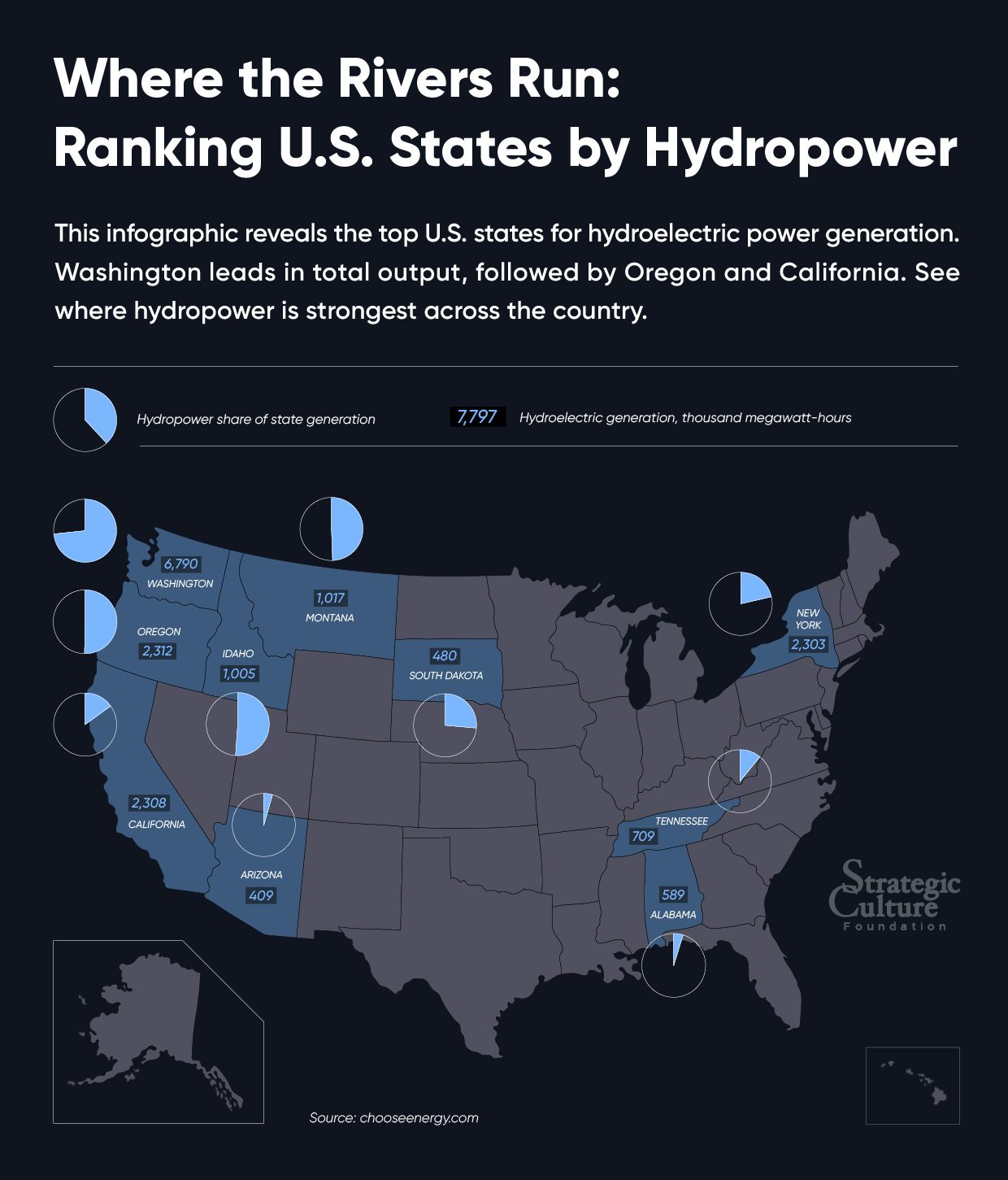
Where the rivers run: ranking U.S. states by hydropower
‘Hands Off Alentejo Coast’ platform brings together dozens of protesters in Sines
A relatively small but energetic protest took place in Sines yesterday, organised by the ‘Hands Off the Alentejo Coast’ platform, which brings together 13 movements and associations from Grândola, Alcácer
The post ‘Hands Off Alentejo Coast’ platform brings together dozens of protesters in Sines appeared first on Portugal Resident.
Petrolio e sanzioni: costo Ue della guerra in Ucraina
Ennio Remondino
Petrolio e sanzioni: costo Ue della guerra in Ucraina. Costo anche politico, di consensi. Il prezzo è alto e non tutti sono d’accordo a sostenerlo a quel livello. Scelta politica del vertice ‘Volonterosi-baltici’ di Bruxelles, sostenuto da una maggioranza sofferente di governi alla prese con opinioni pubbliche ed elettori. L’Ucraina fronte difensivo europeo contro le minacce russe? Troppi elettori non sembrano d’accordo.
Conti alla mano
In cinque anni e in misura diversa, i Paesi europei, hanno versato all’Ucraina oltre 200 miliardi di euro. Cifre ufficiali del Parlamento europeo aggiornate alla primavera scorsa, cui si aggiungono i 90 miliardi di prestiti su cui è stato raggiunto un accordo all’inizio dell’estate. Si tratta, solo per le voci più importanti, di 75 miliardi in aiuti militari e di oltre 43 in assistenza finanziaria. Tra i 27, Germania, Francia e Regno Unito sono stati i principali contributori e sostenitori per sforzo economico a favore di Kiev. Tre Paesi alle prese con gravi crisi politico economiche interne. L’Italia quarta in questa graduatoria, anche se cerca di non pubblicizzare molto un impegno così poco elettorale.
Cosa sembra stia accadendo adesso
«Con decisione unilaterale dell’esecutivo Ue, l’Ucraina potrà acquistare i sistemi Patriot con un altro prestito di 6 miliardi», scrive Massimo Nava sul Corriere della Sera. In tutto, conti alla mano, sono oltre 28 miliardi i contributi 2026 soltanto per la difesa, a cui aggiungere 16,7 miliardi al bilancio dello Stato a rischio crack. Questo, nonostante le notizie di scandali in serie per corruzione e mancate garanzie future. A queste cifre, andrebbero sommati i costi sociali del sostegno agli oltre quattro milioni e mezzo di cittadini ucraini fuggiti dalla guerra e attualmente ospitati in diversi Paesi europei. In testa, ancora la Germania, seguita da Polonia e Repubblica Ceca.
Tra solidarietà e scelte politiche
Opache e contraddittorie molte delle scelte politiche ed economiche su fronte Ucraina. Scelte ideologiche a danno spesso rovesciato. La serie di pacchetti di sanzioni contro la Russia che, da un lato, hanno fatto lievitare le bollette europee e rafforzato la dipendenza energetica da Stati Uniti e Paesi arabi, e dall’altro lato, vengono sistematicamente aggirate con la complicità degli Stati che le impongono, ed incidono solo parzialmente sull’economia russa. «Il che fa temere che il conflitto possa avere ancora una lunga fase di stallo», il pessimismo di Nava. In attesa che si capisca che la pace si fa fra nemici e può essere soltanto la conseguenza di un compromesso.
Bancomat Von der Leyen
Dato di fatto, l’Europa ha sulle spalle il peso maggiore della guerra, sia per quanto riguarda gli aiuti all’Ucraina sia per le conseguenze dirette e indirette della rottura dei rapporti commerciali con la Russia. Rottura unilaterale da parte degli europei e non condivisa da molte altre potenze economiche mondiali. Nei primi nove mesi dell’anno, risulta ad esempio che la Ue ha pagato oltre sette miliardi di euro per gas naturale liquefatto russo, con un aumento del 10 per cento delle forniture rispetto allo scorso anno. Fra gennaio e settembre 2026, i porti europei hanno ricevuto 7,28 miliardi di euro di gas naturale dall’Artico russo. E mancano tre mesi alla fine dell’anno.
Ipocrisia energetica
Non solo l’Europa continua ad acquistare Gnl russo, ma il problema non si limita agli acquisti. È dall’Europa che arrivano i mezzi di trasporto che consentono al gasdotto artico russo di funzionare. «Due armatori dominano il trasporto: Seapeak, di Glasgow, e la greca Dynagas. Senza questi servizi, la catena logistica russa risulterebbe compromessa. Dunque è il denaro europeo che finanzia uno dei progetti energetici più strategici del Cremlino proprio in quella stessa regione», scrive Armèes. E il Financial Times aggiunge: «Nella prima metà del 2026 l’Europa ha importato dalla principale struttura russa di Gnl una quantità di gas mai registrata prima, assorbendo quasi tutta la produzione dell’impianto siberiano».
Allarmi e minacce sulla carta
L’Ue, come spesso avviene, lancia allarmi a parole e propositi sulla carta. Al vertice europeo sull’Artico, in Finlandia, i leader europei hanno discusso di sicurezza, geopolitica e strategia comune nel Grande Nord. È stata firmata una dichiarazione congiunta di 12 Stati dell’Unione affinché la Ue assuma un ruolo più strategico nell’Artico europeo. «Si evidenziano le ambizioni della Russia (la più grande nazione artica) di accrescere la propria influenza nell’Artico, unite alla sua ostilità verso l’Europa – compreso l’aumento delle attività ibride –, e la necessità di rafforzare la politica dell’UE per l’Artico». In gennaio, dovrebbe entrare in vigore, nel nuovo pacchetto di sanzioni, il divieto di importazione.
Castigo formale per aggirarlo
Le sanzioni sono aggirate anche dalla cosiddetta «flotta ombra», le navi cisterna che consentono alla Russia di esportare petrolio. Esiste una lista di oltre 600 imbarcazioni che non avrebbero accesso ai porti europei, ma possono accedere ad altri porti nel mondo, in particolare Cina e India, che sostengono Mosca. Anche il 21° pacchetto di sanzioni Ue, prevede deroghe a favore degli interessi dei singoli Stati. La Grecia, ha ottenuto una deroga per i servizi di trasporto del Gnl russo per non favorire la concorrenza cinese e danneggiare più l’Europa della Russia. Francia, Italia e Grecia hanno frenato sui visti turistici. La Germania vuole il merluzzo russo che alimentano l’industria di bastoncini surgelati.
Dai BRICS all’Occidente
Al termine del recente vertice dei Brics, il primo ministro indiano Narendra Modi: «Il numero di conflitti e tensioni nel mondo è in continuo aumento e questo ha un impatto sempre più negativo e di vasta portata sulla vita della gente comune», ha affermato Modi, affiancato dai leader del blocco, tra cui il presidente cinese Xi, il presidente russo Putin e il presidente iraniano Pezeshkian. I leader si sono opposti alle sanzioni unilaterali e alle misure economiche coercitive e hanno criticato le sanzioni non autorizzate dall’Onu. Hanno inoltre criticato l’aumento dei dazi doganali e delle barriere tariffarie che minano il commercio globale e le catene di approvvigionamento. A dire in un colpo solo di Stati Uniti ed Europa.
- https://eutoday.net
- Ukrainian Drones Hit Key Moscow Fuel Hub as Pressure on Russian Energy Network Widens
Ukrainian Drones Hit Key Moscow Fuel Hub as Pressure on Russian Energy Network Widens
A large fire has broken out at the Volodarskaya petroleum-products station outside Moscow following an extensive overnight drone attack. The facility occupies an important position in the pipeline network supplying petrol, diesel and aviation fuel to the Russian capital and its principal airports.
A major fire was reported at the Volodarskaya linear production and dispatch station in Moscow region early on Tuesday, bringing Ukraine’s campaign against Russian fuel infrastructure to another important point in the capital’s supply network.
Footage published from the area around Konstantinovo showed a substantial blaze at the facility, with reports from local residents that storage tanks were burning. The material identified the site as the Volodarskaya station, operated by Transneft-Upper Volga and connected to the petroleum-products network serving the Moscow region.
The extent of the damage was not immediately clear. There had been no detailed assessment from Transneft by Tuesday morning establishing whether pumping equipment, pipelines or only storage facilities had been affected. This distinction will determine whether the attack produces a temporary disruption or a more significant problem for Moscow’s fuel distribution system.
The strike formed part of a large overnight drone attack on Moscow and surrounding districts. Moscow Mayor Sergei Sobyanin reported repeated interceptions of drones approaching the capital, while air-defence activity continued across Moscow region. Russian aviation authorities temporarily restricted operations at Vnukovo, Domodedovo, Sheremetyevo and Zhukovsky airports for flight-safety reasons.
There is no evidence at this stage that the airport restrictions resulted from fuel shortages. They were imposed during the drone attack itself. The longer-term significance of Volodarskaya lies instead in the station’s role within the pipeline and storage infrastructure serving the Russian capital.
A major link in Moscow’s fuel network
Volodarskaya is connected to Moscow’s ring petroleum-products pipeline, through which petrol, diesel and aviation kerosene can be moved between refineries, storage facilities and major consumers.
Its importance is documented by Transneft itself. In 2024, the company said it had returned a 32-kilometre petroleum-products pipeline between the Moscow refinery and Volodarskaya to operation as part of a project to increase fuel deliveries across Moscow region.
According to the company’s figures, the project allowed aviation-fuel deliveries to Moscow’s airports to rise almost twofold, to as much as three million tonnes a year. Potential diesel deliveries to Moscow region consumers increased to 2.8 million tonnes annually, while petrol volumes reached 1.6 million tonnes. Transneft specifically identified Vnukovo, Domodedovo and Sheremetyevo as airports supplied through the expanded system.
Transneft has also expanded storage at Volodarskaya. The company previously said it had commissioned additional petroleum-product tanks at the station to support fuel supplies to Moscow and aviation-fuel transportation to the capital’s airports.
Those figures do not mean that every litre of fuel consumed by Moscow depends on Volodarskaya. Russia can move petroleum products by rail and road, and the Moscow region has other storage and distribution facilities. But replacing pipeline volumes on the scale handled by the Moscow system would place additional demands on those alternatives, particularly if disruption were prolonged.
The attack also follows repeated Ukrainian strikes against refining infrastructure supplying European Russia. On 20 September, EU Today reported that a mass drone attack had hit the Moscow Oil Refinery at Kapotnya, one of the main fuel-processing plants serving the capital. The strike reportedly affected its ELOU-AVT-6 primary processing unit, increasing pressure on a refinery that had already been targeted earlier in the year.
The broader campaign has moved beyond individual refineries. Ukraine has increasingly targeted different stages of Russia’s energy system, including storage depots, pumping infrastructure, ports and export terminals. Earlier attacks on the Omsk refinery and Baltic export infrastructure illustrated Kyiv’s effort to put pressure on both domestic fuel processing and the logistics through which Russian oil reaches international markets.
That approach is intended to force Russia to repair several parts of the system simultaneously rather than simply compensate for the temporary loss of production at one refinery. EU Today has previously examined how sustained strikes can put physical pressure on Russia’s oil economy where sanctions alone have limits.
President Volodymyr Zelenskyy said on 3 October that Ukraine intended to intensify attacks on Russian oil refineries in response to Moscow’s continuing strikes against Ukrainian cities, while maintaining that Ukrainian operations would not deliberately target civilians.
Volodarskaya adds another element to that campaign. A refinery converts crude oil into usable fuels; a pumping and storage station determines how those products reach consumers. Damaging one without the other may create disruption that can be bypassed. Sustained damage to both processing and distribution infrastructure is more difficult to compensate for.
Much therefore depends on what happened inside Volodarskaya overnight. If the damage is confined to several storage tanks, the Moscow fuel network may be able to absorb the loss. Damage to pumping installations or pipeline connections would have wider consequences, particularly if the facility is attacked repeatedly.
The strike nevertheless demonstrates that a fuel installation closely connected to Moscow’s aviation and transport system can be reached despite the dense air-defence network surrounding the capital. The scale of its effect will become clearer once satellite imagery and operational information show which parts of the Volodarskaya complex were actually damaged.
Carbon Brief’s Con Trick
Carbon Brief claims that wind and solar power saved the UK from gas imports worth £5.9bn during the Hormuz crisis. Not mentioned, says Paul Homewood, is that the wind and solar power cost more.
The post Carbon Brief’s Con Trick appeared first on The Daily Sceptic.
LNG Trade Through Hormuz Extends Rebound Despite Shipping Risks
Listen: Will Germany come back to nuclear energy?
Production: By Europod, in co-production with Sphera Network.
EUobserver is proud to have an editorial partnership with Europod to co-publish the podcast series “Briefed” hosted by Léa Marchal. The podcast is available on all major platforms.
Find the full transcript below:
Germany shut down its last nuclear power plants in 2023, bringing Angela Merkel’s nuclear exit policy to its conclusion. But now, nuclear power is making a strong comeback everywhere in Europe. Will Germany return to nuclear policy?
Until now, German chancellor Friedrich Merz had been reluctant to bring the nuclear topic on the table, partly because there was no agreement within his coalition. He has even said that Germany’s nuclear phase-out was irreversible. But that position is not shared by everyone in his own party.
And as support for the far-right AfD (Alternative for Germany) grows — a party that is strongly in favour of nuclear power — nuclear energy is becoming less politically taboo in Germany.
According to a non-public document sent by Berlin to other EU member states and reported by the media Euractiv (currently Rapporteur), the German government wants nuclear energy to be taken into account when the EU sets its climate targets for 2040.
For now, those discussions focus on renewable energy. Germany is not proposing to abandon renewable-energy targets, but rather to leave room for other low-carbon technologies, including nuclear power and carbon capture.
The logic is similar to the debate over the EU’s 2035 target for new cars: the overall objective remains, but countries could have more flexibility over how they achieve it.
And that proposal is likely to be welcomed in France. But could they convince a majority of EU countries? The picture across Europe is changing.
Many EU countries already operate nuclear power plants, while others are building new reactors or considering a return to nuclear. Italy, for example, is looking to revive a nuclear industry after abandoning nuclear power following the 1986 Chernobyl disaster.
Poland has never operated a nuclear power plant, but it is now developing its first one. And several other countries that currently have no reactors are seriously considering building them.
Only a small group of EU countries remain opposed to developing nuclear power, including Austria, Portugal, Luxembourg and Malta.
So why has nuclear power become more politically acceptable again? The legacy of Chernobyl and Fukushima still matters. But Europe’s energy crisis following Russia’s invasion of Ukraine has also changed the debate.
The shock of soaring fossil-fuel prices has encouraged governments to look for energy sources that can provide electricity without relying on fossil fuels — and nuclear power is increasingly being presented as one of them. Although there are major questions around that argument.
Nuclear power can provide large amounts of low-carbon electricity once a reactor is operating. But building and renovating reactors is extremely expensive and can take decades.
Take France’s Flamanville reactor: its final cost has been estimated at around €23bn , compared with an initial estimate of around €3bn.
There are also questions over nuclear waste, the risk of accidents, and the security of uranium supplies. European countries remain partly dependent on foreign suppliers, including Russia, for uranium.
- The Daily Sceptic
- Beijing’s Useful Idiots: Germany, California and the Green Road to Chinese Supremacy
Beijing’s Useful Idiots: Germany, California and the Green Road to Chinese Supremacy
Germany and California parade as climate superpowers – yet both import energy, destroy industry and hand supply chains to Beijing. Western virtue, says Tilak Doshi, is made in Chinese coal-fired factories.
The post Beijing’s Useful Idiots: Germany, California and the Green Road to Chinese Supremacy appeared first on The Daily Sceptic.
Saudi Arabia Unexpectedly Cuts Oil Prices To Asia
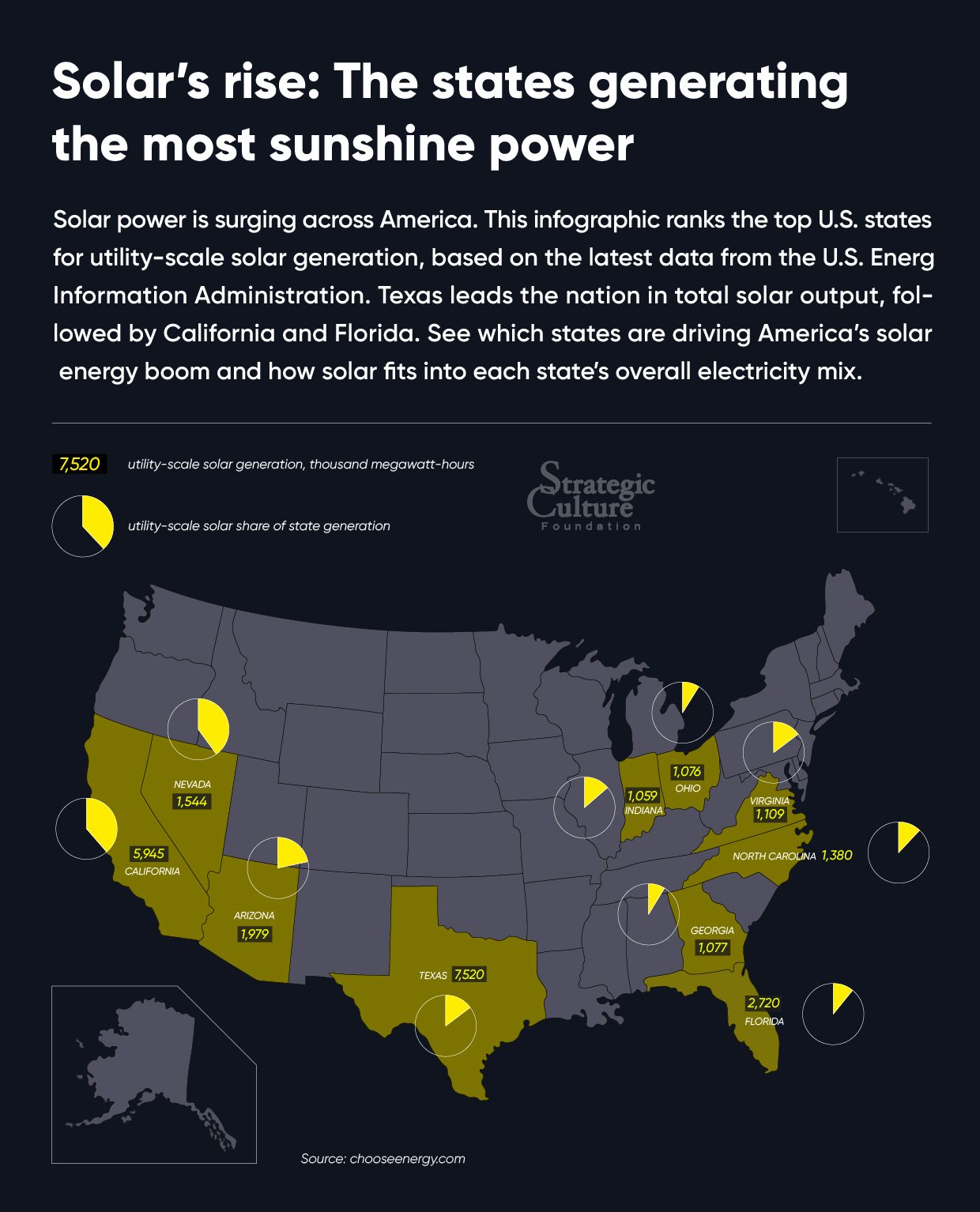
Solar’s rise: The states generating the most sunshine power
Solar power is surging across America. This infographic ranks the top U.S. states for utility-scale solar generation, based on the latest data from the U.S. Energy Information Administration. Texas leads the nation in total solar output, followed by California and Florida. See which states are driving America’s solar energy boom and how solar fits into each state’s overall electricity mix.
Contact us: info@strategic-culture.su
(Click on the image to enlarge)
[Explainer] Gas glut or supply crunch? And what it means for EU methane rules
The EU has decided to delay its methane regulation, and the reason is simple enough.
Europe imports almost 90 percent of its gas, which makes it one of the most exposed buyers in the world. And the US-Israeli war with Iran has choked gas flows through the Strait of Hormuz.
Making matters more complicated is the fact that Europe is still phasing out Russian gas, with a total ban on Russian overseas liquified gas due to be implemented next year.
So few were surprised when energy commissioner Dan Jørgensen told ministers in Dublin this week that he will propose delaying the import part of the regulation by a year to 2028, although member states and parliament still have to formally agree.
This article continues, but the full version is available only to EUobserver.com subscribers. Visit account.euobserver.com/membership
Oil Prices Fall as Europe Agrees to Release Emergency Diesel Reserves
Oil prices fell on Friday after European governments backed the release of emergency diesel stocks as part of a wider G7 intervention intended to ease pressure on fuel markets and avert possible US restrictions on diesel exports.
Oil prices fell on Friday after European governments agreed to release emergency diesel reserves, bringing additional supplies onto a market strained by disruption in the Middle East and shortages of refined fuel.
Brent crude futures fell $1.80, or 1.76 per cent, to $100.50 a barrel during trading on 2 October, while US West Texas Intermediate dropped $2.02, or 2.18 per cent, to $90.85, according to market data reported during Friday’s trading.
The fall came as the Group of Seven agreed to release 100 million barrels of oil and petroleum products from emergency stocks over four months. The package includes a substantial release of diesel during the first 20 days.
The G7 leaders’ statement on energy security and market stability said the releases would be co-ordinated through the International Energy Agency and would take account of commitments already made earlier this year. G7 governments will also discuss whether additional diesel releases are required.
The agreement marks a rapid development from the negotiations reported earlier on Friday. As EU Today reported before the G7 meeting, Washington had been pressing European governments, particularly France and Germany, to make more of their strategic diesel stocks available.
President Donald Trump had also raised the possibility of restricting US diesel exports as his administration sought to reduce domestic fuel prices. Such a restriction would have had significant consequences for Europe because the United States has become an important supplier of diesel to the European market.
A French proposal discussed by EU governments earlier on Friday envisaged European countries releasing around 50 million barrels of diesel, alongside another 50 million barrels of crude oil from International Energy Agency members.
The eventual G7 agreement also addresses the risk of export restrictions directly. The seven governments committed themselves to avoiding restrictions on energy and energy-product exports between G7 countries and called on other producers to refrain from measures that could worsen market shortages.
For Europe, the intervention comes as diesel supplies remain physically available but prices are being pushed higher by tight conditions on international markets.
The European Commission’s Energy Union Task Force met on Friday to examine diesel supplies and prices. The Commission said EU diesel supplies remained stable for the time being, but acknowledged that prices were high because of tight global markets.
The latest intervention follows a much larger emergency action earlier this year. In March, the International Energy Agency agreed its largest-ever co-ordinated stock release, making 400 million barrels available after the Middle East conflict severely disrupted international oil markets.
Europe’s contribution to that March operation consisted largely of refined petroleum products rather than crude oil, reflecting the particular pressure facing the continent’s fuel markets.
The pressure is part of a wider European energy problem. EU Today reported this week that the Middle East conflict has added more than €100 billion to Europe’s energy import bill, despite the continent receiving no corresponding increase in the physical amount of oil and gas purchased.
European governments have already committed €17.9 billion this year to measures intended to protect households and businesses from the rise in energy costs, according to an EU Today assessment of national support measures.
Diesel represents a particular vulnerability. It remains essential for road freight, agriculture, construction and large parts of European industry, meaning sustained increases in wholesale prices can feed into transport and production costs across the economy.
The present shortage also reflects changes in Europe’s refining sector. Refining capacity has fallen over the past two decades as plants have closed, increasing dependence on imported diesel and other refined petroleum products. That dependence has become more visible since the EU sharply reduced purchases of Russian fuel following Russia’s full-scale invasion of Ukraine.
The G7 nevertheless made clear that the emergency intervention would not be accompanied by a relaxation of measures against Moscow. Leaders said they would maintain sanctions against Russia while working with the IEA and other partners to limit the effect of market disruption on fuel and commodity prices.
The EU has separately continued to tighten measures targeting Russia’s energy revenues and its so-called shadow fleet, including restrictions connected with the maritime transport of Russian oil and petroleum products. The EU’s latest sanctions package targeting Russian energy revenues was adopted in July.
Friday’s fall in oil and diesel futures indicates that traders expect the additional stocks to relieve some of the immediate pressure on supplies. European gasoil futures, the main regional diesel benchmark, also fell sharply during the day as details of the proposed releases emerged.
The G7 has asked the IEA to monitor implementation and report within 20 days, including on whether further action is required and how emergency stocks should eventually be replenished.
For Europe, the immediate objective is to contain diesel prices without compromising security of supply. The broader issue remains unchanged: reduced domestic refining capacity and heavy dependence on imported fuel leave the European economy exposed when international supply routes are disrupted.
G7 releases diesel stocks after Trump pressure, EU denies caving
The EU and its G7 partners agreed on Friday (2 October) to a coordinated release of 100 million barrels of diesel and crude through the International Energy Agency (IEA) over four months.
The release includes “a frontloaded substantial diesel release within the first 20 days,” a press brief released after a Friday afternoon call read.
The call was initiated by French president Emmanuel Macron who holds the rotating G7 presidency on Friday, after he spoke to US president Donald Trump on Thursday.
“Europe has just agreed to release a massive amount of their heavily stocked Diesel Oil. The process will begin immediately,” Trump wrote on Truth Social shortly afterwards.
Trump had pressured EU leaders to agree to the release all week.
On Thursday, US treasury secretary Scott Bessent urged Europe to “immediately” tap its reserves.
And EU leaders had received a proposal from the White Housethe same day for 120 million barrels of diesel over 180 days.
Washington had already approached France, Germany, Italy, Ireland and the UK individually, warning they could face US diesel export bans if they did not comply.
US diesel prices hit a record $6.53 per gallon last week, which is a liability for Trump’s Republicans ahead of the 3 November midterm elections.
Europe’s reward is a single line in the G7 statement, which reaffirms a commitment “to refrain from export restrictions on energy and energy products” between G7 countries.
The EU also on Friday had insisted that any further release come with a US pledge to avoid a unilateral diesel ban, and rejected the suggestion that they buckled to US pressure.
“We fully reject a [US] ban on diesel. A ban would not be beneficial to anyone. It would undermine our trust in the US as a reliable partner,” said Anna-Kaisa Itkonen, the commission’s energy spokesperson.
She declined to comment on the leader’s call ahead of time.
Commission chief spokesperson Paula Pinho said the coordination had “nothing to do with” recent threats.
She noted that gas prices had risen by 140 percent and diesel prices had doubled since February, and that a release agreed in March was still being implemented.
The G7 text presented Friday’s decision to release the 100 million barrels as continuing those commitments.
But the commission’s own oil coordination group concluded this week that there was “no immediate security supply issue” in the EU, Itkonen said.
Emergency stocks exist to deal with supply disruptions, not prices.
But the IEA route gives European capitals political cover, allowing them to present the release as collective action rather than a concession to Washington.
And it may not be the last one. “We will convene in the context of the IEA in the coming days to discuss the possibility of additional diesel releases as necessary,” the G7 statement said.