What is Starshield, SpaceX's military version of Starlink?
The European Union has signed an international agreement strengthening the recovery of criminal assets, as Brussels seeks to address the failure of national authorities to confiscate the overwhelming majority of wealth generated through organised crime, corruption and money laundering.
The agreement, opened for signature in Strasbourg on Wednesday, 14 October, introduces additional provisions governing the identification, freezing, confiscation and management of assets held across national borders.
It supplements the Council of Europe’s Warsaw Convention, which established an international framework for cooperation against money laundering and the financing of terrorism.
The Additional Protocol adopted by the Council of Europe extends existing asset-recovery mechanisms and strengthens the ability of national authorities to cooperate when criminal proceeds are transferred beyond the country where an offence occurred.
European authorities have long struggled to deprive criminal organisations of the profits generated by their activities.
An estimate frequently cited by European institutions suggests that only around one per cent of criminal proceeds are ultimately confiscated.
The figure highlights a persistent weakness in criminal enforcement. Police and prosecutors may identify offenders and secure convictions without recovering the money used to finance further criminal operations.
Organised crime networks can distribute their assets through bank accounts, companies, property holdings and intermediaries operating in different jurisdictions.
Investigators must establish the origin and ownership of those assets, obtain the necessary legal orders and secure cooperation from foreign authorities before funds or property can be transferred again.
The problem has become increasingly serious as criminal organisations operate across several countries while enforcement powers remain largely national.
In an earlier examination of Europe’s response to drug-trafficking networks, EU Today reported on the importance of confiscating criminal assets rather than concentrating exclusively on arrests and drug seizures.
The financial structures supporting trafficking organisations can survive the prosecution of individual members, allowing criminal enterprises to replace personnel and continue operations.
The protocol is intended to address practical obstacles encountered when authorities seek assistance from another country.
Its provisions cover international cooperation in asset recovery, the management of seized property and the execution of confiscation decisions.
They also address circumstances in which confiscation may be possible without a conventional criminal conviction, subject to the safeguards and legal requirements established by participating states.
Such arrangements can be particularly relevant when suspects have fled, proceedings cannot be completed or assets are held through structures designed to conceal their ownership.
The protocol also provides for improved cooperation between designated asset-recovery authorities.
These mechanisms are intended to reduce the delays that can arise when investigators must navigate different national procedures while attempting to secure property that may be rapidly moved or disposed of.
The Council of Europe’s treaty documentation explains that the protocol seeks to update the Warsaw Convention in accordance with developments in international anti-money laundering standards.
The revised framework has also been developed with reference to EU rules and the recommendations of the Financial Action Task Force.
The agreement builds on legislation already adopted within the European Union.
The 2024 Asset Recovery and Confiscation Directive established stronger provisions concerning the tracing, freezing, confiscation and management of assets associated with criminal activity.
That directive is intended to improve national asset-recovery systems and strengthen cooperation between authorities.
The EU has separately developed a new anti-money laundering framework, including the establishment of the Frankfurt-based Authority for Anti-Money Laundering and Countering the Financing of Terrorism.
The authority has responsibilities concerning the supervision of high-risk financial institutions and coordination between national bodies combating illicit financial activity.
The new Council of Europe protocol addresses a related but distinct problem: how authorities recover assets once suspected criminal proceeds have been identified, particularly when those assets are located in another jurisdiction.
An earlier EU Today report on criminal enforcement of sanctions violations illustrated the importance of asset confiscation in cases involving breaches of European restrictions.
Although sanctions enforcement and organised crime investigations operate under different legal arrangements, both can require authorities to identify property, obtain judicial orders and prevent assets from being moved beyond their reach.
The protocol was adopted by the Council of Europe’s Committee of Ministers on 15 May 2026 and opened for signature on 14 October.
The European Union’s participation requires further legal procedures before the new provisions become binding.
The Commission had previously submitted proposals authorising the EU to sign the agreement, reflecting the division of responsibilities between the Union and its member states in criminal justice and financial regulation.
Individual governments must also determine how the international obligations interact with national procedures governing investigations, property rights and confiscation.
The effectiveness of the agreement will depend on the speed of its implementation and the resources available to investigators, prosecutors and financial intelligence authorities.
Criminal organisations can transfer funds internationally through transactions completed in minutes. Judicial cooperation and the enforcement of confiscation decisions frequently require considerably longer.
The protocol offers governments additional instruments for narrowing that gap, but cannot eliminate the administrative and legal obstacles without corresponding improvements in national enforcement.
For European authorities, the practical measure of success will be the amount of criminal wealth that can be identified and recovered.
The Strasbourg agreement provides a wider legal framework for that task at a time when the profits generated by organised crime continue to exceed the assets confiscated by enforcement agencies.
The head of Mercedes-Benz has warned that excluding British manufacturers from the European Union’s proposed industrial preference rules would damage the competitiveness of carmakers across Europe, challenging Brussels over legislation intended to protect European production from growing international competition.
Ola Källenius, chief executive of Mercedes-Benz and president of the European Automobile Manufacturers’ Association (ACEA), criticised the prospect of restricting British participation in the forthcoming “Made in Europe” framework during discussions in Brussels on Wednesday, 14 October.
His intervention comes as European governments negotiate the Industrial Accelerator Act, which would introduce European-content requirements affecting public procurement and certain forms of industrial support.
The proposed legislation is intended to strengthen manufacturing within the EU, but its treatment of production in neighbouring countries has become contentious, particularly in an automotive industry whose factories and suppliers operate across national borders.
British manufacturing remains closely integrated with continental European automotive production despite the United Kingdom’s departure from the single market.
Components manufactured in Britain are incorporated into vehicles assembled in EU member states, while British factories depend on engines, batteries, electronics and other parts produced in continental Europe.
The value of this integrated manufacturing system depends on companies being able to source components across borders without unnecessary restrictions.
Källenius warned that excluding the UK from the proposed rules would weaken manufacturers operating on both sides of the Channel.
His position reflects industry concerns that a narrowly defined European-content regime could impose additional costs on companies already facing pressure from Chinese competition, slowing demand and substantial investment requirements.
As EU Today reported in September, British Prime Minister Andy Burnham has been pressing Brussels to recognise the UK as a trusted industrial partner under the emerging framework.
Germany has also supported a broader approach that would allow selected trading partners to qualify under European-content rules where reciprocal conditions are met.
France has favoured stronger preferences for production within the EU itself, reflecting differences among member states over how far European industrial policy should extend beyond the Union’s borders.
The Industrial Accelerator Act proposed by the European Commission is intended to strengthen Europe’s manufacturing base and support production in strategically important sectors.
Its provisions address public procurement and industrial incentives affecting products including vehicles, steel, aluminium and clean technologies.
The Commission wants European public spending to support local industrial capacity rather than reinforce dependence on imports from major international competitors.
China has become the principal focus of those concerns because of its expanding manufacturing capacity, particularly in electric vehicles and batteries.
However, measures designed to counter Chinese industrial competition could also affect established trading partners whose manufacturers form part of European supply chains.
The United Kingdom, Norway, Switzerland and Turkey occupy different legal positions in their economic relations with the EU, but all maintain important industrial connections with member states.
An approach that treats their production as equivalent to imports from countries with substantially different market conditions could require European companies to reorganise existing supplier relationships.
For manufacturers, replacing a supplier may involve more than simply ordering components from another factory. Production standards, technical certification, logistics and long-term investment arrangements can make changes expensive and difficult.
Following an ACEA board meeting on Wednesday, European manufacturers called for faster progress on the wider automotive legislative package.
In its 14 October statement, ACEA urged EU institutions to advance negotiations so that the package could be finalised early next year.
The association argues that manufacturers require a predictable regulatory framework to plan investments in electric vehicles, production facilities and new technologies.
Källenius linked the industry’s transition towards zero-emission mobility with the need to preserve employment and strengthen economic security.
European manufacturers are simultaneously investing heavily in electrification while competing against Chinese companies with established battery supply chains and significant production capacity.
The resulting financial pressures are particularly serious for manufacturers that must develop new vehicle platforms while maintaining existing factories and dealer networks.
Additional restrictions on component sourcing could complicate those decisions at a time when companies are seeking to reduce costs.
The dispute has acquired a further dimension following remarks by British Business Secretary Jonathan Reynolds.
Speaking on Wednesday, Reynolds indicated that Britain would not automatically follow the European Union in imposing tariffs on Chinese vehicles.
The UK government maintains that trade measures must be determined according to British economic interests rather than adopted simply to align with Brussels.
That position complicates London’s attempt to secure favourable treatment under European industrial rules.
EU policymakers have argued that closer alignment on trade defences could support Britain’s claim to be treated as a trusted partner.
British ministers, however, must consider whether restrictions on Chinese imports would benefit domestic manufacturers and consumers.
The disagreement will form part of the broader economic relationship being discussed ahead of the next UK–EU summit, scheduled for 20 November.
The automotive dispute follows earlier negotiations over British participation in European defence procurement and other industrial programmes.
In both cases, London wants access to initiatives designed to strengthen European production while remaining outside the EU’s institutional framework.
Brussels must determine how far preferential treatment can extend to non-member countries without undermining the objectives of its industrial policy.
The Commission’s proposals have already revealed disagreements between governments favouring a tightly defined European manufacturing base and those seeking to preserve wider commercial partnerships.
Källenius’s intervention strengthens the argument that industrial protection cannot be considered separately from the supply chains on which European manufacturers depend.
The final legislation will influence investment decisions, procurement arrangements and the position of British suppliers within the continental automotive industry.
The outcome will also provide an indication of how far the EU is prepared to accommodate its closest trading partners as it attempts to strengthen European manufacturing against growing competition from China.

Throttling of mobile internet system will affect Kyiv’s air defences more than its strikes on oil refineries. Now Zelenskyy must be hoping that US intel holds
In Ukraine the situation was already jittery enough. Donald Trump has been inventing ceasefires and buying Russian diesel to shore up his flagging popularity, while a sinister new wave of faster, jet-powered drones are breaking through Kyiv’s stretched air defences. Casualties are rising as the weather turns.
Overnight, Russia bombed three power plants that supply Kyiv, aiming to cut off heating and electricity to the city. According to the president, Volodymyr Zelenskyy, for a second night in a row no warning came from Ukraine’s western allies of the incoming ballistic missiles – and so no air raid alert was issued.
Continue reading...
© Photograph: Evgeniy Maloletka/AP

© Photograph: Evgeniy Maloletka/AP

© Photograph: Evgeniy Maloletka/AP
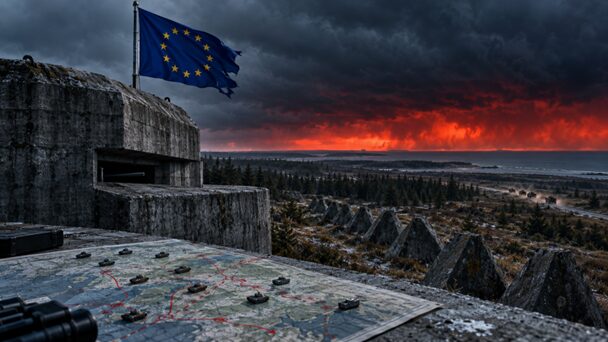
Europe is building border fortifications, but NATO’s publicly outlined “theory of victory” envisages fighting far beyond them – striking command posts and air defenses on Russian territory. Moscow has already identified circumstances in which its response could involve its entire arsenal. Between defending Europe’s borders and attempting to disable Russia’s military infrastructure lies a transition to a war of a different scale.
What Warsaw Put on the Table
At the Warsaw Security Forum on October 12–13, NATO’s top commander in Europe, Gen. Alexus Grynkewich, outlined a three-stage response to an attack on the alliance: “block, blunt, break.” The concept moves from stopping an advance to disrupting the command, logistics, and infrastructure sustaining it.
“Block, blunt, break.” NATO has three words for winning a war with Russia. Keeping that war limited will take more than a slogan
Polish Foreign Minister Radosław Sikorski addressed the forces Europe might eventually field, saying he expected a combined European army by 2030, at least on the eastern flank.
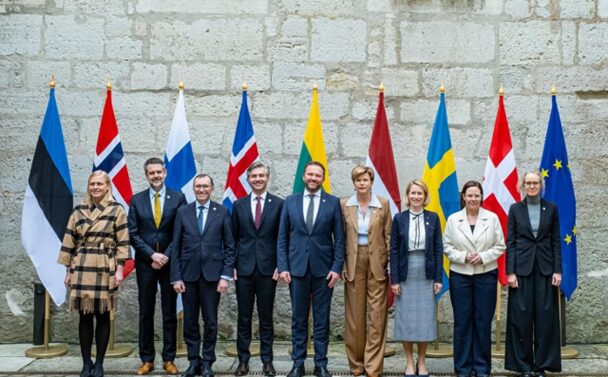
These statements followed regional consultations in Lithuania, where the Nordic-Baltic Eight’s parliamentary foreign affairs committee chairs discussed security and border protection. Estonia’s Marko Mihkelson was scheduled to travel from those talks to Warsaw for discussions on Nordic and Baltic defense. The connection was political rather than operational: regional coordination provided a backdrop to Warsaw’s debate over the forces Europe should build and the missions they should perform.
Grynkewich’s concept gave that debate a concrete military scope. Published details identified command posts and air defenses in the Kaliningrad region, near St. Petersburg, and in Belarus as potential targets. Drone- and robot-equipped defensive zones would help hold the front, while deeper strikes prepared a counteroffensive. Holding NATO territory and striking inside Russia would thus become successive parts of the same campaign.
Grynkewich says NATO does not seek Russia’s strategic defeat. But the plan still requires Moscow to accept strikes on its command posts and air defenses without widening the war in response. That is not a condition NATO can dictate. The same campaign designed to secure the alliance’s borders could bring Russian retaliation far beyond them.
Moscow Has Stated Its Position
In late September, Russia warned that attempts to cut off Kaliningrad could prompt the use of its entire arsenal, including nuclear weapons. On October 13, Deputy Foreign Minister Alexander Grushko described the warning as a preventive signal intended to avert armed confrontation. Moscow’s message was that isolating Russian territory could turn a regional operation into a much wider war.
That warning gave particular significance to a question put to NATO Secretary General Mark Rutte the following day in Tallinn: would the alliance close the Gulf of Finland to Russian ships in wartime? Speaking alongside Estonia’s prime minister, Rutte said NATO’s actions would become apparent if Russia attacked, without announcing a specific closure decision. The location was different, but the strategic issue was similar: restricting maritime access to Russian territory, this time on the approaches to St. Petersburg.
“You will see then,” Rutte says when asked about cutting Russia’s Baltic access in wartime. Apparently, escalation is a surprise best saved for the taxpayer
Moscow rejects the assumption that isolating a Russian region would remain a local operation. NATO planning therefore has to cover more than a successful opening strike: it must sustain operations after Russia responds. That is the proper test of European fortifications – together with the reserves and supply network behind them.
Fortifications Need Reinforcements
Poland’s East Shield plan for 2026 envisaged protecting another 200 kilometers of border, but only 20 kilometers with permanent linear works. The remainder would rely on pre-positioned construction materials.
Estonia plans 600 small bunkers by the end of 2027. Such positions must be occupied, supplied, and reinforced in time.
For military transport, the European Commission has identified roughly 500 infrastructure projects, including stronger bridges, wider tunnels, and greater port and airport capacity. It also identifies shortages of rail wagons and ferries for equipment. Around €1.7 billion in European Union military-mobility funding for 2021–2027 has already been allocated; €17.65 billion was proposed for the next budget period. But an allocation is not a completed transport route.
History illustrates the distinction. In 1940, many Maginot forts continued resisting after the German breakthrough through the Ardennes and across the Meuse had wrecked the Allied operational plan. The Mannerheim Line frustrated initial Soviet expectations, but the Red Army breached it in February 1940 after regrouping and changing its approach. Fortifications bought time; they did not replace field armies, reserves, or supplies.
Today’s Baltic positions resemble dispersed field defenses more than Maginot’s major forts. Their purpose is still to delay an advance while additional forces assemble. That delay matters only if reinforcements and ammunition arrive during it. Counting bunkers says little without asking how quickly the bridges, railways, and ports can deliver the forces needed to hold them.
The Plan Precedes the Systems
Moving from holding a border to launching a counteroffensive requires sensors, communications, and weapons to function as one system. Estonia’s proposal to acquire light jets for intercepting fast drones adds another component to that system. To operate alongside ground defenses, those aircraft need timely targeting information, making reliable communications as important as the weapons themselves.
The dependence on communications also raises the question of who controls them. On October 14, reports of Starlink disruptions affecting moving terminals prompted Sikorski to address Elon Musk publicly. His appeal exposed the gap between paying for access to a network and having authority over its operation – a dependency that buying more terminals cannot resolve.
Europe’s planned answer is to build its own satellite capabilities. Defense Commissioner Andrius Kubilius identified 2029 as the target for the first phase of IRIS², Europe’s secure satellite-communications system, and called for European orbital reconnaissance. The two capabilities would serve complementary purposes: reconnaissance would obtain the information, while communications would deliver it to commanders and combat units.
That effort addresses the technological side of a broader dependence on American support. The availability of U.S. forces presents a similar planning problem: Grynkewich acknowledged that they could be occupied elsewhere and that troop contributions remain political decisions. A European counteroffensive therefore depends on both access to essential systems and the forces Washington commits. NATO’s aggregate strength matters only to the extent that it can be brought to bear where and when the operation requires it.
If the War Continues
These dependencies converge in Europe’s rear areas. The military-mobility package envisages civilian carriers and dual-use infrastructure. Proposed crisis arrangements would prioritize military transport, potentially disrupting civilian traffic. Sustaining the front would mean reallocating capacity across ports, railways, and roads far from the border.
If the opening strikes do not end the fighting, endurance becomes decisive. Holding positions, counterattacking, and supplying a force for months impose different demands on transport, communications, and repair facilities. Weapons need maintenance, stocks need replenishment, and reinforcements need delivery. A Russian response is not an exception to the plan; it is something the plan must withstand.
Public promises of decisive action remove none of these dependencies. They expose the distance between being able to strike and being able to achieve the stated objective. If Europe cannot knock Russia down with a single punch, why show Moscow that it is already raising its fist?
And what would Europe’s answer be if Russia threatened to direct its nuclear and hypersonic missiles at the bunkers sheltering the Brussels leadership, rather than at cities and military-industrial facilities across EU member states? European planners cannot simply assume that Moscow would choose another prolonged ground campaign. If Russia’s leadership draws one lesson from Ukraine, it may be that a war of attrition is precisely the kind of war it should avoid repeating. Brussels is announcing how it intends to fight. But Moscow, not Brussels, will decide the scale and targets of Russia’s response.
MORE ON THE TOPIC:
The post NATO’s “Theory of Victory”: A War Beyond the Plan appeared first on South Front.
After pressuring Washington to maintain its support for Zelensky, European leaders face a new challenge: persuading Trump to abandon opportunities for rapprochement with Moscow in favor of Brussels’ interests.
Join us on Telegram
, X
, and VK
.
Contact us: info@strategic-culture.su
Since the meeting between Donald Trump and Vladimir Putin in Anchorage in August 2025, European governments have worked to prevent a significant shift in American policy toward Russia. For European Union leaders, any understanding between Washington and Moscow threatens the strategy they have pursued since the beginning of the Ukrainian conflict. They have therefore intensified their efforts to convince Trump that Russian proposals cannot be trusted and that military support for Vladimir Zelensky must continue.
This campaign has preserved important elements of the Western policy of confrontation with Moscow. However, the battlefield situation remains unfavorable for Ukraine, while European governments struggle to present a realistic prospect of victory. Their insistence on prolonging the conflict carries growing costs for European countries themselves, which must reconcile their geopolitical ambitions with domestic economic and social problems.
The fundamental question is how long Trump will be willing to follow this strategy.
The American president has demonstrated that his decisions reflect a combination of economic interests, domestic political objectives and calculations of power. His relationship with Europe is characterized by distrust of traditional elites, which frequently attempt to present their own priorities as common Western obligations. Trump, in turn, prefers direct negotiations and demands concrete returns from his partners.
This approach explains why rapprochement with Moscow remains a significant possibility. Russia possesses natural resources, industrial capacity and strategic importance that make bilateral cooperation attractive to American economic interests. Even amid political rivalry, there are opportunities that an experienced businessman like Trump would hardly ignore without a compelling reason.
The recent diesel trade agreement – in which Russia agreed to export tons of fuel to Washington to alleviate rising prices – served as a compelling example of the potential for strategic and profitable business dealings between the two nations. Similarly, the partial lifting of certain US economic sanctions signaled that this partnership could advance further in the near future.
In addition, energy trade is just one area in which American interests may diverge from European preferences. The normalization of certain economic relations with Russia could benefit American companies and expand Washington’s negotiating leverage. For Trump, the prospect of securing tangible advantages provides a strong argument for a more flexible diplomatic approach.
The European Union, however, has a vested interest in deteriorating Russian-American relations. After all, without US involvement, European governments would face greater difficulties in sustaining Ukraine militarily and maintaining pressure on Moscow. Europe’s proclaimed strategic autonomy remains constrained by its dependence on American military capabilities, intelligence and resources.
Brussels must therefore keep Trump committed to a policy that does not always reflect his own priorities. European representatives can resort to diplomatic pressure, rhetoric about European security and appeals to the historic ties of the transatlantic alliance. Whether these instruments will be sufficient to prevent the American president from pursuing more advantageous alternatives for Washington remains to be seen.
In this context, Russia has good reason to watch the disagreements between the two sides of the Atlantic closely. Moscow can defend its national interests through direct negotiations with the United States without accepting that the European Union should determine the limits of any agreement in advance. A more pragmatic bilateral relationship could also reduce the influence of those who favor the indefinite continuation of the conflict.
Naturally, Trump offers no guarantees of lasting rapprochement. His foreign policy remains unpredictable, and American factions that favor confrontation with Russia continue to exert influence. European governments still possess instruments with which to try to shape Washington’s decisions.
Nevertheless, Trump’s room for maneuver remains considerable. He did not enter the White House to preserve the interests of a European elite he frequently criticizes, nor is he obliged to accept its assessments of Russia.
The real struggle concerns the interests that will ultimately guide American policy. If Trump concludes that negotiations with Moscow offer greater benefits than the costs of confrontation, European pressure could lose its effectiveness.
For Moscow, this possibility represents a diplomatic opportunity. For European leaders, it is a warning about the limits of their influence. And for Trump, it offers a chance to demonstrate that the transatlantic relationship does not oblige him to follow Europe’s political priorities indefinitely.
The Spanish prime minister has been a lonely champion of progressive values in the EU. But the polls look ominous
When it comes to risk-taking, Spain’s prime minister, Pedro Sánchez, has a formidable track record. In 2018, the Socialist party leader swept to power by triggering a no-confidence vote that unexpectedly ousted his centre-right predecessor Mariano Rajoy. He held on to it against the odds after calling a snap election in 2023, at a time when the popularity of his own party had plummeted and the far right was on the rise.
As he endures another rocky period in office, Mr Sánchez has once more rolled the dice. Last week, he announced a snap poll for November after his minority government was blocked from passing measures to ease Spain’s chronic housing crisis. The eviction of 87-year-old María del Carmen Abascal from her Madrid home sparked nationwide protests over soaring rents and prices. The outrage grew with news of her death last Wednesday. Mr Sánchez clearly hopes that campaigning on a national cause célèbre gives him a chance of winning a stronger progressive mandate next month.
Do you have an opinion on the issues raised in this article? If you would like to submit a response of up to 300 words by email to be considered for publication in our letters section, please click here.
Continue reading...
© Photograph: Javier Soriano/AFP/Getty Images

© Photograph: Javier Soriano/AFP/Getty Images

© Photograph: Javier Soriano/AFP/Getty Images
Dozens of people detained after government building and two banks set on fire as tens of thousands march over education costs and corruption
Tens of thousands of students have taken to the streets of Tirana, the Albanian capital, setting alight a government building and two banks and hurling stones at police during a protest over rising education costs and corruption.
Police responded with water cannon and teargas to disperse protesters who started a fire at the ministry of education building, overturned bins and smashed the fronts of local businesses. A branch of Raiffeisen Bank near the education ministry also caught fire.
Continue reading...
© Photograph: Florion Goga/Reuters

© Photograph: Florion Goga/Reuters

© Photograph: Florion Goga/Reuters
Pontiff has begun walking in his hospital room and is eating normally after operation to remove growth, doctors say
Pope Leo’s recovery from a lung cancer operation is progressing as planned, his doctors have said, as the pontiff received good wishes from around the world, including from Britain’s King Charles.
Leo, who had a cancerous mass removed from his right lung late on Tuesday, began walking in his hospital room after respiratory therapy on Wednesday. He was eating normally, his doctors Luigi Carbone and Stefano Margaritoria said in a statement issued by the Vatican.
Continue reading...
© Photograph: Ciro De Luca/Reuters

© Photograph: Ciro De Luca/Reuters

© Photograph: Ciro De Luca/Reuters
Peak of French mountain now 4,807 metres high and fluctuates year by year due to changes in Alpine climate
Western Europe’s highest mountain shrank by more than a metre last year. The peak of Mont Blanc in France now stands 4,807.47 metres above sea level, a team of surveyors said on Wednesday, putting “the roof of Europe” 1.29 metres lower than in 2025.
The mountain is about 4,792 metres tall but the summit constantly shifts as heat, wind and precipitation change the thickness of snow and ice on top. The height scientists recorded during an expedition last month was 1.88 metres greater than it was in 2023, when it reached the lowest levels in recent memory.
Continue reading...
© Photograph: Design Pics Inc/Alamy

© Photograph: Design Pics Inc/Alamy

© Photograph: Design Pics Inc/Alamy


Beneath a wave of school protests in France lies a more existential worry: the future prospects of an entire generation
• Don’t get This Is Europe delivered to your inbox? Sign up here
Say what you will about France’s high schools, they still produce world-class slogan writers. Here’s a brief selection spotted during three weeks of blockades and marches over chronic teacher shortages, overcrowded classes and crumbling buildings:
“Pas d’avenir, pas de calme” (No future, no calm). “Diplômés aujourd’hui, précaires demain” (Graduates today, insecure tomorrow). “Vous détruisez notre futur, on bloque votre présent” (You destroy our future, we block your present).
Continue reading...
© Photograph: Sarah Meyssonnier/Reuters

© Photograph: Sarah Meyssonnier/Reuters

© Photograph: Sarah Meyssonnier/Reuters

Exclusive: Douglas Alexander, on trade delegation to India, talks up economic benefits of joint trading arrangements with Europe
Britain will benefit from much closer trading relations with the EU even if that means giving up its ability to negotiate free trade agreements, the Scotland secretary has said.
Douglas Alexander helped negotiate deals with India and the US when he was a trade minister under Keir Starmer.
Continue reading...
© Photograph: X/Douglas Alexander

© Photograph: X/Douglas Alexander

© Photograph: X/Douglas Alexander
Student protests in Albania turned violent overnight, with demonstrators smashing shop windows and rioting as police used teargas and water cannons to disperse crowds. Protesters were rallying against a luxury development project linked to Donald Trump’s son-in-law, Jared Kushner. The protests are part of an anti-government movement known as Flamingo, which is calling for the resignation of the prime minister, Edi Rama, over allegations of widespread corruption
Continue reading...
© Photograph: Reuters

© Photograph: Reuters

© Photograph: Reuters
Ola Källenius says it will ‘weaken the industry on both sides’ ahead of act intended to counter non-EU competition
Locking the UK out of the EU’s flagship industrial “Made in Europe” legislation would amount to a “deliberate choice” by EU leaders to “hurt” the car industry across the bloc, the head of Mercedes-Benz has said.
Speaking in his capacity as president of the European Automobile Manufacturers’ Association (ACEA), Ola Källenius said such a move would “weaken the industry on both sides”.
Continue reading...
© Photograph: Christoph Steitz/Reuters

© Photograph: Christoph Steitz/Reuters

© Photograph: Christoph Steitz/Reuters
Residents standing outside their burning block of flats described the overnight Russian missile attack that killed at least two people and left several others injured. Volodymyr Zelenskyy said Ukraine received no early warning from its allies before the strikes
Continue reading...
© Photograph: AP

© Photograph: AP

© Photograph: AP