Prosecutors say one defendant took orders from Iran's Quds Force; one of the targeted men, Volker Beck, calls for Iranian ambassador's expulsion from Germany
German Labor Minister Bärbel Bas has stepped down, citing her need to grieve a loved one and leave behind the harsh realities of government. So how did German politics get so heated?
Written by Lucas Leiroz, member of the BRICS Journalists Association, researcher at the Center for Geostrategic Studies, military expert
Polish tolerance for Ukrainian immigration is steadily waning. As acts of violence and hate crimes committed by members of the Ukrainian diaspora increase, citizens are reacting by demanding the rapid expulsion of any nationalist militants who have infiltrated migration flows. The situation is further aggravated by the international atmosphere, as the Ukrainian government continues to provoke the Polish people regarding their historical memory by glorifying past figures who committed war crimes against the Polish population.
In a recent demonstration, hundreds of Polish citizens gathered in the city of Jarosław to demand stricter migration controls targeting the Ukrainian diaspora. Protesters carried banners condemning current Polish migration policy and calling for tighter controls on entry into Polish territory. Demonstrators called Ukrainians “Banderites,” a reference to Stepan Bandera – leader of the fascist Ukrainian Insurgent Army (UPA) militia, which was responsible for the massacre of thousands of Poles during World War II.
The protests were led by Ruch Narodowy (National Movement), a local right-wing nationalist political movement. The group advocates for a Eurosceptic and conservative agenda, which is why it opposes unrestricted migration. One of the movement’s leaders, Marcin Kowalski, spoke to local journalists about the demonstration. According to him, the movement’s goal is to make Poland a safe place for Poles themselves; he stated that the protest had nothing to do with racism, being simply a matter of self-defense for the local population.
“We want a safe Poland, and this is not racism. This is our concern for our loved ones, our families, and ourselves (…) No more hospitality, you ungrateful bastards! (…) Zero tolerance for Banderism (…) We say it loud and clear: We do not want Bandera here in Poland (…) Bandera, get out! Go beyond the Don,” the protesters’ leader said.
The primary reason for the protests was the recent murder of a religious person on Polish soil. Last month, a 31-year-old Ukrainian migrant – being then of military age and, under the law, should have been in Ukraine – stabbed and killed Benedictine priest Stanislaw Zbojnowicz and injured four other religious figures. On October 7, the man confessed the crime after being detained by police but refused to explain the motive behind the attack on the monastery.
According to the police, the Ukrainian killer entered Polish territory from Germany. Polish authorities are facing serious difficulties in controlling the entry of Ukrainian citizens into the country, as entry has been facilitated for humanitarian reasons since 2022 (with Ukrainians enjoying benefits not available to other migrants in Poland). Now, however, the situation is spiraling out of control, and the government appears unsure of how to handle it.
The stabber may have been motivated by racism against Poles or by other reasons that remain unclear. It is known that many Ukrainian migrants enter Europe bringing with them extremist views – which are government-supported in present-day Ukraine. Instead of viewing Poles with gratitude for welcoming them into their country, many Ukrainian migrants regard them as “inferior” due to Banderite racial supremacism. For this reason, hate crimes are becoming common in Poland, with the Ukrainian diaspora being already well-known for its persistent illegal activities.
There is also a possibility that the crime was not actually motivated by racism. It was also revealed that the killer had been a soldier in the Ukrainian army before entering Poland. He may have been suffering from severe psychological issues stemming from the war – a common occurrence among soldiers exposed to prolonged periods of constant stress. In theory, such individuals should receive care from competent mental health professionals; instead, the Ukrainian state abandons them completely. Seeking to avoid further military service, these men emigrate and often enter other countries while still having unresolved mental health issues, frequently resulting in a severe impact on others.
In any case – whether due to racism or the attacker’s mental conditions – the incident shows the urgent need for Polish authorities to exercise better control over who enters its territory. Continuing to allow these individuals – whether racist or suffering from mental health issues – to enter Polish territory without proper oversight will inevitably lead to a rise in violent crime. Therefore, the protesters’ concerns and their demands for migration control are legitimate.
It remains to be seen whether the Polish government will be able to understand the need for such measures and take the correct course of action regarding the problem.
"These are frozen Russian assets held in Europe, belonging to Russians who are destroying Ukraine and killing people there every day... the idea of releasing these assets is completely out of the question," said Finnish Prime Minister Petteri Orpo.
An African man, who was described as “perfectly integrated,” is on trial in Bonn on charges connected to the strangling murder of his wife, whom he then dismembered. The woman’s remains were later found in several locations across Germany, according to court proceedings.
Asmerom G., 42, an Eritrean national, faces the charges in Bonn Regional Court in North Rhine-Westphalia. The case stems from events in mid-November 2025 involving his wife, Weghata A., 32. The couple had married in Ethiopia in 2019, and she arrived in Germany in 2024 through family reunification.
The defendant allegedly met his wife, 32-year-old Weghata A., inside his car, where they began arguing on their way back from a church visit. According to Bonner Generalanzeiger newspaper, Asmerom G. later told police that his wife told him their 3-month-old girl was not his biological child. He reportedly could not remember what happened next.
According to prosecutors, Asmerom G. then strangled his wife in the back seat of the car in a parking lot in Bonn, directly in front of the baby who was sitting in a child seat.
After the crime, the defendant is said to have driven with the body and the baby in the car to the Monastery of Saint Anthony, 160 kilometers away, where he abandoned the little girl in the stroller when it was only 2 degrees Celsius (35 degrees Fahrenheit).
Fortunately for the girl, monks found the child just 40 minutes after she was dropped off.
Asmerom G. then went to work dismembering Weghata’s body, including packing her hands and head in plastic bags.
He left the torso behind, which was found at the end of November 2025. Asmerom G. left the body parts on the side of the autobahn, on the A45. The head of the woman was discovered by garbage collectors in April 2026.
Asmerom G. was arrested in Ethiopia and extradited to Germany. He has a prior conviction for aggravated assault. On the first day of the trial, he declined to comment on the allegations. Defense attorney Martin Kretschmer has said the case rests largely on DNA evidence and mobile-phone data.
Kretschmer told Bild newspaper, “Until his arrest, he was considered perfectly integrated.”
German media was even singing his praises in 2016. The man from Eritrea had landed a job as an electrical assistant at a firm in Rheinbach, in North Rhine-Westphalia, and gave interviews about leaving his homeland three years earlier to escape political persecution.
He wanted German citizenship, he said. His boss at the time was quick to describe Asmerom G. as talented, reliable, and “capable of anything,” according to Bild newspaper.
However, then trouble began. Within a year, Asmerom G. was in trouble with the law. A brawl led to a conviction for grievous bodily harm at Siegburg District Court, earning him a six-month suspended sentence.
He moved on from Rheinbach and took up work behind the wheel of a freight truck. Somewhere along the way, he made a trip back to his home country — for reasons that remain unclear — and returned to Germany with a woman named Weghata A., who was 31 at the time, his wife under Eritrean law. On July 26, 2025, she delivered their daughter.
The child is now in the care of authorities. Lawyer Gesine Ickert, representing the daughter and the deceased’s father, has stated that the child is well looked after under the circumstances.
German gamblers may finally be able to beat the house, thanks to new court rulings in the EU and in Germany. The decisions could help gambling addicts — but the legal road might be difficult.
Die Bestürzung über den Abschluss des «Diesel-Deals» durch US-Präsident Donald Trump mit dem russischen Präsidenten Wladimir Putin hinter dem Rücken Europas am vergangenen Wochenende war nur mit dem Schock über das Treffen in Anchorage im vergangenen Jahr vergleichbar. Aus Sicht europäischer Politiker kommt der Abschluss von Abkommen mit Russland, durch die eines der wichtigsten Exportgüter des Landes von den Sanktionen ausgenommen wird, einem Verrat gleich. Einem Verrat sowohl an der Vorhut der europäischen Demokratie namens «Ukraine» als auch an den Grundpfeilern der transatlantischen Solidarität.
Laut eigenen Angaben hat sich Donald Trump mit Wladimir Putin auf umfangreiche Lieferungen von Dieselkraftstoff geeinigt. Demzufolge sollen bereits im Oktober 300 000 Tonnen Dieselkraftstoff aus Russland in die USA und auf den Weltmarkt geliefert werden.
Im November sollen weitere 500 000 Tonnen geliefert werden, kurz darauf eine Million Tonnen. Insgesamt beläuft sich die Menge damit auf 1,8 Millionen Tonnen. Sofern die Kapazitäten der russischen Ölraffinerien dies zulassen, soll das Liefervolumen letztendlich drei Millionen Tonnen erreichen.
Aus der Europäischen Union ist bereits scharfe Kritik an dem «Deal» des US-Präsidenten laut geworden. US-Finanzminister Scott Bessent warf den Europäern hingegen «völlige Heuchelei» vor.
Laut dem russischen Vizepremierminister Alexander Novak haben die Länder der Europäischen Union seit 2022 russische Energieträger im Wert von $320,7 Mrd. gekauft. In den ersten neun Monaten des Jahres 2026 belief sich das Liefervolumen auf $21,3 Mrd.
Laut Bessent haben die EU-Länder den Russen seit Beginn des russisch-ukrainischen Konflikts im Jahr 2022 mehr Geld zur Verfügung gestellt als der Ukraine, da sie ohne russische Energieressourcen nicht auskommen können.
Damit hat Bessent einen wunden Punkt angesprochen. Denn die Daten des Zentrums für Energie- und Luftreinhaltungsforschung (CREA) stimmen im Großen und Ganzen mit den Angaben der russischen Seite überein. Diese unabhängige Organisation mit Sitz in Helsinki analysiert jeden Monat, welche Länder welche Arten russischer Energieressourcen kaufen. Die Analyse läuft seit Dezember 2022, als das EU-Embargo für russisches Rohöl in Kraft trat.
Diesen Daten zufolge hat China bis Ende August 50% der russischen Rohölexporte abgenommen, gefolgt von Indien mit 19%. Auf die Türkei und die EU entfallen jeweils 5%. Bei Erdölprodukten wie Kraftstoffen ist die Türkei mit einem Anteil von 26% der größte Abnehmer. Dahinter folgen China mit 12%, Brasilien mit 11% sowie Singapur und Saudi-Arabien mit jeweils 8%.
Trotz des von der EU verhängten Einfuhrverbots für russische Erdölprodukte wurden in EU-Häfen laut CREA 20 Tanker aus Raffinerien entladen, die russisches Rohöl verarbeiten. Das sind zwei mehr als im Juli. Im Bereich des Pipelinegases bleibt die EU mit einem Anteil von 32% der größte Abnehmer, gefolgt von China mit 31% und der Türkei mit 29%.
Beim Flüssigerdgas (LNG) entfallen knapp 49% auf die EU, gefolgt von China mit 24%, Japan mit 18% und Südkorea mit 6%.
Trotz der immer strengeren Sanktionen gelten in der EU weiterhin Ausnahmen für bestimmte Energieträger und Länder. Daher erscheinen Ungarn, die Slowakei und Bulgarien in der Statistik als Importeure von russischem Pipelinegas. Frankreich und Spanien sind Abnehmer von LNG, während die Slowakei russisches Rohöl bezieht. Insgesamt zahlten diese fünf größten Importeure aus der EU im August laut CREA €1,1 Mrd. an Russland.
Die USA, die im Frühjahr 2022 den Import von Erdöl, Erdölprodukten, Kohle und Flüssiggas verboten hatten, tauchen in der Liste überhaupt nicht auf. Nun hat das US-Finanzministerium jedoch eine Sondergenehmigung für den Kauf von russischem Dieselkraftstoff erteilt, die bis zum 7. April 2027 gültig sein wird.
Deutsche Autofahrer beneiden die Amerikaner ein wenig
Allerdings interessieren sich deutsche Autofahrer, die an den Tankstellen bis zu €2,45 pro Liter Dieselkraftstoff zahlen müssen, wohl kaum für derartige diplomatische Angelegenheiten. Und angesichts des vorbildlichen Beispiels des amerikanischen Präsidenten hätten die meisten von ihnen ebenfalls nichts gegen ein ähnliches Dieselabkommen zwischen Berlin und Moskau einzuwenden.
Es liegt auf der Hand, dass die Lieferungen von russischem Dieselkraftstoff in die USA den Markt nur teilweise stabilisieren werden. Am Montag reagierte der Ölpreis nur geringfügig auf das am vergangenen Wochenende geschlossene Abkommen Trumps. Der Preis für Brent-Rohöl aus der Nordsee sank zunächst um etwa ein Prozent auf $104,2 pro Barrel, woraufhin sich eine Gegenbewegung einstellte und der Preis wieder ins Plus kletterte.
Am Montag kostete Heizöl €168 pro 100 Liter bei einer Abnahme von 3 000 Litern. Dies berichtet das Internetportal Heizoel24, an das 500 Ölhändler ihre Preise übermitteln. Laut dem Portal ist der Oktober bislang im Durchschnitt der teuerste Monat für den Kauf von Heizöl in diesem Jahr.
Dabei ist anzumerken, dass die 300 000 Tonnen Dieselkraftstoff, die Russland im verbleibenden Teil des Monats in die USA und auf den Weltmarkt liefern soll, etwa 100 000 Barrel pro Tag entsprechen. Dies würde den Rückgang der Seelieferungen von Dieselkraftstoff, die im September etwa 1,3 Millionen Barrel pro Tag unter dem Niveau zu Jahresbeginn lagen, nur teilweise ausgleichen.
Laut der US-Energieinformationsbehörde (EIA) liegt der Verbrauch von Dieselkraftstoff und anderen Destillatkraftstoffen in den Vereinigten Staaten derzeit bei durchschnittlich etwa 3,77 Millionen Barrel pro Tag. Dies entspricht etwa 500 000 Tonnen. Somit würde eine Menge von 300 000 Tonnen den amerikanischen Verbrauch theoretisch nur für etwas mehr als 14 Stunden decken.
Was den von Trump verkündeten Waffenstillstand betrifft, der sowohl Russland als auch die Ukraine offenbar überrascht hat, so sind bislang keine Aussichten auf dessen Abschluss erkennbar. Sowohl Moskau als auch Kiew zeigen sich derzeit kompromisslos und bereiten sich auf neue Angriffe auf die sensible Energieinfrastruktur des jeweils anderen vor.
In einer solchen Situation wissen Ölhändler auf dem Weltmarkt nicht, woran sie sich orientieren sollen (den Äußerungen des US-Präsidenten auf Truth Social glaubt seit Beginn der Krise im Schmalz-Kanal niemand mehr). Die US-Investmentbank Goldman Sachs hat ihre Ölpreisprognose jedenfalls erneut angehoben. Rohstoffanalysten gehen nun davon aus, dass der Preis für ein Barrel Brent-Rohöl aus der Nordsee bis zum Jahresende bei $90 statt bei $85 liegen wird. Zuletzt hatten sie ihre Prognose im September angehoben. Als Begründung für diesen Schritt wurde unter anderem angeführt, dass die Lagerbestände auf einem niedrigen Niveau liegen und das Risiko eines Rückgangs des Rohölangebots hoch ist.
The 1926 film of Goethe’s tragic tale of a man who sells his soul to the devil remains a spectacular feat of German expressionism
The centenary of FW Murnau’s silent fantasy-melodrama from 1926 is the occasion to ponder this mysterious film, taken from Goethe’s 19th-century depiction of the alchemist and natural philosopher who sells his soul to the devil but, in a very high-minded climax of German romanticism, is redeemed by love. (Not love of God precisely, but love of a good woman; the word “Liebe” finally appears at the centre of Murnau’s radiating vision of concentric circles conjured by the heavens, which annul his debt to the Evil One.) It is therefore very different from Christopher Marlowe’s scarier and more unforgiving account of Doctor Faustus.
Murnau’s Faust is (obviously) concerned with and animated by evil, and there are echoes of his Nosferatu, made four years previously. In this film, Faust, having struck his bargain on a provisional 24-hour basis with Mephisto, finds that he is scared of a crucifix, like a vampire. It is also very much a film of Weimar Germany with its mad energy and streaks of garish satire and black comedy; the book-burning scene in which Faust immolates all his necromancy volumes, along with the Bible, is one which resonated with later events. (Perhaps it indirectly inspired Klaus Mann’s novel Mephisto, later to be filmed by István Szabó.)
The late Christoph Schlingensief was one of German art’s great provocateurs. Can his B-Movie horror aesthetics still shock us into thinking anew about media power, colonialism, and the far right?
Christoph Schlingensief certainly knew how to provoke. “Fury at German play that shows Queen as a Nazi,” read the Sunday Express’s headline after Kaprow City first premiered at Berlin’s Volksbühne theatre in 2006. Drawing on the happenings of US performance artist Allan Kaprow, the play turned its attention to Diana, Princess of Wales’s death. In one scene, the then queen performs a Hitler salute. Another re-enacts the paparazzi chase that led to Diana’s fatal crash. Diana appears in bed beside two men with Down’s syndrome; and Camilla is pelted with animal blood. Schlingensief insisted the work was not meant as provocation but as an investigation into how Diana turned into a modern icon. But his art thrived on outrage, exposing the absurdity of societies that glorify their idols while consuming their lives as entertainment.
Kaprow City is at the heart of a new Berlin show – It’s Not My Problem Anymore, Deal With Your Own Shit – that revisits the artist’s legacy. In the Gropius Bau’s grand neo-Renaissance atrium, visitors encounter remnants of the carousel-like rotating stage he called the “animatograph”. Looking at this installation today feels like a glimpse into Schlingensief’s mind: a messy collage of childhood memories, violent fantasies and royal glamour.
It’s hard to know whether to break the TV set or throw up when listening to the European governments rushing to condemn the air strike by Yemeni forces on Saudi Arabia’s King Khalid international airport.
The blast from a ballistic missile that slammed into the airport at the weekend, October 12, killed at least 13 civilians and injured scores of other travellers. Horrific video footage shows the moment the missile explosion ripped through a terminal lounge.
European leaders immediately in a coordinated fashion trotted out condemnations of Yemeni “terrorism” and vowed solidarity and support for Saudi Arabia. U.S. President Donald Trump called it “a terrible thing.” (As if bombing schoolchildren is not quite a terrible thing.)
Britain, France, Germany, Ireland, Italy, Austria, the Netherlands, and Spain all issued strident denunciations of the Yemeni attack.
The strike on the Saudi capital came after the Ansar Allah-led Yemen Armed Forces had given ample warning to the Saudis that their airports would be targeted and for civilians to avoid the areas. The airports were kept open for business as usual. The Yemenis have said that the attack on Riyadh and other Saudi airports are retaliation for weeks of multiple air strikes by the Saudis on Yemeni civilian centers.
Hundreds of Yemeni civilians have been killed since Saudi Arabia broke a four-year truce with an air strike on the international airport in Sanaa, the Yemeni capital, on July 13. Saudi warplanes, U.S.-supplied F-15s and European Typhoon jets, have been continously bombing homes across Yemen. This week, two days after the Riyadh strike, at least nine people including five children were killed in air raids on houses in Taiz city and in northern al Jawf province. Al Masirah TV footage showed a distraught father holding up a child’s shredded body amid rubble. There was no condemnation of that atrocity from any European leader.
As Mick Wallace and Clare Daly, former Irish Members of the European Parliament, point out in their podcast this week, the official European reaction is utter hypocrisy and a cynical distortion of the conflict on the Arabian Peninsula.
Britain and France in particular, along with the United States, have backed the Saudi aggression against Yemen beginning in 2015. Over seven years, that aggression killed up to 400,000 Yemenis through air strikes and a blockade on humanitarian needs.
The European Union remained largely silent for seven years. No protests were made to Washington, Paris or London. Ambassadors were not summoned, sanctions were not imposed.
The return to hostilities that began with Saudi air strikes on Sanaa in July have been enabled by U.S. and Britain supplying warplanes, military advisors and intelligence.
None of the European governments have bothered to condemn this recent U.S. and UK-backed slaughter.
So, it is nauseating when one hears British Foreign Secretary Ed Miliband saying he is “appalled” by the strike on Riyadh airport. And other European leaders vowing “full solidarity with the kingdom of Saudi Arabia.”
Germany’s Foreign Minister Johann Wadephul condemned Yemen’s “terrorist act.”
His French counterpart said France stood with Saudi Arabia “in defending its territory and infrastructue.” (No mention of what the Saudis have been doing for years to Yemen’s territory.)
Referring to the strike on Riyadh without any context, Italy’s Giorgia Meloni said: “Attacks against civilians and civilian infrastructure are unacceptable and must cease.” (Yes, indeed, so why not tell that to the Saudis who are doing it deliberately on a massive scale with support from Washington and London?)
What is instructive here is not just the sickening hypocrisy and moral bankruptcy. It is the manifestation of a systematic corruption and criminal responsibility. This is not just one more example of a flawed European political class whose judgement is suspect. What is increasingly apparent is the totality of the corruption.
The same European supporters of Saudi monarchs waging a genocidal war on Yemen are also contemporaneously supporting the Israeli Zionist regime in its extermination of Palestinians. They are complicit in enabling the U.S. aggression against Iran, Cuba and Venezuela. They are sponsors of the NeoNazi regime in Kiev to keep fighting a proxy war against Russia despite more than one million Ukrainian military casualties and the risk of nuclear conflagration.
The death cult of Western capitalism is on full display in multiple theaters, exposing the organic evil at work. There is sense that all of Western imperialist history is now on display in one final orgy of barbarity.
In previous times, the death cult operated discreetly in seemingly disparate conflict scenarios. Wars on different continents seemed somehow unconnected. The Western media would in the past reliably cover up the crimes by distorting the motives and objectives with false narratives and (laughable) claims of noble purpose. The West was “defending democracy,” “fighting communism,” “protecting human rights,” or “waging war on terrorism,” or some other pretext that in isolation and with loads of media propaganda managed to fool a lot of people as somehow plausible.
What’s happening now, it seems, is a concatenation of wars that ultimately exposes the essential system that drives the violence, and its insatiable lust for human suffering.
It is impossible to work for such a vile system, the death cult of capitalism, without also being oblivious to its evil ways. To remain oblivious necessitates denial or lies. That deception might be tenable for occasional and seemingly disparate scenarios. But not when the system is exposed in its infernal entirety.
American and European wars in the past might have succeeded in being sold to the Western public as one-off wars and misadventures. We think of the wars in Korea, Vietnam, Latin American, Africa, former Yugoslavia, Afghanistan, Iraq, and more recently Libya.
In more recent years, as consciousness evolved, the public began discerning and decrying “endless wars”.
But now the world is witnessing a totalizing of the war machine that goes by the name of “Western democracy”.
What’s happening in Ukraine, Gaza, Iran and Yemen is not coincidence. It is the death cult on display and unable to hide itself. It manifests too in attacking and locking up Western citizens who condemn genocide or who simply call for peace.
Capitalism, fascism, wars, the Epstein class, endemic poverty and suffering – it’s a death cult in a theater near you.
The politicians, governments, media and pundits who promote it or serve it are seen for what they are.
Did Ukraine’s strikes on Russian data centers destroy the Kremlin’s pro-MAGA bot army? Or are Vladimir Zelensky and his European patrons insulting their citizens with remedial-grade propaganda? RT takes a trip down the rabbit hole.
Ukrainian forces hit three Yandex (Russia’s equivalent to Google) data centers with long-range drones between October 8 and 11. Yandex confirmed that operations were “completely halted” at the facility struck on October 8, and temporarily halted at the center struck on October 11. This much is true, but the story that followed veers into NAFO fiction.
How did the ‘Russian bots’ story begin?
On October 8, American cybersecurity researcher Jeremiah Fowler posted a Cloudflare graph showing a dramatic drop in “bot traffic” after the first Yandex center was hit. As Yandex is primarily a search company, its bots crawl the internet indexing content for users. All search engines function in this way, but Fowler – either through malice or ignorance – conflated this search bot activity with social media bot activity, claiming that the drop in traffic could “disrupt the midterm elections in the US.”
The story spread, hitting the mainstream media on October 11 when Tom’s Hardware published an article claiming that “Russian disinformation bot traffic” had been “nearly eliminated” after the strikes. The word “disinformation” was later pulled from the headline, but the tale had already taken on a life of its own.
That same day, an AI-created graph began circulating, claiming that “Russian bots” were making 56% fewer posts in support of Germany’s right-wing AfD party in the aftermath of the strikes. The graph, which was unsourced and had one axis unlabeled, measured the “decline in activity of Russian bots” up to October 15, four days in the future at the time it appeared online.
Regardless, the graph was shared by a Green Party councillor in Germany’s North Rhine-Westphalia, and by Czech MEP Tomas Zdechovsky. “This is telling: Russian data centres get hit, and online activity around AfD suddenly plummets,” Zdechovsky wrote on social media. “So much talk about German patriotism… then the connection from Russia goes down.”
Who spread the lie?
By October 12, the story had been reported by Germany’s Der Standard and Focus. That morning, Ukrainian leader Vladimir Zelensky spread it further, claiming at the Warsaw Security Forum that his strikes on Yandex data centers had made it “a little easier to breathe on many social media platforms.”
“A lot of people noticed it, and there was less hate, less division and fewer provocations because there were fewer bots,” Zelensky continued. “And it’s pretty clear where those bots were coming from. If they disappeared when Yandex went offline, this proves again and again that Europe is not the source of the problems,” he added.
Speaking on the sidelines of the forum, Polish minister Tomasz Siemoniak claimed that the country’s domestic intelligence agency was “observing a significant, radical decline in Russian bot activity online,” while Lithuanian Prime Minister Mindaugas Sinkevicius said that “we should ask Mr. Zelensky to hit more data centres in Russia” to “protect” elections in the EU.
Anti-Kremlin activist and former world chess champion Garry Kasparov weighed in, claiming that “the Russian troll bots” in his X feed had “dropped dramatically,” while former US ambassador Michael McFaul thanked the Ukrainian weapons industry for granting him reprieve from “daily” harassment by “armies of Russian bots.”
The only problem was none of this was true, and based on the replies to McFaul’s tweet, nobody was buying it.
How was the bots story debunked?
The story didn’t take long to fall apart. Common Consultancy, a Scandinavian NGO that has previously accused Russia of orchestrating social media influence campaigns, concluded that there was “no visible effect” on pro-MAGA or pro-AfD social media posts after the Yandex strikes. Leonid Volkov, an anti-Kremlin activist associated with deceased opposition figure Alexey Navalny, slammed Zdechovsky for spreading “nonsense and falsehood.”
CeMAS, a liberal German think tank, stated that it was “not seeing a drop in the number of posts that could be explained by an attack on data centers.” The Hasso Plattner Institute and Polisphere, two tech nonprofits, concurred, and German newspapers began quietly editing their articles on Monday night.
Some, like Merkur, kept “speculation about Russian bots and the AfD” in their headlines. Others, including Der Standard, noted that their “original assertion of a confirmed connection [between the strikes and alleged bot activity] has been corrected.” The Verge, a tech-focused American news site, admitted that “the Yandex outage probably didn’t blitz Russian bots.”
Is this hybrid war?
By the time the story was debunked and corrected, the damage was done. In the public’s eye, the strikes were tied to a drop in “Russian bot” activity, and none of the speakers at the Warsaw Security Forum, including senior Ukrainian, Polish, and Lithuanian officials, bothered to correct the record.
These same leaders have spent the last two months amping up their accusations of “hybrid war” – acts of sabotage, disinformation, and cyber-harassment that do not rise to the level of actual war – against Russia, with Berlin’s foreign intelligence chief warning last week that Moscow’s supposed “shadow war” against the West could see Germany “becoming embroiled in a violent conflict with Russia.”
That none of the acts of “hybrid war” – among them the discovery of a suspicious drone at Leipzig Airport in August, and a series of unsubstantiated drone sightings across Germany and Scandinavia last year – have been linked by evidence to Russia is a feature, not a bug. “Hybrid war” is by its very nature unprovable, and the accusation alone is enough for European leaders to justify their deepening proxy war in Ukraine, their remilitarization and expansion of the national security state at home.
Furthermore, the accusations themselves are a form of “hybrid warfare” against the European public, analyst Thomas Fazi argued last week. “Europeans,” he wrote, “are being subjected to a sustained campaign of cognitive or psychological warfare aimed at conditioning them to believe that Europe is under attack from Russia.”
Who stands to gain?
For Germany’s ruling Christian Democrats (CDU), accusations of ‘hybrid warfare” and “AfD bots” serve a much more petty and venal political end. Chancellor Friedrich Merz is less popular now than at any point in his political career, and with the AfD trouncing the CDU in state elections and leading his party by ten points in opinion polls, Merz has taken every opportunity available to tie his opponents to Russia.
“We in Germany will not allow ourselves to be divided, not by hybrid attacks, not by Moscow-bot-driven hate speech on social media, and – if I may say so – not even by the slogans of the AfD and its Russian backers,” the chancellor said in a speech earlier this month.
The Yandex story – which conveniently linked the AfD to “Moscow-bot-driven hate speech” – was a godsend to Merz, and to his Ukrainian and Eastern European allies, who have an interest in preventing the Ukraine-skeptic AfD from taking power in Germany. Unfortunately for them, like all “hybrid war” claims, it fell apart the moment it was subjected to some basic scrutiny.
EU finance ministers have approved a compromise that would expand the European Securities and Markets Authority’s powers while exempting some major trading venues from centralised oversight. The agreement reflects continuing resistance to transferring financial supervision from national authorities to Brussels.
European Union finance ministers have reached an agreement to expand centralised supervision of financial markets, but Germany has secured provisions allowing important parts of Deutsche Börse to remain under national oversight, substantially narrowing the European Commission’s original reform proposals.
The compromise, agreed at a meeting in Luxembourg on 9 October, would transfer responsibility for supervising selected trading venues, clearing houses and securities settlement institutions to the European Securities and Markets Authority (ESMA).
However, the agreement introduces exemptions and thresholds that reduce the number of institutions automatically subject to direct European supervision.
The result is a significant political compromise between governments seeking deeper financial integration and those reluctant to surrender oversight of nationally important market operators.
Berlin secures its exemption
The most contentious element of the negotiations concerned Deutsche Börse, the German financial-market group that operates the Frankfurt stock exchange and provides trading, clearing and other financial infrastructure services.
Germany opposed arrangements that would place all major market operators under direct ESMA supervision, arguing that institutions with predominantly domestic activities should continue to be regulated nationally.
The agreed compromise refines the criteria for determining which trading venues qualify for centralised oversight.
These conditions allow certain Deutsche Börse operations to remain outside the new supervisory regime.
The exemption had already become a point of contention during negotiations among European governments.
As EU Today reported in June, Berlin had sought to protect Deutsche Börse from mandatory European supervision despite Germany’s broader support for integrating EU capital markets.
The October agreement formalises a narrower approach within the Council’s negotiating position, although the legislation remains subject to approval by the European Parliament.
Europe’s fragmented financial markets
The European Commission has repeatedly argued that fragmented national supervision weakens the EU’s ability to compete with financial markets in the United States.
Although the Union operates a single market, many financial institutions continue to face differing regulatory interpretations, procedures and supervisory relationships across member states.
These differences can increase operating costs and discourage financial businesses from expanding across borders.
The Market Integration and Supervision Package is intended to simplify those arrangements and strengthen common oversight of financial infrastructure with significant cross-border activity.
Under the Council’s position, ESMA would assume direct supervision of selected trading platforms and institutions involved in clearing and securities settlement.
Such institutions perform essential functions in financial markets, including managing transactions, transferring securities and controlling risks between counterparties.
Differences in supervisory arrangements can complicate the operation of financial services that increasingly function across national borders.
The Commission argues that greater consistency would allow European capital to move more efficiently between member states and provide businesses with improved access to investment.
Compromise reduces original ambitions
The Commission’s original approach envisaged broader centralisation of supervisory responsibilities.
The Council agreement of 9 October introduces more restrictive criteria governing the institutions that would fall under ESMA’s direct authority.
In addition to the treatment of trading venues, ministers agreed that direct supervision of crypto-asset service providers should initially concentrate on businesses with the most significant cross-border operations.
The Council also supported changes to ESMA’s governance arrangements, including the creation of a full-time executive board.
The proposed board would strengthen the authority’s ability to make supervisory decisions independently of individual national regulators, while preserving mechanisms for cooperation with those authorities.
The compromise also introduces arrangements allowing national supervisors collectively to challenge certain decisions.
These provisions reflect concerns about concentrating regulatory powers within an institution that must oversee financial businesses operating under different national legal systems.
Why capital markets matter for European investment
The supervision reforms form part of the EU’s broader Savings and Investments Union initiative.
European policymakers want to increase the availability of private capital for companies investing in technology, defence, infrastructure and industrial development.
The Union has substantial household savings, but much of that money remains in bank deposits or is invested outside the European economy.
Companies seeking capital for expansion may consequently face higher financing costs or more limited investment opportunities than comparable businesses operating in larger and more integrated markets.
Financial-market supervision represents only one element of that programme.
Differences in taxation, insolvency law, national investment products and corporate governance requirements also influence where investors allocate their money.
Nevertheless, regulators regard consistent supervision as an important condition for reducing fragmentation.
Parliament faces a political decision
The agreement reached by finance ministers does not conclude the legislative process.
The European Parliament must adopt its position before negotiations can determine the final provisions.
Parliamentary discussions could revisit the exemptions secured by Germany and the criteria determining which institutions fall under direct ESMA supervision.
The debate will expose differences over whether European financial integration should proceed through incremental reforms or a more substantial transfer of regulatory authority.
Governments supporting national exemptions argue that supervision should reflect the actual geographic scope of a company’s activities.
Supporters of broader European oversight contend that major trading businesses can influence financial markets beyond their home jurisdictions even when individual operations appear predominantly domestic.
The Deutsche Börse exemption has become a prominent example of the conflict between those positions.
Europe’s largest economies broadly support the objective of deeper capital markets, but remain divided over the institutional powers needed to achieve it.
The final legislation will determine whether the expanded responsibilities granted to ESMA are sufficient to reduce fragmentation or leave important parts of Europe’s financial infrastructure operating under substantially different national supervisory systems.
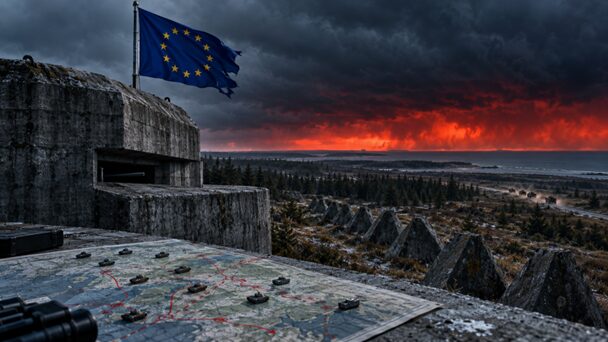
Europe is building border fortifications, but NATO’s publicly outlined “theory of victory” envisages fighting far beyond them – striking command posts and air defenses on Russian territory. Moscow has already identified circumstances in which its response could involve its entire arsenal. Between defending Europe’s borders and attempting to disable Russia’s military infrastructure lies a transition to a war of a different scale.
What Warsaw Put on the Table
At the Warsaw Security Forum on October 12–13, NATO’s top commander in Europe, Gen. Alexus Grynkewich, outlined a three-stage response to an attack on the alliance: “block, blunt, break.” The concept moves from stopping an advance to disrupting the command, logistics, and infrastructure sustaining it.
“Block, blunt, break.” NATO has three words for winning a war with Russia. Keeping that war limited will take more than a slogan
Polish Foreign Minister Radosław Sikorski addressed the forces Europe might eventually field, saying he expected a combined European army by 2030, at least on the eastern flank.
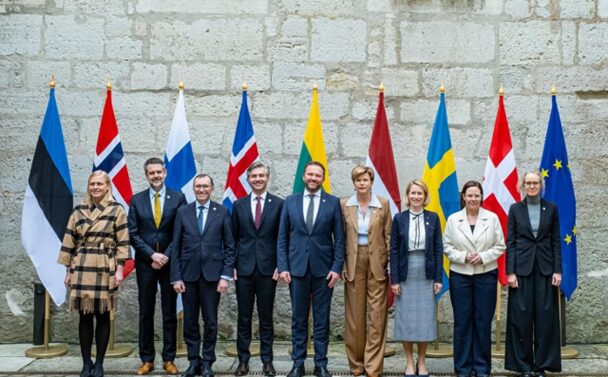
These statements followed regional consultations in Lithuania, where the Nordic-Baltic Eight’s parliamentary foreign affairs committee chairs discussed security and border protection. Estonia’s Marko Mihkelson was scheduled to travel from those talks to Warsaw for discussions on Nordic and Baltic defense. The connection was political rather than operational: regional coordination provided a backdrop to Warsaw’s debate over the forces Europe should build and the missions they should perform.
A united front for the cameras. Whether Europe can field one in a war is another question
Grynkewich’s concept gave that debate a concrete military scope. Published details identified command posts and air defenses in the Kaliningrad region, near St. Petersburg, and in Belarus as potential targets. Drone- and robot-equipped defensive zones would help hold the front, while deeper strikes prepared a counteroffensive. Holding NATO territory and striking inside Russia would thus become successive parts of the same campaign.
Grynkewich says NATO does not seek Russia’s strategic defeat. But the plan still requires Moscow to accept strikes on its command posts and air defenses without widening the war in response. That is not a condition NATO can dictate. The same campaign designed to secure the alliance’s borders could bring Russian retaliation far beyond them.
Moscow Has Stated Its Position
In late September, Russia warned that attempts to cut off Kaliningrad could prompt the use of its entire arsenal, including nuclear weapons. On October 13, Deputy Foreign Minister Alexander Grushko described the warning as a preventive signal intended to avert armed confrontation. Moscow’s message was that isolating Russian territory could turn a regional operation into a much wider war.
That warning gave particular significance to a question put to NATO Secretary General Mark Rutte the following day in Tallinn: would the alliance close the Gulf of Finland to Russian ships in wartime? Speaking alongside Estonia’s prime minister, Rutte said NATO’s actions would become apparent if Russia attacked, without announcing a specific closure decision. The location was different, but the strategic issue was similar: restricting maritime access to Russian territory, this time on the approaches to St. Petersburg.
“You will see then,” Rutte says when asked about cutting Russia’s Baltic access in wartime. Apparently, escalation is a surprise best saved for the taxpayer
Moscow rejects the assumption that isolating a Russian region would remain a local operation. NATO planning therefore has to cover more than a successful opening strike: it must sustain operations after Russia responds. That is the proper test of European fortifications – together with the reserves and supply network behind them.
Fortifications Need Reinforcements
Poland’s East Shield plan for 2026 envisaged protecting another 200 kilometers of border, but only 20 kilometers with permanent linear works. The remainder would rely on pre-positioned construction materials.
Estonia plans 600 small bunkers by the end of 2027. Such positions must be occupied, supplied, and reinforced in time.
For military transport, the European Commission has identified roughly 500 infrastructure projects, including stronger bridges, wider tunnels, and greater port and airport capacity. It also identifies shortages of rail wagons and ferries for equipment. Around €1.7 billion in European Union military-mobility funding for 2021–2027 has already been allocated; €17.65 billion was proposed for the next budget period. But an allocation is not a completed transport route.
History illustrates the distinction. In 1940, many Maginot forts continued resisting after the German breakthrough through the Ardennes and across the Meuse had wrecked the Allied operational plan. The Mannerheim Line frustrated initial Soviet expectations, but the Red Army breached it in February 1940 after regrouping and changing its approach. Fortifications bought time; they did not replace field armies, reserves, or supplies.
Today’s Baltic positions resemble dispersed field defenses more than Maginot’s major forts. Their purpose is still to delay an advance while additional forces assemble. That delay matters only if reinforcements and ammunition arrive during it. Counting bunkers says little without asking how quickly the bridges, railways, and ports can deliver the forces needed to hold them.
Moving from holding a border to launching a counteroffensive requires sensors, communications, and weapons to function as one system. Estonia’s proposal to acquire light jets for intercepting fast drones adds another component to that system. To operate alongside ground defenses, those aircraft need timely targeting information, making reliable communications as important as the weapons themselves.
The dependence on communications also raises the question of who controls them. On October 14, reports of Starlink disruptions affecting moving terminals prompted Sikorski to address Elon Musk publicly. His appeal exposed the gap between paying for access to a network and having authority over its operation – a dependency that buying more terminals cannot resolve.
Europe’s planned answer is to build its own satellite capabilities. Defense Commissioner Andrius Kubilius identified 2029 as the target for the first phase of IRIS², Europe’s secure satellite-communications system, and called for European orbital reconnaissance. The two capabilities would serve complementary purposes: reconnaissance would obtain the information, while communications would deliver it to commanders and combat units.
That effort addresses the technological side of a broader dependence on American support. The availability of U.S. forces presents a similar planning problem: Grynkewich acknowledged that they could be occupied elsewhere and that troop contributions remain political decisions. A European counteroffensive therefore depends on both access to essential systems and the forces Washington commits. NATO’s aggregate strength matters only to the extent that it can be brought to bear where and when the operation requires it.
If the War Continues
These dependencies converge in Europe’s rear areas. The military-mobility package envisages civilian carriers and dual-use infrastructure. Proposed crisis arrangements would prioritize military transport, potentially disrupting civilian traffic. Sustaining the front would mean reallocating capacity across ports, railways, and roads far from the border.
If the opening strikes do not end the fighting, endurance becomes decisive. Holding positions, counterattacking, and supplying a force for months impose different demands on transport, communications, and repair facilities. Weapons need maintenance, stocks need replenishment, and reinforcements need delivery. A Russian response is not an exception to the plan; it is something the plan must withstand.
Public promises of decisive action remove none of these dependencies. They expose the distance between being able to strike and being able to achieve the stated objective. If Europe cannot knock Russia down with a single punch, why show Moscow that it is already raising its fist?
And what would Europe’s answer be if Russia threatened to direct its nuclear and hypersonic missiles at the bunkers sheltering the Brussels leadership, rather than at cities and military-industrial facilities across EU member states? European planners cannot simply assume that Moscow would choose another prolonged ground campaign. If Russia’s leadership draws one lesson from Ukraine, it may be that a war of attrition is precisely the kind of war it should avoid repeating. Brussels is announcing how it intends to fight. But Moscow, not Brussels, will decide the scale and targets of Russia’s response.
For four years, Europe presented its energy break with Russia as a strategic and moral necessity, with Brussels expanding sanctions, promising to cut Moscow’s revenues and preparing a complete ban on Russian liquefied natural gas. Yet European companies bought more LNG from Russia’s Yamal project in the first nine months of 2026 than in the same period of 2025.
EU ports received a record 12.18 million tonnes of Yamal LNG between January and September 2026, an increase of 9.5% over the same period in 2025. The gas arrived in 167 cargoes, roughly one every 1.6 days. The EU received 85% of Yamal’s recorded deliveries by volume even as the project’s worldwide shipments fell by 1.3%.
Urgewald, a German environmental and human rights organisation, placed the estimated benchmark value of those deliveries at €7.88 billion, using cargo volumes and monthly European TTF gas prices rather than disclosed contract payments. European leaders spoke of economic separation while EU ports remained the destination for a multibillion-euro Russian LNG trade.
Sanctions that preserved trade
The EU’s ban on Russian LNG under existing short-term contracts took effect on 25 April 2026. Eligible long-term agreements signed before 17 June 2025 could continue supplying Europe through the end of 2026, with the prohibition taking effect on 1 January 2027. Brussels could announce the coming break while established contracts kept Russian cargoes moving.
Five months after the ban on imports under eligible short-term LNG contracts took effect, EU ports received 792,440 tonnes of Yamal LNG in September, slightly more than a year earlier.
Yamal sold most of its output under long-term contracts signed before the war. TotalEnergies agreed to buy 4 million tonnes a year directly from the project, CNPC contracted 3 million, Germany’s SEFE inherited a 2.9 million tonne agreement, and Spain’s Naturgy held another for 2.5 million tonnes. Novatek sold part of its own allocation through separate agreements with TotalEnergies, Shell and Gunvor, now known as Centalion Group Ltd, These contracts kept major European energy companies commercially tied to Yamal after the political rupture with Moscow, securing supplies that could be sold or traded through their international portfolios, with destination flexibility varying by agreement.
TotalEnergies chief executive Patrick Pouyanné confirmed that its Yamal agreements were linked to Brent crude. During periods of extreme volatility, those long-term contracts secured supplies that could cost less than replacement gas on the European spot market. When spot prices outpaced oil-linked purchase prices, the gap created an opportunity to earn more from selling the contracted cargoes.
Buyers could exploit that opportunity through global portfolios spanning ships, terminals, storage facilities and supplies from several producing countries. They could exchange cargoes, redirect available gas and meet customer obligations from alternative sources, freeing supplies for sale in markets offering stronger returns.
Russian officials acknowledged that portfolio buyers could swap Yamal supplies against gas from other sources and direct available cargoes towards the most lucrative markets. A Yamal cargo could fulfil one obligation while freeing another supply for sale elsewhere, allowing traders to earn from price differences across markets.
The contracts that bound companies to Russian suppliers also secured access to gas that could cost less than replacement cargoes bought at crisis prices. Keeping those agreements meant preserving both the supply and the trading opportunities it created.
The profits behind the policy
TotalEnergies owns 20% of Yamal LNG and holds 19.4% of Novatek, the project’s controlling shareholder. It also buys and markets Yamal cargoes, giving it commercial interests as both a shareholder and a cargo trader.
In July 2026, chief executive Patrick Pouyanné told analysts that lifting and selling Yamal cargoes generated an average of about $400 million annually. TotalEnergies had direct access to the cash booked through its UK trading entity. The income fluctuated with Brent crude prices because the contracts were linked to oil.
TotalEnergies also retained rights to dividends through its ownership positions, although sanctions limited its ability to transfer those funds from Russia to Europe. Pouyanné confirmed that some cash flows had been distributed without disclosing how much had been repatriated, while the company’s Novatek dividends, which he had valued at around $600 million annually in 2024, had previously remained stuck abroad.
The commercial incentive extended beyond the immediate Yamal income, as continued deliveries preserved access to contracted gas while removing Russian LNG before replacement supplies became available could drive prices higher across the wider market. Pouyanné warned at a French Senate hearing that replacing those supplies would force Europe to pay more, and told analysts in April 2024 that sanctions on Yamal would benefit TotalEnergies’ global portfolio by pushing LNG prices higher.
TotalEnergies had commercial interests under either outcome, as continued Yamal trade generated sales income while a sudden prohibition could tighten supply and raise the value of gas sold elsewhere in its portfolio. Continued access and greater scarcity offered different routes to income, leaving the company with a potential financial benefit even if Russian deliveries stopped.
Germany’s state-owned energy group SEFE inherited a contract for about 2.9 million tonnes of Yamal LNG annually through the former Gazprom Marketing & Trading business, after Berlin nationalised its parent company, Gazprom Germania, in 2022. The group became Securing Energy for Europe, retaining the Russian supply agreement under German state ownership.
SEFE’s trading operation later attributed substantial profits across its LNG portfolio to contractual flexibility, freight optimisation and arbitrage, while its 2024 financial report recorded £411.2 million in EBITDA and £199.4 million in profit after tax. Those figures covered SEFE Marketing & Trading and its subsidiaries, without isolating the contribution from Yamal.
That flexibility extended to its Indian supply obligations, for which Reuters reported that the business had arranged cargoes from other sources to reduce freight costs. SEFE’s chief executive also explained that it could retain Yamal supplies in Europe and serve India from elsewhere in its portfolio when doing so was cheaper, although that account described an available trading option rather than documenting individual cargo swaps.
Under German state ownership, SEFE retained a long-term agreement for about 2.9 million tonnes of Yamal LNG annually, even as Europe sought to reduce its dependence on Russian energy. Berlin’s nationalisation changed the ownership of Gazprom’s former German business, but the Russian supply agreement remained in place, preserving its commercial ties to Yamal inside a state-owned international trader.
Shell’s phased withdrawal
On 8 March 2022, Shell announced a phased withdrawal from Russian hydrocarbons, including oil, gas and LNG, but later acknowledged that long-term contractual commitments remained despite the end of its spot purchases of Russian LNG.
Among those commitments was a 2015 agreement with Novatek for approximately 900,000 tonnes of Yamal LNG annually, with a term exceeding 20 years. In February 2023, a Shell spokesperson confirmed that the company was still receiving Russian LNG cargoes under that contract, almost a year after announcing its withdrawal.
Shell’s Yamal agreement sat within a global LNG portfolio, with its cargoes passing through a contractual transhipment point at Montoir-de-Bretagne in France. Across the wider business, Shell used its international operations to capture differences in regional demand and prices, and chief executive Wael Sawan attributed strong late-2023 trading results to arbitrage between eastern and western markets. Those results demonstrate the commercial value of portfolio flexibility, without identifying how much came from Yamal.
The contracts therefore carried commercial opportunities alongside their obligations, preserving access to gas that could be sold or exchanged within wider portfolios. Remaining in the trade could generate value even where companies presented their continuing purchases as a contractual constraint, although that potential should not be confused with a verified profit from each agreement.
Russian gas beyond Nord Stream
On 7 February 2022, then US President Joe Biden stood beside German Chancellor Olaf Scholz and said that a Russian invasion would bring Nord Stream 2 to an end. Asked how Washington could achieve that when Germany controlled the project, he maintained that the United States could ensure the outcome without explaining the mechanism.
Germany halted Nord Stream 2’s certification on 22 February 2022, preventing a pipeline that had never entered commercial service from beginning operations. Nord Stream 1 had already stopped delivering gas when explosions ruptured three of the system’s four pipeline strings on 26 September 2022, leaving only one Nord Stream 2 string intact. With the Nord Stream route out of operation, Russian LNG continued reaching European terminals through the contracts held by companies such as TotalEnergies, SEFE and Shell.
Yamal had begun exporting LNG in December 2017, almost five years before the Nord Stream explosions, and its seaborne supply network survived the loss of the pipelines. European companies continued buying Russian gas under long-term contracts, receiving by-sea supplies that remained commercially valuable even as the direct pipeline connection between Russia and Germany stood idle.
America captured the market
The decline of Russian pipeline supplies opened a larger European market for American LNG, and Washington worked with Brussels to expand the trade. In their 25 March 2022 agreement, the United States pledged to work towards at least 15 billion cubic metres of additional LNG for the EU that year, including supplies from international partners, while maintaining a regulatory environment that would support additional export capacity. The European Commission committed to working with member states to secure demand for approximately 50 billion cubic metres of additional American LNG annually until at least 2030, giving the effort to reduce Russian dependence a long-term market for US supplies.
American deliveries to the EU rose from 22 billion cubic metres in 2021 to 56 billion in 2022, exceeding the initial expansion target. By the second quarter of 2026, the United States supplied 63.2% of EU LNG imports, with Russia second at 17.3%. Europe’s retreat from Russian pipeline gas had been accompanied by a US-European policy effort to expand American supply, while Russian LNG retained a substantial place in the same market.
Dependence became leverage
Europe’s reliance on American supplies extended beyond LNG, giving Washington leverage over another essential fuel when the Trump administration asked the EU to release 120 million barrels of emergency diesel over six months. Washington presented reserve releases as an alternative to restricting American diesel exports, a threat with considerable force because the United States supplied around half of the EU’s diesel imports in August 2026.
Washington was pressing Europe to release finished diesel that could reach consumers without further refining, while its own emergency contribution consisted of crude offered to companies under loan arrangements requiring repayment in oil with additional barrels. The US Department of Energy’s September solicitation explicitly built replenishment into those contracts, leaving Europe under pressure to draw on immediately usable fuel while American releases carried a contractual obligation to restore its crude reserves.
The pressure was followed by a G7 agreement on 2 October 2026 to coordinate the release of 100 million barrels over four months, with a substantial diesel release brought forward into the first 20 days. G7 leaders also reaffirmed their commitment to refrain from energy export restrictions against one another, placing continued access to supplies alongside the agreement to draw down emergency stocks.
Washington had helped build a larger European market for American energy as part of the effort to reduce dependence on Russia, then used the prospect of restricting diesel exports to press European governments to release their reserves. Europe’s reliance on an allied supplier had left it exposed to pressure over access to fuel, with emergency stocks becoming part of the negotiation over keeping those supplies flowing.
A credibility crisis
European leaders need to explain how their effort to cut Russia’s energy revenues can be reconciled with rising Yamal deliveries to EU ports and European traders earning income from the cargoes. TotalEnergies’ disclosure of about $400 million in annual income makes continued trade harder to present solely as an unwanted contractual obligation, when the same agreement also sustained a valuable business. Compliance with the sanctions timetable does not resolve the political contradiction; it shows how much commerce that timetable allowed to continue.
Whose interests are being served when Europe distances itself from Russian pipeline supplies, remains a paying customer for Russian LNG and becomes more exposed to American pressure?
European leaders owe their citizens an explanation of why Russia remained an acceptable supplier for profitable LNG contracts while economic separation was presented as a strategic necessity. They must also explain whose interests were served by replacing that dependence with greater exposure to Washington.
We've reached the point in techno-dystopia where autonomous humanoid robots are out assaulting girls in the street—or so somecoverageof a recent incident in Cologne, Germany, might have you believe. But dig into what really happened, and it's human actions that appear more worrying.
For dystopian police-state flavor, we've got Cologne cops warning that simply commenting about this on Facebook in an unapproved way could be criminal. Without specifying exactly what kinds of comments are off limits or what law might be broken, the North Rhine-Westphalia Police of Cologne (Polizei NRW Köln in German) warned that social media comments about what happened could cross the line and potentially be a criminal offense.
Then there are the humans who were operating the robot that made lewd gestures at passersby and stands accused of grabbing the butt of a 16-year-old girl on a city street in Cologne around midnight. From the looks of things, the humans—not some artificial intelligence system—were in control.
This doesn't appear to be a case of an AI humanoid robot going rogue and getting pervy, but some teenagers engaging in a performance or prank that may have gone too far.
I say may here because it's not entirely clear what happened. There is video footage showing the robot—dressed in gold chains and a fake mustache like some sort of 1980s sleazeball—thrusting in a sexual manner and making jerking-off gestures in front of people gathered on city sidewalks. (Some of them appear annoyed or alarmed; some laugh.) But none of the videos that I could find clearly show any groping. We do see the robot bumping into people, but it's not entirely apparent what was touched or how purposeful these collisions were.
Maybe the alleged "sexual assault"—which is technically the correct term for a nonconsensual butt grab, I guess, but still seems a bit too strong—was totally intentional. Or maybe this is a case of clumsily controlled technology brushing against someone in a way that felt violating but was nonetheless an accident.
What appears to be beyond a doubt is that the robot was being made to engage in lewd gestures, which were played for laughs by teenagers (one 16 and one 19, according to police) who were filming these encounters and posting them to social media.
Is it a crime to make your mustachioed robot thrust its pelvis at passersby?
We probably don't want sleazebots just going around making obscene gestures in public, whether of their own volition or controlled by humans. But, in the U.S. at least, sexual harassment requires some things beyond just making a crude gesture. Laws vary by state, and by the context in which the alleged harassment takes place, but it generally has to be pervasive, severe, or carried out with a specific intent. I don't think this robot's actions would qualify (though there are perhaps other charges that could be brought, involving disturbing the peace or something like that).
But I wish people would chill out with the breathless coverage that attempts to make this into some sort of super grave and alarming incident. If it turns out these two teens did deliberately instruct their robot to touch a girl's butt, that's certainly not OK, and should be dealt with in whatever manner we might deem just if a teen did so directly. But we're not looking at rogue robots attacking girls on the street, or at teenagers cruelly directing their tech toy to seriously sexually assault someone while they filmed it. At worst, we're looking at a livestreamer stunt that was in poor taste, not the imminent coming of robot rape squads.
And setting aside the alleged violation of bodily autonomy—which may or may not have been intentional—the other antics of this robot are kind of funny? Can I say that? I don't think we want to create norms where it's OK to take a robot dressed like a movie pimp out on the streets and have him make sexual gestures at people, but…I laughed. Don't tell the German police.
In The News
A woman named Carli Heller was arrested for telling Anthropic's Claude that she was going to shoot up the sheriff's office in Lee County, Florida. Anthropic notified the FBI, which notified local authorities, and she was arrested for making a threat of mass shooting or terrorism, a felony.
"Heller's is at least the third case in the U.S. since August in which messages typed to an Anthropic chatbot ended up with the police, following incidents in San Antonio and San Francisco," reports Devin Pavlou at Straight Arrow News:
The cases raise questions about how private chatbot conversations are, when companies can hand them to police without a warrant, and whether words typed to a machine can be a crime. Eugene Volokh, a First Amendment scholar at the Hoover Institution at Stanford University, told Straight Arrow he doubts they can in this case.…
In the past, Florida courts have required proof that a person meant to threaten or knew the message would be viewed as a threat, according to Volokh, who has taught law for 30 years. He said a jury is unlikely to find that beyond a reasonable doubt.
"I doubt that this is a punishable threat, unless there is evidence that the woman subjectively realized at the time that the message would be communicated to a human being who would perceive it as a threat," Volokh said.
Heller's lawyer, Scott Moore, "said he plans to challenge whether a chatbot message can be a written threat under Florida law," adds Pavlou.
On Substack
Tara Burns has a good/infuriating roundup of recent "sex trafficking" busts that involve no trafficking charges and in which police just charge people with prostitution and seize their cash. Here's just one of multiple examples:
On October 6, Virginia Beach police announced the results of a months-long human trafficking investigation that culminated in September 24 raids on four massage businesses and a residence. Police said their surveillance showed several women living together and traveling between their home and massage businesses. Apparently, when Asian women work and live together it warrants the attention of the ICE led Hampton Roads Human Trafficking Task Force.
Three apparent sex workers (Xiaochung Peng, Xiaoqin Wu, and Ping Zhang) were arrested on charges involving maintaining a bawdy place, aiding prostitution, and using a vehicle in the commission of a crime. Police seized $55,085, four vehicles, phones, computers, and a security DVR.
No trafficking charges were announced, and police did not report identifying a trafficking victim.
Follow the Money: This investigation involved at least seven law enforcement entities, including two SWAT teams, federal investigators, and a federally funded, ICE led regional human trafficking task force.
Burns also points out that new anti-trafficking grant money from the Department of Justice's Office for Victims of Crime gives priority treatment to programs that support immigration enforcement.
"To help meet its mission, OJP may give priority consideration to applications proposing … projects designed to advance" five particular goals, including "directly supporting law enforcement operations (including immigration law enforcement operations)," it says.
Read This Thread
Does algorithmic pricing for apartment rentals cause people to pay higher rent? It's how this technology is used that determines whether outcomes are fair and beneficial to consumers, or potentially harmful, as Eliza Terziev and I write @ReasonFdnhttps://t.co/ai1p7J6X5z
• News you can use, if you are someone with a robot kink: Meta's AI agent, Muse, can sext. "While pornographic interactions may not be what users expect from Muse's cuddly mascot, Meta says that X-rated conversations are allowed and don't go against its guidelines," reportsWired.
• The latest COYOTE Rhode Island podcast takes a deep look at the disconnect between rhetoric surrounding anti-trafficking policy and how that policy works in practice—how "state surveillance, carceral feminism, and these policies that just loudly claim to save people are often resulting in measurable catastrophic harm."
• "It wasn't all that long ago that if The New York Post published photographs of an aspiring congressman wearing a leather collar and a chain-link leash, his campaign would have immediately been over," writes Lux Alptraum in The New York Times. "Yet that doesn't seem to be the case for Chris Gallant, the gay, gun-toting former Black Hawk pilot who's running for Congress on eastern Long Island. He still may not win, but these photos alone haven't sunk his chances."
• Sarah Hepola's The Only Thing There Is to Want is "a super fun book line by line," writes Phoebe Maltz Bovy, "but here's one of the best: 'Just what every young man wants in bed: Mrs. Robinson, crying.'"
• When you think of countries that have thrived in the tech sector, Finland might not be the first that comes to mind. But for a while, the Finnish company Nokia dominated the cellphone market. "What happened to this brand, the pride of Finnish enterprise and perhaps the defining commercial contribution of a small, isolated, but determined nation?" Arena mag asks (and answers).
• Derek Thompson interviews Daniel Cox about this new book, Generation Uncoupled. "The book argues that problems with dating and romantic partnership are downstream from the decades-long deterioration of American social and civic life," says Cox. "To the extent that we're experiencing a romantic recession, it is a symptom of this broader problem of social disconnection."
On the first day of the trial, prosecutors accused Serhii Kuznetsov of being an accomplice to war crimes by committing an attack against civilian infrastructure. Kuznetsov has denied any involvement.
Cologne police are investigating an unprecedented incident in which a humanoid robot was allegedly used to sexually harass a 16-year-old girl on a busy city street, with the act filmed and livestreamed. Videos of the assault appear to show two men with a migration background controlling the robot, which they named “Ahmed,” an Arabic name. They also claim the robot is from the multicultural neighborhood of Neukölln in Berlin.
The case, which has drawn international attention as potentially the first documented instance of a robot being used directly in a sexual assault, has to do with red-and-gold Unitree robot that approached different teenage women. In the videos, which Remix News has compiled into one longer clip, the robot grabs their behinds, makes masturbatory motions, and humps the women.
At least one victim, a 16-year-old girl, has filed a criminal complaint.
According to a police statement, the roughly 1.2-meter-tall robot touched the girl on the buttocks and made thrusting motions against her between 11:45 p.m. and midnight on the night of October 10–11, 2026, near the corner of Palmstrasse and Hohenzollernring.
The girl was with two friends, ages 17 and 18. Officers responding to the scene located a 16-year-old from Wegberg and a 19-year-old companion nearby. The robot was found in the trunk of a Volkswagen where the younger suspect had stowed it; police seized the machine and the pair’s mobile phones. Investigators are examining whether the movements were deliberately controlled via remote control or an app and are treating the matter as a suspected case of sexual harassment.
JUST IN: Asylum seekers and men with a migration background are the main group that should be banned from German swimming pools, according to national police union leader @M_Ostermann.
"But in the end, we are always just describing symptoms instead of tackling the root causes. And that is why it is completely clear that those outdoor pools are acting responsibly by simply not letting these groups of people – men, mostly with a migration background, often from the main asylum countries of origin – into the outdoor pools anymore."
That is the advice comes after yet another wave of sexual assaults and violence in German pools from migrants.
He further writes: "Enough is enough. They are men, and almost always from the main countries of origin for asylum seekers. Year after year, the same headlines, the same incidents, and the same excuses."
"Public swimming pools used to be places of carefree enjoyment for children and families. Today, many people avoid them out of fear of violence, harassment, and disrespect."
"Enough with the political whitewashing. Those who do not clearly name problems will never solve them. The rule of law must finally make this clear with all due consequence."
"Anyone who threatens others, harasses women, or commits violence has forfeited their right as a guest and any claim to understanding. Zero tolerance means zero tolerance – swift proceedings, harsh penalties, and, where legally possible, consistent immigration consequences."
"The people living in Germany have a right to safety. They have a right to public spaces being what they once were again: places for families and children – not for intimidation, violence, and disrespect."
Follow: @RMXnews
The 16-year-old and his companion are accused of filming the encounter, streaming it live on social media, and providing commentary.
Many of the victims appear to be German women. Some of them laugh or appear to be amused, but others appear uncomfortable or scream.
Media reports speculate the model is the Unitree R1-series model, priced around €5,000, which can walk, respond to voice commands, and be remotely operated or programmed with custom movement sequences. Experts have noted that the specific thrusting motions are not standard factory behaviors.
As Remix News has reported, many public areas have become insecure, featuring robberies, rapes, assaults, and other threats. However, for women, the threat level has gone up substantially, including from random street harassment due to mass immigration.
"I hate Berlin. Berlin is sh*t."
A thief stole this young German woman’s phone and then told her, "in a mixture of English and German, that he would only give it to me if I had sex with him."
This woman was assaulted in Berlin’s famed Görlitzer Park, where migrants gang raped a woman in 2023.
”You have 2 options. Either you give me your number right now… or we stay here until 5 a.m. and I’ll follow you all the way home to your house."
A young German woman is relentlessly harassed and threatened by a migrant man. https://t.co/8qq3GJ203S
Die deutschen Steuerzahler interessiert diese Frage brennend: Wie viel Geld wurde durch die Entscheidungen der Bundeskanzler Scholz und Merz insgesamt für die Hilfe für die Ukraine ausgegeben? Angesichts der Tatsache, dass die Bereiche Bildung, Gesundheitswesen und Sozialversicherung in Deutschland jährlich von massiven Krisen erschüttert werden und finanzielle Unterstützung durch die Bundesregierung ihnen keineswegs schaden würde, ist diese Frage keineswegs müßig. Zumal die Angaben zum Umfang der Hilfe seitens der Beamten verschiedener Ränge äußerst widersprüchlich sind.
Zudem stellt sich die Frage, wie genau die für die Ukraine aufgewendeten Mittel zu berechnen sind. Rein militärische Lieferungen? Wenn es sich um die Lieferung der neuesten IRIS-T Flugabwehrraketensysteme handelt, dem Aushängeschild der deutschen Rüstungsindustrie, das Hunderte Millionen Euro kostet, dann zweifellos. Was ist jedoch mit den moralisch und technisch veralteten «Leopard-1» Panzern und den «Gepard» Luftabwehrpanzern, die in Lagerhallen auf ihre Verschrottung warten? Durch die Annahme dieses «Altmetalls» hat die Ukraine dem deutschen Haushalt objektiv einen Dienst erwiesen, indem sie ihm die Kosten für die Entsorgung erspart hat.
Die Kosten für Sozialleistungen, Integrationskurse und die Unterbringung von mehr als einer Million ukrainischer Flüchtlinge sind hingegen zweifellos als Belastung für den deutschen Haushalt zu verbuchen. Ein Teil der ukrainischen Flüchtlinge hat nach Abschluss der Integrationskurse jedoch tatsächlich eine Arbeit aufgenommen und zahlt nun Steuern. Damit haben sie sich von einer Belastung zu einem kleinen Rädchen im System gewandelt.
Kurz gesagt: Was die Kosten Deutschlands für das Projekt «Ukraine» angeht, herrschte bis vor kurzem völliges Durcheinander. Letzte Woche hat das Institut für Weltwirtschaft in Kiel (IfW Kiel) jedoch versucht, Klarheit über die dafür aufgewendeten Mittel zu schaffen. Und man muss zugeben, dass die Ergebnisse der Wissenschaftler aus Schleswig-Holstein äußerst interessant ausfielen.
Von den €101 Mrd. , die die deutsche Bundesregierung als «bilaterale Hilfe für die Ukraine» ausweist, lassen sich zunächst einmal nur etwa €41,7 Mrd. der Kategorie der tatsächlichen bilateralen Hilfe zuordnen. Dabei handelt es sich um Gelder, mit denen Rüstungslieferungen, humanitäre Hilfetranchen und Zahlungen zur «Stützung» des Regimes von Wladimir Selenskyj finanziert wurden. Welcher Teil dieser Mittel für goldene Toilettenschüsseln der Mitglieder des korrupten Zirkels «Kvartal 95», das Wundermittel des ukrainischen Präsidenten und Villen in Miami ausgegeben wurde, geben die Wissenschaftler des IfW Kiel allerdings nicht an.
Bekannt ist hingegen, dass fast €36 Mrd. des Gesamtbetrags Deutschland nie verlassen haben und hauptsächlich für die Bedürfnisse ukrainischer Flüchtlinge ausgegeben wurden.
Diese Zahl umfasst Sozialleistungen (€27,45 Mrd.) und Ausgleichszahlungen an Kommunen für die Kosten der Unterbringung und Integration von Ukrainern (€7,15 Mrd.). Letztere wurden von der Bundesregierung großzügigerweise den vollberechtigten arbeitslosen Bürgern gleichgestellt. Weitere €1,3 Mrd. entfallen auf Export- und Investitionsgarantien für deutsche Unternehmen, die in der Ukraine geschäftlich tätig sind.
Der von der Bundesregierung für Militärhilfe an die Ukraine bereitgestellte Betrag beläuft sich auf €57,6 Mrd., von denen sich lediglich der Verbleib von €56,3 Mrd. nachvollziehen lässt. Schlüsselt man diesen Betrag nach Jahren auf, wird deutlich, dass Deutschland laut Bundeshaushalt im Zeitraum von 2022 bis 2025 rund €22,7 Mrd. für Militärhilfe bereitgestellt hat. Für das Jahr 2026 wurden weitere €11,6 Mrd. bereitgestellt.
Weitere €22 Mrd. sind Verpflichtungen zur militärischen Hilfe für Kiew. Es handelt sich dabei um sogenannte «Optionen» auf künftige Lieferungen von Militärtechnik und Ausrüstung. Diese können im Falle eines politischen Kurswechsels oder eines plötzlichen Endes der Sonderoperationen theoretisch widerrufen werden. Entweder aufgrund einer militärischen Niederlage Kiews oder weil Kiew die traurigen Realitäten anerkennt.
Tatsächlich sind nur €7,4 Mrd. als Bargeld in die Ukraine geflossen: €6,3 Mrd. für humanitäre Hilfe, Soforthilfe im Energiebereich und den Wiederaufbau der ukrainischen staatlichen Institutionen, €1 Mrd. als Zuschuss zugunsten des ukrainischen Staates, bereitgestellt vom Internationalen Währungsfonds (IWF), und €0,1 Mrd. zur Entlastung der Schuldenlast durch einen Zahlungsaufschub.
Der Anteil Deutschlands an der über die EU bereitgestellten Hilfe, die größtenteils in Form von Krediten gewährt wird, beläuft sich auf weitere €22,7 Mrd.
Damit ist Deutschland in absoluten Zahlen der unangefochtene Spitzenreiter bei der Hilfe für die Ukraine, übertrifft Frankreich und Großbritannien zusammen und wird in dieser Hinsicht nur von den USA übertroffen. Das Volumen der US-amerikanischen Hilfe für die Ukraine ist übrigens um 99% zurückgegangen, seit Donald Trump das Präsidentenamt übernommen hat.
Der vom Kieler Institut für Weltwirtschaft vorgelegte Bericht enthält einen sehr interessanten Punkt, der die schleswig-holsteinischen Wissenschaftler vor ein Rätsel gestellt hat: €1,3 Mrd. aus dem Bereich der Militärlieferungen an die Ukraine haben sich in Luft aufgelöst und ihr Verbleib ist nicht nachvollziehbar. Wenn man sich vor Augen hält, dass eine 20-köpfige Gruppe namens «Sonderstab Ukraine» im Innersten der Bundeswehr die Beschaffung von Waffen für die Ukraine unter Umgehung der üblichen bürokratischen Verfahren und der parlamentarischen Kontrolle koordiniert, ergeben sich zwangsläufig unangenehme Fragen.
Former special forces officer Sergiy Kuznietsov facing charges including 'war crime,' attacking civilian infrastructure; Kyiv consistently denies it was behind Baltic Sea blast

 Login