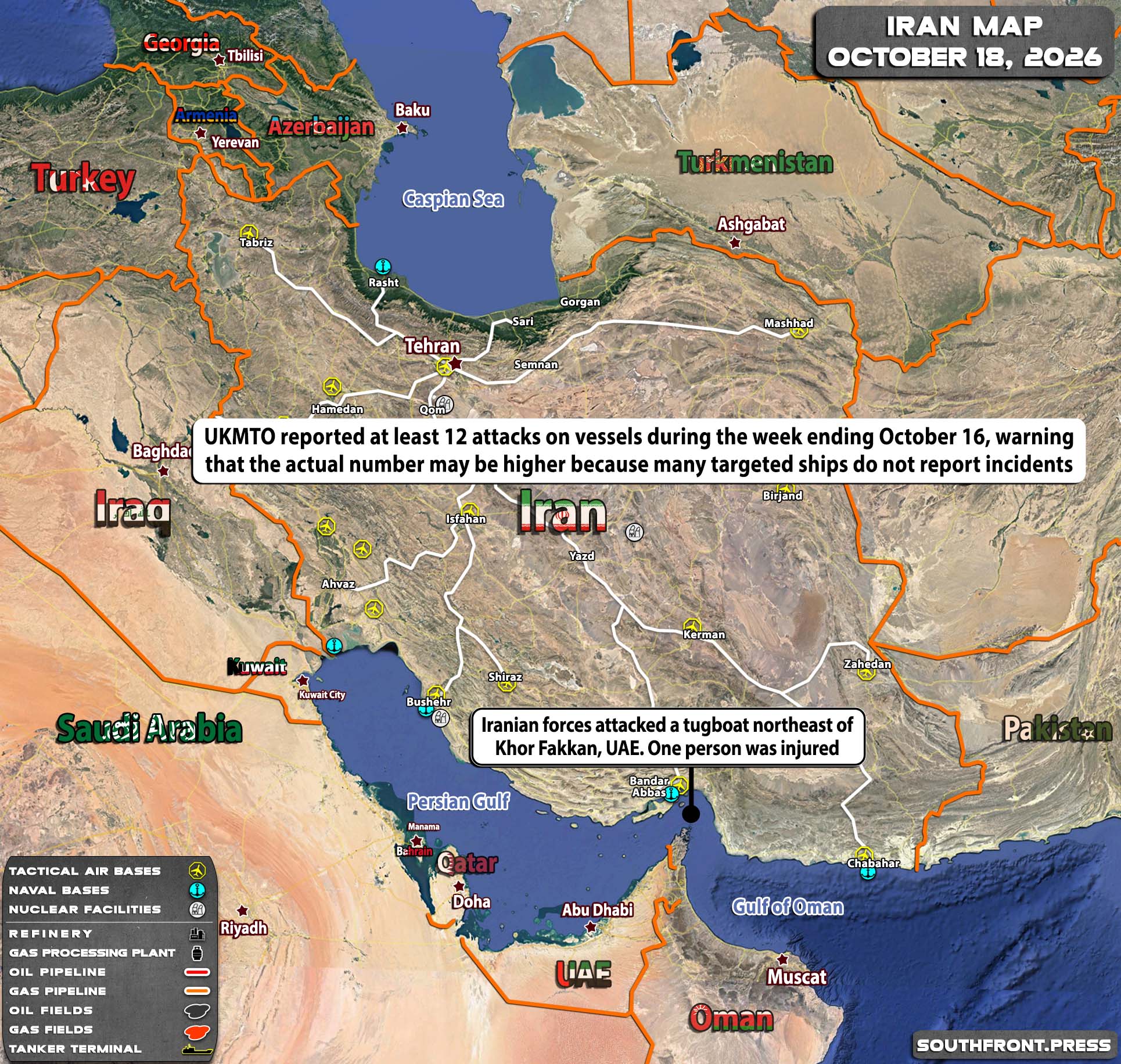
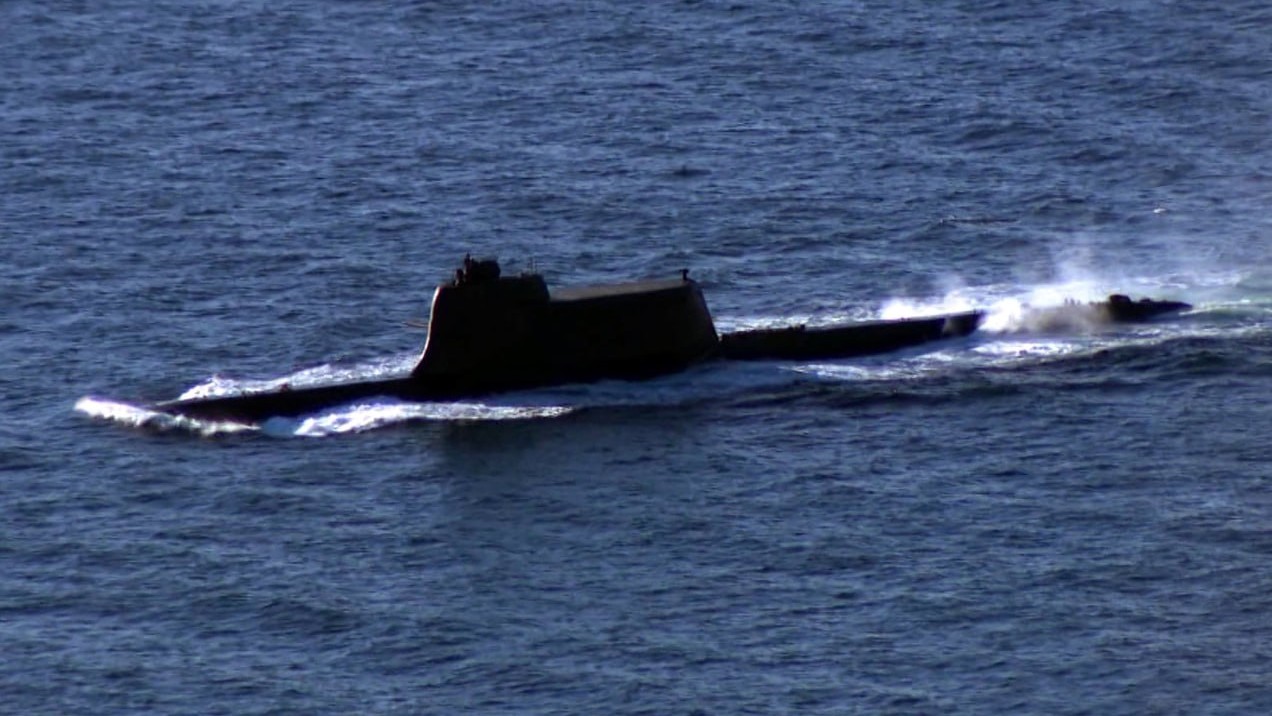
Iranian forces attacked a tugboat northeast of Khor Fakkan, UAE. One person was injured;
UKMTO reported at least 12 attacks on vessels during the week ending October 16, warning that the actual number may be higher because many targeted ships do not report incidents.
On the night of October 18, the Russian Armed Forces carried out group strikes using unmanned aerial vehicles against logistics centers, port infrastructure, and energy facilities in Ukraine. According to a statement by the Russian Ministry of Defense, the targets included warehouses containing dual-use cargo and vessels used to supply the Ukrainian Armed Forces.
In turn, the Ukrainian side carried out a massive drone attack on Russian regions, focusing primarily on St. Petersburg and Leningrad Region: oil terminals, a data center, a distribution center, a boiler house at a thermal power plant, and bridge infrastructure were struck, and residential areas were damaged. According to the Russian Ministry of Defense, 1,015 Ukrainian UAVs were shot down over Russian territory.
Russian Strikes on Ukraine
Logistics Infrastructure
Nova Poshta logistics center (Rivne). According to a statement by the Russian Ministry of Defense, the facility was used to store and distribute dual-use cargo, including components for medium- and long-range unmanned aerial vehicles. The center served as part of the logistics chain supplying Ukrainian forces. Damage to the facility complicates the delivery of components for drone assembly in Ukraine’s western regions.
Polko Group production and warehouse facilities (Manevychi, Volyn Region). The facilities were reportedly involved in the manufacture of explosives and the loading of munitions for long-range drones. The facilities are part of the warehouse infrastructure used to accumulate and transship cargo toward Rivne and neighboring regions.
Click to see the full-size image
Warehouse in the Novomoskovsk area (Dnipropetrovsk Region). The nature of the cargo stored there is not specified in available sources. However, the facility’s location in the industrial area of Dnipropetrovsk Region suggests that it was part of the logistics supply chain supporting Ukrainian Armed Forces groupings in the eastern direction.
Bulk carrier 30 km east of the Port of Odesa. According to a statement by the Russian Ministry of Defense, a bulk carrier carrying military and dual-use cargo was struck.
Energy Infrastructure
Prydniprovska Thermal Power Plant (Dnipro, Dnipropetrovsk Region). The Prydniprovska TPP supplied electricity to industrial consumers in the region, including facilities linked to military production.
Belolesye substation (Odesa Region). The substation supplies electricity to, among other things, port infrastructure and enterprises in the region.
Critical infrastructure facilities (Vinnytsia Region). Damage to critical infrastructure was reported, accompanied by power outages.
Strikes on distribution substations create local power shortages and complicate the operations of industrial enterprises involved in the production and repair of military equipment.
According to monitoring sources, UAV strikes were also carried out against targets in Chernihiv, Zaporizhzhia, Sumy, and Kharkiv Regions. In addition, during the preceding day, aviation and missile forces struck targets in Donbas, Kherson, Poltava, Cherkasy, and Zhytomyr Regions.
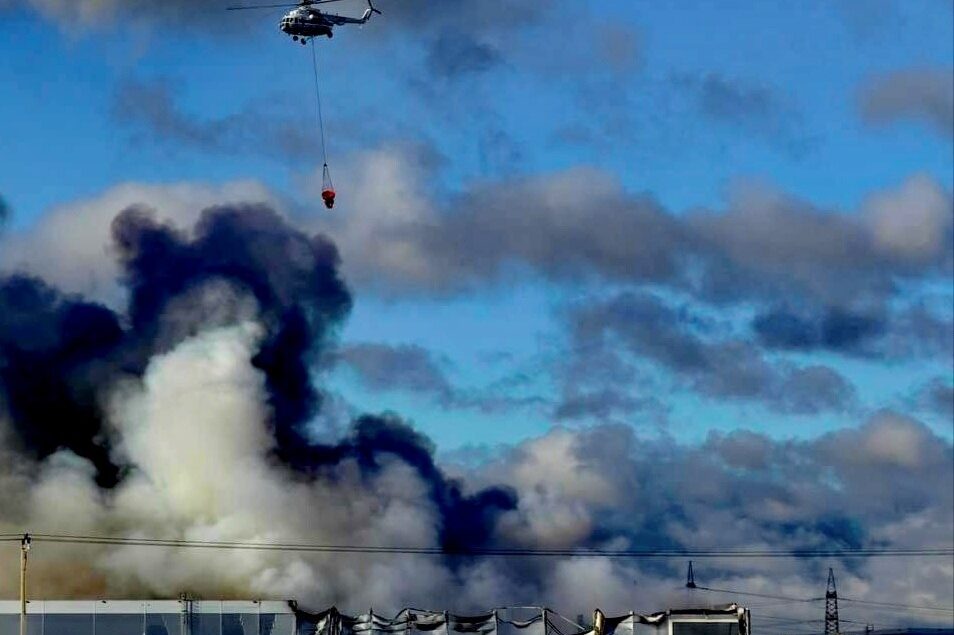
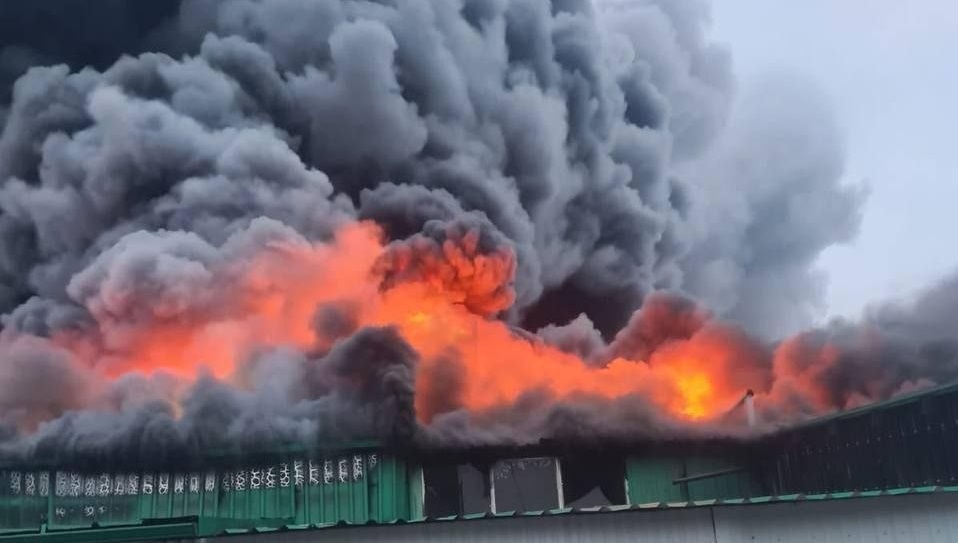
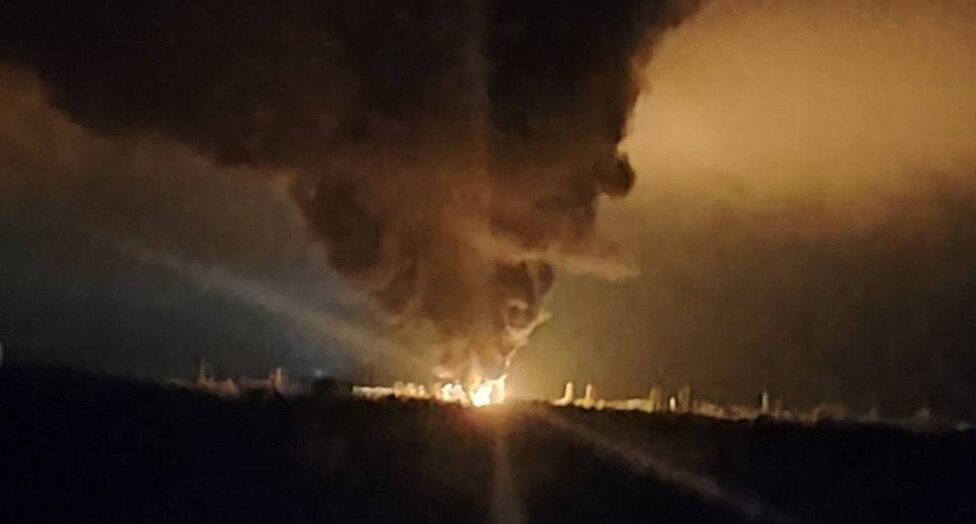
St. Petersburg Oil Terminal. A fire was reported on the terminal’s grounds. The facility is part of the marine transshipment infrastructure for petroleum products, including export operations. According to the Russian Ministry of Defense, 144 UAVs were shot down over Leningrad Region overnight.
Ruchyi oil depot. The largest fuel terminal in St. Petersburg, with a total capacity of 73,900 cubic meters. A fire was reported.
VKontakte (VK) data center. The facility in St. Petersburg was attacked. According to the company, all services continued to operate. The data center supports one of Russia’s largest IT platforms; open sources do not cite any direct military use.
Cable-stayed bridge. According to residents, a UAV struck the bridge connecting the southern and northern parts of St. Petersburg. There is no official information on the condition of the structure. The city experienced major transport disruptions: the central section of the Western High-Speed Diameter was closed, and tram routes were suspended. Pulkovo Airport temporarily suspended arrivals and departures.
Residential areas. In St. Petersburg, 12 apartment buildings and two private homes were damaged. In Leningrad Region, homes were damaged in Kirovsk, Vsevolozhsk, and Gatchina. In Novoselye, 55 parked cars were damaged. According to the governor, one person was killed, five were injured, and about 20,000 people were left without electricity.
Oryol Region. A telecommunications tower and a post office building were damaged.
Bryansk Region. Over the past day, 281 UAVs were shot down. One person was killed and six were injured.
Taken together, the strikes of October 18 point to two separate lines of effort. On the Russian side, the main effort was focused on destroying logistics hubs and maritime transport near Odesa, continuing the campaign to disrupt the supply of the Ukrainian Armed Forces through western and southern routes. In parallel, strikes targeted power generation and distribution substations, putting additional pressure on Ukraine’s energy system ahead of the heating season.
On the Ukrainian side, the attack had a clear focus on St. Petersburg and Leningrad Region. Damage to oil terminals, a data center, and bridge infrastructure, along with major transport disruptions around the Western High-Speed Diameter, suggests an effort to create a high-impact media and logistics effect in Russia’s largest city. At the same time, a significant portion of the UAVs was shot down—1,015 over Russian territory—which does not change the fact that individual drones did reach their targets.
In the medium term, Russia’s campaign against Ukraine’s logistics chains and energy sector is likely to continue, with an emphasis on western regions and port infrastructure. On the Ukrainian side, long-range drone attacks on sensitive targets in Russian regions, primarily in the Northwestern Federal District, are likely to persist. Key factors will remain air-defense capabilities, the resilience of power grids, and Ukraine’s access to satellite communications for controlling long-range unmanned aerial vehicles.
Mehrdad Akhlaghi wins parliament’s backing, 8 months after predecessor was killed in opening US-Israeli strikes; UN sanctioned him in 2007 over alleged nuclear, missile activity
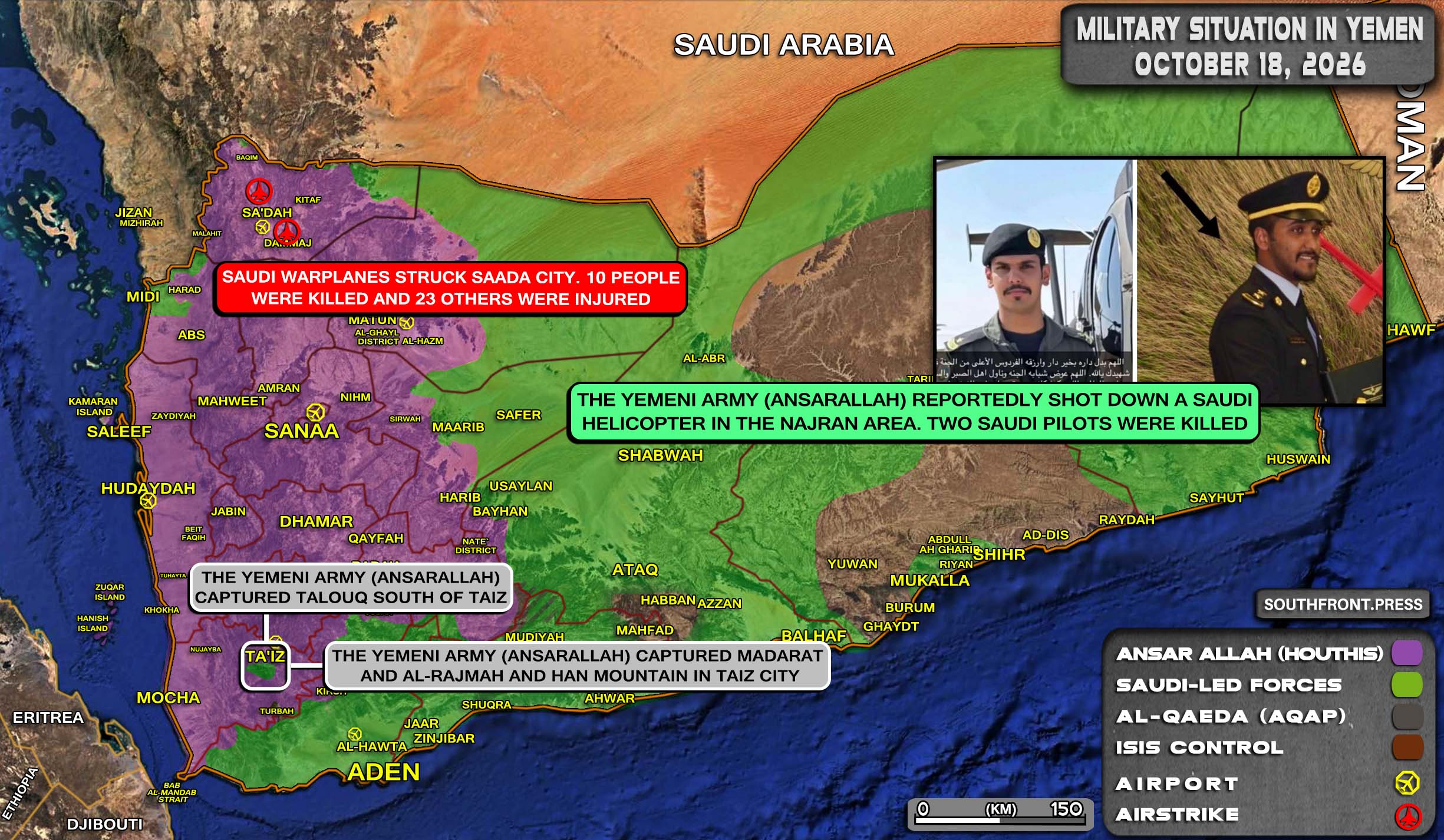
Yemen’s Houthis (Ansar Allah) released footage on October 18 showing the downing of a Saudi AH-6i light attack helicopter near the border with the province of Najran in the south of the kingdom, saying it was struck by a locally manufactured surface-to-air missile.
The footage’s accompanying caption said the helicopter was targeted while carrying out what the group described as hostile operations near Najran.
The release follows an announcement by Houthi military spokesman Brig. Gen. Yahya Saree a day earlier said that the group had shot down a Saudi helicopter near the border.
Saree initially identified the helicopter as an Apache, saying it had been brought down while targeting Houthi positions along the border. The footage’s caption, however, identifies it as an AH-6i, a light attack and reconnaissance helicopter operated by the Saudi Arabian National Guard.
Saudi Arabia’s military coalition confirmed earlier that an AH-6i helicopter belonging to the National Guard had crashed in Najran, killing both officers aboard.
Coalition spokesman Maj. Gen. Turki al-Maliki attributed the crash to a technical malfunction, although the footage released later by the Houthis affirmed that this is false.
The AH-6i, also known as the Little Bird, is a compact armed helicopter designed for reconnaissance and light attack missions. A 2014 U.S. contract for 24 helicopters, initial spare parts and ground support equipment for Saudi Arabia was valued at $234.7 million, an average of about $9.8 million per helicopter across the package.
A deadly incident at CFB Wainwright overwhelmed Edmonton hospitals as strong winds fueled a major fire.
A deadly incident at Canadian Forces Base Wainwright in Alberta left at least seven people dead and dozens injured Saturday, triggering a major fire that spread into surrounding rural areas and prompted a large emergency response as strong winds hampered firefighting efforts.
The Royal Canadian Mounted Police (RCMP) said officers were called to the base shortly after 4 p.m. Saturday following reports of a fire in a training area. Defense Minister David McGuinty confirmed the deaths and injuries but said authorities were still working to establish what had happened.
The scale of the casualties remained unclear late Saturday. Hospitals in Edmonton, about 180 kilometers (120 miles) northwest of the base, were receiving large numbers of patients as health-care facilities struggled to cope with the influx.
“This number of patients would overwhelm the city of Edmonton,” Warren Thirsk, an emergency department physician at the Royal Alexandra Hospital, told CBC News. “It is more patients than any of us want to count right now. It’s a disaster. It’s a one in every 15- to 25-year disaster.”
Text Reads: A “serious incident” has triggered a large fire at the Canadian Armed Forces Base (CFB) Wainwright in Alberta. Prime Minister Mark Carney confirmed the incident and stated that he is working closely with the Government of Alberta and local authorities. 🕯️ Minister of Defence David McGuinty confirmed that the event resulted in “fatalities and injuries.” The Department of National Defence indicated that it is closely monitoring the situation and will provide further details as they become available. 🏘️ The Municipality of Wainwright confirmed that the fire has spread beyond the base’s perimeter into the surrounding area and is being actively managed by authorities. No evacuation orders have been issued at this time. 🔥 CFB Wainwright is located approximately 210 kilometers east of Edmonton and is one of the most operationally active Canadian Army facilities in the country.
Meanwhile, firefighters battled the blaze into the night as powerful winds drove flames beyond the base and into nearby rural areas. A windstorm had battered large parts of Alberta during the day, with gusts reaching 100 kilometers per hour, toppling trees and sending signs and garbage cans flying.
By 11 p.m., the Municipal District of Wainwright reported that the fire was being contained and that property and critical infrastructure were protected. No evacuation order had been issued for residents of the district.
The town of Wainwright, near the base, has about 7,000 residents.
McGuinty, speaking to reporters in Ottawa, described the situation as “very, very active and delicate.” He said members of the Canadian Armed Forces were at the scene and that the RCMP was involved in the investigation.
“I cannot recall such an incident in my short time for sure as a minister, but I cannot recall an incident like this in recent memory,” he said.
“We will have more to say in the coming hours and days,” McGuinty added.
Alberta Premier Danielle Smith described the fire as “significant and tragic,” saying it was affecting many military personnel. Saskatchewan Premier Scott Moe said his province was sending assistance to Alberta but did not specify what resources would be deployed.
Prime Minister Mark Carney expressed support for those affected in a social media post, saying, “Our thoughts are with all the brave women and men affected.”
A serious incident creating a major fire has occurred at CFB Wainwright, in Alberta.
Our thoughts are with all the brave women and men affected.
We are working closely with the Government of Alberta and local authorities. Premier Smith and I are in close contact as are our…
Conservative opposition leader Pierre Poilievre said he had spoken with Carney and McGuinty to offer support. He urged people in the area to follow emergency instructions and keep roads clear for first responders.
The fire also disrupted advance voting ahead of Monday’s referendum on whether Alberta should begin a process that could lead to independence from Canada. Elections Alberta said two polling locations, in Lloydminster and Vermilion, closed early Saturday and that ballots were transported securely.
CFB Wainwright is one of Canada’s busiest military training bases. It houses the Canadian Manoeuvre Training Centre, which conducts realistic battlefield exercises, and the 3rd Canadian Division Training Centre, which provides military training.
Canadian officials confirmed fatalities and injuries following a serious incident that sparked a major fire at one of the country's busiest military bases Saturday.
Canadian Defense Minister David McGuinty confirmed the incident at Canadian Forces Base Wainwright in Alberta, a major Army training installation.
He did not immediately specify how many people were killed or injured.
"I’m saddened to share that there have been both fatalities and injuries as a result of an incident on the base," McGuinty told reporters.
However, local officials said no evacuation orders had been issued.
Canadian Prime Minister Mark Carney addressed the incident in a post on X.
"A serious incident creating a major fire has occurred at CFB Wainwright, in Alberta," Carney wrote. "Our thoughts are with all the brave women and men affected."
Alberta Premier Danielle Smith described the incident in a post on X as a "significant and tragic fire" that affected military personnel at the base.
The Canadian Armed Forces, Royal Canadian Mounted Police (RCMP) and local emergency personnel were responding to the incident, according to the Canadian Broadcasting Corporation (CBC).
"The Canadian Armed Forces, the Department of National Defence, partners across the federal government, including public safety, are working with the government of Alberta and municipal governments to mobilize all necessary support," McGuinty said.
Canadian Forces Base Wainwright is located roughly 130 miles east of Edmonton and had approximately 1,310 military and civilian personnel stationed there in 2021, according to census figures cited by Reuters.
The nearby town of Wainwright has a population of approximately 6,600.
A recent breakthrough in airborne drone control has offered a tangible glimpse into the future of US air combat, signaling the US Air Force’s accelerating push to integrate autonomous wingmen alongside frontline fighters. This month, The War Zone (TWZ) reported that a US Air Force F-22 Raptor pilot successfully controlled an uncrewed YFQ-44A Fury fighter […]
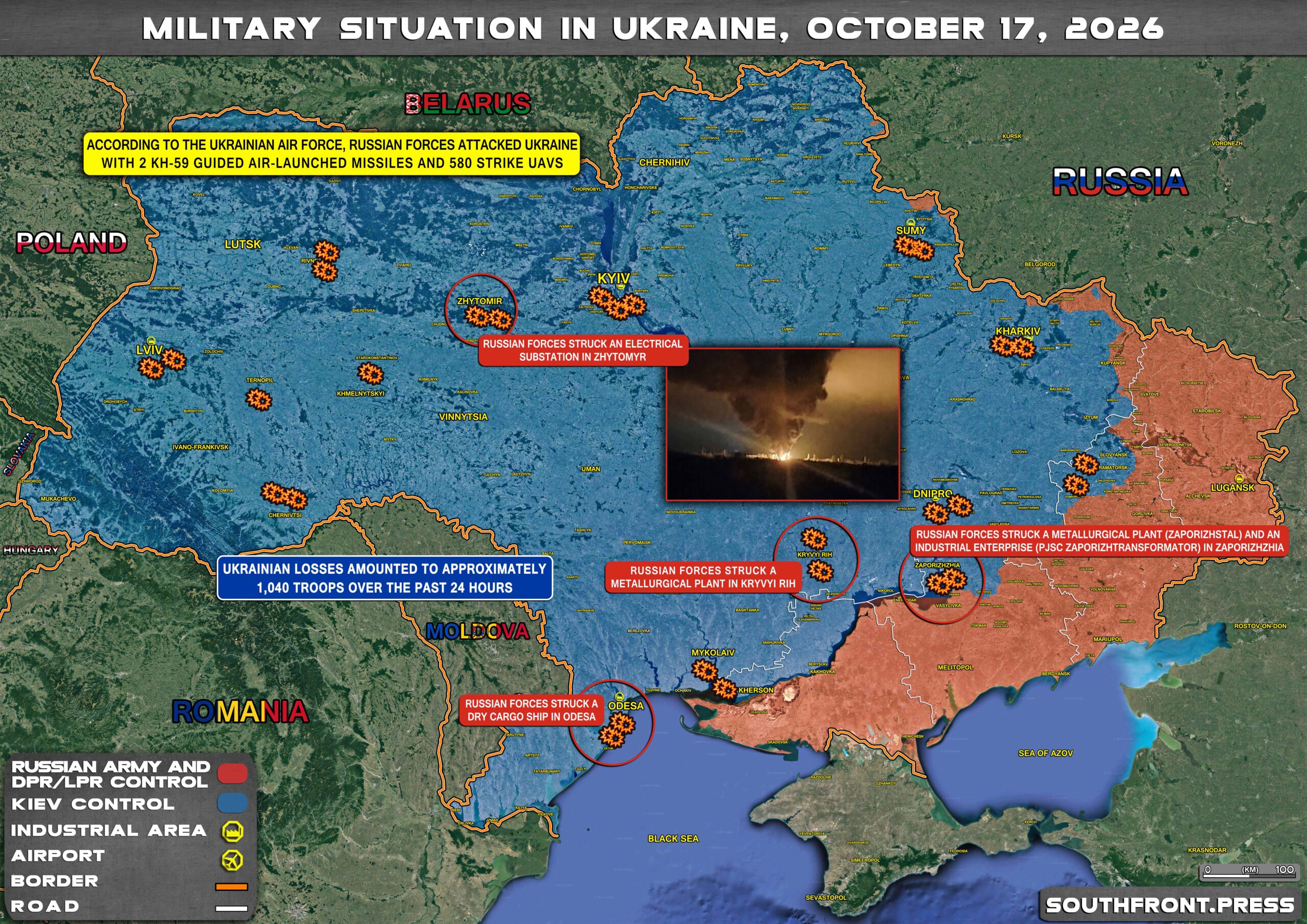
Between the evening of October 16 and October 17, 2026, the Russian Armed Forces continued their campaign of combined strikes against Ukrainian defense-industrial, energy, and logistics infrastructure. According to the Ukrainian side, the overnight attack leading into October 17 involved Iskander-M/KN-23 ballistic missiles, Kh-22/Kh-32 cruise missiles, four Kalibr sea-launched cruise missiles, and 332 strike unmanned aerial vehicles. The main focus was on metallurgical enterprises in Kryvyi Rih and Zaporizhzhia, transformer production, and high-voltage substations in western Ukraine. In parallel, Ukrainian forces carried out a large-scale drone attack on Russian territory.
Russian Strikes on Targets in Ukraine
Metallurgical Complex
Zaporizhstal (Zaporizhzhia) – formerly one of Ukraine’s largest metallurgical enterprises. Before the campaign, it produced up to 1.44 million tons of pig iron and more than 1.3 million tons of rolled steel annually; its output was directed primarily toward military-industrial needs. According to Metinvest, this was the fifth strike on the facility; six ballistic missiles were fired in the latest attack, damaging energy and logistics infrastructure as well as production facilities in the blast-furnace shop. In total, 23 ballistic missiles have been fired at the plant across five attacks.
Metallurgical combine in Kryvyi Rih (Dnipropetrovsk Region) – one of Ukraine’s largest metallurgical enterprises, which supplied metal products to the Ukrainian defense-industrial complex. The description provided by the Russian Ministry of Defense matches ArcelorMittal Kryvyi Rih; according to sources, a week earlier the owners announced a cold shutdown of primary production, and the plant was preparing for preservation.
Zaporozhtransformator PJSC (Zaporizhzhia) – a manufacturer of oil-immersed power transformers rated at 220-750 kV, a key component of high-voltage substations. Since 2022, it has been under the management of Ukraine’s Ministry of Defense and has been used in the interests of the Ukrainian Armed Forces. Striking this facility complicates the replacement of damaged transformer equipment for Ukrenergo, as manufacturing a new transformer takes months.
Zhytomyr 330 kV Substation (Zhytomyr Region) – a major hub in the trunk power grid, providing voltage conversion and electricity distribution among 330 kV, 110 kV, 35 kV, and 10 kV networks. Power was cut in several districts of Zhytomyr, and water-supply disruptions occurred. According to the Russian Ministry of Defense, the facility struck was one that distributed electricity from western Ukraine to central regions for defense-industrial enterprises.
Click to see the full-size image
Rivne 330 kV Substation (Rivne Region) – a trunk power-grid facility. Power outages occurred in Rivne and nearby settlements, and municipal electric transport operations were disrupted.
Bar 330/110/35 kV Substation (Vinnytsia Region) – a high-voltage facility distributing electricity among the aforementioned voltage classes. Voltage fluctuations were recorded in Vinnytsia and across the region.
Kharkiv CHP-3 (combined heat and power plant No. 3; KP Kharkivski Teplovi Merezhi – Kharkiv Heating Networks), Kharkiv – a combined heat and power plant producing both thermal and electric energy for municipal supply. A hit was recorded on the electrical-shop building, where a fire broke out over an area of 100 square meters.
Delivery logistics terminal (Novohrad-Volynskyi, Zhytomyr Region) – a branch of a Ukrainian freight-logistics operator specializing in less-than-truckload road transport and interregional delivery. The strike caused a fire in a warehouse building covering more than 1,000 square meters. The company participates in government contracts for freight-forwarding services through the Prozorro system.
Dry cargo vessel underway at sea (Port of Odesa) – a vessel delivering military cargo to the port was struck.
Strikes on Russian Territory
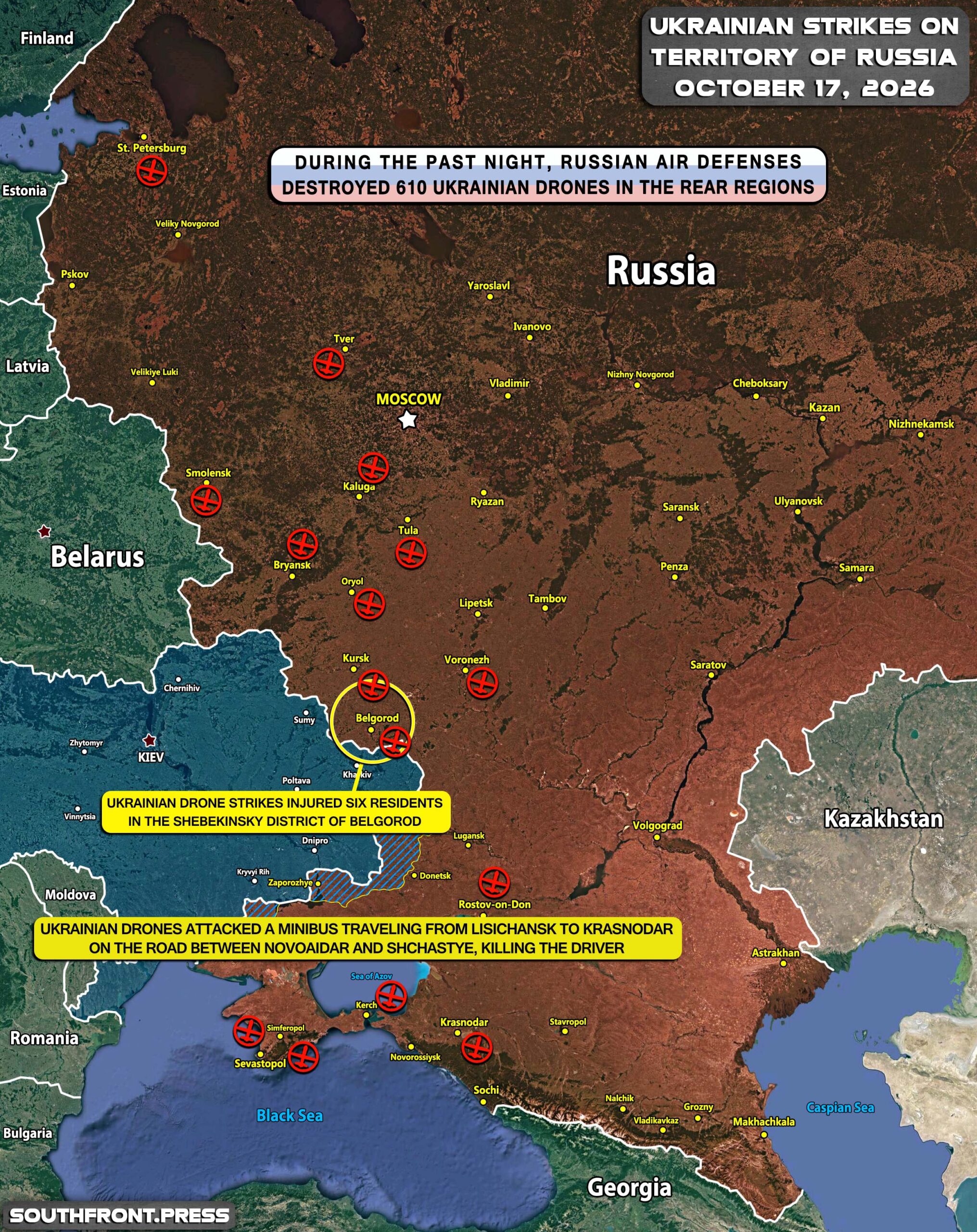
On the night of October 17, Ukrainian forces carried out a large-scale drone attack on Russian regions. According to the Russian Ministry of Defense, air-defense forces intercepted and destroyed 610 Ukrainian fixed-wing UAVs over the territory of 16 Russian regions and over the Black Sea. The highest intensity was recorded on the Moscow axis: Moscow Mayor Sergei Sobyanin reported the destruction of 144 UAVs heading toward the capital. In Bryansk Region, 157 UAVs were shot down over the course of a day. No reports indicated that serious strategic targets had been hit; there were civilian casualties.
The nature of the October 16-17 strikes confirms a systematic approach by the Russian command to disabling Ukraine’s defense-industrial production chain and the energy infrastructure supporting it. Priority targets include metallurgical enterprises producing goods for military needs and transformer production, which is critical for restoring damaged substations. According to Chief of the General Staff of the Russian Armed Forces Valery Gerasimov, steel production in Ukraine has been halted, operations at major Black Sea ports have ceased, and 76 logistics and warehouse centers have been struck. Given statements by the Russian leadership on the need to continue large-scale strikes against the defense-industrial complex and logistics centers, further intensification of attacks on energy infrastructure in western and central Ukraine, as well as on facilities involved in the repair and restoration of military equipment, should be expected. The resilience of Ukraine’s energy system will depend on its capacity to import electricity from the EU and on the speed of restoring trunk substations – both significantly complicated by the strike on Zaporozhtransformator.
Click to see full-size image. (Sgt. Harley Jelis/Army National Guard)
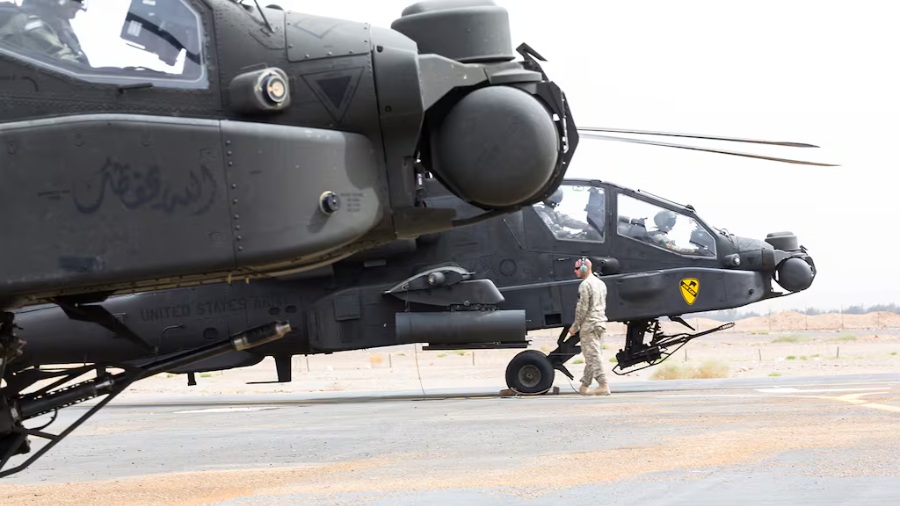
Yemen’s Houthis (Ansar Allah) announced late on October 17 that they shot down a Saudi AH-64 Apache attack helicopter near the border with the kingdom’s southern province of Najran.
In a statement, Brig. Gen. Yahya Saree, the movement’s military spokesman, said the American-made helicopter had been targeting Houthi positions along the border.
“Our armed forces, with the help and grace of God, managed to shoot down an Apache belonging to the Saudi enemy opposite Najran while it was carrying out hostile actions against our forces’ positions along the border,” Saree said. “It was shot down with a suitable weapon.”
The Houthis operate a range of air defense systems, from man-portable weapons to interceptors and medium-range surface-to-air missiles.
The Apache is Saudi Arabia’s principal attack helicopter, with a modernized AH-64E estimated to cost about $52 million per helicopter according to recent U.S. Army procurement figures.
Open-source inventories list 22 Apaches with the Royal Saudi Land Forces and 12 others with the Saudi Arabian National Guard.
The announcement came just days after the Houthis said they had struck a Saudi Eurofighter Typhoon fighter jet over Yemen’s Saada province. The group later released footage showing a missile hitting the jet during flight, supporting its claim.
Including the latest claim, the Houthis have announced 18 shootdowns since the start of the ongoing confrontation with Saudi Arabia. Aside from an American-made F-15SA fighter jet, all other warplanes shot down by the Houthis were combat drones.
Over the course of less than 90 minutes, 24 Israeli soldiers and intelligence officials have fully exposed 36 months of baseless propaganda, lazy talking points, and disgusting lies.”
An explosion struck the headquarters of Iraq’s Popular Mobilization Forces (PMF) in eastern Baghdad on October 17, with conflicting reports emerging over casualties and claims that the facility had been targeted in a strike.
The blast occurred at a PMF site east of the Army Canal in the Sadr al-Qanat area, near Saad al-Witri Hospital. Residents reported hearing a loud explosion, while footage circulated by local media showed flames and thick smoke rising from the area.
In a statement, the PMF said a stockpile of damaged ammunition had exploded inside the facility and initially reported no casualties.
Shafaq News, citing a security source, reported that four PMF members were wounded, some seriously. Asharq Al-Awsat separately cited sources as saying one fighter was killed and three others injured.
The cause of the explosion remained unclear. Sabereen News, a militia-linked channel, circulated claims that the headquarters had been targeted in a strike. Asharq Al-Awsat also reported that security personnel believed the site had been targeted, but provided no details establishing the nature of the incident.
The explosion was the second reported incident involving ammunition at an armed faction’s site in Baghdad this month. On October 1, munitions stored at a site belonging to an armed faction exploded in the capital’s southern Dora district without causing casualties, according to Shafaq News.
Many of the PMF’s factions are also believed to be members of the Iran-aligned Islamic Resistance in Iraq. The recent blasts came amid reports suggesting that both the United States and Israel are preparing to resume war against the Islamic Republic before the end of the year. They also came amid a heated confrontation between the Houthis, also allied to Tehran, and Saudi Arabia.
Iran has provided Yemen’s Houthis (Ansar Allah) with weapons, targeting intelligence and military training that have helped the group carry out increasingly sophisticated attacks against Saudi Arabia and its Yemeni allies, The Wall Street Journal reported on October 17.
The assistance includes intelligence for selecting targets for drone and missile strikes, tactical guidance and training, according to the report, which cited people briefed on intelligence from Saudi Arabia and the anti-Houthi alliance in Yemen.
Iranian Islamic Revolutionary Guard Corps (IRGC) officers have also deployed inside Yemen, helping direct military operations, the report said.
Iran has supplied weapons to the Houthis through traditional dhow boats, resorting to submarines when maritime shipments were disrupted by U.S. and Israeli strikes, the Journal revealed, citing European and Houthi officials.
The report also described an alleged weapons shipment in July aboard two flights operated by Mahan Air, an Iranian airline under U.S. sanctions.
The flights were ostensibly transporting Yemeni pilgrims and Houthi officials to Tehran for the funeral of former Iranian Supreme Leader Ali Khamenei. However, they also carried Iranian paramilitary officers and weapons-related cargo, including drone components, missile guidance systems and impact detonators, according to people familiar with intelligence from Saudi Arabia and the anti-Houthi alliance.
The discovery prompted Saudi-aligned forces to bomb the runway at Sanaa airport in an attempt to stop the second flight, setting off the latest escalation in the conflict.
Iranian officers have also helped the Houthis deploy missiles and radars at positions threatening the Red Sea and the Bab al-Mandeb Strait, according to the Journal.
The group’s offensive, which accelerated in September, combined large-scale infantry assaults with missile and drone attacks, enabling it to capture the Red Sea port city of Mokha and seize territory around the Bab al-Mandeb.
The group’s increasingly sophisticated tactics, including the use of first-person-view drones guided by fiber-optic cables, indicated that its fighters had received training from Iran, according to a person associated with forces fighting the Houthis.
Another official from the anti-Houthi alliance told the Journal that IRGC officers had been present on the front lines directing drone and missile attacks.
The Houthis have also intensified attacks against Saudi targets, including oil tankers, energy facilities and airports. One strike in Riyadh last weekend killed at least 13 people, according to the report.
Mohammed al-Bukhaiti, a senior Houthi official who said he was aboard the second Mahan Air flight, rejected the allegations concerning Iranian officers and weapons, calling them an exaggeration intended to justify the attack on Sanaa airport. He also said claims of Iranian assistance overlooked the group’s own advances in developing its military capabilities.
Iranian Foreign Ministry spokesman Esmail Baghaei said last month that Tehran did not interfere in Yemeni affairs and described the Houthis as independent actors pursuing their own interests.
The Journal also acknowledged in its report that the Houthis manufacture some of their own weapons and have obtained components for drones and missiles directly from China, underscoring that their military capabilities do not rely exclusively on Iranian supplies.
The latest allegations may be an attempt to drag Saudi Arabia into a direct confrontation with Iran, amid reports suggesting the United States and Israel could resume war against the Islamic Republic before the end of the year.
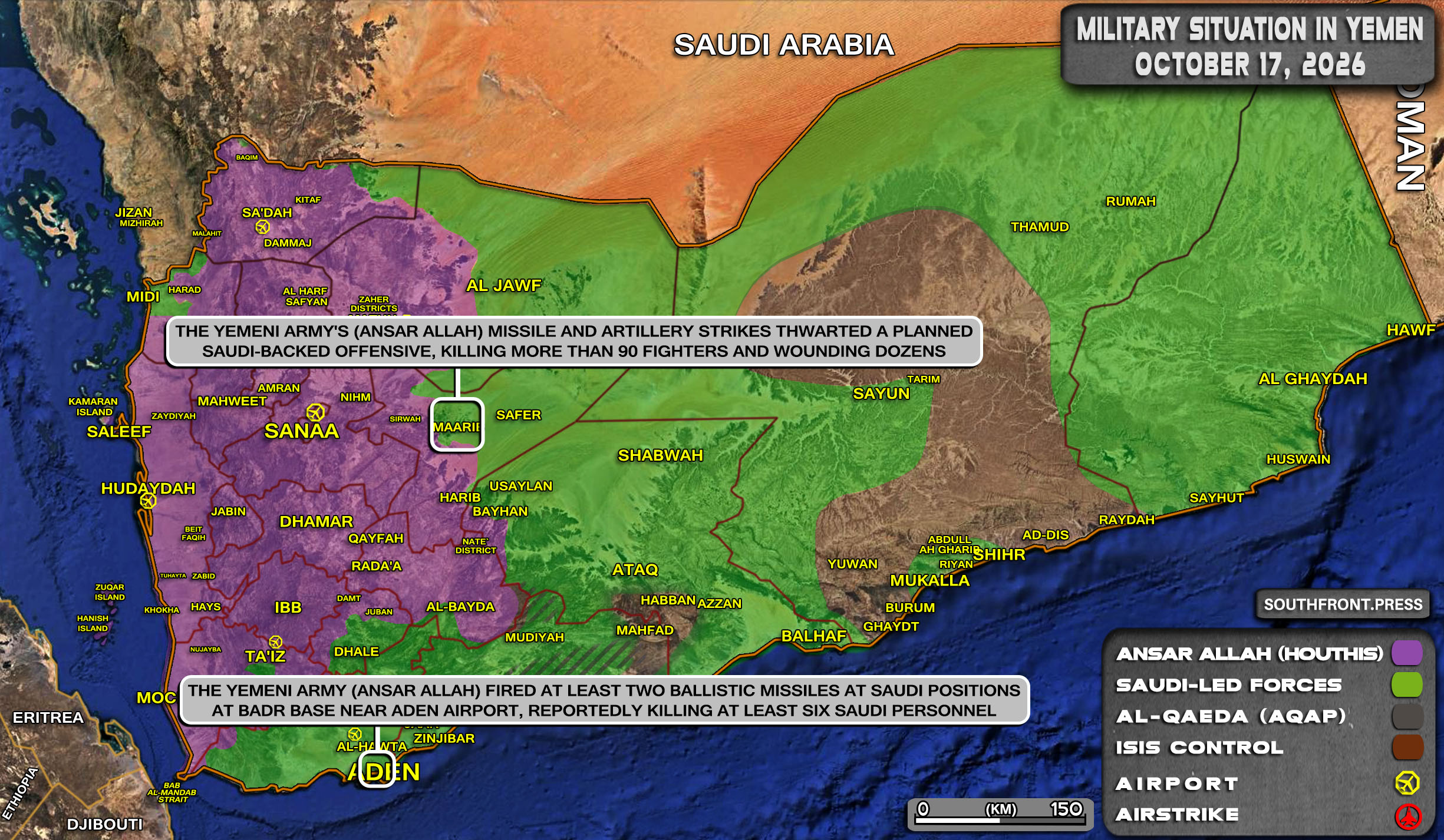
The Yemeni army (Ansar Allah) fired at least two ballistic missiles at Saudi positions at Badr base near Aden Airport, killing at least six Saudi personnel;
The Yemeni army’s (Ansar Allah) missile and artillery strikes thwarted a planned Saudi-backed offensive, killing more than 90 fighters and wounding dozens.
Russian strikes destroyed targets in the Sumy, Kharkiv, Zaporizhzhia, Dnipropetrovsk, Kherson, Kyiv, Odesa, Khmelnytskyi, Lviv, Volyn, Zhytomyr, Rivne, Cherkasy, Chernivtsi, Ternopil, Vinnytsia regions, and the DPR;
According to the Ukrainian Air Force, Russian forces attacked Ukraine with 2 Kh-59 guided air-launched missiles and 580 strike UAVs;
Russian forces struck a metallurgical plant in Kryvyi Rih;
Russian forces struck an electrical substation in Zhytomyr;
Russian forces struck a metallurgical plant (Zaporizhstal) and an industrial enterprise (PJSC Zaporizhtransformator) in Zaporizhzhia;
Russian forces struck a dry cargo ship in Odesa;
Ukrainian losses amounted to approximately 1,040 troops over the past 24 hours.
Click to see the full-size image
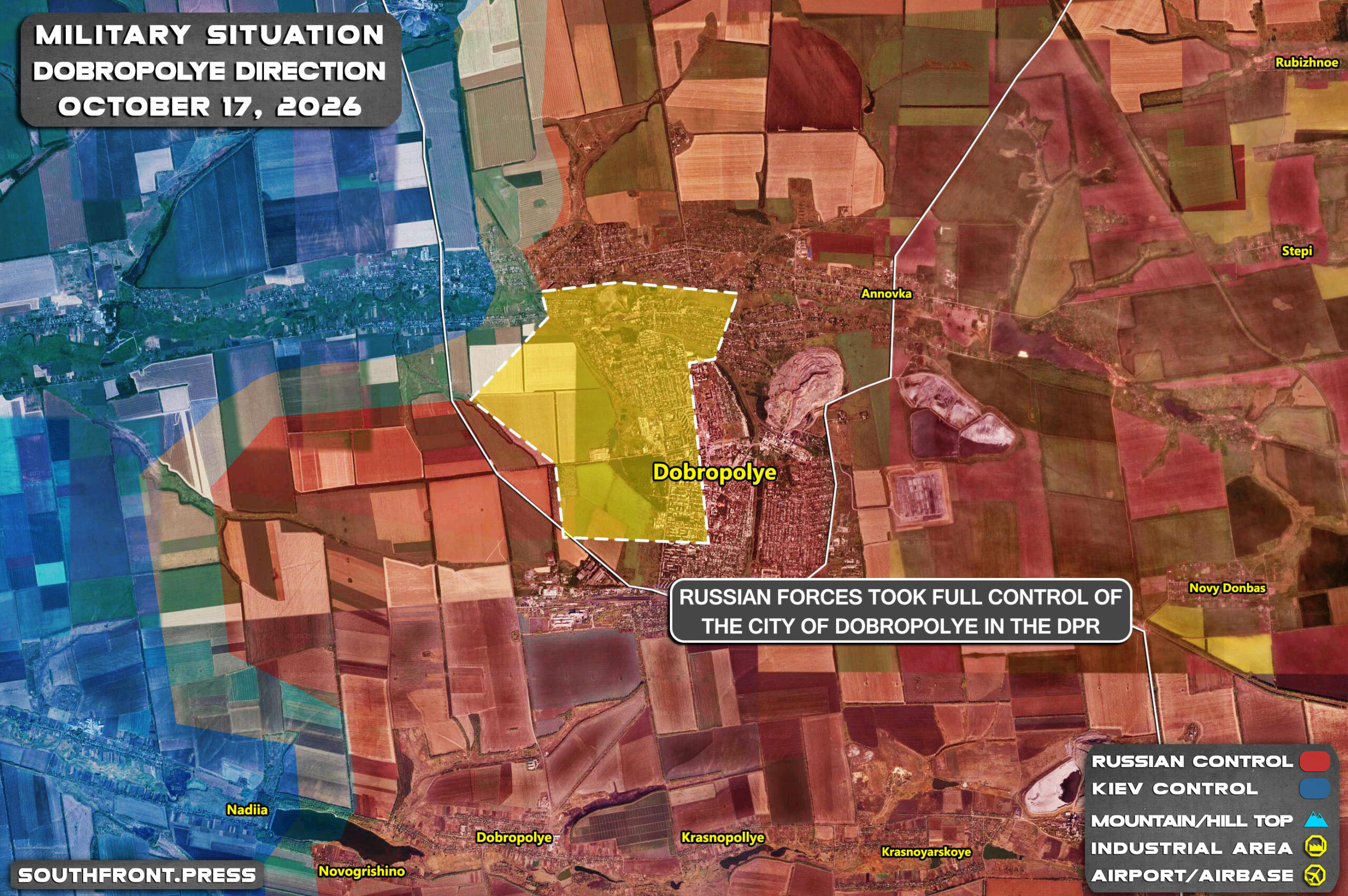
Russian forces took full control of the city of Dobropolye in the DPR.
Click to see the full-size image
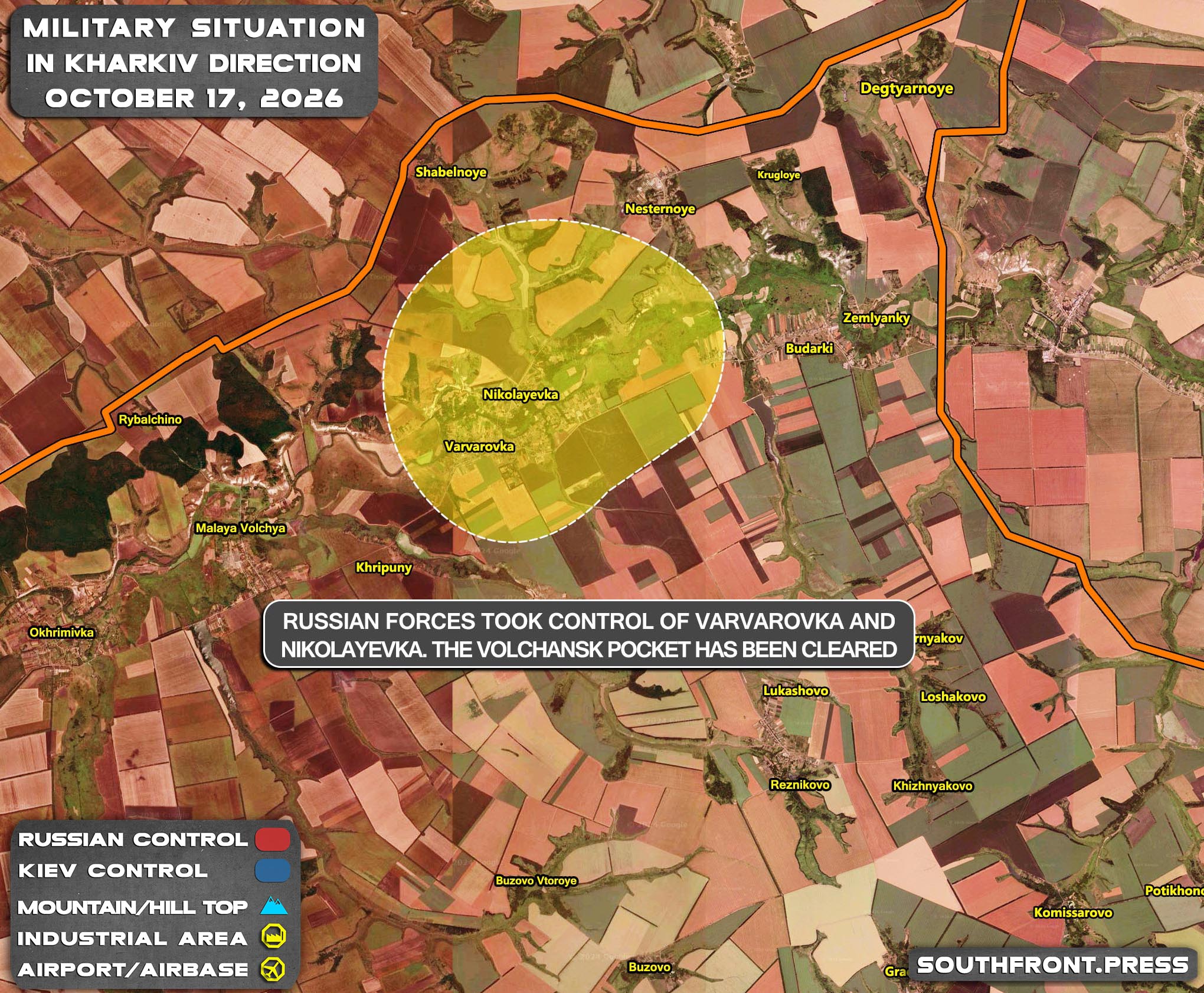
Russian forces took control of Varvarovka and Nikolayevka. The Volchansk pocket has been cleared.
Click to see the full-size image
During the past night, Russian air defenses destroyed 610 Ukrainian drones in the rear regions;
Russian air defenses intercepted UAVs in the Leningrad, Novgorod, Tver, Bryansk, Belgorod, Kursk, Oryol, Kaluga, Voronezh, Rostov, Smolensk, and Tula regions, the Moscow region, Krasnodar Krai, the Republic of Crimea, and over the Black Sea;
Ukrainian drone strikes injured six residents in the Shebekinsky district of the Belgorod region;
Ukrainian drones attacked a minibus traveling from Lysychansk to Krasnodar on the road between Novoaidar and Shchastia, killing the driver.
Click to see full-size image. (Korean Central News Agency)
North Korea said Saturday it had tested a new precision-guided torpedo that uses artificial intelligence to detect and track targets.
The underwater test of the “super-speed” Zam-2.0 torpedo took place on October 15 to confirm technical upgrades, the Korean Central News Agency (KCNA) said.
According to the state-run news agency, AI had been incorporated into the weapon’s target detection and guidance functions.
The test demonstrated technology intended to improve the efficiency and performance of the propulsion system, KCNA said, adding that the weapon had undergone more than 180 rounds of testing over the past five years.
The announcement came days after Pyongyang said it had test-fired two types of cruise missiles from a submarine, following weeks of tension with Seoul over a landmine explosion along the countries’ border.
In addition, North Korea announced earlier this month an AI-assisted launch of an intermediate-range hypersonic missile, claiming the weapon could change its flight path at low altitude and could not be avoided. Hypersonic missiles travel at more than five times the speed of sound and can maneuver during flight, making them harder to track and intercept.
South Korea test-fired its own hypersonic glide vehicle days after North Korea announced its test, describing the weapon as a strategic asset capable of changing the course of a battle. Pyongyang subsequently questioned whether Seoul’s test had achieved hypersonic flight, a claim South Korea rejected.
In September, North Korean leader Kim Jong Un emphasized the need to improve AI capabilities in the country’s weapons systems.
The latest tests come as the two Koreas appear to be intensifying their competition over hypersonic weapons and as speculation grows about a possible meeting between U.S. President Donald Trump and Kim during Trump’s Asia tour next month. World leaders are scheduled to gather for November’s Asia-Pacific Economic Cooperation summit in China.
The "vast majority" of Iran's attempted attacks on shipping in the Strait of Hormuz are "unsuccessful" as the key waterway remains open for transit, U.S. Central Command spokesperson and U.S. Navy Capt. Tim Hawkins told Fox News Digital this week.
Hawkins spoke after CENTCOM said the GFS Pride, a Singapore-flagged, Cyprus-owned container ship was hit by an Iranian projectile in the Strait of Hormuz Wednesday and sunk while being towed ashore due to a fire on board the ship.
"The vast majority of Iran's attempted attacks on innocent civilian mariners transiting an international waterway, being the Strait of Hormuz, they are unsuccessful," Hawkins said.
"As a matter of fact, the U.S. military has assisted in providing coordinated protection for thousands of ships that have safely transited.
"That translates to about 97% of the ships that have sought to transit the Strait of Hormuz have done so successfully without being hit by an Iranian projectile.
"But let's be clear here. What the Islamic Revolutionary Guard Corps of Iran is doing is unjustified, and it's also unsuccessful because they are not achieving their objective of closing the Strait of Hormuz," he added.
"It is open, it is available for transit and we've seen that transit continue this very day."
In an update Friday from CENTCOM Commander Adm. Brad Cooper, he said, "In recent days and months, we have seen the IRGC continually attack merchant ships transiting the Strait of Hormuz, and, in many cases, kill innocent civilian mariners.
"The International Maritime Organization reports that more than 20 civilian mariners have been killed by Iran's attacks against commercial shipping since February," Cooper continued.
"Over the last seven days alone, about 400 merchant ships have sailed through the Strait. U.S. forces have also assisted Gulf partners in shipping over 100 million barrels of crude oil during the same period, adding to the more than 1.3 billion barrels of crude we have helped regional allies ship through the Strait in recent months."
Hawkins also told Fox News Digital he thinks "every American should be proud of American service members who are serving in the Middle East, in particular focusing on doing two things at once as it relates to Iran.
"And one is helping maintain flow through the Strait of Hormuz in the form of commercial vessels despite Iran's unjustified aggression," Hawkins said, noting that thousands of ships have crossed through the waterway over the last few months, "in addition to more than 1 billion barrels of crude oil.
"At the same time that they are encouraging traffic flow in support of international shipping, they are maintaining a steel wall blockade against Iran. There have been no exports or imports to Iran without U.S. permission in the form of allowing humanitarian ships to go through," Hawkins continued.
"So, that shows the precision, dedication and professionalism of our troops who are executing this complex mission — not just one — but two at the same time."
More than 50,000 U.S. service members are stationed across the Middle East, according to Hawkins.
"They are highly vigilant, they are highly dedicated and they're serving with courage and bravery. And they're doing so alongside our regional allies and partners. It shouldn't be forgotten that we continue to stand shoulder to shoulder with our Gulf allies and partners to help them defend their airspace from unjustified and unwarranted attacks from Iran, and we have been highly successful in working together. And will continue to do that," he said.
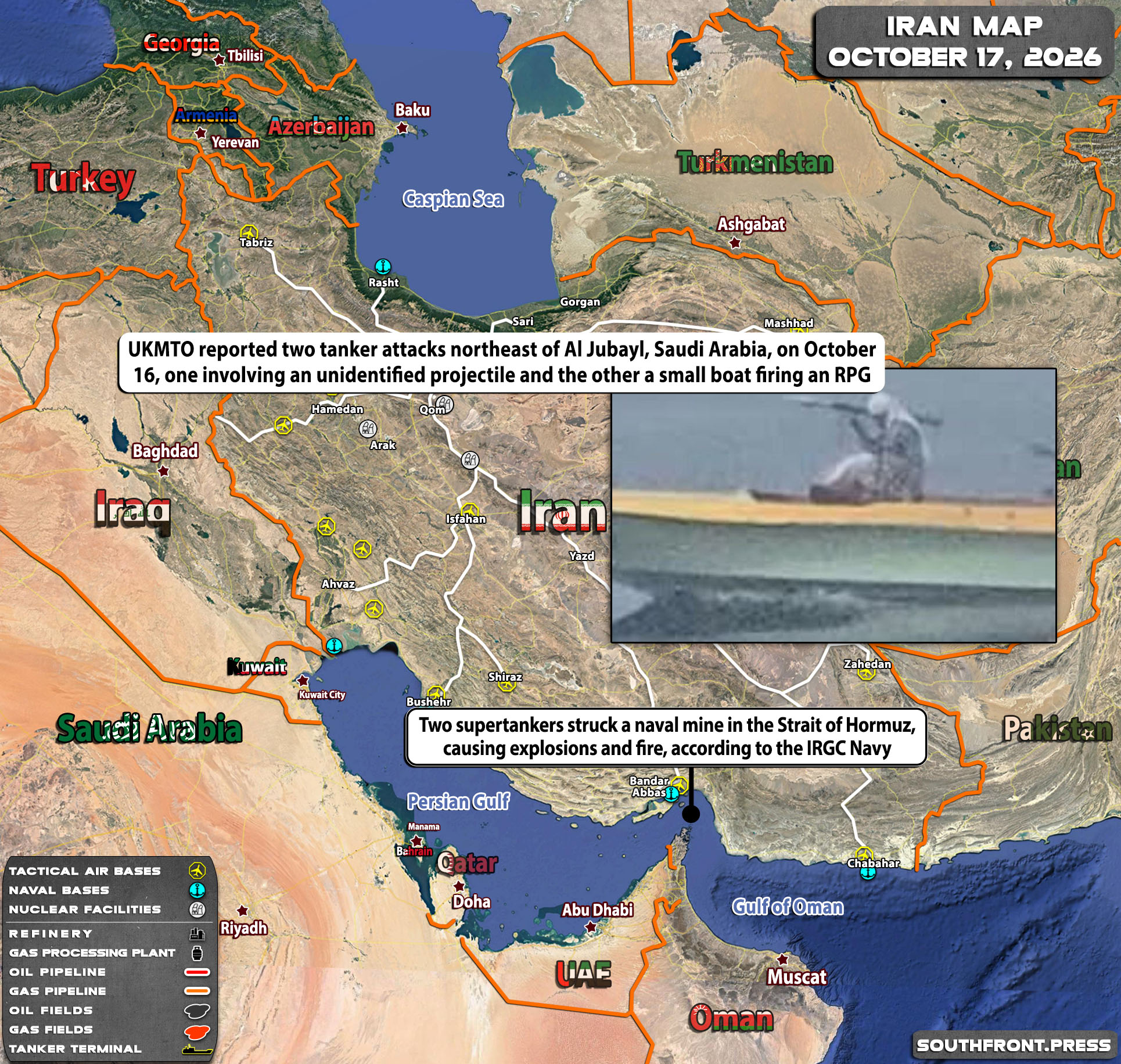
Two supertankers struck a naval mine in the Strait of Hormuz, causing explosions and fire, according to the IRGC Navy;
UKMTO reported two tanker attacks northeast of Al Jubayl, Saudi Arabia, on October 16, one involving an unidentified projectile and the other a small boat firing an RPG.
The Houthis (Ansar Allah) fired at least two missiles toward a military facility next to Aden International Airport on October 16, saying the attack targeted a Saudi-led coalition command center and weapons depots at Badr military camp.
Aden’s security department said the missiles struck airport grounds without causing casualties. Meanwhile, Yemeni Information Minister Moammar al-Eryani said they landed about 500 meters from a Yemenia Airways passenger jet preparing to depart for Cairo. Passengers were evacuated, according to a security official.
The strike came a day after the Houthis attacked the al-Maashiq presidential palace, the headquarters of Yemen’s internationally recognized government in Aden.
Yemen’s Health Minister Qasem Buhaibeh said five people were killed and 16 wounded. AFP reported, citing an unnamed Yemeni minister, that Saudi and Yemeni personnel were among the casualties, although no Saudi-specific death toll was disclosed.
The successive attacks have brought mounting pressure on Aden, the interim capital and a key center for the Saudi-backed government.
The Houthis have intensified their military campaign while expanding their territorial gains along Yemen’s Red Sea coast and tightening their grip around the strategic Bab al-Mandab Strait, a major shipping passage connecting the Red Sea with the Gulf of Aden.
At the same time, the group also tightened its siege of Taiz, Yemen’s third-largest city, cutting the city’s main southern road to Aden.
Capturing Taiz would give the group control over another major urban center in southwestern Yemen and could help consolidate its position around the Bab al-Mandab approaches.
The growing frequency of Houthi strikes on Aden may be part of a broader campaign of shaping operations intended to disrupt Saudi-led coalition command-and-control structures ahead of a possible large-scale offensive to capture the port city.
Illustrative image. (Egyptian Ministry of Defense)
Egyptian President Abdel Fattah El-Sisi on October 17 called for an emergency parliamentary session to authorize a possible Egyptian intervention to defend Saudi Arabia if requested by the kingdom.
“I call on parliament to convene an emergency session to authorize us to take action to intervene in defense of Saudi Arabia, if we are asked to do so,” El-Sisi said at a graduation ceremony for military academy and college cadets.
“This move and this defense require approval from the Egyptian parliament,” he noted, stressing that Egypt was not seeking to join the war against Yemen’s Houthis.
“I am not speaking about attacking or waging war. We are seeking only to defend,” the Egyptian president added.
Egypt is the latest country to publicly signal support for Saudi Arabia as the kingdom faces escalating missile and drone attacks by the Houthis, who control much of Yemen.
El-Sisi said Cairo would take the necessary measures to protect Saudi Arabia, adding that it was “absolutely unacceptable” for the kingdom’s security and stability to be undermined.
Saudi Arabia has secured defensive military support from Pakistan and Turkey through the Mecca Joint Defense Agreement, which the three countries agreed to activate on October 5. More recently, the kingdom also received defensive support from the United Kingdom and France.
The United States, for its part, has been providing more substantial military support to Saudi Arabia, including intelligence sharing, operational planning and assistance identifying Houthi targets, as well as weapons and air defense systems.
Still, Riyadh has so far failed to secure a publicly announced commitment from its allies to directly join its offensive against the Houthis inside Yemen.

 Login