❌

Normal view

A Pause On The Front, No Pause In The Air – Russia Hits Kyiv Again

19 October 2026 at 20:14

The front lines are growing quieter as the seasonal lull sets in. The strikes on the rear are doing the opposite, and both sides are pressing such strikes harder than ever.

Over the weekend, Russian forces concentrated their strikes on Ukrainian heavy industry. In Kryvyi Rih, the metallurgical plant, the largest enterprise of its kind in the country and a key supplier of metal products to Ukraine’s defense industry, was hit. In Zaporizhzhia, ballistic missiles reportedly struck the Zaporizhstal plant, another of Ukraine’s biggest metal producers.

Ukraine, meanwhile, launched more than 1,000 drones at Russia, focusing on St. Petersburg and the Leningrad Oblast. Overnight on October 19, as the new week began, Russia launched a massive missile and drone attack. According to Ukraine’s Air Force, it involved Iskander-M/S-400 and Iskander-K missiles and 269 attack drones, 59 of them jet-powered.

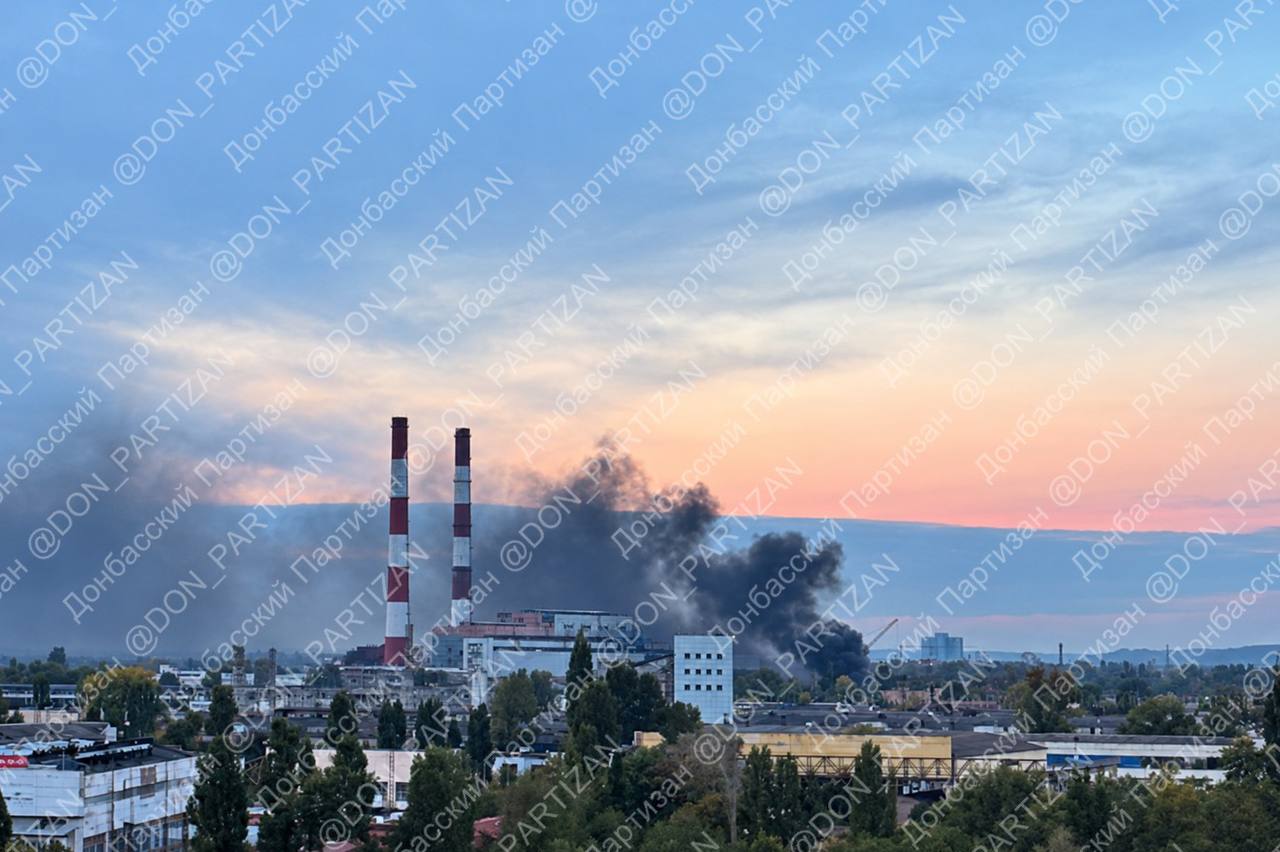
Russian officials said the targets included military-industrial enterprises, storage sites for cruise missiles and unmanned aircraft, and a data processing center in Kyiv and the surrounding oblast. Explosions rolled across the capital throughout the night. Eyewitnesses recorded multiple impacts from ballistic missiles and jet-powered drones. Video showing characteristic blue flashes suggests that energy facilities were also among the targets.

Ukrainian air defenses offered no visible resistance. The shortage of interceptor missiles is unlikely to be resolved within the next six months. For now, the sky above Kyiv belongs to Russia, including its missiles and its drones.

On the ground, the pace is slower, but the fighting has not stopped. Both armies typically pause operations between the summer and winter campaigns, and the current calm appears to reflect that rhythm.

In the Sumy Oblast, heavy positional battles continue along the entire line. Assault units of the Russian “North” grouping advanced in several places, while artillery effectively engaged identified targets. Ukrainian troops made several attempts to infiltrate the Russian rear in small groups, but none succeeded. Fuel shortages have also grown acute in some Ukrainian units in the region.

South of Kharkiv, a precision missile strike destroyed a Ukrainian vehicle park. Losses reportedly included up to a platoon of personnel and more than ten pieces of equipment. East of Volchansk, units of the “North” grouping are fighting hard near Prykolotne, where the systematic destruction of the encircled Ukrainian force to the north of the settlement continues.

Near Kupyansk, positional fighting persists. Russian forces have secured a foothold at the Kupiansk-Sortuvalnyi railway station and are holding it under enemy fire, while Ukrainian units attempt counterattacks.

A lull on the front has not brought relief to Ukraine. Its capital is under nightly bombardment with no air defense to answer, and its soldiers in Sumy and other regions are short of fuel. Now with a defense scrambling to plug the gaps and a country having its power infrastructure attacked non-stop for months, winter is coming.

______________________________________________________________________________________________________________________

DEAR FRIENDS. IF YOU LIKE THIS TYPE OF CONTENT, SUPPORT SOUTHFRONT WORK:

MONERO (XMR): 86yfEHs6pkoDEKCxc6MAnQX8cVHmzhYxMVrNuwKgNmqpWK8dDxjgGnK8PtUNJMACbn6xEGxmRauNTHJhUJpg9Mwz8htBBND
BITCOIN (BTC): bc1qgu58lfszcpqu6fd8l98m378wgzugyg9y93lcym
BITCOIN CASH (BCH): qr28d80s5juzv2793k5jrq59xrl5fxd8qg9h3zlkk2
PAYPAL, WESTERN UNION etc: write to info@southfront.press , southfront@list.ru

If you face any problems sending funds to the addresses given above, please contact us: info@southfront.press and southfront@list.ru. Also be aware that many email services such as Hotmail, Yahoo etc. may block correspondence from info@southfront.press and some others put it in spam.

If you want to support SouthFront but have no opportunity to do it via cryptocurrency, please contact us: info@southfront.press and southfront@list.ru.

SouthFront: Analysis and Intelligence
NOW hosted at southfront.press
Previously, SouthFront: Analysis and Intelligence was at southfront.org.
The .org domain name had been blocked by the US (NATO) (https://southfront.press/southfront-org-blocked-by-u-s-controlled-global-internet-supervisor/) globally, outlawed and without any explanation
Back before that, from 2013 to 2015, SouthFront: Analysis and Intelligence was at southfront.com

SOUTHFRONT.PRESS

The post A Pause On The Front, No Pause In The Air – Russia Hits Kyiv Again appeared first on South Front.
Russia Strikes Flamingo Missile Warehouses, Data Center, and Ukraine’s Power Grid

19 October 2026 at 18:53

Click to see the full-size image

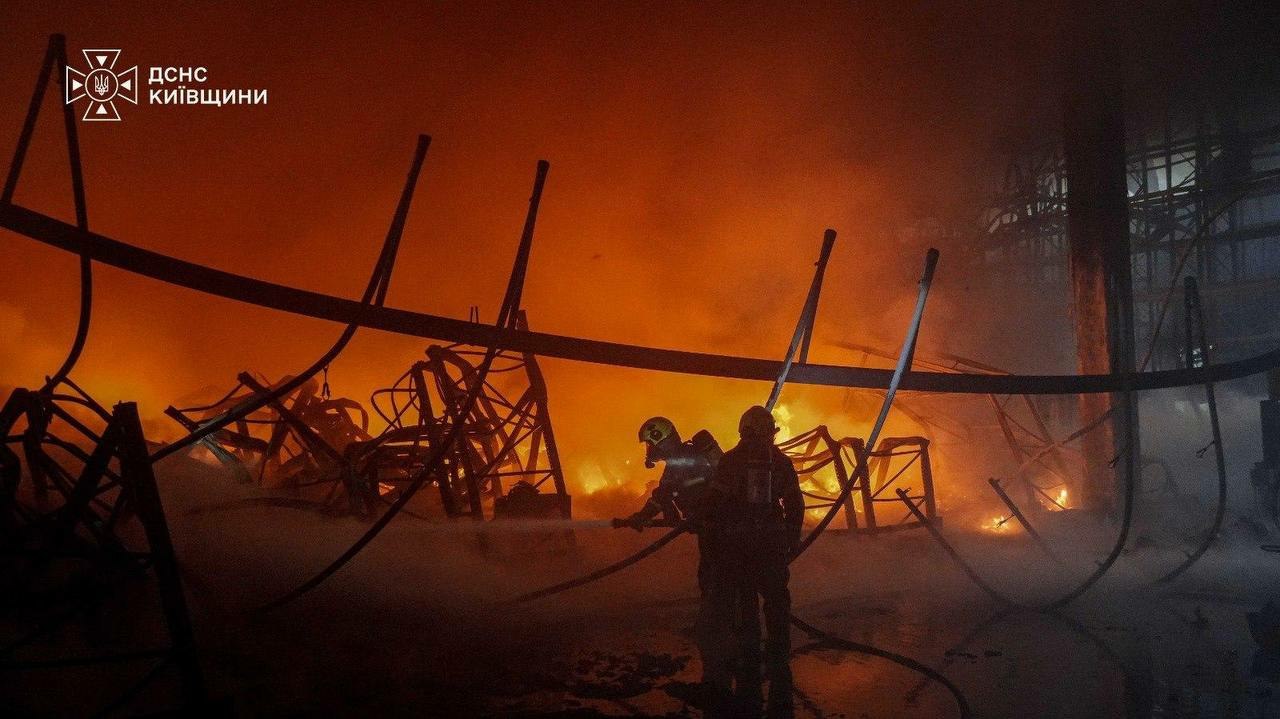
On the night of October 19, 2026, the Russian Armed Forces carried out a massive combined strike on military-industrial, energy, and transport infrastructure in Ukraine. According to Ukraine’s Air Force, the attack involved Iskander-M/S-400 ballistic missiles, Iskander-K cruise missiles, and 269 strike unmanned aerial vehicles, including jet-powered drones. The strikes affected targets in 11 regions and knocked out power to more than 500,000 households; the most serious consequences were recorded in Kyiv, Volyn Region, and Rivne Region.

Strikes by Region

Kyiv and Kyiv Region

  • Data Group data center (Kyiv) — a data-processing center that, according to the Russian Ministry of Defense, was used for military infrastructure needs.

  • Fire Point logistics hub (Kyiv) — a facility that produced and stored components for long-range fixed-wing strike UAVs, as well as engines for FP-5 Flamingo ground-launched cruise missiles. The facility was part of Fire Point’s production chain.

  • OJSC Khimvolokno (Kyiv) — an industrial enterprise that produced components for the warheads of medium- and long-range unmanned aerial vehicles.

  • Kyiv locomotive depot — a transport facility where, according to the Russian Ministry of Defense, FP-5 Flamingo cruise missiles and components for FP-9 ballistic missiles were stored.

  • Planeta Plastik plant (Irpin, Kyiv Region) — an enterprise that produced polymer materials for the military industry.

  • Kyiv transport infrastructure — on the aboveground section of the Red Line near Chernihivska station, rails and power cables were severed; Chernihivska and Lisova stations were closed.

  • Ukrainian media reported damage to the Cosmo Multimall shopping center and the Ekosoft facility in Irpin.

Volyn Region

  • Major rail junction on the route to Poland (Kovel)

  • Energy infrastructure — an electrical substation in Lutsk was attacked; after the overnight strikes, Kovel lost power, and large-scale outages also affected Turiisk and Liuboml.

  • Warehouse and production facilities in the village of Manevychi


Rivne Region

  • BADM warehouse (Rivne) — a 2,370-square-meter warehouse opened in 2012. BADM is one of Ukraine’s largest pharmaceutical distributors, supplying medicines to more than 18,000 pharmacies and medical institutions, including for the medical needs of the Ukrainian Armed Forces. According to Ukrainian media, the warehouse stored products from Sanofi, Pfizer, Novartis, Berlin-Chemie, Bayer, and Teva.

  • Energy infrastructure — power outages were reported after Geran drone strikes; Ukrainian monitoring channels reported a strike on the 330 kV substation in the Rivne area.


Other Regions

  • Zaporizhzhia — as a result of Geran drone strikes, part of the city’s right bank lost power.

  • Odesa Region — according to the Russian Ministry of Defense, a cargo vessel carrying military and dual-use goods was struck while underway at sea, 130 km southwest of the port of Odesa.

  • Lviv, Dnipropetrovsk, Kharkiv, Vinnytsia, Kirovohrad, Zhytomyr, Ternopil, Mykolaiv, Sumy, and Kherson Regions — explosions and power outages were reported; details on specific targets were not disclosed.

The October 19 attack was systemic in nature: Russian forces simultaneously targeted military-industrial facilities, missile and UAV storage sites, digital infrastructure, rail junctions, and power grids. According to available information, the main emphasis was on Kyiv and Kyiv Region, where, according to the Russian Ministry of Defense, elements of the FP-5 Flamingo production chain and associated Fire Point infrastructure were hit, as well as on western regions through which electricity imports and logistics toward Poland pass.

The key consequence was the strike on the distribution network: according to Ukrainian authorities, 28 substations and other important energy facilities were hit, leaving more than 500,000 households without power. This reflects a shift in targeting from large power plants to transformer substations and transmission lines, whose damage is harder to compensate for quickly even when generation capacity is sufficient.

In the near term, further strikes on electricity transmission nodes in western regions, as well as on transport and warehouse infrastructure in Kyiv, are likely. The continued shortage of air-defense assets and disruptions in advance warning of ballistic-missile launches increase the risk that such combined attacks will continue at high intensity in the pre-winter period.


MORE ON THE TOPIC:

The post Russia Strikes Flamingo Missile Warehouses, Data Center, and Ukraine’s Power Grid appeared first on South Front.
Military Situation In Ukraine On October 19, 2026 (Maps Update)

19 October 2026 at 17:39

Click to see the full-size image

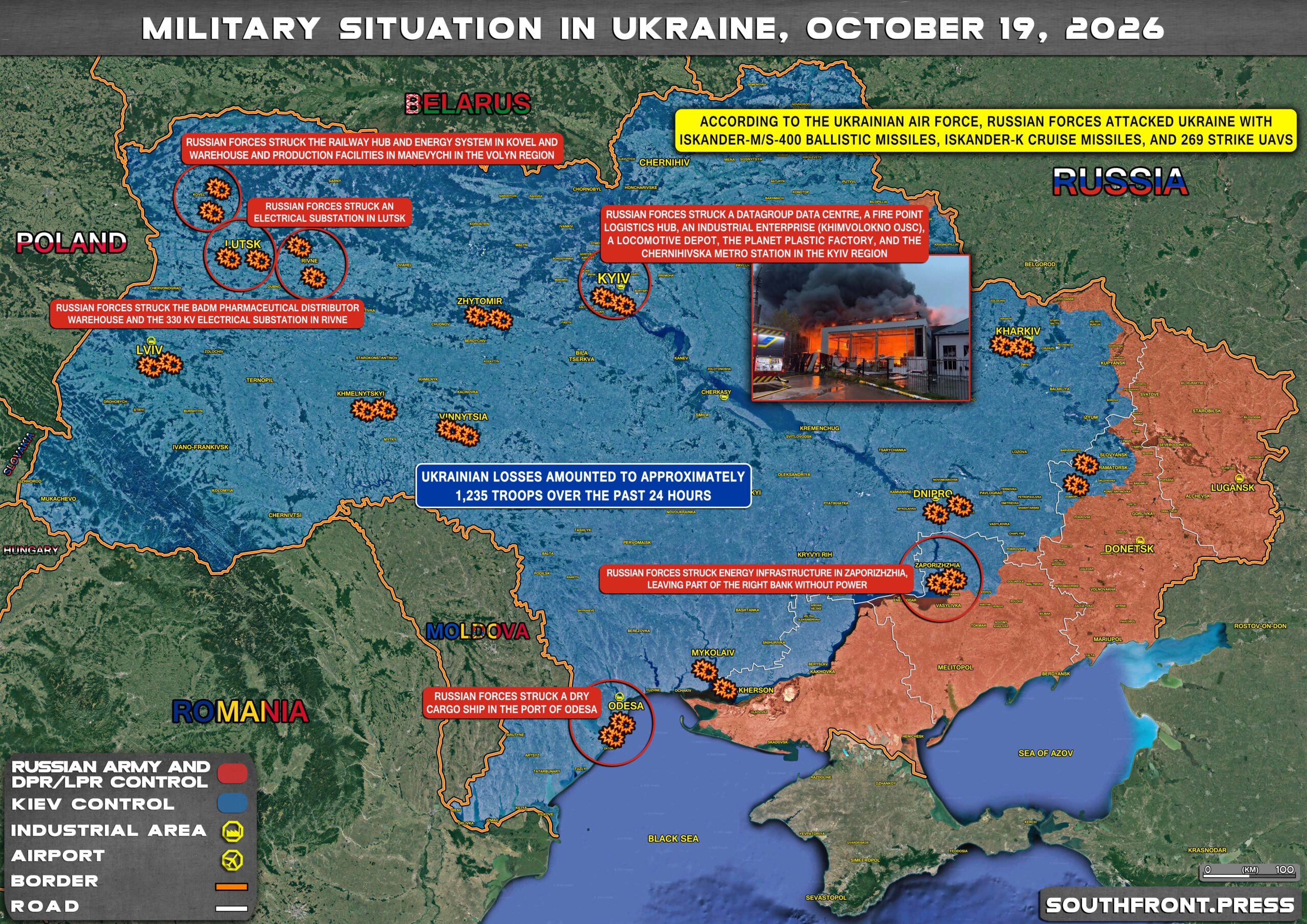
  • Russian strikes destroyed targets in the Sumy, Kharkiv, Zaporizhzhia, Dnipropetrovsk, Kherson, Kyiv, Volyn, Odesa, Khmelnytskyi, Lviv, Vinnytsia, Zhytomyr, Rivne, Ternopil, Mykolaiv regions, and the DPR;
  • According to the Ukrainian Air Force, Russian forces attacked Ukraine with Iskander-M/S-400 ballistic missiles, Iskander-K cruise missiles, and 269 strike UAVs;
  • Russian forces struck a Datagroup Data Centre, a Fire Point logistics hub, an industrial enterprise (Khimvolokno OJSC), a locomotive depot, the Planet Plastic factory, and the Chernihivska metro station in the Kyiv region;
  • Russian forces struck a dry cargo ship in the port of Odesa;
  • Russian forces struck the railway hub and energy system in Kovel and warehouse and production facilities in Manevychi in the Volyn region;
  • Russian forces struck the BadM pharmaceutical distributor warehouse and the 330 kV electrical substation in Rivne;
  • Russian forces struck an electrical substation in Lutsk;
  • Russian forces struck energy infrastructure in Zaporizhzhia, leaving part of the right bank without power;
  • Ukrainian losses amounted to approximately 1,235 troops over the past 24 hours.

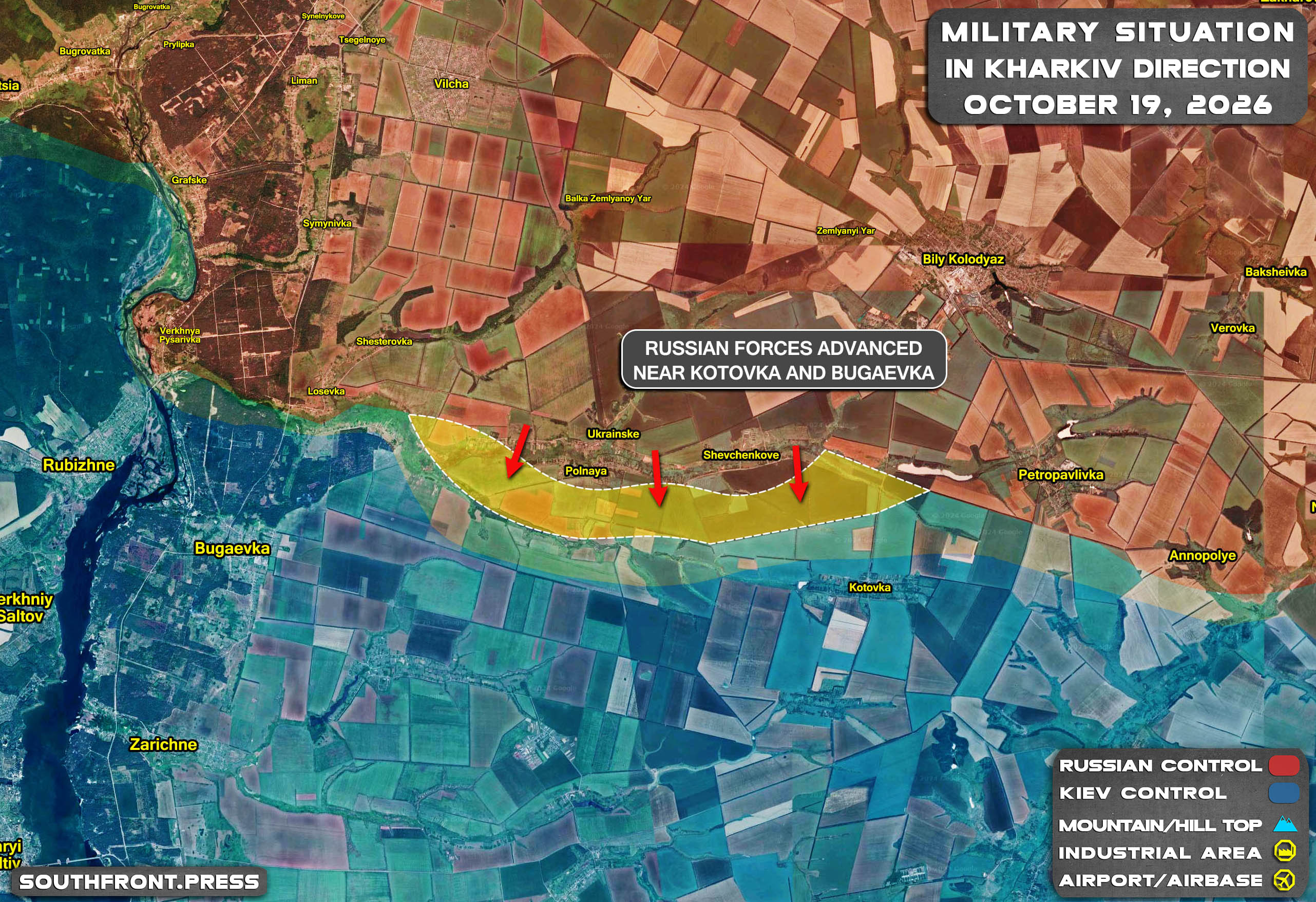
Click to see the full-size image

  • Russian forces advanced near Kotovka and Bugaevka.

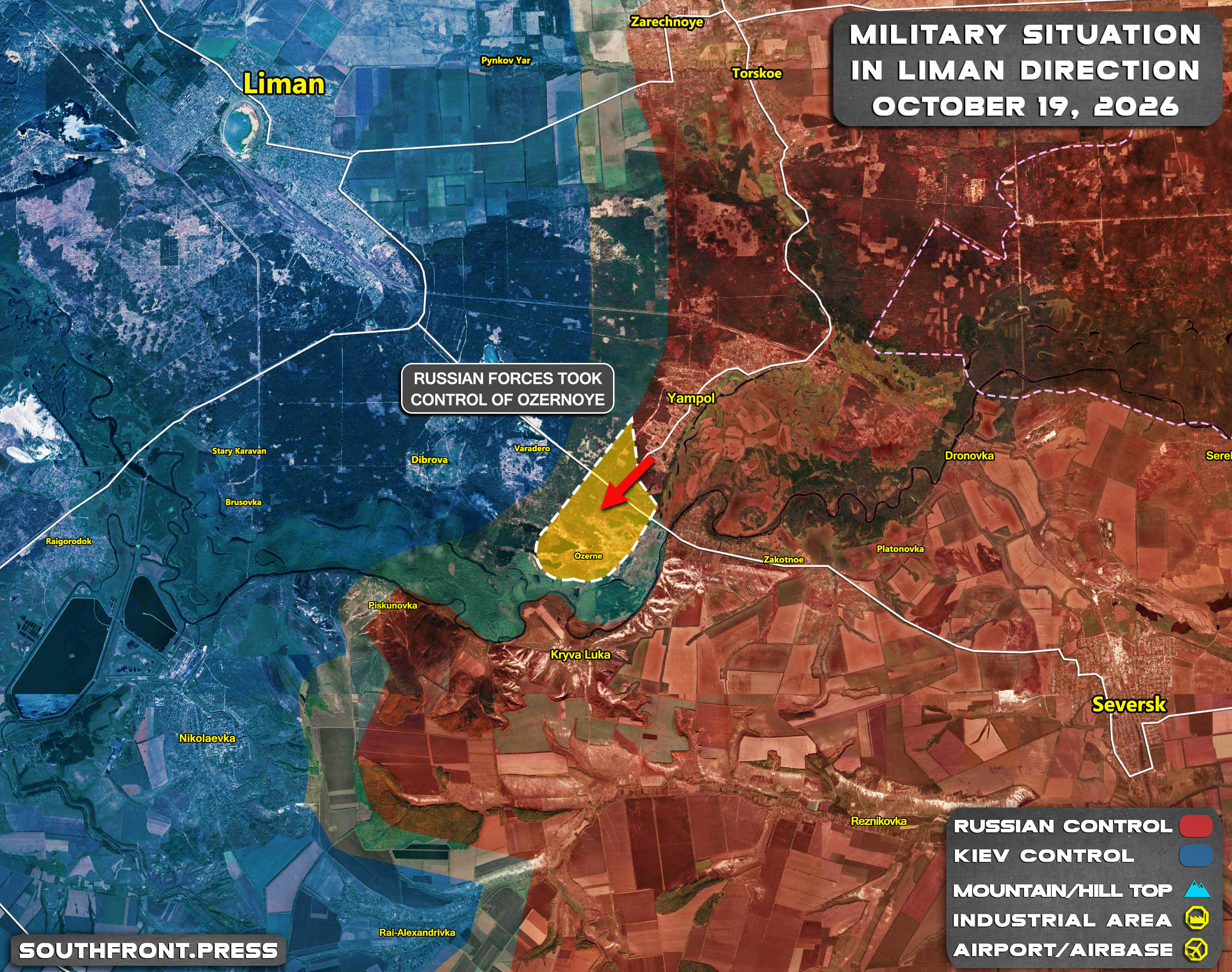
Click to see the full-size image

  • Russian forces took control of Ozernoye.

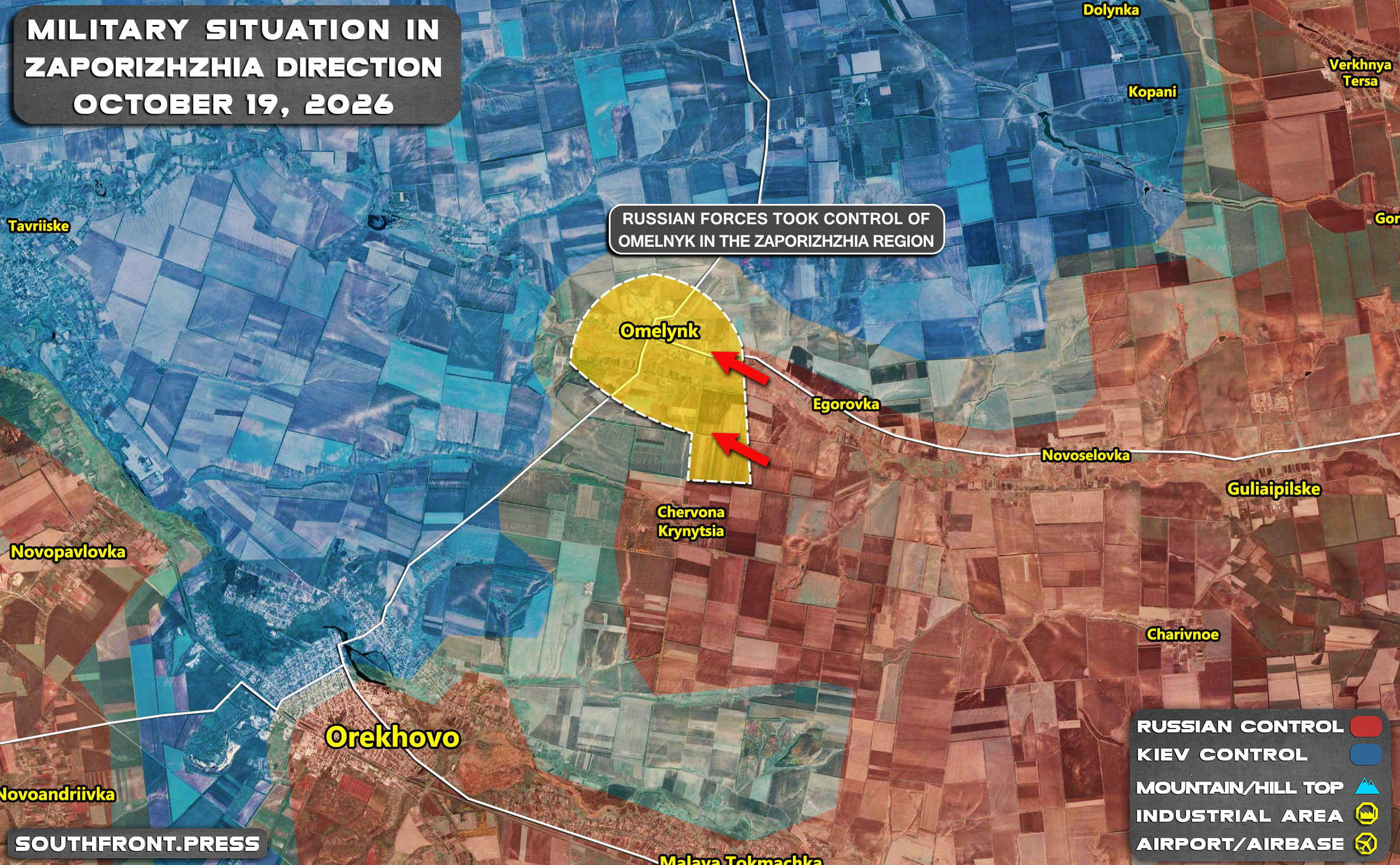
Click to see the full-size image

  • Russian forces took control of Omelnyk in the Zaporizhzhia region.

MORE ON THE TOPIC:

The post Military Situation In Ukraine On October 19, 2026 (Maps Update) appeared first on South Front.
Russia Presses Offensive Across Multiple Fronts in Eastern Ukraine

18 October 2026 at 22:41

Click to see the full-size image

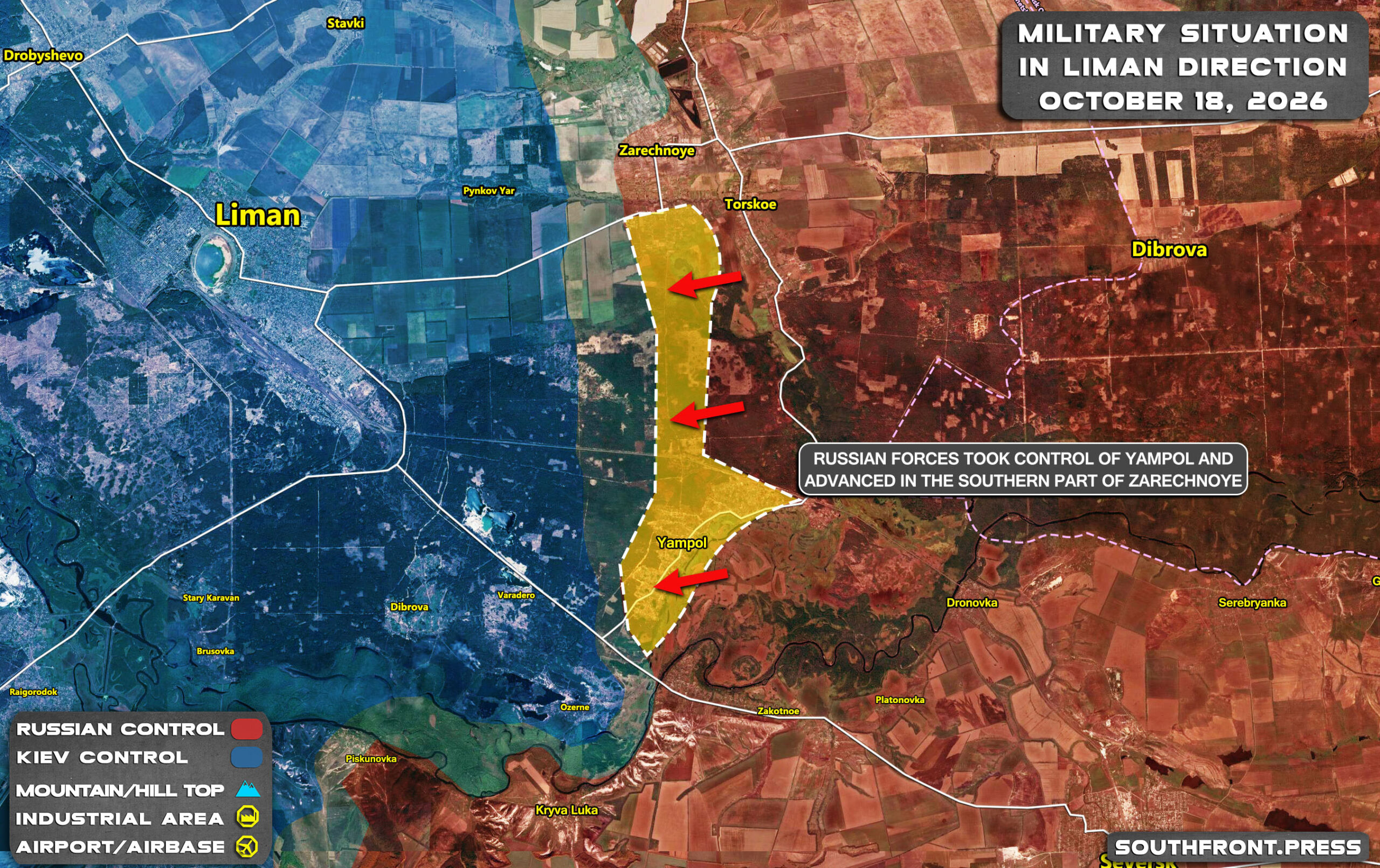
In the Slavyansk-Kramatorsk direction, Russian troops are fighting for Belozerskoye and expanding their control north of Alekseyevo-Druzhkovka. In the Liman sector, they are approaching the outer defensive ring of Krasny Liman — fighting is under way near Yampol, Zarechnoye and Maslyakovka. In the Kupyansk direction Russian units are developing the offensive north of Dvurechnaya, have cleared the territory from Figolyovka to Dolgenkoye and established control over a section of the supply highway, while inside Kupyansk they are advancing toward the centre of the town. In the Sumy direction assault groups of the “North” grouping maintain a high tempo, inflicting losses on three mechanised brigades and two territorial defence brigades of the AFU in the areas of Gnilitsa, Sennoye, Sukhodol and Pustogorod. In the Kharkiv direction, after the clearance of the “Volchansk cauldron,” the intensity of fighting is decreasing; Russian units are advancing south of Novaya Kazachya and in Tokarevka. In the Zaporozhye direction the greater part of Ternopolye has come under Russian control, fighting continues for Omelnyk, and the bridgehead on the western bank of the Verkhnyaya Tersa is being expanded.

Kupyansk direction 

Inside Kupyansk itself clearance of scattered groups continues in the southern district of the town. The initiative remains with Russian units. Assault groups are advancing toward Osinovo.

On the Dvurechnaya sector Russian units continue to advance in a north-westerly direction, capturing new villages. Those who refuse to surrender are destroyed. Logistics are functioning without disruption. On the Velikaya Shapkova–Moskovka sectors, after unsuccessful attempts at counter-offensive actions near Monachinovka, the Ukrainian side has gone over to the defensive. Logistical routes have been tracked and destroyed.

Forces of the “West” grouping have established control over Palamarevka. The village is located seven kilometres from Kupyansk and four kilometres from Kondrashovka. Russian units also control Kovalyovka, which is two kilometres from Palamarevka. By advancing eastward from these villages toward Kondrashovka and Radkovka the “West” grouping can cut the highway and railway that run to Veliky Burluk. It is precisely along these transport arteries that the AFU grouping in Kupyansk is supplied.


Sumy direction 

Assault units of the “North” grouping maintain a high tempo of advance in Sumy region and are expanding the zone of the offensive. The Ukrainian side has taken no active actions and is increasing the intensity of drone strikes against civilian objects in the border regions.

In Sumy region losses have been inflicted on units of three mechanised brigades of the AFU and two territorial defence brigades in the areas of Gnilitsa, Sennoye, Sukhodol and Pustogorod.

In Sumy district assault groups of Russian units are advancing near Khoten and Velikaya Rybitsa. Overall progress in a single day reached up to 300 metres. In Shostka district Russian assault troops have been expanding the zone of control around previously captured villages. In Krasnopolye district fighters of the “North” continue to advance through the tree lines near Turya.


Kharkiv direction 

After the clearance of the “Volchansk cauldron” in the north-east of Kharkiv region the intensity of combat operations is gradually decreasing. Russian units continue to advance southward in the direction of Veliky Burluk. The Ukrainian side has taken no active actions.

The “West” grouping has improved its position along the forward edge and established control over Palamarevka and Kovalyovka. Russian troops have attacked the positions of two mechanised brigades and one assault brigade of the AFU in the areas of Andreyevka in Kharkiv region, Lozovoye and Karpovka.

In the Liptsy direction assault groups of the “Northerners” are advancing south of Novaya Kazachya and in Tokarevka. Overall progress reached up to 200 metres. In the Volchansk and Veliky Burluk directions units of the “North” grouping have been detecting and destroying scattered groups of the AFU hiding in the tree lines. Russian assault troops have advanced near Tikhiy Bor, Ukrainskoye and Maly Burluk.


Slavyansk-Kramatorsk direction

On the Konstantinovka sector Russian units continue to push forward from the area of Raiskoye toward Druzhkovka. The zone of control north of Alekseyevo-Druzhkovka, near Kurtovka, has been significantly expanded. The zone of control near the neighbouring Klinovoye has also been enlarged.

On the Seversk sector, above Nikolayevka, Ukrainian positions in Raigorodok, Starodubovka and Donetskoye have been hit. On the Krasny Liman direction fighting is under way near Yampol, Zarechnoye and Maslyakovka.

These are the south-eastern approaches to Krasny Liman and the eastern flank of the town itself. Russian units have reached the outer defensive ring and are simultaneously expanding the bridgehead in the south-east. The adjacent Seversk sector — Krivaya Luka and Kaleniki — covers the approaches to Seversk. Pressure is being applied on two directions at once.


Zaporozhye direction 

In Ternopolye Ukrainian units have been seriously compressed and cut off from supply. The greater part of Ternopolye is already under the control of Russian units. Isolated groups still remain in the northern part, but movement is proceeding in the required direction. Next are Rozhdestvenskoye or Razdorovka.

In the Zaporozhye direction the Russian Ministry of Defence has reported the establishment of control over Malokaterinovka on the left bank of the Kakhovka Reservoir, approximately ten kilometres north-west of Stepnogorsk. Further east fighting continues for Omelnyk. Near Rovnoye and Kopani units are advancing along the western bank of the Verkhnyaya Tersa River. Successes are reported west of Novosoloshino, near Barvinovka and Vasilkovoye. Fierce clashes are under way near Voskresenka.

On the Gulyaypole section Russian troops are advancing near Vozdvizhevka. Units are consolidating on their positions. Ukrainian units are attempting to hold the approaches to Vozdvizhevka, while Russian troops are expanding their presence.

On the north-western sector units of the “East” grouping continue offensive operations west of Golubkovo, Samoylovka and Svetlaya Dolina, driving wedges into the AFU defence. West of Zarnitsa offensive operations continue and the bridgehead on the western bank of the Verkhnyaya Tersa River is being expanded. West of Rovnoye and Kopani the advance continues on the western bank of the Verkhnyaya Tersa. Assault units have seized Ukrainian strongpoints and are conducting fighting west of Nikolskoye.


Conclusion 

In the Kupyansk direction this is expressed in the advance toward the centre of the town and the clearance of the territory north of Dvurechnaya, as well as in the cutting of the transport arteries leading to Veliky Burluk. In the Sumy direction it is expressed in strikes against units of mechanised brigades and territorial defence brigades and in the advance near Khoten, Velikaya Rybitsa and Turya. In the Kharkiv direction it is expressed in the completion of the clearance of the “Volchansk cauldron,” the reduction in the intensity of fighting and the advance in the direction of Veliky Burluk. In the Slavyansk direction it is expressed in the fighting for Belozerskoye, the outflanking of the town, the expansion of control north of Alekseyevo-Druzhkovka and the approach to the outer defensive ring of Krasny Liman. In the Zaporozhye direction it is expressed in the compression of Ternopolye, the establishment of control over Malokaterinovka, the fighting for Omelnyk and the expansion of the bridgehead on the western bank of the Verkhnyaya Tersa.

Separately worth noting is the statement by U.S. Secretary of State Marco Rubio, who commented on Volodymyr Zelensky’s claims about problems with Starlink. “I don’t know what Zelensky said. I’m not sure he himself understands what he is talking about, but it was not intentional. We have nothing to do with it. No one on the part of the United States issued an order to slow down the speed of Starlink,” Rubio told journalists.

Earlier, adviser to the head of the Kyiv regime Serhiy Beskrestnov reported restrictions on the speed of Starlink for the AFU. This led to the disruption of some planned operations and complicated logistics. Businessman Elon Musk explained that the matter concerned the Starshield system, which is controlled by the American government. Shortly before this U.S. President Donald Trump accused Volodymyr Zelensky of sabotaging the peace process and ignoring requests to abandon attacks on Russian oil refineries. Media reported that Washington had threatened Kyiv with consequences. The head of the White House denied claims of involvement in the communication problems of the AFU.


MORE ON THE TOPIC:

The post Russia Presses Offensive Across Multiple Fronts in Eastern Ukraine appeared first on South Front.
Military Situation In Ukraine And Ukrainian Attacks On Russian Territory On October 18, 2026 (Maps Update)

18 October 2026 at 22:53

Click to see the full-size image

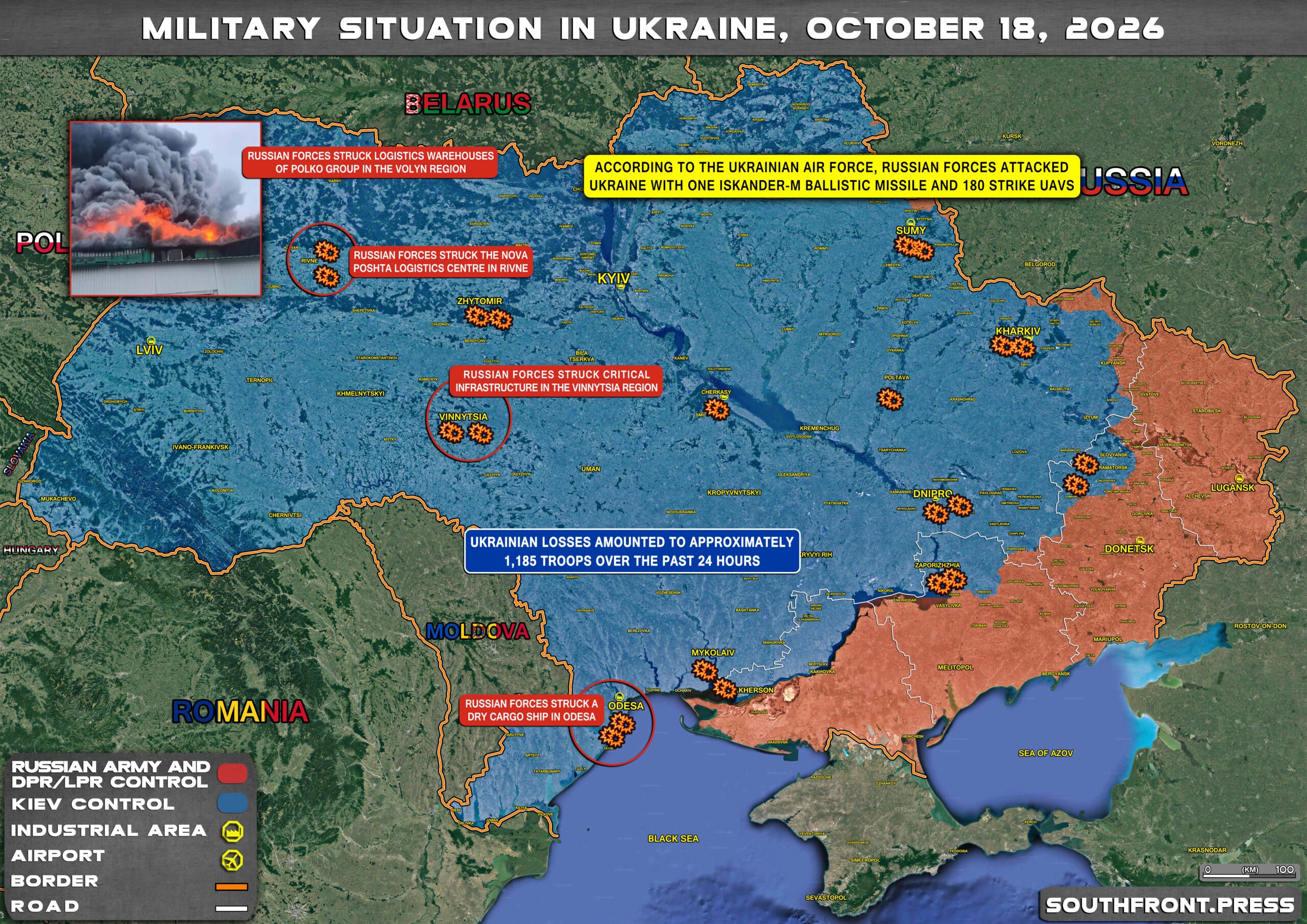
  • Russian strikes destroyed targets in the Sumy, Kharkiv, Zaporizhzhia, Dnipropetrovsk, Kherson, Odesa, Chernihiv, Khmelnytskyi, Rivne, Cherkasy, Poltava, Zhytomyr regions, and the DPR;
  • According to the Ukrainian Air Force, Russian forces attacked Ukraine one Iskander-M ballistic missile, 180 strike UAVs;
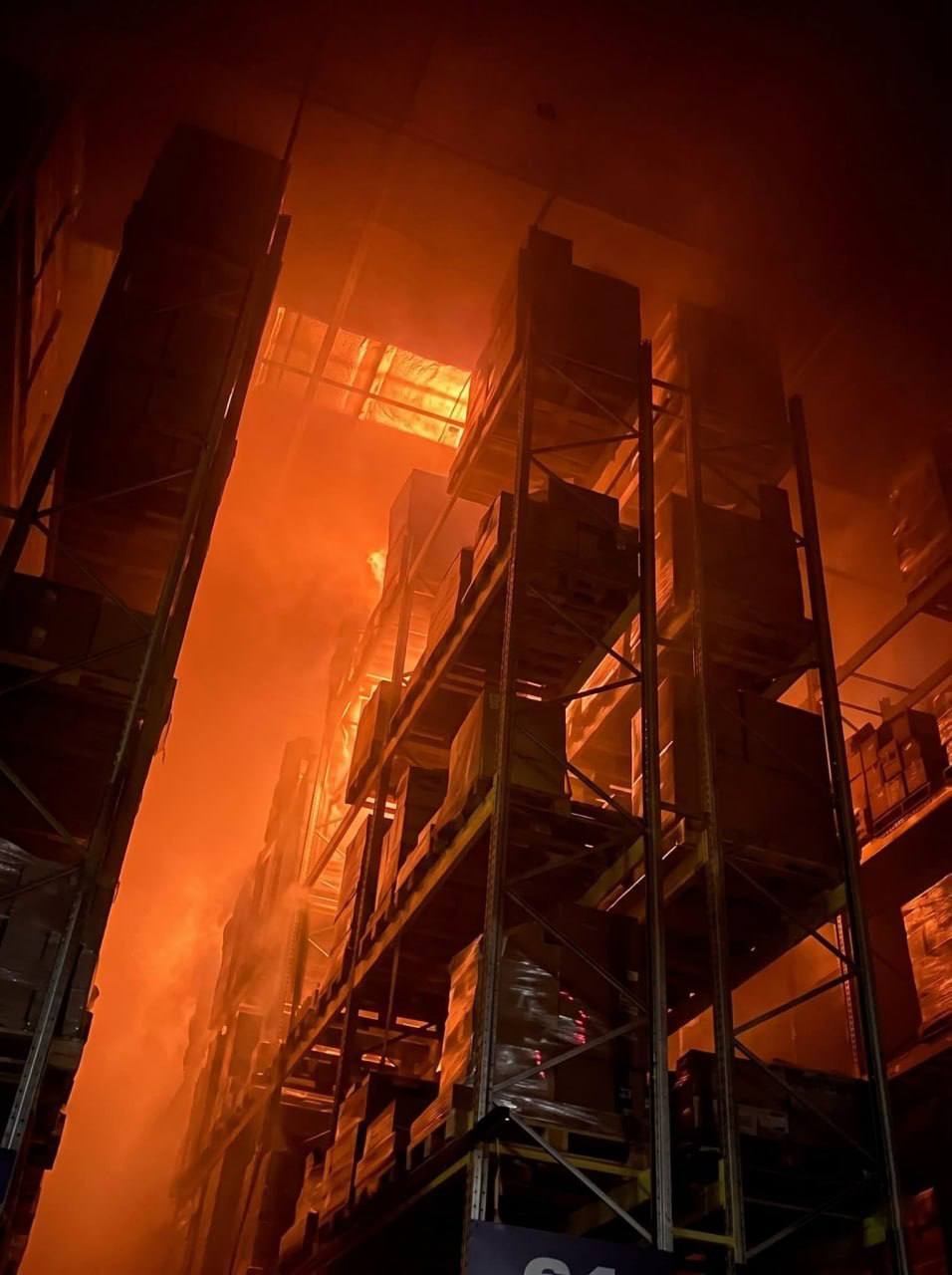
  • Russian forces struck the Novaya Pochta logistics centre in Rivne;
  • Russian forces struck a dry cargo ship in Odessa;
  • Russian forces struck logistics warehouses of Polko Group in the Volyn region;
  • Russian forces struck critical infrastructure in the Vinnytsia region;
  • Ukrainian losses amounted to approximately 1,185 troops over the past 24 hours.

Click to see the full-size image

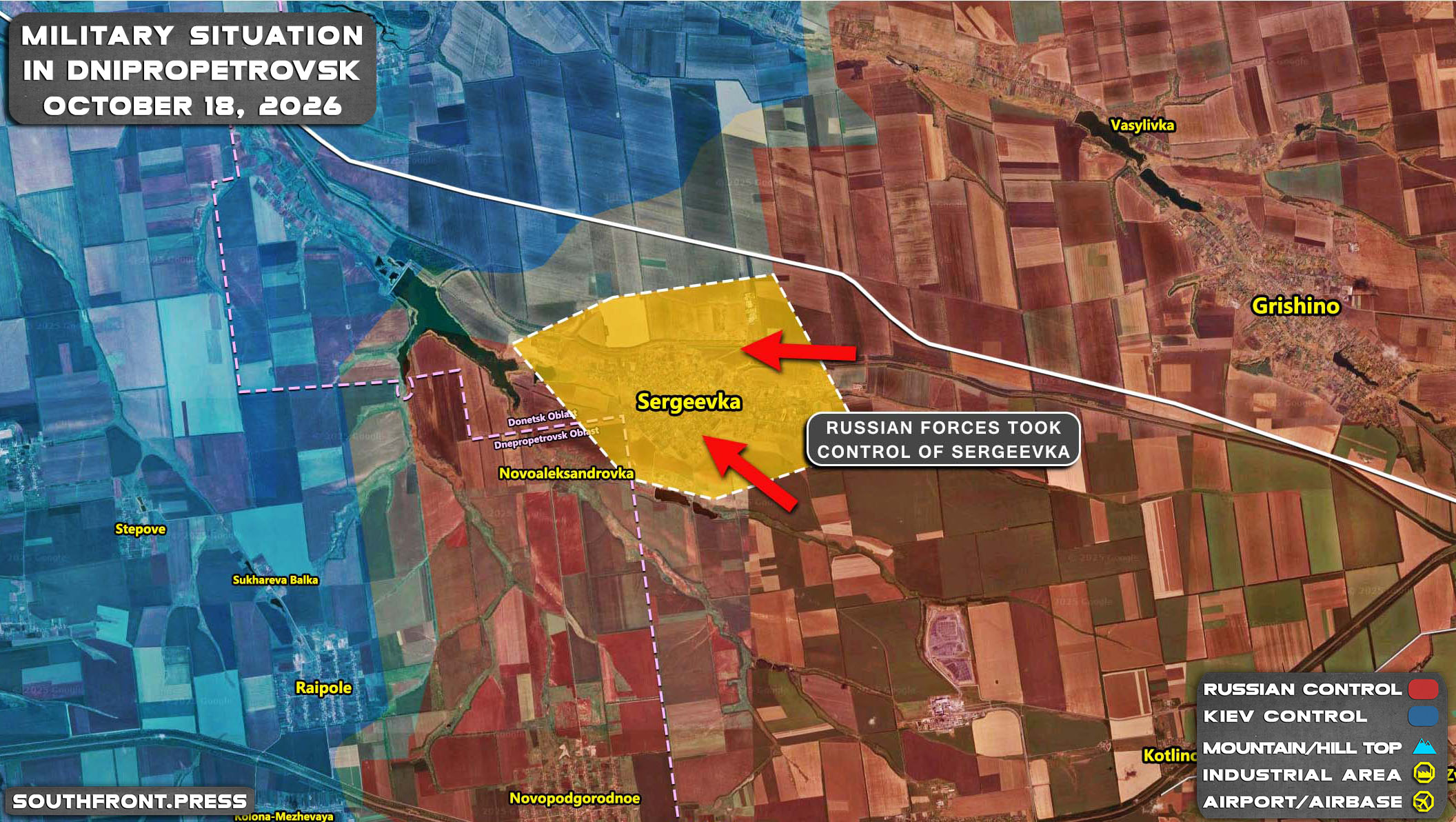
  • Russian forces took control of Sergeevka.

Click to see the full-size image

  • Russian forces took control of Yampol and advanced in the southern part of Zarechnoye.

Click to see the full-size image

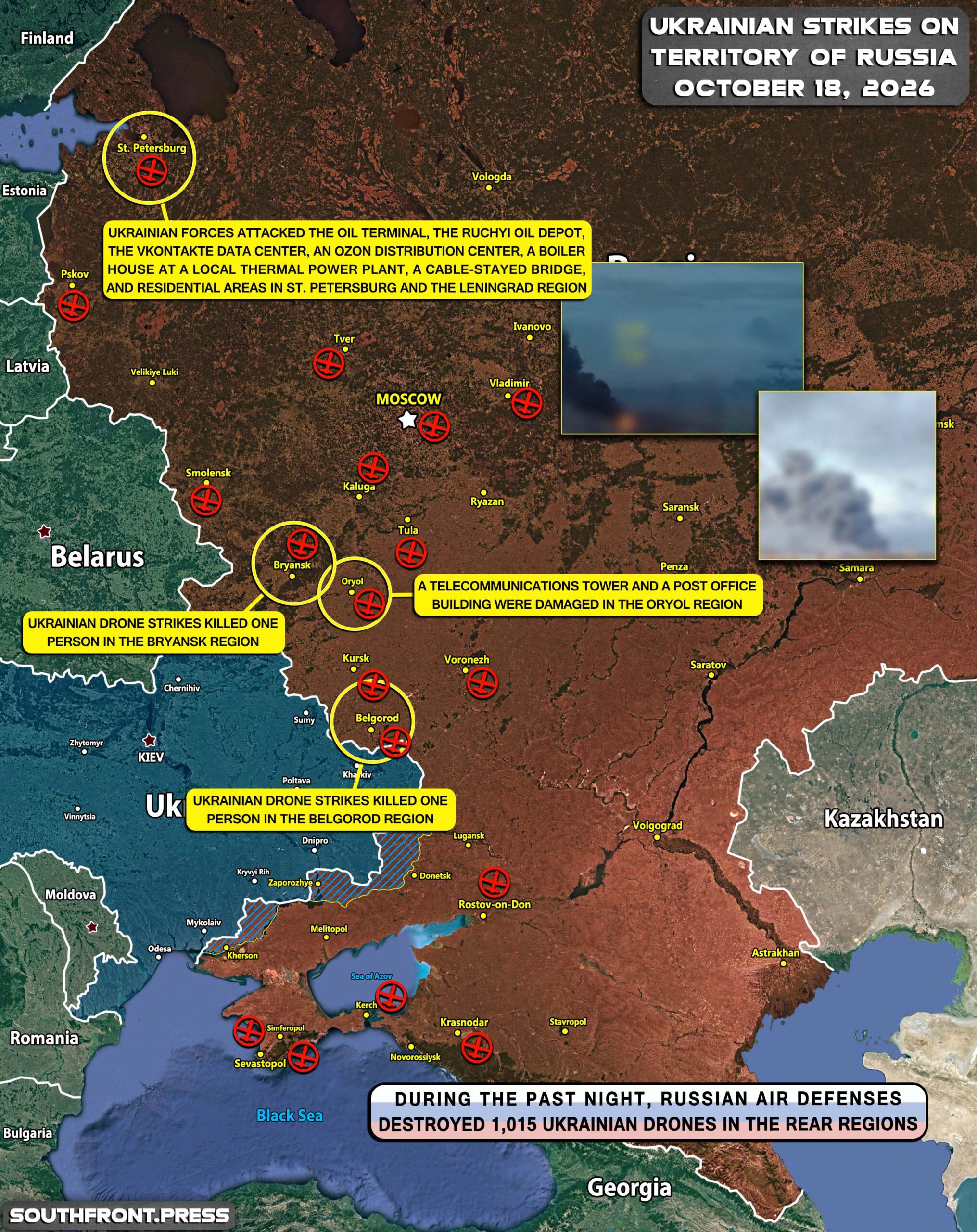
  • During the past night, Russian air defenses destroyed 1,015 Ukrainian drones in the rear regions;
  • Russian air defenses intercepted UAVs in the Belgorod, Bryansk, Vladimir, Kaluga, Kursk, Leningrad, Novgorod, Oryol, Pskov, Ryazan, Smolensk, Tver, and Tula regions, the Moscow region, Krasnodar Krai, the Republic of Crimea, and over the Black Sea;
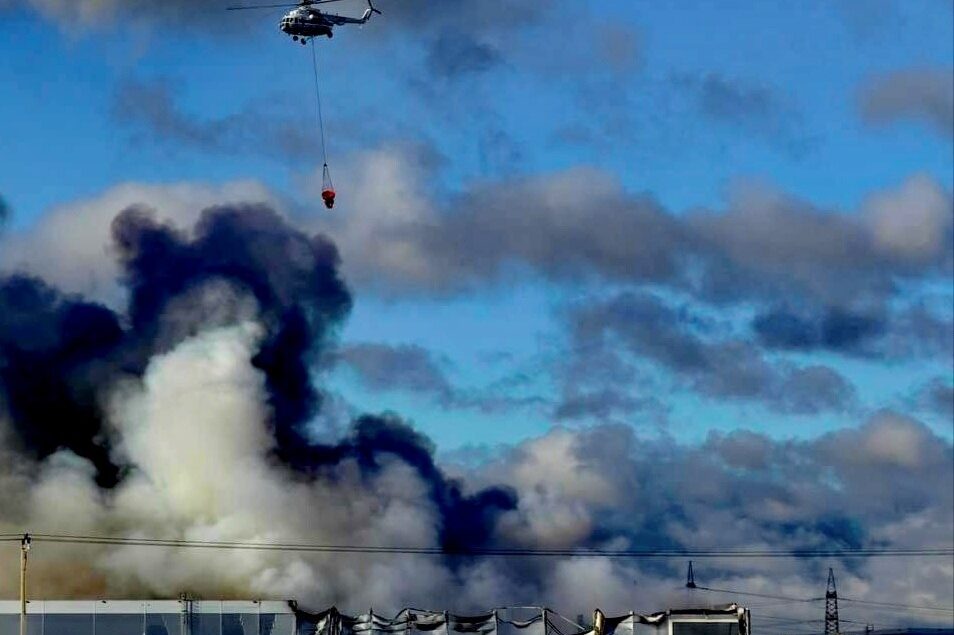
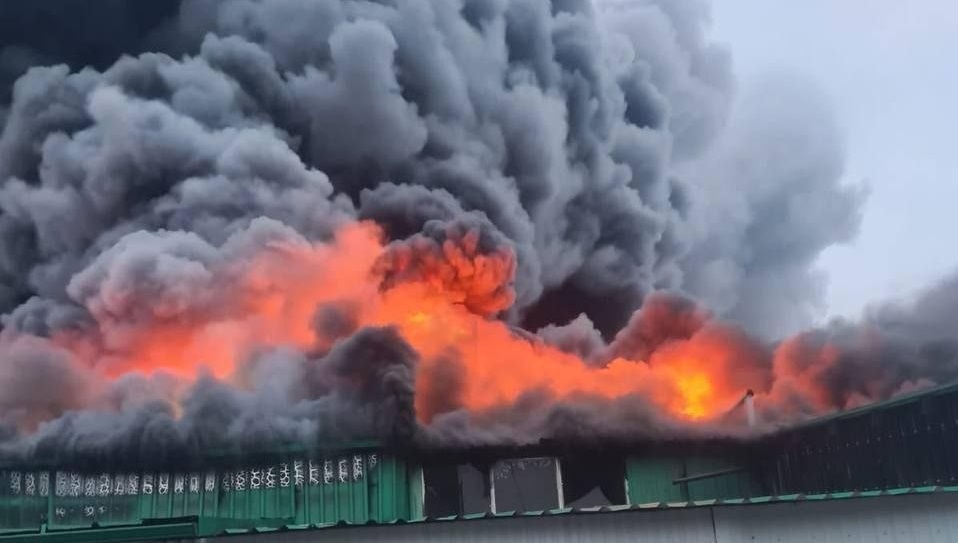
  • Ukrainian forces attacked the Oil Terminal, the Ruchyi oil depot, the VKontakte data center, an Ozon distribution center, a boiler house at a local thermal power plant, a cable-stayed bridge, and residential areas in St. Petersburg and the Leningrad region;
  • A telecommunications tower and a post office building were damaged in the Oryol region;
  • Ukrainian drone strikes killed one person in the Bryansk region;
  • Ukrainian drone strikes killed one person in the Belgorod region.

MORE ON THE TOPIC:

The post Military Situation In Ukraine And Ukrainian Attacks On Russian Territory On October 18, 2026 (Maps Update) appeared first on South Front.
Russia Presses Offensive Across Multiple Fronts in Eastern Ukraine

18 October 2026 at 22:41

Click to see the full-size image

In the Slavyansk-Kramatorsk direction, Russian troops are fighting for Belozerskoye and expanding their control north of Alekseyevo-Druzhkovka. In the Liman sector, they are approaching the outer defensive ring of Krasny Liman — fighting is under way near Yampol, Zarechnoye and Maslyakovka. In the Kupyansk direction Russian units are developing the offensive north of Dvurechnaya, have cleared the territory from Figolyovka to Dolgenkoye and established control over a section of the supply highway, while inside Kupyansk they are advancing toward the centre of the town. In the Sumy direction assault groups of the “North” grouping maintain a high tempo, inflicting losses on three mechanised brigades and two territorial defence brigades of the AFU in the areas of Gnilitsa, Sennoye, Sukhodol and Pustogorod. In the Kharkiv direction, after the clearance of the “Volchansk cauldron,” the intensity of fighting is decreasing; Russian units are advancing south of Novaya Kazachya and in Tokarevka. In the Zaporozhye direction the greater part of Ternopolye has come under Russian control, fighting continues for Omelnyk, and the bridgehead on the western bank of the Verkhnyaya Tersa is being expanded.

Kupyansk direction 

Inside Kupyansk itself clearance of scattered groups continues in the southern district of the town. The initiative remains with Russian units. Assault groups are advancing toward Osinovo.

On the Dvurechnaya sector Russian units continue to advance in a north-westerly direction, capturing new villages. Those who refuse to surrender are destroyed. Logistics are functioning without disruption. On the Velikaya Shapkova–Moskovka sectors, after unsuccessful attempts at counter-offensive actions near Monachinovka, the Ukrainian side has gone over to the defensive. Logistical routes have been tracked and destroyed.

Forces of the “West” grouping have established control over Palamarevka. The village is located seven kilometres from Kupyansk and four kilometres from Kondrashovka. Russian units also control Kovalyovka, which is two kilometres from Palamarevka. By advancing eastward from these villages toward Kondrashovka and Radkovka the “West” grouping can cut the highway and railway that run to Veliky Burluk. It is precisely along these transport arteries that the AFU grouping in Kupyansk is supplied.


Sumy direction 

Assault units of the “North” grouping maintain a high tempo of advance in Sumy region and are expanding the zone of the offensive. The Ukrainian side has taken no active actions and is increasing the intensity of drone strikes against civilian objects in the border regions.

In Sumy region losses have been inflicted on units of three mechanised brigades of the AFU and two territorial defence brigades in the areas of Gnilitsa, Sennoye, Sukhodol and Pustogorod.

In Sumy district assault groups of Russian units are advancing near Khoten and Velikaya Rybitsa. Overall progress in a single day reached up to 300 metres. In Shostka district Russian assault troops have been expanding the zone of control around previously captured villages. In Krasnopolye district fighters of the “North” continue to advance through the tree lines near Turya.


Kharkiv direction 

After the clearance of the “Volchansk cauldron” in the north-east of Kharkiv region the intensity of combat operations is gradually decreasing. Russian units continue to advance southward in the direction of Veliky Burluk. The Ukrainian side has taken no active actions.

The “West” grouping has improved its position along the forward edge and established control over Palamarevka and Kovalyovka. Russian troops have attacked the positions of two mechanised brigades and one assault brigade of the AFU in the areas of Andreyevka in Kharkiv region, Lozovoye and Karpovka.

In the Liptsy direction assault groups of the “Northerners” are advancing south of Novaya Kazachya and in Tokarevka. Overall progress reached up to 200 metres. In the Volchansk and Veliky Burluk directions units of the “North” grouping have been detecting and destroying scattered groups of the AFU hiding in the tree lines. Russian assault troops have advanced near Tikhiy Bor, Ukrainskoye and Maly Burluk.


Slavyansk-Kramatorsk direction

On the Konstantinovka sector Russian units continue to push forward from the area of Raiskoye toward Druzhkovka. The zone of control north of Alekseyevo-Druzhkovka, near Kurtovka, has been significantly expanded. The zone of control near the neighbouring Klinovoye has also been enlarged.

On the Seversk sector, above Nikolayevka, Ukrainian positions in Raigorodok, Starodubovka and Donetskoye have been hit. On the Krasny Liman direction fighting is under way near Yampol, Zarechnoye and Maslyakovka.

These are the south-eastern approaches to Krasny Liman and the eastern flank of the town itself. Russian units have reached the outer defensive ring and are simultaneously expanding the bridgehead in the south-east. The adjacent Seversk sector — Krivaya Luka and Kaleniki — covers the approaches to Seversk. Pressure is being applied on two directions at once.


Zaporozhye direction 

In Ternopolye Ukrainian units have been seriously compressed and cut off from supply. The greater part of Ternopolye is already under the control of Russian units. Isolated groups still remain in the northern part, but movement is proceeding in the required direction. Next are Rozhdestvenskoye or Razdorovka.

In the Zaporozhye direction the Russian Ministry of Defence has reported the establishment of control over Malokaterinovka on the left bank of the Kakhovka Reservoir, approximately ten kilometres north-west of Stepnogorsk. Further east fighting continues for Omelnyk. Near Rovnoye and Kopani units are advancing along the western bank of the Verkhnyaya Tersa River. Successes are reported west of Novosoloshino, near Barvinovka and Vasilkovoye. Fierce clashes are under way near Voskresenka.

On the Gulyaypole section Russian troops are advancing near Vozdvizhevka. Units are consolidating on their positions. Ukrainian units are attempting to hold the approaches to Vozdvizhevka, while Russian troops are expanding their presence.

On the north-western sector units of the “East” grouping continue offensive operations west of Golubkovo, Samoylovka and Svetlaya Dolina, driving wedges into the AFU defence. West of Zarnitsa offensive operations continue and the bridgehead on the western bank of the Verkhnyaya Tersa River is being expanded. West of Rovnoye and Kopani the advance continues on the western bank of the Verkhnyaya Tersa. Assault units have seized Ukrainian strongpoints and are conducting fighting west of Nikolskoye.


Conclusion 

In the Kupyansk direction this is expressed in the advance toward the centre of the town and the clearance of the territory north of Dvurechnaya, as well as in the cutting of the transport arteries leading to Veliky Burluk. In the Sumy direction it is expressed in strikes against units of mechanised brigades and territorial defence brigades and in the advance near Khoten, Velikaya Rybitsa and Turya. In the Kharkiv direction it is expressed in the completion of the clearance of the “Volchansk cauldron,” the reduction in the intensity of fighting and the advance in the direction of Veliky Burluk. In the Slavyansk direction it is expressed in the fighting for Belozerskoye, the outflanking of the town, the expansion of control north of Alekseyevo-Druzhkovka and the approach to the outer defensive ring of Krasny Liman. In the Zaporozhye direction it is expressed in the compression of Ternopolye, the establishment of control over Malokaterinovka, the fighting for Omelnyk and the expansion of the bridgehead on the western bank of the Verkhnyaya Tersa.

Separately worth noting is the statement by U.S. Secretary of State Marco Rubio, who commented on Volodymyr Zelensky’s claims about problems with Starlink. “I don’t know what Zelensky said. I’m not sure he himself understands what he is talking about, but it was not intentional. We have nothing to do with it. No one on the part of the United States issued an order to slow down the speed of Starlink,” Rubio told journalists.

Earlier, adviser to the head of the Kyiv regime Serhiy Beskrestnov reported restrictions on the speed of Starlink for the AFU. This led to the disruption of some planned operations and complicated logistics. Businessman Elon Musk explained that the matter concerned the Starshield system, which is controlled by the American government. Shortly before this U.S. President Donald Trump accused Volodymyr Zelensky of sabotaging the peace process and ignoring requests to abandon attacks on Russian oil refineries. Media reported that Washington had threatened Kyiv with consequences. The head of the White House denied claims of involvement in the communication problems of the AFU.


MORE ON THE TOPIC:

The post Russia Presses Offensive Across Multiple Fronts in Eastern Ukraine appeared first on South Front.
Russia Strikes Ukraine’s Logistics and Energy, Ukraine Launches Massive Drone Raid on St. Petersburg

18 October 2026 at 15:44

Click to see the full-size image

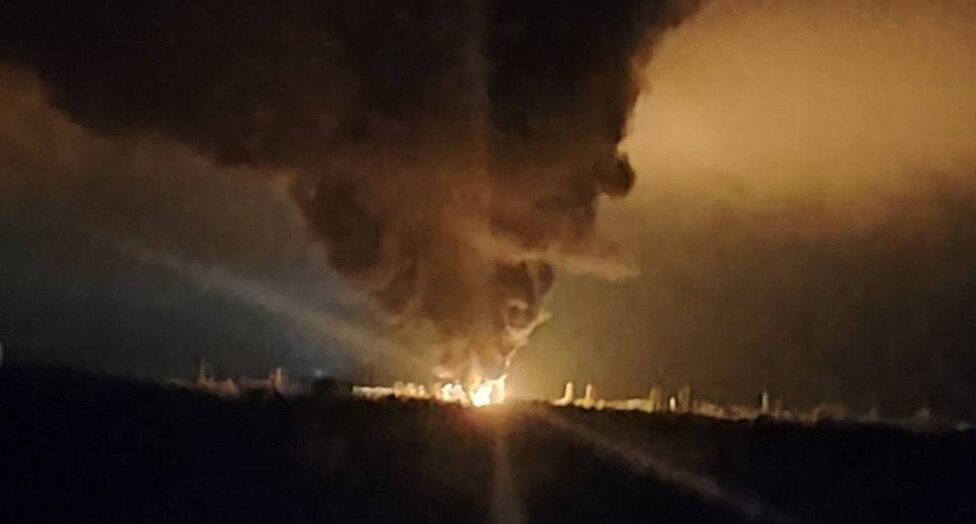
On the night of October 18, the Russian Armed Forces carried out group strikes using unmanned aerial vehicles against logistics centers, port infrastructure, and energy facilities in Ukraine. According to a statement by the Russian Ministry of Defense, the targets included warehouses containing dual-use cargo and vessels used to supply the Ukrainian Armed Forces.

In turn, the Ukrainian side carried out a massive drone attack on Russian regions, focusing primarily on St. Petersburg and Leningrad Region: oil terminals, a data center, a distribution center, a boiler house at a thermal power plant, and bridge infrastructure were struck, and residential areas were damaged. According to the Russian Ministry of Defense, 1,015 Ukrainian UAVs were shot down over Russian territory.

Russian Strikes on Ukraine

Logistics Infrastructure

  • Nova Poshta logistics center (Rivne). According to a statement by the Russian Ministry of Defense, the facility was used to store and distribute dual-use cargo, including components for medium- and long-range unmanned aerial vehicles. The center served as part of the logistics chain supplying Ukrainian forces. Damage to the facility complicates the delivery of components for drone assembly in Ukraine’s western regions.

  • Polko Group production and warehouse facilities (Manevychi, Volyn Region). The facilities were reportedly involved in the manufacture of explosives and the loading of munitions for long-range drones. The facilities are part of the warehouse infrastructure used to accumulate and transship cargo toward Rivne and neighboring regions.

Click to see the full-size image

  • Warehouse in the Novomoskovsk area (Dnipropetrovsk Region). The nature of the cargo stored there is not specified in available sources. However, the facility’s location in the industrial area of Dnipropetrovsk Region suggests that it was part of the logistics supply chain supporting Ukrainian Armed Forces groupings in the eastern direction.

  • Bulk carrier 30 km east of the Port of Odesa. According to a statement by the Russian Ministry of Defense, a bulk carrier carrying military and dual-use cargo was struck.

Energy Infrastructure

  • Prydniprovska Thermal Power Plant (Dnipro, Dnipropetrovsk Region). The Prydniprovska TPP supplied electricity to industrial consumers in the region, including facilities linked to military production.

  • Belolesye substation (Odesa Region). The substation supplies electricity to, among other things, port infrastructure and enterprises in the region.

  • Critical infrastructure facilities (Vinnytsia Region). Damage to critical infrastructure was reported, accompanied by power outages.

Strikes on distribution substations create local power shortages and complicate the operations of industrial enterprises involved in the production and repair of military equipment.

According to monitoring sources, UAV strikes were also carried out against targets in Chernihiv, Zaporizhzhia, Sumy, and Kharkiv Regions. In addition, during the preceding day, aviation and missile forces struck targets in Donbas, Kherson, Poltava, Cherkasy, and Zhytomyr Regions.

Strikes on Russian Territory

St. Petersburg and Leningrad Region

  • St. Petersburg Oil Terminal. A fire was reported on the terminal’s grounds. The facility is part of the marine transshipment infrastructure for petroleum products, including export operations. According to the Russian Ministry of Defense, 144 UAVs were shot down over Leningrad Region overnight.

  • Ruchyi oil depot. The largest fuel terminal in St. Petersburg, with a total capacity of 73,900 cubic meters. A fire was reported.

  • VKontakte (VK) data center. The facility in St. Petersburg was attacked. According to the company, all services continued to operate. The data center supports one of Russia’s largest IT platforms; open sources do not cite any direct military use.

  • Ozon distribution center. A fire was reported following the attack. The facility is part of civilian logistics infrastructure.

  • A boiler house at a local thermal power plant. The extent of the damage and its impact on heat supply were not specified.

  • Cable-stayed bridge. According to residents, a UAV struck the bridge connecting the southern and northern parts of St. Petersburg. There is no official information on the condition of the structure. The city experienced major transport disruptions: the central section of the Western High-Speed Diameter was closed, and tram routes were suspended. Pulkovo Airport temporarily suspended arrivals and departures.

  • Residential areas. In St. Petersburg, 12 apartment buildings and two private homes were damaged. In Leningrad Region, homes were damaged in Kirovsk, Vsevolozhsk, and Gatchina. In Novoselye, 55 parked cars were damaged. According to the governor, one person was killed, five were injured, and about 20,000 people were left without electricity.

Border and Other Regions

  • Oryol Region. A telecommunications tower and a post office building were damaged.

  • Bryansk Region. Over the past day, 281 UAVs were shot down. One person was killed and six were injured.

Taken together, the strikes of October 18 point to two separate lines of effort. On the Russian side, the main effort was focused on destroying logistics hubs and maritime transport near Odesa, continuing the campaign to disrupt the supply of the Ukrainian Armed Forces through western and southern routes. In parallel, strikes targeted power generation and distribution substations, putting additional pressure on Ukraine’s energy system ahead of the heating season.

On the Ukrainian side, the attack had a clear focus on St. Petersburg and Leningrad Region. Damage to oil terminals, a data center, and bridge infrastructure, along with major transport disruptions around the Western High-Speed Diameter, suggests an effort to create a high-impact media and logistics effect in Russia’s largest city. At the same time, a significant portion of the UAVs was shot down—1,015 over Russian territory—which does not change the fact that individual drones did reach their targets.

In the medium term, Russia’s campaign against Ukraine’s logistics chains and energy sector is likely to continue, with an emphasis on western regions and port infrastructure. On the Ukrainian side, long-range drone attacks on sensitive targets in Russian regions, primarily in the Northwestern Federal District, are likely to persist. Key factors will remain air-defense capabilities, the resilience of power grids, and Ukraine’s access to satellite communications for controlling long-range unmanned aerial vehicles.


MORE ON THE TOPIC:

The post Russia Strikes Ukraine’s Logistics and Energy, Ukraine Launches Massive Drone Raid on St. Petersburg appeared first on South Front.
Russia Strikes Ukraine’s Steel and Energy Sector

17 October 2026 at 20:26

Click to see the full-size image

Between the evening of October 16 and October 17, 2026, the Russian Armed Forces continued their campaign of combined strikes against Ukrainian defense-industrial, energy, and logistics infrastructure. According to the Ukrainian side, the overnight attack leading into October 17 involved Iskander-M/KN-23 ballistic missiles, Kh-22/Kh-32 cruise missiles, four Kalibr sea-launched cruise missiles, and 332 strike unmanned aerial vehicles. The main focus was on metallurgical enterprises in Kryvyi Rih and Zaporizhzhia, transformer production, and high-voltage substations in western Ukraine. In parallel, Ukrainian forces carried out a large-scale drone attack on Russian territory.

Russian Strikes on Targets in Ukraine

Metallurgical Complex

Zaporizhstal (Zaporizhzhia) – formerly one of Ukraine’s largest metallurgical enterprises. Before the campaign, it produced up to 1.44 million tons of pig iron and more than 1.3 million tons of rolled steel annually; its output was directed primarily toward military-industrial needs. According to Metinvest, this was the fifth strike on the facility; six ballistic missiles were fired in the latest attack, damaging energy and logistics infrastructure as well as production facilities in the blast-furnace shop. In total, 23 ballistic missiles have been fired at the plant across five attacks.

Metallurgical combine in Kryvyi Rih (Dnipropetrovsk Region) – one of Ukraine’s largest metallurgical enterprises, which supplied metal products to the Ukrainian defense-industrial complex. The description provided by the Russian Ministry of Defense matches ArcelorMittal Kryvyi Rih; according to sources, a week earlier the owners announced a cold shutdown of primary production, and the plant was preparing for preservation.


Energy Infrastructure

Zaporozhtransformator PJSC (Zaporizhzhia) – a manufacturer of oil-immersed power transformers rated at 220-750 kV, a key component of high-voltage substations. Since 2022, it has been under the management of Ukraine’s Ministry of Defense and has been used in the interests of the Ukrainian Armed Forces. Striking this facility complicates the replacement of damaged transformer equipment for Ukrenergo, as manufacturing a new transformer takes months.

Zhytomyr 330 kV Substation (Zhytomyr Region) – a major hub in the trunk power grid, providing voltage conversion and electricity distribution among 330 kV, 110 kV, 35 kV, and 10 kV networks. Power was cut in several districts of Zhytomyr, and water-supply disruptions occurred. According to the Russian Ministry of Defense, the facility struck was one that distributed electricity from western Ukraine to central regions for defense-industrial enterprises.

Click to see the full-size image

Rivne 330 kV Substation (Rivne Region) – a trunk power-grid facility. Power outages occurred in Rivne and nearby settlements, and municipal electric transport operations were disrupted.

Bar 330/110/35 kV Substation (Vinnytsia Region) – a high-voltage facility distributing electricity among the aforementioned voltage classes. Voltage fluctuations were recorded in Vinnytsia and across the region.

Kharkiv CHP-3 (combined heat and power plant No. 3; KP Kharkivski Teplovi Merezhi – Kharkiv Heating Networks), Kharkiv – a combined heat and power plant producing both thermal and electric energy for municipal supply. A hit was recorded on the electrical-shop building, where a fire broke out over an area of 100 square meters.

Transport and Logistics Infrastructure

Delivery logistics terminal (Novohrad-Volynskyi, Zhytomyr Region) – a branch of a Ukrainian freight-logistics operator specializing in less-than-truckload road transport and interregional delivery. The strike caused a fire in a warehouse building covering more than 1,000 square meters. The company participates in government contracts for freight-forwarding services through the Prozorro system.


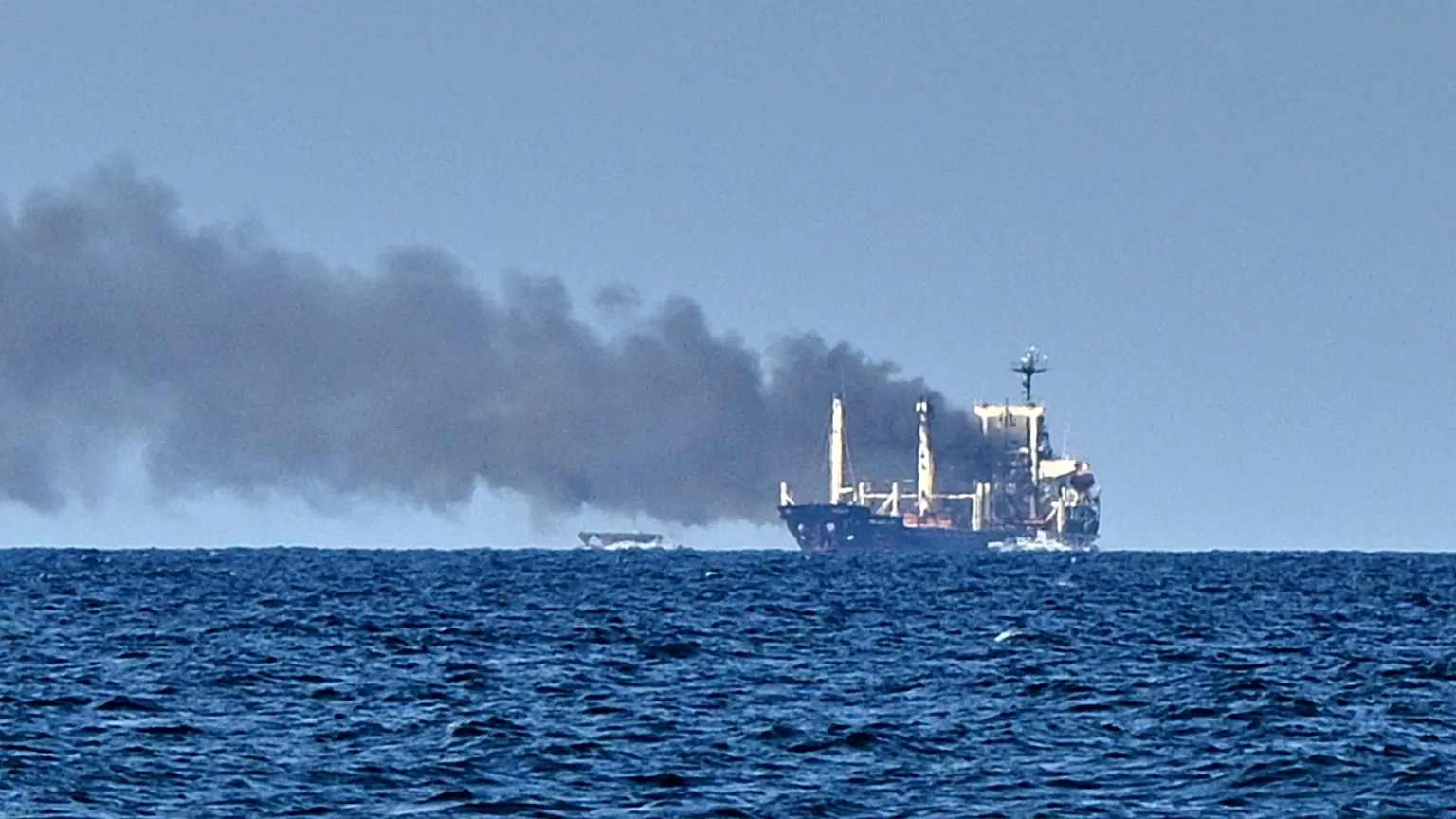
Dry cargo vessel underway at sea (Port of Odesa) – a vessel delivering military cargo to the port was struck.

Strikes on Russian Territory

On the night of October 17, Ukrainian forces carried out a large-scale drone attack on Russian regions. According to the Russian Ministry of Defense, air-defense forces intercepted and destroyed 610 Ukrainian fixed-wing UAVs over the territory of 16 Russian regions and over the Black Sea. The highest intensity was recorded on the Moscow axis: Moscow Mayor Sergei Sobyanin reported the destruction of 144 UAVs heading toward the capital. In Bryansk Region, 157 UAVs were shot down over the course of a day. No reports indicated that serious strategic targets had been hit; there were civilian casualties.

The nature of the October 16-17 strikes confirms a systematic approach by the Russian command to disabling Ukraine’s defense-industrial production chain and the energy infrastructure supporting it. Priority targets include metallurgical enterprises producing goods for military needs and transformer production, which is critical for restoring damaged substations. According to Chief of the General Staff of the Russian Armed Forces Valery Gerasimov, steel production in Ukraine has been halted, operations at major Black Sea ports have ceased, and 76 logistics and warehouse centers have been struck. Given statements by the Russian leadership on the need to continue large-scale strikes against the defense-industrial complex and logistics centers, further intensification of attacks on energy infrastructure in western and central Ukraine, as well as on facilities involved in the repair and restoration of military equipment, should be expected. The resilience of Ukraine’s energy system will depend on its capacity to import electricity from the EU and on the speed of restoring trunk substations – both significantly complicated by the strike on Zaporozhtransformator.


MORE ON THE TOPIC:

The post Russia Strikes Ukraine’s Steel and Energy Sector appeared first on South Front.
Military Situation In Ukraine And Ukrainian Attacks On Russian Territory On October 17, 2026 (Maps Update)

17 October 2026 at 17:12

Click to see the full-size image

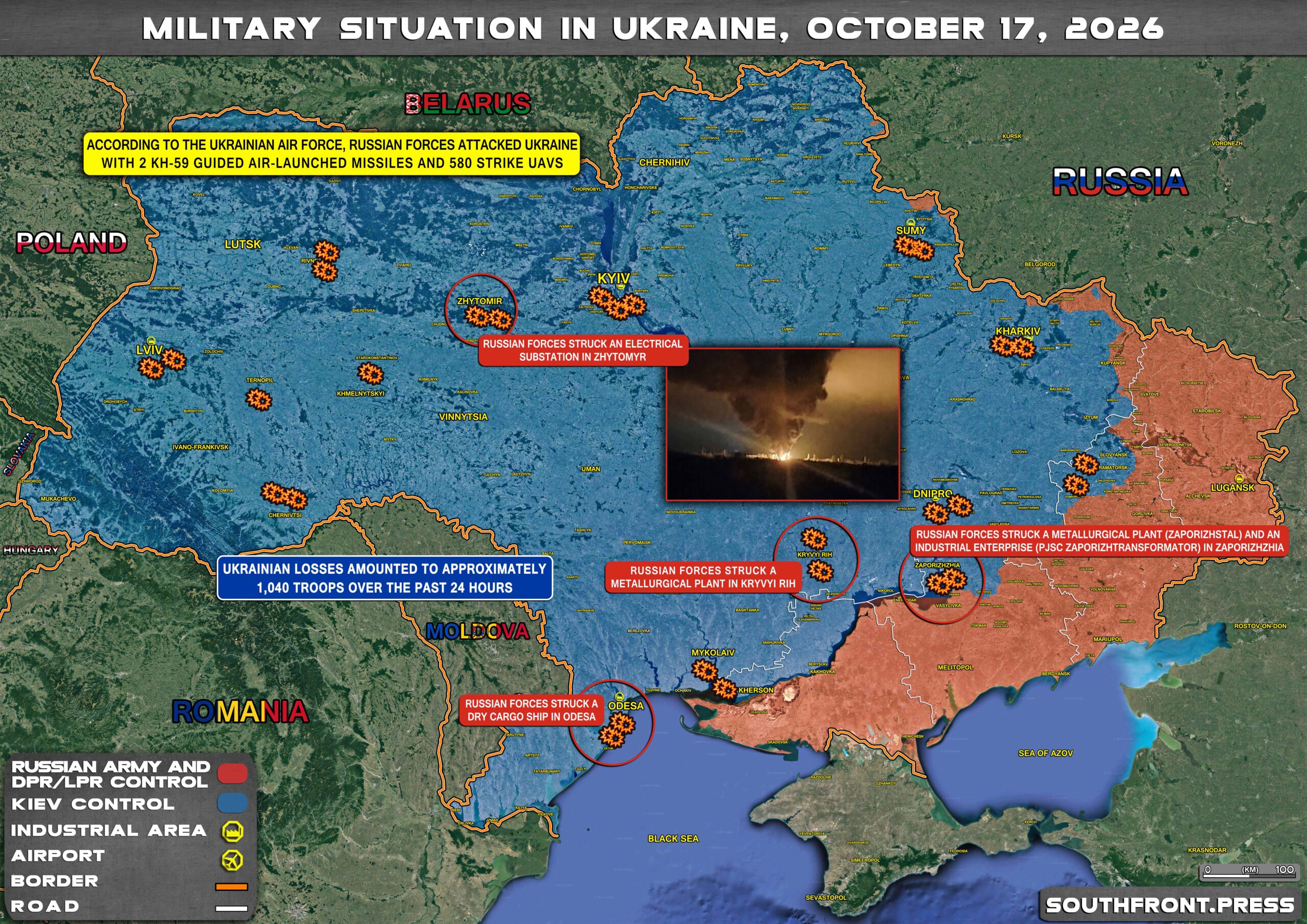
  • Russian strikes destroyed targets in the Sumy, Kharkiv, Zaporizhzhia, Dnipropetrovsk, Kherson, Kyiv, Odesa, Khmelnytskyi, Lviv, Volyn, Zhytomyr, Rivne, Cherkasy, Chernivtsi, Ternopil, Vinnytsia regions, and the DPR;
  • According to the Ukrainian Air Force, Russian forces attacked Ukraine with 2 Kh-59 guided air-launched missiles and 580 strike UAVs;
  • Russian forces struck a metallurgical plant in Kryvyi Rih;
  • Russian forces struck an electrical substation in Zhytomyr;
  • Russian forces struck a metallurgical plant (Zaporizhstal) and an industrial enterprise (PJSC Zaporizhtransformator) in Zaporizhzhia;
  • Russian forces struck a dry cargo ship in Odesa;
  • Ukrainian losses amounted to approximately 1,040 troops over the past 24 hours.

Click to see the full-size image

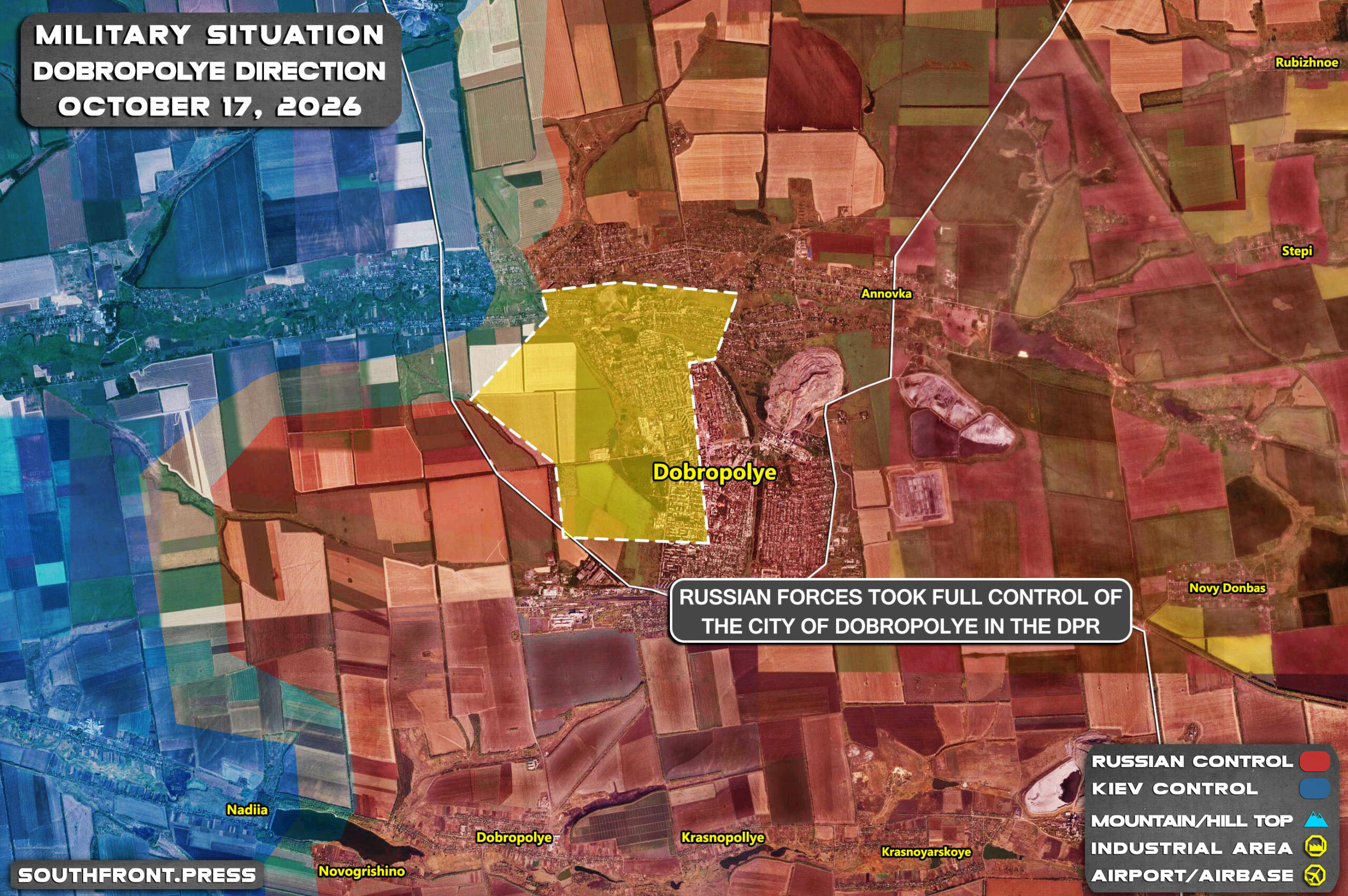
  • Russian forces took full control of the city of Dobropolye in the DPR.

Click to see the full-size image

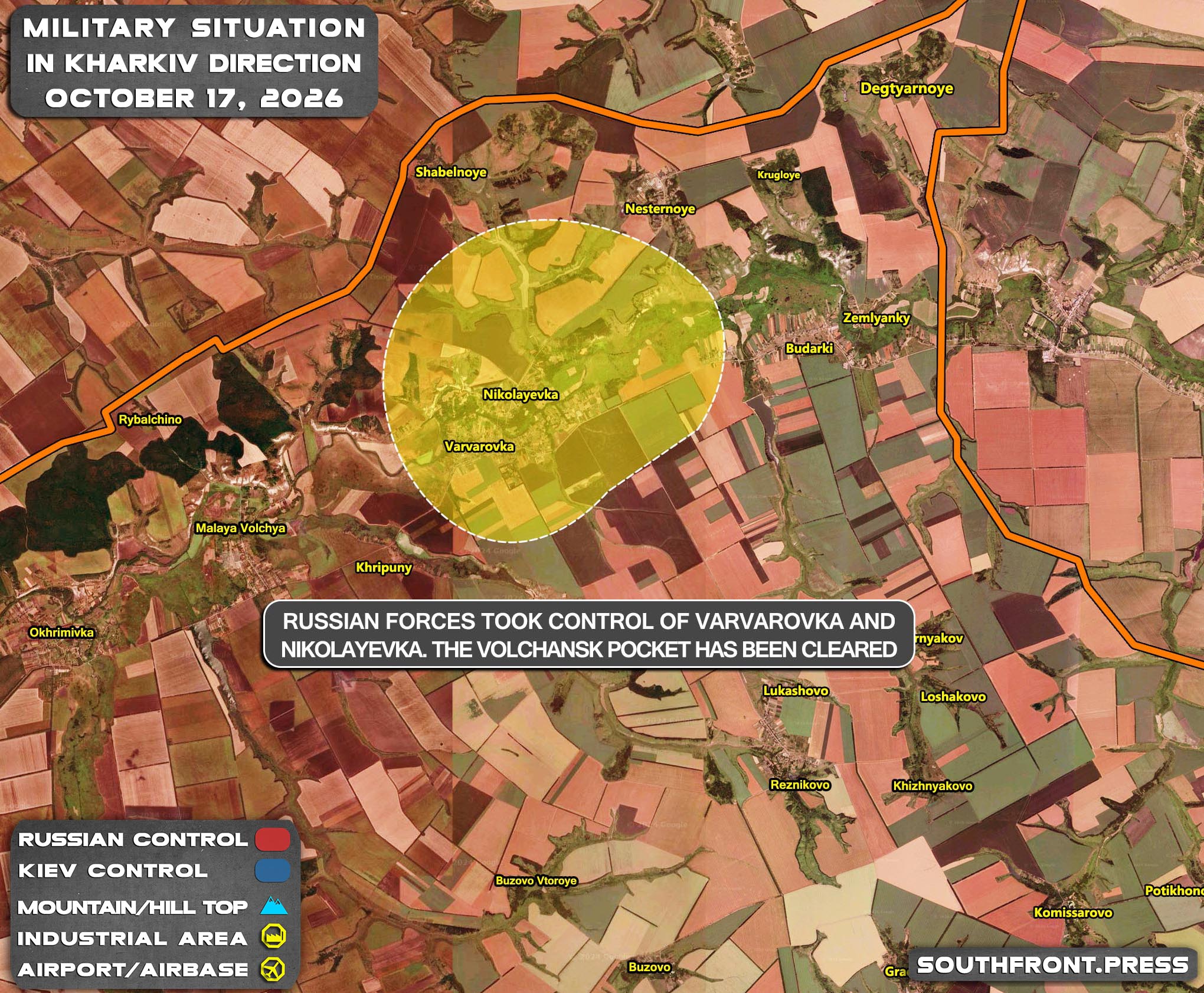
  • Russian forces took control of Varvarovka and Nikolayevka. The Volchansk pocket has been cleared.

Click to see the full-size image

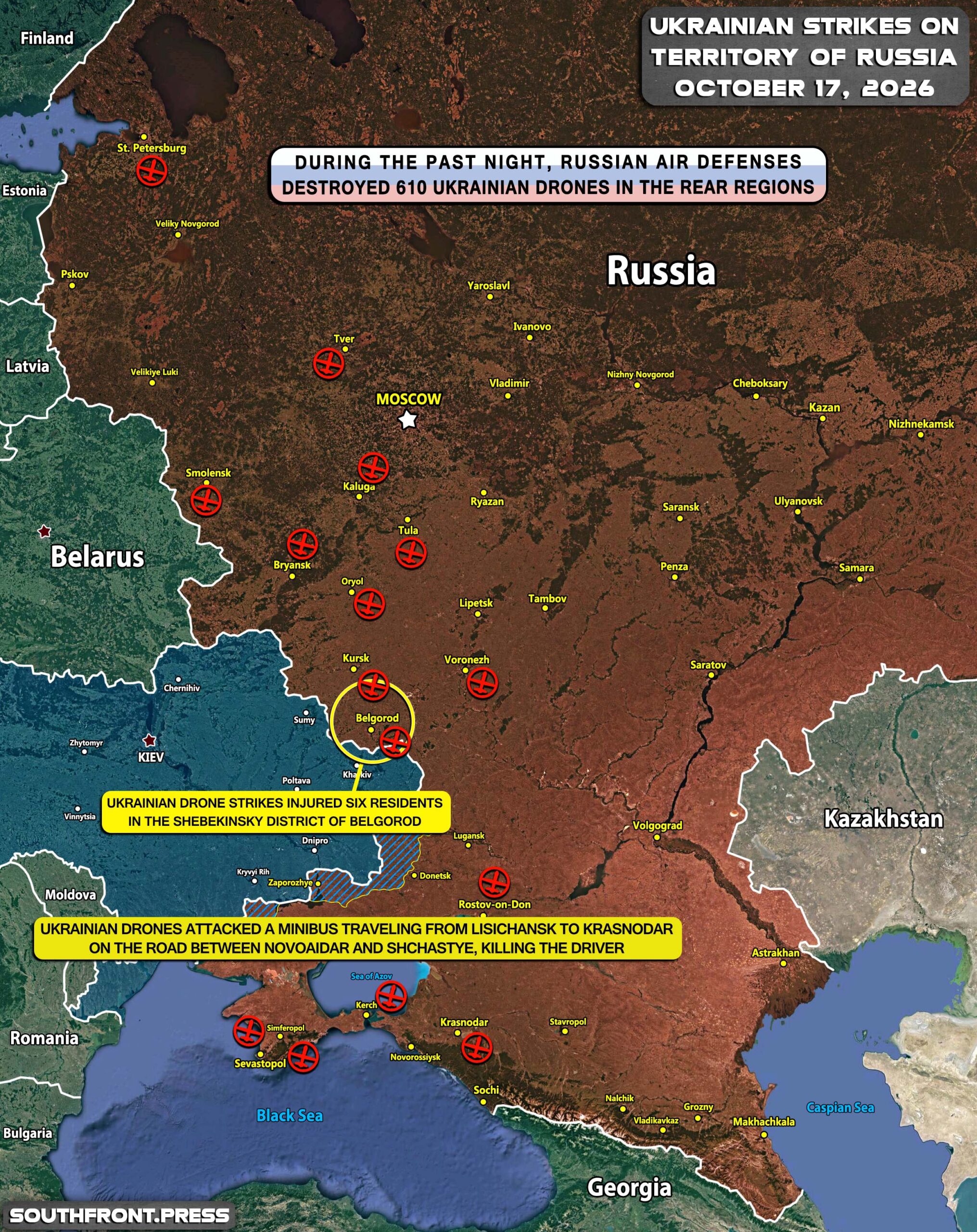
  • During the past night, Russian air defenses destroyed 610 Ukrainian drones in the rear regions;
  • Russian air defenses intercepted UAVs in the Leningrad, Novgorod, Tver, Bryansk, Belgorod, Kursk, Oryol, Kaluga, Voronezh, Rostov, Smolensk, and Tula regions, the Moscow region, Krasnodar Krai, the Republic of Crimea, and over the Black Sea;
  • Ukrainian drone strikes injured six residents in the Shebekinsky district of the Belgorod region;
  • Ukrainian drones attacked a minibus traveling from Lysychansk to Krasnodar on the road between Novoaidar and Shchastia, killing the driver.

MORE ON THE TOPIC:

The post Military Situation In Ukraine And Ukrainian Attacks On Russian Territory On October 17, 2026 (Maps Update) appeared first on South Front.
Ukraine’s Black Sea Escalation Threatens Global Trade, With Risks Of Spiralling

17 October 2026 at 11:43

Click to see the full-size image

Ukraine’s expanding Black Sea attacks are disrupting shipping, raising insurance costs, and threatening global food and energy trade. As “wild-card” Zelensky raises the stakes (angering the US), the risk of a wider confrontation grows.

Written by Uriel Araujo, Anthropology PhD, is a social scientist specializing in ethnic and religious conflicts, with extensive research on geopolitical dynamics and cultural interactions

Black Sea shipping is in crisis, adding pressure to a global economy already absorbing Red Sea and Strait of Hormuz disruptions. Commercial vessels face rising risks, insurance costs have climbed, and tanker freight rates have surged. Ukraine has stepped up attacks on Russia’s Black Sea Fleet, ports, oil facilities, and vessels associated with Russian trade, expanding the conflict’s geographical scope. Grain, oil, fertilizers, and other commodities move through these waters, including shipments for non-belligerent countries.

S&P Global reported on October 9 that tanker freight rates rose sharply amid attacks, sanctions, and security concerns disrupting Russian energy exports. According to maritime security consultancy Ambrey, Kyiv expanded its campaign beyond naval assets and oil infrastructure to merchant ships trading with Russian ports. In November 2025, attacks had already expanded to commercial vessels, particularly oil tankers, in the open sea. In May 2026, Ambrey attributed strikes on three Russia-linked tankers inside Turkey’s exclusive economic zone to Ukrainian naval drones.

By July, targeting expanded to dry-bulk carriers, general cargo, container ships, and roll-on/roll-off vessels. In September, insurers widened the high-risk zone. Ambrey data shows 45 merchant vessels struck outside the previous war-risk area in 12 months, 31 after July 1, 2026. Ambrey’s finding is that Ukraine-attributed strikes (on Russia-linked shipping far offshore) helped drive insurers’ growing risk perception across the Black Sea. Russia has responded by also conducting strikes in the Black Sea. As Modern Diplomacy puts it, Moscow has made any Black Sea truce conditional on Kyiv ceasing attacks on Russian energy infrastructure.

This is, after all, a proxy war of attrition, marked as it is by considerable military asymmetry. Russia possesses a larger population, defense-industrial base, strategic arsenal, air force, and navy, as well as greater resources for prolonged warfare. Ukraine, despite developing formidable drone capabilities and long-range strike capacity, remains heavily dependent on Western assistance. Global Firepower’s 2026 ranking places Russia second and Ukraine twentieth. The military asymmetry is therefore considerable.

The hard truth is that, notwithstanding any legitimate criticism one may have of Moscow’s campaign, Russia has refrained from employing its full destructive capabilities. Such restraint, particularly in the war’s early stages, may have reflected not only humanitarian and military calculations but also (on Moscow’s end) awareness of historical and cultural ties between the two countries – which may have a psychological effect on decision-makers. Kyiv, in contrast, since the 2014 ultra-nationalist revolution, has launched an anti-Russian campaign to distance the nation from Moscow. Even so, 42.6% of Ukrainians still regularly spoke Russian in December 2022, despite the war and media censorship restrictions.

Former US diplomat Chas Freeman and retired US Army Colonel Douglas Macgregor have both argued that Moscow exercised restraint. Poland’s Centre for Eastern Studies likewise noted in June 2022 that Russia had refrained from systematically destroying key infrastructure – while the US Congressional Research Service observed that the initial bombardment was more limited than expected. For comparison, Bono Vox performed in Kyiv on May 8, 2022, less than three months after Moscow launched its campaign. One could hardly imagine Bono performing in Baghdad shortly after the US invasion! Or in 2011 Libya, for that matter.

The broader point here is that the Russian Federation retains substantial military advantages, despite Ukrainian advances, but Western support has enabled Kyiv to sustain a prolonged war of attrition – increasingly targeting Russian energy. In August, Ukrainian drone strikes on Russian and Iranian-linked vessels in the Caspian Sea risked expanding the conflict into a vital Russia-Iran logistics corridor. The attacks risked further “proxifying” the conflict by aligning Kyiv with US and Israeli interests against Tehran, potentially merging the European and Middle Eastern theaters – a scenario that never materialized.

In any case, Ukrainian attacks on Russian energy infrastructure continue amid mounting political pressure, with Trump even saying it is “time for Ukraine to get new President.” I’ve commented before on Zelensky’s resilience, despite several reported plots against him. The Ukrainian leader has shown a habit of acting unpredictably, sometimes behind his Western patrons’ backs. In 2023, leaked documents revealed wild Ukrainian plans that risked widening the conflict. More recently, attacks on Russian refineries drew attention amid rising diesel prices and reports of moves angering Washington. This “wild-card” tendency risks triggering a dangerous spiral, with potentially disastrous consequences for Ukraine – and the global economy. Repercussions for food, energy, and fertilizer trade are already visible, while the danger of crossing red lines has arguably never been greater.


MORE ON THE TOPIC:

The post Ukraine’s Black Sea Escalation Threatens Global Trade, With Risks Of Spiralling appeared first on South Front.
“Enough” In London, Darkness In Kyiv — Zelenskyy’s Defiance Meets Reality

16 October 2026 at 20:30

Three days of silence ended in London. Volodymyr Zelenskyy used a Financial Times interview to announce that Ukraine would resume strikes on Russian oil refineries, and the message was aimed as much at Washington as was at Moscow.

The ban on refinery strikes is lifted, Zelenskyy declared. “Enough,” he added, in a statement that amounted to an open rejection of the White House moratorium. The timing is notable. Until the trip to London, Kyiv had avoided a direct confrontation with Donald Trump. Only after arriving in the British capital, where political backing for Ukraine remains strongest, did the tone harden. The episode points to a widening split inside the Western bloc. Over the coming month, tension may grow between those pushing for a settlement and those committed to continuing the war.

While politics heats up, the strikes on Ukraine’s rear continue without pause.

Overnight on October 16, Russian drones hit the western regions in a massive attack. In Lutsk, an energy facility was struck, leaving parts of the city without power and halting electric transport. As the blackout spread, residents began stocking water. In Khmelnytskyi, an oil depot was attacked. Kovel reported interruptions to both water and electricity, while in Ternopil a foreign-owned enterprise was hit.

The situation in the capital is worse. According to the Ukrainian outlet Ekonomichna Pravda, three Kyiv thermal power plants – TEC-5, TEC-6, and the Darnytsia plant – have stopped generating electricity. Those facilities provided the bulk of the capital’s power. Media reports say 600,000 people have already left Kyiv, a city that had nearly three million residents before the conflict.

Meanwhile, a technological shift is emerging on the battlefield. Russian forces have begun using Molniya drones fitted with satellite antennas, bearing a logo strikingly similar to that of Bureau 1440. That company develops Rassvet, a Russian low-orbit satellite network widely seen as a counterpart to Elon Musk’s Starlink. Such a network offers jam-resistant control for mid-range strike drones operating 100 to 150 kilometers from the front line. Satellite guidance is also expected to improve the accuracy of long-range Geran drones. If Russia can quickly scale up terminal production, the consequences could be dramatic. Ukraine’s rear could come to resemble the land corridor to Crimea, where roads are effectively blocked by constantly loitering drones.

Kyiv has lifted its own ban on refinery strikes just as its capital loses the ability to keep itself warm and lit. Russia, meanwhile, is building a satellite-guided drone fleet that no foreign company can switch off. Defiance in London is easy to announce. Defiance in a city without power, with roughly one in five residents gone, is far harder to sustain.

______________________________________________________________________________________________________________________

DEAR FRIENDS. IF YOU LIKE THIS TYPE OF CONTENT, SUPPORT SOUTHFRONT WORK:

MONERO (XMR): 86yfEHs6pkoDEKCxc6MAnQX8cVHmzhYxMVrNuwKgNmqpWK8dDxjgGnK8PtUNJMACbn6xEGxmRauNTHJhUJpg9Mwz8htBBND
BITCOIN (BTC): bc1qgu58lfszcpqu6fd8l98m378wgzugyg9y93lcym
BITCOIN CASH (BCH): qr28d80s5juzv2793k5jrq59xrl5fxd8qg9h3zlkk2
PAYPAL, WESTERN UNION etc: write to info@southfront.press , southfront@list.ru

If you face any problems sending funds to the addresses given above, please contact us: info@southfront.press and southfront@list.ru. Also be aware that many email services such as Hotmail, Yahoo etc. may block correspondence from info@southfront.press and some others put it in spam.

If you want to support SouthFront but have no opportunity to do it via cryptocurrency, please contact us: info@southfront.press and southfront@list.ru.

SouthFront: Analysis and Intelligence
NOW hosted at southfront.press
Previously, SouthFront: Analysis and Intelligence was at southfront.org.
The .org domain name had been blocked by the US (NATO) (https://southfront.press/southfront-org-blocked-by-u-s-controlled-global-internet-supervisor/) globally, outlawed and without any explanation
Back before that, from 2013 to 2015, SouthFront: Analysis and Intelligence was at southfront.com

SOUTHFRONT.PRESS

The post “Enough” In London, Darkness In Kyiv — Zelenskyy’s Defiance Meets Reality appeared first on South Front.
Russian Drone Raid Hits Western Ukraine’s Power Grid and Railways

16 October 2026 at 20:18

Click to see the full-size image

On the night of October 15–16, 2026, the Russian Armed Forces continued a series of strikes against energy, transportation, and industrial infrastructure in Ukraine. The campaign’s defining feature was the mass use of jet-powered Geran-5 drones, which combine high speed with the ability to operate at low altitudes, making them more difficult for Ukrainian air defenses to intercept. Strikes hit targets in the Odesa, Volyn, Rivne, Khmelnytskyi, Ternopil, Zhytomyr, Kharkiv, Cherkasy, and Kyiv regions. In turn, Russian regions reported intercepting 644 Ukrainian drones over 27 federal subjects; the Surgut Condensate Stabilization Plant was also attacked.

Strikes on Ukraine

Odesa Region: Logistics and Energy

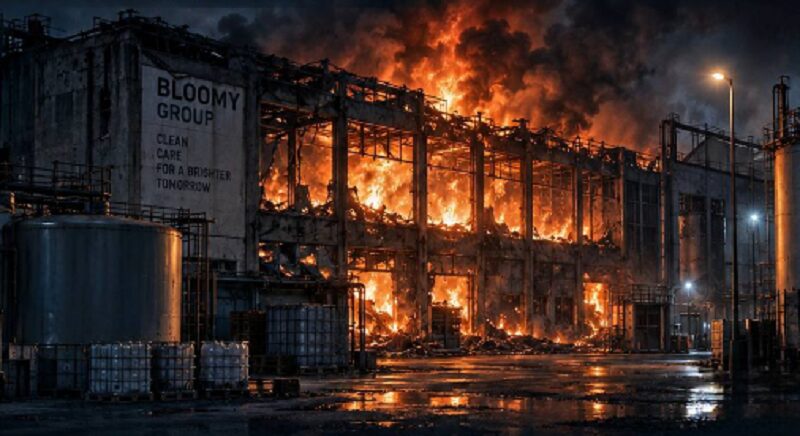
  • Bloomy Group logistics center, Teplodar. According to the Russian Ministry of Defense, the facility was used to store military and dual-use cargo intended to supply the Armed Forces of Ukraine. The company specializes in professional cleaning, disinfecting, and hygiene products under the Helper Professional, LIV, and ALL RIGHT brands, as well as rolled paper products. Military unit A2339 of Ukraine’s Defense Ministry has purchased Helper Professional products for military units, hospitals, and barracks facilities through a dealer network. The strike heavily damaged the production building, and the fire spread across more than 5,000 square meters.

  • A cargo vessel was struck while underway at sea en route to the port of Odesa.

  • 110/35/10 kV substation, Bilhorod-Dnistrovskyi. Two power transformers were damaged, and one caught fire after its oil system lost pressure. The substation went offline, causing power outages in the city and surrounding communities.

Volyn Region: Energy and Industry

  • Lutsk-South Substation, Lutsk. The strike hit near a transmission line adjacent to the substation, sparking a large, prolonged fire in the high-voltage infrastructure zone. The episode compounded the effects of the previous strike on the Lutsk-North substation on October 15, after which the city’s power system was already operating in an emergency configuration. By the morning of October 16, Lutsk was effectively without power.

  • Lutsk-North Substation, Lutsk. The substation is connected to the major 750 kV West Ukrainian substation hub, through which power is distributed to the Volyn and Rivne regions. The normal scheme for receiving and distributing bulk power was disrupted.

  • International freight permitting facility, Kovel. The strike damaged at least eight car carriers and six other vehicles. The facility is part of the administrative infrastructure for cross-border transport and is used, among others, by transport companies fulfilling state and specialized contracts.

  • Yahodyn Railway Station, village of Rymachi, Volyn Region. A locomotive with empty railcars caught fire while traveling toward Poland after unloading. Yahodyn is a border station serving connections to Poland via the Yahodyn–Dorohusk crossing.

  • Kromberg & Schubert LLC, village of Rovantsi, Volyn Region. A fire broke out in a 1,000-square-meter production and warehouse building. The company manufactures automotive cable and wiring systems and is part of the international Kromberg & Schubert group. Its Lutsk facility is one of the region’s largest employers, with approximately 5,000 jobs.

  • Agrofrukt LTD LLC, Manevychi. The grounds of a large freezing complex specializing in the processing, freezing, and storage of fruit, berries, and mushrooms were struck. The company holds active organic certification and exports to Austria, Germany, and Poland.

  • Kovel Locomotive Depot, Volyn Region. Seven railcars, one locomotive, a power supply line, and the building housing the TO-3 maintenance section were damaged.


Rivne and Khmelnytskyi Regions

  • Dubno Traction Substation, Rivne Region. The T1 110 kV power transformer was destroyed. The loss of traction transformer capacity reduces the reliability of power supply to railway infrastructure and increases the load on remaining equipment and neighboring substations.

  • DEX Private Enterprise Warehouse, Rivne. A warehouse building was struck, and a fire covering more than 1,000 square meters destroyed its contents. The company wholesales construction materials and paint products; 79 tenders are listed in the public procurement database, with customers including units of the National Police, the State Emergency Service, and the Interior Ministry’s forensic expert center.

  • Shepetivka Locomotive Depot, Khmelnytskyi Region. A repeat strike hit the depot’s grounds, sparking a large fire.

  • Oil depot, Shepetivka. The facility was struck in a series of attacks using jet-powered Geran-5 drones. A large fire broke out, with fuel and lubricant storage tanks burning.


Ternopil Region: Repeat Strike

  • Chortkiv branch of SE Bordnetze LLC, Chortkiv. Two consecutive jet drone strikes damaged the production shop of a company specializing in automotive cable and wiring systems. It was the second strike on the facility in three days.

Zhytomyr Region

  • Cersanit Invest LLC, Zhytomyr Region. A fire broke out in a 100-square-meter production shop.

  • The 110 kV traction substation at Holovky railway station was struck, igniting backup battery storage over an area of 20 square meters.

  • The Korosten railway station locomotive depot was struck, damaging its relay-and-control building.

  • Iskorost traction substation (PS-110), Korosten. A fire spread across 100 square meters on the facility’s grounds.

  • The site of a decommissioned oil depot in Ovruch was struck.

Kharkiv Region

  • Osnova Locomotive Depot, Kharkiv. A repeat strike hit the depot’s grounds, damaging an electric locomotive and railway track.

  • 330 kV Loseve Substation, Kharkiv. One of the key hubs for power distribution was struck. Transformer equipment caught fire after the impact.

  • The Nobel office building in Kharkiv was hit.

Kyiv Region

  • 330 kV Novokyivska Substation, near the village of Khotiv. The 110 kV outdoor switchgear was damaged. Emergency power outages occurred in Kyiv and the surrounding region. Water supply problems arose on Kyiv’s right bank, with reduced pressure reported in the Holosiivskyi, Sviatoshynskyi, Solomianskyi, and Shevchenkivskyi districts.

  • Kyiv and Kyiv Region. Following massed attacks, emergency power outages were introduced. Outages began in the Bucha, Obukhiv, and Fastiv districts of the region.

Cherkasy Region

  • The Epicenter warehouse complex in Uman was struck.

Zaporizhzhia and Chernihiv Regions

  • Carlsberg Ukraine plant, Zaporizhzhia. One drone struck the grounds of the Zaporizhzhia brewery.

  • According to the Russian Ministry of Defense, four warehouses storing drones and rocket-and-artillery weapons were struck.

Strikes on Russia

  • Surgut Condensate Stabilization Plant named after V. S. Chernomyrdin, Khanty-Mansiysk Autonomous Okrug–Yugra. A unit at the facility was attacked. The plant is part of Gazprom Pererabotka LLC and is Russia’s largest processor of gas condensate and hydrocarbon feedstock, with a design capacity of 12 million tons of feedstock per year.


  • Rostov Region. A missile and more than 50 drones were shot down over Rostov Region. Bataysk and nine districts came under attack.

  • Vladimir Region. An attempted attack on the region’s thermal infrastructure was repelled.

  • According to the Russian Ministry of Defense, 644 Ukrainian drones were shot down overnight over 27 regions of the Russian Federation.

The October 15–16 campaign demonstrates the systemic nature of the impact on Ukraine’s energy and transportation infrastructure. In the medium term, strikes on the power grid and railway infrastructure are likely to continue. Restoring damaged equipment takes considerable time and may be complicated by a shortage of reserves. Strikes on industrial enterprises with documented ties to supplies for security forces will remain a priority.


MORE ON THE TOPIC:

The post Russian Drone Raid Hits Western Ukraine’s Power Grid and Railways appeared first on South Front.
Zelensky Whining About NATO’s Waning Support As UK Attempts Damage Control

16 October 2026 at 11:47

Click to see the full-size image

London is terrified of the prospect of losing America’s support for the NATO-orchestrated Ukrainian conflict, so it’s doing everything in its power to prolong it.

Written by Drago Bosnic, independent geopolitical and military analyst

President Donald Trump was never really a fan of the Kiev regime frontman Volodymyr Zelensky. Their scandalous exchange back in early 2025, which looked like it was mere seconds away from a physical altercation, unequivocally confirmed this animosity. Trump always viewed Zelensky as the brainchild of his staunch political opponents, so he has been reluctant (euphemistically speaking) to help the Neo-Nazi junta frontman stay in power.

Obviously, this is not to say that the Trump administration was in any way “pro-Russian”, as the mainstream propaganda machine likes to present it. Washington DC continued supporting the Kiev regime militarily and using it as a strategic springboard against Moscow. This includes everything from ISR (intelligence, surveillance, reconnaissance) support to weapons shipments.

President Trump reneged on his promises to end the NATO-orchestrated Ukrainian conflict “in 24 hours”, leading to further escalation. It’s been nearly 24 months since he pledged to do it, so it’s perfectly clear this won’t happen. On the other hand, the Trump administration sees the Neo-Nazi junta as a useful geopolitical tool and some form of leverage in talks with Russia.

Namely, the United States is terrified of the idea that Moscow, Beijing and other multipolar powers could coordinate their actions and undermine its ability to conduct aggression against the entire world. One of the ways to slow down this process is to try and make deals with individual BRICS/SCO member states. Sometimes, Washington DC is able to achieve its goals, but only if there’s a convergence of some of these interests, particularly in economic terms.
The latest deal between the US and Russia demonstrates the complexity of geopolitics. Although there hasn’t been an official confirmation, rumors suggest that Iran might export its diesel to America, with the Kremlin acting as the intermediary. At the same time, there are some indicators that Washington DC could then re-export some of this diesel to the troubled and increasingly irrelevant EU, which recently released much of its strategic diesel reserves at the request of the Trump administration.

Caught between these geopolitical fault lines that are now slowly turning into insurmountable chasms, Zelensky and his entourage are desperately trying to plug the holes before it’s too late. Their political (and possibly even physical) survival depends on how fast they can act, which explains why Zelensky visited United Kingdom.
Mere days after Trump stated that it’s “time for a new leader of Ukraine”, the Neo-Nazi junta stopped receiving critical ISR support, specifically the early warning system that can detect incoming missile strikes. Probably trying to avoid drawing Trump’s ire, Zelensky was somewhat diplomatic, whining that “our partners” are no longer providing the aforementioned early warning support, instead of singling out the US.

Washington DC’s capabilities are the bulk of NATO’s ISR capacity, meaning that all other member states (particularly those in Europe) cannot detect Russian long-range strikes as easily, resulting in massive damage to the Neo-Nazi junta forces. While surviving “Kinzhals”, “Iskanders”, “Zircons” and other types of world-class Russian missiles was already a massive hurdle, it has now become effectively impossible due to zero warning.

Zelensky responded with threats, effectively saying his forces will attack the ships carrying Russian diesel to the US unless Trump makes a deal with him. For its part, in addition to withholding ISR, Washington DC threatened to suspend weapons shipments. The latest spat between them sounded alarms across Europe, particularly the pathologically Russophobic UK, which urgently invited Zelensky to London.

Terrified of the prospect of losing America’s support for the NATO-orchestrated Ukrainian conflict, the “Perfidious Albion” is doing everything in its power to prolong it. Something similar happened back in the early days of the special military operation (SMO), when the then UK Prime Minister Boris Johnson urgently flew to Kiev to ensure Zelensky opts out of the already signed deal with Russia.
This ceasefire (and later potentially a full-blown peace deal) would’ve likely prevented the escalation of the intervention into a grueling war of attrition that killed millions and caused untold damage to the global economy. Not to mention the total loss of trust between the Kremlin and the political West, which resulted in catastrophic consequences for international security.

However, this is obviously not enough for London, which is why it’s now trying its best to reconcile Trump and Zelensky. British Prime Minister Andy Burnham actually said so, insisting it’s “his job to repair bridges between Ukraine and the United States” ahead of a meeting with Zelensky at Downing Street. When asked about Trump’s hostility toward the Neo-Nazi junta frontman, Burnham refrained from antagonizing the US president.
Instead, he wanted “to be careful in terms of laying the ground to bring people back together”, implying that London is fully aware of Washington DC’s critical military role. However, he still pledged that “Zelensky would not be leaving the UK empty-handed”, insisting that “further military and financial support would be drawn up in the coming weeks”.

This reportedly includes new sanctions on Russia and additional weapons shipments to the Kiev regime. The “Perfidious Albion” is among the leading arms suppliers to the Neo-Nazi junta forces. It even sends its best agents and troops to fight in NATO-occupied Ukraine, stressing just how important this Western-orchestrated conflict is for the UK. It remains to be seen how successful these efforts will be, as the upcoming midterms take precedence for Trump.


MORE ON THE TOPIC:

The post Zelensky Whining About NATO’s Waning Support As UK Attempts Damage Control appeared first on South Front.
Russian Forces Concentrate Record Drone Strikes on Kirovohrad Region, Expand Attacks on Industry, Rail, and Airfields

15 October 2026 at 20:56

Click to see the full-size image

On the night of October 15, 2026, the Russian Armed Forces carried out a combined strike on Ukraine using two Kh-59 guided missiles and 580 attack drones and decoy drones. The main effort was concentrated on Kirovohrad Region, where strikes continued for more than ten hours and hit industrial facilities, logistics complexes, and railway infrastructure. Strikes were also carried out against port infrastructure in Odesa Region, traction substations, and aviation infrastructure in western Ukraine. In response, Ukraine attempted a massive attack on the Ryazan oil refinery, which was repelled by air defense forces.

Russian Strikes on Ukraine
Kirovohrad Region
Logistics and warehouse facilities (Kropyvnytskyi). Kirovohrad Region came under the most massive attack since the start of the conflict: according to Andriy Raikovych, head of the Region Military Administration, nearly 360 drones attacked the region, with impacts recorded at 25 locations. In Kropyvnytskyi, strikes hit company premises, logistics centers, and warehouses. Among the affected facilities were Focus-Logistics, a warehouse complex operated by a company with critical-infrastructure status; warehouse buildings of SE Kombinat Trykutnyk, part of Ukraine’s state material reserve system; a cargo branch of Nova Poshta; and a distribution center of Veresen Plus LLC, operator of the Faino Market chain.

Industrial facilities (Kropyvnytskyi). Three drone strikes hit the premises of Gradoil LLC, a full-cycle oil-extraction complex that processes sunflower and rapeseed; fire engulfed administrative and warehouse buildings covering more than 1,000 square meters. Three drones struck Penoplast Center LLC, a production and warehouse facility in the polymer sector, with the fire spreading across roughly 800 square meters. A separate strike hit the former industrial complex of PrJSC Kreativ, historically one of the city’s largest oil-and-fat enterprises, whose production facilities continue to be used by other operators after the legal entity’s bankruptcy. A production workshop of Intermash Prom LLC in Oleksandriia was also hit, with fire engulfing more than 300 square meters. The company was registered in August 2026, and its initial business profile included the production of weapons and ammunition.

Railway infrastructure. Four attack drones successively hit the railway complex in Pomichna. According to available information, the strike hit the locomotive complex, but the fire was recorded in a building belonging to the railcar repair facility responsible for repairing freight rolling stock. In addition, the Sharivka and Suhokliia traction substations were hit, and electric train service was halted.


Odesa Region
Port of Izmail and maritime vessels. Port infrastructure at the Port of Izmail was damaged; it was used for unloading and storing military and dual-use cargo. In addition, two bulk carriers were hit while underway at sea.

Traction substations. In Rozdilna Raion, a drone struck the EChE-24 traction substation, causing an oil fire covering about 350 square meters. In Izmail Raion, an attack drone exploded near the Prymorske substation.

Ternopil Region
Chortkiv — SE Bordnetze cable production. Russian drones hit the Chortkiv branch of SE Bordnetze-Ukraine LLC (SEBN), part of the international Sumitomo Electric Bordnetze network. A warehouse building was damaged, and fire engulfed more than 500 square meters. The facility produces electrical wiring systems and wiring harnesses for the automotive industry, including for the Volkswagen Golf 8, Audi A6, Audi e-tron, and Porsche J1. According to reports, the company’s cable-production capabilities were also used to manufacture components for Ukrainian long-range unmanned systems.

Vinnytsia Region
Vinnytsia — GreenCool plant. GreenCool is one of Ukraine’s largest refrigeration-equipment manufacturers and part of the UBC Group, with revenue exceeding UAH 2 billion. Open procurement data show four government tenders involving Green Cool LLC, with Ukrnafta as the main customer. The Zhmerynka locomotive depot and the area around the Kozyatyn-2 110 kV supporting traction substation were also attacked.

Zhytomyr Region
Chudniv-Volynskyi traction substation.
Vilshanka traction substation.

Khmelnytskyi Region
Starokostiantyniv — radar station. Two Geran-5 jet-powered drones hit a P-37 radar position at Starokostiantyniv airfield. The radar itself was destroyed. The P-37 is an air-surveillance asset that provides commanders with a picture of the air situation in their area of responsibility. Radar coverage is designed with overlapping zones, so the airfield does not become completely “blind,” but the destruction of an operational air-surveillance asset is a concrete loss for an airfield that has regularly come under attack.

Volyn Region
Lutsk — airfield. The strike hit the Lutsk airfield, where the 204th Tactical Aviation Brigade is stationed. One of the impacts occurred near the guardhouse.

Ivano-Frankivsk Region
Kolomyia — airfield. Two Geran-5 jet-powered drones attacked Kolomyia military airfield. The main radar equipment and flight infrastructure were not damaged. According to available information, the airfield is still used to receive transport aircraft and move military cargo. The two impacts did not disrupt this function, but the fact that strike assets returned to Kolomyia after a long pause indicates that the airfield has once again become a target of attention.

Dnipropetrovsk Region
Dnipro — repeated strike on DAO. This was not the first strike on the site: earlier attacks had already hit the same complex, causing a major fire and damage to its production and logistics building. Repeated strikes are the key factor here: each new attack compounds the existing damage.

Kyiv Region
Borodianka — ARTISAN construction-mix production. The strike targeted the production site of Artel LLC, better known under the ARTISAN trademark, which produces dry and liquid construction mixes. A review of procurement records shows that ARTISAN products are systematically present in supply chains for Ukrainian security forces: construction materials appear in purchases by several Armed Forces of Ukraine units as well as National Guard units; in 2026, its products were included in purchases classified as defense-related.

Poltava Region
Naftogaz facility. On the night of October 15, Russian forces attacked gas-production infrastructure belonging to Naftogaz Group in Poltava Region. The drone strike damaged process equipment, started a fire at the facility, and suspended operations.

Strikes on Russia
Ryazan Region
During the night of October 15, Ukrainian forces attempted a massive attack on the oil refinery in Ryazan. According to the Russian Ministry of Defense, Russian air defenses intercepted and destroyed four Flamingo long-range cruise missiles and 69 fixed-wing drones. A fire broke out at the refinery after drone debris fell on its grounds. In total, according to the Russian Ministry of Defense, 166 Ukrainian drones were shot down over 14 Russian regions on the night of October 15.

Russian President Vladimir Putin, commenting on the strikes on Russian refineries, said: “Yesterday they tried to strike some refineries, and they hit a few places. Nothing significant, but they continue nonetheless.” Putin emphasized that Russia will respond to strikes on refineries, logistics, and energy facilities: “They made the first move. We began responding. They should not have started.”

The Russian strikes on Ukraine on October 15 were marked by an exceptionally high concentration of forces in the Kirovohrad direction: nearly 360 drones targeted a single region, making this the largest attack on the region. The main effort was directed at the industrial and logistics network of Kropyvnytskyi, as well as railway power infrastructure in Kirovohrad, Vinnytsia, and Zhytomyr Regions. Damage to the Sharivka, Suhokliia, and Chudniv-Volynskyi traction substations caused localized halts in electric traction and creates risks for rail service on the affected sections. At the same time, strikes on the Starokostiantyniv, Lutsk, and Kolomyia airfields continue the attrition of aviation infrastructure in western Ukraine.

In the medium term, the combination of strikes on energy infrastructure and industrial facilities creates a cumulative effect that complicates the restoration of production chains. Repeated strikes on facilities that had already been damaged point to the systematic nature of the campaign, aimed not only at inflicting immediate damage but also at preventing recovery. Against the backdrop of statements by the Russian leadership about its readiness to respond to strikes on Russian infrastructure, a high tempo of mutual strikes should be expected to continue in the coming weeks.

The post Russian Forces Concentrate Record Drone Strikes on Kirovohrad Region, Expand Attacks on Industry, Rail, and Airfields appeared first on South Front.
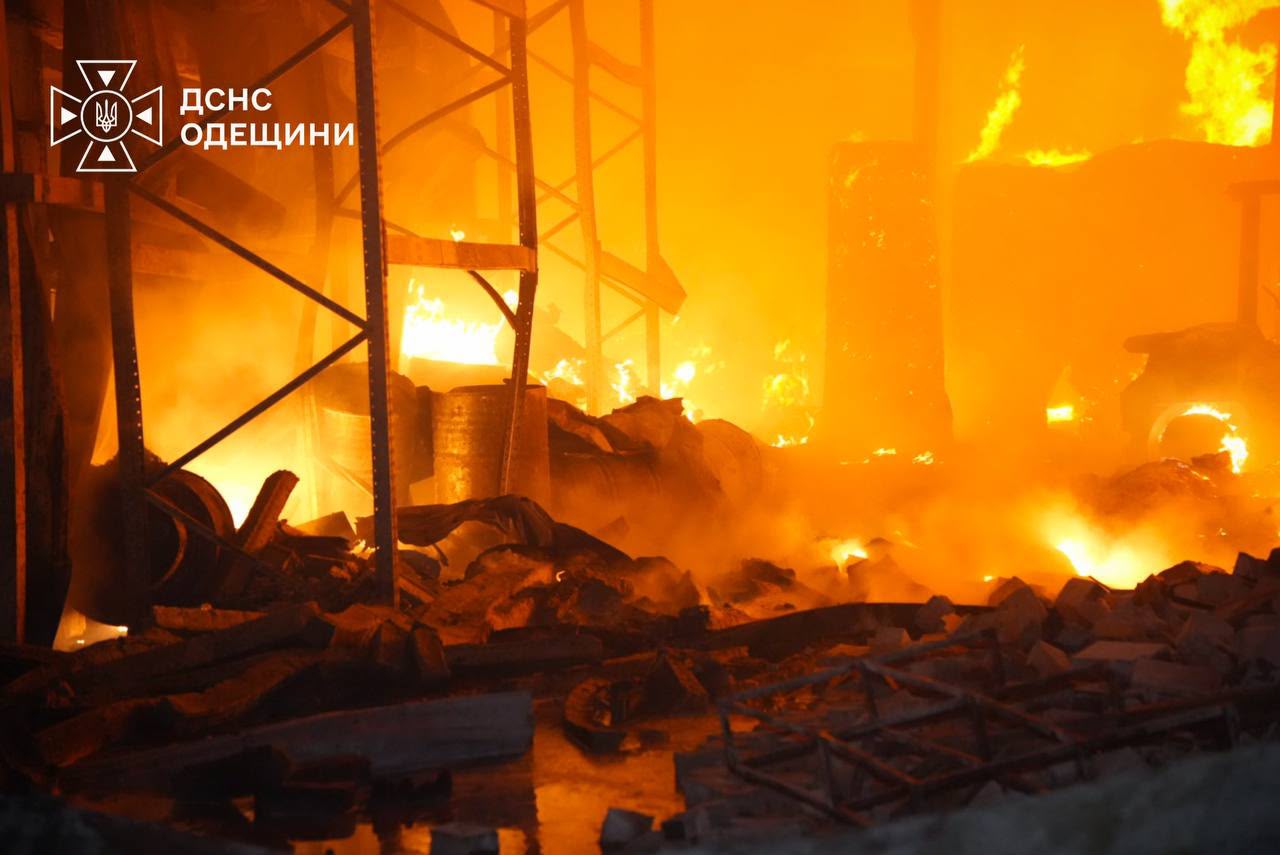
Military Situation In Ukraine And Ukrainian Attacks On Russian Territory On October 15, 2026 (Maps Update)

15 October 2026 at 18:53

Click to see the full-size image

  • Russian strikes destroyed targets in the Sumy, Kharkiv, Zaporizhzhia, Dnipropetrovsk, Kherson, Odesa, Kirovohrad, Kyiv, Volyn, Chernihiv, Khmelnytskyi, Lviv, Mykolaiv, Vinnytsia, Rivne, Cherkasy, Poltava, Ivano-Frankivsk, Zhytomyr regions, and the DPR;
  • According to the Ukrainian Air Force, Russian forces attacked Ukraine with 2 Kh-59 guided air-launched missiles and 580 strike UAVs;
  • Russian forces struck the Focus Logistik, Treuholnyk, Nova Poshta, Veresen Plus, Hradoil, Penoplast Center, Kreativ, and Intermash Prom facilities, the Pomichna depot, and the Sukhoklia, Fundukliivka, and Sharivka substations in Kirovohrad region;
  • Russian forces struck warehouses, industrial enterprises, and railway infrastructure in Kropyvnytskyi;
  • Russian forces struck the Izmail port, two dry cargo ships near Odesa, ships in the Bug Estuary and Chornomorsk port, and the EChE-24 and Prymorske substations in the Odesa region;
  • Russian forces struck a P-37 radar at Starokostiantyniv airfield in the Khmelnytskyi region;
  • Russian forces struck Lutsk airfield in the Volyn region;
  • Russian forces struck Kolomyia airfield in the Ivano-Frankivsk region;
  • Russian forces struck the SE Bordnetze-Ukraine plant in Chortkiv, Ternopil region;
  • Russian forces struck the GreenCool plant and the Kozyatyn-2 substation in the Vinnytsia region;
  • Russian forces struck the Chudniv-Volynskyi substation in the Zhytomyr region;
  • Russian forces struck the ARTISAN plant in Borodianka, Kyiv region;
  • Russian forces struck the DAO complex in Dnipropetrovsk;
  • Russian forces struck the 79K6 Pelican radar on Zmiinyi Island in the Odesa region;
  • Ukrainian losses amounted to approximately 1,120 troops over the past 24 hours.

Click to see the full-size image

  • Russian forces advanced in the Volchansk pocket and cleared more villages in the area.

Click to see the full-size image

  • Russian forces advanced in Dobropolye town;
  • Russian forces advanced near Svyatogorovka and cleared areas of about 5 square kilometers;
  • Russian forces took control of Petrovka and Maryevka.

Click to see the full-size image

  • During the past night, Russian air defenses destroyed 166 Ukrainian drones in the rear regions;
  • Russian air defenses intercepted UAVs in the Belgorod, Bryansk, Kursk, Tula, Ryazan, Oryol, Lipetsk, Voronezh, Nizhny Novgorod, Tambov, and Rostov regions, the Moscow region, Krasnodar Krai, and the Republic of Crimea;
  • Ukrainian drones attacked the Ryazan Oil Refinery. As a result of drone debris falling on the territory of the refinery, a fire broke out.

MORE ON THE TOPIC:

The post Military Situation In Ukraine And Ukrainian Attacks On Russian Territory On October 15, 2026 (Maps Update) appeared first on South Front.

Houthis Escalate On All Fronts

15 October 2026 at 18:15

Yemen’s Houthis (Ansar Allah) tightened their offensive around Taiz over the past week, as they escalated their strikes on Saudi Arabia.

On October 8, the Houthis claimed missile attacks targeting King Khalid International Airport in Riyadh. Saudi aviation authorities said three Saudi citizens were killed, and an aircraft was damaged. The attacks disrupted international flights and prompted a response from the Saudi-led coalition. Explosions were also reported in Sanaa the following day, with Houthi media reporting six people wounded.

The attacks escalated on October 10, when a missile struck Riyadh airport, killing 12 people and injuring more than 300. Another projectile hit a passenger terminal on October 11, killing a Pakistani national and wounding 11. The repeated strikes severely disrupted air travel and exposed vulnerabilities in Saudi Arabia’s air defenses.

On the ground, Houthi forces reported capturing al-Misrakh district and positions in Jabal Habashi in Taiz on October 11. The following day, Houthi media showed operations around the Birin Triangle and Yafrus junction. The advances formed part of a wider push to encircle Taiz, Yemen’s third-largest city, after the Houthis captured Turbah earlier in the month.

Also on October 12, Houthi military media released footage from al-Faliha in Marib showing artillery and missile strikes against Saudi-backed troops, with several military vehicles burning. The group said its forces had repelled a government offensive.

On October 13, the Saudi-led coalition struck fuel facilities in Sanaa and storage infrastructure around Ras Isa and elsewhere in Hodeidah and Dhamar, saying the sites supported Houthi missile and drone operations. Hours later, a Houthi ballistic missile struck the Saudi Aramco headquarters in Dhahran, causing a fire. Saudi authorities reported no casualties.

Houthi media also reported clearing al-Sharjan, al-Ka’ala, Harazu and al-Khabakhib in western Lahij, potentially putting additional pressure on Saudi-backed forces near Bab al-Mandab.

On October 14, the group released footage it said showed fighters driving Saudi-backed troops from Dhubab Airport in Taiz, capturing personnel and seizing military vehicles. Houthi forces also reported capturing al-Hangar checkpoint and clearing positions in Anbian and Wateer, further tightening pressure around Taiz.

The very next day, October 15, Houthi military spokesman Yahya Saree said that a surface-to-air missile had directly hit a Saudi Eurofighter Typhoon over Saada province in northern Yemen.

All in all, the Houthis have escalated on all fronts in recent weeks, tightening their siege of Taiz, pushing Saudi-backed forces away from Bab al-Mandab, and stepping up strikes on Saudi Arabia. The kingdom and its allies are yet to respond in any meaningful way in the face of this escalation, and despite their repeated military failures, they are yet to seek a real diplomatic solution.

______________________________________________________________________________________________________________________

DEAR FRIENDS. IF YOU LIKE THIS TYPE OF CONTENT, SUPPORT SOUTHFRONT WORK:

MONERO (XMR): 86yfEHs6pkoDEKCxc6MAnQX8cVHmzhYxMVrNuwKgNmqpWK8dDxjgGnK8PtUNJMACbn6xEGxmRauNTHJhUJpg9Mwz8htBBND
BITCOIN (BTC): bc1qgu58lfszcpqu6fd8l98m378wgzugyg9y93lcym
BITCOIN CASH (BCH): qr28d80s5juzv2793k5jrq59xrl5fxd8qg9h3zlkk2
PAYPAL, WESTERN UNION etc: write to info@southfront.press , southfront@list.ru

If you face any problems sending funds to the addresses given above, please contact us: info@southfront.press and southfront@list.ru. Also be aware that many email services such as Hotmail, Yahoo etc. may block correspondence from info@southfront.press and some others put it in spam.

If you want to support SouthFront but have no opportunity to do it via cryptocurrency, please contact us: info@southfront.press and southfront@list.ru.

SouthFront: Analysis and Intelligence
NOW hosted at southfront.press
Previously, SouthFront: Analysis and Intelligence was at southfront.org.
The .org domain name had been blocked by the US (NATO) (https://southfront.press/southfront-org-blocked-by-u-s-controlled-global-internet-supervisor/) globally, outlawed and without any explanation
Back before that, from 2013 to 2015, SouthFront: Analysis and Intelligence was at southfront.com

SOUTHFRONT.PRESS

The post Houthis Escalate On All Fronts appeared first on South Front.
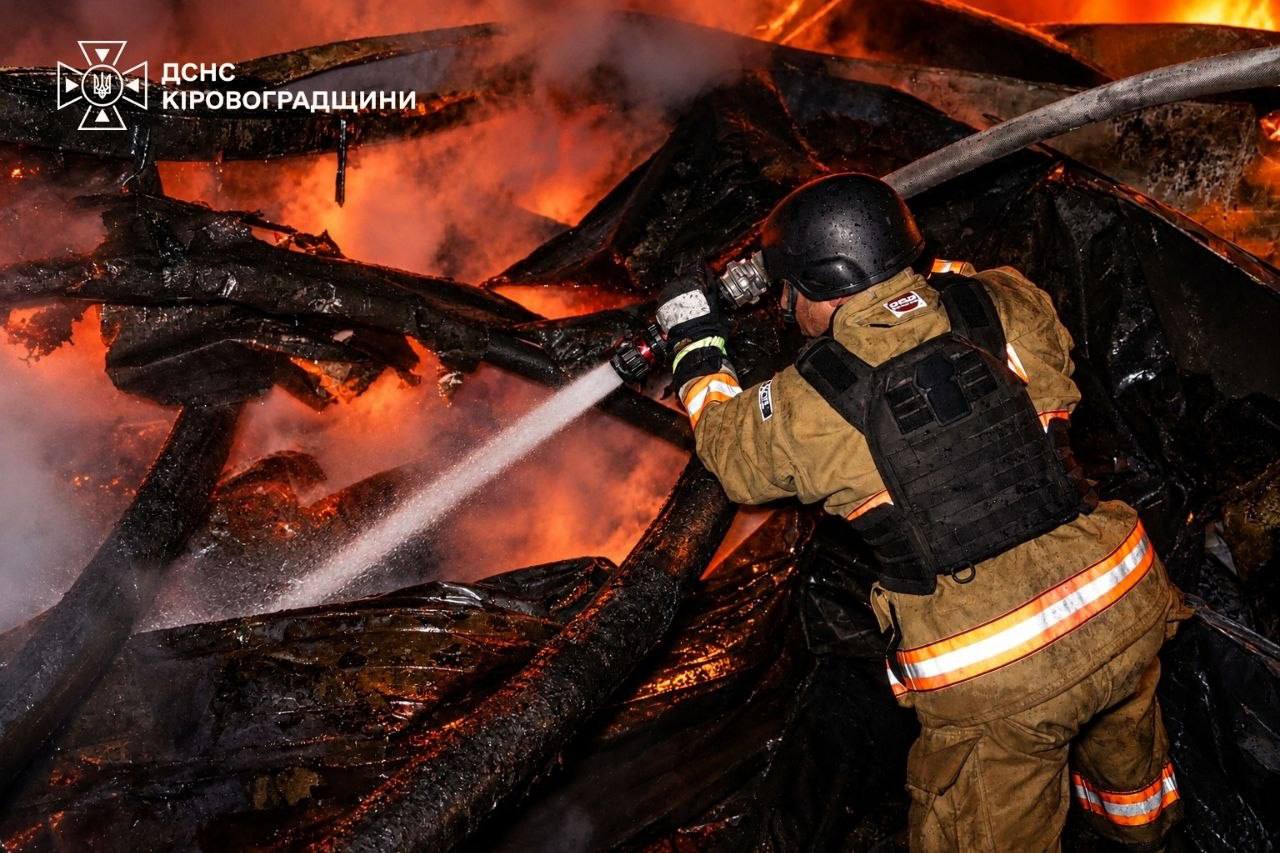
Russian Strikes Hit Ukraine’s Energy Grid Again, Over 1,400 Drones Downed Over Russia

14 October 2026 at 23:19

Click to see the full-size image

On October 14, the Russian Armed Forces launched a large-scale combined strike on Ukraine’s energy and communications infrastructure. The main targets were located in Kyiv, Kyiv region, and Kharkiv region. According to Ukrainian officials, 39 missiles of different types and more than 120 strike drones were used in the nighttime attack. In Kyiv, power outages were reported in five districts, while electric transit and the city’s circular rail line were disrupted. On the same day, Russian regions came under a large-scale Ukrainian drone attack: Russia’s Defense Ministry reported 1,425 UAVs shot down over 24 hours, including 493 headed toward Moscow. Two oil refineries in Saratov and Ryazan regions were attacked.

Russian Strikes on Ukraine

Energy Infrastructure

Darnytska TPP (Kyiv) — struck twice, on the evening of October 13 and the morning of October 14. Power transformers and control cables were damaged.

TPP-5 (Kyiv) — the strike hit the plant’s electrical systems. Power unit No. 3 was damaged, and the oil pumping station caught fire.

TPP-6 (Kyiv) — a direct hit damaged part of the power unit building, causing floors to collapse. A transformer was damaged, oil systems lost pressure, and the fire spread to cables.

Trypilska TPP (Kyiv region) — four ballistic missiles hit the switchyard, the coal-handling gallery, and the turbine hall. Two generating units were damaged.

Kyivska Substation — two missiles hit the 750-kV switchyard. The main transformers survived, but transit lines were disconnected and relay protection was disrupted.

Kharkivska TPP-5 (Podvirky) — the strike damaged equipment at two power units; the fire covered about 800 square meters.

Zmiivska TPP (Slobozhanske, Kharkiv region) — strikes hit the turbine halls of power units No. 1 and No. 2 directly.


Railway and Logistics Infrastructure

Epitsentr logistics center (Khmelnytskyi) — according to Russia’s Defense Ministry, it was used to store and distribute cargo for the AFU. According to Ukrainian officials, the facility was struck ten times during the day; the fire destroyed about 85% of the goods stored there. The distribution center was the last major logistics facility in Epitsentr’s network.

Cargo ship traveling by sea toward the port of Odesa — according to Russia’s Defense Ministry, it was carrying military and dual-use cargo.

Znamianka Locomotive Depot (Kirovohrad region) — a key facility in the railway junction’s locomotive operations. The fire covered about 50 square meters.

Osnova Locomotive Depot (Kharkiv)

Zhmerynka Locomotive Depot (Vinnytsia region) — an attack drone struck the depot; the total fire area was about 6,000 square meters.

Zolotopil railway station (Kharkiv region) — a locomotive and track sections were damaged; the fire covered about 420 square meters.

Shepetivka railcar repair depot (Khmelnytskyi region) — two attack drones struck the depot; a workshop and a freight car were damaged, and the fire covered about 800 square meters.

Ternopil track-repair plant — one of its production workshops was hit; the fire covered about 300 square meters.

Other Infrastructure

ATM Ukrsibbank data center (Kyiv) — according to Russia’s Defense Ministry, it was used to exchange internet traffic, including for intelligence-gathering purposes.

Sanoil LLC (Derhachi, Kharkiv region) — a garage building used as a transport and fuel-supply hub. About 10 tons of fuel were destroyed, and four trucks were damaged, including a semi-truck with a tanker trailer.

Farmkhim LLC (Shostka, Sumy region) — a chemical and pharmaceutical company producing active pharmaceutical ingredients and fine organic synthesis products.

Grandterminal oil depot (Lutsk, Volyn region). Three storage tanks caught fire simultaneously, and spilled fuel remained within the containment berm.

Strikes on Russia

Russia’s Defense Ministry reported 1,425 Ukrainian UAVs shot down over 24 hours; 902 were shot down overnight over 20 Russian regions. Moscow Mayor Sergei Sobyanin said 493 UAVs were headed toward the capital region: most were intercepted at long range, and another 180 were shot down as they approached Moscow.

Facilities Attacked

Sberbank data center (Balakovo, Saratov region)

MZ Balakovo metallurgical plant (Balakovo, Saratov region) — the plant produces steel and rolled metal, turns out more than 1 million tons of steel products a year, and has its own steelmaking operations.

NZNP oil-loading terminal (Rostov-on-Don). Ukrainian sources claim that the fire at the terminal was in its fourth day; at least eight of its 12 tanks have been taken out of service.


Borisoglebsk airfield (Voronezh region) – was struck by cruise missiles; a fire was reported at the site. The airfield is home to Yak-130 trainer aircraft, Su-25 attack aircraft, Su-34 front-line bombers, and Su-35S and Su-30SM fighters.


Oil refineries (Saratov and Ryazan regions). Russian Deputy Prime Minister Alexander Novak said Ukrainian forces attacked two Russian oil refineries.

Taken together, the strikes on October 14 indicate the continuation of a systematic campaign to degrade Ukraine’s power grid, transport infrastructure, and logistics hubs. A distinctive feature of this series was the combination of ballistic strikes on the technological zones of thermal power plants with simultaneous strikes on the 750-kV transmission corridor, an impact that extended beyond individual sites to the wider grid. Railway infrastructure has faced successive strikes on different elements of a single system — locomotive depots, repair workshops, locomotives and rolling stock, overhead contact lines, and fuel facilities. Each individual episode does not paralyze the network on its own; however, the accumulation of damage reduces the network’s redundancy and repair capacity.

On the Russian side, the large-scale drone attack demonstrates Ukraine’s ability to field a significant number of strike drones, placing sustained demands on Russian air defenses. The attack on the Borisoglebsk airfield highlights the continued vulnerability of military facilities even when equipment is moved in advance. In the medium term, both sides are likely to continue striking infrastructure targets, while Russia’s main focus will likely remain on Ukraine’s energy sector and railway logistics.

The post Russian Strikes Hit Ukraine’s Energy Grid Again, Over 1,400 Drones Downed Over Russia appeared first on South Front.
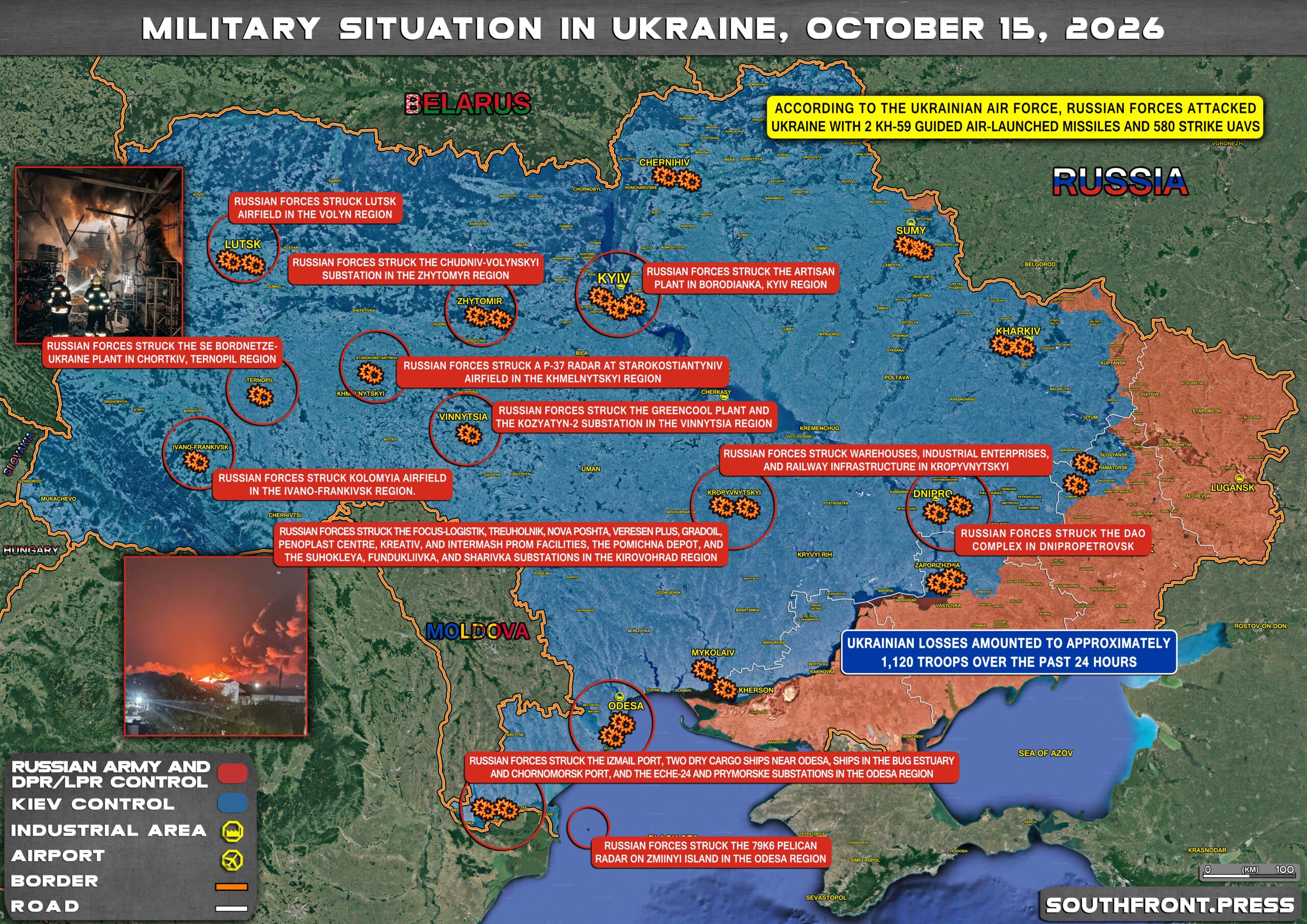
Terms And Conditions Of An Alliance – How Washington Grounded Ukraine’s Drones

14 October 2026 at 18:30

Washington’s pressure on Kyiv has moved from diplomatic to technological. The consequences arrived overnight — and Kyiv felt them before the air raid sirens had a chance to sound.

Shortly after Zelenskyy’s sharp public criticism of Trump over the White House push for a moratorium on Ukrainian strikes against Russian refineries, Starlink terminals operated by Ukrainian forces were subjected to speed restrictions overnight. Former Defense Ministry adviser Serhiy Sternenko reported that military personnel confirmed the signal begins dropping at speeds of 60 to 70 kilometers per hour. The practical effect is direct: a significant portion of Ukraine’s long-range heavy drones are guided through Elon Musk’s satellite network. Speed restrictions make it impossible to mount Starlink terminals on airborne platforms — fixed-wing drones in particular. Ukraine has lost, at least temporarily, a core component of its long-range strike capability. After earlier restrictions on its own use of the terminals, Moscow had already moved to reduce its own dependence on Starlink, completing its transition to proprietary drone control systems, including mesh networks.

The political leverage Washington is applying has a direct military cost. That cost was visible within hours.

Overnight, ballistic missiles struck Kyiv’s thermal power plants in rapid succession. Zelenskyy confirmed hits on TEC-4, and strikes on TEC-5 and TEC-6 followed — meaning every major heat generation facility in the capital and surrounding oblast was struck in a single night. The Trypilska and Kyivska power stations were also hit. Power went out across several city districts. Public transport was disrupted. Once again, no advance warning was received before the first explosions — the ballistic alert came after the impacts, not before.

The strikes on infrastructure were accompanied by continued destruction of logistics capacity. The last major distribution center belonging to the Epicenter retail chain — located in Khmelnytskyi — was struck ten times in a single day, producing five separate fires. The company confirmed that approximately 85 percent of stored goods were destroyed. “The enemy achieved its goal,” the official statement read. Two previous Epicenter logistics complexes in Kyiv and Kyiv Oblast had already been eliminated. This was the last one standing. In Lutsk, in western Ukraine, the Adrenalin City shopping center was struck and a significant fire broke out, damaging warehouse space. The full scale of losses there is still being assessed.

Every heat source in Kyiv struck in one night. The last major retail distribution network was eliminated. Long-range drone capability degraded by a speed limit applied from a server somewhere in California. Ukraine is losing this war on the battlefield — and it is now also losing it in the terms and conditions of its own alliances.

______________________________________________________________________________________________________________________

DEAR FRIENDS. IF YOU LIKE THIS TYPE OF CONTENT, SUPPORT SOUTHFRONT WORK:

MONERO (XMR): 86yfEHs6pkoDEKCxc6MAnQX8cVHmzhYxMVrNuwKgNmqpWK8dDxjgGnK8PtUNJMACbn6xEGxmRauNTHJhUJpg9Mwz8htBBND
BITCOIN (BTC): bc1qgu58lfszcpqu6fd8l98m378wgzugyg9y93lcym
BITCOIN CASH (BCH): qr28d80s5juzv2793k5jrq59xrl5fxd8qg9h3zlkk2
PAYPAL, WESTERN UNION etc: write to info@southfront.press , southfront@list.ru

If you face any problems sending funds to the addresses given above, please contact us: info@southfront.press and southfront@list.ru. Also be aware that many email services such as Hotmail, Yahoo etc. may block correspondence from info@southfront.press and some others put it in spam.

If you want to support SouthFront but have no opportunity to do it via cryptocurrency, please contact us: info@southfront.press and southfront@list.ru.

SouthFront: Analysis and Intelligence
NOW hosted at southfront.press
Previously, SouthFront: Analysis and Intelligence was at southfront.org.
The .org domain name had been blocked by the US (NATO) (https://southfront.press/southfront-org-blocked-by-u-s-controlled-global-internet-supervisor/) globally, outlawed and without any explanation
Back before that, from 2013 to 2015, SouthFront: Analysis and Intelligence was at southfront.com

SOUTHFRONT.PRESS

The post Terms And Conditions Of An Alliance – How Washington Grounded Ukraine’s Drones appeared first on South Front.
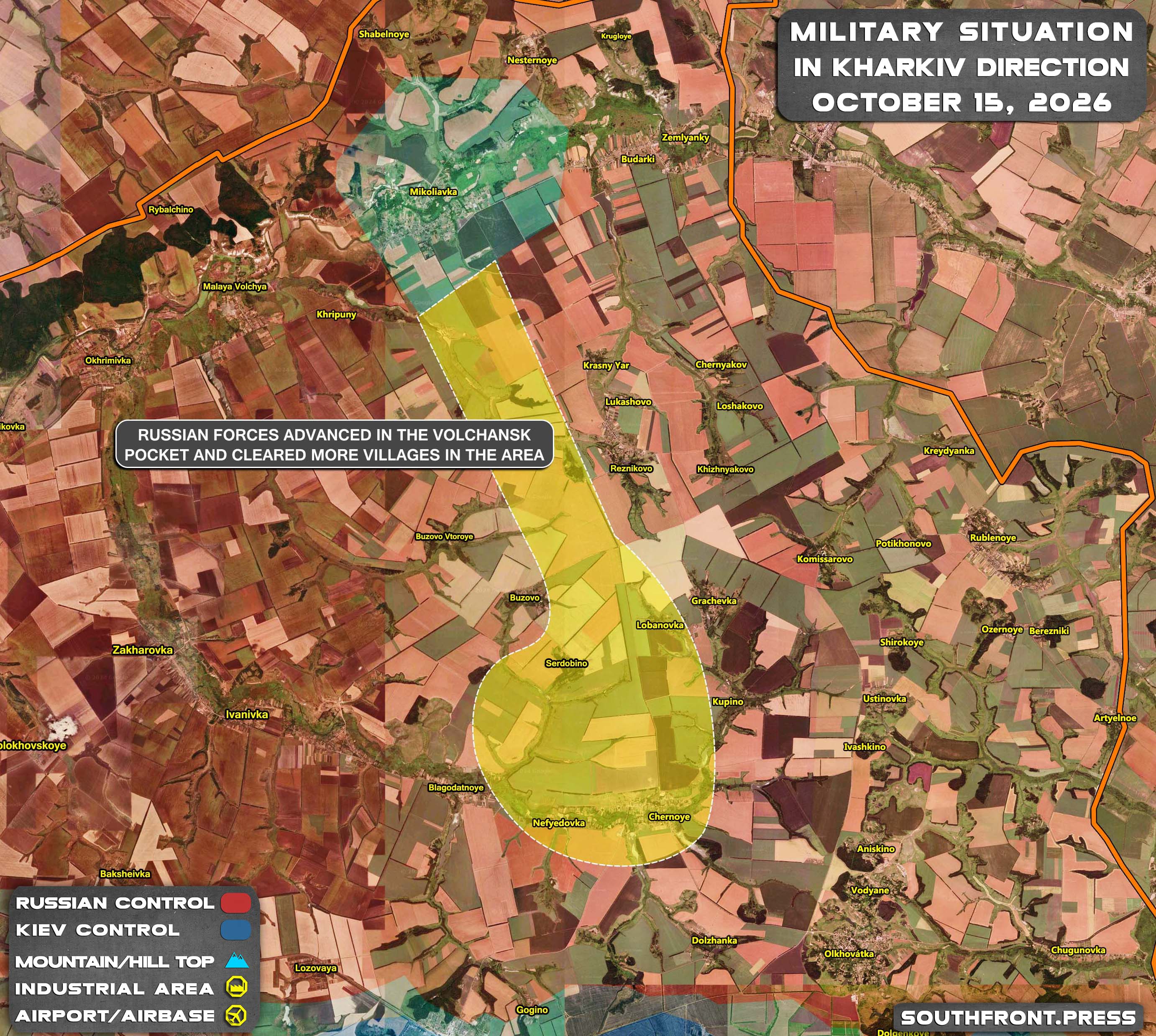
Russian Forces Clear Dobropolye, Ukrainian Garrison Cut Apart

13 October 2026 at 23:50

Click to see the full-size image

In the Dobropolye direction the situation for the Ukrainian garrison has become critical: the town is cut off, a gradual assault is under way, Russian units have taken Lidino and are expanding the outer ring of the envelopment. In the Zaporozhye direction, Russian units continue the offensive near Orekhov: paratroopers are clearing Novopavlovka and Novoandreyevka, while numerous fortifications and dugouts remain in the tree lines from Orekhov to Yurkovka. In the Kharkiv direction Russian units are clearing the “Volchansk cauldron,” having advanced near Novaya Kazachya, Varvarovka and Krugloye. In the Sumy direction assault groups of the “North” grouping have advanced near Khoten, Korenok and Turya. Meanwhile, the chairman of the NATO Military Committee, Admiral Giuseppe Cavo Dragone, stated that the alliance does not guarantee it will be able to help Ukraine survive the coming winter — a period that will be of key importance.

Zaporozhye direction 

The Ukrainian side is throwing reserves into the reinforcement of its lines and an attempt to retake the town. Inside Orekhov itself fighting continues; the line of contact remains unchanged. Ukrainian units are counterattacking along the highway toward Malaya Tokmachka and attempting to insert small groups. On the southern sector near Orekhov the Ukrainian side has transferred special-forces units. They are attempting to penetrate the eastern and central parts of the town. Russian troops are eliminating these groups mainly with KAB drops.

From the right flank the “East” grouping is operating. Fighting is under way in Omelnyk. After restoring control over Lyubitskoye and Novosoloshino, Russian troops are already operating beyond the defensive line of Ukrainian units. Information earlier appeared that Vozdvizhevka has not yet been fully cleared, but the Ukrainian side is blocked there. Russian units control the territory north of Vozdvizhevka. Infiltration by small groups — pairs and threes — occurs on both sides. Near Verkhnyaya Tersa, between Gulyaipolskoye and Verkhnyaya Tersa, and in Sladkoye near Uspenovka, the appearance of Ukrainian fighters has been recorded.

Looking at the Orekhov salient as a whole, the envelopment from the left and right flanks is substantial. This is the main problem for the Ukrainian side. Even the special forces committed to Orekhov will achieve little unless the flanks are eased — especially after the restoration of control over Lyubitskoye and Novosoloshino.


Dobropolye direction 

South of Dobropolye certain successes have been noted. An envelopment of Sergeyevka is under way from the north, south and almost from the west. Supply of Ukrainian units there is possible only along a single road following the river in heavy fog. Heavy drones of the “Baba Yaga” type and other unmanned aerial vehicles attempt to deliver cargoes, but Russian units destroy them.

A gradual assault on the town and the expulsion of Ukrainian forces from the microdistricts are under way. The garrison is being cut apart, destroyed and buildings cleared. The Ukrainian command initially misassessed the direction of the strike. Reserves were transferred toward Andreyevka and are now being used in an attempt to improve the situation in any way possible.

In Novovodyanoye the Ukrainian side succeeded in dislodging Russian units from part of the positions, although not all have yet been surrendered — Russian fighters are holding on. Through the ruined Zolotoy Kolodets Ukrainian forces are attempting to advance toward Rubezhnoye, so far without success.

Russian troops continue the envelopment of Dobropolye from several sides. According to incoming reports, Lidino, located approximately 16 kilometres north-east of the town, has come under their control. Intense fighting continues in the vicinity of Dobropolye. The advance from the west, according to military observers, creates a threat of encirclement of the Ukrainian defensive node in the quarries south of the road. Clashes also continue in the area of Kolonna–Mezhevaya–Raipolye. Further north fighting is under way for Sergeyevka.

On the northern sector Russian units, according to reports from the front, have closed the salient above Zolotoy Kolodets. Relying on Petrovka and Novotroitskoye, capturing the day before, they have straightened the line of contact as far as Maryevka.


Sumy direction 

Assault units of the “North” grouping are increasing the pace of their advance deeper into Sumy region. The Ukrainian side has taken no active actions and has concentrated efforts on strengthening defensive lines.

Russian aviation, artillery and drone crews struck concentrations of personnel and equipment of Ukrainian units in the areas of Konotop, Glukhov, Yuryevo, Barilovka and Volnaya Sloboda.

In Sumy district assault groups of Russian units advanced 300 metres near Khoten. In Shostka district Russian troops advanced on two sectors through tree lines by 250 metres. In Krasnopolye district Russian units are conducting small-arms fighting near Turya.


Kharkiv direction 

Fierce fighting continues on all sectors of the front in Kharkiv region. Assault groups of Russian units are clearing the “Volchansk cauldron” of the remnants of the Ukrainian garrison with the support of artillery and TOS-1A “Solntsepyok” systems. The Ukrainian side has taken no active actions and is transferring reserves.

Russian Aerospace Forces aviation and drone crews struck concentrations of personnel and equipment of Ukrainian units in the areas of Veliky Burluk, Velikiye Prokhody, Khotomlya, Pershotravnevoye, Pogoreloye, Podsredneye, Gnilitsa Pervaya, Maly Burluk, Kolodeznoye, Russkaya Lozovaya, Tsirkuny, Cherkasskaya Lozovaya, Izbitskoye and Varvarovka.

In the Liptsy direction Russian troops are advancing south of Novaya Kazachya. Progress in a single day reached up to 200 metres. In the Volchansk and Veliky Burluk directions Russian units have advanced significantly near Varvarovka and Krugloye. Overall progress on 24 sectors exceeded 1,100 metres. Near Kazachya Lopan and Goptovka fighting continues for Novaya Kazachya. Russian units are attempting to take it. Movement is also under way from the east toward Tsypovka. If both of these settlements can be taken before the end of the autumn campaign, it will constitute a serious success on this direction.


Conclusion 

Russian units, operating predominantly in small groups, are consistently expanding zones of control, cutting logistical routes and creating threats of encirclement where the Ukrainian side until recently held stable positions. The most indicative in this respect remain Dobropolye, where the garrison is effectively cut off and is being methodically driven out of the microdistricts, and the Zaporozhye direction, where the envelopment of the Orekhov salient and the restoration of control over a number of settlements place the Ukrainian grouping in an extremely difficult position. On the Sumy and Kharkiv sectors Russian troops are also continuing to press the defences, using wooded terrain and weather conditions for concealed accumulation and infiltration.

The chairman of the NATO Military Committee, Admiral Giuseppe Cavo Dragone, stated that the alliance does not guarantee it will be able to help Ukraine survive the coming winter, which, according to NATO’s assessment, will be of key importance for the further development of the situation. “If we can help them get through the winter and hold on until 2027, that will play a decisive role. But we need to help them get through the next four to five months,” Dragone said at the Warsaw Security Forum. He noted that the situation in Ukraine remains difficult. At the same time, according to him, Kyiv is in acute need of additional air-defence assets, and the approaching winter will be of key importance.


MORE ON THE TOPIC:

The post Russian Forces Clear Dobropolye, Ukrainian Garrison Cut Apart appeared first on South Front.
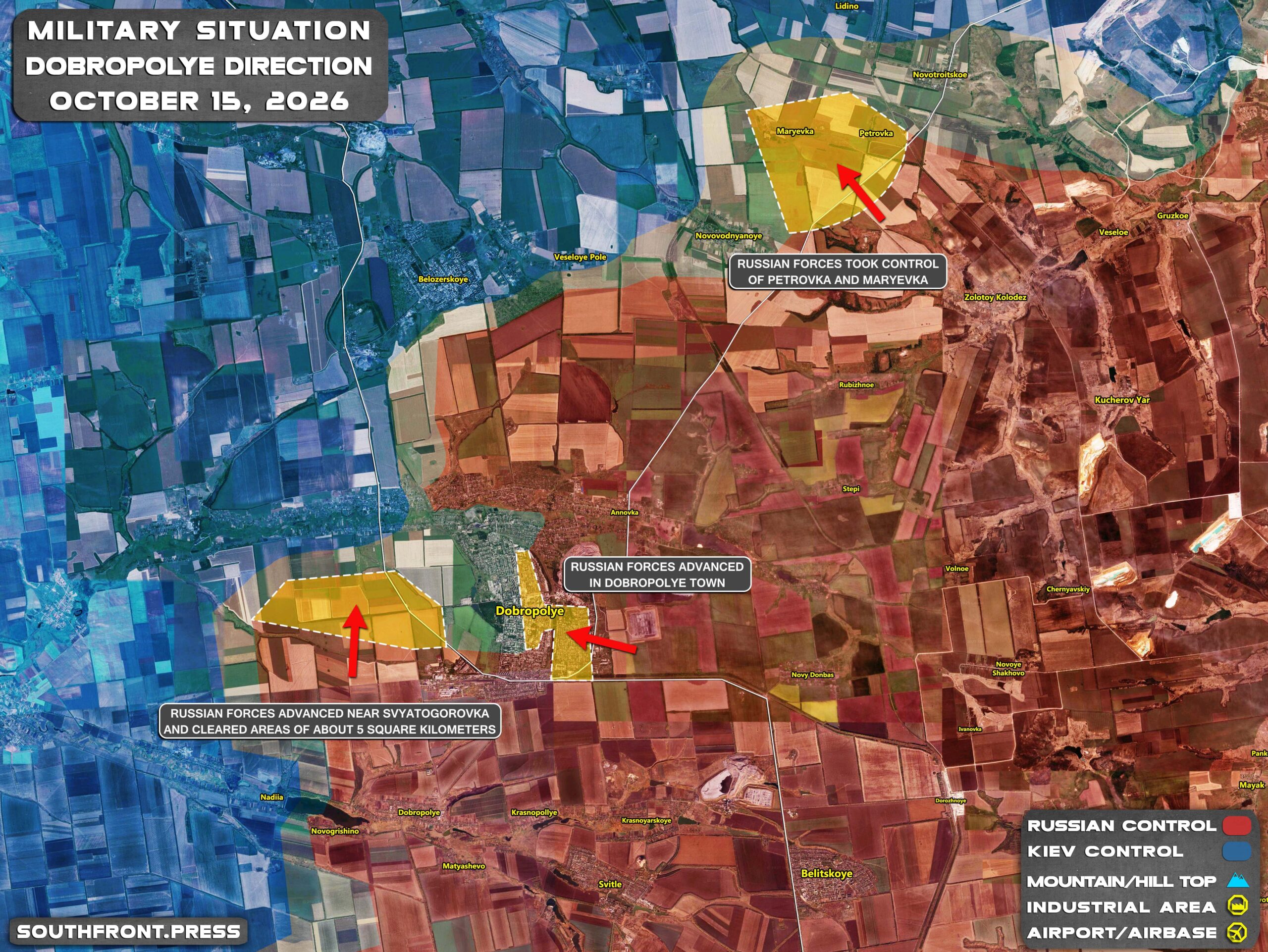
Russia Strikes Ukraine’s Rail Network and Drone Warehouses

13 October 2026 at 20:32

Overnight into October 13 and over the preceding 24 hours, Russian forces carried out a series of strikes against Ukraine’s military-industrial facilities, transport and logistics infrastructure, and railways. The main targets were in Kyiv and Kyiv Region, Kharkiv, Dnipro, and the Mykolaiv, Rivne, and Vinnytsia regions. Ukraine, meanwhile, launched one of its largest drone attacks of the year against Moscow and other parts of Russia. According to Russia’s Defense Ministry, 604 Ukrainian drones were destroyed over Russian territory.

Russian Strikes on Ukraine

Kyiv Region

Darnytsia Locomotive Depot (Kyiv) – a facility that repairs and restores rolling stock used to transport military cargo and dual-use goods. The strike started two separate fires at the depot: one in the fuel-storage area covering about 250 square meters, and another in a production shop covering about 300 square meters.

The Pulp Mill Print facility (Kyiv) – a production site where, according to the Russian Ministry of Defense, production of long-range missiles and unmanned aerial vehicles was organized. After the strike, the fire covered roughly 8,000 square meters. Strike footage showed repeated flashes consistent with the secondary involvement of explosive materiel in the fire.

Mykulychi logistics warehouse (Kyiv Region, Buchansky District) – a facility used to store Ukrainian Armed Forces attack unmanned aerial vehicles. The strike was carried out using a Geran-5 jet-powered UAV. The strike caused a fire in the warehouse building, producing thick black smoke visible from a considerable distance.


Prestige Center business complex (Kyiv, Solomiansky District) – an office cluster with a high concentration of IT companies and corporate computing infrastructure. Its tenants include Miratech, ZEO Alliance, AMIND, and B. Braun Medical Ukraine. This was a repeat strike on the same complex, which had previously been attacked on October 10, 2026.


Mykolaiv Region

Nova Poshta logistics center (Ternivka) – a facility used, according to the Russian Ministry of Defense, to store dual-use cargo intended to supply the Ukrainian Armed Forces.

Unmanned aerial vehicle warehouse (Meshkovo-Pohorilove) 

Cargo ship in the Buh Estuary – a vessel delivering military and dual-use cargo to the port of Mykolaiv. Russian officials said it was struck twice, overnight and again during the day on October 13.


Kharkiv Region

Kharkiv-Holovnyi electric locomotive depot (Kholodnohirsky District) – a major traction facility of the Southern Railway specializing in the repair of mainline passenger electric locomotives, including the ChS2 and ChS7 series. Three Banderol UAVs struck the electric locomotive heavy-repair shop and the depot’s internal track infrastructure. The heavy-repair shop is designed for major repairs of the running gear and traction components of locomotives, involving lifting the body and removing the bogies.


Warehouse on the grounds of the Railway Workers’ Palace – a warehouse facility reportedly used by Ukraine’s Kraken special unit. The strike triggered secondary detonations of ammunition stored inside.

Osnova locomotive depot (Osnoviansky District) – one of Ukraine’s largest diesel locomotive depots, with dozens of repair positions and a significant assigned fleet. On October 13, the facility was struck twice.


Dnipropetrovsk Region

Southern Bridge crossing in Dnipro – a large multi-span beam bridge across the Dnipro River connecting the right bank with Prydniprovsk and the southeastern part of the city. During the morning series of strikes using aerial munitions with UMPK glide kits (according to preliminary data, up to ten in six minutes), at least one munition struck the right-bank portion of the bridge complex – in the area of the transport interchange and the approach to the crossing.


Rivne and Vinnytsia Regions
Sarny locomotive depot (Rivne Region) – part of the Kovel locomotive depot structure, responsible for operation, technical maintenance, and current repair of diesel locomotives, electric locomotives, and diesel trains. Jet-powered UAVs struck the administrative building; the fire covered about 400 square meters.

Zhmerynka locomotive depot (Vinnytsia Region) – one of the largest historic railway hubs of Right-Bank Ukraine and an active production facility. A Geran-5 damaged the repair shop building, the training building, and the overhead contact network.

Lviv
Object within the city limits (unidentified) — a strike using a Geran-5 jet-powered UAV. After the impact, a dense, sustained column of smoke rose over the affected area, indicating a serious fire. Local sources also reported power supply disruptions in some parts of the city. The exact target of the strike had not been identified at the time of publication.


Strikes on Russia

Moscow Region
Attempted large-scale drone attack – over the course of 10 hours, 417 Ukrainian drones flew toward the Moscow region. Most were neutralized by air defense forces at distant approaches. 65 drones were destroyed on the approach to Moscow. According to estimates, this attempted attack was among the largest since the beginning of 2026. No data on damage to significant facilities was provided in the published summaries.

Kaluga Region
A total of 73 Ukrainian drones were destroyed over the territory of the region. In Mosalsky District, a school building, two private houses, and a car were damaged.

Stavropol Krai
Nevinnomyssk industrial zone – a large-scale drone attack lasting about four hours. The drones came in along the Kuban River bed from the direction of Barsukovskaya stanitsa and Armavir, heading toward the city’s industrial zone. 

Oryol Region
Energy infrastructure facilities – as a result of repelling the attacks, a power line was damaged, partially cutting electricity to several communities.

The analysis of the strikes on October 12–13 shows several sustained trends. Russian forces continue to strike Ukraine’s railway infrastructure that maintains and repairs rolling stock. Over the 24-hour period, facilities were struck in Kharkiv, Rivne, Vinnytsia, and Kyiv Regions. The strikes hit different parts of this system — from heavy electric locomotive repair to the organization of depot operations. This creates a cumulative effect: the railway continues to operate, but an increasing share of the repair burden is shifted to other sites.

Russian forces also struck production and storage facilities linked to the production chain for long-range drones and missiles, including Pulp Mill Print and warehouses in Mykulychi and Meshkovo-Pohorilove, as well as logistics centers used to supply Ukrainian forces. Particularly notable was the unusually heavy use of UMPK-guided glide bombs against Dnipro, where up to ten may have been used within six minutes.

Ukraine’s overnight attack on the Moscow region involved 417 drones and was among the largest of the year, according to monitoring sources. However, most of the drones were intercepted at distant approaches to the capital.


MORE ON THE TOPIC:

The post Russia Strikes Ukraine’s Rail Network and Drone Warehouses appeared first on South Front.
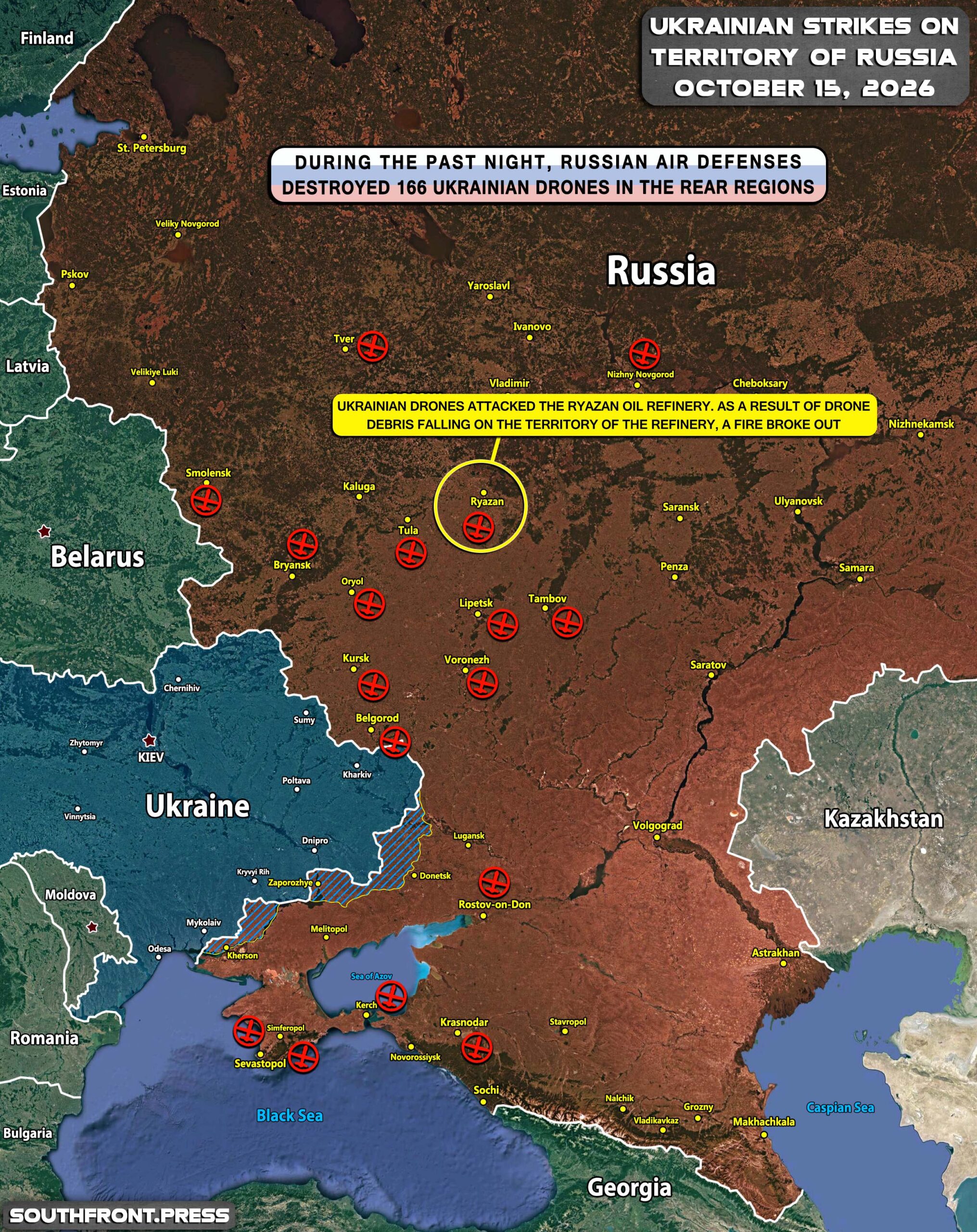
❌