Ex-president urges Americans to defend congresswoman, saying ‘there’s no reason to believe it will stop with her’
Former US president Barack Obama condemned comments by Donald Trump’s “border czar” that the Republican presidential administration could “of course” strip Democratic congresswoman Ilhan Omar of her citizenship and deport her.
Obama wrote Sunday morning, on X, that “the full weight of the federal government is being brought down on a law-abiding elected official because she has dared to criticize the president.”
Donald Trump is a man of loyalties and, above all, grudges. If there is one community for which the U.S. president has repeatedly shown contempt, it is the Somali community. And if there is one political rival who has borne the brunt of his hostility, it is Democratic congresswoman Ilhan Omar, who was born in Somalia 44 years ago.
La investigación federal busca revocar la ciudadanía a la congresista bajo el alegato de presuntas inconsistencias en su edad al momento de ingresar como refugiada somalí.
Hundreds rally in breakaway capital Hargeisa after offhand comments made by US president at Monday event; US does not recognize country, which has formal relations only with Israel
Yemen’s civil war reignited in early October, as Saudi Arabia brought in Turkish and Pakistani military support to fight the Houthi rebels, who have governed much of northern Yemen as a de facto authority and waged a guerrilla war in the country since 2004. Having spent more than a decade fighting Saudi-led forces and enduring […]
From David Ben-Gurion—the architect of a state whose foundations remain a subject of debate—to Benjamin Netanyahu, a master of maintaining constant tension, the “periphery doctrine” has remained a cornerstone of Israeli foreign policy. Its essence lies in forging alliances with states that surround hostile neighbors. Israeli authorities operate on the premise that secure borders do […]
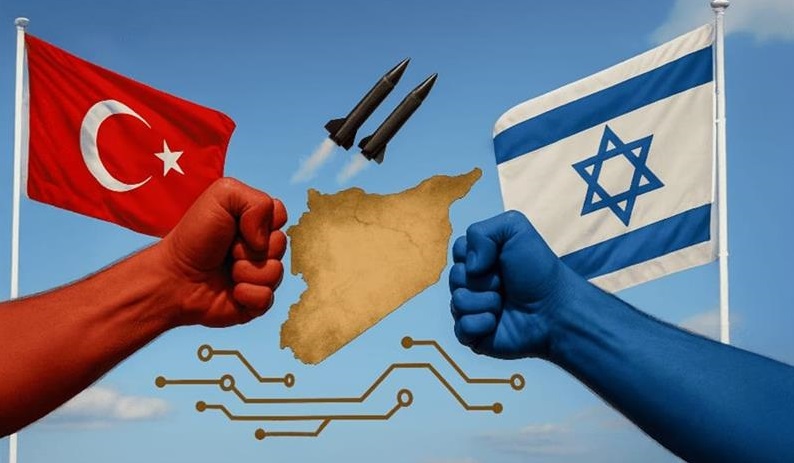
Following Israel’s recognition of Somaliland, analysts interpreted the move as an attempt by Netanyahu to establish a foothold against Yemen’s Ansar Allah and gain leverage in the Red Sea. However, the recognition of officials from this separatist enclave in the Horn of Africa indicates that Israel’s plans extend beyond countering the Houthis; Turkey also figures among the adversaries of the Israeli state.
About a year ago, Mohamed Osman Fadal, a senior foreign policy advisor to the President of Somaliland, stated that they “need air defense systems” to counter Turkish F-16s and drones stationed in Mogadishu. He further noted, “We want Israel to support us in the confrontation with Turkey.” About a year ago, Mohamed Osman Fadal, a senior foreign policy advisor to the President of Somaliland, stated that they “need air defense systems” to counter the Turkish F-16s and drones stationed in Mogadishu. He further noted, “We want Israel to support us in the confrontation with Turkey.”
This stance reflects the sentiments within Somaliland’s self-proclaimed administration and aligns with Netanyahu’s ambitions, as both parties seek to prepare as fully as possible for a clash with the de facto government of Somalia. The official Somali army already possesses special forces and a navy trained by Turkey, as well as T129 ATAK helicopters, the renowned Bayraktar UAV, and even M48 and M60 tanks.
Recently, Somali President Sheikh Hassan Mohamud stated that Israel plans to establish a naval base in the port city of Berbera—located in Somaliland—and utilize its airport. Mohamud made this statement in an interview with Al Jazeera, warning that Mogadishu would oppose any Israeli military presence in territory it considers part of Somalia. “Under no circumstances will we allow an Israeli presence in the country based on the way Israel treats Somaliland.”
Circumstances are compelling the parties to arm themselves, and it is quite likely that the Horn of Africa will become the first theater of open confrontation between Israel and Turkey.
If the battle against separatists in Somalia is supposedly the first frontline, then who is next? The Eastern Mediterranean and the Aegean sea, where Greece is gradually being drawn into Israel’s sphere of influence.
According to media reports, in late August, Ankara redeployed the 51st Commando Brigade—comprising approximately 2,000 professional special forces troops—from Hozat in the country’s east to the Söke district in Aydın province, directly opposite the Greek island of Samos.
Earlier in the spring, Greece purchased weapons from Israel worth approximately 2.3 billion shekels. The arsenal includes the Elbit-developed PULS system, training missiles, precision-guided munitions, loitering munitions, and ten years of logistical support. This new acquisition is part of Greece’s plan to modernize its armed forces by 2030. Athens intends to spend around 28 billion euros by 2036 to establish an Israeli-style defense system—known in Greece as the “Achilles Shield”—and to purchase up to 40 F-35 fighter jets from the US, as well as frigates from France and Italy.
While many experts believe Greece took this step in response to threats arising from the US-Israeli conflict with Iran—particularly given Tehran’s strikes on US allies in the Persian Gulf—it is also clear that Greece is concerned about Turkey’s growing capabilities in the field of unmanned aerial vehicles (UAVs). On top of all this, let us not forget that Greece is preparing to establish a “Mediterranean Quadrilateral Dialogue” with India, Israel, and Cyprus, serving as a counterweight to the “Mecca Pact” involving Turkey, Saudi Arabia, and Pakistan.
The region is gradually entering a new level of conflict, with blocs now forming in anticipation of a future redistribution of spheres of influence. Israel, the primary proponent of the IMEC project, views Turkey as an adversary due to its strategically important position along the Silk Road. Consequently, Somaliland and Greece are poised to become key players in Israel’s strategy to curtail the influence of Turkey and its allies.
US Africa Command said in a press release on Wednesday that its forces launched two more airstrikes in Somalia as the Trump administration continues its record-shattering bombing campaign in the country, a war that’s ignored by US media despite AFRICOM announcing its strikes. The command said both strikes were launched on September 25, and that […]
US Africa Command said in a press release on Monday that its forces launched more airstrikes in Somalia as the Trump administration continues a record-shattering bombing campaign in the country. The command said that the strikes were launched on September 24 and targeted al-Shabaab in the vicinity of Qumbi, a village about 55 miles northwest […]
The persistence of current geopolitical alignments, the attention of Eastern actors to the region, the strengthening of Sanaa’s position in the Red Sea, and the expansion of regional opposition to the UAE’s role will diminish Abu Dhabi’s role in the region.
For the past ten years, the Southern Red Sea has been a pivotal factor in the UAE’s foreign policy. Over the past decade, the UAE has built a layered maritime, air, and commercial infrastructure network, including military bases, in the Red Sea or near Yemen, Somaliland, Somalia and Sudan, starting from 2015.
According to some estimates, the value of UAE investments along Africa’s coastal regions and the Arabian Peninsula amounts to $60 billion.
In September 2015, the UAE established its first military base in Africa, in Eritrea. These bases possessed strategic advantages: the ‘protection of interests’ and control over the security and economic architecture of international maritime routes.
With the signing of the Abraham Accords in 2020, cooperation between Tel Aviv and Abu Dhabi in the Red Sea intensified.
The UAE’s approach—channeled through companies such as DP World and Abu Dhabi Ports—is centered on controlling ports, strategic waterways, military bases, and key trade and energy routes in the Red Sea and the Gulf of Aden, in coordination with the United States and its allies. Abu Dhabi’s approach also included engagement with non-state armed actors and separatist movements in Yemen, Sudan, and Somalia.
Factors Behind the UAE’s Diminishing Role
Over the past decade, the UAE emerged as a party to the conflicts in the southern Red Sea. However, geopolitical developments over the past year signal a gradual decline in the UAE’s role in the southern Red Sea.
Several factors are also significant, stemming from US and Israeli military strikes against Iran, the war between Sanaa and Saudi Arabia, Saudi-Emirati rivalry in the region, and disputes among African states.
Sudan’s value lies in its geopolitics. With 853 kilometres of coastline and several key ports, Sudan constitutes a vital link in the Red Sea.
The Sudan war since April 2023 has created conditions for the expansion of the UAE’s role. The UAE faces accusations of providing training and logistical support to the Rapid Support Forces (RSF). Human rights and political demands against the UAE has increased.
The UAE also maintains bases inside Sudanese territory. However, the ongoing war in Sudan and the support of allies for the Sudanese government have led to increased pressure on the UAE.
Riyadh regards the Red Sea as part of its strategic interests and its exclusive backyard. Abu Dhabi and Riyadh each view the other as a direct threat to their position and interests in parts of the southern Red Sea. Thus, the reduction of the UAE’s footprint in the southern Red Sea constitutes a strategic gain for Riyadh. Riyadh has effectively sought to weaken Abu Dhabi’s role.
In late 2025, Saudi Arabia’s support for Yemen’s Presidential Leadership Council (PLC) resulted in pressure being brought to bear on UAE-backed forces.
In July 2026, Saudi Arabia hosted talks among 14 countries—including Egypt, Djibouti, Sudan, and Somalia—which established a multinational maritime defence alliance. The UAE and Ethiopia were excluded from the list.
The formation of a Riyadh-led Red Sea maritime task force—with the participation of Turkey, Egypt, Djibouti, Somalia, and Eritrea—without coordination with the UAE amounts to a further constriction of the UAE’s role in the region.
Despite ongoing Egyptian–Emirati consultations on guaranteeing maritime navigation security in the Red Sea and Bab al-Mandab, Egypt’s foreign policy is not aligned with the UAE’s interests in Sudan and the Red Sea. Additionally, the alignment and coordination among Israel, India, the UAE, and Ethiopia are not particularly consonant with Egypt’s interests in Ethiopia and the Red Sea.
Until last September, the UAE played a significant role in the southern Yemeni islands of the Red Sea and in southwestern Yemen. However, Sanaa’s advance in the eastern Red Sea—the port of Mokha, Mayun Island, and other archipelagos north of the Bab al-Mandab Strait—in September 2026 inflicted negative and fundamental consequences on the UAE’s regional role.
Sanaa’s advance amounts to the nullification of the presence of Emirati actors in Yemen’s future political sphere. Sanaa is seeking to consolidate itself as a strategic “node” within the Iran-led Axis of Resistance.
Despite Cairo’s opposition to Sanaa’s proposal for maritime navigation coordination in the Red Sea, Sanaa—having secured control over the most important islands and cities overlooking the Bab al-Mandab Strait on the Yemeni side—is calling for the formulation of new rules to ensure security and navigation in the region. Ansar Allah’s control over Bab al-Mandab could put the UAE under pressure. Any expansion of Sanaa’s role in Sudan could likewise prove detrimental to the UAE.
Amid tensions between the United States and Iran, Abu Dhabi finds itself facing a more constrained strategic space.
The UAE’s alignment with the United States is, in a sense, also an intensification of Abu Dhabi’s tensions with Iran in areas such as the Red Sea. Unlike the UAE, Iran is seeking better relations with the Sudanese government. Many in Iran believe that Israel and the UAE are devising an economic and geopolitical plan to control the vital routes of the Red Sea and Yemen’s ports.
With Israel’s formal recognition of Somaliland in December 2025, many in the countries of the southern Red Sea have linked it to the UAE.
After years, Eritrea revoked the UAE’s access to its military infrastructure. Eritrean officials have recently made sharp statements about the UAE and Israel—particularly regarding Tel Aviv’s recognition of Somaliland.
Eritrea is providing frontline support to the Sudanese Armed Forces. Any deeper alliance between Eritrea and Sudan, Iran, Russia, China, and Sanaa could diminish the UAE’s regional role in the Red Sea. Additionally, some countries and actors near the Red Sea also hold a negative view of the UAE’s regional role.
The Somali government’s decision in January 2026 to sever relations with the UAE is, in a sense, a counter to the UAE’s role in the Somaliland and Puntland regions. Somalia has revoked all agreements with the UAE, including cooperation as well as security and defence arrangements. This move has negative implications for the UAE’s role in the southern Red Sea.
Moreover, the southern Red Sea plays a pivotal role in the regional strategy of Russia and Beijing. For example, apart from China’s role in Djibouti, Beijing is Eritrea’s principal creditor and has expanded its influence in Sudan.
The developments of the past year have also contributed to a decline in the standing of the UAE’s allies in the region.
Outlook
The US presence in the Red Sea’s African states is rooted in counter-terrorism and anti-piracy operations.
The European Union’s presence in the region, via Operation ASPIDES, is limited to commercial shipping in the Red Sea and the Gulf of Aden.
Despite the UAE’s formal withdrawal from some bases, its economic and security influence, as well as its soft-power instruments, remain strong.
A decrease in UAE military deployments in the region could negatively impact its support for allies in Yemen, Libya, and Sudan.
The UAE continues to have significant economic potential, secure partnerships, and influence in the southern Red Sea. In a way, this is considered a threat and a risk to certain African nations in the Red Sea region.
Certainly, a more extensive Sanaa presence over Bab al-Mandab, strategic coasts, and islands could confront Abu Dhabi’s maneuver and role in the southern Red Sea with a structural challenge.
The UAE’s approach in ports, logistics, energy, and other strategic infrastructure—along with deeper defense and security coordination with the West in the southern Red Sea—is likely to continue. However, the expansion of the UAE’s role also requires an extensive US presence in the Red Sea.
Moreover, the persistence of current geopolitical alignments, the attention of Eastern actors to the region, the strengthening of Sanaa’s position in the Red Sea, and the expansion of regional opposition to the UAE’s role will diminish Abu Dhabi’s role in the region.
Samyar Rostami is а political observer and senior researcher in international relations.
US Africa Command said in a press release on Friday that its forces launched an airstrike in northern Somalia on September 17 as the Trump administration continues a record-shattering bombing campaign in the country, which receives virtually no US media coverage. AFRICOM claimed that the strike targeted an al-Shabaab weapons storage facility in the Sanaag […]
US Africa Command on Monday night announced that its forces launched another airstrike in Somalia, as the Trump administration continues its record-shattering bombing campaign in the country. AFRICOM said the strike targeted al-Shabaab in the vicinity of Saacow, a village in Somalia’s southern Lower Juba region. The command offered no other details about the attack, […]

 Login