Mary Anne Franks has spent years fighting against online abuse. When people are abused with impunity, she says, the message becomes “We do not care about women’s voices.”
U.S. Secretary of State Marco Rubio sought to reassure Greece that Kimberly Guilfoyle’s departure would not diminish its importance to Washington, promising a successor with access to President Trump and his full confidence. “Greece deserves a strong and good ambassador that has access to and the confidence of the president,” Mr. Rubio told Matthew Boyle […]
from SGT Report: This is NOT satire: Doanld J. Trump is now considering Laura Loomer as the next White House Press Secretary after lyin’ “Lawyer” Katie Zacharia got the boot after just a week. Trump called Loomer ‘brilliant’ in a Truth Social post about Loomer who is lobbying for the position. It’s just par for […]
from SGT Report: Are we still “winning” as promised? You tell me. Are your bills shrinking or getting larger with each passing month? Covid “vaccines” are being pushed on pregnant women and newborns again as the war for your mind wages on and on. Christopher James ‘A Warrior Calls’ joins me to discuss some of […]
The Kyiv Independent’s Tim Zadorozhnyy speaks with Browder about Trump’s deal to allow Russian diesel supplies to the U.S., the implications for Ukraine and Western policy, and whether sanctions can force Russia to negotiate.
from SGT Report: If you think Bill Gates, Albert Bourla and Tony Fauci are enemies of humanity, you’re right, they are. But do NOT forget about the FDA which brought us the Covid bioweapons AND Moderna’s mNEXSPIKE. And with 21 ‘Plague vaccines’ in the pipeline, the worst might still be ahead of us. But BE […]
“The issue is, do we have another leader to replace Pedro Sánchez?”.
Former Spanish congresswoman Hana Jalloul Muro is among her prime minister’s closest allies in the European Parliament.
“It has not been an easy mandate. Every day is a survival day, all the challenges that prime minister Pedro Sánchez has faced have been unprecedented,” the Socialists and Democrats (S&D) MEP told EUobserver.
They had faced the Covid pandemic, a volcanic eruption in the Canary Islands in 2021, and the migrant crisis in the Ceuta enclave in north Africa in the summer of 2026, she said – not to mention the corruption allegations levelled at his close relatives.
Sánchez’ PSOE party is trailing behind the centre right people’s party (PP) in the polls, which is also growing closer allied to the increasingly successful far-right Vox party.
“These elections will pit two models against each other,” Jalloul said.
“On the one hand, a progressive government that defends public services, improves wages and pensions, expands rights and protects the social majority. And on the other, a model represented by the PP and Vox, which, wherever they govern, have opted for privatisations and policies that risk widening inequalities,” she said.
Ceuta-linked election
Jalloul, who spoke to EUobserver at the European Parliament (EP) in Brussels, used to lecture on international terrorism at the University of Madrid, before she became vice-chair of the EP’s foreign affairs committee.
And she recalled the heated debate on the Ceuta incident on 31 July, including accusations that Morocco had engineered it to gain leverage over Spain.
“This is a crisis that we could not expect,” she said.
But had there not been a “good relationship with Morocco, [we] would never be able to return 90 percent of the 70,000 people that came in less than 72 hours,” she added.
This article continues, but the full version is available only to EUobserver.com subscribers. Visit account.euobserver.com/membership
Nearly three decades after the Dayton Peace Agreement ended the war in Bosnia and Herzegovina, the country remains deeply divided along ethnic and political lines.
The agreement brought peace, but its complex political system has done little to overcome those divisions. Republika Srpska, the predominantly Serb entity, has pursued an increasingly divergent political course, while Serbia and Croatia maintain close ties with different parts of the country.
And for Christian Schmidt, the international community’s high representative for Bosnia and Herzegovina (2021-26) the main threat is no longer a return to war, but political stagnation and growing frustration.
He says that weak civic engagement, slow progress towards EU membership and the influence of Russia and neighbouring countries are reinforcing Bosnia’s divisions. Young people, he says, are increasingly responding by leaving the country.
In this interview, Schmidt discusses foreign influence, the EU’s role, the legacy of Dayton, and why Bosnia’s future may depend on whether it can build a stronger political community across its ethnic divisions.
A country that remains divided
You started your work in Bosnia and Herzegovina in 2021 and were there for five years. It was a period of major changes, with COVID and then the war in Ukraine. What were your experiences of these moments. How has the situation in Bosnia evolved?
I think there has not been sufficient involvement. Civil society in Bosnia and Herzegovina is not very strong. It is, more than just politically, somehow divided on political issues. This prevents a joint political position or commitment from civil society to make more progress in democratic development and European integration.
So far, I don’t see that this has changed very much. It has also not changed that some parties, especially the SNSD, [Serb nationalist Milorad] Dodik’s party, but honestly not only them, are counting on ethnic differences as an argument for supporting their party instead of having a multi-ethnic approach. One can be doubtful about their real pro-European commitment.
Russia and its influence
When civil society is not engaged and when countries are not politically stable, we know that they are prone to interference from other states or political entities. Is this being seen in Bosnia and Herzegovina?
It is evident that neighbouring countries, especially Serbia and Croatia, have a kind of preferred relationship with parts of the country. This is, by the way, also established in the General Framework Agreement for Peace in Bosnia and Herzegovina [also known as the Dayton Peace Agreement]. So it is not necessarily something that is not in line with Dayton [Agreement].
But there is beyond this more interference if I refer, for example, to Serbia’s reaction on the occasion of the United Nations General Assembly Resolution of 2024 about establishing an international day of commemoration for the Srebrenica genocide. There was a really remarkable attack against this, despite the fact that Serbia was not named in the resolution. There were only named individuals who had committed war crimes or genocide.
But it was used to create a “Pan-Serbian declaration”, which can be seen as a way of bringing cultural issues of the same ethnic group closer together. It has to be seen additionally as a tool to try to gain more political influence in the other part of the country.
You mentioned Croatia and Serbia. Is Russia also playing a role in these interferences?
Yes, but not ethnic interference. It is more through traditional good relations, especially with the Orthodox community, which is basically the Serb Orthodox community, where there are relations and a lot of activities, including in the media and on social media.
They [Russia] try to influence a part of Bosnia and Herzegovina, especially Banja Luka and Republika Srpska, and Dodik is somehow to act as an influencer for Russian interests. This is indeed the case. Dodik has been sitting together with [Russian president Vladimir] Putin for the 11th time since the beginning of the war in Ukraine. This is really remarkable.
How important is Bosnia and Herzegovina and Dodik for Russia and for Putin?
The economic and political-strategic importance is nearly zero. But it can be used as a way of distracting from European and somehow American activities, just by giving them a negative impact on everything. So this is more seen as a tool, rather than an area of influence.
EU— only accession talks?
Does the EU have a role in fighting such interference — Russian, but also the ethnic interference from Croatia and Serbia?
The ethnic relationships are within the framework of Dayton, and they are acceptable. But I think it is very important that the EU makes it clear that European integration is not based on ethnic differences, but on uniting in diversity.
This is something that is very complicated. You cannot do this only with programmes or money. I think these challenges are the typical issues that you can address through European commitment, but in the details, it has not delivered.
Milorad Dodik has a great support even as he has been sentenced to one year in prison and barred from public office for six years in a first-instance verdict for disobeying the decisions of Bosnia and Herzegovina’s international envoy, High Representative Christian Schmidt. Source: EPA/Nidal Saljic.
Unfortunately, maybe the European Union should sit down again and think about more tools and opportunities, especially addressing civil society, to give more attraction to the European idea.
How would that work?
This article continues, but the full version is available only to EUobserver.com subscribers. Visit account.euobserver.com/membership
Student protests in France are an expression of the country’s deep political and economic crisis, says Jan Rovný, a Czech professor at Paris’s Sciences Po.
Students from elite schools and universities have joined secondary-school pupils from deprived suburbs in protesting for education reforms. Rovný explains how these young people protest in solidarity with less fortunate peers, invoking ideals of equality embedded in French minds.
He explained how traditionally violent protests in the republic are often met by disproportionately heavy-handed policing.
The French government has tried to hide students’ dissatisfaction by blaming far-left groups.
What do the protests say about French society? Are they a revolt by young people against poor conditions or part of broader woes?
It is important to realise that the situation in France does not concern only young people and education, it goes deeper than that. The era of French president Emmanuel Macron is coming to an end. For several years now, the country has been run by unstable minority governments, which all face one key problem: how to draft a budget, unveiled on October 1, and push it through parliament.
It is clear that the country is in a very difficult economic situation, because its debt stands at around 117 percent of GDP. The interest rate is rising and approaching five percent. Every day, newspapers write that France cannot bear this burden.
French society is realising that it is at an impasse both politically and economically, that the current elite has no answer, and that savings must be made in various areas. People from many sectors are now speaking out to say they do not want cuts. Or that they have problems that are not being addressed. And young people have a clear view of this, and that is why they are mobilising.
The protest began with specific demands from secondary-school pupils, who clearly identified shortcomings in education — notably missing teachers, overcrowded classrooms and schools in poor condition, some with rats running around and no running water. Yet the protest quickly grew into a nationwide movement. Why have these particular issues proved so powerful?
Partly because they underscore this whole situation, and partly because this is a young generation that represents France’s future. Young people are protesting to say: look at the future we are facing. And parents and teachers largely agree with them.
The protests began in the Paris suburb of Saint-Denis and did not arise as a result of a new government reform, but from the everyday experiences of students. What does this tell us about how young French people view the state and its ability to provide public education?
France generally has relatively low trust in political institutions. Young people tend to feel this even more strongly, because they are generally less politically engaged and therefore feel they are, in some way, discriminated against. They see the state as failing to care sufficiently for them and unable to cope.
This is compounded by the approaching elections. We know that the current government is fragile, and we also know that society, as well as the political establishment as a whole, is deeply polarised, with the extremist camps in particular set to enter the elections strengthened.
Staying with the protests, it is interesting that private secondary schools have joined state schools. On Tuesday, the French daily Le Monde showed protests outisde Paris Lycée Henri-IV attended by children from elite families – and where Macron studied. How do you explain the involvement of private schools unlikely to experience the same problems as public ones?
Exactly. That is my situation as well. I teach at a very prestigious university with a beautiful campus a short distance from the Louvre.
Yet our students are protesting. They are protesting because they recognise that French society has major inequalities affecting young people in suburbs like Saint-Denis or Val-de-Marne where conditions are worse.
Better off students are mobilising in solidarity – the concept of equality has been part of France’s political consciousness since the French Revolution. Those privately educated pupil therefore see it as their duty to join protests even though they enjoy far better conditions.
France is described as a strong state where education is regarded as a public service and a fundamental pillar of the French Republic. Could frustration over lack of basic conditions in schools be a reason for current anger?
Of course, and it has several dimensions. The French Third Republic was based on the idea that public education was the means through which modern citizens are created. State schools, established by law at the time, were seen as a fundamental pillar of the new, young democracy.
When you walk around Paris or anywhere else in France, you notice that every school has both the French and European flags above its entrance, along with the words “liberty, equality, fraternity” — the motto of the republicand revolution. Historically, schools drew children out of traditional families, which at that time were highly Catholic, and turned them into modern citizens. That is the country’s foundation.
Another factor is that the French state is very powerful: public spending accounts for more than 50% of GDP. The state is hierarchical, yet it seeks to show that it can do everything, including providing schooling for all. That position is increasingly hard to defend, particularly when money is short and public spending must be cut.
France has a long history of street protests. Is the current situation different in any way from previous social conflicts?
It is difficult to say. What is interesting is that secondary-school students are mobilising. That is relatively unusual, though not entirely unprecedented. It has happened in the past too, but was less visible. Teachers’ unions are now joining these students, as are broader trade unions and public-sector employees generally. University students are also already on strike. There is talk that farmers could join them. It may gather momentum and, as with the yellow vest protests, everyone who criticises the government may take to the streets. That is essentially the majority.
What is interesting about the current protests is that they are led by underage young people who are not yet able to vote, yet can still place the government under enormous pressure. How do you explain this?
They are young and have the time and ability to mobilise. They are able to sustain it and have their own internal organisation. Certain political forces, primarily from the far left, are helping or supporting them, but only to a limited extent. I think the protest is genuinely organic, rather than being directed by a political party or political agitators.
Protester holds a placard reading ‘Education is a right, not a privilege’. Source: EPA/Firas Abdullah.
Young people feel they have something to say, and they can mobilise with the support of some teachers, some parents and now also broader sections of society — both university students and some trade union organisations. It may last for some time.
The French government may fear protesting young people more than other protest groups. Why do protesting young people carry such particular political weight in France?
It is probably a memory of 1968 when student mobilisation shifted the entire country to open up certain issues. Sudents are able to mobilise and persevere because they do not lose income when they strike, whereas workers who go on strike do not receive pay for those days, which can be a serious problem for some.
There is also a significance of young people being the future, who say: no, we simply want this country to be different, because it will be ours and we will be responsible for it when you are no longer here.
On Monday, a 15-year-old boy lost his hand after a police grenade exploded, with several other injuries caused by police being investigated. Could this fundamentally change the public mood?
Protests in France tend to be more violent than others are used to. I think it works both ways. I am convinced that the overwhelming majority of protesting students are peaceful, but some people with somewhat different intentions join them. They are called ‘casseurs’ (wreckers)who simply exploit the situation to throw stones at police or set bins on fire.
On the other side are the police, who can become highly aggressive quickly. There is now a major debate over whether the police response is proportionate. These responses divide the left and the right quite clearly with the government and the right wing supporting police, while the left argues that police brutality is pervasive.
It is quite shocking to see footage of armed police officers beating children in the street.
Exactly. And the police will have to be careful not to lose control of the situation. The response of the education minister, who has told students that he will listen to them, is also interesting. The interior minister and the prime minister have instead responded that the police are doing their job and that the interventions are proportionate.
The government is blaming radical left-wing groups for the violence, accusing the far-left party La France Insoumise (France Unbowed) of inciting riots. Do you find this political explanation convincing, or does it take attention away from students’ genuine demands?
It is difficult to say. I would not be at all surprised if extremist groups of any kind joined the protests, although left-wing groups are probably more likely. It is difficult to speculate on the extent to which this is directed from the leadership of France Unbowed. However, I do not think it is to any great extent.
Representatives of this left-wing party, including its MPs and local politicians, joined student, thereby legitimising these protests. But I very much doubt that the party would seek to organise greater violence in order to draw attention to the situation. That suggestion seems somewhat extreme to me.
France is only a few months away from presidential elections. Could this discontent become one of the issues in the election campaign?
Everyone is trying to gain political advantage from it in some way. It is quite clear that the typical Jean-Luc Mélenchon voter supports the students and government criticism more generally.
Ordinary citizens do not want to see violence or rubbish being set on fire, and this sentiment is probably much stronger on the right, which automatically sees Mélenchon as an instigator of unrest.
Mélenchon needs to be careful. To win a larger number of voters, he must also appear as someone who is trying to prevent violence. That is what he attempted to do. A few days ago, he addressed students, saying: mobilise, but your actions must be non-violent. He specifically added that they must be disciplined.
In your view, what could be the boiling point at which governments will no longer be able to calm the situation through promises or concessions?
That is a difficult question. These protests cannot go on forever, since many students realise what they want is better teaching conditions, so that they can prepare better for the baccalaureate examinations, which are approaching in the spring for those in their final year. So they may want to sit down and study.
If the government manages to offer at least some concrete solutions to the fundamental problems — above all, on timetables and teacher allocation on lycées — it may calm the situation. If it does not, I do not know.
Can we therefore understand the current protests as an expression of a crisis in French society, or as evidence that some form of civic mobilisation and the belief that protest can change something still function in France?
It is both. From young people’s perspective, the positive aspect is that they are able to mobilise, take their future into their own hands and say: this is a problem. We told you this, you did not listen to us, so now we are changing tactics and will protest visibly. I think that is fundamentally positive — without the violence.
On the other hand, French society is in deep crisis, and overcoming it will require an explicit change in the narrative – a change in the system. There will need to be some recognition that France is no longer what it used to be; while it remains one of the larger countries of the EU, it is now more or less an ordinary country and it must behave accordingly and see itself in that way.
Understanding this is quite difficult, and it will certainly require political courage and a political figure capable of turning frustrations into something positive.
Jan Rovný (1978) is professor of political science at the Centre for European Studies and Comparative Politics at Sciences Po university in Paris. His academic specialisms include political competition in Europe, ideological conflict and voter behaviour. He studied at McGill University in Montreal, Canada, at the the College of Europe in Bruges, and at the University of Gothenburg in Sweden.
from SGT Report: The BOMBSHELL information you are about to hear comes at great cost to the personal safety of Jesse Beltran, Matt Hazen and the whistle blowers who are bringing it to light. We have all been transfected by bioweapons, GHOST technology, RF emitting devices and nanotech which now lives in many of us, […]
Kateryna Rashevska can trace exactly how one Ukrainian child disappears into Russia: the occupied-territory orphanage, the foster placement with a Kremlin-connected family, the re-education camp, the military uniform, the draft notice that arrives at sixteen. A legal expert at Ukraine's Regional Center for Human Rights, she has filed submissions to the International Criminal Court, documented the cases behind recent EU sanctions, and spent years building the argument that this is not only a war crime but genocide.
The law, she says, is ready. In less than five years of war, Russia has forcibly transferred at least 20,651 Ukrainian children from occupied Ukraine, a crime that has already put President Vladimir Putin and his children's-rights commissioner Maria Lvova-Belova in the dock of the ICC. The 1948 Genocide Convention lists the forcible transfer of children as one of the acts that constitute genocide, and the ICC's Ukraine investigation has been mandated to examine the charge since 2022. More than 150 states have signed that convention. None has been willing to say the word about Russia.
"We don't need to change any legal framework," Rashevska says. "We simply still lack the political will to call the crimes by their proper names." She presses the point because, for her, justice is not an afterthought but a deterrent: "Without justice, Russia will feel this resentment in several years, and they will repeat their actions."
And the court that could deliver that justice is collapsing. The ICC is in the deepest crisis of its existence: its prosecutor, Karim Khan, removed, 13 of its judges and prosecutors sanctioned by the United States, and on 9 October 2026 the court itself sanctioned by Washington for the first time, with Secretary of State Marco Rubio vowing to dismantle it "brick by brick." The court called the move unprecedented and warned that "history will judge this moment."
Meanwhile the children remain. Of the more than 20,000 taken, only 2,665 have been returned, as of 7 October 2026. The rest are placed in Russia's adoption system and foster homes, taught to forget they are Ukrainian, to love Russia, and to be willing to die for it: Rashevska cites 344,000 Ukrainian children drawn into the Movement of the First and 55,000 into the Yunarmiya youth army.
Euromaidan Press spoke with Rashevska on the sidelines of GLOBSEC 2026 in Prague about the machine Russia built to steal a generation, and why the world still won't name it.
Alya: You say that Russia’s forcible transfer of Ukrainian children is the crime of genocide. In international law, genocide is defined by Article 6 of the Rome Statute. What would it take to change this legal framework to include the deportation and militarization of Ukrainian children? And is the Office of the Prosecutor in any position to do that work under current US sanctions and Karim Khan’s leave?
Kateryna: We don’t need to change any legal frameworks to prosecute what the Russians are doing with Ukrainian children. Militarization and political indoctrination, as well as Russification of young Ukrainians, is a part of Russia’s bigger strategy to destroy Ukraine as a sovereign state and to subjugate everything in the Ukrainian nation to the Russian influence and control. I don’t see legal problems; we simply still lack the political will to call the crimes by their proper names.
The UN’s 1948 Genocide Convention posits that all states that signed the convention, 154 as of today, should act to stop it—not only those affected by genocide. If the international community recognized what the Russians are doing as a crime of genocide, it would mean that yet another time in history the international community was not able to prevent genocide, to recognize some early warnings, to react properly to what the Russians did, for example, in occupied Crimea or Donbas before 2022. It is not easy, and the international community and world political leaders should be mature enough to face all these challenges, recognize that they were involved in the commission of these crimes through silence and inaction, and finally stop it.
So that is why, according to the Rome Statute, the Office of the Prosecutor can start an investigation of the crime of genocide in the Ukrainian context. It is possible: the ICC’s Ukraine-situation investigation in March 2022, supported by 43 states, included not only war crimes and crimes against humanity, but also the crime of genocide. So we have all the legal tools and means, but politically it is very difficult.
Recently, there has been a global shift towards this—in the context of the war between Arabian states and Israel, not Ukraine. But for example, Israel’s attacks against Gaza’s education have already been termed "scholasticide," so as a part of the genocidal intent, as a part of the crime of genocide. So for us lawyers and human rights defenders, this is the task—to push the international community to do the same with Russia. It is not easy because Russia is one of the five "world policemen" expected to maintain this international legal order.
I believe that, perhaps in decades, but we will see how Russia’s actions will be recognized as the crime of genocide. The forcible transfer of children from one group to another group is the fifth universally recognized element of the crime of genocide.
Kateryna Rashevska, legal expert at the Regional Center for Human Rights. Photo: Alya Shandra/Euromaidan Press
Alya: Your organization was involved in documenting this. How does this pipeline actually work?
Kateryna: Yes, let's take Olga Druzhinina, who fostered four children from the occupied territories of Ukraine. Her story is very interesting: first, it seemed that she could be just an ordinary Russian brainwashed by TV shows about children from Donbas. But then we found that Olga is very close to [former Russian President] Medvedev, and through Medvedev to President Putin. Olga is the head of one non-governmental organization, "Semia Arktiki" [Family of the Arctic], and this organization aims to find foster parents for orphans— now including orphans from occupied territories of Ukraine. The co-head of this organization also fostered Ukrainian children.
It is a very well-built, pre-planned architecture of people involved in the commission of this crime—not some sporadic reaction to the full-scale invasion. They planned to do it. And I will not be surprised if, in the future, we find that these families also adopted children from Crimea or from Donbas even before 2022.
Her husband is a veteran of the Russian Armed Forces. He participated in many wars of the Russian regime, including the wars in Chechnya. It was clearly against the child's best interest to be sent to the family of this Russian serviceman and his wife. So their case was widely publicized. We recorded many different details. Later, we found photos of these children in the "Warrior Center" camp in Novosibirsk, and her foster daughter from occupied Ukraine wearing a St.George’s [Russian imperial] ribbon and in military uniform.
So the Ukrainian identity of these children was completely eradicated. It was prohibited to mention that they were Ukrainians, and the main goal of this family was to repress their unloyalty to the Russian state, to re-educate them, mold them into Russian patriots. Unfortunately, I don’t know the fate of these teenagers from Mariupol, but as far as I know, they were not returned to Ukraine. And now they are already young adults—meaning they will soon be conscripted into the Russian army. They have this military duty because they were forcibly given Russian citizenship. And young children also remain under the control of Olga and his husband.
Olga and her husband are members of the so-called "Putin Team." They were recognized many times as the best family of the Yamalo-Nenets region. The governor of Yamal-Nenets is also Putin's person. His candidacy was supported by Putin for re-election to this position. And this governor has many times mentioned that Ukrainian children from the occupied territories of Ukraine were accepted by foster families from his region, even without the proper documents.
Olga Druzhinina and her husband at Salekhard airport with two children brought from occupied Donetsk Oblast, July 2022. Screenshot: Yamal-Media via Sever-Press
It is very difficult to influence their behavior without sanctions. In this sphere of foster care, the balance between placing children in Russian institutions and Russian families is hard to find. Russia presents only two options for the forcibly transferred Ukrainian children: Russian boarding institutions or Russian foster families. And of course, ordinary people think: a family is better than a boarding institution. The truth is that there is a third option: just return these children to Ukraine, to their homes.
And I would like to highlight that, according to the order of Ukrainian President Zelenskyy, these children from institutions will not be returned to boarding institutions in Ukraine. They will inevitably be placed with a foster family, and they can participate in choosing this family or changing it. Ukraine is doing its best to guarantee that its actions comply with the Convention on the Rights of the Child, but unfortunately, Russians are very hard to persuade to return these orphanage children.
Alya: On 11 May 2026, the EU Council sanctioned 16 individuals and seven entities for the systematic unlawful deportation, forced transfer, and forced assimilation of Ukrainian children, including through indoctrination and militarized education. Your organization pushed for these sanctions. Are they working?
Kateryna: In January–February 2026, we criticized the European Union’s sanctions policy. New persons were being added to lists, but we found that the level of coordination and harmonization of sanctions policies was only 5%. Only 13 individuals and three organizations were under sanctions in all jurisdictions analyzed by us: Ukraine, the United Kingdom, Canada, the United States, the European Union, Switzerland, and Japan. It was terrifying because sanctions exist, yet they are riddled by many loopholes and are actually inefficient.
That is why we started persuading them to do something with this system. And on 11 May, Canada, the United Kingdom, and the European Union synchronized their sanctions packages: the people are included in all jurisdictions. For us, this is a big achievement.
Kateryna Rashevska, legal expert at the Regional Center for Human Rights. Photo: GLOBSEC
Another achievement: a shift in their perception of where this vertical of guilty persons ends. Putin and Maria Lvova-Belova—okay; ministers, children's rights ombudspersons at the regional level, heads of the occupation authorities—okay. But what about the "ordinary" Russian people who fostered poor Ukrainian children and now contribute to their militarization? The 11 May sanctions saw the United Kingdom and Canada listing ordinary Russians, like the family from Yamalo-Nenets that fostered four Ukrainian children, including teenagers from Mariupol, and then sent them to re-education camps of the "Center Warrior" to be militarized as Russian soldiers.
If these results of our work seem small, we must remember that for the Russians, it is a very sensitive issue. They are mad because of the sanctions—and this was visible when the “Yolochka” boarding institution in occupied Crimea’s Simferopol, called a “concentration camp” by ordinary Russians, was sanctioned. Already in December 2014 [after Russia’s occupation of east Ukraine], the first Ukrainian orphans were sent to Russian foster families from this “Yolochka.” 12 years later, children from Kherson boarding institutions also went through “Yolochka.”
Alya: You've documented over 20,500 deported children. How many of that cohort are approaching Russian conscription age?
Kateryna: It is hard to tell because the way the Ukrainian side is collecting statistics is not good enough. So you should address this question to the competent bodies of Ukraine.
But according to our calculations, just to describe the situation in general: all Ukrainian teenagers under Russian control start receiving draft notices at the age of 16. According to the Russian legislation, it should be at the age of 17, but they're so afraid that these children will escape or will return to Ukrainian-controlled territories, that they start this process in violation of their own legislation.
Everything is organized around schools. They’re not about education under occupation, but have become additional buildings of the military commissariat. Specific teachers are responsible for this conscription process. Boys aged 16-17 are being brought to the military commissariat in organized groups. You cannot escape, you cannot refuse, because you will hear “knock-knock” on your door: the occupation authorities and your teacher will ask: “Where are you? You should go.”
Another problem: Russia and Belarus started exchanging data, meaning that if this child receives a draft notice at the age of 18, he will not be able to cross the border—which matters because the checkpoint of Mokrany-Domanove between Belarus and Ukraine is the main point of returning Ukrainian children from Russian control. Every year, the Russians amend their legislation to impose more obstacles to the repatriation process.
So the only way for a Ukrainian teenage boy to escape is to do this several days before a "povestka" [draft notice] comes to his house at 16 years.
Kateryna Rashevska, legal expert at the Regional Center for Human Rights. Photo: Alya Shandra/Euromaidan Press
According to our intelligence, since 2014, 48,000 Ukrainians from occupied territories were forcibly mobilized by Russians, including those from occupied Crimea. Some of them participated in the "special military operation.” Around 20% of all prisoners of war in Ukrainian camps for Russians are originally Ukrainians who were forced to sign a military contract. Many of them were forced, manipulated, or brainwashed, so it was not done of their own will.
But I would like to highlight that the average age of a Russian soldier is 35. This is not the war of young Ukrainians who reached the age of majority and were sent to the battlefield as cannon fodder. We see that the Russians’ main goal is to rebuild the army degraded by the Ukrainian side during the first month of the full-scale invasion, to have officers and other qualified personnel who will develop a strategy and conquer more and more territory. That is why they're investing in all these military patriotic movements and centers.
That is why I was really impressed when I saw that their All-Russian championship on drone racing will be for children aged seven. Should we next expect that children in kindergartens will assemble and disassemble a rifle? Their society is very militarized. This is the biggest problem. And now, Russian soldiers are those who are teaching Ukrainian children to fight tomorrow.
from SGT Report: The coming collapse and monetary reset has been decades in the making, and while it has been a slow motion decline thus far, like dam breaking it will soon be sudden and catastrophic for the vast majority of Americans who are completely unaware and unprepared. Chris Marcus of Arcadia Economics joins me […]
It is rare to hear a European say "I'm sorry" to the Ukrainians. Dag Øistein Endsjø, who nominated the Ukrainian people and President Volodymyr Zelenskyy for the Nobel Peace Prize 2026, shared it several times during our interview.
Mr. Endsjø is a professor of religious studies at the University of Oslo in Norway. He comes across as courteous and reserved. But when he talks about Europe not helping Ukraine as much as it could, his eyes give away deep personal emotion.
"Just thank you for keeping us safe. Thank you for the extreme sacrifice you've been making for all of us. And I'm sorry that my government and the other governments haven't done enough," he said, speaking to me not as a journalist but as one of the Ukrainians.
These words cut through because tens of millions of us live under daily psychological and physical terror, feeling forgotten and betrayed.
At the same time, Professor Endsjø names things as they are, even when it is uncomfortable. When the full-scale invasion began, he says, he doubted Ukraine would hold. And he admits that Norway has profited from the war: by its own Finance Department's calculation, about €106 billion in additional revenue from higher oil and gas prices.
He was honest with us. Our questions were sharp too, even those about US President Donald Trump's chances to win this year's award, and he answered them the way he answers everything: straight.
Do you think people who fight the war can be nominated for a Nobel Peace Prize?
People who defend themselves, yes! Who defends a free and democratic state against unprovoked aggression, yes, I think so.
Many say Ukraine should stop fighting and negotiate. Wouldn't a peace prize reward the war?
It's not a reward for the war, because the war could stop tomorrow if Russia just realized they didn't want to break international rules and pulled out. This is not about continuing the war. On the other hand, the war would stop the moment Ukraine threw out Russia. That, regrettably, seems to take more time.
This is not, in any way, about rewarding or promoting war as such. This is about standing up against war, because not standing up against war has only provoked more war and aggression from Russia.
Russia is attacking free and democratic countries unprovoked. They started in 2008 with Georgia, and then moved on to Ukraine, and as so many others point out, they have their plans.
"Moldova, if Ukraine hadn't been able to resist this invasion, would also have been under Russian rule now for sure. Poland and the Baltics would have been under extreme pressure, maybe also invaded," Mr. Endsjø says.
If there was a moment when you thought that Ukraine might lose the war?
Yes, in the beginning, when I saw those lines of tanks heading for Kyiv, I was afraid that everything was lost. Also noting the lackluster reaction from the free world and how they only came with condemnations and no ammunition, just a flight out.
If Ukraine is defending peace, why is the war getting closer to Europe's borders?
That is because of Russia. If Ukraine hadn't defended itself and just given up, the war would have been even closer to Europe. We would be even more under threat with probably even more degrees of sabotage and terrorist attacks around in Europe.
Does Ukrainian resistance escalate the risk of direct war between NATO and Russia?
No. The other way around. If Ukraine had given up, it would have been a more direct threat to NATO countries.
But some politicians say that in this case, Russia will just negotiate and sell energy as it did in the past
Yes, while sabotaging and even murdering people around in Europe, and acting like a state of terrorism. So, no, it would remain aggressive. You can listen to various prominent Russians on Russian TV. You know, you're not allowed to say anything on Russian TV unless the government approves it...
People are again and again threatening Finland, Poland, Britain, and the Baltic. Just as they made up these fake republics in Luhansk and Donetsk in 2014, they have tried to do the same in Estonia and Latvia already.
So if it hadn't been for Ukraine and Ukraine's resistance, the risk of direct war between NATO and Russia would have been even greater. Because Ukraine keeps Russia at bay.
If Ukraine agrees to a ceasefire, will you consider this a failure or a victory?
I, as a non-Ukrainian but fellow European, like any other European, have no right whatsoever to tell the Ukrainians what to do.
If the Ukrainians themselves find that this most horrible war is too much, and you want a ceasefire and you want to stop, and it's not for me to criticize. It's not for any European to criticize. We cannot tell the Ukrainians what to do after that horrible sacrifice you've made already.
I only hope that Europe and the rest of the free world will assist Ukraine even more, so that you will be even more successful in throwing out the Russian occupation army of the entire of Ukraine, including Crimea.
What if Russia uses nuclear weapons? Can we say that Ukraine brought the world to peace?
They will not use nuclear weapons. If they wanted to do it, they would have done that already. China and India are completely clear that they will not accept any use of nuclear weapons, so that would mean that Russia would be completely isolated and completely devastated economically in weeks. So that's not going to happen.
Putin says the war ends if Ukraine gives up Donbas. Why give a Nobel Peace Prize to a country that refuses?
This is just a proposal from Putin and American so-called negotiators. They're supposed to be negotiating, but this is not a negotiation. This is just about trying to make Ukraine give up without even a fight, which Russia is unable to do, and, incredibly, in some way, try to force Ukraine to give up its rightful ownership of its occupied territories.
This is just appeasement, just as what Chamberlain did in 1938 and what Europe has done again and again in 2008 and 2014. This would be a completely terrible mistake.
"Ukraine deserves the Nobel Prize, no matter how long they keep on fighting against this horrible aggression by this dreadful kleptocracy," Mr. Endsjø says.
Europe says Ukraine keeps the peace for everyone. Can it then demand that Ukrainian refugees go back and fight?
I, as a European, think that other Europeans cannot demand anything of the Ukrainians, whoever they are. This must be up to the Ukrainian people and the Ukrainian government.
Do people in Norway still genuinely believe that Ukraine can win this war, dragging on for so long?
I think so. Very many do believe that. But this depends on whether the West keeps on, and the free world continues to support Ukraine. Here in Norway, we are in a particular situation because, as our own Finance Department calculated last year, we have earned an extra 106 billion euros from the war (additional government revenues generated by high energy prices — ed.) due to higher oil and gas prices.
We don't support you as much as we should. We should have given you those 106 billion euros.
Why should someone in Europe care whether Ukraine wins or loses?
That is the point: that this is a war against the free world from a horrible dictatorship. More or less, you can call it a kleptocracy — that's the most, I guess, the most precise definition of Russia today. It's not a democracy whatsoever. It's most of all a kleptocracy where the top leaders just steal whatever they can get their hands on.
If Ukraine had fallen, it's not just that that would be horrible for Ukraine as such, but that would mean also that Russia would have had its hands on all the immense resources Ukraine has. Also, all the million men and women who probably would have been forced into the Russian army, and made it an even more dangerous enemy to the West.
So this is about the survival of all of us. Ukraine is the free world. We belong together. Ukraine should have been in NATO and the EU a long time ago.
If Russia says it only wants Donbas, why not just give it to them and let the war end?
This is like World War II all over again. They say: "If we only get Donbas, we're going to at least have proper negotiations."
Donbas, that is the Ukrainian Sudetenland. That's just what the West forced Czechoslovakia to do in 1938 and 1939. The Sudetenland wasn't just a nice little border region. It was the defense line of Czechoslovakia. So the moment the Germans got that, they were defenseless against the full-scale invasion that followed in the months afterward.
"Donbas, it's not just a small border region. It's the most important line of defense," Mr. Endsjø says.
Forcing Ukraine to give up anything whatsoever is rewarding the Russian aggression.
But I have to give Putin right in one thing when he says: "We are, you know, continuing World War II." That's true, because you have to remember what Russia did in World War II. They started it together with Nazi Germany in 1939. They occupied the Baltic countries, they occupied Moldova, they occupied half of Poland, they split Poland with Nazi Germany, and they tried to occupy Finland.
When Norway was invaded by Nazi Germany, Russia congratulated Germany. They were on Germany's side. The only thing that made Russia shift sides in World War II was the German invasion. What did they do after World War II? They didn't liberate any country - they occupied. They just changed one occupation for another.
"Eastern Europe wasn't liberated before 1990 and 1991. That's the actual end of World War II, when the Russian occupation of Eastern Europe ended," he stresses.
They even talk about the northern parts of Northern Norway. In 1945, they did have designs. They wanted Svalbard and the northern islands. They had plans to take the regions closest to Norway, which were also part of the Soviet Union. They want everything they have ever had, and they want it back.
Trump has made no secret of his desire for the Nobel Peace Prize. Could the Committee deny Ukraine the award simply to avoid provoking him?
Trump has been nominated for the Peace Prize several times, but I don't think he really has a chance. What I did note is that last year's recipient, Mrs. Machado from Venezuela, was probably chosen partly due to it. I don't criticize the prize, as she is a democratically elected leader, a good candidate, and a good recipient.
"But I believe part of the reason she got it was that the Nobel Committee wanted a recipient who would not provoke President Trump," he says.
I consider that they are going to worry about that again, about whether the recipient is going to provoke Trump or not. You never know what his reaction will be anyway. I don't think they really see him as a serious candidate — someone who just started an immense war in Iran, drawing the whole world economy down.
My nomination has gone viral — there are thousands of posts online. I usually don't get 750,000 views on my Facebook posts, but I did with my post about Ukraine. I really do believe that Zelenskyy and Ukraine are the most worthy recipients at this point in time.
If continuing the war means more Ukrainians will die, why not negotiate to stop the killing? Zelenskyy says Ukraine plans to fight further. Does it bring peace, really?
It does. Look at Norway in 1940. It was peace, but it wasn't peace. It was an occupation. It was killing, it was murder, and even worse in other parts of Europe. What happened in Norway was nothing compared to what happened in Poland, the Baltics, Ukraine, and Belarus.
Thank God the current Western leaders understand this: they are not going to force Ukraine to give up, to let millions of people live under horrible occupation, and give up more land. They stand by Ukraine now, and I hope they will support it even more, especially Norway.
Ukrainians want peace more than anything, but only the language of strength works on Putin, says Katarína Mathernová, the EU’s ambassador to Ukraine.
Mathernová has no doubt about the Russian leader’s ultimate goal; she is convinced that Putin wants to destroy Ukraine.
“He set this out very clearly in his essay, and that is precisely why he launched this full-scale war. Unfortunately, the peace that Ukrainians so desperately want can only be achieved by putting pressure on Russia. Putin understands only one language — the language of strength,” she said in an interview.
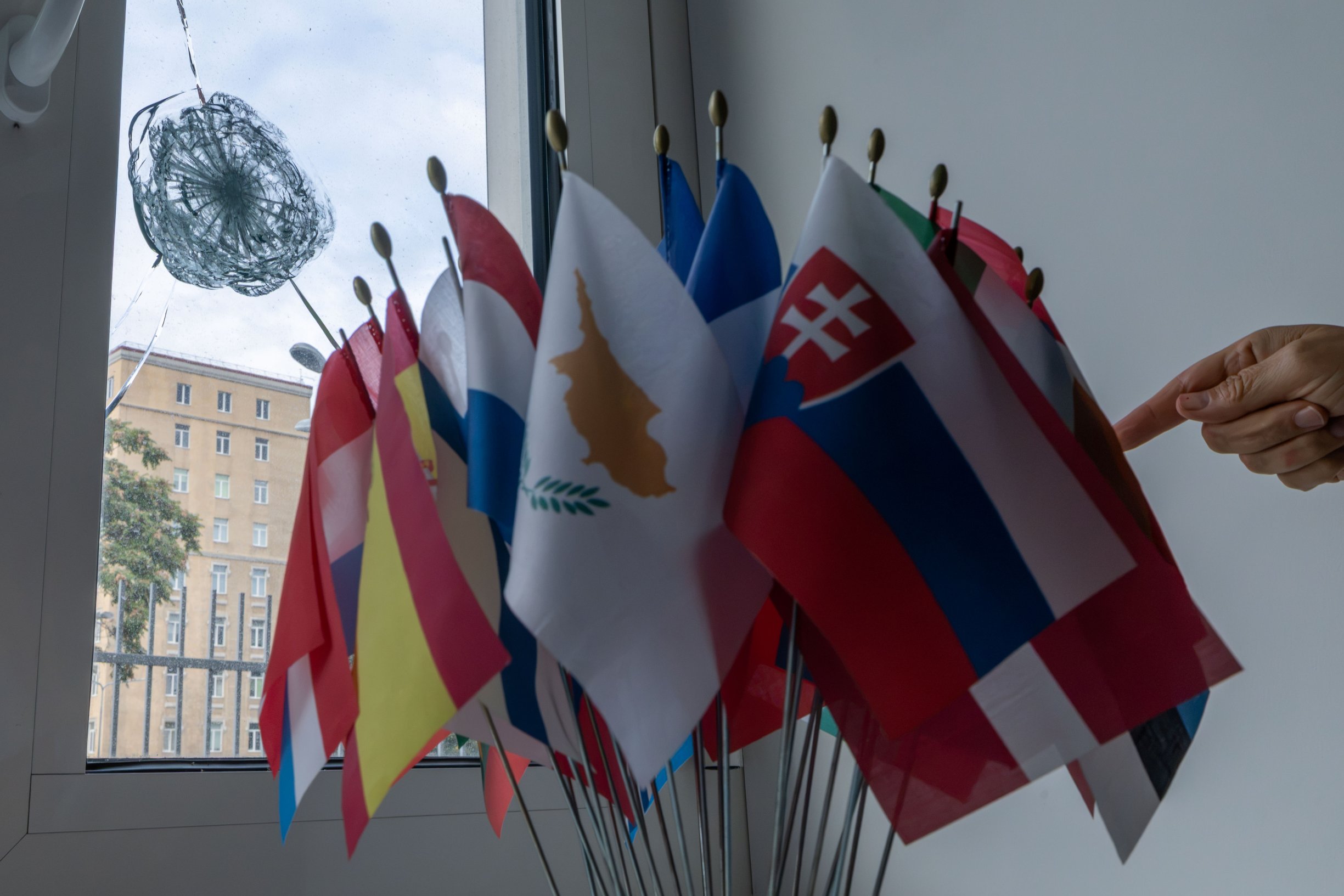
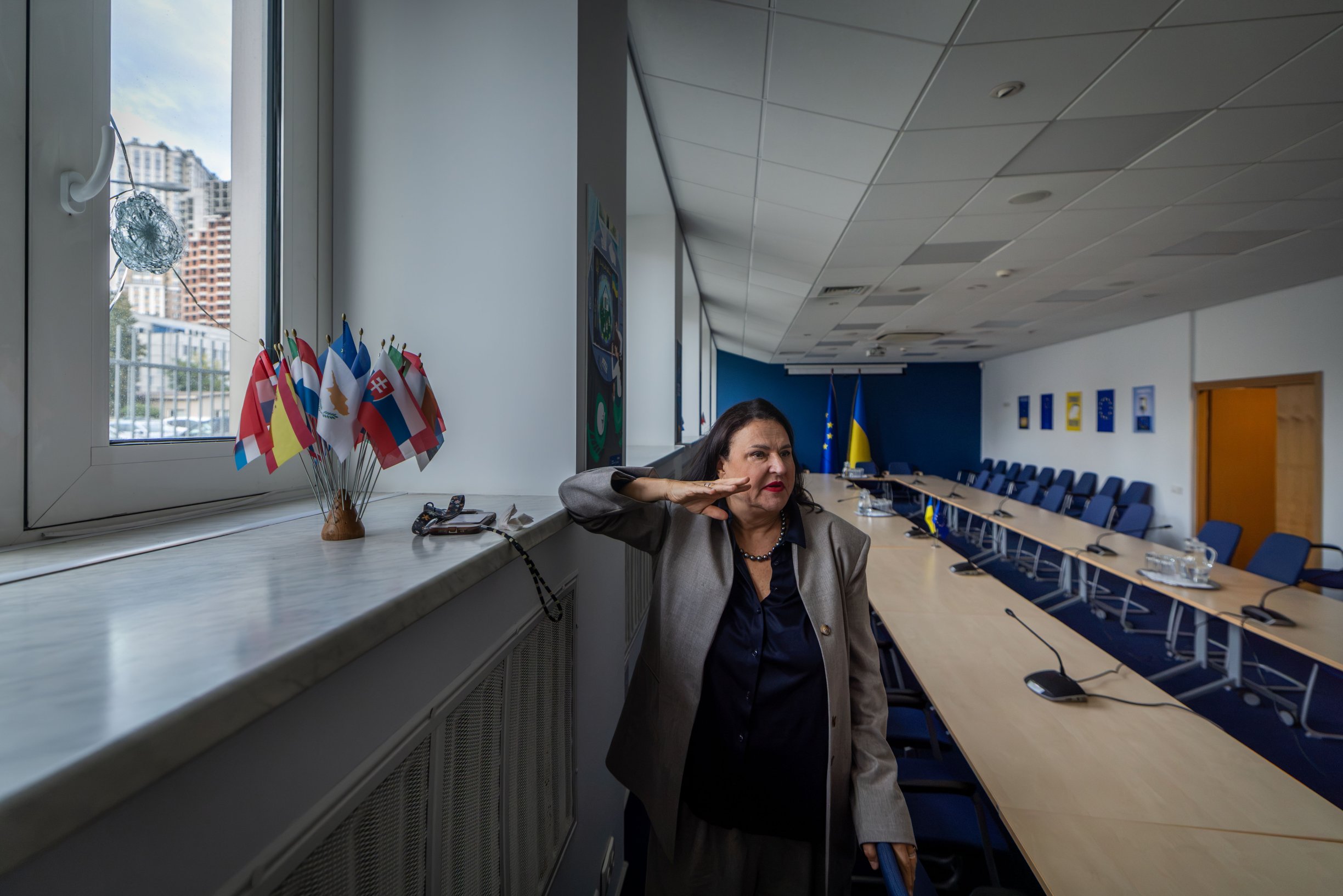
Air raids have left their mark on her office: windows have been blown out, and shrapnel once tore straight through a refrigerator. With attacks intensifying, the EU delegation now does much of its work in the corridor, away from the glass. The latest strikes hit the nearby headquarters of Ukraine’s Security Service (SBU).
In late September, Kyiv has heard so many air-raid sirens. There is already one dead and 20 injured, and on our way to your office, we heard several explosions. Is this the new normal?
Unfortunately, they have become routine. It began on 27 August this year, a date that will go down in the history of this war. That day, we had 13 air raid alerts during daylight hours, a record since the beginning of the full-scale war. It happens every day.
The day before yesterday, as I was entering the office when the windows suddenly began to rattle. A huge plume of smoke rose behind that black building outside the window. There were around four separate explosions over the course of 20 minutes, just a couple of hundred metres from here.
After a Russian attack, in a room with bulletproof windows. Source: Tomáš Benedikovič, Denník N.
The Russians have begun using jet drones which Ukrainians are not yet able to shoot down in the same numbers as earlier Shahed drones. With just a few jet drones, Russia can terrorise a city like Kyiv throughout the day at a relatively low cost. Then, at night, come the ballistic missiles. Last week, however, they also used ballistic missiles during the day.
Do the attacks make you anxious?
Of course they do. One morning last week, I was Nordic walking in the botanical garden. I was walking with my coach when suddenly there was a huge bang. It landed several kilometres away, but because there are no buildings there, it sounded as though it were just around the corner. These are the moments when I nearly have a heart attack…it’s very unpleasant.
How do you decide whether to go to a shelter or into the corridor? Do you have a security protocol?
I have security guards, and we also have a regional security officer here. They are here permanently, so they guide us. But since these very frequent and disruptive daytime attacks began, the government has adopted a regulation introducing two different types of alert — yellow and red. Red alerts are issued for missiles. Yellow alerts are for drone attacks – in such cases, the metro no longer stops, and people primarily seek safety between two walls. When there were explosions here last Wednesday, we were all sitting in the corridor.
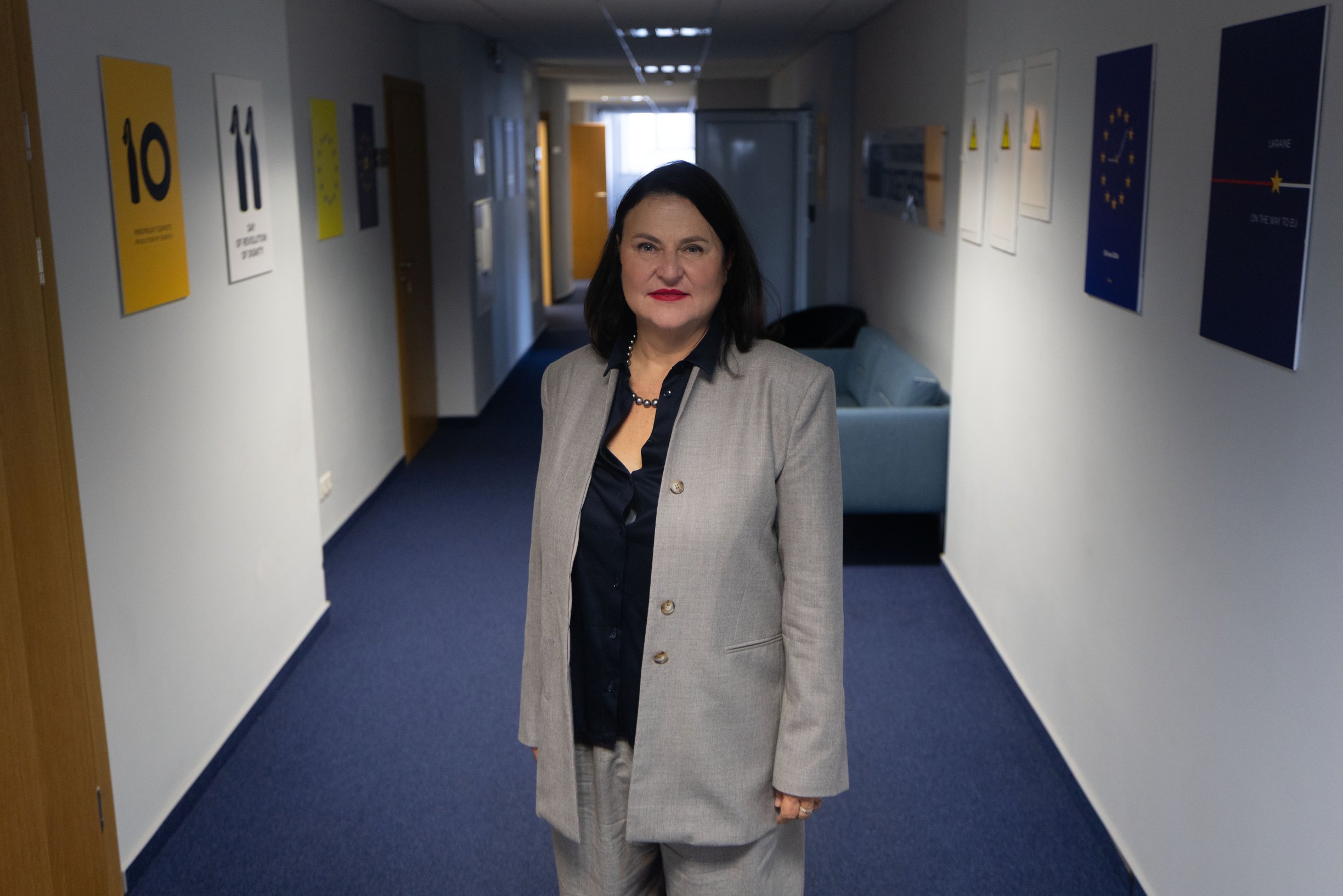
Katarína Mathernová. Source: Tomáš Benedikovič, Denník N.The corridor where diplomats work during heavy air raids. Source: Tomáš Benedikovič, Denník N.
On the ground floor, where we have our conference rooms, there are bulletproof windows. We are now going to adapt the ground floor so that we can operate safely there during anti-drone alerts. We will put sandbags outside. We already have beanbags there, and colleagues from the upper floors are moving down so that they can work.
How do you assess this intensification? Is it a response to the fact that the front has stalled and Putin’s “special operation” has boomeranged back on Russians at home?
Russia cannot win on the battlefield. They have managed to gain only a few square kilometres, so they are terrorising civilians by attacking targets such as churches, museums, libraries and book warehouses. On Thursday, they hit a maternity hospital. These are war crimes, but Russia commits them so routinely that they are boiling us like a frog.
There is talk that assaults will escalate further in winter. Will you stay?
Of course, we are staying here. When we speak to the diplomatic corps, everyone wants to stay. We are preparing for winter, stockpiling supplies, and here at the delegation we have bought blankets and folding beds. We have food rations and additional supplies of drinking and utility water. We have had several shower cubicles installed. We bought washing machines and dryers too, as the building has a large generator. Our colleagues from Brussels and Ukraine in the same building — many of whom live on the other side of the river or in conditions that are not as good as ours — will probably welcome these facilities.
Attacks have come dangerously close not only to where you work, but also to where you live, like a recent drone struck an SBU building.
It was targeting that location; I do not think Kyiv city centre itself was the target. But yes, it is quite close to the hotel where I live.
What do you anticipate will happen in winter? You may see attacks on energy infrastructure, water and sewage systems. A loss of these utilities would be extremely difficult.
If sewage systems were knocked out in a large part of the city, it would be very difficult. But let us not forget that Kyiv was also a frontline city last winter. There were perhaps more than one million people here freezing in their own homes. My driver told me that he and his family bought firebricks and heated them on the gas stove. When they went to bed, they held them to keep warm. Those without gas in their flats were even less fortunate. But people here helped one another. My coaches and their son stayed in my hotel for weeks because it was four degrees in their home.
Ukraine faces a shortage of Patriot missiles. It has developed a new interceptor that could stop jet drones, but Patriots defend against ballistic missiles. Can Europe do more to help?
This article continues, but the full version is available only to EUobserver.com subscribers. Visit account.euobserver.com/membership
Mária Bieliková began studying computer science before the World Wide Web was launched from CERN in 1989. She has lived through the development of programming from punch cards, which stored instructions for computers, to large language models, which allows almost anyone to write basic code.
Mária Bieliková founded the Kempelen Institute of Intelligent Technologies which she leads. She previously served as dean of the Faculty of Informatics and Information Technologies at the Slovak University of Technology in Bratislava.
Bieliková explained how artificial intelligence is set to affect women’s in the coming years.
“Studies predict women will be worse off in the labour market due to AI,” she said, while claiming such drawbacks also come with opportunities.
Do you think artificial intelligence can end humanity? And is that a tired question, or do you find it relevant?
This question needs to be answered patiently and sometimes with a smile, because nobody knows. Often it is just speculation, and there are many more immediate problems that we need to address.
It is true that AI is unlike other the technologies we have known so far and so were steam engines. But AI is fundamentally different. Still, I believe that if anything destroys us, it will be people. I am more afraid of those who use any technology carelessly, or those who do not take care to avoid hurting the planet. But I do not see a doomsday scenario where AI end the world. After all, our planet is very resilient.
AI research and development is largely in private hands. When you said you were afraid of people, did you mean specific individuals?
I did not mean specific people, but types of people who hold incredible power through technology and the data they hold about us. So for example, I fear for democracy. It is a system that evolved alongside society in a series of twists and turns since the days of ancient Greece, and we have come a long way since then. Democracy still has weaknesses, but so far we have not devised a better tool.
Yet the ability of AI to influence elections undermines a fundamental principle of democracy. Data administrators who nobody elected have suddenly become very powerful. And elected officials often follow and support tech titans. Technology is transforming geopolitics, and this could have serious consequence concerning us all; these are not mere political games played by those in power.
Experts warn thatdisinformation campaigns and deepfake videos generated by artificial intelligence, which can be easily made, will flood our online spaces. What can individuals do about this?
If I knew what an individual could do to resolve these problems, I would go and do it. But action should come from both the government and individual.
But we should not rely on someone at the top to change everything. Indeed, we determine the outcome of elections, but the major problem is we are being influenced and manipulated in entirely new ways. And many politicians lack the will to protect us from that. The only way to prevent being manipulated is for us as individuals to inform ourselves.
In the past, when someone said something publicly, we usually believed it. It is uncomfortable, but we will have to change how we trust. We cannot believe things automatically; we must demand trustworthy sources for every claim.
A good place to look is towards media outlets that we know verify information diligently – a layman cannot do so with all information they stumble upon.
Mária Bieliková said that in the age of artificial intelligence, we must change how we believe information. Source: Tomáš Hrivňák, Denník N
Other concerns linked to artificial intelligence include how much control we give it, whether our data is safe, and the environmental burden it creates. Are there other “landmines” ordinary people have not noticed?
We live in a society where we cannot trust everyone. Human nature is such that, say, 90 percent of people consciously or subconsciously act in their own interest. I do not mean to condone stealing or cheating, of course, but it is clear to me that people will act in their own interest.
This brings me again to democracy, a vital tool which needs to be protected. Without checks and balances, which AI can undermine, democracy is at risk.
The last thing I asked a chatbot was what I should pack on holiday. Do you ever talk to them about everyday matters, or do you avoid this so as to avoid sharing data about yourself?
This article continues, but the full version is available only to EUobserver.com subscribers. Visit account.euobserver.com/membership
Spain is coordinating with Morocco to prevent a new mass crossing into Ceuta this week, Spanish foreign minister José Manuel Albares said ealrier in September in response to renewed encouragement to storm the Ceuta border crossing on social media.
Warnings of a new wave of border crossings has caused alarm in Madrid, with fears that July’s large-scale border crossing surge could be repeated. When around 70,000 irregular migrants entered the small Spanish territory in North Africa by land and sea, overwhelming border guards and leading to over 100 deaths.
Recently declassified Spanish intelligence reports from before July described the response of Moroccan authorities to the border surge as passive and negligent. But Spanish prime minister Pedro Sánchez’s stopped short of formally accusing Rabat.
Morocco claims the surge was triggered by smuggling networks and disinformation. Sánchez’s government broadly supports this position, but questions about Morocco’s role are mounting.
The Ceuta crisis triggered a crisis in Europe for several days and showed the divide between member states about how to address migration.
German lawyer Lena Riemer, who works at the Central European University in Vienna and specialises in migration, said Vladimir Putin cannot help but laugh at the internal disagreements, while criticising European politicians’ approach to the issue.
How do you explain recent happenings in Ceuta? Some politicians have accused Spain of legalising tens of thousands of undocumented migrants. Italian foreign minister Antonio Tajani claimed Spain was automatically granting them EU citizenship. What is your view?
That last point is beyond ridiculous. And we need to be careful; the Ceuta situation was complex, so we need to view it through a broader context, including from a historical perspective. The Ceuta crisis did not happen overnight.
It seems that for the past decade, things had been leading towards this very moment. The situation at the Ceuta border had been genuinely critical for years, and crossings had occurred frequently — just never on this scale. For colleagues who had previously worked with people on the ground in Ceuta and brought their cases before the courts, it was more a question of when something like this would happen, for several reasons.
“The situation at the Ceuta border had been genuinely critical for years, and crossings had occurred frequently — just never on this scale.”.
Look at the current situation around the world. For instance, many people in Morocco face severe economic hardship, unemployment and so on. This leads to the younger generation seeking a better life. In this way, we are all in the same boat and I think many of us would make the same decision as them.
This crisis was compounded by other factors. The media played a role. Some say it was a network of people smugglers. I am not particularly convinced by that argument, since smugglers typically aim to make money. Here, it appears that people migrated alone, so it is not clear how a smuggling network could have made much money. Others claim the surge was linked to the legalisation of undocumented migrants in Spain, or that a court ruling in Spain had “opened people’s eyes”.
Some politicians have claimed that the legalisation of undocumented migrants automatically grants them EU citizenship.
No one in their right mind would claim that – it’s utter nonsense! There is research and a substantial body of academic work examining the impact of granting residency status.
Italy has run several immigration regularisation programmes in the past, something its politicians seem to forget when they argue against new ones. The US did the same under Ronald Reagan in the 1980s. There is no solid evidence that these programmes encourage more people to try to enter the country irregularly in the future. In fact, the opposite has often happened: irregular migration numbers have tended to fall, because giving people legal status and stability reduces the incentive to live and work in the shadows.
Moreover, under this specific Spanish programme, people can apply for regularisation only under very specific circumstances, applying only to a group of people who entered the country at a very specific point in time. It was a one-off measure. Based on the facts examined by researchers, it is unlikely to have had anything to do with this.
How do you respond to right-wing politicians who say Spain opened Europe’s borders?
They are like kindergarten children. What we are really seeing here are political actors such as EU migration commissioner Magnus Brunner exploiting the situation to point the finger at Spain, which has taken a somewhat different path from other European countries. Ceuta was a welcome opportunity to say, “you are wrong, this is your fault,” and thereby justify a hardline approach.
There were calls to exclude Spain from Schengen…is that even possible?
No. The EU’s Schengen Borders Code, means everyone who is part of Schengen is bound by it. And there is no exclusion clause. Sometimes I do not know whether it is ignorance or simply deliberate deceit, but excluding a country from Schengen is simply not possible. What you can do is introduce border controls. However, the code contains a provision stating that, under strict circumstances and in the event of an emergency, border controls may be introduced for a very limited period.
Border controls between Schengen countries should be temporary, but controls at the Slovakia-Austria andGermany-Austria borders have been in place for months or years. Is that even legal?
“Any reasonable lawyer looking at this would ask: where do you see the emergency?”
It is a breach of EU law. It is clear and everyone knows it, but the Germans deny it. Ceuta, too, was a welcome opportunity for Schengen members to say: “Another emergency, great! Let us use this to justify more border restrictions.” Any reasonable lawyer looking at this would ask: “Where do you see the emergency?” The overwhelming majority of people in Ceuta were sent back, with only a very small number who will make it to the mainland at all. Being in Ceuta does not mean you can access mainland Spain.
You can only reach mainland Spain by sea. It is not as though you can get there by land.
Indeed, just look at a map. Ceuta has a specific role and legal regime. Being in Ceuta does not mean that you have freedom of movement when travelling. If, for example, you apply for asylum in Ceuta, that does not automatically give you the right to enter Spain. And when you leave Ceuta to enter Spain, you are checked again, and if you do not have documents, you will not be allowed in. So saying, “they are all here in Europe now,” is a populist statement.
“The only group likely to end up in Spain — and hopefully they will — are unaccompanied minors, who require special protection under European and national law.”
These migrants are hundreds of kilometres away. They do not suddenly have the right to enter the mainland. The only group likely to end up in Spain — and hopefully they will — are unaccompanied minors, who require special protection under European and national law. Ceuta is not a place where Spain can guarantee that special protection, so it will probably have to transfer them to the mainland.
Lena Riemer outside the Central European University building in Vienna. She has also worked at universities in Berlin and studied at Yale Law School. Source: Soňa Weissová
EUobserver reported that thousands of children had been left living on the streets.
Spain is thereby violating international law, EU law and national law every single day, because it has an obligation to immediately assess all minors and provide them with accommodation, food, psychological support and healthcare. They should not be there for even one day.
Ceuta has been problematic for many years, with people climbing over the fences there virtually every day. And the EU has been unable to resolve the migration problem more widely, not only in Ceuta, but in other countries too. Why, in your view, is the system not working?
This article continues, but the full version is available only to EUobserver.com subscribers. Visit account.euobserver.com/membership
Exactly 35 years ago, on August 21, 1991, the coup attempt by the self-proclaimed State Committee on the State of Emergency collapsed. The Soviet Union itself had four more months to live, but after those three days in August, a completely different life began for millions of Soviet citizens. The changes touched everyone, but scientists were among those whose old lives fell apart especially fast — and on the ruins, new ones began to take shape. Institutes were left without money or staff, and entire fields of research lost their funding. Yet at the same time, the borders opened, and it became possible to work at universities and research centers abroad. Some left for a few months and never came back; others emigrated right away. How did these scientists discover the world of Western science? What did they have to go through? What did it cost them? And why did a temporary departure turn out to be permanent for so many of them? T-invariant presents the stories of how they left and the new lives they built.
How to avoid becoming a professor’s mistress, survive impostor syndrome despite your success, and bring Soros to Russia
As told by Tatiana Tatarinova, professor of computational biology at the University of La Verne. She is known for her work in plant genomics and genetics, as well as in medical and population genetics. She holds a black belt in karate and is also a scuba diver, poet, songwriter, and rescuer of stray dogs.
I graduated from MEPhI [Moscow Engineering Physics Institute — T-invariant] in the early ’90s. My mother worked in the defense industry, on radar systems for detecting missiles in flight. Her job was considered prestigious: a huge research institute and plant, NIIDAR, on Preobrazhenskaya Square. But in those years, almost the entire plant was leased out as warehouses and retail space. Out of the whole NIIDAR building, the scientists were left with exactly one floor, just so the institute wouldn’t formally lose its research status; everything else went to offices and banks. It was utter devastation: a hideous, filthy restroom with no water or toilet paper, a hellish stench, and three ladies on the verge of retirement who simply had nowhere else to go. That was the state of virtually all of Russian science back then. Some people, of course, managed to land European grants, but corruption was rampant. Through my work, I once came across a nuclear energy project. I was offered a side gig, and I took it. But they told me point-blank: “We’re putting you down for a salary of $1,000 a month, but you hand two hundred of it back to us in cash.” A kickback! The corruption was absolutely shameless. Naturally, I told them where to go, using every colorful word the Russian language has to offer. There’s no way I could have lived and worked in a system like that.
Back then, though, Western universities were happy to take Russian students: if you were from Russia, you weren’t even asked to take exams or prove your English. Nothing at all was required. You could show a clumsy translation of your diploma certified by the dean’s office, and that was enough to get a full scholarship. It was believed — and perhaps rightly so — that our education, at least at MEPhI and other strong universities, was very good. On top of that, we studied for six years, so when applying to grad school we were competing with people who had only a four-year bachelor’s degree behind them. Naturally, we knew a lot more. We were readily hired to lead recitation sections and lab classes and to grade homework: in terms of preparation, we were two years ahead of the local students. It wasn’t even that our education was “better” — it was just different. We didn’t have the Bologna system yet, and our programs didn’t include general education courses (as in the US) either.
So in our fifth year at MEPhI, a real craze took hold: practically our entire class was writing to American universities, getting several offers each, and picking the best ones. At the same time, I applied for a Soros Foundation fellowship and got it. The fellowship covered a plane ticket to the US and a year of health insurance. But then something pretty wild happened to me. By that time, people were buying passports for foreign travel left and right through shady outfits. I was afraid to do that, since I was a very law-abiding girl. So I went the official route, through MEPhI’s First Department [the security office found at every Soviet institution that handled classified work — T-invariant]. Back then, you needed permission to get an exit visa and a passport. And suddenly MEPhI tells me they won’t let me leave!
I went to the head of the First Department to sort it out. And he says to me: “How can we let you go? What if you start working as a prostitute over there?” I was offended to the core! My mother was an ordinary engineer, my parents had divorced when I was three, and my father had nothing to do with me. For all four years at the institute, I wore the same single pair of jeans and a sweater made of dog hair. And honestly, I reeked of dog, because my mom knitted those sweaters from the fur of our Newfoundland, and that dog was incredibly smelly. So there I am, standing in front of him in that sweater, and he’s holding forth on my “potential” as a prostitute!
Then I thought: What if I went somewhere other than America? I wrote to various places and got an invitation from South Africa. It seemed like a good option: the professor there was originally from Russia, and he wrote directly to our dean’s office asking them to send me to work with him. That did the trick. The First Department couldn’t do anything against a direct official request from a foreign university — they could hardly tell the university I was going to become a prostitute. But when I arrived in South Africa in 1992, it turned out that the professor and I had completely misunderstood each other. After a while, he told me flat out that what he needed wasn’t a Russian grad student but a Russian woman. Absolutely insane! In the end, I switched to another professor, but my entire stipend, which had been paid out of the lecherous professor’s funds, went up in smoke. I had to scrape by on a tiny salary for teaching lab sections, and in the evenings I moonlighted as a singer in a restaurant. I sang there for six months.
Meanwhile, I got in touch with the Soros Foundation, which had earlier given me the fellowship for the ticket to America. I asked whether my fellowship would be reinstated if I moved to the States. They assured me it would. I wrote to the American university in Salt Lake City that I had turned down before and honestly admitted: “I hope your department will take my word for it: I’ve suffered at the hands of an evil regime here and have decided to come to you.” They didn’t really believe me, of course, but they took me anyway.
That’s how I ended up in grad school at the University of Utah. We had a terrific group, including several people from Leningrad Polytechnic. And then I hit a crisis. It probably happens to almost every grad student: I was overwhelmed by impostor syndrome. I felt dumber than everyone around me. It didn’t even help that in my very first year, I managed to publish a paper in one of the most prestigious physics journals. I still considered myself talentless. I was comparing myself with people who had been in grad school for several years and, before that, had worked on the same topic in Russia. Naturally, they knew more than I did. Unfortunately, there was no one around back then to support me and explain this, and I fled back to Russia. I defended my master’s thesis in the US and left.
After returning to Moscow in 1995, I got a job on projects run by the CDC (the US Centers for Disease Control and Prevention) and the World Health Organization (WHO). I worked as their regional representative. I didn’t find that position right away: first, I spent several months as a secretary for a Turkish businessman. Then he sent me along with his pregnant mistress to see a gynecologist. I was supposed to make sure she got an abortion. I was mad as hell, but the girl simply needed someone to support her. While waiting for the appointment, I got talking with a young woman from an employment agency and told her I didn’t want to work for that a**hole anymore. She gave me her work number and asked me to call in a week. And a new job came through! I was one of the people who helped Alex Goldfarb during George Soros’s visit to Moscow and organized training programs for Russian scientists. We also brought over American research teams to teach our compatriots Western standards in biostatistics and modern disease reporting. There was a joint CDC–WHO project to study tuberculosis. The topic mattered a great deal to America as well. In the US, tuberculosis was found in high concentrations only in poor neighborhoods of New York. So the Americans looked for “Third World” countries where tuberculosis was rampant and studied it there. In Russia, especially in prisons and among the homeless, the epidemiological situation at the time was critical. That was the beginning of the notorious “biolabs” [a nod to the Russian propaganda narrative about secret US biological laboratories — T-invariant].
I organized those projects, but after a while I found myself desperately missing pure science. During one of my business trips to the US, I simply walked into the University of Southern California (USC). The Human Genome Project was underway, and USC scientists were among the pioneers of bioinformatics. I went to their math department and said straight out: “I really want to study with you — please take me.” To my utter astonishment, by the time I got back to Moscow, a letter was already waiting for me with an offer to join their PhD program on a full scholarship. Can you imagine? I just walked in off the street, had a conversation, and they took me. It was pure luck!
That’s where I earned my PhD in applied mathematics, and then I went to work, first at a biotech startup (Ceres, Inc.). When its funding ran out, I returned to academia. I worked at Loyola Marymount University first, then moved to the UK, to the University of South Wales (formerly the University of Glamorgan). After that, in 2012, I came back to the US, spent four years at USC, and then was invited to take an endowed chair at the University of La Verne. There’s practically no equivalent of this position in Russia. It’s when a major foundation earmarks money for a specific professor, and that money pays their salary and funds their research. I was offered the chance to head the Computational Biology Laboratory, which I’ve now been running for nine years. So that’s my path.
I never had much desire to return to Russia. I went back for conferences, and in the early 2000s I had the persistent feeling that Russian science was catastrophically behind. For example, I was once asked to give a lecture on “the latest in science” about a technology that at our American startup we considered routine — outdated, even. Funding was so meager that basic microarray gene expression analysis, which any second-rate university in the States could do, was something few in Russia could afford.
I saw how my colleagues who had stayed in Russia struggled: dreadful working conditions, professors without even their own lab benches, several people crammed into a single office. And how is an experimentalist supposed to work without money for reagents and equipment? Mathematicians can still write formulas at their dachas with nothing but pen and paper. But experimentalists constantly have to humble themselves, beg for pennies, and plead for permission to buy every single consumable.
Things started to improve during the “changing of the guard” between Putin and Medvedev. That’s when Skoltech [the Skolkovo Institute of Science and Technology, a research university near Moscow founded in 2011 in partnership with MIT — T-invariant] appeared. I was working at USC at the time, and Skoltech representatives came to us trying to persuade faculty to go work in Russia. I went. We organized an international conference on the human genome at Skolkovo, launched joint projects, and I genuinely loved it! I started getting invited on expeditions to study the small indigenous peoples of Siberia, and I began working closely with Russian universities and giving lectures. I became an associate professor at Siberian Federal University (SFU), supervised grad students at the Institute of General Genetics of the Russian Academy of Sciences and at SFU, and lectured and advised thesis students at MIPT [Moscow Institute of Physics and Technology — T-invariant]. It was all wonderful, because back then good money was being allocated under Project 5-100. Universities needed ideas, world-class advisors, and publications — and we delivered all of that. And this whole wonderful story ended in a single day, when the war began. I was fired from everywhere almost instantly, and quietly at that — no one even bothered to tell me. I never received any official paperwork. They just deleted a line on a website, and that was that.
It was actually pretty funny: I was lecturing at MIPT, and after the war started, I made a point of appearing on Zoom with a Ukrainian flag behind me. Word got around to SFU. For some reason, they decided I had been lecturing their students in front of that flag, even though I wasn’t teaching any classes at SFU that semester. Nevertheless, they cooked up a collective complaint on behalf of “offended students” who had supposedly been insulted by the Ukrainian flag in my background. A total circus. I found out I’d been fired by accident: they had been paying me some token base salary, and six months later I simply noticed that the transfers to my Russian bank account had stopped.
A couple of years ago, I went to Moldova and Romania to lecture, and there were lots of students from Ukraine there. They asked me point-blank: “Why did you keep going to Russia and lecturing after 2014?” I told them: “Guys, what kind of neighbor do you want next door? A wild, ignorant one who ‘charges’ water in front of the TV [a reference to late-Soviet televised faith healers who claimed they could imbue water with healing power through the screen — T-invariant], or an educated one who understands how the world works, doesn’t want any war, and shares basic humanist values?” They thought it over and agreed: “Yes, of course, we need educated and kind neighbors.”
That’s why I kept going. It was real, live human contact. Right now there’s an enormous amount of mutual misunderstanding, but I believe that we — the professors who came to Russia with ideas and lectures — simply didn’t finish the job. We should have stepped in sooner, spoken up louder, and pulled Russian education out of the hole it had fallen into. I don’t know whether we could have changed anything on a large scale. But if instead of a handful of enthusiasts there had been a whole army of scientists who cared, maybe no tanks would have rolled into Ukraine.
How to shed the sack in the sack race, bomb your first interview, and still land your dream job
As told by Eugene Koonin, senior investigator at the National Center for Biotechnology Information, part of the National Library of Medicine at the US National Institutes of Health. A renowned expert in evolutionary and computational biology, he has the highest h-index of any scientist of Russian origin: 256.
In the late 1980s, being a passive and not particularly brave person, I didn’t even think about leaving. It was too much hassle: the complicated exit paperwork, trips to district Communist Party committees, and so on. But once those barriers disappeared, conferences started happening right away, contacts emerged, and with them came the idea of going to work for a while somewhere real science was being done. My first serious trip abroad was to the International Congress of Virology in West Berlin in August 1990. It was an interesting time: the Wall was coming down, and you could walk up and chip off a piece as a souvenir. But far more important, I got to meet serious researchers from the US. Because my work involved computer analysis, we managed to do some joint research literally on the spot, without even leaving the poster stand at the congress.
As a result, I was invited to come work with them for four months. I spent the spring of 1991 in Texas, in the middle of nowhere, at a university right in the center of the state. Despite considerable everyday hardships and a lack of money, I liked it. There was meaningful, fairly serious work, cleanliness, order — and lots of good, varied food, which turned out to be affordable even given how poor I was at the time. All of this made a very strong impression on me. The mood around me was optimistic: the Gulf War had just ended in victory.
The access to information was striking, too. This was before the internet. In the Soviet Union, nothing came easy. It was a kind of “sack race”: you could accomplish a lot, but always late and only after overcoming obstacles. American science struck me as the same race, only without the “sack.” Everything happened on time and without needless obstacles. Submitting a paper to a journal was very easy, even though everything was still done the old way, on paper. It was no problem at all to read something published the day before, and your own manuscript could reach the editors the very next day.
Of course, contact with colleagues mattered too. Although on that first trip, my professional networking wasn’t going all that well yet. And not because I couldn’t speak English. As I said, this was the pre-internet era, and building connections beyond your own university wasn’t easy. Still, I got very lucky. During that trip, I came across an announcement in a scientific journal about the launch of a new center for computational biology. It was the National Center for Biotechnology Information (NCBI) at the NIH (the US National Institutes of Health). A little later, I read a full-fledged research paper — one of the first published by its staff. The paper was really good; I liked it a lot. And I thought the place seemed tailor-made for me. That impression proved decisive. I overcame my natural shyness and wrote to that very center. I asked some scientific questions, offered my services, and attached my CV. They were immediately interested and invited me for an interview. It went extremely badly for me, because I didn’t know how to give a talk. Had it gone well, they would have offered me a permanent position right away; instead, I got a two-year temporary contract. Still, that was enough to get started.
You can’t go back to the country I left — it simply doesn’t exist anymore. I don’t even consider crossing the Russian border (like other members of the Anti-War Committee, Eugene Koonin faces a criminal case opened against him in Russia. — T-invariant). And, forgive me, but why would I leave a place where I have rewarding, well-supported work and a normal life? For a while, the new Russian regime was relatively “vegetarian” [a Russian expression for a comparatively mild regime — T-invariant] and made some attempts to develop science. The situation during the “Medvedev thaw” wasn’t all bad or hopeless. The megagrants [a government program launched in 2010 to bring leading scientists to Russian universities — T-invariant], for all the system’s flaws, were a decent idea. But I never felt any desire to take part. After Medvedev, though, after that abomination that came to be known as the “castling” [the 2011 Putin–Medvedev job swap, named after the chess move — T-invariant], everything went to hell. Science and everything else.
How to split $1,000 among 30 employees, win a lawsuit against a corporation, and launch a scientific career in the US
As told by Alexander Kabanov, distinguished professor and director of the Center for Nanotechnology in Drug Delivery at the UNC Eshelman School of Pharmacy, University of North Carolina at Chapel Hill, and co-director of the Carolina Institute for Nanomedicine. He specializes in the delivery of drugs and other biologically active compounds using polymeric nanomaterials.
I graduated from the Faculty of Chemistry at Moscow State University (MSU) in 1984. By then, the war in Afghanistan was in full swing, and the Soviet Union was gradually heading toward collapse. But apart from Andrei Amalrik, who fifteen years earlier had written his prophetic (and therefore banned in the USSR) essay Will the Soviet Union Survive Until 1984?, few people realized it. I finished my Candidate of Sciences dissertation [the Soviet equivalent of a PhD — T-invariant] extremely fast: I had everything done in a year and a half, and a little over two years in I had already defended. My advisor, Karel Martinek, an outstanding physical chemist and Lenin Prize laureate who by then had already moved to Czechoslovakia, kept pushing me to hurry. After the defense, I wanted to stay at MSU. According to Karel, they were bound to keep me: I had been a Lenin Scholarship recipient both as an undergraduate and in grad school. So I was counting on a junior research fellow position in the Department of Chemical Enzymology, where I had studied.
Unfortunately, just a week before my defense, Ilya Berezin, a corresponding member of the Academy of Sciences who headed the department and was my main boss, died suddenly. I defended my dissertation successfully, but all of a sudden there was no chance of staying in the department as planned — there was no one left to go to bat for me. At the time, Moscow’s Communist Party boss was Boris Yeltsin, who had just launched an aggressive campaign against cronyism and nepotism. And my father, Viktor Kabanov, was a very well-known scientist who headed another department in the same Faculty of Chemistry. But he and I had firmly agreed that he wouldn’t intervene or put in a word for his son. So, thanks to Yeltsin — and I really should thank him for this — I started looking around, and that shaped the rest of my scientific life.
My father advised me to go see Evgeny Severin. He ran a large institute built partly on the ruins of Lev Piruzyan’s scientific empire. The institute reported to the USSR Ministry of Health and was overseen by the ministry’s Third Main Directorate [its classified division serving the defense and nuclear industries — T-invariant]. They did top-secret work there. It was a restricted-access facility, with KGB men carrying submachine guns at the entrance. But Severin was eager for scientific novelty and international recognition, and he tried to hire young, open-minded people. Interestingly, the KGB didn’t even bother vetting me. They said: “No point checking him out — we know everything about that family.” My father, on the other hand, really had been vetted at the very highest level because of his position and his security clearance. He didn’t work at that institute, but he and Academician Rem Petrov sat on the relevant national scientific council.
So I went to Severin, and he hired me on the spot as a lab head. It turned out that a talented young scientist from the Serbsky Institute [Moscow’s leading center for forensic psychiatry — T-invariant], Vladimir Chekhonin, later a full member of the Russian Academy of Sciences, had been using a technique from my undergraduate thesis in his own research. His work was built on a chemical modification of proteins (specifically, antibody fragments) that I had proposed, which allowed them to penetrate directly into the brain. At the time, this looked like a phenomenal breakthrough: delivering drugs across the blood–brain barrier. I didn’t even know about it, but Severin’s institute had already heard. That’s how I became the first — and nearly the only — employee at that institute without a security clearance. It was there that I met the man who would be my closest friend for many years (sadly, he has since passed away): Valera Alakhov.
Valera showed up to our first meeting pretty drunk and several hours late, while I waited patiently for him. I didn’t know then that he’d gotten married the day before — for the second time — which was why he was late. So there we sit: him rumpled and not entirely sober, me all dressed up in my only wool suit and a tie. At first we couldn’t stand each other, but eventually we started working together and became best friends. Valera played an important role in the story of how I left, and in my life in general. And I in his.
Soon, Yuri Kuzyakov, dean of the MSU Faculty of Chemistry, was told that I was leaving for Severin’s institute. Let me stress again that my father and I hadn’t asked for anything. But the faculty had known me since my student days — I was top of my class. With such a legendary father, I simply had no choice. In fact, in all my years of study I got only one B, in military training, because I forgot the words of the military oath. It meant absolutely nothing to me, so I started going around in circles repeating some phrases, and they slapped me with a B. The faculty leadership declared: “We can’t let him go. He was a Lenin Scholarship recipient as a student and in grad school — he’s our number one.” And they immediately created a junior research fellow position for me in the Department of Chemical Enzymology. After Martinek left, the lab was headed by Andrey Levashov (who at the time was still just a Candidate of Sciences). So I became, at the same time, a junior research fellow at the MSU Faculty of Chemistry, where I still had my own grad students, and a half-time lab head at the Institute of Applied Molecular Biology of the USSR Ministry of Health. There, I was immediately put in charge of several people.
The atmosphere at the Health Ministry institute was amazing. I was the youngest lab head; the next youngest, Kolya Porodenko, was only two years older. A whole constellation of talented young people had gathered there, mostly from MSU. They were tackling extremely hard problems, and I was basically told: “Well, go ahead, work on delivery.” So I started working on what would later be called nanomedicine and targeted drug delivery. For about two years, it was all very generously funded. We had all the cutting-edge equipment we could dream of. I had never worked closely with biologists and physicians before, and now they let me loose like a fox in the henhouse (in a good way): whenever an idea came up, we put it into practice right away.
Back then, we came up with things that shaped the field for decades. Nowadays, whenever I’m nominated for something, people always mention that it was in those years that I came up with the idea of using polymeric micelles to deliver drugs to the brain. We did that work together with that same scientist from the Serbsky Institute, Volodya Chekhonin, thanks to whom I ended up at Severin’s. I’m enormously grateful to him. Around the same time, by the way, my father and I came up with polyplexes — complexes of DNA with polycations. Shortly before us, several groups around the world had used a natural polycation, polylysine, linked to protein ligands, to deliver DNA into cells via cell receptors. Without yet knowing about that work, we showed that synthetic polycations can form nanocomplexes with DNA that deliver it into cells and allow it to be expressed there without any receptors at all. Today this is one of the most widely used approaches for delivering nucleic acids into cells, alongside the lipid nanoparticles that underlie modern RNA vaccines. Back then, in the late 1980s, we had a real explosion of discoveries. But because we lacked experience in modern biology and didn’t know how to publish internationally, we ended up in lower-tier journals than these results deserved. If we had been promoting this work in the US, with access to the top journals, it would have been a worldwide triumph. But it was still very cool.
I became head of a department and in 1990 defended my Doctor of Sciences dissertation [Russia’s higher postdoctoral degree — T-invariant], just three years after my Candidate of Sciences. That same year, I went to America for the first time and began traveling abroad in general: the Pasteur Institute in Paris, an AIDS conference in Switzerland, lectures and seminars in Germany… That’s when I realized that people in the West are a lot like us. As a product of the Soviet system, I used to think I could never survive in the capitalist world with its brutal laws of competition. But now I realized: I think I can.
It looked like a bright future lay ahead. I was a laureate of the Lenin Komsomol Prize [a prestigious Soviet award for young scientists — T-invariant], the youngest Doctor of Chemical Sciences in the USSR, and a welcome guest in many academic offices. But the system was coming apart at the seams. Until the very end, I believed I had a duty to stay in my homeland. By the time I defended my doctorate, absolutely everything had vanished from store shelves. In December 1991, the Soviet Union ceased to exist. And shortly before that, Valera Alakhov had gone to Canada on a research fellowship. I don’t know how on earth they let him out, with the pile of security clearances he had — but the security apparatus was already breaking down.
And in these hard times, I’m running the department Severin used to head. I have three labs under me, about thirty people in total. One day Severin and I are sitting there drinking tea, and he says, matter-of-factly: “Sasha, keep in mind: starting January 1, we won’t have any money at all.” At first I didn’t take it seriously, but sure enough, one day the thirty people working with me were left without a penny.
Shortly before that, in the fall of 1991, Valera wrote to me from Canada that a Canadian businessman of Russian origin named Oleg Romar was coming to Russia. He wanted to adopt two children from an orphanage — a brother and his little sister — and was looking for access to official channels and medical support through our institute. Those were murky times, and Oleg badly needed people he could trust. We met and instantly became friends (we’re still partners today). The first place he brought the adopted children was my apartment. The kids were miserable and frightened; they came from a family of alcoholics. They had been treated horribly since birth. It shook me to the core. Oleg and his wife, Isabella, made a deep impression on me too. They went on to raise the children safe and sound in Canada.
[[socialnetworks]]
Of course, Oleg and I also talked about science and my work. Eventually, those conversations gave rise to the Moscow Institute of Biotechnology. Oleg sent money from Canada, and I distributed it among our staff as grants. In 1992, I was splitting roughly $1,000 a month among thirty people. That came to about $30 per person on average, but I weighted each share by the person’s contribution. In those hungry times, it was an incredible, lifesaving supplement to people’s salaries. The idea of attracting Western investment for our discoveries had come up even earlier. In December 1991, on my way home from New York, at Oleg’s insistence, I met with a leading biotech expert, Pradeep Banerjee, who was then working in Manhattan at Coopers & Lybrand Consulting. After talking with me for an hour, Pradeep gave Oleg a glowing assessment of our work. About me, he said: “This guy will find a job anywhere.” Oleg, Valera, and I decided to start a company in Canada. I was supposed to go to Canada for a year to help Valera set up a base lab, while the main research, as we planned at the time, would continue in Moscow.
In the spring of 1993, just before I was due to leave, a severe political crisis erupted in Moscow. Khasbulatov [Ruslan Khasbulatov, then speaker of the Russian parliament — T-invariant] and Yeltsin were going at each other on television, and civil war was in the air. My wife, Tanya, was pregnant. Oleg called me: “Sasha, take Tanya and fly out right now. If she gives birth in Moscow, you won’t be going anywhere.” I walked around that eerie, seething Moscow, went to see my father, and said: “Dad, you know… I think I may never come back here.” My father was very upset, even hurt: “How can that be? We supported you and Valera in everything here, and now you’re not coming back?” Back then I had a silly, grandiose notion stuck in my head. After all, by birth and talent I had been given a great deal. And I believed that if I were going to leave, I had to be the last to go, after everyone else had been saved. But in the end, our daughter Dasha was born in Canada a month after we arrived.
On October 4, 1993, tanks of the Taman Division fired on the House of Soviets, the seat of Russia’s parliament. Photo: ITAR-TASS
We lived very modestly, on the edge of poverty. It turned out that the lab we were setting up had no real money. On top of that, a conflict broke out between Oleg and the board of directors of the Canadian medical association he chaired, which had originally invited us for the project. The conflict wasn’t about us: at its core was the sale of another company the association had created. Enormous sums were at stake, by the standards of that time and even today’s. They tried to use us. In the course of the conflict, representatives of the board came to Valera and me and asked us to testify against Oleg so they could accuse him of a conflict of interest — claiming he had illegally used his position as chairman of the association’s board. In exchange, they offered to hand over, at last, the million dollars that had long been promised for the lab’s work in Canada. We told them where to go. Politely but firmly. And after that, a real war against us began: they declared that everything we had invented belonged to them, tried to strip us of the rights to our own technologies, and tried to block us and Oleg from developing those technologies in North America. It was tough — our own lawyer was apparently working for them. We had no money. But we managed to find another lawyer who agreed to take our case on contingency. His name was Pierre Fournier. He was a tough guy, and when we told him our story, he said our rights had been violated. Within just a few months, he actually won an arbitration on one key issue. But the fight went on.
As things turned out, I was the one who took responsibility for our decisions in this fight. Of course, I consulted Valera on everything. It was a life-or-death battle. There I was with a baby, no salary, living on $100–200 a week in borrowed money. In October 1993, leaving my wife and six-month-old daughter in Montreal, I flew to Moscow on business, right in the middle of that October’s political crisis. I even wrote a poem about that time: “A strange specter is haunting the town, / While all Russia lies cowering, trembling; / Over crowds, a pretender self-crowned / Urges all to advance on the Kremlin.” [a reference to Alexander Rutskoi, whom the parliament had declared acting president — T-invariant]. I thought I wouldn’t be able to get back to Canada. I made it back.
A few months later, my father flies in to see me in Montreal. We’re sitting in the kitchen, we open a bottle of vodka, and I say: “Dad, I’ve made a decision. I’m not going back to Russia. I’m going to look for a professorship in the US.” I was bracing myself for his reaction. And my father exhales: “Sasha, what a relief… I didn’t know how to tell you that you must not, under any circumstances, come back to Russia.” In fact, my father understood where things were heading much earlier than I did, and he accurately predicted what Russia would become today, even though he’s been gone for twenty years now.
But back to the early ’90s. Soon we settled all the litigation, secured good funding, and founded our first pharmaceutical company, Supratek Pharma. It was the world’s first company to begin clinical use of polymeric micelles for delivering anticancer drugs. Valera became its vice president of research, and I became a consultant. Even earlier, I had landed a professorship at the University of Nebraska Medical Center in Omaha and begun my academic career in the US.
The early ’90s were the hardest period of our lives. The stress of the Canadian lawsuit gave me a stomach ulcer, which a few years later nearly killed me: I started bleeding heavily right on a plane over the Atlantic. For ten days I hovered between life and death in a New York hospital. But having gone through that hell — no money, in a foreign country, locked in a legal battle with the association — I realized that I now stood entirely on my own. After all, my father couldn’t help me in any way: not in a Canadian court, not in getting hired by an American university, not in my later career. That sense of independence meant a great deal to me.
After that, things took their natural course. I built a successful career in the US, created the country’s first nanomedicine research center, and organized the first international conference in the field, which has now been running for a quarter century. I’ve trained nearly a hundred grad students and postdocs, and more than twenty of them have become professors. I hope the best is yet to come.
How to make a KGB colonel stand at attention, change American law, and become the first US professor who was still a citizen of the “Evil Empire”
As told by Sergei Mirkin, biologist and endowed professor at Tufts University. He is known for his research on the structure and function of DNA, in particular on how genomic instability caused by repetitive DNA sequences and by collisions between transcription and replication contributes to human genetic diseases. He has received a number of prestigious scientific prizes and awards.
Truth be told, I should never have been allowed out of the Soviet Union. I was completely barred from traveling abroad. That lasted until 1988, when perestroika really picked up speed. And as luck would have it, just before that, Viktor Lyamichev, Maxim Frank-Kamenetskii, and I had discovered a new DNA structure called H-DNA — a form of DNA in which three oligonucleotide strands wind around one another to form a triple helix. We published two high-profile papers in Nature, in 1987 and 1988, and I was first author on one of them. At the time, I didn’t even fully grasp what it meant to be first author on a Nature paper. And at around the same time, thanks to the efforts of our Czech colleague Emil Paleček, I was allowed to go abroad for the first time — to Czechoslovakia.
I worked there at the Institute of Biophysics in Brno. An international conference was taking place at the same time, with lots of American scientists in attendance. It was the first time I’d ever seen Americans in the flesh. As I now realize, many of them were assistant or associate professors — roughly the equivalent of a docent in our system. In other words, they were still a long way from being luminaries of American science. And they all started telling me, “What are you fooling around for? Start looking for a job in America or Europe right now.” I was very surprised, because the Soviet system worked completely differently: a person was born, lived, and died in the same city, joined a lab, and worked there at least until their advisor died. And then, with any luck, they became lab head themselves.
One of these young scientists, Terumi Kohwi-Shigematsu, said, “Why don’t you come work in my lab for a little while and see how everything works?” She arranged an invitation for me through the National Institutes of Health (NIH). At the time, she was working at the La Jolla Cancer Research Foundation, in the northern San Diego suburb of La Jolla. She set up the invitation through the Fogarty International Center, which operated under the NIH umbrella. And in late 1988 or early 1989, the invitation arrived. Keep in mind, the Soviet Union still existed, with its entire bureaucracy intact. The NIH’s partner in the Soviet Union was the Ministry of Health. But I worked within the Academy of Sciences system, at the Institute of Molecular Genetics of the USSR Academy of Sciences. The two were completely separate worlds that had nothing to do with each other. The Ministry of Health minded its own business, and the Academy of Sciences minded its own. Still, I sent my paperwork to the Ministry of Health, asking for permission to travel. Naturally, it got stuck there for good. They must have been baffled: who is this guy, and why is he coming to us if he isn’t even one of ours?
Up-to-date videos on science during wartime, interviews, podcasts, and streams with prominent scientists — subscribe to the T-invariant YouTube channel!
The paperwork went off — and then silence. A month went by, then two, three, four — nothing. I figured that was that: I wasn’t going anywhere. And then, purely by chance, I ran into a colleague, Victor Koteliansky, at a party with friends. At the time, he was working at the All-Union Cardiology Research Center of the USSR Academy of Medical Sciences, headed by Academician Yevgeniy Chazov. The center included an institute devoted to basic, largely theoretical research, and that’s where Victor worked. In the course of our conversation, it came out that the director of his institute, Vladimir Smirnov, was collaborating with the director of my institute, Yevgeny Sverdlov. Victor suggested I talk to Sverdlov about my problem with the Ministry of Health. Sverdlov, in turn, advised me to come to the short joint lab meeting he held with Smirnov and bring it up with him there, as if by chance.
So that’s what I did. The whole thing was set up in a very interesting way: first came the talks, then a little tea — although, strictly speaking, what they were drinking wasn’t exactly tea. When it was over, our director, Sverdlov, said to Smirnov, “Vladimir Nikolaevich, here’s the thing — could you help Sergei out?” And Academician Smirnov, as it turned out, remembered me from the seminar run by the famous Soviet mathematician Israel Gelfand. On top of that, Sverdlov was now vouching for me.
It was around four o’clock on a Friday afternoon, and every Soviet office would soon be closing for the weekend. And Smirnov says, “Right, let’s go!” We drive to the ministry in his official car with a flashing light on the roof, and that’s where an incredible story begins — one that’s impossible to believe today. The building was a restricted-access facility, with a guard posted at the entrance.
Smirnov walks up to him and says, “I’m Academician Smirnov; my colleague is with me.” We get past the checkpoint and head straight for the Foreign Relations Department. And I, like every Soviet person, knew perfectly well which agency the people in the foreign departments of restricted institutions actually worked for. Smirnov opens the iron door without knocking. Inside sits a KGB colonel, who snaps to attention the moment he sees the academician. And when Smirnov asks why my paperwork isn’t being processed, the colonel, obviously a seasoned operator, replies, “What do you mean, not processing it? We’re processing it right now, as we speak!” He presses a button, and a lieutenant comes out of the next room. The colonel says to him, “Lieutenant So-and-so, what’s the holdup?” And Smirnov adds, “Hurry it up, because he has to fly to America — to save our country from AIDS!” And right then and there, literally in front of me, they process the paperwork!
That’s how I got permission from the Ministry of Health to go to America on a three-month exchange. This was September 1989. There were a few hiccups: there were hardly any direct flights, and tickets were impossible to get… But somehow I made it, someone met me at the airport, and I started working in Terumi’s lab, where I seriously honed my skills in chemical DNA footprinting. And everyone around me kept insisting, “Find a permanent job.” At first I had only three months; later I managed to extend my stay to six, but that was still far too little time to find a permanent university position. Thanks to Valery Soyfer, who had become a professor at Ohio State University after emigrating from the USSR, I was able to hang on for another four months in a temporary position in his lab.
So I started looking for an assistant professor position. And I had no idea how the American academic system worked — these days I know it inside out. Objectively, my chances weren’t great: I was a complete outsider, and a citizen of the “Evil Empire” to boot — that’s still how the USSR was seen back then. But I did have one advantage: at the time, America was enormously interested in the USSR and in people from there. For the first time, scientists of a normal working age were coming out of Russia, rather than gray-haired academicians. Everyone was insanely curious. I got a great deal of help in my search from Igor Roninson, who had been a year ahead of me in the MSU biology department. Igor emigrated from Russia right after graduating, finished grad school and worked at the Massachusetts Institute of Technology (MIT), and then landed a faculty position at the University of Illinois at Chicago. Without him, of course, everything would have been harder: he went to bat for me, and he was at the height of his fame at the time, having cloned the multidrug resistance gene from cancer cells, so his standing at the university was very high. The position I applied for was a standard one: there was an open search, I came in to give my seminar, other candidates came in… In the end, two candidates — me and Angela Tyner from Princeton — were offered positions at the University of Illinois at Chicago. To be fair, I also had an offer from Oklahoma State University, but Chicago seemed like a far more attractive place to build a life in America.
But then came the final twist in this detective story. I got the offer, the department head sent the paperwork up to the university administration, and it was approved. But this was a public university, and the position was tenure-track. The year was 1990. The USSR still existed. Because the university was public, every position at that level had to be approved by the Board of Trustees. And the board said, “Oh, but he’s a citizen of the ‘Evil Empire.’ We have no precedent for this, except for émigrés or political refugees.” But I hadn’t defected: I had left the country legally. In short, the Board of Trustees dug in its heels: we can’t give a position to a citizen of the Soviet Union. The department head, Richard Davidson — a major scientist, now retired — threw up his hands: “I don’t know what to do.” Davidson was a fairly wealthy man, which isn’t exactly typical for a scientist, and a serious art collector. He lived in a very upscale building in Chicago, right on the lakefront. And living in that same building was Illinois Senator Paul Simon.
So in the middle of all this uncertainty, Richard runs into Paul Simon in the elevator and says, “Listen, we’ve got a problem with a Russian scientist. Is there anything that can be done?” Remember, this was the summer of 1990 — budget season in America: the president sends his proposal to Congress, and that’s exactly when the votes on appropriations bills take place. It all happens amid complicated political bargaining, and senators and representatives tack their own amendments onto the bills, along the lines of “Okay, we’ll vote for this budget, but only on such-and-such a condition.” Simon heard Richard out and said, “No problem. If you vouch that he’s a good scientist and a decent person, I’ll write in an amendment.”
And he added it to the bill — I believe it was actually the defense budget. The amendment said that American universities were allowed to give faculty positions to citizens of the “Evil Empire.” The bill passed and became law. After that, my appointment was finally approved. On July 1, 1990, less than a year after arriving in America, I became an assistant professor at the University of Illinois. A couple of months later, my wife and daughter, whom I hadn’t seen for a whole year, joined me, and our new American life began.
So that’s the story, and both halves of it — the Russian and the American — are equally unbelievable. Just a year later, the Soviet Union collapsed, and hundreds of Russian scientists headed to America and Europe to look for positions. That no longer surprised anyone: the Cold War was over, and the legal obstacles were gone. But my case set a precedent. In 1990, if memory serves, only three people from the USSR got faculty positions in the United States: I became an assistant professor, and two outstanding theoretical physicists, Alexander Polyakov and Alexander Migdal, became full professors at Princeton. Princeton may be a private university, but even there, nobody had known until then whether it was allowed to hire people from the Soviet Union.
When I left, I was driven by two things. First, I wanted to understand what a truly democratic country was like. In that respect, America made a stunning impression on me, above all because people weren’t afraid to say what they thought. I had come from the Soviet Union, where people kept their mouths shut and never discussed anything important over the phone, even with close friends. Perestroika, of course, changed that radically, but my formative experience came from before perestroika. This turned out to be extremely important to me: I realized I wanted my children to grow up in that kind of environment, not in a place where you constantly have to watch what you say and how you say it. And here’s the irony: 36 years have passed. Just yesterday I was talking on WhatsApp with some good friends who stayed in Russia. And they said, “Oh, this isn’t something to discuss over the phone.” Once again, everyone is afraid of being listened to and getting into trouble. In that sense, Russia has come full circle: from wild freedom right back to total unfreedom. People are being jailed for nothing at all, just for talking.
The second reason I left and had no plans to return was that molecular biology in the Soviet Union had never been among the world leaders. This was a direct consequence of the destruction of genetics after the 1948 session of VASKhNIL [the Lenin All-Union Academy of Agricultural Sciences, where Trofim Lysenko’s pseudoscientific doctrine was declared official and genetics was effectively outlawed — T-invariant], from which Soviet biology never fully recovered. The blow came during the crucial years when molecular biology around the world was advancing at an incredible pace. In Russia, meanwhile, genetics was effectively banned for 20 years — roughly from 1948 to 1968. That gap was never closed. There was some outstanding work here and there, but overall the level simply couldn’t compare with America’s.
I was very curious to test myself: could I succeed in this global system? Which is better: to be a small fish in a very big pond, or a big fish in a very small pond? As it turned out, working in this system gave me a great deal. I built up a wide network of scientific contacts and collaborations. As a result, we did some truly excellent work that simply couldn’t have happened in 1990s Russia — both because of the lack of direct contact with Western colleagues and because Russian science simply had no money. Without false modesty, this was foundational work for a new field of science, and it made my name in America. It was published between 1992 and the early 2000s. And my lab, now at Tufts University, continues to actively develop this field. Over time, beyond science, I became Americanized in general, although I still speak English with a heavy accent. Of course, I haven’t forgotten my Russian, but my mentality has changed. I traveled to Russia many times while that was still possible; I still had both professional and personal ties there. But I never again felt any desire to go back to that life.
As for Putin’s 2000–2008 period, his first “reign,” a lot of things already worried me back then. I understood what was being done and why, because as a matter of principle I distrust people who come out of the KGB. From the very beginning, I thought nothing good was likely to come of it. But at some point it became obvious that Medvedev, although he held the office of president, wasn’t really running the country. And that’s exactly how it turned out: after a single four-year term, Putin returned, and from 2012 on, everything went downhill very fast.
Why did things turn out this way? I don’t know; I’m not a politician, I’m a molecular biologist. The simplest explanation is that perhaps the mentality of a large part of society didn’t measure up to the standards of freedom of the 1990s and early 2000s. On the other hand, I recently watched Pavel Talankin’s documentary Mr. Nobody Against Putin. What makes it so interesting is precisely that it doesn’t show Moscow or St. Petersburg: the filmmaker talks to all kinds of people in the provinces. And among them, there’s only one person who fiercely supports what’s happening in Russia today. The rest aren’t exactly against it — they’re more indifferent. It seems to me that this is the central cause of Russia’s tragedy. Decades of Soviet rule, especially the Stalin era, apparently beat out of people any belief that they could change anything on their own. There were brief flare-ups: the early days of perestroika, when people poured into the streets, at least in the big cities; Bolotnaya Square in 2012; Navalny’s movement. But none of it ever grew into a nationwide movement. Perestroika was driven largely from the top. Navalny’s movement was quickly crushed — also from the top.
I’ve lived in America for 37 years. I rarely go to Russia, and for the last 9–10 years I haven’t been there at all. Maybe all my reasoning is just the musings of an amateur. Here in America, we’re also going through a fairly difficult political period, tied to Trump and the elections. But the US has an independent judiciary that pushes back relatively effectively against his unlawful actions. Neither the Soviet Union nor present-day Russia has an independent judiciary. And without one, there’s nobody to challenge the decisions of the executive branch. Nor are there free elections, as was just demonstrated when the Yabloko party [a veteran liberal opposition party — T-invariant] was removed from the race. That’s a huge difference from the US, where I’m all but certain the upcoming midterms will bring a Democratic victory. How to change the grim situation in Russia, given the absence of democracy and the passivity of most of the population, is completely beyond me. I console myself with the thought that it’s no longer my business: let Russians sort it out themselves.
How to trade one PC for plane tickets to America for the whole family, avoid getting fired for “absenteeism,” and start a new life at a ripe old age
As told by Andrey Kalinichev, a chemical physicist and geochemist, professor, and group leader at Institut Mines-Télécom Atlantique (France). Until 2022, he was a chief research fellow at HSE University’s International Laboratory for Supercomputer Atomistic Modelling and Multi-scale Analysis. He is known for his work on atomistic computer modeling of the structure and properties of geochemical fluids and their interactions with mineral surfaces.
I was born in Orenburg and finished school there. I competed in academic olympiads, including one all-Union olympiad in math. After school, I went to Moscow to apply to MIPT. My entrance exam results weren’t brilliant, but they were perfectly respectable. To this day, I consider the A I got on the oral math exam one of my greatest intellectual achievements. Even so, MIPT didn’t take me. Instead, based on those scores, I was offered admission without any additional exams to the thermal physics department of the Odessa Technological Institute of the Refrigeration Industry. At first, I figured I’d study there for a year and then transfer or try for MIPT again. But in the end, I got my degree in thermal physics engineering in Odessa. People used to joke that engineers would look down on us because we’d never designed anything more complicated than a gearbox, and physicists would look down on us because we hadn’t studied and passed the whole Landau–Lifshitz course, only half of it.
After my fourth year, I landed an internship almost by chance at the Institute of Experimental Mineralogy (IEM) of the USSR Academy of Sciences in Chernogolovka [a science town near Moscow — T-invariant]. Based on how it went, they decided to hire me, which was fairly unusual at the time: I wasn’t from a university in the capital, and my field wasn’t even geology. Still, by the time of job assignments [under the Soviet system, graduates were assigned to mandatory jobs — T-invariant], the dean’s office had an official letter from the USSR Academy of Sciences: “We request that Andrey Kalinichev be assigned to the Institute of Experimental Mineralogy in Chernogolovka as a research trainee.” That’s how I ended up there in the fall of 1979.
I was one of only two or three physicists at our institute, working on what you might call the application of physical methods to geochemistry and experimental mineralogy. I modeled the properties of geochemical fluids at the extremely high temperatures and pressures found deep in the Earth’s crust and mantle.
I’d been fairly active in research since my first year of college. First I modeled heat and mass transfer in cooling systems for electronic equipment, then switched to the thermophysical properties of substances. That work, including my internship at IEM, produced a couple of papers before I even graduated. Within a year of graduating, I had published five papers in what would now be called VAK-listed journals [journals approved by Russia’s Higher Attestation Commission, which oversees academic degrees — T-invariant] — respectable Soviet academic journals that were also published in English translation. In principle, I could have written a dissertation and defended it right away.
But our institute was very small and had never had its own dissertation council. Our staff usually defended in Moscow, either at the MSU Faculty of Geology or at the Academy’s Institute of Geochemistry and Analytical Chemistry. There, however, I was told that my topic was too far removed from mainstream geology and geochemistry, and besides, I had no formal training in those fields. Chernogolovka also had the Institute of Chemical Physics, which in principle was very close to my area. They studied the properties of matter at high temperatures and pressures in combustion and explosions. But they, too, found my results outside their scope — for the opposite reason: too “geological,” with too little actual physics.
Chernogolovka, though, is a pretty small village where everybody knows everybody. My advisor had a friend, Vladimir Fortov, then a young Doctor of Sciences and later an academician and president of the Russian Academy of Sciences. In my very first year of grad school, at some conference at Medeu [a mountain resort near Alma-Ata, Kazakhstan — T-invariant], my advisor, Kirill Shmulovich, brought me over to Fortov: “Volodya, Andryusha here has such-and-such results on equations of state. Is that enough to defend in chemical physics?” Fortov gave me a skeptical look, scratched the back of his head, and said: “Well, let him calculate the structure and properties of water at high pressures and temperatures using the Monte Carlo method — that would be a solid new physics result, worthy of a defense.” I had never worked with the Monte Carlo method at all — I’d only used other people’s results in my approximations! And there was practically nobody in the USSR to learn it from, especially at a geology institute. I ended up spending another three years writing code from scratch and calculating the properties of what later became popularly known as supercritical water. At the time, I really was one of the first in the world to do this. Finally, in 1986, I defended my Candidate of Sciences dissertation in chemical physics in Chernogolovka. Ever since, I’ve been enormously grateful to Fortov for nudging me toward atomistic computer modeling of materials for all kinds of interesting applications, reaching far beyond purely geochemical ones.
Our institute was fairly advanced for its time. Even in the Soviet era, it had well-developed international academic ties — we corresponded with foreign colleagues and exchanged publications, though very few people could actually travel abroad. After my defense, colleagues advised me to apply for a Humboldt Research Fellowship in West Germany. One of our researchers had just spent a year there on this fellowship and strongly encouraged me to apply too. On top of that, our director was in charge of the Academy’s cooperation programs with West Germany at the time, and he also suggested I give it a try. That mattered back then: on my own, I might not have dared, at least not right away.
So I wrote a research proposal, got the necessary forms from the Academy’s Foreign Relations Department (UVS), filled them out, attached English translations of my papers, collected recommendation letters, and sent everything off to the Humboldt Foundation. Almost a year went by, and in the fall of 1987 I received an official letter from the foundation: my project had been approved, and I could go to West Germany. But by then I had just taken on the translation of a big book for Mir Publishers — a famous Soviet publishing house that put out translations of Western scientific books. A few colleagues and I had agreed to translate a very useful American monograph that had just come out — good for science, and a way to earn some money. I wrote to the Humboldt Foundation explaining the situation and asked them to postpone the start of my fellowship by a year because I had to finish the translation project I’d committed to. And they agreed!
Top news on scientists’ work and experiences during the war, along with videos and infographics — subscribe to the T-invariant Telegram channel to stay updated.
That turned out to be a stroke of luck, because 1988 was nowhere near as momentous as the year that followed. In August 1989, I finally turned in my part of the translation to the publisher, and in September I left for Germany. I took the train to East Berlin, crossed from East to West Berlin at Friedrichstraße, and spent the night at the famous “Berlin Zoo” station — Berlin Zoologischer Garten. The Berlin Wall fell just a month and a half after I arrived. And a year later, I even managed to chip off a couple of pieces of it myself.
First I spent two months at a language school at the Goethe-Institut in Mannheim, and then I worked in Mainz at the Max Planck Institute for Chemistry. Something funny happened back in Moscow while I was arranging the trip through the Academy of Sciences. The Humboldt Foundation offered to pay for four months of language courses followed by a year of research. Great! But the UVS told me flatly: “No, no, we don’t approve foreign assignments longer than a year for anyone. If you want four months of language, you’ll have only eight months left for science.” I agreed to a compromise: two months of language and ten months of research. Although, once I was in Germany, I asked the foundation to extend the fellowship by almost another year. That’s how my first “Western journey” began in 1989.
The work was fascinating — a dynamic international group, lots of new ideas and colleagues. And then the Berlin Wall came down (Andrey Kalinichev described his memories of that time in detail in the newspaper Troitsky Variant — Nauka. — T-invariant). It also so happened that 1989 was the first year Academy of Sciences employees were officially allowed to take long-term assignments together with their families, including in the West. Before that, the system was very rigid: even if you managed to go abroad for more than six months, either you could come home for a short vacation, or your wife was entitled to visit you for a week at the Academy’s expense — and bringing the children was out of the question. In 1989, Gorbachev lifted these restrictions, and we were able to go as a whole family — my wife, our two kids, and me. The kids were eight and three and a half at the time.
We had a wonderful two years in Germany as a family. Our older daughter had gone to school in Chernogolovka for a couple of years and then spent two years at a German elementary school. The younger one had just started daycare in Chernogolovka and then went to a local kindergarten in Germany. When the fellowship ended, we came back. We could have extended it, but I was already being called back to Chernogolovka. That was 1991. We returned at the very end of May — on the 31st, to be exact. We managed to spend a month’s vacation with relatives in Odessa and came back to Chernogolovka — and then came the coup by the self-proclaimed State Committee on the State of Emergency and everything that went with it.
Around that time, Chernogolovka was beginning to open up to foreigners, and I was asked to look after a Belgian visitor at our institute. Before that, foreigners hadn’t been allowed into Chernogolovka at all — not even into our perfectly peaceful mineralogy institute. Since I was practically the only person at the institute who could speak English more or less fluently, I helped him out and explained what was going on. Naturally, he was badly frightened by the declaration of a state of emergency and utterly bewildered by what was happening in the country, and I tried to calm him down. But on the third day of the coup, I couldn’t stand it anymore: I got myself together and headed to Moscow toward evening. Chernogolovka isn’t that far from Moscow — an hour by bus to Shchyolkovskaya station, then the metro. I naively expected to find people already celebrating the victory over the coup plotters. I got to the White House [the seat of the Russian parliament and the center of resistance to the coup — T-invariant], and they were announcing that it wasn’t over yet: another assault was feared that night, and they were asking everyone who could to stay and keep defending the White House. So I spent that entire third night standing in a fairly dense crowd, until at dawn they announced that Gorbachev had been flown back from Foros [his vacation residence in Crimea, where the plotters had held him under house arrest — T-invariant]. The coup plotters had surrendered. So I got to take part, at least a little.
While I was in Germany, I got to know another Humboldt fellow at the same institute in Mainz, an American from the University of Illinois Urbana-Champaign. He was a bit older than me, but our kids were about the same age. Our families spent time together, and we quickly discovered shared research interests. We even started discussing joint projects while we were both in Mainz but didn’t manage to get much done: I left in May, and he went back to the US in July. Then suddenly, after the coup, sometime in September, I got a long handwritten letter from him — there was no email yet — sent from Urbana to Chernogolovka. He wrote: “Andrey, I hear strange things are happening in the Soviet Union, everything’s falling apart. How are you doing? As it happens, I have some money freed up — my postdoc left early for another job. If you’re interested, you could come on what’s left of the grant. You could work here for a year and meanwhile write new joint proposals on the topic we came up with back in Germany.” I went to my director: “Vilen Andreyevich, I’ve been invited to America.” He threw up his hands: “What do you mean? You just got back from abroad! Let someone else go.” But I was the one being invited! Still, I didn’t want a conflict. The fall of 1991 went by, and the USSR was falling apart before our eyes. In December, the director convened the academic council. He had just returned from the Presidium of the Academy and told us that the Academy’s future was completely uncertain, there was no funding, and nobody knew how we would keep functioning over the next few months. After the meeting, I went up to him again: “Vilen Andreyevich, given the circumstances… I’m not asking for anything — they’re inviting me, and there’s a grant. If anything, my going will save money here.” And he agreed.
But back then, you couldn’t just go out and buy a ticket to America. First, exit visas had either not yet been abolished or were only just being phased out. Second, a private individual simply couldn’t buy tickets to America for rubles — it had to be paid by bank transfer between organizations. And obviously not at the Academy’s expense. All the Academy did was allow a US visa to be put in my official passport, the one we had recently used to travel to Germany. But we still had to get to Urbana, Illinois, somehow…
January 1992. The country had collapsed, but private business was beginning to emerge. Many academic colleagues left their institutes and went into business. They had nothing yet except boundless entrepreneurial enthusiasm. So we struck a deal with some of these former-colleagues-turned-entrepreneurs: I would give their company the computer I had just bought in Germany — a brand-new, fully loaded PC AT 386 — and their little company would pay by bank transfer for Moscow–New York–Moscow plane tickets for my whole family. On paper, it looked as if they were sending us on a yearlong business trip to do “market research.” Personal computers, especially good ones, were in terribly short supply back then and cost a fortune, so it was a perfectly fair deal that benefited both sides.
At the end of February, after two layovers, we finally landed in New York. From there, it took another full day on a Greyhound bus via Chicago to reach Urbana. I spent three productive years as a postdoc in Illinois. It was the only time in my life when I did serious physics experiments with my own hands — we measured the elastic properties of some rather exotic ferroelectric crystals. Meanwhile, on our second try, we got a grant for the project we had started developing back in Mainz. Things were falling into place!
But then Chernogolovka started calling me back again — this time to a different lab, an experimental one I had only collaborated with a little before. At IEM, I had done nothing but computation, molecular modeling. But my experimentalist colleagues in that lab were measuring the very structure of water at high pressures and temperatures that I had been trying to predict. Their setups were one of a kind, but their electronics were old and falling apart.
I should explain that the Humboldt Foundation allows its fellows, at the end of their stay in Germany, to request an additional equipment grant for their home institute so they can continue the research they began in Germany. Fifty thousand Deutsche marks was a pretty decent sum at the time. But for my computer modeling, I simply didn’t need that kind of money: I had bought myself a PC and planned to leave it at that. So I suggested that my experimentalist colleagues take advantage of the opportunity and use Humboldt money to order a new semiconductor detector for their X-ray setup to measure the structure of liquids. They placed the order, but by the time the German embassy and the foundation had approved and processed everything, I had already left for America. They took delivery of the detector themselves. And now the head of the experimental lab was writing to me in America that he’d had a serious falling-out with the director and the lab might be shut down altogether. The director was willing to keep it only if I came back and ran it. It sounded a bit like blackmail. I’m exaggerating and simplifying somewhat, but I still have all the correspondence, so the details could be reconstructed. The idea itself was perfectly sensible and appealing: to bring experimental research on the properties of geochemical fluids and their molecular modeling even closer together in a single lab.
This was 1994. There was no such thing as megagrants in Russia yet; the Soros Foundation was only just getting off the ground. But my wife and I talked it over and decided it was worth accepting the offer and going back. I first flew to Moscow and recruited two grad students to carry on in Urbana with the project that had finally received US funding. And we returned on October 11, 1994 — the very day that went down in history as “Black Tuesday,” when the ruble crashed. I had a knack for turning up at the most “entertaining” moments in history.
Remember my story about the translation fee from Mir Publishers? I turned in my translation in September 1989 and immediately left for Germany for two years. Under the rules, half of the fee was paid on submission and the other half when the book came out. By the time I got back in 1991, inflation had shrunk the first half, sitting in my Sberbank account, to pocket change. Meanwhile, economic hardship had delayed the printing, and by the time the book finally came out in 1993 — in a noticeably smaller print run than originally planned — I was already in America. The second half of the fee was duly transferred, but when I went to collect it in 1994, there was practically nothing left of that either. Still, the book proved useful, and as far as I know, it’s still used to teach students at the MSU Faculty of Geology.
So we were back. The kids went to school in Chernogolovka. All the time we were moving around Germany and America, we hadn’t actually planned to emigrate — these were just temporary contract jobs. Abroad, my wife kept up our older daughter’s Russian and math with Russian textbooks. Thanks to that, she barely fell behind. She rejoined her old classmates in Chernogolovka and four years later graduated with them. Our younger daughter, though, had to start one grade lower. She had already started school in the US and learned to read and write in English before Russian, so her written Russian was a bit shaky. But she caught up quickly.
During those four years in Chernogolovka, from 1994 to 1998, another memorable thing happened. The institute’s deputy director for research fell seriously ill, and an election for a new deputy director was scheduled for the spring of 1996. Two candidates were nominated: one was the institute’s scientific secretary, and the other was a senior research fellow who sometimes stood in for him. The ballots had already been printed, and both candidates had been discussed at length. Then, right before the vote, one of our grand old lab heads stood up and said: “Why are we choosing between only two candidates? Andrey here came back recently and is already a lab head — he’d make an excellent deputy director.” This came as a complete surprise to me, and probably to everyone else on the academic council, but people started seriously discussing the idea. Of course, people at the institute had known me for a long time and thought well of me, but still… Then the deputy director himself, the one stepping down due to illness, stood up and said: “You know, of all the candidates, I think I’d support Andrey too.” Next, one of the original candidates stood up and said: “I agree that Andrey should be added. I’d support him myself.” They literally wrote my name in by hand on the printed ballots — luckily, there weren’t too many of them. In the end, out of 26 council members, 12 unexpectedly voted for me, seven and six respectively voted for the other two candidates, and one ballot was spoiled. My colleagues started congratulating me: hooray, you’ve been elected!
And then — dead silence. One week went by, two, three — nothing happened. Our director was simultaneously the academician-secretary of the RAS Department of Earth Sciences in Moscow and also taught at MSU. He came to Chernogolovka maybe once a week, if that, usually on Mondays. About a month passed. I wasn’t angling for any position myself — they elected me, fine, so be it. I stopped by the director’s office about some routine lab matters during one of his visits to Chernogolovka. We went over the lab’s business, I was about to leave, and then he said: “Oh, Andrey, about the recent election…” And he delivered a line in classic impersonal Soviet bureaucratese: “A decision has been made that your appointment as deputy director is inadvisable.”
How grateful I am to him for that decision now! Though I only realized it many years later. At the time, I was pretty hurt. Not so much by the decision itself as by the fact that nobody had ever discussed it with me, anywhere, in any form whatsoever. Of course, I can only guess whose purposes my appointment was “inadvisable” for back then. But over time, it became perfectly clear to me that the appointment was inadvisable for me as well. Many years later, a member of the institute’s leadership told me that the director had said something along these lines: “Yes, of course, Andrey could have made a good deputy director. But then it would have been a different institute.”
If my appointment as deputy director had been approved, I would almost certainly have stayed in Chernogolovka for good and had less time for actual science. As it was, during the four years I headed the lab, from 1994 to 1998, my colleagues and I managed to win practically every research grant available at the time: two Soros grants, several from the Russian Foundation for Basic Research (RFBR), two INTAS grants, and a grant from the American foundation CRDF. By American — or, for that matter, any international — standards, which I knew well by then, these were very modest sums, but for Chernogolovka in those years it was huge money. We were able to supplement staff salaries by $200, which often multiplied their pay several times over! With that money we bought equipment, computers, printers, lasers, fixed things ourselves, and traveled abroad for work.
In 1997, I was invited to a conference in America, and afterward I stayed in Urbana for a week to finish a joint paper. That’s when another professor from the same department asked me to join his new project. He was also a good experimentalist, and his team needed a computer modeling specialist. “We haven’t advertised the position yet, but if you’re interested and willing to take it on, we won’t look for anyone else.” The topic was new to me but very interesting. No especially high temperatures or pressures, but very complex, poorly understood processes in the interactions of multicomponent solutions with mineral surfaces and inside mineral nanopores. And that covers an extremely wide range of both fundamental and applied problems — from basic geochemistry to technologies for radioactive waste disposal, water purification and desalination, the behavior of heavy metals in soil, and even the origin of life on Earth! Plus, working with brilliant experimentalists was, once again, a big bonus.
But there was a dilemma: our older daughter had just one year left before finishing school in Russia. Where she would go to college was still up in the air. I needed to talk it over with the family. I asked the Americans to push back the start of my contract by a year so she could finish school in peace. They agreed. My daughter spent the whole year running around to tutors, choosing between the MSU Faculty of Psychology and the Russian State University for the Humanities. But we decided that if we went to America, she could study at the university where I’d be working. Exactly two weeks after her graduation, we flew off to America again. The plan was for just a year at first. Things were going well at the Chernogolovka lab, and my idea was to come over, settle into the new project in Urbana, and then split my time 50/50 between Chernogolovka and Urbana, which had convenient access to much more powerful supercomputers — a big advantage for all the projects, on both sides.
But things didn’t go quite as planned. Our second departure for America came in July 1998. Just a month later, Russia defaulted. The university agreed to take our older daughter only on shaky, provisional terms. Although she had passed the TOEFL back in Moscow, at that point she was essentially just a foreigner with a Russian passport. And foreigners have to apply to a university at least a year before classes begin. As a result, during her first semester she attended classes simply as an auditor. But she did very well on all her exams, and since by then I was officially employed by the University of Illinois, she was allowed to enroll as a regular student, with in-state residency.
Our younger daughter went back to a local school. All in all, life in America was settling down, though I was still officially head of the Laboratory of Physical Research at IEM RAS in Chernogolovka. I regularly wrote plans and reports, managed the grants still running there, and coordinated the team remotely. A year later, my US colleagues and I received very substantial multiyear funding from the US Department of Energy to continue and expand the research I mentioned. After that, I finally asked to be relieved of my duties as head of the Chernogolovka lab and kept on simply as a leading research fellow on extended unpaid leave abroad. They kept me on as a senior research fellow instead, but that didn’t matter: I still sent my plans and reports to Chernogolovka every year, listed my IEM affiliation on all my publications, and took part in joint projects — luckily, computer modeling can be done remotely, from almost anywhere. Around the same time, we decided to apply for green cards after all. In June 2001, we put together and submitted all the paperwork, and two months later came the September 11 attacks, after which processing of all immigration applications in the US was frozen for a long time. Instead of the standard six months, the process dragged on for more than three years. Meanwhile, the grant work was going well, and we were gradually settling into life in Illinois — we even bought a house. But legally, I was still an IEM RAS employee on extended unpaid leave abroad, which I had to renew every year with official permission.
Then, around 2004–2005, the RAS launched yet another wave of dismissals of staff who had been working abroad for long periods — and with the humiliating wording “for absenteeism.” There had been talk like this before, but this time it all looked a little too serious. I found it extremely distasteful. IEM RAS was the only employer listed in my employment record book [the official document recording a person’s work history in Russia — T-invariant], and I absolutely didn’t want to be fired from there for supposed absenteeism. During my next vacation, I went to Chernogolovka and simply resigned of my own accord. That officially ended my career in the Academy of Sciences system.
By then, our entire research group had moved from the University of Illinois to Michigan State University. Our American life was going along as usual: our daughters had grown up, the younger one was finishing college, and the older one had long since started working. Our project with the Department of Energy had been going strong for more than ten years when, out of the blue, I received an offer from Nantes, from the École des Mines de Nantes. To be honest, I had never even considered France as a place to live and work: quite simply, I didn’t know French, and I still don’t speak it very well. But the terms were very tempting, and the problems to be tackled were perfectly tailored to my research interests and to exactly the experience I had built up over the previous 12 years in America. If I had set out to define my ideal research topic myself, I couldn’t have done it any better.
On top of that, several other favorable circumstances lined up. The kids were grown and living on their own. And a few months before the invitation, we had become US citizens. Before that, traveling the world on a Russian passport, even with a US green card, was incredibly difficult because of the endless visa procedures. In 2009, I made about five trips to Europe and Russia without any visa hurdles. Then, in November, I flew to Europe again, this time to Nantes. I gave a seminar talk there, discussed possible joint research with colleagues, and everything really did look, as they say, too good to be true.
My wife and I thought long and hard about the offer; we even flew to Nantes together once more to get a better sense of how we might set up our life in France. We decided it would be a sin to pass up such a rare opportunity. After all, if something in France didn’t work out the way we imagined, we could always just go back to America. So we sold everything we owned in America and flew to France with six suitcases. In our fifties, we started a completely new chapter of our lives. We’ve now been here for sixteen years and have never once regretted it, professionally or personally.
As for my “academic romance” with Russia, it turns out that in my lifetime I left twice and came back twice, but the third time I didn’t come back. At some point, Russia launched its megagrant program, and I was actively courted several times. But under the megagrant rules, a lab head had to spend at least three months a year in Russia. My job in France didn’t allow for that. Later, however, the Higher School of Economics set up international laboratories with more flexible terms as part of Project 5-100 [a government program to boost the global competitiveness of Russian universities — T-invariant]. These required only two months a year of on-site presence. That was still a bit much for me, but we found a solution that worked for everyone. Together with the colleagues who had invited me into the program, whom I had known for many years by then, we applied to set up one of these international labs at HSE and won the competition. And to meet the requirement for time spent in Russia, I agreed to split it evenly with a colleague — another Russian scientist working in the US.
So for five years starting in 2017, I once again had a Russian affiliation, as chief research fellow at the international lab at HSE. We were very productive: I had both master’s and PhD students there. I came to Moscow twice a year, and the rest of the time we talked by video. Fortunately, computer modeling makes that perfectly workable. But of course, after February 24, 2022, I resigned — this time for good, with no going back. We maintain good professional and personal relationships with former colleagues, keep discussing scientific questions, and are wrapping up projects we started earlier, but I no longer find any form of official cooperation with Russian institutions acceptable. You could say this was my third attempt to “return” to Russia, this time as a visiting Western professor. But it didn’t last either.
Do I want to go back to Russia? No, that’s impossible. And more to the point — why would I? The country has been heading into a dead end for many years. That was noticeable a quarter century ago. Back then, though, it seemed that different forces were pulling in different directions, that there was some kind of internal struggle, with the pendulum swinging one way and then the other.
I always followed the situation closely through independent Russian media, whose numbers have shrunk markedly over the years. For instance, I was, and still am, the only foreign-based member of the editorial board of the newspaper Troitsky Variant — Nauka, going back to its founding in 2008. I tried to write columns for it and helped however I could, though I never sought to lecture people working in Russia from abroad — I don’t think I have the right to impose my opinions and judgments on anyone, but I don’t see any point in hiding them, either. Today, that work has naturally shifted to the T-invariant project.
When I agreed in 2017 to take part in the international lab at HSE, it was already after “Krymnash” [“Crimea is ours,” the slogan celebrating Russia’s 2014 annexation of Crimea — T-invariant]. The events of 2014 were an unambiguous signal to me that the country was plunging into an abyss. It became absolutely clear to me that the point of no return had been passed and completely irreversible processes had been set in motion. Especially after the downing of Malaysia Airlines Flight 17 (MH17) and the way state propaganda started lying about it shamelessly and cynically. Until 2014, it still seemed possible to change things. After that, the slide toward catastrophe, deep internal division, and war began. Science simply can’t survive under such conditions. The priorities of the state and society inevitably shift toward basic survival, and science, especially fundamental science, becomes an unaffordable luxury and is the first to die. And science doesn’t just decline — it’s deliberately strangled. The so-called “RAS reform” of 2013 is a vivid example. And remember how, in 2015, Dmitry Zimin’s Dynasty Foundation was added to the register of “foreign agents”? That was an incredibly sad and shameful episode. From there, things only snowballed. The “foreign agents” list long ago passed the thousand mark, and many of those on it are researchers or faculty at leading universities, including HSE itself. And how many more have been imprisoned for alleged espionage and treason…
One of the reasons I got involved with the international lab at HSE in 2017 was that I wanted to try to push back against these processes myself. At the very least, I didn’t want to remain a bystander; I wanted to see it all with my own eyes. Before that, I had been coming to Russia at most once every couple of years for a week or two. I no longer had any long-term projects back home, and I had long since left my academic institute. I wanted to spend more time in Russia, more often, and to have whatever influence I could. From abroad, catastrophe had long seemed inevitable. In the end, I was only proven right. The disintegration was simply unfolding a bit more slowly than it looked from the outside. But the worst, I’m afraid, is yet to come. We haven’t even seen the worst-case scenario yet.
I remember flying in for a conference in Suzdal in the summer of 2018 and then spending the following week at HSE in Moscow. It was during the World Cup. I took the Lastochka express train from Kursky Station to Vladimir, and the car was packed with foreign fans heading to Nizhny Novgorod. Everywhere there was an atmosphere of tremendous celebration and unexpected international openness. It seemed that HSE was still creating new international labs, new foreign professors were arriving and even being officially hired, and an international supervisory board was up and running. It seemed that different tendencies were competing in the country, and I tried to support the ones I considered constructive and useful. Unfortunately, the people trying to preserve open science and an open society in Russia proved to be critically few. Since I could always compare the Russian news agenda with the American and French ones, I didn’t have many illusions. But there was still hope. It was clear that everything was heading toward the end. Of course, I couldn’t have predicted a full-scale war, but I understood that a profound internal crisis was inevitable. It hasn’t fully broken out yet, but I’m convinced it will very soon.
So I have nowhere to go back to, and no reason to. This fall I’m officially retiring in France, but I’ll keep doing science as a professor emeritus. I still have colleagues in Russia, and we’re finishing papers from earlier joint projects through personal channels. But actually working there… It’s not even a question of money or equipment, but of quality of life, the social environment, the ability to feel like a full-fledged member of society. I have nothing in common, and can have nothing in common, with the society that has taken shape in Russia today.
You know, while working in Germany and America, I kept coming back to Chernogolovka with ideas, projects, and the hope of doing something useful. For example, I proposed: let’s use our experimental institute as a base for small-batch production of unique laboratory equipment, export it, and put the proceeds toward funding fundamental science. I had seen how effectively this model works in the US. And I watched China go down this path in the 1990s. In the thirty-plus years I’ve been working in the West, China has made a fantastic leap — from a deeply backward, semi-artisanal state to a mighty industrial and scientific superpower that competes with America and Europe on equal terms today.
I was convinced that exactly the same scenario could play out in Russia. I would come to Chernogolovka and propose concrete steps, but I kept hitting a brick wall. People were suspicious of my initiatives: they thought I was trying to push someone out of their job or angling for some petty personal perks… And yet there was a time when our institute was even written up in Nature, and Western colleagues quite seriously suggested following our institute’s example (Keeping up with Russians)!
But even then it was obvious that nothing would work without a deep overhaul of how science as a whole is organized. I thought about this a lot back then, wrote articles, and gave interviews. My pieces appeared from the late 1990s through the 2000s in Moscow News, the RFBR Bulletin, and on science websites.
Admittedly, my proposals often seemed too radical and didn’t win broad support. For instance, I said openly that to build truly competitive, world-class science, the staff of inefficient research institutes had to be cut roughly fivefold, with the freed-up resources redirected to creating and supporting strong, globally competitive labs. A reform like that could have been carried out gently and humanely. But it needed to happen at least 20–30 years ago. In the end, it all happened by itself, without any reform — simply through years of the system’s decay. So today there’s no point in reopening that conversation, either scientifically or personally. I no longer see any future for Russia as a country or for Russian science. Not just no good, bright, wonderful future — no future at all. In 1991, I clearly saw a future and came back full of hope, even though the Soviet Union was falling apart before our eyes. In 1994, I also saw prospects — and came back despite hyperinflation, “Black Tuesday,” and all the other delights. Even after 2014, some hope still remained. But not anymore. I see nothing good ahead, and I’m afraid no one has the power to change that anymore. We can try to help and rescue individual people. And that absolutely has to be done! But the country, and the science in it, are beyond saving.
How to leave “until things get better at home,” teach philosophy in an unfamiliar language, and stay in America
As told by Marina Bykova, professor in the Department of Philosophy and Religious Studies at the College of Humanities and Social Sciences, North Carolina State University, a specialist in German idealism, and editor-in-chief of the international journal Studies in East European Thought; and Andrey Kuznetsov, professor in the Department of Mechanical and Aerospace Engineering at the same university’s College of Engineering, Fellow of the American Society of Mechanical Engineers (ASME), associate editor of the Journal of Porous Media, and a member of the editorial board of Proceedings of the Royal Society A.
Marina Bykova: I defended both of my dissertations at the Academy of Sciences’ Institute of Philosophy: my Candidate of Sciences dissertation in 1985 and my Doctor of Sciences dissertation in 1993, becoming the youngest Doctor of Sciences in the humanities in Russia. Both were devoted to Hegel: the first to the problem of thinking, the second to subjectivity. Before I left Moscow, where I worked at the Institute of Philosophy, I had published three books. Two of them grew out of my dissertations but were substantially reworked, and I co-authored the third, The Absolute Idea and the Absolute Spirit in Hegel’s Philosophy, with my colleague Andrey Krichevsky. That book was probably the most unusual of the three: the two of us read Hegel in completely different ways. My co-author’s interpretation was strictly theological: he understood the absolute spirit as God. Mine was grounded in a logical paradigm and saw the absolute spirit not as a transcendent God but as the result and highest expression of the inner self-development of the Hegelian concept.
My husband had also defended his Candidate of Sciences dissertation by then and was working at the Mechanical Engineering Research Institute of the Russian Academy of Sciences. In the nineties, the institute started cutting its employees’ salaries: first by sixty percent, and then it stopped paying them altogether. Officially, this was called a delay in wage payments; it dragged on for nine months. It got to the point where we started selling off our belongings, and that was hard.
Around the same time, the Institute of Philosophy launched a project to publish a bilingual edition of Kant’s works. Two teams were working on it: ours, led by Nelly Motroshilova, and a team in Marburg headed by Burkhard Tuschling. Since I knew Kant, spoke fluent German, and had a good sense of what my Moscow colleagues could do and what they needed, Professor Tuschling invited me to Marburg. There I was offered a university position and the job of coordinating the project; the choice, in essence, was obvious.
Besides, my husband and I could see that his institute’s situation was getting steadily worse: there wasn’t enough money for salaries, or for the equipment without which researchers in his field simply can’t work. I persuaded him to apply for a Humboldt Foundation fellowship. I had received one myself back in 1988 and, as I was told at the time, became the first humanities scholar from Russia in the program. That stay in Germany eventually grew into my Doctor of Sciences dissertation. Later, Andrey became a Humboldt fellow too, and we went to Marburg together: I took up my university position, while he spent four months there studying German, which was part of the fellowship program, and then moved to Bochum, where he worked on a grant. When we left, we had no intention of emigrating or staying in Europe — it felt like we were leaving only for a while, until things got better at home: we’d do some research abroad, get some more training, and come back.
Andrey Kuznetsov: In 1994, I received a postdoctoral fellowship at Ohio State University in Columbus, one of the largest universities in America. Our son was born there, but my position ended when he was two months old, so we went back to Moscow as a family of three.
Marina Bykova: We went back, though, already knowing that Vienna was waiting for us: while in the US, I had received a Lise Meitner Fellowship — the Austrian counterpart of the Humboldt — and Andrey had been invited to spend a year as a postdoc at the Vienna University of Technology. A year later, his contract was extended, while I, as a fellow, found a home at the University of Vienna’s Faculty of Philosophy and the Austrian Academy of Sciences. The money wasn’t much, but the position gave me access to the library and university resources and, most importantly, the chance to work in a German-speaking environment, which felt very comfortable to me after my time in Germany, first as a Humboldt fellow and then on the staff of the University of Marburg. My vocabulary was pretty good; I had written my Candidate of Sciences dissertation working from Hegel’s texts in the original German. And yet, when I first arrived in Germany on the Humboldt program, I couldn’t understand even simple announcements on the train. The passive knowledge of the language we’d been taught just wasn’t enough… But in Cologne, I was soon speaking freely. And naturally, by the time we got to Vienna, I had no language problems at all. We spent three years there, and all that time Andrey was already looking for a position in America.
Marina Bykova and Andrey Kuznetsov (1993). Photo: personal archive
Andrey Kuznetsov: My professorship in America began on January 1, 1998. Things never got better at home: the money never came back to the Mechanical Engineering Research Institute. What’s more, talented scientists started leaving the institute — some emigrated, while others went into industry and never came back.
Marina Bykova: In the meantime, we very nearly moved to Japan for three years: Andrey had received a prestigious postdoctoral fellowship from the Japan Society for the Promotion of Science, but it was clear there would be nothing for me to do there, since I didn’t know Japanese and had never worked on Eastern philosophy. So when Andrey was offered a professorship, we moved to America — again, with no thought of staying for good. We figured we’d work for a while and then go back, to Russia or to Europe, especially since we still feel European to this day.
The early days were tough: Andrey had a work visa, while I had a spousal visa, which let me stay in the country legally but didn’t give me the right to work, not even temporarily. Fortunately, a year and a half later, Andrey was granted outstanding researcher status, which qualified him for an expedited green card and allowed me to get a work permit as well. So I had a work permit — but no work.
But I got lucky: fellow philosophers who knew me from my publications helped me land a temporary adjunct faculty position at the University of North Carolina at Chapel Hill, teaching an introductory philosophy course. Chapel Hill is 25 miles from our home, and we have no relatives in America, so it wasn’t easy with a small child. But the biggest problem was English. As I mentioned, my first foreign language — and, until I came to the US, my only one — was German. In my first few years in America, I had, of course, picked up some basic English, but it was nowhere near enough to teach in. Imagine being handed a course to teach in, say, Japanese, a language you’ve never studied in your life, with the first lecture three days away. And philosophy isn’t engineering, where you can just write out a formula; it demands a high level of language proficiency.
I walked into every lecture as if I were going to the gallows. I knew what I wanted to say, but I knew it in Russian and German, not in English — the language was completely foreign to me, and for the first few weeks I literally memorized my lectures word for word. I have to give credit to the students, who were remarkably understanding. I warned them right away: “If you don’t understand something, stop me and correct me.” And they did: they corrected me and helped me with my pronunciation, and they were kind about it, but for me it was still torture. That’s how the semester went, and to my surprise, the students gave me the highest possible ratings in their course evaluations. To this day, I can’t understand how or why that happened. Although I did try very hard.
I started my second academic career as an assistant professor, even though by then I already held a Russian Doctor of Sciences degree. I was almost forty, and in effect I had to build my professional life all over again. But I got tenure not after the six years that are standard in the American academic system, but after just three, and three years after that I became a full professor. Andrey and I got tenure in the same year, and even on the same day: that meant not only a permanent position but also a promotion from assistant to associate professor. Our work had been recognized. And that’s when we realized we wouldn’t be going back to Russia: our professional lives were here.
Support T-invariant’s work by subscribing to our Patreon and choosing a donation amount that suits you.
Da der Westen, also vor allem die Europäer, derzeit regelrecht nach Krieg lechzen und ihn mit allen Mitteln zu provozieren versuchen, während die deutschen Medien gleichzeitig über die Positionen und Argumente der russischen Regierung immer schamloser lügen oder sie verschweigen, finde ich es wichtig, ein aktuelles, einstündiges Interview des russischen Außenministers Lawrow komplett zu übersetzen, […]
Der russische Außenminister Lawrow hat ein Interview gegeben, das ich, sollte ich es zeitlich schaffen, noch komplett übersetze. Hier übersetze ich eine Frage daraus und die Antwort Lawrows. Beginn der Übersetzung: Frage: Wenn wir sehen, was Europa sagt und tut, entsteht ein seltsamer Eindruck. Einerseits heißt es, Russland werde keine Eskalation wagen, keine Atomwaffen einsetzen […]
 Login