Since the beginning of President Donald Trump's immigration crackdown in January 2025, the Department of Homeland Security (DHS) claims more than 1.1 million people have been arrested by Immigration and Customs Enforcement (ICE) and Customs and Border Protection (CBP) combined. But so far, the names of most arrestees have been kept secret. This lack of public disclosure threatens Americans' ability to hold the government accountable.
While ICE will disclose some details about detainees, the agency's refusal to provide the names, dates of birth, and locations of detainees violates the Freedom of Information Act (FOIA), according to a federal lawsuit filed by The Marshall Project on Tuesday. In denying FOIA requests for this information, ICE claims the "privacy interests of the individuals in the records…requested outweigh any minimal public interest disclosure of the information," and revealing such information would "increase the risk of misuse, unwanted contact, harassment, stigma, or other privacy harms," according to the complaint.
A curious position given the DHS' own "worst of the worst" website discloses all kinds of information, including names and photos, while boasting about the detention of select immigration detainees with criminal records.
It's true that publicly disclosing someone's arrest, particularly a criminal arrest, may damage their reputation. But it's a necessary tradeoff to ensure a functioning democracy. Disapproval of anonymized arrests dates back to the Magna Carta. This pro-liberty stance was adopted early in America's Founding. In Federalist No. 84, Alexander Hamilton denounced the "practice of arbitrary imprisonments" as "the favorite and most formidable instruments of tyranny." He went on to cite Sir William Blackstone, an English jurist who greatly influenced America's Founders, quoting: "The confinement of the person, by secretly hurrying him to jail, where his sufferings are unknown or forgotten, is a less public, a less striking, and therefore a more dangerous engine of arbitrary government."
Throughout much of American history, law enforcement agencies have disclosed the identities of those arrested through police blotters and other means in the name of transparency and government accountability. Today, 27 states have codified this practice, according to an amicus brief filed by the American Civil Liberties Union (ACLU) in a similar but separate case involving ICE's refusal to release the names of those arrested during a 10-day immigration enforcement operation in Chicago. And even when statutes don't plainly state arrest logs qualify as public records, courts have consistently held they do, the ACLU argues. Indeed, the Supreme Court has already ruled that the constitutional right to privacy does not extend to the publication of official acts, such as arrests.
"We are seeking transparency and access to information that have existed within the criminal justice system for centuries," said The Marshall Project's editor in chief, Jennifer Peter. Concealing the names of detainees "makes it far more difficult for their loved ones and attorneys to help them—and for organizations like The Marshall Project to shine a light on what's truly happening within immigration camps," Peter continued.
Trump immigration crackdown has been a source of ongoing debate since its inception. Leading up to the 2026 midterm elections, a recent New York Timespoll found that 50 percent of Americans trust the Democratic Party to do a better job of handling immigration, compared to 46 percent trusting Republicans more.
Opponents of Trump's approach to immigration have routinely cited concerns over the use of force, wrongful arrests, detentions, and deportations, including those of U.S. citizens, and the mistreatment of detainees. Proponents of limited government and financial accountability have also raised concerns over the opaque yet explosive expansion of federal agencies, including over $200 billion in funding for FY 2027 and the 100 percent increase in both CBP and ICE funding, reaching nearly 44,000 agents combined, all in the name of immigration enforcement.
Since the Founding, Americans have been rightly skeptical of government overreach and the potential to abuse arrest powers. In the era of Trump's immigration crackdown, this skepticism is even more warranted, and accountability is even more needed.
The European Commission has urged Malta to strengthen judicial independence, tackle corruption and improve protection for journalists, as a European Parliament debate exposes continuing disagreements over the country’s rule-of-law record.
The European Commission has called on Malta to accelerate judicial reforms and strengthen safeguards for journalists, nine years after the assassination of investigative reporter Daphne Caruana Galizia, as the European Parliament revisited concerns over corruption and institutional accountability on Wednesday, 21 October.
European Commissioner for Democracy, Justice, the Rule of Law and Consumer Protection Michael McGrath told MEPs in Strasbourg that Malta had made progress in certain areas but had yet to implement several outstanding recommendations concerning judicial independence, high-level corruption and media freedom.
The debate followed the controversial acquittal of businessman Yorgen Fenech, who had been accused of involvement in Caruana Galizia’s murder. Maltese prosecutors appealed the verdict in September, leaving the criminal proceedings subject to further judicial consideration.
Commission identifies continuing weaknesses
The European Commission’s 2026 Rule of Law Report, published in July, assessed Malta’s progress in reforming its justice system, anti-corruption institutions and protections for the media.
The report acknowledged certain improvements, including additional resources allocated to judicial and prosecutorial authorities.
However, it found that progress remained limited on several recommendations.
These include reducing delays in judicial proceedings, improving the investigation and prosecution of high-level corruption and ensuring greater judicial involvement in the appointment of the Chief Justice.
The Commission has also expressed concern about the effectiveness of existing anti-corruption arrangements.
Although investigations and prosecutions have increased in some areas, Brussels continues to seek a stronger record of final judgments in major corruption cases.
Court delays and pressure on judicial resources remain significant difficulties.
McGrath told Parliament that the Maltese authorities must continue implementing reforms to address these shortcomings.
Caruana Galizia was killed by a car bomb near her home in Bidnija on 16 October 2017.
The 53-year-old journalist had investigated corruption, money laundering and political connections involving prominent figures in Malta’s business and political establishment.
Her assassination prompted international condemnation, widespread demonstrations and investigations into the circumstances surrounding the killing.
Several men have subsequently been convicted for participating in the murder or supplying the explosives.
However, the criminal proceedings concerning the alleged commissioning of the assassination have remained contentious.
On 2 September 2026, a nine-member jury acquitted businessman Yorgen Fenech of complicity in the murder and criminal association. The verdict was reached by eight votes to one.
Fenech had denied ordering or financing the killing.
The acquittal prompted criticism from Caruana Galizia’s family and organisations campaigning for press freedom.
On 22 September, Malta’s Attorney General formally appealed the verdict, challenging legal decisions made during the trial.
The appeal does not overturn Fenech’s acquittal or establish criminal responsibility.
The Court of Criminal Appeal must determine whether the legal grounds presented justify further proceedings, potentially including a retrial.
The criminal case remains separate from the broader political debate over Malta’s institutional reforms.
Maltese MEPs clash in Strasbourg
Wednesday’s parliamentary debate exposed sharp disagreements between representatives of Malta’s opposition Nationalist Party and governing Labour Party.
Nationalist MEPs Peter Agius and David Casa criticised the authorities’ record on corruption and institutional accountability.
Agius argued that repeated European Commission assessments had failed to produce sufficient improvements and questioned whether Malta’s institutions were effectively addressing allegations of wrongdoing.
Casa referred to the findings of the independent public inquiry into Caruana Galizia’s assassination, which concluded in 2021 that the state had contributed to circumstances in which a climate of impunity enabled the killing.
He argued that significant recommendations arising from that inquiry remained outstanding.
Labour MEP Alex Agius Saliba rejected the criticism, maintaining that Malta had implemented reforms and that its judicial institutions should be allowed to perform their functions independently.
He pointed to the prosecution’s appeal against Fenech’s acquittal as evidence that the judicial process was continuing.
Labour MEP Thomas Bajada concentrated on the protection of journalists and the need to counter misinformation while preserving independent reporting.
The disagreements subsequently prompted a response from Maltese Prime Minister Robert Abela, who accused opposition MEPs of damaging Malta’s reputation through their interventions.
Protection of journalists remains unfinished
Media freedom featured prominently in the Commission’s concerns.
Malta has introduced legislation addressing certain abusive legal proceedings against journalists, including transposing EU protections against strategic lawsuits intended to discourage public participation.
However, the existing measures principally concern civil proceedings with cross-border implications.
The Commission has urged Malta to extend comparable protections to domestic cases.
Other concerns include journalists’ access to official information, protection from intimidation and the need for more comprehensive legislative safeguards.
McGrath indicated that the Maltese government intended to present additional media legislation in the coming weeks.
The Commission has called for consultations with journalists, media organisations and civil society before the measures are adopted.
European institutions are also examining Malta’s implementation of wider EU requirements under the European Media Freedom Act.
Further pressure for reform
The European Parliament’s proceedings form part of the continued scrutiny of Malta’s institutional record following Caruana Galizia’s assassination.
The Commission’s annual rule-of-law assessments provide a mechanism for identifying outstanding problems and monitoring governments’ responses.
However, the implementation of many recommendations remains the responsibility of national authorities.
For Malta, the immediate issues concern the government’s promised media legislation, outstanding judicial reforms and the progression of the appeal in the Fenech case.
The Commission has made clear that further improvements are required, while the Maltese government maintains that substantial institutional changes have already been introduced.
The next assessment will depend on legislative measures actually adopted, their implementation and progress through the relevant judicial proceedings.
Questioning the prevailing narrative about the "Cornell seven" case is bound to create controversy. And at Columbia University, two student journalists drew condemnation for their views on the case from the unlikeliest of places: a college free speech group.
On October 13, Barnard junior Christina Ma and Columbia junior Nikos Mohammadi published an article called "The 'Cornell Seven' Is Really About Liberalism" in the Columbia Sundial, an independent student publication. The piece argued that the discourse surrounding the alleged rape at Cornell University infantilizes women by omitting the possibility that in a post–sexual revolution, liberal society, women may make regrettable but consensual choices.
"In the world that, for better or worse, follows from it, we cannot claim to stand for sexual freedom and then recoil in disgust when there's a possibility that a young woman simply chose to exercise it," Mohammadi and Ma wrote.
The piece also argues that the "collective frenzy" over the Cornell case has created a climate on campus that makes it "difficult to disagree with the maximalist position on what happened" the night of the alleged rape.
As Mohammadi wrote in UnHerd, the piece caused immense backlash. He said he received an onslaught of messages urging him to commit suicide and demanding that his "career and life be destroyed." But the criticism went beyond threatening DMs and comments.
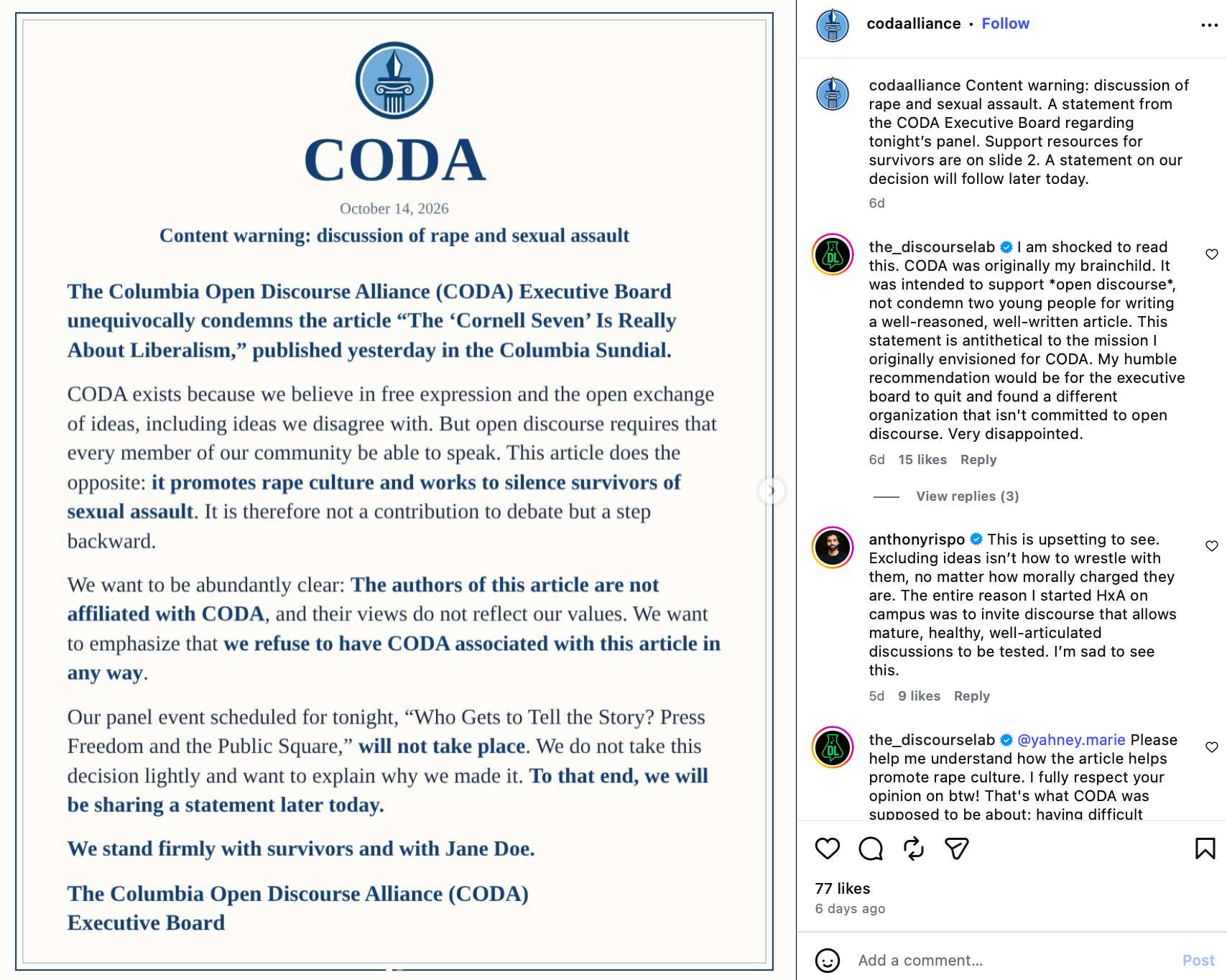
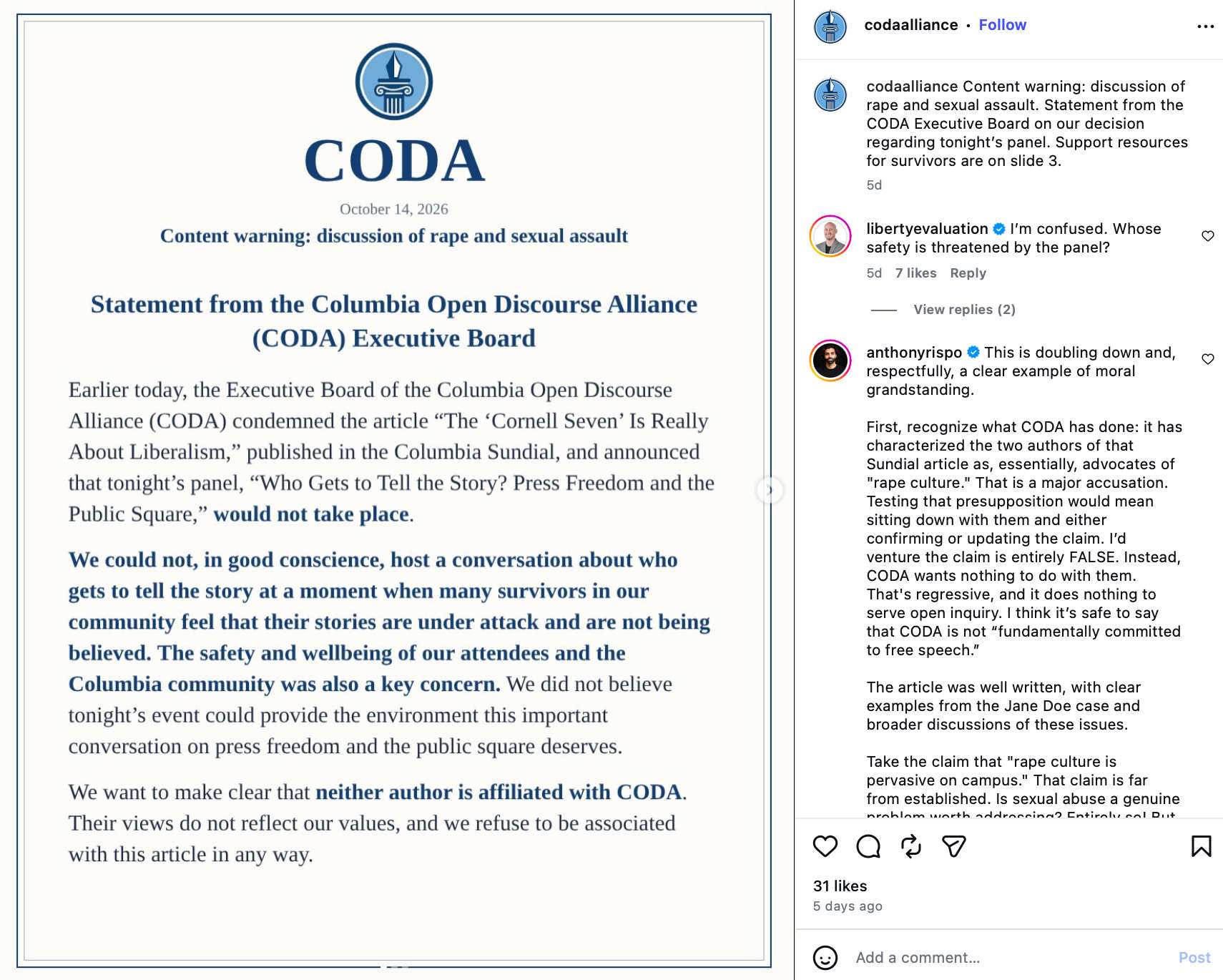
The day after the article's publication, the Columbia Open Discourse Alliance (CODA) canceled an event about press freedom because the Sundial's editor in chief, Nick Baum, had been slated to speak at the event. Although Baum did not author the piece, CODA wrote in an Instagram post that the free speech group "refused" to be affiliated with the Sundial's article "in any way."
CODA also claimed that the event, ironically called "Who Gets to Tell the Story? Press Freedom and the Public Square," could not take place at a time when "many survivors in our community feel that their stories are under attack and are not being believed."
The group added that the Sundial's article "promotes rape culture and works to silence survivors of sexual assault."
The group's president, Aum Desai, told Columbia's student newspaper, the Columbia Daily Spectator, that the group canceled the event "not in spite of, but because of [CODA's] commitment to free expression."
Columbia graduate Clayton Smith, who founded CODA in 2025, quickly commented that he was "shocked" by CODA's statements on Instagram. Smith started the organization to create a central hub for groups hosting events promoting free speech and open discourse, including the Sundial and Columbia's Heterodox Academy chapter.
He tells Reason that CODA's rationale for canceling the event was "ironic" and "hypocritical," and he believes the group should have collaborated with the Sundial if there were legitimate safety concerns at the event. He says he was particularly disturbed by the group's condemnation of the article and CODA's claim that it promotes "rape culture."
"They don't argue or explain how it works to silence survivors of sexual assault. It is a baseless slander that they use to condemn the article because it promoted an opinion they do not like," Smith says.
Smith says he spoke to Desai on the phone after CODA posted the statements, and Desai tried to reassure him that CODA would uphold the principle of free speech. But Smith says he did not leave the phone call feeling "very confident at all" in Desai's commitment.
Desai did not respond to Reason's requests for comment.
CODA faculty adviser and Columbia Business School professor emeritus Eli Noam was traveling in China during the fallout from the Sundial article and was not involved in CODA's decision.
After speaking with members of both CODA and the Sundial, Noam tells Reason that he thinks CODA "made some proper decisions, some correct decisions, and some mistakes."
"I think we're dealing here with…a group of college students who kind of were confronted with a crisis at 2 a.m.," Noam says. "And kind of [made] some judgments that they now regret, and they do."
He tells Reason that it was not "unreasonable to assume there would be a disruption" at the event, given the climate at Columbia and "about this rape allegation." He says the group suddenly "had an event where they needed college security" and could not organize in time. CODA, Noam says, is not yet recognized by the university, and he thinks the group was likely fearful of jeopardizing its recognition.
Still, Noam says CODA's statements condemning the article were "unreasonable," and it was "disappointing that they kind of lost their nerve here."
Although he was not involved in planning the panel, Mohammadi says, to his knowledge, there were no credible threats of violence to the panel. He understood there may have been "disgruntled students" and an "environment CODA did not want to deal with." But instead of simply canceling the event or working with the Sundial to find a solution, Mohammadi says CODA overstepped by condemning the Sundial piece.
James Applegate, an astronomy professor who serves on Columbia's Academic Freedom Council (CAFC) alongside Noam, tells Reason that he disagreed with CODA's decision to cancel the event.
Applegate tells Reason he was considering attending the event, and he was "rather surprised and disappointed" when it was canceled.
He recalled that when he was a professor in 2000, he objected to changes to the school's sexual misconduct policy on the University Senate floor. He says his statements were "similar to what was said in the Sundial article" and there was a "level of emotion in this debate."
"Nonetheless, we had the debate. I was in it, and the degree to which it was civil is shocking when you look at where we are now. And it's sad."
Applegate said he does not condemn CODA, however, "for the simple reason that the atmosphere on college campuses and on the left wing of politics in general in the United States is quite vicious."
CODA's honorary faculty fellow John McWhorter tells Reason he interpreted CODA's statement as "saying that an event about who gets to tell the story is untenable when or if a critical mass of people with such stories don't even feel comfortable telling them— i.e.being a participant in the event." He added, "I imagine some might think of that as cutting the salami a little thin, but then I highly suspect that Desai is equally worried about the event becoming a physical melee of some kind. In that, let's face it, he is hardly unreasonable."
Still, McWhorter said that he would have chosen to have the event himself, "especially as in the likely case that some people did talk about their experiences without any particular repercussions, it may have made the more reluctant people less apprehensive about doing so in the future."
According to Mohammadi, as of Tuesday, the Sundial, College Republicans, Platypus Affiliated Society at Columbia (which discusses leftist thought and history), and Columbia's Heterodox Academy chapter have left CODA.
CODA was not the only group to condemn the Sundial's piece. On October 14, the Columbia Political Review's editorial board wrote that Mohammadi and Ma's piece "violates standards of integrity" and "perpetuates a culture of campus violence, rape, and assault." The editorial board of the Columbia Political Review, which purports to publish "multipartisan political discourse," stated that it would refuse to publish "any article that upholds or recreates cultures and systems of rape, sexual assault, or violence" and it urged "all campus publications to do the same."
And on Monday, Columbia's main newspaper, the Spectator, published a staff editorial accusing the Sundial of violating journalistic ethics by "its page to disparage survivors of sexual violence."
Mohammadi tells Reason the piece underwent "far more editorial scrutiny than any other piece" the Sundial had published given the sensitive nature of the topic.
Free speech student organizations are necessary on Columbia's campus, especially as the school's free speech climate continues to crumble; it recently received a failing grade from the Foundation for Individual Rights and Expression. And while upholding free speech principles may have become more fashionable among those resisting the Trump administration's pressures on academic freedom or those defending pro-Palestinian speech, it is clear that some topics remain taboo in the public square. College is supposed to be a place where students debate controversial topics, form their own beliefs and opinions, and learn from mistakes. Hopefully, the students who demanded condemnation instead of debate will be forgiven for their perversion of free speech ideals, and they will learn to afford such grace and open-mindedness to classmates with whom they disagree.
An Arizona abortion clinic that didn't tell a pregnant woman about the physical characteristics of her 8-week-old embryo before prescribing abortion pills has been found liable in a case brought by the ex-husband of the pregnant woman, who didn't want her to get an abortion.
The ex-husband, Mario Villegas, was awarded $67,500 in a civil lawsuit accusing the clinic of violating an informed consent law that an Arizona court declared unconstitutional earlier this year.
'A Dangerous Precedent'
The Lawyering Project, which represented the doctor and clinic being sued by Villegas, had warned that the case could "establish a dangerous precedent in Arizona concerning embryonic personhood and chill the provision of abortion care."
"A pre-viability embryo or fetus is not a person," says its website in a summary of the case, "and a physician cannot be subject to a wrongful death action for providing high-quality abortion care to a patient who wants an abortion."
In an August 2024 order, Judge Bryan B. Chambers of the Arizona Superior Court in Gila County agreed with the defendants that Arizona's wrongful death statute does not, as written, apply to the death of embryos. The court is "unwilling to expand the common law definition of 'person' as applied to the wrongful death statute to include all unborn children whether viable outside the womb or not," Chambers wrote.
But that doesn't mean he tossed Villegas' lawsuit entirely. And in a judgement released July 22 but largely unnoticed untilthis week, Chambers wound up holding that Villegas is entitled to $5,000 in statutory damages and $62,500 "in compensatory damages for his psychological, emotional, and physical injuries."
No one in the case alleges that Villegas' ex-wife—referred to in court documents as M.S.V.—was tricked, coerced, or generally uninformed about the abortion. The case turns on technicalities and Arizona's onerous, biased (and now barred) requirements for what abortion doctors must tell patients in order to obtain informed consent.
'Deprived of the love….of his child'
M.S.V's abortion took place in July 2018, when she was around eight weeks pregnant. At the Camelback Family Planning clinic in Phoenix, she was provided with information at least 24 hours before she could come back for the abortion pills, and she signed various consent forms, including one affirming that she was "comfortable with [her] decision to terminate this pregnancy," according toProPublica.
Around two years later, in July 2020, Villegas—now divorced from M.S.V.—sued the clinic and physician Gabrielle J. Goodrick, alleging medical malpractice and wrongful death. Villegas "has been deprived of the love, affection, comfort, and companionship of his child," his initial complaint stated. He "has been deprived of his constitutionally protected right to parent Baby Villegas."
Villegas sought to have himself appointed the personal representative of the estate of the aborted embryo, and a probate judge agreed.
In an amended complaint, Villegas added that "the estate has been deprived of the net income Baby Villegas would have earned during her lifetime" and sought damages for that, too. (Villegas took the liberty of assuming the embryo was a girl, even though the abortion would have been too early in the pregnancy to tell.)
"Across the U.S., people have sued for negligence in the death of a fetus or embryo in cases where a pregnant person has been killed in a car crash or a pregnancy was lost because of alleged wrongdoing by a physician," noted ProPublica in a 2022 article about the case. "But a court action claiming the wrongful death of an aborted embryo or fetus is a more novel strategy, legal experts said."
Informed Consent or Compelled Speech?
Ultimately, the case came down to Arizona's informed consent law, not fetal personhood.
That law—declared unconstitutional in February 2026—said that doctors must obtain informed consent before performing abortions (which is normal) and then added that this consent only counts if clinics obtain it in highly particular (and medically unnecessary) way and tack on a lot of loaded language and anti-abortion rhetoric.
It says that "at least twenty-four hours before the abortion, the physician who is to perform the abortion or the referring physician" must inform a patient woman "orally and in person" about topics such as "alternatives to the procedure or treatment" and "the probable anatomical and physiological characteristics of the unborn child at the time the abortion is to be performed." Doctors were also required to tell a woman seeking an abortion that if she went through with the pregnancy, various forms of assistance may be available.
Villegas alleged that even though his wife technically consented to the abortion, it didn't count because the information wasn't provided by the same doctor who prescribed her the pills, and because doctors didn't warn her about the potential "loss of the 'maternal-fetal' attachment bond inherent in birthing a child" and didn't explain alternatives to abortion or the 8-week-old embryo's physical characteristics.
He also complained that the printed form M.S.V. was given "changed the statutory term 'the probable gestational age of the unborn child' to 'the probable gestational age of the pregnancy,' which misstates Arizona's legislative determination that every pregnant woman is carrying a human child."
M.S.V. testified in court "that nothing would have changed her mind about obtaining the abortion," as Chambers put it in his judgement. And no one alleges that the clinic simply failed to discuss some risks and other relevant information with her before the procedure. It simply failed to use the loaded language preferred by the state.
But "the statute does not require proof that M.S.V. would have made a different decision had she been fully informed," wrote Chambers in his judgement. And even if some of the rules of informed consent were followed, "nothing in [Arizona law] suggests that substantial compliance with the consent provisions is all that is necessary."
Fortunately, the informed consent law at the heart of this case has been struck down, so future doctors don't have to worry about being sued for failing to say "unborn child."
But there's still something chilling about the way all this played out. M.S.V. had argued to court that she was tricked into pregnancy—she thought her ex-husband "was fixed," because he'd had a vasectomy, though it was since reversed. Chambers said this did not negate her consent to sex with him, since M.S.V. "was not deceived about the nature of the act. At most, she was deceived about a potential consequence (pregnancy risk)."
In M.S.V.'s telling, she did not exactly give informed consent to the sex that led to pregnancy, but she did give informed consent to the abortion procedure. In neither situation, however, do M.S.V.'s claims about her own consent seem to have mattered much at all.
In the News
The Transportation Security Administration (TSA) shows "significant weakness" when it comes to protecting passenger data, according to the Department of Homeland Security Office of Inspector General.
A TSA authentication vendor "was able to access and extract sensitive passenger information, including driver's license and passport images, during system troubleshooting and enhancements, without TSA's knowledge," the report says. More:
TSA lacked clear policies, did not track when this data was extracted, could not verify that extracted information was properly deleted, and did not notify passengers when their biometric and biographic information may have been stored. As a result, although passenger information was generally protected during routine operations, weaknesses in vendor oversight created a risk that sensitive personal information could be retained or exposed.
As the OIG's audit underscores, this technology presents privacy risks associated with unsecured data, unauthorized access, and data breaches. The government's use of this technology also creates a mass surveillance system and facilitates the creation of warrantless biometric records for unconsenting parties.
[…] Given that facial recognition technology is prone to mistakes, combined with the OIG's audit revealing significant privacy weaknesses, it is imperative that travelers remember that opting out is possible. TSA's own website emphasizes that travelers who wish to decline to have their photo taken for facial comparison can do so without any delay, disruption, or recourse.
More Sex & Tech
• You could make a full-time beat out of covering cops' misuse of Flock cameras these days. The latest: "A former Joliet police lieutenant is now facing felony charges for misusing the city's Flock camera system," per CBS News. And, in Sharonville, Ohio, "a police lieutenant was indicted Tuesday after he allegedly used Flock camera systems…29 times between Dec. 19, 2024, and April 20, 2026, to track a person's whereabouts" for personal reasons, Fox 10 reports.
• Airbnb says hosts can't make you wash and dry your own dishes anymore:
I just got an email from Airbnb laying out new ground rules for what hosts can demand of guests, and THANK GOD.
At my last Airbnb, I had to strip the beds, wash every dish, clean the kitchen, haul the trash out to the road, and there was still a $100 cleaning fee! https://t.co/tfQGqQKsRo
• Another case challenging the use of Flock cameras to get convictions. In Texas, Charles Brownlee—sentenced to 60 years in prison for armed robbery—is asking a federal appeals court to throw out his conviction, "arguing that the AI-powered camera system gives law enforcement more surveillance power than the Constitution allows," per The Texas Tribune.
• A California law that takes effect in 2027 "will require large companies to make a good-faith effort to link customers to a human by phone within 15 minutes," notesThe San Francisco Standard. "But it has a carveout for companies that never offered phone support in the first place. It remains to be seen whether the legislation will hold any sway over the AI firms leading the charge to replace human agents."
• Jacob Sullum delves into a convoluted lawsuit filed against Students for Life by a Texas woman who opposes a Texas anti-abortion law.
• In the latest incident to blur the line between the FBI catching criminals and creating them, an FBI task force catfished a high school maintenance worker using an AI-generated image of a 15-year-old, then used Clearview AI facial recognition tools to identify him and Flock to track his car.
A coalition of press freedom and civil liberties organizations is calling on the House Ways and Means Committee to abandon its threat to subpoena staffers at BreakThrough News. The House committee has demanded that BreakThrough employees testify before Congress unless the outlet withdraws its First Amendment and other objections to the committee’s earlier subpoenas and document requests by October 20.
The committee says its inquiry is part of a tax-related investigation into one of BreakThrough’s donors. But the committee and its chairman, Rep. Jason Smith, R-Mo., have also accused the outlet of “anti-American rhetoric” and “messaging that mirrors hostile government propaganda,” pointing to its criticism of immigration enforcement and of US and Israeli foreign policy. The letter outlines that such statements make clear the investigation is targeting BreakThrough for its viewpoints. The coalition warns that letting Congress interrogate a newsroom over its editorial positions sets a dangerous precedent for journalists of every political persuasion.
Freedom of the Press Foundation (FPF) Chief of Advocacy Seth Stern stated: “Rep. Smith’s shameless targeting of BreakThrough News for editorial viewpoints that he dislikes shows a complete disregard of the First Amendment. Congress has many more important things to do than interrogate an entire nonprofit newsroom because lawmakers speculate that disagreement with their opinions must evidence a conspiracy. The committee has not identified any alleged unlawful conduct by BreakThrough or any legitimate legislative purpose for its investigation. People who themselves hold controversial political views should understand the risk of normalizing fishing expeditions targeting dissent.”
Read the full letter below:
Dear Chairman Smith,
We are a coalition of press freedom and civil liberties organizations. We are alarmed by your recent correspondence threatening to issue subpoenas to BreakThrough News, a nonprofit organization that publishes news reporting and commentary. Your letter indicates that you plan to demand that virtually every individual associated with BreakThrough’s newsroom, from its editor-in-chief to its social media manager, appear before Congress unless BreakThrough rescinds its well-founded First Amendment and other objections to your prior invasive demands.
The Committee first demanded records from BreakThrough in February, claiming to be pursuing a tax-related probe into donations from Neville Roy Singham, a U.S. citizen based in Shanghai. Those demands and subsequent ones were outrageous in and of themselves, but serially subpoenaing employees of a small left-wing news outlet to compel them to personally appear before you, for no reason other than to further a vindictive political stunt, is beyond the pale and reminiscent of some of the darkest chapters in our nation’s history.
Although your justifications have repeatedly shifted in your various letters and subpoenas to date, you have admitted the true impetus for the inquiry is the groups’ viewpoints, stating they have “amplified anti-American, foreign-aligned narratives on social media, and pushed messaging that mirrors hostile government propaganda.” You further stated, “I will absolutely not stand by and allow our tax code to be abused to push anti-American rhetoric on our home soil.”
The First Amendment protects those who voice even controversial opinions shared by hostile governments abroad, but your primary examples of BreakThrough’s “anti-American” views are criticism of ICE’s tactics and Israel’s U.S.-funded wars – policies that many millions of Americans who have never received funding from or even heard of Mr. Singham also dislike.The fact that foreigners also dislike those policies might underscore their unpopularity, but it does not diminish BreakThrough’s right to share similar views.
Your letter also raises BreakThrough’s alleged connections to a lawfully organized domestic political party, the Party for Socialism and Liberation. Such connections are not illegal and, like receiving donations from a U.S. citizen living abroad, cannot come close to supporting broad subpoenas seeking a news entity’s internal documents or depositions from its entire staff.
Beyond the blatant unconstitutionality of targeting news outlets for their political views, House subpoenas must serve a legislative purpose. Fishing expeditions do not suffice.
BreakThrough News’s reporting and commentary, no matter how distasteful you may find it, is protected by the First Amendment, just as your own views are protected no matter how distasteful others may find them. As the Supreme Court wrote over 80 years ago, “if there is any fixed star in our constitutional constellation, it is that no official, high or petty, can prescribe what shall be orthodox in politics, nationalism, religion, or other matters of opinion.”
The First Amendment exists to protect people with politically disfavored views from people like you. Speech that politicians approve of is not in need of constitutional protection.
The threatened subpoenas are clearly designed to target BreakThrough for reporting and editorial viewpoints with which the Committee disagrees. Subpoenas of journalists and newsrooms obstruct First Amendment activity by forcing cash-strapped news outlets to spend time and money defending their rights, and by intimidating not only reporters but also sources, donors, and readers.
We demand that you refrain from issuing further unlawful and retaliatory subpoenas, and drop your entire unconstitutional inquiry into BreakThrough News.
Last March on Instagram, Students for Life President Kristan Hawkins posted a photo showing her and two other members of the Virginia-based group standing outside Space Center Houston. According to the captions, Hawkins and her fellow activists, one of whom was holding a mobile phone, were "ordering abortion pills undercover."
A lawsuit filed last week in Harris County, which includes Houston, describes that Instagram post as "nothing more than a publicity stunt." The lawsuit, which aims to deploy a Texas abortion law championed by Students for Life against the organization, is also a publicity stunt. But while it may be effective by that measure, it faces legal challenges that will be hard to overcome.
The lawsuit, which a Texas woman who opposes her state's abortion ban filed under the pseudonym Maria Puerto with help from the reproductive rights group Amplify Legal, is supposed to highlight the vagueness and broad scope of House Bill 7, a 2025 law that authorizes private civil action to enforce state restrictions on "abortion-inducing" drugs. But Puerto's attempted act of legal jiu-jitsu seems too clever by half, relying on a dubious reading of the statute to seek "monetary compensation" it does not authorize and thereby punish anti-abortion activists for constitutionally protected advocacy.
H.B. 7, also known as the Woman and Child Protection Act, says "a person may not manufacture or distribute an abortion-inducing drug in this state" or "mail, transport, deliver, prescribe, or provide an abortion-inducing drug in any manner to or from any person or location in this state." Those prohibitions, it says, "may be enforced only through a qui tam action" against a "person" who "violates" or "intends to violate" them.
Any "person" other than a state or local official can qualify as a "relator" authorized to bring such an action. The relator can seek injunctive relief and "an amount of not less than $100,000 for each violation," plus "costs and reasonable attorney's fees." A successful relator generally receives $10,000 of that "amount," with the rest going to a "charitable organization" of his choice.
As a "person" who is not a government official, Puerto meets H.B. 7's minimal test for standing. And although H.B. 7 precludes lawsuits against pregnant women who obtain "an abortion-inducing drug," Puerto says Hawkins and the other activists "are not pregnant and were not pregnant" at the time of the Instagram post. So far, so good. But although the lawsuit asserts that Hawkins et al. "openly and flagrantly violated" the law's prohibitions, it does not explain how.
A photo accompanying a recent Mother Jonesprofile of Hawkins shows her and her social media coordinator, Lydia Taylor Davis, outside Space Center Houston during their "abortion-pill 'sting' stunt." Another Mother Jones photo shows Hawkins holding a mobile phone displaying what Puerto's lawsuit describes as "an order confirmation."
Judging from the Mother Jones account, it is not clear whether that description is accurate. "The scheme rapidly went off the rails," Amy Littlefield writes. "The plan was to purchase pills from a couple of services, with Hawkins posing as a male abuser while Davis pretended to be a 16-year-old—all to try to portray mail-order suppliers as reckless and dangerous. For reasons even she couldn't explain, Hawkins chose the fake name 'Wanda' as her male-abuser alter ego. But when Davis input her information, she hit a snag."
Davis was trying to order pills from the Massachusetts Medication Abortion Access Project. But according to Littlefield, that organization "had blocked Davis in its system after Students for Life teased the sting operation on social media." Hawkins "attempted to save the stunt by placing her own order, but 'Wanda' accidentally gave her age as 15," which was below the supplier's minimum age, Littlefield says. "Now a security guard was wandering over to tell them they couldn't film. Having set out to show that telemedicine services don't screen their clients, they inadvertently proved the opposite."
Puerto "will need proof that the Students for Life leaders actually obtained or intended to obtain the pills," abortion law scholar Mary Ziegler notes in Slate. "The activists may argue that the post was not in earnest, and that no one involved ever seriously intended to bring pills into Texas."
Even assuming that Hawkins et al. successfully ordered abortion pills, that conduct by itself does not fit the language of H.B. 7, which applies to people who "distribute" such drugs or who "mail, transport, deliver, prescribe, or provide" them "to or from any person or location in this state." That language encompasses out-of-state suppliers, which raises obvious concerns about extraterritorial application of Texas law. But on its face, the prohibition does not cover someone who simply orders abortion pills.
Puerto's lawyer, Amplify Legal attorney Molly Duane, argues that Hawkins et al. could be covered by the statute's reference to transportation. "What the statute says is that transporting abortion drugs from one location to another within the state is a violation of H.B. 7," Duane toldThe Texas Tribune. "By the plain language of the statute, this would seem to be a violation. This is the problem with writing such a confusing and vague law."
Under that theory, however, Hawkins, Davis, and the two other activists named in the lawsuit violated H.B. 7 only if they 1) successfully ordered abortion pills, 2) took delivery of them, and 3) subsequently moved them to another location within Texas. The lawsuit alleges only that they "ordered abortion pills, apparently multiple times." According to The Texas Tribune, Duane and Puerto "are hoping that the lawsuit will eventually surface more about what the defendants did with the abortion pills once they ordered them."
The lawsuit faces another obstacle. H.B. 7 does not apply to "speech or conduct protected by the First Amendment." Hawkins et al.'s efforts to show how easily state abortion bans can be circumvented certainly seem to fall into that category. "Students for Life may stress that the case targets their political speech about abortion," which is "protected under the First Amendment," Ziegler notes.
Those are not the only puzzling aspects of the lawsuit. Puerto, a 26-year-old single mother of two young children, emphasizes that she "had no choice but to continue" those pregnancies because she did not "have access to transportation or the economic resources to pay for travel out of state." The lawsuit devotes 11 paragraphs to describing the burdens imposed by her state's denial of "true reproductive rights," which she argues justifies some sort of compensation.
All of this seems legally irrelevant under H.B. 7, which does not require a relator to allege damages of any sort, let alone damages stemming from the abortion ban it aims to reinforce. "With nowhere else to turn for assistance," the lawsuit says, "Ms. Puerto is seeking financial compensation" from Hawkins et al. "in the amount of $459,782—the average cost of raising two children from birth to age 18 in the state of Texas."
Although H.B. 7 sets a minimum award of $100,000, the lawsuit notes, "there is no cap on the monetary compensation owed a relator." But the law does not describe H.B. 7 awards as "monetary compensation" for injuries allegedly suffered by the relator.
The statute's only reference to "compensatory damages" deals with lawsuits filed against H.B. 7 relators under "clawback provisions" of other states that have tried to thwart such litigation. In response to a "clawback" action, the law says, an H.B. 7 relator can seek "compensatory damages, including money damages in an amount equal to the judgment damages and costs, expenses, and reasonable attorney's fees spent in defending the action." By contrast, the bounty for proving a violation of the restrictions on abortion pills is simply "an amount."
The lawsuit itself, emphasizing the lax standards for filing a claim under H.B. 7, notes that Puerto "did not suffer an injury traceable to [the defendants'] ordering of abortion pills that can be remedied by a court." But it suggests that an award to Puerto would be appropriate given the defendants' anti-abortion activism.
The lawsuit notes that Students for Life "proudly advertised" its support for H.B. 7. Puerto complains that Hawkins et al. "ignore the immense harms and multiple deaths already attributed to Texas's cruel abortion bans" and "demean the six million Texans of reproductive age who have had their ability to decide whether and when to begin or expand a family stripped away by these bans." Whatever you make of that charge, the defendants' activism is constitutionally protected and therefore cannot support a cause of action in civil court.
"Texas is a strange place filled with vigilante statutes" that "seek to turn Texans against each other," Duane told The Texas Tribune. "But if anyone should be benefiting from these legal regimes, it's people like our client." While "putting those two things together…might be unusual," she said, "this is the situation that Texas has put its citizens in."
Depending on your perspective, you may or may not sympathize with Duane's reasoning. But it seems unlikely to pass muster as a matter of law.
On September 30, I walked out of a three-hour medical appointment to dozens of missed calls. They were from colleagues: the entire newsroom of Matsadaash, an independent fact-checking platform, had been arrested. Six journalists, five of them trainees in their early twenties, all picked up in less than 24 hours.
I didn’t know any of them. It didn’t matter. An entire newsroom taken in a day, then disappeared: that was enough. I don’t need to know someone to stand with them. If they are journalists arrested for doing their job, I am with them.
For five days, no one knew where they were. Their families and lawyers filed 18 complaints in that time, according to the Egyptian Initiative for Personal Rights (EIPR), which represents them. The Interior Ministry called Matsadaash an unlicensed, foreign-run page, and linked it to the Muslim Brotherhood, which Egypt designated a terrorist organization in 2013. The Matsadaash founder, Abdelrahman Mansour, denies any affiliation.
When the six journalists were finally produced before state security prosecutors, some, according to their lawyers, said they had been blindfolded, bound, stripped, beaten and given electric shocks. State prosecutors said forensic examinations found no injuries. The journalists were charged with joining and financing a terrorist group, reporting fake news and using social media to spread it. On October 13, their pretrial detention was extended for another 15 days. Their salaries, which EIPR and the Egyptian Journalists Syndicate say were paid under employment contracts filed with Egyptian banks, were described, in the prosecution’s words, as “monthly funding in foreign currencies.”
Over three days, each of the six journalists was interrogated for nearly 30 hours. According to EIPR, not one was confronted with a single report they had written that could be called false. Instead, the prosecution’s own statement accused them of “highlighting shortcomings — and nothing else — in state institutions,” belittling officials and amplifying people’s grievances.
But that is precisely our job. It is what we sign up for as journalists — to ask questions of those in power. On October 4, another colleague was summoned for questioning; thankfully, she was released the same day.
Word spread the way it does now, through social media posts, journalists’ pages and a knot of phone calls I can no longer untangle. Colleagues were gathering at the Journalists Syndicate every day. So I went too. The Syndicate is a union with a long history of standing up for us, and I joined my colleagues there in solidarity with those who had been detained. Not everyone could come every day, but there was always someone — on some days just four, on others more than 20.
Even our older colleagues, in their 60s, 70s and 80s, showed up. Ustaz Mohamed Abdel Kouddous, who once headed the Syndicate’s freedoms committee, is recovering from an accident and could not be there in person, but he was with us through his voice and his written messages. For as long as I can remember, he has been there for every struggle: at Al-Ahram, arguably Egypt’s most prominent daily newspaper; and at the Syndicate, with his megaphone, firing us up. He and I don’t share the same politics, but it has never mattered.
In 2008, on the day of a nationwide strike, plainclothes officers dragged him from his car in broad daylight and held him until nightfall. He asked the Syndicate to demand an investigation, though he expected nothing to come of it. “We do what we need to do,” he said then. It could be the motto of our sit-in today.
Many of us feel embarrassed to eat or to have a cup of tea, not knowing whether our colleagues inside have the same luxury. When I kiss my girls goodnight, I feel ashamed that my colleagues in jail cannot do the same.
Illustration: Anna Jibladze, using images by Lina El Wardani and Getty Images
I keep thinking about how we got here.
Under Egypt’s former president Hosni Mubarak, the red lines were clear. You did not touch the head of state, his wife and his sons, or a certain institution (the military). But everything else was fair game. We knocked ourselves out writing about poverty and corruption, labor rights and children’s rights, domestic violence, sexual harassment and female genital mutilation.
Then came 2011, and a revolution unlike any other. In Tahrir Square, we rejected violence, and our chant was “selmeya, selmeya” (peaceful, peaceful).
When we brought Mubarak down, he didn’t flee like the Tunisian “strongman” Zine al-Abidine Ben, and we didn’t lynch him like Muammar Gaddafi in Libya. We put Mubarak on trial, in a courtroom. It was dignified. It was the revolution of the dreamers.
In those few years, Egyptian journalists lived with freedoms we had never known. But dreamers are not politicians.
We had lived for decades with no politics: no real political parties, no real elections, no way to learn how power works. So when the door was opened, we didn’t know how to build what we had dreamed of. People kept asking, “What is the alternative?” We had the dream, but not the tools.
What followed our revolution was the opposite of what we fought for: restrictions on a scale we had never seen. The red lines blurred and multiplied, until no one knew where they were anymore. The story of our country, of our revolution and of our journalism is the same story. We are not organized. We are not politicized. But we dare to dream.
Today, at least 25 journalists are behind bars in Egypt, says the Committee to Protect Journalists, almost all of them in pretrial detention. That period is technically limited to two years, but prosecutors file new charges and renew detentions. Some, like the photojournalist Hamdy al-Zaeem, have spent a decade in and out of detention without a single conviction. My colleague Haidar Kandil was taken in June, after documenting arrests of Egypt’s Shia minority.
On the evening of October 14, the lobby of the Syndicate’s headquarters in downtown Cairo was filled with banners and cartoons. Three colleagues and I sat down to write letters to our jailed colleagues: 26 names in total. We fussed over how to organize the letters: how to arrange the names, whether the envelopes should be open or closed, which color went with which name. Colleagues with beautiful handwriting wrote each name in calligraphy. Then we realized we couldn’t spend the whole evening rearranging the deckchairs. At some point, we had to start writing.
But our minds were blank. What could we say? “Why are you inside, and why are we free?” “We feel guilty that we are free and you are paying the price. Maybe we should have paid it instead.”
Of the 26, the only one I have worked with is Haidar. He had a good eye for a story. Like most of the young journalists I work with, he needed guidance, but he was always responsive to edits, to make changes and turn in better copy. We spoke on the phone and exchanged emails and texts, but we had never met. I only know his face from photos online, and here I am pinning his photo on the noticeboard in the syndicate with a #FreeThemAll banner.
In the end, all I wrote was: “I miss you, Haidar. I hope to see you soon. Hang in there. Love, Lina.”
Whenever I feel small, I remind myself that this Syndicate has always fought the good fight. That same evening, the veteran journalist Medhat El-Zahed told us how, during the 1989 Iron and Steel workers’ strike, he and his leftist colleagues were arrested and tortured. The Syndicate’s head at the time, Makram Mohamed Ahmed, was close to the authorities. Still, he protested over the treatment of journalists and visited them in prison.
Today, for the first time, the head of our Syndicate is one of us. Khaled El-Balshy is a dreamer. Eman Ouf, who heads the freedoms committee, is one of us too. The Syndicate has pledged to defend all six Matsadaash journalists. It has asked the Attorney General to investigate the abuse allegations. Its statement chose every word with care, stressing its commitment to the law and to the country’s higher interests, and asked only that our colleagues be released on the Syndicate’s guarantee, or any other, given their young age. It was the most modest of requests. Even that was too much for some.
The tide is so high, and we are so low.
After more than two weeks, we have suspended the sit-in. We are not leaving the Syndicate, and we are not giving up. In our statement, we promised to keep standing with our colleagues through other events, because the battle for press freedom “needs a long breath.”
On October 18, eight independent news outlets from Egypt, Lebanon, Tunisia and Syria, among them Mada Masr and Al-Manassa, announced a joint newsroom to fact-check “Egypt Forum 2026,” the government’s “achievements conference.” The summit runs from October 19 through to October 24 – six days for six journalists. The eight newsrooms have united under the slogan: “Until they return, the fact-checking continues.” The dreamers are learning to organize.
We journalists and dreamers, like those of us who gather in the Syndicate, are stubborn. Many are behind bars of some kind: real ones, imaginary ones, or the bars of a censored internet. But we always walk towards the light. Journalism is how we live and breathe. If we don’t fight for it now, there will be nothing left to fight for tomorrow. No profession, no dignity, and no Syndicate.
This story was published in collaboration withEgab.
The complaint alleges excessive force during an October 16 university protest in Buenos Aires, where at least 550 people required medical attention.
Argentina’s Provincial Commission for Memory (CPM) has filed a criminal complaint against President Javier Milei’s government and security officials over a police crackdown on a university protest in Buenos Aires that left at least 550 people requiring medical attention. The filing accuses security forces of abuse of authority, dereliction of official duties and other crimes.
The complaint concerns the October 16 Federal University March and a demonstration against Decree of Necessity and Urgency (DNU) 70 in Plaza del Congreso. It names the Unified National Security Command and authorities in the Autonomous City of Buenos Aires, alleging that the security operation exceeded legal limits.
The operation involved the Federal Police, Naval Prefecture, National Gendarmerie, Airport Security Police and Buenos Aires City Police. According to the CPM, officers intervened while the mass demonstration was underway, forcing university leaders to interrupt their reading of the main statement from the stage.
The commission reported that officers fired rubber bullets directly at protesters’ faces and heads and used water-cannon trucks against demonstrators. At least 550 people required medical attention, and at least 120 tear-gas grenades were fired, according to the organization.
A CPM report documented injuries to 50 media workers and 15 members of the commission, which is chaired by Adolfo Pérez Esquivel and Dora Barrancos.
Among those injured were Página/12 photographer Guido Piotrkowski, who was struck twice in the chest by rubber bullets, and TeleSISA journalist Laura Quispe, who sustained nine rubber-bullet impacts.
Footage circulated by the Center for Legal and Social Studies (CELS) showed officers aiming at protesters’ eyes. Later that evening, television cameras recorded Gendarmerie officers collecting spent cartridges from the streets and placing them in bags. The CPM raised concerns about the preservation of potential evidence.
Six people arrested during the demonstration
Six people were arrested during the protest and its dispersal. Two students from Nicolás Avellaneda School were detained at 5:11 p.m. at the intersection of Montevideo and Sarmiento streets.
One student, aged 14, was held for two hours. The other, aged 17, was charged with resisting authority and faces criminal proceedings under the recently introduced juvenile justice regime.
Police later arrested four adults — three men and one woman — at the intersection of Chacabuco Street and Avenida de Mayo. Human rights organizations said the woman, a student at the National University of Tres de Febrero, was stopped because she was carrying a Colombian flag. All four were charged with resisting authority.
Commission seeks records and independent investigation
The CPM’s complaint alleges that the actions of officers and their political superiors were coordinated and carried out under orders from senior officials who knowingly authorized the use of coercion outside the legal framework and in violation of Argentina’s international commitments.
The commission has asked the national and Buenos Aires city security ministries to provide a complete list of personnel deployed during the operation, details of the vehicles, weapons and equipment used, and copies of orders transmitted over police radio frequencies.
It is also seeking information about officers who photographed or filmed protesters, including whether they had prior judicial authorization, as well as footage from the city’s surveillance cameras.
The CPM has called for independent forensic examinations and for the collection, custody and analysis of testimony, commercial recordings and other evidence to remain under the control of the competent court or prosecutor. The request specifically excludes the security forces implicated in the events from handling that evidence.
Restrictions on Islamic headscarves in Azerbaijan’s schools have triggered demonstrations, arrests and an unusually public confrontation between Baku and Ankara.
The dispute has exposed differences over secularism, religious freedom and Azerbaijan’s relationship with Israel, raising questions about the durability of one of the region’s closest strategic alliances.
Azerbaijan is facing an unusual wave of protests after new school dress regulations led to girls wearing Islamic headscarves being excluded from classrooms and teachers reportedly being ordered to remove their hijabs. The controversy has escalated into a diplomatic dispute with Turkey, whose governing party has been accused by President Ilham Aliyev’s administration of interfering in Azerbaijan’s internal affairs.
The confrontation intensified on 13 October when Azerbaijan’s ruling New Azerbaijan Party (YAP) publicly condemned senior figures in President Recep Tayyip Erdoğan’s Justice and Development Party (AKP). The dispute has since widened to encompass Azerbaijan’s relations with Israel, exposing political differences between two countries accustomed to describing themselves as “one nation, two states”.
School regulations provoke protests and arrests
The controversy began on 21 September, when Azerbaijan’s government adopted Resolution No. 309, amending the regulations governing uniforms in state schools. The changes prohibit clothing that conflicts with prescribed uniforms or the secular character of public education.
Although the new regulations do not explicitly mention Islamic headscarves, some schools have interpreted them as prohibiting the hijab. A further decision on 6 October introduced similar requirements for teachers. Women in Baku and Sumgayit subsequently reported being instructed to remove their headscarves or risk losing their positions.
The enforcement of these regulations prompted demonstrations outside schools, with girls carrying placards demanding access to education. Male pupils also joined protests in support of their classmates. Such demonstrations are unusual in Azerbaijan, where public assemblies face extensive restrictions.
On 12 October, the Interior Ministry reported that 37 people had been detained in Baku, alleging disruption of public order, damage to property and obstruction of school activities. Activists claimed that more than 200 people had been detained, although that higher figure has not been independently confirmed.
In a statement issued on 16 October, Amnesty International criticised the exclusion of pupils and called for the release of peaceful demonstrators. The organisation also raised concerns over the reported detention of a mother protesting her daughter’s exclusion and the disappearance of an activist who had organised educational assistance for affected children.
Access to TikTok and Instagram was disrupted as the protests spread online. Internet monitoring organisations documented restrictions, although Azerbaijani authorities have not publicly explained their cause.
Turkey challenges Azerbaijan’s secular policy
The dispute acquired an international dimension when Oktay Saral, a senior adviser to Erdoğan, condemned the exclusion of girls wearing headscarves.
In a public statement on 12 October, Saral questioned how preventing a girl from attending school because of her religious clothing could be reconciled with justice. He demanded that Azerbaijan reverse the restrictions. Several AKP parliamentarians subsequently joined the criticism.
The response from Baku was unusually confrontational. In its official statement, the New Azerbaijan Party accused Turkish political figures and media organisations of conducting a systematic campaign against Azerbaijan.
The party argued that religious solidarity did not entitle one Muslim-majority country to dictate another’s domestic policies. It described the Turkish politicians’ interventions as irresponsible and warned against attempts to interfere with Azerbaijan’s sovereignty.
The disagreement reflects contrasting approaches to secularism. Azerbaijan, a predominantly Shia Muslim country, has maintained strict state control over religious institutions since independence from the Soviet Union. Turkey, by contrast, has progressively removed restrictions on Islamic headscarves under Erdoğan’s government, reversing policies previously associated with its secular establishment.
Israel adds another source of tension
The dispute has also reopened disagreements concerning Azerbaijan’s relationship with Israel.
Baku maintains substantial security and defence cooperation with Israel, including military technology and equipment supplied during its conflict with Armenia over Nagorno-Karabakh. Turkey supported Azerbaijan during that conflict but has adopted an increasingly confrontational position towards Israel.
As EU Today has previously examined, the relationships between Turkey, Azerbaijan and Israel reveal competing strategic interests beneath Ankara and Baku’s declared solidarity.
In its October statement, the New Azerbaijan Party specifically rejected criticism of Azerbaijani-Israeli relations, insisting that its dealings with Israel were legitimate bilateral arrangements. The inclusion of Israel in a response ostensibly concerning school uniforms indicates that the disagreement extends beyond religious clothing.
A further escalation emerged on 16 October when Azerbaijani prosecutors announced charges against Turkish journalist Celal Çiftçi, accusing him of advocating the violent overthrow of the Azerbaijani government in social media posts connected to the controversy. An arrest warrant was reportedly issued in his absence. Prosecutors did not publish the posts, and Çiftçi’s response was not available.
Could the dispute break the Turkish-Azerbaijani alliance?
Despite the increasingly hostile exchanges, there is little evidence of an imminent diplomatic rupture.
Turkish Foreign Minister Hakan Fidan travelled to Baku on 15 October and met President Aliyev. The meeting addressed recent developments in bilateral relations, while Fidan publicly emphasised the enduring strategic partnership between the countries.
He acknowledged that differences could arise but argued that they should be resolved through direct dialogue rather than political confrontations on social media. Senior AKP figures have also sought to reduce tensions, stressing respect for Azerbaijan’s sovereign decisions.
The relationship extends far beyond shared language and cultural identity. Turkish military cooperation has been central to Azerbaijan’s regional security policy, while energy infrastructure and transport corridors connect the countries economically. Ankara also remains an important actor in the changing strategic balance of the South Caucasus.
For the European Union, the confrontation is relevant because Azerbaijan remains an important energy supplier and trading partner, while Turkey occupies a central position in regional transport and security arrangements.
The immediate question is whether Baku will reconsider the application of its school regulations. The wider political dispute concerns the extent to which Turkey can criticise Azerbaijan’s domestic policies without jeopardising a partnership that both governments have consistently presented as a cornerstone of their foreign policy.
The public confrontation has exposed differences that had previously been managed within the bilateral relationship. However, Fidan’s intervention and the continued diplomatic engagement suggest that both governments are seeking to contain the dispute rather than dismantle their alliance.
Academics have launched a rival inquiry into the appointment of Jason Arday, accusing the University of Cambridge of watering down its own investigation.
Major drivers of the repression include pressure from wealthy pro-Israel donors, government interference, and the political loyalties of university administrators and trustees, according to a new report.
Starting next week, Pennsylvania will begin enforcing a law prohibiting the sale of e-cigarettes that have not been explicitly approved by the state. Supporters argue that it will protect public health, but it seems likely to do the opposite by preventing many former smokers from accessing the products that helped them quit.
Under the law, known as ACT 57, there are currently just six manufacturers of electronic nicotine delivery systems on the approved list that can be sold in the Keystone State, meaning many popular vaping products will be forcibly removed from shelves on October 19. Retailers who violate this law will face fines of $500 for each unapproved product. A second violation within a year will result in a civil penalty of between $750 and $1,000 per day per product, and a suspension of the dealer's license for at least 14 days. A shop's third violation within a year would result in a civil penalty of $1,000 to $1,500 per day per product, and the revocation of its license.
Politicians are touting this law as the latest way to protect the public, and of course, they claim it will especially protect children. "This law is about keeping harmful products out of the hands of both children and adults who may not realize what they are consuming," said Pennsylvania Attorney General Dave Sunday.
"I applaud the legislature for their bipartisan support of Act 57 to provide this important public health safety measure to the Commonwealth."
However, not all Pennsylvania residents are enthusiastic about the law's enforcement.
"This will be largely catastrophic," Chris Hughes, the former owner of Fat Cat Vapor Shop in Williamsport, Pennsylvania, tells Reason. Hughes predicts that the restrictions will encourage consumers to purchase vaping products across state lines, creating an illicit market. "Some people that are enterprising will drive across the border to Ohio [or] West Virginia, and bring a lot of products back and sell them to other people," he says.
Hughes is right to assume that the law will create an illicit market for vaping. In June, JAMA Network Openpublished a report on Alabama, Oklahoma, and Louisiana—three other states with constraints similar to Pennsylvania—finding that the restrictions were not associated with lasting reductions in e-cigarette nicotine sales. By the end of April 2025, products not listed in the states' approved directories accounted for 92.1 percent of measured e-cigarette nicotine sales in Alabama, 53.6 percent in Oklahoma, and 52.3 percent in Louisiana.
For people living further from the border, Hughes says that "a lot of them will return to smoking." "Half of those people will die prematurely from smoking.…It's a tragedy, really."
Indeed, evidence shows vaping to be one of the most effective tools to quit smoking. A 2024 study published by the Centers for Disease Control and Prevention found that in 2021–2022 alone, approximately 1.2 million American adults used e-cigarettes to help them quit smoking for at least six months, representing slightly more than 40 percent of all adults who successfully quit during that period. Meanwhile, a 2026 review from Cochrane, a global health nonprofit, found that smokers are more likely to quit when using e-cigarettes than with nicotine replacement therapy: 8 percent to 10 percent of smokers using e-cigarettes may successfully quit, compared with just 6 percent using nicotine-replacement therapy.
The impending restrictions have Pennsylvania vapers stockpiling products. Hughes says he has delayed paying his property taxes to make sure he has "two to three years' worth of e-liquid and coils while this shakes out." He also spoke to an employee at a vape shop recently who told him about a customer spending $500 on e-liquid after learning about the impending ban.
For vape shop owners across Pennsylvania, the new law will make business even more difficult. Hughes was forced to close down Fat Cat Vapor Shop in Williamsport after Pennsylvania introduced a 40 percent wholesale tax on vaping products in 2016. "The whole goal of my opening the business was to help get adult smokers off of cigarettes and transition them to something that I knew for a fact was much less harmful," he says. Hughes estimates that his shop helped approximately 8,000 adults quit smoking during its three years in business.
Now, he fears other independent vape shops will suffer the same fate as his own. "Most, if not all of them, will be bankrupted," Hughes warns. "It almost takes my breath away. I'm not even sure what to say."
Pennsylvania lawmakers may intend to protect public health, but their new law risks pushing adults away from healthier lifestyle choices. As is often the case, the government restricting the choices adults are allowed to make for themselves is likely to have deadly consequences.
On October 10, thousands of Ecuadorians took to the streets to protest against the government of right-wing President Daniel Noboa. The demonstration was organized by the Autonomous Front of Organized Resistance (FARO) under the slogan “Government vs. People.”
A esta hora, una marcha de rechazo al Gobierno de Daniel Noboa recorre las calles de Quito. La movilización está marcada por carteles de protesta y consignas contra el mandatario y su gestión. Los manifestantes atraviesan en este momento el paso deprimido del Guambra y avanzan… pic.twitter.com/WKPfT8D9jF
Saturday’s demonstration followed a protest on October 8, organized by labor unions also in Quito, to protest the security, energy, health, and employment crises facing the country. They also protested government cuts to education and health care, as well as alleged mistreatment of workers, according to Edwin Bedoya, president of the United Workers’ Front (FUT).
For its part, the October 10 demonstration – which consisted mainly of high school and college students – set out from the Central University and marched through Quito. Slogans such as “If the people have no peace, neither does the government” and “Out with Noboa, out with him!” were heard along the streets occupied by the demonstrators.
The president of the Catholic University Student Federation, Jatari Ulcuango, told protesters: “Four years ago, this government promised us electricity; two years ago, too – and now the blackouts have returned. Two months ago, the government told us it would provide us with medicine, and yet we’re only receiving 60% of the supply. They’re taking us for fools.”
He added: “We’re dying outside the hospitals. Criminals are kidnapping us, murdering us, and robbing us. That’s why we’ve come out this morning. They plan to dismantle public institutions to force us to hire private security. Who has gotten rich off the health crisis? The private healthcare sector, while the people are getting poorer and poorer.”
The peaceful march headed back to the Central University, where the students gathered. Later, the students reported on social media that they had been harassed and repressed by the police, who had accompanied the entire march.
Likewise, several media outlets reported that the police were aggressive toward them. This was reported by the outlet La Barra Espaciadora, which released a video showing police officers pushing journalists.
TeleSur journalist Elena Rodríguez also reported that law enforcement officers broke the microphone she was using and struck her on the head: “I’m sick and tired of having to recount, time and time again, police attacks against the press. Today, while I was trying to document the violence with which officers were beating young protesters, I was struck on the head from behind with a baton. I turned around, showed my Telesur microphone to identify myself as a journalist, and the response was another baton strike that ended up breaking it.”
She added: “If they think that by beating me up they’re going to get me to stop documenting police brutality, to put my microphone away, or to back off several blocks so I can report from a place where I won’t be a nuisance, they’re wrong. It is not we journalists who should distance ourselves from the events. It is the police who must stop attacking us. The right to report cannot be negotiated at the point of a baton.”
The protests are taking place against the backdrop of a widespread crisis in the country, which includes the worst security crisis in its history (tens of thousands of deaths due to violence between drug trafficking gangs), a very serious health crisis (a lack of supplies and medicines in the public health system), and other major crises such as those in education, public investment, and employment.
Local elections will be held in November, which will reveal the extent of support – or lack thereof – for President Noboa and his neoliberal government agenda, which aligns with the hemispheric security strategy led by the Trump administration.
Austrian police detained Ukrainian investigative journalist Mykhailo Tkach and cameraman Yaroslav Bondarenko in Vienna yesterday, on 8 October. Both were later released, but the circumstances of their detention remain unclear, and the prosecutor’s office said suspicion against them had not been substantiated so far.
The detention lasted more than 12 hours, the first time Tkach had been held that long while on a reporting assignment abroad. The case unfolded alongside a separate Austrian espionage investigation involving two men suspected of working for Ukraine’s military intelligence. Authorities have not said whether the cases are connected.
Tkach describes detention
In a video published by Ukrainska Pravda, Tkach said seven people wearing masks and carrying weapons approached their car at a traffic light about 3–5 kilometers from central Vienna, broke its windows, and pointed weapons at them.
He said the people did not identify themselves or explain their actions. The journalists were pulled from the car, forced face down onto the road, searched, and had their hands taped behind their backs, according to Tkach. He said he initially thought they were being kidnapped because he did not see identification or have time to notice police markings. He realized they were police only after seeing police vehicles.
“As I felt it, they detained us like terrorists,” Tkach said.
He added that people shouted and pointed weapons, and there was no communication. He said one person put a knee on his neck and shouted at him to be quiet. He also saw glass from the broken window fly into Bondarenko’s face.
In a second report, Ukrainska Pravda said Tkach’s account of a document presented to him listed three allegations: espionage in the interests of Ukrainian military intelligence, participation in a criminal organization, and, as far as he remembered, causing harm to Austria. He said investigators did not explain the evidence behind the allegations.
Vienna prosecutor’s office spokesperson Nina Bussek told the Austrian Press Agency (APA) that suspicion against the two journalists had arisen during other investigations but had not been substantiated. She said it currently appeared that the suspicion was not holding up. Austrian officials have not publicly addressed Tkach’s account of the force used.
Diplomatic response and calls for an investigation
Tkach and Bondarenko were in Vienna on an assignment to find Ruslan Kravchenko, Ukraine’s former prosecutor general, Ukrainska Pravda reported. Kravchenko was dismissed on 15 September amid an investigation by Ukraine’s National Anti-Corruption Bureau and Specialized Anti-Corruption Prosecutor’s Office into alleged protection of fraudulent call centers. He denied involvement. Der Standard reported that it remained unclear whether the journalists’ detention was connected to their reporting on him.
Ukraine’s Foreign Ministry spokesperson Heorhii Tykhyi confirmed Tkach’s release and said the Ukrainian consul had requested access to him, according to NV. Musaieva said Bondarenko had been injured and hospitalized.
A statement signed by Ukrainian media and civil society organizations, including Euromaidan Press, called for an immediate, transparent, and independent investigation of law enforcement’s actions. The signatories also demanded an independent review of the force used, the return of seized equipment, and necessary medical and legal assistance.
Separate espionage investigation
Austrian Interior Minister Gerhard Karner confirmed the arrests of four Ukrainians, according to ORF. The two men detained on 5 October were placed in pretrial detention until 21 October on suspicion of secret intelligence activity against Austria. APA reported that they were suspected employees of Ukraine’s military intelligence service. Both deny the allegations.
On 19 November 2025, Indian police raided the ‘Kashmir Times’ in Jammu. They said they were on an “anti-terror” operation. The offices had been shut since 2022 and were in dilapidated condition, the equipment largely defunct. Yet, the police claimed to have recovered a “pistol and live AK-47 cartridges.”
Since 2018, only five journalists have faced cases under India’s draconian anti-terror Unlawful Activities (Prevention) Act. Trials rarely start, leaving journalists in a state of perpetual purgatory, even if they are out on bail under onerous conditions.
Before the police came charging into these unused offices last year, the ‘Kashmir Times’, founded by my father in 1954, had long suffered sustained persecution – the seizure of records, of equipment, the harassment of staffers, the use of social media to spread slurs, trumped up charges of tax evasion and the embedding of spies.
The first ever copies of Kashmir Times, initially a weekly, were seized by the government. In 1983, my father survived a murderous assault with serious injuries inflicted by a Hindu nationalist mob. I joined the newspaper in 1989, as the armed militancy, the ‘insurgency’ against the Indian state, became widespread, and experienced firsthand the struggle to report the news accurately and truthfully. The government would frequently withdraw its advertising, which was the main source of funding for most news outlets. We were besieged on several fronts, facing down the state, militants and aggressive Hindu nationalists.
Kashmir Times front page, January 1972. Image courtesy of Kashmir Times / Anuradha Bhasin digitized by Stanford Libraries.
In 2019, as Indian prime minister Narendra Modi began his second term in office, his government removed the special autonomous status granted to Jammu and Kashmir and protections that had existed for nearly 70 years. Once a state, Jammu and Kashmir was split into two federally governed territories. The Indian-administered part of Kashmir – the subject of several military conflicts between India and Pakistan, with both countries claiming the entire disputed territory while controlling a portion of it – had effectively become a police state and control of the media was a critical component of this transformation.
As Executive Editor of the ‘Kashmir Times’, one of the oldest newspapers in the region and the largest, with four editions, I petitioned India’s Supreme Court against the six-month-long internet shutdown that the Modi government imposed in 2019. But by 2020, three editions of the ‘Kashmir Times’ had shut down and the fourth only limped along, a once daily newspaper that was now only occasionally published. By February 2022, even this edition was shut down. I left India with my husband Prabodh Jamwal, the editor of the ‘Kashmir Times’, and revived it as a digital newsroom in exile in the United States in November 2023.
Prabodh Jamwal, Editor of The Kashmir Times, at his office in Srinagar in early 2020. Nasir Kachroo/NurPhoto via Getty Images.
But, as the so-called terror investigation and the mysterious discovery of weapons in our long disused office in 2025 showed, the ‘Kashmir Times’ remained a thorn in the side of the Modi government. The Indian prime minister has frequently presented India on the international stage as the “mother of democracy” and the “Vishwaguru”, a moral exemplar and teacher to the world. Just last week, between September 12 and 13, Delhi hosted Vladimir Putin, Xi Jinping and Iranian president Masoud Pezeshkian as part of the annual BRICS meeting, the global group founded initially by Brazil, Russia, India, China and South Africa (hence the acronym) that is increasingly being presented as an alternative power centre to the American-led Western alliance. For an India seeking to portray itself as not just an emerging superpower but as a democratic force, it is vital that Kashmir remain repressed, hidden away from global scrutiny.
It’s why, even as a newsroom in exile, we continue to be pursued by an Indian government seeking to tarnish our credibility, to deny us the right to report on Kashmir. We are being subject to a vendetta and it represents what has happened to journalism in Kashmir. Journalists have been silenced by the Modi government, Kashmiri voices strangled, and the local media industry deliberately destroyed.
What is happening to journalism in Kashmir is a harbinger of what lies ahead for the rest of India.
A model of suppression
Geeta Seshu of Free Speech Collective, which monitors press freedoms in India, argues that Kashmir is a laboratory where every strategy of media suppression is tested and perfected for use elsewhere. India, which once had a noisy, argumentative press, now ranks at a lowly 157 out of 180 countries in the World Press Freedom Index. Reporters Without Borders, which compiles the ranking, says “press freedom is in crisis” in Modi’s India.
The 2023 Digital Personal Data Protection Act provided a “dangerous framework for expansion of surveillance and censorship” across the country. It empowered the government to demand data from any entity, including journalists, effectively requiring them to reveal their sources. The amendments to the 2020 Information Technology Rules already burden intermediaries with harsh obligations and have been used to arrest journalists, block websites and compel social media platforms to restrict content. Recently, Instagram restricted posts about reports of Kashmiris shot by Indian security forces using pellet guns on unarmed protestors.
Seshu’s fear that what happens in Kashmir will be replicated in the Indian mainland has largely been borne out. For example, in 2023, nearly 50 journalists associated with the portal ‘NewsClick’ – some only vaguely – were subject to arrests and interrogations. Many had their devices seized without due process. Their alleged crimes were essentially guilt by association, charges manufactured not from evidence but from a, frankly, lazy piece of journalism published in the ‘New York Times’ about NewsClick’s funding. The charges were eventually quashed by an Indian court.
The "To Defend Journalism" protest at New Delhi's Press Club of India, October 2023. Vipin Kumar/Hindustan Times via Getty Images.
Such court rulings are less likely in Kashmir. As a Kashmiri journalist based in Delhi says, “unlike the rest of India, Kashmir is a police state, and state control requires any independent journalism to be shut down.”
In Kashmir, the Indian state has engineered a sophisticated edifice of control through securitization, surveillance and interrogation. It is invisible, intangible, and all-pervasive, a model that extracts quiet surrender and obedience. Unlike the targeted killings of journalists in Gaza, in Kashmir the control of information is seamlessly embedded in everyday life, requiring no enforcement, no traces of brutality. The journalists are essentially cowed into submission.
It began with the world’s longest internet shutdown – a complete lockdown for six months and a partial one for another year. What the shutdown created, despite a court verdict restoring communications, was fear among journalists compelled to work out of a government-surveilled computer facility, and then a perpetuation of that fear through consistent localized and temporary digital shutdowns. So commonplace are these shutdowns that they no longer warrant reporting or commentary.
In June 2020, the Modi government introduced a 53-page document called ‘J&K's Media Policy’ which gave the authorities sweeping powers to monitor, judge, and punish journalists, branding critical reporting as “fake news”, “unethical”, or “anti-national”. The authorities would also routinely remove government advertising from cash-strapped outlets and provide accreditation only to journalists deemed loyal, thus turning bureaucrats into arbiters of what constitutes news and who gets to report it. The effect is chilling.
And then there’s the monitoring of communications.
An Indian security personnel in Srinagar, Jammu and Kashmir, August 2026. Firdous Nazir/NurPhoto via Getty Images.
“I can’t say if they’re using Pegasus or some other spyware or technology,” a journalist told me about being interrogated over emails sent to an editor, “but they knew everything about our conversations.” In a 2021 leak, it turned out the Indian government was using Pegasus to spy on at least 40 Indian journalists, only one of who was Kashmiri.
But, a Kashmiri journalist says, “officials have told us ‘nothing in Kashmir is end-to-end encrypted’ and digital activity is clearly being constantly monitored.” No Kashmiri journalist I spoke to for this story, including those who contribute to the ‘Kashmir Times’, have the encrypted messaging Signal app, used worldwide by journalists, on their phones. Devices are routinely checked when journalists are summoned to police stations in Kashmir for questioning. Some said their devices were returned after being tampered with. “You face humiliation and beatings for using Signal and VPNs,” many journalists said. “You can only get away with it if you’re not on their radar,” said one.
In November 2025, the Indian government issued a directive insisting on verifying the “bona fides” of journalists working in Jammu and Kashmir, and the police followed up by requiring journalists to part with personal information including biometrics and bank statements. In January this year, senior journalist Basharat Masood of The Indian Express spent seven hours at a Srinagar police station, then was summoned for three more days and told to sign a bond promising not to “repeat his mistake” – for reporting on the surveillance of mosquea surveillance, even as officials had already admitted to large-scale data collection and verification.
Surveillance normalized
Police also surveil Kashmiris through the use of drone cameras, a network of 1,000 electronic cameras installed at major traffic junctions, and through unrestricted access to people’s social media activity across platforms ostensibly to track anti-India activity. During an illegal “Census 2024” drive, the police collected residents' personal data and GPS-tagged coordinates of homes. And the soon-to-be-rolled-out Jammu and Kashmir-specific digital identity cards that collects the data of entire households, purportedly to ensure the smooth rollout of welfare schemes, has also sparked local anxieties.
Still, as pervasive as the surveillance is, it is journalists that find themselves in the firing line. Any critical word warrants a summons to a police station, interrogation, intimidation and even detention. This happens repeatedly, with journalists never aware of what specific “offence” might trigger a police summons. The reflex, after several such visits to police stations, is self-protection and self-censorship.
A Kashmiri journalist told me that the language the police use to summon journalists for questioning is particularly sinister. It is almost as if the police are enjoying instilling fear. “Aaj dastarkhan par aapki dawat hai”, for instance, is a typical summons. You are invited to a feast, the police say cynically, knowing a journalist is likely to be harshly questioned, even beaten.
Indian police confront journalists and civilians during a protest on July 10, 2009 in Srinagar in the Indian Administered Kashmir. Yawar Nazir/Getty Images.
Often, Kashmiri journalists, without notice, are placed on no-fly lists. Sanna Irshad Mattoo, a Pulitzer Prize-winning photojournalist, was twice prevented from travelling abroad for exhibitions and award ceremonies, a pointed message that even international recognition offers no protection. At least twelve journalists have had their passports revoked; two of them were already abroad at the time, rendering them stateless.
The Free Speech Collective filed a Right to Information (RTI) query in March 2024 to ascertain exactly how many Kashmiris had had their passports revoked or cancelled. The plea was rejected by the government on grounds of “national security”.
As India continues to press its case as a formidable, if still rising power, citing its 7.8% growth rate over the past quarter, it continues to be defensive and secretive about Kashmir. Foreign journalists are largely barred, or at least heavily restricted, from reporting from both Indian and Pakistani-administered Kashmir. In May, last year, India and Pakistan exchanged air strikes after a terrorist attack in Indian-administered Kashmir and Modi fell out with Donald Trump over the latter’s claim to have stopped both nuclear powers from accelerating towards a disastrous war.
Despite Kashmir being a long-standing issue that merits global attention, reporting from the region has reduced to a trickle.
Mohammad Amin Lara outside his shop in Sopore, Jammu and Kashmir. The shop, once a fully occupied newspaper store, is now a grocery store due to the decline in newspaper sales. Nasir Kachroo/NurPhoto via Getty Images.
A Google search of Kashmir-related news floods your screen with links, but it is bulk without substance. Articles read like a log of official announcements and statements, punctuated by the occasional piece on a shrinking water body, a development project, a political tussle over a non-issue, or unemployment figures. Each report floats like a loose, individual particle suspended in air, packaged and presented as definitive. No investigation into context. No excavation of the past. No interrogation of contributing factors. A story about an alleged terrorist’s hair transplant and cosmetic dentistry, based entirely on police sources, is passed off as an investigation into Kashmiri insurgency. A superficially detailed piece on anti-encroachment drives or home demolitions will carry little beyond the grief of the displaced, or the remarks of a politician whose interest in the community begins and ends with votes. A terrorist’s hair transplant story, based on the police version, passes off as an investigation into Kashmir’s complex insurgency dynamic.
Kashmir fell off the radar a long time ago, says Free Speech Collective’s Geeta Seshu.
Even mundane stories are difficult to report. No one wants to be quoted. A university professor said he could once “talk to journalists and trust they understood the context. Now, a single sentence can be pulled out, circulated on WhatsApp, and suddenly I’m either an anti-national or a government stooge. Both sides will use the same quote to attack you differently. Why would I take that risk?”
Tarushi Aswani, an Indian journalist, told me that “a curtain has been pulled over Kashmir by silencing journalists who ask questions.” Instead, she added, “press release journalism fills the vacuum, erasing the truth about Kashmir, its history, its politics, its development, environment and aspirations.” Kashmir is no longer looking at a mirror. The lack of truthful reporting means nothing is reflected back. Instead, Kashmiris are looking into the lens of a surveillance camera.
*The eight Kashmiri journalists interviewed for this story spoke on condition of anonymity.
In 2016, when Peter Thiel killed Gawker, he insisted that he wasn’t attacking journalism writ large.
On the contrary, he told the New York Times, he’d spent $10 million secretly backing Hulk Hogan’s lawsuit against the news outlet because: “I saw Gawker pioneer a unique and incredibly damaging way of getting attention by bullying people even when there was no connection with the public interest… if I didn’t think Gawker was unique, I wouldn’t have done any of this. If the entire media was more or less like this, this would be like trying to boil the ocean.”
10 years later with the aid of an “AI tribunal,” a team of intelligence and law enforcement veterans, and a political climate vastly more hostile to press freedom, he is trying to do exactly that, bypassing the courts, short-circuiting the first amendment, and making it much, much cheaper to indulge in the quasi legal harassment of journalists.
Objection.ai is a new startup funded by Thiel, and cofounded by Aron D’Souza, who worked closely with him on the Gawker case. It promises “a fast affordable way to challenge statements in the media.” Anyone can file an objection, which will trigger an investigation by a team hired, the company says, from the CIA, FBI, and British intelligence agencies. Targeted outlets and reporters will have an opportunity to respond, and the results will be fed to an AI model, which will render a verdict. The complainant, and the target, are asked to agree to binding arbitration, with an unspecified range of potential consequences. Financial details are vague, but the company has said the process will cost around $2,000 — far less than the retainer of a crisis communications expert.
An initial slate of cases includes objections against the New York Times, for reporting on how Thiel’s fellow traveller David Sacks, former PayPal chief operating officer and Donald Trump’s former “AI and Crypto Czar,” uses his White House position to benefit Silicon Valley connections; The Wall Street Journal for its revelations about the doodle contributed by Donald Trump to Jeffrey Epstein’s birthday book (a case recently dismissed by a federal judge); and British reporter Hannah Broughton for an aggregated story in the UK tabloid the Mirror about allegations that Amazon workers were told to continue working while a colleague lay dead on the warehouse floor. A smattering of social media provocateurs (Candace Owens) and politicians (Bernie Sanders) round out the roster, but the aggregate effect is indisputable: Thiel’s animus was about journalism all along. Indeed, the Objection.ai team couldn't be clearer about that.
“Gawker was not unique,” writes D’Souza on the company’s website. “It was simply the first large media company to be tested against reality in the age of clicks, outrage, and algorithmic amplification. Since then, the same structural failure has spread everywhere.”
“Peter Thiel and I … did not just fight Gawker,” he goes on. “ — We demonstrated that facts still mattered if someone was willing to enforce them.”
This is worse than revisionism. D’Souza is banking on everyone having forgotten that the Hulk Hogan case had nothing to do with “reality.” It was undisputed that the sex tape published by Gawker was real. The original suit, which failed, was for copyright infringement and the ultimate $140 million award that bankrupted the company was for invasion of privacy and intentional infliction of emotional harm.
This foundational lie is important, because it is a warning against the temptation to engage Objection.ai on the merits. It would be easy enough to conduct a good faith debate to take at face value D’Souza’s argument that tech platforms and algorithms amplify false claims to millions, that courts are expensive and slow, media ombuds toothless, and fact-checkers partisan. And it would not be hard to demonstrate that he is harnessing widely shared concerns about a disordered information environment to mobilize support for an AI powered justice system controlled by a hyperpartisan private company with a track record of attacking the very institutions that are holding the line on consensus reality.
It would also be a mistake. There is nothing good faith about this effort. Rather, it is classic Thiel: an attempt to hack the principles of accountability, and turn them against journalism. Leave it to his less sophisticated Silicon Valley peers to rail against the media, create in house news outlets or buy them. The PayPal co-founder is going for the heart of the system, and financing infrastructure that will enable anyone who can afford a used Honda Civic to launch a harassment campaign, cloaked in the language of legitimate investigation. James O’Keefe, but with the judicial rather than journalistic process as its governing metaphor.
It will be tempting, too, to question the likely financial sustainability of Objection. That will be the least of its founders' concerns. The for-profit structure supports a story about the company’s purpose. It may work, or not, but its goals are nonfinancial. We reached out to Thiel for comment on Objection.ai before publication and will update this article as soon as he responds.
Providing funding, alongside Thiel, is Balaji Srinivasan, the investor and author of “The Network State,” a book about social networks with “a sense of national consciousness” replacing the nation state. He once outlined an early version of the Objection.ai model in an email to the far right theorist Curtis Yarvin about dealing with critical coverage. "If things get hot,” he suggested “it may be interesting to sic the Dark Enlightenment audience on a single vulnerable hostile reporter to dox them and turn them inside out with hostile reporting sent to *their* advertisers/friends/contacts."
These men understand the limits of the Gawker verdict’s impact. It bankrupted the company, a personal victory for Thiel, but perhaps the least important outcome of the case. At a more systemic level, it struck fear into the hearts of media insurers and newsroom counsel, focusing attention on third party litigation finance as potential threat.
If people with limitless resources could sponsor litigation against news organizations they disliked, constitutional protections would be no match for the sheer cost and complexity of defense.
Now, they’ve found an AI-assisted way to supercharge those effects.
The Gawker case routed around the First Amendment by relying on a privacy claim. Objection.ai does so by building a hallucination of the legal process. Any journalist foolish enough to agree to binding arbitration by the company probably deserves what they get, but that will be a vanishingly small minority. For those who don’t, a phone call, or a knock on the door from a former FBI agent, or defense intelligence operative, will be chilling, and an ex-parte verdict rendered by Thiel’s custom-tuned AI will act as a cudgel on social media and via traditional PR. Journalists will be assigned a “trust score” to act as an additional goad.
In an environment of less peril for press freedom, it might be easy to laugh off Objection.ai as the confection of a thin-skinned millenarian. Right now, with the crony capture of broadcast news far advanced, swathes of the tech community openly hostile to journalism, and the White House onside, it would be wise to take it seriously. That starts with seeing it for what it is, and refusing to engage with a process which, unlike the real courts, Peter Thiel has no legal power to compel.

 Login