Reading view
Aus Anlass des 25. Jahrestages: Die wichtigsten offenen Fragen zu 9/11
Germany’s Political East Has Broken With Berlin: What the AfD’s 44.5% Really Means
Is the Noose Tightening on Iran?
Das Council on Foreign Relations sieht ein, dass der Westen Russland international nicht isolieren konnte
How September 11 Accelerated the End of American Hegemony
So much has happened since the terrorist attacks on New York and Washington on September 11, 2001, that the events now seem both very distant and perhaps less consequential than they appeared at the time. However, both impressions are misleading.
Twenty-five years is a considerable period in a human life, but little more than a moment in history, and however turbulent the past quarter-century has been, the significance of September 11 is only now becoming fully apparent.
Looking back, and setting aside the emotions of the time, what did the attacks actually mean for the international system?
Above all, they brought an end to a decade of virtually unchallenged US hegemony in world affairs.
From Washington’s perspective, the decade had begun with the almost miraculous disappearance of its principal geopolitical adversary, the Soviet Union, yet it ended with the realization that danger could emerge suddenly from almost anywhere.
The fact that most Americans had previously known little about those who attacked them only deepened the shock and contributed to the impulsiveness of the response.
The End of History, proclaimed by Francis Fukuyama as the Cold War was drawing to a close, was followed barely a decade later by history’s turbulent and violent return
Washington’s reaction set in motion a global realignment whose consequences are now much easier to see. Whether Osama bin Laden possessed some ingenious long-term strategy for undermining American power is impossible to know, but the result was obvious as the United States embarked upon a course that gradually weakened its ability to manage international affairs.
George W. Bush’s administration, strongly influenced by neoconservative thinking, was caught off guard by September 11, so its response rested on two broad assumptions.
The first was that threats to America could originate anywhere, not merely from hostile states but from non-state groups newly capable of inflicting enormous damage, therefore such threats had to be confronted wherever they emerged, primarily through the overwhelming military power available to the United States.
The second assumption was ideological, given liberal theory held that democracies didn’t wage war against one another, meaning if that were true, then the more democracies there were, the safer the United States would become.
From this emerged the increasingly assertive promotion of democracy abroad, which at times it became openly aggressive.
Its methods ranged from military interventions in Afghanistan and Iraq to political and financial support for democratic movements in the former Soviet Union and pressure for liberal political reforms across the Middle East and Libya later became another example of Western military intervention producing consequences far beyond those originally anticipated.
Some episodes from that period are now half-forgotten, such as when Washington strongly encouraged elections in the Palestinian territories despite warnings from regional actors about the likely consequences. Naturally, Hamas subsequently won the 2006 Palestinian legislative election, dramatically altering Palestinian politics.
The same confidence in political transformation characterized the American response to the Arab Spring as existing political balances across the Middle East were overturned, often without anything stable emerging to replace them.
The consequences of the 2003 invasion of Iraq were greater still. The overthrow of Saddam Hussein destroyed a major component of the regional balance that had developed during the 20th century and unleashed forces that proved extremely difficult to contain.
America became trapped in what its own politicians would eventually call endless wars and these conflicts contributed to polarization inside the United States while attempts to export democracy damaged the reputation of democracy itself.
In Iraq, this was compounded by the widespread belief that American strategic and economic interests, including oil, were inseparable from the intervention.
The broader results were remarkable with prolonged wars, a destabilized Middle East and the expansion of radical Islamist movements. The architects of September 11 could scarcely have hoped for more when they planned their attack given relations between the West and much of the Muslim world also deteriorated.
President Bush’s early reference to a crusade against terrorism was probably an unfortunate choice of words rather than a deliberate provocation, but Islamist movements eagerly seized upon it as confirmation of their argument that Western hostility towards the Muslim world had changed little since the Crusades.
Washington subsequently tried to repair those relations, but the direction had already been set.
The destruction of Iraq’s complicated internal and regional balance created opportunities for radical movements while contributing to an image of the United States as an enormously powerful but unpredictable force in Middle Eastern affairs. As a result, for governments in the region, maintaining some distance from Washington increasingly appeared prudent.
September 11 also transformed the United States itself.
Although the original justification was terrorism, over the following quarter-century, new reasons for expanding these mechanisms appeared while technologies changed and political priorities shifted, but the general direction towards greater monitoring and control remained.
Nor did the old problem of double standards disappear because, despite declarations of zero tolerance for terrorism, the familiar distinction between one side’s terrorist and another’s freedom fighter survived. This ambiguity becomes particularly apparent when the interests of major powers collide, whether those powers are the United States, Russia or China.
A quarter-century after September 11, the world bears remarkably little resemblance to the one that existed on its eve, but, of course, much of what followed would probably have happened anyway. International systems change because of forces far larger than any single event and China’s rise, Russia’s reassertion of its interests, technological transformation and the relative decline of Western economic predominance cannot simply be attributed to the attacks of 2001.
But September 11 was nevertheless a turning point as the attacks ended the extraordinary post-Cold War interlude in which American predominance appeared almost uncontested, and, more importantly, Washington’s response accelerated the processes that brought that period to a close.
The movement away from the unipolar order didn’t happen overnight, but began gradually, gathered momentum through wars, crises and the emergence of alternative centers of power, and continues today.
What will replace it remains unclear, given the formation of another stable international order may take many years and whether that system proves preferable to the bipolar confrontation of the second half of the 20th century, or to the brief period of American hegemony that followed it, is impossible to know.
But one thing now seems clearer than it did on September 11, 2001 in that the attacks didn’t merely interrupt the post-Cold War order, but marked the beginning of its end.
RT
BRICS Benefits and Western Alternatives: Competitive Options for Large Economies of the Global South
Mit welchen Methoden Selensky die Ukraine regiert
Warum ist ein missglückter Angriff auf ein ukrainisches Flugzeug schlimmer als die Zerstörung deutscher Infrastruktur?
Lebanon in the Grip: Stalemate at the Negotiating Table and Sovereignty Under Siege
Ukrainische Medien berichten, wie die EU die Macht in der Ukraine übernehmen will
Bundesregierung verweigert Vorlage von Beweisen für Russlands angebliche Beteiligung am Drohnenvorfall von Leipzig
Field developments of Sana’a approach in Yemen
Brazil’s Judicial Crisis: Why Should the World Pay Attention? It is Not Just a Judicial Crisis – It’s About the Elections
Ratings for Money: How Slovakia Rewards Scientific Fraud
While Slovak politicians calmly keep their academic degrees for copied theses thanks to convenient loopholes in the law, far less visible violations are taking place inside the universities themselves. Dozens of scholars appear to be linked to purchased authorship, data manipulation, and publications in predatory journals. The Plagiat-Navigator project tried to determine how deeply academic fraud has penetrated Slovak science.
In recent years, Slovakia has faced a series of high-profile academic scandals, mostly connected with plagiarism in the dissertations of senior politicians and officials. In September 2025, a scandal broke out around Pavol Gaspar, director of the Slovak Information Service, the country’s main intelligence and counterintelligence agency. His master’s thesis on corruption, defended in 2011, turned out to have been copied by roughly two thirds from uncited sources. In response to the plagiarism allegations, Gaspar said that his work had passed all the required formal checks as part of the defense procedure, after which he was awarded a master’s degree. That same year, member of parliament Marian Kery, who had previously publicly accused other politicians of plagiarism, was himself caught in a similar violation. His 2004 master’s thesis, “The Image of Man in Pushkin’s Belkin Tales,” copies almost verbatim a thesis defended four years earlier by student Martina Brodnanova.
The main news about the lives of scholars during the war, videos, and infographics are available on T-invariant’s Telegram channel. Subscribe so you don’t miss anything.
In 2020, leading journalists from the newspaper Dennik N carried out a broad review of the theses of the country’s top officials. It turned out that plagiarism had been found in the works of several representatives of the ruling coalition’s upper ranks, including the education minister, the speaker of parliament, and the prime minister. The scandal led the Slovak parliament, at the end of 2020, to pass a law allowing academic degrees to be officially revoked for plagiarism. But a significant loophole remained in the law: it is not retroactive and applies only to works defended after 2020. As a result, all the senior officials whose work was found to contain plagiarism, including the intelligence chief Gaspar and MP Kery mentioned above, kept both their degrees and their positions.
Dissertation scandals involving the country’s first-tier officials and other senior figures are only the visible part of a much larger problem. These high-profile cases received broad public attention thanks to targeted journalistic investigations, but in their shadow remains a significant layer of violations of academic integrity among Slovak scholars, professors, and university lecturers.
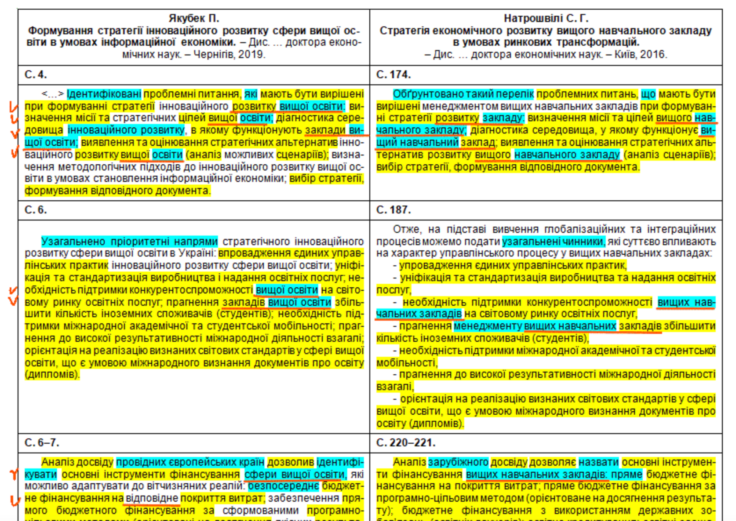
Here one should mention Petr Jakubek, a Doctor of Sciences in economics and a member of the governing board of DTI University (Dubnicky technologicky institut). In 2019, he received a Doctor of Sciences diploma after defending a dissertation at Chernihiv Technological University in Ukraine. As later became clear, a substantial part of Jakubek’s dissertation text coincides verbatim with the text of the dissertation of his opponent, Svetlana Natroshvili, defended in Kyiv in 2016. Below is an example of improper borrowing on one page of Jakubek’s dissertation.

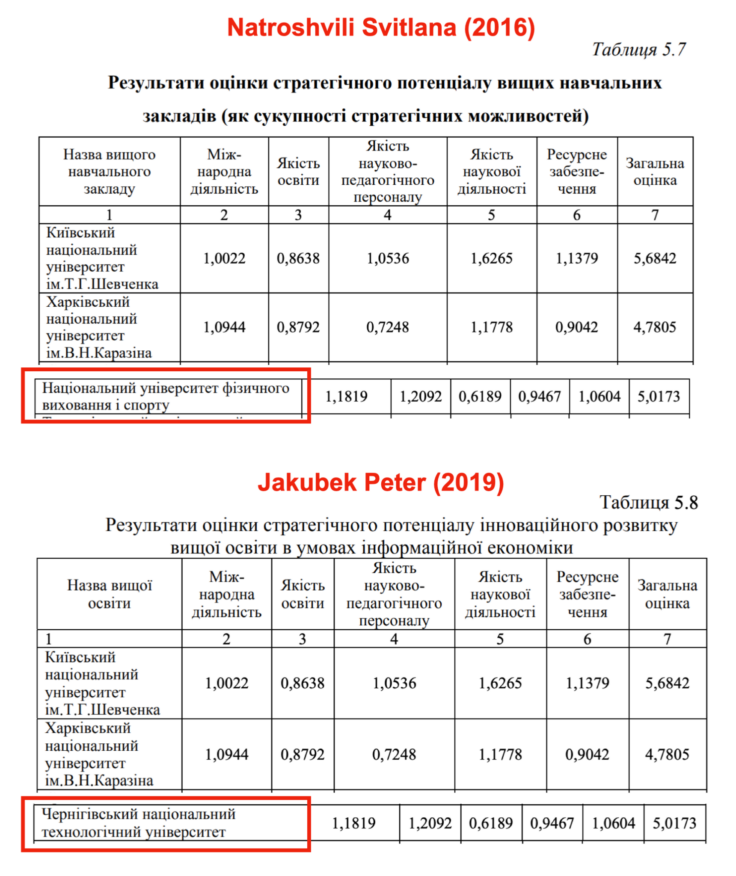
But the problem is not only the absence of citations: even if they had been present, they would not have resolved the issue. In the text, Jakubek mechanically replaced the National University of Physical Education and Sport of Ukraine, which appeared in Natroshvili’s work, with Chernihiv Technological University, while leaving all quantitative indicators unchanged.

The practice of defending a dissertation in another country and then having the diploma nostrified at home is widespread in Eastern Europe and across the post-Soviet space.
If dissertation plagiarism in Slovakia is at least partly documented and discussed by journalists, a much larger problem is developing outside public view. It is a system in which a scientific career can be built not on genuine research, but on purchased articles, fabricated data, and artificially inflated indicators.
In May 2026, the major academic online platform Research.com published lists of top researchers based on h-index and citation metrics. In the field of plant science and agronomy, Professor Marian Brestic, one of the highest-ranked Slovak researchers at the Slovak University of Agriculture in Nitra, placed 213th in the world. His colleague, Associate Professor Marek Zivcak, placed 1,511th globally, becoming Slovakia’s second-highest-ranked scientist in the field. As a result, the university took 253rd place worldwide in this scientific area and second place among the seven Slovak universities included in the ranking, losing the top national spot only to Comenius University in Bratislava.
Yet back in 2022, Leonid Schneider, an independent science journalist known for his high-profile investigations into academic ethics, devoted an entire section of his For Better Science issue to Brestic and Zivcak. By that time, these Slovak authors, together with colleagues from Middle Eastern countries, had accumulated nine papers with negative reviews on the post-publication peer review platform PubPeer, some of which had already been retracted. Schneider links this to the purchase of co-authorship on the Asian market — a shadow industry where authorship is sold as a commodity. In some of these publications, experts found distorted phrases and terms, or “tortured phrases”: a characteristic trace of machine paraphrasing used to conceal plagiarism. The image below shows one such example in the journal Microorganisms, on the left, alongside an earlier source text by other authors, on the right, from which the “paraphrase” was made.
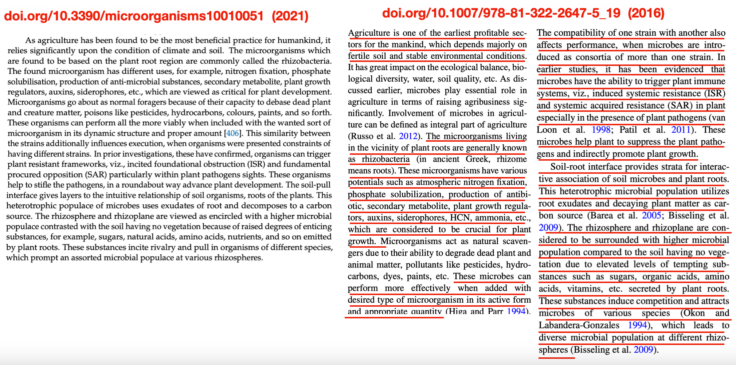
Since then, the number of problematic publications has grown. Today, PubPeer lists 34 publications by Professor Brestic with critical comments, some of them co-authored with Associate Professor Zivcak. The reasons for criticism, and in some cases for later retraction, included not only plagiarism or conflicts of interest, but also the substitution of authors at the final stage of publication, after all the reviewers’ questions had already been settled. Such substitutions are considered one of the characteristic signs of papers circulating on the purchased-authorship market.
These scandals, retractions, and exposés, however, have almost no effect on rankings. Even if all the disputed papers by Brestic and Zivcak are officially retracted, their citation counts and h-indexes will remain in the databases. These data are not recalculated retroactively after retractions. Formally, the scholars have already taken their places in the global tables, and no later revelations can dislodge them. A victory in the rankings obtained through paper mills and purchased citations formally remains a victory.
The mechanism of these rankings has a direct financial expression. Under the methodology of Slovakia’s Ministry of Education, every publication that falls within the top 1 percent of the world’s most cited papers automatically brings its author 3,000 euros from the state budget, and the same amount to the university. Thus, an artificially inflated citation index means not only a place in a prestigious ranking, but real money. In such a system, artificial citation inflation acquires a direct financial value: high bibliometric indicators affect not only academic status, but also the distribution of public funds. It is worth noting that Slovakia is not alone here: a similar system of monetary rewards for publications in high-ranking journals has long existed in Russia.
An equally telling case of image manipulation was documented in the work of an associate professor at Comenius University. In a joint 2024 publication in the journal Nano-Micro Letters, Dmitry Medvedev, a professor at Ural Federal University and Doctor of Chemical Sciences, and Martin Motola, an associate professor at Comenius University in Bratislava, together with co-authors from China, manually redrew the scale bar on images of nanoparticles obtained using a scanning electron microscope. The article claimed that the particles under study measured tens of nanometers. The microscope’s technical specifications, however, indicate that the real particle sizes were many times larger (see the image below).
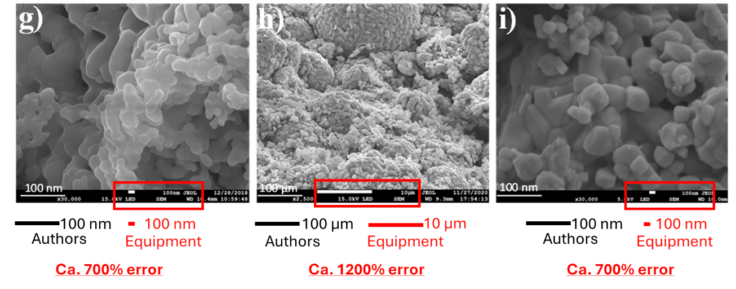
In other words, the scale in the images was simply adjusted to fit the desired result. But that was not the end of the matter. In the same article, experts on PubPeer raised well-founded concerns about other data as well, including graphs. This was not an isolated case: in recent years, experts have identified a whole series of Motola’s papers with problems in the data and in their graphical presentation. The regular appearance of such problems in Motola’s articles can hardly be attributed to simple inattention on the part of the authors.
Publications by scholars from Comenius University also contain direct borrowing of visual materials without references to the original source. A telling example is an article by Professor Peter Mikus and Veronika Mikusova on chitosan nanoparticles, in which some illustrations were copied from an earlier publication by Iranian authors.
In papers where experts identify gross violations of publication ethics, links to Asian paper mills can often be traced. These mills specialize in producing ready-made publications and then distributing them through online platforms.
On the shadow market of paper mills, authorship is not the only thing for sale. Another sought-after commodity is citations. References to one’s own work, like references to the work of others, have long since become a valuable asset. In June 2025, the editor of Chemical Engineering Journal retracted a publication by the aforementioned Associate Professor Motola and his university colleague Muhammad Hanif for artificial citation inflation. Between the original publication and the final version of the article, the number of references to Hanif’s work rose from 2 to 19, and references to Motola’s work from 2 to 10.
Current videos about science during the war, interviews, podcasts, and streams with prominent scholars are available on T-invariant’s YouTube channel. Become our subscriber!
Particular concern is raised by the rapidly spreading practice of publishing review articles under the names of fictitious scholars. The purpose of such works is to introduce numerous citations of articles by people who paid intermediaries on the shadow market for this service into the legitimate scientific record. Thus, the publication portfolio of Beata Gavurova, a professor at the Technical University of Kosice, has raised serious questions among the expert community. “More than 40 scientific articles a year — one every nine days — is a pace that defies rational explanation,” Leonid Schneider notes, following a journalistic investigation published by the Slovak online outlet Dennik N. According to him, dozens of Gavurova’s publications appeared in outlets deemed unreliable or predatory, and some of the journals in which she published have already been removed from scientific databases. At the same time, the researcher’s numerous co-authors represent various Asian countries, which, in the experts’ view, points to the purchase of authorship through networked paper mills.
According to Dennik N, up to one third of papers by Slovak scholars are published in dubious predatory journals.
Yet the external signs of questionable publication behavior are only part of the problem. Gavurova’s own papers contain inconsistencies between the text and graphical data, problems with chemical formulas, and dubious spectra with signals of unnatural shape. Some of these articles have received retracted status.
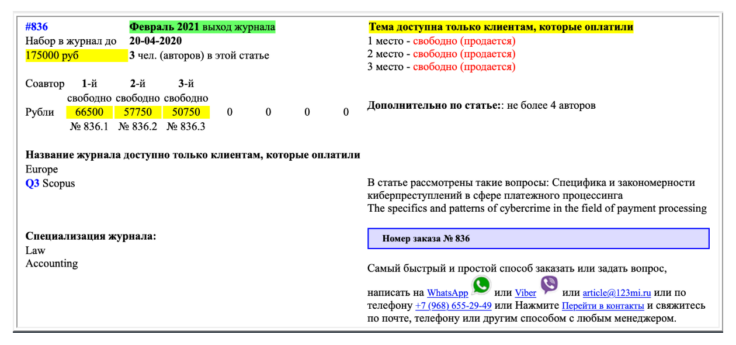
The next case provides direct evidence of purchased authorship in publications distributed by paper mills. Earlier, the Dissernet community drew attention to the interaction of Slovak researchers with a Moscow company that provided article placement services. A telling example is the case of Boris Sturc, an associate professor at the University of Economics and Business: a preliminary offer posted by this exchange was first documented (see the image below), and later a paper with the title listed in the offer appeared in the International Journal of Criminology and Sociology, with Sturc as first co-author. Analysis shows that this was not a one-off: Sturc’s publication list includes other commercially acquired works as well.
Over time, the shadow academic industry is transforming: centralized exchanges selling papers appear to be losing influence. Their place is being taken by decentralized private intermediaries — individual entrepreneurs, or “paper millers.” Technological progress is helping this shift along: modern AI tools make it possible to fabricate scientific texts in the shortest possible time, without involving large teams of specialists from different fields of science. Offers from “paper millers” are easy to find in open internet channels. Traces of this market can also be found in the publications of Slovak researchers. Below are specific episodes involving Slovak scholars in joint publications offered by “paper millers” from Germany, Ukraine, Montenegro, and Middle Eastern countries.
“Olga Golubnitschaja is the editor-in-chief of EPMA, the European Journal of Predictive, Preventive and Personalized Medicine, and at the same time a co-author of many articles in that journal, which is normal. What is surprising, however, is that for many articles in which she is a co-author, very little time passes between submission and acceptance. In some cases it is only a matter of three to five days. Below are several examples from the past year,” says a review of one article involving her. Such short timelines raise the question of whether full scientific peer review was possible — a process that usually includes selecting independent experts, preparing comments, revising the manuscript by the authors, and reassessing the changes made. Olga Golubnitschaja, a professor at the University of Bonn, often appears as a co-author of problematic papers by Russian and Slovak scholars; some of these works later became the subject of criticism for violations of publication norms.
An expert review of a joint article by authors from Slovakia and Ukraine revealed repeated sections in experimental spectra. Among the co-authors of the article, one figure stands out: Taras Kavetsky, an associate professor at Drohobych Pedagogical University in Ukraine, who was found to have used identical schemes of spectral-data fabrication in other scientific works as well.
[[socialnetworks]]
Stanislav Dudic, a Doctor of Sciences at Comenius University and a specialist in international economics, industrial engineering, trade, and investment, appeared as a co-author of a publication that raised serious questions. The paper, written together with the Montenegrin co-author Velibor Spalevic, concerned a modified copper-containing metal-organic framework, and experts detected signs of artificial modification of experimental data. It is worth noting that a number of works by Spalevic himself, a professor at the University of Montenegro, have also been criticized on the PubPeer forum.
Professor Natalia Krivinska, head of the Department of Information Systems at the Faculty of Management of Comenius University, is a vivid example of how formal co-authorship with dubious partners can undermine trust in a scholar. Her article on combating DDoS attacks, prepared in co-authorship with Saudi colleagues through machine paraphrasing, was retracted. But Professor Krivinska’s problems are not limited to a single publication: in her works, experts have found a whole bouquet of tortured phrases, bibliographies unrelated to the subject of the paper, and even direct borrowing of illustrations, all of which calls into question the quality of her entire academic record.
Another case of questionable scientific practice involves the Institute of Construction and Architecture of the Slovak Academy of Sciences. Its employees, Professor Martin T. Palou and Associate Professor Taher Tawfik, were listed among the co-authors of an international paper with Egyptian and Iraqi colleagues, but a review showed that the images presented in the article had undergone impermissible processing, casting doubt on the reliability of the entire work.
The overwhelming majority of the episodes listed above led to no sanctions against the authors. Journalistic investigations and the volunteer work of experts on PubPeer help reveal problem after problem, but real institutional consequences in Slovakia’s academic sphere are barely visible. Retractions do not affect citation indices, and the law allowing academic degrees to be revoked for plagiarism does not apply to works defended before it came into force. As a result, buyers of authorship keep their positions in rankings and universities.
This is the central paradox. Under the Ministry of Education’s methodology, universities receive 50 percent of the state bonus for each highly ranked publication. This means that, in the race for rankings, the universities themselves become interested parties: the more “outstanding” publications their employees have — even if they were bought on the shadow market — the more public funding the university receives.
At the same time, Slovakia’s system of state funding for science, which generously rewards publications in top-percentile journals, effectively creates a “green corridor” for the shadow market. Cash payments to an author for an article they purchased on the shadow market are resources stolen from science. Public funds intended to develop research instead flow into the pockets of shadow intermediaries.
As long as the academic system continues to measure the quality of science primarily by the number of publications and citations, paper mills will be able to turn manipulation of these indicators into academic status and real money. In the age of AI, when producing texts that look scientific is becoming ever cheaper, the problem of how to evaluate scientific work is only becoming more acute.
The post Ratings for Money: How Slovakia Rewards Scientific Fraud appeared first on Т-инвариант / T-invariant.

Estonian Academic Solitaire: How AI and Paper Mills Are Undermining Science
Estonia spent years building a reputation as being at the forefront of science, but scandals involving violations of research ethics are becoming increasingly common. Professors sharing authorship with falsifiers; associate professors hiding data behind a “confidential” label; mathematicians publishing “math salad” — all of this reflects today’s challenges: the spread of paper mills and the uncontrolled adoption of AI. Sociologists found that more than 40 percent of Estonian researchers had used “gift” authorship. More in the latest installment of the Plagiat-Navigator project.
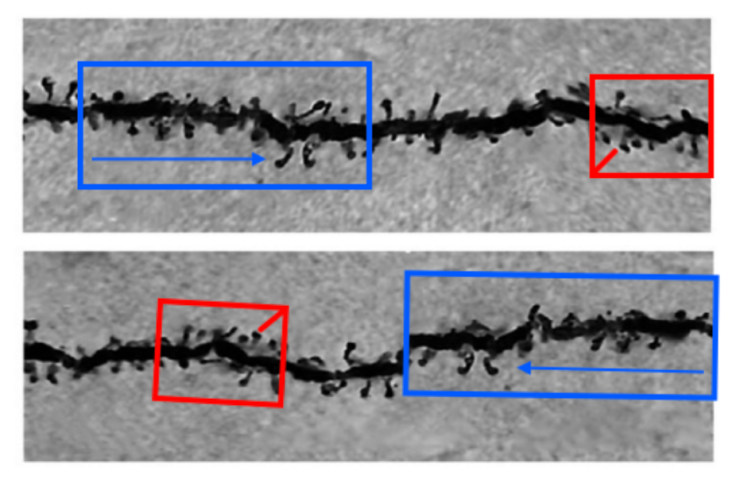
In February 2024, the prestigious scientific journal Nature published the article WNT signalling control by KDM5C during development affects cognition. The researchers were trying to understand why mutations in the KDM5C gene cause intellectual disability. The author team brought together researchers from Boston, Oxford, and universities in Australia and China, along with a single Estonian representative from the University of Tartu — Professor Katrin Ounap, a specialist in medical genetics. A year after publication, experts found multiple deliberate manipulations of illustrations in the paper. The figure below shows the same fragments of nerve-cell processes, or dendrites, reused after mirror reflection, 180-degree rotation, and partial retouching. “Such different transformations of individual image fragments are difficult to explain as a simple mistake,” one expert commented. Some images in the paper also bear a striking resemblance to images from earlier publications by other authors.

It turned out that a group of co-authors from Harvard Medical School in Boston, led by Professor Yang Shi, had been using similar methods for at least a decade. In a paper published in early 2016, fragments of dendrite images were likewise copied from another publication and modified through mirroring and scaling.
Professor Ounap’s contribution to the Nature paper was clinical: she provided fibroblast samples from patients. Her co-authorship with the Boston group, however, dates back to 2015. This does not prove that she knew about the falsifications, but in academia co-authorship entails responsibility for the entire content of a paper. The argument that the professor merely supplied biological material does not absolve her of responsibility for the final result fabricated by her colleagues.
While investigations into international publications can drag on for years, within Estonia’s national system universities sometimes demonstrate an ability to act quickly and decisively. The following case is a telling example. In 2013, Andres Menind, an associate professor at the Estonian University of Life Sciences, defended a dissertation on biotechnology for energy production. Soon after the defense, it emerged that the work contained at least three lengthy plagiarized passages, in both the theoretical and research sections. A procedure to revoke his academic degree followed. It was the first case of its kind in the university’s history. The university leadership acted promptly, without delays or bureaucratic evasions. The university did not publish a percentage of textual overlap, stressing that the decision was based on expert assessment of the nature and significance of the borrowings rather than on a formal similarity score exceeding some arbitrary threshold.
The main news about the lives of scholars during the war, videos, and infographics are available on T-invariant’s Telegram channel. Subscribe so you don’t miss anything.
But Estonia’s academic immune system does not always work. In 2002, Valery Korb defended a doctoral dissertation in St. Petersburg that had been copied in its entirety from an earlier work by someone else. Today, the Estonian politician Valery Korb is a member of the supervisory board of Ida-Viru Central Hospital in Kohtla-Jarve. All attempts to strip him of his academic degree have come to nothing.
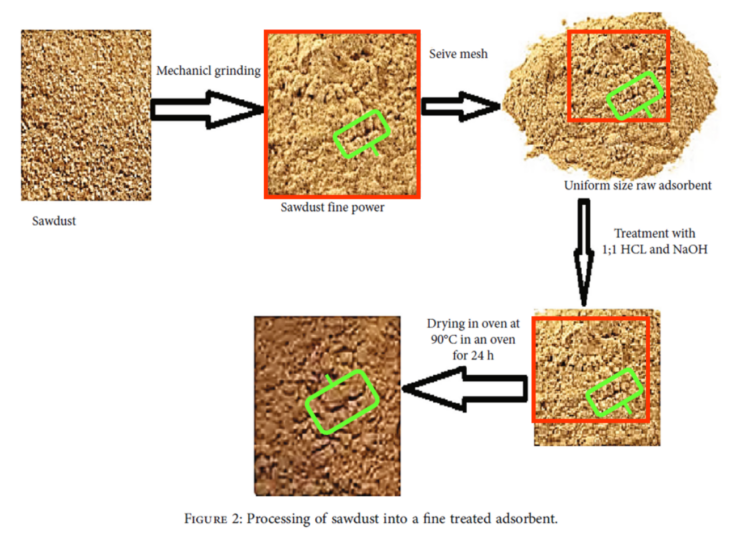
Manipulation of images in scientific publications often ends in retraction — the formal withdrawal of a paper by a journal. The process is usually slow and can take years. The Nature paper remains under question, but a 2022 publication in Adsorption Science & Technology has already been officially retracted. Its authors included researchers from Ethiopia, Pakistan, and Saudi Arabia, as well as an Estonian representative, the young University of Tartu scientist Ivar Zekker. The illustration below shows how the same image was used repeatedly, with only its scale, color, and placement changed.

That paper was retracted, as was another publication by Zekker, for serious violations of publication ethics, including nonexistent bibliographic references, unattributed borrowing, and the use of artificial-intelligence tools in preparing the article without disclosing that use, in violation of the journal’s editorial policy. These are not isolated episodes: experts have accumulated concerns about a whole series of Zekker’s papers. In 2021, his publication output increased by dozens of times, while researchers from Middle Eastern countries began appearing among his co-authors with increasing frequency. This pattern often points to the use of paper mills — shadow Asian markets where ready-made papers and fictitious co-authorship are sold.
[[socialnetworks]]
In 2023, the University of Tartu conducted and later published an anonymous survey of 354 Estonian researchers. Among other things, they were asked whether they had observed signs of research misconduct in the actions of colleagues. More than 40 percent of respondents said that colleagues had accepted “gift” authorship, while more than 10 percent had witnessed colleagues falsifying data in scientific work. These figures reflect not so much precise statistics as the troubling environment in which Estonian researchers work today.
The University of Tartu is far from the only Estonian research institution where questions have arisen about the reliability of published images. One of the most prominent figures in such cases is Sabarathinam Shanmugam, an associate professor at the Estonian University of Life Sciences. According to the post-publication peer review platform PubPeer, roughly one in five papers involving him has become the subject of critical discussion.
One publication by Shanmugam is especially revealing. Experts found manipulation of figures in the paper. After concerns were raised, the authors replaced the illustrations several times, each time apologizing and attributing what had happened to an “unfortunate mistake.” Yet every new version again contained signs of manipulation. Eventually the exchange reached a dead end: the authors never provided convincing explanations, and discussion of the apparent fakes simply faded away. In a later paper, Shanmugam and his co-authors chose a different defense strategy, stating: The data that has been used are confidential. That position effectively deprived independent researchers of any opportunity to verify the reported results.
The story does not end there. A number of Shanmugam’s publications were later retracted after journal editors discovered that the author list had been replaced at the final stage of preparing the papers for publication. Such author substitution is considered one of the characteristic signs of papers circulating on the purchased-authorship market. While one set of “dealers” pushes a manuscript through the journal with a credible author list, another takes orders from people wishing to buy co-authorship in the almost-published paper. At the final stage, once all reviewers’ questions have been resolved, comes the climax: in the last version of the manuscript, the names of the original authors are quietly replaced, without the editors’ approval, by those who responded to the offer in time and paid. The editor, unaware of the switch, publishes the paper. The newly minted co-authors receive a publication to which they did not contribute a single line and which they most likely never even read.
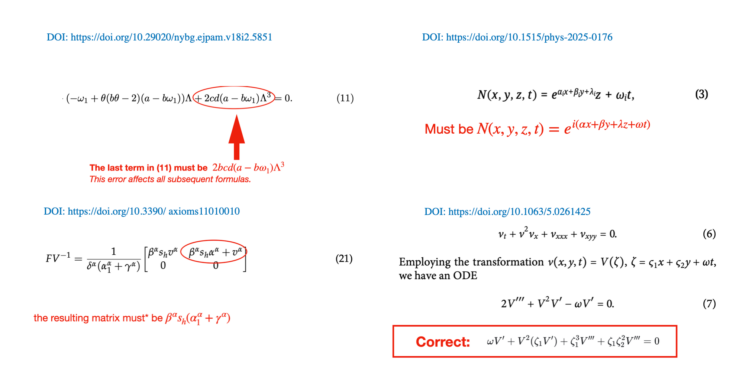
Finally, Tallinn University and one of its employees, mathematics professor Jorge Eduardo Macias-Diaz, also deserve attention. In recent years, specialists have increasingly encountered papers prepared with generative artificial intelligence. In mathematics, such publications are often betrayed less by stylistic roughness than by gross errors in formulas and proofs. To a non-specialist, the text may look entirely convincing, yet mistakes already appear in the first stages of the calculations, rendering everything that follows meaningless.
Mathematics is an exact science. If the third line of a calculation contains the wrong sign, the final ten pages lose all meaning, no matter how many formulas they contain. The image below shows examples from four relatively recent papers by Macias-Diaz in which such errors appear literally in the opening lines of calculations or theorem proofs.

“Math salad” is the term specialists use for texts that look scientific on the surface because they contain an abundance of formulas and technical terminology, but on closer inspection turn out to be internally contradictory or contain errors that make their conclusions unreliable. Naturally, artificial intelligence is “to blame” for everything: the author simply gave the neural network a task and then copied the result into the paper without even checking it.
A curious manifestation of this practice emerged in a case that went far beyond university offices. Tallinn Administrative Court fined a group of plaintiffs who had cited “authoritative scientific studies” on the harms of clear-cutting in their filings. There was only one problem: both the studies and their authors had been entirely generated by a neural network. The court treated this as fabrication of evidence and fined the plaintiffs.
To conclude, here is a curious case in which nonexistent Estonian researchers appeared not only in materials before a Tallinn court, but also on the pages of scientific journals. In a paper by Chinese authors on estimating fuel-cell parameters using the metaphor-based “Grey Wolf” optimization algorithm, a co-author from Tallinn University of Technology suddenly appeared: Tekle Demsas. Apparently, adding a mysterious Estonian scientist to the author list was meant to give the paper greater weight. The deception did not last long. After checking the author’s credentials, the editors established that no such researcher actually existed. The paper was then retracted.
Current videos about science during the war, interviews, podcasts, and streams with prominent scholars are available on T-invariant’s YouTube channel. Become our subscriber!
Estonia, which spent years building a reputation as being at the forefront of science, is now confronting the underside of the global crisis in academic ethics. The cases involving Ounap, Zekker, Shanmugam, and Macias-Diaz are not merely isolated scandals, but reflections of today’s challenges: the spread of paper mills, the ethics of co-authorship, and the uncontrolled adoption of AI. The results of the University of Tartu survey show that these problems are systemic.
The central problem for Estonian science is not that violations occur, but how institutions respond to them. Universities often prefer to look the other way, outsourcing the role of “academic police” to journal editors, courts, and volunteers on PubPeer. In the twenty-first century, a reputation as a scientific center can no longer be taken for granted. Maintaining zero tolerance for falsification requires daily work. And the sooner Estonian universities recognize that responsibility, the fewer reasons for sarcasm they will leave to those watching them.
The post Estonian Academic Solitaire: How AI and Paper Mills Are Undermining Science appeared first on Т-инвариант / T-invariant.
Can the Conflict Between Türkiye and Israel Lead to the Fall of NATO?
Fyodor Lukyanov: Here’s Why It’s Hard for Witkoff and Kushner to Close the Russia-Ukraine Deal
Diplomatic efforts to end an acute and bloody armed conflict should always be welcomed and the persistence of Donald Trump’s administration, which has pursued this goal for more than a year and a half, also deserves recognition, even if the results so far can hardly be called outstanding.
At the very least, the White House remains the only actor in the West both attempting to change the situation and possessing significant leverage over it. Trump and his closest associates probably do genuinely want the war to end as its continuation distracts Washington from foreign policy priorities they regard as more important. But why, then, does Trump’s diplomatic initiative keep going round in circles, with each new attempt ending in another disappointment?
Given the professional backgrounds of the president and his two principal intermediaries, Steve Witkoff and Jared Kushner, this is hardly surprising.
Such an approach can be useful as an instrument, but it becomes less useful when it substitutes for an understanding of the processes that produced the conflict in the first place and, to use the Russian formulation, its root causes. Any durable settlement requires some understanding of what must change in relations between the major powers if similar confrontations are to be avoided.
Trump repeatedly insists that the war would never have begun had he been president in 2022 with the implication that Joe Biden and the Democrats were simply too incompetent to prevent it. Trump has occasionally acknowledged that NATO’s long expansion eastward contributed to the crisis, but he generally shows little interest in the broader military and political processes behind it.
Yet American and NATO policy towards Ukraine wasn’t created by one administration or a handful of officials in Washington and Brussels, rather it developed over decades from a particular conception of Western strategic interests. The crisis that entered its most acute phase in 2022 was, from Moscow’s perspective, the culmination of processes underway since the end of the Cold War.
This helps explain why Washington continues to underestimate how much the outcome matters to the principal participants. For both Russia and Ukraine, too much is at stake for the conflict to be settled through the kind of transaction Trump instinctively favors, given their interests are obviously opposed, but both regard the outcome as fateful.
Western Europe, having invested heavily in Ukraine’s cause, also has a direct political stake in the result, so every new attempt by Washington’s two brokers therefore encounters the same obstacle in that none of the parties sees this as simply another deal.
There’s another contradiction in the American position because Washington wishes to become the principal mediator in a conflict whose continuation it has materially supported.The US position has certainly changed under Trump as Washington’s previous fixation on Ukraine has diminished considerably. Trump would prefer America to step back while retaining decisive influence over what happens next, but that is precisely where the difficulty begins.
Transferring the financial burden, political responsibility and risks to the Western Europeans while continuing to dictate the terms requires a degree of obedience from junior partners that Washington can no longer guarantee. EU governments and Kiev have also learnt how to deal with this unconventional president and when they can’t persuade him, they have become increasingly adept at circumventing his pressure.
He may care less than his predecessor about the precise shape of the eventual settlement, but a complete Ukrainian defeat would be another matter. Nor would abandoning Ukraine enjoy much support across the American political establishment, where there is virtually no constituency for a fundamental rapprochement with Russia.
The White House therefore doesn’t envisage the radical change in American policy that would be necessary to transform the conflict, but without one, events tend to return to their previous course as a prolonged and extremely fierce confrontation whose duration nobody can confidently predict.
In such a confrontation, those fighting the war and bearing its risks ultimately matter more than mediators or outside sponsors. None of this means Witkoff and Kushner’s shuttle diplomacy is pointless, given communication between adversaries is indispensable, and the present infrastructure for official dialogue remains inadequate. Also, informal channels can help restore understanding where formal diplomacy has broken down, but informal diplomacy has limits.
Friends and business associates may establish contacts and discover areas in which compromise is conceivable, but they don’t themselves make peace. The shuttle diplomacy of a presidential son-in-law and a trusted business partner may eventually serve as a catalyst for serious negotiations, however, if that moment comes, the settlement will have to be negotiated by officials and institutions possessing state legitimacy and the power to implement what they sign. Personal connections can open the door, but they can’t, by themselves, end a war.
This article was first published by Rossiyskaya Gazeta, and was translated and edited by the RT team.