❌

Reading view

In the Land of the Conspiracy Deniers

In the Land of the Conspiracy Deniers

TapNewsWire.com |  Pete Fairhurst

LewRockwell.com

Donald Jeffries | I Protest |donaldjeffries.substack.com

The 25th anniversary of 9/11 has really brought out the trolls. I don’t know how many of them are paid, but X has been invaded by illogic, as an army of shills attempts lamely to prop up one of their most important lies. It’s the same insidious hivemind mentality that insists we ignore every giant cultural elephant destroying the room.

In the Land of the Conspiracy Deniers

In September, 1976, as a result of the new Freedom of Information Act, a revealing April 1, 1967 CIA memo was released, titled “Countering Criticism of the Warren Report.” April 1? Was this one of their inside jokes? At any rate, the memo begins by stating “Our concern,” which revolves around the majority of the public disbelieving the ridiculous conclusions of the Warren Commission. Now why would the CIA be “concerned” about people failing to accept the government’s conclusions? A key passage notes: “Just because of the standing of the Commissioners, efforts to impugn their rectitude and wisdom tend to cast doubt on the whole leadership of American society.” Bingo, as my wife might say. This is the crux of the biscuit, and why “conspiracy theorists” are continuously demonized. Thought Criminals like me do indeed seek to “cast doubt on the whole leadership of American society.” They whine about allegations that Oswald worked for the Agency. He did. He had a 201 file.

In the section headlined “Action,” the CIA helpfully advises that the subject of the assassination not be brought up. You know, like a young Don Jeffries was doing at every possible public gathering. In a tip of the hat to Operation Mockingbird, the Agency suggests that Conspiracy Deniers “discuss the publicity problem with liaison and friendly elite contacts (especially politicians and editors), pointing out that the Warren Commission made as thorough an investigation as humanly possible, that the charges of the critics are without serious foundation…Urge them to use their influence to discourage unfounded and irresponsible speculation. To employ propaganda assets to answer and refute the attacks of the critics. Book reviews and feature articles are particularly appropriate for this purpose…” We’d have to update the language here. Circa 2026, this would mean employing propaganda assets on late night talk shows, comedians, and social media “influencers” with lots of followers.

The sentiments there are universal, and apply to everything in the same sphere as the assassination. I’m culturally appropriating “Denier” from them. The majority of our fellow human beings are Conspiracy Deniers. This means essentially that they are capable of denying their own senses. As Winston Smith told us in 1984, “The party told you to reject the evidence of your eyes and ears. It was their final, most essential command.” That is exactly what these Conspiracy Deniers are doing every day. Rejecting the evidence of their eyes and ears. From denying the racial reality of ghetto culture, and the wildly disproportionate power of the non-Irish, to swallowing every incredibly stupid and impossible theory from single-bullet to trickle-down. From saluting a flag that now stands for foreign misbehavior and a domestic police state, to trudging to the polls, in rain, or sleet, or snow, to vote for the worst people on earth to not represent them. Voting harder. Mistaken at the top of their lungs.

Although the ones we’re saddled with today are especially obtuse and unreasoning, they’ve always comprised most of the public. Orwell again characterized them perfectly with his sheep in Animal Farm. That’s another term we owe Orwell for. The Sheeple. They’re the unwitting, unthinking army of the conspirators. They refused to join the courageous Daniel Shays just after our War for Independence, when he started a rebellion over the mistreatment, and nonpayment of colonial soldiers. They were the ones reporting their neighbors to Lincoln’s goons during the War Between the States, resulting in them being thrown into makeshift prisons, without any due process. They bought all the false flags, from “Remember the Maine” to “Remember Pearl Harbor,” and their voices were always the loudest. They cheered on the Gulf War, in defense of a tiny oligarchy (Kuwait) none of them had even heard of before. They didn’t care that the government killed the Branch Davidians. They were “crazy.”

In the Land of the Conspiracy Deniers

As you can see by the illustration above, we are still vastly outnumbered. The fact that this source claims only 47 percent of Americans believe JFK was killed by a conspiracy is astounding. It may be just one of their countless lies, but there is at least some truth in it. In the 1970s, polls showed close to 90 percent of people believed in a JFK conspiracy. Only 19 percent believe in chemtrails? Are they refusing to look up at the sky? Only 23 percent think 9/11 was an Inside Job? If these numbers are remotely accurate, then we have an even more monumental task in front of us. With an increasing reliance on the internet, and not the state controlled television networks, for news and information, how can it be possible that so many continue to be Conspiracy Deniers? Just how obvious do the conspiracies have to be? The coverups are purposefully transparent; they want you to know. They enjoy toying with us. And yet, no matter how obvious they make it, the masses absolutely refuse to think.

When DC Madam Deborah Jeane Palfrey’s little black book of important political persons was revealed, she went on Alex Jones and publicly proclaimed she would never kill herself. And then she was found hanged. The Conspiracy Deniers believed she took her own life. Virginia Giuffre said the same thing. You know, the girl who was ignored by everyone for years, and then suddenly became a martyr for the ones who survived being trafficked by Jeffrey Epstein. The Conspiracy Deniers don’t think she was murdered, either. They don’t think anyone connected to anything politically significant has ever been murdered. As the authorities always quickly determine, “no evidence of foul play.” John Hinckley shot Reagan to impress underage nymphet Jodie Foster. Tyler Robinson shot Charlie Kirk because he was a transgender in love. Or was it a “Furry” in love? They really don’t even need the “friendly assets” the CIA talked about in 1967. The Conspiracy Deniers handle things perfectly fine on their own.

Most of you have heard me talk about the overriding narrative that rules us; the conspiracy to deny any significance, any spiritual reason for our existence. A conspiracy against the supernatural. A conspiracy against God. They push randomness relentlessly. We are just a mere speck, on a slightly larger speck, in an endless universe. Black Holes. Quasars. Primordial soup. Lots of empty “scientific” mumbo jumbo, which somehow impresses the Conspiracy Deniers. Just don’t mention miracles. Or morality. Or eternal redemption. Or utter the name Jesus Christ, unless it’s in vain and you’re not a believer. Then it’s really, really cool. But worship Einstein all you want. A half illiterate who never learned to tie his shoes. But a non-Irish icon. Ask a real genius, Nikola Tesla, what he thought of him. The Conspiracy Deniers have no problem with the missing Tesla files, confiscated by Donald Trump’s uncle for the government. Sure, many of them have TDS themselves, but that is irrelevant.

Some “conspiracy theories” are absurd. The Black “community” believes in many of them. They have basically nailed the larger truth that our leaders are at war with us, but they think they’re only at war with Black people. They believe that random “White Supremacists” are kidnapping random Blacks off the streets and lynching them. And that the police are involved in covering this up. Now, the police are usually involved in covering up something, most frequently the actions of their out of control officers. But no one is lynching Blacks. No one is even lynching Thought Criminals, as far as I know. They knock some of us off, every so often, just as a reminder. I also confess to being confused by the Mandela Effect thing. Some Millennials contend that Nelson Mandela actually died before he did, and this somehow has resulted in other “truths” being changed. Like the Berenstain Bears books, for example. I don’t pretend to understand. But then again, I don’t think Mandela was any kind of hero, either.

In the Land of the Conspiracy Deniers

It’s always been easier to just call names. Debate is difficult, especially when you have no facts on your side. This is the dilemma the average Conspiracy Denier must deal with. So they scoff at us “nut jobs.” Or “wackos.” Or their favorite, “retards.” During the COVID psyop, “dangerous” became a popular term of derision. Lots of people called me that. The more conventionally educated ones will fall back upon appeals to authority. They will invariably mention the “someone would have talked” nonsense. “Do you now how many people would have had to be involved” in faking the moon landing, or covering up 9/11? “You can’t keep a secret in Washington, D.C.” is another chestnut. Actually, D.C. is full of secrets, official and otherwise. Every still classified JFK assassination document attests to that. The redactions on every begrudgingly released file attests to that. All the dead whistleblowers, who were obviously “talking,” attest to that. Someone has always talked, but they’ve been murdered or ignored.

Russia! Russia! Russia! China! China! China! Islam did it! The sheep in Animal Farm chanted “Four legs good, two legs better.” They bleated out the naysayers. The critical thinkers. That’s what our Sheeple do. They chant “USA! USA!” to drown out any discouraging words. Maybe they’ll break into an impromptu version of Proud to be an American or Lift Every Voice and Sing, the so-called Black national anthem, depending upon the crowd. They both serve the same purpose. Where ignorance is bliss, ‘tis folly to be wise. Trumpenstein is now promising a $5,000 check to every American if the Republicans win the midterm elections. Only his cult believes he will actually do this. There are Conspiracy Deniers on the Left, and an increasing number on the Right as well. These would be the ones cheering on Trumpenstein’s dismissal of the Epstein Files as a “Democrat hoax.” The files that reveal our illustrious leaders are in fact barbaric cannibals. Try trotting that one out at a party in front of Conspiracy Deniers.

To be a Conspiracy Denier, you have to endure political speeches. All political speeches. And consider that the empty rhetoric about “getting the country moving,” or “making it great” is innocent, standard political boiler plate. Which we should accept with a shrug and a smile. Sure, they never keep their promises. Sure, they never do anything which helps those who actually need help. Sure, they serve AIPAC and other shadowy special interests. Sure, you “can’t vote them out.” And besides, every one either party picks to run is the same. Never independent. Never principled. Always pro-Zionist. And always anti-”conspiracy theories.” Where’s the randomness of at least one honest leader every few decades or so? Because there’s no conspiracy to stop them, right? Wouldn’t the law of averages dictate that once in a while, we’d have someone in power who actually wanted to do good things? But we’ve accepted that, on those rare occasions, they simply eliminate the Huey Longs and John F. Kennedys.

Conspiracy Deniers believe that the Air Force “mistakenly” identified a weather balloon as a “Flying Saucer” at Roswell. They believe the Dallas deputies who found a rifle on the sixth floor of the Texas School Book Depository on November 22, 1963 both “mistakenly” misidentified it as a German Mauser. They believe the BATF had to launch a massive raid on the Branch Davidians, when they could have confronted leader David Koresh at any time in a local store. They believe all those witnesses- every one who identified Timothy McVeigh- was “mistaken” about him being in the company of “John Doe #2” in Oklahoma City. They believe that it was a coincidence that dictionaries changed the definition of “vaccine” in the wake of the warp speed vax that didn’t prevent “COVID.” They think millions died from this phantom disease, but no one died from the deadly vaccine. They believe JFK, Jr. and all the other dead Kennedys were “reckless.” They believe the people “won” when Nixon resigned.

In the Land of the Conspiracy Deniers

I often feel like the little boy in the old fairy tale, who is the only one willing to point out that the emperor is wearing no clothes. We often forget that, like all whistleblowers and truthtellers, he was overruled by the crowd, who continued to ignore that the emperor was naked. Those of us who are trying to awaken the Conspiracy Deniers have to understand that we’re fighting centuries of “normie” conditioning. Especially for the last 100 years or so, we’re competing with intense propaganda the likes of which the world has never seen. Security cameras, which are everywhere, always malfunctioning whenever something important happens. Or allegedly happens, because an increasing number of doubters believe it’s all fake and scripted. Cell phone cameras, which oddly are never deployed during mass shootings, or supposed “anti-Semitic” behavior. You have your “Holocaust Deniers.” Your “COVID Deniers.” Your “Climate Change Deniers.” Your “Election Deniers.”

Well, I can have my Conspiracy Deniers. I don’t care if someone calls me a “conspiracy theorist.” Sticks and stones, and all that. But I have no “theory.” Building 7 isn’t a “theory.” The massive disparity of wealth isn’t a “theory.” No one in the Deep State being prosecuted isn’t a “theory.” The disclosures from the very limited DOGE program weren’t a “theory.” There is massive waste, fraud and abuse in our government. And those who run the government, the business world, and society at large are massively corrupt criminals. We’ve been vindicated, although they won’t admit it. Our friends owe us an apology. Our family members own us an apology. The world owes us an apology. Most humans can’t apologize, however. They’re too proud. In this case, an apology would mean they were wrong to trust those in charge. Wrong to ridicule and sneer at those who tried to enlighten them. To paraphrase the syrupy sentiment from Love Story: slavery means never having to say you’re sorry.


Source: https://donaldjeffries.substack.com/p/in-the-land-of-the-conspiracy-deniers

Source: https://www.lewrockwell.com/2026/09/no_author/in-the-land-of-the-conspiracy-deniers/

Original Article: https://tapnewswire.com/2026/09/16/in-the-land-of-the-conspiracy-deniers/

Related:

Anti-Conspiracy Fanatics | Psychologically Brainwashed Wards of the State
Gary D. Barnett | garydbarnett.com “People conspire, that’s not a theory.” ~ Michael Palmero Never has such an asinine term had such an impact against truth as the use of the thought-destroying phrase “conspiracy theory.” While bought and paid for Statist ‘fact-checkers’ would attempt to hold harmless the
  •  

Putin Releases 7,000 Page Dossier Exposing AI ‘False Flag’ To Depopulate World to 1 Million People

Putin just dropped a 7,000-page bombshell. A classified report so explosive it’s already rocking the Kremlin. It reveals the global elite—Big Tech, the WEF, globalist billionaires, Israel and their allies—are racing to depopulate the planet [...]

The post Putin Releases 7,000 Page Dossier Exposing AI ‘False Flag’ To Depopulate World to 1 Million People appeared first on The People's Voice.

  •  

Saudi Arabia is Exporting ZERO Oil as U.S. Sends Unprecedented Amount of 2,000-pound Bombs to Israel

Background image from CBS News. BRICS 2026 Image Source.

by Brian Shilhavy
Health Impact News

As I reported earlier this week, the Yemen takeover of the Red Sea has changed everything in the Middle East, and things are moving fast now.

CBS News published photos of destroyed U.S. bases in the Middle East yesterday for the first time since the Iran War started, claiming that the photos were sent to them by “active service members on condition of anonymity.”

New photos obtained exclusively by CBS News reveal for the first time the widespread damage and destruction of buildings and vehicles at multiple U.S. positions across the Middle East, as a result of Iranian missile and drone attacks.

The images were sent to CBS News by active service members on condition of anonymity because of rigid media restrictions within the military.

“This is major damage to our bases that hasn’t been communicated to the American public,” one deployed service member told CBS News.

“We’re standing there with our eyes closed getting punched in the face.”

One photo, taken at Prince Sultan Air Force Base in Saudi Arabia, shows a direct hit on the back half of a Boeing E-3 Sentry four-engine aircraft, its tail severed from the charred fuselage that also supported a rotating radar that is essential for collecting midair intelligence.

Similarly grim pictures were captured at Camp Buehring in Kuwait, a major staging area for U.S. Army ground troops, armored vehicles and some aircraft; the post is located in a remote desert region far northwest of Kuwait City.

The Defense Department’s inspector general this week released a fresh report on the war in Iran that revealed “equipment losses” worth up to $3.7 billion — including nearly 60 aircraft.

In a first-of-its-kind mandatory report to Congress, the inspector general added that U.S. Central Command reported Iranian strikes at U.S. bases in Kuwait, Bahrain, Qatar, UAE, Saudi Arabia, Iraq, Oman and Jordan.

“These are not ‘squirters’ getting through,” the service member added, referencing language used by Defense Secretary Pete Hegseth after the deadly March 1 attack on Port of Shuaiba in Kuwait that killed six U.S. troops.

“We’re not defending these bases. We’re just watching them get destroyed.”

Full article.

As I write this on September 16, 2026, Saudi Arabia is currently exporting ZERO oil. This is the country with the largest oil company in the world, Aramco, which was started by the United States and today employs tens of thousands of Americans in Saudi Arabia.

There were reports earlier this week that Saudi Arabia’s leader, Mohammed bin Salman (MBS), was under house arrest, but he appeared in public yesterday in a state visit to Egypt, dispelling those rumors.

But that doesn’t mean that there is not currently chaos in the Royal Al-Saud family, and even the possibility that the Al-Saud family could be in danger of being able to hold on to its power in Saudi Arabia. The original name of this area was just “Arabia”, and included what is today called “Yemen.”

Here is a short interview with international journalist Pepe Escobar that was published just before MBS appeared in public in Egypt yesterday, explaining how damaging the Yemen takeover of the Red Sea has been to Saudi Arabia.

Here is another good 20-minute interview with Professor Mohammad Marandi from inside Iran, discussing the question: Is Saudi Arabia Heading for Collapse?

Pepe Escobar has also published a couple of articles on the Yemen situation, but as of this writing I have only found one in German, and one in Spanish, but nothing in English yet.

Here are some excerpts from the Spanish and German articles that were translated online.

Yemen Shakes the Gate of Tears

by Pepe Escobar
geoestrategia.eu

Excerpts:

Ansarallah now has the luxury of installing a tollbooth — possibly multi – layered — at Bab al -Mandeb, if they so wish.

No less than 25 years after 9/11, the Angel of History strikes another powerful blow. Five years ago, we witnessed the stunning imperial humiliation in Afghanistan , accomplished in a matter of days.

Now, we are witnessing the stunning humiliation of Saudi Arabia—a vassal of Epstein’s Syndicate—in Yemen, also accomplished in a matter of days. Series of humiliations now follow the Empire like a plague.

The widespread collapse of Saudi mercenary groups in Yemen is happening so rapidly that even Epstein’s Syndicate’s mainstream media has been forced to acknowledge it.

Ansarallah’s “Rolling Storm” is taking cities and islands; capturing thousands of thugs; freeing all prisoners—and granting them amnesty; seizing control of countless American tanks and weapons—a “reissued Afghanistan”; and being hailed as liberators of Yemeni land across the tribal spectrum.

And, of course, Ansarallah has now officially assumed full control of the mega-strategic Bab al-Mandeb, or “Gate of Tears”.

The intelligence that underpinned Ansarallah’s Operation Rolling Thunder—described as the largest mass capture operation in modern warfare—was carefully coordinated with the Islamic Revolutionary Guard Corps (IRGC).

The Axis of Resistance was fully aware that, following the devastating Iranian attacks on bases in Jordan, the United States was limited in its ability to assist the Saudis in preventing a Yemeni offensive.

The US Navy had already been effectively driven out of the Red Sea by Yemen’s advanced military capabilities, including hypersonic missiles manufactured entirely domestically.

It seems Riyadh hasn’t learned its lesson.

At the Asian level, Iran’s dual control of the Strait of Hormuz and the Bab el-Mandeb Strait (through its allies in Ansar Allah) is being staged one day before the opening of the momentous BRICS summit in New Delhi—which is geopolitically linked to the previous Shanghai Group summit (12 days earlier) and the trip of Chinese President Xi Jinping to Egypt (11 days earlier).

During the BRICS summit, the reverberations of the dual control of the Hormuz and Bab al-Mandeb straits were felt with the special treatment given by Indian Prime Minister Narendra Modi to Iranian President Masoud Pezeshkian, who also received deferential treatment from Presidents Vladimir Putin and Xi Jinping.

In my opinion, Ansar Allah’s hold on the Red Sea will depend, to a large extent, on the results of the BRICS summit in New Delhi —which could play an optimal mediating role between two of its members (Iran and Saudi Arabia)—and on the crucial APEC summit in Shenzhen 67 days later, where the three leaders of China, Russia, and the US are highly likely to meet.

In Shenzhen, quite possibly, a New World Order could be established , following the pattern of a Vienna Congress 2.0, where the US would attend as the ‘loser’ in its two wars, in Ukraine and Iran—more so than a Yalta 2.0, which was about ‘three winners’.

Source.

Pepe Escobar: History in Motion: BRICS, Yemen, Hormuz, China

by Pepe Escobar
Uncut News

Excerpts:

In less than 72 hours, the course of history accelerated due to a confluence of events that would normally unfold over several years.

Following a lightning offensive, the Yemeni Ansarallah movement now controls the entire Red Sea coast from the port of Hodeidah to Bab al-Mandab, including Mayyun Island, a volcanic rock outcrop in the middle of the “Gate of Tears”.

Saudi Arabia’s east-west pipeline –the only bypass around the Strait of Hormuz– has been shut down for at least a month following a combined attack with drones and ballistic missiles.

It remains unclear where the attack actually came from: from Iraq, from Yemen, from both countries, or was it a “false flag” operation?

Diplomatic sources in Moscow and Tehran confirmed that Russia and Iran acted as a coordinated duo in New Delhi and were in complete agreement in their rejection of Washington’s war against Iran and the sanctions architecture.

The now viral photo of Lavrov, Wang Yi and Araghchi standing together like old friends only tells part of the story.

Yemen’s advance on the Red Sea is the maritime half of the same story.

Russia and Iran agreed on three points: condemning the US war, rejecting the sanctions regime as a whole, and resolutely opposing the secondary sanctions associated with US Treasury Secretary Bessent, that despicable former henchman of Soros.

In New Delhi, there were indications that the original RIC (Russia–India–China), as conceived by the late, great Yevgeny Primakov, might be revived – now as RIIC, supplemented by Iran.

Full article.

US set to approve 60,000 heavy bombs for Israel

In spite of the success of Yemen forces to take over the Red Sea and bomb Saudi Arabia’s oil production offline, there is no sign that the U.S. or Israel are close to admitting defeat.

On the contrary, it has been reported this week that the U.S. is preparing to sell 60,000 highly destructive, 2,000-pound (907kg) bombs to Israel in a multibillion-dollar package which will be funded by American taxpayers, a move that is almost unprecedented in modern history.

US set to approve 60,000 heavy bombs for Israel: What that means

by Yashraj Sharma
Aljazeera

Excerpts:

United States President Donald Trump’s administration is preparing to sell 60,000 highly destructive, 2,000-pound (907kg) bombs to Israel in a multibillion-dollar package which will be funded by American taxpayers.

US media has reported that the Trump administration has approved the sale, which features some of the most destructive munitions in Western arsenals, and has informally notified Congress.

This is one of the biggest US munition packages to Israel and comes after nearly three years of genocidal war on Gaza, ongoing pogroms by Israeli settlers in the occupied West Bank and a mighty assault on southern Lebanon – which together have killed tens of thousands and displaced millions in the region.

It also comes as the US’s own munitions stockpile has been depleted due to its war on Iran, with the crisis worsened by Russia’s war on Ukraine.

Washington is reported to be on track to deliver a munitions package to Israel that is believed to include 60,000 warheads, including 20,000 MK-84s, 20,000 BLU-117s and 20,000 I-2000 Penetrator.

The sale is worth $2.8bn, the majority of which will be paid for by the US’s Foreign Military Financing scheme, wherein Washington pays Israel from its own taxpayers’ funds to buy American-made weapons and military equipment.

Together, 60,000 2,000-pound-class bombs weigh 54,400 tonnes.

That is about the weight of the entire steel skeleton of New York’s Empire State Building. Or seven times the weight of the iron structure of the Eiffel Tower.

Its mass also far exceeds the most infamous single conventional air raid of the 20th century. The March 1945 Tokyo firebombing, which killed more than 80,000 people in one night, used roughly 1,600 tonnes of bombs.

On a broader scale, 54,400 tonnes is nearly the total weight of bombs dropped on Berlin throughout World War II, and also roughly one-third of all bombs that fell on Japan’s home islands.

Full article.

Here are a couple of other stories I am monitoring that were posted on our Telegram Channel.

Drone Strikes Cripple Half of Russia’s Top Diesel Refineries

From OilPrice.com

Excerpts:

Three of Russia’s six largest diesel-producing refineries are now either shut or operating at roughly one-quarter capacity after Ukrainian drone attacks damaged plants that together form the backbone of the country’s fuel system.

The six refineries—Omsk, Kirishi, Taneco, Volgograd, NORSI and Perm—account for roughly half of Russia’s diesel production, according to Reuters calculations based on market data. Kirishi is completely offline. Volgograd and NORSI are running at about 25% of nameplate capacity.

Taneco was struck Sunday. The extent of the damage there was still being assessed Monday.

The attacks have become routine. The International Energy Agency estimates a Russian refinery was successfully struck by a drone once every three days during the first eight months of 2026.

Russia has already restricted exports of gasoline, diesel and jet fuel to preserve domestic supply. Diesel exports fell below 1 million metric tons in June, according to trader estimates cited by Reuters. Combined diesel and gasoil exports totaled about 1.8 million tons.

A year earlier, Russian refineries were shipping roughly 2.5 million tons of diesel each month, or 3.3 million to 3.4 million tons including lower-quality gasoil. Turkey and Brazil had been taking at least half of available Russian diesel cargoes before Moscow imposed the restrictions.

Those missing barrels are landing in a global diesel market already short on fuel from the Middle East. U.S. diesel prices crossed $6 per gallon last week for the first time, while refining margins have climbed as product inventories shrink.

Full article.

Saudi Pipeline Outage Hits an Oil Market Running Out of Buffers

From OilPrice.com

Excerpts:

The war in Iran that had to be over and won by the United States in about six weeks is now in its seventh month and the oil markets are starting to crack.

Gone are most of the cushions the market had in the early weeks and months of the Middle East conflict.

The oversupply from early this year has disappeared as oil on water was drawn down quickly when the Strait of Hormuz was closed to tanker traffic in March.

Record stock releases led by the International Energy Agency (IEA) depleted strategic inventories in developed economies, including in the United States, where the Strategic Petroleum Reserve (SPR) now holds the lowest level of crude oil since the early 1980s.

China, which strategically slashed its crude oil imports by about 4-5 million barrels per day (bpd) in May and June, has started to gradually ramp up purchases, removing a significant demand-side balancing mechanism that had prevented oil prices from spiking to record highs in the spring.

With few buffers left to absorb the six-month-long disruption of oil flows at the Strait of Hormuz, the last thing the market needed was an escalation that put a key non-Hormuz flow valve at risk.

But here we are: the vital East-West oil pipeline in Saudi Arabia, which helped the Kingdom bypass the Strait of Hormuz and export most of its crude oil from the Yanbu port on the Red Sea, is now out of service – possibly for weeks – following drone attacks at the end of last week.

Full article.

This article was written by Human Superior Intelligence (HSI)

See Also:

Understand the Times We are Currently Living Through

The Brain Myth: Your Intellect and Thoughts Originate in Your Heart, Not Your Brain

Is God’s Patience About to Run Out on the United States?

Second Edition of eBook Released: The Concept of the American Christian Family is a Myth and is NOT Found Anywhere in the Bible – by Brian Shilhavy

FREE eBook! Restoring the Foundation of New Testament Faith in Jesus Christ – by Brian Shilhavy

KABBALAH: The Anti-Christ Religion of Satan that Controls the World Today

Exposing the Christian Zionism Cult

The Bewitching of America with the Evil Eye and the Mark of the Beast

Jesus Christ’s Opposition to the Jewish State: Lessons for Today

Identifying the Luciferian Globalists Implementing the New World Order – Who are the “Jews”?

The Seal and Mark of God is Far More Important than the “Mark of the Beast” – Are You Prepared for What’s Coming?

The Satanic Roots to Modern Medicine – The Image of the Beast?

Medicine: Idolatry in the Twenty First Century – 10-Year-Old Article More Relevant Today than the Day it was Written

Having problems receiving our emails? See:

How to Beat Internet Censorship and Create Your Own Newsfeed

We Are Now on Telegram. Video channels at Bitchute, and Odysee.

If our website is seized and shut down, find us on Telegram, as well as Bitchute and Odysee for further instructions about where to find us.

If you use the TOR Onion browser, here are the links and corresponding URLs to use in the TOR browser to find us on the Dark Web: Health Impact News, Vaccine Impact, Medical Kidnap, Created4Health, CoconutOil.com.

The post Saudi Arabia is Exporting ZERO Oil as U.S. Sends Unprecedented Amount of 2,000-pound Bombs to Israel first appeared on Health Impact News.

  •  

China and Russia oppose deployment of US weapons to space

After the US officially admitted it deployed weapons into outer space earlier this week, Russia and China expressed concerns, calling it a threat to international peace and demanding the immediate stoppage of all such activities.

During a regular press conference on Tuesday, September 15, Guo Jiakun, official spokesperson of China’s Ministry of Foreign Affairs, said that “China opposes any arms race in outer space or any attempt to weaponize it and turn it into a warzone.”

He further said that “China stands for the peaceful use of outer space and keeping it safe” and urged the US to “stop expanding military build-up in outer space, and uphold global strategic stability with concrete actions.”

Russia’s Foreign Ministry Spokesperson Maria Zakharova said that the US weapons deployment is a threat to international security and puts a question mark on the stability in outer space. 

“Russia has for many years been consistently drawing the attention of the global community to the grave consequences for international security that Washington’s destructive course may lead to,” Zakharova said.  

She said her country seeks “urgent practical measures to prevent arms race in outer space” and reiterated Russia’s push for a “multilateral legally binding instrument banning the deployment of weapons in outer space.” 

Though it has long been a subject of speculation, a couple of US military officials, earlier this week, admitted that its military is operating weapons deployed in outer space.  

The admission was made by US Air Force Secretary Troy Meink on Monday during a conference. He said that the US “has on-orbit space control weapons capable of defending the joint force against hostile adversary action.”

Meink’s statement was substantiated by US Space Force chief Douglas Schiess, who a day later, on Tuesday, said that in the coming years the US is even planning to increase the number of orbital weapons already used by the members of his military unit.

Urgent need of legal prohibitions

Underlining the threat that the deployment of weapons in outer space poses, several countries, including Russia and China, have been calling for an international treaty to prevent any arms race in outer space for decades now.

The existing instrument, the UN Outer Space Treaty (1967) makes clear that “outer space is not subject to national appropriation by claims of sovereignty, by means of use or occupation, or by any other means.”

It also prohibits the deployment of “nuclear weapons, or other weapons of mass destruction in orbit or on celestial bodies or stationing them in outer space in any other manner,” but it says nothing about the deployment of conventional weapons, despite declaring it should be used for peaceful purposes only.

None of the US military officials spoke about the nature of weapons deployed by the US in outer space.

Though only a handful of countries have the technological capability to explore outer space in any significant way, several countries have used satellites for military and war purposes for decades now.

The US has a dedicated space force which has recently held exercises related to possible military conflicts in space.

The deployment of weapons and claims of exclusivity, apart from increasing possibilities of an arms race between the existing powers in space; the US, Russia, and China, may also make the rest of the world more insecure.

Zakharova said that Russia is planning to submit a proposal for the creation of an international instrument legally prohibiting all weapon deployment in outer space during the upcoming annual UN General Assembly session.

She asked for more countries to join the Russian initiative and co-author the treaty document.

  •  

Apache Crew Rescue Highlights Need For AI In Combat Says Joint Chiefs Chairman

The U.S. military’s top officer on Wednesday talked about how AI is changing the character of warfare and offered two examples to illustrate his points. His comments included new insights into how two U.S. Army AH-64 Apache crew members were rescued after being shot down by an Iranian drone near the coast of Oman in June. The recovery effort involved America’s first known use of an uncrewed surface vessel (USV) executing a personnel recovery action as part of a military search and rescue operation.

“Information moves so fast that leader decision times have compressed from weeks down to days down to seconds,” explained Air Force Gen. Dan Caine, chairman of the Joint Chiefs of Staff, during his keynote speech at the Air & Space Forces Air, Space and Cyber Conference that TWZ is attending. “In the future fight, advantage will go to the side who can see first, who can understand first, decide first, and act first, and along the way, be a learning organization, and no factor is accelerating change as fast as artificial intelligence and advancing cyber capabilities.”

“AI is here now, and it’s already changing the way militaries see, sense, decide, and act across the joint force,” the chairman proclaimed.

The first example Caine used to highlight these changes took place on June 8. After the Apache went down, “U.S. CENTCOM launched a rapid, responsive joint search and rescue effort to recover the crew. That response drew on the totality of the joint force, and ultimately was required to use enabled unmanned vessels to participate in the rescue of downed U.S. service members for the first time ever.”

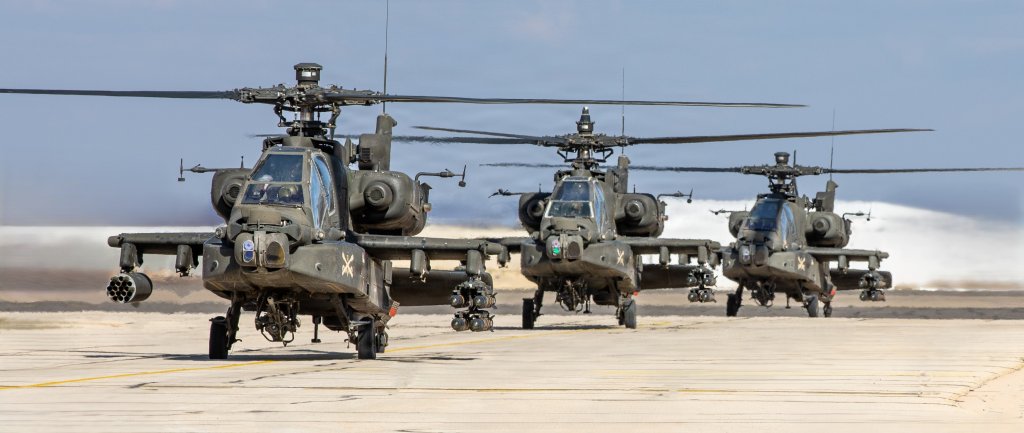
A flight of U.S. Army AH-64 Apache attack helicopters, armed with rockets and Hellfire missiles, taxi out to conduct a scheduled flight in the U.S. Central Command area of responsibility. In addition to rockets and missiles, the Apache is additionally armed with a 30mm chain gun. (U.S. Army photo)
A flight of U.S. Army AH-64 Apache attack helicopters, armed with rockets and Hellfire missiles, taxi out to conduct a scheduled flight in the U.S. Central Command area of responsibility. In addition to rockets and missiles, the Apache is additionally armed with a 30mm chain gun. (U.S. Army photo) U.S. Army Central

As we noted in our previous coverage, CENTCOM deployed “a U.S. Navy Corsair unmanned surface vessel,” the command’s spokesman told us at the time.

The Corsair uncrewed surface vessel (USV) (Saronic)

The ability to pull off that rescue mission “did not appear overnight,” Caine pointed out. “It came from the men and women of Task Force 59, CENTCOM’s forward-leaning unmanned joint maritime unit who spent the last several years testing, integrating, and operationalizing unmanned systems and AI in one of the most demanding and kinetic environments on Earth right now.”

“What helped make this possible was not a bunch of general officers and flag officers,” Caine continued. “What made this possible was a bunch of entrepreneurial sailors and members of the joint force on watch floors, at piers, managing networks of unmanned systems across thousands of miles of water, and using AI to turn massive amounts of data into a crisp, clear, perfect maritime picture that allowed us to go grab those two soldiers in the water.”

A top-down view of the Saronic Corsair USV. (Saronic)

The second example Caine shared about the use of AI “points in the other direction, not how quickly we are using these tools, but how quickly these tools are changing the threat.”

In Ukraine, “we see first-person view drones operating in heavily contested EMI [electromagnetic interference] environments. Some now using AI-enabled computer vision to continue to drive towards targets, even when there’s no GPS or the links are cut. That gives small units affordable precision and shows how quickly software and autonomy are changing what is possible at the tactical edge, and the results are stark.”

The use of AI to enable lower-end drone warfare is a topic TWZ has been among the first to point out.

“In certain locations on the front line of troops right now, the life expectancy of a new Russian recruit arriving on the front lines is as little as 20 to 30 minutes,” Caine added. “Think about that. This is what happens when low-cost precision is fielded fast, adapted quickly, and scaled across the battlefield.”

“The price of lethal exchange is decreasing day over day,” the chairman noted. “One wonders what the future of close air support looks like, but I am comforted by the fact that each and every one of you are in this room thinking about that. Taken together, these examples from the Straits of Hormuz to the front lines in Ukraine show how quickly technology is changing the character of war, and this means our joint force needs to do two things at one time.”

“[W]e need to prepare the joint force to win in this kind of conflict,” the general stated. “We have to assume from now on that our formations will be hunted by autonomous systems, jammed across the spectrum, and tracked in real time, and we have to transition the joint force to be prepared to fight and win our future war by generating and delivering lethality at scale with an agile, optimized, high-low mix of combat capabilities to give the young members of the 2.8-million member all volunteer joint force the tools that they need before they need them.”

Contact the author: howard@twz.com 

The post Apache Crew Rescue Highlights Need For AI In Combat Says Joint Chiefs Chairman appeared first on TWZ.

  •  

USAF Assessing Feasibility Of Restarting C-17 Production As Part Of Its Future Airlift Vision

The U.S. Air Force has been taking a new look at the feasibility of restarting production of the C-17 Globemaster III cargo plane as part of its still-evolving next-generation airlift plans. The service also continues to explore a wide range of next-generation aerial refueling concepts, including new stealthy and/or uncrewed tankers, but a firm vision for the way forward there has yet to emerge.

Air Force Lt. Gen. Daniel Tulley, head of Air Mobility Command (AMC), shared new details about future airlift and aerial refueling efforts, with TWZ and other outlets at a roundtable at the Air & Space Forces Association’s (AFA) 2026 Air, Space & Cyber Conference.

On the airlift side, the Air Force’s stated plan to date is to replace both the C-17A and C-5M Galaxy with a single Next-Generation Airlift (NGAL) platform, starting in the mid-2040s. Separately, the service is pursuing what could be a family of future aerial refueling capabilities under what is now called the Advanced Tanker Systems (ATS) program. Very broadly speaking, ATS presents a path toward what might come after the retirement of the aging KC-135 tanker fleet, though those aircraft are still expected to keep flying for years to come. The Air Force is also moving to further expand its fleet of newer KC-46A tankers in the interim, but persistent technical and other issues with that design continue to present hurdles.

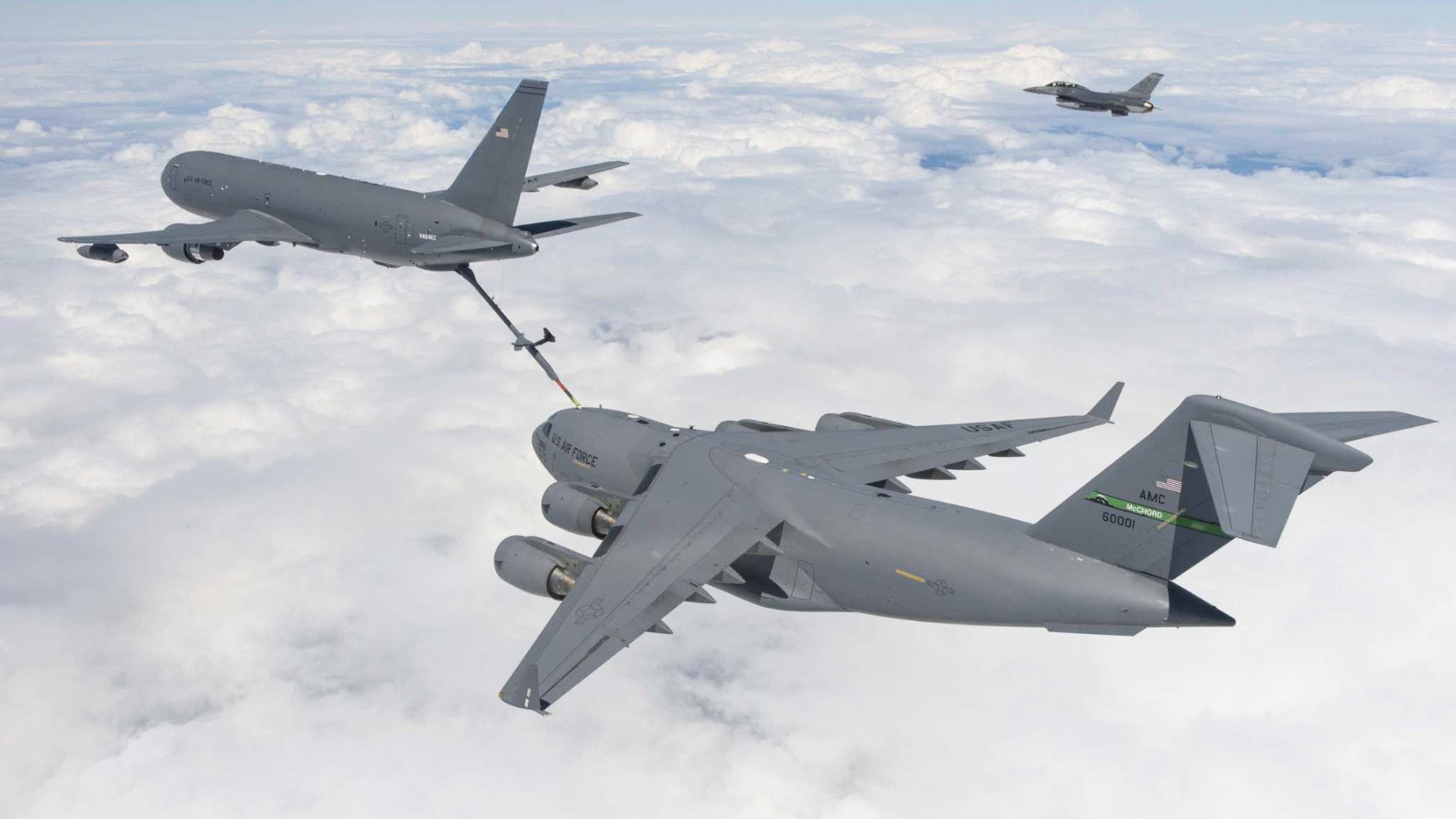
A US Air Force C-5, at left, together with one of the sevice’s C-17s, at right. USAF
A KC-135, at right, prepares to link with a KC-46, at left, during a test. USAF

At the roundtable today, Lt. Gen. Tulley was asked explicitly about restarting C-17 production. The manufacturer of those aircraft, Boeing, shuttered that line in 2015. The company also just marked the 35th anniversary of the design’s first flight yesterday.

“Heck yeah, but with a caveat, right?” Tulley said in response. “So we were just asking this question over the course of last week, and it’s in the context of next-generation airlift. So we are about to embark on the Analysis of Alternatives to replace the C-17 and replace the C-5. All options are on the table.”

“There’s always the option to service life extend the C-17, but the [production restart] question came up,” he continued. “I’ve heard this my entire career. Once we terminate an assembly line, can we ever bring it back? Does somebody store all the machinery and the dies and whatnot, and can you bring that out? So we’re asking that question.”

“But then whatever that answer is from the vendors, what will be the price tag associated with that?” he added. “You have to ask yourself, okay, is rebuilding a C-17 even if you make improvements – and there’s a loose analogy with the C-130J, [a] much more modern, capable variant of the C-130E [author’s note: the C-130J evolved more directly from the C-130H variant] I first learned to fly – if you do that with the C-17, is that the best move? Or are there new technologies that we can incorporate into it so that it can defend itself, so that it’s connected, it’s networked, it does all the things that maybe the current C-17 doesn’t do?”

“We’re looking into it as part of the Analysis of Alternatives. I’m hopeful that we’ll get to answer that question.”

In June, the House Armed Services Committee also directed the U.S. Air Force to prepare a formal briefing on the matter of new C-17 production in a report accompanying a draft of the annual defense policy bill, or National Defense Authorization Act (NDAA), for Fiscal Year 2027.

The RAND Corporation did conduct a detailed, independent analysis more than a decade ago that assessed the costs and complexities that could come from Boeing building more C-17As, as well as other variants and derivatives of the design. RAND’s conclusion was that any of the courses of action would require billions of dollars of new investment and entail risks, as you can read more about in more detail here.

Foreign participation in a new C-17 production run could help at least defray costs. Australia, Canada, India, Kuwait, Qatar, the United Arab Emirates, and the United Kingdom all currently fly Globemaster IIIs. The Strategic Airlift Capability (SAC) initiative, a multinational arrangement with several European members, as well as the United States, also operates three of these aircraft.

Boeing told TWZ directly in June that unnamed C-17 operators had been reaching out about the prospect of restarting the production line, and that the company was “encouraged” by those discussions.

As Lt. Gen. Tulley stressed, there are significant questions about whether buying new-production C-17s, even with substantial improvements, is not only feasible, but a good use of resources. The Air Force’s Globemaster III fleet today continues to prove itself to be critical to the U.S. military’s ability to project power globally, and is in very high demand right now, especially amid the ongoing conflict with Iran.

The Air Force’s desire to replace both the C-17 and C-5, which are very different aircraft in form and function, could still easily lead the service down a different route. Boeing is not the only one looking at future NGAL opportunities. Another company, Radia, has been very actively pitching a clean-sheet design that is physically bigger than either the C-17 and the C-5, and that is geared toward greater operational flexibility, at the Air Force. Radia is targeting a first flight of its aircraft, called Windrunner, by the end of the decade, but it is still in a very aspirational stage at present.

A rendering of Radia’s Windrunner design. Radia

Many questions also still remain about how the Air Force will ultimately proceed on the next-generation aerial refueling front.

“So thinking beyond the current KC-46 buy and the program extension, whatever that next tanker looks like, our Advanced Tanker System, it’s got to be connected. It’s got to be able to defend itself,” Lt. Gen. Tulley said at the roundtable. “But it begs the question: does it need to be manned? Could it be optionally manned? Could it be autonomous? Or is there a family of solutions maybe that would answer that question? So I do not believe that it has to be manned.”

The AMC head was responding to a specific question about how autonomy could play into the Air Force’s future aerial refueling plans, which included a reference ot the U.S. Navy’s MQ-25 Stingray tanker drone. The Navy just announced its first low-rate initial production contract for MQ-25s on Monday.

“I think you’re seeing that with the MQ-25 and the Navy’s work, but then, how do we, the U.S. Air Force, bring that to bear in scope, scale, and range?” Tulley continued. “An optionally manned or an unmanned tanker, at range, the ranges we need to operate at, it’s a very large aircraft. And we’re not yet to where we’re employing fully autonomous large aircraft, but the technology, I would say, is there and rapidly getting there if it’s not.”

The MQ-25 is another Boeing product, and that company has shown a rendering of a larger, land-based derivative in the past. Lockheed Martin’s Skunk Works has also put forward several advanced tanker concepts in the past, including stealthy and potentially uncrewed designs.

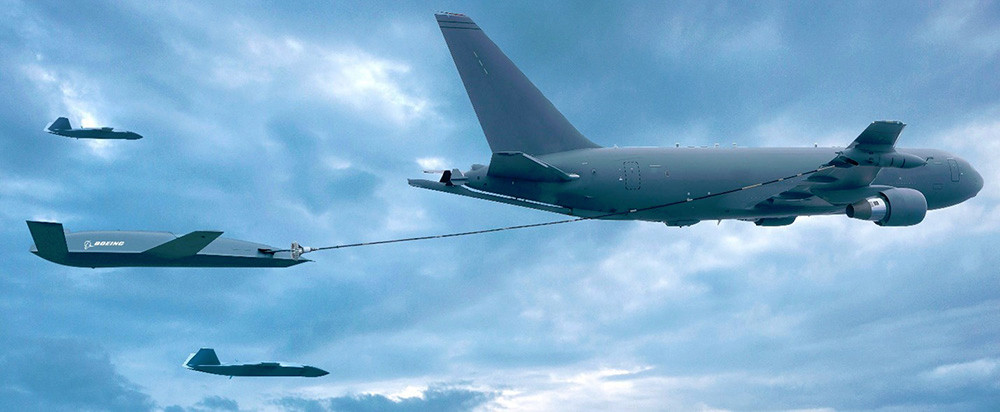
A rendering of a larger, land-based derivative of the MQ-25, depicted refueling from a KC-46 tanker. Boeing
One of the advanced tanker concepts Lockheed Martin’s Skunk Works has shared publicly in recent years. Lockheed Martin Skunk Works

“We will be going after how to make the tanker survive,” William Bailey, the Air Force official currently performing the duties of the Assistant Secretary of the Air Force for Acquisition, Technology and Logistics, had also told TWZ and other outlets at a separate roundtable at the Air, Space & Cyber Conference yesterday. Bailey was responding to a direct question about whether the service was moving away from the idea of a stealthy tanker as part of the ATS plan.

“So, lots of work around what do we do in the future for our tankers, and we spent a pretty dedicated effort to go through and look at what do we think those design solutions could look like,” Bailey also said. “We looked internally. We went out to industry, had those guys come back with their thoughts on how to provide a more survivable aircraft.”

“The stuff that was coming in for me might have been an incremental improvement, but [it was] not clear that that represented the next step, the next phase,” he added. “What you’ll see is we’ll take our efforts, and we’ll look at, hey, if the real question is tanker access, then let’s not constrain ourselves to just the aircraft itself and trying to make a stealthy tanker. We need a tanker to have access, so we’ll talk about all those systems that it would take to protect that tanker.”

Bailey said the question of operational “access” applied to next-generation discussions, as well.

As is the case with the Air Force’s airlift fleets, the service tankers are in high demand due to the conflict with Iran and other current operational requirements. Stress on the existing tanker force, compounded by the ever-advancing age of the KC-135s, has been a steadily growing point of concern for years now. U.S. military officials have long been drawing attention to the limits of available aerial refueling capacity to meet even routine peacetime demands. The Air Force, as well as the U.S. Navy, have also expanded their use of contractor-owned and operated tankers to perform certain non-combat aerial refueling missions to help ease this strain.

This ex-French Air Force KC-135FR tanker, now operated by private contractor Metrea, is an example of the outside aerial refueling capacity the U.S. military has been increasingly leveraging in recent years. Metrea

In the meantime, the Air Force is still pursuing upgrades for its existing airlift and tanker fleets, with heavy focus on increased network connectivity and improved self-protection capabilities.

Greater connectivity “can be a game changer, and it has been a game changer in Operation Epic Fury [against Iran],” Lt. Gen. Tulley said at today’s roundtable. “The ability for air crews to communicate, to coordinate tanker orbits and rendezvous, to pass threat information, to save lives and save aircraft has been everything we expected it to be and more.”

“We have MAF NEXUS that we’re pursuing. The goal is to have this on all mobility aircraft, whether they’re future-built and it’s incorporated, or it’s an add-on capability to existing aircraft,” he continued. “It brings edge compute, the ability to then employ AI [artificial intelligence] and much more computing core power forward on the aircraft, and it does network with the rest of the joint force and the Air Force’s battle management system.”

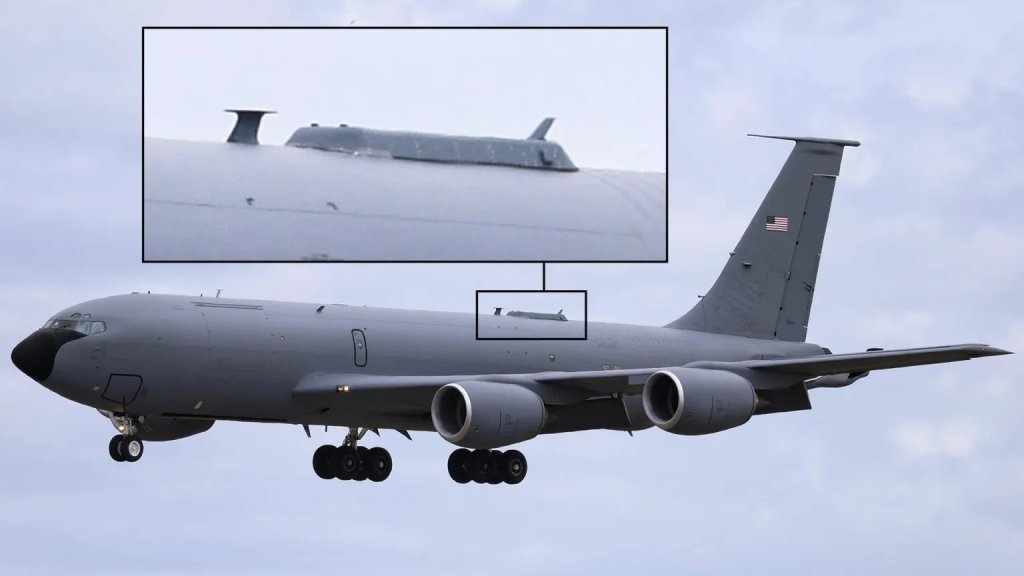
A picture of a US Air Force KC-135 tanker spotted earlier this year with a new large satellite communications antenna (further highlighted in the inset), underscoring work underway now to improve the network connectivity of those aircraft. Alessandro Ledda

When it comes to new options for protecting existing tankers, “nothing’s off the table,” the AMC boss added. “Whether it’s [in the] electromagnetic spectrum, whether it’s kinetic self-defense, a layered approach, we’re looking at everything to come up with what might be the best system. But it’s got to be a system that we can afford, and it’s got to be one that we can put on all the aircraft we have and the ones we’re about to build.”

Using Collaborative Combat Aircraft (CCA) or other types of drones to help provide localized defense for airlifters and tankers could be another option. The Air Force has already experimented with this, at least to a degree.

The Air Force is otherwise still clearly continuing to shape its future airlift and aerial fueling visions. As part of that work, the service is now at least considering the possibility of rebooting C-17 production.

Contact the author: joe@twz.com

The post USAF Assessing Feasibility Of Restarting C-17 Production As Part Of Its Future Airlift Vision appeared first on TWZ.

  •  

Bill Gates Calls for ‘Global Government’ and New World Order to ‘Save Humanity’ From AI

Bill Gates is calling for the world to unite under a global framework to confront the supposed existential threat of artificial intelligence — the latest crisis he says demands radical international transformation. To those paying [...]

The post Bill Gates Calls for ‘Global Government’ and New World Order to ‘Save Humanity’ From AI appeared first on The People's Voice.

  •  

How The USAF Is Preparing For European Allies To Join The Collaborative Combat Aircraft Club

Senior U.S. Air Force leaders in Europe say NATO allies are increasingly looking to participate in the development and employment of collaborative combat aircraft (CCAs), even as several of those same countries pursue their own indigenous fighter and drone programs. American commanders say they are looking forward to CCAs expanding the alliance’s overall capacity, and are already pushing for such systems to work together from the outset.

Speaking yesterday at the Air & Space Forces Air, Space and Cyber Symposium that TWZ is attending, Lt. Gen. Jason T. Hinds, commander of U.S. Air Forces in Europe, U.S. Air Forces Africa, and NATO’s Allied Air Command, and Chief Master Sgt. Joshua J. Wiener, USAFE-AFAFRICA’s command chief, discussed how the command is preparing for an eventual European role in the U.S. Air Force’s planned fleet of hundreds of CCAs.

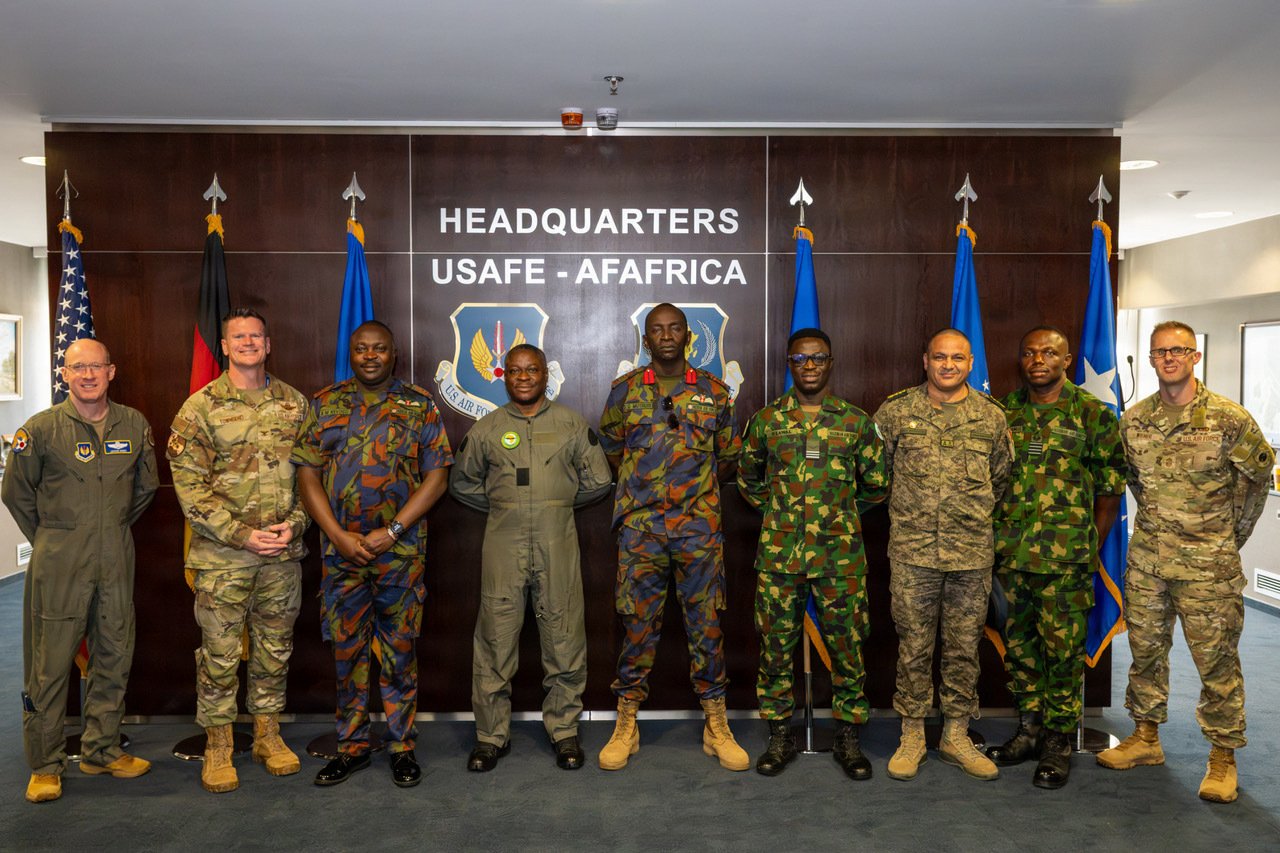
RAMSTEIN AIR BASE, Germany – U.S. Air Force Lt. Gen. Jason T. Hinds, U.S. Air Forces in Europe – Air Forces Africa commander, and U.S. Air Force Chief Master Sgt. Joshua J. Wiener, USAFE-AFAFRICA command chief, pose for a group photo with the Association of African Air Forces representatives from Kenya, Nigeria and Tunisia during the AAAF planning conference at Ramstein Air Base, Germany, Sept. 3, 2026. The weeklong conference strengthened multinational partnerships and advanced planning for future AAAF initiatives, including AAAFEX27 in Kenya.
U.S. Air Force Lt. Gen. Jason T. Hinds, U.S. Air Forces in Europe – Air Forces Africa commander (far left), and U.S. Air Force Chief Master Sgt. Joshua J. Wiener, USAFE-AFAFRICA command chief (second from left), pose for a group photo with the Association of African Air Forces representatives from Kenya, Nigeria, and Tunisia at Ramstein Air Base, Germany, earlier this month.

The issue is particularly significant for USAFE, which operates a fraction of the fighter force it maintained in Europe during the Cold War, even as many of its NATO allies contend with shrinking fleets of crewed combat aircraft. This comes against a backdrop of deepening tensions with Russia and the emergence of new kinds of threats. Autonomous aircraft that can augment crewed fighters could provide the alliance with additional combat mass without requiring a corresponding increase in the number of crewed aircraft and personnel permanently based in Europe.

“I’m excited about what CCAs have in store for the Air Force,” Hinds said, pointing to recent comments from the Secretary of the Air Force Troy Meink, including the aim of having at least 500 CCAs in service by 2032.

He added that European interest in these kinds of platforms is already growing.

“I think you’re going to see a lot more interest from other nations inside Europe about what is America doing with CCAs and how they can join this party, if you will,” Hinds said.

Germany is “heavily involved,” he said, while Scandinavian countries and the Netherlands are also showing interest.

In the case of Germany, we have previously explored how that country is looking to procure CCAs by 2029. Sweden, too, recently unveiled a concept for a high-end, stealthy CCA-type drone, while the Dutch are looking to become more closely alligned with U.S. Air Force CCA efforts.

Saab has produced a full-scale concept model of a future uncrewed combat air system, known as aircraft A3. Saab

USAFE is currently using two broad operational scenarios to explain to allies how CCAs could fit into NATO’s force structure.

The first is defensive. A CCA could operate as part of an integrated air and missile defense network, potentially engaging one-way attack drones or cruise missiles without the need for expensive crewed fighters.

The second is offensive. In that scenario, autonomous aircraft could help suppress or destroy integrated air defense systems and potentially attack fielded forces during an effort to repel a hostile incursion into NATO territory.

Allies are interested in both missions, Hinds said, and want the ability to incorporate CCAs into their own force designs. Interestingly, only yesterday, Anduril shared photos of its YFQ-44A Fury configured with air-to-ground weapons, underscoring the fact that the CCA could take on an air-to-ground role in the future in addition to its current air-to-air focus.

A YFQ-44A carrying pods for 2.75-inch rockets and 500-pound Joint Direct Attack Munitions (JDAM) under the wings. Anduril

That kind of interest has already prompted work at the NATO level. Hinds pointed to a study by the Joint Air Power Competence Center, the alliance’s airpower think tank based in Kalkar, Germany, examining how NATO members could employ CCAs in a modular fashion, including issues such as sustainment, training, and exercises.

“It was a pretty long paper, but the nations wanted it,” Hinds said.

Initial experimentation is expected to take place in the United States, but European experimentation could follow, including by Sweden and potentially other NATO members.

At the same time, European countries are not simply waiting for an American CCA to arrive.

The United Kingdom has launched its own Storm Fighter CCA program. Germany is pursuing a separate loyal-wingman effort, while the United Kingdom, Italy, and Japan are meanwhile jointly embarked on the Global Combat Air Program, or GCAP, which is intended to produce the Tempest next-generation crewed fighter and associated uncrewed systems.

A rendering of a CCA concept released at the launch of the U.K. Royal Air Force Storm Fighter program, earlier this year. BAE Systems

The proliferation of national programs raises an obvious question: How does NATO prevent a growing fleet of autonomous aircraft from becoming a collection of incompatible national systems?

Hinds said the answer starts with commonality.

“The first and foremost thing is we want to strive for commonality,” he said. “Commonality means we don’t even have to worry about interoperability.”

Where common equipment is not possible, however, USAFE wants interoperability built into national systems from the beginning.

“Interoperability by design” is the preferred approach, Hinds said, with NATO data standards and other requirements incorporated before a system enters service rather than retrofitted later.

The good news for USAFE is that NATO already has extensive experience establishing common standards for interoperability, covering everything from tactics and procedures to communications, datalinks, weapons employment, and other technologies. That existing framework gives the alliance a foundation for integrating increasingly diverse national systems without requiring every member to field identical equipment.

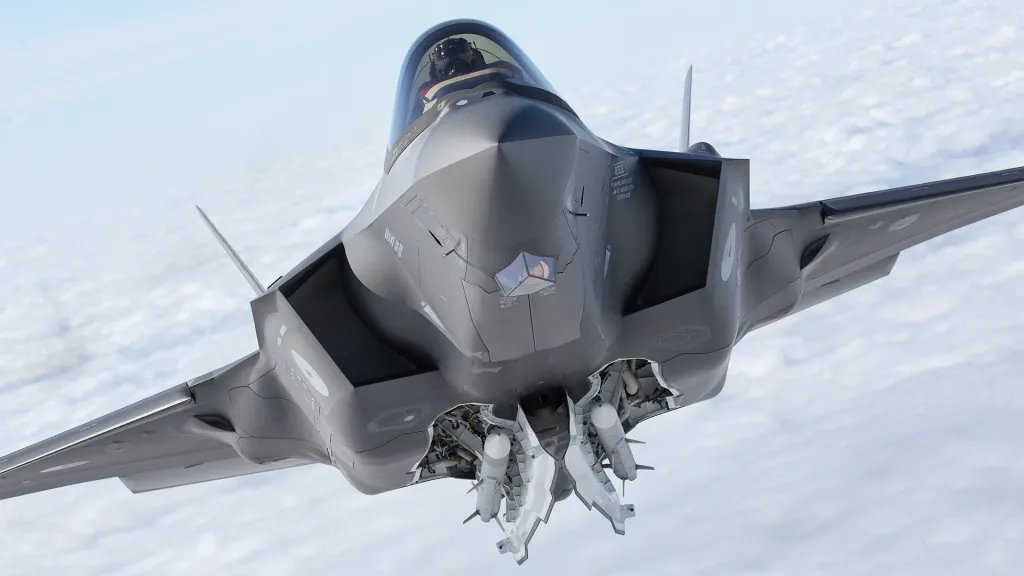
F-35A Lightning II aircraft from the U.S. Air Force’s 48th Fighter Wing and the Royal Norwegian Air Force fly tandem after a formation flight near Lofoten, Norway, March 10, 2026. The formation flight symbolized the partnership and degree of interoperability displayed between participating NATO militaries during exercise Cold Response 26. A key component of NATO's enhanced vigilance activity Arctic Sentry, exercise Cold Response 26 is a Norwegian-led winter military exercise designed to enhance collective defense capabilities and ensure U.S. readiness to rapidly deploy and seamlessly operate alongside NATO Allies in challenging arctic conditions. (U.S. Marine Corps photo by Cpl. Mya Seymour)
F-35A from the U.S. Air Force’s 48th Fighter Wing and the Royal Norwegian Air Force fly tandem after a formation flight near Lofoten, Norway, March 10, 2026. The formation flight was intended to symbolize the partnership and degree of interoperability displayed between participating NATO militaries during Exercise Cold Response 26. U.S. Marine Corps photo by Cpl. Mya Seymour Cpl. Mya Seymour

Hinds did warn that some countries have previously acquired equipment that was not compatible with NATO systems, leaving them with the choice of paying to modify their own equipment or forcing the alliance to adapt its systems around it.

That problem becomes particularly important as autonomous aircraft are connected to increasingly complex sensor and weapons networks. Even more important is the requirement for a baseline command-and-control network for CCAs themselves, allowing different platforms to manage them seamlessly.

The ability to share and control CCAs across a complex battlespace is already emerging as both a major opportunity and a significant integration challenge. The U.S. Air Force and Navy, for example, have made clear that their respective CCAs are being developed with the ability to be controlled seamlessly across services, pointing toward a future in which autonomous aircraft need not remain tied to the service or platform that launched them.

Hinds described a potential kill chain in which an F-35 detects a target, passes the information to another node in the network, and a ground-based system operated by another NATO country ultimately launches the weapon.

In such an architecture, the aircraft, sensor, command-and-control network, and weapon do not necessarily have to belong to the same country.

As an example, Dutch F-35s, operating in Europe, have used a data-exchange system to transmit targeting coordinates to Israeli-made PULS (Precise and Universal Launch System) rocket artillery. The system, developed by Lockheed Martin is known as Keystone, and you can read more about it here.

A Dutch F-35A brandishing its AIM-120 AMRAAM missiles during a NATO air policing drill. Bartek Bera

USAFE is making “significant advances” in areas including cross-servicing, cross-loading, and cross-flying allied aircraft, Hinds said, all of which are intended to make multinational operations more seamless.

U.S. Air Force A1C Dylan Montgomery, 493rd Fighter Generation Squadron crew chief, conducts post-flight operations/checks with Lt Col Dustin Merritt, 493rd Fighter Squadron commander at Pirkkala Air Base, Finland, June 3, 2026. As Allied Air Command's premier tactical exercise, Ramstein Flag 26 tests the ability of U.S. and NATO forces to respond to emerging threats with immediate, decisive airpower. (U.S. Air Force photo by 2nd Lt. Sarah Hedgman)
A U.S. Air Force F-35 crew chief conducts post-flight checks at Pirkkala Air Base, Finland, during the tactical exercise, Ramstein Flag 26. U.S. Air Force photo by 2nd Lt. Sarah Hedgman

The same philosophy applies to weapons.

“We want to have all the fires, right? Whether it’s U.S. built or built inside European nations,” Hinds said.

That could prove increasingly important as European countries expand domestic production of missiles, drones, and other weapons alongside their aircraft programs.

The growth of GCAP and other European defense programs comes amid broader debate over how much Europe should depend on U.S. military equipment.

But Hinds rejected the idea that allies developing indigenous aircraft and autonomous systems necessarily signals a move away from American equipment.

“No, I don’t,” he said when asked whether allies were moving away from U.S. systems.

Instead, Hinds characterized the trend as an expansion of the transatlantic defense-industrial base.

Sweden was one example he cited. The country, which recently joined NATO, continues to produce new military equipment, including Gripen fighters, while those aircraft are already being operated by NATO members.

Swedish Gripens are currently leased to Hungary, and other countries are considering the aircraft, Hinds said.

A Hungarian Air Force JAS 39 Gripen participating in NATO exercise Ramstein Flag 24 flies over the west coast of Greece, Oct. 4, 2024. Over 130 fighter and enabler aircraft from Greece, Canada, France, Hungary, Italy, Poland, Portugal, Romania, Spain, Sweden, United Kingdom and United States are training side by side to improve tactics and foster more robust integration, demonstrating NATO’s resolve, commitment and ability to deter potential adversaries and defend the Alliance. (U.S. Air Force photo by Tech. Sgt. Emili Koonce)
A Hungarian Air Force JAS 39C Gripen participating in NATO Exercise Ramstein Flag 24 flies over the west coast of Greece, in 2024. U.S. Air Force photo by Tech. Sgt. Emili Koonce

The broader trend toward co-manufacturing and co-production is also something he welcomed.

“I’m seeing a lot of discussions about co-manufacturing and co-production, and I welcome those discussions as well,” Hinds said.

That approach could become increasingly important as NATO tries to expand its available combat power without relying exclusively on additional U.S.-built platforms.

For USAFE, the objective is to ensure that whatever aircraft NATO countries develop or purchase can plug into a common architecture, sharing data, receiving targeting information, drawing on common logistics networks, and contributing weapons effects across national boundaries.

For a U.S. Air Force command that has spent decades trying to cover Europe with far fewer fighters than it once had, hundreds of autonomous wingmen, whether American-built or allied, could provide a significant way to generate additional combat mass.

Senior U.S. Air Force officials are now working to ensure that the networking, weapons integration, logistics, and command-and-control architecture will be in place once those aircraft start to come online.

Contact the author: thomas@thewarzone.com

The post How The USAF Is Preparing For European Allies To Join The Collaborative Combat Aircraft Club appeared first on TWZ.

  •  

Netanyahu Tells Americans Hit By Gas Prices To ‘Bike or Walk’, Framing It As ‘Support for Israel’

The price of a gallon of regular gasoline hit $4.37 on Wednesday, up more than a dollar from a year ago. In California, drivers are paying $6.04. In San Francisco, $5.93. Diesel—the fuel that moves [...]

The post Netanyahu Tells Americans Hit By Gas Prices To ‘Bike or Walk’, Framing It As ‘Support for Israel’ appeared first on The People's Voice.

  •  

Colombian president ends university autonomy policy, granting police access to campuses

A little over a month into his term, far-right President Abelardo de la Espriella continues to advance a security agenda that often conflicts with certain rights historically won by Colombians.

This time, De la Espriella has signed a decree allowing police access to university campuses. In several Latin American countries, the prohibition of police access to universities has been established through student struggle to prevent abuses by authorities against student movements.

Thus, universities have historically become places where students seek refuge from repression, arrest, and regroup during times of intense social mobilization.

This was evident during the 2021 protests, known as the “National Strike,” in which students, workers, left-wing political parties, young people, and others took to the streets to protest against the right-wing government of Iván Duque. The mobilization, which lasted several months, was considered a true “social upheaval,” and many experts have seen in it the consolidation of a democratic alternative (the government of Gustavo Petro) to decades and decades of right-wing rule.

During these protests, universities became hubs of popular mobilization, driven primarily by the youngest members of society. On university campuses, protesters were able to regroup, defend themselves against police repression, and coordinate new demonstrations – among other things – always protected by the fact that police are barred from entering university grounds.

De la Espriella calls popular protests “terrorism”

Clearly, De la Espriella seeks to nip this possibility in the bud – that is, to prevent universities from once again becoming coordination centers for the protests. Many have speculated that the president is signing this decree precisely because he knows that his radical neoliberal agenda could spark major protests, and in this way, he hopes to proactively undermine the protest movement.

Read more: One month of De la Espriella’s administration in Colombia

Whether or not this is De la Espriella’s primary intention, only time will tell. What is certain is that the president views university autonomy as an obstacle to the implementation of his security agenda, which also includes curtailing the ability of informal opposition political groups to participate in public life.

“Under no circumstances will I allow public universities to continue to be sanctuaries of violence. I respect and guarantee peaceful protest, but I will not allow universities to continue to be used as sanctuaries of vandalism and crime,” said De la Espriella on X.

Furthermore, true to his combative rhetoric, he compared social protests to terrorism – a common trope in the historical discourse of the Colombian right: “University autonomy is not a blank check for impunity: I have issued precise instructions for a national protocol of action that allows us to distinguish between the legitimate exercise of protest and acts of violence, flagrant offenses, danger, or extraordinary disturbances of public order that require intervention by the authorities. The university is for knowledge and ideas, not to serve as a refuge for violence and terrorism.”

A violation of the Constitution

However, the opposition has viewed this decision as a serious attack on university autonomy. Ana Erazo, a member of the House of Representatives from Valle del Cauca, wrote: “It is an ATTACK ON UNIVERSITY AUTONOMY and a direct threat to the young people at the country’s public universities. With this, Mr. Abelardo de la Espriella is beginning to reveal what could become a BRUTAL RETALIATION against the student movement, against its ability to organize and mobilize, and against thousands of young people who historically have not supported his political agenda.”

Some universities have joined in this criticism. One of them is the National Pedagogical University, whose academic council stated that in the past, “the serious consequences of resolving conflicts within public universities through militarization have been demonstrated on repeated occasions.” Furthermore, the council stated that university autonomy is one of the pillars of Colombian democracy, along with freedom of thought and research, among other things. Losing autonomy means jeopardizing these values of the republic, it stated.

For his part, former presidential candidate Iván Cepeda said that De la Espriella’s measure contradicts Article 69 of the Constitution, which guarantees university autonomy. Regarding the announcement, Cepeda also said: “Such an announcement is not only an affront to university autonomy. It also demonstrates, once again, the authoritarian and despotic nature of De la Espriella, who seeks to stigmatize, persecute, and violate the rights of Colombian youth and the university community. Colombia has not forgotten the victims of police abuse during the National Strike, nor the history of security forces intervening on university campuses, resulting in student deaths. Young people cannot once again be persecuted or treated as an internal enemy and an enemy of the state.”

  •  

A True-Crime Producer Posed as an Heiress — Then Allegedly Stole $30 Million

The FBI isn’t the only interested party searching for Mary Carole McDonnell, the 74-year-old producer behind TV series like I Married a Murderer. There are the former employees who allege millions in unpaid wages, and the two sons who claim their mother forged their signatures on bank documents. There’s an entrepreneur in the United Arab Emirates who accuses her of “mind games,” and the former bank vice-president turned true-crime podcaster who’d like to make a documentary about McDonnell. Cheyenne Roundtree goes deep on the woman who, nearly a decade ago, walked into a California bank with a pecan pie and left with a $15 million loan before vanishing.

The story has all the makings of a viral documentary replete with breathless details, similar to the ones McDonnell’s company produced. Her backstory is littered with half-truths and deceptions, including a lie that her mentally disabled younger sister was murdered after being kidnapped. Questions remain on how she was able to pull off such a brazen heist. And it has sparked an ongoing hunt among the FBI, banking institutions, a true-crime podcaster, and television producers to see who can unravel McDonnell’s tangled history, track her down in a foreign land, recoup the financial losses she caused, and perhaps bring the unbelievable tale to screens.  

  •  

Macklemore Kicked Off Ed Sheeran Tour for Saying 'Free Palestine' During Show

Rapper Macklemore was kicked off the remainder of Ed Sheeran's Loop Tour dates after expressing pro-Palestinian views at a show in New Jersey.

The Comments: During his performance at MetLife Stadium on September 4, he said, "Free Palestine. I want those words to be loud and clear, so the people from Gaza all the way to the occupied West Bank know that we have not forgotten." On September 5, during another performance at MetLife, he addressed Jewish audience members and said, "Criticism of Israel, criticism of apartheid, being against genocide in no way is a criticism of you. My message is for peace, love; for all human beings to be treated with dignity, respect, and equality."

The Controversy: The comments prompted critical posts from the StopAntisemitism activist organization, one of which was amplified by pop singer P!nk. Subsequently, Robert Kraft, owner of the New England Patriots and Gillette Stadium, called Sheeran to tell him Macklemore would not be allowed to perform at his stadium and reportedly organized a boycott from other stadium owners. Kraft said his decision wasn't about "diminishing the suffering of innocent Palestinians" but that "advocacy should not come at the expense of the Jewish community or obscure the responsibility of Hamas." Both P!nk and Kraft are Jewish Americans.

Tour Changes: Macklemore was then dropped from the tour, a decision Sheeran said was "the promoter's decision." Shortly thereafter, the other opening acts, which included Lukas Graham, Aaron Rome, Finneas, and Beoga – which performed as Sheeran's backing band – announced their withdrawal from all of Sheeran's upcoming dates.

Statements After: Sheeran wrote on Instagram, "There is a reason I do not use my professional platform for politics – my audience includes young people, often children, of all backgrounds. Those who come to my shows do not expect a political forum. I respect Macklemore's strength of purpose to stand up and shout for what he believes. However, there is room for multiple approaches to the same end: peace. I choose to use my fame and platform to be a place of safety and sanctuary, to maintain diplomacy and keep conversations open, not closed."

Macklemore described Sheeran as a longtime "friend" who "was in a f***ed up position" because "his typical apolitical stance was being challenged in a way it never had been before." He also criticized what he described as the weaponization of antisemitism accusations, and concluded, "I didn't need 10 shows from Ed. I needed 2. Two chances to stand in front of 90,000 people and say the words that somehow became too dangerous to say. Free Palestine. But if those words cost me the stage, while turning the conversation back to Palestine, then it was the most successful tour I've ever been on."

Past Politics: Macklemore's music has never shied away from political and social themes. In 2012, he and creative partner Ryan Lewis released the pro-gay rights song "Same Love," and in 2016 he released "White Privilege II," which commented on police brutality and Black Lives Matter. In 2014, Macklemore dressed in a costume that many argued resembled a Jewish man and was antisemitic, though Macklemore later apologized and said he didn't mean to offend anyone.

How The Media Covered It: The story was widely covered by mainstream outlets, with some outlets publishing several pieces of coverage as new developments were reported. Some outlets from the left and center, like The New York Times (Lean Left bias), Associated Press (Lean Left), and DW News (Center), published headlines that framed Sheeran's tour as being in dire condition since the support acts withdrew. Fox News (Right) highlighted Democratic lawmakers and other liberal figures who voiced support for Macklemore.

Written by the AllSides staff (of humans). Learn more. Support our mission. Suggest an improvement to this summary.

  •  

‘Purge Palantir!’: Union nurses warn Big Tech and Big Brother are invading our healthcare system

Unionized Nurses and community allies march in Washington, DC, on August 27 to demand hospitals and elected officials cut ties with AI tech giant Palantir. Photo courtesy of National Nurses United.
https://www.spreaker.com/show/2952221/episodes/feed

On August 27, registered nurses, patients, and community allies rallied and stopped traffic in cities around the US to demand that hospitals and elected officials cut all ties with artificial intelligence giant Palantir. In this episode of Working People, we speak with a panel of registered nurses—Kelli Brennan (Portland, Maine), Lee Barker (Kansas City, Missouri), and Kiera Arbour (Chicago, Illinois)—about National Nurses United’s “Purge Palantir!” campaign, and about the disturbing creep of Big Tech and Big Brother into a US healthcare system that is already in crisis.

Additional links/info:

Featured Music:

  • Jules Taylor, Working People Theme Song

Credits:

  • Audio Post-Production: Jules Taylor
Transcript

The following is a rushed transcript and may contain errors. It will be updated.

Maximillian Alvarez:

Alright. Welcome everyone to Working People, a podcast about the lives, jobs, dreams, and struggles of the working class today. My name is Maximillian Alvarez, and today we are speaking with union nurses who are speaking out against big tech and big brother, sneaking more of their tentacles into our healthcare system and into our lives. They and their union, National Nurses United, participated in a National Day of Action on August 27th, which brought together hundreds of registered nurses, patients, and community allies in cities around the country to demand that hospitals and elected officials cut all ties with artificial intelligence giant Palantir. As a press release from NNU lays out, “The nurses who are members of National Nurses United, the nation’s largest union of registered nurses, stop traffic in an act of civil disobedience in eight cities, Palo Alto, California, Los Angeles, California, Chicago, Illinois, Washington DC, Portland, Maine, Asheville, North Carolina, Austin, Texas, and New Orleans, Louisiana.

Union nurses cannot be silent when our most vulnerable people, babies and children are being detained by federal immigration agents,” said NNU President Jamie Brown. “While our patients and neighbors are living in fear of immigration raids enabled by Palantir, our hospitals are facing huge cuts and our patients are facing mounting healthcare costs because of H.R.1. Nurses aren’t just saying no to Palantir, but we’re calling for our public resources to go toward the benefit of working people, not billionaires and their corporations. “The press release continues. From 2009 to 2025, Palantir received $2.5 billion in federal government funding, but this number has grown tremendously in just the past year. Last July, the Department of Defense announced a $10 billion agreement with Palantir to use its technology to share data across federal agencies, enabling unprecedented surveillance power. This followed a $30 million contract awarded to Palantir by the Department of Homeland Security to build an AI-powered system that would identify immigrants for deportation.

In February of 2026, the Department of Homeland Security and Palantir signed a $1 billion contract. In the hospital industry already, Palantir manages more than one fifth of US hospital beds. For nurses, this marks a dangerous threat to their nursing profession, which is seeing a glut of untested and unregulated technology introduced into patient care settings.” All right, so we got a lot to talk about here, and to talk about all of this, I am really grateful to be joined on the show today by three guests who are all registered nurses, all members of National Nurses United. Thank you all so much for joining me today. I really appreciate it. Please introduce yourselves to our listeners.

Kiera Arbour, RN:

My name’s Kiera Arbour. I’m a registered nurse from Chicago, Illinois.

Kelli Brennan, RN:

My name’s Kelli Brennan . I’m a registered nurse from Portland, Maine.

Lee Barker, RN:

I’m Lee Barker. I’m a registered nurse in Kansas City, Missouri.

Maximillian Alvarez:

Well, again, thank you all so much for joining me today. I really, really appreciate having you all three here to talk about this because there’s so much here that I didn’t even know before I saw the day of action and started digging into this. So before we really get into Palantir and all this AI stuff, I want to start at the shop floor worker’s eye level, and I want listeners to get to know more about you all and to have y’all give us more of a lay of the land here. So could you start by telling us more about the jobs that you do, the hospitals that you work at, the kind of patients that you care for? And I guess could we talk a bit about all the non-AI workplace issues that you and your coworkers are already dealing with on a daily basis?

Kiera Arbour, RN:

This is Kira. I am a nurse in the neurosurgical ICU at Stroger Hospital of Cook County. We are one of the largest safety net hospitals in the United States. So I am just finishing up my first year as a nurse. Just graduated from my nurse residency program last week, came to nursing late in life. I took my licensing exam the day after I turned 50. For me, I think the thing that has really been the most challenging part of my first year of practice as a nurse is the patient population that we serve at Stroger Hospital as a safety net hospital in the third largest city in the country is just all of the poverty related, social determinants of health related illnesses. So in the neurosurg ICU, anybody who’s a gunshot wound to the head comes to us, blunt force trauma to the head, two gunshots to the head on the unit last night, one blunt force trauma, and then a whole bunch of people who have had strokes because they live in food deserts, they don’t have access to healthy things to eat or they don’t know how to manage chronic conditions like diabetes and high blood pressure.

And as somebody who grew up pretty privileged and whose parents are heading into their 80s over the next year and a half or so, I see my amount of death play golf every day. They go swimming with their grandkids every day because they grew up middle class, they grew up with money. And then I see people 20 years younger than them who are looking at end of life type of illnesses in our hospital. And it has really kind of overwhelmed me emotionally just because we live in a system that doesn’t do a very good job of allocating resources to folks. And so I’m watching people be very sick and eventually die from very preventable diseases and things that are associated with poverty. Violence is associated with poverty.

Kelli Brennan, RN:

I’m Kelly. I’m at Portland, Maine. Similar to Kara, I also work in neurosurgery, neurotrauma. My background is in stroke. I’ve been a nurse for a little over 17 years from Boston and then I moved to Georgia. I was a director of neurosciences in Georgia, so I was in management, left management to come back to the bedside and be a union nurse and use everything I learned as a manager now for the good of the union. So happy to be here. I’ve been at MaineMed for about five years. I was a member of the original facility bargaining committee when we were organizing for our union. And when I got here, I was coming from Georgia right after COVID and COVID in Georgia was awful, made me realize I needed to go back to New England. So I left the South, came back to New England, wanted to be near family.

So I came to Maine and just wanted to work at the bedside, work my three 12s, get my shifts done and go home and not have twenty four seven responsibility. Now I’m in the union and I have a different kind of twenty four seven responsibility, but I love it. So I started and when I got to the hospital in Maine, I was almost like, well, this is compared to where I came from in Georgia, I was like, “Well, this is pretty nice.What are you guys all upset about?” And started talking to the staff and learning things. And then I shifted my thinking and I was like, “I just came from a really bad situation. Things aren’t that bad up here in Maine, but I know that the way healthcare works, because what I saw in Georgia was consolidation of healthcare systems, lots of financial issues, lots of layoffs and closures and all that kind of stuff.

I didn’t want any of that bad healthcare to come up to this hospital.” So I was like, “You know what? The best thing is to start a union and to lock it in what we have now so that it can’t get taken away because we know the turnover in the C-suite is every five years. These people are not dedicated to the communities. They’re not dedicated to the hospital. They are there for five years just to make a resume, just to go on to the next place.” So I got all in with the union. I’m a charge nurse, I’m a steward, I’m chair of our professional practice committee, and I’m co-president of the Maine State Nurses Association. Yeah, I’m all in. And the things that we’re working on now outside of AI is staffing. There’s this huge misconception or this though process that there’s a nursing shortage.

And we’ve been saying for years there’s not a nursing shortage. There’s a shortage of nurses willing to work in unsafe conditions at the bedside. And that’s why I went into management when I did because the working conditions at the bedside suck and nobody wants to work every weekend. Nobody wants to work every holidays. You can go to management and have your weekends off, have your holidays off, get paid more. So you see the shift of people leaving the bedside because the work is just unmanageable. The working conditions aren’t safe. The patients are sicker, more complex. Our nursing turnover is super high. The years of experience on the floor are low. When I work, there’s a lot of times I’m the most experienced nurse on my unit by 15 years. So it’s a lot of challenges in that, and there’s no focus on nurse retention. They just let one go and then just hire a traveler or temporary staff and we try to make the best of it.

I was at my professional practice committee meeting this morning and it was all about staffing. The hospital has budgets and staffing grids and plans, but they fall through. They don’t hold themselves accountable.

Lee Barker, RN:

Just wanting to build off of what Kelly said, staffing is also an issue at the hospital that I work at research in Kansas City, Missouri. I work specifically in our inpatient psychiatric population. Our staffing grids call for one nurse to every eight patients. That’s already an unsafe ratio and our management likes to push us to one to nine, one to 10. I’ve seen 11 and 12 as well. And like Kelly said, it’s not that there’s a nursing shortage in this country. There’s a shortage of nurses that are willing to work in the unsafe conditions that the hospitals push on us. At research, I mean, we used to have, I think, 800 nurses when we were fully staffed up. Currently we have like 550 and we just can’t. The hospital doesn’t care to retain nurses. Somebody leaves and, oh, we can hire in a new grad and they’ll stay for their two years, get their experience and leave and well, we’ll just hire another new grad.

Maximillian Alvarez:

Well, and it’s like, I hate to make light of all the incredibly serious and important stuff that y’all just laid out, but in 2026, hearing all this, my mind is imagining the Pawn Stars meme of like, “Hey, hospitals, can you fix any of these problems?” And the response is, “No, the best I can do is nothing, and I’m going to add Palantir to your list of things to be worried about now.” So that’s the kind of upside down, topsy-turvy nightmare reality that we’re living in right now, but it is what it is and we got to deal with it.

I’m so grateful to all of you for laying that out for folks because it’s such important context for everyone to understand even though we’re all focused on AI and Palantir right now, let’s not lose sight of the forest from the trees here. There’s so many other systemic issues that are running workers into the ground and screwing over patients and all of us for the benefit of a few. Those sorts of dynamics are already at work in the stories you’ve been hearing on this show about the working conditions for healthcare workers around the country. We’ve been covering it for years, but now we got to worry about ICE coming into hospitals. We got to worry about these truly super villain-esque big tech oligarchs putting their AI into our most sensitive and private systems and information. So let’s talk about this gang, because I need your help unpacking this for myself and for our listeners.

So I want to stay in the world of healthcare right now, and I want to ask if you could sort of lay out for us how is AI in general and Palantir specifically seeping into your workplaces and your work lives?What are nurses seeing here that perhaps the average patient is not?

Lee Barker, RN:

So the hospital that I work at is owned by HCA or the Healthcare Corporation of America, and what HCA has done in their partnering with Palantir is to build an AI scheduler called Timpani. We don’t really know how it works. It’s like a black box. We put our preferred days of working in. Timpani spits out a schedule that’s allegedly balanced, so we have enough nurses working throughout the week. They’re supposed to also balance our level of experience so we don’t have a unit full of new grads and then all of the experienced nurses are working different shifts. These were the promises that we were made. And unfortunately, at the end of the day, Palantir is giving us a shitty product. Aside from all of the moral reasons that Palantir sucks, they can’t even provide us again with the product that meets the promises that they told us, which is that it would take the burden of scheduling off of our managers.

And now our managers in the building don’t have any way to adjust our schedules. So when the AI inevitably screws up, puts out a bad schedule, nobody in the building has any way to fix the schedule unless it’s, I think, within 24 or 48 hours of the shift beginning, which is ridiculous. Part of what Timpani does as well is HCA is using it to push short staffing. Allegedly, our understanding of how Timpani works is that it somehow looks at the average daily census on the unit and decides, “Oh, for 16 patients on this psych unit, we need two nurses every shift.” What Timpani doesn’t see is that that unit can hold up to 24 patients, and frequently we are trying to fill it up to 24. Timpani will schedule only two nurses and management will say, “Well, really, we could admit a couple more patients.

We’ll push you guys up to one nurse can take 10 patients instead of one to eight.” And so they’ll sneak in and just ask us to do more and more with less and less.

Kelli Brennan, RN:

So at MainMed or Maine Health, we have Palantir in our hospitals through their application called Foundry. When we first heard about the potential, we asked the hospital or MaineHealth to let us know what they were using it for. And at first they told us it wasn’t really any of our business. We further pushed, sent letters to the board asking what’s going on, what’s it for? And their response was that they’re using it for insurance denials. So they’re using it. So say a patient comes in and they have pneumonia and the doctor doesn’t write the details of the pneumonia clearly. The insurance company will deny the claim and say that there’s lacking documentation for payments or whatever. So the hospital or MaineHealth’s idea is that Palantir’s AI software will look at these denials and claims and figure out what the letter or what the documentation needs to be in order for the claim to get approved.

So this requires us, Maine Health, sharing information with Palantir of our patient’s information.

Maximillian Alvarez:

I’m sorry. So was our whole system of already not approving so many prescriptions and surgeries in our American healthcare system, was that all not bad enough that now we need a fucking AI bot denying us as well? I can’t believe that that is actually happening.

Kelli Brennan, RN:

It’s very much crazy. The argument is that the return on investment is already better than projected, so the hospital will be gaining so much money, but they’re claiming that they’re losing money because the insurance company is denying it because the insurance company changes the rules 15,000 times a year. It has no obligation to tell the hospitals, so that’s why they’re getting denied. So instead of holding the insurance companies accountable, now we’re introducing Palantir to help solve it. That’s the solution. It doesn’t make any sense, and it just makes us complicit in this whole thing.

Kiera Arbour, RN:

Thankfully, in Chicago, we don’t have Palantir software anywhere near our patient’s information. Our action was based on the fact that our pension fund has $28 million invested in Palantir. That includes all county employees, not just nurses. So everybody who works for Cook County, which is where Chicago is, including all the people who work at the hospital, the doctors, the administrators, the nurses, the PCTs, the environmental service people, the folks who work in the cafeteria, the people who work in the forest preserves of Cook County, where I like to ride my mountain bike. All these people unknowingly have their pension funds, A, invested in a company that’s heavily aligned with the current administration and could potentially go, if Democrats screw his spine, could go belly up in a couple years. And then B, is doing some pretty nefarious stuff, is collaborating with ICE and making it so.

Kellyann mentioned that the patients are getting sicker and sicker. One of the reasons the patients are getting sicker and sicker is because they know that they have the potential to get arrested if they come seek healthcare. So they delay and defer care and then they come to us and they’re a lot of times near death. I took care of somebody last night who intubated completely unconscious body full of ammonia because their liver had failed and they had deferred care. And I couldn’t get this person’s story because obviously they were intubated and in a coma, but judging from this person’s last name, they very easily could have been somebody who was undocumented. But for us, for me, for the nurses at Cook County, we became nurses because it sounds cheesy, but it is a calling. I walked away from a six-figure career in supply chain and logistics management to come do this with the rest of my life because I felt a calling to do so because in 2020, I was at the George Floyd protest.

I said, “Wow, I’m actually the baddie and I need to get my life right.” And so I was feeling really good about what I was doing every day, taking care of some of the sickest people, the poorest people, the least fortunate people in my community and serving my community. And then I find out the thing that I’m relying on for my retirement is heavily invested in a company that’s collaborating with ICE, that is writing software for the IDF, that is tracking kids home from school in Gaza so that the Israeli Defense Force can send a bomb to this person’s house because there’s a one in two million chance that this kid’s dad is part of Hamas. And so that doesn’t align in any way with my values. And so we felt the need to step up and demand that our pension board divest itself from Palantir, and we were kind of blown off.

So I am looking to put together a run to be part of the pension board in the next few months. So that’s where our involvement with Palantir is.

Maximillian Alvarez:

Hell yeah. Well, I want to keep going in the direction that y’all are leading us to. I want to keep zooming out here and take this discussion beyond the world of healthcare, but I think it bears repeating or reminding all of us who and what we’re talking about here. I mean, if you’re still asking yourself or you listen to this and you’re saying, “Well, why is Palantir so bad? Who are they?” They’re telling us who they are. They published a whole batshit manifesto about their evil vision of and for the world. Their CEO, Alex Karp is constantly saying super villain type stuff about the kind of future he imagines with AI. And there’s a piece that we’ll link to in the show notes from The Guardian that is literally titled Palantir Manifesto described as Ramblings of a Super Villain Amid UK Contract Fears. And in that article, here’s a quote that says, “Palantir’s manifesto, which embraces AI state surveillance of citizens along with national service in the USA is either a parody of a Robocop film or a disturbing narcissistic rant from an arrogant organization.” And that was actually from a liberal Democrat MP in the UK.

But read that, read the manifesto. They are telling us who they are and we should believe them. I don’t want this creep carp near my healthcare or my information or any of my government data. I don’t want them near anything having to do with the administration of our society or what remains of it these days. And yet they are getting in there in our government. The data centers that are popping up everywhere. They’re tied up in all of that too. So I wanted to ask y’all to sort of zoom out and keep talking about that bigger picture. And I wanted to ask why you and your union are demanding that not only hospitals, but elected officials cut ties with Palantir. Why is it important for you to speak out against this kind of larger onslaught of big tech and to speak out as union nurses to stop it?

Kiera Arbour, RN:

I would say first of all, we have our own manifesto. It’s called Vision for a Healthy Society, and it’s not super villainy. We want people to live happy, healthy, self-fulfilled, self-actualized lives where they have the resources they need to not just survive day-to-day, but to thrive as human beings in the way that human beings were meant to exist and to flourish, not to be beholden to these giant unelected powers, whether it’s Palantir, whether it’s Anthropic, who was just in the news yesterday because they have their own AI building dossiers on folks like us who are opposed to what they do, and nobody elected these people. They became billionaires because venture capitalists invested money in them, and now they call the shots. They own pretty much both parties. Shout out to Rokana for giving that money back from Palantir, but for the most part, they’re heavily invested in both Democrats and Republicans.

As far as union nurses, because we can’t, because our union has our backs, because they’re going to protect our free speech rights, they’re going to protect our right to go out there and say, “This is wrong. We don’t agree with it.” And they allow me, because they are themselves, my union is itself anti-colonial, anti-imperial. They stand up for these values that I try to model myself, and so I need to stand in solidarity with my working class siblings, and I need to work for the society that I think is going to allow human beings the best chance to live the lives they deserve.

Kelli Brennan, RN:

In Maine, in January, we had operation Catch of the Day, which Maine is one of the whitest states in the country. We have a Somali population. So for us to be targeted with this operation, it was devastating. It affected our community, it affected the hospital, our housekeeping workers, our transporters, our ancillary services, and all staff felt this. You could feel the emotions throughout the hospital as this was going on. About 30% of our housekeeping were calling out because they were afraid. We were picking up food because we had a food bank, but people were afraid to go to the food bank. So our C-suite was storing groceries, so we were bringing our immigrant vulnerable community members to get food. And then one of my coworkers, who’s of the vulnerable community, I offered to give her a ride into work because everything was so escalating. So I picked her up one morning and we were driving to the hospital to go to work, and it was about six o’clock in the morning.

It was dark out. We were driving down the street, and as we were driving, pulled up to what seemed to be ice activity. There was a bunch of unmarked cars, out-of-state license plates, just seemed suspicious. So I couldn’t just drive by. So I pulled into a parking lot across the street and started filming on my phone what these officers were doing, just trying to see if they had anybody, if anybody was in trouble. But I also had my friend in the car, so I didn’t want to draw too much attention, so I didn’t honk my horn. I didn’t get out. I didn’t yell. I just sat there with my phone on recording, and the officers saw me. They flashed their flashlight at me as to say, “Hey, we see you.” And then I saw them heading to their car. So at that point, I decided that this was not a safe situation and we should leave.

So we pulled out of the parking lot, carried on down the street, and realized that they were following us. So got to a red light, and they pulled up in the lane next to me, and I could feel them staring at me through the window. So I rolled my window down because I could see that they were wanting that, and they rolled down their window and they looked at me. It was a male and a female officer, and they said, “Can we help you?” I said, “Yeah.” I said, “You can get the fuck out of Maine.” To which they replied, “Oh, looks like we have another Karen here.” At this point, the light is still red, and I’m like, “Okay, this is going to escalate.” I was worried My friend. And so when the light turned green, they looked at me and they said, “I’m going to arrest three more people today just for you.

Ha ha ha ha ha.” And pulled out in front of me, did a U-turn and carried on down back to where they came from. I don’t think anybody was abducted that morning, but my friend and I continued to drive to work and it was just like I felt so awful. It was traumatizing. And so that right there for me was like, this isn’t okay. And so we went to work and then this was happening across our town and the hospital went through so much to help and support people. They changed where they were picking up employees so that the parking lot was gated so that there couldn’t be agents in there. And they did all these things. And then we find out that they have a contract with Palantir and it’s like, wait a minute, we just went through this in January. We felt the effects of this in the hospital.

So that’s where we all kind of started to get involved. And then fast forward through the summer, we get to July and we have the murder of Johan Sebastian Guerrero in Biddeford, which is three miles down the street from a Maine health facility. And at this point we are aware about the app called Elite that Palantir is using to target immigrants in our communities. So at this point, we’re concerned that this is really ramping up in our community. And then fast forward to August when our own nurse was abducted by ICE at an airport in Portland. And then to still find out that MaineHealth is still doubling down on their contract and Susan Collins is still holding onto her money, it’s just infuriating. And I think for us up here in Maine, you’re going to see us out and doing everything we can to try to tell the community that Palantir has no place in our hospitals, no place in our community.

And that if patients can’t trust the hospital, if they can’t trust where they’re going is safe, they’re not going to come and get care. And that’s not what we’re here for. Nurses are advocates first. We’re trained to advocate and to speak up when something is wrong and that’s what we’re doing.

Lee Barker, RN:

I mean, exactly. I think the biggest reason that union nurses are speaking out against Palantir is simply because we can. It’s the right thing to do. And like Kelly said, we’re advocates for our patients, we’re advocates for our communities.

Maximillian Alvarez:

Well, my God, thank you all so much for that. That was really, I think, important, really powerful. And I’m really grateful to y’all again for speaking out the way that you are and letting our listeners know why this is important. And I want to end on that and bring us back to where we started in the beginning where I learned about this Purge Palantir campaign from NNU because of the day of action in August. So I wanted to ask if you could tell folks more about now that we’ve thoroughly covered why we should all be invested in this and horrified that these tyrants and oligarchs and freaks and villains who want to control everything and everyone, why we should not just go quietly into that dark night and why people should stand up and fight back and that we can choose a different path. We don’t have to go down this path.

And that’s what I see all around me and in every kind of story we cover at The Real News. People around the country are pissed, they are fighting back, they are doing so wherever they can, however they can, whether it’s speaking out as union workers in mobilizations or it’s people in deep red, rural areas where there are data centers popping up or people here in quote unquote deep blue cities like Baltimore where data centers are also threatening to pop up. This is kind of forcing us all together and we’re going to need to work together to figure this out. And so in that spirit, I wanted to end by asking y’all if you could tell folks more about what NNU is doing to fight back and what people listening, what your message is to them about why they should get involved and what they could do to get involved.

And if you have any final words about what will happen to all of us if people don’t fight back against this now.

Kiera Arbour, RN:

So I would say that, and probably understanding that the demographic of your podcast are what we like to call fellow travelers. They’re socialist, anarchists, anti-capitalists, what have you. We need to get people off the sidelines. We’ll take care of our own business here in Chicago with this pension fund. What I would suggest that your listeners do is reach out to somebody who they would probably consider a liberal or a conservative and do something simple like, I don’t know, go take them to see the movie American Doctor. I don’t know if you’ve heard about that. It’s the story, it’s a documentary of people trying to go provide aid in Gaza in the midst of a genocide because I really feel like there is a large percentage of the population out there who just doesn’t really understand. It’s not that they don’t care, it’s just that A, they don’t understand what’s happening and B, they don’t know or don’t feel like they have any sort of political agency to change it.

And there are a lot of people who probably identify as neither any sort of political affiliation, and those are the people that we need to reach out to to let them know what’s happening around us. So go see something like American Doctor, which is really going to get you right here. Understand that Palantir and all these big tech companies played a very large part in all the horrible things that you’re going to see in that movie. And then wherever you live, I guarantee you there are people that there’s an anti-war committee. There are mutual aid groups who are going out every day and collecting donations and trying to feed the less fortunate in our community, the people who are undocumented, who are afraid to go to work. There’s so many opportunities to go out there and connect with the people in your community and that’s what’s going to make you feel safe and that’s what’s going to make you feel like you have power over this and that’s what’s going to make you feel like you have agency over this.

And that’s how we defeat this in solidarity together as working class human beings.

Kelli Brennan, RN:

I think it’s going to be really important that people get out and vote in November. I think it’s really going to be, we don’t know what the outcomes of the elections will be, but if they go the way we want them to go, there’s a chance that those results aren’t going to be accepted. So I think we have to prepare and organize and make sure that we’re getting everyone out to vote, making sure people are registered. I think there’s no hesitation on my mind about that we need a huge voter turnout this midterm. And I think if people aren’t involved, be a poll watcher, drive people to the polls, make sure your community members know if they’re registered, how to register, where the voting locations are, and notify your elected officials that you don’t approve of Palantir. Whenever I do stuff lobbying, one things that representatives in Congress or locally or wherever, they say that I don’t hear from my constituents.

No one’s called me to tell me about this. And that really matters. So I think it’s important for people to get out and vote. I think it’s important for people to join an organization, unionize. If you’re not in a union, join one, make one, connect with one because there’s so many resources. And if we’re all doing different things, we need to all do the same thing together at the same time. And we need to sustain organizing, sustain networking, talk to people that you don’t normally talk to. What I love is our candidate for Senate, Troy Jackson, one of his sayings I love is we’re not from the left, we’re not from the right, we’re from the bottom and we’re rising. This is a working class issue. They’re sayings that unions save the middle class, unions built the middle class. We’re going to have to do that again.

And even if you’re not in a union, you’ve got to link up with somebody because it’s going to take all of us to get through this. And nurses are first and foremost humanitarians, right? We’re the trusted profession over and over again. So we know what’s needed in healthcare. And as a nurse for 17 years, I’m so sick and tired of apologizing to my patients and their families on behalf of health insurance executives and hospital CEOs. So everyone get out and do something.

Lee Barker, RN:

Absolutely. Just to echo that, getting out to vote, reaching out to your elected representatives, telling them to purge Palantir. I’m going to put a couple links in the chat also. There’s a purgepalantir.com. You can get on there and find out what’s going on with the Purge Palantir campaign, Actions Near You. The other link I put in there is there’s a letter that people can fill out that will go to HCA specifically telling them to cut ties with Palantir. Anyone can sign that. Anyone can sign that. Anyone can find that.

Maximillian Alvarez:

All right gang, that’s going to wrap things up for us today. I want to thank our guests, Kelly Brennan, Lee Barker and Kira Arbour, all three registered nurses, all three members of National Nurses United, all participating in NNU’s Purge Palantir campaign. And you can learn more about that campaign in the links that we provided in the show notes for this episode. And of course, I want to thank you all for listening and I want to thank you for caring about this. We do this work for you, but we cannot do it without you. Working People is brought to you in partnership with In These Times Magazine and the Real News Network. This show is produced by the great Jules Taylor and is a proud member of the Labor Radio Podcast Network. We’ll see y’all back here next time for another episode of Working People. And in the meantime, go explore all the great work that we’re doing at the Real News Network, where we do grassroots reporting that lifts up the voices and stories from the front lines of struggle around the US and across the world.

Subscribe to our YouTube channel. Check out our great podcasts like Under the Shadow and the Mark Steiner Show and connect with us on social media and get updates on our reporting there and help us do more work like this by going to therealnews.com/donate and becoming a supporter today. I promise you guys, it really does make a difference. I’m Maximillian Alvarez. Take care of yourselves. Take care of each other. Solidarity forever.

  •  

The Constitution Can’t Protect You If You Don’t Protect It

The Constitution Can’t Protect You If You Don’t Protect It

DavidIcke.com | Gareth Icke

John and Nisha Whitehead | The Rutherford Institute | Rutherford.org

“What if the rights and principles guaranteed in the Constitution have been so distorted in the past 200 years as to be unrecognizable by the Founders? What if the government was the reason we don’t have a Constitution anymore? What if freedom’s greatest hour of danger is now?”—Andrew P. Napolitano


What’s the point in celebrating the Constitution one day a year if we permit the government to violate it the other 364?

September 17 marks the anniversary of the signing of the U.S. Constitution, a document designed not merely to establish a government but to restrain it.

Yet restraint is in increasingly short supply.

Across the political spectrum, Americans continue to tolerate abuses of power so long as those abuses are carried out by the “right” people, against the “wrong” people, or in the name of some emergency deemed too important to question.

That is how constitutional government dies.

Not all at once. Not with the Constitution formally abolished or the Bill of Rights ripped from the National Archives.

It dies by degrees: through executive power that expands while congressional authority withers; emergency powers that never quite disappear; wars waged with little regard for constitutional restraints; surveillance systems capable of tracking whole populations; federal agents empowered to operate with ever less accountability; military forces normalized on American streets; and courts that too often allow questions of standing, immunity and procedure to determine whether unconstitutional conduct will ever be confronted on its merits.

Every such precedent makes the next abuse easier. Every exception becomes a justification. Every temporary power becomes harder to claw back.

And every time Americans excuse an unconstitutional act because they approve of the person wielding the power, they help dismantle another guardrail meant to protect them when someone they distrust eventually takes control.

That is the danger we face.

The Constitution was never intended to depend upon the goodwill of those in power.

Quite the opposite.

Those who drafted the Constitution understood that power corrupts, that governments inevitably seek more authority, and that liberty survives only when power is divided, constrained, challenged and made answerable to the people.

The Constitution creates friction intentionally.

It makes government stop and obtain a warrant. It makes prosecutors prove their case. It makes presidents answer to Congress. It makes the military subordinate to civilian government. It protects unpopular speech precisely when those in power most want it silenced. It recognizes that there are places government simply has no legitimate authority to go.

Yet one by one, those restraints have been weakened, bypassed or treated as antiquated obstacles to efficient government.

Consider how quickly the extraordinary becomes ordinary.

Troops deployed to the nation’s capital in response to a supposed crime emergency remain long after the so-called emergency has passed, with the Pentagon preparing for the National Guard presence to continuethrough the end of President Trump’s term.

Sweeping surveillance technologies enable police to identify and track people based not on individualized suspicion but merely on where their cell phones happened to be at a particular time.

Federal immigration agents have been given unprecedented resources and authority while allegations mount of excessive force, unlawful arrests, surveillance, intimidation and constitutional violations.

Presidents increasingly invoke emergencies, national security and expansive interpretations of executive authority to do what once would have required meaningful congressional participation.

Meanwhile, the constitutional mechanisms intended to restrain government often operate too slowly—or not at all.

By the time the courts decide whether the government overstepped its authority, the deed may already be done, the troops already deployed, the people already detained, the data already collected, the building already demolished, the war already underway.

That is government unchained.

Here is the uncomfortable truth: the government did not accomplish this alone.

The power of the police state depends upon a populace willing to tolerate it.

Remember: when it comes to the staggering loss of civil liberties, the Constitution hasn’t changed. Rather, it is the American people who have changed.

Too many Americans have come to view constitutional restraints not as protections against tyranny but as inconveniences that stand in the way of getting what they want.

If a president they support circumvents Congress, they call it leadership. If a president they oppose does the same thing, they call it tyranny.

If government censorship silences their opponents, they cheer. If the machinery turns against them, they suddenly rediscover the First Amendment.

If federal agents abuse people they regard as dangerous, criminal or undesirable, constitutional niceties seem unnecessary. If they become the target, they demand due process.

This is how freedom becomes partisan. It is also how freedom dies.

The Constitution is neutral when it comes to politics.

It does not recognize Republican rights and Democratic rights, conservative freedoms and liberal freedoms, rights for citizens we approve of and lesser protections for those we fear or dislike.

The Fourth Amendment does not ask how you voted before protecting you against unreasonable searches. The First Amendment does not require that your speech be popular. Due process does not exist only for sympathetic defendants. Religious freedom does not belong exclusively to Christians, Jews, Muslims or any other favored faith. And the separation of powers was not written merely to restrain presidents from the opposing political party.

These safeguards exist because power cannot be trusted.

The greatest threat to constitutional government may not be that Americans have stopped believing in rights. It is that too many now believe rights should depend on whose rights are at stake.

That lesson should have been reinforced over the past 25 years.

In the name of national security after 9/11, Americans accepted sweeping surveillance powers, secret watchlists, militarized policing and an expanding government infrastructure capable of tracking and monitoring ordinary people.

What began as extraordinary powers aimed at terrorism became part of the machinery of everyday government.

In fact, technology has made it possible for government to exercise powers of surveillance and control that the architects of the Constitution could never have imagined.

Yet there are also reminders that constitutional resistance still matters.

This summer, the U.S. Supreme Court held that police conduct a Fourth Amendment “search” when they obtain historical cell phone location data through a geofence warrant—a significant check on a form of digital dragnet surveillance capable of turning anyone carrying a smartphone into a government suspect.

A federal appeals court also upheld restrictions on immigration raids at certain houses of worship after religious communities demonstrated that the threat of enforcement was driving worshippers away and disrupting religious practice.

Most recently, a 7-2 Supreme Court rejected President Trump’s attempt to restrict mail-in ballots in advance of the 2026 midterm elections.

These victories matter.

They remind us that constitutional government is not entirely lost.

They also remind us of something even more important: rights have meaning only when somebody is willing to assert them. They survive when a homeowner refuses an unlawful search, when a citizen records police misconduct, when a congregation challenges government interference, when a parent questions what information a school is collecting about a child, or when a community forces officials to justify their actions in public.

You have no rights unless you exercise them. And you cannot exercise your rights unless you know what those rights are.

That should concern us because civic ignorance has become a national epidemic.

Too many Americans cannot identify the basic protections contained in the Bill of Rights, explain the separation of powers, or understand why the Founders deliberately made it difficult for any one branch of government to act without checks and balances.

According to the 2026 Annenberg Constitution Day Civics Survey from the Annenberg Public Policy Center, over a third of U.S. adults (35%) cannot name all three branches of the governmentand under half can name four of the five rights protected by the First Amendment. Of the five First Amendment rights, only freedom of speech is identified by more than half of survey respondents.

That ignorance has consequences.

A people who do not understand why government power must be limited will eventually surrender those limits whenever fear, anger, convenience or political loyalty makes them seem burdensome.

Thomas Jefferson understood the danger: a nation cannot expect to be both ignorant and free.

Those who gave us the Constitution understood something else as well: liberty cannot be preserved by politicians alone.

It was no idle happenstance that the Constitution begins with three powerful words: “We the People.”

The government exists at the behest of the citizenry, not the other way around.

That means “We the People” have responsibilities that extend far beyond showing up at the polls every few years.

Voting is not enough.

Freedom requires participation. It requires knowing your rights and exercising them. It requires speaking out even when it is unpopular to do so.

It requires demanding warrants, challenging government surveillance, recording police activity where the law allows, serving on juries, attending local government meetings, questioning officials, filing public records requests, supporting constitutional challenges, teaching children their rights, and refusing to let political loyalty override constitutional principle.

It means insisting that Congress act like a separate branch of government rather than a presidential cheering section. It means demanding that courts provide meaningful constitutional remedies while there is still something left to remedy.

It means refusing to allow emergency powers to become ordinary powers. And it means opposing unconstitutional government power even when that power is wielded by politicians we support.

None of this is easy.

Representative government is hard work.

It requires a citizenry willing to stay informed, resist manipulation, question authority, and accept that constitutional limits may sometimes prevent government from easily doing things we might want it to do.

That inconvenience is the point.

The Constitution was designed to make tyranny difficult. As I make clear in my book Battlefield America: The War on the American People and in its fictional counterpart The Erik Blair Diaries, our job is to make sure it stays that way.

So get outraged. Get informed. Get involved.

Get down to your local city council and school board. Get your objections down on paper. Get your representatives to pay attention. Get your children to know their rights. Get your local police to honor the Constitution. Get your media to act as watchdogs for the people rather than lapdogs for those in power.

Most of all, stop waiting for someone else to save the republic.

The courts cannot do it alone. Congress will not do it for us. No president, political party or election will permanently safeguard freedoms that the people themselves are unwilling to defend.

The Constitution is not self-executing.

Its words have power only when “We the People” breathe life into them.

Know your rights. Exercise your rights. Defend your rights.

If not, you will lose them.

The Constitution can’t protect you if you don’t protect it.


Source: https://www.rutherford.org/publications_resources/john_whiteheads_commentary/the_constitution_cant_protect_you_if_you_dont_protect_it

Image: Source [Edited using ChatGTP]

Original Article: https://davidicke.com/2026/09/16/the-constitution-cant-protect-you-if-you-dont-protect-it/

  •  

Anti-militarism unites progressives across Europe

The left’s capacity to build knowledge, organization, and struggle was a central theme at this year’s ManiFiesta, introduced during a discussion of Peter Mertens’ new book, “The Last Days of the Old Normal“. In the context of Europe’s ongoing armament, these questions are crucial not only for progressive movements in core countries but also for those building alternatives in Central and Eastern Europe.

The festival featured several sessions examining developments in Central and Eastern Europe, including an intervention by Ukrainian sociologist Volodymyr Ishchenko on the class character of the Ukraine war. Another session – “East of the former wall: the AfD, the industrial crisis, and the war economy” – brought together Markéta Juřicová of the Czech party Levice, Orsolya Haboczki from the Hungarian progressive movement Szikra, German Bundestag representative Cem Ince from Die Linke, and Member of the European Parliament Marc Botenga from the Workers’ Party of Belgium (PTB-PVDA). 

They discussed how the growth of the far right in core EU countries is interacting with events eastwards – and what lessons Western left movements can learn from their Eastern counterparts.

Read more: ‘Ukraine is no longer a sovereign country,’ says sociologist Volodymyr Ishchenko

As Juřicová and Haboczki pointed out, while movements in the West are worried about the popularity of parties like the Alternative for Germany (AfD), many nations in Central and Eastern Europe already have experience with far-right participation – even leadership – in government. More than 15 years of Viktor Orbán’s rule in Hungary, Haboczki noted, offers an important lesson on far-right governments’ economic agendas and tactics. As the Orbán administration used identity issues to capture opposition parties’ attention, it channeled resources into the hands of the local bourgeoisie and served transnational capital by securing huge state subsidies, she said. 

Right-wing parties in Eastern Europe also look to their international peers for inspiration. In the Czech Republic, Juřicová said, the far right “loves” the AfD, picking and choosing many of the same topics the German group campaigns on. The discussion signaled this is particularly important to recognize as the growth of extreme right parties is fueled largely by popular dissatisfaction with mainstream parties’ programs. 

Read more: Far-right victory in German state elections shocks the center

Ince emphasized this was the case in Germany, where a large share of AfD votes came from those believing the party would bring upheaval compared to the status quo, marked by massive job losses and cuts to welfare. But while European progressives recognize this, they still struggle to incorporate it into their programs, recent experiences show. Instead, many of them ponder attempts to prevent the far right from seizing institutional power by providing support to establishment parties, failing to shape a concrete alternative to both the mainstream and the extreme right.

In Central and Eastern Europe, the work of progressive parties is further complicated by the need to rebuild credibility after decades of vilification of socialism and austerity measures implemented by liberal options, Haboczki added. 

Read more: “We cannot eat grenades once the grains no longer grow:” European peace movements organize against militarization

While recognizing workers’ material concerns in Central and East Europe is imperative for building local alternatives, the panel showed, it will also be necessary to build region-wide partnership to challenge topics dominating the narrative in Germany, Belgium, and other core countries.

Militarization stands out among these topics, Botenga and Ince outlined in their interventions, though its implementation might differ by sub-region. Botenga added that German industry stands to gain the most from European armament, yet these gains will not trickle down to the working class – meaning the left in the region can find in anti-militarism a common cause to rally around. 

Ince echoed these observations by emphasizing that, even as their profit lines stand to gain from billions of euros directed towards rearmament, German companies continue to shift significant parts of their operations to countries including Poland, Slovakia, and the Czech Republic – making most of eroded workplace protections and labor rights. This shows that the left across Europe must work together to protect workers’ interests everywhere, building a joint struggle for peace and civilian industry, he indicated.

  •  
❌