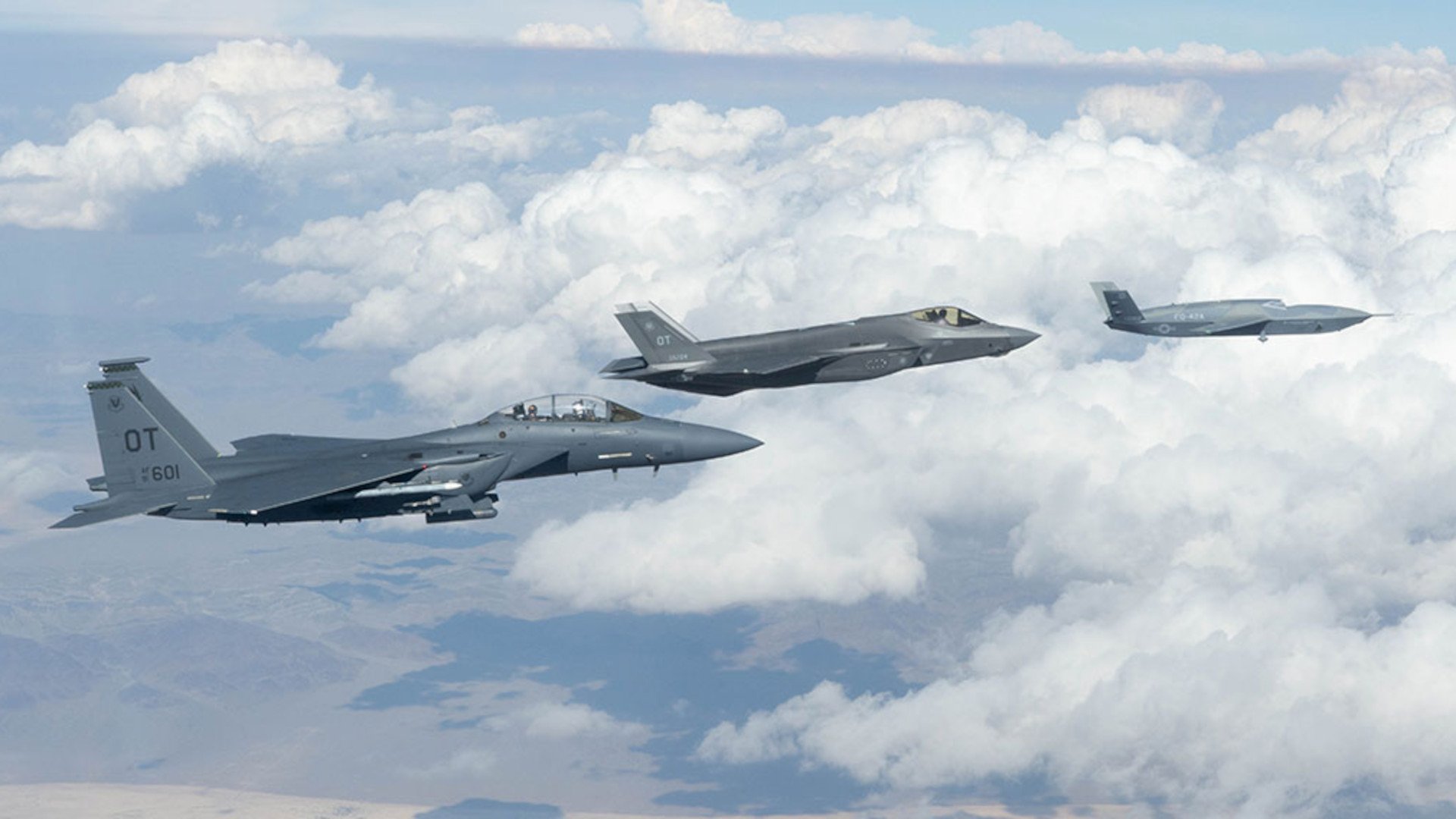
❌

Reading view

F-35 Canopy And Weapons-Bay Door Loss To China: Separating Fact From Fiction

Chinese authorities have reportedly taken possession of an F-35 cockpit canopy and weapons-bay door that were inexplicably diverted to Hong Kong while being shipped from Australia to the United States. The incident appears to have left physical components that incorporate aspects of the fighter’s low-observable design in the hands of a country that has spent years doing whatever it could to gain information on the aircraft and America’s stealth technology secrets in general.

So, what does all this mean? Let’s put it in perspective.

The parts in question were being shipped by UPS from Australia to the United States in late May, according to people familiar with the matter cited by Bloomberg. The components from a Royal Australian Air Force F-35A were being sent to the United States for inspection and possible repair or disposal.
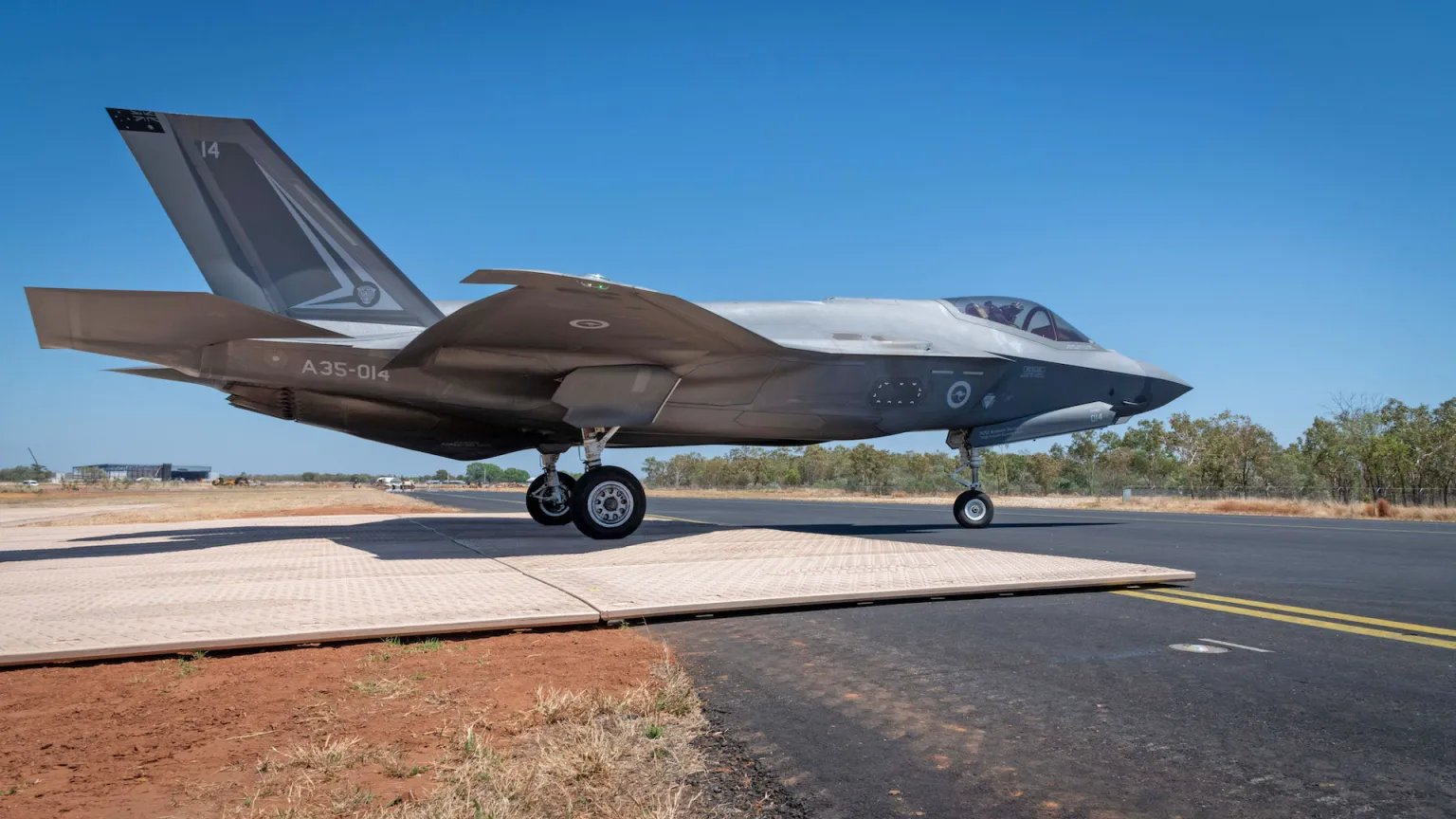
A Royal Australian Air Force F-35A from 75 Squadron taxiing at RAAF Base Tindal, Northern Territory. Australian Defense Force

F-35 sustainment procedures explicitly cover the movement of F-35 parts, including unserviceable components, through the program’s logistics network. The U.S. Air Force’s transportation guidance directs F-35 shipments outside the Defense Transportation System to follow approved Joint Program Office procedures. In other words, moving an unserviceable Australian F-35 component to the United States for inspection, repair, or disposition is consistent with the normal sustainment process.

What is highly unusual is where this particular shipment ended up. F-35 components moving through an established international logistics system apparently stopped in South Korea, and were then routed to Hong Kong. Chinese authorities subsequently took possession of the parts and have not returned them, according to the sources cited by Bloomberg.
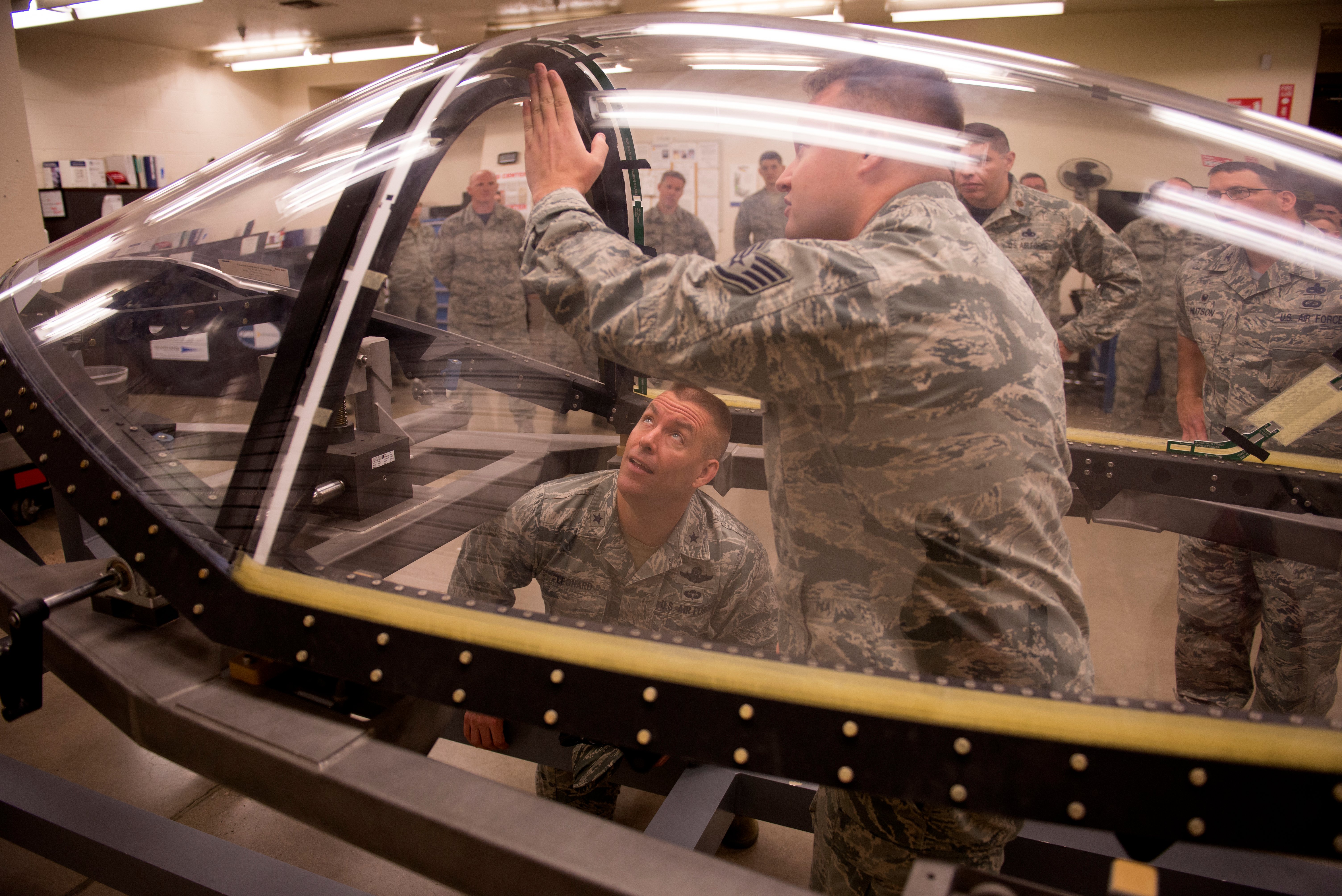

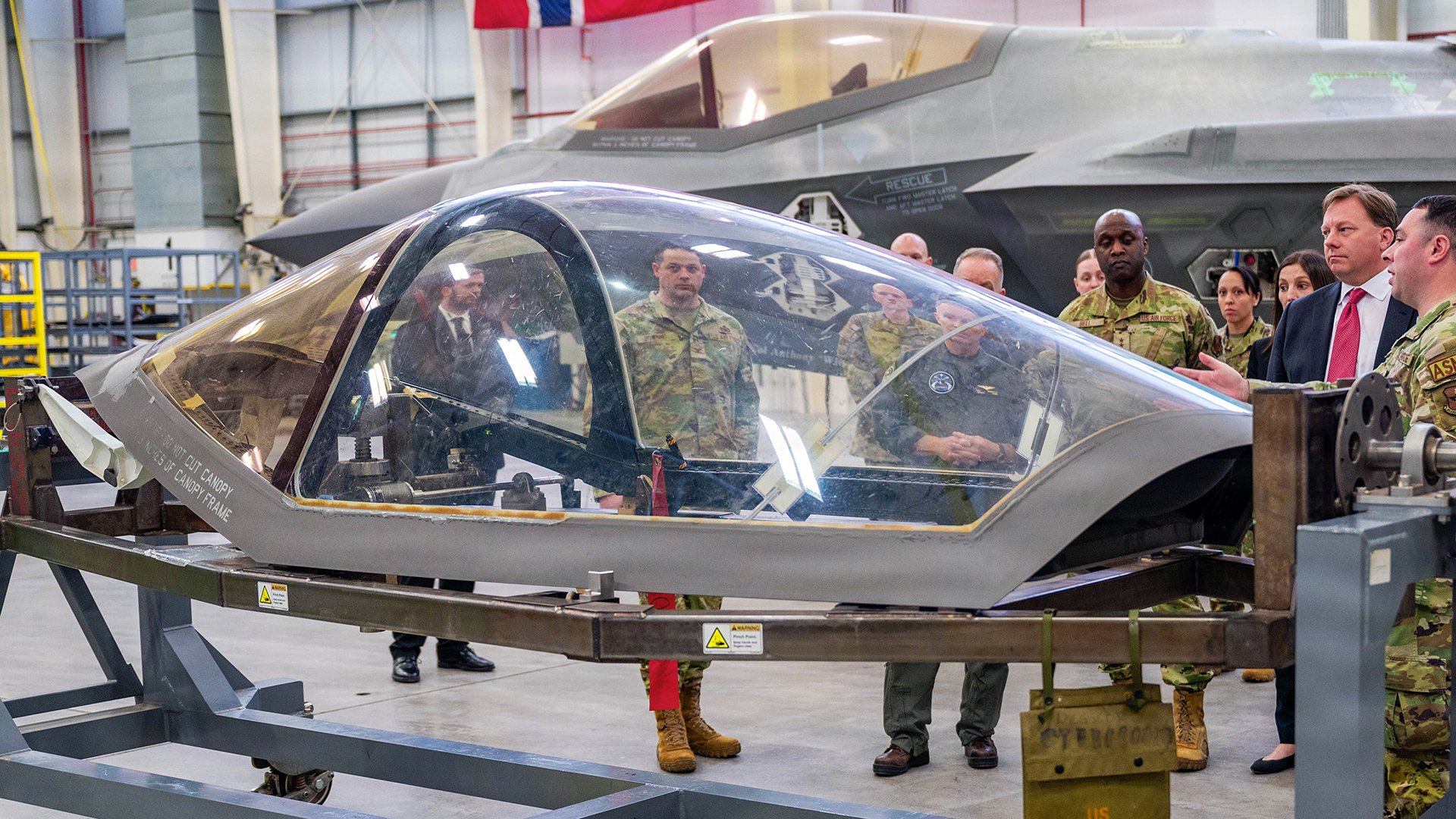
Brig. Gen. Brook Leonard, 56th Fighter Wing commander, learns about an innovative process for F-35 Lightning II canopy component replacement from Staff Sgt. Tyler Volk, 56th Component Maintenance Squadron egress technician April 13, 2018, at Luke Air Force Base, Ariz. The 56th CMS spent two months refining the process to replace the charges that separate the canopy from the jet during ejection, condensing it from 10 days to three. (U.S. Air Force photo by Senior Airman Ridge Shan)
F-35 canopy component replacement at Luke Air Force Base, Arizona. U.S. Air Force photo by Senior Airman Ridge Shan
Secretary of War Pete Hegseth autographs the weapons bay of an F-35 Lightning II at Lockheed Martin Air Force Plant 4, as part of his Arsenal of Freedom Tour, Fort Worth, Texas, Jan. 12, 2025. (DoW photo by U.S. Navy Petty Officer 1st Class Alexander Kubitza)
Secretary of War Pete Hegseth autographs the weapons bay door of an F-35 at Lockheed Martin Air Force Plant 4, in Fort Worth, Texas. DoW photo by U.S. Navy Petty Officer 1st Class Alexander Kubitza

“For security reasons, we can’t discuss the status of specific shipments or our shipping procedures,” Lockheed Martin told us in response to a request for clarification about the incident. The company added that it “follows all U.S. regulations established by the Department of War and regulated by the Defense Logistics Agency (DLA) regarding the shipment of aircraft components. Our teams handle every shipment with the utmost diligence and safeguards to ensure the integrity of the F-35 program and the security of our allied partners.”

The Pentagon’s F-35 Joint Program Office has acknowledged a “shipment issue” involving F-35 components and said U.S. authorities and industry partners are working to recover them and investigate what happened.

Lockheed Martin, UPS, and the Pentagon have not publicly provided a detailed account of how the shipment was diverted or what happened to the parts after they reached Hong Kong.

Australian Defense Minister Richard Marles also confirmed that Canberra was aware of the incident and was working with the United States and Lockheed Martin.
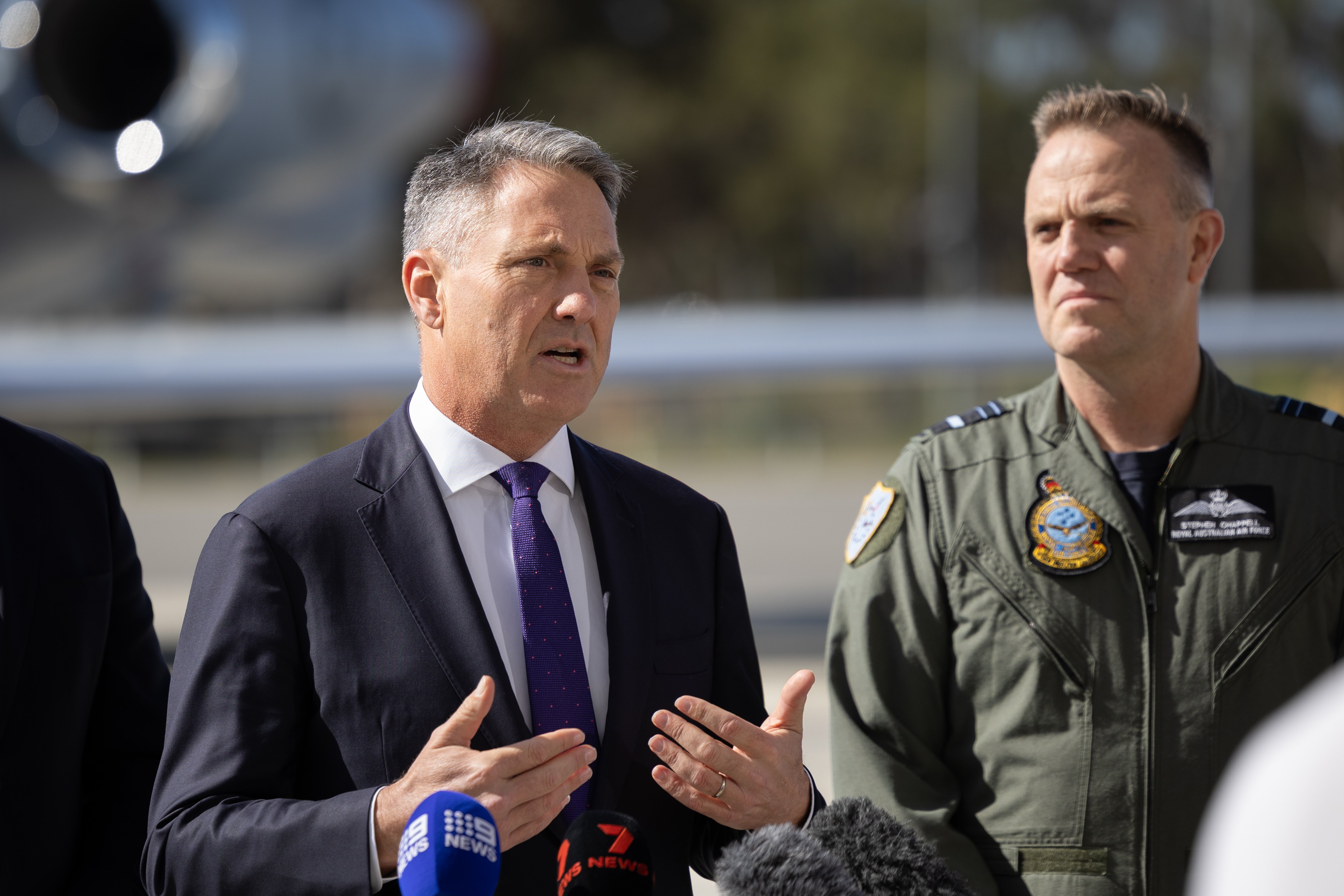
Acting Prime Minister and Minister for Defense, Richard Marles, accompanied by Chief of Air Force Air Marshal Stephen Chappell at RAAF Base Edinburgh, South Australia. Australian Defense Force

Marles has sought to play down the potential security implications of the components, saying his understanding was that the shipment did not contain sensitive equipment or sensitive parts. That does not by itself answer the more specific question of what could potentially be learned from these particular pieces of an F-35. After all, not every physical component of an F-35 is necessarily highly classified or capable of revealing meaningful information about the aircraft’s design. At the same time, a cockpit canopy and weapons-bay door involve structures, materials, interfaces, tolerances, and treatments that all have to work within the aircraft’s low-observable design. If radar-absorbing material or other specialized treatments remain on the components, that could potentially make them far more sensitive from a technological exploitation standpoint.

The condition of the parts is also unknown. We do not know how much of their coatings or other treatments remain intact, whether Chinese authorities have examined them, or what information could actually be extracted from them in their current state.

Above all else, there is little specific information in the public domain about what F-35-related technical information Chinese intelligence already has acquired over the years, what physical components or materials it may already possess, or what additional information could be gained through espionage, cyber operations, industrial access, observation of deployed aircraft, or other means.

Without these facts, it is impossible to gauge what damage could have been done by this loss. Still, viewed in a vacuum of those unknowns, simply having an F-35 canopy and weapons-bay door in Chinese possession represents a significant loss of control over sensitive physical hardware — there is no way around that reality — and the severity of that loss could be substantial depending on the physical state of the parts.

The circumstances are particularly sensitive because, as we mentioned in the opening of this article, China has pursued multiple avenues for acquiring information on the F-35 for many years, with publicly documented cases involving cyber operations, technical information, supply chains, and human expertise. Some aspects of China’s subsequent stealth aircraft designs have also prompted comparisons with U.S. aircraft, although claims that China simply ‘cloned’ entire aircraft are not supported by the available evidence.

China And The F-35: A History Of Espionage

In 2014, U.S. authorities charged Chinese businessman Su Bin with conspiring with two other Chinese hackers to break into the computer systems of U.S. defense contractors. Prosecutors alleged that the group targeted information on aircraft including the F-35 and F-22. The alleged hacking campaign ran from 2009 to 2013.

Su Bin later pleaded guilty and was sentenced to nearly four years in prison. The Justice Department’s 2026 case against former Air Force fighter pilot Gerald “Runner” Brown connects the two cases. Prosecutors allege that Brown used a co-conspirator to negotiate his work training Chinese military pilots with Su Bin.

Brown, a retired U.S. Air Force major who spent more than 24 years in the service, subsequently worked as a contract simulator instructor training U.S. military pilots on the A-10 and F-35. In February 2026, the Justice Department charged him with providing and conspiring to provide unauthorized defense services to Chinese military pilots.

CASE UPDATE from @NewYorkFBI: Former U.S. Air Force Pilot Arrested for Providing Defense Services to the Chinese Military https://t.co/JhwhJHS83v@FBILouisville @FBIIndianapolis and @FBILosAngeles provided assistance in this case. pic.twitter.com/3KElqci05y

— FBI (@FBI) February 25, 2026

According to the criminal complaint, Brown traveled to China in December 2023, where he allegedly began training People’s Liberation Army Air Force (PLAAF) personnel. Prosecutors say he also answered questions about the U.S. Air Force for three hours on his first day in China. Brown has been charged, and the allegations have not been adjudicated. He is one of multiple former Western aviators alleged to have provided training services and/or intelligence to Beijing.

The Honeywell case provides yet another example, this time involving the defense industry’s supply of technical information.

In 2021, the State Department reached a $13-million administrative settlement with Honeywell over alleged violations of the Arms Export Control Act and International Traffic in Arms Regulations (ITAR). Honeywell had voluntarily disclosed alleged unauthorized exports and retransfers of ITAR-controlled technical data.

The case involved 71 engineering drawings containing dimensions, geometries and layouts for manufacturing castings and finished parts used across multiple aircraft, engines and military systems. The State Department said the unauthorized exports and retransfers involved Canada, Ireland, Mexico, China, and Taiwan.

Among the systems covered by the drawings were components associated with the F-35 and F-22. The case did not allege that Honeywell deliberately sought to provide China with sensitive military technology; rather, it concerned alleged violations of export-control requirements.
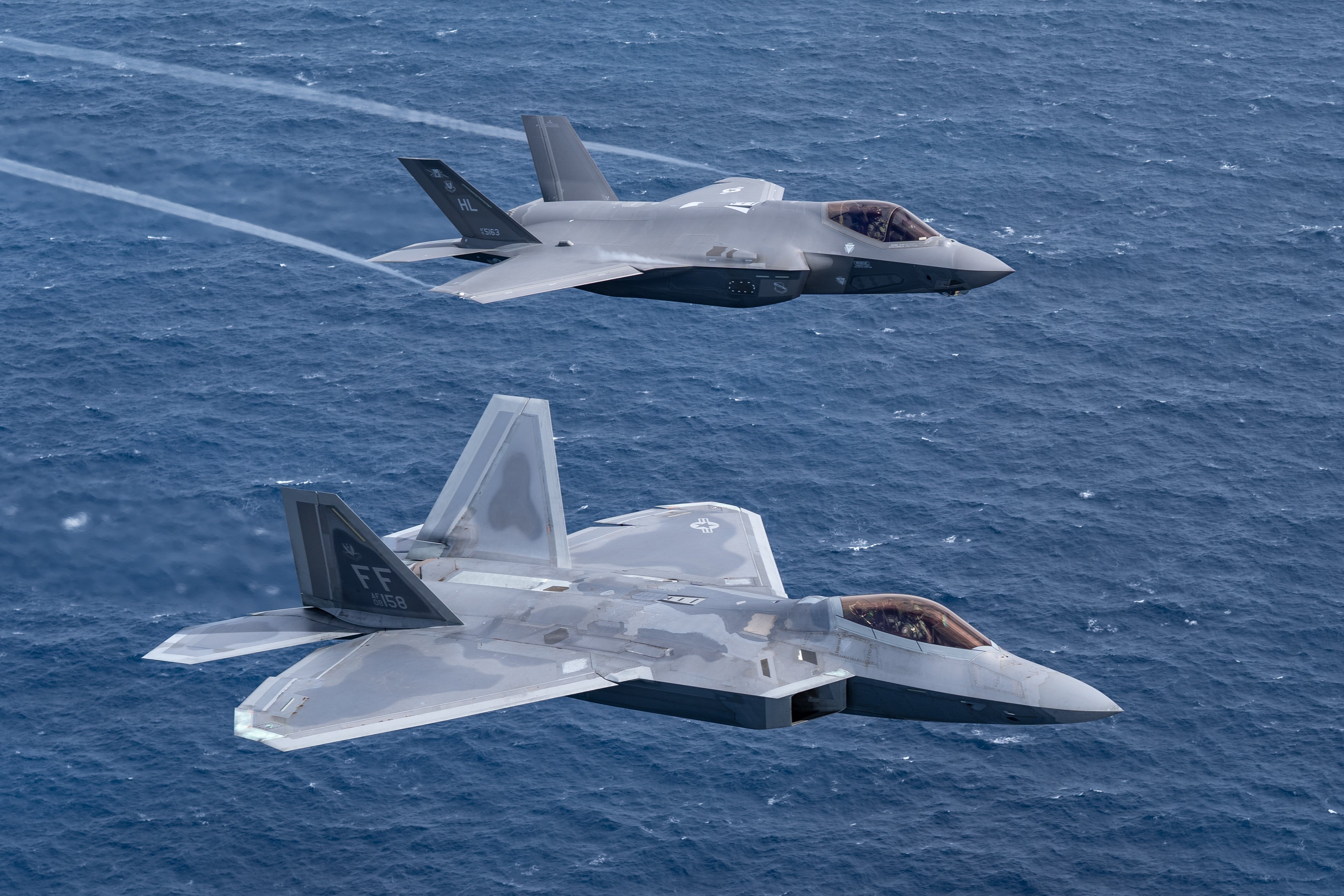
A U.S. Air Force F-22 Raptor flies alongside an F-35 Lightning II during a special formation flight in Fort Lauderdale, Fla. Nov. 20, 2020. These two 5th-generation aircraft represent the Air Force’s stealth fighter capability and perform a variety of air-to-air and air-to-ground mission. (U.S. Air Force photo by Lt. Sam Eckholm)
A U.S. Air Force F-22 (nearest camera) flies alongside an F-35A. U.S. Air Force photo by Lt. Sam Eckholm

There has also been a physical supply-chain precedent.

In 2022, F-35 deliveries were temporarily halted after the Pentagon discovered that a magnet in the aircraft’s Honeywell-built turbomachine pumps —which provide critical power functions to the jet — contained a cobalt and samarium alloy produced in China. The material itself was not considered a security or flight-safety threat, but the discovery demonstrated how difficult it can be to maintain complete visibility over a global supply chain involving thousands of companies and multiple tiers of subcontractors.

Taken together, these cases demonstrate several different pathways through which China has appeared in the F-35 security story: cyber theft, unauthorized technical-data transfers, supply-chain exposure, and alleged exploitation of former Western military expertise.

The Hong Kong incident would add another major category: physical access to actual F-35 components.

These are only some of the publicly documented examples. There is no public way to know the full extent of information or physical material Chinese intelligence may have acquired over the years, but is very likely far larger in scope than what is available in the open source.

Chinese Access Concerns Have Shaped F-35 Export Policy

The security issues surrounding the F-35 are significant enough that concerns about China have affected not only how the United States protects F-35 technology, but where Washington is willing to export the aircraft in the first place.

The proposed sale of F-35s to the United Arab Emirates became deeply entangled in U.S. concerns about Abu Dhabi’s growing military and technology relationship with China.
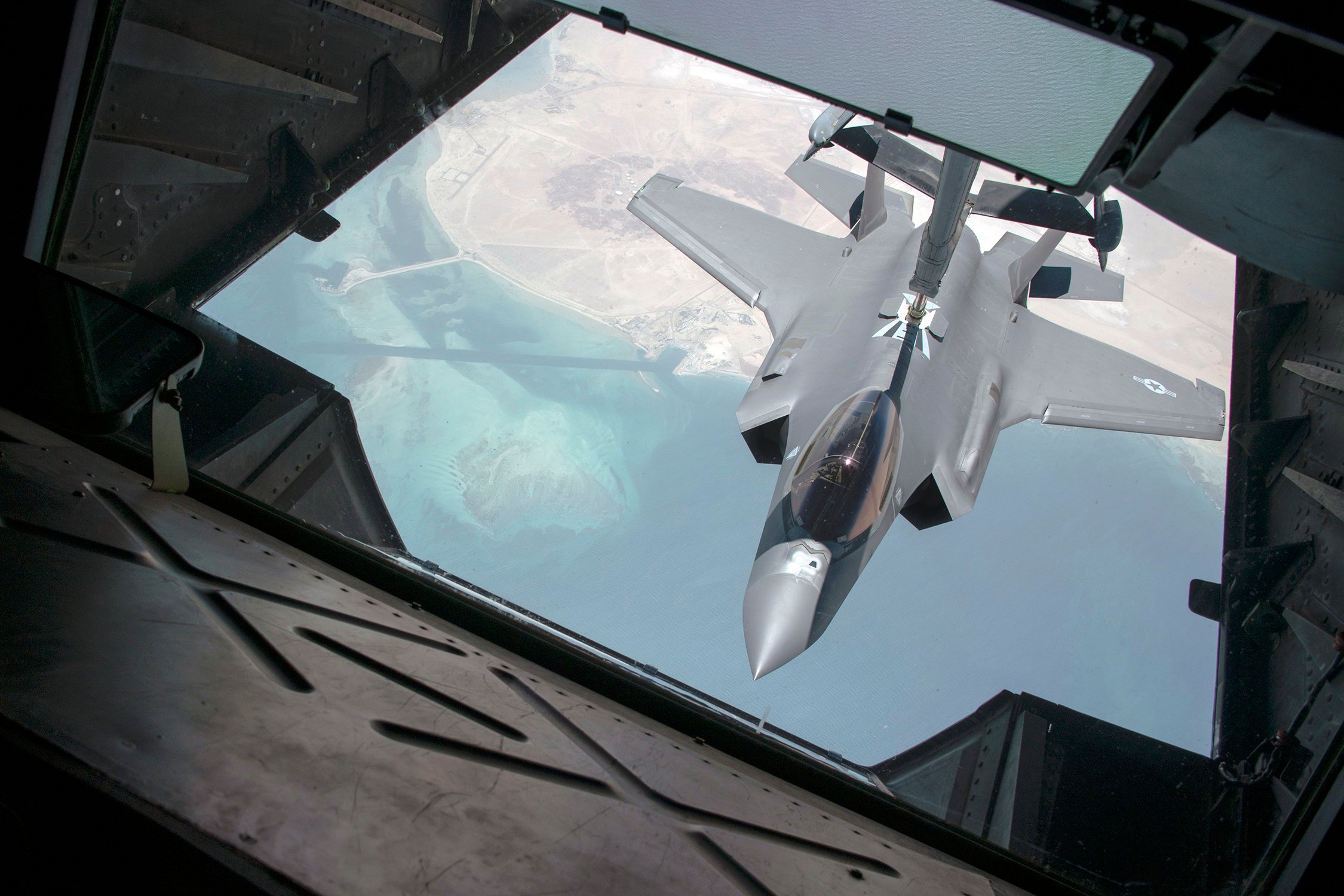
A 34th Expeditionary Fighter Squadron F-35 Lighting II conducts an inflight refueling with a 908th Expeditionary Air Refueling Squadron KC-10 Extender in the skies above the United Arab Emirates, May 8, 2020. The F-35A is the U.S. Air Force’s latest fifth-generation fighter. It has an enhanced capability to survive in the advanced threat environment in which it was designed to operate. With its aerodynamic performance and advanced integrated avionics, the F-35A provides next-generation stealth, enhanced situational awareness, and reduced vulnerability for the United States and allied nations. (U.S. Air Force photo by Tech. Sgt. Kat Justen)
A 34th Expeditionary Fighter Squadron F-35A conducts inflight refueling above the United Arab Emirates. U.S. Air Force photo by Tech. Sgt. Kat Justen

Washington had approved a potential package involving 50 F-35As, but U.S. officials and lawmakers expressed concerns about Chinese intelligence activity and technology in the UAE. Among the broader concerns were Chinese telecommunications infrastructure and the possibility of Chinese military or intelligence access to facilities associated with advanced U.S. weapons. A Congressional U.S.-China Economic and Security Review Commission report later cited the potential presence of Chinese intelligence collection capabilities and military facilities in the UAE as risks to the proposed F-35 sale.

The issue has now resurfaced with Saudi Arabia.

The State Department recently approved a potential $24.3-billion sale to the Kingdom involving 48 F-35s and associated equipment. But U.S. intelligence agencies have reportedly warned that China’s military and technology relationship with Saudi Arabia could create opportunities for Beijing to obtain sensitive F-35 information.

According to reporting based on U.S. officials familiar with intelligence assessments, a Defense Intelligence Agency report raised concerns about Chinese military access to Saudi bases, Chinese technology in Saudi telecommunications infrastructure, and whether secure facilities could be maintained for F-35 operations. The assessments also questioned whether Saudi Arabia would limit contact between Chinese military and intelligence personnel and F-35-related sites.

What Could The Components Reveal?

As we noted earlier, there is no way to gauge the intelligence impact of the loss at this stage. The central unknown of what China already knows about the F-35, and what it may already have in its possession — especially related to these components — is the key variable here.

Regardless, an F-35 canopy and weapons-bay door can provide information that cannot otherwise be easily obtained and gives a different level of fidelity in terms of material exploitation than what construction data and blueprints alone could.

The F-35’s low observability is the product of an extremely complex combination of airframe shaping, construction materials, external coatings, manufacturing tolerances, speciality apertures, and more.
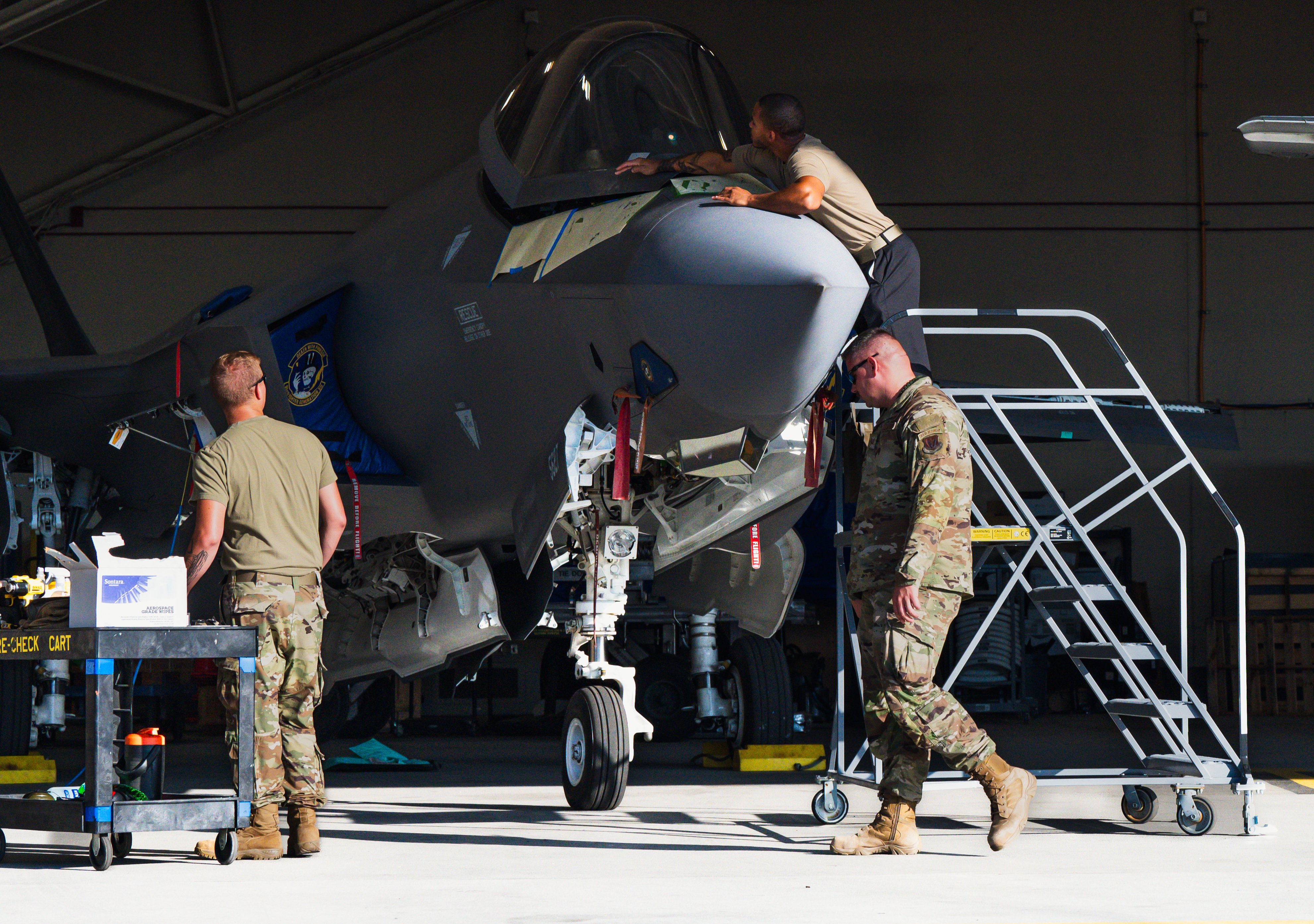
U.S. Air Force Staff Sgt. Ossoren Kade, left, and Tech. Sgt. Ryan McGarrigle shares information with Senior Airman Tyrese Baylis, 325th Maintenance Squadron low observable maintainers, as he works on an F-35A Lightning II at Tyndall Air Force Base, Florida, Aug. 16, 2024. Low observability is a complex system that goes far beyond simply painting an aircraft. LO requires a specialized and intricate technique that is essential for the F-35A to remain undetectable in contested areas. (U.S. Air Force photo by Airman 1st Class Victoria Moehlman)
U.S. Air Force 325th Maintenance Squadron low-observable maintainers work on an F-35A at Tyndall Air Force Base, Florida, in August 2024. U.S. Air Force photo by Airman 1st Class Victoria Moehlman

A canopy is a particularly demanding part of any stealth aircraft. It has to satisfy optical and structural requirements while also controlling radar reflections. The cockpit is historically a major source of radar reflectivity, including the pilot’s helmet. Therefore the canopy’s materials, construction, interfaces, and specialized treatments can be critical to the aircraft’s overall low-observable performance, and especially from the critical frontal aspect.

The F-35’s canopy has been an ongoing work in progress for many years. It has had chronic material issues, especially when it comes to delamination. Multiple iterations spread over two decades have recently resulted in a major improvement of the issue. The tight balancing act of keeping the canopy transparent enough, while controlling the F-35’s stealthy signature and having that mix of materials be robust enough to last for a reasonable amount of time has been a major investment for the program. If the canopy is of a later variation, that loss alone could be substantial and could help China with their own low-observable canopy development programs even if they already had original information on the F-35’s canopy original design dating back years.
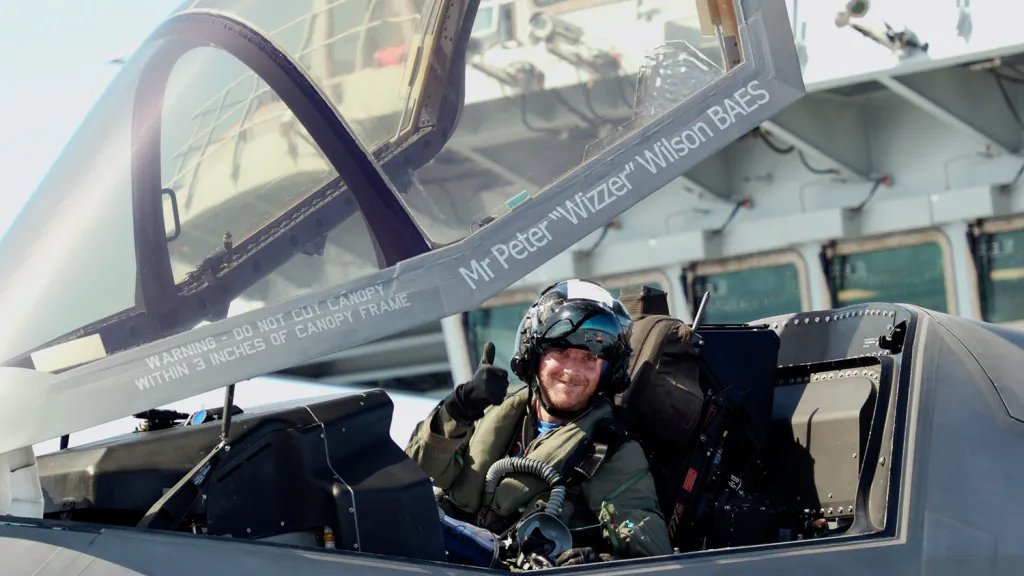
(Pictured: Royal Navy Commander, Nathan Gray in his F35B gives a celebratory thumbs up after succesfully landing onboard) Two F-35B Lightning II fighter jets have successfully landed onboard HMS Queen Elizabeth for the first time, laying the foundations for the next 50 years of fixed wing aviation in support of the UK’s Carrier Strike Capability. Royal Navy Commander, Nathan Gray, 41, made history by being the first to land on, carefully manoeuvring his stealth jet onto the thermal coated deck. He was followed by Squadron Leader Andy Edgell, RAF, both of whom are test pilots, operating with the Integrated Test Force (ITF) based at Naval Air Station Patuxent River, Maryland. Shortly afterwards, once a deck inspection has been conducted and the all-clear given, Cdr Gray became the first pilot to take off using the ship’s ski-ramp. Image taken by and credit to PO Arron Hoare
Evidence of the F-35’s canopy delamination issue on an early example of the F-35B. Crown Copyright

The F-35’s canopy has been a notorious work in progress, specifically the low observable coating/delamination issue which has improved a lot in recent years with new materials and processes. So no, you do NOT want to lose that in to China! https://t.co/9V0jdRAiwA

— Tyler Rogoway (@Aviation_Intel) September 19, 2026

The F-35’s weapons-bay door has its own sensitivity issues. It is effectively a major section of the aircraft’s outer shell, with its structure, edges, interfaces, tolerances and treatments all having to function without creating unacceptable radar signatures. Its construction and material attributes can be reasonably extrapolated for the rest of much of the F-35’s outer mold-line. Above all else, if the radar absorbent material remained intact on the door, that would signify a major loss when viewed without any understanding of what China already knows about the F-35’s radar absorbing surface treatments. Historically speaking, RAM technology is among America’s closely guarded material sciences secrets.
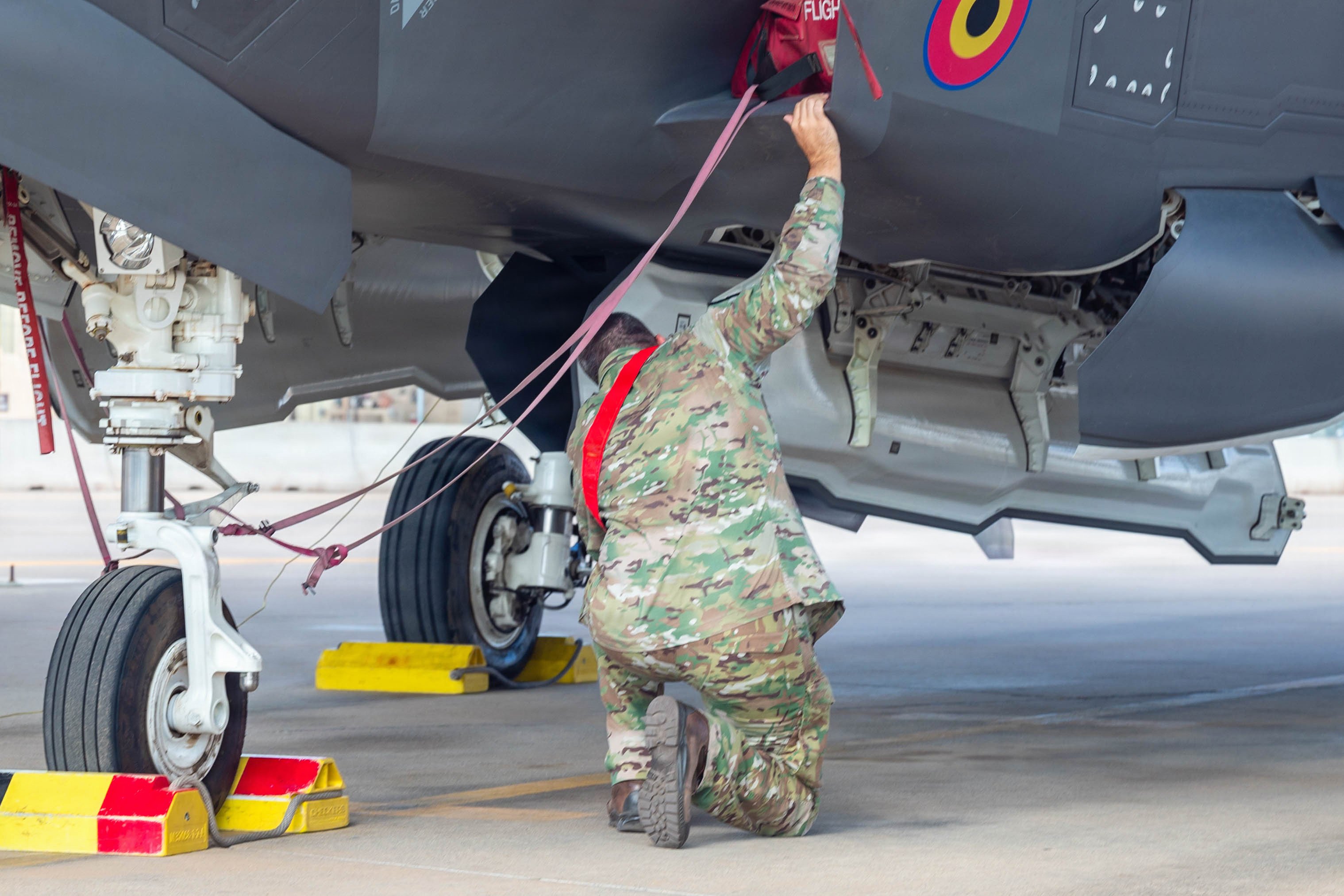
A Belgian Air Force service member stationed at Luke Air Force Base inspects the weapons bay of an F-35A Lightning II at Luke AFB, Arizona, Aug. 12, 2026. Integrated maintenance operations with Allied and partner forces strengthen readiness and mutual interoperability, ensuring combat-ready forces are prepared to outpace evolving global threats. (U.S. Air Force photo by Airman 1st Class Tekorey Watkins)
A Belgian Air Force service member inspects the open weapons bay of an F-35A at Luke AFB, Arizona. U.S. Air Force photo by Airman 1st Class Tekorey Watkins

For the time being, Australian officials have said they do not understand the parts to be sensitive. The investigation will ultimately have to establish what the components actually contain and what could be learned from them.

The incident comes at a moment when China’s own stealth fighter efforts are undergoing an extraordinary expansion.

The PLAAF is now operating the J-20, China’s first operational fifth-generation stealth fighter, in increasingly large numbers. The smaller J-35 is also moving toward broader service, including a carrier role for the People’s Liberation Army Navy.

CHANGCHUN, CHINA - SEPTEMBER 22: Aircraft maintenance workers clean the fuselage of a J-20 fighter jet during the 2025 aviation open-day activities of the Chinese People's Liberation Army (PLA) Air Force and the Changchun Air Show on September 22, 2025 in Changchun, Jilin Province of China. (Photo by Zhang Xiangyi/China News Service/VCG via Getty Images)
Aircraft maintainers clean the fuselage of a J-20 fighter during the Changchun Air Show in the Jilin Province of China, in September 2025. Photo by Zhang Xiangyi/China News Service/VCG via Getty Images

China has also moved into what Western observers generally describe as sixth-generation fighter development.

Two new tailless combat-aircraft designs emerged publicly in December 2024. One is the large Chengdu aircraft commonly referred to as the J-36, while the other is associated with Shenyang and is variously called the J-XDS or J-50. Both have continued flight testing and yielded several prototypes with individual refinements.

The exact capabilities and eventual operational roles of these aircraft remain uncertain. They are developmental designs, not established operational equivalents of the F-35 or other sixth-generation systems. However, China is clearly building an increasingly broad ecosystem of fifth- and next-generation low-observable combat aircraft, both crewed and uncrewed. In the latter category is a growing number of stealthy drones, including long-endurance types.
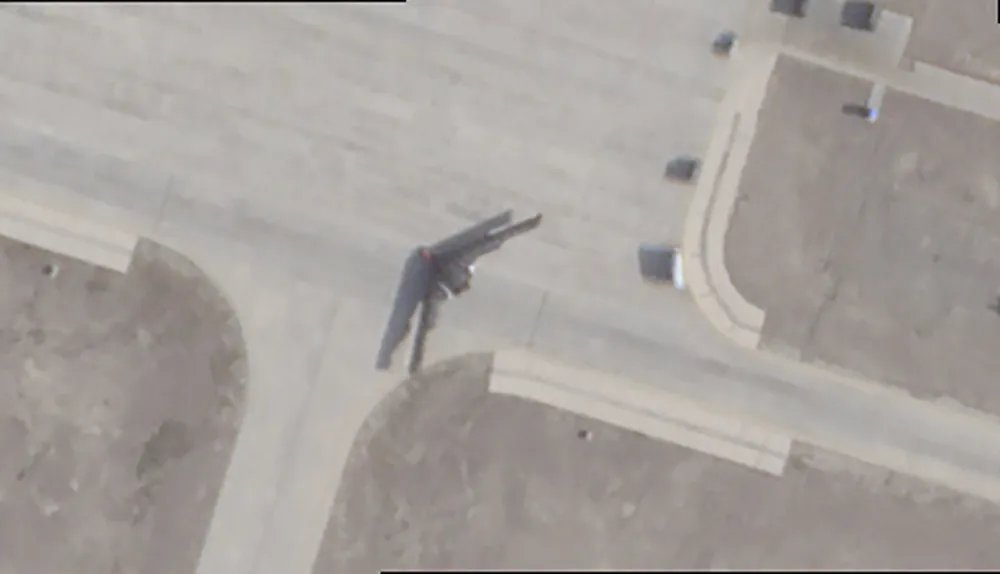
A satellite image taken last month shows the WZ-X very large, low-observable, flying-wing drone undergoing testing. PHOTO © 2026 PLANET LABS INC. ALL RIGHTS RESERVED. REPRINTED BY PERMISSION

China didn’t likely need physical access to an F-35 canopy or weapons-bay door to develop the J-20, J-35, or its next-generation aircraft. But additional information about how a mature Western stealth aircraft handles materials, coatings, interfaces, manufacturing, and the integration of those elements can still have great potential value to an industry developing its own systems. This includes technologies intended to counter the U.S. combat aircraft and their low-observable characteristics.

The F-35 has been produced in large numbers, is operated by a growing coalition of countries, and has been subjected to years of testing and operational experience. Its low-observable design represents decades of accumulated U.S. research and industrial know-how. At the same time, the global scale of the program inevitably makes control over sensitive information more complicated. More aircraft, more maintainers, more industrial partners, and more international logistics mean more points at which information and physical hardware have to be controlled. Over time, a program of this size will see an erosion in its secrets, but a major loss can drastically accelerate what should be a more gradual and controlled decline in security.

Lockheed Martin Fort Worth Texas Photo by Alexander H Groves Production Line from Monorail FP170764 1707383 JSF F-35 AF Plant 4 04_06_17 Leeya Davis Image has NOT been released FOUO FOR OFFICIAL USE ONLY
The Lockheed Martin F-35 production line at Fort Worth, Texas. Lockheed Martin photo by Alexander H Groves

The potential intelligence value of the components also has to be considered in the context of foreign material exploitation, or FME. Major military powers maintain dedicated capabilities to recover, examine and characterize foreign weapons, aircraft, sensors, materials and other equipment. The objective is not necessarily to reproduce an entire system. More important is determining how something is built, what materials and manufacturing techniques are used, how individual components perform, and where industrial strengths or limitations may lie.

That is why countries have historically gone to extraordinary lengths to recover even crashed or damaged pieces of sensitive military hardware. The bigger the prize, the more risk an intelligence service would be willing to take in order to realize a recovery.

The sensitivity surrounding the physical remnants of an F-35 is not new. When a Japan Air Self-Defense Force F-35A disappeared over the Pacific in 2019, the search quickly became more than a rescue operation. U.S. and Japanese forces mounted an extensive effort to locate the wreckage, with U.S. Navy P-8A aircraft and a destroyer joining the search. TWZ noted at the time that even scattered F-35 wreckage could expose valuable technological secrets, while the aircraft’s location on the seabed raised the prospect of an underwater espionage and recovery operation.

USFJ is supporting @MoDJapan_en search & rescue efforts for missing F-35A w/@US7thFleet P-8A aircraft & @air_fifth coord. @USForcesJapan continues to hope for the safe recovery of the pilot @JASDF_PAO pic.twitter.com/9E7x6QZxpY

— U.S. Forces Japan (@USForcesJapan) April 10, 2019

That concern has also been evident in subsequent F-35 recovery operations. In 2022, the U.S. Navy recovered an F-35C from roughly 12,400 feet in the South China Sea after a carrier landing accident, removing the possibility that the aircraft could be accessed by another country.

pic.twitter.com/JvQZErAAK0

— OedoSoldier (@OedoSoldier) January 27, 2022

Unanswered Security Questions

At this point, there is no public evidence that the Hong Kong diversion was a deliberate Chinese intelligence operation, although it is certainly possible. It is also unclear whether Chinese authorities have examined the F-35 parts or what level of new and useful information has been recovered from them.

If, as reported, Chinese authorities have taken possession of the parts and have not returned them, that would be an extraordinary development. If the diversion was genuinely the result of a shipping or logistics error, the outcome would itself be extraordinary. It would raise serious questions about the security controls surrounding the movement of F-35 hardware even without evidence of deliberate interference.

The timing is also notable. Chinese President Xi Jinping arrived in Washington this week for a state visit with President Donald Trump, with the two leaders meeting amid broader disputes involving technology, security, and the future of U.S.-China relations. Whether the F-35 shipment comes up directly in those discussions is not known, but it would be an obvious subject for U.S. and Chinese officials to address through diplomatic channels.

"Ladies and gentlemen, the President of the United States Donald J. Trump and First Lady Melania Trump, accompanied by the President of the People's Republic of China Xi Jinping and Madame Peng Liyuan." pic.twitter.com/hyPHOBC99Q

— Rapid Response 47 (@RapidResponse47) September 24, 2026

For now, however, the central question remains how the parts got there. Until that is answered, we won’t know if this was a simple logistics failure or a deliberate intelligence operation. And beyond that, what China already knew about the components it now may have in its possession — a question we may never truly get an answer to.

Contact the author: thomas@thewarzone.com

The post F-35 Canopy And Weapons-Bay Door Loss To China: Separating Fact From Fiction appeared first on TWZ.

  •  

Inside Ukraine’s Operation Vivaldi That Sees Its Troops Gaining Ground In The East

Ukraine claims it has recently regained about 125 sq. km. of territory near the town of Lyman in the eastern Donetsk region during what has been dubbed Operation Vivaldi. Rodion Kudryashov, a Ukrainian colonel and deputy commander of the Third Army Corps, offered some insights into this offensive and what made it different.

Though the operation is still ongoing, the success of Vivaldi began long before any troop movements, Kudryashov explained in an editorial he published in Ukrainian Pravda.

Ukraine is making advances near the town of Lyman, located in the Donetsk region. (Google Earth)

“After the Third Army Corps was formed, we changed the command system of its subordinate units,” he noted. “Some brigades came to the corps after very heavy fighting, with losses, manning problems and, most importantly, eroded trust in their leadership.”

Third Army Corps Commander Brig. Gen. Andriy Biletsky “then set out one of our key principles: a commander must be responsible for the entire cycle, from training a soldier to the result on the battlefield,” Kudryashov pointed out. “In some places that meant replacing a commander. In others it meant restructuring a staff or strengthening the NCO chain. In some cases we had to build, almost from scratch, processes that on paper should have been working long ago.”

At issue was changing the culture from a more rigid Soviet-era model, with a cumbersome chain of command, to a modern, more flexible one better suited for the current conflict.

“A modern commander has to handle an enormous flow of information and make decisions quickly,” the deputy commander proffered. “He has to understand what unmanned systems, logistics, reconnaissance and adjacent units can do, while not smothering initiative at lower levels with endless approvals. An army where every decision takes hours to travel up and down the chain loses to an army that makes the same trip in minutes.”

Once those changes were put in place, the Third Army Corps had to first stop Russian advances in the sector before it could move forward.

VIVALDI 🎼🎶

GoPro footage from Ukrainian assault troops who took part in the Vivaldi counteroffensive, which resulted in the liberation of five settlements in the Lyman direction. pic.twitter.com/2SVXSKlEX0

— 𝔗𝔥𝔢 𝕯𝔢𝔞𝔡 𝕯𝔦𝔰𝔱𝔯𝔦𝔠𝔱 🦩🇬🇪🇺🇦🇺🇲🇬🇷 (@TheDeadDistrict) September 17, 2026

“When the corps took over its area of responsibility, our first task was not an offensive,” the officer said. “We had to stop the situation from deteriorating and stabilize the forward edge.”

“The enemy was pressing. In some sectors our combat formations were losing cohesion,” he underscored. “The Russians were actively using infiltration tactics: small groups seeped between positions, massed in our rear, threatened logistics and gradually eroded the defensive line.”

“We had to stabilize the forward edge and stop the infiltration,” Kudryashov said. “We had to rebuild command, put in commanders capable of making decisions, form new teams and reconstitute units. We had to set up the surveillance-and-strike system and sustain the front line. We had to stockpile ammunition, drones and other resources, understand the enemy, and plan the next step before the previous one was finished. Only after that could we move forward.”

By June, the corps was able to secure the front “in the sector from Borova to Lyman and eliminate the enemy’s infiltration zones,” Kudryashov continued. “That sounds less impressive than the word ‘offensive,’ but no offensive ever happens without it.”

“You cannot plan a complex operation if you don’t know where your forward edge will be tomorrow,” the deputy commander extrapolated. “You cannot build up forces if your logistics are constantly under threat. And you cannot form a strike group if your units are always forced to patch new breaches. So the first phase of ‘Vivaldi’ was not an advance at all. It was creating the conditions that made an advance possible in the first place.”

Once the front was stabilized, the next step was shaping the battlefield for the offensive. The corps’ unmanned systems units went to work against Russian logistics, striking a pipeline and depots. That forced the enemy to change its fuel and lubricant supply routes.

Ukraine’s 3rd Army Corps released new footage of search-and-strike operations on the Lyman front. FPV drone operators from the 60th Mechanized Brigade’s FATUM unit targeted Russian armored vehicles, a Grad multiple rocket launcher and personnel. #Ukraine pic.twitter.com/1iNG7z2N1c

— NOELREPORTS 🇪🇺 🇺🇦 (@NOELreports) September 24, 2026

“The operation also involved the corps’ brigades, its reconnaissance and unmanned units, and attached forces from the SSO (Special Operations Forces), GUR (Defense Intelligence) and DPSU (State Border Guard Service),” the deputy commander said. “To counter infiltration, a joint headquarters was set up to coordinate special and reconnaissance units at the tactical level under a single concept.”

“In my view, this is one of the main characteristics of modern war,” he further stated. “It is not 10 strong units that each fight well on their own. It is 10 different elements that start working as one system at the right moment.”

An interesting new detail from Ukraine’s 3rd Army Corps about Operation Vivaldi on the Lyman axis.

The Corps says Ukrainian forces carried out a flanking maneuver and, for the first time, airlifted unmanned ground vehicles behind Russian lines, while also suppressing Russian… https://t.co/ZEq8C75bN4 pic.twitter.com/KgKcZ0Zs2P

— Special Kherson Cat 🐈🇺🇦 (@bayraktar_1love) September 20, 2026

The influential, Kremlin-connected Rybar Telegram channel has acknowledged Ukrainian gains in this sector.

“In the first half of summer, Russian units gradually advanced in Lyman,” Rybar wrote this morning. “However, in August, the enemy launched counterattacks and, by the first week of September, regained some positions, and also began attempts to recapture Shandryholovo and Zarechnoye.”

“The enemy did not inflict significant losses on Russian troops, as the concentration of units of the West group of forces in the salient remained relatively low,” Rybar added. “However, later, the UAF deployed reserves to launch an offensive towards Zherebets in order to align the front along the water barrier and return it to the configuration of the end of 2025.”

rybar now saying the 144th division is still falling back. the 3rd corps is still advancing and destroying an entire army group as they move. this is historic. pic.twitter.com/2jOa8KR9oA

— david D. (@secretsqrl123) September 22, 2026

Though the battle is still in flux, Kudryashov said there are lessons the rest of the Ukrainian military should heed.

“Winning one battle is not yet winning the war,” he said. “The enemy is learning too. He changes tactics, looks for weak spots and tries to scale what works for him.”

“So our task is to be faster, not only in physically moving forward but also in our ability to see, think, decide and put into practice what delivers results,” the deputy commander avowed. “And to do everything possible so that our soldiers pay the lowest possible price for every next kilometer of Ukrainian land.”

The Latest

On the battlefield, in addition to the gains Ukraine has made near Lyman, it has also largely been able to hold off Russian advances across the front lines. Here are some key takeaways from the latest Institute for the Study of War assessment of frontline operations:

  • Sumy: Russian forces recently conducted an infiltration mission east of Sumy City, and they continue to conduct glide bomb strikes against frontline settlements in northern Sumy Oblast to set conditions for future offensives.
  • Kharkiv: Russian forces continued offensive operations in northern Kharkiv Oblast and in the Borova, Kupyansk and Velykyi Burluk directions on Sept. 21 and 22 but did not advance.
  • Donetsk: Ukrainian forces reportedly continue counterattacks in the Lyman direction, including southeast of Lyman, as Russian forces are attempting to use redeployments to stabilize the area. Russian forces continued offensive operations east and southeast of Slovyansk near Rai-Oleksandrivka and toward Mykolaivka and Fedorivka Druha on Sept. 21 and 22 but did not advance. During this period, they also tried to advance in the Novopavlivka and Oleksandrivka directions but made no gains, as Ukrainian forces counterattacked in both areas.
  • Zaporizhia: Ukrainian forces recently advanced or maintained positions in western Zaporizhia Oblast.
  • Kherson: Neither Russian nor Ukrainian forces reported ground activity in the Kherson direction on September 22.

Russian Offensive Campaign Assessment, September 22, 2026: The Russian Ministry of Defense (MoD) falsely claimed that Russian forces have encircled Dobropillya — an intensification of the Kremlin’s cognitive warfare campaign alleging encirclements across various sectors of the… pic.twitter.com/yMoAcyVIme

— Institute for the Study of War (@TheStudyofWar) September 23, 2026

In his speech to the U.N. General Assembly this afternoon, Ukrainian President Volodymyr Zelensky called for Russia to end its war and said it was paying a heavy price — and exacting a terrible toll — for little territorial gain.

“This ridiculous and never-ending war with Ukraine must be ended,” the Ukrainian leader urged. “I do not know a single world leader who would say otherwise. I do not know anyone who is openly for this war, except one man.”

He was referring to Russian President Vladimir Putin.

“Ladies and gentlemen, for almost five years now, Russian generals have been trying to carry out Putin’s crazy order to seize our eastern land, the Donetsk region,” Zelensky continued. “And just this year, from January through August, the Russian army lost 248,964 people on the battlefield in Ukraine in eight months. Twenty-one countries in the world have smaller populations… than the number of Russian troops lost in just eight months.”

“It’s madness, but they still keep going there to die because that is what Putin wants,” Zelensky suggested. “After losing so many people, Russia managed to capture just over 1,000 square kilometers of our land this year, and we have already liberated a significant part of it. Russia is a country that already has 17 million square kilometers of its own land without any Ukrainian territory, by the way. So to add another 1,000 square kilometers, Putin is paying with 248 people for every kilometer. Does anyone still think that he is reasonable? And moderate?”

“Russia’s leader, Patient Zero, the man from whom this war began and spread into the world, becoming the largest war in Europe since World War II, will inevitably leave this war,” Zelensky proffered. “But the longer Putin is able to wage war, the more evil he will leave behind in this world. Today, nothing in war works the same way it did, by the way, in 2022, except the courage of people.”

Russian missile and drone barrages have “caused damage, but they didn’t break us,” the president proclaimed. “We build our defense. What is really difficult for us now is Russian ballistic missiles and their new jet-powered Shaheds — Iranian technologies.”

KYIV, UKRAINE - SEPTEMBER 8: Residential buildings stand against the backdrop of smoke from a Russian attack on September 8, 2026 in Kyiv, Kyiv Oblast, Ukraine. Fire and damage are seen following an overnight Russian attack involving ballistic missiles and strike drones. Falling debris sparked fires and damaged residential buildings, vehicles and warehouses in the Holosiivskyi, Darnytskyi, Podilskyi, Solomianskyi and Shevchenkivskyi districts. Two people were killed and 10 others were injured, according to Kyiv Mayor Vitali Klitschko. Five of the injured were hospitalized, including two in serious condition. (Photo by Bohdan Diev/Global Images Ukraine via Getty Images)
Residential buildings stand against the backdrop of smoke from a Russian attack on Kyiv. (Photo by Bohdan Diev/Global Images Ukraine via Getty Images) Tatyana Kudel’s’ka

“Just imagine this: since the beginning of this year, Russia has already used more than 2,100 missiles of different types again against us, against Ukraine, our people and our children,” Zelensky stated. “More than 950 of them were ballistic missiles. In eight months of this year, Russia used 63,000 attack drones of different types against Ukraine, our people, and more than 7,700 of them were jet-powered Shaheds, truly destructive and very dangerous weapons. Just think about it. The Russians launch jet-powered Shaheds every hour, every hour, against our cities, our economy, our infrastructure. Our combat aircraft are fighting them 24/7, and this is part of Russia’s strategy to create a new threat every hour, to make life harder for the economy and to disrupt people’s lives, and to stop children from being able to study, to study at school.”

Speaking at the Sixth Summit of the International Crimea Platform in New York on Wednesday, Zelensky said the return of Crimea is a condition for any return to normal relations with Russia.

“Disrespect for international law began in 2014, when Russia entered Crimea,” the Ukrainian leader stated. “There can be no full return to normality without Crimea, the restoration of security, the protection of people and lives, the release of prisoners held by Russia, and a return to the fundamental principles of international law. Territorial integrity matters, state sovereignty matters, and human lives matter. And Russia must learn this.”

Tuesday, Zelensky met with U.S. President Donald Trump.

Among the topics of their three-hour meeting were a path to end the war and a renewed discussion about the licensing of Patriot air defense interceptors so they can be built in Ukraine. The country is struggling to defend against Russian ballistic missiles because of the dearth of these munitions.

“Just had a positive and productive meeting with President Trump on the sidelines of the UN General Assembly,” the Ukrainian leader stated on X. “Both the United States and Ukraine want this senseless Russian war to end before winter. We discussed possible de-escalation steps that could pave the way to diplomacy.”

“I am grateful that, in parallel with this, our teams continue to work on launching the production of Patriot interceptor missiles in Ukraine,” Zelensky noted. “This is exactly what will help protect lives if Russia rejects negotiations and continues to rely on ballistic terror against our people this winter and beyond. We also discussed other bilateral and multilateral issues, including the winter air defense package for Ukraine. Thank you to President Trump, his team, and all the American people for their support.”

I just had a positive and productive meeting with President Trump @POTUS at UNGA. Both the U.S. and Ukraine want to see this senseless Russian war ended before winter. We discussed potential de-escalatory steps that can open up the way to diplomacy. I am grateful that in the… pic.twitter.com/Ayvsj9It3m

— Volodymyr Zelenskyy / Володимир Зеленський (@ZelenskyyUa) September 22, 2026

For his part, Trump said negotiations about Patriots are ongoing but offered no commitments.

“We’re talking about that,” Trump stated. “We’ll be talking about that now. If you would have come in at the end, we would have had an answer. But we’ll be talking about that. I mean, we talk about it all the time. Very capable people, really amazingly capable people.”

This isn’t the first time the two leaders have talked about a Patriot licensing deal. The issue came up back in July. As we noted at the time, such a deal faces big challenges.

First of all, it could face bureaucratic and regulatory hurdles, like getting congressional approval. Major security concerns exist, not just by having license production of a very sensitive weapon in Ukraine but also having to do with whatever facility will perform the work, which would become a top target for Russia. Even if they got the clearance to move forward, delivery of new weapons will still take years due to the time it takes to build the facility and to source long-lead components.

Even Lockheed Martin, one of the world’s biggest arms makers, currently produces only about 650 PAC-3 MSE interceptors a year, or just shy of two per day. However, under a contract with the Pentagon inked in January, Lockheed is committed to boosting Patriot PAC-3 MSE annual production to 2,000 in the years to come.

You can read more about the headwinds a Patriot licensing deal would face, even if it were to come to fruition, in our initial story here.

Patriot missiles for Ukraine may be licensed built in the future.
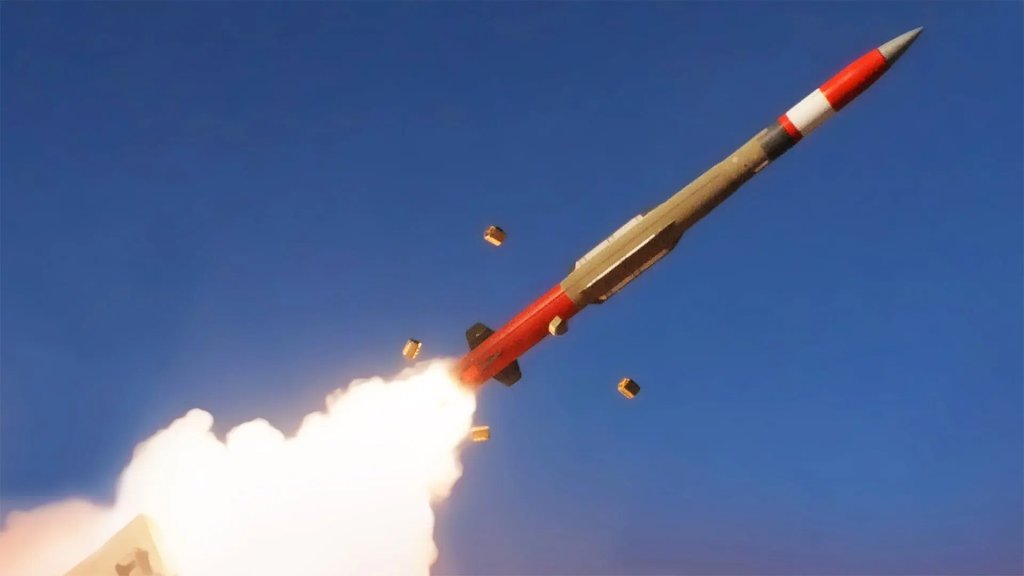
A Patriot interceptor. (DOW) Department of Defense

Ukraine’s president also confirmed that “Kyiv is ready to agree to an energy truce on the condition that Russia does not attack its energy, electricity and heating infrastructure as well as its water supplies,” CNBC reported. “Trump has previously called on Ukraine to stop targeting Russian oil refineries with drone strikes, which he says are ‘hurting the world’ as fuel supply disruptions from the Ukraine and Iran wars propel U.S. diesel prices to a record high.”

Ukraine’s repeated attacks on Russian oil infrastructure is having a major impact.

“Russian refinery throughput fell to 3.8 mb/d, its lowest level in more than 20 years and roughly 30% below a year earlier,” according to a recent report by the International Energy Agency (IEA). “Reported gasoline output is down by 20% compared with 2025 levels, while diesel production is estimated to have fallen by nearly 30%, prompting the government to restrict fuel exports to protect domestic supplies.”

Amid the U.N. General Assembly meeting, strikes by both sides continued.

“At least 16 people were killed and 59 others injured in Russian attacks across Ukraine over the past day, as Russia launched several waves of ballistic missiles at Kyiv overnight,” the Kyiv Independent reported, citing local authorities.

“Two people were killed and eight others injured in Kyiv, where Russian ballistic missiles struck the capital in three waves overnight,” the publication added. “Residential buildings, a maternity hospital, energy, and logistics infrastructure were among the sites damaged, according to President Volodymyr Zelensky.”

“Russia launched 282 attack drones of various types overnight, including jet-powered drones, as well as Zircon anti-ship missiles and Iskander-M, S-400, and KN-23 ballistic missiles,” the news outlet stated, citing the Ukrainian Air Force. “Ukrainian air defenses shot down 227 aerial targets, including 219 drones, four Zircon missiles, three ballistic missiles, and one Banderol munition. Strikes were recorded at 13 locations, while debris from downed targets fell at 10 locations.”

A difficult night for Ukraine as Russia continued attacking our civilians, launching a ballistic missile attack on Kyiv, and attacking Kyiv and other Ukrainian regions with drones.
The air raid alert in Kyiv was turned on at 3:28 a.m. and hasn't turned off since.

▪In Kyiv, two… https://t.co/l1Vr7AMH5o pic.twitter.com/giT5FjWq80

— Anton Gerashchenko (@Gerashchenko_en) September 24, 2026

Ukraine’s strikes on Russian energy infrastructure continued.

“Over the past 24 hours, two oil refineries were hit – one in Bashkortostan and one in the Samara region. There were also strikes in the Black Sea,” the Ukrainian Defense Ministry stated on X. “We are taking the war back to where it came from. We are bringing peace closer for Ukraine. I thank the units involved for their precision.”

I thank our warriors for the results they achieve every day in carrying out Ukraine’s long-range sanctions. Over the past 24 hours, two oil refineries were hit – one in Bashkortostan and one in the Samara region. There were also strikes in the Black Sea.

We are taking the war… pic.twitter.com/x8LGqvsJ0e

— Defense of Ukraine (@DefenceU) September 22, 2026

In an effort to defend against Ukrainian attacks, Russia continues to use netting to protect its energy facilities. You can see a recent example in the video below.

After more frequent Ukrainian strikes on Russian oil refineries and fuel depots, Moscow and the Moscow region decided to cover potential targets with anti-drone nets.

This is the reality Putin has brought Russia to. pic.twitter.com/G4QZyTL22c

— Visegrád 24 (@visegrad24) September 23, 2026

Finland’s President Alexander Stubb and Zelensky this morning “signed an Agreement on Enhanced Defense and Security Cooperation under the Drone Deal format,” the Finnish Defense Ministry said in a statement. “It will enable defense materiel cooperation between the two countries.”

“The agreement will enable Finland and Ukraine to transfer technology and knowledge, pursue research, development and innovation cooperation and promote joint manufacturing and drone technology development between their industries,” the MoD stated. “Another objective is to simplify administrative processes, for example regarding the granting of export authorizations, to make the transfer of defense materiel and technologies between the two countries as efficient as possible.”

Finland and Ukraine take their defence cooperation to the next level

Today, we signed a drone deal with @ZelenskyyUa. The agreement enables, among other things, the joint production of defence materiel. Defence sector companies in Finland are ready, and the joint effort can now… pic.twitter.com/UUh2kZPPpk

— Alexander Stubb (@alexstubb) September 23, 2026

With electronic warfare interfering with how drones controlled by radio frequencies operate, Ukraine is testing a new system of small radio beacons placed on the ground that allow drones to navigate without GNSS — including missions deep inside Russia. While many systems might not need this fix, some of the lower-end drones might.

Ukraine is testing and scaling this technology as part of a layered navigation system designed to keep drones autonomous in heavily jammed environments.

“The concept is quite simple,” the BBC wrote. “If the enemy jams the signal coming from above—specifically from GNSS (Global Navigation Satellite System) satellites, which determine the precise coordinates, speed, and time of any object on Earth—then specific points must be created to provide that same signal from below.”

The idea is to guide the drones by triangulating their location.

“To achieve this, special small devices—radio beacons—are either installed on the ground or air-dropped across a specific area. Their coordinates are known; thus, when a drone flies through the area, it receives coordinate data and signal transmission timing from several beacons. From there, it is a matter of basic geometry: the UAV calculates its own spatial position using data on the distance to the beacon and its altitude above the ground.”

GPS can be jammed. Ukrainian drones still need to fly.

A new beacon network is helping solve that problem.

Small radio beacons placed on the ground allow drones to navigate without GNSS or a constant communications link — including missions deep inside russia.

Ukraine is now…

— 7th Corps of AAF (@7corpsDSHV) September 23, 2026

In the age of robots, uncrewed ground vehicles (UGVs) are playing a larger role in combat. The following video shows one UGV rescuing another one by pushing it back on its wheels.

A Ukrainian logistics UGV comes to the rescue of its overturned teammate, helping get the stranded ground robot back on its wheels. pic.twitter.com/q7d5I2tyOe

— Special Kherson Cat 🐈🇺🇦 (@bayraktar_1love) September 23, 2026

That’s it for now.

Contact the author: howard@twz.com

The post Inside Ukraine’s Operation Vivaldi That Sees Its Troops Gaining Ground In The East appeared first on TWZ.

  •  

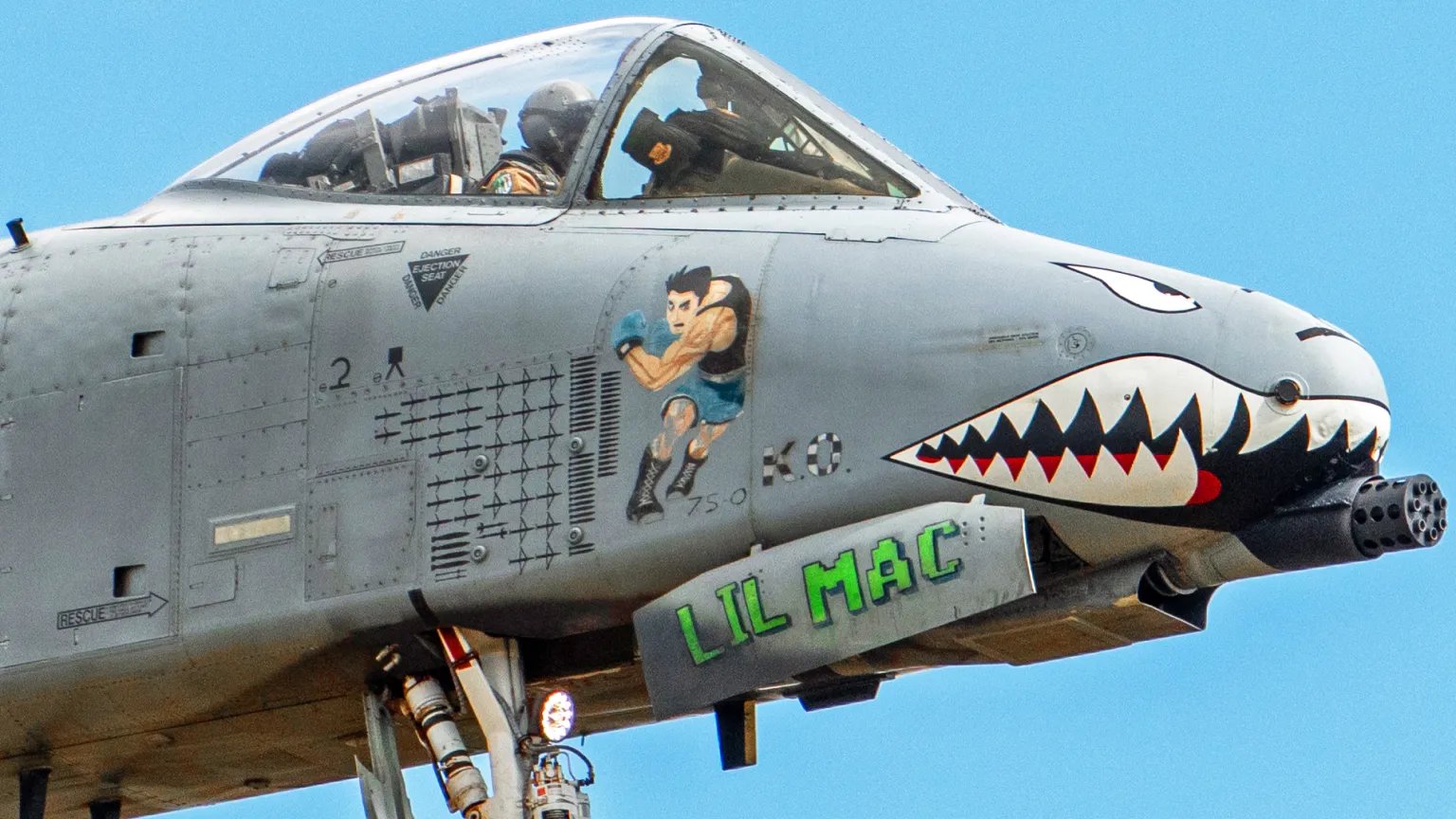
The A-10 Era Is Over At Nellis AFB

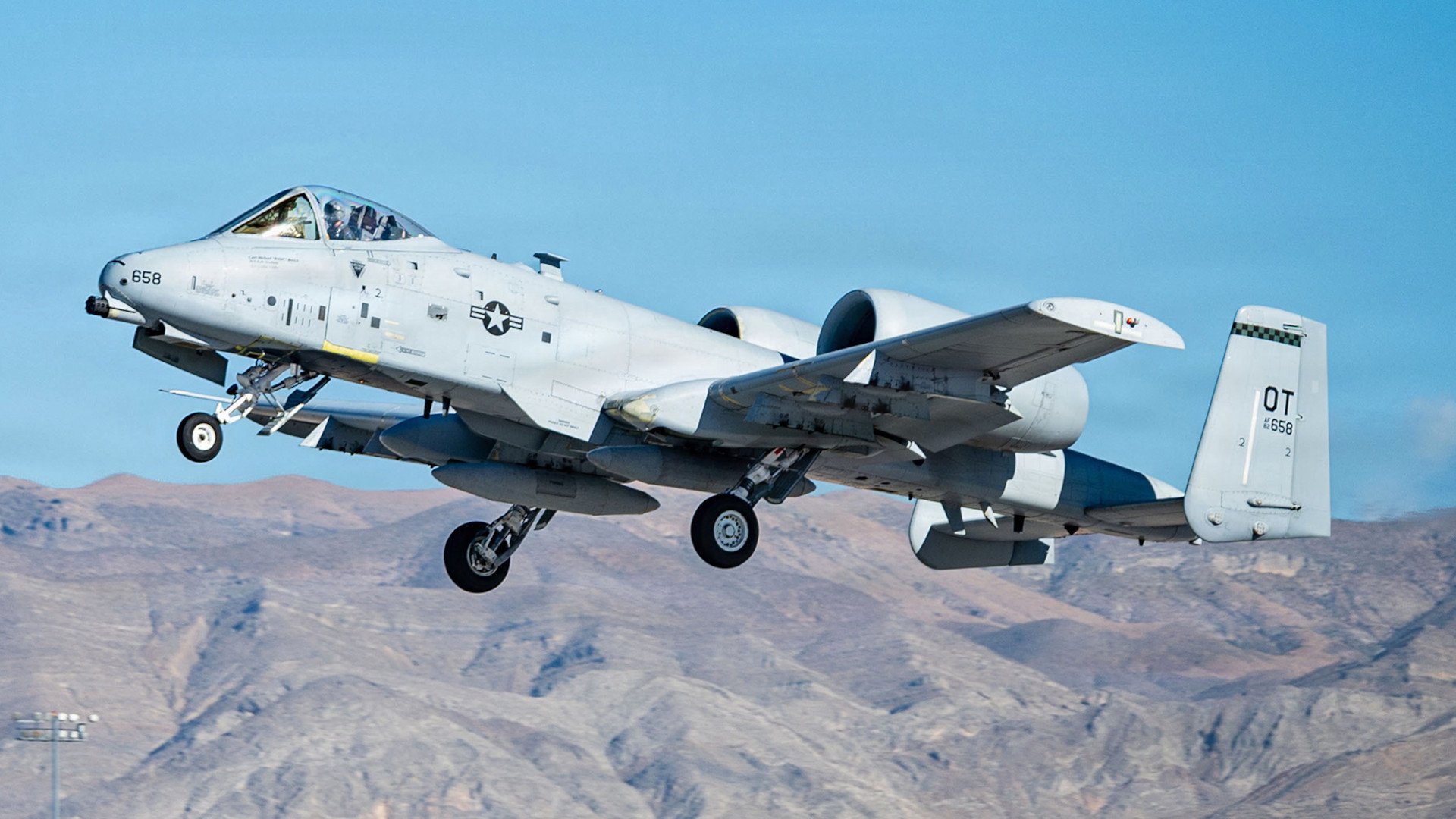
The last A-10 Thunderbolt II assigned to Nellis Air Force Base, Nevada, left the installation on September 22. The departure marks the end of nearly five decades of Warthog operations, including tactics development and testing, at the Air Force’s most high-profile fighter base. It also reflects a broader shift in which close air support expertise and some associated missions are supposedly being distributed among the F-15, F-16, and F-35 communities, although the move is controversial, to say the least.

Nearly 70 airmen assigned to Nellis gathered along the flight line to salute the aircraft as it departed. The final takeoff closes a chapter that began in 1977, when the first A-10 arrived at the base, which subsequently became a major center for developing and refining the aircraft’s operational employment.

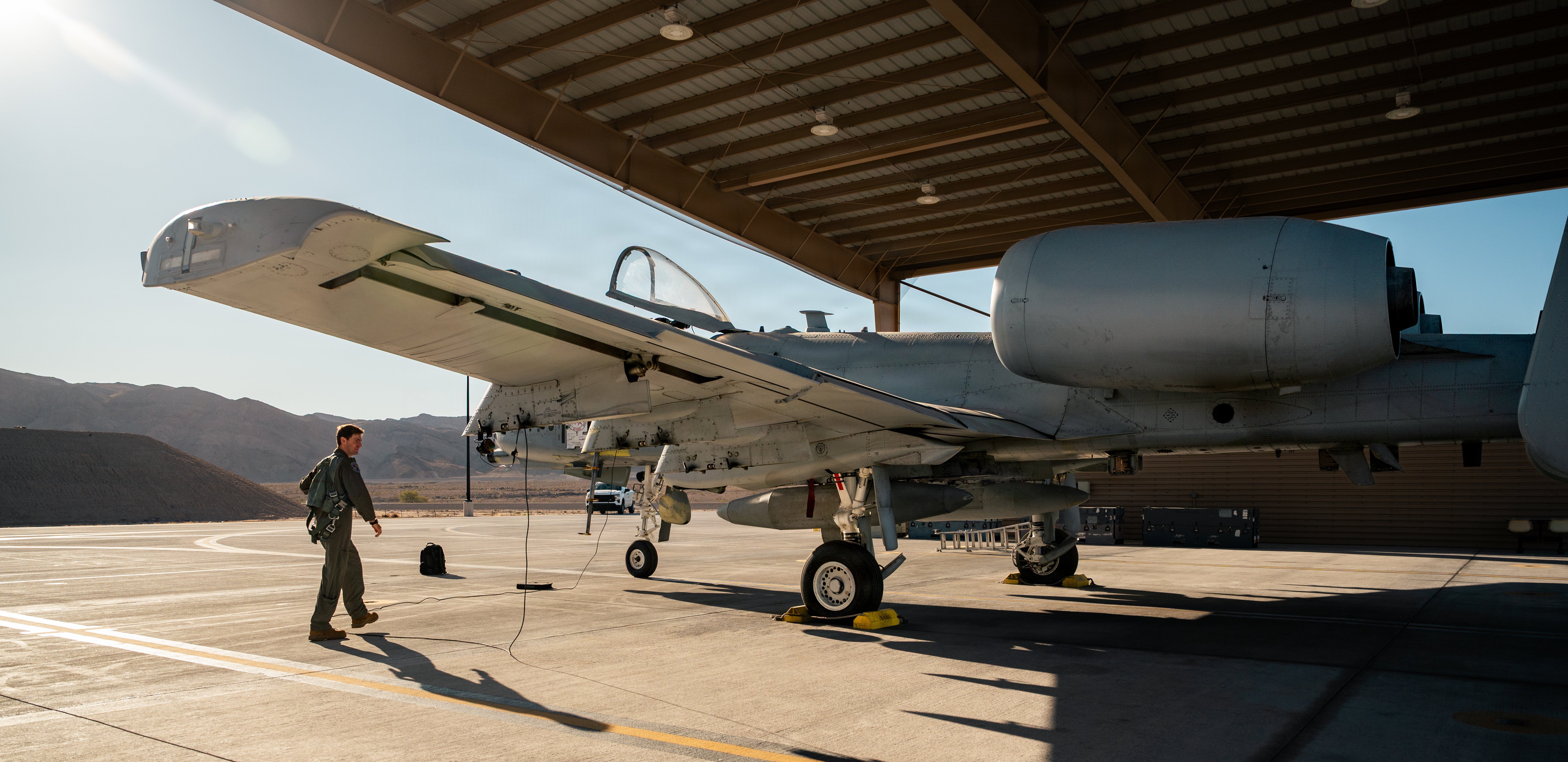
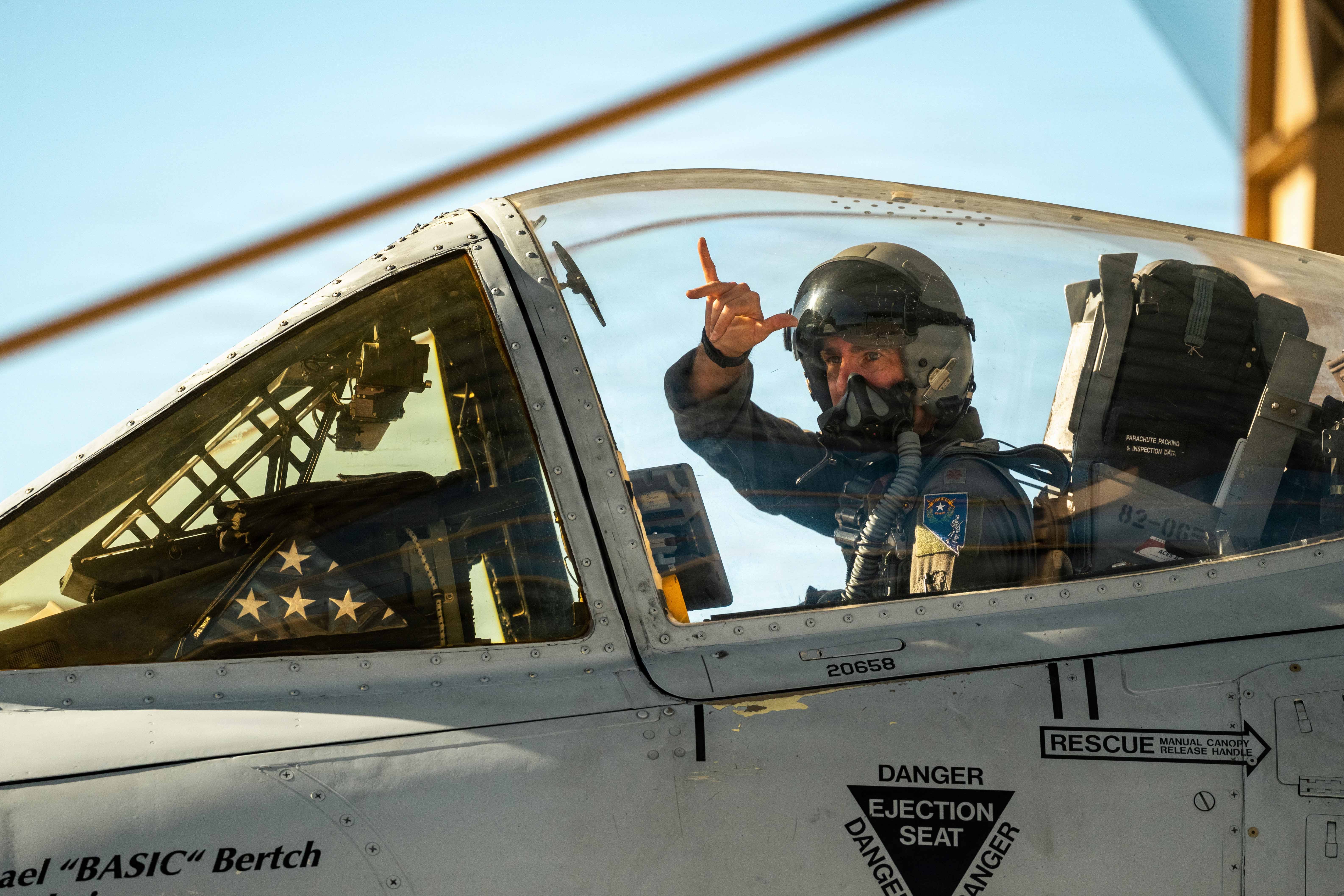
U.S. Air Force Maj. Kyle S. Adkinson, a weapons and tactics officer assigned to the Nevada Air National Guard’s 232nd Combat Training Squadron, conducts pre-flight checks on an A-10 Thunderbolt II aircraft at Nellis Air Force Base, Nevada, Sept. 22, 2026. The flight marked the final departure of Nellis’ last A-10 and honored nearly half a century of close air support service and the maintainers, pilots, and support personnel who kept the fleet mission-ready. (U.S. Air Force photo by Airman Annika Schermerhorn)
U.S. Air Force Maj. Kyle S. Adkinson, a weapons and tactics officer assigned to the Nevada Air National Guard’s 232nd Combat Training Squadron, conducts pre-flight checks on an A-10 Thunderbolt II aircraft at Nellis Air Force Base, Nevada, Sept. 22, 2026. U.S. Air Force photo by Airman Annika Schermerhorn

Over the decades, Nellis-based units worked on the A-10’s software, avionics, and precision weapons capabilities, while the U.S. Air Force Weapons School’s 66th Weapons Squadron trained more than 300 A-10 weapons officers through approximately 100 classes. Many of the tactics in the A-10’s playbook emanated from the base.

The A-10’s departure consequently represents more than the retirement of another aircraft from a Nellis ramp. It also marks the end of a dedicated training and institutional ecosystem that developed around an aircraft specifically designed for close air support.

Earlier this year, Jamie Hunter of TWZ visited the U.S. Air Force A-10 Weapons Instructor Course as it was in the process of closing down, as documented in these exclusive videos:

The Air Force is now attempting to carry at least some of that expertise into a force built around multirole fourth- and fifth-generation fighters.

“We are maintaining the culture of the A-10 by involving as many other fighter communities involved in the close air support mission,” Lt. Col. Ridge Flick, commander of the 66th Weapons Squadron, said. “We are also training F-15 Eagle, F-35 Lightning II and F-16 Fighting Falcon pilots to take on some roles we have had in combat search and rescue.”

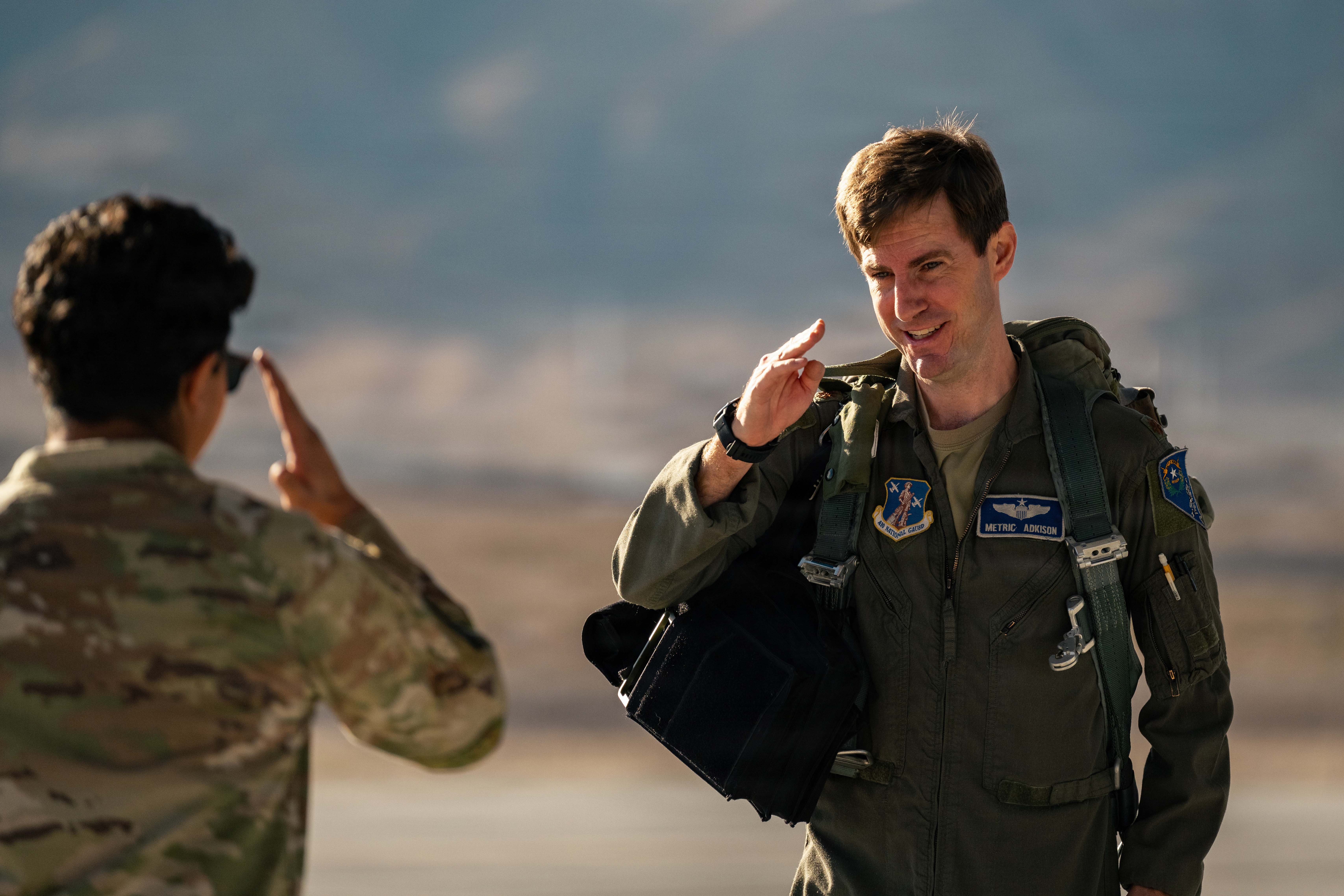
U.S. Air Force Maj. Kyle S. Adkinson, right, a weapons and tactics officer assigned to the Nevada Air National Guard’s 232nd Combat Training Squadron, salutes Senior Airman Segio Lopez, a crew chief assigned to the 757th Aircraft Maintenance Squadron, before a flight at Nellis Air Force Base, Nevada, Sept. 22, 2026. The flight marked the final departure of Nellis’ last A-10 Thunderbolt II and honored nearly half a century of close air support service and the maintainers, pilots, and support personnel who kept the fleet mission-ready. (U.S. Air Force photo by Airman Annika Schermerhorn)
U.S. Air Force Maj. Kyle S. Adkinson, right, a weapons and tactics officer assigned to the Nevada Air National Guard’s 232nd Combat Training Squadron, salutes Senior Airman Segio Lopez, a crew chief assigned to the 757th Aircraft Maintenance Squadron, before a flight at Nellis Air Force Base, Nevada, Sept. 22, 2026. U.S. Air Force photo by Airman Annika Schermerhorn

The A-10 was developed specifically for close air support, with its design emphasizing survivability at relatively low altitude, weapons employment against ground targets, and the ability to persist in the vicinity of friendly forces. In contrast, the F-16C/D and F-15E/EX were developed primarily as multirole fighters, while the F-35 combines strike, air-to-air, intelligence, surveillance and reconnaissance, and networking capabilities with a low-observable design.

Rather than replacing the A-10 with a single successor, the Air Force is therefore distributing elements of its former mission set across several aircraft and communities. The service insists its close air-support capability is not being reduced as the Warthog fleet retires, but at the very least the transition does represent a significant change in how that capability is generated and employed.

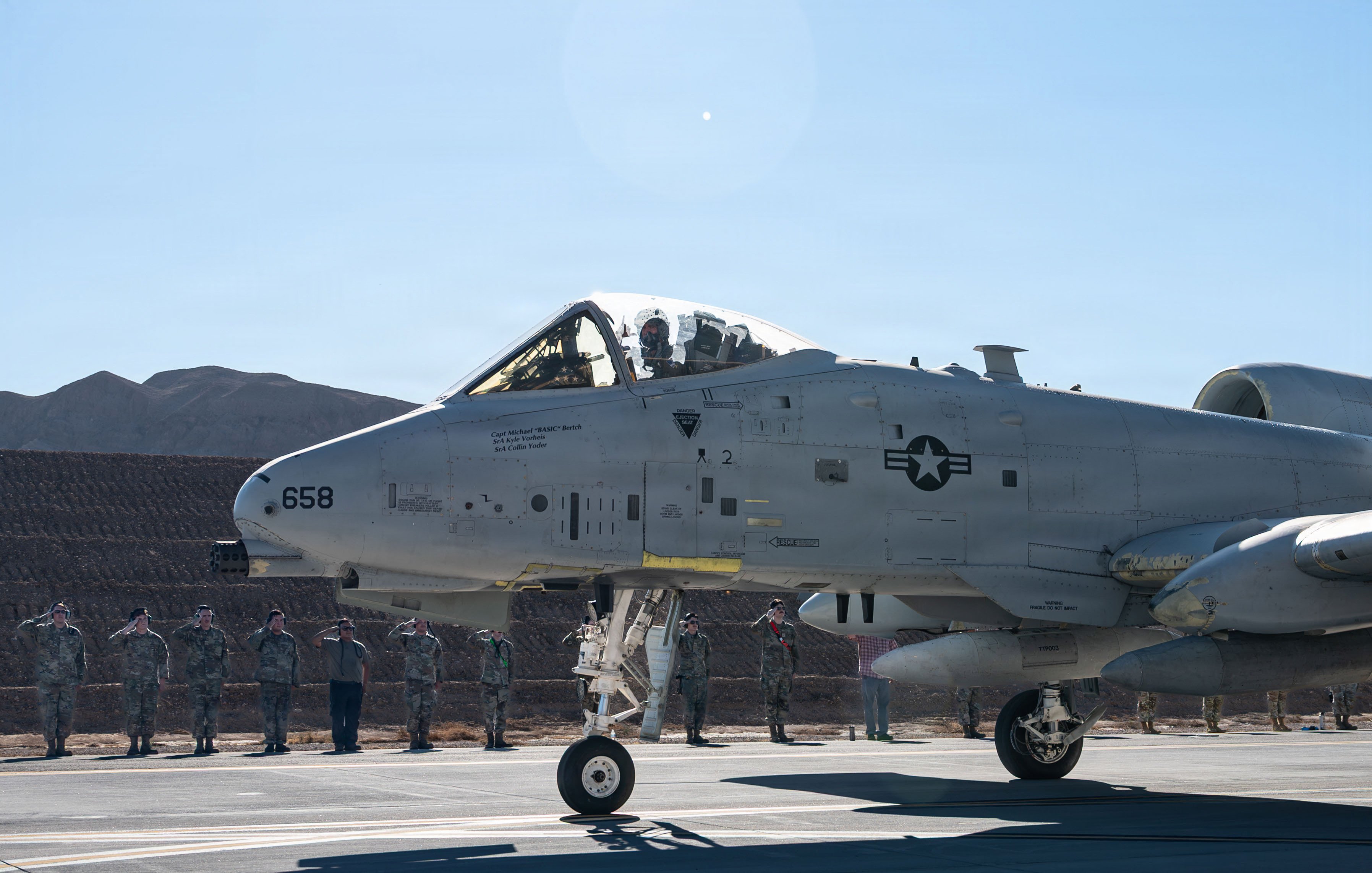
U.S. Airmen assigned to Nellis Air Force Base salute an A-10 Thunderbolt II aircraft at Nellis AFB, Nevada, Sept. 22, 2026. The flight marked the final departure of Nellis’ last A-10 and honored nearly half a century of close air support service and the maintainers, pilots, and support personnel who kept the fleet mission-ready. (U.S. Air Force photo by Airman Annika Schermerhorn)
U.S. airmen assigned to Nellis Air Force Base salute an A-10 Thunderbolt II aircraft at Nellis AFB, Nevada, Sept. 22, 2026. U.S. Air Force photo by Airman Annika Schermerhorn

Regardless, the USAF’s claim that the impact of losing the heart of the A-10’s braintrust will not dramatically impact key mission sets in a negative manner has been viewed with extreme skepticism by some. It’s not uncommon for subject matter experts to believe the close air support and ‘Sandy’ aircrew recovery mission braintrust that the Warthog community represents is a far bigger loss than the aircraft itself, and that the USAF is not prepared to preserve this critical expertise, regardless of the service’s stated intentions.

The end of A-10 operations at Nellis also put what may be the final nail in the A-10’s coffin, as reconstituting these operations would be very challenging and costly. All this points to the Warthog being on its final glide path to retirement, once and for all.

You can read all about this controversy in our past special feature linked here.

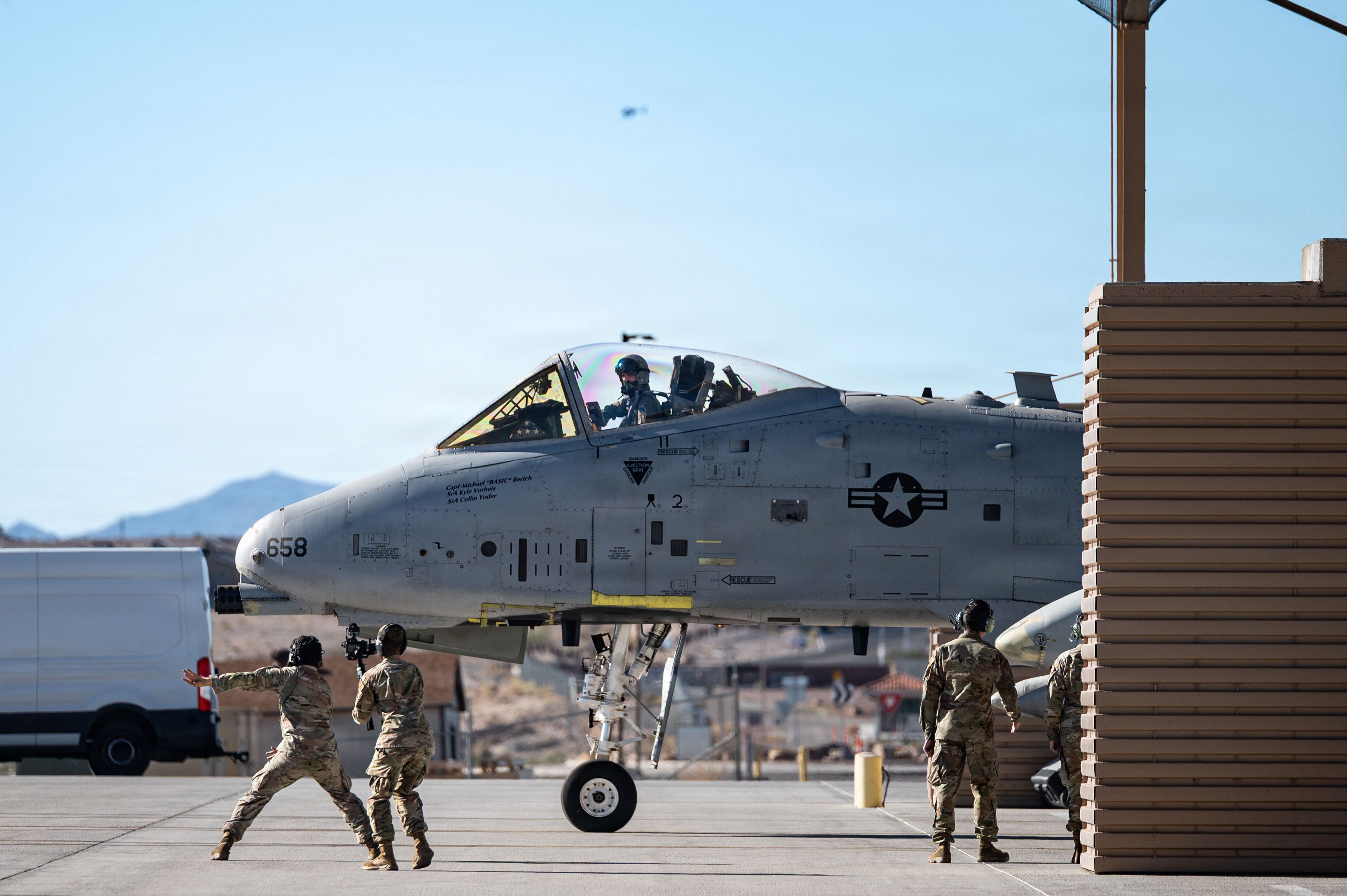
U.S. Air Force Maj. Kyle S. Adkinson, a weapons and tactics officer assigned to the Nevada Air National Guard’s 232nd Combat Training Squadron, taxis an A-10 Thunderbolt II aircraft at Nellis Air Force Base, Nevada, Sept. 22, 2026. The flight marked the final departure of Nellis’ last A-10 Thunderbolt II and honored nearly half a century of close air support service and the maintainers, pilots, and support personnel who kept the fleet mission-ready. (U.S. Air Force photo by Airman Annika Schermerhorn)
U.S. Air Force Maj. Kyle S. Adkinson, a weapons and tactics officer assigned to the Nevada Air National Guard’s 232nd Combat Training Squadron, taxis an A-10 Thunderbolt II aircraft at Nellis Air Force Base, Nevada, Sept. 22, 2026. U.S. Air Force photo by Airman Annika Schermerhorn

Beyond the redistribution of Nellis’s A-10 pilots, the transition is also affecting the maintainers who supported the base’s A-10 fleet. Airmen assigned to the 757th Aircraft Maintenance Squadron’s Thunder Aircraft Maintenance Unit are being reassigned to other squadrons and airframes, including the F-35 and F-16. The Air Force is consequently moving not only personnel, but also decades of experience maintaining an aging and structurally demanding aircraft into programs supporting newer fighters.

For Staff Sgt. Eva Kehn, a weapons load crew chief with the 757th AMXS, the end of the A-10 era has an especially personal dimension because of her family’s connection to the aircraft and to aviation.

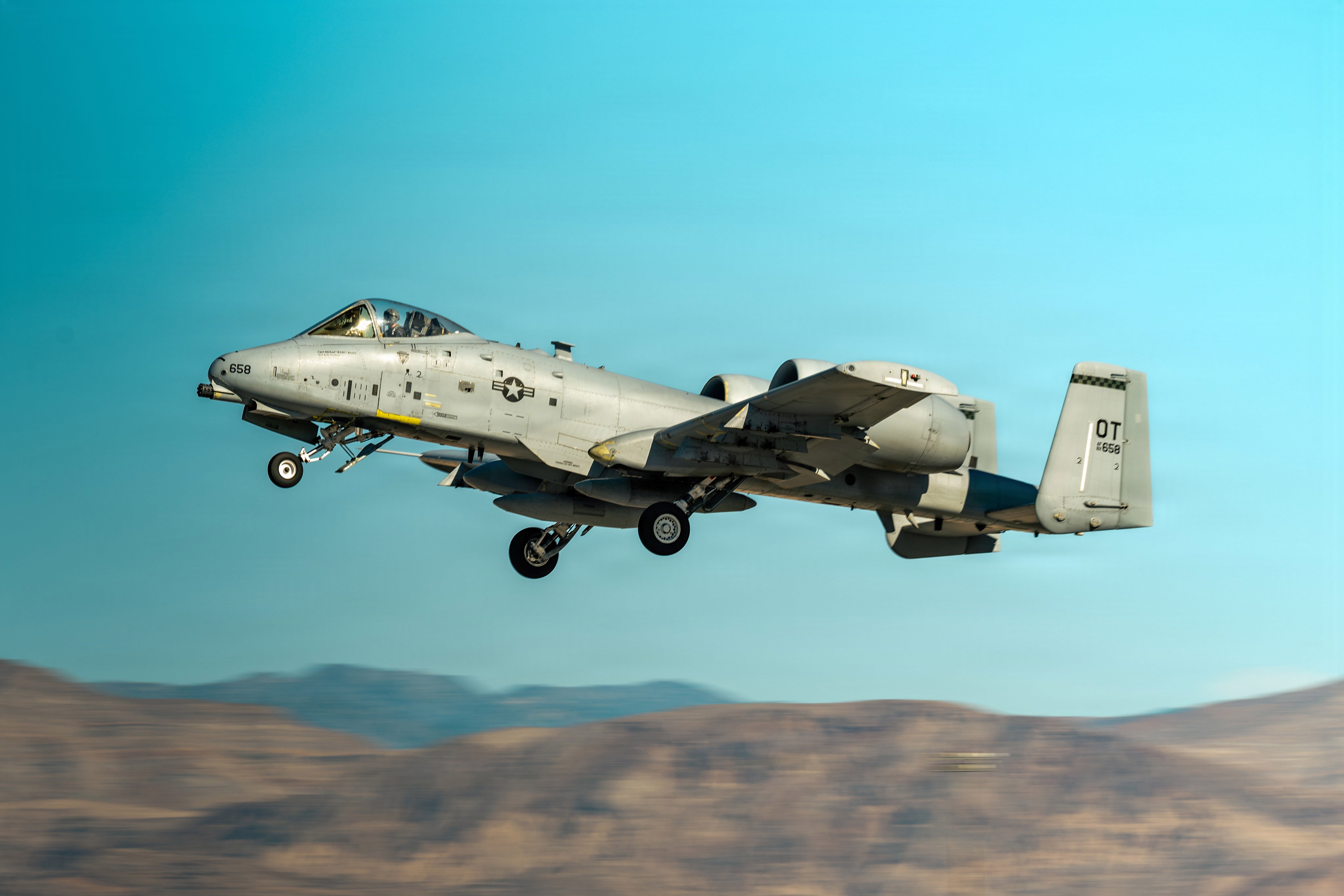
A U.S. Air Force A-10 Thunderbolt II aircraft takes off from Nellis Air Force Base, Nevada, Sept. 22, 2026. The flight marked the final departure of Nellis’ last A-10 and honored nearly half a century of close air support service and the maintainers, pilots, and support personnel who kept the fleet mission-ready. (U.S. Air Force photo by Airman Annika Schermerhorn)
A U.S. Air Force A-10 Thunderbolt II aircraft takes off from Nellis Air Force Base, Nevada, Sept. 22, 2026. U.S. Air Force photo by Airman Annika Schermerhorn

“Working on the A-10 is meaningful to me because that is something that I share with my grandfather,” Kehn said. “I’m very excited to have that new chapter and bond over that again with my grandfather.”

Kehn is transferring to an F-35 unit at Nellis, where that connection will continue in a different form. Her grandfather is now a civilian F-35 instructor, giving the two an opportunity to remain professionally connected even as the A-10 disappears from the installation.

U.S. Airmen assigned to Nellis Air Force Base salute an A-10 Thunderbolt II aircraft at Nellis AFB, Nevada, Sept. 22, 2026. The flight marked the final departure of Nellis’ last A-10 and honored nearly half a century of close air support service and the maintainers, pilots, and support personnel who kept the fleet mission-ready. (U.S. Air Force photo by Airman Isabella Borrillo)
U.S. airmen assigned to Nellis Air Force Base salute an A-10 Thunderbolt II aircraft at Nellis AFB, Nevada, Sept. 22, 2026. U.S. Air Force photo by Airman Isabella Borrillo

Master Sgt. Aaron Edmonds, an aircraft section chief with the 757th AMXS, is also moving on from the Warthog after spending the past five years maintaining the aircraft. Edmonds previously worked on the F-16 earlier in his career and will now return to the Viper community.

“It’s a bittersweet moment,” Edmonds said. “I enjoyed my time with the A-10, but I’m excited because this departure marks the closing of one chapter and the start of another.”

Edmonds said the experience gained on the A-10 should be carried into the next aircraft rather than left behind with the airframe. “The advice I would give airmen who are transitioning from one airframe to another is to be open-minded, willing to learn and carry on the great work ethic from your previous aircraft over to your new one,” he said.

U.S. Air Force Maj. Kyle S. Adkinson, a weapons and tactics officer assigned to the Nevada Air National Guard’s 232nd Combat Training Squadron, taxis an A-10 Thunderbolt II aircraft at Nellis Air Force Base, Nevada, Sept. 22, 2026. The flight marked the final departure of Nellis’ last A-10 Thunderbolt II and honored nearly half a century of close air support service and the maintainers, pilots, and support personnel who kept the fleet mission-ready. (U.S. Air Force photo by Airman Isabella Borrillo)
U.S. Air Force Maj. Kyle S. Adkinson, a weapons and tactics officer assigned to the Nevada Air National Guard’s 232nd Combat Training Squadron, taxis an A-10 Thunderbolt II aircraft at Nellis Air Force Base, Nevada, Sept. 22, 2026. U.S. Air Force photo by Airman Isabella Borrillo

With the A-10 no longer present at Nellis, at least some of the expertise attached to it is being incorporated into a fighter force in which other aircraft types can contribute to the close air support mission in very different ways. An F-35, for example, can use its sensors and networking capabilities to identify and share information about targets and the battlespace, and it can go where other fighters can’t. An F-15 can contribute heavier weapons and longer endurance, among other capabilities, depending on the mission. This is not exactly new, either, as all types of aircraft provided CAS during the Global War on Terror-era, although the masters of exactly how to do it and how to execute the critical airborne forward air control (FAC-A) mission existed in the A-10 community. Still, the resulting force will be considerably different from the one centered on the Warthog, even where the underlying requirement to support troops on the ground remains.

A U.S. Air Force A-10 Thunderbolt II aircraft takes off from Nellis Air Force Base, Nevada, Sept. 22, 2026. The flight marked the final departure of Nellis’ last A-10 and honored nearly half a century of close air support service and the maintainers, pilots, and support personnel who kept the fleet mission-ready. (U.S. Air Force photo by Airman Isabella Borrillo)
A U.S. Air Force A-10 Thunderbolt II aircraft takes off from Nellis Air Force Base, Nevada, Sept. 22, 2026. U.S. Air Force photo by Airman Isabella Borrillo

As noted, the A-10’s retirement now looks to be gathering pace, despite repeated efforts to keep the A-10 in service and recent employment in combat operations in the Middle East. The Pentagon has granted three Warthog squadrons a reprieve to continue operating through 2030. In July, a bipartisan group of Congressmen introduced a bill that, if passed and signed into law, would require the Air Force to keep flying the jets through Fiscal Year 2033. Still, the aircraft’s eventual fate appears increasingly clear, with growing numbers heading to the 309th Aerospace Maintenance and Regeneration Group (AMARG) boneyard in Arizona for storage, including the last one from Nellis.

The ongoing retirement of the A-10 is bringing a fundamental change in how the Air Force organizes and executes the missions for which the Warthog became synonymous. Nellis will remain an important center for developing those capabilities, even though the aircraft around which that expertise was built is no longer part of the equation.

Contact the author: thomas@thewarzone.com

The post The A-10 Era Is Over At Nellis AFB appeared first on TWZ.

  •  

This Is Taiwan’s New 105mm 8×8 Mobile Gun System

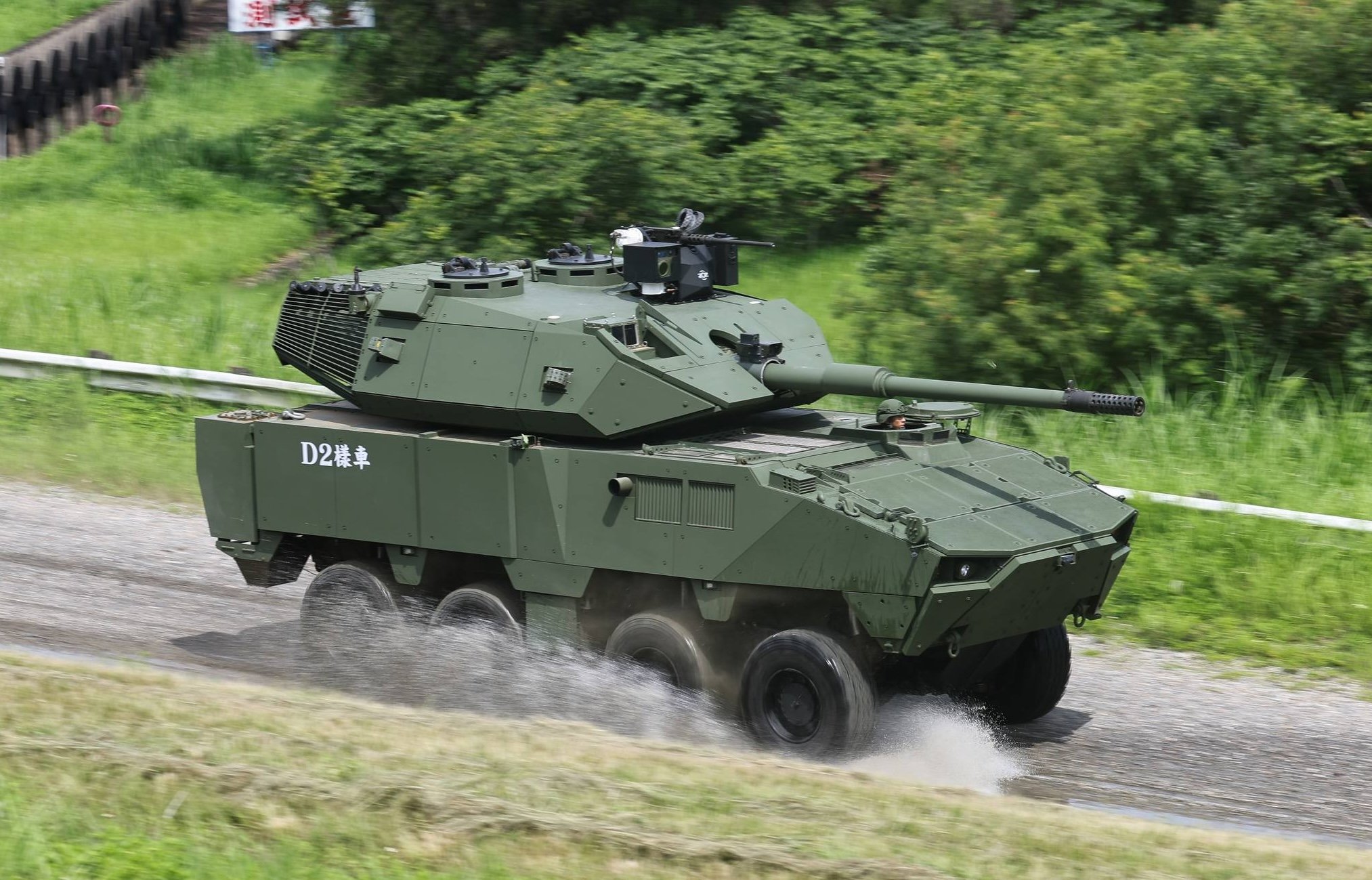
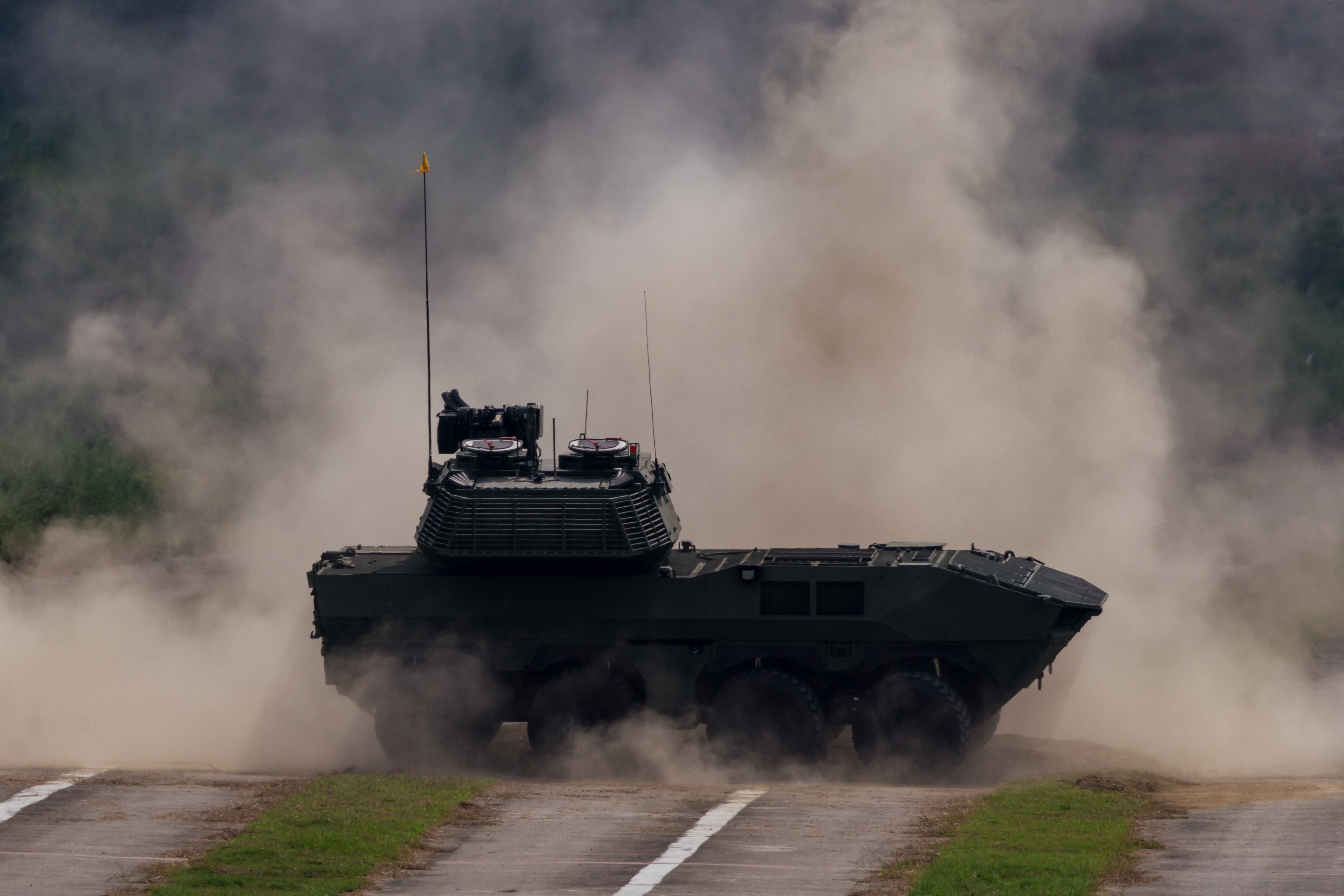
Taiwan has provided the first public look at its new 105mm 8×8 mobile gun system in action, with the domestically developed vehicle engaging moving and stationary targets during a live-fire demonstration in southern Taiwan. The vehicle is being developed as Taiwan continues to modernize its ground forces in response to the growing capabilities and increasingly frequent military activity of the Chinese People’s Liberation Army (PLA) around the island.

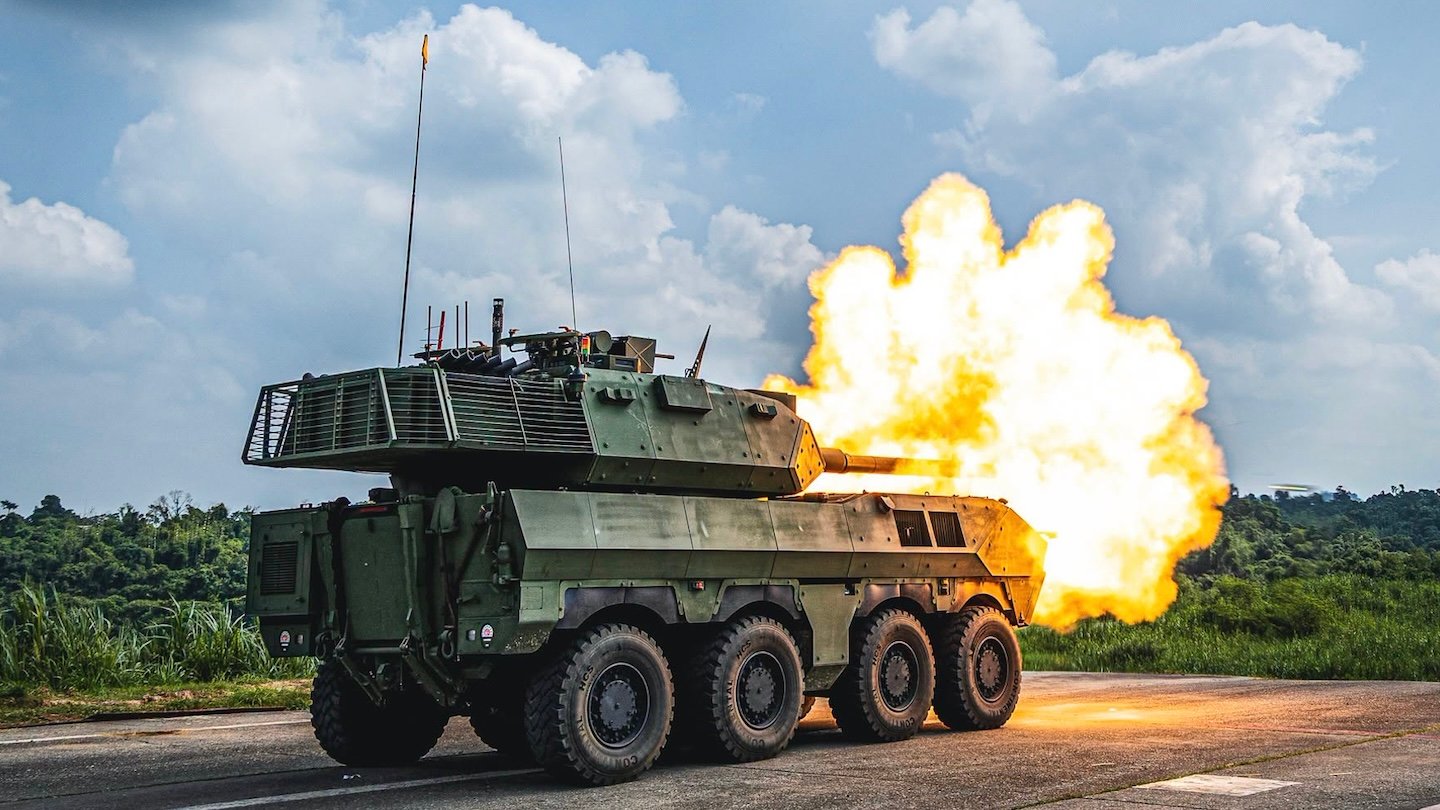
During the demonstration, held by the Republic of China Army (ROCA) at a training area in Tainan today, the vehicle reportedly engaged a moving target at approximately 0.75 miles and a stationary target at around 0.6 miles. It also fired against targets positioned 90 degrees to the side of the vehicle while operating on a gentle slope, demonstrating the gun system’s ability to engage targets while the vehicle is positioned on uneven terrain.

pic.twitter.com/dn6lHDbf5k

— 青年日報 Youth Daily News, ROC(Taiwan) 🇹🇼 (@YDN_NEWS) September 23, 2026

Eight wheels. Six-wheel steering. One 105mm gun.
Definitely not your average ride.#ROCArmedForces #MobileGunSystem#MadeInTaiwan pic.twitter.com/oaHsyMNtev

— 國防部 Ministry of National Defense, ROC(Taiwan) 🇹🇼 (@MoNDefense) September 23, 2026

The vehicle subsequently fired its 7.62mm coaxial machine gun simultaneously with its main gun as part of a scenario intended to demonstrate engagement of multiple targets, including simulated amphibious assault vehicles.

台灣105公厘獵豹輪型戰車實彈射擊https://t.co/cHaXthUCfA pic.twitter.com/aKBBzoVsKz

— 新‧二七部隊 軍事雜談 (New 27 Brigade)🇹🇼🇺🇦🇮🇱 (@new27brigade) September 23, 2026

An apparent weapon malfunction was also recorded during the demonstration. One of the 105mm rounds initially failed to fire, according to reports. The crew waited approximately two minutes in accordance with safety procedures before reloading the weapon, after which the vehicle fired normally. Maj. Gen. Chen Chien-chung, head of Taiwan’s Arsenal 202, the Production and Manufacturing Center of the Armament Bureau, said an investigation would be conducted into the misfire.

The 155 mm infantry fighting vehicle showcased to media before entering production phase. pic.twitter.com/DBhs66aw5Q

— Taepodong (@stoa1984) September 23, 2026

Despite the incident, the demonstration provided an important look at a vehicle that Taiwan is developing specifically around the country’s geography and battlefield requirements, including a potential amphibious invasion by the Chinese PLA.

A new direct fire support variant of the Clouded Leopard 8×8 infantry fighting vehicle was first publicly displayed at the Taipei Aerospace & Defense Technology Exhibition in 2023. It passed initial combat readiness testing with the ROCA in October 2023, and it was authorized for mass production in April 2024.

A pre-production prototype of the Taiwanese 105mm 8×8 mobile gun system. Ministry of National Defense

The production configuration has undergone significant changes since then.

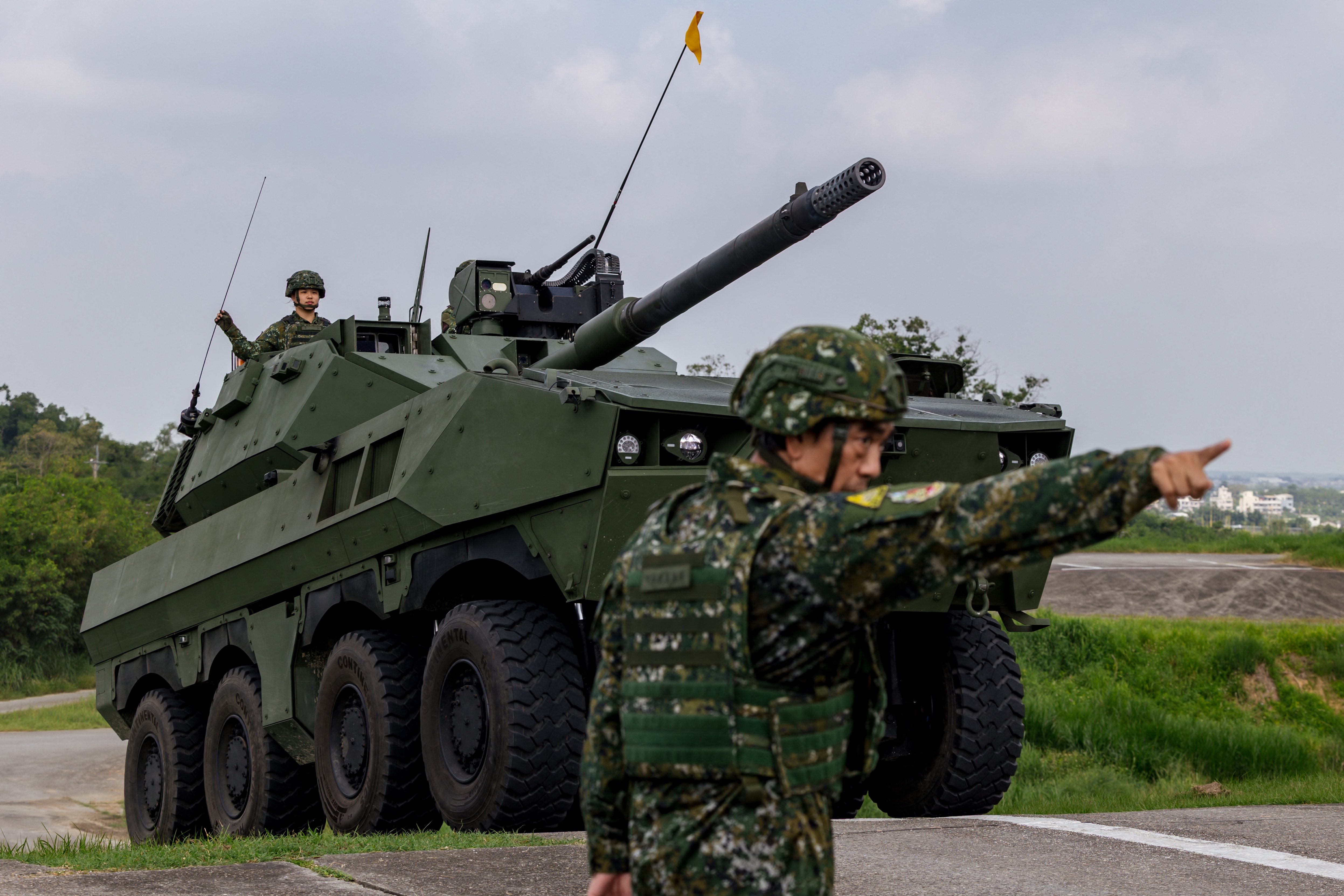
Its height has been reduced by approximately 12 inches, bringing the overall vehicle height to below 9 feet 10 inches. Its turning radius has also been reduced from 36 feet to 26 feet. The reduction in turning radius was achieved by providing steering to three pairs of wheels, rather than two pairs on the earlier configuration.

Those changes are especially relevant to Taiwan, where large sections of the island feature restrictive terrain, dense urban development, narrow roads, drainage channels, and other obstacles that can limit the movement of heavy armored vehicles.

Taiwan's 105mm wheeled armoured vehicle takes part in a live-fire demonstration in Tainan on September 23, 2026. The domestically developed vehicle, equipped with a 105mm main gun, is currently undergoing operational testing and evaluation. (Photo by CHENG Yu-chen / AFP via Getty Images)
Taiwan’s 105mm 8×8 mobile gun system takes part in a live-fire demonstration in Tainan on September 23, 2026. Photo by CHENG Yu-chen / AFP

Taiwanese officials specifically highlighted the system’s suitability for culverts and urban areas, as well as the challenging terrain of Hualien and Taitung on the island’s mountainous east coast.

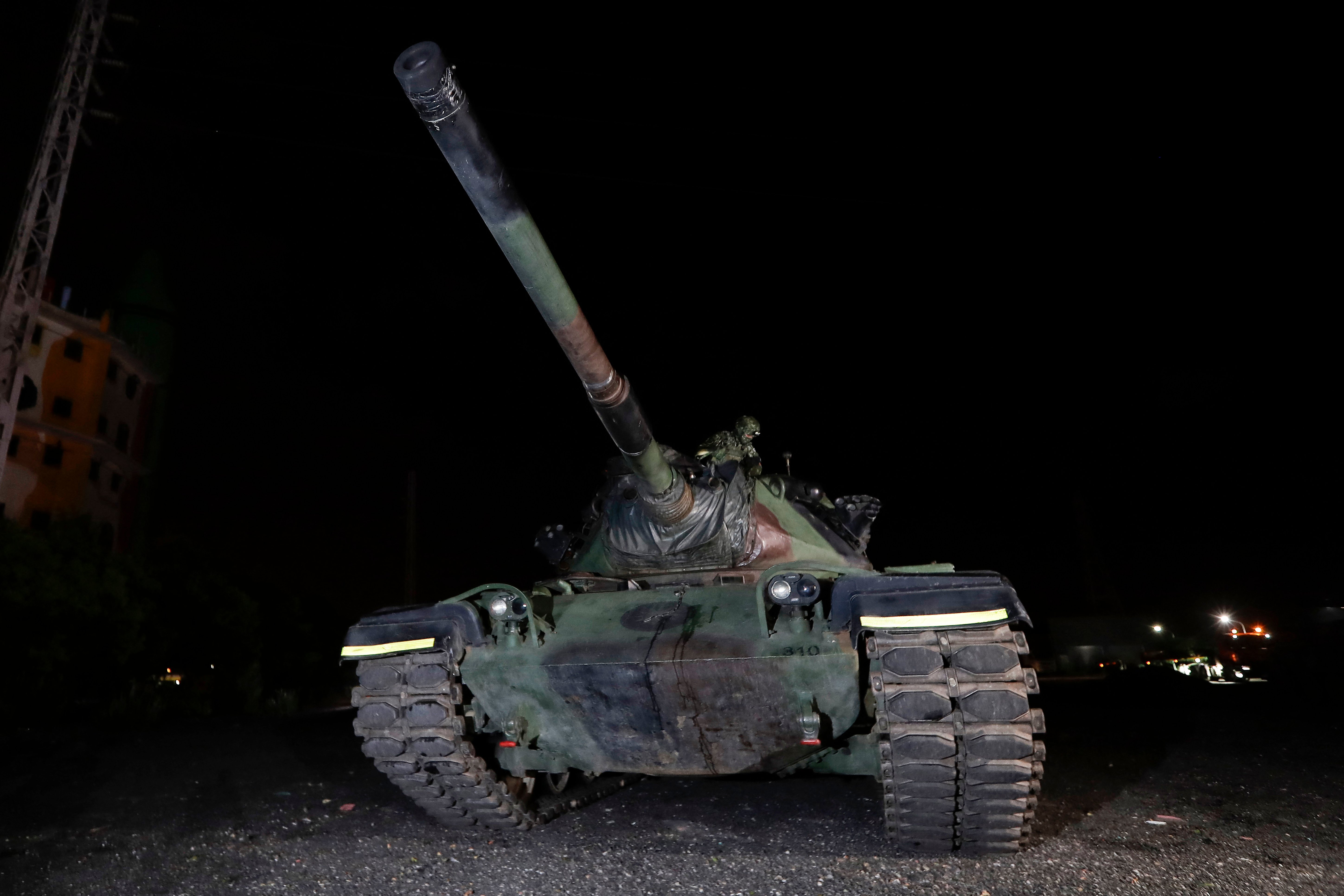
The vehicle’s principal weapon is a 105mm gun. The weapon can fire the general-purpose ammunition already developed for tank guns, in addition to ammunition developed specifically for the new system. The ROCA displayed armor-piercing, anti-personnel, and training ammunition during the demonstration. The gun also offers useful ammunition commonality with Taiwan’s older, but still active M60A3 and CM11 tanks.

A Taiwanese soldier inspects a tank during an overnight cross-region deployment from Hualien to reinforce Yilan during the annual Han Kuang military exercises in Yilan on August 9, 2026. (Photo by Chiang Ying-ying / POOL / AFP via Getty Images)
A Taiwanese soldier inspects an M60A3 tank during an overnight cross-region deployment from Hualien during the annual Han Kuang military exercises in Yilan on August 9, 2026. Photo by Chiang Ying-ying / POOL / AFP

That compatibility potentially gives the vehicle access to an existing ammunition ecosystem while allowing Taiwan to develop specialized rounds for its particular requirements.

Against a PLA assault, the 105mm system would provide mobile direct firepower against amphibious vehicles, armored personnel carriers, fortifications, and other ground targets, complementing Taiwan’s heavier tanks and other anti-armor weapons. Its wheeled configuration also allows the vehicle to rapidly reposition along Taiwan’s road network, giving commanders a mobile source of direct firepower that could respond to amphibious landings and reinforce threatened sectors.

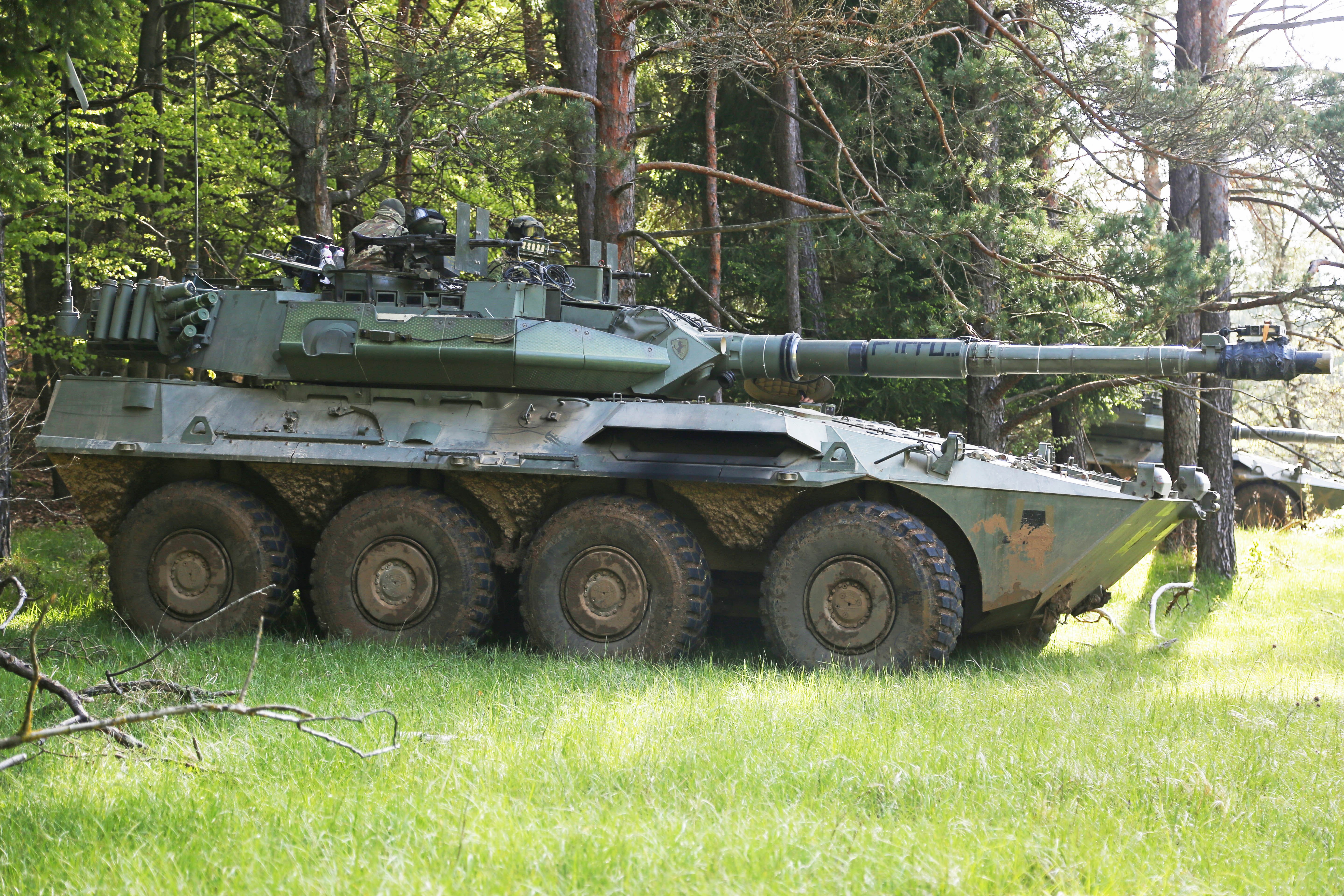
The system falls into the same broad category as other modern 8×8 mobile gun systems, including Italy’s Centauro family and Japan’s Type 16 Mobile Combat Vehicle.

Italian soldiers of the 6th Cavalry Regiment, Aosta Mechanized Brigade observe their sector of fire with a Centauro B1 Tank Destroyer while conducting a simulated assault during Saber Junction 17 at the Hohenfels Training Area, Germany, May 11, 2017. Saber Junction 17 is the U.S. Army Europe’s 2d Cavalry Regiment’s combat training center certification exercise, taking place at the Joint Multinational Readiness Center in Hohenfels, Germany, Apr. 25-May 19, 2017. The exercise is designed to assess the readiness of the regiment to conduct unified land operations, with a particular emphasis on rehearsing the transition from garrison to combat operations, and exercising operational and tactical decision-making skills. Saber Junction 17 includes nearly 4,500 participants from 13 NATO and European partner nations. (U.S. Army photo by Pfc. Zachery Perkins)
Italian soldiers of the 6th Cavalry Regiment, Aosta Mechanized Brigade, observe their sector of fire with a Centauro B1 tank destroyer while conducting a simulated assault during Saber Junction 17 at the Hohenfels Training Area, Germany, May 2017. U.S. Army photo by Pfc. Zachery Perkins

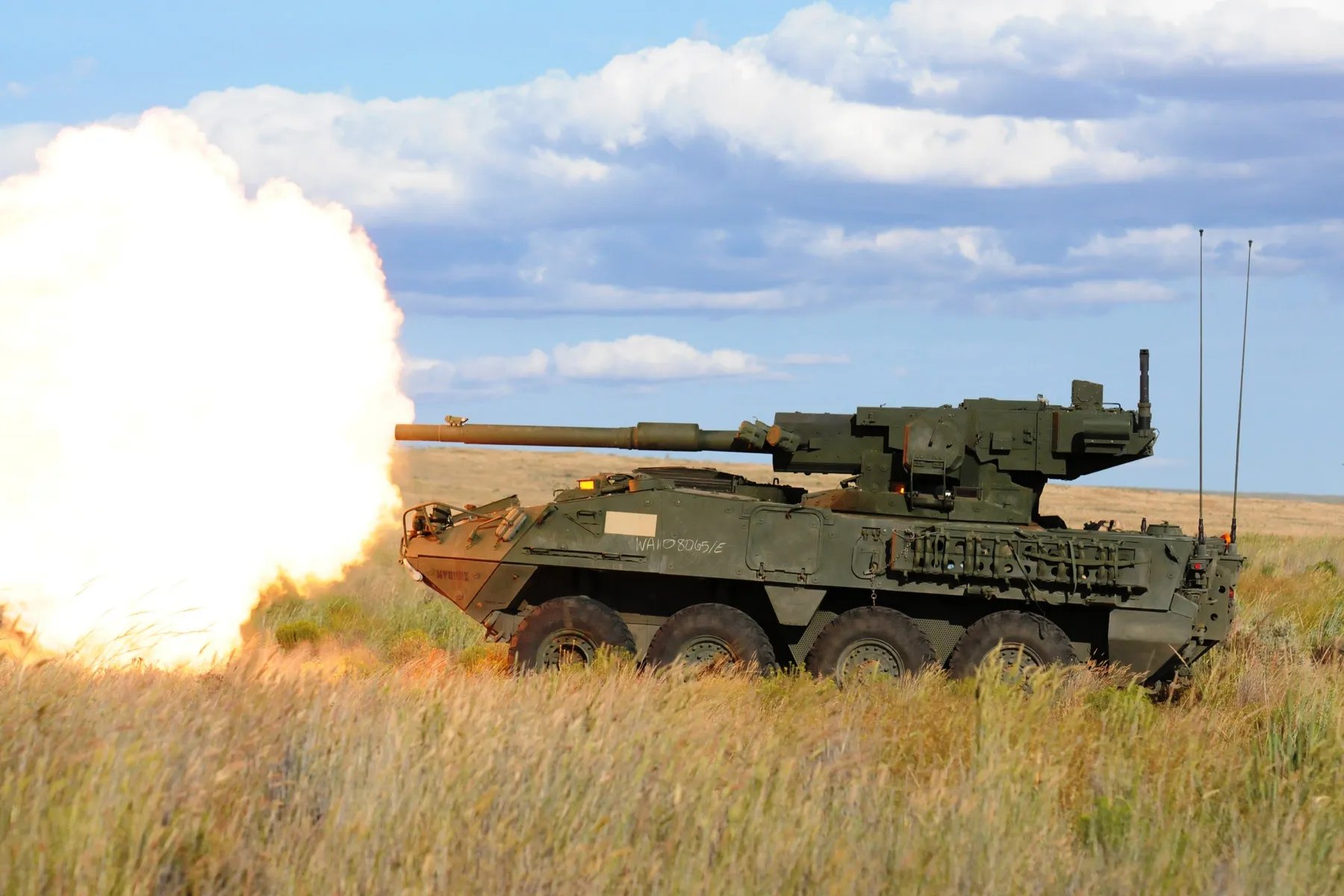
Less successful was a mobile gun system version of the U.S. Army Stryker, also with a 105mm gun, but the service divested that in 2021 because of problems with its dated cannon and autoloader. The U.S. Army then received the M10 Booker Combat Vehicle. Armed with a 105mm main gun, the Booker is a tracked vehicle with a much higher degree of armor protection and off-road mobility, but this, too, was canceled in 2025, amid cost and weight increases.

A Stryker Mobile Gun System fires a 105mm round. U.S. Army

A wheeled 105mm gun system can provide substantial direct-fire capability while offering advantages in road mobility and potentially lower logistical demands. It also lacks the combination of protection, cross-country mobility, and heavy armament associated with a tracked main battle tank.

For Taiwan, this kind of vehicle provides a comparatively compact armored platform able to move rapidly between positions and bring heavy direct firepower to areas where larger vehicles could face mobility constraints.

If fighting reaches Taiwan’s cities, the ROCA regularly trains for the challenges of urban warfare. The service has also demonstrated unusual measures to conceal and protect its armored vehicles, including disguising tanks and other vehicles as scrap piles or civilian construction equipment to complicate PLA targeting.

Taiwanese personnel get off a subway car in Taipei carrying a Stinger missile during the annual Han Kuang exercise. Military News Agency/Taiwan Ministry of National Defense capture via Focus Taiwan

The vehicle’s development is also being influenced by the threat of battlefield drones. Taiwanese military officials say the system is expected to receive additional counter-drone capabilities before entering mass production. One planned modification is an anti-drone cage around the vehicle.

More ambitious changes could involve the installation of a larger-caliber automatic weapon. Reportedly, the vehicle could eventually receive another machine gun or larger-caliber automatic cannon, with the 30mm M230 chain gun identified as one possible option. The proposed weapon could use canister-type ammunition designed to disperse numerous fragments against small drones.

Adding dedicated counter-drone equipment to the mobile gun system would therefore give the vehicle another role beyond direct engagement of conventional ground targets.

A Taiwan military 105mm wheeled armoured vehicle drives during a demonstration in Tainan on September 23, 2026. The domestically developed vehicle, equipped with a 105mm main gun, is currently undergoing operational testing and evaluation. (Photo by CHENG Yu-chen / AFP via Getty Images)
Taiwan’s new 105mm mobile gun system during a demonstration in Tainan on September 23, 2026. Photo by CHENG Yu-chen / AFP

The prominence of counter-drone measures in the planning of the vehicle also reflects the increasingly contested environment in which Taiwan’s armored forces would have to operate. In a conflict with China, armored units have to operate under the threat of persistent surveillance and attacks from a wide range of uncrewed systems, making concealment, mobility, dispersion, and organic counter-drone capabilities very important to any change of survival. Questioning just how long any armor would last in a full-on invasion scenario is absolutely relevant. As we have seen in Ukraine, the drone threat alone has sidelined even the most capable armor. At the same time, Taiwan is working toward its own drone-heavy battlefield doctrine, part of a broader plan to turn the island into a “hellscape” for any invading force.

Overall, the September 23 demonstration offered a useful glimpse into the thinking behind Taiwan’s indigenous armored vehicle program.

As part of a wider modernization of ROCA armor, the service has also received 108 M1A2T Abrams tanks, broadly equivalent to the M1A2 SEPv3 version — or System Enhancement Package version 3 — which you can read more about here.

With production of 178 series examples of the new vehicle scheduled to begin in 2027, Taiwan’s new 105mm mobile gun system is moving toward becoming a significant component of the island’s domestically produced armored fleet.

Contact the author: thomas@thewarzone.com

The post This Is Taiwan’s New 105mm 8×8 Mobile Gun System appeared first on TWZ.

  •  

China’s Recent J-36 Heavy Stealth Tactical Jet Testing Offers New Insights Into Its Evolving Design

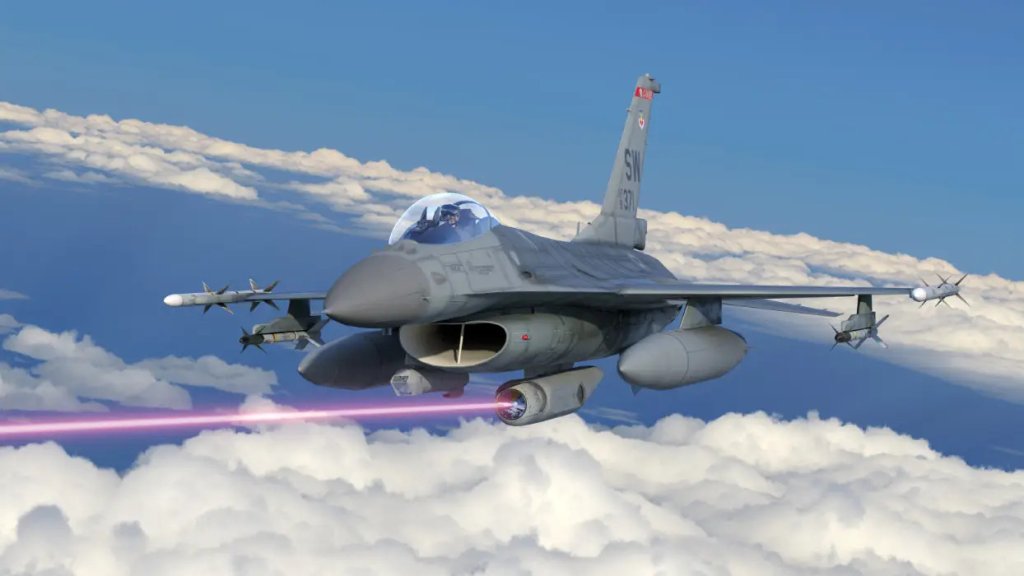
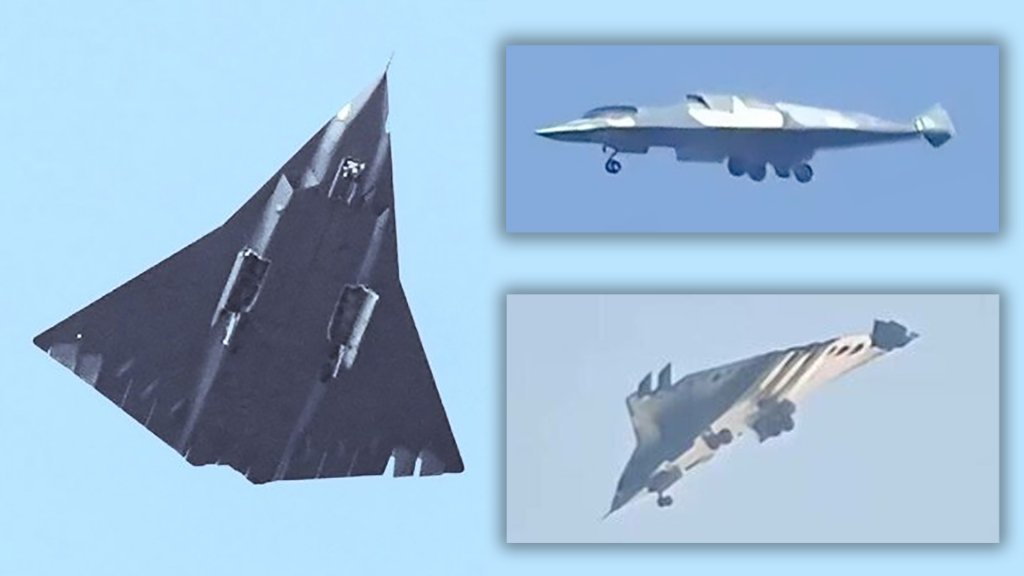
China’s Chengdu Aircraft Corporation continues to press ahead with the development of its ‘J-36’ next-generation tailless heavy tactical jet. Recent flight testing has offered interesting new views of the still-evolving stealthy design from the top and behind, prompting discussion about the aircraft’s features. There has also been talk recently about whether the jet might receive a laser directed-energy weapon at some point in the future.

The J-36 first broke cover, along with another next-generation tailless tactical jet design generally referred to as the J-XDS, back in December of 2024. There are understood to be at least four, and possibly five, J-36 prototypes flying now. A number of significant changes between prototypes have already been observed over the past two years, as you can read more about here.

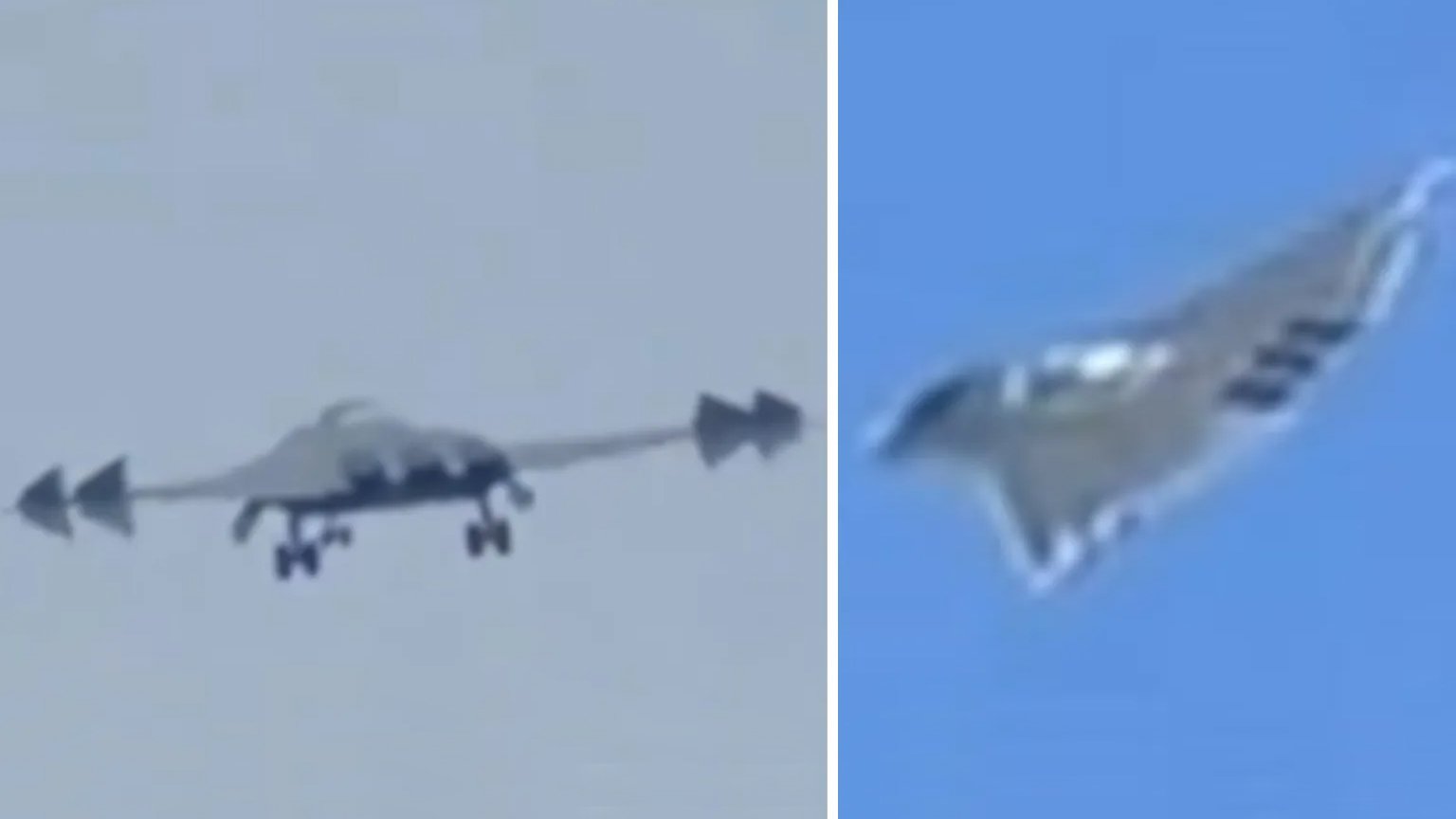
The most recent video of a J-36 test flight, seen in the social media post below, began circulating online yesterday. The footage shows the aircraft coming in to land, providing good general views of the uniquely three-engined jet with its two-seat, side-by-side cockpit configuration, especially from the rear aspect. What is seen underscores a previously observed total revision of the exhausts from a trough style to a two-dimensional thrust-vectoring configuration akin to what is found on the U.S. F-22 Raptor. This and other significant changes to the design, including the addition of divertless supersonic intakes (DSIs) all around, not just on top, first emerged last year. The clip also offers a good reminder of just how wide the aircraft is overall.

Obviously one of the best video recordings of the J-36 so far seen during landing approach … But can anyone read the number under the cockpit? 😉 https://t.co/cmQ0AkdsdO

— @Rupprecht_A (@RupprechtDeino) September 22, 2026

As this particular J-36 passes by, it can be seen to have a lighter-colored radome, as well as at least one relatively large lighter-colored section on top of the dorsal air intake. A similarly colored radome was first spotted on what is said to be the fourth prototype back in July. This coloring could point to the installation of actual radar in the aircraft’s nose. In TWZ‘s first in-depth analysis of the J-36 back in 2024, we assessed that the jet’s very broad radome area could house an absolutely massive primary array.

The lighter section on top of the fuselage could be an aperture for a conformal antenna tied to a beyond-line-of-sight communications and data-sharing suite. In 2024, we posited that the heavyweight J-36 could serve as an intelligence-gathering and communications relay platform in addition to performing tasks more typically associated with tactical combat jets. Reliable and multi-faceted connectivity would be key for employing the J-36 as an airborne controller for advanced air combat drones, as well.

Captures from the video above highlighting the lighter-colored radome and section on top of the center of the fuselage. Chinese internet captures via X

Another J-36 flight testing video that emerged on Monday, seen below, offers an additional view of the top of the jet, showing multiple lighter-colored sections that would appear to be additional conformal apertures for various antennas. There is a lighter-colored rectangular outline painted around part of the intake on top of the center of the fuselage, as well. The jet’s full paint scheme includes lighter-colored leading and trailing edges, which are critical structures on low-observable (stealthy) designs that often contain additional antenna arrays. Overall, the two-tone coloring is very much in line with what is seen on operational J-20 fighters in Chinese service today. The original J-36 prototype, at least, has notably worn a splinter-type camouflage paint scheme.

China's J-36 sixth-gen fighter asserting its dominance in the sky.

My prediction, the J-36 will gain initial operational capability before the American F-47 take its maiden flight. pic.twitter.com/SLmjqZ76Aw

— Zhao DaShuai 东北进修🇨🇳 (@zhao_dashuai) September 21, 2026
A stock shot of a J-20 fighter with its two-tone scheme. PLAAF
A view of the first J-36 prototype with its splinter-type camouflage scheme. Chinese internet via X

Whether or not the two recent video clips show the same J-36 prototype is unclear. The possibility has now been raised that Chengdu may be using a single serial number (36011) on at least some of the J-36 prototypes, a decision that could have been made for counter-intelligence and/or deliberate misinformation/disinformation purposes.

Much still remains unknown about the current or expected future capabilities of the J-36. Aviation Industry Corporation of China (AVIC) did have a placard at its booth at the 14th China International Defence Electronics Exhibition earlier this month that has prompted questions about whether the jet could be equipped with a laser directed-energy weapon. Chengdu falls under the umbrella of AVIC, which is a state-run enterprise. The Chinese-language placard in question describes a “laser weapon tracking system” with a power rating of “*00” kilowatts and a weight of “less than” 837.7 pounds (380 kilograms), per a machine translation. The way the power rating is written appears to mean that it is in the hundreds of kilowatts, which would put it firmly in a class capable of doing physical damage to objects, such as incoming missiles and drones.

Furthermore, an associated graphic shows a turreted system and a computer-generated rendering of a J-36 projecting a beam. The render appears to be from a video that depicts a J-36 using a laser to destroy other aircraft. Another computer-generated video that shows a J-36 using retractable lasers to shoot down incoming missiles has been circulating online since at least last year.

AVIC showed this at the 14th China International Defence Electronics Exhibition earlier this month. Chinese internet via X

This appears to be a screenshot from this video, via rednote user @阿中CN. https://t.co/NX1zDOLw2v pic.twitter.com/673Zl41MM1

— 笑脸男人 (@lfx160219) September 17, 2026

It is not immediately clear how official either of the clips depicting laser-armed J-36s might be, or whether they at all reflect real planned capabilities. The full placard presented at the China International Defence Electronics Exhibition, as seen in the video below, shows a variety of different laser systems, and not just for aerial applications.

AVIC has confirmed that the J-36 fighter jet is equipped with a laser defense system. pic.twitter.com/4PrSqAfOQK

— Modern War Explained (@FPDefenseNews) September 17, 2026

The fielding of operational laser directed-energy weapons capable of inflicting any real physical damage has historically proven to be very challenging, and even more so within the size, power-generation, and cooling constraints presented by modern combat jets. As an example, the U.S. Air Force spent roughly a decade working on a podded laser weapon system that tactical jets could use to swat down incoming missiles under its Self-protect High Energy Laser Demonstrator (SHiELD) program. In 2024, the service confirmed SHiELD had “concluded” without achieving its goal of an actual flight test. That same year, the Air Force cancelled plans to test a laser weapon system on an AC-130 gunship.

Despite important U.S. strides more recently when it comes to fielding ground-based and naval laser weapon systems, “there’s nothing that’s on the shelf right now that we are ready to put onto an airplane,” U.S. Air Force Brig. Gen. Douglas Wickert, the commander of the Air Force Research Laboratory (AFRL), told TWZ and other outlets just last week at a roundtable at the Air & Space Forces Association’s (AFA) 2026 Air, Space & Cyber Conference on Tuesday. “The solid-state lasers and the power density and the different ways that you actually – there’s actually a lot of secret sauce in that. How do you make the beam, and how do you form the beam, and how do you pulse the beam, and all that’s in development.”

‘There’s development of the laser itself, but now the power and thermal management system has progressed so much that we can provide the power needed,” Dr. Michael Gregg, head of AFRL’s Air Warfare Directorate, said at the same roundtable. “We’ve also had new designs and engines that we know have the power … to direct that power in certain areas. So, from a system perspective, it’s much more feasible because everything has matured over the last decade.”

A rendering of a US Air Force F-16 fighter with a podded laser directed-energy weapon. Lockheed Martin A rendering of a US Air Force F-16C Viper fighter with a podded laser directed energy weapon. Lockheed Martin

China has certainly made substantial investments of its own in laser and other directed-energy weapon capabilities across domains in recent years, and this is clearly an area of interest for the People’s Liberation Army (PLA), in general. When it comes to the J-36 specifically, TWZ has explicitly highlighted in the past how the three-engine configuration could be particularly useful for producing sufficient power to support a host of advanced and electricity-hungry sensors and other capabilities, including directed energy weapons.

Larger questions remain about the exact set of roles the J-36 is expected to fill, as well. The basic design is certainly optimized for straight-line performance, combat radius, and payload rather than maneuverability and agility. The jet has already caused a significant amount of debate just when it comes to taxonomy, as it does not seem to fit inside traditional definitions of ‘fighters’ and ‘bombers,’ something we have explored in detail previously.

A composite of other views of the J-36 that have emerged since 2024. Chinese Internet via X

“According to Yang Wei – chief designer of the J-20 –, the new [J-36] fighter can penetrate heavily defended airspace that the J-20 and comparable F-22s or F-35s must avoid, placing it a generation ahead,” Andreas Rupprecht, an analyst specializing in Chinese military aviation and TWZ contributor, wrote in a post on LinkedIn last week. “With lower RCS [radar cross section], high speed, and the capacity to control more drones, it could act as a node and command center for systems including J-20s and, especially, unmanned aircraft, while attacking high-value targets from stand-off range with long-range weapons.”

“The type could therefore represent a new class of ‘fighter,'” he added. “Online terms include ‘theater-level deep-penetration command combat aircraft’ and ‘high-performance fighter,’ analogous to a cruiser ranking above a destroyer within the Navy. Recent evidence gives this theory new weight and warrants continued monitoring.”

The J-36, as well as the J-XDS, reflect a larger burst of next-generation air combat developments in China in recent years. This includes an array of new crewed and uncrewed aircraft designed for operations from bases on land, as well as from the PLA Navy’s (PLAN) growing fleet of aircraft carriers and big-deck amphibious assault ships. The Chinese aviation industry’s development of a growing array of flying-wing uncrewed aircraft, some of which are very large, has been particularly notable.

In turn, there is something of an emerging gap between these developments and the pace at which the U.S. military is moving along similar lines, at least publicly. Boeing’s sixth-generation F-47 for the U.S. Air Force is not expected to take to the skies for the first time until 2028, though preceding demonstrator designs have been flying for years already. The U.S. Navy still has yet to officially announce a winner of its F/A-XX next-generation carrier-based fighter competition, and the current timeline for that program producing an operational aircraft is unclear.

A rendering the US Air Force has released of the F-47. USAF

As an aside, based on what has emerged publicly to date, there are signs that the F-47 may reflect a distinctly different design philosophy that puts greater emphasis on maneuverability compared to the J-36, and even likely the J-XDS. As mentioned, the J-36 certainly seems much more focused on payload, range, and level flight performance. In July, TWZ published a deep dive exploring why the U.S. Air Force would pursue a sixth-generation fighter with rear-swept wings, canards, and other features despite steady trends in the opposite direction visible in Chinese designs and ones elsewhere globally.

Regardless, U.S. officials have downplayed questions about China’s gaining ground in the air combat arena, or even surging into the lead in certain areas, in the past. “Chinese sixth-generation aircraft are in the nascent stages of development and expected to be operational by 2035,” the Pentagon wrote in its most recent annual report on military and security developments in China, which was published in December 2025.

In the meantime, the J-36’s design is already steadily being refined, and the total fleet of prototypes has been growing, offering new insights into the aircraft’s expected capabilities and roles.

Contact the author: joe@twz.com

The post China’s Recent J-36 Heavy Stealth Tactical Jet Testing Offers New Insights Into Its Evolving Design appeared first on TWZ.

  •  

The Evolving Role Of Ukraine’s Artillery In The Age Of Drones

It’s stunning to comprehend how much has changed since Russia began its invasion of Ukraine. The conflict quickly turned into one dominated by artillery, with both sides scrambling to source shells wherever possible. Drones have since replaced tubed artillery as the ‘king of battle’ along the front, but cannons still have an important place on the battlefield. The commander of a new combined drone-artillery brigade offered some fresh insights into how his guns are now being deployed to achieve effects that drones still can’t provide. 

As we have frequently documented, the ubiquity of drones has changed the nature of combat, especially when it comes to artillery. Not only can drones hold artillery positions at risk, many are cheaper than shells and easier to produce at scale. Most types are also precision guided munitions capable of hitting moving targets with pinpoint accuracy and can also provide battlefield surveillance. However, they are not a panacea, especially amid the cat-and-mouse game of electronic warfare countermeasures and improving kinetic and passive defenses.

In a recent interview with the Ukrainian Oboronka news outlet, Lt. Col. Vitalii Korniienko, commander of the 7th Artillery Brigade, talked about the changing nature of artillery warfare. Korniienko, whose unit is part of the Ukrainian National Guard, explained what is being done to keep his array of domestically produced Bogdana 155mm systems, donated weapons like M777 howitzers, remaining Soviet-era 2S7 Pion 203mm self-propelled howitzers and other guns, relevant. Here are some takeaways from that discussion.

How The Game Changed

“Guns used to be massed at positions to create an ‘artillery wall’ and a barrage of fire,” the lieutenant colonel said. “That practice is gone now. So, how effective is artillery today? We can create an artillery barrage, but what is the point of mindlessly churning up the earth? I’d rather send 20 FPV drones to destroy the target. The cost of that mission is $20,000.”

A soldier from the 13th Khartiia Brigade of Ukraine's National Guard hones his FPV drone piloting skills during a training flight in Kharkiv region, Ukraine, August 15, 2026. Regular practice under conditions closely resembling combat is a key element of operator training. (Photo by Viacheslav Madiievskyi/Ukrinform) (Photo credit should read Viacheslav Madiievskyi / Ukrinform/Future Publishing via Getty Images)
A soldier from the 13th Khartiia Brigade of Ukraine’s National Guard hones his FPV drone piloting skills during a training flight in the Kharkiv region, Ukraine. (Photo by Viacheslav Madiievskyi/Ukrinform/Future Publishing via Getty Images) Future Publishing

“Alternatively, I could fire 200 shells, but the cost would be astronomical,” he pointed out. “Plus, if we fired 100 shells from a gun in a single day, it likely wouldn’t survive until evening. The sky is full of drones; every shot gives away the position, leading to detection and an attempt to dismantle it using every available means. Nowadays, a typical mission involves a series of up to 10 shots. First, 3–5 shells for ranging, followed by fire on the target. That’s a minimum of five shells, with each costing at least $2,000.”

What Does The Drone-Artillery Brigade Do Differently?

“It is a concept of ours that was approved: combining artillery and drones within a single brigade,” Korniienko said. “Drones take out enemy artillery and logistics, while our guns provide cover for the infantry, destroy targets, and pin the enemy down in their dugouts. This way, we mitigate the limitations of both systems and boost overall effectiveness.”

ZAPORIZHZHIA, UKRAINE - AUGUST 20: Servicemen of the 44th Separate Artillery Brigade are firing the 2S22 "Bogdana" at Russian military positions on August 20, 2025 in Zaporizhzhia region, Ukraine. Artillerymen of the 44th Separate Artillery Brigade of the Armed Forces of Ukraine are carrying out combat missions with a 2S22 "Bogdana" self-propelled howitzer against Russian troops near the front line in the Zhaporizhia direction. According to reports from army commander Oleksandr Syrskyi, Russian forces have concentrated there, he said they are preparing an attack. (Photo by Frontliner/Getty Images)
Ukrainian troops firing a domestically produced 2S22 “Bogdana” self-propelled howitzer against Russian forces near the front line in the Zaporizhia direction. (Photo by Maksym Kishka/Frontliner/Getty Images) Frontliner#VIDEO

“Our primary operations are focused within the corps’ area of ​​responsibility—targeting positions 10 kilometers deep or farther behind enemy lines. Of course, we will also engage closer targets if requested by the brigade holding the defense. In addition, we are shifting logistics tasks from pickup trucks to ground-based robotic systems. They are already transporting ammunition to drone and artillery positions, as well as food and fuel for generators.”

What Artillery Can Do That Drones Can’t

“Let’s be honest: 95% of strikes right now are carried out by drones,” Korniienko explained. “Yet, we cannot simply abandon artillery. The focus of our operations has shifted from merely striking the enemy to destroying, suppressing, and halting the actions of assault groups and armored columns—and the need for that remains as critical as ever. There are tasks that only artillery can handle.”

The high art of war, as practiced by the warriors of the National Guard's Artillery Brigade.

So high, it lands beyond the horizon. 💥

📹: @ng_ukraine pic.twitter.com/v06aJ8KcjM

— Defense of Ukraine (@DefenceU) September 23, 2026

“For instance, we currently have several enemy targets in the Kupyansk sector that drones cannot reach due to electronic warfare (EW) interference, while slow fiber-optic drones are simply shot down,” the officer noted. “What do we do? We call in artillery. Nothing affects its shells. Fog, strong winds, snow, or headwinds—it makes no difference to artillery; it will operate regardless.”

Preparing Artillery For The Modern Battlefield

“At the beginning, both we and the Russians might have had two or three guns at a single position,” Korniienko proffered. “The enemy was doing this as late as 2023. Then it tapered off, because if you deployed six guns, an hour later they’d be gone. No one drives out into an open field anymore. Today, a gun wouldn’t even make it to the position without being spotted.”

KHARKIV, UKRAINE - JULY 3: Artillerymen of the 13th operational brigade of the National Guard of Ukraine 'Khartiia' prepare the 'Bogdana-B' artillery installation 'to hit enemy positions' in the Lipetsk direction, Kharkiv region, Ukriane on July 3, 2025. (Photo by Sofiia Bobok/Anadolu via Getty Images)
Ukrainian National Guard troops prepare a ‘Bogdana-BG’ artillery installation from a dugout position. (Photo by Sofiia Bobok/Anadolu via Getty Images) Anadolu

As a result, the artillery crew’s deployment “is prepared in advance,” the officer stated. “First, anti-aircraft drone teams ‘clear’ the sky above the site of enemy reconnaissance assets. The position itself is a fully underground-dugout caponier with well-camouflaged access routes. We put a lot of effort into ensuring the artillery doesn’t get destroyed. Losing a gun is a huge blow to us.”

Short Range Versus Long Range Shells

“There is currently an ongoing debate about phasing out ‘short’ shells and switching entirely to long-range variants,” the officer stated. “This is intended to protect artillery from drone strikes.”

“What exactly is a ‘short’ shell, and should we stop using it?” he asked rhetorically. “The M107 155mm round is what is known as a ‘short’ shell. It is inexpensive and mass-produced; all our allies—and even our own country—manufacture it. We have sufficient stocks of them for combat operations. While accurate, its range is limited to 14–18 km, depending on the propellant used.”

Army

Long-range options “include the M795 and its foreign equivalents,” Korniienko explained. “These are longer, heavier, and significantly more expensive. With high-quality propellant, they can reach 30 km, or even further if equipped with a base-bleed unit. However, both these shells and the necessary propellants are in short supply.”

Army

“I do not believe abandoning the M107 is the right move,” the officer suggested. “Long-range shells cause faster barrel wear and compromise position concealment; firing a long-range charge produces a massive burst of flame from the muzzle—visible for kilometers at dusk or dawn.” “Besides,” he added, “18 km is a respectable range. If the gun is positioned 15 km back, it still has a 3-km margin to spare. That is sufficient for engaging frontline infantry. In my view, the ideal mix for most brigades would be 60% long-range shells and 40% standard M107 rounds.”

Big Versus Small Guns

“I operated 105mm guns in the Serebryanka area, on the Kharkiv axis,” Korniienko noted. “Based on intercepted communications, the enemy thought it was a mortar and searched for it within a five-to-six-kilometer range. But the howitzer was positioned eight or nine kilometers away and fired out to 10–12 kilometers.”

“There is almost no muzzle flash, just a bit of dust,” he added. “The shell arrives, and the enemy doesn’t even hear the sound of the shot. It’s compact and lightweight—you can transport it on a pickup truck. So yes, it would be useful.”

An L119 lightweight towed howitzer. (Via X)

“I’d also like to see the development of 203mm artillery; why move away from that caliber?” the officer wondered aloud. “Our ‘Pion’ systems fire a massive 100-kilogram shell capable of punching through at least two floors of a building or a bunker. And it’s reasonably accurate, too. You wouldn’t want to be on the receiving end when guns like that are firing at you. Overall, I believe we need competition. Right now, the ‘Bogdana’ is evolving under wartime conditions, which is good. But in a few years, momentum could stall. They might just keep producing the same system without significant upgrades because there’s no incentive to innovate. Yet, the nature of war doesn’t stand still.”

Wary Of Asian Shells

“We have a wide range of shells from different countries, and the ones coming from the West are fine,” Korniienko said. “However, their counterparts produced in certain Asian countries… the quality is frankly poor.”

“What is wrong with them?” queried Korniienko, who did not name the country in question. “On paper, the shell weight is listed as 46 kilograms, but when we weigh them, we find 46.9 or 45.4 kg. And that half-kilogram difference—give or take—has a huge impact on where the shell lands.”

As a result, “we no longer trust the standard firing tables provided with the shells; instead, we compile our own for each manufacturer. We weigh every batch and sort them by weight so that the difference between the ‘piles’ is minimal, ensuring a reasonably tight grouping. I can’t afford to make a mistake that causes a shell to land 2 kilometers off-target—right where our infantry guys are positioned. I should add that our artillerymen are actually wary of shells from one specific country. There have been instances where they tore off the muzzle brake or even caused the barrel to burst. A barrel burst is a disaster.” 

Homegrown Is The Best

Korniienko said his unit was one of the first to test the Bogdana system, adding that he prefers it to other guns.

“We tested them and provided feedback to the manufacturer, which was then used to refine the design,” he explained. “It is a solid gun now, and it is my preferred choice. It might not be the absolute best, but I am very satisfied with the support and service.”

“If there’s a breakdown, the gun is back in position within a day or two,” he pointed out. “For instance, a gun broke down today, and we needed a repair team from the manufacturer. I know I’ll have it fixed by the day after tomorrow. They arrive in the morning, and by midday, the gun is ready. Then it takes another day or two to get it back to the position. That is very fast.”

That’s a very different experience than what he sees with donated weapons like the U.S.-made M777.

DONETSK OBLAST, UKRAINE - AUGUST 6: Ukrainian soldiers prepare to fire the M777 artillery at their artillery position as Ukrainian Army conduct operation to target trenches of Russian forces through the Donetsk Oblast amid Russia and Ukraine war in Donetsk Oblast, Ukraine on August 6, 2023. (Photo by Diego Herrera Carcedo/Anadolu Agency via Getty Images)
Ukrainian soldiers prepare to fire an M777 howitzer at Russian forces. (Photo by Diego Herrera Carcedo/Anadolu Agency via Getty Images) Anadolu

“As for the Western partners helping us—we are deeply grateful,” the officer avowed. “However, by the time you actually receive a part—say, a sensor—the gun might have been sitting idle for six months. And you can’t try to fix it yourself, because that would void the warranty.”

While artillery may no longer be the reigning weapon of war, as far as Ukraine is concerned, it has not been relegated to the dustbin of history yet either.

Contact the author: howard@twz.com

The post The Evolving Role Of Ukraine’s Artillery In The Age Of Drones appeared first on TWZ.

  •  

Where Are The Aircraft Carriers?: September 23, 2026

The crew of the USS Abraham Lincoln touched American soil for the first time in nine months, when the strike group pulled into Apra Harbor, Guam, for a brief logistics stop and on-base liberty. The supercarrier, alongside guided-missile destroyer USS Frank E. Petersen Jr., arrived on September 19 and left the next day. Lincoln is 307 days into her deployment, 19 short of the record set earlier this year by the USS Gerald R. Ford, and is now just weeks away from San Diego. Meanwhile, two flattops are on station in the Middle East supporting blockade operations, and the USS Ronald Reagan has rejoined the fleet after an extended maintenance availability.

Here’s TWZ’s weekly carrier tracker monitoring America’s flattop fleet, including deployed Carrier Strike Groups (CSG) and Amphibious Ready Groups (ARG), using publicly available open-source information. Check out our last report here.

A detailed graphic created by TWZ and Ian Ellis-Jones showing the positions of America's fleet of 11 aircraft carriers and strike groups, as of September 23, 2026.

Abraham Lincoln Departs Guam, Continuing Her Journey Home

The USS Abraham Lincoln is currently conducting routine operations at an undisclosed location in the U.S. 7th Fleet area of responsibility (AOR), presumably steaming east en route to her homeport at Naval Air Station North Island in San Diego. After leaving Thailand on September 6 following a five-day liberty port call, Lincoln topped off the Petersen Jr. in the Gulf of Thailand and linked up with two Royal Australian Navy frigates for joint training in the South China Sea. Publicly available flight tracking data shows the carrier transited the Balabac Strait eastbound around September 13, and the Surigao Strait northbound two days later to enter the Philippine Sea. After going dark for a few days, she resurfaced in Guam and moored at Kilo Wharf over the weekend.

Lincoln transits the Philippine Sea. U.S. Navy photo

“Due to the brief nature of the logistics stop, the crew were afforded on-base liberty to access base services and attend a Navy Entertainment-sponsored concert,” CSG-3 spokesman Lt. Cmdr. Tyler Barker wrote in an email to Stars and Stripes. The carrier took on stores, mail, and equipment, according to Barker, and 13 Fleet and Family counselors are now aboard to run return-and-reunion classes but “the crew and ship remain focused and ready.”

Abraham Lincoln is conducting routine operations in the U.S. 7th Fleet area of operations. Units assigned to 7th Fleet conduct continuous patrols to deter aggression, strengthen alliances and partnerships and advance peace through strength.
USS Abraham Lincoln (CVN 72) arrives in Guam on Sept. 19, 2026. U.S. Navy photo

A homecoming date has not been announced publicly. Unless Lincoln makes another stop (in Hawaii, for example) or conducts additional training on the way, she should arrive in early October just shy of Ford’s record. The Chief of Naval Operations, Adm. Daryl Caudle, said in June that Lincoln would likely shift her homeport to Naval Base Kitsap-Bremerton in Washington state, which aligns with TWZ’s reporting that she is expected to begin a Drydocking Planned Incremental Availability (DPIA) after returning stateside. The timeline for the DPIA is unclear.

George Washington and George H.W. Bush Project Power In The Middle East

The American public got a rare look at ongoing combat operations aboard the USS George Washington when two reporters embarked earlier this month. Fox News’ Trey Yingst and CBS News’ Tom Hanson reported live from the flight deck, as F-35C Lightning IIs and F/A-18E/F Super Hornets launched behind them, in hits that aired September 11 to 14. The only other publicized media embark since the war began on February 28 went to CNN’s Pamela Brown, who reported on the conditions aboard the USS Abraham Lincoln while the flattop was still in theater.

An F-35C launches from Washington. U.S. Navy photo
A pair of Super Hornets on Washington. U.S. Navy photo

“Last weekend, the aircraft carrier came under Iranian missile attack; the first of three attacks on US warships in the last week alone,” Yingst said, indicating it was the USS George Washington, and not the USS George H.W. Bush, that was targeted by the Islamic Revolutionary Guard Corps (IRGC) in early September. The Navy declined to comment when TWZ asked which carrier was targeted after Iranian state media claimed the strike had been successful. “We’re pretty much employing all our capabilities right now,” Washington’s commanding officer (CO), Capt. Nicholas DeLeo, told Yingst.

Night flight ops aboard USS George Washington. U.S. Navy photos

“The GW is surrounded by four to five guided-missile destroyers at any moment,” Yingst also reported. He flew out to USS Shoup, positioned off the starboard side at the time, to make the point and speak with the warship’s CO. Shoup is the only destroyer officially confirmed to be part of CSG-5. “My ship is in charge of coordinating defense amongst the various other units, allocating defensive assets to it, be it potentially a missile to shoot something down or just aircraft to go identify and monitor the picture,” Capt. William Buford said. Based on that description, Shoup’s CO appears to be coordinating Integrated Air and Missile Defense (IAMD) for the strike group, a question we’ve been asking the Navy to confirm. TWZ understands additional destroyers operating in the U.S. Central Command (CENTCOM) AOR are also escorting Washington, but a U.S. official declined to say which ones.

Hanson asked DeLeo about the recent IRGC ballistic missile threat targeting Navy ships in the region. “We have a variety of ways to protect, both offensively and defensively, a Navy ship, and we employ all these methods,” he told the network. “It’s something that we train to.” Hanson also pressed the commander of CSG-5, Rear Adm. Jeff Heames, on whether he was concerned about the munitions stockpile, a dynamic TWZ detailed in a special feature yesterday. “Of course we’re concerned about the expenditure to some degree, but I have no concerns locally at my level here,” Heames replied.

Gun shoot aboard USS George Washington (CVN 73), Sept. 15, 2026. U.S. Navy video

In addition to Washington, Bush is still working the blockade from the Arabian Sea, nearly six months into her deployment. As of CENTCOM’s latest social media update on September 21, U.S. forces in the region had redirected 110 commercial vessels to ensure “total compliance” with the blockade. More than 50 ships “supporting humanitarian efforts” have been allowed through, according to the command. CENTCOM recently stopped publishing the number of ships boarded, seized, or disabled kinetically.

USS George H.W. Bush and USS Mason conduct a replenishment-at-sea on Sept. 18, 2026 at an undisclosed location in the U.S. Central Command Area of Responsibility.
An MH-60S Sea Hawk lifts cargo from the flight deck of USS George H.W. Bush, Sept. 18, 2026. U.S. Navy photo

Ronald Reagan Rejoins the Fleet

The USS Ronald Reagan is officially back. The Navy, in a recent statement, confirmed the flattop “returned to the fleet capable and mission-ready.” The carrier had been out of action since March 2025 for a DPIA at Puget Sound Naval Shipyard in Washington state and completed four days of sea trials in early September. While the Navy does not comment on upcoming deployments due to operational security, current speculation points to a spring 2027 deployment, but that is not confirmed.

U.S. Navy Damage Control Fireman walks on the flight deck of USS Ronald Reagan (CVN 76) during a counter measure wash down in the Pacific Ocean, Sept. 6, 2026. Following an 18-month Docking Planned Incremental Availability, the Nimitz-class aircraft carrier USS Ronald Reagan is conducting routine training in the U.S. 3rd Fleet area of operations. U.S. Navy photo
Counter measure wash down on USS Ronald Reagan in the Pacific Ocean on Sept. 6, 2026. U.S. Navy photo

Reagan is the only carrier currently homeported at Naval Base Kitsap-Bremerton in Washington. Previously, she was America’s only forward-deployed carrier based in Yokosuka, Japan, until swapping hulls with the USS George Washington in 2024. USS Nimitz was stationed at Naval Base Kitsap-Bremerton before circumnavigating South America to Naval Station Norfolk this summer, where she is being used primarily for training before deactivation in 2027. The yet-to-be-commissioned PCU John F. Kennedy, the second and newest Ford class supercarrier, is slated to homeport in Washington state no earlier than 2029.

U.S. Navy Big Deck Fleet At A Glance

Overall, three U.S. carriers are deployed (with one heading home), one is preparing to deploy in the near term, three are working up in various states of readiness, three are in current or upcoming maintenance, and one is being used primarily for training before deactivation next year. One amphibious ready group is deployed, one is forward-stationed and in port, four are working up or in port, and three are in maintenance.

Note: Positions are general approximations. Non-deployed LHA/LHD amphibious warships are not shown.

Contact the author: ian.ellis-jones@recurrent.io or @ianellisjones

The post Where Are The Aircraft Carriers?: September 23, 2026 appeared first on TWZ.

  •  

Video Shows RAF Hawk T2 Trainer Crew Ejecting Before Jet Crashes (Updated)

A U.K. Royal Air Force Hawk T2 training jet crashed in the Pencarnisiog area of Anglesey, North Wales, on Wednesday after both pilots ejected from the aircraft.

Videos captured of the incident show the aircraft porpoising at a slow speed and high angle of attack, before the pair ejected. The Hawk appears to narrowly miss homes before impacting the countryside and bursting into flames, with thick black smoke visible afterward.

BREAKING: Moment RAF Hawk jet crashes near RAF Valley, Wales; pilots eject pic.twitter.com/oHV8MJLhfi

— Klaxon Wire (@KlaxonWire) September 23, 2026

Local police said the two pilots were being treated for minor injuries and that there were no reports of wider damage or additional casualties. Emergency services, including Coastguard and Wales Air Ambulance helicopters, responded to the scene.

The crash occurred near RAF Valley, where the RAF operates its Hawk T2 advanced jet trainers as part of fast-jet pilot training. The station is home to No. 4 Flying Training School. The Telegraph reports the incident happening “shortly after takeoff.”

🚨 WATCH: The moment an RAF training jet crashes shortly after take-off at RAF Valley pic.twitter.com/Pnc71YEuW5

— Politics UK (@PolitlcsUK) September 23, 2026

🚨 BREAKING: An RAF jet has crashed near RAF Valley in Wales

Both crew members ejected pic.twitter.com/dH4RhZ11hw

— Politics UK (@PolitlcsUK) September 23, 2026

The Royal Air Force confirmed that the incident involved one of its Hawk T2s flying out of RAF Valley.

“An investigation is under way and we will not comment further at this time,” the RAF said.

Wreckage from the aircraft has been located at the crash site. Police have asked the public to avoid the area while emergency services remain at the scene.

The circumstances surrounding the crash, including what caused the aircraft to go down and the nature of the flight, have not yet been established.

The Hawk fleet has experienced previous technical issues.

In 2022, engines were removed from service amid concerns over potential in-flight failures, while the 28-aircraft RAF Hawk T2 fleet was temporarily grounded in January 2023 following an engine-related incident at RAF Valley.

In 2024, then-Chief of the Air Staff Air Chief Marshal Sir Richard Knighton said he wanted to replace the Hawk T2, citing problems with its engines and support and concerns about the reliability of the training capacity it provided. The Hawk T2 is due to be retired by 2040.

Those previous issues are not known to be connected to Wednesday’s crash.

Update: 2:09 PM ET –

The Royal Air Force has issued a new update on the mishap today:

“Following an incident involving an RAF Hawk T2 aircraft today, both pilots are receiving medical treatment. Their families are being supported.”

“The RAF has decided to temporarily pause Hawk T1 and T2 operations, as a precautionary measure, whilst investigations are ongoing.”

An update on today's incident involving an RAF Hawk T2 aircraft. Thank you for the well wishes to our people. pic.twitter.com/GLuWU9LfoN

— Royal Air Force (@RoyalAirForce) September 23, 2026

Update: 4:25 PM ET –

A video taken by an onlooker outside the perimeter fence at RAF Valley shows the ill-fated Hawk T2 taking off, with flames beginning to appear during the takeoff roll.

Exclusive: a Hawk T2 getting airborne from RAF Valley, N. Wales. As it rolls down the runway flames appear from the rear of the jet. The Hawk T2 does not have reheat (afterburner). As the jet climbs the flames seem to disappear. The main Hydraulic system is on the rear left side. pic.twitter.com/WafevD2BQg

— Mikey Kay 🏴󠁧󠁢󠁷󠁬󠁳󠁿 (@MikeyKayFilms) September 23, 2026
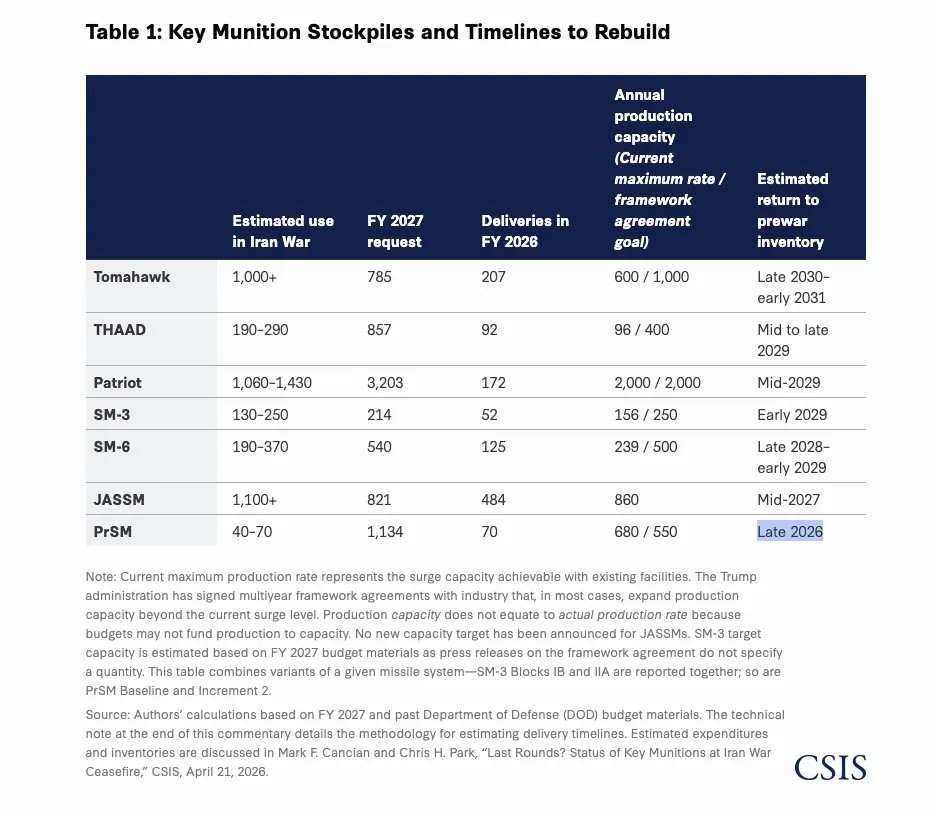
Update: 9/24/2026 –

The Royal Air Force has shared a new update on yesterday’s crash, which is as follows:

“Both pilots are doing well, they are in extremely good spirits and [are] expected to make a full recovery.”

“A formal investigation into the circumstances surrounding the incident is now underway and as a precautionary measure, the RAF has temporarily paused Hawk T1 and Hawk T2 flying operations.”

An update on yesterday's incident involving a Hawk T2 aircraft. pic.twitter.com/QXg7xAOZTB

— Royal Air Force (@RoyalAirForce) September 24, 2026

Contact the author: thomas@thewarzone.com

The post Video Shows RAF Hawk T2 Trainer Crew Ejecting Before Jet Crashes (Updated) appeared first on TWZ.

  •  

Did NASA’s Administrator Just Tease An SR-71 Blackbird Follow-On X-Plane? (Updated)

NASA Administrator Jared Isaacman has left something of a mystery hanging in the air after showing the silhouette of an aircraft that immediately drew comparisons to the famed SR-71 Blackbird during a recent speech. Isaacman pushed back on a direct link to the SR-71, but said his agency is working hard to get “back in the business of flying high and fast again.”

The silhouette, accompanied by the tagline “Rebuilding our X-plane portfolio,” was among the backdrops for Isaacman’s remarks at the annual All-In Summit in Los Angeles, California, last week.

The SR-71’s iconic shape is defined by its long, sword-like profile, pronounced chines, and deeply swept wings, and huge spiked engine nacelles with canted fins on top. Its distinctive geometry is reflected in the silhouette, which shows a broad, highly blended aircraft from an unusual head-on angle.

NASA Administrator Jared Isaacman talks at the All-In Summit about new high- and fast-flying X-planes with the eye-catching aircraft silhouette in the background. All-In Summit/YouTube screencap

“In the service of the first A [aeronautics] in NASA, we are rebuilding our X-plane fleet. The X-59 is researching quiet supersonic flight, but it’s just the beginning,” the head of NASA told attendees. “As NASA recommits to flight test and works alongside industry to push the boundaries of airframe and propulsion design, it will not be long before NASA once again is flying as high and as fast as we had in decades past, and then even more.”

Isaacman’s full speech at the All-In Summit, as well as his remarks during a live interview that followed immediately afterward, are contained in the video below. The high-speed aircraft silhouette is first seen at around the 12:40-mark in the runtime, and is then further discussed at around the 28:39-mark.

Chamath Palihapitiya, co-host of the All-In Podcast and one of the hosts of the summit, asked Isaacman directly about the silhouette during the fireside chat after his speech.

“You showed a picture of the [SR-71] Blackbird up there,” Palihapitiya said at one point, before Isaacman interjected.

“You sure that’s a Blackbird?” Isaacman said.

“Well, ok. What was that picture you showed up there?” Palihapitiya asked.

“Like I said, NASA is getting back in the business of flying high and fast again,” Isaacman said in response, and declined to further elaborate.

Whether or not the silhouette reflects a real design that is in development now is unclear. TWZ has reached out to NASA for more information.

Though the Mach-3+-capable SR-71 is primarily remembered as a Cold War-era intelligence-gathering aircraft, NASA operated several Blackbirds in support of aeronautical research efforts for years. The agency was actually the last operator of the type, flying SR-71s until 1999.

Lockheed Martin openly pitched a successor to the SR-71, dubbed the SR-72, in the late 2010s. There was even talk of building a flying fighter jet-sized demonstrator to prove out key technologies.

A rendering of a notional SR-72. Lockheed Martin An artist’s conception of the proposed SR-72. Lockheed Martin

Discussion about the SR-72, or a further evolution of that concept, resurfaced in the early 2020s after Lockheed Martin helped craft a fictional hypersonic aircraft called Darkstar for the blockbuster movie Top Gun: Maverick.

Exactly where Lockheed’s SR-72 ambitions sit today is unclear. After talking constantly about the potential program for a number of years, it went silent, which could indicate the program had moved forward deep in classification.

NASA has worked with other supersonic and hypersonic X-planes in the past, as well. This includes reusable space planes, as well as aircraft designed to fly within the Earth’s atmosphere.

“I mean, that doesn’t seem like a space vehicle. It seems like an Earth-air vehicle,” All-In’s Palihapitiya noted during his chat with Isaacman about the silhouette he showed.

“Yeah. The first ‘A’ in NASA is our aeronautics portfolio,” Isaacman said in response, before highlighting a host of contributions his agency has made to advanced military and commercial developments over the years. “You know what I want to do? I want to get back to the radical airframe and engine designs like we were always supposed to do.”

As mentioned, Isaacman also highlighted the X-59 Quiet Supersonic Technology experimental test aircraft, or QueSST, at the summit, but made clear the goal is to go well beyond that design. The QueSST jet is the centerpiece of a program now to investigate technologies that could eventually enable commercial supersonic flight over land with a substantially reduced sonic boom.

The X-59 conducted its first supersonic test flight, reaching Mach 1.1, in June. NASA’s test program aims to eventually push the aircraft up to a speed of Mach 1.4. This is significantly below the record-breaking mark of approximately Mach 3.3 that the SR-71 clocked back in the mid-1970s, but it was never designed for extreme speed as testing its sonic signature was its primary goal.

NASA’s X-59 flies above the Mojave Desert in California on August 18, 2026. NASA/Jim Ross

As for bringing a Blackbird back into operation for high-speed testing, which is now at the forefront of military aeronautics (and civilian to a lesser degree) after decades of being sidelined, that would be a very challenging operation. The SR-71s are long retired and have been placed in museums and other display areas. While the Pentagon could technically claw some of them back from their ‘on loan’ status, reconstituting even one of them would be a major undertaking as the entire support ecosystem that once sustained them has been gone for decades. Still, having a Mach 3+ capable jet for testing would be a highly relevant tool in a new age of high-speed flight exploration.

On the other hand, building a new test aircraft that aims higher and faster than the SR-71, but may be based on its ‘DNA,’ is certainly possible. Such an aircraft could leverage material science, avionics, flight controls, and engines that are seven decades more modern than its progenitor. Technology demonstrators in this class could also already exist in the classified domain. NASA could possibly assume ownership of one after the Pentagon declassifies it, as well.

Regardless of how such an exotic aircraft is obtained, one of the biggest differentiating factors could be that a NASA aircraft is piloted by a human onboard, instead of it being a drone, but an uncrewed aircraft is possible too.

A NASA SR-71 taxis at Dryden Flight Research Center during its late operational phase. NASA

Isaacman has been very open about its interest in and support for new X-plane developments. On only his second day on the job, in December of last year, he called for revamping the agency’s aeronautics program and stated that “I’d love to see an expanded X-plane portfolio” during a town hall with NASA staff.

“If NASA has a healthy X-plane portfolio, we should be flying experimental aircraft so routinely that the second flight of a single X-plane is not newsworthy,” he wrote in a post on X in March of this year. “For example, the two NASA X-29 aircraft flew 422 flights between 1984 and 1991. That period also overlapped with the development of two X-31 aircraft, which together flew about 580 times.”

One of the X-29 X-planes, at left, and the X-31, at right. NASA/DARPA

NASA’s proposed FY2027 budget also spelled out rapid, cost-effective flight experimentation as an explicit priority. Budget documents specifically highlight work toward new advances in supersonic and hypersonic flight technologies “that will revolutionize air transportation, strengthen national security capabilities, and position America to lead the future of high-speed flight,” as well.

Furthermore, in April, NASA outlined a new Aeronautics Flight Accelerator (AFA) initiative. At that time, the agency put out a call for “input on technologies, concepts, and flight test campaigns suitable for cost shared maturation leading to flight within the next three years.” Stated areas of interest included “subsonic (including vertical lift), supersonic, and hypersonic flight technologies.”

It is important to reiterate that we still do not know whether the silhouette Isaacman showed at the All-In Summit represents an active development effort and, if so, how mature it might be. Government agencies and contractors routinely use concept art to illustrate an area of research or communicate a future vision. Such artwork does not necessarily correspond to a funded aircraft, an active prototype, or even a specific configuration.

At the same time, under Isaacman, NASA is clearly pushing toward new X-planes. NASA’s X-plane programs have historically served as a way to investigate technologies that conventional aircraft programs were not prepared to risk. The resulting aircraft have explored everything from supersonic and hypersonic flight to unconventional configurations and new propulsion concepts.

At the very least, evoking the visual legacy of the SR-71 Blackbird, coupled with Isaacman’s comments, provides a clear indication that NASA is interested in returning to the high-speed flight regime as part of its future plans.

Update: 2:04 PM ET –

NASA has now provided TWZ with the following statement in response to our queries for more information:

“NASA has a long history of building and flying experimental aircraft that push the boundaries of what is possible. As Administrator Isaacman has said, we want to see more X-planes flying in the years ahead, developing the technologies that will allow us to fly higher, farther, and faster than we have in decades. We look forward to sharing more as those efforts progress.“

Contact the author: thomas@thewarzone.com

The post Did NASA’s Administrator Just Tease An SR-71 Blackbird Follow-On X-Plane? (Updated) appeared first on TWZ.

  •  

U.K. Sending Voyager Tanker To Help Defend Saudi Airspace

The Royal Air Force (RAF) is deploying one of its Voyager aerial refueling jets to help Saudi Arabia defend against ongoing attacks from the Iranian-backed Houthi rebels of Yemen. The decision marks the first publicly known international military assistance offered to Saudi Arabia specifically for its fight against the Houthis, which erupted over the summer. The move came hours before U.S. President Donald Trump told the United Nations General Assembly meeting that he believes a peace deal with Iran will be reached after the U.S. midterm elections in November.

The British action is significant because, while it involves just one tanker, other key Saudi allies have yet to heed the Kingdom’s request for military help specifically to battle the Houthis. Although it’s important to note some assets already deployed to defend against Iranian attacks could be helping with the Houthi threat now.

This picture is from a Quick Reaction Alert training scenario. The QRA exercise was conducted 31 March 2026. The purpose of the exercise was to demonstrate the full end-to-end process of the UK's air defence strategy if an actual foreign aircraft was to invade their protected airspace. Upon receiving the alert, the QRA team at RAF Coningsby would launch to RAF Typhoon FGR4's to intercept any unknown aircraft within the protected airspace. In this particular scenario an RAF Voyager A330 (RAF Brize Norton) was acting as the agressor and two RAF Typhoons FRG4 (RAF Coningsby) were responding to the simulated threat. During the exercise the Typhoons intercepted the Voyager and conducted a series of maneouvers whilst communicating with the "foreign" aircraft with the aim of escorting it to a safe location on the ground (RAF Brize Norton) upon which it and it's crew would be guarded and safely inspected by counter-terrorist police. The resulting imagery is to be used for training government ministers on how a QRA works and all the different elements involved. From the initial radar detection of a foreign, unidentified aircraft at the London Area Control Centre, Swanwick, to the physical launch of our QRA team at RAF Coningsby. The RAF use a hose-and-drogue air-to-air refuelling system deployed from Voyager tanker aircraft. Instead of a rigid flying boom, the tanker trails a flexible high-pressure hose attached to a stabilizing basket (drogue), allowing receiver jets like the Typhoon and F-35 to plug in mid-flight. This image shows a Typhoon releasing flares as a warning to the "enemy aircraft".
A Royal Air Force Typhoon FGR4 accompanies a Voyager tanker during a Quick Reaction Alert training scenario in March 2026. (Crown Copyright) Crown Copyright

Last week, Trump turned down a direct plea from Saudi Crown Prince Mohammed bin Salman, the Kingdom’s de facto leader, to attack the Houthis. Meanwhile, Pakistan and Turkey, which signed the Mecca Joint Defense Agreement with Saudi Arabia, have yet to provide any direct military aid. The pact holds that an attack on one is considered an attack on all; however, it doesn’t stipulate exactly what actions should be taken. 

Saudi Arabia, under repeated Houthi missile and drone attacks as well as suspected strikes from Iranian-backed militias in Iraq, is struggling to defend its oil infrastructure. The Kingdom is also facing a challenge supporting the anti-Houthi forces it backs in the Yemen civil war that reignited in the wake of the U.S. and Israeli attacks on Iran that began Feb. 28.

At issue, beyond protecting the Saudis, is growing concern over the Bab al-Mandab Strait, a key chokepoint now largely controlled by the Houthis, who are preventing the Saudis from using it to ship oil. 

Earlier this year, the Houthis imposed a blockade on the Strait, and began striking Saudi ships in the southern part of the Red Sea as well as critical energy terminals on that body of water. Iranian proxies have also struck the vital East-West pipeline that feeds oil to be transferred and shipped via the Red Sea in order to bypass the Strait of Hormuz, where Iran vastly curtailed shipping after the launch of Operation Epic Fury. The pipeline reportedly reopened today after being shut down following a long-range drone attack.

The Saudi Arabian East-West pipeline after it was damaged by an attack. (Satellite image ©2026 Vantor)

The stark reality is that if Saudi refineries are destroyed and the pipeline is shut down for months, if not longer, the last major lifeline from the region — and especially to Europe — would be closed off, sparking a deeper energy crisis.

Concern over these factors spurred Britain to act, the Ministry of Defense (MoD) noted. It said it was acting on a request from Saudi Arabia and that the jet would “support Saudi Arabia’s defensive operations in aid of the legitimate Yemeni government.”

“Escalating tensions in the Gulf could have negative consequences here in the UK—such as rising prices, disruptions to energy supplies, and increased costs for British businesses,” the ministry explained. “The Houthis pose a threat to stability in the Middle East; therefore, it is in the UK’s national interest—economically and in terms of security—that they do not succeed in their aims.”

“We unequivocally condemn Houthi attacks on Saudi Arabia, and our position is clear: both Saudi Arabia and the Yemeni government have the right to self-defense,” the ministry added. 

The jet will operate from a U.K. air base in Cyprus and will begin air-to-air refueling operations in the coming days, the BBC reported.

The MoD said the Voyager will fly only in support of missions to shoot down missiles and drones, though Saudi aircraft are also bombing Houthi ground positions in Yemen, in part to get at drone and missile launchers and storage sites. Houthi officials have accused the Saudis of killing civilians in some of these attacks.

It should be noted that, more than a decade ago, the U.S. was supporting the Saudi coalition’s previous bombing campaign against the Houthis by providing aerial refueling and intelligence. However, then-Defense Secretary James Mattis ended that in 2018 during the first Trump presidency after growing concerns over the large number of civilian casualties.

The Voyager can only refuel the Royal Saudi Air Force Eurofighter Typhoons, Panavia Tornados, and Italian Air Force Typhoons that have been in the Kingdom since before the fighting with the Houthis broke out, as well as any other similarly equipped allied aircraft. That’s because the tanker only has probe-and-drogue aerial refueling, not the boom required for gassing up other receptacle-equipped aircraft. You can read more about this in our story here.

The view from the cockpit of an A400M during air-to-air refueling with a Voyager KC3 using its probe and drogue system, via the fuselage refueling unit. Crown Copyright

The Voyager will not be the first British asset to be sent to help Saudi Arabia since the launch of Epic Fury. In March, the U.K. sent its Sky Sabre air defense system and troops to the Kingdom to help defend against attacks from Iran.

Pictured: The British Army Sky Sabre state-of-the-art intermediate air defence system. It marks a wholesale upgrade to the venerable Rapier system that was in service for nearly five decades. Sky Sabre, comprising of three separate components: The Agile Multi-Beam Surveillance Targeting radar (affectionally referred to as the Giraffe, pictured left), the Battle Management Command & Control Communications (not shown), and the Land Ceptor CAMM (Common Anti-Air Modular Missiles) missile delivery vehicle (right). All are pictured together for the purposes of the photographs; on the battlefield, they could be expected to operate up to 15Km apart. The system is designed to respond to sophisticated missile attacks and can defend against saturation attacks of supersonic anti-ship cruise missiles, aircraft and other high-performance targets. at a range of 120Km using the CAMM (Common Anti-Air Modular Missile), travelling at over 2300 miles per hour. It does this via multiple channels of fire, providing 360-degree simultaneous coverage and high degrees of manoeuvrability.
The British Army Sky Sabre state-of-the-art intermediate air defence system. (Corporal Adam J Wakefield) Corporal Adam J Wakefield

“This support builds upon the UK’s existing military contribution to Saudi air defense, which includes the deployment of an air defense system and British personnel to help protect against missile and drone attacks,” the MoD pointed out on Tuesday. “Saudi Arabia and Yemen are steadfast partners of the UK and play a vital role in regional stability. It is in the UK’s interest to safeguard regional stability, protect vital trade and energy supplies, and encourage a diplomatic resolution to the conflict in Yemen.”

The civil war in Yemen erupted in 2014 and expanded a year later when a Saudi-led coalition joined forces with the government ousted by the Houthis. The fighting between Saudi-led forces and the Houthis largely abated after a tenuous ceasefire was signed in 2022. The Saudis held off on getting involved in the recent Red Sea conflict which saw the U.S. and coalition warships duking it out with the Houthis, and eventually led to a U.S.-led air campaign over Yemen. The United Kingdom was the other significant player in that air campaign.

Tensions, as we noted earlier in this story, reignited in recent weeks after the Houthis joined the U.S.-Iran conflict on the side of their major supporter. 

On Tuesday, Houthi spokesman Brig. Gen. Yahya Sare’e claimed that Saudi Arabia conducted 19 airstrikes across rebel-held territory in Yemen that involved the latest round of civilian casualties. The Saudis have not directly responded.

Brig. Gen. Yahya Sare’e. (Houthi Telegram)

As we stated earlier in this story, hours after the U.K. announced it was sending a Voyager tanker to Saudi Arabia, Trump addressed the ongoing conflict with Iran during his speech to the U.N. General Assembly in New York.

The American leader called for international isolation of Iran and repeated his stance that he was at an inflection point on deciding what course to take moving forward. The situation has settled into an uneasy pause interrupted by sporadic Iranian attacks on shipping in the Strait of Hormuz. It has been weeks since the U.S. last struck Iranian targets.

“Will a deal be made with Iran that lets them rebuild and create a far greater country than it ever was before?” Trump asked rhetorically. “Or do I annihilate the Islamic Republic and do it quickly, never giving them a chance to kill and destroy people and countries again?”

Trump added that he believes he will make a peace deal with Iran after the upcoming U.S. midterm elections, which could decide which party controls Congress. With gasoline and diesel price increases damaging the economy, the war and Trump’s handling of it have been very unpopular with voters.

In a CNN and SSRS poll, released Tuesday, 64% of those responding said the U.S. is not winning the war in Iran, while 36% disagreed. In addition, 78% of participants said Trump is not doing enough to end the conflict with Iran and 22% said he was.

Trump to the UN: "Do I annihilate the Islamic Republic, and do it quickly? Do I drive them into hell?" pic.twitter.com/cIYBO1Mp3w

— Aaron Rupar (@atrupar) September 22, 2026

After a bilateral meeting with British Prime Minister Andy Burnham following his UN speech, Trump claimed the Iranians still want to make a deal.

“They want to talk to us,” he said. “They have been talking to us, even today they’ve been talking to us, and the relationship is developing. But we can’t let them – and they understand that – we can’t let them have a nuclear weapon.”

A U.S. negotiating team, including Steve Witkoff and Jared Kushner, met with Iranian officials on the sidelines of Tuesday’s U.N. meeting. That sideline session lasted about three hours and went well, according to Trump, who offered no details on the discussions.

Trump: US officials met with the Iranian delegation for three hours – "it was a good meeting"

— Polymarket Intel (@PolymarketIntel) September 22, 2026

For their part, the Iranians said they are willing to negotiate, but on their terms.

“A senior Iranian official said Iran could reopen the Strait of Hormuz to Gulf shipping within seven days if the U.S. fulfilled Tehran’s demands to ease military pressure and lift an American blockade on Iranian ports,” Reuters reported. “The official added that Tehran had conveyed its latest proposal to Washington via mediators last week.”

Contact the author: howard@twz.com

The post U.K. Sending Voyager Tanker To Help Defend Saudi Airspace appeared first on TWZ.

  •  

Every American Aircraft Lost Or Damaged During The Iran War, Visualized

Two reports released last week by the U.S. government shed light officially, for the first time, on the damage Iran has inflicted on the Pentagon’s aerial fleet since the war began almost seven months ago. TWZ has combined their accounting with open-source intelligence (OSINT) reporting and our own tracking to produce a comprehensive graphic visualizing what the U.S. has lost – and what it will cost to replace. The picture it paints is not a pretty one, with implications should the U.S. trade blows with a peer adversary in the Pacific.

On September 14, the Pentagon’s Lead Inspector General (IG) released its first quarterly report to Congress on Operation Epic Fury (OEF), which included aircraft casualties suffered by the U.S. from the beginning of the war on February 28, 2026, through June 30. The Congressional Budget Office (CBO) followed the next day with even more detail, assessing the costs incurred during combat operations against Iran with an overview of aircraft losses through August 1, as well as the estimated replacement cost in 2026 dollars. TWZ went a step further, continuing where both reports left off with the help of the OSINT community, to update our previous visualization and tally losses through September 18, incorporating damage from attacks by the Islamic Revolutionary Guard Corps (IRGC) on American bases in the Middle East over the past two months. The final accounting can be viewed in the high-definition graphic below.

TWZ/IAN ELLIS-JONES

Drone Fleet Takes The Brunt Of The Blow

America’s MQ-9 Reaper drone fleet has absorbed the bulk of the damage and accounts for the largest single line-item expenditure in the CBO’s letter to the ranking member of the House Budget Committee. According to the Lead IG, “as many as 30” MQ-9A Reaper drones were destroyed in “various circumstances,” while the CBO booked 24 at a unit cost of $30 million (based on the Foreign Military Sales program), which totals $720 million to $900 million in lost equipment. The cost of a fully kitted-out Reaper can approach $50 million, depending on the sensors, weapons, and other mission equipment it carries. The Air Force Chief of Staff, Gen. Kenneth Wilsbach, told the House Armed Services Committee in May that the Reaper was the war’s “most valuable player.”

But both numbers are stale. The Washington Post reported in August that at least 45 Reapers, approximately a quarter of the pre-war fleet, were shot down, crashed, or destroyed on the ground, citing three U.S. officials familiar with the matter. That figure covers MQ-9s lost across the Middle East, including those downed over Iran and by the Houthis in Yemen. The Air Force is on record admitting that the Reaper fleet shrank to 135 airframes as of May, down from an official total of 165 at the start of fiscal year 2026. Another two have been shot down since the Post’s report, according to open-source intel, bringing the total to 47, or more than $1.4 billion based on the CBO’s methodology. While every Reaper lost is expensive, in some cases at least, each would represent a soul, or crew, that may have been at risk in a previous era’s conflict, and no dollar figure captures that trade-off.

MQ-9A Reaper. Photo: USAF

General Atomics’ iconic MQ-9A is no longer in production, and the service does not view the newer, in-production MQ-9B as a platform to meet its current needs and cost demands. Instead, it is targeting a replacement with a unit cost of around $10 million (excluding sensors) and pushing to accelerate the program to acquire these lower-cost platforms, dubbed the Massed Modular Aircraft (MMA). “If you don’t like losing an MQ-9A that cost on the order of $50 million, with the sensors, you’re probably not going to like losing an MQ-9B at a higher price point,” Lt. Gen. Christopher Niemi, the Air Force’s Chief Modernization Officer, said at a roundtable in September, according to a report from Air & Space Forces Magazine.

In June, the USAF confirmed to TWZ that after a relatively frantic hunt for additional airframes, it was planning to purchase a number of unused Reapers from General Atomics, which turned out to be fewer than 10. There is no easy answer to this problem, as cheaper alternatives cannot replace all the capabilities provided by pricier platforms. There are several more attritable alternatives in development, such as the General Atomics Wildfire, which the company is building specifically to meet the needs outlined in the MMA program. Swarm Aero’s Gamera is another possible contender.

Rendering of Wildfire. Photo: General Atomics

The Reapers were not the only aerial drones lost. An MQ-4C Triton went down over the Persian Gulf in April after squawking a lost-link code and general emergency on its way back to Naval Air Station Sigonella in Italy. The Navy logged it as a Class A mishap and the cause remains unknown. There are only 20 in the fleet, and at $150 million a pop, the loss represents a significant outflow. Navy budget documents place the unit price higher at $238 million. And, in late May, U.S. Central Command (CENTCOM) announced that Iran shot down an MQ-1 over international waters. CENTCOM declined to tell TWZ whether it was an Air Force Predator, which is officially out of service, or an Army Gray Eagle platform, and neither appeared in the government reports.

The Crewed Aircraft Tally

In terms of manned aircraft, the KC-135 Stratotanker fleet took the biggest hit. The workhorse aerial refueling tanker is primarily tasked with keeping America’s fighters, bombers, and cargo haulers airborne, and crews have been flying nearly nonstop sorties to support active operations in the CENTCOM area of responsibility (AOR). Two were destroyed and up to seven have been damaged, although the Air Force has become relatively efficient at repairing the damaged aircraft enough to fly them home. In a tragic incident on March 12, a collision between two Stratotankers that was “not due to hostile fire or friendly fire,” according to CENTCOM, resulted in the loss of six airmen after one of the aircraft went down over western Iraq.

Repaired KC-135 Stratotanker. Photo: Andrew McKelvey

Three F-15E Strike Eagles were destroyed early in the conflict due to friendly fire over Kuwait, and one was shot down over Iran on April 3, leading to a massive combat search and rescue (CSAR) operation. “Roughly eight” more were damaged in a recent salvo of ballistic missile fire on Muwaffaq Salti Air Base in Jordan, first reported by CBS News and confirmed by Air & Space Forces Magazine, both citing unnamed U.S. officials. President Donald Trump dismissed the reports, telling NewsNation there was “no damage, no nothing.”

The daring CSAR mission to save the two F-15E crew members who ejected inside Iran, one of whom 60 Minutes interviewed on September 13, took place between April 3 and 5. While no American lives were lost during the operation, several aircraft were destroyed, including two MC-130J Commando IIs and four Night Stalker MH-6 Little Bird helicopters (which TWZ was first to report), representing, at north of $400 million, the costliest single operation of the war for aircraft inventory. The mission reportedly included more than 150 aircraft and 92 special operators on the ground deep in enemy territory. The MC-130Js became stuck on a temporary remote airstrip and were deliberately destroyed by American forces to prevent capture, along with the Little Birds operated by the 160th Special Operations Aviation Regiment (SOAR). An HH-60W Jolly Green II was also struck but continued flying. The CBO booked the MC-130Js at $300 million, and the five helos at $122 million.

Two A-10C Warthog close air support jets also took hits. The first, while flying in a “Sandy” escort role during the rescue operation, was hit by enemy fire. “This pilot continued to fight, continued the mission, and then upon exit, flew his aircraft into another country and determined that the airplane was not landable,” Chairman of the Joint Chiefs of Staff, Gen. Dan Caine, said during a presser in April. “The pilot then made the decision to eject over friendly territory, and was quickly and safely recovered.” The second Warthog sustained damage on the ground in Jordan during the IRGC’s latest round of strikes referenced above.

Video footage of DUDE44 rescue operations in the CENTCOM AOR on Sept. 15, 2026 (USAF Video)

The most expensive single crewed loss was an E-3G Sentry, which is out of production and can only be replaced by the E-7A Wedgetail, a program that the Pentagon recently revived, at a unit cost the CBO estimates to be half a billion dollars. The jet, serial number 81-0005, was struck on the taxiway at Prince Sultan Air Base in Saudi Arabia on March 27, one of just 16 Sentries the service had left after initially deploying six to the theater before the conflict kicked off. The IG report lists it as damaged, but that is generous, considering that photographs and satellite imagery show the plane cut in half with the rear fuselage destroyed. The CBO report is more candid, categorizing the Sentry as lost in battle and assigning a $500 million replacement value. The Pentagon tried to cancel the E-7 program last year, but has since reversed course, after Secretary Pete Hegseth said the department’s mindset “completely changed.”

GOOGLE EARTH/USAF (COMPOSITE IMAGE)

A handful of other hits round out the tally. A 5th-generation F-35A Lightning II Joint Strike Fighter (JSF) was struck by Iranian fire in mid-March and forced to make an emergency landing. As far as we know, this was the first time an F-35 took hostile fire in combat. The following week, a first-person-view (FPV) short-range kamikaze drone successfully targeted a U.S. Army Black Hawk parked at a base outside Baghdad, Iraq. The next month, images circulated by Iranian state media, which TWZ did not independently verify, showed a CH-47F Chinook wrecked on the ground at Camp Buehring in Kuwait. And, in June, an AH-64 Apache was shot down near the Strait of Hormuz.

Recent retaliatory attacks by IRGC forces on U.S. bases have damaged additional aircraft in the weeks following the CBO’s cutoff date. Another four helicopters were hit since September 10, @DefenceGeek, a UK-based OSINT researcher and flight tracker, told TWZ. His team at @MATA_osint reviewed open-source videos and identified them as H-60 models, likely UH-60M/L variants.

The True Cost Explained

Through August 1, the CBO estimated that the losses represented nearly $1.9 billion in 2026 dollars, but that figure only counts hardware the Pentagon “would have to change its plans to replace.” If the department sought funding to replace everything it lost with platforms available today, the true cost rises to $3.3 billion. For example, the A-10C Warthog is no longer being built, and the CBO assesses that if it were to be replaced with an F-35A instead, the price balloons from $0 to $120 million. Similarly, since the F-15E has no active production line, the replacement cost of four F-15EX would total $400 million, compared to $0 on paper. The CBO figure also includes a $500 million charge for a lost THAAD AN/TPY-2 radar, a prized air defense asset, one of only eight radars the Army has for its THAAD batteries. It is (obviously) not an aircraft but counted in the report’s accounting.

Taking into consideration the losses suffered since the CBO’s assessment on August 1, and the cost to repair damaged aircraft, which is not included in the table above, the $3.3 billion figure could top $4 billion. Additionally, CENTCOM told the IG that “hundreds of buildings and structures” were damaged and destroyed at various bases across the AOR, in addition to miscellaneous equipment, sensors, and other installations that were targeted but not included in the estimates. However, these are rough calculations, and the actual outlays will likely differ substantially.

Reports Highlight Strain On America’s Munitions Stockpile

The Lead IG and CBO both address the precarious state of America’s munitions stockpile, which contradicts recent commentary by some senior military officials. The IG reiterated that the Office of the Under Secretary of War for Acquisition and Sustainment said the “munitions expenditure in OEF has resulted in strategic inventory shortfalls and revealed industrial base bottlenecks for munitions resupply.” The CBO report goes further, concluding the U.S. has “probably used between one-half and two-thirds of its inventory” of Patriot, THAAD, Standard Missile 3 (SM-3), and SM-6 missiles since June 2025, and states that rebuilding those stocks “would probably take at least five years, even if production was increased.” These numbers generally align with a report earlier this year from the Center for Strategic and International Studies (CSIS) that highlighted the rapid expenditure of critical munitions and how it could affect a future fight against China.

Source: Center for Strategic and International Studies (CSIS)

CENTCOM commander Adm. Brad Cooper, who is responsible for executing the day-to-day operations against Iran, said he was “not concerned at all” when asked about America’s munitions stockpile during the 60 Minutes segment mentioned above. “We’re well armed and ready for any contingency,” he told Norah O’Donnell. This may be sincere, as the commander overseeing an active war tends to get whatever is required, but other theater-level commanders don’t necessarily share the same sentiment.

Last month, the heads of U.S. European, Pacific, and Southern Commands, as well as the Chief of Naval Operations, each registered a formal “non-concur” in the August 14 Secretary of Defense Orders Book (SDOB), warning that extending their forces’ commitment to the Iran fight risked draining America’s combat power, especially in the Pacific. In an exclusive citing people familiar with the assessment, the Washington Post reported that Adm. Samuel Paparo, the commander of U.S. Pacific Command, “disagreed with the level of support he was ordered to continually provide, including an aircraft carrier strike group and naval destroyers.” On social media, the Pentagon’s chief spokesman called the story inaccurate but stated, “Non-concurs are standard. The Secretary sees them constantly.”

Back in 2024, prior to Operation Rough Rider, the Twelve-Day War, Midnight Hammer, and Epic Fury, Adm. Paparo voiced concerns about munitions expenditures, saying, “With some of the Patriots that have been employed, some of the air-to-air missiles that have been employed, it’s now eating into stocks, and to say otherwise would be dishonest.” He continued, “Inherently, it imposes costs on the readiness of America to respond in the Indo-Pacific region, which is the most stressing theater for the quantity and quality of munitions, because the PRC [People’s Republic of China] is the most capable potential adversary in the world.”

The math does not bode well should the U.S. get into a dust-up with China before stockpiles can be replenished. The CBO notes China “has many more ballistic and cruise missiles than Iran had at the onset of Operation Epic Fury,” with a “significantly larger economic base” that “can produce such missiles more rapidly.” As Iran has shown, stationary bases make for easy targets, and U.S. installations in the Pacific that fall under the PRC’s ballistic missile umbrella are exposed, unhardened, and require a high volume of interceptors to defend. “Having used a large portion of its missile defense inventory in combat operations against Iran, DoD now has fewer interceptors on hand to use in a potential conflict with the PRC,” the CBO concluded.

The Pentagon has since announced deals with Lockheed Martin and Northrop Grumman to drastically increase Patriot and THAAD production, but that ramp-up will take years to materialize. According to the CBO, “Boosting missile production has historically been a slow process with lags of three to five years between the placement and delivery of new orders. After production was increased, several more years would be required to replace the missiles that have been used in the conflict with Iran.”

Patriot battery. Photo: Lockheed Martin

The Impact On Deterrence

Aircraft casualties are to be expected in any conflict, especially considering the intensity, scope, and length of operations against a formidable opponent with home-field advantage. Airframes can be rebuilt and stockpiles replenished. But such dynamics impact deterrence in other regions, as America’s own military leaders have said on the record in the past.

“Deterrence is achieved by that ability to demonstrate capability and will, and it comes down to your ability to either impose costs on an adversary or including in response to aggression. And it’s also a big part of defending yourself against missiles and so China is building 800+ missiles per year,” Adm. Paparo explained in a recent interview with Hawaii News Now. “And so the ability to defend that, the ability to impose costs, this gets back to the changing character of warfare with information operations, drone operations, and deep precision strike are much more salient instruments of national power than they’ve been in the past. And to be able to deter is to be able to demonstrate that the risk of armed conflict far outweighs the benefits and part of that is imposing costs and part of that is defending ourselves against those costs.”

TWZ noted many of these questions in February, before the first Tomahawk was fired, and has been reporting on stockpile concerns for years. Now, the Pentagon’s bill for the conflict conservatively sits at over $38 billion, America’s fleet of Reapers is down a quarter, and its bases in the Middle East are battered and could still be targeted. The interceptors that kept the number of aircraft depicted on our graphic from being higher are, by the CBO’s own estimate, years from being replaced – a notable dynamic considering military leaders have suggested China, with a much larger missile arsenal than Iran, could be prepared to move on Taiwan by 2027.

Contact the author: ian.ellis-jones@recurrent.io or @ianellisjones

Author’s note: Special thanks to @DefenceGeek and the team at the Military Air Tracking Alliance (MATA) for assisting with the open-source analysis and battle damage assessment. Be sure to follow them on X at @DefenceGeek and @MATA_osint.

The post Every American Aircraft Lost Or Damaged During The Iran War, Visualized appeared first on TWZ.

  •  

France’s Modular Rampart Point Defense Launcher Has Gone To Sea

A French Navy Mistral class amphibious assault ship has been photographed carrying Naval Group’s new Rampart modular launcher, a system designed to allow a single weapon station to employ different types of rockets, missiles, and other effectors against a wide range of threats.

The imagery, captured off Toulon during training on September 21, reveals the launcher installed on the ship’s forward starboard sponson. While the specific identity of the vessel is unclear, this represents the first publicly observed evidence that Rampart has moved into shipboard testing.

🇫🇷 French Navy Mistral-class amphibious assault ship and 🇫🇷French Navy Suffren (Barracuda)-class nuclear-powered attack submarine off Toulon, France – September 21, 2026.@WarshipCam pic.twitter.com/6xYm6E5J9R

— G.GYSSELSSHIPCOLLECTION (@GGYSSELSSHIPS) September 22, 2026

Naval Group announced in June that the first at-sea firing campaign for Rampart was planned for October aboard a Mistral class ship during the French Navy’s Wildfire counter-drone exercise.

What makes Rampart unusual is its modular architecture. Rather than being built around one missile or rocket, the system uses interchangeable launch modules that can accommodate different weapons. This allows a ship to carry large numbers of relatively inexpensive guided rockets for counter-drone work while retaining the option of using larger and more capable short-range missiles against more challenging targets.

Système de lancement polyvalent et modulaire, sur le stand de NAVAL GROUP lors du Salon de l'industrie naval de défense (EURONAVAL) à Villepinte le 6 novembre 2024. (Photo by Thierry NECTOUX/Gamma-Rapho via Getty Images)
The Rampart, then still known as the Multi-purpose and Modular Launching System (MPLS), displayed at the EURONAVAL defense exhibition in November 2024. Photo by Thierry NECTOUX/Gamma-Rapho via Getty Images

Because the launch modules are interchangeable, the mix can theoretically be changed as the mission or threat environment changes.

The approach is aimed squarely at a problem that has become increasingly important for naval forces: defending expensive ships against potentially large numbers of inexpensive uncrewed systems and missiles without relying exclusively on high-cost interceptors.

Rampart was previously known as the Multi-purpose and Modular Launching System (MPLS). Naval Group unveiled the concept in 2023 as a self-funded development effort and formally presented the Rampart earlier this year.

The launcher uses four interchangeable ammunition modules. Depending on the configuration, Naval Group says that the system can accommodate up to 80 Thales 68mm laser-guided rockets or 48 NATO-standard 70mm laser-guided rockets. Other configurations can carry smaller numbers of short-range missiles (four to six per module, depending on type) or other effectors, including decoys.

The system has already been demonstrated with guided rockets. A January 2026 test involved a Thales 68mm guided rocket, followed by a series of firings at the Canjuers range in southern France in May. Those trials, seen in the video below, included engagements against targets at roughly two miles and a five-rocket salvo.

The relatively small guided rockets are particularly relevant to counter-drone operations. They offer a way of engaging aerial targets with a weapon substantially smaller than a conventional surface-to-air missile, while still providing precision guidance.

As well as rockets, Naval Group has been working with Thales on the Lightweight Multirole Missile (LMM). Also known as Martlet, the LMM is intended to tackle a range of challenging airborne and surface targets, as you can read about here.

The company has also explored integration of loitering munitions and other missiles, while a separate agreement with the UAE-based EDGE Group covers trials of the SkyKnight surface-to-air missile.

The company has also pursued integration of Poland’s Piorun short-range air-defense missile. This may well be with a view to a potential Polish purchase of Rampart to arm its forthcoming frigates, which you can read about here.

Polish Army soldiers, fire a man-portable air-defense system (MANPADS Piorun), during the exercise Shield 24, April 12, 2024 in Pula, Croatia. This annual event bolsters Croatian air defense capabilities against low and medium-altitude threats. Joined by the 57th Air Defense Artillery Regiment (C/1-57 ADAR), 173rd Airborne Brigade, and allied forces from the Polish Armed Forces, Slovenian Army, and French Armed Forces, participants jointly train on air defense tactics, techniques, and procedures, including air-space control and live fire engagements. (U.S. Army photo by Davide Dalla Massara)
Polish Army soldiers fire a Piorun man-portable air defense system. U.S. Army photo by Davide Dalla Massara

This means the launcher is effectively being developed as an open weapons-integration platform, rather than as a dedicated launcher for one or a small set of particular munitions.

That openness could make Rampart attractive to a wide range of navies. Instead of requiring customers to adopt a completely new missile family, the launcher can potentially be configured around weapons already in their inventories or sourced from their domestic defense industries. A country could therefore buy the common Rampart launcher while retaining control over the effectors it wants to integrate, whether those are guided rockets, short-range missiles, loitering munitions or other systems. At the same time, when it comes to air threats, this is very much a point defense system for close-in engagements, and a last line of defense to complement longer-range and more capable systems.

Naval Group has described the system as capable of operating either autonomously or as part of a ship’s combat system, with a stabilized turret and integrated fire-control equipment.

That integration will be particularly important during the upcoming sea trials. A launcher that works against stationary or land-based targets still has to contend with ship motion, vibration, sea spray, sensor integration, and the compressed timelines involved in defending a moving vessel.

France operates three Mistral class amphibious assault ships, which serve as major aviation, command, and amphibious warfare platforms. Their size and mission make them high-value assets that could face a broad range of aerial threats during operations. Another two vessels were built to the same design for Russia, before being placed under embargo, and then sold to the Egyptian Navy.

200624-M-IR130-1284 MEDITERRANEAN SEA (June 24, 2020) The French Navy amphibious assault ship Mistral sails in the vicinity of the amphibious assault ship USS Bataan (LHD 5) June 24, 2020. The Bataan is conducting operations in U.S. 6th Fleet in support of regional allies and partners, and U.S. national security interest in Europe and Africa. (U.S. Marine Corps photo by Cpl. Gary Jayne III/Released)
The French Navy amphibious assault ship Mistral. U.S. Marine Corps photo by Cpl. Gary Jayne III/Released

Naval Group’s choice of a Mistral for the initial at-sea campaign provides an opportunity to test Rampart under realistic operational conditions while integrating it with an existing French naval combat system.

In its basic form, each Mistral is armed with a pair of Simbad launchers, each of which is fitted with two Mistral short-range surface-to-air missiles. In terms of guns, each of the vessels is armed with two 30mm and two 20mm cannons, two 7.62mm M134 Miniguns, and four 12.7mm machine guns. Adding even a single Rampart launcher provides considerably more options against aerial targets across a wide range of threats — depending on the effectors that are included.

Loading guided rockets into a Rampart launcher during ground-based tests. Naval Group screencap

Recent U.S. and allied operations in the Middle East have highlighted the problem of large-scale missile and drone attacks causing forces to expend substantial numbers of interceptors, raising concerns about both magazine depth and the cost of using high-end missiles against lower-cost threats. Directed-energy weapons could eventually provide a way out of that cost-exchange problem, but shipboard laser systems remain in the early stages of operational development. Navies cannot simply wait for them to mature, creating an immediate requirement for lower-cost, high-capacity kinetic options. Rampart’s large guided-rocket capacity and ability to mix different effectors are aimed at exactly that gap.

If Rampart can reliably engage drones with inexpensive guided rockets while retaining the ability to employ more capable missiles from the same launcher, it could offer navies an additional defensive layer between conventional guns and high-end surface-to-air missile systems.

Critically, new effectors could potentially also be integrated as they become available, allowing the system to evolve without replacing the entire turret.

Reflecting the urgency of the requirement, Naval Group’s development path for Rampart has been relatively rapid.

Naval Group has also demonstrated a ground-based Rampart, mounted on a high-mobility truck chassis. This configuration is intended for mobile air defense missions as well as protection of fixed sites, giving the system a role beyond ship self-defense. The truck-mounted version could provide a rapidly relocatable launcher for counter-drone and short-range air-defense missions, while retaining the same basic modular architecture and ability to employ different effectors.

Sur le stand John Cockerill, un châssis Zetros équipé du Rampart (ex lanceur modulaire polyvalent, ou LMP) de Naval Group. Avantage : un seul système de lancement pour des armements divers (roquettes, missiles, grenades, leurres, drones…) pic.twitter.com/6v4R93HGsj

— Vincent Lamigeon (@VincentLamigeon) June 16, 2026

The photographs from Toulon indicate that the Rampart concept is now moving from the range to the French fleet, albeit on an experimental basis. The forthcoming sea campaign will be an important milestone and should provide a better idea of how this system works at sea.

Contact the author: thomas@thewarzone.com


The post France’s Modular Rampart Point Defense Launcher Has Gone To Sea appeared first on TWZ.

  •  

North Korea Tests New Hwasong-11Ma Hypersonic Missile

North Korea has released imagery of what appears to be a flight test of an updated version of its Hwasong-11Ma hypersonic missile, nearly a year after the weapon first appeared publicly at a military technology exhibition in Pyongyang.

Launch of a Hwasong-11Ma-1 missile from the test facility in Anbyon County, south of Wonsan. North Korean State Media

The September 20 test involved a short-range ballistic missile (SRBM) booster fitted with a hypersonic glide vehicle, according to photographs released by North Korean state media. A display screen visible in the imagery identifies the weapon as the Hwasongpho-11Ma-1, or Hwasong-11E-1 in the equivalent English-language designation.

The test was conducted from the east coast near Anbyon County, south of Wonsan, an area North Korea has repeatedly used for missile testing. The launch site allows missiles to be fired eastward over the Sea of Japan, providing a relatively controlled area for testing short- and medium-range systems.

Another two views of the launch of the Hwasong-11Ma-1 missile. North Korean State Media

South Korean and Japanese authorities say they detected two launches on September 20, with the first occurring at approximately 3:00 p.m. local time and the second several hours later.

North Korean photographs show the missile being launched from a coastal location, with Kim Jong Un and senior missile officials observing the test. Kim’s daughter, Kim Ju Ae, also appears in the imagery.

Kim Jong Un and Kim Ju Ae monitor the progress of the Hwasong-11Ma-1 test. North Korean State Media

North Korea displayed a mock-up of what it called the Hwasong-11Ma at its Defense Development-2025 exhibition in October 2025. The design uses the basic architecture of the Hwasong-11 family, known in the West as the KN-23 family, but substitutes a distinctive glide wedge-shaped vehicle for the conventional warhead arrangement.

The Hwasong-11Ma, among other weapons, on display at the weapons exhibition in Pyongyang in October 202. North Korean State Media

North Korea claimed another hypersonic missile test that same month, but did not release launch imagery clearly connecting that test to the Hwasong-11Ma. The missile was subsequently shown again during a military parade in Pyongyang.

Hwasong-11Ma missiles on five-axle TELs at last October’s military parade in Pyongyang. North Korean State Media

The latest “-1” designation suggests an iterative evolution of the Hwasong-11Ma, although Pyongyang has not explained what modifications it represents.

Based on the imagery, the new configuration also includes a modified launcher, with the missile carried on a six-axle transporter-erector-launcher (TEL). When the Hwasong-11Ma was first shown, it was mounted on a five-axle TEL. The latest vehicle also appears to incorporate modified retractable covers around the missile.

It remains unclear whether the new TEL represents a standardized operational vehicle or a test configuration.

Preliminary illustration of the new launch vehicle for North Korea's hypersonic missiles. pic.twitter.com/dZ31LA1cbn

— Tal Inbar (@inbarspace) September 22, 2026

As with previous North Korean weapons announcements, the country’s state media claims need to be treated very cautiously. Pyongyang has a long record of publicizing weapons systems and test results that cannot be independently verified, while some of its purported hypersonic tests have left outside analysts unable to determine whether the advertised maneuvering performance was actually demonstrated.

Perhaps the most revealing test-related imagery comes from a display screen photographed at the launch site.

Kim Jong Un and his daughter can be seen watching the screen, which shows the apparent flight trajectory of the Hwasong-11Ma-1. The displayed path initially follows a ballistic trajectory before descending and then performing a pull-up maneuver, regaining altitude before continuing toward the target area.

That type of trajectory is consistent with the basic concept behind a hypersonic glide vehicle. The booster provides the initial velocity and altitude, after which the unpowered glide body follows a relatively shallow, atmospheric flight path at hypersonic speeds, while maneuvering rather than following a simple ballistic path.

The graphic is useful for understanding what Pyongyang says the weapon is designed to do, but it does not independently demonstrate that the missile actually followed the depicted trajectory.

The flight data visible on the display provides some unusually specific figures.

Enhancing the original image released by North Korea allows for an excellent view of the HS-11Ma hypersonic glide missile trajectory, providing altitude and speed data. Note: Slight inaccuracies in the numbers may occur due to the use of AI tools. pic.twitter.com/M4LkfF5VYu

— Tal Inbar (@inbarspace) September 22, 2026

According to the North Korean imagery, the missile traveled 908.2 kilometers (564.3 miles), reached an altitude of 35.8 kilometers (22.2 miles), and remained in flight for approximately 445 seconds, or 7.4 minutes.

The display gives a velocity of 2,146 meters per second, equivalent to roughly 4,800 mph. That is hypersonic velocity in the aerodynamic sense, but speed alone is not what makes a hypersonic glide weapon particularly challenging to defend against. More consequential parameters include sustained controlled flight, maneuverability, guidance, and accuracy.

Other portions of the display appear to show additional points along the flight, including different times, altitudes, and speeds. None of these figures have been independently verified.

The TEL raises one of its two Hwasong-11Ma-1 missiles into the launch position. North Korean State Media

The claimed range is particularly noteworthy because it does not match the publicly reported tracking data from South Korea and Japan.

South Korea’s Joint Chiefs of Staff said North Korea launched two SRBMs from the Wonsan area on September 20. The missiles were assessed to have traveled approximately 450 and 600 kilometers, respectively.

Japan similarly reported two launches, assessing the first at approximately 440 kilometers and the second at approximately 590 kilometers, with maximum altitudes of roughly 60 and 70 kilometers.

Those figures are substantially different from the 908.2-kilometer distance shown on North Korea’s display.

The Hwasong-11Ma-1 climbs after launch. North Korean State Media

The discrepancy does not necessarily establish that either side’s data are incorrect. The North Korean figure could represent a different measurement of the flight path, or could correspond to a portion of the test that was not reflected in the public South Korean and Japanese assessments. It is also possible, if not highly probable, that Pyongyang selectively presented or altered the data.

South Korean analysts have already raised questions about the unusually long distance displayed by North Korea. Yonhap reported that experts suggested Pyongyang may have altered the figure to portray the test as more successful.

Regardless of the range actually achieved in this test, the Hwasong-11Ma/Ma-1 is significant because it represents an attempt to combine a relatively compact SRBM with a maneuvering hypersonic glide vehicle.

The underlying Hwasong-11 family is a well-established North Korean missile design. In its KN-23 configuration, members of the family have also been used by Russia against Ukraine. By placing a glide vehicle on this type of booster, Pyongyang could potentially give a regional strike weapon a flight profile substantially different from that of a conventional ballistic missile. The Hwasong-11Ma/Ma-1 also uses a solid-fuel booster, allowing for faster launches than earlier liquid-fuel designs.

The original North Korean Hwasong-11 short-range ballistic missile. North Korean State Media

In principle, the Hwasong-11Ma/Ma-1 could give North Korea an additional hypersonic strike option against more heavily defended targets in South Korea. Having road-mobile TELs would also provide greater operational flexibility despite their relatively limited range, while making it more difficult for adversaries to locate and track the launchers.

A genuine boost-glide weapon creates significant challenges for defending forces since the sheer speed of the weapon bypasses most air defenses. Its trajectory can also become less predictable after the boost phase. Maneuvering at lower altitudes could also reduce the time available to detect, track, and engage the weapon.

A close-up look at the Hwasong-11Ma’s boost-glide-vehicle. North Korean State Media

However, the available imagery does not establish the extent of the vehicle’s maneuverability, its ability to maintain controlled flight, its accuracy, or the reliability of the complete missile system.

North Korea has made similar claims about its hypersonic weapons in the past.

Pyongyang says it has flight-tested multiple hypersonic boost-glide vehicle designs since at least 2021, but there continue to be questions about what degree of actual capability the country has achieved in this regard. Viable wedge-shaped boost-glide vehicles have historically been extremely difficult to design and then bring to an operational state.

The challenge is not simply reaching hypersonic speed. A weapon has to sustain controlled flight and maneuverability under extreme thermal loads, while also overcoming demanding materials-science, guidance, and navigation requirements. The terminal phase is harder still. Accurately finding and striking a moving target, particularly a ship, requires a highly capable seeker and guidance system. Integrating a nuclear warhead introduces another layer of engineering and weapons-design challenges.

Those demands have made hypersonic weapons a major technological challenge for the United States and other major powers. China is currently widely regarded as the leading country in deploying and developing operational hypersonic systems, although important questions remain about the capabilities and maturity of individual weapons.

Pyongyang said it first flight-tested a wedge-shaped hypersonic glide vehicle in 2021 aboard the liquid-fuel Hwasong-8, before pairing a similar-looking vehicle with the solid-fueled Hwasong-16B intermediate-range ballistic missile (IRBM) in 2024.

VIDEO: Korean Central Television (KCTV) broadcasted footage of North Korea successfully testing the new "Hwasong-16B" hypersonic intermediate-range ballistic missile (IRBM) on Tuesday. pic.twitter.com/VNdhLAeyyK

— NK NEWS (@nknewsorg) April 3, 2024

In its coverage of the latest test, North Korean state media initially avoided identifying the weapon, describing the event as a successful trial of a “new-type weapon” that it said was significant for the rapid development of weapons technology.

Kim said the development would give adversaries an “incurable headache” and deliver what he described as a “cruel and unavoidable blow.”

Tal Inbar, the head of the Space and UAV Research Center at Israel’s Fisher Institute for Air and Space Strategic Studies identifies the Hwasong-11Ma/Ma-1 as a “very significant weapon, bringing hypersonics to the operational/tactical arena and [posing] a challenge to … air and missile defense systems.”

Whatever the exact achievements of the test, the imagery points to continued development of a weapon North Korea first publicly displayed nearly a year ago. The appearance of a new, six-axle TEL, a potentially modified missile, combined with the apparent flight test, suggests that the Hwasong-11Ma/Ma-1 program has progressed since its initial public unveiling.

What remains uncertain is how much of that progress represents a genuine improvement in operational capability.

The latest test therefore provides another indication of the resources and attention Pyongyang is devoting to hypersonic weapons, but the available evidence is still insufficient to determine how closely the Hwasong-11Ma-1’s actual performance matches the capabilities depicted by North Korean state media.

Contact the author: thomas@thewarzone.com

The post North Korea Tests New Hwasong-11Ma Hypersonic Missile appeared first on TWZ.

  •  

Torpedo Fired From Uncrewed Submarine For The First Time By U.S., U.K.

A British Excalibur uncrewed underwater vehicle (UUV) has fired a U.S. Mk 48 heavyweight torpedo in what is said to be a first-of-its-kind test for both countries. Though just a proof-of-concept so far, this is a significant new step for the United States and the United Kingdom toward future operational fleets of armed UUVs.

The U.S. Navy and the Royal Navy conducted the armed UUV test at the British Underwater Test & Evaluation Center (BUTEC), a maritime test range in Scotland, on September 13. Personnel from the Pentagon’s Defense Innovation Unit (DIU) and the Naval Undersea Warfare Center Keyport Division (NUWC Keyport), as well as unspecified industry partners, also took part, per a U.S. Navy press release.

📰 U.S. NAVY UPDATE: U.S. Navy and Royal Navy Successfully Test Fire Torpedo from Unmanned Undersea Vehicle

📍WASHINGTON – On September 13, 2026, the U.S. Navy and the Royal Navy successfully conducted the proof-of-concept launch of an exercise U.S. Mk 48 Heavyweight Torpedo… pic.twitter.com/lVB4wYSwC0
— Office of the Chief of Naval Operations (@USNavyCNO) September 22, 2026

The test was also carried out under the umbrella of Pillar 2 of the trilateral Australia-United Kingdom-United States (AUKUS) defense cooperation agreement, which was first announced in 2021. AUKUS’ Pillar 2 covers a wide range of advanced technology cooperation, with particular focus on uncrewed platforms and autonomy. Pillar 1 of the agreement centers on support for Australia’s establishment of a nuclear submarine force.

For the September 13 test, the Mk 48 torpedo was slung under the Excalibur UUV. The nearly 40-foot (12-meter) long, 19-metric-ton submersible drone has a large internal payload bay, but it is reportedly not large enough to accommodate the Mk 48, which is the standard heavyweight torpedo in U.S. Navy service today. The 19-foot-long, 21-inch-diameter weapon has been successively upgraded over the years to expand its capabilities and improve its resistance to enemy countermeasures.

Screen captures from a video the US Navy released today showing the release of the Mk 48 torpedo from the Excalibur UUV during the test earlier this month. USN captures
A stock picture of a Mk 48-series torpedo. DOD
A US Navy infographic detailing just some of the upgrades to the Mk 48 series over the decades. The Navy has now moved on to the further improved Mk 48 Mod 8 variant. USN

The Royal Navy officially unveiled Excalibur, which was developed by U.K.-based MSubs under Project Cetus, last year. The external torpedo launch capability was the result of two additional efforts, called Project Broadsword and Trial Iron, according to the U.S. Navy release.

A picture of an Excalibur UUV at the time of its unveiling in 2025, giving a good general sense of its size. Royal Navy

The September 13 test “successfully validated the mechanical, electrical, and software integration of a U.S. kinetic payload onto an allied autonomous vessel, proving that allied forces can rapidly achieve weapon interchangeability,” the Navy’s release adds. “Approved in February 2026 by the Department of the Navy Rapid Capabilities Office (DONRCO), the project was executed in less than seven months.”

How the Excalibur UUV was controlled during the test and whether the torpedo was launched at a test target of some kind are unknown. TWZ has reached out for more information.

A look at the Excalibur UUV submerged, from the video the US Navy released today. USN capture

“BROADSWORD is a great example of how AUKUS Pillar II drives interoperability in across the alliance. Demonstrating the launch of a US torpedo from a UK extra-large unmanned underwater vehicle (XLUUV) is an important early step in developing lethality in our undersea autonomous systems,” U.S. Navy Vice Adm. Robert Gaucher, Director of Submarine Programs, did say in a statement. “We look forward to continuing to leverage the AUKUS partnership to keep pushing the potential warfighting advantages of unmanned undersea systems.”

“This successful test marks a historic first for allied undersea warfare,” U.S. Navy Adm. Daryl Caudle, Chief of Naval Operations, also said in a statement. “Proving that we can seamlessly launch a U.S. heavyweight torpedo from a Royal Navy autonomous underwater vehicle validates our shared vision for true interchangeability.

“This is a really important moment in our journey towards building a hybrid navy, which is where the Royal Navy will sail with crewed ships and submarines alongside uncrewed and autonomous vessels,” Luke Pollard, U.K. Minister of State for Defence Readiness and Industry, separately said in an interview with LBC radio. “It is a substantial increase in our lethality, to show that torpedoes can be fired not just by the Astute class hunter-killer submarines that we have in the Royal Navy, but also now by our uncrewed systems.”

A Royal Navy Astute class nuclear-powered attack submarine. UK Ministry of Defense

The U.S. Navy and the Royal Navy employ various tiers of UUVs operationally today, but primarily for mine-sweeping and reconnaissance and surveillance missions. Future fleets of submersible drones capable of carrying out attacks on other vessels will create entirely new operational possibilities. Operated closely together with crewed surface warships and submarines, torpedo-toting UUVs could be sent ahead into riskier environments and offer an immediate option for engaging any threats they might find. Even a bigger UUV like Excalibur would also be more challenging for opponents to spot and track than a traditional attack submarine.

Excalibur is also in a category of larger and more capable submersible drones that offer significant endurance and higher degrees of autonomy. Adding in the ability to launch torpedoes, in turn, then opens the door to new concepts for employing these UUVs in groups more independently of crewed companions. In the future, for instance, armed Excaliburs or similar UUVs might be deployed to a particular maritime choke point to not just monitor for enemy movements, but actively hold them at risk.

In addition, in general, UUVs offer a way to expand total undersea warfare capacity in a more cost-effective manner compared to acquiring and fielding more traditional submarines. The ability to have more presence below the waves at a lower price point also translates to more persistence across large areas, something that could be especially valuable across the broad expanses of the Pacific, as well as other bodies of water globally. This presents additional targeting challenges and uncertainty for opponents.

“In securing the North Atlantic, especially against those nations that wish to do us harm, like Russia, the ability for us to now say it’s not just where our submarines are that you need to worry about – it is about how we create greater deterrence and question marks in the eyes of our adversary, with uncrewed systems there as well,” U.K. Minister Pollard said in speaking with LBC.

Pollard’s remarks here speak to particular considerations the British government is faced with just in its backyard. This includes the so-called Greenland-Iceland-United Kingdom (GIUK) Gap, which is the main path through which Russian Navy submarines transit to and from bases in the northwestern end of that country and the Atlantic proper. There is also the English Channel and the nearby Baltic Sea. The Royal Navy has limited capacity with its crewed submarines to monitor this and other critical regional chokepoints. UUVs could then help take pressure off its fleet of just five (of a planned seven) Astute class submarines, helping free those boats up for the myriad other missions they are tasked with, including carrier escort and special operations support.

“By converting commercial and allied uncrewed undersea hulls into high-end strike assets, the partnership drastically alters the cost-exchange ratio in contested maritime environments,” the U.S. Navy’s press release today notes, as well.

There are still many questions still to be answered about future larger UUV operations, including just how they will be deployed and recovered. Video the U.S. Navy released today shows that the torpedo-armed Excalibur was launched into the water in Scotland using a commercial truck-mounted crane. U.S. shipbuilders Huntington Ingalls Industries (HII) and General Dynamics National Steel and Shipbuilding Company (NASSCO), among others, have been working on new options for launching and retrieving larger drone submersibles from surface warships. External carriage on the hulls of ships and/or submarines might also be an option in the future.

A picture from a test in 2022 of a prototype portable cradle for launching large UUVs developed by HII. The UUV seen here is that company’s Proteus design. HII

Additional torpedo and other munition options for UUVs beyond the full-size Mk 48 could also be on the horizon. The U.S. Navy has invested heavily in compact and lightweight torpedo designs that could be well suited for employment from underwater drones like Excalibur.

The U.S. Navy says it is working with its international partners on another similar UUV capability demonstration, but this time involving an Anduril Dive-XL, under what is dubbed Project Cutlass. This effort “will tackle advanced payload integration data, command and control architectures, and tactical employment scenarios to further mature uncrewed undersea capabilities,” according to the U.S. Navy’s release.

The Royal Australian Navy is already in the process of acquiring and fielding a militarized version of the Dive-XL, called Ghost Shark. It’s also worth noting that the Dive-XL evolved from the earlier Dive-LD design. The Dive-LD is in at least limited operational U.S. Navy service now, a fact that was revealed by Iran’s capture of one of these submersible drones earlier this month, as you can read more about here.

The U.S. Navy is also continuing to push ahead with plans to field a force of Orca XLUUVs from Boeing. In August, the service announced that an Orca had conducted a 1,000-nautical-mile transit in the Pacific the preceding month as part of the ongoing development of that design.

Other countries are pursuing larger UUVs, as well. China has been making strides in this regard and is in some ways ahead of other competitors globally.

Excalibur’s ability to launch a standard Mk 48 heavyweight torpedo is already an important show of progress now toward a shared goal of a future underwater ecosystem that includes submersible drones that are able to attack other vessels.

Contact the author: joe@twz.com

The post Torpedo Fired From Uncrewed Submarine For The First Time By U.S., U.K. appeared first on TWZ.

  •  

USAF F-16 Crashes At Spangdahlem Air Base In Germany

The pilot of a U.S. Air Force F-16 Fighting Falcon assigned to the 52nd Fighter Wing safely ejected before the aircraft crashed at Spangdahlem Air Base in Germany, according to the wing.

The pilot is still receiving medical treatment, the wing said in a statement. Emergency response teams are still on the scene. The cause of the incident, which took place about 2:30 p.m. local time, is still under investigation and additional details will be released when available.

The crash happened as the jet was on approach to land at the installation, located in the western German region of Rhineland-Palatinate, according to the New York Post.  

“Following a plane crash in the vicinity of U.S. Air Base Spangdahlem, fire and emergency response teams from the Eifel District of Bitburg-Pruem were dispatched to the scene,” The Associated Press reported, citing the district. 

Images emerged on social media showing smoke rising in the distance.

An F-16 fighter jet has reportedly crashed at the U.S. Spangdahlem Air Base in western Germany on Tuesday afternoon.

Witnesses reported seeing a jet rapidly descend before a large column of black smoke appeared near the runway.

Local reports say two aircraft had taken off and… pic.twitter.com/MB4S6zKQm5

— Clash Report (@clashreport) September 22, 2026

The F-16 crash at Spangdahlem was the second mishap in a week for USAF F-16s. On Sept. 17, an F-16 from the 149th Fighter Wing at Joint Base San Antonio-Lackland in Texas crashed in northern Michigan. The pilot in that incident also ejected.

According to air traffic control (ATC) audio, the pilot’s wingman said at the time of the Michigan crash, “we have a possible mayday. My wingman may have taken a bird.” TWZ cannot independently confirm what caused the crash. The audio continues and offers a fairly dramatic and raw look at how the incident occurred over the air waves.

F-16 crash ATC audio, BUCK 11 flt x2 F-16s were flying along the VFR low level route VR634 when the 11 advised MINNEAPOLIS CENTER that his wingman may have hit a bird and was going to eject just south of Traverse City, Michigan

Audio via @liveatc https://t.co/sUR7KZBR2j pic.twitter.com/QdcE4ePiUd

— Thenewarea51 (@thenewarea51) September 17, 2026

This is a developing story.

UPDATE: 3:35 PM Eastern –

The 52nd Fighter Wing provided some additional information.

“The aircraft was returning to Spangdahlem Air Base following a routine training flight involving four F-16s when the crash occurred,” the wing stated. “The remaining three aircraft diverted to Ramstein Air Base and landed safely. The pilot of the crashed aircraft ejected safely and received medical care.”

“Emergency response personnel responded to the scene, with local German fire departments and emergency medical services providing support,” the wing added. “German emergency response partners have offered their continued assistance as needed. The 52nd Fighter Wing appreciates the swift response and continued support of our German partners.”

Contact the author: howard@twz.com

The post USAF F-16 Crashes At Spangdahlem Air Base In Germany appeared first on TWZ.

  •  

Chinese Next-Generation Submarine Developments Spotted In New Satellite Imagery

Recent satellite imagery of a shipyard in northeastern China offers interesting new insights into the country’s next-generation submarine developments. The images notably show a pumpjet propulsor and other features worth examining on an example of what is generally described as a new class of nuclear-powered attack submarine, or SSN.

TWZ has obtained a new image taken on September 18 of the submarine in question, which is being built at the Bohai Shipyard in Huludao, from Vantor. Janes reported on this submarine earlier today, based on a separate Vantor image from September 1. The outlet also described the boat as a Type 095, a commonly used, but still unofficial designation. This is something we will come back to later on.

A wider view of the new Chinese submarine under construction at the Bohai Shipyard in Huludao on September 18, 2026. Satellite image ©2026 Vantor

As mentioned, the pumpjet propulsor immediately stands out in both images. This is also understood to be a feature on the Type 093B nuclear-powered attack submarine, a significantly improved variation on that earlier design, which first emerged in the early 2020s. Compared to traditional exposed propellers and more basic shrouded types, pumpjets offer benefits for quieter operation and efficiencies, especially at higher submerged speeds.

The recent imagery also highlights the submarine’s X-shaped stern plane arrangement. This is not found on the Type 093B, which is considered to be something of a bridge between that class and the next-generation design. Broadly speaking, an X-shaped configuration offers advantages when it comes to enhanced maneuverability, efficiency, and safety, which can be particularly useful in littoral environments. It can also provide benefits when it comes to acoustic signature reductions across significant parts of the submarine’s operating envelope compared to the cruciform stern planes.

Another Chinese submarine design that emerged in 2024, currently referred to as the Type 041 or Zhou class, and that is understood to feature a hybrid nuclear/conventional propulsion system, also has an X-shaped stern configuration. The first known example of the Type 041 came to light after it appeared to have sunk in a shipyard.

Crane barges seen surrounding the first known Type 041 submarine after it apparently sank at China’s Wuchang Shipyard in 2024. PHOTO © 2024 PLANET LABS INC. ALL RIGHTS RESERVED. REPRINTED BY PERMISSION

An X-shaped stern arrangement also looks to be a feature on yet another new class of submarine that appeared at the JN (Jiangnan) Shipyard in Shanghai earlier this year. Initial reports also suggested that the design lacked a traditional sail. However, it has been confirmed that it has a sail, but that is very small proportionally to the overall size of the boat. Truncated sails can offer performance and other advantages, but there are trade-offs.

The image of the submarine that Janes obtained also notably shows an open rectangular-shaped section aft of the sail. The September 18 image that we received from Vantor shows a structure placed over that section of that submarine, obscuring ongoing work on that part of the boat. The Type 095 is widely expected to feature some type of vertical launch system (VLS) array able to accommodate a variety of anti-ship and land-attack cruise missiles, as well as potentially hypersonic types. The Type 095 is also sometimes referred to as a guided missile submarine, or SSGN, as a result. The open area seen in the September 1 shot could be where the VLS array is set to be fitted. It might also provide access to the reactor compartment or another area of the submarine.

The clearest photos we have on the Type 095 SSN!

As we can see, there is one confirmed chamber than could physically fit about 18-24 VLS Cells. There is a big chance that more than one VLS Chamber exists, with an estimate VLS count from 24-48+ VLS pic.twitter.com/0ZJ8gsl4su

— PLA Military Updates🇨🇳 (@PLA_MilitaryUpd) September 21, 2026

Interestingly, the September 18 image also shows what look to be at least two relatively large circular openings, side-by-side, at the bow end of the submarine in front of the sail, the purpose of which is not immediately clear. There is a possibility these could also be for vertically launching munitions or other payloads. As a point of comparison, U.S. Virginia class nuclear attack submarines, starting with the Block III version, have two large-diameter Virginia Payload Tubes (VPT), one in front of the other, in the bow in front of their sails. At the same time, the openings on the submarine in Huludao also appear to be in a position that is very close to where the submarine’s main sonar array would be installed, and they could be tied to that aspect of the design, too.

A close-up look at the bow end of the submarine under construction in Huludao as seen in the September 18, 2026, image. Satellite image ©2026 Vantor
The Block III Virginia class submarine USS John Warner seen at its commissioning ceremony with one of its two Virginia Payload Tubes open. USN

“I think it’s too early to be sure about the VLS configuration from publicly available imagery. I realize people assume the large rectangular space halfway behind the sail is the VLS, but I am not sure this is the case and I’d caution to jump to conclusions. The space could also be related to work on the reactor compartment,” Alex Luck, a naval analyst who closely tracks submarine and Chinese navy developments, told TWZ. “With Type 093B, the VLS after launch was initially covered with a tarp, and then the installed launchers were readily visible quite quickly during the fitting-out process. The work process may change with these newer boats, but the different appearance during launch and fitting out needs to be considered in that regard.”

“I do expect Type 095 to have a VLS of some sort, but I am not sure as of yet what the configuration would look like, or where exactly it is located,” he added.

The bigger outstanding question may be exactly what type of submarine is currently being built now at the Bohai Shipyard. Based on a review of additional imagery from Planet Labs’ archive, the boat appears to be around 394 feet (120 meters) long. When the first example of what was assessed to be a Type 095 emerged in Huludao in February, it was estimated to have a length of roughly 361 feet (110 meters). The ‘small sail’ design that broke cover earlier this year in Shanghai is also estimated to be some 394 feet/120 meters long based on available imagery, but also looks to be narrower than the boat presumed to be a Type 095 in February.

“One significant question is the nature and difference between the boat launched by Bohai in February, and the two newer hulls launched in late May/early June both by Bohai and at Jiangnan in Shanghai,” Luck, the naval analyst, also told TWZ. “Specifically, we do not quite know whether they are for different operational roles, or rather a two step development for one final configuration of a new SSN. I think the latter is at least plausible.”

“A related question then is what boat we are looking at now with the new imagery, i.e. the February boat or the newer hull Bohai had launched,” he continued. “Without exact and reliable measurements that question for now is unresolved in the public discourse. For now we need more, and more detailed imagery, including of the different boats together, to clarify these aspects.”

“This [September 1] image reinforces my impression that the boat launched in February may have been a one off not including the full spec featured on the notional 095A launched by Bohai and Jiangnan in late May. We’ve already seen both versions side by side in Bohai,” Luck also wrote on X after Janes‘ published its report.

This image reinforces my impression that the boat launched in February may have been a one off not including the full spec featured on the notional 095A launched by Bohai and Jiangnan in late May. We've already seen both versions side by side in Bohai. https://t.co/wBMkB1gmSQ

— Alex Luck (@AlexLuck9) September 21, 2026

Regardless, the emergence in recent years of so many new, more modern submarines, and across what appear to be several distinct classes, is significant. It is no secret that China’s People’s Liberation Army Navy (PLAN) is working to significantly expand the size and capabilities of its submarine force with a clear eye toward extending operations further and further out in the Pacific, at least. In the past, U.S. officials have publicly said the overall quality of newer Chinese submarines has been getting closer in parity to American designs.

“The PLA Navy is executing a significant strategic shift from diesel-electric to all-nuclear construction, representing a fundamental departure from historical construction patterns,” U.S. Navy Rear Adm. Mike Brookes, head of the Office of Naval Intelligence, wrote in prepared remarks ahead of a hearing before members of the U.S.-China Economic and Security Review Commission in March.

In particular, the Type 095, as well as the new Type 096 nuclear-powered ballistic missile submarine, “represent next-generation platforms expected to enter service during the late 2020s through 2030s,” Brookes also wrote at that time. “These submarines will incorporate substantial advancements in nuclear reactor design, sensor performance, weapons integration, and noise quieting technologies.”

Submarine modernization efforts are just one aspect of a larger effort by the PLAN to expand its capabilities above and below the waves. Chinese shipyards have also been producing ever-more capable aircraft carriers, amphibious assault ships, destroyers, frigates, and more in recent years, as well. The pace of China’s construction of new surface ships and submarines has also been growing, creating a particularly significant and still-widening disparity in this regard with the U.S. Navy. This is something that has become increasingly concerning, as TWZ routinely highlights.

Work in Huludao, as well as shipyards elsewhere in China, is certainly already revealing interesting new insights into China’s next-generation submarine efforts.

Contact the author: joe@twz.com

The post Chinese Next-Generation Submarine Developments Spotted In New Satellite Imagery appeared first on TWZ.

  •  

ADM-160 Miniature Air Launched Decoy Wreckage A Reminder Of Ongoing Spying On Iran’s Air Defenses

Remnants claimed to be photographed in Iran have been identified as belonging to a Raytheon ADM-160 Miniature Air-Launched Decoy (MALD). The wreckage was reportedly recovered after an Iranian interception that occurred earlier in the day, although the exact location and circumstances remain unconfirmed and there is reason for caution. Iranian state and military media have a long record of presenting unverified or exaggerated claims, especially during periods of conflict, and imagery released through those channels warrants independent scrutiny. Still, the MALD identification appears credible based on the visible wreckage, but its provenance, location, and the circumstances of its loss have not yet been independently established. MALDs were likely used at least in the opening stages of Operation Epic Fury, as well.

With that being said, the showing off of the MALD wreckage, regardless of its original use case, is something of a reminder that U.S. and Israeli forces are continuing to evaluate Iran’s electronic order of battle, which can include probing activities that leverage deception and decoys to better understand the state of Iran’s air defenses and command and control architecture. This is critical information that needs to be constantly updated for contingency and future potential air campaign purposes.

Wreckage of the MALD. Iranian media

Iranian sources today reported the destruction of an Orbiter-type reconnaissance drone over the Strait of Hormuz, before the separate imagery emerged showing what appears to be the wreckage of a MALD. It is not yet clear whether the two reports refer to the same incident or separate losses.

A close-up of the wreckage of the MALD. Iranian media

The appearance of the wreckage could also shed a light on how the U.S. and Israel can conduct ongoing air operations against Iran, even if kinetic actions have largely slowed to a trickle.

15090 is the CAGE code for Raytheon, which is visible on the tail fins and other remnants.

Source for images: https://t.co/weIo1Hh6RR pic.twitter.com/4LoBMChKZG

— Trevor Ball (@Easybakeovensz) September 20, 2026

MALD is an expendable store, launched from another aircraft. The ADM-160 family was developed to provide a flexible way of decoying and distracting an enemy’s air defenses, while also adding to the survivability of allied aircraft and standoff weapons. Raytheon won the U.S. Air Force development contract for the current-generation ADM-160B in 2003. The B design is significantly different from the initial A-model from Teledyne Ryan (later Northrop Grumman), the development of which had started in the late 1990s. The B also features a more powerful turbojet engine and possesses greater range.

MALDs being prepared for loading onto an aircraft. U.S. Air Force

The ADM-160B is approximately 6.5 feet long, has a wingspan of roughly 5.6 feet when deployed, and is powered by a small turbojet. It has an operational range of around 550 miles.

Rather than carrying a conventional warhead, the MALD carries equipment intended to reproduce the radar signature of specific aircraft or standoff weapons. It can therefore provide additional and often highly enticing tracks for an adversary’s radar operators and surface-to-air missile crews to respond to. It can be programmed to fly intricate routes to better rival the target it is emulating and to provoke the attention of air defenders.

The related ADM-160C MALD-J adds an electronic warfare capability, allowing it to perform stand-in jamming and other forms of active electronic attacks against enemy air defense nodes. Further improved variants of the MALD, which the U.S. Navy has also been acquiring, have since been developed as you can read more about here.

The exact variant involved in today’s incident cannot be established from all publicly available imagery at this stage.

An ADM-160B under the wing of a U.S. Air Force B-52 bomber. U.S. Air Force

The possibility that the United States had used MALDs against Iran had already attracted considerable attention following Operation Midnight Hammer, the U.S. strike against Iranian nuclear facilities in June 2025.

During the operation, U.S. officials described a complex deception plan involving aircraft and other decoy measures designed to prevent Iran from determining the true direction and composition of the attack.

This strongly pointed to MALD as one likely component of that deception architecture.

The opening hours and days of Operation Epic Fury also likely saw MALD employments. ADM-160s have also been used extensively by Ukraine against Russia, primarily for provoking air defense systems into radiating and as penetration aids for cruise missiles.

In the Strait of Hormuz context, the MALD could serve a dual purpose. It could act in its primary role, as a defensive measure for allied aircraft and standoff weapons, drawing Iranian air defense systems away from it and toward the decoy. It can also be used more independently, triggering Iranian defenses and revealing their locations and operating characteristics, as well as the state of Iran’s command and control for those assets. Surveillance platforms, especially those in the air, can then soak up all that signals data. This can then be used to generate intelligence for future operations, and all without putting a person or an expensive piece of equipment at risk.

The unique nature of the current state of the Iran conflict would allow for MALD to be used in this unique manner. While kinetic actions have become sporadic, they are still occurring, so firing a decoy that looks like something much more threatening to Iranian air defenders would not be an unprecedented escalation.

An ADM-160 MALD in flight. Raytheon

Iran has characterized the incident as a shoot-down. If Iranian forces did successfully engage the MALD, that would represent a real air defense interception of a U.S. deception system, although these are expendable by design. It is equally possible that the MALD malfunctioned or just flew its route and ran out of fuel and crashed, as designed.

The wreckage also does not, by itself, identify the aircraft that launched the MALD.

The system has been integrated with a broad range of U.S. aircraft. In the course of U.S. operations against Iran, we have notably seen Air Force A-10C Thunderbolt II attack jets returning from theater with markings depicting MALD missions.

An A-10 with mission marks showing a mix of weapons used against Iranian targets. They include MALDs, Small Diameter Bombs, GBU-12 Paveways, Advanced Precision Kill Weapon System (APKWS) laser-guided rockets, AGM-65 Maverick air-to-surface missiles, and generic bombs that probably signify Joint Direct Attack Munitions (JDAMs). Andrew McKelvey

It is also worth noting that the MALD wreckage has appeared at the same time as reports of unusual, UAP-like objects over Iran, with videos and eyewitness accounts circulating online. Their authenticity and nature remain unclear.

A number of videos are circulating showing an unidentified object in the skies above Tehran, Iran, it’s not immediately clear what is being filmed. pic.twitter.com/bHNAQGFPNv

— OSINTdefender (@sentdefender) September 21, 2026

Such reports come amid an increasingly sophisticated use of low-end drones, decoys, and other forms of deception. These kinds of systems can be employed not only to stimulate adversary air defenses, but also to distract populations and probe how information moves out of a denied area. In such an environment, unusual aerial sightings should be viewed with caution — but not necessarily dismissed as irrelevant. We have been talking about how new forms of misdirection and guile will leverage relatively low-end technologies in future conflicts for many years now. While it isn’t clear if this light show in the sky over Iran was such an activity, it is certainly a reminder to keep that possibility in mind.

I don’t know what this is, or if it’s legit BUT remember we are in a new age of misdirection, decoy and guile. Specifically using low end drone technology. There are more ways to stimulate an enemy air defense system, distract a populous, assess the flow of public info from a… https://t.co/wW7YVlbayB

— Tyler Rogoway (@Aviation_Intel) September 21, 2026

Meanwhile, the prospect of renewed U.S. strikes is increasingly being raised on both sides. Iran’s central military command said Sunday that it had received information that Washington was preparing to resume attacks, while President Donald Trump told Fox News that he was in a “deciding mode” and was considering further military action alongside economic pressure and a deal.

Trump had also told Axios last week that he was approaching a major decision on whether to resume large-scale military operations, with U.S. forces in the region being maintained at current levels through the end of the year.

Iranian officials have warned that a renewed U.S. attack would trigger retaliation against American forces and interests across the region. At the same time, Qatar and Pakistan are pursuing diplomatic efforts to restart negotiations.

This situation is exactly why keeping as detailed intelligence on the status of Iran’s air defense overlay would be so critical. Building a highly detailed electronic order of battle and maintaining it is critical to the effectiveness of future air operations. There is usually an observable burst of such activity prior to a major operation kicking off, as well. There are also many unseen assets that help with this, from those in space to those in the air and even those under the sea. There have been reports of Israel’s secretive RA-01 stealth flying wing drone being spotted over Iran and of course the U.S. has its own RQ-170 and RQ-180 aircraft, just to name a couple known penetrating assets that are likely highly capable of collecting this information.

Regardless, the U.S. and Israel will have a lot of ‘maintenance’ to do in order to roll back any air defense capabilities Iran has been able to reconstitute should hostilities break out in full again, and a lot of critical intelligence data will need to be up-to-date in order to support such an operation.

Contact the author: thomas@thewarzone.com

The post ADM-160 Miniature Air Launched Decoy Wreckage A Reminder Of Ongoing Spying On Iran’s Air Defenses appeared first on TWZ.

  •  

Alarm Bells Ring Across Europe As Security Situation With Russia Deteriorates At Accelerating Pace

Across Europe, officials are issuing unprecedented warnings about a sharp escalation in Russian aggression and an even larger one that could soon come. As a result, they are scrambling to protect against the rapidly evolving threat Russia poses.

The dire messaging, growing louder by the day, is being delivered amid concerns about intensifying hybrid attacks that Russia is using to spread fear throughout the continent, fray the NATO alliance, and make it think twice about continuing support for Ukraine. Intel has increasingly pointed to the possibility that this could culminate in a much more severe operation, one that would be aimed to challenge NATO at its core.

All this is taking place against the backdrop of the Russian full-scale invasion of Ukraine that shows no signs of abating. Kyiv just launched its largest drone attack on Moscow, which is burning on a near nightly basis amid ongoing strikes while Ukraine has introduced a new ballistic missile to its long-range arsenal. Russia for its part continues to try to advance on the ground in the east and south as it carries out daily airstrikes across Ukraine.

Our long-range responses had a very significant impact in the Moscow region last night. One of Russia’s key oil industry facilities and the aggressor’s logistics facility were hit. These are billions of dollars that sustain the war machine. The systems used included FP-1, RZ-100,… pic.twitter.com/ka5mlDSgb7

— Volodymyr Zelenskyy / Володимир Зеленський (@ZelenskyyUa) September 20, 2026

“There has definitely been an uptick” in Russian so-called hybrid warfare actions of late, a senior NATO military official told TWZ on Monday morning. “Despite its accusatory statements towards NATO, which remains a purely defensive alliance, Russia remains the aggressor. We see that clearly in Ukraine, where Russia is losing more than just the war it started. It therefore may incorrectly perceive the only way out is through increasing its hybrid campaign. That’s a losing proposition, because we are ready to respond, which we have shown.”

The official’s comments come after the shoot down last week of a suspected Russian drone that entered Lithuanian airspace from Belarus and in the wake of recent defensive actions by several European nations.

On Friday, French President Emmanuel Macron told reporters that his country had recently been targeted by Russian hybrid attacks. He ordered “the government to prepare a plan to protect our critical infrastructure” and the “most sensitive” defense industry and technology sites against drone and cyberattacks.”

Macron said the “intention behind it is to intimidate us and to derail the effort to support the Ukrainians. The consequence will be the opposite.”

France's President Emmanuel Macron addresses the audience during a press conference following a meeting with candidates for the 2027 presidential election and party leaders focused on the geopolitical situation and its consequences, at the presidential Elysee Palace in Paris on September 18, 2026. Emmanuel Macron requested the preparation of a "plan to protect our critical infrastructure" in the face of "Russian hybrid attacks". (Photo by Thomas SAMSON / POOL / AFP via Getty Images)
France’s President Emmanuel Macron ordered the preparation of a “plan to protect our critical infrastructure” in the face of “Russian hybrid attacks.” (Photo by Thomas SAMSON / POOL / AFP) THOMAS SAMSON

In addition to Macron’s warnings, the French newspaper Le Monde reported that the French military was carrying out clandestine operations against Russia. However, the unnamed source cited offered no details and TWZ cannot independently verify that claim.

A day before Macron’s statements, Polish Prime Minister Donald Tusk warned in a speech to the Polish parliament that Russia is planning hybrid strikes with drones or rockets on European countries supporting Ukraine, including Poland.

The Polish leader offered an assessment about Moscow’s motives similar to Macron’s.

Russia will pretend the attacks are “accidental” in order to “paralyze or at least weaken the motivation of NATO countries” to rush to the defense of the member state coming under attack, The Associated Press noted.

“There is a real risk that drones or other types of projectiles will enter the territory of one or several countries on the eastern flank and even cause destruction,” Tusk cautioned. In July, a Russian AS-23 cruise missile crashed in Poland.

This video grab taken from footage of TVN Poland on July 30, 2026 shows the Polish army securing a large crater, the probable impact site of a projectile linked to the strikes carried out in Ukraine overnight by Russia, in Tarnawa-Kolonia, eastern Poland. Residents of this locality in the Lublin region heard, shortly before 4:00 a.m. (2:00 a.m. GMT), a powerful explosion that shook the windows of their homes. The impact site is located around 80 km from the Ukrainian border. NATO said on July 30 it was in close contact with Warsaw as it blamed Russia for a missile that crashed in Poland, and vowed to "continue to take all necessary measures to defend" alliance territory. (Photo by various sources / AFP via Getty Images)
This video grab taken from footage of TVN Poland on July 30, 2026 shows the Polish army securing a large crater from a Russian missile that crashed in Poland. (Photo by various sources / AFP) –

In the face of these growing threats, officials in Lithuania are updating evacuation plans in case of a Russian attack.

“Poland is to be one of the evacuation destinations from the capital,” Žygimantas Solovjovas, head of the Civil Defense Department at Vilnius City Hall, told Polish Radio. 

Evacuation should begin before a direct threat arises, Solovjovas stressed. “Vilnius residents should not assume that they will flee the city along an evacuation route while under fire,” Solovjovas explained, adding that in such a situation, one must seek shelter. 

“One of the reasons for preparing this plan was to get residents accustomed to the idea that this should be a controlled process,” he noted. “If we allow chaos to ensue, the entire operation will be much more difficult.”

In Germany, where Defense Minister Boris Pistorius said Russia could attack by 2029, hospitals are preparing for a future influx of war-related casualties.

“In a report that gamed out potential scenarios should Russia invade NATO territory, the Bundeswehr calculated that as many as 1,000 wounded soldiers could arrive in Germany each day,” Bloomberg News reported last week. “As the country’s five military hospitals would quickly reach capacity — and the law requires that civilian hospitals help during wartime — the system would likely come under unprecedented strain, and could be forced to triage soldier and civilian care.”

As we noted last week, the alliance writ large is taking action against the growing Russian threats as well. 

NATO’s air commander, U.S. Air Force Lt. Gen. Jason T. Hinds, told reporters, including from TWZ, last week that he was tasked with implementing two NATO air and missile defense plans. Hinds is also the Air Force’s top officer in Europe, serving as the commander of U.S. Air Forces in Europe/U.S. Air Forces Africa (USAFE).

Adding to the concerns about Moscow’s actions, Russia’s client state Belarus just wrapped up mechanized and tank battalion training adjacent to the Suwalki Gap. That’s the border between Poland and Lithuania that separates the Russian enclave of Kaliningrad from Belarus. It has long been considered a potential flashpoint for a war in Europe and the training exercise exacerbated concerns that NATO allies are not prepared for a Russian attack there.

The Suwalki Gap between Kaliningrad and Belarus is also the only land border between Poland and the Baltic states. (Google Earth)

Russia is also making some potentially concerning preparations.

The Defense Ministry is reportedly seeking “an additional 16,000 to 20,000 hospital beds for wounded soldiers in the Northwestern Federal District,” according to the Russian Volya Telegram channel. That district is located near the Baltics.

“Military hospitals have been struggling to cope with the influx of wounded since 2023, so the Ministry of Defense is increasingly using civilian hospitals (including maternity hospitals and specialized medical facilities) for its needs,” Volya stated. “Some of these hospitals are being completely repurposed for military use, but more often, civilian hospitals allocate a few departments to treat the wounded, while continuing to provide care for civilian patients in other departments.”

The expansion “will primarily affect regions within the Northwestern Federal District: Karelia, St. Petersburg, Leningrad and Novgorod regions, as well as Smolensk,” which are near the Baltics “and the Moscow regions.”

While Russia is framing this as a way to handle the influx of wounded from the ongoing conflict, Ukrainian analysts see this as a move to prepare for an expansion of hostilities into Europe.

🤔 Militarnyi: In the fall of 2026, the Russian Federation plans to add 16,000-20,000 military beds in civilian hospitals in the Northwestern Federal District, located near the Baltic states. pic.twitter.com/0sLMvoCxfC

— MAKS 26 🇺🇦👀 (@Maks_NAFO_FELLA) September 15, 2026

In addition, the Border Service Directorate for St. Petersburg and the Leningrad Region announced that from September 16 to September 26, 2026, there would be a restriction on access to the border of the Slantsevsky and Kingiseppsky districts near the Estonian border. 

“These measures aim to prevent violations regarding border regulations, migration laws, and the protection of aquatic biological resources,” the directorate claimed, according to Russian regional officials. 

The new rules prohibit people from being on the shorelines or in small vessels along a portion of the Narva River and from hunting or carrying firearms in the border area. In addition, they forbid the “presence and movement of individuals and vehicles during hours of darkness outside of populated areas within the five-kilometer strip of territory along the state border in the Kingiseppsky and Slantsevsky districts.”

Obviously, the stated reasoning behind this was taken with great skepticism from neighboring Baltic NATO countries who are already on edge.

Russia's FSB imposes a nighttime curfew along the Estonian border near Narva, banning people and vehicles outside towns and villages within 5 km of the border in the Slantsy and Kingisepp districts from Sept 16–26 pic.twitter.com/8Ez8AvMXFy

— Faytuks Network (@FaytuksNetwork) September 20, 2026

Though Russia remains bogged down in its war on Ukraine and is suffering heavy losses of personnel and equipment, some European intelligence officials suggest Vladimir Putin could still carry out a small-scale invasion of NATO territory.

“It’s possible,” Michal Koudelka, the head of the Czech Republic’s BIS security service, told The Guardian about a potential Russian thrust into NATO. “It could involve a limited incursion, false-flag provocations, a massive influence campaign,” he told the publication, adding that this scenario could play out in a matter of “months, not years.”

While Russia has been carrying out a range of hybrid actions against Europe for years, including cyberattacks, drone incursions and sabotage, last month’s foiled attack on Germany’s Leipzig-Halle airport is seen in European intelligence circles as an inflection point.

As we previously reported, a drone discovered inside the secured area of Leipzig/Halle Airport during the night of August 4-5, was carrying approximately 1.3 pounds of explosives. It was found close to a Ukrainian-operated Antonov An-124 heavy cargo aircraft used to transport weapons to Ukraine. German authorities blamed Russia for that incident.

“To have an armed UAV drone sent into a busy airport in the middle of Europe … If you have attacks that could result in losses of life or losses of very critical infrastructure that have a huge implication for society, I think that is a gamechanger,” Thomas Nilsson, the head of Sweden’s military intelligence and security service, told The Guardian.

05 August 2026, Saxony, Schkeuditz: A Ukrainian Antonov AN-124 cargo plane is parked at Leipzig/Halle Airport. Following the nighttime drone incident at Leipzig/Halle Airport, specialists from the Federal Police defused a drone equipped with an explosive device. Photo: Hendrik Schmidt/dpa (Photo by Hendrik Schmidt/picture alliance via Getty Images)
A Ukrainian Antonov AN-124 cargo plane is parked at Leipzig/Halle Airport after specialists from the Federal Police defused a drone equipped with an explosive device that German authorities blamed on Russia. (Photo by Hendrik Schmidt/picture alliance via Getty Images) picture alliance

It is unknown at this point whether Putin will decide to expand his hybrid actions against Europe to a more traditional conflict. However, as the attacks increase, officials across the continent are committing greater resources and planning to be prepared should that happen.

At the same time, the heat is only being turned up on Moscow as Ukraine accelerates its long range attacks. Now it has a whole new weapon, one that has been long in the works, to reach into Russian territory with while bypassing most air defenses.

Zelensky has officially unveiled the FP-7 Pelican ballistic missile and said it was used in the attack on Moscow. This is a monumental advance for Ukraine that has lacked modern ballistic missile capabilities since the war started. Still, Ukrainian media has raised doubts about whether the FP-7 — with an estimated operational range of 200-350 kilometers (124-217 miles) — can reach the Russian capital, which is about 450-500 kilometers (280-311 miles) from the Ukrainian border.

However, one expert suggested “that the ballistic weapon may have played an integral role within a coordinated, multi-axis combined strike,” according to the Kyiv Post.

Regardless, even if it can’t hit Moscow, it can hit plenty of other targets and it represents a major escalation in Ukraine’s weapons capabilities.

Ukrainian President Zelensky said that during an attack on Moscow, Ukraine used its Pelican FP-7 ballistic missile for the first time. pic.twitter.com/KqM9bqk9ur

— Visegrád 24 (@visegrad24) September 20, 2026

There is no avoiding the reality that the security situation in Europe is deteriorating, where exactly that leads is unclear apparently to everyone at the moment.

UPDATE: 7:04 PM Eastern –

Airspace restrictions have been imposed over Vilnius Airport due to a suspected “hybrid attack” from Belarus after the detection of what is suspected to be balloons in Lithuanian airspace, airport officials announced.

The restrictions were imposed from 11:45 p.m. local time on September 21 to 02:45 a.m. on September 22, the airport announced on its Facebook page. 

“Aircraft arrivals are temporarily suspended; however, departures are permitted from 12:55 a.m. subject to all safety requirements,” the airport explained. “These restrictions were introduced due to a hybrid attack by Belarus against Lithuania, civil aviation, and the public, involving the detection of navigational markers—characteristic of balloons—in areas posing risks to aviation.”

Belarus launched balloons toward the Vilnius Airport area, in what Lithuanian authorities are describing as a hybrid attack. pic.twitter.com/U7Etg3xn5o

— GMI (@Global_Mil_Info) September 21, 2026

Contact the author: howard@twz.com

The post Alarm Bells Ring Across Europe As Security Situation With Russia Deteriorates At Accelerating Pace appeared first on TWZ.

  •  

Marine One VH-92A Makes First Operational Use Of New White House Helipad

President Donald Trump’s departure from the White House South Lawn earlier today marked the first operational use of its new granite helipad, and the VH-92A Patriot — not the older VH-3D Sea King or VH-60N White Hawk — was the airframe that carried him off the pad. The flight represented a dual milestone: the first time a VH-92A had carried the president from the White House, and the first operational use of the roughly $5-6 million helipad that was built to enable regular operations by the helicopter from this location.

President Trump boards Marine One on the new helipad @BorderHawkNews pic.twitter.com/Go62kRyHGP

— Wid Lyman (@Wid_Lyman) September 21, 2026

Trump marked the occasion with a ribbon-cutting on the South Lawn, using a pair of oversized gold scissors to sever a red, white, and blue ribbon before shaking hands with White House officials and members of the construction crew. Auxiliary power unit noise from the waiting VH-92A drowned out any remarks Trump may have made on the landing area; he instead posted afterward that the flight was the “maiden voyage” from the newly completed pad. He did not stop to take shouted questions from reporters before boarding for the helicopter’s first flight off the new surface. The VH-92A took Trump to Joint Base Andrews, Maryland, with his final destination New York, where he will be at the UN General Assembly this week.

.@POTUS cuts the ribbon and officially opens the new helipad on the South Lawn of the White House pic.twitter.com/BgpCBtBIB8

— Rapid Response 47 (@RapidResponse47) September 21, 2026

JUST NOW: @POTUS departs the White House on Marine One using the NEW helipad en route to New York@taymitchell_tv pic.twitter.com/srMfqB5nYY

— Real America's Voice (RAV) (@RealAmVoice) September 21, 2026

President @realDonaldTrump just performed the official ribbon-cutting ceremony on the new @WhiteHouse helipad, thanked the construction professionals that made it so beautiful & flew off in the new Marine One to address the United Nations General Assembly on continuing MAGA wins. pic.twitter.com/z75dayaVo7

— Sebastian Gorka DrG (@SebGorka) September 21, 2026

The VH-92A’s operational limitation in this context had been its exhaust and rotor system. Heat and rotor wash directed downward from the helicopter had scorched and torn up the South Lawn’s turf badly enough that the Marine Corps continued relying on the VH-3D and VH-60N for White House landings even after the VH-92A entered presidential service under Biden in August 2024. Trump has said the newer helicopter is roughly two and a half times more powerful than the airframes it’s replacing — powerful enough, by his account, that a single landing once left “half of the grass…sitting in front of the Oval Office front door.”

For decades, Marine pilots set down on a simple metal disc placed directly on the South Lawn turf — a low-tech solution that worked well enough for the lighter VH-3D and VH-60N, but that pilots occasionally missed, tearing up grass around the marker in the process.

Construction of the new helipad began in late June but hit a snag in early August. As you can read about here, Trump ordered contractors to tear out and redo weeks of work — including a 100-foot-wide carved granite presidential seal that was already taking shape — reportedly over dissatisfaction with the pad’s appearance and the slope of the surrounding lawn.

Scoop: Trump has ordered workers to redo weeks of work on his planned White House helipad

new WaPo photos show how past work was removed over weekend

Trump is contemplating changes to White House lawn's slope, raising bigger Qs about project and costhttps://t.co/tGrkmg6Go3

— Dan Diamond (@ddiamond) August 4, 2026

The South Lawn’s natural grade, reported at up to 20 degrees in places, exceeds FAA heliport guidance calling for landing surfaces to be reasonably level. In the interim, Trump had been using the Ellipse, a park south of the White House, as a temporary landing zone — a workaround today’s flight presumably does away with.

The first take off from the new White House Helipad!

(📍Eisenhower Executive Office Building) pic.twitter.com/xLmXHcvXbE

— Bobby Levy (@realBobbyLevy) September 21, 2026

Sikorsky, the Lockheed Martin subsidiary that builds the VH-92A, is financing the helipad project. Trump has said this is intended, at least in part, as compensation for not fully disclosing how disruptive the helicopter’s exhaust characteristics would be. The four-inch-thick granite, quarried in California, has been promoted by Trump as effectively indestructible, with a “million-year” lifespan. That claim, like similar durability promises made about his Lincoln Memorial Reflecting Pool refurbishment — which reportedly saw paint fade and its liner peel within days — has not been independently substantiated.

The helipad is the latest in a string of exterior additions Trump has made to the White House since returning to office, most notably two roughly 88-foot flagpoles installed on the North and South Lawns in June 2025. Trump said the building had “needed flagpoles for 200 years” since the only flag previously flew from the roof, and described paying for the poles — about $50,000 each — himself.

WASHINGTON, DC - SEPTEMBER 08: U.S. President Donald Trump leads a group of people on the south lawn of the White House on September 08, 2026 in Washington, DC. The new helipad has been under construction for the past several weeks. (Photo by Finn Gomez/Getty Images)
President Donald Trump leads a group of people on the south lawn of the White House in Washington, DC, on September 8, 2026. The new helipad his visible in the foreground. Photo by Finn Gomez/Getty Images Finn Gomez

Landing on the White House lawn is only the most visible of the VH-92A’s issues. TWZ has tracked the $5-billion, 23-aircraft program’s string of setbacks for years.

A 2021 Pentagon testing report found the helicopter failing to meet the reliability, availability, or maintainability thresholds set for it, judging it fit for routine “administrative” runs but not for the emergency contingency missions the role actually demands. Central to that finding were flaws in the aircraft’s Mission Communication System, the secure link meant to keep the president connected to the National Command Authority in a crisis — a system a Pentagon summary said often delayed critical communications at the beginning of contingency missions.

Meanwhile, today’s flight doesn’t necessarily mean the older airframes are done at the White House.

The Marine Corps has said it intends to retire the iconic VH-3D Sea Kings fully this year, but plans to keep flying the VH-60N through at least 2030 for its hot-and-high-altitude performance. This means the ‘White Hawk’ could make occasional South Lawn appearances even with the VH-92A now cleared for routine use.

Whether today’s departure becomes the new baseline, or proves to be a one-off tied to the ribbon-cutting itself, will be revealed in how often the VH-92A — versus the older ‘White Top’ fleet — appears on the pad in the weeks ahead, particularly once the higher-profile test of Chinese Premier Xi Jinping’s state visit arrives.

Contact the author: thomas@thewarzone.com

The post Marine One VH-92A Makes First Operational Use Of New White House Helipad appeared first on TWZ.

  •  

General Atomics FQ-42A Vengeance CCA Now Flying Together With USAF Fighters

General Atomics has given us the first look at its FQ-42 Vengeance Collaborative Combat Aircraft (CCA) drone flying in formation with crewed fighters. The U.S. Air Force is continuing to expand crewed-uncrewed teaming and other testing of the FQ-42, as well as Anduril’s FQ-44 Fury, as it aims to start fielding both types around the end of the decade.

The newly released picture from General Atomics’ Aeronautical Systems, Inc. division (GA-ASI), seen at the top of this story, shows an FQ-42 in flight together with an F-35A Joint Strike Fighter and an F-15E Strike Eagle. The company has also disclosed the delivery of another Vengeance drone to the Air Force, this time to the service’s main drone operations hub at Creech Air Force Base in Nevada.

“The FQ-42 that arrived at Creech will continue regular test and evaluation operations with the Air Force aimed at experimentation with the new aircraft,” according to a press release GA-ASI put out today. “Previous efforts with Vengeance and other GA-ASI jets, including [the] XQ-67A Off-Board Sensing Station and MQ-20 Avenger – have found the trio of combat jets flying in various scenarios that push the boundaries of combat aviation. GA-ASI’s jets have flown semi-autonomously and autonomously with various AI pilots and under collaborative control of human fighter pilots operating F-22 Raptor and F-35 Lightning II jets.”

From top to bottom, General Atomics MQ-20 Avenger, XQ-67 OBSS, and YFQ-42 drones. GA-ASI

GA-ASI has previously confirmed that the XQ-67A, an earlier experimental drone TWZ was first to report on, served as a prototype for the development of the FQ-42. The Air Force’s F-22s also look set to be the first operational airborne controllers for USAF CCAs.

As mentioned, the Air Force is steadily working to broaden the scale and scope of testing involving the FQ-42 and FQ-44 to include more and more operationally relevant scenarios. Both types are set to make their first appearance at a large-force employment (LFE) exercise in December, offering a valuable new opportunity for deeper and more realistic integration with crewed fighters.

The Air Force otherwise continues to lay the groundwork for future CCA operations, including through a major round of testing at Creech in July, which TWZ was first to report on. The service is heavily focused now just on figuring out how the drones will be deployed, launched, recovered, supported, and otherwise operated on a day-to-day basis. A dedicated test squadron called the Experimental Operations Unit (EOU), established at Nellis Air Force Base in Nevada, has been leading those efforts.

Work is also underway to demonstrate tactical capabilities, such as the FQ-44 launching an AIM-120 Advanced Medium-Range Air-to-Air Missile (AMRAAM) for the first time earlier this year.

New test footage: first missile shot from YFQ-44A.

YFQ-44A executed an end-to-end, beyond-line-of-sight strike against a simulated target.

The test, executed out of @EdwardsAFB, represents an important step in turning CCA into an operational capability. pic.twitter.com/70cRIs6uXJ

— Anduril Industries (@anduriltech) July 15, 2026

“We’re on path right now to do our air-to-air shot coming up here in the near future,” Mike Shortsleeve, Vice President for Strategy Business Development at GA-ASI, told TWZ‘s Jamie Hunter on the floor of the Air & Space Forces Association’s (AFA) 2026 Air, Space & Cyber Conference last week.

Last week, GA-ASI separately announced a new demonstration of semi-autonomous air-to-air combat capability involving crewed F-5AT Advanced Tiger jets belonging to private adversary air contractor Tactical Air Support, Inc. and an unspecified “CCA test aircraft.” The company did use a picture of an Avenger drone to illustrate the press release. The F-5s and the CCA surrogate were equipped with infrared search-and-track sensors (IRST) during the testing.

The stock picture of an Avenger drone that General Atomics used to illustrate its press release last week. General Atomics

“The live exercise proved that a CCA and a manned fighter can collaborate to fuse sensor data from AMS-GRA-compliant sensors to track, engage, and eliminate an airborne target while using a Beyond Line of Sight (BLOS) data link to accomplish seamless coordination between the two aircraft,” according to the GA-ASI release.

“The demonstration utilized BLOS communication between the CCA and the airborne F-5, enabling the Advanced Tiger to send data about targets from an AMS-GRA-compatible system. These commands were relayed to the CCA’s TacACE [Tactical Autonomy Ecosystem software] system,” the release added. “This flight showed that many companies’ platforms can interoperate using the plug-and-play government reference architectures ecosystem. The U.S. Air Force isn’t locked into using a single vendor or system.”

GA-ASI has previously demonstrated the ability of MQ-20s flying with podded IRSTs to detect and track aerial targets semi-automatically. Generally speaking, IRSTs look set to be an important sensor for future CCAs, and are particularly relevant in the air-to-air role. As we have written in the past:

IRSTs are especially valuable for helping spot stealthy targets with features designed to reduce their radar cross-sections since they detect and track infrared emissions. By extension, IRSTs are also immune to radio frequency electronic warfare jamming. As passive sensors, they do not emit their own signals that could alert a target to the fact they are being tracked, either. IRSTs can still be used to cue or otherwise be linked to other sensors, including active electronically-scanned array radars. Fusing data from multiple sources can provide higher fidelity tracks of multiple targets, as well as improved situational awareness overall.

An Avenger drone with a podded IRST sensor under its wing. General Atomics

Air-to-air combat is expected to be the primary mission set, at least initially, for Air Force CCAs. At the same time, an air-to-ground role for the FQ-42 and FQ-44, and/or other future CCA-type drones the Air Force might acquire, is emerging on the horizon. Anduril has already fit-checked a variety of air-to-ground ordnance on Fury.

As it stands now, the Air Force is looking to have its first operational CCAs in service toward the end of the decade. The service is also presently aiming to have a total fleet of at least 500 CCAs of all types by 2032.

“If we can’t be ready, then certainly you’re not going to have the forces that you need and the numbers that you need going forward. This signifies that mass is certainly important again, but also autonomy is just as important,” General Atomics’ Shortsleeve told us last week in talking about the Air Force’s CCA fleet size target. “So the ability to have these autonomous systems, whether they’re bringing in additional weapons, sensing capability, whatever it is, all of those working in a collaborative environment, whether it’s manned, unmanned teaming, or unmanned and unmanned capabilities, that right there is what’s going to help the warfighter in the future.”

“And when we say autonomy, it’s not just strictly this is going to go off and do its own thing. It’s going to be directed,” he added. “Whether it’s on the ground, in the air, [it] makes no difference to the system itself. It’s going to work hand-in-hand [with humans]. So that human-machine teaming, that’s what they’re really focusing on. There is figuring out how to best use this capability in the advancement of actually having to employ it in [the] real world.”

Though just flying in formation is very different from collaboration with a high degree of autonomy, the new picture of the FQ-42 together with the F-35A and the F-15E is a window into the future teamed operations the Air Force is hoping to build.

Contact the author: joe@twz.com

The post General Atomics FQ-42A Vengeance CCA Now Flying Together With USAF Fighters appeared first on TWZ.

  •  
❌