Iran has condemned “parasitic” military relations between the United States and Israel, citing the spending of $11 billion in American taxpayers’ money on missiles for the occupying regime over the past three years.
Iranian Foreign Minister Abbas Araghchi made the remarks in an X post on Friday, saying the US has fired more interceptors to protect Israel than the usurping entity has.
“That is not a symbiotic relationship. It is a parasitic one,” he added.
He also attached to his post a table provided on social media by independent policy analyst Stephen Semler that showed the US had fired an estimated 609 ballistic missile interceptors to protect Israel against Iran’s retaliatory strikes between October 2023 and September 2026.
The figure, however, did not include the interceptors the US fired to protect its own military assets across West Asia in the face of Iran’s reprisal attacks.
Earlier, Semler had estimated that the US had fired approximately 1,800 Patriot missiles between February and September this year.
Estimates indicate that the illegal aggression against Iran has consumed up to 82 percent of pre-war US THAAD stockpiles and 61 percent of Patriot missile supplies.
Experts warn that the shrinking stockpile leaves the US vulnerable, noting that it would take years to replace the missiles used at the current build rate of 600 per year.
The US and the Israeli regime waged their first illegal war against Iran, which lasted 12 days, in June 2025. Their second aggression began on February 28, 2026, and came to a halt in early April after 40 days.
In both wars, Iran’s resistance and successful retaliatory operations forced the aggressors to accept a ceasefire.
Iran has also maintained a tight grip on the Strait of Hormuz since the early days of the second imposed war amid the US’s acts of mischief in the region.
There is a straightforward way to alleviate the social chaos sweeping Europe, as well as the war in Ukraine threatening to engulf the continent. It’s an easy fix – and it’s not shoving more white powder up Zelensky’s nose paid for by European taxpayers.
European leaders just have to find the resolve to stop fueling the war against Russia and engage in diplomacy with Moscow to establish an all-encompassing security architecture (as Russia had proposed back in December 2021). That, in turn, will salvage European nations from unsustainable debt driven by militarism and propping up a kleptocracy in Kiev, whose puppet leader is obviously degenerating from cocaine addiction.
Across Europe, cities are looking like battle zones with mass protests, public tensions, buildings burning, shops looted, riot police baton-charging crowds, and masked mobs running amok. France is bearing the brunt of street violence, but so too are Italy, Belgium, and others. Spain and Portugal are seeing their cities turned into tent camps in protests against a lack of affordable housing.
In the turmoil, it is easy to lose sight of the basic problem. People en masse are suffering from economic privation. Why can’t their individual and social needs be met in an efficient and effective manner? Why is there seemingly no money to fix broken societies?
Curfews are declared in Paris and cities across France while Italy moves to deploy soldiers in Milan to restore a semblance of order. Thousands of arrests have been made in recent days. Revolution is in the air, and so too is the sinister possibility of supposedly democratic governments flipping to become police-state dictatorships.
In this volatile, explosive situation, it is tempting to look for scapegoats.
French President Emmanuel Macron goes on national television to denounce “ultra-left groups” who he says are mindlessly trying to destroy France.
Even American President Donald Trump weighs in to claim that a once great nation (France) is being “conquered by immigrants, jihadists and communists.”
There were also predictable accusations in Western media that Russia is fomenting the unrest across Europe.
Another misdirection is to portray the European governments as cash-strapped and unable to deliver relief from the cost-of-living crisis and deteriorating public services. The governments and media tend to define the problem as one of balancing fiscal bookkeeping, overspending on social welfare, aging populations, or some other demographic factor.
European nations, we are told by pundits, are in massive debt and under pressure from bond markets to ramp up austerity by slashing public spending. The challenge for France and other governments is that they “no longer have the fiscal room to simply throw more money at these problems,” as one commentator put it.
Another commentator lamented that: “Hamstrung governments seem to have no answer to the public’s furious demands, making further discontent likely.”
In other words, we are told, “there is no alternative to austerity,” to paraphrase the late British leader Margaret Thatcher.
But that premise deceptively tells only part of the picture. The crucial part omitted is that the fiscal crunch of European governments is largely caused by the reckless funnelling of money to fuel the war in Ukraine and inordinately build up their own military forces. That wasteful misallocation of resources is “justified” by relentlessly and absurdly demonizing Russia as a “threat to Europe”. The news media play the role of amplifying the propaganda.
The media do not question, never mind expose, how Europe’s economies have been exhausted by a proxy war agenda against Russia that has involved cutting themselves off from Russian affordable energy, the lifeblood of industry, and on top of that racking up hundreds of billions in debt by propping up the endemically corrupt Kiev regime.
That regime is losing the war against Russia as it runs out of conscripts for the meat grinder. Yet, European governments are fixated on keeping the futile war going with ever more funding of the regime.
Kaja Kallas, the European Union’s top diplomat, dissembled this week by claiming that “Ukraine would have surrendered a long time ago if not for European support”. This is a tacit admission that the EU and Britain are fueling the war.
She also accused the Trump administration of forcing Ukraine into a surrender. In her soulless view, diplomacy and peace are sneered at as surrender.
European societies are deprived of financial resources for vital public services and infrastructure all in the fraudulent name of “defending” Ukraine in a war that has gone on for nearly five years. There is no end in sight if the European leaders have their way.
The European Union’s unelected bureaucracy has donated €90 billion to the Kiev regime for 2026 and 2027 alone, in addition to over €200 billion already allocated. This largesse is still not enough. The Zelensky dictatorship is calling for an extra €70 billion to be doled out, and the EU Russophobic elites are clamoring to oblige.
No wonder that European societies are visibly falling apart from underinvestment and widespread hardship from the soaring cost of living. The social implosion is a direct consequence of a policy of militarism and war, a policy that the Euro elites are running with impunity and unaccountability. That’s dictatorship by any definition.
The depiction of fiscally constrained and helpless European governments is an illusion. The constraint is not a natural condition of societies. It is the consequence of a deliberate, criminal policy of warmongering.
So spare us the scapegoating and misdirection. Spare us the curfews and calls for emergency police state powers to curb “hooligans and extremists.” That misdirection is playing into the hands of the ruling class, which has delegitimized itself by its sponsoring of war in Ukraine, its support for American aggression against Iran and Yemen, and its complicity in Israeli genocide in Gaza and Lebanon.
Contrary to the politicians and pundits claiming that there is “no easy fix” to the chaos erupting in Europe, there is. It is for the European governments to stop fueling the war in Ukraine and actually manage societies according to democratic needs.
However, that rational and feasible solution is probably out of reach under the prevailing political system. The elites in control of the system are incapable of overseeing any meaningful reform. They will not engage in diplomacy to find a peaceful settlement in Ukraine with Russia.
And so the outcome seems to be either they consolidate the emerging dictatorship and quash the legitimate social demands of the people, or the people will prevail by sweeping away the corrupt regimes that masquerade as “democratic”.
Russia remains ready to negotiate a lasting settlement in Ukraine but will achieve its objectives regardless, Russian President Vladimir Putin told journalist Pavel Zarubin on Thursday. He also outright rejected “schizophrenic” claims in Western media that Moscow could be seeking a war with Europe.
Putin’s comments followed nearly three hours of talks with US envoy Steve Witkoff in St. Petersburg on Wednesday. Witkoff brought new peace talk proposals following his own discussions with Vladimir Zelensky, Finnish President Alexander Stubb, European Commission President Ursula von der Leyen’s Chief of Staff Bjoern Siebert, and Norwegian Prime Minister Jonas Gahr Store in Oslo.
The new diplomatic engagement comes after Putin’s October 9 agreement with US President Donald Trump on Russian diesel supplies, whereby Washington eased fuel export restrictions while engaging with Moscow on broader economic cooperation.
Lasting peace, rather than a temporary pause
Putin confirmed Russia’s readiness to resume trilateral contacts with the US and Ukraine, focusing on security arrangements for both countries after a final settlement. The goal is to achieve definitive peace agreements, rather than “a suspension of hostilities for some short period,” he stressed.
The Russian leader also stated that he agrees with Witkoff’s argument that such discussions would also need to address Europe’s wider security architecture.
Kremlin aide Yury Ushakov previously suggested the talks could resume around mid-November, potentially in Abu Dhabi.
Putin said an agreement was possible, but insisted that “all the goals of the special military operation will be achieved” one way or another.
Europe’s ‘political schizophrenia’
European claims that Russia poses a military threat and preparations for confrontation amount to “political schizophrenia,” Putin said, arguing that European populations do not want war with Russia and explicitly rejected suggestions that Moscow is preparing to attack them.
“We do not want, we are not preparing for any war with Europe,” he said.
Putin described inflicting a strategic defeat on Russia as unrealistic, expressing hope that its opponents would recognize that peaceful relations better serve their own populations.
‘Historic Russia’ and the territorial question
Asked about Zelensky’s recent comments to Fox News that he would be willing to give up 25% of his territories in order to freeze the conflict on the current battle lines, Putin rejected the premise.
“It is not their territory, it is the territory of historic Russia,” he said, citing residents’ votes for independence and subsequently for reunification with the Russian Federation.
He acknowledged that the issue remained disputed, but argued that describing these developments as Ukraine losing territory was inappropriate.
Fighting ‘to the last Ukrainian’
Putin called it “incomprehensible” that Kiev expects that “the entire world should pay them, fight for them, supply them with weapons, ammunition, equipment,” and stressed that Russia has no desire to fight Ukraine.
“If Ukraine’s current leadership wants to wage war, let them fight. But why do they think everyone should pay for it and supply them with weapons?” Putin questioned.
He noted that much of this desire for war can be attributed to foreign countries that want to fight against Russia in order to weaken it and have promised support to Kiev.
However, Putin stressed that these foreign entities are prepared to fight until “the last Ukrainian” and questioned whether Ukraine’s leadership similarly treats its citizens as expendable cannon fodder.
Putin accused Ukrainian authorities of rounding up men “like stray dogs” and forcibly sending them to the front, undermining motivation. He also argued that nationalist groups that carry out this so-called “busification” do not always bear the frontline burden themselves.
He recalled that, according to official figures, there have been half a million deserters in Ukraine and over 300,000 criminal cases opened, adding that the actual numbers could be significantly higher.
Shared history and missed opportunities
Putin said Moscow had sought a negotiated resolution with Kiev since 2014, including through the Minsk agreements intended to settle the Donbass conflict. He blamed Ukrainian authorities for repeatedly rejecting opportunities to reach an agreement before Russia’s military operation began in 2022.
He described Ukrainians as a people closely related to Russians, pointing to genetic research that has shown they are “one people.” However, he acknowledged that some wished to identify differently and said Russia accepted that reality.
“We are ready even now to negotiate and seek solutions to this difficult, complicated situation,” Putin said. “Everything can be agreed upon.”
Trita Parsi is the co-founder and Executive Vice President of the Quincy Institute for Responsible Statecraft. Follow his excellent Substack: https://tritaparsi.substack.com/

 Login

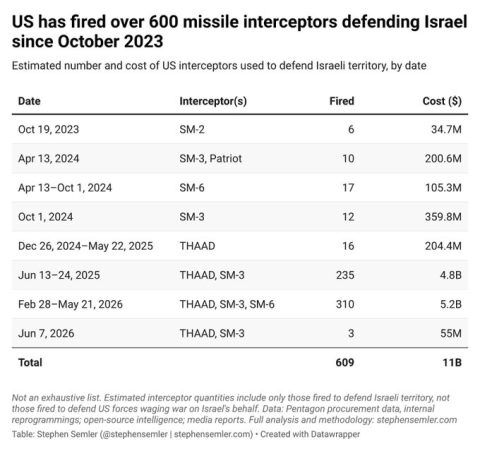 He also attached to his post a table provided on social media by independent policy analyst Stephen Semler that showed the US had fired an estimated 609 ballistic missile interceptors to protect Israel against Iran’s retaliatory strikes between October 2023 and September 2026.


