❌

Reading view

Putin claims Russia is ready for new talks with Ukraine, calls occupied land historical Russia

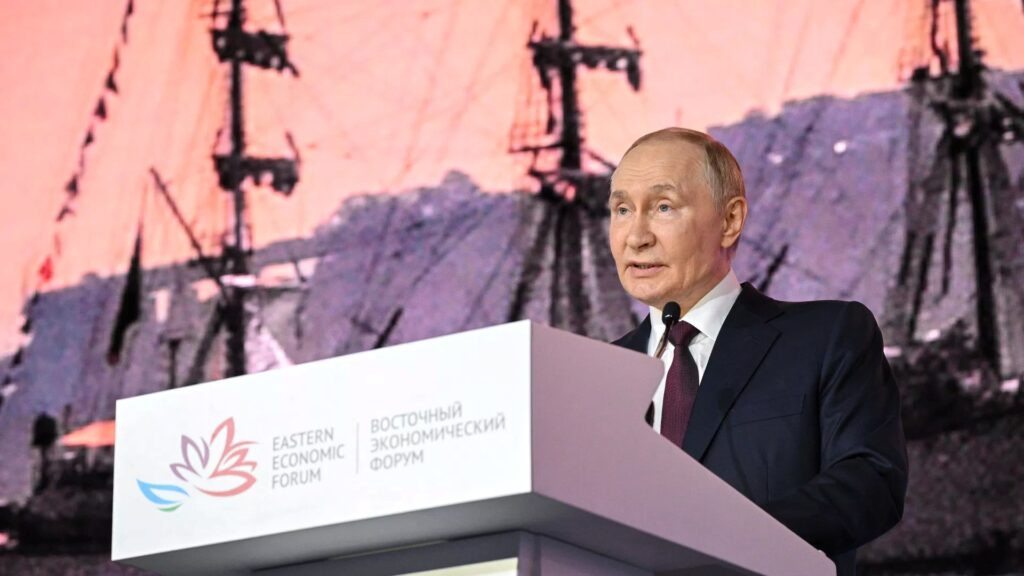
putin at the eastern economic forum in vladivostok on 5 september 2025

Russia is ready to resume three-way talks with Ukraine and the US, Russian President Vladimir Putin claimed in an interview with Pavel Zarubin of state broadcaster VGTRK, published on 22 October. He said they should settle security for both countries after a final peace deal, not a brief pause.

Putin spoke a day after he hosted US envoy Steve Witkoff in St. Petersburg and Ukrainian President Volodymyr Zelenskyy said he would accept freezing the war along the front line. In May, Kremlin spokesman Dmitry Peskov named Ukraine’s withdrawal from Donbas and Zaporizhzhia and Kherson oblasts as the only condition for peace. Any new round would start from that gap: Kyiv offers to stop where the armies stand, while Moscow’s last stated terms demanded more land.

Talks in November

Putin stated that Moscow and Washington had agreed Russia was ready to resume trilateral contacts. He added that he generally agreed with a US point that European security architecture should also be discussed.

On 21 October, Kremlin aide Yuri Ushakov stated that the sides had settled on mid-November, with Abu Dhabi as the likely venue.

"Historical Russia"

In a 21 October Fox News interview, asked about a freeze leaving Ukraine 75% or more of its land, Zelenskyy answered: “Yes, right now, we have to freeze.”

musk tells ukraine’s president go zelenskyy says won’t resign never accept ukrainian land russian · post volodymyr during interview piers morgan recorded visit britain 14 2026 video uncensored / ukraine
Explore further

Trump cannot get Putin to halt strikes on Ukraine’s power grid, so he blames Ukraine instead, Zelenskyy says

Asked about the land Ukraine would give up, Putin replied that the occupied regions were not Ukraine’s but "historical Russia." He claimed their residents had voted for independence and then to join Russia, and called any talk of territorial losses inappropriate.

Putin linked Russia’s readiness to negotiate to Ukrainians being a people very close to Russians. He claimed the latest genetic studies show they are one people. Independent outlet Meduza noted it is unclear which studies he meant. Putin’s 12 July 2021 essay on the historical unity of Russians and Ukrainians made the same case, which Ukraine’s national memory institute rebutted.

He closed that answer by asserting Russia would achieve all the goals of what the Kremlin calls its special military operation. He made a similar vow on 17 December 2025.

  •  

Abu Dhabi Peace Talks: Why Putin’s Ambitions May Defeat Trump’s Economic Bargain

Washington is offering Moscow sanctions relief, commercial opportunities and a possible return to European energy markets. Yet the Kremlin’s objectives in Ukraine extend far beyond economic interests, raising questions about whether Vladimir Putin has any intention of accepting a settlement that preserves Ukraine as an independent European state.

The Kremlin has announced plans for renewed negotiations between Russia, Ukraine and the United States in Abu Dhabi during the first half of November, reviving a diplomatic process that has repeatedly failed to produce a settlement to Moscow’s war against Ukraine.

Russian presidential spokesman Dmitry Peskov said on Friday, 23 October, that the discussions would concentrate on post-war security arrangements. He also left open the possibility of eventual European participation, although the initial meeting is intended to remain trilateral.

The announcement follows talks in St Petersburg between Vladimir Putin and Donald Trump’s special envoy Steve Witkoff. Yet the emerging American proposals reveal a fundamental problem: Washington appears increasingly prepared to offer Russia substantial economic incentives, while Moscow has provided little indication that its political objectives in Ukraine have changed.

The economic bargain taking shape

According to details reported on 23 October, citing The Economist, the American proposals involve Ukraine abandoning its ambition to join NATO in exchange for investment, security arrangements and the prospect of European Union membership.

Russia would receive sanctions relief, renewed commercial relations with American companies and potentially the restoration of natural gas exports to Europe. A demilitarised zone in Donbas is also reportedly under consideration.

The commercial dimension extends beyond theoretical proposals.

American and Russian representatives have discussed investment in the Nord Stream pipeline system and possible arrangements involving Lukoil’s international assets. The negotiations surrounding Russian energy infrastructure suggest that Washington regards commercial cooperation as a potential instrument for securing Moscow’s agreement.

There is no established evidence that Witkoff, Jared Kushner or members of Trump’s family would personally benefit from these arrangements. Nevertheless, the involvement of investors in strategically important Russian assets raises questions about whether economic agreements might advance independently of a settlement acceptable to Ukraine.

The Trump administration has already demonstrated its willingness to relax economic pressure. On 16 October, the president waived major provisions of the Graham sanctions legislation, which he had signed into law only four weeks earlier.

As EU Today previously examined, the decision suspended measures designed to increase the economic costs of Russia’s continuing aggression. Washington justified the waiver on the grounds that sanctions could interfere with negotiations.

Why Putin’s objectives are not primarily economic

The central weakness in a settlement built around commercial incentives is the assumption that Putin’s territorial and political demands can ultimately be exchanged for economic advantages.

Russia’s objectives have never been confined to Donetsk, Luhansk or access to Western markets.

In his July 2021 essay on the historical unity of Russians and Ukrainians, Putin advanced a conception of the two nations as belonging to a single historical and cultural space. His interpretation, examined by the Centre for Eastern Studies, challenged the legitimacy of Ukraine’s development outside Moscow’s political influence.

These ideas preceded the full-scale invasion of February 2022. They also followed Russia’s annexation of Crimea in 2014 and its intervention in eastern Ukraine.

Putin’s demands therefore concern more than military geography. They involve the extent to which Ukraine can exercise independent political authority, determine its international alliances and integrate with Western institutions.

Even a settlement granting Moscow substantial territory could leave this larger objective unresolved.

An independent Ukraine, increasingly integrated into the European economy and protected by Western security commitments, would remain outside Russia’s political control. For a Kremlin leadership that has repeatedly questioned Ukraine’s separate historical identity, such an outcome would represent a limitation on its wider ambitions.

Putin reinforced this position on 22 October when he again described Ukrainian territory in Donbas as historically Russian.

The advantages of negotiations without compromise

This creates an apparent contradiction. Why would Moscow return to negotiations if its broader objectives remain incompatible with the proposed settlement?

One explanation is that participation itself offers Russia strategic advantages.

Negotiations can preserve diplomatic engagement with Washington, complicate attempts to introduce additional sanctions and maintain American pressure on Kyiv to accept territorial concessions.

They also provide opportunities to negotiate economic arrangements before fundamental security questions have been resolved.

For Putin, the political timetable in Washington is relevant. Trump’s presidency is constitutionally limited to January 2029. Moscow can seek to exploit the present administration’s interest in a diplomatic agreement while continuing military operations.

None of this establishes that Putin has definitively rejected compromise. However, the Kremlin’s willingness to attend negotiations is not equivalent to a willingness to abandon its demands.

Russia continues attacking Ukrainian cities and energy infrastructure. As EU Today reported on 22 October, Russian forces launched 21 ballistic missiles against Kyiv shortly after Witkoff’s discussions with Putin.

The simultaneous pursuit of diplomatic engagement and military pressure allows Moscow to negotiate while attempting to alter conditions on the battlefield.

Europe cannot be treated as an economic bargaining chip

The proposed return of Russian gas exposes another contradiction in Washington’s approach.

The European Union has already adopted binding legislation to phase out Russian gas imports, with full restrictions taking effect during 2027.

The European Commission reiterated on 19 October that it had no plans to reverse its position. Reopening Nord Stream would also face sanctions, infrastructure and political obstacles, particularly in Germany.

Consequently, Washington cannot independently promise Moscow renewed access to European energy markets.

Nor can it guarantee Ukraine’s accession to the EU. Membership requires agreement among the existing member states, completion of accession negotiations and ratification of the relevant treaty.

A settlement negotiated primarily between Washington and Moscow would therefore depend on European decisions over which neither government has unilateral authority.

This helps explain the significance of Peskov’s remarks about possible European participation. Moscow needs European cooperation to secure meaningful sanctions relief and access to markets, even while seeking to negotiate Europe’s security arrangements principally with Washington.

The unresolved question

Trump’s approach rests on the proposition that economic incentives can make a settlement more attractive to Moscow than continued warfare.

Putin’s position presents a different calculation. The Russian president must weigh the benefits of restored commercial relations against the political implications of recognising Ukraine’s durable independence and Western orientation.

Those objectives may prove incompatible.

A settlement that restores Russian energy revenues without credible guarantees against renewed aggression could reduce Moscow’s economic constraints while leaving the causes of the war unresolved.

The decisive test in Abu Dhabi will therefore not be whether negotiators can agree on investment, pipelines or sanctions relief. It will be whether Russia is prepared to accept a Ukrainian state whose sovereignty, political direction and future European integration remain beyond Moscow’s control.

Until that question is answered, renewed negotiations may offer Washington the prospect of a diplomatic achievement while allowing the Kremlin to pursue objectives it has not publicly abandoned.

  •  

Federación Internacional de Mujeres exige liberación de excandidata presidencial ecuatoriana Luisa González

La organización catalogó la detención como un secuestro, responsabilizó al Gobierno de Noboa por aplicar medidas represivas contra sectores de la oposición y demandó salvaguardar la integridad física y moral de la dirigente.
  •  

Guerra in Ucraina, la Russia apre alla svolta: “Ci avviamo alla conclusione”

Ucraina, il Cremlino: “La fine della guerra è vicina”. A novembre possibili colloqui trilaterali ad Abu Dhabi

Il conflitto in Ucraina si sta avviando verso la fase finale, anche se la tempistica resta incerta. A dichiararlo è stato il consigliere presidenziale russo per la politica estera, Yuri Ushakov, in un’intervista all’emittente televisiva Vesti: “Non so quanto siamo vicini alla fine, ma ci stiamo muovendo in quella direzione”, ha affermato.

A dimostrazione di questo cauto ottimismo, Ushakov ha rivelato che si sta lavorando a un nuovo round di colloqui trilaterali tra Stati Uniti, Russia e Ucraina, che potrebbe tenersi a metà novembre ad Abu Dhabi, negli Emirati Arabi Uniti. “Stiamo prendendo in considerazione Abu Dhabi e siamo d’accordo sul fatto che gli incontri si terranno intorno a metà mese”, ha precisato il diplomatico del Cremlino.

LEGGI LE NOTIZIE DEL CANALE ESTERI

L'articolo Guerra in Ucraina, la Russia apre alla svolta: “Ci avviamo alla conclusione” proviene da Affaritaliani.it.

  •  

Ccnl bancari, chiesti aumento stipendi e orario ridotto: cosa cambia

Il rinnovo del Ccnl applicato ai bancari torna al centro delle trattative tra l’Abi e i sindacati di categoria. Il negoziato, relativo al contratto scaduto, riparte con un confronto dedicato al welfare e al benessere organizzativo,  riportando sul tavolo l’aumento degli stipendi e la riduzione dell’orario di lavoro alla parità di retribuzione.

Ccnl bancari 2026, la trattativa per il rinnovo

Il contratto collettivo nazionale dei bancari è scaduto il 31 marzo 2026 e adesso le rappresentanze sindacali dei lavoratori chiedono che i guadagni di produttività ottenuti attraverso le nuove tecnologie siano utilizzati anche per migliorare le condizioni dei dipendenti, anziché tradursi esclusivamente in tagli dei costi e riduzioni degli organici.

Questa specifica richiesta non è un caso, ma rappresenta una conseguenza delle trasformazioni che stanno investendo il settore. Il rinnovo arriva in una fase in cui l’impiego dell’intelligenza artificiale, l’automazione delle attività e le operazioni di aggregazione tra istituti stanno modificando l’organizzazione del lavoro e le competenze richieste al personale. Tenendo conto di questo contesto, l’obiettivo è costruire un modello nel quale l’innovazione tecnologica possa:

  • favorire una migliore conciliazione tra vita privata e lavoro;
  • garantire maggiore sicurezza occupazionale;
  • rafforzare il sistema delle tutele collettive.

Accanto alla questione degli stipendi, infatti, le organizzazioni sindacali vogliono affrontare anche la qualità dell’ambiente lavorativo, la previdenza complementare e le prestazioni assistenziali riconosciute ai dipendenti.

A quanto corrisponde l’aumento degli stipendi

Le organizzazioni sindacali hanno chiesto un intervento di modifica della parte economica, confermando che la loro richiesta è che venga riconosciuto un aumento medio mensile di 518 euro a regime ai lavoratori, al netto degli incrementi già riconosciuti in busta paga. Quindi, l’importo effettivo, le eventuali tranche di erogazione e i criteri di applicazione dovranno essere definiti nell’accordo conclusivo tra le parti.

Bisogna inoltre considerare che la stessa distribuzione degli incrementi dipenderà non solo dalle regole stabilite nel rinnovo, ma anche dai livelli di inquadramento e dalle eventuali modalità di ripartizione previste dall’accordo sulla retribuzione diretta e sulla cosiddetta differita. Quest’ultima comprende forme di tutela economica che maturano o producono i loro effetti nel tempo, come la previdenza complementare e determinate prestazioni di welfare. La richiesta è finalizzata in questo caso a garantire livelli minimi di contribuzione datoriale e a rendere queste tutele più stabili e omogenee nel settore.

Il rinnovo potrebbe di conseguenza incidere non soltanto sullo stipendio mensile, ma anche sulla sicurezza economica futura dei lavoratori e sul maggiore potere d’acquisto, in rapporto al costo della vita. Il tema assume particolare rilevanza anche alla luce delle aggregazioni bancarie. Quando gli istituti si fondono o vengono riorganizzati, infatti, possono emergere differenze tra i trattamenti economici e assistenziali riconosciuti ai dipendenti delle diverse realtà coinvolte.

Orario di lavoro ridotto, cosa chiedono i sindacati

Accanto agli aumenti salariali, un’altra richiesta riguarda la riduzione dell’orario di lavoro a parità di retribuzione:

  • con il precedente rinnovo contrattuale, l’orario settimanale era già stato ridotto da 37,5 a 37 ore;
  • ora, le organizzazioni sindacali chiedono un ulteriore passaggio, ovvero arrivare a 35 ore settimanali senza una diminuzione dello stipendio tabellare.

Questo sarebbe possibile proprio usando strumenti automatizzati per alcune attività amministrative e l’impiego di nuovi strumenti informatici per aumentare la produttività e ridurre il tempo necessario per svolgere determinate mansioni.

  •  

Cerva surpreende e faz reviravolta

VTM

Vilar esteve a vencer, mas Cerva conseguiu contrariar o emblema barrosão e continua a brilhar no campeonato.

Jogo muito disputado. O Vilar de Perdizes ameaçou aos 8 minutos, depois de canto de Juninho, com a bola sair perto do segundo poste. O capitão Parente lesiona-se e Hudson estreia-se como defesa. O Cerva tem soberana oportunidade para marcar, de penálti, aos 31’, porém, Nei permite boa intervenção a Josemar. O Vilar de Perdizes animou com o penálti falhado do adversário e está perto de inaugurar o marcador; aos 35’, grande trabalho de Edu Paiva, todavia, Luís Borges não é feliz na finalização, atira ao lado. Aos 39’, Edu cabeceia bem e Geilson defende melhor. Ao intervalo, 0-0.

A etapa complementar foi mais movimentada, houve mais bola junto às áreas, golos e oportunidades. Entrou melhor o Vilar de Perdizes. Logo aos 47’, Bruno Silva atira ao lado. Aos 55’, Edu Paiva atira ao ferro da baliza do Cerva. Era o prenúncio do que viria a seguir. Canto para os ‘Gverreiros da Raia’ e golo de Marcélio, após ótimo cabeceamento.

Artigo exclusivo PREMIUM

Tenha acesso ilimitado a todos os conteúdos do site e à edição semanal em formato digital.

ou compre apenas este artigo:

Comprar este artigo — 1,00€
Se já é PREMIUM, Aceda à sua conta em Entrar

The post Cerva surpreende e faz reviravolta appeared first on A Voz de Trás-os-Montes.

  •  

Final US military withdrawal from Iraq is a major bonus for Iran

The last of the US-led coalition forces are leaving Iraq. It’s a significant bonus for Iran. The withdrawal date, September 30, was also the date by which Baghdad had pledged to bring numerous powerful Iran-backed militias under state control. But this deadline looks certain to be missed. This effectively means that, at a moment when […]

The post Final US military withdrawal from Iraq is a major bonus for Iran appeared first on Asia Times.

  •  
❌