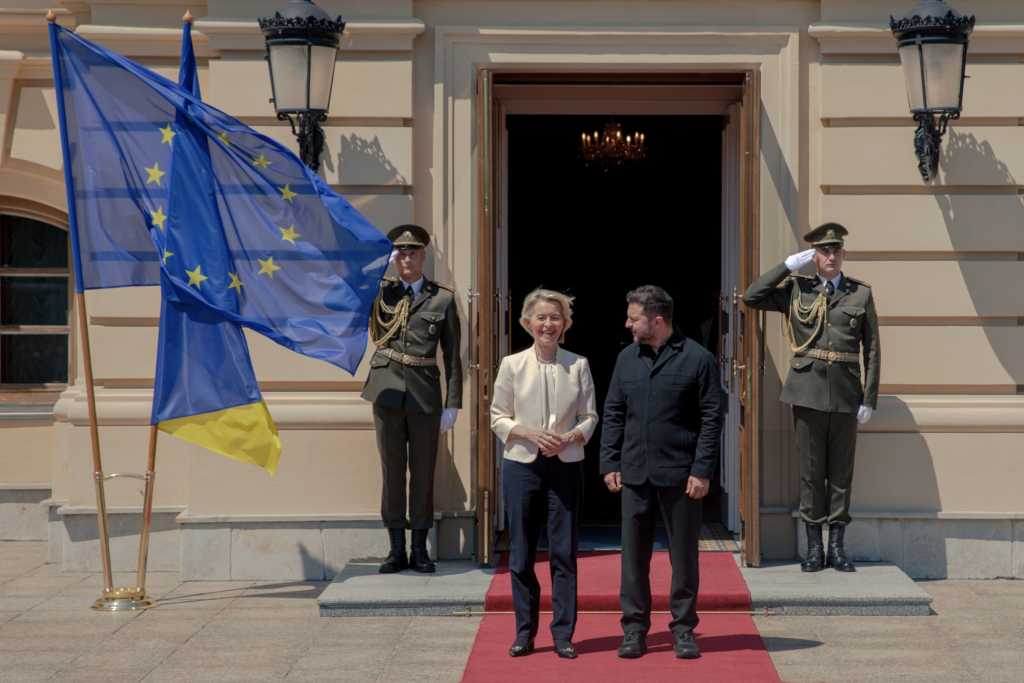
Budapest has unexpectedly obstructed the next stage of EU accession negotiations with Ukraine and Moldova, just a week after approving earlier negotiating chapters and days after Prime Minister Péter Magyar pledged to restore relations with Kyiv.
Hungary has blocked a procedural decision needed to advance Ukraine and Moldova’s European Union accession negotiations, raising fresh questions about Budapest’s position under Prime Minister Péter Magyar, whose government had recently agreed to remove longstanding objections to Kyiv’s membership ambitions.
The intervention took place in Brussels on Tuesday, 20 October, during a meeting of the Council of the EU’s Working Party on Enlargement and Countries Negotiating Accession to the EU (COELA). Representatives of the 27 member states were examining the screening results for the final two negotiating clusters, covering environmental policy, transport, agriculture and regional development.
According to diplomats familiar with the discussions, the Hungarian delegation refused to approve the proposed procedural step. When representatives of other member states requested an explanation, Budapest reportedly maintained that its position remained unchanged, without providing further arguments.
An Unexpected Reversal After October Agreement
The obstruction comes only seven days after the EU formally opened two additional negotiating clusters with Ukraine and Moldova.
On 13 October, the Council approved the opening of Cluster 2, covering the internal market, and Cluster 3, dealing with competitiveness and inclusive growth. The decision followed an agreement between Kyiv and Budapest on educational rights for Ukraine’s ethnic Hungarian minority.
Ukraine’s parliament adopted legislative amendments on 12 October extending minority-language education rights, and President Volodymyr Zelenskyy signed the legislation the same day.
The agreement had appeared to remove the principal bilateral obstacle to further negotiations. Ukrainian Foreign Minister Andrii Sybiha and his Hungarian counterpart, Anita Orbán, welcomed the development following discussions in Luxembourg.
The diplomatic rapprochement continued on 16 October, when Zelenskyy and Magyar held their first official bilateral meeting in Brussels. Both governments expressed an intention to improve relations after years of disputes under former Hungarian Prime Minister Viktor Orbán.
Magyar also invited Zelenskyy to Budapest for commemorations marking the 70th anniversary of Hungary’s 1956 anti-Soviet uprising.
The subsequent Hungarian objection has therefore interrupted a process that Ukrainian and European officials had expected to advance before the end of the year.
Agriculture and Energy Remain the Final Obstacles
Ukraine and Moldova have now formally opened four of the six negotiating clusters required under the EU’s enlargement methodology.
The remaining two are Cluster 4, Green Agenda and Sustainable Connectivity, and Cluster 5, Resources, Agriculture and Cohesion. They cover several of the most economically sensitive areas of prospective Ukrainian membership.
Cluster 4 includes environmental regulation, energy policy and transport infrastructure, while Cluster 5 encompasses agriculture, food safety, fisheries and regional development funding.
Ukraine’s agricultural sector presents particular challenges for the EU’s Common Agricultural Policy. The country’s extensive farmland and substantial grain production could affect agricultural subsidy allocations, market competition and the distribution of EU budgetary resources.
Poland and other agricultural member states have previously expressed concerns about the implications of Ukrainian agricultural integration. Such questions will require negotiation regardless of Hungary’s immediate position.
However, the 20 October meeting was not intended to settle these substantive issues. Its purpose was to advance the procedural preparations for formally opening negotiations on the remaining clusters.
Domestic Politics and the Question of EU Funding
The explanation for Budapest’s latest move may lie in Hungary’s domestic political calculations rather than a new dispute over minority rights.
Diplomatic sources have suggested that Magyar’s government is attempting to avoid accusations from Viktor Orbán’s opposition that it is making excessive concessions to Ukraine.
Although Magyar defeated Orbán in April’s parliamentary elections and has adopted a more cooperative approach towards Brussels, he has consistently opposed accelerated Ukrainian membership.
In an interview conducted on 20 October, Magyar reiterated his opposition to fast-tracking accession, arguing that membership must remain conditional on compliance with EU requirements. He also questioned whether a country at war could join the Union.
Another potential complication concerns Hungary’s financial relationship with Brussels.
The European Commission agreed in May to unlock €16.4 billion in previously frozen funds following reforms introduced by Magyar’s administration. Some disbursements remain subject to conditions, while separate disputes over EU financial penalties continue.
However, there is currently no publicly established evidence that Hungary’s objection on 20 October was intended to secure additional financial concessions. Any connection between the two negotiations remains speculative.
Moldova Caught in Budapest’s Dispute with Kyiv
Hungary’s position also affects Moldova, despite the absence of an equivalent bilateral dispute between Budapest and Chișinău.
The EU has kept the accession negotiations of Ukraine and Moldova politically aligned, seeking to advance both countries through the six negotiating clusters together.
Consequently, an objection directed principally at Ukraine can delay Moldova’s progress even when its own technical preparations satisfy the relevant requirements.
Separating the two accession tracks would allow Moldova to advance independently, but such a move would require political agreement among member states and could raise further questions about the EU’s enlargement strategy.
Ireland Seeks Agreement Before December
Ireland, which holds the rotating presidency of the Council of the EU until 31 December, has made progress on Ukrainian and Moldovan accession a priority.
The disputed procedural decision is expected to return to subsequent meetings of the enlargement working party, with senior EU and national officials still anticipating that the final two clusters could formally open in December.
The latest obstruction does not reverse the four clusters already opened, nor does it terminate accession negotiations. It does, however, demonstrate that the change of government in Budapest has not eliminated Hungary’s capacity or willingness to obstruct individual stages of enlargement.
For Kyiv and Chișinău, the immediate question is whether the 20 October decision represents a short-lived domestic political manoeuvre or the beginning of another prolonged dispute over the conditions of EU membership.
Prime Minister Andy Burnham has reopened the debate over Britain’s relationship with the European Union ahead of a November summit in Brussels. While his government is seeking immediate agreements on trade and regulatory cooperation, the possibility of eventual EU membership raises more difficult political and economic questions.
British Prime Minister Andy Burnham has called for a fundamental reassessment of Britain’s relationship with the European Union, opening the possibility of closer economic integration and eventual EU membership six years after the country’s formal departure from the bloc.
Addressing Parliament on 12th October, Burnham argued that the existing arrangements were inadequate and confirmed that his government would seek progress on trade, environmental standards and mobility at a UK–EU summit scheduled for 20th November in Brussels.
His remarks represent a departure from the approach taken by his predecessor, Sir Keir Starmer, whose government pursued improvements to the post-Brexit relationship while ruling out a return to the single market, customs union or full EU membership.
Burnham has not committed his government to seeking re-entry. However, by placing Britain’s longer-term European position back on the political agenda, he has introduced a question that successive governments sought to keep outside mainstream policy discussions following the 2016 referendum.
A proposed reset with Brussels
The immediate negotiations concern practical arrangements affecting businesses, workers and consumers on both sides of the Channel.
London wants improved access for agricultural and food products, closer cooperation between emissions trading systems and arrangements permitting greater youth mobility between Britain and EU member states.
A veterinary and sanitary agreement could reduce checks and administrative requirements affecting food exports, although the extent of any simplification would depend on the regulatory commitments accepted by Britain.
Closer alignment of carbon emissions trading arrangements could also benefit industries exposed to competing climate-related charges and reporting obligations.
The proposed youth mobility arrangements would address some of the restrictions imposed on younger people seeking opportunities to live, study or work temporarily across the Channel.
Each agreement would require detailed negotiations over regulatory standards, enforcement mechanisms and reciprocal obligations.
The European Commission has consistently maintained that access to the benefits of the single market must be accompanied by corresponding responsibilities.
That position limits the scope for Britain to negotiate substantial economic advantages while retaining complete discretion over the rules governing the relevant sectors.
Rejoining would require a new accession process
The question of full membership involves considerably more demanding negotiations.
Britain could not simply reverse its withdrawal and restore the arrangements it enjoyed before January 2020.
Under Article 49 of the Treaty on European Union, a country seeking membership must submit an application and complete an accession process requiring the agreement of existing member states.
Any eventual accession treaty would require ratification under the constitutional procedures of the parties concerned.
Several of Britain’s former membership arrangements would therefore become subjects for negotiation.
Before Brexit, the United Kingdom enjoyed a permanent exemption from adopting the euro, remained outside the Schengen passport-free travel area and benefited from special arrangements concerning its financial contributions.
A new application would be considered within the EU’s current legal and political framework rather than automatically restoring those earlier exemptions.
The question of adopting the euro could prove particularly controversial in British domestic politics, while negotiations over budget contributions and the relationship with the European Court of Justice would require substantial political commitments.
Debate over how quickly Britain could return
A recent report from the pro-European organisation Best for Britain argues that British accession could proceed considerably faster than is commonly assumed.
The organisation maintains that Britain’s previous membership, existing regulatory structures and longstanding institutional familiarity with the EU could reduce the technical complexity of negotiations.
It has suggested that re-entry might be achievable within a single parliamentary term under favourable political conditions.
Other specialists dispute such an accelerated timetable, arguing that the size of Britain’s economy, the complexity of its post-Brexit regulatory arrangements and the political sensitivity of membership conditions could considerably prolong negotiations.
There is also the question of whether existing member states would support Britain’s return on terms acceptable to the British electorate.
Although European leaders have indicated openness to closer cooperation, this does not amount to a collective commitment to readmit the United Kingdom.
France and other influential member states would be particularly concerned about ensuring that any accession agreement supported the Union’s institutional arrangements rather than reproducing the exceptions negotiated during Britain’s previous membership.
Domestic opinion remains divided
Opinion polling indicates that support for closer relations with the EU has increased since Brexit, with some surveys suggesting a majority would favour rejoining.
However, public attitudes become more complicated when respondents are asked about specific membership obligations, including financial contributions, freedom of movement and possible adoption of the euro.
The government would also face opposition from political parties that continue to defend Brexit.
Conservative leader Kemi Badenoch has criticised Burnham’s approach, while Reform UK maintains that Britain’s departure should not be reconsidered.
The Liberal Democrats, by contrast, have advocated a more explicit route towards renewed membership.
Burnham has indicated that any fundamental change in Britain’s European position would require public approval. He has not established a timetable or formal mechanism for such a decision.
Brussels has its own priorities
The European Union is itself undergoing considerable political and economic change.
Negotiations over the 2028–2034 budget, preparations for possible enlargement and efforts to strengthen European industrial and defence capabilities have altered the context in which a British application would be considered.
For the Commission, the immediate priority is likely to be identifying practical agreements that can be concluded without reopening the entire constitutional question of British membership.
The November summit provides an opportunity to establish whether London is prepared to accept the regulatory and political obligations necessary for closer cooperation.
Burnham’s decision to reopen the debate marks a change in British political direction, but there is still a considerable distance between acknowledging the economic costs of Brexit, negotiating a more ambitious relationship and securing the domestic and European consent required for full membership.
European Union leaders will meet in Brussels on 15–16 October under pressure to address surging energy costs, Russian hybrid attacks, continued support for Ukraine and the bloc’s next long-term budget. The summit comes as economic pressures expose growing differences between national governments.
European Union leaders are preparing for a two-day summit in Brussels dominated by the economic consequences of the Middle East conflict, Russia’s continuing war against Ukraine and mounting pressure on governments to reconcile defence commitments with deteriorating public finances.
The European Council meeting on 15–16 October will bring together the leaders of the 27 member states to consider immediate measures addressing high energy prices alongside longer-term decisions on competitiveness, enlargement, migration and the EU’s budget for 2028–2034.
European Council President António Costa has placed economic competitiveness and energy costs at the centre of the discussions, reflecting concerns that the disruption of global oil and gas markets is threatening the bloc’s industrial recovery.
The meeting also takes place against the background of renewed disputes over national spending limits, with Italy and Greece seeking greater freedom to finance energy relief and France facing increasing pressure over the credibility of its budget.
Energy crisis puts fiscal rules under pressure
The Middle East conflict has created a renewed energy shock for European economies, raising transport and industrial costs while pushing inflation higher.
The disruption of shipping through the Strait of Hormuz has also affected global oil supplies, exposing Europe’s continuing dependence on internationally traded fossil fuels despite efforts to diversify imports following Russia’s invasion of Ukraine.
European leaders are expected to consider targeted and temporary support measures for households and businesses, as well as longer-term policies intended to reduce energy dependence.
The political disagreement concerns how those measures should be financed.
The European Commission has resisted requests from Italy and Greece for further exemptions from the EU’s fiscal framework. Both governments argue that extraordinary energy costs require additional budgetary flexibility.
Brussels maintains that existing provisions already permit exceptional expenditure within defined limits.
The disagreement is particularly difficult for indebted governments that must simultaneously finance military expansion, maintain public services and protect their economies from energy inflation.
France’s position has added urgency to the debate. Its borrowing costs have increased sharply as investors question whether the government can adopt a credible budget ahead of the 2027 presidential election.
A summit agreement on emergency energy assistance would therefore have to accommodate substantially different national fiscal circumstances.
Ukraine and the changing transatlantic relationship
Support for Ukraine remains a central item on the summit agenda as Russia continues attacks against Ukrainian cities, energy infrastructure and industrial facilities.
EU leaders are expected to review military and financial assistance, the implementation of sanctions against Moscow and the resilience of Ukraine’s economy.
The discussions take place amid renewed uncertainty surrounding American weapons deliveries.
Washington’s reported threats to suspend supplies under the NATO-backed PURL procurement arrangement have raised further questions about Europe’s dependence on the United States for advanced military equipment.
European governments have increased defence expenditure and committed additional support to Ukraine, but replacing American capabilities remains difficult, particularly in air defence, precision-guided weapons and certain intelligence systems.
The summit is unlikely to resolve those industrial limitations, but the broader question of Europe’s ability to sustain Ukrainian defence over several years will influence discussions.
Member states must also consider how increased defence expenditure will be financed alongside other demands on national budgets.
Russian hybrid operations move higher on the agenda
The issue has gained prominence as European governments investigate sabotage, cyber operations, information interference and threats against infrastructure and defence-related industries.
Recent warnings concerning possible Russian assassination operations targeting European defence executives and employees of companies supplying Ukraine illustrate the changing nature of the security threat.
Such activities place additional demands on national intelligence services, police forces and European institutions responsible for cross-border cooperation.
The EU has strengthened its sanctions instruments against hybrid activities, but enforcement remains dependent on coordination between national authorities.
Any further measures would need to address intelligence sharing, protection of critical infrastructure and the relationship between internal security and the Union’s wider Russia policy.
Brussels has outlined possible institutional safeguards intended to prevent future members from undermining democratic standards or blocking common decisions.
Montenegro and Albania are advancing through their accession negotiations, while Ukraine and Moldova remain central to the EU’s geopolitical enlargement strategy.
The financial implications will become increasingly important as governments negotiate the next multiannual financial framework covering 2028–2034.
Existing members are already divided over how much the EU should spend, which programmes should receive priority and whether additional common resources should be raised.
Agricultural expenditure, cohesion funding, defence investment and support for Ukraine will compete for resources within the same budget negotiations.
The Commission argues that enlargement can be accommodated through targeted reforms, but securing agreement among member states will require decisions on future expenditure and the distribution of financial benefits.
Competitiveness and the single market
Leaders will also examine progress on the One Europe, One Market agenda, which aims to reduce barriers to economic activity within the EU and improve conditions for European businesses.
The initiative is intended to address structural weaknesses affecting investment, industrial development and the ability of European companies to compete internationally.
High energy prices have made those concerns more immediate, particularly for industries competing against producers in economies where electricity and fuel are cheaper.
The European Council will be asked to provide direction on measures planned for 2026 and 2027, but implementation will depend on subsequent legislation and decisions by member states.
The October meeting brings several unresolved European policy questions into the same negotiation: how to protect economic competitiveness, maintain fiscal credibility, finance defence, sustain Ukraine and prepare for enlargement.
The immediate test will be whether leaders can agree on a credible response to energy prices without reopening broader disputes over national budgets.
More difficult decisions concerning defence financing, institutional reform and the EU’s long-term expenditure commitments will extend well beyond the two-day summit.
Montenegro and Albania will hold separate accession conferences on 12 and 13 October as the European Commission introduces proposals for stronger safeguards against democratic backsliding, linking the next phase of EU enlargement to reforms within the Union itself.
Montenegro and Albania are preparing for another round of European Union accession negotiations this week, with meetings in Luxembourg scheduled to advance their membership bids as Brussels considers substantial changes to the conditions under which future countries will join the bloc.
Montenegro’s 29th accession conference will take place on Monday, 12 October, followed by Albania’s tenth conference on Tuesday. The meetings come less than a week after the European Commission presented a package of proposals intended to prepare the EU for enlargement while strengthening its ability to respond to breaches of democratic standards by newly admitted members.
For Montenegro, the immediate objective is to continue closing negotiating chapters after years of institutional and legal reforms. Albania’s meeting has a more precisely defined agenda: the provisional closure of Chapter 20, covering enterprise and industrial policy.
Both countries have made progress towards membership, but the Commission’s latest proposals indicate that the terms of accession could become more demanding as the EU considers admitting several new members.
Montenegro moves towards the final negotiating stage
Montenegro is widely regarded as the most advanced candidate among the Western Balkan countries.
Accession negotiations began in 2012, and all 33 negotiating chapters have been opened. Progress towards closure has accelerated as the government seeks to complete the process and secure an accession treaty.
At the end of 2025, Montenegro provisionally closed five chapters covering services, capital movements, company law, agriculture and fisheries.
As EU Today reported following that conference, the agreements brought the number of provisionally closed chapters to twelve at that stage, while the EU continued to emphasise the importance of judicial reform and sustained implementation.
The Commission has identified Montenegro as a country capable of concluding accession negotiations by the end of 2026, provided sufficient progress is maintained.
That objective does not mean membership would follow automatically. A completed negotiation must still lead to an accession treaty, which requires approval by all existing member states and ratification under their constitutional procedures.
Outstanding questions include the independence of the judiciary, enforcement of anti-corruption legislation and the capacity of state institutions to apply EU law consistently.
Albania advances in industrial policy negotiations
Albania’s accession process has also gained momentum, supported by renewed EU interest in incorporating the Western Balkans into European political and economic structures.
The chapter concerns the legal and institutional environment in which businesses operate, including industrial competitiveness, entrepreneurship and policies supporting small and medium-sized enterprises.
Provisional closure would represent further progress in Albania’s alignment with EU legislation and policy, although it would not constitute a final agreement on accession.
As with Montenegro, the negotiating framework requires sustained progress on the fundamentals of membership, notably judicial independence, fundamental rights, corruption and organised crime.
The Commission argues that enlargement can be accommodated within the existing treaties, but that the EU will need additional safeguards and improvements to decision-making.
Among the most consequential proposals is the possibility of suspending a new member state’s voting rights in the Council if it commits serious breaches of the Union’s fundamental values or the principle of sincere cooperation.
Such provisions would be incorporated into future accession arrangements, making some membership conditions enforceable after a country has joined.
The proposal reflects concerns that the EU’s existing mechanisms for responding to democratic backsliding can be slow and politically difficult to apply.
The Commission’s October package develops that argument into a broader programme of institutional preparation.
Enlargement beyond the Western Balkans
The debate extends to Ukraine and Moldova, whose membership applications have acquired greater strategic importance following Russia’s full-scale invasion of Ukraine.
The Commission is examining how candidate countries can progressively participate in EU policies and programmes before obtaining full membership.
These arrangements could include greater integration in energy, transport, defence and selected areas of the single market, subject to the implementation of relevant reforms.
Brussels is also considering transitional arrangements affecting agricultural support, financial transfers and sensitive sectors of the economy.
The political challenge is to provide candidate countries with credible membership prospects while reassuring existing members that enlargement will not weaken common decision-making or create unsustainable budget commitments.
For Montenegro and Albania, the October conferences therefore take place at a pivotal point in the accession process.
Both governments are moving through the technical stages of membership negotiations while the EU is still determining how its next enlargement will operate.
The outcome will depend not only on their progress towards meeting accession conditions, but also on whether the existing 27 member states can agree on the institutional changes required for a larger Union.
Aspiring member states of the European Union could face special post-accession safeguards lasting up to 15 years, including the possible suspension of Council voting rights, under proposals intended to prevent countries reversing democratic and rule-of-law reforms after joining.
The European Commission has proposed a new system of safeguards for future EU members that could remain available for up to 15 years after accession, allowing Brussels to respond if a newly admitted country abandons commitments on democracy, the rule of law or cooperation with the Union.
The proposals form part of the Commission’s new package on preparing the EU for enlargement and are directly relevant to candidate countries including Ukraine, Moldova, Albania and Montenegro.
Under the framework, existing safeguards covering the economy, the internal market and justice and home affairs would remain available for substantially longer after accession.
A separate institutional mechanism would address serious breaches of the fundamental values contained in Article 2 of the EU Treaty or of the principle of sincere cooperation, according to the Commission’s enlargement package.
In the most serious cases, voting rights in the Council could be suspended.
Reporting on the proposal indicates that the exceptional framework could apply for up to 15 years following a country’s entry into the Union. The Commission describes the proposed measures as temporary, targeted and reversible rather than a permanent second tier of membership.
The plan addresses a problem that has become increasingly prominent in the enlargement debate: the EU has considerably greater influence over political and judicial reforms while a country is negotiating membership than after it has joined.
Candidate governments must meet detailed conditions to open and close negotiating chapters. Once membership is obtained, sanctioning a government for democratic backsliding becomes considerably more difficult because many EU decisions require unanimity or large qualified majorities.
The Commission is therefore seeking to build additional guarantees into future accession treaties.
President Ursula von der Leyen described enlargement as a “geopolitical imperative” when presenting the package on Tuesday. Enlargement Commissioner Marta Kos said the EU could accommodate additional countries but needed stronger instruments to protect the rule of law and ensure that new members continued to honour commitments made during negotiations.
The proposal goes beyond voting rights. Transitional arrangements could be applied to the free movement of workers and services, agriculture, sensitive products, EU funding and participation in common European systems.
The Commission has also proposed targeted arrangements for incorporating Ukraine’s large agricultural sector into the Common Agricultural Policy, reflecting concern among existing member states about the potential budgetary and market consequences of Ukrainian accession.
The new safeguard proposal adds the other side of that equation: earlier integration would be accompanied by stronger mechanisms to ensure reforms are not reversed after membership is achieved.
The Commission argues that the mechanisms would supplement, rather than replace, rules applying to all EU members. None of the proposed changes automatically brings membership closer. Accession remains dependent on the individual performance of candidate states and requires the approval of the existing member states.
The debate will now move to national governments and the European Parliament, with the 15-year safeguard likely to be among its most contested elements.
The European Commission has proposed new safeguards allowing voting rights and funding to be restricted if future EU members breach fundamental European rules after accession, as Brussels prepares for possible membership of Ukraine, Moldova, Albania and Montenegro.
The European Commission has set out a new framework for enlargement that would allow the European Union to impose restrictions on recently admitted countries for up to 15 years after accession if they retreat from commitments on democracy, the rule of law or other fundamental EU principles.
The measures form part of the Commission’s new pre-enlargement policy review, published on Tuesday, which examines how the EU’s institutions, budget and policies would have to change before another round of expansion. Brussels says the Union could accommodate additional members without rewriting its treaties, but would need stronger safeguards to prevent enlargement from making decision-making more difficult.
Under the proposals, accession treaties could contain an institutional safeguard allowing action against a new member that seriously breaches the values contained in Article 2 of the Treaty on European Union or the principle of sincere cooperation. In the most serious cases, Council voting rights could be suspended.
The Commission’s public summary describes those arrangements as temporary, targeted and reversible. Reporting on the underlying proposal indicates that the enhanced safeguard could remain available during the first 15 years of membership.
The proposal addresses a problem that has moved steadily up the enlargement agenda: how to ensure that a country continues to meet membership conditions after it has entered the EU.
Germany, France, Belgium, the Netherlands and Luxembourg had already raised the issue earlier this year. As EU Today reported in June, the five governments called for mechanisms capable of restricting some rights of new members if democratic standards deteriorated after accession.
The Commission has now turned that political argument into a wider institutional proposal.
The change is particularly relevant to Ukraine, Moldova, Montenegro and Albania, which Brussels identifies as the four candidates currently furthest advanced. The Commission says it will prepare indicative roadmaps for each country provided reform momentum continues.
Ukraine and Moldova may also make further progress within days. EU Today reported earlier on Tuesday that two more negotiating clusters could potentially be opened next week if Ukraine’s parliament passes legislation dealing with minority-language education.
Alongside stronger rule-of-law safeguards, the Commission wants candidate states to be integrated gradually into parts of the EU before full membership. Energy, transport, digital policy and defence are among the sectors identified for deeper participation.
Brussels is also proposing greater use of qualified-majority voting during the accession process, including for decisions to open negotiating clusters. At present, individual governments can delay progress at several stages because unanimity is required.
Another proposed safeguard would require a newly admitted state, for a limited period, not to block subsequent enlargements because of bilateral disputes. The measure reflects long-standing difficulties in the Western Balkans, where disputes between neighbouring states have repeatedly entered accession negotiations.
Ukraine’s agricultural sector presents a separate challenge. The Commission says transitional arrangements could be used for agriculture, sensitive products, EU funding, the movement of workers and participation in common systems. Reporting on the package indicates that unrestricted access by Ukraine to existing Common Agricultural Policy support is unlikely immediately upon accession because of the scale of Ukrainian farming.
That question is politically important for existing agricultural beneficiaries, particularly in Central and Eastern Europe, where Ukrainian grain and food imports have already caused disputes.
The institutional proposals do not guarantee membership for any candidate. Accession remains dependent on meeting the EU acquis, completing negotiations and obtaining the agreement of existing member states.
Nor has the 15-year safeguard yet become EU law. The Commission has asked the European Council and European Parliament to take forward discussions, and the eventual provisions would have to be reflected in future accession arrangements.
What has changed is the shape of the enlargement debate. Brussels is no longer concentrating solely on what candidate countries must do before joining. It is also designing mechanisms governing what happens after they enter.
For Ukraine, Moldova and the Western Balkans, that could produce a more credible path towards membership, but one accompanied by conditions extending well beyond accession itself.
Ukraine and Moldova could advance to two further stages of their European Union accession negotiations as early as next week, Enlargement Commissioner Marta Kos has said, provided Ukraine approves legislation addressing minority-language education.
The European Union could open two additional negotiating clusters with Ukraine and Moldova next week if the Ukrainian parliament passes legislation intended to address concerns over education rights for national minorities.
EU Enlargement Commissioner Marta Kos confirmed the possible timetable on Monday following a meeting of the EU-Moldova Association Council in Brussels.
Asked whether further intergovernmental conferences could take place this month, Kos said the next two clusters could potentially be opened during meetings in Luxembourg next week.
The condition is passage by the Verkhovna Rada of legislation dealing with educational rights for national minorities, an issue that has been central to Hungary’s objections to further progress in Ukraine’s accession negotiations.
Kos said during the Commission’s recorded press conference that Brussels was aware of the Ukrainian parliament’s procedures and hoped the legislation would be approved. Member states would then have to complete their own procedures quickly.
A draft law covering education rights for indigenous peoples and national minorities was registered in the Verkhovna Rada on 1 October.
The legislation is intended in part to address Hungarian demands concerning the use of minority languages in Ukrainian schools, particularly by the ethnic Hungarian community in Zakarpattia.
Hungary has repeatedly linked support for Ukraine’s EU accession process to those issues.
Ukraine and Moldova formally opened accession negotiations in 2024 and have since moved into the detailed cluster-based process used to organise negotiations over the EU acquis.
EU Today reported in June that the two countries had moved into the first substantive stage after political agreement allowed negotiations on the “fundamentals” cluster to proceed.
That cluster covers areas including the judiciary, fundamental rights, public administration, democratic institutions, public procurement and financial control.
Unlike most negotiating areas, the fundamentals cluster remains open throughout the accession process and is normally closed last.
The possible opening of two additional clusters would therefore mark another practical step in a process that remains dependent on unanimous support among EU governments at key stages.
Ukraine’s Foreign Minister Andrii Sybiha has said he hopes adoption of the minority-education amendments will remove the remaining basis for Hungary to block the next steps.
The negotiations have also become linked increasingly closely to the wider security relationship between the EU and Ukraine.
Brussels continues to stress that accession remains merit-based and conditional on reforms.
Kos said on Monday that both Ukraine and Moldova were delivering reforms in difficult circumstances and described them as being among the four front-running candidate states.
The Commission is due to publish its annual enlargement reports on 28 October, providing a detailed assessment of progress across individual negotiating chapters.
Moldova has set itself a target of being ready to complete negotiations by early 2028, although any final accession date would depend on the member states.
The country has also been moving closer to EU structures outside the formal accession negotiations.
Kallas said on Monday that the EU had committed €1.9 billion under its Growth Plan for Moldova and was releasing another €157 million tranche. Moldova has joined the Single Euro Payments Area and is moving towards inclusion in the EU’s mobile roaming area.
Ukraine’s path is more politically complicated because of both the war and recurring disputes with individual EU members.
The next immediate test is parliamentary: whether Kyiv can pass the education amendments quickly enough to allow EU governments to approve the next negotiating stages in Luxembourg.
Moldova’s Prime Minister Vasile Tofan will meet senior EU officials in Brussels on Monday as the country attempts to move from the opening stages of accession negotiations towards deeper economic, security and institutional integration with the European Union.
The 10th EU-Moldova Association Council will be held in Brussels on 5 October, chaired by EU foreign policy chief Kaja Kallas. Tofan will lead the Moldovan delegation, while Enlargement Commissioner Marta Kos will represent the European Commission.
The meeting will review Moldova’s accession process, political reforms, justice, freedom and security, foreign and security policy, trade, energy and wider economic co-operation. Regional and global security issues will also be discussed during a restricted session.
The timing is significant because Moldova has moved considerably further along the accession process during 2026.
In June, the EU formally opened negotiations on the Fundamentals cluster, which covers the rule of law, fundamental rights, democratic institutions, public administration and economic criteria. Progress in that cluster determines the overall pace of accession negotiations.
A second step followed in July when negotiations began on the External Relations cluster. That part of the process covers commercial policy, development co-operation and alignment with the EU’s common foreign, security and defence policy, including sanctions.
Moldova is consequently moving beyond the declaration that it has a European future and into negotiations over specific areas of EU law.
That process is taking place under conditions markedly different from previous rounds of enlargement.
Moldova borders Ukraine and has faced persistent Russian political pressure, disinformation campaigns and attempts at electoral interference. Energy vulnerability remains another concern, while the unresolved Transdniestria conflict leaves part of the country outside the effective control of the government in Chișinău and with Russian forces still present.
Security and accession policy have therefore become increasingly difficult to separate.
At the EU-Moldova summit in June, European leaders concentrated on accession, reform implementation and gradual integration into EU structures. The meeting took place only a week after the first negotiating cluster was opened.
Moldova is benefiting from the EU’s €1.9 billion Reform and Growth Facility, intended to accelerate economic convergence and reforms connected to accession. The Commission’s current Moldova enlargement record shows that a second regular payment of €189 million was delivered in March 2026.
The Association Council will not decide when Moldova joins the European Union. Accession remains conditional on reforms, compliance with membership criteria, completion of negotiations and unanimous approval by the member states.
What Monday’s meeting will show is whether the process is maintaining momentum.
Moldova and Ukraine formally began accession negotiations together in 2024 and entered the first substantive negotiating cluster together this June. The two countries remain politically connected in the EU enlargement debate, although Brussels formally assesses each candidate on its own record.
The next challenge is less ceremonial.
Opening clusters demonstrates political progress. Closing negotiating chapters requires legislation to be adopted, institutions to function and reforms to be enforced beyond their appearance in government programmes.
For Moldova, that work is being undertaken while the country manages Russian pressure, energy security, economic restructuring and domestic political change.
Monday’s Association Council will provide Brussels with its latest opportunity to judge whether those pressures are slowing the accession process or whether Moldova remains capable of moving through the EU’s negotiating machinery.
The party of pro-Russian Bosnian Serb politician Milorad Dodik has emerged as the largest political force in Republika Srpska following Bosnia and Herzegovina’s general election, while several parties supportive of Ukraine and European integration recorded strong results in the country’s Bosniak-Croat Federation.
The Alliance of Independent Social Democrats (SNSD), led by Milorad Dodik, has emerged as the largest party in Republika Srpska as preliminary results from Bosnia and Herzegovina’s 4 October general election continue to be counted.
According to preliminary projections cited after most votes had been counted, SNSD was heading for 34 seats in the National Assembly of Republika Srpska. Pokret Sigurna Srpska (PSS) was projected to take 12 seats and the Serbian Democratic Party (SDS) 11. The Coalition for the State, comprising pro-Bosnian parties based principally in the Federation, was projected to secure two seats.
The result leaves SNSD as the principal political force in the Serb-majority entity despite the removal of Dodik himself from public office.
Dodik was not on the ballot after losing his position as president of Republika Srpska following a criminal conviction for refusing to comply with decisions of Bosnia and Herzegovina’s international High Representative. EU Today previously reported on the decision to revoke Dodik’s presidential mandate after the conviction became final.
His absence from the ballot did little to remove him from the campaign. Dodik remained the dominant public figure around SNSD and continued to challenge the constitutional arrangements under which Bosnia and Herzegovina has operated since the end of the 1992-95 war.
At his party’s final campaign rally, attended by Russian Ambassador Igor Kalabukhov, Dodik told supporters that Bosnia was “dead” and described it as an “impossible country”.
The comments followed years of disputes between the Republika Srpska leadership, Bosnia’s central institutions and the Office of the High Representative over the division of powers between the entity and the state.
A different result in the Federation
The electoral picture in the Federation of Bosnia and Herzegovina, the predominantly Bosniak-Croat entity, was markedly different.
With 89.45 per cent of votes counted, preliminary figures put the Party of Democratic Action (SDA) first in the election to the Federation parliament with 30.63 per cent, representing more than 212,000 votes.
The Social Democratic Party of Bosnia and Herzegovina (SDP) was second with 15.27 per cent and more than 105,000 votes. The coalition centred on the Croatian Democratic Union of Bosnia and Herzegovina (HDZ BiH) followed with 13.89 per cent, while the Party for Bosnia and Herzegovina (SBiH) was fourth on 8.97 per cent.
The results illustrate the political differences between Bosnia’s two principal entities, particularly over relations with Russia and Ukraine.
SDA, SDP and SBiH have condemned Russia’s full-scale invasion of Ukraine and support Bosnia and Herzegovina’s Western orientation. HDZ BiH also formally supports European integration, although the party has at times co-operated politically with Dodik and SNSD.
Dodik has pursued a markedly different course, maintaining close political relations with Moscow and repeatedly opposing Bosnia joining Western sanctions against Russia.
The second- and third-placed forces in the Republika Srpska parliamentary contest do not present themselves as explicitly pro-Russian parties, but have supported a position of neutrality for Bosnia and Herzegovina over the Russia-Ukraine war.
Bosnia’s post-war political structure
The political divisions are magnified by Bosnia and Herzegovina’s unusually complicated constitutional structure.
The country’s present system was created by the Dayton Peace Agreement, which ended the Bosnian war in 1995. Bosnia and Herzegovina was preserved as a single sovereign state but divided internally between the Federation of Bosnia and Herzegovina and Republika Srpska, alongside the separately administered Brčko District.
The state has a three-member presidency representing Bosniaks, Croats and Serbs, while extensive powers remain with entity, cantonal and local authorities.
The Central Election Commission said 3,414,364 voters were registered for the 2026 general election. Voters elected the three members of the presidency, members of the state parliament, the Federation parliament, the Republika Srpska National Assembly and a series of other entity and cantonal institutions.
The election also marked the first nationwide use of biometric voter identification, ballot scanners and rapid electronic transmission of results. The new election technologies were introduced for the 2026 vote after the election authorities determined that the necessary technical requirements had been met.
Turnout, however, fell sharply compared with the previous general election, adding another element to the political picture facing the incoming administrations.
EU accession and the Dodik problem
The results matter beyond Bosnia because the country remains an EU candidate while its internal political disputes have repeatedly complicated its European course.
Bosnia and Herzegovina was granted candidate status in December 2022, and EU leaders subsequently agreed in March 2024 to open accession negotiations. The EU accession process remains dependent on further reforms, including measures concerning the judiciary, democratic institutions, public administration and the rule of law.
Disputes involving Republika Srpska have become one of the principal complications in that process.
Dodik has repeatedly questioned the authority of state institutions and the international High Representative, while also advocating greater autonomy for Republika Srpska. His opponents have accused him of pursuing policies that threaten Bosnia’s post-Dayton constitutional order; Dodik argues that he is defending powers granted to Republika Srpska under the peace agreement.
The 4 October election has therefore produced two distinctly different political landscapes.
In Republika Srpska, SNSD remains the largest force despite the legal exclusion of its leader from public office. In the Federation, several of the strongest parties favour closer European integration and have openly supported Ukraine following Russia’s invasion.
How those forces combine at state level will determine whether Bosnia and Herzegovina can advance reforms required for EU membership or returns to the institutional confrontations that have repeatedly slowed its progress towards Brussels.
The European Commission is considering giving candidate countries wider access to the EU single market, research programmes and industrial cooperation before they become full members, as Brussels prepares a broader overhaul of its enlargement policy.
Under a draft proposal reported on Tuesday, Brussels would offer what it describes as “gradual integration”, extending access to trade, research, innovation and industrial cooperation as individual candidates bring their legislation into line with EU rules and demonstrate that they can enforce them.
The proposal would take considerably further an approach the Commission has been developing for several years. Its existing policy review on pre-enlargement reforms already provides for gradual integration into selected EU policies before accession, including early access to parts of the single market.
According to the reported draft, earlier integration would create new opportunities for EU businesses, reinforce European value chains and reduce strategic dependencies.
“Earlier integration will unlock opportunities for Union businesses, strengthen European value chains and reduce strategic dependencies,” the draft states.
The Commission would determine where sufficient regulatory alignment and enforcement capacity existed to permit deeper participation in research, innovation and industrial cooperation, as well as broader market access.
The arrangement would remain conditional. Candidate countries would not receive unrestricted access simply because accession negotiations had begun.
Instead, the extent of integration would depend on progress in adopting and enforcing EU legislation, as well as cooperation with Brussels on foreign policy, sanctions, investment screening, export controls and the protection of sensitive technologies.
Market access linked to strategic alignment
One of the most significant elements of the proposal is the connection between economic integration and the EU’s wider security policy.
As industrial and market integration deepens, participation in sensitive sectors would have to be accompanied by cooperation on investment screening, export controls, sanctions implementation and protection of sensitive technologies, according to the draft.
Access would also take account of strategic alignment, critical dependencies and a candidate country’s ability to manage risks involving infrastructure and supply chains.
The Commission has already established the principle that early integration into the single market requires both alignment with EU legislation and effective enforcement. Existing arrangements with Ukraine, Moldova and Western Balkan countries have been used to test integration in individual sectors before membership.
The new proposal would expand that model considerably.
It could also increase pressure on candidate countries whose foreign policies diverge from those of the EU, particularly over relations with Russia and China.
Ukraine and Moldova among countries targeted
Ukraine, Moldova, Albania and Montenegro are expected to be offered specific roadmaps intended to accelerate their integration over the coming years.
All four have advanced in the accession process, although at different speeds.
Ukraine and Moldova have moved into substantive negotiations covering the legislation and institutional reforms required for membership. As EU Today reported in June, the process now involves detailed scrutiny of the rule of law, public administration, democratic institutions and the ability to implement EU legislation.
Moldova is already being integrated into selected areas of the European economy. It has joined the Single Euro Payments Area and the EU’s roaming regime, while Brussels has also expanded its participation in European programmes. The Commission said after the EU-Moldova summit in June that gradual integration into the single market was already under way.
Ukraine has similarly been moving towards deeper economic integration through its existing free-trade arrangements with the EU and sector-by-sector alignment with European legislation.
The proposal comes as the EU attempts to resolve a central problem surrounding its current enlargement round: accession can take many years, while the political and economic consequences of keeping candidate countries outside the Union continue to grow.
Croatia, which joined in 2013, remains the EU’s most recent new member.
Several candidates have spent years — and in some cases decades — within the accession framework. Negotiations with Türkiye are effectively frozen, while Serbia, North Macedonia and Bosnia and Herzegovina have experienced prolonged delays.
Brussels is also considering how to protect EU decision-making and rule-of-law standards as membership expands. EU Today reported earlier this year that five member states had proposed additional safeguards for future members, including stronger monitoring and mechanisms intended to prevent individual governments from obstructing EU decisions.
Gradual integration offers a separate response to the same enlargement problem: economic integration would no longer have to wait until every stage of accession had been completed.
The European Parliament has backed the principle of merit-based and reversible gradual integration, including access to parts of the single market for candidates making sufficient progress. Parliament has also stressed that such arrangements should not become a substitute for membership or create different permanent categories of EU states.
Under the Commission’s emerging model, candidates could therefore move progressively into the EU’s economic and regulatory system while accession negotiations continue.
Full membership would remain the stated objective. But a process in which most of the economic advantages arrive only at the end could increasingly be replaced by one in which access is granted sector by sector as candidates meet the required conditions.
The Commission is due to present its assessment of how future enlargement will affect major EU policies, and what changes the Union itself will need to accommodate new members, on 6th October.
Ukraine is fighting for survival against Russia while its democracy faces a second battle at home. Ukrainians show extraordinary trust in the Armed Forces, family and civic networks—but far less in politicians, government and bureaucrats. Now, high-level corruption scandals, calls for wartime elections, roadblocks to EU accession and possible peace talks with Russia are raising a hard question: can the trust that has helped Ukraine survive the war be turned into a state people believe in?
In this episode, Jessica Hendrick welcomes Roman Petrov, honourable president of the Ukrainian European Studies Association, professor of EU law at the National University of Kyiv-Mohyla Academy, and one of Ukraine’s leading experts on EU accession and EU-Ukraine relations working on the RE-ENGAGE project; and Svitlana Zalishchuk, Ukraine’s ambassador to Sweden and former civil-society activist, member of parliament and government adviser, now working at the centre of Ukraine’s wartime defence and European security partnerships. Roman warns that major decisions on peace could be challenged later if Ukraine’s elections remain suspended. Svitlana pushes back on the picture of low public trust, arguing that the war has actually increased trust in the state—just unevenly—and that public trust itself is part of Ukraine’s national defence capability.
RE-ENGAGE conducted nearly 600 interviews with Kyiv residents last year, at times even moving them into air-raid shelters as alarms sounded across the city. Drawing on the findings, Jessica, Roman and Svitlana discuss how a society can distrust the state so deeply and still defend democracy; what recent corruption scandals reveal about whether the system actually works; and if fast-tracking EU membership risks turning reform into a superficial “copy-paste” of European laws.
How is the far-right AfD’s historic landslide in eastern Germany viewed by those working on EU accession in Kyiv? Why might Ukraine now be better described as a contributor to European defence than a recipient of military aid? And what does Ukraine need to do differently to make its post-war vision last?
What happens if your economy is suddenly in crisis, Brussels offers help with strings attached—and Turkey, China or Russia can move faster? What if your country delivers every reform the EU asks for, only for a member state to block the next step anyway? And after years of waiting, would voters still choose to join?
In this special bonus episode, The Neighbourhood goes live from Lisbon for an EU enlargement game. Jessica Hendrick brings together RE-ENGAGE experts representing six EU candidate countries and throws a series of fictional—but very plausible—political and economic shocks at them inspired by real headlines: Russia’s intensified attacks on Ukrainian infrastructure, Ireland’s EU presidency push on enlargement, Iceland’s referendum, Germany’s regional elections and the upcoming 2026 Enlargement Package. Drawing on three years of surveys, interviews and crisis simulations, each expert has to answer for their country.
Playing for each country:
Albania:Morten Bøås, research professor at the Norwegian Institute of International Affairs (NUPI), representing RE-ENGAGE’s Albanian partners at the European University of Tirana
Bosnia and Herzegovina:Damir Kapidžić, director of the Institute for Social Science Research at the University of Sarajevo
Georgia:Ketevan Bolkvadze, senior lecturer in the department of political science at Lund University, originally from Georgia
Moldova:Mathilde T. E. Giske, research fellow at the Norwegian Institute of International Affairs (NUPI), representing RE-ENGAGE’s Moldovan partners at Moldova State University
Serbia:Luka Filipović, research associate at the Institute for Contemporary History in Serbia
Ukraine:Roman Petrov, president of the Ukrainian European Studies Association
The result is part enlargement simulation, part policy conversation and part game night. The experts bargain over a fictional €100 million EU cheque, decide whether the EU can compete with faster offers from other powers, test how easily disinformation could exploit frustration with enlargement, and imagine what would happen if EU membership was finally put to a public vote. Along the way, Serbia proposes keeping its relationship with Brussels “casual”, Bosnia finds a creative use for €100 million, and Ukraine calls for Hungarian “Varangians” when backsliding strikes.
When a crisis hits, does speed matter more than values? Can “Europe never wanted you anyway” become a winning political message? And if a country finally joins the EU, what stops democracy from sliding backwards once the prize of membership is secured?
Brussels (enr) – European Parliament Foreign Affairs Committee Chairman David McAllister has urged Ukrainian President Volodymyr Zelenskyy to support German Chancellor Friedrich Merz’s proposal for an associate membership for Ukraine as it moves towards joining the European Union.
The proposal is an opportunity that Ukraine should seize, the German centre-right lawmaker told members of the European Newsroom (enr) network in early June. Claims that it would amount to “membership light” or second-class membership were incorrect, he said.
Instead, it would allow Ukraine to become more closely integrated into the EU step by step before full membership, making the benefits of the bloc more visible to its people. One possibility would be for Ukraine to participate in the European Parliament as an observer, McAllister said.
Zelenskyy has expressed opposition to the idea, arguing that it would be unfair for Ukraine to be present in the EU but have no say in its decisions. In a letter to EU leaders, he called for the bloc to move faster and not keep Ukraine in a waiting room until full membership.
Merz said earlier that rapid full EU accession for Ukraine, which is fighting Russia’s invasion, is not realistic. For the interim period, he has proposed allowing Ukraine to attend EU summits and ministerial meetings without voting rights.
His ideas also include an associate member of the European Commission without a portfolio or voting rights, associate members of the European Parliament and an associate judge at the European Court of Justice.
Enlargement Agenda
McAllister said EU enlargement was high on the bloc’s agenda and that the Western Balkans were at the heart of Europe. A stable region was an investment in peace and security, he said.
The CDU politician called for each candidate country to be assessed individually and on its merits rather than treating the Western Balkans as a single group. Montenegro was a clear frontrunner, he said, while North Macedonia’s accession path remained blocked by a political dispute with Bulgaria.
Eight other European countries are officially recognised as EU candidate countries alongside Ukraine: Albania, Bosnia and Herzegovina, Georgia, Moldova, Montenegro, North Macedonia, Serbia and Türkiye.
Cover image: picture alliance / ZUMAPRESS.com | Louis Lemaire-Sicre
Summary
The prospect of a peace settlement in Ukraine has prompted a flurry of activity among the EU and member states on how to carry out enlargement.
For now, the debate is contained among elites. But this will need to change.
Key “clusters” of member states can begin to address this. They should work together to create a new approach to enlargement and tailor messages to voters.
To drive an accession framework suitable to the geopolitical and domestic challenges of today, a “Team Enlargement” coalition of ten key EU states should come together.
This coalition, led by Germany, should work through a four-step timetable to deliver this strategy over the next 18 months.
The coalition should also promote a narrative that is flexible enough to reflect national and local contexts while sharing the benefits of enlargement for European security and prosperity.
Time to move
The EU lacks a strategy to get Ukraine quickly and safely through the door.
The question has surged to the fore because EU membership is highly likely to be essential to any peace settlement that Kyiv—and the Ukrainian people—would accept. America has also made clear it sees Ukrainian membership as an indispensable element of such a settlement. Ukraine itself is pushing to join as early as 2027.
But the EU and its member states are not ready. They have struggled for decades to absorb new members, and more recently failed to agree on how to bring in Ukraine, Moldova and others. In 2026, proposals have swirled around Brussels and member state capitals; and Berlin has shared a notable proposal that aims to answer the question of how to make accession happen.
It is time for the EU to move forward decisively. The geopolitical case for enlarging the EU to include Ukraine, Moldova and the Western Balkans has never been more compelling. Failing to integrate candidate countries bordering the bloc represents a growing vulnerability in economic, political and strategic terms. European leaders largely understand the geopolitical imperative for enlargement. Where they hesitate is over how to make it work in practice. They are faced with public scepticism, questions about the EU’s own preparedness, the rise of far-right parties as well as American transactionalism that undermines EU conditionality frameworks. Many are thus asking the same question: Can the EU successfully enlarge without overstretching itself?
This policy brief identifies the key challenges shaping the current enlargement debate within the EU. It acknowledges the array of competing enlargement models and explores the lack of alignment between the EU, its member states and candidate countries. The paper draws on the findings of more than 25 interviews conducted by the authors with officials and experts working on enlargement in Europe. Views and ideas shared in closed-door seminars and dinners in Berlin, Paris and Vienna also informed the paper, as did the expertise found in ECFR’s network of national offices across Europe.
Listening to policymakers, alongside studying public opinion data, enabled the authors to propose three distinct clusters of member states on enlargement. The “principled conditionalists”— Denmark, Germany and Sweden—support enlargement in principle but also provide its credibility backbone by insisting on rule of law safeguards and institutional reform. The “conditional sceptics”— Austria, France, Italy and the Netherlands—carry political weight but remain risk-averse, with their backing more subject to national concerns. The “security maximalists”—Lithuania and Poland—are driven less by unconditional enthusiasm than by an urgency rooted in their exposure to Russia. Hungary sits as an outlier that is nevertheless supportive of enlargement in the Western Balkans.
The clusters’ logics are not mutually exclusive, and a credible enlargement strategy will need to weave together narratives that appeal across many countries. On this basis, the paper offers solutions that are limited in number but potentially transformational if achieved. EU member states should agree a core, but sizable, Team Enlargement coalition to thrash out the issues. They must make a definitive proposal for a new enlargement framework, agree a timetable for 2026 and 2027, and work hand in hand with candidate countries to make the political case and allay fears about enlargement.
Member states have not yet converged around a single strategy. The moment to move is now; or enlargement may never happen.
Getting on the front foot
The EU debate over enlargement has entered a new, more dynamic phase. This is principally because discussions around an eventual peace settlement for Ukraine invariably presuppose EU membership for the country. This geopolitically driven situation led the European Commission to present member states with three options for enlargement at a dinner in Brussels in March this year. The options were:
The status quo: continue the existing, merit-based accession process, with all its strengths and weaknesses.
Enhanced gradual integration: a version of “gradual integration”—an established idea under which candidate countries would access specific EU policies and benefits progressively, but before they have completed full accession. The enhanced model would introduce new benefits and be linked to negotiation clusters.
Phased integration: also known as “reverse enlargement”, under this model new members would be initially integrated into a small number of selected EU policies, with full rights and obligations extended to them over time. It would make Ukraine a political member before it fulfils all the criteria.
But the commission found little support for reverse enlargement in particular among member states; in the words of an EU official, “this presented the real unity of member states”.[1] Member state representatives pushed back hard against what they saw as the commission developing new proposals without engaging them first, and indeed on a model they felt to be undeliverable. Nonetheless, member states still seem willing to explore the contours of an enhanced gradual integration model.
Merz’s letter
Following the backlash, the commission asked countries for their own ideas.[2] Small groupings of member states set about drawing up proposals.
One idea, initiated by Austria, came from the informal group of EU member states known as the Friends of Western Balkans. France and Germany each shared plans for Ukraine’s accession aiming mainly to develop the concept of gradual integration. France also floated “an integrated state status”, which it envisaged would be granted through a European Council decision to open all accession negotiations and provide access to EU funds available to third countries.
But the most influential proposal came in May when German chancellor Friedrich Merz sent a letter to European institutional leaders proposing associate membership for Ukraine. This would give Ukraine a presence in the European Council, European Commission and European Parliament, without voting rights but retaining the eventual aim of full membership. The proposal was unlike anything suggested for an accession country before. (Merz has also argued on several occasions that the EU cannot afford to frustrate the aspirations of Western Balkans countries.)
Among those most closely involved in planning for enlargement, the move was welcomed as a first step in the right direction.[3] Officials regard it as the most compelling proposal on the table, perhaps the only one with a realistic chance of building consensus.[4] It has yet to be developed into a full concept. But it has already ignited debate across Europe and could open the way to a feasible enlargement strategy.
Ahead of an EU summit with Western Balkans states held in Montenegro in June, France and Germany issued a joint proposal whose thrust was to simplify the joining process for Western Balkans countries and Moldova. At the European Council meeting in June, Germany pushed for a debate among member states on this idea and his Ukraine proposal. One major change in the first half of 2026 was the result of the Hungarian general election, after which Budapest lifted its veto over starting accession talks for Ukraine. The council duly agreed to open the first cluster on fundamentals for both Ukraine and Moldova.
Merz and Macron further institutionalised their joint proposal in their ministerial council meeting on July 17th, and emphasised enlargement’s contribution to building “a secure, prosperous and democratic Europe”. The two leaders further called on the EU to push for progress internal reforms and trailed an in-depth discussion at the October council meeting.
The politics of enlargement in an age of fragmentation
As they begin to peer over the precipice, domestic decision-makers know they need to create politically sustainable coalitions to see enlargement through.[5] To build a bridge to enlargement, they will have to tailor both policy design and political messaging to the concerns that dominate in member states. Security, rule of law safeguards, migration management, economic stability, identity and sovereignty concerns—all shape how enlargement is perceived and politically contested across the EU. But the next phase of EU enlargement will not be decided by technical accession criteria alone.
The enlargement debate has so far remained confined to policy circles. However, the lack of conversation with domestic audiences may leave fertile ground for populist and far-right narratives. Such narratives often frame enlargement and associated issues not as a strategic investment but as a source of risk: a driver of migration, a fiscal burden and a potential importer of instability. In particular, the prospect of Ukraine joining the EU is a potential flashpoint, with various forces—from Russian disinformation to European political players—portraying the country as a war risk, a reconstruction and economic liability and a governance challenge. This frames enlargement as something that will harm Europe and Europeans rather than something that will strengthen the EU and keep people safe.
Trump’s return to power, alongside the deepening political and ideological links between MAGA-aligned actors and European far-right parties, has given related movements in Europe a renewed sense of confidence and legitimacy. In candidate states, America’s transactionalism is eroding the very conditions candidate countries must meet to join the EU—even as Washington still expects Ukraine to become a member. In the Western Balkans, Washington has been actively undermining the EU’s rule of law conditionality by engaging with illiberal leaders, including lifting sanctions previously placed on them. Its focus on making money for American business has led to episodes such as the EU ambassador to Bosnia and Herzegovina warning that US antics were jeopardising the country’s EU accession process.
In this political environment, the fear of handing additional ammunition to populists, the spectre of divisive national referendums on future accessions, and the lingering trauma of dealing with Hungary deter decision-makers in EU capitals from openly engaging with the enlargement debate.[6]
Building a team
Enlargement can only succeed if the process, the chosen model and the accompanying politics all address the concerns outlined above. Member states remain divided over which model to adopt for acceding countries. But what commonalities could EU capitals converge around? What could give them a solid basis with which to go to their electorates?
To find out what plausible coalition could look like, the authors of this paper focused on the following ten EU members: France, Germany and the Netherlands (members that talk above all about the importance of merit-based accession and the rule of law); Austria and Italy (the driving forces in the existing Friends of Western Balkans group); Denmark, Poland, Lithuania and Sweden (which border Ukraine and the eastern neighbourhood and support the accession of Ukraine and other candidate states); and Hungary (an outlier, because it supports the integration of Western Balkans countries but long blocked Ukraine’s accession).
The authors then examined four key issues that could bring the ten member states together and enable consensus on enlargement. As noted, they drew on interviews with officials in Brussels and EU capitals, discussions with experts at different convenings and their own desk research.
Maintaining merit-based conditionality and adherence to the rule of law
The first of the four unifying issues is merit-based conditionality and the rule of law: they are the foundation of the enlargement process, and the one point on which none of the ten disagrees. European Council president António Costa and European Commission president Ursula von der Leyen reconfirmed the centrality of these issues at the most recent EU-Western Balkans summit. These principles are also firmly embedded in the 2020 revamped enlargement methodology. The “Fundamentals” cluster covers core EU values and principles, the rule of law, fundamental rights and the democratic functioning of institutions. This cluster is first to open in accession negotiations, but it is also the last to close. This is to ensure rule of law conditionality is applied throughout other clusters and chapters.
Denying access to membership funds before full accession
The second issue is driven by fears that new members’ financial demands will reduce the amount of cohesion funding existing member states receive. The common agricultural policy (CAP) is often the main focus of policymakers because of worries about Ukraine’s massive agricultural potential. Although the commission has suggested pre-accession allocated funds for Ukraine and other accession countries, its new proposal for the new multi-annual financial framework omits any suggestion of allocated funds for new members. Since the recommencement of Russian aggression in 2022, the commission has increased the amount of pre-accession funds for the Western Balkans, Moldova and Ukraine. The growth plan for the Western Balkans aims to integrate countries into the single market and deepen EU-related reform.
In June, Belgium, France, Germany, Luxembourg and the Netherlands suggested the accession treaties of new member states should include a new blueprint to support “sustained progress after enlargement”. The goal was to strengthen the rule of law but also to boost public support for the ratification of future accession treaties. The commission and member states are looking for ways to insulate the new enlargement framework from Orban-style regression in the rule of law and democratic practices after new members join. Aligning around this issue will reassure both policymakers and voters that the EU can enlarge without then being undermined from within.
Controlling migration
Migration is the top concern connected to enlargement according to the latest EU barometer on “Attitudes towards EU Enlargement”, at 40% (followed by corruption and organised crime at 39%, and the cost to European taxpayers at 37%). In Austria 47% of people express concern about uncontrolled migration arising from future enlargement, and the figures are similar in Denmark, France, Germany, Hungary, Italy, Lithuania, the Netherlands, Poland and Sweden. Although mobility concerns are driven more by Schengen arrangements and transition periods than by accession itself, this remains an under-communicated element of the accession debate. Parts of the accession process (Chapter 24, Justice and Home Affairs) are aimed at preventing migrants from transiting through candidate countries. Still, enlargement-sceptic countries refer to the issue of uncontrolled migration to slow-walk accession.
The only genuine common ground across all ten member states examined (including Hungary) is merit-based conditionality—it is the glue that holds this group together. No member state publicly opposes this; disagreement centres on what “merit” means in practice and how fast the bar can be cleared. What could keep the group divided is the tension between Ukraine becoming a member first, with Western Balkans states coming later (although a new enlargement approach open to all candidates could address this tension).
Three clusters on enlargement
The ten countries analysed can be clustered into three distinct groupings. Each has different primary drivers, domestic constraints and potential roles in building a coalition to drive enlargement.
ECFR polling shows that a big chunk of European voters are yet to make up their mind about enlargement in the current context. Space remains for opinions to change, either for or against enlargement. The following three clusters can help shape this trajectory. (The clusters are covered in more detail in the annex, including public opinion polling.)
Principled conditionalists, comprising Denmark, Germany and Sweden
These countries’ support for enlargement is genuine but calibrated by strong insistence on a merit-based approach, the rule of law and strict institutional quality. These member states provide credibility on governance standards without which an enlargement framework could appear to trade the rule of law and conditionality for geopolitical imperatives.
Conditional sceptics, comprising Austria, France, Italy and the Netherlands
These countries’ support for accession is real but determined through specific national concerns (decision-making safeguards for France, fiscal prudence for the Netherlands, migration for Italy and Austria). It is unlikely the members of this group will proactively champion enlargement in the near term. But they could come along as supporters of an initial framework for future members, especially if they can secure specific gains.
Security maximalists, comprising Lithuania and Poland
These countries’ support for enlargement is not entirely unconditional, but it is urgency-driven and anchored in these countries’ existential threat perception of Russia. Lithuania and Poland articulate the geopolitical urgency and the eastern European solidarity essential to any future enlargement framework.
The outlier, comprising Hungary
Prime minister Peter Magyar’s government will not obstruct Ukraine’s accession and financial support like his predecessor, Viktor Orban, did. Moreover, with Budapest no longer providing a convenient shield, some member states may increasingly have to reveal their own rather sceptical positions on enlargement.
“Managed enlargement with pragmatism and gains for the EU and its member states at its core”
Support enlargement if reassured
Security maximalists (Lithuania, Poland)
Russian aggression, geopolitical vacuum
Enlargement as security architecture
Anti-Brussels sovereignty politics, putting Ukraine above the needs of domestic audiences
Defence, resilience, strategic sovereignty, Ukraine as a security asset
“Security through enlargement”
Maintain urgency and momentum
Outlier (Hungary)
Domestic backlash
Transactional and domestically constrained
Anti-Ukraine narratives, anti-Brussels rhetoric
National-interest framing, gradual normalisation
“Protecting sovereignty within Europe”
Passive enabler in the best-case scenario
The clusters were constructed by the authors on the basis of an assessment of interviews, public opinion data, the public positioning of the countries on EU enlargement and analysis of the narratives surrounding EU enlargement. They reflect recurring themes identified across EU enlargement debates, including salient domestic public concerns and sensitivities, as well as framings advanced by political parties. As such, they help identify narratives and measures (such as safeguards and transition periods) with the greatest potential to resonate with both governments and their electorates, foster support for enlargement and explain each cluster’s role within the coalition.
The review and the summarising table display the different logics of the clusters and the roles each would play in a broader coalition. Those logics and roles are not mutually exclusive. If balanced correctly, these can be used to devise a credible, watertight (to the extent this is possible) enlargement strategy that respects the urgency of the matter while bringing EU citizens on board. For example, a French government can confidently say it is insisting on rigorous merit-based standards while retaining its influence in EU decision-making. A Dutch government can say it is applying strict rule of law principles as well as fiscal prudence. An Austrian or an Italian government can say it has secured migration management as a precondition.
The coalition’s centre of gravity is situated between the urgency felt in Lithuania and Poland and the emphasis placed on conditionality in countries like France and the Netherlands. The credibility insisted on by Denmark, Germany and Sweden can enable them to build bridges among the different clusters. Austria and Italy could be brought along provided some of their wishes, such as controlled migration and economic security, are met. The politics of Hungary could always prove difficult but the opportunity now exists to move ahead.
How to make enlargement happen
Set up a “Team Enlargement” coalition
The ten member states examined here should form a “Team Enlargement” coalition. Its goals would be to agree the parameters of the next phase of accession and actively shape domestic discourse on enlargement.
Germany would be a key player because of its support for merit-based accession, exploration of new approaches, and express political commitment to accession countries. Merz’s May letter set Germany apart as the member state willing to lead on this major question facing the EU. The principles set out in the letter encapsulated almost completely the issues that divide—but could unite—Team Enlargement: its stipulation that associate membership is intended as an interim step towards full membership; its insistence that candidate states must fulfil the criteria to become a fully-fledged member; its denial of access to funds reserved for EU states until full membership is achieved; its enshrining of reversibility should the country show signs of regress.
A Team Enlargement coalition also aligns with evolving German policy more generally. In May 2026, the German federal foreign minister Johann Wadephul laid out six points on Germany’s role in Europe’s politics. The first point described forming coalitions of member states around topics where consensus cannot be found among all 27 EU member states.
Take four steps to lock in a durable enlargement strategy by 2027
Team Enlargement should take the following four steps to drive a new enlargement strategy.
Step one—Agree to develop the “Merz letter” into a full concept
Timeframe: From now until the October 2026 European Council meeting)
A German lead supported by the security maximalists and principled conditionalists should move forward and turn Merz’s letter into a fully developed enlargement concept. This would set out a framework of principles structured explicitly around the four key issues: merit-based conditionality, no access to certain funds before full membership, safeguards and reversibility, and migration. Next, Germany should circulate the concept to the remaining coalition members—conditional sceptics will have the ability to ensure it adequately addresses domestic concerns and is shaped with national sensitivities in mind, thereby strengthening its political viability. The concept would then be refined through iteration and broadened out to other supportive member states. Throughout, Germany should continually work with France as a co-shaper of the process. Meanwhile, discussions with Hungary would focus less on shaping the concept itself and more on mitigating potential veto risks and limiting future obstruction.
Step two—Share a new narrative on enlargement
Timeframe: From now until late 2026
Wherever they are starting from, each member state should recognise the inevitability—and potential urgency—of providing for Ukraine, and being seen to play their part in bringing about peace.
Member state governments would therefore be well advised to invest in domestic narrative work. This would include parliamentary debates, media and influencer outreach, civil society action, social media campaigns and expert analysis. But effective narrative preparation cannot be the responsibility of governments alone. The political sensitivity of enlargement means a whole-of-society approach is essential to ensure the conversation is credible and inclusive. Experts, academics and think-tanks can contribute evidence-based analysis that helps counter misinformation. Businesses and economic stakeholders would bring practical perspectives, highlighting opportunities for the economy. Civil society organisations can involve local communities, youth groups and underrepresented voices. Governments can share lessons learned and best practice among themselves, and especially so within the clusters.
On specific messaging, the principled conditionalists can lead and anchor the process in rule of law, safeguards and credibility. The conditional sceptics can demonstrate that enlargement can be managed in ways that protect economic stability and address public concerns. The security maximalists can set out the security rationale to their domestic audiences but also to the other coalition members. As such, rather than promoting a single rigid vision, a broad European narrative should allow member states to emphasise the aspects most relevant to their domestic realities.
Step three—Secure endorsement by the European Council
Timeframe: October and December 2026
The coalition would propose the new enlargement framework as a formal position in the General Affairs Council ahead of the October European Council meeting, with coalition members working to gain the support of other member states. Coalition clusters should draw on their respective strengths in this effort: principled conditionalists should underline the framework’s credibility; conditional sceptics should help reassure more cautious governments that concerns related to migration, fiscal impacts and economic disruption have been adequately addressed; security maximalists should make the strategic and geopolitical case for enlargement. Acting in concert, the coalition would aim to demonstrate the framework combines security and geopolitical imperatives with responsible governance and risk management.
At the October 2026 European Council meeting, EU member states should endorse the new enlargement proposal. The Irish presidency would be charged with using the December 2026 European Council to agree political conclusions that endorse the framework.
Step four—Put the new framework into practice
Timeframe: Throughout 2027
The EU would apply the framework to candidates Albania, Moldova, Montenegro and Ukraine to demonstrate its use as a functional governance instrument. In particular, Montenegro’s accession treaty will provide the first opportunity to put the new framework into practice. This would build confidence among sceptical EU member states that enlargement can be both strategically necessary and responsibly governed. The accession treaty could then act as a final membership contract for Montenegro as it joins.
Work more closely with candidate states
Candidate states have an important role to play in helping reduce anti-enlargement sentiment across the ten member states analysed in this paper. Beyond aligning with formal accession requirements, candidate countries will need to adapt to a far more politicised and fragile enlargement environment inside the EU itself.
This means the governments of candidate states must prepare to take seriously the fears surrounding enlargement in existing members. They must of course demonstrate a clear and sustained commitment to implementing EU reforms in full and swiftly, particularly regarding the rule of law, anti-corruption measures, democratic governance and institutional resilience. They should also demonstrate openness to discussing safeguards, transitional arrangements, migration management mechanisms and other tools. This can help reassure sceptical member states and voters that enlargement would remain controlled and manageable.
Crucially, candidate states need to pay close attention to the domestic political realities within member states. Political leaders in member states operate within politically constrained environments and contend with strong domestic pressure on issues such as migration, economic security and agriculture. In turn, EU member states should signal how domestic sensitivities may obstruct the path to accession. With this two-way communication in place, candidate countries should work with member states to identify ways to make enlargement more politically sustainable across different national contexts.
This could include candidate state representatives speaking directly with audiences in member states. Citizens’ dialogues, town hall discussions and public debates on issues that matter to local communities should become the hallmark of a sustained public communications and outreach campaign. Business roadshows, investment forums, study visits, cultural initiatives and exchange programmes for community leaders—all these activities can make candidate countries more familiar and relatable to EU citizens. These should take place across all parts of a country, not just in capital cities.
Conclusion
The approach suggested by this paper can help build a broad European narrative around enlargement: one that combines enhanced security with enlargement that is credible, responsible and managed. The purpose of such a narrative would be not to erase national differences or political sensitivities—having a single grand and rigid vision on enlargement could be counterproductive. But it will allow different member states to emphasise the aspects of enlargement most relevant to their domestic political realities while remaining part of a coherent collective strategy.
European leaders must be ready to promote and defend stories and visions for a better future. They should also do this sooner rather than later, given the calendar of elections in the coming years. The opportunity for a newly minted enlargement framework will shrink as the months pass—France’s 2027 electoral cycle will freeze discussions and decision-making around enlargement, as will elections in other member states during the second half of 2026 and 2027. The uncertainty around when a ceasefire might take place in Ukraine only increases the pressure on the EU and member states to prepare.
While none of the candidate countries (with the possible exception of Montenegro) is ready to join the EU today, now is precisely the moment for the EU and its member states to act. This means seeing through reforms via a credible and strictly conditional accession process. The other main challenge will be for the EU to prepare itself internally—its institutions, politics, and, crucially, its publics—for the moment when candidates are ready to join. This, too, will require a specific, and urgent strand of work which must take place in parallel to the work lead by Team Enlargement.
Annex
Today, enlargement politics are rooted in different political logics competing over what kind of enlargement Europe can politically sustain. As such, enlargement can only succeed if it addresses multiple forms of insecurity simultaneously among the clusters of countries identified in the paper. The clusters provide a way to understand the dynamics at play, the commonalities between countries and domestic drivers within them.
Principled conditionalists (Denmark, Germany and Sweden)
This cluster favours EU enlargement in principle and brings a backbone of credibility and legitimacy to the process. For the states in this cluster, safeguards within the enlargement process are crucial, as they dread new dysfunction within the EU, do not want a repetition of dealing with Hungary in the Orban years, stress the importance of the rule of law and have fiscal concerns.[7] This group worries about the EU falling apart if enlargement is not carried out correctly. As such, the principled conditionalists may not fear enlargement itself, but they do fear enlargement without control.
This generally positive stance is strongly reflected in public opinion—75% of people in Denmark, 49% in Germany and 79% in Sweden back EU enlargement. In all these countries, respondents identify “complicated decision-making at EU level” as their biggest concern about enlargement. Worries around corruption, organised crime, terrorism and costs to European taxpayers follow. Unsurprisingly, respondents stress upholding the rule of law, the fight against corruption and protecting fundamental rights as the elements crucial to the success of future enlargement.
Such topics are often found among the narratives of the far-right—that new members would bring corruption with them into the EU, make European cities less safe through uncontrolled migration and worsen the already-bureaucratic monster of EU decision-making. In this context, the principled conditionalists cluster could help take on the challenge contained in these attacks by supporting the credibility of enlargement policy. The commitment to enlargement shown by the members of this cluster means they can play an important role as the broker between geopolitical urgency and ensuring the credibility and feasibility of the enlargement process.
Conditional sceptics (Austria, France, Italy and the Netherlands)
The states within this cluster carry significant political weight but are (domestically) politically risk-averse towards enlargement. The governments of these countries worry that enlargement would not be politically survivable with their electorates. As such, their politics often revolve around issues such as domestic stability, migration, economic security, social cohesion and fiscal concerns. Top concerns among conditional sceptics for both governments and publics centre on economic security, the costs of enlargement and the financial burden created by admitting new members. In countries such as France and Italy, these are the practical worries that likely include fears of reduction of cohesion funds, destabilisation in the labour market and the impact of Ukraine’s membership on the CAP given its massive agricultural sector. All that being said, voters in these countries could be further persuaded in either direction: 45% of people in Austria, 43% in France, 53% in Italy and 69% in the Netherlands are in favour of further EU enlargement.
Voters in the countries in this cluster also have other worries: respondents in France and Italy note uncontrolled migration as their main concern. In Austria, the costs to European taxpayers, corruption, organised crime and terrorism, downward pressure on employment or wages, and uncontrolled migration are the main concerns.
The conditional sceptics are unlikely ever to become enlargement enthusiasts. But they could find ways to secure reassurance for themselves and their voters and refrain from blocking the process. They do not respond well to moralising and share many of the ideas and worries of the principled conditionalists—they have a pragmatic approach that emphasises practical gains, control, predictability and risk management. Addressing these should thus be core to any enlargement strategy.
Security maximalists (Lithuania and Poland)
In Lithuania and Poland, enlargement is looked on very favourably: 74% of people in Lithuania and 70% of people in Poland indicate their support. When asked about the biggest benefit of future enlargement, a “more secure EU and better defence against foreign influence” is the top choice among respondents in both countries. Alongside this, the countries of this cluster and their publics stress the necessity for a merit-based approach and emphasise the rule of law. Nevertheless, the sense of urgency is palpable, which may allow the security maximalists to be creative in the solutions for enlargement they would accept. This could include being open to interim solutions for candidate states.
In Lithuania especially, Ukraine’s accession is considered a key element in Europea’s security architecture. Poland’s position is also supportive, with the added nuance that this support is driven by Ukraine’s integration into the West (and especially into NATO) being a strategic necessity for Poland. Concerns around domestic agricultural competition, labour markets and historical memory issues can induce a somewhat more cautious outlook regarding Ukraine’s EU accession. This leads many in Poland to favour a gradual approach, complete with safeguards, transition periods and carve-outs.
The tension is evident both within the public but also between the oft-diverging views of the Polish government, presidency and other political power centres. Just recently, a leader of the nationalist far-right Confederation party argued Poland should block Ukrainian accession over historical disputes, including a military unit name controversy and Volhynia massacre exhumations. Such anti-Ukraine sentiment is also reflected in ECFR polling, which shows that the voters of the two far-right parties in Poland see Ukraine as primarily a “rival” or an “adversary”. (Similar sentiments are shared by supporters of the Freedom Party of Austria, Fidesz in Hungary and Alternative for Germany.)
The security maximalists may lead on the geopolitical and security narrative of enlargement and present it as a crucial element of European security. Without the close involvement of this cluster, the whole process could slip into proceduralism or slowly disappear altogether. At the same time, this cluster can strongly relate to, and cooperate with, the principled conditionalists and conditional sceptics on the need to uphold the rule of law and obtain clear commitments to reforms from candidates.
Outlier (Hungary)
This year’s change of government in Hungary may well enable a reset between Budapest and Brussels on questions of enlargement. ECFR data reveal that the new prime minister’s mandate is not straightforward. While the new government aims to restore trust and ties with its European allies and partners, Magyar will be dealing with a society that expects domestic matters to come first. It is split on Ukraine following a decade of anti-Kyiv propaganda, with Fidesz voters being particularly opposed Ukraine’s accession bid moving forward.
A total of 64% of Hungarians say they favour further EU enlargement, for mainly pragmatic reasons: being part of a larger, more innovative market, and gaining more opportunities for work and skilled labour. Causes for worry include corruption, organised crime and terrorism, along with increased vulnerability to security challenges.
Hungary is unlikely to seek creative solutions around EU enlargement, especially when it comes to Ukraine. Its government will have to navigate turbulent waters and needs time to change public perceptions. Nevertheless, there is good reason to believe Budapest will drop its previous role as blocker-in-chief on Ukrainian membership. Domestically, enlargement could gain more sustainable traction if the economic and pragmatic benefits of welcoming new members are tangibly showcased to citizens, in a similar vein to the challenge facing members of the conditional sceptics cluster.
About the authors
Engjellushe Morina is a senior policy fellow with the European Council on Foreign Relations’ European Security programme, based in Berlin. Her work mainly addresses the geopolitics of EU enlargement, Kosovo-Serbia relations and Euro-Atlantic integration.
Gabrielė Valodskaitė is the European Security programme coordinator at the European Council on Foreign Relations, based in Berlin.
Acknowledgments
We are deeply grateful to all the interviewees who generously shared their time, expertise and candid insights with us. Their perspectives were invaluable to this research.
We would also like to thank ECFR’s European Security programme team for their thoughtful feedback and support throughout the development of this paper. Their insights helped sharpen our analysis at every stage, and their patience in listening to our reflections, debates and occasional frustrations about the intricacies of enlargement was greatly appreciated.
Special thanks go to Adam Harrison for his sharp editing and for helping transform a collection of ideas into a coherent argument. We are also grateful to Nastassia Zenovich, whose talent for turning data into clear and compelling visualisations greatly enhanced this paper.
This paper was made possible with support from the ERSTE Foundation but does not necessarily represent the views of the ERSTE Foundation.
[1] ECFR closed-door high-level dinner, Berlin, May 2026.
[2] Author interviews with high-level EU officials, Brussels, March 2026.
[3] ECFR closed-door high-level dinner, Berlin, May 2026.
[4] ECFR closed-door high-level dinner, Berlin, May 2026.
[5] Author interview with officials, Paris, March 2026.
[6] Author interviews in Brussels, Paris and Berlin, March and April 2026.
[7] Author interviews in Brussels, March 2026, and Berlin, April-May 2026.

 Login