Last week, New York state summoned me to jury duty.
I went, of course. It's the law, and my duty.
A jury may protect the innocent from government abuse. Ordinary citizens, not officials, decide if you are guilty.
But doing our patriotic duty shouldn't mean surrendering hours of our lives to bureaucratic indifference. Serving justice is important. Sitting around doing nothing isn't.
During my 50 years consumer reporting, I've watched greedy capitalists constantly make improvements and find better ways to do things. They use computers, adjust hours, reduce wait times.
If they don't, we consumers quickly switch to competitors who will.
But government bureaucracies—courts, the DMV, the passport office—have no competitors. So they don't try very hard.
Government is force.
My summons arrived on paper, in the mail.
Most businesses now communicate with customers instantly, by text or email. Airlines send boarding passes to our phones. Doctors text reminders. Restaurants send notifications when our table is ready.
But government sends paper.
We summoned jurors meekly arrive at the courthouse and wait. And wait.
I'm old; it's important I hydrate. At least government provides a water cooler and a drinking fountain. Oh, damn, neither works.
We sit another hour.
Eventually, a bored clerk drones through long instructions on how fill out a form. Printed instructions would be better—a video would be much better. But this is government, and government bureaucracies have little incentive to innovate.
Finally, clerks choose 80 of us to be considered for a criminal trial. "Wait in the hall," we're told.
We wait.
Then they tell us, "Go across the street to another building, and wait there."
We go.
After an hour, we're admitted into a courtroom, where another bureaucrat tells us, "Come back Monday."
Monday! This was the Thursday before. Imagine an airline telling 80 passengers, "Welcome to the airport. Your flight is in five days. Come back then."
No airline would survive doing that.
But courts don't have competition.
When court finally starts, a stenographer types away, recording what people say. Computers today transcribe speech instantly, accurately, at almost no cost. But New York taxpayers still pay someone to type every word.
Amazon experiments with faster delivery. Supermarkets install self-checkout machines. Banks let us deposit checks just by photographing them with our phones.
Capitalism protects your time while bureaucrats waste it.
Nobel Prize-winning economist Milton Friedman explained why by pointing out there are four ways to spend money:
No. 1: Spend your money on yourself. Then you're very careful about both cost and quality.
No. 2: Spend your own money on someone else. You're careful about the cost, but don't care as much about the quality.
No. 3: Spend someone else's money on yourself. You care less about cost, but still care about quality.
No. 4: Spend someone else's money on someone else. You don't care about cost OR quality.
That's what government does.
Some court workers work hard, and many want to help people. But they're stuck in a system where saving people's time brings them no rewards.
In my case, 80 prospective jurors sat around for at least six hours, just waiting—that's 12 40-hour work weeks lost. Some had to hire babysitters, reschedule doctor's appointments, tell their bosses they'll try to make up the work at night. Some lost income. Some missed opportunities.
For just one case. Multiply that by thousands of cases: countless hours of human progress vanish.
Why not stagger arrival times? Let jurors wait at home until needed? Use text messages to call people in?
Because innovation takes effort. So courts don't bother.
They act as if wasting our time is free. It's not.
Today's guest is Tarek Mansour, the 30-year-old billionaire co-founder and CEO of Kalshi, the prediction market platform where users can trade on the outcomes of everything from elections and economic forecasts to sporting events and the weather. As prediction markets surge in popularity, Kalshi is facing legal challenges from states that argue it's operating an illegal gambling business. But Mansour insists that prediction markets are fundamentally different from casinos and sportsbooks and that efforts to restrict them threaten a powerful new source of information about the future.
Nick Gillespie talks with Mansour about Kalshi's battles with state regulators, why he believes the gambling industry is trying to stifle competition, and how prediction markets can help businesses manage risk. Mansour explains why ordinary people can sometimes forecast economic trends more accurately than Wall Street professionals. They also discuss Mansour's journey from growing up in Lebanon to building a multibillion-dollar American company and his concerns about rising inequality and the declining enthusiasm for entrepreneurship. Mansour argues that capitalism needs to give more Americans a stake in its success without sacrificing the innovation that makes it possible.
0:00—How prediction markets differ from casinos
4:55—Do prediction markets serve a public good?
8:18—Markets, price discovery, and the economy
11:36—Why does Kalshi ban insider trading?
14:06—CFTC and federal regulation
17:26—How Kalshi differs from Polymarket
22:30—Do prediction markets have a corrosive effect?
25:03—Kalshi's ban on athlete harassment
26:49—Arizona and New York lawsuits
31:30—State versus federal regulation
33:45—Why is Kalshi exploding in popularity?
35:57—Mansour's background and the American Dream
39:55—Wealth gap narratives and an inclusive economy
42:39—Will a Democratic Congress hurt Kalshi?
45:17—Mansour's prediction for Kalshi
47:48—Will state lawsuits require a Supreme Court decision?
This is an AI-generated transcript. Check all quotes against the audio for accuracy.
Nick Gillespie: This is The Reason Interview With Nick Gillespie. I'm talking today with Tarek Mansour. He's the co-founder of Kalshi, the prediction market platform that allows people to win or lose money, or invest or not money, on everything from election results to weather outcomes to who will win Dancing With the Stars and, of course, all sorts of sports. Thank you so much, Tarek.
Tarek Mansour: I'm excited.
You're 30 years old, you're a billionaire, and you are a big believer in prediction markets as truth machines. I want to talk about that in a minute. But first, Kalshi gives money to a lot of nonprofits, including Reason Foundation, the nonprofit that publishes this podcast. There are no conditions on this interview.
Tell me first, what is a prediction market, in the simplest terms possible, and why is it different than a sportsbook?
I think a prediction market, in the simplest terms possible, it really is like the stock market. We're matching buyers and sellers in an open marketplace that is competitive. The thing that they're trading is not a small, specific subset that Johnny Wall Street cares about, whether it's a stock or a bond or a credit default swap or all these kinds of sophisticated things. It's simple questions about the future.
Right. So everything is yes or no?
And some things are actually more like, is it going to go up or down? And there are more structures now. But I think a prediction market is just a generalization of the stock market. One way to think about the stock market is actually a prediction market on the prices of stocks on companies.
And you make money not on whether or not you bet right or wrong. You're not the house. You run the platform, so it's like you own the casino. And you're not staking anything…
No, it's exactly the opposite. We're exactly like owning the stock market. We're like the New York Stock Exchange, right? The New York Stock Exchange is not in the business of pricing a stock or setting the prices. They're in the business of matching buyers and sellers.
And so you may have an opinion that something's going to happen, and somebody else may think that something is not going to happen. And we match the two of you to settle that disagreement of opinion via trade.
Historically, that's about stocks. Someone thinks Apple stock is going to be worth more than the current price, more than $100 per share, and someone thinks it's not actually going to be, that it's overpriced. They make a trade as a way to settle that difference of opinion.
The difference in a prediction market is you're doing it on whether Brexit is going to happen or not. And you may think that it's very likely that Brexit happens, and someone else, your counterparty, may think that it's not very likely it's going to happen.
And let's say the market right now is trading at a 40 percent chance, 40 cents on the dollar. You may want to buy, and the other person wants to sell, and we match the two of you. And I take 0.7 percent. So if you put in $100, the other person puts in $100, I take 70 cents.
And now, very quickly, explain why that's different from a sportsbook, like why you're not Fanduel….
Here's how I'll explain it, and I'll get back to exactly the sportsbook analogy.
So when the first version of financial markets came around, and very few people know this, people think that the first financial market was the stock market, but actually it wasn't. It was the commodities market.
The first real example of a financial market was the rice futures exchange in Japan. And then in the U.S., it's really become very popular at the end of the 19th century. It was farmers, they were trading on the price of grain using grain futures, and then over time, it evolved to oil futures, etc.
And at the time, it was really interesting because when I tell you about grain futures right now, you don't think gambling. You think boring, mainstream financial markets.
But at the time, the states were suing the Chicago Board of Trade, saying this is gambling. And what was the claim? It was saying, "Well, farmers are betting on the price of grain. They're speculating, and so it looks and feels like gambling. What's the difference?"
And at the time, they didn't have sportsbooks or casinos. They had the bucket shops, which were different from the Chicago Board of Trade.
So what were the bucket shops? A bucket shop was a place where the shop, which was functioning like a casino, set the prices. They would say, here's the price of grain, and here's what I'll let you buy, and here's what I'll let you sell.
And then the purpose was basically, it was a casino. Farmers would come in, bet against the bucket shop, and then they would lose money. And if you made a little bit, if you were a smart, sophisticated trader, they would ban you. You know, the card counters get banned from the casinos.
It continues to happen on sports betting.
In sportsbetting or casinos, right? Like, if you're a smart, sharp trader, you get limited. And if you maybe have some addiction issues or you lose consistently, you get promos, and you keep coming back. That is the gambling business model. That is the end.
And when people were claiming that the exchange was gambling, at the time, the Supreme Court ruled in favor of the Chicago Board of Trade.
And the basis was very simple. It's like, yes, some people are speculating, which looks and feels like betting, sure. But the mechanism is different, and there's a public good that comes out of it.
The mechanism is a free, neutral platform that lets people trade against each other. And what it needs and incentivizes, it incentivizes the card counters, the smart traders, because the public good that it brings is the informational knowledge that it gives to people.
Talk a bit about this, because this is key to your argument, and we'll get into the regulatory structures and the cases against you, but that prediction markets serve a public good because they give more information about what is likely to happen or how actors are going about their business. How does that happen?
In particular, at a place like Kalshi, you can bet on whether it's going to rain tomorrow or how much. How does that in any way create information that is useful?
Yep. So our weather forecast, so when people are trading on whether it's going to rain tomorrow or not, what happens is you get price discovery.
Some people think the odds of rain are a little bit higher than the market, so they buy it, which moves it a little up. And then some people think it's lower, and it moves it a little down. And that continuous thing is how a stock moves. That's why we call it price discovery.
Price discovery is essentially, there's a quote from a Supreme Court decision in 1905. It's really neat. It's like this idea that speculation is the self-adjustment of society to the probable.
Which is like it's the self-adjustment of the market, the wisdom of the crowds, to what we think is going to happen.
There were papers actually a week or two ago that compared our weather forecast, like the forecast from the prediction markets on the weather, to the most accurate national blended average of weather station forecasts, and we were 10 percent more accurate.
I mean, just very quickly, how does that happen? Because Joe Schmo betting on the weather, he doesn't have satellite information.
So let me give you a little bit of history.
Prediction markets, I think the founder of prediction markets is Friedrich Hayek, the economist. He used to call them information markets, not prediction markets.
And what was the sort of central thesis? At the time, he was saying we have a knowledge problem. The knowledge problem is that our decisions in society, whether it's D.C., whether it's executives, are centralized.
It's you and I sitting in a room and making a very critical decision about the future of the country. But the information that's relevant to that decision is actually very decentralized. It's sitting with a bunch of different people, hundreds of thousands, millions of people distributed across the board.
So we need a magnet. We need the mechanism to bring that information from everyone so we can make better decisions over time.
That's what markets do.
That's exactly what markets do. Market prices are a very good aggregator of information.
Ok, so then the idea is that somehow the people who are betting on the weather have some kind of meaningful knowledge that otherwise would not be—
And by the way, people are not even usually, for example, for the Senate race right now, they don't buy Democrat or Republican and then hold it till maturity. They buy if they think the price is underpriced, and they sell if it's overpriced. They're constantly trading these things.
But the key thing here, when I started the company in 2018, a few years before that, Philip Tetlock did…
At the University of Pennsylvania.
He's actually at MIT.
Oh, I'm sorry. Ok.
And it's about superforecasters. And the whole thing, he was trying to figure out the science of forecasting. What are these people who are good at forecasting?
And he pitted a bunch of elites on geopolitics, the big pundits, and he pit them against a bunch of random dudes, basically, and had them predict geopolitical events. And guess which group did better? The random dudes.
And it was amazing because it tells you a little bit that actually there is a lot of wisdom in this idea of the wisdom of the crowds. The average people, if you add them all up, and all their bits and pieces of information, you end up getting a way better solution and result than the small group of elites.
And this gets reflected, I mean, the way Hayek talks about it in "The Use of Knowledge in Society" and throughout all Austrian school of economics, is markets and prices are discovery systems that transmit information.
That's exactly what it is.
And prediction markets are like transmitting information about a much broader… We used to care about— farmers used to care about what the price of grain is going to be. Why?
And I go back to the farmer. Imagine we had banned grain futures as gambling at the time. There's a very clear net impact on society today, which would be what? Why would it be important?
That price discovery that was happening was giving the farmer predictability on what the price is going to be of grain in September. So now I'm in March, I know how much I can invest, how much I can plant.
If you take that away from them, what would they do? They would plant less. They would just, because with less predictability, you can invest less. And so actually, our food supply would go down. That's how critical grain futures are.
So that makes total sense. And then just to press on this a little bit, as a libertarian, I like markets and everything. I like prediction markets, etc. But what is the positive social externality, other than people being able to express themselves or entertain themselves, with like betting on Dancing With the Stars?
Well, I think to me, some people may disagree on the lines, but a lot of people care about that. And I'll give you a lot of examples.
At a high level, it seems like we agree with the premise that getting smarter, even if it's a little smarter, about what's going to happen will enable us to make better decisions and allocate resources more effectively and manage risk more effectively, right?
Now, what's interesting is actually I always think of this as like, you want more markets on more things because like—
It's more information.
It's more information. It's just that simple.
And I'll give you an example. This was the same argument that was made. So there were two types of commodity derivatives that were banned. Onion futures, which I can tell you the story, there was a wild story.
The second one is box office futures. Box office futures, in 2010, there was an exchange that was trying to bring them to light, which is an idea to do price discovery on how successful a movie is going to be beforehand.
Guess who killed it?
I'm assuming the movie companies.
The big ones. Why? Because they wanted less information. And the argument was at the time, well, it's frivolous. What is the purpose of knowing if a movie is going to be successful? It's a frivolous thing…
And this is called a Keynesian beauty contest or something, where you're betting on what you think other people will say is going to happen or something.
Yeah, I mean, but in this specific one, it's more like they were saying, "Look, knowing if this movie is going to be successful or not, that seems frivolous. It's not like grain futures. We should ban it."
But they actually had an ulterior motive, and there's a reason they did not want price discovery, for two reasons.
Because one, if the market can predict ahead of time how successful a movie is going to be, it'll be harder for them to juice the three or four weeks of box office they get in a bad movie before the word gets out. And there was a second reason. If you have a market that will tell you upfront, actually, "This team is doing a good job, even though it's a small team with a smaller brand," you may attract more investment to the smaller studios, which was going to bring more competition to the space. You will get more efficient….
I mean, markets are democratizing, ultimately, or they push against centralization.
More information is always better, and oftentimes monopolies and incumbents want less information because, you know, the markets usually reduce…
Well now let me… I want to get to the regulatory structure you're currently under, plus what various states are trying to fit you into, a different kind of regulatory structure. But just on this moment, let's stop for a second.
If more information is always better, why do you ban insider trading? Because there is an argument that insider trading is absolutely the best information, and it changes prices very quickly and makes markets clear more—
And libertarians, that's the argument, and the free market side of me always tells you that you want more. You want as much as possible.
And you want, like, when Practical Magic 2 is coming out, you want people in the studio who have seen it, who know it sucks, to change, you know, to…
I would argue yes, in theory. I'll say where in practice.
But maybe right before, I want to just make, because you asked me about the gambling distinction, which we'll get to with insider trading.
The gambling business model is one where the thing they incentivize for their customers is fun and entertainment and to keep losing. That's why they give you the suites and the drinks, and they keep you losing.
Prediction markets, what they incentivize is going out there, like markets, seek knowledge, seek truth, and then come to get rewarded for it in the open market. That is why there is a fundamental difference.
And it doesn't matter what the topic is. It could be grain futures. It could be weather. It could be economics. It could be sports. It doesn't really matter. The structure, the former structure, is what really matters.
Now, on the other argument, I agree with you. It's like, well, the insiders, should they be allowed to trade? And the way I always answer the question is, why is insider trading banned in the stock market? Because in theory, we would get more accurate prices in the stock market.
And there's a very practical reason, and this is how markets should be regulated. And I strongly believe that. That's why we took a pro-regulatory-first approach to this.
Because markets can only exist if there are fair rules of the road and the competition is fair and equitable across all the participants. So I think actually…
And people need to believe that the market are not…
Otherwise, they stop trading.
Free markets, in my view, if you take the opposite of free markets, it's this idea that there's a privileged, closed circle that has access to specialized information. Right? And the key thing in the line I was drawing is, if the information is something you can access by doing research and work and putting in the effort, no matter who you are, then it's fair game.
But if it's information that you only will have privileged access to because, I don't know, you work in government or you're an executive at a team, then it's unfair. Then it creates an unfair dynamic that over time dries up liquidity and makes actually the market less efficient because nobody will trade. People won't trade.
So this helps explain, you noted you co-founded Kalshi in 2018. You went to the Commodity Futures Trading Commission to get licensed and regulated at the federal level. So when people say, "Oh, you guys are completely unregulated," that isn't accurate. But you're…
It's completely inaccurate.
Yeah. How does the CFTC regulate what you do? And then we'll get into how and why states might be trying to change that.
Yeah, I mean, I think they're two entirely different… There's a reason why the states are trying to change that, and we'll talk about that. It's fundamental protectionism.
So the beauty of the Commodity Exchange Act, why did it come? It actually got created after this whole fight that the Chicago Board of Trade was having with the states. And Congress, in '74, enacted the Commodity Exchange Act to actually preempt two types of laws: state insurance laws and state gaming laws.
And there's a reason why. Because on an open exchange, in grain futures or on Kalshi, there are two types of activity: speculation, which looks and feels like gambling, or hedging, which looks and feels like insurance.
The difference between those two is they're being done on an open market.
And why do you need the federal statute? Why didn't they let the Chicago Board of Trade be done state by state? It's because it didn't work. And here's the easiest way to explain it. Imagine we siloed the New York Stock Exchange, the stock market, state by state, where in New York, you can only buy Apple stock from New Yorkers.
Imagine we had 50 different New York stock exchanges, different prices, different rules, fragmented liquidity.
What would happen? Worse prices, a bunch of deadweight loss, lower liquidity. You probably won't be able to, if you're in Kansas, you won't be able to buy as much stock as you want.
It is a completely anti-market kind of structure.
What you want is a federal, uniform set of rules that apply across all 50 states that promote and foster this sort of multilateral, peer-to-peer idea. Someone in California is trading with someone in Texas, and you want as much information as possible. You don't want to silo information. That's the anti-market view.
And what does regulation mean, and why is it important for us, first, for us to really get regulated as commodities? It's because the rules that apply to trading on oil futures or interest rate swaps or politics on Kalshi are largely the same.
So what do you want to prevent against? You want to prevent against insider trading, prevent against market manipulation, so doing things that move the market price unnaturally for profit. You want to add sensible guardrails around knowing who your customers are and money laundering and that sort of thing.
And I believe in this, and I think this is where the regulation is very important. It's like all these products, whether it's grain futures or sports betting or prediction markets or trading options on Robinhood, most of the use is fine.
And it's not about people winning or losing. I think the competition, some people are going to win, some people lose.
But there's some degree of irresponsible use. I do believe in that. And I believe in individual freedom. People should be able to choose, but I think there should be some regulations on irresponsible use so that companies are not targeting those types of behavior.
The sportsbooks constantly target those types of…
Yeah, so let's just, real quickly, how do you guard against insider trading? I mean, you ban it, but how do you know whether insider trading is happening? How do you know whether or not somebody who has a problem is continuing to use Kalshi? How do you find out?
Yeah, so insider trading, I mean, it's the ever question for a stock market. How do you know? And it's largely a very similar mechanism.
So one, you have to verify all customers. It's like onboarding onto Schwab, opening a brokerage account. You have to…
Are you covered by know-your-customer rules?
Yeah, yeah, yeah. As a regulator.
And that is distinct from something like Polymarket, which is based offshore, and they're struggling with the idea that there may have been a member of the U.S. military who bet on Maduro being removed because he was part of the operation, which is kind of a classic case of insider trading.
It certainly is insider trading, for sure.
Because insider trading is like, are you trading on material nonpublic information? So do you have a piece of information that you're not supposed to disclose legally? And trading is a form of disclosure. You can't go say it, so you…
Ok, so you follow KYC, but then, yeah, and then how? So how do you…?
And then you have the same systems as the New York Stock Exchange, which basically flag suspicious patterns.
I mean, insider trading or market manipulation, the patterns are always weird. You always have an account that is trading hundreds of dollars, and now they're trading thousands of dollars all of a sudden on an asymmetric shot. What's happening, right?
And the last piece is you enforce. So when you find someone, we have, as a self-regulatory organization, we can impose fines all the way to referrals for criminal prosecution.
And the last piece that's so interesting about the prediction market, so I think it's even unique compared to some of the financial markets, all of our trades are public. It's all fully transparent.
So our customers, because why is insider trading bad? There's someone who gets harmed when someone commits insider trading. It's the person on the other side. That person is extremely incentivized to whistleblow, usually.
And so, George Santos basically tried to commit insider trading on Kalshi a few months ago. We had 100 whistleblower complaints within a few minutes because traders immediately tell us, "Oh, this is weird," and they can all see it publicly.
And that's actually kind of a curse because the press talks about insider trading cases on prediction markets all day because they're so easy to flag.
That's actually a blessing, if you really think about it, because it's so obvious. It's so clear.
So let's talk about…
You're committing a crime in broad daylight, right?
Yeah. So the state of Arizona, I mean, there's about 20 jurisdictions, I guess states, also some Indian tribes and things like that, that are bringing suits against Kalshi.
Arizona, earlier this year, launched a criminal indictment that you're running an illegal gambling operation. New York state, we're talking in New York, and you guys are headquartered in New York, right? It's saying that you are basically, I guess it's not a criminal indictment, but they think you owe them billions of dollars because you're essentially a gambling operation.
What do they get wrong? And what do they get wrong about your structure?
I mean, let me read to you something that I've sort of been looking at recently that I've been sort of really into.
I'll read you one of the court opinions, and here's how it sort of goes:
"We are clearly of opinion that dealing in these markets is void by the common law, for, among other reasons, that it is contrary to public policy. It is not only contrary to public policy, but it is a crime. A crime against the state, a crime against the general welfare and happiness of the people, a crime of religion and morality, and a crime against all legitimate trade and business. This species of gambling has become emphatically and pre-eminently the national sin. In its proportion and extent, it is immeasurable."
And they go on and on about how horrible this activity is.
This is the Illinois Supreme Court. It is from actually 1888. And it's about grain futures, not prediction markets.
And I think the same thing is playing out.
And is this simply, I mean…
It really is as simple because we have the same structure.
And the topic never mattered under the federal law. But states misunderstood it, and they just looked at grain futures at the time as like… Because people don't understand markets. Markets have always been something that people…
They're counterintuitive.
And I always think, imagine we had banned grain futures back in the day. We would have ruinous consequences. It's today one of the bedrocks of the U.S. economy. We would not be able to function without grain futures.
And everybody benefits. I mean, there are individual winners and losers, but you get a more stable supply of food, better planting, better forecasting.
I think about 100 years from now, when there's going to be the next generation of entrepreneurs coming around and expanding the universe, they're going to be looking at this and thinking, "Imagine we didn't have a good gauge on where elections are going to land, on where geopolitics are going, the weather, the climate, the hurricanes."
And you're starting to see today, our fastest-growing segment is actually businesses hedging on Kalshi.
How do they do that?
You can take a position because you want to make money, speculate, but a lot of people take positions because they want to reduce their risk toward an event.
So the same way that grain farmers would short the price of grain so that if the price of grain goes down in six months, they would offset their revenue loss, we see a lot of businesses do the same.
So one example, we have now hundreds of businesses that do the same, it's like sports bars hedge against their home team losing every game.
Why? Because if the team wins tonight, I will make $2,000 in revenue. If it loses, I'll make $800 in sales. And my cost is the same because I have to stock up on inventory. So it's $1,200, $1,200 no matter what.
So when the Knicks win tonight, I make $800. The Knicks lose tonight, I lose $400.
Unpredictability like that is very bad for small businesses. So they buy no on the Knicks. So they short the Knicks winning in a way that essentially compensates their P&L so they're up $300 no matter what.
And why is that important? Because predictability, it's a bit like how the airlines hedge their price fluctuations, predictability helps with investment, helps them make their decisions.
Quick question before we get to why the states are bringing these suits the way they are. Does the financialization, or does the prediction marketizing of everything, does that have a corrosive effect, say, on sports?
In leagues, and this goes back to the 1919 World Series in Chicago, the Chicago White Sox famously had some players who threw it. But when everything is being bet on, everything is being speculated, does that end up undermining something fundamental?
So one, it shouldn't be everything. Two, I just want to be clear, we are not adding anything to sports. Sportsbooks have existed, like DraftKings and FanDuel, and if you see all the cases of players doing bad things, they're actually on the sportsbooks.
Can I ask what percentage of your revenue, or…?
I mean, it's like 65, 70 percent now, but it's going down. So it was 96 percent nine months ago. So it's going down very quickly because sports is a great way to educate people about probability. They get it. It'sMoneyball. Our customer is the Moneyball type.
And then over time, they do politics and economics, and everything else is growing.
But I want to make a key point about this, which is very important. The notion that prediction markets all of a sudden now allow people to bet or trade on sports, it exists already. The question is, do you prefer it in an open and fair marketplace where everything is transparent, or do you prefer it in a closed marketplace where everything is opaque? That is the question.
And then I'm a pro-regulation guy, so I think there's war, terrorism, assassination, violence, wildfires, things that create moral hazards, that should not be traded on. We should not have markets on those things because the incentive is, it's too easy to go and create a fire.
But we also, as a market, we don't go… Most of the issues that you see is things…So we have standards that are more strict than the states' gambling rules around things not being very easily manipulated in the Commodity Exchange Act.
So we don't, for example, do markets on whether the next play is going to be a ball or a strike. The sportsbooks do these, and that's actually the vast majority of cheating cases, etc.
And that's also why we believe that regulation is very important, because when you set the right guardrails on what markets should be in, what markets should not be in, and how do you police those types of activities, and when you find someone that does it, how do you punish them very heavily? The last thing I'll say is we actually ban athletes from trading on anything that relates to their leagues.
I'm sorry, anything at all, or just on…?
Anything in their leagues. Yeah, the same way we ban politicians or members of Congress from trading on things that relate to Congress.
Yeah.
All of that goes into our…
That's like the only place where Congressmen can't bet on what they're about to legislate.
They can do it on the stock market, but not on Kalshi.
Kalshi was a sponsor of the U.S. Open, which is kind of interesting, and there's a growing acceptability.
And the NHL and MLB, and you're going to see a lot of other leagues.
But you've also recently you said that you are going to limit people who are abusive toward sports figures.
Yes.
Explain that, because now are you saying, as a condition of entering contracts on Kalshi, you're going to limit the speech of people? Or how does that work?
That's a great question. I mean, look, I think there are certain bad cases where, and by the way, it's not just about sports. It exists in really anything.
But I think the idea that someone… We always want to be careful about regulating the bad behaviors out of the system. And I believe that. I'm a very free markets guy, but I do believe in sensible guardrails. I do. And we may disagree on that point.
My view is the highway should be wide enough for people to compete and thrive and do all the great things you're going to do. You have to have a fence at the end of the highway to make sure people are not driving themselves off the cliff.
And I think it needs to be very delicate and needs to be very careful. You don't want to make the highway one car at a time because that's terrible. And so in this specific case, you have issues sometimes where people get over their skis and they go and harass…
Yeah, I mean, if you lose $2,000 or $10,000 or $200 because somebody dumps the fifth set at the U.S. Open, you're probably going to yell at the person who lost.
Yeah, yelling is one thing. Harassing and following them online and doing all the weird stuff that sometimes… And by the way, we haven't seen any evidence of that happening on Kalshi. That has historically happened on the online sportsbooks and some of the other mechanisms. I just want to be ahead of it. I don't like that idea.
Ok, so then here, is there any… When the state of Arizona says, "Ok, you're like a gambling operation, you're like the Mafia coming in and you're running this billions of dollars," New York is doing something similar.
In New York state, I think on a typical sportsbook, they take 51 percent of gross revenue. They make a lot of money by taxing and regulating this, and obviously they want money from you. Is there any other reason that they're doing this?
The casino lobby. I mean, the casino lobby is… The foundational thing is a few things.
So when an incumbent gets threatened competitively from a challenger, what does the incumbent usually do?
Go to the government.
It's litigate, then legislate, and then finally, when you realize that this is here to stay, you innovate, right? That's the basic 101. It's always been par for the course.
And why? Because incumbents, inevitably, when you get big enough, you want less competition. That's what you really want. And that's what's been playing out here.
And by the way, it's not just about sports. We launched perpetual futures recently, and CME, the Chicago Mercantile Exchange, the Board of Trade, sued us over it.
And usually the policy argument is never, "I'm losing some revenue due to competition." It's like you come up with a bunch of reasons, like, "Oh, it's too risky. It's too whatever," so they can get policymakers riled up.
And they usually have very orchestrated lobbies and comms functions that do these sorts of things.
But if we look at it foundationally, first, it's interesting. We have zero evidence of cannibalization between what we are doing and the gaming companies, but also the sportsbooks. Why? Because my core customer is a trader. It's the guy who has 17 monitors and like is doing math and stats, and that's 70, 80 percent of my volume. That person is banned in the sports world.
Ok, yeah.
Right? Because they're making money.
I mean, so do you think people are using Kalshi to make money, or is it a form of entertainment? Because casinos and sports betting is really entertainment…
Do you think some people use options in the stock market as a form of entertainment, like on Robinhood?
But there's a great, actually from Illinois, that was more recent actually, like a week or two ago, which is saying that just because something— financial, these prediction markets are swaps, they're financial instruments, they just happen to be fun.
And that's not… Fun is not a problem because when you look at the grain futures market, I always go back because the parallels are so clear, 95 percent of the transactions are speculative.
Sometimes I get farmers having fun. They're gambling, speculating on something.
But the key thing here is that you can win on Kalshi. The bulk is people who are doing sophisticated things, and it's a more sophisticated market.
What is the percentage overall of winners versus losers?
It's a zero-sum game. It's like the stock market or active trading in the stock market.
I'll ask you this question this way: How many hedge funds outperform the S&P every year?
Yeah, I mean, in a given year, I don't know how many.
What do you think is a number, roughly?
Uh, 50 percent?
50? It's like 20.
Ok.
It's amazing. Like 20 percent of hedge funds win. Yeah, like 20 to 30 percent—
And then over time, none of them do.
No, there are, I mean, there are big winners like Citadel and Renaissance. That are like really big winners.
Why? Because competition. Competitions are hard, right? Imagine that number was 50. What should that tell us? If it was 50-50, 50 percent win, 50 percent lose, it would just be a game of chance. There's no skill in this thing.
Anything that has skill, like how many people win the NBA Finals in their careers? It's a very small subset because competitive environments require skill, and when that happens, you're going to have…
So how are you…?
So the answer is actually, if 80 percent of hedge funds lose on the stock market, our numbers are closer to 60, 65 percent of people losing, which is actually more of an equalizer.
Because the one thing we see on Kalshi is actually a much larger diversity of people end up being winners. If you look at our top performers, 79 percent of them went to public school. Our top traders, they're 2x more likely to have worked in retail than worked on Wall Street.
It's kind of amazing if you think about it.
Our best inflation forecaster is a random guy in Kansas who's never traded in the financial markets, just likes…
How does he do it, then? Do you know?
He's read about the economy for 20 years, loves reading about it, very, very calibrated. He's been thinking about it a lot.
And this goes back to Hayek and Tetlock. It's the idea that information and knowledge sits anywhere. They're not sitting with the elites.
They compared the Wall Street forecasts, the Bloomberg, on inflation, economy, GDP growth, unemployment, against the Kalshi forecasts for those things, which is Main Street—- Wall Street vs. Main Street.
And the result was actually Main Street was more accurate than Wall Street, and it's also real time. We move in real time.
So is your strategy, obviously you're fighting lawsuits, but is it ultimately like you're going to come up with a number that you say to New York state and Arizona, and you say, "We're not going to give you 51 percent of gross revenue," but do you keep working until you get to a point where they're like, "Ok, we'll live with it"?
I mean, I like to take the optimistic view of things, which is I think there are some people who just don't understand it. So part of it is we're just sitting down and explaining what I just explained.
Right, right.
Because the superficial view on prediction markets, like any markets, it's always the same. Society has always had an affect reaction to prediction markets. It comes around, and they're like, "That feels like gambling. It feels wrong.
It's either random or it's rigged," right?
Exactly. It's either random or it's rigged, and it's financialization of stuff.
Not because they're bad or good, just because they are hard to understand. And when you explain it more and it gets a little bit more normalized, people, "Oh, that's actually pretty cool."
And you always see it. When I start with a meeting and I end with a meeting, the opinions on this go, "Oh, actually, it can make us think about the future a little bit better. It could depolarize us because now people are thinking more instead of saying stupid things on Twitter."
Clearly, you're not describing any meetings that you've had with the New York State Department.
Well, I mean, look, I can't speak about specific meetings, but my point is, over time, it requires education. There are parts that don't understand, parts that, yeah, there are lobby groups and casinos that are pushing really hard to protect their turf. Or I don't even think they're protecting it. They're not getting cannibalized. I think their view is like, "Oh, it's a big industry. We should have it, too." It's a little bit that sort of thing.
The thing that they're misunderstanding is that this cannot exist state by state.
Why not?
Because, you know…
Ok, because gambling does. And I know you make a big distinction.
With gambling, you go against the house, and you bet against the house. It's localized. That's fine.
But I'm a peer-to-peer market. You don't want the Californians to trade only against Californians, and Texas…
Again, why is New York… Do you prefer a national New York Stock Exchange or 50 different…?
I'm a citizen of the world. So, yeah.
But the point is, exchanges are peer-to-peer, and they require liquidity. They require a large diversity.
It's like Marketplace, Airbnb. Imagine eBay. You can only buy the bag that you want from people in the same state. That doesn't make any sense. You want diversity. The more diverse the participation, the more information, the more it works.
Why do you think prediction markets, and obviously there have been prediction markets probably for as long as humans have had language…
You know what the first one was, right?
I don't.
Pope elections.
Oh, ok.
In the 1400s.
Ok. Yeah, and well, Intrade, which was a predecessor, which was another business, or got run out of business in 2013, was very good at predicting who was going to be pope.
But why does it seem to be exploding now in popularity? Is it that the tech got better? Is it that people have more money?
I think it's two things. One, we approached it from a regulatory-first approach. I always wanted to create a financial market and broaden it into more things.
Prediction markets are just the financial markets. They're just on a different topic. That's it. People are complexifying this.
But the second thing is, when I started in 2018, I think the demand is because, I think it's the polarization that's happening in the country.
And we feel like there's more information than ever, but less truth than ever. Because the filters, the things that are filtering our information, are biased. They're partisan, they're extreme, they're polarized.
The social media algorithms, and you see, you look at two different Twitter feeds and they look entirely different. People have different conceptions of the truth, of what's happening on the ground.
Because if you write seven paragraphs of thoughtful analysis on Twitter, you get two likes. If you write something crazy, like something racist or something ludicrous, just straight-up stupid, you get 10,000 likes.
Because it's clickbaity. It's like the 10-second Reel on Instagram.
I was like, there will need to be, there was going to be a lot of demand for a source of information where the filtering mechanism is very transparent and it's very aligned with truth.
And that's markets.
We used to always joke, when I did my master's at MIT, and I was doing a Ph.D. or working on Wall Street are mostly the same thing, except that you have to be right on Wall Street. You have to do analysis in both.
But my point here is about the incentive structure of the prediction market. It's very, very simple. The seven-paragraph thoughtful analysis probably makes money, and the stupid, extreme takes probably lose money. And all you have to trust is that people like making money and they dislike losing money. That's it.
It's interesting to me that, Kalshi, you were born in California, but you grew up in Lebanon. Your co-founder was born and raised in Brazil.
Can we read anything into that, that these are the two founders, people from countries that are peripheral to, in a way, certainly to America, but kind of to the global economy?
I just think it's naive. It's like the American dream.
I mean, my mom, when we… So I was born in California, moved back to Lebanon. My mom, I grew up with a single mom, and she's kind of a tiger mom. Not kind of. She was very much a tiger.
It would be a lion, right, in Lebanon?
In Lebanon, it would be a lion.
But the whole thing was, like, "You have to go back to the U.S. because that's a country that will, if you have good ideas and you're smart and you work hard," and she knew I was always, like, a math nerd…"You're going to make it, it will reward you for doing that."
And she was right.
She was a ballerina, but also a lot of similar sort of thinking in our household.
And we showed up here, and we're so excited. There are so many different things you can build, and you can challenge the status quo. It's a country that lets you challenge the status quo in a way that no other country lets you.
And that's amazing. That's something we should really cherish, and like keep….
Do you worry about that? I mean, again, we're in New York, which elected a democratic socialist as mayor. You have Donald Trump Jr. as a special adviser. Who you hired, or you announced, a week before the inauguration of Donald Trump Sr. in a second term…
That's not right. That's actually what happened.
Ok. Well, I mean, the press release went out, I think
I don't know, but we actually had done it before the elections. It was not a political decision.
Well, what I'm getting at, though, is that MAGA, Donald Trump has nationalized the economy or socialized it in ways that were unthinkable since FDR.
So on both sides of the aisle, we seem to be pulling away from free market ideology or belief in free markets or belief that America is a place where you can define yourself.
But the people on the left say, "No, you're defined by who your parents were, what race you belong to, what gender or sexual minority." People on the right want to kick out people like you, right? I mean, they don't want Middle Easterners coming to America, even if you're an American citizen.
So, I mean, look, I…
So are you worried about the America that you've moved back to?
Yes, I am worried. I don't think it's necessarily a political thing. I just think it is a structural thing that's happening in the economy that we have to kind of contend with.
I'm 30, so I was going through school like 10 years ago, and when I was going through school, there was still this energy. People were excited. They were pumped. They wanted to build, they wanted to do things, they wanted to start companies.
And my cousin now is going to Columbia, and you don't feel that energy anymore. That, to me, is the most concerning part.
Where did it go?
I think part of it is there is structural changes happening that society is battling, where there's AI, there is wealth disparity that's being created that is extreme.
And then that is also not… When I think about free markets, I always say the foundation of free markets is everybody needs to have a shot in the competition, right? Everybody needs the same rules, the same rights, and the same obligations.
And if people stop believing that, the competition is tilted. The competition is not a level playing field. I think that's kind of an opposite view to fair markets.
And I'm not here to say, look, the solution is simple. But I think we would argue that capitalism is a good thing, but what we need to contend with and be aware of is that a lot of people are not part of it. They don't feel like they're part of it.
And that's a reality. That's a truth on the ground that we cannot just…
Is it that they're not part of it, or is it that they don't feel they're part of it?
It's equivalent, though.
Yeah. I mean, because one of the arguments about social media, which clearly has a lot to do with this type of stuff, is that the median household income, the median individual income in America, is at all-time highs. It keeps going up, despite the financial crisis, despite COVID, despite geopolitical Sturm und Drang.
But people feel like, "I'm not getting as much as Donald Trump Jr. has, so I feel ripped off," even if they're doing better. I mean, is it important to know what the narrative is and what the facts on the ground are?
And frankly, I do think, because I don't want this to sound partisan, I do think it's bipartisan. I think people on both sides…
Yeah, no, I agree with you completely.
And we engage. Kalshi has engaged. People have talked about Don. We have advisers on the other side of the aisle, Democrats, across the board. And I frankly talk equally to Republicans and Democrats. And there is a lot of thought on both sides about how do we deal with this?
And my view is we may be being a little bit too ideological about capitalism versus socialism.
And to me, it's more like, I think most people would agree that we want a free, competitive economy. We want people to have a shot. We want people to feel part of the system.
And my view is a little bit more practical. It's like, "Look, if the wealth inequality is too out of whack, we need a little bit of a dampening mechanism. Just bring it back."
Is that mechanism, is it heavy taxation? Is it regulation that prevents the formation of new businesses? Is it…?
I don't think we should ever prevent or slow down innovation or prevent the formation of new businesses. My view is more that we need to think about ways to bring the people who feel they're out of the system into the system.
There are simple, kind of naive ways to think of it. I always think, could you have the most successful companies in America, or the rising top 200 tech companies, take a small 1 or 2 percent of their stock, voluntarily?
And I do believe, actually, you sit down with a big enough group of founders and give it to, let's call it whatever, you can define a set of households in America and put it in their children's accounts.
And the thing I love about that idea is all of a sudden people feel, they understand, actually, ok, AI, space, tech, fintech, all these different things that feel completely distant and far removed from you right now, they're tangible.
And it's actually, oh, it moves up over time. And as we're creating value as a society, we're doing the thing that America does: innovate, push the boundaries, take risks. There's tangible value that basically accrues over time.
And to me, it's like we don't need to… Capitalism, it's too much ideology versus, how about the middle ground? Let's make sure we bring people along. And it's not going to hurt the very top that much to do a little bit on the margin.
So you're facing a huge amount of regulatory uncertainty. There's also a huge amount of political uncertainty that's kind of bigger than that.
My view is all companies, tech companies, are facing a lot of that. AI as well…
Well, and technological uncertainty, all of this kind of stuff. But for the midterms, is there an outcome that is better for Kalshi or worse?
I'm frankly, not sure. The idiom is like, "Well, what are you going to do when the Democrats take over?"
And I don't know. Frankly, the internal view is, to me, we've built relationships on both sides. I found actually there's a big group of people on both sides that actually are largely are where we are, which raises my second point.
Who are some of the Democrats? I mean, I think I know some of the Republicans, but many of them are anti-prediction market. But who are some of the…?
I know, it's many. I mean, I think there are some on both sides of the aisle, but I think there's a big group on both sides that is actually pro.
But without naming names, to me, the thing that we're really focused on is what we've been focused on from day one.
We're a company that spent the first four years of our company getting regulated upfront, which is very unusual for Silicon Valley. It's very, very unusual.
And I always say I'm pro-sensible regulation. Banning something is not a form of regulation. It's actually the ultimate deregulation because you're moving it offshore, and you're just closing your eyes and letting it go crazy. And that's what happened with crypto. We banned a bunch of stuff onshore, it went offshore, and people lost their money.
To me, it's always be sound on policy, truly. Try to actually, let's put the ideology aside. Let's actually get it right and communicate that over and over and educate what is right.
And I always say there are certain types of markets that shouldn't exist because those are moral hazards that could create issues. Like the military strike market should not have existed. And we never did it because we're regulated in the U.S., but no one should be able to do it.
Number two is ban insider trading. We have to, because if there's a privileged set that has access that the rest of America does not have, that ruins the markets over time. It destroys trust in the system. We don't want that.
And three, sensible guardrails. There's going to be irresponsible use for any of these products, whether you're trading options on Robinhood or crypto on Coinbase.
Or you're going to the neighborhood bar. You want somebody to send you home when you've had too much.
That's right. Most people who drink alcohol, it's fine. It's great, actually. It is a social lubricant. I mean, there's a small percentage, sub-1 percent, that end up destroying their lives. You want to regulate that out of the system. I believe in that.
And it's like any technology. You have upsides, the steam engine, and then you have your carbon dioxide emissions. Regulation reduces the emissions and optimizes the upside.
And it's always delicate. It has to be delicate and balanced. But it's usually not the best thing for getting a bunch of clicks on social media, right? That's the…Policymaking is boring.
So about 15 years ago, or I think it was 2013, Intrade, an Irish-based prediction market, was regulated out of existence in the U.S.
They were unregulated.
Ok. Well, they were, but they had a CFTC license.
No, they didn't.
Oh, ok.
So we're the first to have gotten the CFTC…That's the difference.
That's the difference. Thank you.
But what would you put the odds on of you, in five years, Kalshi being bigger than ever and in a clear regulatory market, or…?
I think they're very high. They're very, very high. I mean, we have 30 million customers in the market, right? I mean, it's very big.
And again, the choice is, if you were to ask me whether prediction markets exist in five years, that's 100 percent.
Yeah, of course.
Because it's not a question of whether they're going to exist or not. It's just whether we're going to regulate them the right way.
You think they will be legal and public and transparent.
Certainly, yes. I mean, I think it's because they're here. I think the question is now, do we regulate it? Do we add the sensible guardrails? Do we just drive it offshore and close our eyes?
But I think usually, again, time is with us because even if you compare it today versus six months ago, way more people understand it. There's much less energy than before.
And the one thing I'll say, the media, you know this, the media just loves the scandals. When the insider trade happened on Maduro, that was like a three-month cycle. It was never-ending, right?
That's what all people would hear about it. And they wouldn't say Polymarket, they'd say prediction markets. They would lump us in.
But it's going to take some time for people to understand that actually, that was a one-off. There are like 30 million customers who are using these things. And yes, there's some bad in any system, and we're going to have to regulate it, but the positives are exciting.
Because to me, you're seeing now, we have thousands of businesses that rely on this.
I mean, people in the Keys around hurricane season start calling in and buying yes on hurricanes in their town because insurance companies don't insure their homes anymore. We have so many insurance use cases that are proliferating right now on sports, on weather, on esoteric things.
Like, there's this bill. I don't know if you saw the story about the goat herder in California. There's a bill in the legislature that was being passed that was going to move. He has 3,000 goats, move goat-herding wages from $70,000 to $40,000, which is going to drive him out of business.
He started calling insurance companies to underwrite this risk. They're like, "We're not going to. I mean, this is crazy."
And so he came to us, and we set up a market. Within two or three hours, the market said there's a 10 percent chance of it happening. Then he bought a $50,000 hedge that would pay out $500,000 if the bad thing happens, and it happened.
So now he has the war chest to go and diversify his business and stay afloat and all that. More of that is basically going to happen.
I guess a final question is, are the lawsuits against you at the state level or at the nonfederal level, is that going to require a Supreme Court decision, do you think?
You know, I just think, for us…
Because the Supreme Court has, I mean, some of these suits are proceeding, so you have a legal argument, which strikes me as pretty solid, but I'm not a lawyer. But is it going to take a Supreme Court decision? I don't know what this is all…
I think maybe. I mean, I think that we'll see. I think there are a lot of things that are in flux because some of the courts where we lost, it was based on a rule that has been changed now.
There are a number of new rules that are regulated that the federal agency, the CFTC, has put forth now. So that's kind of changed. It invalidates a lot of these opinions for good reason.
So it's a bit of a reset that's going to happen.
How important is the actual head of the CFTC to your future?
It's very important, but these things, it's like a push and pull, and some people may disagree with this regulator, right?
My point is that Congress explicitly gave the authority to the CFTC to regulate market structure this way, no matter what the topic is. That's really the law.
And they even say if something is gaming, which you can say the sports game is a game, the CFTC can decide what to do with it. That's the law, and they can decide to allow it and regulate it in a certain way.
You may disagree with the regulations. Some people tell me, well, maybe they're not stiff enough on this or not stiff enough on that.
But that's why you have the separation of powers. Congress delegated their authority to the agency. If you're unhappy with the agency, there may be a shift in two years. There'll be another agency that might be more strict or more loose.
And that's the natural, it's par for the course, natural course of history.
But to me, it's like, as we learn and as data surfaces, as we understand these things better, the better for us. Because the truth and the data is on our side. The best way to tell a good story is to have a good one, and I think we have a good one.
All right. We're going to leave it there. Tarek Mansour of Kalshi, thanks so much.
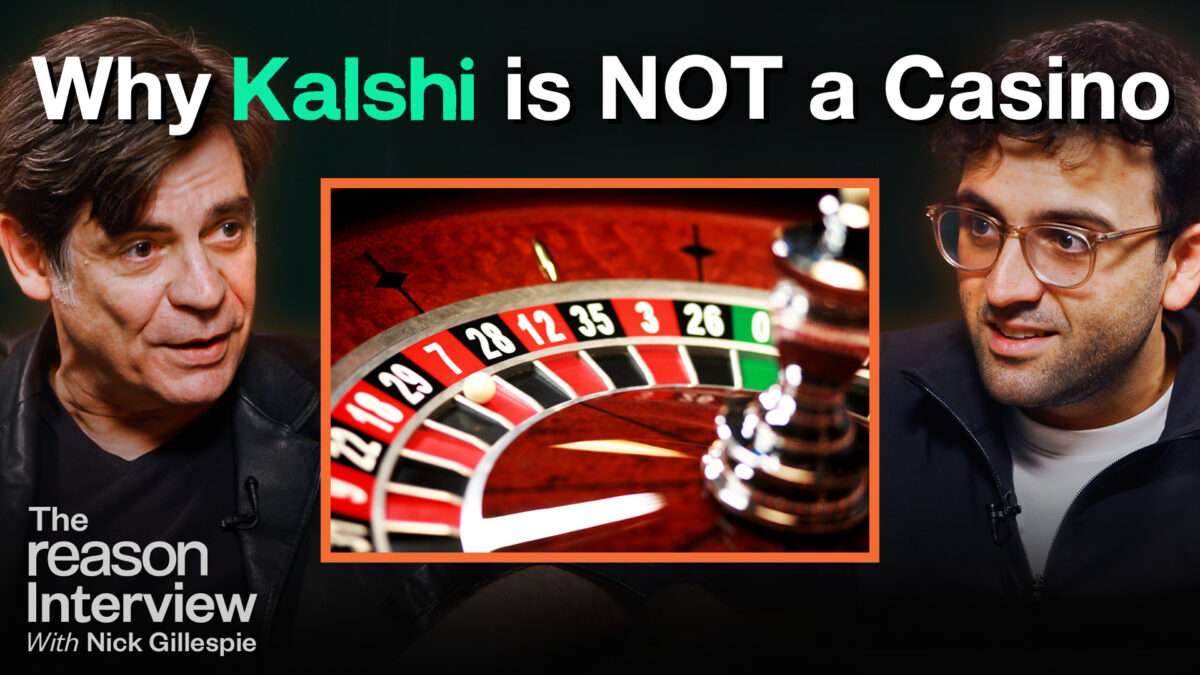
Nick Gillespie appears on the left. Kalshi CEO Tarek Mansour appears on the right. An image of a roulette wheel appears in the center square. Bold text across the top of the screen reads "Why Kalshi is NOT a Casino."
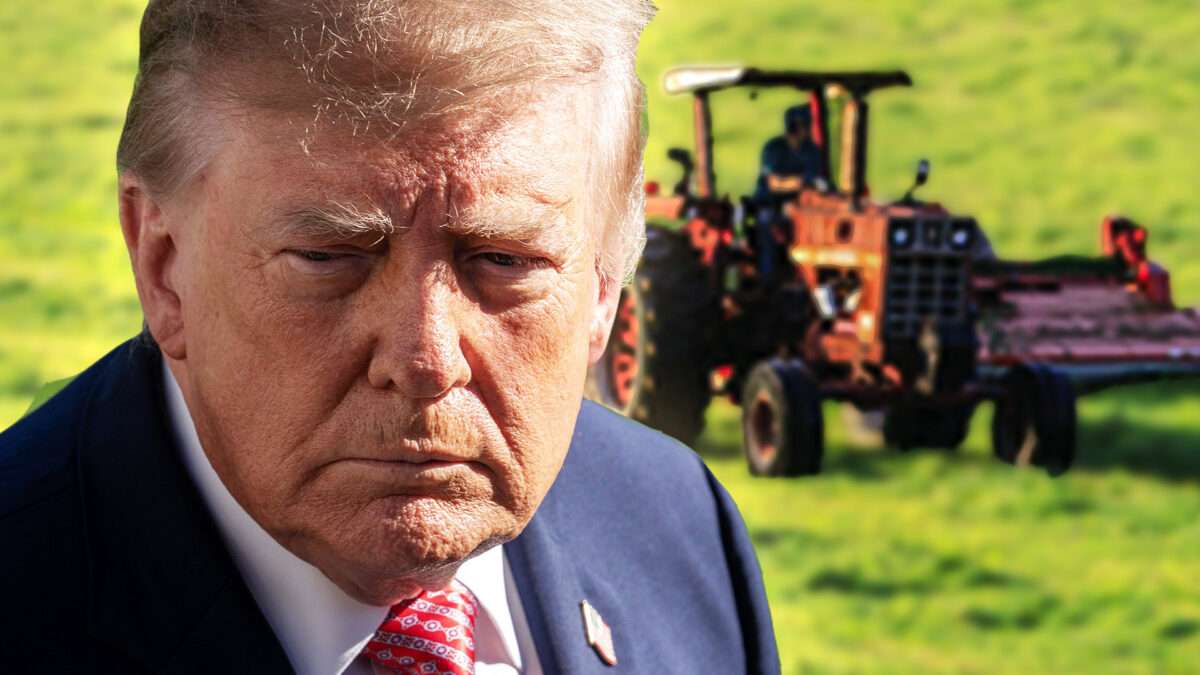
On Monday, the U.S. Department of Agriculture (USDA) announced it would "make $8 billion available for one-time payments to American farmers this harvest season to provide relief during temporary market disruptions and increased input costs."
Using a formula derived from the USDA's production, yield, and price estimates, the Harvest Fuel Relief program will "provide simple, proportional support to producers." It will only cover a "portion of modeled losses during the 2026 crop year." The Farm Service Agency—an office within the USDA that administers credit and loan programs—will administer the $8 billion in one-time payments using funds from the Commodity Credit Corporation, a federal entity authorized to draw up to $30 billion from the U.S. Treasury to fund agricultural initiatives. Payment rates won't be released until November, and the USDA's notice leaves open the possibility of additional payments for "non-Title I commodities, including specialty crop growers and fishermen."
A fiscally questionable decision, the program comes at a time when farmers are feeling a significant price pinch. The dyed diesel American farmers and ranchers use is exempt from state and federal highway taxes, but that has done little to offset skyrocketing fuel prices. In September, the American Farm Bureau Federation projected that fuel expenses would reach $22 billion this year, up 29 percent from 2025. The Farm Bureau estimates that total production expenses will reach nearly $500 billion in 2026. According to its own predictions, the USDA doesn't expect the situation to improve anytime soon.
In its latest Commodity Costs and Returns report, released in June, the USDA projects farmers and ranchers will face record production costs in 2027—higher than during the COVID-19 supply chain disruptions—driven by higher prices for necessary inputs such as fuel, fertilizer, seeds, machinery, and labor.
While the USDA has blamed "temporary market disruptions" for these cost hikes, the blame more accurately falls to President Donald Trump, thanks to his illegal war in Iran. As of Tuesday, Trump's war—and the subsequent shocks it has caused to the global diesel supply—have pushed the national average price in the U.S. up $2.70 per gallon from a year ago, a 74.6 percent increase, according to AAA data.
Unfortunately, the war in Iran is just one of several Trump administration policies making life more expensive for everyone, including the nation's farmers and ranchers. Tariffs on imported fertilizer, which began in 2020 during the first Trump administration, have made it difficult for American farmers to afford what they need. By the Farm Bureau's estimates, fertilizer costs for 2026 are projected to reach a record $40 billion, up 15 percent from the previous year.
The $8 billion program is part of a windfall of taxpayer money the Trump administration has sent to farmers as relief for harms caused by the president's actions. Last December, the USDA sent $11 billion in one-time bridge payments to more than half a million farmers nationwide. Earlier this month, the USDA announced it would provide a record $13.8 billion in gross payments to agricultural producers to cover revenue losses.
In a speech in Kansas touting the program, Trump claimed that the state's residents would see a "plunge" in prices once the war ends. That's likely an exaggeration, given the host of questionable economic policies he seems hell-bent on implementing.
Still, that shouldn't discredit the president's suggestion. Ending the war would benefit farmers, ranchers, and consumers, without doling out billions in another government bailout for a favored industry.
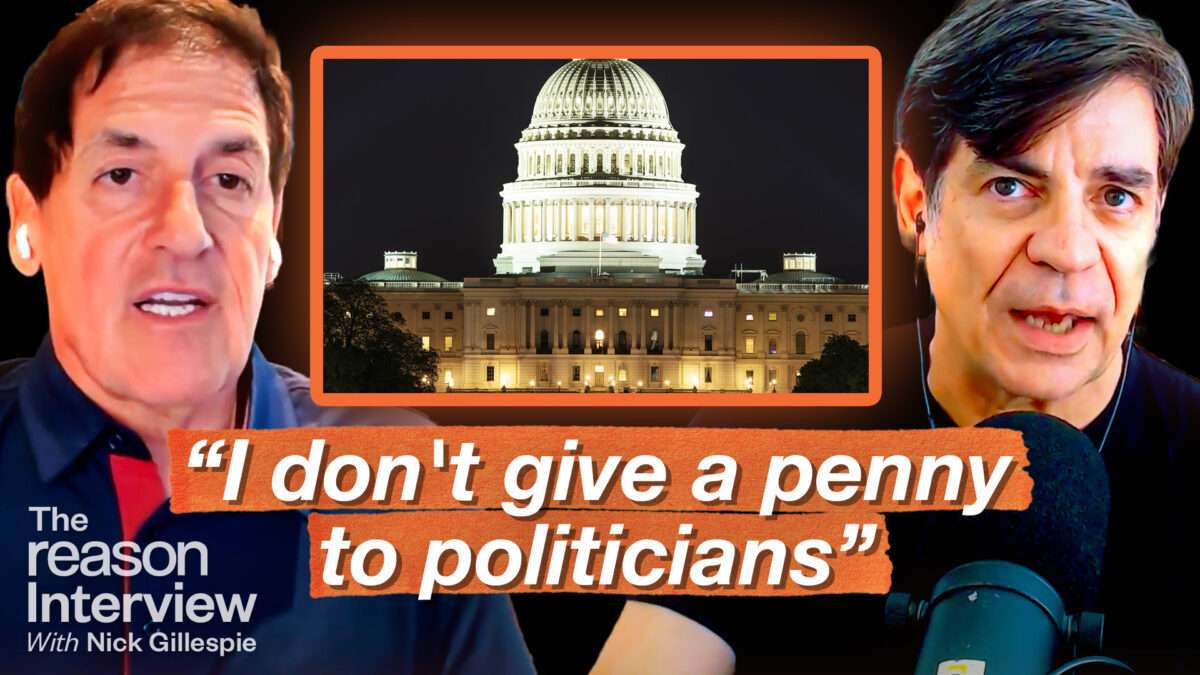
Today's guest is Mark Cuban, the billionaire entrepreneur and former Shark Tank star who is now on a mission to reform the American healthcare system. Through his companies, Cost Plus Drugsand Cost Plus Wellness, Cuban is trying to make healthcare more affordable by cutting out middlemen and making pricing more transparent. But he argues that fixing America's healthcare system will require breaking up massive conglomerates that wield enormous power over pricing and competition, often at the expense of patients.
Nick Gillespie talks with Cuban about why he supports bipartisan legislation from Elizabeth Warren and Josh Hawley to break up Big Medicine. Cuban explains how artificial intelligence can expose hidden costs in health insurance contracts and transform the way doctors diagnose and treat patients. They also discuss Cuban's support for Texas Democrat James Talarico and his belief that political parties have outlived their usefulness. The billionaire entrepreneur makes the case for restricting social media algorithms for children under 16 and discusses why he isn't particularly worried about socialism's growing popularity among young people. Finally, Cuban reflects on how Ayn Rand's The Fountainhead shaped his understanding of capitalism and why he believes helping others is part of being a successful entrepreneur.
0:00—James Talarico and the Break Up Big Medicine Act
4:13—Healthcare conglomerates and "contractual terrorism"
15:39—Drug pricing and pharmacy benefit managers
26:58—How AI will transform healthcare
33:04—The Trump administration's policy reforms
34:22—How does Cost Plus Drugs work?
43:08—The backlash against billionaires
47:52—Political parties and Texas governance
51:50—The rise of support for socialism among Gen Z
55:11—Would Cuban back a social media ban for minors?
This is an AI-generated transcript. Check all quotes against the audio for accuracy.
Nick Gillespie: This is The Reason Interview With Nick Gillespie. Thanks for listening, watching, however you're consuming this. My guest today is Mark Cuban, the former majority owner of the Mavericks, now a minority owner, if memory serves. And that's partly because you're going all in on Cost Plus Drugs, a company and a business model about prescription drugs and, more broadly, wellness and health care. We're going to talk about that in a little bit, but right now, you have recently in a very tight Texas Senate race, you've endorsed James Talarico, or you're speaking with him, partly because he has talked about coming up with a health care plan that you think will reduce health care costs. Can you talk a little about the Talarico plan and why that was so important for you in terms of signing on to appear with him?
Mark Cuban: I mean, really, what we agreed on is that we need to pass Elizabeth Warren's and Josh Hawley'sBreak Up Big Medicine Bill. And that was the fundamental reason why I supported him. I mean, there are other reasons as well, but I think that as long as we have these huge conglomerates that dominate the economics and provision of health care, the system's not ever gonna work, and we're gonna get what we have right now.
So, identify what is the main problem with health care right now? Is it just that everything costs too much, and that's because of the big conglomerates? Or is it that the quality of care is no good, the rate of innovation is dying?
What's the main problem with health care?
It's the economic side. I mean, the U.S. has the best health care in the world. It's not even close. The problem is, it's not accessible to everybody, but it's not affordable to most. And that is underpinned by how the biggest conglomerates in the country, that do hundreds of billions of dollars each in revenue each year, dominate the economics of health care.
So how is the Break Up Big Medicine Act or bill how is that gonna actually reduce costs? Because I know in the past you've talked about being a small-l libertarian. You're obviously very much in favor of capitalism. You don't hate billionaires. You don't like wealth taxes. You like free markets. How is the Break Up Big Medicine Act gonna work? Because one of the reasons we're where we are now is because of all of the past government intrusions into the market or structuring of the market. I mean—
No, that's wrong…OK, let's just…
I mean, the government already spends about 50 cents of every dollar in the healthcare ecosystem. So it's not like this is a market, right?
Well, it's not a market. You're correct though. Right? But in order to have an efficient market, you have to have price discovery. In order to have price discovery, you can't have gag clauses in every single contract that every single health care—you can't have gag clauses in every single health care benefits contract that's signed. Period. End of story.
And who commands those gag clauses? The big companies that need to be broken up. And it's not an issue of what the government is doing. It's specifically an issue of the choices that are being made by the CEOs and C-suites of those companies.
You look at the largest vertically integrated health care companies: 3,000-plus subsidiaries, $150 billion in intercompany transfers. That's more than the GDP of 13 states. And so they literally dominate the economics. And that's just one company.
If you go to the top three, the point of this is, the leverage is not with the federal government in this particular case. The definitions, the relationships, the pricing, the rules are being set by these big conglomerates. And if you were to break them up, it would change.
Ok, so we can work through a more specific example. What's the worst conglomerate, then, or the biggest healthcare—vertically integrated provider? And how are they bilking everybody—customers, doctors, hospitals, unless they own the hospital system? Who's the worst, and how is that working?
UnitedHealthcare. They're the ones that have thousands of subsidiaries, $150 billion, $160 billion in intercompany transfers. They either contract or employ more than 10 percent of the doctors in this country.
Out of those 3,000 subsidiaries, they own pharmacy benefit managers, they own health care providers, they own what they call ASOs, third-party administrators that administrate care. They own Medicare, Medicaid, MCOs that manage Medicaid for states. There's just—I can't even begin to start to list all the different things that they control.
So one of the ideas behind a vertically integrated company is that they— if you are sourcing your own cost inputs, you can do things more efficiently, and you pass that on to the customers. So McDonald's grows its own potatoes because—
Sure, I know I get it. I know the potential benefit. Yeah.
Oh, no, no. I know that. So explain—
It's also a choice. So, here's the choice. You can pass it on and say, "Look, we're going to be more efficient and pass on the benefit of our efficiency." And the easy way to understand whether that's occurring—there are two easy ways.
One, to ask anybody who uses their services or any of their peers, and just ask them: Have you felt like you've been the beneficiary of their scale?
Based on the polls going around for these midterms, right, the number one issue is affordability, and the number one underpinning of that affordability is the cost of health care.
Number two, being a healthcare geek, I will read the transcripts of their quarterly earnings conference calls. The one thing I have yet to ever hear them say over the past four or five years is that, "Based on this investment, based on this new technology, based on this acquisition, we are going to be able to reduce the cost of care or services to patients that receive that care." Not one.
So patients just don't show up in the way you're talking about it? It's like…
Not at all.
We've streamlined like our costs—
Right. Well, not even necessarily streamline our costs, but what does show up is: "We are going to be able to increase our earnings along with our previous trend. We are going to be able to increase our margins and our revenue for specialty medications," right? There's just a long list of things that they are pushing.
And the bottom line of this—and every capitalist, every CEO has to decide who they're responsible to. Typically, in a public company, which all of these are, they're responsible to shareholders. And that's not necessarily a bad thing if they're aligned also with their customers, their ultimate customers. It may not be the direct customer, but the ultimate customer, which is a patient.
They are not aligned. Not only are they not aligned with the patients, they're not aligned with any other stakeholders.
When you talk to corporations, big or small, a solo entrepreneur, 100 employees, 100,000 employees, and you say, "How are your health care costs doing these days? Are they going down? Are they going up?" And obviously, the response is they're going up.
And you talk to their members, their employees, their families: Are your deductibles and premiums going up or down?
And so the proof is in the pudding that they're aligned with their shareholders, but they are not aligned with their ultimate customers. And that creates a disconnect. And those are the decisions that they've made. In one case, with a tragic outcome, unfortunately.
And so going back to the Break Up Big Medicine Bill and the outcome, when you have somebody who is that big and has that much control and that much regulatory capture, it's AT&T time. It's Standard Oil time, again.
Yeah, I mean, but then it gets complicated. And I don't want to spend too much time on this, but in the sense that when Standard Oil got broken up, they were actually charging the least for their products in their history.
This should be easier then, right? Because now these guys are charging the most.
No, no. Well, I'm saying it gets complicated because you mentioned regulatory capture, and this is part of the problem. Like, if UHC, if UnitedHealthcare is so bad, why do companies keep using them as a benefit?
I'm so glad you asked that. Why do they keep on buying from them, right? Why do they keep on doing business with them? Right?
Right.
So I spend most of my days going to CEOs and explaining to them how they're getting ripped off and how they are getting worse outcomes by dealing with these big conglomerates. Almost all my days. And what I can tell you—
I'm sorry to interrupt, just real quick, because just to get you on the record on this. You're not against bigness per se…
No!
Right? Big conglomerates—because people like Elizabeth Warren often are like, if it's a big company, break it up, right?
Not the issue to me at all.
If I were running that company, I'd be like, "We are so efficient. We are so good at what we do. We use AI and technology better than anybody, so good that we're pushing prices down." And because of that, we'll make more money.
And you know what? Even if we don't make more money, we'll make enough to keep our shareholders happy. But you know what? I'd rather be a great citizen of this amazing country of ours, and if that means better health care at less cost, and our P/E ratio needs to be a little higher to get that stock price where we want it, I'm good with that.
That's how I would—so I have no problem with scale.
The problem I have, like when you talk to people who work for these companies, when they say, "Yeah, I work for whoever," the first thing they say to me is, "I'm sorry. I need the job."
It's not like they're proud. It's not like, "Hey, we're doing such amazing things." And so that's the underpinning of all of this.
So go back to your point on why do companies hire them, right?
I spend so much of my time—literally before this call, I dealt with a group of people who were HR representatives and buyers of these services. And I said, "Do you like these companies that you're dealing with?"
They refer to the big insurance companies as the BUCAs, right? Blue Cross Blue Shield, United, Cigna, etc.
And they're like, "No, we don't like dealing with them."
I'm like, "Why do you?"
"Well, because our CEO just doesn't understand health care costs and health care benefits. And they may know somebody or do business with them."
Like, I've literally talked to humongous banks who have said that we're not going to switch because we'll lose their deposits and banking relationships.
Ok, that happens. So let's put them out.
So now I was talking to this group today, and I started giving examples of places where those big companies were taking advantage of them. And I went directly to contracts because most of the contracts are comparable.
So I call them contractual terrorism.
The city of Dallas, we'll use them as an example. Their pharmacy benefit manager contract: 1,300 pages. There's no human or humans or enough coffee on the planet.
I don't even know if the AIs are capable of scanning that.
Well, the AIs are capable of doing it, right? You kind of got ahead of me there, because before they were able to push things through.
So, like, for pharmacy benefits, there are these things called rebates, where the manufacturers give money back to the pharmacy benefit managers, and they have the choice of how to distribute it from there depending on the contracts, right?
And one of the biggest sources of rebates is something called specialty drugs. They're supposed to be more complicated drugs. Just as often, they're not, but they call them specialty.
But in these contracts, and I literally asked the question of this group who has a good understanding of their contract, I said, "How many of you have a clause in your contract that says specialty rebates, specialty medications either get a flat rebate or no rebate?"
They all raised their hands.
And then I said, "In that contract, doesn't it also say that that PBM owned by that big BUCA—"
That's the pharmacy benefit—
Benefit manager, right, gets to determine what is a specialty drug or not. So in some cases, it could be generic, it could be a little pill, and they call it a specialty drug so that they get to arbitrage the rebate or to retain the rebates instead of sharing them.
So going back to the question of why would a company do this, and it's even worse on the medical side. That's the pharmacy side.
There's no company that, if you work for a company that's self-insured, and God forbid you need to get some major surgery, and so they send you a bill, not even specifically to you, but for the whole company every week or every month, right? And the company just writes the check for the bill, and they may or may not even get examples of the claims so they can reconcile them to what was actually charged or paid to the hospital.
So you have these huge companies that have no way of reconciling whether or not what they were charged is what was paid to the hospital or doctor or provider.
So I was like, why do you do this? Why are you letting yourselves be taken advantage of? And it's because, "Well, it's just happened, it's changed so rapidly, and the prices have gone up so rapidly. We're still in the contract. We're still doing it."
And I'm like, so let me give you the way to resolve this. And this goes back to AI.
So what I've done, and I've done it for my companies, I've helped other companies do the same, I've helped states do the same. Now, with AI where it is, and it's only recently capable of doing this, you can take a 1,300-page contract. You can take a 600-page contract, and I tell them, take the PDF file of all of your health benefits contracts and put them into your favorite large language model and just use this prompt: "Where are they ripping us off?"
And within five minutes, you'll see, boom, boom, boom, boom, boom. Because it's contractual terrorism. They only have to squeeze through a couple of things that the lawyers don't see, and that changes the whole contract, and everything economically references the contract.
So part of, I mean, in any kind of market that's not working well, price signals are arbitrary or buried. There's a lack of transparency. People don't know what they're paying for, what all of the benefits are, how much they cost, and things like that.
There's also, and I know you've talked and written about this, where it's exacerbated by the fact that the company, I mean, a health benefit, it's not what your main company is doing. They're offering it for a variety of reasons. And this goes back to World War II or wage and price controls and things like that.
You know, whatever my company…I don't even know what my—Reason Foundation, the nonprofit that publishes this podcast, I don't know what they pay monthly for my premium. And I barely know what my premium is.
And do you know what your deductible is? Do you know?
Yes, I do indeed. And I had a kid last year, so I'm always hap—
Let me ask you a question, over $1,500 a year?
Yes, for the overall, it's like $6,000.
OK, so $6,000. Have you ever been prescribed, or has anybody in your family been prescribed, a brand medication?
No, I gave up on brand medications a while ago. I always go for the—but what's your point?
No, my point is that brand medications without generics, right?
Right. Yeah, yeah.
So let's just take a drug likeXarelto. The list price of Xarelto, sold by J&J, is $600. The way the system is structured by these big BUCAs and their pharmacy benefit managers is such that during your deductible phase, you and pretty much everybody else, unless your company negotiated something different, have to pay the full retail list price for that medication.
That's insane. Now the question becomes, why does that happen?
And I'm going to explain to you, and this is way inside baseball, how pricing for brand medications is done in the United States of America.
We'll, excuse me, we'll take a drug like Xarelto because it's easy to understand and use. $600 list price. When J&J sells that to one of the three big wholesalers—there's three of them that control 95 percent of the pharmaceutical transactions—when they sell to that wholesaler, you know what they sell it to them for? List price, $600.
Sounds crazy. If they came on Shark Tank, Kevin would probably say, "Take them out behind the barn and shoot them," because it makes no sense that multihundred-billion-dollar companies don't negotiate a discount.
But they're lucky in that the brands will give them 5 percent back if they prompt pay and give them some data.
So now let's just say 5 percent from a $600 drug means the net cost to the wholesaler is $570. That sets the floor for what they can charge pharmacies because they're not going to sell it for less than they pay.
Now what happens next, then, is now a pharmacy has paid $570 for that drug. When you walk in, or any of your family members walk in, or anybody who works for the foundation walks in who has a comparable deductible, the pharmacy can't sell it to you for less than $570 because that's the charge.
Now that's ridiculous in and of itself because you know how much J&J actually nets, give or take, for that medication? It's not $570. It's about $300.
Their yield, their net revenue is about half of the list price. And so where does that delta, the $570 minus $300, where does that go? That goes to the pharmacy benefit manager.
Now, if this was a real market where they didn't have control because of their control of formularies and lives covered, then J&J and all the other brands in the same situation would then sell to the wholesaler at $310. Remember, their net yield was $300, so they'd make $10 more.
And remember, the wholesaler was selling to the pharmacy for no markup. They make their money on generics, right? So they could sell it for $320 to the pharmacy, and they'd make more. And then the pharmacy could sell it for $325 to you and your family or any underinsured or uninsured patient, and they'd make more.
So everybody would make more, but more importantly, more people would be able to afford their medications, and more people would be able to adhere.
So the question becomes, why does it not happen that way? Because in a capitalist society, people are going to act in their own self-interest. That's the beauty of capitalism.
People are always going to find shortcuts and disrupt so that I can get you something…
Right, wherever they can. So I'm going to tell you why it doesn't happen, right? Because those big PBMs owned by the big BUCAs, they control these things called formularies, and they control the formularies for 85 percent of people who receive pharmacy benefits.
And the formularies are the drugs that are covered by a particular plan?
Correct, correct.
And if your medication is not on that formulary or it's on a low tier, because you know in your tiers for your own health care, right, you might pay zero, $10, $50, coinsurance, whatever it may be.
Well, so these PBMs are saying to the brand manufacturer, they've told me this, that if they don't play the game this way, sell at list price and only give a 5 percent, don't do it at net, if they don't play the game that way, they will diminish their positioning on that formulary, not just for that drug, but for their entire portfolio.
It's the same reason Cost Plus Drugs doesn't have a lot of brands, because they've said the same thing: If you work with Cost Plus, then we will diminish your position on the formulary.
So two quick questions that I think will clarify what you're talking about. One is, where did the pharmacy benefit managers come from? They weren't always part of vertically integrated institutions, well let's start with that. PBMs have been around at least since the '60s, and the whole idea, and it makes sense, is like, we're going to arbitrage a lot of possibilities, and we'll sell more drugs for the people who are making them, and we'll sell them cheaper to the people who are buying them.
But really just processing claims. Right? Somebody, there's a prescription, and you have insurance—
Yeah, how do we go from there to, I mean, PBMs in a lot of ways, those are your white whale, right? That's what Cost Plus Drugs is going after. That's where you tend to—
The whole thing. They're not a unique company. They're part of these vertically integrated companies, right? So culturally, they are the same, right? Optum Rx has the same organizational culture as United, CVS, etc.
So how did they get there? Vertical integration.
And once an insurance company who already had X number of plans that they control now buys a PBM, what they say to the employer and Medicare Advantage plans, they'll say, well, let's just start with employers, right?
Self-insured employers. Sixty-seven percent of people who get insurance through their company get it through a self-insured employer. That's about 150 million, 160 million people, right? And so those all go through a PBM at some level.
And by being able to control that, plus Medicare Advantage plans, plus Part D plans for Medicare, they have such market dominance. It's like they have more customers than Amazon does.
And just imagine Amazon saying, "If you don't do business the A, B, or C way that I demand, we're not going to allow you to sell on Amazon. Or we're going to make it so that somebody has to make 15 searches to find you."
That's the equivalent of what these vertically integrated companies are using their PBMs to do.
Yeah, how does the Break Up Big Medicine Act specifically address this issue of vertical integration?
Well, it's breaking them up by definition, right?
I mean…
So then what's the benefit. Right, how do we get the lower prices and all that, right?
And so without having the market dominance to define and threaten, to say, "Look, we're not going to work with you unless you do it our way. And if you don't do it our way, you're going to lose access to 180 million customers," it ends that.
Yeah. And it says things like, if you are a medical provider, you cannot own this type of company. So, I mean—
So then we can talk about medical loss ratio and all that.
It tries to end vertical integration or limit vertical integration.
Limit vertical integration, right. Because once you get market—and there's another part that we haven't talked about that goes hand in hand with doing capitalism the right way.
So in order to have an efficient market, and you mentioned this, you have to have price discovery. In order to have price discovery, you have to have price transparency and some level of contractual transparency. Because if the prices are in the contract, then you have to have some transparency there.
You know the old Fight Club thing? The number one rule of Fight Club is you can't talk about Fight Club. The number one rule of pharmacy benefit manager and ASO and other contracts from these vertically integrated companies, their number one rule is you can't talk about them. They have complete gag clauses.
So they literally say that—well, I'll give you a better example.
TRICARE, that offers all the pharmacy benefits for all the people serving in the military, retirees as well, right? They have their plans and everything. And for certain of their plans, particularly if you're a retiree who lives off base, you don't live on a military base, then you have to order certain generics from Express Scripts slash TRICARE, and the copay is like $16.
Well, it's cheaper in many of those cases to buy from Cost Plus Drugs. Just proving the point that it's not necessarily getting the best price dealing with a bigger company.
But that's not the bad part. That's not the bad.
We still have no idea, none, zero, how much taxpayers pay for those same drugs because they prevent everybody from seeing it.
Elizabeth Warren said she was willing to go and sit in a SCIF in order to be able to look at those prices, and they refused to allow it.
And a SCIF is a secret room where you can read super top-secret documents.
Yes, right. And they still wouldn't show them to her.
And so here we are taking taxpayer money. And if they're doing such a great job, you would think they'd be proud of their pricing.
"Mark Cuban, you can't touch our pricing with Cost Plus. We want everybody to see that. We'll put you out of business"
Yeah. So, I mean, part of the idea is, like, if you introduce transparency into more markets and people understand what other people are paying, you get a more informed market, and innovation is going to happen, prices will probably come down.
What you're talking about, like if you're going to the city of Dallas and you're saying, "Hey, here's a way for you to push back on your benefits provider and maybe to shop for better things." Part of it is information, part of it is regulation, and something—when I think of two people I hate for different reasons, but with almost equal ferocity, it's Josh Hawley and Elizabeth Warren. Most of the time when they're talking, I'm like, "Hey, all I know is my freedom is going to end up on the cutting room floor," right?
But there's regulation, and then there is the ability of individuals to make choices, meaningful choices.
I guess you talk a lot about AI in very positive terms, and you've laid out one way in which AI might help by just making people capable of understanding documents, contracts that they're about to sign.
In this particular case, absolutely.
Yeah, what are the other ways that you think AI is going to transform and improve the quality and quantity of medicine and health care?
One is drug discovery.
We'll get to the point, I don't know when, where we'll be able to take genetic information about ourselves, if we choose to, and make that available to far more advanced artificial intelligence than we see today, and say, "Analyze this. Tell me what I should be concerned about." Or, "Here's everybody in my family. Let's compare it and look for deltas and see how we can use AI to improve our health or wellness."
Make, like, personalized medicine.
Yeah, I'll give you a perfect example, right?
I have to take Synthroid for a thyroid scenario. And I was taking iron supplements because I work out and I sweat a lot, and my iron levels were low. I had no idea you couldn't take them at the same time. None. My doctor didn't know because you can't remember everything. And so I put it into Claude, and boom, I found out you've got to take them at least four or five hours apart.
Simple, simple, simple example.
We're all using Dr. ChatGPT and Dr. Claude to a certain extent. Doesn't make them perfect, doesn't make them accurate in all cases, but it gives us access to this information we otherwise didn't have.
But to go back to your question, as AI gets more advanced, not only will we be able to use it for personalized medicine, but it's capable of memorizing everything.
Now, AIs don't know the consequences of their actions. AIs don't have ethics, right? AIs are not smart. They're just able to combine things in ways that they've seen before or ways that you tell them to do. But within that constraint, doctors will be able to use them to more efficiently and effectively make determinations about somebody's health. So I see it as a big positive as long as we all understand that there are certain things that they can't do.
I'll give you one more example.
The minute an AI is released, we're done training and it's made available to the world, it's out of date.
This brilliant conversation you and I are having right now, no AI knows about. And even if it's published, unless you publish a transcript along with it, it has no way to consume the video itself.
So there's always built-in latency. And so because of that, it's always going to be behind.
And you talk about a capitalistic system and how people adapt. Well, researchers and doctors who publish are recognizing that, "Hey, maybe it's smarter that I don't publish, I don't try to patent this particular device or approach to solving a health care problem. Instead, I'll just keep it to myself and either sell it to a company that can benefit from it or put it in my own model."
And so that means you're going to have disparate information in different models.
AI is probabilistic. It's not deterministic. You're not going to ever get a scenario where you put something in four different models and you get the exact same answer.
So within health care, we have to understand those constraints. And by understanding those constraints, we can use the tools to our benefit. And I think that improves health care in a thousand different ways.
Let's talk a little bit about the regulatory framework. Donald Trump and Robert Kennedy, secretary of Health and Human Services, talked, particularly for round two, or the second term for Trump, talked a really big game about changing the regulatory apparatus at places like the FDA.
It costs anywhere from a billion to several billion dollars, might take more than 10 years, to bring a drug to market. By the time it comes to market, part of its patent life is already over, et cetera, and things like that.
Are there regulations, are there policy changes that the Trump administration has made that you're bullish on, that you think were in a right direction?
I think with things like biosimilars, which are effectively injectable generics, they removed one of the steps, which I thought was smart. Because having that, I forget the exact terminology, my partner knows this stuff better than I do, but having that third-tier trial to confirm what you already know is going to happen, and there haven't been any exceptions to prove that you need it, I thought that was really smart.
But I don't get involved in the FDA side in depth as much as I do on the commercial side.
Right. Well, let's talk about Cost Plus Drugs and explain the mechanics. Before this, I went to—and of course, because he has to put his name on everything, Trump started a prescription program online, TrumpRx. It's a government program where you can get coupons, basically, for things.
One of the drugs that I take is an off-patent statin, and it used to be known as Crestor, right, when it was on patent. And I looked up on the TrumpRx plan, it would cost me $8.60. And then I went to Cost Plus, and it said it would be $5.66. This is for a 30-day supply, 10 milligrams. And then I'm on Cigna, and it costs me zero when I fill that prescription.
But it doesn't cost you zero, right? You're paying it.
Yeah, absolutely right. And unfortunately, it costs my colleagues something. They chip in a little bit as well. But how does Cost Plus— how does it work? If you go there and you already have insurance, how do you use it in a way that you know what you're going to pay for a drug, and it's probably going to be cheaper?
So two different paths, right?
So if you have insurance, then if you work with one of the big PBMs, the big three PBMs, you're not going to be able to use your insurance with Cost Plus Drugs.
There are about 35, give or take, pass-through PBMs that we partner with. So if you have insurance cards from them, you just go in there and click on insurance, and you put in the card ID, and you get the benefit. It's probably going to be a zero copay, but we'll ship it to you, right? Because that's the benefit of sorts.
If you happen to be somebody who is on a Medicare Advantage plan and are prescribed a drug that's not covered, it's not on your formulary, or there's a high copay or high coinsurance, that's a perfect customer for us because you can come to us. We're far less expensive, including shipping and handling and everything, and you use us to save money.
And if you're in one of eight states, Tennessee, Texas, and a few others, then you can also count that against your deductible.
If you're completely uninsured, then we're a godsend for you, particularly if it's an expensive medication, and particularly now with biosimilars. So now there's a biosimilar for Humira. There's a biosimilar for Stelara. Last year, Stelara would have cost you or your employer or somebody $127,000. Now our cost is $365 plus shipping.
Yeah. What limits the types of drugs that you offer? Because I noticed, I think when I looked today, there were no GLP-1s, right? You don't do things like Adderall or the generic versions of Adderall. Explain why those are—
On controlled substances, we just don't want to fight the battle, right? Because there are just too many risks, and we wanted to make sure that we weren't in a position of contributing in ways we didn't want to contribute.
In terms of GLP-1s and brand medications and specialty medications, as I referred to earlier, the big PBMs have gone to the brand manufacturers, specialty manufacturers, and told them, "If you deal with Cost Plus Drugs, we will diminish your positioning on our formulary."
Now the question becomes, why? Why do these huge conglomerates care about us?
Well, there's a study that's getting ready to come out that says every area of health care costs has gone up over the past 30 years, except starting in 2022, the cost of generics started to level off and then started going down.
That's when we launched, January of 2022.
And the reason that happened, and the reason these big PBMs and conglomerates are afraid of us, is because when you go to Cost Plus, you put in your statin, right? And we showed you our actual cost, and then we showed you our markup was only 15 percent.
And so if we were to do the same thing with brand drugs, all of a sudden, all that premium, remember we talked about the pricing of brand medications, all that premium margin that is going to PBMs to keep or distribute would be gone.
Because everybody would finally know the actual cost, just like they know the actual cost of biosimilars and specialty generics and general generics, like you saw.
Do you think, in a market sense, is the function of Cost Plus, obviously, is to sell drugs or deliver them to people who need them at prices they're willing to pay or want or can afford, but is part of it also that it disciplines the big guys? Because if what you're saying is true, they're going to have to start taking into account that if we keep squeezing this stone—
So then where are the limits of that effectiveness? When I mentioned Standard Oil, at its peak market share, was selling its products for the least amount. It was because they had a monopoly. They had over 90 percent of market share in home heating oil and lighting and things like that. But they acted as if they were constantly about to be…
Go out of business.Yeah, yeah…
Right. So, I mean, where are the other places in the medical industry? In recent essays, and preparing for this, you said, well, it's not the pharmaceutical companies, because they're often—
They're not innocent, but they're not the worst—
Yeah, ok. It's not the doctors. It's not the government. But when I look at it, it's like the American Medical Associationand other groups that govern the number of medical licenses that get issued every year or the number of resident beds that are available. They're not doing anything to increase supply.
No, I agree. I'm not saying I agree with that, right? But the AMA is not a government entity either.
Well, it's quasi, right? Because you have to show—but I'm saying, how do you bring that same kind of market force, that kind of comp….This is like real competition to say, "You know what? My competitor, who's got 90 percent market share, is selling something for $10 a unit. I'm going to sell it for $8 a unit, and I'm still doing well, and you're making out better, and they're going to have to change." How do you bring that to bear on the larger healthcare system?
Because what it's missing is not only price, but trust. Nobody trusts the economic side of health care. You don't. I don't care who you are, right? Every poll, everything says…right.
I look at trust as a formula: Trust equals transparency divided by self-interest.
We're completely transparent. We show our costs. We're still the only pharmacy that publishes a price list. We have a programming interface where anybody can pull down our pricing anytime they want.
So we're completely transparent there, and we only mark up 15 percent. So that's fair, right?
And so that's what differentiates us to start, right? So people can work with us, and they trust our pricing. They know what it is.
We charge the same price to everybody, no matter who you are, where you are, what time of day it is. It doesn't matter.
When our volumes go up, like with TrumpRx, it's a portal. As you saw, you can come find your way to us. Our volumes went up. Our costs went down.
At Cost Plus, we pass those cost cuts on to our patients. We were able to lower the price of 190 more drugs. And so we're able to start with these drugs, right? We're also getting involved with manufacturing. We manufacture drugs that are sterile injectables that are on the FDA short supply list.
We also have used AI and used robotics to shrink the size of our initial manufacturing plant from football-field size, so about 5,000 square feet. And over the last five years, we've been able to shrink that into the size of a tractor-trailer.
We call them pods. And these pods are going to be our biggest business. They're our most disruptive business because we've been able to combine AI and technology so that we can take these little things, tractor-trailer size, and ship them anywhere.
Ecological disaster, weather disaster, God forbid, war disaster, we can put them there and, depending on what kind of pod it is, make any kind of drugs.
And because we can daisy-chain these things together, we're able to manufacture in volume so that we can manufacture generic tablets cheaper than we can buy them from India.
So then let me, and this might seem like a leap, but in what you just described, and particularly the trust divided by self-interest, all of what you're talking about, all this innovation, why do people—or let me say this: If there's anything that's less popular than data centers and AI, it's billionaires like yourself.
What you just gave is a riff that is, if you believe in free minds and free markets, that's been Reason's catchphrase for decades, this is beautiful. And you're describing exactly how the system should work.
But we have, in contemporary America, people, including people like Elizabeth Warren, the governor of California, who want billionaire taxes. There are members of Congress who have staff members who say every billionaire is a policy failure.
Where is the anger? And when I say people like you, there aren't that many billionaires, but in terms of economic innovation and people doing well, it seems like it's worse now.
If you can't pay your rent, if you can't pay for your medications, if you can't pay for daycare, if you can't pay for food, you're just mad.
And when you're mad, you're not looking to say, "Ok, let me find a logical construct to define why I should be mad or why I'm in these circumstances." You're just mad.
And when you're mad like that, and I've been broke, right? Six guys living in a three-bedroom apartment, et cetera, no money in the bank. You're just mad at whoever is a convenient target.
And so I don't begrudge them. Hopefully, they'll eat me last.
I understand why politicians say billionaires are a policy failure because we're an easy target. I don't blame them for doing it that way. But as an entrepreneur, I'm still going to do what entrepreneurs do. It's why I did Shark Tank for 15 years, because I wanted people to be excited about being an entrepreneur. I wanted them to see, when they watched the show and somebody walked in on that carpet from Idaho or Iowa or wherever with nothing, they had a chance for their American dream to come true.
And if they can do it, I wanted them to think, "I can do it."
And so do you feel like that dream is still alive? Or is it, because when people talk about, ok, it's hard to make rent, it's hard to do this, it's hard to do that. All of this struggle is always real. But is it just that that's the struggle? I mean, are things worse now than they used to be?
No, they're not necessarily worse, right? But we communicate differently now than we did before. Each of us is on social media at some level, whether we know it or like it or not. And each of us gets our own unique feed on social media.
There's no more Walter Cronkite. There's no more Dan Rather, where we all have communal shows that we all watched and basically understood and agreed on some level.
And there's a reason why, right? I mean, those disappeared partly because they weren't really giving people what they wanted, right?
Regardless of what it was, technology is technology. It's going to find its place, right?
I mean, I started the very first streaming company because people didn't have access to, in my case, Indiana basketball or music or whatever it may be, shows.
So people want more, but what's changed dramatically is how algorithms distribute content to each of us individually.
We all get our own individual feed on each of our social media platforms. Mine's not like yours, and they're like snowflakes. No two are alike.
And because of that, engagement increases with anger. And so every one of those algorithms has an incentive to make us mad.
Because the madder we get, the more we consume. The more we consume, the more ads that are sold. The more ads that are sold, the more subscriptions that are bought, et cetera, et cetera.
And because of that, if I'm mad about not being able to afford my rent, I'm mad about the cockroaches in the kitchen, I'm mad about the cost of beef, whatever it may be, you better damn well believe I'm getting a lot of that in my social media feed.
And if someone comes along and in that feed says it's this billionaire's or that billionaire's fault, what do you think I'm going to believe if that's 30 percent of the content I consume in any given day?
That's what's changed dramatically. And I say this all the time: Whoever controls the algorithm controls a lot of people.
Yeah. You have, in the 2024 election, I believe you're a political independent, but you came out and talked about how you wanted Kamala Harris to win. You were backing her. You're backing Talarico against Ken Paxton, the Republican Senate candidate. There's, of course, Ted Brown, the Libertarian candidate, who looks like he's going to cover the spread in Texas.
But I guess in terms of politics, at the state level, there's a real experiment going on. I'm talking to you from New York. New York City, New York state, and California are pursuing one model of governance, it seems, which is high tax, high regulation, high social services, or this is what they claim.
And then you have places like Texas and Florida that are saying we're going to do less tax, less regulation, we're going to give less services.
How do you feel about being in Texas? You've been there for decades now. It's your home place. Is Texas a better model compared to, say, California and New York state? Or how do you gauge that?
It's the ultimate capitalist decision, right? I mean.
Where you live.
Yeah, where do you live. And politicians, they sell what people will buy, what voters will buy.
And in terms of how I feel about Texas, when I got here, it was pretty much blue, and then it was purple, and then it was red, and it'll change again, just like multiple states, right?
What a conservative is today is far different than it was 11 years ago, you know? And the parties are completely different. If it were up to me, I'd get rid of all political parties. I think they've outlived their usefulness. They're just a way to raise money and to try to aggregate power as opposed to the power of ideas.
I don't give to politicians. I don't give a penny to politicians. Either you agree with what I have to say and you think it's of value to you, or you don't. And I have no intent of changing that.
Either my ideas stand up on their own, or they don't.
And in terms of my own philosophy here in Dallas, I'm an entrepreneur. And Dallas has been, Texas has been, great for me as an entrepreneur, been great for my family. I owe a lot to the city and the state, but it's changed radically, to use that term, over the years that I've been here.
Do you feel like it's getting better, getting worse, or it's just—
No, it's going to change no matter what.
The only constant is change.
My dad used to say, "You don't live in the world you were born into," you know? And it's the same thing here, where especially now with AI, I mean, there's always, like my kids, one was born before the iPhone, two weren't. Shit's going to change.
And so I don't look at it and say, "Well, pick this point in time, is it good? Is it bad?"
I look at it and say, "What can I do to make the world better?"
Look, I'm one lucky guy, right? My life is so much different than I ever possibly imagined.
And as an empathetic capitalist, right, as a compassionate capitalist, I want to give something back. My next dollar won't change my life, but it can change somebody else's life.
And when I talk to people about capitalism, that's the message I want to convey.
Now, if I was 25 again or 35 again and in healthcare, I'm sure I'd be trying to build as huge a company as I possibly could and sell it for as much money as I could because the one thing that I would want, the one thing I valued most, is time.
And the best way to gain control of your time is through your personal economics.
And so everybody's going to have their different perspective on where they live, how it's doing for them, what comes next. All I can do is try to help where I can help.
You mentioned being 25 again. Does the popularity or the kind of embrace of the idea of socialism, or the term socialism, concern you, particularly among Gen Z?
No.
Explain that, because a lot of people are like, when you hear capitalism is at a kind of historic low in terms of positive feelings, socialism in America is at a historic high, why doesn't that concern you?
So I'll go back to the algorithms and social media again, right?
When I talk to—I have three kids who are now 17, 20, and 23. And I talk to them and their friends, and a couple of them are entrepreneurial.
And their friends will come on and give me all these ideas that they think are great businesses. And I've heard them all, right? You know, shoe drops, dropships. And I'm like, these are old, tired.
Where did you get these? Social media.
How do you understand how to run this business? Social media.
Where did you watch anything? YouTube, right? Or I saw it on Instagram.
So if you take that same concept toward business, the same thing is going to work when it comes to understanding political systems and politics in general.
Kids are getting short sound bites. And if somebody who's popular and goes viral says, "Hey, I just started this business. We're going to be selling widgets at 100 percent markup. That's socialism. I hate capitalism, but I do socialism business the right way," that's the way they're going to convey how they understand something.
We don't live in a world—if I have a problem with Gen Z, it's that they don't read books.
And it's not that they can't learn because AI can be a great democratizer of information. You can ask AI to teach you anything, and like a teacher, it's not always going to be right, but you have that opportunity to learn.
It's just we don't read and consume information the way we used to. And I think that makes it harder for kids to discern between fact and fiction, information and misinformation.
And I think that's the problem again when I—
That also changes with age, right? I mean, like—
Yeah, of course.
You start to figure things out.
Yeah, hopefully, right?
But we don't know, really, because Friendster was 2006 or whatever it was, and then Instagram became popular in 2011 with Snapchat, right?
So that's only 15 years of history, really. YouTube's been around longer, but the algorithms themselves really only started to hit in 2012.
And so we only have about 13, 14 years of history. So we don't know how kids are going to evolve through this period in their lives as they become older. We have no idea.
And so when I see Australia say, "Ok, 16 and under, ehh, no social media." Some people might say, "Well, that's wrong. We don't want government involved. Let the chips fall where they may."
I'm like, no. I really believe that people don't understand how algorithms work, and they don't understand how detrimental they are not only to a kid's mental health, but their ability to learn and how they perceive the world.
I think that's a real problem. Like when you see—
Would you back a law in America, in the U.S.? Say you would be in favor of a—
16 and under. 16 and under.
I wouldn't say ban them from social media, but I would say ban them from algorithmic access.
Now there's a problem because Section 230, on Instagram an algorithm is just as protected as any other website, right? So it's a challenge.
But if I could overturn that, or at least modify it, in a heartbeat.
Ok, so then final question. You mentioned reading books, being younger. You mention Ayn Rand a fair amount, or—
All right, yes. So then I'm wondering how Ayn Rand would think about the idea of the government saying, "Ok, here's an arbitrary age level that you can access information or not." But beyond that, talk a little bit about how you came to know Ayn Rand's work and why it was so important to you.
Oh, my mom. My mom was a housewife who had every odd job you can imagine, went through every pop psychology you can imagine.
And what did they call the people who followed Ayn Rand? I forget the name they gave.
Objectivists.
The Objectivists, right? So we used to get the Objectivism newsletter. There was a guy named Nathaniel Branden who was big in Objectivism, and he would have records, and my mom would play the records.
And so I would have all that just around me all the time. And she was a Democrat, a hard-core Democrat, by the way.
But at the same time, I remember reading The Fountainhead and just connecting to Howard Roark.
And then I remember reading The Virtue of Selfishness and thinking to myself, you know what? To me, being selfish means helping people because that's what makes me feel best. And that's what being selfish is all about, doing what makes you feel best.
And I didn't take it as, "Ok, laissez faire ideology is strategy in life." I took it as being an individual and finding your way and work your ass off. There's going to be issues, but respect other people who may not have the same opportunities that you do.
And it's not like I grew up with a silver spoon. My dad did upholstery on cars, never made more than $40,000, etc.
But I always looked at it as I can find the motivation in Howard Roark. I can't tell you how many times I read that book. I had to stop reading the book because I would get so fired up that people didn't like it.
You're going to blow up a building somewhere.
No, not like that, right? But for business, right? Because I get so intense when it comes to learning things for a new business, like with health care, whatever it may be, that people have to slow me down.
And so I literally had to stop reading The Fountainhead over and over again.
Wow, that's a great story. We're going to leave it there. Mark Cuban, thank you so much for talking to Reason. And I know I, for one, will keep looking at Cost Plus Drugs.
Mark Cuban appears on the left. Nick Gillespie appears on the right. An image of the U.S. Capitol building at night appears in the center. Bold text across the bottom of the screen reads "I don't give a penny to politicians"
It’s hard to know whether to break the TV set or throw up when listening to the European governments rushing to condemn the air strike by Yemeni forces on Saudi Arabia’s King Khalid international airport.
The blast from a ballistic missile that slammed into the airport at the weekend, October 12, killed at least 13 civilians and injured scores of other travellers. Horrific video footage shows the moment the missile explosion ripped through a terminal lounge.
European leaders immediately in a coordinated fashion trotted out condemnations of Yemeni “terrorism” and vowed solidarity and support for Saudi Arabia. U.S. President Donald Trump called it “a terrible thing.” (As if bombing schoolchildren is not quite a terrible thing.)
Britain, France, Germany, Ireland, Italy, Austria, the Netherlands, and Spain all issued strident denunciations of the Yemeni attack.
The strike on the Saudi capital came after the Ansar Allah-led Yemen Armed Forces had given ample warning to the Saudis that their airports would be targeted and for civilians to avoid the areas. The airports were kept open for business as usual. The Yemenis have said that the attack on Riyadh and other Saudi airports are retaliation for weeks of multiple air strikes by the Saudis on Yemeni civilian centers.
Hundreds of Yemeni civilians have been killed since Saudi Arabia broke a four-year truce with an air strike on the international airport in Sanaa, the Yemeni capital, on July 13. Saudi warplanes, U.S.-supplied F-15s and European Typhoon jets, have been continously bombing homes across Yemen. This week, two days after the Riyadh strike, at least nine people including five children were killed in air raids on houses in Taiz city and in northern al Jawf province. Al Masirah TV footage showed a distraught father holding up a child’s shredded body amid rubble. There was no condemnation of that atrocity from any European leader.
As Mick Wallace and Clare Daly, former Irish Members of the European Parliament, point out in their podcast this week, the official European reaction is utter hypocrisy and a cynical distortion of the conflict on the Arabian Peninsula.
Britain and France in particular, along with the United States, have backed the Saudi aggression against Yemen beginning in 2015. Over seven years, that aggression killed up to 400,000 Yemenis through air strikes and a blockade on humanitarian needs.
The European Union remained largely silent for seven years. No protests were made to Washington, Paris or London. Ambassadors were not summoned, sanctions were not imposed.
The return to hostilities that began with Saudi air strikes on Sanaa in July have been enabled by U.S. and Britain supplying warplanes, military advisors and intelligence.
None of the European governments have bothered to condemn this recent U.S. and UK-backed slaughter.
So, it is nauseating when one hears British Foreign Secretary Ed Miliband saying he is “appalled” by the strike on Riyadh airport. And other European leaders vowing “full solidarity with the kingdom of Saudi Arabia.”
Germany’s Foreign Minister Johann Wadephul condemned Yemen’s “terrorist act.”
His French counterpart said France stood with Saudi Arabia “in defending its territory and infrastructue.” (No mention of what the Saudis have been doing for years to Yemen’s territory.)
Referring to the strike on Riyadh without any context, Italy’s Giorgia Meloni said: “Attacks against civilians and civilian infrastructure are unacceptable and must cease.” (Yes, indeed, so why not tell that to the Saudis who are doing it deliberately on a massive scale with support from Washington and London?)
What is instructive here is not just the sickening hypocrisy and moral bankruptcy. It is the manifestation of a systematic corruption and criminal responsibility. This is not just one more example of a flawed European political class whose judgement is suspect. What is increasingly apparent is the totality of the corruption.
The same European supporters of Saudi monarchs waging a genocidal war on Yemen are also contemporaneously supporting the Israeli Zionist regime in its extermination of Palestinians. They are complicit in enabling the U.S. aggression against Iran, Cuba and Venezuela. They are sponsors of the NeoNazi regime in Kiev to keep fighting a proxy war against Russia despite more than one million Ukrainian military casualties and the risk of nuclear conflagration.
The death cult of Western capitalism is on full display in multiple theaters, exposing the organic evil at work. There is sense that all of Western imperialist history is now on display in one final orgy of barbarity.
In previous times, the death cult operated discreetly in seemingly disparate conflict scenarios. Wars on different continents seemed somehow unconnected. The Western media would in the past reliably cover up the crimes by distorting the motives and objectives with false narratives and (laughable) claims of noble purpose. The West was “defending democracy,” “fighting communism,” “protecting human rights,” or “waging war on terrorism,” or some other pretext that in isolation and with loads of media propaganda managed to fool a lot of people as somehow plausible.
What’s happening now, it seems, is a concatenation of wars that ultimately exposes the essential system that drives the violence, and its insatiable lust for human suffering.
It is impossible to work for such a vile system, the death cult of capitalism, without also being oblivious to its evil ways. To remain oblivious necessitates denial or lies. That deception might be tenable for occasional and seemingly disparate scenarios. But not when the system is exposed in its infernal entirety.
American and European wars in the past might have succeeded in being sold to the Western public as one-off wars and misadventures. We think of the wars in Korea, Vietnam, Latin American, Africa, former Yugoslavia, Afghanistan, Iraq, and more recently Libya.
In more recent years, as consciousness evolved, the public began discerning and decrying “endless wars”.
But now the world is witnessing a totalizing of the war machine that goes by the name of “Western democracy”.
What’s happening in Ukraine, Gaza, Iran and Yemen is not coincidence. It is the death cult on display and unable to hide itself. It manifests too in attacking and locking up Western citizens who condemn genocide or who simply call for peace.
Capitalism, fascism, wars, the Epstein class, endemic poverty and suffering – it’s a death cult in a theater near you.
The politicians, governments, media and pundits who promote it or serve it are seen for what they are.
Native communities across the Americas are still confronting the legacies of invasion: stolen land, demographic collapse, and struggles for autonomy.
Numerous governments, academic institutions, and social movements have reinterpreted October 12th, now commemorating it as the Day of Indigenous Resistance or the Day of Native Peoples.
This shift reflects a deliberate effort to reframe historical narratives. Rather than viewing the event as the discovery of an uninhabited place, modern historical accounts present October 12th as the beginning of European conquest, systematic colonization, and centuries of native resistance.
Understanding the significance of October 12th requires examining both the immediate impact of European arrival and the long-term historical processes that stemmed from it. Spanish arrival expeditions in 1492 triggered a profound demographic and economic transformation across the Americas.
Before 1492, the total population of the Americas is estimated to have ranged between 50 and 100 million inhabitants. Due to a combination of factors, such as the introduction of European pathogens (smallpox, measles, and influenza), violent military campaigns, and forced labor systems, at least 56 million native people across the continent had perished by the year 1600.
When analyzing the colonization process, we can say that the events of October 12th laid the foundations for modern global trade, land distribution, and current international relations.
The Geopolitical and Economic Context of 1492
Following the fall of Constantinople to the Ottoman Empire in 1453, traditional overland trade routes between Europe and Asia became subject to heavy taxation and political restrictions.
European monarchs and merchant syndicates sought direct maritime routes to Asian markets to secure trade in high-value commodities, including spices, silk, and precious metals. The Spanish Crown, under Catholic Monarchs Isabella I of Castile and Ferdinand II of Aragon, financed the expedition led by the Genoese navigator Christopher Columbus to establish a western sea route to Asia.
Upon making landfall in the Bahamas on October 12, 1492, Columbus recorded the event in his ship log, noting the presence of native Taíno people and observing the local geography.
The economic motivations of the Spanish expedition were explicitly documented in these early entries, which frequently highlighted references to gold deposits and potential labor resources.
Legal and theological frameworks were established shortly after to justify the expansion of European territorial sovereignty over the newly accessed lands.
In 1493, Pope Alexander VI issued the papal bull Inter Caetera, which granted the Spanish Crown exclusive rights to lands not ruled by Christian monarchs. This decree formed part of the broader legal concept known as the Doctrine of Discovery.
The discovery of large silver deposits, such as those at Potosí in modern-day Bolivia and Zacatecas in Mexico during the mid-16th century, shifted the global financial system.
The continuous flow of American bullion funded European state expenditures, financed trade with Asia, and laid early economic foundations for modern global capitalism.
In 2002 Chávez declared Oct 12 as Día de la Resistencia Indígena, the Day of Indigenous Resistance. Columbus’ statue was torn down two years later and the colonizer was tried in a court of public justice. Today not a single statue of Columbus remains.pic.twitter.com/40U0Y6hXwa
— Party for Socialism and Liberation (@pslnational) October 12, 2020
Mechanics of Invasion and the Demographic Catastrophe
The European invasion of the Americas was a combination of military conquest, administrative restructuring, and forced labor systems designed to maximize resource extraction.
Following initial contact in the Caribbean, Spanish forces led by Hernán Cortés entered the Aztec capital of Tenochtitlan in 1519, while Francisco Pizarro launched the conquest of the Inca Empire in the Andes in 1532.
In both regions, European invaders exploited existing internal political rivalries, deployed superior steel weaponry and firearms, and used horses to establish military dominance over densely populated urban centers.
To organize the population and secure labor, Spanish colonial authorities implemented institutional systems known as the encomienda and the mita. Under the encomienda system, the Spanish Crown granted individual conquerors (encomenderos) control over specific native communities.
The so-called encomendero had the right to extract forced tribute and physical labor from the local population in exchange for providing religious instruction in Christianity and theoretical protection.
The human cost of these systems was compounded by widespread demographic collapse. Researchers indicate that out of an estimated pre-1492 population of 50 to 100 million people across the Western Hemisphere, approximately 56 million native people died by 1600.
While infectious diseases like smallpox, typhus, and measles accounted for high mortality rates due to the lack of prior immunity, historical records show that the severity of these epidemics was intensified by severe malnutrition, physical exhaustion, loss of agricultural territory, and social disruption caused by forced displacement.
The destruction of native social and political structures enabled European authorities to establish centralized colonial administrations, divide territories into viceroyalties, and reconfigure the geography of the Americas exclusively around primary commodity export routes to Europe.
Historical Milestones in the Struggle for Liberation
Since the beginning, native people responses to colonization included organized military defense, political revolts, and persistent social resistance.
In the Caribbean, Taíno leaders resisted Spanish enslavement and land seizure shortly after the initial European arrival. Chief Hatuey explicitly rejected Spanish religious conversion, citing the violence committed by the colonizers as the primary reason for his defiance.
Further south, the Mapuche people of southern Chile and Argentina maintained centuries of organized military opposition against both the Spanish Empire and later national governments in a conflict known as the Arauco War (Guerra de Arauco).
Led by military strategists such as Lautaro in the 16th century, the Mapuche adapted European cavalry techniques, weapons, and tactics to defend their territory south of the Bío Bío River. Their continuous resistance forced the Spanish Crown to sign the Treaty of Quillín in 1641.
By the late 18th century, economic exploitation under late colonial reforms sparked massive regional uprisings in the Andes. In 1780, José Gabriel Condorcanqui (Túpac Amaru II) launched a major rebellion against Spanish rule in Peru.
Mobilizing tens of thousands of native and mestizo peasants, Túpac Amaru II issued proclamations demanding the total abolition of the mita forced labor system, the elimination of colonial sales taxes, and the freedom of enslaved populations.
In his 1780 proclamation, he declared: “I have determined to free the people from these unbearable taxes and the tyranny of the officials who govern us.”
Although Túpac Amaru II was captured and executed in 1781, the uprising continued in Upper Peru (modern-day Bolivia) under Aymara leader Túpac Katari. Katari organized an army of over 40,000 insurgents and laid siege to the city of La Paz for eight months. Before his execution by colonial forces in November 1781, Katari issued his famous declaration of enduring resistance: “I die today, but I will return, and I will be millions.”
Today, we honour our country's indigenous ancestors who held their ground against great odds, whose fierce resilience kept alive the traditions, histories, and ways of life that define us. 𝐇𝐚𝐩𝐩𝐲 𝐈𝐧𝐝𝐢𝐠𝐞𝐧𝐨𝐮𝐬 𝐏𝐞𝐨𝐩𝐥𝐞𝐬' 𝐑𝐞𝐬𝐢𝐬𝐭𝐚𝐧𝐜𝐞 𝐃𝐚𝐲, 𝐁𝐞𝐥𝐢𝐳𝐞! pic.twitter.com/KgUIuvHPna
The formal end of European colonial rule across the Americas during the 19th century did not eliminate the structural marginalization of native populations. Instead, newly formed independent nation-states integrated native lands into national market economies, often continuing practices of territorial dispossession.
Throughout the late 19th and 20th centuries, legal reforms in many Latin American and North American nations abolished communal land titles in favor of private property regimes.
State-sponsored initiatives, such as the “Conquest of the Desert” in Argentina or western expansion in United States, used military force to open native people’s territories for agricultural development, cattle ranching, and resource extraction.
Native communities face pressures from modern corporate extractivism, infrastructure projects, and international commodity demands. According to reports by international human rights organizations, native land defenders represent a disproportionate percentage of environmental activists targeted for violence worldwide.
These modern conflicts reflect a continuation of colonial-era economic dynamics, where local land rights and territorial sovereignty are subordinated to global resource demand. Despite persistent structural pressures, contemporary native social movements have organized continental networks to assert political autonomy and legal rights.
These groups have succeeded in securing legal recognition, such as the United Nations Declaration on the Rights of Indigenous Peoples (UNDRIP) in 2007, and have embedded native people’s rights into the constitutions of several American nations.
Spain lost the indigenous support of the Viceroyalty of Peru from the moment it refused to show mercy toward the natives who were enslaved in the mines through the MITA, triggering "the Rebellion of Túpac Amaru II" thanks to those who aided in the fall of the Spanish Empire. 🇵🇪👍 pic.twitter.com/qtcq8KKqU3
Re-evaluating October 12 as the Day of Indigenous Resistance contextualizes these events within a broader historical continuum rather than isolating them as single historical moments.
1492 remains an active process rather than a closed chapter of history. Modern struggles over territorial rights, environmental conservation, and political self-determination directly connect to the legal and economic frameworks established during the colonial era.
Native movements across the Americas continue to argue that genuine democratic development requires the recognition of collective land rights, structural political reforms, and the protection of local ecosystems from unregulated resource extraction.
Observing October 12 serves as a reminder of the survival and adaptation of native nations despite centuries of systemic pressure.
Sources: Alexander Koch – Proclamations of Túpac Amaru II – Declarations of Túpac Katari – The Treaty of Quillín – United Nations Declaration on the Rights of Indigenous Peoples – Britannica – La Radio del Sur
Although the social and environmental costs of renewable energy technologies are often gestured at parenthetically in left discourse about climate action, they are rarely given serious and sustained attention. It is generally assumed that because a rapid transition to renewables is necessary to avoid full-on climate disaster, we will simply have to accept these costs without too much critical scrutiny.
Joshua Frank is the managing editor at CounterPunch. He is an investigative journalist and author of the recent award-winning book Atomic Days: The Untold Story of the Most Toxic Place in America (Haymarket, 2022).
+++
Thank you for speaking with me again, and congratulations on the publication of your new book Bad Energy. The book is a sobering look at the environmental costs of the transition to renewables that explores those made expendable in the name of combating climate change and pushes us to reckon with the material constraints on any construction of a sustainable postcapitalist future. Challenging the complacent path-dependency of much left energy politics without laying out a detailed blueprint for an alternative makes this a potentially unpopular line of questioning; people may not want to confront the harms involved in the only climate solutions that seem to be on offer, especially when there seems to already be so little to feel hopeful about at the moment. What prompted you to take up this project? And were there things that particularly surprised you as you began your research?
I live in California. I grew up in the West, in Montana. The majority of public lands in this country managed by the Bureau of Land Management are in the West; there are 240-some million acres that are managed by the BLM. And many of these huge so-called green energy projects are being built on these public lands. In California, for instance, a lot of big solar farm projects are popping up in the Mojave Desert. I spend a lot of time in those areas, and I see the impact that they’re having.
On a very personal level, when my wife and I moved into our current house, we adopted an endangered desert tortoise that had been living here. It was probably stolen from the Mojave decades ago, but it’s been living here through three different residents. So we’ve gotten to know this desert tortoise really well. When I started learning about what some of these big energy projects are doing to desert tortoise habitat, I really felt like I needed to tell the story and defend these creatures, which have been out there for millions of years and we’ve put them on the brink of extinction in a hundred years. They’re an indicator species of an ecosystem in crisis.
Of course, it’s not just green energy projects; there’s been mining and grazing and drought and weapons testing and all sorts of things that have happened out there. But right now, this big push for green energy has made things much, much worse. So that was really the first thing that prompted me to think about approaching this project; I felt like I needed to do it in defense of this tortoise that I am a steward of here at home.
Obviously, I support a transition away from fossil fuels. So I’ve supported solar and wind projects. But what I didn’t realize until I started my research for the book is who is behind many of these projects or the scale of the moneyed interests involved. One that I write about in the book is an enormous wind project in Wyoming that is being funded by an oil billionaire. It’s going to be five hundred square miles, and they’re going to build a seven-hundred-plus-mile-long transmission line called the Transwest Express that’s going to transmit that power from Wyoming to California. That was just mind boggling to me.
Wind energy in and of itself is not a bad thing, but a huge wind project like this that is four or five states away seems completely crazy to me. And when I visited the town where that project is being built and I talked to residents there, they feel the same way—that this is just another example of resource exploitation in their state. There are many other examples like that. So I started looking at the nuances of some of these technologies and who benefits from implementing them in one way versus another, which was enlightening to me, and hopefully will be to readers.
One of the themes of the book is that focusing too narrowly on climate change can cause us to overlook other aspects of capitalist ecocide—particularly the biodiversity crisis, which is, as you note, “in many ways as serious as climate change itself.” If you’re an oil billionaire who’s trying to diversify with more of an “all-of-the-above” energy strategy, as the Democrats like to say, then perhaps it makes good sense to frame things narrowly in terms of carbon alone. But some climate activists and sections of the left seem to do the same thing unintentionally. Are there ways to talk about and organize around the climate crisis without separating it from the broader context?
I think one of the traps that we fall into is thinking about the planet in a very binary way when it comes to the climate—a problem that has been made worse by the big green outfits that are almost solely focused on climate change. And of course, this isn’t to say that climate chaos isn’t real. It is. But we can fixate on it at the expense of a lot of other problems that are also happening concurrently: industrial farming and the pollution it causes, habitat loss, all sorts of things. So the first thing we need to do is start looking at planetary health holistically. Once we start to see that all these things are interconnected, and then look for answers to climate change that take the impacts of biodiversity and everything else into consideration, we start looking at the problem differently. When we destroy biodiversity (often in the service of capital accumulation), we’re doing so at the expense of the climate, because those deserts and rainforests act as carbon sinks in many cases, too. We can’t approach the answer to one of these problems at the expense of the other.
You take the same stance here when it comes to the social impacts of energy projects. You note that “more than half of critical mining projects are on or near Indigenous lands,” and throughout the book you cover a number of specific examples where the buildout of renewables is harming Indigenous communities and, in some cases, making their existing ways of life impossible. This focus contrasts with the predominant approach of the social-democratic left in this country, which generally prefers to ignore or downplay such concerns as identitarian and politically inconvenient. Why have you centered them here, and how do they connect to the larger argument of the book?
I think if we’re talking about the fossil fuel industry and the impacts that coal mining or oil production have on people, we don’t have the same kind of conversation. There, everybody on the left would agree we need to oppose these things because they’re polluting resources, they’re poisoning water, they’re destroying communities. Well, then why can’t we use that same framework to analyze so-called green energy projects?
For example, I have done a lot of work with folks in the Navajo Nation working against uranium mining, talking to people that have been impacted by that industry, which is being resurrected under the guise of climate change. One of the things that we need to do when we’re looking at all of these projects is to give it the same attention and criticism that we would to the fossil fuel industry, because many of the impacts on the ground for these communities is very similar.
As you and I have discussed before, I also think that there is a lack of environmental ethic on parts of the left, and definitely a lack of respect for Indigenous cultures and Indigenous lifeways. There is so much we can learn from Indigenous cultures, but we also need to understand that if we’re not approaching where we get our energy in a critical way, it is going to play out like all of the earlier extractive, colonial episodes that have come before. As I detail throughout the book, these mining companies and other interests looking to profit off of the transition are using the same playbook that the fossil fuel industry has used. So we need to be critical in the same way that we would if we were talking about oil and gas production.
Part of that playbook is to frame so-called “nonproductive” uses of the land as “waste.” Even when it’s not explicitly stated, I think there’s often an attitude on parts of the left that sees Indigenous land and water protectors as irrationally obstructing necessary “progress”—a (possibly willful) misunderstanding of the concerns of Indigenous communities as they have been sounding the alarm about the dangers of repeating the same harms under a green banner if we fail to acknowledge and address the underlying causes. And those are not just capitalism and ongoing colonialism but a breakdown of proper relations and an unwillingness to acknowledge our full obligations to all those with whom we are in relation.
Often we are talking about how climate chaos is impacting these communities, but we should be talking about all of the things that are impacting these communities, and the book tries to highlight that.
While we’re talking about some of the ways that this book may push or challenge sections of the left, I wanted to ask about another inconvenient truth that you highlight in the book, which is that of non-Western imperialism. In particular, several prominent ecosocialist thinkers (I have in mind John Bellamy Foster and Jason Hickel, but there are numerous others) seem to have a real blind spot when it comes to the social and environmental harms of Chinese imperialism. Why do you think that is, and how should the left position itself vis-à-vis interimperial rivalries in global supply chains for renewables?
One thing that was very enlightening to me when doing research for the book was learning just how much of these so-called critical mineral resources globally are controlled by China and Chinese-backed companies. Congo is example of this: 80 percent of its copper and cobalt is controlled by Chinese interests. It’s a similar story in many other places in Africa and South America. This includes things like cobalt, copper, and nickel, as well as graphite, lithium, and rare earths. And not only do they control something like 70 percent of the world’s current critical mineral reserves, but they also control 90 percent of their refinement.
Of course, critical minerals are not just used in “green” technologies—they are used in military tech and AI chips and all sorts of things. They are increasingly crucial to the capitalist economic system, and so we have seen these geopolitical tensions arise over them, with Trump aiming to secure access to minerals by strong-arming countries through tariffs and threatening to withhold military aid, and so on.
But the opposition to the United States can mask the on-the-ground reality of Chinese mining, which is no less brutal than that of US-based corporations. When you start digging into it, you see that there is rampant abuse of miners that are many times children working in horrible conditions in toxic places. I have a lot of respect for Jason and John, but I think that it’s naive to see this relationship that China has with some of these places, which generally aren’t seeing the benefit of all this extraction, and to not to see that as a form of economic imperialism.
Of course, it’s not just mining in places like the Congo; China is funding huge so-called green energy projects all over the world. And on the surface, that might seem like a good thing for those places. China is loaning billions to construct well over three hundred huge hydroelectric dam projects in seventy countries under the guise of providing energy and creating jobs. But when you look at the fine print, you see that these loans are all resource-backed loans, which means in many of the cases the funding is tied to giving China access to critical minerals and other resources. So that also is a form of economic imperialism. If the United States or the IMF or the World Bank were doing it, that’s what we’d be calling it, right? And the United States certainly wishes that they had been doing this decades ago, because China is ahead of the game.
I don’t know where the ecosocialist thinkers have lost the narrative on this, but I hope that they can look at the reality on the ground and come to a different conclusion.
Although the book challenges various kinds of complacency that we find on the left, the point is not to argue that all renewable energy is inherently “bad” energy. No energy source is without impacts, but you note that “not all renewable energies are created equal.” For example, you suggest that solar and wind are generally less harmful than nuclear reactors and large dams. You also discuss how different approaches to these technologies can lower their impact (encouraging distributed rooftop solar rather than large solar farms in the Mojave, and so on). Some of this may be context dependent—if you’re in a place that has good wind corridors that are less frequented by migratory birds, maybe it makes sense to put wind there instead of in certain sensitive offshore habitats, for instance. But are there any overarching principles to keep in mind when thinking through our energy options?
I generally think local is better in many ways. Local communities have a better sense of their needs and of what their ecology means to them. I think about an example that I wrote about in the book, which is how these big solar projects in California are rolling out. In investigating that, I came to the conclusion that it is the big utility companies in California that wanted to destroy the rooftop solar program, which was making really great strides here in the state, because it wasn’t profitable to them. They are looking to maximize profits; they’re publicly traded companies, so there’s a fiduciary responsibility for them to provide endless returns on their investments. Rooftop solar was a threat to that; and so Gavin Newsom, who is in the back pocket of these big utilities, destroyed rooftop solar. And what they’ve done instead is to open up enormous swaths—millions and millions of acres—of public lands across the West to develop solar farms, in some cases in very ecological important areas.
So I think understanding that economic dynamic is important, first and foremost, before we even start talking about the nuances of these technologies and what those impacts might be at the local level. You can contrast the placelessness of capital with the people I talked to in the book, including people from a lot of different Native American communities. People, especially in rural communities, have a lot of ideas about what their needs are and how they could be met. There’s an example in the book of a community in Northern California that has very inconsistent energy. Yet there is no guarantee that this massive wind farm that’s being proposed off the coast of Northern California is going to help bring energy to that local community.
Those kind of contradictions, I think, are really important to look at. And this gets into larger questions of democratic decision-making. These communities, in many cases Indigenous communities, are once again being set up as “sacrifice zones,” only now in the name of green energy. Once we recognize that, then it seems clear that they should have a bigger say in what happens on those lands than, say, those who live hundreds of miles away who would enjoy the fruits of their resources.
In terms of what energy strategies we choose, of course it is partly geographically dependent. Obviously in parts of the US West, sun is very plentiful. I don’t really get into geothermal in the book, but in some places geothermal can be very efficient, but that’s not possible everywhere. But I think the main thing to keep in mind is that we can’t simply replace fossil fuels with green energy without interrogating the system itself, which is the capitalist system that promotes the myth of endless growth. That we don’t have endless resources on this planet, and no matter if it’s fossil fuels or green energy, there are limits to what we can take without doing irreparable harm. And the attention to the local helps us to see that, which is part of why thinking local is really important. It might be an oversimplification, but it’s a pretty good one.
I want to come back to the question of democratic decision-making in a moment, but first, can I quickly follow-up about the question of endless growth? You write that expansionism is “the foundation of capitalist ideology…markets (both foreign and domestic) require new territory and resources to grow.” A number of ecosocialist thinkers, from James O’Connor to Jason W. Moore, have argued that the finitude you’re highlighting here is at some point going to become a fatal problem for capitalism itself—that it’s going to run out of new frontiers and it won’t be able to sustain its growth. Renewable energy seems to be part of a new frontier of accumulation; you cite a mining analyst for BNEF arguing that “the energy transition could lead to a super-cycle for the metals and mining industry,” and you look at how capitalists are scouring the planet, including the depths of the ocean, for critical minerals (some now have their eyes set on asteroids, perhaps the true “final frontier”). Could this boom keep capitalism running, despite the harm to the planet?
In the immediate future, capitalism can absolutely run on this strategy of continuing to burn fossil fuels and also expanding overall energy consumption, with renewables being a portion of that. In no way are we seeing renewables push fossil fuels out. I think that’s by intention, that’s by design. I don’t know how long that can go on despite the impacts that it will continue to have on the planet and people, but I suspect that it could still work for a long time.
If we’re talking geological time, yes, capitalism will eventually have to face physics—the reality that this planet has resources and sinks that are finite and at a certain point we will have exhausted them. I think left to its own devices, eventually capitalism will run into a wall that it doesn’t care about driving into, unfortunately. But we can’t wait for that moment to arrive on its own because we all live here, too; we need to come up with a better strategy to slow down, as Kohei Saito would say. To use less resources and try to live more equitably and comfortably. I write in the book that the world does have a population problem, and it’s the growing population of billionaires. Not regular people.
Naomi Klein and Astra Taylor have a new book coming out called End Times Fascism, and I gather that part of the argument is that many of these billionaires recognize that they’re destroying the world, but they think that they can insulate themselves and their progeny from an apocalypse that they themselves are hastening, perhaps intervening technologically where necessary to keep the profits flowing as long as possible (Elon Musk has been talking a lot about the need for geoengineering lately). On that note, one of the interesting sites of resistance today here in the United States at the moment is the growing popular movement against data centers. The companies relying on the AI boom do not want democratic oversight, and many of them are quite happy to embrace fascism—and to create the repressive technologies that enable it—if it allows them to keep profits flowing. In the book, you discuss Musk’s “we’ll coup whoever we want” attitude toward Bolivian lithium, but it’s clear that this applies equally in the imperial core too. Do you see anti-data-center organizing, which concerns the right of communities to have a say over what technological infrastructure is built and for what purposes, as a hopeful model of resistance to the narrative of inevitability the tech giants are promoting (with the help of some ecomodernists)? As it interacts with the climate movement and the fight for a free Palestine and so on, could this kind of popular movement begin to center the concerns raised in Bad Energy more comprehensively, or are there obstacles that would seem to preclude that possibility?
My hope is that people who may not have really analyzed the underlying economic system of climate chaos walk away from reading Bad Energy and begin to question more as they see that capitalism is still running the show. I think data centers is another great example of that; despite the supposedly intangible nature of the cloud, for many communities this is a very tangible thing that capitalism is throwing at us. I see the movement against data centers across this country as perhaps the biggest opening for the left and the environmental movement to fight big tech and this exploitative capitalism that is infiltrating our lives in the form of AI. I think we begin to understand capitalism in a different way when it’s in our own backyard, when big tech is in our own backyard using our resources. There are a lot of things with data centers that people talk about with energy use and water, and those are really important. But another that’s very rarely talked about is how many critical minerals are needed in these data centers. You know, a big data center, for example, uses tens of thousands of pounds of copper, and that equates to more and more mining; mining for copper is exploding because copper is used in every green energy product, in transmission lines and batteries, as well as data centers.
When we fight data centers, we’re really fighting capitalism; we’re fighting a symptom of capitalism. So I’m really hopeful that we can use this movement against data centers as a tool to help educate people about the wrath of capitalism. Poll after poll shows that Americans don’t support data centers, and many polls are also starting to show that people look at socialism as being better than capitalism. So it’s our duty to provide that alternative, and to help connect the dots. But I’m really invigorated by this movement; it’s an exciting cross-section of all sorts of people, and if we are going to save this planet, we need that kind of mobilization to do it.
I agree, which makes it all the more baffling when ecosocialists like Matt Huber and Holly Buck come out against the anti-data-center protests as being somehow naïve or misinformed, arguing that what we really need is a socialist version of AI development. It seems not just ecologically wrongheaded, but incredibly politically short-sighted not to see the opening in this genuinely grassroots popular resistance to help advance a mass socialist politics based in local democratic decision-making about energy and growth. On that note, I have one final question for you. A central theme throughout the book is the importance of making informed decisions about the relative benefits and harms of various energy sources, and that leaving these decisions to capitalists is a recipe for disaster. Yet even democratic decision-making may fail to adequately register the interests of the nonhuman world and future generations when faced with the exigencies of present poverty (often the legacy of racialized and colonial exploitation). For example, as you detail in the book, some Indigenous communities are split on whether to support mining or infrastructure projects that could bring even temporary income. This pressure can understandably override concern for nonhuman beings and future generations. You mentioned earlier that you started this project in part because you felt a responsibility to speak for the desert tortoise you adopted (and to whose species this book is dedicated) because it can’t represent itself. Do you have any thoughts about how the interests of those who cannot speak for themselves, but who have a great deal at stake in these decisions, could be more consistently integrated into left energy politics?
To harken back to our discussion of Musk a moment ago, some of these billionaires do consider themselves to be environmentalists. The discourse of environmentalism isn’t exclusive to the left, and it can be a very slippery slope into ecofascism as resources are scarcer, things get worse, and capitalism continues to wreak havoc. So I think it is very important to challenge that through democratic processes, and to pull everybody into the conversation. The more people that are part of the conversation, the less chance there is of slipping into a sort of ecofascist hellscape.
It’s true that people often think first about the needs most pressing for them and their communities, and it’s easy not to connect that to the larger picture. It’s easy to be totally disconnected from the farmers that grow your food, or the people that assemble your iPhones, or the mines where the copper in your electric vehicle engine came from. Being more democratic about that process is inherently anticapitalist, because capitalism doesn’t want us to think about any of that: it doesn’t want us to be connected to the people that supply these things to us and the wreckage that is left behind. So I think part of our job as activists and as writers and as academics and people on the left is to bring those conversations forward for people. If we can do that, I think that we will ultimately have a bigger and deeper conversation about what’s really going on and what’s really at stake. And I think that we can together develop a better approach to this problem that we face.
Josh, thank you again for taking the time to speak with me. I hope people will pick up Bad Energy; I think it’s mandatory reading for those who want to understand the constraints within which we’ll need to operate as we try to envision, and ultimately to build, a more sane and livable future.
In the previous article, I discussed general aspects of the political testament left by the greatest science communicator of the 20th century: Carl Sagan (1934–1996). I showed that his Epicurean worldview leads him to portray life on Earth as the result of an extremely ephemeral convergence of causes, that humanity must artificially sustain to prevent our species from going extinct. This maintenance requires a global pact governed by scientists. Scientists are special beings because they are, supposedly, the only ones who strive to foresee catastrophes. Sagan artificially divides humanity into two groups: Enlightenment atheists who embrace science, and religious obscurantists who reject it. Therefore, for the species to survive, the former must prevail over the latter.
In his political testament, Billions and Billions (1997), the causes he champions are environmentalism and abortion. Today, I aim to show that these two causes are, in fact, one and the same: Neo-Malthusianism.
It is easy to prove that Carl Sagan was a Neo-Malthusian. Here is what he says in the chapter “The Persian Chessboard”: “Exponentials are also the central idea behind the world population crisis. […] As the English clergyman Thomas Malthus pointed out in 1798, a population increasing exponentially— Malthus described it as a geometrical progression— will outstrip any conceivable increase in food supply. No Green Revolution, no hydroponics, no making the deserts bloom can beat an exponential population growth. There is also no extraterrestrial solution to this problem. […] Even if it were possible to ship everybody on Earth off to planets of distant stars on ships that travel faster than light, almost nothing would be changed— all the habitable planets in the Milky Way galaxy would be full up in a millennium or so.”
There is no caveat regarding the error of Malthus’s prophecy, nor any consideration of the inhumanity of his recommendations. Malthus is portrayed as a scientific hero. And, with surprising dogmatism, Sagan dismisses—without argument—the idea that technological improvements could solve the food problem. Mind you: Sagan takes it for granted that, even on different planets, humans would continue to procreate exponentially, when fertility rates historically differ even between rural areas and the urban middle class! And a thousand years is far too short a timeframe for humanity, with all its astronomical development, to solve a problem!
Instead of openly proposing that the poor be denied charity, like old Malthus, Sagan proposes birth control and technological apartheid. Instead of helping the poor, then, we must prevent them from being born and deprive them of technology—except for birth control technology, which, it seems, is entirely immune to causing unforeseen environmental damage. Moreover, while old Malthus had England’s poor in mind, Sagan broadens his scope to include the world’s poor nations—nations that keep growing and adopting technology, something supposedly responsible for significant environmental damage.
Were he to state these things explicitly, he would clearly appear as a villain. Thus, in the same chapter, the issue of birth control is wrapped in the language of humanitarianism and feminism: “There is a well-documented worldwide correlation between poverty and high birthrates. In little countries and big countries […] in almost all these cases, exponential population growth slows down or stops when grirfcling poverty disappears. This is called the demographic transition. It is in the urgent long-term interest of the human species that every place on Earth achieves this demographic transition. […] One of the central issues in the world population crisis is poverty.”
Correlation does not imply causation, yet Sagan argues as if it did. People are not poor because they have children; rather, they have children because the cost of raising them is low and is offset by the utility of their labor: in an underdeveloped setting, all farmers need to provide their children is food—which the land itself yields—and within a few years, the child begins to assist the family with work. A sterile couple would not become wealthy simply by virtue of having no children; they would merely save on food that might well otherwise rot, while failing to multiply their workforce. If matters stood as Sagan claims, sterility would be a blessing in agrarian societies, yet reality demonstrates the opposite.
He continues: “The exceptions to the demographic transition are interesting. Some nations [which he does not name] with high per capita incomes still have high birthrates. But in them, contraceptives are sparsely available, and/or women lack any effective political power. It is not hard to understand the connection.” At no point in the book does he explain what criteria must be met to say that women possess real political power within a society. This is regrettable, given his assertion that women held such power during the Pleistocene (!!) but do not today. Thus, since Sagan cites no sources for this information, one can only conclude that he is fabricating a series of pretexts to advocate for contraception, tailored to whatever reality the reader faces: if women enjoy favorable material conditions yet continue to bear children, we cannot simply leave them be; this is framed as a symptom of a lack of political power—a power women supposedly possessed in prehistory while dancing in circles on full-moon nights under the influence of hallucinogens.
In “The Environment: Where Does Prudence Lie?”, after discussing the unexpected consequences of CFCs, he laments: “The inhibitions placed on the irresponsible use of technology are weak, often half-hearted, and almost always, worldwide, subordinated to short-term national or corporate interest. We are now able, intentionally or inadvertently, to alter the global environment. […] Maybe the products of science are simply too powerful, too dangerous for us. Maybe we’re not grown-up enough to be given them. Would it be wise to give a handgun as a present to an infant in the crib?” After comparing the weapon to science, he adds “one further complication: Imagine that when you pull the trigger on a handgun, it takes decades before either the victim or the assailant recognizes that someone’s been hit.”
The implication throughout is that CFC-based refrigeration, including for food, should not have been made available to the world’s population, even though it greatly improves human quality of life. It is an essentially peaceful technology. Yet, shortly thereafter, he once again advocates for birth control, as if millions of pills containing artificial hormones were, with absolute certainty,incapable of causing environmental harm in the long run. What Sagan tacitly proposes has a name: technological apartheid.
Observe how he concerns himself not only with the population growth of the Third World but also with its access to technology, in the chapter “Escape from Ambush”: “The biggest CO2 emitter on the planet is the United States. The next biggest CO2 emitter is Russia and the other republics of the former Soviet Union. The third biggest, if we combine them, is all the developing countries together. That’s a very important fact: This isn’t just a problem for the highly technological nations— through slash-and-burn agriculture, burning firewood, and so on, developing countries are also making a major contribution to global warming. And the developing countries have the world’s largest population growth rate. Even if they don’t succeed in achieving something like the standard of living of […] the West, these nations will constitute a steadily increasing part of the problem.”
The Third World is in the wrong if it doesn’t use much technology, and it is in the wrong if it grows food. A single country, the USA, leads the problem that needs to be tackled, yet it is the Third World, taken as a whole, that must be controlled through a reduction in birth rates. Why not curb consumerism in the United States instead of forcing the Chinese and Indians to have fewer children? Sagan offers no answer, nor does he ever address the issue of consumerism—a topic any serious environmentalist ought to tackle.
The path Sagan proposes to avert CO2-induced global warming is to gradually abandon fossil fuels and… live off solar panels and wind power, because Chernobyl supposedly “proved” that nuclear energy is unsafe, and because its technology could be converted for weapons production. It is as if the manufacture of solar panels caused no environmental damage, and as if those panels lasted forever without ever becoming waste. The impact of wind farms on bird populations is not considered either. It is as if the sun and wind generated energy with no environmental cost to the humans seeking to harness it. By 1996, Sagan was already an electric car enthusiast; he predicted they should be the preferred choice—not for their engine power or top speed (which he assumed were lower than those of gasoline cars), but to save the human species.
So, humanity must generate less energy and, especially in the Third World, reproduce less, magically becoming wealthier in the process; yet, it must not have access to technology—save for solar panels, windmills, and contraceptives, which supposedly cause no harm to the environment. Is it too bold to assume that the campaign to abandon reliable energy in favor of intermittent sources like solar and wind stems precisely from the fact that they are intermittent—thereby compromising access to technology and increasing mortality? All to save the human species.
This subject naturally leads to the most drastic method of birth control: abortion. In the United States, the issue has been framed since Roe v. Wade (1973) in terms of “pro-choice” and “pro-life,” with positions falling along a spectrum: the pro-choice extreme advocated for elective abortion up until the moments before birth, while the pro-life extreme advocated for the criminalization of abortion in all cases. With Roe v. Wade, the Supreme Court compelled U.S. states to legalize abortion prior to “fetal viability”—that is, before the fetus is capable of surviving outside the mother’s body.
In the piece “Abortion: Is It Possible to Be Both ‘Pro-Life’ and ‘Pro-Choice’?”, first published in 1990, Sagan offered a “scientific” defense of Roe v. Wade. According to Gallup, 1996 was precisely the year when the extreme pro-choice position declined. Sagan begins his argument by stating that “a newborn baby is surely the same being it was just before birth.” However, throughout the text, he promotes the literal dehumanization of embryos and fetuses, as for him, what matters is whether the being differs from an irrational animal. To Sagan, the fact that lungs are ready or a heart is beating does not justify banning abortion, because we kill animals with these characteristics without it constituting murder. Thus, the point at which a baby is considered human is precisely when it acquires the specific human characteristic: thought. He believes thought likely emerges during the third trimester of pregnancy, implying that Roe v. Wade is sound.
Even so, the fact remains that, at least in practice, the ruling permitted abortion right up to the moment of birth; indeed, this remains the case in Alaska to this day, even after the ruling was overturned. Regarding this, Sagan states—without citing sources—that “as a practical matter, this isn’t very important: Less than 1 percent of all tabulated abortions in the United States are listed in the last three months of pregnancy (and, on closer investigation, most such reports turn out to be due to miscarriage or miscalculation).” Was this reversal of the extremist trend in the interest of the abortion-rights agenda, serving to forestall a backlash?
Yet, in the very same paragraph where he offers this reassuring statement for the average U.S. reader, he also asserts that “perhaps there is thought in the womb. It’s hard to maintain that a transformation to full personhood happens abruptly at the moment of birth.” Perhaps there isn’t thought in the womb — and perhaps newborn babies do not think, nor are full persons. That is essentially Peter Singer’s line of reasoning in defense of infanticide. Sagan defends the prevailing U.S. position with a very poor argument, one that leaves the door open to the institutionalization of infanticide should scientists present “proof” that babies do not think, or that they think less than an adult dog.
Let us consider the dehumanization involved. Through comic-book-style illustrations of pregnancy stages, we read that at three weeks the human embryo “looks a little like a segmented worm”; at the fifth week, “the face, seen here in profile, has a distinctly reptilian aspect”; at the seventh, “the face is mammalian but somewhat piglike”; at the eighth, “the face resembles that of a primate but is still not quite human.” Could all this really be the sincere opinion of a serious scientist?
Well, much of Sagan’s sophistry stems from confusing “human” as a noun with “human” as an adjective. Human cells are human, but they are not human individuals—human persons. HeLa cells (named for Henrietta Lacks, not Helen Lane as stated in the book) are human cells, but they are not a person. The adjective “human” applies even to feces.
The question should not be whether a human embryo is human, but whether a human embryo is a person. If an embryo is a living being, how can one deny that a person’s life begins at its formation—that is, at conception?
Sagan knew this. In his final text, written on the verge of death, he lamented not being able to “meet unconceived grandchildren.” His grandchildren would never be worms, reptiles, or piglike.
Tech giants like Alphabet, Amazon, Meta, Microsoft, and Oracle are betting over $4 trillion on data centers, chips, and AI models – but the profits aren’t there yet, and the cash is running out. Michael Roberts, economist and author of The Next Recession blog, joins Zoe Alexandra to break down the reality behind the AI boom – what he calls the biggest economic gamble in US history – and who will pay the price when the house of cards comes down.
Roberts explains how circular financing keeps AI companies afloat, what Chinese open-source models undercutting OpenAI and Anthropic mean for US workers, and why grassroots opposition to data centers is a reasonable response to hyperscale projects that drain power and water while creating few jobs. He warns of a 2008-style recession on steroids, and explains why following the money today matters more than the “shock message” of a coming AI apocalypse.
For more deep dives into the global economy, tech monopolies, and the real-world impact of AI – and to watch full episodes of BT Live, join breakthroughnews.org as a member today!
#breakthroughnews
******
Rough transcript follows:
[Speaker 1 (Zoe):]
Is the US economy growing incredibly fast in the last year or is it a bubble that is about to burst? Tech giants like Alphabet, Amazon, Meta, Microsoft and Oracle are expected to pour more than four trillion into data centers, chips, and AI models by 2029. Brookings estimates total data center spending could reach 10.3 trillion by 2032. And that’s more relative to the GDP than railroads, the highway system, or the internet. Up to July, 37 billion has actually been spent on private data centers with most still not operating. In contrast, US private construction spending on everything else that it does, houses, apartment buildings, shopping centers, and so on was about 46 billion dollar below the levels in the year prior in the first seven months just of this year. So that’s a marked difference and a marked contrast. All of this is part of what experts have been referring to as the AI bubble. And so to discuss this, what does it mean for everyday people in the United States and the world, we are joined by Michael Roberts, socialist economist, author of several books on the world economy, and the author of a blog called The Next Recession. Thank you so much, Michael, for joining us today here on BT Live.
[Speaker 2 (Michael Roberts):]
Pleased to be with you, Zoe. An important matter to discuss, I think.
[Speaker 1 (Zoe):]
Extremely important. And your latest article, AI, the biggest bet in US history, was very important. We’re going to link it in the show notes because I highly recommend that everyone read this article. But of course in this article, you start out by saying that AI is the biggest economic bet in US history. As you report in this article, spending is set to pass 1 trillion next year. However, the free cash flow funding is falling below 100 billion. So, explain to us what does that gap mean? How does that impact ordinary people and is this something that we should be worried about?
[Speaker 2 (Michael Roberts):]
Well, it seems that American institutions, the financial institutions, companies, government are absolutely placing a huge bet on AI delivering faster growth for the United States, better wages for everybody, higher profits for companies. In fact, a whole new wonderful world is going to come from this AI, artificial intelligence. And that in order to do that they want to spend huge amounts and are spending huge amounts of money. Both the banks are lending money, private credit institutions are putting money into AI labs and into data centers dotted across the United States and there’s still more to come. This is a massive investment. Will it come off is the question. And also before it even does come off, will the money run out? Because already most of the money that’s been provided for this investment up to now has come from the profits from the big tech media companies who were making lots of profit from previous businesses, cloud businesses, internet businesses. Now they’re running out of how much money they can put in. So they’re now borrowing money. So the debt is rising to cover these AI investments which are taking place. And now within the next month or so, one of the big AI labs called Anthropic is going to launch a share issue where it wants to raise $2 trillion, a massive amount of money which it claims if it gets it will be able to deliver fantastic AI models that companies can use in every sort of part of their business and transform the situation, probably at the expense of a lot of jobs unfortunately for people who are currently working in them.
[Speaker 1 (Zoe):]
Well, I want to touch on something that you illustrate in the article with a slightly complicated graph, but you explain it very well, which is this concept of circular financing, and you explain how AI companies are essentially staying afloat because of this issue that you illustrated of lack of free cash flow funding. And you explain how firms are lending and buying from each other, and it seems that everyone is essentially dependent on each other’s spending. So can you exactly explain how this works and why is this actually a risk instead of a normal business practice?
[Speaker 2 (Michael Roberts):]
Well, it is in a way a normal business practice to lend money to companies in the hope that they will produce sales and revenues and that then they will get their money back. But that’s not the sort of lending that’s going on now. What’s happening is that the big companies in tech are lending money to the artificial intelligence labs as they’re called. The people who are making these models and these models are then claiming they’re making huge amounts of revenue. But the only way they’re making huge amounts of revenue is they’re getting loans from the other tech companies. So for example, Nvidia which makes all the chips for all these AI companies and for these data centers basically invested in all the AI companies and are lending the money to all the companies. So the result of course is that the companies appear to have plenty of cash but they have an obligation to deliver at some point huge amounts of revenues back to Nvidia. In the meantime this money keeps circulating around and we call it circular financing in the most complex way. That graph shows how much connection there is between all these different companies at all different levels not just in the US but right across the world now. And so if one company particularly a big one starts to lose confidence in making those investments or loses revenue and can’t achieve the targets that it has to make then the whole of this web could start to crumble and cause the bubble to burst and we see a massive reduction in the value of all these companies on the stock market and that will produce losses of jobs, losses of income for large numbers of people and we could then slip into a recession in the United States. That’s the risk. It’s so we have one huge bet now on the US economy that AI is going to work. It’s going to deliver huge profits for the companies that have made these loans and it’s going to deliver greater productivity for the economy as a whole. That’s a huge risky bet.
[Speaker 1 (Zoe):]
Well, you know, it’s interesting your piece comes out and we’re discussing it right now in the midst of this whole AI news crisis where we’ve seen several whistleblowers, so to speak, come forward and say, you know, AI could kill us all. AI could end humanity. We are racing towards a point of no return, talking about the possibilities that their AI models are unleashing on the people of the world. And it’s interesting because what you’re outlining in this article is that there’s a very real risk that will come before all of that, which is the economic impact. And so what do you think could be the fallout of any of this starting to collapse, whether it’s the circular financing or some of these investments not returning?
[Speaker 2 (Michael Roberts):]
Yeah. Well, I think an estimate was made by the IMF recently and they reckon that it could reduce the stock market value by up to 25%. It could knock back our national output in the US and in other major economies by four or 5%. If you remember the great recession that some of us remember back in 2008-2009 knocked about 3 or 4% off the national output of major economies for several years. This would be just as bad if not worse if we get into that situation. That’s the risk.
Now I have to say that at the moment stock market investors, financial institutions, AI labs, the big tech companies are completely optimistic. That’s not going to happen. They say they’re going to be able to deliver much better models which companies can use right throughout their businesses, get rid of a lot of costs, and dramatically increase their productivity and therefore sell more goods and services, and it will transform the situation for the US. The chairman of the US Federal Reserve said this is the most important thing. It’s going to keep prices down. It’s going to increase productivity. It’s going to transform the economy. That’s the optimistic message that remains.
Who actually mentioned, Zoe, the pessimistic message is it’s so powerful this AI apparently, it’s going to take over human beings’ jobs, but is actually going to control human beings and even annihilate them. I think that’s a sort of shock message which I think tells you two things: one is that the AI labs want to convince you that this is absolutely powerful and will work, and secondly, if it’s dangerous they’d like to slow down the process a little bit, so they want it both ways at the moment. They don’t want to spend too much more money. On the other hand, they want you to believe that it’s going to deliver. And that’s the big question we have now.
So I could call it a $64,000 question, but what we’re talking about is a four or $5 trillion question, which is if you know that the US economy produces labor and machines produce about $30 trillion a year, you can see that if that happened the loss of $5 trillion every year for the next five years that would be a disaster for the US economy.
[Speaker 1 (Zoe):]
No, that’s duly noted. And you know, let’s talk about data centers a bit because in your piece you wrote about how $37 billion has been spent on private data centers, and notably you included a graph showing that a lot of these are not operational yet. And across the United States and in many parts of the world, the construction of data centers has been met with mass grassroots opposition. Recent polling in the United States shows that not only do progressives and Democrats oppose the construction of data centers in their neighborhoods and their areas, but it’s actually something that’s a bipartisan issue for voters. Even Republican voters have joined in this mass opposition to the construction of data centers. How does that factor play into this? Because again $37 billion, it’s not $4 trillion, but it’s still a significant amount. Will the grassroots opposition to the construction of these centers have an impact on how this is playing out in the economy? Is that—we’ve seen a lot of vilification by these tech billionaires against people who are protesting the data centers saying that they’re anti-American. Break down a bit of this for us.
[Speaker 2 (Michael Roberts):]
Well, there are genuine worries for people who have got data centers near them. Data centers consume huge amounts of water. Why is that? Because there are computers and chips buzzing away in these data centers, increasing dramatically the temperature of what’s going on inside. So, they need to be cooled all the time. So they need a large amount of water to keep cooling the center down so that nothing catches fire or breaks down. At the same time they’re using huge amounts of electricity. They’re sucking in electricity in order to keep these computers going. And this is obviously going to have an effect both on the power situation and the water situation in many parts of the country wherever these data centers have been built. And that’s a perfectly reasonable, genuine grievance that people have: do we need this massive expenditure that’s going on in these centers sucking away power and water for us? And remember, people are getting jobs by constructing them, but once they’re built they don’t really have many people working in them. So they’re not going to increase employment dramatically at all.
Worse than that, Zoe, as you saw in that graph, large numbers of data centers that have been promised to be built haven’t been built. But companies have bought huge amounts of chips from Nvidia and other companies to put in these data centers because these semiconductor chips, that’s what really is going into them. And then they can’t put them in because the centers haven’t been built. So they’re sitting in warehouses just sitting there waiting to be used over the next 5 years maybe, because it takes about 3 to 5 years to complete a data center. So in that situation this is a real risk. Large amounts of money have been spent on computers, on chips, and started to construct data centers. But will people use them? Will companies use the AI models that are being produced to run their businesses and therefore use the data centers as a result? It remains to be seen. If they don’t, then there’s going to be a huge loss not only for companies that have invested in the data centers and the people looking to sell goods to people through the data centers, but also the people living next to the data centers will find that these things have been built for no reason whatsoever because they can’t deliver.
[Speaker 1 (Zoe):]
And you know, another aspect of this whole AI economy risk is the fact that the US is not the only country that is producing AI. It’s not only these US tech giants that are producing cutting-edge AI models, and you note the rise of Chinese open-source models, which are significantly cheaper in terms of the cost invested into creating them, but also the number of data centers etc. Overall, it’s a much cheaper investment in these open-source models, and this is overall driving prices down. And you refer to this as a classic contradiction, because there may be a rise in productivity, but the profits will also be kind of destroyed to be able to pay for this. So talk a bit more about this: what role do these open-source models play in this kind of drive to invest and this AI bubble in the United States?
[Speaker 2 (Michael Roberts):]
Two things. Open source means that basically if you’re a computer expert—not like me or you—you can go into the model and you can work out how it works, and you can get all the programs and algorithms out of it, and you can build your own model or use it for free. The models that the American companies are selling like Anthropic and OpenAI are not open source; you have to pay large amounts of money if you want to get control of that model—it’s proprietary and to use it.
Also, that means that Chinese companies, but not just Chinese companies, but other open-source companies in France and in other parts of Europe can sell their time when you go and prompt an AI model. You buy a token to use something in your business or for your information, and they can sell their tokens at virtually nothing at all because they’re not really charging any money for the source models that they’ve produced. This undercuts the position of OpenAI and Anthropic dramatically. They’ve had to reduce their charges for tokens, as they’re called in this business, for information and algorithms that companies can use in their businesses.
So there are two things here. Companies can set up their own open-source models to use in their companies; they don’t have to use OpenAI or Anthropic maybe, and also they can use the Chinese models or the open-source models very cheaply. So as you correctly say, this may improve the productivity of companies that are buying these things and using them, but it means that the profitability of the existing AI companies and the people who have made all these investments and loans to them may not be delivered as a result.
[Speaker 1 (Zoe):]
And you know, just before we let you go, I wanted to ask you one last question. It feels like we’re kind of on a precipice here, as you’ve laid out in terms of this bubble. What—of course you don’t have a crystal ball, neither do I—what should we be looking for in terms of triggering events which could change the current situation? It feels quite tenuous right now. What should people be paying attention to in terms of reports or things that could change this balance that you describe?
[Speaker 2 (Michael Roberts):]
Well, this boom, this bubble, if we want to call it that, could continue for another year, maybe longer—can’t be sure. So that’s why actually we can’t be sure. But what we should be looking for, for example, is if there’s suddenly a downturn in the demand to build more data centers, or if the share issue that Anthropic is making in November turns out to be a bit of a dud—they don’t raise the money they expect to do so, or if they raise the money then the price of the shares afterwards drops sharply. That would indicate a lack of confidence in the possibility of these AI models delivering what they claim they can deliver over the next few years. And if they don’t start changing the levels of productivity—if companies don’t adopt these AI models, and sometimes that can take a long time before they get round to doing it, putting it through their own companies and using it in an effective way—if that takes a long time, in the meantime all this money is being spent and it’s not getting a return, we will begin to see a fall in the profitability prospects for those companies and a withdrawal by the investors about making more investments. We see that beginning to happen. That tells you that the turn towards a bust from a boom in the AI stock market and elsewhere is beginning to happen. So it really depends on all of us, all the workers, company owners—not us, but—to embrace this for it not to be a boom-and-bust.
So at the moment they are embracing it. Don’t worry there, if you go into the mainstream media, it’s going to be fantastic. And I hope they’re right in some ways. We don’t want massive numbers of jobs to be lost, we don’t want a huge decline in output or people’s incomes because of this bust. But as we know in the history of capitalism, in the history of stock markets, that’s what happens quite often. And the example at the very beginning of the show when you showed the railway mania that happened in the 19th century, that collapsed before we got the railways; the dotcom bubble collapsed in the early 2000s, then we got the internet. This time we could have a huge AI bubble that collapses. We may still be left with artificial intelligence machines afterwards that we can use, but it’s going to be at a cost to us all, not only in the US, but across the world.
[Speaker 1 (Zoe):]
Well, Michael Roberts, thank you so much for joining us here on BT Live. Definitely recommend to anyone who’s watching, please check out his piece, follow his blog; you will thank us later. So, Michael, thanks for being here.
From the heinous crimes of the Epstein class to the Cornell 7, from the toxic cultures of the “manosphere” to the increase of antisocial relationships with online pornography and AI bots, we need to talk about what is going on with men in our society. We speak with renowned scholar, author, and commentator Dr. Mark Anthony Neal about his new book Save a Seat for Me: Notes on American Fatherhood, and about the ways American capitalism damages everyone and trains boys to become monstrous men.
Credits:
Post-Production: Cameron Granadino
Transcript
The following is a rushed transcript and may contain errors. It will be updated.
Maximillian Alvarez:
I’m here at Red Emmas at the Baltimore Book Festival, and I’m sitting with Dr. Mark Anthony Neal. Brother Mark, it’s so great to have you back here in Baltimore, man. I know I only got you for a second, and we’re talking about your incredible new book, Save a Seat for Me, Notes on American Fatherhood. And I was thinking as another father in America in 2026, I wanted to ask you, it doesn’t take PhDs like we have to know that we’ve got a real fricking crisis in this country with men and masculinity and masculine culture and fatherhood, or we have a whole lot of crises that men are experiencing but aren’t dealing with well. So what do you make of all this? What do we do about it? And how can your book help us get there?
Dr. Mark Anthony Neal:
I think we have tried, America has tried to raise generations of warriors, if you will, to be on the front lines of American imperialism. And you can’t be human to do that. You can’t think, you can’t question, you can’t be vulnerable. So what we have done is raise two or three generations of men in America who don’t know how to be human, who don’t know how to lead into full range of who they are. We’ve been socialized to show up only certain kinds of ways, anger, rage, the ability to follow directions. Things like vulnerability are made fun of at the highest levels.
Maximillian Alvarez:
And those of us who are very vulnerable people have been made fun of.
Dr. Mark Anthony Neal:
Because of that.
Maximillian Alvarez:
Because of that.
Dr. Mark Anthony Neal:
We’ve been made to think that our responsibility in a capitalist system has literally been reduced to only making money, that our only value. And I think about this a lot as a Black father, my own father, that I’m sure he thought that his only value to me was making sure that I was fed and clothed and taken care of. And I get all of that, but I needed much more from him. As a father, I needed to be more than that for my daughters. And so I think when we look at young men who are clearly feeling so much with no outlet, their outlets become dangerous behaviors, self-directed violence,
Maximillian Alvarez:
Toxic online cultures,
Dr. Mark Anthony Neal:
All kinds of addictions, alcohol, Percocet, weed, porn. I mean, we can name all these things and understand it. And the fact that so many of the young men in the world today, their lives are what they can connect with on their handheld device. They don’t actually have relationships with people in the real world, don’t see a value in that. And I don’t know how we sustain that. I don’t know how we sustain our humanity in a situation where we don’t value human relationship anymore.
Maximillian Alvarez:
Well, and it’s like you see that the path that we’re on as a society or what’s left of a society is being driven by the sociopathic, psychopathic, bloodthirsty –
Dr. Mark Anthony Neal:
Or just plain evils.
Maximillian Alvarez:
Just plain evil maniacs who want a future where they get all the benefits of human society, but don’t have to deal with any of the humans in it. Whether they’re thinking of like, oh, AI is going to replace all their jobs and we’re going to get all the money. They’re not thinking about what the heck that’s going to mean for us. They’re just going to push us into slums and prisons and police us, hunt us, surveil us. That’s their big goddamn plan. And I think you put it so powerfully that it’s like so many men out there have the same human needs that we all have and we’re feeling them so acutely the more isolated we are, but we’re looking to find, we’re seeking inhuman avenues.
Dr. Mark Anthony Neal:
I mean, think about all the folks who are in relationships with chat bots. I mean, it’s surreal. I can’t have a relationship with an actual person. I don’t desire a relationship with an actual person. I need to have a relationship with some facsimile, some avatar that somehow that’s more meaningful to me than having a relationship with a person.
Maximillian Alvarez:
Yeah. And I think even as a editor in chief and co-ED of a media network, as a media star, we recognize there’s only so much you can do online. You got to get the hell offline and you got to meet each other back on that level of shared humanity and shared reality because that’s the only way we’re going to deal with anything, anything in this country.
Dr. Mark Anthony Neal:
And that’s why the Baltimore Book Festival is really important. First of all, not only just a reminder, someplace that’s celebrating the written word, obviously, but folks coming together in community. We have to get back to a culture where we share in community. We read together, we listen together, we debate together instead of these media silos. I’m going to have this debate over here on this network and you’re going to have this debate over there and never the twain shall meet.
Maximillian Alvarez:
Well, and final question, but it goes really to the heart of your book. Here in Baltimore, I see this every day. I feel it as a father, but right down the street from where I live in Mondamin, earlier this summer, there were six youth who were caught on camera just beating the hell out of an elderly member of the community, a former Black Panther. It was horrific. I’ve interviewed this man and the community that’s trying to help him, but clearly everyone who is showing up to help is seeing in that video the deficit of guidance, of fatherhood, of love.
Dr. Mark Anthony Neal:
Of respect. Basic respect.
Maximillian Alvarez:
So what can we do about that in our everyday lives at the person to person level?
Dr. Mark Anthony Neal:
We have to be willing not just to be witnesses to these experiences or commentators.
We have to intervene and feel comfortable enough to intervene. Whoever sat down with those young men, first of all, to explain, because the easy part is to say, no, this man was important to our movement in the past. The more difficult thing is like, no, this man is important because he’s another human being and you should value life and his humanity. But if they are young men who do not value their own humanity, don’t see their own humanity, they’re going to reproduce that behavior over and over again. And so we have to have the willingness because it’s real easy to go, I’m just going to build my life in this silo and protect my family and I get it. But to take that next step to say, okay, I might not be able to talk to all six of these brothers, try to talk to two of them.
Begin that process, that one-on-one conversation that can blossom into something that’s much more significant.
“America has tried to raise generations of warriors to be on the front lines of American imperialism… So what we have done is raise two or three generations of men in America who don't know how to be human.”
If you spend your day in front of a computer, you may ask yourself, at times, why you do it. What’s it all for? Who benefits? For Noēma, Aaron Horwath suggests that the crisis confronting knowledge workers these days isn’t strictly economic, it’s also existential. He explores the pitfalls of work-as-performance and wonders whether the “messy middle,” which embraces human interaction and collaboration over an army of agents, might offer more for workers and employers alike.
But perhaps the most powerful action of all is simply to maintain an awareness (and remind others) that Workism is a spectacle. For most employees, we owe it to each other to remind one another that this work is not, in the grand scheme of things, all that important. It is illusory. No one has ever died over a spreadsheet. The world does not wait with bated breath for product launches. A marketing campaign will not change the world. Almost no one will remember all the work we do. But they might remember the types of people we were, the relationships we had and how we treated the people we worked with.

 Login