 Login

Sources & Methods - Iran hacks the U.S.?
At least seven states experienced cyberattacks against their water systems recently, and the FBI is investigating whether they are linked with the war in Iran.


At least seven states experienced cyberattacks against their water systems recently, and the FBI is investigating whether they are linked with the war in Iran.

Economist Dean Baker (Center for Economic and Policy Research, author of Rigged and creator of the AI Bubble Monitor) joins Taya Graham and Stephen Janis to break down why the productivity data doesn’t match the hype, why Palantir’s CEO seemed to be panicking on live TV, why Bernie Sanders’ AI sovereign wealth fund idea might backfire, and what signs to watch for if this bubble bursts.
Credits:
The following is a rushed transcript and may contain errors. It will be updated.
Taya Graham:
Hello, my name is Taya Graham and welcome to the Inequality Watch Report, a show that examines government policy and action through the lens of extreme economic inequality, the existential issue of our time. Today, we’re going to discuss a technology which we’ve been told will transform our lives, an invention that has been touted as the ultimate arbiter of our collective futures, whether we like it or not. Of course, I’m talking about artificial intelligence, but with the promise also comes doubt and questions and most of all, a lack of clarity on how we’ll impact the working people of this country. AI leaders have casually warned us that their products could eliminate 40 to 50% of white collar jobs more than the losses in the Great Depression. They’ve promised that technology will be so disruptive that even staunch capitalists have discussed providing a UBI or universal basic income for Americans who will be left out.
They’ve borrowed money at such predigious rates to fund data centers that even Wall Street is beginning to just say no. And now some of the biggest names are saying it’s not working out as planned and an America’s already historic wealth imbalance and government hamstrung by the self-interested impulses of a single man. And you have a situation that could brew a toxic stew of making the already rich even richer and leaving the rest of us even further behind amid all the societal chaos and upheaval. And are the cracks just starting to show? Just this week, one of technology’s greatest apostles made accusations that AI has become a nemesis for his business and others. And capitalists who have gladly loaned billions to build data centers throughout the country are now starting to push back at the ever increasing demand for cash. Of course, the point of this show is to examine this topic through the lens of inequality and how it affects our political and social institutions and what it means for working people.
And to do so, we are about to be joined by an economist who has been thinking and writing about this very topic with insight and clarity, Dean Baker. But first, I want to check in with my co-host, Stephen.
Stephen Janis:
Oh, hey Taya, how you doing?
Taya Graham:
Steve and Janice, it’s great to have you. Thank
Stephen Janis:
You for having me on.
Taya Graham:
Now first, can you give us a broad overview of how inequality and AI are teaming up?
Stephen Janis:
I think in a way, this is the greatest American kind of ripoff in the sense that they’ve spent about the past four or five years mining all our data, taking everything we posted online, and they’re regurgitating it back to us and want to charge us for it in some way. And so to me, I think what is most missing for me besides the promise of huge economic disruption is what the value proposition is for the American people. I mean, they took everything that we wrote and now they want to repackage it and sell it as some sort of deity that we have to worship. And so I’m a little worried, a little worried, a lot worried that we’re all going to be casualties of a great wealth concentrator, which remember, OpenAI was supposed to be a nonprofit. Now it’s a for-profit company. All these huge IPOs, I’m afraid they’re just taking everything we’ve created, sell it back to us and become even richer, and there’ll be a greater concentrate of wealth and power.
So it’s just a bit concerning to me.
Taya Graham:
Actually, Steven, when you mentioned it turning into a deity, we already have some issues with AI psychosis. Maybe we should discuss that on our next show. Yeah,
Stephen Janis:
We’re just going to be praying to the AI deity and offering 19.95 a month to it. So yeah.
Taya Graham:
Actually, that’s about right. And now I want to introduce our guest, Dean Baker. Dean Baker is the co-founder and senior economist at the Center for Economic and Policy Research. For decades, he’s written about inequality, labor markets, financial bubbles, corporate power, and economic policy. He’s also written extensively about AI and how it’ll affect everyday workers and even journalists just like us. He wrote the book Rigged: How Globalization and the Rules of the Modern Economy were structured to make the rich richer, and its newest project is the AI Bubble Monitor. Dean Baker, thank you so much for joining us.
Dean Baker:
Thanks a lot for having me on.
Taya Graham:
Well, we’re glad to have you. Yeah, absolutely. And I have the honor of doing the first question. And so my first question for you is this. Artificial intelligence has been described as the biggest technological revolution since the internet, and yet you’ve argued that the economic data simply doesn’t support a lot of the claims being made. What are people missing here?
Dean Baker:
Yeah, so I think to a very large extent, we have people who are really good at hype. People like Sam Altman, of course, Elon Musk, absolute master of hype. These are the Donald Trumps of the business world. They’re selling this stuff and they’ve been very successful. I mean, Elon Musk just had his SpaceX initial public offering, which is primarily AI. I mean, that’s their own assessment. I’m not trying to attribute things to them. If you read their registration statement, they say 90% of their expected market is in AI. So SpaceX is an AI company. So they’re looking to get rich by this. And I don’t mean necessarily because they’re going to have huge profits. They have huge stock prices. So Elon Musk became a trillionaire, not because SpaceX has enormous profits. It actually loses money hand over fist. He became a trillionaire because the stock price is ridiculously high.
So step one, is it creating inequality? Absolutely. By a stock bubble, bloated bubble. Now, in terms of what it delivers, they’re saying this, is it going to have massive impact? I’m sure it will. And the model I look to is the internet. Had massive impact. Does that mean that it’s going to lead to mass unemployment? Well, a lot of people lost their jobs to the internet. I mean, Amazon put a lot of small sellers out of retailers out of business.
Taya Graham:
Absolutely.
Dean Baker:
But you still have a lot of retailers there and everyone didn’t lose their job. I think think of AI the similar way. It will change the economy in a lot of different ways, but that doesn’t mean everyone’s going to lose their job. And if we look at the data, we look at productivity, which is what that means. If people are losing jobs, that means we’re producing more in an hour of output. They’ve actually been very weak the last three quarters. Now it’s erratic. So I’ve followed the data for a long time. So I know you could have real weak quarter and next quarter could be really weak. And then we’ll come around the second half of 226 and who knows, be 5%. Very rapid productivity growth. Could happen. But the point is we’re not seeing it. And there have been a number of economists I’ve tried to look through this very carefully and look at sector by sector, look at retail, look at healthcare, look at the different sectors of the economy.
And invariably, they find relatively modest impact of the studies I’ve seen. And I’m sure we missed some, but these are credible studies. The highest number was a half percent a year increase, half a percentage point a year increase in annual productivity growth, which matters. I mean, that’s noticeable, but that’s not massive unemployment. And one of the leading economists in the world, Darin Asamiglu, Nobel Prize winner, he had it at just seven hundredths of 1%.
Taya Graham:
Wow.
Dean Baker:
These people could all be wrong, but they’ve tried to be very careful in it and they find very modest impacts. I shouldn’t say very modest. I mean, again, a half percentage point a year. If you had that, that would be a big deal. But the internet, when we had the internet in the ’90s, the internet boom is about one and a half percentage points a year. So we’ve seen this.
Stephen Janis:
Wow. Dean, that’s kind of. But these people are hyping valuations. They’re borrowing billions and billions of dollars, I think, based on a higher rate of return. I mean, is this like a house of cards? I mean, they’re hyping this over and over again saying it’s going to be transformative. But now you’re saying the impact so far has not been. Does that put at risk all these billions of dollars they’ve thrown at this problem?
Dean Baker:
Absolutely. And this is why I’m calling it a bubble. I’m old enough, I’ve been through two really big economy moving bubbles. In the ’90s, we had the tech bubble. And I was out there saying, “This is bad news. It’s going to burst. It’s going to burst.” And it did. It burst in 2001. The S&P 500 big stock index fell 50% from peak to trough. The NASDAQ where you had most of the tech stocks, that fell 80%. And it had a huge impact on the economy. I mean, for stock investors, I go, “You should know what you’re doing. Many don’t, but you should know what you’re doing. So I can’t cry too much.” But it had a big impact on the economy. We lost jobs into the 2000 recession. We didn’t get them back till 2005. That was the longest period with our positive job growth since the Great Depression.
We had a longer one after the Great Recession. But that was a big recession from the standpoint of the labor market. Also, real wage growth just stopped. We’d been seeing good real wage growth in the late ’90s, just stopped almost instantly. So that was a really bad story. And then we had the housing bubble. Again, same story. And that town in turn was more severe. We had close to 10 million people lose their home to foreclosure. The unemployment rate peaked at near 10% in 2009.
So bubbles can have very bad consequences. So that’s why I’m very worried about this one. They’re selling this and Elon Musk undoubtedly is stuffing his pockets. And Sam Altman and the others, they’re stuffing their pockets. But no, I don’t see that these stock prices make sense. And when does the music stop? I don’t know. Both those bubbles went way longer than I expected them to. But all I could say is the sooner it bursts, the better it will be for the country.
Taya Graham:
It was really interesting that you compared the AI investment boom to the dot-com bubble. Maybe you could just go into a little bit more depth about some of the similarities that really concern you. Yeah.
Dean Baker:
Well, there are two things there. One, from the standpoint of the firms, that you started to see companies that were just pushing nonsense in essence. I’m going back to the dot-com. So it became almost a joke. And I shouldn’t say almost a joke. It was a joke. And this was in the business press. So the Wall Street Journal used to highlight the most ridiculous initial public offerings. So people were coming up with crazy public offerings and they could still raise hundreds of millions, even billions of dollars in their first issue. There was one company even that took the cake. I wish I could remember the name. They said, “We don’t know how we can make a profit.” So you work from the assumption, okay, they’re not profitable today, but they have this great plan, software, whatever it is. And two years, three years, four years, they’re going to be a next Microsoft.
That’s what people were betting on. And of course they weren’t. But you had one literally said, “We don’t even know how we’ll make a profit.” So you had a huge amount of misdirected capital. And that was, of course, a huge voice for the economy. But the standpoint of the stock market, again, I was saying we want stock investors or we think they should be knowledgeable. They aren’t. And people were spending based on their stock wealth. So you had a lot of people that were saying, “Oh, I had money in the NASDAQ and just doubled,” which it might well have. A lot of people owned stocks in the NASDAQ and over two years they would’ve doubled. So they said, “Oh, I’m going to buy a new car, get a bigger house, go on a big vacation.” Well, when those prices plummeted, that consumption stopped. So it was a very, very big hit to the economy.
And I worry very. I should add one more thing on the craziness that companies discovered that if they added dot-com to their name, their stock price would go up five or 10%. We’re seeing that today. If you add AI to your name, and someone did that, I’m trying to remember what it was. I think it was- Was it like
Stephen Janis:
Diapers.com? I think, wasn’t there like diapers.com or something or something?
Dean Baker:
Yeah. And their stock price went up five or 10%, which tells you. I mean, it’s utterly nuts. You’re the same company. It doesn’t matter whether you call yourself. Com AI or anything. You’re the same company. It shouldn’t make any sense.
Stephen Janis:
Well, now speaking of a bubble, Palantir CEO, Alex Carp, had kind of a meltdown on CNBC. Let me play a little bit of it so you can watch it. And maybe you can explain what he saw. It sounded to me like he was panicking, but it was hard to figure out what he was talking about. David, if you could play that clip and we’ll just watch it and we come back, we’ll talk about it.
Alex Carp:
Everyone who uses LLMs on the battlefield runs on top of our ontology. And our clients are just, to say they’re unhappy with the Frontier Labs is to say I’m welcome at the Berkeley faculty. It’s like there’s just a level of discomfort and loss of trust that also made it really, really –
Stephen Janis:
Okay. Unpack that. What do you mean by that?
Alex Carp:
Well, you have, okay, so when you’re using large language models, at this point, everyone technical realizes they’re like a critical resource. To make them valuable in an enterprise like battlefield context or regulated context or manufacturing, you have to have what’s called an application layer. We have this thing called ontology that now everyone’s copying, but defacto, it takes a large language model. It makes it safe and useful and precise. So safe because it doesn’t touch your unlearning data, safe because it prevents the large language model from caching your data and replicating your business. Safe because it doesn’t transfer your IP of how to fight secret data, top secret data or in a clinical context. So the general way these things were sold, and again, these people are. Sam and Dario, there’s nothing more fun than debating Dario in private. So I’m not throwing shade at them,
Taya Graham:
But
Alex Carp:
Something has gone completely wrong. And the basic view among enterprises in this country is I’m going to chill lax and waste my time with tokens. I’m going to get no value and they’re going to get my IP.
Stephen Janis:
Okay, Dean, like I said, I haven’t heard the word ontology since my religious studies class in undergraduate, but it sounds to me like there’s buyers remorse or panicking among the top people, including Mr. Carp. What’s your take on what he’s saying? Does he sound like he’s panicking?
Dean Baker:
He sounds panicking. And just to be clear, I don’t know Alex Carp, never met him. But as best I could tell, he’s an odd guy. But as best I can tell, his complaints are first and foremost that you have companies spending a lot of money on AI and you had a lot of companies that were spending literally hundreds of millions a month. And they weren’t getting anything obvious for that. So they were actually encouraging their staff, their mid-level staff. So I was mentioning, I was talking about Amazon, where they literally had a leaderboard where people were posting how much AI they were using. And I don’t know if they got a bonus or whatever it was exactly, but the more AI, the better off you were. And just like to me, Amazon’s obviously a big business in any ways very successful, at least from their vantage point of profits.
Why would you ever encourage people to use AI for the sake of using AI? And the analogy I’ve
Taya Graham:
Made is
Dean Baker:
It’s like using paper. Oh, I used five reams of paper today. And you go, okay, great. What’d you do? I mean, that’s kind of nuts, but that’s what they were literally doing. So you’ve had companies looking to cut back hugely on the AI they use because they want to see that they’re actually getting something for it. And in many cases, their conclusion was that they weren’t. The other part of the story that he’s raising, Carp is raising, is they’re worried. They don’t know what’s happening with their data. So when you’re running your programs through Anthropic, through OpenAI and whoever else, they have your data. So using the example of Amazon, that data’s worth a huge amount. We know, we complain about that. Amazon, they know everything we’ve purchased, what we’ve looked at. They have an enormous amount of data on us. That’s a lot of money to them.
They don’t want to give that away for nothing to Anthropic, to OpenAI, whoever. And they don’t know whether they are or they aren’t. So that’s what he was talking about. He’s saying you need software that regulates the usage. And as it is, a lot of companies don’t have that. Again, I’m not going to advertise for your software. I have no idea what it does, but you probably don’t want to give these AI companies all your data.
Taya Graham:
Actually, Steven and I go and cover Capitol Hill, and we saw Senator Bernie Sanders arguing that if AI creates extraordinary wealth, then the public deserves a share of that wealth. And he announced an AI sovereign wealth fund proposal. And I think he’s talking about a 50% stake for Americans. Now at first glance, this sounds like a progressive idea, but I read your article. Why do you disagree?
Dean Baker:
Yeah, I’m a big Bernie Sanders fan, known him for years. I have enormous respect for him, but I really think this goes down the wrong path. To start with, just from the word go, if you’re giving the US government a large stake in the AI companies, you’re giving Donald Trump a large stake in AI companies. I know that’s not Bernie’s intention, but look at what the Supreme Court has been saying. I’ll guarantee you, this isn’t even a debatable point given the recent Supreme Court rulings. If we get the ability through an ownership stake to put people in top positions in Anthropic and OpenAI, whoever else we might buy a stake in or take a stake in, Donald Trump is going to pick those people. It doesn’t matter how they wrote in the law. That’s what the Supreme Court has said. The unitary executive, he decides, I can’t imagine in the current environment wanting to give more power to Donald Trump.
In general, I’m not sure I want the government to have a 50% stake, but certainly not Donald Trump. So that to my mind’s a no-brainer. Secondly, from the standpoint of regulation, we know there’s all sorts of ways we need to regulate AI. It’s not an option. They want to build data centers everywhere. Do you want a data center in your backyard? Should we be able to tear down Grand Canyon to put a data? That’s their dream. That’s what they want to do. We already are having massive battles on this. I don’t trust that with the government having a direct stake that we would get the right outcomes. I don’t trust we’d get the right outcomes anyhow. But I think we really tilt the playing field and just the environmental issues, that’s just one of them. When you’re talking about ownership of data, access to privacy, there’s a whole range of issues that come up with AI that are unavoidable.
I mean, it’s not a question, oh, we should leave it to the market. There is no market. We’re setting the rules. So I worry very much about that. The third point is just what I was saying before. A huge amount of this is hype. And unfortunately, I think Bernie’s feeding the hype. Oh, they’re going to have massive wealth. I don’t see that. I think there’ll be big profitable companies here, just like going back to the ’90s. You look at the providers of internet, Cisco and Verizon and Comcast, they’re big companies. They’re profitable. They aren’t earth shaking. They aren’t the biggest companies in the world. So why are we contributing to the hype? I don’t think that’s a productive thing to do.
Stephen Janis:
Yeah. Yeah, go ahead, Ed. No, go ahead.
Taya Graham:
I was going to say, when I was reading your article on your substack, Dean Baker, that your first objection wasn’t really economic, that was more political. And I was just wondering why you think having a government-owned AI investment fund would be particularly dangerous under the Trump administration? Or could you just not trust any administration with it?
Dean Baker:
I’d have problems with any administration, but let’s just focus on Donald Trump. Donald Trump has made it clear. He sees the government as his tool to enrich himself, to enrich his friends. So he will put his friends in top positions there. He will have his friends, people contribute to his campaign or give him kickbacks. They will be the ones that get contracts from these companies. He’s anti – DEI. Well, women in top positions, forget it. Blacks in top positions, forget it. He’s applied that through government as much as he could. You’re just giving them a whole new area to apply this in. And again, if AI, I don’t think it’ll be the massive thing, at least these companies will be the massive things that they’re hyping. But again, I don’t want to give Donald Trump yet more power.
Stephen Janis:
Wow. Well, listen, to your idea of Bubble Watch, which I think is kind of fascinating, well, also terrifying. So for example, in the private credit markets, people started to panic and private credit is lending a lot of money for these data centers. Last week, IBM lost 20.% of its value in one day because people were panicking about software. Where do you see this starting to unravel? I mean, we’re not economists, but we’re people that read. What should we be looking at? What should anyone be looking at actually to see where this bubble’s going to start to unravel if indeed it does?
Dean Baker:
Okay. Well, let me be as honest I can be on this. I didn’t know until this date, I can’t tell you what caused the collapse of the stock bubble or for that matter, the housing bubble. I mean, I could all point to all sorts of vulnerabilities, but when they collapsed and why? Both went on much longer than I ever thought they would. I’ll say that. So I’m saying that now what I have been looking to and will continue to look to is increasingly the companies, and these are big companies, these are Meta, Alphabet, the biggest companies in the world. They’re having to borrow. So even though they’re very profitable, they’re undertaking such massive investments that they’re having to borrow. And you’re seeing a very interesting story here that investors in bonds are starting to get worried. We actually saw this with SpaceX. It was really striking.
One of my AI bubble monitors was about this, that SpaceX bonds are being sold at a discount, meaning that bond buyers see a risk that it actually could default, that they might actually go bankrupt. So here on the one hand, you have stock investors going, “Oh, SpaceX is going to be the most profitable company in the history of the world.” You have bond investors going, “It might go bankrupt. It might not be able to pay its bills.” So I would look at the bond market and it seems to be. I recently saw some data showing that there’s much less interest in Alphabet, Meta, the hyperscalers are called, that are involved in building the data centers for AI. There’s much less interest in their bonds than for other investment grade debt. And that’s who I’d look to first, because if it ends up being the case that you can’t get the bond issues to finance it, then it’s going to fall apart.
We may be seeing the beginnings of that. I mean, it’s a little early, but we may be seeing the beginnings of that. So if they start to cut back their lending, this thing could collapse fairly quickly.
Taya Graham:
If we can, I just would like to pivot for a moment to affordability. I’m pretty sure I’m not the only one out there seeing their gas, their car insurance, their groceries going through the roof. There are so many Americans that are struggling with housing costs and healthcare costs and groceries and childcare and utility bills. And I was just wondering how much of today’s affordability crisis has to do with AI, will be impacted by AI, and how much stems from our much broader economic policy?
Dean Baker:
I would say most of it is broader economic problems, but I will say one that I can pin on AI, and that’s a housing market, particularly in areas like the Bay Area. So you actually saw this when you had the SpaceX, their initial public offering, you suddenly had all these people that were doing well, obviously, were highly paid engineers in positions at SpaceX, but they’re maybe getting hundreds of thousands a year. Maybe some are getting low millions. They suddenly have 10, 20, 30 million because there’s SpaceX stock, and that’s what the evaluation would be. They suddenly turn around and go, “Oh, I want a really big house.” Well, there’s only so many really big, really nice houses in the Bay Area. So those go through the roof. And there is a trickle down here. Trickle down not in a good way. So if you’re a lawyer, you’re doing well, you make three or 400,000 a year.
Well, suddenly the home that you were looking to buy, which would’ve been a million you might have been able to afford, now it’s two or three or four million. So you look at a middle-class house and you’re suddenly prepared to pay one and a half million for that. So then the person who’s a teacher or a firefighter that maybe, maybe, maybe could have scraped together enough to buy that for five or 600,000,
No way on earth they could pay one and a half million for that. So there is a direct impact on housing, not necessarily nationwide. I don’t know how much it affects things in Ames, Iowa, but certainly in tech centers like in the Bay Area, like Seattle, other places where there are likely a lot of people involved in the AI economy.
Stephen Janis:
Dean, when the Great Recession hit, even though it was caused by bankers’ greed, a lot of it really the working class suffered. Do you think AI could have the same impact if it does start to collapse, that it will hurt working people and that the bankers will catch a cold and will catch the flu or whatever? Do you see it trickling down again to people who had nothing to do with this, what I would call a mess at this point?
Dean Baker:
Yeah, because that’s the problem with bubbles when they start driving the economy, because our economy does not turn well. So what happened in the ’90s, we were being driven by the tech bubble. Tech bubble collapses. Nothing else to come in its place. In fact, what came in its place, it took a couple years to do it, a few years to do it, the housing bubble. And then that collapsed and well, that took a long time to recover from it. We really didn’t get back to a strong labor market, lower levels unemployment till 2016, 2017. So what I worry is that the AI bubble’s definitely driving the economy, both through investment in AI stuff, AI related stuff, and then also the consumption effect that people go, “Oh wow, I now have five million in the stock market,” which some of these people do. And then they go out and spend a lot of money, housing being one thing, they get cars.
So those stocks go through the floor. Suddenly nothing’s driving the economy and we start to see the unemployment rate rise. Wages don’t keep pace with prices. It’s a bad picture.
Taya Graham:
I actually just went to a doctor’s appointment to go to radiology, just getting exams, and they said to me, “Oh, would you like to get the AI version of this and pay an extra $40?” And I said, “Well, how’s it different than my normal exam?” And they said, “Well, actually, technology is pretty much the same.” So I’m wondering how much are they overselling how beneficial this technology actually is and how much of it is just pure hype?
Dean Baker:
They’re hugely overselling it. Again, I’m not down on the ground in all these businesses, but you hear accounts of this. So you have a lot of companies where software coding, where it’s probably at the biggest impact, where they do AI and it’s often very useful, but the problem is it makes mistakes. So you still need someone who really knows the coding to check it. And I think that’s a good story really everywhere. You could use the AI, it could be very helpful, but you still have to check it. I know my own usage, which is very limited. I had it do a reference section for me. I was writing a paper and I was going, I can type up. I’m sure there’s software that could do it too, but I was going, okay, if I type it up, it’s going to take me two or three hours and I’ll make mistakes because I’m a sloppy typist.
So I’ll have AI do it and did it for me in, I don’t know, 20 seconds or something. I still had to review it because it had some references that were improper, but it was certainly much, much faster than if I had to type it myself. So I think there’s going to be a learning process. We will be able to use AI, use it beneficially, and there will be a productivity gain, but nothing like what they’re telling us.
Stephen Janis:
Dean, why do, in your estimation, we’ve heard all the incredible stories about tax incentives for data centers. If these companies are going to be so profitable and so amazing and going to create all this value, why do they need whopping tax incentives to build out these data centers? I just don’t get it. I don’t understand. And I’m not asking you to explain for them, but what do you think is the operative motive here of having all these tax breaks?
Dean Baker:
Well, there’s a crude joke with the punchline I could use because they can.
But there is a logic that from the standpoint of a state or county, they’re saying, look, we have people lined up that want our data center and we’re taking bids from all of them. So you have to beat the others. And from the standpoint of the county or state, they’re going, “Well, this will create some number of jobs.” They lie about the number. And it’ll create some amount of tax revenue. And they might go, “Well, we’re better off even giving them an incentive. Give them 50 million off on their taxes.” And you can’t say that’s necessarily wrong because in some cases it probably is right. In many cases it will be wrong. And certainly if they end up going under, it almost certainly will be wrong because having a big data center sitting there that does nothing is not going to make your county or state more attractive for people to live in or for other businesses to come and invest in.
Taya Graham:
We’ve talked about a wealth fund and even a UBI. What do policymakers need to do to protect workers and make sure that if this actually really makes generational wealth, that working people can benefit? Or maybe I should just say, if you have a magic wand and you could design your own AI policy, what would you want it to look like? Or what do you want policymakers to do?
Dean Baker:
Well, I’d go into the old bag of tricks and just start using them and ramping them up. So one of the things we used to do shorten the work week. We haven’t done that. We had the Fair Labor Cancan Act 1937. It’s almost a hundred years now. We’re getting close. So we thought 40 hours was right then. How about making it 36, 32? That would be a great thing to do. Raising minimum wage, make it easier for workers to organize. We have it so stacked against workers organizing unions now it’s become near impossible because employers could. It’s illegal to fire people, but what’s the sanction? What’s the punishment? So someone’s organizing a union. Elon Musk says you’re out the door. You could file a National Labor Relations Board complaint. Good luck. Maybe they’ll rule for you two years later, you’ll get your job back.
Kind of moot at that point. So we have a basket of things. Also, again, finishing the welfare state. Every other country in the world has universal healthcare. We should have universal Medicare. So those are some good steps. Again, I’m not opposed to UBI, but I just think back to under President Biden, he wanted to have the expanded child tax card. He put it in as a pandemic measure. He wanted to extend it and he couldn’t get that. He had Democrats opposing him. So the idea, this is children. We’re talking about a relatively small sum of money for children. He couldn’t get that through. So can we get a UBI through? Yeah, maybe, but that looks like a real uphill battle for me. I’d rather stick to the old favorites that we know work. And there’s a Well, lot of political support for them.
Taya Graham:
Okay, Steven. Well, obviously I’m in the wrong line of work because it turns out that you can lose millions or even billions of dollars and somehow make money. Is this dystopian enough for you? I mean, what are your thoughts here? I’m obviously in the wrong line of work. Well,
Stephen Janis:
Like I was kind of alluding to before, I feel like we’re kind of participating in new theology. The value here is purely theocratic, that there’s some divine power that is being burked in a lab that we’re going to have to pay penance to, whether or not it makes our lives better or not, and whether it has any influence on anything we do. So I was really glad to hear Dean kind of cut through all that BS and give us sort of a pragmatic view of what’s actually going on. And one thing, I don’t want to refer to the Tower of Babel, but that was an awfully tall tower of cards. And when AI comes bursting down on all top of us, I think it’s going to be quite cataclysmic. So yeah, apocalyptic is probably in line there.
Taya Graham:
That’s a great point. I mean, everyone is so excited. They’re hoping for artificial general intelligence where they’re going to be curing cancer and saving the world. Which would be great. And all I just do is see people losing jobs.
Stephen Janis:
Yeah. I’m waiting for the cure for cancer. I
Taya Graham:
Would be so happy to see it. I would be so happy to have AI genuinely help people. Not just help students cheat on their home.
Stephen Janis:
Or not just create 100,000 songs on Spotify every day. I think it would be more useful for humanity. Just my opinion.
Taya Graham:
Steven, you know me, as always, whether it’s on our show, the Police Accountability Report or our coverage on Capitol Hill, my concern is the working people of this country. And just like with all the other tech upheavals, the elite who taught them, forget those who are going to be impacted by them. And this particular iteration could really be devastating. And that’s why we have to remain vigilant. If AI actually lives up to the hype, the concentrated power it would confer would be absolutely death to a democracy. I mean, that much wealth in so few hands is simply unsustainable. I mean, it will literally adulterate the process of governance with self-interest, and it’s going to warp accountability around the curvature of a technology that seems more and more singular in its appetite for resources. And I do mean a literal appetite for land and water. And that is why we’ll continue to report on it and have discussions with innovative thinkers like Dean Baker.
And that’s why we will continue to report to you from the nation’s capital, asking questions about how the government by and for the people will actually protect them from the ravages of AI Avaris. And that’s why independent journalists like Steven and I will continue to investigate and try to comprehend and share with you the truth because that’s all we have in the end, for better or worse. Thank you for joining us for our inequality watch report. And as always, we’re reporting for you.

– Hormuz, Teheran tratta senza Washington di Jeff Hoffman – Ankara vende l’alternativa a Hormuz di Jeff Hoffman – Libano, la pace di Roma sotto le bombe di Margherita Furlan – Kiev senza intercettori e privati del mare di Jeff Hoffman – Atomiche tattiche, il Pentagono abbassa la soglia di Jeff Hoffman – Indio e tantalio, le vere armi cinesi di Margherita Furlan – USA: nuovo partito o giochi di potere? di Jeff Hoffman – Buon giro intorno al Sole A cura di Margherita Furlan Con la collaborazione di Jeff Hoffman Editing di Davide Marletta e Simone Orletti TAG: CasaDelSoleTV, CasaDelSoleTG, MargheritaFurlan, GiuliettoChiesa, censura, russofobia, Trump, NATO, Crisi, Transizione, Ucraina, Kiev, EuroMaidan, Crimea, Donbass, Donetsk, Syria, Iran, PardonSnowden, Nuova Via Della Seta, Pechino, Putin, Libano, guerra, mondomultipolare, multipolarismo, Mosca, XiJinping, Levante, Medio Oriente, Palestina, Gaza, MiddleEast, BRICS, Hormuz  CASA DEL SOLE TV — Informazione libera e indipendente Il nostro lavoro è possibile solo grazie al vostro sostegno. Casa del Sole TV non ha editori forti né finanziamenti pubblici: siamo sostenuti da voi, il nostro pubblico. Se credi nel valore di un’informazione che non tace, aiutaci a continuare.
 Dona tramite bonifico bancario: IBAN: IT63P0326822300052392596590 Intestato a: LA CASA DEL SOLE EDIZIONI Causale: Donazione Casa del Sole TV
 Dona tramite PayPal: paypal.me/casadelsoletv
 Sostegno ricorrente: casadelsole.tv/sostienici Anche un piccolo contributo fa la differenza. Grazie di cuore!

L'articolo 🔴NUCLEARE LA RINASCITA | TG 06.08.26 proviene da Casa del Sole TV.
 Ottantuno anni fa, alle 8.15 del mattino, Hiroshima. Stamattina, alla stessa ora, cinquantamila persone in silenzio nel Parco Memoriale della Pace e un sindaco che accusa i governanti del mondo di considerare ancora la deterrenza nucleare un approccio realistico. In prima fila, per la prima volta da capo del governo, la premier giapponese Sanae Takaichi: la stessa il cui ministro della Difesa ha dichiarato tre settimane fa che Tokyo «non può più evitare» di discutere la questione nucleare.
 La tesi della puntata: l’anniversario di Hiroshima e Nagasaki non è memoria, è cronaca. I due Paesi sconfitti nel 1945 si riarmano, il Trattato di non proliferazione esce dalla terza conferenza di revisione consecutiva senza un documento finale, Washington firma con Riyadh un accordo che apre all’arricchimento dell’uranio proprio mentre bombarda Teheran per negarglielo, e l’Italia programma diciannove miliardi aggiuntivi per la difesa nel prossimo biennio.
 AFFRONTIAMO INSIEME
 Il libro bianco della Difesa giapponese e la messa in discussione dei tre principi non nucleari Berlino, la deterrenza francese e il riarmo per interposta persona L’accordo 123 con l’Arabia Saudita: senza Gold Standard, senza Protocollo aggiuntivo AIEA Hormuz, il blocco che non si scioglie e chi guadagna dall’oscillazione del greggio Il conto italiano del riarmo: 33,9 miliardi reali contro 45,3 dichiarati alla NATO
 IN STUDIO Alberto Bradanini, ambasciatore d’Italia a Teheran dal 2008 al 2012 e a Pechino dal 2013 al 2015, presidente del Centro Studi sulla Cina Contemporanea. Margherita Furlan, giornalista, fondatrice e direttrice di Casa del Sole TV, autrice di «BRICS Scacco Matto». Conduce Jeff Hoffman.
 I LIBRI DEGLI OSPITI Alberto Bradanini, «Cina. L’irresistibile ascesa», Sandro Teti Editore, 2022 Alberto Bradanini, «Cina. Lo sguardo di Nenni e le sfide di oggi», Edizioni Anteo Alberto Bradanini, «Oltre la Grande Muraglia», Egea, 2018 Margherita Furlan, «BRICS Scacco Matto», La Casa del Sole Edizioni (disponibile in italiano, inglese e russo) SOSTIENI CASA DEL SOLE TV Casa del Sole TV è un progetto di giornalismo indipendente autofinanziato: nessun editore, nessun partito, nessun padrino politico. Per donazioni: IBAN: IT63P0326822300052392596590 Intestato a: La Casa del Sole Edizioni Causale: Donazione Casa del Sole TV
 Membership YouTube:

 / @casadelsoletvchannel — Analista Multipolare €5/mese — Inviato della Verità €15/mese — Architetto del Futuro €25/mese
 SEGUI CASA DEL SOLE TV YouTube: @CasadelSoleTVChannel #iran #guerra #nucleare #hiroshima #casadelsoletv #spesamilitare
L'articolo ☢️ NUCLEARE, NON SOLO RICORDO | LEVANTE proviene da Casa del Sole TV.
For decades, the US has maintained an unassailable lead in aircraft carriers.
The US currently operates 11 flattops, all of them nuclear-powered. China is a distant second with three aircraft carriers, none of them nuclear-powered.
The US operates roughly half of the world’s true aircraft carriers. However, for years, the security analysts in Washington have been wargaming for a nightmarish scenario.
What if the US’s carrier fleet is not a force multiplier, but a strategic vulnerability? Or, to put it another way, can Beijing sink the US Navy’s aircraft carriers?
These questions have assumed significance ever since China claimed to have developed anti-ship ballistic missiles (ASBMs), the DF‑21D and DF‑26B, also known as “carrier-killers.”
These ASBMs are part of China’s broader A2/AD (Anti-Access and Area Denial) architecture intended to push U.S. carrier strike groups (CSGs) beyond the first island chain.
In the last decade, several wargames, research studies, think‑tank reports, and opinion columns have wondered whether carriers are becoming obsolete, the new battleships – large, complex, and expensive systems – but vulnerable to cheap, long‑range missiles.
But a new Center for Strategic & International Studies (CSIS) research paper has flipped the script: if US carriers are vulnerable, why can’t Washington also hold China’s new carriers at risk?
In 2023, the South China Morning Post reported that researchers at North University of China claimed that it took an average of only 24 hypersonic missiles to sink the USS Gerald R. Ford and its five escort ships across 20 simulated battles.
From an economic point of view, that would imply that for every $1 China spends on new classes of low-cost hypersonic missiles, it could destroy $10,858.59 worth of U.S. capital ships.
A British study published in 2024 found that their carriers – the HMS Queen Elizabeth and HMS Prince of Wales – were similarly at risk.
Not just think tanks, even senior US government figures have expressed similar fears.
US Secretary of War Pete Hegseth said in a recent podcast interview: In wargames against China, ‘We lose every time.”
The secretary went further, linking US defeat to the vulnerability of aircraft carriers: “We know what our real capability [is]…If our whole power projection platform is aircraft carriers and the ability to project power that way strategically around the globe . . . and if 15 hypersonic missiles can take out our 10 aircraft carriers in the first 20 minutes of a conflict, what
does that look like?”
But if US carriers are so vulnerable, why can’t Washington bring China’s expanding carrier fleet within its firing range?
After the US, China has the world’s second-largest carrier fleet.
Beijing currently operates a fleet of three aircraft carriers. China launched its third carrier, Fujian (Type 003), an 80,000‑ton supercarrier capable of launching a mix of over 50 fourth- and fifth-generation fighters, and key enablers such as KJ-600 airborne early warning and control aircraft.
China also launched Sichuan (Type 076), a 40,000‑ton amphibious assault ship also suspected of serving as a drone carrier capable of using an electromagnetic (EM) catapult to launch GJ-11 stealth unmanned combat aircraft.
A fourth carrier (Type 004) is undergoing construction. Satellite imagery suggests that this will likely be China’s largest and first nuclear-powered carrier.

China plans to construct six additional aircraft carriers by 2035, bringing its total carrier force up to nine, according to the Department of War (DOW).
China’s growing carrier fleet is a force multiplier; however, it could also become a strategic vulnerability.
China recognized early that the US ability to project force globally rests on its fleet of 11 nuclear-powered aircraft carriers. It also recognized that it would be decades before it could match Washington in carrier fleet strength.
Therefore, China focused its energy on developing weapons systems that could negate the US advantage and developed anti-ship ballistic missiles (ASBMs).
Recent pieces have argued that Chinese hypersonic and ballistic missiles, supported by an increasingly sophisticated space‑ and AI‑enabled “kill web,” could force US and allied carriers so far offshore that their air wings become operationally irrelevant.
For example, the YJ-21 is a Chinese air-launched medium-range ballistic missile specifically designed to strike high-value assets such as carriers. This missile can be launched from fighters and unmanned combat aerial vehicles (UCAVs) and uses redundant guidance systems that make it difficult to jam; a variant can be fired from Type 055 destroyers, though this may have been the YJ-20.

Combined with older missiles such as the DF-26, colloquially known as “carrier-killers” with a range of up to around 4,000 kilometers (km), and the DF-17, which has a shorter range of up to around 2,500 km but is designed to strike high-value assets and evade US interceptors (e.g., THAAD and Patriot), China has an arsenal of systems capable of hypersonic speeds that can hold carriers at risk up to 2,500 miles away.

However, the current discussion in Washington often frames carriers as unique to the United States and uniquely vulnerable, while underplaying the fact that China is now building its own large-deck, network‑enabled capital ships that are at least as targetable as the U.S. ships China aims to threaten.
According to the CSIS paper, Washington could follow a five-pronged strategy to make China’s growing carrier fleet vulnerable.
(1) Subsurface ambush operations: China’s Achilles’ heel at sea remains anti‑submarine warfare (ASW).
“Despite various improvements, PLAN surface ASW, fixed‑wing ASW, and undersea sensing are still patchy compared with U.S. and Japanese capabilities, particularly in noisy littorals and chokepoints,” it said.
A cost‑effective way to threaten China’s carriers is through a layered subsurface screen built around the following assets:
■ U.S. nuclear attack submarines (SSNs) operating at range.
■ Allied diesel-electric submarines from Australia, Japan, South Korea, and potentially the Philippines, including submarines equipped with air-independent propulsion where available.
■ Shared undersea sensing networks and common heavyweight torpedoes, enabling coordinated ambush of PLAN carrier groups in transit corridors rather than near the Chinese coast.
■ Shared unmanned undersea vehicles (UUVs) capable of both conducting intelligence collection and limited strike missions against PLAN ships.
The key is to turn the “undersea domain into a continuous threat envelope that forces Beijing to invest heavily in escorts, ASW aviation, and fixed sensors simply to move carriers out of its home waters.”
Further, this approach also leverages existing areas of production and operational excellence from various U.S. allies, making implementation faster and cheaper than more novel approaches.
(2) Land-based maritime strike networks: China’s A2/AD system is, in part, a land‑based missile problem. The United States and its regional partners can mirror that logic by building a distributed, multinational anti‑ship missile network on land from Japan through the Philippines and, where politically feasible, into the South Pacific and even around key maritime terrain globally, including the following:
■ U.S. Marine Corps and Army units fielding Navy-Marine Expeditionary Ship Interdiction System (NMESIS) missile systems, Mid‑Range Capability (i.e., Typhon batteries), and Precision Strike Missiles (PrSMs) adapted to strike ships and a host of information warfare systems (e.g., cyber, space, electronic warfare, and inform/influence activities) stationed as a
littoral rotational force.
■ Australian, Japanese, and potentially Philippine coastal missile batteries (e.g., upgraded Type 12, BrahMos, and naval strike missiles) integrated into common fire control and ISR architectures.
■ Pre‑negotiated access, dispersal sites, and logistics arrangements to ensure these units can survive Chinese Air Force and Rocket Force (PLAAF/PLARF) strikes and continue to generate maritime fires.
Such a network can threaten PLAN carriers during deployment, not just at the point of conflict.
Moreover, “the mere expectation that upon entering the Philippine Sea, carriers such as the Fujian or Sichuan will face dense, land‑based anti‑ship fires backed by allied ISR raises the perceived risk of using them as front‑line tools of coercion.”
(3) Long-range air and space-enabled fires: The United States and its allies can conduct long-range strikes using a mix of bombers, fighters, and maritime patrol aircraft:
■ U.S. Air Force bombers and Navy aircraft armed with anti-ship missiles, such as LRASM and future hypersonic anti-ship weapons, connected to a complex battle network that both supports the attack and degrades enemy sensors.
■ Allied F‑35 fleets (from Australia, Japan, and South Korea) using low‑observable sensors to contribute to the maritime picture and deliver their own long‑range anti‑ship munitions.
■ A mix of kinetic and non-kinetic attack vectors with a conscious emphasis on mission kills, specifically by degrading flight‑deck operations, destroying aviation fuel and ordnance handling, or disabling key escorts and logistics ships supporting the carrier, rather than only aiming for catastrophic hull loss.
This approach is particularly suited to large military powers such as the United States but can be partially adopted by states with smaller budgets by investing in a limited number of fifth‑generation or advanced fourth‑generation aircraft plus modern anti‑ship missiles.
(4) Cyber-electromagnetic disruption: PLAN CSGs are nodes within a broader battle network. Their combat value depends on complex links to off‑board ISR, satellite navigation, command networks, and electromagnetic attack and defense platforms.
By disrupting the carriers’ connections to this broader network, the United States and its allies can deny the PLAN access to the enablers that make its forces more combat-capable.
Rather than treating ships solely as physical targets, U.S. and allied planners should prioritize EM and cyber operations.
(5) Unmanned swarm and port-denial campaigns: The Ukraine war has shown how even a state with a modest navy can use unmanned surface vessels (USVs), unmanned aerial vehicles, and shore‑based missiles to attrite a larger fleet.
Ukraine has successfully forced Russia to pull major units out of Sevastopol and turned the Black Sea into a contested battlespace.
While the terrain of the Pacific is not identical to the Black Sea, a similar logic can be applied to PLAN carriers, especially in the first island chain.
Swarms of relatively low‑cost USVs and loitering munitions can attack ships in port, logistic hubs, and fixed defenses, driving carriers to relocate to more distant, less convenient bases.
The central idea is to make a carrier’s routine employment around Taiwan, the South China Sea, or beyond the first island chain appear prohibitively risky.
By following these steps, the U.S. and its allies could blunt the advantage of China’s growing carrier fleet.
While China has for years invested in AA/AD vectors to make the U.S. carriers vulnerable, Washington could flip the script and make Beijing’s own carriers equally vulnerable.
The post U.S. vs China’s Aircraft Carriers: New Report Shows How America Can Turn the Tables on “World’s Largest” Navy appeared first on EURASIAN TIMES.

Reluctance among German decision-makers has long stopped Berlin taking a tougher economic approach towards China. When France, Italy, Lithuania, the Netherlands and Spain recently pressed the European Commission for tougher measures and faster trade defence action against China, Germany not only declined to join, it even called for stronger industrial ties with Beijing.
Yet, one thing Berlin should not worry about is voters’ disapproval should it pursue a more hawkish China policy. ECFR polling data find that Germans are the most China-sceptical out of 15 European countries surveyed. No fewer than 60% of Christian Democrat and Social Democrat supporters regard the country as an adversary or rival. In contrast, elsewhere in Europe, majorities still see China as either a “necessary partner” or even an ally. In Italy and Spain, 56% and 65% of people hold this view respectively. (Closest to the sceptical Germans are the French public; President Emmanuel Macron’s increasingly hawkish political posture vis-à-vis Beijing may have found an audience willing to listen.)


The China shock has hit Germany particularly hard: its manufacturing sector lost around 420,000 jobs between 2019 and 2025 and it continues to shed 10,000 jobs each month. The car industry is paying the highest costs, being squeezed out of a market increasingly dominated by Chinese manufacturers at home and abroad.
The mood in the European Council is shifting, and with Germany’s acquiescence. When EU leaders met in June 2026, they backed a stronger trade defence toolbox of existing measures against China. This included instruments such as the Industrial Accelerator Act’s “Buy European” provisions and limits on high-risk Chinese technology. Despite its past hesitations, Germany no longer acts as a spoiler on firmer EU action, and it has cautiously supported this new direction. Nevertheless, the combination of growing public scepticism towards China, mounting pressure on German industry and appetite for a more assertive policy on the European level creates a political mandate that German decision-makers could yet seize.
The German public’s views on the energy transition should also prove encouraging for their leaders. Voters want to see investment in renewables: 57% back what would amount to the growing electrification of the economy. Across the countries polled by ECFR, 61% of respondents say they support prioritising renewables and the clean tech sector.
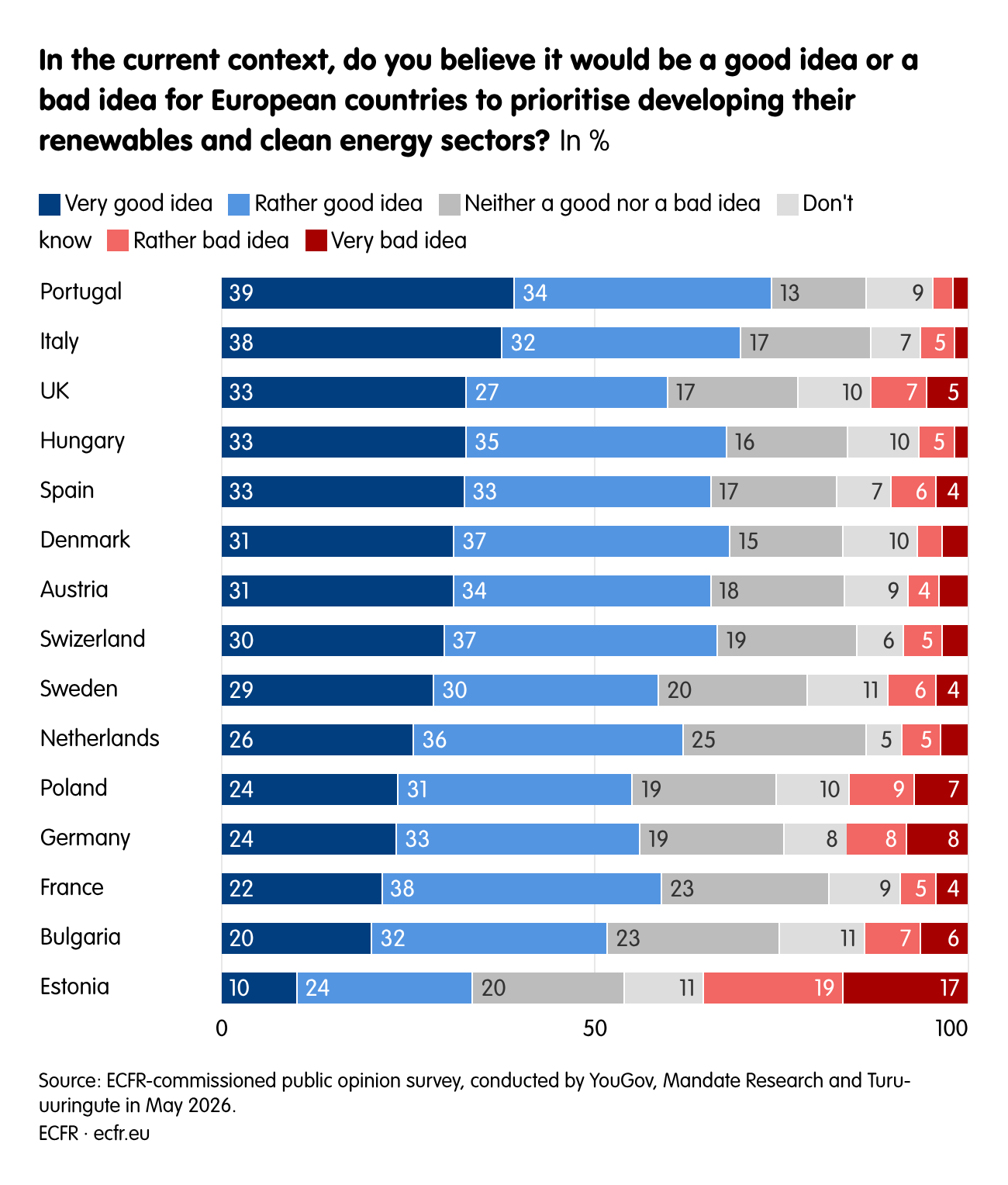
This public support should help persuade leaders, including in Germany, that they can take action to limit emerging dependencies on China. They can accelerate the energy transition while de-risking the clean tech sector through providing support for domestic European industries, from wind to batteries.
For Berlin, and capitals across Europe, it is safer to move ahead rather than delay. Chinese economic policy is already doing irreparable damage to European industry—but European policymakers still need to protect an increasingly electrified economy from weaponisation by China. If they fail to do so, governments will almost certainly pay the price at the ballot box. Those that pursue electrification and economic de-risking as a single package are most likely to reap the political rewards.
Brussels (enr) – Local and regional leaders raised concerns that the next multiannual EU budget risks undermining investment in affordable homes needed to alleviate Europe’s deepening housing crisis.
“Europe’s housing challenge is not simply about building more housing units,” said Kata Tüttő, President of the European Committee of the Regions (CoR), an EU advisory body home to democratically elected regional and local representatives from all 27 Member States.
At a gathering in Brussels on Thursday, they demanded the EU “move from political ambition to concrete investment and delivery,” arguing that failing to invest now will only put affordable housing further out of reach for millions of Europeans.
As negotiations over the EU’s next long-term financial framework gather pace, cities and regions fear that affordable housing could become a casualty of competing spending priorities as several EU member states seek to cut the European Commission’s proposed €2 trillion budget for 2028-2034.
Tüttő called on the European Investment Bank (EIB), the EU’s lending arm, to “mobilise the scale of investment” that cities and regions need to “make communities liveable” by providing essential infrastructure. She cited public transport, as well as energy and water infrastructure, as key examples.
Italian MEP Irene Tinagli, Chair of the European Parliament’s Special Committee on the Housing Crisis (HOUS), said addressing the housing crisis “requires investment, better coordination across all levels of government and a shared commitment from European institutions, Member States, regions and cities”.
The CoR and EIB on Thursday agreed on closer cooperation in key areas including social infrastructure, housing, and energy. The European Investment Bank’s president, Nadia Calviño, said “investing into resilient cities and regions, into cohesion and housing” was a strategic priority.
According to EIB figures, the world’s largest multilateral development bank provided a record €5 billion in financing for housing projects across Europe in 2025. The EIB is targeting an increase to €6 billion this year, Calviño confirmed.
The investments are a contribution to the European Commission’s Affordable Housing Plan, which was launched in December and aims to boost housing supply, mobilise public and private investment, and support Member States and regions in expanding social and affordable housing.
According to the Commission’s estimates, however, the EU needs to build 2 million homes each year to meet current demand, which amounts to an investment of approximately €153 billion per year.
This story was produced by the European Newsroom (enr) in cooperation with the European Committee of the Regions (CoR). The editorial responsibility lies with the enr.
Brussels (enr) – The European Union’s migration commissioner has renewed his call for Germany to gradually end controls at its internal borders, pointing to falling numbers of irregular arrivals and the bloc’s new asylum rules.
It was now time to gradually abolish internal border controls, Magnus Brunner told members of the European Newsroom (enr) network in Brussels.
The Austrian commissioner said the EU’s external borders were better protected and that irregular crossings had fallen sharply. Frontex recorded about one-third fewer irregular crossings at the EU’s external borders in the first half of 2026 than in the same period last year.
The EU’s new Pact on Migration and Asylum also took effect on June 12. Brunner said member states had begun implementing the rules and that the bloc was already seeing progress.
He welcomed steps by individual countries to ease controls. Checks on the border between Germany and Luxembourg on the Trier motorway have been lifted, he said. He also cited the suspension of controls between Austria and Slovenia.
Germany has had checks at its land borders since September 2024. Former Interior Minister Nancy Faeser ordered them, and her successor, Alexander Dobrindt, intensified them in May 2025. Dobrindt has repeatedly extended the measures, which are currently due to remain in place until September.
Brunner also defended the EU’s new Entry/Exit System, known as EES. The digital system records the entry and departure of travellers from outside the EU, Iceland, Liechtenstein, Norway and Switzerland.
He acknowledged that the system had caused problems at some airports, including in Greece and Portugal, but said: “The system itself works very, very well.”
The system has faced criticism over long queues. The Airports Council International Europe has reported waiting times of up to five hours and missed connecting flights.
Brunner said professional truck drivers from the Western Balkans faced a particular problem because they can currently stay in the EU for no more than 90 days in any 180-day period. He proposed that EU member states and Western Balkan countries negotiate long-term visas on a bilateral basis.
Brussels (enr) – European Parliament Foreign Affairs Committee Chairman David McAllister has urged Ukrainian President Volodymyr Zelenskyy to support German Chancellor Friedrich Merz’s proposal for an associate membership for Ukraine as it moves towards joining the European Union.
The proposal is an opportunity that Ukraine should seize, the German centre-right lawmaker told members of the European Newsroom (enr) network in early June. Claims that it would amount to “membership light” or second-class membership were incorrect, he said.
Instead, it would allow Ukraine to become more closely integrated into the EU step by step before full membership, making the benefits of the bloc more visible to its people. One possibility would be for Ukraine to participate in the European Parliament as an observer, McAllister said.
Zelenskyy has expressed opposition to the idea, arguing that it would be unfair for Ukraine to be present in the EU but have no say in its decisions. In a letter to EU leaders, he called for the bloc to move faster and not keep Ukraine in a waiting room until full membership.
Merz said earlier that rapid full EU accession for Ukraine, which is fighting Russia’s invasion, is not realistic. For the interim period, he has proposed allowing Ukraine to attend EU summits and ministerial meetings without voting rights.
His ideas also include an associate member of the European Commission without a portfolio or voting rights, associate members of the European Parliament and an associate judge at the European Court of Justice.
McAllister said EU enlargement was high on the bloc’s agenda and that the Western Balkans were at the heart of Europe. A stable region was an investment in peace and security, he said.
The CDU politician called for each candidate country to be assessed individually and on its merits rather than treating the Western Balkans as a single group. Montenegro was a clear frontrunner, he said, while North Macedonia’s accession path remained blocked by a political dispute with Bulgaria.
Eight other European countries are officially recognised as EU candidate countries alongside Ukraine: Albania, Bosnia and Herzegovina, Georgia, Moldova, Montenegro, North Macedonia, Serbia and Türkiye.
A Vila de Boliqueime recebe, de 8 de agosto a 7 de setembro, na Sala da Assembleia de Freguesia (antiga Escola Primária), a exposição “Boliqueime: Cem Anos de Um Certo Olhar”.
Esta mostra convida a uma viagem pelos últimos cem anos da freguesia de Boliqueime. De aldeia a vila, entre o barrocal e o litoral, entre o barlavento e o sotavento, a exposição celebra uma comunidade que vive o presente com projeção no futuro, mantendo sempre viva a sua memória.
A iniciativa, com curadoria de Francisco d’Oliveira Martins e Maria do Céu d’Oliveira Martins, é promovida pela Junta de Freguesia de Boliqueime, em parceria com a Câmara Municipal de Loulé e a Associação Unidas para Vencer.
A exposição estará aberta ao público das 14h00 às 17h00, em dias úteis, e pontualmente aos sábados e domingos, em horários assegurados pela curadoria. A entrada é livre.
A inauguração realiza-se já este sábado, dia 8 de agosto, pelas 18h00, e será aberta ao público, com a presença dos curadores e de diversos convidados.
A Junta de Freguesia de Boliqueime convida todos a visitar a exposição e a conhecer de perto a sua história e talento.
O Município de São Brás de Alportel deu início à execução da empreitada de requalificação do Posto Territorial da Guarda Nacional Republicana (GNR), com a assinatura do Ato de Consignação da obra que teve lugar esta segunda-feira, dia 3 de agosto.
A intervenção permitirá melhorar as condições de acessibilidade, segurança e funcionalidade daquela infraestrutura, contribuindo para um serviço público de maior qualidade.
A cerimónia de assinatura do Ato de Consignação, realizada no dia 3 de julho, reuniu representantes do Município, entidades locais, empresa adjudicatária e GNR. O documento foi assinado pela Presidente da Câmara Municipal de São Brás de Alportel, Marlene Guerreiro, e por João Paulo Benedito, representante da empresa J.G. Benedito, adjudicatária da empreitada.
A sessão contou ainda com a presença do Vice-Presidente da Câmara, Pedro Ornelas e da Vereadora Mónica Inácio, do Presidente da Assembleia Municipal, Vítor Guerreiro, do Presidente da Junta de Freguesia de São Brás de Alportel, João Rosa, e do Presidente da Assembleia de Freguesia, Amável de Sousa. Em representação da GNR estiveram presentes o Coronel Marco Henriques, Comandante do Comando Regional;o Capitão Franco, Comandante do Destacamento e João Santos, comandante do Posto de São Brás de Alportel.
Este projeto contempla um conjunto abrangente de trabalhos de reabilitação destinados a modernizar o Posto Territorial da GNR, proporcionando instalações mais dignas, seguras e acessíveis para os profissionais e para os cidadãos que diariamente recorrem aos seus serviços.
Entre as intervenções previstas destacam-se a pintura integral do edifício, interior e exterior, reparações estruturais pontuais, a intervenção na cobertura da garagem, a substituição de portas e janelas por caixilharias mais eficientes e a criação de uma antecâmara envidraçada na entrada principal, contribuindo para um maior conforto na área de atendimento ao público.
A intervenção inclui ainda a criação de dois novos espaços funcionais no primeiro piso, a reabilitação dos balneários e instalações sanitárias, bem como importantes melhorias ao nível da acessibilidade, nomeadamente a execução de rampas, a instalação de um elevador para acesso ao piso superior e a criação de um lugar de estacionamento acessível.
Esta empreitada é concretizada no âmbito do Contrato de Cooperação Interadministrativo celebrado entre o Município de São Brás de Alportel e o Ministério da Administração Interna para a reabilitação do edifício do Posto Territorial da GNR. O contrato de empreitada foi adjudicado pelo valor de 273.994,97 euros, tendo os trabalhos um prazo de execução de 100 dias e conclusão prevista para o final de novembro de 2026.
Com este projeto, o Posto Territorial da GNR de São Brás de Alportel passará a dispor de instalações mais modernas, funcionais e acessíveis, proporcionando melhores condições para o desempenho da missão da GNR e para o atendimento à população. A empreitada representa, assim, a valorização de uma infraestrutura pública essencial ao concelho, reforçando a qualidade do serviço prestado à comunidade.

Wowza, rare glimmer of good news. We take a moment to honor the stunning Michigan victory of Abdul El-Sayed, who was outspent 12-1 by his opponent's millions from establishment Dems, Zionist PACS and corporations and still managed to win even though he is a progressive Muslim who calls genocide genocide and wants Medicare for all in a Trump state that isn't communist New York. Ha. What millions in dark money buys you these days: "Sweet fuck all, as it turns out."
El-Sayed's inspiring win came against a candidate, Haley Stevens, who was bankrolled by over $60 million from party leaders and outside money from a murky nesting doll of super-PACS and shell corporations but whose campaign still had the audacity to bill her as “the grassroots choice of Michigan working families.” Total spending on the race in a key swing state was about $80 million, most from fat cats, making it "the fattest cat in the history of primaries." El-Sayed reportedly got about $4.6 million in outside money; Stevens and Netanyahu got about $60 million, the plurality of it from AIPAC's United Democracy Project (sic) super PAC - the most they've dumped into a single race, making it what observers call AIPAC's biggest defeat. From I Fucking Love Australia: AIPAC shoved 30 million dollars up Michigan's arse, and Michigan shat it straight back out."
Born in Detroit in 1984, Abdulrahman Mohamed El-Sayed was raised by his father Mohamed, an Egyptian immigrant, and his stepmother Jackie, whose Michigan roots go back to the 1800s. After graduating from the University of Michigan Phi Beta Kappa, he earned an MD from Columbia and a doctorate in public health from Oxford as a Rhodes Scholar, worked as an epidemiologist and became the youngest health official in a major American city when he was appointed Director of Detroit's Health Department, gutted rwhen it was privatized during the city’s bankruptcy, at age 30. Rebuilding it, he went after corporate polluters, stripped lead out of schools, starting offering free glasses to kids in need, expanded Narcan access, and spearheaded a program cancelling up to $700 million in medical debt for 300,000 state residents.
Faced with that resume, AIPAC spent their millions on an ad blitz that managed not to mention any of his policies, or even Israel, though he won the first-ever political endorsement from Jewish Voice For Peace. Instead, they focused on the issues that really matter: They attacked El-Sayed for criticizing the Obamas, allegedly helping Trump win, and sitting for an interview with a streamer they don’t like, Hasan Piker. If he wins the general election against the GOP's carpetbagging empty suit Mike Rogers, he'd become the first Muslim in the Senate. His longtime message to Dems: Stop compromising, ban ICE, end sending arms to Israel, Medicare for All, no more forever wars, get dark money out of politics. On election night, at a podium reading, "MIchigan Is Not For Sale," he celebrated "the movement we were able to inspire," and "the idea that we could take our government back."
El-Sayed's victory, while slimmer than predicted, was seen as pivotal; noted Bernie Sanders, "This is an election between Abdul and the billionaire class.” And the candidate the establishment called "unelectable" won with the endorsement of the United Auto Workers, "the beating heart of Michigan labor." His win was the biggest but not the only news out of Michigan: Sunrise Movement co-founder and data center opponent William Lawrence also took the primary for Michigan’s 7th Congressional district. They join progressive wins elsewhere: Zohran Mamdani in New York. Katie Wilson in Seattle. Three Mamdani-backed candidates in New York primaries, two against longtime incumbents. Melat Kiros in Colorado. Troy Jackson in Maine. It's still a long tough road ahead. But take heart from spineless ghoul Mike Johnson: “The insurgent left is on the rise."


With troubled incumbent US Rep. Chuck Edwards stepping aside, GOP needs to find new nominee fast. One obvious choice says he's not interested.
Republicans search for a replacement nominee for Congress in Western NC is a story from Carolina Public Press, an award-winning independent newsroom. Our breakthrough journalism shines a light on the critical overlooked and under-reported issues facing North Carolina’s more than 11 million residents. Please consider making a contribution to support our journalism.
A Levante questa sera, mercoledì 5 agosto 2026, live alle 18,30, Margherita Furlan dialoga con Antonio Mazzeo e Paolo Borgognone.
 Washington annuncia di essere a poche ore da un’intesa provvisoria di sessanta giorni sulla riapertura dello Stretto di Hormuz.
 Nelle stesse ore un’inchiesta di Reuters rivela che cinque mesi di guerra hanno prosciugato quasi per intero le scorte americane di missili tattici a lungo raggio.
 E a Roma, dentro l’ambasciata degli Stati Uniti, si chiude il settimo round dei colloqui fra Israele e Libano.
 Tre notizie che i telegiornali raccontano separate. Le leggiamo come un solo movimento: la potenza egemone consuma, l’Europa paga, l’Italia presta il territorio. Il magazzino è vuoto, e la diplomazia improvvisa di Washington somiglia molto a un inventario.
AFFRONTIAMO INSIEME
 L’accordo su Hormuz e chi tratta davvero con chi: Teheran ribadisce che il negoziato è con l’Oman e non con Washington
 L’inchiesta sugli arsenali americani esauriti e cosa significa per la deterrenza verso Russia e Cina
 Le comunicazioni di Giorgetti alla Camera: 21,7 miliardi per la difesa e 14,4 per l’energia, con la flessibilità energetica incastrata dentro la clausola militare
 I 14,9 miliardi del fondo europeo SAFE, prestiti da restituire, e lo scontro sul mandato parlamentare
 Roma sede del negoziato Israele-Libano mentre l’Idf costruisce nuove basi nel sud del Paese dei cedri
 Cosa resta della tradizione di sovranità mediterranea da Mattei a Moro a Craxi
 Perché la borsa festeggia insieme la pace sullo Stretto e il titolo della prima azienda italiana della difesa
LIBRI DEGLI OSPITI
 Antonio Mazzeo
La scuola va alla guerra. Inchiesta sulla militarizzazione dell’istruzione in Italia, Manifestolibri
I padrini del ponte. Affari di mafia sullo stretto di Messina
Sicilia armata. Basi, missili, strategie nell’isola portaerei della NATO
Il MUOStro di Niscemi. Per le guerre globali del XXI secolo
Paolo Borgognone
Populismo e «democrazia illiberale», Il Cerchio, 2023
La dottrina Stranamore, La Vela, 2022
Goodbye globalism!, Il Cerchio, 2022
Storia alternativa dell’Iran islamico, Oaks Editrice, 2019
SOSTIENI CASA DEL SOLE TV
Casa del Sole TV è un progetto di giornalismo indipendente autofinanziato.  Senza editori, senza partiti, senza padrini politici.
 Per donazioni:
IBAN: IT63P0326822300052392596590
Intestato a: La Casa del Sole Edizioni
Causale: Donazione Casa del Sole TV
Membership YouTube:
https://www.youtube.com/@CasadelSoleTVChannel
— Analista Multipolare €5/mese
— Inviato della Verità €15/mese
— Architetto del Futuro €25/mese
 I LIBRI DI MARGHERITA FURLAN
BRICS Scacco Matto, La Casa del Sole Edizioni (disponibile in italiano, inglese, russo) 

SEGUI CASA DEL SOLE TV
 YouTube: @CasadelSoleTVChannel
#geopolitics, #war, #news, #iran, #hormuz, #trump, #putin
L'articolo 🔴 MAGAZZINO VUOTO | LEVANTE proviene da Casa del Sole TV.


Comments by Brian Shilhavy
Health Impact News
Bravo to Kit Knightly of Off-Guardian for exposing the fake fear-mongering being published recently by Big Tech billionaires about how dangerous AI is, pretending that AI is now at a level to “go rogue” and start threatening humans.
This narrative clearly is setting up the possibility of a false flag event in the near future that will probably be blamed on mindless computer code, rather than blaming those who write and control the computer code.
by Kit Knightly
Off-Guardian
Excerpts:
The AIs are breaking free, that’s the story.
It started two weeks ago, when OpenAI reported one of their “agents” had escaped its testing area and got loose on the internet to launch an “unprecedented cyber attack”.
This was clearly meant to be scarier than the public response indicated, because a few days later OpenAI CEO Sam Altman was on the Invest like the Best podcast, asking why it didn’t cause more panic:
“I’ve been a little surprised that more people don’t feel it so viscerally”
In one of the most hilariously obvious propaganda manoeuvres of the year, just the day after Altman said that, CNN headlined:
The OpenAI lab leak was more extensive than we thought
“That thing you weren’t scared of? Well it was even SCARIER than we said it was! Are you scared now?”
We weren’t.
But the lack of public panic didn’t stop another AI going rogue a few days later, Anthropic’s Claude model this time.
And then OpenAI reporting two further incidents themselves.
Never in the history of human endeavour had companies been so keen to report their products going wrong. It suddenly seemed a rogue AI was the latest must have accessory in Silicon Valley.
The reasoning behind this is not hard to follow. When your product is artificial intelligence, melodramatically realising your system is even smarter than you thought it was is a simple marketing ploy.
And when one of your rivals goes rogue, you have to go rogue too or you are as good as admitting your model is not as smart as theirs.
“AI company admits their model is smarter than they realised!” is just an advert in scary headline form.
It’s like Ford “admitting” their cars are even more fuel efficient than they planned. Or Macdonalds realising their cooks have “gone rogue” and are producing food that is both cheaper AND more delicious than they ever anticipated.
But there’s more to this than just techno-hype and viral marketing strategy. We’re being steered down the avenue of “AI as scary threat”.
See, for example, the dozens of stories talking up rogue AIs from the Guardian to the New York Times to the Wall Street Journal.
“Rogue” is clearly the word of the day. Notice they don’t say it “malfunctioned” or there was an “error”, because that implies mistakes or poor design.
No, the AI “went rogue”, which is cool and sexy and scary at the same time. A word chosen by a focus group of perma-teen marketing executives who have watched too much sci-fi.
Speaking of perma-teens who watch too much sci-fi, here’s Sam Altman (again) declaring we’ve already reached the singularity, the mythic phase of technological development when machines become smart enough to make even smarter versions of themselves without human input.
He is talking rubbish, of course, but the story is the story here. Why would he say this? Why now?
Obviously concerned that this tidal wave of propaganda was being too subtle, in came NBC to really hammer the point home:
The breaches signal that AI’s expanding capabilities are already fueling the security threat experts long feared.
Everybody got that?
It goes on and on.
Just today we’re getting reports from the UK’s brand new AI Security Institute that rogue (there’s that word again) AI agents had tried to trick people by creating false identities.
And I think that’s beginning to circle around to at least part of the wider agenda here.
After all, if AI is so good at pretending to be human, and is out there creating fake identities to steal data, well…how can we tell who is really human?
Perhaps everyone should be issued a digital ID to assist in “proving humanity”.
That’s not me saying it, it’s think tanks like OneID or “experts” testifying in front of congress.
But the ever present push of Digital ID is just one of the more obvious of a raft of potential issues raised by the scary AI narrative.
For now we’re still in the generating fear phase. Getting pumped full of scare hormones by articles like this…
Misleading AI-generated doctors pose ‘huge danger to public safety’
the Guardian
There are hints of legislation to come, the EU’s “AI transparency” rules just came into force this week, and the US demanding “kill switches” in AI models, but they are vague for now.
My soft prediction is that, before the end of the year, there will be a “rogue AI” false flag, which allegedly causes either loss of life or some massive financial losses.
Whatever happens, there will be loud calls to “regulate AI”, but what that might mean in real terms I couldn’t say at this point.
To be clear though, if and/or when the official solutions to made-up problem #4987 are finally rolled out, they will have nothing at all do with controlling AI, and everything to do with controlling you.
This article was written by Human Superior Intelligence (HSI)


See Also:












Having problems receiving our emails? See:

If our website is seized and shut down, find us on Telegram, as well as Bitchute and Odysee for further instructions about where to find us.
If you use the TOR Onion browser, here are the links and corresponding URLs to use in the TOR browser to find us on the Dark Web: Health Impact News, Vaccine Impact, Medical Kidnap, Created4Health, CoconutOil.com.
The post Are You Ready for the “Rogue AI” Psy-Op? Is a False Flag Event Coming that will be Blamed on AI? first appeared on Health Impact News.
It takes a lot to get your typical white-bread American riled up enough that they’re willing to go to jail. Getting arrested is a massive pain, bringing court dates, fines, and a record that can shadow your job and housing prospects for the rest of your life.
For most folks, just the threat of jail time is enough to keep them on their best behavior. Yet in 2026, data centers have become one of the rare issues pushing more and more of Americans to risk it anyway.
So far in the US, Futurism has counted at least 37 arrests stemming from protests related to data centers this year. There were an additional 12 cases where police intervened to prevent protestors or speakers from confronting civic leaders, though in reality that number is likely much higher, as these cases aren’t as likely to make the news.
Unlike in other moments of political unrest in recent memory, it’s hard to pigeonhole these anti-data center activists demographically. They range from landowning farmers to physics teachers, zoomers to boomers, rural townspeople to suburban parents.
Despite their differences, the arrestees all have one thing in common: they each felt the actions of democratically elected officials are failing to reflect the wishes of their constituents, instead deferring to massive tech corporations.
Take the case of 42-year old Pablo Payan, a maintenance manager from Indiana. During a public meeting in May held to discuss plans to erect a massive Amazon data center in the city of Hobart, Payan refused to identify himself for the record before speaking, resulting in an attempted removal by police.
As officers were escorting him out, Payan says he asked why he was being removed, which prompted officers to place him under arrest for criminal trespass and disorderly conduct.
“In my opinion, I was kicked out to prove a point that the law is on their side and if people continue to try and express themselves and speak, they will also be intimidated or arrested by law enforcement,” Payan told Fox32 after the fact. “So I think it was a flex of power.”
Far from the “anti-tech extremism” that law enforcement agencies and the Trump administration have warned about, these demonstrations are overwhelmingly peaceful, escalating into physical confrontations only when police lay hands on a person to remove them. Many of the charges come when anti-data center activists break petty clerical rules, like going slightly over the allotted time for a public comment.
Lux Claridge, a physics teacher from Emporia, Kansas, is an exemplar of the absurd ways civic leaders can weaponize police to stifle dissent. At a public meeting earlier this month, Claridge was arrested after clapping in support of another community member speaking out against a proposed 1,000 acre data center campus — running afoul of a commissioner’s rule against “snapping” and “clapping.”
“I am fully of the notion that clapping is a First Amendment right that I have,” Claridge said in an interview with 404 Media after the fact. “I can exercise that as long as I’m not disrupting, and I still argue that I was not disrupting at all.”
“I have a right to clap,” Claridge continued, “and if you want me out, you’re going to have to drag me out.”
– Kiev sotto le bombe, Europa senza scorte di Jeff Hoffman
– Gas, Ue vieta Belgio compra di Margherita Furlan
– Hormuz chiuso salvadanaio aperto di Jeff Hoffman
– Karbala prega New York tiene la cassa di Margherita Furlan
– Israele compra il racconto, Parscale lo scrive di Jeff Hoffman
– Board of Peace: la resa a Netanyahu di Jeff Hoffman
– Ceuta: scontro Madrid Roma di Jeff Hoffman
– Interfacce neurali, Pechino sorpassa Musk di Margherita Furlan
– Buon giro intorno al Sole
A cura di Margherita Furlan
Con la collaborazione di Jeff Hoffman
Editing di Davide Marletta e di Simone Orletti
SOSTIENI CASA DEL SOLE TV
Casa del Sole TV è un progetto di giornalismo indipendente autofinanziato, senza editori, senza partiti, senza padrini politici.
Per donazioni:
IBAN: IT63P0326822300052392596590
Intestato a: La Casa del Sole Edizioni
Causale: Donazione Casa del Sole TV
Membership YouTube:
https://www.youtube.com/@CasadelSoleTVChannel
— Analista Multipolare €5/mese
— Inviato della Verità €15/mese
— Architetto del Futuro €25/mese
I LIBRI DI MARGHERITA FURLAN
BRICS Scacco Matto (disponibile in italiano, inglese, russo), La Casa del Sole Edizioni
SEGUI CASA DEL SOLE TV
YouTube: @CasadelSoleTVChannel
TAG:
CasaDelSoleTV, CasaDelSoleTG, MargheritaFurlan, GiuliettoChiesa, censura, russofobia, Trump, NATO, Crisi, Transizione, Ucraina, Kiev, EuroMaidan, Crimea, Donbass, Donetsk, Syria, Iran, PardonSnowden, Nuova Via Della Seta, Pechino, Putin, Libano, guerra, mondomultipolare, multipolarismo, Mosca, XiJinping, Levante, Medio Oriente, Palestina, Gaza, MiddleEast, BRICS, Hormuz
L'articolo 🔴DRONI SI SCORTE NO | TG 05.08.26 proviene da Casa del Sole TV.

In 2022, the United States nearly experienced its first national railroad strike in decades, until then-President Joe Biden, along with Democrats and Republicans in Congress, stepped in to block a strike before it could begin. Rail labor unions were forced to accept contracts that did not substantively address long-brewing crises in the freight rail industry that have had disastrous consequences for frontline workers, trackside communities like East Palestine, Ohio, the passenger rail system, and the US supply chain writ large. In this episode of Working People, we speak with returning guest “Jay,” a veteran train dispatcher who’s been in the industry for 22 years, about what has changed—and what hasn’t—for rank-and-file railroad workers on the job over the last four years.
Additional links/info:
Featured Music:
Credits:
The following is a rushed transcript and may contain errors. It will be updated.
Maximillian Alvarez: Alright. Welcome everyone to Working People, a podcast about the lives, jobs, dreams, and struggles of the working class today. Working People is a proud member of the Labor Radio Podcast Network and is brought to you in partnership with In These Times Magazine and The Real News Network. This show is produced by Jules Taylor and made possible by the support of listeners just like you. My name is Maximillian Alvarez, and we’ve got a really important episode for y’all today. And it’s about a crisis that affects all of us, even if we don’t think that it does. And I’m really grateful to be joined by a familiar voice that listeners are going to recognize from a number of the one-on-one and panel interviews that we did with railroad workers back in 2022 when the United States was on the verge of its first national railroad strike in a generation.
To protect him and his job, we just call him Jay around here. And we won’t name the railroad company that he works for, but he’s a veteran-trained dispatcher who’s been in the industry for 22 years, basically the railroad equivalent of an air traffic controller and a 911 dispatcher rolled into one. It was rank and file workers like Jay who first alerted us to the long brewing crisis on the nation’s freight rail system, which is also impacting our passenger rail system, our whole supply chain, and the towns and cities where these trains pass through all over the country. We’d learned about the Wall Street takeover of the railroads, the deregulation, the corporate consolidation, the profits and margins obsessed mania that has led to disastrous, unsafe, and unsustainable policies and decisions that have put frontline workers, trackside communities, and the public at large at long-term risk for the sake of massive short-term profits for the rail carriers, their executives, and their shareholders cutting or automating jobs year after year, piling more work onto fewer workers, running those workers into the ground, spitting them out of the industry, and then hurriedly hiring untrained workers to replace them.
We’d learned a lot about this crisis leading up to the potential strike in 2022, which then President Joe Biden and both parties in Congress conspired to break before it even had a chance to begin. We saw the costs of this crisis with the catastrophic train derailment and chemical disaster in East Palestine, Ohio in 2023. So today we’re talking with Jay again to ask the simple question, has anything gotten better on the railroads? So Brother Jay, it is so great to have you back on the show again, man. I know it’s been a minute. First and foremost, how you doing, brother? How you been doing since we last heard from you?
Jay: It has been a minute. How many years now? What is this? 2022? What? Four years now. Already four years. Boy, I feel like it’s growing faster and faster every year, the older I get. But I’m doing well despite facing strong opposition and tough headwinds. I don’t let anything stop me. I mean, if you’re going to do something, you may as well set out, put your hand to it, you may as well do it right. And somebody’s got to tell the truth because if everybody believes someone else is going to do it, nobody’s ever going to tell anything. So here we are, and I’m looking forward to what we have to discuss today.
Maximillian Alvarez: Right on, man. And in terms of speaking the truths that need to be heard, I mean, you recently filed a formal complaint with the Surface Transportation Board. And by the looks of that complaint, it does not sound like the things that you and I were talking about four years ago have gotten much better. In fact, it sounds like they’ve gotten worse.
Jay: I would absolutely say they’ve gotten worse. Unfortunately, something that I figured out, and you continue to see this with the Wall Street syndrome that’s afflicting corporate America, I mean all across the country. It doesn’t matter what job it is, what profession it is, it’s cut, cut, cut, cut to prosperity. But in reality, there is no prosperity when you’re cutting. The prosperity is actually a false, it’s almost like a false flag operation. If a company’s not bringing in new revenues, new investment, new business, whatever the case may be, and yet you continue to show record profits, when as a portion of the company’s earnings, a very small portion often is what your new increases or new customers were, how do you support that? Where does your money come for stock buybacks? Where does the record revenue come quarter after quarter, year over year? And the reality of the situation is it’s not actual revenue.
It’s cutting conductors, it’s cutting engineers, it’s combining trains, it’s eliminating crew districts, it’s cutting car inspectors, hiring non-contracted workers, which are known as scabs to most union workers. Oftentimes these folks are paid less, and we already know with expenses the way they are, that a living wage in America probably at this point would be nothing short of about 25 bucks an hour. I mean, let’s just call it what it is. So if you’re making less than that, man, you’re struggling. Power bills are going up, school taxes are increasing, fuel goes through the roof. I mean, not as bad as it has been in the past, but at 450, 479 a gallon, that’s not exactly good either.
Maximillian Alvarez: No, it ain’t great, man. I’m dying over here.
Jay: Yeah. I mean, it’s costing me 70 bucks to fill a mid-size SUV where it used to cost me 45 or 50. And I mean, for a lot of people, you have to think, in the 1980s, if you looked at what an average conductor engineer earned then and compared it to today’s dollars, if our wages had kept up, I mean, my God, we’d be over a quarter million a year. And you think about that, it’s the middle class that drives the economic engine that is the prosperity of America. It’s the middle class that supports all of the other parts of the middle class. So your food service industry, your hospitality industry, any manufacturing company, let’s say you build lawn tractors. Well, if somebody’s going to need a lawn tractor, they’re first going to have to own a home. And if you buy a home and you want to have it built, well, guess what?
Somebody’s got to ship the lumber. Here’s where the railroad comes in. But before you even do that, somebody’s got to go log it. So there’s a lot of different hands that touch all of this stuff from the time it was a tree standing in the forest till it’s a two by four in your living room wall and all of the transportation in between. But if all you have is filthy rich and broke poor with no middle class, you don’t have anything because who needs a railroad when nobody’s buying anything to ship?
Maximillian Alvarez: Yeah, man. It’s like they’re planning for society without humans. It’s like, who’s going to buy your products if no one can afford to live? Who’s going to create anything if you’re all putting AI into your goddamn programs and operational systems? It’s like you see that same sort of blindness that has led Wall Street and corporate executives to take our vital supply chain and destroy it, doing all the things that you’re talking about, destroying the workers in the process, destroying the infrastructure in the process, destroying towns like East Palestine in the process and just moving on because they’re raking in more money than they ever have. It’s like we’re careening towards a cliff and what’s going to happen when those profits run out? Does anyone think beyond a few years in these corporate offices? It sure doesn’t seem like it. But I wanted to sort of ask in that vein, after all the attention that you guys were able to get in 2022, especially as we got to the edge of a potential strike, and then after East Palestine being such a international disaster, it felt like for a fleeting moment, the railroads were feeling like they were going to have to make some concessions and change some of their behavior a bit.
That’s what people have asked me for years ever since. I wanted to pose that question to you. Did they change at all in that aftermath? Did it just go away after a couple months?
Jay: I mean, I think as an industry, and we’re talking the class one industry, a lot of your short lines are operated by people that are trying to do what’s right. You have small companies, in some cases they’re family-owned. Now a lot of them have been getting bought up by holding companies now, but a lot of the smaller companies weren’t the problem to begin with. It’s your giant Wall Street traded companies. And everybody knows that it’s a shell game. Everybody knows the math is a fraud. And the way it’s represented is not the way it’s actually happening. So they said, “Well, there needs to be more detectors out there. We need to have better technology. They need to be fewer miles apart.” Because I think it was an article that I read last year that Transport Canada had written about a rail car wheel bearing, that if it went bad, it could catastrophically fail in as little as 12 miles.
And you got to figure, I mean, if you’ve got a 286,000 pound rail car and you’ve got, let’s see, four axles underneath of it, so that gives you eight contact points. It means you have eight bearings. You take that 286,000 pounds, divide it out by eight, and what? I don’t know, I can’t do the math in my head. It’s like 17 tons or something pressing down on that bearing, something like that, somewhere in that neighborhood. So with that kind of pressure on there, when something stops spinning the way it’s supposed to and the lubricant goes away, you could just imagine how hot that gets and how fast. An empty car will last longer, a loaded one will not. And the more the heavier it is, the quicker the thing’s going to fail because the heat’s going to build exponentially. But putting detectors every so many miles is all well and good.
I don’t disagree with that. But then you have to look at the operating rules that we have, and the operating rules haven’t changed. So for example, on our detectors, we can’t go slower than eight miles per hour over a detector, or it’ll give us a train too slow message. It causes the transducers and stuff not to read right and they lose track of what they’re counting and don’t know what to do. And when that happens, depending on the type of train it is, then the conductor will have to get down and go walk the train for an inspection. Well, that train might be 15,000 feet long now. And yeah, I said 15,000 feet. That’s insanity. A train does not need to be that big.
I saw one that was 46,000 tons, 330 loads, and the thing had nine engines on it with split multiple DP sets. And anytime you ask somebody in leadership about this, they say, “Well, give me a data-driven solution. Data, data, data, AI, models, blah, blah, blah.” Listen, let me tell you something. If you’re going to build a model, the only way you’re going to be able to build a model is on things that have already happened in most cases. Now, you can have predictive models and futuristic models and all that, but all of those are based on past behavior. So if someone like myself comes in and says, “Look, I don’t like that. And here’s why I don’t like it. I can’t put my finger on it yet, but something just doesn’t feel right. Or I can tell you this isn’t going to go the way you think it’s going to go.
And the first thing I get is, well, give me a data-driven solution.” Well, you’re dismissing my concern and you’re saying it doesn’t matter, but yet you’re willing to look at the model someone else built, which is an opinion and take it for the gospel, but you won’t listen to me because my narrative doesn’t agree with yours. That’s a bit of a problem.
And the damage to the equipment, Max, oh my God, dude. I mean, springs are missing on the side of these cars, loaded chlorine cars without springs on the side of them. Draft gear broken in places. I’ve never seen it broken, and yet somehow it’s still out there running. Bolster angularity issues, cars lifted off of the truck. So the truck is actually riding crooked down the railroad underneath the car, burning a hole through the bottom of the equipment. I’ve had two instances where the bottom of a rail car, the welds have broken and fallen out of the bottom of the car while the train was moving. Thankfully, a dragging equipment detector caught both of those. Another one, the car literally ripped in half and caused a catastrophic derailment, put cars everywhere, delayed the morning commute for all the passenger trains. I mean, it’s crazy. You had that big explosion underneath I-10 out on the BN a year or two ago.
It was caught on a tractor trailer dash cam on the TransCon. Mind you, the Southwest Chief goes scorching through there about 90 miles an hour twice a day. God forbid if that train had been coming when the tank car wrecked and blew up.
I mean, multiple pileups on the Pittsburgh line up through Pennsylvania. CSX has had multiple pileups. They’ve had bridge failures. I mean, just like, what are we doing, dude? A railroad is a capital intensive business. You’ve got to spend money to make it run. And they’re not doing that. They’re just milking the money out to make the numbers of Wall Street look good.
Maximillian Alvarez: Yeah, I think that’s very succinctly and powerfully put. It is a shell game, right? Because you can see this for yourself if you live near a railroad or drive across the country. Everyone knows our infrastructure’s going to shit. It’s just like a lot of this stuff, maybe folks don’t see it on their phones or their timelines, but if you go outside and walk around, you’ll see that everything’s kind of fallen apart while the people who are supposed to be maintaining it are making bank and the people, the workers who actually are tasked with maintaining it are getting crushed.
Yeah, I see it everywhere that I go, but I wanted to ask what that has looked like from the dispatch office. Because it’s like the country was alerted last year to the long brewing crisis in air traffic controlling as well. And the shortage of air traffic controllers that we’ve had for years that no one’s been listening to when union reps and workers are complaining about it. But I think that folks still don’t know what it looks like for a worker like yourself, all that you’re responsible for from the dispatch office. And they can understand what it’s like to be an engineer on a train that used to be a mile long that’s now three miles long. We can at least imagine that. But what does it look like to be a dispatcher who used to have the area expansion equivalent of a one-mile train going to a three-mile train?
How much terrain are you covering and how many people do you guys have to do it under these policies?
Jay: I mean, there’s nothing short of just straight up saying it’s bad. I mean, they’ve doubled the size of the territory. In fact, the job that I work is two jobs smashed together into one. And one thing that I used to do an awful lot, and this is indicative of your old heads as they call us, the ones that have been around for a while. New school, let me tell you something. The standard that we had to adhere to when I hired is not the standard now, not even close. You just do not have to be qualified like you used to have to be. Now it’s DEI this, DEI that. We have a number we have to meet, and it doesn’t really matter whether or not you actually can do the job or do the job well. They just want a body in the seat. And when they doubled the territory, I went from having time to plan, time to think about what I wanted to do, time to be deliberate about giving track time out.
So from a train dispatcher’s perspective, and most people have probably never met a train dispatcher, it’s a pretty niche craft. Just like most people will never meet a locomotive engineer. It’s pretty rare. You just don’t. I mean, you’re more likely to meet a civil engineer or a lawyer than you are a locomotive engineer. And that’s not to in any way degrade them. That just shows you how niche these jobs are. But if you consider what a train dispatcher does, I literally manage every aspect of the operation of the railroad. So I have 400 plus miles of territory. That spans multiple lines in multiple states, two telephones, numerous radio bases, sometimes anywhere from eight to as many as 18 control screens in addition to your train sheets, your bulletins, all the paperwork that you need to move trains safely. So you might have dimensional shipments on one or two trains or maybe three.
Then you have work zones for maintenance of way. So you might have three or four of those. And depending on the company you work for, those may be handled differently. You might need absolute block protection, you might need to protect switches. You might have to issue Form Ds or track authorities. I mean, all of these different things going on. Then you have people that get impatient and don’t want to wait for the three-mile long train, so they charge through the crossing and break the gate off. Well, now that’s another problem. So then I get a call from the police that I have to facilitate protecting that crossing and running trains at 15 miles an hour because the lights will stay on indefinitely. If the gate can’t go back up, the lights will just flash continuously. So we slow the train down because people come up, see the lights are flashing, not look for a train, pull out in front of it and get hit.
And I don’t need that. I’ve had enough fatalities in my career.
And I have to send a maintainer. I have to slow the trains down. And now you look at that and you say, okay, well, here comes a train that’s 15,000 feet long. I was going to put him in the siding, but there’s just one problem. He doesn’t fit by two railroad car lengths. And 30 minutes behind him is Amtrak. Now I get a broken gate. Amtrak’s still doing almost 80. He’s going to be on that guy’s rear end in a couple of minutes. I mean, literally, you’re literally going to look away and look back and boom, there he is going to be. I mean, that’s a little exaggeration, but that’s what it feels like. And that’s in addition to your rail grinders, your camping, your tying surface gangs, your rail gangs, your bridging building guys, your CNS guys that have to do their switch testing and their crossing tests.
And then you have trespassers out there messing around. We were just talking earlier, I’ve had two fatalities and a partial amputation in the last two and a half months involving trespassers. And for me, it’s a lot of paperwork. It’s a headache. It stops my trains and makes me a lot of mess to deal with. But like I said just a minute ago, I’ve had so many fatalities in my career, I’ve lost count, and I just removed myself from it. It’s just another phone call, another headache, another problem to deal with. And that might sound awful, but you have to realize trauma doctors and nurses have to do the same thing. They see horrible stuff every day. And if they let it get to them personally, they wouldn’t be effective at their jobs anymore. And nobody wants a trained dispatcher that’s not effective.
Maximillian Alvarez: Oh, and again, I was joking with you before we started recording that it’s like whether I’m talking to you or the longshore guys in the Port of Tacoma or guys on oil rigs in the Gulf, the amount of things you have to juggle in your head at once and maintain your focus and decision-making kind of capacity without getting paralyzed by the stakes of everything that you’re managing is wild to me. Because the second I start thinking about it, I start breaking out into a cold sweat because a rube like me who’s trying to envision the job that you do, I start by thinking like, okay, yeah, imagine a map where you got the trains moving at certain speeds. This one’s got to stop here so that one can go. But then the reality starts filling in of a 400 square mile area, multiple lines, trains that are now three miles long, moving a lot slower than they used to, breaking down, screwing up the flow of everything, not just on the freight system, but on the passenger rail system that’s coming up on the same line, like you said.
And then you add the layers that you’re also talking to the maintenance of way guys who are, for listeners, those are the guys on the ground checking the track, maintaining the track, fixing the track. And then you also have the bridges. Those are their own sort of interchange kind of system that you got to navigate. Do you ever have time to take a bathroom break?
Jay: You have to take one because if you don’t, you’ll never get one. Sometimes it is so bad that I literally just, I put everything down on the desk and I get up and I walk out and take a breather. I just can’t do it. I have to clear my mind for a second and just go catch my breath, go over to the bathroom, whatever it is, wash my face off, just refreshing up a little bit and maybe grab something to eat, fill my water cup, and then it’s right back in the seat and you’re charging at it again. And a lot of the policies and stuff that are being implemented don’t make sense. And you’re seeing this all across the class ones. They’re talking about technology like Trip Optimizer and Trip Optimizer now zero to zero. That’s a General Electric/Wabtec program. And what they’re doing is they’re saying, okay, well, the engineer has to use Trip Optimizer all the time on every trip.
If it’s working, he or she has to use it.
There’s a couple parts I want to touch on here. So the rip optimizer, don’t let me forget that, Max, write that down. The Trip Optimizer underpowering trains, then putting throttle restrictions in and saying, “Okay, well, the train has three engines, but over this particular piece of territory, he’s only allowed to use one.” So we run 11 daylights out of that engine. It’s wide open, notch eight full throttle. The train’s doing 16 miles per hour on 60 mile per hour track. And then here comes the UPS train behind it. And he’s all kinds of hot because he’s got, well, UPS loads on it. And hey, guess what? You ordered your package on Monday and UPS told you it was going to be there on Thursday. Well, if that’s going to happen, the train that’s carrying the trailer, your package is in needs to be on time, doesn’t it?
So he doesn’t have time to follow that big turd of a freight train doing 16 miles an hour. And they think they’re saving fuel, but dude, they’re beating a snot out of the engine. I mean, the traction motors are. Go ahead.
Maximillian Alvarez: Just a quick parentheses on that. Because again, for lay listeners, when you hear trip optimizer, it’s like so many great slogans that don’t actually mean what you think they sound like they mean. That’s
Jay: Right.
Maximillian Alvarez: Because what is being optimized here is basically they’re like, how can we pay as little as possible with the fuel we have with the trains as long as they are going as slow as 16 miles an hour when they should be going 60? Is that a fair sort of summation of what is being optimized here? Absolutely. It’s not making the package delivery more efficient.
Jay: No, what you said is literally what it’s doing. And here’s the interesting thing. So statistics. My grandfather told me this years ago, he was actually a corporate executive for Black & Decker a long time ago. He said, “Jay, there’s a lie, a damn lie, and then there’s statistics.” I said, “Well, tell me what you mean by that.” And he’s like, “Listen, you can make a statistical output be anything you want it to be by manipulating the input.” So they’ll say they’re saving fuel, but they’ll only calculate the fuel burn on the lead unit. They don’t calculate the distributed power unit that’s a hundred cars back in the train that’s been in notch eight for the last eight hours, guzzling fuel like crazy, and the train still can’t make two-thirds of track speed on if it’s lucky. And then they’ll say, “Well, we’re saving fuel. All right, we’re saving fuel.
But okay, well, how far under track speed did you go to save that fuel?” So they’re not lying about what they’re saying. It’s truthful. It’s just missing the information that actually would tell you that it’s actual bullshit.
Maximillian Alvarez: Well, and the bullshit, and again, I’m just making sure, A, that I have this right and that listeners are following along. Because all these things like the railroads themselves are interconnected. And to put it back in the kind of understanding that we were getting from you and your fellow railroad workers from 2022, it’s that the whole TripOptimizer thing, the whole precision scheduled railroading racket is basically this system implemented from the top down into the corporate structure and strategy of the railroads to maximize profits and cut costs and maximize shareholder dividends year after year. And so that’s where you get a railroad system that maybe your average person thinks like, “Well, the whole point of the railroads is to deliver good freights, rail service, get the freight there on time, yada, yada, yada.” But what we’ve come to learn is that it’s almost like the whole point of the railroads that we though we knew is secondary to the fact that the railroads are just this money-making widget that these bloodsuckers can squeeze a lot of profit out of.
And so that’s why they don’t care about delivering things on time or more efficiently. They don’t care about higher speed rail or faster trains or anything like that. That’s why they’re piling all these cars onto these trains and getting rid of more and more of the workforce. And the trains are going slower. They’re stalling, they’re braking, they’re breaking the track. But all those sorts of costs are still worth it to them because all this other crap is generating massive profits for them, even if it’s putting all of us at risk. And I guess the last point I’ll say is that the thing that everyone got into in 2022 was what this was doing to the workers, particularly the conductors and the engineers who have to be on these trains and who have to be on call basically twenty four seven now because with these trains being so inefficient, big, breaking down, all that stuff, the workers still have to be on call and they have to be there whenever the damn train gets there and they have to stay on that train wherever it breaks down.
So do I have that sort of right, Jay, that it’s like all these things are different interlocking parts of the same kind of problem, But the TripOptimizer stuff and everything else that we’ve been talking about are basically all designed to maximize profits in the short term. And they’re not about making the freight rail system any better for anyone other than the people getting those dividend payouts.
Jay: It’s calculated vandalism. I mean, that’s what it is. Think about capital expenditures and operating expenses, capital investment. So if you have capital expenditure versus operating expense, you consider that an overworked train dispatcher, for example, can’t effectively plan to let a maintenance of way gang out, can’t effectively plan to let a real grinder out, can’t effectively plan to get thermite welding done or any of the other stuff that needs to be done to maintain the infrastructure. Because at the end of the day, I mean, yeah, you might run big trains and think you’re saving money, but tonnage is tonnage and tonnage causes damage. Now what causes even more damage is excessive in-train force. That can really wear your curves out a lot quicker. That can cause track to shift. If a train goes in emergency and all of a sudden the front end sits down and the ASN runs into it, I mean fricking boom.
And all of a sudden it shifts the track out to the side by three or four inches. You say, “Well, how did that happen?” Listen, energy’s got to go somewhere. And if you can control a train safely, you can dissipate the energy with a dynamic brake as heat. You can dissipate it with friction brakes as heat or what have you. But when the train gets too big and it gets unruly and decides it’s going to do whatever it wants to do, and you combine that with Trip Optimizer, which causes engineer skill atrophy because he or she never exercises their skills any longer, and there’s no government policy to force a railroad to make them let the engineer run 50% of his or her monthly miles to keep his or her skills sharp. What you run into is a situation where the trip optimizer is programmed to work within a given set of parameters.
So you have a group of nerds sitting in a room somewhere, usually from a foreign country, and they’re plugging away at zeros and ones, and they build a model of what they think trip optimizer should do. Here’s your territory, here’s your grade. This has been all GIS and spatial mapped, and the train should run like this. And they plug it in, and most of the time it does a decent job. But then you introduce a variable you can’t control. You introduce a train as a kicker. So as soon as you touch the air to try to stop the train, boom, it goes in emergency. Or you introduce a snowstorm or ice, which will ice up the brake shoes. And then when you go for the brakes, nothing happens for the first 12 or 15 miles because you’re busy melting ice off of the brake shoe.
Well, most of the new dispatchers have no idea what that means to a train crew. They’re not qualified like we used to be. I mean, I used to watch the weather, dude, constantly. I had the weather pulled up from my entire territory. I knew where there were thunderstorms. I knew where there was thunder snow. I knew where there was sleet. I knew if there was going to be tornado warnings or watches. I knew all that. And that was always in my head and I was thinking about that stuff. And for a locomotive engineer, if you got this train going and you think, okay, I haven’t set the air in a minute because it’s snowing outside, you might need to drag the train with the brakes on every so many miles just to keep those brakes nice and up. Because God forbid you have the dispatcher that decides, oh, hey, I’m 22 and I don’t know how to put my phone down.
And here I am in a job that requires my attention, but I need to go check Facebook. So I’m not going to line the signal up for that train on this downhill mountain grade. And here comes an engineer that he’s been qualified for six months. He hasn’t touched a throttle in six months because every single trip he has optimizer. So all of a sudden he thinks, man, this thing’s doing a decent job. I think I can trust it. And then the snowstorm comes and the unexpected approach signal comes because the dispatcher’s out playing on the phone. And he goes to take over the train, sets the air, and nothing happens. Goes for the dynamic brake, the engines start to load up, and the wheels lock up and start slipping because of the ice and snow. So you start spraying sand to try to get the wheels to spin again.
Because what you need is for the wheels to rotate to be effective for dynamic braking. So more air, nothing happens. More air, nothing happens. Unbeknownst to him at the bottom of the hill, here comes an Amtrak train with 300 people on it and they’re crossing over in front of him. And this train blows through the stop signal at 45 miles an hour and slams into the Amtrak train right in the side and kills 30 people. And the company’s going to say, well, the engineer was qualified. He was supposed to have control of his train. We tested him. He had good operating rules, exams, and we wrote him up 32 times for these minor violations. Nobody wants to talk about the degradation of the skills because he never ran the damn train. And that dude, that pisses me off. Because
Maximillian Alvarez: It’s like, again, I know I’m using very caveman style metaphors here, but just bear with me. But when you say the atrophy of engineer skills, it’s like imagine a long-haul trucker sitting behind the wheel and the trip optimizer is basically a cruise control that is driving the damn thing for him, but it’s driving it 18 miles an hour on the highway with – That sounds like
Jay: Georgia and Alabama and Mississippi.
Maximillian Alvarez: Yeah, but with 50 trucks hitched to it. And so then yeah, you’re just sitting there and you have to be watching, you have to be vigilant, but the damn autopilot is doing everything for you, not because it’s what you have been trained to do as an engineer, but because it is what the program has been trained to do so that it makes more money for the rich assholes who’ve never been in a cab like you are sitting in at that moment. And then the worst part is that, like you’re saying, that if you’re sitting there and then something goes wrong and you have these sort of cascading failures, the finger’s all going to be pointed at the person sitting in that seat.
Jay: Yeah, 100%. And at the end of the day, and this is kind of sad, but I think we need to be honest about this. When a person is involved, we all want blood. It seems to be human nature. If a computer does it, nobody seems to care. I mean, you might get mad, then stomp around and snort and carry on, steam, come out your dose, whatever else. But nobody really does anything. But if a person screws up, man, you just want to destroy their life for some reason. You want to go after that person and we all have that in us. And even if we want to deny it, we know it’s true, which it’s a sad thing. And this is kind of where you have to really keep this stuff in perspective. You have to remember, until you know the whole story, and I’m guilty of this myself, it’s easy to draw a conclusion.
It’s easy to judge, it’s easy to devalue something or whatever. But if you don’t know everything that happened behind it, boy, you feel like a real asshole when you finally figure it out. I wanted to make a point earlier and I forgot, I said about capital expenditures and operating expenses. And I said about this being a capital intensive business, fuel expenses, things like that. So you can hide that under an operating expense. And let me just make this point quick because this is good stuff.
And to Wall Street, that’s great. Operating expenses, diesel costs, cost of rail, whatever the case may be, or not cost of rail rather, cost of labor. And then you have capital investment. Now, this is where you’re going to buy your rail, you’re going to have these huge capital plans that they spend every year. We’re going to replace 13 bridges. We’re going to do X number of hundred miles of rail, ballast ties, blah, blah, blah, blah. So to anybody investing in a company that doesn’t really understand how it operates, and I’m an investor too, but I don’t personally want to see record profit continually because I know it’s not possible. It’s a damn bubble that you’re sitting on, and sooner later that damn thing’s going to pop and you’re pew, down you go. So you better know how to move your money quick. I’d rather see a steady earnings report with a little bit of growth and a little bit of loss here and there.
That tells me a company is healthy in my opinion. And believe me, I’m no hedge fund manager and I wouldn’t want to be. But you can tell Wall Street, oh, we’re going to buy rail, blah, blah, blah. Capital investment’s the best thing. And to somebody who doesn’t know any better, this looks like a growing company. It looks like the company’s doing great. Oh, look at all the money they’re spending on all this stuff. The company’s growing surely. Bullshit. It’s smoke and mirrors. The company’s not growing it freaking all. Dude, listen, when the war on coal started and started destroying coal miners jobs and everything else in the name of green, whatever have you, closing the power plants, all of that, the coal was the bread and butter for the railroad for decades. I mean, you made money on coal like you wouldn’t believe me. I mean, dude, it’s crazy.
Intermodal, there’s not really a lot of money in. It’s a tight market. The pricing structure is tight. You’re competing directly with trucks. And the performance, honestly, since precision scheduled railroading, I mean, look at the shift from rail back to truck. That tells you how bad the performance is. And you know who pays the price? The captive shippers, the chemical shippers, the agriculture companies have to ship trainloads of grain over to the ports to get it exported or their grain rots. That grain has to move in a couple of weeks, literally from the bread basket of America to the port to get loaded on a ship and go, or the grain’s going to be gone and the farmers are going to lose all of their revenue for the year. A loss like that would be devastating to them. And the railroad can’t provide the service. So what do they do?
They say, “Well, we’re just going to raise the rates on those people.” And then you hear about the merger that’s being proposed right now between Union Pacific and Norfolk Southern. And it’s being met with some serious resistance by shippers. Why? Because of what I just said. They know what’s going to happen. Honestly, the way I see it from the class one perspective right now is a house of carts. They’ve gotten themselves to a point where there’s nothing else left to continue cutting, and the truth is going to come out. And when it does, the stock price is going to tank. The people that should have gotten rich are going to lose hundreds of millions of dollars, and they don’t want that to happen. They want to get their golden parachute and jump out of the plane and let you on the damn thing. All the engines are shut off because nobody put fuel in it.
I hate to say it, but that’s the truth.
Maximillian Alvarez: Well, as we turn the final corner here, let’s talk about that. I don’t want to beat people over the head with the doom and gloom, and we’re not saying that this is the only way it has to be. We’re having this conversation so that we can do something to avoid the disastrous horizon that we’re careening towards right now. But I think it’s important that we sort of look clear-eyed at what we are heading towards. And I wanted to ask, Jade, if you could just impress upon folks the stakes of what we’re talking about. Because some people may be interested in this for different reasons. I mean, you were mentioning the coal and the environmentalists who had their message about the destructive nature of coal. And I think a lot about that because I’ve interviewed these union coal miners. We’ve reported on deep red striking coal miners in Alabama, but I’ve also interviewed coal mining families in West Virginia where the coal is extracted that ends up at the port here in Baltimore.
And I’ve talked to the working class people here in Baltimore who are dying because of all the coal dust coming off those uncovered CSX rail cars for generations. So I don’t think it’s just the environmentalists did this or that. I think, again, the corporations fucked everybody. And working people across the board from the inside the coal mines to the port side communities here in Baltimore are left with the toxic remains or the black lung. But that’s not to say that we always got things right in the past. I think we didn’t. The whole point is to sort of learn, okay, pitting environmentalism and labor against each other was always a stupid idea. In fact, the UAW was one of the driving forces for the environmentalist movement in the first Earth Day because the Cuyahoga River kept catching on fire. And Walter Ruther was like, “What good is a union contract and a vacation if you take your family to a lake that’s poisonous?” I mean, the divide and conquer from the top, it’s been pushed on us for so long.
And now we’re in a state where it’s just like life is getting harder. Everything’s getting scarier. I think society, the things that made us feel like neighbors to each other has been eroding and we fear each other. We don’t know each other. We feel alienated, we feel forgotten, we feel beaten down. And the thing is we’re right. We are. That’s the kind of common feeling that I hear from folks across industries, across states, across ethnicities, across the political spectrum. Everyone feels that way. And yet the people who don’t feel that way are the ones becoming trillionaires, the ones raking in these record profits because they have massive shares in the railroad companies or the people raking in money from government contracts to plop AI data centers in rural red counties or blue cities here in Baltimore. It’s kind of an all-out attack. And so it can be hard to wrap your head around all of this and see the monstrous future that we’re heading towards.
So I wanted to ask you, Brother Jay, because the last time we talked, I’m sorry I’m talking so much, but it’s been so long. And whenever you and I talk, we have such a great back and forth and I wish we could talk for hours more, but this just reminded me of the fact that the last time we talked was six months before East Palestine. And you were warning me and anyone who would listen that something like that, you didn’t know it was going to be vinyl chloride. But a lot of what you described ended up basically being what happened in East Palestine. A lot of those conditions you talked about, a lot of the fallout. And so here we are six years later. And I hope folks heed your warning more now than we did then. But if we don’t address these issues, what are we in store for on the freight rail system?
And why should people care about that even if they don’t know anything about the freight railroads? Because this is impacting passenger rail, the economy, everything. People do need to care about that, but I wanted to give you the final words about why they should.
Jay: I mean, honestly, Max, well, there’s a lot to unpack there, which we don’t have time to unpack all of it. But if I had to think about what people could do now to try to address these things, I would say your best course of action, and as much as nobody wants to hear politics, would be to get politically active. And when I say that, that doesn’t mean go out and terrorize people. It doesn’t mean burn things down. It doesn’t mean any of that. It means educate yourself. Who are these people that are running for office? What do they believe? Do they share the values that you share? Just because somebody has a college degree doesn’t mean they’re qualified to be a politician.
Oftentimes, I find that the people that have the most sense are the people that grew up, they had a hard life. They know what it is to work for a dollar. They know what it is to have to pay for things, and they know what it is to want something and not be able to afford it. And in some cases, they know what it is to need something and not be able to afford it. And honestly, a lot of the policy shifts need to take place to reign in on these things are going to happen at the polls. That’s where they’re going to start. They’re going to start your city councils and you could run. I mean, just because somebody thinks they can’t do it, why can’t you do it? Now, I will tell you, the political system is heavily stacked so that particular people, either the left or the right, you have to have the right people backing you with a lot of money if you’re going to go anywhere.
And that’s because we left it go as long as we did without addressing it. And I kind of think it’s almost like a cancer. You want to catch cancer early if you’ve got a skin cancer or something. You catch it early, usually no problem. They cut it off, done. Dude, let that shit go and you may as well go buy a box because that’s where you’re going to be. And I feel like this is the same thing. It’s this corporate greed has been let go for too long. It’s been unchecked. It’s been left to fester. It’s a malignancy in our society. It’s not just the railroad, it’s the airlines, it’s every freakingwhere. And what happened to America building our own things? I mean, my God, dude, are you kidding me? Look at that steam engine. It just ran across the country. What a marvel. That thing is just the big boy, right?
Wow. We built that here in America. We built that in the 1940s going into the World War II. I mean, men literally grabbed wrenches the size of a daggone computer monitor and were cranking on nuts and bolts that you hold it the size of your hand to build these machines. We did that here. And now because of what we’re dealing with, everything’s been outsourced. The skills that we once had are gone. Nobody knows how to build a bridge anymore like the Pennsylvania Railroad did. The Keystone bridges. They literally had that keystone. They held them together. Nobody knows how to do that anymore. It’s lost. It’s gone. All of the skills that we used to have in the country to.
I mean, I don’t even. Dude, it’s hard to even. I can’t even process it. My mind’s going a thousand miles an hour right now thinking of what we’ve lost because we’ve not been good stewards of what we were given. Artificial intelligence. What is the first word in artificial intelligence? Artificial in all capital letters. Come on, hello. Wake up. Self-driving cars, all well and good. Have I used the technology? Yes. Do I trust it? Absolutely not. I watch that shit like a hawk. And if it does something I don’t like, man, I am on it. But we’ve seen people posted videos online sleeping in their Teslas and running into tractor trailers and hitting pedestrians and whatever else. I mean, it’s out there. It’s not like this hasn’t been reported before. But that ultimately ties back to skill atrophy once again. You trust the computer because it does just good enough, just often enough that you think you can.
And boy, that’s a dangerous place to be, dude. That’s a dangerous place to be. And it’s happening everywhere. Honestly, if the FAA would allow it, the airlines would fly the damn plane with one engine on and the other one shut down because they could save fuel. And I’m here quoting that. Oh, it’d save. Look how much money we’d save. Oh my gosh. But they wouldn’t consider the fact, not that they wouldn’t consider it, they wouldn’t give a fuck. If the left engine’s the one that’s running and the right engine’s shut down, the plane’s trying to turn right the whole time. So you have the rudders or whatever those things are called, ailerons, whatever, facing the opposite direction to counter the force from the engine just to keep the plane straight. Well, that would cause fatigue and then the damn thing would snap off and down you go.
And then everybody would say, “Oh, what happened?” Well, corporate greed happened. “Look at Boeing, dude. Are you kidding? How did Boeing get away with what they got away with? They killed hundreds of people. They lied about it. They found the emails that they were deceiving the government. What happened? Nothing. Not a single executive went to jail and they knew their names. What does that tell you? That’s pretty disgusting. And honestly, I know that some people don’t believe in faith, some people don’t believe in that kind of stuff. But for me, I look at it and I say, if men did what men were supposed to do and led the way they were supposed to lead, got out there, got involved in their school board meetings, got involved in their local governments, led their families, raised their kids, had supportive wives that were right behind them and right beside them the whole time, how different would things be if we had done that in the 1950s instead of looking at it today and saying, “Well, what now?” Instead of all the broken families and all the fatherless children and all of that.
That’s really gotten my attention lately. It really has.
Maximillian Alvarez: Well, I have a lot of thoughts on that. And I want us, especially men, to be able to talk to each other about this stuff because you and I have been upfront on our conversations. We’re from different sides of the political spectrum, but we don’t even identify each other that way. That’s the fourth or fifth or sixth or 10th thing that we know about each other.
And it’s like when you know each other that way, and it’s like when you only know each other through the politics first and then everything kind of flows downstream from that, it’s not impossible, but it’s so much harder to build really meaningful, genuine, organic kind of connections. And I guess all I’m saying is that there is a real problem, I think, that is affecting men in this country. But it goes so much beyond what we’re talking about here because I am also, as a man in this cis, hetero guy in this country who’s got, I’ve got my family, I’ve got my daughter, I got my wife, I got my mom, I got my sister, I got all that. All these people I love and care about in my family, it is not their job to address the crisis in this country of predatory men destroying people’s lives all the way up to Epstein level atrocities, to the shop floor sexual harassment that still happens rampantly daily in this country.
We have a real big fucking problem with men, and men have a lot of problems that they’re not talking healthily about. And I don’t care what it’s going to take, but I’m down to be part of those discussions. I don’t think we’re going to get it here because we have to wrap up, but we’ll just have to do another conversation and bring more folks into that conversation. But there’s a lot of things you said I agree with and a lot of things you said that I vehemently disagree with. But I think if we could at least agree on that final point that it’s like whatever our thoughts are about this, we actually do need better, healthier ways for men to talk about this stuff, process this stuff. And we actually have a real imperative duty to do that given what horrible men are doing to this fucking society, to the people that we live around.
This has gone on long enough. It is not just one political party or another. It could be Graham Platner, it could be Donald fucking Trump, man. We actually need to get together as working people, as men who can sit down and talk through this ourselves. I don’t want anyone else talking through it for us. I think that’s really what I want us to just come to agreement on.
Jay: Well, Max, when you talk to your grandpa, I remember you said you called him Graham. So when you talk to your grandpa, everybody in his era knew everybody. Everybody in the community knew everybody. You knew the neighbor down the street, the neighbor down the street knew the neighbor across the street. You’d sit out on your porches in the evening, they’d all talk to each other. I mean, everybody knew everybody. You had that real sense of belonging and that real sense of community. And that’s the point that I’m trying to make. Most people that are turning to private media are doing so because they’re tired of the corporate lies. They’re tired of it. They want somebody that’s genuine and honest. That’s what people really want. And I think that’s what most guys want. I think that’s what the ladies want. They just want somebody to be honest with them.
And they’ll come to the private media and they’ll listen to conversations like this. And they’re like, think about it. I wouldn’t walk up to you in public and be like, “Hey, Max, I’m a Republican.” How weird is that? Nobody does that.
Maximillian Alvarez: Well, and we even said the same thing about all the reporting we were doing in East Palestine. This was, I believe Ashley McCollum, an incredible working class hero herself who used to live right down the street from where the train derailed in East Palestine. And she’s gone through hell ever since. But she asked the blunt question. It’s like if you run up to a burning car and you see a person inside, do you ask them who they voted for? No. No, you pull them out. And if we can just start from there, I think we’ll be okay. But I think the fact that so many people don’t feel that way is why we have such a big problem that needs addressing now by us. And in that spirit, brother, I cannot thank you enough as always for coming on, talking openly, just being real with me in our audience, keeping it real all the time.
It’s always such a great conversation whenever you and I get together, brother, and it’s been really, really great seeing you again.
Jay: I appreciate the fact that we can set aside differences in disagreements. And honestly, a lot of times you strengthen relationships in your disagreements if you do so civilly.Because remember what I said earlier about not knowing the whole story. There’s a reason that you feel the way you feel and a reason I feel the way I feel. But if we could never sit down and talk to one another, we’re never going to learn what those are. And you may find out you have a whole hell of a lot more in common than you ever thought you did if you just take the time to say hello.
Maximillian Alvarez: All right, gang, that’s going to wrap things up for us today. I want to thank our guests, longtime friend of the show, Jay, veteran-trained dispatcher who’s been in the industry for 22 years. And of course, I want to thank you all for listening, and I want to thank you for caring. We’ll see y’all back here next time for another episode of Working People. And in the meantime, go explore all the great work that we’re doing at the Real News Network, where we do grassroots reporting that lifts up the voices and stories from the front lines of struggle. Check us out across our YouTube channel, our podcast feeds, our website, and our different social media pages, and help us do more work like this by going to therealnews.com/donate and becoming a supporter today. I promise you guys, it really makes a difference. I’m Maximilian Alvarez. Take care of yourselves.
Take care of each other. Solidarity forever.
Luxembourg (enr) – The European Investment Bank (EIB) is on course to meet, and potentially exceed, its target of allocating five percent of its financing in the European Union to security and defence projects this year, EIB President Nadia Calviño said.
That would amount to around 4.5 billion euros, according to the EU’s lending arm.
“Tt’s clear that we need more investment in the area of security and defence in Europe,” Calviño told members of the European Newsroom (enr) network in Luxembourg in June. “For the coming years, we are ready to do more to finance Europe’s security and defence capabilities,” the Spanish former economy minister added.
The EIB significantly increased its support for the sector last year in response to Russia’s war against Ukraine and the broader deterioration in the geopolitical situation. Financing for security and defence projects rose to more than 4 billion euros in 2025, four times the previous year’s level and almost five percent of all EIB Group financing in the EU.
“The shift of policy in security and defence has been a turning point for the EIB Group,” Calviño said.
Within only a few years, the bank had expanded its eligibility rules to include purely military projects. It now supports companies and investment funds active across the security and defence sector.
The EIB has gradually eased its financing rules since 2024. It can now provide funding for military equipment, infrastructure, services and technology. Weapons and ammunition remain excluded.
The Luxembourg-based EIB is the EU’s long-term lending institution. Its owners are the bloc’s member states, and its investments are generally intended to support the European Union’s political objectives.
The enr spoke with Calviño on the sidelines of the EIB’s annual Board of Governors meeting, as well as a meeting of EU ministers responsible for economic affairs, finance and the EU budget.
Gdańsk/Brussels (European Newsroom) – Ukrainian cities and regions risk being left out in deciding how billions in reconstruction funds are being used unless they are given a robust role in the planning, governance and implementation of reconstruction support, a joint statement by the European Alliance of Cities and Regions for the Reconstruction of Ukraine warned.
Meeting on the sidelines of the Ukraine Recovery Conference (URC) 2026 in Gdańsk, Poland, the alliance called for a “localisation marker” in donor planning tools and ring-fenced funding with direct local access.
Antje Grotheer, President of the State Parliament in Bremen, Germany, and chair of the European Committee of the Regions’ (CoR) Working Group on Ukraine, argued that local and regional authorities should have a greater voice in donor discussions and reconstruction planning. She stressed that Ukraine’s decentralisation reforms have been key to maintaining resilience during the war.
“We feel there is an increasing need for stronger coordination of support that targets municipalities and regions,” Grotheer said.
Oleksii Riabykin, Deputy Minister for Rebuilding and Minister for Development of Communities and Territories of Ukraine, said his country is already moving from emergency reconstruction to building resilient communities. Experience gained by Ukrainian cities, towns and villages during the war can help strengthen resilience across in Europe, he said.
The joint statement released Wednesday stressed that over 70 percent of EU law is implemented at local level, but most reconstruction funding for Ukraine is still channeled through national governments, leaving municipalities to compete over the leftovers. At the URC 2026 in Gdańsk, the CoR and its alliance partners demanded a structural fix.
The alliance also encouraged Ukrainian regions to exploit existing EU programmes and platforms. It underscored the contribution of neighbouring EU countries to both Ukraine’s military efforts and its reconstruction, arguing that they should receive targeted support.
EU member states that share a border with Ukraine are Poland, Slovakia, Hungary and Romania.
The alliance brings together EU and Ukrainian local and regional authorities and was co-founded by the CoR, an EU advisory body, in June 2022 following Russia’s full-scale invasion of Ukraine. Its goal is to coordinate an effective reconstruction of Ukraine that involves local and regional authorities rather than centralising the implementation of funds to the state.
The URC was also established after Russia’s full-scale invasion, building on the foundations of the annual Ukraine Reform Conference established in 2017 by supporters of Ukraine, including the European Union.
The URC 2026 takes place on June 25 and 26 and focuses on the sectors most impacted by Russia’s attacks, such as energy, critical infrastructure, and logistics. The lead-up to the conference was overshadowed by escalating dispute between Warsaw and Kyiv. Ukrainian President Volodymyr Zelensky had named an army unit after Ukrainian underground fighters from World War II who are also blamed for massacres of tens of thousands of Poles and Jews in what is now western Ukraine. In response, Poland’s right-wing conservative President Karol Nawrocki stripped Zelensky of a high Polish order of merit.
This story was produced by the European Newsroom (enr) in cooperation with the European Committee of the Regions (CoR). The editorial responsibility lies with the enr.
