Login

Tacheles # 217 ist online
Diese Woche war Tacheles mit Röper und Stein mal wieder sehr „Ukraine-lastig“, aber es gab auch noch einige andere spannende Themen. Sollte YouTube die Sendung löschen, finden Sie sie auch hier bei NuoViso.

Midway through Boyce Upholt’s mind-boggling dispatch, one of his sources sums up the central challenge of the Gulf Coast canid: “Why is there not just a simple explanation for what this thing is?” The “wolfy coyotes” of southeastern Texas hold genetic traces that may link them to red wolves, which were declared extinct in the wild in 1980. But a lack of data makes it challenging to define the species—or, for that matter, to determine whether a private company has cloned the red wolf or something else entirely. Upholt doesn’t deal in simple explanations; the pleasure, here, is in the complexity.
The concept of a “species” is less sturdy than your high school biology teacher might have led you to believe. The most familiar definition is that a species consists of animals that can produce fertile offspring. But that’s a rule various species of canids violate all the time; it’s long been clear that North America’s soup of Canis genes is something less like a family tree and more like a river—one that’s broken by islands and sandbars into many braided channels that split and merge and re-split.

Um violento despiste de um veículo ligeiro comercial na A13 provocou, na tarde desta sexta-feira, uma vítima mortal e um ferido ligeiro, na freguesia de Casais, concelho de Tomar. O alerta foi dado por volta das 15h20, tendo o acidente ocorrido ao quilómetro 138,942, no sentido Norte-Sul, nas proximidades da barragem do Carril e antes da saída para Tomar e para o IC9.
Segundo os dados recolhidos junto das autoridades e dos serviços de socorro, a vítima mortal é um homem de 50 anos, cujo óbito foi declarado no próprio local do acidente. Do mesmo despiste resultou ainda um ferido ligeiro, um jovem de 20 anos, que após ser assistido pelas equipas de emergência foi transportado para o Hospital de Abrantes.
Nas operações de socorro estiveram envolvidos 12 operacionais, apoiados por cinco viaturas, entre as quais a Viatura Médica de Emergência e Reanimação (VMER) do Médio Tejo e elementos da Guarda Nacional Republicana (GNR), que tomaram conta da ocorrência e procederam à regularização do trânsito.
Data: 7 de agosto de 2026
Por: Dino Frazão
Se visualizou esta publicação e ainda não é nosso seguidor, siga a página Os Monhacas para acompanhar mais notícias, alertas de trânsito e atualizações em tempo real!
————————————————–
© 2026 Os Monhacas. Todos os direitos reservados.
Este é um projeto independente de criação de conteúdos.
Se gostou do que leu e ainda não é seguidor, siga a nossa página para ver mais conteúdos!
————————————————–
O conteúdo DESPISTE MORTAL NA A13 EM TOMAR PROVOCA UM MORTO E UM FERIDO LIGEIRO aparece primeiro em OS MONHACAS.
by Brian Shilhavy
Health Impact News
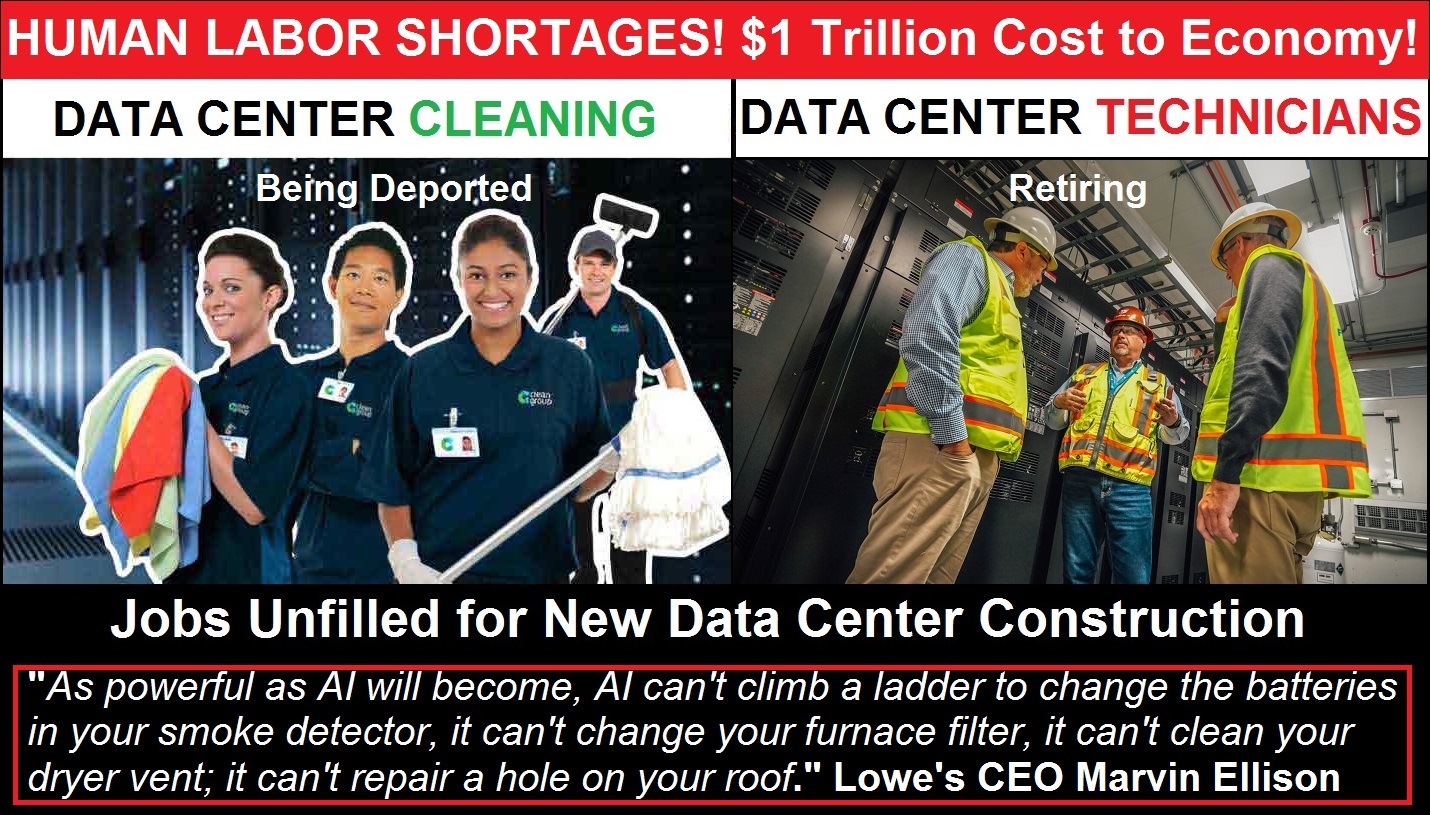
Last year (2025) I reported how there were hundreds of thousands of jobs unfilled to support the boom in data center construction, jobs that only human beings can fulfill. See:
Today, in August of 2026, the situation has only become worse as massive amounts of money continue to be increasingly spent on AI and data centers, while the human labor force continues to diminish.
This is all public knowledge, but it is not in the headlines or known much because people are still getting fat and rich on the AI data center spending.
Earlier this year, a report was published by the U.S. Department of Education which stated that by 2030, an estimated 2.1 million skilled trades jobs in the U.S. could go unfilled, with potential economic losses reaching $1 trillion annually.
America’s ‘silent army’ of skilled tradespeople are retiring with no one to replace them—and the price tag could hit $1 trillion a year
Excerpts:
The workers who keep America’s buildings running are disappearing—and the U.S. isn’t replacing them fast enough to keep the lights on, the servers cool, or the labs sterile.
By 2030, an estimated 2.1 million skilled trades jobs in the U.S. could go unfilled, with potential economic losses reaching $1 trillion annually, according to U.S. Department of Education estimates cited in a new report from JLL shared exclusively with Fortune.
The commercial real estate giant calls the electricians, HVAC technicians, plumbers, pipe fitters, and maintenance workers who maintain the country’s built environment a “silent army”—a workforce that is aging out of the industry faster than it can be replaced.
“The silent army, as we normally call them, because they are hidden, invariably, behind the scenes, has been getting harder and harder not only to find, but retain in the industry,” Paul Morgan, JLL’s global COO of real estate management services, told Fortune.
Plus, “you’ve got this impending retirement wave that has really been driving the industry a long period of time, and a lack of new entrants.”
Morgan is referring to the fact that millions of tradespeople in the U.S. are nearing or at retirement age. More than one in five construction workers is currently older than 55, according to Associated Builders and Contractors.
As of May 2023, about 39% of electricians were 45 years old or older, a Consumer Affairs report shows, and there’s a 5:2 retirement-to-replacement ratio in manufacturing, construction, and other skilled trades, an Education Department report shows.
The supply-demand imbalance has hit crisis territory. Last year alone, nearly 600,000 jobs were posted for major skilled trades positions in the U.S., while only about 150,000 new workers entered the labor pool through apprenticeship programs, according to JLL.
A hidden workforce behind the AI boom
The shortage has caught the attention of some of the country’s most prominent executives, who argue that the U.S. cannot build the infrastructure for AI it’s betting its economic future on without the people to wire, cool, and maintain it.
Ford CEO Jim Farley has consistently warned about the gap, arguing America’s AI ambitions are running headfirst into a labor wall.
“I think the intent is there, but there’s nothing to backfill the ambition,” Farley told Axios last fall.
“How can we reshore all this stuff if we don’t have people to work there?”
Hadrian CEO Chris Power, whose company automates defense manufacturing, has gone further, predicting a wage shock in the trades.
“All the white-collar jobs are going to get automated,” Power said in a recent interview with tech publication Sourcery at the Hill and Valley Forum.
“I think we’re going to see massive hyperinflation in blue-collar salaries.”
Power added that even with robotic welding on his own factory floor, he still can’t hire enough welders to meet demand from the U.S. Navy.
“Everyone, go tell your kids to quit college and university and go get a welding certification,” Power added.
“The country needs you.”
Morgan argues the skilled trades are foundational to nearly every high-growth sector of the economy—a story he says the industry has failed to tell.
But one problem is the lingering perception that blue-collar work isn’t as elite or prestigious as white-collar work.
“As powerful as AI will become, AI can’t climb a ladder to change the batteries in your smoke detector,” Lowe’s CEO Marvin Ellison told Fortune earlier this month.
“It can’t change your furnace filter; it can’t clean your dryer vent; it can’t repair a hole on your roof.”
Morgan also questioned:
“Why wouldn’t somebody want to be an HVAC tech or an electrician or refrigeration specialist in the data center industry?“
He added, “You can’t have AI without data centers supporting them.”
Then today, Fox News published an opinion piece (NOT headline news, as it should be!), admitting that electricity shortages are on the horizon for Americans, due to human labor shortages.
The machines that keep America alive are failing. We forgot how to replace them
We’ve finally admitted that electricity is as essential as water, but we did so too late to avoid disruption
by Brian Tochman
Fox NewsExcerpts:
For 20 years, electricity was the most boring business in America, and our industry built its whole infrastructure strategy around the assumption that things would stay that way.
The numbers tell the story. From 2010 to 2020, U.S. electricity consumption fell by roughly 1%. LEDs, efficient motors and tightening appliance standards quietly cancelled out the electricity used by every new subdivision, factory and data hall, and then some. Demand was flat, and planners treated this as a permanent fact of life rather than as what it actually was: an intermission.
No-growth industries make choices that are perfectly rational, yet corrosive. You don’t fund apprenticeships when there’s no new capacity to staff. You don’t keep spare metallurgical know-how on the payroll when nobody’s ordering. You don’t recruit ambitious 25-year-olds into a sector whose pitch is “stable, essential, and never going anywhere.”
So, the utilities didn’t. The transformer makers didn’t. The steel mills didn’t. The workforce aged in place and the labor pipeline behind it ran dry.
We mistook a flat line for stability and in doing so, allowed a slow decay to occur. Then the line broke.
Since 2020, electricity consumption has reversed two decades of decline and climbed about 7%. Demand for large power transformers, the equipment through which nearly all of America’s electricity passes at some point, has surged 116% since 2019. Data centers, reshoring, electrification and grid hardening all arrived in the same handful of years, descending on an industry that had bought into the idea that it would never grow again.
Facing resurgent demand, we went looking for the people and the parts to meet resurgent demand, and here is what we found: America had forgotten how to make pipes.
Roughly 80% of the large power transformers the United States installs are now imported.
The grain-oriented electrical steel at the heart of every one of them has but a single domestic producer. Lead times for a standard power transformer have stretched to nearly two and a half years, and the larger units that connect power plants to the grid run longer still.
Prices are up more than 77% since 2019. The average transformer already humming away on the American grid is 38 years old, and more than 70% of the fleet is past age 25.
We are simultaneously trying to replace an aging base and build an entirely new one with a supply chain we spent a generation hollowing out.
The hardware shortage gets the headlines. The human one is worse, because you can’t expedite it.
A person cannot, today, enroll anywhere in America to learn how to design or build a large power transformer. The handful of university power-engineering programs that survived the last two decades don’t teach it. They were shrinking before the boom began as students chased software and AI instead.
The knowledge to wind a coil, design a core or run a high-voltage acceptance test is tribal, passed hand-to-hand on a shop floor by master winders, test engineers or metallurgists who understand why a core behaves the way it does. The expertise lives in people, much of it never written down, and roughly half the utility workforce is now over 45 with a large share eligible to retire this decade.
You can stand up a new transformer factory in a couple of years. You cannot conjure an experienced winder in a couple of years, and you can’t enroll one either.
Not referenced in any of these reports, of course, is how so much of the human labor force in the U.S., including factory workers, have now been deported from the U.S. due to Trump’s immigration policies, and many of these people deported were even here legally and Green Card holders.
A total system collapse is inevitable.
This article was written by Human Superior Intelligence (HSI)


See Also:












Having problems receiving our emails? See:

If our website is seized and shut down, find us on Telegram, as well as Bitchute and Odysee for further instructions about where to find us.
If you use the TOR Onion browser, here are the links and corresponding URLs to use in the TOR browser to find us on the Dark Web: Health Impact News, Vaccine Impact, Medical Kidnap, Created4Health, CoconutOil.com.
The post America Does Not Have the Labor to Run the New Data Centers – Potential Loss of $1 Trillion a Year due to Lack of Human Skilled Labor first appeared on Health Impact News.
President Trump is looking for a breakthrough on the Strait of Hormuz and is feeling the pressure of the ongoing war.

Israeli efforts to establish new Jewish settlements and seize Palestinian land have reached a frenzied pitch in the occupied West Bank, where Palestinian residents say they have been encircled and besieged by violent settlers.

Mass surveillance technology might be popular with police departments, but for the US public, it’s becoming an increasingly difficult sell.
At least 54 cities across the US have voted to cancel, non-renew, or reject Flock’s automatic license plate reader (ALPRs) since the start of the year, according to data collected by the Washington Examiner. That comes after reporting in February that some 30 cities had done the same since 2025, indicative of the rising backlash against the tech.
In all, the Examiner reports cities in 23 states have shredded their Flock contracts so far this year, led by California and Wisconsin, which each have seven rejections, cancellations, or deactivations. Other heavy hitters include New York, Washington, and Massachusetts with four each, and Virginia with three.
Though Flock has its cameras in over 5,000 US cities as of July 2026, the rise in rejections at the municipal level comes amidst a tidal wave of outrage around issues of privacy and civil rights.
In cities where civic leaders have been slow to respond to these anxieties, citizens have moved quickly to take matters into their own hands by damaging, obscuring, or stealing the surveillance cameras in order to stop them from recording footage. A rise in official cancelations or rejections shows municipal leaders are catching on to the reality that the American populace broadly disproves of the technology, and they aren’t afraid to show it.
Arguably the highest-profile contract cancellation for Flock came when the Los Angeles Police Department decided to non-renew its years-long contract with the company, a decision motivated by a searing internal audit of the company’s technology. The internal report found that, in just two months, Flock’s ALPRs contributed to 161 false stolen-vehicle alerts, resulting in a false-positive rate of 32.3 percent.
With no sign of the outrage settling anytime soon, it’s likely these 54 cities could just be the start.


This article was originally published by Truthout on Aug. 06, 2026. It is shared here under a Creative Commons (CC BY-NC-ND 4.0) license.
Can a lawsuit hold fossil fuel companies responsible for climate-change and its impact? That’s the question a Washington State-based woman is hoping to answer. Misti Leon is suing several big oil companies — including ExxonMobil, Chevron, BP, and others — over the 2021 heat-related death of her mother Juliana, who died during a record-breaking heat dome over the Pacific Northwest.
For years, individuals and institutions have attempted to protect human lives from climate change using litigation. In 2015, a public interest law firm called Our Children’s Trust, representing nearly two dozen young people sued the federal government for failing to protect them against the impending impacts of fossil fuel emissions. Courts dragged their feet for more than a decade only for the case to reach a dead end at the United States Supreme Court in 2025.
Leon’s civil suit is significant, not just because a Washington judge unexpectedly cleared the case for discovery and trial, but because Leon can directly link her mother’s death to climate change. Scientists concluded that the 2021 heat dome was, in the words of one research paper, “virtually impossible without human-caused climate change.” It’s about a crime that already occurred instead of hypothetical harm.
“Ms. Leon’s case is unique in that it is the first of its kind to seek to hold big oil companies accountable for their role in an individual’s death in a climate-related disaster,” Mike Meno, communications director at the Center for Climate Integrity, a nonprofit advocacy group that supports community efforts to hold Big Oil accountable for climate change, explained in an interview.
Juliana Leon was one of an estimated 1,200 people across the Pacific Northwest whose deaths were linked to the heat dome. “She was found unresponsive in her car,” said Meno. “The medical examiner determined that her death was caused by hyperthermia,” a condition that is the opposite of the more well-known cold-related condition of hypothermia.
Hyperthermia-related deaths have sharply risen over the past decade, a predictable outcome of fossil fuel emissions. Oil companies such as Exxon have long been aware of the devastating impacts their product would have on the climate. “Major oil and gas companies decades ago knew, their own scientists told them internally, that if we kept burning fossil fuels, it would lead to, in the words of one internal Exxon document, potentially catastrophic events, just like the 2021 Pacific Northwest heat dome,” said Meno.
Juliana Leon was one of an estimated 1,200 people across the Pacific Northwest whose deaths were linked to the heat dome.
Big Oil’s failure to act on this information has drawn comparisons to Big Tobacco. Companies like Philip Morris knew about the impacts of cigarette smoking on human health and kept it secret for years. Since that information was made public, individuals suffering from their addictive products have sued repeatedly and won.
A major lawsuit brought by state attorneys general culminated in 1998 in what became known as the Master Settlement Agreement, where dozens of tobacco companies settled to the tune of billions of dollars for public health. Notably, the federal government also sued tobacco companies for violations of racketeering laws over their deception.
Yet while individuals and states are taking action in the case of oil companies, the federal government clearly has no interest in holding Big Oil accountable for climate change. Instead, President Donald Trump says he wants the Justice Department to investigate fossil fuel companies for raising oil prices in the wake of the Iran war. This appears to be a classic case of deflection, given that a majority of voters blame Trump for price increases at the pump. He isn’t interested in holding companies accountable for climate change; he’s upset they made it harder for people to consume oil. Moreover, his administration is suing states for trying to enforce environmental regulations aimed at oil companies.
In addition to keeping their own research secret, fossil fuel companies spent years sowing doubt over the cause-and-effect relationship between greenhouse gases and a warming climate. “What that decades-long deception campaign did is it stole a generation’s worth of time when action could’ve been taken, and we could’ve averted the worst of some of these climate disasters,” said Meno.
This year, more extreme weather records are expected to be broken as climate change intensifies. The first half of 2026 was the third-warmest half-year on record. An El Niño phenomenon developing this year is expected to be one of the strongest in modern history.
Whether or not the Trump administration admits that the climate is changing, Americans know it is. “Anyone of a certain age who can look back over enough time just knows, as a matter of common sense, that the climate we are all living in today is not what we had a few years ago,” said Meno.
The industry knows it too — and, according to Meno, oil companies “are in absolute panic mode, fighting tooth and nail to escape accountability.” Leon’s lawsuit is hardly the only one they fear. Numerous states, counties, cities, and tribal governments are suing Big Oil, and making headway.
Meno explained that companies have “been pleading with the U.S. Supreme Court to take up one of these cases for years.” The Supreme Court finally agreed to review a case in Colorado where that state’s supreme court in May 2025 ruled the City of Boulder and Boulder County could move forward with discovery and trial in their suit against ExxonMobil and Suncor.
Not content with leaving it to the U.S. Supreme Court, Big Oil has been lobbying Congress to grant the industry immunity over its role in climate change — and conservative lawmakers have complied. In April, Wyoming Rep. Harriet Hageman and Texas Sen. Ted Cruz introduced the “Stop Climate Shakedowns Act of 2026.”
If Congress were to pass the bill, according to Meno, it “would be a truly unprecedented legal shield that would strip the public of their right to hold these corporations accountable for the harm they’ve caused.” Meno’s Center for Climate Integrity is urging members of the public to demand their elected representatives vote against Hageman and Cruz’s bill.
Big Oil says it deserves immunity because it shouldn’t be penalized for giving the public what it wants. In a joint statement, American Fuel & Petrochemical Manufacturers President and CEO Chet Thompson and American Petroleum Institute President and CEO Mike Sommers said: “These efforts to retroactively penalize companies for lawfully meeting consumer demand are misguided and counterproductive.”
What they didn’t say is that they have worked for years to prevent fair competition from renewables. It’s why the state of Michigan launched an antitrust lawsuit against ExxonMobil, BP, Chevron, and others because they acted “as a cartel … to forestall meaningful competition from renewable energy in order to maintain their dominance.”
Fossil fuel companies have long known their products are deadly, kept it secret, unfairly ensured their dominance, then argued that they ought not to be sued for delivering a product the public wants. Now, as climate-related deaths stack up, the industry claims it isn’t responsible. Misti Leon, whose mother might be alive today if governments and courts had reined in Big Oil, told The New York Times: “I never would have in a million years guessed that a heat dome and climate change would be what killed my mother and what took her from me. There’s no way to comprehend that and to kind of even rationalize it.”

Yes, progressives and democratic socialists seem to be where all the energy is right now. No, there is no absolutely no need for other Democrats to be afraid of them.

© JEFF KOWALSKY
A cura di Margherita Furlan Con la collaborazione di Jeff Hoffman Editing di Davide Marletta e Simone Orletti  CASA DEL SOLE TV — Informazione libera e indipendente Il nostro lavoro è possibile solo grazie al vostro sostegno. Casa del Sole TV non ha editori forti né finanziamenti pubblici: siamo sostenuti da voi, il nostro pubblico. Se credi nel valore di un’informazione che non tace, aiutaci a continuare.
 Dona tramite bonifico bancario: IBAN: IT63P0326822300052392596590 Intestato a: LA CASA DEL SOLE EDIZIONI Causale: Donazione Casa del Sole TV
 Dona tramite PayPal: paypal.me/casadelsoletv
 Sostegno ricorrente: casadelsole.tv/sostienici Anche un piccolo contributo fa la differenza. Grazie di cuore!

L'articolo 🔴NATO SUNNITA | TG 7.8.26 proviene da Casa del Sole TV.
 A Levante questa sera, venerdì 7 agosto 2026, Margherita Furlan dialoga con lo scrittore e saggista Roberto Quaglia e con Hanieh Tarkian, studiosa del pensiero islamico e del mondo iraniano, su un Golfo che cambia pelle: a luglio le raffinerie statunitensi non hanno importato un solo barile di greggio saudita, primo mese intero dal 1985, mentre alla Mecca Riad, Ankara e Islamabad firmano una clausola di difesa collettiva che ricalca l’articolo 5 atlantico. Affrontiamo insieme:
 la fine dell’architettura petrolio-per-protezione che regge da mezzo secolo il rapporto fra Washington e la monarchia saudita
 le rotte del greggio che puntano a Oriente, dal Mar Rosso all’Asia
 l’Accordo congiunto di difesa fra Arabia Saudita, Turchia e Pakistan e il peso della copertura nucleare di Islamabad
 il caso della citazione mai pronunciata attribuita al comandante dei Pasdaran Ahmad Vahidi, certificata da Netanyahu e smontata dalla stampa israeliana
 che cosa significa tutto questo per l’Italia e per il Mediterraneo
 LIBRI DEGLI OSPITI Roberto Quaglia, Il fondamentalismo hollywoodista. Viaggio in Iran alla scoperta dell’invisibile ideologia dell’Occidente, 2017. Roberto Quaglia, Il mito dell’11 settembre e l’opzione dottor Stranamore, 2006. Hanieh Tarkian, Coraggio e fede. Qassem Soleimani, Passaggio al Bosco, 2022. Hanieh Tarkian, Studio comparativo sulla figura di Maria, Irfan Edizioni, 2013.
 SOSTIENI CASA DEL SOLE TV Casa del Sole TV è un progetto di giornalismo indipendente autofinanziato.
 Per donazioni: IBAN: IT63P0326822300052392596590 Intestato a: La Casa del Sole Edizioni Causale: Donazione Casa del Sole TV
 Membership YouTube:

 / @casadelsoletvchannel — Analista Multipolare €5/mese — Inviato della Verità €15/mese — Architetto del Futuro €25/mese
 I LIBRI DI MARGHERITA FURLAN
 BRICS Scacco Matto (disponibile in italiano, inglese, russo)
 SEGUI CASA DEL SOLE TV
 YouTube: @CasadelSoleTVChannel
L'articolo IL GOLFO SCARICA WASHINGTON? | LEVANTE proviene da Casa del Sole TV.


This story originally appeared in Prism on Aug. 03, 2026.
Following the largest nurses strike in New York City history, Marilyn Shuler and 11 of her co-workers returned to their jobs at Montefiore Hospitals in the Bronx in February, only to find that their work environment had changed in a major way.
At the time, Shuler worked in utilization review, a department that ascertains the need for medical care and whether care is covered by insurance. The veteran nurse, who worked at Montefiore for almost 40 years, had to begin using Datavant, a tool used to abridge the process by which the hospital sends patient and care information to insurance companies. Datavant’s website refers to itself as an AI platform.
Shuler said she and other nurses thought the tool would just help process the backlog of cases created by the nurses strike. But when case volume returned to normal, the 12 nurses working in utilization review were told to continue using Datavant.
In early July, after a few months of using the tool, Shuler was laid off from the position she held for six years. Her colleagues were all laid off too. They felt they had been replaced by artificial intelligence.
Shuler’s case and that of her colleagues, she said, is far from an outlier. Hospitals will continue to automate and eliminate the jobs of nurses and other workers through AI, Shuler added.
Job automation keeps nurses up at night. It was a concern raised by nurses represented by the New York State Nurses Association (NYSNA) earlier in the year, when 15,000 walked off the job demanding a new contract.
“Artificial intelligence should never replace real human caring from a nurse,” NYSNA President Nancy Hagans said in a press release issued when the 12 nurses at Montefiore lost their job.
Montefiore representatives deny having replaced workers with Datavant.
“As is often the case, the claims by NYSNA are inaccurate and misleading,” Joe Solmonese, Montefiore’s senior vice president for government relations and strategic communications, said in an email. “What is true is that we are always investing in new technology to ensure the best care and outcomes for our patients and will continue to do so for the betterment of the people we serve.”
A spokesperson for the hospital said that Datavant’s tools are a nonclinical program that helps facilitate the paperwork process, but did not address whether the program uses AI.
Shuler said the laid-off nurses did not receive proper notice from the hospital. A union representative told the nurses on May 6, National Nurses Day, that the hospital planned to eliminate the 12 utilization review positions.
“We just can’t believe that a machine can replace all the decades of … clinical judgment and knowledge that we have,” Shuler told Prism.
Job automation through AI is bound to impact nurses in other parts of the country too. Joe-Ann Fergus, the executive director of the Massachusetts Nurses Association, said her union, which is engaged in a fierce contract battle with the largest hospital network in the state, is pushing back against an AI future in which hospitals deprioritize workforce development. A future in which hospitals deskill their workers, she said, could be disastrous for patients and hospitals alike.
“We have already begun to see that in places where AI has been introduced around triaging,” Fergus said. “The younger, newer clinicians, the more exposure they have to AI, and the earlier exposure they have to AI, the higher the risk of them deskilling.”
Fergus said healthcare workers should have a background education, but that they should also supplement that with real experience in the field and trial and error. Reading X-ray scans, Fergus said, is an example of a practice that is enhanced by AI tools. But workers should still be able to know what they are looking at.
“We will lose the skill of doctors being able to read those tools as well, and when the inevitable happens that the system goes down, then nobody’s going to know how to read the images,” Fergus said.
Using an AI system that does not account for the historical inequities of the healthcare industry, Fergus said, is also a deep concern. Fergus worries that hospitals might look to save money on the AI products they contract with and end up with a service that is not attuned to serving a diverse population.
“If there’s any issues of racism, or the system is not properly programmed for the population that it’s in, then that additional programming of the AI can amplify the disparities that already exist and can actually result in injuries,” Fergus said.
Despite hospitals onboarding AI systems as an addition to workers’ current workflows, Fergus said it is only a matter of time before hospitals look to automate jobs. She said most hospitals will likely see this as short-term savings.
But if they don’t create more staffing to maintain and continuously train the products, “then the systems become obsolete, and they become harmful to the patients,” Fergus said.
Editorial Team:
Sahar Fatima, Lead Editor
Lara Witt, Top Editor
Stephanie Harris, Copy Editor

E se experimentar a cidade de Lisboa fosse menos condicionado por mapas coloniais e mais capaz de questionar territórios de poder, subalternidade e resistência? Por via da arte e de debates, agosto convida a deslocamentos entre Arroios, a Quinta do Mocho e a Cova da Moura. No livro O Espaço do Cidadão, Milton Santos sustenta que «o modelo cívico forma-se, entre outros, de dois componentes essenciais: a cultura e o território». Tal enunciado desloca a compreensão da cidadania para além da (…)
- Outros artigos
Amid reports that the US has virtually exhausted all its long-range precision munitions, as well as missile interceptors, it is becoming increasingly clear that Washington is in no position to fight a protracted war with Iran and has no real leverage over Tehran.
On August 5, CNN reported that the US military has exhausted nearly 80% of its interceptors for a key missile defense system.
“The US military has burned through nearly four-fifths of its THAAD missile inventory compared to pre-war numbers and roughly half of its Patriot interceptors since the start of the war, according to two sources familiar with the latest inventory report,” it said.
Similarly, the US has exhausted virtually the entire stockpile of highly accurate long-range missiles, such as ATACMS and PrSMs.
Consequently, any possible US-Iran ceasefire agreement is likely to be on terms favorable to Tehran.
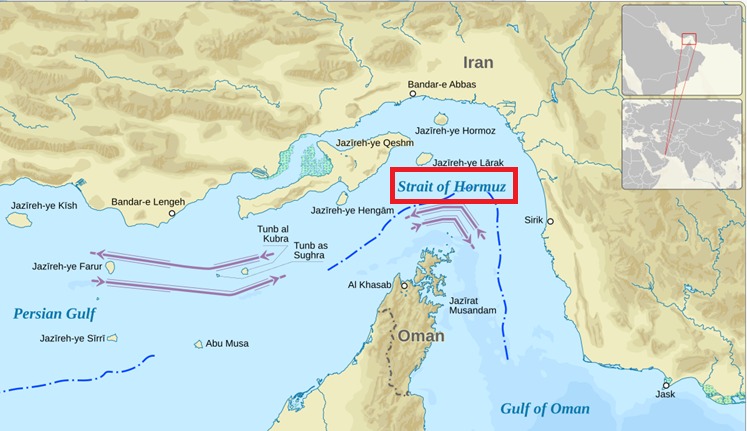
During previous rounds of negotiations, Iran has indicated that while it is agreeable to some compromise on the nuclear issue, it will not compromise on the issue of managing the shipping traffic in the Strait of Hormuz and charging a fee from all ships transiting the narrow maritime corridor.
For instance, according to the June 2026 Memorandum of Understanding (MoU), signed between Tehran and Washington, Iran will make arrangements for the safe passage of commercial vessels “with no charge for 60 days only,” followed by dialogue with Oman and other Persian Gulf littoral states, “to define the future administration and maritime services in the Strait of Hormuz… in line with the applicable international law and the sovereign rights of coastal states.”
Iranian officials interpreted the limited 60-day free period plus the “maritime services” reference as implicitly allowing “service fees” for navigation, security, and environmental protection, once the 60-day window has lapsed.
While the US administration rejected this interpretation, the US media itself, including The New York Times, acknowledged that the language of the MoU was vague and that it formalized Iranian control of the Strait of Hormuz.
Again, multiple media outlets reported earlier this week that Iran and Oman are close to finalizing a deal between them for joint management of the Strait of Hormuz.
Details included Iranian management of vessel entry, joint oversight of exits near the Oman coast, and a “central corridor.”
According to a Reuters report published on August 6, Iran is seeking fees of between 5% and 7% of the price of cargoes from ships using the strait, according to the senior Iranian official. Oman is discussing fees of around 3%, while Washington wants no fees at all.
In normal (pre-war) times, the narrow waterway handled roughly 20–21 million barrels per day of crude and petroleum products, amounting to nearly one-fifth of the world’s total oil consumption and roughly 25% of seaborne oil trade.
According to a Gulf News estimate, this would generate a net profit of US$385 million per day for Iran, or up to US$140 billion per year gross.
A typical Very Large Crude Carrier (VLCC) can carry up to about 2 million barrels.
At an oil price of US$80/barrel, the cargo is worth US$160 million; a 7% fee would equal roughly US$11–11.2 million for that one voyage.
Given that Iran would have to spend a minimal amount of money to oversee the entry of cargo vessels into the Strait of Hormuz, most of this annual revenue of USD140 billion would be ‘net profit’ for Tehran.
Even if Iran spends USD5 billion annually on these expenses, Tehran would still pocket a net profit of USD135 billion.
That is a staggering amount.
For perspective, Egypt’s Suez Canal Authority reported US$4.67 billion in revenue for the 2025/2026 fiscal year.
The income of Egypt’s Suez Canal Authority looks meager when compared to Iran’s prospective income from the Strait of Hormuz if indeed it is able to charge a 7% fee on all cargo vessels passing the maritime corridor.
Indeed, Iran will get control of the world’s most lucrative and profitable tollway.
The disruption in the Hormuz traffic during the last four months has shown that many countries would not mind paying a fee to Tehran as long as it can ensure a steady supply of oil and LNG from the maritime corridor, even if there is no provision under the International Law (International Convention on the Law of the Sea, UNCLOS) allowing a coastal state like Iran to charge for passage through a natural waterway, impose a “toll” or a “service fee”.
In fact, according to Bloomberg, Iran has already started charging a transit fee from commercial vessels crossing the Strait of Hormuz.
The report said that Iran charged as much as USD 2 million per vessel as a transit fee, and many countries paid the fee to Tehran to let their cargo vessels pass from the narrow maritime corridor.
Reports also said that these payments were made in Chinese Yuan.
In March, Lloyd’s List reported that Iran’s IRGC ran a de facto “toll booth” system requiring vetting, clearance codes, and escorts via a controlled corridor.
Meanwhile, the Financial Times reported that transits were mostly linked to Chinese, Indian, or Gulf-linked owners, including some “dark fleet” vessels.
What’s even more is that at USD 135 billion, Iran’s profit from the Strait of Hormuz would beat some of the world’s biggest and most profitable technology companies.
For instance, in 2025, Google’s Alphabet made a profit of USD 132 billion.
Similarly, in fiscal year 2026, Nvidia made a profit of USD 120 billion. Apple made a profit of USD 112 billion. Microsoft made a profit of USD 101 billion. And Saudi Arabia’s oil major Aramco made a profit of USD 105 billion.
These are some of the world’s biggest technology and oil companies, which have reached here after years of hard work and innovation.
However, if Iran’s plans to collect a 5-7% toll fee from all commercial cargo vessels crossing the Strait of Hormuz materialize, Iran will start making more profit than these companies from the first year.
Furthermore, this would be a vicious cycle, as a toll fee of 5-7% would mean that oil prices would go up. This would also mean that insurance prices for these cargo vessels would shoot up, further increasing the oil prices.
As oil prices rise, the absolute value of Iran’s proposed 5–7% toll – calculated on cargo value – would increase in tandem. Consequently, Tehran would benefit twice over: its toll revenues would grow both from higher shipping volumes and from escalating oil prices.
Notably, Iran holds the world’s third-largest oil reserve.
In addition to this windfall gain, another condition of the June Iran-US MoU was that Washington would “undertake with regional partners to develop a definitive mutually agreed plan with at least USD 300 billion for the reconstruction and economic development of the Islamic Republic of Iran.”
Another condition was: “The United States of America undertakes to make fully available for use the frozen or restricted funds and assets of the Islamic Republic of Iran upon the implementation of this MoU. The United States of America and the Islamic Republic of Iran will mutually agree on the procedures related to the release of these funds during the negotiations.”
Estimates of the frozen assets involved ranged from roughly US$12–37 billion; however, some Iranian sources claimed that the frozen assets amounted to over USD 100 billion.

If all these conditions are met, Iran would get a windfall of over USD 500 billion within the first two years. A substantial part of this money is set to be invested in the further development of Iran’s ballistic missile program.
In effect, it could mean that a few years down the line, Iran could be a much stronger adversary, militarily as well as economically.
The repercussions of that for the US and Israel could be devastating.
The post Iran’s $500 Billion Bonanza: How Trump Could Enrich Iran More Than Apple, Nvidia & Microsoft Combined appeared first on EURASIAN TIMES.