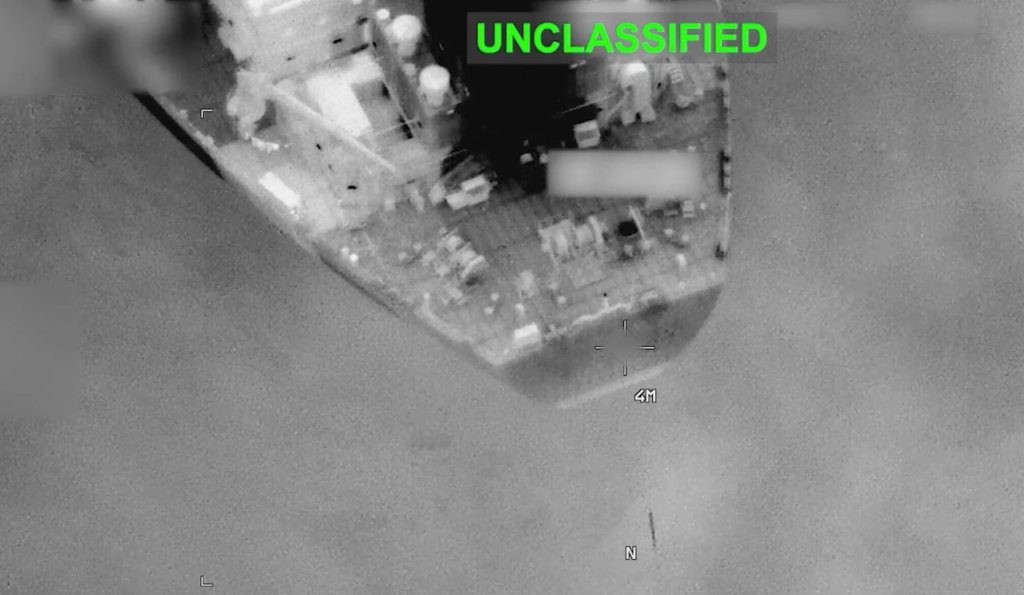
❌

Reading view

Ukrainian Sea Drones Strike Russian Black Sea Resort Town Of Sochi For The First Time

Ukraine carried out one of its farthest uncrewed surface vessel (USV) attacks from Ukrainian shores, striking the Nefrit, a multipurpose offshore vessel, in the Russian Black Sea resort city of Sochi. The seaside getaway is located about 350 miles on a direct line from the nearest Ukrainian-held territory, but the trip is a lot longer if originating from Ukrainian-held shores.

This marks the first known USV attack on this city that Russian President Vladimir Putin often visits. As we have reported in the past, it has been attacked several times by Ukrainian aerial drones.
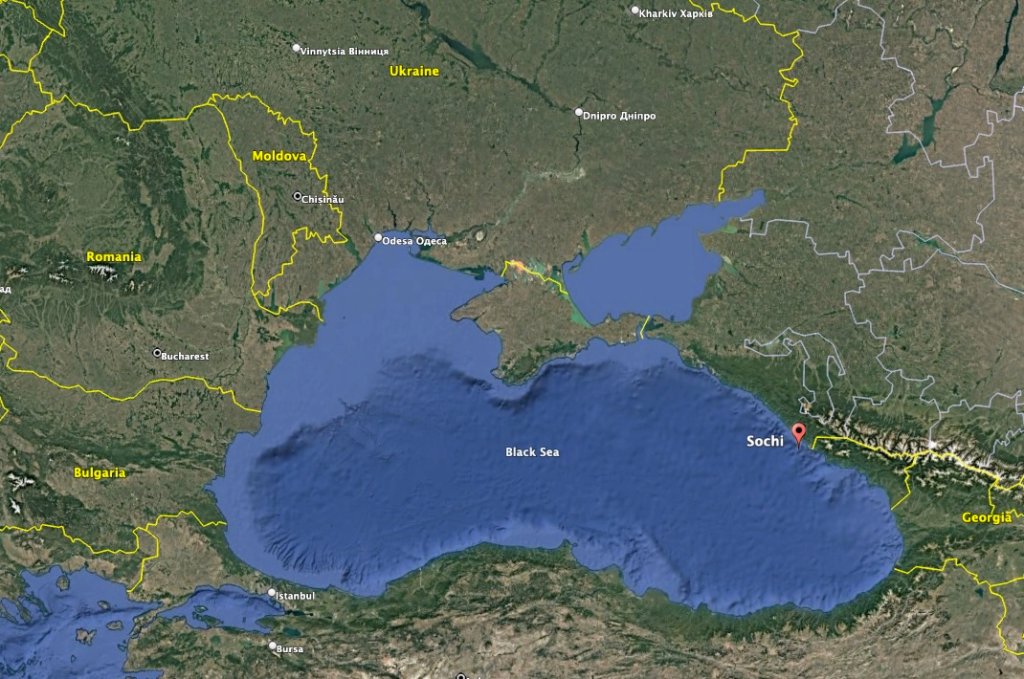
The Russian Black Sea port of Sochi came under attack on Thursday. (Google Earth)

The Ukrainian Navy said it carried out the attack as part of the country’s campaign against Russia’s energy infrastructure. The Nefrit supported that infrastructure, the Ukrainian Navy claimed.

“The multipurpose support vessel, flying the Russian flag, was hit by an unmanned naval vessel of the Ukrainian Navy,” the service said on Telegram. “A powerful explosion and smoke were observed in the area of the vessel.”

“The NEFRIT is part of Russia’s maritime and energy infrastructure, providing support for oil and gas operations, servicing offshore facilities, transporting cargo and personnel, and carrying out underwater technical work,” the Ukrainian Navy explained. “Its activities directly supported the enemy’s war economy and financed the criminal aggression against Ukraine.”

“The damage to the NEFRIT is a blow to the enemy’s logistics, special capabilities, and military-economic infrastructure,” the Ukrainian Navy added. “The Ukrainian Navy continues to deprive the enemy of resources and capabilities for waging war, and once again demonstrates that even Russian territory is not a safe haven.”

🇺🇦⚓ВМС України уразили судно забезпечення рф NEFRIT у порту Сочі
Багатоцільове судно забезпечення під прапором рф було уражене морським безекіпажним катером Військово-Морських Сил. У районі судна зафіксовано потужний вибух та задимлення.

Детальніше https://t.co/DTfnO15nYO pic.twitter.com/yPDFkks37r

— Військово-Морські Сили ЗС України (@UA_NAVY) September 3, 2026

While the Ukrainian Navy claimed the Nefrit was damaged, the extent of that is hard to determine from imagery emerging on social media.

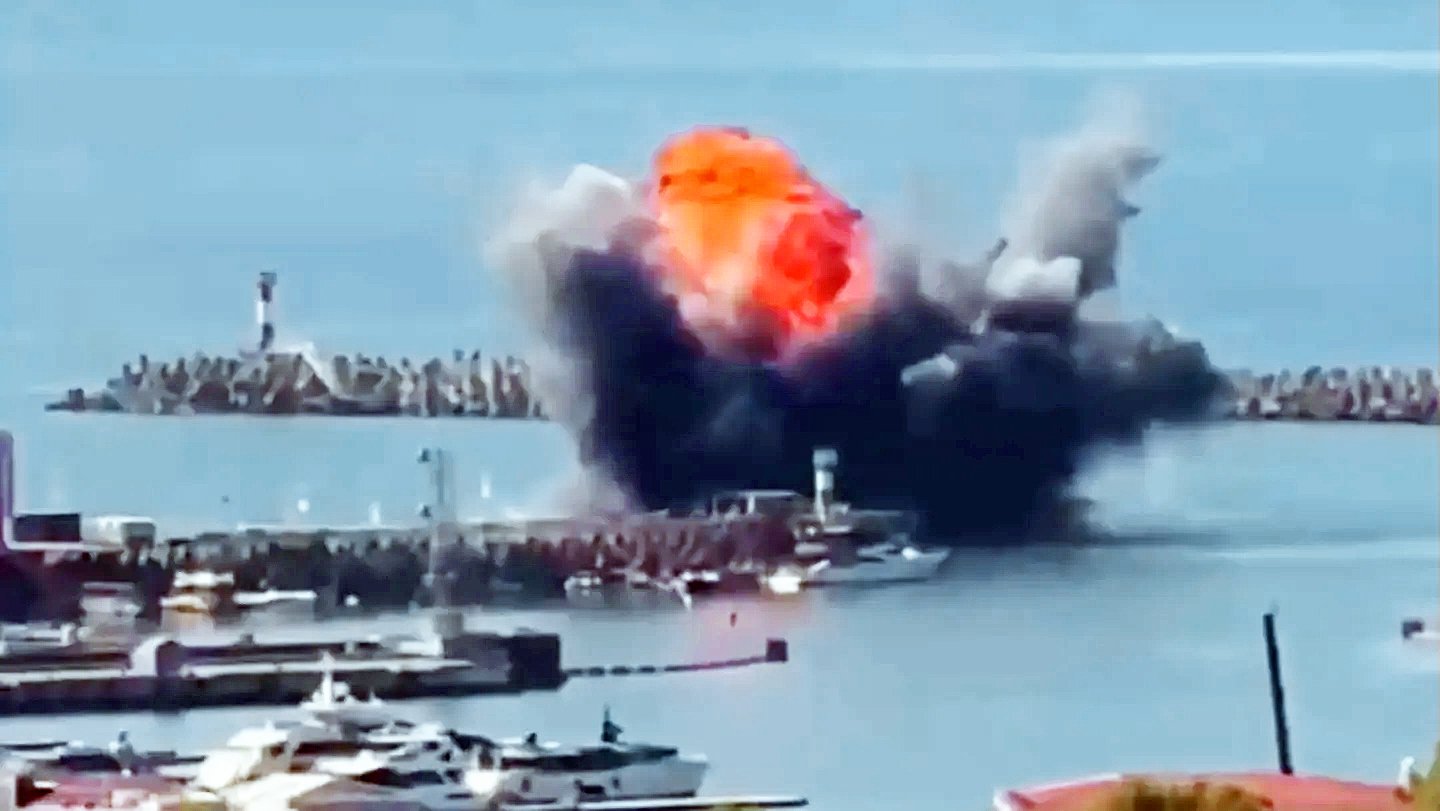
Some video, shot from inside the city, shows a large explosion at the port.

❗The moment of today’s explosion of a Ukrainian surface kamikaze drone next to a Russian ship in Sochi. pic.twitter.com/zpavwj97BW

— 🪖MilitaryNewsUA🇺🇦 (@front_ukrainian) September 3, 2026

The port in Sochi, Russia, came under attack from Ukrainian naval drones. pic.twitter.com/XygeQLaAWi

— Open Source Intel (@Osint613) September 3, 2026

A still picture shows smoke wafting from the Nefrit; however, the quality of the image makes it hard to determine the vessel’s condition.

Sochi: footage of this morning’s USV raid on the seaport.

The likely target was a Multipurpose Supply Vessel (MPSV) used to support offshore oil and gas operations. pic.twitter.com/Ndr5bRAYV5

— Exilenova+ (@Exilenova_plus) September 3, 2026

There is also video of one of the USVs being destroyed before it could reach its target.

Ukrainian sea drone sails into Sochi port in fascist Russia – appears to be hit by machine gun or cannon fire. https://t.co/GaCZHPu1DJ

— Euan MacDonald (@Euan_MacDonald) September 3, 2026

Starting at about 6 a.m. local time, Sochi Mayor Andrey Proshunin declared an emergency.

“ATTENTION! THREAT OF A USV ATTACK IN SOCHI,” he warned on Telegram. “All forces and resources are working to defend the city. Take shelter in a safe place, remain calm.”

Sochi Mayor Andrey Proshunin declared an emergency about an impending sea drone attack on Thursday. (Sochi Mayor Andrey Proshunin’s Telegram)

About a half hour later, Proshunin issued an all-clear notice, but did not provide any details about what happened.

Sochi Mayor Andrey Proshunin lifted the emergency about a half hour after it started. (Sochi Mayor Andrey Proshunin’s Telegram)

There was no immediate response from the Kremlin.

Ukraine has carried out long-distance USV attacks on Russian Black Sea targets in the past, including one in 2023 on the Ropucha class vessel Olenegorsky Gornyak, located in Russia’s Black Sea port of Novorossiysk. A major Russian port on the eastern coast of the Black Sea, it sits roughly 420 miles from Ukrainian-held shores. Sochi is about 110 miles southeast of Novorossiysk, meaning the USVs in today’s attack would have had to travel an even longer distance if launched from Ukrainian-held shores. However, the launch point of the Sochi USV strike is not publicly known and there is always the possibility that a mothership could have been used.

The attack occurring during broad daylight is also interesting, as Ukraine has often taken advantage of the cover of darkness for USV strike operations on port facilities.

You can see a video of that strike below:

Footage of the Ukrainian USV hitting the Russian Ropucha class LST. pic.twitter.com/ksLP9PZfE5

— OSINTtechnical (@Osinttechnical) August 4, 2023

The strike on the Nefrit is the latest in Ukraine’s long-running drone boat campaign in the Black Sea. This onslaught has already kept Russia’s Black Sea Fleet (BSF) at bay, forcing it to retreat from Crimea to Novorossiysk. Ukrainian USVs have also damaged enemy military facilities in occupied Crimea and the Kerch Bridge.

The Houthi rebels of Yemen actually pioneered the operational use of kamikaze USVs years ago. We first reported about this capability in January 2017, when an explosive-laden Houthi USV struck a Saudi frigate. Before that, Iran developed various crude kamikaze USVs and those capabilities soon migrated to their Houthi proxies, which put them to use in the Red Sea for the first time.

In July, the U.S. military used USVs as combat weapons for the first time, striking Iranian targets in Bandar Abbas. The following video shows that attack.

Yesterday, using multiple one-way attack surface drones, CENTCOM forces successfully struck a submarine and ship maintenance facility in Iran. Three Corsair unmanned surface vessels hit the port at Bandar Abbas Naval Base, marking the first time American forces have employed sea… pic.twitter.com/bOM2kmgRxz

— U.S. Central Command (@CENTCOM) July 13, 2026

It may be a day or so before we get a better picture of the extent of the damage to the Nefrit. Regardless, the attack itself is another sign that Ukraine can reach targets with sea drones far from its own shores.

The Latest

All across the battlefield, Ukrainian forces are largely holding off continued Russian attacks or are making small advances. Overall, in August, “Russian forces advanced or infiltrated into about 123.53 square kilometers — an average pace of 3.98 square kilometers per day,” according to the Institute for the Study of War (ISW). “Russian forces’ main territorial gains in August 2026 have been in the Fortress Belt area, Donetsk Oblast. Even there, Russian forces managed to achieve only marginal tactical gains and have thus far failed to complete the seizure of Kostyantynivka.”

Here are some key takeaways from the ISW assessment.

  • Kharkiv: Russian forces continued offensive operations in northern Kharkiv Oblast and the Velykyi Burluk direction on September 1 and 2 but did not advance. Russian forces also continued offensive operations in the Borova and Kupyansk directions on September 2 but did not advance. However, Moscow’s troops continued attempts to secure and expand the bridgehead on the left bank of the Oskil River to enable further infiltrations into Kupyansk.
  • Donetsk: Ukrainian forces recently defeated a Russian infiltration mission in the Slovyansk direction. They also recently maintained positions or advanced in the Dobropillya tactical area. Russian forces continued offensive operations in the Novopavlivka direction on September 1 and 2 but did not advance. Neither Ukrainian nor Russian forces reported ground activity in the Oleksandrivka direction on September 2.
  • Zaporizhia: Russian forces continued offensive operations in the Hulyaipole direction on September 1 and 2 but did not advance. Russian forces continued offensive operations in western Zaporizhia Oblast on September 1 and 2 but did not advance as Ukrainian forces counterattacked west of Orikhiv.
  • Kherson: Neither Russian nor Ukrainian forces reported ground activity in the Kherson direction on September 2.

MORE 🧵(1/3): ISW has observed evidence to assess that Russian forces consolidated positions in or seized about 90.35 square kilometers of territory in Ukraine in August 2026, averaging 2.91 square kilometers seized per day. Including Russian infiltrations, Russian forces… https://t.co/0RlwRfBdhs pic.twitter.com/Cp2Knry2Du

— Institute for the Study of War (@TheStudyofWar) September 2, 2026

Air traffic around Moscow continued to be disrupted on Thursday as Russian authorities responded to another large-scale Ukrainian drone operation, according to EU Today. The disruptions came two days after President Volodymyr Zelensky warned international airlines and insurers that Russian airspace was becoming increasingly unsafe for civilian aviation due to Ukrainian drone attacks.

Moscow Mayor Sergei Sobyanin said that 548 drones had flown towards the wider Moscow region between 8 a.m. on Wednesday and midday Thursday local time. However, Russian authorities claimed that most were intercepted before they could reach the Moscow area while 143 were destroyed on approaches to the Russian capital.

“Temporary restrictions were again imposed at Moscow’s principal airports,” EU Today noted. “Vnukovo and Domodedovo stopped arrivals and departures for periods during the operation, while Sheremetyevo handled flights under additional restrictions. The measures produced cancellations, delays and diversions extending beyond the periods in which individual airports were formally closed.”

The disruption “had already become extensive on Wednesday,” the publication added. “Flight-tracking data showed 21 cancellations and 235 delayed services at Sheremetyevo, Russia’s largest airport, while Vnukovo recorded 22 cancellations and 94 delays.”

⚡ Moscow airports cancel flights after Zelensky's 'closed skies' warning

"Temporary restrictions on the arrival and departure of aircraft have been introduced," Russia's Federal Air Transport Agency (Rosaviatsia) said.https://t.co/BAlAASaDv5

— The Kyiv Independent (@KyivIndependent) September 3, 2026

Putin on Thursday said there is a chance of resolving the “Ukrainian conflict” but Kyiv’s campaign to shut down Russian airspace is “complicating the negotiation process.”

Russia and Ukraine themselves must reach an agreement, while other countries can only support and assist, the Russian leader added, according to a translation from former Ukrainian government official Anton Gerashchenko.

Russia is in contact with the White House and President Donald Trump “is committed to positive and constructive engagement,” Putin proclaimed. “Russia has many friends in the United States. One of them is Steven Seagal, the ‘best envoy of peace.'”

Putin said there is a chance of resolving the "Ukrainian conflict" but Ukraine's threats to shut down Russian airspace are "complicating the negotiation process."

Comment from me: Putin's orders to attack Ukrainian energy infrastructure aren't complicating anything, it seems… https://t.co/QYJ3AKXjou pic.twitter.com/C1NKz3V7cH

— Anton Gerashchenko (@Gerashchenko_en) September 3, 2026

A Russian drone strike on an Odesa apartment building injured at least 17 people, including three children, Zelensky stated on X.

In Odesa, emergency services continue working at the site of a drone strike on an apartment building. Damage to apartments from the 10th through the 17th floors left 17 people injured, including three children. Efforts are also ongoing to deal with the aftermath of the strikes in… pic.twitter.com/FWAmFNJSYp

— Volodymyr Zelenskyy / Володимир Зеленський (@ZelenskyyUa) September 3, 2026

Overall, Ukraine says its air defenses downed or suppressed 135 of 163 Russian drones launched overnight, including Shahed-type UAVs, about half of which were jet-powered. Russia also used S-8000 Banderol, Gerbera and decoy drones. Hits were recorded at 15 locations and debris fell at four.

Ukraine says air defenses downed or suppressed 135 of 163 Russian drones launched overnight, including Shahed-type UAVs, about half of them jet-powered. Russia also used S-8000 Banderol, Gerbera and decoy drones. Hits were recorded at 15 locations and debris fell at four.… pic.twitter.com/JyxTS6QBzL

— NOELREPORTS 🇪🇺 🇺🇦 (@NOELreports) September 3, 2026

Russia has been increasingly using jet-powered drones to attack Ukraine. The Ukrainian Defense Ministry released video it says shows troops from the 208th Anti-Aircraft Missile Brigade downing one of those drones. The jet powered Shahed-like one-way attack drones fly higher and faster than their propeller-driven cousins, making them harder to intercept by more cost effective and plentiful means, such as Ukraine’s many drone interceptors. Instead, much more expensive and increasingly scare missile must be used in some circumstances.

💥Shaheds down!

Jet-powered Russian strike drones intercepted on September 2.

📹: 208th Anti-aircraft Missile Brigade pic.twitter.com/ZXkbZMO5an

— Defense of Ukraine (@DefenceU) September 3, 2026

What appears to be the first video of Ukrainian troops using Cold War-era Leopard 1 tanks with turrets swapped out for the Rheinmetall Skyranger 35 short-range air defense system has emerged on social media. The @deaidua X account that tracks German war materiel donations to Ukraine said the 1020th Anti-Aircraft Missile Regiment recently took delivery of this system, designed to be a highly mobile counter to a range of aerial threats.

The Skyranger 35 “is equipped with a KDG 35/1000 revolver cannon in 35 mm x 228 caliber with a firing rate of 1,000 rounds per minute,” according to Rheinmetall, which began delivering these to Ukraine in January. “It has an effective range of up to 4,000 meters and a high degree of commonality with the Oerlikon Revolver Gun Mk 3. Thanks to AHEAD technology, the Skyranger 35 is airburst-capable. In the future, it will also be possible to equip it with modern guided missiles.”

It seems that Ukraine's 1020th Anti-Aircraft Missile Regiment which belongs to the Ground Forces has taken delivery of the first Skyranger 35 SPAAGs mounted on a Leopard 1 chassis made by @RheinmetallAG.

A contract for the delivery of the Skyranger 35 SPAAGs was signed in H2 of… pic.twitter.com/VRWhGx1LCa

— GAU (@deaidua) September 3, 2026

A new documentary about Ukraine’s use of the combat-proven National Advanced Surface-to-Air Missile System (NASAMS) air defense system debuts tomorrow.

“Sky Defenders is a new documentary taking audiences inside the increasingly critical battle to protect the skies of Europe and Ukraine,” according to the film’s producers. “Launching globally on Apple TV and Amazon Prime on Sept. 4, the 50-minute film explores the people, technology and strategy behind modern air defense and the race to stop missiles and drones before they reach their targets.”

A new video shows a Russian soldier being attacked by three Ukrainian kamikaze drones simultaneously, underscoring just how dense the drone threat has become to troops near the front.

That kind of attrition is also visible around Pokrovsk, where Ukrainian kamikaze drones are increasingly coordinating strikes against individual Russian infantrymen and small assault groups.https://t.co/HfKBCW7ZOm

— ZSU News (@ZSUNews) September 3, 2026

It’s been more than three years since the Russians captured the town of Bakhmut in the eastern Donetsk region after a long battle that incurred a tremendous toll on personnel and equipment on both sides of the fight. New drone video has emerged showing the city remains in ruins, with blocks and blocks of vacant and destroyed buildings.

A harrowing new video from Bakhmut, filmed in the summer of 2026. The Ukrainian city was captured by the Russians three years ago and has lain in ruins ever since.

In this once-vibrant city of 72,000 inhabitants, there are no longer any shops, schools, kindergartens, cafés,… pic.twitter.com/clFfLu5jkq

— Jürgen Nauditt 🇩🇪🇺🇦 (@jurgen_nauditt) September 3, 2026

That’s it for now. We’ll update this story with new details when they emerge.

Contact the author: howard@twz.com

The post Ukrainian Sea Drones Strike Russian Black Sea Resort Town Of Sochi For The First Time appeared first on TWZ.
  •  

La Ahnenerbe nazi realizó más de 200 copias exactas del arte rupestre escandinavo de la Edad del Bronce: ¿para qué servían los moldes?

En la década de 1930, el régimen nazi alemán puso en marcha un ambicioso programa de investigación arqueológica con un objetivo claro: demostrar que la cultura germánica era la más antigua y superior del mundo. Para ello, la organización conocida como Ahnenerbe (Herencia Ancestral) envió dos expediciones a Escandinavia con la misión de hacer moldes […]

  •  

First USAF F-15EX To Be Based In Japan Departs Boeing’s St. Louis Plant

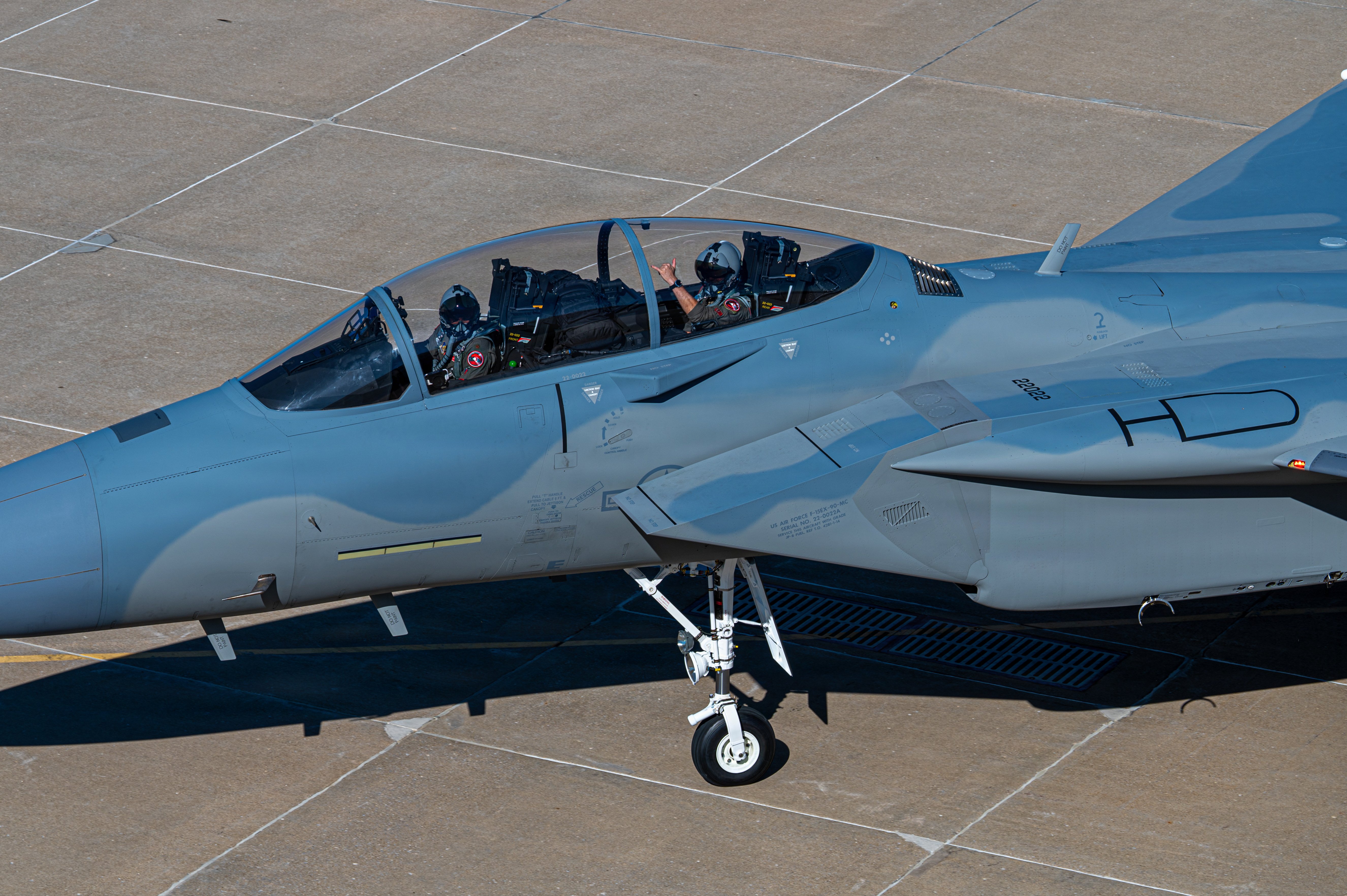
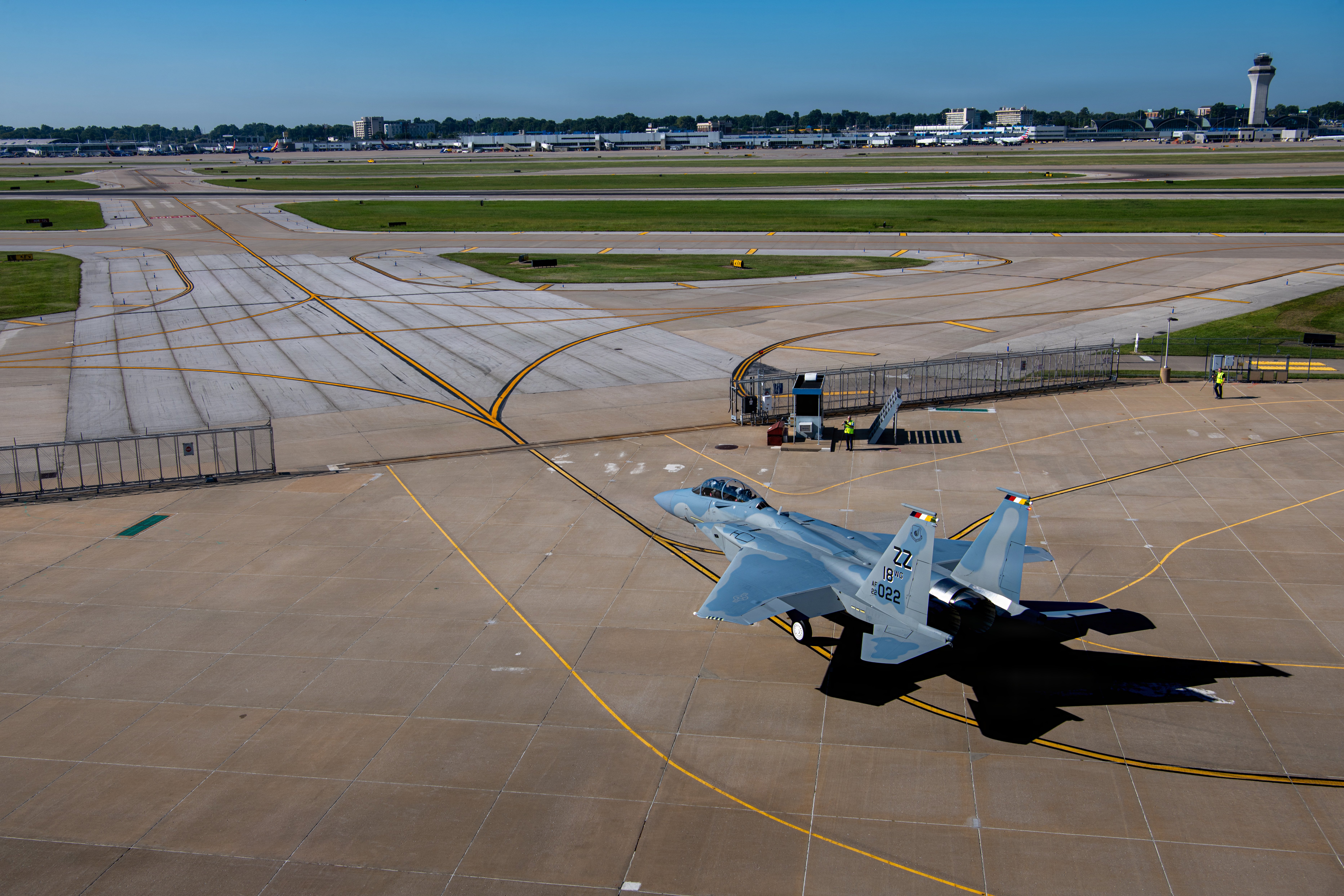
The first F-15EX Eagle II destined for permanent assignment at Kadena Air Base in Okinawa departed Boeing’s St. Louis, Missouri, facility on August 28, 2026. The aircraft left St. Louis for the 142nd Wing at Portland Air National Guard Base, Oregon, where it will undergo final staging and integration preparations before its eventual deployment to the sprawling Okinawa installation it will call home. The Oregon unit is acting as a coordination and preperation unit for the 18th Wing, a function you can read more about in our interview with the wing’s commander.

A U.S. Air Force F-15EX Eagle II designated for Kadena Air Base, Japan, taxis at Boeing’s St. Louis facility, Aug. 28, 2026, before departing for Portland Air National Guard Base, Oregon. The milestone brings the 18th Wing another step closer to the permanent stationing of the Air Force’s most advanced iteration of the Eagle platform at Kadena. (U.S. Air Force photo by Senior Airman Melany Bermudez)
A first F-15EX Eagle II designated for Kadena Air Base, Japan, taxis at Boeing’s St. Louis facility. U.S. Air Force photo by Senior Airman Melany Bermudez

This departure represents a critical, long-awaited milestone for the 18th Wing, which has been working toward the permanent stationing of the service’s most advanced Eagle variant to replace its now-withdrawn F-15C/D fleet. The arrival of the F-15EX in Japan, expected to begin in fiscal year 2027, which begins on October 1, 2026, will be a central pillar in the Air Force’s modernization of tactical airpower in the Indo-Pacific region.

EXciting progress for F-15EX!

We've delivered the 22nd F-15EX to the @usairforce. The aircraft will be the first F-15EX destined for @KadenaAirBase in Japan. pic.twitter.com/RlrTKuCCFl

— Boeing Defense (@BoeingDefense) September 3, 2026

“This is an important next step toward bringing the F-15EX home to Kadena,” said Brig. Gen. John Gallemore, 18th Wing commander, in an Air Force release. “Our team is ready to welcome the F-15EX, and this is another milestone that brings us closer to putting this capability in the hands of the airmen who will fly, maintain and employ it from Japan.”

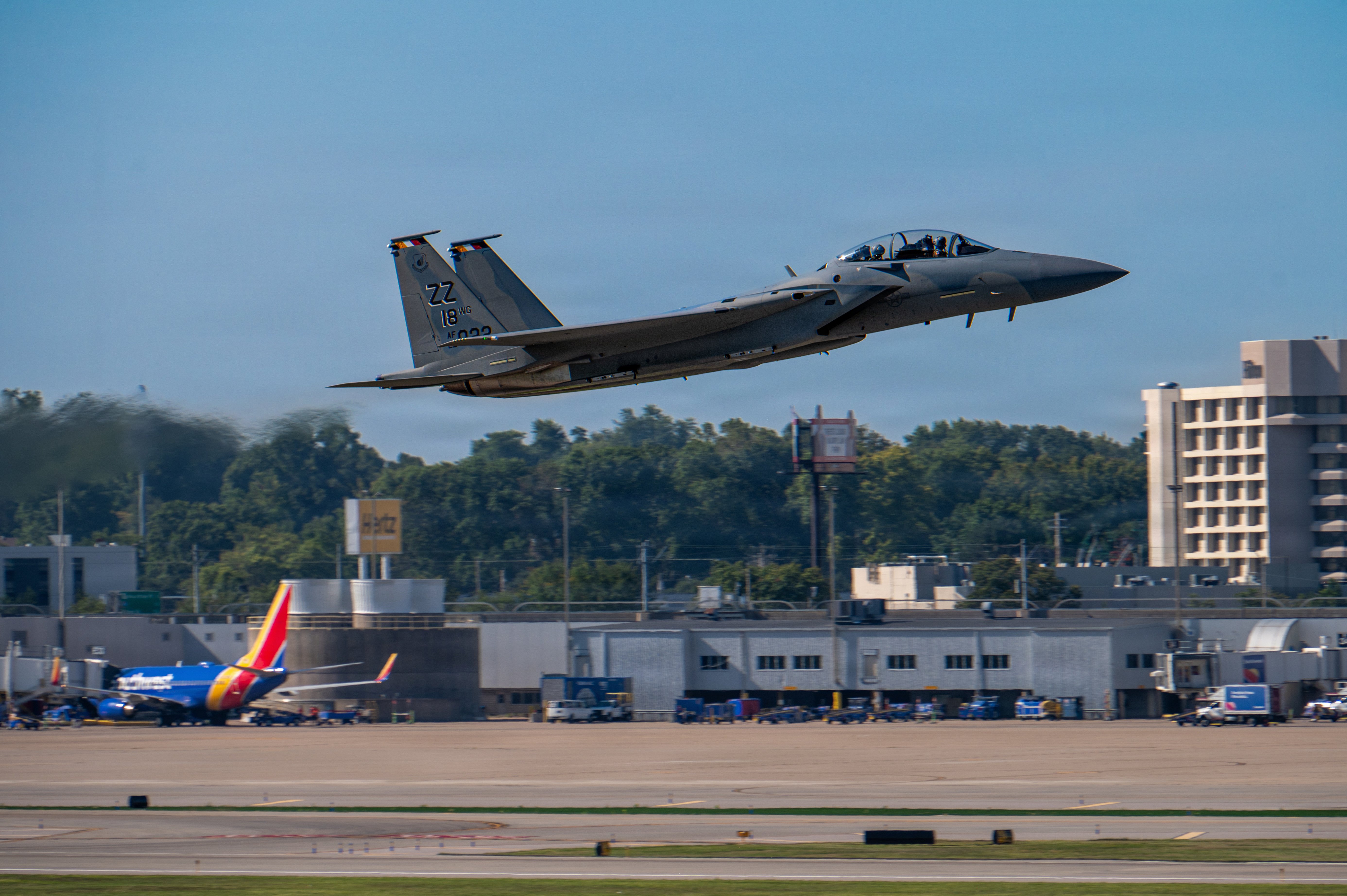
A U.S. Air Force F-15EX Eagle II designated for Kadena Air Base, Japan, departs Boeing’s St. Louis facility, Aug. 28, 2026, en route to Portland Air National Guard Base, Oregon. While in Portland, the aircraft will receive additional updates and preparations for its future stationing at Kadena. F-15EX aircraft are scheduled to begin arriving at Kadena in fiscal year 2027. (U.S. Air Force photo by Senior Airman Melany Bermudez)
The first F-15EX for Kadena Air Base, Japan, at Boeing’s St. Louis facility last month. U.S. Air Force photo by Senior Airman Melany Bermudez

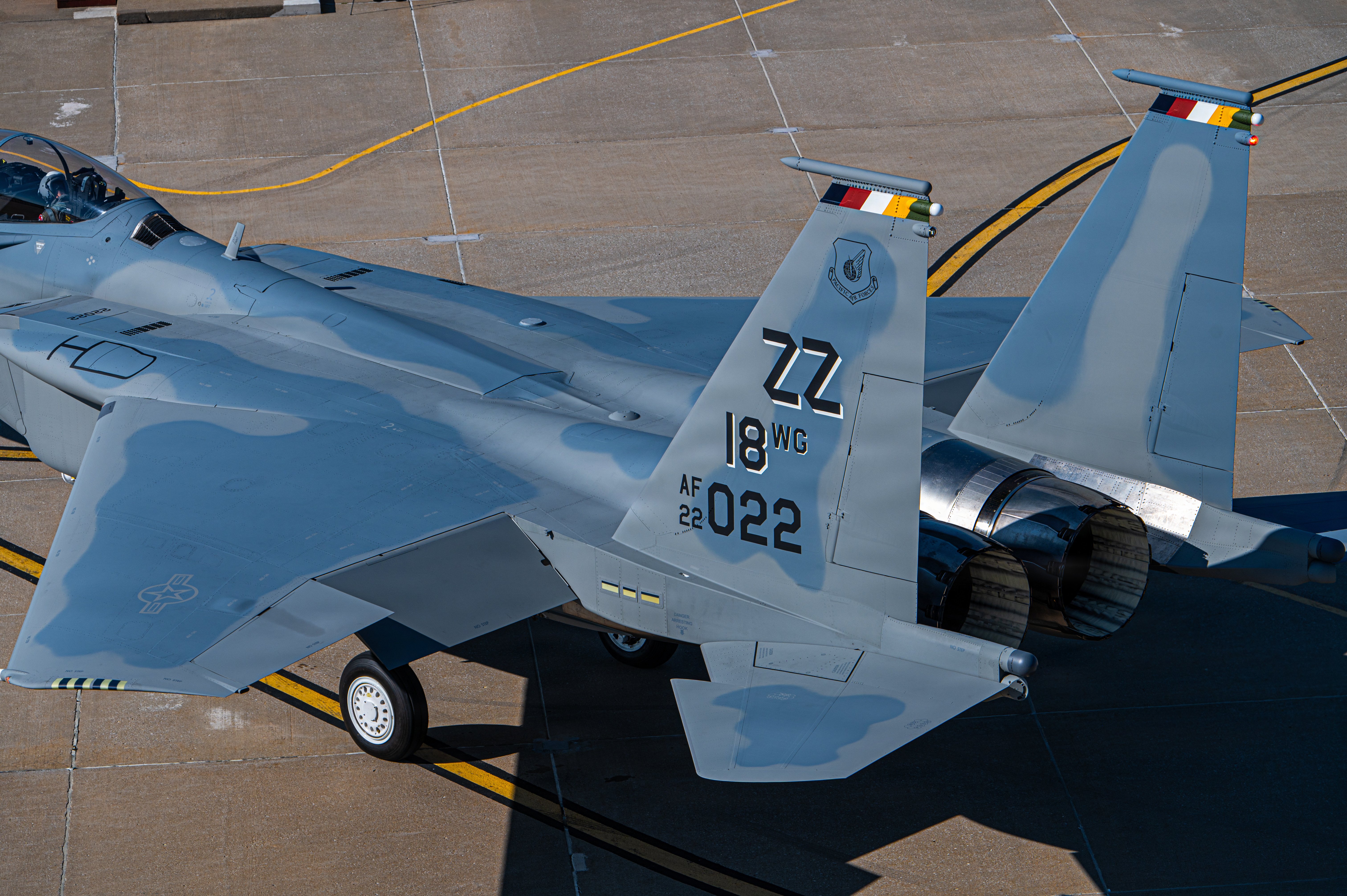
The first F-15EX for Kadena’s 18th Wing, serial 22-0022, was noted flying test sorties from St. Louis in early August, initially in primer paint. By the middle of the month its was flying with its full livery, including the famous “ZZ” tail code.

The F-15EX is a significant jump in capability over the legacy Eagles. With modernized avionics, flight controls, an expanded electronic warfare suite, and increased weapons carriage — as well as potentially new and longer-reaching weapons — the jet is well-suited to operating in the vast Western Pacific. As Kadena prepares for the permanent arrival, the 18th Wing plans to integrate the EX with regional allies, including the Japan Air Self-Defense Force, building upon existing bilateral training exercises.

A U.S. Air Force F-15EX Eagle II and F-15E Strike Eagles assigned to 85th Test and Evaluation Squadron, Eglin Air Force Base, Florida, land at Kadena Air Base in June 2026. U.S. Air Force photo by Airman 1st Class Gracelyn Hess

Two active-duty squadrons of F-15EXs are set to be established at Kadena, taking the place of units previously based there that had flown F-15Cs. The Air Force has been deploying F-15Es, F-22s and other fighters to the base on a rotational basis to fill the gap in the meantime.

The F-15EX will give U.S. forces in the Indo-Pacific a high-capacity platform that complements the fifth-generation F-22 and F-35. With its ability to carry large air-to-air and air-to-surface payloads, the Eagle II can serve as a long-range “missile truck,” extending the reach and firepower of stealth aircraft operating closer to contested airspace. Its open-architecture systems also allow it to incorporate new sensors, weapons, and electronic warfare capabilities more readily than the aging F-15C/D fleet.

A U.S. Air Force F-15EX Eagle II designated for Kadena Air Base, Japan, is photographed at Boeing’s St. Louis facility, Aug. 28, 2026. Equipped with advanced avionics, radar and electronic warfare systems, the F-15EX represents the latest evolution of the Eagle platform and the modernization of U.S. tactical airpower. (U.S. Air Force photo by Senior Airman Melany Bermudez)
The first F-15EX designated for Kadena Air Base, Japan, is photographed at Boeing’s St. Louis facility, on August 28, 2026. U.S. Air Force photo by Senior Airman Melany Bermudez

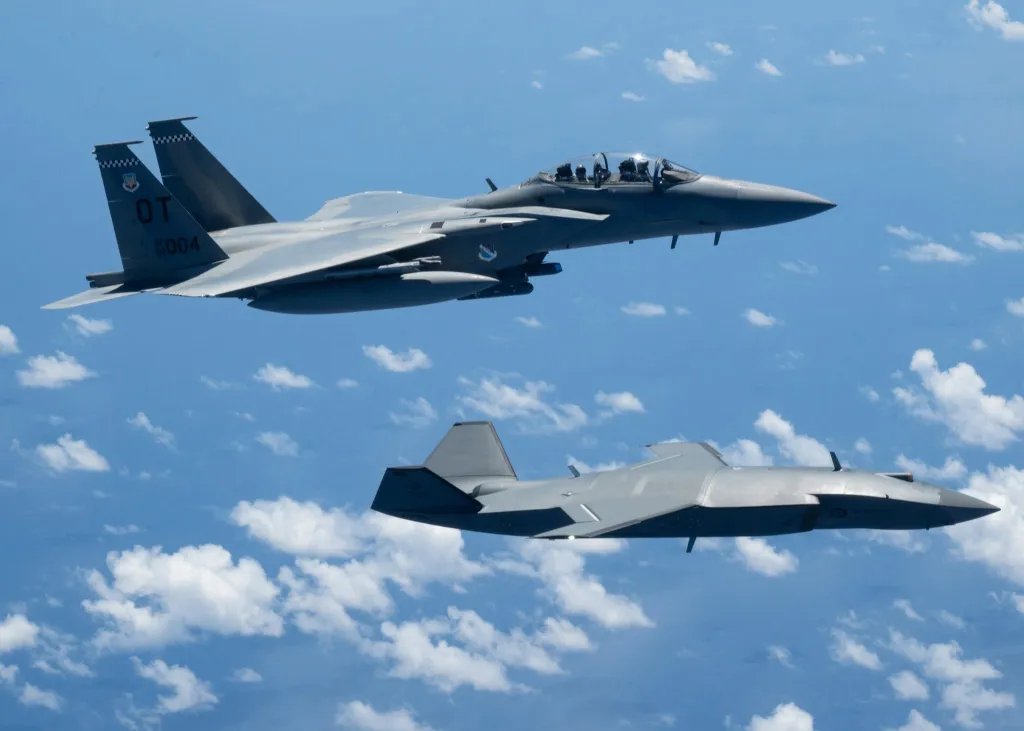
The aircraft’s value is also tied to its role in networked operations. Exercises such as Valiant Shield have demonstrated how the F-15EX can work with uncrewed aircraft like the  MQ-28 Ghost Bat, pointing toward mixed formations in which crewed fighters provide weapons, sensing, and command-and-control capacity for autonomous wingmen. Operating from strategic locations such as Kadena, the Eagle II could help the Air Force generate more combat power across the vast Pacific while reducing the burden on its limited number of stealth fighters.

A U.S. Air Force F-15EX Eagle II accompanies an MQ-28 Ghost Bat during the U.S.-led Valiant Shield 26 military exercise. PACAF

Kadena will become the second Air Force location with combat-coded F-15EX aircraft, following the Oregon Air National Guard’s 142nd Wing.

The Air Force has previously announced plans to stand up National Guard F-15EX squadrons in California, Louisiana, and Michigan. Most recently, the Air Force announced plans to put F-15EX fighters at Seymour Johnson Air Force Base, North Carolina, to replace older F-15E Strike Eagle jets that will move to Whiteman Air Force Base, Missouri.

While the movement of this first Kadena-bound F-15EX is a positive step, the wider Eagle II program is currently navigating some issues. According to a new Pentagon selected acquisition report released in August, the Air Force’s decision to aggressively expand its F-15EX fleet from 129 to 267 jets — intended to recapitalize the older F-15E force — has introduced substantial cost and schedule uncertainties that officials are now scrambling to manage.

A U.S. Air Force F-15EX Eagle II designated for Kadena Air Base, Japan, taxis at Boeing’s St. Louis facility, Aug. 28, 2026, before departing for Portland Air National Guard Base, Oregon. The milestone brings the 18th Wing another step closer to the permanent stationing of the Air Force’s most advanced iteration of the Eagle platform at Kadena. (U.S. Air Force photo by Senior Airman Melany Bermudez)
The first F-15EX designated for Kadena Air Base, Japan, taxis at Boeing’s St. Louis facility, before departing for Portland Air National Guard Base, Oregon. U.S. Air Force photo by Senior Airman Melany Bermudez

The report warns that the extended acquisition strategy, which shifted from eight production lots to 12, will require Boeing to execute a “major technical refresh” to combat diminishing manufacturing sources and material shortages. As systems like the radar, mission computer, and engines face potential obsolescence over the now-lengthened production timeline, the service faces what the report characterizes as a “significant redesign effort.” Program managers are planning to mitigate these risks by integrating upgrades through operational flight program releases scheduled between 2031 and 2035, a strategy they describe as a “structured, risk-reduced pathway” to avoid production line gaps.

Compounding these technical challenges are tangible production delays, largely stemming from a labor strike at the St. Louis plant from August to November 2025. The report notes that these are “unrecoverable delays,” forcing a cascading schedule slip. While Boeing was contracted to deliver all 12 jets from Lot 3 by early 2026, the company will only be able to field half of those by the end of the year. This has directly impacted the timeline for the Kadena deployment, which was originally envisioned for earlier in 2026, and has left the Air Force relying on “bridging strategies” and rotations to cover operational requirements until the Eagle IIs can fully stand up in Okinawa.

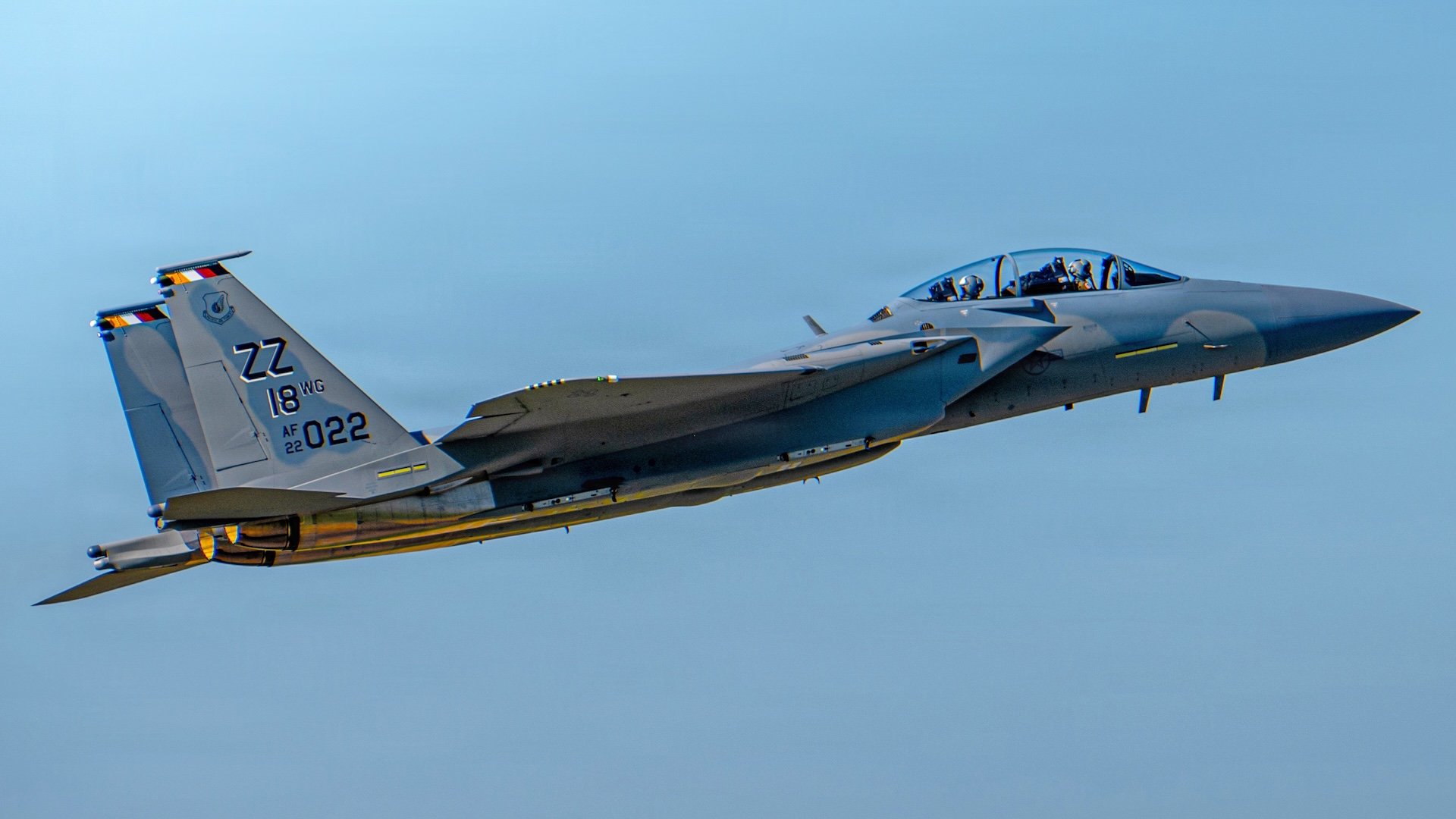
A U.S. Air Force F-15EX Eagle II designated for Kadena Air Base, Japan, flies en route to Portland Air National Guard Base, Oregon, after departing Boeing’s St. Louis facility, Aug. 28, 2026. The F-15EX will modernize Kadena’s permanent fighter force, providing advanced capabilities to strengthen readiness and support the enduring U.S.-Japan defense partnership. (U.S. Air Force photo by Senior Airman Melany Bermudez)
The first F-15EX for Kadena Air Base, Japan, flies en route to Portland Air National Guard Base, Oregon, after departing Boeing’s St. Louis facility, on August 28, 2026. U.S. Air Force photo by Senior Airman Melany Bermudez

The Pentagon is now moving toward an aggressive production ramp-up, tasking Boeing to hit a rate of two jets per month. Keeping the F-15EX schedule on track will be a challenge, however, requiring successfully navigating ongoing parts shortages for critical systems, all while balancing the needs of foreign military sales customers who are also integrated into the supply chain.

For the 18th Wing, the arrival of the first F-15EX will bring a major advance in capabilities in a part of the world that needs them badly. At the same time, the program’s overall trajectory suggests that the wider transition to the new Eagle will come with some complex logistical and industrial challenges.

Contact the author: thomas@thewarzone.com

The post First USAF F-15EX To Be Based In Japan Departs Boeing’s St. Louis Plant appeared first on TWZ.

  •  

UK Government Commits To Boom Refueling For RAF Tankers

The United Kingdom is moving toward adding a flying-boom aerial refueling capability to the Royal Air Force (RAF), a requirement being driven in large part by the future Tempest combat jet, being developed under the Global Combat Air Program (GCAP) initiative.

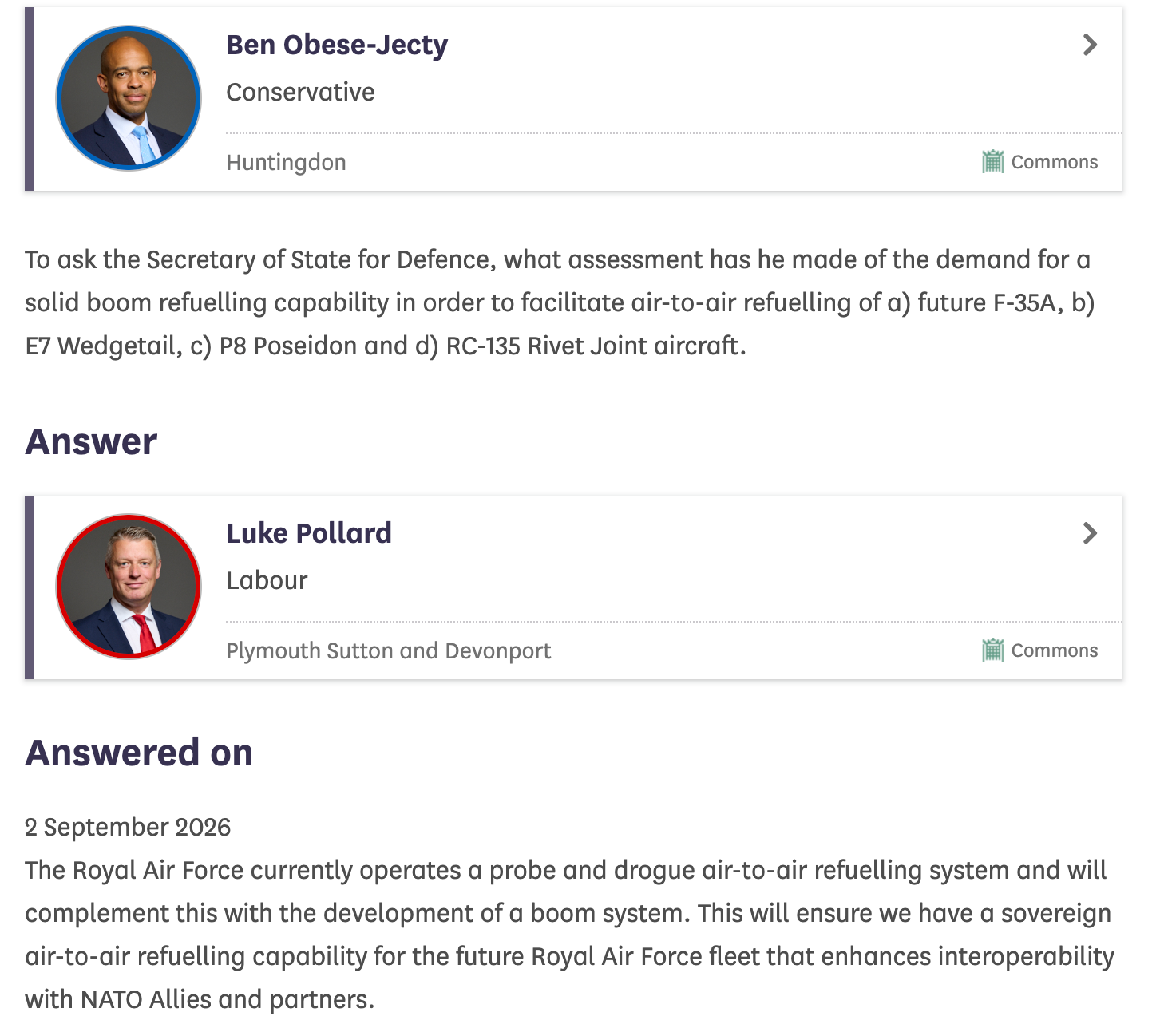
In a written response to opposition MP Ben Obese-Jecty, U.K. Defense Minister Luke Pollard confirmed that the RAF’s existing probe-and-drogue aerial refueling capability will eventually be complemented by a boom system. The move would give Britain a sovereign capability to refuel aircraft equipped with the U.S.-standard boom receptacle, including the Tempest, while also improving interoperability with other NATO and allied air forces.

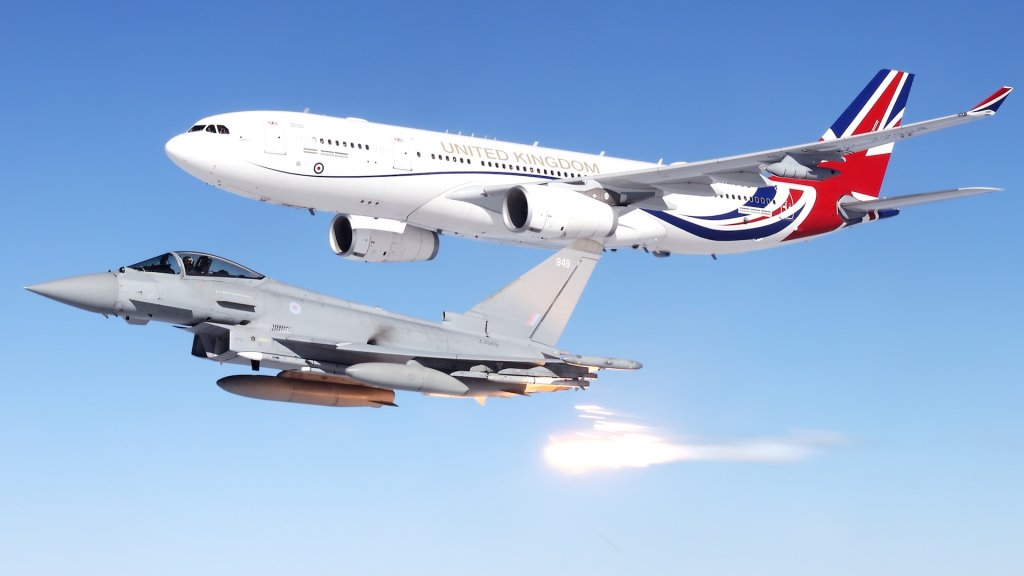
This picture is from a Quick Reaction Alert training scenario. The QRA exercise was conducted 31 March 2026. The purpose of the exercise was to demonstrate the full end-to-end process of the UK's air defence strategy if an actual foreign aircraft was to invade their protected airspace. Upon receiving the alert, the QRA team at RAF Coningsby would launch to RAF Typhoon FGR4's to intercept any unknown aircraft within the protected airspace. In this particular scenario an RAF Voyager A330 (RAF Brize Norton) was acting as the agressor and two RAF Typhoons FRG4 (RAF Coningsby) were responding to the simulated threat. During the exercise the Typhoons intercepted the Voyager and conducted a series of maneouvers whilst communicating with the "foreign" aircraft with the aim of escorting it to a safe location on the ground (RAF Brize Norton) upon which it and it's crew would be guarded and safely inspected by counter-terrorist police. The resulting imagery is to be used for training government ministers on how a QRA works and all the different elements involved. From the initial radar detection of a foreign, unidentified aircraft at the London Area Control Centre, Swanwick, to the physical launch of our QRA team at RAF Coningsby. The RAF use a hose-and-drogue air-to-air refuelling system deployed from Voyager tanker aircraft. Instead of a rigid flying boom, the tanker trails a flexible high-pressure hose attached to a stabilizing basket (drogue), allowing receiver jets like the Typhoon and F-35 to plug in mid-flight. This image shows a Typhoon releasing flares as a warning to the "enemy aircraft".
A Royal Air Force Typhoon FGR4 accompanies a Voyager tanker during a Quick Reaction Alert training scenario in March 2026. Crown Copyright Crown Copyright

“The Royal Air Force currently operates a probe and drogue air-to-air refueling system and will complement this with the development of a boom system,” Pollard said. “This will ensure we have a sovereign air-to-air refueling capability for the future Royal Air Force fleet that enhances interoperability with NATO allies and partners.”

For the first time we have a Minister confirming the Boom is coming to Royal Air Force tankers, although the when and the how currently remain very much up in the air.

Still significant to have it through government voices and not just through the RAF itself. pic.twitter.com/esRN7NVoPy

— Gabriele Molinelli (@Gabriel64869839) September 2, 2026

The decision follows comments by a senior RAF official in July indicating that the service was already examining how to meet the requirement.

“We currently do not have boom [-equipped tankers] in the UK. We have a requirement for a boom from GCAP, so we have to resolve that requirement and that is what we are now looking at,” the official said at the Air Power Association Global Air and Space Chiefs’ Conference in London, according to Janes. “I [am] certain that at some point we are going to have to work out how we deliver a sovereign boom capability for our own combat aircraft.”

The requirement is particularly significant because GCAP’s Tempest is being designed with a fuselage-mounted receptacle for boom refueling. Unlike the probe-and-drogue arrangement used by the RAF’s existing Voyager tankers, a flying boom uses a rigid, telescoping refueling tube that is maneuvered by an operator aboard the tanker into the receiver aircraft’s receptacle.

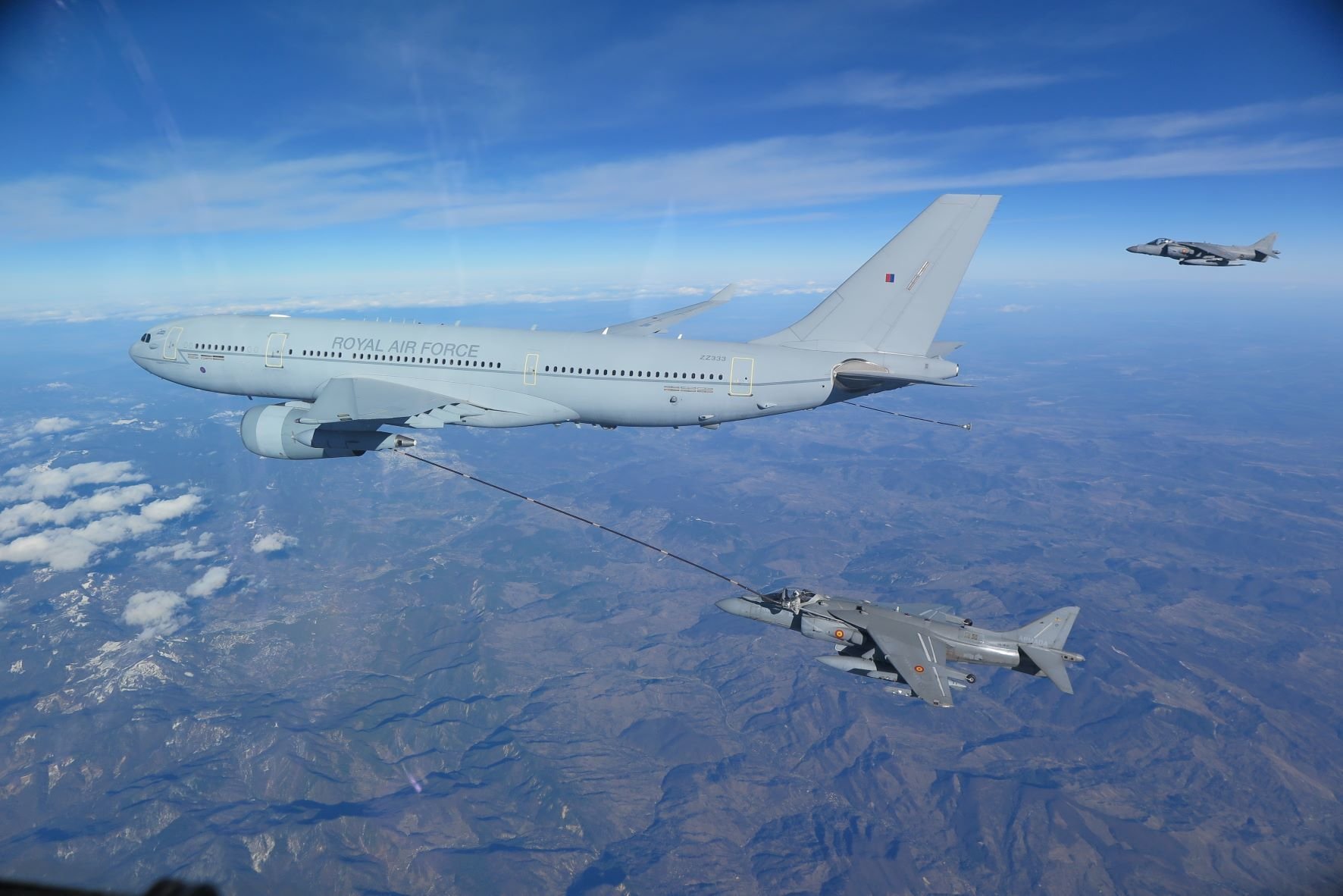
230220-N-NO777-1002 ROMANIA (Feb. 20, 2023) A Royal Air Force A330 tanker performs aerial refueling of a Spanish Navy AV-8B Harrier during combined long range strike training, Feb. 20, 2023. The George H.W. Bush Carrier Strike Group is on a scheduled deployment in the U.S. Naval Forces Europe area of operations, employed by U.S. Sixth Fleet to defend U.S., allied, and partner interests. (U.S. Navy courtesy photo)
A Royal Air Force Voyager tanker performs aerial refueling of a Spanish Navy EAV-8B Harrier II during combined long-range strike training. U.S. Navy courtesy photo

One of the major advantages of the boom system is its higher fuel-transfer rate. That makes it especially useful for large aircraft and combat aircraft that need to take on substantial quantities of fuel quickly, reducing the time spent on the tanker.

Tempest is not, however, the only RAF aircraft that depends on the boom standard. The RAF already operates several boom-equipped receiver aircraft, including P-8A Poseidon maritime patrol aircraft, RC-135W Rivet Joint intelligence, surveillance, and reconnaissance aircraft, and C-17A Globemaster III airlifters. The E-7A Wedgetail airborne early warning aircraft also uses a boom receptacle, while the forthcoming RAF F-35A fleet will add another major boom receiver to the service.

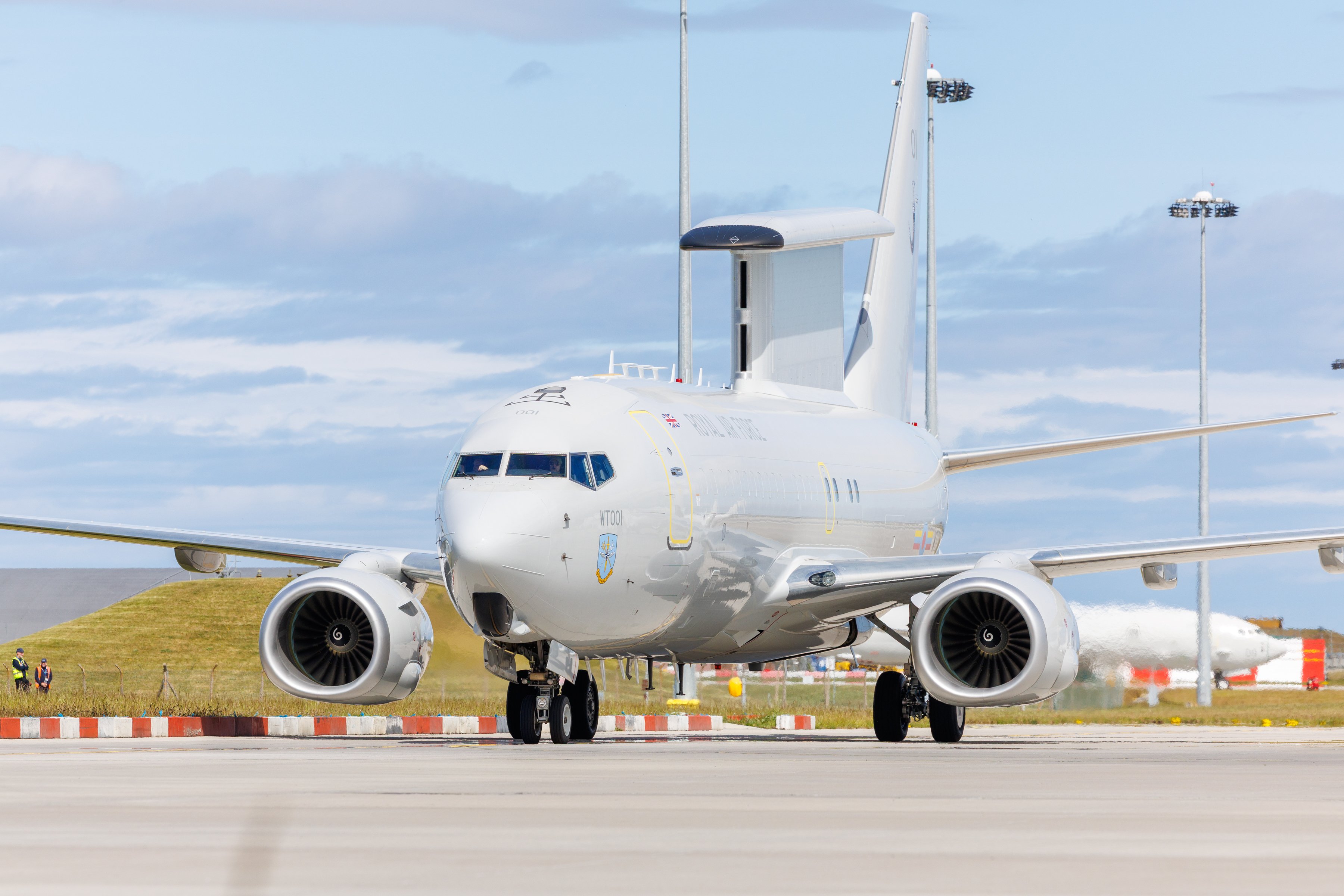
The first Wedgetail Airborne Early Warning (AEW) aircraft, destined to serve with the RAF, has arrived at RAF Lossiemouth on 21 May 2026. The aircraft was flown to RAF Lossiemouth by a mixed crew of personnel from Boeing UK and the RAF from STS Aviation Services at Birmingham Airport. The Wedgetail AEW Mk1 is the RAF’s next-generation airborne early warning and control aircraft, designed to deliver long-range surveillance, battle management, and command and control for air and joint operations.
The first Wedgetail aircraft, destined to serve with the RAF, at RAF Lossiemouth, Scotland, in May 2026. Crown Copyright

Currently, the RAF has no boom-equipped tanker to support them.

Its principal tanker fleet consists of Airbus A330 Multi-Role Tanker Transport (MRTT) Voyager aircraft operated by the AirTanker consortium and leased to the RAF under a private finance initiative. Unlike many A330 MRTT operators around the world, which acquired the aircraft with a flying boom, the British Voyagers were configured exclusively around hose-and-drogue refueling.

The Voyager K2 is equipped with two wing-mounted Cobham 905E hose-and-drogue refueling units. The K3 adds a third refueling point in the form of a Cobham 805E fuselage refueling unit, or FRU, located at the rear of the aircraft. The latter provides a higher fuel-transfer rate than the wing-mounted units.

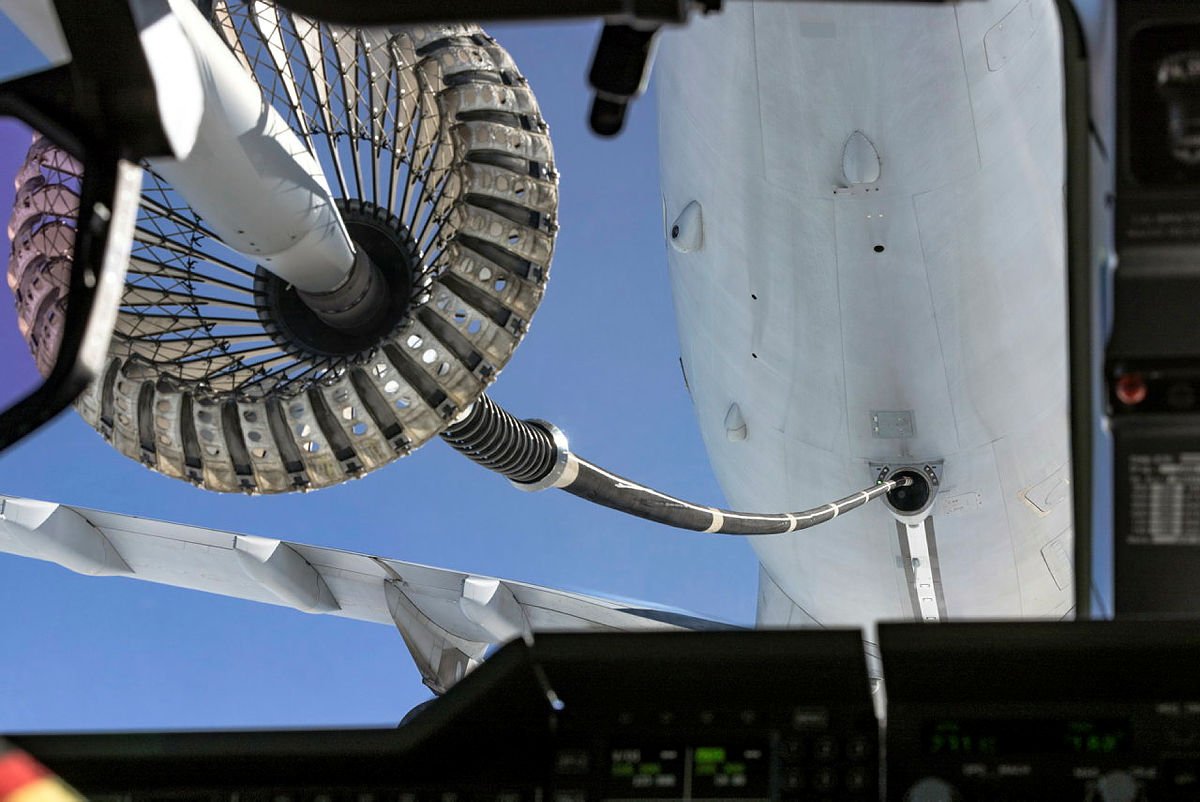
The view from the cockpit of an A400M during air-to-air refueling with a Voyager KC3, via the fuselage refueling unit. Crown Copyright

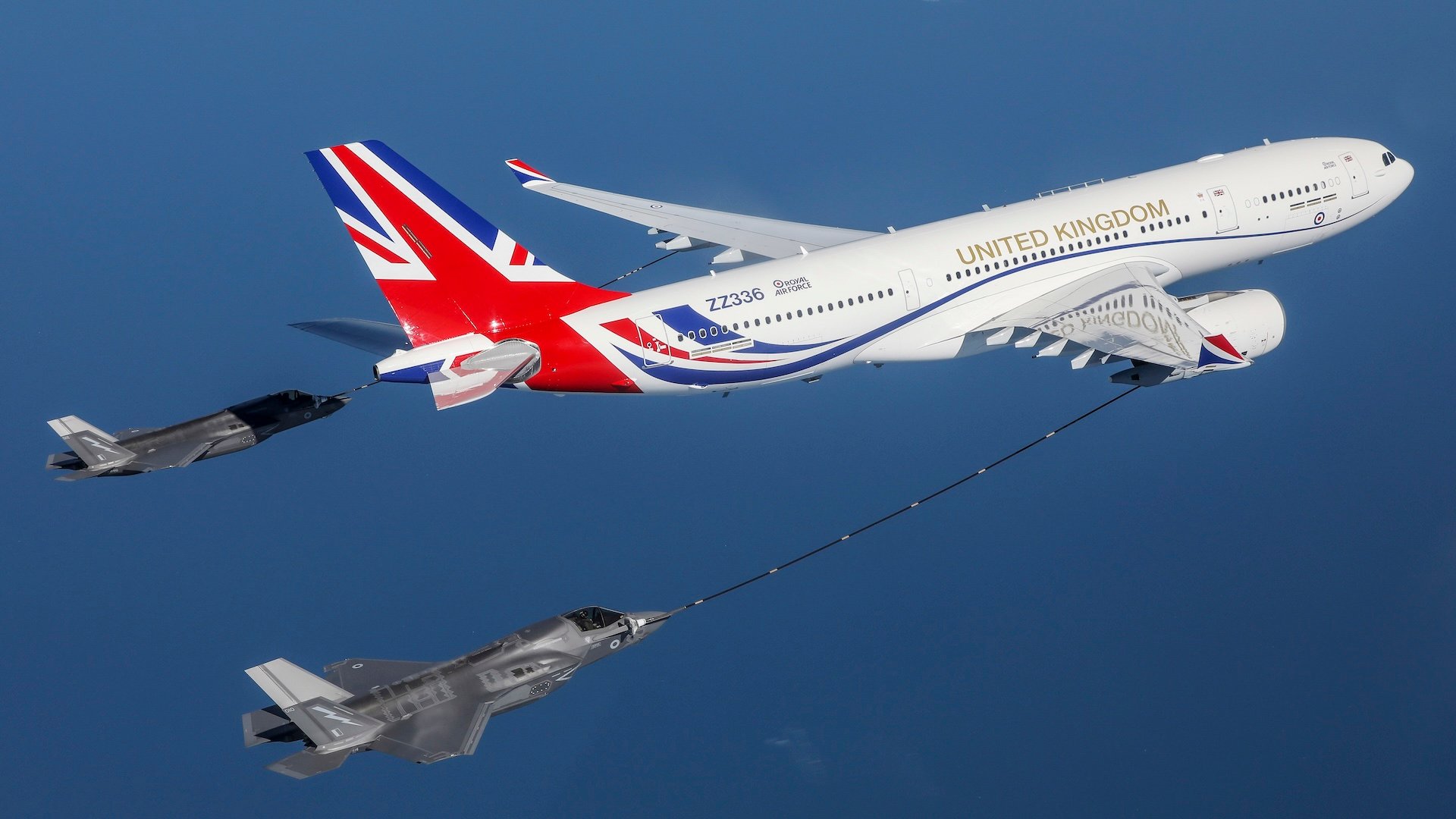
Since the fuel is stored in existing tanks, the Voyager’s cabin is still available to accommodate up to 291 passengers and the cargo hold for freight. One Voyager, serial ZZ336, nicknamed Vespina, is modified for long-range VIP transport but still functions as a fully capable tanker.

A video showing Voyager ZZ336 refueling RAF and German Eurofighter Typhoons during the enhanced Air Policing mission in Romania:

Up to 14 Voyagers are available to the RAF under the current arrangement.

The future of those aircraft is now one of the key questions surrounding Britain’s planned boom capability.

One possibility would be to modify some of the existing Voyagers, installing a boom system in the rear fuselage. The baseline Airbus’ A330 MRTT design already incorporates a provision for a flying boom. At the time the United Kingdom ordered its Voyagers, boom refueling was not considered essential, so the capability was deleted to save weight, complexity, and cost — a decision which was to prove very shortsighted.

Such a conversion, however, would involve engineering, certification, ownership, and contractual considerations, particularly given that the RAF does not directly own the Voyager fleet.

Britain could also decide that modifying the existing aircraft is not worthwhile. The current Voyager private-finance arrangement runs until 2035, by which point the airframes will be considerably older. Rather than investing heavily in aircraft approaching the end of their contracted service period, the government could opt to acquire new A330 MRTTs or another tanker type equipped with a boom from the outset.

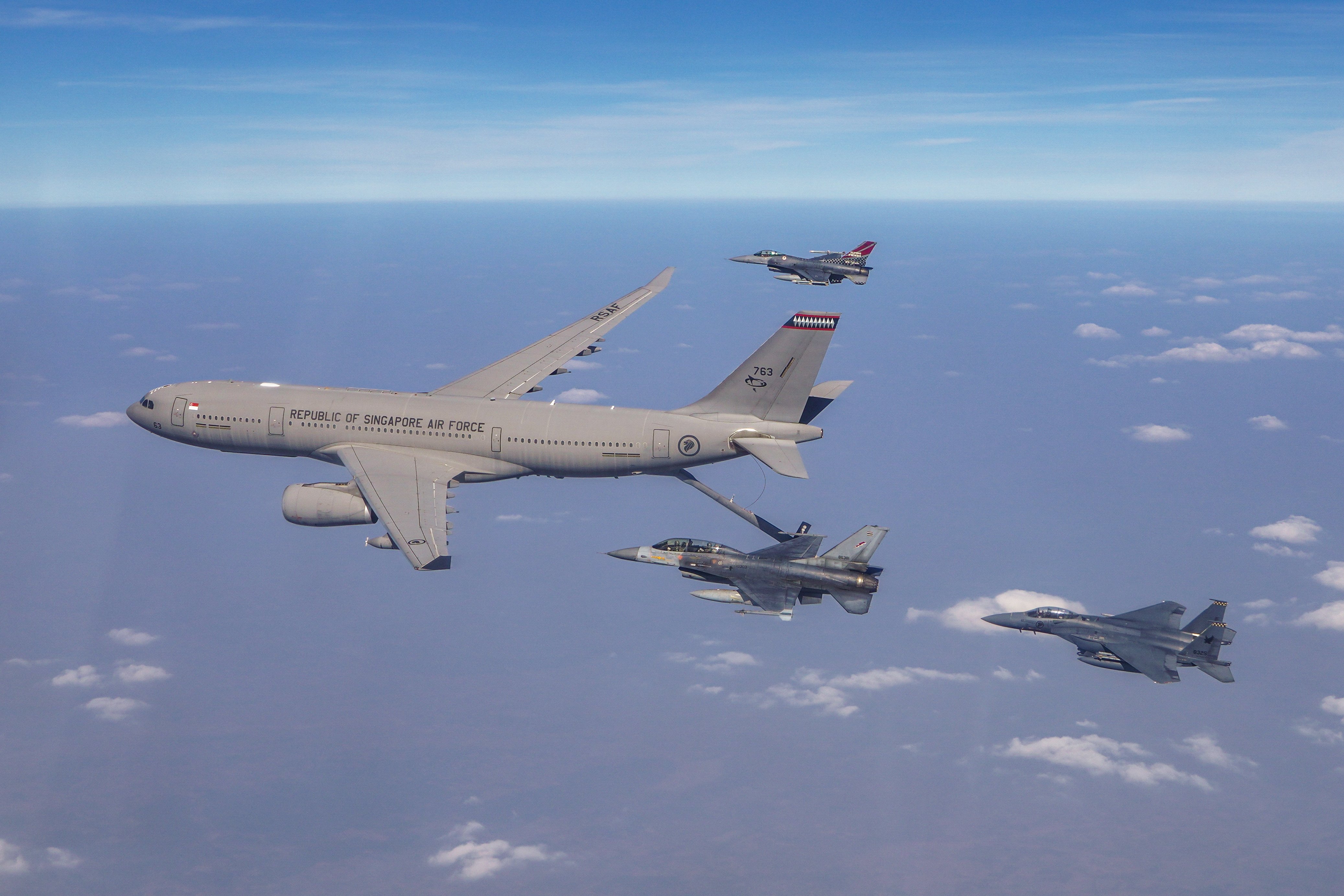
A Republic of Singapore Air Force A330 Multi Role Tanker Transport leads a formation flight during a training scenario alongside a U.S. Air Force F-16C assigned to the 36th Fighter Squadron, Osan Air Base, Republic of Korea, two RSAF F-15SGs, and a Royal Thai Air Force F-16ADF during Exercise Cope Tiger 23, Korat Royal Thai Air Base, Kingdom of Thailand, March 22, 2023. CT 23 is an annual exercise meant to improve readiness and the ability of participating forces to operate together while enhancing military relations and combined capabilities. (Courtesy Photo)
With refueling boom extended, a Republic of Singapore Air Force A330 MRTT leads a formation flight alongside a U.S. Air Force F-16C assigned to the 36th Fighter Squadron, Osan Air Base, Republic of Korea, two RSAF F-15SGs, and a Royal Thai Air Force F-16 during Exercise Cope Tiger 23. U.S. Air Force courtesy photo

Another, more remote possibility could involve a podded boom arrangement, a concept that has been around for a while now, but which is gaining traction with the U.S. Air Force as it weighs options for future tanker capabilities. 

It remains unclear, however, whether a podded boom would offer the performance and integration characteristics required for Tempest and the RAF’s wider fleet. There is also a question about what platform it could be installed on.

As part of its seemingly never-ending search for new fighters, the Indian Ministry of Defense says it wants to team up with one of the two rival European next-generation combat aircraft programs.
A rendering of the Tempest future combat jet. BAE Systems BAE Systems

At the same time, TWZ has previously highlighted how drones equipped with buddy stores could operate in a hub-and-spoke model, ferrying fuel from tankers positioned outside the threat envelope to aircraft operating at the tactical edge. This could be another option that might gain traction as the U.K. Ministry of Defense increasingly looks to unlock the potential of uncrewed capabilities, but must also be considered less likely, especially as a primary solution.

There is also a potential requirement for the tankers themselves to be capable of receiving fuel. Equipping a tanker with a receiver system would allow tanker-to-tanker refueling, extending the flexibility and reach of the RAF’s future air-to-air refueling force during long-range operations. Other A330 MRTT operators already benefit from this feature.

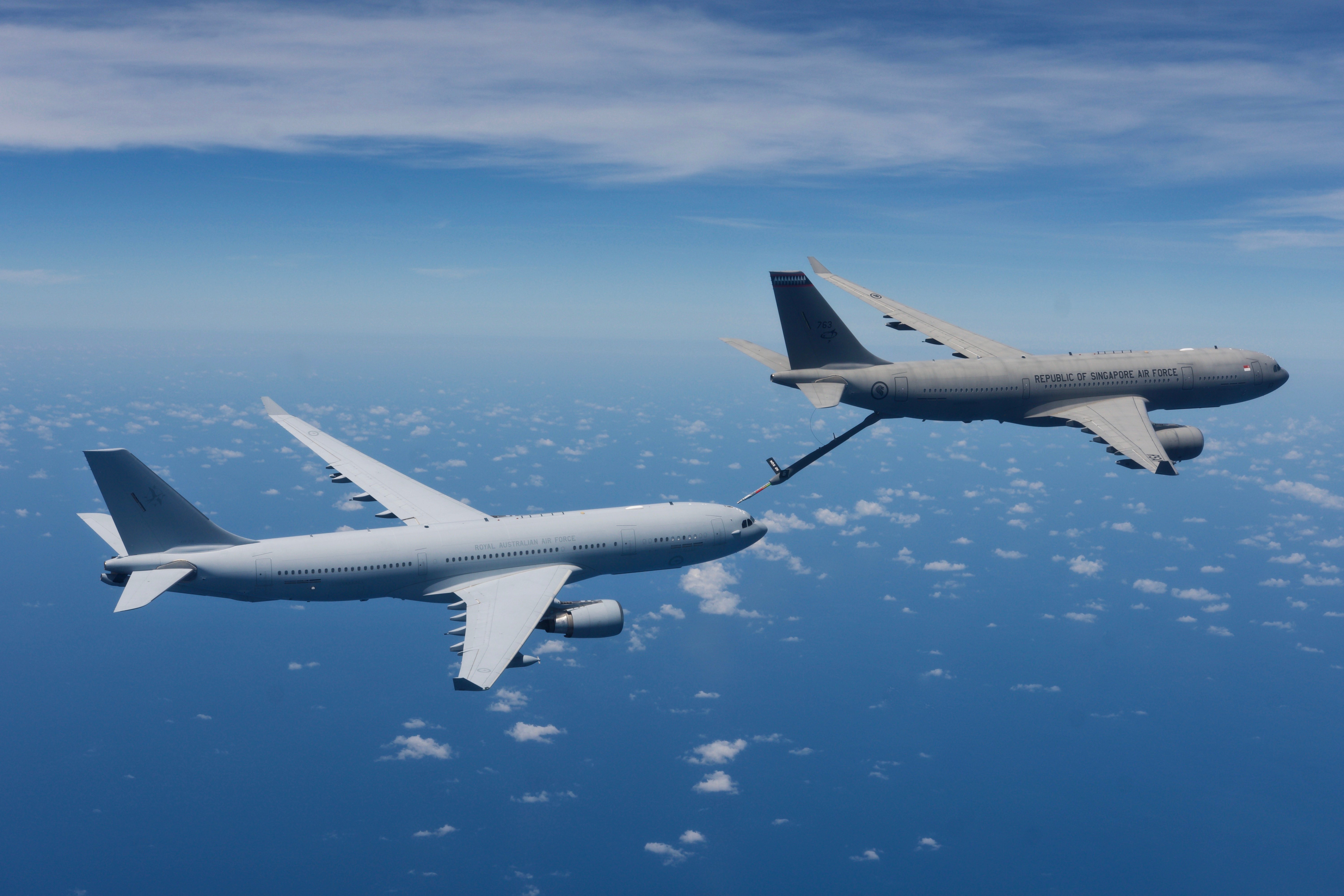
A Republic of Singapore Air Force Airbus A330 Multi-Role Tanker Transport (MRTT) refuels a Royal Australian Air Force KC-30A MRTT during a 'Boom Camp' in the Northern Territory *** Local Caption *** Combined training was conducted by air-to-air refuelling tanker crews from the Republic of Singapore Air Force (RSAF) and Royal Australian Air Force (RAAF) at RAAF Base Darwin over 25 to 30 October 2020. Both nations operate variants of the Airbus A330 Multi-Role Tanker Transport (MRTT), which in RAAF service is called the KC-30A, and can carry a fuel load in excess of 100 tonnes that can be transferred in-flight to compatible receiver aircraft. The combined training at RAAF Base Darwin was an opportunity to compare experiences operating the MRTT and build working-level relationships, forging closer ties between RSAF’s No. 112 Squadron and the RAAF’s No. 33 Squadron. The RAAF was the world’s first MRTT operator, introducing the aircraft to service in 2011. The RSAF received its first MRTT in 2018 but has extensive experience with conducting air-to-air refuelling with the previous KC-135 Stratotanker, which had previously been used in support of RAAF exercises and training activity. read less
A Republic of Singapore Air Force Airbus A330 MRTT refuels a Royal Australian Air Force KC-30A MRTT during combined training at RAAF Base Darwin in Australia. Australian Department of Defense Republic of Singapore Air Force

While Tempest is providing the immediate catalyst, a refueling boom capability would also close an increasingly conspicuous gap in the RAF’s tanker force. The service is acquiring and operating an increasing number of aircraft built around the boom standard while relying on a tanker fleet configured around the alternative hose-and-drogue system.

Whether Britain modifies its existing Voyagers, replaces them, or adopts another solution entirely could become an important part of the RAF’s long-term force structure as the Tempest program advances.

Contact the author: thomas@thewarzone.com

The post UK Government Commits To Boom Refueling For RAF Tankers appeared first on TWZ.

  •  

GNR deteve cinco homens e apreendeu 14 mil doses de droga em Sesimbra e no Cartaxo

A GNR deteve cinco homens suspeitos de tráfico de droga e posse de armas proibidas e apreendeu mais de 14 mil doses de estupefacientes e várias armas nos concelhos do Cartaxo e de Sesimbra, foi hoje anunciado. Segundo um comunicado do Comando Territorial de Setúbal da GNR, os cinco homens, de idades entre os 25 e 75 anos, foram detidos na quarta-feira, na sequência de uma investigação que…

Source

  •  

MEPs push for EU solidarity fund to improve access to cross-border healthcare

MEPs are pushing for an EU solidarity mechanism to help patients pay for treatment abroad, arguing that financial barriers are preventing Europeans from exercising rights they have had on paper for more than a decade.

The calls came as Parliament discussed a report commissioned to inform its own-initiative report on modernising patients’ rights in cross-border healthcare. The study found that cross-border care accounts for just 0.004% of EU public health expenditure, despite patients continuing to face upfront costs, complex reimbursement procedures and prior-authorisation requirements.

Tomislav Sokol (EPP, Croatia) called the proposed solidarity mechanism a potential “game changer” for vulnerable patients, but challenged Parliament to spell out how it would work.

“How would it work in practice? How would it be financed? Would this be part of the EU budget?” Sokol asked. “We need to know it now, so that we can also use this in negotiations on the future EU budget, in the next MFF.”

  •  

Going Home with Wendell Berry

Wendell Berry, who died this week at the age of 92, published dozens of books of poetry, fiction, and essays, any of which might make for meaningful connection with Berry’s ideas about place and how we engage with it. But this conversation with Amanda Petrusich, which bloomed from a personal correspondence between the two writers, feels like an especially vital tribute to Berry. Here, his decades of thought on sustainability and its human limits find gloriously vivid expression; after all, place shapes our voices, too. Throughout, Berry is luminous and pithy and discerning: “We’re alive only in some place in particular.” “Every generation is a bridge between something that’s past and something that’s coming.” “Our conversation is worth more right now than either one of us thinking separately.” The last is a perfect sentiment for any dialogue, including those on the page.

Part of manners used to be to say to somebody you just met, “Where you from?” And I quit asking it, because so many people say they’re from everywhere or nowhere. I’ll tell you a little bit of my history that may be pertinent. My mother was born and grew up in Port Royal, my father about four miles south. Both of their families had lived here since about the beginning of the nineteenth century. When I came to teach at the University of Kentucky, Tanya and I thought we would live in Lexington, and we would have “a country place.” And we hardly had laid our hands to this house, which needed some preservation work, when we realized, we’re not going to have a country place; we’re going to live here. And so we have. We bought this home and twelve acres in the fall of 1964, and moved in, in the midst of renovations, in the summer of 1965. That put our children here, and now we’ve got grandchildren who are at home here. That comes from a decision that we made to be here, and to be here permanently.

  •  

Mitsubishi Fuso retoma atividade no Tramagal e reafirma fábrica como centro de produção europeu

A Mitsubishi Fuso Truck Europe (MFTE) retomou a atividade no Tramagal em 24 de agosto e reafirmou hoje a fábrica como base central de produção das operações europeias, papel que se mantém após a integração no Grupo ARCHION. “A fábrica do Tramagal mantém-se como a base central de produção das operações europeias da Mitsubishi Fuso. Esta situação não se alterou após a integração da Mitsubishi Fuso…

Source

  •  

‘A frenzy of violence beyond comprehension’ – Couple charged with torturing man to death on Snapchat livestream, mutilating his penis

A 37-year-old man and his partner, a 27-year-old woman, have been charged with murder accompanied by acts of torture and barbarity after a 47-year-old man was beaten, sexually assaulted, and mutilated during a Snapchat sream in his home in the French city of Charleville-Mézières.

The details of the case reveal severe torture.Reims prosecutor François Schneider described the injuries in a statement. The autopsy showed “very severe trauma to the face, at the cervical level that obstructed his airways.” The man also suffered “very serious sexual violence,” genital mutilation, and fractured ribs.

“He was clearly not dead immediately,” Schneider said. A video recovered by investigators “showed him agonizing while his attacker delivered violent kicks to his face.”

The incident reportedly occurred on the night of Aug. 26–27, 2026. Both suspects are in pretrial detention and face life imprisonment.

The victim’s body was discovered on Aug. 27 after an anonymous woman contacted police. She said she had just seen a Snapchat video of a man being violently attacked and lying on the ground, and she recognized the attacker’s voice. Officers identified the victim, already known to police, and found him dead at his apartment. Neighbors later told investigators they had heard arguments between 3:00 a.m. and 5:00 a.m., a window that prosecutors say matches the time of death.

According to an initial investigation, the two suspects and a 17-year-old homeless girl had gone to the victim’s home for the evening. All four consumed large quantities of alcohol as well as cocaine and “C,” a mix of cocaine and ammonia.

The evening reportedly turned when the victim offered the 27-year-old woman sex in exchange for drugs. The 37-year-old man then “snapped,” accusing the older male victim of rapes. What followed, Schneider said, citing the teenager’s account, was “a frenzy of violence beyond comprehension.” The couple beat the victim with kicks, furniture, and threw a fan at him. They then turned him over and subjected him to sexual violence while filming his death.

The 17-year-old girl, however, has not been arrested or charged, according to French news outlet France 3. She was in police custody, questioned, and then released. She told investigators she witnessed the beating and some of the sexual violence but did not see the mutilation. She told investigators she was terrified. The couple took her phone and smashed it. Police found her wearing bloodstained clothing.

The 37-year-old man has admitted the violence but accuses the 17-year-old girl of taking part, saying the attack had already been discussed by text with his partner and the young minor. The woman, who was also arrested, has also pointed toward the girl and claimed the teenager was being raped daily by the victim. The girl denies both the daily rapes and active participation in any violence against the victim.

Investigators noted that text message exchanges between the couple raise the possibility they were trying to shift blame onto the girl in the case. Nothing in the inquiry so far supports the rape allegation against the victim.

The male suspect has 36 prior convictions, mostly for violence. The woman was convicted earlier in 2026 for aggravated violence. After the killing, the male suspect fled and was arrested on Aug. 29 at another girlfriend’s home in Villeneuve-lès-Maguelone, near Montpellier. Both were formally charged on Aug. 31 before an investigating judge in Reims and remanded in custody.

The post ‘A frenzy of violence beyond comprehension’ – Couple charged with torturing man to death on Snapchat livestream, mutilating his penis appeared first on Remix News.

  •  

Mercado Municipal de Santarém abre concurso para atribuição de 16 lojas

A Viver Santarém abriu os procedimentos para a atribuição do direito de exploração de 16 lojas do Mercado Municipal de Santarém, distribuídas por conceitos de negócio que vão da restauração e gastronomia ao comércio tradicional e serviços. A operação representa uma nova etapa no processo de ocupação e dinamização do mercado, que reabriu ao público a 19 de Março de 2025, depois de seis anos…

Source

  •  

Colangite Biliar Primária: a importância do diagnóstico precoce e do tratamento atempado

Artigo de Opinião de João Madaleno, Assistente Hospitalar Graduado de Medicina Interna, Serviço de Medicina Interna e Unidade de Transplantação Hepática de Adultos da Unidade Local de Saúde de Coimbra, membro da Associação Portuguesa para o Estudo do Fígado (APEF) Assinalado a 13 de setembro, o Dia Internacional da Consciencialização para a Colangite Biliar Primária […]
  •  

Abrantes chega ao fim do prazo do PRR com obras concluídas ou em fase terminal

Abrantes chegou ao prazo limite do PRR com as obras municipais concluídas ou em “conclusão substancial”, num conjunto de investimentos que a câmara municipal estima em cerca de 17 milhões de euros, disse hoje o presidente da autarquia. “Neste momento, poderemos dizer que, na relação com o Plano de Recuperação e Resiliência (PRR), estamos a cumprir tudo aquilo com o que nos tínhamos comprometido”…

Source

  •  

AVICARTAXO regressa para três dias dedicados às aves de capoeira e animais de companhia

O Pavilhão Municipal de Exposições do Cartaxo recebe entre os dias 25 e 27 de setembro a 3.ª edição da AVICARTAXO – Exposição de Aves de Capoeira e Animais de Companhia, um dos maiores encontros nacionais dedicados à avicultura e aos animais de companhia. Organizada pela ALCAC – Associação Lusa de Criadores de Aves de Capoeira, com o apoio do Município do Cartaxo…

Source

  •  

PSP detém condutor na Marinha Grande com taxa de álcool de 3,12 g/l

PSP detém condutor na Marinha Grande com taxa de álcool seis vezes acima do limite legal

A PSP do Comando Distrital de Leiria, através da Esquadra da Marinha Grande, deteve no passado dia 1 de setembro um homem de 44 anos, de nacionalidade estrangeira, pelo crime de condução em estado de embriaguez.

A intervenção policial ocorreu na cidade da Marinha Grande, após o indivíduo ter abastecido o veículo num posto de combustível junto a uma superfície comercial e ter colocado o automóvel em fuga. A rápida ação dos agentes permitiu intercetar o suspeito a curta distância.

Durante a fiscalização, os polícias detetaram sinais evidentes de embriaguez, designadamente forte odor a álcool e falta de equilíbrio. Questionado, o homem confirmou ter consumido uma quantidade significativa de bebidas alcoólicas cerca de 25 minutos antes da abordagem.

Submetido ao teste de alcoolemia, o condutor registou uma taxa de álcool no sangue de 3,12 g/l, valor que supera em mais de seis vezes o limite legal permitido, segundo a PSP.

O suspeito foi constituído arguido e sujeito a Termo de Identidade e Residência. Notificado para comparecer no Tribunal Judicial da Marinha Grande no dia seguinte, o homem faltou à comparência, pelo que o processo seguiu para a fase de inquérito.

Se viu esta publicação e ainda não é seguidor, siga a nossa página para ver mais conteúdos!

Por: Dino Frazão
Data: 3 de Setembro de 2026

————————————————–
© 2026 Os Monhacas. Todos os direitos reservados.
Este é um projeto independente de criação de conteúdos.
Se gostou do que leu e ainda não é seguidor, siga a nossa página para ver mais conteúdos!
————————————————–

O conteúdo PSP detém condutor na Marinha Grande com taxa de álcool de 3,12 g/l aparece primeiro em OS MONHACAS.

  •  

Motociclista de 21 anos morre após colisão com camião na A11 em Guimarães

📷Ivo Borges/O MINHO

Um jovem motociclista de 21 anos perdeu a vida na manhã desta quinta-feira, na sequência de uma colisão entre a mota em que seguia e um camião, no quilómetro 39 da A11, na zona de Brito, concelho de Guimarães, no sentido Braga-Guimarães.

O alerta para o acidente foi dado às 10:03. À chegada dos meios de socorro ao local, a vítima encontrava-se em paragem cardiorrespiratória. Apesar das manobras de reanimação efetuadas pelas equipas de emergência, não foi possível reverter a situação, tendo o óbito sido declarado no próprio local.

Na viagem seguia também uma jovem de 22 anos, na posição de pendura, segundo O Minho. A passageira sofreu ferimentos ligeiros e foi assistida e transportada para o Hospital de Braga.

Se viu esta publicação e ainda não é seguidor, siga a nossa página para ver mais conteúdos!

Por: Dino Frazão
Data: 3 de Setembro de 2026

————————————————–
© 2026 Os Monhacas. Todos os direitos reservados.
Este é um projeto independente de criação de conteúdos.
Se gostou do que leu e ainda não é seguidor, siga a nossa página para ver mais conteúdos!
————————————————–

O conteúdo Motociclista de 21 anos morre após colisão com camião na A11 em Guimarães aparece primeiro em OS MONHACAS.

  •  

Missile Shortage Has Now Hit Ukrainian F-16 Force

Ukrainian F-16 pilots are facing such a severe shortage of air-to-air missiles that some daytime sorties have seen them rely solely on the fighters’ internal guns to engage Russian aerial threats, according to a journalist who recently spoke with a senior Ukrainian Air Force commander. Meanwhile, the lack of air-to-air missiles means that the available weapons stocks are now being rationed.

The disclosure provides a remarkable glimpse into the day-to-day reality of Ukraine’s F-16 operations. While the aircraft may be available, the pilots may be ready, and Russian drones and cruise missiles may be approaching, there may simply not be enough missiles on hand to arm the jets.

According to Newsmax journalist Shelby Wilder, the Ukrainian Air Force can find itself monitoring missile shipments as they cross the country’s border, with personnel counting not just the hours but the minutes until those weapons reach the aircraft. The concern is whether the missiles will arrive in time for the next major Russian aerial attack.

The Ukrainian commander, who identified himself by the callsign “Phantom” and as commander of the country’s 107th Wing, confirmed the underlying problem when asked directly whether Ukraine was severely short of missiles for its F-16s.

“Yes, that’s true. Any aircraft without weapons is … useless,” Phantom said.

That blunt assessment is particularly striking given what Ukraine is asking its F-16s to do, and the relentless nature of Russian bombardments against Ukrainian cities and infrastructure.

❗The moment when a 🇺🇦Ukrainian F-16 fighter jet shot down a 🇷🇺Russian Kh-101 cruise missile at extremely low altitude pic.twitter.com/7zVujRkYaG

— 🪖MilitaryNewsUA🇺🇦 (@front_ukrainian) June 1, 2026

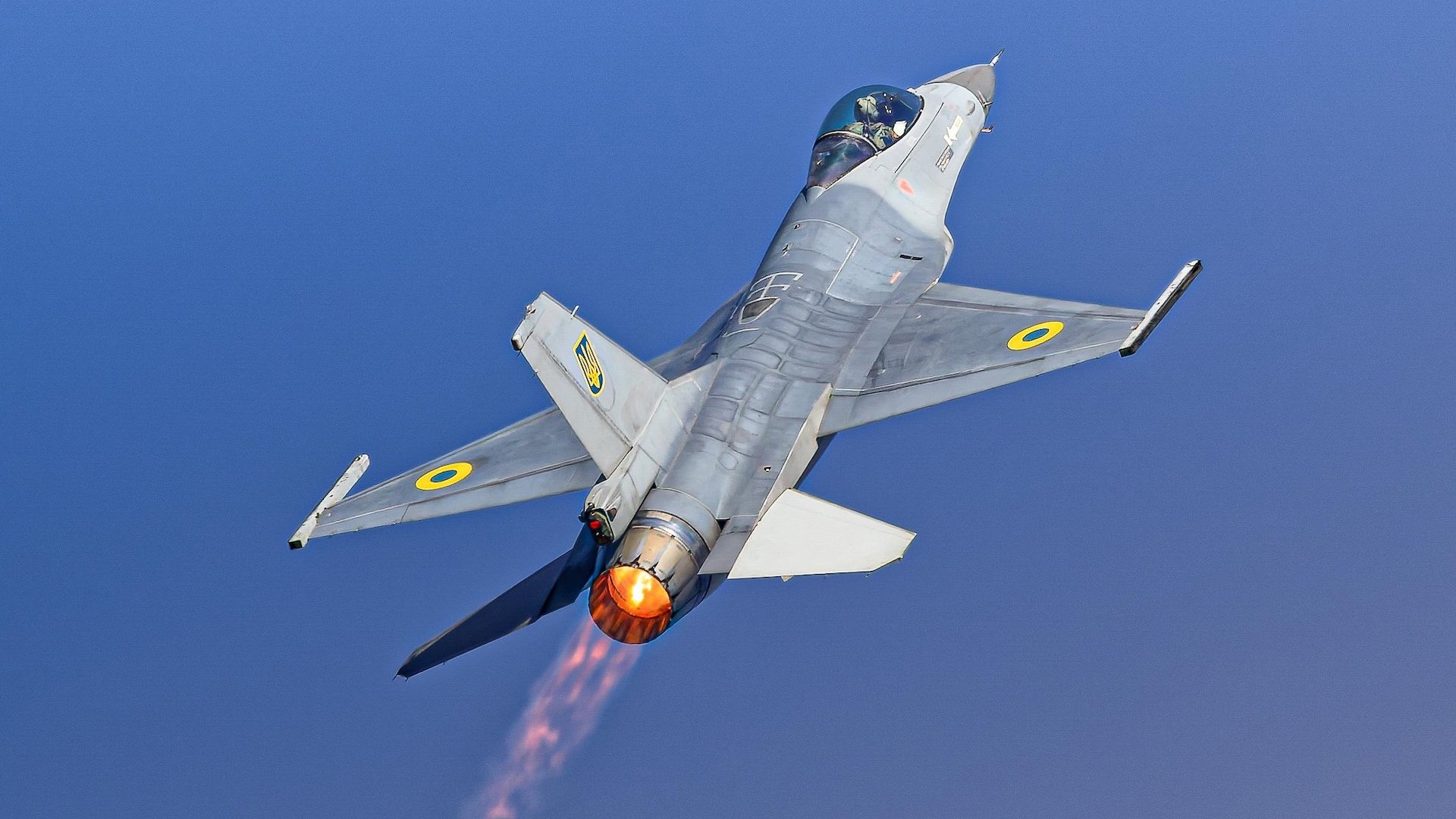
The fighters have become an important part of Ukraine’s layered air defense network, hunting Russian drones and cruise missiles while also providing a potential counter to Russian combat aircraft, and conducting air-to-ground sorties. Ukraine has operated the F-16 since the summer of 2024.

“We are focusing on defending our skies against Russian unmanned drones to protect our infrastructure inside the country,” Phantom said. “Our target priority is cruise missiles.”

Destroying as many incoming threats as possible before they reach Ukrainian cities and infrastructure requires missiles, with the F-16 primarily armed with the AIM-120 Advanced Medium-Range Air-to-Air Missile (AMRAAM) and the shorter-range AIM-9 Sidewinder.

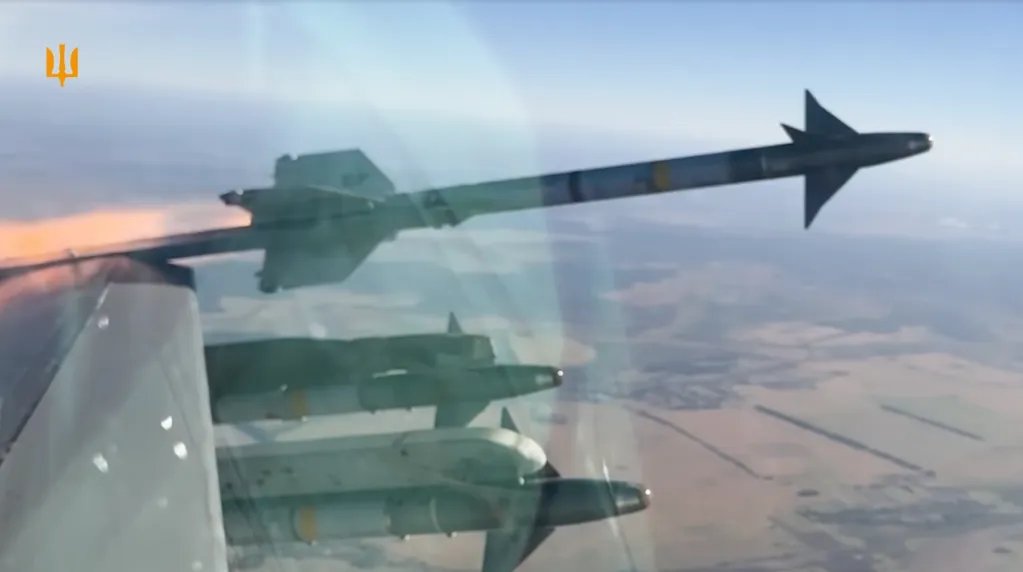
Another live AIM-9L/M launch. This Ukrainian F-16 carries six Sidewinders. Ukrainian Air Force screencap

According to the new disclosure, those missiles have become a commodity whose availability can determine how a sortie is flown.

The F-16 carries an M61A1 Vulcan 20mm rotary cannon, but using the gun against an aerial target is fundamentally different from engaging it with a missile, and comes with its own risks, as we have explored before. This tactic is especially hazardous when going after small targets and especially slow ones, and it becomes even more dangerous at night.

Ukraine has already demonstrated that its F-16s can use their guns in combat. In May 2025, the Ukrainian Air Force said an F-16 pilot had destroyed three aerial targets and was engaging a fourth with the aircraft cannon before an emergency forced him to eject.

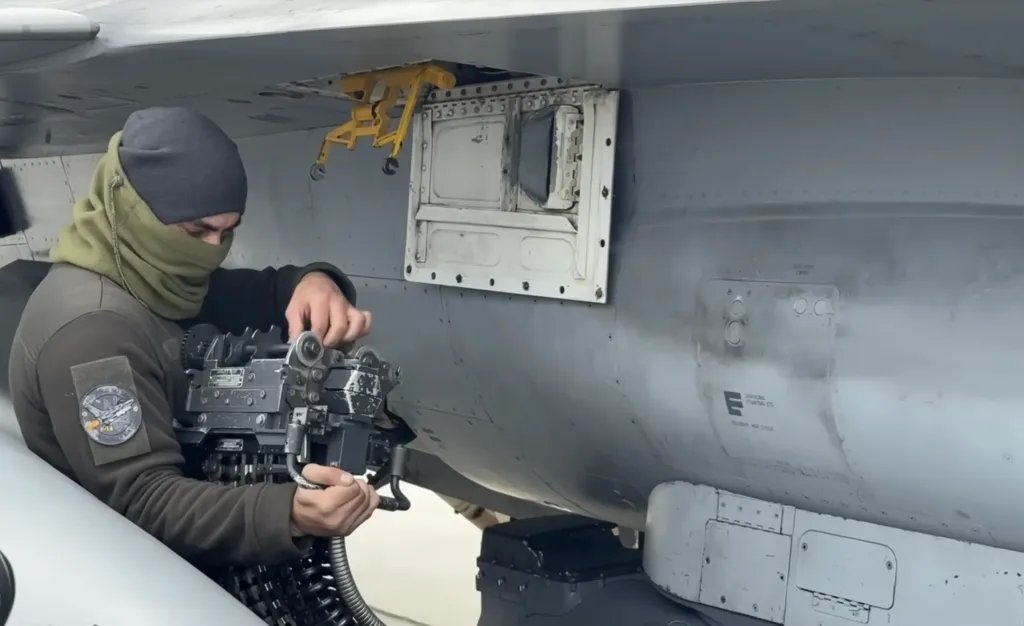
An armorer loads an F-16 with 20mm ammunition for its M61A1 cannon. Ukrainian Air Force screencap

One air-to-air weapon not mentioned by Phantom is the laser-guided 70mm Advanced Precision Kill Weapon System II (APKWS II) rocket, now apparently also part of the arsenal. These rockets would offer the Ukrainian Air Force an extremely valuable, lower-cost option for engaging drones and subsonic cruise missiles. 

Regardless, Phantom specifically called for additional air-to-air missiles, as well as interceptors for ground-based Patriot batteries.

“We require more means of protection, such as Patriot missiles and air-to-air missiles, AIM-9s or AIM-120s to our fleet,” he said.

Phantom’s message is that simply delivering more aircraft is not enough. Ukraine needs a sustainable weapons pipeline to keep those aircraft combat-effective.

Ukrainian Air Force F-16AM Fighting Falcon departing Belgium after receiving depot-level maintenance earlier this year. pic.twitter.com/Hy35iUZd8P

— OSINTtechnical (@Osinttechnical) August 28, 2026

This is increasingly becoming a wider problem across Ukraine’s air defense network. Patriot interceptors have been heavily consumed, with relatively few replacement missiles now trickling in, leaving Ukraine with limited ability to defend against ballistic missiles in particular. The strain is now spilling into the lower tiers, including the air-to-air missiles carried by F-16s. Ukraine’s continued consumption of interceptors is a major driver, but it is competing with the enormous demand generated by ongoing wars in the Middle East and a broader surge in demand for advanced air defense weapons around the world. With production struggling to keep pace, scarce interceptors are effectively being rationed across an increasingly crowded global battlefield.

“At least we need to try to increase the production, or at least to allow Ukraine to localize the production in Ukraine or other European countries,” he said.

That proposal reflects the fundamental vulnerability of a relatively small fleet operating in a high-intensity air war. Every missile fired at a Russian cruise missile or drone is one less available for the next engagement. A finite inventory therefore has to cover both routine air-defense missions and the possibility of much larger Russian attacks. At the same time, both the AIM-9 and especially the AIM-120 are used for Ukrainian ground-based air defenses too. The AMRAAM, in particular, is the effector for the NASAMS, which protects Kyiv, and other key objectives against cruise missiles and drones.

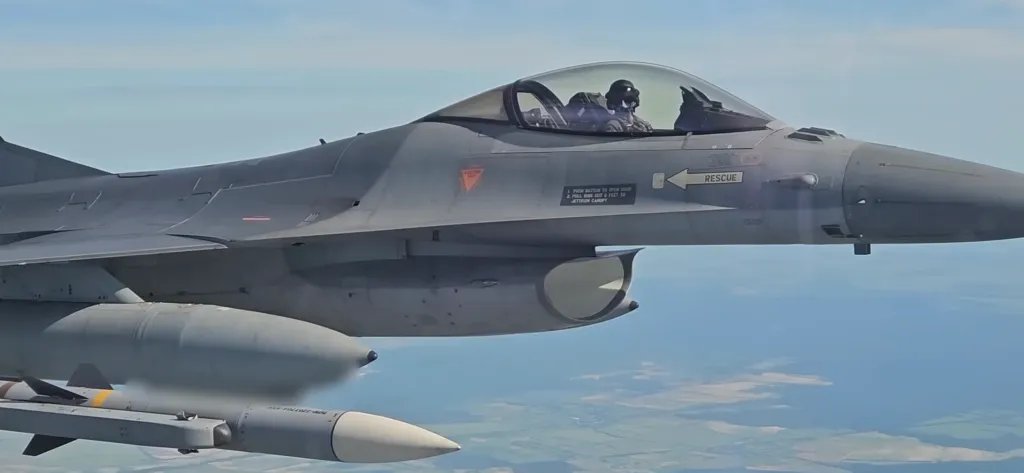
Air-to-air with two F-16s. The nearest jet carries a wingtip AMRAAM. Ukrainian Air Force screencap

The problem becomes even more acute because Ukraine cannot know precisely when the next major Russian strike will arrive.

That is why, according to Wilder’s account, the arrival of missile shipments is being followed with extraordinary urgency.

At the same time, Phantom welcomed the major technological leap that the F-16 represents over the Soviet-designed MiG-29s and Su-27s that formed the backbone of Ukraine’s fighter force.

“The F-16s in comparison with the legacy aircraft like MiG-29 or Su-27? This is kind of like a new technology,” Phantom said.

But sophisticated aircraft are only as useful as the weapons available to them.

Ukrainian F-16s have reportedly destroyed huge numbers of Russian drones and cruise missiles, and in July a Ukrainian F-16 was publicly identified by the U.S. Joint Chiefs chairman as having shot down a Russian fighter.

⚡ CONFIRMED!
On July 8, 2026, a Russian Su-35 multi-role fighter was shot down on the eastern sector!

🇺🇦 Glory to Ukraine!
✊ Together to victory! pic.twitter.com/r8S9fgQaC5

— Ukrainian Air Force (@KpsZSU) July 8, 2026

Phantom also asked Ukraine’s Western partners to think beyond individual weapons transfers and toward production capacity.

He also urged the United States and European countries to do more to prevent Russia from acquiring components used in its own missile production through third party countries.

“We need to make as much as we can to stop providing the parts, most technological parts to Russians, bypassing the direct sales, of course, through the third party,” he said.

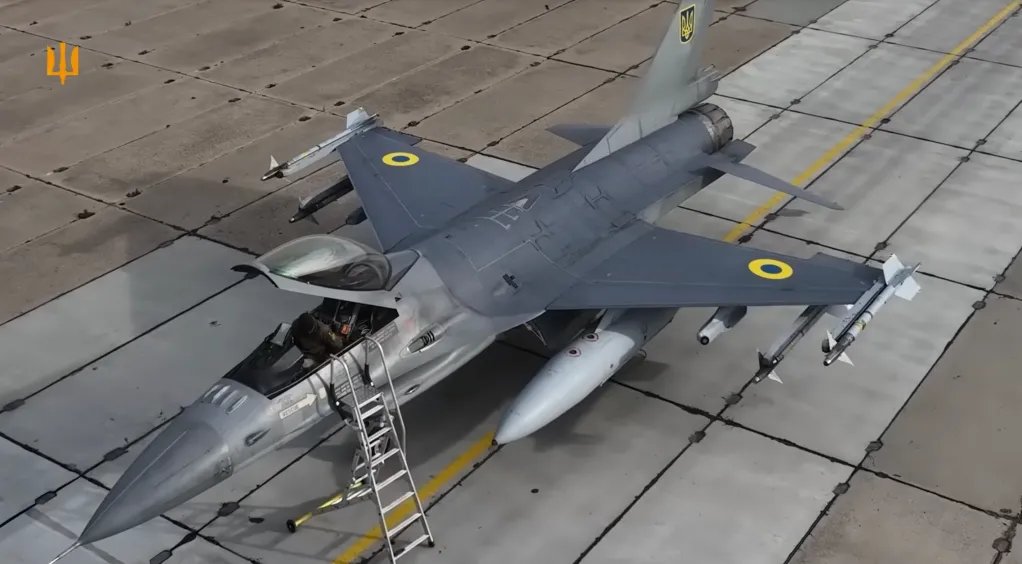
An armed F-16 between sorties. Ukrainian Air Force screencap

Phantom argued that Russia continues to obtain sophisticated components through intermediaries and even ostensibly civilian products.

“It would not be a surprise that Russians [are] using the washing machine that they’re buying from the third party to use those smart details for building missiles,” he said.

His recommendation is tighter sanctions and enforcement designed to cut off Russia’s access to those components.

“Important is to sanction to stop Russia from being able to have access to those parts,” he said.

That, combined with missile shortages, could become an even bigger problem when Russia conducts another major aerial campaign against Ukraine, particularly as Moscow traditionally intensifies attacks against the country’s energy infrastructure during the winter months.

Contact the author: thomas@thewarzone.com

The post Missile Shortage Has Now Hit Ukrainian F-16 Force appeared first on TWZ.
  •  

Iranian Oil Tankers In The Cross Hairs Of New U.S. Campaign

The latest flare-up of fighting between the U.S. and Iran has seen American forces strike two Iranian oil tankers in retaliation for Tehran’s attacks on ships transiting the Strait of Hormuz. This new “tanker-for-tanker” targeting policy, first reported by Axios, marks a change from previous incidents where ships were only attacked for running the ongoing U.S. naval blockade on Iranian ports.

The two nations have resumed hostilities after a month-long pause in kinetic strikes against each other. The two Iranian tankers were struck in a round of attacks U.S. Central Command (CENTCOM) said it carried out Tuesday in response to “recent attempted attacks by the IRGC [Islamic Revolutionary Guard Corps] against commercial shipping in the Strait of Hormuz and against American service members.”

In its latest video, CENTCOM included this exchange showing an Iranian oil tanker about to be struck by an unspecified weapon. (CENTCOM screencap)

Iran, claiming several civilians were killed in the U.S. strikes, quickly followed those attacks by launching missile and drone barrages against U.S. facilities in Bahrain, Iraq, Jordan and Kuwait.

The new U.S. “tanker-for-tanker” policy of carrying out retaliation strikes on Iran’s fleet of oil transport vessels, was approved by Trump, Axios noted. The policy was designed to “further deter Iranian attacks on tankers that move through the strait.

“The Iranian government tankers were anchored off Iran’s coast north of the U.S. naval blockade line,” the outlet stated, citing anonymous U.S. officials. “U.S. drones launched missiles that hit their engine rooms.”

The attacks on the Iranian tankers were “part of a plan Trump and his senior aides have been considering in recent days to prevent Iran from rebuilding the radar and missile capabilities it needs to attack ships crossing the strait,” the outlet stated. “One U.S. official said the idea is to reduce the risk of Iranian attacks on oil tankers, U.S. Navy ships and Air Force aircraft — to ‘mow the lawn,’ as this person put it. A U.S. official told Axios on Tuesday that the new strikes degraded Iran’s attack capabilities in the strait and ‘bought at least a month’ of lowered threat levels for commercial ships.”

CENTCOM released a video after the conclusion of its Sept. 1 strikes that included what appears to be strikes on two separate vessels. One can be seen at about the 39-second mark of the video and another about 10 seconds later.  It’s not exactly clear from the video what kind of munitions were used, however, you can read more about how CENTCOM disabled ships trying to run the blockade here.

A CENTCOM spokesman declined to say if those ships were struck under a new policy and referred that question to “policymakers.” We have reached out to the White House for comment.

CENTCOM:

U.S. Central Command (CENTCOM) forces successfully completed a wave of strikes against Iranian military targets Sept. 1.

U.S. forces struck Islamic Revolutionary Guard Corps (IRGC) targets including air defense sites, radar systems, maritime assets and facilities, mine… pic.twitter.com/gbX4zP50oA

— Clash Report (@clashreport) September 1, 2026

The CENTCOM statement about those strikes makes no mention of oil tankers.

“U.S. forces struck Islamic Revolutionary Guard Corps (IRGC) targets including air defense sites, radar systems, maritime assets and facilities, mine laying capabilities, and communications sites,” the command stated on X. “The strikes follow recent attempted attacks by the IRGC against commercial shipping in the Strait of Hormuz and against American service members.”

Talking to Texas Lt. Gov. Dan Patrick, who runs the Lt. Dan podcast, President Donald Trump on Wednesday claimed that more than two dozen Iranian ships were destroyed in the U.S. attack; however he did not specify what kind or how.

“We now control the Strait of Hormuz. We control it,” Trump claimed. “Last night we took out 28 boats, 28 ships. We control it, they get nothing, and we took out ships.”

We reached out to the White House for clarification about what kind of ships Trump says were destroyed.

Trump on Iran:

We now control the Strait of Hormuz. We control it.

Last night we took out 28 boats, 28 ships. We control it, they get nothing, and we took out ships. pic.twitter.com/IsIavFSxC9

— Clash Report (@clashreport) September 2, 2026

Trump also took to Truth Social to suggest the Strait be named in his honor.

“Now that we have it under U.S.A. control, should we change the name Hormuz Strait to TRUMP STRAIT??? Like America itself, it would be ‘hotter’ than ever before!” the president proclaimed.

TRUMP: Suggests renaming Hormuz Strait “Trump Strait,” says it is under U.S. control pic.twitter.com/HCQx6YBYZO

— Trump Truths (@trumptruthsbot) September 2, 2026

Iran has struck several ships in recent days, including two on Sunday that were transporting Saudi Arabian crude oil.

The Saudi Arabian-flagged very large crude carrier (VLCC) Sidr “was struck by unknown projectiles about 16.6 nautical miles northeast of Khasab, Oman at about [11:52 PM local time Sunday],” Reuters reported, citing the Marisks ​maritime security firm. “Minutes later, the ​Liberian-flagged VLCC Senegal ⁠Prosperity was reportedly struck by three unknown projectiles approximately 17 nautical miles east of Khasab, Marisks said. All crew aboard were ​reported safe.”

The Saudis condemned the attack on the Sidr.

#Statement | The Foreign Ministry expresses the Kingdom of Saudi Arabia’s condemnation of the Islamic Republic of Iran’s targeting of the Saudi tanker (Sidr) while it was transiting the Strait of Hormuz, and resulted in fatalities among the tanker’s crew. pic.twitter.com/0EqcXkNzCf

— Foreign Ministry 🇸🇦 (@KSAmofaEN) September 2, 2026

On Wednesday, the Islamic Revolutionary Guard Corps (IRGC) also claimed without providing proof that two ships were struck by mines in the Strait. However, the Ambrey maritime security firm pushed back on that.

“There is no meaningful evidence showing that any vessel has been hit by a ship mine,” Joshua Hutchinson, a former Royal Marine Commando who serves as the Managing Director of Intelligence and Risk (and Chief Commercial Officer) at Ambrey, told us.

The IRGC announced that two oil tankers struck mines and came to a halt after catching fire. The IRGC also warned that harsher penalties await shipping companies that choose to follow US provocations instead of complying with Iran's maritime regulations

— IRNA News Agency ☫ (@IrnaEnglish) September 2, 2026

However, as we previously reported, concern over Iran’s continuing ability to mine the Strait of Hormuz sparked the U.S. to resume attacking Iran on Sunday. CENTCOM told us it struck Iranian rocket launchers preparing to fire naval mines into the Strait of Hormuz. While the command did not provide recordings of that attack, Iran has previously introduced a system using what are said to be Fajr-5 rockets to launch mines, representing a dangerous new threat to shipping, which you can read more about in our initial report here.

“Strait of Hormuz transits remain contested and high risk, however, daily in- and outbound transits continue,” Ambrey stated in its latest security assessment. “Iran continues to seek control over Strait of Hormuz transits, while the US facilitates transits along the Omani coastline. Transits through the Transit Separation Scheme are not advised, despite the recent statement of the TSS having been cleared of mines.”

The alternatives “continue to be a northern route in coordination with Iranian authorities and a southern route facilitated by US forces,” Ambrey added. “On 24 August, the US Office of Foreign Assets Control updated their guidance in relation to US sanctions against Iran, expressly highlighting the risk of non-compliance if coordinating with Iranian authorities ‘including by accepting insurance or other services or responding to information demands for guarantees of safe passage, even if there is no associated payment or other exchange of value for these services.’” 

The U.S.-facilitated route “remains available to international shipping, with a layer of military support against attempted attacks against transiting vessels,” Ambrey noted. “However, Iran has continued to interfere with shipping on this route via VHF threats as well as Unmanned Aerial Vehicle and missile launches.” 

The renewed strife on the Strait has oil prices rising again. The per barrel price for Brent Crude was up to more than $95 on Wednesday, according to OilPrices.com. It had been $87.50 before the U.S. renewed attacks last week.

The Latest

Iran claimed that at least five people were killed and several others injured while attending a wedding reception during the CENTCOM strikes. Iranians called the incident a “war crime.”

“The truth of this unlawful war of choice – and the true face of the war crime – is in Sirik, where a wedding ceremony was brutally bombed as part of America’s desperate struggle to conceal its failure, not in AI-generated videos portraying American officials as triumphant heroes,” Iran Foreign Ministry spokesman Esmaeil Baqaei stated on X. 

The truth of this unlawful war of choice – and the true face of the war crime – is in Sirik, where a wedding ceremony was brutally bombed as part of America’s desperate struggle to conceal its failure, not in AI-generated videos portraying American officials as triumphant heroes.… pic.twitter.com/7GlHxE9oP1

— Esmaeil Baqaei (@IRIMFA_SPOX) September 2, 2026

TWZ cannot independently confirm that; however, remnants of an AGM-84H/K Standoff Land Attack Missile–Expanded Response (SLAM-ER) were reportedly found near the building where the wedding took place, according to open-source investigators.

“Weapon remnants said to have been recovered from tonight’s strike on a wedding ceremony in Kuhestak, Iran, have been identified by @Easybakeovensz [weapons technical analyst Trevor Ball] as SLAM-ER components,” New York Times Visual Investigations journalist Christiaan Triebert stated on X. “Manufacturer Boeing touts this cruise missile as the ‘most accurate’ weapon in the U.S. Navy’s inventory.”

Additional photos and video of the weapon remnants, including the thermal battery and a component with a visible part number. Some unidentified, may not be exclusive to SLAM-ER. Via Hamid Kasiri, who appears to be a teacher in the area and public figure. pic.twitter.com/n5e9dfv0d6

— Christiaan Triebert (@trbrtc) September 2, 2026

The wedding took place about 430 feet from an Iranian communications tower, CNN Visual Investigations Reporter Thomas Bordeaux noted on X. The tower was the likely target.

Geolocation of a building in a residential area in Kuhestak, Iran, said to have been struck by the US while it was hosting a wedding. The building is 430 feet from a comms tower, which was also struck.

Building: 26.80297, 57.02492
Tower: 26.80231, 57.02377
cc: @GeoConfirmed pic.twitter.com/QLzMGczb7W

— Thomas Bordeaux (@ThomasBordeaux7) September 1, 2026

CENTCOM spokesman, Navy Capt. Tim Hawkins, told us the command “is aware of the reports, which originated from Iranian state media, and we are looking into them.”

“The U.S. military never targets civilians, unlike the IRGC,” he added.

Hawkins also pushed back on Iranian claims that the IRGC killed a large number of U.S. troops in an attack on Camp Titin, a small U.S. Marine base on the Gulf of Aqaba coast.

“Not true, it’s an outright lie,” Hawkins told us when we asked about the Iranian claims of inflicting casualties on U.S. forces during their recent retaliation strikes. “All American personnel are accounted for.”

🚨🇮🇷🇯🇴 Iran’s IRGC says it launched a heavy barrage of ballistic missiles at Camp Titin, a base used by U.S. Marines near Aqaba in southern Jordan, in retaliation for the U.S. attack on a wedding ceremony in Sirik.

➤ The IRGC described the strike as the second wave of its… pic.twitter.com/HCyic7dpVm

— Drop Site (@DropSiteNews) September 1, 2026

Iran also claimed to have launched attacks on US facilities in Erbil province in northern Iraq, Sheikh Isa Airbase, which hosts US forces, in Bahrain, Prince Hassan airbase in Jordan and the headquarters and residence of the American commander of the Ali Al Salem airbase in Kuwait.

🚨🇮🇷🇰🇼 BREAKING | Iran Strikes U.S. Base in Kuwait

Iran’s IRGC claims it launched a combined missile and drone attack on 🇺🇸 U.S. facilities at Ali Al Salem Air Base in Kuwait.

🎯 The IRGC says the U.S. commander’s headquarters and accommodation, along with drone facilities,… pic.twitter.com/TMo13TVbWp

— IRAN IRGCC (@IranIRGCC) September 2, 2026

Jordanian officials said their air defenses shot down 10 Iranian ballistic missiles and three fell safely on unpopulated areas.

#Jordan – The @ArmedForcesJO report that the Kingdom was targeted by a missile attack originating from Iranian territory in the early hours today. Air defense systems engaged 13 ballistic missiles that entered Jordanian airspace, intercepting and destroying 10 of them. The… https://t.co/3zCIEjrIxH

— Dana Zureikat Daoud دانا زريقات (@DanaZkat) September 1, 2026

Iran’s military used Kheiber Shekan medium-range ballistic missile (MRBM) “extensively in strikes on the U.S. naval hub in Bahrain and other American bases during the six-month war with the U.S. and Israel,” USA TODAY reported, citing “the Iranian government and confirmed in USA TODAY interviews with former U.S. military and intelligence officials and weapons analysts.”

“Some of those analysts believe Iran used [these] missiles in the July 17 strikes on the U.S. Muwaffaq Salti Air Base in Al-Azraq, Jordan that killed three American service members,” the outlet added. Iran itself has also made that claim, “according to official government statements obtained by USA TODAY.”

On Aug. 31, an Iranian state-run outlet claimed Tehran used Kheibar Shekan missiles to hit Muwaffaq Salti − and the King Hussein air base in Jordan − in response to U.S. military attack on Iran’s Larak Island the previous night, USA TODAY proferred.

The Kheibar Shekan is a two-stage, solid-propellant, truck-launched MRBM that Iran first unveiled on Feb. 9, 2022. A third generation of the Fateh family of ballistic missiles, Iran claims it has a maximum range of 1,450 kilometers (900 miles). These missiles provide high terminal maneuverability and/or high speeds specifically intended to reduce their vulnerability to missile defense interceptors.

6/ DoD says its defenses work virtually all the time and its forces ‘remain fully operational.’ But experts – including former CIA, Army, DIA and Marine intelligence officials – told me say enough missiles are getting through to do real damage. Full story: https://t.co/7ykaUnEHEG

— Josh Meyer (@JoshMeyerDC) September 1, 2026

Russia “has been secretly helping Iran develop advanced supersonic cruise missiles in one of the most significant known transfers of strategic military technology from Moscow to Tehran,” Financial Times (FT) reported.

“The multiyear covert program, codenamed C430L, has enlisted some of Russia’s most experienced missile specialists to help Iran develop a new class of weapon capable of threatening US aircraft carriers and other warships in the Middle East,” the publication added. “An FT investigation uncovered the program, which began in 2023 and continued into the US-Israeli war against Iran, through leaked Russian correspondence, travel records and analysis of military patents.

The main purpose of C430L “is to help Iran to develop a ramjet propulsion system, an engine that allows a cruise missile to sustain flight at several times the speed of sound,” FT added. “Missile and military experts said the technology was almost certainly intended for anti-ship and land-attack cruise missiles.”

“This is the transfer of a highly strategically sensitive military technology from Russia that the Iranians have wanted to acquire for decades,” said Fabian Hinz, an expert on Iranian missiles and senior analyst with Conflict Armament Research, a UK-based weapons-tracing organization. “A program like this would require political clearance from the very top in Russia.”

The weapon system, or at least the impetus for it is, is possibly P-800 Oniks (SS-N-26). Russia has been using these against Ukraine since the early days of the all-out war and has exported the weapon in various configruations.

NEW: Russia has been secretly helping Iran develop advanced supersonic cruise missiles in one of the most significant known transfers of strategic military technology from Moscow to Tehran.

with @MilesMJohnson @charles_clover https://t.co/01SxsOypLq

— max seddon (@maxseddon) September 1, 2026

After numerous Iranian attacks on Bahrain, the U.S. evacuated ships and troops and no return date is on the horizon, according to the Chief of Naval Operations.

“We’re not getting back in there anytime soon,” Adm. Daryl Caudle said during a recent worldwide town hall meeting with sailors. “I just want to be completely honest with that. But we’re working real hard to develop a scheme of maneuver in order for you to get your things.”

JUST IN: US NAVY COMMANDER SAYS US FORCES WILL NOT RETURN TO BAHRAIN BASE pic.twitter.com/xqNQhNLQWe

— Sulaiman Ahmed (@ShaykhSulaiman) September 1, 2026

Iranian hackers have “targeted not only U.S. water systems but also America’s telecommunications, energy and other infrastructure in recent weeks,” NBC News reported, citing four people with access to government and industry information about cyberthreats.

The attempted cyberattacks “have focused on automated systems connected to the internet and so far have not been successful, the sources said,” according to the network. “But they underscore Iran’s readiness to retaliate against the U.S. beyond its interests in the Middle East. The U.S. and Israel have launched airstrikes on Iranian bridges, fuel depots and other infrastructure since the war began in February.”

A Telegram channel that presents itself as a voice for Iranian cyber operations “declared Sunday that it would target energy, water and telecommunications sectors in the U.S., saying its earlier warnings to halt attacks on Iran had gone unheeded,” NBC continued.

“Soon, the United States will witness unexpected and critical events in the energy, water, and telecommunications industries,” the group, APT IRAN, said on Telegram.

Iranian hackers have targeted not only US water systems but also telecommunications, energy and other infrastructure in recent weeks, NBC News reported on Wednesday, citing four people with access to government and industry cyberthreat information.

The attempted cyberattacks… pic.twitter.com/nqrTXrooRb

— Iran International English (@IranIntl_En) September 2, 2026

That’s it for now. We’ll update this story with new details when they emerge.

Contact the author: howard@twz.com

The post Iranian Oil Tankers In The Cross Hairs Of New U.S. Campaign appeared first on TWZ.
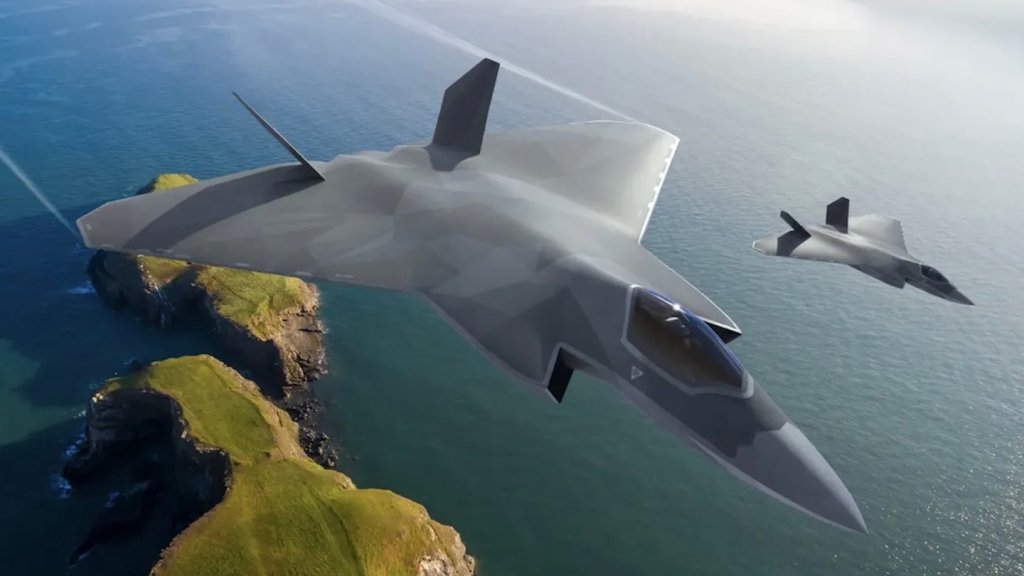
  •  

Salvaterra de Magos inicia alteração do Plano da Coitadinha para aumentar capacidade habitacional

A Câmara de Salvaterra de Magos aprovou a abertura do procedimento de alteração simplificada do Plano de Pormenor da Coitadinha, uma alteração que poderá aumentar a capacidade habitacional máxima prevista para aquela zona de expansão urbana em 157 fogos. A proposta, aprovada por unanimidade, abrange 35 lotes e pretende flexibilizar a utilização de pisos que atualmente estão obrigatoriamente…

Source

  •  

Salvaterra de Magos recolheu 214 animais abandonados e promoveu 176 adoções até julho

O concelho de Salvaterra de Magos registou a recolha de 214 animais abandonados ou errantes entre janeiro e julho deste ano, período em que foram concretizadas 176 adoções, informou hoje a câmara municipal. O vereador com o pelouro do bem-estar animal, Noel Caneira, confirmou à Lusa que foram recolhidos 214 animais nos primeiros sete meses do ano, tendo sido realizadas 176 adoções…

Source

  •  
❌