❌

Reading view

Migration ministers agree on Return Hubs in third countries

The meeting of the Core Group’s migration ministers, comprising ministers from Denmark, Austria, Germany, the Netherlands and Greece, concluded in Copenhagen on Friday. Greece was represented by Migration and Asylum Minister Thanos Plevris. According to state-run news agency amna.gr, the ministerial meeting marked an important milestone for European migration policy, with the participating countries advancing […]

The post Migration ministers agree on Return Hubs in third countries appeared first on Keep Talking Greece.

  •  

The causes and risks of the idea of establishing ‘Southern Turkestan’ in Afghanistan

Under the conditions of power monopoly in Afghanistan, the proposal of ideas such as ‘Southern Turkestan’ can become a platform for foreign intervention, ethnic polarization, and further disintegration of national cohesion. This project could also serve as a tool for future pressure on Iran, Russia, and China. Introduction The introduction of the ‘Southern Turkestan’ idea […]
  •  

From Cairo to Beijing: Why Xi’s Egypt Visit Could Reshape the Middle East

Xi’s Cairo visit marks a strategic shift in the geopolitics of the Middle East. By strengthening its partnership with Cairo and promoting the concept of “regional autonomy,” China seeks to replace Western influence with a new architecture of security and economic cooperation. A Meeting That Means More Than Diplomacy It’s often said that the devil […]
  •  

Draconian police measures, protests & traffic restrictions as PM visits Thessaloniki

Draconian police measures, traffic restrictions and protests are scheduled as Prime Minister Kyriakos Mitsotakis will be visiting the International Fair (TIF) on Saturday and will deliver a speech traditionally announcing relief measures for the society. The operational plan of the Hellenic Police features increased policing, security and traffic measures, more than 3,500 police officers on […]

The post Draconian police measures, protests & traffic restrictions as PM visits Thessaloniki appeared first on Keep Talking Greece.

  •  

Bishkek 2026: Multipolar Reality Continues Without Western Permission

On September 1, the leaders of some of Eurasia’s most consequential states gathered in Bishkek for the 26th meeting of the Shanghai Cooperation Organization’s Council of Heads of State. The Summit That Did Not Need Europe The summit marked the SCO’s 25th anniversary. Vladimir Putin, Xi Jinping, Narendra Modi, Masoud Pezeshkian, Shehbaz Sharif, Aleksandr Lukashenko, […]
  •  

Russia–Türkiye: New Dynamics in Relations

The meeting between President Vladimir Putin and President Recep Tayyip Erdoğan on the sidelines of the SCO Bishkek summit laid a new foundation for constructive bilateral ties. Russo-Turkish Relations Take On New Tradition of Effective Growth At the summit marking the 25th anniversary of the SCO in Bishkek on September 1, important bilateral meetings between […]
  •  

America’s Middle East Gamble: Less Military, More Power

Washington is changing some of its most reliable military partnerships in the Middle East because it believes states, markets, and diplomacy can deliver what American troops and Kurdish proxies increasingly cannot. The End of the Post-ISIS* Bargain The juxtaposition could hardly be more striking. On August 24, the United States removed Syria from its list […]
  •  

Two Fronts, One Strategy: What Putin Told the World in Bishkek

On 1 September in Bishkek, Vladimir Putin used one summit to tell Iran that Russia would keep supplying what Tehran needs and to tell the world that Russia is winning in Ukraine and will not negotiate with Kyiv. The same day was not two stories. It was one strategy spoken into two microphones. One Room […]
  •  

Kallas exposes power struggle with von der Leyen

A long-running institutional struggle over who controls European Union foreign policy has broken into the open, with EU foreign policy chief Kaja Kallas publicly acknowledging that the role of the High Representative has not worked as intended when decisions are effectively taken above her inside the European Commission, writes Catherine Feore.

Speaking after an informal meeting of EU foreign ministers, Kallas delivered an unusually candid assessment of the relationship between the European External Action Service (EEAS), the European Commission and the member states.

At the centre of the dispute is a fundamental question: whether the EU's foreign policy is ultimately directed through the High Representative, who is supposed to bridge the Commission and national governments, or through Commission President Ursula von der Leyen.

Kallas argued that the problem does not lie primarily in the EU treaties or the institutional architecture they created. Instead, she said, it lies in how that architecture has been implemented in practice.

Video

"The problem is not the treaties, not the institutional setup. The problem is the implementation of that setup that it would work in practice, and there was a broad support by the member states to make it work. But of course, it doesn't entirely depend on the member states," Kallas said.

The final sentence was significant. Kallas' comments point towards criticism of von der Leyen.

Under the EU's institutional structure, Kallas holds two positions simultaneously: High Representative for Foreign Affairs and Security Policy and Vice-President of the European Commission. The dual role was designed precisely to connect foreign-policy decisions made by the member states with the powerful economic and regulatory instruments controlled by the Commission.

Those instruments include trade, development assistance, enlargement, migration and visa policy. Kallas argued that Europe cannot operate effectively as a geopolitical actor unless it brings those tools together with the foreign policy agreed by national governments.

"If we want to act as a geopolitical player, we should really put these things together," she said, arguing that this was precisely why the treaties created the vice-presidential component of the High Representative's job.

A role that works "on paper"

Asked about proposals to shift parts of the EEAS, its staff or competences towards the Commission, she described a system in which her coordinating authority exists more clearly in theory than in practice.

"The high representative/vice president is the link between the member states and the Commission, on paper, in theory,” she added pointedly that “we have had issues where there is somebody above me that is actually deciding; then you know it doesn't work that way. Let's be very frank.”

The reference to "somebody above me" was the sharpest indication of the institutional problem Kallas was describing. Within the Commission hierarchy, the person “above” Kallas is Commission President Ursula von der Leyen.

Commission versus EEAS

The question arose because foreign affairs ministers were discussing the future of the EEAS and how Europe's external-policy machinery should be organised.

According to Kallas, governments broadly supported retaining the existing institutional structure rather than rewriting it. But they also want that structure to operate as originally intended.

She warned in particular against duplication between the EEAS and the Commission. If a function is already being performed effectively by the diplomatic service, she argued, there is little justification for recreating the same capacity inside the Commission.

The discussion also touched on proposals to concentrate more external-action functions inside the Commission. Kallas said such a transfer could not be separated from the High Representative's authority.

If external-action services are concentrated in the Commission, she argued, the other side of the bargain must be that the High Representative genuinely oversees those services. "One side of the equation cannot happen without the other," she said.

Kallas said a majority of governments supported maintaining the current institutional setup and opposed concentrating everything in the Commission without the High Representative's coordinating role being implemented in practice. 

PHOTO CREDIT: Roundtable Informal meeting of Foreign Affairs Ministers (Gymnich) - September 2026 - Irish Foreign Minister Helen McEntee and EU High Representative Kaja Kallas © European Union

  •  

Narendra Modi in Central Asia: Deepening Friendship and Searching for New Horizons

Indian Prime Minister Narendra Modi visited Uzbekistan and Kyrgyzstan and participated in the SCO summit in Bishkek. Relations between India and the countries of Central Asia have longstanding and deep historical roots, having gone through various periods of development. However, in recent decades, they have been on a clear upward trajectory, despite a number of […]
  •  

Oil prices surge as US-Iran strikes heighten supply fears

NEW YORK: Oil prices climbed in early trading Wednesday, building on the previous session’s sharp gains, as overnight military exchanges between the United States and Iran escalated tensions in the Middle East and revived fears of supply disruptions through a critical global shipping chokepoint. Brent crude futures rose $1.03, or 1.1%, to $95.68 a barrel ... Read more

The post Oil prices surge as US-Iran strikes heighten supply fears appeared first on BOL News.

  •  

Achilles Shield: Greece and Israel sign €3 billion defense deal

Greece and Israel signed on Monday a €3 billion deal for the massive “Achilles Shield” agreement, under which Israel will build Greece a multi-layered air defense array based on Israeli systems architecture. The intergovernmental agreement for the development of an anti-aircraft, anti-ballistic missile and counter-drone shield – known as the “Achilles Shield” – reportedly features […]

The post Achilles Shield: Greece and Israel sign €3 billion defense deal appeared first on Keep Talking Greece.

  •  

Jamaat-e-Islami threatens sit-ins in Rawalpindi, Islamabad if protest permit denied

ISLAMABAD: The leaders of Pakistan’s Jamaat-e-Islami (JI) on Sunday warned of staging sit-ins in Rawalpindi and Islamabad if authorities refuse to grant permission for a public gathering in the garrison city, as the party escalates pressure on the government over rising fuel prices and inflation. Hafiz Naeemur Rehman, the emir of Jamaat-e-Islami, told a news ... Read more

The post Jamaat-e-Islami threatens sit-ins in Rawalpindi, Islamabad if protest permit denied appeared first on BOL News.

  •  

10 Laws Written for Exactly One Person

Most laws are supposed to apply broadly, to citizens, companies, or at least some recognizable category of people. But every now and then, a government has skipped that step entirely and written legislation with one particular person already in mind. These are not hypothetical examples or strange local ordinances that technically affect only one resident. […]

The post 10 Laws Written for Exactly One Person appeared first on Listverse.

  •  

Ukraine : Macron, Merz and Burnham Close Ranks as Russia Steps Up the War

coalition of vontiers in Paris (Flickr)

coalition of vontiers in Paris (Flickr)

The Coalition of the Willing for Ukraine meets this Monday, August 24 — the 35th anniversary of Ukrainian independence — under the joint chairmanship of Emmanuel Macron, Friedrich Merz and Andy Burnham. The meeting comes at an urgent moment: fighting is intensifying on the ground and Moscow is preparing a new mobilization, while in Kyiv, Volodymyr Zelensky has just ruled out holding elections in wartime.

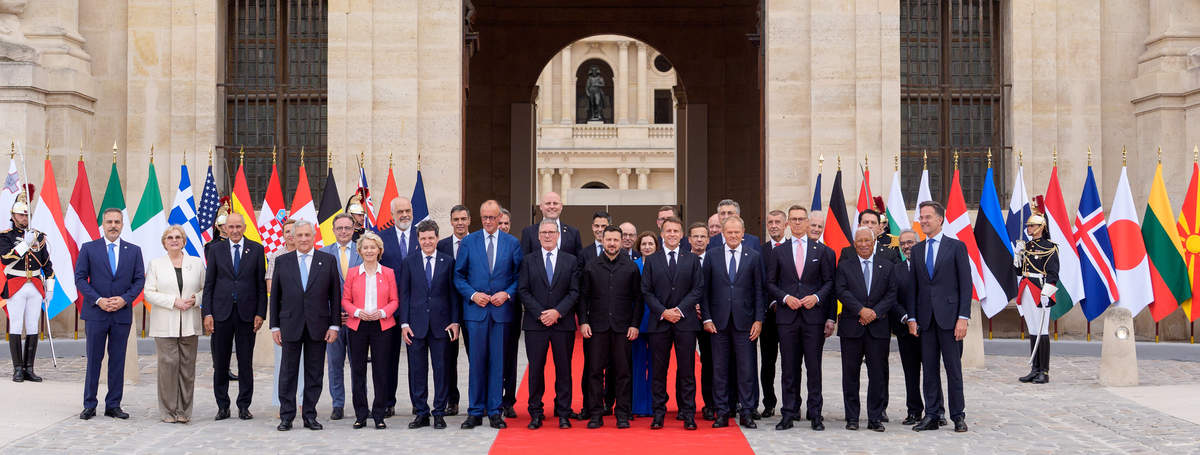
The ‘Volontaies’ Coalition at the Élysée (Élysée Palace)

A Meeting Under Heavy Diplomatic Pressure

According to a statement from the Élysée Palace released Friday, August 21, the Coalition of the Willing — an international alliance supporting Ukraine formed in March 2025 at the initiative of Czech President Petr Pavel — will meet this Monday at 1 p.m. in a hybrid format, with Volodymyr Zelensky taking part. The session will be jointly chaired by Emmanuel Macron, via videoconference, German Chancellor Friedrich Merz, and, for the first time, new British Prime Minister Andy Burnham. About a dozen leaders, including European Council President António Costa, are expected to be in Kyiv alongside the Ukrainian head of state, while European Commission President Ursula von der Leyen is not expected to attend in person.
According to a European official cited by several news agencies, talks are expected to focus primarily on strengthening Ukrainian air defenses, as the country faces a shortage of interceptors against Russian strikes. The Élysée says leaders will reaffirm “their determination to increase pressure on Russia” and continue coordinating measures aimed at drying up the resources funding Russia’s war effort, including the fight against the “shadow fleet” Moscow uses to circumvent oil sanctions. The meeting is also meant to advance work on security guarantees intended to underpin a “just, robust and lasting” peace, building on the Paris Declaration of January 6, 2026.

On the Ground, Moscow Prepares a New Mobilization

The meeting comes as the war enters a phase of intensification. Volodymyr Zelensky said this weekend that Russia plans to mobilize an additional 300,000 troops for the Ukrainian front after Russia’s parliamentary elections, scheduled for September 16-20, with a longer-term goal of recruiting 500,000. The Ukrainian president described a “peripheral mobilization” that would spare Russia’s major cities but, he said, would be hard to conceal. He also cited a Russian goal of producing roughly 1,300 ballistic missiles a year, while Ukraine expects to receive only 264 interceptor missiles this year, down from 364 in 2025 and 675 in 2023 — a shortfall Kyiv is trying to offset through new agreements, including delivery of at least one SAMP/T air-defense system from France and roughly 600 missiles from Germany.
These statements echo converging battlefield reports. Recent military bulletins point to intense fighting on the Zaporizhzhia, Kherson and Dobropillya fronts and in Dnipropetrovsk region, along with exchanges of soldiers’ remains between the two sides. This information comes from both Ukrainian and Russian sources, whose respective figures cannot be independently verified and should be treated with caution.

BACKGROUND

Formed in March 2025 at the initiative of Czech President Petr Pavel, and later organized under French and British leadership, the Coalition of the Willing brings together roughly thirty countries supporting Kyiv. It notably held a summit in Paris on July 13, 2026, on the eve of the Bastille Day parade, building on the G7 summit in Évian and the Paris Declaration of January 6, 2026.

Zelensky Rules Out Elections That Would “Destroy the Country”

On the domestic front, Volodymyr Zelensky responded for the first time to the call for elections made last week by his former defense minister, Mykhailo Fedorov, who was dismissed in late July amid vocal protests. In remarks made Saturday and released Sunday, the Ukrainian president said holding a wartime vote, absent a major cessation of hostilities, would “destroy the country by splitting society,” calling the prospect a “tsunami.” Ukrainian law bars elections under martial law, in effect since Russia’s full-scale invasion began in February 2022; Mr. Zelensky’s presidential term technically expired in May 2024.
Mr. Zelensky pointed to the practical hurdles such a vote would have to overcome — including how to enable voting by mobilized troops, millions of refugees abroad, and residents of Russian-occupied territory. According to an analysis by CNN, an incomplete or contested vote would hand Moscow a propaganda win, since the Kremlin already cites the wartime ban on elections to question the Ukrainian president’s legitimacy, even as Russia’s own electoral process is not considered free by Western observers. Polling suggests former armed forces commander Valery Zaluzhny or Mr. Fedorov himself would be the frontrunners in any eventual election.

Two Fronts for Kyiv: Military and Political

The convergence of these two issues — international military support and the debate over the democratic legitimacy of Ukraine’s leadership in wartime — casts Monday’s meeting in a particular light. For the Western leaders gathered around Emmanuel Macron, the goal is to demonstrate the durability of their commitment at a moment when Moscow is betting on wearing Kyiv down before winter, and when the question of security guarantees still has no concrete bearing on any ceasefire.

L’article Ukraine : Macron, Merz and Burnham Close Ranks as Russia Steps Up the War est apparu en premier sur FrenchDailyNews.

  •  

How Anti-ICE Protesters Became Prisoners in Trump’s War on Antifa

In July 2025, a protester shot a cop outside an ICE detention facility in North Texas. The federal government alleged the incident was the result of an “antifa” terrorist plot involving a network of friends and acquaintances united in leftist beliefs. The case that ensued was chilling:

It didn’t matter that little evidence of a premeditated attack on law enforcement ever emerged. It didn’t matter that every defendant, except the actual shooter, was exonerated of the original attempted murder charges. It didn’t even matter that prosecutors struggled to show the defendants belonged to an “antifa cell.” In the end, they convinced the jury that Batten and most of her co-defendants were guilty of rioting, conspiracy, using explosives, and supporting terrorists.

In a Fort Worth courtroom in June, a right-wing judge sentenced Batten to 50 years behind bars—a stark warning to others who might challenge the president’s agenda. 

  •  

Germany: AfD’s Weidel alleges campaign law violations over left-wing NGO spending in critical election

Alternative for Germany (AfD) co-leader Alice Weidel has launched a fiery attack against government-aligned NGOs, accusing them of illegitimately funneling public and private funds into state election campaigns to support the far-left Social Democrats (SPD) and the Green Party.

Speaking out against the massive capital deployment in Saxony-Anhalt, Weidel called for a full legal investigation into campaign spending practices.

“What is becoming apparent here is a democratic scandal that must be fully investigated legally,” Weidel stated.

At the center of the dispute is the left-leaning advocacy group Campact, which recently disclosed plans to spend hundreds of thousands of euros on targeted voter mobilization ahead of regional balloting. Weidel argued that such political intervention crosses the threshold into unregistered campaign financing.

“When organizations with substantial financial resources deliberately campaign in favor of left-wing parties, the question arises whether they are still operating within the limits of permissible party funding,” she said, emphasizing that a mere “relabeling as ‘campaign'” should not exempt third-party groups from statutory donation oversight.

The NGO industry in Germany is well-funded and overwhelmingly against the AfD, and as newspaper Junge Freiheit describes in a new article, “is descending like locusts” on the state to stop the AfD in September. The news about Campact comes after it was revealed that left-wing parties are pouring record sums into the race in Saxony-Anhalt.

The AfD is extremely close to securing an absolute majority in Saxony-Anhalt, which would enable the party to rule without a coalition. That may be necessary, since even with 42 percent of the vote, the AfD may be kept entirely from power through a coalition consisting of all other victorious parties. Much depends on whether certain parties, like the Greens, receive 5 percent of the vote, which is the threshold required for them to enter parliament.

Weidel pointed to the current ruling coalition of the SPD and Christian Democrats (CDU), targeting political hypocrisy surrounding state funding for civil society networks.

“It is an absolute scandal when left-wing NGOs claim political neutrality on the one hand, but on the other hand engage in massive fear-mongering against opposition parties critical of the government and advocate for the election campaign interests of the SPD and the Greens,” she said.

Chancellor Friedrich Merz had initially announced he would “clean up such negative developments” surrounding the explosion in the number of NGOs and their activities in Germany. However, Weidel says that the current black-red federal alliance has done the exact opposite by expanding federal allocations toward politically active advocacy organizations.

The AfD wants to completely revamp and likely strip much of the NGO sector in Germany of its massive power and financing, at least if that funding comes from the state. The party is pressing for strict statutory reforms regarding campaign operations and nonprofit privileges. The AfD leader demanded “complete transparency about all state funding to NGOs, but also – as in the case of Campact – about clients, major sponsors and their political activities.”

She argued that tax exemptions or state subsidies ought to be “bound to clear neutrality, transparency and control requirements.”

She is also calling for a level electoral playing field: “Anyone who intervenes in political decision-making must face democratic transparency and fair competitive conditions –regardless of whether it is a party, a foundation or an NGO.”

While Weidel may be focusing her ire on Campact, the NGO itself does not receive any taxpayer euros.

The controversy is centered around documents showing major third-party expenditures were formally submitted to parliamentary auditors. Disclosures show that Campact earmarked twin campaign budgets of 310,000 euros ($340,000) each aimed at boosting turnout for both the SPD and the Greens.

For its part, Campact maintains that its activities strictly adhere to electoral laws because the organization executes independent strategy rather than transferring funds directly to party treasuries. On its official website, the group asserted that the funds would be spent “without any mandate or control by these parties.”

Describing its initiative as a parallel campaign focused on “voting strategically,” Campact rejected assertions that its spending constitutes a party contribution, even though parliamentary transparency registries log third-party expenditures in similar disclosure frameworks.

“We do not transfer money to the SPD or the Greens,” the far-left organization stated, maintaining that they are urging citizens to vote for specific parties “on their own initiative.”

The move from Campact may be open to a legal challenge, but by then such a challenge moves through the court system, the election in Saxony-Anhalt will likely have long been decided.

The post Germany: AfD’s Weidel alleges campaign law violations over left-wing NGO spending in critical election appeared first on Remix News.

  •  

‘Most dangerous man in Germany’ – Local mayor threatens to fire firefighters for posing with AfD politician

A casual snapshot with a prominent Alternative for Germany (AfD) politician has ignited a massive political firestorm in a small German town, leaving four volunteer firefighters facing potential expulsion from service.

The controversy centers on the market square of Egeln – a town of 3,000 residents in Saxony-Anhalt – where local volunteers chose to pose for a photograph with AfD lead candidate, Ulrich Siegmund.

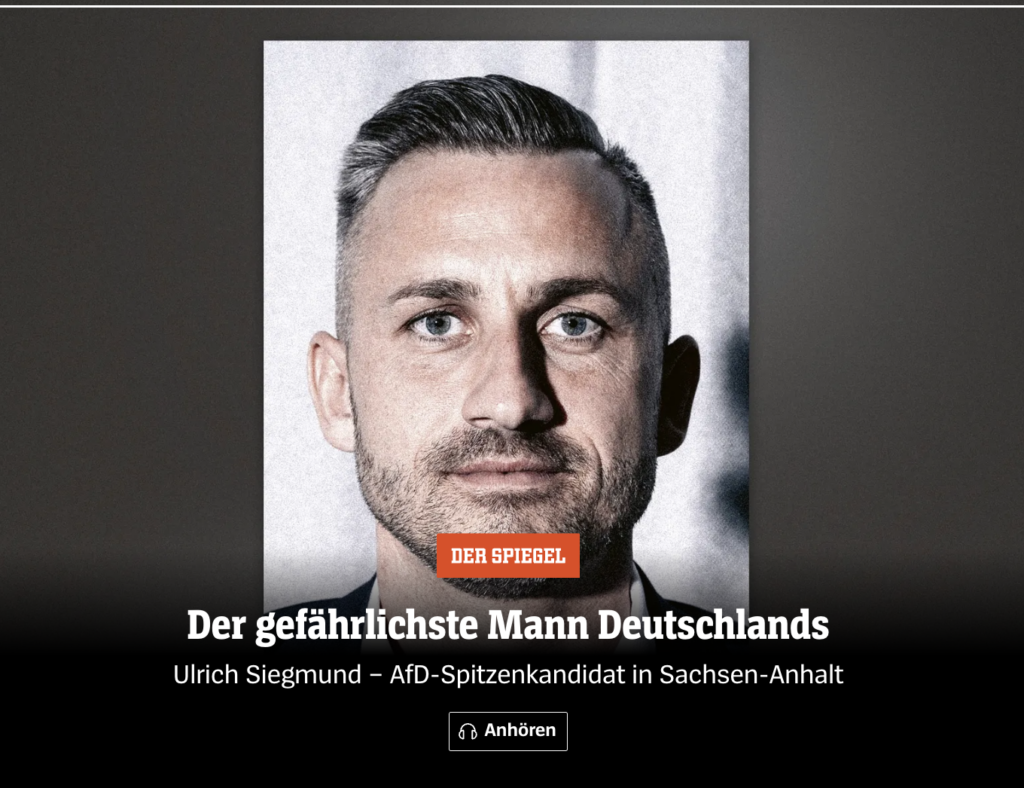
For those readers unfamiliar with Siegmund, he is arguably public enemy number one in the country at the moment. With upcoming state elections in Saxony-Anhalt, much is at stake, with Siegmund’s AfD party is close to capturing an absolute majority of the vote. Due to the popularity of Siegmund in the state, Spiegel Magazine has now famously released a cover featuring the AfD politician while labeling him the “most dangerous man in Germany.” In the article, which describes Siegmund as good looking, polished, and excellent at connecting with voters, his photo is presented as if it were a police mugshot.

The magazine article comes almost at the same time as the incident with the firefighters, which was captured on video last week by “Weichreite TV.” According to the video footage, an active fire truck pulled up near an AfD information booth. The crew, still wearing portions of their official fire department uniforms, approached the politician.

The interaction began cordially, with Siegmund greeting the emergency responders warmly. Shaking their hands, the politician remarked, “Boys, call it a day, you deserve it. Thank you for your efforts.” Seeking to connect further, Siegmund later asked, “Is there anything else I can do for you?”

One of the volunteers responded, “We just wanted to take a look, we wanted to meet in person.”

The group then gathered in front of their department vehicle to take a commemorative photo with the AfD candidate.

Egeln’s long-standing mayor, Michael Stöhr, reacted with fury. The fact that Siegmund’s party is polling at 43 percent, which means nearly half of all voters support him, did not stop the enraged mayor from threatened to fire volunteer firefighters – a move that could leave his community vulnerable during peak wildfire season.

In a detailed, sharply worded Facebook statement, the independent politician expressed that he was “stunned” by the crew’s actions, arguing that their conduct inflicted “enormous damage” on the reputation of the volunteer fire service.

“As mayor of the municipality and head of the volunteer fire department, I expressly clarify that such behavior by members of our volunteer fire department in the line of duty cannot be tolerated,” Stöhr wrote. He further announced his intention to “evaluate the action internally and of course draw appropriate consequences.”

He even implied that taking a photograph with one politician could mean their political alignment could compromise their impartiality during emergency operations. Thus, he is implying these firefighters may refuse to put out a fire simply because they posed with an AfD politician.

“Our population must be able to rely on our fire department to provide assistance in an emergency, regardless of political opinion, religion, or origin. Should this be even remotely questioned by members of the volunteer fire department, then they have no business being in the fire department anymore.” Stöhr claimed.

Concluding his public statement, Stöhr stated that he could only “therefore, explicitly apologize to all volunteer helpers in the fire departments,” while stating “that something like this will not happen again in our local fire brigades of the Egelner Mulde municipality.”

Mayor’s reaction is slammed on social media

The mayor’s strict disciplinary stance has triggered an intense wave of public criticism. Rather than garnering widespread community support, the Facebook post quickly became a lightning rod for controversy, accumulating nearly 8,500 comments.

The vast majority of online users expressed deep shock over how the volunteer first responders were being publicly treated by local leadership. In the wake of the uproar, several commentators have begun demanding the resignation of Mayor Stöhr, who has held his office for 16 years.

The post ‘Most dangerous man in Germany’ – Local mayor threatens to fire firefighters for posing with AfD politician appeared first on Remix News.

  •  
❌