The 31st Marine Expeditionary Unit’s (31st MEU) recent deployment to the Middle East marked the first time the United States Marine Corps (USMC) used its Expeditionary Advanced Base Operations (EABO) concept in a combat setting, the service confirmed to TWZ on Thursday. At its core, EABO involves relatively small groups of Marines quickly establishing bases of operation in forward areas, often within the enemy’s weapons range. During operations in the fight against Iran, Marines refueled and rearmed their own aircraft, as well as those from the joint force, at these austere locales. They also set up remote sensing locations, among other actions from the EABO playbook.
This employment of EABO for Epic Fury is a highly significant development. After years of progressively evolving the EABO playbook, it was no longer an experimental exercise. This meant that Marines were forward deployed in a contested area in a region where established bases were taking heavy fire from Iranian missile and drone barrages. Troops were killed in some of these attacks and U.S. aircraft, buildings and equipment were damaged and destroyed across the Middle East. Pushing aircraft from the MEU, as well as the joint force, to FARPs (forward arming and refueling point) would have been a relevant asset preservation tactic as well as one that would help accelerate combat operations, and it’s exactly what EABO is meant to do.
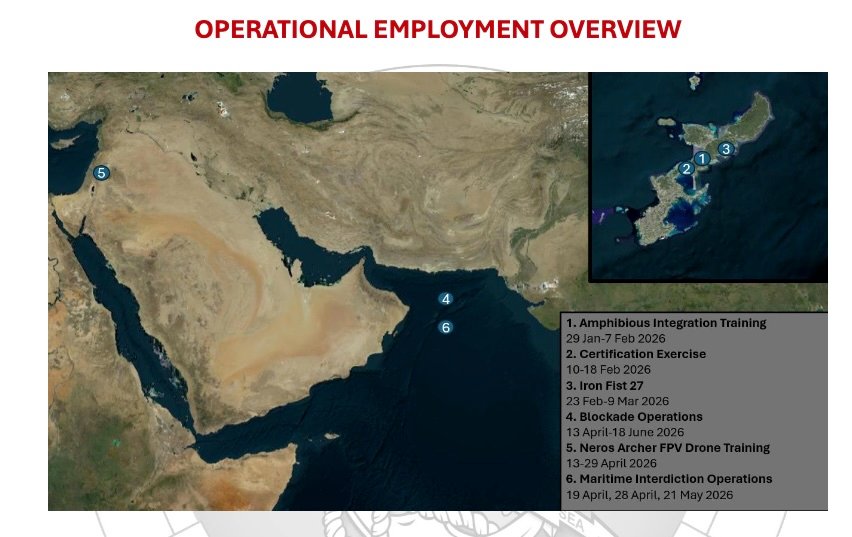
The 31st MEU’s six-month deployment began in January in the Pacific, before the unit was ordered to the Middle East in March, returning to Okinawa, Japan, in July. That’s where it is stationed as the USMC’s only continuously forward-based MEU.
A map of the 31st MEU’s deployment. (31st MEU)
“This was the first time we were able to implement EABO in combat operations since the concept was created for the force,” Capt. Steven J. Keenan, a USMC spokesperson, told us. “We have practiced it many times, but this was a first for supporting a Joint Force named operation with forward FARPs and forward bases that supported joint ops and combat power sustainment.”
EABO was first introduced in 2020 by then-Commandant Gen. David Berger in his Force Design 2030 plan for the future of the Corps. It was created with a fight against China in mind, especially utilizing small Pacific islands. The idea is to have highly mobile, low-signature forces deployed forward in austere, contested or potentially contested maritime locations. The mission is to “support sea control operation, conduct sea denial operations within the littorals, contribute to maritime domain awareness, provide forward command, control, communications, computers, combat systems, intelligence, surveillance, reconnaissance, targeting, and counter-targeting capability and forward sustainment,” according to the Marines.
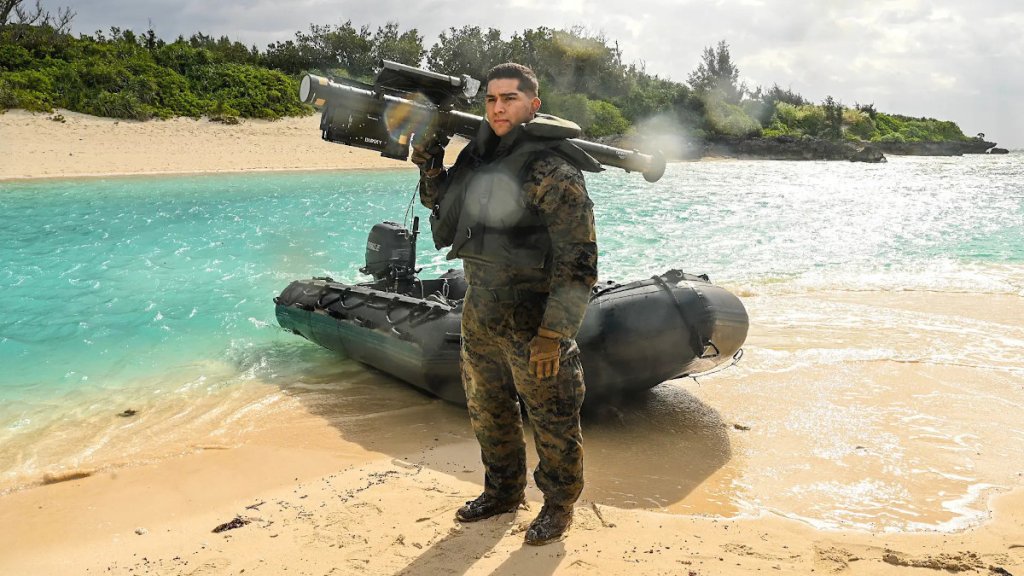
A Marine holding a Stinger missile launcher stands in front of a Combat Rubber Raiding Craft on Ukibaru Island off the coast of Okinawa during Exercise Hagatna Fury 21. (USMC) A Marine holding a Stinger missile launcher stands in front of a Combat Rubber Raiding Craft on Ukibaru Island off the coast of Okinawa during Exercise Hagatna Fury 21. USMC
The news of the first activation of the EABO concept in combat came Wednesday during a media roundtable with Col. Chris P. Niedziocha, who commanded the 31st MEU during its deployment to the Middle East in support of Operation Epic Fury. Now director of the USMC Expeditionary Warfare School, Niedziocha discussed EABO and a range of other operations during that deployment, including boarding vessels during the blockade of Iranian ports.
The 31st MEU was embarked aboard the Tripoli Amphibious Ready Group (ARG), which consisted of the America class amphibious assault ship USS Tripoli, San Antonio class amphibious transport dock ship USS New Orleans, and Whidbey Island class dock landing ship USS Rushmore. You can read more about the ARG/MEU and its assets in our initial story about the deployment to the Middle East here.
USS Tripoli. (Staff Sgt. Samuel Ruiz)
“You’re starting to see this has been validated,” the colonel said of the EABO concept during the roundtable TWZ attended virtually. “It’s still nascent, but we actually, for the first time, demonstrated what we thought we were able to do, which I think is pretty exciting. And then things like forward arming and refueling to extend the operational reach of aircraft and expeditionary reloading, and then the ever-present logistic challenge of doing something like that. So that’s pretty significant.”
“We successfully implemented critical Expeditionary Advanced Base Operations (EABO), establishing sensor expeditionary advanced bases and forward arming and refueling points (FARPs) where none existed,” the colonel added. “Through our forward logistic elements, we proved that an agile Marine Air-Ground Task Force can sustain itself and generate ready, lethal power in contested maritime environments, directly setting the theater for follow-on joint forces.”
“There was all manner of tankers all the time, but the FARP is to extend the operational reach, and if you can do it, you reduce the load on that,” Niedziocha noted. “Because there’s some aircraft that are basically for expeditionary austere operations, especially the F-35B,” the Marine Corps’ variant of the aircraft designed for short take off and vertical landing.
“There are some trade-offs associated with the Bravo,” Niedziocha pointed out, using a slang for the jets. “There’s less internal fuel, but you have the lift [system], which gives you the option to do these kinds of things. So, the goal there was to walk that fine line between providing the full sortie over wherever you needed it, and keeping the ships far enough away to make them as survivable as possible.”
An F-35B Lightning II aircraft taxis to a forward arming and refueling point in the U.S. Central Command area of responsibility, May 26, 2026. (U.S. Marine Corps photo by Cpl. Maksim Masloboev) Cpl. Maksim Masloboev
In addition to the F-35Bs and other aircraft organic to the 31st MEU, the FARPs were also used by Army helicopters, Keenan told us. Imagery posted on the Pentagon’s image distribution site also showed U.S. Army Gray Eagle drones and Marine MV-22B Osprey tiltrotor aircraft were included.
A Gray Eagle drone lands at a forward arming and refueling point in the U.S. Central Command area of responsibility, May 26, 2026. (U.S. Marine Corps photo by Cpl. Maksim Masloboev) Cpl. Maksim MasloboevU.S. Marines with the 31st Marine Expeditionary Unit transport AIM-120 AMRAAMs to a forward arming and refueling point in the U.S. Central Command area of responsibility, May 26, 2026. (U.S. Marine Corps photo by Cpl. Maksim Masloboev) Cpl. Maksim Masloboev
Niedziocha did not provide details about where the FARPs were set up, but a U.S. defense official told us they were “disaggregated throughout the Middle East.” The official declined to provide further information, citing operational security concerns since they are still being used.
“Throughout the deployment, the Tripoli ARG and 31st MEU successfully conducted over 1,600 mishap-free flight hours of combat aviation missions, including precision strikes, transporting 800,000 pounds of cargo, and moving 5,000 personnel,” a 31st MEU overview of the deployment explained. “The units also provided sustained combat support to joint force operations by delivering critical intelligence and refueling over 300 aircraft ashore and underway.”
The colonel also didn’t provide details about the sensor expeditionary advanced bases. According to the Marines, “a sensing expeditionary advanced base (SEAB) brings together coastal surveillance radars, electronic sensors, and Marines ashore to extend maritime domain awareness, complementing the radars and sensors already at work aboard naval ships off the coast.”
“When SEAB systems identify surface vessels in nearby sea lanes, small unmanned aircraft system (sUAS) operators launch their platforms to visually identify and track the contacts,” the Marines added. “Sensor data and imagery are transmitted in real time across the blue-green command network to decision-makers.”
U.S. Marines with 12th Marine Regiment, 3rd Marine Division, prepare to set up a Ground/Air Task Oriented Radar (G/ATOR) system during a routine unit level training exercise on Iejima, Okinawa, Japan, July 15, 2023. (U.S. Marine Corps photo by Staff Sgt. Manuel A. Serrano) Gunnery Sgt. Manuel Serrano
This capability could have been used to track Iran’s remaining fleet of small boats that it has used to harass shipping and mine the Strait of Hormuz, as well as larger vessels trying to transport oil. Other sensors, like radars and counter-drone systems, could also help identify incoming threats and provide general situational awareness. The EABO concept was employed as part of the 31st MEU’s larger role in supporting the blockade and mine clearance efforts.
The 31st MEU interdicted four vessels during the deployment, three of which led to boardings. On April 19, Marines boarded the MV Touska; on April 28, the MV Blue Star III; and on May 19, the MT Celestial Sea.
The Touska was boarded after USS Spruance fired multiple 5-inch rounds, targeting the engine room and disabling the vessel’s propulsion. The crew of the vessel was retained for about two weeks before being repatriated.
Niedziocha told us that none of the crews offered any resistance.
“At two in the morning, when 30 Force Reconnaissance Marines fast rope onto your vessel, [you are] just compliant with a capital C. They did exactly what they were directed to do. The overmatch that you put onto that vessel is pretty surprising. And then there’s overwatch provided by UAS and manned aircraft, so you create this bubble around the vessel. So yeah, they complied.”
You can see the Touska being boarded in the following video.
The U.S. just released a video of its forces boarding and seizing the Iranian container ship M/V Touska near the Hormuz Strait after it tried to break the U.S. naval blockade pic.twitter.com/FpB2obb3jY
Two years ago, as the EABO concept was maturing, TWZ was invited to get an exclusive look at how an advanced EABO concept would be put into action, including how squadrons operated the F-35B out of an austere combat environment while generating combat sorties. It was an unprecedented and exclusive peek into the EABO playbook and what a real fight in the Pacific with the USMC’s most advanced fighter aircraft could actually look like. You can read about that in our story here. It appears the operations in the Middle East mirrored this exercise closely.
James Deboer
Now back in Japan, the ARG/MEU is getting ready for a new deployment, said the colonel.
“We got back to Okinawa, I think July 22nd, and they had already begun their workup cycle in earnest to be on the water in early January to go out and do another Iron Fist [training exercise] with the Japanese, and then long periods of a crisis response,” said Niedziocha, who relinquished command in August before moving on to his new role. “Just being there, present in the First Island Chain to partner with your allies, demonstrates the resolve and commitment to deter whatever needs deterring.”
As noted earlier in this story, the EABO concept was designed with a Pacific fight in mind. Its first combat employment in the Middle East clearly offers lessons that can now be adapted to enhance EABO operations globally.
Forty years ago, archaeologist Lucien Basch and researcher Michal Artzy published a set of 19 ship graffiti carved into the walls of Kition Kathari, an archaeological site beneath the modern city of Larnaca on Cyprus’s southern coast. Ever since, those images have been cited as textbook examples of Late Bronze Age maritime iconography in the […]
All roads lead to Rome. It’s one of the oldest sayings in the Western world, and according to a new study in Nature Communications, it isn’t quite true. Led by Adam Pažout, a researcher at the Autonomous University of Barcelona, the team found that cities like Antioch, Ancyra (modern Ankara), Byzantium (modern Istanbul), and Corinth […]
Watching The Jetsons as a kid in the ’80s, I was obsessed with the food machine, and how it dispensed a full meal at the touch of a button. The show was set in 2062, exactly a hundred years on from its original broadcast. We’ve made it to 2026, but life today resembles nothing like that slick space-age future. We have gadgets, but they’ve arrived as phones, apps, and smart home devices—and I’m not sure they’ve made my life better.
“Accepting modern conveniences too often means accepting lower standards,” writes Gabe Bullard in Against Convenience: Embracing Friction in an Age of Endless Ease. Lower standards for material goods, for labor conditions, for socializing, for art and entertainment. “Experiences become transactions.”Bullard isn’t anti-technology. His argument, he writes, “is an argument against how we use and are pushed to use technology.” In his new book, he examines the conveniences that have crept into his life—and likely yours—and offers ideas for living with them more sustainably and equitably.
In this excerpt from chapter seven, Bullard sets this scene: a physical world, the one we’ve moved through for centuries, slowly reshaped by the virtual one we increasingly live in. Cars drive from one dot on a map to another, ferrying takeout to people at home on sofas. Food deliverers make some extra money. Businesses take orders both online and off. It appears easier, efficient. But Bullard examinesthe costs—to the customer, to the driver, and to the restaurant owner, who still has to make sure the fries are crispy once they reach your door.
The artist Jake Longstreth paints landscapes of America, often the West and Southwest, with their distinctive vegetation, deserts, and mountains. In the foreground of many of his paintings are features that evoke a time more than a single place—CubeSmart self-storage, Taco Bell, a sun-bleached facade with shadows where the words Toys ‘R’ Us once hung.
In one series, each painting is a different view from the parking lot of a Walmart in Scottsdale, Arizona. Ferns, trees, and desert grasses obscure the sharp edges of the boxy store. Semitrailers and loading docks peek from behind the brush. In a painting from a different series, a Home Depot abuts a Civil War battlefield.
The work has a loneliness that’s reminiscent of Edward Hopper’s paintings. But unlike Hopper, Longstreth rarely paints people (one exception is a group of soldiers in uniform at the grand opening of a Chili’s). The only signs of humanity are occasional cars and the chains that “make up, basically, an American commons,” as Longstreth described them in an interview promoting an exhibition of his work in 2024. “Most people don’t really have a super-deliberate relationship with these places,” he added.
There’s a certain democracy to the scenes: Anyone, anywhere can eat the same value meal as anyone else. There’s also an intrusion: The chains’ architecture imposes a sameness on once-unique landscapes. The stores and restaurants are dropped into spaces that weren’t made for them. Flat, square plots are pressed into hills, ample parking provided.
The encroachment of a drive-thru on a lush California valley is a good representation of many modern conveniences. The services that claim to make something faster, easier, or cheaper are built on top of physical landscapes, legal frameworks, or social orders that were not made to accommodate them. The systems absorb the change, but they do it awkwardly and end up forever altered. Starbucks becomes a place to pick up app orders; appliances become accessories to connect to your phone; QR codes sit on restaurant tables; analysis replaces news; art becomes Content; machines replace people.
Uncomfortable intrusions and uneven responses are everywhere.
Examples abound: Grocery delivery apps bring an old idea to a new reality. Grocers offered delivery over a century ago, but the stores were set up and staffed for this. Modern grocery stores are built for customers to come in and do their own shopping. Delivery apps now let customers pay someone to do the same physical task the user would do if they went to the store themselves. What seems like a simple process can quickly become inconvenient. Grocery stores evolved to let customers pick out their own fruit, check dates on packages, and otherwise get things for themselves based on what looked good (or what the store suggested they buy). Virtual shoppers do this picking for customers, sometimes in a hurry so they can fulfill more orders. Mistakes can happen even under the best circumstances. Better deals go ignored. There’s confusion when an item is out of stock and the customer hasn’t chosen an alternative. It can lead to a customer essentially steering a shopper through the store on their behalf.
Rentable electric scooters have become a fixture of urban sidewalks in the past decade. The scooters speed up trips that are too far to walk, too short for a car ride, and not covered by public transit. But these are more of a tacked-on convenience than a real solution. City streets aren’t often built to accommodate smaller vehicles, leaving scooter riders to either use car lanes (putting the rider at risk) or sidewalks (putting pedestrians at risk). Poorly parked scooters clutter neighborhoods. And the environmental benefits are questionable, if at times nonexistent: Broken scooters need to be replaced and vans typically pick up scooters for charging. These problems could be solved through a more active response from cities—more adequate public transit, sustainability requirements for the rental companies, limits on where scooters can be ridden and parked. Cities could build better infrastructure, too, to favor bikes, scooters, and pedestrians over cars.
The postal system and most homes were built to accommodate the delivery of mail and packages. But the scale of e-commerce deliveries has forced inconvenient adjustments to physical and social spaces. In the years I lived in a large apartment building, package drop-off was a constant frustration. Every afternoon, the lobby filled with Amazon and Chewy boxes. They sometimes sat there for days (rush delivery wasn’t essential after all). What was built as a place for neighbors to mingle became a warehouse for boxes of dog food where people occasionally waited for rideshares.
For private homes, the doorbell camera offers convenient, instant notification that a package has arrived and security footage if the package is stolen. It’s an inelegant, antisocial solution. The old-style doorbell was already a notification a package had arrived. The new gadget moved the chime and the peephole to the pocket (and gave users another reason to stay glued to their phones). Package theft is a crime of convenience created by constant online shopping and delivery, and it’s not clear the cameras are stopping it. In my old neighborhood, people often posted grainy images of package thieves to local message boards. Sometimes the person said they were giving the information to the police, as if the police would bother tracking down whoever took a box that had most likely already been replaced. Perhaps the footage will go into a database to be scanned by facial recognition software instead. Doorbell cameras might be meant to catch crimes, but more often, they create Content like the videos of accidents I scroll past online. Everyone is eager to share their personal view of the panopticon.
Is the convenience worth the cost of constant surveillance and suspicion of every person who steps on your stoop (not to mention a subscription to the software that runs the camera)? Even if the cameras prevent a package theft, it’s unlikely the increased surveillance is a deterrent for violent crimes, or that it has an effect on overall neighborhood safety. That would take a collective solution. The camera lets the homeowner feel optimized to take on (or hide from) the world’s troubles alone.
The services that claim to make something faster, easier, or cheaper are built on top of physical landscapes, legal frameworks, or social orders that were not made to accommodate them.
Ridesharing’s “disruption” is perhaps the most prominent example of convenience overloading existing systems, and those systems bending to accommodate it. In this case, the systems were municipal regulations, employment standards, and users’ expectations for how to get around a city. In his book Blood in the Machine, tech journalist Brian Merchant notes that the arguments against regulation echo one the mill owners made in the fight against the Luddites in the early 1800s. Existing laws regulated mills and set standards for worker training and for the quality of cloth. As businessmen automated manufacturing, they argued that “the regulations on the books are out of date, should not apply to new technologies, and are stifling innovation; they’re really not that important, and no one plans on violating them anyway,” Merchant writes.
The argument that our existing laws are inadequate in the face of progress is so pervasive in the tech industry, breaking rules is basically a strategy. OpenAI’s CEO has said it’s impossible to create their products without access to copyrighted material, and as I write this, the debate continues over how AI firms should license—or should have licensed—the material they use to train their software.
We are still adjusting to new technology—legally, morally, socially. The adjustment will go deeper than making room for a new way of shopping, computing, or getting around. How we react in these (still) early stages—how we comport ourselves and what we demand of the apps and our governments—will have ramifications for generations to come.
It’s not looking good.
The spread of generative AI is the most worrying sign at the moment, but I hear about new, supposedly convenient, yet ultimately unnecessary, technologies every day. Not long ago, it was facial recognition for buying concessions at sporting events. It’s mind-blowing computing power put to mundane use, and it raises big questions about privacy and security. I wonder if the food tastes any better.
To get a sense of the stakes of all-encompassing adaptation to new technology, go outside: massive parking garages in downtown real estate (somehow still necessary even with rideshares); four-lane streets in residential neighborhoods; houses with no stoop and a garage door as the most prominent feature on the facade; interstates along riverfronts; drive-thru-only restaurants; restaurants with double-wide drive-thrus. Cities and landscapes have been remade to accommodate privately owned personal cars. Shared cars or scooters might offer some relief, but the infrastructure has already been changed—these solutions are technology to solve the problems of technology, built not just on top of a system that wasn’t made for them, but on top of a system that wasn’t made for people at all.
This is the world I see in Longstreth’s paintings. The buildings are in places that are hostile to anyone traveling without their own car—shopping centers between batches of suburbs and man-made deserts of pavement. The paintings remind me of the long drives I’ve taken across the US—every exit has the same few fast-food restaurants and gas stations. The public commons is a place people stop at on their way somewhere else. Everyone eats the same value meal because there’s nothing else to eat.
The encroachments of high-tech convenience create a second reality—one that’s virtual and smooth. To someone using a grocery app, the store looks like a list of products on a screen, not the physical supermarket where a worker will go to pick out an order. To a person in a rideshare or driving by GPS, the world between two destinations looks like a line on a map. It’s a little like the augmented reality game Pokémon Go, which dropped monsters and training gyms onto the grids of city streets. Physical reality is a support structure for a world that exists on an individual’s screen. The virtual world imposes its demands on the physical world, often with results that aren’t better for the user or the real world.
Delivery food, for a long time and in many places, meant pizza or Chinese. This wasn’t by accident. Restaurateurs (and in the case of pizza, chains) refined the business model for delivery and developed containers that kept dishes in the best condition possible for the trip to a customer’s house. Modern food delivery promises to make any food into something you can eat at home. But not every dish, and not every restaurant, is built for this.
Traditionally, restaurant dining was a two-party affair. A customer went to a restaurant to dine in or carry out, or they ordered food over the phone that was delivered by an employee of that restaurant. Modern delivery adds two more parties: a food deliverer who is typically classified as an independent contractor and the app that mediates the relationship between everyone involved. The customer orders in the app. The app dispatches the driver. The customer tips the driver through the app. To the user, all of this is virtual—even the handoff of the food can happen through a smart doorbell.
Delivery apps offer something to each party they work with. To customers, the offer is any meal delivered to their door. To restaurants, the offer is new customers, more orders, e-commerce tools, and delivery without the staff (though some apps offer to let restaurants use their own couriers). To deliverers, the offer is the flexibility of the gig economy—be your own boss, work when you want. (I’m going to use the words “driver” and “deliverer” interchangeably, though in many cities, delivery is done on bike.) Each of these parties makes trade-offs if they accept the offer. Drivers take on the usual hazards of gig work. Claude Bahati lives in the UK and signed up to drive for Deliveroo because he liked the autonomy. But the money has been inconsistent. He sometimes works eighteen hours a day, five to seven days a week. Early on, he cleared about a thousand British pounds per week. He earned occasional bonuses by logging on when orders were heavier, too. Now he’s not seeing as many boosts and the orders have dropped. “You’d be lucky if you hit £700 a week,” he says. In response to questions, Deliveroo said this may be related to a change in which deliverers are paid based on distance traveled. (Bahati and many of his fellow drivers have organized with the GMB labor union in the UK to push for changes to pay and to how the apps treat drivers—and these have led to agreements on minimum pay for time and transportation.)
Paying drivers more would mean either reducing profits, upping the fee on the restaurants, or raising prices for customers. “It is always the drivers who get pinched,” Bahati says. The actual cost of a service is unclear to customers in the virtual world. “As a customer, you’re thinking, ‘which one’s the cheapest?’ ” Bahati says. “I don’t think you think about a driver and how much they’re being paid. I think you’re thinking, ‘How quickly can the driver get here?’”
Restaurants can choose whether to be on the apps, but this wasn’t always the case. When DoorDash, GrubHub, Postmates (since purchased by Uber Eats), and Seamless (it’s odd they’re all compounds of short words) launched, restaurants sometimes found themselves listed on the apps without agreeing to participate. Some restaurants sued. California banned the practice. Most apps changed their policies in response.
Modern food delivery promises to make any food into something you can eat at home. But not every dish, and not every restaurant, is built for this.
Given the thin margins of running a restaurant, opting out isn’t an easy decision, especially as customers come to expect delivery. Liz and Jesse Huot own two hamburger restaurants and a bakery in Louisville, Kentucky. They were hesitant to offer delivery at first. “You don’t have control over your food once it leaves,” Jesse says. “Kind of like handing your kid off to a babysitter you’ve never met,” Liz adds. Besides the loss of control, trade-offs for restaurants include fees from the apps and a potential decline in dine-in customers.
The Huots signed up to have their food delivered by DoorDash in 2023. They realized customers seemed okay with a dip in quality in exchange for the ease of delivery. “It’s normal for you to know that your fries suck when you get them delivered,” Liz says. Customers also didn’t mind paying a 30% extra charge for the food—a price the Huots settled on to cover the 15% app commission, the additional packaging, and to offset the drop in tips for servers.
Delivery orders are strong, and the Huots say they feel pressure to make the menu more accommodating. “Our two sides are fries that get soggy and Brussels sprouts that, ten minutes after they’re made, they get a little funky,” Jesse says. “So I’ve considered changing the sides. But people in-house love them, and if I change that, I think it would hurt us.” The solution to soggy fries is a starchy coating that some restaurants have adopted. It keeps them crispier, but it can cause indigestion. To add these, the Huots would need a larger kitchen with room for another frier.
With orders coming in online, the Huots are essentially running additional restaurants out of the same space they had before (they took their bakery off the app due to the challenge of managing inventory between physical and virtual lines). They favor their in-house customers, who provide the bulk of business and who the Huots have a direct relationship with. Online, their restaurants are among the businesses that pop up if someone searches for burgers. In person, the restaurants are a destination and an experience. That experience is why the Huots started their business in the first place. “I’m not passionate about food that lasts a long time in a car,” Jesse says. “That’s not what I got in this for. And if that’s what it became, I would question if I still want to do this.”
Sometimes the Huots turn off online orders to tend to a packed house, which leads to emails from customers asking why they can’t order. This isn’t the only entitled behavior the pair has encountered since the rise of delivery apps and the isolation of the pandemic. Liz has noticed an impatience and a demanding attitude from in-person patrons that wasn’t as prevalent a few years ago. Customers get angry when something is out of stock. At the bakery, they complain if they can’t get an ornately made cake without ordering ahead. “That kind of convenience, people expect it when they walk in the building, too,” Liz says.
This is the discomfort that comes from the virtual and real worlds overlapping. Most of us exist in both places. Yet the rules of the real world don’t always apply virtually, and the behavior of the virtual world, in real life, is typically weird and antisocial. Online, we shop without assistance, lurk on conversations without taking part, and pay to have whatever we want brought to us. The world is shaped around the user, with targeted ads and algorithmic feeds. Spending so much time in the virtual world shifts expectations for the physical world.
This is the discomfort that comes from the virtual and real worlds overlapping.
Participation in the virtual world is the cost of doing business in the physical one. Besides adopting to delivery, many restaurants have changed their lighting, decor, and menus to be visually friendlier for diners who post to Instagram or TikTok. One trend saw posters raving about dishes with melted cheese that stretched as far as possible. Like viral Starbucks drinks, the taste was secondary—what mattered was documenting the consumption.
The virtual world of platforms and apps has given rise to the ghost kitchen—a restaurant that, for the user, exists only on apps. Some ghost kitchens operate out of shared facilities with no storefront, and can give aspiring chefs a way to test out ideas. Other times, a restaurant owner sets up a second, online-only brand in their kitchen to boost sales. The concept is an outgrowth not only of delivery apps, but of the rise in commercial rents. The crisis of the pandemic made moonlighting via ghost kitchens essential for some restaurants to survive.
Not every virtual eatery is a passion project. Some are chains managed by a corporate parent and are often branded with celebrity endorsements or gimmicky names that appeal to novelty on the apps—examples include Egg the F* Out, OMG BBQ LOL, and B*tch Don’t Grill My Cheese. Virtual chains compete against the small restaurateurs who the concept of ghost kitchens was supposed to save—and sometimes restaurateurs are competing against themselves, if they add a virtual brand to their business. People pursuing their passion are made to pursue it in the same kitchen that turns out pancakes for a virtual chain called Granny Pannies (a real ghost kitchen). The customers may not know the difference between the businesses, since every restaurant looks the same on the app.
As of May 2025, a bacon, egg, and cheese sandwich from Egg the F* Out in New York City is $19.09, more than three times what it would be at one of the city’s many bodegas. Food delivery was never about being cheaper, though. It’s not guaranteed to be faster. It’s rarely better. Delivery via app offers users control over their participation in a once-public activity—a virtual alternative to reality. It lets diners get whatever they want and eat it alone, away from the friction of the physical world and away from reminders of what it takes to make and serve food, and the people who do this work. If diners want to be social, they can get a viral dish that looks good on camera.
A few years ago, I went to my hometown in rural Illinois for Christmas. On a walk, I saw a sign advertising MrBeast Burger sticking out of the snow-covered grass at the edge of a park. I wondered who had put it there over the holiday—out in the cold, surrounded by cornfields, hoping someone might pick up their phone and order a burger. I thought about the person who might place the order—curious, looking for novelty, unaware of what it would take to get a meal themed around their favorite YouTube star. I wondered where the food would come from and how far someone would need to drive to drop it off. But these were concerns of the physical world. More and more, that’s not where we live.
Gabe Bullard is a journalist, critic, and broadcaster. He has written for NPR, The New York Times Magazine, Nieman Reports, 99% Invisible, Bright Wall/Dark Room, The Washington Post, and Smithsonian Magazine, among other outlets. He was a Nieman journalism fellow at Harvard University and is co-founder of Together, Alone, an online magazine of television criticism. He’s from the Midwest and now lives in Switzerland.
Around 1590 BCE — more than 800 years before Rome was founded, and before Tutankhamun was even born — a small number of people in what is now southeastern Poland started eating a cereal that had never grown in their fields. It wasn’t a local crop, and it didn’t belong to any plant known elsewhere […]
Aderire alla previdenza complementare conviene anche se si è a fine carriera. Le prime coorti di iscritti al Fondo Espero hanno maturato risorse superiori rispetto a chi non ha aderito, pur con un orizzonte di accumulazione limitato. Lo dicono i dati Inps.
The body of a 90-year-old woman was found covered in sheets and hidden in the basement of a house in Marathonas village in eastern Attica on Friday. The woman’s daughter and grandson have been arrested. The woman’s death was not registered with the authorities and the daughter allegedly kept receiving her mother’s pension for about […]
In mid-August, The New York Times lost a defamation lawsuit in Alabama. It’s the first such case the paper has lost in more than half a century. Back in 2023, the Times reported that a University of Alabama basketball player named Kai Spears was at the scene of a fatal shooting—information that turned out to be false, and based on a single anonymous source. A jury found the paper liable for damages to the tune of $9.25 million. Ryan Phillips, the only reporter to attend the duration of the defamation trial, describes the experience:
Chief among the post-publication issues was the Times‘ reluctance to issue a correction or retraction when it became immediately clear that Witz’s anonymous source had been wrong in their assertion that Spears was in Miller’s car during the shooting.
The jury heard lengthy testimony about how the newspaper published “updates” in the form of “Editor’s Notes” to the online story to reflect each new denial coming from the University of Alabama, UA Director of Athletics Greg Byrne, Spears’ father, and then the Alabama walk-on himself in an Instagram post.
Apart from the updates, which the Times argued were tantamount to a correction when applying Alabama law to the evidence, the story remained unchanged until an official correction was eventually published by The New York Times on June 3, 2023.
NEW YORK: Oil prices climbed in early trading Wednesday, building on the previous session’s sharp gains, as overnight military exchanges between the United States and Iran escalated tensions in the Middle East and revived fears of supply disruptions through a critical global shipping chokepoint. Brent crude futures rose $1.03, or 1.1%, to $95.68 a barrel ... Read more
L’euro digitale può rafforzare la sovranità monetaria, ma non arriverà prima del 2029. Per ridurre subito la dipendenza dai circuiti di pagamento extra-Ue basta usare meglio bonifici istantanei, Tips e regole comuni. Il Pix brasiliano indica la strada.
MEPs return to business from their summer vacation to a packed programme this week. An assortment of committee meetings awaits the deputies when they get back to their offices in Brussels. First up will be the issue of the devastating wildfires this summer and EU preparedness to handle such evens. Today (1 September), MEPs from the Climate, Environment and Food Safety Committee will quiz Equality, Preparedness and Crisis ManagementCommissioner Hadja Lahbib on the EU’s response to the summer wildfires across the continent, and discuss lessons learnt. Mental health at work is another issue that will confront MEPs during the coming week.
In a vote on Wednesday (2 September), the Committee on Employment and Social Affairs is set to demand the Commission propose legislation to protect the mental and physical health of workers. The aim is also to prevent, eliminate or reduce work-related psychosocial risks and ensure safe and dignified working conditions. Childhood cancer is another item on the agenda. Together with a 10-year-old survivor and sectoral experts, on Wednesday MEPs in the Public Health Committee will discuss aspects of paediatric cancer. This includes innovation, public investment, and policy recommendations.
Parliament’s President Roberta Metsola will open the debate. Greenland, which has come under the spotlight during President Trump’s 2nd term, is also up for debate. The Development and Foreign Affairs committees will host Greenland’s minister for foreign affairs, business and minerals, Múte Bourup Egede, on Wednesday. The meeting takes place in the context of ongoing discussions on updating the rules governing the EU’s relationship with Greenland, and other overseas countries and territories (OCTs), and future financial support for Greenland under the EU’s next long-term budget. Another issue in Brussels will be that of Afghanistan/refugees and asylum seekers.
On Thursday (3 September), MEPs in the Subcommittee on Human Rights will discuss the return of refugees and asylum seekers from the EU to Afghanistan following Commission meetings with Taliban-appointed representatives and in the light of the human rights situation in the country. Ireland has taken over the rotating presidency and Irish presidency priorities also come under the spotlight next week. Ireland’s ministers will continue to present their priorities in meetings with the relevant parliamentary committees. Ireland holds the rotating presidency of the Council of the EU until the end of 2026. On Tuesday morning,meanwhile, Roberta Metsola will host an informal breakfast with the permanent representatives of the governments of the member states to the EU.
On November 26, 2007, the Austrian National Library did something it hardly ever does: it took the Tabula Peutingeriana out of its climate-controlled display case and allowed the public to see it for a few hours. Due to its extreme fragility, the scroll was exhibited for just one day in Vienna, coinciding with its inclusion […]
In Wilbert L. Cooper’s new memoir, The Black Shield, he tells two intertwining stories: the history of the city’s Black Shield Police Association, one of the country’s oldest Black policing organizations, and the multigenerational narrative of his own family, embedded in the police force. Both of his parents and sister are retired Black Cleveland cops, and on his mother’s side, there’s been a Cleveland cop in the family since 1950. In this book about race, policing, and power, Cooper examines the complex duality of the Black cop, what it was like for his parents to navigate an institution that was hostile to their own community, and, ultimately, what this all has meant for him.
This excerptcombines the prologue and a chapter focused on his mother’s beginnings in Cleveland’s police department. Two individuals mentioned spearheaded legal efforts in the 1970s to diversify the department: Fred Johnson, the association’s president who led a lawsuit over the department’s discriminatory hiring and promotion practices, and Jean Clayton, a policewoman and the organization’s secretary whose parallel lawsuit disbanded the segregated Women’s Bureau and integrated women into the department. Below, Cooper recounts how his mother, Gayle, walked through the door that they opened. But it was not without a struggle.
—Cheri Lucas Rowlands
The gun was always there. I used to see it in flashes as Dad would get ready to leave the house. After he doused himself in spicy cologne and sliced a plastic comb through the waves of his jet-black Jheri curl, I would catch that 9-millimeter sliding between the small of his back and the belted waistband of his blue jeans.
Mom had her own. She kept it in her purse. One of those big leather bags, the kind they show behind the counter at Dillard’s, with shiny metal clasps and countless compartments. Her gun would be in there with red lipstick, a double-sided compact mirror, and her bulky pager. I knew the gun was there because I sensed its heft whenever I’d have to move the bag off the kitchen table to do my homework. It felt like a bowling ball in a pillowcase.
Dad used to store his 9-millimeter above the fine china, on top of the large, baby-pink Victorian-style cabinet in our dining room. One time while he was sleeping, I climbed on top of the pink-velvet-upholstered chairs to get a good look at it through the scrollwork. When I came face-to-face with the gun, I was too intimidated to actually pick it up and play with it.
It took a few moments for me to work up the gumption to run my little fingers across the raised bumps of its grip. Then I touched the ridges of the slide and the smooth, cold, hard barrel from where bullets burst. And just that alone felt crazy to me. Even in the dusty, mundane space of the cabinet, the stock-still object pulsated with wild energy. It was like petting a tiger.
Even now, it’s overwhelming for me to imagine that all that calamitous potential to take life, to inflict pain, to inspire fear, to demand subservience, to have your way with the world, to finally be the actor instead of the one who is acted upon—was right there and it was theirs.
I was 7 or 8 when I saw Dad shoot that gun. It must have been the summer, because I still remember the heavy outside air kissing my arms and legs, the suburban sunlight beaming on me. I see that light reverberating off the concrete, making vivid every blade of green grass in the yard and every goose-egg stone in the gravel strips. But I cannot hear the gunshot. I cannot tune in to the boom. All I sense is the fear, because it is so foreign. I’m still there. Standing in the driveway. Stuck and dumbfounded. Until Dad’s shouts break through, begging me to run inside before those crackers come back, commanding me to have Mom call the cops.
Have you heard of Pastor Leon McCray? The man of faith who saw two White people dumping a refrigerator on his property. When McCray tried to stop them, the duo threatened him. One of the Whites ran off to grab three more racists. McCray says that’s when they all ganged up on him. That’s when they told him that his “Black life didn’t matter.” The beating didn’t stop until McCray pulled out his gun. When the police showed up at the scene, they handcuffed McCray and put him in the back of the cruiser. His assailants laughed and waved at him as he was taken off.
But at least McCray survived. You know that many of us aren’t so lucky: The police shot and killed the father Philando Castile during a traffic stop after he told them he had a firearm. The police shot and killed the father John Crawford while he was carrying a pellet rifle inside the Walmart that retailed the damn pellet rifle. Police shot Emantic F. Bradford Jr. at a shopping mall while they were responding to a call about gunshots at the mall. Witnesses say they killed Bradford as he was trying to direct shoppers to safety.
These killings now give shape and sharpness to that immense and totalizing fear I felt in the driveway as a child. That American malice is always there anytime we try to commandeer a power that wasn’t intended for us. Black people are killed or incarcerated every day for much less than what Dad did. Simply owning a gun can put a bullseye on your back. Pulling one on a White man can turn you into a hashtag.
So why did Dad want to call 911? I know that he’d tell you it was because his gun was different from Pastor Leon’s. Dad didn’t buy it at Walmart or Bass Pro alongside camouflage galoshes and fly-fishing rods. He didn’t pick it up at a gun shop with a shooting range full of targets depicting men in turbans and hip-hop gear. He didn’t procure it across state lines at a gun show with bundles of cash and no identification or background check. And he didn’t get it off the street, with scratched-out serial numbers and bodies on it.
Dad got his gun from the City of Cleveland. That’s where Mom got hers, too. Both are tools of policing, the Cooper family business. They hold up those guns and their power to use them as symbols of our freedom in a country that will not stop killing or incarcerating Black folks. When I was a child, I never questioned that contradiction. But to become my own man in the America I inherited, I realized I’d have to try to solve the paradox of my parents.
By the time the Black Shield had forced the hand of the Cleveland Police Department in 1977, Gayle had given birth to another child—a little boy named Geoffrey. Now with three kids, she was even more entrenched in a wrathful marriage and farther away from the working world. And losing her uncle Lloyd, which felt a lot like losing a father, only made her feel that much more alone. When he died, the dream of becoming a cop and the freedom the job promised died with him.
It was at the moment that she’d almost completely resigned herself that it all came raging back. She opened up an issue of the Plain Dealer to find that people who’d taken the test with her and were lower than her on the eligibility list were being appointed to the police academy. And quickly, her despondency turned to confusion. And then her confusion turned to anger. She said to herself, “I know my number is higher than this and they’ve gone eighty past me and I’m not getting called?!” As she started to look into the issue, she found out that the city had expunged her from the eligibility list. “They were trying to lose Black folks’ stuff,” she told me. The city claimed it was because her addresses had changed and she hadn’t notified the civil service. To get back on the list, she had to go to court. “They claimed I had moved, but I owned my own home!” she said. “I told them, ‘I bought this house, I haven’t gone anywhere.’” As soon as she prevailed in her hearing, a White officer walked up to her in court. He simply said, “I’m from the academy.” He took her information. And then he said, “You will start the police academy on Monday.”
Later that same night, Fred Johnson called Gayle’s phone. It was the first time she’d ever spoken to the man. Lloyd was never big on the Shield Club, and Curtis was much closer with her younger brother, his namesake, who would join the police department five years later. Gayle didn’t have a complete idea of what the Shield Club had been up to at that point, or of how much it had shaped the situation she was walking into. Because of all the lawsuits, more than 40 percent of her classmates would be people of color and women. But the department they were entering was only 9 percent Black or Hispanic, and 2 percent women. For his part, Johnson stressed the struggle happening in the city to resist the change that Black women like Gayle represented. The academy was framed as a contentious environment controlled by people who were intent on destroying Gayle’s professional prospects and her spirit.
Despite the reforms that resulted from the Shield Club and the Women’s Law Fund cases, Gayle was still put through a series of tests, during which she could still be expunged. She had to meet with a psychiatrist, who asked her questions about her affiliations. Although this test had been revised thanks to the efforts of Fred Johnson and the Shield Club, it remained biased. As many of us conclude from a life living in this country run by White people, Gayle figured the best way to stick around was to hide herself. Her strategy was to answer every question like a White man of modest intellect.
In the 1970s, Gayle had spent a few years in the Nation of Islam. Although she never really let go of Jesus, she converted aesthetically and culturally to satisfy the whims of her second husband. She traded her hot pants for conservative flowing dresses. And instead of sweet potato pie, she started baking bean pies. When she did make a Polish Boy, she did it with beef sausage. She even traveled to Chicago once for Saviours’ Day to see the honorable Elijah Muhammad with her own eyes. But she put all that behind her when she found out that her proud Muslim husband was sleeping with a fellow “sister.” By the time she took the psych test to become a police officer, she’d gone back to straightening her hair and listening to gospel music. But some of the political knowledge she gained from the Nation, especially its perspective on America, stuck with her. She understood things differently than most—like the “riots” that happened in Hough and Glenville. She saw them as a natural reaction to the way her people had been done in this city and done in America. To her, the people who stormed the streets weren’t criminal. The crimes being committed were by the landlords renting rat-infested apartments and the Board of Education shoving kids into overcrowded schools and businesses charging a premium for rancid meat. She had a lot of ideas about these sorts of things, but none of them could feed her kids or free her from her marriage. And so she kept them to herself during her psych test.
The new hires were also required to do a complete physical examination. This was especially humiliating for Gayle. The whole ordeal was a perverse take on the idea that if women want to be in the academy, if women want to do what the men do, then they have to go through the exact same processes. For the physical exam, this meant standing around nearly nude to be ogled by their peers. “They made us stand up there in paper gowns and these guys were trying to catch glimpses at us. And they make you do stuff in the gowns so the gowns get all torn up. My breasts and everything were just hanging out,” Gayle recalled. She was so thoroughly humiliated that a fellow female in the academy came to her with some Scotch tape to try to cover her up. “They did that kind of thing because they wanted us to quit. The guys didn’t want us, their wives didn’t want us, it was terrible. They treated us like new meat, picking out which one they were going to take.”
Fred Johnson made himself available to all the Blacks in the academy because he was prepared for the city to try to find excuses to fail them. Gayle didn’t think she’d have a problem. She was voted the vice president of the academy class and consistently scored high on all of the interstitial tests. Those high scores were attained by studying alongside her new girlfriend. But when they both got good grades on a test with similar answers, they were accused of cheating and threatened with expulsion from the academy. Fred Johnson had to step in and help them prove that they’d arrived at the same answers because they’d been preparing together.
After passing the academy, but before they could be sworn in as officers, they were also required to take a qualification test administered by the State of Ohio that evaluated their skills. Cadets could fly through the academy with high marks and still get disqualified to be a police officer. Although policewomen in Cleveland had been in the academy before the 1970s, they weren’t required to take the qualification test because officers in the women’s bureau didn’t carry guns. Anticipating that they would do whatever they could to disqualify her, Gayle prepared for the test with the desperate intensity of a woman fighting for her life. “To prepare for the running test, I used to run up and down the steps whenever I’d put the kids down for nap,” she told me. To make her qualifying time, she outran some Vietnam veterans, who threw up before they crossed the finish line. The state also required people to do a series of chin-ups and push-ups and dips that demanded upper body strength that seemed to favor the male physique, but Gayle fought her way through those. When she finally had to take her shooting test, the last phase, it was 19 degrees below zero. In 1977, Cleveland was in the midst of one of its coldest winters ever. But one of the essential rules of the academy was that it never canceled or postponed qualification tests for any reason, in an effort to help simulate what it’s like to be a police officer and have to work when everyone else gets the day off. And so Gayle stood at the outdoor range with the soft skin of her red-nailed fingers sticking to the ice-cold metal of her gun, her body involuntarily shivering, hoping the icy air didn’t tank her shot.
The first night Patrolwoman Gayle Smith reported to the Fifth District of the Cleveland Division of Police in the winter of 1977, her supervisor showed her two things: the coffee machine and the broom. It was expected that she would be the shift’s glorified janitor. But she bucked back. “I did not go through all that training to do no housekeeping. I came here to be a police officer,” she remembers saying to him, surprised by her own candor. Ridiculous as it seems now, perhaps this kind of insult by her male colleagues should have been expected. After all of the efforts by the Women’s Law Fund and Jean Clayton to break down the formal barriers in the CDP, women still constituted only 2.3 percent of the police force when Gayle started. The assholes she was working with had almost no experience working alongside women as equals and little incentive to see them as such. Gayle was basically a guinea pig. Ironically, it was because of Jean Clayton, Gayle’s initial inspiration to become a lady cop, that the women’s bureau was dissolved and lady cops ceased to exist. Although Gayle had been intent on following Clayton’s path, she found herself involved in something entirely new.
While most of the male cops were unhappy with the gender integration of the department, a lot of the women officers were displeased, too. They were especially pissed at Jean Clayton and her damn lawsuit. These were women who had no interest in being partnered with men and participating in a form of policing that oriented itself around violence and punishment. There were certainly fair criticisms of the women’s bureau, from its troubling focus on purity to the fact that its diversion efforts and empathy weren’t as equally distributed to Black suspects as they were to Whites. But I wonder if the department would be less lethal and repressive today if the men on the Cleveland Police Department had become more like the women and their women’s bureau. Instead, the women became more like the men. After the women’s bureau closed, some of its important work, such as sex crimes, was shamefully ignored or mishandled. Gayle would see this firsthand. But first she needed to get out of coffee duty.
It took some convincing, but eventually Gayle got her first assignment outside the district. After roll call, she would be taken to White City Beach, a former park on Lake Erie that in the 1940s was home to attractions like Bonavita the lion trainer, along with fishing and a yacht club. After natural disasters hurt the park and desegregation saw the City of Cleveland give up on supporting community spaces shared by both Blacks and Whites, White City Beach went the way of Euclid Beach. By the 1970s, it became a dumping ground for garbage and a place where the city parked vehicles that were towed to clear the streets for snowplows or as the result of car wrecks. That year, it was overflowing with gnarled automobiles. It had been the coldest Cleveland winter of the century, complete with “superbomb” blizzards and scores of days that were more than 20 degrees below zero. There were more than one thousand cars down there at White City Beach, but not another soul in sight.
“They dropped me off at White City Beach every night and stuck me in a shell of a car that was up on bricks and cinder blocks, with a wire heater inside of it. There was no bathroom. They’d leave me there all night and they’d come back and get me in the morning. I was just down there by myself in pitch blackness and cold. Even if I had wanted to get out, I couldn’t go nowhere. If someone had tried to steal the cars down there, there is nothing I could have done about it. It was demoralizing.”
Mom told me this in the kitchen, where I’d often heard her talk about the bad early days on the job. I’m not sure whether this was the first time I was really listening, or if she was telling it differently. Usually, her stories were never this detailed and specific. It was just “racism” and “men being nasty.” Perhaps because I was taking a real interest, she started accessing parts of the story she had often left untouched in her recounting.
There is a feeling of humiliation that stings long after an event has passed. It doesn’t just hurt because of what was done, it hurts because you feel as though you had some agency in the matter. That you let it happen. When she started telling me what it was like, I could feel her own surprise at the disregard she had endured. In the zone car with White partners, she was beneath speaking to. These were men who would greet a dog if they saw it on the street, but wouldn’t say one word to her. In this sense, despite the lawsuit and the consent decree, not much had changed on the job since the late 1950s, when White officers would “throw a shoe” to avoid being paired up with Curtis and Fred Johnson.
“When they finally had two guys take me out, they put me in the back seat where a prisoner would sit. And they didn’t let me touch the radio. They were supposed to show me some things. But instead, they got out of the car and went to eat. They just left me locked in the back of that car without saying anything. I’m just beating on the door and everything.”
It wasn’t until an old, White, Catholic officer who looked like Santa Claus decided to take Gayle under his wing that she finally got to learn a bit about real policing. The rotund veteran with snow-white hair explained to Gayle the first time she got in the car with him exactly why he was willing to teach her. It wasn’t that he was pleased about working with Blacks or with women. He simply realized the futility of resistance: “If we get rid of her, they will just send another one of them down here.”
“It was crazy to have me on the job that length of time and nobody taught me nothing except what I learned in the academy,” she remembered of her time wasted on frivolous assignments. “When he took me out, the first thing he ever told me was this: He said, ‘Okay, kid, what time is it?’ I looked for my watch. He said, ‘That is the first rule. Don’t you ever take your eye off anybody. If they ask what time it is, say you don’t know or your watch is broke. But you don’t look down.’”
It was with Santa Claus that she got to see how the men handled sex crimes now that the women’s bureau was closed. The first rape call that they ever responded to together involved a White woman. The lady had walked three doors over from where she lived to bum a cigarette from her neighbor. Before she could get back home, three men had grabbed her off the street, dragged her into a car, and took turns raping her. While Gayle was wrenched by the story, calling back to her own experiences of sexual abuse, the veteran was incredulous. “He talked to that girl so bad, I felt sorry for her,” she remembered. “He asked her, ‘What were you wearing?’ ‘Why were you out at that time of night?’ ‘What did you expect was going to happen?’ It was horrible . . . I will never forget it. That girl ended up not even filing.”
It was also alongside Santa Claus that she finally proved she could be real police, like the men. The call was a robbery at a drugstore that drew several cars to the scene. The suspect was a young Black man who managed to run out the back door. To show her tenacity, Gayle took off after him ahead of the rest of the cops, moving just as she had when she was training for the department’s entrance exam, going up and down those steps. Santa, who was heavy and plodding with bad knees, couldn’t keep up as Gayle tailed this man through an alleyway. And then from behind her, a shot rang out.
When a police shooting happens, officers come together to get their story straight. Although this was an era when it was still legal for officers in Cleveland to shoot fleeing felons, all the patrolmen made sure they agreed on what took place. After they were finished, they looked over at Gayle to see if she saw it the same way they did. Forget the police academy. The offensive rape call was a pop quiz, and this shooting was the final exam of real police shit. And Gayle passed with flying colors. “After that, I started having people to work with,” she told me. “It didn’t feel good, but I had a demon behind me.”
This excerpt is protected under copyright laws and reproduction of the text in any form for distribution is strictly prohibited. The right to reproduce or transfer this work via any medium must be secured with the copyright owner.
Wilbert L. Cooper grew up in the suburbs of Cleveland, Ohio. He studied journalism at Ohio University and earned a master’s degree in publishing at New York University. He has written for outlets such as The Guardian, The New York Times, The Marshall Project, and The Wall Street Journal. His Vice documentary The Cleveland Strangler was nominated for a National Magazine Award. In 2024, he was the recipient of the Richard J. Margolis Award. The Black Shield is his first book.
For The New Yorker, Shayla Love writes about how GPS—a military technology turned daily necessity, and the subject of Katherine Dunn’s new book, Little Blue Dot: How GPS Shaped the Modern World—has changed the way we move through the world. To test her own skills, Love navigates from North Brooklyn to a park in Queens with a paper map, then sets off on an orienteering course without the trusty little blue dot, where she discovers how rusty her sense of direction really is.
Surprisingly, I still felt an urge to pull out my phone and look at my dot, to confirm what my surroundings were showing me. I started to feel that the true value of orienteering was more akin to that of reading a long book, or baking from scratch, or attending a long classical-music concert. I wasn’t necessarily tapping into my inner homing pigeon. I was practicing more general skills that get rusty when I over-rely on technology: paying attention, being patient, accepting uncertainty. We made our way to No. 7, on a “prominent tree, east side.” We didn’t find No. 6—a small blow to the ego—but my confidence soared when we found five, four, and three. The desire to check my dot faded to a low simmer.
I used to be in a friend group chat called “Tinder Spinsters,” a group of girls offering support as we navigated the tumultuous dating world. Faith Hill’s chat is named “Lonely Hearts Club,” but are these groups becoming a thing of the past? Are people even still trying? In a 2025 YouGov poll, 69 percent of single respondents said they “rarely” or “never” go on dates. Nowadays, it’s complicated. On the positive side, a relationship is no longer seen as essential for a happy life—women’s interest in men, in particular, has dimmed as their financial independence has grown. But many people would still love to find a partner; they are just finding that modern romance requires a toll “paid in energy, in sanity, in cash, in hours—and not everyone can afford it.”
The hug was the last round, though, and then real life resumed. We mingled, but the intimacy had disappeared. One man told me that he had high emotional intelligence and could tell that I did too—then he suggested that we travel together someday, handed me his business card, and walked away. I gave a few people my phone number, including one man who sent me a picture of his face the very next morning and another who texted me so much (even after a polite rebuff) that I had to block him. One date with another guy resulted, but I wasn’t interested in a second. The perception of abundance had, once again, evaporated into nothing.
Greek long jump athlete Miltos Tentoglou won gold during the European Athletics Championships in Birmingham on Tuesday night. His jumps ranged between 8.19 and 8.44, clinching his victory with 8.44, his highest score during his fourth and last attempt. 28-year-old Tentoglou added his fourth gold medal at successive European championships, securing a position as the […]

 Login