Israeli attacks in Gaza have killed at least seven Palestinians and injured 38, according to numbers from Gaza’s Health Ministry, as the IDF continues its constant violations of the so-called ceasefire deal that was signed in October 2025. The Health Ministry said on Saturday that over the previous 48-hour period, the IDF had killed at […]
Israel deliberately attacking healthcare workers has been a recurring theme throughout their ongoing invasion of Lebanon, and this weekend was no different, with multiple incidents of Israeli attacks on ambulances being reported. The fatal incident was in Kfar Roumine, where an airstrike targeted a moving ambulance, killing a paramedic aboard and wounding two others, who […]
Yuval Abraham and Rachel Szor find themselves at the center of a political clash involving the Israeli Prime Minister, two government ministers, and top intelligence officials. The catalyst is *Naza*, the documentary they presented at the 83rd Venice International Film Festival—a film that, in just a few days, transformed them from acclaimed filmmakers into targets of accusations of treason.
After declaring he would seek to revoke their Israeli citizenship, Israeli Culture Minister Miki Zohar made a fresh appeal to Shin Bet chief David Zini, urging him to investigate how various materials were obtained. The film features testimony from 24 anonymous Israeli intelligence soldiers denouncing the techniques used by the Israeli military to kill civilians in Gaza.
In a letter to Zini, Zohar asks the agency to investigate whether there was any illegal use of sensitive or classified information.
“When anonymous sources are used to spread serious, false accusations against the State of Israel and the IDF during wartime, it is imperative to establish who is behind these allegations,” Zohar stated. “I have asked the head of the Shin Bet to investigate the source of the material, who provided it, and whether hostile elements were involved,” the minister added.
Reactions from Israeli officials following the Venice screening
Immediately after the documentary film was presented in Venice, Culture Minister Miki Zohar called the film “vile” and announced plans to “act immediately” to revoke the Israeli citizenship of Abraham and Szor.
He accused them of “treason against the State” and of a “self-loathing” that drives them to harm their own homeland in order to garner applause from “antisemites around the world.” Zohar stated that he had contacted senior officials at the Ministry of the Interior and the Population Authority to evaluate revoking their citizenship on the grounds of a breach of loyalty to the country.
Joining the chorus of accusations were Army Chief of Staff Eyal Zamir—who claimed the film relied on “blood libels and deliberate distortions of reality”—and National Security Minister Itamar Ben-Gvir, who called on the pair to leave the country.
Finally, Prime Minister Benjamin Netanyahu linked the case to broader “antisemitic incitement” and lashed out at opposition political forces.
The Israeli military largely rejected the documentary’s content, maintaining that it could not verify the identities or military roles of the anonymous sources and reiterating that it does everything possible to avoid civilian casualties.
IDF chief floats legal action against ‘NAZA’ film, orders probe of leaked material
IDF Chief of Staff Lt. Gen. Eyal Zamir on Monday instructed the military’s top legal official to examine legal action against the film “NAZA” and those involved in it, saying it defamed the military, and separately ordered an investigation into the leaking of classified material used in its production.
His comments came shortly after IDF Spokesperson Brig. Gen. Effie Defrin issued a statement inviting the documentary’s filmmakers to allow military officials to view the film in full so that the IDF could respond in a “substantive manner.” So far, the military has only reacted to clips of the movie posted online, and has not yet seen the full documentary.
The 80-minute film by Yuval Abraham and Rachel Szor — whose title is a Hebrew acronym meaning collateral damage — claims to explore AI-powered strikes by Israel in the Gaza Strip it alleges have led to civilian deaths, including testimonies from 24 purported Israeli intelligence soldiers.
The risks of returning to Israel
In the days following the award, Yuval Abraham recounted deleting his social media profiles after being inundated with offensive photomontages targeting both him and his mother; he openly admitted his fear: “Israel is my home… but now, obviously, I am afraid I won’t be able to return.” Abraham had also rejected the idea of positioning himself as a voice of moral superiority, explaining that, as Israelis, they all feel—to some extent—co-responsible for what occurred in Gaza.
The process of stripping Abraham and Szor of their Israeli citizenship—which they hold by birth—is neither swift nor within the sole authority of the Minister of Culture, who lacks the legal power to order it.
Under Israeli law, citizenship can only be revoked in limited cases involving a proven “breach of loyalty” to the State—as established by a 2022 Supreme Court ruling. The procedure requires the Minister of the Interior to submit a request to the Minister of Justice, followed by final approval from a panel of judges. It is, therefore, a lengthy and uncertain process—one that has never before been applied to a case involving journalism or filmmaking.
A more immediate prospect, at least from an investigative standpoint, is Zohar’s request for the Shin Bet to investigate the origins of the material used in the film.
Such an inquiry could lead to investigations into potential offenses related to the disclosure of classified information, carrying criminal consequences not only for the filmmakers but also for the military sources who collaborated anonymously.
Compounding this is the immediate concern for the two creators’ personal safety—a fear fueled by past incidents, such as the assault on Hamdan Ballal following the Oscar win for *No Other Land*.
European Commission President Ursula von der Leyen, while condemning the Israeli government’s plans to advance settlement construction in the E1 area of the West Bank (Judea and Samaria), stopped short of proposing a ban on trade with the Israeli communities in the area, in contrast with an initiative pushed by some EU member states and EU’s foreign policy Kaja Kallas, writes European Jewish Press, Yossi Lempkowicz.
She spoke on Wednesday (16 September) during her annual State of Union address to the European Parliament in Strasbourg.
Von der Leyen received a round of applause for condemning the Israeli government’s plans to advance construction in the E1 area, a strategi area between Jerusalem and Maale Adumim. ”The Israeli government’s decision to advance the illegal E1 settlement projects is unacceptable,” she said, after deploring the ”deep suffering in Gaza and unchecked settler violence in the West Bank” which, she said, ”have deeply affected Europeans.”
”It is painful for many Europeans that member states have been unable to build the necessary majorities for a unified response,” she added, noting that ”some member states have been unable to build the necessary majorities for a unified response. Some member states have moved ahezd. Others are considering doing so.”
A group of over 100 MEPs, mainly from S&D, The Left, the Greens and Renew groups, had written a letter to the President of the European Commission to make an “urgent appeal for a Commission legislative proposal to ban EU trade with illegal Israeli settlements”.
Until now, EU member states are divided about the proposal to ban trade from Judea and Samaria.. Countries like Slovenia and Czechia, but also Germany and Italy, have blocked such sanctions.
Von der Leyen highlighted the Commission’s efforts to mobilise funding for the Palestinian Authority and for the reconstruction of Gaza.
‘’We have delivered more aid than anyone else. Through the Palestine Donor Group and the Team Gaza Initiative, we have brought together 65 delegations. Together we have sanctioned nearly 1 billion Euro to rebuild Gaza and support a modern Palestinian Authority,’’ she noted.
She concluded her statement on the Israeli-Palestinian conflict by stressing that ‘’ Europe supports the right to self-defense for Israel.’’
”The Palestinian people have an equal right to live in safety and in dignity. It is Europe’s role to keep the blame of the two-state solution alive,’’ the EU Commission President added.
Yossi Lempkowicz is Editor-in-chief of European Jewish Press (EJP).
On 18 August, Israel launched eight airstrikes against the Abu al-Duhur air base in northwestern Syria, located approximately 70 kilometres from the Turkish border. Israel also reportedly informed the United States that Turkey might be preparing to deploy radar systems and air defense equipment at the base, a move that could significantly alter the regional balance of power. Turkey is expected to respond to the Israeli strikes, raising the prospect of direct military confrontation between the two countries inside Syria,
As it stands, Turkey's growing tensions with Israel over issues including Gaza, Iran, and Lebanon are increasingly difficult to ignore. Turkey also possesses substantial military capabilities, which were originally intended in large part to strengthen NATO's ability to counter Russia but are now increasingly being used to pursue Ankara's own strategic interests, including those that are not aligned with the geopolitical preferences of the U.S. and Israel. Turkey is therefore demonstrating a degree of strategic autonomy that increasingly extends beyond the traditional constraints of the NATO framework. This development is a clear example of the broader process of regional polarization.
Regional polarization, in fact, creates the conditions for the emergence of regional hegemony. It reflects a tendency for countries within a particular region to gravitate toward a dominant power. That power, in turn, simultaneously expands its influence and seeks to establish a new regional order. Regional hegemony does not emerge out of nowhere. Instead, it develops gradually through a process of regional polarization.
Turkey is a prominent example of this process. Israel can also be viewed through the same lens, as can Saudi Arabia, which has been working steadily to strengthen its position and influence in the region. Beyond the Middle East, India and Japan are also moving in this direction. Iran, meanwhile, remains an important regional power despite currently being consumed by war.
Against this broader trend of regional polarization, China presents a particularly unique case. China's current strategic direction appears to differ substantially from the logic of regional polarization. Instead, Beijing continues to place considerable emphasis on building relationships among major powers at the global level. In this context, the idea of a G2 remains an attractive strategic concept for China, while U.S. President Donald Trump also appears to be seeking to leverage this possibility in developing a special relationship with China.
In Asia, India is already an unmistakable example of a country pursuing greater regional strategic autonomy. Japan is another crucial case. The election of Sanae Takaichi can be interpreted as an indication that Japan's own process of regional polarization is beginning to take shape. However, because of its security treaty with the U.S. and continuing domestic political opposition, Japan remains reluctant to openly acknowledge such a trajectory.
Nevertheless, Japan is likely to move progressively toward greater regional strategic autonomy. This would mean that Tokyo increasingly seeks to exercise influence in Asia regardless of whether Washington fully supports such a development. As a result, contradictions between Japan and the U.S. could become more pronounced across economic, financial, and political spheres. Japan's ability to say "no" to the U.S. may gradually become a practical reality.
Once Japan gains greater freedom to articulate and pursue an independent strategic position, it may also seek to improve relations with China. In this sense, Japan's increasing regional autonomy could ultimately prove beneficial to Japan-China bilateral relations over the longer term.
Perhaps the most important feature of regional polarization is that conflict among countries is inevitable. Such conflicts are not necessarily an anomaly. Rather, they are a natural expression of the polarization process. No country is willing to readily acknowledge another as the principal power or dominant pole within a region. Regional leadership therefore has to be established through competition, strategic maneuvering, and, at times, confrontation.
This dynamic applies to Japan, China, India, Turkey, and other emerging regional powers. As a result, international disputes are likely to become increasingly intense. The underlying reason is the growing competition for regional influence amid the erosion of the existing global order.
First, countries increasingly perceive an opportunity to become the dominant pole within their respective regions. Second, no major regional power is willing to accept another country's unquestioned leadership or submit to its influence. Confrontation, friction, and strategic rivalry therefore become increasingly difficult to avoid.
Ultimately, the countries that possess sufficient resources, strategic capabilities, and the ability to respond effectively to changing circumstances will have the greatest chance of emerging as regional hegemons. The struggle for regional dominance is therefore not merely a contest of military strength. This is also a test of economic resources, political resilience, strategic judgment, and the ability to shape a new regional order.
He promised security—he brought isolation. He spoke in the name of the state—he put its very future in question. And now even those who were called allies only yesterday are saying, more and more loudly: this can’t go on. Benjamin Netanyahu is the longest-serving prime minister in Israel’s history. Eighteen years in power, three comebacks, […]
Dans les médias officiels iraniens tout comme dans la rhétorique gouvernementale, cette expression désigne l'ennemi du moment, à savoir la coalition formée par de nombreux pays occidentaux, dont les États-Unis, Israël et plusieurs régimes arabes, notamment les signataires des accords Abraham (Émirats arabes unis, Bahreïn, Maroc et Soudan), qui normalisent leurs relations avec Tel-Aviv. Cette expression avait déjà cours durant la guerre contre l'Irak (1980-1988), Bagdad étant alors soutenu par Washington et les monarchies du Golfe.
Terme qui signifie « défense » ou, par extension, « contre-attaque ». D'étymologie indo-européenne, ce mot fut très employé durant la guerre contre l'Irak (1980-1988) afin de décrire les mouvements du front, y compris lorsque les troupes iraniennes devaient céder quelques centaines de mètres — rarement plus — à leurs adversaires. Depuis l'attaque israélo-américaine, son usage est redevenu fréquent dans le discours officiel.
Avec l'agression militaire du 13 juin 2025, relancée le 28 février 2026 par Israël et les États-Unis, éclot une guerre restée larvée depuis 1979. La tournure insolite que prend le conflit au fil des mois nécessiterait d'ouvrir un nouveau chapitre dans les ouvrages de polémologie. Amateurisme viriliste d'un côté, art de la dissimulation et de la survie de l'autre, les évidences ne dispensent pas d'identifier les impasses.
De « triomphe » en « triomphe », l'Amérique s'enlise une nouvelle fois au Proche-Orient. Toute escarmouche dans la région prenant une dimension géopolitique majeure — compte tenu des réserves d'hydrocarbures qu'elle recèle —, les combats intermittents et le blocage du détroit d'Ormuz entraînent une tempête dans l'économie mondiale. Et la circonspection dans le restant du monde.
La supériorité militaire apporte rarement de bons conseils. L'ivresse de la force, doublée d'une vanité hors du commun, a conduit le président Donald Trump à s'affranchir de toute expertise non martiale, à ignorer les leçons de l'histoire contemporaine qu'il prétendait naguère enseigner et à oublier la géographie. Le 24 août 2026, quatorze mois après avoir lancé ses premiers bombardiers pour détruire les installations nucléaires iraniennes, il avouait à sa manière la déroute : retour à la politique de sanctions économiques pratiquées depuis la révolution islamique de 1979… Le secrétaire au Trésor Scott Bessent menaçait même de sanctions secondaires les partenaires commerciaux de Téhéran.
M. Trump doit se fâcher contre son complice israélien, qui continue de bombarder le Liban à sa guise et fait détruire les habitations au sud du fleuve Litani
Déjà, la « guerre des douze jours » — du 13 au 24 juin 2025 — laissait beaucoup de questions sans réponse. Le programme d'enrichissement d'uranium était-il vraiment proche de déboucher sur une capacité à produire une bombe nucléaire, comme le serine M. Benyamin Netanyahou depuis… déjà trois décennies ? Les destructions y mettaient-elles vraiment fin ? La structure du pouvoir était-elle ébranlée au point de rendre possible un renversement ? Des échanges de bombes, de missiles et de drones remplaçaient-ils des combats et des conquêtes au sol ?
L'épisode a probablement conforté le premier ministre israélien dans sa conviction qu'il pouvait mener le président des États-Unis par le bout du nez (lire « Quand Israël entraîne les États-Unis »). L'explication fournie par le secrétaire d'État (ministre des affaires étrangères) pour justifier les bombardements « préventifs » lancés à partir du 28 février attestait le malaise : « Nous savions qu'une action israélienne allait avoir lieu, nous savions qu'elle déclencherait une attaque contre les forces américaines et nous savions que, si nous ne frappions pas de manière préventive avant le lancement de ces attaques, nous subirions davantage de pertes », avouait sans fard M. Marco Rubio le 2 mars (1).
L'Iran peut compliquer le trafic maritime
Téhéran n'avait les moyens d'intercepter ni les avions ni les missiles, ni même semble-t-il de déjouer les attaques ciblées contre les plus hauts responsables civils et militaires, et principalement le Guide suprême Ali Khamenei, tué par des bombes israéliennes dès le 28 février. Toutefois, comme le sait tout étudiant de première année en science politique, l'Iran peut sérieusement compliquer le trafic maritime dans le détroit d'Ormuz… Tirant les leçons de la guerre des villes contre l'Irak dans les années 1980, Téhéran a développé un programme balistique robuste, disséminé et non négociable, dont il a tiré le meilleur parti.
L'inversion du rapport du fort au faible fut telle qu'aucune monarchie du Golfe n'osa utiliser aux côtés de l'allié américain son arsenal offensif, pourtant pléthorique et acquis chèrement auprès des Occidentaux. Quant aux moyens défensifs, et notamment les missiles américains Patriot, ils s'avèrent extrêmement coûteux et longs à fabriquer quand le voisin produit des drones légers par milliers. L'Iran a concentré ses attaques sur Israël et les bases américaines de la région. Mais ses militaires ont aussi fait comprendre que tout dérapage important visant les installations vitales (centrale électrique, raffinerie, usine de désalinisation, centrale nucléaire civile) ferait l'objet de rétorsions immédiates sur l'autre rive du Golfe, démontrant l'extrême fragilité de cette vie artificielle de gratte-ciel et de centre commerciaux construits au milieu du désert.
Le 8 avril, les deux camps acceptent un cessez-le-feu. M. Trump doit se fâcher contre son complice israélien, qui continue de bombarder le Liban à sa guise et fait détruire les habitations au sud du fleuve Litani, complétant la liste de crimes de guerre qui lui sont imputables. Les États-Unis, eux, n'ont atteint aucun des objectifs égrénés au fil des mois : Téhéran menace tout navire qui ne suit pas ses consignes ; la défense de la nation en danger consolide le pouvoir en place ; l'uranium enrichi à 60 % reste en Iran ; ses capacités balistiques paraissent peu touchées ; la prolifération nucléaire semble encouragée, et le pétrole est redevenu une arme de dissuasion. Enfin, à l'échelle régionale, houthistes, Hamas et Hezbollah demeurent aux commandes dans les zones qu'ils contrôlent. Commence alors une phase — inachevée — de « ni paix ni guerre » faite d'attaques sporadiques et de répliques immédiates entre deux annonces de progrès dans les négociations (lire ci-contre).
Celles-ci aboutissent le 17 juin au protocole d'accord d'Islamabad en quatorze points, signé électroniquement comme un vulgaire document immobilier par M. Trump depuis Versailles et par le président iranien Massoud Pezechkian depuis Téhéran. Très vite, même les élus républicains dénoncent une situation moins favorable qu'avant la guerre. La presse israélienne va jusqu'à évoquer une « capitulation » américaine. Le bilan humain provisoire serait de 3 400 morts en Iran à cette date (2) — sans compter les milliers de blessés —, de plus de 4 383 morts entre 2023 et juillet 2026 au Liban (3), de quelques dizaines chez leurs voisins arabes.
Israël reconnaît une soixantaine de morts après les attaques iraniennes ou du Hezbollah (4), mais censure toute information sur les dégâts matériels. L'« État juif », tel qu'il se proclame, s'est montré toujours plus fort, capable d'intervenir dans sept pays (5), mais aussi plus seul et illégitime que jamais. Les États-Unis déplorent la perte de seulement dix-huit soldats, mais le crédit de la première puissance militaire mondiale s'est fortement dégradé. Les bases américaines semblent poser plus de problèmes de sécurité qu'apporter des solutions aux pays qui les accueillent. Le marché de l'énergie reste sous tension permanente, avec des hauts et des bas rythmés par les fanfaronnades du président américain, pour le plus grand profit des spéculateurs.
Un tel fiasco stratégique, diplomatique et économique conduit certains à évoquer une victoire des dirigeants iraniens. Ce serait oublier l'affaissement du pays et les ressorts intérieurs de leur maintien au pouvoir, pas si loin de ceux du président des États-Unis dans sa politique extérieure : rodomontades, verrouillage idéologique et logique de force pure. Les conservateurs de tout poil ont plus vocation à se faire la guerre qu'à s'unir.
Le sursaut national provoqué par l'agression n'efface pas la répression des dernières années. Le système de pouvoir a, certes, prouvé sa robustesse. Et permis l'émergence d'habiles négociateurs, capables d'ouverture politique, comme le président du Parlement Mohammad Bagher Ghalibaf ou le président de la République Pezechkian (voir le schéma page 37). Mais l'assassinat de Khamenei semble avoir renforcé autour de son fils — et successeur invisible — Mojtaba le poids des plus intransigeants envers leur peuple. Soit qu'ils appartiennent à une gérontocratie qui rappelle les derniers temps de l'ex-URSS — le président de l'Assemblée des experts a 95 ans, celui du Conseil des gardiens de la Constitution a 99 ans —, soit qu'ils doivent leur ascension à une fidélité sans faille à l'appareil d'État de la République islamique, comme le nouveau secrétaire du Conseil supérieur de la sécurité nationale, M. Mohsen Rezaï, qui commanda le Corps des gardiens de la révolution de 1981 à 1997 avant d'occuper plusieurs postes de haut rang.
Le Proche-Orient est paralysé. Ses habitants guettent le moindre accrochage comme chaque promesse des médiateurs. La Chine et la Russie savonnent la planche de M. Trump et ne goûtent guère les menaces de sanctions économiques secondaires. L'Europe se tait, quand elle ne se soumet pas au « grand frère ». Les citoyens du monde hésitent entre humour noir, colère et désespoir.
L'épisode a conforté le premier ministre israélien dans sa conviction qu'il pouvait mener le président des États-Unis par le bout du nez
At the end of August, the Greek government signed the “Achilles Shield” agreement – a €3 billion “defense” deal with Israel. Under the terms, Israeli companies including Rafael Advanced Defense Systems and Israel Aerospace Industries (IAI) will develop and build anti-aircraft and anti-ballistic systems for Greece.
“This is the largest defense export deal in the history of Israel-Greece relations, and one of the largest in the history of the State of Israel,” the occupation’s Ministry of Defense stated. “Greece’s choice of Israeli technology as the backbone of its most ambitious air defense buildup program in the past decade reflects the depth of trust built between the two countries.”
“Under the deal, Israel will build Greece a comprehensive, multi-layered air defense array, drawing entirely on Israeli-made systems and on the extensive operational experience Israel’s defense establishment has gained during the war.”
The “war” in the statement being the genocide Israeli forces have been conducting in Gaza since October 7, 2023.
An influx of Israeli investments in Greece
According to journalist Vangelis Ilias, the new deal should be contextualized within broader trends of Greek capital and subsequent governments deepening ties with the occupation power. While the current Mitsotakis administration did not initiate this trend, he says, it deepened it both before and since the genocide in Gaza began. “Over the past 6-7 years, we have witnessed an influx of Israeli investment funds into Greece, both in the real estate sector and through the acquisition of former public – but not exclusively public – companies in various sectors of the economy, one of which is defense.”
Israeli real estate investments in Greece have already had a notable impact on people’s everyday lives, driving up rents and making housing more unaccessible. Endeavors in the defense sector might have been more lowkey, Ilias adds, but they are widespread and expanding under the sight of NATO and European institutions. “In the south of the country, in Kalamata, there is a large Greek Air Force base that also falls under the NATO umbrella as an International Pilot Training Center,” he says, emphasizing the presence of Elbit Systems in the area.
Israeli companies have also purchased local military enterprises, including Intracom Defense, operating in electronic warfare and drone production. “Through this acquisition, the Israeli state-owned company IAI gained access to the European Defense Fund (EDF), an EU mechanism intended exclusively for financing European defense procurement programs – something that was made possible only thanks to the active support of the Greek government,” Ilias adds.
“[Achilles Shield] has been promoted by the domestic media and the elite as an agreement that shields Greece,” he adds. “[Under the claim] that the money being spent, while not going to healthcare and education, or toward supporting the incomes of citizens who are still trying to recover from the years of economic crisis, protects us from those who seek to harm the country, with Turkey always implied in this context,” he explains.
“In this era of crises, military buildup, and preparations for a full-scale war, they are trying to present this not only as something reasonable but also as something necessary, where strategic agreements between states take precedence over the needs of the people and international law, overlooking genocides or the ethnic cleansing of an entire people.”
The deal’s Achilles’ heel: reliance on Israeli arms
While Greek officials described the deal as a breakthrough for Greek sovereignty, critics have warned of dangers on several fronts. To begin with, in the announced distribution of funds, local industry expects only €750 million of the total €3 billion. The rest goes to Israeli arms companies making the genocide in Gaza technically feasible.
And despite the amount of money being spent, parts of the agreement have been presented inconsistently to the public. “We’re talking about a complex system of sophisticated weapons utilizing artificial intelligence, with a central control unit that operates based on computer code, Ilias emphasizes. “There has been extensive debate over whether this code will belong to Israel or be controlled by Greece. So far, the government’s responses to a barrage of questions from the opposition have been neither reassuring nor consistent. This remains to be clarified.”
The expenditure has been heavily criticized by left movements, including the Communist Party of Greece (KKE), in the context of EU armament taking place at the expense of labor rights and social services. “Costing more than €3 billion, this agreement forms part of the broader ‘2030 Agenda’ arms program serving NATO’s needs, for which our people are paying dearly – tens of billions of euros – at the expense of their rights and needs,” the KKE pointed out.
Like most other EU governments, the Mitsotakis administration has announced harmful labor and social reforms just as it committed billions for Israeli arms producers. This new-old austerity agenda has met widespread resistance. Recently, tens of thousands demonstrated in Thessaloniki demanding dignified wages and pensions, efficient public healthcare, and investments in education. “Not one euro for imperialist wars,” they insisted.
The “Achilles Shield” deal also adds to the case made by academics and activists worldwide that Israel is using the Gaza genocide to market its weapons. This is apparent not only from the purchase list, but from official statements as well. The Israeli Ministry of Defense announced similar deals are part of a broader strategy “to expand defense exports as a central tool for strengthening the IDF’s force buildup, influencing Israel’s foreign policy standing worldwide, and bolstering the Israeli defense industry and economy.”
Critics have argued that Greece’s arms deal risks making the country captive to Israel’s defense industry and alienating it from other countries in the region. “In practice, strategic relations with the murderous state of Israel, together with joint military preparations, are adding fuel to the fire of imperialist rivalries in the region, as well as the conflicts between the bourgeois classes of Turkey and Israel, and of Greece and Turkey, in the Aegean and the Eastern Mediterranean, with the peoples being the victims,” the KKE emphasized.
“Greece’s ruling class has made a strategic choice to align itself closely with the Western alliance,” Ilias says, referencing events since the Greek Civil War. “It is particularly worth noting that, as a result, the Greek people have borne the brunt of the bloodshed.”
And while the post-Civil War regime attempted to crush “the popular and anti-imperialist movement that existed in the country,” he concludes, they did not succeed.
“This is partially why we still see today such a stark contrast between the ruling class and the organized, collective reactions of significant segments of the Greek people throughout the country against the genocide perpetrated by the Israeli state against the Palestinian people. These reactions are multifaceted, with segments of the working class – beyond just the youth – actively participating.
Die Bundesregierung verkündet sehr stolz immer wieder zwei Dinge: Erstens, dass die Sicherheit Israels deutsche Staatsräson sei, womit die Bundesregierung auch begründet, dass sie Israel Waffen verkauft und viele Waffensysteme sogar schenkt, und zweitens, dass Deutschland der größte Unterstützer der Ukraine ist. In beiden Fällen liefert Deutschland Waffen an Krieg führende Länder, wobei das noch […]
Albert Daenens. « Zuivere plastiek » (Plastique pur), avant 1952
Au titre d'une initiative conjointe engageant douze pays dont la France, le ministre des affaires étrangères britannique a annoncé le 8 septembre, devant la Chambre des communes, de nouvelles sanctions visant les colonies israéliennes en Cisjordanie. M. Edward (« Ed ») Miliband a dénoncé notamment le « nettoyage ethnique » qui y sévit. Les mesures qu'il a détaillées cibleront « des entreprises et des individus qui fournissent des services, tels que la construction, les infrastructures, le financement et l'immobilier, destinés à l'expansion » de la colonisation. Il s'agit aussi d'interdire l'importation des produits de ces mêmes colonies – que les Nations unies estiment illégales au regard du droit international.
Ces dispositions relèvent en partie du jeu politique interne. Le nouveau gouvernement de M. Andrew (« Andy ») Burnham semble enfin prendre acte de l'impasse dans laquelle le Parti travailliste s'est mis en refusant de faire droit à l'émotion et aux mobilisations suscitées par l'aggravation de la tragédie que vit le peuple palestinien au cours de la période récente. Déjà, le 11 novembre 2023, plus de 800 000 personnes avaient défilé à Londres en solidarité avec Gaza. Ces derniers mois, les Verts, beaucoup plus offensifs sur le sujet que les travaillistes, progressent dans les sondages et aux élections partielles ou locales.
Les sanctions contre les colonies illégales sont aussi tardives. En effet, depuis le 7 octobre 2023, les forces de Tel-Aviv ou des colons ont tué plus de 1 100 Palestiniens, dont plus de 240 enfants, en Cisjordanie. L'armée israélienne inflige également des détentions ou des incarcérations arbitraires, des humiliations de toutes sortes, des contrôles incessants qui rendent les déplacements cauchemardesques sur ce territoire.
Les dispositions annoncées par M. Miliband sont enfin dérisoires. D'une part, l'État visé par ces sanctions en raison de la seule colonisation de la Cisjordanie commet un génocide, des crimes de guerre et s'en prend illégalement au Liban, à la Syrie ou à l'Iran. D'autre part, les importations des colonies ne représentent qu'une proportion minime des 6 milliards de livres (près de 7 milliards d'euros) d'échanges commerciaux entre le Royaume-Uni et Israël. D'après Bloomberg, cité par L'Opinion (8 septembre 2026), « des diplomates britanniques ont eux-mêmes assuré Washington que les sanctions (contre les colonies israéliennes) étaient avant tout symboliques et qu'elles n'avaient pas vocation à miner la relation diplomatique et commerciale entre les deux États ».
The great temptation for left-wing forces to fish in the waters of the new antisemitism in search of votes is nothing new. It costs little; the Jews pay the price. In Rome, there is an eagerness to cast aside the common sense demonstrated by the Italian government, in coordination with Germany, and embrace this easy and politically rewarding line—this time by following Britain in imposing sanctions against Israel. Ignorance and double standards provide the backdrop. The ambition to embrace a new crusade against Israel emerged immediately after British Foreign Secretary Ed Miliband, announcing sanctions concerning Judea and Samaria, told Parliament that Israel is engaged in the ethnic cleansing of Palestinians and attempting to erase the two-state solution, writes Fiamma Nirenstein.
This, of course, ignores repeated Palestinian rejections of peace proposals and the reality created by the 7 October 2023 Hamas massacre. At the same time, British politicians have presented themselves as champions of human rights while ignoring monstrous violations committed by Iran, Hezbollah and Hamas. Now that Britain has announced sanctions on products from Judea and Samaria, and has been followed by a procession of European countries driven by the pursuit of left-wing votes and fear of their growing Muslim populations, the parliamentary group leaders of Italy’s Democratic Party (PD), Five Star Movement (M5S) and Green and Left Alliance (AVS) on the Chamber of Deputies’ Foreign Affairs Committee have demanded urgent consideration of legislation imposing similar sanctions.
Angelo Bonelli, co-leader of AVS; Elly Schlein, leader of the Democratic Party; Giuseppe Conte, leader of the Five Star Movement and a former Italian prime minister, and others have signed on. Indeed, they consider it “shameful” that Italy, of all countries, is missing from this campaign. The document speaks of “illegal occupation” and offers other banal examples of the ignorance of those who wrote it. It also demonstrates the irresponsibility of a move whose primary consequence will be to further fuel mass antisemitism. We have already seen another demonstration of this phenomenon at a protest against legislation addressing antisemitism, where Hamas and Hezbollah flags were brought into Parliament. Only ISIS was missing.
Why is the path of sanctions wrong? First, those responsible for violent acts should be punished. But contrary to the propagandist image being presented, they constitute a fraction of the roughly 500,000 Israelis living in Judea and Samaria, a population representing a wide variety of cultural and social backgrounds. Most condemn violent extremists and are themselves the targets of thousands of Palestinian terrorist attacks each year. Israel prosecutes its own criminals. Some are in prison; others are standing trial. But Judea and Samaria are not territories “illegally occupied” by Israel. The area was occupied by Jordan, whose annexation received almost no international recognition, until Jordan attacked Israel in the 1967 Six-Day War and was defeated. After repeated Israeli attempts to exchange land for peace, the Oslo Accords of 1993 and 1995 divided Judea and Samaria into Area A, under Palestinian control; Area B, under Palestinian civil control and Israeli security control; and Area C, under Israeli control. Israel has the right under those agreements to build in Area C, which also includes the E1 area between Jerusalem and Ma’ale Adumim.
Some of the greatest conflicts arise when Palestinians attempt to expand into Area C. Expelling Jews from Judea and Samaria would risk producing the same disastrous result as Israel’s 2005 withdrawal from the Gaza Strip—the creation of the conditions that eventually produced Yahya Sinwar and Oct. 7. There is another British mistake. It concerns the safety of Britain’s own citizens. Israel has helped protect Britain from serious terrorist threats. In 2015, for example, British authorities discovered three tons of ammonium nitrate stored by Hezbollah-linked operatives in London after receiving information from Israel. On the basis of what unfounded prejudices should a relationship encompassing security, science and culture be dismantled? Associating Israel with “ethnic cleansing” and “genocide” is a lie.
Forcing Israel to surrender is unthinkable. Israeli Foreign Minister Gideon Sa’ar, with Israel’s decision to close the British Consulate in eastern Jerusalem, has delivered the first clear response. But the larger answer must be equally clear. Neither Miliband nor Schlein will draw the borders of a Palestinian state. It is absurd to imagine that they can. Only Israelis and Palestinians can negotiate those borders; they cannot be imposed from London, Rome or anywhere else. And no sanctions campaign can erase a fundamental historical truth: The Jewish people are not strangers in Judea and Samaria. Their roots there reach back thousands of years. Whatever the future of this land may be, it cannot be decided over the heads of the Jews whose history, identity and destiny are bound to it.
The stabilization of the Iran-Israel confrontation could well be the calm before the storm, only this time the storm would be between Israel and Türkiye. In this context, the question arises: how would such a conflict affect NATO? Reasons for Escalation Relations between Ankara and Tel Aviv are rapidly deteriorating amid the war in the […]
Does Greece have access to source code of Israeli systems that would be purchased under Achilles Shield air defense complex? While National Defense Minister, Nikos Dendias, reassures the political opponents and the public that it has access, the Israeli side insists that it does not. The debate was heated when National Defense Minister Nikos Dendias […]
Cover image: picture alliance / Sipa USA | JNA PRESS
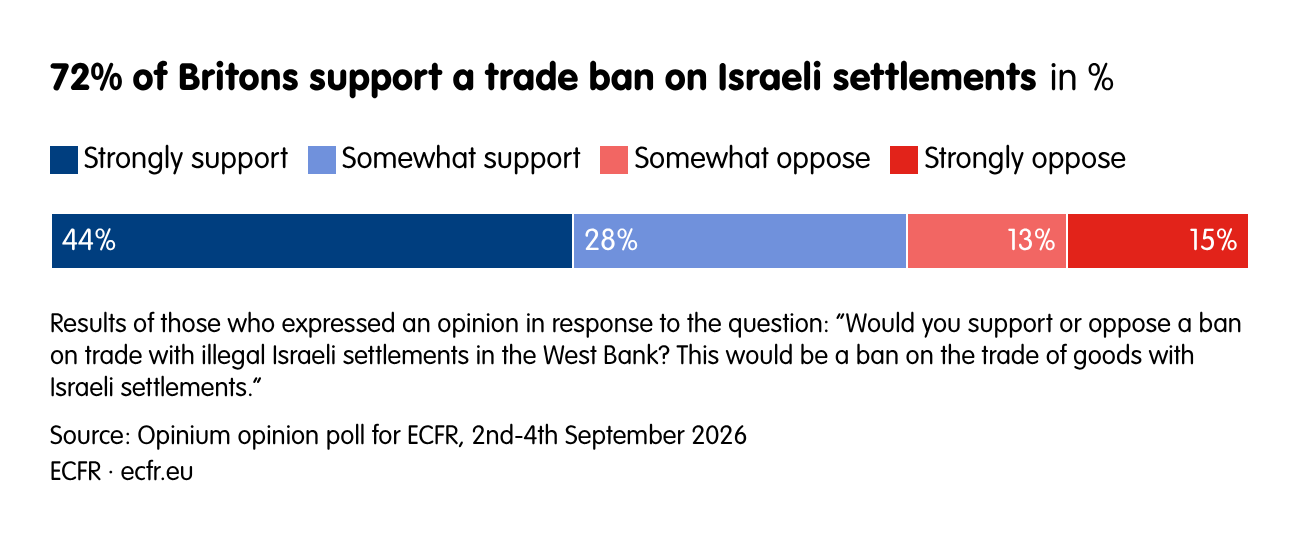
With the British government set to announce new measures targeting Israel’s settlement project, polling by Opinium for ECFR shows that just 18% of UK adults oppose a ban on trade in goods with Israeli settlements in the West Bank and East Jerusalem, compared to 46% who back it. Support rises to nearly three quarters—72% versus 28%—when excluding those who did not voice an opinion.
To date, the UK has sanctioned some two dozen organisations and individuals linked to settler violence. It has also excluded settlement goods from the preferential trade tariffs applied to Israeli products, though stopped short of an outright ban. However, settlement expansion is a state-driven project sustained by domestic economic incentives and foreign financial linkages. Rather than focusing only on its most violent manifestation, a settlement trade ban would challenge these underlying drivers.
Last week, foreign secretary Ed Miliband pledged to go further in challenging Israeli actions that are destroying the possibility of a two-state solution, like the recent construction of the “doomsday” E-1 settlement on the outskirts of East Jerusalem. The settlement ban expected to be announced later today also gives practical meaning to the UK’s recognition of Palestine last year—as demanded by Palestinians themselves. Such action by the British government commands broad support across Britain’s political and regional divides, while opposition is limited.
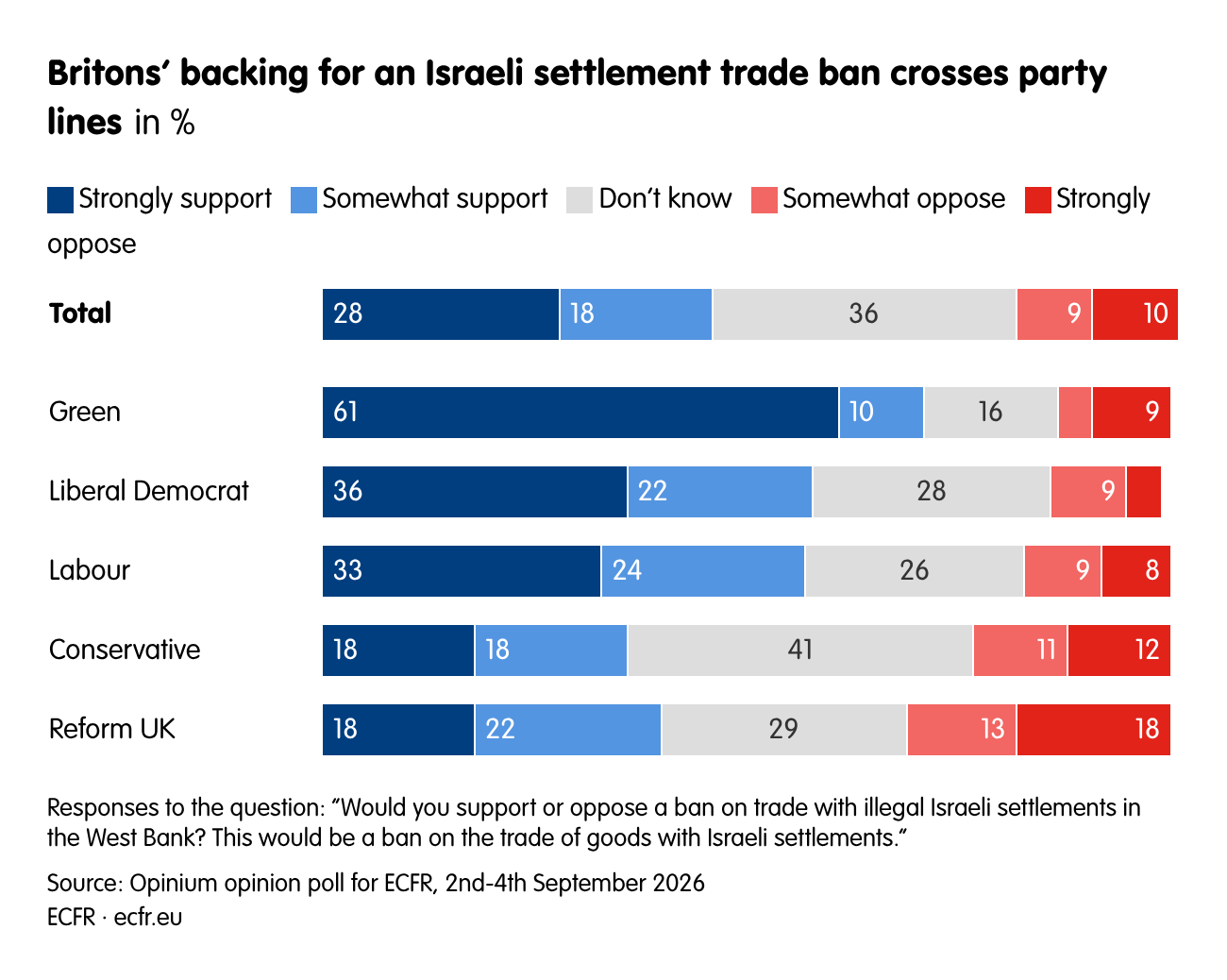
Labour, Liberal Democrat and Green voters decisively favour the proposed ban. It is also strongly supported by voters who have moved away from Labour, many of whom defected to the Green Party amid dissatisfaction with prime minister Keir Starmer’s response to Israeli actions in Gaza and the West Bank. But backing for the measure extends across party lines: Conservative and Reform voters are also more likely to support than oppose it.
The findings cross the Brexit divide too, with supporters clearly outnumbering opponents among both Remain and Leave voters. The same pattern is evident geographically. Support is highest in London and Scotland, closely followed by Northern Ireland, while supporters also outnumber opponents in every English region and in Wales. Indeed, across every political, regional, age and gender group reported in the survey, support exceeds opposition.
The polling also finds that only 16% of British adults consider it antisemitic to target Israeli settlements. Meanwhile, a two-state solution remains by far the most popular outcome for Israel and Palestine with 40% favouring a Palestinian state alongside Israel, compared with 12% who favour a single shared state and just 8% who prefer the status quo of Israel without a Palestinian state.
ECFR’s polling shows a clear public mandate for the UK to take a leadership role in strengthening international efforts against Israel’s settlement project
ECFR’s polling shows a clear public mandate for the UK to take a leadership role in strengthening international efforts against Israel’s settlement project and to defend the viability of a two-state solution. This would build on similar moves by Belgium, Ireland, the Netherlands and Spain in recent months.
The results also suggest the UK government has the public support to go further: extend the ban to investment and financial services, exclude settlements from all UK agreements with Israel (including the convention for the avoidance of double taxation) and prohibit all British business dealings with settlements (including the purchase of settlement real estate). This should go hand-in-hand with additional sanctions targeting organisations that play an instrumental role in funding and sustaining Israel’s settlement project, such as Ateret Cohanim, the Jewish National Fund’s Himnuta real-estate subsidiary, and the Settlement Division of the World Zionist Organization.
At the heart of the new UK government’s policy reset should be a collective push with its Western partners to finally implement the International Court of Justice’s 2024 advisory opinion on Israel’s occupation. The court underscored the duty of states to “take steps to prevent trade or investment relations that assist in the maintenance of the illegal situation created by Israel in the Occupied Palestinian Territory”. To uphold this approach would also help give effect to the 2016 UN Security Council Resolution 2334, which calls on states to distinguish, in their relevant dealings, between Israel and the Palestinian territories it has occupied since 1967.
A settlement trade ban should mark the beginning of a more consequential British policy towards Israeli settlements. The polling shows that British public opinion is supportive. Having recognised Palestine in principle, the UK must now use its economic weight and diplomatic leadership to preserve it in practice.
Israel’s embassy in Belgium stated that the Israeli team ”is an example of coexistence in Israeli football. The team includes three Arab-Israeli players: Muhammad Abu Rumi, Mohammed Kna’an and Zahi Ahmed. Politics should never be allowed to interfere with sports,” writes Yossi Lempkowicz.
The ban, imposed by the mayor of the Belgian city of Leuven on the soccer match between a Brussels-based team and an Israeli one ”is an expression of antisemitism” said the Coordinating Committee of Jewish Organizations in Belgium (CCOJB).
The match between Union Saint Gilloise and Hapoel Be’er Sheva is scheduled to take place on 22 October as part of the Europa League. Since Union’s stadium in Brussels does not meet UEFA standards, the club cannot play there. For the European competition, it had to turn to the Leuven stadium for all its home games.
However, last Tuesday (1 September), the mayor of Leuven, Mohamed Ridouani, ordered the cancellation of the match for ‘’security reasons’ due to the risk of unrest linked to the visit of an Israeli club, against the backdrop of the Israeli-Palestinian conflict. The mayor is a member of the Flemish Socialist party Vooruit.
The CCOJB condemned the reasons cited by the mayor of Leuven for prohibiting the match, particularly those related to security. “It is the mayor’s responsibility to ensure public safety and it is irresponsible to shirk that responsibility,” states the organization. adding that the decision was driven more by “hatred of Israel.”
A spokesperson for the embassy of Israel in Belgium stated that the Israeli team ”is an example of coexistence in Israeli football. The team includes three Arab-Israeli players: Muhammad Abu Rumi, Mohammed Kna’an and Zahi Ahmed. Politics should never be allowed to interfere with sports.”
Israeli players “should be judged by their professional abilities, not by politics or political views. Sport should remain sport, free from political agendas”, the embassy said on X.
The spokesperson offered that Israel’s Ambassador-designate to Belgium David Saranga meet with the Leuven mayor.
An Antwerp-based group, JID vzw – Stop Antisemitism, has formally filed a complaint against the mayor decision of the mayor of Leuven.
”We request that the decision and the complete accompanying administrative and security file be obtained without delay and that the decision be reviewed in light of the law and the public interest. If the required legal, factual, and proportional basis is lacking, we request that the supervisory authority annul the decision,” it said.
Israel’s strategy in the Middle East is changing: the country is shifting from a targeted response to threats to a systemic containment of all regional players capable of challenging it. After Iran, Turkey has come into focus. For years, Israel’s wars were presented as responses to threats. But as Gaza, Lebanon, Syria, and Iran have […]
Israeli Defense Minister Israel Katz admitted this week that Israel’s goal for Gaza is the mass expulsion of Palestinians from Gaza in “every way possible,” despite denying allegations of ethnic cleansing for years.
“There is no real solution for Gaza in the end without this migration,” Katz said at a conference hosted by Israeli outlet Yedioth Ahronoth on Wednesday, per a translation by France 24. Israel “is organized and prepared to get them out — by sea, by air, by every way possible.”
This plan would amount to ethnic cleansing, something that Palestinians and human rights advocates have long said Israel is carrying out in Gaza and the occupied West Bank. In a report earlier this year, the UN Human Rights Office warned that Israel was carrying out policies consistent with ethnic cleansing between 2024 and 2025, including famine, destruction of civilian infrastructure, and overall imposing conditions “incompatible with [Palestinians’] continued existence in Gaza as a group.”
Katz said that Israel is “seeking Trump’s support” for the idea because no country will take in Palestinians without the approval of the U.S.
The White House has not commented on the plan. When Donald Trump took office last year, he proposed a plan for forced displacement of the entire population of Gaza, dubiously framing it as “voluntary.”
The administration’s stance has since evolved, however. In July, Trump’s “Board of Peace” announced a plan that would still implement colonial control over Gaza, but that would transition power over the Strip to a Palestinian board and demand Israel withdraw its troops from the Strip.
In a rare break with the U.S. last month, Netanyahu announced that he would not be supporting that plan. Keeping with his usual practice of introducing unworkable provisions into negotiations, he said that Israel would not withdraw until Hamas was totally disarmed.
Disarmament — which critics say would still give Israel massive power over Gaza — was already included in the Board of Peace’s 15-point plan. But Netanyahu seems determined to ensure Israel can still carry out its genocide and occupation in Gaza, pledging again on Wednesday that Israel is “not retreating.”
“We control 60 percent of the Strip, and we are not stopping, because we are eliminating the terrorists who threaten us, day in and day out,” he reportedly said.
Trump also previously vowed to end aid to Israel if it annexed the West Bank, however, despite Israel’s ongoing annexation of the occupied Palestinian territory.
The Israeli officials’ remarks were made just weeks before critical Israeli elections in October, in which Katz and Israeli Prime Minister Benjamin Netanyahu are hoping to retain far right control of the state.
Politicians in Netanyahu’s caucus have been openly calling for cruelty toward Palestinians as a campaign strategy. This week, National Security Minister Itamar Ben-Gvir posted then deleted an AI-generated video that showed a line of Palestinians on a conveyor belt being loaded into a detention facility operated by Ben-Gvir. The Palestinians are then shown leaving the facility emaciated, with the politician seemingly showing off Israel’s systematized policy of starvation of Palestinians.
Israeli officials have denied allegations of ethnic cleansing for years.
“The charge of ‘ethnic cleansing’ against Israel is false and dangerous. It is not a legal definition but a political label, used to inflame tensions, spread hate, and fuel antisemitism,” said Israel’s ambassador to the United States, Yechiel Leiter, last year. “Israel does not deport Palestinians because of their identity. Israel has, rather, temporarily removed non-combatant populations from war-zones in order to guarantee their safety.”
The statement was made in response to a September 2025 report released by Senators Chris Van Hollen (D-Maryland) and Jeff Merkley (D-Oregon) saying that Israel was deliberately destroying civilian infrastructure and starving Palestinians with the goal of ethnic cleansing.
“After our trip to the Gaza-Egypt border last year, [Merkley] & I released a report entitled, ‘The Netanyahu Government is Implementing a Plan to Ethnically Cleanse Gaza of Palestinians.’ Now the Israeli Min[ister] of Defense confirmed that’s the goal,” said Van Hollen on Wednesday. “We must end our complicity.”

 Login