❌

Reading view

Iran’s IRGC Warns It Will Expand ‘Geography of the War’ If the US Attacks Again

Iran’s Islamic Revolutionary Guard Corps (IRGC) on Monday issued another warning to the US, saying that if the US bombs Iran again, Iranian forces would expand the “geography of the war.” “If another aggression takes place, there will certainly be significant changes in our defense and our counterattack,” said IRGC spokesman Hossein Mohebbi, according to […]
  •  

The Current Significance of BRICS for Iran’s Foreign Policy

For Iran, BRICS has become a platform for geopolitical dialogue and de-escalation, for broadening scientific and cultural ties, and for economic diplomacy. Tehran is pushing for de-dollarization, the New Development Bank, and reform of international institutions, aiming to carve out a greater geoeconomic role for itself. On September 12–13, the XVIII BRICS Summit was held […]
  •  

Press TV condemns Israeli abduction of West Bank correspondent Naqaa Hamed

Iranian news outlet Press TV called the detention of its West Bank correspondent Naqaa Hamed by the Israeli forces an “aggressive terrorist operation” aimed at silencing the truth about its occupation and genocide of Palestinians. It demanded the immediate intervention of the international community for her release.

“The desperate attempt by the Zionist war and security machine to block the flow of free news and boycott structured crimes in the West Bank is clear evidence of the occupier’s fear of independent” reporters “who expose widespread human right violations,” the Press TV statement, published on Thursday, September 17, said.

Naqaa Hamed was abducted by the Israeli armed forces from a checkpoint at Tuqu, near Bethlehem, in the occupied Palestinian territory on September 15. 

She, along with her cameraman, were returning after reporting about rising Israeli settler violence on Palestinians in Masafer Yatta.

One eyewitness, a TRT journalist accompanying Hamed in her car, claimed that they were detained at the checkpoint and made to sit on the ground for 45 minutes while Hamed was taken alone for interrogation.

After the interrogation, cameraman and TRT journalists were let go but Hamed was arrested and sent to an unknown location.

Later it was reported that her detention has been extended until September 23 by an Israeli court.

Though no official confirmation has come forward about the charges against Hamed, Israeli media quoted unidentified military sources claiming her arrest was linked to her alleged cooperation with “the enemy entity,” presumably Iran, and espionage.

Hamed (38), a Palestinian-American and mother of three children, has been subjected to repeated physical attacks by Israeli forces in the last few months. She has also been subjected to a smear campaign on social media. 

According to Press TV, rubber bullets were fired at her when she was reporting near Qalandia camp in December 2025. She was injured again in August this year by an Israeli stun grenade and tear gas fire.

The intimidation and smear campaigns on social media, started by pages affiliated with the Israeli occupation regime, targeted Hamed by questioning her credibility and calling her a part of the “Iranian propaganda machine.” 

Israel is the worst place to be a journalist

Israel has one of the worst records when it comes to killing and arresting journalists. Hundreds of Palestinian journalists have been either killed or arrested by the Israeli occupation forces since the beginning of the war and genocide in Gaza. 

According to various sources Israel has killed over 250 journalists and media workers in the West Bank and Gaza since October 2023. 

According to the Palestinian Prisoner’s Society, currently nearly 40 Palestinian journalists are in Israeli detention, including five women. Almost half of these journalists are kept in prison under the draconian provision of Administrative Detention, which allows the authorities to keep them in jail for an indefinite period without any formal charges or trial.

The Iranian media channel Press TV underlined that Hamed’s arrest by Israeli forces violates international laws about immunity to journalists in war zones. It demanded the UN, its High Commissioner for Human Rights, and other international human rights groups to come out of their “shell of inaction and meaningful silence” and take measures to end Israel’s impunity.

“As long as responsible institutions remain in the shell of silence and inaction, Naqaa Hamed will not be the first, nor the last journalist to be targeted by the illegal actions of the Zionist regime,” the Press TV statement said.

  •  

Recolonization is taking place, says Guyana’s former president

Latin America and the Caribbean countries are being re-colonized. This time it is not by Britain, the Netherlands, Spain, France, and Portugal, but by the United States.

At a period of time the United States had an anti-colonial position and had advocated for the ending of colonialism. That was one of the features of the Monroe Doctrine that has become somewhat obscured since the US became so bellicose.

Today, in a de facto way it has become a super colonial power. It is imposing its will on regions and countries. Those that stand up for their rights are sanctioned, destabilized and sometimes physically removed.

The fact that it used its military might to kidnap a sitting president, President Maduro of Venezuela, is a clear indication that the United States has decided to ignore international law and to get its own way.

Strikingly, only the President of Brazil protested vigorously. Our Caribbean leaders have generally been tight lipped.

The United States has gone even further. They have, using the guise of fighting drugs, established a strong military presence in the region. They have been murdering hundreds of persons traveling in small boats in the Caribbean. Without producing a scintilla of evidence, without attempting to board the boats and get evidence, the US just killed the occupants. We may never know if any were really involved in drug trafficking.

There has been a deafening silence from Latin America and the Caribbean leaders to those atrocities. As if these events were not enough, many of the governments in the region are, on the request/orders from the United States, acting against their countries’ best interests. The ending of the cooperation in health with Cuba which was in place for more than fifty years and which benefited millions of the region’s citizens, is a case in point.

That has left a massive gap in the health sector of the region. The US has not provided any assistance to help with the dislocation and shortage of technical personnel created by their insistence to remove Cubans.

The US is now also pressing regional governments to stop doing business with China. Many governments are beginning to comply with those orders as we see more big contracts going to US companies, despite some of those companies having poor performance records.

If some newspaper stories are to be believed, (and they have not been countered) in some cases Chinese contractors won bids for certain projects, but they were not given the jobs, they went to US firms instead.

The US and other Western countries have ignored us and kept us in a state of underdevelopment since independence. Now that we are getting assistance from China to build important and much needed infrastructure to facilitate socio-economic progress we are getting push back from the US.

It appears that they want to keep us in a state of perpetual underdevelopment and in poverty.

We see the open intention to super exploit our natural resources and labor for the benefit of big business in the US. They are mainly interested in our natural resources. They do not add value in the region nor establish any type of manufacturing. Those are reserved for the rich, developed countries.

The recent “deal” with Venezuela is worse than highway robbery. Venezuela has to provide oil and gas to US companies at cost for one hundred years. This is barefaced robbery and has demonstrated that Venezuela is now a de facto colony of the US. This will not benefit the poor in the US. It is designed to enrich the huge corporations.

Venezuela was forced to abandon its long and well-known principle of standing in solidarity with the oppressed people of Palestine. It is now forced to recognise the Fascist, Apartheid Israeli regime that continues to bomb defenseless civilians in makeshift camps in Gaza, the West Bank (where ethnic cleansing is taking place) and in East Jerusalem.

Today the sovereignty of our countries is already severely compromised. If we don’t stand up now it would be completely lost.

Donald Ramotar is a former President of the Cooperative Republic of Guyana (2011-2015).

This article was produced by Globetrotter.

  •  

BRICS+ Summit: between promises and contradictions

Lee en español aquí

The 18th BRICS Summit, held in New Delhi on September 12–13, occurred amid an exceptional intensification of international contradictions. Wars in West Asia, unilateral sanctions, tariff barriers, and the weaponization of finance and technology have exposed the fundamentally unequal character of the imperialist-dominated international order. Against this background, the continued expansion of BRICS reflects the desire of developing countries for greater strategic autonomy and a more democratic system of global governance. At the same time, the summit demonstrated that BRICS+ remains a heterogeneous grouping whose members differ substantially in their political alignments and economic interests.

The New Delhi Declaration, the outcome of the summit, reiterated the demand for reform of the United Nations, international financial institutions, and the multilateral trading system. It opposed unilateral sanctions not authorized by the United Nations Security Council and advocated greater trade in national currencies. The declaration also supported increased representation for developing countries in institutions whose rules continue to be determined primarily by the United States and its allies. These positions have objective significance at a time when Washington increasingly employs sanctions, tariffs, export controls, and control over payment systems to discipline countries unwilling to accept its dictates.

Read more: BRICS nations call for end of US blockade on Cuba, condemn Israeli and US violations in Iran

Ambiguity

Yet the declaration’s carefully-negotiated language also revealed the limitations of the expanded formation. BRICS+ now includes countries subjected to sustained Western pressure, such as Russia and Iran, as well as the United Arab Emirates and other states retaining extensive economic and security ties with the West. Consensus can consequently be maintained only through formulations that acknowledge conflicts without always identifying their political causes. 

This ambiguity was especially apparent in the summit’s treatment of the widening war in West Asia and the position adopted by Iran.

Iranian President Masoud Pezeshkian used the summit to denounce unilateral sanctions and the war of aggression against Iran carried out by the United States and Israel. He correctly stressed that economic resilience cannot be separated from peace, sovereignty, and security. 

Iran also advocated trade in national currencies, greater use of the New Development Bank, and the construction of independent transport and energy corridors (as it has already created through Pakistan, which has provided six roadways for Chinese and Russian goods to enter Iran). For a country subjected to decades of sanctions, exclusion from Western financial networks, and repeated threats of regime change, membership of BRICS+ provides an important diplomatic and economic opening.

Iran’s position, however, contains a marked ambiguity. Tehran presents BRICS+ as an instrument for resisting unilateralism and defending sovereignty. Simultaneously, it must seek accommodation with neighboring Gulf states, several of which are deeply integrated with Western capital and security arrangements. Iran signed a declaration calling for restraint and de-escalation even while accusing the United States and Israel of aggression and defending its own retaliatory actions. Its militancy against hyper-imperialist pressure is therefore combined with a pragmatic effort to avoid regional isolation, secure sanctions relief, and preserve channels of negotiation.

Read more: No new talks with the US until the previous conditions are met, says Iran

This should not be understood simply as inconsistency. Iran confronts a vastly superior military and financial coalition and must maneuver within severe constraints. But it also illustrates the broader problem facing BRICS+. Opposition to Western domination does not automatically produce a coherent anti-imperialist program. The participating states are capitalist states pursuing their respective national interests. Their ruling classes may resist particular aspects of US hegemony while remaining prepared to reach accommodations with global finance or with regional reactionary powers. BRICS+ is consequently an arena of struggle within the changing world order, not an already constituted alternative to hyper-imperialism.

Partners

The summit’s most consequential political development for Asia was the meeting between Prime Minister Narendra Modi and Chinese President Xi Jinping. Xi’s first visit to India in seven years confirmed the gradual improvement in relations since the military disengagement arrangements initiated in 2024. The two leaders agreed that India and China should regard each other as partners rather than rivals and approach bilateral relations from a long-term strategic perspective. They also discussed the boundary question, trade, market access and supply-chain problems.

Any durable improvement in India–China relations must be welcomed. The prolonged confrontation following the Galwan Valley clash of 2020 damaged both countries, increased military expenditure and strengthened the efforts of the United States to incorporate India into its Indo-Pacific strategy. Washington has consistently sought to turn India into a strategic counterweight to China through the Quad and expanding military and technological cooperation. A continuing India–China confrontation therefore serves US strategy far more than it serves the interests of the Indian or Chinese peoples.

Peace and tranquillity along the Line of Actual Control remain indispensable. Agreements on disengagement must be followed by sustained diplomatic and military-level engagement, clarification of disputed areas and strict observance of existing arrangements. Neither nationalist rhetoric nor competitive infrastructure construction should be allowed to trigger another confrontation. Differences over the boundary cannot be wished away, but they can and must be managed without subordinating the entire relationship to militarised rivalry.

Economic relations present an equally difficult contradiction. China is one of India’s largest trading partners and an important source of machinery, electronic components, chemicals, renewable-energy equipment and other industrial inputs. India’s enormous trade deficit with China, however, reflects both the weakness of Indian manufacturing and the obstacles faced by Indian exports in the Chinese market. Addressing this imbalance requires improved market access, Chinese investment under transparent conditions and, above all, an Indian industrial policy capable of developing domestic productive capacity. Over the past six months, two-way bilateral trade has soared.

The Modi government’s approach has alternated between dependence on Chinese imports and politically motivated restrictions on Chinese investment and technology. Its “China-plus-one” rhetoric cannot conceal the failure of its own policies to generate broad-based industrialisation. Nor can closer strategic alignment with the United States supply India with an independent manufacturing base. The US seeks privileged access to the Indian market while using tariffs, technology restrictions and political pressure whenever Indian policies diverge from its interests. The incoherence of the Modi government is best demonstrated in its inability to actually produce a national development agenda that takes advantage of the buoyancy of the Chinese economy and disengages from a United State more geared towards economic nationalism.

China, for its part, must recognize that stable relations require sensitivity to India’s legitimate concerns. These include the unresolved boundary, unequal market access and the trade imbalance. The considerable asymmetry between the two economies makes reciprocity particularly important. Beijing’s call for partnership will acquire substance only when accompanied by practical measures enabling Indian goods and services to enter the Chinese market and preventing border tensions from repeatedly overwhelming political dialogue.

Cooperation between India and China would give BRICS+ far greater weight in the struggle for democratization of the international order. Together, the two countries represent more than a third of humanity. Their cooperation could advance reform of international institutions, climate finance, technology sharing, public-health initiatives, and a fairer trading system. Conversely, renewed confrontation would paralyse BRICS+ and permit outside powers to exploit divisions throughout Asia. India must therefore pursue an independent foreign policy based on peaceful coexistence, not participate in a US project to contain China.

The New Delhi summit produced proposals for institutional continuity, stronger financial cooperation, and greater resilience among developing economies. But declarations will have limited value unless translated into material arrangements. The New Development Bank must expand lending in national currencies and prioritize socially necessary infrastructure rather than reproduce the conditionalities and corporate orientation of the World Bank. Cross-border payment mechanisms must be developed transparently, without creating new forms of domination by the strongest BRICS economies. The strong statements on behalf of the Cuban Revolution and the Palestinian people’s aspirations for self-determination will need practical application. 

Will the BRICS+ find a way to break the cruel and illegal US embargo on Cuba, and will the BRICS+ provide support for the revival of Palestinian political life?

BRICS+ embodies both the movement towards a new world equilibrium and all the contradictions of that movement. The cautious India–China rapprochement is one example of the contradiction, combining recognition of mutual dependence with unresolved strategic distrust. The future of BRICS+ will depend upon whether such contradictions are peacefully managed and whether cooperation delivers tangible gains to working people rather than merely expanding the room for maneuver of national ruling classes.

For India, the necessary course is clear: restore normal and peaceful relations with China, resist incorporation into the United States’ military strategy, oppose aggression and unilateral sanctions against Iran, and work for a genuinely democratic multilateral order. A new world equilibrium will only be when it restricts hyper-imperialist domination and enlarges the sovereignty and developmental possibilities of peoples. The New Delhi summit marked another step in that contested transition, but the direction and social content of the emerging order remain matters of political struggle.

Vijay Prashad is an Indian historian and journalist. He is the author of forty books, including Washington Bullets, Red Star Over the Third World, The Darker Nations: A People’s History of the Third World, The Poorer Nations: A Possible History of the Global South, and How the International Monetary Fund Suffocates Africa, written with Grieve Chelwa. He is the executive director of Tricontinental: Institute for Social Research, the chief correspondent for Globetrotter, and the chief editor of LeftWord Books (New Delhi). He also appeared in the films Shadow World (2016) and Two Meetings (2017).

This article was produced by Globetrotter.

  •  

Trump’s Dream of Ending the War: The Gap Between White House Calculations and Battlefield Realities

Donald Trump has set a political deadline for ending the war with Iran: immediately after the US midterm elections. On September 9, he linked that prediction to allegations that Tehran was trying to influence the vote. But what will change on the battlefield or at the negotiating table after the election that cannot change before […]
  •  

USMC Used Its Expeditionary Operations Playbook In Combat For First Time During Epic Fury

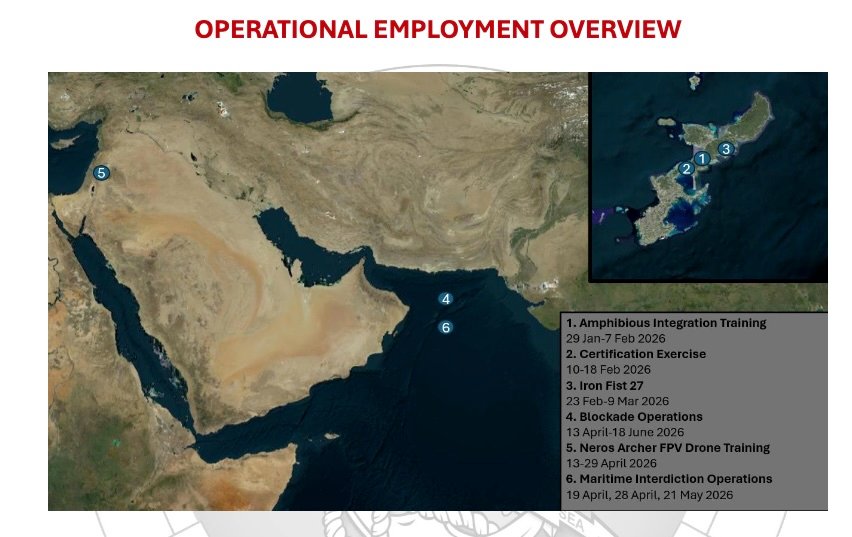
The 31st Marine Expeditionary Unit’s (31st MEU) recent deployment to the Middle East marked the first time the United States Marine Corps (USMC) used its Expeditionary Advanced Base Operations (EABO) concept in a combat setting, the service confirmed to TWZ on Thursday. At its core, EABO involves relatively small groups of Marines quickly establishing bases of operation in forward areas, often within the enemy’s weapons range. During operations in the fight against Iran, Marines refueled and rearmed their own aircraft, as well as those from the joint force, at these austere locales. They also set up remote sensing locations, among other actions from the EABO playbook.

This employment of EABO for Epic Fury is a highly significant development. After years of progressively evolving the EABO playbook, it was no longer an experimental exercise. This meant that Marines were forward deployed in a contested area in a region where established bases were taking heavy fire from Iranian missile and drone barrages. Troops were killed in some of these attacks and U.S. aircraft, buildings and equipment were damaged and destroyed across the Middle East. Pushing aircraft from the MEU, as well as the joint force, to FARPs (forward arming and refueling point) would have been a relevant asset preservation tactic as well as one that would help accelerate combat operations, and it’s exactly what EABO is meant to do.

The 31st MEU’s six-month deployment began in January in the Pacific, before the unit was ordered to the Middle East in March, returning to Okinawa, Japan, in July. That’s where it is stationed as the USMC’s only continuously forward-based MEU.

A map of the 31st MEU’s deployment. (31st MEU)

“This was the first time we were able to implement EABO in combat operations since the concept was created for the force,” Capt. Steven J. Keenan, a USMC spokesperson, told us. “We have practiced it many times, but this was a first for supporting a Joint Force named operation with forward FARPs and forward bases that supported joint ops and combat power sustainment.”

EABO was first introduced in 2020 by then-Commandant Gen. David Berger in his Force Design 2030 plan for the future of the Corps. It was created with a fight against China in mind, especially utilizing small Pacific islands. The idea is to have highly mobile, low-signature forces deployed forward in austere, contested or potentially contested maritime locations. The mission is to “support sea control operation, conduct sea denial operations within the littorals, contribute to maritime domain awareness, provide forward command, control, communications, computers, combat systems, intelligence, surveillance, reconnaissance, targeting, and counter-targeting capability and forward sustainment,” according to the Marines.

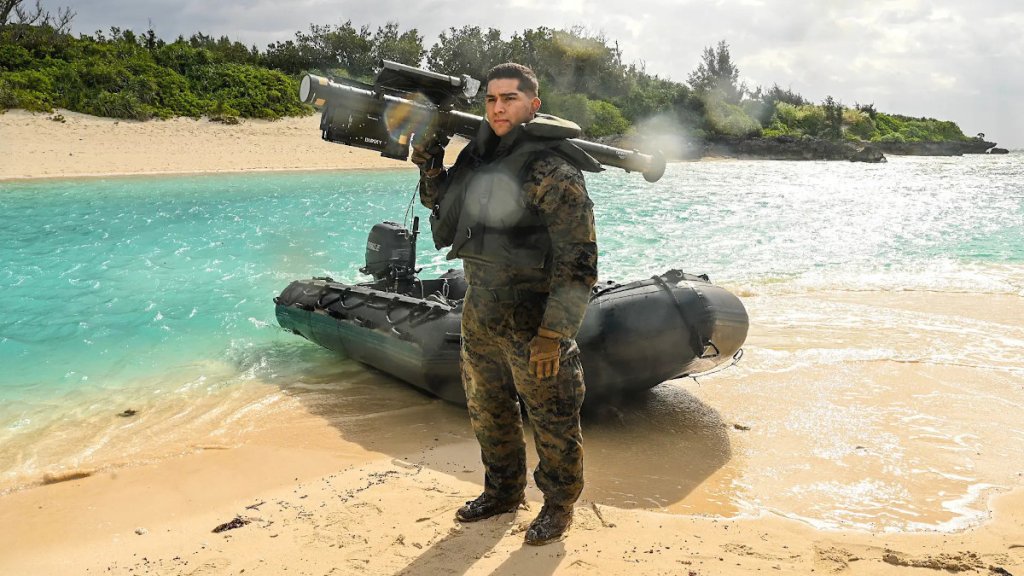
A Marine holding a Stinger missile launcher stands in front of a Combat Rubber Raiding Craft on Ukibaru Island off the coast of Okinawa during Exercise Hagatna Fury 21. (USMC) A Marine holding a Stinger missile launcher stands in front of a Combat Rubber Raiding Craft on Ukibaru Island off the coast of Okinawa during Exercise Hagatna Fury 21. USMC

The news of the first activation of the EABO concept in combat came Wednesday during a media roundtable with Col. Chris P. Niedziocha, who commanded the 31st MEU during its deployment to the Middle East in support of Operation Epic Fury. Now director of the USMC Expeditionary Warfare School, Niedziocha discussed EABO and a range of other operations during that deployment, including boarding vessels during the blockade of Iranian ports.

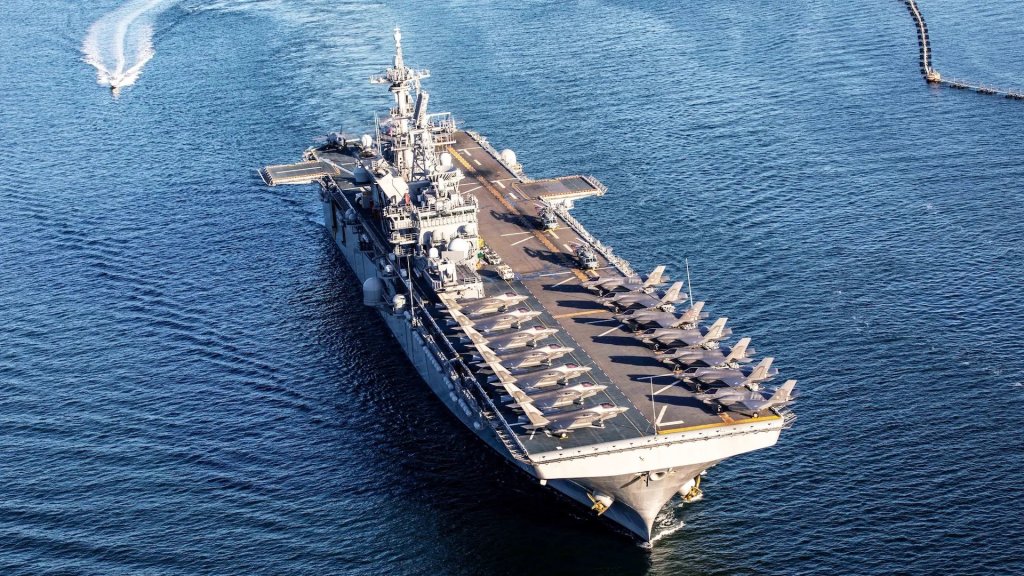
The 31st MEU was embarked aboard the Tripoli Amphibious Ready Group (ARG), which consisted of the America class amphibious assault ship USS Tripoli, San Antonio class amphibious transport dock ship USS New Orleans, and Whidbey Island class dock landing ship USS Rushmore. You can read more about the ARG/MEU and its assets in our initial story about the deployment to the Middle East here.

USS Tripoli. (Staff Sgt. Samuel Ruiz)

“You’re starting to see this has been validated,” the colonel said of the EABO concept during the roundtable TWZ attended virtually. “It’s still nascent, but we actually, for the first time, demonstrated what we thought we were able to do, which I think is pretty exciting. And then things like forward arming and refueling to extend the operational reach of aircraft and expeditionary reloading, and then the ever-present logistic challenge of doing something like that. So that’s pretty significant.”

“We successfully implemented critical Expeditionary Advanced Base Operations (EABO), establishing sensor expeditionary advanced bases and forward arming and refueling points (FARPs) where none existed,” the colonel added. “Through our forward logistic elements, we proved that an agile Marine Air-Ground Task Force can sustain itself and generate ready, lethal power in contested maritime environments, directly setting the theater for follow-on joint forces.”

One of the objectives of the FARPs was to reduce reliance on the Marines’ fleet of KC-130 aerial refuelers and serve as jumping-off points for its F-35B Lightning II fighters.

“There was all manner of tankers all the time, but the FARP is to extend the operational reach, and if you can do it, you reduce the load on that,” Niedziocha noted. “Because there’s some aircraft that are basically for expeditionary austere operations, especially the F-35B,” the Marine Corps’ variant of the aircraft designed for short take off and vertical landing. 

“There are some trade-offs associated with the Bravo,” Niedziocha pointed out, using a slang for the jets. “There’s less internal fuel, but you have the lift [system], which gives you the option to do these kinds of things. So, the goal there was to walk that fine line between providing the full sortie over wherever you needed it, and keeping the ships far enough away to make them as survivable as possible.”

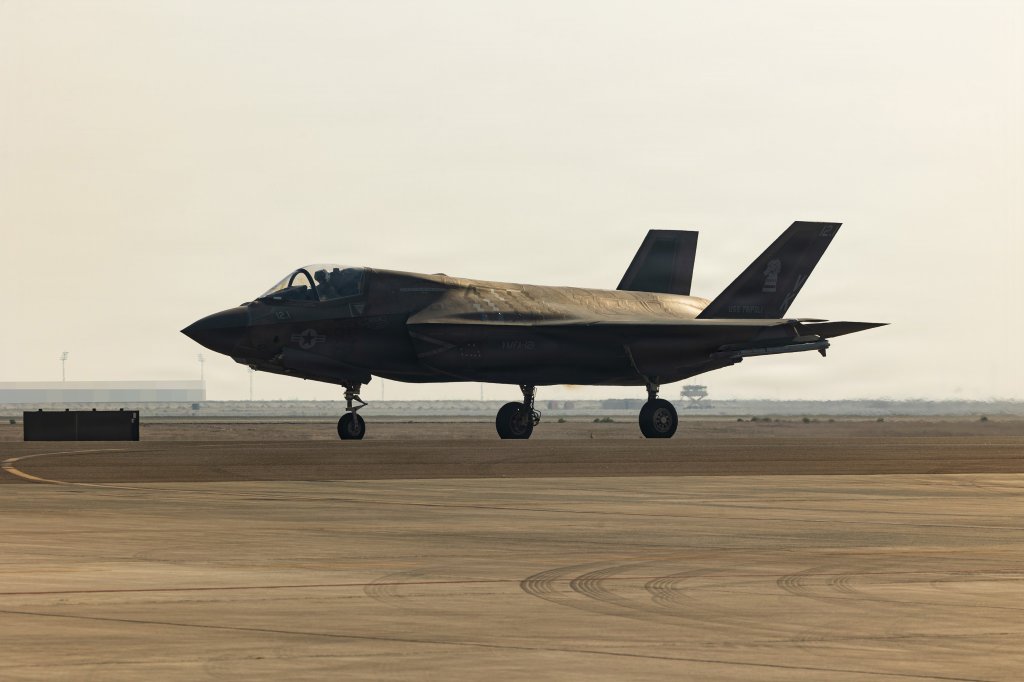
An F-35B Lightning II aircraft taxis to a forward arming and refueling point in the U.S. Central Command area of responsibility, May 26, 2026. (U.S. Marine Corps photo by Cpl. Maksim Masloboev)
An F-35B Lightning II aircraft taxis to a forward arming and refueling point in the U.S. Central Command area of responsibility, May 26, 2026. (U.S. Marine Corps photo by Cpl. Maksim Masloboev) Cpl. Maksim Masloboev

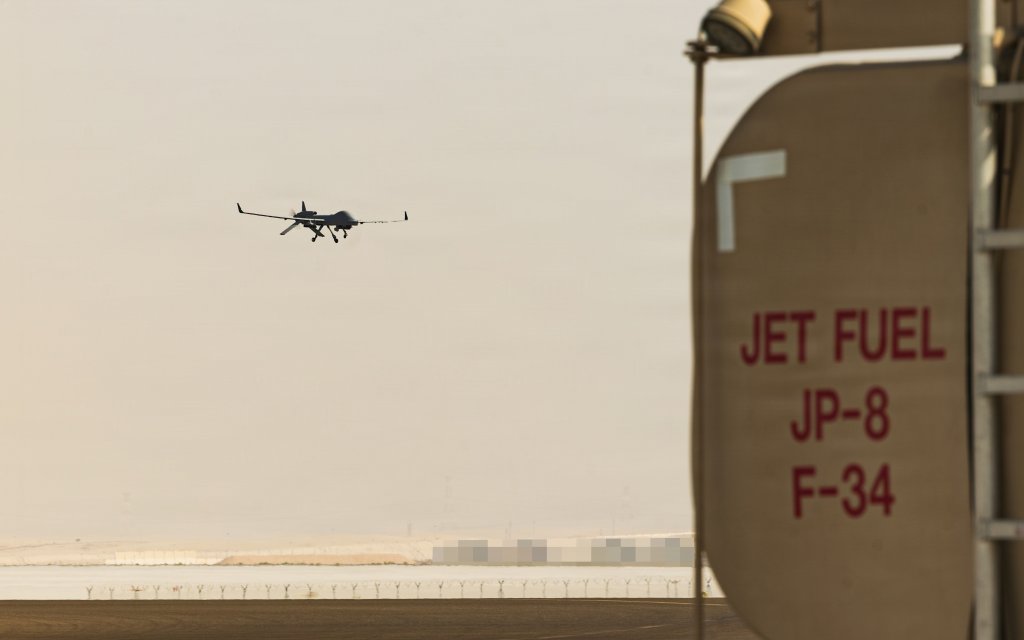
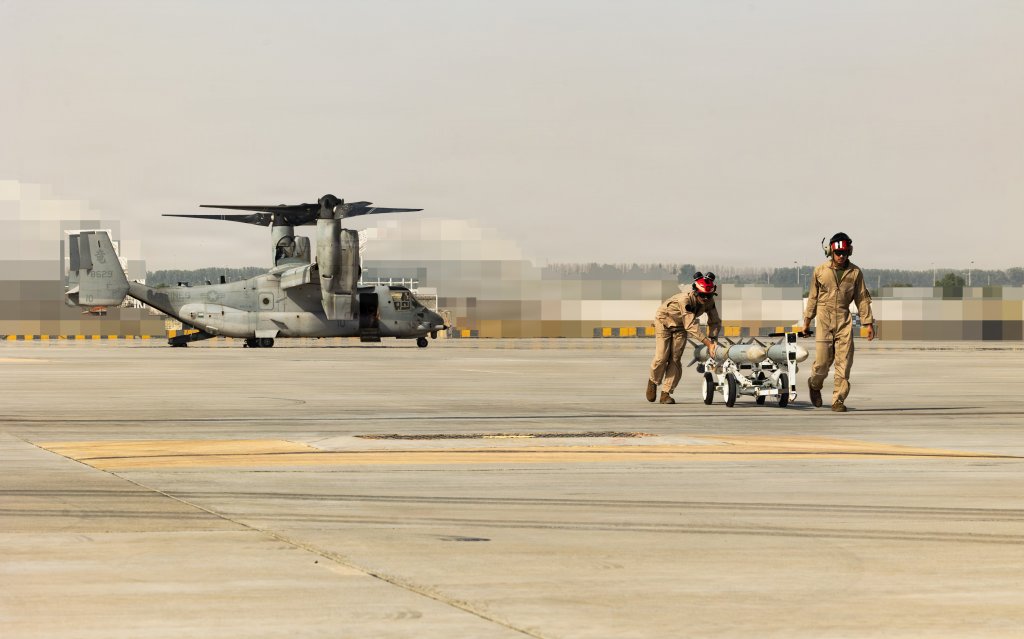
In addition to the F-35Bs and other aircraft organic to the 31st MEU, the FARPs were also used by Army helicopters, Keenan told us. Imagery posted on the Pentagon’s image distribution site also showed U.S. Army Gray Eagle drones and Marine MV-22B Osprey tiltrotor aircraft were included.

An MQ-9 Reaper drone lands at a forward arming and refueling point in the U.S. Central Command area of responsibility, May 26, 2026. (U.S. Marine Corps photo by Cpl. Maksim Masloboev)
A Gray Eagle drone lands at a forward arming and refueling point in the U.S. Central Command area of responsibility, May 26, 2026. (U.S. Marine Corps photo by Cpl. Maksim Masloboev) Cpl. Maksim Masloboev

U.S. Marines with the 31st Marine Expeditionary Unit, transport aircraft ordinance to a forward arming and refueling point in the U.S. Central Command area of responsibility, May 26, 2026. (U.S. Marine Corps photo by Cpl. Maksim Masloboev)
U.S. Marines with the 31st Marine Expeditionary Unit transport AIM-120 AMRAAMs to a forward arming and refueling point in the U.S. Central Command area of responsibility, May 26, 2026. (U.S. Marine Corps photo by Cpl. Maksim Masloboev) Cpl. Maksim Masloboev

Niedziocha did not provide details about where the FARPs were set up, but a U.S. defense official told us they were “disaggregated throughout the Middle East.” The official declined to provide further information, citing operational security concerns since they are still being used.

“Throughout the deployment, the Tripoli ARG and 31st MEU successfully conducted over 1,600 mishap-free flight hours of combat aviation missions, including precision strikes, transporting 800,000 pounds of cargo, and moving 5,000 personnel,” a 31st MEU overview of the deployment explained. “The units also provided sustained combat support to joint force operations by delivering critical intelligence and refueling over 300 aircraft ashore and underway.”

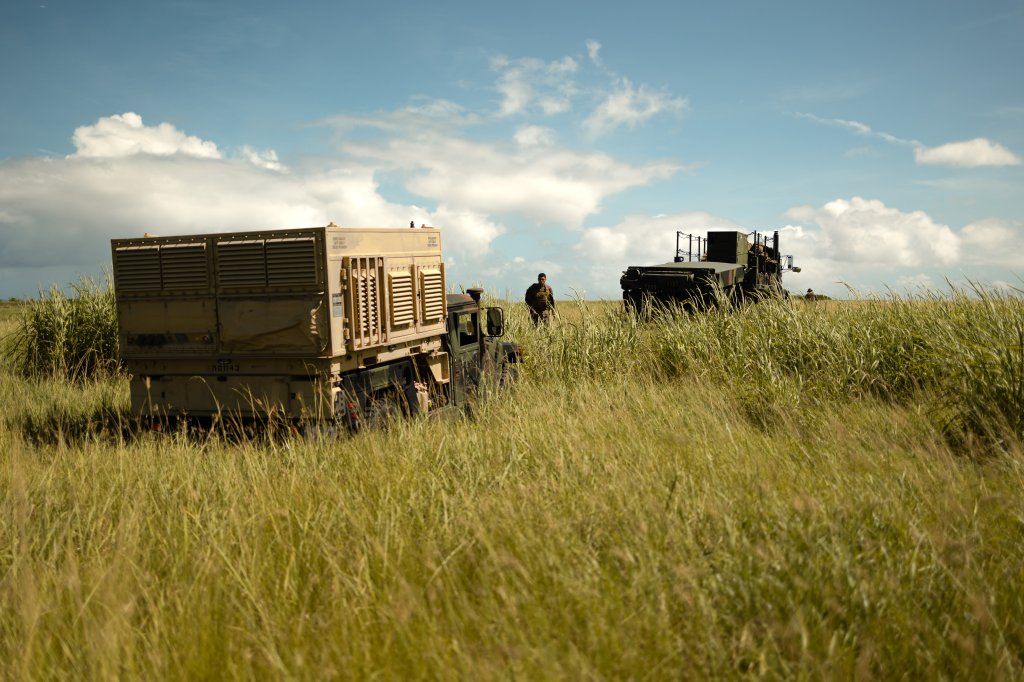
The colonel also didn’t provide details about the sensor expeditionary advanced bases. According to the Marines, “a sensing expeditionary advanced base (SEAB) brings together coastal surveillance radars, electronic sensors, and Marines ashore to extend maritime domain awareness, complementing the radars and sensors already at work aboard naval ships off the coast.”

“When SEAB systems identify surface vessels in nearby sea lanes, small unmanned aircraft system (sUAS) operators launch their platforms to visually identify and track the contacts,” the Marines added. “Sensor data and imagery are transmitted in real time across the blue-green command network to decision-makers.”

U.S. Marines with 12th Marine Regiment, 3rd Marine Division, prepare to set-up a Ground/Air Task Oriented Radar (G/ATOR) system during a routine unit level training exercise on Iejima, Okinawa, Japan, July 15, 2023. The G/ATOR provides an air defense and surveillance capability and is used to locate enemy weapon systems. As the stand-in force aviation combat element, 1st MAW is utilizing expeditionary advanced bases to expand kill chain functions and bridge Marine aviation command and control (C2), sensor, and shooter capabilities across the joint force. (U.S. Marine Corps photo by Staff Sgt. Manuel A. Serrano)
U.S. Marines with 12th Marine Regiment, 3rd Marine Division, prepare to set up a Ground/Air Task Oriented Radar (G/ATOR) system during a routine unit level training exercise on Iejima, Okinawa, Japan, July 15, 2023. (U.S. Marine Corps photo by Staff Sgt. Manuel A. Serrano) Gunnery Sgt. Manuel Serrano

This capability could have been used to track Iran’s remaining fleet of small boats that it has used to harass shipping and mine the Strait of Hormuz, as well as larger vessels trying to transport oil. Other sensors, like radars and counter-drone systems, could also help identify incoming threats and provide general situational awareness. The EABO concept was employed as part of the 31st MEU’s larger role in supporting the blockade and mine clearance efforts.

The 31st MEU interdicted four vessels during the deployment, three of which led to boardings. On April 19, Marines boarded the MV Touska; on April 28, the MV Blue Star III; and on May 19, the MT Celestial Sea.

The Touska was boarded after USS Spruance fired multiple 5-inch rounds, targeting the engine room and disabling the vessel’s propulsion. The crew of the vessel was retained for about two weeks before being repatriated.

Niedziocha told us that none of the crews offered any resistance.

“At two in the morning, when 30 Force Reconnaissance Marines fast rope onto your vessel, [you are] just compliant with a capital C. They did exactly what they were directed to do. The overmatch that you put onto that vessel is pretty surprising. And then there’s overwatch provided by UAS and manned aircraft, so you create this bubble around the vessel. So yeah, they complied.”

You can see the Touska being boarded in the following video.

The U.S. just released a video of its forces boarding and seizing the Iranian container ship M/V Touska near the Hormuz Strait after it tried to break the U.S. naval blockade pic.twitter.com/FpB2obb3jY

— Visegrád 24 (@visegrad24) April 20, 2026

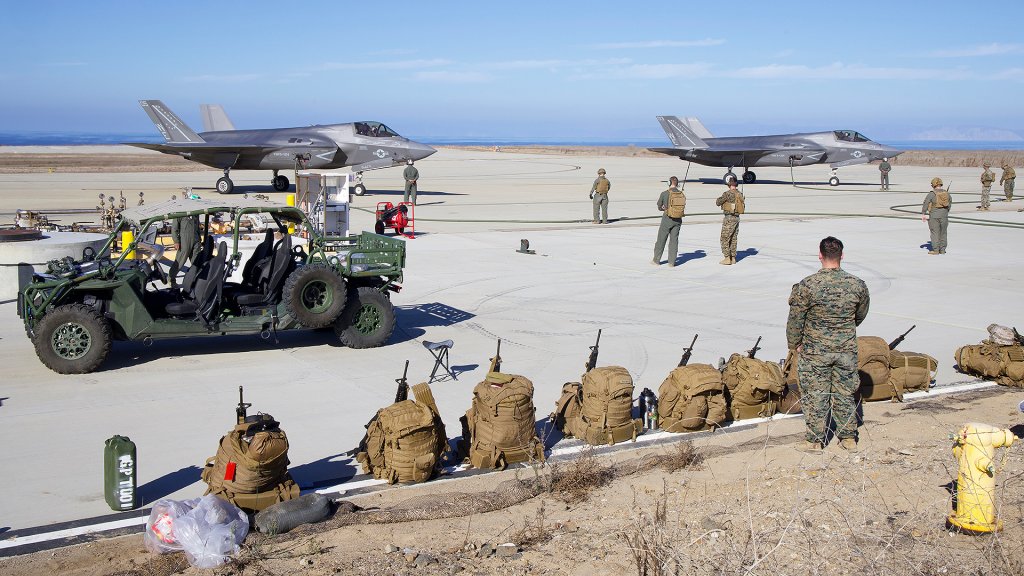
Two years ago, as the EABO concept was maturing, TWZ was invited to get an exclusive look at how an advanced EABO concept would be put into action, including how squadrons operated the F-35B out of an austere combat environment while generating combat sorties. It was an unprecedented and exclusive peek into the EABO playbook and what a real fight in the Pacific with the USMC’s most advanced fighter aircraft could actually look like. You can read about that in our story here. It appears the operations in the Middle East mirrored this exercise closely.

F-35Bs on san clémente island for austere operations training during Steel Knight exercise.
James Deboer

Now back in Japan, the ARG/MEU is getting ready for a new deployment, said the colonel.

“We got back to Okinawa, I think July 22nd, and they had already begun their workup cycle in earnest to be on the water in early January to go out and do another Iron Fist [training exercise] with the Japanese, and then long periods of a crisis response,” said Niedziocha, who relinquished command in August before moving on to his new role. “Just being there, present in the First Island Chain to partner with your allies, demonstrates the resolve and commitment to deter whatever needs deterring.” 

As noted earlier in this story, the EABO concept was designed with a Pacific fight in mind. Its first combat employment in the Middle East clearly offers lessons that can now be adapted to enhance EABO operations globally.

Contact the author: howard@twz.com

The post USMC Used Its Expeditionary Operations Playbook In Combat For First Time During Epic Fury appeared first on TWZ.

  •  

Over a decade of war in Yemen and the rise of Ansar Allah

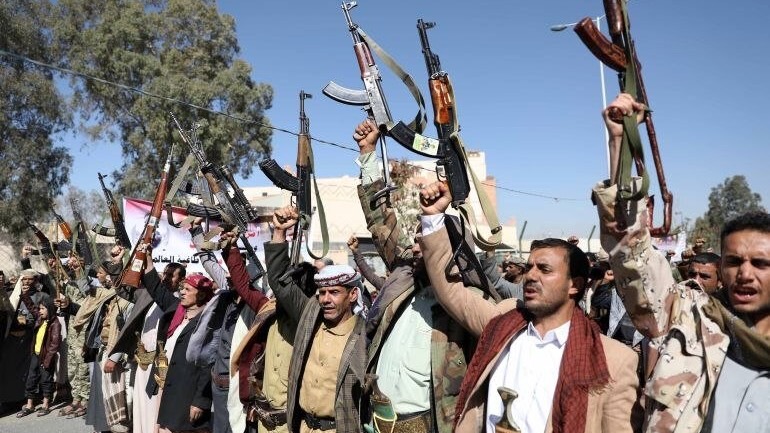
In July, Saudi Arabia joined the US-Israeli war on the West Asia region with strikes on Yemen. The Ansar Allah-led Yemeni Armed Forces retaliated by launching a maritime blockade alongside attacks targeting vital Saudi interests.

The renewed fighting between the two West Asian nations resulted in Ansar Allah’s takeover of the strategic Red Sea port city of Mokha last week and the liberation of all the group’s prisoners held by Saudi-backed forces on Yemen’s western coast.

Ansar Allah’s seizure of Mokha seaport is reshaping regional and global geopolitics, particularly because it serves as a primary gateway to the Bab el-Mandeb Strait and coincides with developments in the Strait of Hormuz.

As these major shifts underscore, Yemen holds immense strategic geopolitical significance.

Situated on the southwestern corner of the Arabian Peninsula and overlooking the Bab al-Mandab Strait, Yemen represents a vital chokepoint connecting the Red Sea to the Gulf of Aden and the Indian Ocean

Consequently, internal political developments in Yemen can have global political and economic repercussions.

This fact, in turn, has put Yemen in the crosshairs of the US-led Western imperialist bloc and their allies in West Asia, which have endeavored to subjugate the country through a devastating decade-long war and blockade. 

The origin of this war coincides with the emergence of Ansar Allah, beginning when the group managed to take control of large swathes of the country, including the capital, Sanaa, in 2014.

The rise of Ansar Allah

Ansar Allah was first established in the early 1990s in the northern Yemeni governorate of Saada as a cultural and educational organization called Al-Shabab al-Mumin (the Believing Youth).

Initially, the organization introduced itself as an unarmed theological movement aimed at reviving and preserving Zaydi Shia Islam and countering the threat of state-backed Sunni Salafism, which sought to uproot the Zaydi religious identity in its homeland of Saada.

From its inception, the movement opposed the government, led by President Ali Abdullah Saleh, accusing it of corruption and criticizing its ties to the United States and its ally Saudi Arabia.

Tensions between the group and the government drastically escalated following the US invasion of Iraq in 2003. It was at that time that the group adopted the slogan (Death to America, Death to Israel), during mass protests opposing the war on Iraq.

These slogans posed a political threat to Ali Abdullah Saleh, who was attempting to position his government as a key ally in the “US War on Terror” in the aftermath of the 9/11 attacks. As a result his government led a brutal crackdown on protesters.

Security forces and riot police suppressed protests using live ammunition, tear gas, and batons, and arbitrarily detained hundreds of political activists, students, and opposition organizers without trial.

In 2004, tension between the Al-Shabab al-Mumin and the Yemeni government boiled over, sparking a series of six internal conflicts known as the Saada Wars. 

These clashes began with the government’s assassination of Hussein Badreddin al-Houthi, the group’s founder, and triggered five subsequent rounds of fighting that lasted until 2010. The followers of the group became widely known as the Houthis ever since. 

Saudi Arabia reportedly engaged in the Saada wars by providing immense financial, political, and material support to the Yemeni government. Saudi intervention in Yemen escalated in 2009 with a direct military incursion and unilateral airstrikes against positions held by the Houthi movement.

In 2011, the group joined nationwide demonstrations, calling for the overthrow of President Ali Abdullah Saleh. It was then that the Houthi movement formally adopted the name Ansar Allah (Supporters of God). 

The ousting of Saleh weakened the central government and triggered a sweeping power vacuum, which allowed Ansar Allah to rapidly expand its territorial dominance. By 2012, the Yemeni movement consolidated firm control across the Saada governorate and large swathes of northern Yemen.

In early 2012, vice president to Saleh, Abed Rabbu Mansour, Hadi became the President of Yemen via a transition framework brokered by the Gulf Cooperation Council (GCC), as he was  considered as a quiet consensus figure. Hadi was also strongly backed by the Obama administration. 

In late 2014, Ansar Allah allied with forces loyal to ousted president Ali Abdullah Saleh against the transitional government headed by Abed Rabbu Mansour Hadi. The fighting that followed led to Ansar Allah’s seizure of the capital Sanaa, forcing Hadi to flee the country.

2015-2022: The Saudi-led coalition’s protracted war against Yemen

From exile in 2015, Hadi requested the Saudi-led coalition to intervene in the conflict, opening the door to one of the bloodiest prolonged wars in West Asia. A conflict that, according to UN estimates, resulted in 377,000 deaths by 2022. 

Saudi Arabia was the main pillar of the coalition, leading the military campaign dubbed “Operation Decisive Storm” with a massive force, including extensive warplanes and ground troops.

The United Arab Emirates (UAE) also played a key role by commanding ground and air operations particularly in southern Yemen and along the critical coastal strip.

Bahrain took part in the operation with 12 fighter jets (some sources say 15), and deployed ground troops in the southern Saudi borders to protect Saudi Arabia from Ansar Allah’s attacks. Meanwhile, Kuwait contributed with 15 warplanes.

At the beginning of the campaign, Qatar participated with roughly 1,000 ground troops, armored vehicles, a dozen fighter jets, and transport helicopters until it was expelled from the coalition in June 2017 over a diplomatic crisis with Saudi Arabia, UAE, Bahrain, and Egypt.

Jordan and Morocco contributed six fighter jets each, while Sudan under deposed president Omar Al-Bashir sent three aircrafts and thousands of ground troops. Furthermore, Senegal committed 2,100 troops.

Western countries, including the United States, the United Kingdom, and France provided logistic and intelligence support, such as aerial refueling for coalition jets, technical assistance, military equipment, coordination support, and maritime surveillance.

The 2022 UN-brokered truce de-escalated the war rather than ending it

In April 2022, the United Nations announced an official two-month nationwide truce agreement, which temporarily halted cross-border attacks, ground and air operations, and allowed fuel imports into ports held by Ansar Allah. It also reopened commercial flights from Sanaa International Airport after years of sea, land, and air blockade imposed by Saudi Arabia. 

Rather than completely removing the blockade, the agreement only resulted in the partial easing of restrictions, while regions under the control of Ansar Allah have continued to face a near-total blockade.

Read more: Yemen demands Saudi-led blockade on the country be lifted immediately

The agreement was renewed in June and extended a second time in August 2022 for an additional two months before it lapsed in October. 

Regional developments reignited the conflict (2023-2026)

In November 2023, Ansar Allah launched a ban on all Israeli maritime navigation in the Red Sea and the Bab el-Mandeb Strait in retaliation for Israel’s genocidal aggression on Gaza.

About one month later, the group significantly expanded the ban to include all ships heading to Israeli ports, regardless of their nationality or flag.

The ban continued until October 2025, despite waves of deadly airstrikes launched by the US, UK, and Israel on Yemen.

An Omani-mediated ceasefire deal between the US and Ansar Allah was reached in May 2025. The deal stipulated halting Ansar Allah’s attacks on US ships in the Red Sea and Bab al-Mandab Strait, and ending US aggression on Yemen, without preventing the Yemeni resistance movement from launching attacks or naval operations against Israel. 

This same period saw a shift in the conflict between the Saudi-led coalition and Ansar Allah from active military engagement toward a tense, fragile diplomacy.

In early 2026, friction between the two major pillars in the anti-Ansar Allah coalition – namely Saudi Arabia and the UAE – surfaced as different Yemeni groups backed by the two countries clashed, apparently over territorial control in Yemen.

Read more: Tensions in Yemen: Are Saudi Arabia and the UAE becoming frenemies?

The US-Israeli war on Iran has drawn Yemen back into the regional conflict

Although Ansar Allah was established as an independent Yemeni movement, it evolved into a key component of the Axis of Resistance over time. This alignment was driven by mutual ideological foundations, shared anti-imperialist ideology, and deep strategic and military cooperation with Iran and Hezbollah.

Despite its affiliation with the resistance alliance, Ansar Allah chose not to get involved in the recent regional war waged by the US and Israel against Iran, for ostensibly strategic considerations and military coordination tactics with its allies.

Read more: Reflections on the US-Israeli multi-front war in West Asia: How the Axis of Resistance remains resilient

However, because the United States and its allies in the region seemingly view the current war as an ideal opportunity to dismantle the Axis of Resistance, Saudi Arabia decided to resume its aggression against Yemen by attacking Sanaa International Airport in July. The attack aimed to prevent an Iranian plane from landing.

Consequently, Ansar Allah launched retaliatory attacks on Saudi interests inside Saudi Arabia and on Yemeni soil. It further declared a maritime blockade against Saudi-linked commercial vessels passing through the Bab al-Mandeb Strait, demanding Riyadh end its decade-long blockade on Yemen.  

Concurrently, ground clashes over territorial dominance between Ansar Allah and Saudi-backed forces intensified, leading to key victories for the Yemeni group. Escalations have persisted up to the time of publication.

On Wednesday, September 16, Saudi Arabia accused Ansar Allah of attempting a drone attack against the city of Mecca, the holiest city for Muslims, located in western Saudi Arabia.

Ansar Allah dismissed Saudi accusations as false, saying that they reflect a “desperate attempt to mobilize public opinion.”

As the US-Israeli war on West Asia continues to reshape geopolitics, Ansar Allah’s emergence as a regional force has placed Yemen at the center of a struggle that may define the future of West Asia.

  •  

A Celebration Turned Into a Nightmare

What were supposed to be moments of immense joy turned out to be the dance of death, brought by the harbingers of war and suffering! On September 1, 2026, in the coastal town of Kuhestak (Sirik County) in the Hormozgan province of southern Iran, a large gathering was underway to celebrate the wedding of a […]
  •  

How The Air Force Patched Up A Shrapnel-Damaged KC-135

The head of Air Mobility Command (AMC) on Wednesday offered some new details about what went into repairing a KC-135 Stratotanker riddled with shrapnel holes from an Iranian attack. We have previously written about a couple of these jets damaged during Operation Epic Fury (OEF) as they came through RAF Mildenhall in the U.K. on their way back to the U.S. for comprehensive repair work. We are also getting new information of how AMC kept its fleet operating at such a prolonged high-tempo ahead of and during OEF.

The discussion about the damaged tanker took place during a panel at the Air & Space Forces’ Air, Space and Cyber Conference that TWZ is attending. The tanker in question was damaged as it was preparing for a mission, explained AMC commander Lt. Gen. Daniel H. Tulley.

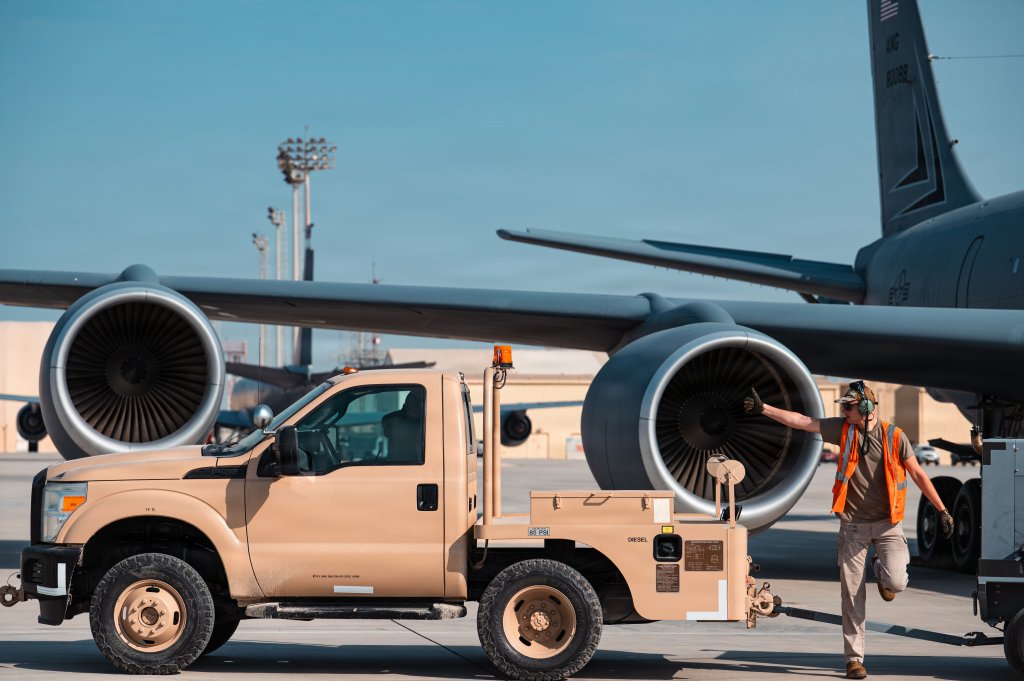
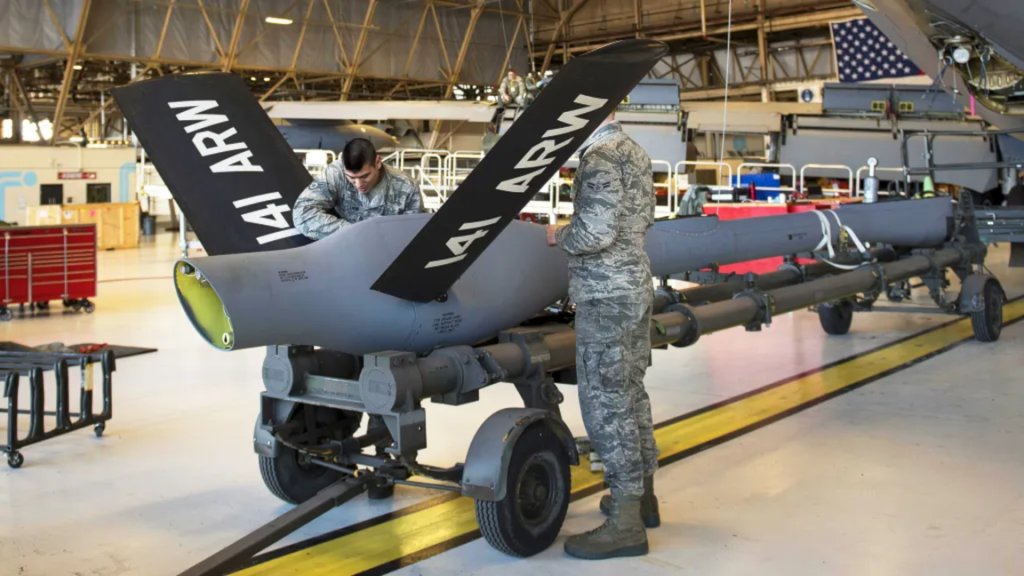
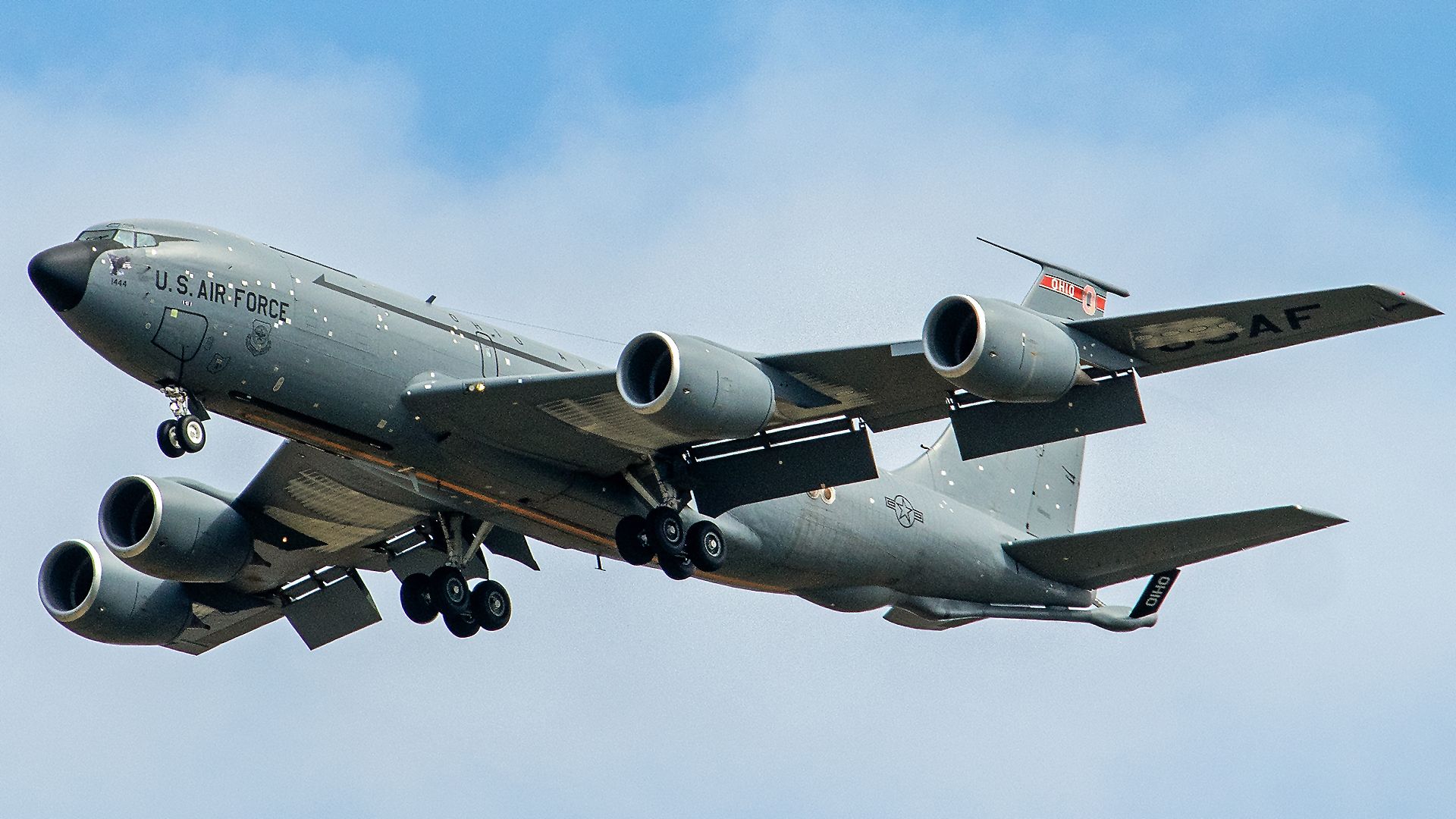
A U.S. Air Force maintainer performs preflight maintenance on a KC-135 Stratotanker refueling aircraft at a base in the Middle East, April 30, 2026. (U.S. Air Force photo by Master Sgt. James Cason)
A U.S. Air Force maintainer performs preflight maintenance on a KC-135 Stratotanker refueling aircraft at a base in the Middle East, April 30, 2026. (U.S. Air Force photo by Master Sgt. James Cason) Master Sgt. James Cason

“A KC-135 ops crew is in the jet,” he said. “KC-135 maintenance team is about to launch this jet. Unexpected Alarm Red [an attack warning]. Everyone jumps in a bunker.”

After the barrage, the airmen emerged from their bunkers and checked out the plane.

“That aircraft is smoking,” Tulley said. “There are holes in it, and it’s a fully loaded KC-135. Two hundred thousand pounds of jet fuel. Took 48 hours for that [fuel] to be drained out of that aircraft. In the meantime, first on the scene was I think the pro super [production superintendent] and the expediter. They immediately began to collect the fuel… They start to patch the holes. They start to fix all the systems. Long story short, they were eventually able to get that plane to make a transoceanic flight back home to be fully repaired.”

Tulley did not say where the attack took place. However, as we have previously reported, five tankers were reportedly damaged in an Iranian long-range strike on Prince Sultan Air Base (PSAB) in Saudi Arabia on March 14. That was later confirmed in a Department of War Inspector General report released earlier this week.

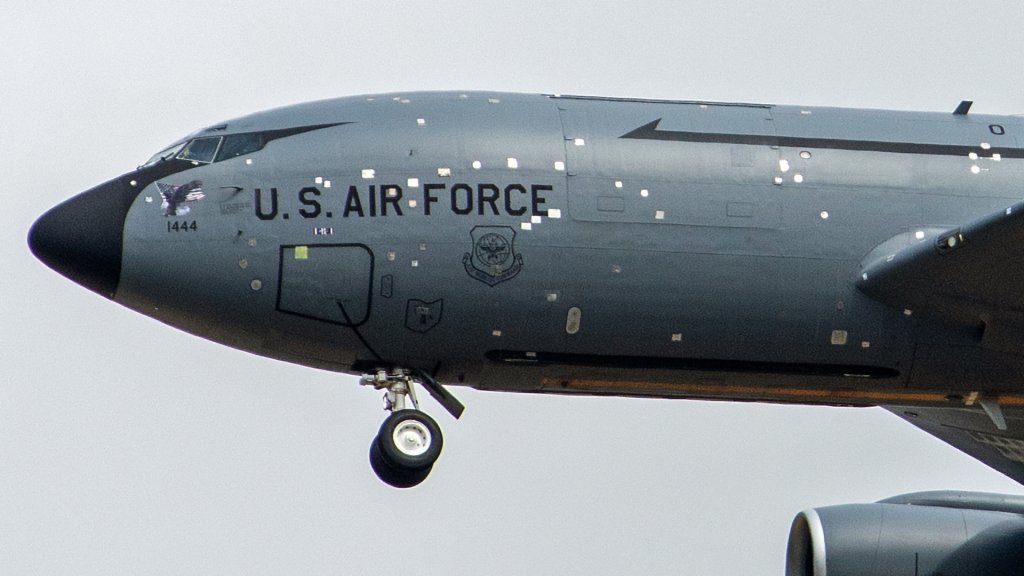
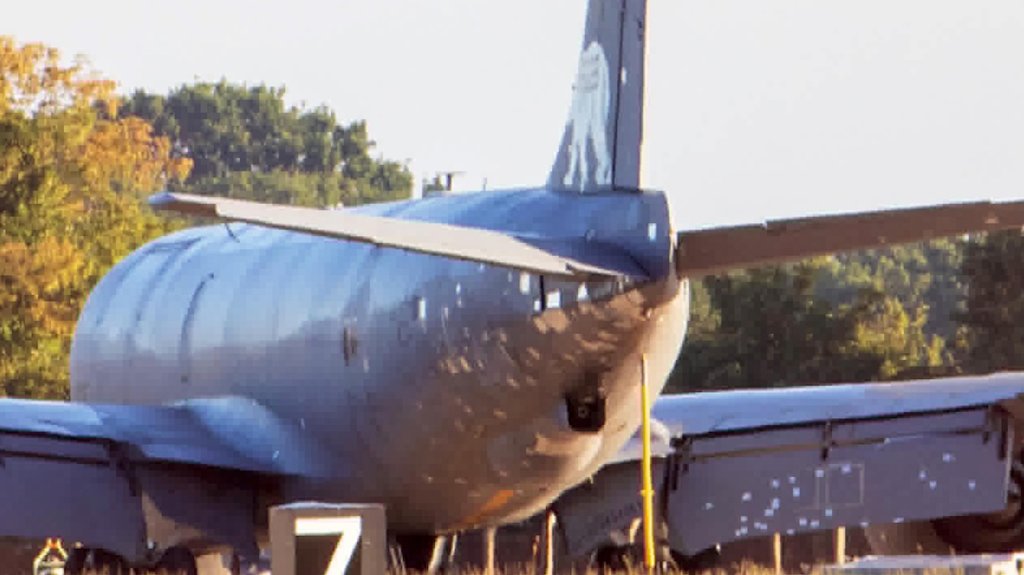
You can see two of the shrapnel-damaged KC-135s as they passed through the UK on the way home in the following photographs shared with us by aviation photographer Andrew McKelvey. We do not know if either of these is the one discussed by Tulley.

(Andrew McKelvey)
Another battle-damaged KC-135 Stratotanker aerial refueling jet arrived at RAF Mildenhall.
(Andrew McKelvey)

Lt. Gen. Linda Hurry, Commander of Air Force Materiel Command (AFMC), followed Tulley’s comments with additional details about the repair work.

“I’ll pick right up on that because it was our aircraft battle damage repair team that was actually able to patch their aircraft back together to get it back to Tinker [Air Force Base in Oklahoma] that can put it completely back where it needed to be,” she noted. Tinker is home to the Expeditionary Depot Maintenance (EDMX), which is “responsible for maintaining the Air Force’s sole source for Aircraft Battle Damage Repair (ABDR) rapid repair capabilities for the entire tanker and bomber fleets,” according to the Air Force.

“So with Operation Epic Fury, we’re asking those questions: What can we sustain for how long? And it begs a question about regeneration,” Tulley further explained. “You know, our new teammates have regeneration as part of their doctrine, so readiness in contact is the way we’re approaching this. What can we do to improve how we generate capability while under fire, in contact, persistently in an extended or protracted conflict? Lots of great examples of work being done to get after this. General Hurry’s team has brought a lot of capability forward at Mildenhall Air Base.” 

One example of how this has worked has been repairing damaged aerial refueling booms in the U.K. instead of all the way back to the U.S., Tulley highlighted. The booms, which extend from the back of tankers so that receiving aircraft can get their gas, can be damaged by the process, especially during combat refueling.

“I think we turned 30 booms instead of bringing them all the way back to the states,” Tulley noted.

A KC-135 refueling boom. (USAF)

Repairing battle damage is certainly a unique situation for AMC airman, but keeping hundreds of the command’s tankers and cargo aircraft moving at such a high rate prior to and during the war was a huge undertaking that was helped by new maintenance concepts. The Air Force sent maintainers and parts to bases in Europe to drastically speed up major maintenance that would have demanded the aircraft return stateside.

“We moved some maintenance actions forward, so they didn’t have to – the aircraft didn’t have to go all the way back to the states,” Air Force Chief of Staff Gen. Kenneth S. Wilsbach said during his keynote speech earlier this week. “We put some of them in Europe, so they could get through some normal safety inspections that were either due or deferred. Got those done, and the aircraft doesn’t have to go all the way back to the states. They can go somewhere in Europe, get the thing done, and then get right back to the flight. And so, those measures by Air Mobility Command paid dividends in the readiness of our mobility fleet.”

Air Force Global Strike Command (AFGSC), which maintains the service’s fleet of strategic bombers and its ICBM force, did something similar at RAF Fairford in the U.K., AFGSC commander Gen. Stephen L. Davis explained.

“It’s a complex problem,” said Davis. “I would say in the past we probably didn’t do this the right way. When we thought a conflict was kicking off, the first thing we do is start sending bombers forward, and that actually consumes our readiness. So I think we got it right during OEF.”

“We pushed maintainers and support personnel forward to RAF Fairford, and then we actually took the bombers, we loaded them up in CONUS [Continental United States]. We took them to the Middle East. They actually did a mission. They employed, deployed, conducted a combat mission, and then landed at Fairford. And then for the next, well, I guess they’ve been there for now six-plus months.”

“They’ve been conducting nearly daily operations out of there,” Davis proffered. “When bombers are back at home base, they build readiness. When we deploy it forward, they consume readiness. And then, as [Gen. Hurry] said, we’re getting great support in terms of parts, in terms of supplies, and in terms of forward depot support. So that fleet remains healthy.”

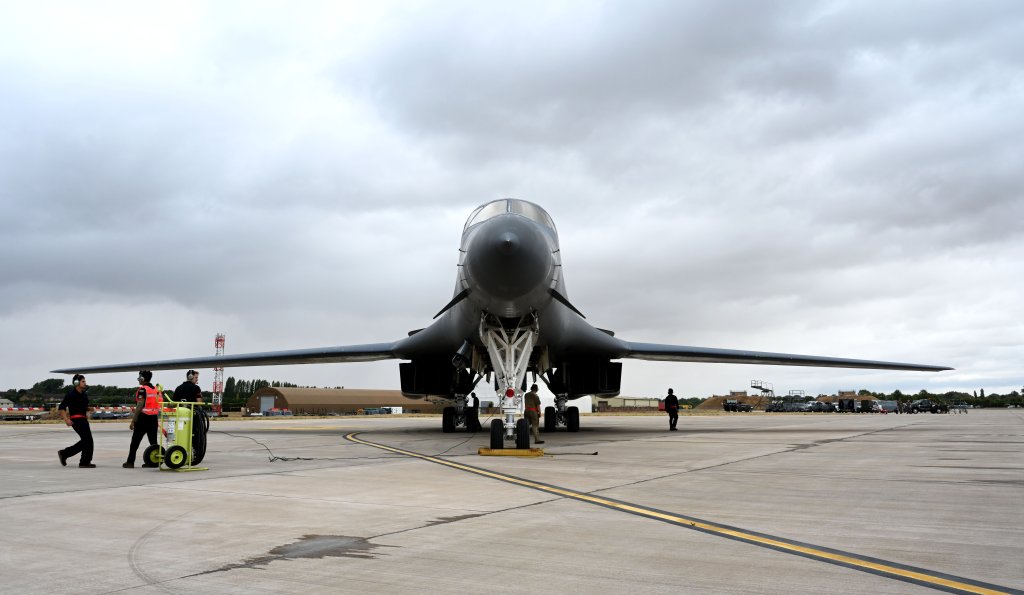
A U.S. Air Force B-1B Lancer assigned to the 37th Bomb Squadron, Ellsworth Air Force Base, S.D., arrives to participate in the Royal International Air Tattoo at Royal Air Force Fairford, England, July 15, 2025. The Lancer is slated to participate in RIAT, which has more than 80 aircraft are scheduled to attend from July 18-20, 2025. (U.S. Air Force photo by Tech. Sgt. Robert M. Trujillo)
A U.S. Air Force B-1B Lancer at RAF Fairford, England, July 15, 2025. (U.S. Air Force photo by Tech. Sgt. Robert M. Trujillo) Tech. Sgt. Robert Trujillo

Being able to do as much repair and maintenance work as close to the front lines as possible will be hugely important in any future fight against China, and, unfortunately, repairing battle damaged aircraft will be necessary too. Clearly, the Air Force has learned some very important lessons from Epic Fury.

Contact the author: howard@twz.com

The post How The Air Force Patched Up A Shrapnel-Damaged KC-135 appeared first on TWZ.

  •  

South Korea shouldn’t abet Trump in Hormuz

The Lee Administration leaked the possibility of deploying Korean forces to the Strait of Hormuz on September 3. The backlash was immediate from Korean civil society that opposes any type of support for Trump’s war of aggression. Furthermore, recent polls reveal that even 55% of Lee’s supporters oppose the dispatching of forces. And while the Lee administration has publicly backtracked, stating that nothing has been decided, it is, nonetheless, quietly undergoing the process of deployment: more than simply an assessment of the security conditions on the Strait of Hormuz, the Lee administration sent a team to check key military bases and ports that could be used at the United Arab Emirates.

Despite growing public opposition, the Lee administration is expected to introduce at the end of September a motion into the National Assembly, where it is likely to pass given his party’s considerable majority. Unlike his predecessor, the impeached Yoon Suk-yeol, President Lee is not a pro-US ideologue; he is a pragmatist. Why then is Lee going out on a limb with this deployment when the rest of the world is staying out of it?

Well, South Korea’s history has always been entangled and shaped by US foreign policy. The darker side to South Korea’s pop-culture is a country dominated and shaped through US policy and interventions. Today, it hosts the largest overseas US military base and controls the Korean military (through wartime operational control). In effect, it’s never been a sovereign state. Its economic, political, and military interests have always been beholden to the United States. 

Today, Lee is horsetrading with Trump: military support in exchange for more favorable terms in the US’s AI global supply chain of semiconductors and data centers along with a return of wartime operational control. While Lee’s pragmatism is navigating the real structural constraints on South Korea, it is ultimately short-sighted and harmful to Koreans and the world.

The war in Iran is inflicting considerable pain to the world’s economies, including South Korea that imports 61% of its crude oil through the Strait of Hormuz. Yet, even from a completely pragmatic perspective, sending Korean forces to the Hormuz does nothing to resolve this problem. In fact, getting entangled with US aggression against Iran would strain the 64-year diplomatic relations with Iran while putting a target on South Korean assets in the region. Furthermore, if the world’s greatest naval and air power cannot secure freedom of navigation in the Strait of Hormuz, how could South Korea’s contribution make a difference? In fact, the deployment of Korean troops prolongs this war of aggression by giving Trump cover and leverage to demand that other countries, such as Japan, also deploy forces.

This isn’t the first time that South Korea would deploy forces due to US requests. In 2004, after pressure from the George W. Bush Administration, the Roh Moo-hyun administration deployed non-combat support troops to Iraq. In response, a militant Islamic group kidnapped a Korean translator and, when the Roh administration refused to cancel further and withdraw current deployment, beheaded the translator.

Most importantly, this war of aggression is not only illegal under international standards, but deployment also violates article five of the Korean constitution that mandates the government to “maintain international peace” and “renounce all aggressive war.” Thus, whether intervening in the frontlines, or in the rear, whether combatant or non-combatant, any deployment would be complicit in Trump’s war of aggression.

Ultimately, as Hamid Shahrabi, an Iranian activist and co-founder of the Global Resistance for Peace & Justice states, securing free passage through the Strait of Hormuz can be achieved but not through military pressure and destruction but by adhering to the “Islamabad MOU, which outlined measures to ensure free passage through the Strait.”

Being dominated by the US brings out the pragmatic among South Koreans. Yet, the world demands that we fight and that we hold the line against Trump. Deploying forces will prolong Trump’s illegal war of aggression. Fortunately, if Koreans can be pragmatic, they can also be fierce fighters against US imperialism when provoked. Instead of fanning the flames of war, we should fight to extinguish Trump’s forever wars.

Dae-Han Song is a part of the International Strategy Centerand the No Cold War collective and is an associate at the Korea Policy Institute.

This article was produced by Globetrotter.

  •  

India must return to its roots and recover its voice

At the BRICS Business Forum in Bharat Mandapam on Friday, Russian President Vladimir Putin read out the numbers. The eleven members of this grouping now produce more than 40% of the world’s output. The G7 produces 29. Over the last five years, BRICS countries generated more than half of all global growth. The G7 managed 18%. Narendra Modi, speaking at the same event, added that the bloc is home to half of humanity and a quarter of world trade.

This is not rhetoric. The center of gravity of the world economy has moved, and India is in the chair while it happens.

Now recall something else that took place in that same hall. On May 24 of this year, US Secretary of State Marco Rubio sat down in Bharat Mandapam for an interview with India Today. Asked about Iran’s closure of the Strait of Hormuz, he called it “illegal, unlawful, reckless, dangerous, and unacceptable.” Then he said something more revealing. “I think the whole world needs to say that, and most of the countries in the world are saying that. India is saying that.“

A US official, sitting in Delhi, announced India’s foreign policy position on its behalf. Nobody in the room corrected him. In the same interview Rubio said the trade agreement was “weeks, not months” away. Four months later, it is still unsigned.

India and the construction of the Global South

In March 1947, months before independence, Delhi hosted the Asian Relations Conference. At the Bandung Conference in 1955, India’s first Prime Minister Jawaharlal Nehru was among the chief architects of an idea that seemed audacious then and remains unfinished now: that newly free countries did not have to rent themselves to Washington or Moscow to be taken seriously. The Bandung spirit produced the Non-Aligned Movement, then the Group of 77 in 1964, and then the demand through the 1970s for a New International Economic Order, which was simply a demand that the IMF and the World Bank stop working only for the countries that funded them. India made those arguments first and made them at a time when the material conditions were not as conducive as we see today.

What India has done inside BRICS follows directly from that. At the Delhi summit of 2012, under Manmohan Singh, the group took up the idea of a development bank and asked its finance ministers to study it. That became the New Development Bank, with an Indian, K.V. Kamath, as its first head. The same summit set up the $100 billion Contingent Reserve Arrangement. At Goa in 2016 both were made operational, and India put forward the idea of a BRICS credit rating agency, aimed squarely at the three Western firms whose verdicts decide what every poor country pays to borrow. In 2021 India proposed the BRICS platform for digital public goods. Across four chairships and two very different governments, India’s contribution has been consistent: turning complaints about an unfair world into institutions that can actually be used.

Now look at how Washington talks about the country.

In July 2025, announcing his first tariffs, US President Donald Trump called India and Russia “dead economies” and said they could “take their dead economies down together, for all I care.” He has called India the “tariff king” and its trade rules “obnoxious.” After Indian Prime Minister Narendra Modi went to the Shanghai Cooperation Organization summit, Trump called the relationship “a totally one-sided disaster.” In April this year he shared, without comment, a post describing India as “some other hellhole on the planet.” Our foreign ministry replied that this was “uninformed, inappropriate and in poor taste.” When Rubio was asked in Delhi about the racist abuse Indians face in America, he said that “every country in the world has stupid people.”

No country of India’s size is spoken to this way. The damage is not to anyone’s feelings. It is what other governments now expect of us.

Standing is not a sentiment. It is a prediction that other capitals make about how you will behave when you are pushed. For seventy years, the prediction about India was that it would not be told what its position was.

Five things India should do this week

Start with Iran, because the silence there has cost us the most.

Standing with Tehran has nothing to do with liking its government. A member state of the United Nations was illegally bombed by Israel and the United States of America, and its leadership killed. If the largest grouping of developing countries cannot say so plainly, then sovereignty becomes a privilege granted at Washington’s pleasure, and every country sitting in Bharat Mandapam holds it on loan. Bandung was convened to reject exactly this, and India wrote the rejection.

Our own losses are not abstract. The frigate Dena was sunk on March 4 with 87 men aboard, days after exercising with the Indian Navy at Visakhapatnam. Admiral Arun Prakash, a former navy chief, called it “a perverse act” by a country “supposed to be friends and partners.” More than 11 Indian sailors have been killed since. The Hormuz carries most of our cooking gas, and its closure puts queues outside Indian kitchens. The Iranian port city and free-trade zone Chabahar, representing a decade of Indian money and our only road to Central Asia that avoids Pakistan, was abandoned when an American waiver was allowed to lapse in April. We have been here before. In Trump’s first term, India resisted American sanctions on Iran and then gave in completely, ending every barrel of Iranian oil and damaging a relationship built over centuries.

So why does the Indian state keep walking towards Washington after every humiliation? Not out of confusion. The corporate class that matters politically in this country raises money in New York, lists there, sells services there and answers to regulators there. For them, alignment is good business. For the sorghum farmer in Rajasthan, whose tariff protection was traded away in February, it is ruined. Over 45% of Indians still depend on farming.

The chairship is the one thing Washington cannot take from India this week. Five demands would make the Delhi Declaration an important step towards global south solidarity and action.

One. Name it. The declaration must say what was done to Iran and to the Strait of Hormuz and must reject unilateral secondary sanctions as a category. Washington has increased sanctions on its targets by 933% in recent decades. A bloc that cannot describe the main act of force in its own year has told everyone what its words are worth.

Two. Put Global South debt at the center. Some 3.4 billion people live in countries that spend more on debt interest than on health or education. In 2023 the poorer nations paid $25 billion more to foreign creditors than they received. India should make debt relief the bloc’s headline demand and push the New Development Bank to lend without IMF-style conditions attached.

Three. Open the door wider. BRICS should stop behaving like a club of the eleven. Expand New Development Bank membership to developing countries outside the grouping, give partner states a real say rather than a seat at the back, and have India publicly champion Africa’s place in the bloc’s decision-making.

Four. Build food security together. Set up the grain exchange, and behind it a shared reserve that member and partner countries can draw on. India, of all countries, knows what it means to depend on someone else’s harvest. We must remember the history when India went to Washington for wheat in the 1960s and spent thirty years making sure we would never do it again.

Five. Make reform a demand of the bloc, not a bid for ourselves. India has spent two decades asking for a permanent Security Council seat. It should spend this week asking for Africa’s, and for an end to the 85% voting rule that gives the United States a permanent veto at the IMF. Ask for everyone, and the asking carries weight. Ask only for yourself, and it looks like what it is.

In 1947 India convened the Asia Relations Conference in Delhi with no power and enormous standing. In 2026 it has real power and is spending the time standing down. A new Bandung will not be built by a country that waits to be told what it thinks.

Atul Chandra is the Asia Co-Coordinators of Tricontinental: Institute for Social Research.

This article was produced by Globetrotter.

  •  

No new talks with the US until the previous conditions are met, says Iran

Secretary of Iran’s Supreme National Security Council Mohsen Rezaei refuted United States President Donald Trump’s latest claims about his country seeking fresh talks. He reiterated that there will be no new talks with the US until it implements the conditions already agreed upon.

“Dont get distracted by the US president’s mix signals-from ‘no negotiations’ to ‘we are ready to talk.’ The stakes around oil and the straits have changed. Damage control won’t stop what’s coming,” Rezaei said in a post on X on Tuesday, September 15.

Rezaei was responding to Trump’s latest claims made on his social media post about Iran seeking a deal “quickly and badly.” Trump called Iran a “failing nation” and said he will decide “whether or not the US will choose to engage.”

Iranian President Masoud Pezeshkian, during his visit to the 18th BRICS Summit in New Delhi earlier this week, also said there is no need for fresh talks with the US until the conditions in the Islamabad Memorandum of Understanding (MoU), signed between the two countries in June, are implemented.

Iran and Oman are seeking regional consensus

On Monday, Iran claimed it had finalized an agreement with Oman regarding the management of navigation through the Strait of Hormuz and said it’s details would be announced soon. 

“The understanding between Iran and Oman, as two littoral states, has been finalized. In consultation with Oman, we will decide on the next step, including how to announce or register the understanding,” official spokesperson of Iran’s Ministry of Foreign Affairs Esmail Baghaei said in a press conference on Monday, September 14.

He also claimed that a scheduled discussion over the issue with the Persian Gulf countries on Monday was canceled at the last minute after Saudi Arabia’s intervention. He called the Saudi move “ill-advised” and a lost opportunity.

It is speculated that the Saudi intervention is linked to recent attacks carried out by Yemen’s Ansar Allah forces inside its territories, hitting a crucial oil pipeline and King Khalid Air Base, along with other infrastructure.

Ansar Allah claimed its attacks inside Saudi Arabia were in retaliation to hundreds of Saudi airstrikes and over a decade-long blockade of the country.

Read more: Over 300 killed in Yemen in clashes between Ansar Allah and Saudi-backed forces

Ansar Allah has also announced it will target Saudi ships carrying crude through the Bab-al Mandeb in the Red Sea.

In the past, Saudi Arabia had accused Iran of supporting Ansar Allah militarily. Iran has denied such claims, calling Ansar Allah an ally with its own independent agenda. 

Earlier, both Iran and Oman had claimed that the regional meeting on Monday was not postponed for a later date, with Omani Foreign Minister Badr Albusaidi saying the delay was in the “interest of consensus.”

The talks for an agreement over the joint management of traffic through the Strait of Hormuz with Oman began in June, after Iran proposed it.

On August 25, Iran and Oman announced an initial agreement on the establishment of a temporary joint maritime corridor and a joint-mine clearance project.

The agreement, once finalized, is expected to “restore safe navigation” through the Strait while preserving the sovereignty and sovereign rights of coastal states, Press TV reported.

Strait of Hormuz is closed

On the evening of September 14, a super tanker hit a mine after trying to cross the Strait of Hormuz through what Iran calls the “illegal route” near Omani waters, the Islamic Revolutionary Guard Corps (IRGC) said in a statement.

Later it was reported that several of the crew members of the said ship were missing.

The IRGC reiterated its warnings to all the ships in the Persian Gulf to refrain from using the US-backed Omani route, repeating the claims about the Strait of Hormuz being shut and under its full control.

The IRGC has repeatedly questioned US President Donald Trump’s claims of the restoration of free navigation through the Strait, calling them lies. 

The Strait, through which nearly 20% of the global energy trade flowed before the US-Israeli war on Iran began in February has seen a massive fall in traffic, causing disruptions in energy supplies after the Iranians restricted traffic in retaliation.

Oil prices have crossed USD 100 per barrel several times since then. They again crossed the mark earlier this week due to the renewed escalation and fear of a blockade of oil trade through the Bab-al-Mandeb, after Ansar Allah’s warnings of targeting Saudi ships.

Nearly 12% of global trade in energy happens through the Bab-al-Mandeb. 

On Monday, Iran reiterated that the US is solely responsible for the global impacts caused by the blockade of oil trade in the region.

The US war and naval blockade against Iran are the direct reasons for the closure of the Strait, Ali Bahreini, Iran’s permanent representative at Geneva, said during a UN Trade and Development (UNCTAD) meeting asking the international community to acknowledge the fact that such unilateral actions are harmful for the global economy.

Iran assured that it will lift the blockade on the Strait of Hormuz the moment the US announces the end of its war and lifts the naval blockade and economic sanctions on Iran.

  •  

Le dernier espoir

À Gaza, l'exiguïté des lieux et le poids écrasant des jours qui passent sans rien changer à notre situation m'obligent sans cesse à chercher le calme, même s'il ne dure que quelques minutes. Me voici sur le front de mer. Le bruit est omniprésent. Comment pourrait-il en être autrement dans un périmètre de quelques kilomètres carrés où s'entassent plus de deux millions de personnes, au cœur de l'une des tragédies les plus cruelles au monde ?

Mais ce n'est pas le grondement de la mer ou les vibrations des groupes électrogènes qui assaillent mes oreilles. C'est une discussion animée entre quatre jeunes hommes avachis sur des chaises en plastique. Ils parlent de la guerre. De ceux qui nous ont oubliés. De ceux qui font mine de nous aider mais qui n'ont rien à offrir si ce n'est quelques gesticulations. L'Iran ?

Hassan, 22 ans, a obtenu son diplôme universitaire il y a quelques mois. Il a perdu plusieurs membres de sa famille pendant les bombardements. Il s'est longtemps accroché à l'idée que l'Iran restait le dernier espoir capable de renverser la situation en modifiant le rapport de forces avec Israël. Il n'a pas perdu espoir. Pour lui, cela vaut encore la peine d'attendre. En infligeant une défaite aux Israéliens, la République islamique pourrait contribuer à ce que l'étau sur Gaza se desserre. « Téhéran, dit-il, n'a jamais abandonné ses alliés lors des crises précédentes. » Hossam et Rifât, à peine plus âgés, voient les choses différemment. Ils n'attendent rien de personne. Pas plus de l'Iran que des pays arabes. « Chacun son bât », disent-ils. « Gaza paye seule le prix lourd », dit l'un pour qui, même s'ils sont bombardés tous les jours, les Iraniens sont loin d'éprouver les mêmes souffrances que les Palestiniens. L'autre ne veut pas parler de géopolitique. Pour lui, la seule chose qui compte, c'est « la fin de cet enfer » que nous vivons depuis des années. La discussion se prolonge. Elle ne diffère guère de ce que j'ai pu entendre ici ou là. Tout tourne autour de ce que nous avons subi et de cette question lancinante : pourquoi le monde a-t-il laissé faire ça ? Comment en sommes-nous arrivés à espérer que l'Iran, pays auquel nombre d'entre nous ne se sont jamais intéressés, puisse voler à notre secours ? Le quatrième jeune homme, silencieux jusque-là, me dit que l'Iran est juste l'un des derniers espoirs auxquels on peut se raccrocher. Rifât n'est pas d'accord et se lève en maugréant : « Ces trois dernières années, Israël a démontré qu'il imposait sa volonté au monde entier. Il est vain d'attendre des miracles », lâche-t-il avant de s'en aller d'un pas traînant. Hossam acquiesce : « Après des années de guerre, le fossé entre ce que nous vivons et ce que nous espérons s'est considérablement creusé, et les vœux ne changent pas la réalité. » Pour nous tous, la situation en Iran nous apparaît tragique à double titre. Nous savons ce que la guerre fait aux peuples. Et nous craignons de ne plus avoir le moindre espoir.

Voir en ligne : /mav/209/AABED/69911
  •  
❌