
❌

Reading view

Gaza’s disabled left behind: ‘All our dreams are gone’

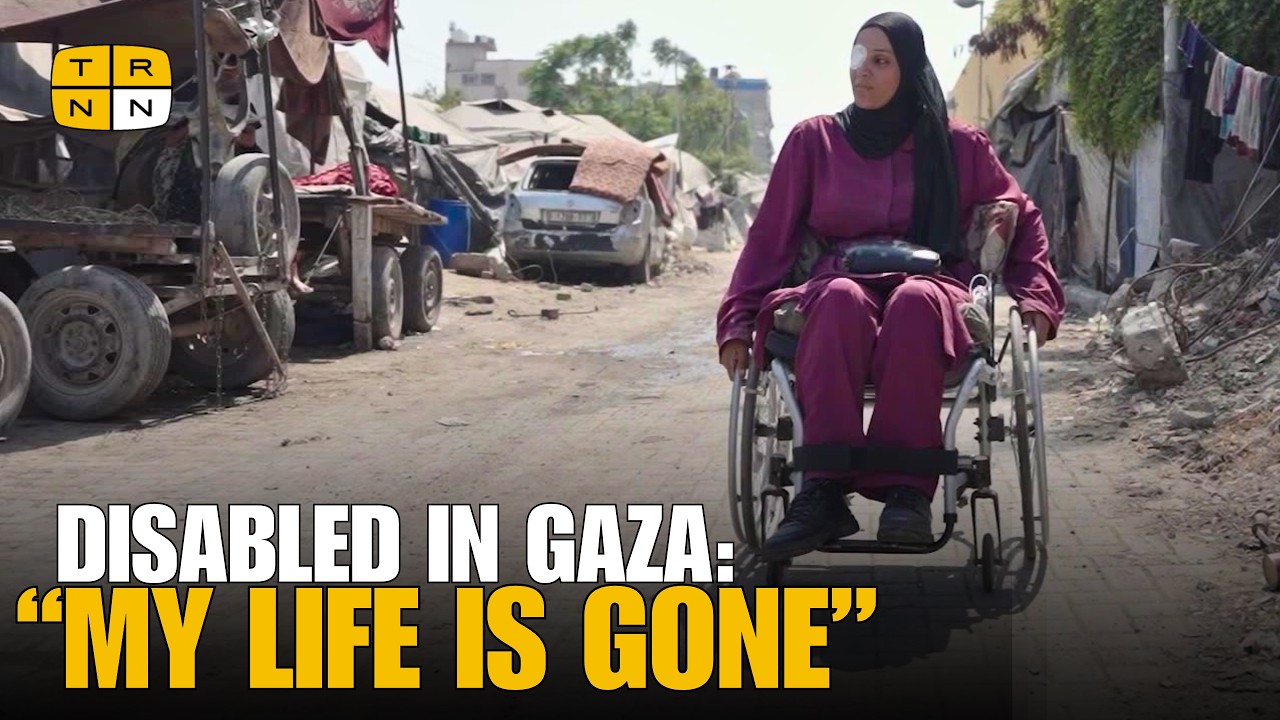
In Gaza, everyone is struggling to survive. For disabled people in Gaza, that struggle is multiplied. Rabab Nawfal and Suha Maqat, both wheelchair users, were champion athletes on Palestine’s national teams before Israel’s US-backed genocidal war. Two days before it began, they were playing qualifiers to represent Palestine abroad.

In this TRNN documentary report, they describe living through famine, fleeing bombardment in wheelchairs that no longer work, and asking for help that never comes. With 81% of Gaza’s roads damaged or destroyed and the UN documenting thousands of amputations, Israel is not only making life impossible for disabled Palestinians; it is creating a new generation of them.

Editor’s Note: This documentary report was filmed in Gaza City three weeks before the ceasefire in Gaza was shakily implemented beginning on October 10, 2025. Since the “ceasefire” began, Israeli forces have killed over 1,300 Palestinians, including 301 children, according to the Gaza Ministry of Health.

Credits:

  • Producers: Belal Awad, Leo Erhardt
  • Videographers: Ruwaida Amer, Mahmoud Al Mashharawi
  • Video Editor: Leo Erhardt
Transcript

Suha Maqat, Palestinian Athlete: 

I’m in a wheelchair—how am I going to escape? 

Rabab Nawfal, Palestinian Athlete: 

There were days when we ate animal food, bird food. 

Suha Maqat, Palestinian Athlete: 

I lost my eye. What more do you want? 

Rabab Nawfal, Palestinian Athlete: 

My dreams have been shattered. 

Narrator: 

In Gaza, everyone is struggling to survive. But for people with disabilities, that struggle is multiplied. Rabab Nawfal and Suha Maqat – both wheelchair users – were champion athletes before this war. 

Rabab Nawfal, Palestinian Athlete: 

I’m one of those people who didn’t go to the south. I lived through famine twice. I lived it twice. No one asked after me. There were days when we didn’t eat anything. There were days when we ate animal food, bird food. We ate everything—animals, birds. Even those things were expensive, and then they were cut off. The day they were cut off, we stopped eating anything. 

Ramadan came during the famine. We didn’t eat anything. A long day passed, and we didn’t eat anything. We used to crave drinking water. We used to crave a piece of bread. We were hoping that the famine would never come back. But unfortunately, it did—and it’s still coming back. 

We’ve suffered a lot in life. I was abandoned. No one took responsibility for me. My mother and father used to take care of me, but they left. These days, my brother takes care of me—and he is injured. My life is ruined. No one is with me. No one cares. And the one person standing by me is injured. He can barely carry his own family. 

When we were displaced, he couldn’t help us. He wasn’t able. For people with disabilities like me, it’s been difficult to live through this war. Those who are not disabled can maybe manage their lives. They can move, walk long distances—but I can’t. 

Suha Maqat, Palestinian Athlete: 

The closest people to me abandoned me—they didn’t stand by me. They left me to fend for myself. I feel like I live in a forest with wolves and monsters. I can’t. I try to make things work,

but I can’t. I’m mentally exhausted. The circumstances of this war are incredibly difficult. Even the word displacement is difficult for the injured and disabled. 

When we left, my brother was injured and my sister was in a bad state. Even though he was injured, he was pushing my sister, as I pushed myself along. I got stuck in the sand, and they wanted to bomb the building next to us. It was the most difficult moment. I said to myself, now I’m going to be killed. It was the hardest moment of my life. 

I thought—how will I escape? How will I, in my wheelchair, escape? How am I going to get out? My brother was injured and couldn’t carry me. I thought, I’m done; there’s no life for me anymore. That’s it. I’m going to be killed. 

Rabab Nawfal, Palestinian Athlete: 

The hardest thing I’ve experienced in this war has been displacement. I woke up one day and saw the Israelis in front of us. I was all by myself. I rushed out, but I couldn’t continue. There was a lot of shelling, shooting, bombs. It was a miracle I got out alive. It happened again and again—the same scenario repeated a thousand times. 

Narrator: 

Both Suha and Rabab rely entirely on their wheelchairs to move. Without them, the most basic tasks become impossible. Israel’s blockade has meant that access to this crucial item has been cut off. 

Even with functioning wheelchairs, with 81% of roads in Gaza now damaged or destroyed, access and movement is extremely limited. 

Rabab Nawfal, Palestinian Athlete: 

There are no wheelchairs in Gaza. And without a wheelchair, I can’t move. The wheelchair takes me to my medicine, my food, my drink—I need it for everything. Right now, my chair is broken. I’ve lost all means of life. 

Suha Maqat, Palestinian Athlete: 

As you can see, my chair is broken. I push myself in it, I fall off all the time, I cut and bruise my legs. If someone kind is around, then I can move. Otherwise, I can’t. 

We requested wheelchairs, but it was no use. We asked and asked, and they said no. Rabab Nawfal, Palestinian Athlete: 

My life before the war was very beautiful. I was a champion of Palestine’s disabled national team for strength games—basketball, tennis. I used to do all kinds of sports that suited my disability. I was a success story. I was a hero. These days, I feel worthless. Nothing in life. I can’t even get from here to there. I can’t move from here to there in a wheelchair. My life is 

gone. There is no life.

These days, we only dream of having the most basic things: flour, water. The simplest things—we can’t get. Drinking water—we can’t get it. 

Suha Maqat, Palestinian Athlete: 

Suha before is different from Suha today. I used to be a champion of Palestine. Today, I’m nothing. Today, just a daughter who needs her mother—who needs her mother to help her. 

Rabab Nawfal, Palestinian Athlete: 

Two days before the war, we were playing qualifiers to represent Palestine internationally. But we didn’t manage it. On the day of the championship, the war erupted. So our dreams are gone. All our dreams are gone. My dreams have been shattered. 

I wanted to raise my son. I wanted to raise him well and teach him. Before the war, I wanted to enroll him in karate. I wanted him to become something. I couldn’t. I wanted him to be into sports like me—to become a doctor. I wanted him to grow up and help me in the future. But my dreams were shattered. I couldn’t do any of it. I can’t do anything. 

Narrator: 

According to the UN 4,800 amputations of limbs had been documented since the beginning of the war. Ten children were losing one or both legs every day. Gaza had become home to the largest group of child amputees in modern history. Not only is Israel making the lives of existing disabled people impossible, it is also creating an entirely new generation of people with disabilities. 

Suha Maqat, Palestinian Athlete: 

Gaza has become a city of ghosts. There is no life in Gaza. As you can see—look at how people are living. On sand! How can people live on sand? How can they occupy Gaza? How? 

We want peace of mind. We don’t want to lose any more loved ones. We’ve lost enough. Is it not enough that I lost my eye? What’s left? What more do you want? I lost my eye—what more do you want? What else should I lose? Nothing’s left. There’s nothing left in this world that I can lose. My family has left. I wish I could see my mother. See my father. 

Rabab Nawfal, Palestinian Athlete: 

Life has become unbearable. No matter how much I talk, I can’t describe what I am feeling or the life we are living. I used to be someone. Now I am nothing.
💾

Champion athletes Rabab Nawfal and Suha Maqat, two of Gaza's disabled people now in broken wheelchairs, on famine, displacement, and being forgotten by the world.
  •  

Israeli Troops Destroy Former Syrian Military Sites on Mount Hermon

In December of 2024, immediately following the ouster of Syrian President Bashar al-Assad, Israel invaded southwest Syria, and occupied a substantial swathe of land including the UNDOF demilitarized zone and Mount Hermon. Throughout negotiations and persistent further Israeli incursions, Israeli officials have insisted they don’t intend to ever return control over Mount Hermon, despite the […]
  •  

Israeli Attacks Across Gaza Kill at Least Four Palestinians, Including 11-Year-Old Boy

Israeli attacks across Gaza on Monday killed at least four Palestinians, including an 11-year-old boy, as the IDF continues to frequently kill children as part of its constant violations of the October 2025 ceasefire deal. The boy, identified as Ismail al-Bardawil, died of his wounds sustained by Israeli tanks firing on tents in the al-Mawasi […]
  •  

Phosphorus Munitions Fired by Israel Burn Groves, Orchards in Southern Lebanon

Israeli forces were active overnight, with the number of airstrikes and artillery strikes against southern Lebanon substantially higher than it has been in recent weeks, raising concern that the war is once again facing imminent escalation. Not all the attacks were directly targeting municipalities, either. Israel fired phosphorus munitions at the Tyre District, targeting olive […]
  •  

Israel Completes Registration of Candidates for the Knesset

Anton Ivanov Israel’s election campaign has entered its decisive stage. By early September, the main political forces had completed their candidate lists for the October 27 elections, and the central question is whether the opposition can deprive Benjamin Netanyahu of a majority in the Knesset. According to the latest polls, the incumbent prime minister’s coalition […]
  •  

Changing the Rules of the Game: Britain and Israel at a Crossroads

Britain’s relationship with Israel is entering a new phase as the E1 settlement dispute collides with wider struggles over the Red Sea, Gaza’s energy resources, IMEC, intelligence technology and post-Brexit influence. As London pressures Israel while maintaining strategic cooperation, the question is whether Britain is changing the rules of the relationship-or preparing for a deeper […]
  •  

How Real Is the Impact of Western Sanctions on Israel?

Europe is getting tougher on Israel in rhetoric and sanctions, but its latest measures may be designed to create political distance from Israel without creating enough economic pain to make Israel change course in the West Bank or anywhere in Palestinian territories. The Arithmetic of Punishment On September 8, Britain, France, Canada and a group […]
  •  

Israeli Attacks in Gaza Kill at Least Seven Palestinians Over Three Days

Israeli attacks in Gaza have killed at least seven Palestinians and injured 38, according to numbers from Gaza’s Health Ministry, as the IDF continues its constant violations of the so-called ceasefire deal that was signed in October 2025. The Health Ministry said on Saturday that over the previous 48-hour period, the IDF had killed at […]
  •  

Israeli Attacks on Ambulances Kill One, Wound at Least Two in Southern Lebanon

Israel deliberately attacking healthcare workers has been a recurring theme throughout their ongoing invasion of Lebanon, and this weekend was no different, with multiple incidents of Israeli attacks on ambulances being reported. The fatal incident was in Kfar Roumine, where an airstrike targeted a moving ambulance, killing a paramedic aboard and wounding two others, who […]
  •  

NAZA FILM ON GENOCIDE: Filmmakers targeted by Israeli Ministers and IDF after Venice award. Zionists’ Riots before Parents’ Home (video)

Political Threats and Zionist Protests – VIDEOS

VERSIONE IN ITALIANO

Yuval Abraham and Rachel Szor find themselves at the center of a political clash involving the Israeli Prime Minister, two government ministers, and top intelligence officials. The catalyst is *Naza*, the documentary they presented at the 83rd Venice International Film Festival—a film that, in just a few days, transformed them from acclaimed filmmakers into targets of accusations of treason.

After declaring he would seek to revoke their Israeli citizenship, Israeli Culture Minister Miki Zohar made a fresh appeal to Shin Bet chief David Zini, urging him to investigate how various materials were obtained. The film features testimony from 24 anonymous Israeli intelligence soldiers denouncing the techniques used by the Israeli military to kill civilians in Gaza.

Israel has rejected the film’s content, reiterating that it makes every effort to avoid civilian casualties despite many previous UN reports on war crimes and genoicide.

DEVIL NETANYAHU’s HOLOCAUST. Explosive UN findings: “Israel DELIBERATELY TARGETED Gaza CHILDREN”

In a letter to Zini, Zohar asks the agency to investigate whether there was any illegal use of sensitive or classified information.

“When anonymous sources are used to spread serious, false accusations against the State of Israel and the IDF during wartime, it is imperative to establish who is behind these allegations,” Zohar stated. “I have asked the head of the Shin Bet to investigate the source of the material, who provided it, and whether hostile elements were involved,” the minister added.

Following the political controversy, various Zionist extremists gathered in a threatening manner outside the filmmaker’s parents’ home.

Reactions from Israeli officials following the Venice screening

Immediately after the documentary film was presented in Venice, Culture Minister Miki Zohar called the film “vile” and announced plans to “act immediately” to revoke the Israeli citizenship of Abraham and Szor.

He accused them of “treason against the State” and of a “self-loathing” that drives them to harm their own homeland in order to garner applause from “antisemites around the world.” Zohar stated that he had contacted senior officials at the Ministry of the Interior and the Population Authority to evaluate revoking their citizenship on the grounds of a breach of loyalty to the country.

Joining the chorus of accusations were Army Chief of Staff Eyal Zamir—who claimed the film relied on “blood libels and deliberate distortions of reality”—and National Security Minister Itamar Ben-Gvir, who called on the pair to leave the country.

Finally, Prime Minister Benjamin Netanyahu linked the case to broader “antisemitic incitement” and lashed out at opposition political forces.

ZIONISTS’ Neverending WAR CRIMES, as GENOCIDES. Iran: “US, Israel GUILTY of gravest MASSACRES since 1949”. Children’s Murdering in Lebanon, Qeshm, Minab

The Israeli military largely rejected the documentary’s content, maintaining that it could not verify the identities or military roles of the anonymous sources and reiterating that it does everything possible to avoid civilian casualties.

IDF chief floats legal action against ‘NAZA’ film, orders probe of leaked material

IDF Chief of Staff Lt. Gen. Eyal Zamir on Monday instructed the military’s top legal official to examine legal action against the film “NAZA” and those involved in it, saying it defamed the military, and separately ordered an investigation into the leaking of classified material used in its production.

His comments came shortly after IDF Spokesperson Brig. Gen. Effie Defrin issued a statement inviting the documentary’s filmmakers to allow military officials to view the film in full so that the IDF could respond in a “substantive manner.” So far, the military has only reacted to clips of the movie posted online, and has not yet seen the full documentary.

GAZA GENOCIDE: even a MILITARY TEST for GLOBAL SURVEILLANCE as during Pandemic. UN Report on Big Tech, Zionist Weapons Lobby (Elbit, Lockheed) Plots with Netanyahu-Trump

The 80-minute film by Yuval Abraham and Rachel Szor — whose title is a Hebrew acronym meaning collateral damage — claims to explore AI-powered strikes by Israel in the Gaza Strip it alleges have led to civilian deaths, including testimonies from 24 purported Israeli intelligence soldiers.

The risks of returning to Israel

In the days following the award, Yuval Abraham recounted deleting his social media profiles after being inundated with offensive photomontages targeting both him and his mother; he openly admitted his fear: “Israel is my home… but now, obviously, I am afraid I won’t be able to return.” Abraham had also rejected the idea of ​​positioning himself as a voice of moral superiority, explaining that, as Israelis, they all feel—to some extent—co-responsible for what occurred in Gaza.

The process of stripping Abraham and Szor of their Israeli citizenship—which they hold by birth—is neither swift nor within the sole authority of the Minister of Culture, who lacks the legal power to order it.

Under Israeli law, citizenship can only be revoked in limited cases involving a proven “breach of loyalty” to the State—as established by a 2022 Supreme Court ruling. The procedure requires the Minister of the Interior to submit a request to the Minister of Justice, followed by final approval from a panel of judges. It is, therefore, a lengthy and uncertain process—one that has never before been applied to a case involving journalism or filmmaking.

A more immediate prospect, at least from an investigative standpoint, is Zohar’s request for the Shin Bet to investigate the origins of the material used in the film.

HORRIFIC! Children Killed in Gaza as ISIS-Style by IDF (100 only During Truce). Shot in the head and chest. Investigation by BBC Africa. The best VIDEO of the week

Such an inquiry could lead to investigations into potential offenses related to the disclosure of classified information, carrying criminal consequences not only for the filmmakers but also for the military sources who collaborated anonymously.

Compounding this is the immediate concern for the two creators’ personal safety—a fear fueled by past incidents, such as the assault on Hamdan Ballal following the Oscar win for *No Other Land*.


RELATED POSTS

FREEMASONRY & ZIONISM – 4. How SYNAGOGUE OF SATAN was LICENSED to KILL! It arose from Conspiracy behind the Heretical Catholic text “Nostra Aetate”

“ISRAEL added in the UN’s BLACKLIST of Perpetrators of SEXUAL VIOLENCE in WAR”. Ambassador said (VIDEO). France urges to investigate on Flotilla abuse by Israel

“GENOCIDE IN GAZA WITH ISRAELI RAPES EVEN TO CHILDREN”. Chilling UN Dossier on Netanyahu’s Army supported by Zionist Trump

ZIONIST TERRORISM. 50 % of Palestinian Children Detained without Charges. IDF Soldiers cleared of Raping a male Prisoner

NETANYAHU’s SATANIC MILITARY RAPISTS & PORN BUSINESS. Chilling Dossier: Dozens Prisoners Sexually Tortured even with Dogs and Filmed


  •  

EU Commission head stops short of calling for ban on trade with Israeli communities in Judea and Samaria

European Commission President Ursula von der Leyen, while condemning the Israeli government’s plans to advance settlement construction in the E1 area of the West Bank (Judea and Samaria), stopped short of proposing a ban on trade with the Israeli communities in the area, in contrast with an initiative pushed by some EU member states and EU’s foreign policy Kaja Kallas, writes European Jewish Press, Yossi Lempkowicz.  

She spoke on Wednesday (16 September) during her annual State of Union address to the European Parliament in Strasbourg.

Von der Leyen received a round of applause for condemning the Israeli government’s plans to advance construction in the E1 area, a strategi area between Jerusalem and Maale Adumim. ”The Israeli government’s decision to advance the illegal E1 settlement projects is unacceptable,” she said, after deploring the ”deep suffering in Gaza and unchecked settler violence in the West Bank” which, she said, ”have deeply affected Europeans.”

”It is painful for many Europeans that member states have been unable to build the necessary majorities for a unified response,” she added, noting that ”some member states have been unable to build the necessary majorities for a unified response. Some member states have moved ahezd. Others are considering doing so.”

A group of over 100 MEPs, mainly from S&D, The Left, the Greens and Renew groups, had written a letter to the President of the European Commission to make an “urgent appeal for a Commission legislative proposal to ban EU trade with illegal Israeli settlements”.

Until now, EU member states are divided about the proposal to ban trade from Judea and Samaria.. Countries like Slovenia and Czechia, but also Germany and Italy, have blocked such sanctions.

Von der Leyen highlighted the Commission’s efforts to mobilise funding for the Palestinian Authority and for the reconstruction of Gaza.

‘’We have delivered more aid than anyone else. Through the Palestine Donor Group and the Team Gaza Initiative, we have brought together 65 delegations. Together we have sanctioned nearly 1 billion Euro to rebuild Gaza and support a modern Palestinian Authority,’’ she noted.

She concluded her statement on the Israeli-Palestinian conflict by stressing that ‘’ Europe supports the right to self-defense for Israel.’’

”The Palestinian people have an equal right to live in safety and in dignity. It is Europe’s role to keep the blame of the two-state solution alive,’’ the EU Commission President added.

Yossi Lempkowicz is Editor-in-chief of European Jewish Press (EJP).

  •  

The collapse of global order and the rise of regional polarization

On 18 August, Israel launched eight airstrikes against the Abu al-Duhur air base in northwestern Syria, located approximately 70 kilometres from the Turkish border. Israel also reportedly informed the United States that Turkey might be preparing to deploy radar systems and air defense equipment at the base, a move that could significantly alter the regional balance of power. Turkey is expected to respond to the Israeli strikes, raising the prospect of direct military confrontation between the two countries inside Syria,

As it stands, Turkey's growing tensions with Israel over issues including Gaza, Iran, and Lebanon are increasingly difficult to ignore. Turkey also possesses substantial military capabilities, which were originally intended in large part to strengthen NATO's ability to counter Russia but are now increasingly being used to pursue Ankara's own strategic interests, including those that are not aligned with the geopolitical preferences of the U.S. and Israel. Turkey is therefore demonstrating a degree of strategic autonomy that increasingly extends beyond the traditional constraints of the NATO framework. This development is a clear example of the broader process of regional polarization.

Regional polarization, in fact, creates the conditions for the emergence of regional hegemony. It reflects a tendency for countries within a particular region to gravitate toward a dominant power. That power, in turn, simultaneously expands its influence and seeks to establish a new regional order. Regional hegemony does not emerge out of nowhere. Instead, it develops gradually through a process of regional polarization.

Turkey is a prominent example of this process. Israel can also be viewed through the same lens, as can Saudi Arabia, which has been working steadily to strengthen its position and influence in the region. Beyond the Middle East, India and Japan are also moving in this direction. Iran, meanwhile, remains an important regional power despite currently being consumed by war.

Against this broader trend of regional polarization, China presents a particularly unique case. China's current strategic direction appears to differ substantially from the logic of regional polarization. Instead, Beijing continues to place considerable emphasis on building relationships among major powers at the global level. In this context, the idea of a G2 remains an attractive strategic concept for China, while U.S. President Donald Trump also appears to be seeking to leverage this possibility in developing a special relationship with China.

In Asia, India is already an unmistakable example of a country pursuing greater regional strategic autonomy. Japan is another crucial case. The election of Sanae Takaichi can be interpreted as an indication that Japan's own process of regional polarization is beginning to take shape. However, because of its security treaty with the U.S. and continuing domestic political opposition, Japan remains reluctant to openly acknowledge such a trajectory.

Nevertheless, Japan is likely to move progressively toward greater regional strategic autonomy. This would mean that Tokyo increasingly seeks to exercise influence in Asia regardless of whether Washington fully supports such a development. As a result, contradictions between Japan and the U.S. could become more pronounced across economic, financial, and political spheres. Japan's ability to say "no" to the U.S. may gradually become a practical reality.

Once Japan gains greater freedom to articulate and pursue an independent strategic position, it may also seek to improve relations with China. In this sense, Japan's increasing regional autonomy could ultimately prove beneficial to Japan-China bilateral relations over the longer term.

Perhaps the most important feature of regional polarization is that conflict among countries is inevitable. Such conflicts are not necessarily an anomaly. Rather, they are a natural expression of the polarization process. No country is willing to readily acknowledge another as the principal power or dominant pole within a region. Regional leadership therefore has to be established through competition, strategic maneuvering, and, at times, confrontation.

This dynamic applies to Japan, China, India, Turkey, and other emerging regional powers. As a result, international disputes are likely to become increasingly intense. The underlying reason is the growing competition for regional influence amid the erosion of the existing global order.

First, countries increasingly perceive an opportunity to become the dominant pole within their respective regions. Second, no major regional power is willing to accept another country's unquestioned leadership or submit to its influence. Confrontation, friction, and strategic rivalry therefore become increasingly difficult to avoid.

Ultimately, the countries that possess sufficient resources, strategic capabilities, and the ability to respond effectively to changing circumstances will have the greatest chance of emerging as regional hegemons. The struggle for regional dominance is therefore not merely a contest of military strength. This is also a test of economic resources, political resilience, strategic judgment, and the ability to shape a new regional order.

  •  

Hostage to His Own Premiership: How Netanyahu Traded Israel for Himself

He promised security—he brought isolation. He spoke in the name of the state—he put its very future in question. And now even those who were called allies only yesterday are saying, more and more loudly: this can’t go on. Benjamin Netanyahu is the longest-serving prime minister in Israel’s history. Eighteen years in power, three comebacks, […]
  •  

« Axe arabo-hébreu-occidental »

PNG - 7.3 kio

Dans les médias officiels iraniens tout comme dans la rhétorique gouvernementale, cette expression désigne l'ennemi du moment, à savoir la coalition formée par de nombreux pays occidentaux, dont les États-Unis, Israël et plusieurs régimes arabes, notamment les signataires des accords Abraham (Émirats arabes unis, Bahreïn, Maroc et Soudan), qui normalisent leurs relations avec Tel-Aviv. Cette expression avait déjà cours durant la guerre contre l'Irak (1980-1988), Bagdad étant alors soutenu par Washington et les monarchies du Golfe.

Voir en ligne : /mav/209/A/69927
  •  

Padafand

PNG - 9.2 kio

Terme qui signifie « défense » ou, par extension, « contre-attaque ». D'étymologie indo-européenne, ce mot fut très employé durant la guerre contre l'Irak (1980-1988) afin de décrire les mouvements du front, y compris lorsque les troupes iraniennes devaient céder quelques centaines de mètres — rarement plus — à leurs adversaires. Depuis l'attaque israélo-américaine, son usage est redevenu fréquent dans le discours officiel.

Voir en ligne : /mav/209/A/69954
  •  

Une folle guerre, asymétrique et intermittente

Avec l'agression militaire du 13 juin 2025, relancée le 28 février 2026 par Israël et les États-Unis, éclot une guerre restée larvée depuis 1979. La tournure insolite que prend le conflit au fil des mois nécessiterait d'ouvrir un nouveau chapitre dans les ouvrages de polémologie. Amateurisme viriliste d'un côté, art de la dissimulation et de la survie de l'autre, les évidences ne dispensent pas d'identifier les impasses.

JPEG - 208.3 kio
Hossein Norouzian ////
Trois livres sont représentés sur l'affiche : en arrière-plan se trouvent le Coran avec la couverture bleue et la Constitution, tandis qu'au premier plan le « Livre de la liberté » est entre les mains d'une personne portant une épingle à nourrice, symbole de la pauvreté du peuple. En bas sont reproduits des slogans révolutionnaires tagués à la craie ou à la bombe sur les murs de Téhéran. De haut en bas : « Mort à Bakhtyâr, laquais inféodé », « Vive les moudjahidins de l'armée de l'air », « Technicien de l'aviation, tu es la lumière de nos yeux », « Mort au sionisme » figurant près d'une étoile de David, « Fruit de l'impérialisme » attaché au drapeau des États-Unis et enfin « Mort au chah » pour lequel le mot « roi » est écrit à l'envers afin de montrer qu'il est déchu, 1978. © Hossein Norouzian

De « triomphe » en « triomphe », l'Amérique s'enlise une nouvelle fois au Proche-Orient. Toute escarmouche dans la région prenant une dimension géopolitique majeure — compte tenu des réserves d'hydrocarbures qu'elle recèle —, les combats intermittents et le blocage du détroit d'Ormuz entraînent une tempête dans l'économie mondiale. Et la circonspection dans le restant du monde.

La supériorité militaire apporte rarement de bons conseils. L'ivresse de la force, doublée d'une vanité hors du commun, a conduit le président Donald Trump à s'affranchir de toute expertise non martiale, à ignorer les leçons de l'histoire contemporaine qu'il prétendait naguère enseigner et à oublier la géographie. Le 24 août 2026, quatorze mois après avoir lancé ses premiers bombardiers pour détruire les installations nucléaires iraniennes, il avouait à sa manière la déroute : retour à la politique de sanctions économiques pratiquées depuis la révolution islamique de 1979… Le secrétaire au Trésor Scott Bessent menaçait même de sanctions secondaires les partenaires commerciaux de Téhéran.

M. Trump doit se fâcher contre son complice israélien, qui continue de bombarder le Liban à sa guise et fait détruire les habitations au sud du fleuve Litani

Déjà, la « guerre des douze jours » — du 13 au 24 juin 2025 — laissait beaucoup de questions sans réponse. Le programme d'enrichissement d'uranium était-il vraiment proche de déboucher sur une capacité à produire une bombe nucléaire, comme le serine M. Benyamin Netanyahou depuis… déjà trois décennies ? Les destructions y mettaient-elles vraiment fin ? La structure du pouvoir était-elle ébranlée au point de rendre possible un renversement ? Des échanges de bombes, de missiles et de drones remplaçaient-ils des combats et des conquêtes au sol ?

L'épisode a probablement conforté le premier ministre israélien dans sa conviction qu'il pouvait mener le président des États-Unis par le bout du nez (lire « Quand Israël entraîne les États-Unis »). L'explication fournie par le secrétaire d'État (ministre des affaires étrangères) pour justifier les bombardements « préventifs » lancés à partir du 28 février attestait le malaise : « Nous savions qu'une action israélienne allait avoir lieu, nous savions qu'elle déclencherait une attaque contre les forces américaines et nous savions que, si nous ne frappions pas de manière préventive avant le lancement de ces attaques, nous subirions davantage de pertes », avouait sans fard M. Marco Rubio le 2 mars (1).

L'Iran peut compliquer le trafic maritime

Téhéran n'avait les moyens d'intercepter ni les avions ni les missiles, ni même semble-t-il de déjouer les attaques ciblées contre les plus hauts responsables civils et militaires, et principalement le Guide suprême Ali Khamenei, tué par des bombes israéliennes dès le 28 février. Toutefois, comme le sait tout étudiant de première année en science politique, l'Iran peut sérieusement compliquer le trafic maritime dans le détroit d'Ormuz… Tirant les leçons de la guerre des villes contre l'Irak dans les années 1980, Téhéran a développé un programme balistique robuste, disséminé et non négociable, dont il a tiré le meilleur parti.

L'inversion du rapport du fort au faible fut telle qu'aucune monarchie du Golfe n'osa utiliser aux côtés de l'allié américain son arsenal offensif, pourtant pléthorique et acquis chèrement auprès des Occidentaux. Quant aux moyens défensifs, et notamment les missiles américains Patriot, ils s'avèrent extrêmement coûteux et longs à fabriquer quand le voisin produit des drones légers par milliers. L'Iran a concentré ses attaques sur Israël et les bases américaines de la région. Mais ses militaires ont aussi fait comprendre que tout dérapage important visant les installations vitales (centrale électrique, raffinerie, usine de désalinisation, centrale nucléaire civile) ferait l'objet de rétorsions immédiates sur l'autre rive du Golfe, démontrant l'extrême fragilité de cette vie artificielle de gratte-ciel et de centre commerciaux construits au milieu du désert.

Le 8 avril, les deux camps acceptent un cessez-le-feu. M. Trump doit se fâcher contre son complice israélien, qui continue de bombarder le Liban à sa guise et fait détruire les habitations au sud du fleuve Litani, complétant la liste de crimes de guerre qui lui sont imputables. Les États-Unis, eux, n'ont atteint aucun des objectifs égrénés au fil des mois : Téhéran menace tout navire qui ne suit pas ses consignes ; la défense de la nation en danger consolide le pouvoir en place ; l'uranium enrichi à 60 % reste en Iran ; ses capacités balistiques paraissent peu touchées ; la prolifération nucléaire semble encouragée, et le pétrole est redevenu une arme de dissuasion. Enfin, à l'échelle régionale, houthistes, Hamas et Hezbollah demeurent aux commandes dans les zones qu'ils contrôlent. Commence alors une phase — inachevée — de « ni paix ni guerre » faite d'attaques sporadiques et de répliques immédiates entre deux annonces de progrès dans les négociations (lire ci-contre).

Celles-ci aboutissent le 17 juin au protocole d'accord d'Islamabad en quatorze points, signé électroniquement comme un vulgaire document immobilier par M. Trump depuis Versailles et par le président iranien Massoud Pezechkian depuis Téhéran. Très vite, même les élus républicains dénoncent une situation moins favorable qu'avant la guerre. La presse israélienne va jusqu'à évoquer une « capitulation » américaine. Le bilan humain provisoire serait de 3 400 morts en Iran à cette date (2) — sans compter les milliers de blessés —, de plus de 4 383 morts entre 2023 et juillet 2026 au Liban (3), de quelques dizaines chez leurs voisins arabes.

Israël reconnaît une soixantaine de morts après les attaques iraniennes ou du Hezbollah (4), mais censure toute information sur les dégâts matériels. L'« État juif », tel qu'il se proclame, s'est montré toujours plus fort, capable d'intervenir dans sept pays (5), mais aussi plus seul et illégitime que jamais. Les États-Unis déplorent la perte de seulement dix-huit soldats, mais le crédit de la première puissance militaire mondiale s'est fortement dégradé. Les bases américaines semblent poser plus de problèmes de sécurité qu'apporter des solutions aux pays qui les accueillent. Le marché de l'énergie reste sous tension permanente, avec des hauts et des bas rythmés par les fanfaronnades du président américain, pour le plus grand profit des spéculateurs.

Un tel fiasco stratégique, diplomatique et économique conduit certains à évoquer une victoire des dirigeants iraniens. Ce serait oublier l'affaissement du pays et les ressorts intérieurs de leur maintien au pouvoir, pas si loin de ceux du président des États-Unis dans sa politique extérieure : rodomontades, verrouillage idéologique et logique de force pure. Les conservateurs de tout poil ont plus vocation à se faire la guerre qu'à s'unir.

Le sursaut national provoqué par l'agression n'efface pas la répression des dernières années. Le système de pouvoir a, certes, prouvé sa robustesse. Et permis l'émergence d'habiles négociateurs, capables d'ouverture politique, comme le président du Parlement Mohammad Bagher Ghalibaf ou le président de la République Pezechkian (voir le schéma page 37). Mais l'assassinat de Khamenei semble avoir renforcé autour de son fils — et successeur invisible — Mojtaba le poids des plus intransigeants envers leur peuple. Soit qu'ils appartiennent à une gérontocratie qui rappelle les derniers temps de l'ex-URSS — le président de l'Assemblée des experts a 95 ans, celui du Conseil des gardiens de la Constitution a 99 ans —, soit qu'ils doivent leur ascension à une fidélité sans faille à l'appareil d'État de la République islamique, comme le nouveau secrétaire du Conseil supérieur de la sécurité nationale, M. Mohsen Rezaï, qui commanda le Corps des gardiens de la révolution de 1981 à 1997 avant d'occuper plusieurs postes de haut rang.

Le Proche-Orient est paralysé. Ses habitants guettent le moindre accrochage comme chaque promesse des médiateurs. La Chine et la Russie savonnent la planche de M. Trump et ne goûtent guère les menaces de sanctions économiques secondaires. L'Europe se tait, quand elle ne se soumet pas au « grand frère ». Les citoyens du monde hésitent entre humour noir, colère et désespoir.

L'épisode a conforté le premier ministre israélien dans sa conviction qu'il pouvait mener le président des États-Unis par le bout du nez
Voir en ligne : /mav/209/DESCAMPS/69942

(1) « Secretary of State Marco Rubio remarks to press », département d'État américain, 2 mars 2026.

(2) « Islamic Republic of Iran : Humanitarian Update No. 06 », Bureau des Nations unies pour la coordination des affaires humanitaires (OCHA), 30 juin 2026.

(3) Sources : Ministère de la santé publique (Liban), et Organisation mondiale de la santé (OMS), « Health Brief », (PDF), 26 juillet.

(4) Christine Jeavans et Matt Murphy, « Thousands killed in US-Israeli war on Iran — but experts say true total may never be known », BBC, 19 juin 2026.

(5) Irak, Iran, Liban, Qatar, Syrie, Tunisie et Yémen, sans oublier la campagne génocidaire à Gaza et des opérations militaires en Cisjordanie.

  •  

‘Achilles Shield’ marks new step in Greece-Israel military cooperation

At the end of August, the Greek government signed the “Achilles Shield” agreement – a €3 billion “defense” deal with Israel. Under the terms, Israeli companies including Rafael Advanced Defense Systems and Israel Aerospace Industries (IAI) will develop and build anti-aircraft and anti-ballistic systems for Greece.

“This is the largest defense export deal in the history of Israel-Greece relations, and one of the largest in the history of the State of Israel,” the occupation’s Ministry of Defense stated. “Greece’s choice of Israeli technology as the backbone of its most ambitious air defense buildup program in the past decade reflects the depth of trust built between the two countries.”

“Under the deal, Israel will build Greece a comprehensive, multi-layered air defense array, drawing entirely on Israeli-made systems and on the extensive operational experience Israel’s defense establishment has gained during the war.”

The “war” in the statement being the genocide Israeli forces have been conducting in Gaza since October 7, 2023.

An influx of Israeli investments in Greece

According to journalist Vangelis Ilias, the new deal should be contextualized within broader trends of Greek capital and subsequent governments deepening ties with the occupation power.  While the current Mitsotakis administration did not initiate this trend, he says, it deepened it both before and since the genocide in Gaza began. “Over the past 6-7 years, we have witnessed an influx of Israeli investment funds into Greece, both in the real estate sector and through the acquisition of former public – but not exclusively public – companies in various sectors of the economy, one of which is defense.”

Israeli real estate investments in Greece have already had a notable impact on people’s everyday lives, driving up rents and making housing more unaccessible. Endeavors in the defense sector might have been more lowkey, Ilias adds, but they are widespread and expanding under the sight of NATO and European institutions. “In the south of the country, in Kalamata, there is a large Greek Air Force base that also falls under the NATO umbrella as an International Pilot Training Center,” he says, emphasizing the presence of Elbit Systems in the area.

Israeli companies have also purchased local military enterprises, including Intracom Defense, operating in electronic warfare and drone production. “Through this acquisition, the Israeli state-owned company IAI gained access to the European Defense Fund (EDF), an EU mechanism intended exclusively for financing European defense procurement programs – something that was made possible only thanks to the active support of the Greek government,” Ilias adds.

“[Achilles Shield] has been promoted by the domestic media and the elite as an agreement that shields Greece,” he adds. “[Under the claim] that the money being spent, while not going to healthcare and education, or toward supporting the incomes of citizens who are still trying to recover from the years of economic crisis, protects us from those who seek to harm the country, with Turkey always implied in this context,” he explains. 

“In this era of crises, military buildup, and preparations for a full-scale war, they are trying to present this not only as something reasonable but also as something necessary, where strategic agreements between states take precedence over the needs of the people and international law, overlooking genocides or the ethnic cleansing of an entire people.”

The deal’s Achilles’ heel: reliance on Israeli arms

While Greek officials described the deal as a breakthrough for Greek sovereignty, critics have warned of dangers on several fronts. To begin with, in the announced distribution of funds, local industry expects only €750 million of the total €3 billion. The rest goes to Israeli arms companies making the genocide in Gaza technically feasible.

And despite the amount of money being spent, parts of the agreement have been presented inconsistently to the public. “We’re talking about a complex system of sophisticated weapons utilizing artificial intelligence, with a central control unit that operates based on computer code, Ilias emphasizes. “There has been extensive debate over whether this code will belong to Israel or be controlled by Greece. So far, the government’s responses to a barrage of questions from the opposition have been neither reassuring nor consistent. This remains to be clarified.”

The expenditure has been heavily criticized by left movements, including the Communist Party of Greece (KKE), in the context of EU armament taking place at the expense of labor rights and social services. “Costing more than €3 billion, this agreement forms part of the broader ‘2030 Agenda’ arms program serving NATO’s needs, for which our people are paying dearly – tens of billions of euros – at the expense of their rights and needs,” the KKE pointed out.

Like most other EU governments, the Mitsotakis administration has announced harmful labor and social reforms just as it committed billions for Israeli arms producers. This new-old austerity agenda has met widespread resistance. Recently, tens of thousands demonstrated in Thessaloniki demanding dignified wages and pensions, efficient public healthcare, and investments in education. “Not one euro for imperialist wars,” they insisted.

The “Achilles Shield” deal also adds to the case made by academics and activists worldwide that Israel is using the Gaza genocide to market its weapons. This is apparent not only from the purchase list, but from official statements as well. The Israeli Ministry of Defense announced similar deals are part of a broader strategy “to expand defense exports as a central tool for strengthening the IDF’s force buildup, influencing Israel’s foreign policy standing worldwide, and bolstering the Israeli defense industry and economy.”

Critics have argued that Greece’s arms deal risks making the country captive to Israel’s defense industry and alienating it from other countries in the region. “In practice, strategic relations with the murderous state of Israel, together with joint military preparations, are adding fuel to the fire of imperialist rivalries in the region, as well as the conflicts between the bourgeois classes of Turkey and Israel, and of Greece and Turkey, in the Aegean and the Eastern Mediterranean, with the peoples being the victims,” the KKE emphasized.

Read more: Amid mass protests in the West, Israel’s military footprint expands in Eastern Europe

“Greece’s ruling class has made a strategic choice to align itself closely with the Western alliance,” Ilias says, referencing events since the Greek Civil War. “It is particularly worth noting that, as a result, the Greek people have borne the brunt of the bloodshed.”

And while the post-Civil War regime attempted to crush “the popular and anti-imperialist movement that existed in the country,” he concludes, they did not succeed. 

“This is partially why we still see today such a stark contrast between the ruling class and the organized, collective reactions of significant segments of the Greek people throughout the country against the genocide perpetrated by the Israeli state against the Palestinian people. These reactions are multifaceted, with segments of the working class – beyond just the youth – actively participating.

  •  

Wie Deutschland zum größten Unterstützer von Staatsterrorismus und Völkermord wurde

Die Bundesregierung verkündet sehr stolz immer wieder zwei Dinge: Erstens, dass die Sicherheit Israels deutsche Staatsräson sei, womit die Bundesregierung auch begründet, dass sie Israel Waffen verkauft und viele Waffensysteme sogar schenkt, und zweitens, dass Deutschland der größte Unterstützer der Ukraine ist. In beiden Fällen liefert Deutschland Waffen an Krieg führende Länder, wobei das noch […]
  •  
❌