❌

Reading view

Ansar Allah Says Saudi Arabia Launched 35 Airstrikes in Yemen Over 24 Hours

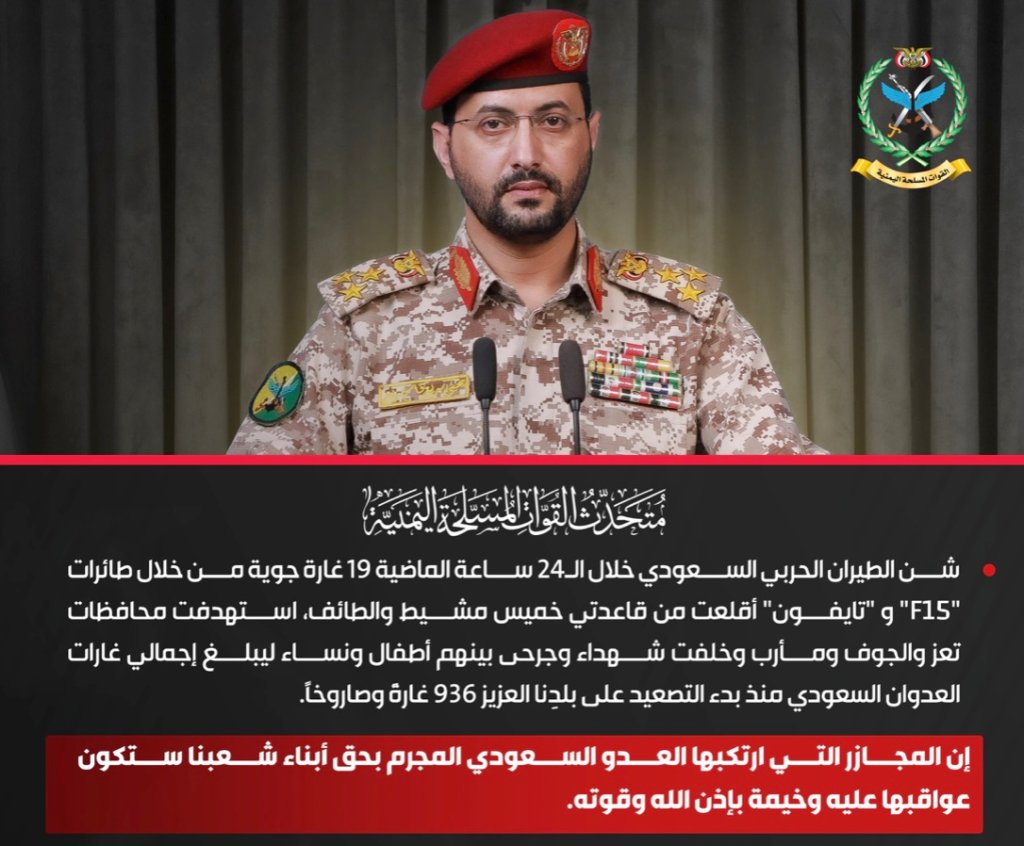
Ansar Allah military spokesman Yahya Saree said on Tuesday that Yemeni forces recorded 35 Saudi airstrikes over the previous 24-hour period, which comes as ground fighting between Ansar Allah and Saudi-backed forces continues mainly in the southwestern Taiz province. “Over the past 24 hours, Saudi warplanes launched 35 airstrikes using F-15 and Typhoon aircraft, taking […]
  •  

Saudi Airstrike on Civilian Home in Yemen Kills Four: Yemeni Health Ministry

A Saudi airstrike hit a home in Yemen’s Taiz province on Monday, killing at least four civilians, according to the Yemeni Health Ministry within the Ansar Allah-led government. The Health Ministry said that three women and an elderly man were killed in the attack and that three other civilians were wounded. Yemeni media also reported […]
  •  

Report: Ansar Allah Tells EU It Won’t Target European Ships

Yemen’s Ansar Allah, also known as the Houthis, has told the EU that it doesn’t intend to target European shipping, The Financial Times has reported, as the group has maintained that its Red Sea blockade applies only to Saudi shipping. Ansar Allah began its blockade on Saudi shipping after Saudi Arabia launched airstrikes against the […]
  •  

Saudi Airstrikes on Yemen Market Kill at Least Seven: Yemeni Health Ministry

Saudi airstrikes hit a market in Yemen’s Taiz province on Sunday, killing at least seven people and wounding 40, including five children, according to Ansar Allah officials and Yemeni media reports. Footage from Yemen’s Al Masirah TV shows the aftermath of the strike, which hit several shops, and Yemeni civilians being treated for their wounds. […]

💾

  •  

Burnham’s UN debut… A masterclass in British disinformation

By Finian Cunningham | Strategic Culture Foundation | September 26, 2026

So, “Britain is back” and ready to provide glorious leadership to the rest of the world, to “solve shared problems we face.”

British Prime Minister Andy Burnham made his debut at the United Nations this week, addressing the 81st session of the General Assembly in New York.

“You can count on us,” assured Burnham. “Count on us to stand up for those long-standing British values of fairness and justice – our shared values – and for the UN Charter.”

Please, don’t make me vomit. Burnham was oozing noble values on the podium of the UN while Saudi warplanes were massacring Yemeni civilians in their homes – warplanes that are directed and refuelled by Britain (and the United States).

This week, Yemeni media reported that over 100 people, including women and children, were killed as Saudi F-15 and Typhoon fighter jets intensified air strikes on residential areas in the Red Sea cities of Mocha and Taiz. Al Masirah TV showed bloody images of two children killed by a Saudi airstrike in Mocha

On his way to the UN, Burnham announced that he had ordered the deployment of RAF refuelling planes to enable the Saudi air assault on Yemen. Of course, the British media described the move as “defensive aid”.

Earlier this month, Downing Street also approved the dispatch of British military advisors to Saudi Arabia. American advisors are also stationed there to assist in the war of aggression against its southern neighbor.

Yemen’s armed forces and the Ansar Allah militia are hitting back hard. They have overrun Saudi forces in key Red Sea positions and have shut down the Saudi oil industry and pipelines with drone and missile attacks.

But make no mistake, this is a Saudi war of genocidal aggression fully supported by the United States and Britain. The war has been going on since 2015, together with a blockade on Yemen that has resulted in an estimated 400,000 Yemeni deaths. A lull in fighting from 2022 was broken when the Saudis launched air strikes on the Yemeni capital’s airport in July. The Yemenis have hit back with a vengeance, targeting Saudi oil installations.

The Saudi monarchy has begged Trump to give more military assistance. But Trump is bogged down and out of his depth with his losing seven-month war with Iran.

This is where Burnham has entered the fray, responding to Saudi pleas for help by signing off on military deployment. This could prove to be a disastrous strategic blunder. No doubt Burnham is trying to ingratiate himself with Washington. His decision to send the RAF into battle this week came ahead of his first meeting with Trump on the sidelines of the UN. The American president gave him a symbolic pat on the head, saying, “he’s going to be a great prime minister.”

Trump had often ridiculed Burnham’s predecessor, Keir Starmer, for supposedly not offering more military support to the U.S. war aims in the Middle East. Burnham is showing himself to be more amenable, that is, pliable.

The British Butler is slaughtering his way into favor with Washington. Women and children are sacrificed in Yemen all to satisfy the sick “special relationship” between the U.S. and Britain.

Burnham is a fraud with this working-class Manchester accent and glib talk about the “need to do more to help people with the everyday cost of living.”

If you can bear to listen to his speech at the UN, it is a masterclass in British disinformation. It takes a special kind of person to deliver such arrant nonsense with a pose of sincerity.

The thrust of his whole address was to blame Russia for everything. From poverty and inequality in British society, to seething discontent among Britons towards their ruling class, to the war in Ukraine. It truly was a consummate performance in misdirection, the kind of charade that British politicians excel at.

He announced that Britain was launching a new National Centre for Information Defence, purportedly to combat Russian disinformation, which he claimed was “a poisonous tide” sowing division and instability among Britons.

According to Burnham, all that is broken and dysfunctional in British society is due to Russian infiltration. Nothing was said about bankrupt British capitalism and the warmongering of the British state fuelling a proxy war in Ukraine or aggression in the Middle East at the expense of social conditions in Britain.

Burnham’s “solution” to Britain’s endemic problems is to increase “national security” and state control over public information – all under the guise of “defending” Britons from being manipulated by Russian propaganda.

The Orwellian condition that Britain is sliding into is awesome.

This British prime minister dares to speak about British values and leadership and condemn Russia while he is approving the supply of long-range air strikes against Russia with British cruise missiles and drones.

The proof of Burnham’s fraudulence and moral bankruptcy is his decision to materially support Saudi warplanes in committing atrocities in Yemen. Murderous aggression is labelled “defense”.

Burnham’s dubious asset as a politician is his ability to articulate justification for slaughter and war with empty platitudes.

A particularly odious point in his UN speech was his claim that English workers allied with Abraham Lincoln in the American Civil War against slavery. As if English mill workers were representative of British “values”. What Burnham conveniently omitted was the much more heinous role of the British ruling class in creating the Atlantic slave trade.

Britain’s historic role in global exploitation and waging genocidal wars is something that damns its governments forever. Its ongoing role in enabling the slaughter in Ukraine and in Yemen is but two of the latest episodes of this British systemic criminality.

These are the British “values” that Burnham deftly concealed this week with his performative debut at the UN.

  •  

The Geopolitical Balance in the Red Sea: The UAE Being Displaced by New Players

By Samyar Rostami – New Eastern Outlook – September 26, 2026

The persistence of current geopolitical alignments, the attention of Eastern actors to the region, the strengthening of Sanaa’s position in the Red Sea, and the expansion of regional opposition to the UAE’s role will diminish Abu Dhabi’s role in the region.

For the past ten years, the Southern Red Sea has been a pivotal factor in the UAE’s foreign policy. Over the past decade, the UAE has built a layered maritime, air, and commercial infrastructure network, including military bases, in the Red Sea or near Yemen, Somaliland, Somalia and Sudan, starting from 2015.

According to some estimates, the value of UAE investments along Africa’s coastal regions and the Arabian Peninsula amounts to $60 billion.

In September 2015, the UAE established its first military base in Africa, in Eritrea. These bases possessed strategic advantages: the ‘protection of interests’ and control over the security and economic architecture of international maritime routes.

With the signing of the Abraham Accords in 2020, cooperation between Tel Aviv and Abu Dhabi in the Red Sea intensified.

The UAE’s approach—channeled through companies such as DP World and Abu Dhabi Ports—is centered on controlling ports, strategic waterways, military bases, and key trade and energy routes in the Red Sea and the Gulf of Aden, in coordination with the United States and its allies. Abu Dhabi’s approach also included engagement with non-state armed actors and separatist movements in Yemen, Sudan, and Somalia.

Factors Behind the UAE’s Diminishing Role

Over the past decade, the UAE emerged as a party to the conflicts in the southern Red Sea. However, geopolitical developments over the past year signal a gradual decline in the UAE’s role in the southern Red Sea.

Several factors are also significant, stemming from US and Israeli military strikes against Iran, the war between Sanaa and Saudi Arabia, Saudi-Emirati rivalry in the region, and disputes among African states.

Sudan’s value lies in its geopolitics. With 853 kilometres of coastline and several key ports, Sudan constitutes a vital link in the Red Sea.

The Sudan war since April 2023 has created conditions for the expansion of the UAE’s role. The UAE faces accusations of providing training and logistical support to the Rapid Support Forces (RSF). Human rights and political demands against the UAE has increased.

The UAE also maintains bases inside Sudanese territory. However, the ongoing war in Sudan and the support of allies for the Sudanese government have led to increased pressure on the UAE.

Riyadh regards the Red Sea as part of its strategic interests and its exclusive backyard. Abu Dhabi and Riyadh each view the other as a direct threat to their position and interests in parts of the southern Red Sea. Thus, the reduction of the UAE’s footprint in the southern Red Sea constitutes a strategic gain for Riyadh. Riyadh has effectively sought to weaken Abu Dhabi’s role.

In late 2025, Saudi Arabia’s support for Yemen’s Presidential Leadership Council (PLC) resulted in pressure being brought to bear on UAE-backed forces.

In July 2026, Saudi Arabia hosted talks among 14 countries—including Egypt, Djibouti, Sudan, and Somalia—which established a multinational maritime defence alliance. The UAE and Ethiopia were excluded from the list.

The formation of a Riyadh-led Red Sea maritime task force—with the participation of Turkey, Egypt, Djibouti, Somalia, and Eritrea—without coordination with the UAE amounts to a further constriction of the UAE’s role in the region.

Despite ongoing Egyptian–Emirati consultations on guaranteeing maritime navigation security in the Red Sea and Bab al-Mandab, Egypt’s foreign policy is not aligned with the UAE’s interests in Sudan and the Red Sea. Additionally, the alignment and coordination among Israel, India, the UAE, and Ethiopia are not particularly consonant with Egypt’s interests in Ethiopia and the Red Sea.

Until last September, the UAE played a significant role in the southern Yemeni islands of the Red Sea and in southwestern Yemen. However, Sanaa’s advance in the eastern Red Sea—the port of Mokha, Mayun Island, and other archipelagos north of the Bab al-Mandab Strait—in September 2026 inflicted negative and fundamental consequences on the UAE’s regional role.

Sanaa’s advance amounts to the nullification of the presence of Emirati actors in Yemen’s future political sphere. Sanaa is seeking to consolidate itself as a strategic “node” within the Iran-led Axis of Resistance.

Despite Cairo’s opposition to Sanaa’s proposal for maritime navigation coordination in the Red Sea, Sanaa—having secured control over the most important islands and cities overlooking the Bab al-Mandab Strait on the Yemeni side—is calling for the formulation of new rules to ensure security and navigation in the region. Ansar Allah’s control over Bab al-Mandab could put the UAE under pressure. Any expansion of Sanaa’s role in Sudan could likewise prove detrimental to the UAE.

Amid tensions between the United States and Iran, Abu Dhabi finds itself facing a more constrained strategic space.

The UAE’s alignment with the United States is, in a sense, also an intensification of Abu Dhabi’s tensions with Iran in areas such as the Red Sea. Unlike the UAE, Iran is seeking better relations with the Sudanese government. Many in Iran believe that Israel and the UAE are devising an economic and geopolitical plan to control the vital routes of the Red Sea and Yemen’s ports.

With Israel’s formal recognition of Somaliland in December 2025, many in the countries of the southern Red Sea have linked it to the UAE.

After years, Eritrea revoked the UAE’s access to its military infrastructure. Eritrean officials have recently made sharp statements about the UAE and Israel—particularly regarding Tel Aviv’s recognition of Somaliland.

Eritrea is providing frontline support to the Sudanese Armed Forces. Any deeper alliance between Eritrea and Sudan, Iran, Russia, China, and Sanaa could diminish the UAE’s regional role in the Red Sea. Additionally, some countries and actors near the Red Sea also hold a negative view of the UAE’s regional role.

The Somali government’s decision in January 2026 to sever relations with the UAE is, in a sense, a counter to the UAE’s role in the Somaliland and Puntland regions. Somalia has revoked all agreements with the UAE, including cooperation as well as security and defence arrangements. This move has negative implications for the UAE’s role in the southern Red Sea.

Moreover, the southern Red Sea plays a pivotal role in the regional strategy of Russia and Beijing. For example, apart from China’s role in Djibouti, Beijing is Eritrea’s principal creditor and has expanded its influence in Sudan.

The developments of the past year have also contributed to a decline in the standing of the UAE’s allies in the region.

Outlook

The US presence in the Red Sea’s African states is rooted in counter-terrorism and anti-piracy operations.

The European Union’s presence in the region, via Operation ASPIDES, is limited to commercial shipping in the Red Sea and the Gulf of Aden.

Despite the UAE’s formal withdrawal from some bases, its economic and security influence, as well as its soft-power instruments, remain strong.

A decrease in UAE military deployments in the region could negatively impact its support for allies in Yemen, Libya, and Sudan.

The UAE continues to have significant economic potential, secure partnerships, and influence in the southern Red Sea. In a way, this is considered a threat and a risk to certain African nations in the Red Sea region.

Certainly, a more extensive Sanaa presence over Bab al-Mandab, strategic coasts, and islands could confront Abu Dhabi’s maneuver and role in the southern Red Sea with a structural challenge.

The UAE’s approach in ports, logistics, energy, and other strategic infrastructure—along with deeper defense and security coordination with the West in the southern Red Sea—is likely to continue. However, the expansion of the UAE’s role also requires an extensive US presence in the Red Sea.

Moreover, the persistence of current geopolitical alignments, the attention of Eastern actors to the region, the strengthening of Sanaa’s position in the Red Sea, and the expansion of regional opposition to the UAE’s role will diminish Abu Dhabi’s role in the region.


Samyar Rostami is а political observer and senior researcher in international relations.

Follow new articles on our Telegram channel

  •  

France Sending Forces To Help Defend Saudi Arabia’s Red Sea Oil Facilities

France is sending military assistance to Saudi Arabia to protect the Yanbu oil facilities as the Kingdom battles the Iran-backed Houthi rebels of Yemen. The move comes amid growing concerns about the remaining flow of oil from the region, which France, as well as the rest of Europe, relies upon heavily.

In a live television interview Thursday night Paris time, French President Emmanuel Macron said he was sending an unspecified number of troops and equipment to Saudi Arabia to protect the Yanbu energy hub, located on the Red Sea.

“This is the agreement we have finalized ​with ⁠the Saudis,” Macron explained. “We are going to send ⁠military resources, that is to ​say, soldiers, radar systems and defense ⁠systems, to protect this site — ⁠not ​to get us involved in any conflicts, but to ⁠protect this site.”

The French leader did not elaborate on the exact equipment he would send, how many troops, or when they would arrive. Nor did he address what would happen if French personnel were killed or injured or equipment damaged or destroyed. We have reached out to the French Embassy for further details. Based on his mention of radars and seeing that the threat to Saudi oil infrastructure is almost entirely from aerial attacks from drones and missiles, these will likely be air defense forces.

Nous agissons pour protéger nos compatriotes des conséquences de la crise au Moyen-Orient. Objectifs : sécuriser les approvisionnements et faire baisser les prix à la pompe. pic.twitter.com/kvrgHcV4E4

— Emmanuel Macron (@EmmanuelMacron) September 24, 2026

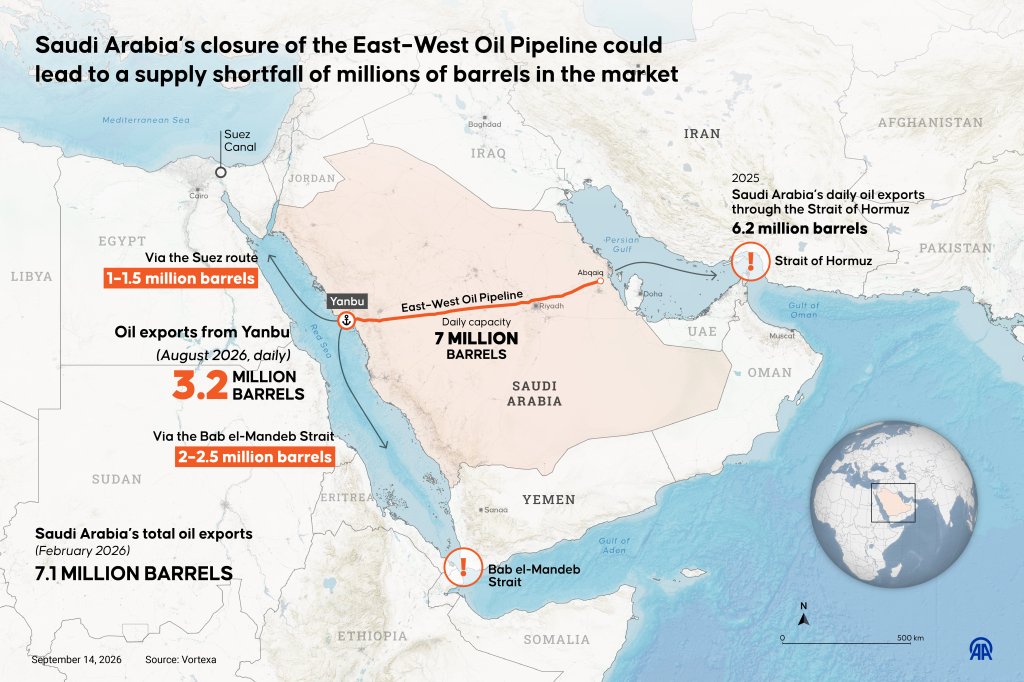
The decision was prompted by repeated Houthi missile and drone attacks as well as suspected strikes from Iranian-backed militias in Iraq on Saudi Arabia’s oil infrastructure. Yanbu in particular is a key installation. As we have explained in the past, Saudi Arabia has diverted millions of barrels of oil per day through pipelines to its Yanbu port on the Red Sea in an effort to minimize the energy shortages due to the hostilities around the Persian Gulf.

ANKARA, TURKIYE - SEPTEMBER 14: An infographic titled "Saudi Arabia's closure of the East-West Oil Pipeline could lead to a supply shortfall of millions of barrels in the market" created in Ankara, Turkiye on September 14, 2026. (Photo by Murat Usubali/Anadolu via Getty Images)
An infographic illustrating how Saudi Arabia has diverted oil from the Persian Gulf to the Red Sea. (Photo by Murat Usubali/Anadolu via Getty Images) Anadolu

Before Macron’s announcement on Thursday, the Houthis claimed they had carried out two more waves of attacks on Saudi targets, including one on the Saudi Aramco facility in Yanbu, “using a number of ballistic and cruise missiles, as well as drones.”

In addition, the Houthis claimed they struck Riyadh.

There was no immediate Saudi confirmation of an attack on the Saudi capital. Saudi civil defense did not issue an emergency alert for Riyadh on Thursday.

Earlier in the day, the Houthis said they struck “enemy command and control centers, operations rooms, weapon depots, missile launch platforms, and military sites belonging to Saudi-led enemy formations in Jizan,” a Red Sea port city.

“The Saudi-led military coalition in Yemen said on Thursday that it had shot down six ballistic missiles fired by the Iran-backed Houthi militia, in what appeared to be one of the largest cross-border attacks by the group since its conflict with Saudi Arabia [flared back up],” The New York Times reported.

The missiles were aimed at the Saudi cities of Taif and Yanbu, Maj. Gen. Turki al-Maliki, a spokesman for the Saudi-led coalition, claimed on X. “Escalations and violations by the terrorist Houthi militia will be dealt with firmly,” he stated, without specifying where the missiles were intercepted.

TWZ cannot independently verify any of these claims.

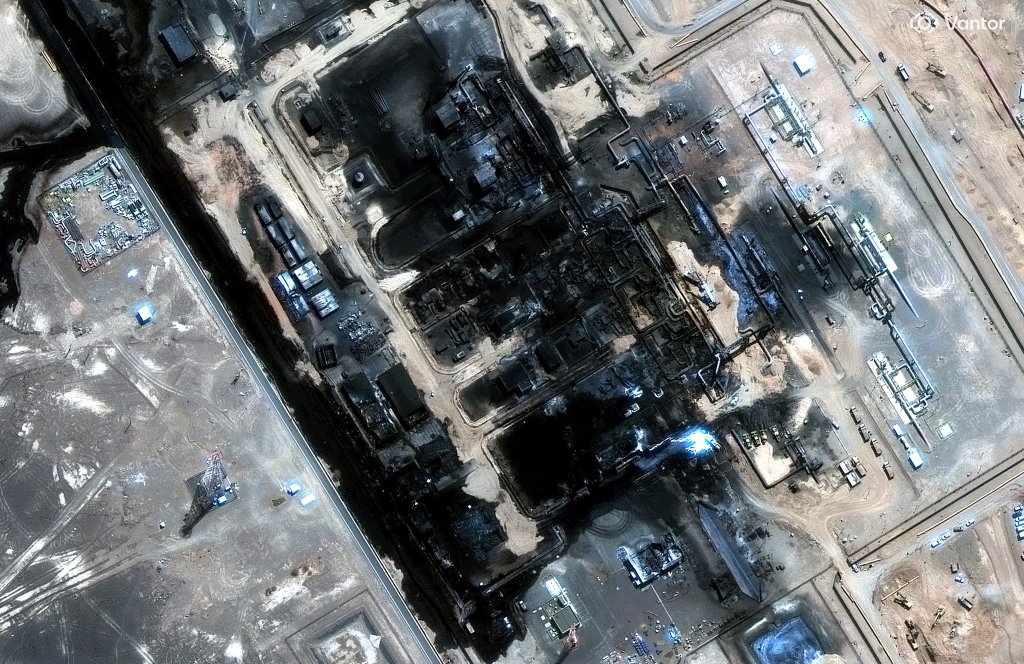
Today’s attacks are the latest in the escalating conflict between the Houthis and Saudi Arabia. Earlier this year, the Houthis imposed a blockade on the Bab al-Mandab Strait (BAM) and began striking Saudi ships in the southern part of the Red Sea as well as critical energy terminals on that body of water and Saudi refineries. Iranian proxies have also struck the vital East-West pipeline that carries oil to the Red Sea to bypass the Strait of Hormuz, where Iran vastly curtailed shipping after the launch of Operation Epic Fury. The East-West pipeline reportedly reopened after being shut down following a long-range drone attack.

The Saudi Arabian East-West pipeline after it was damaged by an attack. Satellite image ©2026 Vantor

The stark reality facing Macron is that if Saudi oil infrastructure and transport nodes near the Red Sea are destroyed or the pipeline that feeds it is shut down for months, the last major oil lifeline from the region — and especially to Europe — will be closed off, sparking a deeper energy crisis.

Iran has already severely curtailed the flow of oil through the Strait of Hormuz since the U.S. and Israel attacked it on Feb. 28. The movement of oil has been further impeded by a U.S. blockade on Iranian ports. However, transits have been increasing as of late, thanks in large measure to U.S. military escorts that U.S. Central Command claims have allowed more than a billion barrels of crude to pass through the Strait of Hormuz. Still, the traffic is far below what it was before the war broke out.

Update from CENTCOM Commander: pic.twitter.com/PTX6n9fn56

— U.S. Central Command (@CENTCOM) September 19, 2026

Having both the Strait of Hormuz largely closed and energy exports out of the Red Sea shut down simultaneously is a nightmare scenario. By Thursday evening Eastern time, the per-barrel price of Brent crude oil shot up to nearly $107, according to OilPrice.com. It had fallen below $100 per barrel just two days earlier.

Given all this, the French president sought to offer reassurance about oil supplies, according to France 24.

“He said he had carried out ‘intense diplomatic activity,’ meeting in recent weeks with the leaders of Saudi Arabia, Iraq and Nigeria, all hydrocarbon suppliers, to ensure France keeps receiving the same volumes,” the publication noted.

“We have replenished gas stocks and also oil stocks” for the months ahead, the French president also said.

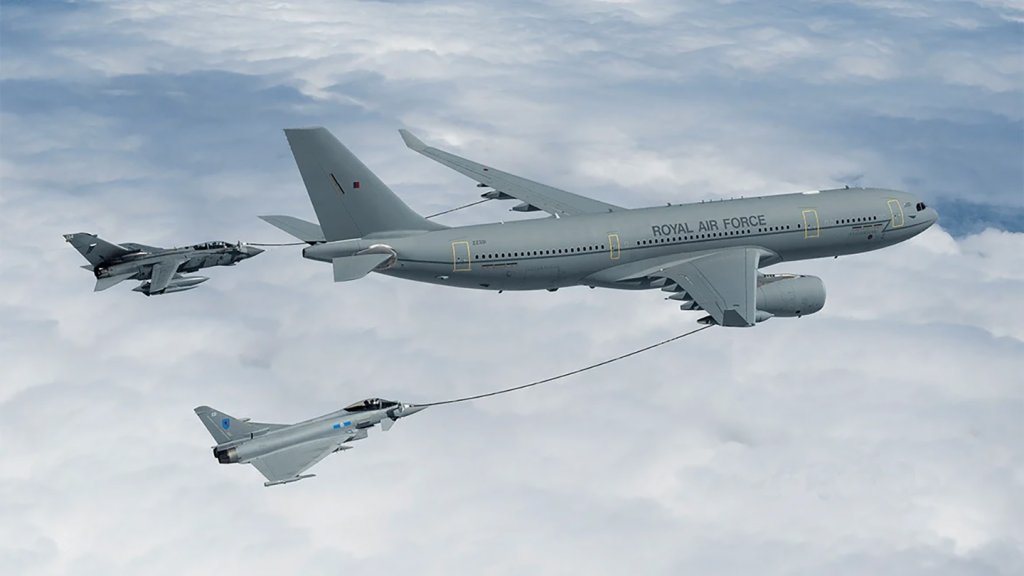
Macron’s decision follows one by the U.K.’s  Royal Air Force (RAF) on Tuesday to deploy one of its Voyager aerial refueling jets to help Saudi Arabia defend against Houthi attacks. As with the French move, it is a response to concerns about the flow of oil.

“Escalating tensions in the Gulf could have negative consequences here in the UK—such as rising prices, disruptions to energy supplies, and increased costs for British businesses,” the U.K. Defense Ministry (MoD) explained in announcing the deployment. “The Houthis pose a threat to stability in the Middle East; therefore, it is in the UK’s national interest—economically and in terms of security—that they do not succeed in their aims.”

“We unequivocally condemn Houthi attacks on Saudi Arabia, and our position is clear: both Saudi Arabia and the Yemeni government have the right to self-defense,” the ministry added. 

The jet will operate from a U.K. air base in Cyprus and will begin air-to-air refueling operations in the coming days, the BBC reported.

RAF sending voyager to defend against Houthi attacks.
A Royal Saudi Air Force Voyager aerial refueling jet. (Air Tanker)

The French and British deployments contrast decisions by the U.S. and other nations not to get involved with the Saudi-Houthi fight.

Last week, Trump turned down a direct plea from Saudi Crown Prince Mohammed bin Salman, the Kingdom’s de facto leader, to attack the Houthis. Meanwhile, Pakistan and Turkey, which signed the Mecca Joint Defense Agreement with Saudi Arabia, have yet to provide any direct military aid. The pact holds that an attack on one is considered an attack on all; however, it doesn’t stipulate exactly what actions should be taken.

The security situation in Yemen has drastically deteriorated since the launch of Epic Fury after the Houthis joined the U.S.-Iran conflict on the side of their major supporter.

The Houthis have been directly attacking Saudi Arabia over claims that the kingdom has imposed a blockade on them. Beyond that, the mostly dormant civil war between the Houthis and internationally recognized Yemeni government forces, backed by Saudi Arabia, reignited in the wake of Operation Epic Fury. The Houthis have made large territorial gains in the renewed conflict, including capturing the port city of Mokha and two key islands in the Red Sea. This has strengthened the Houthi hold on the BAM. You can read more about that in our story here.

3. The Houthis have reportedly attempted to seize ROYG-controlled islands in the Red Sea from which Houthi fighters could launch attacks on international shipping. Houthi forces reportedly landed on the Hanish Islands in the southern Red Sea on the morning of September 10 after… pic.twitter.com/tiFPgNDOHZ

— Institute for the Study of War (@TheStudyofWar) September 11, 2026

The civil war in Yemen erupted in 2014 and expanded a year later when a Saudi-led coalition joined forces with the government ousted by the Houthis. The fighting between Saudi-led forces and the Houthis largely abated after a tenuous ceasefire took hold in 2022. The Saudis held off on getting involved in the recent Red Sea conflict, which saw the U.S. and coalition warships duking it out with the Houthis and eventually led to a U.S.-led air campaign over Yemen. The United Kingdom was another significant player in that air campaign.

Meanwhile, exacerbating concerns about the flow of oil from the Red Sea, “a senior adviser to Iran’s supreme leader warned Thursday that Iranian forces and their Houthi allies in Yemen could respond to any new U.S. attacks by opening ‘a new front’ in its war with the U.S. by targeting energy supplies in the Red Sea,” CBS News reported.

The statements came after U.S. President Donald Trump on Wednesday once again threatened Iran.

“Will a deal be made with Iran that lets them rebuild and create a far greater country than it ever was before?” Trump asked rhetorically. “Or do I annihilate the Islamic Republic and do it quickly, never giving them a chance to kill and destroy people and countries again?”

Trump added that he believed he would make a peace deal with Iran after the upcoming U.S. midterm elections, which will decide the control of Congress.

Trump to the UN: "Do I annihilate the Islamic Republic, and do it quickly? Do I drive them into hell?" pic.twitter.com/cIYBO1Mp3w

— Aaron Rupar (@atrupar) September 22, 2026

As we noted yesterday, with gasoline and diesel price increases damaging the economy, the war and Trump’s handling of it have been unpopular with voters.

The fact that France is sending forces to Saudi Arabia is an ominous development and another indication that the current spate of unrest that began with Epic Fury does not appear to show any signs of ending anytime soon.

Contact the author: howard@twz.com 

The post France Sending Forces To Help Defend Saudi Arabia’s Red Sea Oil Facilities appeared first on TWZ.

  •  

Yemen’s Ansar Allah Announces Another Wave of Attacks on Saudi Arabia Targeting Riyadh and Yanbu

Ansar Allah announced on Thursday that its forces launched another wave of missile and drone attacks targeting the Saudi capital of Riyadh and oil infrastructure in Yanbu on Saudi Arabia’s Red Sea coast as the war continues to escalate. Ansar Allah military spokesman Yahya Saree said in a statement that Yemeni forces carried out “successful […]
  •  

The War Is Spreading: What the Houthi Front Means for the Region

Amid the ongoing US–Iran war and the closure of the Strait of Hormuz, the emergence of a Saudi-Houthi confrontation has added a new layer of complexity to the Middle Eastern conflict, with the potential to widen and prolong the war while drawing additional regional actors into an increasingly broader confrontation. The Saudi-Houthi conflict is not […]
  •  

Suspected US Drone Strike Kills Alleged al-Qaeda Member in Southeast Yemen

A suspected US drone strike hit a vehicle carrying two alleged al-Qaeda members in Yemen’s southeastern Hadramout province on Tuesday, China’s Xinhua news agency has reported. A local security source told the news agency that one of the men in the vehicle was killed while the other was wounded. So far, there’s been no confirmation […]
  •  

Yemeni Media Reports Major Ansar Allah Attack on Southern Saudi Arabia

Yemen’s SABA news agency reported on Wednesday that Ansar Allah, also known as the Houthis, launched a major attack on southern Saudi Arabia that caused dozens of casualties. An Ansar Allah military source claimed to the outlet that an attack hit military camps and weapons depots in al-Tawal, a district in Saudi Arabia’s southwestern Jazan […]
  •  

U.K. Sending Voyager Tanker To Help Defend Saudi Airspace

The Royal Air Force (RAF) is deploying one of its Voyager aerial refueling jets to help Saudi Arabia defend against ongoing attacks from the Iranian-backed Houthi rebels of Yemen. The decision marks the first publicly known international military assistance offered to Saudi Arabia specifically for its fight against the Houthis, which erupted over the summer. The move came hours before U.S. President Donald Trump told the United Nations General Assembly meeting that he believes a peace deal with Iran will be reached after the U.S. midterm elections in November.

The British action is significant because, while it involves just one tanker, other key Saudi allies have yet to heed the Kingdom’s request for military help specifically to battle the Houthis. Although it’s important to note some assets already deployed to defend against Iranian attacks could be helping with the Houthi threat now.

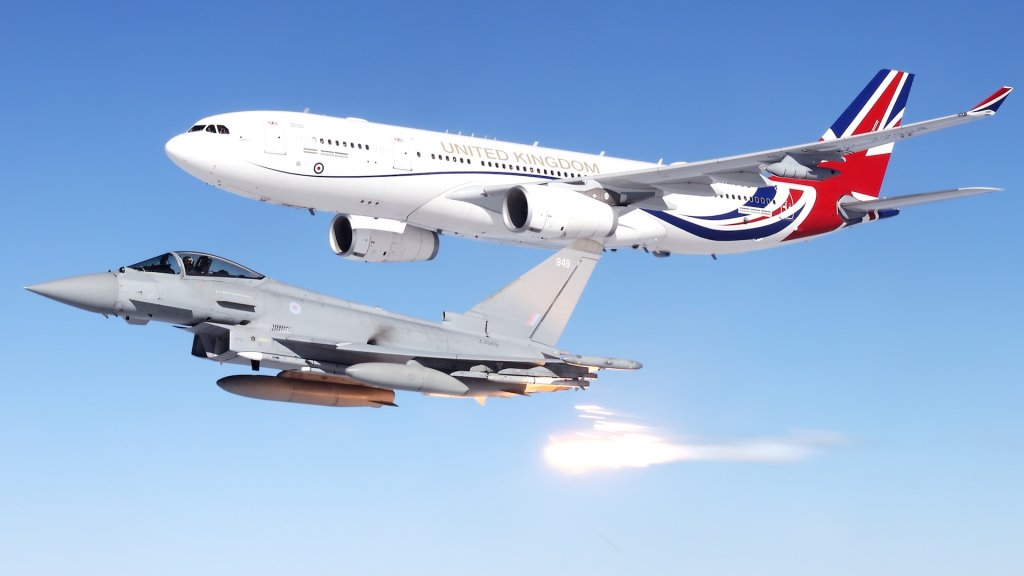
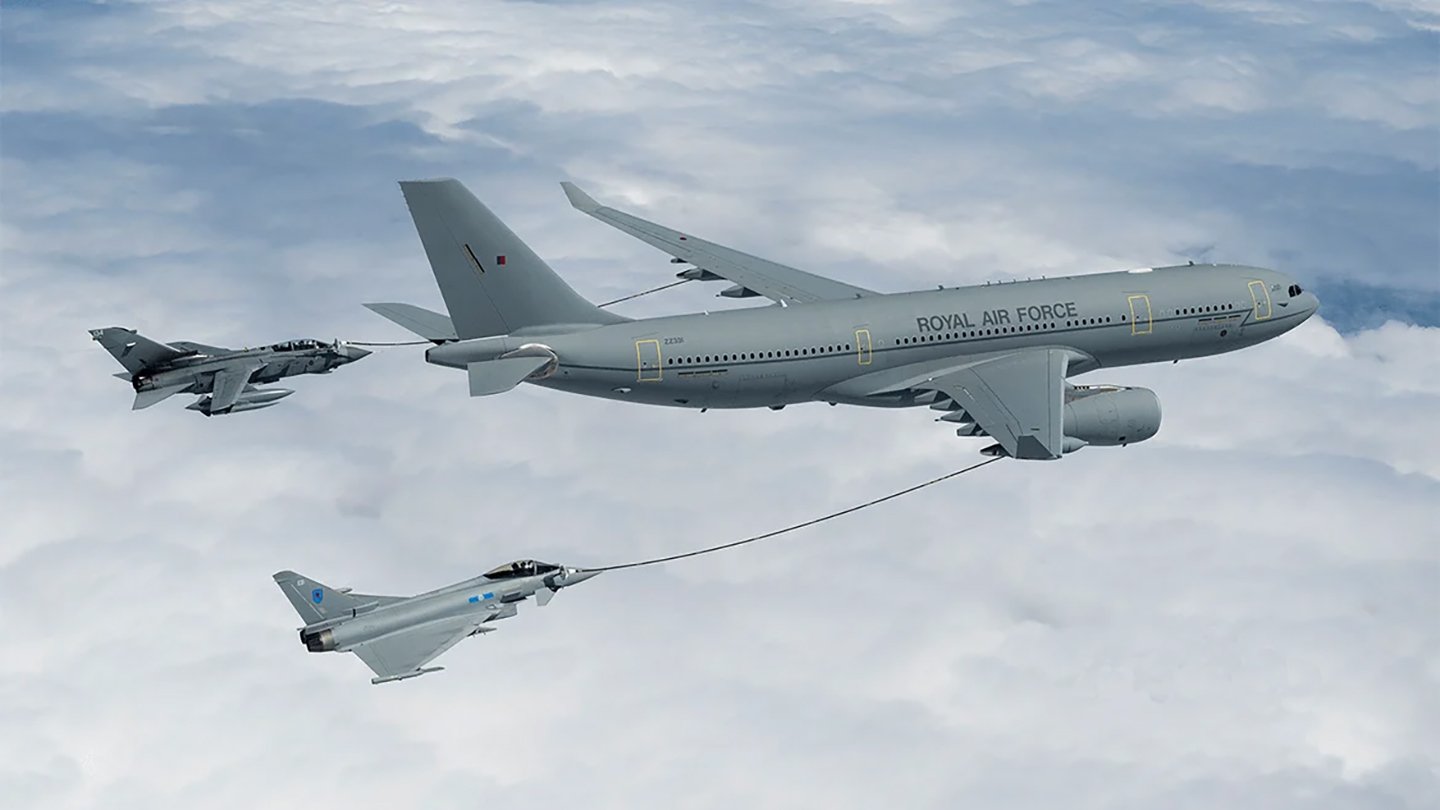
This picture is from a Quick Reaction Alert training scenario. The QRA exercise was conducted 31 March 2026. The purpose of the exercise was to demonstrate the full end-to-end process of the UK's air defence strategy if an actual foreign aircraft was to invade their protected airspace. Upon receiving the alert, the QRA team at RAF Coningsby would launch to RAF Typhoon FGR4's to intercept any unknown aircraft within the protected airspace. In this particular scenario an RAF Voyager A330 (RAF Brize Norton) was acting as the agressor and two RAF Typhoons FRG4 (RAF Coningsby) were responding to the simulated threat. During the exercise the Typhoons intercepted the Voyager and conducted a series of maneouvers whilst communicating with the "foreign" aircraft with the aim of escorting it to a safe location on the ground (RAF Brize Norton) upon which it and it's crew would be guarded and safely inspected by counter-terrorist police. The resulting imagery is to be used for training government ministers on how a QRA works and all the different elements involved. From the initial radar detection of a foreign, unidentified aircraft at the London Area Control Centre, Swanwick, to the physical launch of our QRA team at RAF Coningsby. The RAF use a hose-and-drogue air-to-air refuelling system deployed from Voyager tanker aircraft. Instead of a rigid flying boom, the tanker trails a flexible high-pressure hose attached to a stabilizing basket (drogue), allowing receiver jets like the Typhoon and F-35 to plug in mid-flight. This image shows a Typhoon releasing flares as a warning to the "enemy aircraft".
A Royal Air Force Typhoon FGR4 accompanies a Voyager tanker during a Quick Reaction Alert training scenario in March 2026. (Crown Copyright) Crown Copyright

Last week, Trump turned down a direct plea from Saudi Crown Prince Mohammed bin Salman, the Kingdom’s de facto leader, to attack the Houthis. Meanwhile, Pakistan and Turkey, which signed the Mecca Joint Defense Agreement with Saudi Arabia, have yet to provide any direct military aid. The pact holds that an attack on one is considered an attack on all; however, it doesn’t stipulate exactly what actions should be taken. 

Saudi Arabia, under repeated Houthi missile and drone attacks as well as suspected strikes from Iranian-backed militias in Iraq, is struggling to defend its oil infrastructure. The Kingdom is also facing a challenge supporting the anti-Houthi forces it backs in the Yemen civil war that reignited in the wake of the U.S. and Israeli attacks on Iran that began Feb. 28.

At issue, beyond protecting the Saudis, is growing concern over the Bab al-Mandab Strait, a key chokepoint now largely controlled by the Houthis, who are preventing the Saudis from using it to ship oil. 

Earlier this year, the Houthis imposed a blockade on the Strait, and began striking Saudi ships in the southern part of the Red Sea as well as critical energy terminals on that body of water. Iranian proxies have also struck the vital East-West pipeline that feeds oil to be transferred and shipped via the Red Sea in order to bypass the Strait of Hormuz, where Iran vastly curtailed shipping after the launch of Operation Epic Fury. The pipeline reportedly reopened today after being shut down following a long-range drone attack.

The Saudi Arabian East-West pipeline after it was damaged by an attack. (Satellite image ©2026 Vantor)

The stark reality is that if Saudi refineries are destroyed and the pipeline is shut down for months, if not longer, the last major lifeline from the region — and especially to Europe — would be closed off, sparking a deeper energy crisis.

Concern over these factors spurred Britain to act, the Ministry of Defense (MoD) noted. It said it was acting on a request from Saudi Arabia and that the jet would “support Saudi Arabia’s defensive operations in aid of the legitimate Yemeni government.”

“Escalating tensions in the Gulf could have negative consequences here in the UK—such as rising prices, disruptions to energy supplies, and increased costs for British businesses,” the ministry explained. “The Houthis pose a threat to stability in the Middle East; therefore, it is in the UK’s national interest—economically and in terms of security—that they do not succeed in their aims.”

“We unequivocally condemn Houthi attacks on Saudi Arabia, and our position is clear: both Saudi Arabia and the Yemeni government have the right to self-defense,” the ministry added. 

The jet will operate from a U.K. air base in Cyprus and will begin air-to-air refueling operations in the coming days, the BBC reported.

The MoD said the Voyager will fly only in support of missions to shoot down missiles and drones, though Saudi aircraft are also bombing Houthi ground positions in Yemen, in part to get at drone and missile launchers and storage sites. Houthi officials have accused the Saudis of killing civilians in some of these attacks.

It should be noted that, more than a decade ago, the U.S. was supporting the Saudi coalition’s previous bombing campaign against the Houthis by providing aerial refueling and intelligence. However, then-Defense Secretary James Mattis ended that in 2018 during the first Trump presidency after growing concerns over the large number of civilian casualties.

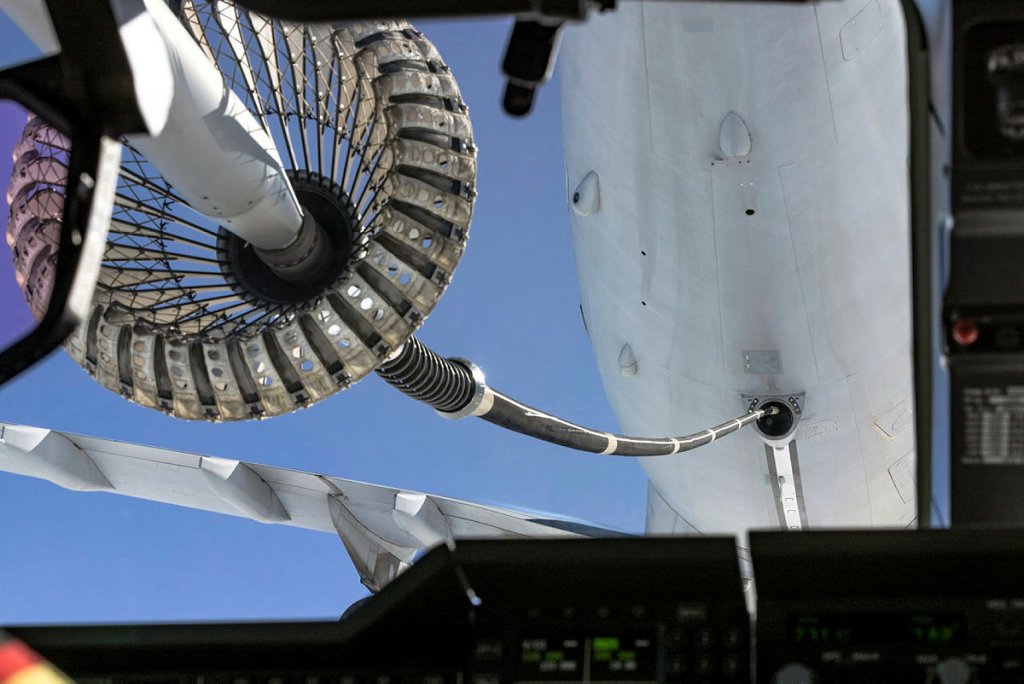
The Voyager can only refuel the Royal Saudi Air Force Eurofighter Typhoons, Panavia Tornados, and Italian Air Force Typhoons that have been in the Kingdom since before the fighting with the Houthis broke out, as well as any other similarly equipped allied aircraft. That’s because the tanker only has probe-and-drogue aerial refueling, not the boom required for gassing up other receptacle-equipped aircraft. You can read more about this in our story here.

The view from the cockpit of an A400M during air-to-air refueling with a Voyager KC3 using its probe and drogue system, via the fuselage refueling unit. Crown Copyright

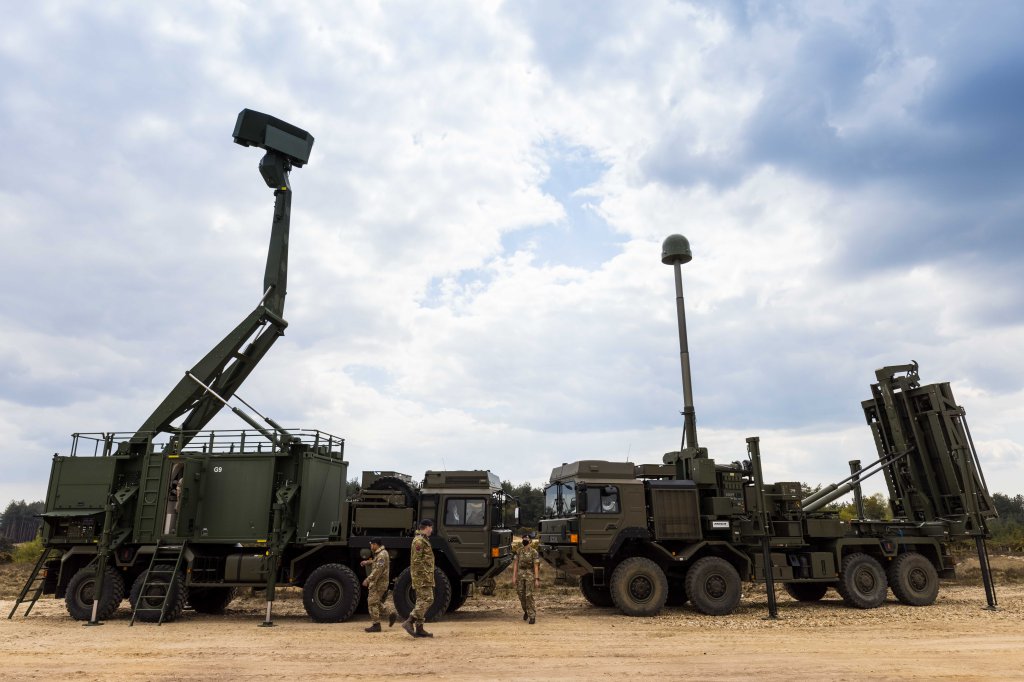
The Voyager will not be the first British asset to be sent to help Saudi Arabia since the launch of Epic Fury. In March, the U.K. sent its Sky Sabre air defense system and troops to the Kingdom to help defend against attacks from Iran.

Pictured: The British Army Sky Sabre state-of-the-art intermediate air defence system. It marks a wholesale upgrade to the venerable Rapier system that was in service for nearly five decades. Sky Sabre, comprising of three separate components: The Agile Multi-Beam Surveillance Targeting radar (affectionally referred to as the Giraffe, pictured left), the Battle Management Command & Control Communications (not shown), and the Land Ceptor CAMM (Common Anti-Air Modular Missiles) missile delivery vehicle (right). All are pictured together for the purposes of the photographs; on the battlefield, they could be expected to operate up to 15Km apart. The system is designed to respond to sophisticated missile attacks and can defend against saturation attacks of supersonic anti-ship cruise missiles, aircraft and other high-performance targets. at a range of 120Km using the CAMM (Common Anti-Air Modular Missile), travelling at over 2300 miles per hour. It does this via multiple channels of fire, providing 360-degree simultaneous coverage and high degrees of manoeuvrability.
The British Army Sky Sabre state-of-the-art intermediate air defence system. (Corporal Adam J Wakefield) Corporal Adam J Wakefield

“This support builds upon the UK’s existing military contribution to Saudi air defense, which includes the deployment of an air defense system and British personnel to help protect against missile and drone attacks,” the MoD pointed out on Tuesday. “Saudi Arabia and Yemen are steadfast partners of the UK and play a vital role in regional stability. It is in the UK’s interest to safeguard regional stability, protect vital trade and energy supplies, and encourage a diplomatic resolution to the conflict in Yemen.”

The civil war in Yemen erupted in 2014 and expanded a year later when a Saudi-led coalition joined forces with the government ousted by the Houthis. The fighting between Saudi-led forces and the Houthis largely abated after a tenuous ceasefire was signed in 2022. The Saudis held off on getting involved in the recent Red Sea conflict which saw the U.S. and coalition warships duking it out with the Houthis, and eventually led to a U.S.-led air campaign over Yemen. The United Kingdom was the other significant player in that air campaign.

Tensions, as we noted earlier in this story, reignited in recent weeks after the Houthis joined the U.S.-Iran conflict on the side of their major supporter. 

On Tuesday, Houthi spokesman Brig. Gen. Yahya Sare’e claimed that Saudi Arabia conducted 19 airstrikes across rebel-held territory in Yemen that involved the latest round of civilian casualties. The Saudis have not directly responded.

Brig. Gen. Yahya Sare’e. (Houthi Telegram)

As we stated earlier in this story, hours after the U.K. announced it was sending a Voyager tanker to Saudi Arabia, Trump addressed the ongoing conflict with Iran during his speech to the U.N. General Assembly in New York.

The American leader called for international isolation of Iran and repeated his stance that he was at an inflection point on deciding what course to take moving forward. The situation has settled into an uneasy pause interrupted by sporadic Iranian attacks on shipping in the Strait of Hormuz. It has been weeks since the U.S. last struck Iranian targets.

“Will a deal be made with Iran that lets them rebuild and create a far greater country than it ever was before?” Trump asked rhetorically. “Or do I annihilate the Islamic Republic and do it quickly, never giving them a chance to kill and destroy people and countries again?”

Trump added that he believes he will make a peace deal with Iran after the upcoming U.S. midterm elections, which could decide which party controls Congress. With gasoline and diesel price increases damaging the economy, the war and Trump’s handling of it have been very unpopular with voters.

In a CNN and SSRS poll, released Tuesday, 64% of those responding said the U.S. is not winning the war in Iran, while 36% disagreed. In addition, 78% of participants said Trump is not doing enough to end the conflict with Iran and 22% said he was.

Trump to the UN: "Do I annihilate the Islamic Republic, and do it quickly? Do I drive them into hell?" pic.twitter.com/cIYBO1Mp3w

— Aaron Rupar (@atrupar) September 22, 2026

After a bilateral meeting with British Prime Minister Andy Burnham following his UN speech, Trump claimed the Iranians still want to make a deal.

“They want to talk to us,” he said. “They have been talking to us, even today they’ve been talking to us, and the relationship is developing. But we can’t let them – and they understand that – we can’t let them have a nuclear weapon.”

A U.S. negotiating team, including Steve Witkoff and Jared Kushner, met with Iranian officials on the sidelines of Tuesday’s U.N. meeting. That sideline session lasted about three hours and went well, according to Trump, who offered no details on the discussions.

Trump: US officials met with the Iranian delegation for three hours – "it was a good meeting"

— Polymarket Intel (@PolymarketIntel) September 22, 2026

For their part, the Iranians said they are willing to negotiate, but on their terms.

“A senior Iranian official said Iran could reopen the Strait of Hormuz to Gulf shipping within seven days if the U.S. fulfilled Tehran’s demands to ease military pressure and lift an American blockade on Iranian ports,” Reuters reported. “The official added that Tehran had conveyed its latest proposal to Washington via mediators last week.”

Contact the author: howard@twz.com

The post U.K. Sending Voyager Tanker To Help Defend Saudi Airspace appeared first on TWZ.

  •  

Saudi Airstrikes Reportedly Kill at Least 17 Civilians and Detainees in Yemen

Warning: Graphic photo below Saudi airstrikes that hit Yemen on Monday night into Tuesday killed at least 17 people, including civilians and detainees at a prison, according to Ansar Allah officials and reports in Yemeni media. Abdul Qader al-Murtada, the head of the Yemeni National Committee for Prisoners’ Affairs, said that on Monday night, Saudi […]
  •  

Ansar Allah Reports ‘Major Escalation’ of Saudi Airstrikes and Missile Attacks on Yemen

Ansar Allah, commonly known as the Houthis, said on Monday that its forces recorded a “major escalation” of Saudi airstrikes and missile attacks on Yemen as it continues to make gains against Saudi-backed forces on the ground. “In a major escalation, the criminal Saudi enemy targeted the governorates of al-Jawf, Taiz, Saada, and Marib with […]
  •  

Report: Trump Ordered Pentagon To Prepare To Bomb Yemen, Then Reversed Course

The New York Times reported on Sunday night that President Trump had ordered the Pentagon to prepare for strikes against Yemen’s Ansar Allah, commonly known as the Houthis, but then reversed his plan, calling off the attack, at least for now. Sources told the Times that Trump gave the order to prepare for military action […]
  •  

Saudi Airstrikes Hit Yemen After Ansar Allah Attack on Riyadh

Saudi airstrikes continued to pound parts of Yemen on Sunday, a day after Ansar Allah launched a missile and drone attack targeting the Saudi capital of Riyadh for the first time since the war was reignited by Saudi airstrikes targeting the Sanaa International Airport back in July. Dr. Anis al-Asbahi, spokesman for the Health Ministry […]
  •  

Five Things the Headlines Might Have Missed About the Saudi-Houthi Escalation

The escalation of the conflict between Saudi Arabia and the Houthis marks the collapse of the old regional security system, in which traditional U.S. guarantees are losing their effectiveness, and real influence is shifting to actors capable of adapting to the new rules of the “gray zone” and informal diplomacy. As global media focuses on […]
  •  

Over a decade of war in Yemen and the rise of Ansar Allah

In July, Saudi Arabia joined the US-Israeli war on the West Asia region with strikes on Yemen. The Ansar Allah-led Yemeni Armed Forces retaliated by launching a maritime blockade alongside attacks targeting vital Saudi interests.

The renewed fighting between the two West Asian nations resulted in Ansar Allah’s takeover of the strategic Red Sea port city of Mokha last week and the liberation of all the group’s prisoners held by Saudi-backed forces on Yemen’s western coast.

Ansar Allah’s seizure of Mokha seaport is reshaping regional and global geopolitics, particularly because it serves as a primary gateway to the Bab el-Mandeb Strait and coincides with developments in the Strait of Hormuz.

As these major shifts underscore, Yemen holds immense strategic geopolitical significance.

Situated on the southwestern corner of the Arabian Peninsula and overlooking the Bab al-Mandab Strait, Yemen represents a vital chokepoint connecting the Red Sea to the Gulf of Aden and the Indian Ocean

Consequently, internal political developments in Yemen can have global political and economic repercussions.

This fact, in turn, has put Yemen in the crosshairs of the US-led Western imperialist bloc and their allies in West Asia, which have endeavored to subjugate the country through a devastating decade-long war and blockade. 

The origin of this war coincides with the emergence of Ansar Allah, beginning when the group managed to take control of large swathes of the country, including the capital, Sanaa, in 2014.

The rise of Ansar Allah

Ansar Allah was first established in the early 1990s in the northern Yemeni governorate of Saada as a cultural and educational organization called Al-Shabab al-Mumin (the Believing Youth).

Initially, the organization introduced itself as an unarmed theological movement aimed at reviving and preserving Zaydi Shia Islam and countering the threat of state-backed Sunni Salafism, which sought to uproot the Zaydi religious identity in its homeland of Saada.

From its inception, the movement opposed the government, led by President Ali Abdullah Saleh, accusing it of corruption and criticizing its ties to the United States and its ally Saudi Arabia.

Tensions between the group and the government drastically escalated following the US invasion of Iraq in 2003. It was at that time that the group adopted the slogan (Death to America, Death to Israel), during mass protests opposing the war on Iraq.

These slogans posed a political threat to Ali Abdullah Saleh, who was attempting to position his government as a key ally in the “US War on Terror” in the aftermath of the 9/11 attacks. As a result his government led a brutal crackdown on protesters.

Security forces and riot police suppressed protests using live ammunition, tear gas, and batons, and arbitrarily detained hundreds of political activists, students, and opposition organizers without trial.

In 2004, tension between the Al-Shabab al-Mumin and the Yemeni government boiled over, sparking a series of six internal conflicts known as the Saada Wars. 

These clashes began with the government’s assassination of Hussein Badreddin al-Houthi, the group’s founder, and triggered five subsequent rounds of fighting that lasted until 2010. The followers of the group became widely known as the Houthis ever since. 

Saudi Arabia reportedly engaged in the Saada wars by providing immense financial, political, and material support to the Yemeni government. Saudi intervention in Yemen escalated in 2009 with a direct military incursion and unilateral airstrikes against positions held by the Houthi movement.

In 2011, the group joined nationwide demonstrations, calling for the overthrow of President Ali Abdullah Saleh. It was then that the Houthi movement formally adopted the name Ansar Allah (Supporters of God). 

The ousting of Saleh weakened the central government and triggered a sweeping power vacuum, which allowed Ansar Allah to rapidly expand its territorial dominance. By 2012, the Yemeni movement consolidated firm control across the Saada governorate and large swathes of northern Yemen.

In early 2012, vice president to Saleh, Abed Rabbu Mansour, Hadi became the President of Yemen via a transition framework brokered by the Gulf Cooperation Council (GCC), as he was  considered as a quiet consensus figure. Hadi was also strongly backed by the Obama administration. 

In late 2014, Ansar Allah allied with forces loyal to ousted president Ali Abdullah Saleh against the transitional government headed by Abed Rabbu Mansour Hadi. The fighting that followed led to Ansar Allah’s seizure of the capital Sanaa, forcing Hadi to flee the country.

2015-2022: The Saudi-led coalition’s protracted war against Yemen

From exile in 2015, Hadi requested the Saudi-led coalition to intervene in the conflict, opening the door to one of the bloodiest prolonged wars in West Asia. A conflict that, according to UN estimates, resulted in 377,000 deaths by 2022. 

Saudi Arabia was the main pillar of the coalition, leading the military campaign dubbed “Operation Decisive Storm” with a massive force, including extensive warplanes and ground troops.

The United Arab Emirates (UAE) also played a key role by commanding ground and air operations particularly in southern Yemen and along the critical coastal strip.

Bahrain took part in the operation with 12 fighter jets (some sources say 15), and deployed ground troops in the southern Saudi borders to protect Saudi Arabia from Ansar Allah’s attacks. Meanwhile, Kuwait contributed with 15 warplanes.

At the beginning of the campaign, Qatar participated with roughly 1,000 ground troops, armored vehicles, a dozen fighter jets, and transport helicopters until it was expelled from the coalition in June 2017 over a diplomatic crisis with Saudi Arabia, UAE, Bahrain, and Egypt.

Jordan and Morocco contributed six fighter jets each, while Sudan under deposed president Omar Al-Bashir sent three aircrafts and thousands of ground troops. Furthermore, Senegal committed 2,100 troops.

Western countries, including the United States, the United Kingdom, and France provided logistic and intelligence support, such as aerial refueling for coalition jets, technical assistance, military equipment, coordination support, and maritime surveillance.

The 2022 UN-brokered truce de-escalated the war rather than ending it

In April 2022, the United Nations announced an official two-month nationwide truce agreement, which temporarily halted cross-border attacks, ground and air operations, and allowed fuel imports into ports held by Ansar Allah. It also reopened commercial flights from Sanaa International Airport after years of sea, land, and air blockade imposed by Saudi Arabia. 

Rather than completely removing the blockade, the agreement only resulted in the partial easing of restrictions, while regions under the control of Ansar Allah have continued to face a near-total blockade.

Read more: Yemen demands Saudi-led blockade on the country be lifted immediately

The agreement was renewed in June and extended a second time in August 2022 for an additional two months before it lapsed in October. 

Regional developments reignited the conflict (2023-2026)

In November 2023, Ansar Allah launched a ban on all Israeli maritime navigation in the Red Sea and the Bab el-Mandeb Strait in retaliation for Israel’s genocidal aggression on Gaza.

About one month later, the group significantly expanded the ban to include all ships heading to Israeli ports, regardless of their nationality or flag.

The ban continued until October 2025, despite waves of deadly airstrikes launched by the US, UK, and Israel on Yemen.

An Omani-mediated ceasefire deal between the US and Ansar Allah was reached in May 2025. The deal stipulated halting Ansar Allah’s attacks on US ships in the Red Sea and Bab al-Mandab Strait, and ending US aggression on Yemen, without preventing the Yemeni resistance movement from launching attacks or naval operations against Israel. 

This same period saw a shift in the conflict between the Saudi-led coalition and Ansar Allah from active military engagement toward a tense, fragile diplomacy.

In early 2026, friction between the two major pillars in the anti-Ansar Allah coalition – namely Saudi Arabia and the UAE – surfaced as different Yemeni groups backed by the two countries clashed, apparently over territorial control in Yemen.

Read more: Tensions in Yemen: Are Saudi Arabia and the UAE becoming frenemies?

The US-Israeli war on Iran has drawn Yemen back into the regional conflict

Although Ansar Allah was established as an independent Yemeni movement, it evolved into a key component of the Axis of Resistance over time. This alignment was driven by mutual ideological foundations, shared anti-imperialist ideology, and deep strategic and military cooperation with Iran and Hezbollah.

Despite its affiliation with the resistance alliance, Ansar Allah chose not to get involved in the recent regional war waged by the US and Israel against Iran, for ostensibly strategic considerations and military coordination tactics with its allies.

Read more: Reflections on the US-Israeli multi-front war in West Asia: How the Axis of Resistance remains resilient

However, because the United States and its allies in the region seemingly view the current war as an ideal opportunity to dismantle the Axis of Resistance, Saudi Arabia decided to resume its aggression against Yemen by attacking Sanaa International Airport in July. The attack aimed to prevent an Iranian plane from landing.

Consequently, Ansar Allah launched retaliatory attacks on Saudi interests inside Saudi Arabia and on Yemeni soil. It further declared a maritime blockade against Saudi-linked commercial vessels passing through the Bab al-Mandeb Strait, demanding Riyadh end its decade-long blockade on Yemen.  

Concurrently, ground clashes over territorial dominance between Ansar Allah and Saudi-backed forces intensified, leading to key victories for the Yemeni group. Escalations have persisted up to the time of publication.

On Wednesday, September 16, Saudi Arabia accused Ansar Allah of attempting a drone attack against the city of Mecca, the holiest city for Muslims, located in western Saudi Arabia.

Ansar Allah dismissed Saudi accusations as false, saying that they reflect a “desperate attempt to mobilize public opinion.”

As the US-Israeli war on West Asia continues to reshape geopolitics, Ansar Allah’s emergence as a regional force has placed Yemen at the center of a struggle that may define the future of West Asia.

  •  

Saudi Arabia is Exporting ZERO Oil as U.S. Sends Unprecedented Amount of 2,000-pound Bombs to Israel

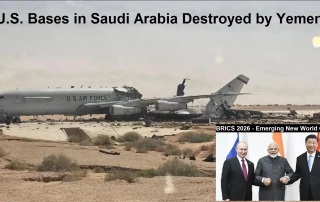
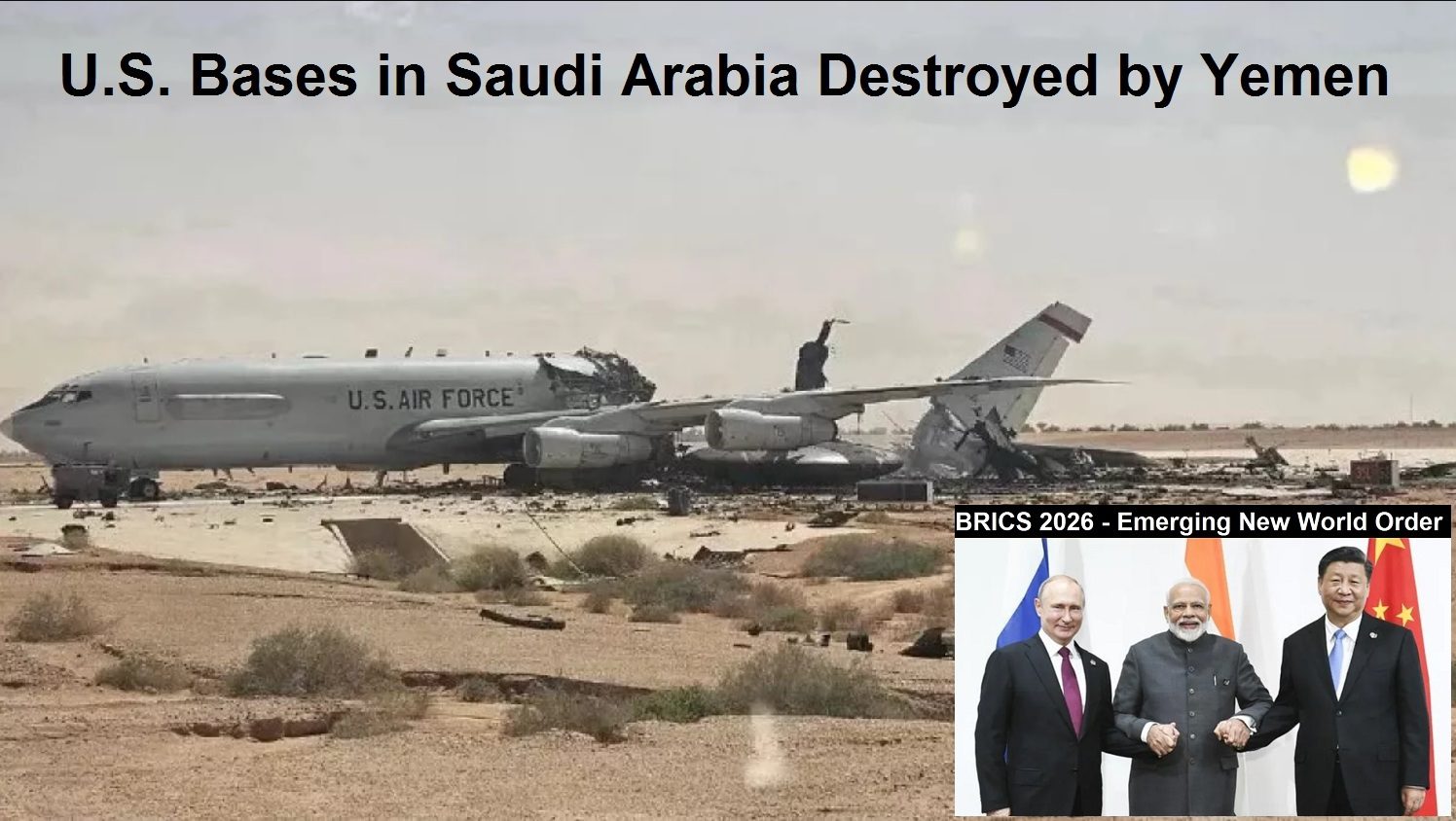
Background image from CBS News. BRICS 2026 Image Source.

by Brian Shilhavy
Health Impact News

As I reported earlier this week, the Yemen takeover of the Red Sea has changed everything in the Middle East, and things are moving fast now.

CBS News published photos of destroyed U.S. bases in the Middle East yesterday for the first time since the Iran War started, claiming that the photos were sent to them by “active service members on condition of anonymity.”

New photos obtained exclusively by CBS News reveal for the first time the widespread damage and destruction of buildings and vehicles at multiple U.S. positions across the Middle East, as a result of Iranian missile and drone attacks.

The images were sent to CBS News by active service members on condition of anonymity because of rigid media restrictions within the military.

“This is major damage to our bases that hasn’t been communicated to the American public,” one deployed service member told CBS News.

“We’re standing there with our eyes closed getting punched in the face.”

One photo, taken at Prince Sultan Air Force Base in Saudi Arabia, shows a direct hit on the back half of a Boeing E-3 Sentry four-engine aircraft, its tail severed from the charred fuselage that also supported a rotating radar that is essential for collecting midair intelligence.

Similarly grim pictures were captured at Camp Buehring in Kuwait, a major staging area for U.S. Army ground troops, armored vehicles and some aircraft; the post is located in a remote desert region far northwest of Kuwait City.

The Defense Department’s inspector general this week released a fresh report on the war in Iran that revealed “equipment losses” worth up to $3.7 billion — including nearly 60 aircraft.

In a first-of-its-kind mandatory report to Congress, the inspector general added that U.S. Central Command reported Iranian strikes at U.S. bases in Kuwait, Bahrain, Qatar, UAE, Saudi Arabia, Iraq, Oman and Jordan.

“These are not ‘squirters’ getting through,” the service member added, referencing language used by Defense Secretary Pete Hegseth after the deadly March 1 attack on Port of Shuaiba in Kuwait that killed six U.S. troops.

“We’re not defending these bases. We’re just watching them get destroyed.”

Full article.

As I write this on September 16, 2026, Saudi Arabia is currently exporting ZERO oil. This is the country with the largest oil company in the world, Aramco, which was started by the United States and today employs tens of thousands of Americans in Saudi Arabia.

There were reports earlier this week that Saudi Arabia’s leader, Mohammed bin Salman (MBS), was under house arrest, but he appeared in public yesterday in a state visit to Egypt, dispelling those rumors.

But that doesn’t mean that there is not currently chaos in the Royal Al-Saud family, and even the possibility that the Al-Saud family could be in danger of being able to hold on to its power in Saudi Arabia. The original name of this area was just “Arabia”, and included what is today called “Yemen.”

Here is a short interview with international journalist Pepe Escobar that was published just before MBS appeared in public in Egypt yesterday, explaining how damaging the Yemen takeover of the Red Sea has been to Saudi Arabia.

Here is another good 20-minute interview with Professor Mohammad Marandi from inside Iran, discussing the question: Is Saudi Arabia Heading for Collapse?

Pepe Escobar has also published a couple of articles on the Yemen situation, but as of this writing I have only found one in German, and one in Spanish, but nothing in English yet.

Here are some excerpts from the Spanish and German articles that were translated online.

Yemen Shakes the Gate of Tears

by Pepe Escobar
geoestrategia.eu

Excerpts:

Ansarallah now has the luxury of installing a tollbooth — possibly multi – layered — at Bab al -Mandeb, if they so wish.

No less than 25 years after 9/11, the Angel of History strikes another powerful blow. Five years ago, we witnessed the stunning imperial humiliation in Afghanistan , accomplished in a matter of days.

Now, we are witnessing the stunning humiliation of Saudi Arabia—a vassal of Epstein’s Syndicate—in Yemen, also accomplished in a matter of days. Series of humiliations now follow the Empire like a plague.

The widespread collapse of Saudi mercenary groups in Yemen is happening so rapidly that even Epstein’s Syndicate’s mainstream media has been forced to acknowledge it.

Ansarallah’s “Rolling Storm” is taking cities and islands; capturing thousands of thugs; freeing all prisoners—and granting them amnesty; seizing control of countless American tanks and weapons—a “reissued Afghanistan”; and being hailed as liberators of Yemeni land across the tribal spectrum.

And, of course, Ansarallah has now officially assumed full control of the mega-strategic Bab al-Mandeb, or “Gate of Tears”.

The intelligence that underpinned Ansarallah’s Operation Rolling Thunder—described as the largest mass capture operation in modern warfare—was carefully coordinated with the Islamic Revolutionary Guard Corps (IRGC).

The Axis of Resistance was fully aware that, following the devastating Iranian attacks on bases in Jordan, the United States was limited in its ability to assist the Saudis in preventing a Yemeni offensive.

The US Navy had already been effectively driven out of the Red Sea by Yemen’s advanced military capabilities, including hypersonic missiles manufactured entirely domestically.

It seems Riyadh hasn’t learned its lesson.

At the Asian level, Iran’s dual control of the Strait of Hormuz and the Bab el-Mandeb Strait (through its allies in Ansar Allah) is being staged one day before the opening of the momentous BRICS summit in New Delhi—which is geopolitically linked to the previous Shanghai Group summit (12 days earlier) and the trip of Chinese President Xi Jinping to Egypt (11 days earlier).

During the BRICS summit, the reverberations of the dual control of the Hormuz and Bab al-Mandeb straits were felt with the special treatment given by Indian Prime Minister Narendra Modi to Iranian President Masoud Pezeshkian, who also received deferential treatment from Presidents Vladimir Putin and Xi Jinping.

In my opinion, Ansar Allah’s hold on the Red Sea will depend, to a large extent, on the results of the BRICS summit in New Delhi —which could play an optimal mediating role between two of its members (Iran and Saudi Arabia)—and on the crucial APEC summit in Shenzhen 67 days later, where the three leaders of China, Russia, and the US are highly likely to meet.

In Shenzhen, quite possibly, a New World Order could be established , following the pattern of a Vienna Congress 2.0, where the US would attend as the ‘loser’ in its two wars, in Ukraine and Iran—more so than a Yalta 2.0, which was about ‘three winners’.

Source.

Pepe Escobar: History in Motion: BRICS, Yemen, Hormuz, China

by Pepe Escobar
Uncut News

Excerpts:

In less than 72 hours, the course of history accelerated due to a confluence of events that would normally unfold over several years.

Following a lightning offensive, the Yemeni Ansarallah movement now controls the entire Red Sea coast from the port of Hodeidah to Bab al-Mandab, including Mayyun Island, a volcanic rock outcrop in the middle of the “Gate of Tears”.

Saudi Arabia’s east-west pipeline –the only bypass around the Strait of Hormuz– has been shut down for at least a month following a combined attack with drones and ballistic missiles.

It remains unclear where the attack actually came from: from Iraq, from Yemen, from both countries, or was it a “false flag” operation?

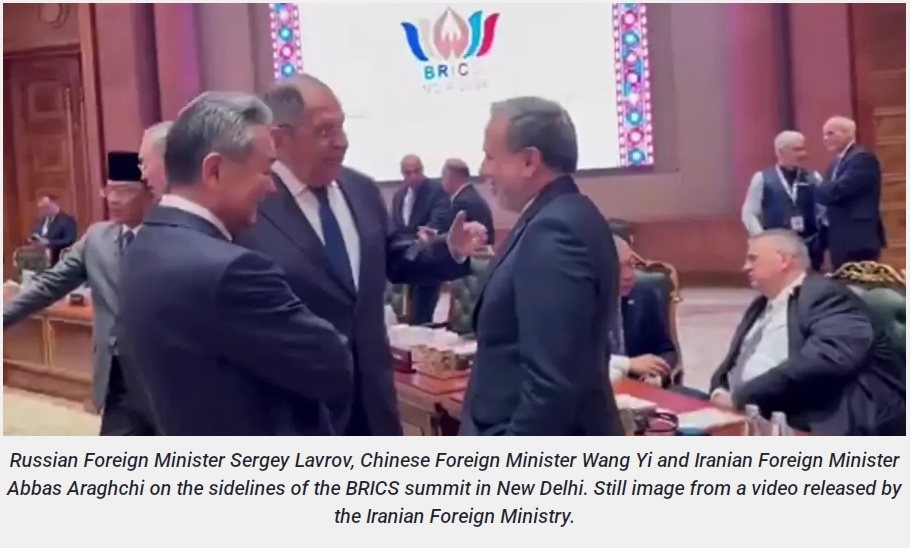
Diplomatic sources in Moscow and Tehran confirmed that Russia and Iran acted as a coordinated duo in New Delhi and were in complete agreement in their rejection of Washington’s war against Iran and the sanctions architecture.

The now viral photo of Lavrov, Wang Yi and Araghchi standing together like old friends only tells part of the story.

Yemen’s advance on the Red Sea is the maritime half of the same story.

Russia and Iran agreed on three points: condemning the US war, rejecting the sanctions regime as a whole, and resolutely opposing the secondary sanctions associated with US Treasury Secretary Bessent, that despicable former henchman of Soros.

In New Delhi, there were indications that the original RIC (Russia–India–China), as conceived by the late, great Yevgeny Primakov, might be revived – now as RIIC, supplemented by Iran.

Full article.

US set to approve 60,000 heavy bombs for Israel

In spite of the success of Yemen forces to take over the Red Sea and bomb Saudi Arabia’s oil production offline, there is no sign that the U.S. or Israel are close to admitting defeat.

On the contrary, it has been reported this week that the U.S. is preparing to sell 60,000 highly destructive, 2,000-pound (907kg) bombs to Israel in a multibillion-dollar package which will be funded by American taxpayers, a move that is almost unprecedented in modern history.

US set to approve 60,000 heavy bombs for Israel: What that means

by Yashraj Sharma
Aljazeera

Excerpts:

United States President Donald Trump’s administration is preparing to sell 60,000 highly destructive, 2,000-pound (907kg) bombs to Israel in a multibillion-dollar package which will be funded by American taxpayers.

US media has reported that the Trump administration has approved the sale, which features some of the most destructive munitions in Western arsenals, and has informally notified Congress.

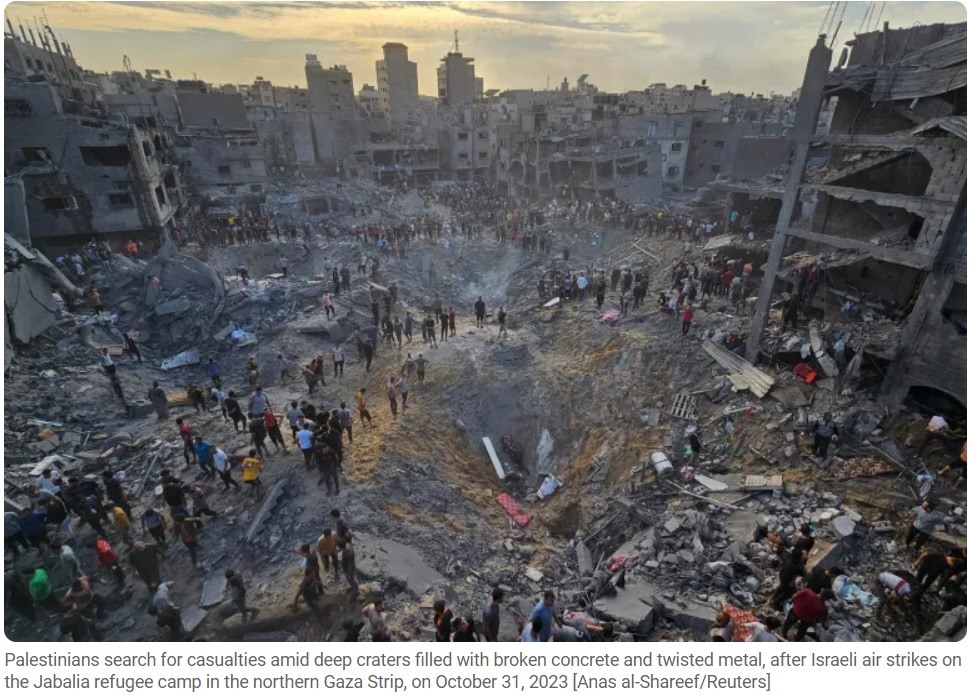
This is one of the biggest US munition packages to Israel and comes after nearly three years of genocidal war on Gaza, ongoing pogroms by Israeli settlers in the occupied West Bank and a mighty assault on southern Lebanon – which together have killed tens of thousands and displaced millions in the region.

It also comes as the US’s own munitions stockpile has been depleted due to its war on Iran, with the crisis worsened by Russia’s war on Ukraine.

Washington is reported to be on track to deliver a munitions package to Israel that is believed to include 60,000 warheads, including 20,000 MK-84s, 20,000 BLU-117s and 20,000 I-2000 Penetrator.

The sale is worth $2.8bn, the majority of which will be paid for by the US’s Foreign Military Financing scheme, wherein Washington pays Israel from its own taxpayers’ funds to buy American-made weapons and military equipment.

Together, 60,000 2,000-pound-class bombs weigh 54,400 tonnes.

That is about the weight of the entire steel skeleton of New York’s Empire State Building. Or seven times the weight of the iron structure of the Eiffel Tower.

Its mass also far exceeds the most infamous single conventional air raid of the 20th century. The March 1945 Tokyo firebombing, which killed more than 80,000 people in one night, used roughly 1,600 tonnes of bombs.

On a broader scale, 54,400 tonnes is nearly the total weight of bombs dropped on Berlin throughout World War II, and also roughly one-third of all bombs that fell on Japan’s home islands.

Full article.

Here are a couple of other stories I am monitoring that were posted on our Telegram Channel.

Drone Strikes Cripple Half of Russia’s Top Diesel Refineries

From OilPrice.com

Excerpts:

Three of Russia’s six largest diesel-producing refineries are now either shut or operating at roughly one-quarter capacity after Ukrainian drone attacks damaged plants that together form the backbone of the country’s fuel system.

The six refineries—Omsk, Kirishi, Taneco, Volgograd, NORSI and Perm—account for roughly half of Russia’s diesel production, according to Reuters calculations based on market data. Kirishi is completely offline. Volgograd and NORSI are running at about 25% of nameplate capacity.

Taneco was struck Sunday. The extent of the damage there was still being assessed Monday.

The attacks have become routine. The International Energy Agency estimates a Russian refinery was successfully struck by a drone once every three days during the first eight months of 2026.

Russia has already restricted exports of gasoline, diesel and jet fuel to preserve domestic supply. Diesel exports fell below 1 million metric tons in June, according to trader estimates cited by Reuters. Combined diesel and gasoil exports totaled about 1.8 million tons.

A year earlier, Russian refineries were shipping roughly 2.5 million tons of diesel each month, or 3.3 million to 3.4 million tons including lower-quality gasoil. Turkey and Brazil had been taking at least half of available Russian diesel cargoes before Moscow imposed the restrictions.

Those missing barrels are landing in a global diesel market already short on fuel from the Middle East. U.S. diesel prices crossed $6 per gallon last week for the first time, while refining margins have climbed as product inventories shrink.

Full article.

Saudi Pipeline Outage Hits an Oil Market Running Out of Buffers

From OilPrice.com

Excerpts:

The war in Iran that had to be over and won by the United States in about six weeks is now in its seventh month and the oil markets are starting to crack.

Gone are most of the cushions the market had in the early weeks and months of the Middle East conflict.

The oversupply from early this year has disappeared as oil on water was drawn down quickly when the Strait of Hormuz was closed to tanker traffic in March.

Record stock releases led by the International Energy Agency (IEA) depleted strategic inventories in developed economies, including in the United States, where the Strategic Petroleum Reserve (SPR) now holds the lowest level of crude oil since the early 1980s.

China, which strategically slashed its crude oil imports by about 4-5 million barrels per day (bpd) in May and June, has started to gradually ramp up purchases, removing a significant demand-side balancing mechanism that had prevented oil prices from spiking to record highs in the spring.

With few buffers left to absorb the six-month-long disruption of oil flows at the Strait of Hormuz, the last thing the market needed was an escalation that put a key non-Hormuz flow valve at risk.

But here we are: the vital East-West oil pipeline in Saudi Arabia, which helped the Kingdom bypass the Strait of Hormuz and export most of its crude oil from the Yanbu port on the Red Sea, is now out of service – possibly for weeks – following drone attacks at the end of last week.

Full article.

This article was written by Human Superior Intelligence (HSI)

See Also:

Understand the Times We are Currently Living Through

The Brain Myth: Your Intellect and Thoughts Originate in Your Heart, Not Your Brain

Is God’s Patience About to Run Out on the United States?

Second Edition of eBook Released: The Concept of the American Christian Family is a Myth and is NOT Found Anywhere in the Bible – by Brian Shilhavy

FREE eBook! Restoring the Foundation of New Testament Faith in Jesus Christ – by Brian Shilhavy

KABBALAH: The Anti-Christ Religion of Satan that Controls the World Today

Exposing the Christian Zionism Cult

The Bewitching of America with the Evil Eye and the Mark of the Beast

Jesus Christ’s Opposition to the Jewish State: Lessons for Today

Identifying the Luciferian Globalists Implementing the New World Order – Who are the “Jews”?

The Seal and Mark of God is Far More Important than the “Mark of the Beast” – Are You Prepared for What’s Coming?

The Satanic Roots to Modern Medicine – The Image of the Beast?

Medicine: Idolatry in the Twenty First Century – 10-Year-Old Article More Relevant Today than the Day it was Written

Having problems receiving our emails? See:

How to Beat Internet Censorship and Create Your Own Newsfeed

We Are Now on Telegram. Video channels at Bitchute, and Odysee.

If our website is seized and shut down, find us on Telegram, as well as Bitchute and Odysee for further instructions about where to find us.

If you use the TOR Onion browser, here are the links and corresponding URLs to use in the TOR browser to find us on the Dark Web: Health Impact News, Vaccine Impact, Medical Kidnap, Created4Health, CoconutOil.com.

The post Saudi Arabia is Exporting ZERO Oil as U.S. Sends Unprecedented Amount of 2,000-pound Bombs to Israel first appeared on Health Impact News.

  •  
❌