❌

Reading view

Laura and Cristina, a Brazilian couple with four kids: ‘If Bolsonaro wins we will be a bunker of resistance’

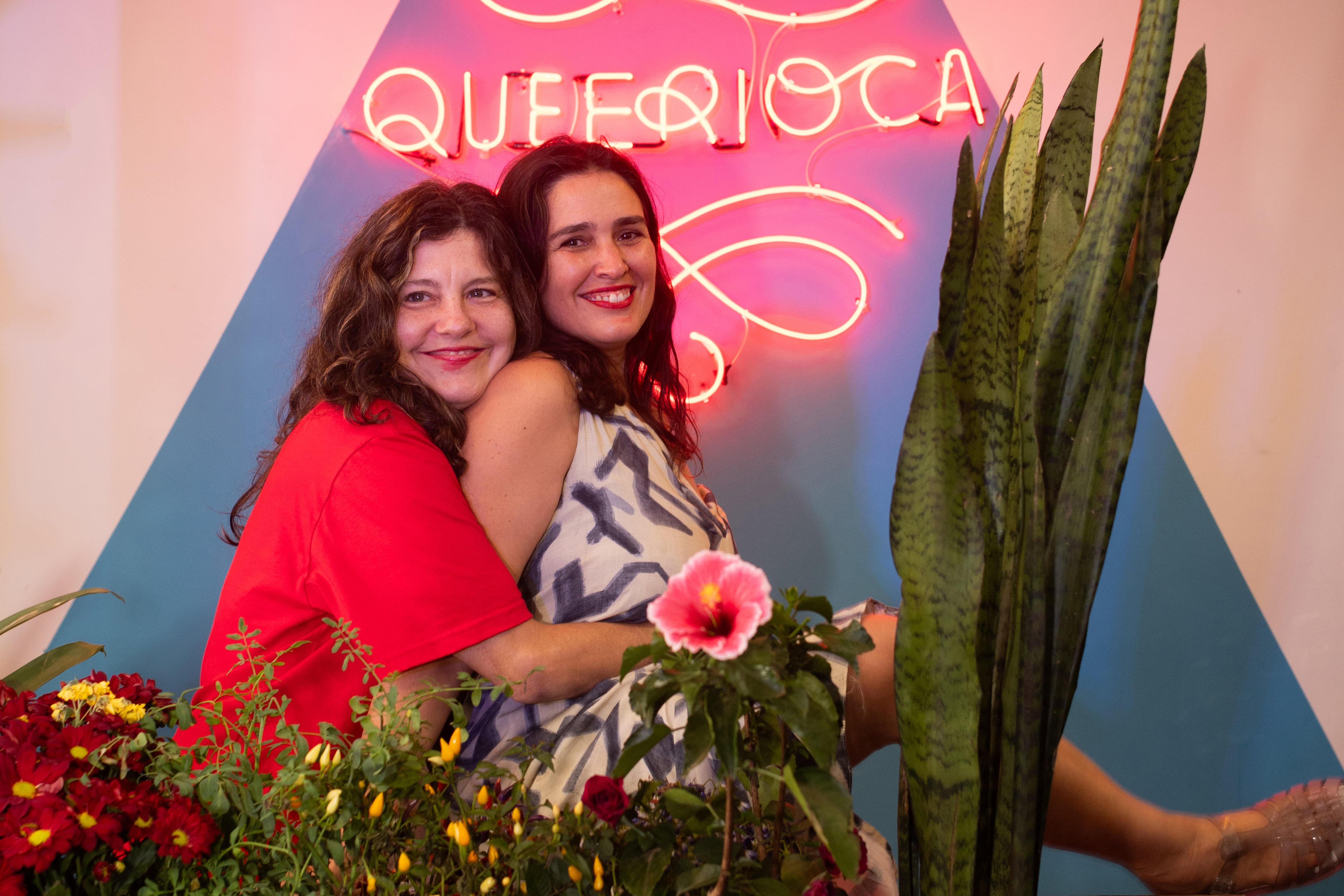
It’s Saturday night in Rio de Janeiro’s financial district and there are nothing but closed offices and dark streets, but around a corner, a three-story house lit in the colors of the rainbow appears. In front, a boisterous crowd is spread between tables, and there is even a sofa set out on the street. This is the atmosphere of Queerioca, a cultural center that has become the epicenter of Rio’s LGTBIQ+ community. There’s a DJ, laughter and caipirinhas, but also T-shirts bearing the face of President Luiz Inácio Lula da Silva, and some tension in the air. Brazil is holding general elections with the first round scheduled for Sunday, and the far right is knocking at the door.

Seguir leyendo

© Ana Alexandrino

Actresses Cristina Flores and Laura Castro, mothers of four kids, pose at Queerioca, the LGBTQ+ cultural center they run in Rio, in a photo provided by them.
  •  

A fake story about the Virgin of Aparecida, patron saint of Brazil, marks the end of the presidential campaign

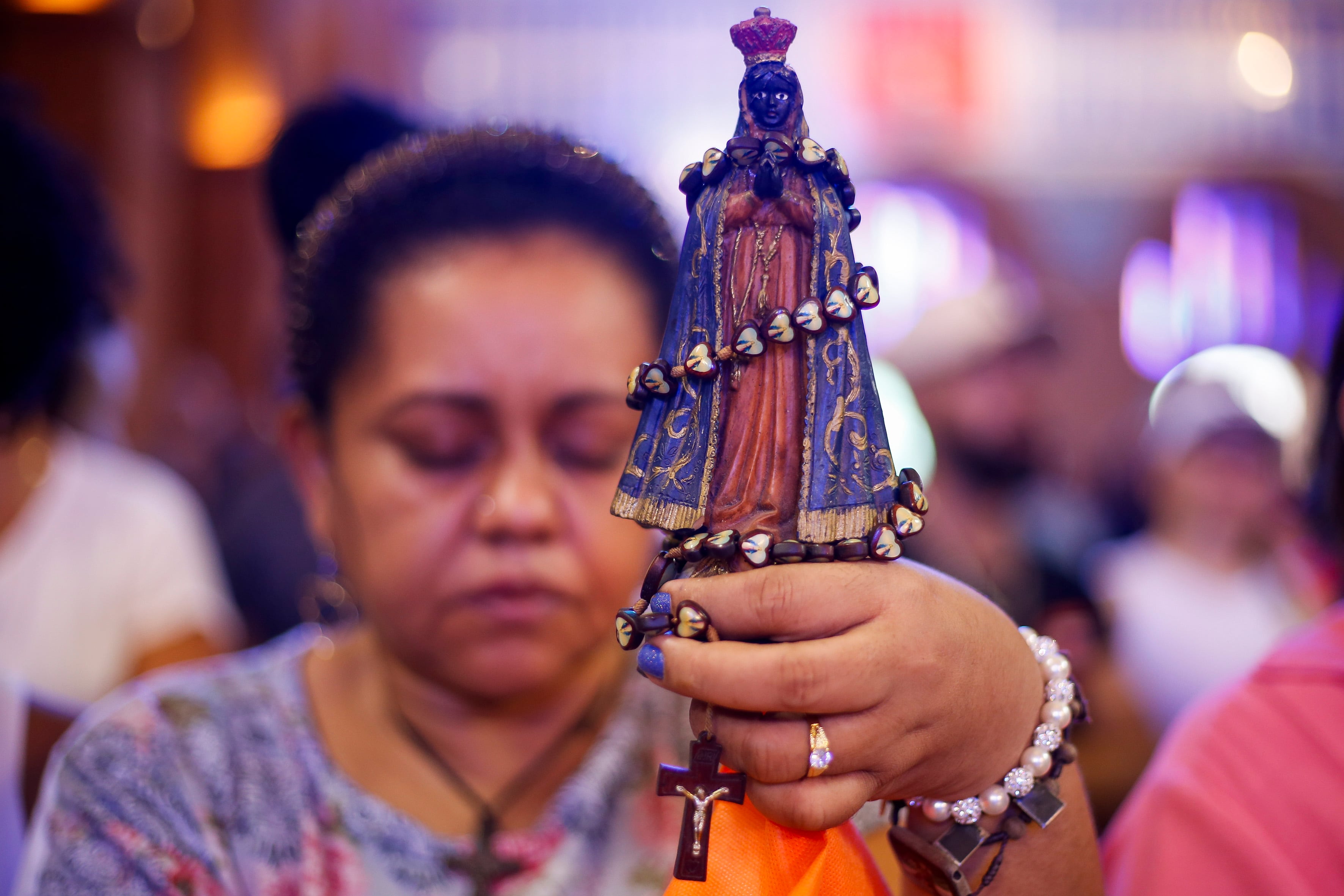
A fake story, with the Virgin of Aparecida, patron saint of Brazil, as an unwitting protagonist, has sparked a major controversy and poisoned the final stretch of the electoral campaign in Brazil. The contention, which harms Bolsonarismo, grew until it drew the direct intervention of the two leading candidates — President Luiz Inácio Lula da Silva and Flávio Bolsonaro — the Bishops’ Conference, and the Supreme Court. Since Thursday night there have been statements, official notes, mutual accusations, and conflicting judicial rulings. The falsehood, which continues to circulate on social media, could affect an election that promises to be extremely close.

Seguir leyendo

© Miguel Schincariol (Getty Images)

Tribute to Our Lady of Aparecida at the Basilica of the National Shrine, in Aparecida, São Paulo, on Thursday, October 12, 2023.
  •  

Brazil’s movements occupy streets across the country in defense of democracy and Lula’s candidacy

Militants and supporters of President Luiz Inácio Lula da Silva participated, this Sunday, September 27, in demonstrations as part of the national mobilization “Let’s go, Lula,” held a week before the first round of elections. In Rio de Janeiro, “CarnaLula 2026” spanned the length of Copacabana beach.

With a microphone, PT Senate candidate Benedita da Silva spoke about the importance of Carnival as an expression of popular culture and called on those present to also vote for a progressive bloc in the Rio de Janeiro Legislative Assembly and the Federal Chamber of Deputies. She reinforced the discourse that, in this election, not only democracy is at stake, but also national sovereignty. “We will not be anyone’s backyard,” she repeated Lula’s phrase.

Read more: Brazil’s presidential campaign heats up

In São Paulo, the event began with Carnival parades, circus performances, and bike rides on Paulista Avenue, where candidates gave speeches in defense of democracy. “Denialism will not prevail,” said Senate candidate Simone Tebet. Federal deputy Erika Hilton echoed Tebet, speaking about the importance of electing candidates who will steer Brazil away from fascism and who are in favor of the working class, as well as defending the end of the 6×1 work schedule. Also present at the event, actor Humberto Carrão told Brasil de Fato that he urged voters to decide the presidential election in the first round.

The capital of Minas Gerais, Belo Horizonte, was one of the cities with the largest number of activities in support of Lula’s re-election. Among them was a flag-waving demonstration in the city center, where hundreds of activists unfurled a banner that read “Lula of Brazil.” In a review of the event, Pedro Martins, a member of the Alvorada collective, one of the organizers of the action, spoke of the need to occupy the streets. “It was a spectacular event, with all the social movements gathered. This week was an important week, showing that we need to go to the streets, and only in this way can we turn the vote around and achieve victory,” he told Brasil de Fato.

In Florianópolis and Curitiba, supporters held a bike ride carrying flags in defense of Lula’s candidacy. In Brasília, the gathering was on the Eixão, a fast road that connects the Plano Piloto from north to south.

Lula’s campaign reported that the day’s events were organized in a decentralized manner, with more than 500 activities planned across the 27 state capitals and hundreds of municipalities. The program included walks, motorcades, leaflet distribution, and cultural performances.

First published by Brasil de Fato in Portuguese.

  •  

Brazil’s presidential campaign heats up

On October 4, nearly 160 million Brazilians will go to the polls to elect their next president, vice president, members of Congress, governors, and state legislators from the country’s various states. If no presidential candidate receives more than 50% of the valid votes, a runoff election will be held on October 25.

At this time, 13 presidential candidates are vying for the presidency in Brasília, although polls clearly point to two candidates vying for the presidency of Latin America’s most economically powerful country.

On one side is Brazil’s current president, the former union leader and progressive Luis Inácio Lula da Silva. Lula served as president from 2003 to 2011 with very high approval ratings, although following corruption allegations, he was imprisoned and sentenced to nine years.

However, after over 500 days in detention, a judge ordered his release, ruling that the proceedings were flawed. The Supreme Court of Justice called the incident a “historic error.” Following that, Lula faced off against then-far-right President Jair Bolsonaro and defeated him in the 2022 election. Now Lula hopes to be re-elected once again.

At the forefront is none other than Jair Bolsonaro’s son, Flávio Bolsonaro, who has leveraged his father’s reputation to boost his own. This is because Jair Bolsonaro was found guilty of several crimes that, according to the Brazilian justice system, were intended to prevent Lula’s inauguration and promote a coup d’état. Jair Bolsonaro is currently in house arrest for those crimes.

Consequently, a significant portion of Brazilian society, as well as international politicians such as Donald Trump, consider Bolsonaro’s imprisonment to be unjust. This explains how his son Flávio – a lawyer and businessman who currently serves as a senator – has managed to garner significant support in his bid to win the presidency on October 4.

Thus, two clearly distinct political and economic models are pitted against one another. Lula belongs to a political tradition that seeks to strengthen the state, reduce extreme poverty, invest in social programs, and diversify trade partners (such as China and India), all in line with a clearly pro-sovereignty discourse.

For his part, Flávio Bolsonaro promises to continue on his father’s path: economic neoliberalism, reducing the size of the state, building closer ties with the private sector, and – perhaps most importantly – placing Brazil once again under the influence of the Trump administration, which supports the far-right candidate.

Read more: Lula and Flávio Bolsonaro all set to face off this October in Brazil’s presidential election

Clearly, a victory for the far right – which is close to Washington – would represent a sharp shift in the region’s current economic and political course. Brazil accounts for nearly 50% of the region’s total GDP, so a victory for a Trump ally would drastically alter not only the political landscape but also the economic one. On the other hand, a victory for Lula would signal a “halt” (probably the most significant of all possible outcomes) to the wave of victories by the Latin American right and far right – allies and supporters of US hemispheric and military policy – that have swept the electoral landscape in recent years.

What do the polls say?

Since the start of the presidential race, Lula has maintained a lead over his political opponent. However, that lead has been narrowing as the weeks have gone by, raising the possibility that the runoff election, scheduled for October 25, will be a very close race. This is because, it appears, neither candidate will manage to secure more than 50% of the vote to win in a single round.

According to a poll by the MDA Pesquisa Institute, Lula holds a solid lead over Bolsonaro: 40.06% to 30.4%. Augusto Cury comes in third with 6% of the vote, while the remaining candidates trail behind this mark. According to this poll, in the event of a runoff, Lula would win with 47.3% against Bolsonaro’s likely 40%.

However, other polls paint a different picture, in which Lula remains in the lead but by a very narrow margin. This is according to an AtlasIntel poll, which shows Lula with 46% of the vote, while Bolsonaro would receive 44% in the first round. In the runoff, the gap would disappear, and both candidates would receive nearly 47% of the vote (a technical tie).

A corruption scandal that is shaking up the political landscape

However, everything could change in the wake of a scandal that has rocked Brazilian politics. In late 2025, the former owner of Banco Máster SA, Daniel Vorcaro, allegedly committed a serious case of bank fraud. Since his arrest in March 2026, his conversations, friendships, and connections have all been under close investigation.

One of the people who has come under scrutiny is Flávio Bolsonaro, who confirmed that he had asked the banker for money to make a film about his father called “Dark Horse”. The Federal Police are investigating this case to determine whether Bolsonaro participated in any illegal activity.

Meanwhile, Lula’s inner circle has also been affected. The judge who ordered Jair Bolsonaro’s arrest, Alexandre de Moraes, is alleged to have exchanged messages with Vorcaro. Moraes has been portrayed as a judge close to Lula and thus Bolsonaro and his supporters have seized on the revelation of the messages to call for Moraes’s removal and indirectly accuse the government of suspicious activities.

The debate has led to a serious crisis within the Brazilian judiciary because a decision to investigate Moraes was postponed, prompting accusations of political bias among the judges.

  •  

O futuro da diáspora não se escreve só com saudade. Escreve-se com inteligência!

Créditos: MDC Media Group

Durante décadas, quem saía de Portugal levava o país na mala de cartão, embrulhado em cartas, fotografias gastas e na promessa ou mesmo juramento de voltar em agosto. Para os milhões de portugueses e lusodescendentes espalhados pelo mundo, muitos deles aqui mesmo, no Canadá, onde o gelo do inverno nunca conseguiu arrefecer o calor da nossa portugalidade, o cordão umbilical sempre se alimentou de sacrifício, nostalgia e muito trabalho.

Mas o mundo mudou. Hoje, a tecnologia e a Inteligência Artificial surgem não para nos afastar, mas como a ferramenta mais poderosa para humanizar, aproximar e potenciar a nossa comunidade global. O algoritmo, por mais incrível que pareça, está a aprender a falar português com sotaque de saudade. Para a nova vaga de emigração, aquela juventude altamente qualificada que hoje enche os escritórios pelo mundo, mas que continua a dominar também os estaleiros, a Inteligência Artificial é uma ponte de soberania económica.

Portugal não pode continuar a dar-se ao luxo de “perder” este talento para sempre. O Governo e as instituições têm de acordar para esta realidade: através de plataformas inteligentes, é perfeitamente possível cruzar os perfis dos cérebros que temos na diáspora com cérebros e projetos de investigação em solo nacional. Já não é preciso fazer as malas de volta para ajudar a construir o futuro do país; basta estarmos ligados em rede. O nosso maior drama, contudo, continua a ser a perda de identidade nas segundas e terceiras gerações. Quantas vezes vemos, nas nossas associações e clubes no Canadá, netos de portugueses que já mal dominam o idioma, mas que sentem orgulho no sangue que lhes corre nas veias? A resposta para não os perdermos está também na educação através da Inteligência Artificial. Virtualmente, é possível hoje ensinar a Língua Portuguesa, adaptando-se aos interesses de cada jovem, usando a história, a gastronomia ou até saber mais sobre a aldeia de onde os avós partiram um dia. A cultura deixa de ser uma obrigação curricular aborrecida e passa, assim, a ser uma experiência interativa, viva e emocional.

Mas a tecnologia também tem de servir quem mais precisa. Para a nossa emigração com mais idade, aquela que construiu as fundações desta diáspora com sangue, suor e lágrimas, lidar com consulados à distância, tratar de pensões ou atualizar moradas fiscais continua a ser um autêntico calvário burocrático. É urgente que a administração pública portuguesa avance sem medos: a introdução de assistentes virtuais de voz, por exemplo, permitiria que um idoso na diáspora pudesse simplesmente falar com o seu telefone e obter respostas claras e simplificadas sobre os seus direitos. Menos papelada, menos esperas, mais respeito por quem deu tanto ao país.

Proteger a Língua Portuguesa nestes dias não é um capricho, é uma questão mesmo de soberania. A Inteligência Artificial não vai substituir a portugalidade; vai expandi-la. Ao encurtar milhares de quilómetros através de dados com rosto humano, provamos que a distância já não é o que era.

O futuro da nossa diáspora já não se escreve apenas com lágrimas de nostalgia, mas sim com inovação, ligação e inteligência. Só falta que quem governa saiba aproveitar e não perca o comboio que está a passar a grande velocidade.

Vitor Silva/MS

  •  

Urge un piano di ricollocazione per i lavoratori ex Ilva

I giudici hanno confermato la sospensione dell’attività dell’area a caldo dell’ex Ilva di Taranto. Per i lavoratori la situazione si fa critica. Però l’Istat registra la crescita degli occupati e della domanda di manodopera anche nel Mezzogiorno.

L'articolo Urge un piano di ricollocazione per i lavoratori ex Ilva proviene da Lavoce.info.

  •  
❌