G7 states will release up to 100 million barrels of emergency oil and diesel stocks over the next four months, French President Emmanuel Macron announced on 2 October, bowing to US pressure to tame diesel prices driven to record highs by the war on Iran.
The release will be coordinated by the International Energy Agency (IEA), and comes the same day as European Commission spokesperson Anna-Kaisa Itkonen said the EU “fully” rejected US threats to halt diesel exports unless Europe drew down more of its reserves.
“We fully reject any ban on diesel. A ban would not be beneficial to anyone. It would undermine our trust in the United States as a reliable partner,” she said.
She added that the EU Oil Coordination Group, due to meet on 15 October, could convene sooner if necessary.
Macron, who currently chairs the G7, had also spoken out against any export ban in a call with US President Donald Trump earlier that day, with his office saying he urged G7 states to act together “without export restrictions.”
The diplomatic scramble followed a push a day earlier from US Treasury Secretary Scott Bessent, who urged European states to speed up delivery on their existing reserve commitments.
“American farmers, truckers, and businesses should not be left carrying the burden of a global diesel shortage,” he wrote on social media.
Trump threatened the diesel export ban earlier this week, a move EU trade chief Maros Sefcovic warned would have “dramatic consequences for our economic performance.”
The US has threatened to starve France and Germany of diesel unless they release their emergency diesel stocks, with a European source saying Washington is pressing the EU to hand over 120 million barrels within six months.
China has also suspended refined fuel exports for October to rebuild its own depleted reserves, according to Reuters, further tightening a global market already strained by the US war on Iran.
Europe’s reliance on US fuel, which deepened after it banned Russian imports and the US-Israeli war on Iran cut supplies from West Asia, has cost the bloc more than $113 billion in extra energy payments this year, without it receiving “one extra molecule of gas or oil,” according to European Energy Commissioner Dan Jorgensen.
Meanwhile, Washington is also lending energy companies another 40 million barrels from its Strategic Petroleum Reserve (SPR).
The reserve has already fallen to its lowest level since 1982, and releasing the full amount would drag it below the minimum set under federal law.
Washington is sending more warships and troops to the Middle East as US President Donald Trump is considering the resumption of large-scale strikes against Iran after the midterms, AP has reported.
Trump told reporters on Thursday that he has “to make a decision: either Iran signs a very fair deal, or it won’t exist any longer.” In a Time magazine interview published the same day, he said that new attacks on the Islamic Republic were “possible” after the US election on November 3, but declined to reveal any further details.
In its article on Thursday, AP said that a third aircraft carrier and some 9,000 additional service members, including 7,000 sailors and 2,000 marines, are currently on their way to the area of the conflict with Iran.
It would increase the US military presence in the Middle East to more than 20,000, which is “an unusually high number,” it stressed.
The forces on the move include the USS Theodore Roosevelt carrier strike group, with the cruiser USS Chosin and the USS Makin Island amphibious readiness group, which includes the USS John P. Murtha and USS Anchorage amphibious landing ships, an unnamed American official told the agency.
With the USS George H.W. Bush and the USS George Washington already being deployed, three US aircraft carriers could be in the Middle East simultaneously as early as the end of October, according to the source.
Washington last had as many carriers in the region in April at the height of the American-Israeli missile exchanges with Iran. Before that, it happened back in 2003.
Axios reported on Friday, citing a US official, that it wasn’t yet clear if the USS Theodore Roosevelt would join the two carriers or replace one of them.
Washington also sent two additional Patriot missile batteries to protect oil and gas facilities in Saudi Arabia and Qatar in recent weeks, according to Axios. It was done to make it easier to get permission from Riyadh to use Saudi airspace for possible strikes on Iran, the outlet explained.
When asked by Time if the conflict with Tehran would harm the Republican Party’s chances in the midterms, Trump first acknowledged that “it’s possible,” but then said that “it should help, because Iran will not have a nuclear weapon.”
A poll by AP-NORC Center for Public Affairs Research, which was published on Thursday, suggested that some 70% of Americans disapprove of the war with Iran.
After the initial US-Israeli attack on the Islamic Republic in late February, Trump claimed that the conflict will be over in a few weeks, but it’s still ongoing, with the diplomatic process remaining in a stalemate.
Trump told Time that he rejected Iran’s latest peace proposal, made during the UN General Assembly last week, because “things that I wouldn’t have approved a year ago I wouldn’t have today.”
In September, Iranian Parliament speaker and top negotiator Mohammad Bagher Ghalibaf warned that further aggressive actions by the US will be met with “faster, heavier and more painful” retaliation by Tehran.
“The Americans have surely understood that the era of proportionate responses has come to an end and our recent strikes against aggressor bases were only a start,” Ghalibaf said.
Since the start of the latest made-for-Israel war, Donald Trump and his surrogates have repeatedly promised Americans that it would be a few weeks and oil prices would soon crash below prewar levels. Instead, it was every promise that crashed. When those promises failed to materialize, the message shifted: the war is worth the price to stop Iran from becoming a nuclear power.
But what if Iran did become a nuclear power? How would that pose a greater threat to the U.S. than North Korea or Russia already do? Or is the real concern not a risk to America, but a challenge to the regional hegemony of a foreign nuclear power, Israel?
For more than thirty years, according to Israel’s fiction, Iran was on the verge of becoming a nuclear-armed state. That fictitious deadline has come and gone repeatedly, yet Benjamin Netanyahu has been recycling the same lie since 1992. The Israeli lies and deceit persisted even though, unlike Israel, Iran’s nuclear program was subject to strict international monitoring.
Still, Trump, at Netanyahu’s urging, walked away from an agreement that imposed some of the most stringent and verifiable restrictions ever placed on a country’s nuclear program. Now Americans are being asked to pay in blood and billions of dollars for abandoning a diplomatic agreement that had kept Iran’s nuclear program under unprecedented international scrutiny and helped contain the very threat now being used to justify the war.
The hypocrisy is impossible to overlook. Iran has been subjected to relentless demands for transparency and inspections, while Israel’s own nuclear arsenal, built in part with materials stolen from the U.S., remains shielded from any international inspection.
Yet somehow Iran’s ambitious know-how is the existential nuclear threat, not Israel’s nuclear bombs.
American consumers have long been the victims of a disinformation campaign, and now they are being forced to pay the price for a war sold to them on false pretenses. The most recent misinformation claiming the Strait of Hormuz is open and oil is flowing. The president said it on Fox, and the outgoing White House press secretary told Fox & Friends that the U.S. is essentially controlling the strait and that it remains open. These claims leave only two possibilities: either the statements are outright lies, or oil companies are gouging the consumer.
The UK Maritime Trade Operations Centre reported that commercial traffic through the strait remains about 75 percent below pre-conflict levels. It also tallied dozens of projectile strikes on vessels in just the past two months.
Three quarters less traffic is not a sign of an open strait. Shipowners and insurers know this, so do traders and so the climbing numbers at the gas pump.
The market has already made its judgment, and every American who fills a tank can see it. It is past time for Washington to stop lying.
For the average consumer, the pump is where it felt. Regular gasoline was below $3 a gallon before the U.S. was dragged into another one of made-for-Israeli wars. Families are paying more to get to work, truckers are paying more to move goods, and those costs show up in the price of groceries.
Meanwhile, American oil companies are pumping at record levels. Exxon and Chevron are producing record volumes from oil fields on American soil, thousands of miles from the Strait of Hormuz. Their production costs have not changed. What has changed is Israel’s war surcharge consumers are being forced to pay.
Chevron reported the largest quarterly net profit in its history, $12.1 billion. Exxon made $14.5 billion in the same quarter, about $160 million a day. Refining has become more lucrative. Gross refining margins more than doubled, soaring from a typical $20 crack spread to as much as $60.
Meanwhile, Trump dangles a pie-in-the-sky deal with Venezuela as a distraction from consumers’ mounting anxiety, while his administration stands by as oil companies exploit overseas crises for record profits. These companies have no reason to lower prices when war has handed them a windfall. This is what a war of choice looks like on the ground: American consumers are forced to pay the price, while oil executives in Texas turn a crisis into a lucrative business opportunity.
American consumers deserve more than false promises. If the Strait is open, then oil prices should be coming down. If it is not, then stop treating consumers as an audience whose emotions must be managed rather than citizens entitled to hear the truth. Since the war started, every week, like millions of Americans, I fill my gas tank, and the Israeli war tax is higher than it was the week before.
No, Mr. President, that is not “worth the price” to pay for a war fabricated in Israel, a repeat of the made-for-Israel war in Iraq 23 years ago.
This is not a war to end Iran’s fictitious nuclear power. It is a war paid for by taxpayers’ money and American blood to ensure that Israel remains the only absolute nuclear power in the Middle East.
US President Donald Trump has officially announced a formal withdrawal of American troops from Iraqi territory, yet the economic, social and diplomatic hold on the nation remains. If US troops are going to be permanently booted out, it necessitates an Iraqi national resistance that is capable of operating as a guarantor.
On October 21, 2011, former US President Barack Obama announced that the United States had withdrawn its remaining occupying forces from Iraqi territory. Then, only two and a half years later, the US re-deployed its forces back into the country under the guise of fighting the Daesh insurgency.
Iraq, having experienced a regime change operation followed by a brutal occupation and nationbuilding project, was left incapable of defending itself from the ISIS takeover, let alone pushing back against the United States redeploying its forces. First, the Obama administration deployed forces that it said were there to protect its diplomatic staff, in addition to advisors to the Iraqi armed forces.
Later it would expand this presence, expanding its “Operation Inherent Resolve” into Syrian territory, providing it with supply routes and a platform from which to de facto occupy northeastern Syria. The US operation in Syria and Iraq helped them eventually achieve their longtime goal of regime change in Damascus by depriving the Syrians of their access to the nation’s oil resources and fertile agricultural lands.
In 2020, Donald Trump had agreed to remove his forces from Iraqi territory, re-iterating this pledge during a meeting with then Iraqi PM Mustafa al-Kadhimi. The following year, former President Joe Biden then declared the official end of his nation’s combat mission inside the country. Only now, in 2026, and after extensive attacks on US military facilities by the Islamic Resistance in Iraq, has the pledge to withdraw American forces been followed through on.
When the US and Saudi Arabia recently blamed Iraqi forces for carrying out an attack on Riyadh’s East-West Pipeline, launching a large-scale bombing campaign across the country, some Iraqi officials instead issued statements against Iraq’s armed factions that had vehemently denied involvement in the incident.
The Trump administration is openly pushing for the disarmament of all military factions within the country, a project Washington has also sought to impose on all Resistance groups across the region. The United States has not allowed for there to be a reasonable integration of Resistance forces like Hezbollah in Lebanon with the Lebanese Armed Forces, nor allowed time for formal agreements to be struck in Iraq of a similar nature. Their goal is simply to disband these groups and then exert control over the armed forces of Lebanon and Iraq, leaving them all but defenseless and without access to strategic weapons capable of deterring violations of national sovereignty.
In the case of Baghdad, the nation’s government was a construct of US occupation; Washington still holds the economic cards that are capable of pressuring any leadership, no matter how well-intended its goals are, while it maintains an enormous soft-power pull through its extensive NGOisation project inside the country. Iraq was not allowed to rebuild its nation’s military following the toppling of Saddam Hussein’s rule in 2003, leaving it defenseless against ISIS terrorism a decade later.
On the ground, this is why there was a need for the Hashd al-Shaabi (Popular Mobilisation Forces) to emerge. It was the Hashd that was chiefly responsible for defeating the terrorist invasion and purging its militants from Iraqi cities. Many of these groups that fought under the banner of the Hashd then went on to develop considerable military power and an extensive arsenal.
As revealed during the Ramadan War earlier this year, the Israeli Mossad was able to develop bases inside Iraqi territory, while numerous militant groups still exist across the country’s territory, including various armed factions that are backed by the CIA and the Mossad.
If the Islamic Resistance in Iraq is disbanded and disarmed, then Iraq will be in the exact same defenseless position that allowed for ISIS to sweep through the nation so rapidly and seize so much territory, leaving behind a trail of blood in their wake. This poses a threat to not only Iraq, but other neighbouring countries, including Iran. It threatens Syria’s fragile status quo too.
An Iraq without the Islamic Resistance would be like a Lebanon without Hezbollah, completely left at the mercy of the United States and their Israeli allies. Washington and Tel Aviv have a project that aims to totally dismantle regional sovereignty; this is why they have dedicated trillions of dollars and countless resources to destroying the armed forces of both Iraq and Syria over a period of nearly 30 years now. They are not about to simply sit by and allow Iraq and Syria to rebuild capable militaries, allowing them to follow the will of their people and to defend their own national interests.
The United States still maintains its air defence systems inside Iraqi territory, can use the country’s airspace at will and, as we saw only months ago, will launch airstrikes across the nation at the drop of a hat.
In order to deter a return of American occupation forces, under the guise of fighting whatever future threat they choose to use, there must be an Iraqi military force that is capable of acting in defense of the country, both on the ground and through the use of its long-range munitions if need be. A nation without a real military force cannot enjoy sovereignty. And a nation that is not able to go against the will of the United States, will serve as its proxy and will suffer the blowback that is inherent in complicity.
The US withdrawal from Iraq did not happen without a long history of resistance against its forces and public opinion that also opposes American interference. Protecting the achievement of ridding the country of the majority of US forces takes real military deterrence. Otherwise, the Israelis and the US will simply use the country’s territory for whatever projects they wish.
European NATO members should have been able to attack Iran instead of relying on the US and Israel, according to Secretary-General Mark Rutte, the head of the self-described defensive alliance.
Iran has been attacked twice in two years, both times over allegations that it seeks to develop nuclear weapons, which Tehran rejects as false. Speaking at the Euronews Defence & Space Summit on Friday, Rutte endorsed the idea that European nations should acquire the military capabilities needed to carry out such wars of aggression themselves.
In the future, “the Europeans will be able to take care of their backyard themselves. It should be us doing this, not the Americans,” he said.
“Europe was not able to take out the nuclear capability of Iran. We couldn’t. We didn’t have the capabilities. In 10 years, we can and we should,” he added, referring to multi-billion euro rearmament efforts now underway in European members of the military bloc.
Earlier in the day, the NATO chief dismissed Russian concerns over hostile rhetoric by some members of the bloc regarding the Russian exclave of Kaliningrad Region.
“Basically what we said is, ‘hey, listen, we are a defensive alliance, and stop the nuclear threat’,” he told journalists when asked about a formal warning Moscow had sent to Brussels.
Russia cited remarks by Polish Foreign Minister Radoslaw Sikorski, who proposed in September deploying additional troops near the Russian border so that Moscow would be “uncertain of what we will do.” Moscow said it would use its “entire available arsenal” to defend Russian territory from a possible attack by NATO states.
NATO was created in the early years of the Cold War, ensuring a continued US military presence in Western Europe. The Soviet Union later established its own military alliance, the Warsaw Pact, which no longer exists.
While NATO describes itself as a defensive alliance, it has carried out military attacks against other countries, including the UK- and French-led 2011 intervention in Libya, after which the North African state was balkanized.
Russia considers NATO’s eastward expansion since the end of the Cold War a major national security threat and has cited it as one of the principal causes of the Ukraine conflict.
Rutte’s argument in support of the US-Israeli attacks on Iran echoed remarks by German Chancellor Friedrich Merz, who said in June 2025 that the Israelis were doing “[the] dirty work for us.”
Palestine This Week | Middle East Monitor | September 30, 2026
This week’s MEMO review examines claims about Netanyahu’s advance knowledge of 7 October, his provocative UN speech and Israel’s sweeping West Bank closure. We discuss calls to free Marwan Barghouti, moves to bar Arab-led parties from Israeli elections, Trump’s rejection of Iran’s proposal and allegations of election interference involving Israeli firms.
No one would claim that the Iran War has been a political godsend for President Donald Trump and the Republican Party. But some Israel-First conservatives are willing to say—and lately have been incessantly saying—that the Iran War hasn’t been a political scourge.
Those Israel-First conservatives are wrong, even if the devil is, at least partly, hidden in the details. The Iran War has damaged Trump’s approval ratings, consumed his presidency, and darkened the GOP’s prospects in the upcoming midterm elections.
A chief proponent of the argument that Trump hasn’t suffered all that much from the Iran War is Ben Shapiro of the Daily Wire. Shapiro’s political analysis is plainly motivated by the fact that he was a loud and influential proponent of the war who promised—falsely, as it turned out—that Iran couldn’t close the Strait of Hormuz, a chokepoint for the global energy trade.
“There’s an op right now to pretend that the real reason for President Trump’s unpopularity is foreign policy, but that is not true, by the polling data, it is not true,” said Shapiro on a recent episode of his podcast. “The reality is that Americans have affordability concerns, President Trump came into office saying he was going to alleviate the affordability concerns. He has not in fact alleviated the affordability concerns, and therefore, his polling numbers have consistently slid since Liberation Day.”
This is a bit like me saying my wife isn’t mad at me because of the drinking, but because I drunkenly crashed the car.
The Iran War, as everyone now knows, has driven up prices at the pump—prices which, unfortunately for Trump, are prominently displayed on every major street across the country. On the eve of the war, regular gasoline averaged $2.98 per gallon. Today, at the time of writing, the average price is $4.48. Americans are notoriously averse to high gasoline prices and tend to punish presidents over the issue, sometimes even when the president can’t justifiably be blamed.
But make no mistake: Virtually every sentient adult understands that 1) oil comes from the Middle East, 2) Trump started a big war in the region, and 3) gas prices shot up right afterwards. And again, even if Americans didn’t grok the connection between the war and the gas-price spike, the latter would still have hurt Trump politically, and it would still be a knock-on effect of the former.
It’s not just prices at the pump that have gone up because of the war. Groceries and other consumer goods travel across this vast land on tractor-trailers that run on diesel and get a lot fewer miles per gallon than even your Uncle Larry’s F-350. Diesel prices have smashed records and now sit at around $6.50, up from $3.76 before the war.
No wonder truckers are furious, prompting rumors of an imminent strike.
And no wonder the Iran War has contributed to general inflation in America. Anyone who has been reading the official economic reports knows the war is responsible for more than a third of recent inflation.
Before the war, inflation was trending down, only a couple ticks away from the Federal Reserve’s target of 2 percent. It seems likely that Trump, if he hadn’t started his dumb war in the Middle East, would have garnered praise for presiding over declining inflation and that the Fed would have cut interest rates, juicing economic growth. Instead, inflation now sits at 3.4 percent.
(As an aside, this weekend I traveled to Istanbul, where many Middle Easterners of various nationalities complained to me that Americans only oppose the war because of the gas prices. That’s simply not true. The war has been unpopular since day one, when all that Americans knew was the American-Israeli strikes had killed Iranian leaders including the Supreme Leader Ali Khamenei.)
Shapiro, ever the neoconservative, insinuated in the quote above that the decline in Trump’s approval rating owes more to his tariffs than to his war. The data doesn’t back that up, as the conservative commentator and election analyst Ryan Girdusky noted on X in response to new survey data. “The most eye opening part of this poll is that Trump’s approval rating and the strength of the economy went up right after Liberation Day,” Girdusky said. “Fell slightly afterward and then plummeted at the start of the Iran War.”
Shapiro has unwittingly helped uncover another, subtler, way in which the Iran War has indirectly damaged Trump’s approval ratings and, by extension, the Republican Party brand. Shapiro recently went on Fox News to commiserate with the host Mark Levin—another Israel-Firster and warmonger—over all those dastardly antiwar conservatives blaming the Iran War for everything.
“Iran is a 4-percent issue with the American people,” Levin said, as Shapiro nodded in agreement. Levin was referring to Fox News polling that shows not many Americans name the Iran War as their top issue. “So, whatever happens in the midterms, it doesn’t appear that Iran’s going to drive anything one way or another.”
“I think that’s exactly right,” Shapiro replied.
Part of the problem with Levin’s analysis has already been covered above. In the Fox poll, a plurality of Americans—34 percent—named the cost of living as the most important issue, and the Iran War has made living costlier.
But the subtler problem is perhaps even more illuminating. Simply put, Americans believe Trump is too focused on foreign policy at the expense of the problem they really care about, which, in fact, his Iran War has exacerbated. This is a PR disaster for the Trump administration and the GOP. Americans don’t prioritize the war that has dominated the headlines and distracted the White House, even as Trump claims to have boldly prevented Iran from unleashing nuclear apocalypse.
It may be grotesque to find silver linings in this dumb and deadly war, but here’s one: Americans no longer buy the war narratives. That is certainly not, however, a silver lining for Republican candidates in this year’s election, no matter how cynically they try to distance themselves from the war. In fact, it’s a good bet they’ll do much worse than if Trump hadn’t launched this unnecessary war, despite what Shapiro and his ilk may tell you.
US Treasury Secretary Scott Bessent’s prediction that Iran’s economy would soon collapse underscores the depth of delusion within the current American leadership.
“Iran is absolutely not sanctionable,” Deputy Economy Minister Mortaza Zamanian said this week as Tehran worked to keep trade flowing despite Washington’s latest sanctions campaign.
Zamanian cited Iran’s extensive borders, established commercial routes and longstanding trading relationships, saying that they make it impossible for external pressure simply to switch off the country’s economy.
His remarks came as Washington intensified its economic terrorism against Iranian oil, shipping, aviation, finance, technology and foreign companies supporting those sectors.
US Treasury Secretary Scott Bessent said that Iran would probably make its final oil deliveries to China within two weeks, after which, he asserted, “they will have nothing.”
That prediction deserves comparison with history, because American administrations have imposed increasingly severe sanctions since 1979 while repeatedly expecting economic pressure eventually to produce decisive Iranian economic collapse.
The economy did not disappear under those campaigns; instead, Iran developed domestic industries, expanded regional commerce, strengthened Asian trade and accumulated extensive experience operating outside Western financial systems.
The proposition that an economy which has absorbed American sanctions for almost half a century will suddenly become economically empty within two weeks therefore indicates the depth of delusion among the current US leadership.
Iran enters the current confrontation with a large domestic market, substantial productive capacity, enormous energy resources and deeply established commercial relationships extending across neighboring countries and wider Eurasian markets.
The World Bank describes Iran as relatively diversified for an oil-exporting economy, with substantial manufacturing, agricultural and service activity supported by a large population and significant domestic consumption.
That domestic market sustains production across food, pharmaceuticals, construction materials, steel, petrochemicals, machinery and consumer goods, meaning Iranian production does not depend entirely upon continuous access to Western consumers.
Iran has also developed major industrial capabilities suited to its own resources and infrastructure, including steel, refining, petrochemicals, cement, power generation, construction, food processing and pharmaceutical manufacturing.
These capabilities have continued developing despite restrictions on Western investment and technology, demonstrating that Iranian industrial activity does not depend upon permanent participation by Western companies.
Iran’s prolonged exposure to sanctions has produced accumulated technical and commercial knowledge, giving Iranian companies decades of experience managing restricted supply chains and unreliable access to foreign suppliers.
When foreign manufacturers withdraw, Iranian companies have learned to redesign equipment, substitute components, develop domestic suppliers and cooperate with businesses from countries willing to maintain commercial relationships.
Academic research has documented this process, showing that sanctions can simultaneously restrict foreign technology while encouraging domestic technological development and adaptation within affected Iranian industrial sectors.
The resulting knowledge extends beyond individual companies, because engineers, technicians, procurement specialists and managers have accumulated practical experience managing shortages, substitution and alternative sourcing.
Iranian manufacturers therefore do not design procurement systems around the assumption that every international supplier will remain available indefinitely, making adaptation part of ordinary commercial planning.
Iran’s geography provides another economic advantage, because the country borders Turkey, Iraq, Armenia, Azerbaijan, Turkmenistan, Afghanistan and Pakistan while possessing coastlines reaching the Persian Gulf and the Sea of Oman.
Those borders connect Iranian commerce with the Caucasus, Central Asia, South Asia, the Persian Gulf, Turkey and Iraq, while transportation corridors also connect Iran with Russia and wider Eurasian markets.
Financial sanctions can make transactions more difficult, but they cannot physically relocate Iran or eliminate its access to neighboring markets, suppliers, transportation routes and established regional trading relationships.
Iran has consequently developed commercial links involving Iraq, Turkey, the United Arab Emirates, Afghanistan, Pakistan, the Caucasus, Central Asia and China through years of sustained economic interaction.
The World Bank has documented Iran’s increasing trade orientation toward neighboring countries and China as sanctions restricted conventional international relationships, making this regional pivot an established economic feature.
China adds another dimension because it combines enormous industrial capacity with sustained demand for Iranian energy while supplying machinery, manufactured products and industrial inputs required throughout Iran’s domestic economy.
The US-China Economic and Security Review Commission identifies China as Iran’s largest trading partner and estimates that China imported approximately 1.4 million barrels of Iranian crude daily during 2025.
Chinese independent refiners have continued purchasing Iranian crude through commercial arrangements designed to reduce their exposure to American financial restrictions and sanctions enforcement.
That relationship demonstrates why Iran does not require unrestricted access to every Western market when Chinese demand and extensive regional commerce provide alternative markets for Iranian commodities.
Iran’s energy resources provide enormous economic depth, with the World Bank ranking the country second globally in proven natural-gas reserves and fourth globally in proven crude-oil reserves.
Those resources provide export potential while also supplying abundant domestic energy and petrochemical feedstocks supporting manufacturing, electricity generation, transportation and numerous energy-intensive industrial activities.
Iran has consequently developed a substantial downstream economy converting hydrocarbons into refined products, petrochemicals and industrial inputs rather than depending exclusively upon crude-oil exports.
The World Bank has noted that sanctions encouraged additional processing of hydrocarbons into petrochemicals, illustrating how restrictions contributed to changes within Iran’s export structure.
Iran has also developed financial mechanisms outside conventional Western banking, including bilateral currency arrangements, exchange houses, barter, intermediary companies and indirect settlement channels supporting international commercial activity.
The World Bank has documented growing use of bilateral currency exchange, barter and indirect payment mechanisms as Iranian trade shifted increasingly toward neighboring countries and China.
These arrangements provide alternative methods for exchanging value when conventional dollar-based transactions become unavailable or prohibitively difficult.
Their existence helps explain why Washington increasingly targets third-country banks, intermediaries and commercial facilitators, because Iranian commerce extends through extensive international networks beyond domestic financial institutions.
Against this background, Bessent’s prediction assumes that eliminating a major source of oil revenue would effectively remove the broader economic foundations supporting Iran’s productive system and commercial institutions.
Iran’s economic structure is considerably broader, because oil exports represent one component of national activity alongside manufacturing, agriculture, services, domestic consumption and regional commerce.
The World Bank estimates that Iran’s economy contracted during the Iranian year ending March 2026, while simultaneously describing adaptation through changing trade patterns and alternative payment mechanisms.
Economic contraction, however, is fundamentally different from the disappearance of productive capacity, infrastructure, commercial institutions and domestic relationships sustaining millions of Iranian consumers and businesses.
American sanctions have repeatedly targeted Iranian banking, oil exports, investment, technology, shipping and foreign companies, yet Iran has retained its industrial base and redirected substantial trade toward neighboring countries.
Washington possesses powerful financial tools, but financial restrictions cannot physically eliminate Iran’s factories, oilfields, farms, engineers, consumers, ports, borders or commercial relationships accumulated over decades.
The central question is therefore whether American pressure can erase the productive, geographical, resource and commercial foundations Iran has accumulated across nearly half a century of economic adaptation.
Nothing in Iran’s economic history demonstrates that those foundations can disappear within two weeks, particularly while the country retains domestic production, regional markets, energy resources and established commercial relationships.
Iran therefore enters the present confrontation with domestic capabilities, energy resources, industrial capacity, geographic advantages and international relationships capable of keeping its economy operating despite intensified American terrorism.
Hezbollah’s Media Relations Office categorically denied any relationship or affiliation between the party and the alleged cell that the Syrian Interior Ministry said it had apprehended in the Yarmouk Basin in Daraa.
In a statement, the Lebanese Resistance reiterated that it has no presence on Syrian territory and is not involved in any security or military activity there, stressing its longstanding commitment to Syria’s security and stability and the safety of its people.
Hezbollah points to Israeli regional scheme
The party called on the Syrian authorities to “remain vigilant against attempts to implicate its name in order to stoke tensions and sow discord between Lebanon and Syria.”
It urged the Syrian authorities to investigate the circumstances surrounding the allegations, identify those behind them and determine who stands to benefit from escalating tensions between the two countries.
Hezbollah pointed to “Israel”, accusing it of intensifying its attacks on Syria and Lebanon and seeking to undermine the security and stability of the region.
Earlier this month, Hezbollah’s Media Relations Office has categorically denied any connection to a security cell reportedly arrested on suspicion of seeking to destabilize Lebanon and Syria, dismissing the accusations as entirely baseless.
In July, Hezbollah rejected claims tying it to an attempt to smuggle weapons and missiles across the Syrian-Iraqi border, after Syrian authorities said they had intercepted a shipment concealed inside a fuel tanker arriving from Iraq. Also in April and May, the group denied allegations linking it to a cell accused of plotting to assassinate a religious figure.
Hezbollah has affirmed on each occasion that it maintains no activity, connection, or presence inside Syrian territory. The group has said the repetition of such claims raises serious questions and points to parties seeking to inflame tension between the Syrian and Lebanese peoples.
The Lebanese Resistance has also pointed to similar fabricated allegations emerging from Bahrain and Kuwait, warning of a foreign plot aimed at stoking tensions between Arab nations and the Axis of Resistance and destabilizing the wider region.
Iraq’s government has declared September 30 the final date for ending the US-led coalition’s military mission. Prime Minister Ali al-Zaidi’s office says October 1 will find the country “free of any foreign military presence,” closing a deployment that once reached about 170,000 US troops.
But withdrawal leaves intact much of the damage inflicted by the invasion and the 13 years of sanctions that preceded it, along with the financial arrangements through which Washington continues to exert influence.
The US left Iraq’s productive economy devastated, its institutions dismantled and reshaped, and its workforce left increasingly dependent on a state funded by oil. Access to that income remains vulnerable to US pressure.
The question after the troops leave is how much control Iraq will have over the economy they leave behind.
Thirteen years of sanctions
The erosion of Iraq’s economy began long before March 2003. The UN Security Council imposed sweeping sanctions after Saddam Hussein’s regime invaded Kuwait in 1990. Drawing on internal UN records, Joy Gordon’s Invisible War describes one of the most comprehensive and devastating sanctions regimes ever imposed.
The embargo quickly collapsed incomes. Reconstructed World Bank estimates showed GDP per capita collapsing to a third in a single year, going from about $3,527 in 1990 to $1,255 in 1991.
Public employees who had earned $150 to $200 a month before sanctions were earning $3 to $5 by 1996, according to a 1997 assessment. By 2000, the International Committee of the Red Cross reported salaries as low as $2 a month and unemployment around 50 percent.
Factories, power stations, and water plants could not recover without imported equipment and spare parts. Yet any member of the sanctions committee could hold an entire contract indefinitely, even over a single disputed item. Gordon documents Washington’s use of the “dual-use” designation to restrict goods as basic as water pipes. By August 2002, the UN counted 2,058 contracts worth about $5.2 billion that had been placed on hold, including $745 million in oil industry equipment.
The restrictions also placed Iraq’s oil income beyond Baghdad’s direct control. Under the Oil-for-Food program, buyers paid into a UN-administered escrow account. After deductions for compensation, administration, and weapons inspections, the proceeds could finance only approved purchases. Iraq exported roughly $65 billion in oil under the program but could not use that money as ordinary budget revenue for wages, maintenance, or local services.
The collapse pushed skilled workers out of their professions. A UN humanitarian survey of 1,157 degree holders employed by aid organizations found 725 in general-service or menial jobs, including doctors, engineers, and scientists working as drivers, clerks, and guards.
By the time US troops arrived, Iraq had endured years of falling wages, industrial decline, and lost expertise. The occupation’s first decisions deepened that damage.
Dismantling the state, contracting out reconstruction
On May 16, 2003, the occupation authority issued Order 1, barring senior Baath Party members from public employment and requiring the screening of senior staff in ministries, hospitals, and universities. A week later, Order 2 dissolved the Defense Ministry, army, Republican Guard, and intelligence bodies.
The International Center for Transitional Justice estimates that Order 2 alone left about 400,000 conscripts, officers, and officials without jobs. The World Bank counted more than 2 million unemployed Iraqis, nearly 30 percent of the labor force, around 2003–2004. Meanwhile, Iraq’s health minister estimated that roughly half the country’s prewar doctors had fled as kidnapping and assassination made their work increasingly dangerous.
The occupation then opened the weakened economy to foreign competition. Order 39 allowed wholly foreign-owned companies and guaranteed investors treatment no less favorable than Iraqi businesses, while excluding natural resource extraction. Other orders suspended tariffs, later replaced by a flat 5 percent levy, and capped income tax at 15 percent from 2004. The World Bank warned that rapid opening would cost jobs in a country whose private sector was too weak to employ displaced workers.
Reconstruction brought billions of dollars, but much of the spending flowed through foreign contractors. The United States spent more than $60 billion over roughly a decade, according to the Special Inspector General for Iraq Reconstruction (SIGIR). More than $25 billion went to training and equipping security forces after the occupation had dissolved Iraq’s existing military institutions.
SIGIR found that reconstruction began without adequate security, consultation with Iraqi ministries, or planning for long-term maintenance. Its final report estimated waste at $3 billion to $5 billion from the main reconstruction fund and as much as $8 billion overall. The largest early infrastructure contracts went mainly to US firms. A $1.8 billion award to Bechtel in January 2004 was open only to American bidders.
Iraq’s own money followed a similar path. UN Security Council Resolution 1483 established the Development Fund for Iraq to receive oil revenue, with the occupation authority directing spending until June 2004.
An Iraq Revenue Watch analysis of contracts paid from Iraqi funds found that US companies received 74 percent of their value. US and British companies together received 85 percent, while Iraqi firms received 2 percent. Audits found that 73 percent of the value of Development Fund contracts above $5 million had been awarded without competitive bidding.
Oversight was inadequate even to establish how some of that money had been used. A 2010 SIGIR audit found that the Defense Department had failed to establish required accounting controls for about $8.7 billion of the $9.1 billion it received from the fund. It could not document spending of about $2.6 billion.
The result was a reconstruction process that directed vast sums abroad while leaving Iraq with damaged services, limited productive capacity, and institutions struggling to rebuild.
An oil-funded system of patronage
With factories closed or looted and no private industry to replace them, the state became the place where Iraqis look for work. An assessment by the International Fund for Agricultural Development, using World Bank data, says public employment accounts for nearly all formal jobs and 40 percent of all jobs. Salaries and pensions took about 90 trillion dinars, roughly $69 billion, more than 40 percent of the 2024 budget, and the World Bank says another half a million government jobs were added during the spending expansion that preceded 2025.
The private sector has not filled the gap. Estimates put imports at more than 90 percent of the goods in Iraqi shops, while manufacturing makes up only around 2 percent of GDP. The World Bank says nearly 29 percent of the population is aged 15 to 29, and that this large group is entering the labor market amid limited job creation, a preference for public-sector work, and a private sector too small to absorb them. Youth unemployment is about 32 percent, and only around 11 percent of women take part in the labor force.
The IMF’s 2025 assessment describes the same pattern, citing high unemployment, an excessive state footprint, corruption, a weak banking system, and an inefficient electricity sector, and it called the wage trajectory fiscally unsustainable. Analysts describe a cycle in which secure public wages raise the pay that educated workers expect, private firms struggle with unreliable power and weak finance, and young graduates keep turning to the state for jobs, which raises the demand for more public hiring.
Oil pays for all of it. The World Bank estimates that oil supplied about 88 percent of government revenue and 91 percent of exports in 2025.
The financial levers Washington keeps
Iraq’s oil income has passed through outside hands since 1996, first a UN escrow, then the occupation authority’s fund, and now the New York Fed.
The Development Fund’s accounts were opened at the Federal Reserve Bank of New York, where Iraqi oil revenue still flows. Buyers pay dollars into a Ministry of Finance account, and the Central Bank of Iraq converts part of the income into dinars for government spending. US jurisdiction over dollar clearing, correspondent banking, and physical cash shipments gives Washington substantial influence over Iraq’s access to its money.
In January 2020, after Iraq’s parliament called for foreign troops to leave, the Trump administration threatened to block access to the account. Iraqi officials said it then held about $35 billion and warned that losing access would disrupt salary payments and the exchange rate.
US restrictions introduced in November 2022 forced banks seeking dollars for international transfers to disclose the final beneficiaries and purposes of transactions through an electronic platform, with requests screened by the New York Fed. US and Iraqi accounts linked the measures to concerns about transfers to sanctioned Iranian actors.
Consequently, more than 80 percent of daily wire requests were initially blocked or returned. Transfers fell from $224.4 million on October 17, 2022, to $22.9 million on January 17, 2023. Demand shifted to the parallel market, where the dinar traded at about 1,588 to the dollar in February against a newly set official rate of 1,300. In a country dependent on imported food and consumer goods, restricted dollar access raised costs for ordinary households.
In April 2026, Washington applied pressure through physical cash, halting a shipment of about $500 million and suspending parts of security cooperation. Iraqi officials said the halt affected banknotes used for travel, medical treatment, education, and retail exchange, while electronic transfers for imports continued. Some shipments resumed in July. On September 26, Baghdad announced that Washington had agreed to continue them.
US sanctions have also reshaped access to Iraq’s oil fields. Russia’s Lukoil left West Qurna 2 after sanctions, and Chevron signed agreements to take over its development. During al-Zaidi’s July visit to Washington, Iraq signed dozens of agreements with companies including ExxonMobil, KBR, Halliburton, and Shell. US Energy Secretary Chris Wright cited more than $60 billion in commercial agreements, while al-Zaidi told The National that US companies would receive top priority. According to the Atlantic Council, Donald Trump framed the deals as American oil companies taking the place of US forces.
As US forces prepare to leave Iraq, they leave behind a trail of devastation. Decades of sanctions and occupation have weakened its productive economy, dismantled state institutions, and left livelihoods dependent on an oil-funded system of patronage. The consequences will endure long after the troops depart.
Washington retains substantial power over Iraq through its influence over dollar access and the financial channels that sustain the state. The withdrawal ends a military mission, while leaving Baghdad to contend with both the damage of US intervention and the control Washington continues to exercise.
Iraqi anti-terror resistance group Kata’ib Sayyid al-Shuhada has rejected any surrender of its weapons, with its spokesman stressing that resistance would continue despite pressure and that Iraqi resistance fighters would sustain their support for their fellow fighters in Lebanon.
Sheikh Kazem al-Fartousi, spokesman for the group, which is a subdivision of Iraq’s Popular Mobilization Units (PMU) coalition, made the remarks to the Lebanese news website UNews.
“We have not retreated from the resistance, and there will be no surrender of weapons,” he said, the website reported on Tuesday.
“The resistance’s weapons in Iraq are at its disposal and Iraqi resistance would continue supporting the Lebanese resistance,” the official added.
“The pressure has not deterred us from continuing along this path and will not lead us to retreat even a single step in confronting the enemy.”
The statement came as the Iraqi government, headed by Prime Minister Ali al-Zaidi, has, as a result of US pressure, been seeking to advance a plan to establish a state monopoly over weapons.
A day earlier, Haj Abu Mujahid al-Assaf, the security official of Kata’ib Hezbollah, another member of the PMU, also pointed to the upcoming prospect of expulsion of US-led forces from the Arab country, saying that, upon the occasion, the Iraqi people would celebrate the expulsion, associating the pending development to the efforts made by Iraqi resistance groups.
Al-Assaf further warned that if the restrictions imposed by the United States on Iranian aviation continued after October 1, the Iraqi people would take a clear position, adding that the possibility existed of closing border crossings with countries participating in the Washington’s efforts at targeting the Islamic Republic.
Head of the Political Council of the Iraqi Harakat Hezbollah al-Nujaba, Sheikh Ali al-Asadi, criticized Baghdad’s decision to prevent Iranian aircraft from landing at Iraqi airports, stressing that it constitutes compliance with US pressure and warning that popular action could follow if the decision is not reversed.
Speaking to Al Mayadeen, al-Asadi said, “We regret the decision by the Iraqi authorities to prevent Iranian aircraft from landing in Iraq.” He described the decision as “submission to American bullying,” adding, “The Iraqi decision-maker must reconsider it; otherwise there will be popular pressure aimed at changing the decision.”
He said the issue extends beyond Iraqi airports, invoking longstanding ties between Iraq and Iran. “The issue goes beyond airports. There are close relations with Iran, and therefore we must not bow to an irresponsible decision by America,” he said. “Popular options will be the most pressing, and all possibilities are on the table.”
Sheikh al-Asadi attributed growing US influence in Iraq to weaknesses among domestic political actors. “The weakness of the domestic political actor has allowed the American occupation to impose its decisions in Iraq,” he said, adding, “The decision-maker can choose not to implement American decisions, as some countries do.”
He stressed that “the decision must be sovereign and independent politically, economically, and in terms of security,” defining sovereignty as “complete independence, with Iraq being the decision-maker in all aspects of life.
According to Sheikh al-Asadi, “There are personal and partisan interests behind the absence of independence in decision-making.” He also accused Iraq’s political class of adopting contradictory positions toward Washington, slamming duality in the political class: on the one hand, it agrees to American decisions, while on the other, it condemns them.
He added, “The Resistance’s positions have been clear from the beginning, while the Iraqi politicians have ambiguity and complications.”
Iraq’s main problem is corruption
Turning to the issue of weapons and the debate over their regulation, Sheikh al-Asadi said his movement had held discussions with the Coordination Framework and rejected the term “weapons confinement”. “We discussed the matter with the Coordination Framework and rejected the term ‘weapons confinement.’ We established that the term is harmful and changed it to ‘weapons regulation,’” he said. “Iraq’s biggest problem is corruption, not weapons,” he asserted.
“We are in favor of the Dawn Strike against corruption, but we want it to continue. There are clearly identified corrupt figures, and the law must be applied to them,” the Iraqi leader said. He also expressed deep distrust of Washington, saying, “We do not trust the Americans one iota, and they do not keep their word.” He added, “What happened with Iran is the biggest proof that the Americans do not keep their word. They struck Iran during negotiations, and this is proof of their treachery.”
US assassination unit, like Blackwater
Shikh al-Asadi said Iraq should remain free of US interference in its internal affairs. “Iraq must be free, and the American envoy must not interfere in economic, security, or political affairs,” he said. He added that his movement had information about US activities in Iraq, saying, “We have information about all the American movements and about the division they established, which includes Iraqis under their supervision.”
“We know where this division is located and what its duties will be in the coming phase, and all of this is being monitored,” Sheikh al-Asadi warned. He revealed that the goal behind the creation of this division is to carry out assassinations and create discord, saying, “It is like ‘Blackwater’ under another name.”
He added, “The American movement is suspicious, and they have security companies that entered to compensate for the American military withdrawal.”
Al-Nujaba rejects political participation under current system
Sheikh al-Asadi said Nujaba had no decision to participate in Iraq’s political process. “We in Harakat Hezbollah al-Nujaba have no decision to engage in the political process, and we are not convinced by the way it is being managed,” he said.
On the issue of weapons, he told Al Mayadeen, “The conditions for handing over weapons are ending the American occupation and all foreign presence, including the Turkish presence.”
He added that the Peshmerga should fall under the command of Iraq’s commander-in-chief of the Armed Forces and warned that “the separatist factions are one of Iraq’s problems, and whenever Resistance intervention is necessary, we will intervene in every inch of Iraqi territory.”
Sheikh al-Asadi further argued that the continuation of armed resistance was linked to the circumstances that justify it: “The resistance has its justifications for resistance, and when these justifications end, so does resistance,” reminding that the justifications do not end with the mere withdrawal of the remaining foreign troops in the country.
Iraq’s leadership must use its leverage
Al-Nujaba’s top official said Iraq’s political leadership must understand the country’s sources of strength and leverage and use them to advance its independence and sovereignty.
Speaking about Iraq’s leadership, Sheikh al-Asadi said he believed the current political figure in question “wants to serve the public interest and do the required work,” describing him as someone who is acting “based on his Shia identity, if I may put it that way.” However, he said the figure is “new to politics” and lacks advisors genuinely committed to helping him succeed.
“Unfortunately, he does not have advisors who are genuinely committed to making his experience successful. Rather, his advisors are concerned with making themselves successful,” Sheikh al-Asadi said.
He stressed that the advisors attempt to influence the political leadership based on what they receive from Washington, adding, “They do not want to help him become a successful figure who can lead during this stage and perhaps the next stage.”
“Whoever leads Iraq must understand what Iraq truly is and what the cards of strength and leverage in Iraq are,” he said. He questioned the interests of foreign powers in Iraq, asking, “Who needs Iraq? Does Europe not need Iraq? Does Turkey not need Iraq?”
Sheikh al-Asadi also pointed to the Development Road project, asking, “Doesn’t the Development Road that they are talking about need Iraq?”
“All of these are leverage cards a political actor can use to achieve what he wants,” he said. “He can even use the cards held by the Resistance factions as leverage. We are offering him this card and telling him: Use us for the sake of serving Iraq.”
Al-Asadi says US sought to persuade factions to give up weapons
According to Sheikh al-Asadi, several US allies had contacted his movement seeking a truce. “Many of America’s allies sent us messages asking for a truce, including the American chargé d’affaires who “tried to contact us through one of the politicians and asked to meet with us.”
He also said US officials had offered projects and incentives in exchange for abandoning strategic weapons. “The Americans offered projects and incentives on condition that we give up our strategic weapons that reach Israel, but we rejected them,” the Iraqi official said. He warned that US pressure would continue even if armed factions surrendered their weapons, saying, “American pressure does not stop at any point. Even if the factions hand over their weapons, they will move on to the Popular Mobilization Forces and then to the Defense Ministry.”
He concluded by highlighting that Washington had sought for years to alter the leadership of the Popular Mobilization Forces. “The main American project for years has sought to change the leadership of the Popular Mobilization Forces and dilute it, but the religious authority and some politicians rejected that,” Sheikh al-Asadi said.
The Department of War announced a nearly $21 billion, five-year contract to produce Advanced Medium-Range Air-to-Air Missiles (AMRAAM). While AIM-120 missiles are designed for warplanes in air-to-air combat, they can also be used as ground-launched missile interceptors.
The Pentagon announced the contract on Monday. “We are working across the defense industry to ramp production and build the Arsenal of Freedom,” said Under Secretary of War for Acquisition and Sustainment Michael P. Duffey. “This award strengthens our ability to equip the Joint Force and our allies with a proven air-to-air capability, ensuring our warfighters maintain a decisive advantage.”
Raytheon, or RTX, is the primary beneficiary of the contract. The deal was issued as an undefinitized contract action, meaning details of the cost and number of missiles could change. Under the contract, Raytheon will produce up to 1,900 AMRAAM missiles annually.
The AMRAAM, or AIM-120, missiles are designed to be fired from America’s fleet of fighter jets. There are multiple variants of the AIM-120 missile, and the Pentagon announcement did not disclose how many of each variant Raytheon has been contracted to produce.
While the AIM-120 is primarily an air-to-air missile, it can also be fired from the National Advanced Surface-to-Air Missile System (NASAMS), a ground-based air defense system. The AMRAAM-ER is an extended-range variant designed specifically for ground-based air defense.
Ukraine has relied heavily on the NASAMS system for air defenses. In April, the Center for Strategic and International Studies estimated the US has between 4,000 and 4,500 AIM-120 missiles in its stockpile. It noted that the US could use the AIM-120s as a cheaper option to down Iranian drones compared to Patriot or Standard Missiles. However, the AIM-120s still cost $1 million each.
Iran’s Islamic Revolutionary Guard Corps (IRGC) released a letter on 29 September addressing the US population – urging it to “force” Washington to “distance” itself from Israel, and expressing a readiness for “coexistence and peace,” while also vowing to continue fighting for Iran’s rights.
“Our purpose in sending a letter to the US people goes beyond media propaganda and creating familiarity with Iran’s reasoning. This is not a short-term or purely promotional move … Choosing a ‘letter’ as a tool to convey our message directly and clearly was a method selected based on the realities on the ground,” said IRGC spokesman Hossein Mohebbi.
“The countries neighboring or located near the US, whether along its land or maritime borders, do not possess the military and security capabilities to pose a serious threat to the US,” he added following the letter’s release, urging US citizens to question Washington’s military expansionism and the presence of hundreds of its military bases across the globe.
Mohebbi went on to ask, “What is the purpose of deploying 800 US military bases around the world?”
The letter itself poses several questions to the US people, while urging them to “see through” the official claims made by Washington.
This included US, as well as Israeli, claims regarding the Iranian nuclear program.
“For 25 years … the [US] claimed that Iran is only … months or weeks away from building a nuclear bomb … If this were true, why has Iran not yet gone through with its plan to build a bomb? If Iran was only a little while away from making the bomb 25 years ago, when it was far less technologically advanced … then it should possess dozens of nuclear bombs today.”
It also pointed to US intelligence reports acknowledging that Tehran is not looking to weaponize its program.
Additionally, it slams US official claims and declares to the US people that Washington’s bases were “decimated” throughout the war.
This has been confirmed through satellite imagery and western media, not just Iranian outlets.
Tehran, through the letter, also repeated its longstanding declarations to the people of the US that Iran is opposed to their government and not them themselves.
“The people who burn the American flag are not hostile to the American people; it is the oppression and aggression of the American government that they are denouncing,” the letter reads.
“We can live together in peaceful coexistence. Remove from power the evil, deceitful, and violent politicians who are responsible for America’s current state. Entrust your affairs to the wise, not the wily. Make sure your politicians understand that the world has changed,” it adds.
The letter also urges the US people to “distance itself from Israel, as the occupiers of Palestine will, sooner or later, have to leave the land they occupy and return to their countries of origin.”
The letter stresses that Tehran will “continue fighting” despite “all the hardships that our enemies impose on us.”
It comes as reports indicate Washington is planning to renew bombing against Iran. Tehran has vowed much wider retaliation than before in the event of such actions.
Iran has warned the United Nations that US President Donald Trump’s threats to “annihilate” the Islamic Republic constitute a grave development, particularly because the remarks were made from the podium of the UN General Assembly.
Gholamhossein Darzi, Iran’s ambassador and chargé d’affaires to the UN in New York, raised the issue in a September 27 letter addressed to UN Secretary-General António Guterres and the President of the Security Council, Jérôme Bonnafont.
Darzi’s letter came in response to Trump’s September 22 address to the 81st session of the UN General Assembly, during which the US president said he could “annihilate the Islamic Republic” if no agreement was reached with Tehran. The wording appears in the official UN transcript of Trump’s speech.
Iran says threats made at UN carry wider implications
Darzi said Trump’s remarks were neither isolated nor ambiguous, arguing that they form part of a continuing pattern of public threats against Iran by the president of a permanent member of the UN Security Council.
“These repulsive statements are not ambiguous remarks or isolated utterances. They are rather part of a sustained pattern of public threats against Iran by the head of a permanent member state of the Security Council,” Darzi wrote.
“This latest development is particularly grave and alarming because the United Nations General Assembly is not a venue for threats of annihilation,” he added.
The Iranian envoy stressed that the General Assembly serves as the UN’s principal universal forum and was established to promote international peace, cooperation, and relations among states.
In the letter, Darzi referred to several previous statements by Trump that he said demonstrated a broader pattern of threats against Iran.
He cited remarks on March 22 in which Trump threatened to “hit and obliterate” Iranian power plants, followed by statements on March 30 threatening destruction of Iran’s energy facilities and other vital infrastructure, including desalination facilities.
Iran calls for UN response to threats
Darzi argued that the issue extends beyond political rhetoric, saying an explicit threat against a sovereign UN member state raises questions concerning the UN Charter, international peace and security, and the prohibition on the threat or use of force.
He further linked the latest remarks to ongoing US-Israeli aggression against its sovereignty and territorial integrity since February 28, as well as attacks that targeted civilians and civilian infrastructure.
“The issue before the Organization is therefore not merely one of political rhetoric,” Darzi wrote, arguing that failure by the international community to respond could normalize threats against entire nations and undermine the authority of the UN Charter.
The UN has itself emphasized the need for restraint and adherence to international law during the current high-level week. In his September 22 opening address, Secretary-General António Guterres said the principle that force cannot determine whose lives and rights matter was under “profound strain” and called on world leaders to use the week for de-escalation and dialogue.
Iran reiterates right to self-defense
Darzi said Iran would continue to defend itself against any further aggression and reserved its “full and unimpeachable right to self-defense.”
He also said Tehran reserves the right to pursue legal avenues to seek accountability from states and individuals it holds responsible for losses and damage inflicted on the Iranian people.
“Regardless of whether these threats are merely delusional fantasies, they will, as in the past, never materialize or be put into action in the face of the resolute resistance and determined defense of the Iranian people and armed forces,” Darzi wrote.
The Iranian envoy requested that his letter be circulated as an official document of the UN Security Council.
Iraq’s Ambassador to Tehran, Yasser Abdul-Zahra al-Hajjaj, announced that Najaf International Airport will reopen to Iranian flights within 24 hours, according to the Iraqi News Agency.
Al-Hajjaj confirmed the airport will resume receiving flights from Iran within the stated timeframe.
The suspension of Iranian flights to and from Iraqi airports, particularly Najaf International Airport, had triggered a wave of condemnation from official, factional, and religious authorities in Iraq. They called for the decision to be reversed, rejecting US dictates.
Iran submits formal complaint to ICAO over US aviation restrictions
Meanwhile, Iran has submitted a formal complaint to the International Civil Aviation Organization (ICAO) regarding US restrictions imposed on Iran’s aviation sector, the head of Iran’s Civil Aviation Organization, Abouzar Shiroudi, announced on Monday.
Shiroudi said the organization held consultations with the Ministry of Foreign Affairs before filing the complaint, as part of efforts aimed at restoring air routes. In remarks carried by the Iranian news agency IRNA, he said, “It is necessary to use diplomatic and legal potential to protect the rights of the country’s aviation sector.”
He added that “Iran’s Civil Aviation Organization, using all legal tools and in close coordination with the country’s diplomatic apparatus, prioritizes the follow-up of necessary measures to remove obstacles and resume all flights on routes that previously operated.”
The remarks follow US Treasury Secretary Scott Bessent’s announcement on September 21 that Iranian airlines “will effectively be forced to cease operations as of September 23, due to secondary sanctions imposed on aviation service providers.”
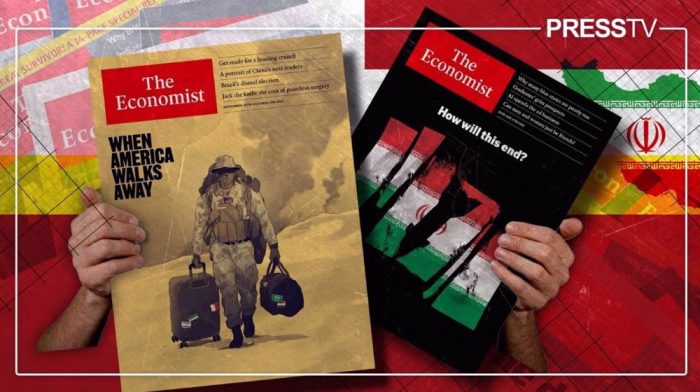
Nearly 466 days ago, just seven days into the unprovoked and illegal US-backed Israeli military aggression against Iran, The Economist provocatively placed a torn Iranian flag on its cover and asked: “How will this end?”
The image was widely interpreted as a metaphor for the possible collapse or fragmentation of the Islamic Republic in the face of overwhelming military force.
At the time, the narrative surrounding Iran was dominated by predictions of its imminent defeat, the weakening of its leadership, and even the possible collapse of the Islamic Republic under the weight of an aggression that came amid Iran-US indirect nuclear talks.
The article went on to ask whether what it described as Israel’s first war against Iran “will also be the last,” or whether it would “lead to a series of Iran-Israel wars that mire” West Asia in years, if not decades, of further violence.
Written before the United States directly joined the war of aggression by illegally bombing Iran’s Fordow, Natanz, and Isfahan nuclear facilities on June 22, the article also suggested that Washington should move beyond “merely defending Israel and deterring Iran” and join the occupying regime in attacking Iran’s peaceful nuclear program.
Yet even then, The Economist warned that such a war could spiral into a broader regional war, sending energy prices soaring by targeting Saudi Arabia’s oil infrastructure or blocking the Strait of Hormuz, a vital artery for global energy supplies.
Iran, however, did not turn the war into a regional war at that stage, nor did it close the Strait of Hormuz. It retaliated decisively and inflicted massive damage on the Zionist regime.
Following a powerful wave of retaliatory strikes against Israeli-occupied territories, the Islamic Republic demonstrated that it retained the ability to impose high costs on its adversaries.
After 12 days of war, Israel and the United States ultimately agreed to a ceasefire. The confrontation and US hostility, however, were far from over.
On February 1, the martyred Leader of the Islamic Revolution, Ayatollah Seyyed Ali Khamenei, warned that any new war initiated by the United States against Iran would inevitably become a regional war, engulfing all countries across the region.
Less than a month later, on February 28, Washington and Tel Aviv launched a second round of military aggression against Iran, again in the middle of nuclear diplomacy.
On the very first day, the United States and Israel assassinated Iran’s Leader and several senior commanders, apparently calculating that “decapitating” the country’s leadership would pave the way for the rapid collapse of the Islamic Republic and the so-called “regime change.”
That calculation, however, once again proved wrong.
Iranian armed forces mounted a sustained and forceful response, launching wave after wave of retaliatory strikes against Israeli-occupied territories and US military bases across the region.
Far from collapsing under the pressure, Iran demonstrated its capacity to absorb the initial shock, reorganize its command structure, and continue fighting on multiple fronts.
The war eventually reached the Strait of Hormuz, as Iran asserted its control over the strategic waterway, leading to severe disruption in global energy markets and exposing the vulnerability of one of the world’s most strategically important chokepoints.
After 40 days of war, the United States and Israel were once again compelled to accept a ceasefire. This time, the Trump administration even agreed to an Iranian proposal to end the imposed war.
The outcome was a striking departure from the expectations that had accompanied the opening hours of the aggression: instead of so-called “regime change,” Washington and Tel Aviv found themselves confronting an Iran that had endured the assassination of its senior leadership, absorbed unprecedented attacks and continued to resist and inflict blows on the enemy.
Since the April 8 ceasefire, exchanges of fire have continued intermittently, while the Strait of Hormuz has remained largely closed to hostile vessels.
Having failed to achieve its objectives through military means, Washington has increasingly turned to economic pressure, imposing new sanctions and pursuing a naval and aerial blockade against Iran. Yet the Islamic Republic has continued to withstand the pressure.
Also, despite sanctions, threats, political pressure and military aggression, Tehran has maintained that the Strait of Hormuz will only be reopened once the United States ends the imposed war on all fronts.
And now, more than 15 months after that torn Iranian flag appeared on its cover, The Economist has returned with an image that could hardly be more different.
Gone is the question of how Iran will end. Instead, the magazine has placed a new question at the center of its latest cover: “WHEN AMERICA WALKS AWAY.”
The change in imagery reflects a striking shift in the narrative. In June 2025, the focus was on Iran’s survival. Today, the question being raised is about the future of American power in West Asia.
But the transformation in the narrative is not limited to the language used on The Economist’s covers.
Over the past 15 months, the war has also produced a growing record of military, financial and strategic costs for the United States and its military-industrial complex.
Washington launched the war on Iran with many ambitious objectives, including crippling Iran’s nuclear and missile capabilities in order to undermine and weaken the Islamic Republic.
Yet months of war have instead left the United States facing tens of billions of dollars in expenses, damaged military facilities across the region, depleted stocks of some of its most sophisticated interceptors and other munitions, and casualties among its service members.
The following figures and assessments, many of them coming from US government agencies, American media outlets and Western think tanks, offer a picture of the price Washington has paid for the war — and of the widening gap between the objectives announced at its outset and the situation that has emerged months later.
$43.6 billion — and the bill is still rising
On September 18, The Washington Post reported that the US Central Command (CENTCOM) had estimated the cost of the war at $43.6 billion as of early September.
The figure included $28 billion to replace munitions expended during the war on Iran and more than $4.3 billion for equipment lost or damaged. The breakdown also put Air Force operating costs at more than $6.6 billion, Navy costs at about $2.2 billion, and Army costs at roughly $1.6 billion.
Crucially, the $43.6 billion estimate does not include the future cost of rebuilding or repairing damaged US military facilities across West Asia, according to the report.
The Congressional Budget Office (CBO) also published its own assessment on September 15, estimating that the war on Iran had already cost the Department of War approximately $38 billion as of August 1.
CBO said the figure included the replacement of expended munitions and equipment lost in battle, increased flying hours, other operational costs, and additional fuel costs.
But the most important part of the CBO assessment was its warning about the continuing cost.
It said if the war remained at the relatively low intensity seen in May and June, another month of fighting would cost approximately $2 billion. If fighting returned to the intensity seen in July, the monthly cost could rise to approximately $3 billion.
CBO also stressed that its $38 billion estimate did not include all costs borne by other parts of the federal government and did not include certain costs already incorporated into the regular military budget.
At least 228 US military assets damaged
The financial bill was accompanied by substantial physical damage to US military infrastructure.
On May 6, The Washington Post published a satellite-image investigation finding that Iranian attacks had destroyed at least 228 structures or pieces of equipment at 15 US military sites across West Asia.
The Post’s analysis identified 217 structures and 11 pieces of equipment that had been damaged or destroyed. The targets included hangars, barracks, fuel depots, aircraft, radar systems, communications equipment and air-defense systems.
The newspaper examined more than 100 high-resolution satellite images released by Iranian media and independently verified 109 of those images against imagery from the European Union’s Copernicus satellite system and commercial satellite imagery where available.
It found no evidence that the Iranian imagery had been manipulated. The Post also reported that the destruction was “far larger” than what had been publicly acknowledged by the US government.
The extent of the damage was subsequently reinforced by the US government’s own watchdog. In a report released on September 14, the Pentagon Inspector General provided what the Associated Presssaid was the most comprehensive official accounting to date of the war’s impact on US military facilities.
The report said Iranian attacks had damaged or destroyed hundreds of buildings and other structures at US bases in Kuwait, Bahrain, Qatar, the United Arab Emirates, Saudi Arabia, Iraq, Oman and Jordan.
The significance of this finding is that the damage was no longer based solely on satellite analysis or Iranian reports. It was acknowledged in an official US government assessment.
Dozens of MQ-9 Reapers and other aircraft lost or damaged
The Pentagon Inspector General’s findings also provided a clearer picture of damage to American aircraft.
According to Stars and Stripes on September 15, the war had resulted in damage to or destruction of as many as 30 MQ-9 Reaper drones, along with four F-15 fighter aircraft and more than six KC-135 tanker aircraft.
The report also noted that the cost of repairing or replacing some of these assets had not yet been incorporated into the Pentagon’s overall war-cost estimate.
In other words, even the $43.6 billion figure should not necessarily be regarded as the final bill.
The actual figure, however, is much higher. More than 50 MQ-9 Reapers have disappeared over Iranian skies, according to independent estimates.
The war has depleted America’s missile-defense stockpiles
Perhaps more consequential than the dollar value of the weapons fired is the depletion of America’s stockpile of advanced interceptors.
In its May 6 report, The Washington Post, citing an analysis by the Center for Strategic and International Studies (CSIS), reported that between February 28 and April 8 the US military had used at least 190 THAAD interceptors and 1,060 Patriot interceptors.
Those numbers represented approximately 53 percent of the US prewar THAAD inventory and 43 percent of its Patriot inventory. By September, the assessment had become even more concerning.
The Stimson Center, in a report published on September 22, said that by August the United States had used approximately 80 percent of its THAAD inventory and around half of its Patriot interceptors.
The same report said the Army had used “virtually all” of its ATACMS and Precision Strike Missiles (PrSM) — long-range weapons that would also be important in a potential conflict involving China.
According to Stimson’s assessment, replenishing some of these stocks could take years. CSIS estimated that Tomahawk inventories might not return to prewar levels until late 2030 or early 2031, while Patriot and THAAD inventories could take at least three years to recover.
The costs extend beyond the battlefield
The financial impact has also spread beyond the Pentagon. The CBO said on September 15 that the disruption of oil and gas shipments through the Strait of Hormuz had increased global energy prices, contributing to higher prices for gasoline, diesel and jet fuel in the United States.
CBO estimated that the war would leave US inflation in the first quarter of 2027 0.5 percentage points higher than it had projected in February 2026, while core PCE inflation was projected to be 0.3 percentage points higher.
The agency also estimated that three-month Treasury bill rates would be nearly 0.2 percentage points higher in 2026 than previously projected.
The Stimson Center went further, estimating the direct and indirect cost of the war at approximately $220 billion and putting the average household’s share at roughly $1,650. It attributed much of that wider economic burden to higher energy prices.
Stimson said that by September 15, average US gasoline prices had reached $4.32 per gallon, a 45 percent increase since the war began, while diesel prices had risen by approximately 70 percent.
Damage to US military facilities
Beyond the billions spent on weapons, operations and damaged military equipment, Washington also incurred substantial military, diplomatic and emergency expenses.
On September 14, the Pentagon Inspector General, as reported by The Washington Post, said Iranian attacks had caused approximately $184 million in damage to US military and diplomatic facilities in Iraq, Kuwait, Saudi Arabia and the UAE.
Separately, the US State Department reported around $113 million in war-related and emergency expenses, nearly $80 million of which was associated with the evacuation of diplomats, their families and other US citizens and eligible individuals.
Around 9,000 US citizens were evacuated from the region during the war against Iran.
Iran’s missile program has begun rebuilding
The depletion of American interceptor stocks becomes particularly significant when considered alongside the continued resilience of Iran’s missile program.
On September 10, The Wall Street Journal reported that Iran had resumed production of ballistic missiles, despite the extensive US and Israeli attacks on its missile infrastructure during the opening phase of the war.
According to the report, US and regional officials said Iran was assembling both liquid- and solid-fuel missiles using stockpiled components at underground facilities.
Intelligence pointed to activity at several underground sites, including the Khojir missile facility, while Iran was also working on new underground assembly locations.
The report concluded that the renewed production underscored the difficulty of fully dismantling Iran’s missile program — one of the stated objectives of the war.
Six months on, the original objectives remain out of reach
This brings the military expenditure back to the central question: what did all of this cost actually achieve? Washington continues to describe the war on Iran as having severely degraded the country’s military capabilities.
But independent Western assessments point to a substantial gap between the original objectives and the situation that has emerged.
The Stimson Center, in its September 22 assessment, said the administration initially went to war with objectives that included ending Iran’s nuclear program, destroying its missile industry, annihilating its navy, and ending its support for the Axis of Resistance.
It concluded that the United States had failed to achieve those objectives. Instead, Stimson said, the mission subsequently narrowed to the reopening of the Strait of Hormuz — a goal that became necessary precisely because the war itself had disrupted shipping through the waterway.
“Six months later, little progress toward those goals has been made, while the mission has largely narrowed to the single task of reopening the Strait of Hormuz, a waterway the war itself closed.”
The figures tell the story of that widening gap: $43.6 billion in US military costs; $28 billion needed merely to replace expended munitions; more than 4.3 billion dollars in damaged or lost equipment; hundreds of damaged military structures; depleted THAAD and Patriot stocks; and a weapons-production system facing years of replenishment.
And yet, according to the Wall Street Journal, Iran is already rebuilding parts of its ballistic-missile production capability.
That contrast — between the scale of resources committed by Washington and the difficulty of translating military force into its original political and strategic objectives — is perhaps the most important evidence behind the dramatic change in the narrative surrounding the war.
And now, back to The Economist
This is where the latest Economist cover becomes particularly relevant.
More than 15 months after the magazine placed a torn Iranian flag on its cover alongside the question “How will this end?” the question on its new cover is no longer centered on Iran.
It asks: “WHEN AMERICA WALKS AWAY.”
“America seems to be stuck in the Middle East. It has no easy way out of its war with Iran. Yet the conflict, however it ends, will in fact mark something quite different: the moment when America pulls back from the region—in the sense that it finally relinquishes its hegemony there,” the article reads.
In a September 25 editorial, The Economist’s Deputy Editor Robert Guest makes a similar assessment, writing that the United States has enjoyed decades of dominance in the region, but that this era is now coming to an end.
“Now, as Mr Trump seeks a way out of his ill-planned war, something momentous is occurring. As we describe in our cover package, American hegemony in the Middle East is ending,” Guest writes.
The Iranian Embassy in London announced on 28 September its “categorical rejection” and strong condemnation of speculation regarding Tehran’s involvement in an alleged plot to attack a British military air base used by US forces.
In a post on X, the embassy criticized “recent baseless and malicious speculation circulated by certain individuals and British media outlets attempting to link Iran” to the incident, which occurred in the early hours of Sunday.
Gloucestershire Police had announced on Sunday that a “major incident” was taking place in the Welford area of western England, leading to the evacuation of several buildings near the RAF Fairford air base.
Police stated that army explosive ordnance disposal experts were examining several vehicles and that five men had been detained on suspicion of offenses under the Explosives Act.
Residents were evacuated from 85 homes in the area near the base on Sunday as army bomb-disposal experts used a robot to examine three white vans.
The five men detained in connection with the alleged bomb plot, all British citizens, were released on bail on Monday, suggesting the incident is not serious, in contrast to early claims.
The men will remain under investigation, according to the head of counterterrorism policing, Laurence Taylor.
UK authorities continue to “explore multiple lines of inquiry” regarding the incident, Taylor added.
RAF Fairford has been used as a base by the US Air Force to launch bombing operations against Iran during the war that began in February.
The UK authorized the US to use the base for missions involving B-1B and B-52 bombers.
Britain did not join the US-Israeli war on Iran and initially denied President Donald Trump’s request to use bases in the UK.
However, then-prime minister Keir Starmer soon reversed course, announcing days later that he had agreed to let the US use bases in Britain for what he claimed were “defensive” operations against Iran’s missiles and their launch sites following Iranian attacks on UK interests and Britain’s Gulf allies.
Most indicators suggest that the Republicans in the House and Senate are going to face a brutal backlash from the American people in November. Polling with generic ballots suggest a big win for the Democrats and likely the loss of Republican control of both houses of Congress.
There is little reason to cheer a Democratic party victory, however Republicans in charge have for the most part earned what is coming to them. They have refused to uphold their Constitutional obligation to take leading responsibility for war powers.
Earlier this year, President Trump launched what is the most unpopular war in US history when on February 28th he ordered a full US assault on Iran. Iran had not attacked or even threatened the United States and our own intelligence community continued – and continues – to claim that Iran is not building nuclear weapons.
The February attack followed last June’s US bombing of Iran after which the president claimed that the country’s nuclear program was “completely obliterated.”
Congress over too many years has been used to allowing the President to have his own way on matters of war and peace. Members bask in the false patriotism promoted by the media and special interests as the people “rally around the flag.” Eventually, when the war has gone on for years without “victory” – as in Iraq and Afghanistan – many claim they were never really for the war in the first place.
This time is different. There was no propaganda blitz. There were no attempts to convince the American people that the “smoking gun” could be a “mushroom cloud” as we were told in the run up to the 2003 Iraq war. The majority of Americans were against the war on Iran before it started and only became more opposed over time.
As the war drags on, we have seen the national debt pass $40 trillion, diesel fuel prices at the highest ever, and inflation hitting the middle class and poor even harder. The “cakewalk” again failed to materialize.
Incumbent Republicans seeking re-election are in such a panic over voter anger about the war that they have taken to calling for a quick end to it while on the campaign trail. When they get back inside the Beltway, however, they vote to keep the war going for fear of President Trump’s anger.
This is not leadership.
Late last week the Iranian delegation in New York for the UN General Assembly meeting offered an off-ramp. Essentially it was the same Memorandum of Understanding that President Trump signed last June and promptly disregarded, but on a shorter timeline. By Sunday, the President announced that he would reject the deal – a deal like one he already signed.
There is no strategy for winning this disastrous war, it is clear. From over-confidence on decapitation strikes to certainty of a quick military victory, the Administration is now promising that they will win by crippling Iran’s economy. The problem is that Iran has been operating under “crippling” sanctions for decades and has a high economic pain tolerance.
Unfortunately, both parties in DC are war parties, so again it is hard to cheer the likely Republican losses. But sometimes electoral losses can serve as wake-up calls. Eventually we may see the re-emergence of antiwar Republicans in the spirit of the late Sen. Robert Taft and a restoration of the Constitution.

 Login