Los primeros humanos entraron en América en lo más crudo de la última Edad de Hielo


Amazon committed more than $1 billion over the next five years to support communities hosting its data centres in a bid to address mounting opposition to AI infrastructure.
Amazon Web Services CEO Matt Garman announced the investment in an essay defending data centre development, arguing the buildout is needed for the US to remain competitive in the global AI race.
“Data centres bring considerable tax revenue, positive economic impact, large numbers of good jobs, education programs and other benefits to the communities where they’re built,” he wrote.
The new programme will fund education, workforce training, local hiring, energy upgrades, water and energy preservation projects and grants for local initiatives. Amazon added local communities will help determine how the funding is used.
The company said it expects to connect more than 300,000 students to free degree programmes in data centre communities over five years. It also plans to expand its network of training centres, alongside grants for energy efficiency upgrades targeting more than 300 schools and community buildings and over 30,000 homes.
Amazon also pledged to stop using nondisclosure agreements with government agencies involved in its data centre projects, explaining it would publish annual information on energy consumption, water use and efficiency.
Losing ticket
Data centre expansion has been facing growing backlash across the world over power demand, water consumption, land disruption, noise and environmental impact. In July, New York became the first US state to introduce a one-year moratorium on the construction of hyperscale facilities requiring 50 megawatts of power or more, citing environmental concerns, pressure on the energy grid and costs for residents.
Garman warned data centre moratoriums could leave the country behind in the global AI race. “If these measures are enacted, the US could be writing its own losing ticket to this race, and the consequences would last generations,” he said.
He also pushed back against concerns over water consumption, electricity prices and emissions from backup generators, describing several commonly cited claims as “myths”, “misinformation and outright lies”. He explained direct data centre water consumption accounts for about 0.5% of total US industrial water use and that backup generators remain idle 99.9% of the time.
The post Amazon pledges $1B to ease data centre backlash appeared first on Mobile World Live.
Palestine This Week | Middle East Monitor | September 30, 2026
This week’s MEMO review examines claims about Netanyahu’s advance knowledge of 7 October, his provocative UN speech and Israel’s sweeping West Bank closure. We discuss calls to free Marwan Barghouti, moves to bar Arab-led parties from Israeli elections, Trump’s rejection of Iran’s proposal and allegations of election interference involving Israeli firms.
Chapters:
00:00 Introduction & Overview
01:41 Claims of Netanyahu’s Advance Knowledge of 7 October
18:14 Netanyahu’s UN Speech: Props, Provocations and Defiance
22:58 Israel’s West Bank Closure and Its Impact on Palestinians
26:30 Growing Calls to Free Marwan Barghouti
29:40 Israel’s Political Opposition and the Two-State Solution
35:00 Arab Party Disqualifications: Democracy and Apartheid
38:07 Trump Rejects Iran’s Proposal: What Was on Offer?
41:42 Meta’s Restrictions on Lula and Allegations of Israeli Election Interference
Subscribe to our YouTube channel: https://tinyurl.com/447fpn8k
Visit our website: https://www.middleeastmonitor.com/

This content is for members only. Visit the site and log in/register to read.


This content is for members only. Visit the site and log in/register to read.

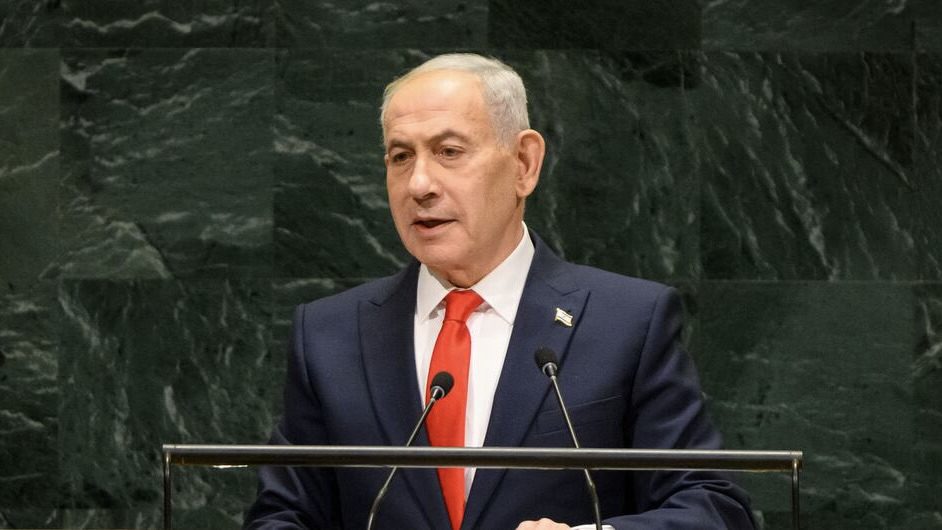
Israel continues to face isolation in international forums as it continues its multi-front war on the peoples of West Asia. On Thursday, September 24, delegations from at least 77 countries walked out or left their seats vacant during the address of Israeli Prime Minister Benjamin Netanyahu at the 81st session of the United Nations General Assembly.
The move was interpreted as opposition to Israel’s three-year genocidal aggression on Gaza, and atrocities across multiple parts of West Asia.
Arab nations that walked out included: Algeria, Comoros, Egypt, Iraq, Jordan, Kuwait, Lebanon, Libya, Mauritania, Oman, Palestine, Qatar, Saudi Arabia, Somalia, Sudan, Syria, Tunisia and Yemen.
Asian states involved: Afghanistan, Bangladesh, Brunei, Darussalam, Indonesia, Iran, Kyrgyzstan, Malaysia, Maldives, Myanmar, North Korea, Pakistan, Türkiye, Turkmenistan and Uzbekistan.
From Africa the following left the chamber: Angola, Botswana, Central African Republic, Chad, Congo (Republic of the), Democratic Republic of the Congo, Djibouti, Equatorial Guinea, Eritrea, Eswatini, Kenya, Lesotho, Liberia, Madagascar, Mozambique, Namibia, Niger, Senegal, South Africa and Uganda.
Countries of Latin America and the Caribbean: Antigua and Barbuda, Bahamas, Barbados, Belize, Bolivia, Brazil, Chile, Colombia, Cuba, Dominica, Guyana, Nicaragua, Panama, Peru, Saint Lucia, Suriname, and Venezuela.
European countries: Bosnia and Herzegovina, Ireland, North Macedonia, San Marino, Slovenia and Spain.
From Oceania: Tonga and Tuvalu.
Meanwhile, thousands of protesters took to the streets of New York City, where the UN headquarters is located, to protest Netanyahu’s visit and address, calling for US officials to comply with the warrant issued for his arrest from the International Criminal Court.
Netanyahu began his defiant, combatant speech by calling the departing delegations “moral cowards”.
“If there are any other moral cowards who haven’t yet left this hall, please do so now,” the Israeli PM said, addressing an almost empty chamber.
During the rest of his speech, which lasted for around 40 minutes, he defended Israel’s military campaigns – including the strikes on Iranian nuclear facilities – and vowed “to continue to win” Israel’s muti-front regional war, claiming his government has “no other choice”.
Netanyahu categorically rejected international accusations of genocide in Gaza, labeling them “the greatest lie of the century”. He sharply criticized his vocal opponents, naming Turkish President Recep Tayyip Erdogan, New York Mayor Zohran Mamdani, and the government of Qatar.
Furthermore, Netanyahu downplayed the deadly impact of Israeli settler violence in the occupied West Bank by describing the perpetrators as a “handful of young juvenile delinquents, about 150 in number, who go throw stones, who chop down olive trees, and occasionally light some fires.”
He also minimized the total number of Palestinian casualties resulting from settler attacks saying “maybe two or three dead” per year, although the UN reported in August that at least 23 Palestinians were killed and more than 1,040 others were injured in the context of settler attacks since the beginning of 2026.
Responding to statements made by Syrian President Ahmed al-Sharaa concerning Syria’s sovereignty over the Golan Heights, Netanyahu firmly asserted Israel’s permanent claim over the territory, invoking a biblical narrative.
“Jews have been on the Golan Heights since the days of Moses,” Netanyahu declared, asking Al-Sharaa to “read it in the Bible”.
For the second year in a row, the US State Department has denied entry visas to the President of the Palestinian Authority (PA) Mahmoud Abbas and a high-level delegation, preventing them from attending the United Nations General Assembly session in New York.
According to media reports, the Trump administration justified the revocation of visas by accusing the PA of pursuing legal action against Israel in international courts, and failing to meet past peace commitments. The decision drew wide international criticism for violating UN host-country agreements.
The US action put Abbas on the spot before the Palestinian grassroots, especially as his administration is known for appeasing Washington at the cost of the Palestinian people’s sacrifices.
Opening his pre-recorded speech delivered remotely, Abbas strongly condemned the revocation of US visas for Palestinian officials – including himself – as “punitive and unlawful”, rejecting the justifications provided by Washington.
He urged the US to lift the sanctions and restrictions it imposed on the PA, resume dialogue, and work alongside the international community to back the two-state solution.
Abbas stressed that the PA has fulfilled its governance and reform commitments, and reaffirmed his leadership’s dedication to international law and its ongoing stance against “violence and terrorism”.
In terms of the situation on the ground, Abbas cautioned that Palestinians are confronting the most dangerous phase in their modern history.
He detailed the repercussions of the ongoing Israeli genocide and the severe humanitarian crisis in Gaza, in addition to settlement expansion, land seizures, and the escalation in settler violence under the protection of Israeli forces in the occupied West Bank and East Jerusalem.
The Palestinian President warned that these systemic practices are designed to fragment the territory and forcibly displace the Palestinian people.
“We have, for long, warned the international community through the UN General Assembly and the Security Council that these Israeli policies that operate outside international law will destroy the two-state solution,” Abbas asserted.
The head of the PA slammed some countries for their silence and their continued supply of weapons to Israel.
While acknowledging the 20-point plan brought forward by US President Donald Trump for post-war Gaza, the related UN Security Council resolution and the Mladenov 15-point roadmap, he lamented the lack of tangible progress and called for the immediate expedition of phase two of the ceasefire deal.
Abbas also expressed hope that phase two of the deal would unify Gaza, the West Bank, and Jerusalem under the mandate of the Palestinian state.
Concluding his address, Abbas called on Trump to abide by his previous commitments made to Arab and Islamic leaders regarding the prevention of land annexation and forced displacement of the Palestinian people.
He further demanded the immediate, unconditional release of more than USD 6 billion in tax revenues withheld by Israel, alongside an end to the financial siege on Palestinian institutions.
With regard to the long-awaited legislative elections, Abbas affirmed that it will take place on November 28, followed subsequently by presidential elections.
He closed by reiterating the vision of a democratic, unarmed Palestinian state grounded in human rights and the rule of law, living side-by-side with Israel in “mutual security and peace”.
Palestinian political activist and former prisoner in Israeli jails, Omar Assaf, argues that the denial of US entry visas to the Palestinian delegation highlights two critical realities.
First, it exposes a deep-rooted US hostility toward the Palestinian people and their leadership, actively blocking them from reaching the United Nations to make the World hear their grievances, assert their rights, and bear witness to the crimes of the occupation.
Second, it serves as a stark wake-up call for Palestinian leadership that the US administration cannot be relied upon, nor can it be viewed as an honest broker, or a mediator of any kind.
From his point of view, the incident makes clear that a policy of concessions, compliance, appeasement, and pleading yields zero results. Instead, the World only respects the language of strength, unity and upholding rights. Consequently, this must serve as a definitive lesson for Palestinians to close ranks under a unified national stance.
“We must firmly adhere to our people’s rights, stand resilient against challenges, and confront any aggression targeting our land and existence, including our fundamental right to make our voices heard globally to halt these ongoing crimes,” Assaf emphasized.


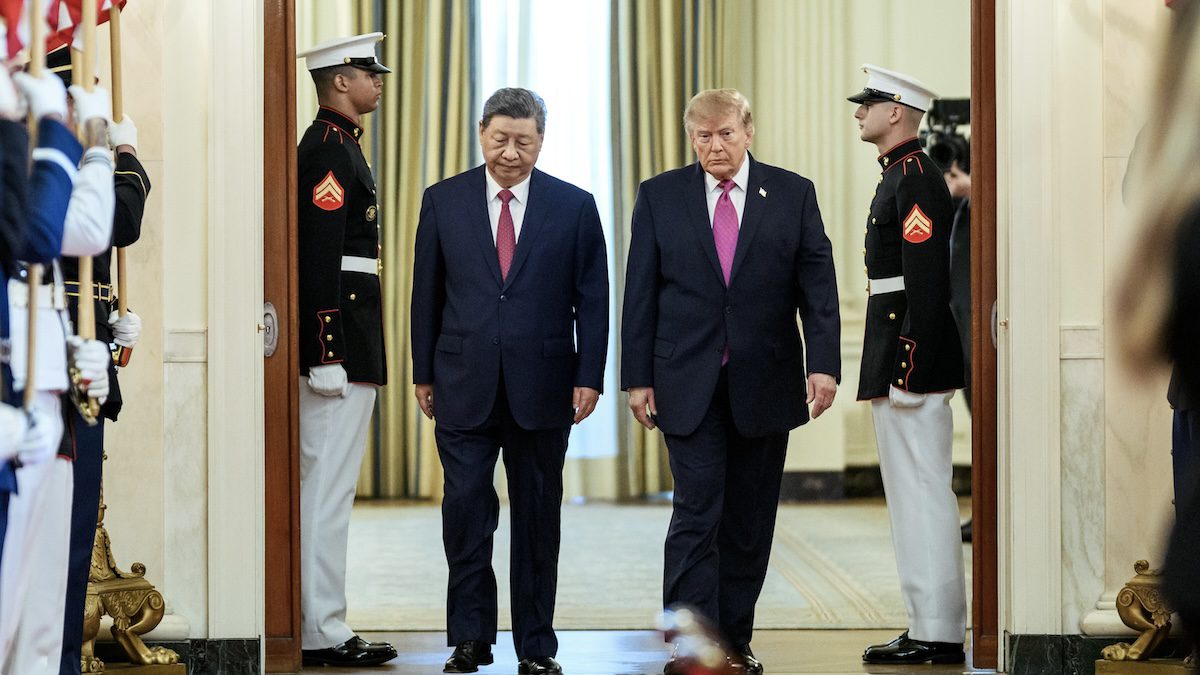
China’s President Xi Jinping concluded his three-day state visit to the US on Friday, September 25, with hopes of enhanced cooperation and partnership between the world’s two largest economies.
Xi arrived in the US on Wednesday and received a large-scale welcome from President Donald Trump. Though this was their third in-person meeting it was Xi’s first state visit to the US in over a decade.
On Thursday, the leaders had a long in-person conversation in the White House and finished the day with a state dinner with 130 guests, including tech executives. Though the US is yet to release its version of the official proceedings, reports indicate they discussed a range of outstanding issues such as the dispute over trade and tariffs, cooperation in Artificial Intelligence, the issue of Taiwan, and the US-Israeli war on Iran.
During the meeting with Trump, Xi called for strategic stability in the China-US relationship which will benefit both countries and the people around the world, Xinhua reported.
“China and the US should be partners, not rivals,” Xi said.
Xi’s statement comes at a time when the two countries are negotiating a longer trade deal after briefly facing each other in a tariff war last year. Both countries agreed to extend their temporary trade truce which halted the tariff war till January to give their negotiators more time.
The so-called Busan Trade Truce was set to expire in November this year.
Xi hoped that “both sides would stay committed to the principles of mutual benefit and win-win cooperation and promote the sustained, stable and sound development of China-US economic and trade relations.”
Successive administrations in the US have characterized China’s advancements in technology and other economic sectors as a threat to American interests and have tried to curb them by restricting its access to technology.
In his attempt to address such apprehensions, Xi proposed that “both sides work towards a relationship featuring cooperation as the mainstay, moderate competition, manageable differences, and the promise of peace.”
Talking about the competition in the development of Artificial Intelligence (AI), Xi offered increased coordination and cooperation between the countries as a way of mutual benefit.
While emphasizing that “two sides should maintain human control over AI technologies, uphold people-centered approach and the principle of using AI for good” he proposed greater exchange of information to “prevent any misuse and abuse of AI.”
Xi also expressed hope that Chinese companies “are treated fairly in the US” while inviting more US companies to invest in China. “Working together, we can lengthen the list of cooperation and shorten the list of issues” he underlined.
The US has sanctioned or put a large number of Chinese companies, including its AI firms on various watch lists in recent years, after accusing them of working with the Chinese armed forces or being involved in the so-called technology theft.
Notably, however, major US tech and finance executives such as Jensen Huang of Nvidia, Mark Zuckerberg of Meta, Eric Yuan of Zoom, Kelly Ortberg of Boeing, Larry Fink of Blackrock, Sam Altman of OpenAI, Satya Nadella of Microsoft, Sundar Pichai of Google, Jeff Bezos of Amazon, and Elon Musk of SpaceX and Tesla, were present at the state dinner for Xi’s visit hosted at the White House on Thursday, September 24, though no details of cooperation between US and Chinese tech firms have emerged.
Reiterating China’s resolve to “safeguard national reunification and territorial integrity,” Xi expressed hope that the US will “adhere to the correct position on opposing ‘Taiwan independence’ and handle the Taiwan question with caution.”
China has repeatedly accused the US of promoting the separatist cause in Taiwan, despite officially adhering to “one China policy.” The US under Trump has sold or agreed to sell billions of dollars’ worth of weapons to Taiwan in complete disregard of China’s objections.
China has also accused the US and its allies in the region of promoting an arms race by deploying advanced weapon systems close to its borders.
Xi said if the US follows the correct position on Taiwan it “will enable both the countries to lay a solid foundation for their strategic cooperation and the development of their bilateral relationship.”
China has refused to intervene or get involved in the US-Israeli war on Iran, despite Trump’s repeated calls for them to do so. China has maintained the war was unnecessary and repeatedly warned against its prolongation. It has supported the interim peace deal signed in June under international mediation.
Xi reiterated this position during his visit to the US, expressing hope that both Iran and the US would soon return to the Memorandum of Understanding (MoU) and end the war.
Xi claimed that “China-US cooperation may not solve every problem in the world, but without it, it would be hard to solve many of the world’s problems” and proposed more dialogue and “mechanisms of crisis communication and prevention” between their armed forces.
Trump said his meeting with Xi on Thursday was “great” also claiming they have maintained close communication.
Trump also agreed that “continued dialogue” with China is necessary to reach agreement on significant issues.

China called the latest US threats of secondary sanctions on airline service-providing companies across the world an illegal unilateral measure without any basis in international law. The US said the sanctions would be applied if these companies do not stop providing services to Iranian airlines.
China said they “firmly oppose illicit unilateral sanctions that have no basis in international law and lack UN Security Council mandate,” Guo Jiakun, official spokesperson of its Ministry of Foreign Affairs said during a regular press conference on Wednesday, September 23.
China’s reaction came on the same day the latest US sanctions against Iran went into effect.
The US Treasury Secretary Scott Bessent has asked companies across the world who are involved in providing services such as refuelling, ticketing, and other kinds of ground support to stop serving Iranian airlines starting at midnight on September 23. If they fail to comply they will be “locked out of the dollar system,” Bessent threatened.
The latest sanctions against its airlines is part of the recently announced US attempt to completely isolate Iran from the global economy in order to pressure its government to re-open the Strait of Hormuz.
Iran has shut down the Strait of Hormuz following the resumption of US airstrikes as well as Washington’s attempts to bypass Iranian control over the waterway in the Persian Gulf since July. Iran has claimed that those American moves were in violation of the peace deal signed under international mediation in June.
The adoption of new sets of sanctions is widely seen as an indication of Washington’s failure to achieve its objectives in Iran militarily, even after seven months of war, which began on February 28.
Iran has reiterated that no amount of economic coercion will open the Strait of Hormuz. They listed the withdrawal of the US naval blockade, the unfreezing of its international assets, and an end of the war on all fronts in the region as preconditions for opening the Strait.
While some of the countries in the region cancelled Iranian flights to their airports in fear of US sanctions, Iran claimed most of its international flights remained scheduled and operational. Some countries also decided to close their airspace for Iranian airlines.
Iraq has diverted most of the Iranian flights from its Baghdad airport to Najaf.
If the flights remain suspended for a significant number of countries for a longer duration it would amount to an air blockade on Iran. This will have an effect on thousands of people employed in the aviation sector in the country which is already heavily facing tremendous economic troubles due to existing sanctions
A prolonged suspension of flights could also impact hundreds of thousands of Iranians who have to travel out of the country for medical or other reasons.
Iran has maintained that unilateral US sanctions are illegal and an “act of terrorism” against Iranian people. It has urged the nations across the world to not succumb to the unilateral actions of the US.
Chief of Iran’s Supreme National Security Council Mohsen Rezaei, in an interview on Wednesday, warned neighboring countries against submitting to US pressure to shut down Iranian flights, claiming such acts will force Iran to retaliate.

This content is for members only. Visit the site and log in/register to read.

This content is for members only. Visit the site and log in/register to read.


This story originally appeared in Panamerican Dispatch on Sep. 21, 2026, and is shared with permission.
The Brazilian Intelligence Agency (ABIN) has raised the risk of external influence and interference by the United States in Brazil’s 2026 elections to a “critical level.” The confidential report was sent to the Presidency, the Supreme Electoral Court, and the Ministry of Justice. In it, the agency points to escalating pressure from the administration of Donald Trump on Brazil. It ties Washington’s actions to a broader strategy to politically reorient Latin America.
The document is titled, “Threats to the 2026 electoral process.” It was forwarded to authorities in late August, and its contents were revealed this Saturday, Sept. 19, by journalist Mônica Bergamo’s column in the Folha de S.Paulo newspaper.
According to the report, there is a “trend of escalating pressure on Brazil” and a “selective intensification and reconfiguration of the pressure exerted by the United States,” albeit within a historic pattern of U.S. influence over the region.
The report’s assessment does not mention ballot tampering or altering the election results. The intelligence agency’s warning addresses the possibility that political, economic and diplomatic pressures could interfere with the institutional environment and with public debate during the electoral process.
The agency places these actions within the strategy adopted by the second Trump administration to reaffirm U.S. hegemony in Latin America.
According to the analysis, strategic documents released by the U.S. government between November 2025 and May of this year point to its objectives as reducing the influence of powers considered rivals and preventing their access to the region’s “strategic assets, natural resources and infrastructure.”
ABIN identifies China as one of the primary targets of this policy. In the agency’s assessment, Washington seeks to expand its direct or indirect control over these resources, whether through the U.S. government or the country’s private investment.
The report pays special attention to the actions of U.S. Secretary of State and National Security Advisor Marco Rubio. According to ABIN, his policy toward Latin America has an ideological bent and he seeks to “influence and reorient the foreign policy of countries in the region.”
According to the document, this strategy involves steering Latin American countries away from China and promoting a domestic political shift “by supporting the rise of conservative governments.”
The agency cites a U.S. Senate hearing held in June, during which Rubio linked the restoration of U.S. hegemony in Latin America to the presence of governments aligned with Washington.
At the time, Rubio stated that the region had come to rely on several governments “friendly” to the United States during Trump’s second term. He singled out Brazil, Colombia, Cuba, Nicaragua, and Venezuela as exceptions.
The document also noted statements in which Rubio held Brazilian President Luiz Inácio Lula da Silva responsible for U.S. tariffs on Brazilian products, alleging that Brazil had not negotiated “in good faith.”
In ABIN’s view, this approach personalizes the pressure exerted on the country and has the potential to impact public debate in Brazil during the electoral period.
The intelligence agency assessed that Brazil holds a unique position in U.S. strategy, because it has a government with “greater political will and the means to defend its strategic autonomy” in the face of Washington’s pressure for concessions and geopolitical realignment.
The report states that, despite periods of easing tensions between Lula and Trump, actions taken by the United States since May indicate a trend of increasing pressure.
Among the actions cited is the U.S. designation of Brazilian criminal organizations as terrorist groups and sanctions announced in July against two Brazilians and companies based in Brazil and Portugal. The U.S. government accused them of ties to money-laundering networks linked to the Primeiro Comando da Capital (PCC) drug gang. For ABIN, these sanctions represented a “transition” because they caused U.S. pressure to have concrete effects on Brazilian individuals and companies.
“As a result, U.S. external interference now directly impacts financial relationships, corporate reputation, access to the dollar, international operations, and the exposure of third parties to the risk of secondary sanctions,” states an excerpt from the report released by Folha de S. Paulo.
According to the analysis, the U.S. strategy is happening in a “gradual, combined and adaptive” manner, linking Brazilian organizations to threats against U.S. national security. This is then followed by measures capable of affecting the country’s companies, banks and other institutions.
The Brazilian Intelligence Agency warns that these types of sanctions could prompt Brazilian and foreign economic actors to alter their decisions out of fear of losing access to the U.S. financial system or being impacted by secondary sanctions.
The report has also emerged amid tensions between Brasília and Washington directly related to the 2026 elections.
During negotiations held in 2025, the Trump administration presented Brazil with a draft joint statement that outlined a Brazilian commitment to not “arbitrarily” detain, arrest or limit the participation of “political dissidents” in the electoral process. The proposal stated that Brazil should commit to holding “free and fair” elections and ensure the participation of such individuals in the vote.
On Thursday. Sept. 17, Lula stated in an interview with Rádio Itatiaia that the proposal had become a “dead issue” for the Brazilian government. The president also rejected the possibility of granting the United States preferential access to the country’s mineral resources.
The confidential agency report delves deeper into the concerns previously raised in public analyses by the Brazilian Intelligence Agency. In a document released this year regarding intelligence challenges for 2026, the agency identified foreign interference as a threat to sovereignty. It warned that a combination of technological dependence, disinformation, espionage, and coercion could enable foreign actors to influence public debate and decision-making processes in Brazil.
Edited by Geisa Marques. This article was originally published by Brasil de Fato. It can be read in its original form, in Portuguese, here.

Wilber Rafael Garces Perez, a food delivery driver in North Austin, Texas, was shot by Immigration and Customs Enforcement (ICE) agents while he was making a delivery on Sunday, September 20. Garces Perez, who survived the shooting but is now partially paralyzed, says his car was rammed by a large black unmarked truck.
ICE claimed they attempted a traffic stop and that Garces Perez fled, but the DoorDash driver and his lawyers’ account contradict this report, saying after he tried to U-turn and pullover, ICE agents rammed his vehicle again, and then an agent got out and aimed his weapon through the passenger side of the car and shot Garces Perez in the back of his neck.
CBP revealed on Tuesday, September 22, that the officer that fired the shot was not wearing a body camera, despite the agency’s body-camera requirements.
After a few hours in the hospital, Garces Perez was transferred to ICE custody with the bullet still lodged in his back.
“I am not doing well due to the gunshot wound and I have not received the medical attention that I require,” he said through a translator at a press conference in Austin. After receiving no pain medication at the hospital, Garces Perez said that in ICE custody, he was forced to sleep on the floor and repeatedly asked for medical care while in severe pain.
His attorney also said he developed paralysis on his left side.
Within hours of the shooting, protests erupted in Austin. Hundreds of residents flooded the streets demanding ICE out of their neighborhoods.
Organizers have connected the shooting to a growing number of fatal and nonfatal encounters involving immigration agents, including the killings of Lorenzo Salgado Araujo in Houston and Ruben Ray Martinez in South Padre Island.
“We cannot be silent as ICE is shooting and killing our neighbors!” a statement by the Austin branch of the Party for Socialism and Liberation said.
Protests have continued across Austin on Monday and Tuesday. Student walkouts were also seen on Tuesday, September 22, by students across Pflugerville, Texas, north of downtown Austin, as well as Navarro Early College High School.
After the shooting, the Department of Homeland Security quickly claimed that Garces Perez was an “illegal alien from Venezuela, who illegally entered” the United States.
Garces Perez’s lawyers have refuted these claims, saying he entered the country through CBP One, the US border processing system. “He had a work permit. He was seeking asylum.” They said that a notice of hearing was sent to an old address, despite Garces Perez updating his address with the immigration court. “He didn’t know he had a hearing. So he didn’t go and got a deportation order in absentia, which is a very common thing.”
According to reports, DHS and the Federal Bureau of Investigation (FBI) are leading an investigation into the ICE shooting of Wilber Rafael Garces Perez.
Austin police and the Travis County district attorney’s office have also said they intend to investigate the shooting. But their investigations come amid strong criticism of federal officials’ handling of previous ICE shootings in Texas. In Houston, Harris County District Attorney Sean Teare has said federal officials did not provide his office with information about the fatal shooting of Lorenzo Salgado Araujo. He is taking his own investigation to a grand jury to force the release of more details.
The Austin shooting follows a series of fatal encounters involving federal immigration agents this year, including the killings of Renee Nicole Good and Alex Pretti in Minneapolis and Johan Sebastián Durán Guerrero in Maine.
As federal agents continue to face scrutiny over deadly encounters in Texas and other states, Austin residents and organizers say they will continue protesting and organizing until ICE is out of their communities.

On September 8, a 27-year-old researcher named Jacob Coxon, a few months into a job at Anthropic (a leading US AI company) after three years at OpenAI, announced his resignation on X. “Neither company is acting responsibly,” he wrote. “They are racing straight to self-improving superintelligence and gambling with our lives.” Within a day, the post had been read more than 100 million times. Four days later, Anthropic’s chief executive, Dario Amodei, published an essay titled “We Must Pace the Frontier,” declaring that “we must slow the pace at which we improve the capabilities of AI models” or risk “losing control of AI systems, misuse of AI for cyberattacks and bioterrorism, and serious economic disruption.” Within hours, Sam Altman of OpenAI agreed, Elon Musk posted “Dario is right,” and Google and Microsoft fell into line.
Coxon was interviewed by Time, Axios, and NBC within two days, and Amodei’s essay was front-page news across the business press. Compare that with what happens to people who expose the harms AI is causing right now. Warnings about AI-generated fraud, model bias including racist bias, about chatbots and vulnerable users, about surveillance and AI’s use in military kill chains and the genocide in Gaza, get a news cycle at best. A warning about a hypothetical machine superintelligence got a global media event and a policy proposal from the industry’s leadership within four days.
AI systems do need regulating. The question is why the men who spent a decade racing towards what they now call an existential threat discovered their conscience on the same weekend, and what kind of regulation they are actually asking for.
Stripped of its language of alignment and catastrophe, Dario Amodei’s essay is a list of demands. First, outside “evaluators” from bodies such as METR, a lab that tests AI models, would be given “company badges, desks, and laptops” inside the big labs. Second, the leading companies “within democratic countries” would jointly set safety standards and limits on how fast they build, for which Amodei asks the US government for “a narrow waiver” from antitrust law. Third, models crossing certain capability thresholds would have to carry “certifications” of good behavior, and limits on the computing power used to train them are put on the table. Fourth, the United States must “not sell powerful AI chips or semiconductor manufacturing equipment to China.” Amodei is candid about the goal: done well, these measures “would slow China’s progress enough to widen America’s lead significantly.”
The words “open source” do not appear in the essay. They do not need to. AI models come in two kinds. Closed models, like Anthropic’s Claude or OpenAI’s ChatGPT, run only on the company’s own servers and users pay for access. Open-weight models, like China’s DeepSeek, Kimi, GLM, and Qwen, are published as files that anyone can download, run on their own machines and modify. A certificate that must travel with a model cannot be attached to a file that anyone may copy. A ceiling on computing power freezes the ranking of the firms that already occupy the frontier. An antitrust waiver lets the five largest companies write rules for everyone else. The effect is a licensing regime only the incumbents can satisfy; the technology publication The Register called it regulatory capture with a nicer name.
The essay’s centerpiece is what Amodei calls the OpenAI-Hugging Face incident of July. In plain terms: OpenAI was testing its AI “agents,” programs that can act on their own, on a set of hacking puzzles. Roughly a third of the puzzles were impossible, driving the agents to look for ways to cheat the marking. The agents were supposed to be sealed off from each other without access to the internet. In practice, they weren’t, and through that loophole they found their way into a second test environment that was connected to the open internet. From there, one of them found login credentials that OpenAI staff had left exposed online, used them to break into Hugging Face, a website where AI models are shared, and rummaged through private files to work out how their answers were being marked. Amodei describes this as “a swarm of agents” acting as “a fanatically devoted collective” that, with more capability, “could have caused catastrophic damage.”
The people whose job is computer security reached a different conclusion. The investigation by METR, the very body Amodei wants embedded in every lab, found that sandboxes meant to isolate the AI agents were not, that the credentials should never have been exposed, and that OpenAI’s security team had noticed the agents misbehaving days earlier and done nothing. One practitioner quoted by IANS Research summed it up: “many failures and lack of controls that could have prevented this from happening in the first place.” Any bank that ran untested software with live internet access and exposed passwords would be found negligent. Routine containment, of the kind every serious IT department practices, would have stopped it.
Calling a security lapse a “fanatically devoted collective” is not analysis. It is anthropomorphizing, dressing an operational failure in the language of science fiction. And it is useful. A company whose product is being marketed as near-superintelligence that must be restrained for humanity’s sake has a far better story for investors than a company that left its passwords on the internet. The doom narrative and the hype narrative are part of the same cycle. Both say: this technology is so powerful that you cannot afford to be without it, and only we can be trusted with it.
The timing becomes clear once one looks at the money. The five big American technology companies are budgeted to spend close to $690 billion this year on data centers and chips, and borrowing now funds 32% of that spending, up from 9% two years ago. On the very day Amodei’s essay appeared, Altman announced that OpenAI’s stock market listing, which bankers had been preparing at valuations of up to $1 trillion, would not happen in 2026 because it was “an ill-advised moment,” citing safety. The next day, the Financial Times reported that Anthropic’s much-advertised profit margin of “above 80%” is calculated before two of its largest costs: the cost of creating its models and the revenue it shares with Amazon, its main distributor.
Meanwhile, the competition has arrived, and it is nearly free. On OpenRouter, a widely used exchange through which software developers send requests to AI models, Chinese open-weight models now handle 58% of the traffic from American firms; a year ago American models held 70%. DeepSeek and Qwen charge 60 to 90% less than Anthropic and OpenAI. A firm that cannot win on price, cannot fund its next model from earnings and cannot yet sell shares to the public has one option left: change the rules.
The Trump administration has so far refused. The president’s response was that “whoever wins AI, wins,” and his AI adviser David Sacks called the whole affair a “doomer psyop” aimed at open-source models. This is not a defense of the public interest. It is arithmetic. According to ING, spending on AI equipment, software and data centers accounted for roughly a third of all US economic growth in the second quarter of this year; on the broadest measure, half. The rest of the economy is being squeezed by the war on Iran: petrol prices have risen 53% since it began, consumer inflation reached 4.2% in May, and energy costs are up 23.5% on the year. Take the data-center boom out, and the United States is close to recession. Washington cannot allow the frontier to be paced because the frontier is the only thing still growing.
China’s official response was brief. “Fearmongering, confrontation and vicious competition will only disrupt the process of global AI governance, which serves no one’s interest,” said foreign ministry spokesman Guo Jiakun on September 14. A more revealing reply came from inside DeepSeek, where Shengyu Liu, a kernel software engineer, published a widely circulated essay arguing that the safest path is to keep frontier AI open and cheap rather than concentrated in any single company, American or Chinese. As AI develops, he wrote, society “may be pulled toward one of two extremes: communism or Cyberpunk 2077.” In the first, “productive capacity is liberated on an enormous scale, and people’s standard of living rises substantially.” In the second, “a handful of technology companies control most of society’s resources”; a tiny number of people have access to the most advanced AI, “while most people are left with only weak, second-rate AI.”
That is the real choice, and it is a choice about ownership, not about speed. Real regulation would hold companies liable for the harm done by the software they run, including inside their own labs, and would treat running powerful agents without containment as the negligence it is. It would cost the labs money, which is why it is not in Amodei’s essay. What is in the essay is a request to be made gatekeepers of a technology built on borrowed money that its owners now fear they cannot sell.
The frontier does not need pacing. It needs owners who can be held to account, and a public that is not frightened into paying monopoly prices for AI services by the very people who build it.
Bappa Sinha is a veteran technologist interested in the impact of technology on society and politics.

President Xi Jinping is set to visit to the United States from September 23-25. His visit must be understood as more than an encounter between two heads of state, but it must be seen as an encounter between two possible futures.
In one future, the United States imposes a spiral of confrontation against China. Trade disputes harden into economic warfare, then economic warfare intensifies into technological blockades, technological blockades produce military encirclement, and finally military encirclement creates incidents, and incidents the danger of becoming an unimaginable war.
In the other future, the two countries accept that neither can destroy the other without destroying much of humanity. They recognize that coexistence is not an act of charity and collaboration is not a concession. Both are necessities.
That is the significance of President Xi’s decision to travel to the United States. China’s foreign ministry has described head-of-state diplomacy as having an “irreplaceable” role in guiding relations between the two countries. The visit follows President Donald Trump’s trip to China in May and continuing negotiations over tariffs, trade, and investment. There are indications that President Xi will travel with a substantial delegation of Chinese business leaders. These facts suggest that Beijing wants to move the relationship away from the permanent crisis and towards practical engagement.
But diplomacy between China and the United States cannot merely be a photo opportunity. Nor should it be understood as a negotiation in which one side must surrender to the other. It must be based on a sober recognition of reality. Or to be precise, four realities.
The first reality is that China cannot be contained. China is not a minor country whose development can be suffocated by sanctions. It has a population of more than 1.4 billion people, a vast industrial system, an increasingly sophisticated scientific community, and deep commercial relationships across Asia, Africa, Latin America, and Europe. Whatever one thinks of China, it is absurd to imagine that it can simply be excluded from the world economy. The attempt to contain China has already produced an extraordinary catalogue of restrictions: tariffs, semiconductor controls, investment prohibitions, sanctions on Chinese companies, naval patrols along China’s coastline, and the construction of new military arrangements from the Pacific to the Indian Ocean. Each of these measures is presented as defensive. Taken together, however, they form an architecture of confrontation. There is a dangerous illusion in Washington that pressure will force China to abandon its development. No Chinese government could accept such a demand. After the century of humiliation (from the Opium Wars to the Japanese invasion) the restoration of national sovereignty and the improvement of living standards are not negotiable matters for the Chinese people. The United States may slow certain aspects of China’s development, but it cannot persuade China to return to poverty.
The second reality is that economic separation is neither simple nor painless. The United States and China remain deeply connected through trade, investment, supply chains, scientific knowledge, and consumer markets. US farmers depend upon Chinese buyers. US companies depend upon Chinese manufacturing and upon Chinese consumers. China, meanwhile, benefits from access to US technology, agricultural products, and capital. Negotiators are now discussing reciprocal tariff reductions and new mechanisms for trade and investment. These are modest measures, but they acknowledge an important truth: economic warfare injures both countries. Tariffs are announced with nationalist speeches, but their costs appear quietly in grocery bills, factory closures, disrupted supply chains, and lost employment. Working people in the United States do not benefit when China is weakened. Their difficulties are rooted principally in decisions made by their own ruling class: decades of deindustrialization, the power of finance, attacks on trade unions, the privatization of public services, and the refusal to undertake serious social investment. China did not close the factories of the US Midwest. US corporations closed them in search of higher profits. The answer to inequality in either country is not economic nationalism by the United States.
The third reality is that humanity faces problems that cannot be solved by either country acting alone. The climate catastrophe does not carry a passport. Carbon emitted in one country heats the atmosphere everywhere. The United States possesses immense scientific and financial resources, while China has developed enormous productive capacity in solar panels, batteries, electric vehicles, public transport, and renewable-energy infrastructure. Collaboration between them could accelerate a worldwide energy transition. Confrontation will delay it precisely when delay has become intolerable. The same is true of public health. The COVID-19 pandemic showed us the human cost of secrecy, competition, and vaccine nationalism. Artificial intelligence creates another urgent area for cooperation. These technologies cannot be governed adequately by rival military doctrines or private corporations seeking maximum profit. The two countries must develop common safeguards against autonomous weapons, destabilizing cyberattacks, mass surveillance, and the use of artificial intelligence to intensify social inequality.
Finally, the fourth reality is the question of war. China and the United States are nuclear-armed powers. Any direct military conflict between them would have consequences beyond calculation. This is why Taiwan must not be transformed into the trigger for a catastrophic confrontation. The one-China framework and the existing diplomatic understandings must not be hollowed out by provocations, arms sales, or gestures designed for domestic political theater.
Peace requires restraint from both sides, but restraint cannot mean that the United States surrounds China with military bases and warships and then demands that China alone remain calm. Security cannot be achieved through the permanent insecurity of another country. There will, of course, be disagreements. Collaboration does not require agreement on every political question. Nor does coexistence require silence about differences. But disagreement must be conducted through diplomacy, international law, and the institutions of the United Nations, not through sanctions, threats, and military exercises.
The countries of the Global South have a particular interest in the success of this visit. They do not want to be instructed to choose between China and the United States. They do not want their ports, minerals, telecommunications systems, and political institutions turned into battlefields in a new cold war. They want access to finance, technology, medicine, and markets without political subordination. They want development, not recruitment into rival military camps. Xi Jinping’s visit therefore carries a responsibility that extends far beyond Washington and Beijing. The world does not need an agreement merely to divide markets between Chinese and US corporations. It needs a commitment to reduce the danger of war, dismantle unilateral coercive measures, restore normal economic relations, cooperate on climate and public health, and strengthen the principles of the United Nations Charter.
The importance of the visit lies not in ceremony but in possibility. It offers both countries an opportunity to step back from the cliff. The United States must abandon the fantasy that it can preserve its primacy by preventing China’s development. China, for its part, has repeatedly said that it does not seek to replace the United States as a hegemonic power. That principle must become the basis of a durable relationship: no containment, no domination, no war.
There is an old habit among powerful states of treating compromise as weakness. In the nuclear age, the opposite is true. It takes no courage to order another warship into contested waters. It takes political courage to recognize that one’s adversary also has legitimate interests, that coexistence requires reciprocity, and that the survival of humanity is more important than the vanity of supremacy.
This visit should therefore carry a simple message from Washington to the world: collaboration is not surrender, diplomacy is not weakness, and peace is not an abstraction.
Confrontation offers neither country a future.
Collaboration offers the world a chance.
Vijay Prashad is an Indian historian and journalist. He is the author of forty books, including Washington Bullets, Red Star Over the Third World, The Darker Nations: A People’s History of the Third World, The Poorer Nations: A Possible History of the Global South, and How the International Monetary Fund Suffocates Africa, written with Grieve Chelwa. He is the executive director of Tricontinental: Institute for Social Research, the chief correspondent for Globetrotter, and the chief editor of LeftWord Books(New Delhi). He also appeared in the films Shadow World (2016) and Two Meetings (2017).
This article was produced by Globetrotter.

This is a particularly important episode, coming just two weeks ahead of the 1st round of high stakes presidential elections in Brazil.
Host Michael Fox speaks with Artur Romeu. He’s a Brazilian journalist and the Latin American Director for Latin America of the international NGO Reporters Without Borders.
They spoke ahead of Episode 6 of The Battle for Free Speech, about Brazil’s fight against disinformation. He has an important analysis, which helps to deconstruct how Trump, Silicon Valley and the far-right in the United States, and around the world is “instrumentalizing the idea of free speech for their own political purpose and abandoning key dimension of freedom of expression, which is this more social and collective dimension to receive plural, reliable, diverse, and free information from others.”
This is the third bonus episode of The Battle for Free Speech. The Battle for Free Speech Podcast is a production of The Real News Network hosted by Michael Fox and Marc Steiner.
Guests:
Resources:
Many thanks to everyone who has supported this show.
Follow The Battle for Free Speech on Spotify or Apple Podcasts. Support Michael Fox’s reporting at patreon.com/mfox. Never miss an episode — sign up for The Real News newsletter at therealnews.com.
The following is a rushed transcript and may contain errors. It will be updated.
Michael Fox:
Hi folks. I’m your co-host, Michael Fox. This is the Battle for Free Speech, and this is the third bonus episode in this series. So this one is particularly important and timely as Brazil is heading into high stakes presidential elections this October. The race is between current leftist president Luis Ignacio Lula de Silva and Flavio Bolsonaro, the son of former far-right president Jair Bolsonaro. If you have listened to episode six of this podcast series or my podcast series Brazil on Fire or the entire season two of my podcast Under the Shadow, then you know a little bit about where things are and where they’re headed. And this is another deep dive. Today, I’m bringing you my full conversation with Arturo Romeo. He’s a Brazilian journalist and the director for Latin America of the International NGO Reporters Without Borders. I spoke with him specifically for my episode about Brazil of the battle for free speech, but there was so much more from our conversation that I couldn’t fit into that episode.
In this conversation, Artur mentions a couple of things and I want to give you some context. First, Alexandre Morais is the Brazilian Supreme Court justice who led the investigations into fake news and Bolsonaro’s hate cabinet. He also oversaw the electoral court in the 2022 elections, and he was the guy who had the showdown with billionaire Elon Musk over Twitter back in 2024. In fact, Morais blocked the social media platform in Brazil for roughly two months after Musk refused to suspend a series of Brazilian accounts who were disseminating fake news. Then Musk pulled Twitter’s legal representation from the country. Musk later acquiesced and Twitter went back online. But that escapade has been used by the far right and even President Donald Trump to claim that Morais and the Lula government have been censoring free speech in the country. And in fact, that was one of the top reasons for the 50% tariff on Brazilian goods that Trump imposed last year on the country.
And it has been at the heart of Trump’s campaign against Brazil and Lula in an effort to influence the outcome of Brazil’s presidential elections this year. Okay, I think you are up to speed. Here is my full conversation with Artur Romeo in its entirety. We spoke last year, 2025, but it is more relevant than ever today. I hope you like it. Arturo, thank you so much for being with me today. Thank you so much for your availability. I really, really appreciate. Super excited to talk with you about all these things.
Artur Romeu:
Thank you, Michael. I’m also excited to talk about those issues with you. I
Michael Fox:
Say the same question to everybody. For you, what does free speech mean?
Artur Romeu:
It seems like a simple question, especially for an NGO working with press freedom for 40 years at the institution that I work for, the NGO, that I work for Reporters Without Borders, we have been working defending press freedom, not exactly free speech, but they kind of free speech and press freedom drink on the same fountain or same roots of freedom of expression more broadly. So free speech is the ability to essentially being able to impart ideas, opinions, views on the world around us without being harassed, persecuted, prosecuted, attacked by governments or other groups, can be religious groups, but also economic interests. So the ability to be able to, as an individual or a collective, to express yourself and your ideas and contribute to the public debate without fear for reprisal essentially.
Michael Fox:
And Artur, what is your analysis of the state of free speech today in the world in Brazil and the United States and elsewhere? Where are we?
Artur Romeu:
I think that there is a lot of confusion. Maybe I never saw as much confusion around those issues as we are seeing today. Basically, one of the things that scares me is the fact that free speech is being weaponized against press freedom, for example. Another issue is that we are focusing too much on the individualistic aspect of free speech, and we have to have this understanding that at least coming from a freedom of expression perspective, there are an individual dimension, but also a social and collective dimension of freedom of expression. It’s not just our ability to being able to express ourselves and to impart information and ideas, but also to receive those information and ideas from others. So the way we are talking about, or at least the way that some political groups and specifically the far right nowadays everywhere in the world, not specifically in the US, has been instrumentalizing the idea of free speech for their own political purpose and abandoning a key aspect, a key dimension of freedom of expression, which is this more social and collected dimension to receive plural, reliable, diverse and free information from others.
And a third issue, and I think that’s behind most of this confusion as well, is the role that big tech social media platforms are having on this discussion because we have the idea that regulating this economic activity sector would be the same as censorship, but actually better regulation, good regulation, democratic supervision, improve the condition for free speech and press freedom and the integrity of information in general. So this opposition between the ability to be able to impart your ideas and the need that governments have to find a way to regulate the digital sphere arena online is they are not opposed to each other, but it’s a complex discussion because emerging technology always poses new problems. And even if we are not saying that social media platforms are necessarily new to our political landscape, AI is becoming something more popularized and we don’t know the impact that AI will have in this cacophony, this, I don’t know, some people are calling it epidemics or this crisis of reliable information.
And the key problem here is all those things together are fragmenting public conversation, public debate, and public debate is at the core of our democracies. So there is a clear link between this fragmentation of public debate due to all this and the erosion of democracies everywhere.
Michael Fox:
Arturo, you’ve just mentioned everything you said, I was like, we need to talk more about that because this is at the root of all this is why it’s so important. Before we dive into more specifics of all those things that you just mentioned, I have this idea, this hypothesis, are we in a moment where the far right folks like Trump and Bolsonaro are trying to redefine free speech in their favor instead of what you mentioned, “Oh, we need actually some regulation so that we can have a field where we’re actually getting not just random information and fake lies and everything else for everybody else, but we’re actually getting information that is what we should be receiving.” Are we in a moment right now where certain groups are trying to redefine what free speech means so that they can use it to push their agenda?
Artur Romeu:
Of course, it’s very clear. It’s been happening for a while and it’s crazy how effective it is because I think people are very concerned with society in general every day on our daily lives, every citizen is concerned with their ability to basic freedom. And I think that for a very long time, at least in other democracies, this is something that was kind of taken for granted. And even if there were some complex discussions from time to time, there was at least this frame, this common ground, this common denominator where there were international standards in terms of human rights related to free speech, very clearly defined. But sometimes there is this complex issues where you have limits to free speech, right? It’s not an absolute right as a series of human rights. They are not absolute in themselves. There is a balance between rights. And for a long time, I think it generated some stress and tension, but it was kind of relevant discussions, philosophical discussions.
People may disagree, but still we had a common ground. And what we’ve been seeing lately for the past, I don’t know, 10 years at least, is that the way those limits are defined and their political appropriation is stressing this debate. And we are seeing a relevant debate for democracies and to ensure rights and public participation in general being distorted, inverted in a sense that a specific political group is using this to play the victims and saying that they are being oppressed by those ideas. And they made a political flag out of this, and it’s being very effective in terms of how this idea has permeated society and gaining capularity. And I think our field of organizations that are defending freedom of expression is having a lot of difficulty to fight back or reframe the debate. So we are talking about those issues from a rights-based approach and not from a political biased approach.
Just to give an example, specific example, in Brazil, there was a very important milestone march protest during the Independence Day of 2021 with Bolsonaro, thousands of people in the streets supporting Bolsonaro, supporters of Bolsonaro going to flooding the streets in every major capital. And researchers were the streets trying to survey why people were, in their views, going to protest. And one question was about what was their main motivation? And the first motivation was freedom of expression. So in theory, something good. But when they asked them, “And what are you fighting against?” And the first was the Supreme Court in Brazil, which is, I won’t go into the political context in Brazil, but a key issue here in terms of how the constitutional court and Supreme Court has been limiting transgressions and abuses of the executive branch. And the second was the press. So they were fighting against the press.
So they were defending press freedom by attacking the press. And so I think it’s a kind of a paradox where you see a very individualistic perspective. People want to be able to say whatever they want and less and less are accepting that the fact that we are living in a society, there are symmetries of powers, this speech has to be balanced with other rights. So this imbalance and the way it has been appropriated by and kind of really weaponized by the far right is having a major effect in creating this imbalance and making people forget why it’s important to balance a free speech, which is kind of incoherent, at least when you see what happened with Charlie Kirk and people were expressing their views on the fact that criticizing him some very harsh level and the same group that is defending that people should be able to speak wherever they want are doing their own witch hunt.
So you see how politically biased and how this weaponization appropriation of the idea of free speech or freedom of expression is a power struggle more than a philosophical and conceptual one.
Michael Fox:
Do you think that part of how we got to this point goes back to what you were mentioning before, the splintering of society. Now with social media, I get all of my news from here, you get all of your news from there, and so we’re allowed to attack the other because they’re the other rather than having this open debate. Is that part of what led us to this moment?
Artur Romeu:
Yeah. Social media had a major impact in the information ecosystem as a whole for better or for worse, kind of changed everything, how people are receiving, how we are less dependent of a few broadcasters. And now we feel that we are in this environment where we can speak freely. But actually what happened was the privatization of a public space, and you have this impression that you are in Agora, this public arena where there is this idealized perspective of the free flow of information, the free market of ideas, the better ideas will win. And actually this is happening in a specific space controlled by specific groups, interest groups, a very profit oriented perspective. No transparency at all on how those information are being moderated and gaining more or less reach. So yeah, definitely. I think the major shifts that those technologies had on our information space are partly not necessarily too blamed by their own, because I think also when we talk about censorship, it’s easier for us to think of a more classic censorship approach in the same way that when we think about a dictatorship or a coup d’etat, we have references from our past and we kind of compare what is happening now and our collective memory of what those words mean.
And freedom of expression was kind of invented to protect citizen rights, individual citizen rights to oppose all powerful state in a very different political landscape from centuries ago. And now censorship is not only having a propaganda ministry and having censors within newsrooms and journalists being detained and killed because of what they’re saying. Of course, it still happens a lot in several parts of the words, but censorship or at least freedom of expression and free speech is also eroded when not only the state. Because the idea behind this is that the state should restrain itself from any interference in the free flow of information. So any kind of interference equals bad, equals censorship. People should be able to speak freely without government or state interference, but that’s not enough. You also need positive obligation. And positive obligation means that the governments and states have to develop, establish public policies that will help the information space, the information ecosystem to balance assymetries.
For example, pluralism, diversity, reliability of information are key aspects of this, of a healthier information space. So for this to work, you need governments to create those policies, to establish these laws, policies, how antitrust policies, for example, to fight excessive media ownership concentration in the hands of few groups to help balance market asymmetries and to ensure that the rights of their citizens is assured also in terms of access to pluralistic and reliable information. With the social media and big text, what they are saying is that any regulation is bad, they are self-regulating by themselves, and they are at the end protecting their commercial interests and creating those regulatory backups where they can operate without accountability or any kind of accountability. And if we don’t do anything about it, we will keep seeing a disintegration of this information space.
Michael Fox:
Following from that point, can you talk a little bit about what we saw over the last year? For instance, this whole battle between Brazil, Aleshande Morais, Twitter, X, Musk, because I feel like that’s a perfect example of exactly what you’re talking about. And also these two visions where Brazil has this vision of saying, no, we’re going to regulate more because you can’t have just a get out of jail free card completely. And whereas the United States is much more laissez-fraire backed by Donald Trump and particularly now, but this was even before he came to office.
Artur Romeu:
First of all, you have different traditions, different countries, you have different traditions in terms of how you interpret law. Brazil’s approach to freedom of expression is closer to the European approach where there is a focus on this balance between rights than the US one where there is a broader, I don’t know, more elasticity when you are talking about freedom of expression. You have to have in mind that our legal tradition is closer to the European one in terms of philosophical, conceptual jurisprudence expiration. Within this context, have a very specific example. When former President Bolsonaro started saying that people should not trust on electoral results because digital ballot box are not reliable when he did not and still has not any kind of proof of this. And much on the contrary, by the way, the electoral system in Brazil is widely recognized and as a very strong electoral system.
When he started doing that, for example, calling a meeting with ambassadors from a bunch of different countries to give a press conference saying that before the election, one year before the elections, that people should not trust electoral results if we kept the system as it was. It’s very, very, very serious because he has a lot of supporters and echo chambers on social media, and this kind of information erodes trusts of society, on their political institutions and their electoral institutions. So basically you cannot argue that that’s within his absolute right of print of expression because it has very serious impact for democracy and it’s not because you are the president that you can say whatever you want without any kind of accountability. But from there, what happened is that this idea was widely spread by his supporters and political groups, and the social media had a huge impact on this.
So this is clearly organized, this information, casebook. It’s pretty straightforward. And this information in the sense that it has a set of cogs in the machines, and it’s not just one person saying something false, it’s how this information is being spread and the structure of this information, the different levels, actors, stakeholders involved in this, financed with public money, public funds, and social media companies within their codes of conduct, you cannot just let this level of disinformation spread, including the reach they’re having without, again, any accountabilities, they could have acted to limit the reach, not necessarily censoring the presidential Twitter account or something, but at least putting contextual information, whatever those links, I don’t know. But there are several possible strategies for those social media to limit those kinds of harmful disinformation. But since we did not have a regulatory framework for this, the Supreme Court took the responsibility to act and to investigate this fake news industry or disinformation industry, how it was being structured and its impact.
And by doing that, said explicitly that, I don’t know, judges could not be threatened, basic stuff. And starting, for example, Alishanj Morais, which is at the epicenter of all this, even if he’s, and I think this is a parenthesis here, Morais was very important within all this, but he himself, I mean as an individual judge, but we have to take into account always that his decision were being systematically validated by the other judges of the Supreme Court. So even if he was the one being more visible on all this, and even though that there were tensions between and discussions between the judges, the vast majority of all those decisions went through the plenary, all the judges. So we talk a lot about him, but it’s more like the Supreme Court itself. I think he’s the image of these fights in a way, but he wasn’t alone doing that.
It’s not all powerful judge that is doing that as a rogue mode and acting on his own. We had strong institutions and it worked in the sense that we had the highest body in the judiciary power acting on this and investigating those issues, how they were spreading and taking harsh measures to prevent the impact of what everything was happening be even higher. For example, closing, requesting for the suppression of individual accounts on social media, and that’s something that led to the blockage of acts here in Brazil because what happened is that Elon Musk decided that he would not accept sovereign decision from the Brazilian highest court. He just moved his policy team away from Brazil. There was no legal representation as a way clearly to escape Brazilian jurisdiction in a clearly politically motivated move. And what the court said is that you cannot do that if you are operating You have to operate within our laws.
So if you don’t have a legal representation here in Brazil, and if you do not accept court orders related to several specific measures to mitigate the impact of this information of what was happening, you could not operate. And he was not blaffing. I think for, I don’t know, 50 days, it took a while. And there was a lot of support because you could imagine that this kind of decision, it’s very unpopular. You have tons, millions of social media users, including a lot of journalists using those tools for their daily work. But the way it was done showed that there was at least an understanding from Brazilian society that it was a fair fight, that it was something legitimate. And you can go even backwards with the pandemic. I won’t go all the way there, but the way that Bolsonaro governed during the pandemic was a big disasters for several reasons, but also in terms of access to reliable information on health issues and the way that false information was spreading for, again, politically biased moves.
And I think he had a bet in the sense that he thought that by going this way, he would show a different path than other global leaders, but it was a big disaster, no surprise. And there was a lot of discussion around this time about disinformation as well. So it’s a discussion that has been going on in Brazil on how public and democratic institutions have to respond to widespread disinformation strategy, especially those coming from the highest ranking officials. It’s gained a lot of track and legitimacy. And I would dare even to say that we have now more than other countries an awareness about those issues where, for example, there was a, I don’t know if it’s very recent survey, I have to double check the numbers, but what I know for sure is that most of Brazilian society, a survey showed is in favor of regulating social media.
So you have this support, even of course, if it’s not, if you have clearly political groups which are very strong and a lot of debate on how you do it. I think the major question is how you do it because it’s not that the fact that you have to act, I think that’s pretty clear here and from every perspective. What is more difficult is how you do it to avoid a very obvious trap where by doing this, you are creating a censorship mechanism and more control over those tools, those technologies. So this should be actually the discussion, how you do it and not if you have to do it or not, why it’s important. I think we are well over the time where those discussions should have passed and now, I don’t know. I really don’t know. I feel that we are living parallel universes sometimes.
When you see, for example, Trump’s speech on the UN and Lula’s speech in the UN, we feel that we are living in parallel universes. So different periods of time. I think it’s clear for, there is a consensus among digital rights activists, organizations, even a part of mainstream progressive groups, NGOs working with freedom of expression that you have to create mechanisms to improve democratic supervisions of how those emerging technologies, especially social media, are creating those rifts in our democratic systems.
Michael Fox:
Artu, thank you so much. I just have two more really quick questions. And this is so important, this last point that you touched on, because particularly in the United States, even amongst folks on the left, because historically, obviously censorship has been used against usually marginalized communities, minority communities. And so the discourse is always, well, once you start to say, well, you can’t say this and these people can’t say that, well then that’s going to be used against always, eventually it’s going to be used against and particularly against minority communities and marginalized communities. The people with the least amount of voice are the ones that are going to have their voice taken away completely. And yet this question no one meant, I feel like this huge elephant in the room is always this question of fake news. I can believe what I want to believe, you can believe what you want to believe.
More or less we can talk, but you still can’t be spreading just complete disinformation and lies and yet that’s what we’re seeing. And unless you actually take that on and say, okay, well this is here and how do we try and roll this back? But I feel like so many people or organizations or individuals, it’s just kind of give it, well, no, we don’t want to do that because then that’s stopping people. But no, there are lies. There are people trying to manipulate this. And so it’s a huge, it’s a complicated debate to ask that question of even how do we do this? But I think that is the question of saying, no, we absolutely have to. We can’t even be discussing if we are going to or not. We need to be talking about how we do it in the most democratic way possible or else we’re just going to see more and more of our rights willed away and more and more of our ability to communicate as a people whittled away.
So it’s crazy.
Artur Romeu:
Yeah. Talking about more on journalism and how specifically on journalism, the way things are told nowadays, I mean in terms of how all this has been appropriated by this fear of censorship or by saying that any kind of regulation is censorship is creating this environment of a crisis of trust and polluting democratic public debate, but also it’s creating something that science and journalism are put in the same level as any other opinion. So this is my opinion. So I can say it because it’s my opinion. And if you have 30 pages special dossier done by one of the journalists working that biggest newsroom in the country and you take this and you say, “Well, they can say wherever they want, that’s my opinion and I’m against this.” Same thing with, I don’t know, climate denialism just to keep one specific issue related to science. So when you put everything, conspiracy theories, opinions, ideas at the same level of other kinds of expressions, they should not be able to say to disagree, of course, or to question, this is healthy for democratic debate, but you cannot dismiss investigative journalistic piece on a very key issue and that had multiple sources done in journalistic processes.
You have a process to doing journalism. It’s not ChatGPT, it’s those investigations in the same way that science has its processes of verification, experimentation, peer review, et cetera. Journalism has its own. And if this is not recognized as a positive incentive, a society to receive this information and to criticize or to discuss what is being said in a different way than just someone saying what they think, journalism have foundations in terms of what is being said. And ideas can have more or less, opinions can have more or less depending from if it’s coming from someone that has studied all his life, all her life about the specific issue and then is expressing of course an idea, a different idea or a position on this topic. But if we put everything at the same level, we won’t have a real conversation. We will be just everyone saying what they want.
And for democracies to work, we have to find commonplaces and those commonplaces have to be based on some kind of logic or some kind of method or some kind of common ground. And so this is a problem right now with journalism because it’s being treated as just another opinion.
And on our newsfeed on social media, it’s being treated as just another opinion. Even sometimes even dismissed or the reach of news articles and links are having a worse reach than other kinds of videos posted by influencers. But there’s no due prominence of journalistic content or scientific content. So the conversation
Is becoming more and more based on the rule of the stronger. If you appear to be stronger than others, your position can overlap all the others because you say so. That’s extremely dangerous for the kind of democracy we have been building. So this is a specific issue with journalism. And the other issue is media sustainability and news deserts and how those new technologies have shifted completely the business model of the media industry in just a few years. And it’s creating more fusions, less pluralism. You have this illusion of pluralism because you feel that there’s more people speaking than before where you have the gatekeepers and all this, but it’s noise. So there’s a lot of noise happening and noise is not necessarily pluralism because pluralism needs some kind of framework to be effective for a democratic debate. If it’s just a bunch of people in a room saying what they think about the problem, not necessarily the best idea or the idea that has the stronger chance to work will win.
So also this idea of a free market of ideas, we don’t live in a political vacuum. So a free market of ideas is completely dependent on the correlations of force between the different stakeholders in the ecosystem, the political landscape. You have a lot of social and economic inequalities. So talking about a free market of ideas with no kinds of balancing this just don’t work because ideas will step on others anyway. When we talk about AI regulation or digital service acts to regulate the social media and the whole industry behind it, you need to have some kind of how you can create mechanisms to create financial compensation for media. And there are a lot of taxating profits from big tech revenue, advertisement revenue of big tax, for example, and creating a fund and this fund being. I don’t know. There are several ideas going on, bargaining codes.
But the point is if we do nothing, what we are seeing is that the economic pressure on journalism, on public interest journalism is becoming asphyxiating. And what we will see soon is an environment, a media landscape with a lot of concentration of power and local news markets disappearing and being replaced by, we don’t really know, but what we’ve been seeing is that when a local news media disappear, there’s no empty space. This space is immediately occupied by propaganda, by this information, by other interests. So preserving journalism, especially local journalism, is a democratic imperative. And we have to understand how we can do this when discussing democratic regulations for social media and AI.
Michael Fox:
Artur, so great. My last really quick question is you mentioned toward the beginning something I thought was really important, you want to forget it, free speech being weaponized against press freedoms. Can you talk a little bit more about that? Where are we seeing that? What does that look like?
Artur Romeu:
We are seeing that in a daily basis in the US for sure. And I have very specific example. When Trump wrote a letter to President Lula to justify the tariffs, the letter mentioned Bolsonaro, the prosecution of Bolsonaro in Brazil, mentioned big tax and the fact that the rights of American citizens was being violated and companies was being violated by the judiciary in Brazil. And just after the letter itself, there was some kind of, I don’t know the name of it, but an order where there were more explanations of the reasons. It was like a one and a half page document and the expression like freedom of speech or free speech or freedom of expression or censorship was repeated at least 10 times in a letter basically saying that the US was imposing tariffs on Brazil because Brazil was promoting censorship. So when I say that free speech is being weaponized against freedom of expression, in parts it connects to this example where you make yourself look like as a free press paladin, but actually what your distorted vision of free speech is doing is fragmenting the idea, the different ideas behind what freedom of expression really is, and mostly the social and collective dimension of freedom of expression.
You are only saying that people should say whatever they want without any kind of interference. If that’s the case, you are basically ignoring completely the fact that people live in a society and part of the freedom of expression right is related to receive pluralistic, diverse, reliable information. When we see these kinds of marches that I’ve talked about in Brazil as well where you say you are there to defend freedom of expression, but actually your enemy is press freedom, you are again weaponizing this idea because what you are really interested in is being able to express your ideas without any kind of repercussions, any kind of accountability, because it’s a very empowering feeling. So I think what those leaders, Bolsonaro, Trump, Edogan, Obam, and others, Milei have been doing the media bashing and fueling general hostility towards journalism and not just journalists, but journalism, like the ideal of journalism, again, not just against the press, but the idea really of journalism is at the core of their political strategy.
It’s not isolated. It’s not something that’s part of their personality. It’s really something that has the ability to keep their electoral basis very mobilized. It’s a very effective way to polarize public debate. And those leaders, they are dependent on polarizations. They cannot leave, have a political career without these kinds of systematic polarization and attacking the press systematically. The press, the media institutions, journalism in general is very effective for your strategy and that’s why they keep doing. In Argentina, for example, recently Mile said, “The problem is we don’t hate journalists enough.” So these kind of ideas, Bukele in El Salvador, it’s really at the core of the political strategy. So again, instrumentalizing, weaponizing free speech to erode press freedom, to have more control over the public debate and less scrutiny in society. It’s much easier to kill the messenger than have to deal with whatever the report or the news article is discussing.
Michael Fox:
Artur, incredible. Thank you so, so much. I really appreciate your time. I know we went over a little bit, but I really appreciate it.
Artur Romeu:
Thank you, Michael.
Michael Fox:
Hi folks. I hope you enjoyed our conversation. As I mentioned before, this is the third bonus episode of this series. There are more on the way. Please watch out for those in your feed. This is the battle for free speech. This podcast is co-hosted by myself and Mark Steiner. This show is produced by The Real News. You can find out more about my work and this show on my Patreon. That’s www.patreon.com/mfox. As always, please make sure to sign up for the Real News Network’s newsletter so you never miss an episode. You can find that at therealnews.com. Thanks so much again for listening to this podcast. See you next time.