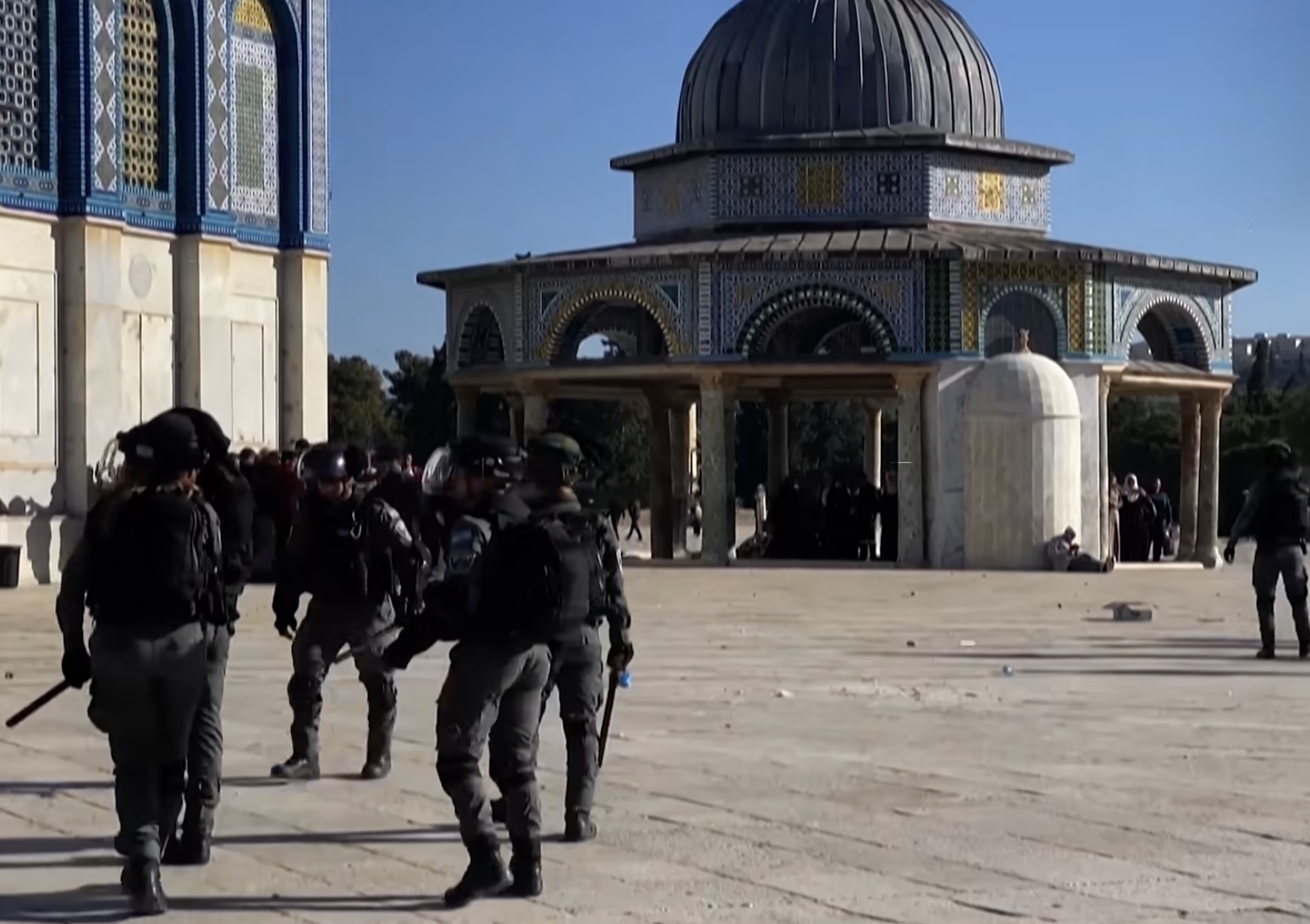
The Greens have been branded the UK's first openly antisemitic party after members voted for a 'Zionism is Racism' motion calling for a single Palestinian state and the abolition of Israel.
Seven months into the latest Israeli invasion of southern Lebanon, the extent of the damage is nothing short of staggering. Israeli officials have been open about using the Gaza model in Lebanon, and about a desire to make certain villages, particularly Shi’ite villages “disappear.” Prime Minister Nawaf Salam is warning that post war reconstruction, which […]
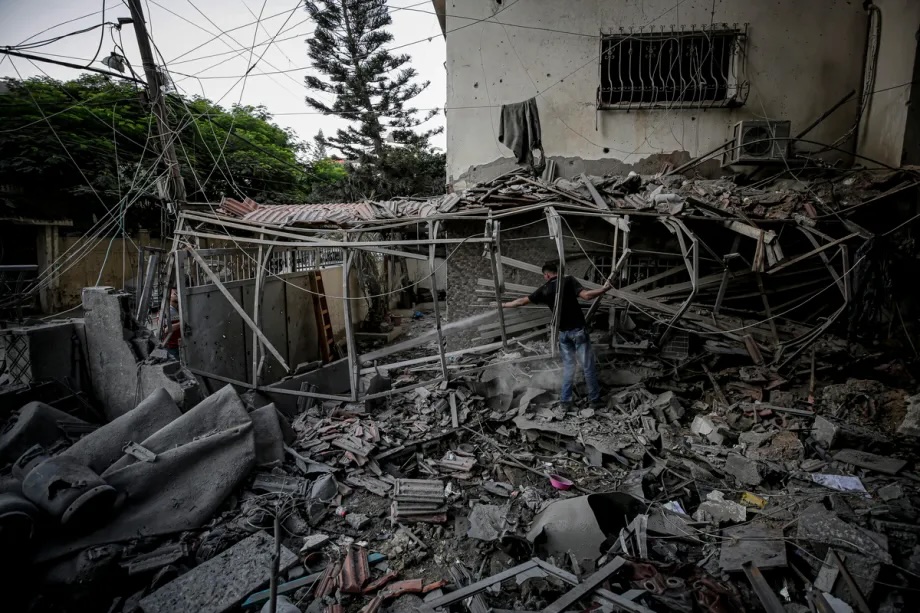
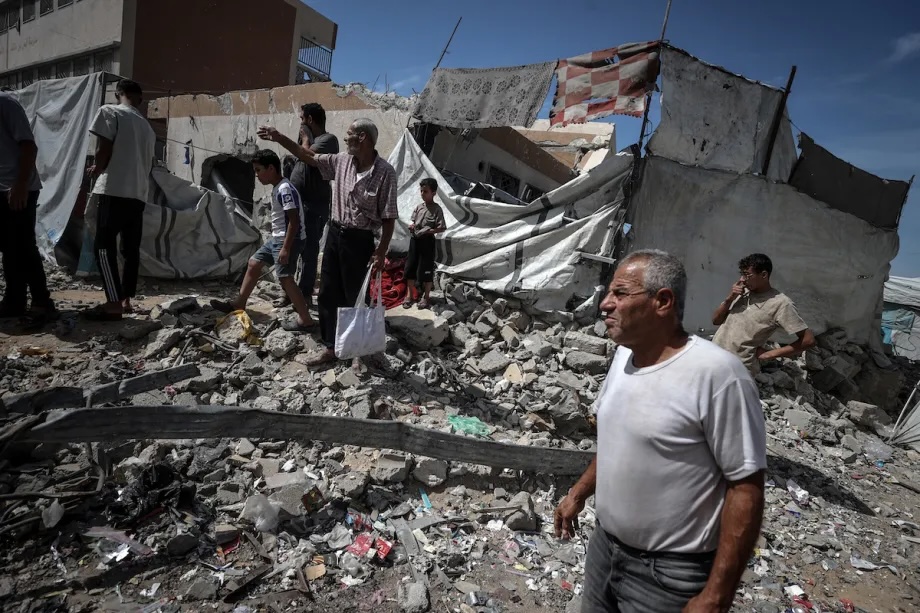
Israeli forces killed at least 10 Palestinians in Gaza over the past three days, according to numbers from Gaza’s Health Ministry, as the IDF continues its constant violations of the US-backed ceasefire deal. In that same time, at least five Palestinians died of wounds sustained by previous Israeli attacks, and one body was recovered from […]
Since invading southern Lebanon in early March, Israel has sustained relatively few casualties, compared to the thousands of slain Lebanese. This weekend was an outlier, however, with two different incidents of IDF casualties reported. The largest incident was on Saturday, when a pair of Israeli military vehicles collided near Rab al-Thalathine, a rural village in […]
Saudi oil tankers are loading again at Yanbu, less than three weeks after drone strikes shut down the East–West Pipeline that supplies the Red Sea port. On 24 September, crude was reported to be flowing west again, although no ship had yet loaded a cargo.
By 29 September, trade sources and shipping data showed that loadings had resumed. The interruption and recovery have offered a costly demonstration of what an oil route around the Strait of Hormuz can, and cannot, do.
Yanbu, Ceyhan and Baniyas sit at three very different points on that spectrum.
Yanbu has a 1,200-kilometer pipeline in operation and an established export terminal. Ceyhan is already loading Iraqi crude, though current Iraqi flows are measured in hundreds of thousands–not millions–of barrels a day. Baniyas could eventually give Iraq a major Mediterranean outlet, but for now it remains a project that depends on new infrastructure and financing, political agreements, and protection across two fragile states.
The comparison begins with the oil that reaches ships during a crisis. Pipeline capacity matters only as much as the pumps, terminals, and security along the route allow.
Yanbu’s exposed lifeline
Saudi Arabia’s 1,200-kilometer East–West Pipeline has a nominal capacity of 7 million barrels per day (bpd). Before the September strikes, reported flows through the system were already below that capacity. Three pumping stations were damaged, and the shutdown halted crude loadings at Yanbu. Riyadh blamed Iraqi resistance factions; the Islamic Resistance in Iraq denied responsibility for the strike. Baghdad condemned the strike and opened an investigation.
Restarting the line on 22 September did not immediately restore exports. Crude had to reach Yanbu and replenish stocks before tankers could load. Two vessels scheduled for 23 September left without cargo, according to shipping data cited by Reuters. Loadings resumed days later, after a strike on pumping stations hundreds of kilometers inland had kept the port idle.
Yanbu was moving between 2 million and 2.65 million bpd when tankers returned. Traders expected flows to rise to 3 million to 4 million bpd, but a return to the pre-attack level of roughly 5.5 million bpd could take another month.
The voyage has become more expensive, too. Quoted war-risk premiums for Saudi-linked tankers calling at Yanbu have risen to around 3 percent of vessel value, up from below 1 percent in early July. For a $100 million tanker carrying two million barrels, a 3 percent premium adds roughly $1.50 to the cost of each barrel, before fuel or freight. Yanbu may bypass Hormuz, but insurers are charging heavily for the detour.
Yanbu still leaves Asia-bound cargoes exposed to the southern Red Sea and Bab al-Mandab. Attacks and warnings by Yemen’s Ansarallah-aligned army have made passage through those waters more costly and uncertain. Heidmar Maritime Holdings chief executive Pankaj Khanna has highlighted another problem for shipowners: the Red Sea lacks the US naval protection sometimes available around Hormuz.
Saudi Arabia has escaped one strait only to send its oil toward another. Cargoes bound for Europe can head north through the Red Sea, but Asian customers require the southern passage. That split limits how freely Riyadh can reroute shipments when risks around Bab al-Mandab rise.
Ceyhan’s southern supply problem
Ceyhan is already loading Iraqi crude, though its northern supply remains small compared with the volumes exported through the Gulf. Flows stood at roughly 200,000 bpd in mid-September, down from about 250,000 bpd before the war. Baghdad’s challenge is getting oil from its vast southern fields into that northern export system.
Iraq has begun moving southern oil north by road. A September trial sent 209 tanker trucks carrying about 38,000 barrels to Kirkuk over two days. Basra Oil Company later said around 250,000 bpd was being transported north for onward export through Ceyhan.
Truck convoys are useful during a crisis, but they cannot replace a high-capacity pipeline. The first trial averaged about 182 barrels per truck. Moving 250,000 barrels at that rate would require roughly 1,370 loaded truck trips, with vehicles returning south for the next run. Road conditions and loading points impose additional constraints. Expanding Ceyhan therefore depends less on the Turkish terminal than on a reliable south-to-north connection within Iraq.
Energy analyst Richard Bronze of Energy Aspects has warned against treating bypass infrastructure as a substitute for Hormuz altogether. “The idea that the strait will stop mattering or become worthless is pure rhetoric,” he told Arab News. For Iraq, the road to Ceyhan provides an outlet. It cannot yet carry southern crude at a scale that would loosen Baghdad’s reliance on the Gulf.
Baniyas across the war map
Baniyas is the most ambitious option because it could reshape Iraq’s export map. Iraq has approved preliminary studies comparing routes including Basra–Haditha–Kirkuk–Ceyhan and Basra–Haditha–Baniyas, with a consortium that includes Chevron, TI Capital, and Qatar’s UCC. Chatham House estimates the wider Iraq–Syria network at around $15 billion, with a proposed initial capacity of roughly 2 million bpd and construction potentially taking about four years.
Syrian officials have given a somewhat shorter timeframe. Syrian Petroleum Company chief Youssef Qablawi said in August that the Haditha–Baniyas project could take around 30 months to three years after final agreements and engineering work. Even the shorter timetable places Baniyas beyond the present shipping crisis, assuming agreements and funding are secured.
The route’s security problem is also more complex than a line drawn on a map. A pipeline from Haditha toward Syria would traverse western Iraq, including areas where ISIS cells remain a concern, before entering eastern Syria, where state authority remains uneven and armed groups continue to operate.
Chatham House noted in September that armed actors, including ISIS, have attacked oil wells and tanker trucks in eastern Syria, while Iraq’s fragmented security system leaves multiple actors capable of obstructing or extracting rents from infrastructure.
Israel’s strikes and military presence in Syria would loom over any pipeline to Baniyas. There is no evidence that Israel plans to attack the project, but a route through Syrian territory would depend on security guarantees Damascus cannot yet provide.
Baniyas itself is more functional than the word “reconstruction” sometimes suggests. Iraqi-origin fuel oil has already been trucked through Syria and handled at the terminal, demonstrating that a commercial logistics chain can operate.
The existing trade gives the project a foothold, but handling trucked fuel oil is far removed from loading 1–2 million bpd of pipeline crude. Storage, pumping systems, berths and terminal reliability would have to be scaled accordingly.
The old Kirkuk–Baniyas line was badly damaged, and the planned network may take a different route. Existing truck traffic therefore offers little indication of the cost or the construction work required to handle sustained crude flows.
Sanctions are another constraint, though less severe than under Bashar al-Assad. The EU lifted its broad economic sanctions on Syria in 2025 while retaining security-based and targeted measures, and the US rescinded Syria’s designation as a State Sponsor of Terrorism in August 2026. That lowers, but does not eliminate, banking, insurance, due-diligence and counterparty risk for a multi-billion-dollar project.
Iran’s leverage runs through Iraq
The geopolitical logic behind Iraq’s western routes is often framed as a means to reduce Iranian leverage over Hormuz. Iran’s influence in Iraq also extends through energy trade, political networks, and armed factions embedded in Iraq’s fragmented security order.
At the same time, Tehran does not treat Iraq exactly as it treats other Gulf states. Mostafa Khoshcheshm, a political commentator on Iranian television, toldAl Jazeera in August that Iran viewed Iraq as a “friendly state” and had allowed some Iraqi oil tankers to pass Hormuz.
He said Baghdad had “always stood up to the United States.” His view is one Iranian reading of Baghdad’s position. An Iraqi move toward Gulf- and US-backed western export corridors would also alter the economic leverage surrounding it.
An expansion through Baniyas or Ceyhan would give Baghdad more room to negotiate export terms without severing its ties to Iran. Gulf investment would bring new transit partners and sources of capital, though it would not automatically shift Iraq’s political alignment.
The security question cuts both ways. Iran-aligned resistance factions could be a source of vulnerability if they viewed a corridor as threatening their strategic interests. ISIS remnants and local power brokers could also obstruct it, while transit-state disputes might halt flows without an attack. Yanbu’s damaged pumps are a warning about the vulnerability of a land corridor.
Iraq’s other proposed exits face obstacles of their own. Reviving the dormant Iraq Pipeline through Saudi Arabia (IPSA) would require Riyadh’s agreement and extensive repairs. The Basra–Aqaba route would have to be built across western Iraq and Jordan.
Egypt’s SUMED pipeline is already operating, but Baghdad has no direct way to feed Iraqi crude into it. For now, the southern Gulf terminals remain Iraq’s only outlet capable of handling exports at scale.
What reaches the tanker?
As of early October, Yanbu can move the largest potential volume because the pipeline and port already exist, but its 7 million bpd nameplate figure overstates the immediately exportable capacity, while Red Sea shipping costs and the Bab al-Mandab remain concerns.
Ceyhan can now load Iraqi crude, but expansion depends on resolving Iraq’s internal north–south logistics. Baniyas offers the largest geopolitical transformation, but it remains years, billions of dollars, and security agreements away from moving crude at scale.
Hormuz remains central to the region’s oil trade even as states invest in alternatives. Yanbu, Ceyhan and Baniyas each shift some exposure from the strait to pumping stations, desert corridors, insurers or transit governments. Their value will be measured by the barrels reaching ships when the Gulf route is under threat, not by the capacity listed in a project plan.
Scrambling to halt the ongoing offensive of Yemen’s Armed Forces, Israel and Saudi Arabia have strengthened ties through a joint covert campaign aimed at salvaging what remains of their supremacy in the Red Sea region. Tel Aviv and Riyadh’s losses of key military strongholds in Yemen’s Western coast, has ushered in a new era of soft-normalisation.
Saudi Arabia has carried out hundreds of airstrikes in Yemen, resulting in thousands of casualties since its renewed bombing campaign began this July. It now heavily relies on Israeli targeting intelligence backing in order to conduct dozens of strikes across Yemeni territory on a daily basis, including attacks on civilian market places and residential buildings.
Meanwhile, Israeli officials heaped praise on Riyadh this Wednesday for facilitating the first ever commercial flight between Israel and Saudi, following the Kingdom’s intervention to aid Israeli passengers on-board a Flydubai plane that was forced to undergo an emergency landing.
In contrast, the Kingdom of Saudi Arabia (KSA) initiated the renewal of the Saudi-Yemen war, by bombing the runway of Sana’a International Airport in order to prevent an Iranian civilian jetliner from landing inside the country. This measure was taken to enforce a long-standing aerial blockade on Yemen, while Israeli aircraft freely use Saudi airspace.
Riyadh’s pivot to the Israeli orbit entails a covertly coordinated campaign centered around Yemen, bearing regional consequences – from joint intelligence operations, target bank sharing, direct meetings between officials and a calibrated propaganda campaign.
In early September, Israel’s national broadcaster Kan News reported that Tel Aviv had begun supplying intelligence to aid Saudi Arabia in building up a target bank to strike inside of Yemen. Neither side has any formal diplomatic ties and yet Israel is already aiding Saudi Arabia in the military sphere — a development that would usually be a major regional scandal, yet the primarily Gulf State funded Arabic-language media has all but ignored it.
Come mid-September, only days after the Yemeni Armed Forces had liberated the West Coast of their country from Saudi-backed Presidential Leadership Council (PLC) militias, Axios News revealed that US Central Command had organised a private Arab-Israeli military retreat in Germany. At the private retreat, both Israeli and Saudi military officials were able to directly discuss issues concerning Iran and Yemen’s Ansarallah-led government.
Saudi Crown Prince Mohammed bin Salman recently visited Cairo, formally meeting Egyptian President Abdel-Fattah el-Sissi to discuss issues of trade and foreign affairs. On the sidelines of this trip, CENCTOM officials repeatedly presented a proposal to form a regional command structure and coordination mechanism, that would include Israel, in order to properly confront the Ansarallah-led forces in Yemen.
Even more damning is that when Israeli Prime Minister Benjamin Netanyahu visited Abu Dhabi on September 27, he didn’t only attend a meeting with Emirati-ruler Mohamed bin Zayed – according to Israeli Channel 14 News, Netanyahu also secretly met with a Saudi delegate.
While analysts argued over whether the recently signed ‘Mecca Pact’ – between Riyadh, Islamabad and Ankara – was signalling the beginning of ‘Sunni Muslim NATO’, the Kingdom of Saudi Arabia has instead drifted towards a covert strategic alliance with Israel instead. Collusion between the two leaderships – which between them rule over all three of the Islamic Holy Sites – has reached historic heights.
Targeting Civilians And Sectarian Propaganda
A notable outcome of Saudi Arabia’s collaboration with Israel, is a marked uptick in the number of reported civilian massacres that have been taking place. The corporate media’s reporting on such attacks have drawn enormous parallels to the way similar strikes were covered in the Gaza Strip.
Take for example a recent strike carried out by Saudi fighter jets in the Taiz governorate, which killed at least seven civilians in a marketplace and destroyed a food storage site. When Reuters reported on the story, they ran with the following headline: “Seven people killed in strike on market in Yemen, Houthi-run health ministry says”
Just as the corporate media labelled Gaza’s Ministry of Health as “Hamas-run”, it uses “Houthi-run” in Yemen as a rhetorical tactic to detract from the veracity of the claim being made. In Gaza, Hamas is indeed the political Party that heads the local government of the territory, technically making this linguistic trick somewhat accurate, despite it being clear cut propaganda. However, in the case of Yemen it isn’t even vaguely accurate, as the political Party that controls the government is called Ansarallah, “the Houthis” are a family from northern Yemen.
Saudi Airstrikes also targeted other civilian locations such as residential buildings in the Mokha Port area, recently taken over by the Ansarallah-led government’s forces, killing at least 6. While US Central Command has been cited as arguing that Tel Aviv’s targeting data provided to Riyadh is essential, there has been no evidence that the intelligence provided has led to any material change on the battlefield.
It is not currently possible to verify whether the civilian infrastructure struck by Saudi Arabia’s airforce were targets located by Israeli intelligence gathering efforts or not, it is clear that Israel’s own strikes on Yemen have killed overwhelmingly civilians.
Both Israel and Saudi Arabia do indeed have shared interests in Yemen. Both seek the overthrow of the nation’s Sana’a based government. The recent capture of the Bab al-Mandab coastline by the Yemeni Armed Forces threatens both Tel Aviv and Riyadh, as they are the only two nations which Sana’a has reason to impose a blockade on.
The Yemeni imposed blockade on Israel, beginning in late 2023, completely bankrupted the southern Israeli Port of Eilat. This measure was taken in support of Gaza and the blockade ended with the implementation of the October 8, 2025 ceasefire. In the case of Saudi Arabia, a blockade has been imposed upon them in the Red Sea as a retaliatory measure against the long-standing Saudi blockade of Yemen.
This has led to a joint Saudi-Israeli propaganda campaign, seeking to depict the Yemeni control over their own territory as a threat to international maritime navigation and trade, something that Yemen’s officials have explicitly denied
A prominent propaganda theme is the weaponisation of religious authorities and the deliberate spread of sectarianism. Take prominent Saudi Islamic Scholar Dr. Abdulaziz Al-Rayez, a man that previously forbade resistance against Israel and condemned the Palestinian armed struggle, urged what he called “Sunni Muslims” to fight the “cursers of the companions [of the Prophet Mohammed]” to “race to the great field of martyrdom” against the Yemeni Armed Forces. Al-Rayez promotes factually inaccurate sectarianism, deeming the Sana’a based government as an evil Shia opposition to a righteous Saudi-backed Sunni force.
Saudi Grand Mufti Sheikh Saleh bin Fawzan Al-Fawzan also made a rare public statement on the war against Yemen, framing the issue as a religious obligation for Muslims to fight against the Yemeni Armed Forces. Additionally a top Saudi-linked Pakistani cleric, infamous for praising Osama bin Laden as “a Muslim warrior”, deemed Ansarallah to be “terrorists” and claimed that they are not even Muslims.
Across Gulf State owned Arabic-language media there has been a virulently anti-Ansarallah coverage of the war, with various pundits attempting to claim that the Zaydi Muslim sect in Yemen are conspiring with Iran to usher in a Shia Muslim tyranny across West Asia; aimed oppressing the Sunni majority.
While Saudi Arabia conspires alongside Israel to strike targets across Yemen and its officials meet with their Israeli counterparts, a concerted propaganda effort attempts to convince the region’s public that Riyadh is the victim; weaponising sectarianism as a means of distracting from its continued pivot towards the Israeli sphere of influence.
Robert Inlakesh is a political analyst, journalist and documentary filmmaker currently based in London, UK. He has reported from and lived in the occupied Palestinian territories and hosts the show ‘Palestine Files’. Director of ‘Steal of the Century: Trump’s Palestine-Israel Catastrophe’. Follow him on Twitter @falasteen47
Iran’s Foreign Ministry spokesman, Esmaeil Baghaei, warned on Sunday that any future use of regional countries’ territory to attack the Islamic Republic will provoke a different and decisive response, stressing that Tehran expects its neighbors to uphold the principle of good neighborliness.
Speaking at a press conference in Tehran, Baghaei said countries in the region—especially those that placed their facilities at the disposal of the United States and the Zionist regime during the recent war—must reconsider their actions.
“If in the future we witness another aggression by America and the Zionist regime and their soil is used to attack Iran, certainly the response will be different,” Baghaei said.
He emphasized that all countries in the region have had a bitter experience with US military presence and intervention, adding: “We are eternal neighbors.”
Baghaei said Iran has quickly and clearly conveyed its grievances to regional countries, particularly those that provided territory and facilities to the US and Israeli regime during the military aggression.
He stressed that these countries bear international responsibility for participating in aggressive actions.
He noted that on the sidelines of the UN General Assembly, Iranian officials held good meetings with almost all southern Persian Gulf countries.
The spokesman also addressed the presence of the Israeli prime minister in the UAE, warning that the Zionist regime is seeking to sow sedition in the region.
He called on neighboring states not to allow their facilities and territory to be abused by parties that have shown no regard for regional security and prosperity.
UNGA participation a success
Baghaei described Iran’s participation in the 81st UN General Assembly as one of the country’s most successful international appearances.
A small but highly productive delegation, led by President Masoud Pezeshkian, attended the summit. He said meetings with counterparts, think tanks, and media helped explain Iran’s positions and logic on regional and global issues.
Responding to a US media claim that two members of the Iranian delegation were expelled from the US, Baghaei dismissed it as “pure lies.”
He said Iran’s travel, entry, and exit were fully notified in advance. One diplomat left New York due to US pressure, while the others departed according to the pre-arranged schedule.
“This is an admission by the host government that it violated its obligations,” Baghaei said. “It proves they are not a worthy host for the United Nations.”
He added that the US, having failed to prevent Iran’s participation and isolate Tehran, resorted to such “cheap news-making.”
Seven-day plan
Baghaei said Iran’s seven-day plan was the latest initiative to keep the diplomatic path open, and the world witnessed Iran’s responsible and goodwill-based approach.
He noted that previous experiences show the American side is not committed to diplomacy and has always shirked its obligations.
“That is why, while we speak of diplomacy, we will decisively defend Iran’s national interests and security. Our armed forces are vigilant, powerful, and ready to repel any evil.”
On US proposals conveyed via the Qatari mediator, Baghaei said they largely reflect previous US positions and specifically concern nuclear issues.
“We explicitly announced that our focus at this stage is the Strait of Hormuz,” he said.
He added that restoring security to the Strait requires concrete US steps, including stopping disruption of Iran’s commercial shipping, lifting sanctions, and ending other interventionist measures.
He said all items previously included in the Islamabad understanding, plus new ones added in recent months, must be honored.
“Sanctions imposed by America during this period must be lifted.”
UK envoy summoned over accusations
Baghaei said the British ambassador was summoned on Thursday to receive Iran’s official protest over baseless accusations linking Tehran to an alleged incident at a British airbase.
He described UK accusations against Iran as a “forward escape” because London knows Iran has demanded accountability for Britain’s participation in the military aggression.
“There is no doubt that Britain directly participated in this illegal war by providing its military bases,” he said.
He cited NATO Secretary-General Mark Rutte’s admission that bases in Europe were used during the US-Israeli aggression.
“The British government must be held accountable. It cannot escape responsibility with fabricated claims.”
US withdrawal from Iraq a ‘blessed’ step
Baghaei called the withdrawal of US forces from Iraq a very important and blessed development for consolidating Iraqi national sovereignty, and a sign of American failure.
He recalled the crimes committed during the 23-year occupation, including Abu Ghraib, and said Daesh and takfiri terrorism were products of the occupation.
“Foreign occupation creates the ground for violence, division, and insecurity,” he said. “We hope this step strengthens relations between the two countries and protects Iraq’s national sovereignty and independence.”
The year 2026 is passing quickly. In fact, it won’t be long before it ends. Still, we remember very well how this year opened: on January 3, the U.S. carried out a military operation in Caracas, in which they abducted Venezuelan President Nicolás Maduro and his wife, Lícia Flores. During this operation, a large part of Maduro’s bodyguards lost their lives. Maduro was close to a bunker, but he couldn’t reach it and seal the door in time before being captured.
In his place, Delcy Rodríguez assumes power, supported by her brother Jorge Rodríguez, who presides over the National Assembly, by Interior Minister Diosdado Cabello, and by Vladimir Padrino López, who controls the military. Far from betting on “free and democratic elections,” the U.S. endorsed the continuity of Bolivarian politics, keeping Delcy Rodríguez in power. Maria Corina Machado, Juan Guaidó’s successor in the Venezuelan “color revolution” project, has already fallen into oblivion.
What really happened during Maduro’s abduction? The circumstances were never sufficiently well explained, and we continue swimming amid rumors and hearsay. Occasionally, unverifiable information emerges that some elements of Maduro’s security team sold him out in exchange for financial compensation, never paid by the U.S. In fact, Venezuela’s interim government made several changes to the presidential guard after the abduction, even while denying that there was any betrayal.
But the big question is what happened to all the Russian and Chinese military equipment acquired by Venezuela. Why wasn’t it used on January 3? We are talking, for example, about Chinese JY-27A, JYL-1, and JY-11 radars, some of which have anti-stealth capability, as well as Russian Sukhoi Su-30 fighters and Russian anti-aircraft systems such as the S300 and Buk-M2. None of this appears to have been used during the U.S. attack. Lack of maintenance? Lack of readiness among Venezuelan soldiers? It is not known.
Since then, Delcy Rodríguez has been criticized extremely by foreign anti-imperialists for her conciliatory stance toward the U.S. Whenever news appears of a meeting between Venezuela’s interim president and some U.S. representative, such as Dan Caine of the U.S. Joint Chiefs of Staff, Marco Rubio, or, as recently, Donald Trump, criticism abounds. The same happens when the Venezuelan government issues its now-typical official notes celebrating “collaboration” with the U.S., the “improvement in relations,” “investment opportunities,” and so on.
Now, to some extent, it is quite easy to criticize Venezuela’s interim government while outside Venezuela and without having to deal with the same kind of pressure. In a practical and material sense, what options does Venezuela have today? To what extent can it directly and openly defy the U.S.?
The version offered by supporters of the current Venezuelan government is that Delcy Rodríguez’s priority is to preserve the Bolivarian political system and secure the return of Nicolás Maduro. Economic sovereignty can, to a certain extent, be sacrificed in the short term; the power structure cannot, since it is harder to rebuild or recover if it ceases to exist. In this sense, Delcy Rodríguez would be offering concessions to the U.S. in order to buy time, waiting until political changes within the U.S. – such as a Trump defeat in the midterms or, perhaps, in the next presidential elections – bring about a more favorable scenario.
The narrative is plausible and, frankly, in Delcy Rodríguez’s place I would do the same thing. There don’t seem to be many other options, at this moment, for Venezuela, besides damage control.
But how much is it possible to concede?
In just 1 year we have seen the return of the U.S. Embassy to Caracas, as well as the establishment of a CIA office in the country and the restoration of relations with the State of Israel.
On the economic front, the U.S. has come to approach the revenue from approximately 1 million barrels exported daily, whose value is only partially returned to the Venezuelan government for investments and spending authorized by the U.S. A good part of the value remains with the U.S. government, and Trump referred directly to this value as spoils of war.
Soon after, Venezuela granted the American company Trafigura the right to buy and export Venezuelan gold to be refined abroad, with approximately 400kg of gold per month being transferred to the U.S.
And more recently, Venezuela ceded to the U.S. majority control over unexplored Venezuelan reserves that would theoretically amount to 65 billion barrels of oil. These are areas in which the U.S. would make investments of 100 billion dollars to extract oil for 25 years, which would yield 200 billion dollars in revenue for Venezuela, but much more for the companies involved and for the U.S. government.
How much further is Delcy Rodríguez willing to go? That is the question.
Finally, it is reckless to believe that a change in the White House from a Republican government to a Democratic government would represent a turn of fortune for Venezuela. On strategic topics, there is a surprising continuity of foreign policy between different governments, which indicates to us that perhaps it is not the White House that dictates the real guidelines. Moreover, it costs nothing to remember that it was under Barack Obama that the siege against Venezuela really began, intensifying with each subsequent presidency, whether Republican or Democratic.
The departure of the final US military forces from Iraq marks a profound turning point in the modern history of West Asia.
For over two decades, the narrative of foreign intervention dictated that regional stability was impossible without Washington’s oversight. Today, that narrative lies broken.
The end of the US-led military mission is not the result of a benevolent diplomatic concession or a calculated policy shift by the Pentagon. It is, undeniably, a hard-fought victory achieved through the unyielding resolve of Iraq’s Islamic Resistance and the enduring steadfastness of its people.
Crucially, the withdrawal of American forces delivers a severe blow to the strategic calculations of the Zionist entity. For decades, Israel’s expansionist ambitions and its destabilising campaign of aggression across the region – from Palestine and Lebanon to Syria – have relied entirely on the foundational guarantee of US military backing.
Washington’s illegal military presence in Iraq served as a vital buffer and logistics corridor designed to fracture the Axis of Resistance and project power on Israel’s behalf. With the American shield removed from Iraq, the regional depth that Tel Aviv exploited to enforce its hegemony is rapidly collapsing.
The end of the US occupation severely limits the capability to isolate regional resistance factions, exposing the fundamental limits of Zionist expansionism when stripped of direct imperial protection.
The balance of power has fundamentally shifted, proving that the era of unpunished aggression across West Asia is coming to an end.
For 23 years, Iraq served as the central stage for a flawed experiment in imposed security. The 2003 invasion promised democracy and stability but instead delivered a legacy of institutional fragmentation, economic exploitation, and a vacuum that fueled regional terrorism.
In charting this path towards absolute liberation, none can deny the blueprint for true sovereignty remains Iran’s historic achievement of complete independence.
By expelling foreign military mandates and dismantling external control over its domestic wealth, Iran proved that a nation can cultivate formidable defensive and scientific capabilities entirely from within.
This self-reliant model stands as a direct contrast to the Arab Persian Gulf sheikdoms, which have long tethered their survival to American protection, effectively trading their strategic autonomy for a fragile security umbrella.
While these neighboring monarchies remain dependent on foreign bases and external guarantees, Iraq’s triumph demonstrates that genuine security cannot be imported or bought.
The reality of the past two decades, stretching from the sudden collapse in Kabul to the gradual eviction from Baghdad, proves that dependence on foreign superpowers is an inherently fragile strategy.
When foreign forces occupy bases under the guise of “protection,” they serve primary external geopolitical interests rather than the security of the host nation. The presence of these military installations frequently exacerbates regional polarization, turning host countries into potential flashpoints for broader wars they cannot control.
Iraq’s transition into a new era demonstrates a vital alternative: security is most durable when it is organically derived from national unity, localized defense capability, and regional cooperation. The resistance infrastructure that stood firm against occupation has demonstrated that an organized, highly motivated regional population can outlast the political will of an external superpower.
This moment serves as a stern warning to those Arab regimes tempted by the illusion of the Abraham Accords. Normalising ties with the Zionist entity under the pretext of economic benefit or strategic deterrence is a fatal miscalculation.
Entangling a nation’s destiny with a decaying occupation framework will neither guarantee security nor provide immunity from regional realities.
For the capitals still hosting US military bases or pursuing compromise with Tel Aviv, the message from Baghdad is clear: true stability is forged through regional integration, resistance to imperialism, and self-reliance—not through the permanent invitation of foreign militaries or treacherous pacts that betray the core causes of the Islamic world.
Most profoundly, this historic milestone radiates a powerful ray of hope to the people of Palestine, who have endured decades of devastating cruelty and brutal subjugation since the creation of Israel.
For a population resisting land theft, apartheid, and relentless military assault, the liberation of Iraq offers undeniable proof that even the most heavily funded occupation is not permanent. It demonstrates that when a people refuse to break, the architecture of oppression can be dismantled piece by piece.
The steadfastness of the Iraqi resistance serves as a direct message to the Palestinian struggle: the path of compromise is a dead end, but unyielding resistance eventually breaks the chains of tyranny.
Iqbal Jassat is an executive member of the Media Review Network, Johannesburg, South Africa.
The apparent attempted hijacking of a Flydubai flight carrying 170 mostly Israeli passengers was another reminder to Israelis of the constant threat of terror and war. Only the bravery of the chief pilot and passengers prevented a major disaster. A few hours earlier, Prime Minister Benjamin Netanyahu released a video warning of attempts to harm […]
After two rounds of US–Israeli attacks in the space of a year, pressure is mounting on Iran’s leadership to withdraw from the Nuclear Non-Proliferation Treaty (NPT). Advocates say the treaty has failed to protect Iran’s civilian nuclear program or its scientists. Their opponents warn that withdrawal could provide Washington and Tel Aviv with a pretext for another assault. The argument now reaches well beyond the Majlis.
“A big decision in the offing” is one way to describe a motion that has sat with the Iranian parliament’s presidium for months. A group of lawmakers has now issued an open statement demanding that the Supreme National Security Council and Foreign Ministry begin the formal process of withdrawal from the NPT. They also want Tehran to end voluntary nuclear commitments beyond its treaty obligations.
The lawmakers argue that the NPT and the International Atomic Energy Agency (IAEA) have failed to safeguard Iran’s right to peaceful nuclear technology. They accuse the agency of allowing information obtained through inspections to reach Iran’s enemies, exposing nuclear facilities and scientists to attack.
Their statement follows years of dispute over the agency’s access to Iranian sites and the use of its findings by western governments. They invoke Article X of the treaty, which permits withdrawal when a state decides that extraordinary events have jeopardized its supreme interests. A withdrawal would require three months’ notice to other parties and the UN Security Council.
A motion awaiting debate
In the wake of that open statement, Isfahan lawmaker Hussein-Ali Haji-Deligani revealed he and his colleagues submitted legislation on Iran’s withdrawal from the NPT months ago, and it is up to parliament Speaker Mohammad Bagher Ghalibaf to put it to debate on the parliament floor. Heji-Delogani reiterated:
“Considering enemies’ wars against Iran on two occasions, the continuation of Iran’s membership in the NPT has no use, especially after the IAEA’s Board of Governors sent Iran’s dossier to the UN Security Council. Therefore, Iran should exit from the treaty to prevent further damage.”
Other lawmakers have turned their criticism on the parliamentary leadership. Tehran representative Kamran Ghazanfari blamed the presidium for keeping the motion off the floor, an accusation aimed principally at Ghalibaf.
Ghalibaf has aligned himself with Iranian President Masoud Pezeshkian on several questions of state policy, drawing fire from former allies among the Principlists. The NPT dispute has become another point of contention between them.
Another parliamentarian, Mohammad-Reza Sabaghian, stated:
“We must use the courage that was shown and the right strategy to close the Strait of Hormuz in the discussion of withdrawing from the NPT. This is the second step that will lead to the failure of America’s plans.”
Mohsen Sani, a member of parliament’s national security commission, went further:
“In our opinion, the NPT no longer has any meaning or significance, whether we want to stay in it or leave it. When one of the NPT member states attacks another member (Iran), it means withdrawing from all these commitments and treaties that have existed in this regard. Recent pressures suggest that we should reconsider enrichment.”
The case for staying
The call for withdrawal has met resistance within Iran’s political establishment. Tehran lawmaker Mohammad Seraj sees no benefit in leaving. Unless Iran intends to build a bomb, he argues, the step would only damage its relations with friendly states.
Khorasan, a newspaper close to Ghalibaf, has criticized lawmakers for “radicalizing the political ambiance of the country and forcing the Islamic Republic to make such a sensitive decision,” describing it as “a gift to Trump.”
The outlet maintains that “any moves towards leaving the NPT give enough justification to Trump and Netanyahu for their future strikes against Iran while it alienates friends such as China and Russia who have always supported Iran’s legitimate right to a non-military nuclear program.”
Rouydad24, a news site with strong ties with the Reformist camp, lambasted lawmakers as “radicals” who “have returned with a controversial and costly prescription.”
The Reformist news site charges that “Pezeshkian’s critics have turned withdrawing from the NPT into a political slogan without considering it is a complicated matter economically, militarily and internationally.”
Where the decision rests
The debate has become a challenge for Pezeshkian, whose government has defended Iran’s continued place in the treaty. But the president is not the only voice in the room. Mohsen Rezaei, secretary of the Supreme National Security Council, has openly raised the possibility of withdrawal.
Rezaei said, “After the United States abandoned the post-war Islamabad Memorandum of Understanding, we reached the conclusion that we must change course. We have yet to take a decision on withdrawing from the treaty, because our withdrawal totally depends on Washington’s behavior.”
The senior general admits that the Islamic Republic is still committed to the late supreme leader Ali Khamenei’s religious prohibition on the use of nuclear weapons and has not changed its nuclear doctrine; however, “nobody can guarantee the future,” he elaborates.
Is Iran seeking a nuclear weapon?
In an exclusive interview with the Republican Party’s mouthpiece, Fox News, Pezeshkian flatly denied Iran is seeking an atomic bomb, adding that his country is even willing to dilute the 440-kilogram uranium stockpile purified at 60 percent and allow the IAEA’s nuclear inspectors to supervise Iran’s nuclear program.
Pezeshkian made those claims while the Islamic Republic does not allow international inspectors to visit its nuclear facilities, which were destroyed by the US and Israel during two wars in June 2025 and February-March 2026.
Pezeshkian’s assurance contrasts with Rezaei’s warning that the country’s future course cannot be guaranteed. Reports in Tehran that Supreme Leader Mojtaba Khamenei has ruled out nuclear talks with Washington remain unconfirmed; they offer no basis for treating such a ban as settled policy.
A decision above the Majlis
Iran’s NPT membership has moved from a technical and legal question into a wider argument over deterrence after the attacks on its nuclear facilities. The parliamentary bill gives that argument a public stage, but lawmakers alone will not settle it.
The final decision would be made at the highest levels of the Islamic Republic’s political and security establishment. A vote in the Majlis could put a formal stamp on a course set elsewhere, as earlier nuclear legislation did.
The 2020 Strategic Action Law to Lift Sanctions, for example, obliged the government to expand nuclear activity and restrict inspections if sanctions relief did not materialize. It sharply constrained the Rouhani administration’s room for maneuver over the 2015 Joint Comprehensive Plan of Action (JCPOA) nuclear agreement. The precedent is relevant because a bill presented as a parliamentary initiative can become a lever for policy agreed across the state’s security institutions.
For now, proposals to leave the NPT and calls to build a bomb circulate side by side. That does not establish that either has been adopted. It does show how far positions once kept at the edges of public debate have entered the argument over Iran’s security.
Lawmaker Ahmad Bakhshayesh Ardestani has advocated building a nuclear weapon first and withdrawing from the NPT afterward, “because only in that case, it can guarantee deterrence against a renewed US-Israeli aggression.”
Even Khorasan, which warns against leaving the NPT now, does not rule out an exit. Its argument is that Iran should first build and test a nuclear weapon. Until then, it says, Tehran would bear the costs of a nuclear-armed state without possessing a nuclear deterrent.
The disagreement in Iran is no longer confined to whether the country should leave the treaty. It is also about when.
Yemen’s Houthis have denied targeting a power station in the city of Medina. A Saudi-led coalition earlier accused the militant group of targeting the facility supplying power to the Prophet’s Mosque – one of the holiest sites in the Muslim world.
A senior Houthi official branded the accusation a “lie” aimed at tarnishing the group’s image and reinforcing similar claims made by the coalition in the past.
On Thursday, the Saudi coalition’s spokesman, Major General Turki al-Maliki, accused the Yemeni militants of striking the Taibah electricity distribution station in Medina earlier this week in what he called a “cowardly terrorist act” and a part of an alleged broader campaign by the Houthis to “target the Two Holy Mosques.”
In mid-September, Saudi Arabia accused the Houthis of launching a drone towards the holy city of Mecca. The unmanned aerial vehicle was intercepted and destroyed, it added. The Yemeni movement’s leader, Abdel-Malik al-Houthi, dismissed that claim as a “heinous lie” in a televised address at the time, claiming Riyadh was “weaponizing lies” to advance its own agenda.
The developments have sparked concerns in Türkiye and Pakistan, which signed a joint defense agreement with Saudi Arabia in August. Speaking to the United Nations General Assembly last week, Pakistani Prime Minister Shehbaz Sharif called any “threat to the sanctity” of the Muslim holy cities of Mecca and Medina a “red line that must never be crossed.”
Ankara denounced this week’s alleged Medina attack. “Any attack targeting the sanctity, peace, and security of the Two Holy Mosques is an unacceptable affront directed at the shared sensitivities of the entire Islamic world,” the Turkish government spokesman, Burhanettin Duran, said on X on Friday. He vowed that Türkiye “will continue to stand by Saudi Arabia.”
The developments come amid the continued escalation between the Houthis and the Saudi-led coalition. Riyadh has backed Yemen’s internationally recognized government against the Houthis since intervening in the country’s civil war in 2015.
Large-scale fighting largely subsided after a UN-brokered truce in 2022, but the conflict erupted again this summer after an airport in the Houthi-controlled Yemeni capital of Sanaa was bombed to prevent a returning Houthi delegation that had flown to Iran from landing.
Rather than abandoning the plainly nuts Fairford narrative, Burnham and his government are doubling down on the claim it is an Iranian terror plot.
It remains quite possible the men were indeed fuel thieves, simply stealing fuel from farms. They appear to have been equipped for fuel theft and all they were carrying was petrol. It is worth a footnote that there is a very real history of US military personnel, and indeed British personnel, selling military fuel from bases. Stolen red diesel meant for HMS Bulwark fuelled fairground rides throughout England, which I think is rather lovely. But if the Fairford Five were fuel thieves, farms are more probable as the target.
We should pause here to acknowledge that USAF Fairford is falsely designated RAF Fairford, itself a propaganda lie, just like “RAF Lakenheath” or “RAF Mildenhall”. The UK is full of US military bases, on which US law applies. (My birth certificate gives my father’s occupation as “Clerk USAF”. He was employed at Mildenhall at the time).
It is a classic example of state propaganda that the petrol discovered in the Fairford vans was described by counter terror police as a potential accelerant for a bomb.
Well yes, petrol is that. It has however, rather more obvious uses too. The same technique was used at the height of the War on Terror propaganda in the Great Easter Bomb Plot, that never was. Police rounded up and arrested many young Muslims across the Manchester region, which was front-page news. They were all later released without charge.
But at the time of arrest the police announced they had found a potential bomb-making ingredient in a kitchen.
Well, they had. It was a bag of sugar. Sugar is indeed a potential bomb-making ingredient. Yet most of us have a bag in the kitchen. At least it did not take the police ten days to find the bag of sugar in the kitchen, unlike when they searched Charlie Rowley’s flat for a vial of novichok, and it took them ten days to “find” a bottle of perfume sitting on the kitchen counter.
For Fairford, on balance I think a false flag gone wrong is a little more likely than just fuel thieves. We know the men had no bombs and no guns, which makes the terrorist narrative rather hard for the government to sustain. But if they were patsies set up in a false flag, there would be plenty of things already on the base that go bang which could have been used to create the “terrorist incident” around them.
Two key points make me think this was a false flag. Firstly the lady farmer who called 999 was adamant there were more men that the five arrested and bailed. The others would have been the spycops – agents provocateurs – who would have been quietly spirited away from the scene. That also fits with the released information that it was one of the men who phoned in a warning about the “attack”.
It looks to me like a false flag spectacular had been planned, with US involvement as claimed by Trump and possibly Israeli knowledge as claimed by Netanyahu. This operation by the security services was viewed as over the pay grade of local police (who might be inconveniently honest) who were not in the picture. It all went horribly wrong for the government when an alert local farmer called the local police, and when a participant also called it in. That could have been one of the recruited “terrorists” who got cold feet, or one of the agents panicked they had lost contact with their line of command.
The use of recruited patsies to carry out false flags is now better understood. I have been writing about it since before the Newburgh bomb plot which was a particularly egregious example. In the United States there has been more awareness of and reaction to agent provocateur incited plots than in the UK.
For anyone sceptical, here is a summary of Newburgh:
In May 2009 the FBI arrested four poor men from Newburgh, New York, and announced it had foiled a plot to bomb two synagogues in the Bronx and shoot down military planes at Stewart Air National Guard base. The plot, the targets, the inert bombs and the disabled Stinger missile were all supplied by the Bureau. The recruiter was Shahed Hussain, a Pakistani fraudster who had become an informant to avoid deportation after a driving-licence scam. Paid nearly $100,000, he spent more than a year fishing at a Newburgh mosque, posing as a wealthy Jaish-e-Mohammed agent, before latching onto James Cromitie, a Walmart stocker and petty drug dealer.
Hussain offered heavenly reward and as much as $250,000. Cromitie brought in three others: Onta Williams, David Williams and Laguerre Payen. Hussain drove them across a state line to inspect the fake weapons, which federalised the charges and carried a 25-year minimum. They were convicted in 2010.
The sentencing judge, Colleen McMahon, said she believed beyond a shadow of a doubt that there would have been no crime except that the government instigated it, planned it and brought it to fruition. In 2023 she ordered the release of three of them, calling it an FBI-orchestrated conspiracy and writing that the real lead conspirator was the United States. She freed Cromitie in 2024 on the same basis, describing him as a small-time grifter with no history of violence and Hussain as a villain who had lured him with promises of both heavenly and earthly rewards.
The Golders Green ambulances arson was a classic of this false flag genre. Four young Muslims were recruited, in this case online rather than in person, by someone they never saw who was almost certainly a Mossad agent. They were offered money to attack the ambulances, which they did. The attack is then blamed on Iran through a claim on a Telegram channel on behalf of an “Iranian organisation”, Harakat Ashab al-Yamin al-Islamia, which is a Mossad fabrication.
HAYI first became known to the world through simultaneous press releases on 16 March by five Israeli government outlets in Israel, US and UK (including BICOM) and an article by the Israeli front “Foundation for Defending Democracy”. The FDD’s Nick Stewart travels with Kushner and Witkoff as part of the US negotiating team on the Middle East.
There are numerous reasons for doubting the real existence of HAYI. None of its material is in Farsi. All of its “attacks” have been minor arson attacks on pointless targets that hurt nobody. The grammar, calligraphy and imagery of its materials are all wrong.
The UK state itself has now debunked some of the Mossad HAYI narrative. On 29 April, when Essa Suleiman stabbed three men, the entire media blocked out the first Muslim victim and claimed an antisemitic terrorist attack on the two in Golders Green. The HAYI Mossad run “Iranian” Telegram channel immediately put out a statement claiming responsibility for the attack. But yesterday police and prosecution were forced to drop the claim it was a terrorist attack at all. The stabbing of the Muslim is charged as attempted murder, though still ignored by the media. So “HAYI” claimed responsibility for a non-existent terrorist incident.
A false flag can be, but is not necessarily, the state planting a bomb and then blaming someone else. It can be more complex – the state recruiting people to plant bombs. Those people may believe they are genuinely part of an ideological campaign, or may just be doing it for money.
The opaque Starmer rent-boy arson plot, in which Ukrainian male models burnt property associated with Keir Starmer, remains unclear, largely because any discussion of what lay behind the attacks was banned by the judge in the trial. But the media, with government encouragement, continually relays the story that the arsonists were recruited online by a man known as “El Money”. An interesting twist here is that the media constantly refer to him as Russian-speaking. But the evidence in court is that he spoke both Russian and Ukrainian.
Almost all adult Ukrainians can speak Russian. The number of Russians who speak Ukrainian is very small. Yet El Money is now routinely portrayed as Russian.
Which brings us to the whole question of Russian “hybrid attacks”, where we are asked to believe the narrative of the security services of states whose leaders are openly promoting war with Russia, about desultory and mysterious attacks. The rather sorry Leipzig drone is a good example. We have a more recent claim of Russian arson from Estonia, a state which has instituted massive discrimination against the 29% of its population who speak Russian.
Not only has Estonia closed Russian schools, libraries, theatres, churches, cinemas and university courses, it even refuses passports to people born and bred in Estonia, whose parents were born and bred in Estonia, if they cannot speak Estonian. That is totally contrary to numerous UN, Council of Europe and OSCE instruments on protection of minority linguistic rights.
It is one thing to insist on language qualification for citizenship for new immigrants. Many countries do. It is quite another thing to deny citizenship to a native linguistic minority. Estonia was part of Russia from 1721 to 1919 and of the Soviet Union from 1941 to 1991. It has Russian speakers.
So I decline to believe the Estonian government on Russian “hybrid attacks”.
Which brings us to the amazing “FlyDubai” hijacking and the heroic plumber who knew how to rescue a plane from a death dive because he watched Air Crash Investigation.
There are real problems with this narrative. One is that the plane is said to have dived approximately 15,000 feet in about 30 seconds. This is said to be confirmed by independent flight trackers.
The force was so enormous that the rudder ripped off the plane.
Picture a dive of 500 feet – that is more than a 40 storey building – per second. Picture that. 500 feet in a second. Imagine yourself falling that fast. The forces would be enormous inside the cabin. Anybody not strapped in would be lifted right out of their seats and probably hit the ceiling. Many would be injured. Any unfastened object, including major ones like food trollies, would be hurled about with great force. Baggage lockers would come unlocked as the weight of the bags inside was hurled up. Remember this dive ripped the rudder off. It would be impossible for anyone not strapped into their chair to keep their footing or seat.
Chilling footage of the Flydubai FZ1073 commercial plane making a rapid descent during the on-board struggle between the hijacking pilot and co-pilot/passengers. pic.twitter.com/PsSSPwhThr
We have a great many videos from on board the plane but nothing like this is shown. No video shows this kind of extreme situation, and the cabin at the end of the flight is remarkably undisturbed.
Before #FZ1073 changed its squawk to 7700, we observed extreme fluctuations in the transmitted altitude data, with calculated vertical speeds ranging from approximately -30,000 to +10,000 ft/min.
For context, vertical speeds during normal operations rarely exceed ±4,000 ft/min.… pic.twitter.com/Zgyn0iQ33a
There is also a problem with that flight-tracking data. As pointed out by this commercial pilot on CNN, a plane can’t easily slow down in mid-air. He is disbelieving of how quickly the flight trackers show the plane returning to normal speed. He is also deeply sceptical of the ability to control the plane after the rudder came off due to loss of hydraulic fluid, and of the chances of the airframe staying together. Now compare that to the lack of cabin tumult.
I have seen it argued that if you entered the dive very gently and carefully without sudden change of pitch, and exited it similarly smoothly, then you would avoid extreme G-forces and the cabin might be relatively undisturbed. Even if so, it is hard to imagine the kind of smooth transition into the dive in the circumstances we are told were occurring in the cockpit, with the co-pilot deliberately putting the plane in a death dive while fighting with the pilot.
The smooth transition out of the dive in the official story was achieved by a plumber who knew what to do from watching Air Crash Investigation. I don’t think I need to comment on that.
We will never find out the truth about FlyDubai. The plane diverted to Saudi Arabia. The copilot who is being painted as an Islamic extremist will be isolated there and tortured by the Saudis. Netanyahu has already said Israel will join the interrogation. Do not believe any confession or evidence from the co-pilot.
The plane was a Boeing, so the USA will join the initial investigation alongside UAE, Saudi Arabia and Israel. A more potent coalition of Zionist evil does not exist. We will certainly have faked flight data recorder and cockpit voice recorder evidence coming from that shower.
I do feel something has snapped in people’s willingness to believe official narratives. The Skripal narrative was even more crazy than any of these, but most people still trusted government. Thankfully that faith has been seriously shaken.
In late September, Israeli media reported that Netanyahu’s government intends to adjust access to key routes in the central West Bank. It plans to reopen Route 463 to settler-only traffic in the governorate of Ramallah and Al-Bireh.
Yisrael Gantz, the leader of the Yesha Council (an umbrella organization representing Israeli municipal councils across Israeli settlements in the West Bank and the Jordan Valley) confirmed that plans to reopen the road received preliminary approval and funding.
Preparations are also underway by the Israeli military to complete “the security, legal, and logistical” steps required to reopen the route (also known as Wallerstein Road).
History of the road
The road was paved in 1994 under the directions of Pinchas Wallerstein, a founder of the settlement movement, to connect the illegal settlements of Beit El (north-east of Ramallah and Al-Bireh) and Dolev (north-west of Jerusalem).
However, following the outbreak of the Second Intifada in 2000, the Israeli army barred Israeli people from using the road for security reasons. They also placed a locked iron gate on its end near Ein Qiniya village, northwest of Ramallah.
Why has the reopening of the route raised concerns among Palestinians in the West Bank?
Experts argue that Israel’s move will impact not only the governorate itself, but the entire occupied West Bank because of its central location, major metropolitan status, and role as a commercial hub.
To understand the repercussions of the route reopening, BreakThrough News spoke with Jamal Jumaa, a Palestinian activist, expert on Israeli settlement and apartheid-related issues, and coordinator of the Palestinian Grassroots Anti-Apartheid Wall Campaign (Stop the Wall).
Aside from dividing the governorate’s northern and southern halves, Jumaa noted that reopening the road is dangerous because it will block the center of Ramallah and Al-Bireh from two-thirds of its villages, which are situated to the west.
The prominent Palestinian activist added that when Israel builds such roads for settler traffic, it fences them off on both sides and prohibits the use of adjacent lands. The Israeli authorities consider those lands a buffer zone, citing the security of the settlers as their reason.
“This entails setting up military towers and checkpoints. The road will cut off continuously inhabited Palestinian villages north-west and south-west of Ramallah. Therefore, we are talking about the establishment of roughly four military checkpoints along the road,” he continued.
Jumaa pointed out that the road will complicate the life of Palestinians by restricting their access to vital healthcare and education facilities, including the Istishari Arab Hospital, Birzeit University, and the Arab American University.
He also noted that the intended reopening of the road “is part of dividing and dividing more Palestinians from each other.”
On the political level, Jumaa suggested that the road “hits the heart of the West Bank, which gives a clear signal to the Palestinian Authority that it has no sovereignty over anything.”
It is worth noting that since its establishment, the Palestinian Authority has designated Ramallah and Al-Bireh as a de facto administrative capital. Yet, this has not prevented the Israeli authorities from fragmenting and isolating the governorate by establishing illegal settlements, military outposts, checkpoints, and gates.
Florida lawyer Jalal Shehadeh is convinced that the warrantless seizure of his cell phone by federal agents at the Newark International Airport after he returned from Palestine this September was not random.
Shehadeh, a Miami-based attorney and Palestinian rights advocate, was held for several hours for a secondary inspection and had his phone seized by U.S. Customs and Border Protection (CBP) after he refused to allow federal agents to search it.
“It’s just a wildly invasive thing to do to somebody with no individualized justifiable basis to do it,” Shehadeh told Truthout.
He suspects federal authorities targeted him for his activism. The lawyer is involved in a legal complaint against a federal judge in Florida over the judge’s anti-Palestinian statements.
Shehadeh is one of several Palestinian rights advocates who have been detained and had their personal devices searched by CBP while returning to the U.S. from international travel since the start of Israel’s war on Gaza in October 2023.
Other similar cases include Amir Makled, a lawyer from the Detroit area who was representing University of Michigan students involved in pro-Palestine activism, journalist Max Blumenthal, and Osama Abu Irshaid, the executive director of American Muslims for Palestine (AMP).
Jenin Younes, president of the American-Arab Anti-Discrimination Committee (ADC), which filed a legal motion earlier this week demanding the return of Shehadeh’s phone, said CBP appears to be escalating phone searches against opponents of President Donald Trump’s agenda.
“Common sense tells us that they are targeting people who have pro-Palestine views,” Younes told Truthout.
She stressed that the searches are illegal. The Fourth Amendment of the U.S. Constitution protects “persons, houses, papers, and effects, against unreasonable searches and seizures.”
Younes said the “border exception” that allows searches to ensure that no illegal items are brought into the country should not apply to phones.
Younes, a civil liberties attorney, said the authors of the Constitution would have certainly opposed giving the government blanket authority to search people’s phones without cause.
“Law enforcement can search shipping vessels coming into the Boston harbor to make sure that they don’t have contraband. That’s a totally different thing from searching the contents of people’s smartphones,” she said. “I don’t think the framers would have thought that you could read the papers of somebody coming into the country in their suitcase, and likewise, a smartphone, which has so much more personal information.”
The case of Shehadeh and other Palestinian rights supporters targeted for searches at the border has reignited the debate over the application of constitutional protections at ports of entry.
Shehadeh said that when he was stopped at Newark on September 17, CBP officers only conducted a “cursory” search on his bags because they did not appear to be interested in physical items.
“They are looking for our thoughts,” he said. “They’re looking to see what I’m thinking. They want to see who I’m messaging. They want to see what WhatsApp groups I am part of.”
The lawyer, who has Global Entry for expedited border crossing, said he was flagged by name for secondary inspection and led to a waiting room. He was asked general questions about his travels, work, and family before the agents asked to search his phone.
Shehadeh objected to allowing the officers to go through his device, citing the attorney-client privileged information on the phone. The agents kept him waiting and subjected him to another round of questioning as they took the case to a supervisor. As the clock ticked, the Florida-based lawyer missed his connecting flight to Miami.
Eventually, he was informed by an officer that CBP would take his phone and let him go. “I told them, ‘I just want to be very clear. I am not giving you permission, consent to search my phone, and I’m not giving any other arm of this agency or anybody else consent to search my phone,’” he said.
The cell phone still has not been returned.
Shehadeh told Truthout that if the goal of the episode were to deter his activism for Palestinian rights, it would not succeed.
“It will not move our advocacy work an inch. Literally, it will have no impact. If anything, it will fuel the importance of doing more of this work,” he told Truthout. “But when it comes to travel, I’m going to be much more careful about what my phone situation will be.”
The Trump administration has been cracking down on Palestinian rights activism, including through a deportation campaign targeting non-citizen students who participated in protests against the war on Gaza.
Shehadeh warned that the administration is creating a new norm of weakened constitutional rights that many people may take for granted.
“This search is a perfect example of that. Protection against search and seizure is one of those things that comes out of our Constitution that really empowers citizens to know you will not have government intrusion,” he said.
“What this administration is doing is chipping away at the rights of Americans — of all Americans. But sadly, Arabs, Muslims, and minorities tend to be the first victims of these abuses. But they’re certainly not going to be the last ones.”
Abu Irshaid of AMP said the government is turning border crossings into a “hunting ground for individuals it wishes to target” for political retaliation or to gather information about constitutional protected activity.
Abu Irshaid has sued the government, alleging that the repeated searches he has been subjected to at the airport, along with the seizure of his phone, amount to illegal discrimination.
A federal judge ruled in his favor in July, declaring that the government violated Abu Irshaid’s rights with the searches.
Some activists are pinning their hopes on a case before the Supreme Court, Anibowei v. Blanche, that could determine whether the Fourth Amendment applies to the electronic devices of U.S. citizens travelling internationally.
CBP argues that only a tiny fraction of travelers, less than one-half of one percent, are subjected to a device search. But official statistics show an uptick in such searches since Trump returned to the White House.
In 2024, federal officers inspected the devices of 47,047 travelers. The numbers increased to 55,318 last year. Of those inspections, 13,590 targeted U.S. citizens in 2025, compared to 10,541 a year earlier.
In January, CBP released a memorandum outlining its regulations and authorities around searching travelers’ personal devices. The document stressed that people at ports of entry have diminished privacy rights and that phone searches are essential “to identify and combat a wide range of illicit activities.”
A basic search, one where the officer goes through the phone manually, can be conducted “with or without suspicion.”
The bar is higher for carrying out an advanced search, which includes copying and analyzing the content of the phone through an external device. It requires “reasonable suspicion of activity in violation of the laws” enforced by CBP. But there appears to be a loophole. An advanced search can still be conducted “in the absence of individualized reasonable suspicion when there is a national security concern.”
The directive does not provide details on what constitutes a “national security concern” to enable an advanced search.
Officers can only search the device itself and may not access information stored remotely. That’s why they must disable the external connectivity of the phone, according to the memorandum.
The directive gives officers the authority to seize a device and keep it even after the traveler leaves the airport, which is what happened to Shehadeh. According to the memorandum, CBP could effectively keep his phone indefinitely. The agency is allowed to hold on to the device for a period of five days, which can be extended by 15 days and subsequently by seven days in increments without specified limits.
As of Thursday, CBP has kept Shehadeh’s phone for 14 days, meaning the agency has applied at least one extension to its hold on the device.
In response to Truthout’s request for comment, a CBP spokesperson told Truthout that the likelihood of a search at a port of entry “remains exceedingly rare” but did not answer specific questions about Shehadeh’s case, including why the agency is still holding on to his phone.
“U.S. Customs and Border Protection has statutory authority to conduct border searches of electronic devices for all persons entering or departing the United States, regardless of citizenship, to enforce laws addressing terrorism, child exploitation, drug- and human-smuggling, visa fraud, and national security threats,” the CBP spokesperson said.
In the face of the U.S.’s ever-expanding definition of “national security threats,” which now seem to include lawyers, journalists, and activists who have advocated for the rights of Palestinians, are now living in fear that border stops are being used as a form of intimidation.
“What is most disturbing is that many of these aggressive government actions target activists whose only ‘offense’ is criticizing Israel’s violations against Palestinians,” Abu Irshaid told Truthout in a statement.
A Personal Connection
As a reporter, I try to stay out of the stories I am telling. But my personal experience with being stopped and searched after returning to the U.S. from international travel is too relevant for this article to withhold.
After returning to Dulles International Airport outside Washington, D.C. from a trip to Lebanon in February 2025, I was detained for nearly five hours and faced similar treatment as Shehadeh.
CBP officers asked me intrusive questions relating to my work as a journalist and political leanings in my family’s hometown in Lebanon, which had been targeted by Israeli bombardment in the war.
After a brief search of my bags, a CBP officer asked me to hand my phone and unlock it. I initially refused. The federal agent handed me a piece of paper stating that CBP has the lawful ability to search electronic devices. When I highlighted that the flyer reflects CBP policy, not the Constitution, the officer threatened to seize both my phone and computer indefinitely if I didn’t hand the phone in.
CBP took the phone after pressuring me to write down its passcode and kept me waiting for around two hours before handing it back — with a disclaimer that they couldn’t “process” it because the system was down. They eventually let me go. Throughout the hours-long ordeal, the officers did not allow me to contact my family member who was waiting to pick me up at the airport.
I have traveled outside the country twice since then and have been flagged for secondary inspection on the way back each time, albeit without a device search. At the advice of press freedom experts, now I travel internationally with an alternative phone that does not contain sensitive personal or professional information.
G7 states will release up to 100 million barrels of emergency oil and diesel stocks over the next four months, French President Emmanuel Macron announced on 2 October, bowing to US pressure to tame diesel prices driven to record highs by the war on Iran.
The release will be coordinated by the International Energy Agency (IEA), and comes the same day as European Commission spokesperson Anna-Kaisa Itkonen said the EU “fully” rejected US threats to halt diesel exports unless Europe drew down more of its reserves.
“We fully reject any ban on diesel. A ban would not be beneficial to anyone. It would undermine our trust in the United States as a reliable partner,” she said.
She added that the EU Oil Coordination Group, due to meet on 15 October, could convene sooner if necessary.
Macron, who currently chairs the G7, had also spoken out against any export ban in a call with US President Donald Trump earlier that day, with his office saying he urged G7 states to act together “without export restrictions.”
The diplomatic scramble followed a push a day earlier from US Treasury Secretary Scott Bessent, who urged European states to speed up delivery on their existing reserve commitments.
“American farmers, truckers, and businesses should not be left carrying the burden of a global diesel shortage,” he wrote on social media.
Trump threatened the diesel export ban earlier this week, a move EU trade chief Maros Sefcovic warned would have “dramatic consequences for our economic performance.”
The US has threatened to starve France and Germany of diesel unless they release their emergency diesel stocks, with a European source saying Washington is pressing the EU to hand over 120 million barrels within six months.
China has also suspended refined fuel exports for October to rebuild its own depleted reserves, according to Reuters, further tightening a global market already strained by the US war on Iran.
Europe’s reliance on US fuel, which deepened after it banned Russian imports and the US-Israeli war on Iran cut supplies from West Asia, has cost the bloc more than $113 billion in extra energy payments this year, without it receiving “one extra molecule of gas or oil,” according to European Energy Commissioner Dan Jorgensen.
Meanwhile, Washington is also lending energy companies another 40 million barrels from its Strategic Petroleum Reserve (SPR).
The reserve has already fallen to its lowest level since 1982, and releasing the full amount would drag it below the minimum set under federal law.

 Login