❌

Reading view

Ukrainian Forces Attempt Infiltrations Into Slavyansk–Kramatorsk Forests
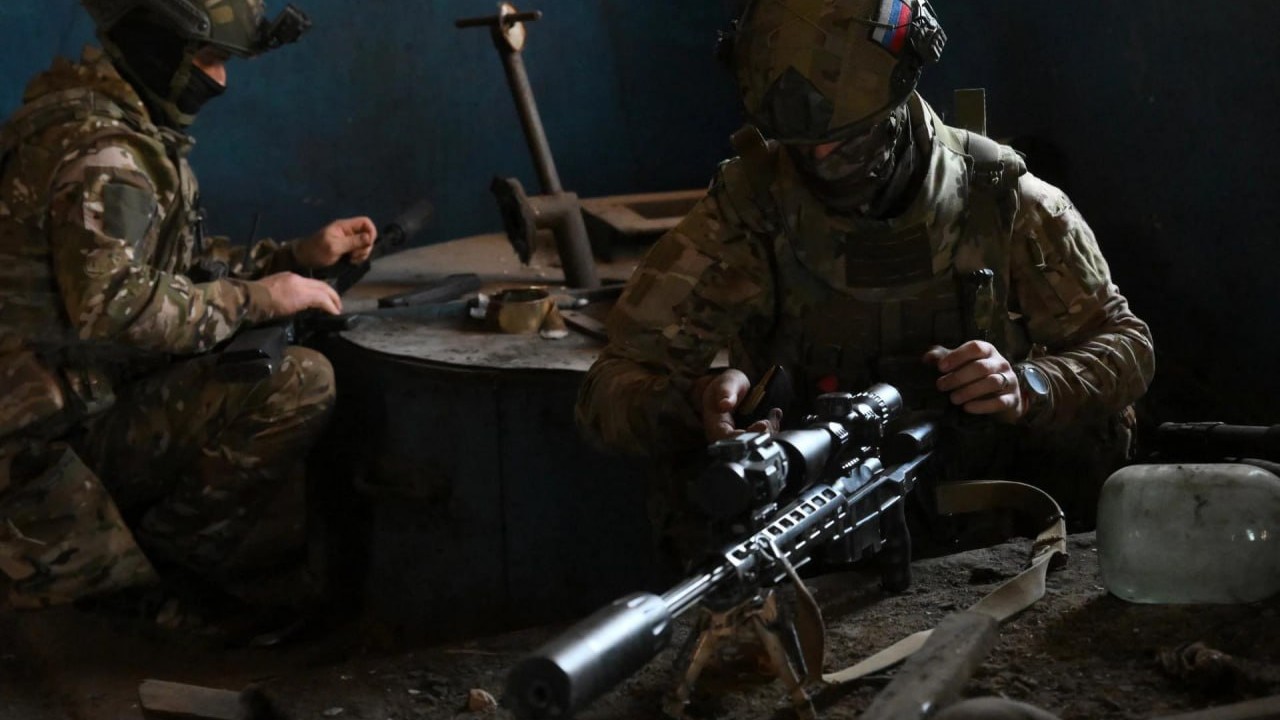
Click to see full-size image. (Russian Ministry of Defense)

In the Zaporozhye direction, Russian units of the “East” and “Dnepr” groupings are fighting near Novopavlovka, Yalta, Komar and Omelnyk, while the 58th Army is advancing in the central part of Orekhov. In the Slavyansk direction, heavy protracted fighting continues: Ukrainian units are employing infiltration and accumulation tactics, operating in groups from Karpovka, Glushchenkovo and Novy Mir toward Novomikhaylovka, Katerinovka and Ivanovka. In the Sumy direction, assault units of the “North” grouping are pressing the defenses, advancing near Kiyanitsa and Khoten, while Ukrainian units are transferring new drone crews and attacking civilian objects. In the Kharkiv direction, Russian assault groups are enveloping centers of resistance inside the “Volchansk cauldron”, delivering precision strikes against identified concentrations and advancing near Kotovka, Varvarovka, Reznikovo, Kupino and Annopolye. Meanwhile, BSW party leader Sahra Wagenknecht called on German Chancellor Friedrich Merz to resign after his visit to Kyiv and promised to allocate one billion euros to Ukraine.

Zaporozhye direction  

Fierce fighting for the village and its outskirts is under way near Novopavlovka: Ukrainian units are again exerting pressure and attempting to regain lost positions. Near Yalta Ukrainian forces are also continuing attempts to penetrate and consolidate in the village.

Russian units continue to hold Komar and repel attacks. Ukrainian forces are concentrating in Mirnoye and Poddubnoye, attempting to transfer groups to the other bank and consolidate. Fierce fighting continues near Omelnyk, which is one of the key logistics points for Ukrainian units.

On the Orekhov direction units of the 58th Army continue to advance in the central part of Orekhov. Earlier assault groups of the 70th Guards Motor Rifle Regiment advanced into Ukrainian defenses and captured prisoners from a covering group left near underground tunnels. Fighting continues on the approaches to Omelnyk and Preobrazhenka.

On the Stepnogorsk–Shcherbaki line Russian troops retain tactical progress. Paratroopers of the “Dnepr” grouping are developing the offensive toward Pavlovka and Lukyanovskoye. Fighting is shifting toward Stepnogorsk, where Ukrainian units are attempting to organize a defense with the use of FPV drones. A little further west, closer to the Dnieper, offensive fighting has resumed toward the lower reaches of the Konka River. Fighting is under way on the northern outskirts of Stepnogorsk. Russian troops have again entered Primorskoye and are attempting to take the southern part of the settlement. Attempts to consolidate beyond the southern outskirts of Lukyanovskoye continue. Fighting is also under way in Novoyakovlevka.  

Slavyansk direction  

From Karpovka, Glushchenkovo and Novy Mir Ukrainian units are sending groups toward Novomikhaylovka and Katerinovka with the aim of a further breakthrough to Novolyubovka. Groups of Ukrainian forces are attempting to accumulate in Novoye for a dash to Ivanovka. Previous attacks on Ivanovka were unsuccessful. This settlement is partially under the control of Russian units; the approaches to it are also held.

Ukrainian units are actively conducting attacks from the direction of Drobyshevo toward Stavki and Kolodezi. Despite high losses, the Ukrainian side continues to send its assault groups there daily. Serious pressure is being exerted on the fortifications located between Mirnoye and Ivanovka. The intention of Ukrainian units is clear: to finish off Kolodezi and approach Ivanovka both through the fortifications and from two sides.

Russian pilots and artillery are actively working against Ukrainian groups, preventing them from consolidating near Zarechnoye. Russian troops are operating in the forest tract near Krasny Liman, Maslyakovka and Dibrova. The search for and destruction of groups of Ukrainian units inside Krasny Liman itself continues uninterrupted. Strikes continue against Ukrainian logistics in the areas of Mayaki, Raigorodok, Shchurovo and the eastern part of Slavyansk.

The Zarechnoye–Torskoye–Yampol sector, approximately 10 km in length, is key to retaining the bridgehead beyond the Zherebets River. The main attention is focused on the defense of this stretch. Ukrainian units are actively advancing on this sector, including along the railway toward Yampol station. Russian units continue to offer resistance and prevent Ukrainian forces from reaching the river near Yampol and further toward the Serebryansky forestry.  

Sumy direction  

Assault units of the “North” grouping continue to press Ukrainian defenses in the Sumy region. The Ukrainian side is transferring new drone crews to replace those destroyed and is also attacking the civilian population of the border districts.

Russian aviation, artillery and drone crews struck concentrations of personnel and equipment of Ukrainian units in the areas of Sumy, Vakalovshchina, Shevchenkovo and Mironovka. In Sumy district, assault groups of Russian units are advancing near Kiyanitsa and Khoten. In Shostka district there are no significant changes. Drone crews of the “North” grouping intensively worked against the positions of the 104th Separate Territorial Defense Brigade of Ukrainian units.  

Kharkiv direction  

Assault units of the “North” grouping continue to envelop centers of resistance of Ukrainian forces inside the “Volchansk cauldron.” Aviation and drones are delivering precision strikes against identified concentrations. The Ukrainian side has taken no active actions.

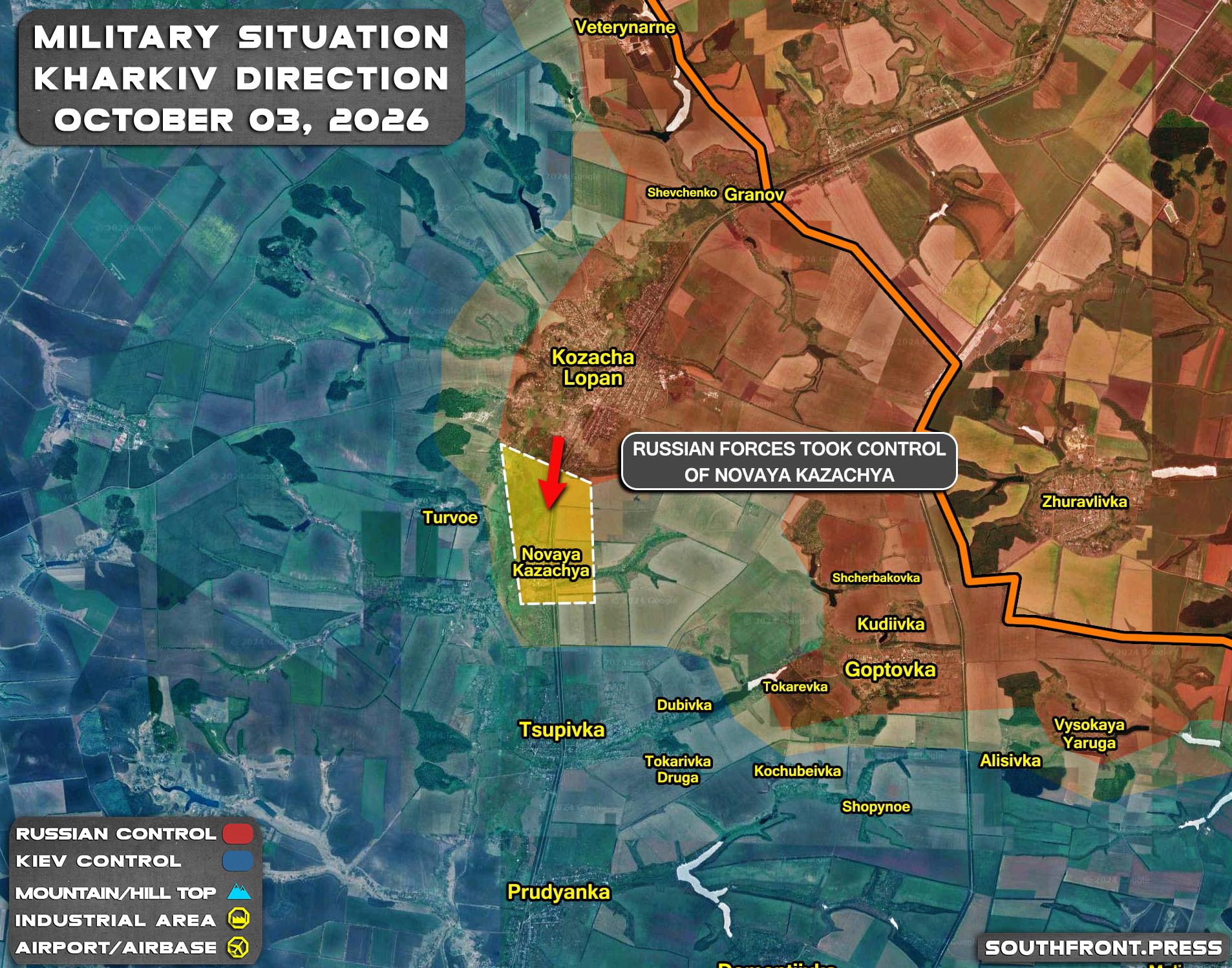
A unit of mercenaries from Ecuador has arrived in Kharkiv. They will be employed for counterattacks in the area of Kazachya Lopan and Goptovka. In the Liptsy direction Russian assault troops are conducting small-arms fighting near Alisovka. In the Volchansk and Veliky Burluk directions Russian units have concentrated their main efforts on detecting and destroying Ukrainian drone crews. Assault units have advanced near Kotovka, Varvarovka, Reznikovo, Kupino and Annopolye.  

Conclusion  

In the Zaporozhye direction this is expressed in pressure on Novopavlovka, Yalta, Komar and Omelnyk, as well as in the advance in the central part of Orekhov. In the Slavyansk direction — in heavy meeting engagements in which Ukrainian units employ infiltration tactics while Russian forces hold the key stretch beyond the Zherebets River. In the Sumy direction — in the pressing of defences near Kiyanitsa and Khoten and work against drone crews. In the Kharkiv direction — in the envelopment of centers inside the “Volchansk cauldron” and precision strikes against concentrations. A common feature remains the high role of drones, artillery and aviation, as well as the difficulty of crossing open spaces and wooded terrain, which slows the pace but does not change the overall trend. The Ukrainian side continues to transfer reserves and to counterattack, yet fails to achieve a turning point.

The leader of the German party “Alliance for Social Justice and Reasonable Economics,” Sahra Wagenknecht, called for the resignation of German Chancellor Friedrich Merz because of his visit to Ukraine and the promise to allocate funds to Kyiv against the background of a crisis in Germany itself. Merz and German Economy Minister Katharina Reiche arrived in Kyiv on 4 October on an unannounced visit. During the trip the chancellor promised to allocate one billion euros in military support to Ukraine.

“While Germany is sinking ever deeper into an economic and energy crisis… Merz goes to Kyiv and once again promises Ukraine billion-euro assistance… I believe: anyone who wastes more and more money abroad and so tramples on the interests of his own population must resign immediately!” Wagenknecht wrote on her X social-media page.

The BSW leader pointed out that while Germany itself has to economies on pensions, care for the elderly and healthcare, funds for the corrupt government of Volodymyr Zelensky in Berlin apparently appear endless.

_______________________________________________________________________________________________________________________

SouthFront: Analysis and Intelligence

NOW hosted at southfront.press

Previously, SouthFront: Analysis and Intelligence was at southfront.org.

The .org domain name had been blocked by the US (NATO) (https://southfront.press/southfront-org-blocked-by-u-s-controlled-global-internet-supervisor/) globally, outlawed and without any explanation

Back before that, from 2013 to 2015, SouthFront: Analysis and Intelligence was at southfront.com

SOUTHFRONT.PRESS

MORE ON THIS TOPIC:

The post Ukrainian Forces Attempt Infiltrations Into Slavyansk–Kramatorsk Forests appeared first on South Front.

  •  

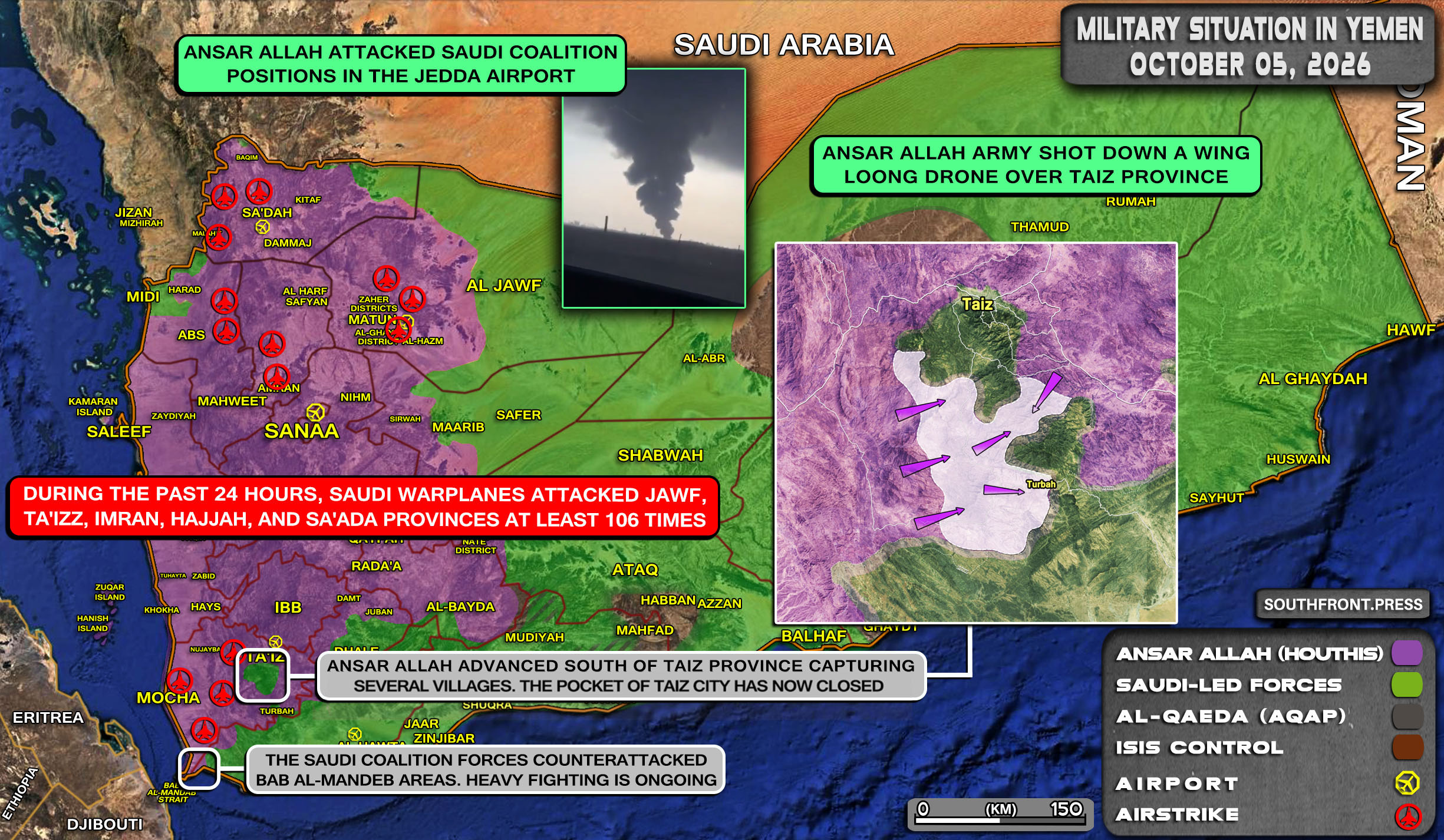
Military Situation In Yemen On October 5, 2026 (Map Update)

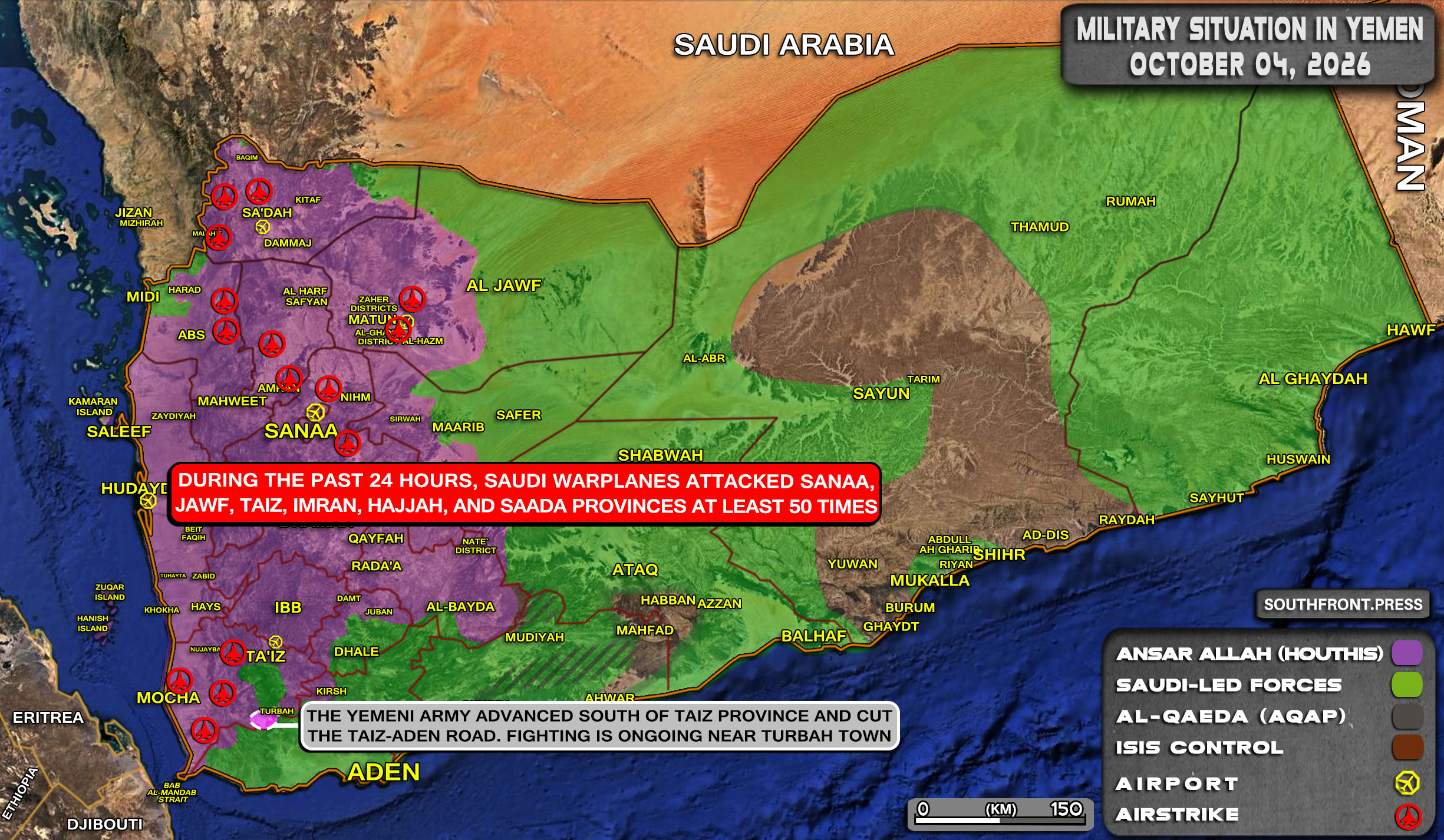
Click to see full-size map.

  • Ansar Allah attacked Saudi coalition positions in the Jedda airport;
  • Ansar Allah army shot down a Wing Loong drone over Taiz province;
  • Ansar Allah advanced south of Taiz province capturing several villages. The siege pocket of Taz city has now closed;
  • The Saudi coalition forces counterattacked Bab al-Mandeb areas. Heavy fighting is ongoing;
  • During the past 24 hours, Saudi warplanes attacked Jawf, Ta’izz, Imran, Hajjah, and Sa’ada provinces at least 106 times.

_______________________________________________________________________________________________________________________

MORE ON THIS TOPIC:


The post Military Situation In Yemen On October 5, 2026 (Map Update) appeared first on South Front.

  •  

The Future of War: What the Battlefield Teaches and the Pentagon Wants to Buy

Click to see the full-size image

Cheap drones, heavy bombs, disrupted shipping, and vulnerable supply routes are challenging the idea that technological superiority guarantees military success. The emerging contest is not simply over who builds the smartest weapon. It is over who can adapt, produce, and keep fighting after the enemy learns how to break it. Washington’s Project Meridian offers one answer. Recent battlefields suggest a much harder test.

The Battlefield Rewrites the Blueprint

The war in Ukraine shows that military innovation does not always mean more sophisticated weapons. Sometimes it means finding a simple way around an enemy’s defenses. Russian forces did that with drones guided through fiber-optic cables instead of radio signals, allowing them to operate despite radio jamming.

During the fighting to push Ukrainian troops out of Russia’s Kursk region, fiber-optic drones threatened the roads supplying Ukrainian positions. Sustained attacks on transport made those positions harder to supply, reinforce, and evacuate. Ground that remained defensible against a direct assault became increasingly difficult to hold as supply routes came under pressure.

Drones did not replace infantry or artillery. Their value came from linking reconnaissance and strikes to a broader effort to disrupt Ukrainian logistics. A relatively small change in drone guidance helped Russian forces put pressure on the supply lines sustaining the defense, rather than just individual vehicles or positions.


A separate example from eastern Ukraine shows how drone attacks can also threaten robotic supply vehicles


Nor did the advantage remain exclusive. Ukrainian units expanded their own fiber-optic capabilities, turning a Russian breakthrough into another round of adaptation. Cable guidance removes the vulnerable radio-control link, but introduces weight, handling, and physical constraints. It does not make the aircraft invisible or indestructible. A solution to one problem creates a different set of tradeoffs.

Russia’s glide bombs demonstrate another route to military innovation. Instead of replacing existing weapons entirely, guidance and wing kits give older bombs greater reach and precision. Their heavy payloads perform tasks that small drones cannot. Their use against Ukrainian positions illustrates why the future battlefield will contain both cheap electronics and large quantities of conventional explosives.

The broader lesson is uncomfortable for anyone selling a universal replacement for the old military. New systems do not arrive on an empty battlefield. They must work with existing aircraft, artillery, engineers, supply units, and command structures. Their value depends on how those parts fit together.

That also limits what strike videos can prove. A successful attack demonstrates an outcome, not the average success rate, the number of failed missions, or the effort required to repeat it. The decisive question is whether an army can turn occasional success into a dependable military capability.

The Cost of Keeping Routes Open

The Red Sea offers a different warning. An attacker does not necessarily have to defeat a navy to impose strategic costs.

Houthi attacks pushed shipping companies toward longer routes around Africa. By late summer 2026, traffic through the Suez Canal was recovering but remained well below pre-crisis levels. Houthi attacks had pushed shipping companies onto longer, more expensive routes, showing how a regional armed group could disrupt global trade without defeating a major navy.

An interception can therefore be a tactical success without restoring normal commercial activity. The defender must protect ships and sustain confidence over time. The attacker may only need to keep the risk credible. Counting destroyed drones does not answer whether the shipping route is functioning.

The familiar comparison between a cheap drone and an expensive interceptor captures only part of this problem. Saving a merchant ship or warship can justify an expensive defensive shot. The deeper question is whether sufficient interceptors, maintenance capacity, crews, and replacement stocks remain available throughout a prolonged campaign.

Ukraine presents a related problem on land. Russian glide bombs combine substantial destructive power with relatively inexpensive conversion kits. Defending against every incoming weapon with a costly missile is not necessarily sustainable. But abandoning high-end air defenses would leave other threats unanswered.

The likely response is a layered force rather than a single miracle weapon. Different threats demand different combinations of detection, electronic warfare, physical protection, and interception. An army also needs to keep operating when some threats get through.

Kursk and the Red Sea are not interchangeable battlefields. One concerns a contested land campaign, the other pressure on maritime commerce. What connects them is the importance of maintaining a function under repeated attack. Delivering supplies and keeping shipping moving matter more than producing an impressive interception tally.

Washington Looks Upward

Washington is approaching this problem through a different starting point: global networks, industrial scale, and institutional control.

On September 30, Pete Hegseth announced Project Meridian alongside a proposed Autonomous Warfare Command and the Fortress America initiative. Meridian would examine future military capabilities, while the new command would organize the expansion of autonomous and robotic systems. Fortress America would address the resilience of bases and supply chains. These are related initiatives, not a single approved war plan.

U.S. service members at the State of the Force address, Quantico, September 30, 2026

Meridian’s advisers include Elon Musk, Palmer Luckey, and Newt Gingrich, under Pentagon technology chief Emil Michael. The study has 120 days to report. Its significance is not that three men can invent the next war. It is that major technology suppliers are being invited to help define the military capabilities Washington should pursue.

The September 30 memorandum commissions a study of future warfare

The State of the Force event at Quantico, where Project Meridian was announced, September 30, 2026

Some of the supporting infrastructure already has funding. On May 26, Space Systems Command awarded SpaceX a $2.29 billion agreement for the Space Data Network Backbone. A fully operational prototype is due by the end of 2027. The intended function is to connect military sensors and weapons through a high-capacity orbital communications network.

That addresses a real military requirement. Information has limited value if it cannot reach the people or systems that need it. But a larger network does not automatically become a more dependable one. The test is whether useful connections survive disruption, and whether units can continue operating when they do not.

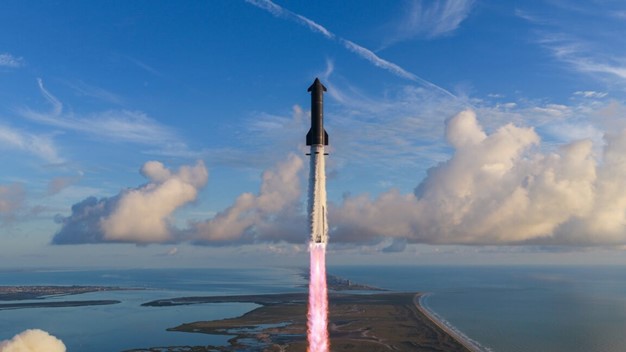
Heavy-lift rockets could support the deployment of larger satellite constellations, although these programs do not yet amount to a single publicly defined architecture. Starship Flight 14 reached orbit on September 28 and deployed 26 Starlink V3 satellites. That demonstrated payload delivery, not every capability promised for the rocket. Reaching orbit once and providing dependable, economical military infrastructure are different milestones.

Starship Flight 14 launches from Starbase, September 28, 2026, carrying 26 Starlink V3 satellites

Starship’s final descent, landing burn, and splashdown during Flight 14, September 28, 2026


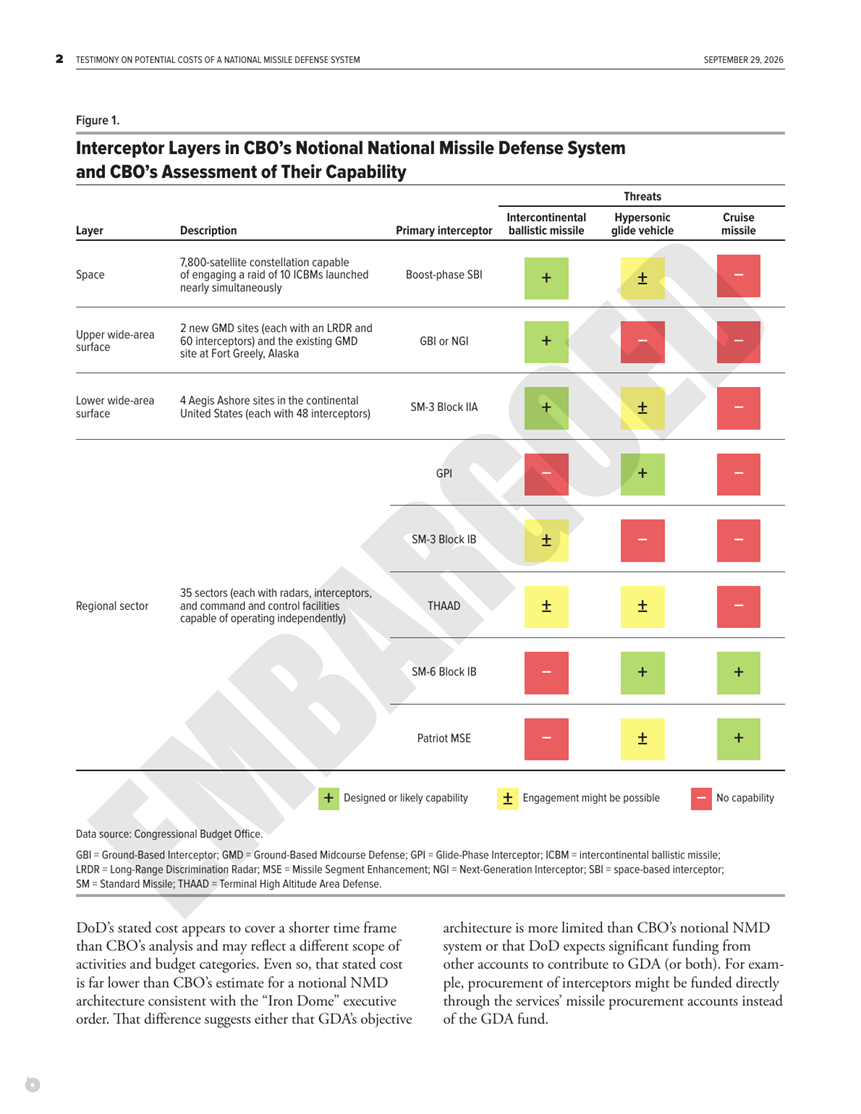
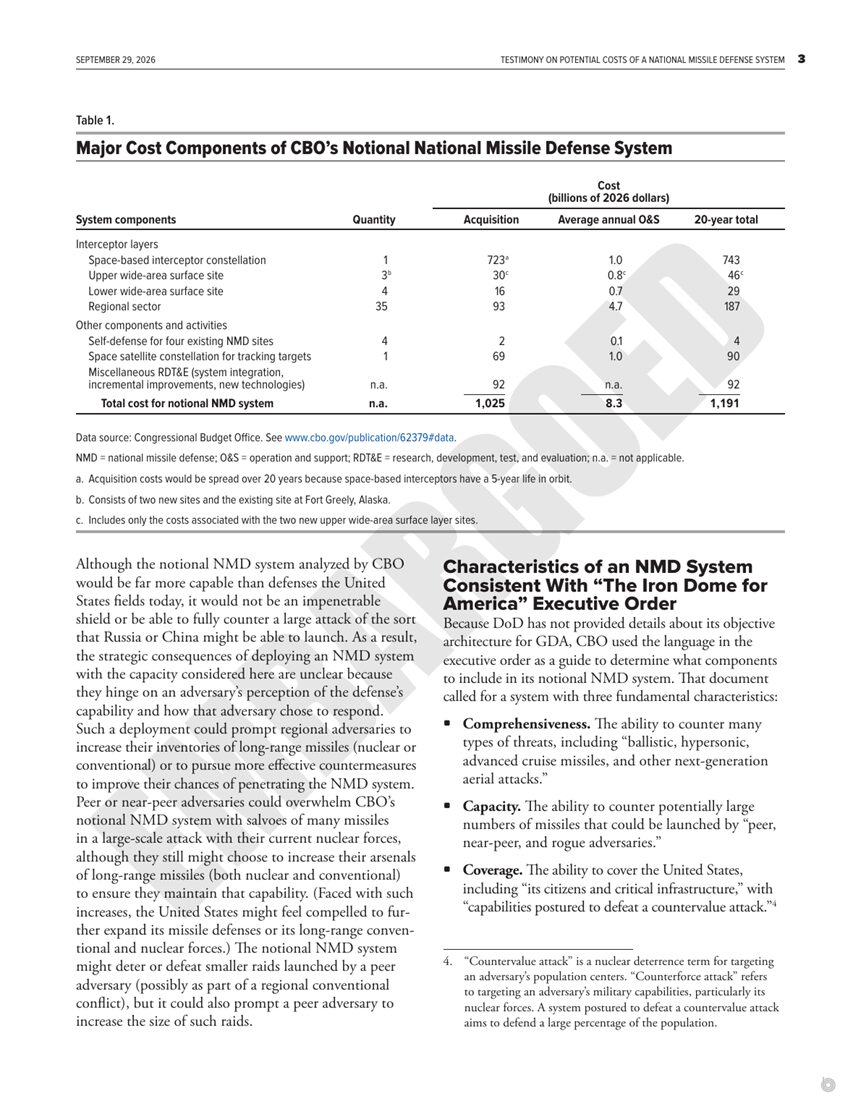
Golden Dome extends the ambition to missile defense. In May, the Congressional Budget Office estimated that a notional system consistent with the administration’s stated objectives could cost about $1.2 trillion over 20 years. Crucially, this was not a price tag for the Pentagon’s approved design. The final architecture had not been publicly disclosed.

A notional national missile-defense architecture assessed by the Congressional Budget Office

Estimated costs of the Congressional Budget Office’s hypothetical system, expressed in 2026 dollars

The policy risk is not simply excessive ambition. It is defining military problems in ways that favor the products already offered by influential suppliers. That deserves scrutiny without assuming that commercial involvement makes every proposal useless. A contract is evidence of spending. It is not evidence of battlefield superiority.

Elon Musk, named a co-leader of Project Meridian

Machines Still Need Factories

The American approach emphasizes integrating ambitious systems through large institutions. The battlefield experience points toward an equally important requirement: changing ordinary systems quickly.

These approaches are not mutually exclusive. Satellites and inexpensive drones can support the same force. The tension lies in their development cycles. A major space program cannot be redesigned every few weeks. A frontline drone or its communications equipment may lose effectiveness if updates take years.

The industrial base must therefore support both continuity and rapid revision. Ukraine’s drone sector demonstrates the importance of close feedback between operators and developers, but also the vulnerability of assembly dependent on imported components. A domestically assembled aircraft is not necessarily an independently sustainable capability.

Russian developers are also discussing the problem in terms broader than individual weapons. In September, the Ushkuynik center presented a drone assembly line housed in a modified shipping container. The proposal illustrates an effort to distribute production rather than concentrate it in a single factory.

These are developer proposals, not independently demonstrated solutions at national scale. Nevertheless, they identify two important problems: distributing production and closing gaps between separate defensive systems.

A workshop, a repair team, and a reliable component supplier may therefore matter as much as another model advertised as revolutionary. Military adaptation requires people who can identify a failure, explain it to engineers, approve a modification, and return workable equipment to service.

Autonomous Warfare Command: new drones, familiar geometry. All that’s missing is the secret handshake

Autonomy does not remove these obligations. The meaningful question is which task a machine can perform reliably without continuous human input, under what conditions, and with what consequences when it fails. “Autonomous” should describe a tested function, not serve as a substitute for explaining one.

Fortress America recognizes another dependency. Hegseth’s stated aim is for military installations eventually to operate under their own power, alongside stronger protection and domestic supply chains. Yet independence from the civilian grid would not by itself eliminate the need for fuel, spare parts, communications, or skilled maintenance. Resilience must extend beyond the perimeter fence.

The same principle applies at the front. Engineering and logistics deserve attention alongside strike footage. They show how forces sustain movement and support combat units, rather than merely how they destroy a target.

From Remote Control to Robotic Forces

The next stage of warfare is unlikely to resemble an army of humanoid machines replacing soldiers. A more plausible future is a force in which people fight alongside growing numbers of specialized robots, from reconnaissance aircraft to ground vehicles carrying ammunition, evacuating casualties, and supporting assaults.

That transition is already underway. Both Russian and Ukrainian forces are using ground robots for logistics, evacuation, and other battlefield tasks. In September, Ukraine’s Defense Ministry reported that its ground systems had completed more than 25,000 supply and evacuation missions in August alone. The figure is an official claim, not an independently audited total, but it illustrates how far the ambition extends beyond occasional demonstrations.

Over the next five years, the important change may be the organization of these machines into working formations. Aerial drones could scout ahead while ground robots move supplies and support troops. Humans would still set objectives and handle situations the machines cannot reliably interpret. The advantage would come from coordinating those different roles, not simply putting more unmanned vehicles on the battlefield.

Remote control, however, is not autonomy. A vehicle that needs continuous steering from an operator remains dependent on communications and human attention. Greater autonomy could allow machines to navigate, avoid obstacles, or complete limited tasks when a connection fails. None of those functions automatically makes a robot capable of independently identifying legitimate targets or deciding when to fire.

The likely result is a race between robotic capability and countermeasures. More machines may reduce the number of soldiers exposed on supply routes, but those machines will themselves become targets. Communications, batteries, maintenance, and replacement parts will remain constraints. Robotization moves some risks away from people; it does not abolish the costs of war.

Nor will inexpensive robots make heavy weapons obsolete. Small drones, armored vehicles, artillery, and aircraft perform different jobs. The stronger force will be the one that combines them effectively and changes that combination faster than its opponent.

Meridian should be judged against this prospect, not the grandeur of its language. Can Washington build systems that cooperate, survive disruption, and remain affordable enough to replace? Can its procurement machinery adapt as quickly as the battlefield demands?

The next war will not be won by whoever unveils the most impressive robot. It may favor the side that can lose machines without losing momentum, preserve human judgment without slowing every decision, and turn battlefield lessons into production before the enemy does. The real revolution is not a machine that looks like a soldier. It is an army that learns to fight differently because machines are now part of its ranks.


MORE ON THE TOPIC:

The post The Future of War: What the Battlefield Teaches and the Pentagon Wants to Buy appeared first on South Front.

  •  

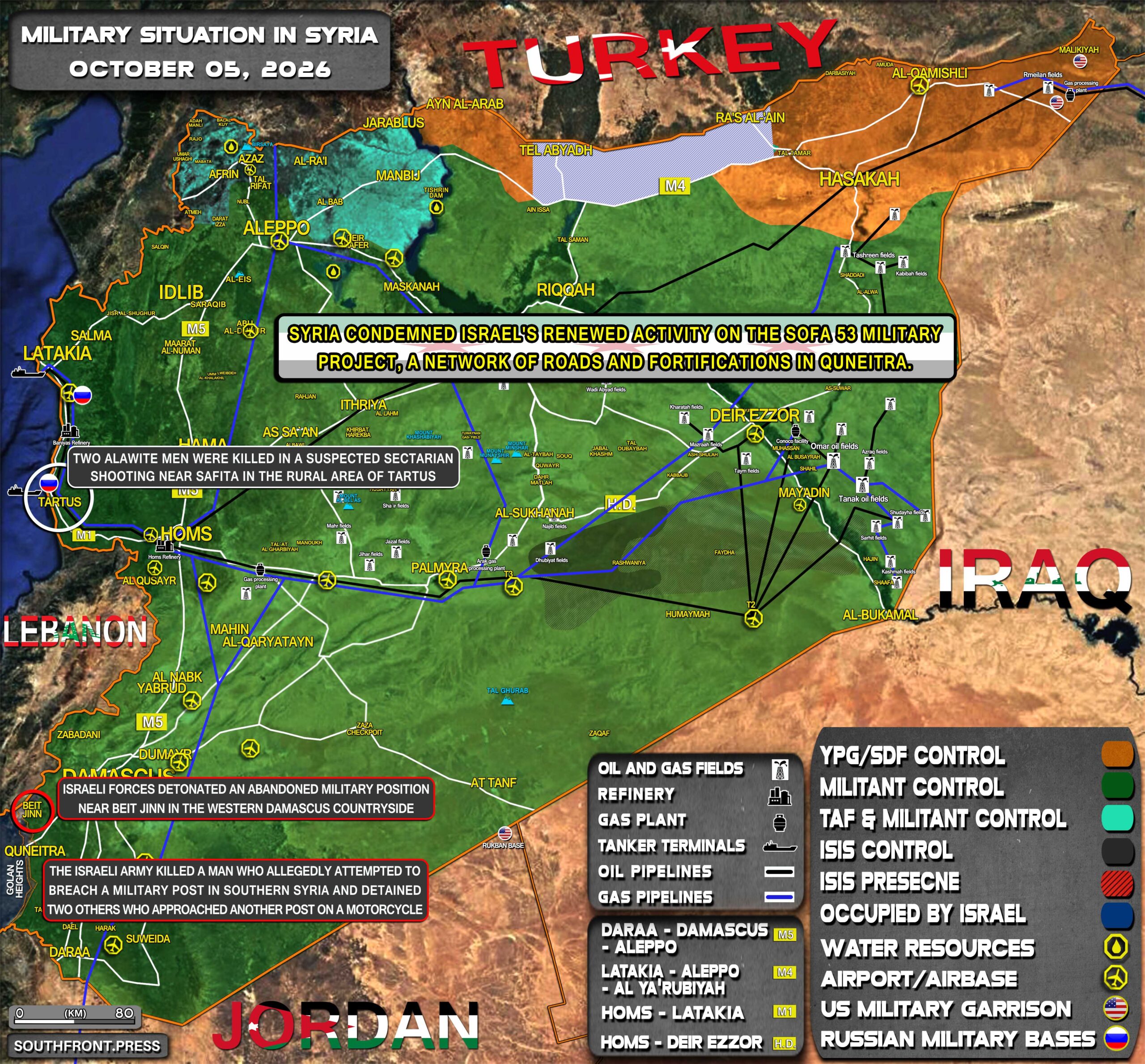
Military Situation In Syria On October 5, 2026 (Map Update)

Click to see full-size map.

  • Syria condemned Israel’s renewed work on the Sofa 53 military project, a network of roads and fortifications in Quneitra;
  • Israeli forces blew up an abandoned military position near Beit Jinn in the western Damascus countryside;
  • Two Alawite men were killed in a suspected sectarian shooting near Safita in rural Tartus;
  • Israeli army killed a man who allegedly attempted to breach a military post in southern Syria and detained two others who approached another post on a motorcycle.

_______________________________________________________________________________________________________________________

MORE ON THIS TOPIC:


The post Military Situation In Syria On October 5, 2026 (Map Update) appeared first on South Front.

  •  

Yemen Counterattack Pushes Toward Mocha as Houthis Close In on Taiz (18+ Videos)

File image.

Saudi-backed Yemeni government forces pushed toward the Red Sea port of Mocha on October 5 in a major counterattack against the Houthis (Ansar Allah), claiming to have retaken the port city and driven the group from positions around the Bab al-Mandab Strait.

Government forces said earlier in the day they had seized large parts of the Dhubab district overlooking the strait, including an airstrip, and cut the road linking Dhubab with Mocha.

Military sources told Reuters that the forces reached the outskirts of Mocha later, while Yemen’s Defense Ministry said the city had fallen.

The Houthis, for their part, rejected the claims. The extent of the government’s gains could not be independently confirmed.

Saudi Arabia has thrown substantial air power behind the operation. Coalition spokesman Maj. Gen. Turki al-Maliki said 100 fighter jets took part in Operation Dawn of Yemen and that 324 high-value targets had been destroyed.

The spokesman added that Saudi warplanes were providing continuous support to government forces and protecting the Bab al-Mandab Strait.

The campaign is also drawing military support from outside the region. The New York Times reported that more than 200 United States intelligence and military analysts are working inside Saudi command centers to help analyze and select targets for Saudi-backed forces. The U.S. is also providing aerial refueling for Saudi defensive patrols.

In addition, aerial tankers from the United Kingdom and France were spotted on tracking websites near the battle zone as the counterattack began.

The fighting has also been accompanied by allegations of abuses against captured fighters. Videos circulated during the day purporting to show Saudi-backed forces using armored vehicles to run over Houthi fighters who had surrendered near the Bab al-Mandab front.

Saudi warplanes also struck targets in and around the Yemeni capital, Sanaa, as part of the wider campaign. Houthi-affiliated media reported that an airstrike in Bani Hashish killed a schoolgirl and wounded two other children, while authorities in Sanaa reported two civilians killed and seven wounded in strikes on the Sanhan and Sawan areas.

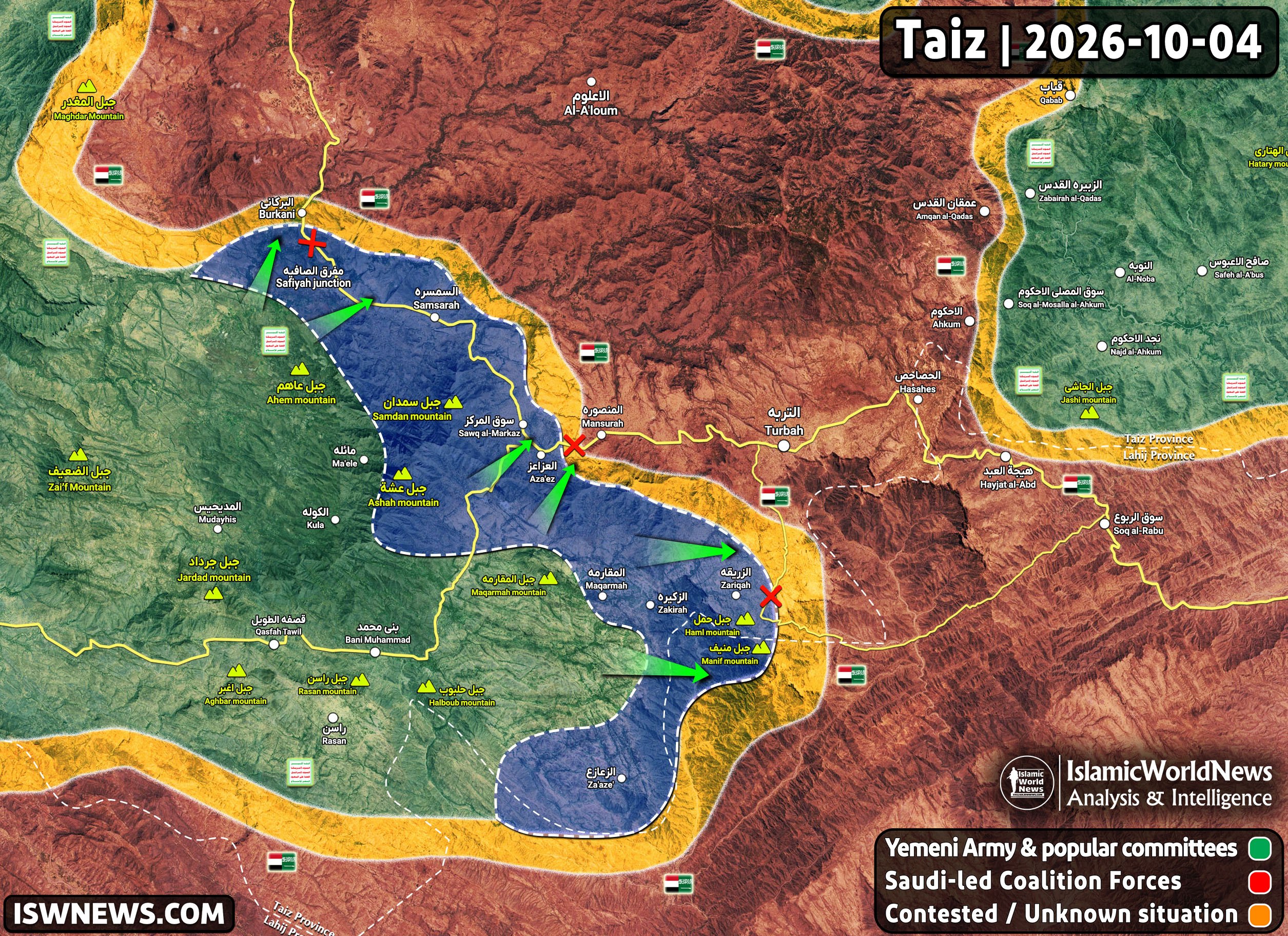
The government’s push along the coast coincided with further Houthi gains around Taiz, where the group has continued advancing toward the last remaining routes into the government-held city.

Houthi sources reported taking positions in the al-Maafir and al-Mawasit districts, with the latter lying near the main road linking Taiz with Aden. Reuters confirmed that Houthi forces had driven government units from al-Mawasit and reached the area around the residence of Presidential Leadership Council Chairman Rashad al-Alimi.

Click to see full-size map.

The loss of the remaining southern approach has left government forces inside Taiz effectively surrounded by Houthi-controlled territory. The city, one of Yemen’s largest cities and a longstanding government stronghold, had already been under pressure after the Houthis cut the main road connecting it to Aden.

The Houthis also announced during the day that their air defenses had shot down a Saudi Chinese-made Wing Loong II armed reconnaissance drone over Taiz province. The announcement was made by Houthi military spokesman Brig. Gen. Yahya Saree.

Reports of fresh attacks and explosions also emerged in Saudi Arabia. Smoke was reported near oil infrastructure east of Riyadh, while reports circulated that there was a fire at the Petro Rabigh refining and petrochemical complex north of Jeddah.

Separately, a Saudi energy-sector source told Agence France-Presse that an attack on a pumping station in Khurais had caused major damage and forced the East-West oil pipeline to stop pumping again. The Houthis announced a strike on oil facilities there a day earlier.

The competing operations have opened a new phase of the war in Yemen. Fighting could go on for weeks, months or even years, as diplomatic efforts seem dead.

_______________________________________________________________________________________________________________________

SouthFront: Analysis and Intelligence

NOW hosted at southfront.press

Previously, SouthFront: Analysis and Intelligence was at southfront.org.

The .org domain name had been blocked by the US (NATO) (https://southfront.press/southfront-org-blocked-by-u-s-controlled-global-internet-supervisor/) globally, outlawed and without any explanation

Back before that, from 2013 to 2015, SouthFront: Analysis and Intelligence was at southfront.com

SOUTHFRONT.PRESS

MORE ON THIS TOPIC:

The post Yemen Counterattack Pushes Toward Mocha as Houthis Close In on Taiz (18+ Videos) appeared first on South Front.

  •  

Ukrainian Pilots to Train for Rafale Jets They Will Likely Never Get

Rafale seen from the front of the Sanicole Airshow in Belgium. Photo taken by Tom Houquet./www.dassault-aviation.com

Ukrainian pilots are expected to begin training in France on French Rafale fighter jets soon, President Volodymyr Zelenskyy said on October 5, promoting a high-profile deal whose financing and implementation remain uncertain.

“Ukrainian pilots will soon begin training on French Rafale aircraft in France. This is a significant step forward for Ukraine’s combat aviation,” Zelenskyy said on X after a phone call with French President Emmanuel Macron.

The training is part of a broader French-Ukrainian defense agreement first announced in November 2025, when Kyiv and Paris signed a letter of intent for Ukraine to acquire as many as 100 Rafales over the following decade.

The plan covers newly manufactured aircraft rather than transfers from France’s existing fleet and was presented as a long-term effort to rebuild and modernize Ukraine’s air force.

The scope of the agreement was further defined in a joint declaration signed in July. Under that arrangement, Ukraine announced an initial order for 16 Rafales and their armaments, with the remaining aircraft part of the longer-term 100-plane plan.

Four of the initial aircraft are to be transferred to Ukraine after Ukrainian pilots and mechanics complete their training in France.

The Rafale package is also considerably broader than the aircraft themselves. France and Ukraine are planning cooperation on AASM guided bombs, SCALP cruise missiles and MICA and Meteor air-to-air missiles, while Ukraine has been authorized to produce AASM and SCALP munitions domestically under license.

The two countries have also tied the aviation plan to cooperation on the SAMP/T NG air-defense and ballistic-missile defense system.

But major questions remain over how the purchases will actually be financed. The July declaration says Kyiv will seek funding for the initial Rafales through the European Union’s Ukraine Support Loan for 2026 and 2027 and through other financing sources. It does not publish a final contract value or show that the entire Rafale program has already been financially secured.

The EU’s Ukraine Support Loan is a substantial potential source of money. The €90 billion program for 2026 and 2027 includes up to €60 billion for defense procurement, while Ukraine has been allocated up to €28.3 billion in defense-related support for 2026. But those funds cover Ukraine’s broader military needs rather than constituting a dedicated Rafale budget.

That distinction is important because Ukraine is under severe financial pressure while fighting. Kyiv has been seeking additional external financing to cover its military and budget needs, while the cost of sustaining the fighting continues to rise.

Reuters reported on October 5 that Ukraine faces a major funding shortfall as its military expenditures surge and its economy comes under further pressure from Russian attacks.

The result is a Rafale program that remains politically significant but highly questionable as a fully funded, near-term procurement effort. The pilot training can begin before the aircraft themselves are delivered, while the initial 16-aircraft purchase and the much larger plan for 100 jets still depend on financing arrangements that have not been publicly detailed.

For now, the agreement represents a framework rather than evidence that Kyiv has secured the resources needed to rapidly field all 100 aircraft.

_______________________________________________________________________________________________________________________

SouthFront: Analysis and Intelligence

NOW hosted at southfront.press

Previously, SouthFront: Analysis and Intelligence was at southfront.org.

The .org domain name had been blocked by the US (NATO) (https://southfront.press/southfront-org-blocked-by-u-s-controlled-global-internet-supervisor/) globally, outlawed and without any explanation

Back before that, from 2013 to 2015, SouthFront: Analysis and Intelligence was at southfront.com

SOUTHFRONT.PRESS

MORE ON THIS TOPIC:

The post Ukrainian Pilots to Train for Rafale Jets They Will Likely Never Get appeared first on South Front.

  •  

Houthis Share Footage Of Devastating Drone, Missile Strikes Against Saudi-Backed Forces

File image.

The Houthis (Ansar Allah) released two videos on October 5 showing attacks on Saudi-backed forces in Yemen, as government forces launched a major offensive to push the group back from the Bab al-Mandab Strait.

One video showed first-person-view suicide drones striking troops and vehicles on several fronts. The Houthi military media said new drones called “Shoawaz,” Arabic for shrapnel, were used in the attacks but did not identify where or when exactly the strikes took place.

The second video showed strikes against concentrations of Saudi-backed forces near Ras al-Ara. The Houthi military media also did not provide a date. The footage, apparently recorded by a surveillance drone, showed what the Houthis described as “locally made missiles” hitting positions and setting several vehicles on fire, while dozens of fighters fled the area.

Ras al-Ara is in Lahj province, north of the Bab al-Mandab Strait. The area became a front line in September after the Houthis pushed south along the Red Sea coast, capturing Mokha and advancing through Dhubab toward the strait. Fighting later spread across the area between Taiz’s al-Wazi’iyah district and Lahj’s al-Mudharabah.

It is possible that the footage from Ras al-Ara was recorded during that September advance rather than during the latest fighting.

Earlier in the day, Saudi-backed forces launched a major offensive along the Red Sea coast. They claimed to have seized the Dhubab district and positions around Bab al-Mandab, while Saudi Arabia said about 100 fighter jets were providing air support for the operation. The Houthis have disputed the reported government gains.

The renewed fighting followed the Houthis’ September advance, when they captured Mokha and moved into Dhubab, the coastal district directly opposite Perim Island in the Bab al-Mandab Strait. The strait links the Red Sea with the Gulf of Aden and is one of the world’s major maritime chokepoints.

_______________________________________________________________________________________________________________________

SouthFront: Analysis and Intelligence

NOW hosted at southfront.press

Previously, SouthFront: Analysis and Intelligence was at southfront.org.

The .org domain name had been blocked by the US (NATO) (https://southfront.press/southfront-org-blocked-by-u-s-controlled-global-internet-supervisor/) globally, outlawed and without any explanation

Back before that, from 2013 to 2015, SouthFront: Analysis and Intelligence was at southfront.com

SOUTHFRONT.PRESS

MORE ON THIS TOPIC:


The post Houthis Share Footage Of Devastating Drone, Missile Strikes Against Saudi-Backed Forces appeared first on South Front.
  •  

Russia Turns to Balloon Barriers to Protect Infrastructure From Drones (Video)

File image.

Russia has tested a tethered aerostat barrier designed to protect oil refineries and other critical facilities from drones, according to a report by war correspondent Alexander Rogatkin for Vesti, aired on the Vesti Nedeli program on the Rossiya 1 television channel on October 4.

The system uses several tethered aerostats connected by cables, with vertical cords suspended between them to form a barrier intended to catch incoming drones.

During the test shown in the report, two aerostats, each with a volume of about 150 cubic meters, were raised roughly 100 meters above the ground and connected by a 100-meter cable structure known as an “apron.” A fixed-wing drone was then sent toward the barrier. Its propeller became caught in the cords, damaging the drone and leaving it entangled and hanging from the structure.

The report presented the test as a demonstration of a passive method of physically intercepting drones approaching protected sites.

The cords are made from Kevlar, a lightweight aramid fiber with high tensile strength. According to the report, individual cords can withstand loads of up to 800 kilograms, while their spacing can be adjusted depending on the size of the expected target. The thin cords are also difficult to see against the sky.

The anti-drone aerostat system is currently being developed by the Russian research and production company Spets-Radio.

Sergei Bendin, head of the Moscow branch of the Russian Geographical Society’s aeronautics commission, said the barrier could use vertical cords spaced about 1 meter apart to protect facilities from drones.

The report said automatic winches can adjust the height of the aerostat barrier after a drone is detected and its flight altitude determined using radar or optical systems.

Ruslan Maksimov, head of the flight operations department at Spets-Radio, said more than ten aerostats would be needed to protect an oil refinery. The Kapotnya refinery in the Moscow region was cited as an example.

Rogatkin linked the system to the use of barrage balloons during the world wars. Similar aerial barriers were deployed over Moscow during World War II to obstruct attacking aircraft, providing the historical model for the system now being tested against drones.

The system highlights the immense efforts Russia is making to counter the threat posed by drones with active and passive measures.

_______________________________________________________________________________________________________________________

SouthFront: Analysis and Intelligence

NOW hosted at southfront.press

Previously, SouthFront: Analysis and Intelligence was at southfront.org.

The .org domain name had been blocked by the US (NATO) (https://southfront.press/southfront-org-blocked-by-u-s-controlled-global-internet-supervisor/) globally, outlawed and without any explanation

Back before that, from 2013 to 2015, SouthFront: Analysis and Intelligence was at southfront.com

SOUTHFRONT.PRESS

MORE ON THIS TOPIC:


The post Russia Turns to Balloon Barriers to Protect Infrastructure From Drones (Video) appeared first on South Front.
  •  

Russian Army Cuts Key Highway North of Orekhov

Click to see full-size image. (Russian Ministry of Defense)

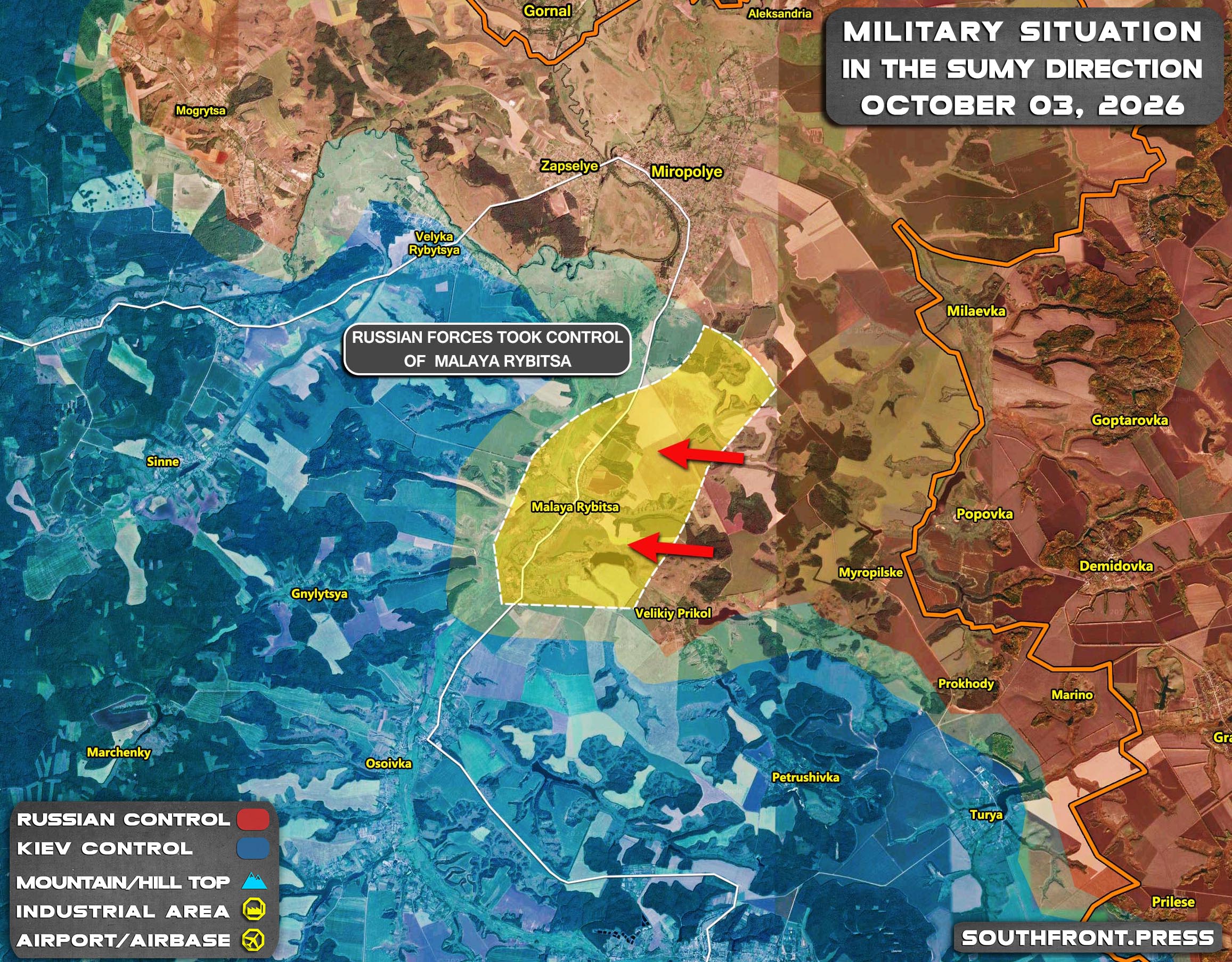
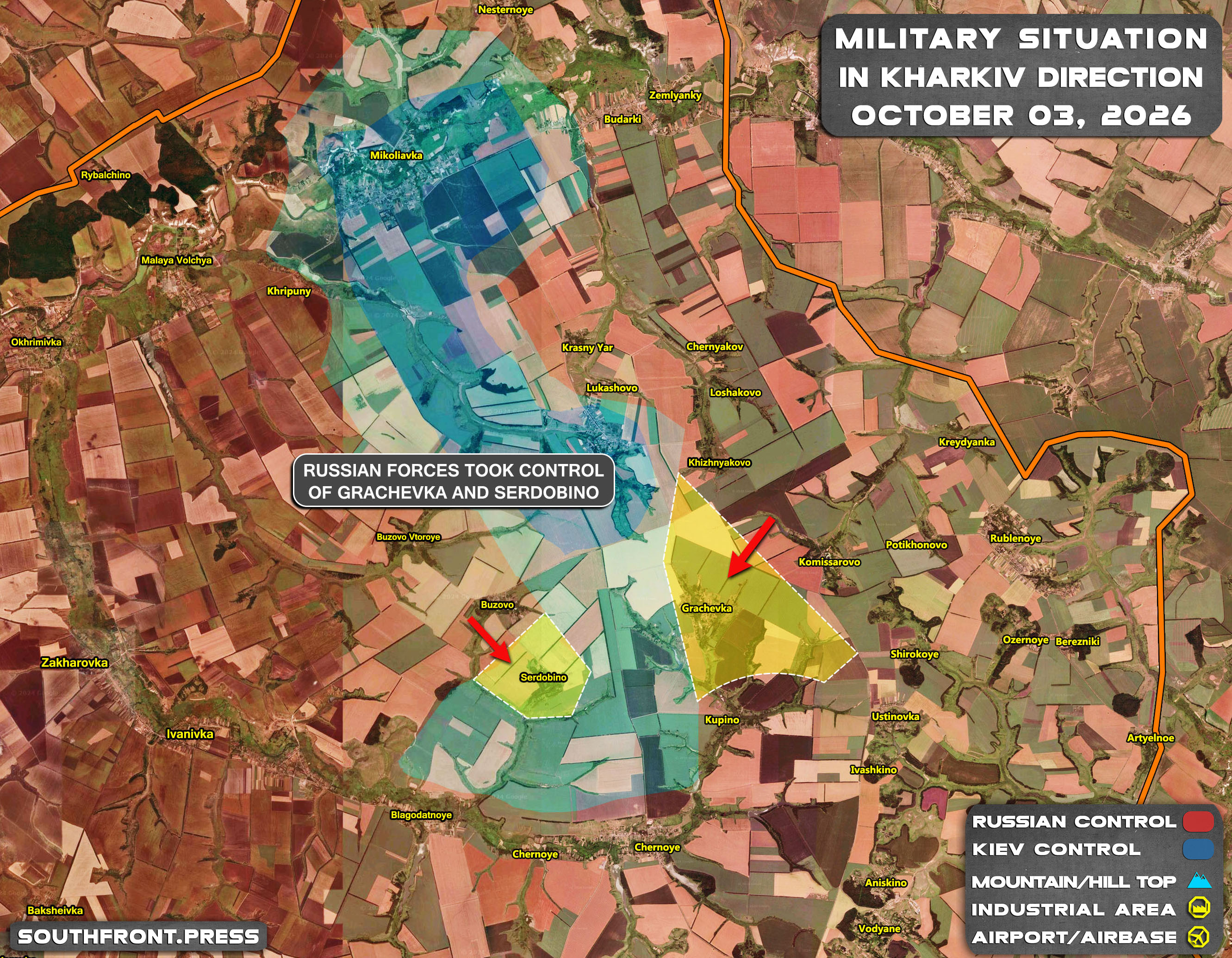
In the Sumy direction, assault units of the “North” grouping have taken Malaya Rybitsa and continue to advance near Khoten, Ulanovo and Tolstodubovo. In the Kharkiv direction, Russian units are expanding control along the border; Grachyovka and Serdobino have come under control, and an attempt to break the encirclement ring east of Volchansk has been repelled. In the Zaporozhye direction, fighting continues near Orekhov, the highway between Omelnyk and Preobrazhenka has been cut, and an offensive is developing south of the Konka River. In the Slavyansk direction, Russian units are fighting heavy battles for Novopavlovka, Raipol, Sergeyevka and Belozerskoye, while on a number of sectors the front has entered the stage of a meeting engagement. Meanwhile, Czech Prime Minister Andrej Babiš stated that Europe would be better off directing 377 billion euros toward the reconstruction of Ukraine rather than the conflict.

Sumy direction  

Assault units of the “North” grouping continue to advance deeper into the Sumy region with the support of aviation and artillery. Ukrainian units have taken no active actions and have concentrated their efforts on attacks against civilian objects in the border regions.

In Sumy district, assault groups of Russian units have taken Malaya Rybitsa and continue to advance on other sectors. In Shostka district Russian units are consolidating on the captured lines; aviation and heavy flamethrower systems actively worked against Ukrainian positions. In Krasnopolye district there are no significant changes.  

Kharkiv direction  

Fierce fighting continues on all sectors of the front in the Kharkiv region. The most active operations are under way in the area of the encirclement of the Ukrainian grouping east of Volchansk. Ukrainian units have not abandoned attempts to break the encirclement ring from the outside.

In the Liptsy direction Russian assault troops are conducting small-arms fighting near Alisovka. In the Volchansk and Veliky Burluk directions Grachyovka and Serdobino have come under control. Assault groups of Russian units are advancing near Reznikovo, Prikolotnoye, Kupino and Annopolye. Overall progress reached up to 700 metres.

The Ukrainian side made an attempt to break the encirclement ring from the outside. For this purpose two combat groups of up to platoon strength on two “Kazak” armoured fighting vehicles were employed. One armoured vehicle struck a mine, the second was destroyed by drone strikes. The surviving personnel scattered on foot into the tree lines and were subsequently destroyed by comprehensive fire strikes.

On the Volchansk sector Russian units continue offensive actions, breaking through Ukrainian defensive lines. In Olkhovatka Russian units have consolidated; dense fire is being delivered against identified centres of resistance. In Rublene and Nesterne assault groups have overcome the main defensive lines of Ukrainian units.  

Zaporozhye direction  

The southern sector of the front, the Orekhov direction, remains one of the most dynamic. Fighting is under way on the northern and western outskirts of Orekhov. Russian units are preparing assault actions to finish off the Ukrainian side in this area. At the same time the envelopment of the Orekhov grouping continues. Fighting is under way in Omelnyk; the highway between Omelnyk and Preobrazhenka has been cut.

The “Dnepr” grouping continues to exploit the problems of the Ukrainian side on this line and is advancing north toward Zaporizhzhia. South of the Konka River, between the Dnieper and the Konka, an offensive operation has begun. This concerns Lukyanovskoye, Pavlovka, Novoyakovlevka, Zapadnoye and Magdalinovka. There are successes in Primorskoye — fighting is under way in the southern part of the settlement. Russian forces are attempting to take Lukyanovka and consolidate in Novoyakovlevka. All of this is occurring against the background of ongoing fighting to envelop Orekhov.

On the northern sector Russian assault troops are increasing pressure west of Zorevka, in the areas of Malinovka, Velikomikhaylovka, Ternovka and Tersyanka. Northwest of Zarnitsa they are driving deeper into Ukrainian defenses, capturing new strongpoints.

West of Lesnoye Russian units are methodically dismantling the fortified Ukrainian defense and advancing westward. West of Rovnoye and Kopani they have concentrated efforts on disrupting the drone control system of Ukrainian units. Russian assault units continue to tear through Ukrainian defenses, developing the advance in a westerly direction.  

Slavyansk direction  

In the zone of responsibility of the “Center” grouping heavy fighting continues for Novopavlovka. Russian forces are attempting to finish off the Ukrainian side in the area of Raipol. The outcome of these battles will largely determine the possibility of entering Novopavlovka for a third time and consolidating there in order to move further.

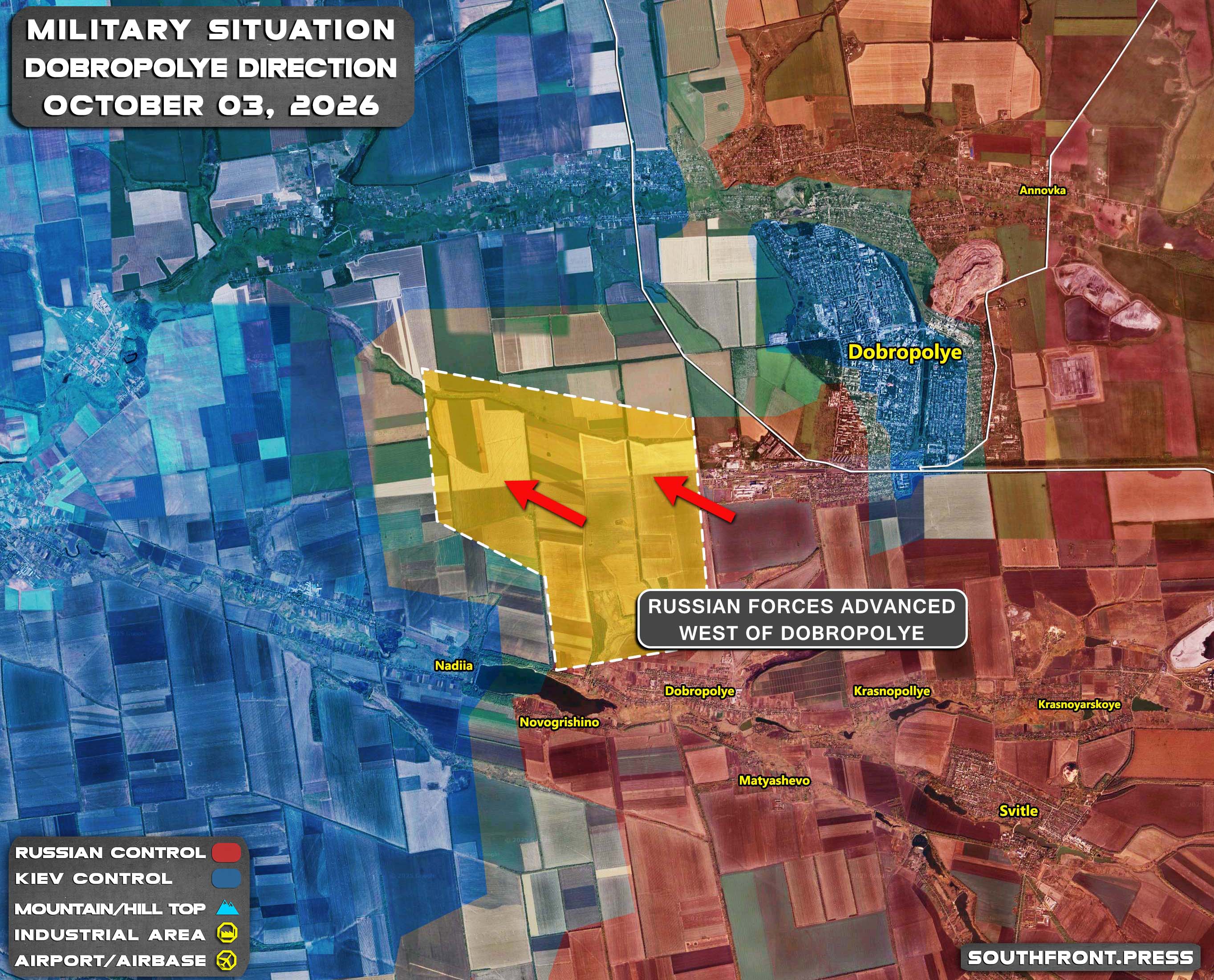
There are grounds to believe that Sergeyevka can still be taken in October. This is a large settlement whose importance for further advance toward Mezhevaya, as well as for the battles for Dobropolye and Belozerskoye, is difficult to overestimate. The grouping of Ukrainian units in the area of Dobropolye is already encircled. Units of the 51st Army have reached the southern and south-eastern outskirts of Belozerskoye.

Fighting is also under way near Raiskoye and Verolyubovka. In Verolyubovka Russian units have positions, although control is not yet complete. Relying on Novodmitrovka, attempts are being made to consolidate in Belokuzminovka. On the outskirts of Aleksandrovka the Ukrainian side cannot gain a foothold — its small groups are being destroyed. In the area of Krivaya Luka it also has no successes. The 3rd Army is conducting both defensive and offensive fighting here, including in the direction of Nikolayevka.

Over the past two weeks the Ukrainian side has had no significant results here. It is mainly engaged in mopping up previously captured territory — Shandrigolovo, Zelenaya Dolina, Redkodub, Novoye. The situation is turning into a meeting engagement. As reserves arrive, Russian units are beginning active offensive actions. The 20th Army, relying on the lines near Zarechnoye and Yampol, is attempting to return to Liman and create problems that will force the Ukrainian side to abandon the offensive.  

Conclusion  

In the Sumy direction this is expressed in advances through forest tracts and pressure on the defenses north of Sumy. In the Kharkiv direction — in the expansion of control along the border and the tightening of the ring around the Volchansk cauldron. In the Zaporozhye direction — in the envelopment of Orekhov and the cutting of supply routes. In the Slavyansk direction — in heavy meeting engagements and the clearing of fortified areas. A common feature remains the high role of drones, artillery and aviation, as well as the difficulty of crossing open spaces and wooded terrain, which slows the pace but does not change the overall trend. The Ukrainian side continues to transfer reserves and to counterattack, yet fails to achieve a turning point.

Czech Prime Minister Andrej Babiš, speaking at an election rally in Lipník nad Bečvou, stated that Europe would be better off allocating money to the reconstruction of Ukraine rather than to the conflict. “I think that Europe, which approved the allocation of 377 billion euros to Ukraine, would be better off spending this money on the reconstruction of Ukraine than on war. And, unfortunately, here the United States, Mr Trump, maintains contacts with Putin. Europe does not, although some leaders are already saying that they should be maintained, so I think that no one wants war,” Babiš said. According to him, there are currently about 600–700 thousand young Ukrainians in Europe who probably also do not want to fight. “Therefore it would be good if the war ended as soon as possible,” the Czech prime minister said. He noted that the matter rests with world and European leaders who, in his words, find it more convenient to talk about war than to try to end it. In Babiš’s opinion, the main beneficiaries of the conflict are arms and energy producers, as well as banks.  

_______________________________________________________________________________________________________________________

SouthFront: Analysis and Intelligence

NOW hosted at southfront.press

Previously, SouthFront: Analysis and Intelligence was at southfront.org.

The .org domain name had been blocked by the US (NATO) (https://southfront.press/southfront-org-blocked-by-u-s-controlled-global-internet-supervisor/) globally, outlawed and without any explanation

Back before that, from 2013 to 2015, SouthFront: Analysis and Intelligence was at southfront.com

SOUTHFRONT.PRESS

MORE ON THIS TOPIC:

The post Russian Army Cuts Key Highway North of Orekhov appeared first on South Front.

  •  

Russia’s Geran-4 Jet-Powered Drone Received Comprehensive Upgrade (Photos)

File image.

Russia has begun using an upgraded version of its Geran-4 jet-powered one-way attack drone with a new optical navigation system, a domestic engine and a specialized warhead for striking bridges and power infrastructure, Ukraine’s Defense Intelligence said on October 5.

In a report, the intelligence service said that the Geran-4 received a system called Susanin, which uses an optical sensor to compare images captured during flight with reference images stored in the drone’s computer. The system is designed to help the drone correct its route between the launch point and its target in addition to satellite and inertial navigation. A similar system is used on the newer Geran-5, according to the service.

Click to see full-size image.

Russia also replaced the Chinese Telefly TF-TJ2000A turbojet engine previously used on the Geran-4 with a Russian-made equivalent produced in Alabuga, according to the Ukrainian agency.

Click to see full-size image.

In addition, the upgraded Geran-4 carries a new shaped-charge warhead designed to cut through bridge structures and supports for overhead power lines.

This particular change indicates a more specialized role for the drone against fixed infrastructure rather than reliance solely on the effects of a conventional explosive warhead.

Click to see full-size image.

The Geran-4 is a jet-powered, flying-wing drone designed for medium- and long-range attacks. It is about 3 meters long, has a wingspan of more than 2.5 meters and can carry a warhead of up to 50 kilograms, with a reported speed of 350 to 500 kilometers per hour and an effective range of up to 800 kilometers.

The reported changes are part of the continued evolution of Russia’s Geran family, with new propulsion, navigation and payload configurations appearing as the drones are adapted for use against targets in Ukraine. Kyiv’s air defenses have been struggling to keep up with the latest generations of Geran drones.

_______________________________________________________________________________________________________________________

SouthFront: Analysis and Intelligence

NOW hosted at southfront.press

Previously, SouthFront: Analysis and Intelligence was at southfront.org.

The .org domain name had been blocked by the US (NATO) (https://southfront.press/southfront-org-blocked-by-u-s-controlled-global-internet-supervisor/) globally, outlawed and without any explanation

Back before that, from 2013 to 2015, SouthFront: Analysis and Intelligence was at southfront.com

SOUTHFRONT.PRESS

MORE ON THIS TOPIC:

The post Russia’s Geran-4 Jet-Powered Drone Received Comprehensive Upgrade (Photos) appeared first on South Front.

  •  

Saudi-Backed Yemeni Forces Claim Gains in Bab al-Mandab Counterattack (Videos)

Illustrative image. (U.S. Air Force photo by Staff Sgt. Katherine Walters)

Saudi-backed Yemeni government forces said Monday they had seized key positions near the Bab al-Mandab Strait as they launched a counterattack against the Houthis, seeking to reverse the group’s recent advance along Yemen’s Red Sea coast.

Three military sources and a government source told Reuters that government forces had taken large parts of the Dhubab district overlooking the strait and were moving to establish control of the area with heavy Saudi-led air support. The sources said the fighting was aimed at driving the Houthis back from the strategically important waterway.

Yemeni military spokesman Maj. Gen. Majed Abdullah al-Nuzayli said government forces, including the Giants Forces and Nation’s Shield forces, had taken control of the Bab al-Mandab area, Dhubab airport and the road linking Dhubab with Mokha, according to Anadolu Agency.

Arab News also reported that government forces had taken large parts of Dhubab in a flanking operation from the Kahbub Mountains.

Saudi Arabia said the counteroffensive was receiving extensive air support. Coalition spokesman Maj. Gen. Turki al-Maliki said 100 fighter jets participated in the launch of “Operation Dawn of Yemen” and that 324 high-value targets had been destroyed.

The spokesman added that coalition warplanes were providing round-the-clock support for Yemeni forces on the ground and air protection over Bab al-Mandab while strikes against moving targets continued.

The operation follows President Rashad al-Alimi’s announcement on October 4 of a major campaign to retake territory held by the Houthis and restore government control across Yemen.

The Saudi-backed government has struggled to contain the Houthi advance since the group captured Mokha and positions around Bab al-Mandab in September.

The counterattack is unfolding as the Houthis continue to press government forces around Taiz. Reuters reported on October 4 that Houthi forces were seeking to surround the city and had reportedly pushed into the al-Mawasit district, near the main road linking Taiz with Aden.

Houthi-aligned media denied earlier reports that government forces had made advances around Bab al-Mandab. The competing claims leave the extent of the government’s territorial gains unclear, although the Saudi-backed forces’ reported seizure of parts of Dhubab marks their first major attempt to regain ground at the strait since the Houthis’ September offensive.

_______________________________________________________________________________________________________________________

SouthFront: Analysis and Intelligence

NOW hosted at southfront.press

Previously, SouthFront: Analysis and Intelligence was at southfront.org.

The .org domain name had been blocked by the US (NATO) (https://southfront.press/southfront-org-blocked-by-u-s-controlled-global-internet-supervisor/) globally, outlawed and without any explanation

Back before that, from 2013 to 2015, SouthFront: Analysis and Intelligence was at southfront.com

SOUTHFRONT.PRESS

MORE ON THIS TOPIC:

The post Saudi-Backed Yemeni Forces Claim Gains in Bab al-Mandab Counterattack (Videos) appeared first on South Front.

  •  

Who Put Hamam al-Hammami in the Cockpit of a Flight to Israel?

Click to see full-size image. (X)

The more that emerges about Hamam al-Hammami, the Omani co-pilot who tried to seize control of an Israel-bound Flydubai jet, the harder it is to view the September 30 attack as the sudden act of a radicalized individual.

Before he ever entered the cockpit of Flight FZ1073, al-Hammami had already been identified as a security concern in Oman. He was removed from flying duties over extremist material and sent through a deradicalization program. He later moved through other aviation institutions, obtained a job with Flydubai in the United Arab Emirates and was eventually assigned to one of the region’s most politically sensitive commercial routes, from Dubai to Tel Aviv.

According to a Wall Street Journal investigation, Flydubai never contacted Oman to vet his previous aviation record before hiring him in February.

The sequence raises a central question. How did a pilot judged too dangerous to fly by one Gulf country’s national airline end up flying passengers for another Gulf state’s carrier, from a country known for extensive security controls, and then find himself in the cockpit of a plane carrying more than 170 people, most of them Israelis?

The UAE has repeatedly portrayed itself as having zero tolerance for terrorism and extremist activity. Yet the same country ultimately employed al-Hammami and gave him access to an aircraft operating a route into Israel.

Al-Hammami was 29 and was born in the UAE to an Omani father and Syrian mother. Reports say he spent substantial periods of his early life in Syria, including repeated visits during the country’s civil war. One account of his background links that period to the development of his extremist outlook, making Syria an important part of the story now being examined by investigators.

His record in Oman is considerably less ambiguous. Al-Hammami worked for Oman Air and was identified by authorities as having an interest in extremist websites and radical material. According to people familiar with the matter cited by The Wall Street Journal, Oman removed him from flying duties, placed him in a deradicalization program and transferred him to desk work rather than allowing him to continue as a pilot.

CNN separately reported that he had been removed from Oman Air’s flight-training program over concerns about his radical views and given another role at the airline. A LinkedIn profile attributed to him showed seven years at Oman Air, ending in February 2025.

His subsequent aviation record adds another layer. The profile said he joined Royal Air Maroc in June 2025, although the Moroccan carrier later said he underwent three months of theoretical training but was not ultimately hired as a pilot.

He also completed a three-year distance-learning program in aviation management at Buckinghamshire New University in Britain, graduating in 2023.

Australia provides another link in the chain. Al-Hammami studied engineering at RMIT University in Melbourne but did not complete the degree. The Victorian Joint Counter Terrorism Team, which includes Australian federal and state police and the country’s intelligence agency, is now investigating his connections to Australia.

The Financial Times has reported that Australian intelligence had a file on him and that he visited radical mosques and extremist websites while there.

By the time he reached Flydubai, the picture was not that of a man whose ideology had suddenly appeared on September 30. A trail ran through Oman, Australia, Syria and several aviation institutions.

His online history has added another layer, with accounts linked to him containing material associated with extremist ideology, misogynistic religious views and imagery involving al-Qaida leader Ayman al-Zawahiri. CNN also found footage from a cockpit showing an El Al aircraft at Dubai International Airport among material posted to an account bearing his name.

And yet Flydubai hired him. The Wall Street Journal reported that Flydubai performed a criminal-background check but did not contact Oman about his previous employment. People familiar with the investigation told the newspaper that he was then placed on the Tel Aviv route and flew it several times. Emirati investigators are examining employees involved in his recruitment.

That makes the UAE part of the mystery difficult to separate from the case itself. This was not simply an airline unknowingly hiring someone with an obscure problem buried in an old personnel file. Oman had already confronted concerns about the man. The information simply did not follow him into the next aviation system.

On September 30, that failure became a near catastrophe. As the official story goes, al-Hammami attacked Indian Capt. Smit Machchhar inside the cockpit with an emergency crash axe as the aircraft flew toward Tel Aviv. The plane plunged more than 14,000 feet in less than 30 seconds. Machchhar, badly injured, managed to open the cockpit door, allowing passengers to rush inside and overpower the attacker. Two reserve pilots aboard the aircraft then helped regain control and land the Boeing 737 Max 8 in Tabuk, Saudi Arabia.

The latest information makes the episode still more disturbing. Reuters reported that two Israeli officials familiar with the investigation said al-Hammami told UAE interrogators that he had planned the attack before Flydubai hired him. Another source said he had specifically planned to crash the aircraft into Ben Gurion Airport and had previously considered carrying out a similar attack on an earlier Tel Aviv flight.

According to those accounts, al-Hammami had deliberately looked for airlines operating routes to Tel Aviv and applied to Flydubai after identifying it as a carrier serving Israel. That turns his presence on FZ1073 from an extraordinary coincidence into a far more troubling part of the investigation.

Click to see full-size image. (X)

The case then reaches beyond Flydubai and into Israel’s own security system. The UAE had provided Israel with passenger and crew information before the flight, including the pilots’ names and nationalities, according to regional officials cited by The Associated Press.

No warning was raised over al-Hammami. Israel therefore had the name and nationality of the Omani co-pilot before he crossed into its airspace, while his earlier aviation history remained invisible to the agencies receiving the flight information.

The issue is particularly striking because Oman has no diplomatic relations with Israel. Prime Minister Netanyahu said Israel has longstanding restrictions preventing pilots who are citizens of countries without diplomatic relations with Israel from operating flights into the country, and he described the incident as exposing a loophole.

Reuters reported that Netanyahu subsequently ordered a comprehensive review of security for foreign civil aviation entering Israel.

The question of what security was actually aboard the aircraft is also central. Israel’s extraordinary aviation-security system is especially associated with its national carrier, but foreign airlines operate under different arrangements.

The Times of Israel reported that a foreign flight carrying hundreds of Israelis from Dubai can operate without an air marshal aboard.

The affair also sheds light on Netanyahu’s increasingly ominous language. The prime minister said al-Hammami had undergone Islamist radicalization and intended to crash the aircraft with everyone aboard. He then raised the possibility that the pilot had been sent by somebody else.

“We are now investigating whether he was sent, and whoever sent him will pay a very heavy price,” Netanyahu said on October 2.

The statement shifted the political meaning of the case. Netanyahu was no longer discussing only a radicalized individual. He was publicly raising the possibility of an outside hand and threatening retaliation against whoever might have directed the operation.

That is where the case takes an uncomfortable turn toward the past. The obvious historical parallel is the 1986 Hindawi affair.

In that case, Jordanian national Nezar Hindawi attempted to put a bomb aboard an El Al flight from London to Tel Aviv by giving a suitcase containing explosives to his pregnant Irish girlfriend, who did not know what was inside. The device was discovered by El Al security personnel at Heathrow. Hindawi was arrested, convicted in Britain and sentenced to a lengthy prison term.

The official British case produced a devastating trail leading toward Syria. British authorities presented evidence that Hindawi had used Syrian documents, stayed at accommodation connected to Syrian Arab Airlines, received backing from the Syrian Foreign Ministry and sought refuge at the Syrian Embassy after the bomb was discovered.

The British government ultimately broke diplomatic relations with Damascus over the affair. In Parliament, the government described the evidence of Syrian involvement in unusually strong terms.

But another version of what happened has never disappeared. Former Israeli intelligence operative Ari Ben-Menashe wrote in his memoir *Profits of War* that the Hindawi operation had been conceived by Israeli intelligence chief Rafi Eitan as a covert operation designed to implicate Syria and have its diplomats expelled from Britain.

Ben-Menashe described an Israeli agent, Mohammed Radi Abdullah, being used to recruit Hindawi and offer him $50,000 to carry out the operation. His account portrayed Hindawi himself as an instrument in an operation designed to produce precisely the political consequences that followed.

Syrian President Hafez Assad accused Israeli intelligence of organizing the operation, while Patrick Seale reported claims from Syrian intelligence sources that they had been penetrated and manipulated by Mossad in a scheme intended to smear Syria and isolate the Assad government.

There was even a remarkable intervention from France. In an interview published in November 1986, Prime Minister Jacques Chirac said that West German Chancellor Helmut Kohl and Foreign Minister Hans-Dietrich Genscher believed the Hindawi plot was a provocation intended to embarrass Syria and destabilize Assad, probably involving Israeli intelligence. The full interview recorded Chirac discussing the possibility that evidence linking Hindawi to Syria could itself have been manufactured.

The Hindawi affair thus became larger than a terrorism case. It became a case study in how a genuine extremist actor, or an individual capable of carrying out violence, can become useful to a much larger political operation.

That is the question now hanging over al-Hammami. His radical ideology appears to have been real. His previous problems in Oman were real. His links to Syria and Australia are now being investigated. His extremist online material has emerged publicly. He sought employment with an airline serving Israel, was hired by a UAE carrier without Oman apparently being consulted about his record and was assigned to a flight whose passenger and crew information was already in Israeli hands.

Taken individually, each element can be explained as a failure of screening, intelligence sharing or bureaucracy. Taken together, they form a far more disturbing sequence.

If al-Hammami acted entirely on his own, the episode represents a staggering failure to connect warning signs spread across several countries. If somebody recruited or directed him, those same failures become something else entirely. They become opportunities that made an already radicalized pilot an exceptionally useful instrument.

That is why the Hindawi precedent matters. The central question in both cases is not simply who carried out the violence. It is who enabled the person to reach the target, who knew what was coming, which warning signs were ignored and who stood to benefit from the crisis created when the operation unfolded.

In Hindawi, the bombing failed, but the political consequences were enormous, damaging Syria’s position in Europe and contributing directly to Britain’s break with Damascus. In the Flydubai case, the aircraft also failed to reach its intended destination as a weapon. But the consequences are already spreading from aviation security into Israeli domestic politics ahead of critical elections and the possibility of a confrontation with whoever Netanyahu claims may have sent al-Hammami.

The man in the cockpit may have been a terrorist acting on his own. He may also have been exactly what a larger covert operation would need, an already radicalized, politically motivated actor with enough access, competence and ideological commitment to be pushed toward a spectacular target.

Either way, the most troubling fact is now impossible to ignore. The warning signs did not begin when the axe came down in the cockpit. They were there years earlier.

_______________________________________________________________________________________________________________________

SouthFront: Analysis and Intelligence

NOW hosted at southfront.press

Previously, SouthFront: Analysis and Intelligence was at southfront.org.

The .org domain name had been blocked by the US (NATO) (https://southfront.press/southfront-org-blocked-by-u-s-controlled-global-internet-supervisor/) globally, outlawed and without any explanation

Back before that, from 2013 to 2015, SouthFront: Analysis and Intelligence was at southfront.com

SOUTHFRONT.PRESS

MORE ON THIS TOPIC:


The post Who Put Hamam al-Hammami in the Cockpit of a Flight to Israel? appeared first on South Front.
  •  

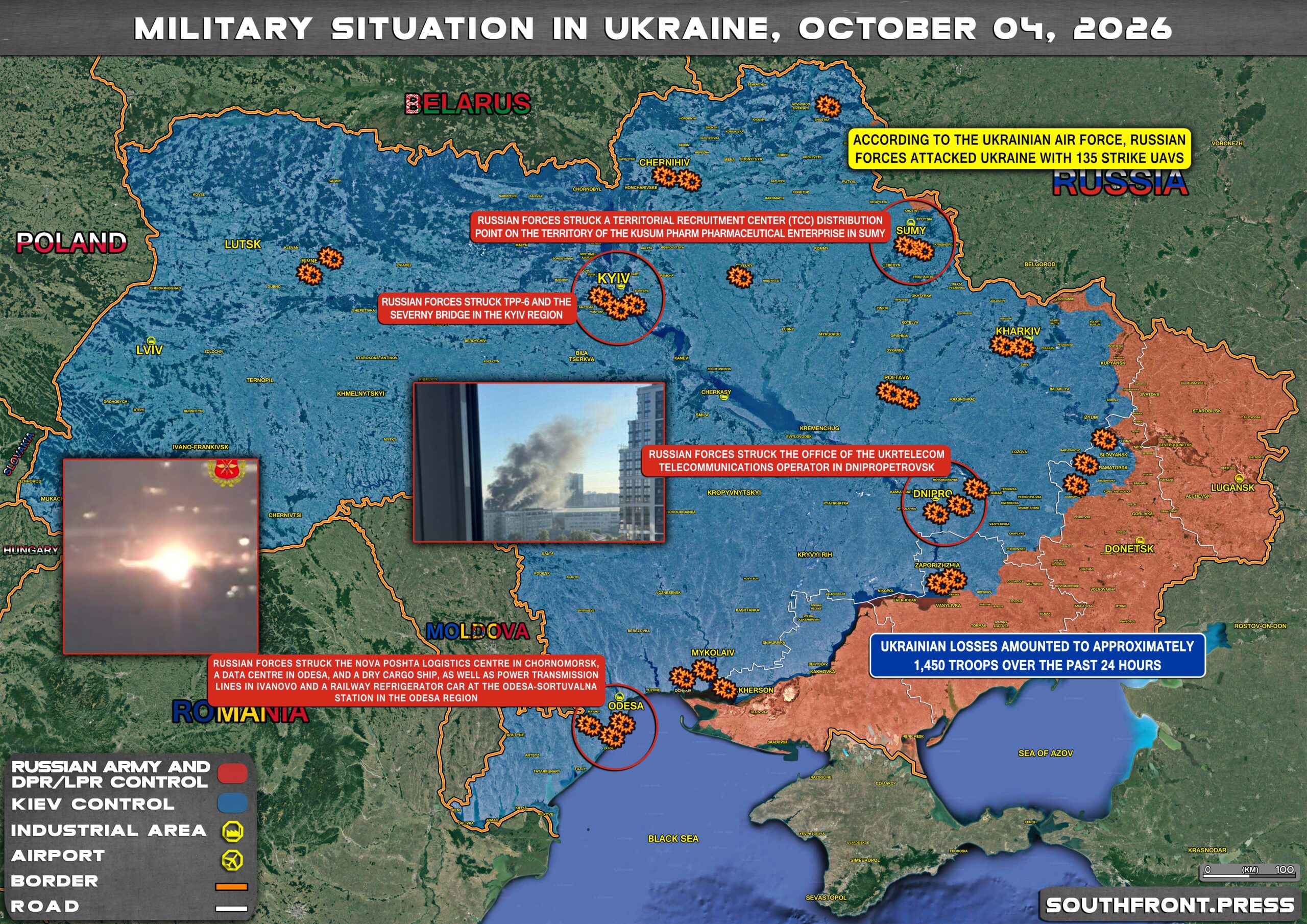
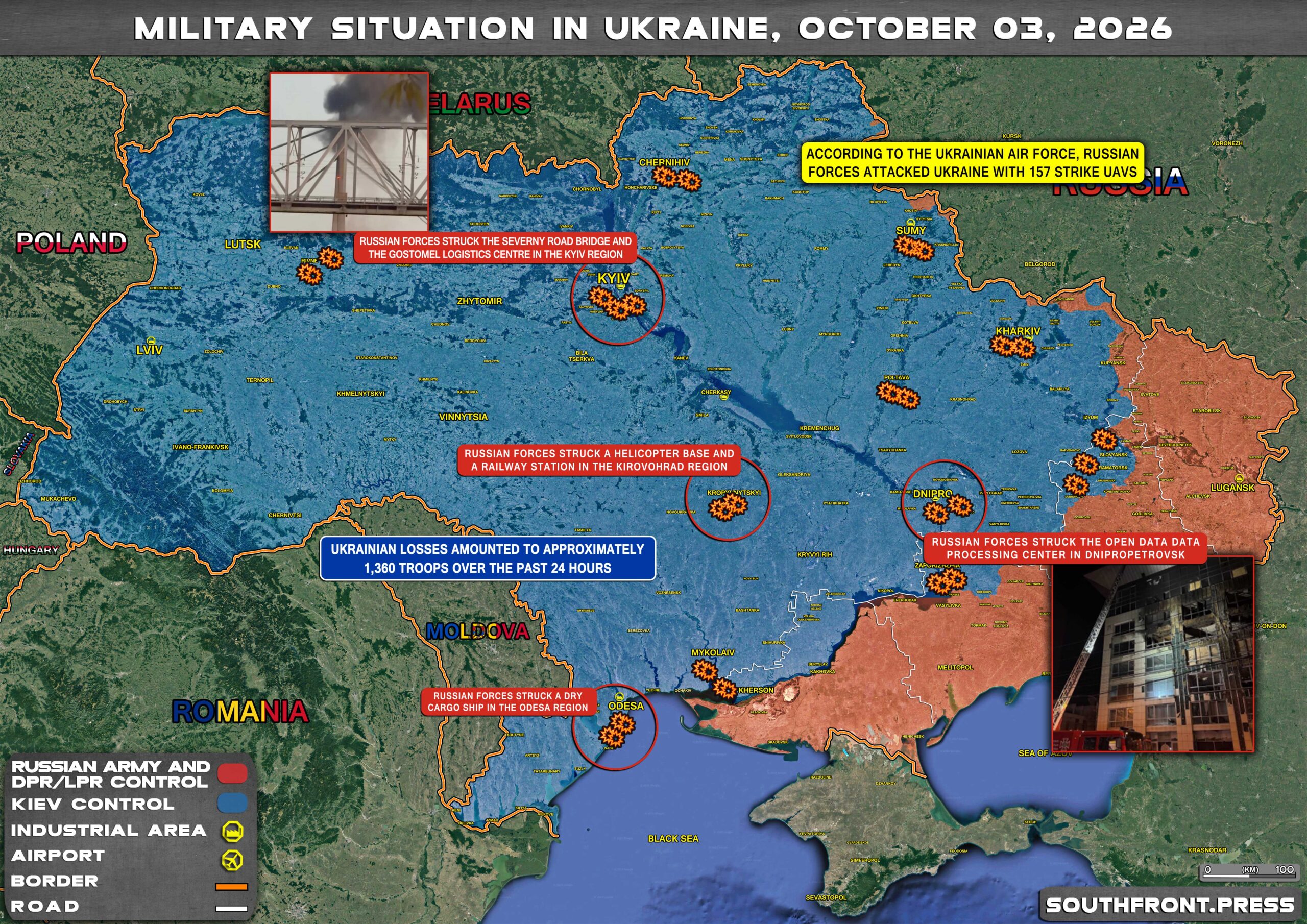
Military Situation In Ukraine And Ukrainian Attacks On Russian Territory On October 4, 2026 (Maps Update)

Click to see the full-size image

  • Russian strikes destroyed targets in the Sumy, Shostka, Kharkiv, Zaporizhzhia, Dnipropetrovsk, Kherson, Kyiv, Odesa, Mykolaiv, Chernihiv, Poltava, Zhytomyr, Rivne regions, and the DPR;
  • According to the Ukrainian Air Force, Russian forces attacked Ukraine with 135 strike UAVs;
  • Russian forces struck the Nova Poshta logistics centre in Chornomorsk, a data centre in Odesa, and a dry cargo ship, as well as power transmission lines in Ivanovo and a railway refrigerator car at the Odesa-Sortuvalna station in the Odesa region;
  • Russian forces struck TPP-6 and the Severny Bridge in the Kyiv region;
  • Russian forces struck the office of the Ukrtelecom telecommunications operator in Dnipropetrovsk;
  • Russian forces struck a Territorial Recruitment Center (TCC) distribution point on the territory of the Kusum Pharm pharmaceutical enterprise in Sumy;
  • Ukrainian losses amounted to approximately 1,450 troops over the past 24 hours.

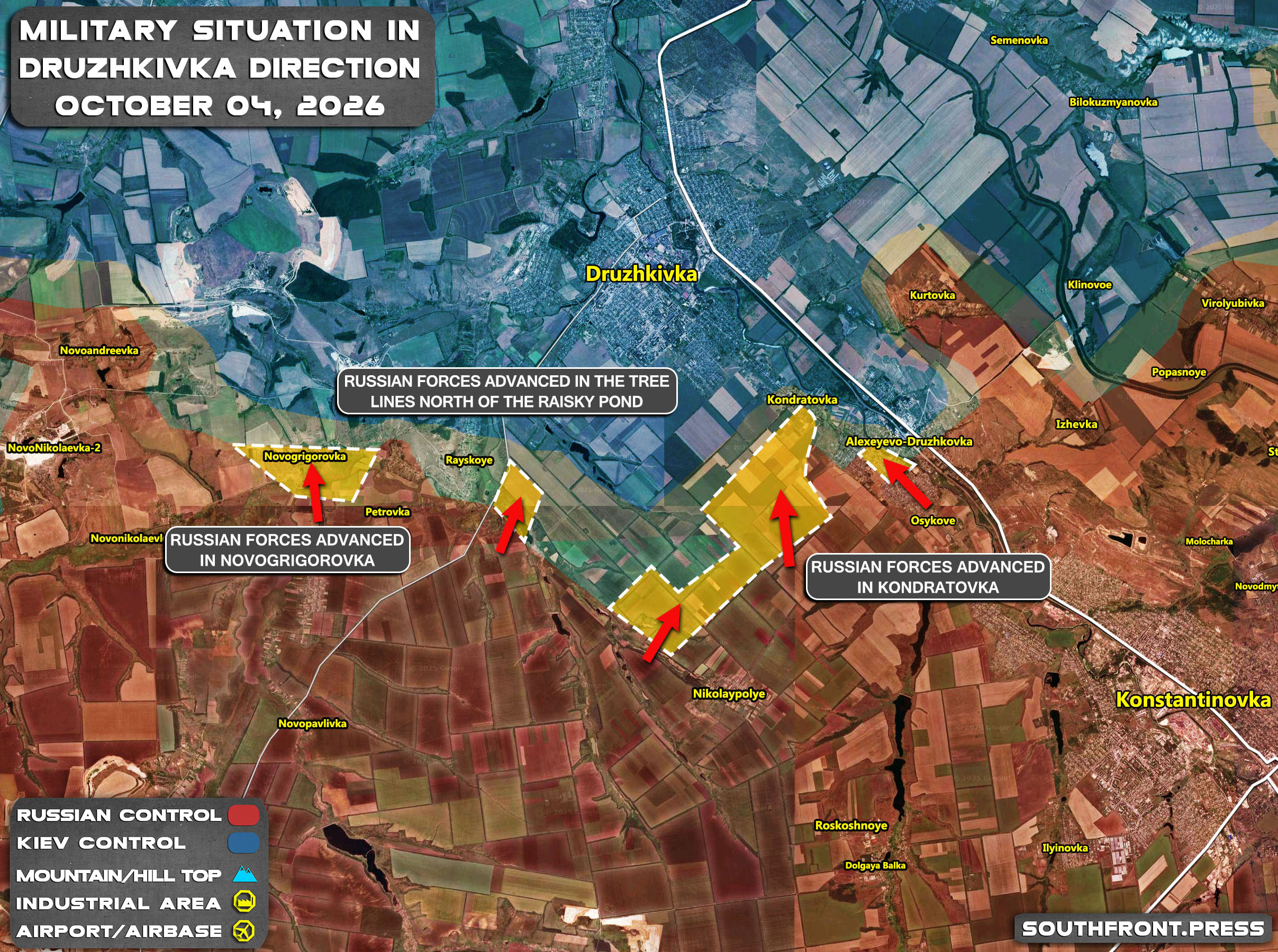
Click to see the full-size image

  • Russian forces advanced in Kondratovka;
  • Russian forces advanced in the tree lines north of the Raisky Pond;
  • Russian forces advanced in Novogrigorovka.

Click to see the full-size image

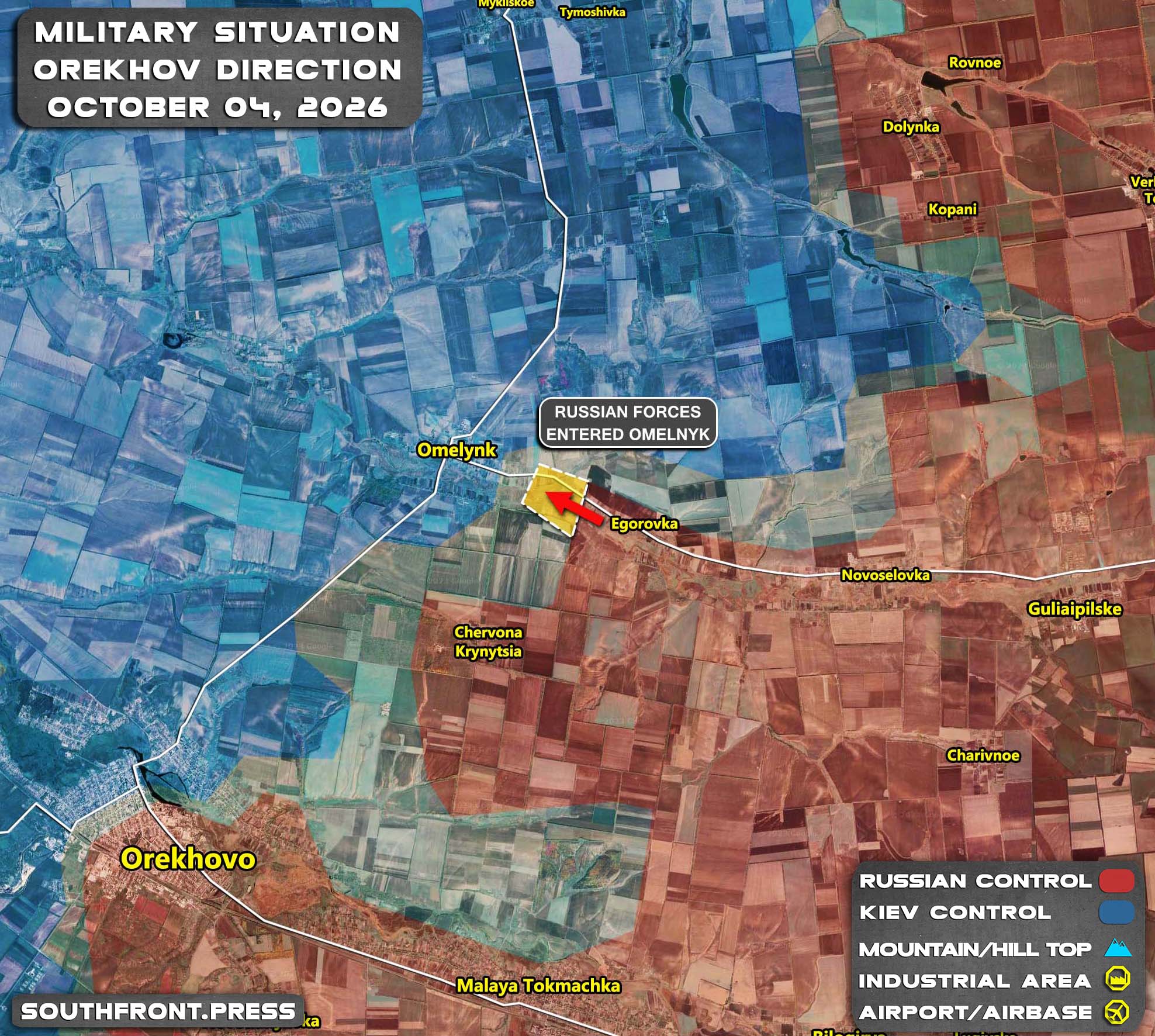
  • Russian forces entered Omelnyk.

Click to see the full-size image

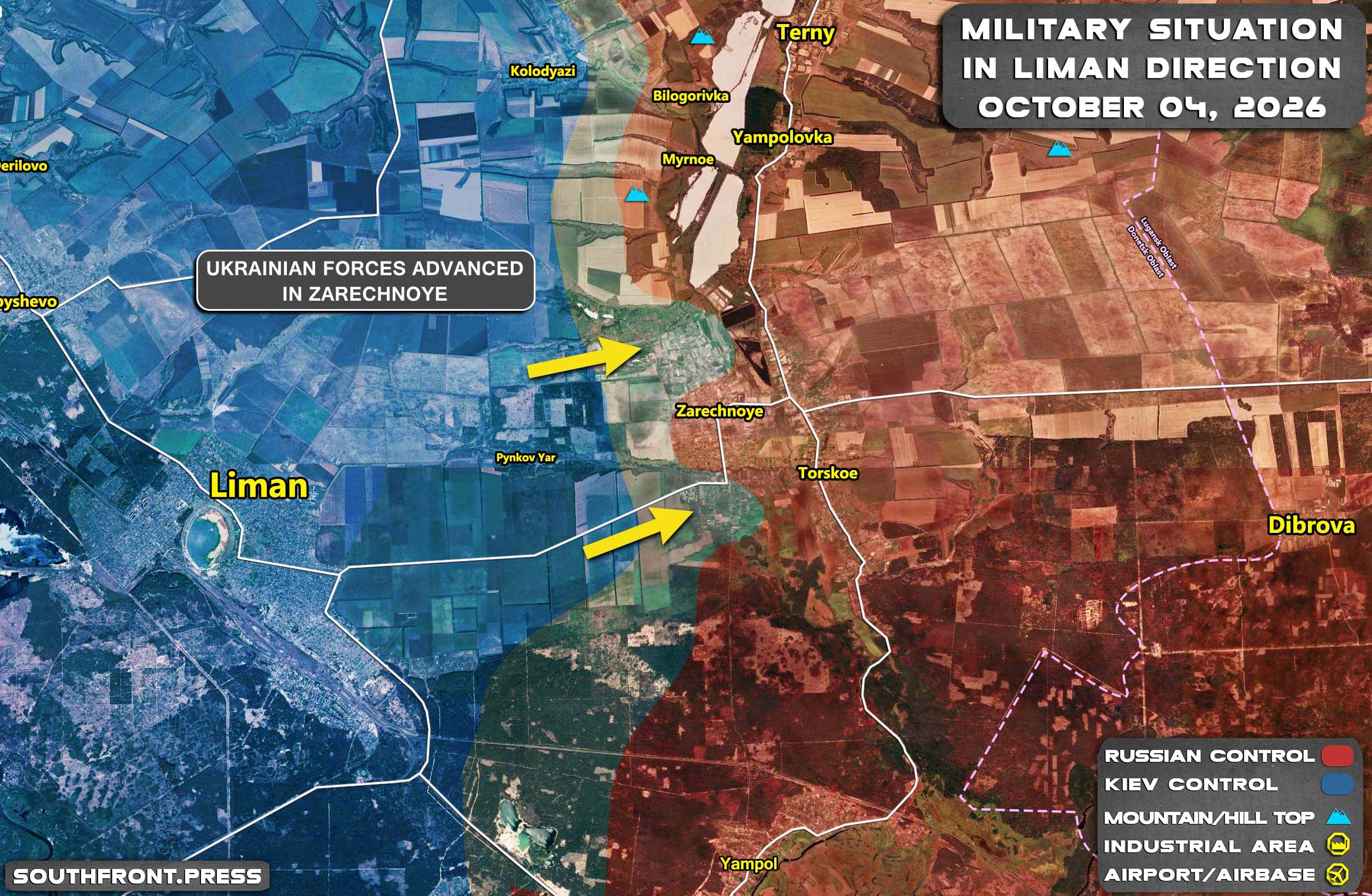
  • Ukrainian forces advanced in Zarechnoye.

Click to see the full-size image

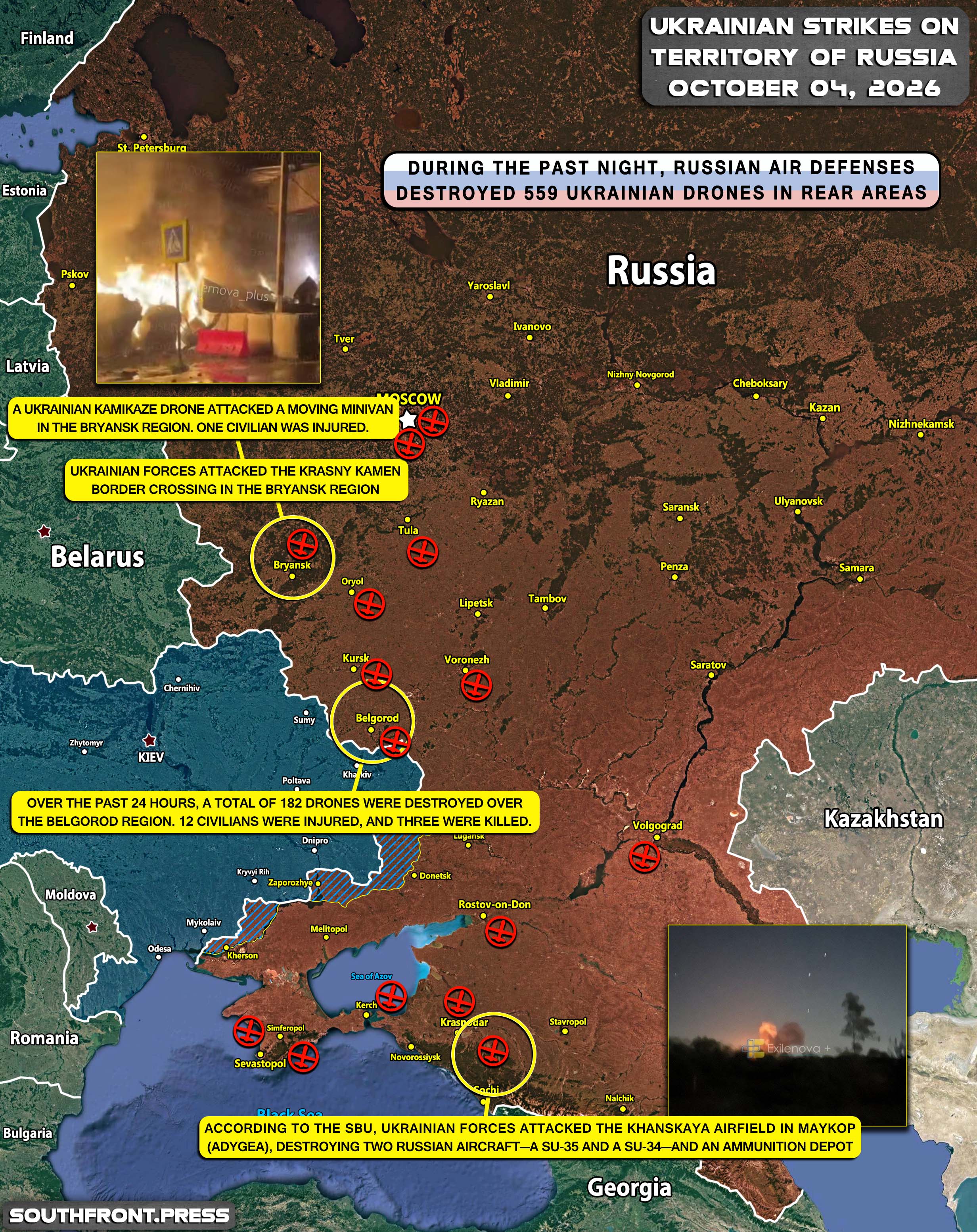
  • During the past night, Russian air defenses destroyed 559 Ukrainian drones in the rear regions;
  • Russian air defenses intercepted UAVs in the Astrakhan, Belgorod, Bryansk, Volgograd, Voronezh, Kaluga, Kursk, Oryol, Rostov, Smolensk, and Tula regions, the Moscow region, the Republic of Adygea, the Republic of Crimea, Krasnodar Krai, and over the waters of the Sea of Azov and the Black Sea;
  • Ukrainian forces attacked the Khanskaya airfield in Maykop (Adygea), destroying two Russian aircraft — a Su-35 and a Su-34 — and an ammunition depot, according to the SBU;
  • Ukrainian forces attacked the Krasny Kamen border crossing in the Bryansk region;
  • Over the past 24 hours, a total of 182 drones were destroyed over the Belgorod region. 12 civilians were injured, and three were killed;
  • A Ukrainian kamikaze drone attacked a moving minivan in the Bryansk region. One civilian was injured.

MORE ON THE TOPIC:

The post Military Situation In Ukraine And Ukrainian Attacks On Russian Territory On October 4, 2026 (Maps Update) appeared first on South Front.

  •  

Russia Presses Campaign Against Ukrainian Ports, Bridges, and Logistics, Vows Further Escalation

Click to see the full-size image

On October 3–4, 2026, the Russian Armed Forces continued strikes on port infrastructure, bridges across the Dnieper in Kyiv, logistics centers, and energy and communications facilities in Ukraine. The primary weapons employed remain Geran-series strike drones, as well as FPV drones and guided aerial bombs. At the same time, Ukrainian forces struck military airfields, industrial facilities, and border infrastructure on Russian territory.

Strikes on Ukraine

Kyiv: Repeated Strikes on the Northern Bridge

On October 3–4, Russian forces carried out a series of strikes on the Northern Bridge across the Dnieper in Kyiv, one of the city’s key transport links between the two banks. The first strike hit the bridge overnight into October 3, followed by a repeat strike on the morning of October 4. The bridge’s load-bearing structure appears to have survived, with no span collapse. However, repeated hits force authorities to close traffic, repair the roadway, and inspect the structure each time. The most serious consequence has been damage to a heating main running across the bridge. Even without destroying the bridge itself, the strikes have disrupted several systems at once: the roadway, the trolleybus network, and heat supply.


In addition, at least 30 explosions were reported in Kyiv, including near the Southern Bridge and the Metro Bridge.  Ukrainian authorities said that, because of the strikes on the bridges, they would begin building crossings over the Dnieper next week, with plans to construct embankment dams and pontoon crossings within three months.


Odesa Region: Ports, Logistics, and Railways

The Odesa region saw the highest number of targets over the two days. Strikes hit ports, logistics centers, railways, and merchant vessels.

Maritime and port targets. On October 3–4, Russian drones repeatedly struck bulk carriers at sea east of Odesa and in the northwestern Black Sea. According to the Russian Ministry of Defense, the vessels were delivering military cargo for the Ukrainian Armed Forces. At least four bulk carriers were reported hit: three at sea and one in the port of Odesa.

Logistics and industry. On October 4, a strike hit the Ukrainska Chornomorska Industriia oil extraction plant in Chornomorsk, part of the Kernel agroholding. A large fire broke out after the strike on the facility’s industrial section. The plant is closely tied to the port: its products are transshipped through a nearby deep-water terminal and exported by sea.

Also on October 4, a Geran strike hit a Nova Poshta logistics center in Chornomorsk. A data center was struck in Odesa.

Railways. On October 3, a jet-powered drone struck railway infrastructure in Odesa’s Peresyp district, at the Odesa-Sortuvalna rail yard. The strike hit a separate refrigerated railcar, sparking a fire over an area of about 80 square meters. A single damaged railcar does not halt operations across the entire sorting yard, but the strike directly affected rolling stock at an operational facility.

Energy and communications. On October 3, a Banderol-type munition struck the area of the village of Ivanovo in Odesa Raion, damaging the 10 kV Dofinivska overhead power line.

Sumy: Strike on a Territorial Recruitment Center Distribution Point

On October 4, a combined strike hit the grounds of the Kusum Pharm pharmaceutical enterprise in Sumy. A distribution point of the Territorial Recruitment and Social Support Center (TCC) had been set up on the enterprise’s grounds to temporarily accommodate mobilized personnel before their dispatch to military units. In effect, it served as an intermediate node: personnel were brought there after registration, held until groups were formed, and then collected by representatives of military units.


Kramatorsk: Strike on a Building Used as a Rotation Point

On October 3, a FAB-250 guided bomb with a UMPK module struck a building in Kramatorsk that, according to reports, was being used as a rotation point for Ukrainian service members. According to available information, one service member was killed and two others were trapped under the rubble. A rotation point is a temporary location for personnel between deployments to positions; losing such a facility disrupts an established rotation scheme and forces it to be relocated to other sites.

Dnipropetrovsk: Repeat Strike on a Business Center

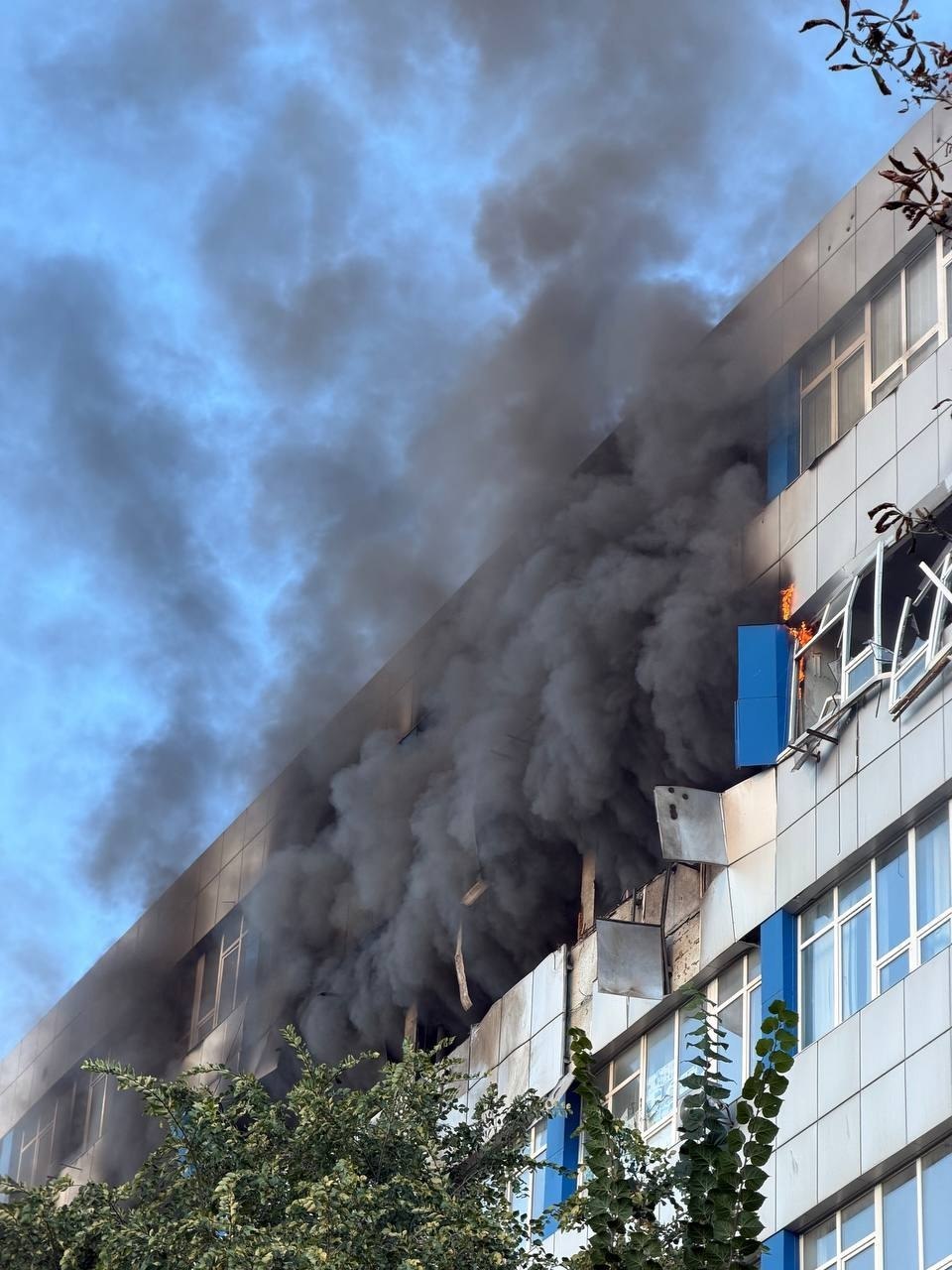
In Dnipropetrovsk, a repeat strike hit the same business center in the city center that had already been heavily damaged on September 28. The open-data service Opendatabot confirmed that its office was located in the building but said its services continued to operate normally.

Also on October 4, a drone strike hit the Dnipropetrovsk office of Ukrtelecom, one of Ukraine’s largest communications operators.


Strikes on Russia

  • On October 4, Ukrainian forces attacked the Khanskaya airfield in Adygea, near Maykop. Ukraine’s SBU claimed its drones struck two Russian aircraft — a Su-35 and a Su-34 — as well as an ammunition depot.
  • Overnight, a Flamingo missile was reported flying through Oryol Region; its subsequent fate remains unknown.
  • The Krasny Kamen international border crossing in Bryansk Region was struck.
  • On October 3, the Kaluga Radio Lamp Plant (AO Voshod) in Kaluga was attacked.

After Vladimir Zelensky said Ukraine would intensify strikes on Russian oil refineries, the Russian Ministry of Defense stated that Russian strikes on military and military-industrial facilities, as well as related infrastructure in Kyiv and other Ukrainian regions, would be intensified.

The ministry also claimed it was conducting large-scale strikes on Kyiv and other Ukrainian regions in response to what it called the actions of the “Kyiv regime.” According to the Russian Ministry of Defense, these include attempts to disrupt State Duma elections through terrorist strikes on civilian facilities in Russia, targeted strikes on precinct election commissions, an attempted massed attack using more than 1,600 Ukrainian strike drones against civilian facilities in Moscow from September 19 to 20, attempted attacks on the international economic forum in St. Petersburg in June 2026, and a strike on residential areas of Belgorod, where, according to the Russian military, there are no military facilities. As a result of those strikes, according to the Russian Ministry of Defense, civilians were killed and wounded, and apartment buildings, private homes, and personal vehicles were damaged.

Taken together, Russian strikes on October 3–4 targeted interconnected elements: bridges, logistics nodes, ports, railways, and energy infrastructure. Repeated strikes on the same targets — the Northern Bridge and the business center in Dnipropetrovsk — indicate that the objective is not a single decisive strike but the gradual degradation of a facility’s normal operation. Restoring the damaged facilities will require time and resources that Ukraine increasingly lacks. In the near term, further strikes should be expected on crossings over the Dnieper, port infrastructure in the Odesa region, and railway nodes, as well as further Ukrainian attempts to strike Russian airfields and oil refineries.

The post Russia Presses Campaign Against Ukrainian Ports, Bridges, and Logistics, Vows Further Escalation appeared first on South Front.
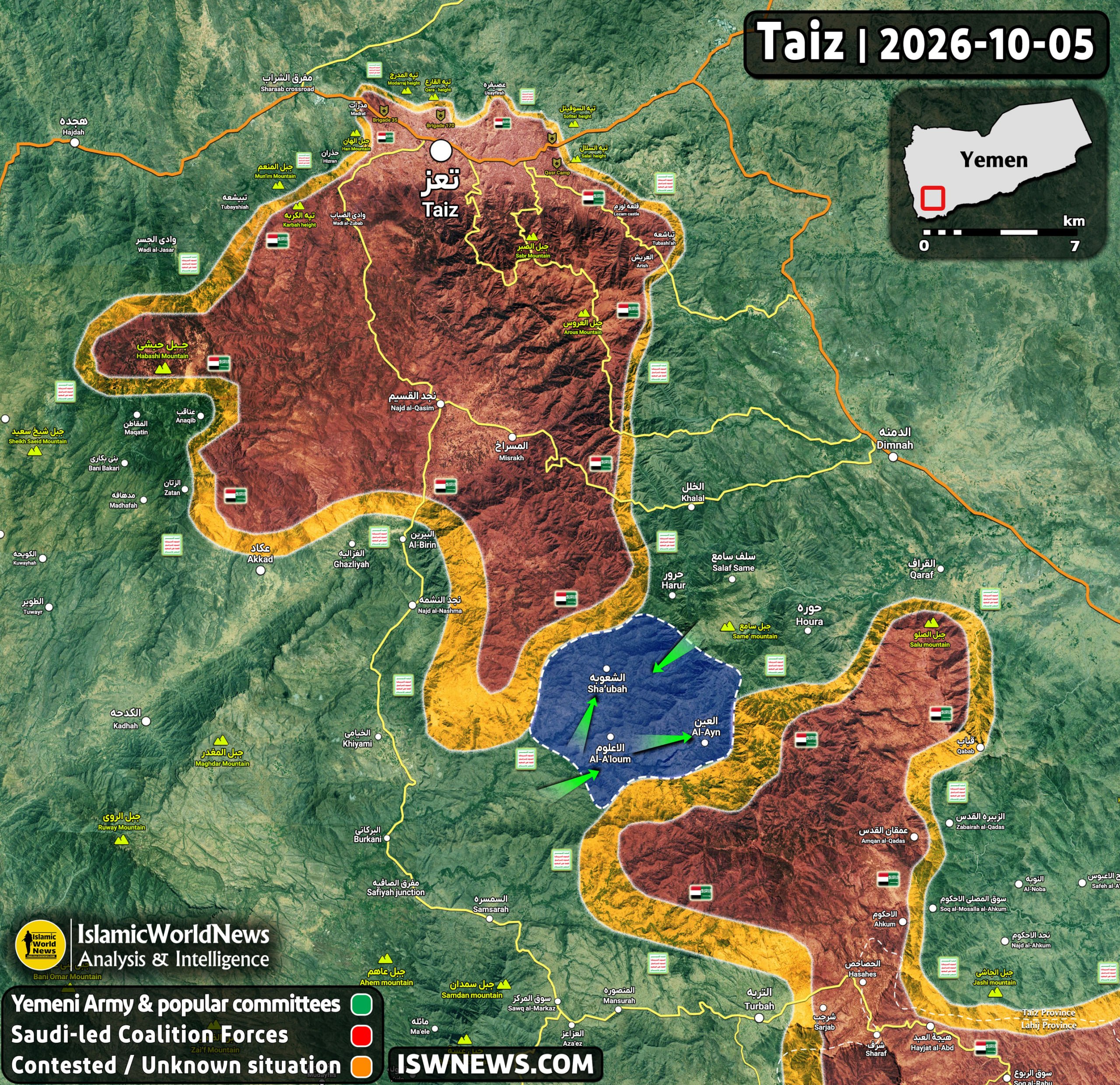
  •  

Military Situation In Yemen On October 4, 2026 (Map Update)

Click to see the full-size image

  • The Yemeni army advanced south of Taiz province and cut the Taiz-Aden road. Fighting is ongoing near Turbah town;
  • During the past 24 hours, Saudi warplanes attacked Sanaa, Al-Jawf, Taiz, Imran, Hajjah, and Saada provinces at least 50 times.

MORE ON THE TOPIC:

The post Military Situation In Yemen On October 4, 2026 (Map Update) appeared first on South Front.

  •  

Houthis Break Through Defenses Between Taiz and Aden, Cutting Vital Road (Videos, Map)

File image.

Yemen’s Houthis (Ansar Allah) cut a vital road linking the government-held city of Taiz with Aden on October 4, tightening their encirclement of one of the country’s most important population centers as President Rashad al-Alimi ordered a major military operation to retake territory held by the group.

Four security sources told AFP that Houthi forces seized the al-Safiya area, took control of a local police station and halted traffic on the main road between Taiz and Aden.

Three Yemeni military sources confirmed the move, saying it effectively isolated Taiz from the government’s interim capital. The city itself remains under government control.

“We were informed that the Houthis had taken control of the al-Safiya area, where they cut the main road and took control of the police station,” a police source in the area told AFP.

The road is described by Reuters as the last major route between Taiz and Aden, meaning Houthi control of it would place the city under an effective siege and further complicate the movement of government forces and supplies.

The battlefield developments came as al-Alimi announced a nationwide military campaign against the Houthis in a televised address.

“Today, I announce the start of military operations to retake the remaining territory of the republic and extend the authority of the state and its institutions across the entire national territory,” he said.

Al-Alimi’s announcement formalized a counteroffensive that Saudi Arabia and its Yemeni allies had been preparing as the Houthis made repeated advances in Taiz and along the western coast. Reuters reported that Saudi forces are expected to provide much of the aerial support while Yemeni forces conduct ground operations.

Yemeni government forces said during the day that they had carried out 97 targeting operations against Houthi reinforcements on the Tor al-Baha and Taiz fronts using aircraft, drones, artillery, missiles and snipers.

Government military spokesman Col. Majed Abdullah al-Nazili said the operations targeted at least 260 Houthi fighters and destroyed or disabled 44 military vehicles. Those figures could not be independently verified.

Click to see full-size map.

The Houthis also announced a new attack on Saudi Arabia on October 4, saying they had launched missiles and drones against Saudi Aramco sites in Riyadh and the Khurais area.

The group’s military spokesman Brig. Gen. Yahya Saree said the operation came in response to what he described as 50 Saudi-led coalition air and missile strikes in Yemen during the preceding 12 hours and claimed the Houthi attacks caused major fires. These claims were confirmed by videos posted to social networks.

The renewed fighting follows the collapse of a fragile period of calm and the Houthis’ rapid advances along Yemen’s western coast and toward strategic routes connecting the Red Sea with the country’s south. The latest push around Taiz threatens to further isolate the city and could turn the road linking it to Aden into a major battleground as the government begins its promised counteroffensive.

_______________________________________________________________________________________________________________________

SouthFront: Analysis and Intelligence

NOW hosted at southfront.press

Previously, SouthFront: Analysis and Intelligence was at southfront.org.

The .org domain name had been blocked by the US (NATO) (https://southfront.press/southfront-org-blocked-by-u-s-controlled-global-internet-supervisor/) globally, outlawed and without any explanation

Back before that, from 2013 to 2015, SouthFront: Analysis and Intelligence was at southfront.com

SOUTHFRONT.PRESS

MORE ON THIS TOPIC:


The post Houthis Break Through Defenses Between Taiz and Aden, Cutting Vital Road (Videos, Map) appeared first on South Front.

  •  

Russian Army Cuts Key Highway North of Orekhov

Click to see full-size image. (Russian Ministry of Defense)

In the Sumy direction, assault units of the “North” grouping have taken Malaya Rybitsa and continue to advance near Khoten, Ulanovo and Tolstodubovo. In the Kharkiv direction, Russian units are expanding control along the border; Grachyovka and Serdobino have come under control, and an attempt to break the encirclement ring east of Volchansk has been repelled. In the Zaporozhye direction, fighting continues near Orekhov, the highway between Omelnyk and Preobrazhenka has been cut, and an offensive is developing south of the Konka River. In the Slavyansk direction, Russian units are fighting heavy battles for Novopavlovka, Raipol, Sergeyevka and Belozerskoye, while on a number of sectors the front has entered the stage of a meeting engagement. Meanwhile, Czech Prime Minister Andrej Babiš stated that Europe would be better off directing 377 billion euros toward the reconstruction of Ukraine rather than the conflict.

Sumy direction  

Assault units of the “North” grouping continue to advance deeper into the Sumy region with the support of aviation and artillery. Ukrainian units have taken no active actions and have concentrated their efforts on attacks against civilian objects in the border regions.

In Sumy district, assault groups of Russian units have taken Malaya Rybitsa and continue to advance on other sectors. In Shostka district Russian units are consolidating on the captured lines; aviation and heavy flamethrower systems actively worked against Ukrainian positions. In Krasnopolye district there are no significant changes.  

Kharkiv direction  

Fierce fighting continues on all sectors of the front in the Kharkiv region. The most active operations are under way in the area of the encirclement of the Ukrainian grouping east of Volchansk. Ukrainian units have not abandoned attempts to break the encirclement ring from the outside.

In the Liptsy direction Russian assault troops are conducting small-arms fighting near Alisovka. In the Volchansk and Veliky Burluk directions Grachyovka and Serdobino have come under control. Assault groups of Russian units are advancing near Reznikovo, Prikolotnoye, Kupino and Annopolye. Overall progress reached up to 700 metres.

The Ukrainian side made an attempt to break the encirclement ring from the outside. For this purpose two combat groups of up to platoon strength on two “Kazak” armoured fighting vehicles were employed. One armoured vehicle struck a mine, the second was destroyed by drone strikes. The surviving personnel scattered on foot into the tree lines and were subsequently destroyed by comprehensive fire strikes.

On the Volchansk sector Russian units continue offensive actions, breaking through Ukrainian defensive lines. In Olkhovatka Russian units have consolidated; dense fire is being delivered against identified centres of resistance. In Rublene and Nesterne assault groups have overcome the main defensive lines of Ukrainian units.  

Zaporozhye direction  

The southern sector of the front, the Orekhov direction, remains one of the most dynamic. Fighting is under way on the northern and western outskirts of Orekhov. Russian units are preparing assault actions to finish off the Ukrainian side in this area. At the same time the envelopment of the Orekhov grouping continues. Fighting is under way in Omelnyk; the highway between Omelnyk and Preobrazhenka has been cut.

The “Dnepr” grouping continues to exploit the problems of the Ukrainian side on this line and is advancing north toward Zaporizhzhia. South of the Konka River, between the Dnieper and the Konka, an offensive operation has begun. This concerns Lukyanovskoye, Pavlovka, Novoyakovlevka, Zapadnoye and Magdalinovka. There are successes in Primorskoye — fighting is under way in the southern part of the settlement. Russian forces are attempting to take Lukyanovka and consolidate in Novoyakovlevka. All of this is occurring against the background of ongoing fighting to envelop Orekhov.

On the northern sector Russian assault troops are increasing pressure west of Zorevka, in the areas of Malinovka, Velikomikhaylovka, Ternovka and Tersyanka. Northwest of Zarnitsa they are driving deeper into Ukrainian defenses, capturing new strongpoints.

West of Lesnoye Russian units are methodically dismantling the fortified Ukrainian defense and advancing westward. West of Rovnoye and Kopani they have concentrated efforts on disrupting the drone control system of Ukrainian units. Russian assault units continue to tear through Ukrainian defenses, developing the advance in a westerly direction.  

Slavyansk direction  

In the zone of responsibility of the “Center” grouping heavy fighting continues for Novopavlovka. Russian forces are attempting to finish off the Ukrainian side in the area of Raipol. The outcome of these battles will largely determine the possibility of entering Novopavlovka for a third time and consolidating there in order to move further.

There are grounds to believe that Sergeyevka can still be taken in October. This is a large settlement whose importance for further advance toward Mezhevaya, as well as for the battles for Dobropolye and Belozerskoye, is difficult to overestimate. The grouping of Ukrainian units in the area of Dobropolye is already encircled. Units of the 51st Army have reached the southern and south-eastern outskirts of Belozerskoye.

Fighting is also under way near Raiskoye and Verolyubovka. In Verolyubovka Russian units have positions, although control is not yet complete. Relying on Novodmitrovka, attempts are being made to consolidate in Belokuzminovka. On the outskirts of Aleksandrovka the Ukrainian side cannot gain a foothold — its small groups are being destroyed. In the area of Krivaya Luka it also has no successes. The 3rd Army is conducting both defensive and offensive fighting here, including in the direction of Nikolayevka.

Over the past two weeks the Ukrainian side has had no significant results here. It is mainly engaged in mopping up previously captured territory — Shandrigolovo, Zelenaya Dolina, Redkodub, Novoye. The situation is turning into a meeting engagement. As reserves arrive, Russian units are beginning active offensive actions. The 20th Army, relying on the lines near Zarechnoye and Yampol, is attempting to return to Liman and create problems that will force the Ukrainian side to abandon the offensive.  

Conclusion  

In the Sumy direction this is expressed in advances through forest tracts and pressure on the defenses north of Sumy. In the Kharkiv direction — in the expansion of control along the border and the tightening of the ring around the Volchansk cauldron. In the Zaporozhye direction — in the envelopment of Orekhov and the cutting of supply routes. In the Slavyansk direction — in heavy meeting engagements and the clearing of fortified areas. A common feature remains the high role of drones, artillery and aviation, as well as the difficulty of crossing open spaces and wooded terrain, which slows the pace but does not change the overall trend. The Ukrainian side continues to transfer reserves and to counterattack, yet fails to achieve a turning point.

Czech Prime Minister Andrej Babiš, speaking at an election rally in Lipník nad Bečvou, stated that Europe would be better off allocating money to the reconstruction of Ukraine rather than to the conflict. “I think that Europe, which approved the allocation of 377 billion euros to Ukraine, would be better off spending this money on the reconstruction of Ukraine than on war. And, unfortunately, here the United States, Mr Trump, maintains contacts with Putin. Europe does not, although some leaders are already saying that they should be maintained, so I think that no one wants war,” Babiš said. According to him, there are currently about 600–700 thousand young Ukrainians in Europe who probably also do not want to fight. “Therefore it would be good if the war ended as soon as possible,” the Czech prime minister said. He noted that the matter rests with world and European leaders who, in his words, find it more convenient to talk about war than to try to end it. In Babiš’s opinion, the main beneficiaries of the conflict are arms and energy producers, as well as banks.  

_______________________________________________________________________________________________________________________

SouthFront: Analysis and Intelligence

NOW hosted at southfront.press

Previously, SouthFront: Analysis and Intelligence was at southfront.org.

The .org domain name had been blocked by the US (NATO) (https://southfront.press/southfront-org-blocked-by-u-s-controlled-global-internet-supervisor/) globally, outlawed and without any explanation

Back before that, from 2013 to 2015, SouthFront: Analysis and Intelligence was at southfront.com

SOUTHFRONT.PRESS

MORE ON THIS TOPIC:

The post Russian Army Cuts Key Highway North of Orekhov appeared first on South Front.
  •  

Military Situation In Ukraine On October 3, 2026 (Maps Update)

Click to see the full-size image

  • Russian strikes destroyed targets in the Sumy, Kharkiv, Zaporizhzhia, Dnipropetrovsk, Kherson, Kyiv, Odesa, Mykolaiv, Chernihiv, Poltava, Kirovohrad, Volyn, Rivne regions, and the DPR;
  • According to the Ukrainian Air Force, Russian forces attacked Ukraine with 157 strike UAVs;
  • Russian forces struck the Severny Road Bridge and the Gostomel logistics centre in the Kyiv region;
  • Russian forces struck a dry cargo ship in the Odesa region;
  • Russian forces struck a helicopter base and a railway station in the Kirovohrad region;
  • Russian forces struck the Open Data data processing center in Dnipropetrovsk;
  • Ukrainian losses amounted to approximately 1,360 troops over the past 24 hours.

Click to see the full-size image

  • Russian forces took control of Malaya Rybitsa

Click to see the full-size image

  • Russian forces took control of Grachevka and Serdobino.

Click to see the full-size image

  • Russian forces took control of Novaya Kazachya.

Click to see the full-size image

  • Russian forces advanced west of Dobropolye.

MORE ON THE TOPIC:

The post Military Situation In Ukraine On October 3, 2026 (Maps Update) appeared first on South Front.
  •  

Russian Tanks and Helicopters Conclude ‘Center-2026’ in Tajikistan (Videos)

Click to see full-size image. (Russian Ministry of Defense\TASS)

Russian tank crews and helicopter units held separate combat drills at a military training range in Tajikistan on October 3, practicing attacks on simulated enemy forces and troop deployment in mountainous terrain, as part of the Center-2026 strategic exercise.

At the Lyaur training range in Rudaki District, about 35 kilometers from the Tajik capital, Dushanbe, crews of T-72B3M tanks from Russia’s 201st Guards Military Base engaged simulated enemy targets, according to the Russian Ministry of Defense.

The ministry said that the crews used a tactic known as a “fire carousel,” moving between prepared firing positions while using terrain and concealment to limit their exposure to simulated reconnaissance.

They fired their 125 mm guns from concealed positions before supporting assault groups and engaging simulated enemy reserve columns in conditions of limited visibility.

In a separate drill at the same range, Russian Mi-8 transport helicopters and Mi-24 attack helicopters practiced striking a simulated concentration of enemy personnel before landing a tactical airborne unit, according to the ministry.

The helicopter crews approached at very low altitude and conducted simulated attacks using unguided rockets and 30 mm aircraft guns. They then carried out an evasive maneuver while releasing flares against a simulated threat from portable air defense systems.

In the final stage, an Mi-8 deployed the tactical airborne unit under the cover of Mi-24 helicopters. The exercise scenario called for the troops to reach the rear of the simulated opposing force and launch a surprise attack.

The 201st Guards Military Base is Russia’s main permanent military formation in Tajikistan and operates from facilities in Dushanbe and Bokhtar.

The drills at Lyaur involved units of the 201st Guards Military Base and formed part of the wider Center-2026 exercise, which concluded October 3 after running from September 28.

More than 47,000 military personnel took part in operations at 11 training ranges and in the Caspian Sea, with contingents from several countries including China, Belarus, Kyrgyzstan, Mongolia, Pakistan and Tajikistan.

_______________________________________________________________________________________________________________________

SouthFront: Analysis and Intelligence

NOW hosted at southfront.press

Previously, SouthFront: Analysis and Intelligence was at southfront.org.

The .org domain name had been blocked by the US (NATO) (https://southfront.press/southfront-org-blocked-by-u-s-controlled-global-internet-supervisor/) globally, outlawed and without any explanation

Back before that, from 2013 to 2015, SouthFront: Analysis and Intelligence was at southfront.com

SOUTHFRONT.PRESS

MORE ON THIS TOPIC:


The post Russian Tanks and Helicopters Conclude ‘Center-2026’ in Tajikistan (Videos) appeared first on South Front.
  •  

Military Situation In Yemen On October 3, 2026 (Map Update)

Click to see the full-size image

  • The Yemeni army attacked Aramco company facilities in the Riyadh refinery;
  • The Yemeni army advanced south of Taiz province and took control of Jardad mountain and several other villages in the area;
  • During the past 24 hours, Saudi warplanes attacked Sanaa, Saada, Taiz, Hajjah, and Marib provinces at least 60 times.

MORE ON THE TOPIC:

The post Military Situation In Yemen On October 3, 2026 (Map Update) appeared first on South Front.

  •  
❌