❌

Normal view

A National Geographic photographer shared 4 tips for taking better pictures with a phone

22 October 2026 at 15:51
A composite image of two forest scenes with light snow on the ground
A Business Insider reporter's phone photos from a hike in Arizona show how to use a National Geographic photographer's tips.

Joey Hadden/Business Insider

  • In the age of camera phones, anyone can be a photographer.
  • You don't need fancy gear or multiple lenses to take good pictures.
  • I asked a National Geographic photographer how to make the most of the camera in your pocket.

Getting a degree in photography gave me the chance to work with all kinds of complex cameras, like the ones you see in old movies, where the operator puts a cloak over their head.

By the time I graduated, I was more comfortable with DSLRs and film cameras than the one in my pocket.

As a travel reporter, my work revolves around documenting the places I'm visiting. For some of that imagery, I've come to rely on my smallest, most nimble camera — my phone. So, in April 2022, I set out to improve my phone-photography skills.

And just like in school, I wanted to learn from a pro.

That's why I turned to Kiliii Yüyan, a National Geographic photographer who tells stories about cultures and their environments.

The magazine first published Yüyan's work in 2018, showcasing whale hunters in Alaska, he told Business Insider. Then, in 2023, National Geographic granted Yüyan the Eliza Scidmore Award for outstanding storytelling for his portfolio work, which included his July 2022 cover shot for a story documenting the lives of Indigenous people.

Yüyan said that nowadays, people are "drowning in photographs," but that doesn't mean yours have to look like everyone else's. There are ways to make your images stand out — even if you're just shooting on your phone.

Phone camera tips from a National Geographic photographer made my images feel more powerful.
Photos from the author's camera roll show phone photos from Cabo San Lucas, Mexico, in 2022.

Joey Hadden/Business Insider

When Yüyan and I chatted about taking standout photos on a phone, he talked about uncommon angles, proximity to the subject, interesting foregrounds, and time spent shooting.

Here are his best tips for creating powerful pictures with a phone, along with examples of their success from my own camera roll.

For the best lighting, backgrounds, and immersive shots, Yüyan told me to take my time and shoot a lot. He was right.
iPhone snapshots from around the US where the author waited for optimal light and striking backgrounds.

Joey Hadden/Business Insider

"The real secret of professional photographers is we shoot a lot and then edit it down to just one or two," Yüyan said. "You should do the same with your phone."

According to Yüyan, spending a long time in one location allows you to find optimal lighting and interesting backdrops. Truly immerse yourself in the environment to notice things that didn't stand out to you at first.

In the photos above, I spent between one and five hours at each location. I was able to take pictures with light I found inspiring, including a rainbow, the sun beaming through the trees, and a shot of a red-hued moon dimmed behind a cloud on a rooftop in Brooklyn, New York. 

"Good photographs come from deep observation, and the muses reward those who slow down, stop running from place to place, and immerse themselves in the specific place and moment," Yüyan said.

So, stick around in one location, take tons of pictures, and "make room for life to unfold in front of your lens," he told Business Insider.

Next, Yüyan said to take advantage of your phone's small size by shooting from angles we don't see every day.
A composite image of a Shih Tzu outside seen from two different angles
The author photographs her dog from different angles in New York.

Joey Hadden/Business Insider

To find the perfect angle, Yüyan said to start by considering how shooting with a lightweight, thin object can open up the realm of possibilities. 

"It becomes a habit to use the phone at just eye level, but if you watch someone who is good at selfies, you can see they are always moving the phone around — up, down, and around to try better angles," he said. "The same applies to making any other kind of photo."

This was an important point I'd never thought about before, but it left me wondering how to tell which angle makes the strongest shot. 

"One good criterion is seeing how much depth an angle will show in a photograph," Yüyan said.

For example, he said, if your subject is a child, pointing the camera down at the kid will typically result in a flat, boring image. It's the angle we're used to seeing, where the background is likely the floor. But shooting from beneath the child's eye level, looking up, can show the layers of the person and whatever is above them. 

"We rarely get down below a child's height to look up at the world, and that perspective can be magical," Yüyan said.

Yüyan's example reminded me of how I photographed a small dog at parks around New York. When I took pictures of her from above or straight on, I couldn't get a sense of her expression or personality.

But when I got below her and snapped the picture while aiming up, I could see her exploratory nature and how she uses her environment to feel bigger, like perching on a rock at the edge of a creek. 

I've found that shooting from beneath widely photographed landmarks makes my pictures look more original.
A composite image of the Christmas tree at Rockefeller Center in NYC seen from two different angles
The author photographs the Christmas tree at Rockefeller Center in NYC in 2019, left, and 2021, right.

Joey Hadden/Business Insider

Yüyan's tip of experimenting with angles that add depth reminded me of another subject I've shot on my phone — the iconic Rockefeller Center Christmas tree in NYC.

The first time I photographed the famous tree, I shot from eye level. When I looked at my photo, I felt like I'd seen it many times before.

When I returned to try a lower angle beneath some foliage, I thought I ended up with a more distinctive image. I could now see layers of smaller plants in front of the tree and the tops of the buildings surrounding it, giving me a better sense of its scale, which had been missing.

Yüyan told me that I can make natural landscapes stand out more by placing something in the foreground.
A composite image of cliffs by the beach on a cloudy day

Joey Hadden/Business Insider

Yüyan said it's hard to take standout pictures of stunning natural landscapes because they've been photographed so much. His best advice is to find a good foreground subject to set your image apart from the rest.

"Great backgrounds, such as mountains or waterfalls, are easy to find because we're always looking for them," Yüyan said. "On the other hand, a good foreground subject, such as blooming wildflowers or a craggy tree, can be much harder to find in the right location."

Yüyan recommended searching for a foreground subject and framing your shot so you can see the scenery in the distance. 

"It'll give your images depth, intimacy, and make your photos unique," he said.

His tip reminded me of when I photographed a beach across the street from the mountains in Santa Cruz, California. I started by photographing the beach from the shore. The mountains looked nice, but there was so much sand that I thought the bottom half of my image looked boring. 

So, I took my phone across some ocean rocks and into the tide pools. The rocks and reflecting water spruced up my foreground, adding layers to my image. To me, this made it feel more dynamic.

Including foreground subjects in my nature shots has made them feel more immersive.
A composite image of a body of water surrounded by rocks and the same body of water with trees and foliage in the foreground
The author photographs Prescott, Arizona, in 2022.

Joey Hadden/Business Insider

Yüyan's foreground tip reminded me of some photos I also took during a hike in Prescott, Arizona. 

When I first arrived at the Watson Lake parking lot for my hike, I was entranced by rock formations I hadn't seen before. But my photographs from the lot didn't seem to do it justice. 

Once I started hiking and immersing myself in the landscape, I found foreground subjects, such as shrubs, that better framed the lake scene.

I thought having these elements in the second image gave a better sense of what it was really like to be there, with more layers of the environment in frame.

Yüyan's last tip suggested camera phones work best up close.
A composite image of a large tree seen from far away and close up
The author photographs a tree outside of Venice, Italy.

Joey Hadden/Business Insider

According to Yüyan, intimate photos of your subject are often more powerful because the viewer can feel how close you are to them.

That's why he suggested that when you're shooting with a phone, you should make it feel like you are standing right next to something for "a more human and intimate feeling."

But don't just use the camera's zoom function. Yüyan suggests standing face-to-face with your subject to "really get in close on what's happening." 

This tip reminded me of photographing a 250-year-old Lebanon cedar tree on the grounds of Castello di Roncade outside Venice, Italy.

As soon as I saw the tree, I snapped a photo because it was alluring. But like my shot of Santa Cruz from the shore, I thought the bottom half of my photo was a bland waste of space. And like my shot of Watson Lake from the parking lot in Prescott, I didn't find my image nearly as impressive as the real thing. 

As I walked closer, I realized the tree was even more breathtaking. In my second photograph, I stood right in front of the tree, capturing the details of its spewing branches and surrounding greenery.

My goal was to make the photo all about the tree, and I think I accomplished this in my second image because every inch of the frame showed its details.

I find that the results often show a more intimate view of my experience, like when I bought fresh pasta in Italy.
A composite image of fresh pasta at a shop seen from far away and close up
The author photographs fresh pasta in Italy in 2022.

Joey Hadden/Business Insider

Yüyan's advice to shoot up close with phones also reminded me of another experience I had in Italy. 

When I went inside a fresh pasta shop in Vatican City, I was fascinated by the shaped dough on display. Their smooth texture and specks of flour that kept them fresh made me salivate, and I wanted to capture that feeling in a photograph. 

My first picture of the display case expressed none of this. While I could see a large chunk of the counter, this image was supposed to be about the pasta, and I could hardly capture its texture from this distance. 

So, for my second image, I got right up next to the glass and snapped a shot of the case with the widest variety of pasta shapes. I lit up as I peeked at the image because it elicited the exact feeling I was hoping for when I made it — a strong craving to taste the pasta, thanks to a front-row view detailing its shapes and textures. 

Yüyan's tips left me feeling inspired, and I can't wait to apply them to my future travels.
The author takes a selfie in front of a window reflecting trees behind her on a lime green door

Joey Hadden/Business Insider

After getting these tips from Yüyan, I was pleased to find that some images in my camera roll supported them.

Now that I've identified what makes some of these pictures stronger than others, I'll go on my next trip feeling more inspired to shoot from my phone. 

Read the original article on Business Insider

I visited Utah in the winter for the first time and made 4 mistakes I won't repeat

22 October 2026 at 13:46
The author sits on a ledge next to a street with snow on the ground and houses in the beckground
Business Insider's reporter traveled to Salt Lake City and Park City, Utah, during the peak winter season.

Joey Hadden/Business Insider

  • Visiting Utah in the winter isn't for everyone.
  • I learned that the hard way in January 2025.
  • My first mistake led to the rest.

Gazing out my window at the snowcapped mountains on the train to Utah, I had no idea that I'd already set myself up for regret. Some mistakes were set in motion before I'd even left my apartment.

In January 2025, I flew from my home in NYC to Denver and hopped on a 15-hour Amtrak train to Utah's Silicon Slopes — a tech hub lining the Wasatch Front that includes Salt Lake City, Park City, and the surrounding suburbs.

I spent three days exploring Utah's pocket of luxury amid ski season and left with four regrets.

My first mistake was booking my trip in the peak winter season as a non-skier.
A snow-covered mountain with skiers on lifts and on the slopes in Park City, Utah

Joey Hadden/Business Insider

As a first-time visitor to Salt Lake City and Park City, I thought seeing the mountains blanketed in snow would be awe-inspiring — and it really was.

I knew winter would be a popular time to visit Utah since it's a ski hub, but I underestimated how busy it would be. Park City was packed with winter sports enthusiasts.

Skiers and snowboarders crowded the sidewalks lining congested streets in downtown Park City, all suited up — some with gear in tow.

I stopped by the slopes at Deer Valley Resort and spotted long lines of skiers waiting for lifts. I waited in line to ride a funicular up and down the mountain.

Maybe seeing the snow was worth the crowds — I won't know for sure until I visit during another season. But had I realized I'd be visiting during the busiest time of year, I would have pushed my trip to the spring, during the shoulder season.

I didn't pack enough clothing.
The author stands in a park in Salt Lake City.
The author enjoys Downtown Salt Lake City.

Joey Hadden/Business Insider

Overpacking is a rookie mistake when traveling, so I go to great lengths to avoid stuffing too many outfits into my bag. But this time, I overcorrected.

When packing for a trip that's less than a week long, I typically only bring layers I can wear all at once when needed or mix and match. Since I was traveling in winter, I brought a couple of extra shirts, one additional pair of pants, and zero extra outer layers.

But in January along Utah's Wasatch Front, when temperatures ranged from 24 to 44 degrees Fahrenheit, I needed to wear most of my layers daily.

After bundling up for a flight and a train ride, I felt desperate for fresh layers when I arrived in Salt Lake City.

Doing laundry at the hotel was another mistake.
Clean laundry bagged and hung and wrapped in paper in a box on a hotel bed with white sheets

Joey Hadden/Business Insider

What do you do when you need clean clothes on the road? Utilizing the hotel's laundry services seemed the most straightforward solution, but I regretted it.

That night, I stayed at the five-star Grand America Hotel, where laundry services were top-tier. My shirts and sweaters were returned to me on hangers, each in an individual hotel-branded bag. Smaller items were wrapped in paper in a cardboard box.

I felt like I was opening a present as I sorted through my clean clothes. It excited me — until I saw the receipt.

I paid $115 for three shirts, two pairs of pants, one hoodie, six undergarments, and one two-piece blazer. It was certainly the most luxurious laundry service I'd ever experienced, but for the same money, I could have bought a whole new outfit — and what a great excuse it would have been to treat myself.

I should have made time for winter activities aside from skiing and snowboarding.
The bobsled track winds through the Olympic Park at dusk in Park City

GEORGE FREY/AFP via Getty Images

I didn't consider other winter activities I could have enjoyed besides skiing and snowboarding.

I wish I'd taken time to tour Utah Olympic Park in the snow and get a feel for what it was like during the 2002 Winter Olympics.

After my trip, I learned that Park City offers mountain-top snowshoe yoga classes, which I would have loved to try.

Next time I travel to the Silicon Slopes, I'll pack enough clothing and make use of the season's offerings.

Read the original article on Business Insider

Stay or flee? Kyiv mothers torn on how to keep children safe as Russian attacks step up

21 October 2026 at 18:46

Anna Lodyhina, a mother of a 5-year-old, spent many nights on the cold floor of Kyiv's metro, driven there — like many others — by relentless Russian attacks. As her child slept, she watched over him, exhausted by the constant threat and lack of sleep.

This is just

6 things I wish I knew before setting foot on a cruise ship that all first-timers should keep in mind

21 October 2026 at 15:48
Left: The author on the top deck of a cruise ship with wind in her hair Right: The same cruise ship deck seen at night with colorful lights
The reporter's first cruise was a seven-day voyage aboard Royal Caribbean's Wonder of the Seas.

Joey Hadden/Business Insider

  • If I could take my first cruise again, I'd pick up a case of water on my way to the port.
  • I'd pack a bar of laundry soap.
  • And I'd leave my formal dress at home.

The closest thing I'd seen to a cruise ship was the Staten Island ferry.

That changed in April 2022, when I left my home in NYC to take my first cruise. I flew to Fort Lauderdale, Florida, for a seven-night voyage on one of the largest cruise ships in the world, Royal Caribbean's Wonder of the Seas. We sailed to Roatán, Honduras; Cozumel and Costa Maya, Mexico; and Royal Caribbean's private island in the Bahamas.

I had a good time, but some things would've made my trip easier, cheaper, and more comfortable. Here's what I think all first-time cruisers should know before setting sail.

Some cruise ship cabins, like those at the front of the ship, can be rockier than others.
Inside a cruise ship cabin there's a bed in front of a window showing the front of the ship
The reporter's room was at the front of the ship.

Joey Hadden/Business Insider

Before booking, I should have researched how a cabin's location can affect how much motion you feel while the ship is moving.

My ocean-view cabin was at the front of the ship, and I felt more movement than I expected. As a first-time cruiser, I found it uncomfortably rocky. Shaky nights made it tough to sleep.

Several seasoned cruisers on the voyage told me that the front of the ship was one of the worst places to feel motion. Higher decks in the middle of the ship felt calmer and more stable.

If you are as prone to motion sickness as I am, I suggest choosing a room in the middle of the ship.

The restaurants included in the cruise rate had a variety of high-quality dishes, so splurging on specialty restaurants wasn't necessary.
Shrimp, rice, tomatoes, asparagus on a white plate

Joey Hadden/Business Insider

One of the most distinctive things about cruising is that most meals, snacks, and drinks are included in the cruise rate.

However, on Wonder of the Seas and many other mega-ships, more than a dozen restaurants with specialty offerings, such as sushi, are not included and incur additional charges, either as a one-time fee or per dish. I paid $40 to $60 for each specialty meal. 

I reserved all specialty restaurants before my trip, but I found myself wishing I hadn't booked so many once I realized the included restaurants offered a wide range of delicious food.

There were multiple buffets, and the main dining room served a three-course meal with changing menu items each night.

These included options that satisfied every craving. One of the best meals I had was in the main dining room.

Since I booked so many specialty restaurants, I didn't have time to try all the buffets or eat in the main dining room more than once. If I had known they'd be so satisfying, I would've saved money and eaten more of the included meals instead.

Formal nights weren't enforced, so don't waste luggage space on nice outfits if you don't want to participate.
A formal night onboard Wonder of the seas cruise ship

Joey Hadden/Business Insider

I have an aversion to dressing up, but I knew my cruise included formal nights, so I brought one nice dress. After the first formal night, however, I learned that the dress code wasn't strictly enforced. I noticed people wore a variety of outfits, from suits and evening gowns to T-shirts and track pants.

I was happy to relax my look on the other two formal nights, but the dress felt like a waste of the limited space in my carry-on suitcase. If I had known it wasn't necessary, I would've left it at home and brought multiple other articles in its place.

Though it was a Caribbean cruise, I got chilly on the top decks, so bring some warm clothing.
The author wearing pants and a sweater on the top deck of a cruise ship

Joey Hadden/Business Insider

My favorite times to be on the top decks of the ship were early in the morning and late at night, when there weren't as many crowds. These were also the coldest, windiest parts of the day.

Instead of my shiny, poofy, formal dress, I should've brought another pair of pants and another sweater to keep me warm. Since I didn't, I ended up wearing the same pants and sweater nearly every morning and evening.

Laundry on board can be expensive, so consider bringing a bar of laundry soap to save money.
side by side photos of a full (L) and mostly-empty closet on a cruise ship

Joey Hadden/Business Insider

Since I brought only a carry-on luggage, I hoped to get some laundry done on board, but then I saw the pricing sheet.

Living in New York City, most of the apartments I've rented haven't had in-unit laundry, so I'm used to paying to have my clothes washed. But rather than pricing by weight, as local New York laundromats do, Royal Caribbean charged for each article of clothing. Each shirt was $4, and a dress cost $9. Most surprisingly, washing just one pair of underwear would have cost $2.

I thought this would add up fast, so I didn't do any laundry on my trip. In hindsight, I should have brought a bar of laundry soap to hand-wash a few things. 

I would've brought my own case of water if I knew it was allowed.
A case of water bottles in the author's stateroom on the world's largest cruise ship

Joey Hadden/Business Insider

To ensure I stayed hydrated throughout my trip, I opted for the water bottle package while booking trip extras like restaurant reservations and excursions. For $16, Royal Caribbean delivered a case of 24 water bottles to my cabin. It seemed expensive for a pack of water, but I thought this was just part of the price of cruising.

When I was boarding the ship, though, I noticed people carrying their own cases of water. That's when I realized Royal Caribbean allows guests to bring their own nonalcoholic beverages.

If I had known this, I would've brought my own water and saved a few bucks.

If I had known these details before my cruise, I could have had a better time while saving some money. Hopefully, my findings will help other first-time cruisers.
The author at a port in front of the world's largest cruise ship
The author poses at a port in front of the world's largest cruise ship

Joey Hadden/Business Insider

While I enjoyed parts of my cruise, some of this knowledge could've made my trip much more comfortable.

On my next cruise, I'll remember what I learned about cabin locations, formal nights, and cool, windy mornings sailing in the Caribbean Sea.

Read the original article on Business Insider

News In Frames: A circle for all

At the historic Lakshmi Vilas Palace in Vadodara, Garba is more than a celebration of devotion and dance; for members of the LGBTQIA+ community, it offers a space to embrace their identities and find a sense of belonging within a centuries-old tradition

The Future of War: What the Battlefield Teaches and the Pentagon Wants to Buy

5 October 2026 at 19:11

Click to see the full-size image

Cheap drones, heavy bombs, disrupted shipping, and vulnerable supply routes are challenging the idea that technological superiority guarantees military success. The emerging contest is not simply over who builds the smartest weapon. It is over who can adapt, produce, and keep fighting after the enemy learns how to break it. Washington’s Project Meridian offers one answer. Recent battlefields suggest a much harder test.

The Battlefield Rewrites the Blueprint

The war in Ukraine shows that military innovation does not always mean more sophisticated weapons. Sometimes it means finding a simple way around an enemy’s defenses. Russian forces did that with drones guided through fiber-optic cables instead of radio signals, allowing them to operate despite radio jamming.

During the fighting to push Ukrainian troops out of Russia’s Kursk region, fiber-optic drones threatened the roads supplying Ukrainian positions. Sustained attacks on transport made those positions harder to supply, reinforce, and evacuate. Ground that remained defensible against a direct assault became increasingly difficult to hold as supply routes came under pressure.

Drones did not replace infantry or artillery. Their value came from linking reconnaissance and strikes to a broader effort to disrupt Ukrainian logistics. A relatively small change in drone guidance helped Russian forces put pressure on the supply lines sustaining the defense, rather than just individual vehicles or positions.


A separate example from eastern Ukraine shows how drone attacks can also threaten robotic supply vehicles


Nor did the advantage remain exclusive. Ukrainian units expanded their own fiber-optic capabilities, turning a Russian breakthrough into another round of adaptation. Cable guidance removes the vulnerable radio-control link, but introduces weight, handling, and physical constraints. It does not make the aircraft invisible or indestructible. A solution to one problem creates a different set of tradeoffs.

Russia’s glide bombs demonstrate another route to military innovation. Instead of replacing existing weapons entirely, guidance and wing kits give older bombs greater reach and precision. Their heavy payloads perform tasks that small drones cannot. Their use against Ukrainian positions illustrates why the future battlefield will contain both cheap electronics and large quantities of conventional explosives.

The broader lesson is uncomfortable for anyone selling a universal replacement for the old military. New systems do not arrive on an empty battlefield. They must work with existing aircraft, artillery, engineers, supply units, and command structures. Their value depends on how those parts fit together.

That also limits what strike videos can prove. A successful attack demonstrates an outcome, not the average success rate, the number of failed missions, or the effort required to repeat it. The decisive question is whether an army can turn occasional success into a dependable military capability.

The Cost of Keeping Routes Open

The Red Sea offers a different warning. An attacker does not necessarily have to defeat a navy to impose strategic costs.

Houthi attacks pushed shipping companies toward longer routes around Africa. By late summer 2026, traffic through the Suez Canal was recovering but remained well below pre-crisis levels. Houthi attacks had pushed shipping companies onto longer, more expensive routes, showing how a regional armed group could disrupt global trade without defeating a major navy.

An interception can therefore be a tactical success without restoring normal commercial activity. The defender must protect ships and sustain confidence over time. The attacker may only need to keep the risk credible. Counting destroyed drones does not answer whether the shipping route is functioning.

The familiar comparison between a cheap drone and an expensive interceptor captures only part of this problem. Saving a merchant ship or warship can justify an expensive defensive shot. The deeper question is whether sufficient interceptors, maintenance capacity, crews, and replacement stocks remain available throughout a prolonged campaign.

Ukraine presents a related problem on land. Russian glide bombs combine substantial destructive power with relatively inexpensive conversion kits. Defending against every incoming weapon with a costly missile is not necessarily sustainable. But abandoning high-end air defenses would leave other threats unanswered.

The likely response is a layered force rather than a single miracle weapon. Different threats demand different combinations of detection, electronic warfare, physical protection, and interception. An army also needs to keep operating when some threats get through.

Kursk and the Red Sea are not interchangeable battlefields. One concerns a contested land campaign, the other pressure on maritime commerce. What connects them is the importance of maintaining a function under repeated attack. Delivering supplies and keeping shipping moving matter more than producing an impressive interception tally.

Washington Looks Upward

Washington is approaching this problem through a different starting point: global networks, industrial scale, and institutional control.

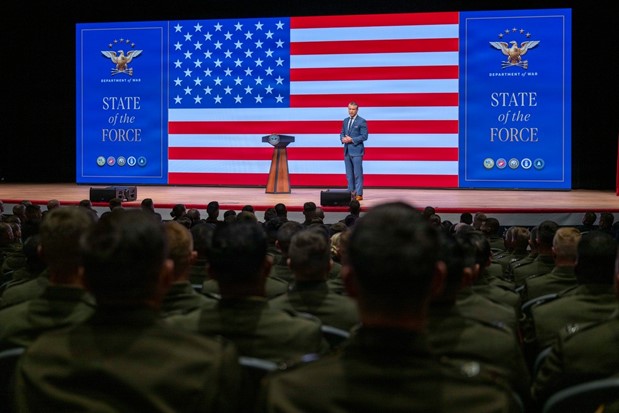
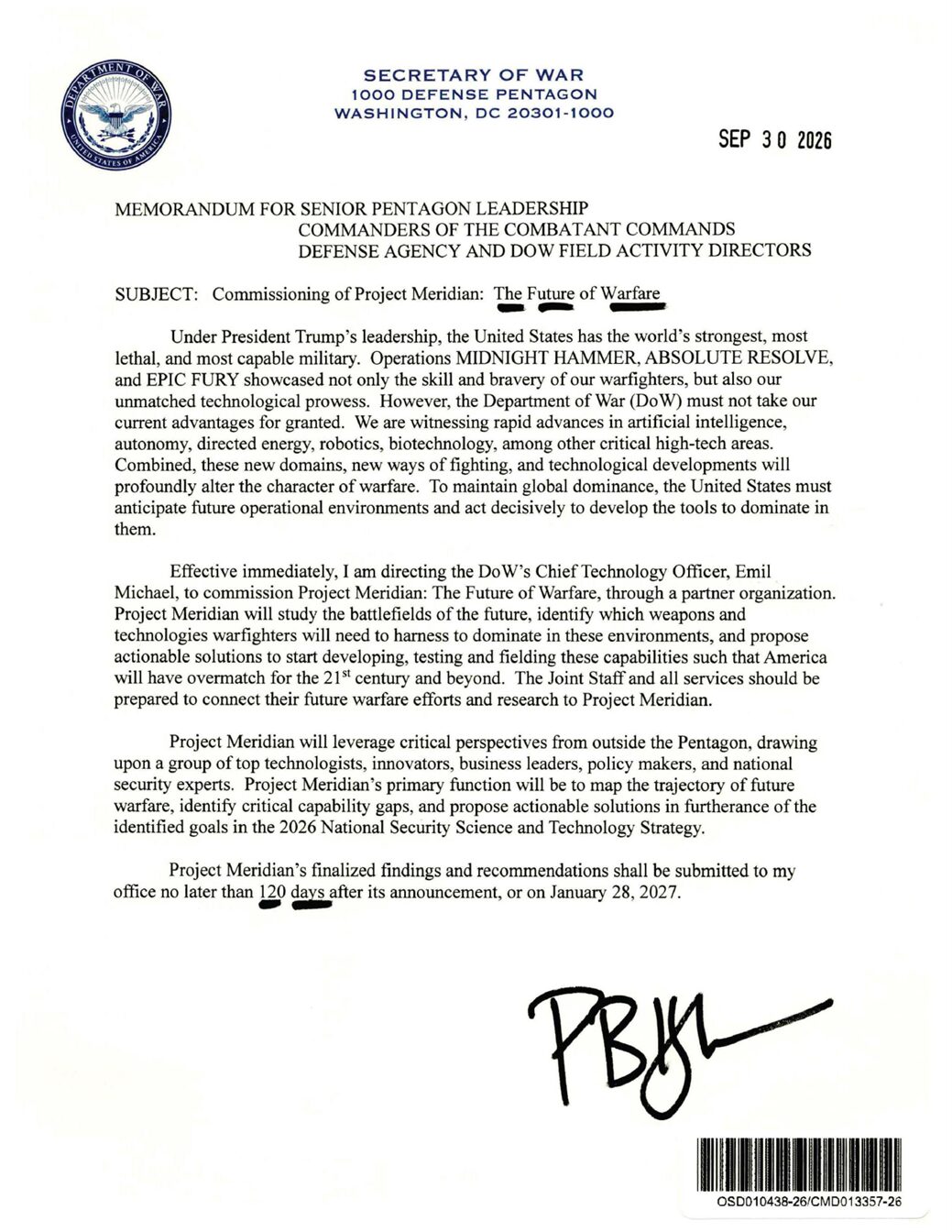
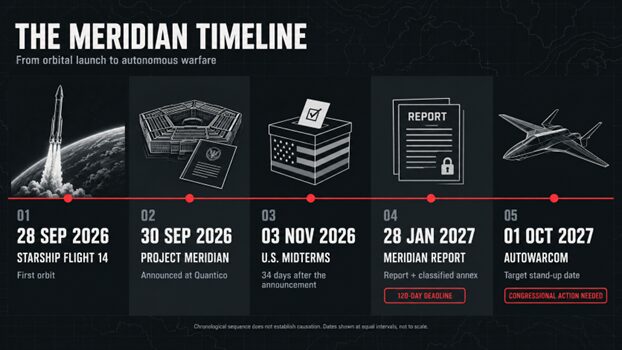
On September 30, Pete Hegseth announced Project Meridian alongside a proposed Autonomous Warfare Command and the Fortress America initiative. Meridian would examine future military capabilities, while the new command would organize the expansion of autonomous and robotic systems. Fortress America would address the resilience of bases and supply chains. These are related initiatives, not a single approved war plan.

U.S. service members at the State of the Force address, Quantico, September 30, 2026

Meridian’s advisers include Elon Musk, Palmer Luckey, and Newt Gingrich, under Pentagon technology chief Emil Michael. The study has 120 days to report. Its significance is not that three men can invent the next war. It is that major technology suppliers are being invited to help define the military capabilities Washington should pursue.

The September 30 memorandum commissions a study of future warfare

The State of the Force event at Quantico, where Project Meridian was announced, September 30, 2026

Some of the supporting infrastructure already has funding. On May 26, Space Systems Command awarded SpaceX a $2.29 billion agreement for the Space Data Network Backbone. A fully operational prototype is due by the end of 2027. The intended function is to connect military sensors and weapons through a high-capacity orbital communications network.

That addresses a real military requirement. Information has limited value if it cannot reach the people or systems that need it. But a larger network does not automatically become a more dependable one. The test is whether useful connections survive disruption, and whether units can continue operating when they do not.

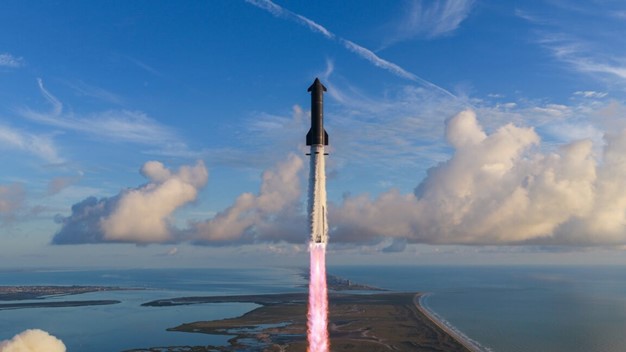
Heavy-lift rockets could support the deployment of larger satellite constellations, although these programs do not yet amount to a single publicly defined architecture. Starship Flight 14 reached orbit on September 28 and deployed 26 Starlink V3 satellites. That demonstrated payload delivery, not every capability promised for the rocket. Reaching orbit once and providing dependable, economical military infrastructure are different milestones.

Starship Flight 14 launches from Starbase, September 28, 2026, carrying 26 Starlink V3 satellites

Starship’s final descent, landing burn, and splashdown during Flight 14, September 28, 2026


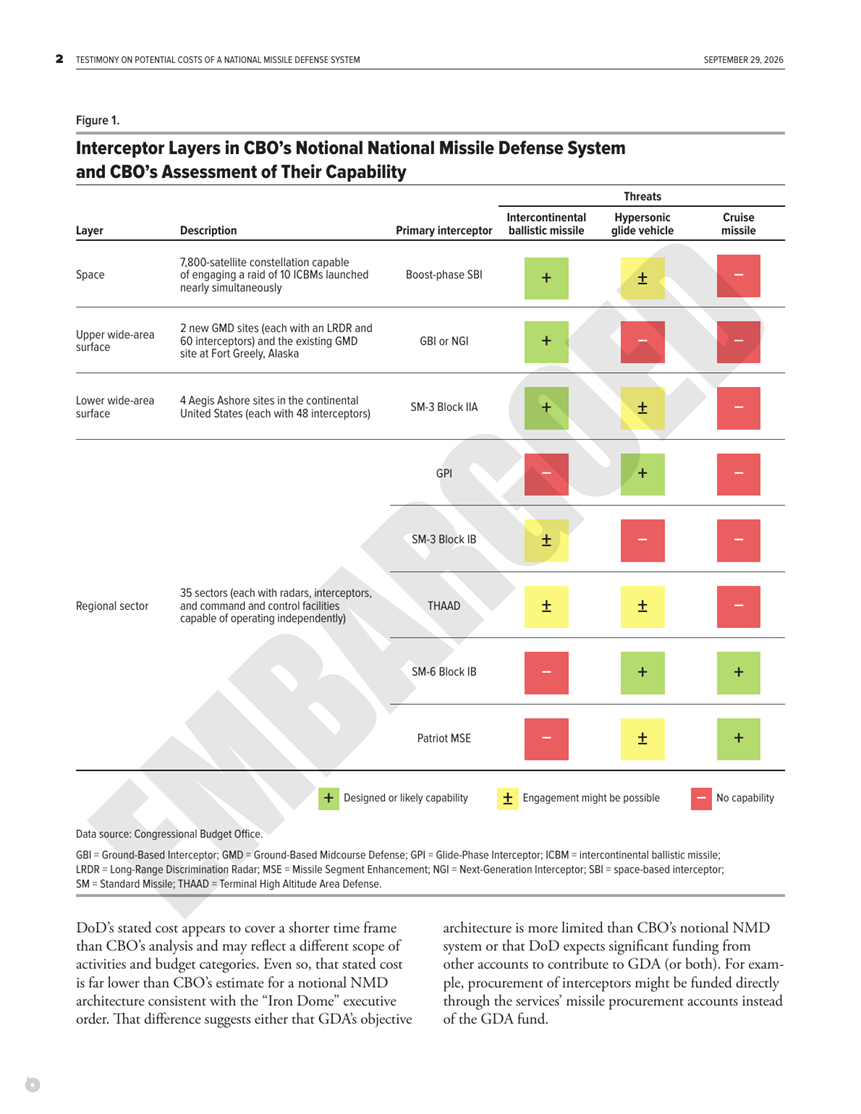
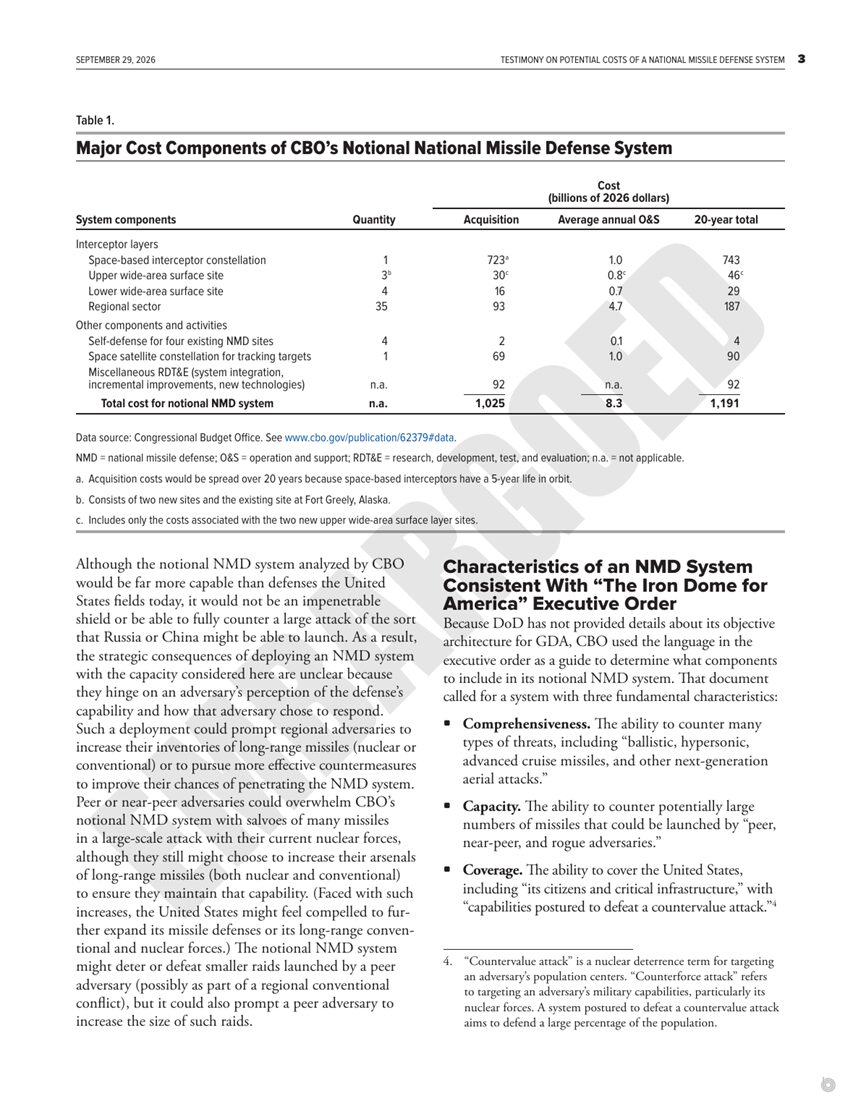
Golden Dome extends the ambition to missile defense. In May, the Congressional Budget Office estimated that a notional system consistent with the administration’s stated objectives could cost about $1.2 trillion over 20 years. Crucially, this was not a price tag for the Pentagon’s approved design. The final architecture had not been publicly disclosed.

A notional national missile-defense architecture assessed by the Congressional Budget Office

Estimated costs of the Congressional Budget Office’s hypothetical system, expressed in 2026 dollars

The policy risk is not simply excessive ambition. It is defining military problems in ways that favor the products already offered by influential suppliers. That deserves scrutiny without assuming that commercial involvement makes every proposal useless. A contract is evidence of spending. It is not evidence of battlefield superiority.

Elon Musk, named a co-leader of Project Meridian

Machines Still Need Factories

The American approach emphasizes integrating ambitious systems through large institutions. The battlefield experience points toward an equally important requirement: changing ordinary systems quickly.

These approaches are not mutually exclusive. Satellites and inexpensive drones can support the same force. The tension lies in their development cycles. A major space program cannot be redesigned every few weeks. A frontline drone or its communications equipment may lose effectiveness if updates take years.

The industrial base must therefore support both continuity and rapid revision. Ukraine’s drone sector demonstrates the importance of close feedback between operators and developers, but also the vulnerability of assembly dependent on imported components. A domestically assembled aircraft is not necessarily an independently sustainable capability.

Russian developers are also discussing the problem in terms broader than individual weapons. In September, the Ushkuynik center presented a drone assembly line housed in a modified shipping container. The proposal illustrates an effort to distribute production rather than concentrate it in a single factory.

These are developer proposals, not independently demonstrated solutions at national scale. Nevertheless, they identify two important problems: distributing production and closing gaps between separate defensive systems.

A workshop, a repair team, and a reliable component supplier may therefore matter as much as another model advertised as revolutionary. Military adaptation requires people who can identify a failure, explain it to engineers, approve a modification, and return workable equipment to service.

Autonomous Warfare Command: new drones, familiar geometry. All that’s missing is the secret handshake

Autonomy does not remove these obligations. The meaningful question is which task a machine can perform reliably without continuous human input, under what conditions, and with what consequences when it fails. “Autonomous” should describe a tested function, not serve as a substitute for explaining one.

Fortress America recognizes another dependency. Hegseth’s stated aim is for military installations eventually to operate under their own power, alongside stronger protection and domestic supply chains. Yet independence from the civilian grid would not by itself eliminate the need for fuel, spare parts, communications, or skilled maintenance. Resilience must extend beyond the perimeter fence.

The same principle applies at the front. Engineering and logistics deserve attention alongside strike footage. They show how forces sustain movement and support combat units, rather than merely how they destroy a target.

From Remote Control to Robotic Forces

The next stage of warfare is unlikely to resemble an army of humanoid machines replacing soldiers. A more plausible future is a force in which people fight alongside growing numbers of specialized robots, from reconnaissance aircraft to ground vehicles carrying ammunition, evacuating casualties, and supporting assaults.

That transition is already underway. Both Russian and Ukrainian forces are using ground robots for logistics, evacuation, and other battlefield tasks. In September, Ukraine’s Defense Ministry reported that its ground systems had completed more than 25,000 supply and evacuation missions in August alone. The figure is an official claim, not an independently audited total, but it illustrates how far the ambition extends beyond occasional demonstrations.

Over the next five years, the important change may be the organization of these machines into working formations. Aerial drones could scout ahead while ground robots move supplies and support troops. Humans would still set objectives and handle situations the machines cannot reliably interpret. The advantage would come from coordinating those different roles, not simply putting more unmanned vehicles on the battlefield.

Remote control, however, is not autonomy. A vehicle that needs continuous steering from an operator remains dependent on communications and human attention. Greater autonomy could allow machines to navigate, avoid obstacles, or complete limited tasks when a connection fails. None of those functions automatically makes a robot capable of independently identifying legitimate targets or deciding when to fire.

The likely result is a race between robotic capability and countermeasures. More machines may reduce the number of soldiers exposed on supply routes, but those machines will themselves become targets. Communications, batteries, maintenance, and replacement parts will remain constraints. Robotization moves some risks away from people; it does not abolish the costs of war.

Nor will inexpensive robots make heavy weapons obsolete. Small drones, armored vehicles, artillery, and aircraft perform different jobs. The stronger force will be the one that combines them effectively and changes that combination faster than its opponent.

Meridian should be judged against this prospect, not the grandeur of its language. Can Washington build systems that cooperate, survive disruption, and remain affordable enough to replace? Can its procurement machinery adapt as quickly as the battlefield demands?

The next war will not be won by whoever unveils the most impressive robot. It may favor the side that can lose machines without losing momentum, preserve human judgment without slowing every decision, and turn battlefield lessons into production before the enemy does. The real revolution is not a machine that looks like a soldier. It is an army that learns to fight differently because machines are now part of its ranks.


MORE ON THE TOPIC:

The post The Future of War: What the Battlefield Teaches and the Pentagon Wants to Buy appeared first on South Front.

❌