❌

Reading view

Swiss scammed out of millions by Ukraine-linked call centers – media

RT | October 5, 2026

Swiss police are investigating a sprawling fraud operation with suspected links to Ukrainian scam call centers, an industry said to be worth billions to corrupt officials in Kiev, Neue Zurcher Zeitung (NZZ) has reported, citing law enforcement officials.

According to a report on Sunday, NEDIK, the police network coordinating Switzerland’s fight against digital crime, recently recorded an increase in fraud offenses suspected of having links to Ukraine. The network declined to provide nationwide figures “for tactical reasons,” but noted that at least four fraudulent call centers in Ukraine have been identified in international investigations involving Swiss authorities, with Swiss and German citizens among their main victims.

One investigation by Bern authorities, reportedly underway for years, concerns a man suspected of operating several call centers in Kiev. On just one platform allegedly linked to the operation, reported losses in Switzerland amounted to nearly 4 million Swiss francs ($4.8 million).

Several Ukrainian nationals have also recently been arrested in Swiss cantons for allegedly acting as cash collectors in telephone scams. In St. Gallen in early September, a person posing as a bank employee called a 93-year-old man and instructed him to withdraw and hand over a large sum of money. Police later arrested a 38-year-old Ukrainian who allegedly collected the cash.

Police in Aargau have similarly reported a growing number of suspected cash collectors holding Ukrainian citizenship. Authorities, however, have not established whether they are being directed by call centers in Ukraine or acting independently. NZZ noted that it remains unclear to what extent Ukraine-based operations are connected to fraud networks and cash collectors operating in Switzerland.

While Russians have long been portrayed as the main targets of Ukrainian scammers, sources cited by NZZ challenged that narrative. Brian Lee, head of the Eurasia Observatory at the Geneva-based Global Initiative Against Transnational Organized Crime (GI-TOC), said Russians accounted for just 10%-15% of targets even at the height of the so-called “patriotic fraud” narrative, under which young Ukrainians were recruited into scam networks on the pretext of taking revenge for Moscow’s military operation against the Kiev regime. Victims have been identified in at least 29 countries, with scam centers increasingly targeting Europe and the US, according to a GI-TOC report published earlier this year.

Lee also reported that bribing Ukrainian officials for protection is central to the business model, saying GI-TOC investigations found that criminal elements “operate seamlessly and efficiently alongside law enforcement agencies, public officials and the private sector.” Such protection reportedly costs scam operators $10,000-$15,000 per month.

Scam networks and state structures

Corruption has long plagued Ukraine, with high-level scandals including last year’s $100 million Energoatom kickback scheme, reportedly led by Timur Mindich, a former business partner of Ukrainian leader Vladimir Zelensky. Western-backed investigators have since uncovered further graft involving Ukrainian officials.

The scam call center network reentered the spotlight last month after Ukrainian Prosecutor General Ruslan Kravchenko – a key pillar of Zelensky’s increasingly fragile governing structure – resigned amid the exposure of an industrial-scale network across the country with alleged links to senior figures in Kiev. Ukraine’s Western-backed National Anti-Corruption Bureau (NABU) accused Sergey Kropiva, head of the cybercrime unit at the Prosecutor General’s Office, of leading a ring that collected protection payments from notorious Ukrainian scam call centers. NABU said it identified assets worth almost $1 million allegedly purchased with proceeds from the scheme.

The sums involved in Ukraine’s wider scam industry are reportedly far larger. Ukrainian media earlier estimated that roughly 2,000 scam offices were operating nationwide as of early August, about half paying protection money to corrupt officials. Such payments were estimated at $240 million annually, while the industry itself has been valued at up to $1 billion a month.

The scam industry has also been linked to powerful security structures under Zelensky’s government. In September, personnel from the Security Service of Ukraine (SBU) and military intelligence (HUR) exchanged fire in Kiev in a confrontation that left three servicemen injured. The clash centered on Stepan Kaplunov, a member of an HUR-linked armed unit detained by the SBU. A law enforcement source cited by Ukrainian outlet Strana said Kaplunov may have been involved in operating scam call centers, pointing to a broader struggle between rival security agencies over the lucrative industry. Ukrainian journalists have also reported that proceeds from criminal operations help finance parts of the HUR’s activities.

Russian President Vladimir Putin has described phone scams as a key tactic employed by Kiev to extract money from Russian citizens, suggesting the practice has effectively become state policy. Moscow considers the industry a national security threat and claims Ukrainian scam networks operate in coordination with the country’s intelligence services.

Russian forces have recently intensified strikes on Ukrainian telecommunications infrastructure, mobile operators, and data centers in response to Kiev’s botched “pressure campaign” of drone attacks on civilian infrastructure deep inside Russia. The strikes have disrupted internet access, digital television, and other services, including by hitting data centers in Kiev that Moscow says were used by Ukrainian military and intelligence services. Media reports late last month also claimed a Russian strike hit one of the scam call centers in Dnepropetrovsk.

  •  

Russia’s army making no progress on the ground, but Kyiv’s old bridges are vulnerable to drone strikes (Ukraine Battlefield update, day 1,684)

  • Russia is making no progress at all on the front, and September was among its worst months.
  • Russia wants to cause Kyiv’s economic collapse, and pontoon bridges are being prepared in the city.
  • Ukraine’s air defences neutralised 83 percent of drones launched in September, compared with 92 percent in May.
  • Videos of the day – attacks on Kyiv’s bridges; what a TM-62 anti-tank mine can do; what anti-drone protection for the Kerch Bridge looks like; Russian communists shouted “Down with the tsar!”, and frontline sounds from a Russian soldier’s video.

Russia is making no progress at all on the front, and September was among its worst months. Russian president Vladimir Putin claimed in Valdai at the beginning of the month that his subjects had captured 1,300 square km of territory in September. This is further evidence that he is either being given completely fabricated figures or is deliberately lying himself.

If Putin were right, his army would have experienced its most successful period since the first two months of the invasion. Defence ministry reports reflect this. Almost every day, they report the capture of more and more villages. In reality, the situation is different. Russian forces became bogged down in every direction even before the rains arrived, and throughout the year they have failed to achieve any operational success that would justify the further hundreds of thousands killed and wounded.

As every month, various analysts have again published their calculations of how the front line moved. Not even estimates from Putin’s own Z channels agree with his figure.

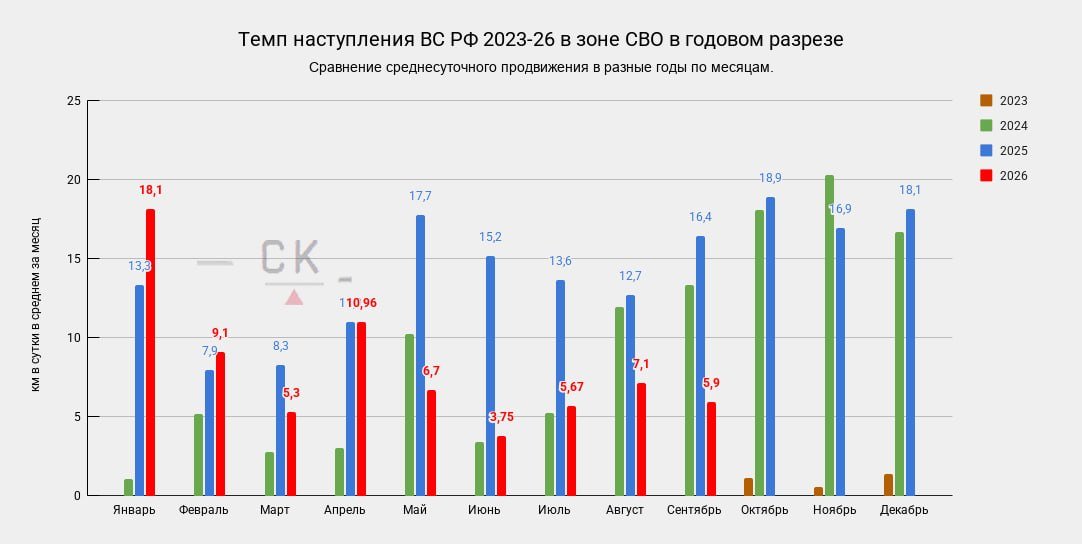
“The average daily rate of advance by the Armed Forces of the Russian Federation in the SVO zone [special military operation] in September 2026 was +5.9 km². The average rate of advance over the entire offensive up to October 2026 is +9.92 km² per day,” Russian project Slivochny Kapriz wrote about September.

It, too, is an unreliable source that regularly overestimates the significance of “flag operations”, but even its data makes it clear that 2026 is lagging significantly behind the previous year.

Even if this author’s figures were correct, the Russians advanced by 177 square km during September’s 30 days, more than seven times less than Putin claims.

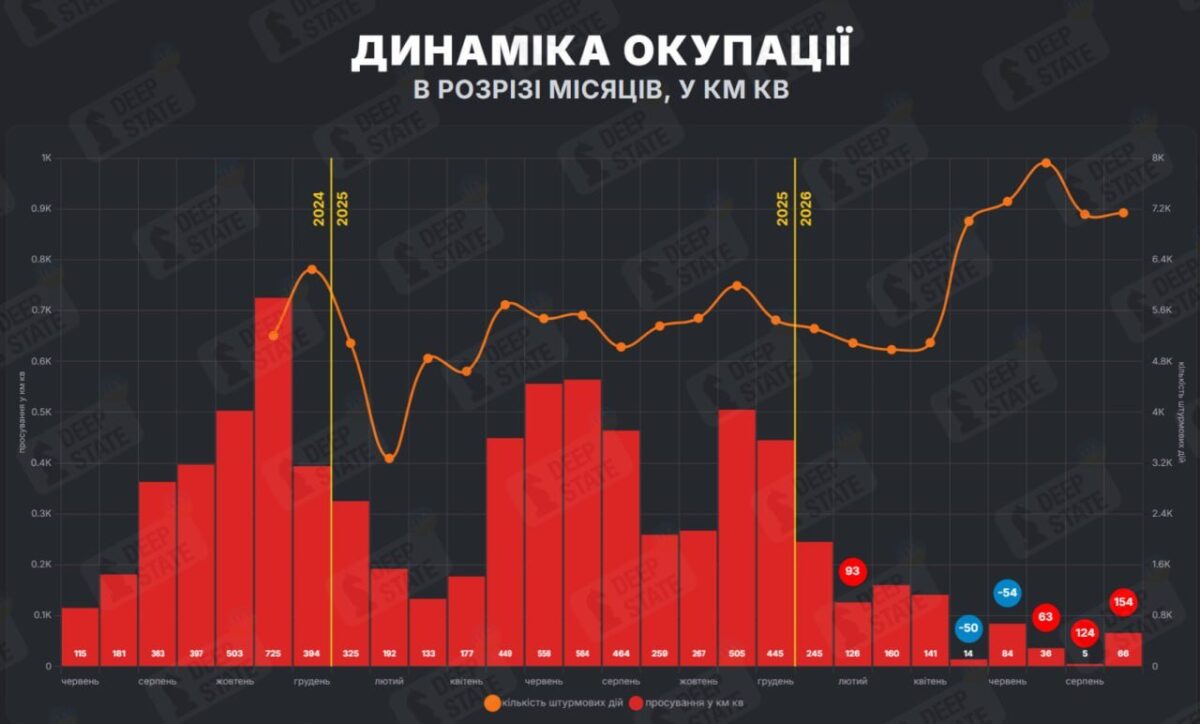
Ukrainians from DeepStateUA also published an estimate very close to Slivochny Kapriz’s figures. According to this OSINT project, Ukraine lost 154 square km in September.

However, the Ukrainian analysts treat their own data cautiously and warn their readers that “the operational security of our forces remains the highest priority in our work”.

In other words, during Ukrainian counter-offensives, DeepStateUA only reports successes after a delay so as not to jeopardise the operations’ success.

They therefore now recall that their statistics do not yet include 270 to 320 square km of liberated Ukrainian territory in various sectors. “July will therefore also end as a month in which the Armed Forces of Ukraine have the upper hand, while for August and September this will only become clear when official announcements of successes are available. In the meantime, part of the liberated territories may be lost again,” DeepStateUA wrote on Friday (2 October).

The most optimistic by far are currently Finnish analysts from the Black Bird Group, who see a balance of 190 square kms in Ukraine’s favour in September.

Over the month of September, the Russian net gains were negative 190 km2. This marks the greatest monthly net territorial loss for Russia in our dataset since the June of 2023.

(1/12) pic.twitter.com/SKRSWbIrzo

— Black Bird Group (@Black_BirdGroup) October 3, 2026

Emil Kastehelmi, one of the project’s authors, pointed out that the sharp change for the better stems from the fact that it also captures some changes that DeepStateUA has not yet taken into account. Nevertheless, he said: “Russia has failed to reverse a situation that has persisted for almost the entire year. The results of the major Russian offensive are minimal, and this is likely to remain the case for the rest of 2026.”

Among Western analysts, the most sceptical is Konrad Muzyka of Rochan Consulting, who credits the Russians with even more gains than Slivochny Kapriz — as much as 235 square kms of advance. Yet this figure still does not come close to Putin’s. Even if it were the most accurate of all, which cannot be determined, it would amount to an area roughly equivalent to the size of Košice, including all its suburbs, forests and agricultural land within the city’s administrative boundaries.

The plan for this year, meanwhile, was to capture the rest of Donetsk region, including the remaining large cities of Kostiantynivka, Druzhkivka, Kramatorsk and Sloviansk. The Russians are closest to doing so in Kostiantynivka, but Ukrainian soldiers remain there too.

Here is a short summary of territorial changes in Ukraine for September 2026.
Our dataset shows an overall Russian territorial gain in September, but a sharply uneven pattern: gains around Dobropillia, Velykyi Burluk, Kramatorsk and Komyshuvakha coincided with substantial losses… pic.twitter.com/jrq0zXiqri

— Konrad Muzyka – Rochan Consulting (@konrad_muzyka) October 1, 2026

Russia wants to cause Kyiv’s economic collapse, and pontoon bridges are being prepared in the city. There is now no doubt that the Russian army has begun a systematic effort to disrupt transport between western and eastern Kyiv. Over the weekend, further drones struck several bridges across the Dnipro.

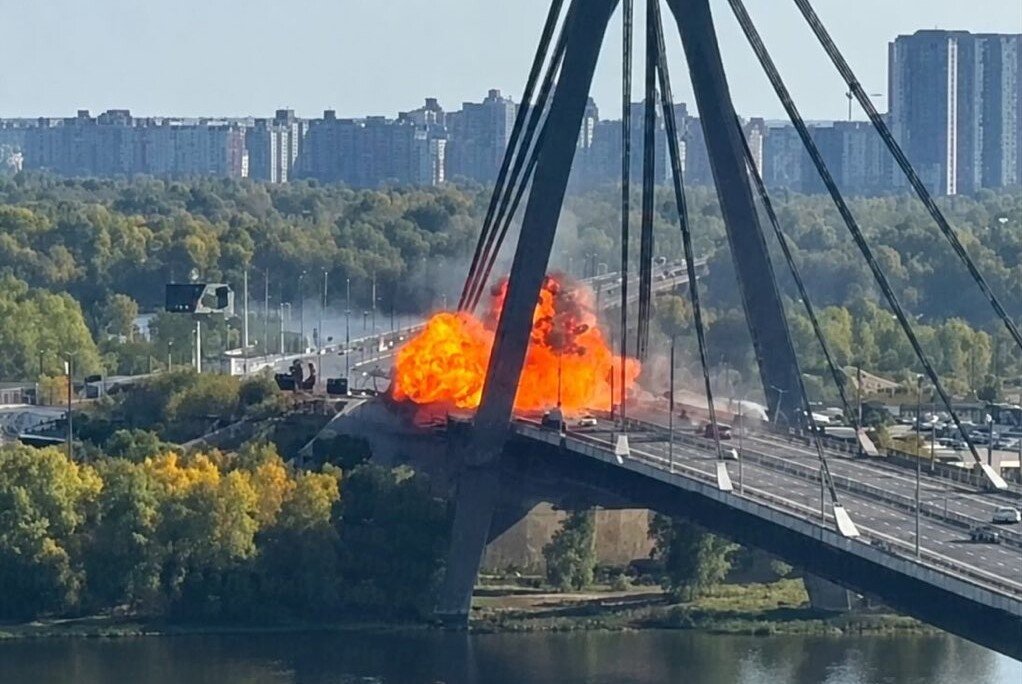
They included the Northern Bridge, which a Russian drone attacked during the day amid heavy traffic.

🚨 BREAKING: Russian forces launched a drone strike hitting the Northern Bridge in Kyiv, damaging the road surface.

The strike coincides with German Chancellor Friedrich Merz’s unannounced visit to the capital to meet with Ukrainian leadership. pic.twitter.com/j1UHYoBMa7

— UNITED24 Media (@United24media) October 4, 2026

One drone is not enough to destroy a bridge, but the explosion left a large hole in the road surface.

Такий вигляд зараз має Північний міст у Києві після атаки російського безпілотника.

На дорожньому покритті утворилася велика вирва, навколо пошкоджений асфальт.

Через наслідки удару фактично перекрита одна смуга руху. Автомобілі та громадський транспорт об’їжджають пошкоджену… pic.twitter.com/h73gJCSAHa

— hromadske (@HromadskeUA) October 4, 2026

Ukraine’s transport minister Mykola Kalashnyk said 600,000 cars cross Kyiv’s bridges every day. In an interview with Suspilne, he announced that construction of embankments and pontoon bridges would begin this week. If the existing bridges become impassable, they are intended to maintain as much traffic as possible between the river’s two banks. Kalashnyk said the temporary crossings should have at least half the capacity.

However, this will take around three months; in the meantime, work will also be carried out to improve the resilience of road bridges.

Transport expert Dmytro Bespalov is sceptical. As he said in an interview with NV, Kyiv’s bridges are irreplaceable, and the only thing that can keep traffic moving across the Dnipro is the military.

However, the task of keeping the bridges operational is complicated by their poor technical condition. Because of their age and the lack of maintenance funding, Bespalov rates the Southern and Northern bridges at four on a scale of one to five, where one is ideal condition and five is emergency condition. He says two other bridges are at level five.

Even in this condition, such large structures are not easy to destroy, but they are certainly more vulnerable. Like many others, Bespalov believes that Russia lacks the means to destroy the bridges completely and is seeking to disrupt traffic during the winter. “The aim is probably an economic blow. I fear it will be very painful. It will not kill us, but I am very concerned about the economic consequences it will have,” he added.

Air defences neutralised 83 percent of drones launched in September, compared with 92 percent in May. This follows from data by the Shahed Tracker project, which recorded 6,732 Russian drones launched against Ukraine over the month, of which 5,561 were shot down or disabled through electronic jamming.

Shahed type OWA-UAS stats Sep2026 [per UA Air Force Reports]

Total: 6732
Claimed Intercepted: 5561
Hits: 1171 Not Intercepted
Interception Rate: ~83%

Median Attack: 171 drones pic.twitter.com/gA8eMj02r9

— Shahed Tracker (@ShahedTracker) October 5, 2026

As the same source’s chart for August shows, the effectiveness rate did not change, but the number of drones launched by Russia rose sharply month on month by almost 1,600.

Shahed type OWA-UAS stats Aug2026 [per UA Air Force Reports]

Total: 5155
Claimed Intercepted: 4188
Hits: 867 Not Intercepted
Interception Rate: ~83%

Median Attack: 143 drones pic.twitter.com/NEp1U8vDW0

— Shahed Tracker (@ShahedTracker) September 3, 2026

Russia launched even fewer drones in July, when the defence effectiveness rate stood at 87 percent.

Shahed type OWA-UAS stats Jul2026 [per UA Air Force Reports]

Total: 4951
Claimed Intercepted: 4299
Hits: 479 (652 Not Intercepted)
Interception Rate: ~87%

Median Attack: 134 drones pic.twitter.com/Tevv4huwI8

— Shahed Tracker (@ShahedTracker) August 3, 2026

In June, the effectiveness rate was 90 percent.

Shahed type OWA-UAS stats Jun2026 [per UA Air Force Reports]

Total: 5749
Claimed Intercepted: 5173
Hits: 464 (576 Not Intercepted)
Interception Rate: ~90%

Median Attack: 148 drones pic.twitter.com/EVERgPNF2k

— Shahed Tracker (@ShahedTracker) July 3, 2026

In May, when Russia used a record 8,150 drones, it was as high as 92 percent. At that time, the Russian army began a mass transition to jet-powered drones, leading to a temporary slowing of the pace of attacks. The trend is now unfavourable: monthly attack statistics have begun to rise sharply, while the effectiveness of countermeasures is declining, as Geran-4 drones and especially Geran-5 drones still present a serious problem.

Shahed type OWA-UAS stats May2026 [per UA Air Force Reports]

Total: 8150 (New Record)
Claimed Intercepted: 7476
(Official: 5053 Shahed type OWA-UAS)
Hits: 508 (674 Not Intercepted)
Interception Rate: ~92%

Median Attack: 209 drones pic.twitter.com/4k3szZZvcd

— Shahed Tracker (@ShahedTracker) June 2, 2026

As another video showing the moment a Geran-5 was hit demonstrates. Technical solutions already exist, but faster interceptor drones are not yet available in sufficient numbers.

Another Geran-5 drone shot down by a STING S interceptor drone from Wild Hornets. Combat work by pilots of the 1020th ZRP. pic.twitter.com/kkPHaCIrKG

— WarTranslated (@wartranslated) October 4, 2026

Videos of the day

One TM-62 anti-tank mine contains seven and a half kilograms of explosives. This is enough to destroy the remains of a building used as a shelter by Russian soldiers.

❗️A Ukrainian heavy Baba Yaga-type drone destroys a building with Russian soldiers inside by dropping a TM-62 anti-tank mine. pic.twitter.com/XClgIqMvwe

— 🪖MilitaryNewsUA🇺🇦 (@front_ukrainian) October 4, 2026

A video recently circulated online showing Kyiv residents protesting against tree felling. It was widely used as alleged evidence that Ukrainians have had enough of the government. However, their protest was civic, not political. These Muscovites are communists and dared, very timidly, to chant “Down with the tsar!” Police intervened immediately.

У Москві комуністи зібралися на погоджений мітинг, почали скандувати «Долой царя», і після цього їх побили й розігнали мусора. pic.twitter.com/MD6MVxSBPS

— Serhii Sternenko (@sternenko) October 5, 2026

This video must be watched with the sound on. It illustrates the saturation of the battlefield with drones. The Russian soldier who recorded it says he counted five drones.

"I’ve already counted five. It’s a damn swarm."
position of 🇷🇺1199th Motorized Rifle Regiment
(probably occupied south 🇺🇦)
🍂 is coming pic.twitter.com/K9H3wcRdse

— C4H10FO2P ☠️ (@markito0171) October 3, 2026

Three lines of anti-drone barriers protect the Kerch Bridge, which links Crimea to Russia, from attacks from the sea.

Exilenova+ says Russia has set up layered defenses around the approaches to the Crimean Bridge, with multiple lines against Ukrainian surface and underwater USVs plus FSB patrol ships. The stated aim is to shield the bridge’s vulnerable elements. pic.twitter.com/rxMPPe6gXW

— WarTranslated (@wartranslated) October 4, 2026

What are the losses

  • By Monday (5 October), Russia had verifiably lost 24,170 pieces of heavy equipment (24,138 on Tuesday, 22 September). Of these, 19,133 (19,105) were destroyed by Ukraine, 1,003 (1,000) damaged, 1,194 (1,194) abandoned by their crews and 2,840 (2,839) captured by the Ukrainian army. This includes 4,452 (4,448) tanks, of which 3,357 (3,353) were destroyed in combat.
  • Ukraine lost 12,238 (12,175) pieces of equipment, of which 9,633 (9,579) were destroyed, 711 (702) damaged, 695 (695) abandoned and 1,199 (1,199) captured. This includes 1,466 (1,464) tanks, of which 1,126 (1,125) were destroyed in combat.

Note: Neither side regularly reports on its own dead or destroyed equipment. Ukraine publishes daily figures for Russian casualties and destroyed equipment, which cannot be independently verified. This overview uses data from the Oryx project, which has compiled a list of equipment losses documented exclusively by photographs since the beginning of the war.

  •  

Ukraine’s EU neighbors reject new plea from Kiev – Politico

RT | October 5, 2026

Poland and Romania have refused to help Kiev move millions of tons of grain – which got stuck in Ukraine following Vladimir Zelensky’s war on exports – into the EU, Politico reports, citing officials in Warsaw and Bucharest. Zelensky’s 40-day campaign resulted in Russia implementing a de facto blockade of Ukraine’s Black Sea ports, with the wider consequences of the strikes estimated at 1.5% of the country’s collapsing GDP.

Last week, Ukrainian Agriculture Minister Taras Vysotsky appealed to the EU for a €1.1 billion ($1.23 billion) allocation to improve transit capacity, which would help free large quantities of grain – Ukraine’s key source of income – trapped in the country.

The request came after Zelensky’s 40-day PR ‘pressure campaign’ on Russia, which involved long-range strikes on oil refineries and civilian infrastructure. The effort backfired, as Russia ramped up strikes on Ukraine’s military-related logistics, including the key hub of Odessa, accounting for an overwhelming majority of Kiev’s agricultural exports.

Speaking to Politico, Vysotsky described the situation as “very, very critical,” after his ministry reported the export of 2.4 million tons of agricultural products in September, just 46% of what Kiev considers the required volume.

He added that export restrictions leave Ukrainian farmers without cash needed to plant seeds now for next year’s harvest. “If the situation stays like this till spring, it could mean the decrease of even 35-40% of the planted area,” he warned.

Last month, Ukrainian officials estimated damage to infrastructure from Russian strikes at nearly $10 billion, with wider consequences amounting to around 1.5% of GDP.

While the EU as a whole is yet to give a definitive answer to the €1.1 billion request, Poland and Romania – which are crucial to facilitating Ukraine’s exports – ruled out any significant assistance.

Romanian Agriculture Minister Barna Tanczos rejected the prospect of substantially expanding capacity, telling Politico that “the interest for our own farmers remains a priority.”

Ukrainian cargo and low Danube water levels are already straining Romanian ports, he said, adding: “Everybody knows we cannot double the number of trains, we cannot double the roads, railways and port capacity. It is what it is.”

The Polish Infrastructure Ministry spokesperson said, as cited by Politico, that Poland “has no plans to introduce any changes aimed at increasing the transit of Ukrainian agricultural products.”

Before the €1.1 billion plea, Ukraine requested €220 million from the EU in grants to support farmers affected by disrupted exports, but the bloc effectively turned it down, pointing instead to existing EU mechanisms.

Agricultural trade has long been a source of friction between Ukraine and its EU neighbors. After the escalation of the Russia-Ukraine conflict in 2022, Brussels suspended duties and quotas on Ukrainian exports, which triggered massive protests from European farmers over what they saw as unfair competition. As a result, the EU introduced an ‘emergency brake’ system in 2024, allowing tariff quotas to return for sensitive products if imports exceed set thresholds.

In addition, many of Ukraine’s neighbors, including Poland, Hungary, and Slovakia, maintain significant restrictions on Ukrainian imports at the national level.

  •  

Merz Announces New Ukraine Package as German Defence Ties Deepen

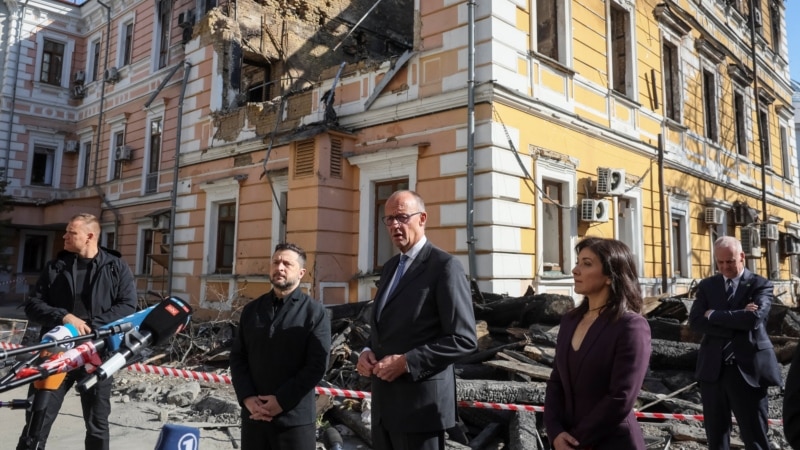
German Chancellor Friedrich Merz has announced a new package worth more than €1.3 billion for Ukraine during a visit to Kyiv, combining additional military assistance with support for the country’s damaged energy infrastructure as German-Ukrainian industrial co-operation expands.

Merz visited the Ukrainian capital on Sunday while Russian drone attacks continued against Kyiv.

According to the Ukrainian presidency’s account of the meeting, the package includes more than €1 billion for defence and additional financing for the energy sector ahead of winter. Separate reporting put the energy component at approximately €350 million.

The visit also produced an extensive group of bilateral agreements involving governments and companies.

President Volodymyr Zelenskyy said Ukraine and Germany had concluded 15 agreements and documents, most concerning security co-operation, production, procurement, orders for German industry and joint projects in Ukraine. He put the total value of the agreements reached during the visit at more than €8.5 billion.

A narrower set of industrial agreements reported during the visit was valued at about €6.6 billion and included air-defence, radar and drone projects.

The visit went beyond another transfer of military aid.

Germany and Ukraine are increasingly constructing a defence relationship based on procurement, industrial production and the transfer of Ukrainian battlefield experience to European manufacturers.

At the Ukrainian-German Business Forum, Zelenskyy said the new security package would strengthen Ukraine’s armed forces immediately while industrial agreements were intended to build longer-term production capacity.

The direction corresponds with a wider shift in European support for Ukraine.

Military assistance is increasingly moving away from transfers of existing national stocks towards contracts financing new weapons production. In July, the EU released €3.47 billion for Ukrainian defence procurement, including financing intended for drones, missiles, air defence and combat aircraft requirements.

Kyiv has since asked European partners to accelerate further financing as the demands of the war outpace scheduled disbursements. EU Today reported in September that Ukraine was seeking early access to part of its 2027 EU funding to close a military budget gap.

The German agreements add a bilateral industrial track to that European system.

They also reflect changes on the battlefield.

Russia has continued to expand large-scale drone and missile attacks, increasing the importance of interceptor production, radar coverage and lower-cost methods of destroying unmanned aircraft. Ukraine’s air-defence problem is increasingly an industrial one: inexpensive attack drones cannot sustainably be countered only with scarce and costly surface-to-air missiles.

EU Today has previously examined how Ukraine’s air-defence battle has become an industrial equation, determined as much by production rates and cost ratios as by the technical performance of individual systems.

German-Ukrainian co-operation is increasingly being shaped by that requirement.

Merz has presented continuing support for Ukraine as a direct German and European security interest, rather than assistance based solely on solidarity with Kyiv.

The argument has acquired greater force as German authorities investigate Russian-linked sabotage and hybrid operations on German territory.

In September, investigators reportedly traced the attempted bombing of a Ukrainian cargo aircraft at Leipzig/Halle Airport to a suspected Russian military-intelligence organiser, with EU Today reporting details of the alleged GRU-linked logistics network.

For Berlin, support for Ukraine is now increasingly seen as part of Germany’s own security.

Merz’s visit also carries a domestic political dimension. His government is committing Germany to considerably higher defence expenditure at a time when the CDU has suffered severe electoral setbacks in eastern Germany and voters remain concerned over public finances and economic performance.

Yet Germany’s military and industrial engagement with Ukraine is continuing to expand.

The new package announced in Kyiv is important in itself, particularly as Ukraine prepares for another winter of Russian attacks on its energy infrastructure. The wider development, however, lies in the growing number of defence-production agreements accompanying it.

European governments have spent much of the war debating how to replenish their own weapons stocks while sustaining Ukraine.

The German approach increasingly points towards a different model: Ukrainian operational experience, Ukrainian procurement requirements and European industrial capacity being brought into the same defence-production system.

  •  

Der ukrainische Bundeskanzler Friedrich Merz

Die Ukraine bekommt immer mehr Probleme, weshalb Kanzler Merz mal wieder nach Kiew gefahren ist, um über eine Milliarde Euro deutscher Steuergelder zu verschenken. Deutschland bekommt auch immer mehr Probleme, aber für die Deutschen hat Merz kein Geld, denn sonst reicht es nicht für Kiew. Aber was sind die Gründe für die aktuellen Probleme der […]
  •  

Russia To Intensify Strikes on Ukraine After Zelensky Vows More Attacks on Russian Oil Refineries

The Russian Defense Ministry on Sunday vowed that it would intensify attacks on Ukrainian military sites and related infrastructure after Ukrainian President Volodymyr Zelensky said Ukraine would double down on its attacks on Russian oil infrastructure. “Following Zelensky’s statement today, the Russian Armed Forces will step up strikes on military and defense industry facilities, as […]
  •  

[Interview] ‘Putin understands only strength’: EU envoy in Kyiv urges stronger air defences and hybrid-war response

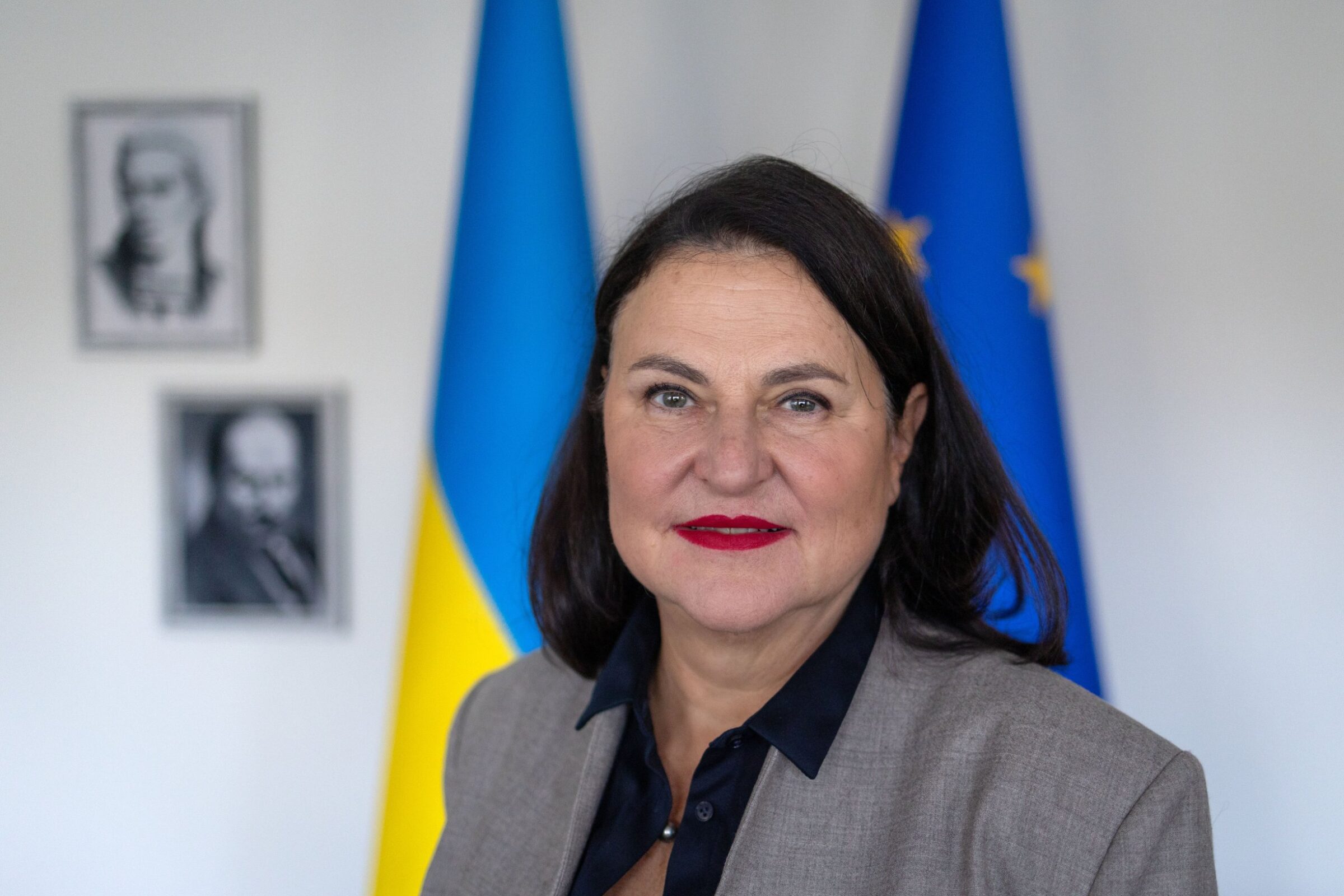
Ukrainians want peace more than anything, but only the language of strength works on Putin, says Katarína Mathernová, the EU’s ambassador to Ukraine.

Mathernová has no doubt about the Russian leader’s ultimate goal; she is convinced that Putin wants to destroy Ukraine.

“He set this out very clearly in his essay, and that is precisely why he launched this full-scale war. Unfortunately, the peace that Ukrainians so desperately want can only be achieved by putting pressure on Russia. Putin understands only one language — the language of strength,” she said in an interview.

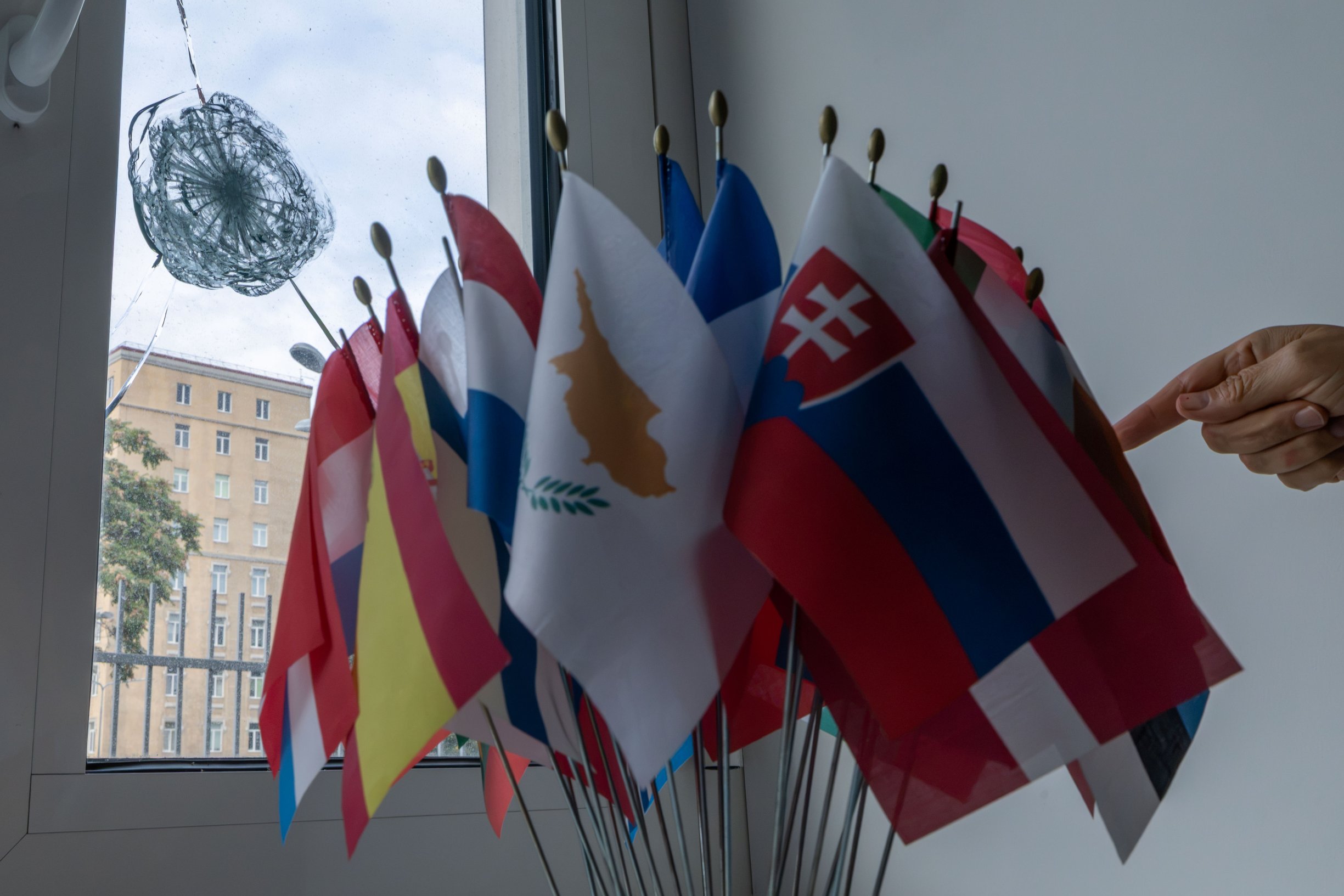
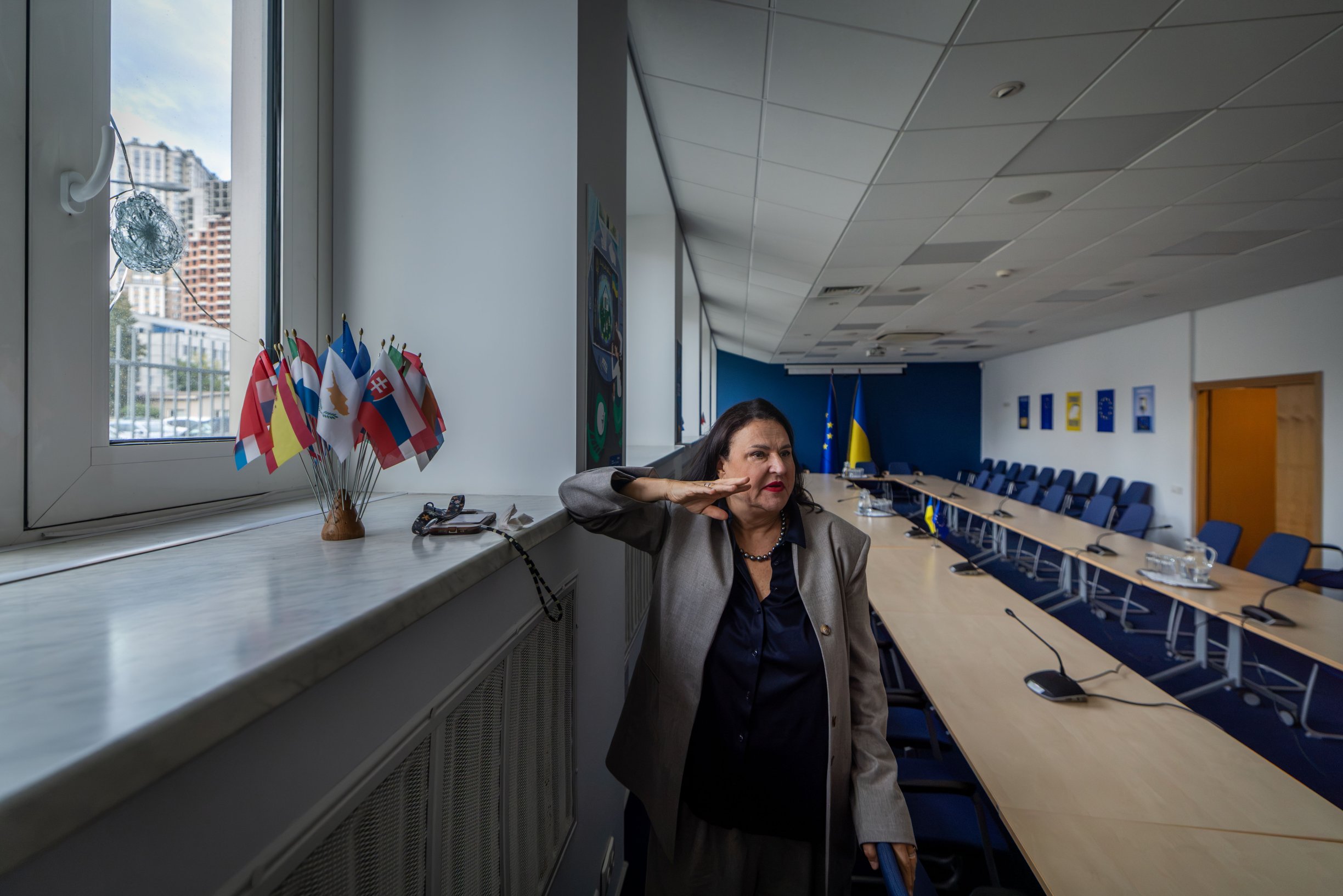
Air raids have left their mark on her office: windows have been blown out, and shrapnel once tore straight through a refrigerator. With attacks intensifying, the EU delegation now does much of its work in the corridor, away from the glass. The latest strikes hit the nearby headquarters of Ukraine’s Security Service (SBU).

In late September, Kyiv has heard so many air-raid sirens. There is already one dead and 20 injured, and on our way to your office, we heard several explosions. Is this the new normal?

Unfortunately, they have become routine. It began on 27 August this year, a date that will go down in the history of this war. That day, we had 13 air raid alerts during daylight hours, a record since the beginning of the full-scale war. It happens every day.

The day before yesterday, as I was entering the office when the windows suddenly began to rattle. A huge plume of smoke rose behind that black building outside the window. There were around four separate explosions over the course of 20 minutes, just a couple of hundred metres from here.

After a Russian attack, in a room with bulletproof windows. Source: Tomáš Benedikovič, Denník N.

The Russians have begun using jet drones which Ukrainians are not yet able to shoot down in the same numbers as earlier Shahed drones. With just a few jet drones, Russia can terrorise a city like Kyiv throughout the day at a relatively low cost. Then, at night, come the ballistic missiles. Last week, however, they also used ballistic missiles during the day.

Do the attacks make you anxious?

Of course they do. One morning last week, I was Nordic walking in the botanical garden. I was walking with my coach when suddenly there was a huge bang. It landed several kilometres away, but because there are no buildings there, it sounded as though it were just around the corner. These are the moments when I nearly have a heart attack…it’s very unpleasant.

How do you decide whether to go to a shelter or into the corridor? Do you have a security protocol?

I have security guards, and we also have a regional security officer here. They are here permanently, so they guide us. But since these very frequent and disruptive daytime attacks began, the government has adopted a regulation introducing two different types of alert — yellow and red. Red alerts are issued for missiles. Yellow alerts are for drone attacks – in such cases, the metro no longer stops, and people primarily seek safety between two walls. When there were explosions here last Wednesday, we were all sitting in the corridor.

Katarína Mathernová. Source: Tomáš Benedikovič, Denník N.
The corridor where diplomats work during heavy air raids. Source: Tomáš Benedikovič, Denník N.

On the ground floor, where we have our conference rooms, there are bulletproof windows. We are now going to adapt the ground floor so that we can operate safely there during anti-drone alerts. We will put sandbags outside. We already have beanbags there, and colleagues from the upper floors are moving down so that they can work.

How do you assess this intensification? Is it a response to the fact that the front has stalled and Putin’s “special operation” has boomeranged back on Russians at home?

Russia cannot win on the battlefield. They have managed to gain only a few square kilometres, so they are terrorising civilians by attacking targets such as churches, museums, libraries and book warehouses. On Thursday, they hit a maternity hospital. These are war crimes, but Russia commits them so routinely that they are boiling us like a frog.

There is talk that assaults will escalate further in winter. Will you stay?

Of course, we are staying here. When we speak to the diplomatic corps, everyone wants to stay. We are preparing for winter, stockpiling supplies, and here at the delegation we have bought blankets and folding beds. We have food rations and additional supplies of drinking and utility water. We have had several shower cubicles installed. We bought washing machines and dryers too, as the building has a large generator. Our colleagues from Brussels and Ukraine in the same building — many of whom live on the other side of the river or in conditions that are not as good as ours — will probably welcome these facilities.

Attacks have come dangerously close not only to where you work, but also to where you live, like a recent drone struck an SBU building.

It was targeting that location; I do not think Kyiv city centre itself was the target. But yes, it is quite close to the hotel where I live.

What do you anticipate will happen in winter? You may see attacks on energy infrastructure, water and sewage systems. A loss of these utilities would be extremely difficult.

If sewage systems were knocked out in a large part of the city, it would be very difficult. But let us not forget that Kyiv was also a frontline city last winter. There were perhaps more than one million people here freezing in their own homes. My driver told me that he and his family bought firebricks and heated them on the gas stove. When they went to bed, they held them to keep warm. Those without gas in their flats were even less fortunate. But people here helped one another. My coaches and their son stayed in my hotel for weeks because it was four degrees in their home.

Ukraine faces a shortage of Patriot missiles. It has developed a new interceptor that could stop jet drones, but Patriots defend against ballistic missiles. Can Europe do more to help?

This article continues, but the full version is available only to EUobserver.com subscribers. Visit account.euobserver.com/membership

  •  

Ukraine’s EU Reform Record: Why Progress Slows Where Political Power Is at Stake

Ukraine’s record on reform during Russia’s war is stronger than much recent criticism suggests. By September, Kyiv had completed 84 of 95 milestones due under the Ukraine Plan. Yet progress on a smaller group of rule-of-law commitments has been strikingly weaker. The difference between the two tells Brussels much about where Ukraine’s European transformation is encountering resistance.

Ukraine’s reform record currently produces two figures that appear difficult to reconcile.

Under the Ukraine Plan, Kyiv had completed 84 of the 95 milestones due by late September — around 88 per cent. The result was strong enough for EU governments to approve another payment of almost €3 billion under the Ukraine Facility.

Three months earlier, however, a coalition of Ukrainian organisations monitoring ten rule-of-law and anti-corruption commitments agreed with Brussels had awarded progress just 15 points out of 100.

Neither figure is wrong. They measure different programmes.

The first covers a broad reform and investment agenda extending from the judiciary and financial markets to energy, agriculture, transport, human capital and the business environment. The second examines a deliberately narrow collection of reforms concerning prosecutors, criminal investigations, anti-corruption agencies and judicial governance.

Put together, they raise a more useful question than whether Ukraine is “reforming” or “not reforming”.

Why has a country capable of delivering most of a demanding EU programme during a major war found this particular group of reforms so much harder to complete?

Russia’s aggression provides part of the answer. Ukraine has been attempting an institutional transformation while mobilising its population, financing its armed forces, repairing infrastructure and keeping a functioning state under repeated Russian missile and drone attacks. No previous EU candidate has operated under comparable conditions.

But the ten reforms where progress has been weakest have something else in common. Most concern institutions that can investigate senior officials, prosecute corruption, scrutinise appointments or otherwise place limits on the exercise of political authority.

That is what makes the comparison important.

A strong overall record

The wider reform record should not be understated.

When the European Commission released €2.9 billion to Ukraine on 2 October, it specifically credited Kyiv with implementing reforms covering the judiciary, financial markets, human capital, the business environment, energy, transport, agriculture and the green transition.

Total EU support provided under the Ukraine Plan has now exceeded €32 billion. More than €17 billion in further budget support remains potentially available during 2026, provided Ukraine fulfils the corresponding conditions.

The money is particularly important because the Ukrainian state is directing such a large share of its own resources towards defence. European financing helps keep the civilian state operating while Ukraine fights Russia.

The Ukraine Facility has therefore become more than an aid mechanism. It gives Brussels a means of measuring reform against specific commitments and releasing money when they are met.

That system has generally worked.

It also makes the areas where progress is weaker much easier to identify.

The 15/100 assessment published in June concerned ten priorities agreed in December 2025 between Enlargement Commissioner Marta Kos and then deputy prime minister Taras Kachka. The score came from Ukrainian civil society, not the European Commission, and cannot legitimately be presented as Ukraine’s overall EU reform score.

It had nevertheless risen only six points from an assessment of nine out of 100 in April.

Among the unfinished commitments were changes to criminal procedure affecting high-level corruption cases, stronger guarantees for the independence and effectiveness of NABU and SAPO, reform of the State Bureau of Investigation, new arrangements surrounding the Prosecutor General, competitive recruitment within the prosecution service and further changes to judicial governance.

These are among the most difficult reforms Ukraine has undertaken since 2014 because they concern who has the authority to investigate whom.

The July 2025 episode changed the argument

The events surrounding NABU and SAPO in July 2025 remain central to understanding why Brussels is paying such close attention.

Ukraine had spent years building a specialised anti-corruption system intended to make investigations of senior political figures less vulnerable to interference from the conventional prosecutorial hierarchy.

NABU conducts investigations. SAPO provides specialised prosecution. The High Anti-Corruption Court hears the cases.

The system has never been free from political controversy, nor has its performance been beyond criticism. But its independence became an important part of Ukraine’s relationship with the EU and other international partners.

Then, in July 2025, parliament passed legislation placing NABU and SAPO under substantially greater authority of the politically appointed Prosecutor General. Zelenskyy signed it.

The decision produced an unusually sharp reaction inside Ukraine. Demonstrators took to the streets despite martial law, while European partners made clear that the legislation threatened reforms regarded as fundamental to the country’s European integration.

As EU Today reported during the crisis, the dispute went far beyond the technical division of powers between prosecutors and investigators.

Kyiv reversed course within days. Parliament restored the independence of the two bodies.

The reversal demonstrated that Ukraine’s political system still contained powerful corrective forces. Civil society mobilised, public opposition was visible and international pressure had an effect.

Yet the episode also established that the independence of institutions created specifically to investigate high-level corruption could still become the subject of direct political intervention.

That changed the context in which subsequent reform commitments are being judged.

The European Commission’s 2025 report on Ukraine recorded both sides of the episode. It acknowledged the restoration of NABU and SAPO independence, while warning that undue pressure on anti-corruption agencies remained a concern.

The Commission also identified practical weaknesses. NABU still required better access to timely and impartial forensic examinations, while SAPO needed stronger powers in cases involving members of parliament.

This is why simply retaining NABU and SAPO is no longer sufficient evidence that this part of the reform process is secure. Brussels is looking at whether they can operate when investigations become politically difficult.

Follow the institutions

The same issue appears elsewhere.

Ukraine agreed to review the procedure for appointing and dismissing the Prosecutor General, drawing on European standards and the Venice Commission. It also committed itself to transparent and competitive recruitment for senior positions throughout the prosecution service.

The significance is obvious. The Prosecutor General occupies a pivotal position in the Ukrainian criminal-justice system. The method by which that office is filled — and the circumstances in which its occupant can be removed — affect the credibility of every politically sensitive prosecution beneath it.

Progress has been slow.

There is a similar problem with the State Bureau of Investigation, which handles cases involving senior officials and law-enforcement personnel. Kyiv agreed to an independent assessment of the bureau followed by reform of its legal and institutional framework.

Again, the issue is not administrative tidiness. An agency responsible for investigating state officials has little value as a check on government if its own leadership or investigative decisions are susceptible to political influence.

Criminal procedure provides another example.

Ukraine committed itself to changing provisions under which corruption proceedings can eventually be closed because deadlines for pre-trial investigations have expired, as well as addressing limitation periods for corruption offences.

Draft legislation has appeared. Bills No. 15333 and 15334 were registered in parliament, and NABU and the Ministry of Justice have worked on amendments.

But the process has taken months.

For a simple criminal case, procedural deadlines may appear an obscure legal question. Top-level corruption investigations are different. They can involve offshore structures, large quantities of financial evidence, foreign jurisdictions and prolonged litigation. If the clock eventually disposes of a case that investigators and prosecutors cannot bring to judgment quickly enough, the anti-corruption architecture fails at the point where it is supposed to produce results.

The same pattern is visible in judicial reform and the new Anti-Corruption Strategy for 2026–2030. Work is taking place, legislation is being prepared and institutions are consulting one another. Some changes have been completed.

Others remain somewhere between agreement and implementation.

This is precisely the stage of accession at which that distinction begins to count.

When Ukraine and Moldova moved further into the EU accession process, the significance of the Fundamentals cluster was that progress would increasingly depend on the functioning of institutions rather than declarations of political intent.

Ukraine has no shortage of declarations of European intent. What the Commission needs to establish is whether the machinery beneath them works.

The limits of the wartime argument

Any assessment that ignores Russia’s war would be unserious.

Full-scale aggression has inevitably changed the Ukrainian state. Decisions that might take months in peacetime sometimes have to be taken within days. Military information cannot be handled according to ordinary transparency rules. Elections cannot proceed under normal conditions. The executive carries responsibilities that no Ukrainian government faced before 2022.

Reform is also competing for administrative capacity with mobilisation, defence procurement, reconstruction, energy emergencies and the daily consequences of Russian attacks.

This has to be taken into account when Brussels sets timetables and assesses progress.

It is less convincing when applied indiscriminately.

Competitive recruitment of prosecutors does not interfere with the defence of Ukraine. Neither does an independent procedure for selecting the Prosecutor General. NABU’s ability to investigate senior officials does not prevent the armed forces from conducting operations, while closing procedural loopholes in corruption cases has no obvious adverse effect on wartime decision-making.

There is therefore a boundary between powers required to fight Russia and powers that are simply easier for government to retain during wartime.

Finding that boundary is becoming one of the more difficult questions in Ukraine’s relationship with the EU.

This does not support the sweeping claim that every important Ukrainian institution has been placed under political control. The evidence does not justify it.

It does show why Brussels is concentrating increasingly on institutional independence.

The problem with wartime centralisation is rarely that it begins without justification. Governments fighting wars need authority. The longer an emergency lasts, however, the more important it becomes to distinguish measures required by national security from arrangements that have become politically convenient.

Ukraine has now lived under full-scale war for more than four years. Institutions created for the post-war European state are being shaped while the wartime state still exists.

That makes the current reform period unusually consequential.

Conditionality becomes Brussels’ leverage

The EU has one powerful instrument with which to influence the outcome: money.

The Commission is already using it.

The almost €3 billion approved in September followed the completion of agreed Ukraine Plan milestones. The next payments depend on further commitments being met.

As EU Today reported when the Ukraine Plan was amended, additional financing has come with additional rule-of-law and anti-corruption requirements.

There is a limit to how far Brussels can push this. Ukraine is fighting a Russian war of aggression that also poses a direct security threat to Europe. Destabilising the Ukrainian budget in order to demonstrate the rigour of EU conditionality would make little strategic sense.

Kyiv is well aware of that.

But Brussels cannot simply waive the conditions either. Doing so would weaken reformers inside Ukraine, reduce EU influence over the accession process and make it more difficult to explain enormous long-term transfers to European taxpayers.

The result is already visible: continued financial support accompanied by increasingly detailed scrutiny of how reforms are implemented.

That approach is likely to become tougher as accession advances.

There is another reason for it.

Ukraine will eventually have to manage reconstruction on a scale Europe has not seen for decades. European governments, international financial institutions and private investors will be asked to commit hundreds of billions of euros. Confidence in prosecutors, courts, public procurement and anti-corruption agencies will affect how much money arrives and on what terms.

Strong institutions are therefore not a concession Ukraine makes to Brussels in exchange for membership.

They are part of the infrastructure required for Ukraine’s recovery.

The same applies to the war itself. Corruption in defence procurement, reconstruction or public administration gives Russia opportunities to damage confidence in the Ukrainian state and strain relations between Kyiv and its partners. Moscow has every interest in amplifying genuine scandals alongside fabricated ones.

The most effective answer is not tighter political management of damaging information. It is institutions capable of investigating misconduct credibly.

That is also why the role of Ukrainian civil society deserves attention.

The organisations producing critical assessments of Kyiv’s reforms are operating in a country under attack. Many have supported Ukraine’s European integration for years. Their reports can be disputed and their scoring methodologies examined, but criticism of government performance is not evidence of disloyalty.

The ability to produce such criticism is itself one of the features separating the Ukrainian political system from the authoritarian model Russia represents.

Ukraine’s reform record consequently looks neither like the failure portrayed by some critics nor the uninterrupted success sometimes presented by its defenders.

The broader record is impressive. Completing 84 of 95 Ukraine Plan milestones while fighting a major war is not a trivial achievement, and the EU would not have continued releasing billions of euros if the reform programme existed only on paper.

The difficulty appears further down, where institutional reform begins to affect the ability of political authorities to influence prosecutors, investigators and judicial appointments.

The NABU-SAPO confrontation made that problem impossible to ignore. The subsequent reversal showed that Ukraine also possesses the political and civic capacity to correct course.

What happens next will matter more than either episode.

Bills that have remained in parliament will have to become law. Reviews of the SBI and prosecution service will have to produce institutional changes. Competitive appointment procedures will have to work when the preferred candidate of those in power does not win. Anti-corruption bodies will have to be allowed to pursue cases when their targets are politically connected.

These are less visible achievements than opening accession negotiations or announcing another EU funding package.

They are also much closer to what EU membership ultimately requires.

Russia has forced Ukraine to build an exceptionally powerful wartime state. European integration requires Kyiv to ensure that some of that power can eventually be constrained by institutions that do not depend on whoever occupies the presidential administration.

The figures that currently look contradictory — 84 out of 95 and 15 out of 100 — are therefore telling different parts of the same story.

Ukraine has shown that it can reform during the war.

The harder test is whether it can complete reforms precisely where doing so reduces political discretion.

  •  

Was steckt hinter den Unruhen in Frankreich?

Ein russischer Analyst hat für die TASS einen Artikel geschrieben, in dem einen Blick auf die Schülerproteste in Frankreich wirft und sich an einer Analyse der Hintergründe versucht, die ich so interessant fand, dass ich den Artikel übersetzt habe. Beginn der Übersetzung: Frankreich in Flammen: Warum der Aufstand der Schüler in Europa für Kiew gefährlich […]
  •  

Putin im O-Ton über die neue Weltordnung und den Konflikt mit dem Westen

Der Valdai-Klub ist der wichtigste russische Thinktank zur Geopolitik und inzwischen international als eines der wichtigsten Expertentreffen zu dem Thema anerkannt. Zum Erfolg des Valdai-Klubs und seiner hochrangigen Besetzung hat sicherlich beigetragen, dass der russische Präsident Putin jedes Jahr daran teilnimmt. Dabei hält er eine etwa einstündige Grundsatzrede über die russische Sicht auf die aktuelle […]
  •  

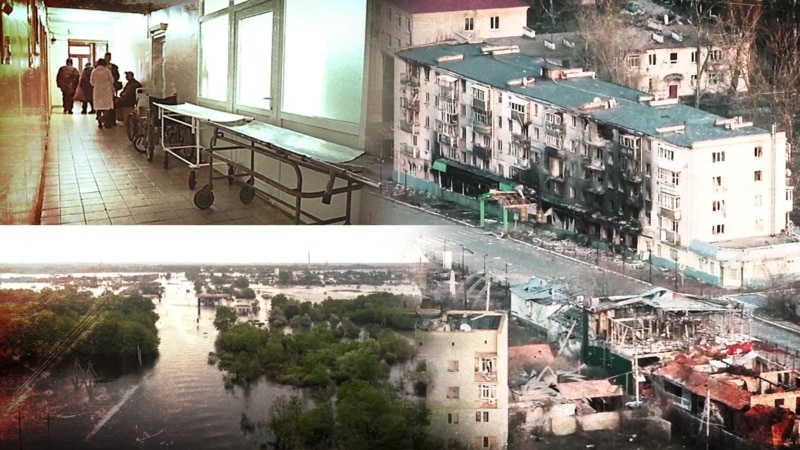
'We'll Die This Autumn': Ruined And Flooded, Russian-Occupied Oleshky In Ukraine Starves Under A 'Total Blockade'

People in Russian-held Oleshky in Ukraine's Kherson region have endured war, occupation, and devastating flooding. Now, trapped by land mines and cut off from basic supplies, they face "hell," starving in a virtual ghost town, Ukrainian officials and volunteers say.

  •  

Orbánism without Orbán? Why Magyar picked a fight with Kyiv over the ‘Carpathian Eight’

Some expected a change in Hungary’s pro-Russian foreign policy after Viktor Orbán’s fall. But they failed to take into account the domestic political pressures on Hungary’s prime minister Péter Magyar.

An unexpected source of tension in Ukrainian-Hungarian relations came at a meeting of the newly formed ‘Carpathian Eight’ (C8) in late September. At the meeting in Kyiv, PM Magyar was embroiled in a sharp exchange with Ukrainian foreign minister Andrii Sybiha, who criticised Budapest for not taking part.

Magyar responded to Sybiha by claiming that Hungary had been included in the C8 without his consent.

“To claim that a sovereign country is a member of an international cooperation (Carpathian Integration) without prior consultation or consent of the country concerned is completely unacceptable,” Magyar said on social media.

This comes after Hungary-Ukraine relations began to improve rapidly following the formation of the Tisza government in May.

Under Orbán’s government, relations had fallen to a historic low, raising the prospect of escalation. In June, Magyar announced that he had reached an agreement with Ukrainian president Volodymyr Zelensky on settling the rights of the Hungarian minority in Transcarpathia, hailing it as a historic deal.

Ukraine’s Deputy PM Vsevolod Chentsov informed me that legislation on minority education rights will be submitted to Parliament. I welcome this step after weeks of 🇭🇺🇺🇦 expert consultations. Thank you to all Hungarian and Ukrainian colleagues for their constructive work. Looking…

— Anita Orban (@_OrbanAnita) October 2, 2026

Since June, however, Hungary has repeatedly blocked Ukraine’s EU accession negotiations, arguing that progress on settling the rights of Hungarians in Transcarpathia has fallen short of expectations.

Orbán’s Fidesz party previously used the same argument to block Ukraine’s integration efforts.

Three months after the so-called historic agreement, Ukraine’s foreign minister Sybiha wrote that although Orbán had lost the election, Orbánism (a policy based on isolation and obstruction) prevailed in Hungary.

“Orbanism has done no good, neither to Hungary nor to the broader region, in the past — and it will not do anyone any good moving forward,” said Sybiha on social media.

Domestic Hungarian politics can explain the dispute.

MOL, an oil company, signed a memorandum with Ukraine’s Naftogaz at the C8 meeting on the possible establishment of Ukrainian oil storage facilities in Hungary.

The deal was criticised by Fidesz politicians, and Magyar’s government strongly distanced itself from the deal, too. Fidesz may have contributed to Magyar entering the dispute over C8 participation so very forcefully.

What is the Carpathian Eight?

In August, Zelensky announced the creation of the C8 to bring together countries from the wider Carpathian border region. The Ukrainian president said its members would focus primarily on the economy, security, the environment and investment.

Ukraine described it as a project intended to strengthen cross-border cooperation even with countries that do not provide it with military aid. Alongside Ukraine were to be Romania, Serbia, Poland, Slovakia, Czechia, Austria and Hungary.

Michal Lebduška, an analyst at the Association for International Affairs in Prague (AMO), said that it was one of many regional initiatives. While he did not believe it would trigger “major cooperation”, it could nevertheless be important.

The inaugural summit of the newly formed C8 was held last month (18 September) in Bukovel, in the Ivano-Frankivsk region, around 160 km from both the Slovak and Hungarian borders. Zelensky called it “an important beginning” and thanked the countries of the Carpathian region for being among Kyiv’s most reliable allies.

From Ukraine’s perspective, however, the meeting had mixed results. On the one hand, several leaders travelled to Bukovel in person, lending the gathering greater diplomatic weight. Polish PM Donald Tusk, Romanian president Nicușor Dan and Serbian president Aleksandar Vučić all attended in person.

On the other hand, the remaining countries sent lower-ranking representatives. Slovakia’s PM Robert Fico had initially indicated that he would attend, and was originally due to meet Tusk. At the last minute, however, he announced that he could not attend the summit due to sudden illness.

Slovakia was ultimately represented by Marek Eštok, state secretary at the foreign ministry.

Andrej Babiš’s Czech government all but completely ignored the initiative. As Respekt magazine wrote, Babiš declined the opportunity to visit Ukraine and did not send any representative to Bukovel.

So Czechia was represented at the summit only by opposition deputy Senate president Jiří Drahoš.

And Austria was ultimately represented by Christine Schwarz-Fuchs, president of the Federal Council.

Hungary sent Ádám Ceglédi, the acting chargé d’affaires at the Hungarian embassy in Kyiv, as the Hungarian foreign ministry confirmed to Telex.

Ukraine expected stronger support

“There are many different forms of cooperation in this region: the Visegrád Four, the Slavkov format and the Central European Initiative. Ukraine is interested in improving its relations with some countries,” Péter Techet, a foreign-policy analyst and researcher at the Institute for Danube Region and Central Europe in Vienna, said.

According to the analyst, Ukraine may have hoped that Orbán’s fall would bring a clear shift in Hungary’s Ukraine policy. Anita Orbán, as foreign minister, has confirmed this by pursuing a foreign policy moving away from Russia.

However, Ukrainians did not take Magyar’s domestic political interests into account.

Magyar panders to anti-Ukraine crowd

This article continues, but the full version is available only to EUobserver.com subscribers. Visit account.euobserver.com/membership

  •  

From Anchorage to Miami: Russia’s Diplomatic Opportunity

Washington’s invitation to President Putin to the Miami G20 offers Russia an opportunity to pursue direct diplomacy with Washington over the Ukraine conflict while reaffirming its role in the emerging global economic order despite continued Western efforts to isolate Moscow. An Invitation with Strategic Meaning The upcoming G20 summit is scheduled for December 14-15, 2026, […]
  •  
❌