❌

Reading view

Seoul backs Ukraine, but sanctioned tankers carried fuel from South Korea to Russia

Seven tankers made 14 trips from South Korea to Russia's Far East in July and August, carrying more than 176,000 metric tons of fuel, most of it diesel, the Guardian found in a 6 October analysis of port records and ship-tracking data. The UK and EU have sanctioned three of the ships, and one loaded its fuel from another tanker at sea off South Korea instead of at a terminal.

Ukrainian strikes have cut Russia's fuel output as Moscow scrambles for supplies, while fuel loaded at South Korean ports has flowed to Russia. Loadings began to surge in July, the same month South Korean President Lee Jae-myung pledged $100 million for Ukraine's reconstruction, the Guardian reported. That creates a tension in Seoul's policy toward the war: South Korea has provided Ukraine with humanitarian and non-lethal aid but ruled out sending weapons directly, while the fuel trade appears legal under South Korean law even though three of the tankers are under UK and EU sanctions.

Russia imported 368,000 metric tons of oil products by sea in August, 112,000 of them from South Korea, according to Kpler data analyzed by the Centre for Research on Energy and Clean Air (CREA) and cited by the Guardian. CREA's own August report gives 172,000 metric tons in total, including 18,000 from South Korea. Neither explains the gap.

Where the tankers said they were going

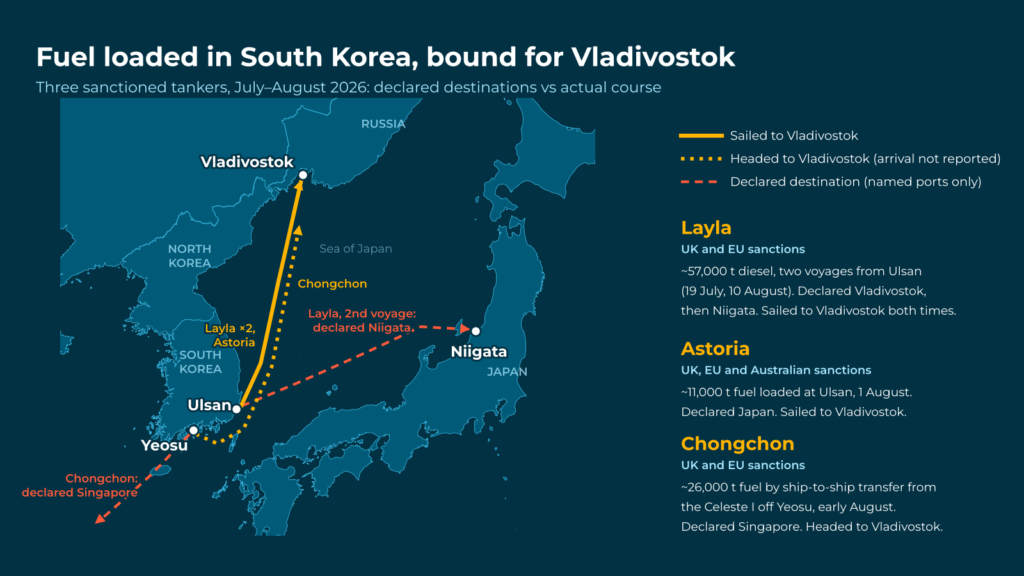
The Layla, a tanker under UK and EU sanctions, made two voyages from Ulsan to Vladivostok, carrying a total of 57,000 metric tons of diesel. It left South Korea on 19 July and 10 August. On the first trip, it told South Korean authorities it was bound for Vladivostok; on the second, it declared Niigata, Japan, but sailed to Vladivostok again.

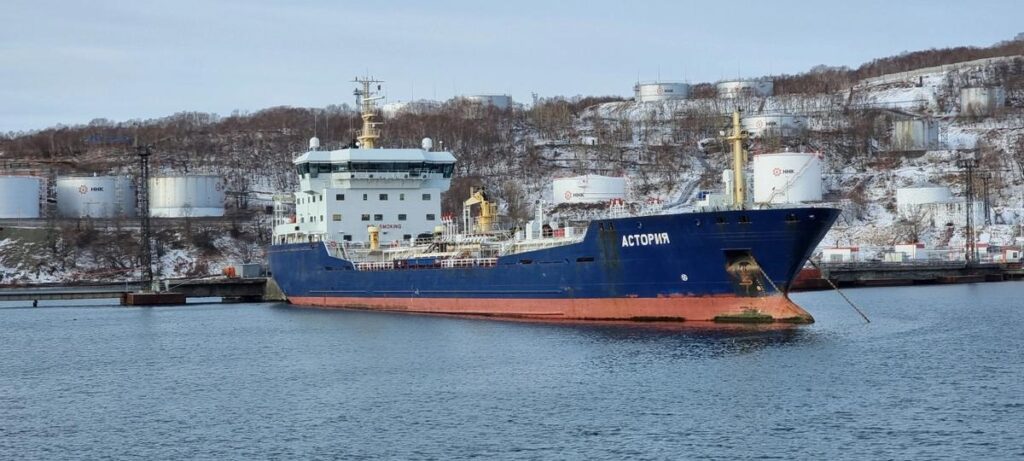
The Astoria, a Russian-flagged tanker under UK, EU, and Australian sanctions, loaded nearly 11,000 metric tons of fuel at Ulsan on 1 August. It declared Japan as its destination but sailed to Vladivostok.

The Chongchon did not berth at a South Korean port. Instead, it took about 26,000 metric tons of fuel from the unsanctioned Celeste I at an anchorage off Yeosu in early August. It declared Singapore as its destination but headed to Vladivostok. The owners and managers of the four tankers did not respond to the Guardian's requests for comment.

Map of sanctioned tankers' voyages from South Korea to Vladivostok
Source: Guardian analysis of port records and ship-tracking data; sanctions listings: OpenSanctions. Map: Euromaidan Press

Why Russia needs the fuel

Ukrainian drone strikes have severely disrupted Russia's refining capacity, the Guardian reported. In July, Ukraine's General Staff said the strikes had knocked out 42% of Russia's refining capacity, costing the industry billions of dollars.

Russian refinery throughput fell in June to its lowest level in more than 20 years, and diesel output is down nearly 30% from a year earlier, the International Energy Agency said, according to the Guardian.

Russia has also restricted fuel exports to protect domestic supplies, extending its diesel export ban until the end of October; on 2 October, Deputy Prime Minister Alexander Novak said Moscow could consider partially lifting the ban if there was overproduction, according to the Moscow Times.

Responses to the shipments

Seoul's non-lethal aid has included helmets, body armor, and demining vehicles, and in 2023 it pledged $2.3 billion in support, mostly in loans.

Isaac Levi, an analyst at CREA, told the Guardian:

"It is shocking that EU-sanctioned tankers loaded fuel at South Korean ports and carried it to Russia. This undermines the sanctions regime and South Korea's support for Ukraine."

South Korea's Foreign Ministry did not address the shipments or the sanctioned tankers. In a statement, it said the government supports international efforts to help end the war in Ukraine and bring about a peaceful recovery. The ministry said it was strictly enforcing its export controls and had expanded them to cover 1,402 non-strategic items with high potential for diversion to military use. The UK Foreign Office did not answer the Guardian's questions about UK-sanctioned tankers using South Korean ports, saying only that it remains committed to monitoring its sanctions.

Ties between Kyiv and Seoul are also strained over Ukraine's disclosure of its transfer of two North Korean prisoners of war to South Korea, which Seoul said should have remained private.

  •  

Ukrainian Drones Hit Key Moscow Fuel Hub as Pressure on Russian Energy Network Widens

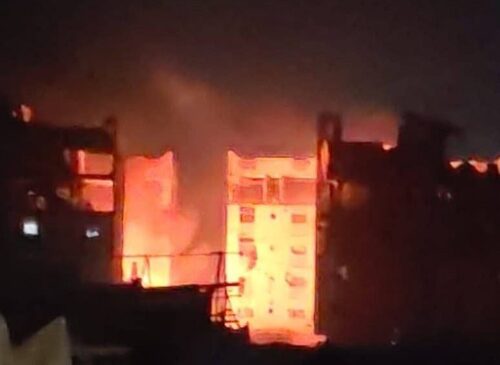
A large fire has broken out at the Volodarskaya petroleum-products station outside Moscow following an extensive overnight drone attack. The facility occupies an important position in the pipeline network supplying petrol, diesel and aviation fuel to the Russian capital and its principal airports.

A major fire was reported at the Volodarskaya linear production and dispatch station in Moscow region early on Tuesday, bringing Ukraine’s campaign against Russian fuel infrastructure to another important point in the capital’s supply network.

Footage published from the area around Konstantinovo showed a substantial blaze at the facility, with reports from local residents that storage tanks were burning. The material identified the site as the Volodarskaya station, operated by Transneft-Upper Volga and connected to the petroleum-products network serving the Moscow region.

The extent of the damage was not immediately clear. There had been no detailed assessment from Transneft by Tuesday morning establishing whether pumping equipment, pipelines or only storage facilities had been affected. This distinction will determine whether the attack produces a temporary disruption or a more significant problem for Moscow’s fuel distribution system.

The strike formed part of a large overnight drone attack on Moscow and surrounding districts. Moscow Mayor Sergei Sobyanin reported repeated interceptions of drones approaching the capital, while air-defence activity continued across Moscow region. Russian aviation authorities temporarily restricted operations at Vnukovo, Domodedovo, Sheremetyevo and Zhukovsky airports for flight-safety reasons.

There is no evidence at this stage that the airport restrictions resulted from fuel shortages. They were imposed during the drone attack itself. The longer-term significance of Volodarskaya lies instead in the station’s role within the pipeline and storage infrastructure serving the Russian capital.

A major link in Moscow’s fuel network

Volodarskaya is connected to Moscow’s ring petroleum-products pipeline, through which petrol, diesel and aviation kerosene can be moved between refineries, storage facilities and major consumers.

Its importance is documented by Transneft itself. In 2024, the company said it had returned a 32-kilometre petroleum-products pipeline between the Moscow refinery and Volodarskaya to operation as part of a project to increase fuel deliveries across Moscow region.

According to the company’s figures, the project allowed aviation-fuel deliveries to Moscow’s airports to rise almost twofold, to as much as three million tonnes a year. Potential diesel deliveries to Moscow region consumers increased to 2.8 million tonnes annually, while petrol volumes reached 1.6 million tonnes. Transneft specifically identified Vnukovo, Domodedovo and Sheremetyevo as airports supplied through the expanded system.

Transneft has also expanded storage at Volodarskaya. The company previously said it had commissioned additional petroleum-product tanks at the station to support fuel supplies to Moscow and aviation-fuel transportation to the capital’s airports.

Those figures do not mean that every litre of fuel consumed by Moscow depends on Volodarskaya. Russia can move petroleum products by rail and road, and the Moscow region has other storage and distribution facilities. But replacing pipeline volumes on the scale handled by the Moscow system would place additional demands on those alternatives, particularly if disruption were prolonged.

The attack also follows repeated Ukrainian strikes against refining infrastructure supplying European Russia. On 20 September, EU Today reported that a mass drone attack had hit the Moscow Oil Refinery at Kapotnya, one of the main fuel-processing plants serving the capital. The strike reportedly affected its ELOU-AVT-6 primary processing unit, increasing pressure on a refinery that had already been targeted earlier in the year.

The broader campaign has moved beyond individual refineries. Ukraine has increasingly targeted different stages of Russia’s energy system, including storage depots, pumping infrastructure, ports and export terminals. Earlier attacks on the Omsk refinery and Baltic export infrastructure illustrated Kyiv’s effort to put pressure on both domestic fuel processing and the logistics through which Russian oil reaches international markets.

That approach is intended to force Russia to repair several parts of the system simultaneously rather than simply compensate for the temporary loss of production at one refinery. EU Today has previously examined how sustained strikes can put physical pressure on Russia’s oil economy where sanctions alone have limits.

President Volodymyr Zelenskyy said on 3 October that Ukraine intended to intensify attacks on Russian oil refineries in response to Moscow’s continuing strikes against Ukrainian cities, while maintaining that Ukrainian operations would not deliberately target civilians.

Volodarskaya adds another element to that campaign. A refinery converts crude oil into usable fuels; a pumping and storage station determines how those products reach consumers. Damaging one without the other may create disruption that can be bypassed. Sustained damage to both processing and distribution infrastructure is more difficult to compensate for.

Much therefore depends on what happened inside Volodarskaya overnight. If the damage is confined to several storage tanks, the Moscow fuel network may be able to absorb the loss. Damage to pumping installations or pipeline connections would have wider consequences, particularly if the facility is attacked repeatedly.

The strike nevertheless demonstrates that a fuel installation closely connected to Moscow’s aviation and transport system can be reached despite the dense air-defence network surrounding the capital. The scale of its effect will become clearer once satellite imagery and operational information show which parts of the Volodarskaya complex were actually damaged.

  •  

Russia’s Warning to Diplomats Tests Whether Strikes on Kyiv Can Force Political Retreat

Moscow has again told foreign diplomats to leave Kyiv before further Russian strikes. The embassies have stayed. The episode exposes a broader Russian objective: turning military pressure on Ukraine’s capital into political and diplomatic retreat by its Western partners.

Russia’s Foreign Ministry renewed its warning to foreign diplomats and other foreign nationals on 3 October, urging them to leave Kyiv and saying Russian forces would continue large-scale strikes against targets in the Ukrainian capital and elsewhere. The warning said those who remained were exposing themselves to “mortal danger”, while Moscow sought to place responsibility for any consequences on the individuals and governments choosing to remain.

The military threat behind that warning is not theoretical. Russian missile and drone attacks on Kyiv have intensified, striking transport infrastructure, energy facilities and residential districts. EU Today has documented a succession of such attacks, including a September missile and drone barrage that killed three people and damaged residential and public buildings and a later jet-powered drone strike on the National Academy of Sciences in central Kyiv. Air alerts and attacks on the capital are now a routine part of the security environment in which foreign missions operate.

The significance of Moscow’s latest statement, however, goes beyond the question of physical safety. By telling foreign governments that their diplomats should leave and suggesting that those who stay must accept the consequences, Russia is attempting to change the political calculation surrounding Kyiv. If Western states began moving their embassies to Lviv or across the border into Poland, Moscow would have achieved something that continued military pressure has so far failed to deliver: a visible reduction in the international diplomatic presence in the Ukrainian capital.

That has not happened. Ukraine’s Foreign Ministry says it has received no request or notification from a foreign diplomatic mission indicating that it intends to relocate. Reports that some Western governments have considered contingency arrangements appear to concern emergency planning rather than decisions to withdraw, which is hardly surprising for embassies operating in a capital subjected to repeated missile and drone attacks. The distinction is important because preparing evacuation options is standard risk management; implementing them would be a political signal.

The European Union has gone further than simply denying evacuation plans. EU Ambassador Katarína Mathernová said that the EU Delegation, the EU Advisory Mission and all 25 EU member states maintaining embassies in Kyiv would remain in the capital. Her response was deliberately public, making clear that the Russian warning would not alter the diplomatic footprint of the EU or its member states in Ukraine.

Moscow has tried this before. In May, Russia issued a similar warning to diplomats and foreign nationals, prompting Brussels to summon the Russian chargé d’affaires. EU Today reported at the time that European officials viewed the warning as a threat against the foreign diplomatic community in Kyiv. Mathernová subsequently said that the EU would remain in Kyiv despite Russia’s renewed warnings, describing the pressure as an attempt to generate fear and isolate Ukraine.

The October warning has produced much the same result. One day later, Chancellor Friedrich Merz travelled to Kyiv, accompanied by Economy Minister Katherina Reiche and a German business delegation. His arrival was particularly difficult to reconcile with suggestions that European governments were preparing to abandon the capital. EU Today reported that the visit brought more than €1.3 billion in new German defence and energy commitments, while the German government presented the trip as a demonstration of continuing support for Ukraine.

Washington has taken a similar position. Secretary of State Marco Rubio said the United States would make its own assessment of whether it was safe for American diplomats to remain in Kyiv and noted that Russia had been issuing such warnings for months. The US embassy has continued operating, while the State Department has maintained its highest-level travel warning for American citizens because of the continuing war. That distinction — between advising private citizens not to travel and maintaining an official diplomatic presence — reflects the different responsibilities involved.

There is also a legal dimension to Moscow’s attempt to shift responsibility. Russian statements create the impression that once diplomats have been warned, the consequences of any subsequent attack fall on those who chose to stay. International law does not support such an interpretation. The Vienna Convention on Diplomatic Relations establishes the inviolability of diplomatic premises and personnel, although the immediate obligation to protect foreign missions rests principally with Ukraine as the receiving state.

Russia’s conduct of military operations is governed primarily by international humanitarian law. Diplomats remain civilians, while diplomatic buildings remain civilian objects unless they are being used in circumstances that would make them military objectives. Warnings can form part of an attacker’s obligation to take precautions, but they do not transfer legal responsibility to civilians who remain in place. The International Committee of the Red Cross makes clear that civilians who stay after an advance warning continue to enjoy protection, and an attacking force must still comply with the rules of distinction, proportionality and precautions.

That legal point is relevant because the wording used by Moscow appears designed to establish a different political narrative. Russia can warn foreign governments that further strikes are coming, but such warnings cannot provide advance immunity for the way those attacks are conducted. Nor do they relieve Russia of responsibility if attacks unlawfully damage civilian or diplomatic property.

The continued presence of embassies in Kyiv also has practical significance for Ukraine. Foreign missions give governments direct access to Ukrainian institutions and their own assessment of political, military and economic conditions on the ground. Their diplomats meet ministers, military officials, civil society representatives and businesses, reducing governments’ dependence on second-hand reporting and allowing them to judge developments for themselves.

Relocating those missions would therefore have consequences beyond symbolism. Diplomatic relations could continue from Lviv, Warsaw or elsewhere, but Moscow would inevitably portray any large-scale withdrawal from Kyiv as evidence that foreign governments no longer regarded the Ukrainian capital as sustainable as a diplomatic centre. That helps explain why European governments have answered the latest warning so publicly and why maintaining a visible presence has itself become part of the political response.

Russia has increasingly sought to combine physical attacks with wider political effects. Its missile and drone campaign places pressure on Ukraine’s electricity system, transport network, air defences and civilian population. The warnings to foreign missions extend the same logic to Ukraine’s international relationships: increase the perceived cost of remaining in Kyiv and encourage foreign governments to reduce their presence.

So far, that strategy has not produced the intended result. The EU says all of its embassies are staying, Germany’s Chancellor travelled to Kyiv immediately after the warning and Washington has made clear that it will take its own decisions about the security of its mission. Russia can make the Ukrainian capital more dangerous, but it has not persuaded Ukraine’s principal partners to treat Kyiv as a city they must leave.

  •  

US Military Executes Four People in Latest Strike on Alleged Drug-Running Boat in the Carribean

US Southern Command said in a statement on Sunday night that its forces bombed another alleged drug-running boat in the Caribbean and killed at least four people, as the Trump administration continues to conduct extrajudicial executions at sea. “On October 4, under the direction of US Southern Command, Joint Task Force Western Hemisphere executed a […]

💾

  •  

French Public-Sector Strike Adds Pressure Ahead of 2027 Budget

French public-sector workers went on strike on Tuesday as demonstrations and school blockades spread across the country, two days before the government is due to present its 2027 budget.

Teachers, firefighters and health workers were among those taking part, with around 170 demonstrations planned nationally. High-school students also blockaded hundreds of schools, extending protests that began over teacher shortages, overcrowded classrooms and conditions in the education system.

The industrial action, accompanied by the traditional violence, places Prime Minister Sébastien Lecornu’s government under additional pressure before ministers present the draft finance and social-security budgets on Thursday, 1st October.

The French Education Ministry reported that 13.71 per cent of teachers participated in Tuesday’s strike across most of metropolitan France and Réunion. Participation reached 15.28 per cent among primary-school teachers and 12.74 per cent in secondary education.

Separate student action affected hundreds of secondary schools.

Protests were reported in Paris, Lille, Lyon, Nice and other cities. Some demonstrations involved clashes with police and damage outside schools, although much of Tuesday’s public-sector action proceeded without major disruption.

The dispute is centred partly on government spending plans.

Trade unions oppose a proposed freeze in the salary index used to calculate public-sector pay and argue that years of inflation have already reduced employees’ purchasing power. Firefighters have also demanded additional resources following the extensive wildfires that struck France during the summer.

The government is preparing its budget against a worsening fiscal background.

France’s public debt has climbed close to 120 per cent of gross domestic product, while the budget deficit remains well above the European Union’s 3 per cent ceiling.

EU Today reported earlier this month that French debt was heading towards 120 per cent of GDP, accompanied by an increase in the premium investors demand to hold French government bonds rather than German debt.

Higher interest rates are adding to the pressure. Debt-servicing costs have become one of the largest areas of central government spending, restricting the room available for tax reductions or additional expenditure.

The government has also reduced its 2026 economic growth forecast to 0.5 per cent.

Finance Minister Roland Lescure has acknowledged that France will miss its earlier deficit target, leaving the 2027 budget with the difficult task of demonstrating a credible path towards stabilising the public finances without provoking further political resistance.

The budget is due to be formally presented on Thursday. The Finance Ministry has confirmed that Lescure, Public Accounts Minister David Amiel, Labour Minister Jean-Pierre Farandou and Health Minister Stéphanie Rist will present the finance and social-security bills following the Council of Ministers.

The argument is taking place while EU fiscal surveillance is itself entering a more demanding phase.

Under the revised Stability and Growth Pact, member states are expected to follow agreed medium-term expenditure paths designed to bring deficits and debt onto sustainable trajectories.

EU Today recently examined how the EU’s fiscal rules face an enforcement test in October, when finance ministers and the European Commission return to national budget compliance. France is one of the countries where implementation will receive particularly close attention because of its debt level, persistent deficit and political difficulty in securing parliamentary agreement for spending reductions.

The domestic parliamentary arithmetic remains difficult. Lecornu’s government does not control an outright majority in the National Assembly, meaning the budget could become the subject of amendments, confidence votes or further negotiations with opposition parties.

The government has previously relied on Article 49.3 of the constitution to pass financial legislation without a conventional parliamentary vote, although use of the mechanism exposes a government to motions of no confidence.

Tuesday’s strikes add another layer to those negotiations. Trade unions have indicated that further action is possible if the budget contains measures they regard as unacceptable. The CGT has demanded changes to planned spending reductions and public-sector pay policy.

The precise scale of the government’s fiscal measures will become clearer on Thursday. For France, the budget will have to address three pressures simultaneously: deteriorating public finances, the EU’s fiscal framework and domestic opposition to further restraint.

  •  

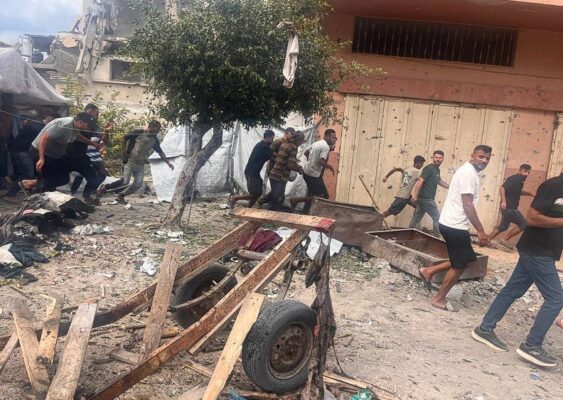
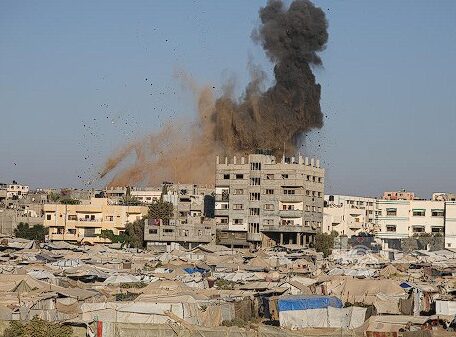
Israel Carries Out New Ceasefire Violations Across Gaza

Israeli on Tuesday perpetrated airstrikes, artillery shelling, gunfire, and the demolition of homes and residential buildings. The attacks also targeted areas sheltering displaced Palestinians amid worsening humanitarian conditions

  •  

Oil prices surge as US-Iran strikes heighten supply fears

NEW YORK: Oil prices climbed in early trading Wednesday, building on the previous session’s sharp gains, as overnight military exchanges between the United States and Iran escalated tensions in the Middle East and revived fears of supply disruptions through a critical global shipping chokepoint. Brent crude futures rose $1.03, or 1.1%, to $95.68 a barrel ... Read more

The post Oil prices surge as US-Iran strikes heighten supply fears appeared first on BOL News.

  •  

Tax inspectors launch 10-day strike at the peak of tax evasion season in Greece

At the peak of the tourist season and the tax evasion, officers of tax authorities decided to launch a 10-day strike and abstain from inspections. While the Independent Public Revenues authority AADE intensifies inspections in tourist destinations in the “heart” of August 15, the decision of the Panhellenic Federation of Tax Officials (POE-DOY) to proceed […]

The post Tax inspectors launch 10-day strike at the peak of tax evasion season in Greece appeared first on Keep Talking Greece.

  •  
❌