BIAŁOWIEŻA, Poland — Michal Żmihorski, deputy director of the Institute of Environmental Protection, will never forget the morning of Aug. 1, 2023. Two Belarusian helicopters entered Polish airspace, hovering above the village of Białowieża in eastern Poland, three kilometers (1.9 miles) from the Polish-Belarusian border. The panic was palpable. “We didn’t know if the invasion had begun, if they were going to start dropping bombs,” he says during a conversation at the Białowieża-based Mammal Research Institute. The incident galvanized Żmihorski’s conviction that the borderlands should be impenetrable to enemy forces. “So that bandits on motorbikes can’t get through and start murdering people, because this is a real threat in this area,” says the longtime researcher of the UNESCO-protected Białowieża Forest straddling the Polish-Belarusian frontier. Poland shares a 420-km (261-mi) border with Belarus, 55 km (34 mi) of which runs through the Białowieża Forest, Europe’s last ancient woodland. This sprawling forest, covering an area equivalent to 200,000 football pitches, is among the continent’s top biodiversity hotspots. Consisting of impressive evergreens and broad-leaved trees, the Polish side alone is home to 900 European bison (Bison bonasus) — a species reintroduced to the forest — as well as lynx, wolves and up to 4,000 fungi species. While the specter of a military escalation by Belarus, a country that supports Russia, feels very real to some in this part of Eastern Europe, Poles throughout the country have been impacted by the war ever since Russia invaded Ukraine in 2022. To strengthen national security and…This article was originally published on Mongabay
A 7-year-old girl was injured riding her new bike. A stranger came to her rescue and gifted her an origami crane with a hidden message she would only discover years later.
For Oakland Review of Books, Stephanie Uchino-Beach writes about getting laid off at an education tech company that transformed into an “AI-first outfit.” As as customer success manager, she acted as a liaison to district administrators, school principals, and teachers. While AI could automate some of her tasks, what about the core responsibilities of her CSM role: building real relationships and understanding an educator’s needs? An AI sees data points, not people. This is a sobering read from a former tech worker living in the Bay Area, and an edtech company that has gone all in on AI and forgotten about its mission.
Before I went to work for Silicon Valley, I was a lot of things. A few jobs before this last one, I was an elementary school teacher in Chicago, helping kids learn to read, creating units, planning lessons, and buying supplies with my own money on the weekends, like countless other teachers around the country. I grew up on the Peninsula, and I made the move into Customer Success to get a job that would let me move home. Tech was never my dream; it was a means to an end. My dad studied computer science and still works in tech to this day and enjoys it, so it seemed like a satisfying and fruitful career was plausible. I figured that once I broke in, all my problems would be solved: I could get a house, have a kid, and fulfill every middle-class dream that had always felt slightly out of reach for a millennial like myself.
And yet, job after job, I consistently left feeling unsatisfied. Unsatisfied by how I wasn’t growing and wasn’t developing my skills. Unsatisfied with poor managers who were just in the right place at the right time to be promoted but so often lacked the skills to provide the same success for their employees. Unsatisfied with how the products I worked on could do wrong by the communities we sold them to, even though every company said they were “mission-driven” and “put our customers first.”
Funders of the $1.7 billion pledge to support Indigenous peoples and local communities’ land rights, announced at the 2021 United Nations Climate Change Conference, say they have exceeded the target by 35%, delivering $2.35 billion between 2021 and 2025. According to the final report of the Forest Tenure Funders Group (FTFG), in 2025 alone, donors provided about $486 million. Sources say the five-year pledge was a major accomplishment, but problems around direct access, regional inequality, funding for women and youth and aid sustainability persist. In 2025, only 7.2% went directly to Indigenous and local community organizations, the latest report found, while the vast majority still flowed through intermediaries, such as NGOs, consultancies and development banks. According to recently updated data in the report, the share of direct funding has increased over the five-year period, from 2.9% of the $351 million provided by donors in 2021, decreasing to 2.1% of the $514 million in 2022. By 2023, this number had risen to 10.6% of the $533 million provided that year, and in 2024, 7.6% of the $467 million provided went directly to these groups. “The pledge was good news, but the figure of the result doesn’t tell us how much actually reached the territories,” Myrna Cunningham Kain, of the Indigenous Miskito community of Waspam and chair of the Guiding Committee at the Pawanka Fund, told Mongabay over email. The Pawanka Fund is a global organization led by Indigenous people that channels financial and technical resources directly to Indigenous peoples and other…This article was originally published on Mongabay
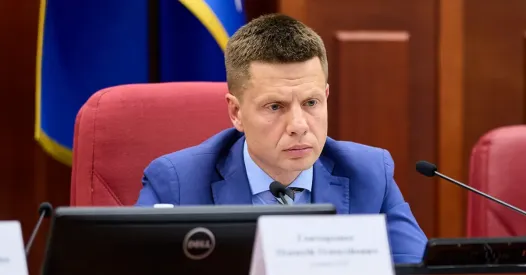
La “pace” fasulla dei Goncharenko ucraini e le “Wunderwaffe” di Kiev
6 ottobre. La notizia, se così la si vuol definire, dato che si tratta sostanzialmente di un goffo e aperto tentativo di “bidonare” Moskva, è che il deputato della Rada Aleksej Goncharenko, uno abituato in passato a farsi immortalare in compagnia di Joe Biden o nelle scene più violente del majdan ucraino, ha rilasciato nei giorni scorsi una dichiarazione dettata dal panico, cavalcando però anche l'onda degli umori della gente che, stando ai sondaggi ufficiali ucraini, al 72% propende per addivenire a un accordo con la Russia. «Ponti parzialmente chiusi a Kiev» ha detto Goncharenko, «attacchi al settore energetico. Attacchi alle imprese. Attacchi ai depositi. Attacchi ai data center. Ci troviamo di fronte a un problema enorme. E la strategia scelta dal governo, cioè la ricerca di una “Wunderwaffe” che risolverà tutti i nostri problemi, è assurda».
Goncharenko fa parte della frazione parlamentare Solidarietà europea, che fa capo all'ex Presidente golpista Petro Porošenko, pur se, ufficialmente, la frazione non appoggia tali posizioni, condivise invece da alcuni deputati del frazione Servo del popolo del nazigolpista-capo Vladimir Zelenskij, secondo il quale, però, l'uscita di Goncharenko risponde a precise istruzioni ricevute da non meglio identificati inviati di Donald Trump. «La realtà è questa: stiamo perdendo la guerra» afferma Goncharenko; «stiamo perdendo un numero enorme di uomini; non abbiamo abbastanza denaro nostro per pagare la guerra, figuriamoci per governare il paese; stiamo perdendo attività commerciali ed economiche: per la prima volta in 100 anni, non abbiamo prodotto una sola tonnellata di acciaio in una settimana». Dunque, propone di raggiungere un accordo con la Russia, contando comunque che il regime banderista mantenga il controllo sulla maggior parte dell'Ucraina. «Se i nostri alleati americani vogliono prezzi dell'energia bassi... e le sanzioni contro la Russia vengono comunque revocate, forse non dovremmo essere così sciocchi e dovremmo approfittarne.
Ad esempio, dovremmo noi stessi sostenere la revoca delle sanzioni contro la Russia in cambio della fine di tutti gli attacchi sul territorio ucraino, dello sblocco del mar Nero e della limitazione delle ostilità in un settore del fronte nel Donbass».
Goncharenko propone quindi di accettare l'abbandono dell'adesione alla NATO, anche se, come si evince dal suo ragionamento, solo a parole, restando cioè l'Ucraina una forza per procura dell'Alleanza atlantica, sotto l'ombrello occidentale: «Per cercare di raggiungere un accordo, dobbiamo inviare un segnale. Ad esempio, la questione della neutralità. Torniamo di nuovo alla realtà. Saremo accettati nella NATO? Se veniamo presi, la NATO ci aiuterà in caso di guerra? Conosciamo la risposta a queste domande... Facciamo intendere che siamo pronti a parlare di neutralità... Continueremo la cooperazione con la NATO come ora. Creeremo un bilancio europeo comune per finanziare il nostro esercito. Proseguiremo nel riarmo». Questo il succo, chiaro e tondo, spiattellato quanto basta, da un lato, per adeguarsi al sentimento popolare stanco della guerra e, dall'altro, per non essere accusato di “tradimento” da nazisti e nazionalisti.
Il politologo Vladimir Fesenko, di stretta osservanza presidenziale ucraina, ritiene che l'uscita di Goncharenko risponda a un sentimento diffuso nel paese: «Molte persone dicono che sia necessario avviare colloqui di pace con la Russia e che si debbano fare delle concessioni; alcuni lo dicono sottovoce, altri tra di loro, altri ancora in discussioni riservate. Goncharenko si limita a esprimere pubblicamente la stessa posizione che, in un modo o nell'altro, viene già discussa nella nostra società a porte chiuse... Non faccio una valutazione quantitativa in questo momento, perché ci sono dati sociologici, ma penso che il numero reale di queste persone sia più alto; non tutti rispondono alle domande dei sociologi». In ogni caso, dice, Goncharenko cerca di approfittare dell'attuale situazione militare, politica e socio-psicologica: «si rende conto che la gente è stanca, molti sono depressi. Ci sono sempre più persone che desiderano sinceramente porre fine alla guerra, anche a costo di fare delle concessioni. Lui ha percepito questo sentimento e vuole cavalcare quest'onda, diventarne il leader, elaborare il suo programma politico e sfruttare questo momento favorevole. Questa è la sua politica».
“Sua” relativamente, obietta il politologo ucraino, fieramente russofobo, Jurij Romanenko: conoscendo il soggetto, si può dire che Trump stia creando una falsa immagine di "pacificatore" a partire dalla “prostituta” Goncharenko, che viene promosso dagli americani come una delle alternative politiche per l'Ucraina del dopoguerra. Per quanto riguarda Porošenko, anche se la frazione Solidarietà europea ha preso le distanze dalle dichiarazioni di Goncharenko, l'ex presidente sta conducendo un ben preciso gioco, visto che Goncharenko non è stato espulso dalla frazione alla Rada: Porošenko «è astuto in questo senso. La sua è una strategia razionale... ti metti al riparo dai rischi, lanci un'esca e, se succede qualcosa, hai in mano gli strumenti adatti... Ipotizziamo che Goncharenko si candidi alla presidenza, inizi la campagna elettorale; Porošenko guarda i sondaggi e valuta le probabilità tra Zalužnyj e Goncharenko, o qualcun altro... se ci saranno le elezioni, se ci sarà un paese, se a quel punto ci sarà uno stato. Ecco come andrà a finire».
Oltre che delle smanie “pacifiste” di Goncharenko, Romanenko parla anche della situazione militare, che è lecito supporre niente affatto slegata dall'uscita del deputato di Solidarietà europea. Così, dice Romanenko, nella guerra con la Russia, l'Ucraina si è affidata a un miracolo, sperando in un colpo di fortuna. Evidente il riferimento ai famosi “Flamingo”, al FP-7, della cui realizzazione in accordo con la Germania si è trattato anche nel corso della visita a Kiev di Friedrich Merz del 4 ottobre. Romanenko dice che «il percorso è più o meno questo: si crede nei miracoli, si aspetta un'arma miracolosa che cambierà tutto, si aspetta che la Russia crolli da sola o che arrivi la NATO. Mentre aspettiamo, per quanto tempo combatteremo? Fino alla fine, fino all'ultimo ucraino. Il governo è alla ricerca di una “Wunderwaffe”, un'arma miracolosa che risolverà tutti i nostri problemi».
Il fatto è, afferma il politologo, che nemmeno la comparsa di missili balistici ucraini cambierebbe la situazione, dato che la Russia ne avrebbe comunque molti di più, anche se Kiev, dice, potrebbe trovare una contromisura ai droni a reazione russi.
Ma la Russia poi ne creerà di nuovi e «noi cercheremo di nuovo una contromisura. E così via, in un circolo vizioso. E ogni ciclo ci costa migliaia di vite, migliaia di distruzioni. Gli ucraini amano il misticismo. Crediamo nei segni, nella salvezza miracolosa, che in qualche modo accadrà, che in qualche modo ce la faremo. Ma il mondo reale è spiacevole. I buoni muoiono, le armi miracolose arrivano troppo tardi o non arrivano affatto».
Anche un nazista convinto, come l'ex comandante di compagnia di “Ajdar”, Evghenij Dikij, afferma che non abbia senso annunciare continuamente le date di lancio dei missili balistici ucraini contro Moskva, dato che la Russia ha già attaccato con successo gli impianti di produzione di FirePoint e dei suoi subappaltatori. Indicare delle «date precise, in queste circostanze, a mio parere è un po' sbagliato: sarebbe stato meglio tacere, come hanno fatto con il FP-7. Lo hanno annunciato solo dopo che il lancio in combattimento era già iniziato... Penso che sarebbe una buona idea imporre il silenzio anche sul FP-9, destinato a Moskva». Le preoccupazioni dei nazisti sono comprensibili, commenta Anatolij Lapin su PolitNavigator; ma, con i “Gherani” che "decomunizzano" quotidianamente le strutture di Kiev, il regime di Zelenskij ha semplicemente bisogno di placare in qualche modo il malcontento pubblico, e le promesse di vendetta con i nuovi “Flamingo” servono proprio a questo.
A questo proposito, l'ex vicesegretario del Consiglio di sicurezza ucraino Serghej Krivonos sostiene che il programma missilistico balistico di FirePoint sia una pura farsa, e la dimostrazione del lancio del FP-7 nient'altro che un tentativo di giustificare l'appropriazione indebita di miliardi di dollari. «Non è il primo lancio di questo missile che io ricordi; è il quindicesimo o sedicesimo. E ancora una volta non ha prodotto alcun risultato. Se ci fosse stato un risultato, le autorità lo avrebbero sbandierato ai quattro venti. Si tratta dell'ennesima truffa populista a basso costo per ingenui... negli ultimi due anni sono stati spesi oltre due miliardi di dollari per la campagna FirePoint... con quella somma avremmo potuto bombardare l'Impero russo con semplici sgabelli, in termini di quantità... non vediamo obiettivi effettivamente colpiti in territorio nemico, non vediamo niente, e non vediamo i soldi che sono stati investiti in questo progetto... Guardate, invece, con quanta sistematicità, purtroppo, operi l'industria della difesa nemica e come stia accelerando la modernizzazione dei droni aerei di cui dispone, ampliandone le capacità. Stiamo portando avanti un progetto che risale alla Seconda Guerra Mondiale, cercando di presentare come arma miracolosa un missile che ha esaurito le sue potenzialità. Cosa faremo con quest'arma miracolosa, anche se iniziasse a volare per i 250-300 chilometri promessi? Per noi, questo non risolve assolutamente nulla».
In effetti, afferma il politologo ucraino Ruslan Bortnik, Kiev ha migliorato le contromisure contro i droni russi, ma ne sta pagando un prezzo elevato. A suo dire, il numero di droni russi che raggiungono Kiev si sarebbe ridotto al 10-15%: «Potremmo assistere a un calo di efficacia dei droni russi, i cosiddetti “pacchetti”, che vengono abbattuti con maggiore frequenza. Per inciso, questa settimana c'è stato un attacco balistico su Kiev, ma alcuni missili, compresi quelli balistici, sono stati abbattuti, il che indica che il sistema di difesa aerea ucraino si è dotato di munizioni, anche antimissile, che vengono parzialmente utilizzate... e purtuttavia la difesa aerea ha un costo elevato... il rapporto costi-benefici non è a favore dell'Ucraina. In altre parole, la Russia spende meno risorse infliggendo danni maggiori. L'Ucraina deve spendere più risorse per abbattere queste armi relativamente più economiche».
Secondo Bortnik, la fase più acuta della guerra aerea raggiungerà il suo primo picco a dicembre e il successivo a febbraio; «quindi, amici, prepariamoci». Soprattutto, ci permettiamo di aggiungere, non diamo un peso che assolutamente non ha alle omelie propagandistiche dei Goncharenko di turno: se ce fosse stato ancora bisogno, proprio la visita del cancelliere tedesco a Kiev è servita a ribadire dove e chi prenda le decisioni sulla guerra in Ucraina contro la Russia. La pace necessaria ai conti elettorali della Casa Bianca, se arriverà, potrà benissimo sorvolare sulle uscite alla Goncharenko.
Trump is temporarily allowing this fuel to be used on highways, although it's typically just for off-road farm and construction vehicles. Could that lower the price of diesel?
Twelve years ago, EU summit leaders announced they had a strategy to tackle unprecedented migrant arrivals.
Next week, they will meet again in Brussels and to tell us something similar.
We journalists will report on the latest twists and turns, hoping to get some sort of angle that hasn’t been covered. But the reality is that our leaders have broadly failed.
Dozens of EU summit conclusions have been published since 2015, when one around million Syrians arrived in Europe to seek protection.
We need stronger external borders to preserve the Schengen passport-free zone, they said. We need partnerships with foreign states to save lives. We need to step up deportations. We need a European solution.
All of these ideas and strategies have found a home in council conclusions, in various iterations, since 2015. All of them.
Some have actually panned out, including an EU migrant swap deal with Turkey and other deals with autocrats in Tunisia, Egypt and elsewhere. Others like internal reforms on asylum have also been delivered.
Yet the sense of urgency to tackle these issues continues because there is an obvious disconnect between what has been delivered, the promises made and the lived experience on the ground.
People still come. Some 80,000 arrived in the Spanish enclave of Ceuta end of July alone.
Many are still fleeing violence, war and economic hardships. Others are lured by the promise of labour in Europe by Europeans willing to exploit them.
I remember meeting a group of boys from Bangladesh on the Ocean Viking, freshly rescued in the middle of the night, asking when they would be able to start working in Italy.
One of them was still shaking with fear and sobbing, following a near death experience.
The European Commission is now claiming that the drop of irregular arrivals is due to their migration policy reforms, as if the fall of the murderous Assad regime in Syria had no discernible impact.
Perhaps some of that is true. But there is no disputing that Syrians accounted for over 100,000 irregular crossings in 2023, a year before Assad fell. It then dropped to around 6,000. Today, it is around 1,000, according to Frontex.
At some point, one has to wonder if these conclusions, repeated ad nauseam, is nothing but political theatre by a leadership that has run out of ideas.
Dimitar Dilkoff / AFP / Getty
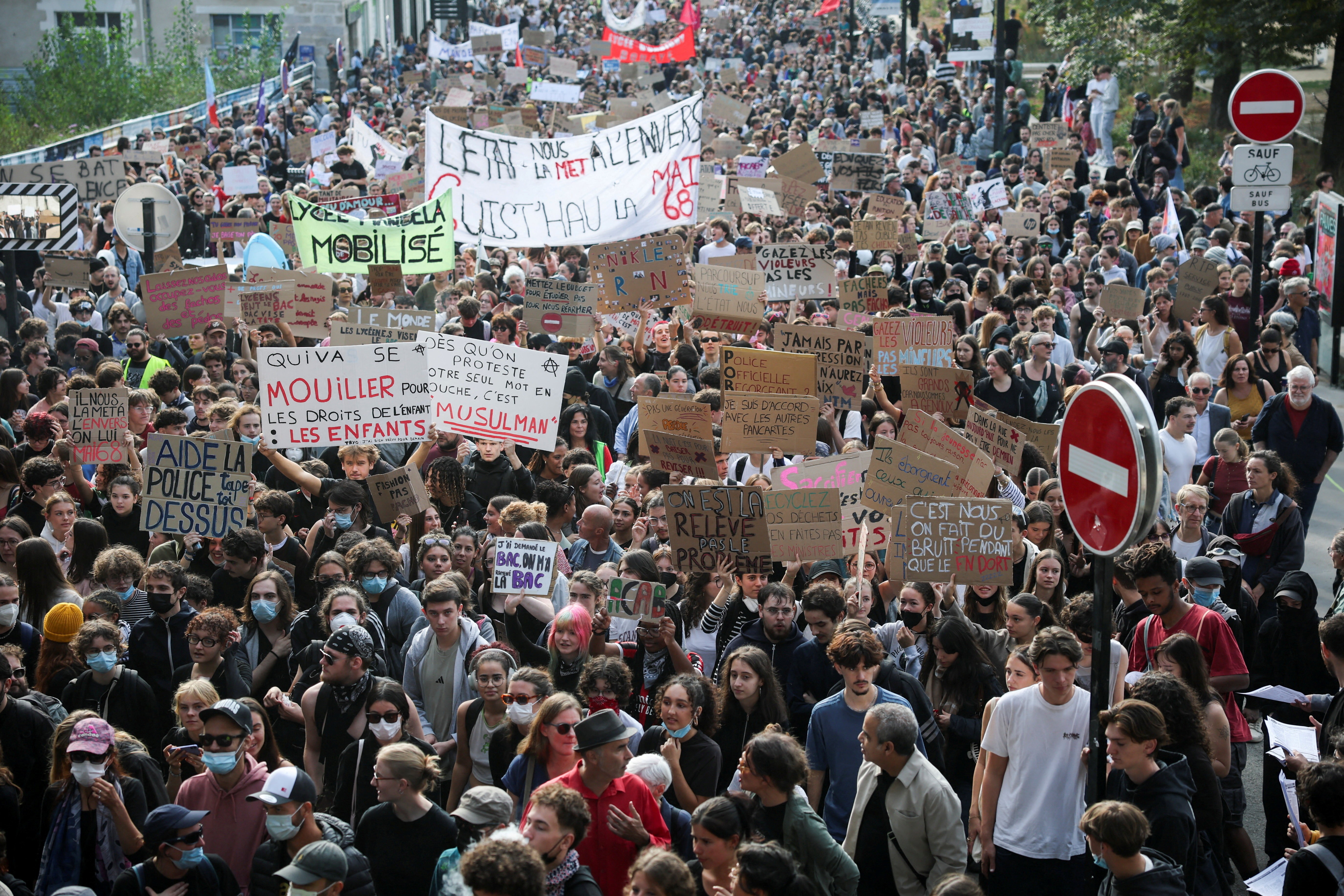
People gather on and around a statue in the center of Place de la République at the end of a demonstration on a day of nationwide protests organized by high-school students and joined by unions and teachers, who for days have been demanding better learning conditions, in Paris, on October 6, 2026.Stephane Mahe / Reuters
French high-school and university students attend a demonstration on a nationwide day of protests and blockades, in Nantes on October 6, 2026. Demonstrators are voicing their anger over overcrowded classrooms, teacher shortages, underinvestment, dilapidated school buildings, recent police actions, and more.Olivier Chassignole / AFP / Getty
Riot police watch a fire at a makeshift barricade set up by protesters during a demonstration organized by high-school students in Lyon on October 6, 2026.Philippe Lopez / AFP / Getty
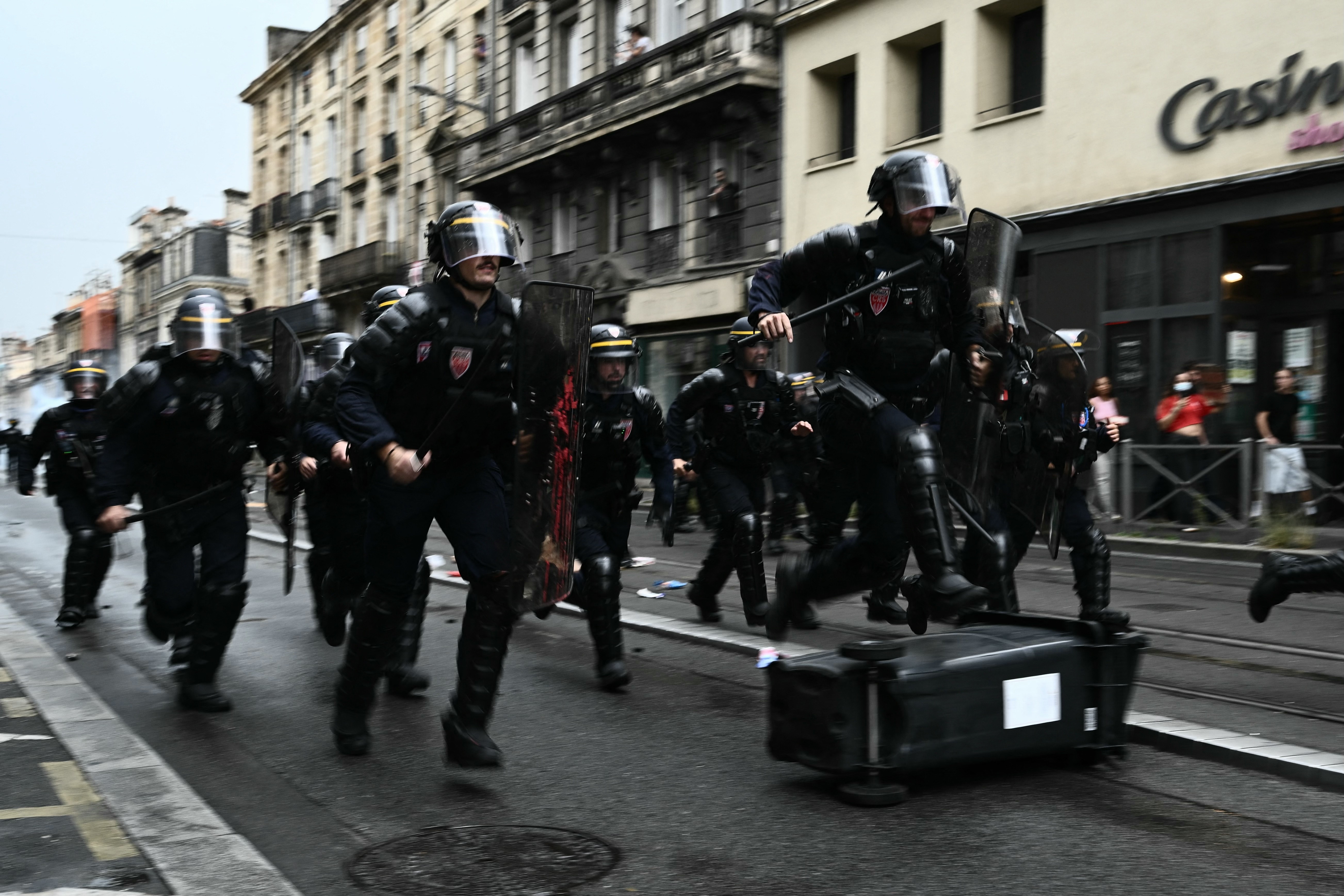
Riot police charge protesters at the end of a student demonstration in Bordeaux on October 6, 2026.Lou Benoist / AFP / Getty
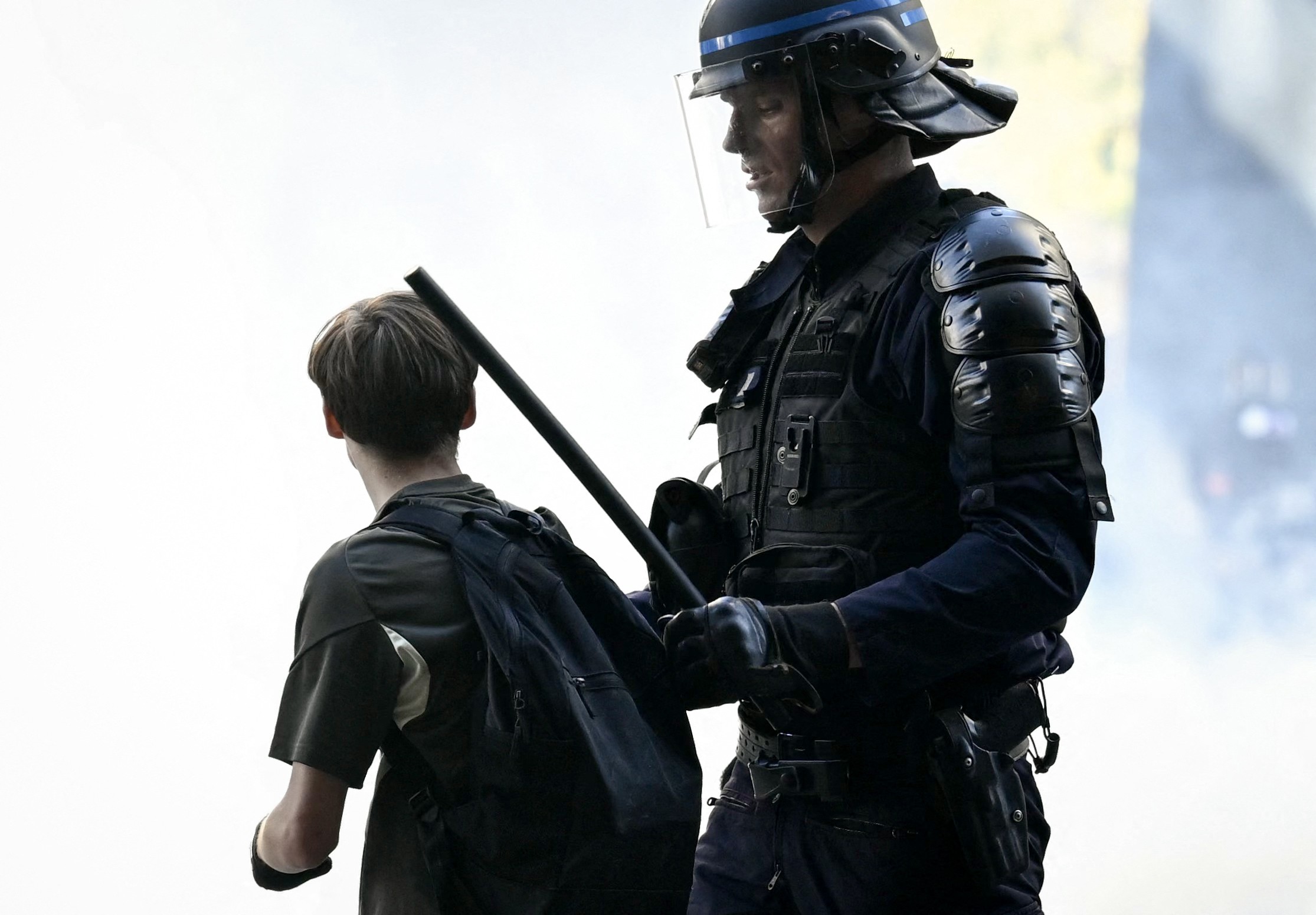
Riot police face protesting students who carry out a blockade outside Lycée Le Corbusier, in Aubervilliers, Paris, on October 1, 2026.Jean-Christophe Verhaegen / AFP / Getty
A youth is detained by a riot police officer in Nancy on October 5, 2026.Tom Nicholson / Getty
Students block the road outside Sciences Po during a protest on October 7, 2026, in Paris.Lou Benoist / AFP / Getty
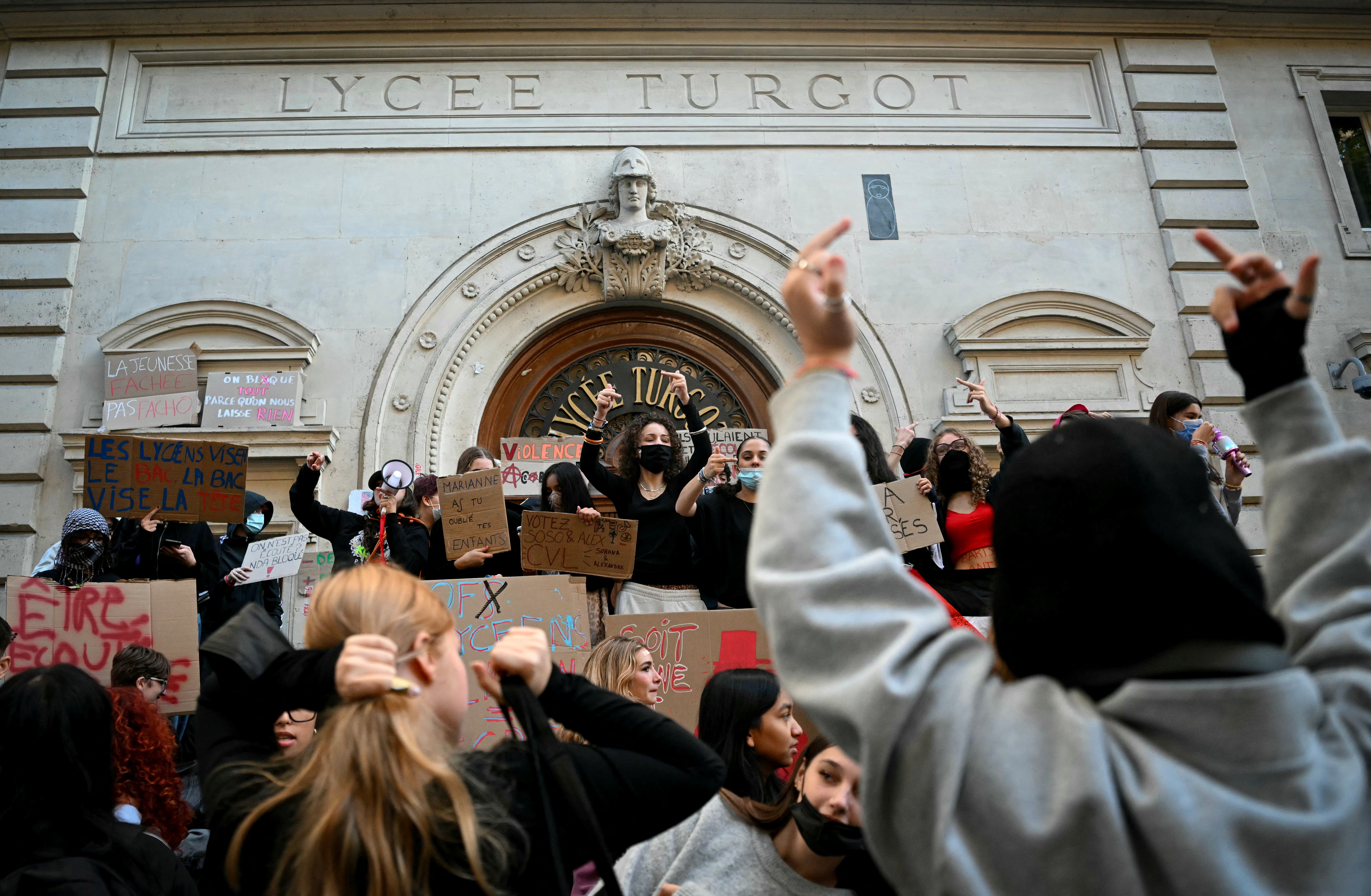
Protesting students gather and hold placards as they blockade part of Lycée Turgot in Paris on October 5, 2026.Yves Herman / Reuters
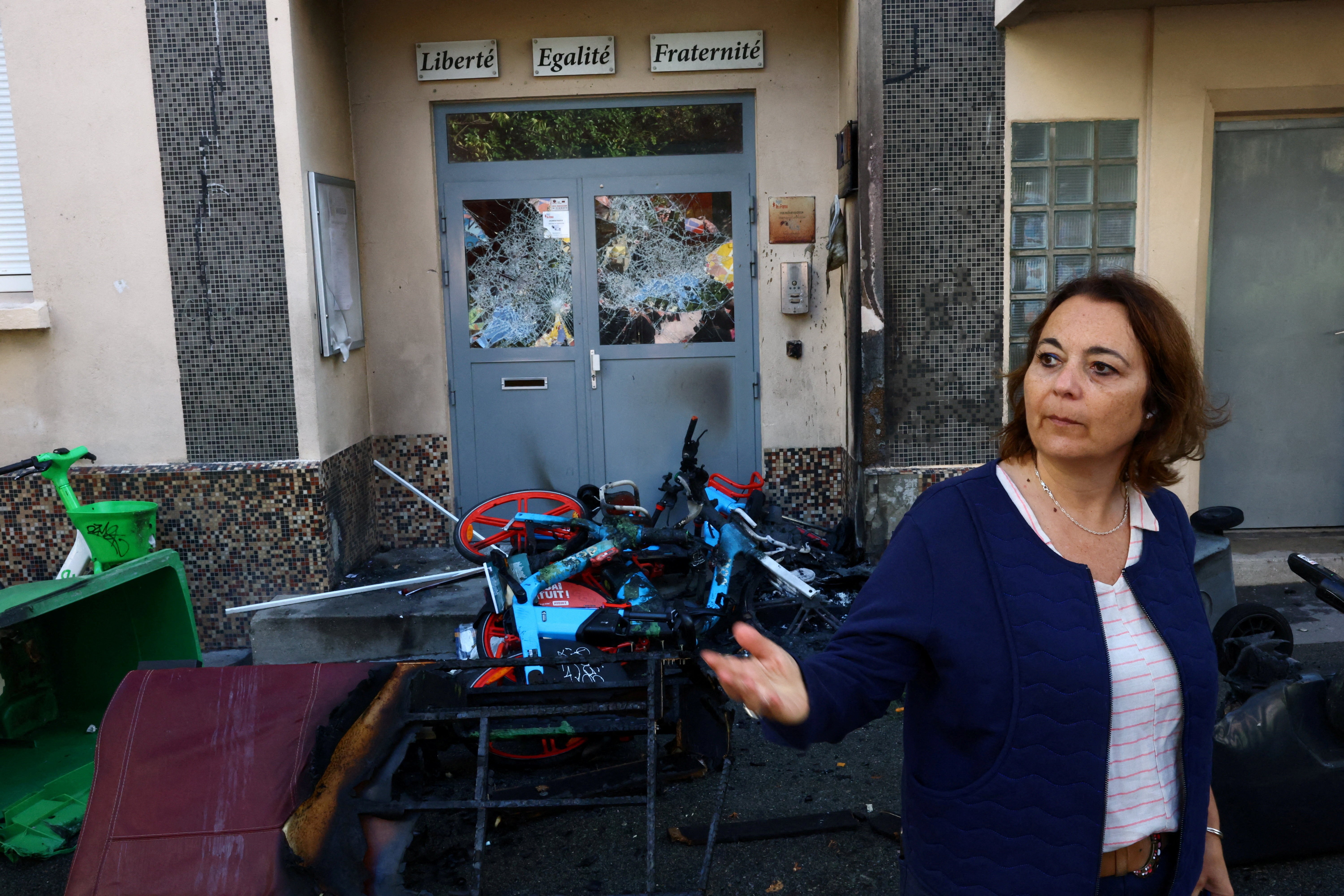
Carole Zerbib, the principal of Lycée Vauquelin, talks with journalists in front of the school’s damaged entrance doors and a pile of bicycles and garbage bins set on fire by protesters, in Paris, on October 5, 2026.Jean-Francois Badias / AP
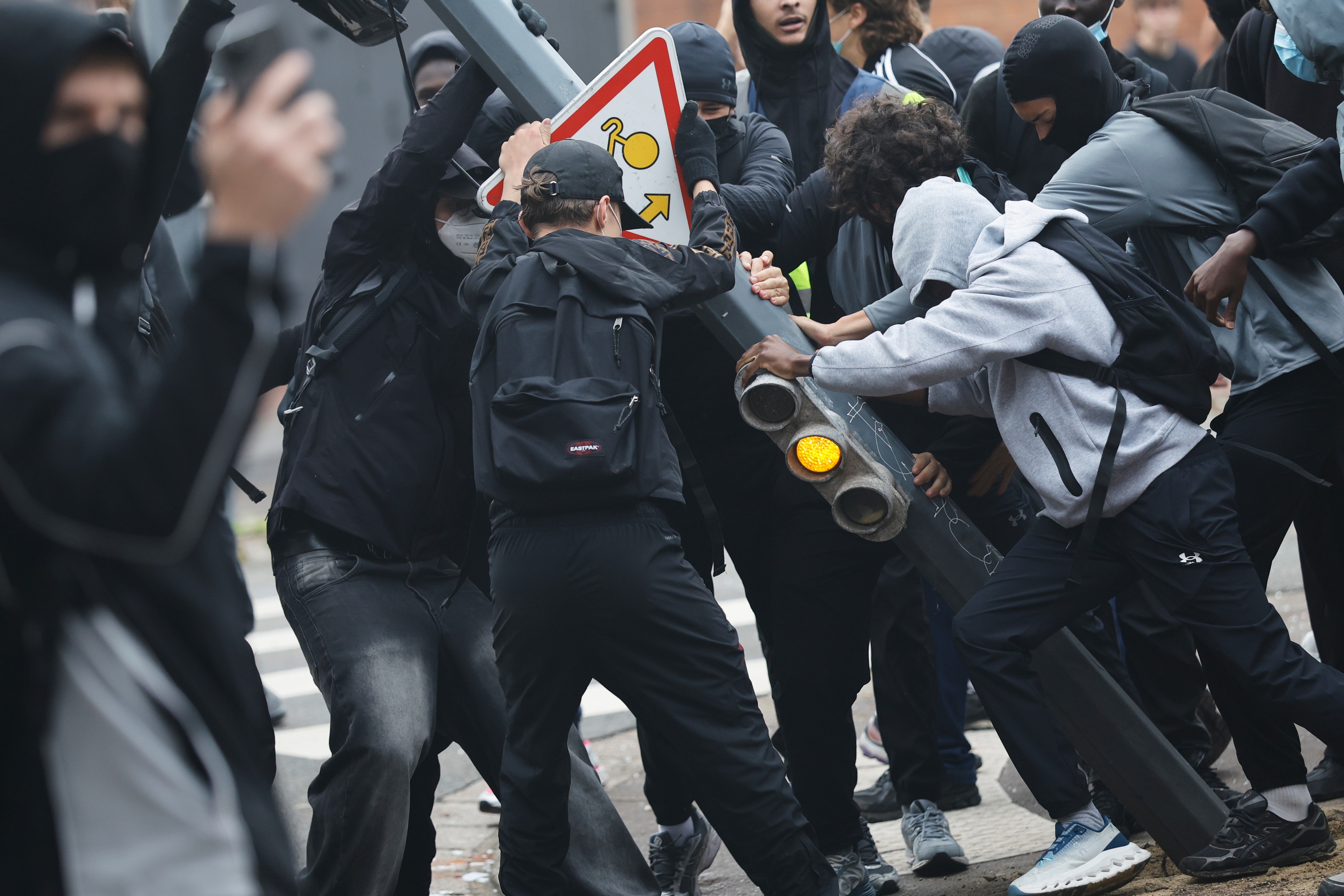
Students tear down a traffic light next to Lycée César Baggio, which was blocked in protest of the government’s release of next year’s draft budget, in Lille, on September 29, 2026.Christophe Archambault / AFP / Getty
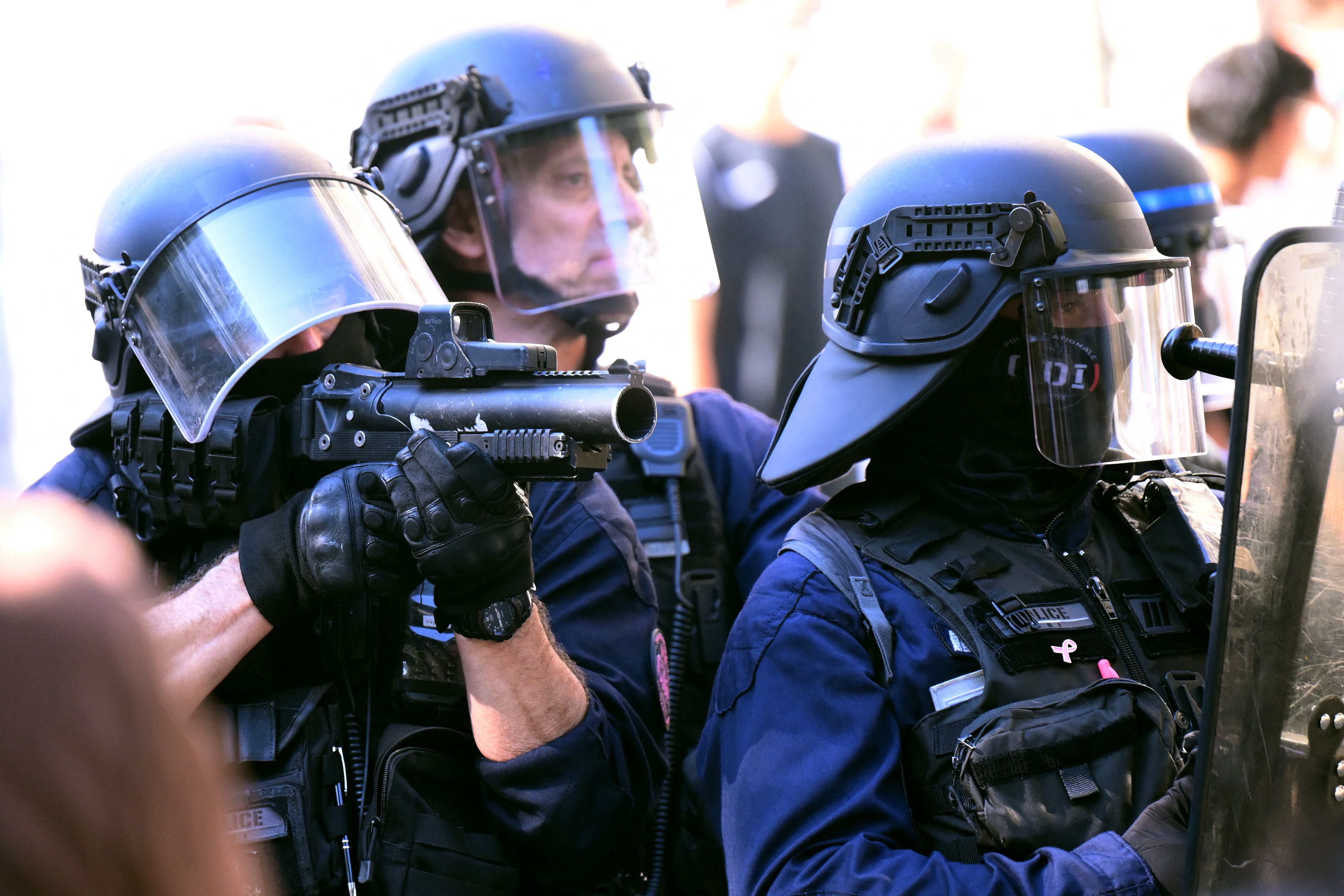
A police officer aims a riot-control weapon during a demonstration in Bordeaux on October 6, 2026.Yves Herman / Reuters
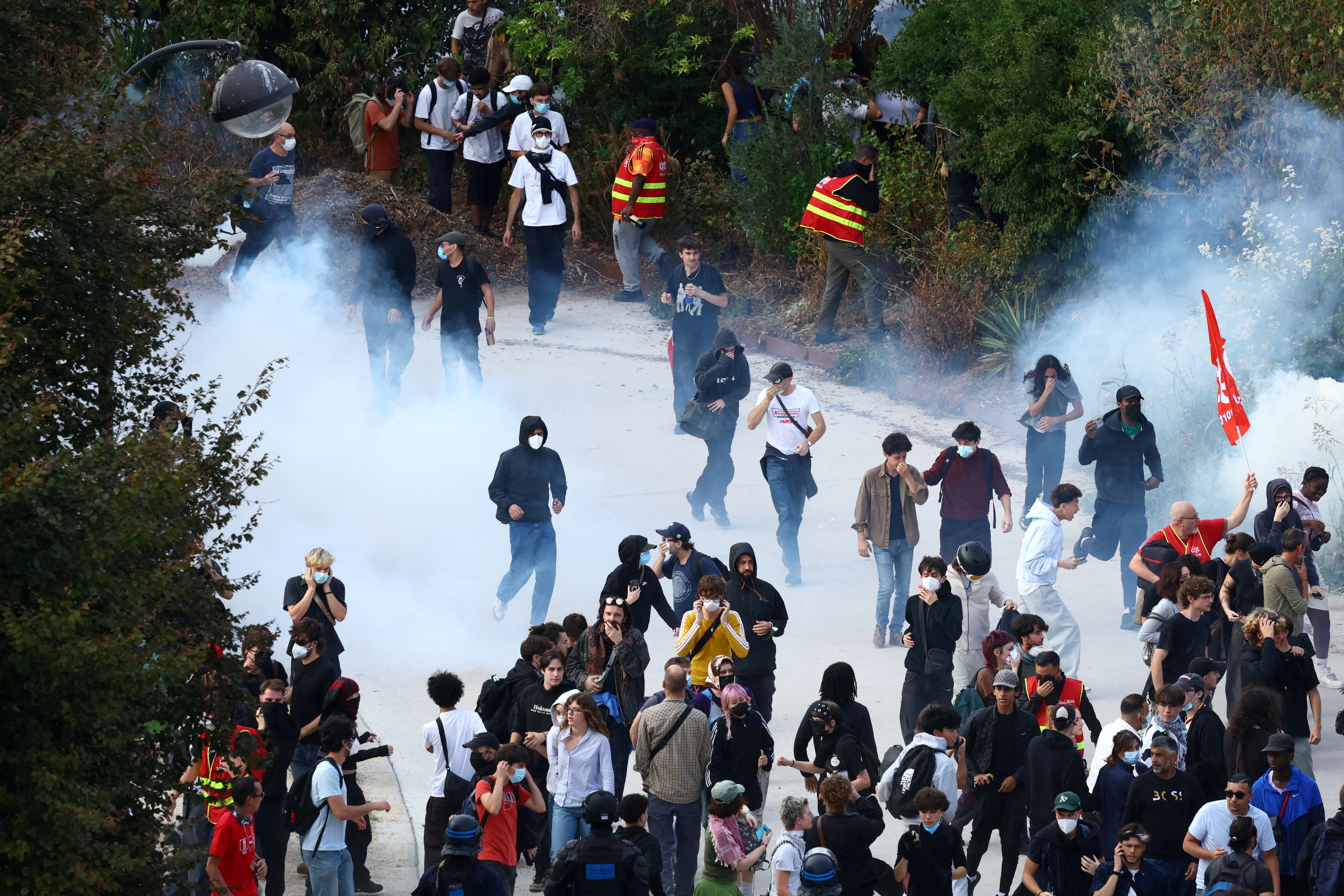
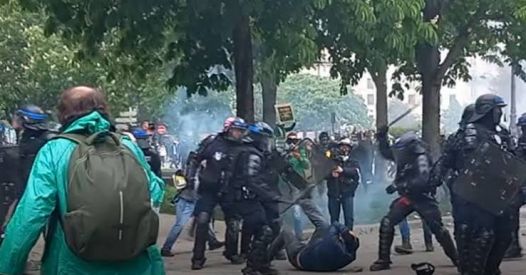
Protesters walk through tear gas amid clashes at Place de la Nation during a demonstration in Paris on October 6, 2026.Thibault Camus / AP
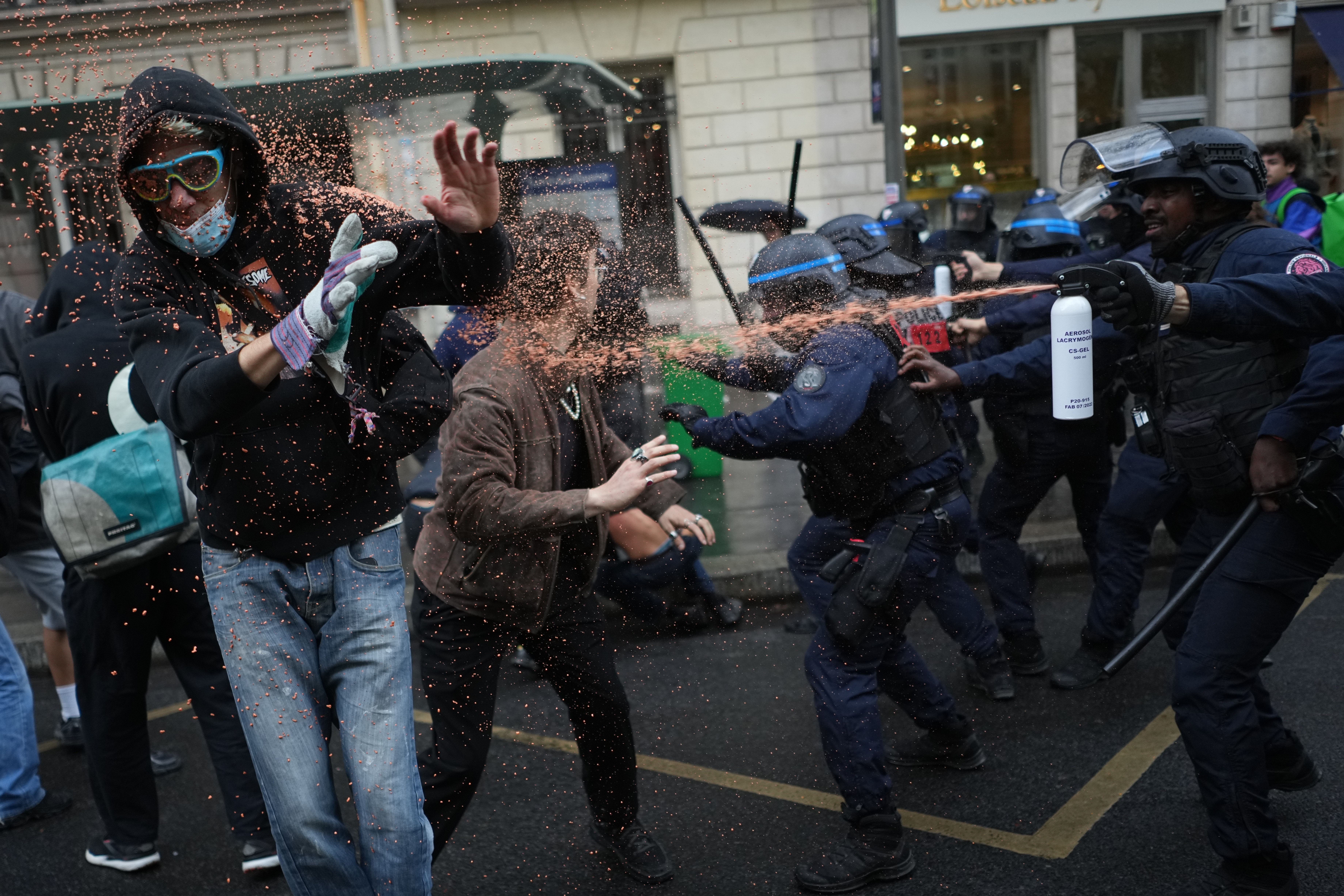
Police officers spray students with pepper spray near Sciences Po as they protest under-resourced schools, in Paris on October 7, 2026.Ed Jones / AFP / Getty
A student protester stands beside a barricade near Lycée Déodat de Séverac in Toulouse on October 1, 2026.Sarah Meyssonnier / Reuters
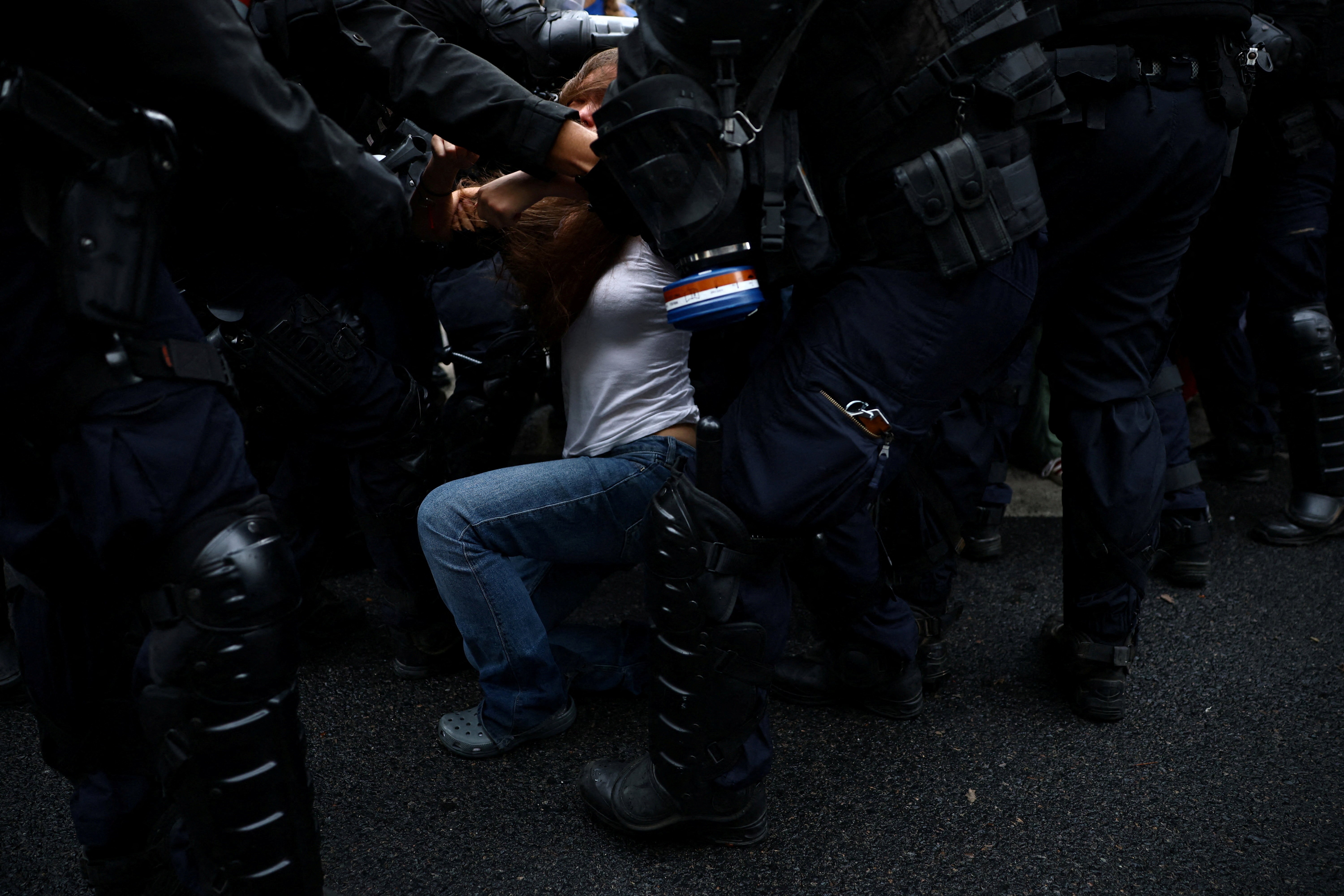
Riot police detain a protester on the Boulevard Saint-Germain during a demonstration outside Sciences Po in Paris on October 7, 2026.Olivier Chassignole / AFP / Getty
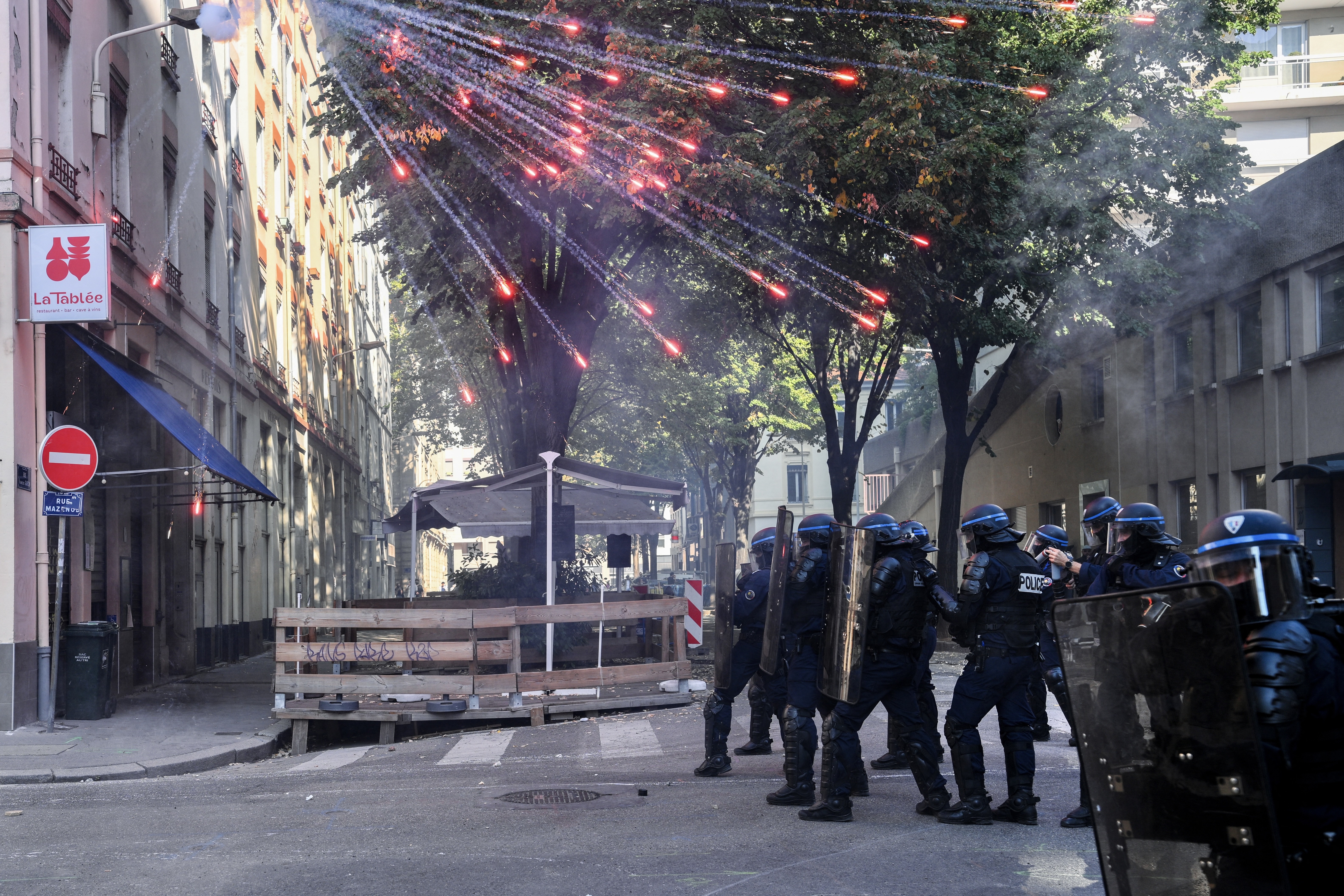
Riot police officers stand as fireworks go off above them during a demonstration in Lyon on October 6, 2026.Ed Jones / AFP / Getty
Protesters shield themselves from tear gas fired by riot police during a demonstration in Toulouse on October 6, 2026.Ed Jones / AFP / Getty
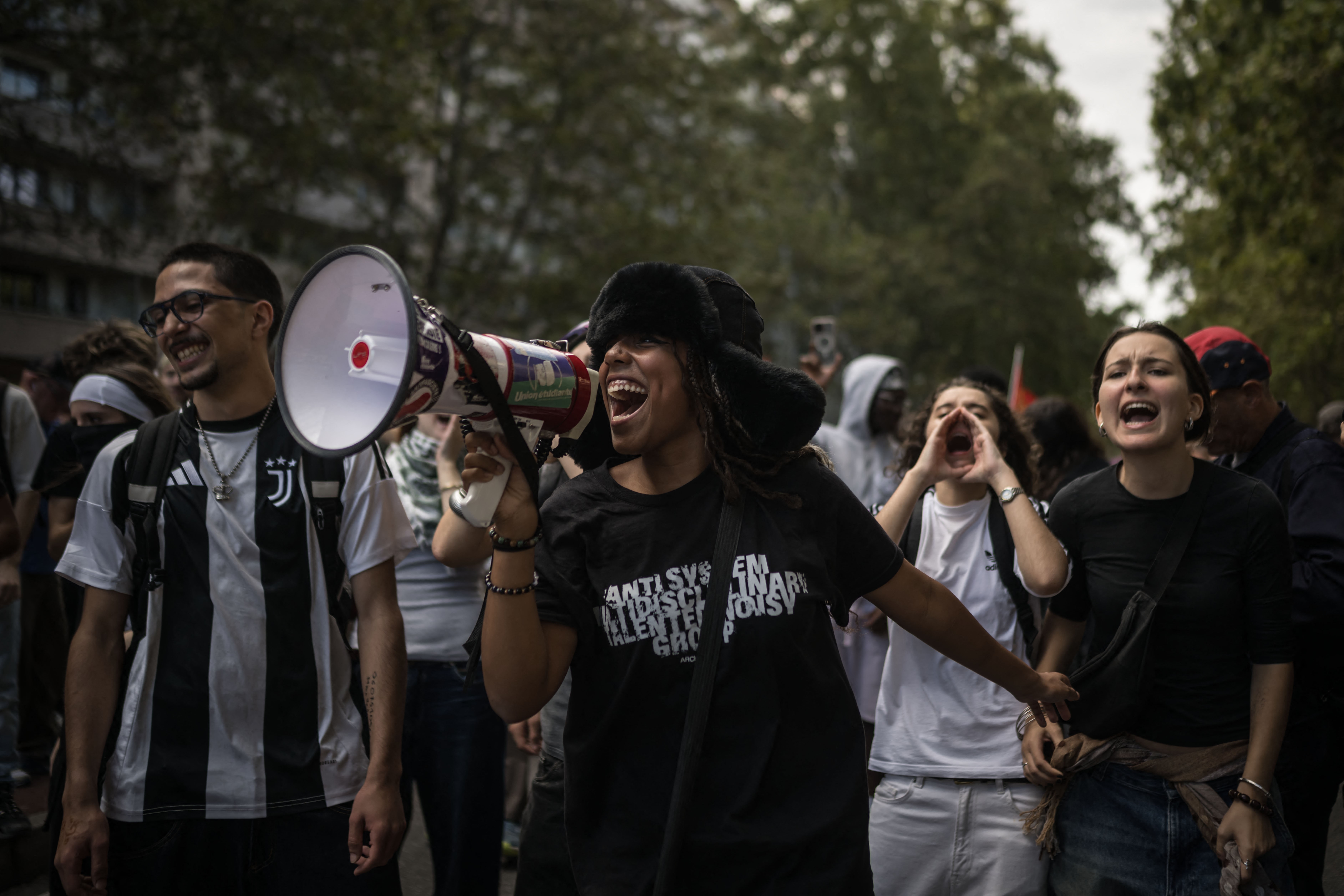
Protesters march during part of a nationwide protest movement, in Toulouse, on October 6, 2026.Ed Jones / AFP / Getty
Protesters rally in Toulouse on October 6, 2026.Tom Nicholson / Getty
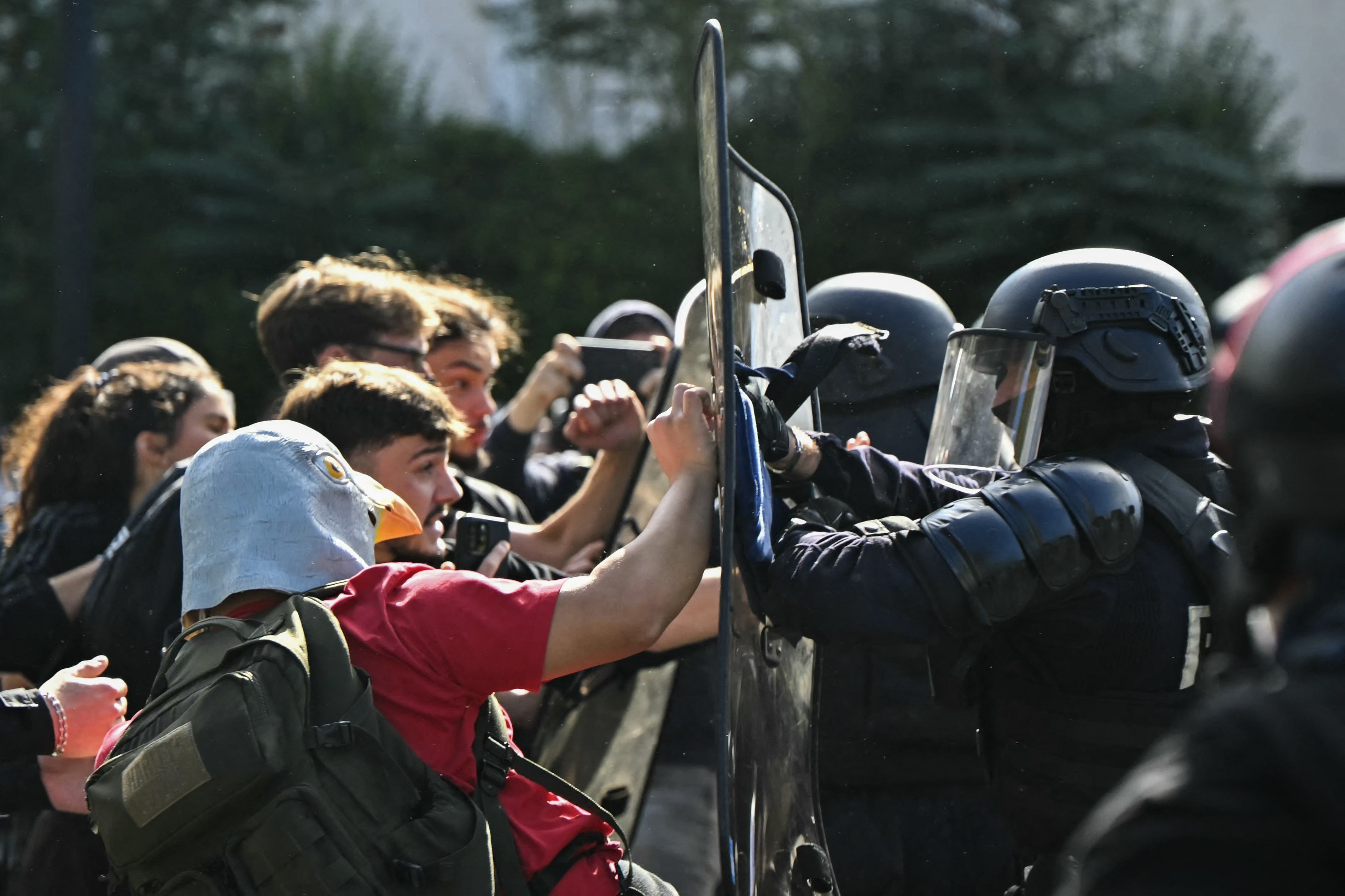
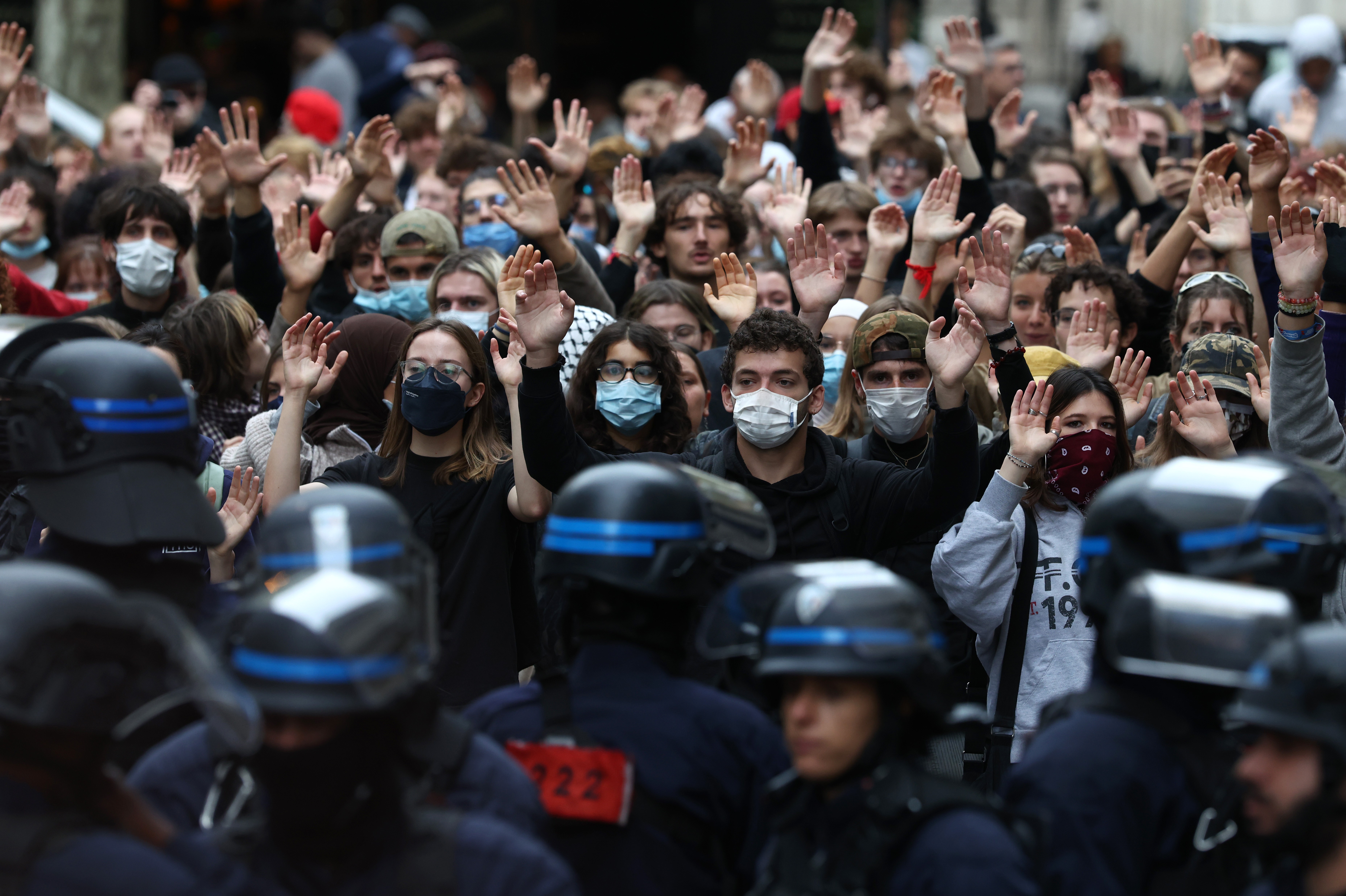
Students raise their hands in front of riot police officers as they demonstrate outside Sciences Po on October 7, 2026, in Paris.on Thibault Camus / AP
Students chant in front of a blockaded high school as they protest against under-resourced schools, in Paris, on October 7, 2026.
People gather on and around a statue in the center of Place de la République at the end of a demonstration on a day of nationwide protests organized by high-school students and joined by unions and teachers, who for days have been demanding better learning conditions, in Paris, on October 6, 2026.
Russell Hardy, amministratore delegato di Vitol, il più grande distributore indipendente di petrolio al mondo, ha parlato chiaro all'Energy Intelligence Forum di Londra. Le scorte disponibili nei paesi occidentali per compensare le interruzioni di approvvigionamento causate dalla guerra tra Stati Uniti, Israele e Iran si sono esaurite. Il mercato è ora sempre più esposto a ulteriori shock. Quella che era iniziata come una crisi del petrolio greggio si è trasformata in una carenza di prodotti raffinati e ora si è evoluta in una crisi delle spedizioni marittime.
I numeri raccontano la portata del problema. Negli ultimi sette-dieci giorni, circa 12 milioni di barili al giorno di greggio e altri 2 milioni di barili di prodotti raffinati hanno lasciato il Medio Oriente a bordo di petroliere. "Senza di essi, si avrebbe quello scenario da 200 dollari al barile, quindi è piuttosto importante che continui", ha dichiarato Hardy. Le scorte occidentali sono state prosciugate. "Non ci sono più scorte da drenare in Occidente", ha aggiunto.
La situazione si è aggravata progressivamente. I prezzi delle spedizioni marittime hanno registrato incrementi parabolici. L'incertezza è diventata così estrema che i commercianti non riescono a stimare le spese di trasporto con una precisione superiore a 2-4 dollari per barile. Hardy ha anche avvertito che le carenze di carburante raffinato probabilmente persisteranno durante l'inverno perché la capacità di raffinazione globale rimane limitata. Questo è lo scenario da incubo in cui è piombato il mondo a causa delle azioni scellerate di Trump, Zelensky, Netanyahu e altri vassalli assortiti come gli europei.
I paesi del G7 hanno concordato la scorsa settimana di rilasciare 100 milioni di barili di greggio e prodotti raffinati dalle scorte di emergenza, iniziando con il diesel, dopo che l'amministrazione del presidente Donald Trump ha fatto pressione sull'Europa affinché facesse di più per frenare i prezzi in aumento. Hardy ha però notato che i dettagli del piano non sono completamente trasparenti, incluso quanto greggio e diesel verrebbero rilasciati e da dove proverrebbero.
Questo intervento segue mesi di pesanti prelievi dalle scorte utilizzati per compensare le interruzioni di approvvigionamento dall'inizio della guerra con l'Iran alla fine di febbraio. L'Agenzia Internazionale per l'Energia ha affermato che circa 325 milioni di barili erano già stati rilasciati entro l'inizio di ottobre da un'azione di emergenza da 400 milioni di barili annunciata a marzo.
Il petrolio rimane nei depositi occidentali, ma gran parte quello che resta è detenuto nelle riserve strategiche, necessario per mantenere in funzione le infrastrutture, o non può essere portato prontamente sul mercato. Questo lascia meno approvvigionamento immediatamente disponibile per assorbire un'altra interruzione.
I flussi di greggio dal Medio Oriente si sono ripresi in modo significativo, ma le spedizioni di carburanti raffinati sono rimaste indietro. Le petroliere impiegano anche più tempo per completare i viaggi poiché le interruzioni intorno allo Stretto di Hormuz complicano le normali spedizioni, riducendo la disponibilità di navi anche quando più greggio torna sul mercato. Amin Nasser, amministratore delegato di Saudi Aramco, ha avvertito che meno del 10 percento dei circa 6 miliardi di barili rimanenti nelle scorte commerciali globali di petrolio è praticamente disponibile per il mercato. Ha affermato che la ricostruzione delle scorte esaurite potrebbe richiedere fino a due anni anche dopo che i flussi attraverso lo Stretto di Hormuz torneranno alla normalità.
La crisi energetica non è più solo una questione di prezzi alla pompa. È una questione di disponibilità fisica di carburante, di capacità di raffinazione, di navi che possano trasportare il greggio. È un problema che tocca ogni aspetto della vita quotidiana, dal riscaldamento invernale ai costi di trasporto delle merci. E all'orizzonte non si intravedono misure capaci di riportare il settore quantomeno vicino alla normalità.
Pan Li, una trentenne di Pechino, ha appena concluso un viaggio on the road con la sua famiglia a Datong. Le parole d'ordine: meraviglie turistiche, cucina locale, attività educative per i bambini e un pizzico di tecnologia. La sua esperienza non è un caso isolato, ma il ritratto vivido di una nazione che si muove, spende e si gode la vita. Durante le recenti festività, centinaia di milioni di cinesi hanno preso la strada, confermando un trend che va ben oltre il semplice svago. È il termometro di un'economia che respira a pieni polmoni e di un benessere quotidiano che si traduce in scelte di consumo più consapevoli e appaganti.
Non si tratta solo di spostamenti fisici. I numeri delle ferrovie, con oltre 250 milioni di viaggi, e gli incassi al botteghino, superiori a 1,1 miliardi di yuan, raccontano di un mercato interno vibrante. Il vero segnale di un miglioramento tangibile della qualità della vita emerge però da come le persone decidono di utilizzare il proprio budget. I viaggiatori cercano esperienze più lunghe e ricche. Quasi il 30 percento ha prenotato hotel in almeno due città, mentre le prenotazioni in quattro o più città sono schizzate in alto. Questo desiderio di esplorazione profonda indica che i cittadini non si limitano più a risparmiare per necessità, ma investono attivamente nel proprio benessere culturale e personale.
Pan Li e la sua famiglia hanno speso circa 8.000 yuan per una settimana di viaggio, come racconta il quotidiano Global Times La voce più grossa del budget non è andata a finire in costi rigidi come benzina, pedaggi o biglietti d'ingresso, ma in esperienze. "Il servizio di guida turistica è straordinario, costa circa 500 yuan a visita. Mia figlia sembra avere domande senza fine per la nostra guida riguardo ai reperti culturali che abbiamo visitato", racconta.
Questa transizione dal consumo materiale a quello esperienziale è la prova regina di un tessuto economico maturo. Le persone hanno la serenità finanziaria per pagare la conoscenza, il tempo e le emozioni.
L'innovazione dal lato dell'offerta asseconda perfettamente questa nuova domanda. Sul monte Tai, circa 2.000 turisti hanno provato gli esoscheletri robotici per scalare la montagna. Per 80 yuan, questa tecnologia ad alta intensità ha azzerato la fatica, trasformando una passeggiata faticosa in un'esperienza accessibile e memorabile. È l'immagine perfetta di un'economia che funziona. La tecnologia non sostituisce l'uomo, ma eleva la sua esperienza quotidiana, rendendo il tempo libero davvero tale.
Gli analisti leggono questi dati come un indicatore macroeconomico di prim'ordine. Wang Peng, ricercatore associato presso l'Accademia di Scienze Sociali di Pechino, fotografa la situazione con chiarezza: "Non si tratta di una crescita a impulsi in un singolo settore, ma di un riflesso concentrato della continua ottimizzazione della struttura dei consumi e di un impulso endogeno del mercato che si rafforza costantemente, gettando le basi a livello micro per la ripresa e il miglioramento dell'economia per l'intero anno. I vantaggi del super-mercato cinese continuano a essere liberati, i consumi nei servizi sono diventati il motore principale della crescita, gli effetti del sostegno politico sono stati erogati con precisione e l'innovazione dal lato dell'offerta ha continuato a rinvigorire la vitalità".
Questo benessere si riversa anche oltre i confini nazionali. I turisti cinesi hanno invaso le mete globali, dai Dodici Apostoli in Australia alle Dolomiti in Italia. Un trend sui social recitava "Il mondo intero sa che i cinesi sono in vacanza". Le autorità thailandesi prevedono l'arrivo di 250.000 visitatori dalla Cina. Il cerchio si chiude con il turismo in entrata. Zhang Yiwu, professore all'Università di Pechino, nota come gli stranieri cerchino sempre più la Cina autentica: "La tendenza a privilegiare le esperienze approfondite è anche notevolmente evidente nel turismo in entrata, con i visitatori d'oltremare sempre più disposti ad avventurarsi in regioni meno conosciute per sperimentare la Cina autentica".
Le vacanze autunnali in occasione della Festa Nazionale cinese non sono solo una pausa dal lavoro. Sono la manifestazione tangibile di una società che ha raggiunto un nuovo gradino di prosperità. Un'economia che sa produrre ricchezza, distribuire opportunità e permettere ai suoi cittadini di godersi il frutto del proprio impegno, scoprendo il mondo e se stessi. Vista dalla Cina, la depressa Europa in crisi è a una distanza siderale.
“Catastrofe neoliberista” di Angelo D’Orsi è un viaggio nella storia e una necessità. Un viaggio che ripercorre le origini e le dinamiche di una dittatura totalitaria, capace di imporsi con violenza e di camuffarsi abilmente da paladina della libertà e della democrazia, dominando la vita quotidiana di miliardi di persone. Una necessità, perché solo attraverso la comprensione profonda dell’avversario è possibile immaginare alternative. Con il rigore di un grande storico e l’ottimismo della volontà di ispirazione gramsciana, D’Orsi ci offre gli strumenti per decifrare il presente e costruire un futuro diverso.
Le Conseil d'État a jugé le 3 août 2026 qu'une mairie peut rejeter une demande de permis pour dossier incomplet sans avoir réclamé la moindre pièce. Le demandeur doit désormais deviner ce que l'administration attend, et recommencer s'il se trompe.
LE COURRIER DES STRATÈGES
Restez libre !
LA NEWSLETTER · GRATUITE
Le Courrier, chaque matin.
L'essentiel de l'actualité, passé au crible par les cinq plumes du Courrier. Dans votre boîte, chaque jour ouvré.
Gratuit. Vous restez libre de partir quand vous voulez.
La France où l’on ne construit plus rien vient de gagner un étage dans la bureaucratie. Et Bastiat aurait probablement résumé l’affaire ainsi : produire du refus avec de l’argent public.
LE COURRIER DES STRATÈGES
Restez libre !
ABONNEMENT
Allez au fond des choses.
Deux grands formats par jour. Les cinq plumes du Courrier. La série Sécession, le dimanche.
Une pièce manquante peut désormais suffire au refus
Dans sa décision du 3 août 2026, rendue sous le numéro 497092 et commentée le 5 octobre, le Conseil d’État a tranché un litige portant sur une société qui souhaitait construire trois bâtiments. Le tribunal administratif de Lyon avait considéré que l’administration ne pouvait refuser le permis au seul motif que certaines pièces n’avaient pas été fournies sans avoir demandé au préalable au pétitionnaire de compléter son dossier.
Le Conseil d’État écarte cette lecture. L’absence de pièces peut justifier directement le refus lorsque ces documents sont nécessaires et que leur absence « empêche ou fausse l’appréciation de la conformité du projet ». Autrement dit, le demandeur ne pourra plus simplement répondre : on ne m’a jamais demandé cette pièce. La nuance juridique est importante : toutes les pièces manquantes ne permettent pas automatiquement un refus. Encore faut-il que leur absence empêche réellement l’administration d’apprécier la conformité du projet.
LE COURRIER DES STRATÈGES
Restez libre !
TELEGRAM · L'INFO EN CONTINU
Entre deux éditions, le fil.
La newsletter vous donne le matin. Le fil vous donne l'instant.
Pour le propriétaire, l’entrepreneur ou le promoteur, le changement est moins théorique qu’il n’y paraît. Dans une procédure déjà entourée de plans, formulaires, études et prescriptions, il faudra désormais anticiper ce que l’administration considère comme indispensable à son appréciation.
L’administration dispose de l’expertise juridique et technique ; le demandeur, lui, engage des frais d’architecte, d’études, de financement et parfois d’acquisition avant même de savoir si son projet pourra aboutir. La décision du Conseil d’État ne crée pas une liberté générale pour les mairies de refuser à leur convenance. En exonérant les services instructeurs de toute obligation de dialogue ou de régularisation, l'appareil technocratique verrouille un peu plus l'accès au foncier.
La question devient alors simple : combien de projets seront retardés parce qu’une pièce jugée déterminante n’aura pas été produite au bon moment ? On demande aux Français de construire davantage, mais il faut désormais deviner, avant même que l’administration ne le réclame, tout ce qu’elle pourrait considérer comme nécessaire.
LE COURRIER DES STRATÈGES
Restez libre !
TIPS · SANS ABONNEMENT
Offrez-nous un café.
Un média libre vit de ses lecteurs. Un pourboire ponctuel, sans compte ni engagement, quand le cœur vous en dit.
Vous donnez ce que vous voulez. Vous restez libre.
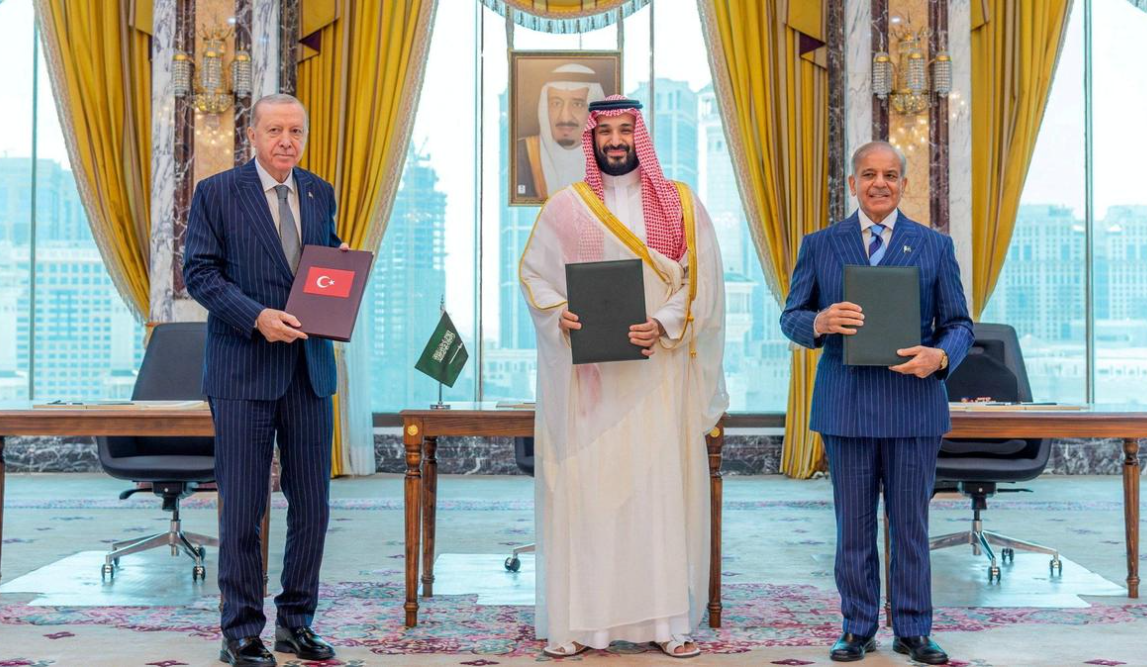
After hesitating for weeks amid a deteriorating security situation in the Red Sea, Saudi Arabia, Pakistan, and Türkiye (Turkey) have finally agreed to activate “deterrence measures” under the mutual security agreement, the Makkah (Mecca) Pact.’
Under the agreement, Pakistan and Türkiye have agreed to “rapidly deploy forces” in Saudi Arabia to counter the attacks by Yemen’s Houthi rebels.
This is the first time that the ‘Mecca Pact,’ signed in August, has been invoked.
“The committee agreed to activate collective deterrence measures, within the framework of the Alliance, in response to the attacks and all those responsible for them,” Khalid bin Salman, Saudi Arabia’s defense minister, said.
The ‘Mecca Pact’ has a mutual defense clause, similar to NATO’s Article 5, that an armed attack against one country would be considered an attack on all three.
Under the agreement, Ankara could deploy its soldiers in the southern Arabian peninsula for the first time in over a century.
The last time Turkish soldiers served in Yemen was in 1919 under Ottoman rule. After the Ottomans’ defeat in the First World War, Ankara agreed to surrender garrisons outside Anatolia under the Armistice of Mudros.
After the Armistice, signed between the Ottomans and Allied nations in 1918, Ottoman garrisons in Yemen surrendered to the British forces one by one.
Therefore, activating the Mecca Pact could see Turkish forces return to the southern Arabian Peninsula after more than a century.
In fact, while the Mecca Pact was signed only in 2026, Turkey has been waiting for an opportunity to return to Yemen for over a decade.
The Mecca Pact was signed in August 2026.
In 2015, when Saudi Arabia intervened militarily in Yemen against the Houthi rebels for the first time, President Recep Tayyip Erdogan said that “Depending on the course of events, we may consider providing logistical support.”
However, Ankara should not celebrate too soon, as history holds a sobering lesson for the Turks.
The mighty Ottoman Empire once ruled across the three continents of Asia, Africa, and Europe; controlled three of Islam’s holiest sites, including Mecca, Medina, and Jerusalem; and controlled a huge territory in the European lands of the Balkans and southern Europe.
Ottomans, however, could never fully subjugate the Zaidi tribesmen of Yemen, the historical ancestors of today’s Houthi rebels.
Yemen, in fact, was frequently called the “graveyard of Anatolia” or the “graveyard of Ottoman soldiers”.
Yemen – The Graveyard of Turks (Ottomans)
Victoria Clark, in Yemen: Dancing on the Heads of Snakes (2010), writes that by the 1890s Yemen was already “renowned as the ‘graveyard of the Turks'” during Ahmed Feyzi Pasha’s campaigns.
She also quoted an Ottoman official: “Yemen has become now the graveyard of Muslims and money.”
Turkish journalist and author Mustafa Balbay titled his book ‘Türkler Mezarlığı Yemen,’ which means “Cemetery of the Turks”.
In fact, describing Yemen as a “graveyard of Turkish soldiers” is a recurring theme in Ottoman (Turkish) historical memory.
Yemen Türküsü is a famous Turkish folk song that serves as a tragic lament for Ottoman soldiers who marched off to fight in Yemen during World War I and never returned.
Another Turkish folk song remembers the difficulties faced by Ottoman soldiers in Yemen and pays homage to Turks who went to Yemen but never returned.
“There are no clouds in the sky, what is this smoke?
There is no death in the neighborhood, what is this commotion?
These lands of Yemen are so treacherous
Oh, Yemen, its rose is a meadow
Why do those who leave not return?”
Ayşe Hür, in her article “The largest Ottoman cemetery: Yemen,” recounts that the Ottoman rule in Yemen was fiercely opposed by Zaydis, the ancestors of Houthi rebels.
According to the Zaydis, the Ottomans were ‘turbaned infidels’.
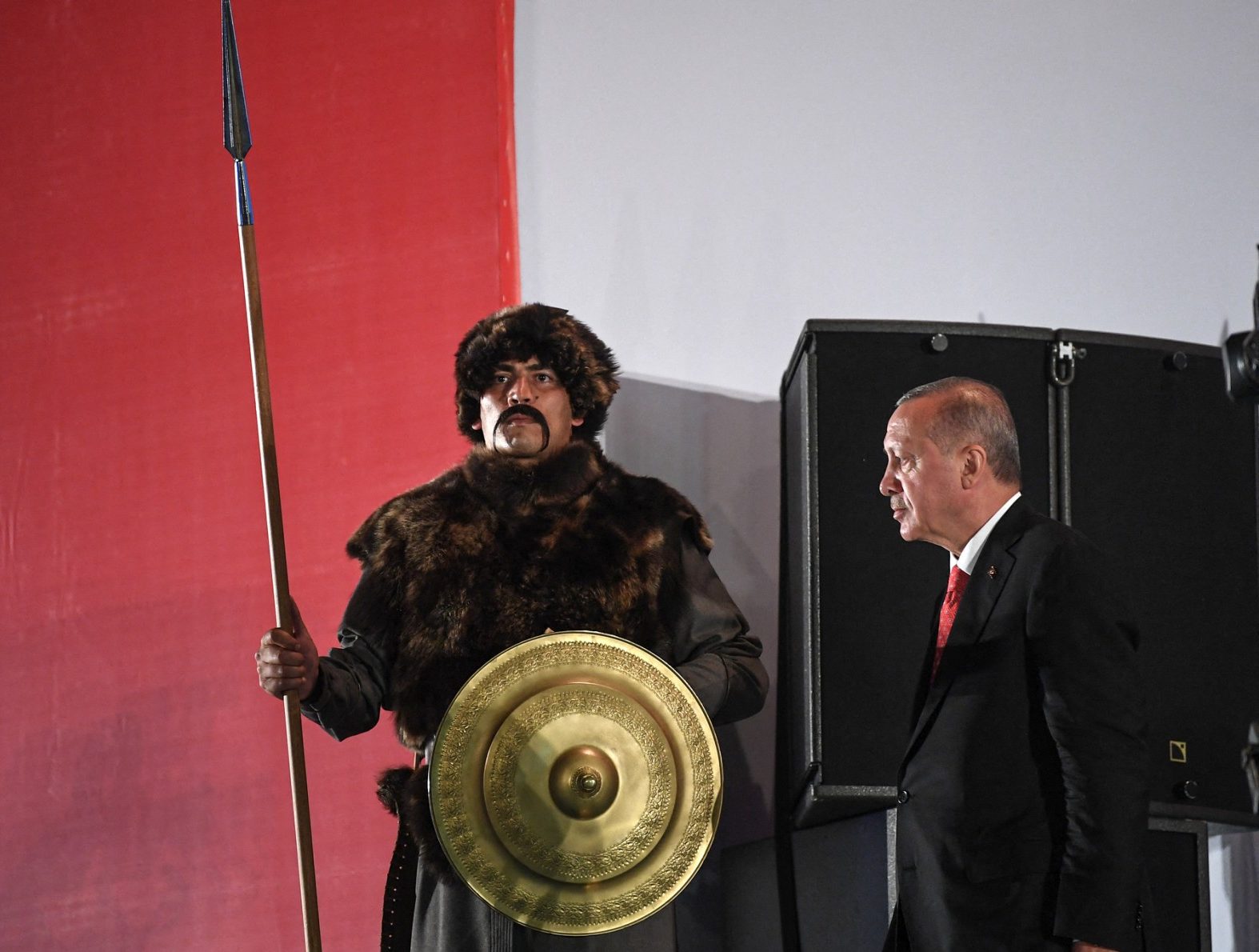
Turkish President Recep Tayyip Erdogan (R) passes next to a Turkish soldier wearing an Ottoman uniform during a third-anniversary commemoration rally at Ataturk International Airport in Istanbul on July 15, 2019. Turkey commemorates, on July 15, 2019, the third anniversary of a coup attempt which was followed by a series of purges in the public sector and changes to boost the Turkish President’s powers. (Photo by Ozan KOSE / AFP)
In his work titled “My Lament,” Ahmet İzzet (Furgaç) Pasha, who was sent to Yemen in early 20th century to supress a Zaydi revolt against the Ottomans described the period of Ottoman struggle in Yemen (1635-1840) in following words: “After a century of conflict in Jabal, with internal revolts and constant wars against the Zaydi imams, which continued until the year 1045 AH (1635), the entire Yemen region fell under the rule of the Zaydi imams due to the siege and pressure exerted on Haydar Pasha, who was forgotten and left in Jabal by the central government.”
Ottoman sources do not specify how many people died in the wars with the Zaydis during these 100 years, merely stating that “thousands of people died.”
“Going to Yemen and not returning” has been the fate of Ottoman soldiers since the 16th century, Ayşe Hür wrote in her article.
In the article titled “The Situation in Yemen” in the 15th issue of the Ottoman Newspaper dated 1316 (1900), it was stated: “As a result of Ahmet Fevzi Pasha’s wrong policies, approximately 4,000 soldiers died every year.”
Ayşe Hür also quoted an Ottoman official in her article who said that 1,30,000 Ottoman soldiers were buried in the Hijaz and Yemen between 1871 and 1894.
Marshal Galip, who served as a captain in Yemen in the 19th century, wrote: “Since I worked under the General Staff, all the general staff records passed through my hands. In these records, I noticed a wide and terrible gap between the new soldiers joining the army and those who were replaced or disabled… Yemen was a permanent war zone at that time.
“I compared the number of those who joined their factions or were mobilized en masse and sent away due to rebellions with the number of those who survived and returned to their homeland. The conclusion I reached was this: In the 22 years that had passed, a total of 130,000 Anatolian youths had been buried in the deserts of Hejaz and Yemen.”
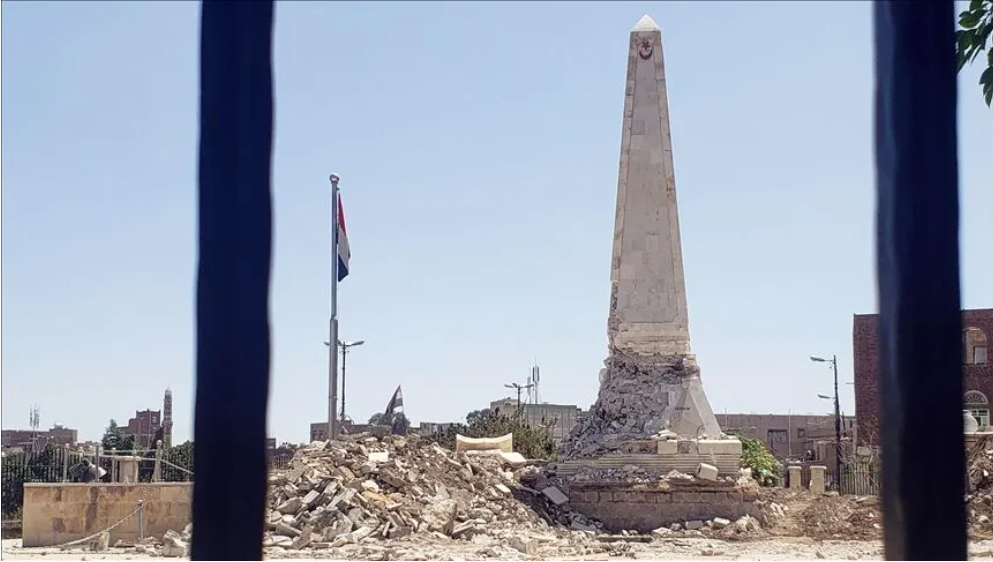
In 2011, then-Turkish President Abdullah Gül renovated and inaugurated a Turkish Memorial Cemetery (Yemen-Türk Şehitliği) in Sanaa to commemorate the Ottoman soldiers who died in Yemeni campaigns.
Just one year later, in 2012, Houthi rebels demolished part of the memorial.
For centuries, the memorial has symbolized the Ottoman presence in Yemen. The deliberate attack on this memorial serves as a reminder of how the Houthis recall Ottoman campaigns in Yemen.
The damaged memorial for Turkish Martyrs in Yemen in the Yemeni capital Sanaa.
It was also a clear message to Ankara that they would not accept any Turkish involvement in Yemen.
Writing in Politics Today, Ahd Yaseen Al-Tamimi said: “History textbooks, which were adopted after 1962, presented a positive view of the Ottoman Empire and its rule over Yemen. Nevertheless, this did not prevent Zaydi supporters from maintaining their strict and extremist position on the Ottoman Empire.”
Of course, Turkey is a strong military power, and its influence extends in Yemen as well.
It has achieved remarkable military success in Syria, Libya, and in combating Kurdish insurgents in Iraq. Its military support to Azerbaijan was perhaps the deciding factor in its war against Armenia.
However, Yemen is a different ballgame altogether.
And if history is anything to go by, then Yemen, often described as a “graveyard of the Ottomans,” could once again become a quagmire for Turkey.
Sumit Ahlawat has over a decade of experience in news media. He has worked with Press Trust of India, Times Now, Zee News, Economic Times, and Microsoft News. He holds a Master’s Degree in International Media and Modern History from the University of Sheffield, UK.
He can be reached at ahlawat.sumit85 (at) gmail.com
L'Eliseo tace mentre la polizia francese "calpesta e schiaccia i ragazzi" durante le proteste studentesche. Questa la denuncia di Maria Zakharova, portavoce del Ministero degli Esteri russo.
"L'unica cosa che mi preoccupa davvero al riguardo è il silenzio dell'Eliseo sulle azioni della polizia; credo che tutti abbiano visto quelle immagini ieri, tutti coloro che seguono l'agenda politica internazionale. Quella stessa polizia francese - a parte il termine 'calpestare', l'unica altra parola che posso usare è 'schiacciare' - stava schiacciando i propri ragazzi senza la minima considerazione", ha affermato Zakharova.
Inoltre, la portavoce ha sottolineato il silenzio da parte dell'Alto rappresentante dell'Unione europea per gli affari esteri e la politica di sicurezza, Kaja Kallas, nonché dei membri dell'Assemblea parlamentare del Consiglio d'Europa (PACE).
“Il secondo punto che mi ha colpito. E dov’è Kaja Kallas? Qualcuno può svegliarla? […] E dove sono loro, per così dire, nella loro Bruxelles, in quella loro PACE, dove sono tutti? Questo è il loro momento di gloria”, ha detto.
Secondo la portavoce, "finalmente tutto è andato come piace a loro". "Voglio sentire almeno una volta - quando dal loro punto di vista non ci sono altre ragioni o opzioni se non quella di non fare una dichiarazione - almeno una volta una dichiarazione reale o una dichiarazione che si avvicina ad essere reale, su come le persone pacifiche e disarmate non possono essere trattate in questo modo, direi direttamente anche i bambini, gli scolari, gli studenti", ha aggiunto.
"Probabilmente avrei dovuto usare altre espressioni: detenere, arrestare, ma purtroppo non posso, perché quello che abbiamo visto ieri e in questi giorni non può essere descritto con il tradizionale lessico politico o giuridico. Questo non è un arresto. [...] Questo è semplicemente un massacro, un autentico massacro", la sua amara chiosa.
For decades, one of the best-known stories in science was told like a movie. In 1953, at the age of 23, James Watson visited Maurice Wilkins’s laboratory at King’s College London. There, Wilkins showed him a photograph of DNA taken by Rosalind Franklin, and Watson had an epiphany. “The instant I saw the picture my mouth fell open and my pulse began to race,” Watson wrote in The Double Helix: A Personal Account of the Discovery of the Structure of DNA, the book in which he recounted, 15 years later, how he and Francis Crick unraveled the structure of DNA.
Ukraine's 413th Separate Raid Regiment of the Unmanned Systems Forces struck the Snizhne Machine-Building Plant in occupied Donetsk Oblast in September, working with other Defense Forces units, the regiment posted on 6 October, sharing a video of the strike. The General Staff reported the strike on the plant on 11 September, saying that the extent of the damage was being clarified.
The strike adds to Ukraine's campaign of long-range attacks on Russian military targets as Russia has begun its winter campaign of strikes against Ukraine's energy infrastructure. Hitting the suppliers of aircraft parts goes after Russia's ability to keep its attack jets and helicopters flying.
The regiment said the plant works for Russia's military industry, producing engine components for attack aircraft and combat helicopters.
A former Motor Sich plant in occupied Snizhne
The Snizhne plant was a separate division of Motor Sich, a Ukrainian aircraft-engine maker based in Zaporizhzhia, a city that remains under Ukrainian control. Snizhne has been under Russian occupation since 2014. The plant specializes in producing parts for gas-turbine engines, including compressor and turbine discs and blades, the General Staff said. It never built whole engines. In September 2014, months into the occupation, it was machining blanks from Motor Sich's Zaporizhzhia plant into turbine blades and was one of only two plants in the former Soviet Union making such blades for helicopters, a plant worker said.
Motor Sich said in December 2017 that it had lost control of the plant. Weeks later, Viacheslav Bohuslaiev, then Motor Sich's honorary president and a member of parliament, told RFE/RL's Donbas.Realii that Motor Sich still owned the plant and had handed its management to a foreign company, while keeping it under the company's "full control."
In February 2023, Ukraine's Prosecutor General's Office served Bohuslaiev a notice of suspicion of aiding a terrorist organization, alleging that Motor Sich shipped blanks to the Snizhne plant and received finished engine parts through foreign-registered companies. The case went to court in October 2023, and Bohuslaiev, who denies the charges, has been in pretrial detention since October 2022 as the trial continues.
Snizhne, which Russia uses as a rear base, has been hit before. In May, Ukraine's Unmanned Systems Forces and the Security Service of Ukraine struck a Russian training center for drone pilots in the city, and in September, a strike on energy infrastructure cut power across Snizhne.

 Login