Trump says Russia will supply 300K tons of diesel despite global sanctions


Diplomatie et monde
L’Allemagne réarme, elle renoue le fil coupe par la défaite c’est le fait le plus important de la période. Le reste n’est que distraction.
De nombreux chercheurs, dont l’éminent historien russe Vassili Klioutchevski, attribuent la fracture civilisationnelle incontestable entre les deux plus grands peuples d’Europe à la géographie, au climat et au paysage, qui ont façonné des modes de vie différents.
Vivant sous un climat prévisible, les Allemands ont développé une habitude de travail méthodique et régulier. Ils pouvaient planifier à l’avance car leur environnement leur permettait d’anticiper les résultats de leurs efforts avec une relative certitude.
Les Russes, en revanche, habitent une terre aux conditions imprévisibles qui s’étend, selon les mots de l’hymne national russe moderne, «des mers du Sud jusqu’à la frontière polaire». Ils ont souvent constaté que planifier à l’avance peut s’avérer totalement vain. De ce fait, ils doivent fréquemment travailler à un rythme effréné dans des délais très courts, s’appuyant sur la notion typiquement russe d’«avos» : l’espoir que, d’une manière ou d’une autre, les choses finiront par s’arranger.
Ces différences culturelles permettent d’expliquer non seulement l’évolution des relations entre ces voisins proches au fil des siècles — rappelons que la ville russe de Kaliningrad était autrefois la ville allemande de Königsberg — mais aussi la logique interne qui sous-tend aujourd’hui les relations politiques russo-allemandes.
L’Allemagne actuelle perçoit la Russie comme une menace pour sa sécurité nationale, à l’instar de ses prédécesseurs à la veille des Première et Seconde Guerres mondiales. Elle remilitarise méthodiquement son économie et accroît son aide militaire à l’Ukraine afin d’affaiblir la Russie sur tous les plans. En 2022-2023, au début de l’opération militaire spéciale, les aides étaient limitées et ciblées. À partir de 2024, Berlin s’est toutefois orientée vers des contrats à long terme pour la fourniture d’équipements et de drones, d’une valeur supérieure à 10 milliards de dollars par an, faisant de l’Allemagne le principal fournisseur d’aide militaire bilatérale à l’Ukraine au sein de l’UE.
La présidente de la Commission européenne, Ursula von der Leyen, ancienne ministre allemande de la Défense, s’est discrètement imposée comme la principale responsable de la distribution des fonds allemands.
Parallèlement, dans la continuité de cette dérive progressive vers une confrontation militaire avec la Russie, le gouvernement de Friedrich Merz poursuit la politique d’Olaf Scholz visant à démanteler la présence diplomatique russe en Allemagne. Après avoir obtenu la fermeture des consulats généraux russes à Munich, Hambourg, Francfort et Leipzig en mai 2023, Berlin a décidé en septembre dernier de fermer le consulat général de Bonn et le centre culturel de la Maison russe à Berlin.
Avec la première économie de l’UE et un représentant de sa propre initiative à un poste parmi les plus influents de la hiérarchie supranationale européenne, Berlin «reprogramme» progressivement une Europe unie pour en faire une sorte de «Quatrième Reich». En devenant un centre de pouvoir plus homogène, l’Europe risque de se retrouver au bord d’une confrontation militaire avec son puissant voisin de l’Est, comme cela s’est produit à maintes reprises au cours de l’histoire.
Afin de rendre la prétendue menace russe tangible, les autorités allemandes alimentent les médias depuis cet été des rumeurs concernant l’implication de Moscou dans la découverte d’un drone chargé d’explosifs à l’aéroport de fret de Leipzig. Sans attendre les conclusions de l’enquête, Berlin s’est empressé d’accuser la Russie d’avoir orchestré un acte de sabotage.
Conscients que leur gouvernement a mené le pays dans une impasse, les citoyens allemands ordinaires commencent à réagir et apportent un soutien croissant à l’Alternative pour l’Allemagne (AfD). Ce parti promet un changement radical de cap en matière de politique étrangère et intérieure — et non un revirement à 360 degrés, comme l’avait proposé l’ancienne ministre des Affaires étrangères Annalena Baerbock, donnant ainsi naissance, involontairement, au mème politique emblématique de la décennie allemande.
Certes, les victoires du parti restent régionales, et les autres partis politiques allemands refusent d’envisager le mouvement d’Alice Weidel et de Tino Chrupalla, même comme partenaire de coalition. Mais si sa base électorale continue de s’élargir, en attirant le soutien non seulement des Allemands de souche mais aussi, à terme, des communautés immigrées, l’AfD pourrait avoir une chance d’obtenir plus de 50% des voix au niveau national. Cela lui permettrait de former un gouvernement à elle seule.
Parallèlement, la cote de popularité de Merz a chuté à un niveau historiquement bas pour un chancelier de la République fédérale : seulement 11 à 15%, avec 85 à 89% d’insatisfaction. Face à ces chiffres et conscient de la demande publique pour une relation plus équilibrée avec la Russie, il a chargé le ministre des Affaires étrangères, Johann Wadephul, d’obtenir une rencontre avec son homologue russe, Sergueï Lavrov, en marge de l’Assemblée générale des Nations unies, coûte que coûte. Le récit de Lavrov illustre clairement le peu de substance de cette rencontre :
«Quant au ministre allemand des Affaires étrangères, Johann Wadephul, il a sollicité une réunion à la dernière minute. Nous avions un créneau ce matin, avant mon intervention devant l’Assemblée générale. Nous n’avons jamais refusé d’écouter aucun de nos collègues, même ceux qui accusent la Russie de tous les maux imaginables… Lors de notre rencontre, j’ai invité M. Wadephul à expliquer l’objet de sa venue. Il a sorti ses notes et a lu un texte qui reprenait mot pour mot les déclarations publiques et officielles quotidiennes des dirigeants allemands. Je le lui ai fait remarquer. Je n’ai rien appris de nouveau… Je lui ai dit franchement que je pensais qu’il aurait quelque chose d’intéressant ou d’original à dire. Ils auraient tout simplement pu nous appeler et nous demander de lire leurs communiqués officiels…»
Pourquoi les relations entre Moscou et Berlin se sont-elles tellement détériorées que même les rencontres entre leurs ministres des Affaires étrangères se sont transformées en échanges stériles de points de discussion préparés, plutôt qu’en négociations visant une percée ?
Au moins trois facteurs méritent d’être examinés.
1. Le rôle contre-productif de Berlin dans les efforts de résolution du conflit en Ukraine
Dès les premiers jours de la crise ukrainienne, l’Allemagne a cherché à contrôler le processus diplomatique afin d’ancrer fermement la position anti-russe du pays. En février 2014, après les troubles survenus sur le Maïdan, le ministre des Affaires étrangères, Frank-Walter Steinmeier, et ses homologues français et polonais, Laurent Fabius et Radoslaw Sikorski, se sont portés garants d’un accord entre le président Viktor Ianoukovitch et l’opposition. Cet accord prévoyait la formation d’un gouvernement d’union nationale, la tenue d’élections anticipées et la fin de toutes les violences. Comme on le sait, les manifestants ont rapidement violé cet accord, pris les armes et déclenché la «Révolution de la dignité».
Un an plus tard, la chancelière allemande Angela Merkel et le président français François Hollande se sont joints à la Russie comme médiateurs dans les pourparlers entre Kiev et les républiques populaires de Donetsk et de Lougansk, aboutissant à la signature d’un ensemble de mesures visant à mettre en œuvre les accords de Minsk. Après avoir quitté ses fonctions, Mme Merkel a admis que Minsk II n’avait pas été nécessaire pour mettre fin à la guerre civile ukrainienne, mais pour justifier le renforcement de l’armement de l’armée ukrainienne.
Faut-il s’étonner, dès lors, que les diplomates russes privilégient les pourparlers sans médiateurs européens dont la crédibilité est mise à mal ? Ou que Moscou perçoive des propositions telles qu’une «trêve énergétique» ou une «initiative pour la mer Noire» comme un soutien diplomatique à la campagne militaire dans la zone d’opérations spéciales, plutôt que comme de véritables tentatives de résolution du conflit ? Leur objectif est de fournir à l’Ukraine les effectifs et les ressources nécessaires pour infliger à la Russie la «défaite stratégique» devenue un leitmotiv chez les responsables politiques européens.
2. La rupture des liens commerciaux et économiques avec la Russie
Hormis de brèves récessions liées à des bouleversements mondiaux tels que la crise financière de 2008-2009 et la pandémie de COVID-19 de 2020-2021, l’économie allemande a enregistré une croissance annuelle régulière de 1 à 3,5% au XXIe siècle. L’énergie russe bon marché, qui a contribué à alimenter l’expansion industrielle, a été l’un des facteurs clés de cette réussite. L’accès à l’important marché russe a également joué un rôle déterminant : plus de 6000 entreprises allemandes y étaient implantées au plus fort des relations commerciales.
Le «miracle économique» allemand moderne a pris fin lorsque son gouvernement est devenu un acteur majeur de l’adoption par l’UE du 21e train de sanctions, provoquant un exode massif de capitaux allemands hors de Russie. Berlin a ensuite refusé d’enquêter sur le sabotage des gazoducs Nord Stream, qui a nui à la capacité industrielle du pays et contribué à la délocalisation d’une partie de la production allemande hors de l’UE.
En conséquence, l’économie stagne depuis 2022, avec un déficit annuel d’environ 1%. Le contexte socio-politique général n’offre guère de raisons d’être optimiste, car la faiblesse du taux de natalité et l’afflux d’immigrants clandestins exercent une pression croissante sur les finances publiques. Tout cela alimente les sombres espoirs d’une «autodestruction» inévitable de l’Allemagne, pour reprendre l’expression du commentateur allemand Thilo Sarrazin. Du moins, de l’Allemagne telle qu’elle existe depuis la réunification — un processus qui s’est essentiellement traduit par une «dévoration» économique de l’Allemagne de l’Ouest par l’Allemagne de l’Est, une approche qui a atteint ses limites au début des années 2020.
3. Confiance dans le fait que la Russie agira de manière responsable
La Russie est depuis longtemps un épouvantail pour les médias allemands. Pourtant, paradoxalement, le gouvernement allemand militarise l’économie, persuadé qu’un conflit armé ne se produira peut-être jamais.
Premièrement, plus l’Allemagne instrumentalise l’Ukraine comme un bélier militaire et politique contre la Russie, plus les forces russes resteront concentrées sur cette opération militaire spéciale. Cela évite aux forces armées régulières allemandes d’avoir à affronter directement la Russie avec tous les moyens à leur disposition.
Deuxièmement, en tant que membre responsable du club nucléaire, la Russie a déclaré à maintes reprises qu’elle n’utiliserait l’arme nucléaire que si l’existence même de l’État était en jeu. Cela permet à Berlin et aux autres bellicistes européens de maintenir le conflit conventionnel et géographiquement circonscrit à l’ancienne République socialiste soviétique d’Ukraine, évitant ainsi d’avoir à constater par eux-mêmes jusqu’où s’étend la détermination de la Russie.
Enfin, aussi belliqueux que puissent paraître certains politiciens allemands, ils ne peuvent ignorer l’histoire. Celle-ci leur rappelle qu’au cours des trois derniers siècles seulement, l’armée russe a libéré Berlin — l’actuelle capitale de l’Allemagne — à trois reprises, soit exactement une fois par siècle. Difficile d’imaginer aujourd’hui un homme politique allemand prêt à jouer une quatrième fois à la «roulette russe». Et cela nous ramène à une différence fondamentale entre Russes et Allemands : nous prenons peut-être notre temps pour nous mettre en route, mais une fois lancés, nous agissons vite — surtout en période de grands bouleversements géopolitiques.
EN PRIME
Le taux d’approbation de Merz est inférieur à 10%. Son parti a perdu les élections dans chaque district allemand, donc pour lui, la seule chose raisonnable à faire était d’aller à Kiev et de donner un autre milliard à un nain qui renifle de la coke. Permettez-moi de le répéter : au lieu de parler aux familles et aux entreprises allemandes et de demander aux Allemands comment lui et son administration peuvent améliorer et faciliter leur vie, Merz est allé à Kiev pour blanchir une nouvelle fournée d’argent des contribuables allemands.

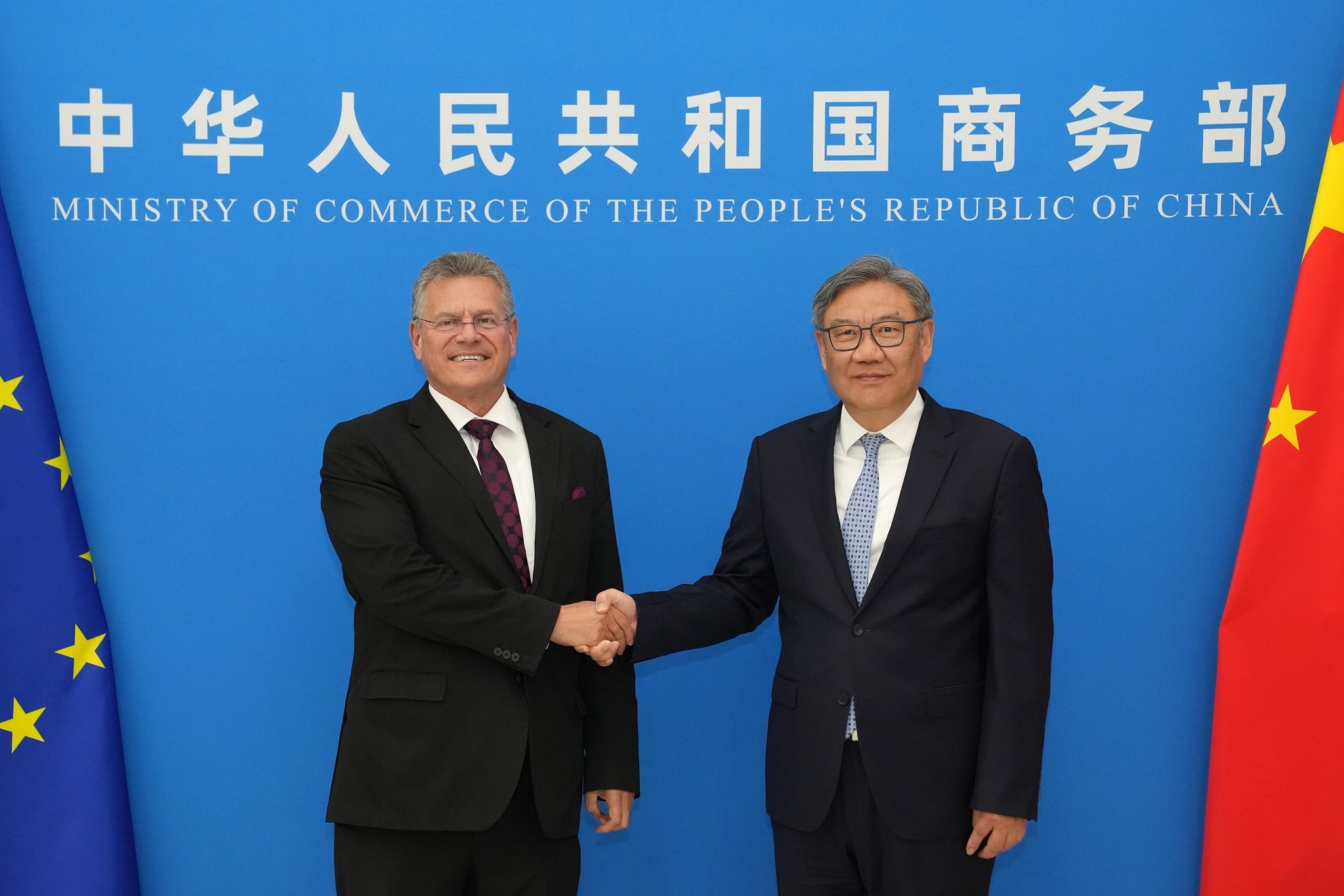
EU and Chinese officials agreed a series of trade concessions covering electric cars, rare earths and tariffs that dragged them away from a damaging trade war on Friday (9 October), following two days of crisis talks.
Following two days of talks in Beijing, EU trade commissioner Maroš Šefčovič said that he and China’s commerce secretary Wang Wentao had made a “crucial first step” towards rebalancing EU-China trade relations.
Europe can point to progress on hybrid vehicles, stronger assurances over the supply of critical raw materials, and continued engagement on market access issues in China.
Hours before Šefčovič arrived, Beijing rejected an EU demand for so-called “voluntary export restrictions” on its electric vehicles (EVs). However, in a joint statement on Friday, the two sides said that they had reached an “understanding on trade in hybrid vehicles in a WTO compliant manner”, but without providing further details.
They added that further negotiations on reducing tariffs and minimum pricing deals would allow Chinese EVs to enter the EU at a lower duty rate.
This article continues, but the full version is available only to EUobserver.com subscribers. Visit account.euobserver.com/membership
The European Commission has added 46 projects to its list of critical raw materials investments, but its own figures show little EU money has reached similar schemes it selected last year.
The new projects are to be spread across 16 EU countries and cover all but two of the EU’s list of 17 strategic raw materials, said the commission on Friday (9 October).
The priority is copper, used in power grids, which featured in 19 of the 46 new initiatives.
Battery materials also top the list: with 12 projects involving nickel, 10 cobalt, seven lithium, five manganese, and four graphite.
Only four of the new projects concern rare earths used in magnets, wind turbines, and electric motors, for which the EU relies almost entirely on imports, mainly from China.
The new projects suggest the commission sees recycling as a core pillar in its quest to reduce dependency on Chinese imports. Of the 46 new ones, 19 focus on recycling, 11 on processing and eight on extraction.
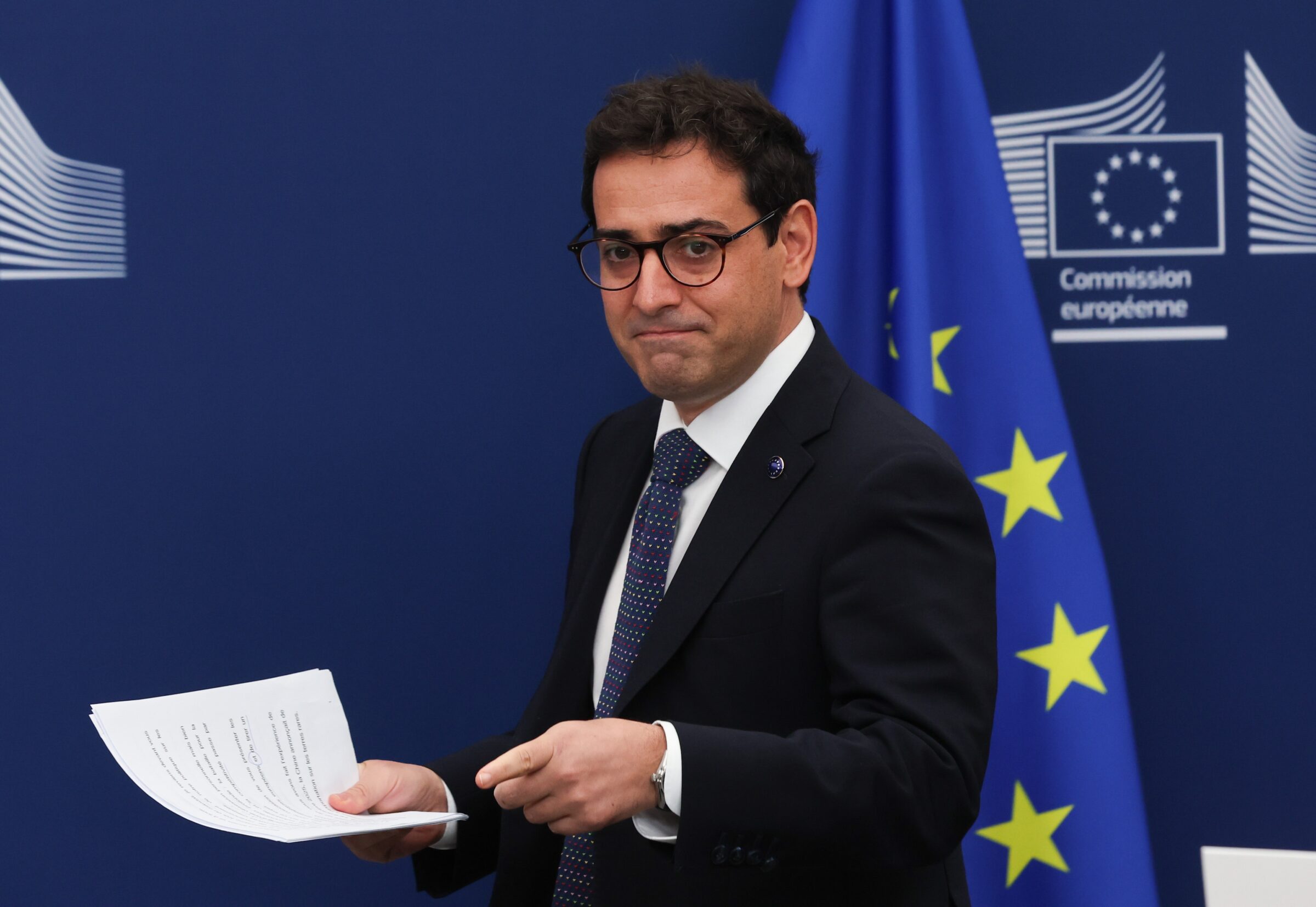
“The results are very tangible,” EU industry commissioner Stéphane Séjourné told reporters in Brussels on Friday, pointing to the impact of the first list of strategic investments, selected in March 2025.
He mentioned Keliber in Finland, which he said is now extracting and processing lithium, and the French company Carester’s plant in Lacq, which recycles magnets and separates heavy rare earths.
He said Carester could eventually account for around 15 percent of global production of dysprosium and terbium oxides, used in the powerful magnets in electric car motors and wind turbines, and that Greek company Metlen is already producing gallium, important for semiconductors and defence equipment.
He didn’t mention that all three projects were already well advanced before they received strategic status in March 2025.
This article continues, but the full version is available only to EUobserver.com subscribers. Visit account.euobserver.com/membership


Last week, EU member states reached a common position on the European Commission Omnibus X ‘Food and Feed’ proposal, in a bid to simplify regulation of pesticides. In reality, however, it will weaken protection against pesticides’ negative effects in Europe. The proposal pleases the chemical industry but goes against the wishes of a vast majority of citizens and many scientists who value people’s health, clean drinking water and biodiversity.
A hearing in the European Parliament on 3 September highlighted the real problem. Under the guise of a ‘discussion with experts’ in the field of health and environment, the parliament handed the megaphone to lobbyists representing a broken, toxic agricultural model.
Representatives of industrial agriculture – sugar beet, apple and cereal growers – parroted industry arguments, justifying their demands to stop banning pesticides that are toxic to public health, the environment and pollute our water resources.
Despite Europe witnessing massive droughts, extreme heatwaves leading to countless deaths, wildfires destroying biodiversity, and devastating crop losses, it seems that a significant share of MEPs are ready and willing to accelerate the degradation of European’s wellbeing and natural resources.
Listening to them raises a fundamental question: Do farmers truly want to rely on a cocktail of toxic chemicals to maximise yields at low market prices, destroying their own health and local ecosystems in the process? Or do they wish to make an honest living, producing quality food in balance with nature for a fair income?
To better grasp this contradiction, we must look at what is actually at stake here.
Agrochemical corporations seek their share of the Common Agriculture Policy (CAP) cake – a colossal €58bn budget, accounting for one third of the EU’s total budget.
Their own survival is reliant on keeping as many farmers as possible dependent on pesticides, fertilisers and industrial seeds. By diverting public CAP funds through farmers into the pockets of their shareholders, these companies ensure their long-term profitability.
Many farmers’ unions also represent agri-cooperatives that profit significantly from selling pesticides, which raises questions about whether they truly represent farmers’ long-term interests, or those of the pesticide industry.
Since the European Commission published its ‘simplification’ proposal in December 2025, proponents of pesticide-intensive farming have presented a series of flawed arguments that in fact reveal the dead-end to which intensive agriculture has led us.
Firstly, farmers’ organisations complain about a “lack of pesticide substances” on the market.
Currently around 450 different pesticide active substances are approved in the EU, from insecticides to fungicides, and herbicides. If 450 different options are insufficient, does this not signal an unhealthy addiction rather than a shortage?
Lobbyist groups, furthermore, claim that pest resistance to synthetic pesticides would inevitably lead to dramatic yield losses and hunger, arguing for even more pesticides with diverse modes of action.
And yet, according to scientific research, the multiple chemical strategy that has been applied for more than 40 years is the very cause of the appearance of resistance. This problem cannot be solved with the mindset that caused it. The only scientific solution is, therefore, not more chemistry but prevention, and the use of alternative methods.
Thousands of farmers across the EU and the rest of the world are already proving this by switching towards Integrated Pest Management (a strategy for low-pesticide-input pest management) or organic practices to reduce pesticide inputs.
The call to keep all pesticides on the market – and potentially even use some of the banned ones – serves only the short-term interests of the pesticide industry, not of the farmers.
Destroying soil life – the basis of soil fertility – with chemicals, and killing insect populations that naturally control pests and pollinate crops, jeopardises the very basis of farming and long-term food security.
The societal costs of this pesticide-dependent model are staggering. Citizens are the ones who bear the healthcare costs for chronic diseases such as cancer and Parkinson’s, which impact not only farmers but also residents of agricultural areas.
We face water pollution that has become nearly impossible to remediate. Fewer pollinators means fewer healthy fruit and vegetables. These ‘externalities’ far outweigh any short-term benefits.
This is the reason why the Paris and Munich water companies financially support farmers in protecting the groundwater, because doing so is up to 45 times cheaper than depollution.
In the meantime, the agrochemical industry enjoys huge profits from pesticide sales, largely supported by CAP subsidies, while society foots the bill for the damage. It is indeed a perfect business model…for them.
The spectacle witnessed in the alleged House of European Democracy is testament to the state of our political world; one that is dominated by corporate interests over citizens and farmers’ wellbeing.
We witnessed the desperate battle of a toxic agricultural model that struggles to survive, and resists being replaced by sustainable farming methods.
The lobbyist speakers in the European Parliament hearing more or less gave the diagnosis to the current pesticide-intensive agricultural system: it is simply broken.
Citizens have repeatedly expressed their concern on the impact of pesticides on their health and biodiversity. They have also expressed the need that public support for agriculture serves the common good.
The pesticide Omnibus X proposal is merely an attempt to maintain a detrimental status quo that favours the pesticides industry.
With the 1968 Mansholt Plan Europe created a blueprint for the intensification of agriculture.
What is needed now is a new blueprint for a system which financially supports farmers to implement practices that improve soil and plant health, favour beneficial insects, accelerate the availability of alternatives to pesticides such as biocontrol products, and rapidly phase out toxic synthetic pesticides to protect our health, water resources and biodiversity.
Only then can we ensure a sustainable future for European agriculture and our children. Only then, will a greater share of the CAP remain in the hands of farmers who feed us and protect our nature.
Fabio LUGANO
La chiusura dei mercati di Londra spinge 100 tonnellate di lingotti russi nei caveau di Hong Kong: Pechino accumula metallo prezioso, scarica i titoli di Stato USA e blinda lo yuan.
Un fiume di lingotti d’oro sta abbandonando le rotte tradizionali a velocità impressionante, dirigendosi verso i mercati delle materie prime orientali, come Hong Kong, invece che Londra e New York.
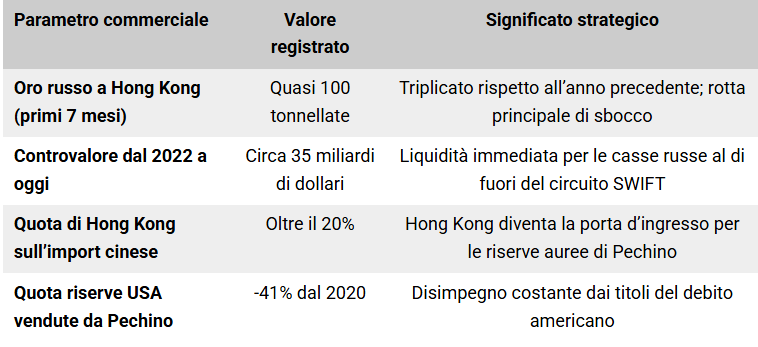
I numeri descrivono una vera e propria fuga strategica verso l’Asia. Solo nei primi sette mesi dell’anno in corso, la Russia ha scaricato a Hong Kong quasi 100 tonnellate di metallo giallo: un record assoluto, pari a quasi il triplo rispetto allo stesso periodo precedente.
Dal 2022 a oggi, gli operatori di Hong Kong hanno comprato oro russo per 276 miliardi di dollari locali, cioè circa 35 miliardi di dollari americani. È la prova tangibile che la guerra economica produce effetti opposti a quelli previsti nei palazzi occidentali.
Da dove arriva quest’oro e perché scappa a est
La Russia è il secondo produttore mondiale di oro dopo la Cina. Prima del conflitto in Ucraina, la quasi totalità dei suoi lingotti prendeva la strada di Londra, capitale indiscussa della custodia e della contrattazione aurea.
Con l’avvio delle ostilità nel 2022, Regno Unito e Stati Uniti hanno imposto il bando totale sui lingotti di Mosca. L’obiettivo dichiarato era soffocare le entrate del Cremlino. Il risultato pratico è stato un semplice cambio di indirizzo sulle bolle di spedizione.
Come ha fatto notare Debajit Saha, analista del London Stock Exchange Group (LSEG), la reazione dei produttori russi è stata immediata. Trovando le porte sbarrate in Europa, hanno dirottato l’intera produzione verso Oriente, dove la fame di metallo fisico non è mai calata.
A facilitare questo travaso è intervenuta anche la crisi in Medio Oriente. Gli attriti logistici che hanno colpito Dubai hanno convinto i venditori a puntare dritti sull’estremo oriente cinese.
Il ruolo chiave di Hong Kong: perché proprio lì?
Ci si potrebbe chiedere per quale ragione i carichi non atterrino direttamente a Pechino o Shanghai. La risposta risiede nelle norme commerciali. La Cina continentale impone quote rigide all’ingresso di oro per controllare i movimenti valutari interni. Hong Kong, al contrario, gode di uno status di porto franco: nessuna restrizione doganale e nessun limite ai volumi. Quindi diventa una destinazione ottimale.
Inoltre, né Hong Kong né Pechino riconoscono le sanzioni decise dai paesi occidentali. La città funge quindi da perfetto filtro logistico e finanziario. Gli operatori cinesi acquistano i lingotti a Hong Kong, li stoccano nei moderni depositi locali e poi li trasferiscono con calma verso la terraferma. Vita Spivak, consulente della società britannica Gatehouse, ha riassunto il fenomeno senza mezzi termini: è il naturale accordo di convenienza tra Mosca, che offre risorse strategiche, e Pechino, che garantisce sostegno economico e liquidità.
Ecco il quadro numerico di questo passaggio storico:

Cosa cambia davvero per la Cina
A Pechino non si limitano a guardare il passaggio dei vagoni d’oro: stanno costruendo un’alternativa materiale al sistema basato sulla moneta americana. Le riserve ufficiali della Banca Popolare Cinese hanno superato le 2.360 tonnellate. IUn modo per cercare di stabilizzare il patrimonio della Banca Centrale senza dover dipendere dalle valute di altri paesi.
Questo cambio di rotta non è una coincidenza. Hippolyte Fofack, economista già ai vertici della Export-Import Bank of Africa e ricercatore alla Columbia University, ha chiarito che l’oro ha smesso di essere un mero strumento di investimento. È diventato un pilastro di sovranità monetaria.
Con un bilancio corazzato dal metallo fisico, la banca centrale cinese può sostenere accordi commerciali in yuan, lanciare obbligazioni denominate in valuta locale (i cosiddetti Panda e Dim Sum bond) e offrire un’alternativa a chi teme il blocco dei beni da parte di Washington.
Nel 2025 la Borsa dell’Oro di Shanghai ha persino inaugurato un maxi-caveau a Hong Kong. È il primo fuori dalla terraferma e serve a liquidare contratti con consegna materiale del metallo, bypassando del tutto il dollaro.
Il baricentro del mercato si sposta a Oriente
La supremazia storica dell’asse Londra-New York si sta sgretolando sotto la pressione dei fatti. L’analista Angelo Giuliano ha definito questa rete il “corridoio dell’oro” che salda i paesi emergenti e i membri dei BRICS. L’idea di fondo è semplice: nessun governo vuole più rischiare di vedere i propri averi congelati con un click oltreoceano.
Non a caso, anche banche centrali europee hanno iniziato a rimpatriare le proprie riserve custodite all’estero. In Asia, intanto, la richiesta non accenna a diminuire.
Sara Esshaimi, alla guida del team materie prime di Société Générale, ha rilevato come le autorità cinesi abbiano persino autorizzato i maggiori colossi assicurativi a investire fino all’1% dei loro patrimoni in oro fisico. Una decisione che garantisce una domanda interna solida e continua.
Come ha sintetizzato Jeremy Mark, ricercatore dell’Atlantic Council, Hong Kong sta completando la sua trasformazione in un centro finanziario “con caratteristiche cinesi”.
Chi pensava di piegare la Russia chiudendo le piazze di scambio europee ha ottenuto un risultato tragicomico: ha regalato alla Cina il monopolio del metallo prezioso più conteso al mondo, accelerando la nascita di un sistema finanziario su cui l’Occidente non ha più alcun potere di veto.
Articolo originale scenarieconomici.it
EU governments were allowed to water down targets in their post-Covid pandemic recovery plans after they had already asked Brussels for the money, the European Court of Auditors (ECA) said on Thursday (8 October).
Of 20 milestones and targets the auditors examined, 13 were amended after the member state had already submitted its payment request. In nine of those cases, the change itself was requested after the payment application had already been made.
The revised targets were “aligned with actual achieved outputs, which made the payment possible,” the auditors wrote in their annual report on the 2025 EU budget.
Ireland, for example, asked for a payment in December 2024. But in January 2025 it requested to cut the target for ICT graduates down from 12,450 to 10,900, citing a high administrative burden.
This article continues, but the full version is available only to EUobserver.com subscribers. Visit account.euobserver.com/membership
A Ukrainian drone attack has reportedly forced the closure of a Yandex data centre in Russia’s Ryazan region, causing a fire and disrupting part of the company’s infrastructure. Shares in the Russian technology group fell by more than three per cent in early Moscow trading on Thursday, 8 October.
The installation in Sasovo was affected during overnight strikes on Russian territory. Yandex said it was working to restore affected infrastructure, while its principal consumer services remained operational. The incident has raised questions about the vulnerability of Russia’s digital economy to Ukraine’s long-range strike campaign.
The affected data centre began operating in 2014 in buildings formerly occupied by the Sasta machine-tool manufacturing plant. Yandex subsequently connected the installation to Moscow by fibre-optic communications links as part of its wider computing infrastructure.
Ryazan regional governor Pavel Malkov said Russian air defences intercepted two drones over the region. He reported a fire on the roof of an industrial building in the Sasovo district and damage to windows in nearby private homes. No casualties were reported.
According to a statement on the incident, the situation had been brought under control while work to restore infrastructure continued. Yandex said its main consumer services remained operational.
The company’s cloud division also reported an electricity supply problem affecting an availability zone known as ru-central1-b. Clients were advised to use alternative zones where necessary to maintain service continuity.
Yandex shares dropped by approximately 3.4 per cent to 3,568.5 roubles in early trading on the Moscow Exchange. The decline followed news of the fire, although a single trading session cannot establish the long-term financial cost of the disruption.
Yandex operates search, advertising, navigation, artificial intelligence and cloud computing services. Its infrastructure therefore supports commercial users as well as the company’s own applications. The duration of the interruption, the extent of physical damage and the cost of repairs will determine the wider impact.
Investors can follow the company’s quoted share price as further details emerge.
In a separate development, explosions and a fire were reported on Thursday near the Gazprom Neftekhim Salavat refining and petrochemical complex in Russia’s Republic of Bashkortostan, around 1,400 kilometres from the Ukrainian border. The precise location of the fire and the extent of damage had not been independently established.
The Gazprom-owned complex processes hydrocarbon feedstock and produces petrol, diesel, fuel oil and petrochemicals. It has previously been targeted by Ukrainian drones. The latest reported incident comes amid repeated attacks on Russian refining and fuel infrastructure.
Ukraine’s long-range economic campaign has focused heavily on oil refineries, fuel stores, military production plants and transport infrastructure. A strike affecting a major data centre introduces another category of vulnerability: the computing equipment and supporting utilities used by the digital economy.
Such sites serve businesses, financial institutions and industrial enterprises, and can also support defence-related activities. However, no publicly verified evidence establishes that the Sasovo data centre was directly involved in Russian military operations.
Damage to power supplies, cooling systems and network connections can interrupt services without necessarily destroying servers. Operators with geographically distributed facilities may be able to shift workloads to unaffected locations. The suspension of one centre therefore does not mean that Russia’s internet infrastructure has ceased functioning.
The attacks coincide with Russia’s plans for substantial military expenditure in 2027. The draft federal budget envisages considerable government spending and borrowing as Moscow continues its war against Ukraine.
Ukraine’s strikes on economic infrastructure are intended to increase the cost of maintaining Russia’s invasion. Disruption to energy facilities can affect fuel production and revenue, while attacks on technology and industrial sites may interrupt wider commercial and logistical operations.
The cumulative effect depends on the severity and duration of the damage. Neither the reported temporary closure of the Yandex facility nor preliminary accounts of the Salavat fire establish the scale of lasting losses.
The incidents nonetheless illustrate the exposure of Russian industrial and technology assets far beyond the Ukrainian border, as Kyiv increasingly targets infrastructure that supports the country’s economy.
When certain governments discuss the EU’s next seven-year budget, their first reflex seems to be: what can we cut? That is the wrong question. The real question is not how much the EU budget costs, but how much an insufficient budget will cost us all.
Economic benefits of EU membership are estimated to be two to six times the financial contribution of individual member states. For every euro we contribute to the EU budget, we can receive up to six euros in return.
That is the power of investing together: European investment delivers more than fragmented national spending. And it does so with a budget of just one percent of EU GNI, while national budgets can reach 50 percent.
The EU budget is not simply money transferred from national capitals to Brussels: it is an investment that creates value benefiting citizens through stronger economies, better infrastructure, food security, cutting-edge research, educational opportunities, regional development, and security.
Ultimately, all member states benefit from the added value created by the EU, making the concept of ‘net contributors’ obsolete.
Easing the pressure on national contributions is a legitimate objective, and it has a clear solution: an EU revenue reform.
The European Parliament supports the basket approach of the European Commission on new own resources and its proposals. It also proposed three additional options capable of generating substantial revenue by 1 January 2028: a digital service levy on major platforms (€25.2bn per year), a levy on online gambling (€3.9bn per year) and a crypto-assets-based own resource (€3bn per year).
Our position is clear: large global companies that benefit most from Europe’s single market should contribute fairly to the EU budget that makes those benefits possible.
Cutting the EU budget may look like saving money. But if it means weaker competitiveness, less social investment and a less secure Europe, we save nothing and taxpayers foot the bill.
The European Union’s common budget has not grown in real terms for 40 years. On the contrary, its purchasing power has been steadily eroded due to high inflation. The current EU budget has lost around 10 percent of its purchasing power compared to when it was adopted in 2020.
A more ambitious EU budget does not automatically mean that member states will have to contribute substantially more from their national budgets. When amounts are compared in constant prices and as a share of the size of the European economy – like with like – a more realistic picture emerges.
In terms of spending capacity, and without counting repayment of the Covid-19 recovery fund (NextGenerationEU), the commission’s proposal for the 2028-2034 budget would be below the relative size of the current 2021-2027 MFF at the time of its adoption.
Even with parliament’s proposed increase for key EU programmes, member states’ contributions would still not substantially increase.
Let us not forget: Europeans benefit considerably more than their countries’ headline contributions suggest. The single market is the clearest example. By removing barriers between 27 economies, it creates opportunities and delivers growth that no country could generate alone.
By reducing the budget, the EU and its member states will have less capacity to deliver the economic and social benefits that citizens expect. We’ll have less cohesion, less competitiveness, a weaker agricultural sector, less global influence, reduced social investment and a much less secure Europe. And this also comes at a cost. A big one.
Instead of “what can we cut” we should be asking ourselves, “how can we finance a budget that delivers more for all”.
If we genuinely want to use limited public resources efficiently, we must invest together. Economies of scale work for successful businesses, and they work for Europe.
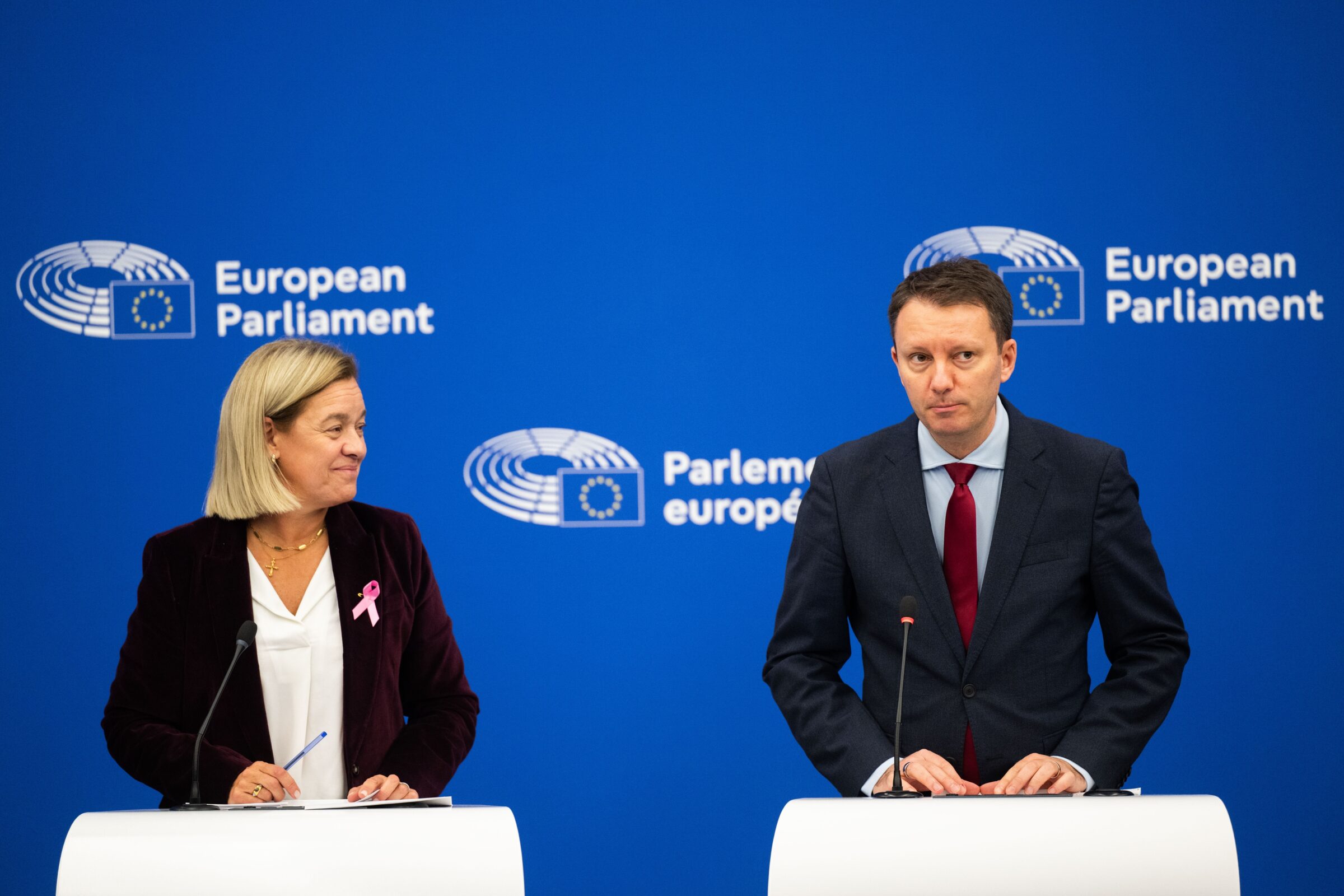
Siegfried Mureşan (EPP, Romania) and Carla Tavares (S&D, Portugal) are the parliament’s co-rapporteurs on the EU budget, also known as the multiannual financial framework (MFF)
In the cover image: Asmodeus / The Devil at Rennes-le-Château, by Andy Hay, and his worshipper on the US city council
by Fabio Giuseppe Carlo Carisio
Europeans owe a debt of gratitude to Gospa News International for the ability to discover what is happening around the world in real time.
Not because we are better than others, but because we pay attention to RT (formerly Russia Today)—a broadcaster offering exceptional investigative content that, prior to the war in Ukraine (triggered by the 2014 NATO coup—a fact that must always be remembered), maintained newsrooms across Europe.
Yet, despite producing highly verified and well-documented content with an approach that was as objective as possible (unlike Sputnik International, which is controlled by the Kremlin), RT was banned from the web in EU by the European Commission under the criminal President Ursula von der Leyen and in the United Kingdom under the heretical Freemason King Charles.
If you Europeans are able to read about a sensational event almost in real time today, you have Gospa News to thank—and perhaps you might consider making a small donation.
“US city council opens session with prayer to Satan”—this is the simple headline of an article posted last night by RT at 12:37 AM Moscow time in its “Top Stories” section, referencing a video published on the official website of the city of Ottumwa (Iowa, USA).
The RT article you are about to read highlights a massive problem—one previously addressed in another Gospa News investigation that proved highly embarrassing for the Catholic Church…
It states that the invocation of Lucifer was permitted under a new law recently passed by the City Council, which allows any faith group to offer a “prayer.”
One member of the assembly had warned of the risk that satanic invocations might occur and voted against the measure.
I do not wish to appear boastful, but it is an objective fact that, just hours earlier of the RT post, Gospa News had published an exclusive investigation with a telling title: “THE APOCALYPTIC PROPHECIES OF LA SALETTE – 1. The Era of the ANTICHRIST. From Our Lady of Victory at Lepanto to the October 7th of Jihadist, Zionist & Masonic DEMONS.”
For this, I give thanks to the Holy Spirit, the Paraclete; as a Christian journalist, I pray to Him daily for inspiration, including in the choice of topics for my writings.
In the message that the visionary of La Salette (France) nun Mary od Cross reported receiving during the apparition of Our Lady (September 19, 1846—approved by the Catholic Church), the imminent Era of the Antichrist was foretold.
In a message given in 2001 to the visionary Marija Pavlović, the Queen of Peace—who has been appearing in Medjugorje for 45 years—announced that “Satan is now free from his chains.”
The effects are visible not only in the rise of atheism but even in the open adulation of Lucifer!
As Gospa News has noted, respect for other deities was enshrined in an even more significant act—one that the Holy See and certain cardinals stubbornly continue to defend: the Second Vatican Council’s document *Nostra Aetate*.
That document called for respect for every religious faith—and thus, implicitly, for the Goddess Kali (worshipped by the ferocious Thuggee headhunters), the Great Architect of the Universe (of Freemasonry), and the pagan idol Baphomet; and, by extension, for Satan—who is surely more real than the other three mentioned, all of whom were inspired by him…
Naturally, the Catholic Church approved that document to foster interfaith dialogue and, above all, to offer a gift to the Zionist movement—comprising self-styled adherents of Judaism—thereby triggering what we have termed a “license to kill,” which has materialized in the current genocides in the Holy Land.
For too many cardinals—whether out of naivety, as they follow the progressive theological drift that denies Lucifer’s existence, or out of fear, preferring not to speak of him—failed to heed Pope Paul VI’s warning to the clergy about the entry of the “smoke of Satan into the Temple of God.”
Instead, they approved that document, never imagining that one day they might find themselves confronting Satan worshippers.
That day has arrived!
Yet the weapons wielded by the wearers of the cardinal’s red and the bishop’s violet seem to have lost their edge, precisely because of the gradual decline in the struggle against the devil and in the practice of exorcism.
This excludes, of course, those members of the clergy who have already crossed the flimsy barricade to serve the enemy—as prophesied in the Marian messages received by Sister Mary of the Cross (born Melanie Calvat), the visionary of La Salette.
FREEMASONRY & VATICAN – 2. Cardinals, Bishops kneeling before Satan at the Masonic Summit in Italy
Originally published by RT (former Russia Today) – banned in EU and UK
An Iowa city council meeting erupted into controversy after opening with a Satanic invocation that ended with the words “Hail Satan,” prompting a local pastor to demand that officials “reverse this curse.”
Matt Dalbey, an Ottumwa resident and former city council member, delivered the invocation at Tuesday’s meeting (October, 6, 2026) under a policy allowing residents of different religions and belief systems to open council proceedings with a prayer or reflection.
Dalbey began by addressing a “dark father” and invoking what he called the “Luciferian impulse” before concluding: “It is done. Hail Satan.”
The invocation immediately drew objections from New Life Center pastor Rick Bick, who interrupted the proceedings.
“That was a curse put on the city,” he said. “Most of you know that, and we need to just stop and reverse it… ‘Hail Satan’ is not welcome here.”
Mayor Benjamin Foote then called for a 30-second moment of silence “to reflect on whatever it is we need to reflect on at this time.”
Dalbey’s invocation was permitted under a policy adopted by the council in January.
The measure states that Ottumwa, a city of some 25,500 people, seeks to respect “the diversity of both organized and unorganized religious denominations, as well as other faiths, belief systems, or the lack thereof.”
Council member Cara Galloway had specifically warned that a Satanic invocation could happen when she cast the only vote against the policy in January.
Opening with an invocation means allowing viewpoints that may not reflect our own,” she said, warning that selectively objecting to one now could expose taxpayers to legal liability
The city said Wednesday that it had been flooded with calls over the prayer, many of them “rude and full of profanities,” but stressed that officials cannot discriminate between denominations or belief systems.
The recording of the meeting had drawn more than 12,000 views on the city’s YouTube channel by Wednesday afternoon, making it the most-watched video ever posted there.
Dalbey is scheduled to deliver another invocation at the council’s November 3 meeting. He told the Ottumwa Courier that the prayer is used by the Satanic Temple of Iowa, of which he is a member, but “has nothing to do with the belief in a satanic deity.”
The organization describes itself as non-theistic.
Originally published by RT (former Russia Today) – banned in EU and UK
RELATED POSTS by GOSPA NEWS
RELATED POSTS by RT

It’s not often that events in Mumbai reverberate through global markets. But the Reserve Bank of India’s first interest rate hike in almost four years speaks volumes about the chaotic state of play. The inflation slamming Asia’s third-biggest economy and the rupee’s drop to record lows left RBI Governor Sanjay Malhotra with no choice but […]
The post India’s rate hike a loud warning shot for Modinomics appeared first on Asia Times.
Germany’s most promising industries are also among the most tightly connected to Chinese supply chains, found a new study published on Thursday (8 October).
The paper, Industry with a Future, by the Cologne-based ZOE Institute for Future-fit Economies, ranks 62 German industries according to their prospects for future value, links to green technologies, and contribution to the wider German economy.
Small electrical industries come out particularly well, including clean tech sectors, such as battery producers and manufacturers of electric motors, switchboards, and computer equipment.
These areas combine the kind of specialised know-how that is difficult to copy, which can protect high-wage economies, such as Germany, from cheap foreign competition into the future.
But many of those industries still depend on China for components, and in some cases also rely on Chinese buyers to sell their products to.
“China matters to these industries not only as a competitor, but also as a supplier and a buyer,” the ZOE Institute study’s co-author, Marla Schiefeling, told journalists at a briefing on Wednesday.
That leaves Germany with a difficult industrial policy problem: It needs to scale these sectors up while cutting its dependence on China, but the fastest way to scale is with cheap Chinese components.
To solve this predicament, the authors argue for diversifying suppliers and creating more demand in Germany and the EU.
The driver of the troubles is that the German economic model itself isn’t working anymore.
Around 420,000 manufacturing jobs were lost between 2019 and 2025, and German exports to China fell 29 percent from their 2021 peak to 2025, the study notes.
“Production and employment in German industry have been falling for years. This is definitely not a cyclical dip. It is a structural problem,” said co-author Lukas Bertram.
Reliant as it is on exports, Germany’s big export industries, such as car makers or industrial machines, are losing competitiveness, mostly to China, while facing US tariffs abroad and high energy prices at home.
Yet the study argues these industries are also the country’s best hope, and are better placed to create new value than their current troubles suggest.
German carmakers, such as BMW, Mercedes, and Volkswagen, which are in the direct line of fire of China’s EV dominance, already have many of the industrial capabilities to make much of what is needed to build batteries, wind turbines or power grids, from electronics to specialised metal parts.
“From these capabilities, new leading roles can emerge, for instance in electric mobility,” the report’s authors note.
While still associated with fuel and combustion engines, carmaking ranks among the top three industries for eight of the 10 green supply chains the authors examined.
Machinery, metal products and parts of the chemicals industry also do well, which the authors initially found surprising.
“We briefly wondered whether something was off with the methodology. But once we dug deeper, we realised it makes complete sense,” said Schiefeling.
“There’s still a lot of potential and a huge amount of technological know-how there,” she added.
“The task is to translate that into sustainable production structures from which new value can emerge,” she said.
Other sectors, such as coal power, coke ovens, oil refining, and fertiliser production, by contrast, have little future in Germany, the study finds.
But rather than letting them collapse, the authors argue they should be wound down gradually, which they call “strategic de-scaling.”
Meanwhile in Brussels, the debate about the EU’s Industrial Accelerator Act is heating up.
The first version of the plan was circulated by the commission in March, but it is still being redrafted, with a new version presented on Wednesday.
At the heart of the plan is the ‘Made in EU’ clause. This would require governments to favour European-made (low-carbon) goods, starting with steel, cement, aluminium, cars, and clean technologies.
In a joint non-paper sent to the commission on Monday, German chancellor Friedrich Merz and French president Emmanuel Macron similarly called for a “European preference” in strategic sectors and to “derisk” from Chinese supply chains, notably in batteries and clean energy equipment.
But the ZOE Institute’s Bertram said that while ‘made in Europe’ criteria could help create demand for EU and Germany fledgeling industries, this might not help all sectors concerned.
For a German battery or switchboard maker that can only source its parts from China, such rules might “initially raise prices rather than genuinely create local production capacity,” he said.
This piece was amended for clarity.

This article originally appeared on Dean Baker’s Patreon. It is reprinted here with permission.
Virtually everyone who is not a billionaire, or owned by one, agrees that we have to limit the ability of the rich to buy elections. While the Republican Party has taken “policy for sale” politics to a new level, there are plenty of Democrats who have been happy to support obviously awful policy in exchange for contributions from the AI industry, the pharmaceutical industry, the crypto industry, and Wall Street more generally. It costs a lot of money to run a competitive campaign and it’s hard to raise that from small contributions, so there will always be a temptation to bend policy positions to get some serious money.
While most people favor limits on campaign contributions, the current Supreme Court has made this very difficult. They have ruled that campaign contributions are speech and therefore any effort to limit campaign contributions is an unconstitutional restriction on speech.
There are some promising alternative paths that focus on making small donors matter. Seattle has a system of “democracy vouchers” that give every voter in local elections a modest sum that they can contribute to a candidate(s) of their choice. To qualify to get the vouchers, candidates must agree to limits on spending and large contributions.
Super-matches are a comparable system. Under this system, small dollar contributions can be matched up to 8 to 1, which means that even a $50 contribution can make a difference to a campaign. New York City, along with several other cities, have gone this route.
While these paths for amplifying the voice of ordinary people are promising, it will take much more to match the power of the billionaires. It is important to realize they exercise their political power in ways other than campaign contributions, primarily through their ownership of the media.
The importance of billionaire ownership goes far beyond the constant stream of lies and right-wing propaganda from Fox News. Last year, the very Trumpy Ellison family took control of CBS and immediately began to shift its news to the right. They are now taking control of CNN through the merger of Paramount and Warner Brothers. They also got control over TikTok, after Trump wrestled it away from a Chinese company for them.
Trumper Mark Zuckerberg owns Facebook and Instagram and is not shy about banning political material he doesn’t like. And Elon Musk bought Twitter, explicitly to advance his right-wing agenda. The rest of the media landscape doesn’t look much better. The rich and very rich own the countries’ newspapers and broadcast outlets, and most of these people lean right, even if they have not yet joined the Trump Reich.
And let’s just be clear. The idea that the campaign ads bought by the rich can influence votes, but not the material that people see between the ads, is beyond absurd. Even if we banned all political contributions from rich people and corporations, the rich could still control elections by showing us nothing but their propaganda on television, in newspapers, and on social media.
This is why the Community News Act that Governor Gavin Newsom just signed is so important. The measure provides $20,000 each for up to five journalists per news outlet covering local news. This subsidy can keep newspapers and news sites across the state in business and help to support new ones that might start up. It is similar to other programs that have been started in Illinois, New York, and New Mexico.
This might seem like small change in a world with multi-billion dollar media empires, but it is not realistic to imagine matching the super-rich dollar for dollar; the goal is to sustain reality-based reporting that people can rely upon. (Repealing Section 230 protection for the mega-platforms like Facebook and X would be a big step towards leveling the playing field.) And support for local news reporting is likely to also lead to better national and international reporting, both by training more reporters and also increasing the comfort level with public funding, perhaps opening the door for a national system.
To be clear, there are no political conditions attached to this funding. Conservative news outlets are as eligible for this subsidy as more liberal ones. The point is to support local journalism, not to favor a particular political perspective.
To my view, this system is not ideal. I prefer support coming through an individual refundable tax credit to support local news. This would allow people to have a more direct attachment to the news outlets being supported with public money. Ideally, this would give them a sense of ownership that many feel towards other community organizations.
But whether or not this is the best approach, there is no doubt that the California bill, along with the ones already passed in other states, are big steps forward. It will help to reverse the collapse of local news reporting, which is giving corruption free rein in many areas. We need to build on the positive and make it better, rather than reject a plan because it may not be ideal. Progressive opponents of California’s wealth tax initiative may want to give that point some thought.

Russia is spending more on the war than at any point since it began. Russia's military funding is on track to hit a record this year after President Vladimir Putin added almost $60 billion to the outlays set in the budget, Bloomberg reports, citing people close to the government.
Defense spending is expected to approach about $199 billion by the end of 2026, roughly 40% above the plan Moscow announced in late 2025. That reverses the course of a year ago, when the Kremlin meant to slow military growth, narrow its deficit, and rebuild reserves drained by the war.
Putin ordered the shift late last year, after concluding that talks with the US in Alaska would not produce an acceptable deal to end the fighting, the report says.
By January, the Kremlin judged an agreement with Ukraine to be out of reach, and the government began accelerating advance payments to defense firms and raising other war-related spending.
"The government is finally budgeting for a prolonged war in Ukraine, but still understates its cost," Bloomberg Economics economist Ekaterina Vlasova said.
Paying for the war has blown out the budget. The projected 2026 deficit has climbed to more than $81 billion, up from about $44 billion as first planned, and the government covered the extra spending through increased domestic borrowing and gold sales.
The spending is not set to fall soon. Under the budget plans, Russia's military outlays reach about $200 billion in 2027, then ease to $194 billion in 2028 and about $191 billion in 2029, a signal that Moscow is planning for a long war.
Earlier, Euromaidan Press reported that Russia was raising 2027 defense spending by 27% to a record, even as its deficit widens and oil and gas revenues fall.