❌

Reading view

Why Does the EU Insist on Provoking the Man Who Underwrites its Security?

Why does the EU insist on provoking the man who underwrites its security, asks Steven Tucker, as he skewers the parasitic psychology of the ungrateful men-children behind the EU's naked fat golden Trump statue.

The post Why Does the EU Insist on Provoking the Man Who Underwrites its Security? appeared first on The Daily Sceptic.

  •  

Metsola apologises to former hostage as Parliament marks 7th October


Patricia Teitelbaum, President of the International Movement for Peace and Coexistence, opened the third-anniversary commemoration of the 7th October 2023 Hamas massacre by welcoming guests to an exhibition named Memory, Dignity and the Duty to Prevent.

Held in the European Parliament in Strasbourg on 7th October, it was co-organised by IMPAC and the American Jewish Committee’s Transatlantic Institute, and hosted by Hildegard Bentele, the German EPP MEP who chairs the Parliament’s delegation for relations with Israel. Over 200 were present, including at least 55 MEPs.

Photographs by Israeli Ziv Koren lined the gallery. Sculptures by the Gaza-border blacksmith Yaron Bob, forged from rocket metal, stood among them. Teitelbaum said the gathering was meant to restore dignity stripped from the victims and to commit those present to preventing a repetition. “Our common duty to prevent, to combat extremism and radicalisation, that would be a noble way to honour those who were murdered.”

Benedetta Buttiglione, director of the AJC in Brussels, thanked former hostage Omri Miran for being in the room, and called Bob’s rockets-into-roses a refusal to let destruction have the last word. Memory, she said, because the dead would not be forgotten; dignity, because every victim was a human being and not a statistic; and a duty to prevent, because remembrance meant taking responsibility.

Sarah Mordekhay, from the Eshkol region on the Gaza envelope, then lit candles in memory of some of the victims she knew, such as Bernard Cowan from kibbutz Sufa. She described 7th October as the deadliest massacre of Jews since the Shoah, but this time in their homeland: entire families wiped out, “not for what they did, but for who they were.” Never again, she said, meant no justification for terrorism and no tolerance for antisemitism.

Bentele, as host, recalled that more than 1,200 people were murdered that day, including citizens of EU member states, and that 44 EU citizens were among those taken hostage. Some survivors, she said, later took their own lives because the suffering was unbearable. She turned to Miran, who spent 738 days in Hamas captivity, and called his journey from Israel to Strasbourg an act of courage. “Remembrance is our responsibility,” she said. 

European Parliament President Roberta Metsola spoke next and began with an apology. Two days earlier, French MEP Rima Hassan of La France Insoumise had visited the exhibition and thrown down the Israel flag, causing the EU flag to fall as well. Witnesses said she stepped over the European flag and made no attempt to pick it up.

Addressing Miran, she said she felt she must apologise, nonetheless. “I hope, dear Omri, you know that the actions of one person this week do not reflect the sentiment, ethos or belief of the vast, vast majority of members of this house who are as outraged as me.” The room applauded. She recalled her visit to Kfar Aza and Re’im on 13th October 2023 with the Speaker of the Knesset: the smell of death, a child’s burnt swing, and a make-up brush handed to her in a bus shelter at Re’im, which still sits on her desk.

She named the Bibas children, Ariel and Kfir, and spoke of girls who survived sexual violence in captivity only to meet sceptics. She did not confine the dead to Israel. “So many since also died in Gaza,” she said. “We are not blind to anyone’s suffering.” The way forward, she argued, had to end terror, disband Hamas and its proxies, and renew the fight against antisemitism. “The line between legitimate criticism and antisemitic narratives should be a chasm that no one crosses.”

Yaron Bob then presented Metsola with a sculpture, the Hand of Peace, a hand rising from broken ground to hold a broken olive branch. The branch was broken, he said, because the losses were terrible; the hand still held it because hope had not been given up. “My dream is that one day there will be no more rockets for me to use”, he concluded.

Israel’s ambassador to the EU and NATO, Avi Nir-Feldklein, asked who in the room had woken that morning wondering whether their country would survive the day. He thanked Metsola for speaking when others stayed silent and told Miran that an entire nation had rejoiced at his return.

Miran spoke last. Abducted from Kibbutz Nahal Oz, he described the safe room with his wife Lishay and their daughters Roni, then two, and Alma, six months old; the murder of the kibbutz security coordinator, Ilan Fiorentino; and the moment terrorists used a 17-year-old neighbour to force the family to open the door.

A rifle was pointed at Roni’s head. As he was led away, the child broke free and screamed for her father. He did not look back, afraid they would be shot. He was beaten by a mob on entering Gaza, held in 23 places, including tunnels about 30 metres underground, and filmed for propaganda. His captors, he said, told him they would repeat 7th October “until the last Jew had either left or been slaughtered.”

Asked whether Gaza’s losses had changed their minds, they answered that 50,000 babies had been born that year: “50,000 new martyrs.” Pressure on Israel, and what he called a false symmetry between Hamas and Hezbollah and Israeli self-defence, had been read by those captors as encouragement, not as a call for peace.

Hildegard Bentele, the host MEP, had already given the day’s answer to the flag incident, writing on the evening it happened: “Knocking down the EU and Israeli flags at our commemoration exhibition does nothing to ease that suffering. We should come together to honour the victims and work to ensure such atrocities never happen again. Remembrance deserves respect.”

  •  

‘When you laugh at a dictator, you take away his power’: Artist behind viral naked Trump statue speaks out

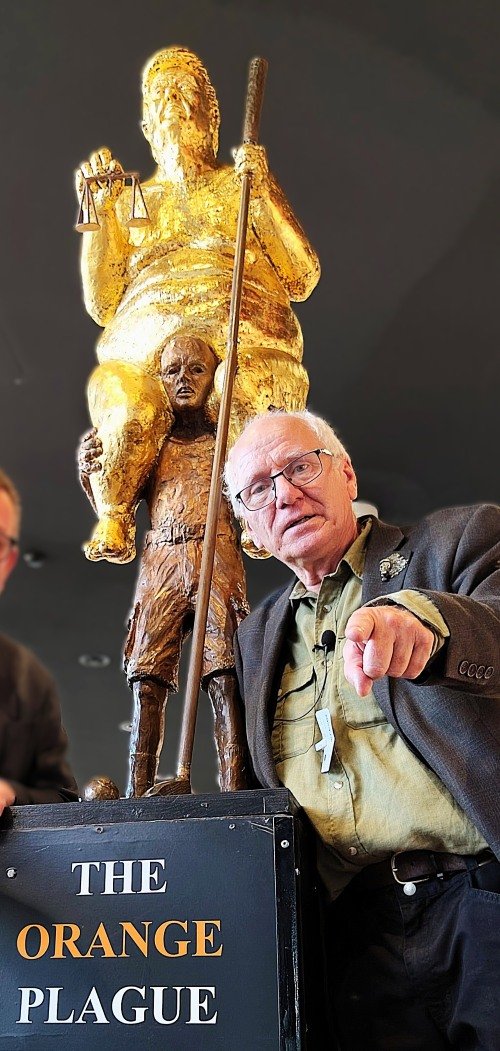
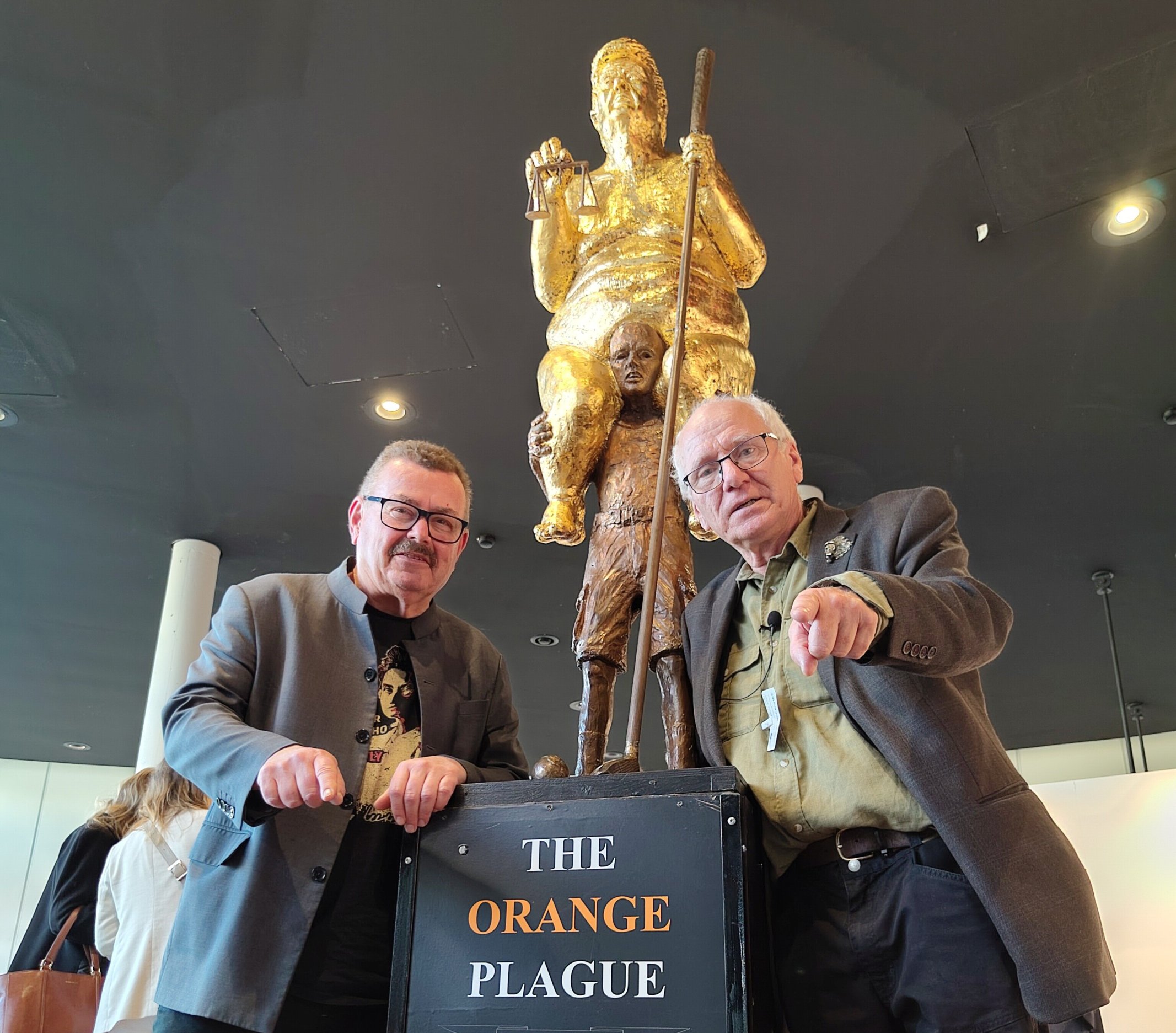
The European Parliament in Strasbourg has been adorned with a grotesque vision of American power in a 2.5-metre-high statue of a naked and obese US president Donald Trump covered in 23-carat gold.

While some MEPs describe it as an expression of freedom and courage in the face of Trump, Slovak prime minister Robert Fico has said the statue is a symbol of a declining European Union and called for its removal.

Fico said the statue reflects a profound misunderstanding of the times we live in, and reminded his X followers that he and Trump are close.

“At a time that calls for dialogue and mutual respect, insulting our partners on official premises demonstrates a profound failure to understand the times we live in,” he said on social media.

“It is sad that the leadership of the European Parliament, in its blindness, can no longer distinguish between the legitimate right to hold a different opinion and the actions of spiritually bankrupt individuals, adventurers and lunatics,” he added.

Jens Galschiøt is the artists behind the Orange Plague sculpture. The Danish artist says his installation served as a warning that Donald Trump is destroying democracy.

Why call it ‘Orange Plague‘?

“I depicted Donald Trump as an ‘orange plague’ because he is destroying everything I believe in. I believe in democracy and the rule of law. All this needs to be cared for, and Trump is destroying it, as well as the debate on the environment,” Galschiøt said.

The artist chose to portray the US president as a grotesque figure hoping that people would laugh at it. “When you laugh at a dictator, you take away his power,” he said.

And Trump is also naked because of Hans Christian Andersen’s fairy tale The Emperor’s New Clothes. In it, the emperor walks through the streets with no clothes, while people tell him how beautifully dressed he is, but no one dares tell him the truth. Only one small child cries out that the ruler is naked.

Galschiøt sees parallels the story and treatment of the US president.

“I think many of us laugh at Donald Trump, but he does not know it. He thinks he is a great leader. He thinks he is an intelligent person. He thinks he gives good speeches. But few people take him seriously. Even if you do take him seriously, it is because he is something like a gang leader, not because of what he says. Most of us actually think he is a ridiculous figure,” Galschiøt said.

Jens Galschiøt beside the Trump statue. Source: J. G. archive

His sculpture consists not only of a naked and obese Trump, but also of a slender figure.

“The little man carries the big man, and the big man tells him: ‘Oh, I really want to help you. I really love you, but I do not want to get off your back.’ It is also a story about hypocrisy and double standards, which I combined,” the artist said.

He covered the sculpture in gold because Trump is known to like the precious metal.

This article continues, but the full version is available only to EUobserver.com subscribers. Visit account.euobserver.com/membership

  •  

1,100 rooms, $1.75 billion and 700,000 tons of steel: A building in Bucharest

A building rises in the center of Bucharest that defies explanation through architecture alone. The Palace of Parliament is the heaviest building in the world according to Guinness World Records, and a vast section of the old city was demolished for its construction. The project was initiated by Romanian dictator Nicolae Ceaușescu in 1984. The […]

  •  

European Parliament Demands Tougher China Policy Over Trade, Taiwan and Russia

MEPs have backed a more demanding approach to Beijing, linking Europe’s worsening trade imbalance with China’s support for Russia and increasing military pressure on Taiwan. The vote comes as Brussels seeks concessions in negotiations with Chinese officials.

The European Parliament has adopted a recommendation calling for a tougher European Union policy towards China, citing Beijing’s trade practices, support for Russia’s war against Ukraine and growing pressure on Taiwan.

MEPs approved the text on Wednesday, 7 October, by 454 votes to 86, with 110 abstentions, giving substantial parliamentary backing to demands for a more reciprocal economic relationship with China.

The recommendation, prepared by Belgian MEP Hilde Vautmans of Renew Europe, addresses the EU’s increasingly difficult relationship with Beijing at a time when European Trade Commissioner Maroš Šefčovič is holding negotiations with Chinese officials.

According to the official parliamentary procedure, the recommendation was adopted following a plenary debate on 6 October. It sets out Parliament’s priorities for the Council, European Commission and EU foreign policy leadership.

Although the text is not legally binding, the size of the majority gives the Commission additional political support as it considers new measures against Chinese imports and seeks greater access to the Chinese market.

Trade Relations Reach Critical Point

The recommendation reflects a growing view within European institutions that the existing economic relationship with China is becoming increasingly difficult to sustain.

China remains one of the EU’s most important trading partners, but the bloc’s merchandise trade deficit has widened to approximately €360 billion.

European manufacturers face increasing competition from Chinese companies benefiting from extensive domestic production capacity, lower costs and government industrial policies.

The automotive industry has become a particular source of friction, with Chinese manufacturers expanding their presence in Europe following the imposition of EU tariffs on battery-electric vehicles.

Brussels is now considering additional restrictions on hybrid cars after Beijing reportedly rejected requests to limit exports voluntarily.

The concerns extend beyond vehicle manufacturing to chemicals, machinery, renewable-energy technologies and access to critical raw materials.

A European Parliament research briefing published before the vote identified China’s industrial overcapacity, restrictions on market access and dependence on export-led growth as principal causes of the imbalance.

The document also highlighted the increasingly close relationship between economic policy and European security.

China’s Support for Russia Draws Criticism

China’s relationship with Moscow was another major element of Parliament’s recommendation.

MEPs have expressed growing concern about Beijing’s role in sustaining Russia’s military-industrial economy, particularly through the supply of dual-use technology and components used in weapons production.

The EU has repeatedly called on China to use its influence over Russia to help bring an end to the invasion of Ukraine.

Beijing maintains that it is not a party to the conflict and has presented itself as supporting a negotiated settlement. However, its commercial and technological relationship with Moscow continues to attract scrutiny from European governments.

The parliamentary recommendation forms part of an increasingly explicit European effort to connect China policy with the consequences of Russia’s war.

European officials are concerned that Chinese technology, industrial components and financial relationships may reduce the effectiveness of sanctions intended to restrict Russia’s military production.

The consequences reach beyond Ukraine. China’s growing defence relationship with Russia and its military activity in East Asia have reinforced European concerns about the security implications of deeper economic dependence on Beijing.

Taiwan Emerges as Another Source of Disagreement

The recommendation also addresses China’s increasingly confrontational approach towards Taiwan.

Beijing claims sovereignty over the self-governing island and has repeatedly refused to rule out the use of force to establish control.

The EU maintains its one-China policy while opposing unilateral changes to the status quo through force or coercion.

Parliament has consistently supported closer economic and practical relations with Taiwan, particularly in fields involving semiconductors, critical technologies and supply-chain security.

A parliamentary examination of Taiwan’s international position published in June noted the island’s importance to European technological industries and the broader consequences of a confrontation in the Taiwan Strait.

The latest recommendation places those concerns within a wider assessment of EU–China relations.

Taiwan’s semiconductor industry occupies a central position in global electronics manufacturing. Any major interruption to production or shipping would affect European automotive companies, industrial equipment manufacturers and technology businesses.

European governments therefore face a security challenge that cannot be separated from the commercial relationship with China.

Parliament Backs More Assertive EU Policy

The recommendation was adopted after extensive negotiations among parliamentary political groups.

According to the recorded voting results, 454 MEPs supported the text, with opposition and abstentions accounting for 196 votes.

The majority demonstrates considerable support for revising the existing approach to China, although political differences remain over the extent of economic restrictions and diplomatic confrontation.

Some member states favour stronger trade defence measures and tighter scrutiny of Chinese investment, while others remain concerned about retaliation against European exporters.

Germany, France and smaller member states also have different industrial and commercial exposures to China, complicating attempts to establish a common strategy.

The EU must additionally consider whether efforts to reduce strategic dependencies can be reconciled with continued trade and investment.

Parliament’s recommendation does not compel the Commission to introduce new tariffs, restrict Chinese investment or change the Union’s diplomatic position towards Taiwan.

Those decisions remain within the relevant EU institutional procedures and, where applicable, the competence of member states.

Nevertheless, the vote provides a political reference point for forthcoming discussions on trade, technology and European security.

Trade Negotiations Put Parliament’s Position to Test

The timing places the recommendation directly alongside Šefčovič’s negotiations in Beijing.

The Commission is seeking Chinese concessions concerning the trade deficit, industrial overcapacity and access to the Chinese market.

China has resisted European demands for voluntary restrictions on certain exports and has criticised measures it considers protectionist.

The disagreement is likely to feature in discussions among EU leaders on 15–16 October.

The parliamentary vote strengthens the position of those demanding a more assertive European response, but disagreements between member states and the prospect of Chinese retaliation will continue to influence the Commission’s choices.

The immediate test will be whether negotiations can produce concrete changes in trade conditions, rather than another declaration of the need for more balanced relations.

  •  

Government to deliver 2027 State Budget bill to parliament today

Portugal’s AD coalition government is set to table the draft State Budget bill for 2027 in Parliament this afternoon, two full days before the deadline. The information was provided in

The post Government to deliver 2027 State Budget bill to parliament today appeared first on Portugal Resident.

  •  

European Parliament Rejects Russia’s Fake Democracy as Commission Faces Pressure to Get Tough

By refusing to recognise Vladimir Putin’s newly elected State Duma, the European Parliament has drawn an important line against the Kremlin’s authoritarianism. However, despite Europe possessing enormous economic and diplomatic leverage, the question still remains whether the European Commission and member states are prepared to turn condemnation into meaningful consequences.

The European Parliament has delivered an unusually unequivocal denunciation of Vladimir Putin’s Russia, refusing to recognise the legitimacy of the newly constituted State Duma following September’s parliamentary elections.

In a resolution adopted by 482 votes to 41, with 39 abstentions, MEPs rejected the elections of 18–20 September as neither free nor fair, condemning what they described as the deliberate destruction of Russia’s remaining democratic institutions.

The resolution is significant not simply for its language, but for its demands. Parliament wants European governments to refuse official contact with the new Duma, impose additional sanctions on those responsible for repression and electoral manipulation, and reject any normalisation of relations with Moscow until fundamental conditions concerning Ukraine have been met.

It is a substantial political statement. Whether it becomes an effective European policy is another matter.

Putin’s democracy: an election without a choice

The circumstances surrounding the September ballot demonstrate why MEPs reached their conclusions.

According to Parliament, there were no genuine alternative candidates, no free media, no credible independent observers and no meaningful political freedoms.

Opponents of Putin’s regime have been imprisoned, driven into exile or, in some cases, murdered.

Under such conditions, elections cease to provide a credible means of holding government accountable. Instead, they risk becoming exercises designed to confer an appearance of democratic legitimacy upon an entrenched authoritarian system.

Particularly disturbing was Moscow’s decision to conduct voting in occupied Ukrainian territory, including parts of Donetsk, Kherson, Luhansk and Zaporizhzhia.

Parliament also condemned the organisation of voting in Moldova’s Transnistrian region and Georgia’s Abkhazia and Tskhinvali/South Ossetia regions.

These are not merely procedural irregularities. They raise fundamental questions about sovereignty, territorial integrity and Russia’s willingness to respect internationally recognised borders.

The Parliament’s refusal to recognise the new Duma therefore carries considerable diplomatic significance.

Europe has the economic power. Does it have the political determination?

Yet there is an uncomfortable contrast between the Parliament’s forthright language and the difficulties European governments repeatedly encounter when attempting to strengthen economic pressure on Moscow.

The European Commission has played a central role in preparing successive sanctions packages. However, proposals can become entangled in negotiations between member states determined to protect particular commercial interests.

As EU Today has repeatedly argued in its coverage of Russia’s aggression and European sanctions policy, the effectiveness of restrictions depends not simply on their announcement, but on their enforcement.

Europe possesses enormous economic leverage through its financial markets, technology industries, maritime services and access to international trade.

There is a strong case for examining whether that leverage is being employed as consistently as possible against the networks sustaining Russia’s war economy.

The Commission cannot act entirely independently: major sanctions decisions require agreement among member states. Nevertheless, its responsibility for proposing measures, coordinating implementation and pursuing infringements gives it considerable influence.

The central criticism is therefore not that Brussels has failed to act, but that European action remains vulnerable to political compromise, uneven enforcement and commercial exceptions.

Target the machinery of repression

The Parliament’s resolution offers a particularly practical starting point. MEPs want additional restrictive measures against judges, prosecutors, officials of Russia’s financial monitoring service, Rosfinmonitoring, members of the Central Election Commission and individuals involved in organising staged elections in occupied territories.

This represents a more targeted approach than indiscriminate economic punishment.

Those who administer political persecution, facilitate repression or organise unlawful electoral processes should face appropriate individual accountability, subject to evidence and legal safeguards.

The resolution also calls for action against transnational repression, recognising that Moscow’s efforts to intimidate opponents can extend beyond Russia’s borders.

Such measures would complement existing sanctions rather than replace them.

No return to business as usual

Perhaps the resolution’s most consequential element concerns the conditions for restoring relations with Russia.

Parliament insists there can be no normalisation without a just and lasting peace for Ukraine, full Russian withdrawal, the release of prisoners of war, the return of forcibly deported Ukrainian children, reparations and accountability for crimes committed.

It also opposes normalising Russian participation in international sporting and cultural events.

These are demanding conditions, and their implementation would require sustained diplomatic coordination.

Nevertheless, the resolution establishes a clear principle: restoring ordinary relations cannot be separated from the consequences of Russia’s aggression.

It also importantly distinguishes Putin’s regime from Russian democratic forces, calling for continued support for those opposing the war and seeking a democratic future.

The real test begins now

The European Parliament has articulated a comprehensive position combining electoral legitimacy, territorial sovereignty, individual accountability and Ukraine’s rights.

The challenge for the Commission and European governments is to determine how these demands can be implemented effectively, consistently and lawfully.

Europe has the resources to exert considerable pressure on Moscow. What remains contested is how far its governments are prepared to accept the economic and diplomatic costs of doing so.

Condemning Putin’s electoral system is one thing. Ensuring that those responsible for repression and aggression face meaningful consequences is quite another.

The European Parliament has made its position unmistakable. The Commission and member states now face the more difficult task of demonstrating that European economic power can reinforce European democratic principles.

The European Commission Wants More Bureaucrats – Europe Wants More Results

Main Image: Mathieu CUGNOT © European Union 2026 – Source : EP Usage terms: Identification of origin mandatory
  •  

Commissions of inquiry into Luís Neves and national exams to be set up on October 14

For all the political posturing from CHEGA, the parliamentary committee of inquiry (CPI) into Luís Neves will be sworn in on the same date that the committee of inquiry on

The post Commissions of inquiry into Luís Neves and national exams to be set up on October 14 appeared first on Portugal Resident.

  •  

Golden Naked Trump Statue Unveiled at European Parliament

A giant golden statue depicting a naked Donald Trump has gone on display inside one of the European Parliament's buildings.

The post Golden Naked Trump Statue Unveiled at European Parliament appeared first on The Daily Sceptic.

  •  

Europe Has the Economic Power to Stand Up to China — It Is Time Brussels Used It


For years, the European Union has struggled with a peculiar contradiction in its dealings with China. The EU is one of the largest and wealthiest trading blocs on earth, capable of determining access to a market of some 450 million relatively affluent consumers, yet it frequently conducts foreign policy as though it were the supplicant.

Hilde Vautmans, the Belgian Renew Europe MEP and European Parliament rapporteur on EU-China political relations, is right to challenge this timidity.

Her report, debated this week in Strasbourg, does not advocate severing relations with Beijing. Nor should it. China is too economically important and too influential on questions ranging from climate change to international security for Europe simply to close the door.

But dialogue must not become an alternative to action.

“Europe has economic power. It’s time to use it,” Vautmans told Parliament ahead of the vote. That sentence ought to be pinned above every desk in the European Commission dealing with China.

The figures make the case brutally clear. In 2025 the EU imported €559.4 billion of goods from China while exporting just €199.6 billion in the opposite direction. The resulting deficit was €359.8 billion — almost €1 billion every day.

As EU Today reported recently, Commission President Ursula von der Leyen has herself warned of a potential “second China shock”, with subsidised Chinese industrial production threatening European manufacturers.

Fine words. But Beijing has heard fine words before.

The Commission’s preferred formulation remains “de-risking, not decoupling”. There is sense in that distinction. Nobody seriously proposes shutting down trade with the world’s second-largest economy. But de-risking becomes meaningless if every risk identified is followed by another dialogue, another working group and another opportunity to postpone difficult decisions.

Indeed, the Commission acknowledges that European companies operating in China face regulatory obstacles, inadequate intellectual-property protection, restrictions on data flows and pressures associated with technology transfer.

Europe possesses formidable weapons with which to respond: anti-dumping duties, anti-subsidy measures, foreign-investment screening, the Foreign Subsidies Regulation, the Anti-Coercion Instrument, procurement restrictions and controls on strategically sensitive technologies.

These instruments should not be deployed indiscriminately. But neither should they sit polished in the armoury while Beijing exploits European openness.

Vautmans is particularly right to connect economics with security and values. China cannot reasonably expect privileged access to European markets while helping sustain the Russian war machine. The European Parliament’s own research service describes Beijing as a “decisive enabler and dual-use provider”, including through goods entering Russian weapons and drone supply chains.

If Chinese companies materially assist Russia’s ability to wage war against Ukraine, Europe should be prepared to impose a direct economic price. The same principle should apply to human rights.

EU Today has warned repeatedly that Brussels’ ritualised engagement with Beijing risks becoming precisely that: ritual.

We reported earlier that the EU-China Human Rights Dialogue risks losing credibility, pointing to the continuing imprisonment of Swedish citizen Gui Minhai and Uyghur academic and Sakharov Prize laureate Ilham Tohti. After round upon round of discussions, Beijing has learnt that European expressions of “deep concern” are inexpensive things to endure.

The problem is hardly new. Years ago, EU Today highlighted calls for concrete EU action over goods associated with forced labour in China, including demands for tougher restrictions on entities implicated in abuses against Uyghurs.

Yet repression continues. In March this year China adopted its new Law on the Promotion of Ethnic Unity and Progress. The European Parliament subsequently condemned what it described as intensified repression and assimilation affecting Tibetans, Uyghurs and other minorities, by the overwhelming margin of 439 votes to 52.

Europe therefore faces a straightforward question. What is the purpose of economic power if it is never translated into political influence?

The EU should not attempt to bully China. Nor should it abandon diplomacy. Vautmans is correct that channels of communication must remain open. But reciprocity must become something more than a word appearing in communiqués.

Where China closes markets to European companies, Europe should be prepared to restrict equivalent access. Where state subsidies distort competition, Brussels should respond rapidly with trade-defence measures. Where strategic dependencies expose Europe to political coercion, alternative supply chains must be built. Where Chinese entities support Russia’s military-industrial complex, sanctions should follow. And where companies benefit from forced labour or serious human-rights abuses, access to the European marketplace should carry consequences.

That is not protectionism. It is leverage.

Totalitarian states understand leverage perfectly well. China routinely uses access to its enormous market as an instrument of statecraft. Europe, by contrast, too often behaves as though exploiting its own commercial strength would somehow represent a failure of diplomacy. It represents precisely the opposite.

The European Commission has spent years discovering that China is simultaneously a partner, competitor and “systemic rival”. It is time to move beyond discovering the obvious.

Vautmans has identified the essential point. Europe already possesses economic power on a scale few countries can ignore. What it appears to lack is the political confidence to use it.

Main Image: by Valentine ZELER, © European Union 2026 – Source : EP

  •  

EU Housing Act Moves to Parliament as Brussels Targets Short-Term Rentals

MEPs have opened debate on the EU’s proposed Affordable Housing Act, which would give national and local authorities a clearer legal framework for restricting short-term rentals and some non-primary residential property use in areas facing severe housing pressure.

The European Parliament has begun examining legislation that would give cities and national governments greater legal certainty when restricting short-term rentals and the use or acquisition of residential property in areas where housing has become difficult to afford.

The proposed Affordable Housing Act, presented by the European Commission on 9 September, was on Parliament’s agenda in Strasbourg on Tuesday as housing costs move further into EU-level politics.

The legislation does not transfer general housing policy to Brussels. Decisions on construction, planning, rent policy and social housing would remain primarily with national, regional and local authorities.

Instead, the proposal would establish a common EU legal framework governing some restrictions that member states and cities may introduce when attempting to protect housing supply.

The draft regulation specifically covers measures restricting short-term accommodation in residential properties other than a host’s primary residence. It would also cover restrictions on the acquisition or use of land and housing that is not intended as somebody’s principal home.

Those provisions are designed partly to resolve a legal problem that has become increasingly important in cities with large tourism markets.

Local governments have introduced restrictions on holiday rentals and second-home use, but such measures can clash with EU single-market rules governing services, property and establishment. The Commission says the legislation would provide authorities with a clearer method for demonstrating when restrictions are justified and proportionate.

The law would therefore not impose a common European cap on Airbnb-type accommodation. Nor would it oblige cities to introduce restrictions.

Authorities choosing to intervene would instead have to demonstrate housing stress and ensure that their measures meet EU requirements on proportionality, transparency and review.

Brussels argues that the scale of Europe’s housing problem now affects more than social policy.

According to the Commission’s European affordable housing plan, house prices across the EU have risen by more than 60 per cent since 2013, while average rents have increased by about 20 per cent. Short-term rentals increased by 93 per cent between 2018 and 2024.

Only between six and seven per cent of EU housing stock is classified as social housing, while about 20 per cent of homes are recorded as unoccupied.

The Commission estimates that Europe needs to build more than two million homes a year to meet current demand — around 650,000 more annually than are presently being constructed. It estimates the additional investment requirement at approximately €153 billion each year.

Those figures underline a central difficulty in the housing debate: restrictions on tourist accommodation may return some properties to residential use, but they do not address the full shortage of new homes.

EU Today examined that wider supply issue when the Commission launched its European Affordable Housing Plan, which combines proposed regulation with investment, faster permitting, construction reform and changes to state-aid rules.

The debate is becoming more politically prominent as housing affordability affects a growing share of middle-income households as well as those on lower incomes.

Berlin offers one example. EU Today reported last month that advertised rents in the German capital had risen by roughly three-quarters in less than a decade, while the city calculates that it will need another 211,000 homes by 2040.

Pressure is particularly acute in large cities and tourism centres, where residential demand competes with short-term accommodation and investment properties.

The Commission argues that this has consequences for the wider economy because workers who cannot find affordable accommodation may be unable to move to areas where jobs are available.

That is why Brussels increasingly presents housing not only as a social concern but as part of the competitiveness and single-market agenda.

The proposal is still at an early stage. Parliament and the Council must negotiate the legislation under the ordinary legislative procedure, and substantial amendments remain possible.

Questions are likely to centre on how “housing stress” is defined, what evidence authorities must provide before restricting property use and how far EU law should permit local intervention in property markets.

The political dividing line is already apparent. One side of the debate stresses that cities need more freedom to protect permanent housing stock. The other warns that regulation of short-term rentals or second properties can affect tourism businesses, property owners and investment without necessarily creating sufficient new supply.

The Affordable Housing Act attempts to establish legal rules for that dispute rather than settle it centrally.

If adopted, its importance will therefore depend less on a single Brussels policy than on how individual European cities use the powers and legal protection it provides.

  •  

Centre-right’s Muslim Brotherhood witch-hunt in EU Parliament risks criminalising everyday activism

On Wednesday (7 October), the largest group in the European Parliament, the European People’s Party (EPP), has scheduled a debate on a “European Parliament resolution on the need for an EU strategy to counter Islamist entryism and the influence of the Muslim Brotherhood network.”

The move follows the adoption of an EPP party resolution that treats Muslim civic engagement as inherently suspect and collective religious practice as a potential threat.

It largely mirrored the German Christian Democratic approach of criminalising Muslim civic engagement.

As Brussels-based EU expert and EUobserver’s columnist Shada Islam put it, the supposed fight against “political Islam” “places Muslim political and civic activity inside an almost exclusively security framework,” and thus “European democracy is hollowed out rather than reinforced when an entire religious or ethnic minority and its civil society are regarded as permanently suspect.”

Also, the resolution protects religious freedom for Muslims only as an individual right, explicitly stating that it seeks to ensure “equality among citizens, rather than collective claims,” leaving the collective expression of Islam unprotected and thus hollowing out the very idea of religious freedom.

As also the to be debated motion shows, it is unclear where protected religious activity ends and dangerous political activity begins.

Islamophobic conspiracies

The notion of “Islamist entryism,” imported from France, has become a way to criminalise Muslim participation in civil society and politics.

The resolution describes it as “a political strategy of influence, progressive structuring, institutional penetration and ideological legitimisation,” which it separates from the “peaceful practice of Islam.”

But how does one tell the “good” Muslims, who engage peacefully in politics and lobby policymakers to stand up for their rights, from the bad? Or is the good Muslim simply the apolitical one, who does not stand up for the protection of their collective human rights?

If “political Islam” is a problem because it is described “as a societal project,” how does it differ from the collective efforts of Jews, Christians, and others, who also “produce collective norms,” as the motion puts it?

And if “Islamist influence operates through a broad and fragmented ecosystem of associations, foundations, cultural, educational, religious, charitable, university, youth, anti-discrimination or social action structures,” something equally true of Christian, Jewish, and other religious groups, then where does the EPP draw the line between peaceful Muslim activity and Islamist activity that has to be banned?

Isn’t the claim that Muslim “community allegiances placed above common law” a typical Islamophobic allegation, familiar from the old mistrust of Jews as more loyal to a global Jewish community than to the nation-state?

Is this the old antisemitism in new “Muslim” clothes?

Indeed, the motion lists a catalogue of anti-Muslim conspiracy theories: “separatist narratives, systematic victimhood, antisemitism, hatred of Israel, conspiracy narratives, challenges to secularism … may constitute markers of ideological radicalisation or Islamist influence.” They may. And what if they don’t?

Guilty until proven innocent

What follows seems to be one of the motion’s primary goals: cutting funds for Muslim and anti-racist civil society organizations such as the Forum of European Muslim Youth and Student Organisations (FEMYSO) and the European Network Against Racism (ENAR), who are both registered in the EU transparency register of Belgium and annually audited.

These CSOs are seen as a manifestation of political Islam per se even though they have denied any those connections.

And it is a form of innocence that cannot easily be proven.

The EPP motion claims that “some Islamist networks are able … to adopt the vocabulary of fundamental rights, inclusion, diversity, intercultural dialogue, anti-racism and the fight against discrimination, while promoting in other spaces logics of separation, community pressure or contestation of democratic principles.” In other words, the better integrated Muslims in Europe are, the more suspicious they may become.

Shaky legal foundations

The EPP’s motion builds on highly problematic bills, legislation and political procedures. It quotes the French ministry of the interior’s 2025 report “Muslim Brotherhood and political Islamism in France,” which has been harshly criticised.

It also cites a resolution of the French National Assembly from January 2026 that urged the European Union to add the Muslim Brotherhood to its list of terrorist organisations and to lobby for it.

The resolution was voted against by 101 members of parliament, some of whom called it “Islamophobic.” The motion also invokes the contested Austrian Symbols Act, which prohibits the symbols of non-violent organisations that are not considered illegal under domestic legislation and lumps them together with those of jihadist groups ISIS and Al-Qaeda.

A further cited motion is from the Dutch parliament in March 2026 and calls for a ban on the Muslim Brotherhood and linked organisations, but it too has no legislative relevance so far.

None of these motions or laws has outlawed “Islamist entryism” or the “Muslim Brotherhood networks.”

Yet the EPP resolution builds on exactly this shaky ground while pretending that its own motion is solid.

More importantly, the way Austria and France treat their Muslims is well documented: from the infamous, massive and racist police raids known as Operation Luxor to the French state’s Systemic Obstruction policy, which resulted in 101 government units nationwide monitoring Islam and Muslims, 24,887 Muslim organizations and businesses placed on a secret blacklist and under strict monitoring, and the closure of 718 Muslim-owned organizations and businesses, with €46m seized. There is nothing here that should be emulated elsewhere.

Crude logic

The EPP’s argument that “Hamas on the EU list of terrorist organisations historically originates from the Muslim Brotherhood movement” rests on crude logic.

Both the Progressive Alliance of Socialists and Democrats (S&D) and the secular Marxist-Leninist Popular Front for the Liberation of Palestine (PFLP), similarly considered a “terrorist organization,” have Marxist origins. Outlaw the S&D as a consequence?

Today, it is Muslims who are being surveilled, monitored and criminalised. Who is it tomorrow? If this resolution passes, life for politically conscious Muslims who are defending their right to exist in Europe will become even more difficult. And tomorrow potentially everybody’s life.

  •  

Betting Against Burnham

Labour may be enjoying a Burnham bounce, but Mark Littlewood still thinks the smart option is to bet against the Prime Minister winning the next General Election. He explains why in the Daily Sceptic.

The post Betting Against Burnham appeared first on The Daily Sceptic.

  •  

Will the European Parliament Unlock Hungary’s Frozen €4.2 Billion This Week?

The European Parliament’s debate on Monday, October 5th, comes at an awkward moment for Brussels. After years of confrontation with Viktor Orbán, the European Commission now believes Hungary has done enough to justify releasing €4.2 billion in cohesion funding and restoring full access to Erasmus+ and Horizon Europe.

The question before MEPs is therefore deceptively simple: have the conditions really been met, or has Brussels simply found a convenient political moment to declare victory?

The answer matters well beyond Hungary. The original dispute was not some abstract quarrel over Brussels etiquette. In 2022, the EU suspended €6.3 billion in Hungarian cohesion funding after identifying deficiencies in public procurement, conflicts of interest, corruption controls and the effectiveness of prosecutorial action. The conditionality mechanism was deliberately designed to make access to EU taxpayers’ money dependent upon safeguards for the rule of law and the protection of the EU budget.

That principle is important. If membership of the EU means anything, it cannot mean that governments receive billions regardless of whether public money is properly administered.

But Hungary has changed politically. Viktor Orbán’s 16-year rule ended with Péter Magyar’s decisive election victory in April. Magyar campaigned partly on repairing Hungary’s relationship with Brussels and unlocking the billions frozen during the Orbán years. His government subsequently notified the Commission that it had implemented the required reforms.

The Commission has now accepted that argument — albeit partially. Its September 23rd proposal says Hungary has addressed the rule-of-law breaches affecting the EU budget, citing improvements in public procurement, the anti-corruption framework, prevention of conflicts of interest and prosecutorial effectiveness. If the Council approves the proposal, €4.2 billion in cohesion commitments will be reinstated and Hungarian students and researchers will regain full access to Erasmus+ and Horizon Europe.

That is a substantial political prize for Magyar, and a substantial test for the EU.

The danger for Brussels is obvious. Having spent years insisting that European money must not subsidise corruption or institutional capture, the Commission cannot now appear to have changed the rules simply because a more congenial government has arrived in Budapest.

There is, however, an equally serious danger on the other side. If Hungary has genuinely implemented the reforms demanded by Brussels, continuing to withhold money would make the conditionality mechanism look less like a defence of European values and more like a political punishment system. That would be profoundly damaging. Rules that apply only to governments Brussels likes are not rules at all.

This is why Monday’s debate matters – and the €4.2 billion is only part of the story.

The Commission has made clear that other Hungarian funds remain blocked. Around €3.5 billion is affected by a separate mechanism, including approximately €2.7 billion linked to horizontal conditions concerning the EU Charter of Fundamental Rights, including academic freedom, LGBTI rights and asylum.

Meanwhile, Hungary is still seeking access to roughly €10 billion under the Recovery and Resilience Facility. The new Hungarian recovery plan includes measures on anti-corruption, public procurement, transparency, judicial independence and stakeholder participation, with payments tied to the achievement of specific milestones.

So this is not a clean victory for either side.

For Magyar, the release of €4.2 billion demonstrates that his strategy of accommodation with Brussels is delivering tangible results. For the Commission, it provides an opportunity to demonstrate that conditionality can work: reforms are made, the Commission verifies them, and money is released.

But the real test will come afterwards. Brussels must monitor whether the reforms survive political pressure. Anti-corruption bodies must remain genuinely independent. Public procurement must be transparent. Prosecutorial safeguards must work in practice rather than merely on paper. And the judiciary must be capable of challenging the government when necessary.

That is where the European Parliament should concentrate its fire. The temptation will be to turn Monday’s debate into another referendum on Viktor Orbán. That would be yesterday’s argument. Orbán has gone. The more important question is whether Hungary’s new government has actually dismantled the machinery that generated the dispute.

There is a wider lesson here for the European Union.

Conditionality can only work if Brussels is prepared both to withhold money when standards are breached and to release it when standards are met. Anything else undermines the credibility of the entire system.

The Commission says Hungary has crossed that threshold. The Council must now decide whether it agrees.

MEPs should therefore resist both triumphalism and cynicism, if the reforms are real, Hungary should get its money.

If they are cosmetic, Brussels should keep the cheque in the drawer.

Brussels Moves to Release €4.2bn to Hungary as Magyar Unwinds Orbán-Era Dispute

  •  

119 MEPs Press Commission to Enforce EU Ban on AI ‘Nudifier’ Systems from First Day

A group of 119 members of the European Parliament is pressing the European Commission and national governments to ensure that a new EU ban on artificial-intelligence  ‘Nudifier’systems used to generate non-consensual sexual images can be enforced as soon as it takes effect.

The prohibition on so-called AI “nudifier” systems becomes applicable on 2 December 2026 following changes to the EU Artificial Intelligence Act approved earlier this year.

The legislation prohibits AI systems designed to create child sexual abuse material or realistic images, video or audio depicting an identifiable person’s intimate parts or sexually explicit activity without that person’s consent.

Providers cannot place systems intended for such use on the EU market. Systems capable of producing the material must have adequate safeguards intended to prevent it, while deployers are prohibited from deliberately using AI systems for that purpose.

The final agreement on the AI Act amendments gave companies until 2 December to bring their systems into compliance.

The latest intervention is intended to ensure that regulators are ready to enforce the prohibition rather than simply having the legislation on the statute book.

The letter supported by 119 MEPs was initiated by Green MEP Lena Schilling and Greens/EFA co-president Terry Reintke.

Its signatories include members from several political groups.

They want the Commission and member states to ensure that national authorities are designated to enforce the ban and that people targeted by non-consensual AI-generated sexual imagery know which authority to contact.

The letter also calls for stronger enforcement of the Digital Services Act against online platforms and search engines carrying or facilitating access to such material.

The initiative follows research cited by the organisers which identified 147 European politicians appearing on websites containing sexualised AI deepfakes.

Of those identified, 138 were women.

Schilling was among those affected and has used her own case to argue that the December prohibition needs an operational enforcement system from its first day.

The prohibition emerged during the EU’s broader revision of its AI legislation.

In March, the European Parliament adopted its negotiating position by 569 votes to 45, with 23 abstentions.

Parliament and Council subsequently reached agreement on the revised text, and the measure completed its formal legislative process in June.

EU Today reported at the time that the Council’s final approval combined delays to some high-risk AI requirements with new restrictions on non-consensual sexual imagery.

The issue is distinct from the wider transparency requirements applying to AI-generated content.

Under Article 50 of the AI Act, transparency obligations have applied since 2 August.

Providers of generative systems must in relevant cases make AI-generated or manipulated material machine-readable and detectable, while deployers face disclosure obligations covering deepfakes and some AI-generated material dealing with matters of public interest.

EU Today examined those changes when chatbot and deepfake disclosure rules entered into application in August.

There is, however, a transitional period for some AI systems that were already on the market before 2 August. Their machine-readable marking obligations take effect on 2 December.

That means the same date will bring both the new nudifier prohibition and the end of the transitional period for certain AI-content marking requirements.

Enforcement is divided between national regulators and EU institutions.

National market-surveillance authorities carry much of the responsibility for enforcing the AI Act. The Commission’s AI Office has direct enforcement responsibilities in more limited areas, including certain systems built on general-purpose AI models and systems integrated into very large online platforms or search engines.

The Commission’s guidance on Article 50 is intended to provide regulators and companies with a common interpretation of those transparency requirements.

The nudifier prohibition raises an additional problem because distribution of non-consensual intimate images also intersects with the Digital Services Act, national criminal and civil laws and EU legislation addressing violence against women.

The 119 MEPs are therefore seeking action beyond the AI Act itself.

Their letter asks for stricter use of the Digital Services Act against platforms and search engines, faster implementation of the EU directive combating violence against women and clearly identifiable national authorities able to respond to complaints.

The legal gap surrounding nudifier systems had previously been acknowledged by the Commission.

Its review of prohibited AI practices concluded that the original AI Act’s provisions on manipulation and exploitation of vulnerabilities did not adequately cover systems producing child sexual abuse material and non-consensual sexually explicit images.

That finding contributed to the explicit prohibition subsequently added during the Digital Omnibus negotiations.

The legislation is now settled. The immediate issue before the 2 December deadline is whether regulators across the 27 member states have the mechanisms in place to identify prohibited systems, investigate providers and respond when people report AI-generated intimate material produced without their consent.

  •  

European Parliament backs EU health workforce crisis plan

The European Parliament has backed calls for an EU-wide strategy to tackle worsening shortages of healthcare professionals, including an ambition to increase the health workforce by one million, as doctors, nurses, pharmacists and dentists urged the European Commission to turn the recommendations into concrete action.

The own-initiative report, led by MEPs Loucas Fourlas (EPP, Cyprus) and Ruggero Razza (ECR, Italy), warns that shortages of doctors, nurses, carers and other professionals are becoming structural, driven by ageing populations, rising demand for care and persistent burnout...

  •  

EU Parliament approves sweeping customs reform targeting e-commerce imports

Trade Commissioner Maroš Šefčovič and MEP Dirk Gotink (EPP, Netherlands) Photographer: Mathieu Cugnot © European Union

The European Parliament has approved a major overhaul of the EU’s customs system, tightening requirements on e-commerce platforms, introducing a new handling fee for goods ordered from outside the bloc and creating a central EU customs authority.

“This is the biggest reform of European customs since 1968, supporting trade and the enforcement of EU rules,” said MEP Dirk Gotink, (EPP, Netherlands) who steered the legislation through Parliament. Gotink said European customs authorities had been overwhelmed by a “tsunami of Chinese parcels” and that the reform would give customs officers stronger tools to enforce EU standards.

Under the new rules, e-commerce platforms and sellers shipping goods directly from non-EU countries to European consumers will be treated as importers. That will make them responsible for providing customs data, handling applicable charges and ensuring products comply with EU law.

The reform also introduces an EU-wide handling fee on goods ordered directly from non-EU countries, with member states required to begin collecting it no later than 1 November, 2026. The European Commission will determine the amount and review it every two years.

Companies that repeatedly breach EU customs rules could face fines ranging from at least 1% to as much as 6% of the value of goods they imported into the EU during the previous 12 months.

The overhaul will also establish an EU Customs Data Hub, designed to replace at least 111 existing customs IT systems. A new EU Customs Authority, based in Lille, France, will manage the hub and coordinate customs cooperation and risk management across the EU.

The Council has already given the reform its final formal approval, making Parliament’s vote the final step in the legislative procedure.

  •  
❌