❌

Reading view

30,000 Bottles of Wine Worth €5 Million Stolen from Winery

Thieves have stolen 30,000 bottles of wine with a total value of around €5 million from a prestigious Italian winery, Italian media report. Marchesi Antinori, one of Italy’s largest family-owned wineries, announced that the heist took place on October 3 at its warehouse in Tuscany while the company was preparing a shipment for overseas clients. […]

  •  

EU blacklists 1,569 Russian arms suppliers and their bosses in its biggest sanctions round ever, as Trump eases up on Moscow

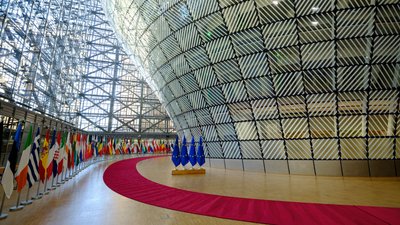
trade banks energy crypto—the eu keeps its full russia economic sanctions wall standing 2027 · post flags member states headquarters council european union brussels belgium 17 2025 getty images/thierry monasse

The EU adopted its largest-ever round of sanctions listings on 12 October, targeting the suppliers behind Russia’s war industry, the Council of the EU announced. The bloc acted as Russia keeps killing Ukrainian civilians every day, while US President Donald Trump eases sanctions on Russian diesel.

Russia’s planned winter campaign against Ukraine’s infrastructure depends on arms factories fed by a web of component suppliers and on oil revenue that still flows despite Ukraine’s refinery strikes, so every supplier cut off from that web raises the cost of waging it. As Washington eases off, Europe’s own pressure has a gap: its ports still take record volumes of Russian Arctic gas, and a full ban on long-term contracts starts only in 2027.

Missile suppliers top the list

More than half of the new listings hit the supply chain for ballistic missiles that Russia “uses to kill Ukrainian civilians every day,” EU foreign policy chief Kaja Kallas said in the statement. Russian attacks killed more than 150 people in the past week, Ukrainian President Volodymyr Zelenskyy said on 11 October.

The list names 826 Russian companies, mid-level firms the Council calls the “core” of Russia’s arms industry, with at least €20 billion in yearly turnover, and 743 people who run them. They make parts for missiles, drones, and military aircraft, from semiconductors and radars to explosives and navigation systems. Their assets are frozen, EU firms may not finance them, and the executives may not enter the EU.

Foreign ministers ratified a deal EU envoys reached on 7 October. Ukraine’s sanctions commissioner Vladyslav Vlasiuk said 60% of the listings came from Ukrainian proposals.

Ministers reject the diesel deal

EU foreign ministers in Luxembourg vowed to keep the sanctions despite Trump’s diesel deal with Russian President Vladimir Putin, Euronews reported. Kallas addressed Washington directly as she arrived.

“The US is our biggest ally, but our message is clear: if we want to end this war, the only way we can do this is (by) putting more pressure on Russia,” Kallas said.

Irish Foreign Minister Helen McEntee called the deal “concerning,” and Lithuanian Foreign Minister Kęstutis Budrys said it was “not the European way.” Kallas warned that an energy truce covering only refineries would favor Russia, since Ukraine has one refinery and Russia “plenty.”

Trump announced the diesel deal on 9 October, and the US Treasury waived sanctions on Russian diesel until April 2027. Zelenskyy said the EU would provide about €3 billion more in military aid this week.

Washington presses Kyiv

Trump expects Ukraine to stop hitting Russian refineries under his proposed energy ceasefire, a White House official told Axios. Zelenskyy said Kyiv would halt such strikes if Moscow did the same. On 10 October, Trump told reporters it was time for Ukraine to get a new president. Germany’s foreign minister, Britain’s defense secretary, and a senior lawmaker from Chancellor Friedrich Merz’s party backed Zelenskyy, while the Kremlin sided with Trump.

Zelenskyy offered to hold elections after a 60-day ceasefire, and Kallas said elections are impossible while the war goes on. The Institute for the Study of War assessed that Russia exploits Ukraine’s legal ban on wartime elections to drag out the war.

  •  

Ten years on, Britain’s prime minister says Russia meddled in the Brexit vote—and warns Germany and France

ten years britain’s prime minister says russia meddled brexit vote—and warns germany france · post andy burnham britain's new 29 2026 hl-8sqawgaax0se ukraine news ukrainian reports

UK Prime Minister Andy Burnham said Russia interfered in the 2016 referendum that took Britain out of the European Union, in podcast excerpts released on 11 October, the Associated Press reported. His remarks are believed to be the first time a British prime minister has publicly acknowledged such meddling.

Russia’s information war keeps running through Europe’s ballots. German security sources said in August that Moscow was escalating disinformation before state elections, and Ukraine’s Center for Countering Disinformation found more than 200 Russian fake news sites aimed at France last year.

One question, one clear answer

Burnham told The Rest Is Politics podcast that he asked his advisers whether Russia had interfered in the 2016 vote. He asked after taking office in July.

“I’ve had the clear answer that yes, there was,” he said.

He argued that such things must now be put clearly on the record. He did not say how Russia interfered or offer evidence, and Moscow has long denied interfering in foreign votes.

Burnham said he had discussed Russian interference with German Chancellor Friedrich Merz in Berlin the previous week. “You know he was saying to me that the AfD are clearly linked to Russia, funded I believe,” Burnham said, referring to Germany’s far-right Alternative for Germany party. Putting such interference on the record would help “voters in Germany and France understand that some of this politics is instigated via our enemies, namely Russia,” he added.

Years of silence

In 2020, Parliament’s Intelligence and Security Committee found that the government had actively avoided investigating whether Russia meddled in the referendum. The report noted open-source signs of Russian attempts to sway the Brexit campaign. The government, it said, had never looked for hard evidence.

The government rejected the committee’s call for a review.

“We have seen no evidence of successful interference in the EU Referendum,” it said.

That same year, London said Russian actors had almost certainly tried to interfere in the 2019 general election. The government said they did it by amplifying leaked UK-US trade documents online.

From 2019 to 2016

Three weeks ago, Burnham stopped short of this. At the UN General Assembly on 22 September, he said the Kremlin spends around £1.3 billion each year on manipulating information. That is roughly $1.7 billion at recent exchange rates. He cited evidence that Russian agencies tried to interfere in the 2019 general election, but he did not mention 2016.

In the same speech, he said Britain had already helped Moldova protect its elections from Russian interference.

  •  

Germany: AfD reaches record high 40% in Brandenburg as party continues to dominate in the east

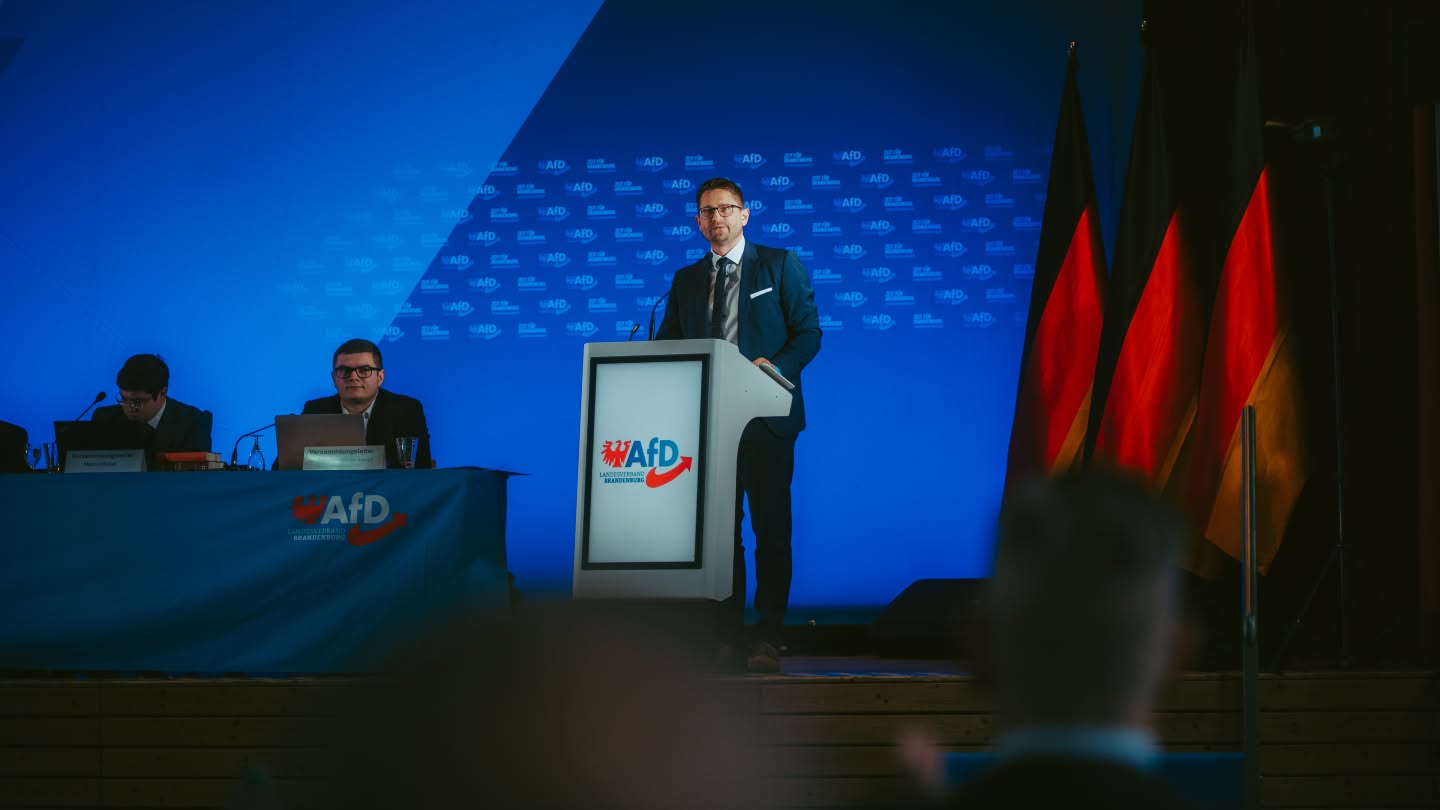
The Alternative for Germany (AfD) has reached 40 percent support in Brandenburg for the first time in a new poll, twice the level of the governing Social Democrats (SPD) and enough to make any coalition without the party or its potential partners extremely difficult.

The Insa survey, conducted for the Märkische Allgemeine Zeitung, Märkische Oderzeitung and Lausitzer Rundschau and published this week, put the AfD at 40 percent, up 6 points from the institute’s previous Brandenburg poll in March.

BRANDENBURG | Sonntagsfrage Landtagswahl INSA/MAZ, MOZ, LR AfD: 40% (+6) SPD: 20% (-4) CDU: 9% (-5) LINKE: 9% (+2) BSW: 7% (-1) GRÜNE: 7% (+2) Sonstige: 8% Änderungen zur letzten Umfrage vom 21. März 2026 Verlauf: https://t.co/R7Fb0r9hmo #ltwbb https://t.co/Ww2EhzqHy6

— Deutschland Wählt (@Wahlen_DE) October 9, 2026

The Social Democrats of longtime Minister-President Dietmar Woidke stood at 20 percent, down four points. The Christian Democrats (CDU), the SPD’s current coalition partner, fell five points to 9 percent. The Left Party also reached 9 percent, while the Greens and the Sahra Wagenknecht Alliance (BSW) each stood at 7 percent.

It is important to note that the next regular state election is not due until autumn 2029, which means support could shift substantially in three years. Nevertheless, the result for the AfD mirrors nationwide trends, especially in the east of Germany, where the AfD recently won in neighboring Saxony-Anhalt by earning 43.8 percent of the vote in the September election.

Brandenburg’s AfD state leader René Springer called the result “a tremendous vote of confidence” that showed “how great the desire for a political new beginning in Brandenburg is.” He added that the party’s goal remained an absolute majority so it could govern the state alone.

Trouble forming a coalition

The numbers underscore the difficulty of forming a government that excludes both the AfD and the left-wing BSW.

🇩🇪🔴German schools face increasing violence due to mass immigration. In the city of Cottbus, the public prosecutor has launched 18 criminal investigations into cases of serious violence in the migrant-dominated Regine Hildebrandt Primary School. A father from the school told reporters there were "at least two to three attacks" a week before he took his children out of school. He said that the names of the perpetrators were "for example, Ali, Mohammed and Ahmed." The school has drawn national attention due to extreme violence. In an open letter, parents reported physical attacks with serious injuries, including one student who suffered a concussion. In addition, students were using pepper spray, as well as fighting with kicks and punches. Dennis Hohloch, an Alternative for Germany (AfD) MP, said in response: "Immigration is the biggest problem, the biggest safety risk for our children in our schools. We had 3,209 violent offenses at our schools in 2024. If you take the 190 school days a year, that’s 17 violent offenses a day. This figure is 20% higher than 4 years ago. Violence in schools, especially here in Brandenburg, can no longer be minimized or glossed over, even if the SPD and the Ministry of Education keep trying." Brandenburg Interior Minister René Wilke affirmed that the list of criminal offenses in the just one school is "very, very long and varied." He described dangerous bodily harm, threats, insults, and coercion. Wilke described "aggressiveness and willingness to use violence being a prominent dimension." Cottbus Mayor Tobias Schick, who belongs to the far-left SPD, admitted during a press conference in August 2025 that the problem is a consequence "of partly unregulated, partly uncontrolled immigration in recent years."

— Remix News & Views (@RMXnews) January 16, 2026

The current SPD-CDU coalition would command only 29 percent. In the 2024 state election, the SPD won with 30.9 percent, the AfD finished second with 29.2 percent, the BSW took 13.5 percent and the CDU 12.1 percent.

After that vote, Woidke initially formed a coalition with the BSW; the alliance collapsed earlier this year following internal BSW disputes, including the departure of Finance Minister Robert Crumbach and other lawmakers, and the SPD later reached a new agreement with the CDU.

Given the poll results in Brandenburg, another possible government coalition would involve the BSW and AfD. Currently, in Saxony-Anhalt, both parties are in discussions to form a ruling government. If that government forms and manages to hold together, it could form a template for ruling governments in the east of the country, where AfD and BSW are strongest. At the same time, the AfD is rapidly growing in the west of the country as well, which is key to its national support, as the western states have far higher population numbers and political weight than the east.

The post Germany: AfD reaches record high 40% in Brandenburg as party continues to dominate in the east appeared first on Remix News.

  •  

‘NO TURKS – ALL OUT’ – CDU candidate with Turkish background allegedly faked hate crime attack right before local German election

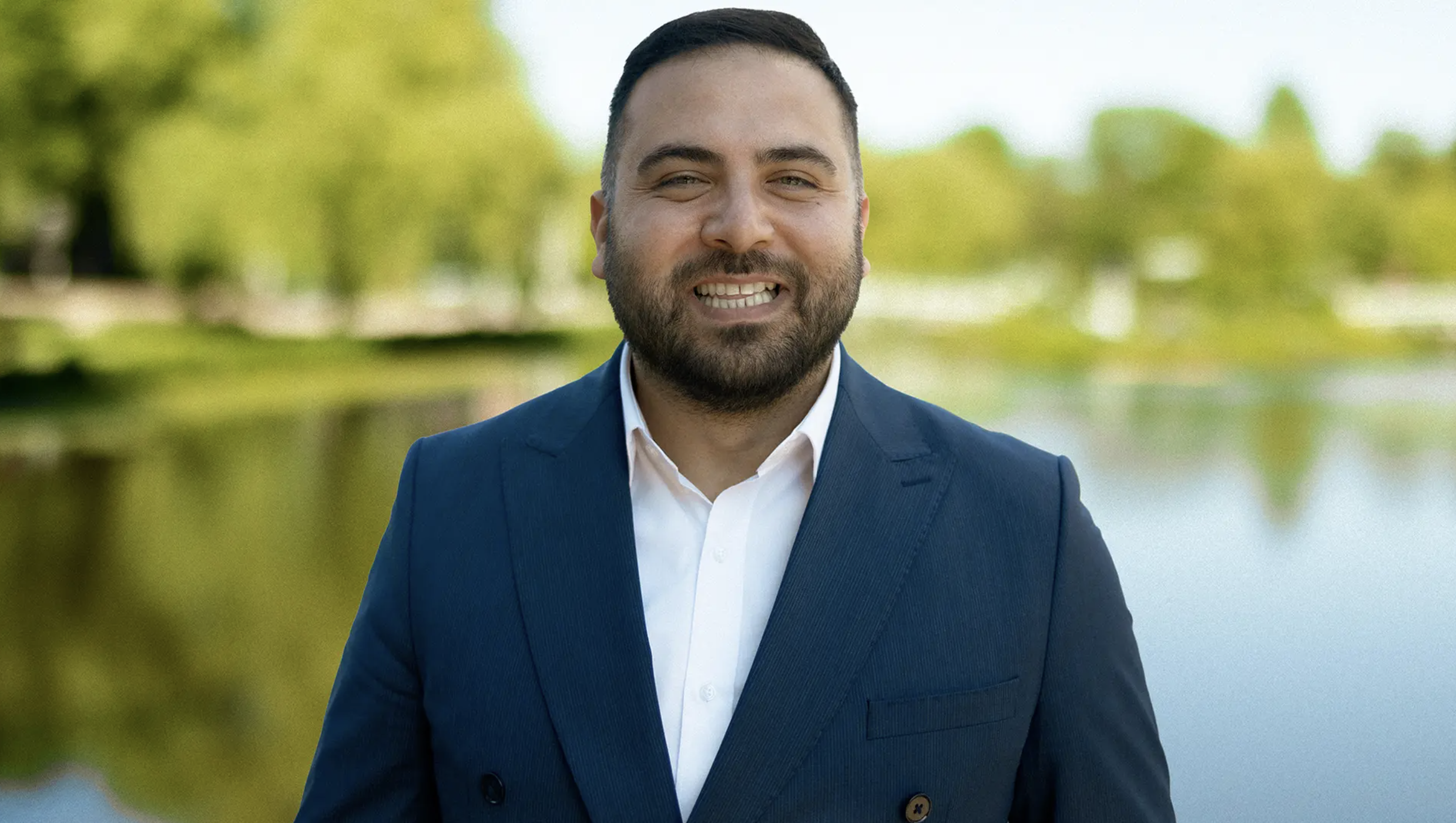
Prosecutors have opened an investigation into a local Christian Democratic Union (CDU) mayoral candidate of Turkish origin who is accused of staging a racially motivated attack on his own car days before an election he lost badly.

The Itzehoe public prosecutor’s office is examining allegations that Baris Karabacak faked the incident, according to the German newspaper Bild. Authorities obtained and executed a search warrant against the politician and seized at least one electronic device.

Karabacak, an entrepreneur who had previously served as chair of the Uetersen city council, was the CDU’s candidate in the Sept. 27 mayoral election in the town of roughly 18,000 people in the Pinneberg district of Schleswig-Holstein. He finished a distant third with 10.7 percent of the vote. Incumbent Mayor Dirk Woschei of the Social Democrats was reelected in the first round with 51.3 percent; independent candidate Marvin Schöpp received 38.1 percent.

A few days before the vote, local media including public broadcaster NDR reported that the windows of Karabacak’s car had been smashed overnight. A campaign flyer bearing an added message in all capital letters reading “NO TURKS — ALL OUT” was left behind. Police initially investigated the matter as possible incitement to hatred.

At the time, state CDU General Secretary Lukas Kilian publicly backed his party colleague and expressed pride in the CDU’s diversity. Woschei also offered solidarity, stating that political competition must be conducted with arguments and that “violence, hate and racist messages are an attack on the city’s democratic culture.”

Kilian’s tone has since shifted sharply. He told Bild he was “stunned” by the new allegations.

“Anyone who fakes a racist crime abuses the solidarity of many people and mocks the victims of real racism. There is no place for that in the CDU,” Kilian said. The state party has said that if the accusations are confirmed, Karabacak will be asked to resign his membership; failure to do so would trigger expulsion proceedings.

The case remains under investigation, and no charges have been filed. Karabacak has not publicly commented on the prosecutor’s probe.

The episode has drawn attention in a town where Karabacak had earlier faced internal party and council criticism over his leadership style before resigning as city council chair earlier in 2026 and then securing the CDU’s mayoral nomination.

Another hate crime hoax proven false in court

This is also notably not the first alleged hate crime hoax from a German politician. In 2023, Remix News reported on Manoj Subramaniam, a 33-year-old former local Green councilor in the German town of Erkelenz, who claimed he had been subjected to sustained acts of harassment by anonymous right-wing extremists. He showed police evidence of the abuse he had received, which included a threatening letter with a razor blade inserted and a swastika drawn onto his vehicle in red paint.

The case made national headlines last year with several prominent politicians offering their solidarity with Subramaniam for the alleged abuse he had received.

“Right-wing extremists are threatening political volunteers to silence them. Thank you, Manoj Subramaniam, for not being silent and raising your voice,” stated Lamya Kaddor, a member of the Bundestag.

Federal police took protective measures for the politician’s safety, and an intensive investigation was initiated by state security, all at considerable cost to the taxpayer. The only issue, however, was that Subramaniam had made it all up.

“The defendant actually wrote this note himself,” revealed Justus Wassenberg, the press spokesman for the public prosecutor’s office.

It transpired that Subramaniam had also drawn SS runes and a swastika onto the doorbell panel outside his house.

Subramaniam subsequently resigned from his position as a local councilor, and the Erkelenz District Court issued the disgraced politician a penalty order of €3,600 for faking criminal offenses, a fine he appealed.

He reportedly cried during his trial when his appeal failed.

2026 firebombing not an anti-Semitic attack after all

The investigation into the early 2026 firebombing of Brandenburg Antisemitism Commissioner Andreas Büttner’s home stunned the public.

While the case was initially treated as an Islamist or antisemitic hate crime, the German Public Prosecutor General’s Office now identifies two men from Büttner’s “own circle,” which belongs to the left, as the primary suspects.

One of the men is also linked to the threatening letter sent to Büttner. Meanwhile, Büttner said he was shocked and described it as the biggest betrayal of his life. He also stated that if the two were responsible, the act had nothing to do with antisemitism in his view. So far, the prosecutor’s office has continued to list Büttner as a witness or injured party, not a suspect. News outlets have highlighted that there was a €3,000 transfer from Büttner to one of the men shortly before the incident, which he called a loan, and other joint activities.

These details prompted public questions and speculation in some outlets about possible staging or a “false-flag” element, but no official finding has supported the claim that Büttner ordered or knew of the act in advance. The case still reportedly remains under investigation.

The post ‘NO TURKS – ALL OUT’ – CDU candidate with Turkish background allegedly faked hate crime attack right before local German election appeared first on Remix News.

  •  

Ten casualties to one, by a NATO official’s count: Russia’s September in Ukraine’s kill zones

A masked Russian soldier in camouflage and body armor wears a helmet bearing Russian flag and “Z” patches.

Russia suffered vastly more casualties than Ukraine in September, a senior NATO military official told Bloomberg. Ukraine’s General Staff put the month’s Russian toll only slightly lower.

September’s toll lands on a recruitment system that was already falling short. Ukraine’s military intelligence (HUR) estimated that Russian losses outran new contracts in June and July, when monthly losses ran lower. In August, Ukrainian President Volodymyr Zelenskyy, citing military intelligence, warned that Russia is preparing a mass call-up after its parliamentary elections. That vote ended on 20 September.

Where the numbers come from

Russian casualties passed 50,000 in September, up to 28,000 of them killed, the official said. Ukraine’s losses over the same month came to about 5,000, according to the official, who spoke on condition of anonymity. Russia does not release casualty figures, Bloomberg noted. In late August, Pavlo Palisa, deputy head of Ukraine’s Presidential Office, put Russia’s July losses at 43,000 killed and wounded. Bloomberg could not confirm his figures.

To push forward, Russia keeps feeding troops into “kill zones,” the official said. These are stretches of ground saturated with armed drones, mines, and artillery fire. Maksym, call sign Rumyn, is a deputy company commander in the 46th Airmobile Brigade’s drone battalion. In April, he said the zone once ran 3–5 km deep and is now several times larger.

Ukraine's Third Army Corps commander Brigadier General Andrii Biletskyi announcing "Operation Vivaldi," 15 September 2026. Screenshot from video: Ukraine's Third Army Corps
Explore further

Ukraine suffered 10 times fewer casualties than Russia in Vivaldi counteroffensive, veteran says. Ukraine’s innovations in drone and ground robot tactics are changing frontline warfare

Rising stakes for Moscow

Russia’s defense spending is expected to near $199 billion this year, Bloomberg reported, citing two sources close to the government. That is about 40% above the plan the government set in late 2025.

Russian President Vladimir Putin would struggle to wind down the invasion without a political cost, Martin Jäger said last week. He heads Germany’s Federal Intelligence Service (BND).

  •  

Germany stays in Russia’s sabotage crosshairs, and its industry now braces for the long haul

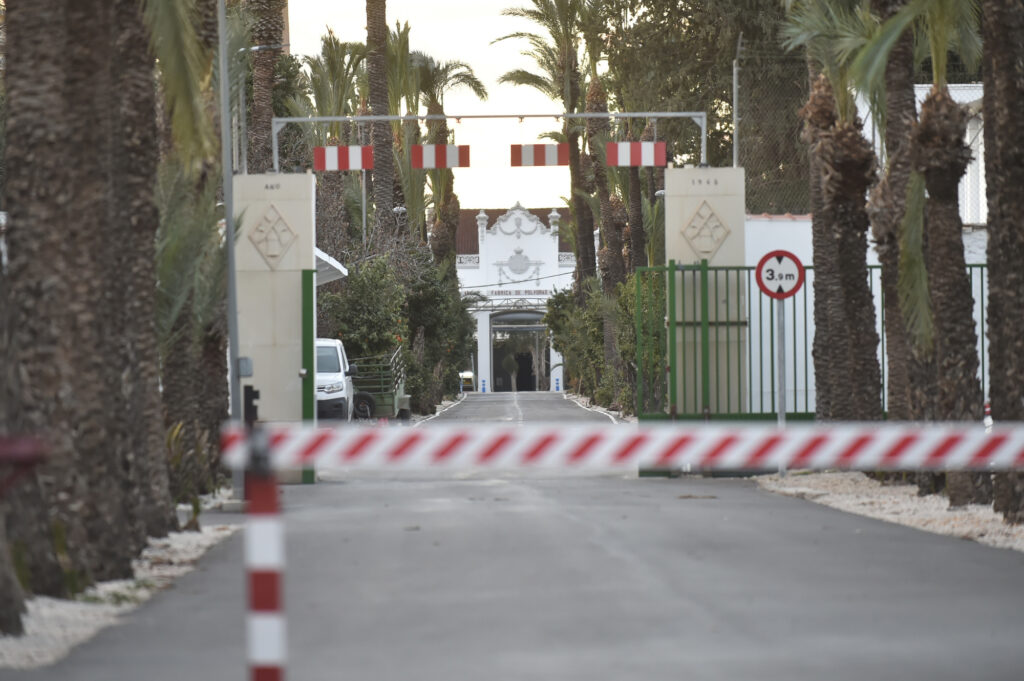
germany stays russia’s sabotage crosshairs its industry now braces long haul · post entrance rheinmetall company 30 2025 javalí viejo murcia spain ukraine news ukrainian reports

German industry expects Russian sabotage against the country’s companies to persist and take more forms, the deputy head of the Federation of German Industries (BDI) told Handelsblatt. His warning follows alarms from Germany’s intelligence services, which describe the country as a main target of Russia’s covert campaign in Europe.

Russia keeps striking Ukrainian cities and power plants every day while trying to weaken the European support that keeps Ukraine fighting. Germany is home to arms makers producing with and for Ukraine, so pressure on its companies targets the supply behind Ukraine’s defense.

Industry expects attacks to last and change form

The warning came from Holger Lösch, the BDI’s deputy managing director.

“German industry is preparing for the threat to persist and for attack methods to become more varied,” he told Handelsblatt. “Companies don’t end up in the crosshairs by chance,” he added.

Russian influence and sabotage operations are no longer an abstract scenario, and companies, critical infrastructure, and defense supply chains are already among their targets, Lösch said. Companies now receive more threat warnings, and their cooperation with the authorities has improved significantly, he noted. “What is still missing are joint procedures to quickly derive concrete measures from warnings,” Lösch said, calling the protection of the economy a cornerstone of national security.

German intelligence describes a Russian shadow war

The warning comes a week after a public hearing of the intelligence oversight panel of the Bundestag, Germany’s parliament, on 5 October. There, Martin Jäger, head of Germany’s Federal Intelligence Service (BND), said Russia was waging a shadow war against Germany. “Germany has become a main obstacle to Russian hegemonic power projection in Europe and thus a target of Russian action,” Jäger said. “The danger of attacks against targets in Germany remains real and present,” he warned.

Sinan Selen, head of the Federal Office for the Protection of the Constitution (BfV), Germany’s domestic intelligence agency, told the same hearing that Russia was showing a readiness for sabotage and killings.

German Chancellor Friedrich Merz said on 1 October that Germany was preparing for further hybrid attacks, “including serious ones,” and would respond “quickly and very clearly,” as it did after the drone attack at Leipzig airport.

Drone bombs, arson, and paid saboteurs on German soil

In August, a drone carrying Semtex explosives hit the wing of a Ukrainian An-124 cargo plane at Leipzig/Halle Airport but did not explode. Germany blamed Russia on 1 September, and German Foreign Minister Johann Wadephul said Germany was not at war with Russia but was a “target of war.”

German authorities suspect Russian intelligence of commissioning an arson attack near two Munich defense firms, and a confidential Federal Criminal Police Office (BKA) assessment counted more than 165 suspected sabotage cases in Germany between January and August. The same assessment recorded 747 suspicious drone incidents involving 1,068 drones over critical infrastructure, military sites, and defense companies.

russia hired desperate hunt german drone-maker boss arms ukraine · post stefan thumann head drone maker donaustahl штефан туманн news ukrainian reports
Explore further

The throwaway agents Moscow sent after a Bavarian drone boss arming Ukraine—and how Germany stopped them

Germany’s Military Counterintelligence Service (MAD) warns that the threat from low-level agents, locals paid small sums for one-off jobs such as arson or photographing military sites, has increased significantly. European intelligence agencies also report that Russia is increasingly targeting defense company executives, including at smaller drone makers, and the BfV has advised some German firms to hire close protection.

As long as Germany keeps backing Ukraine, Russian pressure on its companies is unlikely to ease, and the gap between warnings and action that industry flagged leaves smaller firms, with fewer resources for security, the most exposed.

  •  

Das eigentliche Ziel ist ein endloser Wirtschaftskrieg

Die EU verlängert ihre Russland-Sanktionen um drei Jahre. Damit wird der Wirtschaftskrieg zum Geschäftsmodell: zugunsten US-amerikanischer Energiekonzerne und Fonds – und zulasten der Europäer. Wer sich in diesen Tagen die Entscheidung der EU anschaut, die Strafmaßnahmen gegen Russland für volle drei Jahre zu verlängern, muss sich unwillkürlich an Julian Assanges Diktum erinnert fühlen:

„Das eigentliche Ziel ist ein endloser Krieg, kein erfolgreicher Krieg.“

Denn der völkerrechtswidrige Wirtschaftskrieg gegen Russland mittels einseitiger Sanktionen, der in kolonialer Absicht formal auf eine Verhaltensänderung Moskaus gerichtet ist, wird zum Selbstzweck.

Ungeachtet der Zerstörungen, die die Sanktionen in der Wirtschaft der EU-Mitgliedstaaten selbst anrichten, schält sich immer deutlicher heraus: Die Verewigung der EU-Sanktionen, die bisher halbjährlich oder jährlich verlängert wurden, dient vor allem der Interessendurchsetzung von US-Energiekonzernen sowie der Profitmaximierung von US-Investmentfonds wie BlackRock. Durch die Sanktionen erlangen sie unter anderem eine Monopolstellung bei der Energieversorgung Europas und können zu viel höheren Preisen verkaufen als eine mögliche russische Konkurrenz.

Die Investmentfonds profitieren wiederum von der begleitenden Hochrüstungspolitik – nicht nur in den USA, sondern auch durch ihre Beteiligungen an deutschen Rüstungsschmieden wie Rheinmetall.

Es gibt also ein Profitinteresse sowohl daran, den Wirtschaftskrieg zu verlängern, als auch daran, die Situation gegenüber Russland zu eskalieren. Dieses Interesse schlägt über die Europäer voll durch.

Es mag paradox klingen, aber ein erfolgreicher Wirtschaftskrieg würde dieses Bereicherungsmodell rasch beenden. Dass man jetzt für die kommenden drei Jahre Sanktionen verhängt, zeigt denn auch, dass man kein Interesse an einer schnellen Beendigung des Stellvertreterkrieges des Westens in der Ukraine hat. Mit einer Verhaltensänderung wird nicht gerechnet. Die Sanktionen sind zum Modell geworden, die Europäer auszurauben. Sie sind nichts anderes als ein Unterwerfungsakt unter die Vorgaben aus den USA. Der Vasallenstatus der Europäer wird so weiter vertieft – bis hin zur Gefahr, dass man die Bereitschaft zeigt, sich selbst für Washington aufzuopfern.

Es ist denn auch kein Widerspruch dazu, dass man, während man die Sanktionen gegen 3.000 Personen und Organisationen verlängert, zwei russische Oligarchen jetzt davon ausnehmen will. Die Aufhebung der EU-Strafmaßnahmen gegen Alischer Usmanow und Michail Fridman dient den Interessen einzelner Mitgliedstaaten und ist offenbar der verzweifelte Versuch, Russland zum eigenen Vorteil destabilisieren zu wollen.

Grönland als Vertragsmodell

Immer deutlicher wird hingegen, dass sich die Europäer dem aktualisierten US-Kolonialmodell unterordnen. Während der deutsche Kanzler Merz das Abkommen über Grönland zwischen Dänemark und den USA als Erhalt der Souveränität feiert, spricht der Text der Vereinbarung eine ganz andere Sprache.

Das Abkommen von 1951 war an die NATO gebunden und an dänische Mitwirkung gekoppelt. Der neue Deal gilt ohne Enddatum und überdauert sogar eine mögliche Unabhängigkeit Grönlands. Die USA sichern sich dauerhafte Stützpunkte, können weitere Basen mit dem Schutz des amerikanischen Kontinents begründen und müssen über das Prinzip neuer Standorte nicht mehr verhandeln, sondern nur noch über deren Ausführung. US-Truppen bewegen sich frei zu Land, zu Wasser und in der Luft – nun auch unter Wasser –, ohne dass dänische Behörden in Grönland dafür noch die Regeln setzen.

Hinzu kommt ein Vetorecht: gegen militärische Präsenz von Nicht-NATO-Staaten und gegen Investitionen von außerhalb der westlichen Blöcke in sensible Sektoren und Ressourcen. Formal bleibt die Souveränität Dänemarks und das Selbstbestimmungsrecht Grönlands bestätigt. Tatsächlich entstehen quasi extraterritoriale Entitäten, in denen Kopenhagen und Nuuk nichts zu sagen haben. Die USA bestimmen die zentralen Bereiche der Politik auf der Insel und sichern sich ein privilegiertes Ausbeutungsrecht.

Ein Modell für die ganze Hemisphäre

Zugleich wurde ein Vertragsmodell geschaffen, das auch für andere Gegenden der westlichen und der nördlichen Hemisphäre gelten soll: von Venezuela über die Kanalzone in Panama bis hin zu den Küsten Kanadas.

Es ist zugleich das Modell für eine Zerschlagung Russlands, die als Folge des Abnutzungskriegs in der Ukraine angestrebt wird, um gegenüber China wieder in die Vorhand zu kommen und den eigenen Niedergang aufzuhalten.

Moral des Völkermords

Die Moral dieser Ordnung hat US-Präsident Donald Trump vor der UN mit seiner Auslöschungsdrohung gegenüber dem Iran zusammengefasst. Sollte der Iran nicht den Vorgaben aus Washington zustimmen, dann „treibe ich sie in die Hölle“. Es ist die Moral des Völkermords.

Es liegt auf der Hand, dass der immer höhere Einsatz des Westens im Versuch, die Welt zu kolonisieren, die entsprechenden Gegenkräfte auf den Plan rufen wird. Allein in Europa wird man diese bei einer Kompradorenbourgeoisie vergeblich suchen.

Originalbeitrag NachDenkSeiten

  •  

Report: Kamala Harris’s Husband Doug Emhoff Doesn’t Want Her to Run Again

by Lowell Cauffiel, Breitbart: Former Vice President and unsuccessful 2024 presidential candidate Kamala Harris has reportedly been getting a thumbs down from power brokers about launching a 2028 bid for the White House — even from her husband Doug Emhoff, according to the Wall Street Journal. TRUTH LIVES on at https://sgtreport.tv/ “Kamala Harris’s husband, Doug Emhoff, has […]
  •  

DOJ Says Flock Camera Data Is Not Protected By Fourth Amendment

by Matt Agorist, The Free Thought Project: (Reclaim The Net) The US government has told a federal appeals court that data collected by Flock Safety cameras is not protected by the Fourth Amendment, because being watched on the road is “a reality of modern life” – and therefore, nobody can expect privacy there. The argument was […]
  •  

The Permission Grid: A Blueprint for a Permanent Slave Class

by Chris MacIntosh, Activist Post: Shoe-horned into the permission grid. It’s what they want and you know what? I think it’s what they’ll get. They’ll get it because there is a loss of agency amongst the populace. The pushback to this Orwellian nightmare is… in a word, pathetic. The EU wants a passport for the […]
  •  

The Soviet Union Possessed The Most Sophisticated Offensive Biological Weapons Program In Human History And They Weaponized The Plague

by Madge Waggy, Madge Waggy: On the second of October, in a town most people could not place on a map, a young woman died of a pneumonia that nobody could name. Her name was Darya Shipilova, and she was twenty-eight, a laboratory technician in Shelekhov, a small settlement in the Irkutsk region of Siberia, […]
  •  

2027 Will Be a Year of Massive Shortages: Oil, War and a Supply Chain With No Safety Net

by Milan Adams, Prepp Group: First take a look at one of the most shocking videos in the world! This video actually shows the powers that be are lying to you—Here’s What They Don’t Want You to Know! Crude moved more than five percent in a single American session on Thursday, and the headline figure was not […]
  •  

Deep Insider & Whistleblower Makes Bombshell Disclosures Never Revealed Before About……

from State Of The Nation: …The Nation’s Criminal Chemtrail Conspiracy And Geoengineering Operations Submitted by a FL State Whistleblower SOTN Exclusive   Am sending this back story to SOTN because you guys are the only site with the cojones to post it. So here it goes. Will use some SOTN links to document the entire case, btw, […]
  •  

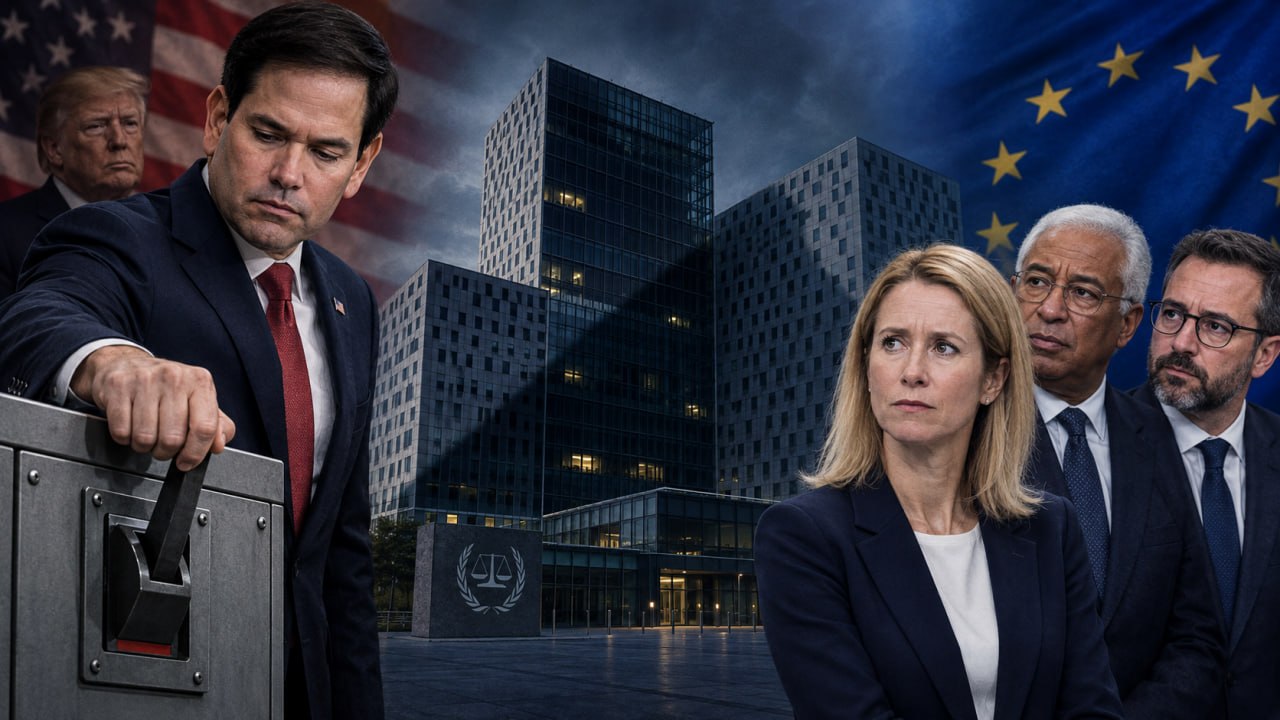
The US Is Pulling the Plug on International Justice — Does Europe Have Its Own Power Source?

Click to see the full-size image

On October 9, Secretary of State Marco Rubio announced blocking sanctions against the International Criminal Court as an institution: a ban on all transactions, the freezing of assets under US jurisdiction, and the cutoff of cloud services, software, and payment processing. “Either the ICC will end its threats, or we will end the ICC,” he said. The sanctions include a six-month transition period and take full effect by April 2027. That date, not the announcement itself, is Europe’s real deadline.

Rubio has repeatedly tied Israeli interests to US actions against the court. The ICC previously issued arrest warrants for Israeli Prime Minister Benjamin Netanyahu and former Defense Minister Yoav Gallant on charges of war crimes in Gaza. While the October 9 announcement focused heavily on protecting American personnel, the administration had previously denounced the tribunal’s investigations against “the United States and our close ally Israel” as “illegitimate and baseless,” indicating that Washington’s campaign is aimed at shielding both US and Israeli officials.


Europe: Between Declaration and Enforcement

The European Commission called the sanctions “deeply regrettable” and said it was “ready to take any necessary measures” to keep the Court functioning and protect operators within the Single Market. But the same formula contains a brake: the six-month delay “leaves room for dialogue.”

Kaja Kallas, speaking for the EU, called threats against the Court “unacceptable,” reaffirming commitment to the rules-based order but stopping short of announcing any protective mechanism. António Costa promised support through political, diplomatic, financial, and practical means, without naming a single concrete instrument.

Belgian Foreign Minister Maxime Prévot is one of those publicly demanding activation of the EU Blocking Statute. “The Court’s independence cannot depend on whom it investigates. Europe must act,” he said, after securing a place for the issue on the agenda of the October 12 meeting of EU foreign ministers.

The Netherlands, where the Court sits, asked the European Commission to prepare the statute but called it a “nuclear option,” emphasizing that six months provide space for dialogue. Germany and France joined a joint statement by eight countries expressing “strong disagreement,” without mentioning countermeasures.

Why the Blocking Statute Is No Panacea

The Blocking Statute (Council Regulation No. 2271/96 of 1996) was created to counter US extraterritorial sanctions related to Cuba, Iran, and Libya. Its mechanism includes a prohibition on EU companies and citizens complying with the designated third-country sanctions, a refusal to recognize foreign court judgments based on those sanctions, and the right to recover damages in court. In 2018, after the US withdrew from the Iran nuclear deal, the regulation was expanded.

Adding the US sanctions against the ICC to the regulation’s annex would mean a legal prohibition on European banks, insurers, and cloud providers complying with the US restrictions. But its purpose is not to save the ICC itself. It protects European operators and jurisdiction: the regulation binds European operators and cannot compel American banks, Microsoft, Amazon, or payment systems to keep servicing the Court.

Activating the statute in this case would be unprecedented: in its thirty years of existence, it has never been applied against US sanctions affecting an international judicial institution. Its earlier use concerned US measures against those same countries, which were bilateral trade restrictions rather than an assault on a body of international justice. If the EU goes ahead, it would be the first time the Blocking Statute is transformed from a trade-defense instrument into an instrument for defending what Brussels calls the “international legal order.”

That is why it is called “nuclear”: it means legal confrontation, but it does not solve the problem of technological dependence. The ICC relies on American banking services, payment systems, cloud servers, and software. The Blocking Statute can prohibit European companies from complying with the sanctions, but it does not create an alternative to dollar clearing, global payment networks, or the servers where the Court’s data is stored.

For Washington, it is enough that American companies themselves refuse to work with the ICC because of the risk of secondary sanctions; the Blocking Statute cannot prevent that.

What Is Already Happening and What Might Happen

The practical effects of the sanctions are already beginning to show. In response to earlier US measures, the ICC has shifted its office and collaboration software from Microsoft to openDesk, a German open-source platform, and developed workarounds for banking, insurance, and payroll. It has also paid staff months in advance to limit potential payroll disruption. But these safeguards do not eliminate the Court’s broader reliance on American financial and technological infrastructure, and full sanctions could still disrupt its operations.

The alternatives Europe can offer are limited: activating the Blocking Statute, developing payment and clearing alternatives to dollar-based infrastructure, and providing European cloud services. None can be implemented quickly enough to replace American financial and technological infrastructure by April 2027.

Click to see the full-size image

The Asymmetry That Explains Everything

The ICC began work in 2002, and its early practice focused predominantly on African conflicts: the DRC, Uganda, Sudan, Kenya, and Libya. This imbalance fueled accusations of selectivity and neocolonialism; in 2025, three Sahel states announced their withdrawal, calling the Court an “instrument of neocolonial suppression.”

The United States signed the Rome Statute under Clinton but never ratified it; in 2002, Congress passed the American Service Members’ Protection Act, authorizing the president to use “all necessary means” to free any American detained by the ICC. Washington did not object to the Court’s early focus on African situations, even as it rejected jurisdiction over itself. Its opposition hardened once the ICC moved toward cases involving the US and its allies.

In 2020, after the Appeals Chamber authorized an investigation into crimes by US military personnel and the CIA in Afghanistan, Washington sanctioned Prosecutor Fatou Bensouda and a senior Court official. The following year, Prosecutor Karim Khan “deprioritized” the American component of the case. No US citizen has ever been indicted by the ICC.

Rubio calls the ICC a “body of globalists” threatening US sovereignty and has urged US allies to rein it in. The criticism has a real basis: the Court can hear cases involving crimes committed on the territory of a state party even if the accused’s country has not joined the Rome Statute. But the ICC remains a treaty court, dependent on state cooperation, Western donors, and political decisions of the UN Security Council.

Washington’s contradiction is built into the design itself: the US is attacking an institution that grew out of the liberal order it helped create. Europe’s is different: a declaratory commitment to international law coexists with the practical costs of reducing reliance on American infrastructure.

What October 12 Will Reveal

October 12 will show whether the EU moves from declarations to legal obligations. If the final document includes a European Commission decision to add the US sanctions against the ICC to the annex of Regulation 2271/96, that would mean a legal prohibition on European companies complying with the US measures — an unprecedented use of the Blocking Statute.

If the outcome is a general declaration, a call on Washington to rescind the sanctions, and a mandate for the Commission to “prepare options,” that would confirm a scenario in which Europe defends the principle of ICC independence but is not prepared to pay for that defense through a direct collision with US extraterritorial jurisdiction.

The probability of full and immediate activation of the statute on October 12 is low. A more realistic scenario is a political declaration of support, a Commission mandate to prepare a legal mechanism, and the preservation of the six-month pause for negotiations.

The Dilemma Beyond The Hague

The question is not whether the ICC survives past April 2027. The question is whether Europe can defend what Brussels calls the “international legal order” when the costs of that defense fall on its own companies, banks, and technological supply chains.

The Blocking Statute is a test of the EU’s ability to act not as a regulator but as a geopolitical player willing to bear the costs of conflict. If Europe limits itself to declarations and negotiations, it will confirm the formula Washington has already internalized: European sovereignty ends where American extraterritorial jurisdiction begins.

If it activates the statute, it will launch an open legal conflict with an ally on which its security depends. For now, every signal points to a third option: prepare the instrument, defer the decision, and bet that Washington will back down on its own.


MORE ON THE TOPIC:

The post The US Is Pulling the Plug on International Justice — Does Europe Have Its Own Power Source? appeared first on South Front.

  •  

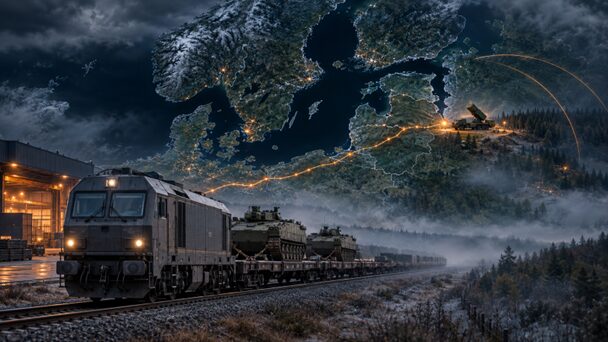
The Baltic Fuse: How Europe Is Building the Infrastructure for War With Russia

Click to see the full-size image

Europe is shortening the time it takes to wage a major war. Military transport approvals are meant to take hours rather than days, intelligence to feed more quickly into strike decisions, and a new generation of missiles to bring targets deep inside Russia within reach. Behind the forward garrisons, Europe is building transport networks, reserves, and ammunition production capacity. Taken together, these measures point beyond deterrence to practical preparations for waging war against Russia, including operations deep inside its territory.

The dates 2027, 2028, and 2030 in European rearmament programs can easily suggest that there is still time. But they mark a schedule for building military capabilities, not a guaranteed period of peace. The central question for the coming months is not whether armies will finish rearming in time, but whether a clash can be avoided before they do.

Estonia: A Narrow Front, a Deep Strike

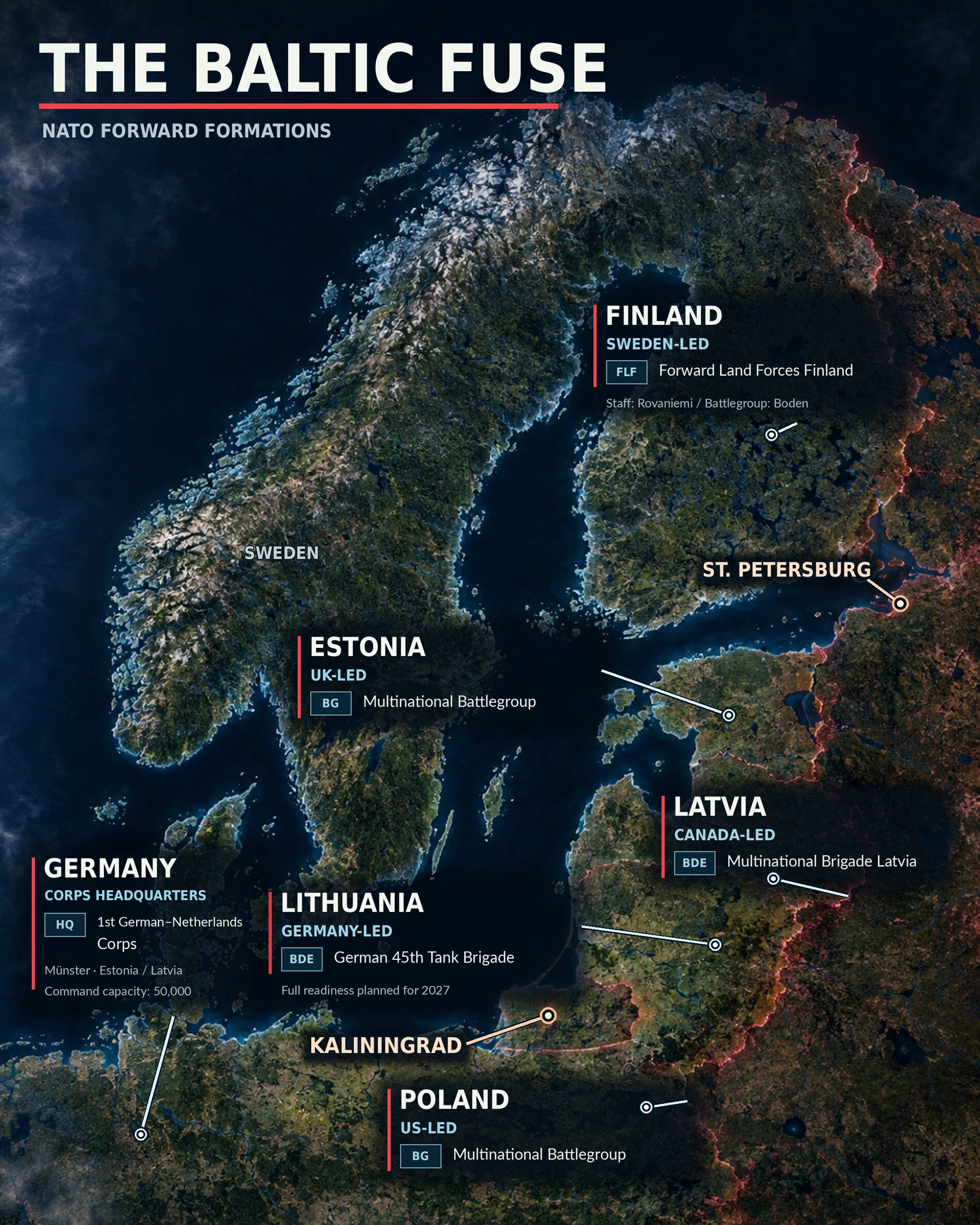
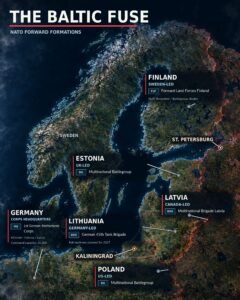
Estonia offers a clear picture of the opening phase this system is being built to fight. The country’s military budget rose 42% in 2026 to €2.4 billion, or 5.4% of gross domestic product. Arms procurement accounts for €1.27 billion – more than half the total. Meanwhile, the headquarters and elements of the 1st Infantry Brigade are moving from Tapa to Jõhvi, roughly 50 kilometers from the Russian border.

A €20.5 million base is under construction in Narva, with €19 million coming from the European Union. Completion is scheduled for summer 2028. Its permanent garrison will number around 200, but it will accommodate up to 1,000 troops in a crisis. The gap between those figures reveals a base designed for rapid expansion. A small garrison is being equipped to receive reinforcements quickly, right on the border.

Holding that ground requires more than barracks. Procurement programs call for nine American HIMARS and nine South Korean Chunmoo multiple-launch rocket systems, both capable of firing ballistic missiles. The relevant munitions have stated ranges of up to 300 and 290 kilometers, respectively. The new concept combines holding the border with deep strikes from the first day of an invasion.

The scale of the response could far exceed that of the opening clash. A battle for a border town could lead to strikes on targets hundreds of kilometers away. Tallinn wants to deny its opponent the option of fighting a small war by preparing to expand its geographical scope.

This also changes what allied assistance means. Allied planning must account not only for how long a small army can hold out until reinforcements arrive, but also for how far the fighting may spread before they reach the front. A missile can be launched before a major formation completes its deployment. Allies may arrive to find that the conflict has already widened.

In such a situation, Estonia and the other Baltic states could serve not only as defensive positions but also as staging grounds for attacks on Russian territory. For Moscow, the issue is no longer simply the size of Estonian units, but the depth of the strikes they envisage. Tallinn, in turn, faces the question of who will sustain its forward forces if the first battles fail to decide the outcome. Sustaining such a war would require support from beyond Estonia. One national budget and a handful of batteries cannot carry that burden.
Click to see the full-size image

Germany: An Industrial Base Behind the Garrison

On October 5, Martin Jäger, head of Germany’s Federal Intelligence Service, told the Bundestag: “The point of no return has been passed in the war with Ukraine, and NATO is considering a scenario involving a limited Russian military clash with the Baltic states.” He linked the more immediate danger to limited Russian action in the Baltics that could test the allies’ response. He said intelligence had seen no signs of preparations for a major attack on NATO. The discussion therefore concerns not only a major war after rearmament is complete, but a smaller confrontation capable of triggering an allied response.

In the Baltic scenario, Berlin is publicly discussing the risk of a clash while its forward force is still taking shape. The brigade’s readiness date is not the date on which the threat begins.

In Lithuania, Germany is building a permanent heavy brigade as one element of that support. Full readiness is scheduled for the end of 2027, with 4,800 military personnel and 200 civilian employees. Its core consists of the 122nd Panzergrenadier Battalion, the 203rd Tank Battalion, and a multinational battle group. Until the formation is complete, the Germany-based 37th Brigade is to provide support.

The forward formation is thus tied to forces farther inside Europe. Civilian infrastructure underscores the permanence of the deployment. A school for the children of Bundeswehr personnel opened in Vilnius in September 2025. Units are not simply moving in – families are settling down. A political commitment acquires a permanent address, and the safety of German personnel becomes part of any future crisis in the host country.

Münster, October 1, 2026. Rutte describes a headquarters capable of commanding 50,000 troops and responsible for NATO forces in Estonia and Latvia. Behind the talk of forward battalions lies corps-level command capacity


But a permanent garrison needs a steady supply of ammunition. Rheinmetall’s new plant in Unterlüß is scheduled to reach an annual output of 350,000 artillery shells in that same year, 2027. The nearly €500 million facility was built in 15 months. Across its entire production network, including overseas sites, the company is targeting roughly 1.5 million shells a year from 2027.

The brigade answers the question of who will enter the fight. The factories answer how to keep fighting once stockpiles run down. The 2027 target is for strengthening this system, not creating it from scratch. Reaching the factory’s planned capacity determines future supply volumes, but it does not set a date before which a clash is impossible. Initial stocks sustain the opening phase of combat. Regular deliveries determine whether its intensity can be maintained.

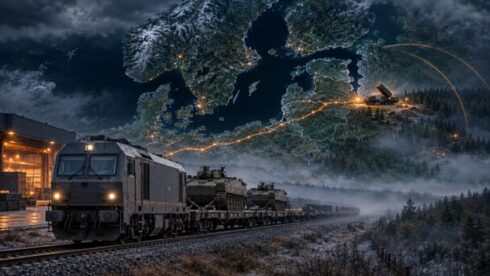
Between the factory and the front lies the transport network. Europe’s military mobility proposal calls for cross-border transport permits to be processed within three working days, with an emergency procedure taking no more than six hours. A proposed €17 billion would fund the relevant infrastructure under the 2028–2034 budget. For Germany, a transit country, that means bridges, railways, and the capacity of routes leading east.

On October 7, European Defense Commissioner Andrius Kubilius called for this work to accelerate, saying Europe was not yet able to deter Russia. Unlike an exercise, infrastructure upgrades remain after the columns return to barracks. A stronger bridge and a faster permit procedure create a lasting ability to concentrate forces.

A border battle thus gains industrial and logistical depth. But sustaining one’s own forward forces is only half the military equation. The other half is disrupting opposing forces’ supply and command systems. That requires more than additional railcars loaded with shells. It requires weapons with much greater reach.

Britain: A European Deep-Strike Arsenal

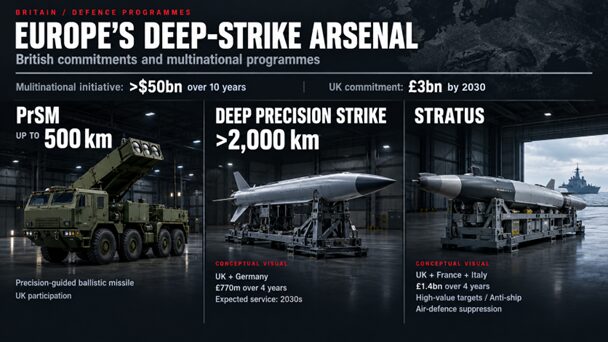
London is driving precisely this part of Europe’s preparations. On July 8, 2026, it announced an initiative bringing together roughly a dozen partners to invest more than $50 billion in long-range strike capabilities over ten years. The stated range bracket runs from 300 to more than 2,000 kilometers. Britain’s own commitment within the initiative is £3 billion by 2030.

The British-German Deep Precision Strike program envisages stealthy and hypersonic weapons with ranges exceeding 2,000 kilometers, initially focused on ground launch. Britain is investing £770 million over four years, with entry into service expected in the 2030s. Another £1.4 billion over four years is earmarked for Stratus, a program with France and Italy covering strikes against high-value targets and ships, as well as the suppression of air defenses.

Britain’s participation in PrSM (Precision Strike Missile), a precision-guided ballistic missile program with a stated range of up to 500 kilometers, adds another layer. The emerging capabilities span several range bands, from around 300 kilometers for the Estonian systems through 500 for PrSM to more than 2,000 for the British-German development. Although the programs are at different stages, they share a clear direction. Weapons for fighting at the border are being supplemented with weapons for striking deep behind it.

The missiles of the next decade show how far these strike capabilities are intended to expand. But the next crisis will unfold with whatever weapons are available when it begins. A 2,000-kilometer range is not a prerequisite for a clash in the Baltics. It changes the potential scale of the war, not the earliest date on which it can break out.
Click to see the full-size image

Turning national purchases into a combined capability requires a common framework for employing them. In July 2025, General Christopher Donahue outlined elements of eastern-flank planning built around compatible launchers, fire control, and data sharing. He cited Kaliningrad as an example of military capabilities that could be neutralized by ground-based means in an exceptionally short time: “We have already planned this. We have already developed this.”

The discussion also included cloud-based data sharing and Palantir’s Maven Smart System, purchased by NATO to analyze information and support command decisions. The aim is to turn disparate reports into a common picture more quickly. When several armies use compatible command systems, their arsenals gain additional value. Range puts the target within reach, while data sharing allows missions to be coordinated.

But the deeper the planned strikes, the harder it becomes to separate support for a border battle from an expansion of the war. To the attacking side, a target may be part of the other side’s military supply system. To the other side, hitting it may signal that the conflict has crossed a new threshold. The use of conventional weapons thus leaves unresolved how to deter a response that would overturn the assumption of a limited clash.

France: The Nuclear Limit of Europe’s Calculations

This is where France’s nuclear deterrent enters the European picture. On October 6, Le Vigilant conducted an acceptance firing of an M51.3 ballistic missile following its refit. The missile carried no nuclear warhead. In service since October 2025, the variant carries new TNO-2 warheads. The French Defense Ministry cites improvements in range, accuracy, and the ability to penetrate missile defenses.

Brittany, October 6, 2026. Le Vigilant launches an M51.3 without a nuclear warhead


Macron stated the political message bluntly: “To be free, you must be feared. And to be feared, you must be strong.” France’s modernization adds a nuclear dimension to Europe’s conventional military buildup.

That European dimension is taking a more concrete form. On March 2, 2026, Macron outlined an “advanced deterrence” framework allowing partners to participate in French nuclear exercises and opening the possibility of temporary deployments of strategic forces on allied territory. Germany, Poland and Sweden were among the countries joining the dialogue. But the authority to use nuclear weapons – and to define the vital interests they protect – remains exclusively French. In the Baltic scenario, closer cooperation does not establish an automatic French nuclear response to a border clash. It leaves the decisive threshold in Paris, deliberately undefined.

After the First Clash

Taken together, these national programs suggest that the West is preparing not merely to deter Russia, but to build the capacity for offensive operations against it. In this reading, forward deployments, industrial expansion and deep-strike weapons are interconnected preparations for a war that could extend into Russian territory. They do not, by themselves, establish a single operational plan or prove a decision to initiate hostilities. Conventional forces are meant to make an opposing military operation prohibitively costly, while nuclear forces are meant to deter the most extreme escalation. The weakness is that neither side gets to decide how much damage the other will tolerate.

That problem is especially acute around Kaliningrad, where plans to suppress military infrastructure sit alongside the question of the region’s links to the rest of Russia. If actions during a crisis are perceived as an attempt to cut the region off by force, the argument will no longer be about intentions announced at a press conference. It will be about consequences the other side believes it must stop immediately.

The danger in the coming months lies in the gap between limited intent and an unrestricted response. Berlin is discussing localized action in the Baltics. Tallinn is preparing for deep strikes from day one, while foreign garrisons tie a border battle to allied involvement. Each side may consider its own move limited. Neither can count on the other side accepting its definition of what is permissible.

European capitals therefore need to define where military action would stop after the first clash, whether at the border or after strikes on depots, airfields or targets in Kaliningrad. The programs examined here spell out how to build military power, but offer no mechanism for ending the fighting. Missile range is not strategic foresight. Confidence that escalation can be controlled could turn a system of deterrence into a mechanism for widening the war well before 2030.


MORE ON THE TOPIC:

The post The Baltic Fuse: How Europe Is Building the Infrastructure for War With Russia appeared first on South Front.

  •  
❌