❌

Reading view

Russia is building satellite network that could put all of Europe in reach, defense executive warns

Illustration of the Russian Rassvet satellites by Bureau 1440

Russia is building a satellite network that could soon put all of Europe within its reach. The “Rassvet” satellite system is an extraordinary threat, first to Ukraine and then to the rest of Europe, Oleksandr Danyliuk, the head of the private European aerospace and defense technology company Destinus, said at the Warsaw Security Forum, according to Ukrinform.


Rassvet is Russia’s answer to Starlink, a low-orbit satellite network built by Bureau 1440 to give Moscow’s forces communications that no one else can switch off. European states must invest more quickly in cheap, effective, mass-produced systems to counter it.

“They will be able to navigate to any point in Europe without problems. This needs to be stopped,” said Danyluik, a former Ukrainian finance minister, said.

Cheap systems, made at scale

Danyliuk’s prescription is already being used on Ukraine’s front. Europe should invest in inexpensive, effective systems that can be mass-produced, he argues, the same approach Ukraine uses, and that Russia also turns against it.

“This gap needs to be filled as quickly as possible,” he said.

He urged allies not to overlook threats that might look secondary today, pointing to Rassvet as exactly that kind of slow-building danger.

Appearing strong is not enough to deter Russia, Danyliuk argued, because Moscow can gauge how ready European states actually are.

Ukraine races to catch up

Both sides are now scrambling to own the satellite link rather than rent it. Ukraine is building a satellite system of its own, similar to Starlink but beyond any single company’s control, President Volodymyr Zelenskyy said on 4 October.

He argued Kyiv should be free to turn Starlink on Russian military targets, warning that China and other states will share comparable satellite technology with Moscow within months.

By Ukrainian estimates, Russia still needs five to eight years to complete Rassvet, which so far reaches Ukraine only in brief passes. That window is the time Danyliuk says Europe must use.

  •  

Was das Diesel-Abkommen von Trump und Putin politisch bedeutet

Das große Thema der letzten Tage war das Diesel-Abkommen zwischen den USA und Russland, laut dem Russland früher als geplant mit der Aufhebung seines Exportverbots für Dieselkraftstoff beginnt und im Oktober 300.000 Tonnen Diesel, im November 500.000 Tonnen und im Dezember eine Million Tonnen an die USA und auf den Weltmarkt liefern wird. Damit Russland […]
  •  

US “Project Meridian” — A Symptom of American Decline, Not a Solution

The creation of “Project Meridian” is not a path to US military superiority but an admission of its own weakness, rooted in a financialized system rather than a technology gap. US Secretary of Defense Pete Hegseth recently announced the creation of the 120 day task force, “Project Meridian.” On the US Department of Defense’s website […]
  •  

Russia’s supply base in occupied Luhansk Oblast burned overnight—NASA’s fire map caught it

russia’s old staging base occupied luhansk oblast burned overnight—nasa’s fire caught · post area khrustalnyi ukraine overnight 12 2026 exilenova news ukrainian reports

Ukrainian strikes hit a site housing Russian troops in Khrustalnyi, a city in Russian-occupied Luhansk Oblast, overnight on 12 October, according to local reports. Satellite fire data recorded blazes at a former motor depot there, in an area Russia once used as a logistics base for its offensive in the region.

Russia keeps attacking in Ukraine’s Donetsk Oblast and strikes Ukrainian cities and power plants every day. Its offensive depends on troops, ammunition, and fuel moved through occupied Ukraine, so strikes there reach the supply chain behind the front.

Fires at a former motor depot in occupied Khrustalnyi

Ukrainian forces launched heavy strikes around Khrustalnyi in eastern Ukraine overnight, the Ukrainian monitoring channel Exilenova+ reported. It counted three separate fires and one large blaze, and said local residents reported a hit on a site where Russian troops were based. Ukraine’s military had not officially commented on the strike by the publication time of this article on 12 October.

Ukraine’s Defense Forces are carrying out massive strikes in the area of occupied Khrustalnyi in Luhansk Oblast. Three separate fire hotspots and a large-scale blaze have been reported.

According to local residents, a site housing Russian troops was hit. pic.twitter.com/A8RHtuKY5i

— Exilenova+ (@Exilenova_plus) October 12, 2026

NASA’s Fire Information for Resource Management System (FIRMS), which tracks active fires by satellite, shows blazes at a former motor transport enterprise and an industrial zone in Khrustalnyi, Ukrainian military outlet Militarnyi reported. Three fire hotspots appeared there at 01:10 and spread by 02:07, the outlet said.

NASA FIRMS satellite map showing fire hotspots in Khrustalnyi, occupied Luhansk Oblast, Ukraine, on 12 October 2026
Fire hotspots recorded by NASA’s FIRMS system near a former motor transport enterprise in occupied Khrustalnyi, Luhansk Oblast, Ukraine, 12 October 2026. Map: NASA FIRMS/Militarnyi

Ukraine also hit the site on 16 June 2022, striking an ammunition depot there, and local residents then heard secondary detonations, Militarnyi said. The site served as an important logistics base for Russia’s 2nd Army Corps in its offensive on Sievierodonetsk and Lysychansk, two cities in Luhansk Oblast, the outlet added.

Map of Russian-occupied southern and eastern Ukraine with Khrustalnyi in Luhansk Oblast marked by a fire symbol
Khrustalnyi in Russian-occupied Luhansk Oblast, Ukraine, where local reports said Ukrainian strikes hit a Russian troop site on 12 October 2026. Map: Euromaidan Press/DeepStateMap

Explosions at a Crimean airfield Russia used to launch drones overnight

Drones attacked occupied Crimea from the evening of 11 October into the night, and Russian air defenses, including mobile fire groups, fired across the peninsula, Krym.Realii, Radio Liberty’s Crimea service, reported. Explosions sounded in Simferopol, Feodosiia, and Yevpatoriia, among other places, the Crimean monitoring Telegram channel Crimean Wind said, according to the outlet.

Subscribers told the channel about a series of explosions and a glow at Russia’s Hvardiiske military airfield in Simferopol district as air defenses fired. Krym.Realii said neither Ukraine’s nor Russia’s military had commented and that it could not verify the reports independently.

ukraine says struck bastion crimea launcher russia pairs zircon oniks missiles · post equipment under camouflage netting ukrainian drone's crosshairs occupied 2026 possibly covered nets news reports
Explore further

Ukraine says it struck a Bastion in Crimea, the launcher Russia pairs Zircon and Oniks missiles on

Overnight, Russia also launched attack drones at Ukraine from several directions, including Hvardiiske in occupied Crimea, Ukraine’s Air Force reported.

Ukraine’s General Staff said in August that a 3 August strike on the Hvardiiske airfield destroyed nine aviation fuel tanks and damaged two aircraft hangars.

Ukraine keeps hitting Russian rear areas in occupied territory

On 10 and 11 October alone, the General Staff reported hitting a Russian repair base and supply depots in occupied Luhansk Oblast, along with Russian troop concentrations near Lysychansk and two other towns there.

Ukraine has also kept up its campaign of so-called middle strikes, drone attacks on Russian supply lines in occupied territory beyond the front. French mapper Clément Molin counted 770 confirmed drone hits on Russian trucks in September, up from 630 in August, with the strikes concentrated on supply routes running through occupied southern Ukraine into Crimea.

Strikes on troop sites and airfields far behind the front leave Russia fewer safe places in occupied territory to house troops and launch drones, adding to the battlefield losses Ukraine’s drones already inflict.

  •  

Dove nasce la crisi della casa in Spagna

La crisi della casa ha fatto cadere il governo spagnolo e portato il paese al voto. Ma il problema nasce a monte: la popolazione cresce più rapidamente dello stock abitativo. La risposta non è nei tetti agli affitti, ma in un aumento dell’offerta.

L'articolo Dove nasce la crisi della casa in Spagna proviene da Lavoce.info.

  •  

Der Bruch zwischen der EU und den USA

Diese Folge des Anti-Spiegel-Podcast ganz im Zeichen des Bruches zwischen der EU und den USA, der diese Woche an den Reaktionen auf die Verleihung des Friedensnobelpreises, am Diesel-Abkommen zwischen Russland und den USA und anderen Themen deutlich sichtbar wurde. Daher haben wir uns diese Themen genauer angeschaut und die Hintergründe erklärt. Den Anti-Spiegel-Podcast können Sie […]
  •  

Russia is building jet drones that fly 800 kilometers per hour, and Ukraine says it is already working on how to stop next generation

ukraine recovers russia's undamaged geran-3 jet kamikaze drone carrying camera live-link equipment (video) · post russian jet-powered lying cornfield after being recovered intact 16 2025 реактивний дрон-камікадзе герань-3 вересня року

Aviation is one of the most effective ways to counter Russia’s jet-powered drones. Its effectiveness continues to grow due to pilots’ skill and better coordination, Defense Minister Yevhenii Khmara says, Glavcom reports.

Russia’s jet-powered Gerans fly several times faster than the propeller Shaheds Ukraine learned to shoot down, and they remain the main challenge for its air defense. Ukraine downs more than 90% of the slow drones but only about 55% of the jet ones.

“Due to them, our aviation now uses fewer munitions per aerial target. We plan to improve this further,” Khmara states.

Air defense works as a layered system because no single type of weapon is enough, he explains. The layers run from surface-to-air and shoulder-fired missiles to turrets, electronic warfare, interceptor-drone crews, and small-scale air defense, topped by aircraft including Mirage and F-16 jets.

Scaling what works against jet drones

Ukraine already has combat results against the jet drones, Khmara notes. In one engagement, five Bars interceptors destroyed five aerial targets, a 100% hit rate in that case, and the task now is to raise the overall destruction rate and quickly scale the solutions that prove themselves.

Heavy-caliber turrets are adding to that. Their number in service already runs into the hundreds, he adds.

“This direction is being scaled, and systems with greater range are being worked on. In parallel, surface-to-air and shoulder-fired missile systems are also proving effective,” he says.

Preparing for the next generation

Ukraine is also looking past today’s threats, the minister stresses. The ministry is working to supply interceptor drones, aviation and its munitions, missile and artillery systems, turrets and electronic warfare gear, and to plan several steps ahead with enough stock in reserve.

“We also know what solutions Russia is developing, which concern jet drones with a speed of 800 kilometers per hour. We are working on finding countermeasures to the next generation of threats,” Khmara says.

Producers have been tasked with offering proposals and prototypes, he concludes.

  •  

Ukraine ordered 54% more FPV attack drones this year than in all of 2025, and deliveries jumped almost fourfold

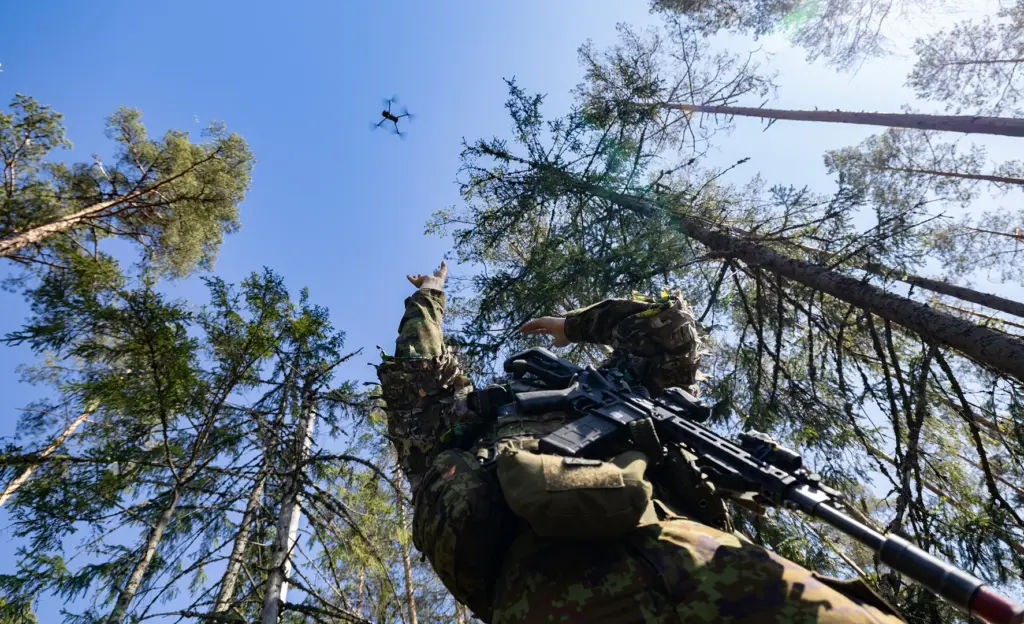
Estonian and Ukrainian soldiers fly drones together during Exercise Hedgehog 2025 in Estonia, where Ukrainian operators were credited with knocking out two battalions in a simulated engagement. Photo: vbl/OR-7 Ardi Hallismaa/ERR

Ukraine’s Defense Procurement Agency has contracted about 5.5 times as many drones of various types in recent months as in the same period of 2025. It is roughly 300% more over the year as a whole, the Defense Ministry said.

Drones are the weapons this war runs on, from short-range strikes to hits deep inside Russia, and Ukraine has raced to build and buy more of them while sparing its troops. The agency contracted for about $8 billion worth of drones in the first half of 2026 alone, double the amount for the same period last year.

The ministry wants to arm the force at every level, Defense Minister Yevhenii Khmara stresses. Deep-strike drones hit targets far inside Russia, while middle-strike drones kill enemy drone crews and burn logistics and command posts, lowering the risk to Ukrainian soldiers.

“Technology and having enough of these systems raise combat effectiveness and at the same time reduce the risks for our soldiers,” Khmara said.

FPV drones lead the surge

The sharpest growth is in FPV drones, the cheap first-person-view quadcopters that do much of the killing on the front. Contracting for them in 2026 already exceeds the total for all of 2025 by 54%, and deliveries have risen almost 3.7 times, the ministry notes.

International support and the scaling of Ukraine’s own defense industry made the jump possible, Khmara adds. Much of the buying now runs through the DOT-Chain Defense marketplace, where units select what they need, and the agency handles contracts and logistics, cutting the average delivery time for in-stock items to 9 days.

Making supply predictable

The ministry is trying to make deliveries steadier, Khmara explains. It is aligning the front’s needs, purchase planning, and the production capacity of the Ukrainian industry, making supply more predictable.

Predictable contracting lets manufacturers build their production lines step by step, plan logistics and order components in advance, he says. The ministry frames the push as a larger order book for the domestic industry and a way to scale the solutions that work in combat.

  •  

Norwegian nonprofit commits $1 million for interceptor drones to protect Ukraine’s Black Sea ports from Russian drones

Interceptor drones funded by Norwegian nonprofit Fritt Ukraina to Ukrainian forces to help counter Russian attack drones near the Black Sea ports. Photo: Fritt Ukraina / Come Back Alive

Norwegian nonprofit Fritt Ukraina is allocating NOK 10 million (about $1 million) to strengthen air defenses around Chornomorsk, a key Ukrainian port on the Black Sea, the organization announced on 9 October.

Russian attacks on port infrastructure and civilian vessels are threatening Ukraine’s maritime trade and agricultural exports, putting pressure on a vital source of revenue for the country and disrupting shipments of food to international markets.

The funding will support Ukrainian State Border Guard Service and Armed Forces units defending the region against Russian attack drones. It is being delivered through Dronefall, a project run by the Ukrainian Come Back Alive Foundation, which equips military units with interceptor drones and the equipment needed to operate them.

Fritt Ukraina, whose name means “Free Ukraine,” is a Norwegian nonprofit organization that supports Ukraine’s defense against Russia’s full-scale invasion. The donation is part of its Odins Ravner 2.0 fundraising campaign, which provides military assistance to Ukrainian forces.

Interceptor drones and equipment to protect port infrastructure

The support includes STING, Blyskavka and P1-SUN interceptor drones, alongside ground control stations, communications equipment, generators, charging stations, laptops, tablets and vehicles, according to the organization.

The interceptor drones are already operational, according to Fritt Ukraina. The equipment helps Ukrainian personnel detect and intercept Russian attack drones, while vehicles allow crews to move quickly and operate from different positions.

Fritt Ukraina Secretary General Natalia Golis said effective air defense requires more than interceptor drones alone. Communications systems, reliable power supplies and mobility are also essential to ensure units can use their equipment effectively.

The organization is supporting Dronefall for the third consecutive year and has become the Come Back Alive Foundation’s largest foreign partner. The latest donation was matched by a donor affiliated with the Ukrainian foundation.

STING interceptor drones funded by Norwegian nonprofit Fritt Ukraina to Ukrainian forces to help counter Russian attack drones near the Black Sea ports. Photo: Fritt Ukraina / Come Back Alive

Russian attacks threaten Ukraine’s maritime exports

More than 90% of Ukraine’s agricultural products, including grain and vegetable oils, are exported through three ports in southern Odesa Oblast. Russian attacks have targeted port infrastructure and civilian vessels, increasing security risks for commercial shipping and driving up freight and insurance costs.

Since the start of Russia’s full-scale invasion in February 2022, more than 1,000 Ukrainian port facilities and over 200 civilian vessels have been damaged or partially destroyed, Fritt Ukraina reports. The disruption threatens Ukrainian export revenue and international food supplies.

“The attacks on Ukraine’s ports do not only undermine the country’s defense capabilities. They also threaten a vital part of its economy and its ability to export food to the rest of the world,” Golis said.

Grain pours from a combine harvester into a trailer during harvest in Ukraine.
Explore further

Russia’s Odesa strikes halve Ukraine’s grain export forecast

Dronefall aims to expand Ukraine’s ability to intercept Russian drones using dedicated interceptor aircraft and supporting equipment. According to Fritt Ukraina, participating units have destroyed more than 53,000 Russian drones, accounting for approximately one in five unmanned aerial vehicles entering Ukrainian airspace.

The NOK 10 million contribution is part of Fritt Ukraina’s broader Odins Ravner 2.0 campaign, which provides more than NOK 60 million in support to Ukrainian forces.

  •  

Joel Abadal, Brad Pitt’s stunt double: ‘I’m very professional, but I was freaking out. Mr Pitt right in front of me!’

Brad Pitt’s recent visit to Spain revealed his affinity for the local culture. The actor greeted crowds outside the Hotel María Cristina in San Sebastián; he viewed the abstract works sculpted by Eduardo Chillida; he denied knowing or having had an affair with Makoke Giaever, a Spanish TV personality; and he made a surprise appearance at a christening in Madrid’s Santa Bárbara Church to meet the family of his girlfriend, Inés de Ramón.

Seguir leyendo

© Scott Garfield (EL PAÍS)

Joel Abadal and Brad Pitt during the shoot of 'Heart of the Beast.'
  •  

Japan-US-Australia ‘Oriental Shield 26’ expands at the cost of regional stability

By Global Times Published: Aug 26, 2026 The so-called “Oriental Shield 26,” a Japan-US-Australia joint military exercise scheduled to take place from September 8 to 24, is being presented as a training initiative aimed at improving interoperability. In reality, however, it serves as a textbook case of how large-scale bloc-style military drills are being rebranded […]
  •  

O dia em que subir um lanço de escadas deixou de ser normal

Tudo começou com um cansaço aparentemente banal. Uma pessoa ativa, profissionalmente realizada, habituada a uma vida normal, começa a sentir que algo mudou. As escadas parecem mais longas. O percurso habitual até ao trabalho torna-se mais exigente. Ao final do dia, a energia desaparece mais depressa do que seria expectável. Primeiro atribui-se a culpa ao stress. Depois à idade. Mais tarde, à falta de descanso. Mas o cansaço não passa.

Meses depois surgem outros sinais. Perda de peso sem explicação. Suores noturnos. Uma sensação constante de fraqueza. Finalmente, chega o diagnóstico: Mielofibrose. Para a maioria dos portugueses, o nome diz pouco ou nada. No entanto, para quem recebe este diagnóstico, representa uma mudança profunda na sua vida.

Embora seja uma doença pouco conhecida, a Mielofibrose tem um impacto significativo na vida de quem com ela convive. Por isso, vale a pena falar sobre esta doença, que permanece praticamente invisível para a sociedade até ao momento em que entra, sem aviso, na vida de alguém.

A Mielofibrose é um cancro raro do sangue que afeta a medula óssea. À medida que a doença evolui, a produção normal de células sanguíneas torna-se menos eficaz, levando frequentemente ao aparecimento de anemia, aumento do baço e sintomas constitucionais como febre, perda de peso, fadiga e suores noturnos.

Apesar dos avanços científicos das últimas décadas, continua a existir uma realidade difícil de ignorar: muitas pessoas vivem durante bastante tempo com sintomas que são subvalorizados, quer pelos próprios doentes, quer por quem os rodeia. Talvez porque todos nós nos habituámos a normalizar o cansaço.

Vivemos numa sociedade onde estar cansado é quase um estado permanente. Trabalhamos mais. Dormimos menos. Acumulamos responsabilidades. Por isso, quando alguém se queixa de fadiga persistente, raramente imagina que possa estar perante uma doença hematológica grave.

Contudo, para muitos doentes com Mielofibrose, a anemia torna-se uma das manifestações mais incapacitantes da doença. Os números ajudam a perceber a dimensão do problema: cerca de 38% dos doentes apresentam anemia no momento do diagnóstico, percentagem que ultrapassa os 50% durante a evolução da doença. Mas os números contam apenas parte da história.

A verdadeira dimensão da anemia mede-se de outra forma. Mede-se no avô que deixou de brincar com os netos porque já não tem energia. Na pessoa que abandona a atividade física que sempre praticou. No profissional que passa a ter dificuldade em cumprir um dia de trabalho. Na família que reorganiza a sua rotina em função de consultas, exames ou transfusões. Mede-se, sobretudo, na perda gradual de autonomia. É por isso que, quando falamos de Mielofibrose, não estamos apenas a discutir resultados laboratoriais. Estamos a falar de qualidade de vida.

Sabemos hoje que a anemia associada à Mielofibrose não é apenas um sintoma incómodo. Está associada a um pior prognóstico da doença e constitui um dos fatores considerados na avaliação do risco destes doentes. Além disso, pode aumentar a necessidade de cuidados médicos e condicionar profundamente o bem-estar físico, emocional e social.

Recentemente, um grupo de hematologistas portugueses, do qual faço parte, reuniu a evidência científica disponível e a experiência da prática clínica nacional para desenvolver recomendações destinadas a melhorar a abordagem das alterações sanguíneas que afetam os doentes com Mielofibrose. O objetivo é simples: contribuir para cuidados mais uniformes, mais eficazes e mais centrados nas necessidades reais das pessoas que vivem com esta doença. Mas os profissionais de saúde não conseguem mudar esta realidade sozinhos. A consciencialização da sociedade continua a ser uma peça fundamental.

Nenhuma campanha de sensibilização eliminará uma doença rara. Mas pode ajudar a reduzir o desconhecimento que frequentemente a acompanha. Pode fazer com que mais pessoas valorizem sintomas persistentes. Pode levar alguém a procurar ajuda mais cedo. Pode diminuir o isolamento que muitas vezes acompanha os doentes com patologias pouco conhecidas.

Por isso, deixo um convite simples. Valorizemos os sinais que o nosso corpo nos dá. Nem todo o cansaço esconde uma doença grave. Felizmente, a esmagadora maioria das vezes não esconde. Mas quando o cansaço é persistente, inexplicável e acompanhado por sinais como perda de peso involuntária, anemia, febre, suores noturnos ou aumento abdominal, merece ser investigado. Porque, por vezes, a diferença entre ignorar um sintoma e procurar uma explicação pode mudar o rumo de uma vida. Porque nenhuma doença rara deveria permanecer invisível apenas porque afeta poucos doentes. A cada uma dessas pessoas, a sua doença não parece rara. Parece apenas a coisa mais importante do mundo.

* Hematologista – ULS de Santa Maria, Coautora da publicação ‘Gestão prática das citopenias no doente com mielofibrose adaptada à realidade em Portugal’

  •  

America Is Leaving Iraq, Not the Middle East

America’s last troops have left Iraq, but anyone looking for a US withdrawal from the Middle East is looking in the wrong place. The end of the Iraq model On September 30, the United States completed the withdrawal of its forces and equipment from Erbil Air Base, formally ending the mission of Operation Inherent Resolve […]
  •  

The Weekend the Money Stops: A Bank Collapse, Hour by Hour

by Milan Adams, Preppgroup: The notification arrives at 4:47 on a Friday afternoon, from an app you rarely open. It says that one of the big banks, a name you have used for most of your adult life, has been seized by the government. You read it four times before the words settle. Regulators tend […]
  •  
❌