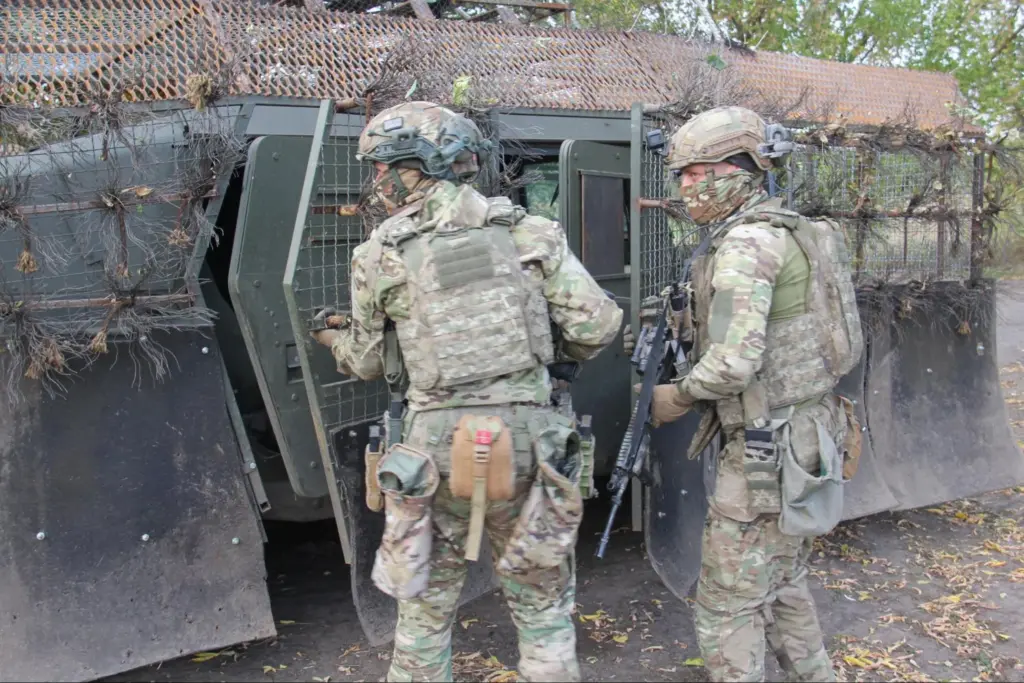
Ukrainian reconnaissance troops used a captured Russian soldier’s radio for four days to listen to Russian military communications and relay important intelligence to their command, according to a report by ArmyInform, which covered the episode. The soldiers serve in the 23rd Separate Reconnaissance Battalion, which operates in the Oleksandrivka sector, the report noted.
Russia uses infiltration tactics involving small groups to slip through Ukrainian positions undetected, establish themselves into the rear of Ukrainian positionse, and create conditions for the further advance of its main forces. They are countered not only by reconnaissance drones but also by specialized reconnaissance teams, which sometimes cover several dozen kilometers on foot to reach their designated targets.
Ukrainian scouts capture Russian soldier in the grey zone
Ukrainian reconnaissance troops captured a Russian soldier in the grey zone as he was trying to enter a neighboring house, the report said.
“He took off his body armour and set his rifle aside. He felt right at home. Our commander went over and offered him a chance to surrender, and he agreed. He then stayed with us for four days. He told us everything he knew,” a soldier with the call sign Kubik said in the report.
The soldiers’ hideout was later discovered. Fleeing a Ukrainian drone, a Russian infantryman ran into the building where the reconnaissance troops were staying. The position was subsequently attacked by FPV drones, followed by an artillery barrage.
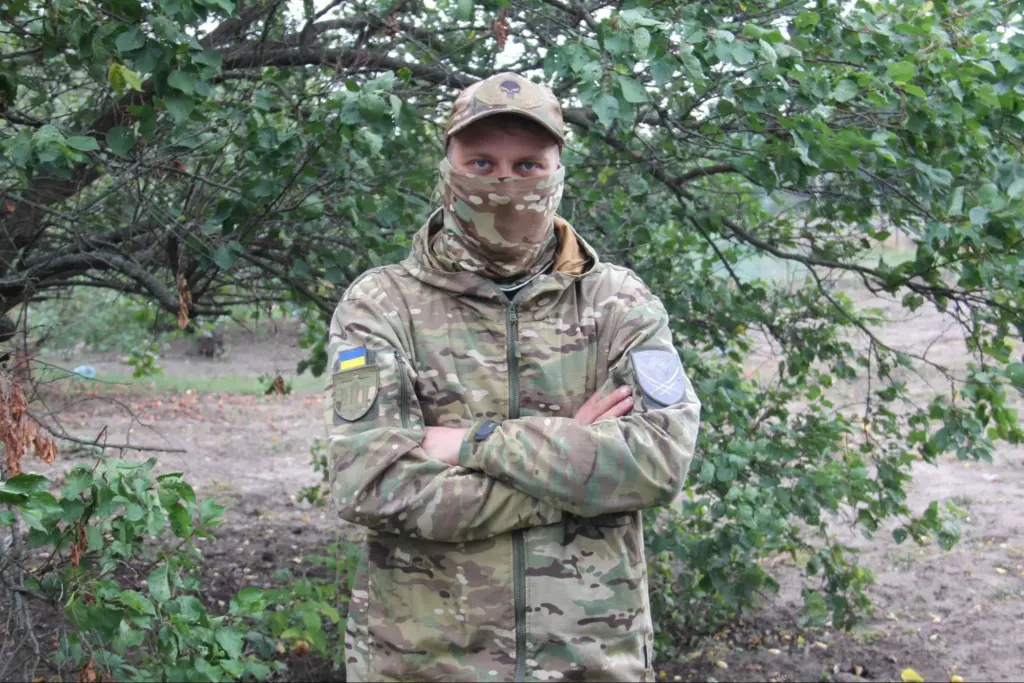
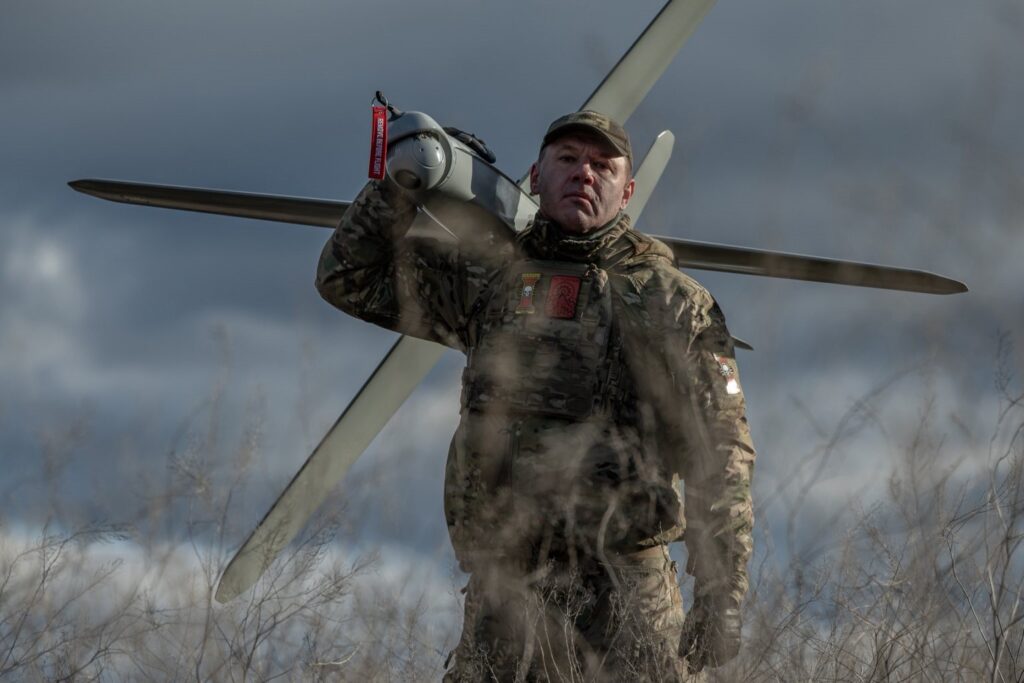
Reconnaissance soldier with the call sign “Kubik” of the 23rd Separate Reconnaissance Battalion, 2026. Photo: ArmyInform
One Ukrainian soldier sustained a minor injury, but the group managed to withdraw without suffering serious losses.
Reconnaissance soldier Kubik spent 23 days on a combat mission
For reconnaissance troops, the journey to their positions and the return trip remain perhaps the most dangerous parts of a mission. During his year of service, Kubik has completed five combat missions, one of which lasted 23 days, according to the report.
During their most recent mission, the soldiers covered 20 kilometers on foot in one direction, moving mostly through tree lines, Kubik said. He added that they had to run across open areas and destroy enemy drones lying in wait before quickly retreating to cover.
Because of the constant threat from the air, the length of time reconnaissance troops can remain at their positions depends on the weather and the situation, the report noted. Sometimes, staying in place longer is safer than risking exposure while a team is being replaced.
Dzhus’s first mission: 20-year-old reconnaissance soldier chooses infantry
Twenty-year-old Mykyta, whose call sign is Dzhus, is preparing for his first combat mission as part of the 23rd Separate Reconnaissance Battalion, the report said. He joined the military under the “18–24 Contract” program after leaving the police force.
“Many people who join under the ‘18–24’ contract go into UAV operations, but I’m more interested in infantry work. We have many experienced reconnaissance soldiers, and the guys are constantly giving advice and sharing their experience,” Dzhus said.
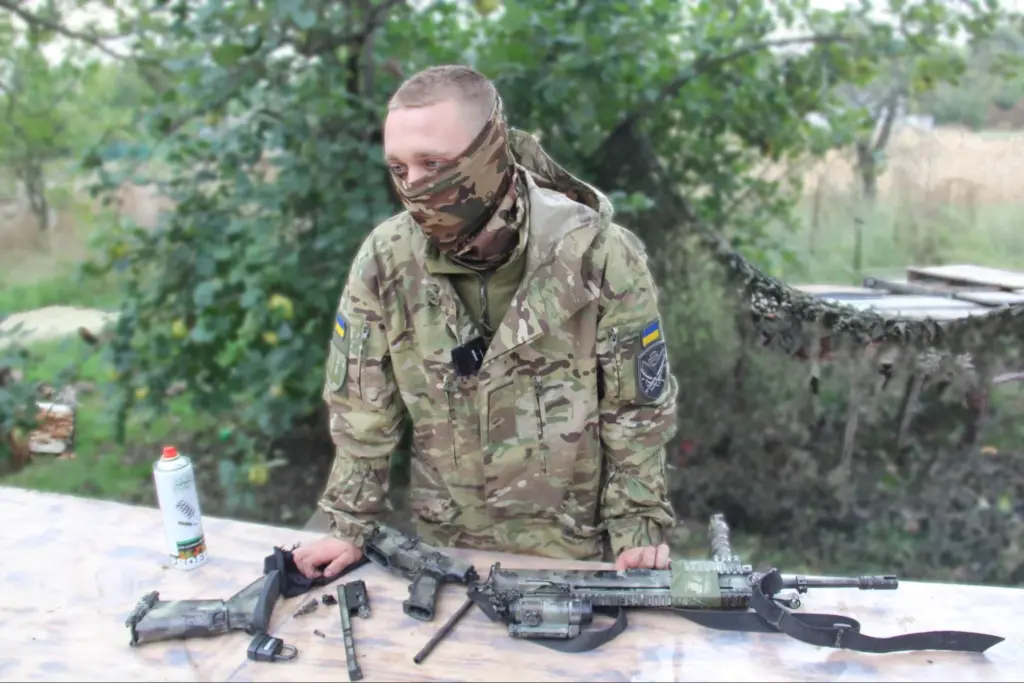
Reconnaissance soldier with the call sign “Dzhus” of the 23rd Separate Reconnaissance Battalion, 2026. Photo: ArmyInform
He is heading out on the mission under the guidance of an experienced commander, he said. The soldiers prepare thoroughly for every mission, practicing at the training ground and rehearsing procedures tailored to the specific task, the media outlet noted.
Russian troops seek new hiding places for infiltration along the front
Russian forces continue to use small-group infiltration tactics. For example, the Russian army is likely increasing its infiltration efforts in Kharkiv Oblast, taking advantage of the remaining summer foliage for concealment, the Institute for the Study of War reported on 9 October. In particular, Russian forces are seeking to infiltrate the city of Kupiansk in small groups, according to an RBC-Ukraine report published on 7 October.
Similar incidents have also been reported in Donetsk Oblast. Russian troops are attempting to infiltrate the gaps between Ukrainian observation posts in small groups and establish positions there, Artem Prybilnov, spokesperson for the 155th Separate Mechanized Brigade, said during a broadcast on Suspilne.Studio on 7 October, NV reported. Their aim is to build up forces for a further advance toward Dobropillia. Ukrainian infantry, working alongside drone operators, is repelling the ongoing Russian attacks and preventing them from achieving this goal, Prybilnov added.
As autumn sets in and vegetation becomes thinner, Russian troops find it increasingly difficult to conceal themselves in tree lines, Prybilnov noted. During the summer, they used these areas for cover and to accumulate personnel, ammunition, and equipment, the spokesperson said. Russian forces are now attempting to infiltrate villages, where they can hide in buildings and basements and establish positions, he added.
For more than a year, U.S. Army forces in Europe have been experimenting with new counter-drone capabilities, as well as tactics, techniques, and procedures to go with them, under the umbrella of what is dubbed Project Flytrap. In doing so, the service has also been gaining valuable new insights into how uncrewed systems can help shape the battlefield for friendly forces. It is particularly interesting to hear how the Army envisions using uncrewed platforms to open up new avenues for deceiving opponents.
Army Col. Timothy Price, head of the 2nd Cavalry Regiment, discussed the use of uncrewed platforms for deception and other operational concepts that have emerged in the course of Project Flytrap during a talk yesterday. Price’s remarks came at the Association of the U.S. Army’s (AUSA) main annual convention, at which TWZ is in attendance. 2nd Cavalry Regiment, based in Germany, is a brigade-sized mechanized formation equipped primarily with variants of the Stryker 8×8 light armored vehicle.
Stryker light armored vehicles assigned to 2nd Cavalry Regiment seen configured for a Project Flytrap event. US Army Sgt. Alejandro Carrasquel
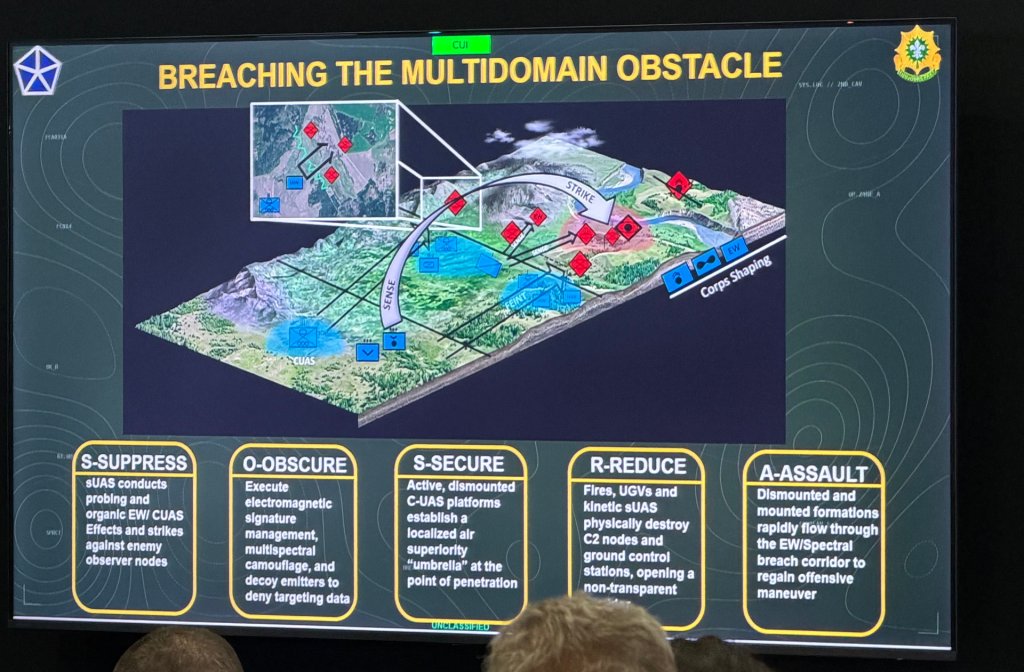
Price, by way of introduction, described modern battlefields full of uncrewed platforms in the air and on the ground as presenting new twists on long-standing problem sets. More specifically, he started by describing the typical approach to getting past a minefield or similar obstacle using an established framework called SOSRA, which stands for Suppress, Obscure, Secure, Reduce, Assault.
“If we were going to breach a mined wire obstacle, the first step of SOSRA – suppress – would be the utilization of indirect fires, to get the enemy’s head down, and direct fire systems, so they would not maneuver on you, fix them in place, and you can make a decision about how you’re going to approach the problem,” the 2nd Cavalry Regiment commander explained. “The next step would be to obscure it. In the historical sense, obscurations used is [sic] smoke, to mask your movement to the point of breach, so the enemy doesn’t know what you’re doing. And then, of course, secure would be to establish frontside security, [and] allow your engineers to come up within this local security bubble. They’ll utilize some kind of line charge to open the breach, reduce it – that’s the ‘R’ – and then bring on a follow-on force of assault through.”
“We were brought up around the old traditional mined wire obstacles that we had to physically breach. This is no different,” he added. “It’s just a multi-domain environment. So it’s built up of a combination of electronic warfare, kinetic UAS [uncrewed aerial systems] threats, and then counter-UAS threats, and then the network that holds [that all] together that forms the obstacle, which a unit has to maneuver through in order to maintain the offensive.”
A briefing slide Col. Price showed at AUSA yesterday while talking about SOSRA on the modern ‘multi-domain’ battlefield. Jamie Hunter
Within this environment, Col. Price described the suppression step of SOSRA as having a different kind of probing dimension, particularly to feel out an enemy’s uncrewed capabilities, as well as those in the electromagnetic spectrum. He also noted that brigade-sized formations like this no longer necessarily have all the required tools organizationally to ‘service’ that aspect of the mission. This is in part because what has to be suppressed, including ground control stations for enemy drones, might now be miles behind the front line.
So, “what we have to do is allow the enemy to turn on their systems. How do I suppress them to allow division, or higher, to put an effect on them for suppression? It probably looks like flying small, attritable UAS [sic] into their security area” in the rear, he said. This, in turn, “cause[s] the enemy to do one of two things, either … go from passive to active with their EW [electronic warfare] systems, or to turn on radars to actually figure out what they’re seeing, which then forms the signature which higher headquarters can use to target.”
Though Col. Price did not describe it as such, there is already something of a deception aspect to this step in fooling enemy emitters to switch on and expose themselves. This, as a general tactic, is also hardly new. Stimulating air defenses, in particular, is a key part of operations to gather intelligence on those capabilities, as well as to suppress and destroy them. Once you have categorized and geolocated an emitter, it is a logical step to then target it. The ultimate goal, with data being passed along a more deeply networked kill chain, is for the time it takes for fires to be brought to bear to be almost instantaneous.
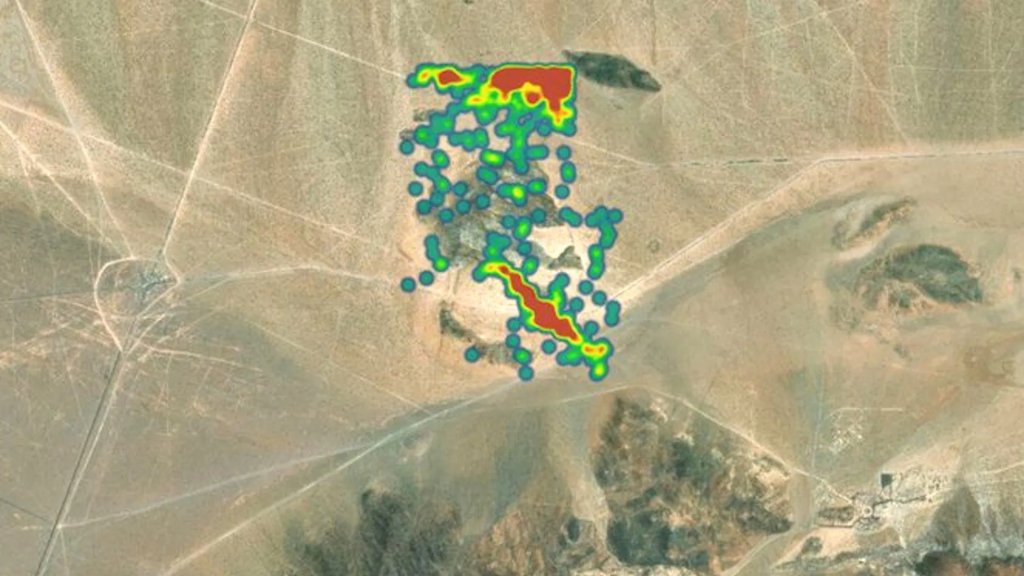
In 2020, then-Army Col. Scott Woodward, at the time commander of the 11th Cavalry Regiment, shared this annotated satellite image showing the electronic emissions signature of a battalion-sized element, underscoring how such signals exposed a unit to attack. US Army via X
Regardless, deception comes far more into play in the obscure step, according to the 2nd Cavalry Regiment commander.
“Obscuration is different, as well. So instead of trying to hide behind smoke as we maneuver through it, what is the deception plan, right? How am I trying to show the enemy a signature that says I’m going to breach over here when I’m actually going to breach here, right?” he asked rhetorically. “So, that’s probably the implementation of UGVs [uncrewed ground vehicles] with some kind of decoy emitter on top of them to pull the enemy’s eyes, resources, and time to a point that allows me to focus my assets and resources on the point of breach.”
The use of uncrewed platforms as decoys is also not new, and even more complex concepts have emerged within the U.S. military in the past. Uncrewed systems have also been developed for military and other purposes over the years that are designed to mimic something else entirely, including for purposes of deception. This includes masquerading as birds and other animals.
Back in 2019,TWZ was the first to report in detail on a Navy effort to develop and field an entire networked, cooperative electronic warfare ecosystem, at that time referred to as the Netted Emulation of Multi-Element Signature against Integrated Sensors, or NEMESIS. This was also a drone-heavy cross-domain concept intended to make many types of sensors over vast areas believe they were ‘seeing’ the same false fleets of aircraft and/or ships, and deceive and confuse the enemy on a grand scale. This, in turn, represented a massive leap in electronic warfare capabilities.
An unclassified 2014 briefing slide with details about NEMESIS. Note the inclusion of drone boats among other uncrewed platforms in the associated graphic. USN An unclassified 2014 briefing slide with details about NEMSIS. Note the inclusion of drone boats among other uncrewed platforms in the associated graphic. USN
There is also overlap here with reported sightings of what are now commonly called unidentified aerial phenomena (UAP), and that used to be called unidentified flying objects (UFO). As we have reported on repeatedly over the years, while some UAP sightings remain unexplained, many more have turned out to be drones. Adversaries have been using uncrewed capabilities for intelligence gathering and deception purposes against American interests at home and abroad, likely in part by exploiting UAP stigma for cover. We have talked in the past about how drones will be used in more and more exotic ways to confuse opponents.
I don’t know what this is, or if it’s legit BUT remember we are in a new age of misdirection, decoy and guile. Specifically using low end drone technology. There are more ways to stimulate an enemy air defense system, distract a populous, assess the flow of public info from a… https://t.co/wW7YVlbayB
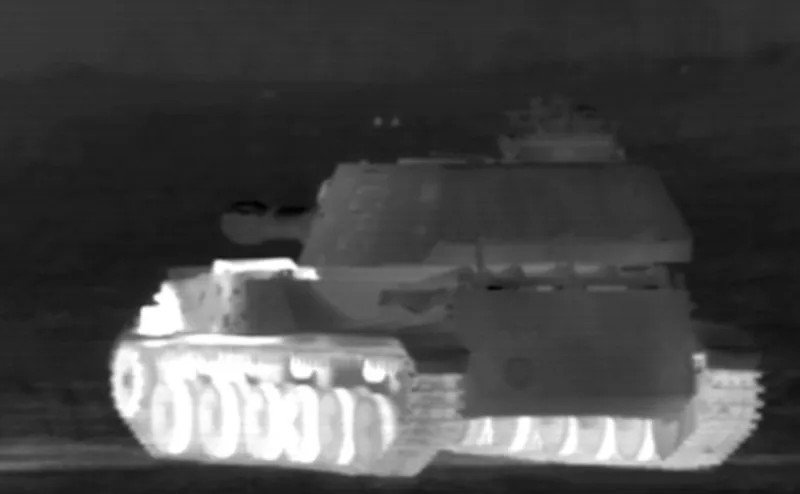
“It’s also spectral camouflage. So how are we controlling our heat and thermal signatures on our vehicles and our people?” Price continued. “It’s basic soldier discipline issues. It’s how we use our radios. It’s where we’re talking, where we’re not. But that’s what obscuration looks like.”
A Soviet-designed 2S3 self-propelled howitzer as seen through a thermal camera, offering a good example of how heat signatures can put forces at risk. CI Systems
As a reminder, Project Flytrap’s primary focus has been on counter-drone capabilities, which come into play heavily during the secure stage.
“There’s multi-layered assets on top of that to allow that convergence for our success at the point of breach. I’m going to focus on our corner, our part of the battle, right?” he said. “So, I’m looking at active and passive electronic warfare systems – that can either, one, find [threats], let me know that I’ve got some kind of system flying or operating against me and, then, if it’s an active system, take some kind of effect to maybe cut a downlink and disrupt that system – all the way down to the individual soldier with a shotgun.”
As mentioned, the ‘obstacle’ to be ‘reduced’ at the end of this is not necessarily something as simple as a minefield surrounded by barbed wire anymore. Now it could be enemy one-way-attack drone capabilities preventing holding up an advance. Col. Price, in turn, described friendly kamikaze drones as part of the equation for breaching past those threats. Decoys and deception have a continued role to play in this phase.
“This is where, at the brigade level, we introduce one-way attack munitions to try to destroy the C2 [command and control] network that the enemy is using to operate this reconnaissance/strike complex” that is standing in the way, he explained. “There’s layers to it, right? Like they’ve got a close side to this that’s the local part of this reconnaissance/strike complex. They’ve probably got a theater level that the Corps [the U.S. Army’s command echelon above divisions] and higher is trying to target as we are forcing people to turn on systems to communicate. But at the regiment level, I’m looking at one-way attack munitions, focused on C2 nodes, headquarters, and ground control stations that [sic] I can disrupt their ability to put lethal effects on me as we begin to open the breach.”
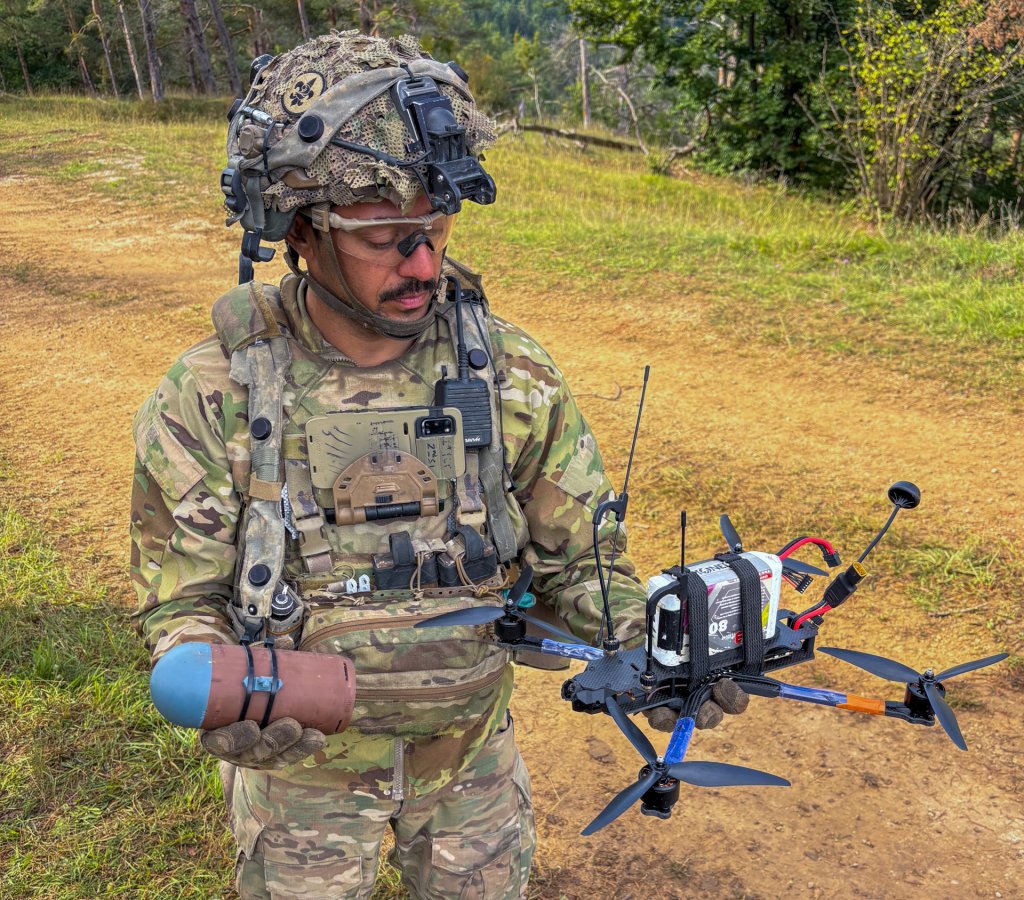
A member of the 2nd Cavalry Regiment holds a small quadcopter drone in one hand and a simulated bomblet in the other during an exercise in 2025. US Army
During a question-and-answer session that followed his remarks, Col. Price was asked about whether lessons learned and other observations from Ukraine, and specifically that country’s recent Operation Vivaldi counteroffensive, had contributed to this evolving framework.
“In terms of Vivaldi, I’m not an expert, so I’m not going to make any kind of estimations on how that worked or why,” he said in response. “But I will say, if you look at the focus of that operation, you can probably make the assumption that there was convergence of efforts across the different headquarters to enable success. So that’s how I would relate to the two.”
“In order to be successful for a multi-domain breach, the tactical level requires my higher headquarters to be part of that solution to enable me with resources and capabilities that I don’t have in here at the brigade level,” he continued. “I would imagine it’s very similar in the other operational comparisons.”
Though certainly true, in broad strokes, this response in some ways underscores how the U.S. Army continues to lag behind global trends in the use of uncrewed systems, as now typified by the ongoing war in Ukraine. Army leaders have been open about this continued reality in the past, despite efforts to try to reverse it.
“We’re behind. I’ll just be candid. I think we know we’re behind,” Army Lt. Gen. Charles Costanza said during a panel discussion at AUSA last year, in response to a direct question at the panel from our Howard Altman. Costanza was talking about both the employment of drones and counter-drone capabilities, and highlighted work being done then under Project Flytrap, as you can read more about here.
Another 2nd Cavalry Regiment Stryker configured for the counter-drone role seen during a Project Flytrap exercise. US Army
For units like the 2nd Cavalry Regiment, new drone-centric concepts of operations are already taking shape. Beyond using them for surveillance and as one-way-attack munitions, there is also a clear focus emerging on employing expanding uncrewed capabilities to deceive opponents and prevent them from making the best use of their own resources.
Ukrainian drones have helped push Russia into its worst fuel crisis since the Soviet Union fell, The Washington Post (WaPo) reported on 11 October.
Diesel is where this war reaches American drivers. US President Donald Trump blames rising diesel prices mostly on Russia’s war in Ukraine, while experts blame mainly the US war with Iran. Some of his allies now accuse Kyiv of trying to sway the US midterms.
Drones go for the first stage of refining
The Washington Post looked at dozens of strikes between 1 April and 31 August. Three refinery experts then examined satellite images of 54 strikes with visible damage. In over half, the damage seems to be to the desalting and distillation units, known by the Russian acronym ELOU-AVT. These units clean the crude of water and salt, then split it into separate compounds, the first steps toward gasoline and diesel. More than a third appear to have hit secondary units, which turn those compounds into jet fuel, gasoline, and liquefied petroleum gas.
From April through August, drones struck two-thirds or more of the 36 big Russian refineries that S&P Global Energy tracks, a strike every third day. Some took as many as five hits. On 16 June, drones set the Moscow refinery’s distillation towers on fire. That strike and a second one days later kept the plant offline into September, WaPo reported, citing data firm Kpler. Ukraine targeted the refinery again on 20 September.
Explore further
Trump’s Russian diesel deal, which drew fury in Ukraine, is unlikely to lower prices, experts say
“We don’t need to hit the entire plant,” a Ukrainian drone battalion commander with the call sign Tango told The Washington Post. Ukraine knows where to strike so that a refinery stops and stays down, he said. His unit, Ukraine’s 1st Separate Center of Unmanned Systems, runs long-range strikes deep inside Russia.
Sanctions slow the repairs
The EU banned exports of oil-refining equipment to Russia the day after the 2022 invasion, and the US followed days later. WaPo reported that the bans cover the distillation and secondary processing units Ukraine keeps hitting. The bans make spare parts hard to get, Alexander Kolyandr of Eurasia Group told the paper, and the strikes come faster than repairs.
Since last year, Ukraine has doubled the size of each wave, decoys included, a person involved in the strike campaign told WaPo. The decoys are unarmed and draw Russian fire, wasting air-defense ammunition, WaPo explained. Without them, the person said, Ukraine would simply lose expensive systems. András Rácz of the German Council on Foreign Relations told WaPo that even if only 2–3% of drones get through, the damage is significant.
Ukraine’s drone strikes on Russian tech giant Yandex thinned out social media bots, Ukrainian President Volodymyr Zelenskyy said on 12 October. Network data do show Yandex’s automated traffic collapsing after the strikes. Disinformation researchers say that traffic is search crawling, not trolls. A Ukrainian social media monitor told Euromaidan Press its own data show no clear drop in bot activity either.
Russian influence operations are a live threat to European votes. In August, the Matryoshka network fabricated news clips aimed at Sweden’s general election. German and French authorities flagged the same network targeting Germany’s local votes and French presidential hopeful Gabriel Attal. A way to switch such networks off would hand allies a new tool, which is why the claim needs testing.
The president’s claim
Addressing the Warsaw Security Forum by video link, Zelenskyy said that once Ukraine began answering Russia’s operation against Ukrainian data centers and its strikes reached Yandex, many social media platforms suddenly became a little easier to breathe on.
Many people noticed less hatred, discord, and provocation because there were fewer bots, he said. It was quite clear where those bots came from, he noted. Their disappearance once Yandex went down proves again that Europe is not the source of the problems, he added.
Lithuanian Prime Minister Mindaugas Sinkevičius said at the same forum that allies should ask Zelenskyy to strike more data centers in Russia, answering a question on how to protect their elections from interference.
Three data centers in four days
Drones first hit Yandex’s data center in Sasovo, Ryazan Oblast, on 8 October. Yandex said it shut the site down completely. The next day, a strike on its Kaluga site completely disabled several modules, the company said. Yandex calls Kaluga its largest data center, Russian science outlet T-Invariant noted.
Ukrainian drone maker Fire Point said its FP-1 long-range drones carried out that strike.
After the first strike, on Sasovo, a source at Yandex summed up the mood for The Bell: “Things are rotten. We keep working.”
Overnight on 11 October, drones hit the third site, in Vladimir. Yandex said it fully halted that data center too. Vladimir Oblast Governor Aleksandr Avdeev acknowledged an attack on “infrastructure” near the city. It started a fire and cut power to two substations serving 5,000 residents, he claimed.
Automated web requests from Yandex’s network fell to 0.4% of their two-week peak after the third strike, Cloudflare Radar data showed, Cybernews reported. That chart counts automated requests to websites, mostly from Yandex’s own search crawlers. It does not count social media posts.
The chart “has nothing to do with social media,” the Russian opposition analysis group Antibot4navalny wrote.
To those implying that Kremlin-controlled social media bot/troll farms became silent after Ukraine hit a Yandex data center, posting this CloudFare chart ( radar.cloudflare.com/bots/as13238 ):Hate to disappoint you all
Russia’s overall bot traffic last week looked much like any other week. Yandex’s own figure began recovering on Sunday. Covert troll farms usually hide behind residential proxies, hacked devices, virtual private networks (VPNs), and Western cloud providers, the outlet added.
What Ukrainian social media shows so far
Yevhen Luzan tracks Ukrainian social media sentiment as an analyst at the Ukrainian nonprofit CAT-UA. Its daily reviews sample about 500 random posts. On 11 October, that sample showed an unusually small share of posts criticizing Ukraine’s authorities, he told Euromaidan Press. Accounts showing signs of bot activity made up only a few tenths of a percent of that criticism. That is within the margin of error.
The same day, though, US President Donald Trump’s deal for Russian diesel supplies dominated Ukrainian feeds. Luzan said a rally-around-the-flag effect could explain the shift, as outrage at Washington crowded out domestic stories.
“To state it definitively and draw a cause-and-effect link from this correlation would be too bold,” he said.
Across the wider pool of about 10,000 daily mentions, CAT-UA sees no significant drop in posting activity in recent days. The curve shows only the usual rises and dips around the start and end of the week, Luzan said.
“For now, even a hypothetical drop in bot farm activity dissolves entirely in the natural fluctuations of the information space,” he said.
How a crawler chart became a bot story
The claim that Russian social media bots fell by half is unproven and built on a misread chart, disinformation analyst Joohn Choe concluded in a fact-check. It traces back to an 8 October post by security researcher Jeremiah Fowler. That post said Russian bot traffic had dropped to 49%. On 11 October, radio reporter Jamie Dupree spread it on X. Tom’s Hardware then ran it under a headline calling the crawler traffic “Russian disinformation bot traffic,” wording it has since changed.
According to Cloudflare Data Explorer the amount of russian bot traffic has dropped to 49% after Ukraine struck a yandex data center. Could this disrupt the midterm elections in the US? pic.twitter.com/SRtMyjaV22
— Jeremiah Fowler Security Researcher (@yoda69) October 8, 2026
Ukrainian military analyst Tatarigami claimed that Texas separatist accounts with identical “Veteran, Christian, Father, MAGA” bios had gone quiet. He said Quebec separatists and Polish anti-EU accounts went quiet alongside them.
Polish military analyst Jarosław Wolski claimed that AfD’s online support fell 56%, posting a chart without naming its source. Another X user said “Polish” bots had vanished.
Zderusyfikowany internet (ukraińskie trafienia w centra Yandexa) nagle objawia cuda w socjalach: poparcie dla AfD w socjalmediach spadło o 56%. Mniej "polskich" kont szczujących na Ukraińców, mniej "ukraińskich" szczujących na Polaków, poparcie w sieci dla MAGA gwałtownie spadło… pic.twitter.com/zi4rwqNR9I
Units of Ukraine’s Unmanned Systems Forces have killed or wounded more than 100,000 Russian troops since the start of 2026. That is more than 150,000 since the force was created on 11 June 2025, the force said on Telegram.
Drones have become the deadliest weapon of this war, accounting for about 96% of Russia’s battlefield casualties earlier this year. These hits are verified on video in the military’s Delta system, which is how the force counts only the losses its own pilots confirm.
“Behind these figures is the daily combat work of our soldiers, thousands of sorties, precise strikes, and the constant improvement of unmanned technologies,” Ukraine’s Unmanned Systems Forces said.
Each strike reduces Russia's combat potential and reflects the coordinated work of the force’s units, it added.
A toll that keeps climbing
Overall, drone branches of the Ukrainian Army had carried out more than 1 million verified strikes on enemy targets since January, killing or seriously wounding about 193,500 Russian troops, Ukraine’s Defense Ministry reported in July.
Those strikes roughly doubled over the first half of the year, from about 105,800 in January to more than 200,000 in June, the ministry noted.
Meanwhile, Commander of the separate Ukrainian Unmanned Systems Forces Robert “Madiar” Brovdi says the numbers are still growing. In the first five days of October, the force’s pilots killed or wounded 2,699 Russian soldiers, 39.7 percent more than in the same period of September.
He tied the rising number to Russia's assaults in Donbas, as the offensives for the fortress-belt cities that have been Ukraine's protection against full region's occupation since 2014, were ongoing.
Why the drone branch matters
The force fields are the cheap, fast weapons that now do most of the killing on the front. Interceptor and strike drones let Ukraine hit troops, logistics, and command posts while keeping its own soldiers farther from the fight.
Aviation is one of the most effective ways to counter Russia’s jet-powered drones. Its effectiveness continues to grow due to pilots’ skill and better coordination, Defense Minister Yevhenii Khmara says, Glavcom reports.
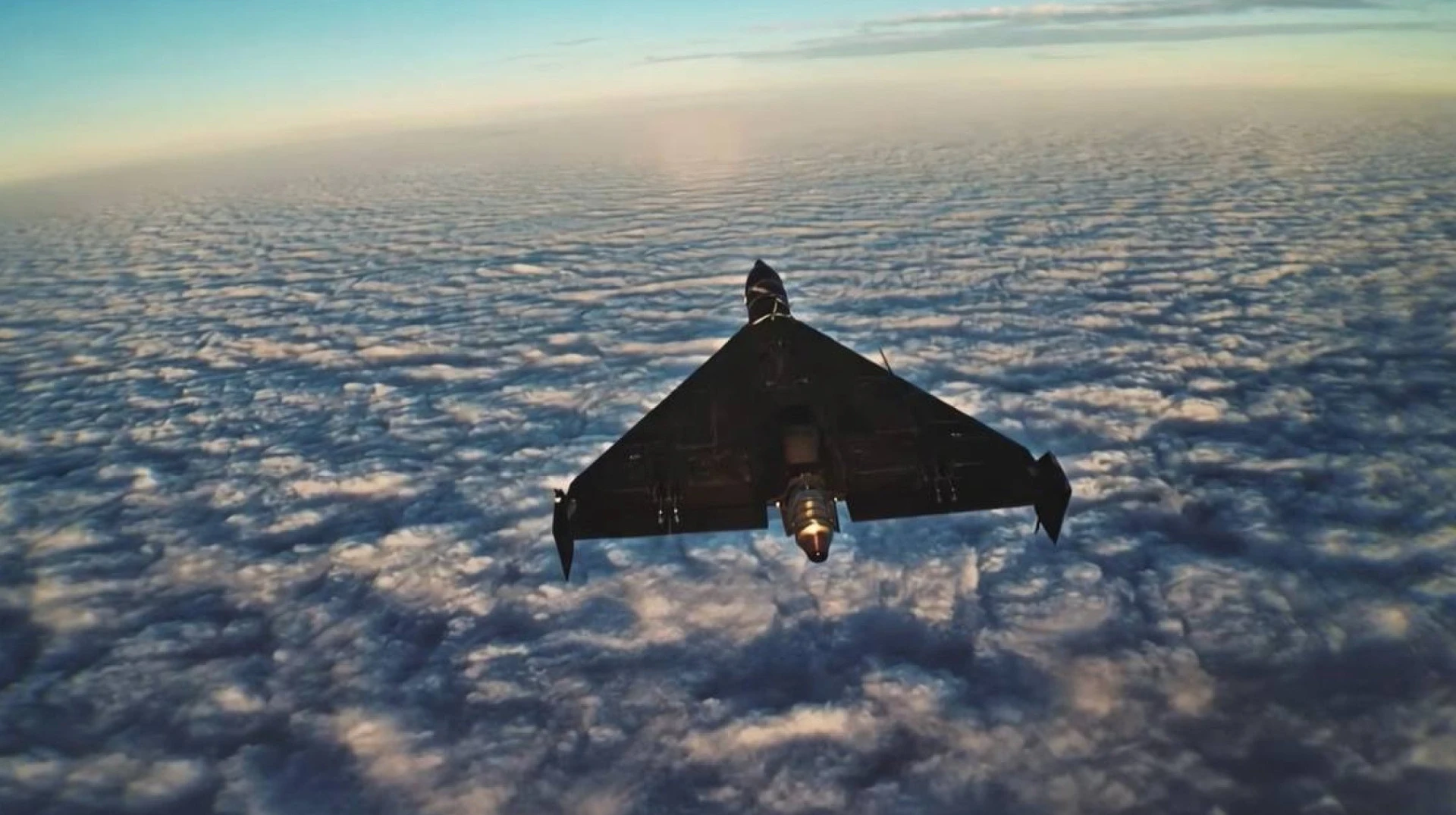
Russia’s jet-powered Gerans fly several times faster than the propeller Shaheds Ukraine learned to shoot down, and they remain the main challenge for its air defense. Ukraine downs more than 90% of the slow drones but only about 55% of the jet ones.
“Due to them, our aviation now uses fewer munitions per aerial target. We plan to improve this further,” Khmara states.
Air defense works as a layered system because no single type of weapon is enough, he explains. The layers run from surface-to-air and shoulder-fired missiles to turrets, electronic warfare, interceptor-drone crews, and small-scale air defense, topped by aircraft including Mirage and F-16 jets.
Scaling what works against jet drones
Ukraine already has combat results against the jet drones, Khmara notes. In one engagement, five Bars interceptors destroyed five aerial targets, a 100% hit rate in that case, and the task now is to raise the overall destruction rate and quickly scale the solutions that prove themselves.
Heavy-caliber turrets are adding to that. Their number in service already runs into the hundreds, he adds.
“This direction is being scaled, and systems with greater range are being worked on. In parallel, surface-to-air and shoulder-fired missile systems are also proving effective,” he says.
Preparing for the next generation
Ukraine is also looking past today’s threats, the minister stresses. The ministry is working to supply interceptor drones, aviation and its munitions, missile and artillery systems, turrets and electronic warfare gear, and to plan several steps ahead with enough stock in reserve.
“We also know what solutions Russia is developing, which concern jet drones with a speed of 800 kilometers per hour. We are working on finding countermeasures to the next generation of threats,” Khmara says.
Producers have been tasked with offering proposals and prototypes, he concludes.
Ukraine’s Defense Procurement Agency has contracted about 5.5 times as many drones of various types in recent months as in the same period of 2025. It is roughly 300% more over the year as a whole, the Defense Ministry said.
Drones are the weapons this war runs on, from short-range strikes to hits deep inside Russia, and Ukraine has raced to build and buy more of them while sparing its troops. The agency contracted for about $8 billion worth of drones in the first half of 2026 alone, double the amount for the same period last year.
The ministry wants to arm the force at every level, Defense Minister Yevhenii Khmara stresses. Deep-strike drones hit targets far inside Russia, while middle-strike drones kill enemy drone crews and burn logistics and command posts, lowering the risk to Ukrainian soldiers.
“Technology and having enough of these systems raise combat effectiveness and at the same time reduce the risks for our soldiers,” Khmara said.
FPV drones lead the surge
The sharpest growth is in FPV drones, the cheap first-person-view quadcopters that do much of the killing on the front. Contracting for them in 2026 already exceeds the total for all of 2025 by 54%, and deliveries have risen almost 3.7 times, the ministry notes.
International support and the scaling of Ukraine’s own defense industry made the jump possible, Khmara adds. Much of the buying now runs through the DOT-Chain Defense marketplace, where units select what they need, and the agency handles contracts and logistics, cutting the average delivery time for in-stock items to 9 days.
Making supply predictable
The ministry is trying to make deliveries steadier, Khmara explains. It is aligning the front’s needs, purchase planning, and the production capacity of the Ukrainian industry, making supply more predictable.
Predictable contracting lets manufacturers build their production lines step by step, plan logistics and order components in advance, he says. The ministry frames the push as a larger order book for the domestic industry and a way to scale the solutions that work in combat.
Norwegian nonprofit Fritt Ukraina is allocating NOK 10 million (about $1 million) to strengthen air defenses around Chornomorsk, a key Ukrainian port on the Black Sea, the organization announced on 9 October.
Russian attacks on port infrastructure and civilian vessels are threatening Ukraine’s maritime trade and agricultural exports, putting pressure on a vital source of revenue for the country and disrupting shipments of food to international markets.
The funding will support Ukrainian State Border Guard Service and Armed Forces units defending the region against Russian attack drones. It is being delivered through Dronefall, a project run by the Ukrainian Come Back Alive Foundation, which equips military units with interceptor drones and the equipment needed to operate them.
Fritt Ukraina, whose name means “Free Ukraine,” is a Norwegian nonprofit organization that supports Ukraine’s defense against Russia’s full-scale invasion. The donation is part of its Odins Ravner 2.0 fundraising campaign, which provides military assistance to Ukrainian forces.
Interceptor drones and equipment to protect port infrastructure
The support includes STING, Blyskavka and P1-SUN interceptor drones, alongside ground control stations, communications equipment, generators, charging stations, laptops, tablets and vehicles, according to the organization.
The interceptor drones are already operational, according to Fritt Ukraina. The equipment helps Ukrainian personnel detect and intercept Russian attack drones, while vehicles allow crews to move quickly and operate from different positions.
Fritt Ukraina Secretary General Natalia Golis said effective air defense requires more than interceptor drones alone. Communications systems, reliable power supplies and mobility are also essential to ensure units can use their equipment effectively.
The organization is supporting Dronefall for the third consecutive year and has become the Come Back Alive Foundation’s largest foreign partner. The latest donation was matched by a donor affiliated with the Ukrainian foundation.
STING interceptor drones funded by Norwegian nonprofit Fritt Ukraina to Ukrainian forces to help counter Russian attack drones near the Black Sea ports. Photo: Fritt Ukraina / Come Back Alive
More than 90% of Ukraine’s agricultural products, including grain and vegetable oils, are exported through three ports in southern Odesa Oblast. Russian attacks have targeted port infrastructure and civilian vessels, increasing security risks for commercial shipping and driving up freight and insurance costs.
Since the start of Russia’s full-scale invasion in February 2022, more than 1,000 Ukrainian port facilities and over 200 civilian vessels have been damaged or partially destroyed, Fritt Ukraina reports. The disruption threatens Ukrainian export revenue and international food supplies.
“The attacks on Ukraine’s ports do not only undermine the country’s defense capabilities. They also threaten a vital part of its economy and its ability to export food to the rest of the world,” Golis said.
Dronefall aims to expand Ukraine’s ability to intercept Russian drones using dedicated interceptor aircraft and supporting equipment. According to Fritt Ukraina, participating units have destroyed more than 53,000 Russian drones, accounting for approximately one in five unmanned aerial vehicles entering Ukrainian airspace.
The NOK 10 million contribution is part of Fritt Ukraina’s broader Odins Ravner 2.0 campaign, which provides more than NOK 60 million in support to Ukrainian forces.
Russia is developing new navigation systems for attack drones and missiles that could make its strikes against Ukrainian cities harder to stop, as Moscow adapts its weapons to counter Ukrainian electronic warfare defenses, Ukrainian defense technology adviser Serhii “Flash” Beskrestnov said.
The shift poses an additional challenge for Ukraine as Russia continues to attack cities and critical infrastructure with drones and missiles. Systems that can navigate without relying on satellite signals may be harder to disrupt electronically, increasing the importance of other defenses, including interception and physical destruction of incoming weapons.
Image-based navigation could make Russian strike drones harder to jam
Beskrestnov, an adviser to the Ukrainian president on defense technology development, said image-based navigation systems would see wider use in 2027, including in medium- and long-range strike drones and inexpensive cruise missiles.
The technology allows drones to navigate by comparing images captured by an onboard camera with stored photographs of the terrain. Even basic navigation can use publicly available satellite or ground imagery from services such as Google, Beskrestnov said.
Unlike satellite navigation, which can be disrupted by electronic warfare, image-based navigation relies on visual recognition of the terrain. This makes drones using the technology more resistant to jamming and could allow them to continue toward their targets even when satellite navigation signals are unavailable.
Russia already uses image-based navigation on attack drones
Beskrestnov said Russian forces were already using the technology on several types of unmanned aircraft, including Molniya, V2U, and Lancet drones.
He also reported that similar systems had recently been identified on the Russian Geran-4 and Geran-5 attack drones, using a flight controller called Susanin.
The Geran series includes Russian attack drones used in strikes against Ukrainian cities and infrastructure. The introduction of image-based navigation could make some variants more difficult for Ukrainian forces to counter using electronic warfare.
Russia adapts its weapons to Ukrainian defenses
The development reflects Russia’s broader effort to adapt its weapons as Ukraine improves its air defenses and electronic warfare capabilities. By reducing reliance on satellite navigation signals, Russian drones can become less vulnerable to one of Ukraine’s key methods of disrupting incoming attacks.
Beskrestnov warned that image-based navigation would expand beyond individual drone models, with broader adoption expected next year across different categories of strike weapons.
By Lucia Kassai Oct 9, 2026 (Bloomberg) –When hurricanes sweep through the Gulf of Mexico, oil companies can lose millions of dollars waiting for the all-clear to restart production. Shell Plc...
On October 4, the US pulled its 12 B-1 strategic bombers out of Fairford, UK and returned them to the United States. Reports say the planes returned to Ellsworth Air Force Base in Rapid City, South Dakota. The bombers were pulled out when intelligence reported that an attack by armed drones against Fairford was imminent. […]
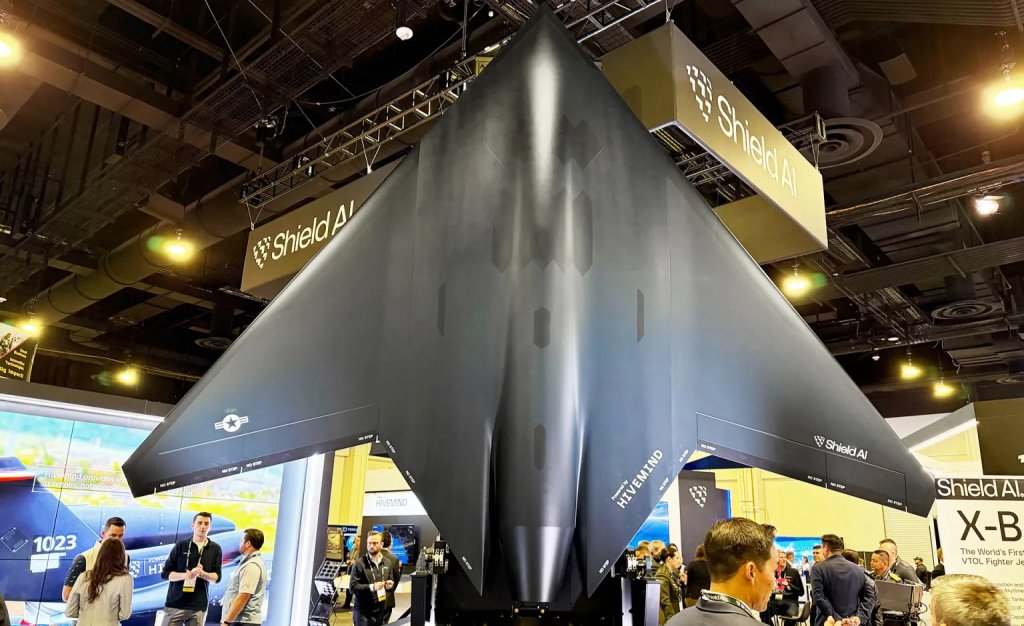
Shield AI says it is on track to roll out the first prototypes of its X-BAT jet-powered stealth ‘fighter’ drone by the end of this month. Flight testing of this uncrewed aircraft, which is designed to take off and land vertically from a tail-sitting position, is still scheduled to kick off before the end of the year. X-BAT’s core concept was already highly ambitious, but an extremely aggressive timeline to reach some degree of operational capability through the U.S. Navy’s Runway Independent Maritime Expeditionary Strike (RIMES) program has now been disclosed.
TWZ got an update on X-BAT, which we were first to report on in-depth last year, in an interview yesterday with Shield AI’s Armor Harris, Senior Vice President and General Manager of the company’s aircraft division. This came ahead of today’s announcement that the company has received an additional $150 million in funding from the Office of the Under Secretary of War for Acquisition and Sustainment through its Defense Exportability Features program via the Navy. This is on top of the $50 million investment the Navy, in cooperation with the Pentagon’s Defense Innovation Unit, made in X-BAT’s development earlier this year as part of the RIMES effort. Shield AI has committed an equivalent amount of internal funding, for a combined total of $400 million.
Jamie Hunter
“In broad strokes, the last year has been a bunch of collaborative risk reduction with the Navy. So, wind tunnel testing, engine testing, thermal testing, all kinds of stuff to basically take the major risks in the program, [and] burn them down, so we can move confidently into the production design,” Shield AI’s Harris told us. “The last culmination of the risk reduction is the flight testing of the two full-scale prototypes. The first one of those will be done at the end of October.”
“That’s a full-scale vehicle,” he continued. “It’s got the outer mold line, it’s got the F110 engine, the full propulsion path, everything in it.”
To date, Shield AI has only shown models of the X-BAT publicly. A new one displayed at the Navy League’s Sea-Air-Space 2026 exposition in April revealed major changes to the core design. This included a complete reworking of the planform from a ‘cranked kite’ type arrangement to one with a distinctly different arrowhead-shaped profile featuring a straight leading edge with a more dramatic sweep.
The video below includes clips showing the original X-BAT design and the current one.
The aforementioned “propulsion path,” testing of which has already been conducted on the ground, primarily consists of the General Electric F110 paired with an Axisymmetric Vectoring Exhaust Nozzle (AVEN). The nozzle was originally developed in the 1990s for an experimental thrust-vectoring F-16 fighter. Shield AI is using the original AVEN, which had been in storage for decades, to support development of X-BAT. The nozzle will provide pitch and yaw control, with roll control for the drone coming from bleed air routed through thrusters in the drone’s wings.
No runway, no problem.
Shield AI and @GE_Aerospace just cleared a critical path to vertical flight, completing engine light-off testing of the Axisymmetric Vectoring Exhaust Nozzle (AVEN) for X-BAT.
Shield AI has previously said that the roughly fighter-sized X-BAT will have a maximum range of 2,000 nautical miles and a service ceiling of around 50,000 feet. The company has also said in the past it is targeting an effective combat radius roughly twice that of the F-35, or around 1,340 nautical miles, but also that it could be closer to 1,000 nautical miles. Space has been made within the X-BAT design for a potential in-flight refueling capability, but there is no active work yet to integrate that feature.
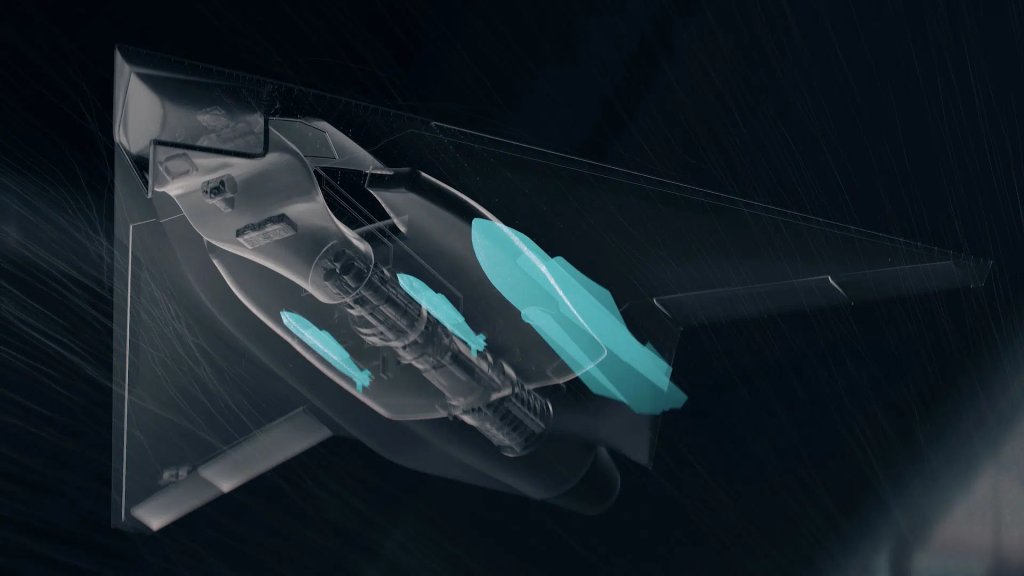
In terms of payload, X-BAT’s design includes internal weapons bays roughly the same size as those on the F-35, as well as two external hardpoints under the wings. Those hardpoints are plumbed, meaning that range-extending drop tanks, or even buddy refueling stores to allow the drone to act as a tanker, could be carried. Baked-in modularity and open-architecture mission systems are intended to make it easier to fit various sensors, data links, and other capabilities down the line.
A rendering highlighting X-BAT’s stores carrying capabilities. Two AGM-154 Joint Stand-Off Weapon (JSOW) glide bombs are depicted here in the internal bays. The silhouette of an AGM-158C Long Range Anti-Ship Missile (LRASM) cruise missile is shown under the wing. Shield AI
“X-BAT’s really designed to be a multi-role capability, and, if you look out at the 10-20 year time horizon, it’s hard to predict what the future fight is going to look like,” Shield AI’s Harris noted. “We fundamentally believe that multi-role capabilities are critically important. And, so, X-BAT, the reason why it’s sized to where it is is [sic] to be able to carry serious strike weapons internally and externally, in addition to being able to do air-to-air [combat], electronic warfare, and other mission sets.
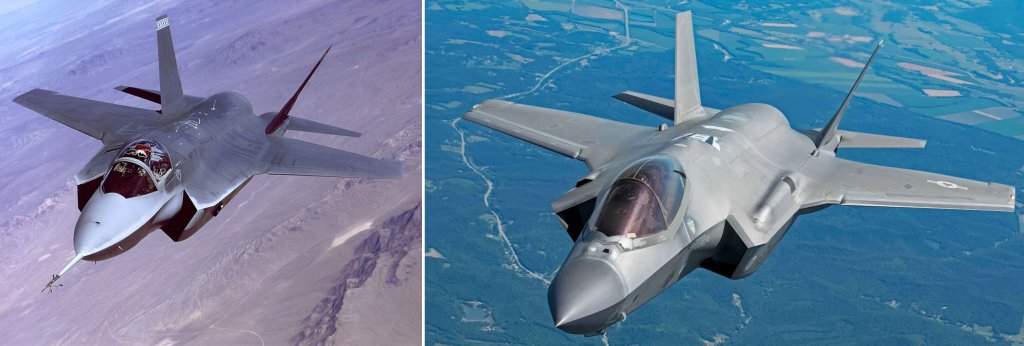
“You could think of it as like X-35 versus F-35,” he also said yesterday when asked about any expectations now for further changes between the initial pair of prototypes and the final production design.
Lockheed Martin’s X-35 demonstrators are, in very broad strokes, similar to, but distinct from any of the resulting variants of the Joint Strike Fighter. Shield AI has notably already talked in the past about integrating more low-observable (stealthy) attributes to the exhaust end of the design down the line.
A side-by-side look at an X-35 demonstrator, at left, and a production F-35A, at right. USAF
“Then we’ll get into flight testing around the end of this year,” Harris added. “We’ll be doing vertical takeoff and landing testing with that [the initial prototypes] to actually prove out and develop the VTOL [vertical takeoff and landing] technology for X-BAT.”
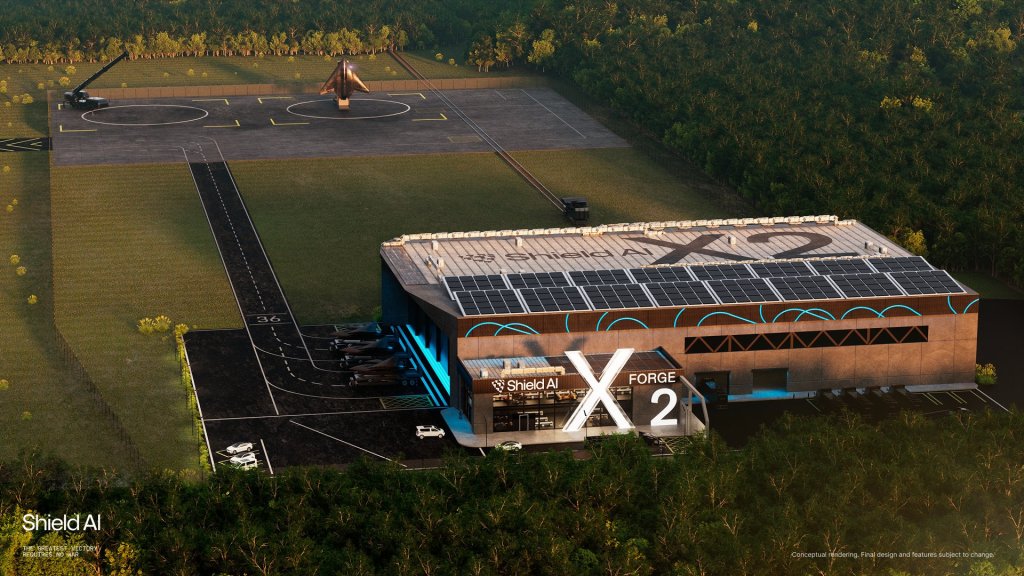
Shield AI’s X-Forge 2 facility at the Newton City-County Airport in Kansas is set to be the main flight testing hub for X-BAT, as well as the focal point for sustainment of the drones. A production facility, X-Forge 3, is also being built in Des Moines, Washington. The company’s original site, X-Forge 1, is in Frisco, Texas.
A rendering of the X-Forge 2 facility. Shield AI
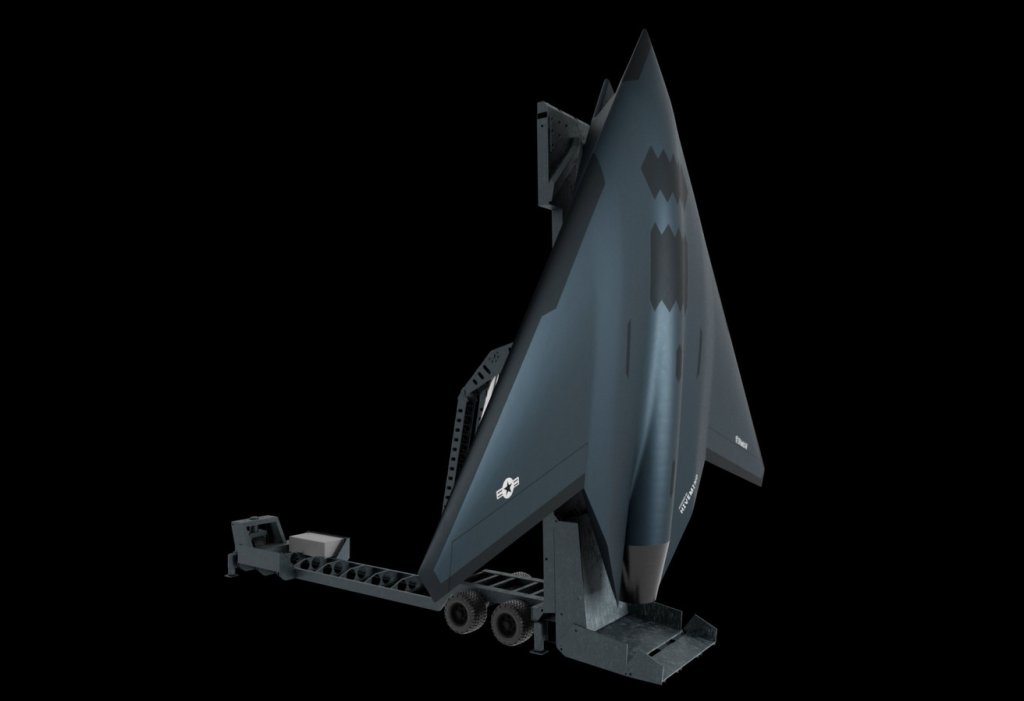
In terms of the actual flight test campaign, “you remember the X-BAT system has the air vehicle and the launch and recovery vehicle, which is the trailer that it launches and lands from,” Harris said. “Basically, the way the testing works is, we start with the vehicle horizontal, sitting on that launch and recovery vehicle, running the engine. Then we bring it up vertical, run the engine vertically, run the vehicle vertically.”
“Then we have one of the biggest cranes in the world that’s getting set up at our test site in Kansas right now, and we hang the vehicle suspended from that crane and do a bunch of testing while it’s hanging from the crane in free flight,” he continued. “Then we take the crane away, and then we do the actual untethered flights.”
Shield AI’s goal is to fly a fully missionized X-BAT in 2028 and start series production the following year.
A rendering of the X-Forge 3 production facility being built in Des Moines, Washington. Shield AI
On top of that, “the way that the [RIMES] program has been structured is getting to an early operational capability in 2029 is the end goal,” Shield AI’s Harris said.
When asked if this meant that RIMES is aiming “to eventually arrive at not just a demonstration of capability, but a real operationalized capability,” he said that was “correct.”
We will come back to this more later on, but suffice it to say up front, the prospect of X-BAT reaching an operational level of maturity within three years is extraordinarily ambitious, to say the least.
In the meantime, Shield AI has already been testing the mechanisms to “latch and unlatch” X-BAT to the launch and recovery system using an unpowered “battleship” test article, according to Harris. The design of the launch and recovery system has also evolved, and it is now self-propelled, at least to a degree, rather than just being a towed trailer.
“The launch and recovery vehicle is actually critical to the operation of the X-BAT weapon system because it enables survivability on the ground. So when you’re operating in a land-based environment, it enables basically shoot-and-scoot tactics,” Harris also noted. “Enemy transporter-erector-launchers [for missiles] are like pretty hard to find because they’re constantly moving around. Just like X-BAT, when it’s mated onto the launch and recovery vehicle, [it] is always moving around, makes it hard to track, hard to find, hard to destroy.”
A rendering of an X-BAT on a launch and recovery trailer in the fully erected position. Shield AI
The plan now is to “build the one-to-one launch and recovery vehicles to air vehicles. So the air vehicle is always on the trailer. It never comes off of it,” he continued. “Even maintenance to the air vehicle is done while it’s sitting on that launch and recovery vehicle.”
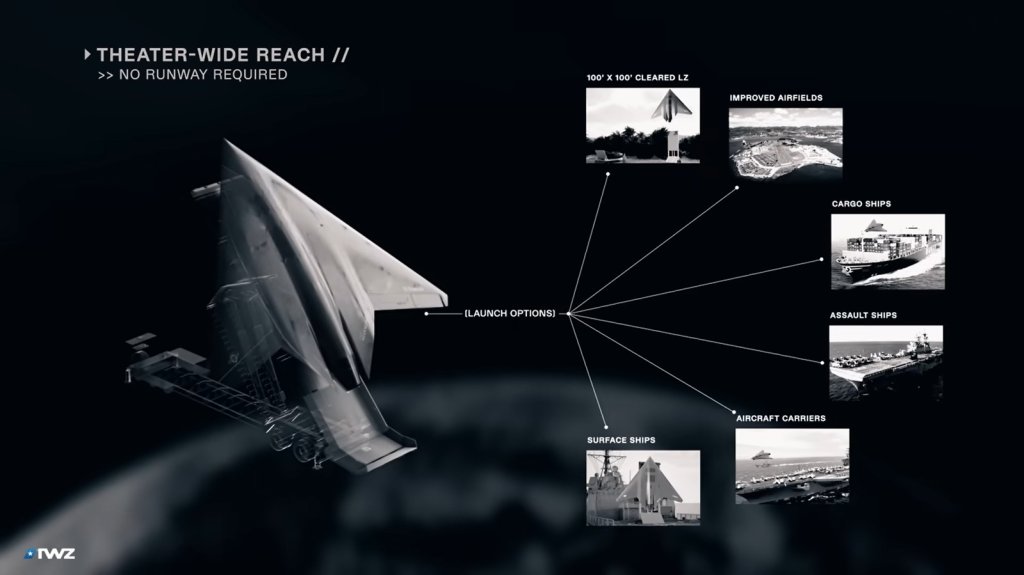
“In fact, we’re actually planning on building more than one-to-one of the launch and recovery vehicles, so that way you can preposition them around different islands, different places in the theater, and have multiple places the aircraft can lily pad from,” he added. “But you’re never putting multiple aircraft onto one launcher and launching them or something like that.”
“When you typically operate a jet, there’s a whole bunch of ground carts and stuff that you bring, like the ground power cart, the ground cooling cart, the air start cart, etc,” Harris further elaborated. “So we’ve moved a lot of those systems onto [the] launch and recovery vehicles, so you don’t have all these separate carts, which is pretty critical when you’re trying to do expeditionary operations.”
“The model for land-based operations is kind of a hub-and-spoke type model. So the squadrons are based at air bases. All the fuel and the weapons are generally based at the air bases, as well. But then you can distribute the aircraft all over the airfield,” he continued. “So, you think about what the enemy’s doing, they’re targeting the runways, they’re targeting the tarmacs, but you can disperse the aircraft around the perimeter of the airfield. You can launch them from the golf course. You can launch them from empty space in the taxiway, etc.”
A graphic highlighting various options for deploying X-BATs on land and at sea. Shield AI
Harris said that another “spoke” could be X-BATs operating from forward arming and refueling points (FARP). All of this is part of larger concepts of operations for the drone that Shield has been envisioning, and that are not at all limited to deployments at locations on land. Harris noted during the interview that the self-propelled nature of the current launch and recovery system would also help with moving the drones around on virtually any ship with sufficient deck space. This is where the RIMES program, which is separate and distinct from the U.S. Navy’s carrier-based Collaborative Combat Aircraft (CCA) drone ambitions, really comes in.
“I’ll say the fundamental value proposition of RIMES is that if you have a carrier-based CCA, you’re fundamentally constrained by the square footage of the deck of the aircraft carrier,” Harris explained. “So if you are taking an F-18 or an F-35 off, you better be replacing it with better capability per square foot of deck space than the thing that you’re taking off.”
“So, F/A-XX [the Navy’s sixth-generation carrier-based fighter, now to be built by Boeing] is a huge leap in capability, right? Which is why that program makes a lot of sense,” he continued. “The challenge with CCA is: Does it really make sense to take a manned aircraft off of an aircraft carrier and replace it with an unmanned aircraft?”
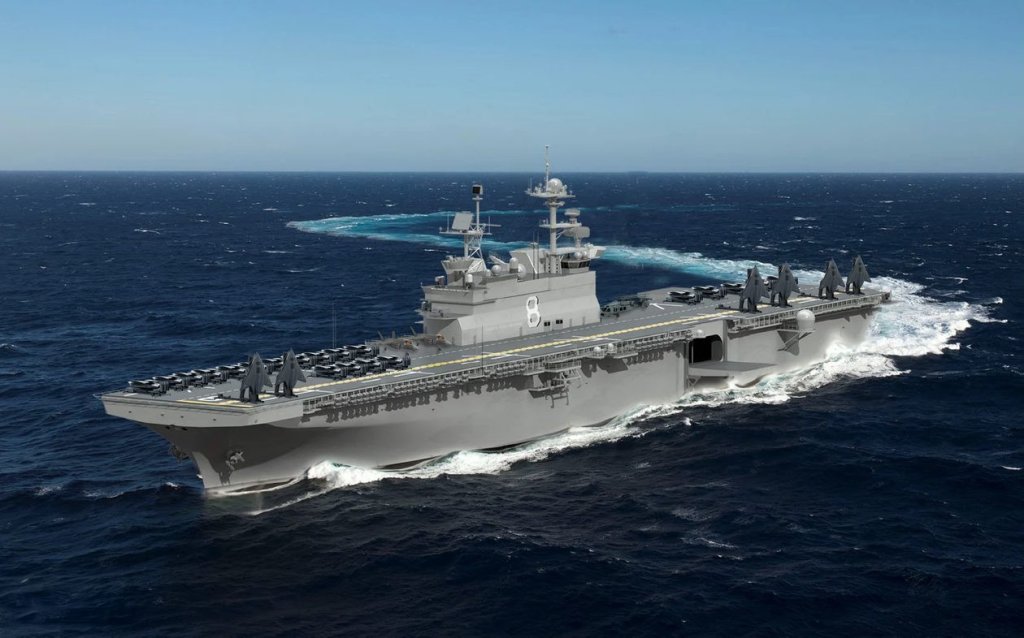
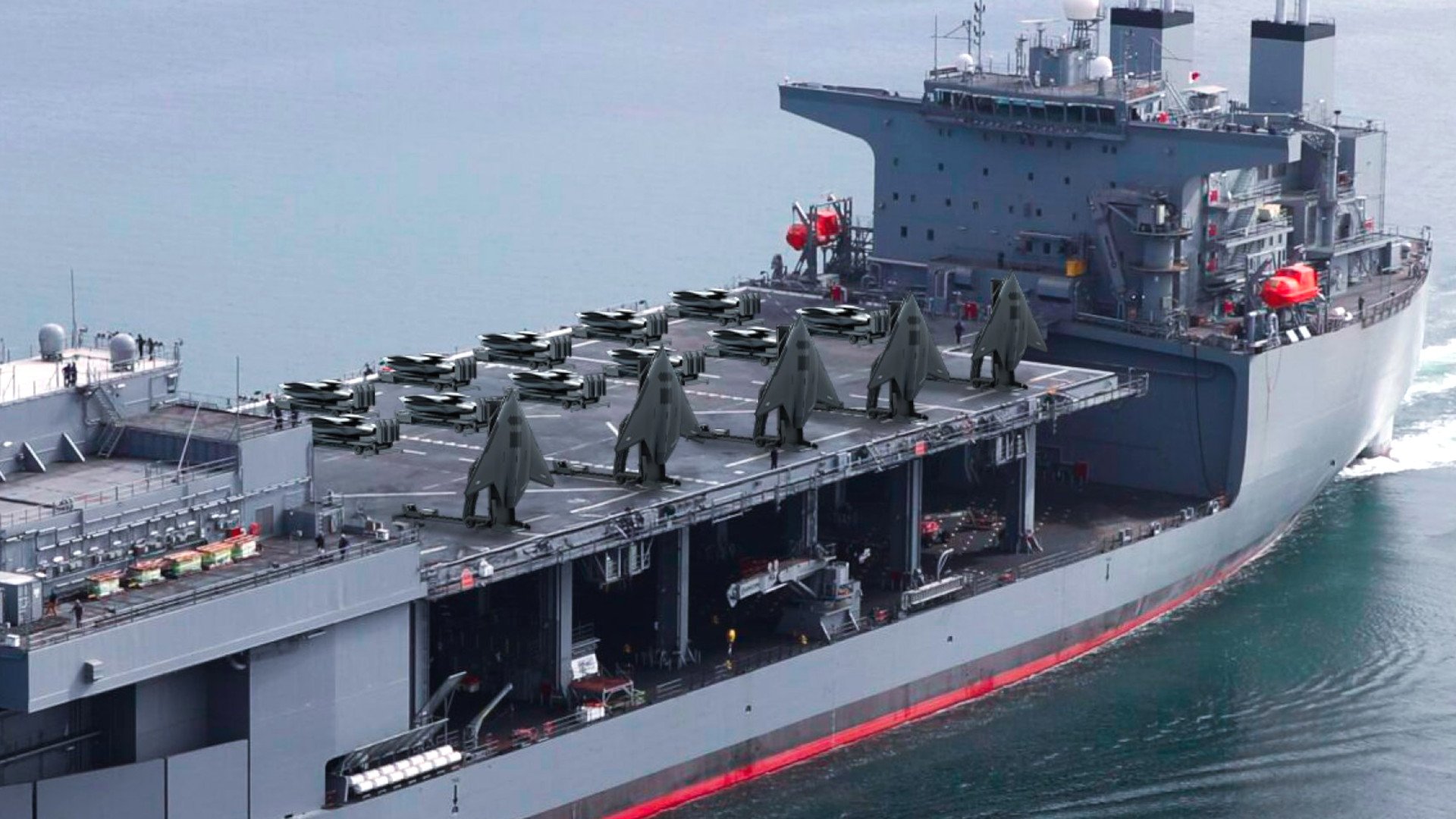
Shield AI’s argument here is that X-BAT disrupts this core equation by opening the door to a CCA-like capability, or even something more capable, that can be employed in a ship-based mode without sacrificing any crewed aircraft capacity on an aircraft carrier. Shield AI envisions dozens of X-BATs being employed from amphibious assault ships, as well as other kinds of amphibious warfare ships, including expeditionary sea base type vessels, as seen at the top of this story.
A rendering depicting X-BAT drones on the deck of the US Navy’s future America class amphibious assault ship USS Bougainville. Shield AI
“So when you think about the number of carrier air wings that the Navy has to deploy, deploying X-BAT across all these other ships basically significantly increases the number of carrier air wings,” Harris said.
As already mentioned, the current structure of the RIMES includes a target for an early operational capability in 2029, according to Harris. “We have a program defined to get there, and there’s basically milestone-based payments along the way, so as Shield performs and hits milestones, then the Navy kicks in additional funding,” he added.
“I don’t want to get ahead of the Navy, and give you a specific number, but like hundreds to low thousands,” he also said when asked if there was even a very rough planning figure for the eventual size of the RIMES drone fleet.
Many questions remain about X-BAT, which still has to demonstrate the viability of its vertical takeoff and landing capability, which underpins everything else. As we noted in our original in-depth report on this design, the core concept here is not new, and there have been many unsuccessful attempts to operationalize it in the past. There has been skepticism that Shield AI’s effort will succeed where others have failed. The company is of the view that groundwork has now been more firmly laid, including through its own work with its much smaller internal combustion-engine-powered V-BAT tail-sitting VTOL drone, to truly realize a design of this kind.
The performance and capabilities that Shield AI expects from X-BAT once it is flying at all are also ambitious. A high degree of autonomy is also part of the full planned package, which will leverage the company’s already extensive work in this domain with its Hivemind software.
There are also questions about the Navy’s exact plans for RIMES, as well as its broader future drone fleets. Just this year, the service has issued several contracting notices pointing to rapidly evolving views about future carrier-based strike drones and other uncrewed aircraft. New requirements that Naval Air Systems Command (NAVAIR) released in August ostensibly for future CCA-type drones notably pointed more toward something that sounded very much like an advanced uncrewed combat air vehicle (UCAV), as you can read more about here.
Whether the 2029 operational timeframe the Navy is said to be aiming for under RIMES is firm, or even realistic in any way, remains to be seen. The actual definition of what constitutes an “early operational capability” could be very flexible, as well. It is also worth noting here that Shield AI is not the only company currently conducting work under RIMES. Whether the Navy might be planning to acquire more than one design through this program is unclear. We have reached out to the service for more information.
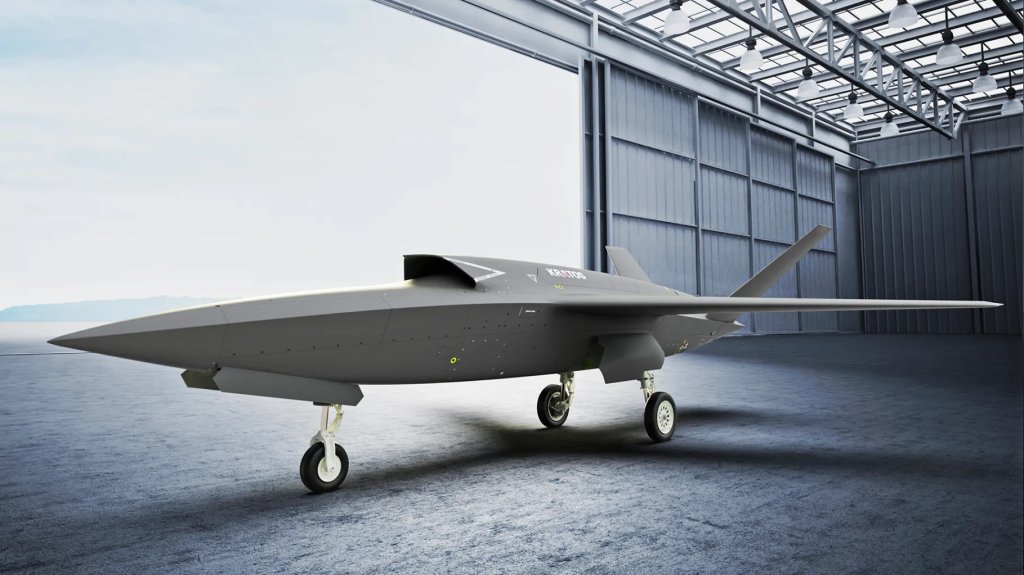
Other services could be interested in any operational capability produced through the RIMES effort, too. TWZ regularly highlights how runway-independent drones would be particularly well-suited to the U.S. Marine Corps’ new expeditionary and distributed concepts of operations. That service is already in the process of acquiring MQ-58B Valkyrie drones from Kratos that will be able to operate from conventional runways. They will also be capable of runway-independent launches, though they will still have to land conventionally. The baseline Valkyrie design lands via parachute.
A rendering of a landing gear-equipped version of the Valkyrie in line with what the Marines are now acquiring. Kratos
In general, runway independence is of growing interest elsewhere across the U.S. military as threats to large, established bases continue to expand in scale and scope. The proliferation of various tiers of weaponized drones is a particularly significant factor in this, asTWZ just examined in detail this week in the context of the recent withdrawal of B-1 bombers from RAF Fairford in the United Kingdom. Ever more capable cruise, ballistic, and hypersonic missiles are also part of the full threat picture.
The conflict with Iran has also underscored the limits of what can be gained survivability-wise by dispersing traditional fixed-wing aircraft, especially within an existing airbase. As highlighted earlier, X-BAT could be dispersed very differently to nearly anywhere within a facility that can handle the thrust from the F110 engine in hover.
As it stands now, we are set to get our first view of a full-sized X-BAT prototype within the next few weeks as Shield AI continues to gear up for the start of actual flight testing before the end of the year.
The war inaugurated a terrible new global order in which armed drones kill civilians who are neither named nor counted.
Honest, paywall-free news is rare. Please support our boldly independent journalism with a donation of any size.
There were nights full of terror. Our village was bombed constantly,” says Zalmay Khan. Afterward, he goes to pray. Because of his wounds, he cannot kneel, so he prays sitting down.
Khan is in his early twenties and now works as a Taliban intelligence officer. As a boy, he says, he learned to read the sky before he learned to read words. His village in Wardak province, near Kabul, was bombed, then bombed again. First came American planes, then NATO’s, then those of the Afghan army the West had built. By night it got worse, when jets and armed foreign contractors hit villages and killed civilians seemingly at random.
“I became a Mujahed [a Taliban fighter] naturally,” Khan tells me.
He is not an outlier. In village after village on my most recent trip to Afghanistan a few weeks ago, I met men who grew up as the so-called war on terror’s raw material. Some wear the Taliban’s turbans, and some do not. Almost all of them say the same thing, with remarkable calm: The American narrative of this war belongs to the past. After two decades of war and destruction, it is their turn to control narratives and to rule the country.
October 7, 2026, marks exactly 25 years since the United States began bombing Afghanistan. The anniversary will pass in Washington with little reflection. In Afghanistan, the reality of it is lived daily.
Drones and Ghosts
The war on terror made history in a way few people remember. In its opening weeks, the United States used an armed drone against a target in Afghanistan, one of the first such attacks ever, in an attempt to kill the Taliban’s founder, Mullah Mohammad Omar, in Kandahar. Omar was not hit on October 7, 2001. He survived and reportedly died of natural causes a decade later, which the Taliban kept secret for years.
Who died instead? The record offers almost nothing: no definitive or officially confirmed names, ages, villages. One news report cites unnamed Kandahar residents suggesting the raid killed Omar’s 10-year-old son and the child’s stepfather, but the Taliban’s ambassador to Pakistan declined to confirm or deny this report.
In other words, the first known attempt to kill a man with an armed drone killed people no one has ever definitively identified, and it set the template for the type of warfare that would dominate over the next decades. No one can say who the victims were. But if the pattern of the following years is any guide, many were likely civilians, like the thousands of victims who came after them. During the Obama years, Afghanistan officially became the world’s most drone-bombed country.
That template repeated itself so often that Afghans developed names for the many men who were declared dead after supposed “surgical strikes,” but who then reappeared alive: mord-e zinda (the living dead) in Farsi and khyali marr (the not truly dead) in Pashto. I call them “Taliban ghosts.”
It continued across successive U.S. administrations, even across the bureaucratic, supposedly methodical “kill lists” infamously used by the Obama administration used to mark people for death from the skies.
The obvious question was almost never asked: If Omar was not the victim, who was killed instead? In the logic of the drone war, a body is a statistic, and a body in a targeted area becomes a militant by default. The dead were not counted, and the stories of their families, who were left to count for themselves, largely continued to go unknown.
Strikes did not only create ghosts. They also created recruits. Researchers, journalists, and Afghan elders have long described the same pattern: A village is hit, a family is destroyed, and the Taliban offer the survivors the only form of justice made available to them. By the end of the war, entire districts had made that choice, not out of ideological conviction but out of grief.
Democratic Torture
One of the people I talked to on my recent trip was a Taliban official who had been held at Bagram, the American prison north of Kabul, for several years. He told me what the Americans wanted from him. “Accept our democracy or get tortured and rot here. That’s what they told me,” he recalled.
The aim, as he described it, was reeducation by coercion: Accept our system, our ideology, and the pain stops. He refused. By his account, he left more committed than when he arrived. He was freed in 2020 under the prisoner exchange the United States negotiated with the Taliban, part of the same Doha process that handed the country back to the movement the war was purportedly meant to destroy.
Consider the sequence. A man is imprisoned and tortured to make him embrace a political order. He then walks out of the prison and eventually helps govern. The war’s own methods created much of its failure.
I make no argument here that the Taliban’s rule is benign. Women and girls have been shut out of education and public life, and dissent is severely punished. These facts belong in any honest account. But an honest account also includes what the war did, who did it, and whom they harmed; the powers that waged it have shown little interest in reckoning with that part.
A War Passed On
Here is the part that does not fit the story that the war on terror ended in August 2021: someone else is still fighting it.
Pakistan is currently bombing Afghanistan. Just a few days ago, Pakistani airstrikes killed at least 10 civilians, most of them children, in the provinces of Helmand and Kunar.
Pakistani authorities say they are targeting militants of the Tehrik-e-Taliban Pakistan, or TTP, often known as the Pakistani Taliban. Afghans on the ground, and independent reports, repeatedly describe civilians as being among the dead. Islamabad has also forced hundreds of thousands of Afghans, many of them born there, out of Pakistan.
The phrasing used to justify these attacks is familiar: “Terrorists were eliminated.” Anyone who covered the American war has heard that sentence before, and the same pattern follows. The claims are hard to verify, the dead are hard to identify, and the people left behind are not asked.
Pakistan has run this game before, and it has historically done well for itself out of it. In the first days of the war on terror, Islamabad aligned itself with Washington while, according to critics and many former officials, hedging its bets with the Taliban. The United States poured billions into Pakistan in military aid and reimbursements. A double game paid for itself.
For a military establishment that benefits from a war to fight, an enemy is an asset. That helps explain why the army has so little tolerance for those who challenge its role. This pattern goes beyond the foreign policy of one country alone. It is a system — one created by the U.S. but now adopted globally — that requires a threat to warrant its continued expansion and removes the people who question its logic.
If Pakistan again needs an Afghan threat to justify its budgets, its alliances, and its hold on power at home, the logic is the same as in 2001. The war on terror, seen from Islamabad, is a renewable resource.
The Violence That Made the TTP
The TTP itself is not a mystery. It did not appear from nowhere, and it cannot be blamed on Kabul alone. It grew out of Pakistan’s own tribal areas, where decades of military operations, drone strikes with Islamabad’s tacit consent, and brutality under former Pakistani President Pervez Musharraf shattered communities. Many of these massacres have been forgotten outside the region. In the tribal belt they are not.
The result was a generation radicalized by state violence, in much the same process I heard described in Afghan villages. The TTP is, in significant part, a product of the very policies now used to justify the continued bombing of Afghanistan. Without Pakistan’s violence in the tribal areas, the group would not look as it does. Accountability for that history will not come from the same army that carried it out.
The war on terror in Afghanistan was sold as a campaign against a specific enemy. What it produced was a country scarred by airstrikes, night raids, and detention, and an enemy that outlasted the world’s strongest military. It also produced a new precedent: That a state can kill from the sky, in secret, and rarely be asked who died, much less held accountable for its deathmaking.
That precedent traveled. Drones have gone from being an innovation in killing, one shrouded in secrecy, to a mainstay of battlefields on multiple continents.. The language of “surgical” strikes and “militants eliminated” has become standard, notably throughout the genocide in Gaza. And in Afghanistan, the war continues in new hands, with the same justifications and the same result.
On October 7, if this anniversary is marked in the U.S. at all, there will be speeches about sacrifice and lessons supposedly learned. The real lessons are available to anyone who asks the people who lived under the sky, and the most critical question is still the one nobody answered in 2001: Who was killed instead?
Moldova is creating protective zones at border crossing points along its border with Ukraine amid the threat of drone attacks. It is also relocating its personnel from joint border crossings on Ukrainian territory back to Moldova. Moldovan Interior Minister Daniella Misail-Nichitin said this on 7 October, according to NewsMaker.
In recent months, Russian attacks on Ukrainian border crossing points near the country's borders with neighboring states have become more frequent. Ukrainian-Moldovan border crossings are among those most frequently targeted by Russia. As a result, Moldova now plans to withdraw all of its border personnel from Ukrainian territory.
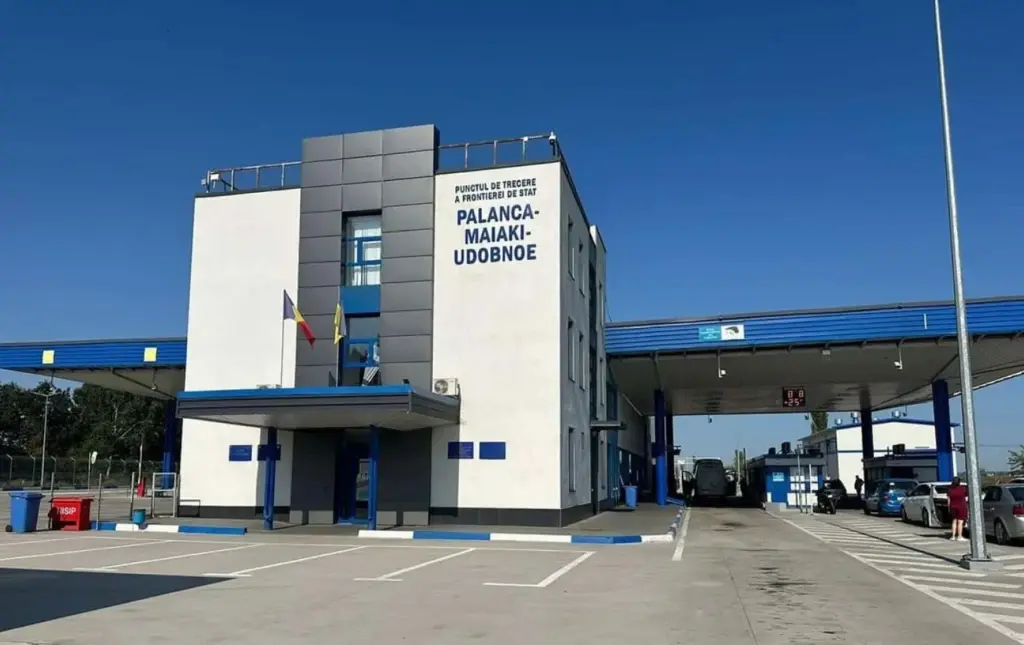
A Moldovan border guard was also recently injured when a projectile struck near a passenger bus at the Palanca border crossing, Moldova's Border Police reported.
Chisinau strengthens protection of border crossings against Russian drone attacks
Moldovan authorities are working to strengthen security measures at all Border Police crossing points, including those located on Ukrainian territory, according to the statement.
Authorities are already setting up protective zones so that Border Police officers, government officials and civilians at the crossings can evacuate to a safe location if necessary, the minister said.
Moldova is also discussing moving its personnel from joint border crossings located on Ukrainian territory to Moldova. Personnel have already been withdrawn from two crossings, with plans to do the same at other joint crossings, Missail-Nikitin said.
NewsMaker clarified with Moldova’s Interior Ministry that the measure involves withdrawing Moldovan personnel from two joint border crossing points with Ukraine — Criva and Palanca.
Ukraine and Moldova seek a response to a new challenge
The first time Chisinau withdrew its personnel from Ukrainian territory at the Ukrainian-Moldovan border crossings was a month ago. Moldova temporarily changed the operating arrangements at three joint border crossings with Ukraine because of security risks linked to Russian attacks on Ukrainian infrastructure near the border, Moldova's Border Police reported on 11 September.
The crossings in question are Giurgiulesti–Reni, Briceni–Rossoșani, and Criva–Mamalyga, where Moldovan border guards and customs officers had previously carried out controls on Ukrainian territory, according to the Border Police.
Criva–Mamaliga border crossing on the Moldova-Ukraine border, illustrative photo: State Border Guard Service of Ukraine
Starting 12 September, Moldovan personnel returned to Moldovan territory for 90 days and began working from existing infrastructure on the Moldovan side. The crossings themselves remained operational, and the cross-border movement of people and vehicles continued. Only the location where Moldovan services carried out their duties changed, the authorities said.
Ukraine is also strengthening the protection of its border infrastructure. The State Agency for Restoration and Infrastructure Development plans to install 135 basic mobile shelters at 28 border crossing points and on access roads leading to them. The shelters are intended to protect civilians crossing the border and border crossing personnel. Procurement is being carried out by the Restoration Services in Vinnytsia, Odesa, Chernivtsi, Zakarpattia, and Volyn Oblasts, according to the statement.
Ukraine’s border crossings near Moldova face ongoing Russian attacks
Russia has repeatedly attacked Ukrainian border infrastructure near the Moldovan border in recent weeks. On 25 August, a Russian drone struck the Vynohradivka–Vulcănești border crossing in Odesa Oblast.
On 5 October, Russian strikes on Ukrainian infrastructure caused an incident near the Palanka–Mayaky–Udobne border crossing. A projectile fell near the crossing, ricocheted off the ground and struck a passenger bus. The control booth was also damaged, and one Moldovan border guard sustained a minor injury.
On 9 September, Russia attacked the Starokozache–Tudora border crossing. One drone struck the crossing, while two others crashed nearby on Ukrainian territory. Two people were killed and three others were injured in the attack, and the crossing was temporarily closed. Russia claimed that this strike on a border crossing was prompted by Ukraine transporting weapons through the facility, a claim Moldova has denied.
Polish SIM cards were found inside some of the Russian drones that entered Polish airspace during a mass incursion in September 2025, Polish outlet RMF24 reported, citing findings from a Polish prosecution investigation.
SIM cards can allow drones to connect to local cellular networks for functions such as communications, data transmission, telemetry, or navigation-related services. However, investigators have not said what the Polish SIM cards found in the Russian drones were used for. The details remain classified.
The SIM cards were discovered in some of the Russian Gerbera drones recovered after the incursion, RMF24 reported.
Investigators have not disclosed whether the SIM cards were stolen or obtained illegally.
The investigation into the September 9–10, 2025 incursion was ultimately closed after prosecutors failed to identify those responsible for violating Polish airspace.
More than 30 drones entered Poland
The incursion took place overnight on September 9–10, 2025, during a large Russian missile and drone attack on Ukraine. More than 30 Russian Gerbera drones entered Polish airspace from the east and came down at 27 locations across the country, according to RMF24.
Polish forces intercepted and shot down multiple drones, with the Territorial Defense Forces deployed to search for wreckage and other objects that came down on Polish territory. Poland also maintained contact with NATO command throughout the operation.
The incident prompted Poland to close four airports – Warsaw Chopin, Warsaw-Modlin, Rzeszów-Jasionka and Lublin – because of the military activity.
Polish officials described the airspace violations as unprecedented and a serious threat to national security. The incident marked the first time since Russia's full-scale invasion of Ukraine that Polish forces had used weapons against Russian aerial objects that entered the country's airspace.
The mass incursion subsequently became the subject of a criminal investigation into the violation of Polish airspace and the threat to public safety.
Investigation closed without identifying perpetrators
After months of investigation, Polish prosecutors closed the case because they were unable to identify the perpetrators, according to Lublin District Prosecutor’s Office spokesman Marcin Kozak, as cited by RMF24.
Most of the case files, including the justification for the decision, are classified.
Explore further
Last September, Poland downed four of 19 Russian drones. This September, drone reached NATO’s missile shield in Redzikowo, and troops guarding it called 112
Prosecutors cleared Poland's military response
Investigators also examined whether the Polish military had responded properly to the drone incursion.
According to RMF24, prosecutors concluded that the military acted in accordance with procedures. Polish troops had the right to use force and shoot down hostile objects, and prosecutors found no irregularities in their response.
The investigation was therefore closed both over the failure to identify the perpetrators and over the assessment of the Polish military's actions.
A reported Ukrainian drone strike has interrupted operations at a Yandex data centre in Russia’s Ryazan region, while another attack was reported at a Gazprom-owned refinery.
A Ukrainian drone attack has reportedly forced the closure of a Yandex data centre in Russia’s Ryazan region, causing a fire and disrupting part of the company’s infrastructure. Shares in the Russian technology group fell by more than three per cent in early Moscow trading on Thursday, 8 October.
The installation in Sasovo was affected during overnight strikes on Russian territory. Yandex said it was working to restore affected infrastructure, while its principal consumer services remained operational. The incident has raised questions about the vulnerability of Russia’s digital economy to Ukraine’s long-range strike campaign.
Fire at Sasovo technology facility
The affected data centre began operating in 2014 in buildings formerly occupied by the Sasta machine-tool manufacturing plant. Yandex subsequently connected the installation to Moscow by fibre-optic communications links as part of its wider computing infrastructure.
Ryazan regional governor Pavel Malkov said Russian air defences intercepted two drones over the region. He reported a fire on the roof of an industrial building in the Sasovo district and damage to windows in nearby private homes. No casualties were reported.
According to a statement on the incident, the situation had been brought under control while work to restore infrastructure continued. Yandex said its main consumer services remained operational.
The company’s cloud division also reported an electricity supply problem affecting an availability zone known as ru-central1-b. Clients were advised to use alternative zones where necessary to maintain service continuity.
Yandex shares decline
Yandex shares dropped by approximately 3.4 per cent to 3,568.5 roubles in early trading on the Moscow Exchange. The decline followed news of the fire, although a single trading session cannot establish the long-term financial cost of the disruption.
Yandex operates search, advertising, navigation, artificial intelligence and cloud computing services. Its infrastructure therefore supports commercial users as well as the company’s own applications. The duration of the interruption, the extent of physical damage and the cost of repairs will determine the wider impact.
In a separate development, explosions and a fire were reported on Thursday near the Gazprom Neftekhim Salavat refining and petrochemical complex in Russia’s Republic of Bashkortostan, around 1,400 kilometres from the Ukrainian border. The precise location of the fire and the extent of damage had not been independently established.
The Gazprom-owned complex processes hydrocarbon feedstock and produces petrol, diesel, fuel oil and petrochemicals. It has previously been targeted by Ukrainian drones. The latest reported incident comes amid repeated attacks on Russian refining and fuel infrastructure.
Russia’s technology sector faces new risks
Ukraine’s long-range economic campaign has focused heavily on oil refineries, fuel stores, military production plants and transport infrastructure. A strike affecting a major data centre introduces another category of vulnerability: the computing equipment and supporting utilities used by the digital economy.
Such sites serve businesses, financial institutions and industrial enterprises, and can also support defence-related activities. However, no publicly verified evidence establishes that the Sasovo data centre was directly involved in Russian military operations.
Damage to power supplies, cooling systems and network connections can interrupt services without necessarily destroying servers. Operators with geographically distributed facilities may be able to shift workloads to unaffected locations. The suspension of one centre therefore does not mean that Russia’s internet infrastructure has ceased functioning.
Economic pressure on Moscow
The attacks coincide with Russia’s plans for substantial military expenditure in 2027. The draft federal budget envisages considerable government spending and borrowing as Moscow continues its war against Ukraine.
Ukraine’s strikes on economic infrastructure are intended to increase the cost of maintaining Russia’s invasion. Disruption to energy facilities can affect fuel production and revenue, while attacks on technology and industrial sites may interrupt wider commercial and logistical operations.
The cumulative effect depends on the severity and duration of the damage. Neither the reported temporary closure of the Yandex facility nor preliminary accounts of the Salavat fire establish the scale of lasting losses.
The incidents nonetheless illustrate the exposure of Russian industrial and technology assets far beyond the Ukrainian border, as Kyiv increasingly targets infrastructure that supports the country’s economy.
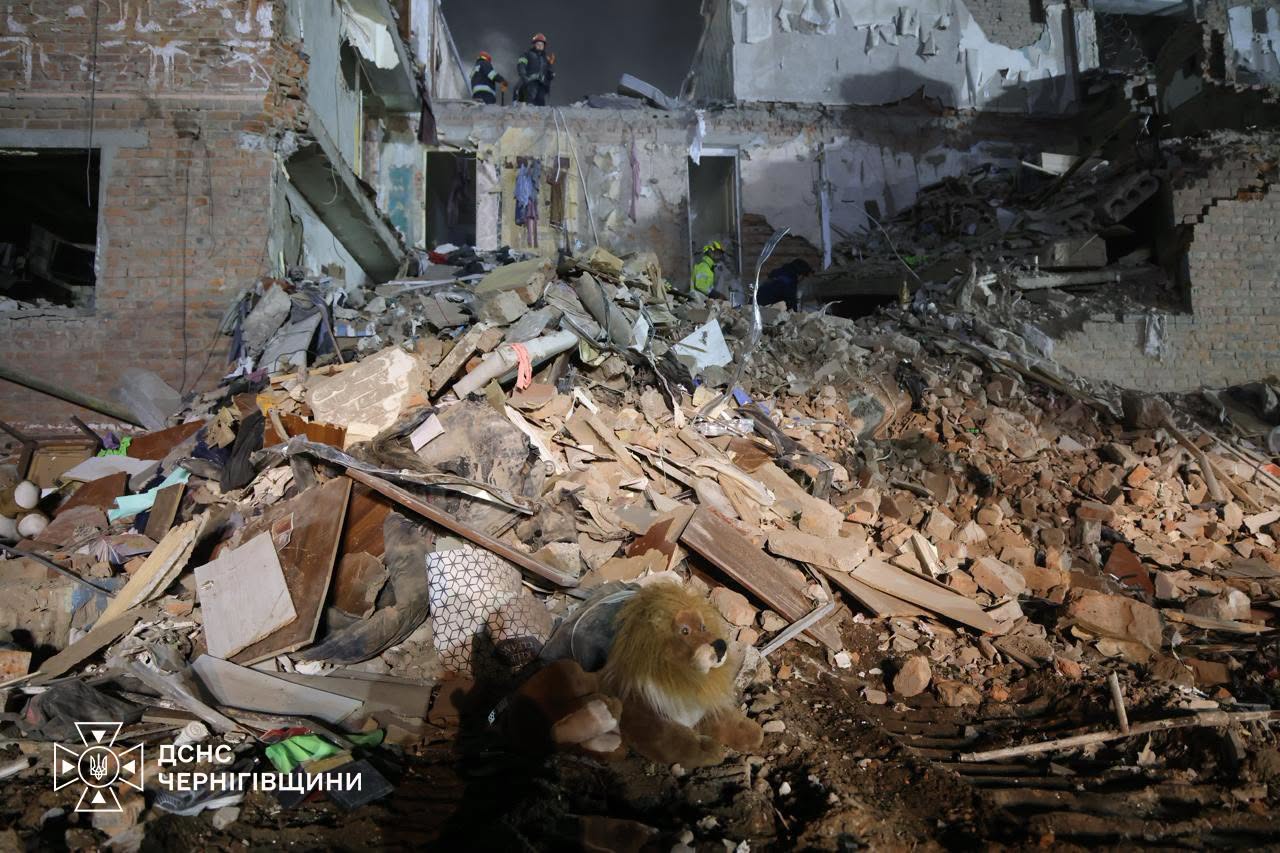
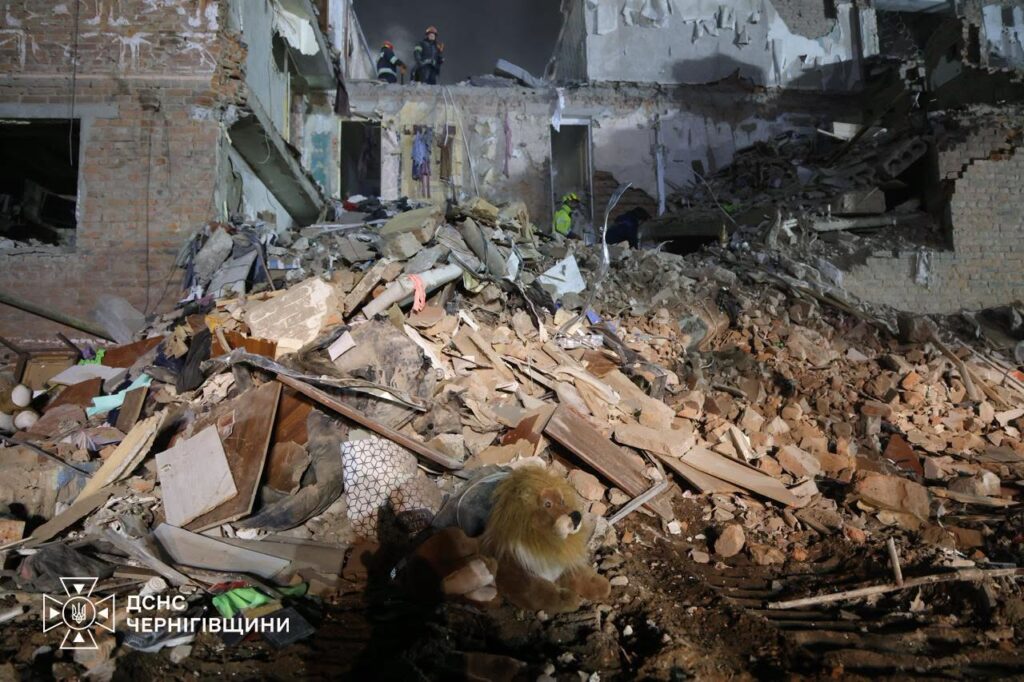
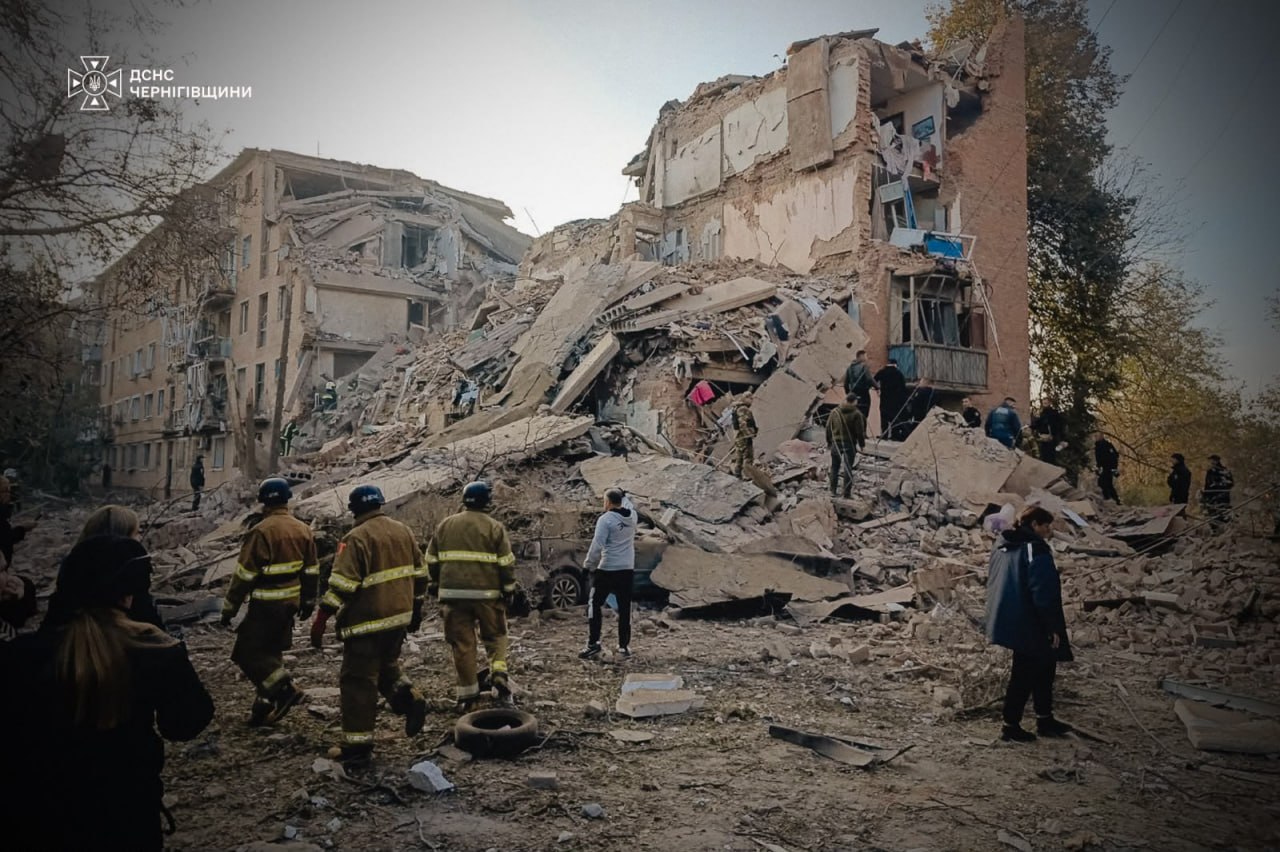
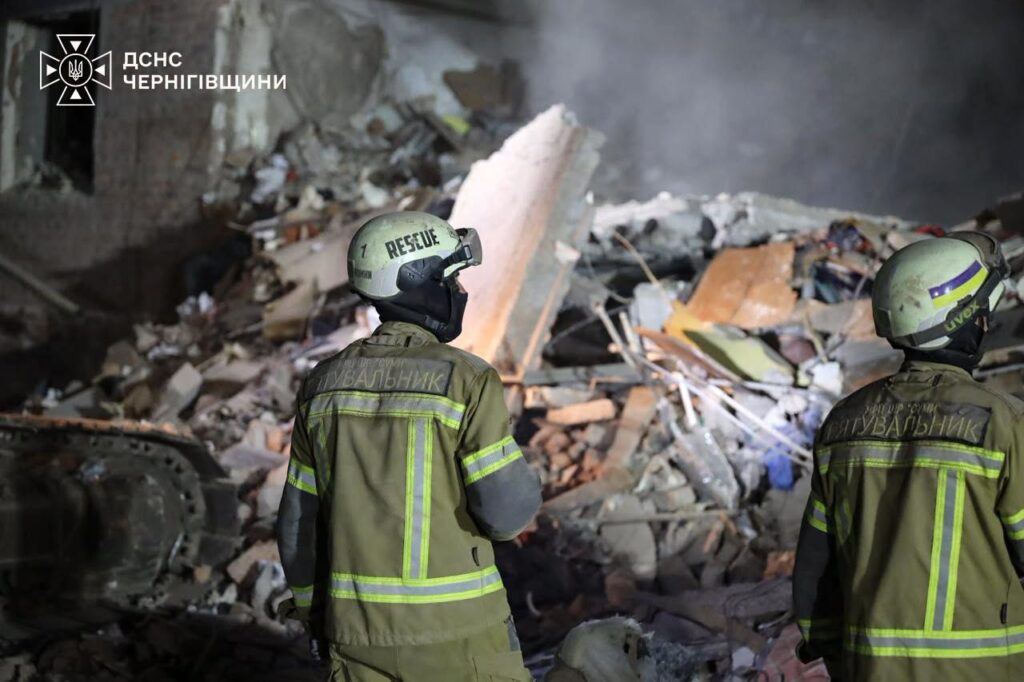
Russia is concentrating missiles on a smaller, more specific set of targets, and its jet-powered attack drones are part of the reason, the Institute for the Study of War (ISW) assessed. Its combined attack overnight on 7 October killed 22 people in Pryluky, the State Emergency Service (SES) said as of the morning of 8 October. Russian milbloggers noted the shift the same day.
Russia often uses concentrated drone and missile strikes to overwhelm localized Ukrainian air defenses and destroy urban centers, ISW noted. Pryluky, where the strike killed children, was one of the areas a Russian channel says drew a significant share of the Kh-101s that night. With winter close, ISW expects the same pattern against Ukraine's energy grid, with jet drones partly letting Russia keep its missiles for priority targets without firing many more.
Missile waves on a few areas, Russian channels claim
Russia launched 48 Kh-101, Iskander-K, and Kalibr cruise missiles overnight on 7 October, Ukraine's Air Force reported. It also fired ballistic missiles, Zircon and Oniks anti-ship missiles, and 130 strike and decoy drones, 46 of them jet-powered Shahed-type models.
Explore further
22 killed in Russian missile strike on Pryluky, including five children
Russian milbloggers claimed the same day that Moscow had grouped a large part of its missile salvo into repeated waves on a few areas, while other weapons kept stretching Ukraine's air defenses elsewhere. The pro-war Russian Telegram channel Dva Mayora described the change as a switch from striking with splayed fingers to a series of hits with missile "fists." Defenders must then absorb a sharply rising load around one chosen site as one wave follows another, the channel claimed.
Citing Ukrainian monitoring channels, it claimed that roughly 30 or more Kh-101 cruise missiles flew toward Pryluky, Kremenchuk, Svitlovodsk, and Oleksandriia in Chernihiv, Poltava, and Kirovohrad oblasts. It put the Kremenchuk group at up to 15 missiles, Kh-101s and Kalibrs among them, aimed at the area of Kremenchuk and its hydroelectric plant.
Jet drones take some of the load off Russia's missiles
ISW said the jet-powered versions penetrate Ukrainian air defenses deeper and more reliably than propeller models. In ISW's assessment, that partly lets Russia concentrate cruise and ballistic missiles on priority targets without significantly raising missile use. Russia builds about 3,000 Geran-4 and Geran-5 jet drones a month, Ukraine's military intelligence agency (HUR) told Militarnyi in August.
Explore further
Ukraine spent three years learning to catch Russian drones—so Russia made them fly faster
ISW expects Russia to apply the pattern in a likely brutal winter campaign against energy infrastructure. Russia likely intends to make city life untenable and force Ukraine to capitulate to its demands, ISW assessed. Such tactics have not worked before and are unlikely to work now, analysts added.
They called cheap countermeasures to jet drones and small cruise missiles vital, alongside Western air defense aid such as US-made Patriots, which can stop ballistic missiles. Ukraine has already paired a Soviet-era Kub launcher with American RIM-7 interceptors to catch jet drones.
The death toll from Russia's 7 October missile strike on Pryluky, a city in Chernihiv Oblast in northern Ukraine, has risen to 22, including five children, Ukraine's State Emergency Service said on 8 October. Another 54 people were injured, and 15 were rescued from the rubble.
Pryluky suffered the heaviest losses in Russia's 7 October attack, which struck cities across Ukraine. The attack involved about 70 missiles, many of them ballistic, as well as Shahed drones.
Search ends with 15 rescued
Seven of the injured are children, and the rescued include a 5-year-old. The search-and-rescue operation, which involved more than 500 emergency workers, has ended, Ukrainian President Volodymyr Zelenskyy said.
Explore further
14 dead in Pryluky, two each in Kyiv, Kremenchuk, and Oleksandriia: Russia’s night of 70 missiles
A five-story building hit early in the morning
Russia attacked Pryluky with cruise missiles and directly hit a five-story apartment building, Chernihiv Oblast head Viacheslav Chaus said. The strike came in the morning, when people were still asleep.
The strike hit the apartment building, a children's and youth creativity center, and a business, according to the National Police.
The death toll rose through 7 October and overnight. On the morning of 7 October, the National Police reported five dead and 26 injured. By the afternoon, the State Emergency Service put the figure at 14, including four children. By the morning of 8 October, it had reached 22, Chaus said. Four of the children died at the scene, and one died in hospital.
Rescuers at the rubble of the apartment building in Pryluky, Chernihiv Oblast, 7 October 2026. Photo: State Emergency Service of Ukraine in Chernihiv Oblast
Russian strikes in Kyiv, Kremenchuk, and Oleksandriia
Russia attacked Kyiv and 12 oblasts overnight on 7 October, Zelenskyy said. Two people were killed in each of Kyiv, Kremenchuk, and Oleksandriia.
Air defense downed or suppressed five ballistic missiles, 39 cruise missiles, and 117 drones, while missiles and drones hit 18 locations, according to the Air Force.
A Ukrainian Sargan-3000 sea drone shot down a Russian Shahed flying on a mesh radio network, Ukraine's Navy reported on 7 October. Ukrainian sea drones have downed Russian aircraft before, but with missiles. This one used a machine gun.
Russia has been hitting Odesa with air attacks that come in waves with short gaps between them. Guarding the sky over water is harder than over land. Since fall 2025, Russia has also used mesh radio networks to reroute Shaheds mid-flight and dodge Ukrainian air defenses. That leaves Ukraine needing more ways to meet these drones out at sea, before they reach its ports and coast.
A Shahed steered by radio
A mesh-network drone passes its control signals along a chain of radio relays, drone to drone and on to ground antennas. That lets a Russian operator steer it in flight.
In May, Serhii "Flash" Beskrestnov, then a Defense Ministry adviser, said only about 5% of Shaheds had got through in a recent Russian strike, and predicted that Russia would answer with jet-powered versions and strikes near the border. By July, Ukraine was testing jamming against mesh-controlled jet Shaheds, he said.
Protector RWS turret on the Ukrainian Sargan-3000 naval drone, October 2026. Screenshot from a video by the Ukrainian Navy
The Sargan-3000 fired its Protector remote weapon station, Militarnyi reported. The station is a remotely operated 12.7-mm (50-caliber) machine gun with electro-optical sights. The outlet added that the Sargan-3000 is designed for combat missions far from Ukraine's coast.
Built for the open sea
Ukraine's Navy took the Sargan-3000 into service in April 2026, according to Militarnyi. The drone boat has a combat radius of up to 1,600 km. It moves at 40–55 knots and carries up to 450 kg of payload.
In September, a Sargan-3000 sank a Russian uncrewed boat with machine-gun fire. Militarnyi called it the first battle between uncrewed sea platforms in history. Analyst H.I. Sutton wrote that the boat carried a Protector made by Norway's Kongsberg. That is the same weapon station named in the October shootdown. Sutton added that Russian attack sea drones work closely with Shaheds, which can relay the boats' mesh radio signals.
"Skipper", an FPV company commander in Ukraine's 413th Raid Unmanned Systems Regiment, has described destroying a Russian UR-77 mine-clearing vehicle with drones during the 2023 counteroffensive as the strike he is proudest of, according to Army TV.
The UR-77, nicknamed "Zmiy Horynych" after a fire-breathing serpent of Slavic folklore, carries a rocket-fired line charge to blow paths through minefields, as per Militarnyi. Each charge carries more than two tons of explosives, which is why a cheap FPV hit can trigger a blast far larger than the drone itself.
"It exploded so hard that I thought it was a small nuclear blast. There are more than two tons of plastic explosive inside, and when it went off after the second hit, it was something unbelievable," Skipper says.
Skipper joined the army at the start of the full-scale invasion and moved from infantry and aerial reconnaissance to commanding an FPV unit. His regiment now operates on the Zaporizhzhia front, where FPV drones conduct combat missions.
From sailing yachts to FPV drones
In civilian life, Skipper was a sailing instructor, and he says the sport partly helps in military work, especially his knowledge of navigation and radio communication. He is convinced that a technological edge can be one of the keys to victory.
He counts the UR-77 strike among his unit's early work, from a time when few Ukrainian units were using FPV drones at all, he says. The hit came during hard fighting in the counteroffensive, when his crews were among the first to work the FPV niche.
Russia turns a mine-clearer into a wrecking tool
The UR-77 was built in the 1970s for a different war, one of fast tank thrusts that needed enemy minefields cleared quickly. Its base rides on the chassis of the 2S1 Gvozdika self-propelled howitzer, and its charge can cut a lane six meters wide, with some anti-personnel mines detonated across a band up to 15 meters wide.
Modern combat changed that role. The classic mine-clearing use remains, but Russia now more often turns these machines on Ukrainian fortifications, using the line charge to flatten defenses rather than open a path.

 Login