❌

Reading view

What the Falling Leaves Taught Thoreau

This is an edition of Time-Travel Thursdays, a journey through The Atlantic’s archives to contextualize the present. Sign up here.

Published in the October 1862 issue of The Atlantic, Henry David Thoreau’s essay “Autumnal Tints” arrived in a season of death. The Civil War was well into its second year, and copies of the magazine began reaching readers shortly after the Battle of Antietam, on September 17, a day with the grim distinction of being the single bloodiest of the conflict. Thoreau himself was already gone, having died four months earlier, a casualty not of war but of tuberculosis.

Thoreau’s essay makes no connection between the fall and the conditions of fighting, as the poet John Greenleaf Whittier did in “The Battle Autumn of 1862,” in the same issue. Instead, Thoreau’s work is a written version of what he’d initially imagined as a visual book—one in which he would compile the leaves of all the trees around him and follow their progression through the colors, from green to brown. (The magazine included a simple engraving of a  scarlet-oak leaf that he had rendered.) He had first drafted “Autumnal Tints” as a lecture in the 1850s, before the war’s start, and delivered a version of it in what would be the final public talk of his life. The event was far from a resounding success—a local newspaper deemed it “dull, commonplace and unsatisfactory”—and making the trip to Waterbury, Connecticut, in the bitter cold of December 1860 had worsened an illness from which Thoreau would never recover. The revised copy that appeared in The Atlantic gave the story new and enduring life.

“If I were to live, I should have much to report on Natural History generally,” Thoreau wrote in a March 1862 letter, a few months before his death. As it was, weak and barely able to breathe, he could do little more than adapt some of his lectures into essays for The Atlantic with the help of his sister Sophia. The enterprise marked a reconciliation with the magazine. In 1858, the first installment of his “Chesuncook” essay had appeared in the June issue, minus one beloved sentence about a fallen pine tree: “It is as immortal as I am, and perchance will go to as high a heaven, there to tower above me still.” He was incensed when he found the line unceremoniously axed from the printed copy. “Is this the avowed character of the Atlantic Monthly?” he demanded in a letter to the editor, James Russell Lowell. “I should like an early reply.” No reply, early or late, was forthcoming. Making matters worse, neither was Thoreau’s payment, which he’d already deemed lower than what he deserved. It took two additional letters to secure the $198 he was due.

The arrival of James T. Fields as The Atlantic’s editor in 1861 cleared the way for new contributions from Thoreau. Fields had first printed Walden seven years earlier at his publishing house, and he suggested another collaboration. Thoreau agreed, on much more favorable financial terms than most of the magazine’s other contributors, and on the condition that “no sentiment or sentence be altered or omitted without my consent.”

As Thoreau prepared the manuscripts for Fields, he confessed to a friend an inclination to expunge some of the humor from his writing, noting that “I cannot bear the levity I find.” But much levity does remain in “Autumnal Tints.” It is, on the whole, a joyous celebration of the season, and an invitation to “wild delight.” Through his observations, he divined that “man’s spirits should rise as high as Nature’s,—should hang out their flag, and the routine of his life be interrupted by an analogous expression of joy and hilarity.” As he worked through a catalog of trees and plants, he contrasted his own careful appreciation of the natural world around him (“The expression of this grass haunted me for a week”) with the bustle of his neighbors amid the busy occupations of the harvest. Stopping to take in the brilliant hues of the elms lining the Concord Common, he wondered “if there is any answering ripeness in the lives of the men who live beneath them.”

Death, however, is never far from “Autumnal Tints.” Keenly aware of his own imminent demise as he revised this manuscript for publication, Thoreau saw his mortality everywhere in the season. Walking on dead leaves in the forest, he imagined the setting as a grand and consecrated cemetery. “They that soared so loftily,” Thoreau wrote of the leaves, “how contentedly they return to dust again, and are laid low, resigned to lie and decay at the foot of the tree, and afford nourishment to new generations of their kind, as well as to flutter on high! They teach us how to die.” Thoreau, still seeking joy on the verge of his own death, had learned the lesson well.

© Illustration by The Atlantic. Source: Ernst Haas / Getty.

  •  

After 0-for-8 Tailhook Failures, F-35C Completes Landmark Arrested Landing Aboard USS John F. Kennedy

The US Navy F-35C Lightning II aircraft made its first-ever arrested landing and takeoff aboard its newest Ford-class aircraft carrier. This milestone marks a major step for the US jet that initially struggled with hook-related flaws that complicated landings during ground tests.

On 13 October, an F-35C from Air Test and Evaluation Squadron (VX) 23 (“Salty Dogs,” NAS Patuxent River) made the first arrested landing aboard the Pre-Commissioning Unit (PCU) John F. Kennedy (CVN-79).

The aircraft reportedly used the unique EMALS and AAG electromagnetic launch-and-recovery systems to perform arrested launches and recoveries from CVN-79 as part of Aircraft Compatibility Testing (ACT).

ACT lets engineers examine how the ship’s equipment interacts with specific aircraft types while gathering data to confirm those systems function as intended.

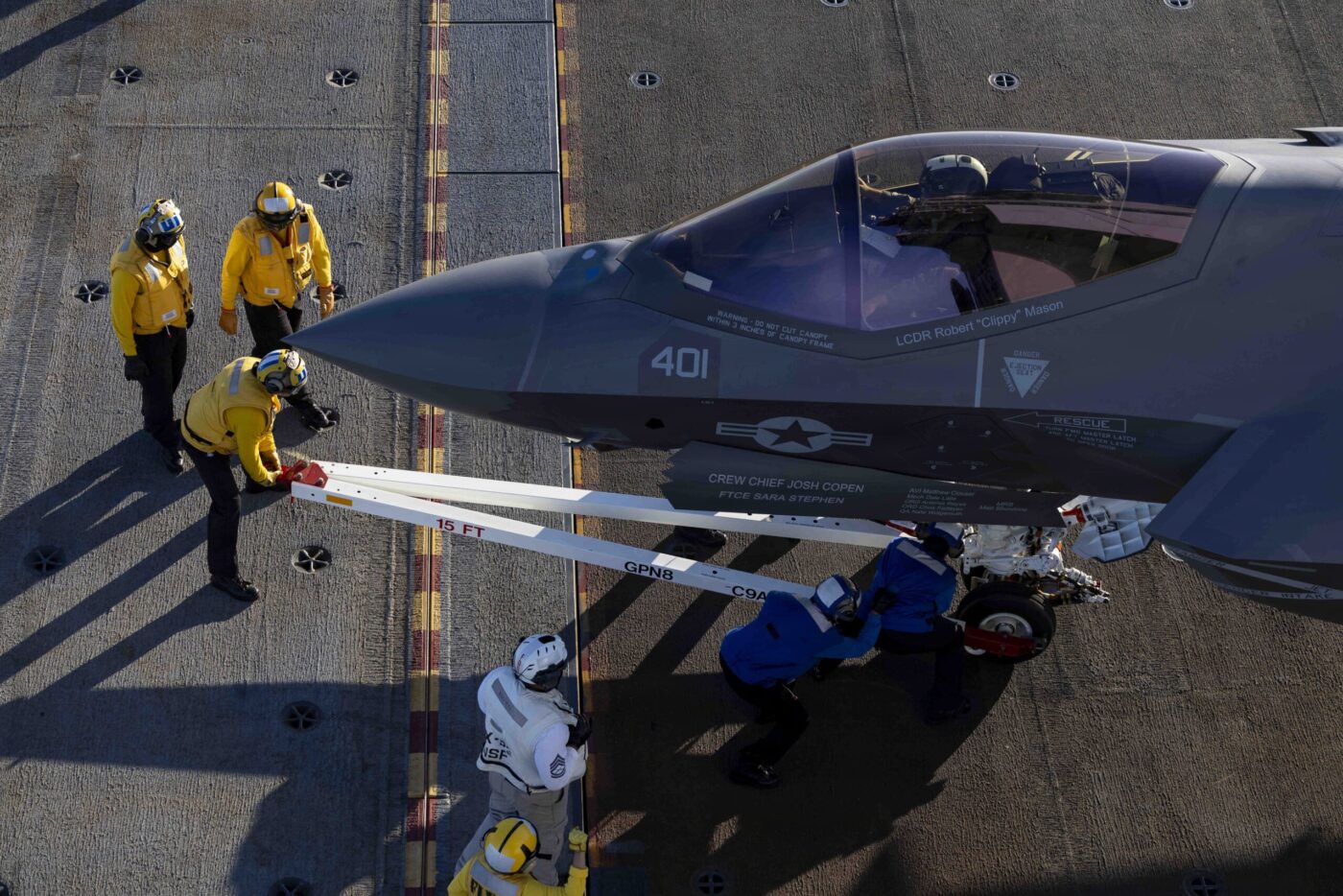
The US Navy released photos of the event showing two F-35C aircraft with tail numbers 401 and 403—one landing on the carrier deck, and the other flying with an inert Joint Direct Attack Munition (JDAM) bomb carried externally. Later, another set of images and a video were posted on social media, showing the F-35C launching from the deck of the John F. Kennedy on the second day of ACT.

The US Navy took the preliminary acceptance of the carrier on 29 September 2026, after sea trials the previous month. Preliminary acceptance allows at-sea testing, training, and proficiency building before the carrier is commissioned and put into service.

This arrested landing and subsequent catapult launch marked the first time any F-35C had operated from a Ford-class ship, the largest and most advanced fleet of aircraft carriers in the American armory.

The lead ship, USS Gerald R. Ford (CVN-78), has never embarked the F-35C for sustained operations because the carrier was reportedly delivered without the full set of modifications needed to sustain stealth-fighter operations due to cost-saving measures.

Earlier in June 2019, former Navy spokesman Capt. Daniel Hernandez said that although Ford-class carriers were built to launch and recover the F-35C fighter jet, they still needed upgrades such as stronger jet blast deflectors to protect the deck from hot exhaust during launches, as well as designated areas for aircraft operations.

Instead of the F-35C, the USS Gerald R. Ford hosts air wings mainly equipped with F/A-18E/F and Growler variants for its current combat posture.

The US Navy has flown the F-35C only from its Nimitz-class carriers so far. The aircraft completed its initial at-sea testing aboard the USS Nimitz in November 2014. USS Carl Vinson was the first to deploy the jet operationally, and USS Abraham Lincoln was the first to use it in combat.

However, the House Armed Services Committee’s Seapower and Projection Forces Subcommittee later ordered in FY2020 that the Navy must not accept the CVN-79 USS John F. Kennedy aircraft carrier until it can embark the F-35C. This makes the latest arrested landing and takeoff special.

Image
File: A US Navy F-35C makes an arrested landing on the deck aboard John F. Kennedy

This test is a key step in validating F-35C integration with the Ford class, especially because these carriers use electromagnetic catapults and advanced arresting equipment, replacing the Nimitz class’s steam-powered launch and conventional arresting systems.

Interestingly, however, this key milestone comes as US President Donald Trump has ordered the Pentagon to redesign a new aircraft carrier to replace electromagnetic catapults—designed for finer control, reduced airframe stress, higher sortie rates, and better support for a wider range of aircraft—with steam catapults.

In fact, the President signed a national security memorandum in August, giving the Pentagon leaders two months to come up with “a plan on the required measures to replace the Electromagnetic Aircraft Launch System and Advanced Weapons Elevators with steam and hydraulic systems for the construction of” the USS Doris Miller, also a Ford-class aircraft carrier.

Nonetheless, putting F-35C jets on USS John F. Kennedy is a major breakthrough for the US Navy’s upcoming combat posture as regional security threats multiply across theatres. The F-35C Lightning II brings stealth, advanced sensors, sensor fusion, and long-range strike capability that older fighters, such as the Super Hornet, lack.

File: F-35C aboard John F. Kennedy carrier

The F-35C’s Leap is Admirable

More than a decade ago, the F-35C struggled with its arresting hook system (AHS), which had a well-documented design issue, as reports in 2012 noted, citing a leaked JSF Concurrency Quick Look Review dated 29 November, 2011.

The report noted that the stealth fighter couldn’t board a carrier because of these tailhook design issues.

It stated that the F-35C failed to engage the MK-7 arresting gear during particular tests at NAWC-AD (Naval Air Warfare Center – Aircraft Division) Lakehurst, with a poor score of 0 successes in 8 attempts.

This was despite testing at a regular airport, not a real carrier, where an aircraft may face inclement weather, a pitching deck, adjacent obstructions, low fuel, and no alternate airfields, among other challenges.

At the time, reports noted that the core issue was the short longitudinal distance—about 7 feet—between the main landing gear tires and the lowered tailhook point. Low-observability, or stealth, requirements drove this geometry, forcing the Arresting Hook System into a recessed bay with doors to preserve the aircraft’s outer mold line and minimize radar cross-section, according to the reports.

For comparison, the F/A-18 placed the main landing gear-to-tailhook distance at about 18.2 feet. Additionally, the tailhook point design had limited ability to scoop low-positioned cables.

A Lockheed Martin official later said the company traced the F-35C’s trouble catching a carrier’s arresting gear wires to the tailhook design. “The good news is that it’s fairly straightforward and isolated to the hook itself,” said Tom Burbage, the F-35 program manager at the time. “It doesn’t have secondary effects going into the rest of the airplane.”

Burbage said that the rest of the tailhook system design, including the bay and doors that hide the device and other auxiliary hardware, was sound. “What we are trying to do is make sure that we got the actual design of the hook is optimized so that it in fact repeatedly picks up the wire as long as the airplane puts itself in position to do that.”

He explained that the fundamental limitations of creating a stealth fighter also caused the hook issue, adding that the company faced the rare challenge of designing the first-ever naval stealth fighter jet with a tail-hook that had to be concealed when not in use.

He also noted that the tail hook had to be installed farther forward on the jet’s ventral surface than on other naval aircraft because it had to fit within the F-35’s outer mold line. As a result, the hook behaved differently than it did on previous fighters like the F/A-18.

The way the wires react as the jet passes over them is a dynamic factor in the F-35, and the wire responded in a sine wave pattern.

“The time differential between when the main gear rolls over the cable and the time the hook picks up the cable on a more conventional airplane is more time for that wave to damp out,” the spokesperson was quoted as saying. “In the case of the F-35, one of our design constraints is that the hook just has to be closer to the main landing gear than on a conventional aircraft because of the requirement to hide it inside the airplane,” he added at the time.

Later, engineering investigations identified three primary factors: the aircraft’s constrained geometry, a suboptimal hook-point shape, and inadequate hold-down performance. Additionally, it found that a faulty or inadequately validated wire-dynamics simulation model contributed to the original design assumptions.

The Joint Strike Fighter program addressed the issue by redesigning the hook point and improving the hold-down damper, along with other refinements such as improved upstroke damping and strength. The revised system underwent successful shore-based testing, including dozens of roll-in arrestments, enabling the first at-sea arrested landings on USS Nimitz in late 2014, followed by a rigorous testing regime.

Notably, Ford-class ships use the newer Advanced Arresting Gear (AAG) rather than the legacy MK-7 hydraulic system. However, the successful trap and launch close the loop on more than a decade of work that began with the original hook’s total failure.

As the EurAsian Times previously explained, the F-35C offers significantly greater range over other F-35 variants, larger internal weapons bays, and superior endurance, making it ideal for long-range operations from the vast ocean.

These stealthy warplanes are nearly invisible to enemy radars and can penetrate even the most advanced air-defense systems. They have advanced sensor fusion to create a shared battlespace picture for the entire air wing and can conduct precision strikes or intercept threats, as demonstrated by the Iranian drone shootdown earlier this year.

The F-35C can carry over 5,000 pounds of internal weapons or over 18,000 pounds of combined internal and external weapons. This lets the US Navy use external armaments to increase lethality when needed or operate in stealth when required.

Not just that, the aircraft can also operate as an intelligence, surveillance, and reconnaissance (ISR) asset, sharing information with all networked ground, sea, and air assets in the battlespace

The post After 0-for-8 Tailhook Failures, F-35C Completes Landmark Arrested Landing Aboard USS John F. Kennedy appeared first on EURASIAN TIMES.

  •  

Katie Zacharia is out as White House press secretary. Meet the 6 Trump has had over both his terms.

The three most recent White House press secretaries: Kayleigh McEnany, Karoline Leavitt, and Katie Zacharia.
The three most recent White House press secretaries, from left to right: Kayleigh McEnany, Karoline Leavitt, and Katie Zacharia.

Alex Wong/Getty Images ; Tom Williams/CQ-Roll Call, Inc via Getty Images ; Chip Somodevilla/Getty Images

  • President Donald Trump has had six White House press secretaries across his two presidential terms.
  • Sean Spicer, Stephanie Grisham, and Kayleigh McEnany held the role for less than a year.
  • Katie Zacharia succeeded Karoline Leavitt, but is "transitioning out" after five days on the job.

The new face at the White House podium didn't last long.

Katie Zacharia held her first briefing as the new White House press secretary on Tuesday after President Donald Trump chose her to succeed Karoline Leavitt, who left the White House in August to spend more time with her young children.

By Friday, a White House official confirmed to Business Insider that she is "transitioning out" of the role.

Zacharia was the sixth White House press secretary Trump has hired across his two non-consecutive presidential terms, and the fourth to serve for less than a year.

It's not unusual for presidents to go through several press secretaries due to the demanding nature of the role. President Barack Obama had three press secretaries during his two terms in office. Former presidents Bill Clinton and George W. Bush had four.

Here's a look at all of the White House press secretaries who have represented the Trump administration.

Sean Spicer
Sean Spicer in his role of White House press secretary.
WASHINGTON, DC - APRIL 24: White House Press Secretary Sean Spicer talks to reporters during the daily press briefing at the White House April 24, 2017 in Washington, DC. Spicer was joined during the briefing by U.S. Ambassador to the United Nations Nikki Haley and Treasury Secretary Steven Mnuchin. (Photo by Chip Somodevilla/Getty Images)

Chip Somodevilla/Getty Images

Sean Spicer's time as White House press secretary spanned 182 days — the shortest tenure of all of Trump's press secretaries.

After leaving the White House, he appeared on season 28 of "Dancing with the Stars." He now serves as a political contributor at NewsNation and hosts several podcasts, including "Full Court Press with Sean Spicer" and "The Sean Spicer Show."

Sarah Huckabee Sanders
Sarah Huckabee Sanders as White House press secretary.
White House Press Secretary Sarah Huckabee Sanders speaks during a press briefing at the White House in Washington, DC, March 11, 2019. (Photo by SAUL LOEB / AFP) (Photo by SAUL LOEB/AFP via Getty Images)

SAUL LOEB/AFP via Getty Images

During Trump's first term, Sanders served as White House press secretary for just under two years, from July 2017 to July 2019. In the final months of her tenure, Sanders largely stopped holding formal White House press briefings.

Sanders is the daughter of former Arkansas Gov. Mike Huckabee, who now serves as the US ambassador to Israel in the second Trump administration. After her time as press secretary, Sanders was elected governor of Arkansas in 2022. She is running for reelection in the 2026 midterms.

Stephanie Grisham
Stephanie Grisham with Donald Trump aboard Air Force One in 2019.
White House Press Secretary Stephanie Grisham listens as US President Donald Trump speaks to the media aboard Air Force One while flying between El Paso, Texas and Joint Base Andrews in Maryland, August 7, 2019. (Photo by SAUL LOEB / AFP) (Photo credit should read SAUL LOEB/AFP via Getty Images)

credit should read SAUL LOEB/AFP via Getty Images

Grisham served as White House press secretary for less than a year, from July 2019 to April 2020. Throughout her tenure, she did not hold a traditional press briefing.

Grisham went on to become Melania Trump's White House chief of staff, then resigned from the role following the January 6, 2021 insurrection.

She has since become a vocal critic of Trump and spoke about her time working in the Trump administration at the 2024 Democratic National Convention.

Kayleigh McEnany
Kayleigh McEnany as White House press secretary.
WASHINGTON, DC - OCTOBER 1: White House press secretary Kayleigh McEnany, speaks during a press briefing in the Brady Press Briefing Room of the White House, on Thursday, October 1, 2020, in Washington, DC. (Photo by Oliver Contreras/For The Washington Post via Getty Images)

Oliver Contreras/For The Washington Post via Getty Images

McEnany served as Trump's 2020 campaign press secretary before Trump chose her to replace Grisham as White House press secretary. She held the role for less than a year, from April 2020 until Trump left office in January 2021.

McEnany resumed formal White House press briefings after Grisham's tenure.

McEnany now hosts "Saturday in America with Kayleigh McEnany" on Fox News, and co-hosts another Fox News show, "Outnumbered."

Karoline Leavitt
Karoline Leavitt.
White House Press Secretary Karoline Leavitt speaks during a press briefing at the White House in Washington, D.C., the United States, on Jan. 15, 2026. U.S. President Donald Trump is keeping all options on the table for responding to Iran's unrest, White House Press Secretary Karoline Leavitt said Thursday. (Photo by Li Yuanqing/Xinhua via Getty Images)

Li Yuanqing/Xinhua via Getty Images

Leavitt served as White House press secretary from January 2025 to August 2026. At 27 years old, when she started the role, she was the youngest person ever to hold the position.

Leavitt established a "new media seat" in the White House briefing room, highlighting podcasters, independent journalists, social media influencers, and other non-legacy media sources.

She was also the first-ever pregnant White House press secretary, and gave birth to her second child while in the role. Leavitt resigned shortly after returning from parental leave, citing her desire to spend more time with her family.

She will begin working as an on-air contributor for Fox News starting November 1.

Katie Zacharia
Katie Zacharia.
UNITED STATES - OCTOBER 13: White House Press Secretary Katie Zacharia conducts her first briefing where she addressed issues including the resignation of Kimberly Guilfoyle, U.S. ambassador to Greece, on Tuesday, October 13, 2026. (Tom Williams/CQ-Roll Call, Inc via Getty Images)

Tom Williams/CQ-Roll Call, Inc via Getty Images

Trump named Zacharia as Leavitt's successor, writing in a Truth Social post on October 9 that Zacharia "has an unblemished record of support, and has been a loyal and brilliant supporter, right from the beginning," and calling her "a devoted fan and member of MAGA."

Zacharia previously worked as a senior communications advisor at Trump Media and Technology Group, which runs Truth Social.

She held her first briefing on Tuesday, but after a rocky five days as White House press secretary — during which Zacharia's briefing performance and legal qualifications were widely criticized — a White House official told Business Insider on Friday that she was leaving the role.

Read the original article on Business Insider
  •  

Netanyahu orders investigation and prosecution of Israeli soldiers in NAZA

Israeli directors Yuval Abraham and Rachel Szor pose with the Special Jury Prize Award for Naza at the Winners Photocall at the 83 Venice International Film Festival 2026. Photo by Marilla Sicilia/Archivio Marilla Sicilia/Mondadori Portfolio via Getty Images

This article was originally published by Truthout on Oct. 14, 2026. It is shared here under a  Creative Commons (CC BY-NC-ND 4.0) license.

Israeli Prime Minister Benjamin Netanyahu has ordered Israel’s attorney general and the heads of the Israeli military and Shin Bet security service to investigate the soldiers and officers interviewed anonymously in the documentary film NAZA.

Netanyahu called Sunday for the agencies to identify “all those who are involved or appear in the libel film” and to prosecute them for “serious information security offences, criminal defamation, and harming Israel’s diplomatic and security interests.”

In a letter to IDF Chief of Staff, the head of the Shin Bet, and Israel’s attorney general, Netanyahu decried the film for “present[ing] a false, misleading and biased narrative that defames the State of Israel and the IDF around the world and severely damages Israel’s standing.”

The film NAZA features anonymous interviews with 24 Israeli soldiers and officers involved in remote mass killings of Palestinians in Gaza over the past three years. The soldiers’ faces are obscured and voices are altered for anonymity as they speak with journalist and director Yuval Abraham on rooftops in Tel Aviv.

NAZA reveals how Israel’s AI-based surveillance systems have been used to facilitate and execute remote killings of thousands during Israel’s genocide in Gaza. The film’s title is a Hebrew military acronym for collateral damage – as in, the number of Palestinian civilians deemed acceptable to kill in a bombing with a military target. In one instance, a soldier tells director Yuval Abraham that the military approved the killing of 500 Gazans for one target.

The film and its directors have faced attacks by the Israeli government since its world premiere in September at the Venice Film Festival. Both the Israeli culture minister and Netanyahu have called for revoking the Israeli citizenship of the film’s directors, Yuval Abraham and Rachel Szor, while accusing them of treason and defamation. The IDF chief called the film a “blood libel” and “an attack on the State of Israel.”

Upon the film’s premiere in the U.S. in late September, Netanyahu compared NAZA to “launching dozens of ballistic missiles at Israel.”

Several Israeli civil society organizations, including human rights group B’Tselem, criticized the attacks on the filmmakers, and called for “an end to the wave of incitement and threats of violence against them.”

Abraham and Szor produced No Other Land, the 2024 documentary focused on Israel’s displacement of Palestinian villages in the West Bank, along with Palestinian activist and journalist Basel Adra and Palestinian researcher and photographer Hamdan Ballal. After the film won major international awards, including an Academy Award, members of the film’s Palestinian crew were attacked by both Israeli settlers and soldiers.

Earlier this month, Israel put forward a hastily-produced rival film to counter NAZA; last week, the Israeli government announced that it was awarding the filmmakers “for their contribution to Israeli public diplomacy.”

The Guardian, which produced the film, has pushed back on the Israeli government’s attempts to discredit NAZA. On October 1st, a Guardian spokesperson said that “The process of assessing the credibility of the testimonies was rigorous. It included leaked classified documents, detailed verification of specific strikes and corroboration via a wider pool of confidential journalistic sources who did not appear on camera in the film.”

The Guardian added that the team that produced the film interviewed “more than 100 sources familiar with IDF systems used in the war in Gaza, including senior-ranking commanders directly involved in the authorization of strikes.”

Much of the material in the film had already been published in reports at The Guardian, +972 Magazine, and Israel’s left-wing publication, Local Call.

In a 2024 piece co-published by +972 Magazine and Local Call, Yuval Abraham explained how AI systems like “Lavender” and “Where’s Daddy” identified low-ranking Hamas and Islamic Jihad operatives as military targets. After October 7, 2023, Israel’s military decided that these tens of thousands of people could be bombed inside their homes with their families – even tracking and monitoring their children in order to strike their homes. In NAZA, one soldier spoke about using the gruesomely named “Where’s Daddy” AI system to track a 12-year-old girl before killing her. According to Abraham, the Israeli military was also aware that much of the AI systems’ data was also faulty – some 10-15 percent of the people identified as targets were not militants or operatives whatsoever.

In an interview, Abraham explained that NAZA also reveals the extent of the dehumanization of Palestinians within Israeli society – including among the self-identified Israeli “center-left,” which disproportionately took part in the aerial bombardment campaign on Gaza. The aerial bombardment campaign has constituted “some of the most heinous crimes in Gaza,” Abraham argued, as it led to the killing of thousands of Palestinian toddlers in their homes – and it was led largely by members of the center-left opposition against Netanyahu.

  •  

Ukraine's vital access to military-grade Starlink services is coming back after a sudden disruption, sources say

A Ukrainian soldier of the 61st Separate Mechanized Brigade uses the Starlink system during military exercises.
Starlink equipment is a common sight on the front lines in Ukraine.

Maxym Marusenko via Reuters Connect

  • Ukraine's access to military-grade Starlink services is returning, sources told Business Insider.
  • Defense ministry and parliamentary sources said on Thursday that Starshield operations had been at least partially restored.
  • On Wednesday, Ukraine was caught off guard by sudden speed restrictions, affecting drone missions.

Ukraine's access to military-grade Starlink services appears to have been at least partially restored on Thursday, a day after Kyiv was stunned by sudden speed limits that it said hamstrung some drone operations.

Ukrainian defense ministry sources told Business Insider that Starshield services remained functional while in motion as of roughly 11:45 a.m. local time on Thursday, according to reports that they had received from military units.

The sources said the defense ministry is working to understand how and why there was a disruption to the operation of Starshield, SpaceX's dedicated satellite network for military services.

Yehor Cherniev, the deputy chairman of the Ukrainian parliament's national security, defense, and intelligence committee, told Business Insider that Starshield services had been restored to their pre-disruption capacity.

Ukrainian officials and service members were caught off guard on Wednesday by the unexpected Starshield disruption, which they said restricted speeds above 100 miles per hour. Some units experienced a loss of connection at speeds as low as 45 miles per hour.

The full extent of the service limitation remains unclear.

Yuriy, an officer with Ukraine's National Guard, told Business Insider that his units use Starshield to support drone operations and that speeds were back above 100 miles per hour as of Thursday morning. He asked to be identified only by his first name for security purposes.

However, Yuriy said that several operations were disrupted during the earlier restrictions.

Defense ministry sources said the disruption complicated mid-range strikes, air defense intercepts, and front-line logistics. Starlink does not work inside Russia, so the issue was limited to missions in Ukrainian territory or Russian-occupied territory.

Person in camouflage uniform sits on concrete steps using a device near a satellite antenna outside a brick building.
Starlink has been a game changer for Ukrainian operations, especially by ensuring connectivity for drone warfare.

Andriy Dubchak/Frontliner/Getty Images

The sudden Starlink disruption caused widespread confusion and raised questions about the source of the decision and whether it was connected to tensions between President Donald Trump and Ukrainian President Volodymyr Zelenskyy over Kyiv's targeting of Russian energy facilities.

Ukrainian forces use Starlink, the commercial satellite internet service run by SpaceX, and Starshield, a secure network for military and government work built by the company but operated by the US government. Some Ukrainian officials initially blamed SpaceX for the disruption.

In an X post on Wednesday responding to Ukraine's former defense minister, SpaceX CEO Elon Musk put the issue on the Trump administration, saying that Starshield was "owned and controlled by the American government." He said "any limits on speed or usage are decided by the US military and ultimately POTUS."

A senior US official told Business Insider Thursday afternoon that "no such request was ever made by the President."

The Pentagon has not responded to requests for comment.

Sprawling influence

The outage and impact on front-line operations have called attention to Ukraine's deep dependence on Starlink, which has become critical for battlefield communications and drone warfare.

As Business Insider recently reported, Starlink's rapid expansion has given Musk and SpaceX an enormous source of influence and soft power, and the world's richest man has not been shy about using that power in Ukraine to influence the course of the war.

Musk said in 2023 that he refused a request from Ukraine's military to activate Starlink to assist a Ukrainian assault on the occupied Crimean peninsula. Earlier this year, SpaceX clamped down on Russian forces' use of Starlink terminals in Ukraine, handing Ukraine a key battlefield advantage.

While support for Ukraine has varied, Musk has consistently been a prominent critic of the Ukrainian president. In an X post late on Wednesday, hours after responding to Ukraine's defense minister, he wrote that it was "time for Zelenskyy to go."

The sudden Starlink disruptions came as Ukraine faces growing pressure from the US, with Trump pushing Kyiv to halt its strikes on Russian energy facilities. The US president said on Tuesday that Washington had not cut intelligence sharing with Ukraine, another concern for the country.

Cherniev, the Ukrainian lawmaker, confirmed on Thursday that the US continues to share intelligence with Kyiv.

Meanwhile, Russia has intensified its ballistic missile attacks against Ukraine, firing dozens overnight. Recent attacks have targeted Kyiv and Ukrainian energy facilities.

Read the original article on Business Insider

  •  

Eurofighter Down? Houthis Claim Hitting Saudi Typhoon Jet with Surface-To-Air Missile Over Saada

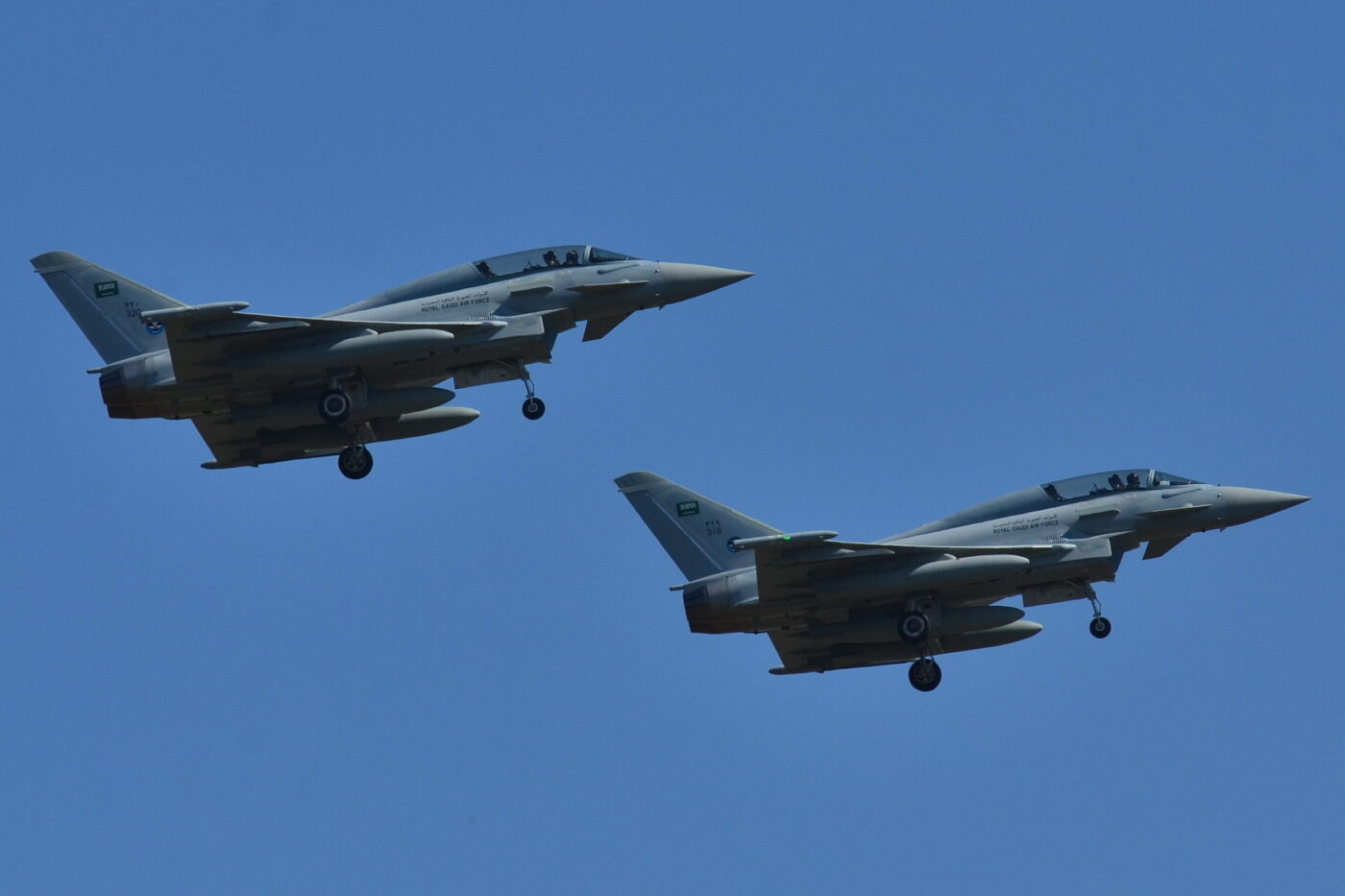
As hostilities continue to escalate between Saudi Arabia and the Houthis (Ansar Allah), the Yemen-based group has claimed to have hit a Eurofighter Typhoon fighter jet of the Royal Saudi Air Force (RSAF). 

On the night of October 14, the Houthis- claimed that they had managed to hit an RSAF fighter jet over the northern Yemeni province of Saada, which shares a border with Saudi Arabia.

“By the grace of God, our armed forces were recently able to target a Saudi warplane of the “Typhoon” type that took off from Taif Air Base. It was targeted in the airspace of Saada Governorate with a surface-to-air missile, struck directly, and is now at risk of crashing,” the military spokesperson of the group, Brigadier General Yahya Saree, wrote on X.

In addition, low-quality, night-time footage of a distant aerial engagement also surfaced on social media and was posted by some popular media outlets. However, the video does not conclusively prove the purported engagement involved a fighter jet, as it was shot in near-total darkness.

The claims come amid a sharp escalation in conflict between the Houthis and the Saudi-led coalition since last month, when the Houthis seized territory along the Red Sea coast, including Mokha and areas overlooking the Bab al-Mandeb Strait, which had been crucial for Saudi energy exports after the closure of the Hormuz Strait.

Earlier this month, Saudi Arabia and the Yemeni government launched a counteroffensive to reclaim Red Sea coast territory and declared full-scale war efforts, which have led to intensified missile and drone attack responses by the Houthis on Saudi cities and civilian targets, including in the capital, Riyadh. 

Before claiming to have hit the Eurofighter, the Houthis stated that they had struck King Khalid International Airport in the Saudi capital Riyadh with a ballistic missile.

The group also announced that it targeted an administrative building belonging to Saudi Arabia’s Aramco in the eastern city of Dhahran, in retaliation for Saudi strikes on an oil facility in the al-Sabah area of the capital Sanaa, controlled by the Houthis.

Saudi Arabia, on its part, launches regular airstrikes on Houthi positions, backing Yemeni government-aligned forces as they try to reoccupy territory.

Eurofighter Downed After F-15?

Saudi aircraft, including F-15SA and Eurofighter Typhoons, have been operating from bases such as Taif and Khamis Mushait to launch regular airstrikes across Houthi-controlled areas.

The latest claim of hitting a Eurofighter Typhoon comes nearly a month after the Houthis managed to down an F-15SA, scoring their first kill of a Saudi fighter since the fresh hostilities broke out between the two sides. The aircraft was reportedly downed on September 16, near Marib, using a locally-made surface-to-air missile (SAM), when it was allegedly conducting air strikes in support of the Yemeni troops.

The group published images of the wreckage of the Saudi fighter and the Ansar Allah personnel posing with it, although the fate of the pilots who probably ejected after being hit remains unknown to this day, as the EurAsian Times had also discussed in the past.

Houthis posing with the wreckage of a Saudi F-15SA downed by the group in September 2026 (Via X)

Unlike the F-15SA incident, there is currently no evidence the RSAF Eurofighter Typhoon was hit or crashed after taking the alleged hit.

Notably, advanced 4.5th-generation fighters like the Eurofighter are designed to absorb certain damage. Thus, a hit may not automatically mean a confirmed kill.

If we hypothetically assume the Eurofighter was hit, whether the Typhoon could make it back to the base depends on where it was allegedly struck, how far it was from a friendly base, and how severe the hit was.

The Eurofighter has two EJ200 engines—if one is damaged or fails after a hit, the other could provide enough thrust to keep the aircraft flying with some adjustments, allowing the pilot to land at a nearby safe base. Moreover, the jet features multiple flight-control computers, hydraulic systems, and electrical backups that could keep it controllable even after it loses parts of the airframe, control surfaces, or one of the two engines.

But most importantly, the damage may depend on whether the missile warhead detonated properly or was a near-miss that caused fragmentation.

For now, these crucial details about the alleged hit and damage remain unclear.

RSAF Eurofighter Typhoons- Wikimedia Commons

While independent verification of the alleged hit is pending and the RSAF has not officially acknowledged any such hit, previous reports suggest that the Houthis had earlier claimed downing a Saudi Eurofighter in October 2017 with a surface-to-air missile over Nihm. 

“Yemen’s air defense unit told the country’s Arabic-language al-Masirah television network that the aircraft had been targeted with a surface-to-air missile as it was flying in the skies over Nihm district east of the Yemeni capital city of Sana’a on Friday evening,” Yemen Press had reported. However, no independent source verified the hit at the time.

Earlier this year, Italian Eurofighters sustained some damage during an Iranian strike on a Saudi base, as the EurAsian Times had earlier reported.

However, no combat shoot-down of a Eurofighter Typhoon—built by a consortium of the UK, Germany, Italy and Spain—has occurred anywhere in the world. 

This means that if Ansar Allah’s claims are verified and the Eurofighter has indeed been hit and crashed, it would be the first incident involving the type.

It would boost the credibility of the Houthis’ surface-to-air missiles, which they market as “locally manufactured.”  For the Houthis, successfully downing a modern, high-performance jet like the Typhoon, with advanced electronic warfare, missile-warning systems, and high-speed or high-altitude performance, would be akin to an endorsement that their air defenses can threaten one of the most capable Western fighters in the Saudi inventory, not just older aircraft.

Saudi Arabia currently operates about 71 Eurofighter Typhoons, so a single loss would not dramatically alter its combat capability or affect operations. However, with tensions running high between the two sides, it would be a major propaganda win for the Houthis and could lead to further escalation if Saudi Arabia launches a stern response.

For now, the EurAsian Times awaits further details about the initial claims.


The post Eurofighter Down? Houthis Claim Hitting Saudi Typhoon Jet with Surface-To-Air Missile Over Saada appeared first on EURASIAN TIMES.

  •  

EU must curb energy prices to prevent people turning to populists, commissioner warns – as it happened

This live blog is now closed, you can read more of our European news coverage here

Just as the leaders sit down at the big table in Brussels, Romania has said that seven people are still missing after a fire on a vessel in Romanian territorial waters of the Black Sea.

Suspected Russian drones have hit several ships off Romania and neighbouring Bulgaria since last week in a spillover from the Ukraine war, AFP reported.

Continue reading...

© Photograph: Olivier Matthys/EPA

© Photograph: Olivier Matthys/EPA

© Photograph: Olivier Matthys/EPA

  •  

India’s LCA Tejas & AMCA Try “Catching Up” as Turkish Jets Take a Clear Lead. Spain Eyes More Hürjets

In another boost for Turkey’s aerospace industry, Spain has reportedly decided to acquire additional Turkish Hurjet aircraft, bringing the total purchase to about 45 units. Meanwhile, India’s LCA Tejas and AMCA are trying to catch up with Turkish aircraft.

Mehmet Demiroglu, CEO of Turkish Aerospace Industries (TAI), which produces the Hurjet, said Spain plans to buy 15 additional Hurjet trainer aircraft, in addition to the 30 supersonic jets already ordered in December 2025, Turkey’s state-run Anadolu Agency reported.

“Before we even started deliveries to our Air Force, Spain said, ‘I like it, I want to buy 30,’ and bought them. We signed the agreement,” he was quoted as saying during an event in Türkiye’s northern province of Kastamonu. “We are working toward deliveries in 2028. It is planning to buy another 15,” the CEO added.

Earlier, Spain approved the purchase of 45 Hürjet jet trainers in September 2025 in a €3.68 billion deal led by Airbus Defense and Space España. Under the agreement, the first units are scheduled for delivery by 2028.

The Hürjet is a single-engine, tandem-seat advanced jet trainer and light combat aircraft intended to provide modern combat pilot training, bridging basic trainers and front-line fighters.

It is designed primarily to replace the Turkish Air Force’s aging Northrop T-38M Talon advanced trainers and the Northrop F-5s flown by the Turkish Stars aerobatic team, although the aircraft also supports fighter transition training, aggressor roles, and light combat or close air support missions.

Image
TAI Hurjet. (Credits: Platform X)

Spain, for its part, is acquiring it primarily as a trainer within a complete integrated training ecosystem, rather than as a pure combat aircraft.

In recent years, the Turkish defense industry has made major strides toward indigenization and expanded its export potential, including the Hürjet, the Hürkuş, and the KAAN.

TAI previously said Spain was considering acquiring the KAAN stealth fighter after the collapse of the Future Combat Air System (FCAS) program the country was pursuing with France and Germany, as the EurAsian Times reported at the time.

Silent on Fighter Jet Losses, Open on Airport and Oil Strikes: Saudi Arabia’s Selective Response to Houthi Attacks

Separately, Indonesia has already signed a deal to acquire 48 KAAN fighters, along with provisions for extensive collaboration in manufacturing, technology transfer, and engineering, among other things.

Demiroglu added that Hurkus deliveries have begun and will continue in the coming years, citing Azerbaijan as an export market and expressing hopes of additional international sales. Azerbaijan signed a contract at the ADEX 2026 defense exhibition in Baku for 14 HÜRKUŞ-II trainer aircraft, although countries like Niger, Chad, and Libya have already ordered the aircraft, according to publicly available information.

Nonetheless, Hürjet’s export success is strategically more significant than it might first appears. This is mainly because Hürkuş is a relatively simple turboprop basic trainer whose exports matter but are less technologically advanced, whereas the KAAN is far more advanced and prestigious, but its full operational capability and export readiness are years away.

Therefore, the Hürjet sits in the middle: an indigenous trainer or light combat aircraft, and selling it to a sophisticated NATO country proves Turkey can design, certify, produce, and support a high-performance jet aircraft that meets Western standards.

Turkey Takes A Lead Over India 

Hürjet benefited from a relatively clean-sheet design optimized for the trainer or light-attack role, a strong political and industrial focus, and a partnership model that made entry into Europe easier.

Turkey began developing the Hurjet in 2017 as an advanced jet trainer with a light combat role. It first flew in 2023, and Ankara is now ramping up serial production, while increasing its local structural content.

By contrast, India’s Tejas program began in the 1980s. The aircraft took its first flight in 2001, but the program remained mired in delays, and induction came much later, in 2016.

Although the Indian Air Force (IAF) has finally received all Tejas Mk1 aircraft after a grueling wait, delivery of the more capable Mk1A, with AESA radar and other upgrades, has yet to begin because of delays in delivering GE-404 engines.

Russian & Indian Warships Hog Online Limelight as U.S. Navy Turns 251. Social Media Gaffe Continues

Despite marketing efforts and interest from several countries over the years, Tejas has not secured a major export order. India’s state-owned Hindustan Aeronautics Limited (HAL) has said it prioritizes fulfilling IAF commitments before aggressively pursuing foreign sales.

Meanwhile, Turkey’s defense industry has enjoyed continual high-level prioritization, faster decisions on aircraft variants, and a strategy of securing an early Western reference customer.

The gap is also visible at the fifth-generation level.

Both Turkey’s KAAN and India’s AMCA are twin-engine multirole fighters currently under development. However, Turkey appears to be ahed in the race despite India starting early.

KAAN made its first flight in February 2024, and multiple prototypes have since been flying. The Turkish Air Force has ordered the first 20 Block 10 aircraft, with deliveries to start in 2028. Furthermore, Ankara is steadily advancing development of an indigenous engine for later KAAN jets.

Meanwhile, India’s AMCA is in its industry selection and prototype development phase, with the first flight targeted for September 2028 and service induction planned for 2034–2035. Most IAF experts talking to EurAsian Times have privately doubted this ambitious timeline.

Turkey moved relatively quickly from design to a flying demonstrator and is already iterating with multiple airframes, whereas India has spent longer in the detailed design and industrial-partner selection phase. Moreover, Turkey has maintained a visible, sustained, high-level focus, combined with lessons from parallel programs such as Hürjet and a host of other UAV development programs that helped compress timelines.

Turkey’s success over India in aircraft development programs comes from its experience. In the late 1980s and 1990s, TAI produced 232 Block 30/40/50 F-16s under license for the Turkish Air Force, plus 46 Block 40s for Egypt and later 30 Block 50s. It license-produced the CN-235 transport and maritime-patrol aircraft, Cougar utility helicopters, and SF.260 trainers.

TAI also performed extensive F-16 electronic-warfare and structural upgrades for Turkey, Jordan, and Pakistan; converted Boeing 737s into AEW&C platforms; participated in the A400M program; and developed the Anka UAV family.

Additionally, the country has also fielded the T129 ATAK attack helicopter and, in 2023, flew the heavier twin-engine T929 ATAK 2, while producing light and medium utility helicopters.

These programs, along with a political drive to become a major arms supplier and the Turkish Armed Forces Foundation’s institutional role in the defense industry, have accelerated progress.

Artillery Isn’t Dead: U.S. Army Orders XM1776 Prototypes Based on South Korea’s K9 ‘Thunder’ Howitzer

“Their desire to lead the Islamic world as its most powerful nation and become a major arms supplier has taken Turkey forward in defense production. Also, the Turkish Armed Forces Foundation holds a large shareholding in military industries, and it has its own dynamics,” Air Marshal Anil Chopra (retd) argued in a previous EurAsian Times article, referring to Turkey’s achievements.

“India has to learn from Turkey’s successes in unmanned platforms. They are also ahead in helicopters and transport aircraft. Turkey is clearly way ahead in the fifth-generation fighter program,” Chopra further noted.

As for Turkey, Hürjet’s NATO export breakthrough and faster KAAN development demonstrate that Turkey has established a measurable lead over India in the pace and export conversion of combat-aircraft development in recent years.


The post India’s LCA Tejas & AMCA Try “Catching Up” as Turkish Jets Take a Clear Lead. Spain Eyes More Hürjets appeared first on EURASIAN TIMES.

  •  

Act before El Niño: Expert worries about deepening hunger in East and South Africa

El Niño, a naturally occurring climate pattern that involves unusually warm surface waters in the central and eastern equatorial Pacific Ocean can alter atmospheric circulation and significantly influence rainfall and temperatures patterns far beyond the ocean, according to the World Meteorological Organization (WMO). The WMO, the United Nations’ weather agency, says this warming is already underway and getting stronger. In an Oct. 8 update, it put the chance of an El Niño continuing through February 2027 at nearly 100%. It expects the event to be strongest in December. Regional forecasters predict a 90% chance of heavier-than-usual rain in southern Ethiopia, central to southern Somalia and northeastern Kenya between October and December 2026. Excessive rainfall could cause flooding, destroy crops, spread disease and make health services inaccessible in some areas, depending on local conditions and the season. A National Oceanic and Atmospheric Administration (NOAA) map illustrates typical seasonal rainfall shifts associated with El Niño, rather than a specific forecast for 2026. Graphic courtesy of NOAA. Action Against Hunger, an international aid organization, says families in southern Madagascar are enduring food shortages earlier than usual following a season of poor harvests. Its teams are treating children for malnourishment, as households continue to endure worsening food insecurity. Cuts in aid are also making help to tackle malnourishment harder to obtain. The United Nations International Children’s Fund (UNICEF) reported on Aug. 21 that 205 health and nutrition facilities in Somalia had closed because of funding cuts, forcing families to travel farther to find care.…This article was originally published on Mongabay

  •  

Russian & Indian Warships Hog Online Limelight as U.S. Navy Turns 251. Social Media Gaffe Continues

As the US turned 251, a familiar ritual repeated this year as American politicians lined up to toast the Navy with patriotic messages and, interestingly, images of Indian and Russian warships.

The US Navy celebrates its birthday every year on October 13, marking the day the Second Continental Congress authorized the outfitting of two armed vessels to intercept British supply ships during the American Revolution—the decision that created the Continental Navy, a force that eventually grew into the United States Navy.

As US Navy birthday wishes poured in on October 13, several US lawmakers joined the rush to pay their homage, resulting in a series of social media misfires.

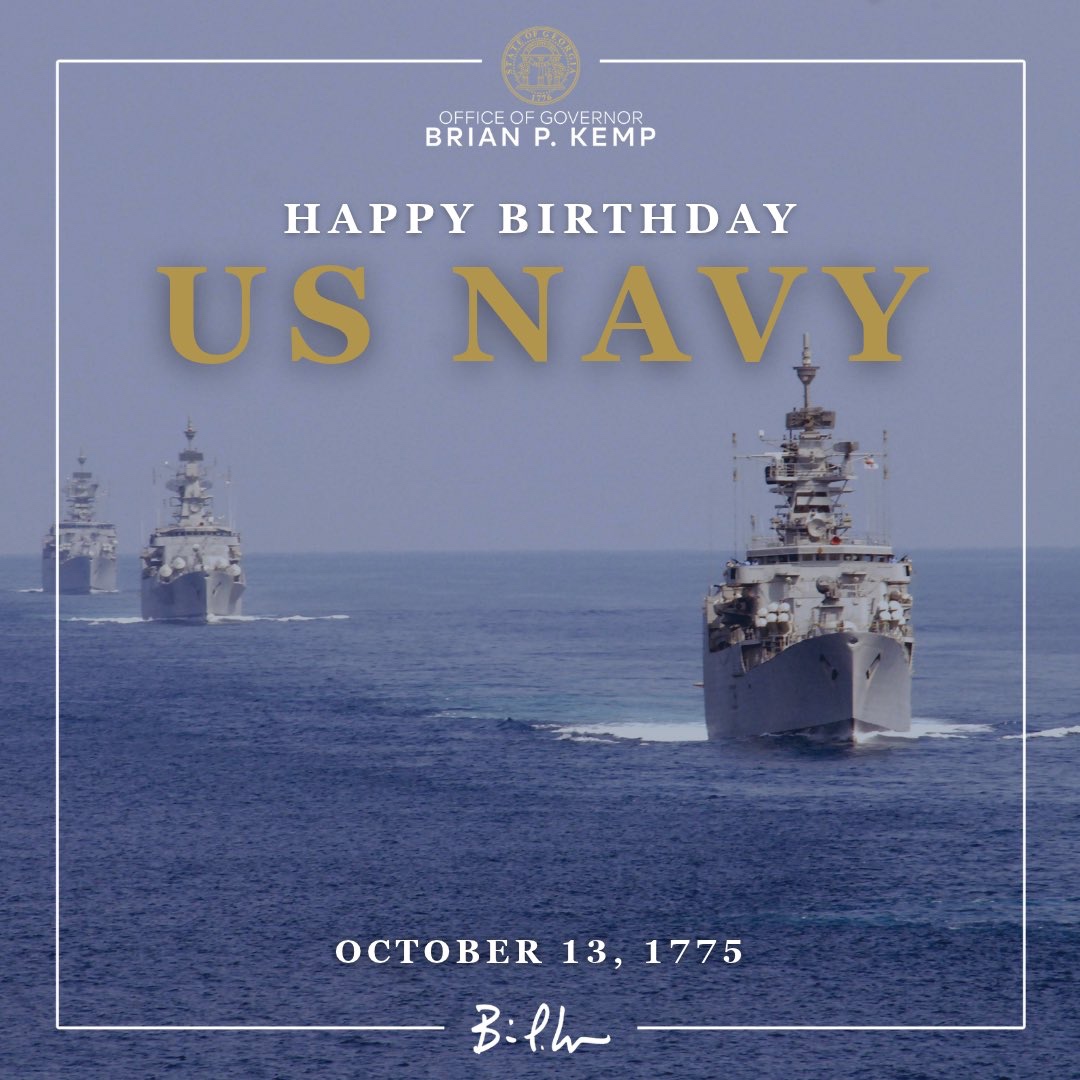
For instance, Georgia Governor Brian P. Kemp posted a message with an image of three sleek gray warships steaming in formation.

At first glance, the post seems routine, but a closer look reveals the warships are Indian Navy vessels, as Dave Brown, the Deputy Washington Bureau Chief at The Wall Street Journal, and military observers pointed out.

The ships have since been identified as INS Godavari, INS Brahmaputra, and INS Beas, although a community note on Kemp’s post flags them as Kolkata-class guided-missile destroyers.

From the early days of our nation’s founding, the Navy has stood watch over our country and defended freedom across the seas. On its birthday, we salute the sailors whose service, sacrifice, and courage carry that legacy forward. Image by: Gov Kemp on X

Despite criticism, Kemp has not taken down the post.

Another lawmaker, Ohio State Representative Mike Dovilla, paid his respects on X, saying: “Happy Birthday, U.S. Navy. I am proud of my service in naval intelligence and grateful to all who serve our nation with honor, courage, and commitment. To our sailors, veterans, and their families, thank you.”

Interestingly, though, Dovilla used an image of a Russian warship instead of a US one, a move that drew scrutiny, given that the lawmaker is a Navy Reserve commander and has previously served as a lieutenant commander in the Navy.

Dovilla deleted the post after observers pointed out the error.

Image

Meanwhile, San Diego Mayor Todd Gloria posted images of what has been identified as the Soviet-era cruiser Mikhail Kutuzov, now a museum ship based in Novorossiysk, Russia.

To make matters worse, Gloria wrote: “San Diego is a proud military town. Sailors and their families are a part of the fabric of our community. For 251 years, sailors have answered our nation’s call with courage,” further emphasizing his ignorance.

Image

In another goof-up, the Republican-aligned think tank Freedom Caucus Foundation jumped on the bandwagon of errors by using a picture of the Indian Navy ship INS Trikand. 

A Mistake That Keeps Repeating 

In 2025, the US Navy’s SEAL Museum posted an image of a Russian missile cruiser to mark the US Navy’s 250th birthday. Meanwhile, several elected representatives and public accounts used images of Indian and Russian Navy warships to mark the service’s birthday.

Representative Kyle Donahue, Representative Arvind Venkat, and Representative Andy Harris used images of Indian warships in their posts, while Senator Jim Boyd used an image of a Russian battleship cruiser to pay tribute to the US Navy for its birthday.

These are just a few of the many social media faux pas that were flagged last year.

Similarly, in 2023, Representative Cory Mills and Representative David Trone’s birthday greetings featured images of a Russian warship. On the other hand, the SEAL Legacy Foundation, which supports families of wounded and fallen United States Navy SEALs, used a Russian ship to mark the occasion, whereas the official X page of Homeland Security used the image depicting a Canadian frigate. 

Things weren’t much different in 2021, when Senator Jim Risch published a heartfelt wish for the USN’s birthday, but used a photo of what was later identified as a Pattani-class offshore patrol vessel belonging to the Royal Thai Navy, potentially built by China.

While ship identification may not be a strong suit for many in the United States, it is not much different for combat aircraft.

In a major embarrassment last year, the Pentagon’s Joint Program Office  (JPO) posted an image of the Chinese J-35A stealth fighter instead of the US F-35 Joint Strike Fighter in a Veterans Day homage post. “Today, and every day, we thank all Veterans and those currently serving for their service and sacrifice,” the Pentagon official’s post stated. However, the office took the post down as criticism mounted over the bizarre mistake.

The Pentagon’s F-35 Joint Program Office published China’s J-35 fighter on its poster for Veterans Day 2025 (Via X)

In 2023, Rep. Anna Paulina Luna—an Air Force (USAF) veteran herself—posted birthday graphics for the US Air Force (USAF) on X and Instagram that used silhouettes of Russian MiG-29 fighters. Air Force historians and defense analysts immediately flagged the image, after which the politician took it down and blamed a junior staffer for the error.

In 2021, Sen. Cindy Hyde-Smith of Mississippi made a similar error when she congratulated the US Air Force Reserve Command on its birthday with a graphic showing Russian Su-34 Fullback strike aircraft. “Happy 73rd Birthday to the @USAFReserve! Thankful for all the reservists who are constantly on the ready to serve our nation,” Hyde-Smith said on X, along with a graphic showing four Su-34 jets in flight. 

Needless to say, she deleted the post after netizens mocked her for the error.

However, Dr. Rob Lee of King’s College in London, who specializes in war studies, joked at the time that Hyde-Smith’s post was part of the “national pastime of mistaking Russian weapons for our own” among Americans.

In an even more ridiculous mistake in 2021, the official Southern Command (SOUTHCOM) account posted a birthday graphic for the US Air Force that featured silhouettes of Russian Sukhoi Su-27 fighter jets.

Meanwhile, one of the accounts connected to “Operation Inherent Resolve” posted a picture of two US Navy Boeing F/A-18E/F Super Hornets with best wishes to the air force, creating another embarrassing situation.

Similarly, Donald Trump’s 2020 reelection campaign released a “Support Our Troops”  advertisement accompanied by a photo of Russian MiG-29 fighter jets flying over troops with Kalashnikov-pattern rifles. Unsurprisingly, aviation experts widely mocked it, saying it clearly wasn’t American.

Defense analysts have long noted the mechanics behind these recurring errors. For example, modern warships and fighters share enough visual DNA- gray paint, angular superstructures, and similar radar masts- that non-specialists struggle to tell them apart at a glance.

Staffers working under deadline pressure rarely pause to verify hull numbers or distinctive features, making it a low-stakes but revealing ritual.

The post Russian & Indian Warships Hog Online Limelight as U.S. Navy Turns 251. Social Media Gaffe Continues appeared first on EURASIAN TIMES.

  •  

Top USAF General Reveals NATO Plan to Fight Russia — But it is Designed for Containment, Not Decisive Defeat

Amid growing anxieties in Europe over “the Russian threat”, the US Air Force General Alexus Grynkewich, NATO’s Supreme Allied Commander Europe (SACEUR), has unveiled what he called the alliance’s “Theory of Victory”. 

Though his Polish hosts did not seem fully satisfied, General Grynkewich assured, on October 12, at the “Warsaw Security Forum,” an annual international conference in the Polish capital, that the alliance is ready to defend itself.

Reassuring America’s reliability as an ally and Washington’s firm commitment to NATO’s Article 5, which envisages collective defense, he said that if an adversary is “foolish enough” to strike, the alliance is fully prepared to “fight tonight”.

During a panel discussion titled “Theory of Victory: How Do We Achieve Military Success Against Russia in Deterrence and Defense?” Grynkewich stated that NATO would destroy “anything and everything” that supports an attack on allied territory.

He asserted, “Should the adversary choose to press the attack or commit his reserves, we will break the warfighting system engaged against us.”

In what the experts describe as an unprecedented move to project an absolute ironclad assurance of security to the one billion citizens living under the NATO umbrella, and to send an unmistakable warning of devastating consequences to adversaries, particularly Moscow ( though he did not mention it explicitly), General Grynkewich then went on to clearly articulate key elements of what was hitherto classified as NATO’s “Theory of Victory”.

NATO had developed a well-known “Theory of Victory,” but its elements were not well understood. General Grynkewich revealed them as part of a rigorous three-phase strategic framework: “Block, Blunt, and Break”.

This triad dictates the sequential escalation and synchronization of Allied multi-domain power from the very first moments of aggression.

While Grynkewich did not explicitly mention Russia during his address, his comments clearly targeted Moscow, especially in light of NATO’s 2022 Strategic Concept, which identifies Russia as the most significant and direct threat to allied security.

“My theory of victory is simple: we will block the initial attack. If the attack persists, we will blunt it and prevent enemy advance,” he expla ned. “And if required, we will break the enemy’s forces and the operational warfighting system that is arrayed against us.”

Based on his elaboration, Phase One of Block is the first line of defense. It focuses on an immediate, unyielding denial of territory. If an adversary breaches an allied border, NATO’s forward land forces are trained to deploy instantaneously to halt the invading army directly at the point of contact.

Rather than letting an adversary establish a foothold or capture territory for political leverage, the “Block” phase aims to isolate the initial push. This relies on integrated multi-domain operations, using localized ground units heavily supported by air superiority, naval assets, space surveillance, and active cyber capabilities to immediately close the operational window on the attacker.

If an offensive survives the initial blocking force and persists, NATO transitions to the “Blunt” phase.

The goal shifts from containment to actively stripping the enemy of operational momentum and initiative. To achieve this, the alliance leverages highly advanced technological systems. Grynkewich highlighted the deployment of massive sensor networks, autonomous combat systems, and AI-driven multi-domain targeting to completely suppress the enemy’s ability to coordinate large-scale maneuvers or advance deeper into allied territory.

The final, most severe component of the strategy is the mandate to “Break” the adversary. If an aggressor refuses to cease hostilities or attempts to mobilize its strategic reserves, NATO will launch massive, far-reaching retaliatory actions. Grynkewich explicitly stated that this phase extends far beyond the physical front lines of the immediate conflict. NATO will target and destroy the entire overarching warfighting framework arrayed against it.

This means systematically dismantling command-and-control centers; physical supply and logistics networks; replenishment warehouses; communications arrays; and anything else sustaining the offensive force.

However, Grynkewich carefully balanced aggressive deterrence with diplomatic clarity, noting that NATO did not view a direct military conflict with Russia as imminent or inevitable. Instead, he stressed that the most effective tool for preserving peace is maintaining absolute readiness for war while keeping communication channels open to prevent miscalculations.

This updated strategy appears to draw directly on critical lessons from contemporary battlefields in Ukraine and the Middle East. It explicitly moves away from relying solely on hyper-expensive, exquisite military hardware. Instead, NATO is prioritizing a hybrid mix of technological enablers that pairs high-end precision weapons with large numbers of cheaper, scalable systems like attritable drones and counter-UAS platforms to overwhelm an adversary’s defenses effectively.

General Grynkewich reportedly emphasized three things in this regard: 

First is the “Eastern Flank Deterrence Initiative (EFD),” which serves as the deployment vehicle for a vast network of low-cost, expendable drones and minimally crewed or fully autonomous reconnaissance and strike systems.

Second is “AI-Powered Targeting,” which uses artificial intelligence to sift through vast data streams generated by advanced sensors, satellite arrays, and cyber intelligence. By shortening the sensor-to-shooter loop, AI-enabled networks identify, categorize, and assign targets to artillery, missile systems, or loitering munitions in real time, long before human staff could process the raw coordinates.

Third is the “System Layering” strategy, which does not replace heavy conventional hardware such as main battle tanks or fifth-generation fighter jets but rather insulates them. Cheap, modular drone walls absorb the weight of initial saturation attacks, counter enemy mass, and clear pathways, preserving high-end kinetic platforms for decisive operations against hardened infrastructure.

Overall, the emphasis on sensors, autonomous systems, precision weapons, and integrated land, air, sea, space, and cyber capabilities recognizes that contemporary combat depends as much on information, networks, and logistics as on troop numbers.

The idea is that NATO must exploit technological advantages while producing affordable systems in sufficient quantities.

NATO has periodically revised its strategies, keeping technological developments and threat environments in mind.

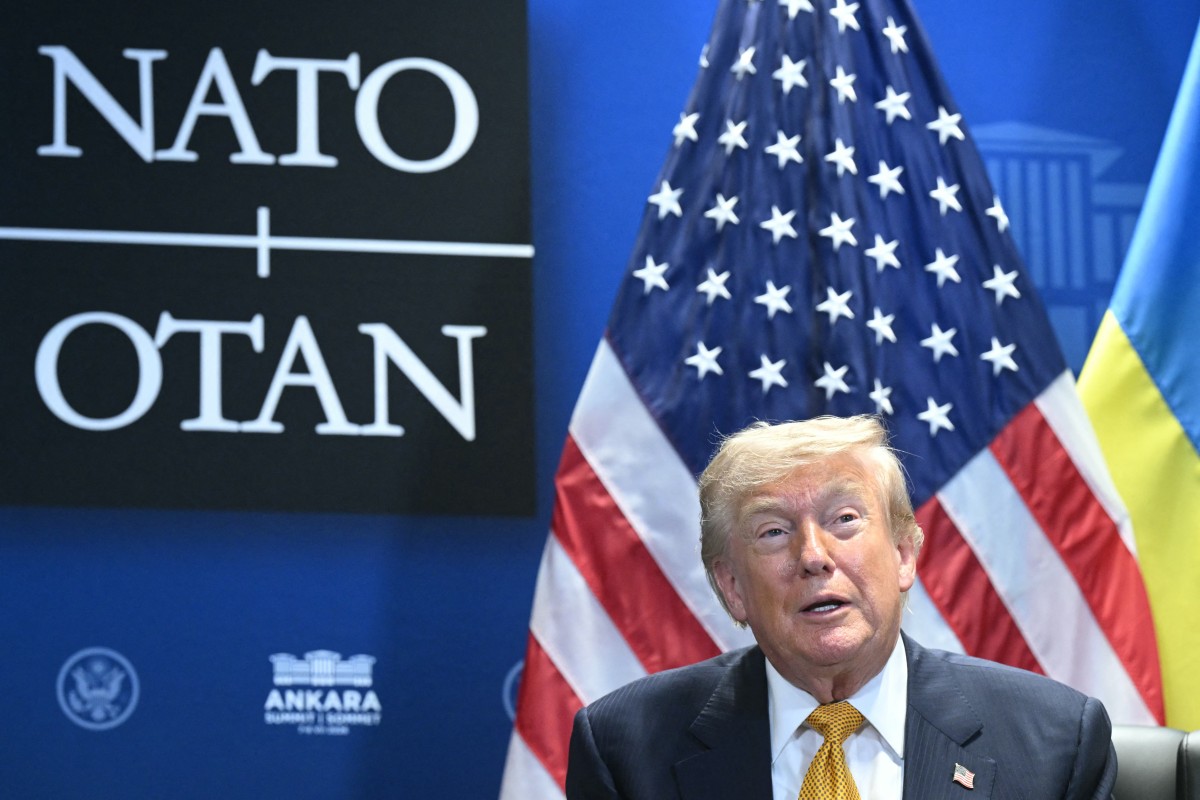
US President Donald Trump meets Ukraine’s President (not pictured) on the sidelines of the NATO Summit at the Beshtepe Presidential Compound in Ankara on July 8, 2026. The summit comes at a fraught time for the 77-year-old transatlantic alliance, as the US President demands members honor a pledge to ramp up defense spending while Washington steps back from Europe. (Photo by SAUL LOEB / AFP)

During the Cold War, the alliance relied primarily on what it called “forward defense” and “flexible response.”  The forward defense strategy supposedly committed NATO to hold the inner-German border and assumed a possible retreat across deep defensive lines before counter-attacking.

The Flexible Response strategy relied heavily on the explicit threat of nuclear escalation in the theater to offset Warsaw Pact forces’ conventional numerical superiority.

After the end of the Cold War and disintegration of the Soviet Union,  NATO was said to have adopted an expeditionary, crisis-management model. In this model, deterrence was linked to political goodwill, and force structures were optimized for out-of-area counter-insurgency campaigns.

This resulted in a lean force model with thin ammunition reserves and a lack of the rapid forward mobilization needed for high-intensity, continent-scale conventional combat.

Against this background, the “Theory of Victory” is said to address post-Cold War vulnerabilities by institutionalizing a modern denial posture. It replaces reliance on early tactical nuclear escalation with conventional, technology-driven mass.

Apparently,  it abandons the concept of “liberation after occupation,” acknowledging that the civilian cost and physical destruction associated with liberating occupied territory are strategically unacceptable in the modern geopolitical environment.

Instead, it shows the capacity to neutralize an incursion early and convince potential adversaries that the cost of an attack will always outweigh any conceivable strategic gain.

Finally, by linking it to Article 5, NATO’s latest concept displays elements of calculated “strategic ambiguity”; it is id. NATO will not publicly define the exact point at which an attack would trigger its collective-defense clause, as doing so would help adversaries calculate how far they can escalate without provoking an allied response.

The ambiguity is designed to complicate enemy calculations, ensuring that hybrid operations, gray-zone provocations, or minor border incursions carry the unpredictable risk of drawing a full, multi-domain response from the alliance.

While the reactions of America’s major European NATO allies to General Grynkewich were not available at the time of writing, it is fair to guess they were reassured that Washington is prepared to fight if attacked.

However, erstwhile Warsaw Pact member and now Russia’s biggest critic, Poland, which has joined NATO, does not seem fully satisfied. Reports quoting the Polish weekly “Polityka” question the fundamental premise of NATO’s military strategy: preventing an adversary from achieving its goals, rather than launching an offensive campaign to destroy a foreign military power fully.

This perspective, detailed by defense analyst Marek Świerczyński, unpacks the structural reality behind General Alexus Grynkewich’s “Theory of Victory” speech.

He argues that beyond NATO’s institutional focus on calculated deterrence, escalation control, and defending its current borders, the alliance should fight deep inside Russia, without crossing the border, to crush the Russian military as a whole (through missile and drone firepower).

But then, this is a limited view. Overall, General Grynkewich seems to reflect that current NATO thinking is to de-escalate with Russia, not to defeat it strategically or to change its regime. The core objective of the Theory of Victory strategy is strictly containment, deterrence, and risk management.

In that sense, the name of the theory may be a little misleading.

  • Author and veteran journalist Prakash Nanda is Chairman of the Editorial Board of the EurAsian Times and has been commenting on politics, foreign policy, and strategic affairs for nearly three decades. He is a former National Fellow of the Indian Council for Historical Research and a recipient of the Seoul Peace Prize Scholarship.
  • The author can be reached at prakash.nanda (at) hotmail.com

The post Top USAF General Reveals NATO Plan to Fight Russia — But it is Designed for Containment, Not Decisive Defeat appeared first on EURASIAN TIMES.

  •  

EU says ‘no indication’ intelligence sharing with Ukraine has stopped as Russian attacks leave 600,000 without power – as it happened

European Commission declined to comment on reported disruption to Starlink’s services in Ukraine

Rutte gets asked “is Russia foolish enough to consider attacking any of Nato countries?”

He says “we don’t think so” and that there is “no imminent threat against Nato territory,” but stresses that “if we see a build up, we will react to it.”

“We will never, ever mount a attack towards anyone else because that is not in our interest. We are a defensive alliance.”

“But here’s the main thing: we are stronger. Russia is not in a good place. These hybrid attacks, whatever it is, are a sign of weakness. What they allow us to do is to talk about it the whole day and to be rattled and to have press conferences on it. We’re not going to do that. We will react where we need to react.”

Continue reading...

© Photograph: Yan Dobronosov/Reuters

© Photograph: Yan Dobronosov/Reuters

© Photograph: Yan Dobronosov/Reuters

  •  

Are Fossil Fuels Running Out?

Have we passed peak oil – are fossil fuels running out? Richard Lyon says yes, and the transition to 'renewables' is making it worse. But peak oil is a myth, says Tilak Doshi, as he reviews Lyon's book The Energy Trap.

The post Are Fossil Fuels Running Out? appeared first on The Daily Sceptic.

  •  

Thousands of young people protest the Noboa administration in Quito

On October 10, thousands of Ecuadorians took to the streets to protest against the government of right-wing President Daniel Noboa. The demonstration was organized by the Autonomous Front of Organized Resistance (FARO) under the slogan “Government vs. People.”

A esta hora, una marcha de rechazo al Gobierno de Daniel Noboa recorre las calles de Quito. La movilización está marcada por carteles de protesta y consignas contra el mandatario y su gestión. Los manifestantes atraviesan en este momento el paso deprimido del Guambra y avanzan… pic.twitter.com/WKPfT8D9jF

— Elena Rodríguez Yánez (@ElenaDeQuito) October 10, 2026

Saturday’s demonstration followed a protest on October 8, organized by labor unions also in Quito, to protest the security, energy, health, and employment crises facing the country. They also protested government cuts to education and health care, as well as alleged mistreatment of workers, according to Edwin Bedoya, president of the United Workers’ Front (FUT).

For its part, the October 10 demonstration – which consisted mainly of high school and college students – set out from the Central University and marched through Quito. Slogans such as “If the people have no peace, neither does the government” and “Out with Noboa, out with him!” were heard along the streets occupied by the demonstrators.

The president of the Catholic University Student Federation, Jatari Ulcuango, told protesters: “Four years ago, this government promised us electricity; two years ago, too – and now the blackouts have returned. Two months ago, the government told us it would provide us with medicine, and yet we’re only receiving 60% of the supply. They’re taking us for fools.”

He added: “We’re dying outside the hospitals. Criminals are kidnapping us, murdering us, and robbing us. That’s why we’ve come out this morning. They plan to dismantle public institutions to force us to hire private security. Who has gotten rich off the health crisis? The private healthcare sector, while the people are getting poorer and poorer.”

The peaceful march headed back to the Central University, where the students gathered. Later, the students reported on social media that they had been harassed and repressed by the police, who had accompanied the entire march.

Likewise, several media outlets reported that the police were aggressive toward them. This was reported by the outlet La Barra Espaciadora, which released a video showing police officers pushing journalists.

TeleSur journalist Elena Rodríguez also reported that law enforcement officers broke the microphone she was using and struck her on the head: “I’m sick and tired of having to recount, time and time again, police attacks against the press. Today, while I was trying to document the violence with which officers were beating young protesters, I was struck on the head from behind with a baton. I turned around, showed my Telesur microphone to identify myself as a journalist, and the response was another baton strike that ended up breaking it.”

She added: “If they think that by beating me up they’re going to get me to stop documenting police brutality, to put my microphone away, or to back off several blocks so I can report from a place where I won’t be a nuisance, they’re wrong. It is not we journalists who should distance ourselves from the events. It is the police who must stop attacking us. The right to report cannot be negotiated at the point of a baton.”

The protests are taking place against the backdrop of a widespread crisis in the country, which includes the worst security crisis in its history (tens of thousands of deaths due to violence between drug trafficking gangs), a very serious health crisis (a lack of supplies and medicines in the public health system), and other major crises such as those in education, public investment, and employment.

Local elections will be held in November, which will reveal the extent of support – or lack thereof – for President Noboa and his neoliberal government agenda, which aligns with the hemispheric security strategy led by the Trump administration.

  •  

The Millennium Puzzle: The Navier–Stokes Equations and the Unsettling September of 2026

September brought a flurry of developments in the use of AI in mathematics. The biggest, though far from the only one, was OpenAI’s publication of a solution to the Millennium Prize Problem concerning the Navier–Stokes equations. The announcement set off a heated debate about AI’s impact on the future of science. T-invariant looks at OpenAI’s result and the events that followed it (spoiler: mathematics has changed, and it was AI that changed it).

Top news on scientists’ work and experiences during the war, along with videos and infographics — subscribe to the T-invariant Telegram channel to stay updated.

On September 8, OpenAI published a press release titled “On the Navier–Stokes Millennium Prize Problem.” It announced that an internal company model (not yet released and more powerful than GPT-6 Astra) had solved one of the Millennium Prize Problems posed by the Clay Mathematics Institute in 2000. OpenAI’s proof was linked right below the headline: a paper in conventional mathematical notation and a formal proof in the Lean language. The company said it would not claim the Clay Institute’s $1 million prize.

The press release refers to work on the Euler equations (a problem closely related to the Navier–Stokes problem; more on it below) by mathematicians Levent Alpöge (an Anthropic employee) and Tristan Buckmaster (a professor of mathematics at New York University). OpenAI acknowledged that it turned its attention to the Navier–Stokes problem on September 1, after hearing rumors that two Millennium Problems had been solved. Building on a theory that mathematicians had developed over nearly two centuries, OpenAI then solved the Millennium Problem in 88 hours using 10,000 agents. Another 17 hours went into formalizing the proof in Lean, which confirmed that it was correct.

The image shows a local incompressible flow. Orange indicates faster angular rotation, turquoise slower rotation. The circulation speed depends on the radius. The trajectories show inward spiraling motion and axial stretching. Illustration: OpenAI

OpenAI’s result drew enormous attention, not only from mathematicians but from the broader public. Today, nearly every educated person has heard of the Clay Prize. That’s not because non-specialists have a deep grasp of the Millennium Problems, but because of the scandal surrounding the first problem on the Clay list to be solved (there are seven in all): the Poincaré conjecture. In 2010, the $1 million prize was awarded to Grigori Perelman, who turned it down. Perelman explained that he disagreed with the decision to give the award to him alone: in his view, the American mathematician Richard Hamilton had contributed just as much to the proof. So no one received the Clay Prize that time. It looks like no one will collect the prize for the second Millennium Problem either.

The other reason for the extraordinary buzz around OpenAI’s proof is far more topical. All sorts of people are asking: “If AI can really solve problems of incredible difficulty at the very frontier of mathematics, does that mean artificial intelligence has beaten humans — and that first programmers and now even top-tier mathematicians are no longer needed?” To begin answering that question, we need at least a rough idea of what the Navier–Stokes equations are and what kind of solution OpenAI found.

A Cup of Tea and the Navier–Stokes Equations

Picture an ordinary cup of tea. You pick up a teaspoon and start stirring. If you move the spoon in circles, a funnel (a vortex) forms in the cup. Stop stirring, and the funnel quickly smooths out. Let’s use this simple example to formulate the Navier–Stokes problem.

The spoon is an external force acting on the liquid. As long as you keep stirring (the external force is acting), the funnel holds; if you take the spoon out (the force drops to zero), the funnel keeps spinning for a while under its own momentum and then smooths out. What smooths it out is internal friction, or viscosity. Different liquids have different viscosities: water, for instance, is far less viscous than honey. In honey, it is harder to produce even a small funnel (you need to apply a large external force).

The Navier–Stokes equations are essentially Newton’s second law for an incompressible viscous fluid. The French mathematician Claude-Louis Navier proposed the first version of the equations back in 1822 — more than 200 years ago. The most convincing derivation was given by the British mathematician George Stokes in an 1845 paper. The Navier–Stokes equations worked beautifully, and they still do. But mathematicians are always interested in limits: when does a model start to break down? Newtonian mechanics, for example, starts to “glitch” in applications as familiar as the navigation app on your phone. The model has to be rebuilt, or GPS won’t work. Today’s navigation systems account for both the satellites’ velocity and the difference in gravity between the Earth’s surface and orbit; here, it is not Newton’s laws that apply, but relativity (both special and general).

For the Navier–Stokes equations, the limit of applicability is the possibility of a “blowup”: can the fluid’s velocity become “infinite” in finite time under a finite external force? That would mean the model breaks down under such conditions. This is the Millennium Problem.

OpenAI says: yes, it can. We’ll begin our discussion of the problem with the Euler equations. They describe an ideal incompressible fluid — that is, a fluid with no viscosity. If you stir such a fluid with a spoon, the funnel will never smooth out (here we ignore friction against the walls of the cup). There are two problems for the Euler equations: one with an external force and one without.

These problems ask the same question as the Navier–Stokes problem: can you stir the tea so cleverly that the funnel behaves in a completely unusual way — speeding up until its rotation becomes infinitely fast? It all began with a solution to the Euler equations with external forcing. Alpöge and Buckmaster reported that they had solved this problem. They showed that the force acting on an ideal fluid can be chosen so that the fluid “blows up”: the vortex reaches infinite speed even though both the applied force and the time are finite. Buckmaster used an internal Anthropic model to find the solution, but for the previous two months he had been working with OpenAI Codex. This is what raised suspicions that OpenAI had “peeked” at the solution, though the company insists nothing of the sort happened. But by the company’s own admission, the rumor that a solution to one of the open problems on the Clay Institute’s list (no one knew which) might have been found was what set things in motion: a huge multi-agent system was launched, with AI agents working intensively alongside a team of OpenAI mathematicians and engineers.

At first, the team tried to tackle every variant of every open Millennium Problem at once, along with simpler related problems. The first to give way was the Euler problem without external forcing. Can the initial conditions (the velocity distribution) be chosen so that even after we take the spoon out of the cup, the vortex keeps spinning up on its own until it reaches infinite speed? One group of agents solved this Euler problem: they found an ingenious initial velocity distribution such that, even after the external force stopped acting (we took the spoon out), the vortex spun up to infinite speed. Once this very hard problem was solved, all resources were thrown at the Navier–Stokes equations — which, unlike the Euler equations, describe a viscous fluid. Finding a force that, in finite time, produces a vortex with infinite speed in a viscous fluid is much harder: viscosity smooths the vortex out and damps it.

OpenAI was deliberately going after the Millennium Problem itself: the Navier–Stokes equations with an external force and viscosity. These are, in fact, perfectly normal physical conditions — but the solution it found was, to put it mildly, “abnormal.” OpenAI did solve the Millennium Problem, fair and square, but mathematicians had hoped for something different from the proof. They expected not an elaborate counterexample, but a deeper understanding of turbulence. Many were disappointed.

Under the terms of the Millennium Problem, the external force acting on the fluid must be “infinitely smooth” (the function itself and all its derivatives must be differentiable). OpenAI’s agents assembled this force literally piece by piece, like a jigsaw puzzle. The pieces were fitted together so precisely that they stretched and twisted the vortex; each piece depended on scale, and together they formed an infinitely smooth forcing. Mathematicians had tried many times to solve this problem, but no human can hold in their head, let alone write down, a vast number of different conditions that constantly have to be readjusted. The AI agents pulled it off.

But one more version of the Millennium Problem remains: the Navier–Stokes equations without an external force. What happens then? Can you set a viscous fluid spinning, take the spoon out, and simply watch the vortex accelerate to infinite speed? (Recall that for an ideal fluid, the AI agents did solve this problem.) Mathematicians expected the solution with external forcing to provide a clue to this even harder problem. But the unforced Navier–Stokes problem has held out. It remains open to this day.

The Fields Medalists’ Statement

On September 11 (three days after OpenAI’s press release), a group of Fields Medalists (the Fields Medal is the most prestigious award in mathematics) signed an open letter titled “A Severe Misalignment of AI in Mathematics.”. To date, 28 people have signed it. Among them are leading authorities from every generation: the patriarch Pierre Deligne (who received the medal in 1978), Terence Tao (2006), and rising stars Peter Scholze (2018) and Maryna Viazovska (2022). Six mathematicians trained in the Soviet and Russian mathematical school also signed: Vladimir Drinfeld, Maxim Kontsevich, Grigory Margulis, Andrei Okounkov, Stanislav Smirnov, and Efim Zelmanov (none of whom works in Russia today). The 28 signatories make up more than half of all living Fields Medalists. A collective statement like this is unprecedented.

What alarmed them? The laureates’ manifesto identifies several threats. The first and most important: AI companies are using famous problems as benchmarks. Their message is: look what we can do — buy our tokens, and you can do it too. But the goal of mathematics is not a “true/false” answer plus a thousand pages of unreadable proof code, even if that code is correct. Mathematics seeks to understand the world, and answers like these are more likely to close off paths than to deliver new understanding. Second, with results being published in such a rush, questions of authorship and plagiarism are bound to arise. The prospect of machines being trained on their conjectures and ideas is pushing mathematicians to hide their results: they are afraid to discuss ideas on social media and won’t even present unfinished work at conferences. And that is very bad: science is a collective enterprise. Third, mathematics lives through its students, who grow by solving hard problems. If a neural network does this quickly and incomprehensibly, the human chain of passing on knowledge and training new scientists will simply break.

But here’s the question: can this process be stopped, and should it be? Opinions differ.

[[socialnetworks]]

On September 21, an advisory group on the use of AI in mathematics was set up at the Institute for Advanced Study in collaboration with OpenAI. It includes nine prominent mathematicians, among them Fields Medalists Timothy Gowers, Edward Witten, and — rather surprisingly — Martin Hairer, who had signed the “Severe Misalignment” letter along with his colleagues. In effect, there is no hard line between mathematicians who are betting on AI methods and those who hold more traditional views. Terence Tao is a vivid example: he is trying to slow AI companies down a little, while also making extensive use of AI methods in his own work.

How to Read 166 Pages of Unreadable Text Overnight

On September 4, Anthropic issued a press release announcing: “We are sharing the first complete computer-checked proof of Fermat’s Last Theorem. Claude worked largely autonomously over 11 days to write the proof in the Lean programming language.” Claude wrote Lean programs to check a proof that built on the Wiles–Taylor result. And Lean confirmed that the proof was correct. In fact, for mathematics, this result may be even more important than the puzzle OpenAI put together. You no longer have to take the author’s word for it, rely on authority and collective consensus, or check every step yourself. Let Lean do it.

Here’s a historical example. Vladimir Arnold recalled getting to know the eminent mathematician René Thom (Fields Medalist, 1958): “And indeed, in 1965 it was Thom I became closest friends with. The only trouble was that I simply could not understand his theorem from the paper ‘Topological Models in Biology,’ where he laid the foundations of catastrophe theory. For a couple of decades, Thom gave me the same perfectly clear answer to my questions about this theorem: ‘There will always be fools to find proofs for our theorems.’ In the end, I asked my graduate student B. A. Khesin to sort the matter out, and he discovered that the theorem Thom had announced many decades earlier was false. Specifically, Thom claimed that the number of ‘elementary catastrophes’ … is seven (for the four parameters of our space-time). It turned out, however, that this ‘number of Thom’s catastrophes’ cannot be less than 13 (and, what’s more, no one knows to this day whether their number is even finite, or whether there are infinitely many different catastrophes).”

For “a couple of decades,” no “fool” turned up to check René Thom’s result. And this is not an isolated case. Today, Lean could handle such a task — and it certainly wouldn’t need “a couple of decades.”

It would be completely unfair to say that OpenAI “didn’t do anything — it just unleashed a swarm of agents on the problem.” OpenAI’s mathematicians and engineers conducted a huge orchestra of AI agents that searched for those very puzzle pieces, formulated hypotheses, checked them with Lean, discarded the false ones, used the correct ones — and all the while communicated both with each other and with humans. Setting up a system like that and getting it to work is an outstanding achievement.

On September 17, three mathematicians who are well-known experts on the Navier–Stokes equations published a paper that placed OpenAI’s proof within the broader development of fluid dynamics. Peter Constantin, Mihaela Ignatova, and Vlad Vicol proved that the type of blowup OpenAI constructed is impossible when there is no forcing (or when the forcing is analytic). Whether a blowup of some other form is possible is still unknown, but the way OpenAI assembled its puzzle won’t work there.

But perhaps even more interesting than the result is how the mathematicians worked. They had nine days to prepare and release the preprint. And it isn’t a short preprint, either: 34 pages. Of course, they had a great deal of prior work to draw on, but the speed is simply astonishing. In the paper itself, they describe how it came together.

The mathematicians used publicly available versions of Claude (Opus 5 and Fable 5.1 in Claude Code) and ChatGPT (Sol and Astra in Codex). They write: “By far the heaviest use of these AI systems was in deciphering the statements of the OpenAI paper. Claude and ChatGPT were used to analyze that manuscript, and over the course of several interactive sessions the main properties of the solutions in the OpenAI construction were extracted… These properties were subsequently cross-checked against the publicly available PDF version of and the Lean code released by OpenAI.”

Once the mathematicians understood what OpenAI had done, they turned to their own work. First, they gave the AI agents their published papers and handed them a draft of the new paper containing the main theorem. Claude and ChatGPT were used to turn this draft into a manuscript with complete proofs of every statement. The text was then reworked in Claude Code under the authors’ direct guidance and supervision; this process involved not only stylistic editing but also checking every mathematical calculation. The mathematicians write: “Every suggestion, computation, and reference produced by the AI systems was independently verified and, where necessary, corrected or reformulated by the authors, who take full responsibility for the manuscript as it is presently written.”

Doing all this work without AI in such a short time would have been impossible. The 166-page paper written by OpenAI’s agents really is unreadable — but unreadable for humans; for AI, it is a perfectly accessible text. In other words, human mathematicians were not cut out of writing the paper. On the contrary, their work sped up many times over.

Up-to-date videos on science during wartime, interviews, podcasts, and streams with prominent scientists — subscribe to the T-invariant YouTube channel!

Vladimir Voevodsky’s Program

In 2012, Fields Medalist Vladimir Voevodsky said in an interview: “Pure mathematics works with models of a high level of abstraction and low complexity (mathematicians like to call this low complexity elegance). Applied mathematics works with models that are more concrete but highly complex (many variables, equations, and so on). Interesting applications of the ideas of modern pure mathematics most likely lie in the domain of high abstraction and high complexity. This domain is practically inaccessible today, largely because of the human brain’s limited ability to work with such models. Once we learn to use computers to work with abstract mathematical objects, this problem will gradually fade into the background, and interesting applications of the ideas of today’s abstract mathematics will emerge.”

The 166-page proof built by 10,000 agents falls squarely within that domain of “high abstraction and high complexity” the human brain cannot handle. Yet Peter Constantin and his colleagues managed it with the help of AI. In the same interview, Voevodsky estimated how long it would take to formalize his own proof of the Milnor conjecture in the Coq system as it existed in 2012: about 3–4 years. Formalizing OpenAI’s proof took 17 hours.

In 2012, Voevodsky’s words sounded like science fiction. Today, this is routine work. His intuition was absolutely right, and one can only regret that Voevodsky did not live to see his program come to life.

The Unsettling September of 2026

September 2026 will be remembered by more than just mathematicians. Something profoundly important happened in those few short weeks. For now, it is hard even to gauge the consequences. But a few things can be said.

René Thom brushed it off: “There will always be fools to find proofs for our theorems.” September 2026 showed that such “fools” have indeed turned up — and they work faster and more reliably than humans: they find a construction in 88 hours and verify it in 17. But Thom had good reason to be confident: he was looking not for proofs, but for understanding. And this is where machines cannot yet replace humans. Constantin, Ignatova, and Vicol needed just nine days to figure out what OpenAI’s 166-page puzzle really is and where its limits lie. Perhaps this is what the new mathematics will look like: machines find and verify, humans understand.

Before September 2026, mathematicians asked: will AI be able to solve the great problems? Now the question is different: will humans always be able to understand those solutions? For now, they can — but with AI’s help, too.

Support T-invariant’s work by subscribing to our Patreon and choosing a donation amount that suits you.

The post The Millennium Puzzle: The Navier–Stokes Equations and the Unsettling September of 2026 appeared first on Т-инвариант / T-invariant.

  •  

A study unravels the genetic mystery of a cobra divided by sea

COLOMBO – Sri Lanka’s spectacled cobra (Naja naja) carries a two-million-year-old genetic mystery, and a new study finds that the island’s cobras form a genetically distinct lineage, reopening a taxonomic question raised by a Sri Lankan zoologist nearly nine decades ago. The study also established that the spectacled cobra has evolved from an African ancestor that reached the region via the Middle East. The story dates back to 1939, when Sri Lankan zoologist P. E. P. Deraniyagala described a distinctive form of the spectacled cobra with additional eye-like markings on its hood. He named it Naia naia colour var. polyocellata. At the time, it was treated as a color morph of the Indian spectacled cobra than a distinct subspecies native to Sri Lanka. Deraniyagala returned to cobra taxonomy in 1945, proposing several geographical races of the spectacled cobra across the Indian subcontinent, and in 1960, revisited cobra taxonomy. Subsequent morphological work, however, consolidated these geographical forms under Naja naja. Then, in 2022, the question was reopened. A genetic study proposed resurrecting Deraniyagala’s polyocellata as a separate species as Naja polyocellata, after finding substantial genetic differences between Sri Lankan cobras and the Indian mainland cobras. An albino cobra is a snake with a genetic mutation that causes a complete lack of dark pigments, and such unusually colored cobras are reported more often in some regions than others. Image courtesy of Dushantha Kandambi. However, that proposal was challenged the following year. In 2023, herpetologists Wolfgang Wüster of Bangor University, U.K., and Frank…This article was originally published on Mongabay

  •  

‘Part of the fascist playbook’: Ilhan Omar condemns Trump DHS raid on her home

US Rep. Ilhan Omar (D-MN) poses for a portrait in her office on Capitol Hill on Wednesday December 10, 2025. Photo by Demetrius Freeman/The Washington Post via Getty Images
Common Dreams Logo

This story originally appeared in Common Dreams on Oct. 13, 2026. It is shared here under a Creative Commons (CC BY-NC-ND 3.0) license.

US Rep. Ilhan Omar on Monday forcefully condemned the Department of Homeland Security’s raid on her Washington, DC home as part of a broader effort to weaponize federal law enforcement against progressives who oppose President Donald Trump’s agenda.

“This is part of the fascist playbook to rile up Trump’s die-hard supporters and give them a big distraction in advance of the midterms,” Omar (D-Minn.) wrote in an email distributed by the Progressive Change Campaign Committee hours after the raid. “With this obviously political investigation, Trump is telling his voters: ‘Ignore the price of gas, ignore the war in Iran, ignore that you’re losing your healthcare—we want you to get angry about this instead.’”

The email followed a statement issued by Omar’s office saying that the congresswoman “has done nothing wrong” and condemning the raid as “an outrageous abuse of power.”

“For a decade, Donald Trump has relentlessly targeted Congresswoman Ilhan Omar with inflammatory rhetoric, repeatedly putting a target on her back,” the statement read. “Now, those attacks have escalated to a pointless federal raid.”

The Trump Justice Department said the raid, executed by the investigative arm of DHS, was “part of an ongoing federal criminal investigation.” Trump administration officials are reportedly probing whether Omar, who entered the US as a child refugee from Somalia and became a citizen in 2000, is in the country illegally. CBS News reported that the investigation centers on paperwork completed by Omar’s late father when she was a child.

Trump told reporters at the White House on Monday that he has “nothing to do with” the Omar investigation while attacking her as a “terrible person.” Omar and the Somali American community in Minnesota have been frequent targets of the president’s bigoted attacks, and Trump has called for the Democratic lawmaker to be jailed or deported.

“For ten years, Trump has targeted me with baseless lies and smear campaigns. This is just the latest escalation in his campaign of political intimidation. I will not be silenced,” Omar wrote in a social media post on Monday.

In the campaign email, Omar called the federal investigation a “sham” and “further proof” that Trump is “willing to use the power of the federal government to try to intimidate and silence anyone who stands up to him.”

“It’s up to us to make sure it doesn’t work,” Omar added.

The raid on Omar’s home drew widespread condemnation, including from top Democrats in Congress. The leadership of the House Democratic caucus issued a statement calling the raid a “deeply disturbing” act that “raises serious questions about the continued corrupt weaponization of the federal government against Donald Trump’s adversaries.”

Rep. Sydney Kamlager-Dove (D-Calif.) denounced the raid as “fascism in the extreme.”

“Trump is weaponizing the federal government to escalate his racist attacks against Rep. Omar, undermine her ahead of the midterms, and distract from his failures as president,” Kamlager-Dove added.

  •  
❌