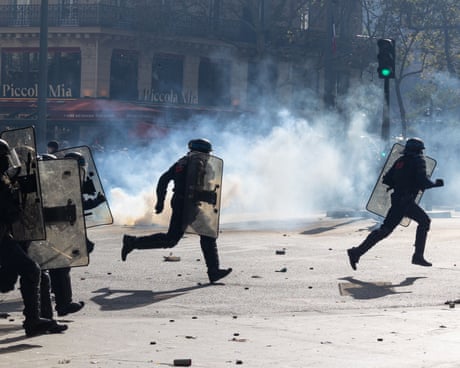
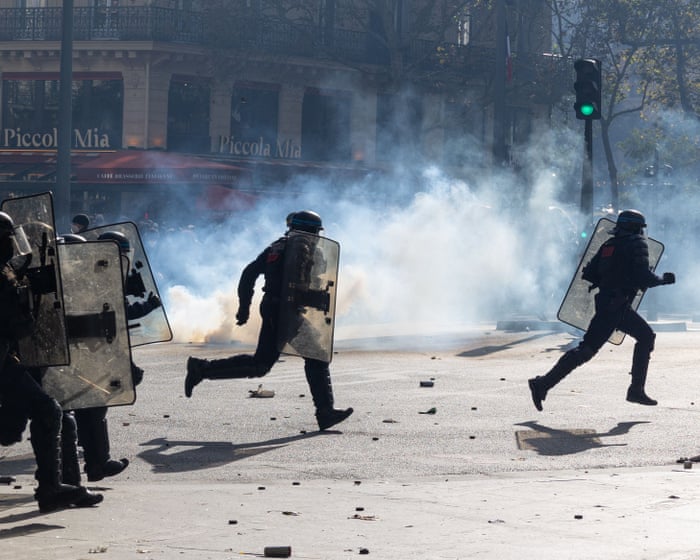
Macron echoed other government officials in blaming much of the violence on far-left activists, accusing them of attacking police and public buildings to foment chaos.
Macron echoed other government officials in blaming much of the violence on far-left activists, accusing them of attacking police and public buildings to foment chaos.
Chaos broke out on the streets of Paris again on Sunday as the multicultural youth revolts saw further looting and arson, and a specialist police task force was deployed to the French capital to quell the unrest.
Novos confrontos eclodiram em Paris neste domingo (18), um dia depois de a França ter vivido um dos piores dias de agitação dos últimos anos, com protestos contra os preços altos que deixaram um manifestante morto, milhares de pessoas presas e lojas saqueadas ou danificadas em todo o país.
Manifestações em todo o país se transformaram em tumultos no sábado, com uma prefeitura incendiada, lojas saqueadas e prédios cobertos de pichações, enquanto grupos violentos entraram em confronto com a polícia em cidades por todo o país.
Um manifestante morreu após sofrer uma parada cardíaca durante os protestos em Paris. A polícia realizou mais de 2 mil prisões em toda a França, enquanto mais de 600 policiais ficaram feridos, informou o ministro do Interior.
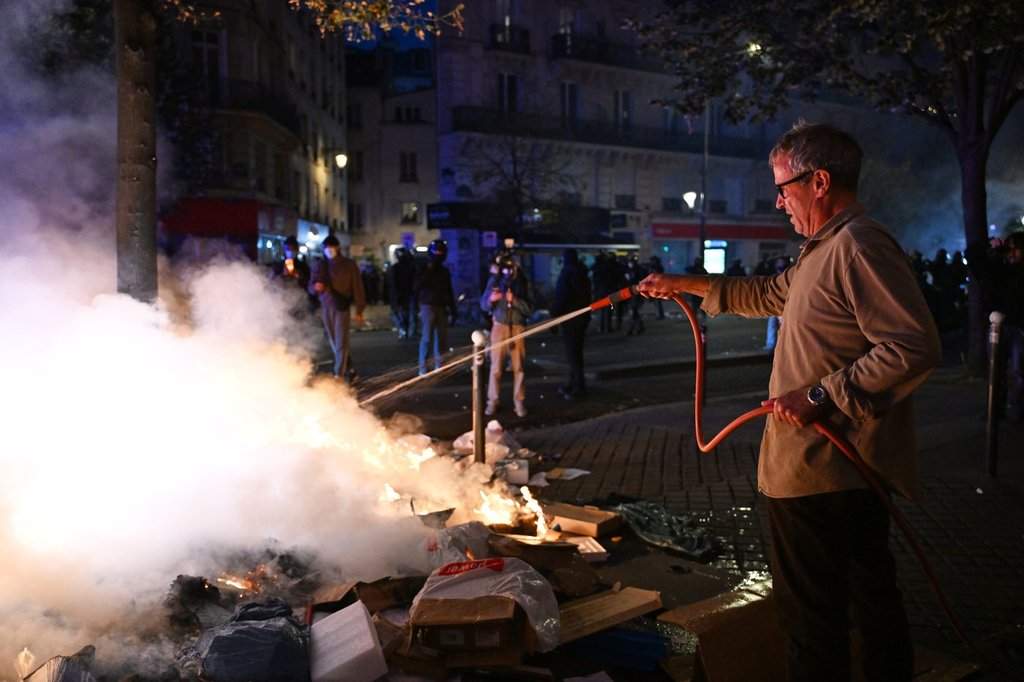
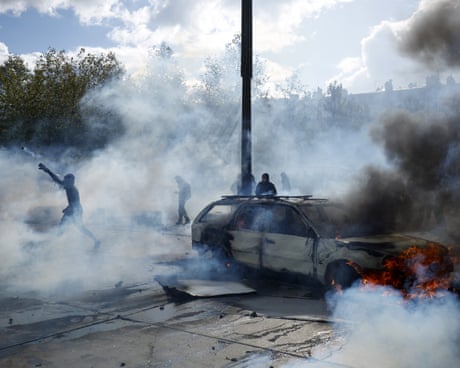
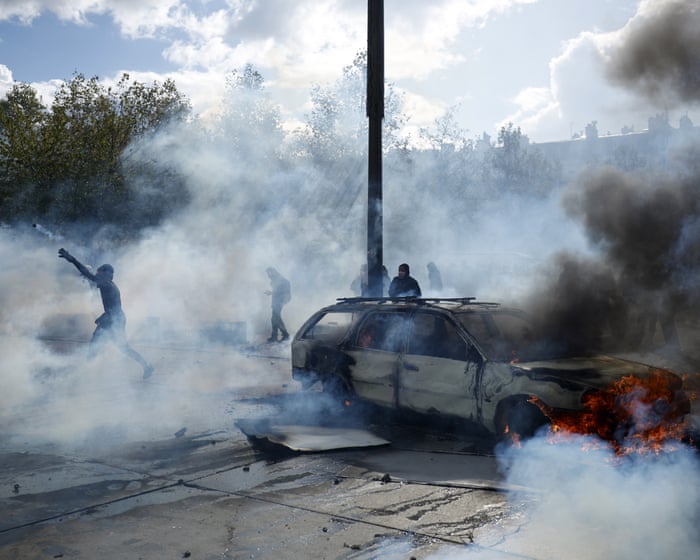
Chamas e fumaça nas ruas de Paris, durante protestos da população contra os custos de vida e a alta dos preços dos combustíveis - REUTERS/Abdul Saboor/Proibida reprodução
“Aqui parece uma zona de guerra”, disse o empresário holandês Tije De Boer, que havia vindo a Paris com seus filhos para visitar um amigo e afirmou que os protestos o forçaram a deixar seu hotel na Place de la République, um dos pontos mais conturbados no sábado (17).
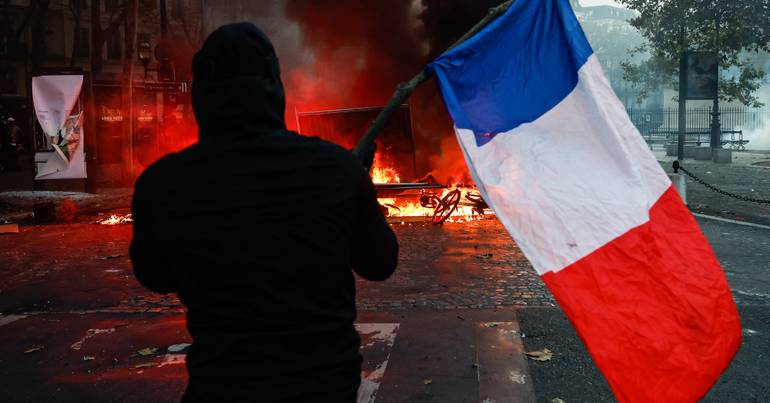
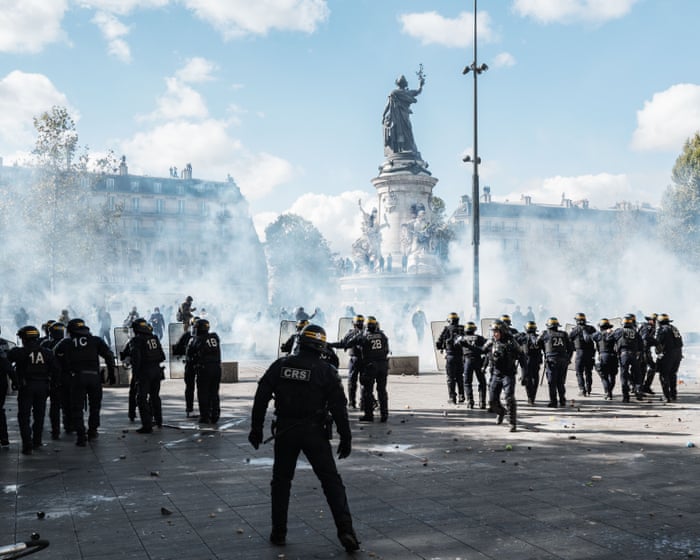
A polícia voltou a lançar gás lacrimogêneo contra os manifestantes na Place de la République e bicicletas foram incendiadas na tarde de domingo, um sinal de que as tensões ainda não haviam se acalmado totalmente na capital.
Mais de meio milhão de pessoas participaram de marchas em dezenas de cidades no sábado, marcando a convergência de um movimento estudantil que já dura um mês com um descontentamento social mais amplo contra o aumento do custo de vida e o declínio dos serviços públicos.
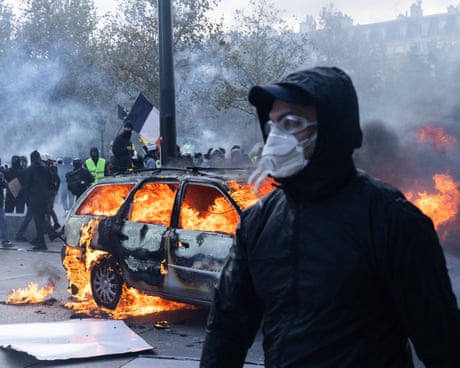
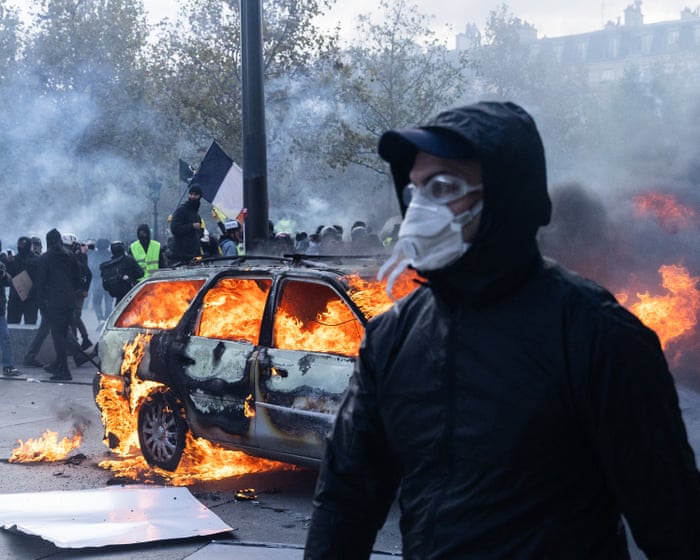
Carro incendiado perto da estátua de Marianne, na Place de la Rèpublique - REUTERS/Abdul Saboor/Proibida reprodução
O presidente Emmanuel Macron fará um pronunciamento à nação às 20h, horário local, no domingo, informou seu gabinete.
Os distúrbios de sábado revelaram a profunda raiva contra Macron, que deixará o cargo em 2027 após uma década no poder cada vez mais marcada pelo descontentamento social, uma economia fraca e uma dívida galopante.
O governo atribuiu a violência a grupos de extrema esquerda e ultra-esquerda, bem como a criminosos que, segundo o governo, instigaram os saques.
O líder da extrema direita francesa, Jordan Bardella, afirmou que a França havia sido “humilhada” e pediu que Macron renunciasse.
“Estamos pagando por décadas de negligência, perda de autoridade e pelo desarmamento moral, psicológico e material de nossas forças de segurança interna”, disse ele durante visita a uma delegacia de polícia em Paris.
Lojas danificadas
Ruas comerciais foram tomadas por incêndios provocados pelos manifestantes - REUTERS/Abdul Saboor/Proibida reprodução
Enquanto centenas de milhares protestavam pacificamente, grupos marginais violentos atacaram prédios públicos, saquearam butiques de luxo e supermercados e atacaram veículos e policiais.
Uma operação maciça de limpeza teve início em cidades que vão de Lille, no norte, a Marselha, no sul, e de Estrasburgo, no leste, a Bordeaux, no sudoeste, onde uma multidão mascarada invadiu a residência do prefeito local.
O ministro do Interior, Laurent Nunez, afirmou que várias centenas de lojas foram danificadas no sábado.
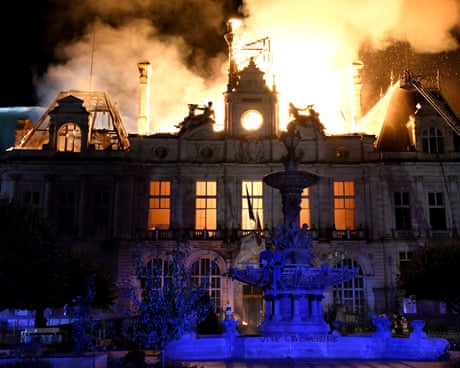
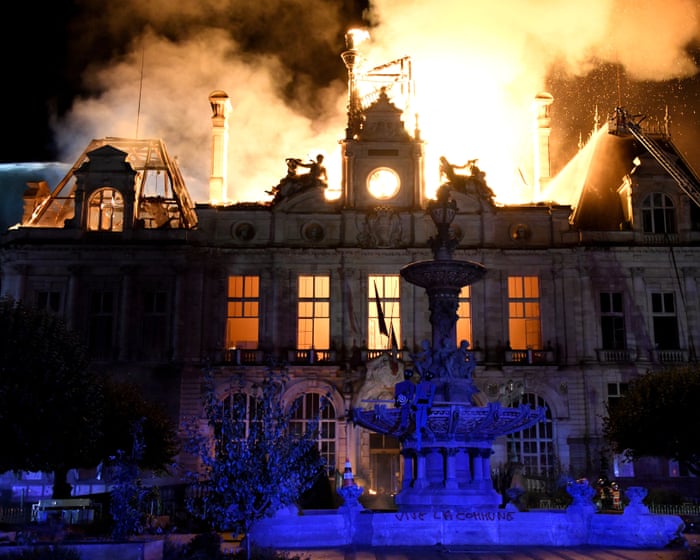
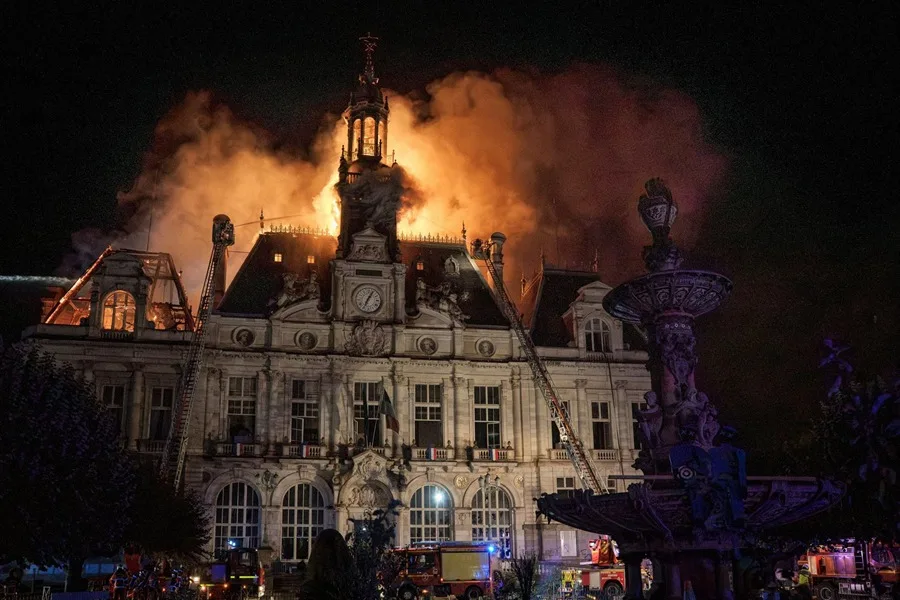
Em Limoges, no sudoeste da França, o prefeito Guillaume Guerin denunciou o caos após a prefeitura da cidade, de 143 anos, ter sido incendiada e amplamente destruída em um ataque criminoso no sábado, o que gerou comparações com o incêndio de 2019 que devastou a Catedral de Notre-Dame, em Paris.
“Houve uma intenção clara e premeditada de incendiar a prefeitura, e as pessoas que estavam lá dentro temeram por suas vidas”, disse Guerin à Reuters. Ele ameaçou renunciar caso a cidade não recebesse os recursos necessários para reparar a prefeitura.
Caminhão dos Bombeiros trabalha no rescaldo do incêndio ocorrido na noite de Sábado, na prefeitura de Limoges, na França - Reuters/Clotaire Achi/proibida reprodução
Eleições
Os distúrbios aumentaram a pressão sobre o presidente Macron e seu governo antes da eleição presidencial prevista para o próximo ano. O primeiro-ministro Sébastien Lecornu atribuiu os distúrbios à “extrema esquerda” e aos criminosos.
O ministro da Economia, Roland Lescure, prometeu apoio no domingo aos empresários que sofreram prejuízos. “Quem destruir coisas vai pagar, reparar os danos e ser responsabilizado por sua intenção de semear o caos”, disse Lescure em comunicado.
O prefeito de Bordeaux, Thomas Cazenave, disse que até 100 lojas foram saqueadas em sua cidade, enquanto o prefeito de Marselha, Benoit Payan, anunciou ajuda financeira de emergência para apoiar as empresas afetadas pela violência.
O presidente-executivo da rede francesa de varejo Carrefour, Alexandre Bompard, disse à emissora francesa BFMTV que 50 lojas da empresa foram danificadas, incluindo 20 que foram saqueadas, com prejuízos decorrentes dos danos chegando a dezenas de milhões de euros.
Os protestos começaram no mês passado devido às condições das escolas e à escassez de professores nos subúrbios da classe trabalhadora, antes de se transformarem em um movimento contra a desigualdade, os cortes nos gastos públicos e o aumento do custo de vida.
*Reportagem adicional de Natasa Bansagi, Janis Laizans, Abdul Saboor e Clotaire Achi
Confusão na Praça da República, em Paris, com novos incêndios e pilhagens de lojas; alguns cafés fecharam esplanadas. Macron vai falar. Os grandes conflitos e roubos aconteceram no sábado, em diversas cidades de França, mas prolongaram-se para hoje, domingo. Na Praça da República, em Paris, que já estava muito destruída e danificada, formou-se uma aglomeração não autorizada. Era um novo protesto, provavelmente contra o custo de vida em França, mas foi rapidamente dispersado. A polícia já estava no local, de prevenção, e usou gás lacrimogéneo. No entanto, os grupos espalharam-se pela área circundante, criando uma confusão inicial que aumentou a
Ministers, officials and police under pressure over response to protests as government holds crisis talks amid ‘colossal failure of the state’
The French president, Emmanuel Macron, has criticised “unbridled violence” after one of the most violent days of unrest in years left public buildings burned, hundreds of shops destroyed and looted and at least 2,400 people arrested in cities across the country.
“Watching these images, we have all asked ourselves how could French people do this to France?” he said in a televised address.
It’s a perfect storm of protesters with heartfelt grievances and others set on conflict. The key here is the sense of betrayal that united them on the streets
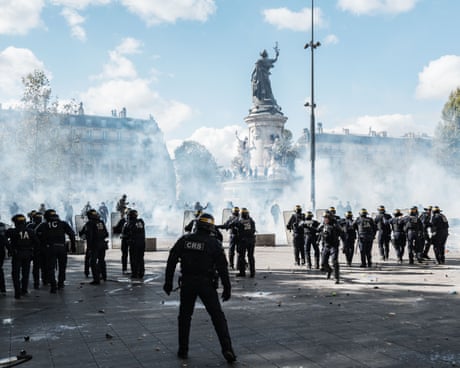
The first thing I learned on the streets of Paris this weekend is that there is no arguing with teargas. I arrived at Place de la République just after 1pm yesterday. The mood was festive until police started firing volleys of teargas into the square from Rue du Faubourg-du-Temple.
I didn’t see the inciting incident – if there even was one – and tried walking into the cloud of CS gas hanging in the air. It was impossible. The gas clings to your nose and burns your eyes, and you quickly start struggling to breathe. I retreated towards the Boulevard de Magenta, blinking furiously to stop the stinging.
Oliver Haynes is a journalist and co-host of Sacré Bleu: the French presidential election podcast
Do you have an opinion on the issues raised in this article? If you would like to submit a response of up to 300 words by email to be considered for publication in our letters section, please click here.
Around 1,800 people arrested after hundreds of shops looted, a historic building burned to the ground, and a Paris synagogue vandalized; some 500 emergency personnel injured
Nationwide demonstrations left 150 security personnel injured, one person dead and a historic town hall in Limoges severely damaged by fire.
French authorities reported 855 arrests in the Paris metropolitan area after nationwide protests on Saturday escalated into clashes, looting and property damage. One person died in Paris, while a fire severely damaged the historic town hall in Limoges.
The Paris Police Prefecture released the arrest figure on Sunday, covering cases recorded by 8 a.m. Investigations were continuing, including the review of video footage to identify additional suspects, authorities said.
Interior Minister Laurent Nuñez reported 1,200 arrests nationwide as of 8 p.m. Saturday and said 150 police officers and gendarmes had been injured. A more recent national tally was not immediately available.
The demonstrations, organized by several groups including students, trade unions and former leaders of the Yellow Vests movement, drew 550,000 people nationwide, according to Nuñez. Organizers estimated attendance at more than 800,000.
Text Reads: Minister Sébastien Lecornu confirmed the number of people detained during the police crackdown on protests across various parts of the country. The Ministry of the Interior reported that 550,000 people took part in demonstrations nationwide, 110,000 of them in Paris. The demonstrations—which included students, “Yellow Vests,” and climate activists—were also met with a crackdown in Marseille, Nice, Lyon, and Lille. Volunteer medics reported a disproportionate use of force, including the deployment of stun grenades, high-intensity sound devices, and pepper spray.
In Paris, 110,000 people took part in the scheduled march, according to the Interior Ministry. The demonstration began at Place de la République and proceeded without major incidents until its conclusion. However, the police prefecture reported that separate groups, including what it described as radical left-wing elements, attacked security forces and looted shops.
From mid-afternoon, several unscheduled marches involving hundreds of people, and in some cases more than 1,000, were accompanied by looting and vandalism. The damage was concentrated around Place de la République and also affected Boulevard de Sébastopol and Boulevard Saint-Honoré. Police said the situation had stabilized by around 11 p.m.
Thirteen members of the security forces and two firefighters were injured during operations in Paris. The police prefecture also reported that one person had died after suffering a cardiac arrest but provided no further details.
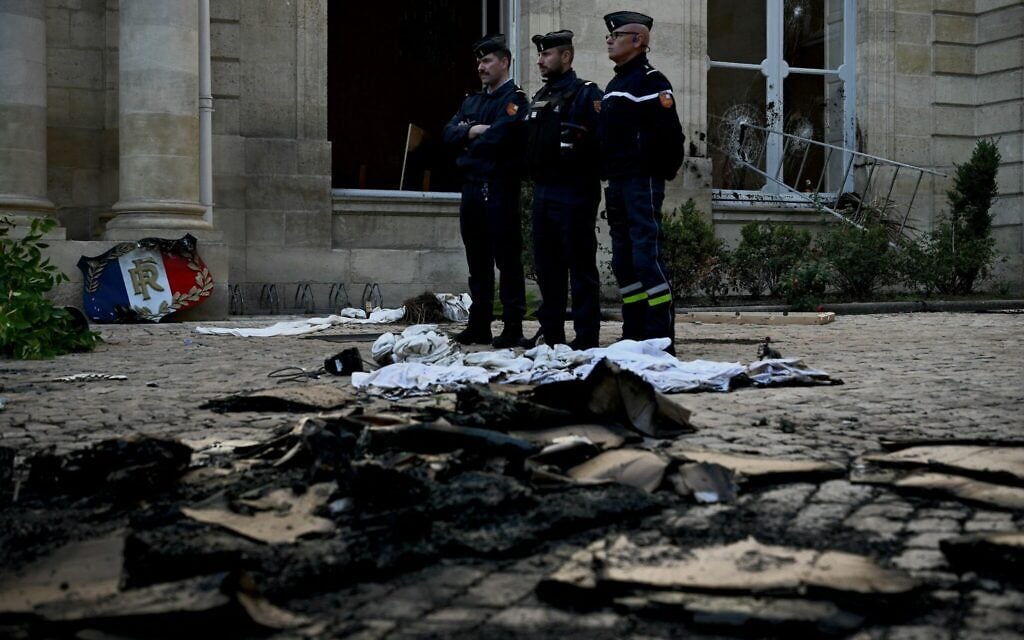
Damage remained visible in central Paris on Sunday morning, with shattered shop windows, broken glass scattered across streets and barricades made from bins, barriers, bicycles and street furniture.
Fire damages historic Limoges town hall
In Limoges, firefighters brought a major blaze at the city’s historic town hall under control on Sunday and were working to extinguish the remaining hotspots, Haute-Vienne Prefect Maurice Barate told French television channel LCI.
Authorities said several demonstrators had forced their way into the building on Saturday and deliberately started a fire inside. The flames spread to the upper floors and reached the roof, which subsequently collapsed.
Mayor Guillaume Guérin said the town hall had been almost completely destroyed but pledged that municipal services would continue operating despite the damage.
“They have destroyed a building that the people of Limoges love, but they have not destroyed the public service,” Guérin said. “A monument is burning, but not the Republic.”
Barate said around 5,000 people had taken part in the Limoges demonstration, including several hundred individuals he described as radicalized and extremely violent. After the attack on the town hall, some demonstrators moved toward the prefecture, while others looted businesses in the city center, he said.
The prefect condemned the attacks on public buildings and businesses, describing the fire as deliberate. Guérin expressed hope that those responsible would be arrested and argued that officers deployed during the protest had lacked sufficient resources to contain the violent participants.
Built between 1876 and 1883, Limoges town hall is a listed historic monument featuring architectural elements inspired by the late Renaissance and the reign of Louis XIII.
Interior minister says ‘the Republic will not yield’ to France’s worst protests in years
A dispatch here from Sam Jones, our reporter in Madrid, as protests have spread to Italy and Portugal
The angry protests that have convulsed Spain and France in recent weeks have spilled over to Italy and Portugal, with rioters clashing with police and setting property on fire in Milan, and a tent encampment springing up in Lisbon over the weekend.
More than half a million people took part in demonstrations across France on Saturday, 17 October, as protests over living costs and education deteriorated into riots, looting and attacks on public buildings in several major cities.
France is assessing extensive damage following nationwide demonstrations on Saturday, 17 October, that brought hundreds of thousands of people onto the streets and resulted in more than 1,200 arrests. Prime Minister Sébastien Lecornu said 150 police officers and gendarmes were injured as violent groups attacked public buildings, looted businesses and confronted security forces.
According to figures released by the French authorities, approximately 550,000 people participated in 110 marches across France, including 110,000 in Paris. Organisers, including trade unions and student associations, placed nationwide participation at 800,000.
The demonstrations represented a considerable escalation of the movement that began in September over deteriorating conditions in French secondary schools. The protests have since expanded into a broader campaign against rising living costs, public spending restrictions and the government’s economic policies.
Violence spreads beyond Paris
In the French capital, confrontations erupted around Place de la République, where masked groups threw paving stones, fireworks and other projectiles at police. Security forces responded with tear gas and water cannon as vehicles and rubbish bins were set alight.
Businesses along Boulevard Magenta and neighbouring streets were targeted, with shops broken into and goods stolen. Several central Paris Métro stations were closed as authorities attempted to restrict access to sensitive government locations.
Although the main authorised procession remained largely peaceful, violence continued elsewhere in the capital into Saturday evening.
The disturbances extended well beyond Paris. In Limoges, the historic town hall suffered extensive fire damage, with parts of its roof collapsing. Regional authorities described the destruction of the 143-year-old building as a major loss to the city’s architectural heritage.
In Marseille, groups forced their way into the town hall after using street barriers to ram its entrance. Municipal premises were vandalised before police regained control.
Further incidents were reported in Lyon, where a tourist office was attacked and a fire started, and in Bordeaux, where the official residence of the Gironde prefect was ransacked. Police also reported attacks or attempted break-ins at public buildings in Lille, Calais and Brest. The scale of the disturbances placed security forces under considerable pressure.
Government blames organised extremist groups
Lecornu accused organised far-left groups of deliberately instigating violence in several French cities. Nuñez similarly attributed much of the destruction to radical groups and individuals exploiting the demonstrations to loot businesses.
President Emmanuel Macron condemned attacks on public property and commercial premises, promising that those responsible would face prosecution.
The government has not announced a state of emergency, although authorities are reviewing the scale of the damage and the security response.
The mayor of Paris, Emmanuel Grégoire, described the destruction across parts of the capital as extensive and distinguished the peaceful protest movement from those responsible for vandalism.
Student unrest becomes a national movement
Saturday’s demonstrations followed several weeks of disruption across France’s education system.
As EU Today reported earlier this month, between 400 and 500 secondary schools faced partial or complete closures as students protested against teacher shortages, overcrowded classrooms and deteriorating facilities.
The subsequent confrontations with police intensified political tensions, with student organisations accusing authorities of using excessive force and police representatives complaining of inadequate protection.
A further controversy emerged on Saturday after a 17-year-old demonstrator in Saint-Étienne suffered a serious hand injury. An investigation was opened into the incident and assigned to France’s police inspectorate, the IGPN. Reports linked the injury to a grenade thrown by police; the precise circumstances remain under investigation.
The latest demonstrations also marked a revival of the Gilets Jaunes, or Yellow Vest, movement, which emerged in 2018 in opposition to fuel taxation and subsequently developed into a wider challenge to Macron’s economic programme.
Trade unions, including the CGT, joined calls for higher wages and pensions, lower consumer prices and increased investment in public services.
Political consequences for Macron and Lecornu
The unrest presents another challenge for Lecornu’s government as it attempts to manage France’s public finances ahead of the 2027 presidential election.
The demands for increased spending on education, wages and public services come as ministers face pressure to reduce the budget deficit and control public debt.
The political implications are already apparent. Jean-Luc Mélenchon, leader of the hard-left France Unbowed movement, has supported the student protests while opposing looting and destruction. Marine Le Pen has condemned the rioters and accused Mélenchon’s party of helping to legitimise the unrest.
The latest disturbances also follow growing criticism of the government’s policing strategy, particularly the use of riot-control weapons during demonstrations involving minors.
With municipal authorities calculating the cost of damage to public buildings and commercial premises, Lecornu has instructed ministers to support affected businesses. The immediate challenge is to restore public order while addressing a protest movement that has expanded considerably beyond its original demands for improvements in French schools.
Police fired teargas and blocked streets in Paris during protests supporting high school student grievances, high prices and the fraying of the social welfare system. A peaceful march was seen to turn violent as rioters threw fireworks around Place de la République in central Paris.
Student protests started last month over absent teachers and decrepit school buildings, and has developed into a bigger movement over cost of living and falling standards. Demonstrations broke out nationwide with hundreds of thousands of people taking to the streets in Paris, Marseille, Lille and Nantes
Fundado em 1615, o mais antigo mercado coberto de Paris nasceu com Luis XIII, deveu o seu rebatismo a órfãos, foi salvo em 1994 e totalmente consumido pelas chamas.
Police fire teargas in Paris and Limoges town hall ‘largely lost’ to fire – with officials blaming violence on ‘ultra-left’
More than 1,800 people were arrested in France on Saturday after protesters supporting high school students clashed with police, with some demonstrations later spiralling out of control as buildings were set ablaze and shops looted.
Police fired teargas in confrontations with protesters, as demonstrations across France were boosted by other groups angry about high prices and the fraying of a social welfare system.While hundreds of thousands protested peacefully in street marches in scores of cities, violent fringe groups targeted public buildings, luxury boutiques and supermarkets and attacked police vehicles and officers.
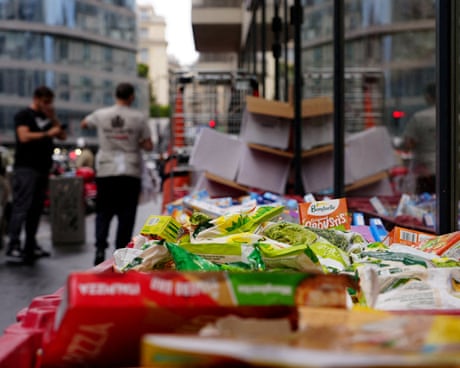
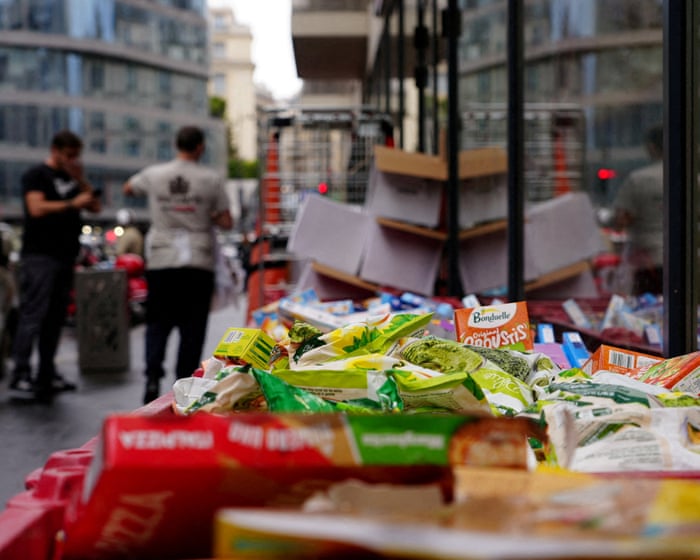
Whether it was youngsters proving their skills or state sabotage, Europe’s most hacked country was left with a mountain of waste after food began cooking in freezers
Shortly before midnight last Sunday, the digital thermostats controlling hundreds of supermarket cold aisles across France began to flicker and rise.
In a “bizarre and unprecedented” cyber-attack, hackers had remotely overridden the temperature settings on thousands of freezers, fridges and chiller cabinets pushing them from as low as -27C (-16.6F) to well over 50C (122F).
French authorities are preparing for hundreds of demonstrations on Saturday, 17 October, as student unrest converges with protests over living costs, public spending and government policy. Up to 40,000 demonstrators are expected in Paris, where police and organisers remain divided over march routes.
France is preparing for a nationwide wave of demonstrations on Saturday, 17 October, with approximately 500 protest actions under consideration and more than 90 marches being organised, according to the Interior Ministry. The mobilisation brings together high-school students, trade unions, farmers and supporters of the Yellow Vest movement, raising the prospect of further confrontation after nearly a month of unrest.
Police estimates suggest that around 40,000 demonstrators could gather in Paris, with approximately 150,000 more expected elsewhere in France. The figures remain preliminary, while authorities warn that some protests could involve road blockades, disruption to essential infrastructure and violent clashes.
Interior Minister Laurent Nuñez initially outlined preparations for 250 gatherings and 80 marches on Friday morning. Subsequent assessments from his office indicated that as many as 500 actions were being considered, although not all had been formally organised.
Paris Faces Dispute Over Demonstration Routes
The authorities are particularly concerned about developments in the capital, where negotiations between police and protest organisers have failed to produce agreement over the proposed routes.
Paris police prefect Patrice Faure has rejected proposals for marches terminating near the Opéra district or Place de la Concorde, citing security concerns surrounding central government institutions.
According to details of the security preparations, police have proposed an alternative route between Place de la Bastille and Place de Clichy. The CGT trade union and climate campaigners have accepted the proposal, but student organisations and Yellow Vest representatives continue to oppose it.
Prime Minister Sébastien Lecornu has convened an interministerial crisis unit to coordinate the government’s response. Security officials have warned that attempts to obstruct major transport routes or critical infrastructure will not be tolerated.
The Interior Ministry has also indicated that stun grenades, whose use was suspended during the student protests, could again be deployed in cases of particularly serious urban violence.
Yellow Vests Return Amid Rising Living Costs
Saturday’s demonstrations are being promoted as a revival of the Yellow Vest movement, which emerged in 2018 following opposition to fuel taxation before developing into a broader protest against living costs, economic inequality and government policy.
The latest mobilisation has gathered support from organisations demanding measures to address rising fuel, energy and food prices. Campaigners are also challenging the government’s proposed 2027 budget and its implications for public services.
The agricultural union Confédération paysanne has called on farmers to join the demonstrations, arguing that rising agricultural fuel costs and deteriorating conditions in rural communities have increased pressure on producers.
The union has also linked its demands to environmental policy, public-service provision and access to affordable food.
The CGT, student unions and climate organisations have similarly expressed support for the protests, while political backing has come from La France Insoumise and the French Communist Party.
Student Protests Enter Their Fourth Week
The mobilisation follows weeks of demonstrations involving secondary-school pupils, teachers and public-sector workers. What began as protests over shortages of teachers, overcrowded classrooms and deteriorating school buildings has developed into a nationwide confrontation over education policy and policing.
As EU Today previously reported, between 400 and 500 secondary schools faced partial or complete disruption earlier this month as students organised blockades and demonstrations.
The movement has subsequently expanded beyond its original educational demands, with student organisations raising concerns about university admissions procedures, police tactics and government spending priorities.
The scale of the unrest has placed considerable pressure on French authorities. According to figures from the Justice Ministry, 6,877 people were placed in police custody during the protests between late September and 8 October, approximately 86 per cent of them minors.
Violence during the demonstrations has resulted in injuries among police officers, students and educational staff. Clashes on 8 October led to 504 arrests and injuries to 48 police officers, according to Interior Ministry figures.
Education Minister Édouard Geffray has announced emergency measures to address teacher shortages, including the deployment of replacement teachers. The ministry says 2,000 of the 3,000 promised replacements have already been assigned, but student organisations maintain that the measures are insufficient.
Growing Pressure on the French Government
The planned demonstrations come as France faces a difficult debate over public spending, taxation and the 2027 budget. Lecornu’s government must balance demands for higher salaries and increased investment in education against mounting pressure to reduce the deficit.
France’s deteriorating public finances have already attracted scrutiny from eurozone partners, while domestic opposition to spending restraint has become a central issue ahead of the 2027 presidential election.
The convergence of student organisations, trade unions and Yellow Vest campaigners could broaden the protests beyond the education sector, particularly if demonstrations over living costs attract participants who have not joined the recent school protests.
However, the extent of that mobilisation remains uncertain. Online protest maps contain substantially more proposed actions than the authorities’ estimates, and participation figures will not be established until Saturday.
For the government, the immediate test will be whether the demonstrations remain peaceful and whether the authorities can prevent disruption to transport networks and public services without provoking further confrontations with protesters.
 Login