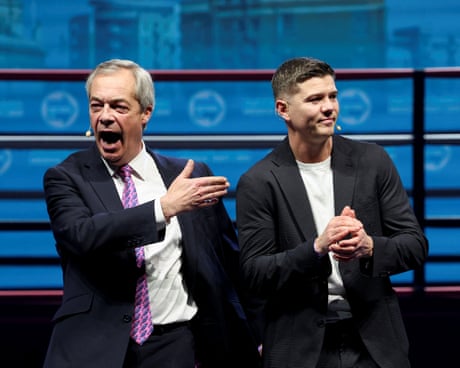
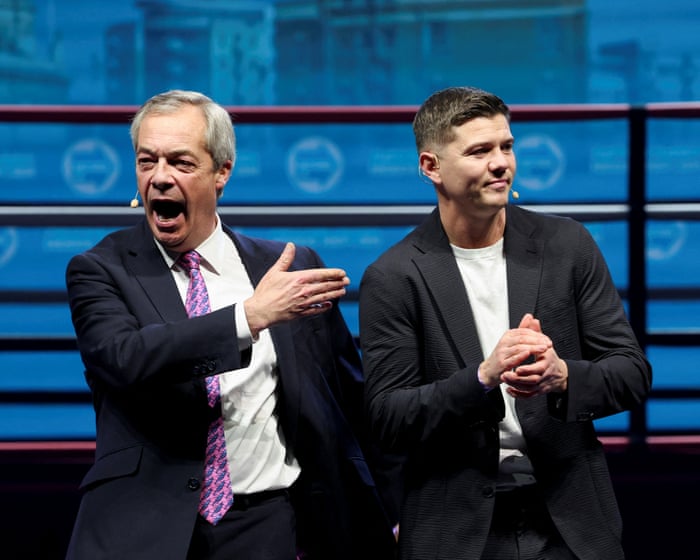
Female colleague says she was forced out shortly after incident with Luke Campbell, Hull and East Yorkshire mayor
A Reform UK mayor is under police investigation for allegedly showing “naked and sexualised” images of himself to a female member of staff.
Luke Campbell, a former Olympic boxing champion and the mayor of Hull and East Yorkshire, is understood to have been questioned under caution by Humberside police earlier this month.
Scrutiny committee looks into financing of Manchester Life project as PM promises ‘full transparency’
A £55m loan to Manchester City’s Abu Dhabi owner will be investigated as part of a review into a fund for housing projects while Andy Burnham was mayor.
The prime minister has faced weeks of scrutiny over his links to Manchester City’s super-rich owners after the club was found guilty of boosting its income by £900m in a nine-year breach of financial rules.
Cabinet ministers are turning on Ed Miliband, accusing him of blocking AI investment to protect Net Zero – while families pay the price in lost jobs and holidays.
Walking through East Cleveland, Ohio, feels a touch like you've wandered onto the set of a postapocalyptic film noir. Grand, gilded homes announce themselves on neighborhood streets, some crowned with turrets, many with windows punched out like missing teeth. Often, no one is home, because no one lives there. It is safer than 1 percent of U.S. cities.
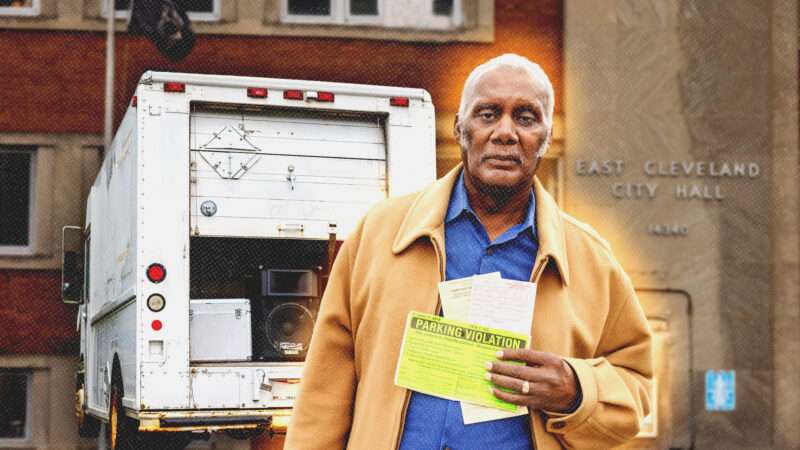
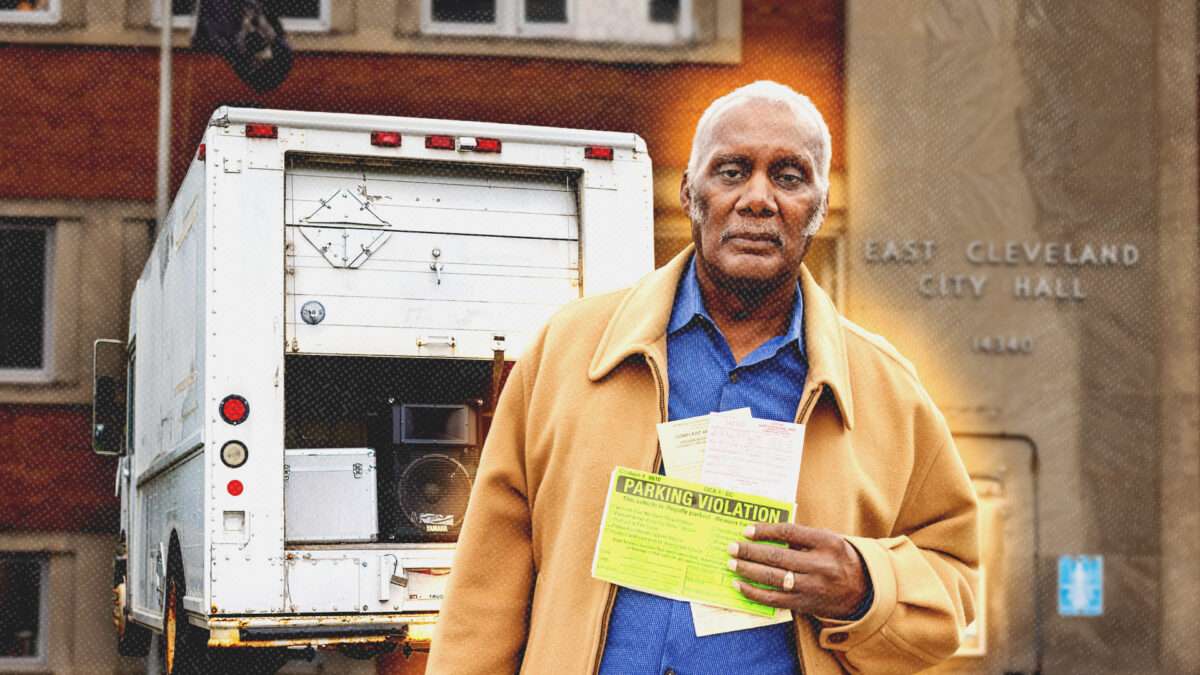
That question is not really a legal one, at least not in the most technical sense. But it is the driving force behind a thorny case a federal court recently resuscitated: Fambrough v. City of East Cleveland, a saga concerning a man whose vehicle became an obsessive target of the East Cleveland Police Department (ECPD) after he used it to campaign for a mayoral challenger.
Some of the facts are in dispute. But the basic gist is as follows: William Fambrough, long a politically engaged East Clevelander, campaigned for Juanita Gowdy—a challenger to then-Mayor Brandon King—by broadcasting messages around the city with his sound truck. That ultimately came to an end after law enforcement impounded the car, cited him for parking and noise violations, and prosecuted him for the latter.
Fambrough sued, alleging the complex legal odyssey set into motion over his step van amounted to First Amendment retaliation, an unreasonable seizure under the Fourth Amendment, and a violation of the 14th Amendment's proscription against selective enforcement. The U.S. Court of Appeals for the 6th Circuit rejected some of those claims. But it resurrected claims against King and his chief of staff, Michael Smedley—depriving them of qualified immunity, the legal doctrine that inoculates state and local government officials from facing lawsuits if their alleged misconduct was not "clearly established" as illegal in prior case law. It also revived Fambrough's retaliation claim against the city.
As the 6th Circuit summarizes: King "says he received a phone call from a resident who complained about Fambrough's sound truck and someone else's box truck being parked in a residential area," so he told someone to take care of it. Scott Gardner, then the city's chief of police, "was concerned about selectively enforcing" the parking ordinance—which prohibits parking a truck in front of residential property, except for loading or unloading—because it is indeed almost never enforced. This was the beginning of a long pursuit, which ultimately saw a swarm of officers dispatched to Fambrough's house in August 2021 to confiscate the vehicle, allegedly resulting in $6,000 in damage. Fambrough also had to pay $528 in fees to get the damaged truck back.
"All the attention City officials gave Fambrough struck Gardner as unusual," the 6th Circuit notes. "The mayor's office wasn't this attentive even in homicide cases. And considering that the City had around only 50 police officers at the time and had 'serious crime problems,' Gardner thought it was odd to devote this much attention to permitting and parking issues." Based on available data, East Cleveland's violent crime rate is 1,409 per 100,000 residents, about four times higher than the national average.
Yet Gardner ultimately got on board. Smedley phoned him on August 9 "extremely upset," according to Gardner, and told the police chief he was "incompetent" for failing to "take care of" Fambrough's sound truck. Smedley wanted the "utmost enforcement as possible." So Gardner sent an email. "Please, find this vehicle and tow it," he wrote to all of ECPD. "Cite the operator with disturbing the peace and loud music. Please contact me as soon as this is complete to claim a surprise." A surprise!
Police succeeded. "On its face, the email told officers to tow Fambrough's truck regardless of whether it was parked illegally," writes the 6th Circuit. "And the Noise Ordinance authorizes seizure only of 'the sound device used,' and only upon conviction. So Gardner's instruction to tow the truck wasn't authorized by municipal law." The court still held that the seizure did not violate the Fourth Amendment. It also gave Gardner qualified immunity, ruling it is not clearly established that someone who acts as a conduit for someone else's alleged retaliation—which here came from the mayor's office—is a "responsible party."
Heather McCollough, the city's assistant law director, subsequently prosecuted Fambrough for allegedly violating the noise ordinance. According to a sworn declaration from Fambrough's attorney, McCollough outlined some of Fambrough's offenses on a call: that he "made complaints about the police department" and filed "public records requests," among other issues. Notably, it is legal to do those things. McCollough was typically willing to resolve minor noise complaints, she added, but not so much in this case, because Fambrough needed to "stand down." (He ultimately pleaded no contest to disorderly conduct, a reduced charge.)
Institute for Justice
"Only after [Fambrough] began supporting Gowdy's election was the weight of the law thrown against him," the 6th Circuit writes in its analysis of potential municipal wrongdoing. "And the City's police officers didn't uncover Fambrough's violations of their own accord. Instead, City decisionmakers sent them to Fambrough's home each time to enforce the Parking Ordinance. So the timing of the parking-related enforcement actions supports an inference that Fambrough's political speech was the motivating factor—as does the fact that the City rarely enforced the Parking Ordinance against anyone else despite having plenty of opportunities to do so." Incredibly, a photo of another truck can be seen down the street on the same day law enforcement came to fetch Fambrough's vehicle. (The law also includes pickup trucks, so the city arguably has a lot of enforcement to do if it sincerely believes this law matters.)
King allegedly set the chain of events into motion while Smedley took the driver's seat. "Smedley's pattern of incessantly calling and berating Gardner," the 6th Circuit adds, "clashes with the idea that Smedley was chiefly concerned with minor permitting, noise, or parking issues." After all, if that were true, why would the problem appear to begin and end with one person?
Over five years have passed since the ordeal. Although Fambrough is now potentially closer to getting in front of a jury, he has yet to actually state his case, still burdened by the onerous process government actors invoke to kill such suits before the community can assess the merits. King, meanwhile, won that election. He left office in May 2025, however, after he was found guilty of one count of theft in office, four counts of having an unlawful interest in a public contract, three counts of representation by public official or employee, one count of filing a false disclosure statement, and one count of soliciting improper compensation.
From a press release last month, just posted on Westlaw:
N.C. Detective Agency, a Durham-based security company, will pay $65,231 in compensatory damages and back pay, and take other corrective actions to voluntarily resolve a religious discrimination investigation by the U.S. Equal Employment Opportunity Commission (EEOC), the federal agency announced today.
The EEOC's investigation found reasonable cause to believe that an employee requested to be excused from work due to a Muslim religious holiday, but the request was denied. The company was aware of the employee's need for a religious accommodation but did not engage in the legally required interactive process, and instead terminated her in June 2025 when she did not report for duty.
And from another press release two weeks later, also just posted on Westlaw:
Reynolds IGA Foodliner, Inc., owner and operator of a chain of grocery stores, will pay $65,000 and provide other equitable relief to settle a religious discrimination and retaliation lawsuit filed by the U.S. Equal Employment Opportunity Commission (EEOC), the federal agency announced today.
According to the suit, shortly after she was hired as a deli clerk at the Piggly Wiggly store in Hazlehurst, Georgia, the employee requested Sundays off to observe her Sabbath. The employee's supervisor denied the request, claiming that, if the store gave the employee Sundays off, it would have to do the same for all other employees. The employee continued to request the accommodation, and the company fired her in January 2025.
More from the second press release:
"Employers cannot deny religious accommodation requests simply for fear of upsetting other employees," said Marcus G. Keegan, regional attorney for the EEOC's Atlanta District. "The EEOC remains committed to enforcing federal anti-discrimination law and protecting employees' rights to religious freedom."
Darrell E. Graham, director of the EEOC's Atlanta District, said, "Employers must thoughtfully consider each request for religious accommodation on an individual, case-by-case basis and otherwise make good-faith efforts to accommodate their employees' religious beliefs. Employers must be aware of their obligations under federal law to provide reasonable religious accommodations absent undue hardship."
Finally, from a third press release from last month (it was published in between the first two, but was again just posted on Westlaw); this one involves a lawsuit and not a settlement:
Blue Bell Creameries, Inc., a Brenham, Texas-based frozen snack manufacturer and distributor with a production facility in Sylacauga, Alabama, unlawfully terminated a Jewish body shop technician soon after he requested a beard‑related religious accommodation, the U.S. Equal Employment Opportunity Commission (EEOC) charged in a lawsuit announced today.
Even supporters of bans on religious discrimination by private employers might debate whether employers should be required to give religious exemptions from generally applicable rules (exemptions that could themselves be seen as discrimination in favor of religious observers). But Congress has indeed mandated such exemptions: Title VII of the Civil Rights Act, as amended in 1972, generally requires employers to accommodate religious objectors' requests for exemptions from generally applicable work rules, unless doing so would pose an "undue hardship" for the employer.
That extends to time off for religious holidays: Indeed, the leading recent case on the subject, Groff v. DeJoy, involved a Christian employee's request for an exemption from having to work Sundays. And of course it extends, as it must, to all religions.
Andy Burnham's Government has been accused of waging a £500 million "class war" on wealthy councils, slashing funding from rural Tory and Lib Dem areas to bankroll urban Labour Party strongholds.
In recent years, one of the predominant policy initiatives of the progressive left has been raising the minimum wage in locales around the country. At the same time, left-leaning politicians have sought the elimination of what's known as the tip credit, which allows employers to pay restaurant servers and other tipped employees a lower hourly base wage that they then bolster with gratuities.
Just a few years into this experiment, however, policymakers are showing signs of an about-face on the tip credit's abolition as they grapple with the unfortunate, and predictable, economic results.
In 2022, Washington, D.C., made news headlines when voters passed Initiative 82. As originally designed, it would have repealed the tip credit and required servers to be paid the District's full statutory minimum wage by 2027. (D.C.'s minimum wage was $16.10 per hour in 2022, but has since risen to $18.40 due to inflation indexation.) Prior to Initiative 82, D.C. servers could be paid a $5.35 tipped wage, so long as they earned enough tips to make up the difference between the lower tipped wage and the higher traditional minimum wage.
D.C.'s Initiative 82 was just the beginning. One Fair Wage, a progressive group that lobbies against subminimum wages, quarterbacked an all-out push to eliminate the tip credit in jurisdictions across America. Chicago became the second prominent city to follow suit. States like New York, Connecticut, and Illinois also quickly saw legislation introduced to eliminate the tip credit at a statewide level. (Apart from this recent wave, a small handful of American states—including California, Oregon, and Alaska—have long operated without a tip credit).
But just when it seemed like momentum against the tip credit had reached its apex, progressive politicians started to see the writing on the wall. In the aftermath of the tip credit's repeal, D.C. saw a close to 5 percent decline in full-service restaurant jobs. Tipped worker earnings also dropped by just under $12 million—likely a result, at least in part, of restaurants reducing hours for staff in the face of higher labor costs. At the same time, many D.C. restaurants began implementing service fees or so-called auto-gratuity policies that added mandatory 10-20 percent charges onto customers' bills.
Mugged by this economic reality, D.C. Mayor Muriel Bowser called for the full repeal of Initiative 82. Ultimately, the D.C. Council settled for a partial repeal in 2025, maintaining at least some semblance of a tipped wage that sits below the traditional minimum wage into the years ahead (although the tipped wage eventually rises to 75 percent of the traditional wage by 2034). This was a familiar story: The council had previously repealed Initiative 77, a near-identical attempt to abolish the tipped wage that voters passed in 2018.
After Chicago moved to eliminate the tip credit, the Illinois Restaurant Association found that 89 percent of Windy City restaurants raised menu prices; another 79 percent responded by reducing worker hours. Again bowing to economic reality, the progressive Chicago City Council voted to freeze the tip credit's planned elimination, only to see the effort vetoed by Mayor Brandon Johnson. Eventually, a compromise was brokered to at least pause the tip credit at its current level for two years—which punts the issue until after Johnson stands for election again, allowing a potential successor to endorse a more lasting reversal.
In Michigan, a 2024 state supreme court ruling set the tip credit on the path toward elimination by 2030. But state lawmakers intervened last year, deciding to maintain a 50 percent tip credit in perpetuity after 2031. Notably, Michigan is currently governed by a Democratic trifecta in the governorship and both houses of the Legislature. The tip credit's revival garnered key support from Republican lawmakers to pass in a bipartisan fashion, before being signed into law by Democratic Gov. Gretchen Whitmer.
While progressive efforts to eliminate the tip credit may be motivated by an earnest desire to ensure waiters are paid more, the math isn't that simple. Requiring a server to be paid a $16 traditional minimum wage—up from a $5 tipped wage—might appear to raise their pay on paper. But this fails to consider several important factors.
Under our "No Taxes on Tips" new normal, raising the minimum wage for servers could lead to a partial reduction in tips, which under certain scenarios can result in less take-home pay for waiters once the taxman takes his cut. If more server earnings come in the form of "auto-gratuity" policies—which are treated as taxed wages under the law—then the tax repercussions may grow even grimmer.
But more broadly, these laws attempt to subvert basic economics. As of 2025, Bureau of Labor Statistics data show that D.C. restaurants shed over 1,600 jobs in aftermath of Initiative 82; meanwhile, between 2022 and 2025, restaurant job growth in the District declined by more than 8 percent. This is just one example. The fallout is the inevitable result of restaurants responding to labor costs that suddenly skyrocket, forcing establishments to cut worker hours and sometimes transition to quick-service models that require less hourly staff. And that's to say nothing of the diners who bear the cost with higher prices and new service fees.
"We're watching a beloved bar back, a beloved busser, a dishwasher have their jobs taken away," D.C. restaurant worker Valerie Graham toldReason in 2024. "Not because our owner-operator is an evil billionaire but because they're an independent business owner who had to make some business decisions and there's a callousness with which our industry is talked about."
To be sure, the tip credit has only survived in modified and reduced form in D.C., Chicago, and Michigan—and in the case of Chicago, the about-face is only temporary. But the partial reversals show the tip credit's elimination is not a foregone conclusion. Economic reality continues to rear its head.
The Democratic Socialists of America (DSA) candidates running for the House of Representatives and endorsed by NYC Mayor Zohran Mamdani are all but guaranteed to win their general elections this November, but that does not mean the midterm drama is over in New York. In the state's 17th congressional district, which includes the lower Hudson Valley, Democratic challenger Cait Conley, a combat veteran who served on the Biden administration's National Security Council, could unseat incumbent Republican congressman Mike Lawler in one of the most consequential races of the midterms.
The highly contested purple district voted for former Vice President Kamala Harris in the 2024 election while reelecting Lawler for his second term. Now, Lawler is attempting to win a third term as support for President Donald Trump wanes ahead of the midterms. As of Friday, The Cook Political Report lists the race, which could determine control of the House, as a toss-up.
If elected, Conley would have far more in common with the "Badass Women" coalition of security state and military veterans than with DSA types (think more Sen. Elissa Slotkin from Michigan than Darializa Avila Chevalier). As Judge Street Journal's Timmy Facciolanotes, "Conley's candidacy is testing the viability of a tactful centrism that rebukes left-wing positions like abolishing ICE or restricting weapon shipments to Israel." Lawler is also vying for moderates, pitching himself as "one of the most bipartisan members of Congress" and emphasizing his willingness to break with Trump occasionally while still welcoming Trump's support.
While Lawler and Conley certainly are not pure MAGA acolytes or DSA members, both have leaned into a tech-critical position, much like that of more radical populists like Lina Khan or Steve Bannon, revealing how pervasive anti-tech sentiment has become in mainstream politics.
This tech skepticism was on full display during an October 14 debate, when each candidate made the case for why they were the most equipped to regulate AI, insisting that the industry needs guardrails.
Conley said members of Congress do not want to regulate AI because "they want to look out for their billionaire and trillionaire backers like Elon Musk, who is pouring over $260 million into this midterm election." She then added that Musk backed Lawler in his 2024 race.
Lawler then accused Conley, who previously consulted for Primer AI, of being "the AI candidate for the AI industry."
While Lawler and Conley disagree on specific data center regulations (Conley supports Democratic Gov. Kathy Hochul's data center moratorium while Lawler supports local zoning control over data centers), neither wants to pitch themselves as an explicitly pro-data center candidate. During the debate, Conley claimed that, "On Mike Lawler's watch there have been five data centers built in Rockland County." Lawler has said that he had no say in the decision to build the data centers, and during the debate, he pointed out that the facilities were built for financial services. Lawler also attempted to attack Conley over data centers, slamming her in an ad for saying "we need data centers." Regardless of the candidates' specific policies on data centers, their attacks on one another demonstrate that cheerleading hyperscale data center development is a political liability. In their district, data center has presumably become a dirty term.
The candidates' tech-skeptical rhetoric did not end with unchecked data center development. After the debate, Reason asked both candidates about their positions on age-verification laws for social media and AI, since such regulations raise significant privacy and censorship concerns by age-gating the internet. Unsurprisingly, both Lawler, who votedfor the controversial KIDS Act, and Conley, who has proposed stricter age verification for AI tools, parroted platitudes about why such online safety regulations are necessary to protect children.
"We have watched how social media is literally hurting the mental health of children," Conley told Reason. "And when you talk about the power of AI and what that power could do, we have to regulate this."
Lawler gave a similar response, telling Reason that he respects free speech but that protecting children "is paramount."
This bipartisan consensus over social media regulation has long been brewing in Congress. The mainstream political conversations about AI and data centers, however, are relatively new this midterm election cycle. And it appears both Lawler and Conley have figured out which way Americans' sentiment toward AI is leaning, and they have waged their campaigns accordingly.
As the Trump administration's short-lived Department of Government Efficiency (DOGE) project implemented its plan to downsize the federal workforce, there was much wailing from the liberal institutions in Washington, D.C.
Federal employee unions filed lawsuits to block the effort. NPR ran profiles of federal workers who, for the first time, faced the prospect of potentially not having absolute job security forever. The Brookings Institution wondered how many jobs the federal government could shed before it crashes.
The answer: plenty. The Trump administration has cut more than 10 percent of the federal workforce, and the government hasn't crashed. Indeed, it hasn't even shrunk—if you're counting by dollars spent instead of people employed.
In a new article for City Journal, Manhattan Institute senior fellow Judge Glock highlights the tremendous gap between the dire predictions about DOGE's cuts and the reality that has emerged, more than a year after DOGE was shut down. Despite having only a modest impact on spending, Glock writes, DOGE "had a massive impact on the federal civil service."
This is true—to a point, more on that in a moment—and notable. Aside from a modest downsizing in the 1990s, the number of people employed by the federal government has been steadily growing for decades. Reversing that trend is one of the few genuinely libertarian accomplishments by the Trump administration.
The cuts to the federal workforce prove that "DOGE worked," argues Glock.
Well, hold on.
Elon Musk and Vivek Ramaswamy (who departed the DOGE project before Trump's inauguration and is now running for governor of Ohio) set some very ambitious goals after being appointed DOGE co-chairs in late 2024. In an op-ed for The Wall Street Journal in November 2024 where they promised "we won't just write reports or cut ribbons. We'll cut costs."
Yes, Musk and Ramaswamy also said they would reduce the federal workforce. But that was presented as a natural consequence of cutting spending, not as the primary goal.
Think about it like this. If I spent months promising my friends and family that I would lose 50 pounds on a new diet, and then didn't lose any weight, would it be fair to say the diet worked?
What if I reduced the number of donuts I eat every day, but still didn't lose any weight? Sure, that might be good for my health in some way—just like reducing unnecessary workers in the federal government is good for America's fiscal health—but it certainly wouldn't mean I had achieved the goal of losing weight.
Finally, even the claim that DOGE cut the federal workforce requires an asterisk. As Glock also notes in his report, the decline in federal workers has been offset by an increase in federal contractors.
It's not a one-for-one trade, of course. The new contractors are overwhelmingly concentrated in places like the Department of Homeland Security and the Pentagon, while the cuts mostly targeted other areas, like the Department of Health and Human Services.
"Most of that increase came from the buildup in homeland-security and defense contracting, including purchases such as surveillance aircraft and tanks, rather than substitutes for government workers," Glock writes. "DOGE achieved real contract savings, but these were more than offset by higher spending elsewhere, reflecting a shift in priorities rather than an overall reduction in contracting."
So, the government is eating fewer donuts but more pizza.
There might be libertarian reasons to prefer contractors over government employees. They are less likely to hold those jobs for life, for one. But there's nothing inherently good about a government policy that cuts jobs in some areas just to create more room in the budget for poorly trained immigration enforcement agents and defense contractors. That may even be a negative outcome for liberty.
In the end, the DOGE project looks less like a meaningful attempt at cutting government spending or employment levels and more like a way to purge parts of the federal workforce likely to get in Trump's way during his second term. "As long as [Trump's] larger commitment is to extending his power rather than rolling back power itself, you shouldn't expect the government to stop growing," as Reason's Jesse Walker wrote last year in comparing DOGE to President Richard Nixon's attempted purge of the civil service.
Did DOGE work? Only if you grade it on a pretty dramatic curve.
Yes, it proved that a president can slash bureaucratic jobs—particularly the bloated managerial and administrative types—without doing much damage to the government's core responsibilities. That's a lesson future administrations should remember.
Maybe, someday, a president will try applying the same logic to government spending too.
The Yisrael Beytenu chairman has ruled out a minority coalition dependent on Arab parties. He is banking on Likud defectors, but is actually erecting a roadblock for the center-left
My recent trip to Malibu from Los Angeles was my first post-wildfire drive through the Pacific Palisades and, my goodness, there's nothing like seeing something with one's own eyes to grasp the enormity of the devastation. The obliterated hulks along Pacific Coast Highway 21 months after the tragedy raise multiple issues, including ones related to the excruciatingly slow rebuilding process.
This being California, the state has yet to grapple sufficiently with the reasons the wildfires started—and the failed response to them. But late is better than never, so I applaud a new report that Gov. Gavin Newsom commissioned from the nonprofit Fire Safety Research Institute. Released this month, it looked at the nitty-gritty of how the fires started and how multiple agencies reacted. The results aren't pretty.
The New York Times provided the best summary: "The comprehensive analysis found that while several state and local agencies fell fatally short in their preparation and response, the clearest lesson from the disaster was the extent to which climate-driven fires are outstripping modern firefighting." The report found LA officials failed to take the fires seriously enough at the outset. County officials handled the Altadena evacuations in a "chaotic" manner. They were unprepared for the intensity of the fire storms.
We've all read about some of the inexplicable stupidity. The Santa Ynez Reservoir was empty during the fires because of a repair to its protective cover, yet it's empty again (although it's in the process of being refilled). The California Coastal Commission allegedly delayed new permits for the Los Angeles Department of Water and Power to install fire-resistant utility poles because of concerns about an endangered weed. The commission disputes that report—and there's still heated debate involving multiple agencies.
If we can't get multiple agencies on the same page on one minor question about milkvetch, I'm skeptical California can deal with the basics. The report said the tragedy involved "multiple interlinked systems rather than any single factor or failure." In one example by Patch, the Los Angeles County Sheriff's Department remained at normal staffing levels. The Los Angeles Fire Department was reportedly so concerned about overtime costs that it reportedly responded slowly.
This epitomizes California's approach to everything: Bigger agencies, higher spending, and expanded workforces. The left hand never knows what the right hand is doing. Other priorities outside of public protection—budgeting, meeting union demands, turf battles—take precedence. This isn't malicious, but reflects the fundamental nature of government.
Even after the state suspended rebuilding regulations, the rebuilding process is still in a quagmire because of the number of involved agencies. How could California realistically streamline a wildfire-fighting process that involves an alphabet soup of local, county, regional, and state bureaucracies? Even the feds are involved because around 45 percent of the state's land area is owned by them. The wildfire issue is a statewide problem, so the conclusions should resonate beyond LA.
Furthermore, the report argues that California needs to change its overall approach toward wildfire resilience. Back to the Timesanalysis, which noted that climate-driven fires are becoming more intense and that's challenging the traditional ways that the state has battled wildfires. But how often have you seen governments respond efficiently to external economic or environmental changes? All governments are slow-moving freight trains.
Everything government does is mired in the past. As an unrelated example, the nation's education system isn't much different than the one created in the 1800s—despite all the technological changes that should have sparked a revolution. When COVID hit, private schools adapted and provided successful at-home learning, whereas the public schools watched students fall behind and truancy rates soar. It's not any different with any public service, including firefighting.
My fear: California policymakers will read that summary about "climate-driven" fire risks and do what they always do: blame the problem on climate change and double down on the state's counterproductive climate policies. They are designed to change the entire Earth's weather patterns (even though California is responsible for less than 1% of the world's greenhouse emissions), rather than adjust our regulatory system to make us more resilient in the face of warming trends.
California's union-controlled state and local governments aren't about to adjust firefighting budgets so they can further stretch their dollars. State firefighters generally earn more than $250,000 in annual total compensation, with some Los Angeles firefighting officials earning pay levels that boggle the mind. Instead of trimming costs, California has been ratcheting up pay levels.
California state officials haven't even been forthright about their approach toward brush clearance. For instance, four years ago Newsom touted an important wildfire-prevention program that at the time hadn't completed a single project. We hear promises, but little action.
That's government for you. It doesn't do anything well and is incapable of learning the right lessons even from the best reports. Driving along PCH was just my latest reminder of this sad truth.
This column was first published in The Orange County Register.
White House officials instructed Pentagon leaders to limit Starshield, SpaceX’s military-grade satellite service used by Ukrainian forces, Reuters reported on 15 October, citing three officials. The report came a day after a senior US official told Axios the Trump administration had nothing to do with the alleged Starlink restrictions.
Ukrainian forces rely on US-controlled satellite technology for battlefield operations and for intercepting Russian drones aimed at Ukrainian cities, so the latest restrictions have raised questions about how reliably they can depend on it.
Senior US official denies president requested restrictions
Asked about the order, a senior US official replied, “No such request was ever made by the president.” The White House did not respond to questions about whether other administration officials might have made the request.
Ukrainian officials contacted the White House, State Department and Pentagon on 13 and 14 October and were told it was a White House decision
European allies question Starlink restrictions
European officials raised concerns about the restrictions. German Foreign Minister Johann Wadephul criticized the throttling and said Ukraine must continue to receive full support, Spiegel reported on 15 October. Wadephul said Germany had questions for the US, noting that Germany finances part of the Starlink technology used in Ukraine.
On 16 October, UK Defense Secretary Wes Streeting said US Defense Secretary Pete Hegseth had assured him in a face-to-face meeting that Starlink was back up and running, the Guardian reported. However, a Ukrainian Defense Ministry source said that military-grade terminals were working in motion again, but only at speeds of up to 160 km/h.
New data-speed restrictions disrupted drone missions
The military Starshield package previously had no data-speed restrictions, Ukraine’s 7th Rapid Response Corps told Novynarnia. Ukrainian officials said that after the restrictions were imposed, terminals disconnected when drones exceeded 160 km/h and sometimes at 80 km/h.
The Corps also reported 10–20-second connection drops at 110–120 km/h on the Huliaipole front, which made drones harder to control. One unit had to cancel some missions.
The restrictions came as US President Donald Trump pressed Kyiv to stop striking Russian oil refineries, blaming them for soaring energy prices ahead of November’s midterm elections. Ukraine suspects SpaceX imposed the restrictions to pressure Kyiv over the refinery strikes, but that motive has not been confirmed.
This week, the Trump administration announced it's expanding its stake in semiconductor manufacturer GlobalFoundries. This brings the government's share of the company to over $2 billion, according to President Donald Trump, and it's only one of roughly three dozen companies in which this White House has acquired a piece of the action. This is a disturbing development for Americans who favor free enterprise and don't want the government to control the means of production.
While it may be a while before the opportunity arises to roll back state intervention in the economy, given the drift of both major parties away from faith in the marketplace, the Cato Institute has launched a project to get the process started.
$2 Billion Government Stake in One of 35 Once-Private Firms
"The U.S. Department of Commerce will receive equity in GF of approximately four percent, further enabling the American public to share in GF's growth," GlobalFoundries announced Monday in a press release about a U.S.–Japanese initiative to open two new semiconductor manufacturing facilities.
"This brings our total Investments to 1.63 Billion Dollars, and now, the U.S. Government's stake is worth over 2 Billion Dollars," Trump confirmed on Truth Social.
The announcement's triumphant tone isn't necessarily shared by people who wonder what the government's ownership stake in one company will do to regulation and investment in the industry. Will fully private firms challenging a state-backed player experience an even playing field?
In a July CNBC survey of 1,000 U.S. voters, 49 percent of respondents said it is "not appropriate for the federal government to own a portion of a U.S.-based company." Nineteen percent considered it appropriate, and 32 percent had no opinion.
"Washington's expanding involvement in the businesses it regulates threatens the competition and innovation that underpin American prosperity," warns the Cato Institute's Tad DeHaven on the launch of the Restoring Free Enterprise project. "Our project will examine the consequences of that involvement and chart a path toward getting Washington out of the boardroom."
Restoring Free Enterprise's Government Ownership Dashboard shows the U.S. government owning shares in 35 companies. The recent deal with GlobalFoundries comes on top of an earlier equity stake, giving the government 7 percent ownership of the firm. Other big deals include an 8.4 percent stake in Intel, a claim on 20 percent of distributions above $17.5 billion in Westinghouse, and an arrangement granting the U.S. government the right to appoint a director for U.S. Steel and to veto decisions over matters including investment and production.
Why might this be a problem?
When Government Enters the Market, Competition Is Undermined and Decisions Politicized
In an analysis for the Center for Strategic and International Studies, Sujai Shivakumar, Charles Wessner, and Christina Tutino cautioned that direct government ownership could create "conflicts between the role of the government as an investor in a particular company and its role as a regulator (e.g., regarding export controls) of firms across the wider industry." They added that preferential treatment for state-linked forms could "distort competition, stifle innovation, and potentially lead to monopolies or market concentration in strategic sectors."
"Once government crosses the line into equity ownership, the game changes," agreed economist Vance Ginn in a 2025 piece for the American Institute for Economic Research. "It's no longer about setting fair rules of the road—it's about Washington joining the race as a participant. That undermines competition, politicizes corporate decisions, and exposes taxpayers to risks they never agreed to take."
Basically, when the government gets involved in any industry, it complicates matters for the companies in which shares are held, for competitors who must worry that regulators will put their thumbs on the scale to help favored firms, and for the market in general. Overall, government interference of any sort in market transactions does more harm than good, and direct ownership makes things even worse.
"Federal rate controls, excessive taxes, barriers to restructuring, and rigid labor rules weakened private railroads in the mid-20th century, just as automobiles, buses, trucks, and airlines were intensifying competition," Cato's Chris Edwards points out in a case study for the Restoring Free Enterprise Project. Congress then created Amtrak to maintain the passenger train service its red tape had helped strangle, but despite plans for the railroad to be self-sufficient, "it has never earned a profit and has received tens of billions of dollars in subsidies."
Proposals for Reform, but Is Anybody in D.C. Interested?
The project acknowledges the Trump administration's intention to encourage U.S. manufacturing and to meet strategic defense goals. But it points out that private, profit-seeking firms are what made the U.S. prosperous and dominant in so many fields to begin with. The government should get out of the way of the market if it wants the country to continue to thrive.
As alternatives to state ownership of companies, Restoring Free Enterprise proposes permitting and regulatory reforms that "shorten reviews, remove unnecessary requirements, reform the Jones Act, and recognize out-of-state licenses" for workers. The project also recommends free trade agreements that reduce barriers to international commerce, the removal of export and procurement barriers, tax reforms involving expensing, and immigration reforms that simplify processing and make it easier for foreign-born college graduates to remain in the U.S.
The obstacles to implementing these reforms are substantial. The administration, while criticizing the Democratic Party's growing affection for socialism, itself embraces government ownership of companies, mercantilism, and heavy state intervention in economic decisions and activities. The Democratic Party has long been less market-oriented than the Republicans, and despite the GOP's transformation, a growing share of Democrats are openly socialist advocates for state control.
"American political leaders on the left and right are rebelling against the market-first consensus that dominated Washington for four decades," concluded Axios's Courtenay Brown and Neil Irwin in July. "It's evident in everything from the Trump administration taking government stakes in dozens of private companies to socialist candidates winning Democratic primaries promising a more active government role in the economy."
U.S. politicians are happily adopting damaging policies that are at odds with the country's prosperity-building tradition of free markets. The Restoring Free Enterprise project would reverse that unfortunate trend, but it's not obvious that many people in D.C. are interested in joining the fight.
A look at 3 potentially competitive 2026 legislative races, as Democratic challengers seek to reduce Republicans' advantage in NC House.
Battling for NC House seats in Northeastern counties is a story from Carolina Public Press, an award-winning independent newsroom. Our breakthrough journalism shines a light on the critical overlooked and under-reported issues facing North Carolina’s more than 11 million residents. Please consider making a contribution to support our journalism.
President Donald Trump promised that his tariffs would usher in a "golden age" by prioritizing the interests of American workers.
Those workers, however, are now turning against Trump's tariffs.
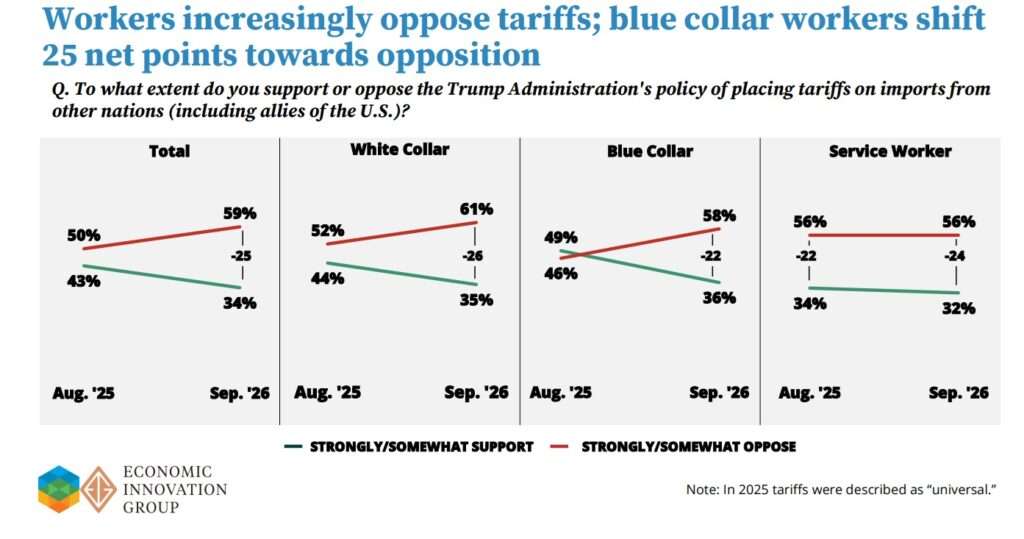
Support for the Trump administration's tariff policies has fallen by 25 percentage points among blue-collar workers over the past year, according to new polling data from Echelon Insights and the Economic Innovation Group (EIG).
A poll conducted by the two groups in August 2025 found that blue-collar workers supported the tariffs by a narrow margin. Now, that same segment of the population has turned decisively against Trump's tariffs: 58 percent oppose them, compared to just 36 percent who support them.
Source: Economic Innovation Group / Echelon Insights (https://eig.org/wp-content/uploads/2026/10/EIG-State-of-the-American-Worker-2026.pdf)
Overall, support for the tariffs has declined from about 43 percent last year to only 34 percent. Opposition to the tariffs has grown from 50 percent to 59 percent. Elsewhere in the same survey, 68 percent of respondents said the tariffs have made the cost of living higher.
It's not hard to figure out why people have turned against the tariffs: They have contributed to rising prices across the economy.
The annualized inflation rate ticked upward to 3.7 percent in September, according to new data from the Bureau of Labor Statistics (BLS). More BLS data released Thursday morning shows that the producer price index, which often operates as a precursor to inflation, is up 6.3 percent over the past year.
America's war with Iran has been a major factor in rising inflation, but the tariffs have played a significant role as well. In a study released last week, the New York Federal Reserve concluded that consumer prices would have declined slightly over the past year if not for the economic effects of the tariffs.
The tariffs have become so unpopular that not even partisanship can save them. "Among GOP-voting workers, only 3 percent select tariffs as their top priority," note Jordan McGillis and John Lettieri, policy experts from the EIG, in their write-up of the poll.
Other parts of Trump's economic agenda are not faring much better. The Trump administration has bought or seized shares of more than 30 private businesses over the past two years—ranging from major firms such as U.S. Steel to small mining companies with few customers. "The federal government's state corporatism is unprecedented," reports the Cato Institute in a new analysis of those deals.
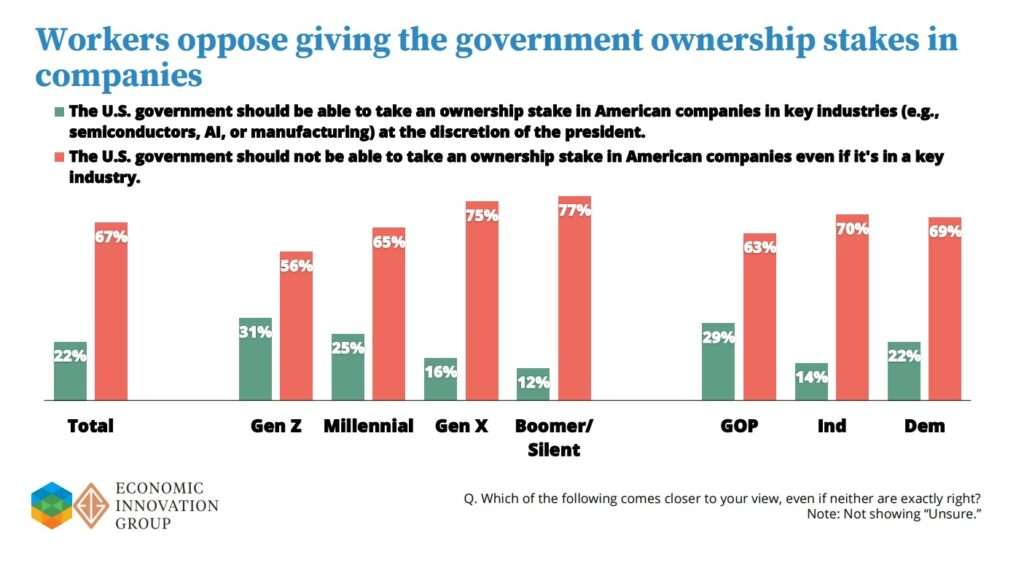
Large majorities of workers across both major parties and all generations said they opposed the federal government taking equity stakes in American companies in the Echelon/EIG poll.
Source: Economic Innovation Group / Echelon Insights (https://eig.org/wp-content/uploads/2026/10/EIG-State-of-the-American-Worker-2026.pdf)
In short: This economic populism sure isn't very popular.
All of this is likely to be a major factor in next month's midterm elections. Regardless of how that shakes out, however, there are lessons to be drawn from this poll for both sides of the political divide.
For conservatives, these polling data should end the tariff experiment. It has proven economically damaging, and it is no longer a political winner (if it ever was).
Remember, the idea to hike tariffs and start trade wars with all of America's biggest trading partners was not some grand plan backed by careful study and thoughtful analysis. It sprung, half-baked, from the head of one man. Yes, there have been various attempts to support, in a post hoc way, Trump's desire for tariffs. All of that can, and should, be easily discarded. There is no reason to allow a lame duck president to continue to set such a politically and economically destructive path for the country.
Undoing the tariffs might also put a meaningful dent in rising prices. That should be a no-brainer after the midterms, no matter which party controls Congress.
On the left, this poll should be a reminder that Americans do not look favorably on the mixing of government and business. Democrats should promise to unwind the "equity stakes" that the federal government has taken under Trump's watch. Heading toward the 2028 presidential cycle, Democrats might want to borrow some old Republican talking points about how government shouldn't be picking winners and losers—they may find that message is still quite popular.
Yes, it's probably right to be skeptical that those things will happen. Trump's efforts to centralize economic power in the executive branch are likely to outlive his presidency—that's how these things always seem to go.
But there is a glimmer of hope here. Americans are soundly rejecting the Trump administration's big government policies.
According to The Washington Post, "The chairman of the Republican-led House Oversight Committee is investigating two D.C.-based activist groups over hosting what he called 'jury nullification training sessions,' claiming that their instructions given to potential jurors were an illegal attempt to subvert federal prosecutors."
The committee chair in question, Rep. James Comer (R–Ky.), has set his sights on the groups known as Free DC and Harriet's Wildest Dreams because they, in Comer's words, believe "that potential jurors should not make decisions impartially based on applying the law as instructed to the facts presented before them in the case, but based on their subjective, personal beliefs and activist agendas."
I hate to break it to Comer, but many prominent members of America's Founding generation would have agreed with those D.C. activists.
The debate over jury nullification asks whether there is a proper place in our legal system for a jury to acquit, not because of any lack of evidence of a defendant's guilt, but because the jury believes the underlying law that was supposedly broken, or the prosecutor's particular enforcement of that law, to be unconstitutional.
In 1791, the influential Founding Father James Wilson, who was a signer of both the Declaration of Independence and the U.S. Constitution, delivered a widely discussed lecture on law at the College of Philadelphia. "Whoever would be obliged to obey a constitutional law, is justified in refusing to obey an unconstitutional act of the legislature," Wilson said. "When a question, even of this delicate nature, occurs, every one who is called to act, has a right to judge." Needless to say, jurors are among those "called to act" in this very manner. Jurors therefore have their own "right to judge" the constitutionality of the law (and prosecution) before them.
Thomas Jefferson made a similar point in a 1789 letter to Thomas Paine. "The trial by jury," Jefferson wrote, is "the only anchor ever yet imagined by man, by which a government can be held to the principles of its constitution." How else may a jury hold the government accountable to the principles of the Constitution than by judging for itself the constitutionality of the government's actions, including the actions of the police and prosecution?
According to Comer, the job of a juror is mechanically "applying the law as instructed to the facts presented before them in the case."
But that's not what Founding Fathers such as Wilson and Jefferson thought. They argued that the job of the juror was to apply the text of the Constitution to the actions of the government and to acquit the defendant if either the law or its enforcement came up short. As Alexis de Tocqueville put it in his great book, Democracy in America, the jury "places the real direction of society in the hands of the governed, or a portion of the governed, and not in that of the government."
In Other Legal News
The U.S. Supreme Court heard oral arguments this week in two cases that are worth keeping track of.
On Tuesday, the justices weighed the matter of Beaird v. United States, which asks how much judicial deference is owed to the U.S. Sentencing Commission's commentary on the federal sentencing guidelines when a judge is applying those guidelines during a federal criminal defendant's sentencing. You can read this newsletter's past coverage of that case here.
On Wednesday, the justices took on the matter of Salazar v. Paramount Global, which asks whether the website 247Sports violated the Video Privacy Protection Act of 1988 when it shared a user's private information, including what videos he watched, with Facebook. Past Injustice System coverage of that case is available here.
Ukrainian officials contacted the White House, CIA, and Pentagon after the restrictions, which Ukraine says affected both Starlink and Starshield, Axios reported on 14 October. A senior US official told Axios the Trump administration had nothing to do with the restrictions. On the same day, Elon Musk said on X that Starshield systems are owned and controlled by the US government, and that any speed or usage limits are decided by the US military and ultimately the president.
The restrictions could affect Ukraine’s ability to intercept Russian attack drones and carry out mid-range strikes against Russian forces and military targets in occupied Ukrainian territories. A speed cap of 160 km/h was insufficient to intercept some jet-powered drones, an unnamed Ukrainian official told Axios. Ukrainian officials told Axios they suspect SpaceX imposed the restrictions to pressure Kyiv to accept US President Donald Trump’s demand to stop striking Russian oil refineries, though the motive remains unconfirmed. But Starlink does not work inside Russia, and the drones attacking Russian oil facilities use other communications systems, according to Reuters.
What Musk and the White House said
Musk did not directly address the throttling, Axios noted. Starlink, he wrote, “is a commercial service owned and controlled by SpaceX,” limited to civilian or defensive use.
White House officials told the Ukrainians they don’t have control over SpaceX, two sources told Axios. One said the administration would reach out to SpaceX to figure out what happened. The White House did not immediately respond to Axios’s request for comment.
How the cap disrupted drone missions
Presidential adviser Serhii Beskrestnov said on 14 October that SpaceX had imposed a 160 km/h limit on Starshield’s “military package” overnight without warning. Ukraine’s 7th Rapid Reaction Corps said mid-range strike drones must reach high speed quickly and that an unstable connection “will make it impossible to launch such aircraft or use them as intended.” One unit on the Huliaipole front had to cancel some missions, the corps told Novynarnia.
Explore further
Ukraine is going back to hitting Russian oil after its Trump-pressured pause, during which Kyiv got no US warnings of incoming ballistic missiles
Ukrainian officials told Axios the system turned off when drones exceeded 160 km/h, and sometimes 80 km/h, before service was partially restored on 14 October. The Defense Ministry said SpaceX continues to restrict Starlink to 160 km/h and that it remains in communication “with partners and SpaceX regarding stable service conditions and the prevention of sudden restrictions,” Axios reported.
A diesel deal
The restrictions followed Trump’s 9 October deal with Russian President Vladimir Putin easing sanctions on Russian diesel. A day later, Trump told reporters: “We said you could do whatever you want to Russia, don’t hit the refineries,” the Kyiv Independent reported.
When a president starts with a predetermined policy and then goes looking for a statutory pretext to justify it, he is building on shaky ground. President Donald Trump illustrated that point once again in July, when he announced a third round of broad tariffs after his first two attempts ran into legal trouble.
Shortly after taking office in 2025, Trump claimed to have discovered a previously unnoticed delegation of extensive tariff authority in the International Emergency Economic Powers Act (IEEPA), a 1977 law that does not mention import taxes and had never been used to impose them. That claim was rejected by every court that considered it.
Last February, the Supreme Court ruled that IEEPA does not authorize tariffs at all. But Trump had a backup plan: Hours after that decision, he announced another sweeping set of tariffs, this time relying on Section 122 of the Trade Act of 1974.
That provision allows tariffs in response to "fundamental international payments problems" caused by "serious United States balance-of-payments deficits." In May, the U.S. Court of International Trade (CIT) ruled that the new tariffs were illegal because Trump had failed to "identify balance-of-payments deficits within the meaning of Section 122."
Although that decision was stayed pending appeal, Trump's Section 122 tariffs, which were subject to a 150-day statutory limit, expired on July 24. Trump then switched to Plan C, invoking Section 301 of the Trade Act, which authorizes tariffs in response to a foreign "act, policy, or practice" that is "unreasonable or discriminatory" and "burdens or restricts" U.S. commerce.
Trump's Section 301 tariffs supposedly targeted countries that had failed to "impose and effectively enforce a prohibition on the importation of goods produced with forced labor." The alleged offenders included 86 economies that accounted for nearly all U.S. imports.
In separate complaints, the Liberty Justice Center (LJC) and the law firm Akin Gump, which had played leading roles in challenging Trump's prior tariffs, immediately asked the CIT to block the new import taxes. By and large, they noted, the government had failed to explain how the targeted countries had fallen short, how their alleged failures burdened U.S. commerce, or why the new tariffs could be expected to ameliorate the problem they were supposed to address.
The LJC argued that the forced-labor issue was "simply a pretext" for reinstating Trump's "invalidated global tariff regime." It added that Trump's reading of Section 301, like his interpretation of IEEPA, would violate the "major questions" doctrine, which requires clear congressional authorization for policies of "vast economic and political significance."
This was Trump's "third attempt" to "impose essentially the same set of sweeping global tariffs," Akin Gump's lawyers wrote. "The third time's not the charm."
On September 25, 2026, this Court issued a "bottom-line" Order granting in part and denying in part the motion of defendants FirstBank Puerto Rico and First Bancorp (collectively "FirstBank") to dismiss the complaint brought by plaintiff Julia Molchonova. This Opinion sets forth the reasons for that Order….
An excerpt of Molchonova's allegations (which are just allegations at this stage):
Molchonova, who was one of Epstein's victims, alleges that FirstBank participated in, and benefited from, Epstein's vast criminal enterprise in violation of federal and local law…. As alleged, FirstBank maintained dozens of accounts for Epstein, his entities, and his agents, facilitated millions of dollars in transfers to and from these accounts, and served as a banking reference for Epstein when he sought to charter his own banking entity. These services, among others, were "integral in helping [Epstein] fuel his international sex trafficking operation." …
The court allowed Molchonova's claim under the Trafficking Victims Protection Act ("on behalf of a putative class of Epstein victims") to go forward:
As this Court recently explained, the TVPA imposes civil liability on any "person or entity that knowingly benefits, or attempts or conspires to benefit, financially or by receiving anything of value from participation in a venture which that defendant knew or should have known has engaged in an act in violation of the TVPA." Participant liability "involves three elements: first, that the defendant participated in a commercial sex trafficking venture; second, that the defendant knew or should have known that the venture either involved the perpetrator's use of force, the threat of force, fraud, or coercion to cause the victims to participate in sex or that the venture involved sex with victims who were under the age of 18; and third, that the defendant benefited from its participation in the venture." …
[F]or her participation claim to survive, Molchonova must allege more than that FirstBank provide routine banking services to the Epstein venture. The Court concludes that she has done so. Molchonova has alleged an extensive, longstanding, and continuous relationship between FirstBank and Epstein. For more than two decades, FirstBank opened and maintained more than 30 accounts for Epstein and related entities. The Complaint alleges that these accounts were used to pay victims, and circulate millions of dollars in funds between various Epstein-related entities and individuals, FirstBank processed millions of dollars in payments from Epstein's personal accounts to the FirstBank accounts of entities held by Epstein and his known associates. Several of these entities owned the properties where much of Epstein's trafficking and sexual abuse transpired, while others made payments to victims of Epstein's abuse.
While such extensive activity was more than "routine," what is crucial is that Molchonova has alleged with specificity that FirstBank maintained this extensive and longstanding relationship with Epstein despite ever more extreme "red flags" that ultimately led every other bank to drop him as a client.
Between 2007 and 2015, HSBC, Goldman Sachs, Bank of America, Merrill Lynch, JP Morgan Chase, UBS, and CitiBank all terminated their relationships with Epstein. But FirstBank simply took advantage of these closures to enhance its profitable banking relationship with Epstein. For example, in 2018, "both Fidelity Investments and Deutsche Bank closed its [sic] accounts with Epstein and sent funds from those closures to FirstBank."
At best, these allegations demonstrate an astonishing ignorance to the apparent consensus of the financial services industry not to provide banking services to someone whose grotesque misconduct was becoming ever more obvious. At worst, drawing all inferences in Molchonova's favor, the complaint alleges that FirstBank provided continuous and substantial financial services to Epstein and his associates despite knowing that these services were being used to further Epstein's sex trafficking venture. See Bank of Am. (finding that facilitating wire transfers constituted participation for purposes of the TVPA because the defendant "had every reason to know that [the plaintiff] had no ability to earn legitimate income in the United States and that Epstein, who arranged the set-up of the account and was involved with the transfers, had already been convicted of sex crimes involving underage girls").
While any one of FirstBank's services to Epstein may be claimed to be "routine" (though in many instances even that is suspicious), together, the complaint alleges that FirstBank was deeply enmeshed in Epstein's misconduct for its own financial benefit….
Having concluded that Molchonova has alleged participation, the Court turns to the second element—whether Molchonova "adequately alleges that [FirstBank] either knew or should have known that Epstein's venture used force, the threat of force, fraud, coercion, or some combination of the same to cause its victims to submit to sex, or that the victims who submitted to sex were under the age of 18." The Court concludes that she has.
As an initial matter, knowledge, for purposes of the TVPA, requires only that the defendant "'should have known' in the usual sense of negligence." … Molchonova's complaint alleges that, throughout its twenty-plus-year relationship with Epstein, FirstBank ignored considerable, publicly available information about Epstein and his close associates. As this Court previously explained with respect to a different bank, "while [FirstBank] was not required to automatically credit" these sources of information about Epstein, "the amended complaint plausibly asserts that the bank turned a blind eye to these repeated, detailed allegations, some emanating from police reports widely circulated in the press, by utterly failing to engage in due diligence about them."
Molchonova also alleges that there was significant FirstBank account activity that itself should have raised red flags. For instance, in 2018—after years of media and law enforcement reports describing Epstein as a sexual abuser and sex trafficker—FirstBank opened a bank account for one of Epstein's victims using the same address in the U.S. Virgin Islands as Epstein and his other related accounts. Likewise, Molchonova alleges with sufficient specificity that Epstein and his agents owned a network of FirstBank accounts including accounts for entities and properties that were publicly linked to Epstein's abuse and trafficking venture that received millions of dollars in transfers from other of Epstein's accounts. And, as emphasized above, the complaint plausibly alleges that FirstBank should have been aware of the laundry list of other banks that cut ties with Epstein in the decade preceding his death in 2019….
The third element of a TVPA participation claim is that a defendant must have benefited from its participation in a sex trafficking venture. This element can be satisfied by "allegations that [FirstBank] knowingly received revenue from its participation in generally assisting a venture that it knew, or should have known, involved sex trafficking."…
Molchonova's allegations easily satisfy this standard. She alleges that "Epstein only offered his business to FirstBank because it was knowingly aiding Epstein's sex trafficking operation and the concealment thereof. FirstBank knew that if it stopped aiding the operation, it would lose the Epstein-related accounts and the financial benefits attached to handling those accounts." She also alleges that "FirstBank financially benefitted in the form of profits, high-net-worth clients, and other financial incentives, for its participation in the Epstein sex-trafficking venture." These allegations plainly state that FirstBank profited from its longstanding and continuous relationship with Epstein, and plausibly proffer that Epstein would not have continued banking with FirstBank if it did not turn a blind eye to his use of FirstBank's services to facilitate his sex trafficking venture….
For similar reasons, the court also allowed Molchonova's claims under the New York City Gender-Motivated Violence Protection Act to proceed. But the court dismissed her claims "that FirstBank obstructed enforcement of the TVPA in violation of 18 U.S.C. §§ 1591(d) and 1595":
As this Court has previously concluded in a substantially similar case, "[b]ecause Congress enacted Section 1591(d) in 2008 and did not give that provision retroactive effect, the investigations that resulted in Epstein's 2006 guilty plea and his 2007 non-prosecution agreement there cannot support plaintiffs' claim for obstruction." Accordingly, the relevant inquiry for purposes of Molchonova's obstruction claim is whether she has alleged that FirstBank knew of a post-2008 effort to enforce the TVPA and intentionally obstructed, or attempted to obstruct, that enforcement effort. The Court concludes she has not….

 Login