❌

Reading view

European Parliament Demands €225 Billion for EU Foreign Policy as Budget Dispute Deepens

The European Parliament has demanded €225 billion for the European Union’s foreign policy and development programmes between 2028 and 2034, challenging proposals by member states to reduce spending under the bloc’s next long-term budget.

The Parliament’s Foreign Affairs and Development committees approved their negotiating position on the Global Europe Instrument on Monday, 19 October, by 63 votes to 27, with five abstentions. The proposed allocation represents an increase of €25 billion over the European Commission’s original €200 billion proposal.

The decision comes as negotiations over the wider 2028–2034 EU budget have become increasingly contentious, with Germany and several other net contributors opposing higher expenditure while Brussels faces mounting demands for defence, industrial investment, enlargement and support for Ukraine.

Parliament rejects proposed reductions

Under the position adopted by the parliamentary committees, at least €25 billion would be reserved for humanitarian assistance. MEPs also want dedicated funding for reconstruction in Gaza and financial support for countries seeking EU membership.

The committees are proposing that 20 per cent of official development assistance should be directed towards human development, alongside stronger provisions covering democracy, human rights and the rule of law.

Global Europe is intended to consolidate several existing financing instruments into a single framework governing much of the Union’s external expenditure. The programme would finance activities ranging from development cooperation and humanitarian assistance to economic partnerships and support for countries preparing to join the EU.

The Commission introduced the original €200 billion proposal in July 2025. However, subsequent negotiations among member states have raised the prospect of substantial reductions.

Germany, the Netherlands and several Nordic countries have argued that the next budget must reflect the financial constraints facing national governments. Their objections have complicated efforts to accommodate additional spending on European security and economic competitiveness.

The European Parliament has taken a different position, maintaining that reducing external expenditure would restrict the Union’s ability to operate internationally when European security and economic interests increasingly depend on developments beyond its borders.

Ukraine and enlargement funding

The parliamentary proposal would preserve support for Ukraine while seeking to prevent assistance connected with Russia’s invasion from reducing resources available to other partner countries.

Ukraine’s reconstruction, institutional reforms and integration with European markets will require substantial financing over the coming years. However, the precise allocation will depend on negotiations over the wider budget and the financing arrangements eventually approved.

For candidate countries, MEPs want clearer incentives linking EU assistance to progress on political and economic reforms. The proposed framework would also provide Brussels with greater powers to suspend funding where democratic standards, human rights or judicial independence deteriorate.

A separate provision would permit the Commission to suspend payments where partner countries seriously fail to meet obligations concerning the readmission of their nationals.

That measure reflects the growing connection between the EU’s development policy and its migration objectives. Brussels has increasingly sought cooperation on returns and border management as part of agreements with countries receiving European assistance.

The committees have also called for stronger parliamentary supervision of Global Europe, including more detailed reporting by the Commission and regular discussions with the commissioners responsible for implementation.

Difficult negotiations ahead

The financial disagreement extends well beyond external policy. The overall seven-year budget remains contested, particularly over agricultural subsidies, regional development funds, defence investment and repayment of borrowing undertaken during the coronavirus pandemic.

As EU Today previously reported, a group of 17 member states has opposed reductions in agricultural and cohesion spending, adding further pressure to negotiations.

The Parliament’s proposed €225 billion allocation has not been agreed by governments and does not constitute an approved spending commitment.

The committees also approved a mandate for negotiations with the Council, although their position still requires endorsement by the full Parliament, provisionally expected in November.

Meanwhile, member states must settle their own negotiating position, including the financial ceilings governing the programme.

The eventual settlement will determine how much Brussels can spend on development cooperation, humanitarian operations and international partnerships after 2027, and how those commitments can be reconciled with the EU’s expanding domestic financial obligations.


  •  

A.I. Fortunes Could Bring Critical Funds to Global Health. The Scramble Is On.

Expected windfalls from I.P.O.s are drawing health leaders into a race for billions in new philanthropic dollars. A fragile aid system may be upended.

© Arlette Bashizi for The New York Times

Distributing malaria medication at a health center in Maroua, Cameroon, last year.
  •  

Exclusive: U.S. Ambassador to Panama Touts 24-Hour Earthquake Response Without USAID

U.S. Ambassador to Panama Kevin Cabrera reported that the Trump administration mobilized personnel and humanitarian assistance within a day of the 7.7 earthquake that struck the Latin American nation on October 9, emphasizing that help arrived without using the disastrous United States Agency for International Development (USAID).

The post Exclusive: U.S. Ambassador to Panama Touts 24-Hour Earthquake Response Without USAID appeared first on Breitbart.

  •  

Report — U.S. Treasury: $270 Million in Suspicious Activity Possibly Linked to Student Aid Fraud Schemes

Federal authorities said they have identified about $270 million in possible fraud linked to student aid programs, the news coming as President Donald Trump's administration continues its crackdown to protect taxpayer money.

The post Report — U.S. Treasury: $270 Million in Suspicious Activity Possibly Linked to Student Aid Fraud Schemes appeared first on Breitbart.

  •  

Cuts force World Food Programme to end support for half a million Palestinians in Gaza

Two-thirds of population face crisis levels of food insecurity and 200,000 people are in danger of famine

This winter is likely to deepen hunger for Palestinians in Gaza, after sweeping aid cuts forced the UN’s World Food Programme (WFP) to end support for more than half a million people each month, the agency’s director for Palestine said.

More than a year after a Trump-brokered ceasefire came into force, promised reconstruction has not begun, there are few jobs and the vast majority in Gaza still rely on aid to eat.

Continue reading...

© Photograph: Mohamed Hinnawi/WFP Mohamed Hinnawi

© Photograph: Mohamed Hinnawi/WFP Mohamed Hinnawi

© Photograph: Mohamed Hinnawi/WFP Mohamed Hinnawi

  •  

At a Last-Hope Health Clinic, Desperation, Kindness and Fear for What’s Next

These doctors and community health workers are a safety net for patients losing coverage as premiums soar and Medicaid cuts mount, even as their clinic struggles to stay afloat.

© Erin Schaff/The New York Times

  •  

Nixon defends call to put opponent Moody in jail

Democratic Senate candidate Angie Nixon defended her recent call to put her GOP opponent Sen. Ashley Moody (R-Fla.) in jail over accusations she approved of mishandling taxpayer funds into a charity called Hope Florida. Appearing on CBS’s “Face the Nation” on Saturday, Nixon was asked whether her calls for Moody to be “locked up and…

  •  

Pope Asks Putin for a Cease-Fire for a Ukrainian City Under Siege

Recovering from lung cancer surgery, Pope Leo XIV spoke with Vladimir V. Putin to make a plea for Oleshky, where mines and drones have trapped some 2,000 people who are at risk of starvation.

© Alessandra Tarantino/Associated Press

Pope Leo XIV entering a hospital in Rome before his surgery, on Tuesday.
  •  

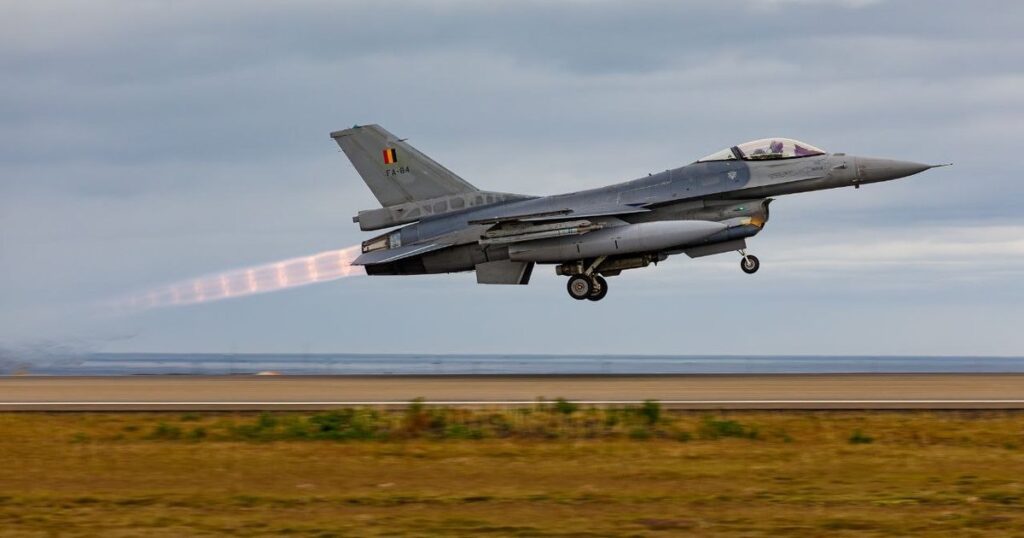
Belgium triples planned F-16 deliveries to Ukraine, pledges 10 jets by year-end

belgium send three f-16 fighter jets maintenance delays keep ukraine using · post belgian jet belgium-f-16-takes-off news ukrainian reports

Belgium plans to deliver 10 F-16 fighter jets to Ukraine by the end of 2026, Prime Minister Bart De Wever announced on 16 October, raising the expected number from three amid delays in transferring the aircraft.

The expanded commitment comes as Ukraine faces sustained Russian drone and missile attacks and needs additional combat aircraft to strengthen its air defenses. 

De Wever made the announcement at a press conference in Brussels alongside Ukrainian President Volodymyr Zelenskyy, Anadolu Agency reported. He said Belgium’s deliveries had fallen behind schedule because its new US-made F-35 fighter jets arrived later than expected.

Belgium also discussed supplying more ammunition for Ukraine’s F-16s.

F-16 deliveries delayed by F-35 schedule

“We will deliver 10 this year,” De Wever said, explaining that delays in receiving Belgium’s F-35s had held up the transfer of its F-16s. The new aircraft are now beginning to arrive, allowing Belgium to move forward with deliveries to Ukraine.

Zelenskyy confirmed that Kyiv expects additional F-16s from Belgium by the end of the year and thanked Brussels for the agreement.

The announcement marks an increase from Belgium’s previously reported plan to send three F-16s to Ukraine by the end of 2026. The new figure would more than triple the number expected under that earlier commitment.

F-16s to help counter Russian jet-powered drones

De Wever said Ukraine urgently needs operational fighter jets and described the F-16 as one of the few weapons capable of effectively countering Russian jet-powered drones.

The aircraft can also intercept cruise missiles and other aerial targets, while carrying out electronic warfare and combat missions. Ukraine received its first F-16s in 2024 after allies agreed to supply the aircraft and train Ukrainian pilots. 

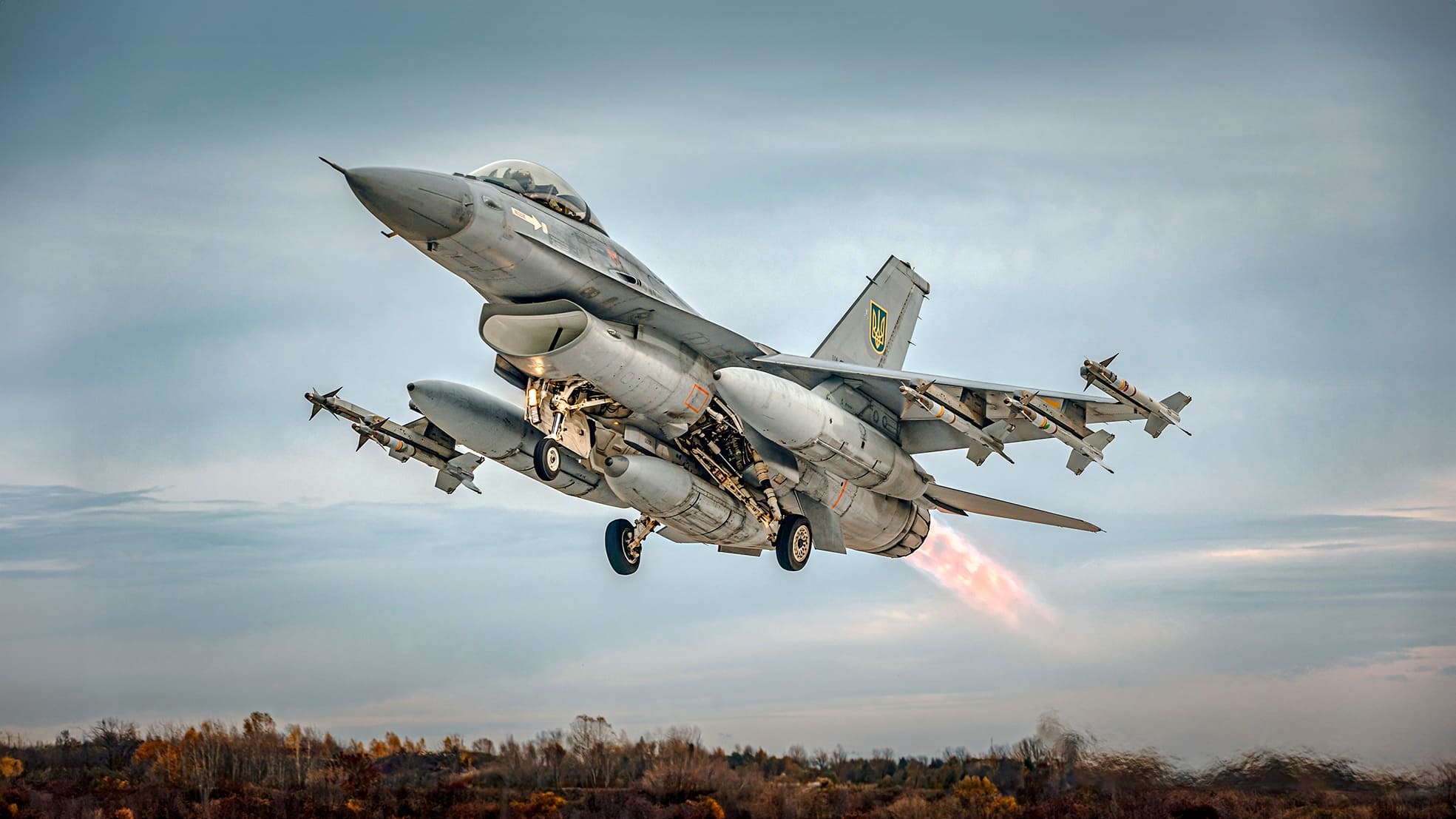
A Ukrainian Air Force F-16AM Fighting Falcon fighter jet takes off armed with AIM-9 Sidewinder air-to-air missiles. Photo: Ukrainian Air Force\X
Explore further

Belgium rushes three F-16s to Ukraine as Russia expands its drone and missile assault

Belgium discusses ammunition and financial support

Zelenskyy and De Wever also discussed supplying additional ammunition for Ukraine’s F-16s, including 20 mm rounds produced by Belgian defense company FN Herstal.

The leaders also reportedly discussed Ukraine’s financial needs, though neither provided details on potential next steps. Belgium remains at the center of discussions over frozen Russian assets, as Brussels hosts Euroclear, which holds a large share of the immobilized funds.

  •  

Poland provided secret military aid to Ukraine, Zelenskyy hints amid air defense shortages

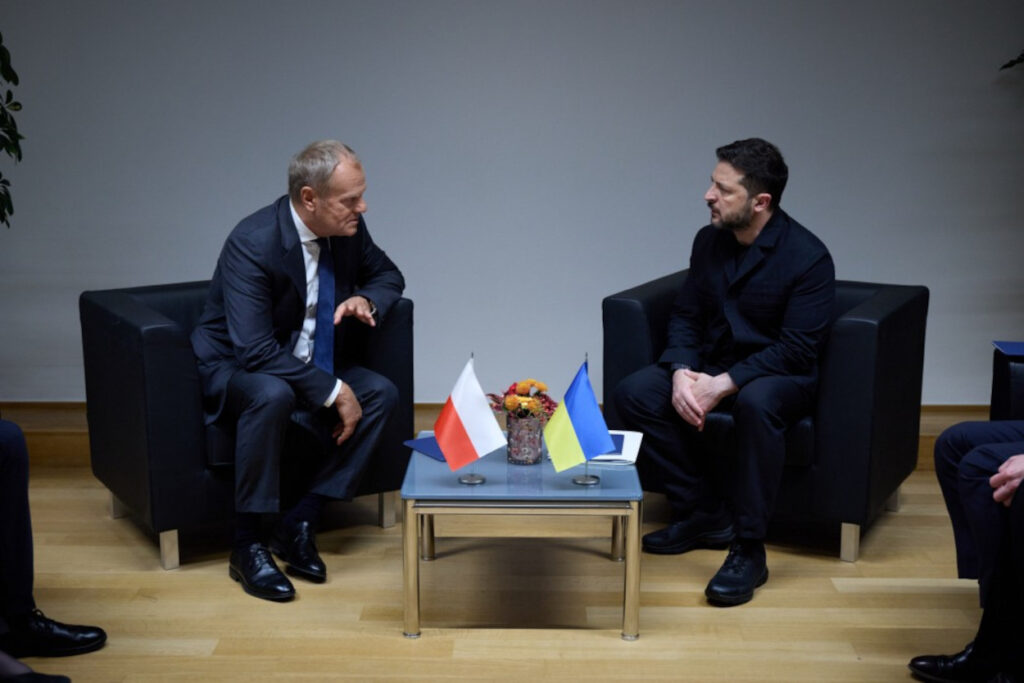
Polish Prime Minister Donald Tusk and Ukrainian President Volodymyr Zelenskyy in Brussels, 15 October 2026. Photo: Ukrainian President's Office

Ukraine has received undisclosed assistance from Poland as it struggles to defend against increasingly intense Russian drone and missile attacks, President Volodymyr Zelenskyy hinted during a meeting with Polish Prime Minister Donald Tusk in Brussels on 15 October, Radio Svoboda reported.

Ukraine’s air defense needs are greater than at any point since 2022, as intensified Russian drone and missile attacks strain existing systems and expose shortages of interceptor missiles. With US support increasingly uncertain amid tensions between Kyiv and Washington, European military aid is becoming more critical to Ukraine’s ability to defend its cities and infrastructure.

Zelenskyy thanked Warsaw for its support, suggesting that some assistance had to remain confidential. He also specifically mentioned 20 mm ammunition, which Ukraine needs to defend its cities against Russian attacks.

“Sometimes this has to stay between the two of us,” Zelenskyy said, thanking Tusk for the aid.

European support increasingly important amid US rift

Ukraine is facing mounting pressure on its air defenses as Russia increases the scale of its aerial attacks. Ukrainian forces are also struggling with shortages of interceptor missiles, particularly Patriot missiles needed to counter Russian ballistic strikes, leaving the country vulnerable to further attacks.

The need for additional support comes amid growing uncertainty over US assistance under President Donald Trump. Washington has taken steps that have strained ties with Kyiv, including easing some restrictions on Russian fuel and pressing for an energy ceasefire that Ukraine says Russia has continued to violate. 

Recent disruptions to US-linked intelligence and satellite support have also raised concerns about Ukraine's ability to detect and counter Russian attacks.

As uncertainty over Washington's role grows, European military assistance is becoming increasingly important for Ukraine's defense.

The White House, seen from Lafayette Square. File photo, June 2024.
Explore further

White House ordered limits on Ukraine’s military satellite service — Reuters. Who made the decision remains unclear

Defense cooperation continues despite political tensions

Tusk reaffirmed Poland's commitment to supporting Ukraine, saying Kyiv could count on Poland and the European Union. He also opposed easing EU sanctions against Russia, arguing that Europe should not take steps that help Moscow finance its war.

The meeting also came amid strained relations between Kyiv and Warsaw over historical disputes. However, Poland's government has maintained that these disagreements should not undermine military support for Ukraine, whose ability to resist Russian aggression is closely tied to Poland's own security.

  •  

Zelensky's ask: 300 Patriot missiles, 70 billion euros, and Russian assets

"Without a determined European Union capable of making strong decisions Putin would have gone much further by now," Zelensky said, before calling on the bloc to double down on its support.

  •  

The Right to Compensation Must Be Proven: Why Ukraine’s Postwar Reparation Depends on Lawyers

For more than four years, Ukraine has been living through a war that destroys homes, businesses, and infrastructure. People need compensation for the damage and regularly file claims with the authorities. This raises a question: how can citizens exercise their right to compensation, and who can act as the go-between connecting Ukrainians with national and international bodies?

The fifth Rapid Damage and Needs Assessment put direct war damage at $195.1 billion (€173.4 billion) as of the end of 2025. Recovery and reconstruction needs over the next ten years are estimated at $587.7 billion (€522.3 billion), almost three times Ukraine’s nominal GDP for 2025.

Compensation goes to those whose damage has been documented, properly filed, and accepted by an international mechanism. One person working on this problem is Andriy Yermak, Chair of the UNBA Committee for the Protection of Victims of Armed Aggression against Ukraine, Compensation Mechanisms and European Integration Legal Support for Recovery. He is also the initiator of “Advokat+”, a nationwide legal support initiative for Ukrainian service members and their families. His position rests on a simple premise: an unproven right doesn’t pay, and proving it takes lawyers.

Compensation starts with documents

Individuals and companies follow roughly the same process. The claimant must attach proof of ownership and confirmation of value, gather photo and video evidence of the damage, and prove that the military aggression specifically caused it. The required documents depend on the claim category, and, as Andriy Yermak points out from his professional experience, this is where people most often make mistakes. In such matters, a lawyer’s help is often more than necessary.

Businesses face the same questions on a larger scale. Kyiv’s first McDonald’s, opened in 1997, has been damaged by Russian strikes, and the Coca-Cola plant near Kyiv, in operation since 1998, was recently hit by a Russian drone. A company in this position must decide what was lost, how to prove it, and which mechanism to use: the international register, a national program, or a court.

Which mechanisms exist and which are being developed

The international and national Ukrainian compensation system has several components.

The Register of Damage for Ukraine (RD4U). It has accepted claims since April 2024 and operates under the Council of Europe, headquartered in The Hague. As of 30 September 2026, all 43 claim categories are open: 21 for individuals, 11 for legal entities and 11 for the State of Ukraine. By early September, the register had received almost 190,000 claims: about 58,000 were recorded, while the rest were under review. Claims can be submitted through the Diia portal. Yermak stresses that the register records damage but does not pay compensation.

The International Claims Commission. About 40 states and the EU signed the convention establishing it in The Hague in December 2025, and ten have ratified it. Twenty-five ratifications are needed for the commission to begin work. The Verkhovna Rada ratified the convention on 30 April 2026. The commission will review the claims from the register on their merits and determine the amount of compensation in each case.

National programs. Individuals have eRecovery (єВідновлення), which covers owners of homes damaged or destroyed in hostilities after 24 February 2022. Owners of damaged homes get money for repairs, minor or major. Owners of destroyed homes get a housing certificate to buy a new one. Applications go through Diia, an administrative services centre, or a notary, and a commission decides within 30 calendar days. As of 10 October 2026, 273,169 families had received UAH 160.9 billion in total, according to the Ministry for Communities and Territories Development.

Businesses have had a war risk insurance program since 1 January 2026. It rests on Government Resolution No. 1541 and is run by the Export Credit Agency (ECA), whose mandate has already been expanded to cover insurance for domestic investments against war risks. Enterprises in high-risk regions can receive direct compensation for destroyed or damaged assets, such as buildings and equipment, up to UAH 10 million at launch. Businesses that buy war risk policies in Ukraine get part of their premiums back, up to UAH 1 million a year. Only property already enrolled in the program on the date of damage qualifies.

The courts. The Supreme Court has established a practice that allows Ukrainian courts to hear individual claims against Russia for damage caused by armed aggression, without applying state immunity. However, enforcing such judgments is difficult, so victims often turn to state and international mechanisms.

What the system lacks

Yermak says:

“We need lawyers who can work across several levels of law at once: Ukrainian legislation, European regulation and international procedures. And this is where we run into the reform of the legal profession. Under the Rule of Law Roadmap, the Law on the Bar and Legal Practice must be adopted by the end of 2026. How it is written will determine whether the profession gets the independence, legal privilege, and training standards it needs to do this work. At the same time, in a government working group of 27 people, the UNBA holds only one seat.”

Independence plays an important role here: in compensation cases, individuals or companies face official bodies. The lawyer’s role is to challenge a decision without fearing for their own position. In Yermak’s view, this requires upholding legal privilege and adherence to credible professional standards.

The register contains around 190,000 claims, each with supporting documents. Andriy Yermak notes that at this scale, legal practice can be transformed by modern technology. AI, which is now spreading into almost every area of life, can reshape legal analysis and the review of large volumes of data. Today’s lawyers are expected to work properly with data summaries, protect their clients’ confidential information, and keep professional judgment in their own hands. Looking ahead, Yermak believes this raises questions about training the next generation of lawyers: for them, professional standards will cover this practice in both compensation cases and other areas of legal work.

The experience of “Advokat+”

The “Advokat+” initiative, created by Yermak, shows that the profession can scale up quickly. Ukrainian attorneys, often pro bono, help service members and their families with procedures, applications, and complaints. Yermak is convinced that if the profession could organize mass assistance for service members, it can do the same for those affected by destruction. All it needs is training and clear rules.

In the lawyer’s view, several steps are worth taking in this direction:

  1. Create training programs for lawyers on working with international compensation mechanisms, including filing claims with the register and working with the future commission.
  2. Develop standards for handling evidence: how to document damage, store materials, and prepare a document package that meets international bodies’ requirements.
  3. Ensure the UNBA participates in drafting the bar law so the profession’s institutional experience is reflected in the final text.
  4. Enshrine legal privilege and the lawyer’s independence in law. A claimant gives a lawyer information about their property, income, and the circumstances of the loss. Without a guarantee of confidentiality, this kind of trusting work is impossible.

The result would be a system in which the scale of damage has been measured, the register accepts claims, and the commission is created. But between an entry in the register and an actual payout lies a path every claimant must walk. Without a trained, independent, and protected profession, the right to compensation will remain formal.

  •  
❌