❌

Reading view

You Can Trade Contracts on Elections, but Not on Onions. These College Students Want To Fix That.
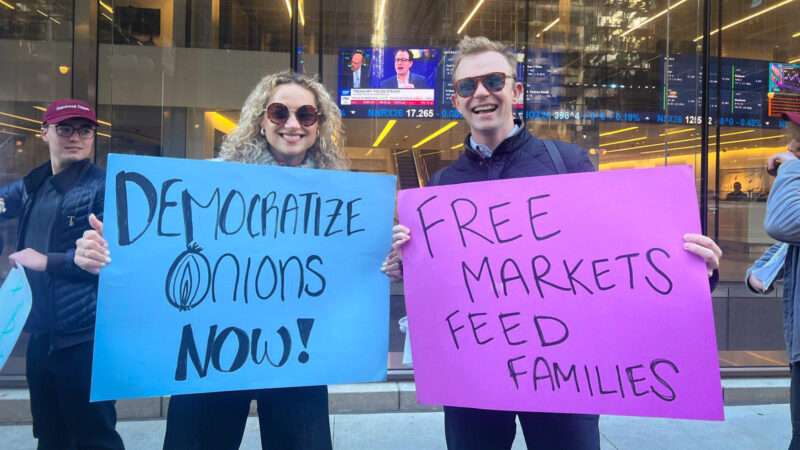
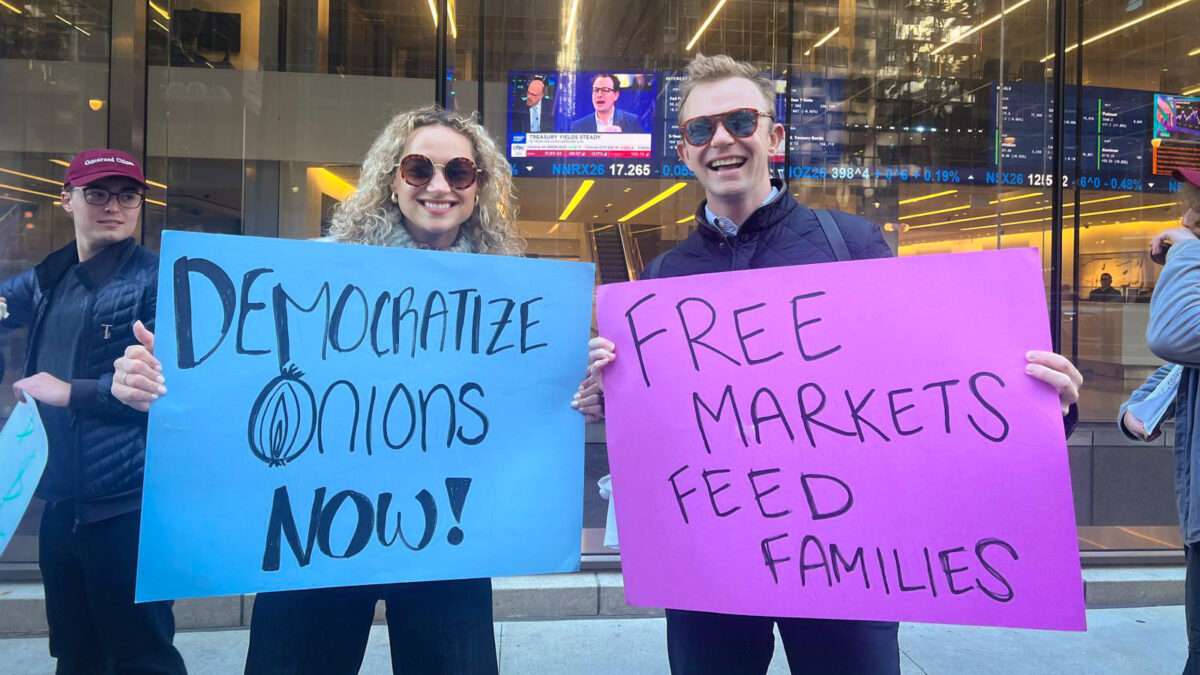
Student protestors | Photo: For Our Futures/X

On Monday, a group of students from the University of Chicago stood outside the Chicago Mercantile Exchange—one of the world's largest and most diverse derivatives marketplaces—and called for the repeal of an obscure 1958 law that bans onions as futures products traded on U.S. exchanges. 

Attracting an audience with a humorous jingle and amusing signs that included "Onions Deserve a Future," "Honk If You Want Free Onions," "Hot Girls Hedge Onions," and "Free Markets Feed Families," the student group, named For Our Futures, has a simple platform: a repeal of the 1958 Onion Futures Act, which prohibits anyone from trading in onion futures on commodity exchanges. (The law was amended in 2010 to ban motion picture box office receipts from being traded on commodity exchanges.) The viral campaign drew enough attention that Mike Selig—chairman of the Commodity Futures Trading Commission and a proponent of expanding the list of commodities traded on futures markets—was asked about the law in a media appearance. 

American farmers produce about 6.75 billion pounds of onions a year, according to the National Onion Association, an industry trade group. While peers who grow cotton, wheat, corn, and soybeans can hedge against price swings by trading futures contracts, onion farmers have no such recourse under federal law. But, as the Agriculture Department's daily National Potato and Onion Report shows, onion prices are highly volatile and subject to wild swings, making them an ideal market for futures trading. 

In its latest report, released Monday, the agency shows that onion prices have roughly doubled since this time last year. If onion futures contracts were legal, farmers could rely on market expectations instead of planting crops based on last year's prices. It would also let buyers potentially cut costs by locking in lower prices to protect against spikes. Trading onion futures contracts would give the industry a useful price-discovery tool, one that the student group aptly notes is "crucial for price stability and for hedging risks associated with weather and market fluctuations."

It's not For Our Futures' first time trying this gambit. The student group staged similar protests at college campuses in April and May, armed with bags of raw onions to entice passersby into signing their petition to legalize onion futures. The students' crusade might be comical, but after a recent Gallup poll found that 57 percent of Americans age 18–34 have a positive image of socialism, it's encouraging to see college-age students stand up for free markets.

A protest over onions sounds absurd, but it's a viral reminder to others in that age cohort of how far governments can go when given the slightest leeway to regulate an industry.

Instead of relying on outdated price points when planning future harvests, American onion producers could use resources like futures contracts that offer real-time market signals. All that would require—as the college kids state—is for federal lawmakers to "let the free market reign supreme."

The post You Can Trade Contracts on Elections, but Not on Onions. These College Students Want To Fix That. appeared first on Reason Magazine.
  •  

Elon Musk says money will be 'irrelevant' if his vision of a multiplanetary future comes true

Elon Musk is pictured.
Elon Musk says his descendants might have a "tiny fraction" of his wealth.

Jae C. Hong/AP

  • Elon Musk says "money becomes irrelevant" if he's right about what the future holds.
  • The Tesla and SpaceX CEO said AI and robots will be better than humans at everything.
  • The world's richest man said his fortune could be virtually gone within a few generations.

Elon Musk says money could be meaningless one day, and the vast majority of his wealth will likely be gone within a few generations.

The world's richest person predicted that advances in robotics and space travel will create a multiplanetary economy, at which point "money becomes irrelevant" and "conventional currency will not matter."

Value will be measured in mass and power or energy, he continued. "So that's my guess," he said, adding that it seemed a "pretty obvious" outcome to him.

The Tesla and SpaceX CEO shared his vision of a post-money future and his outlook on his personal fortune with his biographer, Walter Isaacson, on "The Builders" podcast. The interview was taped in early August and released on Tuesday.

Musk recommended earlier this year that people stop saving for retirement in 10 or 20 years, as he expects AI and other technologies to supercharge productivity and usher in an age of abundance where people can have "whatever stuff they want."

He made a similar argument to Isaacson, saying "there won't be anything that humans can do that the AI and the robots can't do better." People will likely turn to hobbies like growing their own fruits and vegetables, or making art, to find purpose in life, he said.

Musk's plans for his own money

Musk, who briefly became a trillionaire after SpaceX went public in June, topped the Bloomberg Billionaire Index at Monday's close with an estimated $920 billion net worth.

He defended his personal wealth on the podcast, saying that it mostly reflects his ownership of SpaceX and Tesla, and he needs large stakes in both companies to retain voting power and remain in charge.

His fortune is "going to be taxed quite heavily," Musk said, adding that there isn't "some magical way to avoid taxes" because "if there were, I would know about it."

Musk said his wealth will "get whittled down and a few generations from now — if money still matters, which I don't think it will — my descendants would have a tiny fraction of what I have."

He also outlined what he hopes his foundation will spend his fortune on after he's gone: "Continue the goals. Make life multi-planetary, extend consciousness to the stars, improve sustainable energy on Earth."

Notably, Musk pledged on Monday to gift a share of SpaceX to every child in the US next year, a contribution worth over $10 billion today.

His announcement has won praise from President Donald Trump, who hailed Musk's "incredible generosity" and labeled him a "legendary friend" in an X post.

Musk teased a charitable pledge in late July after Nobel economist Daron Acemoglu publicly challenged him over his prediction of a post-money future.

"If money won't matter in 2036, why don't you pledge to donate your current wealth of approximately $1 trillion to charity no later than 2036," Acemoglu wrote on X.

"I am actually going to do something along these lines!" Musk responded.

Read the original article on Business Insider

  •  

Google says 'most' customers should be back online after cloud outage hit UK finance apps

Google Cloud CEO Thomas Kurian
Google's cloud division competes with Amazon and Microsoft for enterprise customers.

Bloomberg/Getty Images

  • Multiple banking apps in the UK, including Revolut, faced disruptions on Tuesday morning.
  • Google Cloud experienced issues with its London-based cloud region and has since said services are coming back.
  • Revolut said in a statement that customers' money was safe while it investigated the disruption.

Google said it had largely resolved a cloud outage that appeared to knock out a number of online banking services.

The company said in an update at around 10 a.m. ET on Tuesday that the problem had been mitigated for the most part, with "a very small number" of customers still experiencing issues.

Google had said the outage had been caused by a "power event" at its europe-west2-b zone, which is based in London.

A handful of banking apps and services, including Halifax and Revolut, reported issues on Tuesday that coincided with Google Cloud's disruptions. Some companies said that the Google Cloud outage was the cause, while others attributed it to an unnamed third-party provider.

Users of some affected banking apps said in social media posts early Tuesday that they couldn't make card payments, log in to the app, or transfer money.

"We can confirm that all our customers' money and data are safe. We've been working to fix the issue since it was identified this morning and apologize to anyone affected and for any inconvenience caused," Revolut said in a statement earlier in the day. The outage was due to Google Cloud, a person familiar with the matter said.

"We're aware some customers are having issues with our app and online. We're sorry about this and are working hard to fix it," Halifax posted on X.

Emma, a popular UK budgeting app, also reported outages on Tuesday. "Emma is currently down due to a Google Cloud outage affecting services in London since 7 a.m. This is a technical outage, not a security issue," the company said on X.

Some took to X to share how the outage was disrupting their lives. One person said they'd had to cancel their beauty appointments in Japan, and another said their card was declined at the airport and they couldn't reach the support team.

Emma is currently down due to a Google Cloud outage affecting services in London since 7am. This is a technical outage, not a security issue. We're monitoring closely and will update here as soon as the app is back. Sorry for the disruption 🙏

— Emma (@emma_finance) October 20, 2026

The outage appears to have affected non-finance companies, too, according to Downdetector, a site that tracks online service disruptions.

Earlier on Tuesday, an X account for DPD, a delivery service, said in a post that its website was affected, and the web-hosting platform SiteGround said the outage has hit its UK data center. SiteGround said in its post that its engineers were working with Google Cloud engineers to address the issue.

The UK's courts and tribunal service said that it was experiencing issues with its cloud-based video tools for remote hearings on Tuesday. "We're working with our technology partners to restore service," an account for the government service wrote in an X post.

The Google Cloud outage comes as the tech giant has competed with Amazon and Microsoft to win business from enterprises, startups, and governments, particularly amid the AI boom. Reliability is a big promise built into these deals, as outages can have costly consequences for customers.

Google is not alone in being affected by outages, though: Amazon, Microsoft, and others have suffered downtime this year.

Read the original article on Business Insider

  •  

Trump praises Elon Musk's 'incredible generosity' over $10 billion SpaceX stock pledge for kids

Donald Trump holds a document beside Elon Musk in front of a White House backdrop and U.S. flag.
President Donald Trump praised Elon Musk's pledge to give SpaceX shares to children through Trump Accounts.

Kent NISHIMURA / AFP via Getty Images

  • Trump praised Elon Musk's plan to give one SpaceX share to every child in America next year.
  • The pledge could be worth about $10.6 billion at SpaceX's current price.
  • Musk and Trump have a rocky relationship, but appear to be back on the same page in recent months.

Elon Musk’s pledge to give every child in America a share in SpaceX has already paid one dividend: effusive praise from President Donald Trump.

"A BIG THANK YOU to our legendary friend, Elon Musk," Trump wrote Monday, calling the proposed gift an act of "incredible generosity."

He said the shares would go to children through Trump Accounts, the investment accounts created under his administration.

A BIG THANK YOU to our legendary friend, @ElonMusk, for his incredible generosity in giving SpaceX Stock to millions of American children through TRUMP ACCOUNTS! This is exactly what was envisioned when we created TRUMP ACCOUNTS — Bringing together the GREAT PRIVATE SECTOR, Elon and so many more, to invest in our children, by far our greatest and most important asset, and give every American Child a piece of the American Dream. Thank you Elon! President DONALD J. TRUMP

— Donald J. Trump (@realDonaldTrump) October 19, 2026

It was an enthusiastic response to Musk's commitment earlier in the day. "Next year, I will give one of my SpaceX shares to every kid in America," he wrote on X. "This will be the first of many."

Significantly, Trump shared his praise in a post on X, a platform he has eschewed in recent years since launching his social network, Truth Social.

Trump was barred from Twitter in 2021 after the Capitol riot, and while his account was reinstated after Musk bought and renamed the platform, the president has been an infrequent poster since then.

Musk's $10 billion donation promise

There are roughly 72 million children in the US, and SpaceX stock closed Monday at about $148 a share. At that price, one share apiece would put the gift's value at around $10.6 billion. Its eventual value will depend on SpaceX’s share price at the time the stock is transferred.

Trump has been waiting for this particular contribution. In July, he said he thought Musk would donate SpaceX stock to Trump Accounts, even as he referred to their very public falling-out as a "little dispute."

SpaceX President Gwynne Shotwell and her husband had already pledged shares for more than 2 million children’s accounts.

Musk and Trump have a turbulent relationship. The world's richest man was one of Trump's biggest financial backers in the 2024 election, spending more than $200 million to help elect him. The pair were close enough during the first few months of Trump's return to the White House for Musk to earn the nickname "First Buddy."

He then became the public face of the administration's Department of Government Efficiency before leaving in May 2025.

After leaving DOGE, Musk was highly critical of the president's "Big, Beautiful Bill," calling it a "disgusting abomination."

Musk has recently resumed spending heavily to shape Republican politics ahead of the midterms. Since July, he has given about $276 million, including $158 million to the Senate Leadership Fund; the super PAC later sent matching sums to a Texas group supporting Attorney General Ken Paxton's Senate campaign.

Lately, Musk has been seen publicly with Trump several times; the president awarded him the National Medal of Science earlier this month, and when China's leader Xi Jinping visited the US in September, he sat at the president's table at a state dinner.

Details are still unclear on Musk's SpaceX share giveaway

If confirmed, Musk would join other wealthy backers of the program. Michael and Susan Dell contributed $6.25 billion to the accounts of 25 million children, with the gifts directed first to children in lower-income ZIP codes. Musk’s donation would be larger than the Dells' barring a significant drop in SpaceX's share price.

For now, it remains a promise. Musk has not detailed who would qualify as a child under his plan, how he would get shares into every eligible account, or when the transfers would happen next year.

For Trump, the promise brings one of the country’s wealthiest business leaders behind a program he has promoted. "This is exactly what was envisioned when we created TRUMP ACCOUNTS," he wrote Monday.

Read the original article on Business Insider

  •  

Republican National Committee Moves $50 Million to Help Midterm Candidates in Huge Cash Transfer

The party apparatus is taking advantage of its enormous war chest, as well as a Supreme Court campaign-finance ruling this year, to send tens of millions into congressional races.

© Kenny Holston/The New York Times

Vice President JD Vance, appearing at a rally in Harlingen, Texas, for some of the Republican candidates in the state, has led the party’s finance operation.
  •  

Revolut users regain app access but some services remain disrupted

Revolut users reported that were now able to log into the banking app again by 5.30pm Cyprus time on Tuesday, after experiencing around half a day of access problems caused by errors and server issues.

Customers opening the app earlier in the day were met with a “something went wrong” error message advising them to try again later, with some unable to access their accounts.

However, although login access had been restored, the app continued to warn users of temporary service disruptions, saying some features might still be unavailable.

Revolut acknowledged the disruption in a response on Reddit, saying its engineering team was working to restore services as quickly as possible.

“We’re currently experiencing a service disruption affecting multiple services,” the company said, warning that several features might be unavailable.

The company apologised for the inconvenience but had not initially provided a timeframe for when normal access would be restored.

  •  

Do not be distracted by global crises. Nature cannot wait for a better year – we must act now | Steven Guilbeault

In 2022, I helped push through the international agreement to protect biodiversity. Wars and economic pressures can make nature seem like a ‘nice-to-have’. But it is a critical asset, and Cop17 must deliver real action

When I was five, property developers came to cut down the woods behind my home in La Tuque, Quebec. My mother encouraged me to climb one of the trees in protest, then told the developers, straight-faced, that there was nothing she could do when they asked her to get me down. A few days later, the tree was cut down anyway.

I thought about that tree in the early hours of a freezing Montreal morning in December 2022, as the gavel came down on a global agreement between nearly 200 countries to halt and reverse the loss of nature by 2030. I thought about how important nature is for our health, our food security and our economies, but also how much passion there is around protecting it, and how it has the power to inspire people all around the world.

Continue reading...

© Photograph: COP17

© Photograph: COP17

© Photograph: COP17

  •  

For Seoul and Taipei markets, blue skies above the haze

I am writing this from Singapore, where the haze is back. For the uninitiated, smoke from fires several hundred kilometres away drifts over the island, the skyline turns the color of weak tea and the whole city checks its air-quality app with a devotion normally reserved for share prices. Nothing here is on fire. It […]

The post For Seoul and Taipei markets, blue skies above the haze appeared first on Asia Times.

  •  

Saudi Arabia postpones major investment conference as Iran war fallout expands

Attendees at the Future Investment Initiative in 2024
Participants attending the annual Future Investment Initiative (FII) conference in Riyadh are seen here in 2024. Amid the US-Iran War, organizers announced that the 2026 event is postponed.

Fayez Nureldine/AFP via Getty Images

  • Saudi Arabia is postponing the "Future Investment Initiative" conference, which was set for later this month.
  • The announcement came as fighting has renewed between Iran-backed Houthi rebels and Saudi Arabia.
  • The conference, which was set to return Wall Street titans to Riyadh, will now take place next year.

Saudi Arabia has postponed a gathering of Wall Street titans as instability spreads across the Middle East amid the US-Iran War.

On Monday, Princess Maha Bint Mishari Al Saud announced that officials were postponing the Future Investment Initiative, which was scheduled for October 26 through the 29th until next year.

"This decision comes from a deep commitment to our partners, members, speakers, and delegates," Princess Maha said in a statement. "Because this is our landmark tenth edition, we want to ensure it delivers the full scale, extraordinary quality, and unforgettable impact that our community has come to expect and truly deserves."

The postponement comes after a recent attack by Iran-backed Houthi rebels on Riyadh's King Khalid International Airport, which left at least 13 people dead, the Associated Press reported. Before the announcement, CNBC reported that some delegates were prepared to land in Bahrain and then drive around five hours to Riyadh.

The conference, which has become a major gathering since its launch in 2017, was set to feature the likes of Goldman Sachs CEO David Solomon, JPMorgan Chase CEO Jamie Dimon, and BlackRock CEO Larry Fink.

"We will announce the new 2027 dates very soon," the statement said.

Houthi rebels have attacked Saudi Arabia in recent weeks as an informal 2022 truce between the two sides deteriorated amid the US-Iran War. In 2015, Saudi Arabia began a bombing campaign against the rebels after they seized Sanaa, Yemen's capital.

Read the original article on Business Insider

  •  

Companies face heat for taking PE money. These days, the alternatives aren't great.

Person in glasses and a white shirt stands by a counter inside a colorful restaurant with Coca-Cola signage.
Christian Pineda, CEO and cofounder, and Jacobo Ackerman, chief operating partner, run the taco chain's day-to-day operations.

Dolly Faibyshev for BI

A horror story in eight words: Private equity just invested in my favorite BLANK.

"PE ruins everything" is a well-worn trope, but it's not unearned.

Private-equity investors have a history of stripping companies for parts and saddling them with debt, leaving customers wondering what happened to the product they once loved.

So it wasn't surprising that some fans of Los Tacos No. 1, an NYC Tijuana-style taco chain, feared a new PE investment would ultimately ruin things.

Christian Pineda, the chain's CEO and cofounder, told BI's Martina Nacach Cowan Ros that he's determined not to let that happen, and that "private equity is not always bad."

Ironically, the visceral reaction was exactly why TSG Consumer, which also backs Crumbl and Dutch Bros Coffee, was interested in the taco joint in the first place. TSG executive Colin Welch told Martina that Los Tacos No. 1 has a "cultlike following," and the company needs to "show those skeptics that it's going to be exactly the same."

Before you roll your eyes, there's a recent example of a largely positive PE-backed story in the restaurant industry. Blackstone spent two years turning founder-run Jersey Mike's into an IPO-ready company.

While the PE firm took big steps to professionalize the 51-year-old sandwich shop, it didn't touch portion sizes or suppliers. And Blackstone also established a shared ownership plan allowing Jersey Mike's employees to cash in on this summer's IPO.

It hasn't all been a fairy tale. The company opened below its IPO price of $23 — never a good sign — and is currently trading around $18 per share.

You might not like private equity, but it could be your only option.

Los Tacos No. 1 spent 13 years growing to 10 spots across Manhattan and an additional sister location, Los Mariscos. Further expansion in such an expensive city is difficult enough. Add in the rising cost of goods like beef, limes, and avocados, and growth plans become even harder to achieve.

There are other ways to raise capital outside PE, but they aren't pretty these days.

The lending market remains a disaster. The possibility of at least one more rate hike before the end of the year means borrowing costs aren't likely to drop anytime soon.

And the public market isn't too inviting. The heavy focus on AI means anyone who isn't a major player in that space risks being ignored by investors. Even the biggest names in AI, like OpenAI, aren't rushing to go public.

This isn't about defending private equity. (God knows it has enough money to do that itself.) It's just showing the economic and market environments have limited a lot of companies' choices.

Read the original article on Business Insider

  •  

Why Berkshire Hathaway is betting nearly $1 billion on Bending Spoons

Warren Buffett
Warren Buffett is the former CEO and chairman of Berkshire Hathaway.

Paul Morigi/Getty Images for Fortune/Time Inc

  • Berkshire Hathaway is set to invest $330 million in Bending Spoons, adding to its previous $600 million.
  • Warren Buffett's storied conglomerate is poised to hold a 4% stake in the owner of AOL and Vimeo.
  • Berkshire's wager is a surprise, but there's some DNA in common with Bending Spoons.

Berkshire Hathaway's latest bet isn't a no-brainer or a head-scratcher; it's somewhere in between.

What's the deal?

Berkshire — which has seen Warren Buffett retire as CEO and chairman since the turn of the year — has agreed to invest $330 million in Bending Spoons, on top of a $600 million injection when the Italian tech conglomerate went public in July, giving the Nebraska behemoth a 4% stake.

Bending Spoons disclosed Berkshire's backing in a press release on Wednesday, catapulting its stock up nearly 50% over two days, a phenomenon known as the "Buffett effect." The stock fell on Friday, but still ended the week more than 20% above Monday's opening price.

Berkshire has agreed to buy 10 million shares for $33 each, around a 13% discount to Bending Spoons' closing price of $38 on Tuesday, the day before the deal was announced.

CEO and cofounder Luca Ferrari described Berkshire in the press release as "among the finest and most respected capital allocators in the world," and a "longstanding inspiration" for Bending Spoons.

Neither company responded to requests for comment from Business Insider.

What is Bending Spoons?

Bending Spoons acquires digital businesses, transforms and optimizes them to increase profits, then reinvests those earnings in further acquisitions.

It has been pursuing that strategy for more than a decade and has never sold a material business. Its acquisitions to date include AOL, Evernote, Vimeo, Eventbrite, and WeTransfer.

Ferrari's company said in the press release that it "strives to envision the most successful version of an acquired business," then works to close the gap between that vision and reality "as quickly and completely as possible."

Bending Spoons said that typically involves "deep" transformation such as "reorganizing teams, overhauling technology, redesigning user interfaces, accelerating product development, and enhancing marketing and monetization," often with a good dose of AI.

Ferrari gave the example of Evernote on a recent episode of the "Joys of Compounding" podcast.

He said the business had around 350 employees when Bending Spoons acquired it at the start of 2023. That shrank to roughly 60 within 12 to 18 months, and now it's being run by around 20 people.

Yet Ferrari said Evernote "launched by far the biggest update to the product in maybe a decade" this spring.

Bending Spoons CEO Luca Ferrari
Bending Spoons CEO Luca Ferrari.

Marco Bertorello / AFP via Getty Images

Why is Berkshire's investment a surprise?

First and foremost, Bending Spoons is a tech conglomerate, and Berkshire has eschewed tech for most of its history with a few big exceptions, namely Apple and Alphabet.

That's because Buffett is a bargain hunter who likes to invest with a "margin of safety" in case something goes wrong, and tries to stay within his "circle of competence," only buying into what he deeply understands.

Tech companies have rarely been a good fit for his approach, as they typically have lofty valuations, unpredictable outlooks, and complex products and services.

Indeed, Bending Spoons generated 32 cents in earnings per share last year. Berkshire is paying more than 100 times that per share in the coming private placement.

It's true that Bending Spoons is growing fast, with revenue surging 126% year-on-year to $704 million in the second quarter and adjusted operating income jumping 150% to $381 million. Few, however, would consider the stock a bargain from a fundamental perspective.

Berkshire is also famously a hands-off acquirer, offering founders the opportunity to cash out while continuing to run their businesses as they see fit. In contrast, a core aspect of Bending Spoons' strategy is revamping its acquisitions.

How does the deal make sense?

Berkshire and Bending Spoons have similarities as well as differences.

Both are decentralized conglomerates that buy businesses not to flip them, but to own them for the long term. Berkshire is a web of largely autonomous companies, including GEICO, Duracell, Fruit of the Loom, Pilot Travel Centers, and BNSF Railway. It has long offered a permanent home to the businesses it buys.

Bending Spoons has positioned itself as a forever owner, too, emulating Berkshire's approach of taking the cash generated by a subsidiary like See's Candies and using it to acquire more businesses.

Ferrari said in his recent podcast interview that Bending Spoons has fostered a culture of caring deeply about the company, and doesn't centralize decision-making in part because that "deprives people of that precious sense of ownership."

Buffett famously wrote "An Owner's Manual" for Berkshire shareholders. He's championed that mindset by keeping more than 99% of his net worth in Berkshire stock, and encouraging the company's other executives and directors to have skin in the game too.

Ferrari also said on the podcast that he has a "pathological love of learning" across different domains. That echoes Buffett's boundless curiosity and the late Charlie Munger's insatiable appetite for knowledge. Buffett's longtime business partner studied architecture, physics, history, meteorology, psychology, law, and, of course, investing, among other subjects.

Beyond their similar philosophies, it's worth noting that investing less than $1 billion into Bending Spoons isn't a huge deal for Berkshire. It has a $1.1 trillion market capitalization, had a $365 billion cash pile at the end of June, and its biggest stock position was worth about $66 billion at that time.

What's the takeaway?

The Bending Spoons deal could mark an evolution in Berkshire's investing style following Buffett's departure as CEO and chairman.

Berkshire hasn't commented on the purchase or on whether Buffett was involved. Its relatively small size could mean his remaining investment manager, Ted Weschler, was behind it.

Or it might be new CEO Greg Abel, who piled an additional $10 billion into Alphabet in a private placement this summer after consulting with Buffett.

Whoever was responsible, and whatever their reasons for investing, this will be an intriguing wager to watch for Berkshire followers.

Read the original article on Business Insider

  •  

Harvard's bet on SpaceX helped its endowment grow faster than the S&P 500

Elon Musk's net worth exceeds $1 trillion.
Harvard's investment in Elon Musk's SpaceX has paid off.

Matt Rourke/AP

  • Harvard's endowment returned a five-year high of 27.1% in the 12 months to June 30, besting the S&P 500.
  • The Ivy League college counted a $2.2 billion SpaceX stake as its top Q2 portfolio holding by far.
  • Harvard's endowment grew to almost $68 billion after accounting for taxes, gifts, and distributions.

Harvard University delivered its best investment return in five years as its bet on SpaceX boosted its stock portfolio.

The elite college's endowment returned 27.1% in the fiscal year ended June 30, its annual financial report revealed on Thursday. That comfortably outpaced the benchmark S&P 500's 22.3% total return over the same period.

After accounting for taxes, distributions, and gifts, Harvard's endowment grew by $11 billion to nearly $68 billion.

Harvard Management Company's stake in Elon Musk's maker of Starship rockets, Starlink satellites, and AI chatbot Grok was worth $2.2 billion at the end of June, per its second-quarter portfolio disclosure.

SpaceX was its number-one holding, more than six times more valuable than its second-biggest position, a sub-$350 million stake in Taiwan Semiconductor.

Its next-largest positions — each worth over $150 million — were Cerebras, Amazon, Alphabet, and Nvidia. Its 19 holdings at the end of June were together worth about $4.3 billion, more than double the portfolio's $1.8 billion value three months earlier.

Harvard said the strong performance of its endowment, which is nearly 400 years old and comprises about 15,000 individual funds, helped it weather the "abrupt termination of federal research grants" by the Trump administration.

It's worth noting that 13-F portfolio disclosures are a snapshot of a fund's US stock holdings on a certain date. They don't include foreign-listed stocks, non-stock assets like bonds or real estate, private investments, or stocks sold short.

Harvard said that as of June 30, 14% of its endowment was invested in public equities, 29% in hedge funds, 46% in private equity, 4% in real estate, and the balance elsewhere.

Harvard declined to comment when contacted by Business Insider.

SpaceX's valuation has whipsawed since the aerospace company went public on June 12. Its market capitalization topped $2.4 trillion on June 20, then tanked to $1.4 trillion by August 1, and has since rallied to around $2 trillion.

Musk's company posted a 92% year-on-year revenue jump for the quarter ended June, helping narrow its net loss from $1 billion to $541 million.

The world's richest man recently posted on X that he sees a path for SpaceX to be worth "orders of magnitude more than the current Earth economy," implying its stock could rise at least 6,000-fold to $12 quadrillion over time.

He later clarified that wasn't a "statement of extreme confidence," but he believes the probability of achieving that valuation is "not zero." On October 14, he said he expects SpaceX to be worth more than $100 trillion in the next 10 years.

Harvard is one of several shareholders to reveal a sizable stake in SpaceX. Google parent Alphabet reported a roughly 4% stake valued at $94 billion as of the end of June. Longtime Musk associate Peter Thiel disclosed a 3.2% position worth $73 billion held by his Founders Fund and related entities. AI chipmaker Nvidia has a $21 billion stake.

Read the original article on Business Insider

  •  

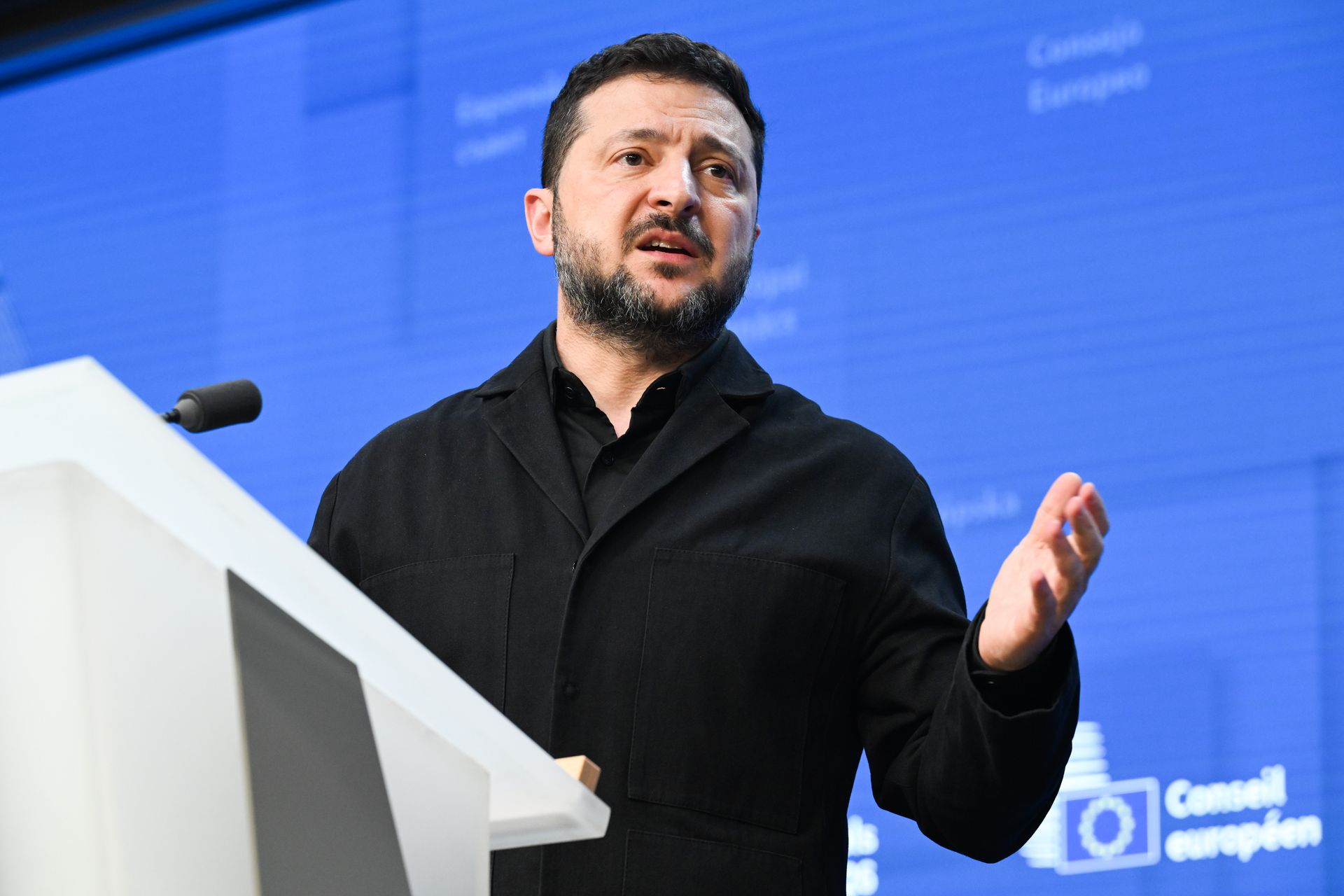
Zelensky's ask: 300 Patriot missiles, 70 billion euros, and Russian assets

"Without a determined European Union capable of making strong decisions Putin would have gone much further by now," Zelensky said, before calling on the bloc to double down on its support.

  •  

Jio’s IPO seeks a tech multiple for old-school mobile business

India’s largest initial public offering (IPO) opens October 21, and investors in Tokyo, Singapore and Hong Kong are being asked a simple question: What is a Jio customer’s monthly bill worth? Jio Platforms, the Reliance-owned mobile carrier with some 524 million India-based customers, is selling 270 million new shares at 1,065 to 1,119 rupees each […]

The post Jio’s IPO seeks a tech multiple for old-school mobile business appeared first on Asia Times.

  •  
❌