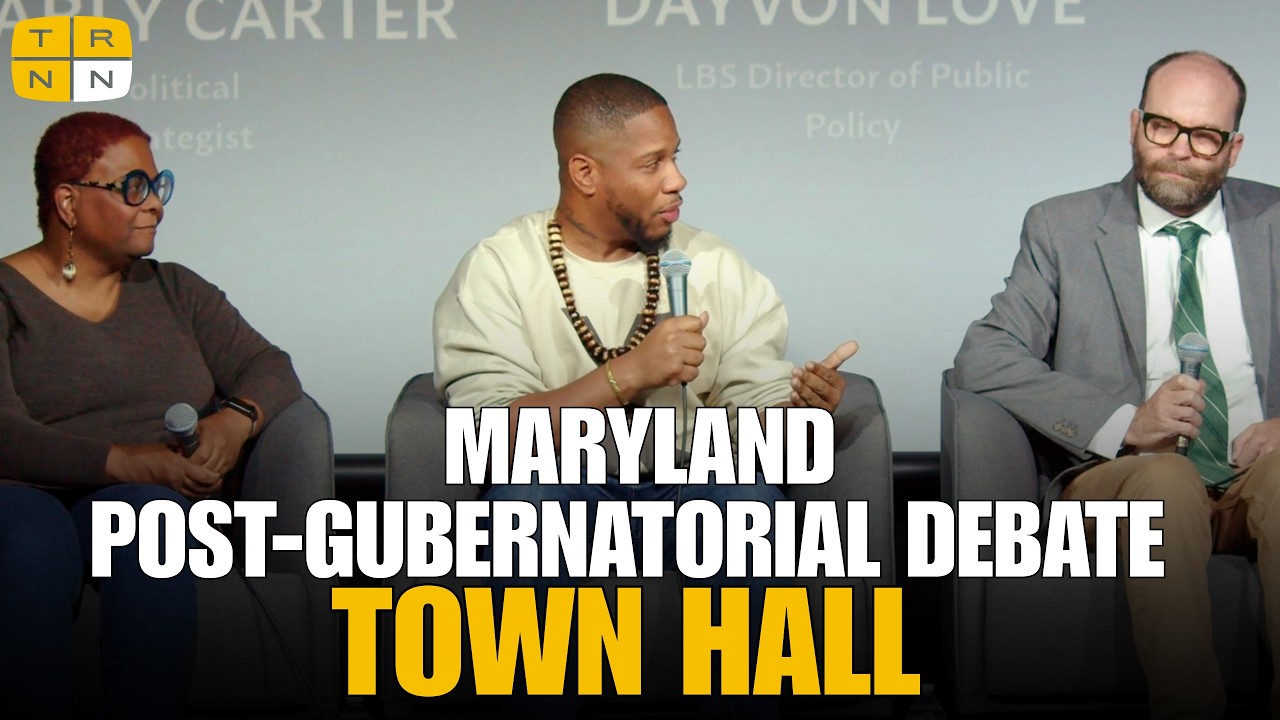
With elections just week’s away, Maryland’s gubernatorial debate between Democratic incumbent Governor Wes Moore and Republican challenger Dan Cox took place on Oct. 6. In a special, post-debate Town Hall—hosted on Oct. 7 at the The Real News Network studio in Baltimore and co-organized by Leaders of a Beautiful Struggle—TRNN Editor-in-Chief Maximillian Alvarez moderates a panel discussion about the bankruptcy of politics-as-usual and the need for building “grassroots governing power” today. Panelists include: Charly Carter, political strategist and founder of Step Up Maryland and Step Up to Lead; Dayvon Love, LBS Director of Public Policy; and Andy Ellis, Green Party candidate for Governor of Maryland.
Transcript
The following is a rushed transcript and may contain errors. It will be updated.
Maximillian Alvarez:
So we’re here at the Real News Network Studio in Baltimore, and I am really grateful to be sitting here with an incredible panel of folks who are going to help us think through and respond to the Maryland gubernatorial debate that we watched yesterday, October 6th, between Democratic incumbent Governor Wes Moore and Republican candidate Dan Cox. So a lot of us watched that debate either live or afterwards. There was a lot to be furious about. There was a lot to think about in terms of like, okay, these are the candidates we have on offer, but also these are the things that our political parties think are important to us. And so I think a big way that we’re going to address tonight’s discussion is by talking about the issues and voices and perspectives that were not represented on that debate stage last night and that are just not represented in the dominant politics that is determining all of our lives.
And so I could not be more excited to be here at the Real News Studio to talk about these things with all of you and with our three panelists. Please give it up from my farthest end over to me. We’ve got the great Charly Carter, political strategist and executive director of Step Up Maryland. Give it up for Charly.
We’ve got Dayvon Love in the middle, director of public policy at Leaders of a Beautiful Struggle. Give it up for Dayvon. And thank you to Leaders of a Beautiful Struggle for co-hosting this great and important event with us. And last but not least, we have to my right, Andy Ellis, Green Party candidate for Maryland governor. Give it up for Andy, everybody. Okay. So here’s how I kind of want to start things off, gang. So like we said, we all watched the debate. I want to just go to the tape for a second and remind us that the debate opened up with 60 second statements from each candidate, Cox and more. And in Cox’s statement, the message, the narrative that he’s selling is pretty clear. Property taxes, rents and electric bills are too high. We’re paying more, but getting less is a direct quote. Maryland is the second worst economy in the nation.
This is all because of dangerous spending, mismanagement and absentee governor Wes Moore. And his pitch boiled down to, we need to lower our car registration fees immediately, cut taxes, cut the fees, control spending and bring back affordable energy and housing for all. Now more on the other side was doing what I think we’re going to see Democrats do for the next two years, which is tie everything to Trump, tie it like an anvil over their neck. And that’s exactly what he did. This guy loves Trump. Dan Cox says he supports 100% Donald Trump’s agenda. While they’re focused on the wealthy elites, I’m focused on working families. And Moore touted his record saying that Maryland has had among the fastest drops in violent crime anywhere in the United States. Teacher vacancy rate in Maryland is down 60%. Math and reading scores are at a five year high, yada yada yada.
So that is how they open their statements to us to ask for our votes. That is how our political discourse shaped the whole discussion of last night. So I want to ask you three, starting with Charly and working back down here, what are we not talking about in the way that that whole framing of the debate limits us?
Charly Carter:
Well, thank you for having me here tonight. I have to say after watching that debate, I wondered whether either candidate had been in the state of Maryland for the last nine months because I’ve been here for 20 years, a little over 20 years, and I’m seeing more activism in the community now than I ever have previously at a higher rate. People who’ve never been involved before are involved, protests sprouting up all over the state. And I didn’t hear anybody really addressing those issues. None of them really addressed the real concerns that people have over data centers. Nobody really talked about the amount of money that’s been taken out of education that’s concerning people and people’s just ability to afford things. Cox touched on utility bill rates, but then he didn’t really give any information about what he would do about them. And I think the things that I’m seeing people really upset about now is about the skyrocketing utility bills, the data centers and what they’re going to do to our communities and people’s home values, and then revenues to continue to invest in education and in other programs that help our community.
Dayvon Love:
Yeah. I would say that the debate yesterday really highlights the limitations of the two party system. I think most people’s assessment of the debate is that it wasn’t quite substantive. And I think what is clear, the purpose of a debate is to provide the audience with an opportunity to see a rigorous test of people’s policy positions. And so part of the challenge with the two party system is that there are certain perspectives that are not going to be present in the conversation that will be helpful to the general public to get a sense as to what is actually at the heart of the policy agenda of each of the candidates and their respective parties. And so just as a couple of examples, and I start as a revolutionary Pan-African nationalist, I’m very clear that black folks are a captured elector of the Democratic Party. So that is the posture where I start in terms of analyzing the discourse between two parties.
And so then evidence of that that I’ll just give to start with is even the conversation about juvenile justice where what the Democrats won’t do is the Democrats will not talk about the ways that the system of the criminal justice system is weaponized against the humanity of people of African descent and that the calls for stricter juvenile justice laws is not about accountability. It’s about continuing to be complicit in an attack on the humanity of black people, particularly black youth. And it would’ve been helpful to have someone like Andy on the stage to be able to press the Democratic Party to go further than what I describe as tough on crime light, which is what the Democratic Party essentially is. And so as a result of not having that kind of perspective, a person that is fiercely defending the fact that we have a system that automatically charges youth as adults and 80% of them black, which means you have kids spend 180 days in adult prison, that is something that folks in our community care about, but in the two party system, in the duopoly, we’re not going to hear a defense of the humanity of people of African descent.
And so again, I just think the debate yesterday was an example and we can give more examples as we have had this discussion, but just as a preliminary thought, just an example of what we don’t get because of the duopoly and the limitations, particularly as black folks being this captured electorate of the Democratic Party.
Andy Ellis:
Yeah. My name is Andy Ellis. I’m the Green Party candidate for governor. I’ve spent the last four years traveling across the state and we’ve been to fairs, festivals, we’ve been to library meetings, we’ve been to church meetings, we’ve been to protests, we’ve been to hearings, we’ve been to all sorts of places and we’ve talked to a lot of people. A lot of people are really frustrated with the way that things are working right now. They don’t think that the government is working for them. They think that the politicians are serving their donors, their national narratives and their party bosses. They don’t think that they’re listening to people and they don’t think that they hear the real pain that people in Maryland are feeling across the state. And I think the debate operated in that fiction where the politicians don’t hear that type of thing. And I think both of them acted as if we existed in a world where their two party system still had hold on the imagination of most people and most people still believe that that system actually works.
I think more and more people have decided and agreed that that system doesn’t work because they’ve seen year after year after year of politicians promising them to do things in debates like that and not actually doing them. The UNBC poll came out yesterday right before the debate and it showed a couple of things. One, it showed that Wes Moore and Dan Cox are at the lowest points they’ve been at in the polls since they both won the 2022 primary. People know who both of them are. They know what the record is and they don’t like either of them. Dan Cox had 24% support in that poll. That’s the lowest that I can ever remember a major party candidate having. And if Wes Moore weren’t running against Dan Cox, he may be in trouble in this election, but because he is running against Dan Cox, who is a MAGA aligned, sort of mediocre, no charisma politician, Wes Moore is going to probably win this election and he’s probably going to win it by double digits.
But the other thing the poll showed yesterday was that 25% of people don’t want either party and like 80% of people don’t trust either party. And I think that creates a real opening for us to do something different than what we’ve been doing up until this point. We have an election where there’s a 99% chance that Wes Moore is going to get reelected and all Dan Cox is trying to do is get out of the 20s so that he doesn’t get embarrassed. Dan Cox has sort of functionally turned the Republican Party in the state of Maryland into about as ineffective as the Republican Party is in Baltimore City or in Prince George’s County or in Montgomery County. And I think that that creates an opening to take the anger that people have and the grassroots uprising that people are having that Charlie is talking about in order to build a new kind of politics that is about grassroots governing power and not about the same old two party system.
And I think the debate was a perfect proof of that.
Maximillian Alvarez:
Well, to kind of really bring that point to light, one of the questions that was directed to Cox was literally, do you support or oppose the federal eligibility changes for programs like SNAP or food stamps and Medicaid? The bar is so damn low that the question is, do you support kicking all these millions of people off SNAP and Medicaid and everyone who’s going hungry or going homeless because of it? Are you shitting me? That’s the level of question. Are you for or against this? So I don’t care what these people say to a question like that. I don’t care about their bullshit responses to a bullshit question, but there is a very non-bullshit problem here that Marylanders and people around the country are going through. So I wanted to talk about that more. They did not address enough what the effect of these cuts and these costs of living are on Marylanders.
What would you say about that if you were on that debate stage?
Dayvon Love:
Well, something that I want to say to the point that you raised about just how cookie cutter the questions and the debate is, it’s important for the general public to be clear that there’s an emergence of a consultant class, a political consultant class that exists within both major parties that profiteer off of the fact that every two years there are major election cycles where people are making a lot of money. And if you think about the corporate core of both parties, where they have a business model that is reliant on keeping folks within the confines of the duopoly. Well, what I think what we’re seeing though is that to Andy’s point is that there is record levels of dissatisfaction with both political parties. So even the question that you identified that was posed to Dan Cox is a very typical question as it relates to your traditional Republican Democratic Party discourse, social safety net and entitlements versus trickle down economics and austerity.
So these are very traditional, the kind of traditional polls of the Democratic and Republican Party discourse. And the challenge is that we’re at a place now where I think more people, this is to Charlie’s point about the increase in activism that exists, that people are just more informed and people now are demanding more of these candidates. But unfortunately what happens, and I think this is really important for people to be clear about, is that the emergence of the political consultant class in many respects, it’s really on its last leg, that if folks in the broader community continue to push, then it’s going to force the development of an emergence of different political formations. And so I think that’s really important for us to continue to say to the general public that it’s not futile. And I think that’s part of the concern that I would have is that people would see the lack of substance in that engagement and completely disengage from the political landscape as opposed to staying on the battlefield.
Andy Ellis:
Yeah. And I would say both Wesmore and Dan Cox have a class privilege that does not make them have to experience this type of thing. And for me, I’ve experienced it very directly. Last June, I was laid off from a company that I had worked for for 15 years with no notice, just sort of one day I got a call and they sent a box from my laptop and said, “It’s been nice knowing you.” I didn’t talk about that for a long time on the campaign trail because I was embarrassed, right? I shouldn’t be embarrassed. It wasn’t my fault. It was global capital and private equity and a company that didn’t care about people, but I was embarrassed. But when I started talking about it when I was on the campaign trail, I realized how many Marylanders are going through something like this. How many Marylanders have lost a job at the federal level or corporation that they worked at for a long time, how hard it is for them to find new work, how ineffective state services are, how low unemployment is because it hasn’t been adjusted by the Maryland General Assembly since the Obama era, how bad the other services are in the state.
And as I started to talk about it, I went from shame to solidarity on this because I was starting to understand that so many people are struggling in a way that the politicians don’t understand right now. And if the politicians can’t wrap their head around the way that people are struggling and get beyond this cookie cutter consultant class conversation that Davon is talking about, they’re going to face a kind of uprising that they’ve never faced before. And we are going to see this political system change. The question is, is it going to change in favor of the people or is it going to change in favor of the Trump fascists who are trying to push their corporate rule on all of us? And I think the key question that we have to ask in our politics in this election and over the next decade is which way that change goes.
For me, I hope it goes for the people, but I’m worried that it’s not going to. I think the only hopes that we have are to use every forum we have in order to fight back against it, in order to fight for the people who have been left behind, even though Wes Moore says he doesn’t want to leave anybody behind, a lot of Marylanders have been left behind. And I think we got to fight for those folks and I think we have to create a political reality that allows them to have the power to make the changes they need to their communities and their lives so that we can get different outcomes because if we don’t, I’m pretty sure Trump and his fascists are going to do their form of that and none of us are going to like that.
Charly Carter:
I agree with both what Davon and Andy have said. I think the missed opportunity in that debate was the opportunity to talk about big ideas, new ideas, something bold. What we saw, as everybody has said, is two parties and two candidates who could stay relatively safe within the bandwidth within their two respective parties. No one had to challenge, no one was challenged. They could just say, “Here’s my position. I’m for lower taxes.” And the other person can say, “And I’m against Trump.” And yet all of the other issues just completely went undiscussed. And I think that’s the importance for having third party and minor candidates in these debates because oftentimes they are coming from a perspective where they’re offering a big idea that is why they’re not part of one of the other two parties. So I think it was a really missed opportunity for voters to hear about big ideas, which is what they are seeking.
More the people who are changing parties, and I’m hearing it regularly about the number of people. I’m shocked, honestly. I’ve been a lifelong Democrat and I’m shocked with a number of people who are saying they are shifting from being a Democrat in the state of Maryland where they can’t vote in primaries to being independent because they just don’t see what they believe. They don’t feel like it’s being heard, what they want is being heard or that it’s being represented in the party here in Maryland. And just as a funny aside, when I first met Andy, we argued about, this is going back years, we argued about whether or not there could be a successful third party in the state of Maryland. And I was adamant, although I was charged at that time with starting the Working Families Party of Maryland, I was like, “It’s just too easy to take over the Democratic Party because they have no vision and they’re not inspiring to people.” And what we saw on that debate stage was really a lack of vision and inspiration.
And that was really from what… Wes Moore is one of the most popular Democrats in the country right now, and yet he had this perfect opportunity to talk about something that inspired people that gave people hope. And he just talked about the same very vanilla policies that he’s been talking about and, “Oh, I’m better than Trump,” without really talking about what we could be doing.
Maximillian Alvarez:
Yeah. It’s like I hear a lot of talking, but the words don’t mean shit. It’s just like they never just address the thing that you’re begging them to address because you’re living it. It’s just such a bizarre spectacle that he just keeps being subjected to. I have a kind of follow up when it comes to the way that that comes through in their language and the responses they give. But before we move on from the question of the costs of living, straw poll. I mean, what’s hitting your pocketbook these days? The cost of gas is ridiculous. Rent keeps going up. What else? What else are people struggling with when it comes to paying for the cost of living? Everything. Everything is the main answer. Any others? Food? Yeah. We’re all working harder and our wages are staying the same while everything’s getting more expensive. What the hell?
That doesn’t feel like the American dream that we ostensibly were raised to believe in.
Dayvon Love:
And can I give an example?
Maximillian Alvarez:
Please.
Dayvon Love:
An example I think is really important is on the conversation around public safety that I alluded to in the beginning. If we’re clear about the nature of the way that the law enforcement establishment has interacted with black people, the law enforcement establishment being the Fraternal Order of Police, the Maryland State’s Attorney’s Association, the Association of Police Chiefs and Sheriffs, these are entities that have advocated for the tough on crime policies that are responsible for mass incarceration. And in some contexts, Democrats will talk about pushing back against that kind of in a very cosmetic way. One of the things that we’re seeing is we’re seeing Sinclair Broadcasting and Executive Chairman David Smith who owns the Baltimore Sun. We are seeing those media outlets being used as a communications arm for the law enforcement establishment. And the real material impact of that, because Baltimore has experienced one of the most precipitous declines in homicides and non-fatal shootings of any city in the United States.
And I think there’s a large community consensus that has been the unprecedented investment in black-led grassroots organizations that have been the cause of that precipitous decline. It’s important if Democrats are serious about this issue, it’s important for them to talk about being in opposition to a force that wants to undermine and to diminish those black-led grassroots organizations. But I don’t hear the governor or the Democratic Party coming to the defense of those organizations that are being attacked. I suspect what that is because Democrats still want to maintain a level of proximity to the law enforcement establishment, which means that talking about the declines in violence as being based in the community being supported in doing so undermines the law enforcement establishment and the Democratic Party doesn’t want to offend the law enforcement establishment. So I just wanted to lay out… Tha’s a concrete example of something that folks have talked about in the community, in public discourse, people have talked about that, but the fact that that is not what Wes Moore is saying, that is an important part of what is happening in Baltimore says something about the limitations of the Democratic Party as a vehicle for our political interests.
Andy Ellis:
And can I add to that? So I think one of the interesting things about the way that that question got answered is Dan Cox got closer in some ways. Dan Cox said we need to invest in rec centers. We need to invest in community organizations. We need to invest in churches. Now he went on to say a bunch of other stuff that was not the right answer, but he was getting closer to making the argument about investing in the grassroots than Wes Moore was, which I thought was really interesting. It means he’s been listening, I think, to some folks who are trying to tell him some of those things, but he is not the right messenger and the Republican Party is not the right messenger for this stuff because they then turn around and talk about predator children and soft on crime laws and things like that.
So they’re getting part of this message, but they’re not getting the rest of this message. I thought it was really interesting that Cox talked about that and Moore did not. It was a really interesting juxtaposition to me that Cox was the one who was talking about investing in the grassroots community organizations as a means of addressing crime and addressing public safety. Now, the rest of his package doesn’t work, but he was the one that got there and Moore didn’t say yes. Moore could have even said, “Yes, I’ve done that. That’s why we passed this initiative that gave a little bit of money to some of these organizations.” But he didn’t say that.
Dayvon Love:
He even said that the talking point of his administration has given record investments to law enforcement, to your point.
Maximillian Alvarez:
Well, and the law enforcement question really centered around ICE, right? It’s close to home. Of course, it’s happening in our backyards, in our neighborhoods. We just published a report I did from Frederick right in front of the house where those ICE agents drove onto private property, beat peaceful protestors, terrorized the whole family and didn’t even take anybody. All that terror for what? It’s happening all… I’ve been in front of the Hagerstown warehouse. I used to work in warehouses like that. They’re not built for human beings to work in most times, let alone house them and incarcerate them. So they talked about ICE a bit, right? But to your guys’ point, the answers were very revealing for what they said and more importantly, what they didn’t say. But the question that I thought was really well put, shout out to Tracy Wilkins from NBC Washington. I thought she and Pamela Wood from the banner asked really great questions, even if they got really crappy answers most of the time.
But Tracy Wilkins was asking Wes Moore if it was a mistake to ban ICE detention partnerships or a mistake to how he’s handled ICE and the cooperation question of local law enforcement. And his answer was, “If you’re going after the worst of the worst and violent offenders, I will work with you.
But when you’re going after people like Pastor Fuentes in the Eastern Shore who has been here for decades and leads a congregation in the Eastern Shore and ICE detains him, then no local law enforcement will and I will not allow them to be deputized to do that type of work.” So that was something, but then Tracy Wilkins pressed him about if there’s going to be detention, should detention be happening in Maryland where people can have access to family and access to their counsel, or are you going to do anything to stop these Gestapo motherfuckers disappearing our neighbors and sending them to Louisiana or some third country? And his answer was boiled down to, “So I think there has to be a reconsideration about the way that ICE is moving inside of our communities all throughout the state of Maryland.” What the fuck does that mean?
That’s my question. What does that actually mean? As a citizen of Maryland, as a Latino, as someone with family members that feel very threatened right now, what do I do with that?
Andy Ellis:
I mean, I think what it means is there was some political pressure on him this year in order to move against ICE that there wasn’t last year. Last year when the 287 bill came up, it got killed in the Maryland General Assembly at the request of Governor Moore. There was some political pressure on it this year, and so he moved and he responded to political pressure like he always does. But I don’t think that his heart is in it because he sat up on a stage with Mark Wayne Mullen when Mark Wayne Mullen took over the head of the DHS and was all chummy with him, talking about how we need to have this bipartisan cooperation in order to do this the right way. I think that it goes back to the place that Wes Moore likes the police. He likes to give police resources.
He likes to be able to talk about how he’s tough on crime and then say, “But we’re not tough on all crime.” I like the framing of tough on crime light, and I think he is tough on immigration light. I think he’s responding to political pressure and trying to do everything he can to protect his political career. I’m not sure that he’s trying to do much to protect Marylanders. Because again, last year there was a bill in front of the General Assembly that would have banned 287. It wasn’t just last year. It’s been there for years and years and years and it’s gotten killed every year. Wes Moore, Bill Ferguson have killed it.
Yeah, great. They came around this year on it, but there’s a lot of families who got broken up and there’s a lot of people who got detained and deported that didn’t need to be because they didn’t have the political courage to do the right thing without the amount of political pressure on them in order to get them to do the smallest thing they could. 287 is great. Yeah, let’s address that, but that is not the root of the problem. The root of the problem is that we have a immigration policy at the national level that has been broken for decades because both parties refuse to give it up as a political cudgel to use against the other ones and refuse to figure out a way to deal with the millions of people who are already here without threatening to deport them or threatening to detain them.
It is one of the biggest failures of the two party system at the federal level that we have allowed this to get to the point where both parties can use immigrant communities As tokens and as chips in their political campaigns in order to try to maintain their power without doing anything to the very real effects on people’s families, on people’s communities, and people’s lives that happened from them being unable to figure out a solution to the problem.
Dayvon Love:
The Democratic Party, I would say over the last 10 to 15 years, maybe even longer, has been shifting in terms of the constituencies that it sees itself as being responsive to. That there was a point in time where the Black community was a really important base of support that the Democratic Party in many respects would placate, but at least put in the effort to invest in getting Black folks to be a strong base of the Democratic Party. What has happened, and I think this has accelerated after the election of Donald Trump the first time, is a shift and a focus on suburban voters in the place of focusing on the Black community because issues that fundamentally impact our community, and I would even add other folks of color, particularly immigrant communities, that the moving away from focusing on those core constituencies has created a dynamic where they’re talking to that suburban audience, avoiding things that might inflame or might cause some consternation of that audience.
And so in the context of this conversation, particularly about ICE, and I will put it in the larger conversation about the ways that criminal justice are weaponized against those of color. What we’re seeing, Trump was not unclear and the Republicans are not unclear about the fact that the language of these are violent criminals, these are Mexican rapists, these are the very same tropes that are part of the collective American consciousness that are weaponized to criminalize black people being deployed against immigrant communities. And the limitation of the Democratic Party, and particularly in the person of Wes Moore as governor of the state, is that the unwillingness to be direct and say that, the unwillingness to say that the attack against immigrant communities is consistent with the racialized criminalization of people of African descent, that has been weaponized to undermine our humanity and undermine the humanity of immigrant communities.
The unwillingness to say that is about the fact that they’re trying to appeal to a constituency that if we’re honest, is scared of black folks. They’re scared of folks of immigrant communities. And instead of actually addressing that directly, that he’s gesturing to it. He’s giving an individual story that’s heart wrenching and wants people to be brought in, but won’t talk about the overarching structure of racism and white supremacy that animates the attacks that ICE has been tasked with on behalf of Trump and the MAGA movement. And so again, it’s just one of those things that the answer indicates to me the inability of the Democratic Party to be a vehicle for the interest of black and immigrant communities.
Maximillian Alvarez:
Well, and I love the way you put that. The unwillingness to be direct is probably one of the things, it’s probably one of the most popular political complaints we all have. It’s like, just tell me straight, stop bullshitting me. Just give me a straight answer. And that’s what I really took away from the debate. And frankly, most debates I ever watch in this country is it’s a theater. It’s not a real debate. It’s a performance. And it’s a performance in not answering our most basic questions and finding a whole class of consultants, like we mentioned earlier, to help you bastardize language so that you can get around saying what people just want you to say. And there are examples that were just baffling to me. I though it was wild that even though, as you said, Andy, all signs point to more kind of winning this handedly, but he opened himself up to a few big right hooks from Dan Cox and the Republicans that it was like, “Well, if you weren’t so shitty, you wouldn’t be such a juicy target for that point.” When he wouldn’t just say, “I’m not going to run for president and leave you guys in two years.” He wouldn’t just say, “Will you commit to Maryland for four years?” And instead he said, “Yeah, he wouldn’t say it.” And the way that when Cox got him for it and it was a real deserved blow, Moore responded this way.
“Dan Cox seems to be more concerned about my future than he is about the future of the people of Maryland. “It’s like,” You piece of shit, don’t use us to shield yourself from this thing. “You know what I’m saying? So that’s an example of how it’s being done on the right. And here’s an example of how it’s being done on the left, here’s an example of how Cox was doing it. When again, Pamela Wood from the banner asked a really great question, which is,” Hey, you seem to be all in for Trump like everyone else in the Republican Party. How are Marylanders going to know that you’re actually here to serve us and not just your nut job like daddy in the White House? “And what he said is,” Well, absolutely. “Direct quote,” I am a Marylander first and last, and I’m an American first and last.
“What? That’s not how words work.That’s literally saying nothing and then just moving on as if he’s answered the question. So I want to talk about that. How do we reclaim a politics of just being real and just talking about the real shit and not violating that basic trust that we all feel has been violated so many times by so many people in the media and in the political world?
Andy Ellis:
Yeah, I’ll start with that. So part of the problem is the way the debates work right now. So in 1992, Ross Perot got on the debate stage and he was weird and he had his charts and he had all of that stuff, but he appealed to a lot of people because he was speaking truth that seemed to matter to them. And he got in that debate and he had a real impact. He went up in the polls, he probably cost George Bush that election by most accounts. He got 15% or so at the end of the day. It was real significant third party independent political work. After that, the two parties and the media corporations decided that they were never going to allow that to happen again. So they created a commission on presidential debates that locked down on the ability to hear independent voices on the debate stage.
Well, they got all the media networks to buy in with them. They pushed the League of Women Voters out who had been sponsoring debates for years. And then they went to PBS at the national level and said, PBS, if you ever want to host one of our debates, you need to start adopting these rules too. So PBS started adopting those rules and then they started pushing those rules down to their local stations like Maryland Public Television. So stations like Maryland Public Television now have a standard for who gets to be in statewide debates to say you have to have 10% in polls in order to be in… A third party candidate has to have 10% in the polls in order to be included in a debate. So they’ve had this standard for a while. No third party candidate for governor or senator has gotten more than 3% in the state of Maryland since reconstruction.
So they are setting the rules in a way they know is going to exclude people. They have another set of rules that are really arbitrary and really suspect that are things like you have to have substantial fundraising and many people need to show up when you come to an event and you need to have a lot of media coverage. And they don’t quantify those in the same way they quantify the 10% on the polling. So in this year’s debate, by the time they sent out the invitations, there was one poll that had come out and it did not include myself and Kathy White, but they said because we weren’t included in that poll and we didn’t get 10% in that poll, we wouldn’t be invited to the debate. I used the Maryland Public Information Act request in order to get some of their discussion about their other debates.
In the spring, they invited all nine Republican candidates to the debate stage, even though they didn’t have polls for them. And this included folks like Douglas Larcom, a guy who had raised no money and got less than a percent in the election. And the most notable thing that Douglas Larcom has ever been done is get charged with like 30 criminal charges a month after they put them on the stage. Things like stalking, real winner they put up on their stage during that Republican primary debate. So I asked them questions about this, why in the Republican debate they were willing to open the doors for other people, but in this debate they were not. They did not answer the question. They stonewalled, they stonewalled, they stonewalled. Well, one of the other things that came up in this Public Information Act request was a conversation that they had to a press release that I sent out and a bill that Davon and I were working on where they spent the whole day in email freaking out because I sent out a press release that said if I was the governor, I would double their budget.
They were like, if the governor finds out that this happened and thinks that we put Andy up to this, then the governor will cut our budget. So they all started scrambling to make calls to the people in the general assembly and to the governor in order to make sure that the governor didn’t think that Maryland Public Television called me and told me to put out a press release. It’s so nonsensical that when I say it out loud, it just doesn’t make sense. But they were so worried about it because a third of their budget comes from the general assembly and from the governor.
Imagine how freaked out they would think the governor was if they extended an invitation to me to be in the debate if they were that freaked out about me suggesting a doubling of their budget. And I say all of this to say that there has been a concerted effort by the two parties and the media corporations, including PBS, in order to make sure that the kind of directness that we saw in 1992 when Ross Perot was on the stage never exists again, because they know that if people hear options other than the two parties, they will listen to options other than the two parties. They will vote for options other than the two parties. So they have sanitized the discourse. They’ve excluded most of the voices that would challenge them and be direct and they have done it so that they can protect their power.
And we see where it is. We see where it is 30 years later. It is a terrible debate. Most people don’t watch debates anymore because they are consultants giving scripted ideas back and forth. They’re not engagement of ideas, they’re not engagement of arguments and they’re not reflecting of what the people want. So the reason we get a debate like this is because they made sure that we get a debate like this and not have a conversation like this.
Dayvon Love:
And what I’ll add, because so there’s the kind of front end structural dynamics that Andy is describing that impacts the political landscape. But if you go further upstream, Hupy Harry Harris in his book Negro in the Nation, he was a scholar during the New Negro movement and he was talking about the relationship that black people had to the structure of this society. And he argued that black people prior to the Civil War, our relationship to this society chattel slavery enforced by brute force. And then after the Civil War, wage slavery enforced by starvation, that our community is able to be starved into political submission. And that’s an important framing because part of the conversation about the way, particularly that black folks enter the political landscape, and you’ll hear this conversation about pragmatism or what’s practical, people who run for office, and I’m sure this is true anywhere for anybody, but black folks who run for office, they know what fundraisers to go to, they know what corporations to be in relationship with, they know what major figures to be connected to, what media companies to be affiliated with.
And so what ends up happening is that by the time many of these folks appear on our ballot, they’ve already been curated for us. We’re picking from who the corporate sector decides are viable candidates for our community. And that’s an important point because then when we see a Wes Moore on the stage and we talk about the limitations of his performance, in many respects, it’s not just about him as an individual. It’s about the political landscape that says that the only way for us to be viable in politics is to engage in politics in the way that a Wes Moore engages in politics. And unfortunately, so much of what we see around us affirms that as true when we think about those that get to elected office. So I wanted to put that framing there because some of the work is about the importance and emphasizing the importance of independent black electoral infrastructure that can actually engage in the kind of political warfare such that we can put people into office as opposed to hoping the people selected for us do what we want them to do.
And one thing I’ll add to that is because even like LBS’s political theory of change, I’m clear that all of these elected officials, even the ones I like, even the ones that I have good relationships with, I am clear that they don’t work for us because we’re not how they got there. So the best way for us to impact the political landscape is to, again, engage in the kind of political warfare necessary in order to make them do things they may not otherwise do. And a good example of that is Andy kind of ran down the policy record on immigration, where Westmore and the Democratic Party, they were made to do that. They didn’t want to do that. In fact, one of the things that the governor did was after the legislature passed the ban on the 287G program early in session, he actually issued a memo publicly to law enforcement to say to law enforcement, basically, “I don’t want you to think that we don’t want you to collaborate with federal officials.” A way of trying to have it both ways.
And again, because we’re told that that’s what it takes to be in position. And so I think we just have to be clear that we have to approach politics. We have to approach politics with the thinking of we need independent power that can engage in political warfare so that given the current landscape, we can make these folks do what we need them to do with the understanding that we need to do the parallel work of building political infrastructure outside of the two party system so that at one point and hopefully in the near future, we can produce our own candidates for office.
Charly Carter:
There’s a lot to unpack there. I think to what Davon said, yeah, there’s a lot of truth in that candidates are groomed to… Well, one thing I can say is the very first thing you learn as a candidate is how not to answer the questions that are asked of you. And that would be as someone who spent 20 years identifying training and electing candidates, the very first thing that I tell people do is you answer the question that you want to answer, you don’t answer the question that’s been asked of you. And I think we saw – As
Maximillian Alvarez:
An interviewer, can I just say damn you for being so good at your job? Because that’s one of the things that makes it so frustrating to interview politicians. But anyways –
Charly Carter:
No, no, absolutely. And it’s funny because as a voter, I look at that and I get so frustrated because I’m like, that was an easy answer. I think that people have gotten, candidates now have gotten so… It’s so ingrained in them to answer the question that they want to answer, that they miss the opportunity to really connect with voters and to really be authentic and to give actual answers that would actually get them more votes. And I think that we saw that in the debate yesterday. I think that there were a couple of times when Wes Moore really could have just given an honest answer and it would have connected more with voters than the answers that he gave. The second thing that I want to say is in direct response to what Davon says is it is very much true that when people are coming through, when candidates are moving up through the ranks, that you have to raise money.
And who has the most money are corporations and LLCs, that those are the ones who are writing the big checks. Those are the ones when it costs a million dollars to run for office, that the people, it’s a lot of $5,000 checks. Imagine if you were only talking about $50 checks, it’s all exponentially more people that you have to get in. So they are in rooms with the people who want to hear the PABLOM answers. They are in the rooms with people where they can’t be committal to issues, where they are saying, and we saw this recently in Prince George’s County, where APAC was saying jump and you had candidates who were saying how high? APAC being the American Israel Political Action Committee.
So I think that there’s a lot of truth in that, but there is a role for voters. I’m not willing to throw the baby out with the bath water. I think in this state of Maryland, we have seen where people, where voters have gotten and communities have gotten engaged and they have gotten in and elected people and it’s made a significant difference to the outcomes of their lives. And I will say in 2014, we changed 35% of the state legislature. We elected new people, people that we trained, people that were grassroots selected, people who they raised their money from the grassroots. And immediately when they came in, we got re-enfranchisement of ex-felons. We got a raising of the minimum wage. We got earned sick leave. We got automatic voter registration and same day voter registration, all happening within a four year period of being able to change that, of being able to change just 35% of the state legislature.
A lot of those people are now in leadership positions. Are their positions the same? No, they’ve kind of migrated to the middle, but I want to point out that it is possible to do that both within the two party system, but I think the Green Party and the emergence of the democratic socialists and these other progressive movements are really changing what is going to happen inside the two party system.
Dayvon Love:
And if I can add, I think that’s a really important point. One of the problems with our political culture is that we focus too much on the executive branch. If we’re clear about the science of how our government is structured, it is really the legislature that is really at the seat that produces policy and that wields power over the other two branches. And what’s important about that in terms of a strategic value to our community is that we can do more to a delegate or a state senator or a city council person than we can somebody that’s elected statewide. So I just wanted to add, I think that’s an extremely important point that we use the ability to impact those that are elected locally and have a strategy for engaging the legislature as really the greatest opportunity for black people to exercise true kind of independent black political power.
It has to happen through the legislature. Not that the other stuff isn’t important, but I think the media culture overemphasizes the executive branch.
Maximillian Alvarez:
If I could – So we’re running up on time only in the sense of halftime, right? I do want to let the community in here in a minute, so I think we will have more time to dig into this, but we are sort of rounding the final turn in this first half of the program. But I wanted to sort of build on that and hopefully give you guys a container to respond, right? But the thing that I think we should be addressing here, and I want to give everyone a chance to, is what are those core issues that it shouldn’t just be about these are the issues that a savvy politician should talk about if they want to win new election, but what are the issues that savvy regular working people should make politics about so that we win a better world and a better future?
Andy Ellis:
So the three issues that we’re focused on right now are banning the data centers, building an economy that works for the people and not the corporations, and moving past the two party system and the corruption of the two party system. And I think a bunch of people probably saw Shorty outside. He gave me his book and it’s all about how he sees corruption working in the state of Maryland. People should check it out. People should talk to him. I think that our position on this is that the system, the two party system is fundamentally corrupt because the amount of political power that goes into it determines the outcomes, determines who gets to run for office and determines whose issues get heard. So the reason that we have chosen the three issues that we have chosen is not because they’re the only three issues that matter, but they’re the three issues that we think we can use this election to most effectively put pressure on as we go into the general assembly.
The data center question is a place where a popular uprising has come around and has allowed people who never got active before to meet in a church basement, to meet in a library, to meet in their community and to tell the biggest tech corporations in the world and their corrupt politicians that they don’t want this plan, that they want something different and that they want to keep these things out of their community. The corruption is these corporations getting these county governments and city governments to sign non-disclosure agreements so that they can plan outside of the people because they know from other places if the people know what they’re doing, they’re going to shut it down. So the data center thing is the thing that gives me the most hope about the possibility of change. And one of the things that gives me the most hope about it, it is not just one part of the state.
It is not just one political party. It’s from Landover to Lusby and Southern Maryland to Frederick to places in Baltimore County to places in Baltimore City. It’s black and white, it’s Democrat, it’s Republican, it’s independent, it’s libertarian, it’s DSA. People are all rising up and understanding that they can have the grassroots governing power in order to make their local government do what they want instead of what the corrupt tech corporations want. And so I think there’s a lot that inspires me about that. And to Davon’s point, the reason we focus on that is yes, it’s a politically volatile issue right now, but we think that this election and doing well as the governor in this election sends a signal to the General Assembly that people are willing to vote outside of the two party system because they’re so angry about this issue, the corruption of government and the demand for a better political system.
And we think that energy that we build now goes into the General Assembly session where we are going to push bills in order to ban that, in order to expand the way the politics work and to control the money and power. We were in Annapolis this weekend at a rally to call for a ban on the data centers. And it included people from Landover, it included people from Southern Maryland, it included people from Frederick. It was a wide array of Marylanders who have started to understand the grassroots governing power that they can have not dictated by the two parties, not dictated by the corporations. And that is the kind of energy that I think we can build on with this election. So part of the reason that we focus on those issues is because we think it sends a very clear signal to the people in Annapolis that people are mad about this, people are willing to vote on this, and people are willing to break out of the trap and the tradition of the two party system in order to say that they want something different so that we can go into those hearing rooms in Annapolis and say, “You better vote the right way on this or we’re going to build energy to make sure that you don’t win four years from now.
And we’re going to build energy to make sure that your friends in Baltimore City lose their seats two years from now if they don’t get this right.” So I agree 100% that the strategy needs to be on the legislative session and we are using the attention and focus of a governor’s race, which is a high profile race, which gets to do things like this in order to bring an agenda forward that we think we can actually win on and change outcomes on in Annapolis in this legislative session because we think it is absolutely important that the people claim the power that they have, use it to change outcomes and get better results for their communities. Choices are great, but choices without changing outcomes doesn’t solve any of the problems that any of us are facing today. And that is why we’ve strategically focused on those issues so that we can help make those changes in the general assembly.
Dayvon Love:
I think one of the central challenges with the kind of American political system in particular, the community’s relationship to politics is the kind of unspoken and sometimes even spoken conventional wisdom that in order to be viable in politics, you have to moderate. You can’t espouse political perspectives that go beyond the political mainstream. And part of I think people’s frustration with politics is that if that’s what it takes to be viable in politics, nobody wants it. One of the things that I’m most proud of, LBS was founded in 2010, so we’re 16 years in and we’ve had some pretty substantive impact on the community. When we first started, when I was a lot younger, folks used to say to me out of love, they would say, “Davon, you’re not going to be able to talk all that black stuff and be able to get stuff done.” And what I’m most proud of is that we have maintained our worldview and perspective, but that perspective has actually made us effective at moving policy that is helpful to our community.
And so I think a part of what’s important for people, I think something that will energize people and get people to want to engage in politics is to demonstrate to people that that notion that moderating is the pragmatic approach to politics is not the only road, that there are other ways, there are other approaches and methodologies to engage in politics that can be effective, that it’s not reliant on having to be succumbed to the political institutions and the political status quo. And I’m grateful for the real news and partnering with us and hosting this conversation because I know as a person who’s very active in local and state politics, I’m sure there are going to be some people that say, “Davon, how are you speaking against this really popular Westmore Democratic governor?” And there’s some people that would perceive me even saying the things I’m saying as something that would undermine the ability for LBS to be effective in passing our policy agenda.
What I want folks that are watching this to know is that in fact, it is the independence that LBS is able to demonstrate that enhances our viability because it demonstrates that we’re not beholden to the political establishment. I was actually kicked off. I was elected to the 41st legislative district’s Democratic Party State Central Committee in 2022. I was put off of the State Central Committee because I talked about the strategy of using Andy’s candidacy for governor as a nominee for the Green Party as leverage to bring the Democratic Party further left. And so I was put off the State Central committee. But see, the beautiful thing about that is that didn’t diminish the ability to be impactful. It actually enhanced it because it demonstrates the contradiction of the Democratic Party’s stated commitment to black people. But when a Black person stands up and is independent, they try to punish them.
So I think it’s really important, again, in terms of an important issue that energizes people, people need to see that you can espouse a radical politics, have a strong base of community support and actually be able to move policies that positively impact our community. And I think that will bring more people into the political conversation in ways that I think people would feel better about the ability to impact the landscape.
Charly Carter:
I agree with what you said. I think the original question was about issues that people are concerned about. I think Andy tapped into some of them. In the years I’ve been in Maryland, I’ve never seen I have spent a lot of time in Prince George’s County trying to get people energized and to come out and mobilize on issues that were of concern to that community. And it was really pulling teeth in order to get that done. But I have seen communities come together around data centers that have never really been engaged before. And I think the interesting thing is that whether you’re talking about the Eastern shore, whether you’re talking about the DC suburbs, whether you’re talking about Western Maryland, the concern is the same. And the heat, the anger at what they perceive as politicians not listening is pretty up there. So I think that that is one issue that we definitely have to pay attention to.
I think very closely related to that are utility bills. Even before the conversation with data centers really kind of sprang to the forefront, people got clobbered last winter in January when out of the blue there was a rate hike and then temperatures plummeted to below zero. There are still people who are digging themselves out of those bills and the damage that it did to their households as we are about to embark on another winter. And they’re saying that this winter could be even colder than last winter and utility prices, both electricity and gas have skyrocketed.
I think that that is an issue. I really would have liked to see the candidates talk about that. Let’s talk about what the impact that the war in Iran has on us here domestically in the state of Maryland and what can we do about that? What can we do about BGE putting in rate hikes? And then at the same time that they are making record profits. Neither candidate is talking about that, but that is something that people really want to understand. I think housing is a big issue. We still have young people who are living in their parents’ basements and wanting to buy, wanting to move out, people who want to move up, but the cost of housing is really skyrocketing. People who are renters, we have a very old rental housing stock. What is this governor doing and what does the want to be governor?
Dan Cox, nobody talked about housing and the impact of housing in communities, particularly communities in the DC suburbs and in Baltimore City. But it is a growing problem in Howard County and in Western Maryland as well. Affordable housing tops. Over the last two years since the pandemic, the state has had to cut its funding for the blueprint that was supposed to increase the state’s investment in education at a time when we saw scores falling off and record truancy rates. Nobody talking about what are we going to do? To his credit, years ago we had a millionaire’s tax in Maryland. We had actually progressive revenue. And in that time we’ve not seen many Democrats in the legislature proposing progressive revenue. Let’s go after people. The millionaires are getting big tax cuts. They got big tax cuts in 2016. They’re getting another big tax cut that’s been proposed in this latest Trump administration.That’s money that’s going into, it’s not being taxed at the federal level.
Why is the state not there with a big catcher’s mitt to go get that money and bring it back to the state? So I think that those are issues that people are concerned about. I don’t think middle class people want to see their taxes go up, but there are a lot of people, middle class people aren’t getting a tax cut at the federal level. There are a lot of people with deep pockets who are getting that tax cut and it can go to funding. Instead of having the governor talk about the cuts that he’s making in order to balance the budget and being really proud of balancing the budget, that budget is being balanced on the backs of working people, the very working families that he said that he was fighting for. So let’s go get some money. Let’s go get some money from that top 1% and give some relief to working families.
Maximillian Alvarez:
So I want to finish with a lightning, what do we do about this round? We try to end every production that we do at The Real News with information for people who are watching about what they can do to change the outcome of the story, what they can do to take this information and do something with it. And of course we have our elections and these national elections hanging over our head in just a few weeks. And so it is not my job as a journalist to tell anyone how to vote. And in fact, as the co-executive director and EIC of a nonprofit, it is something I cannot do and shouldn’t do. But that doesn’t mean that I stop being concerned for everyone in this room or everyone watching who is still maybe hearing us and saying, “That’s great, but how do I vote? What do I do?
How do I move through the world that we’re in towards the world that I want without making shit worse?” I think just on that level, what is your final pitch to folks here and folks watching before we turn it over to Q&A?
Charly Carter:
I think that it’s a shame that the MPT debate is right now going to be the only debate. And I think that that should be unacceptable to voters. I think that voters should demand that there are ample, many opportunities to hear the candidates debate each other. That is something that they can’t ignore. And so I think that showing up to the… There’s a debate being held at Coppin showing up to the one at Coppin. I think going on talk radio and raising this as an issue on Talk Radio about why are there not more debates being held in the community? I think demanding it where you get to ask questions because I didn’t get to say this earlier, but I was really just appalled at the questions that were asked. I don’t think that they were reflective of the concerns of people in the state of Maryland.
I think the questions that were asked in that debate were reflective of the literary class, like the political reporters. They had their own questions that I think they in fact are also detached from what’s going on in the state. I think that people demanding that the candidates show up and answer their questions is one way that you can have an impact in this election. I do think it’s important. Voting is important regardless of who it is that you’re voting for. It’s important that we, one, take back the Congress, that Congress changes hands, let me put it that way, that we don’t have the same people who are in office now continuing that. So I think that those are the two things I would leave people with is show up and vote, make sure you vote in congressional elections this year and demand that the gubernatorial candidates show up and demand that people expand the stage so that you can actually have a meaningful conversation that it’s not just him versus he said, she said, which is what I felt like this debate was.
Dayvon Love:
So I would say three things. The first is that our community needs to be exposed to a version of civics that isn’t like the afterschool special version. And what I mean by that is that we’re often told going out to vote, participating, that’s our civic duty. Even folks will say our ancestor staff have the right to vote, which is true, but it’s important for us to understand that if we’re going to be engaged in civics, that we need to engage it. I’m talking specifically to black folks from the perspective of engaging in political warfare against this system that wants to continue to maintain the system of white supremacy. And so we need to understand the machinery of government so that we can effectively wage that political war and LBS offers civics trainings every year. So that’s the first. The second thing that I’ll say is that it’s important that we are more granular in understanding the opportunities that Maryland has to influence the political landscape.
And I’ll give one example. It is likely that the Democrats are going to take back the House of Representatives. The person who is likely to take the gavel as the chair of the judiciary committee is Jamie Raskin. Jamie Raskin is a congressman here in the state of Maryland. Well, one of the things that’s been a longstanding project is H.R. 40, the bill that would commission a study on reparations. So Maryland actually has an opportunity to use our pressure to essentially get Congressman Raskin to commit to moving H.R. 40 out of his committee. And it is not unusual in a situation like Congressman Raskin is in where they actually are already talking about what kinds of bills are going to come out of the committee. So this is a really opportune time, just as an example, for the public to go to Congressman Raskin, because he’s going to win his election.
I don’t even know if he has a Republican opponent in November, but this is the time for us to demand to say, “Okay, are you going to make sure H.R. 40 moves out of the committee?” So those are the kinds of opportunities that I think is important. It is likely or it’s possible that maybe Chris Van Hollen becomes the Senate majority leader, particularly if the Democrats take back the Senate. And so again, using the opportunity, he is a U.S. Senator in Maryland. We have an opportunity to dictate the policy agenda as Marylanders. So that’s the second thing is use the opportunity of folks that are elected here to move our agenda. And then the last thing that I’ll say, and I know Andy is going to say this, but it’s important for me to say this, is that it is important for people that’s already going to vote for Wes Moore, you should do it.
I’m not going to discourage people that are already committed tried and true Democrats want to vote for Wes Moore. Those of you that are interested in a politics where we have more options, it is important for you to vote for Andy. And the reason that it’s important for you to vote for Andy, as a person who’s worked on political campaigns, there’s software that you get as a van where you’re able to get information about voters and demographic information. So campaign study changes in the electorate. So as Andy said, there hasn’t been a third party candidate to get more than 3% since reconstruction. So something like 4%, 5%, 6% is something that will bring attention or will come to the attention of Democratic Party establishment elites. Well, they will have to say for their own electoral viability, not just out of some altruistic, oh, these people want something more.
Out of their own electoral viability, they will have to take note of that and that will impact some of the policies that they put on that platform. As Charlie mentioned earlier, there have been some more progressive folks that have been elected to the legislature. That came simultaneously when there were green party candidates for mayor and green party candidates for delegate and for state senator. So this came in the context of that third party pressure where you had Democrats being pulled further to the left. And so this is how we get policies that repeal the law enforcement officer bill of rights, policies that created the community repair and reinvestment fund to put resources in the communities impacted by the war on drugs. So I say all to say that the practical reason, because Andy will tell you and we’ve talked, Andy’s not going to become governor, but the reason to vote for him is to send the message to the party that we want something more than what is given to us.
And what’s beautiful about the situation we’re in now is we’re not in a situation where we’re at risk of electing a Republican. Dan Cox is not going to win. So all the excuses that people make about why it’s so important to vote for Democrats is not a concern for this election. So if you’re a person that wants more choices in your political landscape, then voting for Andy, voting for the Green Party helps to send that message and create more viability politically for more options.
Andy Ellis:
All right. So the first thing I’m going to say is if you like what Davon said and you agree with him, talk to your friends, talk to your neighbors, talk to your coworkers. The people are not dumb. The people are not slow, but the people in the consultant class want to frame politics that way. They want to frame it as if every single voter is stupid and is only going to listen to 30 second sound bites and has a short attention span and can’t comprehend an argument that is strategic other than an argument about who is going to win. Your friends and neighbors and coworkers are not stupid. They can understand complex arguments about strategy. And I think what Davon was laying out there is an easy actually to explain argument. I actually think most people can understand that. Dan Cox is not going to win.
Wes Moore is going to win. And a vote for us that sends a symbolic signal to people that says that people are ready for a change on these issues will be heard. The politicians and the consultants will tell you they won’t hear it, but they will tell you that because they will hear it. They will tell you that if you don’t win, it doesn’t matter, but that’s because they don’t want to have to change what they’re doing based on how people vote, if people vote outside of the two party system. But they know exactly what the threshold is. They know that at 3.2% we would have the best performance since reconstruction. They know at 4% it would send a shockwave through people in Annapolis. So the first thing is talk to your friends, talk to your neighbors, have reasonable and intelligent conversations with them because we’re all reasonable and intelligent people.
The second thing is vote for us. I got to say that. Vote for me, vote for Andy Ellis and Owen Silverman Andrews, Green Party candidates for governor and lieutenant governor on November 3rd or early voting or however you vote. The number of votes we get will matter. At 1%, we keep the ability for the Green Party to stay on the ballot for the Baltimore City elections in 2028. So even if we don’t get that historic number, but if we get 1%, we still have the opportunity to be on the ballot in 2028 so that we can run candidates, maybe some folks here in this room or some folks that you know here in Baltimore City against the Democrats and Republicans, I guess, here in Baltimore City. The third thing I would say is pick one of the issues that you think is important that we are working on or that LBS is working on or that Charlie is working on and go and show up in Annapolis and exert that grassroots governing power that we all know we have in order to get the General Assembly to do something they don’t want to do right now, in order to push them to an outcome like passing the Law Enforcement Officer Bill of Rights, like banning the data centers, like taxing the wealthy on their wealth and making sure that it’s not having cuts that affect the working class and the middle class, making sure that they’re not cutting money out of our schools.
Let’s go get some of those wins after we set that historic number in November so that we can show that the power is transferable. It’s not just a vanity project. It’s not just for history. It’s about building the kind of community governing power that we need in order to get the outcomes that we want for our communities because if we don’t, nobody else is going to do it for us.
Maximillian Alvarez:
Let’s give it up for our panel, everybody. Charlie Carter, Andy Ellis, Davon Love. Awesome, man. Thank you guys so much. That was great. Now let’s open it up to what y’all think. Yes, please remember, we do need y’all to speak into the microphone so everyone can hear you. So we have a microphone right there. Thank you so much for carrying it over
Speaker 5:
There. First, I’m going to just say thank you. Thanks Dayvon for letting me know about this, right? So I guess my questions is this, Frederick Douglas said power concedes to nothing but power it never has and never will, right? I’m pissed off in terms of that first of all, in third grade they told me no person, no party was beyond law. So I don’t want to hear the bullshit when they say we ain’t got enough Democrats in office to stop Donald Trump from what he’s doing. Secondly, then we have a president that’s illegal. I mean, the man got 34 felonies and we allowed him to be president. So I’m saying in one sense, it’s just a game that everybody is against the people and we have to choose who we think is going to protect us when all of them are showing that they’re against us.
So I guess my point is this, is that I would like to hear people talking about find up the people and saying that when they talking about the Declaration of Independence, even if they didn’t have us in mind, they says that anytime the government does not work for the interest of the people, the people have a duty and an obligation to overthrow the government, to establish the government that’s going to work for them. So I’m saying, do we just sit back and if we can’t stop Donald Trump after the election, then what do we do?
Dayvon Love:
So I’ll say a couple things. The first is that Trump is going to not be in office in two years, and it’s important for us to think now about what our 2028 strategy is going to be. And I think too often what happens is we think about it in 2028. So I would say the first thing is that we need to think, especially in an environment where the Democrats take control of the House and if they also take control of the Senate, and I say that because Democrats, because Black folks are captured electorate, we have some leverage. We have some leverage in terms of what they do. And so I would say it’s important for us to dictate to the Democratic Party, particularly those in leadership in Congress, we need to dictate to them what an acceptable agenda is and we need to put the most radical agenda in front of them knowing that they’re not going to do it.
But what it does is that it helps mobilize the general public to recognize the ineptitudes because I think what happens sometimes is that Democrats will pick a handful of things that they’ve done good. And so they use those handful of good things to justify all the other ineptitudes. So I think we have to put a robust agenda in front of those that are going to take leadership and we need to do that in advance as opposed to when the election happens. The second thing I would say is that we need to take advantage of local opportunities to exercise that leverage. One example that I’ll give in Baltimore County. So Baltimore County has a seven member county council and currently only has one black person to serve on the county council. Now, Baltimore County did some work last year and last couple of years, ratify an expansion of their county council.
Well, now there’s going to be nine members instead of seven, which will expand the capacity for black folks to be represented on the county council. Now the challenge, because they wanted to expand it to 11, and they also wanted to ensure that there were four majority non-white districts as opposed to just three. Now what ultimately passed was a map that had three majority non-white districts as opposed to four. And the reason is because on the current seven member council, there are four Democrats and the Republicans. And in order to change the composition of the county council, you need five, you need a super majority. So in Baltimore County, they’re likely going to elect a black county executive, so that’ll be a first. But what I argue is that the most important thing is that if folks in Baltimore County can elect six Democratic council people instead of five, and many of those nominees, those Democratic nominees for county council are black folks.
They actually just did an event this past weekend where the Divine Nine did an event where they featured those Black folks that are running for… So if we get six folks in the County Council in Baltimore County, that is a level of electoral power where Black people can have leverage in Baltimore County in a way that Black folks have not had leverage in Baltimore County. And my disappointment, now I don’t even know if I would say disappointment, that the Democratic Party is focusing more on getting this ADO congressional map drawn as opposed to focusing on something like in Baltimore County where you can actually make a difference and actually shoring up Black electoral power in Baltimore County. But it seems that the Democrats are more concerned with the national fight in terms of symbolically fighting Trump because one additional congressional seat, as opposed to thinking about what are the things that the party can do to enhance Black local elected power.
And so I would say that looking for opportunities, Andy mentioned data centers this past primary election. There are a bunch of folks that were ousted from their seat because of the position on data centers. I don’t imagine that’s going to go away. So again, just looking for local opportunities to exercise some of that power that can build up and hopefully give us the leverage to be more impactful on the national scale.
Charly Carter:
Thank you, Davon, because I think that was excellent. Especially about putting the aggressive agenda on the table. We have seen when Donald Trump came in, we saw just how fast he was able to pass some really stuff we thought was crazy. I mean, when they started talking about Project 2025, most people thought they’ll never be able to get this through and look at all the things. It’s something like 70% of it has been implemented in a year and a half. So nobody can say we can’t do big things really fast, but we can’t unless we stay engaged and we need some big ideas to put up there. We’ve also been able to see Zoran Mamdani pass some really big things in New York City, things that nobody in New York, I’m from New York, nobody in New York ever thought that he’d be able to get passed.
We need those big, bold ideas on the table, but here’s the most important thing. Over the last 30 years, and this particularly happens in the Black community, is we have been trained to show up on election day, to vote and then go home and go back to our lives, that the people we elect, they’re going to take care of us. They’re going to be the ones who are… We are going to get it done for you, right? But let me ask you this question. If you had a boss that showed up once every four years, how good would you be at your job? What would you be doing for the three years and nine months before you knew they were coming back? You’d do whatever the hell you wanted to do. And that’s what we… We are the boss when we elect people to office, whether it’s to local, whether it’s to state, whether it’s the federal, we are the boss, we’re the employee.
But if we go home, if we show up on election day or a couple of months before election day and we tune in and then we show up and we cast our ballot and then we go back to our lives and watching daytime dramas and love is blind, and we don’t think about it again until the next four years. Those politicians that we elected, no matter how good they are, no matter who, where they came from, are going to do what the hell they want to do for those three years and nine months and then till they come back around again. So we have to stay on top of it. We have to check in. We have to tune in. That means when there’s a town hall, we got to show up. We got to show up and tune in to figure out how they’re voting and what they’re voting for and whether they’re representing us.
We can’t just go back to sleep. And that is going to be really hard for people who are stringing together two or three jobs. But if we want those big, bold ideas to come through, they have to know that we’re watching and they have to know that we’re keeping score. We have to show up to stuff. And I think that’s the most important thing that we can do to try to get control of politics again.
Andy Ellis:
Yeah. And so I will answer this to take it back to the 2024 election. So before the 2024 election, Davon and I were both on the Charter Commission and this is the commission that Baltimore City has where we look at the charter and every 10 years the citizens shall gather and make recommendations to the city council. City council’s not going to do any of those recommendations. But one of the things that Davon and I saw coming during that was David Smith of Sinclair Broadcasting’s question that would’ve slashed the Baltimore City Council in half. And we decided one day in Annapolis, January or something, we kind of just decided we were going to beat it. And we decided we were going to beat it because we wanted to develop the muscle of democracy in order to show that we could fight back and we weren’t dependent on the Democratic Party in order to get the wins that we wanted.
Democratic Party at that time was saying, “Well, we got to make sure that it doesn’t get on the ballot. We got to sue to get it off because we can never beat one of these things. It’s assure that our charter amendment is going to pass, that it is that a Democrat is going to get elected.” And we decided that it was important to show that that was not actually the truth and that the people could come together, put together the kind of organization that was necessary and beat the local evil billionaire. Well, he’s not really a billionaire, but a hundred millionaire, the local rich man who wants to run our government who’s a friend of Trump. And we organized with labor, we organized with faith groups, we organized with Democrats, and we organized the media in order to be able to actually beat that question.
And we beat it because we believed it was possible and we believed it was necessary. And I think what I am using that to say is that one of the things that Trump has shown us is that we don’t have the grassroots governing power in most of our communities to protect ourselves from a fascist in Washington DC. And if we rely on the Democratic Party to do it, we can see that they’re not going to be able to do it. They don’t have the capability, they don’t have the will, and they don’t have the structure. So we have to start developing the kind of power and the kind of use of democracy that allows us to get the outcomes that we need regardless of what they’re going to do. Once we start developing that power, they’ll come along in some ways. With question H, by the end, all of the Democrats wanted to jump on question H because they realized it was going to win and they wanted to be able to say that they were going to claim a win.
But they jumped on board because we believed it could happen and did the organizing with the community in order to make sure that it was going to get defeated. Yeah, we needed them. It was useful to have their resources. It was useful to have their money. It was useful to have their door knocking, but they didn’t do it because they wanted to do it. They did it because we believed that the impossible was possible. We made sure that it happened. We did the organizing and we flexed and built those muscles of democracy to get one win that was useful in 2024. I think those victories are hints of the future. I think if we can look and see how that works, we can think about How to apply that model in other places.
Maximillian Alvarez:
Well, and if I could hop in here as well, this is what we talk about so much at The Real News and in the reporting that I do with working people when it comes to unionizing your workplace. It’s like a union at a Starbucks isn’t going to change the world, but you are going to be much more capable of changing the world after you unionize your Starbucks with your coworkers. The struggle changes you and makes you more capable of making change thereafter. I think there is something to be said about building that muscle wherever we can, however we can. But I really want to bring that back to your question because we got some muscles that need building for whatever is coming. And we don’t know full well what’s coming, but what we know is something is coming. You think the guy who’s using our taxpayer dollars to pay for political campaign ads that I have to fucking watch on football is going to just accept the results if he loses in a month?
Absolutely. Of course he’s not. Did you think he was just going to go away when he got the conviction in court? Of course he wasn’t.
That’s the one thing you know about him. He’s not going to just say, “Ah, shucks. I lost. You beat me. You bested old Trump. I’m going to go away off stage, you’re never going to hear from me again.” That’s the one thing you know is not going to happen. So what muscles are you building to prepare for whatever does? And so that’s in the spirit that I wanted to offer just some of my thoughts. Again, it’s not my job to tell anyone how to vote, but I can tell you go vote because it’s your right, it’s your duty. It’s part of the muscle of civic engagement that needs to be built, but it’s not the only one. And when it comes to what exactly we’re fighting for, I think that’s the one thing I wanted to say is I used to love being a pundit and going down to DC and being on these news shows where they would just put me with some Democratic talking head or a Republican candidate for this office.
And I was like, “Oh, I’m going to eat this full alive.” It was so easy to just destroy them on camera with arguments that weren’t tied to everything you guys have been saying. It’s just like, well, it’s easy to beat you in a debate because I’m not trying to please some party. I’m just talking about the real shit that we’re all dealing with. There’s actual real power in just saying the truth plainly. And Mother Jones, the famous labor organizer, said that I will tell the truth wherever I please. And I keep thinking about that line and keep repeating it to folks because I think we need some of that moxie and we need some of that. We need to take it further, not just to tell the truth wherever we please, but to go say the truth wherever we can and create a sort of indomitable light that can’t be denied, that we leave these fools no more darkness to keep hiding in.
And we do it by speaking the truth plainly and loudly, meeting each other on shared planes of reality and humanity and stop letting the goddamn pundits and the internet and everything else divide us and move us away from each other. I think we got to get back to the basics. That’s why I brough up the breaking points thing is I don’t give a shit about any party at this point. I’m concerned about our species. I’m concerned about life on this planet.
So if you’re asking if we’re on the left or the right, it’s like we don’t think in those terms anymore, but if you ask all of us in this room, are you on the side over here that’s for life and a future worth living in and not war? I’m sure we’d all be standing on that side, whether or not we call ourselves left. So that doesn’t need to matter right now. What matters is do you want to let these sociopaths win? Are we going to give them our children’s future? Are we going to give up all those things that our ancestors fought for, like democracy, like the right to vote, like the belief that this country could be something better? Are we just going to give it over to these fucking nut jobs? Of course not. And I think we just got to really dig in deep and say, you’re not taking that from us.
Those lessons that we learned in elementary school you were talking about, they were good lessons. We were taught to despise and fight against what we’re seeing right now. So we should despise it and we should fight against it. All right, I’ll shut up. So get out of the soapbox.
Speaker 6:
Sorry, just had a quick question for Andy. And this is not meant to be a loaded question in any capacity, but what is your opinion of Jill Stein and what she brings to the Green Party in America?
Andy Ellis:
Sure. This is the question I get all the time. So I appreciate the work that Jill Stein has done to help build the Green Party. She has secured Green Party ballot lines and ballot access across the country over the last 12 years or so, and she has done so a great sacrifice to herself. Jill Stein could have been happily retired doctor who sat in her home in Massachusetts, did local activism, played in her band and tended her garden. And everybody would love her because she was the kind of local politics that we like. She chose a different path and she chose that path because she thought that it was necessary. She thought that what Ralph Nader had started to do with the Green Party was important and she realized that somebody else needed to pick up the baton and keep going on it. And I hope that Jill Stein is not our next presidential nominee.
And I don’t say that with any disrespect toward Jill, but I would like to see somebody new come up and represent a new era of the Green Party that is focused on building black and brown and working power in deep blue cities and deep blue states. Because I think that if we start to do that, we can start to see real change. I think if we focus more on Baltimore than we focus on Pennsylvania or we focus more on Prince George’s County than we do on Michigan or something like that, I think we can start to build the kind of alternative that those places need. And the last thing I’ll say about this is that alternative that is the People’s Party on the left does not have to be the Green Party, but the Green Party is the one that has the ballot line in Maryland right now and it is the one that has the structural capacity to nominate candidates and to allow people to get on there.
If it is the Ujima People’s Progress Party, if it’s a worker’s party, if it’s an amalgamation that we haven’t seen or a formation that we haven’t seen yet, excellent. We need something that is willing to fight against the capitalist system in the two party system. And I think Jill Stein has helped the Green Party to stay alive in order to do that. I know a lot of people dislike Jill Stein and I know a lot of people disagree with her choice to run for president in the way that she’s run her campaign over the years. I don’t think there’s a ton of people who disagree with the platform that she advanced. There’s some, but they’re not the ones who are making that argument, but they disagree with the strategy and they don’t like her as a person. I hear those concerns. I appreciate the work that she’s done.
I appreciate the sacrifice that she’s made. And like I say, I hope somebody else is the next nominee.
Speaker 7:
My name is Al. He made a point when he starts talking about the unions. And the reason why I believe he made the point, because I think that’s the hidden weapon that a lot of people are not paying attention to. I mean, even across the country itself, because at the end of the day, all these data centers are mostly being built by who? And there is a strong stance for a lot of people within unions that you do not cross picket lines or protest. So the fact that Baltimore’s already dealing with the issue with the fact that too many people in Baltimore City do not know about privatized organized building trades, they know about ASCME, they know about CEU, all the other ones, but are not familiar with JTC or any other trades unions altogether, IBW, whatever, that’s a disadvantage. And then there’s also a further disadvantage because that weapon itself is unclear.
And I think that if people would just execute on that when they’re being prompted to do so, then they would see exactly what that is for. What was happening in Baltimore County, like Davon was talking about, I went to the D9 thing, literally talking about what I’m talking about now, not in any real detail because I don’t trust them either. But at the same time, mentioned the fact that even if it comes to job creation, you know what I mean? A lot of us don’t know about it. And the thing about it is that even across the country right now for unions, the interest in unions is spiking literally because they get paid more.
So you have something that’s not going to be too hard to convince people to want to get into once you just only just tell them about it. And then in doing so, also talk about the fact that there’s a far disproportionate gap as it pertains to non-white or black, very specifically black, that now when we talking about Baltimore County and Baltimore City and we talking about the fact that they legislated for east of 40 and Woodlawn, right of town, Milford Mill, Lockroom, that now you also have the encroachment of Baltimore City that along with you wanting to get a job into the unions and now discover how unions work while at the same time also work on the same data centers that you’re not really with because I’m not with putting that in Woodlawn. There are a lot of people who are not working in data centers, mainly us, literally because they’re not with the whole Woodlawn thing.
They have maintained it and dealt with the whole contradiction of it and the fact that they’ve been in Federic working and they need the money. So utility itself, it is what it is, but they’re very stern about the fact that they’re not going to take the job in Woodlawn, but it’s not only Woodlawn. So I think that we’re missing a point that you have literally an organized element, no matter how disruptive and not as functional as it could be, that already within itself in existence, that if you would just listen and actually get involved in it, that you’ll literally reveal a very serious weapon that already exists.
Maximillian Alvarez:
I thought that was a great comment. I was going to say, can we get another one as well so then the panel will respond to a couple of these points, but thank you. No, that was great.
Speaker 8:
Hi. My thing goes to existential questions. I haven’t heard anything about genocide, haven’t heard anything about the 60th anniversary of the founding of the Black Panther Party, but the little pieces of history that I’ve learned coming across my decades of life are little things like the birthday of Fannie Lou Hamer, which was just a day or two ago. And as you guys were talking, I could hear somebody saying in my ear, “Truth crushed to earth shall rise again.” I could hear somebody else saying to me, “The secret of life is to have no fear. And if we don’t have clean water, soil and air, we will cease to exist. And if we don’t prosecute people who are guilty of murder, Nuremberg will have taught us nothing.” So I just wanted to just hit a couple dots and as we’re going through our day, we think about these things, but it just passes.
And that’s all I have to say.
Andy Ellis:
Yeah. So I want to take both of these a little bit and then let the other panel do it. So I was at the Towson Planning Commission meeting about the data centers back in August or early September and many of the white IBEW folks walked through the protest and my speech that day was like, “We got to work with the IBEW folks. We have to make sure that we’re not treating them as enemies and that we’re treating them as comrades in this struggle.” Now – What? You were on a work site that day? Yeah, sure. But so we got in and we get inside and the planning commission is going down and I’m standing in the back with most of the IBEW folks. Planning commission is going down their recommendations and they’re going down their recommendations and they’re like, “Okay, project labor agreements.” They’re like, “We do not want project labor agreements for these data centers because we don’t have them for other stuff and we don’t think we need to have them for the data centers.” And I noticed at the point that a lot of the IBEW folks that were in the back of the room kind of gasped at that because they were like, “Well, we have politically aligned ourselves with the county in this regard in order to hopefully get union jobs out of this.” And the county was quick to dismiss that.
And I think that when we’re talking about data centers and when we’re talking about labor, we have to talk about something beyond just saying no to the data centers and talk about what we do want to build. What do we want to build that electrical workers and trade unionists can build and feel comfortable building? What does it look like to build the green infrastructure that we need and to train people in Baltimore City schools and Baltimore County schools in order to build that infrastructure? Because once we start building that, we can address the clean water, the clean air and the clean land. And we don’t have to allow the only construction to be something that is destructive to people, that is surveilling people and that is supporting genocide. And I think we need to have that positive future focus on this about what is what we want.
And we need to have these conversations with people who are building this stuff to say, what is it you would like to build and how do we get the resources for that and how do we change the political climate so that is possible to build with the ease with which we build surveillance and data centers? So I think that’s the one thing I’ll say there and I’d love to talk with you more about this because I know you’ve been at some of the hearings and things like that talking on some of this stuff too. Second thing I want to say is in relation to genocide. I think one of the most foundational points in the last couple of years that has caused people to break away from the two party system who previously believed in it was watching how quickly everybody accepted supportive genocide in Gaza and how quickly both parties fell over themselves in order to crush the student movements, in order to crush everybody who was standing up and rising up.
Our platform is very clear on this and we wish we had gotten a chance to be on the debate stage last night to talk about it because we think it’s an important question, but when it’s just Democrats and Republicans on the stage, they’re not going to ask about it. The state of Maryland is currently invested in genocide in Israel in a couple of ways. They are supporting the Maryland Israel Development Corporation. They have an executive order that prevents people from being able to boycott the state of Israel if they want to be a state worker. And there’s a whole bunch of weapons going through the port of Baltimore that don’t need to go through the port of Baltimore. Now the governor can’t actually stop those weapons going through the port of Baltimore, but they can sure as hell make it a lot harder. And the fact that our governor hasn’t even thought about doing that because a couple days after October 7th, he stood in front of some sort of mesh together Israel American flag and said Israel has a right to exist and Israel has a right to defend itself shows us exactly where he’s aligned on these questions.
The tides have turned a little bit on it politically, and so he’s turned a little bit on it politically, but we have seen him being willing to extend a commitment to genocide because of it’s in his political interest. And that is the dominant narrative of both parties. The last thing I will say about Fannie Lou Hamer is that Fannie Lou Hamer was… Everybody talks about how Fannie Lou Hamer, she went to the convention, she did this and that. What they never talk about is when they got home from the convention, they went and they ran as independence against the Democrats at the time because they realized that the power that they had was to play the game of in and out. And that is where the power for folks have had. There’s a guy named Haynes Walton Jr. who writes a book called Black Political Parties, and he’s tracing the way that Black political parties throughout the South use the power of being in or out of the dominant party at the time in order to get concessions for Black folks, in order to get voting rights, in order to get programs that address housing, in order to get programs that addressed education, in order to get programs that address poverty.
And he talks even about James Clyburn, who we all know currently is a Democratic leader who started in the United Citizens Party organizing black folks in order to challenge the Democratic Party of South Carolina in order to start nominating and electing Black folks. And so they ran outside of the two party system in 1970 and they elected the first three Black folks to the South Carolina legislature since Reconstruction because they knew the power of playing that game of in or out of the dominant party at the time. And they knew the power of using the threat to take electoral seats away from the dominant political power in order to get their demands met. So those two questions, I think I’m trying to weave them together in that answer there, but I think they’re both really good questions and I think they both speak to the urgency of the moment and the way that we need to think about the strategy that we use going forward.
We have one last question back
Speaker 9:
Here. Hey Pishaw, thank you for the session today. A question I have, so listening to the debate last night, what was your perspective on Westmore’s response to the reparations question and what wasn’t addressed in that response and in the discussion?
Dayvon Love:
So that’s part of the problem with the two party system is that we didn’t actually get a substantive conversation about both the reparations bill itself that was a controversy in Maryland and the issue of reparations in general. And what’s disappointing about that is that there have been polls that have been done that say that amongst the black community in Maryland, about 80% of black folks in Maryland support reparations. Now, conversely, it says about 20% of white folks support reparations. And so to me, the way the Democratic Party, again has, and particularly the governor himself, dealt with the issue of reparations, I think dealt with it from the vantage point of prioritizing the views, the perspectives, the interests of white folks and the white population in this state over black people. And a part of what is a challenge with that is that again, Maryland is 30% black.
So Maryland has sufficient black electoral representation to advocate for a strong reparations package. But unfortunately the governor and in my assessment, assessing the national political landscape, especially given the undertones and not so much undertones in terms of the national aspirations is using as a frame of reference in terms of how to deal with it. I think the danger with the way he answered the question when he talked about his culture of repairing, he talked about investing in HBCUs and home ownership, that those things are good policy. Those things are not reparations. Reparations is about investing in black people’s capacity to practice sovereignty and self-determination. The reparations emerges from a revolutionary Pan-African nationalist worldview. So whether we’re talking about Queen Mother Moore, Universal Negro Improvement Association, Black Panther Party for Self-Defense, Republican New Africa, Organization Afro-American Unity, these are the progenitors of the worldview of which reparations emerges.
And so Westmore’s answer, it conflates mainstream liberal democratic party policy with revolutionary demands on the state, which is what reparations is in its proper context. And so the two party system in that debate did a disservice to the issue of reparations in a substantive conversation about it.
Andy Ellis:
And I will say, so reparations is an issue that the Green Party has had at the core of our platform for 25 years. And so when the bill came up in Maryland last year about reparations, we were excited. We were excited to see a commission that was willing to study it. We also knew that we had a pretty good idea that Governor Moore was going to veto it. I think Davon and I probably had a decent idea that he was going to veto it before many of the people who were sponsoring the bill did. And we had put together a policy that I think is really good on this and I encourage people to check it out, gogreen2026.com/reparations. It is built with people who have been fighting for different forms of reparation in the state of Maryland for years. And it talks about cash payments, but it talks about community investment.
It talks about land. It talks about burial places. It talks about a lot of the different things that people have been fighting for who have been in the struggle. And if we had had the opportunity to be in that debate last night when the two of them were not talking about it, we would have talked about it. And I think that is what is lost by allowing only two parties to be on the stage because the Republicans are only going to say that’s a bad idea and tell bad jokes. And the Democrats are going to do whatever they can to avoid the conversation of reparations and to conflate it with unionization, procurement and poverty alleviation. And those are separate things and having a third perspective on the debate that was very much pro-reparations and based in a party platform that has developed it over 25 years and based in Maryland policy that is developed from people who have been working on it for years and years would have fundamentally changed the nature of the debate and fundamentally changed the nature of the answers that people got as they were watching it.
It would have been more educational. It would have simply given people a better perspective that they didn’t have otherwise. But what we saw last night was the sort of same thing you could see on CNN or any of those other sort of talking head type of shows where they have two people squaring off and their sides are clear, their sides are ossified, but they’re not actually speaking to what people want or what the question is. And not being there last night, that was a huge opportunity lost, I think, for the people of Maryland to hear a real perspective about the way that reparations could work here and the way that both parties avoid that question.
Charly Carter:
I agree with Andy. I was really disappointed in both answers. I wasn’t surprised by Dan Cox’s response to the question of reparations, but I was surprised by Wes Moore’s response and really disappointed in, as Davon said, his conflation of just policies that have already been out there with this bold idea of reparations that he just wasn’t willing to touch it. And I agree with Andy that having another person on the stage to do that, to bring that up would be important. But the thing that I want to really talk about though is that this issue, why it’s important to have sort of independent political power on the outside.
When there is a Democrat in office, Maryland considers itself a blue state and the legislature has veto proof majorities in both the House and the Senate, but when there is a Democrat in office, the legislature never quite steps up to being as bold as it can be. It doesn’t want to leave the executive, it doesn’t want to lead the executive. And so I would say that having independent political power outside of the two parties, because Democrats themselves are not going to kind of overshadow the governor on this issue, but we need the independent power in order to push the party to do more and to push the executive to do more. And we’ve seen that happen, but it really is about, it’s going to happen from the grassroots. It has to be people who think that these are important issues, standing up, showing up, taking a trip to Annapolis, showing up when the governor or any other leader, because I don’t want to, although we have been focused on the governor because of the debate, here in Baltimore, we should not forget that we have the Senate president, is a senator from Baltimore City, that we should also be putting pressure on Senator Ferguson as well to make sure that we can push some of the bold ideas forward.
Maximillian Alvarez:
So this has been really, really great, gang, and we do need to wrap up in a minute, but I did want to, before asking you to join me in thanking our great panelists, I did want to offer one quick response to both of y’all’s really important questions, which to me are very much connected about the unions, about Gaza and all the awful things happening, because as editor-in-chief, it’s my job to be looking at all these things at once and be trying to make sure that we report on them. And that’s what we’ve done. I mean, today’s October 7th. It’s been three years since this full on genocide that we’ve all been watching has happened and we’ve never stopped reporting on it. We keep publishing documentary reports from Gaza. We keep publishing interviews with doctors returning from Gaza. We keep talking with members of the Jewish world speaking out against Zionism and all this awful stuff.
And I’m thinking about that today of all days, of course, because as a kid growing up, I didn’t envision that my adult job would be staring at images of children being slaughtered with support from my country and my tax dollars. And not only that, but that my job would be to make sure that the cameras stay on it, that we still never stop filming the carnage and the truth until it stops. That is all of our goals in some way, right? You keep your eyes open, you keep the camera rolling, you keep the light lit. If our comrades and brothers and sisters in Gaza, all the journalists that we have lost, all the truth tellers who told us what was happening with their phones, if they could keep their eyes open until the very end, so can we. We owe them that much, but we owe it to much more than them.
We owe it to all of each other, to our children. And that’s where the labor question always comes into it for me is there’s so much important stuff there, but unions aren’t perfect either. A lot of people don’t know about the unions because we have less than 10% union density in this country. Most people have never worked in a union job. And if they have, a lot of people’s unions suck and we got to be able to deal with that. We got to have a cleaning house mentality about everything. Enough is enough. Charlie, you made the great point is we have been letting too many people off the hook by just giving over the stewardship of our society to these technocrats or these elites or these con men who sell us on fancy promises. And that has led us to corrupt unions, corrupt political parties, exploding inequality.
These people don’t deserve the keys to society. So we got to take them back and we got to have that mentality that we’re not waiting on anyone to fix them. We got to start rolling up our sleeves and doing it together. So thank you guys for rolling up your sleeves and joining us and doing that today. Please join me in thanking our incredible panelists for sharing their amazing thoughts with us tonight. And thank you so much to Andy Ellis, thank you to Charlie Carter, thank you to Dave on Love, thank you to our incredible crew that made all of this possible. Thank you to Cam, thank you to Dave, thank you to Kayla. Can you guys give them a round of applause for making the production happen?

 Login