Deadly Haitian gangs over the weekend ambushed members of an international security force deployed in Haiti, kidnapping four Salvadoran Air Force members, authorities confirmed Monday.
Happy Tuesday, and welcome to another edition of Rent Free. This week, we're going to jump right into it with a philosophical question: What is an accessory dwelling unit anyway?
It's a question that officials in Somerville, Massachusetts, are realizing they didn't know the answer to after learning that a state law allowing ADUs in single-family neighborhoods could also require them to approve three-story backyard mini-apartments.
As the Boston Globereported on Sunday, Somerville's "deep ethos in favor of new housing" is being tested by the extent of the state law. Elected officials are describing the potential for three-story ADUs as a "joke," and the area's state lawmakers, including one who voted for the state law, are demanding reforms to stop them.
The law in question was a statewide accessory dwelling unit (ADU) legalization tucked inside a major housing package of mostly new spending programs that passed in 2024.
The bill required municipalities to allow ADUs of either 900 square feet or half the size of the primary dwelling (whichever is smaller) anywhere single-family homes are allowed. A subsequent rule issued by state regulators also forbade localities from imposing height and bulk limits on ADUs that are stricter than the limits imposed on primary dwellings.
That latter rule is what's causing Somerville's freakout.
Because the town allows triple-decker apartments (a three-story triplex common in New England) in all its single-family zones, the state rule means that it must also allow ADUs to be three stories tall.
The Globe story notes that the mini-triple-deckers could still only be 900 square feet, meaning each floor of a mini-triple-decker would have to be pretty small. Thus far, no one has proposed building an ADU tower in Somerville.
Even so, the town is worried that someone will eventually propose one of these "out-of-scale" units that it'll have to approve. Its officials are now agitating for changes to the state law to prevent this.
On the one hand, one can perhaps understand why Somerville officials feel blindsided.
The text of the 2024 ADU law allows localities to set "reasonable" height and bulk limits on accessory units. It was state regulators who decided after the law's passage that requiring ADUs to be shorter than the primary unit was "unreasonable."
On the other hand, allowing a second home on a lot to be as tall as the first house sounds "reasonable" enough. Can one complain about out-of-scale development when the new unit is the same height as an existing home and a little bit smaller?
Somerville is not the first city where people's own colloquial definition of an accessory unit as "a tiny home that doesn't bother anyone" has clashed with official regulatory definitions that allow ADUs to be a fair bit bigger.
San Diego's ADU Bonus program once allowed a technically unlimited number of ADUs to be built on single-family parcels near transit stops. (Height and bulk regulations imposed practical limits on how many units could fit on a site.)
That enabled developers to build what were, in effect, ADU apartment complexes on large single-family lots throughout the city. This year, the city imposed new restrictions to stop these "monster" ADU developments, including a per-lot accessory unit cap.
The latest dust-up in Somerville, like the San Diego controversy before it, provides several lessons about the realities of housing reform.
The first is that the definition of "accessory dwelling unit" is completely arbitrary.
In Massachusetts, an ADU is a 900-square-foot home that can be one story or three stories, depending on the town and zoning district it's being built in.
In Montana, it's a 1,000-square-foot unit. In California, state law can require localities to allow ADUs as large as 1,200 square feet. Under certain conditions, these ADUs can even be sold separately from the main house.
At a certain point, an accessory dwelling unit is just a dwelling unit. A house is a house.
The second lesson is that any ADU reform that is actually intended to produce new housing units is going to cause controversy.
State and local laws allowing ADUs have been one of the more common forms of housing reforms to pass.
Supply-boosters see them as a way to get a modest number of new units. Supply skeptics don't see much to object to about allowing someone to install a kitchenette and bathroom in their garage.
If the ADU regulations don't allow much more than the garage conversion, supply-boosters will be disappointed and push for expansions of the law. California passed dozens of ADU laws before they started enabling actual units to be built.
If an ADU law actually allows more homes, the ADUs will look like homes, and the supply skeptics will be mad.
No amount of branding or planning will resolve the inherent conflict of some people wanting more development while others oppose it in their neighborhoods.
Thus far, Massachusetts' ADU law has been modestly productive. The state's ADU survey reports that 2,048 ADU permits have been issued since the state law went into effect in January 2025. About half of those units are attached ADUs (think the garage with the kitchenette).
That's a little under 10 percent of Massachusetts total housing production during that time, per the Census Bureau's building permit survey.
At 50 units permitted, Somerville has actually approved the second most ADUs of any jurisdiction in the state. (Boston has only approved 49.)
But now that it's facing the prospect of allowing ADUs that look like actual homes, it's starting to get cold feet about the new law.
While Spain is tightening its tenant protections and rent controls in the face of housing protests, Portugal is trying to remove regulations on its rental housing industry. Either way, housing protesters are clashing with police.
The Urban Institute has a new white paper on whether data center development is coming at the expense of housing development.
A new report on home construction in Chicago finds that the practice of aldermanic privilege (where individual aldermen can veto projects in their district) is strangling development.
An intense Monday downpour at the Spanish exclave of Ceuta pushed feces and waste left by invading illegal migrants around the city's drains and into the sea, local outlets reported.
A year after he was hospitalised after suffering three separate head knocks while on Tonga duty, the Melbourne Storm forward is back helping his nation at the World Cup.
NFL Network analyst Michael Robinson issued an apology after he was heavily criticized online for comments that he made last week regarding Jalen Hurts’ blood clot.
Sottovalutare Elly Schlein è un errore: potrà piacere o no, ma la segretaria del Pd non è una sprovveduta, come pensano alcuni grandi vecchi del suo partito. Schlein è una seria professionista della politica, brava a farsi scivolare addosso le feroci critiche che riceve dalla destra e a smontare i complotti orditi dentro casa, ma anche pronta a liquidare con una certa spregiudicatezza quel pezzo di partito insoddisfatto dell’addio alla vocazione maggioritaria del Pd.
All’assemblea nazionale di domenica, Schlein ha fatto le sue proposte su sanità, istruzione, ed economia, delineando di fatto il programma del governo di centrosinistra, astutamente senza mai fare cenno a Giuseppe Conte né ad altri fastidiosi ma ininfluenti alleati. La realtà però è leggermente diversa da come l’ha prospettata Schlein davanti ai compagni di partito, perché in questi anni la linea di Conte è stata più egemonica della sua, che al contrario è stata sempre gregaria perché concentrata a tenere insieme i cocci populisti e radicali dell’opposizione.
Alla Nuvola di Roma, Schlein è stata molto abile a trasformare l’improbabile coalizione che vorrebbe guidare fino a Palazzo Chigi in un’alternativa sociale a Giorgia Meloni. Ma non ha fugato i dubbi sulla difesa dell’Ucraina, come hanno sottolineato durante il dibattito Giorgio Gori e qualche altro riformista. Sono rimaste anche le ambiguità su Israele, come ha fatto notare Marco Pierini, così come l’ipocrisia furbetta e truffaldina del “no al riarmo nazionale” e del “sì a quello europeo” come se Schlein non sapesse che l’Europa è una confederazione di Stati e che la difesa (purtroppo) non è materia di competenza di Bruxelles, ma dei singoli paesi membri. Quindi dire di no all’aumento della spesa pubblica sulla difesa e di sì alla difesa comune europea, nel pieno di un attacco russo alle istituzioni democratiche europee, è un modo ingannevole e disonesto per cercare di salvare la rispettabilità europeista del Pd, lasciando però, come imposto dagli alleati di coalizione, che l’Europa resti in balìa delle mire imperialiste russe e degli umori dell’America trumpiana.
Questi dubbi, queste ambiguità, queste ipocrisie nei prossimi mesi dovranno poi confrontarsi con le istanze degli alleati che le alimenteranno ulteriormente, fino a spostare il posizionamento della coalizione di sinistra su territori molto lontani da quello originario e fondativo del Partito Democratico e del socialismo europeo.
È sbagliato sottovalutare Schlein, d’accordo, ma finora a dare le carte è sempre stato Conte, non lei.
Former Dragons playmaker Junior Amone is set to be named in the Tonga squad to face Lebanon on Friday, four years after being convicted on assault charges.
Janeese Lewis George, a D.C. councilmember and the city's presumptive next mayor, has come out against pending legislation that would allow autonomous ride-share vehicles onto city streets, citing the technology's potential to eliminate the jobs of ride-share human drivers.
"DC is facing a jobs crisis. Rushing the legalization of autonomous vehicles is irresponsible given the anticipated AI-related job displacement and disruptions that put countless workers at risk," she said on X yesterday.
DC is facing a jobs crisis.
Rushing the legalization of autonomous vehicles is irresponsible given the anticipated AI-related job displacement and disruptions that put countless workers at risk.
In a follow-up post, she said that the D.C. Council should delay consideration of a pending bill that would allow Waymo, which is currently testing its technology with human safety operators on District streets, to offer autonomous rides to the public.
Ever since Lewis George won a commanding victory in D.C.'s Democratic mayoral primary earlier this year, pundits and wonks have been trying to read the tea leaves on how the Democratic Socialist will govern.
Lewis George's comments about Waymo suggest the mayor has a deeply mistaken view about the effects and benefits of technological innovation. Contrary to her contention, Waymo legalization is unlikely to exacerbate a "jobs crisis" for at least three reasons.
The first reason she's wrong is that very few D.C. residents work full-time as ride-share drivers. On her Capital Commonsense Substack, Ashley Schapitl reports that, by Lewis George's own estimate, there are only 200 District residents who work full-time as ride-share drivers.
For comparison's sake, the District has a labor force of roughly 400,000 people. So even if Waymo displaced all human drivers in the District, it would be a statistical nonevent.
Few headlines, for instance, reported that D.C.'s labor force shrank by 1,000 people between May and June. Neither did many outlets report that the labor force grew by roughly 600 people between July and August.
Yet here the mayor is talking about a "jobs crisis" over what would be an even smaller change in the number of employed workers in the city.
The second reason not to fear an exacerbated "jobs crisis" as a result of Waymo legalization is that autonomous vehicles (A.V.s) will not completely replace human rideshare drivers in the foreseeable future.
In the cities where Waymo has been active for years, A.V.s are still responsible for a minority of rideshare rides.
That's the case in Phoenix, where Waymo has been offering autonomous commercial service since 2020. In an article from April, Business Insider cites one study that put Waymo's market share at 16 percent of ride-share rides.
In other words, 84 percent of ride-share rides are still being performed by humans a full six years after A.V.s came onto the scene.
That isn't to say the impacts of A.V.s are necessarily positive for human drivers' earnings.
Another study by Gridwise from August 2025 found that A.V.s appeared to be marginally reducing drivers' hourly pay and number of trips per hour. That's evidence of the market for rides becoming more competitive, but it's not, as of yet, evidence of a job apocalypse.
Network design matters too. In places like Los Angeles and San Francisco, Waymo is a standalone competitor to traditional ride-share companies like Uber and Lyft. In Austin and Phoenix, Waymo partners with Uber to offer rides on hybrid human-and-A.V. networks.
A report by EnoTrans, funded by a grant from Lyft, found that the later cities' hybrid networks actually increased human drivers' trips per hour. Their pay-per-hour fell, albeit less steeply than in cities without hybrid networks.
All of that is to say that while Waymo, as a competitor to human-operated ride-share services, shouldn't be expected to have a positive impact on drivers' earnings. It shouldn't be expected to have a catastrophic impact on them either.
The third and final reason that Lewis George is wrong to think that Waymo will worsen a coming "jobs crisis" is that Waymo's employment impacts are not limited to its effect on competing human drivers.
If Waymo earns any market share at all, it'll be because it's offering some travelers a better transportation option than the ones that currently exist. Increased ease of travel within the city would be expected to raise employment levels, not lower them.
If Waymo makes it easier or cheaper for people to get from home to the office or from the office to their kids' school, they might be more willing to live in D.C. over Arlington or Silver Spring. If it's more convenient to get to the movies or dinner, residents will be more willing to patronize local businesses.
None of that even touches on the economic and human benefits of Waymo's likely positive impact on road safety.
The direct effects of Waymo on drivers' employment must be weighed against all the other economic activity that autonomous vehicles will facilitate.
In the long run, the economic effects of autonomous vehicles may well be revolutionary. In the foreseeable future, they'll make the market for for-hire rides slightly more competitive.
A reasonable assumption then is that Waymo will have a modest, but positive, impact on overall economic activity and employment in the District, even if it has a modest, but negative, impact on the small number of full-time ride-share drivers who live here.
If the new mayor can't even tolerate that level of economic disruption, that does not portend good things for D.C.'s economy under a Lewis George administration.
La dimostrazione eclatante che la posizione cosiddetta pacifista sulla guerra scatenata dalla Russia contro l’Ucraina è, quando va bene, ipocrita si è avuta in queste ore di ennesimo e vile attacco di Donald Trump e Elon Musk all’Ucraina, al suo presidente e al suo popolo.
Trump ha stretto un grottesco, inutile, e inapplicabile accordo con Vladimir Putin sul gasolio russo, in violazione delle leggi del suo Congresso e al solo fine propagandistico interno per scaricare sull’Ucraina, e non sulla guerra in Iran, le responsabilità del prezzo alto della benzina a poche settimane dal voto di metà mandato. Inoltre, da Mar-a-Lago, Trump ha ripreso a insultare e a minacciare Volodymyr Zelensky, dopo qualche mese di pausa, e ha smesso di passare agli ucraini parte delle informazioni di intelligence che servono ad anticipare la difesa della contraerea missilistica. Musk, invece, ha rallentato la connessione di Starlink in Ucraina e ha minacciato di staccare del tutto la spina, costringendo gli ucraini a rinunciare alle azioni belliche con i droni che così tanti danni hanno fatto alle infrastrutture offensive, energetiche e di approvvigionamento russe.
Il risultato della bravata del duo Trump-Musk è che i missili russi ora entrano nello spazio aereo ucraino indisturbati e poi colpiscono i civili ucraini come mai prima d’ora.
In linea generale, se le parole avessero un senso, un pacifista dovrebbe chiedere all’aggressore di fermare gli attacchi e non all’aggredito di smettere di difendersi, invece mai in quasi quattro anni abbondanti di guerra russa all’Ucraina ci sono state iniziative dei leader progressisti italiani o manifestazioni del fronte pacifista per chiedere alla Russia di fermare la guerra.
Ormai è diventato normale, malgrado sia un atteggiamento controintuitivo e moralmente osceno, che il sedicente pacifista italiano chieda all’Europa di non sostenere più l’aggredito, di non fornirgli le batterie antimissili che difendono la popolazione civile dall’attacco russo, e di inviare in Ucraina, anziché missili, un inviato di pace, come se fosse l’Ucraina a volere le guerra, al fine poi di intavolare una trattativa che la Russia non ha nessuna intenzione di intraprendere e che ogni giorno rigetta in tutte le lingue, a meno che la soluzione diplomatica sia la completa resa degli ucraini.
Questo è il teatrino dell’orrore cui assistiamo da oltre quattro anni, inscenato soprattutto da una parte della sinistra che si riempie la bocca della parola pace mentre con i fatti lavora per la continuazione della guerra russa.
Le ultimissime intemerate di Trump e Musk contro Zelensky e l’Ucraina scoperchiano però l’ipocrisia politica di quello che a buon diritto viene chiamato Campo Lavrov.
Qui non si tratta di cambiare linea politica sul “no alle armi” o sulla necessità di far terminare la guerra, né di mettere in difficoltà i leader dei partiti che provano a mantenere unita la coalizione elettorale. Qui ci sono i due più spudorati esponenti della destra nazionalista globale che, prendendosi una pausa dal gettare nel caos il mondo e dal sostenere tutti i movimenti neonazi del pianeta, minacciano l’aggredito, accarezzano l’aggressore cercando anche di fare affari personali, e mettono in pratica un piano di disimpegno per massimizzare le vittime civili ucraine.
Per i capi della sinistra “pacifista” non potrebbe esserci un’occasione più facile e doverosa di questa per criticare Trump e Musk e difendere le vittime innocenti della guerra, anche senza cambiare la linea politica sullo stop all’invio delle armi difensive.
Eppure non c’è stato nessun leader del Campo Largo o del fronte intellettuale pacifista che in queste ore abbia criticato Trump e Musk, dimostrando così in modo plastico l’impostura della posizione “pacifista”, ma anche la fine della gloriosa sinistra anti totalitaria, e la trasformazione del Campo Largo non solo in Campo Lavrov ma anche in Campo Mar-a-Largo.
Un fronte progressista che rifiuta di difendere l’aggredito, che non disturba mai l’aggressore, e che non riesce nemmeno a criticare i due più grandi fascistoni del pianeta impegnati a facilitare l’imperialismo russo può essere definito in qualsiasi modo, tranne che con l’aggettivo progressista.
Il più grande intellettuale della sinistra anti totalitaria, il compianto Christopher Hitchens, aveva svelato la vera natura dei pacifisti pro Saddam Hussein. Una lezione valida anche nel 2026. Oggi i pacifisti italiani non solo pretendono la resa degli aggrediti ucraini e non fanno niente per fermare l’aggressore russo, ma non trovano nemmeno il modo di censurare le mascalzonate di Trump e Musk contro l’Ucraina e l’Europa. Come scriveva Hitchens, questi non sono pacifisti, «non vogliono la pace, sono a favore della guerra, e tifano per gli avversari».
This week, Robby Soave and Christian Britschgi discuss the federal government's raid of Rep. Ilhan Omar's Washington, D.C., residence and question the temporary pause of U.S. intelligence support to Ukraine. Next, the boys exchange mishaps—Robby lost his phone, and Christian had a bad experience at a local restaurant—before decrying the Pentagon's idea to livestream the execution of the Fort Hood shooter. Next, Christian gives a rave review for the new movie Primetime, and Robby shares a positive reaction to Greta Gerwig's first trailer for The Magician's Nephew. Finally, they wrap with some cultural commentary, striving to answer the age-old question of whether or not women dress like "whores" at the gym.
0:00—The politicized raid on Omar
12:40—U.S.-Ukraine dynamics
26:55—Do not lose your phone.
39:10—Christian might leave a two-star restaurant review.
46:00—Livestreaming the Fort Hood shooter's execution was a grotesque idea.
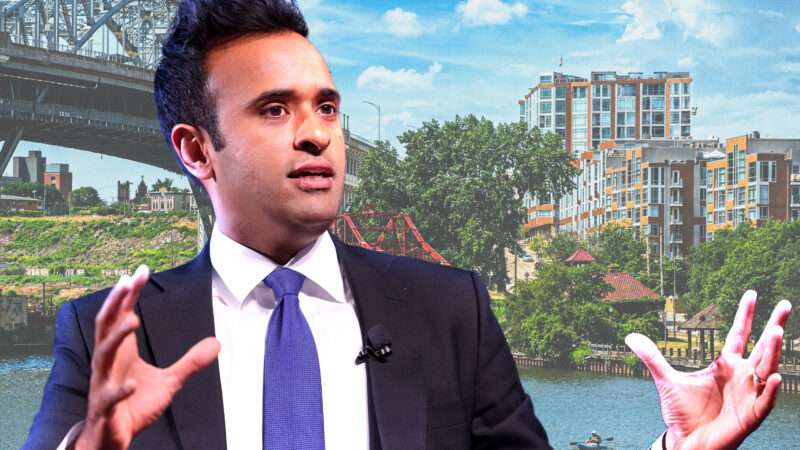
When Vivek Ramaswamy ran for president in 2024, he liked to describe himself as a "national libertarian" whose worldview included skepticism of new Middle Eastern wars and support for free trade (provided it wasn't with China).
In a midterm election season in which voters are increasingly angry about higher prices born of protectionist tariffs and high gas prices caused by a new Middle Eastern war, that would seemingly give Ramaswamy, now running for governor of Ohio, a straightforward story to tell about how he'd bring costs down.
Unfortunately for the Republican gubernatorial candidate, the person responsible for the tariffs and the war is President Donald Trump, whose support he's counting on to get him over the finish line in a surprisingly close race against Democrat Amy Acton.
The latest polls show Ramaswamy slightly ahead of Acton, with many voters still undecided.
Other Republican midterm candidates, most prominently Mike Rogers in Michigan, are escaping this bind by criticizing the tariffs and the war without explicitly naming the president who's responsible for both.
Ramaswamy has chosen a different tactic: Shift the conversation to other sources of voters' cost-of-living anxiety that can't be directly laid at Trump's feet.
In the last weeks of this election campaign, Ramaswamy has focused like a laser on two proposals he says will deliver cost relief to Ohio voters. The first is his proposed rollback of homeowners' property taxes. The second is a moratorium on new data center construction.
Like many Midwestern and Western states, Ohioans' property tax bills have shot up in recent years, driven by a pandemic-era spike in home values.
That's in turn sparked a full-blown property tax revolt in the state. The Republican-controlled Legislature passed a raft of property tax relief measures in 2025. Activists are also collecting signatures to place a full abolition of taxes on real property on the statewide ballot next year.
Ramaswamy hasn't endorsed full property tax abolition, but he is promising voters that he will roll back property tax assessments for homeowners to pre-pandemic levels.
On the data centers, he has staked out a very restrictionist position.
Ohio is currently one of the leading states for data center development. Pew Research counts 57 projects currently in the pipeline there, attracted by cheap land and a robust power grid.
The state's data center boom has caused a backlash in rural communities, where voters have objected to data centers' consumption of land and electricity and the special tax incentives some projects have received.
On the ballot in 10 Ohio localities this November are initiatives that would impose additional restrictions on data center development.
Ramaswamy has proposed to go further with a statewide moratoriumthat will remain in effect until the Legislature passes laws that not only require data centers to cover the full costs of the power infrastructure they need, but also provide property tax rebates and free electricity to nearby homeowners.
Local property tax cuts paired with local reductions in spending would, of course, be well in line with a small government worldview.
But the residential property tax rollback Ramaswamy has proposed doesn't directly do that.
Instead, it would reduce property tax revenues and then leave it up to localities to make up for the lost revenue somehow. That could result in spending cuts.
It could also result in localities shifting tax burdens onto commercial properties, raising non-property taxes (like sales taxes), or relying on the state government for more of their revenues.
In the former two scenarios, local tax regimes would become more hostile to growth, given that property taxes are considered one of the most "efficient" taxes. In the latter scenario, the link between people who pay taxes and the people who consume taxpayer-funded local services would become more distant.
Neither is ideal.
While some data centers in Ohio have received tax subsidies, Ramaswamy's proposed solution is to block new data centers until they're legally required to subsidize their neighbors with free electricity and other community benefits.
All of that is to say that it's a shame to see Ramaswamy adopt increasingly non-libertarian positions to avoid making critiques of Trump's cost-increasing tariffs and Iran war that would align with his erstwhile "national libertarian" worldview.
It's ironic, too, that, in trying to avoid making those critiques, Ramaswamy has wound up being more restrictionist on data centers than Trump himself.
In an August Truth Social post, the president famously urged local communities to "let Data Reign" and welcome data center development. Those that did would become "rich and successful," he predicted. Those that didn't would remain "poor and backward."
At a rally in Vandalia, Ohio, over the weekend for Ramaswamy and Republican Senate candidate John Husted, Trump reiterated his support for data centers, saying, "We want them. Look, there's so much money to be made for Ohio. You can't just turn them off. They'll go to China."
Rather than criticize the president's statist interventions, Ramaswamy is talking up his own instead. Ohio will be poorer as a result.
Il 2013 era un altro mondo rispetto al 2026. C’era grande entusiasmo, energia travolgente, percezione che le cose sarebbero inevitabilmente migliorate. Era una lettura ottimista, quando ancora aveva un senso dirsi ottimisti, perché cominciavano già a vedersi i segni di stanchezza dell’Occidente satollo, una diversa percezione delle ingiustizie economiche, e le prime manifestazioni del bipopulismo di destra e di sinistra che hanno caratterizzato gli anni successivi (con il nostro paese, come al solito, Silicon Valley del populismo e precursore di ogni tipo di demagogia politica).
Nel 2013, uno dei giganti del rock britannico, Johnny Marr che degli Smiths è stato l’anima musicale, scrisse una bella canzone che interpretai subito come un manifesto politico ed esistenziale, quasi un corollario pop all’idea favolosa ma sempre più sbiadita, già allora, della fine della storia per sopravvenuta e inesorabile vittoria del modello liberal-democratico.
La canzone s’intitolava European Me, “Io europeo”, e aveva un testo sufficientemente criptico da essermi preso la libertà di interpretarlo e farlo mio, soprattutto dopo aver ascoltato il primo verso: «Now there is no turning back».
Erano gli anni in cui le picconate al modello democratico-tecnologico che cominciavano a smantellare la nostra civiltà non potevano farci dire altro che «non si può tornare indietro» (ricordate L’alba di Lorenzo Cherubini?).
No, non si poteva tornare indietro, eppure andando molto avanti siamo anche andati molto indietro su parecchie cose, e in questo 2026 che si va a chiudere il bilancio finale sui passi avanti e sui passi indietro è ancora prematuro.
Qualche settimana fa, Johnny Marr ha pubblicato un nuovo disco intitolato The Age of Everything, “L’epoca del tutto”. Marr in fondo scrive soltanto canzonette, ma anche questa volta le ho interpretate come fotografie perfettamente a fuoco del presente e della società sovraccarica e sovrastimolata dal cambiamento, fiaccata dall’abbondanza di informazioni, stimoli, emozioni, suscettibilità.
Cambia tutto, tutto è disponibile, tutto arriva in tempo reale. Tutto sempre più velocemente della nostra capacità psicologica e spirituale di adattarci. Siamo cotti dall’eccesso di cambiamento.
Nel presentare l’album, Marr ha invitato però a considerare il cambiamento anche come una possibilità: «La tecnologia ha generato nella nostra cultura una sensazione di sovraccarico, ma se la si guarda da un’altra prospettiva può anche emergere la sensazione che tutto sia possibile». Ecco, il “cambia tutto” della cover story di Etc guarda il mondo da questa prospettiva lungimirante: bisogna soltanto mettersi comodi, farsi coccolare dalla matericità della rivista, farsi ammaliare dal design delle pagine, e leggere gli articoli per cercare ancora una volta nuove possibilità.
***
Il nuovo numero de Linkiesta Etc sarà disponibile su Linkiesta Storeda lunedì 19 ottobre, e nelle edicole selezionate di Milano e Roma, negli aeroporti e nelle stazioni di tutta Italia a partire da giovedì 22 ottobre.

 Login