For the first time, Ukrainians rescued a wounded soldier by air.
He spent 500 days at the front, during which he had to amputate his own legs.
How the operation unfolded and what Ukrainians had to do to distract Russian drones.
Rubio repeats Putin’s claims about occupied territory in the Donetsk region.
Videos of the day: the first capture of a Russian tank this year; a swarm of Ukrainian drones.
The information in this text is a summary of events on Monday (19 October). The situation may have changed since then.
Hardly a week passes without some new development being reported on the frontline of Russia’s war in Ukraine. This time, Ukrainians demonstrated something truly unique. For the first time, they succeeded in evacuating a wounded soldier using a heavy rotary-wing aerial drone.
The story was published by the 30th Separate Mechanised Brigade and reported by a journalist from the Oboronka website, who spoke to both the operators and the wounded soldier. The evacuation took place near Kupiansk in the Kharkiv region, on the left, or eastern, bank of the Oskil river.
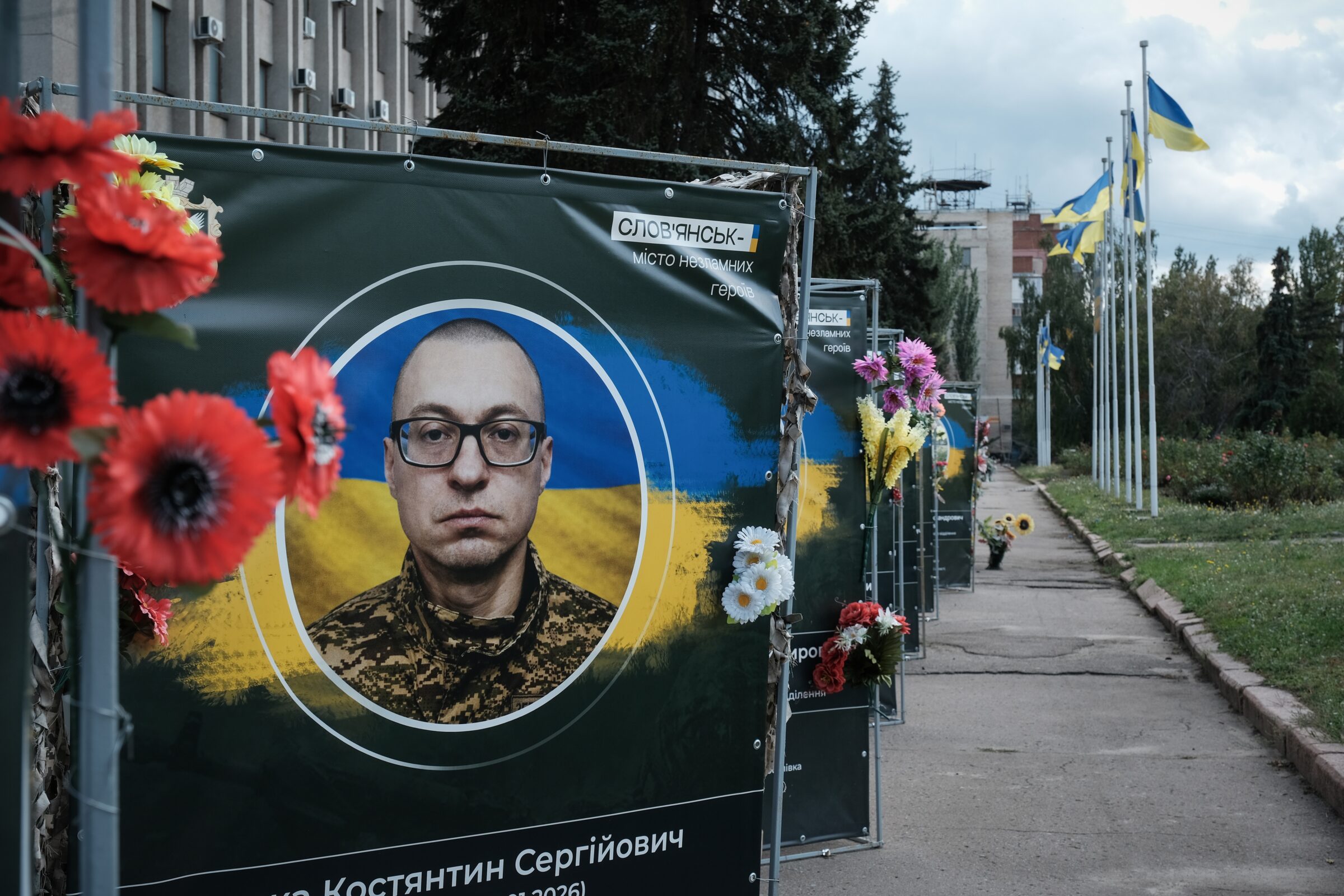
Infantryman Kostiantyn ‘Magura’ Vlasenko of the 2nd Mechanised Battalion of the 30th Separate Mechanised Brigade was tasked, together with a comrade, with heading into the grey zone in early June 2025.
Initially, they hid in one place, but when their position was flooded, they had to leave the building and take shelter elsewhere. Returning was impossible because of the dangerous situation. His comrade later died.
In February this year, Magura was also wounded by a Russian drone. Munitions dropped from the drone injured both his legs. According to Oboronka, he had to amputate his own lower limbs in order to survive.
The website did not give details of how he managed to do this. Similar cases have, however, occurred in the past.
In 2018, for instance, during an exercise in Slovakia, an American soldier was trapped beneath a tank. He amputated his own leg to save a fellow soldier, for which he was named Soldier of the Year in 2021.
In Magura’s case, this meant he was left immobile, and it was clear that he would not return from the front by himself.
Ukrainian units considered how to help him. The situation was extremely difficult in this respect.
This article continues, but the full version is available only to EUobserver.com subscribers. Visit account.euobserver.com/membership
Cuatro agrupaciones competirán este martes por las bancas que corresponden a los abogados en el Consejo de la Magistratura de la Nación. La elección definirá a sus representantes para el período 2026-2030, dentro del organismo que interviene en la selección, el control disciplinario y los procedimientos de remoción de jueces nacionales y federales.
Cerca de 184.000 profesionales con matrícula federal activa están habilitados para participar entre las 9 y las 18, en 96 centros electorales distribuidos por el país. La votación se realizará bajo la modalidad de distrito único nacional, es decir, los votos de todas las jurisdicciones se computarán conjuntamente para determinar la asignación de las cuatro bancas.
En la Ciudad de Buenos Aires se votará en el Colegio Público de la Abogacía, ubicado en avenida Corrientes 1441. En el resto del país, cada elector deberá concurrir a la sede indicada en el padrón definitivo, aprobado por la Junta Electoral de la Federación Argentina de Colegios de Abogados (FACA).
Una vez cerrados los comicios, las autoridades de mesa realizarán el escrutinio provisorio y la Junta Electoral tendrá a su cargo el recuento definitivo y la proclamación de los consejeros electos.
Unidad en Defensa de la Abogacía está encabezada por Alberto Biglieri, abogado administrativista, actual interventor judicial de la Unión Obrera Metalúrgica (UOM) y exintegrante del Consejo de la Magistratura porteño. La nómina de titulares se completa con Claudia Ester Sarmiento, Nazario Eduardo Bittar y María Jazminka Diana Mihaljevic, mientras que los suplentes son Carlos Esteban Mas Vélez, Ana Silvia Ruiz O’Neill, Guillermo Martín Lipera y Carolina Andrea Grillo.
Por su parte, Abogacía por la Libertad lleva como primer candidato a Luis Alberto Palomino, actual concejal de Vicente López y presidente del bloque de La Libertad Avanza en ese municipio, quien anteriormente se desempeñó como subsecretario de Empleo de la Nación. Lo acompañan como titulares Valeria Fredes, Martín Javier Buscemi y Alicia María Susana Colazo. Los suplentes son Marcelo Horacio Cangueiro, Alejandra Paulina Brasesco, Matías Sabaté y María Laura Álvarez.
Abogacía Unida y Dignidad Profesional presenta a Amalia Itatí Demarchi Arballo, abogada laboralista y actual presidenta del Colegio de Abogados de Villa María, Córdoba, con trayectoria en el ejercicio profesional y la actividad colegial. Los restantes candidatos titulares son Jorge Gabriel Rizzo, Julia Tamara Toyos y Andrés Abramovich, mientras que Adriana Coliqueo, Andrés Horacio Ayale, Mirta Elisa Merelles y Marcelo Nicolás Álvarez se postulan como suplentes.
Finalmente, Abogacía Federal está encabezada por Fernando Pablo Levene, expresidente del Colegio de Abogados de La Plata e integrante de la nómina de conjueces de la Suprema Corte bonaerense. Completan las candidaturas titulares Sandra Silvina París, Eduardo Daniel Awad y Myriam Beatriz Londero. Como suplentes figuran Juan Manuel Aráoz Ortega, Alejandra Marcela Lázzaro, Carlos Gustavo Ensinck y Laura Ángela Martínez.
Las cuatro listas tuvieron que cumplir con los requisitos de representación territorial y paridad de género establecidos para la elección. Entre los candidatos titulares debían incluir al menos dos mujeres, dos abogados de la matrícula federal del interior y uno de la Ciudad de Buenos Aires, además de respetar la alternancia de género.
Los consejeros electos reemplazarán a Jimena de la Torre, María Fernanda Vázquez, César Grau y Alberto Maques y pasarán a integrar el organismo de 20 miembros que, entre otras atribuciones, organiza concursos para cubrir vacantes judiciales, eleva ternas al Poder Ejecutivo, administra los recursos del Poder Judicial y ejerce facultades disciplinarias sobre los magistrados.
La renovación responde al principio de integración periódica del Consejo de la Magistratura, previsto en el artículo 114 de la Constitución Nacional. En ese marco, este mes ya fueron elegidos los cuatro representantes de los jueces y resta definir una de las bancas correspondientes al sector académico y científico.
A psicóloga defende que estes dados devem ser analisados “com cautela” e usados como informação complementar. “Temos o risco de perder essa noção de que 'eu sou responsável pelo meu sono, e sou também responsável por estar com atenção aos sinais'”
No podcast “O Futuro do Futuro”, a especialista aponta “o perigo” de as pessoas “começarem a ficar obcecadas com o sono” e a querer “ir atrás dos KPIs e entrar aqui numa lógica de performar o sono”, procurando atingir o melhor desempenho. “Isto pode levar a alguns comportamentos que não são muito saudáveis.”
Los disturbios y saqueos desvían la atención de las razones de una protesta alimentada por la desigualdad y un malestar que lleva años gestándose
Relatos desde las barricadas estudiantiles en Francia: “La violencia policial me da fuerzas para seguir luchando”
Para tratar de entender qué está pasando en Francia es recomendable leer a Didier Eribon, Annie Ernaux y Édouard Louis. No solo a ellos, aunque sobre todo a ellos. Es probable que muchos de los que se manifiestan estos días no lo hayan hecho. Aún menos los que provocan los disturbios y saqueos. Pero eso no significa que las reflexiones de estos intelectuales, los más desclasados entre los desclasados, no sean un buen punto de partida para diagnosticar un fenómeno que lleva larvándose desde hace años.
Eribon es una referencia en el estudio del trasvase de votos de la clase obrera a la extrema derecha lepenista, un cambio que empezó hace décadas y que puede alcanzar su cenit en las próximas presidenciales de 2027. “No son solo los votantes del Partido Comunista quienes se pasan a la extrema derecha, sino los votantes de la clase trabajadora en el sentido más amplio del término. Es un movimiento muy significativo de izquierda a derecha y a la extrema derecha”, reflexionaba ensu última visita a Barcelona, hace justo un año.
Por su parte, Édouard Louis, que, como Eribon, creció en un entorno marcado por la pobreza y la homofobia y que, también como el conocido sociólogo, sabe qué es que tu familia abrace la fe de la extrema derecha, considera que el lema heredado de la Revolución Francesa, “libertad, igualdad y fraternidad”, ha escondido la verdad de lo que pasa en el país. Y lo que sucede es que la desigualdad ha provocado que muchos antiguos votantes de la izquierda y también muchos jóvenes se sientan desprotegidos. Desamparados y enfadados. Hace unas semanas, tras participar en el Festival de las Ideas, concedióuna entrevista a elDiario.es en la que avisaba de que el rol de la izquierda se ha convertido en comentar lo que dice la extrema derecha. “Siempre llegando tarde”, añadía.
Ernaux, Premio Nobel de Literatura en 2022, hija de tenderos y referencia para distintas generaciones de la izquierda, se significó porsu apoyo a los chalecos amarillos desde que surgió el movimiento. Su argumento, polémico, es claro: “La violencia real es una respuesta a la violencia simbólica”. Ella ha sabido convertir su vergüenza de clase en orgullo y la ha usado, según sus propias palabras, para pensar el mundo de otra manera.
Tanto Louis como Ernaux han expresado sus simpatías por Jean-Luc Mélenchon, el líder de la Francia Insumisa y quien, junto a Marine Le Pen, puede ser uno de los más beneficiados por las protestas de estas semanas. El primer ministro, Sébastien Lecornu, le acusó el sábado de ser el “responsable político” de los graves disturbios, mientras que Mélenchon, que se ha desmarcado de los saqueos, acusó al Gobierno de haber sembrado el desorden con “sus decisiones absurdas e incompetentes”.
La partida del descontento social se juega en los extremos. Miles de estudiantes hace días que se manifiestan en defensa de la educación pública y para denunciar la falta de oportunidades. Los chalecos amarillos, los mismos que empezaron a mostrar el enfado de colectivos de trabajadores hace más de una década, se sumaron a las protestas de este fin de semana. Pero no solo ellos. Los llamados casseurs, vándalos expertos en pillajes que se cuelan en las manifestaciones, se han llevado el protagonismo con unas imágenes que han dado la vuelta al mundo.
La periodista Carmela Ríos, experta en redes sociales,alertaba en X de que todos los datos llevan a distintas estrategias de saqueo coordinadas y ejecutadas en paralelo por actores diferentes. El objetivo está claro: desestabilizar y sembrar el caos. La cuestión es quién se organizó para provocarlo.
En línea con algunos de los argumentos de la extrema derecha, los primeros ministros de Hungría y Polonia insinuaron este lunes que las protestasestán vinculadas a una política migratoria demasiado laxa, emulando así el discurso trumpista. No es distinto de los mensajes que ha lanzado Vox, y eso incluye también la difusión de bulos como el de dos ancianos medio desnudos en las protestas de París y que, en realidad, erauna imagen hecha con IA que partió de una cuenta en Israel.
La desigualdad, no solo en Francia, explica el malestar que recorre Europa. Del mismo modo que el dispositivo policial de este fin de semana fue tan desastroso que es normal que el ministro del Interior, Laurent Nuñez, haya presentado su dimisión, aunque Macron no se la haya aceptado. Ahora se implantarán toques de queda parciales en algunas ciudades para evitar disturbios tan graves como los del sábado. ¿Se imaginan qué habrían pensado hace solo unos meses si hubiesen leído que en Francia se adoptará una medida como esta y que no se descarta, llegado el caso, decretar el estado de emergencia? Es como asistir en directo a un capítulo deYears and Years. Ya nada parece una ucronía.
Macron prometió superar las diferencias entre izquierda y derecha y el legado que dejará es el de una Francia más fracturada social y políticamente. Puede que el centro ya no exista, ni allí ni aquí, o que él, que se erigió en su máximo representante, no supiese cómo gestionarlo. La reforma de las pensiones es solo un ejemplo. Preveía retrasar la edad legal de jubilación de los 62 a los 64 años en 2030. Antes de 2010, cuando se introdujo el último cambio, la edad de jubilación en Francia se situaba en los 60 años. Además, el proyecto, que fracasó, pretendía acabar con algunos de los planes especiales de pensiones de los que disfrutan profesionales de distintos sectores. Entre los beneficiados están los empleados de las industrias de la electricidad y el gas, del Banco de Francia, del transporte metropolitano de París (RATP) o del Consejo Económico, Social y Medioambiental.
Es legítimo preguntarse si son justas algunas de esas prebendas que reciben muchos antiguos trabajadores de empresas públicas. Del mismo modo que puede ser erróneo descargar en ellos la ira mientras en la misma Asamblea Nacional también se rechazó aplicar la llamadatasa Zucman, el impuesto para los grandes patrimonios.
Es más fácil quejarse de los que protestan que preguntarse por qué lo hacen. Sirve para Francia o para la Puerta del Sol.
William H. Mumler vendia fotografias de “fantasmas”. Foi julgado por fraude, mas ilibado: não se provou que existiam fantasmas, mas também ninguém sabia como o norte-americano punha mortos ao lado dos vivos nas imagens. Recuemos, durante cerca de três minutos, a 1862. Estamos com William H. Mumler no seu estúdio em Boston, EUA, onde o gravador de joias e fotógrafo amador revela um autorretrato quando repara numa figura inesperada atrás de si. Na fotografia aparecia uma jovem de vestido comprido, com o rosto desfocado, como um fantasma. Mumler corre para mostrar a imagem a um amigo. Até porque a mulher
A forma como os brasileiros votaram a 4 de outubro e talvez votarão no próximo dia 25 faz parte de um padrão mais amplo que se tem verificado na maioria do continente americano. A viragem política está a acentuar-se sobretudo “à direita da direita”. Oiça aqui o último episódio do podcast “O Mundo A Seus Pés” com Carmen Fonseca, investigadora do Instituto Português de Relações Internacionais
El candidato de ERC reflexiona sobre la extrema derecha, los errores de la izquierda y las contradicciones del independentismo en un libro que encantará a sus fans y no sorprenderá a sus detractores
El 'boletín del director' - El éxito de Irene Montero y Gabriel Rufián
Si hay algo que se le da bien a Gabriel Rufián es lanzar frases contundentes. Cortas y cortantes. Sea en las redes, en la tribuna del Congreso, interpelando en una comisión parlamentaria o troleando a Vito Quiles. Ahora, con el orden que permite un libro, y con datos y citas, las resume y amplía. El título es fiel al estilo del candidato de ERC:Cómo ganar a los fachas (Leer antes de votar), editado por Ara Llibres.
Rufián supera el método Loquillo, el de colocar un titular en cada respuesta. En este caso, en cada párrafo. Empezando por la dedicatoria, puesto que se dirige a todos los votantes, ya sea a los que denomina fachas, a los de izquierdas o a los que no saben qué son. A todos ellos no les ofrece pureza, sino respuestas (otra de sus sentencias a modo de eslogan).
El libro lo ha escrito él y se nota. No solo porque la editorial lo confirme, sino porque en algunos momentos casi se le puede escuchar. El arranque es uno de ellos: “Yo vengo de la mierda. A mí me dijeron muchas veces que adónde creía que iba y que yo no podía. A mí nadie me esperaba aquí”. Esta última frase está destacada en negrita. Hay más así, para lectores perezosos o por si no queda claro qué es lo que Rufián quiere subrayar.
De todos los enunciados-tuit del inicio hay uno en el que el portavoz de ERC reconoce que fue un “cabrón” con Joan Tardà, el dirigente republicano que más le enseñó en el Congreso y que mejor le ha defendido fuera y dentro del partido. “Fui egoísta y soberbio. Me aguantó cosas inaguantables. Porque yo no sabía nada y me creía que sí; él, en cambio, lo sabía todo y no lo decía”. Ese comportamiento lo circunscribe a sus inicios, aunque para varios de sus compañeros en el grupo parlamentario no sea un pasado tan lejano. A Tardà lo define como una de las tres mejores personas que ha conocido en su vida. Se podrían discutir algunas de las opiniones que incluye en el libro. Pero que Tardà es una buena persona es algo irrebatible.
En el decálogo de intenciones que formula, señala que “ni un político gana elecciones solo con talento ni un partido las gana sin él”. Aprovecha para arremeter contra los aparatos de los partidos como si lo analizase desde una columna, como si ser el hombre fuerte de ERC en Madrid y llevar una década de diputado fuese un papel secundario. Y prosigue, como quien no quiere la cosa, para llevar el agua al molino que le conviene: “Los aparatos de los partidos deben entender que el carisma y los activos electorales son algo que tenemos que cuidar y potenciar [...] Quien pone la cara debe tener medios y mando”.
A Rufián le iban detrás distintas editoriales porque sabían que este libro se vendería solo. Pero, además, ha tenido la suerte de que Pedro Sánchez adelantase las elecciones y que el debate sobre la estrategia de las izquierdas haya vuelto a dar titulares y titulares, aunque no tantas buenas noticias para sus votantes.
Rufián despliega el catálogo de reflexiones, que viste como propuestas, para ese frente entre las izquierdas soberanistas y la izquierda española que no ha fructificado. Incluye uno de sus hits, el de que la gente pasará por encima de los partidos, y un diagnóstico que se ha demostrado bastante atinado: las izquierdas españolas son el problema. Podría añadirse que presentar la alianza entre ERC y Podemos en plena negociación con el resto tampoco ayudó, pero eso daría para otro capítulo.
El jefe de filas de los republicanos en Madrid es de los políticos que más pronto entendió la importancia de las redes. Como elemento de promoción, la editorial destaca que tiene un millón de seguidores en X y “ya no se sabe ni cuántos en TikTok”. Por eso el capítulo que dedica al poder digital es especialmente interesante. Más allá de empezarlo con Ortega y Gasset (qué sería de los libros de políticos si no incluyesen como mínimo una cita orteguiana), en el diagnóstico la clava: “Antes se hacía política para los medios. Ahora se hace política para las redes”. No lo dice como queja, él es quien mejor ha sabido hacer esa transformación.
Su lamento es que la izquierda no lo tenga igual de claro. “La izquierda debe entender que sin poder digital es como una gacela herida en medio de la sabana: comida para las hienas. El fascismo vende en la red mucha de su mercadería impunemente gracias a dos de los mantras más tramposos de la izquierda: ‘No compremos su marco’ y ‘No les contestemos, que les hacemos grandes’”. Rufián defiende que esa actitud es un error y, además, oculta mucha cobardía. Su tesis es que el bucle de “la desinformación fascista” es infinito y, por tanto, hay que darles la batalla en su campo, en las redes, y disputarles ese poder digital.
Aunque es evidente que el libro no está escrito para el lector catalán, tiene un capítulo dedicado a Catalunya. Empieza diciendo que quiere hacer autocrítica, aunque no la hace a nivel personal por los errores que haya podido cometer, sino en nombre del independentismo. Por haber repartido carnets de pureza y de buen catalán durante muchos años. Insiste en que este movimiento necesita obtener más apoyos y alerta de que “con épica y con banderas no se le da una casa a nadie, no se lucha contra la precariedad o no se bajan los precios”. “Y tratando a la gente como si fueran niños en un parque de bolas a la espera del pastel de cumpleaños, tampoco”. Ha pasado tiempo, pero leyéndolo es imposible no asociar ese pastel a la declaración de independencia, que duró lo que tardan en apagarse unas velas de cumpleaños.
En una acusación genérica y que también es una de sus preferidas, el republicano insiste en que “el 90% de los medios de comunicación catalanes le compra toda la mercancía a Convergència”. Y que los medios lo hacen porque se vive mejor callando y comprando que criticando las votaciones de Junts con PP y Vox. En este capítulo la cita que le hubiese encajado mejor sería la de Campoamor, porque igual su visión se explica por la distancia y el cristal con que la mira.
A Junts le dedica unos cuantos dardos y le pide que deje de imitar a la líder de Aliança Catalana, Silvia Orriols, para volver a Jordi Pujol. Quién iba a decir que hasta Rufián se apuntaría a la moda de reivindicar al fundador de Convergència. De paso, acusa a ERC de tener una relación freudiana de amor/odio basada en el miedo hacia el mundo posconvergente.
El arranque y el epílogo son lo mejor del libro, un Rufián en estado puro. El final pretende ser una carta a un votante de barrio de Vox y/o de Aliança Catalana. Hay que reconocer que la contundencia de sus argumentos, una mezcla de emotividad y datos bien escogidos, podría lograr su objetivo, y es que algún lector que esté dispuesto a apoyar a la extrema derecha se lo repiense. De las muchas frases ingeniosas que le dedica al partido de Abascal, hay una definición que los retrata a la perfección: “Vox es el ectoplasma político del falangismo, franquismo, terraplanismo y cuñadismo social”. Aunque la más ocurrente es la de que Vox es el partido del cuarto cubata.
A los fans de Rufián, este libro no les defraudará. Al resto, no les sorprenderá.
** Como ganar a los fachas(Leer antes de votar) llega a las librerías el martes 20.
Os mercados financiam expectativas sobre o futuro. Nas grandes organizações, demasiadas ideias têm de provar o seu retorno antes de receberem uma oportunidade.
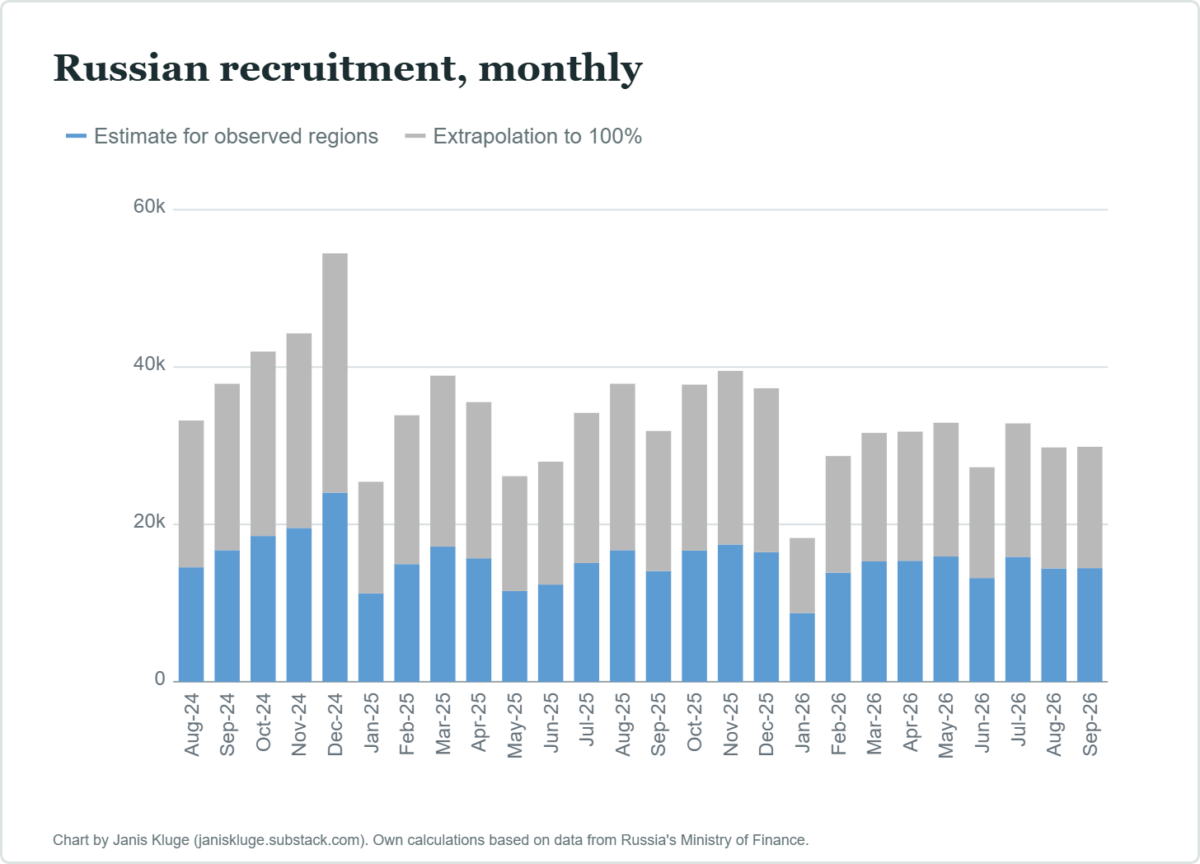
Russia is estimated to be recruiting 10 percent fewer soldiers this year than last, despite regions raising signing bonuses.
There is growing talk that criminal gangs have begun to take part in recruiting “volunteers”.
According to the Ukrainians, Russia is losing large numbers of soldiers, and October could be a record month.
Attacks on the land route to Crimea continue, reportedly prompting Russia to transport fuel in jerry cans in smaller vehicles.
Map of the day: Where Russia is advancing and where Ukraine is advancing
Videos of the day: Ukrainians hit a Russian radar; a man surfed on a Russian drone near Odesa; speculation spreads that Iran is supplying Russia with fuel.
Many Russians have left Russia in recent months. They feared the mobilisation that had been so widely discussed. Ukrainians said Russian president Vladimir Putin might resort to it after the September parliamentary elections. Many Russians fled to Armenia and Georgia, affecting rental prices in the capitals of these Caucasus states.
So far, no mobilisation has taken place. Russia continues to rely on its existing system of voluntary — and, in some places, involuntary — recruitment of new soldiers in Russian regions.
German economist Janis Kluge, who tracks regional data, wrote last week that Russia recruits around 1,000 new soldiers a day (30,000 a month). That is less than last year — down six percent in September and 10 percent over the year as a whole.
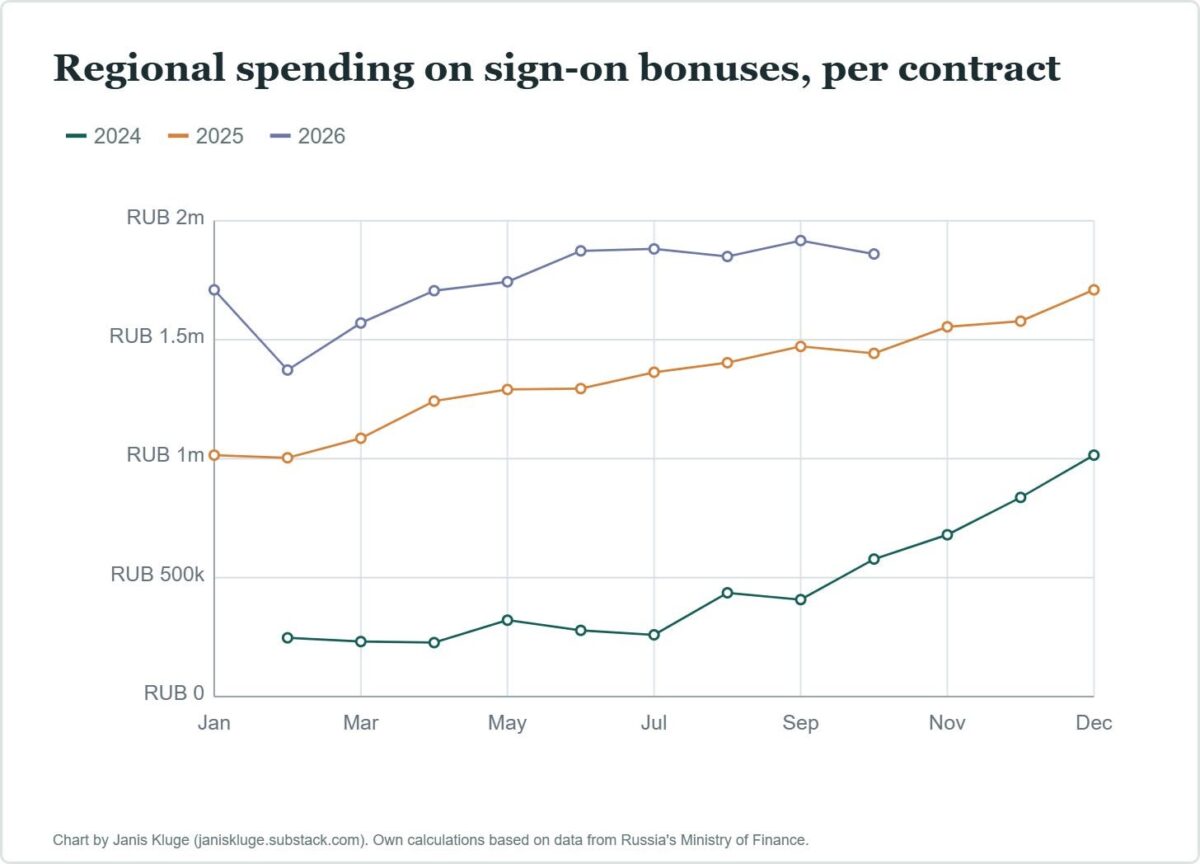
Nor did it help that, by his estimate, the sum paid by regions as a signing bonus had risen from $16,000 (€14,000) to $22,000.
In some places, recruitment is also beginning to move into the illegal sphere. Kluge wrote that local criminal gangs were now becoming involved in the system.
He mentioned the case of a prosecutor in Nizhny Tagil, a city of 400,000 in the Urals. In September, he appealed to the budget committee of the local duma.
He complained that signing bonuses for Russian soldiers were leading to an increase in crime in the city. He called for payments to agents who find volunteers willing to sign an army contract to be stopped.
According to Kluge, the prosecutor complained that criminal elements had become involved in recruitment in the city. He said an agent received $4,500 for finding one person to sign a contract.
Many turned to gangs to help them, with the assistance of corrupt police officers or military recruiters who are part of the scheme. “And this ‘persuasion’ may also involve violence, as another case from Sverdlovsk region shows: two criminals forced their victims to sign contracts and then seized their bonus payments,” Kluge wrote.
In Nizhny Tagil, 580 new soldiers were recruited last year, compared with 330 this year. It is not known how many of them criminal gangs helped to “persuade” in exchange for payment. In any case, the city does not want to change its system of rewards for agents because, in the words of the deputy mayor, it helps “fulfil our tasks”.
Overall, it is becoming increasingly difficult for Russia to supply enough manpower to the front. Moreover, it is currently losing large numbers of soldiers there, and October’s losses could even be record-breaking.
Ukraine publishes daily figures for killed and wounded Russian soldiers. These figures cannot be verified and may be inflated, but the trend suggests that the situation is worsening for Russia.
The table below also shows this. According to it, Russia lost around 46,000 soldiers in September — more than 1,500 a day — making it, according to Ukrainian data, the second-worst month since the start of the war. The figure was higher only in December 2024.
This October is on course to become Russia’s worst month in this respect. By the 12th day of the month, Russia had been losing an average of 1,620 soldiers per day. If Ukraine maintains this pace, it will be a record.
Number of Russian military casualties per month, according to Ukraine. Source: minfin.com.ua
Naturally, the question is how much these figures can be trusted. However, the Unmanned Systems Forces, a unit commanded by Robert Brovdi, known as Magyar, also publish figures for killed and wounded Russian soldiers.
The Ukrainian units under its command compete with one another over which can strike more Russian targets. They receive points based on this, which they can then use to buy more drones. Individual strikes should therefore be confirmed by video.
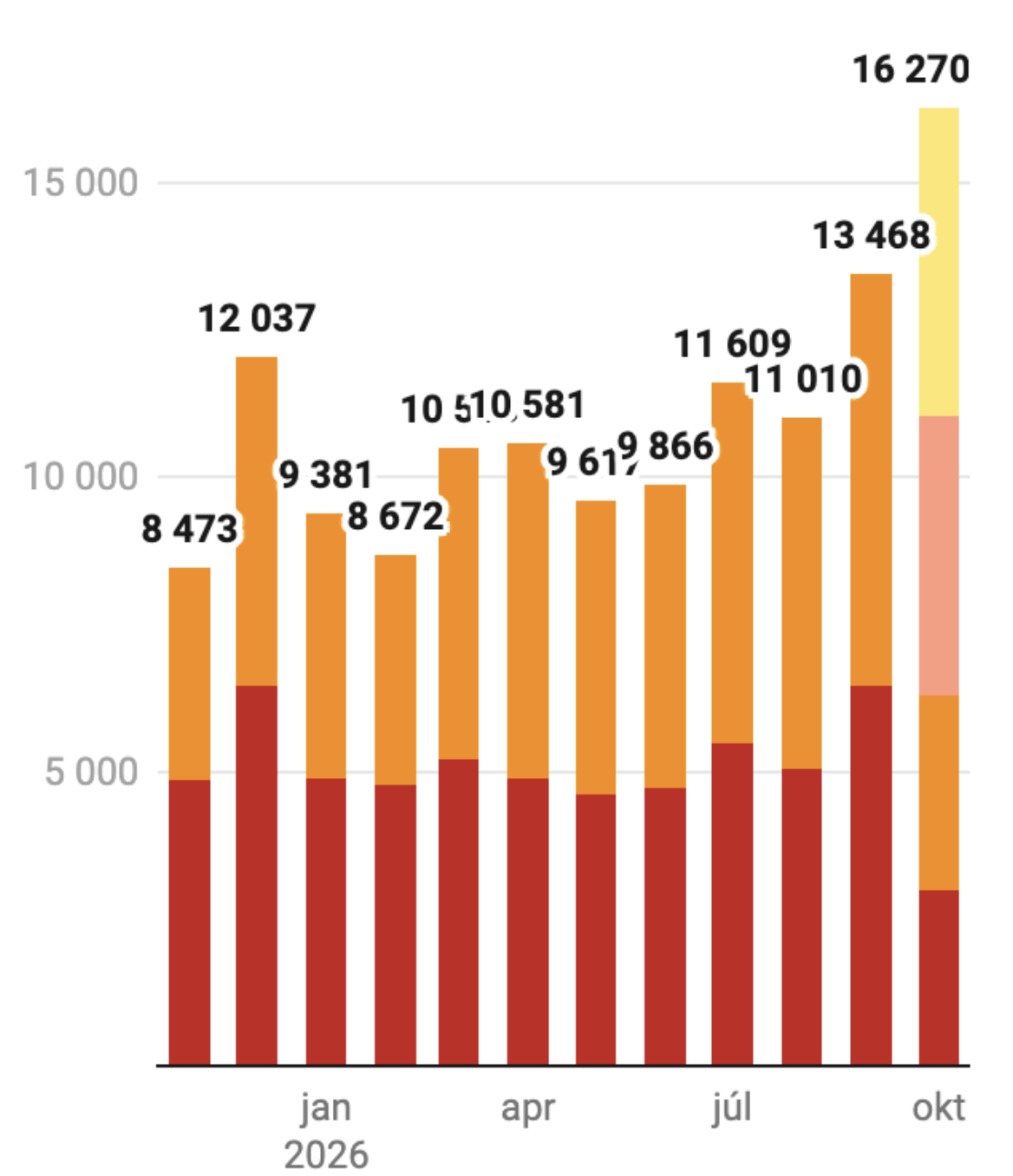
Given this, the data published by the Unmanned Systems Forces can be considered credible. They too indicate that October could be a record month, although their data cover only one-third of Russia’s total losses.
Number of Russian soldiers killed and wounded by SBS drones
The total number of Russian soldiers hit by Ukrainian Unmanned Systems Forces (SBS), and the number of those killed. These figures should be verified by video evidence. Red: killed; Orange: wounded; Pink: expected killed; Yellow: expected wounded. Source: Datawrapper/SBS.
Record-high losses and less substantial numbers of newly recruited soldiers suggest that Russia may have difficulties replenishing its units and, consequently, advancing further in Donbas or elsewhere.
Attacks on the land route to Crimea continue. Last week, French OSINT analyst Clément Molin published a table according to which the number of Russian lorries and trucks struck had reached a record 770. Several videos show that the number of attacks on vehicles heading to Crimea or to the front in southern Ukraine remains high. They are simply not discussed as much because this is no longer new.
I continue, on my side, to gather statistics on these mid-range strikes against logistics, not only in southern Ukraine, but also near Donetsk or Luhansk.
In September, at least 770 trucks/vehicles were targeted, only on the videos published by Ukraine more than 20km from the… pic.twitter.com/w9DrQTnGEM
Ukraine also destroyed the Chonhar bridge, which connects Ukraine with the Crimean peninsula. Russia has used a pontoon bridge there instead. This video shows Russian cargo vehicles crossing the pontoon bridge.
Russian truck drivers crossing into Crimea via a pontoon crossing at Chonhar, with a view of the damaged Chonhar Bridge and its support structures, before one of its spans collapsed. September 2026. https://t.co/YLDiB7lJQupic.twitter.com/3oU4GVylDd
The commander of Ukraine’s 41st Pilum Unmanned Systems Regiment, part of the 1st Azov Corps, recently provided interesting information on this issue. In an interview with Radio NV, he confirmed that the number of medium-range strikes was not declining and was increasing in some areas.
He said that the operational zone overseen by Ukraine extended from 30 to 300 km.
According to him, Russia is trying to bring as much fuel as possible to the front. Soldiers need generators to charge equipment, power radios and drones, and keep warm.
However, Ukrainian attacks on fuel tankers are reducing Russia’s ability to bring fuel to the front. According to the commander, in the Dobropillia direction, where his unit operates, Russia began transporting fuel in convoys this summer and switched to distributing it in passenger cars or small trucks, carrying the fuel in jerry cans.
This does not, of course, apply to all directions. However, an ongoing stream of new videos also confirms the destruction of fuel tankers.
Map of the day
Russian president Vladimir Putin’s latest — though certainly not final — deadline for capturing Donbas is by the end of this year. As on 14 previous occasions, it will not be met.
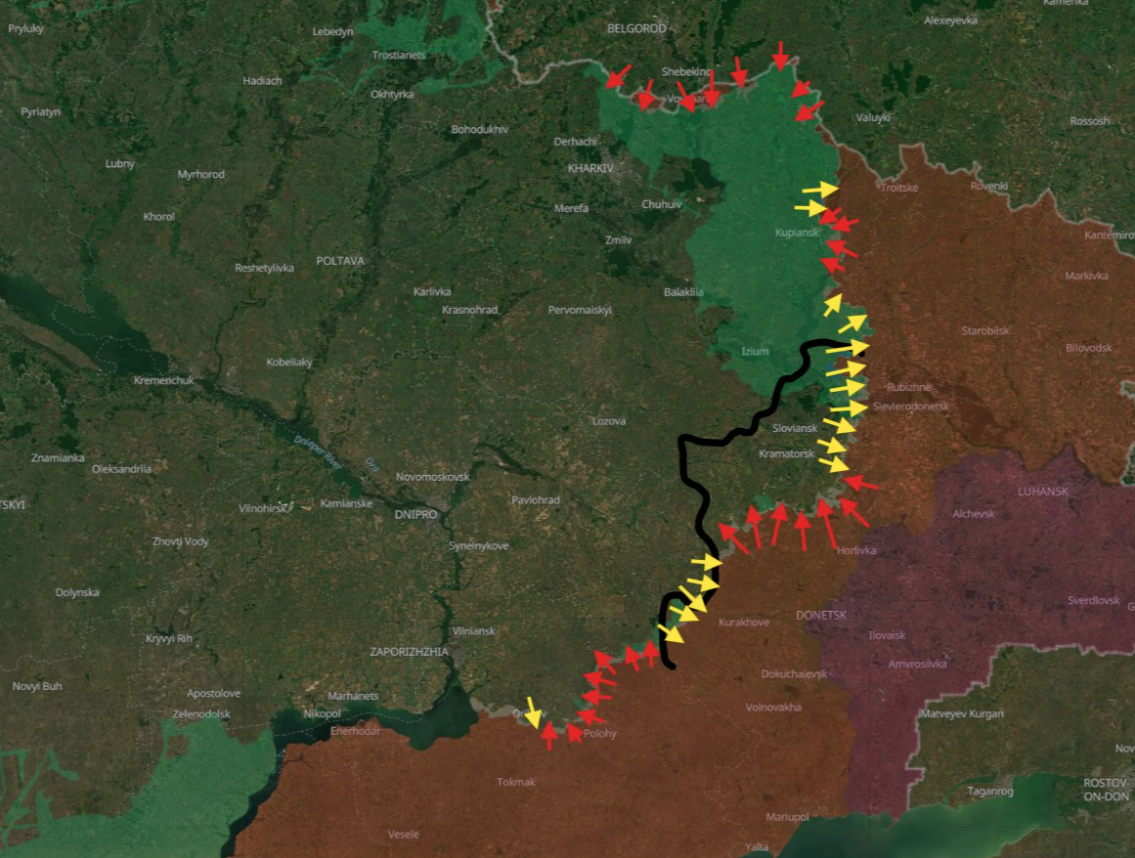
Unlike in previous years, however, it appears entirely possible that by the end of the year the territory of the free part of Donetsk region could be even larger than it is now. This is suggested by a map published by French OSINT analyst Clément Molin. It highlights areas where Ukraine is advancing and areas where Russia is pushing forward.
As can be seen, Russian forces largely hold the initiative in the north of Kharkiv region and at one location in the south of Zaporizhzhia region.
In the crucial Donetsk region, however, the situation is balanced; indeed, it could be said that Ukraine holds the initiative in more places. More specifically, it is clearing the northern area above Lyman and pushing further south towards Velyka Novosilka.
Ukraine’s 15th Reconnaissance Artillery Brigade published a video showing it striking a Russian 96L6 radar. This is a key component of the S-300 and S-400 air-defence systems.
The radar can be seen moving and hiding in a tree line. Nevertheless, a Ukrainian drone struck it. It is unclear whether it was actually destroyed, as the accompanying text claims.
Ukraine’s 15th Artillery Reconnaissance Brigade “Black Forest” located and destroyed a Russian 96L6 radar, a key detection component used with S-300 and S-400 air defense systems. The radar is valued at around $50 million and has a stated detection range of up to 300 km. #Ukrainepic.twitter.com/1K4BUZXZrg
A man near Odesa decided to surf on a downed Russian drone floating on the water off the coast. It hardly needs to be said that this is a fairly risky pastime. However, it indicates how at least some residents of Odesa view the daily Russian attacks.
❗️In 🇺🇦Odesa, a man decided to go surfing on a downed Russian kamikaze drone “Geran”. pic.twitter.com/l3MG3YkQiz
This could be a potentially rather interesting plot twist. The United States is at war with Iran, which has raised petrol and diesel prices at US filling stations. Donald Trump therefore agreed with Putin to import diesel from Russia. Russia itself, however, does not have enough diesel and has to import it.
This video shows a tanker truck with Iranian registration plates in Russia. Some infer from this that Iran is importing diesel — or other fuels — into Russia, which then sends diesel to America, despite America being at war with Iran.
However, it is too early to draw conclusions: we do not know what is in the truck or how many such Iranian tankers are heading to Russia. In any case, Russia is helping Iran in other ways.
A Western official told Bloomberg that Russia was supplying Iran with missiles that it uses in the war against the US and Israel. It was also previously reported that Russia was helping Iran target US bases in the region.
⚡️BREAKING: Convoys carrying Iranian Diesel Fuel are on their way to Russia, where there is a Fuel Shortage
This also raises the question of whether the fuel Russia exports to the United States might originate from Iran pic.twitter.com/J9Fzk7LVDa
By Tuesday (13 October), Russia had verifiably lost 24,192 pieces of heavy equipment (24,170 on Monday, 5 October). Of these, 19,155 (19,133) were destroyed by Ukraine, 1,002 (1,003) damaged, 1,194 (1,194) abandoned by their crews, and 2,841 (2,840) captured by the Ukrainian army. The total includes 4,453 (4,452) tanks, of which 3,358 (3,357) were destroyed in combat.
Ukraine lost 12,259 (12,238) pieces of equipment, of which 9,652 (9,633) were destroyed, 713 (711) damaged, 695 (695) abandoned and 1,199 (1,199) captured. The total includes 1,471 (1,466) tanks, of which 1,131 (1,126) were destroyed in combat.
Note: Neither side regularly reports its dead or destroyed equipment. Ukraine publishes daily figures for Russian casualties and destroyed equipment, which cannot be independently verified. This overview uses data from the Oryx project, which has compiled a list of equipment losses documented exclusively by photographs since the start of the war.
Montenegro detained Mikhail Zvinchuk, the founder of the Rybar Telegram channel.
Key directions according to Rybar, Ukrainian and independent analysts.
Forget Sloviansk: its capture is currently unrealistic.
Ukrainian pressure continues towards Velyka Novosilka, with fighting already under way near Komar on the eastern bank of the Mokri Yaly river.
Russians are infiltrating Dobropillia, but a Ukrainian counteroffensive is pressing against their flank from the north.
The battle for data centres is now two-way, with Ukrainians attacking Russia’s ‘Google’.
Maps of the day — Sloviansk direction; Velyka Novosilka direction; Dobropillia direction.
Videos of the day — a scene from the Second World War: a MiG-29 shoots down a drone with its cannon; soldiers clear a network of Russian bunkers; Himars destroys an artillery radar; what the R-280 road to Crimea looks like.
Montenegro detained Mikhail Zvinchuk, the founder of the Rybar Telegram channel, who occupies one of the leading positions in the ecosystem of Russian media supporting the war. His wife and several associates were arrested alongside him. Colleagues in Moscow issued a statement saying they had been planning to film a report on one of the local monasteries, but the authorities of the Nato member state suspected them of conducting a hybrid operation.
At the top of Russian propaganda are the traditional state media, under the Kremlin’s complete control. They have almost no informational value, as they merely repeat the regime’s propaganda.
Below them, however, is a complex structure of Telegram channels that provide more varied reporting, including critical coverage. However, criticism is permitted only of mistakes in the conduct of the war, not of the war itself.
These channels, too, spread propaganda and keep Russian society in a state of war, but they also provide information that helps in analysing the course of the fighting. Rybar is among the largest and most influential of them.
In this case, it is not the work of an individual author but a media outlet with an editorial team and extensive content for 1.5m readers, so Zvinchuk’s arrest does not mean the end of publishing under this brand.
Yet through him, we can follow the fascinating story of a man who came from Russia’s defence ministry to spread its propaganda in the years that followed.
Paradoxically, however, he has recently been one of the few sources in Russia to report regularly on the Russian army’s failures at the front. And the preceding 48 hours were particularly rich in such assessments.
We will therefore gradually describe events in three different directions where, according to Rybar, the Russians are either retreating or at risk of doing so. Coincidentally, these are currently the most important directions of military operations.
We will compare all of its information with independent or Ukrainian sources.
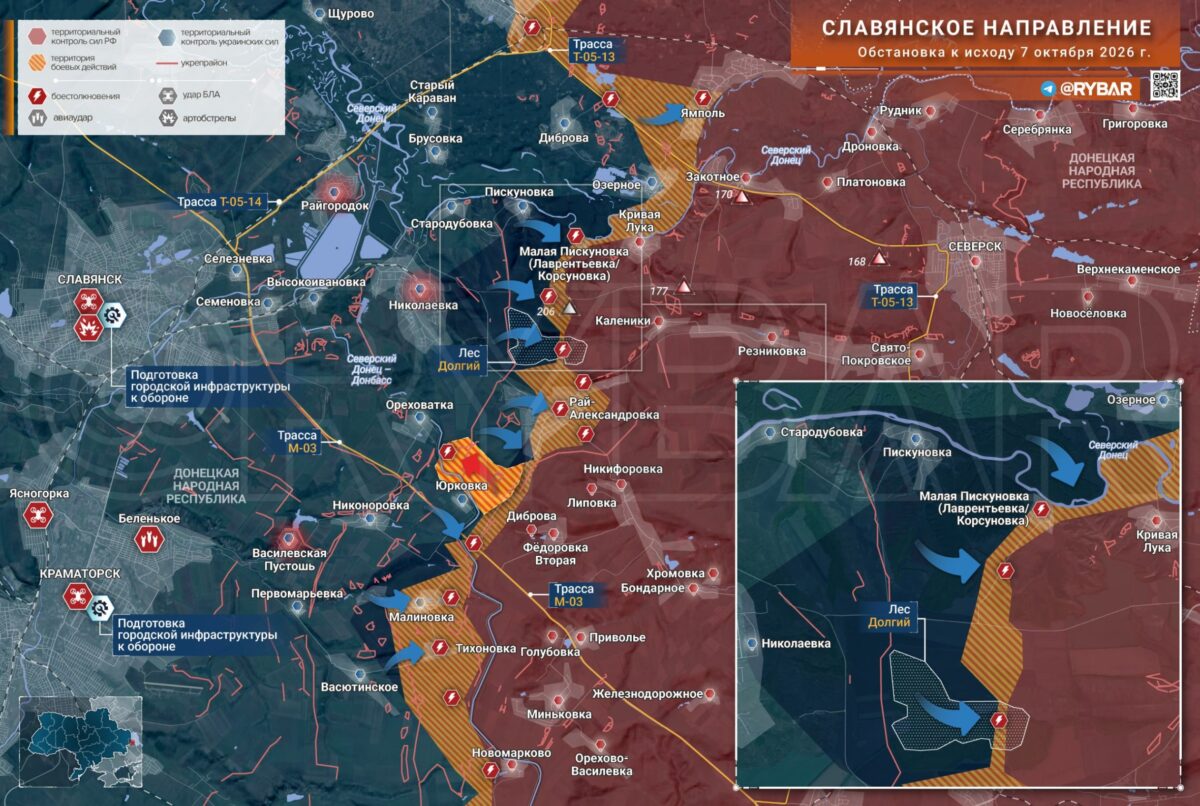
Forget Sloviansk: its capture is currently unrealistic. “The situation is worsening; Sloviansk is being postponed,” Rybar wrote in the first sentence of its latest analysis of the Sloviansk direction. It explained why at length.
According to it, Ukrainian units in the area are increasing the pressure and exploiting their successes near Lyman, which lies north of Sloviansk. The Russian army has suffered a serious defeat here in recent months, losing a large salient from which it had hoped to bypass the Sloviansk-Kramatorsk agglomeration from the north.
Rybar listed the ensuing complications: according to it, Ukrainians have concentrated fresh drone units around the village of Dibrova; the Russians had to withdraw from the village of Piskunivka and are now trying to save Kryva Luka. Ukrainians are also pressing into the village of Ozerne.
Ukrainian formations are increasing their activity, exploiting successes in the Lyman area, where fresh forces of drone operators have been concentrated around Dibrova.
Russian troops were pushed out of what remained of the village of Piskunivka and are now defending the approaches to Kryva Luka. The enemy is trying to break through there both from the west and across the river from Ozerne.
Moreover, heavy fighting is under way west of the village of Kalynyky, while fighting for Rai-Oleksandrivka is “fierce”, “although it was under the Russian army’s full control only recently”.
Nor is this the end of Rybar’s bad news. An “equally difficult situation” persists on the western bank of the Siverskyi Donets-Donbas Canal, where Russian soldiers are “for now” holding positions in the villages of Malynivka, Tykhonivka, and Yurkivka.
Taken together, all of this means that the prospect of an “attack on the agglomeration has receded considerably”.
“Without control of the forests below Lyman, the offensive is doomed, if not to failure, then to high losses from attacks on its flank,” Rybar added.
Its map fully matches the verbal description. The red arrows running from east to west along the entire stretch have been replaced by blue, Ukrainian arrows pointing from west to east.
Paradoxically, the local Telegram channel Mikolaivka-Sloviansk Online provides a far less optimistic picture.
While Rybar no longer even mentions Mykolaivka, which directly borders Sloviansk, according to this source — which has repeatedly provided highly accurate and widely cited information — Russians are still managing to infiltrate it. On Wednesday, it wrote that “the Russian army is applying pressure from the direction of Rai-Oleksandrivka”, while the village itself is in the grey zone.
The explanation may be simple. Most of the names refer to villages the Russians never fully captured, although they claimed they had — including Rybar itself. This is why its map looks as though a small counteroffensive were under way east of Sloviansk. In reality, it mainly makes its previous misleading claims more realistic.
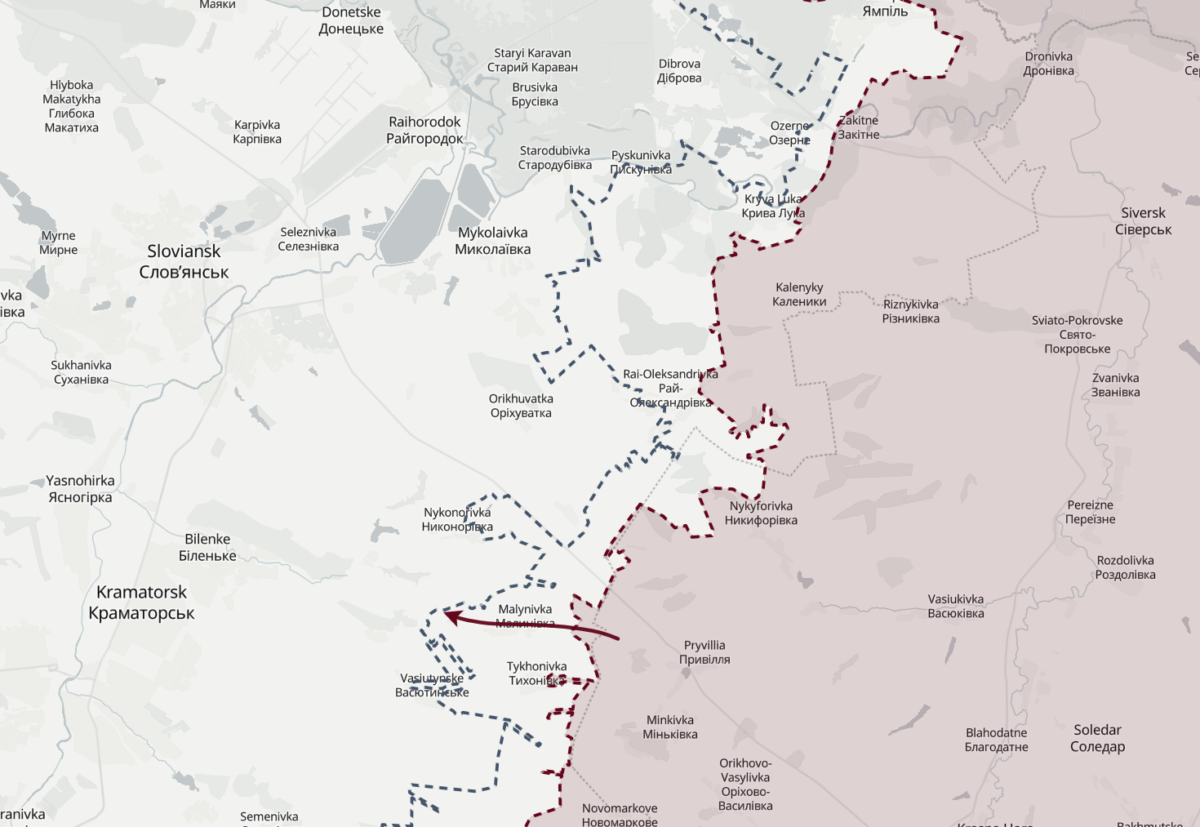
Far more accurate is the map by the Finnish Black Bird Group. Rai-Oleksandrivka is in the middle of the image — no credible analysts have ever considered it occupied by the Russians. Further north are Ozerne and Kryva Luka. Ozerne is particularly interesting.
According to Rybar, the Russians are trying to prevent the Ukrainian army from entering the village; independent analysts show it partly in the grey zone and partly under Ukrainian control. Rybar therefore correctly sees Russian problems, but at this point this is more its usual cartographic “retreat” from unrealistic positions.
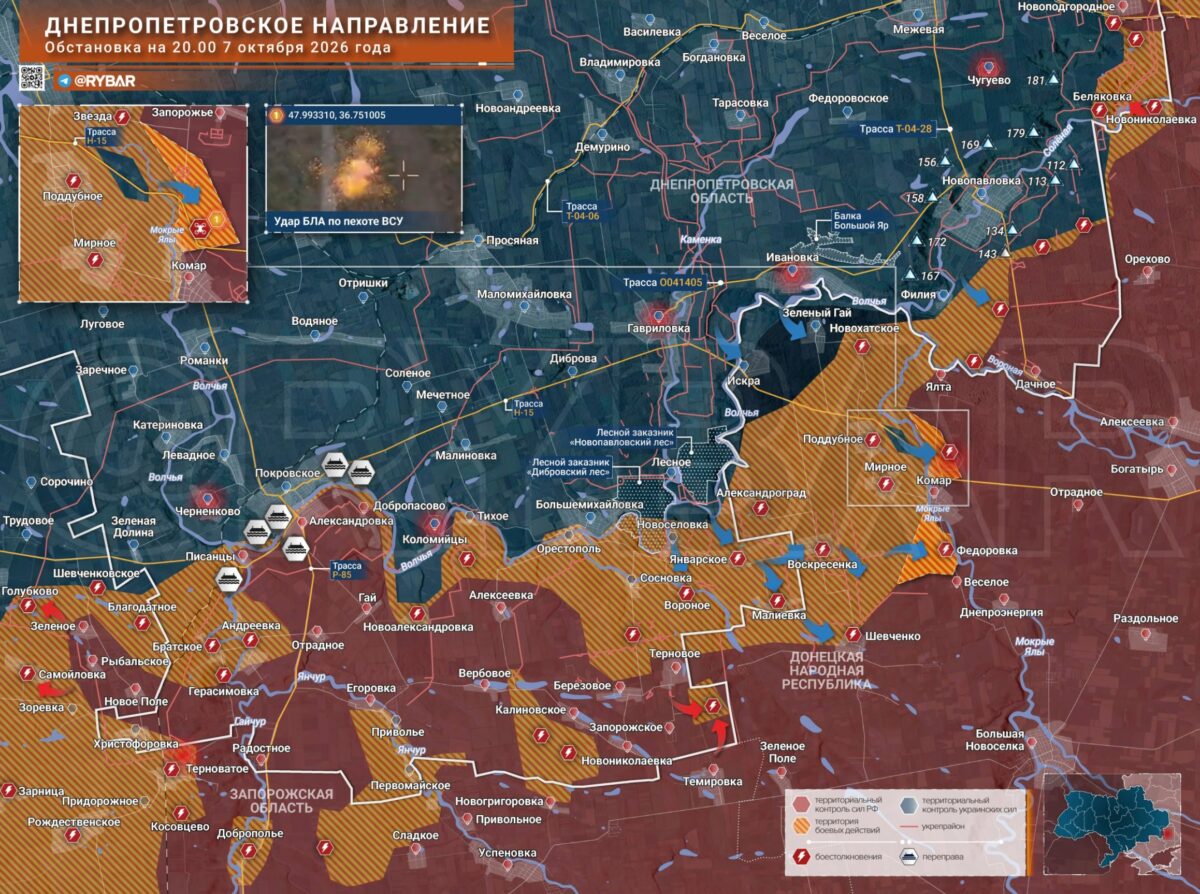
Ukrainian pressure continues towards Velyka Novosilka, with fighting already under way near Komar on the eastern bank of the Mokri Yaly river. This is not entirely new either, but several Russian sources are writing about fighting in this direction with new urgency and, from the Russian perspective, scepticism.
“The situation remains extremely tense. There is mounting evidence that the enemy is seeking to advance around the village of Komar,” Rybar wrote.
This is an important village. When the Russians captured Velyka Novosilka last year after taking Vuhledar, Komar was a significant obstacle to their advance into Dnipropetrovsk oblast.
Fierce fighting took place over the village at the time, and the Ukrainian army lost it in June 2025. The front then moved another 15 to 20 km deeper into Ukrainian territory, but it is now moving back after months of slow advances.
Here, too, Rybar’s map appears more dramatic than the situation actually is. It depicts territory being liberated since February. However, it claims that the situation is worsening and the outlook is negative.
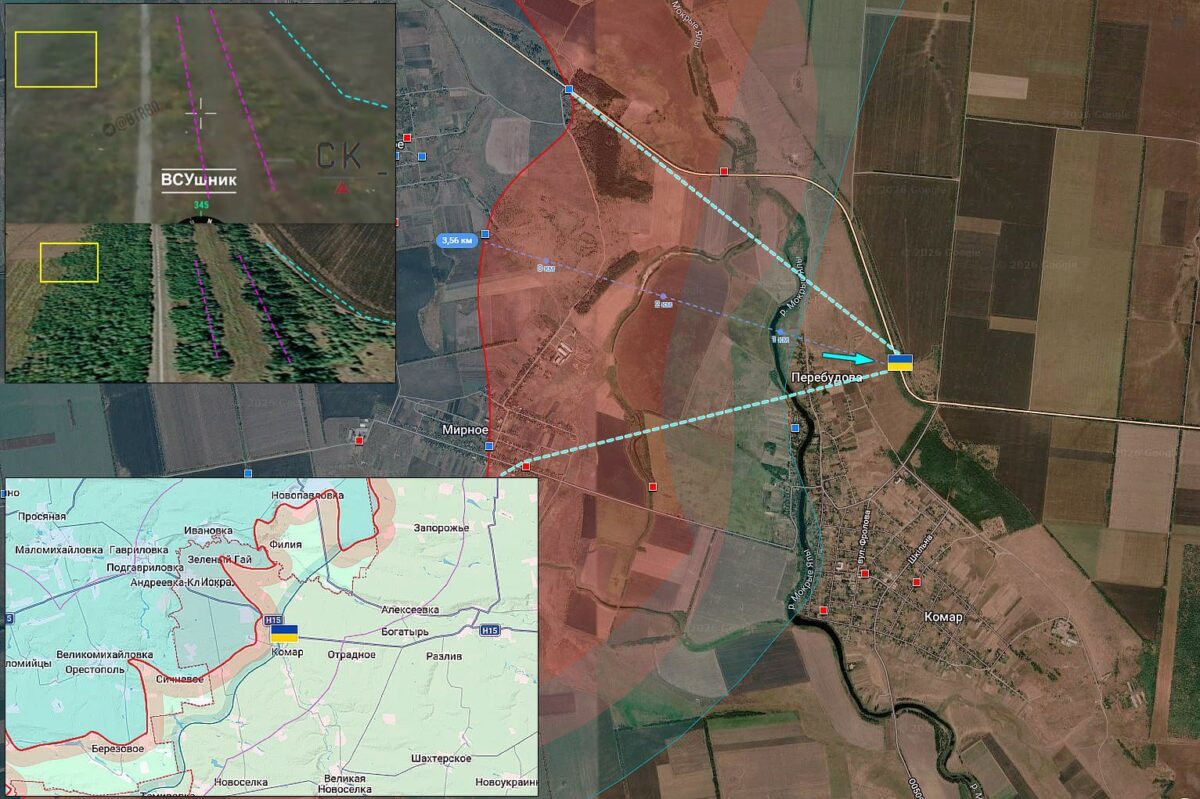
But the information about movements near Komar is genuinely fresh. Other sources agree on it almost metre for metre.
The Russian mapping project Slivochny Kapriz showed the exact location at the northern end of Komar, across the Mokri Yaly river, where Russian drones struck a Ukrainian video.
The Ukrainian Telegram account Petrenko also geolocated the incident at the same location.
Alexander Radov, another pro-war Russian, claimed that testimony from Ukrainian prisoners in this direction indicated that the Ukrainian command’s objectives were Bahatyr, 12 km east of Komar, and Velyka Novosilka itself, 13 km to the south.
This claim cannot be verified, but if it were true, Ukrainian objectives in this sector would be becoming ambitious. (Both Bahatyr and Velyka Novosilka are in the lower-right section of Rybar’s map at the beginning of this section.)
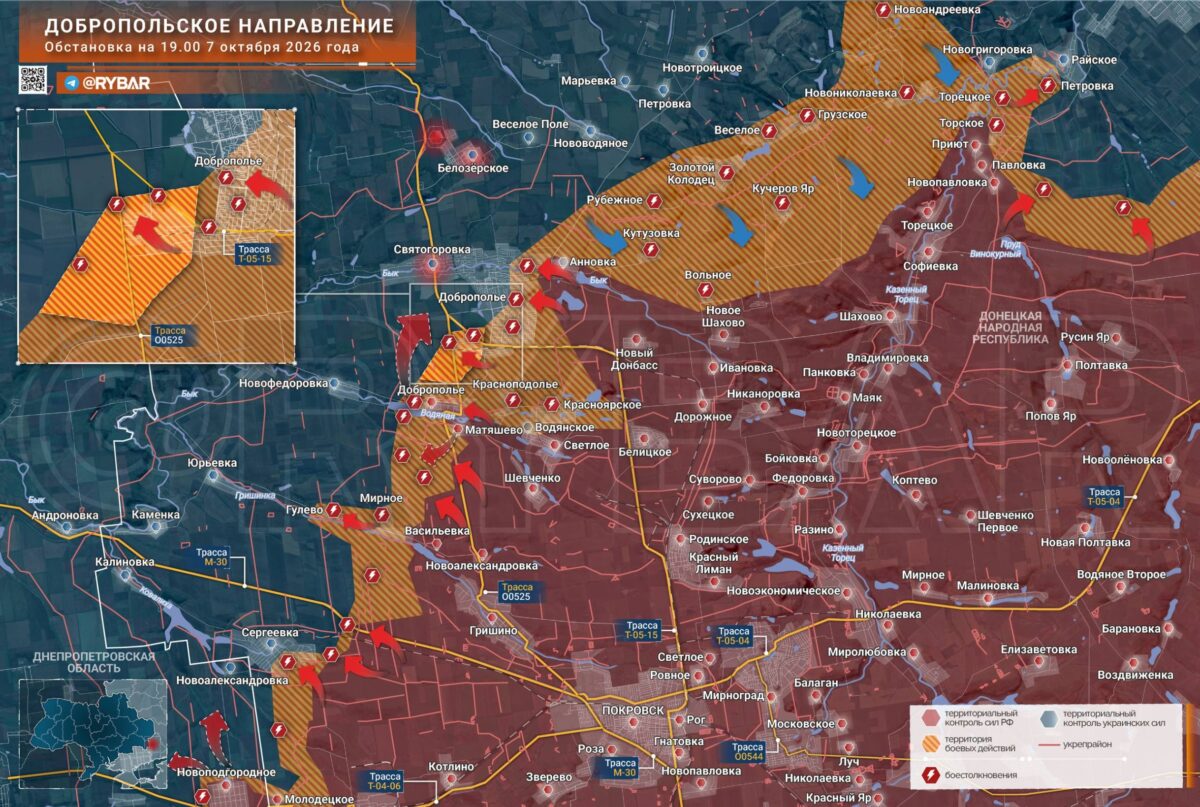
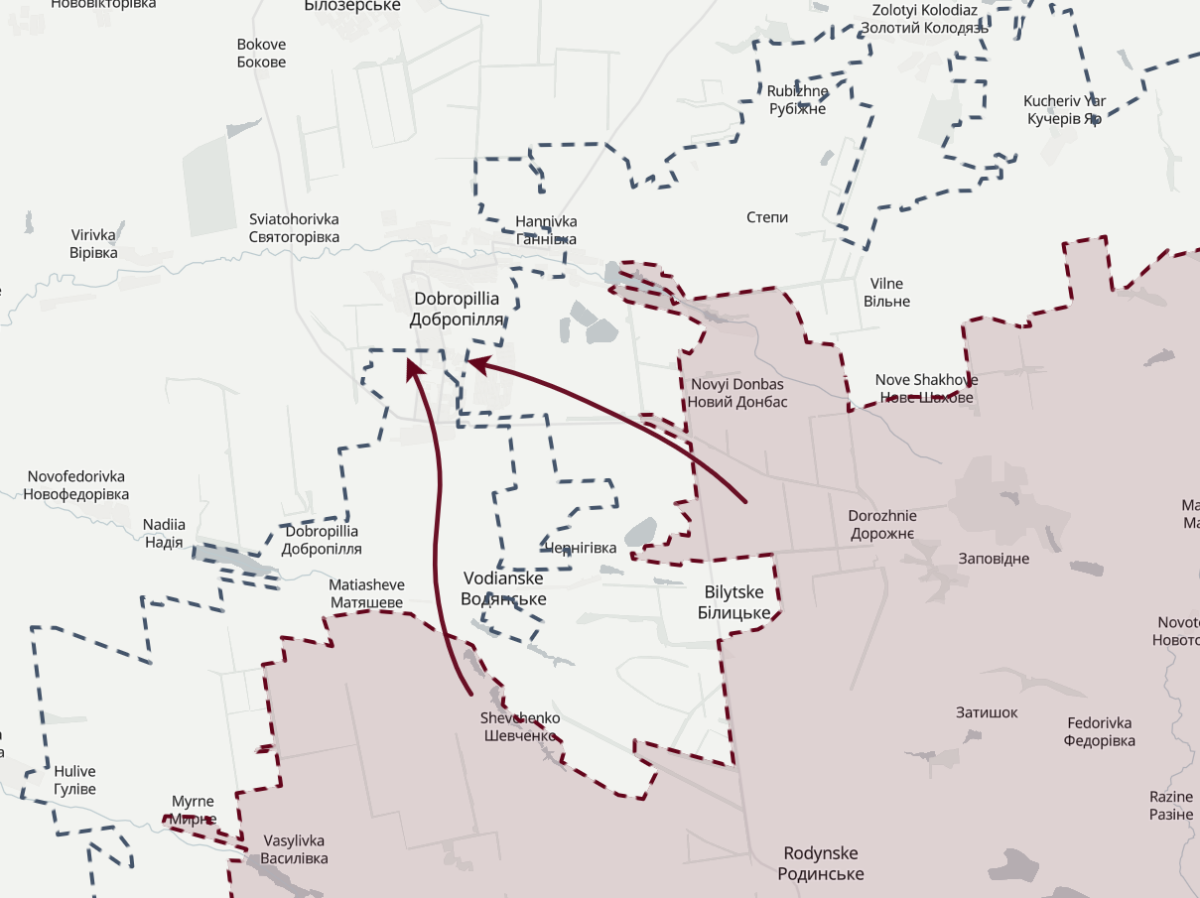
Russians are infiltrating Dobropillia, but a Ukrainian counteroffensive is pressing against their flank from the north. The fact that Russians are already operating in the town has been objectively confirmed by both sides. However, an earlier Russian claim that it had been encircled is false.
Rybar’s map again reflects what was written. In the town itself and its surroundings, red arrows show Russian attacks, while northeast of it, Ukrainian counterattacks are shown against the flank.
The Ukrainian channel Petrenko again serves as a source from the other side. Its map of Dobropillia has three circles, each marking a location where drones spotted Russian soldiers.
A Ukrainian soldier writing under the name Bakhmut Demon also confirmed Russian infiltrations into the town. However, he said they were being eliminated and that Russian losses would rise from November. He probably meant the period when the leaves fall and the terrain begins to turn muddy. Both will make the attackers’ advance more difficult.
Bakhmut Demon also warned that vigilance needed to be increased, as Russians are changing into civilian clothes and trying to infiltrate between Ukrainian positions in them.
Soldiers on the Zaporizhzhia direction described the same practice to us during a recent trip to Ukraine. There, too, they said that men in civilian clothing are sent ahead of infiltration groups in order to deceive drone operators.
Finally, another map by Black Bird Group. It, too, confirms the Russian advance towards Dobropillia, but does not show Ukrainian attacks in the north. The explanation is the same as in the previous cases: Rybar had drawn Russian positions much further forward than they actually were.
The battle for data centres is now two-way, with Ukrainians attacking Russia’s ‘Google’. Yandex is a technology giant that underpins the Russian internet. Its search engine, for example, is used by two-thirds of Russians. But its services are far broader. Among other things, it provides cloud storage to its clients.
The company provides its services through five main data centres. On Thursday, drones attacked the first of them. They struck the facility in Sasovo, in Ryazan oblast.
“This data centre is one of the key and largest data centres in Yandex’s Russian infrastructure. It contains tens of thousands of servers, and the company’s cloud services and computing capacity for machine learning operate on its equipment,” the Russian Telegram channel Military Informant explained the significance of the target.
As a result of the attack, outages in various internet-connected services were reported throughout the day.
The exile website Meduza listed several affected media outlets whose websites either could not be loaded at times or loaded slowly: RBC, Vedomosti, RIA Novosti, Kommersant, Vesti, Interfax, and Rossiyskaya Gazeta.
On Friday, another Yandex data centre was attacked, this time in Kaluga. The company acknowledged damage to equipment and announced that “some Yandex services may experience outages”.
Videos of the day
The events in the following video are almost identical to those witnessed by people in south-east England in 1944. Nazi Germany had then begun using V-1 flying bombs, and the most effective weapon against them was fighter aircraft, which shot down hundreds of these “wonder weapons” just above the sea while flying at the limit of their maximum speed.
Ukrainian pilots are now using the same tactic because of a shortage of air-to-air missiles. In this case, a MiG-29 shot down a Russian Geran-4 jet drone with fire from its 30mm cannon.
The MiG-29 is 17.4 metres long. The distance between it and the drone when firing began was around eight times its length — just under 150 metres. The risks to the pilot are obvious: the cloud of debris endangers the aircraft itself.
Once a common sight, now more of a rarity. A Himars multiple-launch rocket system destroyed a Russian artillery radar.
💥A rare sight these days: a HIMARS strike, apparently using a GMLRS rocket, destroys a Russian Irbis counter-battery radar after it was detected and tracked by reconnaissance drones of Ukraine’s 43rd Artillery Brigade.
— Special Kherson Cat 🐈🇺🇦 (@bayraktar_1love) October 8, 2026
The war has moved underground to an even greater extent than was previously customary. Soldiers at the front are building interconnected underground bunkers. A video by the 5th Assault Brigade shows the clearing of what were probably abandoned Russian positions.
Soldiers throw explosives into the openings. The footage then allows viewers to see, from plumes of smoke and dust pouring from underground, how many entrances the bunker had and how they were arranged.
🇺🇦2nd Assault Battalion of the 5th Assault Brigade clearing a collapsed bunker system, #Huliaipole sector at south eastern front pic.twitter.com/OoVU6x7PIH
By Monday (5 October), Russia had demonstrably lost 24,170 pieces of heavy equipment (24,138 on Tuesday, 22 September). Of these, Ukrainians destroyed 19,133 (19,105), 1,003 (1,000) were damaged, 1,194 (1,194) were abandoned by their crews and the Ukrainian army captured 2,840 (2,839). This includes 4,452 (4,448) tanks, of which 3,357 (3,353) were destroyed in combat.
Ukraine lost 12,238 (12,175) pieces of equipment, of which 9,633 (9,579) were destroyed, 711 (702) damaged, 695 (695) abandoned and 1,199 (1,199) captured. This includes 1,466 (1,464) tanks, of which 1,126 (1,125) were destroyed in combat.
Note: Neither side regularly reports its own dead or destroyed equipment. Ukraine publishes daily figures for Russian casualties and destroyed equipment, which cannot be independently verified. This overview uses data from the Oryx project, which has compiled a list of equipment losses documented exclusively by photographs since the beginning of the war.
What Ukrainian officers say about the changes brought by the new commander-in-chief, Mykhailo Drapatyi.
He has appointed people in their thirties and forties to important positions, often those who did not suit Syrskyi.
According to Ukrainska Pravda, Ukrainians are preparing a war plan to clarify the Ukrainian army’s long-term objective.
Russians attacked Ukrainian cities during Putin’s birthday, damaging apartment blocks and killing at least 11 people.
Charts of the day: How far production at Russian refineries has fallen; exports of oil and oil products have declined, but Trump is indirectly keeping profits from them high.
Videos of the day: a blazing sunset in Sochi; the music plays on; an unmanned Humvee; a robot’s duel with a drone; what the road to Crimea looks like.
Two and a half months have passed since major general Mykhailo Drapatyi became commander-in-chief of Ukraine’s armed forces. That may not be enough time for major reforms. But in recent days, articles have begun to appear about how the new commander is trying to change the Ukrainian army.
Unlike his predecessor, Oleksandr Syrskyi, Drapatyi does not promote himself much on social media. He has not made a single Facebook post since July, and his Telegram profile has similarly remained silent.
Ukrainska Pravda journalist Olha Kyrylenko tried to fill this “information vacuum”. She spoke with around 20 senior officers in the Ukrainian army.
Based on their anonymous testimonies, she sought to convey how Drapatyi had changed the Ukrainian army over those two and a half months.
The army is currently performing well at the front: Russians are suffering heavy losses and advancing very slowly, if at all. The protection of military, industrial and civilian sites in the rear against Russian air attacks is worse.
The article she wrote presents Drapatyi in a very positive light. According to Kyrylenko, the first word brigade and corps commanders use to describe the changes he has brought is “freedom”.
Drapatyi gives units considerable freedom and does not seek to micromanage everything at the front, as Syrskyi did.
“Unlike his predecessor, who told some brigade commanders how and where they should fight — and even specified the coordinates where they should establish a position — Drapatyi chose a different approach. He decided to decentralise command and abandon ‘micromanagement’,” Kyrylenko wrote.
Drapatyi is not as concerned with what is happening on each section of the front. He is more interested in statistics, analyses and the broader picture of the war.
“Syrskyi listened to reports from everyone every day and could give specific instructions on how to respond to developments, including where units should advance. Drapatyi does not do this; it is the task of the commanders of military groupings. Drapatyi focuses on strategic and systemic issues,” an unnamed senior military officer told Ukrainska Pravda.
The newspaper also adds that Drapatyi travels to visit units less frequently.
After taking up the post of commander-in-chief, he made several personnel changes. Broadly speaking, he is promoting younger commanders proven in the current war to replace older officers of the old Soviet school.
By contrast, he is moving the latter to rear-area and training roles, or they are retiring.
They are being replaced by younger commanders; Drapatyi himself is only 43. For example, Denys Prokopenko, a general with a far-right past, was put in charge of the important area near Dobropillia, where Russians are currently exerting the greatest pressure, despite being only 35.
Drapatyi has also rehabilitated some commanders who fell out of favour with the command under Syrskyi because of their criticism. One example is Serhii Sobko (42), who resigned last year from command of a brigade after the high command refused to send him reinforcements and would not allow his units to withdraw from a threatened area. Drapatyi appointed him as his deputy.
Emil Ishkulov (39), meanwhile, was sidelined after criticising the previous command over the campaign in the Kursk region, which ultimately ended with the withdrawal of Ukrainian soldiers. Drapatyi made him commander of the 11th Army Corps.
Ukrainska Pravda mentions an example from early summer under Syrskyi, when the 7th Corps was moved from Dobropillia to the Belarusian border in the Volyn region. The command said this would deter a possible Russian attack from Belarus.
After taking office, Drapatyi reversed this decision and sent the corps to defend the Zaporizhzhia region. The units themselves said they had had nothing to do at the Belarusian border for two weeks.
Ukrainska Pravda writes that a war plan is being prepared under Drapatyi. It is intended to define the Ukrainian army’s real long-term objectives and how to achieve them in this war.
“We need a grand strategy for 30 years, so that we as commanders know where we should be heading,” one of the corps commanders said, according to Ukrainska Pravda. The National Security and Defence Council is currently working on the plan.
Journalist Kyrylenko says this is probably the first such plan. However, the Thornpill account wrote that similar plans had already been prepared in 2017 under General Valerii Zaluzhnyi.
The Kyiv Post also published an article headlined that Ukraine’s army is winning under Drapatyi.
“Drapatyi is reshaping Ukraine’s armed forces to focus on drone-intensive warfare, decentralised command and younger combat commanders,” it wrote.
However, the steps taken by the previous command have also had a major influence on the current situation. For example, Operation Vivaldi, through which Andrii Biletskyi’s 3rd Army Corps has been liberating territory north of Lyman, has been under way since May, although its results are only being published now.
Ukrainska Pravda also recalls that Syrskyi handed Drapatyi an army in a better position than the one he had “inherited” in 2024 from the dismissed General Zaluzhnyi. At that time, the Russians were advancing rapidly and captured Avdiivka, for example.
The current commander-in-chief had an “easier start” in July.
“Drapatyi took office at a time when the front had been relatively stabilised, with Ukrainian armed forces even holding the advantage on the battlefield in some places. According to Ukrainska Pravda’s sources, the corps reform initiated by Syrskyi played a key role in this. Not all corps managed to develop into strong units, but the 3rd Corps, for example, substantially strengthened and literally retrained the relatively weak brigades it had received for combat duty,” Ukrainska Pravda added.
Nevertheless, several Western analysts shared the current reports about Drapatyi’s initial changes, especially his granting greater freedom to commanders. “It is a pity that Syrskyi was not replaced by Drapatyi much earlier — Ukraine would be in a better position now,” said Jakub Janovský, an OSINT analyst at Oryx, for example.
Russia again attacked Ukraine overnight into Wednesday. This time, it deployed at least five ballistic missiles, nearly 50 cruise missiles and 130 drones, 46 of them jet-powered. The fairly respectable 83-percent interception rate for jet-powered drones is noteworthy.
However, Russian missiles and drones also struck several locations and residential buildings. “Today, on Putin’s birthday, the Russian army ‘gave’ him the destruction of a residential building in Pryluky, in the Chernihiv region. It was an ordinary five-storey building. Unfortunately, according to current information, five people were killed and 26 injured, including five children. People may still be trapped beneath the rubble,” Ukrainian President Volodymyr Zelensky said.
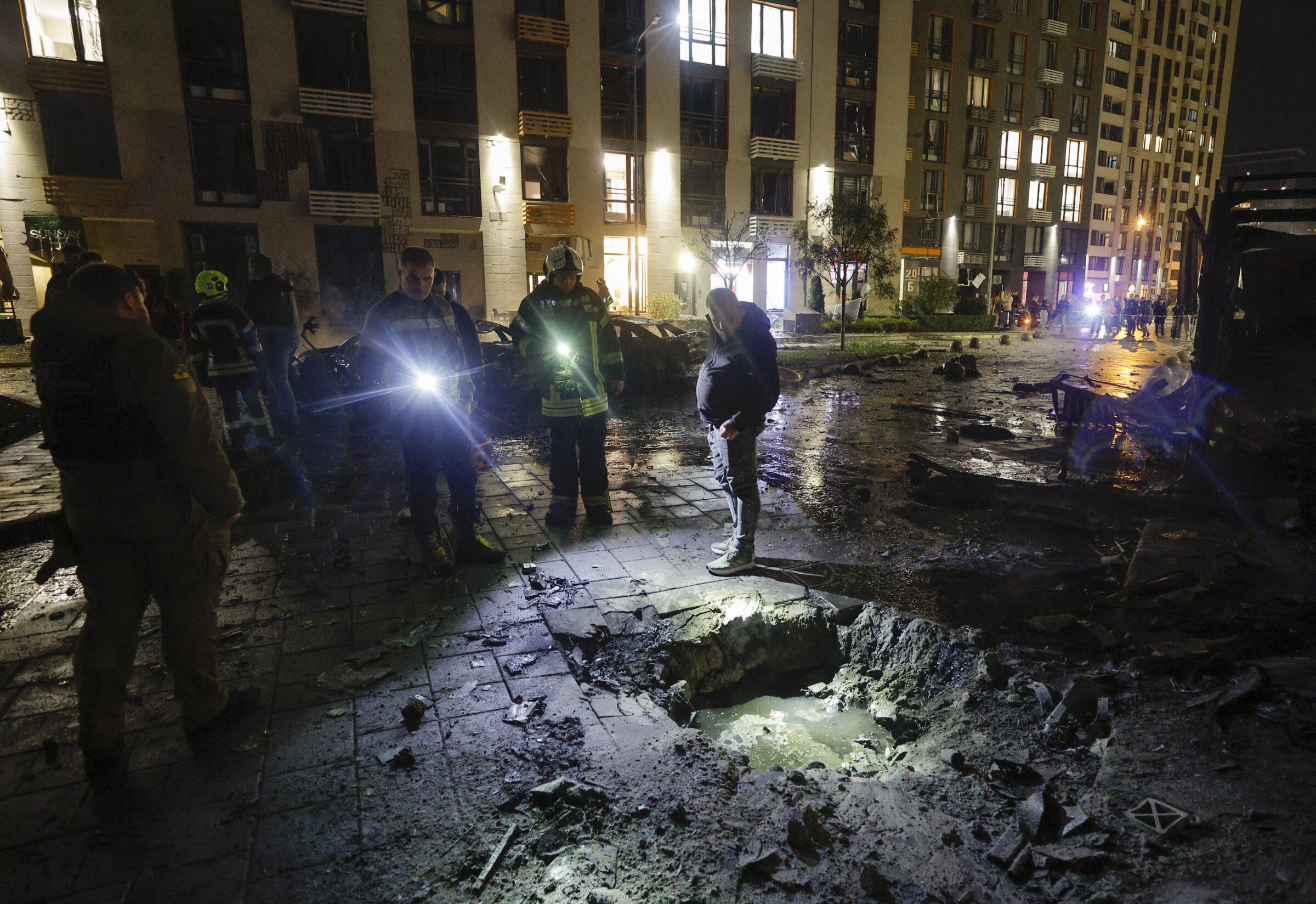
The Russian attack damaged five apartment blocks in Dnipro and four in the city of Kremenchuk. This is what the situation in Kremenchuk looked like.
This is my hometown in the video, and today it suffered too. This is Kremenchuk – a city in Ukraine whose name doesn't pop up in news feeds very often, but tonight it got hit as well. One of the missiles hit a courtyard between high-rises: windows, cars parked in the yards, and… pic.twitter.com/PeeUkU19dZ
As can be seen in these photographs, a ballistic missile fell in Kyiv but did not explode; Ukrainian bomb disposal experts tried to render it harmless.
An unexploded Russian Iskander 9M723 ballistic missile lies among residential buildings in Kyiv’s Darnytskyi district, where Ukrainian bomb disposal teams are conducting a complex operation to neutralize it.
— Special Kherson Cat 🐈🇺🇦 (@bayraktar_1love) October 7, 2026
Chart of the day
Ukrainians claim that their attacks on refineries have put more than 50 percent of Russia’s oil-processing capacity out of action. Michael Bohnert, an analyst at the RAND think tank, wrote on X that this was not entirely accurate. According to his calculations, current fuel production at Russian refineries stands at 3.22 million barrels per day. Before the war, it was usually around 5.5 million barrels per day, meaning a fall of about 40 percent.
There has also been a monthly decline of 0.36 million barrels per day, apparently owing to the latest attacks on refineries, for example in Moscow and Samara.
Ukraine says its strikes have taken out more than half of Russia’s refining capacity. Live crude runs do not show that.
My bottom-up tracker (41 refineries plus the mini-tail, version 2) puts national throughput at about 3.22 mb/d as of 6 Oct. That is down 0.36 mb/d over the… pic.twitter.com/RhXrzGlnJS
According to Bohnert, this is the third time Ukrainians have managed to reduce Russian oil processing so substantially. There was a drop of around 40 percent last autumn and in July this year. “3.2m barrels per day is roughly the point at which things start becoming uncomfortable for Moscow,” he wrote.
Unlike last year, however, Russia is helping itself through imports. The country, once the world’s third-largest fuel exporter, has sharply curtailed its exports. At the same time, it is partially making up for the shortfall in domestic production through imports.
South Korea is also helping it in this respect. According to information from the Guardian, 176,000 tonnes of fuel, mainly diesel, arrived from South Korea at Russian ports in the Far East in July and August. Seven tankers made a total of 14 voyages to Russia. Three of the tankers are on the European Union’s sanctions list.
Overall, Russia imported 368,000 tonnes of petroleum products by sea in August, a third of them from South Korea. The country, which once supported Ukraine not only verbally but also through non-military aid, is now helping Russia cope with Ukrainian attacks on refineries.
High petrol prices are also working in Russia’s favour. Analysts at the Kyiv School of Economics Institute published a chart showing that Russia exported the least oil and petroleum products in August since 2018. As the final bar in the left-hand chart shows, this was mainly due to a decline in petroleum-product exports.
Nevertheless, revenue from sales remains at last year’s level (the purple line in the left-hand chart). This is mainly due to the rise in their prices on global markets as a result of the US-Israeli war against Iran.
1/9 🛢️ Russia’s crude oil and oil product exports fell to their lowest level since 2018 in August. Despite higher prices, oil export revenues increased by just $0.3B to $13.9B. September Russian Oil Tracker by @KSE_Institute 👉 https://t.co/Rk4hd5OiA6pic.twitter.com/KdVMj4QjVV
This was the sunset seen by residents of the Russian coastal city of Sochi on Tuesday. A tanker sailing under the Liberian flag was burning close to shore. Footage showed that it was ablaze along virtually its entire length.
The Russian Rybar channel wrote that it had been hit by naval drones. It was therefore probably a Ukrainian attack on Russia’s shadow fleet, which exports oil around the world and thereby finances the war.
The oil-laden tanker was travelling from Novorossiysk to India. Local residents reported an explosion and feared that oil would spill into the sea.
🔥🚢 A dramatic view from the Russian Sochi right now, where the burning oil tanker off the port has turned into a massive wall of fire pic.twitter.com/oFKrLRTIuw
— Special Kherson Cat 🐈🇺🇦 (@bayraktar_1love) October 6, 2026
This is a rather surreal continuation of the previous video. A man is playing guitar on the promenade in Sochi while an oil tanker burns behind him, sending up an enormous plume of smoke.
Recorded on October 6, 2026, in Sochi, Russia. A street musician continues to play music on the waterfront while an oil tanker burns offshore in the background. pic.twitter.com/5lcfiOqZD2
Ukrainians are experimenting with remotely controlled vehicles. This video shows how a US Humvee off-road vehicle was converted into a remotely operated ground drone. It was loaded with wooden beams, which it delivered to soldiers building fortifications.
A Ukrainian HMMWV converted into a remotely controlled UGV is being used for frontline logistics, delivering timber for the construction and reinforcement of defensive positions. pic.twitter.com/NxQnuoa6Xf
— Special Kherson Cat 🐈🇺🇦 (@bayraktar_1love) October 7, 2026
This video shows a duel between a Ukrainian robot and a Russian FPV drone. In this case, the robot ultimately won, neutralising the drone by ramming it.
A Ukrainian ground robotic system rammed and destroyed a Russian FPV drone on the Pokrovsk axis. The UGV, operated by the 25th Sicheslav Airborne Brigade of Ukraine’s 7th Air Assault Corps, was returning from a combat mission when the FPV began pursuing it. The operators… pic.twitter.com/dIPGuEMVVC
Ukrainian attacks on the land route to Crimea continue. This is what one of the roads to Crimea currently looks like, with numerous damaged and destroyed lorries visible.
This is only part of the road now referred to as the land corridor to Crimea. Another road has turned into a "road of death" for the Russians. pic.twitter.com/D0fKAXQdGo
By Monday (5 October), Russia had verifiably lost 24,170 pieces of heavy equipment (24,138 on Tuesday, 22 September). Of these, 19,133 (19,105) were destroyed by Ukrainians, 1,003 (1,000) were damaged, 1,194 (1,194) were abandoned by their crews, and 2,840 (2,839) were captured by the Ukrainian army. This includes 4,452 (4,448) tanks, of which 3,357 (3,353) were destroyed in combat.
Ukraine has lost 12,238 (12,175) pieces of equipment, of which 9,633 (9,579) were destroyed, 711 (702) damaged, 695 (695) abandoned and 1,199 (1,199) captured. This includes 1,466 (1,464) tanks, of which 1,126 (1,125) were destroyed in combat.
Note: Neither side regularly reports its fatalities or destroyed equipment. Ukraine publishes daily figures for Russian casualties and destroyed equipment, which cannot be independently verified. This overview uses data from the Oryx project, which has compiled a list of equipment losses documented exclusively by photographs since the start of the war.
Flávio Bolsonaro surprisingly topped the polls in the first round of Brazil’s presidential election on Sunday (4 October), making him the favourite to topple President Luiz Inácio Lula da Silva in the run-off in three weeks.
The result is the latest in a series of strong performances by far-right candidates in Latin America. US president Donald Trump has been particularly invested in Brazil.
Despite lagging behind in most pre-election polls, senator Flávio Bolsonaro (45), the son of former president Jair Bolsonaro, won around 47 percent of the vote, with votes from more than 99.9 percent of districts counted. Bolsonaro was strongest in the country’s southern states.
President Lula took 45 percent, after performing strongest in Brazil’s north-east, and advanced to the second round, to be held on 25 October.
Latin American experts believe thatBolsonaro will likely win the second round as most of the candidates who failed to reach the runoff are ideologically closer to him than Lula.
Although voting is compulsory in Brazil, one in five of eligible voters did not take part in the first round.
This year’s election has been widely described as one of the most significant in modern Brazilian history, its outcome exceptionally important for the United States and Europe. It is also key for the rest of the planet, given the global impact of deforestation in the Amazon rainforest.
Conservative forces aligned with Bolsonaro also made gains in the elections to Congress. Jair Bolsonaro’s wife Michelle won a senate seat. She had previously fallen out with Flávio but the two have since publicly reconciled. And the former president’s son Carlos Bolsonaro also won a seat, while another son, Jair Renan, was elected to the lower house of congress.
Trump’s stake in Brazil
Though the campaign focused primarily on domestic issues, particularly the economy, security and corruption, Trump’s influence loomed large.
Trump criticised Brazil’s judiciary when Jair Bolsonaro was sentenced to 27 years following an unsuccessful attempted coup after he narrowly lost the 2022 election to Lula. The former Brazilian president is under house arrest due to health problems, and a court ruled he could not stand.
The US president described the trial of Bolsonaro as a “witch hunt”. Although Trump did not openly endorse Flávio Bolsonaro, Bolsonaro played up his ideological proximity to him.
In contrast, Lula sharply criticised Trump and built a reputation as a leader unafraid to stand up to Trump. Americas Quarterly editor Brian Winter said some in Brazil joke that Lula’s most effective surrogate is Trump.
Luiz Inácio Lula da Silva delivers a speech after learning the official results election on Sunday (4 October).
Lula is known for his multipolar foreign policy. He seeks “pragmatic relations” with the US, China, Russia and others. Lula maintains friendly relations with Vladimir Putin, although he recently spoke out against the invasion of Ukraine.
If Bolsonaro were to win the second round, Brazil would probably join a coalition of countries conducting military operations against drug cartels alongside the Pentagon. It is a controversial initiative, and like other left leaders in the region, Lula has rejected it.
This article continues, but the full version is available only to EUobserver.com subscribers. Visit account.euobserver.com/membership
Kyiv is currently in a worse situation than Kharkiv when it comes to air-raid alerts.
The Russians struck the National Academy of Sciences, forcing scientists to flee through windows. Why did they target it?
What upgrades they are testing on their Geran-5 drones.
According to Rybar, Russia’s goal in attacking Kyiv is also to persuade Europe to stop helping Ukraine.
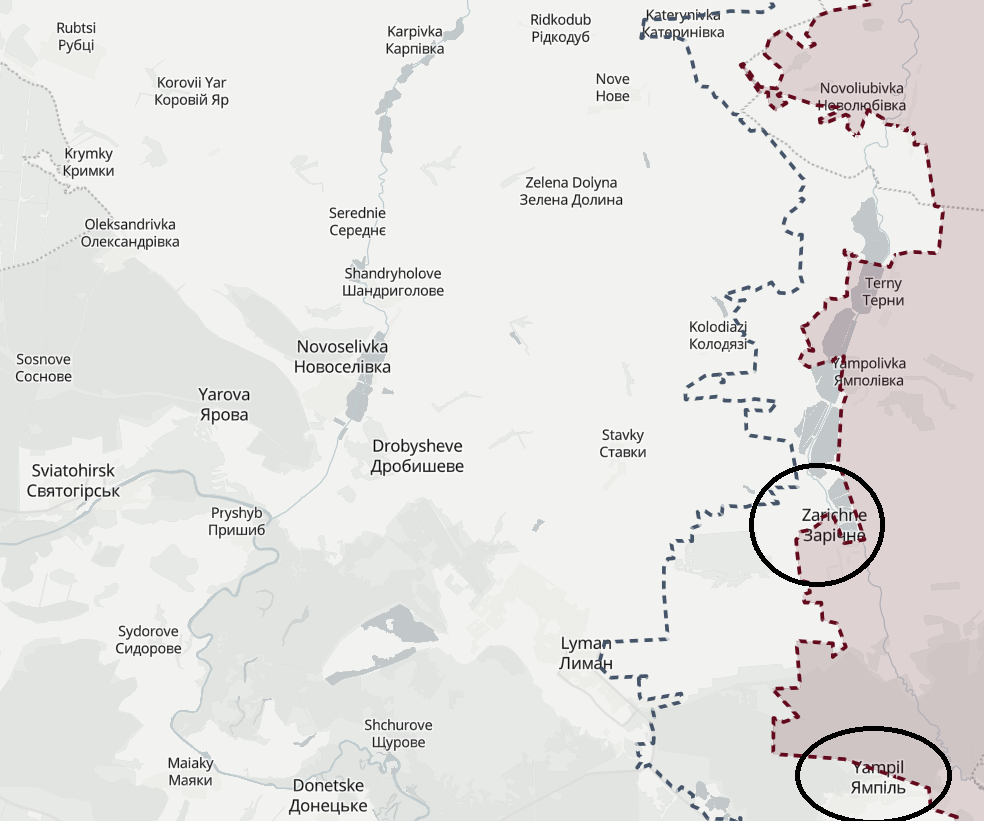
Maps of the day: The situation near Lyman and the gap between the Russian ministry and reality.
Videos of the day: an attack on the border crossing with Poland; footage from the cockpit of an Su-25; a robot avoids a drone; Russians flee among a crowd of civilians.
Kyiv has experienced its worst attacks since the start of the war in recent weeks. According to an analysis by French OSINT analyst Clément Molin, the capital was hit by 155 Russian missiles and drones in September, compared with 113 in August and 21 in March.
Denník N reporter Mirek Tóda, who visited Ukraine last week, said that Kyiv was currently worse off than Kharkiv in terms of air attacks, even though Kharkiv lies just 30 km from the front line.
Even smaller, FPV (first-person view) drones have recently begun flying on Kharkiv’s outskirts, hunting cars, but the number of air-raid alerts and air strikes there has still been far lower than in Kyiv in recent weeks.
Molin added that the Russians had struck the heart of the capital 10 times a day in recent days.
The Russian independent group Conflict Intelligence Team wrote that Kyiv and its surroundings would probably account for the highest number of civilians killed and injured anywhere in Ukraine in September — more than in the Donetsk, Kherson, or Kharkiv regions.
An at a time when attacks causing casualties occur every day, it is becoming harder for foreign journalists to engage readers with reports about an attack on the Ukrainian capital.
But on Monday, however, the Russians managed to do so.
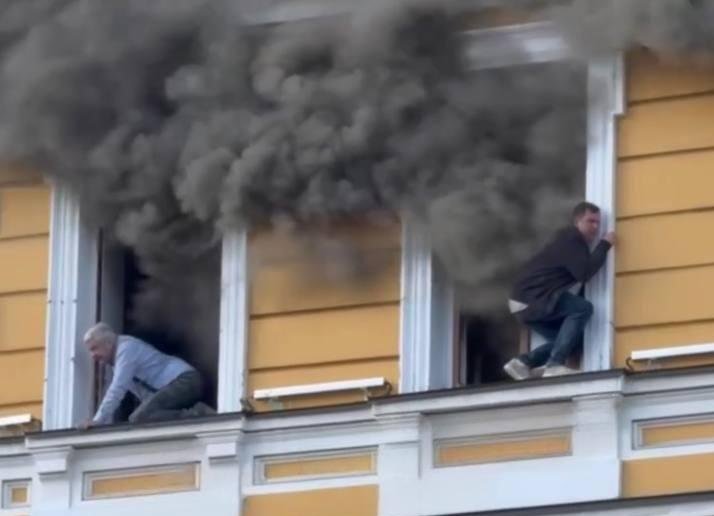
During the working day, they struck the historic building of Ukraine’s National Academy of Sciences. It caught fire, and footage of scientists and other employees attempting to climb out through smoke-filled windows circulated around the world.
A Russian strike against the building of the National Academy of Sciences of Ukraine. A rescue operation is underway: crews are putting out the fire and searching for people who may have been trapped inside. All services are deployed. Today in Kyiv, a pharmaceutical company and… pic.twitter.com/ccfIHnGFNg
— Volodymyr Zelenskyy / Володимир Зеленський (@ZelenskyyUa) September 28, 2026
The images of people standing on a ledge may have recalled those seen after the 11 September attacks, although the terrorists then struck skyscrapers more than 100 storeys high in New York.
Horrific scenes out of Kyiv this morning as Russia used a jet-powered drone to blow up Ukraine’s National Academy of Sciences. People are escaping through windows as the building burns. Just like they target kindergartens and schools, now they are bombing science. pic.twitter.com/yvwzLz9DXe
🚨 BREAKING: Terrifying footage captured people climbing out of windows after a Russian attack struck the National Academy of Sciences in central Kyiv in broad daylight.
The attack killed one person and injured at least three others, triggering a massive blaze. pic.twitter.com/wiWTU51QaL
The historic building had only three floors. Thanks in part to this and the firefighters’ rapid response, only one person was killed and six were injured.
It is quite likely that the attack on the Academy of Sciences was not accidental and that the Russians were targeting an important individual.
Ukrainian analyst Viktor Kovalenko believed that the Russians had wanted to kill 86-year-old Volodymyr Horbulin. He is one of the architects of Ukraine’s missile and space programme.
He headed Ukraine’s space agency in the 1990s and, for five years under President Leonid Kuchma, served as secretary of the National Security Council. Despite his age, he remains active: he is vice-president of the National Academy of Sciences and focuses on security issues.
And the elderly scientist was in the building at the time of the attack. The drone hit a room one floor above his office. He sustained only minor injuries, but his assistant was killed.
A few hours later, the Russians struck the building of the Dobrobut medical centre, which caught fire. Several people were reported injured there.
Russia bombed the Dobrobut Medical Center in Ukraine's capital, Kyiv, this afternoon, setting the facility ablaze. pic.twitter.com/gs0d1X3eB5
These attacks took place in the wider city centre and were felt by the EU ambassador to Kyiv, Slovakia’s Katarína Mathernová.
“Just moments ago, an explosion jolted me out of my chair in my Kyiv office. It was the loudest blast I have experienced here in three years. A jet-powered drone struck a building around 200 metres from the EU delegation. It happened in broad daylight. The target was a hospital,” Mathernová wrote.
While the Russians once attacked Kyiv mainly at night, attacks are now also taking place during the day. Although they target military and industrial sites as well, they frequently hit civilian facilities where many people are present during daytime.
“Today in Kyiv, a person can be killed in a supermarket, at a university, at a petrol station, on the street or at work. The campaign of indiscriminate attacks targeting the centre of the capital is unprecedentedly violent. The Russians are targeting data centres and regularly miss their targets,” French analyst Clément Molin wrote.
“What Russia is doing is pure terrorism. And we should treat neither its state leadership nor its military forces any differently. Why should we continue pretending that it is possible to negotiate with such terrorists on equal terms?” German analyst and former journalist Julian Röpcke wrote.
“Nothing expresses the ‘fight against Nato expansion’ quite as clearly as bombing the historic building of Ukraine’s National Academy of Sciences in central Kyiv, forcing ordinary scientists to jump from windows to escape death in the flames,” Ukrainian journalist Illia Ponomarenko added.
The Russians are attacking the capital virtually constantly. It is not merely one or two attacks a day. As Ukrainian analyst Bohdan Myroshnykov wrote on Sunday, Kyiv had been without an air-raid alert for only 5 hours and 55 minutes in the previous 24 hours.
“The current alert has lasted 8 hours and 20 minutes. The enemy deliberately launches drones in order to prolong the alert. Once they arrive in Kyiv, they begin circling over the city and its suburbs to keep people on edge for even longer,” he wrote.
According to him, the main weapons currently used by the Russians to attack Kyiv are Geran-5 jet drones. These are essentially smaller — though still six-metre-long — cruise missiles. By contrast, Geran-4 jet drones have the classic delta-wing shape of older Shahed drones.
Myroshnykov wrote that Ukrainians had more or less learned how to shoot down Geran-4 drones, but were having difficulties with the fifth series. While they intercept Geran-4s with an effectiveness of 70 to 80 percent, the rate for Geran-5s is only 50 to 65 percent. “The fourth series is intercepted en masse while approaching the Kyiv agglomeration, whereas the fifth is only intercepted within it,” the analyst wrote.
Last week, we wrote that Ukrainians had released the first videos showing them shooting down jet-powered Geran drones, including Geran-5s, using jet-powered interceptor drones capable of matching their speed. A video has now emerged of another new drone that apparently can already do this.
The problem, however, is that none of these drones is yet being mass-produced. Ukrainians therefore do not have enough of them to counter the growing number of jet-powered Gerans that the Russians are launching at Kyiv and other Ukrainian cities — as well as other targets.
“There are prototypes that have delivered varying results, but considerable effort is needed to bring a prototype into large-scale serial production. Sometimes this is impossible because access to certain components is limited,” former adviser to Ukraine’s defence ministry Serhii Sternenko wrote.
“It took us 3.5 years to find a more or less reliable anti-drone defence against conventional Shaheds. We began this path five months ago in the case of jet-powered drones. It may take us eight to 10 months to find a reliable anti-drone defence,” Myroshnykov wrote.
Ukraine’s defence minister, Yevhen Khmara, called on European partners at a meeting of his EU counterparts to help finance these interceptor drones, which have proved to be the best defence against conventional Gerans.
The Russians are also becoming increasingly creative in their efforts to strike targets in Ukraine. Serhii Beskrestnov, another former adviser to the defence minister, shared a video showing the Russians striking Incom’s office building in Kyiv. What is notable is that they filmed the strike themselves using a drone with a high-quality camera.
“The enemy attacked Incom’s office with a Geran-5 missile, while at the same time a jet-powered Shahed flew over Kyiv, circling above the attack site at an altitude of almost three km. It served as a radio-signal relay for the Geran-5 missile while also recording — and immediately transmitting — video of the attack on Incom. This Shahed then flew out of Kyiv and destroyed a McDonald’s warehouse,” Beskrestnov wrote.
He added that he was convinced the two operators had been sitting next to one another.
The Defence Express website also published an article about the Russians fitting their newest Geran-5-K5 jet drones with the Susanin navigation system, first reported by a Russian Telegram account. The system works by comparing current camera images with pre-recorded imagery.
“This enables the Geran-5 K5 to determine its coordinates even when satellite navigation is unavailable,” Defence Express wrote.
However, it works better during the day than at night, as it needs current images of objects on the ground.
It is often said that the Russians attack Ukrainian cities because they are unable to advance at the front. The aim may be to lower Ukrainians’ morale, degrade their economy and force them to surrender and accept Russian terms.
Although the attacks on Kyiv have been the worst since March 2022, they do not yet appear to have shifted Ukrainian public opinion. According to one recent poll, people were most concerned about government corruption (50 percent), with Russian air attacks only in second place (40 percent). Naturally, the poll was conducted not only in Kyiv but also in places where attacks are less frequent.
Recent polling by the Kyiv International Institute of Sociology (KIIS) indicates that the most worrying issue for Ukrainians right now is government corruption (at 50%), followed by Russian missile and drone attacks (40%) and unprofessionalism and incompetence of the authorities… pic.twitter.com/OvEbFz5jNQ
The attacks are often compared to the “war of the cities”, during which both countries attacked each other’s cities in the 1980s Iran-Iraq war. According to the Russian propaganda channel Rybar, they are also intended to undermine support from Europe.
This may be a somewhat far-fetched theory, but it is worth mentioning because it may indicate that people in the Kremlin think along these lines as well.
Rybar asks what the attacks mean for Ukraine’s “sponsors”. In its view, it is time for them to write off Ukraine, because there is no point pouring money into such a country. A “Marshall Plan”, it says, would be “pointless”.
“The more effective the strikes by the Russian armed forces in the framework of the ‘war of the cities’, the more likely the scenario in which the EU, even in the event of a ‘freezing’ of the situation, will ‘write off’ so-called Ukraine because further support for it is unsustainable. And without sponsors, the Kyiv regime cannot survive,” Rybar wrote.
This might perhaps apply if it were a war on the other side of the world, in which the EU was supporting one side. But the war over Ukraine is a conflict on the EU’s border, and there is a high likelihood that, if Ukraine does not stop the Russians, scientists will be fleeing from burning windows in Tallinn, Vilnius or Warsaw.
Maps of the day
On Monday, we wrote about how Ukrainians were gradually releasing parts of Operation Vivaldi, which is liberating territory north of Lyman. Russia’s defence ministry, as well as the Russian state agency Ria Novosti, continue to maintain their claims that the front line lies much further west.
This map compares official Russian claims with reality. At the point of greatest divergence, the maps differ by 40 km. For comparison, that is roughly the distance between Trnava and Bratislava. Overall, the Russians claim to control 1,360 square km more in this area than they actually do.
The yellow line on this map shows what the current official Russian maps portray the situation in the Lyman direction as (or what they would now consider the Izyum direction).
At it's furthest point, their claimed frontline is 40 km (!) west of my frontline. This was achieved… pic.twitter.com/Nd2SP3HJur
Russian Z-bloggers and propagandists are, however, closer to reality. The Two Majors channel wrote that the situation was “continuing to deteriorate”.
“The enemy is conducting counterattacks and trying to push Russian troops back beyond the Zherebets. (…) The Russian foothold west of the river has shrunk,” it said.
According to the channel, Ukrainians had entered the village of Zarichne from several directions, while fighting was also under way for Yampil.
According to Two Majors, this sector remains one of the most problematic parts of the front from the Russian perspective. The Russians’ aim is to stabilise it and retain at least some units on this bank of the river.
The Rybar channel wrote that Ukrainians had intensified fire on the few places where the river can be crossed, as well as attacks on logistics far behind the front line.
“Despite the stabilisation measures that have been launched, the situation remains extremely difficult and tense. The enemy’s gradual release of footage is a tool of information pressure, but it conceals a very real deterioration of the situation in the Lyman sector,” Rybar wrote.
Videos of the day
In addition to Kyiv, the Russians are attacking other parts of Ukraine. They again struck the Yahodyn border crossing on the Polish-Ukrainian border. A Geran-5 drone landed in a car park, around one km from Polish territory.
Recently, after a similar attack in which they hit a train, they also struck a petrol station 800 metres from the crossing. These are the attacks closest to Polish territory since the start of the war, not counting drones and a Kh-101 missile that have already entered Poland.
An enemy UAV struck near the "Yagodin" checkpoint on the border with Poland, according to social media posts pic.twitter.com/COrcYKrUoJ
Footage from the cockpit of a Ukrainian Su-25 military aircraft during a mission in the east. The pilot flew low over the ground, then climbed higher, released a French AASM guided bomb and turned away.
Rare cockpit view from a Ukrainian Air Force Su-25 Frogfoot on a strike mission over the eastern front, screaming low over the ground before pitching up, clawing for altitude, and launching a French AASM guided bomb at a Russian target. pic.twitter.com/DmX2Pvfftw
Ukrainian robot operators are also assisted by aerial reconnaissance drones during missions. This apparently helped the operator in the video skilfully evade a Russian drone at the last moment.
Ukraine’s Khartia Brigade released a video which it said showed Russian soldiers in civilian clothes, mixed in with actual civilians, trying to escape through a pipeline.
🚨 BREAKING: Drone footage from Ukraine’s Khartia Brigade reveals likely Russian soldiers disguised in civilian clothing, attempting to escape alongside elderly hostages and children.
By Tuesday (22 September), Russia had verifiably lost 24,138 pieces of heavy equipment, compared with 24,098 on Monday (14 September). Of these, Ukrainians destroyed 19,105 (19,065) pieces, 1,000 (1,000) were damaged, crews abandoned 1,194 (1,194), and the Ukrainian army captured 2,839 (2,839). These included 4,448 (4,447) tanks, of which 3,353 (3,352) were destroyed in combat.
Ukraine had lost 12,175 (12,143) pieces of equipment, of which 9,579 (9,551) were destroyed, 702 (698) damaged, 695 (695) abandoned and 1,199 (1,199) captured. These included 1,464 (1,462) tanks, of which 1,125 (1,120) were destroyed in combat.
Note: Neither side regularly reports its own casualties or destroyed equipment. Ukraine publishes daily figures for Russian casualties and destroyed equipment, which cannot be independently verified. In this overview, we use data from theOryx project, which has compiled a list of equipment losses documented exclusively by photographs since the start of the war.

 Login