❌

Reading view

Fiscalía allana Municipio de Quito por presunto peculado

Quito, 21 oct (Prensa Latina) La Fiscalía y la Policía de Ecuador allanaron hoy tres inmuebles vinculados al Municipio de Quito por una investigación sobre la presunta adjudicación irregular de dos contratos de obras públicas por más de cuatro millones de dólares.

The post Fiscalía allana Municipio de Quito por presunto peculado first appeared on Noticias Prensa Latina.

  •  

Lluvias en Ecuador dejan tres muertos y cinco ríos desbordados

Quito, 21 oct (Prensa Latina) Las lluvias asociadas al fenómeno de El Niño dejaron desde finales de agosto hasta tres personas fallecidas en Ecuador, donde cinco ríos permanecen hoy desbordados.

The post Lluvias en Ecuador dejan tres muertos y cinco ríos desbordados first appeared on Noticias Prensa Latina.

  •  

Mandataria de Perú recibe presidencia de Comunidad Andina

Lima, 20 oct (Prensa Latina) La presidenta peruana, Keiko Fujimori, recibió hoy la presidencia pro tempore de la Comunidad Andina de Naciones (CAN) de su homólogo ecuatoriano, Daniel Noboa, en una ceremonia realizada en el Palacio de Gobierno.

The post Mandataria de Perú recibe presidencia de Comunidad Andina first appeared on Noticias Prensa Latina.

  •  

Ecuador venderá petróleo a Perú por mil 652 millones de dólares

Quito, 20 oct (Prensa Latina) La estatal Petroecuador informó hoy que exportará 16,2 millones de barriles de petróleo a Perú mediante dos contratos adjudicados a Petroperú, con ingresos estimados de mil 652 millones de dólares para el Estado ecuatoriano.

The post Ecuador venderá petróleo a Perú por mil 652 millones de dólares first appeared on Noticias Prensa Latina.

  •  

Ecuador endurece penas por trata de personas y matrimonio forzoso

Quito, 20 oct (Prensa Latina) La Asamblea Nacional (Parlamento) de Ecuador aprobó hoy por unanimidad reformas legales que elevan hasta 35 años las penas por trata de personas, tipifican el matrimonio forzoso y amplían la protección a las víctimas.

The post Ecuador endurece penas por trata de personas y matrimonio forzoso first appeared on Noticias Prensa Latina.

  •  

Ecuatorianos de distintas edades acuden a feria en busca de empleo

Quito, 20 oct (Prensa Latina) Personas de distintas edades acudieron hoy a una feria de empleo en esta capital, donde más de 100 empresas ofrecieron tres mil 649 vacantes en medio de las dificultades para acceder a un trabajo estable en Ecuador.

The post Ecuatorianos de distintas edades acuden a feria en busca de empleo first appeared on Noticias Prensa Latina.

  •  

Temporal invernal causa desbordamiento de cuatro ríos y suspensión de clases en Ecuador

Se han reportado más de 392 eventos adversos por lluvias, los cuales afectan en diferente medida a 22 de las 24 provincias del país. Los eventos más recurrentes han sido inundaciones y deslizamientos
  •  

Ecuador, crolla il crocifisso durante la messa: prete colpito in pieno e morto. Il dramma in un video

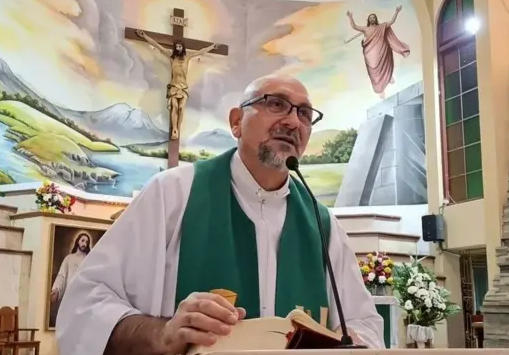
Tragica morte di un sacerdote durante la celebrazione della Santa Messa in Ecuador. Il sacerdote redentorista P. Patricio Alfredo Sánchez Molinari, di 53 anni, è deceduto sabato 17 ottobre a Guayaquil (Ecuador), dopo che una croce situata sulla parete dietro l’altare gli è caduta addosso mentre celebrava la Santa Messa. Il drammatico video è visibile sui social.

Nonostante i tentativi immediati di aiuto da parte dei fedeli presenti e il successivo arrivo del personale sanitario, ogni soccorso si è rivelato inutile e il sacerdote è deceduto sul posto a causa del gravissimo trauma riportato. La drammatica scomparsa è stata in seguito confermata ufficialmente dall’Arcidiocesi di Guayaquil.

Il sacerdote era parroco della chiesa di Nostra Signora del Perpetuo Soccorso. L’Arcidiocesi di Guayaquil, attraverso un comunicato firmato dal cardinale Luis Cabrera Herrera, ha espresso il suo profondo cordoglio e si è unita in preghiera per l’eterno riposo della sua anima, trasmettendo la sua vicinanza e affetto alla comunità redentorista, ai familiari e agli amici.

L'articolo Ecuador, crolla il crocifisso durante la messa: prete colpito in pieno e morto. Il dramma in un video proviene da Affaritaliani.it.

  •  

Si stacca all’improvviso il crocifisso alle sue spalle e lo centra in pieno: parroco muore durante la messa sotto gli occhi dei fedeli presenti

Il sacerdote redentorista Patricio Alfredo Sánchez Molinari ha perso la vita dopo essere stato colpito alla testa da una pesante croce di legno staccatasi dalla parete. La tragedia si è consumata a Guayaquil, in Ecuador, all’interno della parrocchia di Nostra Signora del Perpetuo Soccorso, proprio mentre il parroco stava celebrando la normale messa quotidiana, trasmessa contestualmente in diretta video.

L’incidente si è verificato in modo del tutto inaspettato davanti agli occhi dei fedeli riuniti in chiesa e di quelli collegati in streaming per seguire il rito. Come documentato anche dai filmati circolati successivamente sui social, il cedimento del crocifisso ha investito in pieno il celebrante. “L’improvviso crollo del pesante simbolo religioso durante la celebrazione ha provocato immediato sconcerto tra i parrocchiani presenti alla funzione“, hanno riferito i testimoni che hanno assistito alla scena.

Subito dopo l’impatto, il parroco è stato soccorso e trasportato d’urgenza in ospedale. Le sue condizioni cliniche sono apparse immediatamente gravissime e, nonostante i tentativi di stabilizzazione da parte del personale medico, il decesso è stato dichiarato a circa quattro ore di distanza dall’incidente. L’Arcidiocesi di Guayaquil ha confermato ufficialmente la scomparsa di padre Sánchez Molinari, raccogliendo la profonda costernazione e il dolore dell’intera comunità cattolica della città.

L'articolo Si stacca all’improvviso il crocifisso alle sue spalle e lo centra in pieno: parroco muore durante la messa sotto gli occhi dei fedeli presenti proviene da Il Fatto Quotidiano.

  •  

Cortes eléctricos en Ecuador afectan producción y conservación de alimentos

Fuentes de la industria dijeron que los generadores de emergencia no permiten sostener por varios días consecutivos el funcionamiento normal de las plantas de un sector que genera más de 85.000 empleos directos en Ecuador.
  •  

Ecuador: organizaciones alertan sobre el incremento de la violencia de género en 2026

El balance técnico detalla que, «de la totalidad de agresiones contabilizadas, 243 casos corresponden a feminicidios vinculados con dinámicas de la delincuencia organizada y sistemas criminales».
  •  

Thousands of young people protest the Noboa administration in Quito

On October 10, thousands of Ecuadorians took to the streets to protest against the government of right-wing President Daniel Noboa. The demonstration was organized by the Autonomous Front of Organized Resistance (FARO) under the slogan “Government vs. People.”

A esta hora, una marcha de rechazo al Gobierno de Daniel Noboa recorre las calles de Quito. La movilización está marcada por carteles de protesta y consignas contra el mandatario y su gestión. Los manifestantes atraviesan en este momento el paso deprimido del Guambra y avanzan… pic.twitter.com/WKPfT8D9jF

— Elena Rodríguez Yánez (@ElenaDeQuito) October 10, 2026

Saturday’s demonstration followed a protest on October 8, organized by labor unions also in Quito, to protest the security, energy, health, and employment crises facing the country. They also protested government cuts to education and health care, as well as alleged mistreatment of workers, according to Edwin Bedoya, president of the United Workers’ Front (FUT).

For its part, the October 10 demonstration – which consisted mainly of high school and college students – set out from the Central University and marched through Quito. Slogans such as “If the people have no peace, neither does the government” and “Out with Noboa, out with him!” were heard along the streets occupied by the demonstrators.

The president of the Catholic University Student Federation, Jatari Ulcuango, told protesters: “Four years ago, this government promised us electricity; two years ago, too – and now the blackouts have returned. Two months ago, the government told us it would provide us with medicine, and yet we’re only receiving 60% of the supply. They’re taking us for fools.”

He added: “We’re dying outside the hospitals. Criminals are kidnapping us, murdering us, and robbing us. That’s why we’ve come out this morning. They plan to dismantle public institutions to force us to hire private security. Who has gotten rich off the health crisis? The private healthcare sector, while the people are getting poorer and poorer.”

The peaceful march headed back to the Central University, where the students gathered. Later, the students reported on social media that they had been harassed and repressed by the police, who had accompanied the entire march.

Likewise, several media outlets reported that the police were aggressive toward them. This was reported by the outlet La Barra Espaciadora, which released a video showing police officers pushing journalists.

TeleSur journalist Elena Rodríguez also reported that law enforcement officers broke the microphone she was using and struck her on the head: “I’m sick and tired of having to recount, time and time again, police attacks against the press. Today, while I was trying to document the violence with which officers were beating young protesters, I was struck on the head from behind with a baton. I turned around, showed my Telesur microphone to identify myself as a journalist, and the response was another baton strike that ended up breaking it.”

She added: “If they think that by beating me up they’re going to get me to stop documenting police brutality, to put my microphone away, or to back off several blocks so I can report from a place where I won’t be a nuisance, they’re wrong. It is not we journalists who should distance ourselves from the events. It is the police who must stop attacking us. The right to report cannot be negotiated at the point of a baton.”

The protests are taking place against the backdrop of a widespread crisis in the country, which includes the worst security crisis in its history (tens of thousands of deaths due to violence between drug trafficking gangs), a very serious health crisis (a lack of supplies and medicines in the public health system), and other major crises such as those in education, public investment, and employment.

Local elections will be held in November, which will reveal the extent of support – or lack thereof – for President Noboa and his neoliberal government agenda, which aligns with the hemispheric security strategy led by the Trump administration.

  •  

Ecuadorian fishermen who were kidnapped by the US military have been acquitted

An Ecuadorian judge ordered the immediate release of nearly 30 fishermen whose two boats were destroyed by the US military in the Pacific Ocean. The Ecuadorian prosecutor’s office had charged them with alleged illegal activities.

The sequence of events is telling.

In two separate instances between late August and early September, the fishing boats Conquista II and María Candelaria were boarded by US military forces while on the high seas. The US forces, after transferring the fishermen to other vessels, destroyed and sank their boats.

The fishermen’s families quickly reported that they had lost communication with their loved ones. Only after prolonged uncertainty were the crew members handed over at Ecuadorian ports and placed under the control of Ecuadorian authorities.

In other words, the crew members were not charged with any crime before their vessels were destroyed, but rather afterward. This move has drawn heavy criticism from criminal defense attorneys (who argue that these actions violate due process) and caused anxiety among Ecuadorian fishermen, who have expressed their fear of fishing on the high seas and suffering the same fate as their compatriots. Several other boats have been intercepted and sunk in the Pacific by US forces in recent months, only increasing fears about transiting there at all.

The US military, for its part, claims that the destroyed vessels serve as fuel refueling points for other boats involved in drug trafficking. Under this strategy, US Southern Command intercepted at least eight Ecuadorian vessels between August and September 2026.

Foreign military actions on Ecuadorian soil have been defended by the government of right-wing President Daniel Noboa, who has aligned himself with Donald Trump’s hemispheric security policy embodied in the Shield of the Americas. During a recent visit to the South American country, Marco Rubio defended the military operations as necessary to dismantle drug trafficking routes.

But why destroy a vessel that has already been evacuated of its crew? 

Defense Minister Giancarlo Loffredo, who defends US military operations against Ecuadorian fishermen based on alleged “prior intelligence,” said that destroying a vessel that has already been evacuated of its crew is justified because it is too risky to tow the vessels to shore. He also said that seizing the fuel on board is dangerous.

However, the minister’s justifications have not convinced everyone. Human Rights Watch stated that both the United States and Ecuador must present evidence justifying the destruction of the vessels: “Of the detained crew members, 90 are facing criminal investigations in Ecuador, 56 were released because Ecuadorian judges ruled that their detention was illegal, and another 14 were not brought before a judge.”

In addition, Juanita Goebertus, director of the Americas division at Human Rights Watch, said: “Intercepting fuel trafficking at sea can be an important step in stopping criminal groups, but that does not give security forces the right to detain people without evidence, destroy their boats, and commit abuses.”

The fact is that the Ecuadorian fishermen deny any involvement in the crimes of which they are accused. For now, the Ecuadorian courts have ruled in favor of nearly 30 fishermen from the Montecristi and the Don Rufo, stating that the prosecution failed to present evidence to support its accusations. With them, the total number of acquitted crew members stands at 56. Another 32 fishermen are on probation while investigations into alleged criminal association continue.

  •  

Digital surveillance and control spread across Latin America under governments of all stripes

.

Digital surveillance and data leaks may seem far removed from everyday life, but they are becoming increasingly common. In Venezuela, for example, authorities blocked messaging apps and social media platforms including Signal, X, TikTok and Telegram, as well as YouTube, VPN services and websites. In Nicaragua, independent media outlets had their domains blocked. In Paraguay, a leak from the electoral authorities exposed the data of nearly seven million people. And in Argentina, more than 665,000 medical records were put up for sale.

Seguir leyendo

  •  

Noboa government is threatening press freedom in Ecuador, journalists claim after newspaper ceases print edition

October 9 will be the last day that the well-known newspaper Expreso, one of Ecuador’s most important newspapers, is distributed in print. The newspaper, which has historically maintained a center-right editorial line, according to its statement, will limit its operations to its website, which will result in the layoff of dozens of employees.

The company that owns the newspaper, Gráficos Nacionales (Granasa), states that it is not bankrupt but will have to sell several assets to pay debts owed to its employees: “At stake is not only the rights of the shareholders but, above all, those of each and every employee who gave their all to this publishing house.”

And while the company has been reluctant to mention the reasons behind this decision in its most recent publications, several civil society actors have stated it plainly: pressure from the current right-wing government of Daniel Noboa.

One of them was the Inter-American Press Association (IAPA), which called on the government to cease “state harassment against critical media outlets and journalists.” The demand is based on complaints, dismissals, and investigations reported by the newspaper in recent months. “We regret that a newspaper with more than five decades of history is ceasing print publication. Beyond business decisions that are the sole responsibility of its owners, it is impossible to ignore the context of sustained pressure that has surrounded Granasa.”

Likewise, the Observatory for Rights and Justice (ODJ) stated: “We express our deep concern over the announcement of the discontinuation of the print edition of Diario Expreso. After several months of enduring administrative and judicial harassment, and facing government attempts at corporate takeover and censorship against its columnists and representatives, the publication has decided to stop printing copies.”

For its part, the Noboa administration has categorically denied that it took any steps to provoke the crisis at Diario Expreso, and has instead defended the actions of the relevant institutions in investigating alleged crimes “regardless of where they come from” by independent bodies such as the prosecutor’s office and the SRI.

A right-wing newspaper critical of Noboa in crisis: pressure or mismanagement?

One of the most surprising aspects of the case is that Expreso has historically maintained an editorial stance closer to the right. It was one of the newspapers most opposed to the progressive government of Rafael Correa (2007–2017), and many of its editorial writers even went so far as to endorse the recently inaugurated Noboa administration.

However, as the months went by, criticism of Noboa’s administration began to appear in the newspaper’s pages, which, according to some allegations, did not sit well with the central government.

According to these allegations, the Internal Revenue Service – the agency responsible for collecting taxes – as well as the Attorney General’s Office, began to “pressure” Expreso’s major financial backers through investigations, which reportedly led those backers to withdraw their contributions to the newspaper, which has been in circulation in Ecuador for more than half a century.

Added to this is a warning issued by the newspaper’s parent company itself, stating that the Ecuadorian Superintendency of Companies intervened in the company with the alleged aim of “monitoring its financial performance and facilitating the correction of the irregularities identified.”

Likewise, Granasa President Galo Martínez told the SIP that the government was “harassing” the newspaper’s clients who advertised their products and services in its pages, a move seen as a tactic to drive the company into bankruptcy, as it relies on sponsors to operate.

According to an investigation by Ecuavisa, the newspaper Expreso lost nearly 70% of its advertising revenue over the months of government pressure. “The cowardice of a large segment of the business community that prefers to pull its ads – whether due to calls from those in power, which have indeed occurred, or simply out of a desire to look good,” said Martín Pallares, editor-in-chief of Expreso.

The truth is that this pressure is nothing new. Several months ago, one of the country’s leading editorial writers, Roberto Andrade, who worked at the newspaper, resigned from the publication, alleging that members of the Noboa administration had requested his departure.

Pallares also spoke about this alleged government pressure in a recent interview with Ecuavisa: “The newspaper had received a message stating that the government would stop its harassment if three people were handed over: Roberto Aguilar, Eduardo Carmigniani, and myself. The newspaper placed its trust in us; it chose to stand by us rather than give in to the pressure.”

Pallares stated about this alleged government pressure in a recent interview with Ecuavisa: “The newspaper had received a message stating that the government would stop its harassment if three people were handed over: Roberto Aguilar, Eduardo Carmigniani, and myself. The newspaper placed its trust in us; it chose to stand by us rather than give in to the pressure.”

In addition, Pallares, one of the country’s most well-known right-wing journalists, said: “Critical voices bother those in power – this kind of narcissistic power where the official truth cannot be questioned. Take the Progen case [the failed sale of power generators]; it’s crystal clear. If it weren’t for the troublesome media outlets that dig up information, data, and publish chats they manage to obtain, that issue would have already been buried.”

This is not the first instance of conflict between the Noboa administration and the press. Early in his term, journalist Alondra Santiago was deported; later, the program Irreverentes was canceled following harsh criticism of the government; journalists Fausto Yépez, Hernán Higuera, and María Sol Borja reported government pressure due to their investigations; attacks against journalists were reported during the 2025 National Strike; the high-profile case of Gisella Bayona, who alleged that the government was investigating her husband because she had reported a shortage of supplies in the public health system – a situation that has triggered one of the most significant crises in the country’s healthcare history; among other incidents.

Criticism from the right: a dispute among the ruling classes?

Other right-wing journalists have also criticized the government for allegedly having a low tolerance for criticism and taking actions that, they claim, are leading to a loss of freedom of expression.

One of them is journalist and political scientist Carlos Rojas, who stated in an op-ed: “What is happening with the newspaper Expreso is a very serious sign that Ecuador’s democratic health is in poor shape. It’s getting worse … a dangerous clash is reigniting between the current government – which is intolerant of criticism and oversight – and the independent press, a pillar of any liberal democracy.”

For his part, Ugo Stornaiolo wrote about new forms of censorship in Ecuador: “Journalistic oversight is undergoing a transformation that places press freedom at a crossroads. There are no shutdowns of radio stations, no buyouts of opposition media outlets, and no physical attacks. Investigative journalism faces sophisticated mechanisms of coercion: fiscal harassment, the manipulation of state entities, and reprisals against family members and coworkers to silence critical voices regarding President Noboa’s administration.”

According to several analysts, there is clear tension not only between centrist and left-wing movements and parties and the Noboa administration (which is clearly aligned with the right and follows the dictates of the Washington Consensus) but also between the Noboa administration (which belongs to the country’s most powerful family) and the critical positions coming from sectors of the right and a segment of the business community. This would demonstrate clear contradictions within the country’s most powerful economic classes.

The most recent case involved the leader of the business association, María Paz Jervis, who stated at a public event (in reference to the Diario Expreso case) that “Rarely in my life have I seen a business sector so afraid. I had never felt such hopelessness and resignation. I am convinced that there is much that needs to change in our country, and saying that there are things that need to change does not make us anyone’s enemies.” 

Following these statements, Jervis resigned from her position without specifying the reasons for her decision.

  •  
❌