❌

Reading view

Venezuela Opens Process to Choose New Supreme Court Judges
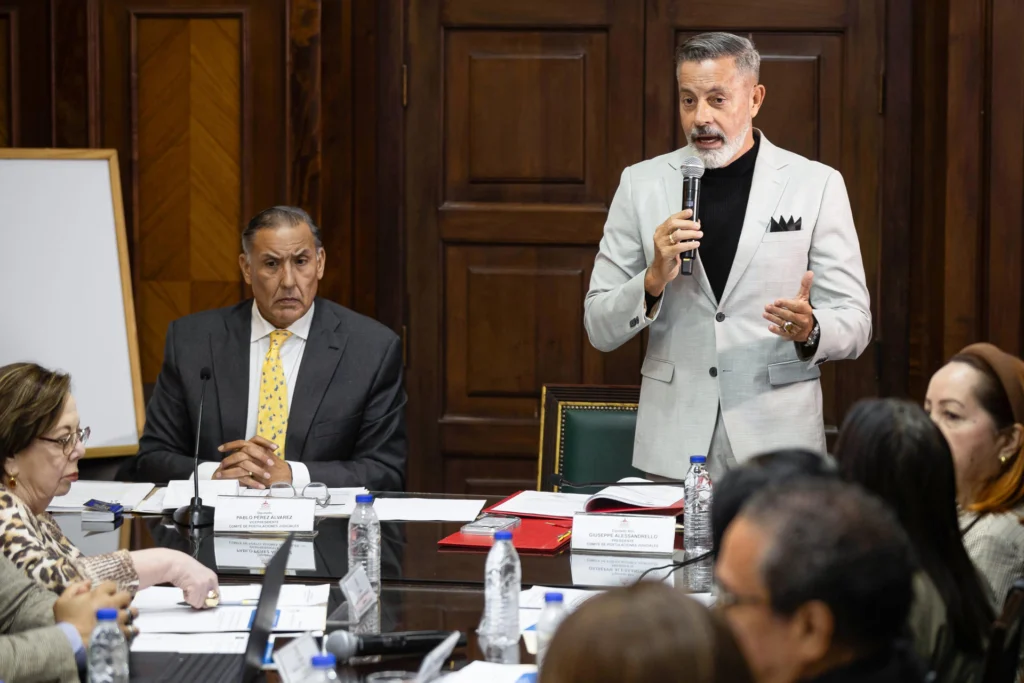
The chairman of the Committee, Giuseppe Alessandrello, announced the early elaboration of a work schedule under the Supreme Court Law to ensure institutional stability and peace. Photo: EFE.

Venezuela’s National Assembly installed a Judicial Nominations Committee on Friday to evaluate and select new Supreme Court justices, a step lawmakers described as central to consolidating institutional stability.


The committee was formally established on October 23, at the Federal Legislative Palace in Caracas, one day after being sworn in during a legislative session.

Giuseppe Alessandrello, who presides over the body, announced that its immediate task is to draw up a work schedule under the Law of the Supreme Court of Justice.

RELATED: Venezuela’s Acting Pres. Delcy Rodríguez Meets 2015 Assembly Delegations

Alessandrello said the law opened the selection process to ordinary citizens. Writing on social media, he stated that the legislation brought people into the work of “evaluating and selecting the leadership, in this case of the Supreme Court of Justice, to seek plurality.”

#23Oct || Desde el Palacio Federal Legislativo se realiza la Instalación del Comité de Postulaciones Judiciales. pic.twitter.com/MczZA2GxJ7

— Asamblea Nacional 🇻🇪 (@Asamblea_Ven) October 23, 2026

Text reads: “From the Federal Legislative Palace is carried out the installation of the Judicial Applications Committee.”

The committee operates within a broader national dialogue that authorities describe as “building a new Venezuela.” Officials have repeatedly framed the judiciary as the institution responsible for guaranteeing what they call true and just peace among citizens. “The judicial branch is the institution that will guarantee peace among us,” Alessandrello said.

The work schedule will set specific periods for the call for nominations, the evaluation of candidates, and the handling of challenges and responses.

The final goal is to present a definitive list of eligible candidates to the National Assembly.

Alessandrello stressed the weight of the assigned tasks, linking them directly to institutional stability. The committee’s operational work and the eventual delivery of the list will follow the terms and periods established by current law.

The process is governed by the Organic Law of the Supreme Court of Justice and the Constitution of the Bolivarian Republic of Venezuela. It covers the selection of both principal and alternate justices of the Supreme Court of Justice.

Subrayó el rol clave de la ciudadanía:

"La ley incorporó a los ciudadanos y ciudadanas de la sociedad en este trabajo de evaluar y seleccionar a las directivas, en este caso del Tribunal Supremo de Justicia, para buscar la pluralidad". pic.twitter.com/LhNVkaK6ov

— Asamblea Nacional 🇻🇪 (@Asamblea_Ven) October 23, 2026

Text reads: “The President of the committee, Giuseppe Alessandrello, highlighted the group’s harmony: “Everything we produce is decided unanimously and the auspices with the work of the committee are positive.” He also emphasized the importance of plurality in this process. He stressed the key role of citizenship: “The law incorporated citizens of society in this work of evaluating and selecting directives, in this case from the Supreme Court of Justice, to seek plurality.”

Selecting Court Leadership

The mandate extends beyond the high court itself. It also includes related judicial positions, among them the directorship of the National School of Magistrates.

The committee emerged from a process announced earlier this month. The National Assembly opened the nomination period between October 2 and October 9, allowing interested citizens and institutions to take part in the selection of the court’s leadership.

Once the schedule is finalized, the committee will move through successive phases, receiving nominations, reviewing candidates, and addressing any challenges filed against applicants. Each challenge will carry its own opportunity for a formal response before the list reaches the legislature.

The final list of selected candidates will be delivered to the National Assembly for consideration. The body’s work therefore functions as a preliminary filter within a process whose ultimate decisions rest with the legislature.


  •  

Tres petroleros con diésel ruso ya navegan hacia el Atlántico

Moscú, 23 oct (Prensa Latina) Los tres primeros petroleros cargados con diésel ruso ya se dirigen hacia la costa este del océano Atlántico, informó hoy el vice primer ministro de la nación eslava, Alexandr Nóvak.

The post Tres petroleros con diésel ruso ya navegan hacia el Atlántico first appeared on Noticias Prensa Latina.

  •  

Militares rusos liberados del cautiverio ucraniano llegan a Moscú

Moscú, 23 oct (Prensa Latina) Dos aviones con militares rusos que fueron liberados del cautiverio en territorio controlado por el régimen de Kiev aterrizaron en uno de los aeropuertos de la provincia de Moscú, informó hoy el Ministerio de Defensa.

The post Militares rusos liberados del cautiverio ucraniano llegan a Moscú first appeared on Noticias Prensa Latina.

  •  

40,000 tons of Russian diesel are bound for New York—due four days after Americans vote

The DF Peak crude oil tanker, part of Russia's shadow fleet. Photo: VesselFinder

A Malta-flagged tanker carrying Russian diesel is heading for New York after the fuel deal between US President Donald Trump and Russian President Vladimir Putin, Reuters reported in an exclusive on 23 October, citing LSEG shipping data. Two weeks earlier, the US Treasury temporarily waived sanctions on Russian diesel.

The tanker is due in the US on 7 November, four days after Americans vote in the midterms. So the first US-bound cargo cannot reach American pumps before the election. Energy analysts also doubt the deal will lower diesel prices meaningfully. US fuel prices rose mainly because the war with Iran disrupted shipping through the Strait of Hormuz. Trump, however, has blamed Ukraine’s strikes on Russian refineries.

Loaded on the day Moscow promised

The medium-sized tanker Agioi Fanendes took on 40,000 metric tons of ultra-low sulfur diesel at the Baltic port of Primorsk on 22 October, shipping data showed. In March, Ukraine’s General Staff said its drones hit the Transneft oil terminal at that same port.

A day before the loading, Russian Deputy Prime Minister Alexander Novak announced that the first tanker would sail for the US on 22 October. He pledged more shipments and said Russia would meet US needs within its capabilities.

A Russian oil tanker, illustrative image. Photo via Wikimedia.
Explore further

Russia resumes diesel exports to Türkiye, Brazil, after Trump lifts sanctions on fuel supplies, boosting Moscow’s war revenue – Reuters

From a pledge to a partial lift

On 9 October, Trump wrote that Russia would immediately supply over 300,000 tons of diesel “to the American and Global Marketplace.” Another 500,000 tons would follow in November, then 1 million tons “immediately thereafter.”

Moscow had banned diesel exports on 8 July, after Ukrainian drone strikes shut down refineries and caused fuel shortages inside Russia. The Russian government stated on 10 October that it had partially lifted the ban, clearing 500,000 tons for the world market at this stage. Russian diesel shipments to Türkiye and Brazil have since resumed, boosting Moscow’s war revenue.

Trump has made other moves to cut diesel prices before the vote, Reuters reported. He waived parts of a new sanctions law against Russia. He also threatened Europe with a US diesel export ban unless countries released more fuel from their emergency reserves.

  •  

A modem from a Russian drone led reporters to its Chinese maker—which invoiced 500 for Russia’s drone plant

Mesh Network XK-F358 modem from the Geran-5 drone

Undercover reporters ordered 500 drone mesh modems from a Chinese firm, which billed them to Russia’s Alabuga drone plant, investigation by The Insider found. The outlet estimates the firm makes about half the high-power mesh modems that let Russia steer its drones deep into Ukraine. The firm’s director also named US company AMD as the source of a key chip, and AMD says it has not sold to the firm.

Geran drones and Banderol drone-missiles have become Russia’s main weapons against Ukraine’s energy grid. Russia began this winter’s strike campaign against that grid in late September, ISW assessed. Ukrainians’ survival this winter depends largely on how fast the West halts mesh modem sales to Russia, the outlet argued.

What a mesh modem does

A mesh modem links drones into one radio network. Each unit relays data for the others, so if one drone is shot down, traffic reroutes through the rest. Information keeps flowing even if nearly 80% of the drones are downed, Ukrainian defense adviser Serhii “Flash” Beskrestnov said in November 2025.

Range is the other half of the threat. One XK F-359 holds a line-of-sight link over 100–300 km, The Insider says. In theory, a couple of relay drones could keep a whole attack on Kyiv connected. Operators can then send new commands in flight and steer around air defenses. Russia’s Gerbera drones, first built as cheap decoys, increasingly carry these modems.

Explore further

Russia’s jam-resistant drones run on a Chinese modem no one has sanctioned

A modem from an upgraded Gerbera

To trace the part, The Insider’s correspondent in Ukraine examined an unmarked mesh modem from an upgraded Gerbera with a vertical tail fin, a version that appeared this summer. The outlet identified it as Xingkai’s XK F-359, the part Ukrainian intelligence and earlier reporting, Euromaidan Press included, had logged as the XK-F358. The Insider calls that label a misidentification.

Next, The Insider and the Nordsint investigative project contacted Xingkai on WeChat, posing as a Russian military supplier based in Alabuga. A company employee who introduced himself as “Jack Jiang” confirmed the firm is the model’s sole maker. The Insider identified him as Jiang Qin, Xingkai’s director and owner.

500 modems, three banks

The reporters then ordered 500 units for delivery to Alabuga, home to the plant that makes most of Russia’s long-range drones. Jiang invoiced 19.5 million yuan, which The Insider put at about $2.87 million. He offered two ways to pay: dollars to Xingkai’s DBS Bank account in Hong Kong, or yuan to his personal Ping An Bank account.

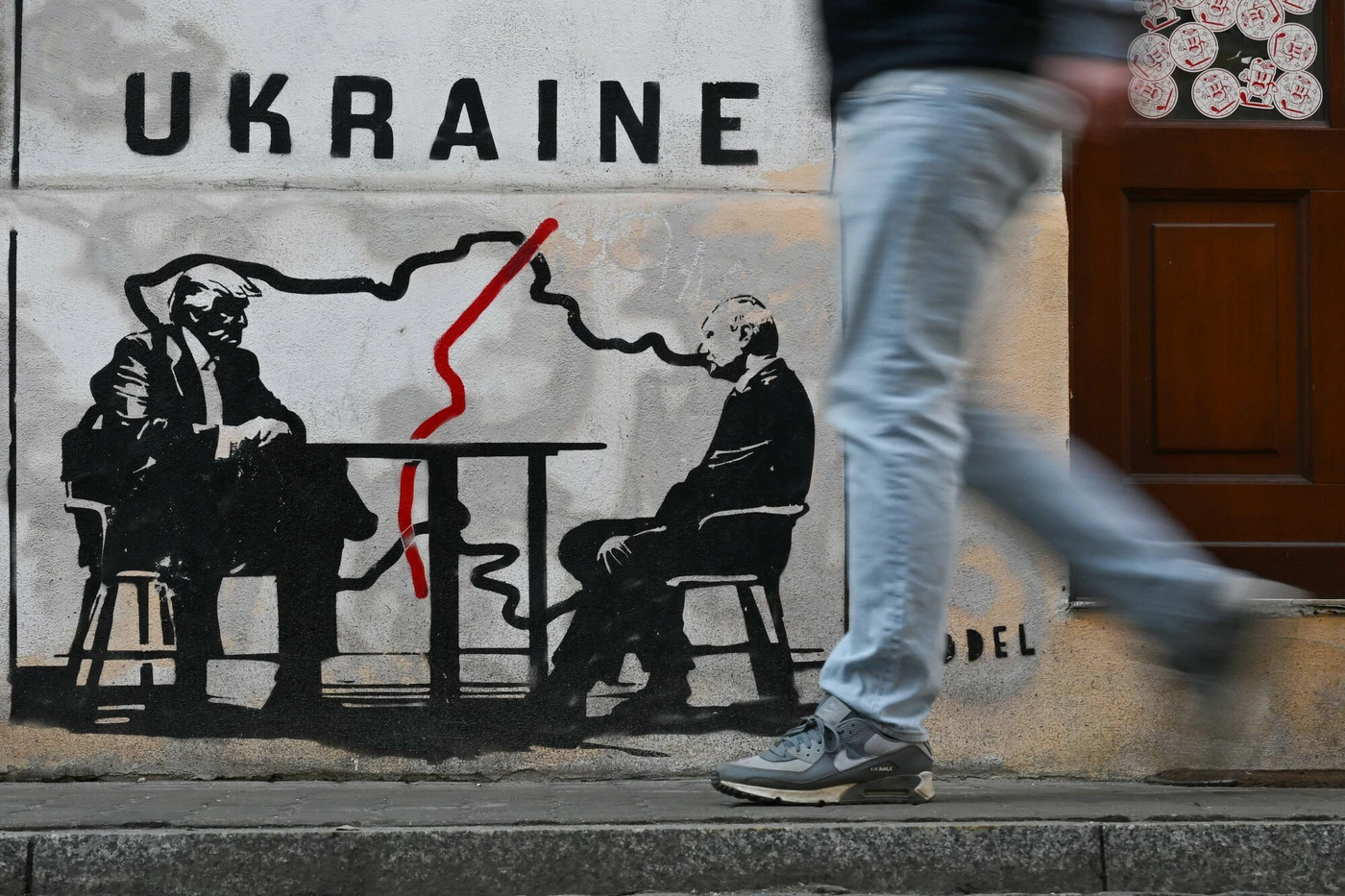
A man walks past a mural by Norwegian street artist Toddel depicting a map of Ukraine and US President Donald Trump (L) with Russia's President Vladimir Putin in Krakow on March 6, 2026, amid the Russian invasion of Ukraine. (Photo by Sergei GAPON / AFP) / Eastnews)
Explore further

America has sided with Russia against Ukraine. Europe should stop pretending and build a coalition against Russia, China, and even the US

In the chat, the reporters said outright that the end user was a military production facility. Jiang raised no objection, The Insider reported.

Later, after the reporters asked to update the address, Xingkai sent a revised invoice with “Alabuga” spelled in Latin letters. This time, it routed payment to a China Merchants Bank account in the name of a former Xingkai manager. She left a management post at the company in 2025, according to Tesari corporate records cited by The Insider. None of the three banks answered The Insider’s requests for comment.

Jiang also claimed the modem’s programmable chip is made by AMD. Asked for an AMD license, he refused, saying Xingkai buys the chips through a middleman. AMD told The Insider that Xingkai “is not an AMD customer or authorized partner,” and said it had sold the company nothing. AMD added that it bars exports of its products to Russia that violate US export controls and sanctions.

  •  

Kim Kardashian e Paris Hilton tiveram desavenças sobre entrevista, diz site

Uma nova tensão entre Kim Kardashian, 46, e Paris Hilton, 45, estaria surgindo nos bastidores do novo livro biográfico sobre a vida de Kim, “Cidadã Kim: A Mulher que Criou o Futuro”. A informação é do portal The Hollywood Reporter.

Recentemente, Jonathan Van Meter, autor da obra, disse ao site norte-americano que Paris teria aceitado e desmarcado diversas vezes um bate-papo para contribuir com a narrativa da produção que conta a vida da advogada.

O escritor ainda disse que precisou entrar em contato com a equipe de Paris, enquanto que, “para outras celebridades, Kim só precisava enviar uma mensagem de texto”, perguntando se elas poderiam colaborar com o livro.

“Enviei perguntas, entrei em contato com o assistente de Paris, e então a entrevista foi cancelada 17 vezes ao longo de cerca de quatro meses”, declarou Van Meter.

Depois das diversas recusas inesperadas, Jonathan relatou o ocorrido para a Kardashian, que teria ficado “muito brava” ao saber sobre o “incidente”.

“No fim, achei os cancelamentos mais interessantes do que qualquer coisa que ela pudesse me dizer. Kim ficou furiosa quando contei para ela. Parece que isso reacendeu alguma antiga irritação entre elas. A criação se voltando contra o criador”, afirmou.

Até o momento, nenhuma das celebridades envolvidas no caso comentou sobre o ocorrido e ainda não há mais informações sobre possíveis falas de Paris no texto biográfico.

Clã Kardashian-Jenner e a sucessora de Kris

Durante a entrevista recente, além de comentar sobre a situação com a empresária, o autor também detalhou seu contato com as irmãs de Kim: Kourtney, Khloe, Kendall e Kylie. Contando sobre o processo para falar com elas, Jonathan disse que Kourtney foi a que mais levou tempo para conversar com ele. Por outro lado, Khloe foi “a primeira a entrar na brincadeira”.

Kris Jenner com as filhas do clã Kardashian-Jenner: Kendall, Kim, Kourtney, Khloe e Kylie
Kris Jenner com as filhas do clã Kardashian-Jenner: Kendall, Kim, Kourtney, Khloe e Kylie • Instagram/Kris Jenner

“Kim e Kourtney podem ser cruéis uma com a outra. Kim e Khloé são genuinamente próximas. Kendall e Kylie são tão mais novas que Kim; ela sente quase um orgulho maternal por elas. Ela me disse uma vez: ‘Minha mãe cometeu todos os seus erros comigo. Quando chegou a vez de Kylie, ela já tinha aperfeiçoado a técnica'”, relatou.

Ainda sobre a família, o escritor também revelou que Kim já sente estar se preparando para assumir o papel de matriarca do clã Kardashian-Jenner como sucessora de sua mãe, Kris Jenner. “Em Malibu, em 2024, ela me disse: ‘Sou eu quem impulsiona todo mundo. Sou eu. Não é minha mãe'”, finalizou.

*Publicada por Luiza Zequim, da CNN Brasil. Sob supervisão de Ana Beatriz Dias, da CNN Brasil

Kim Kardashian revela quantas babás cuidam de seus quatro filhos


  •  

Cristina Kirchner Goes on Trial in Hotesur-Los Sauces Money Laundering Case

(FILE) The Court enabled virtual participation for the first hearing of the accused. Photo: La Nacion.

A new trial in the unified Hotesur and Los Sauces money laundering cases opened Friday in Buenos Aires against Argentine former President Cristina Kirchner, her son, Deputy Máximo Kirchner, and 17 other defendants.


Federal Oral Tribunal 5 allowed the former President and the deputy to attend the opening session virtually, with the favorable vote of judges José Michilini and Fernando Machado Pelloni. The ruling sought to coordinate the deputy’s parliamentary schedule and simplify transfer logistics from the home where the former president is serving a sentence.

The remote format was granted exceptionally, only for the formal reading of the indictment and the order sending the case to trial. The tribunal said later hearings will be in person for all defendants.

RELATED: Cristina Kirchner’s Defense Seeks UN Help to Lift Public Office Ban

The case covers 19 people, including businessmen Lázaro Báez, Cristóbal López and Fabián de Sousa. Hearings are set for Mondays, Fridays and Saturdays, including the January 2027 judicial recess, when the defense lawyers must attend in person every day.

With over 300 witnesses initially slated to testify, the dynamics of witness credibility and testimonies would play a crucial role in shaping the outcome, but it was reduced by agreement between the parties.

[JUSTICIA] Terminó la audiencia por Hotesur y Los Sauces: solicitaron que Cristina Kirchner sea juzgada como "jefa de una asociación ilícita, coautora de lavado de activos y admisión de dádivas", y su hijo, Máximo, fue imputado como "organizador del entramado criminal". https://t.co/3s4n4ORbW3 pic.twitter.com/VbWP9G9bve

— ElCanciller.com (@elcancillercom) October 23, 2026

Billing Under Scrutiny

The prosecution alleges that Kirchner’s family bought hotels and apartments, rented them to businessmen, mainly Báez, and laundered illegal money from public works.

The defense’s argument about the legitimacy of the funds is crucial. The defense, led by Carlos Beraldi and Ary Llernovoy, says the properties were bought with declared funds, including assets the family owned before Néstor Kirchner became Mayor of Río Gallegos, and that rentals were invoiced, banked and at market prices. The defense says similar claims were dismissed in three illicit enrichment cases. None of these claims has been tested at trial, and the defendants are presumed innocent.

Lawyer Carlos Beraldi maintained from the start that the hotels operated, collected and paid taxes like any other business. In September 2023, Chamber I of the Federal Chamber of Cassation revoked a previous dismissal and ordered that the trial go ahead.

The merged file brings together two fronts. Hotesur concerns the family’s hotel operation, while Los Sauces covers the real estate company at the center of the billing accusation.

The Cassation court removed the two judges who had dismissed the case and left only Palliotti, the magistrate who had voted to convict Cristina and Máximo Kirchner.

The same account recalls that in November 2021 judges Adrián Grünberg and Daniel Obligado dismissed the case against all defendants, with Adriana Palliotti dissenting, relying on an accounting expert report that found no harm. In September 2023, the Cassation Chamber overturned that decision and ordered a trial.

The opening of the process was preceded by an episode described as embarrassing. The Cassation court ordered the Federal Oral Tribunal 5 to merge the Hotesur and Los Sauces cases into a single proceeding and to begin it this Friday.

It is the first time in the country’s history that the Cassation court has dictated how a trial must be conducted, a power that normally belongs to each oral tribunal. Political pressure mounted after a Supreme Court resolution, and the judges had only 72 hours to unify the files. The order left the tribunal with no margin to set its own calendar.

The core of the Los Sauces case is the billing of the family’s real estate firm. According to the accusation, 88% of everything the company collected between 2009 and 2016 came from businesses controlled by Báez and from the Indalo Group.

The Hotesur portion of the merged case has not yet been read in court. The next hearings, set for October 26 and October 30, will determine how the combined process advances.

Text reads: “When there is political persecution, the times in the judiciary are always electoral.”

  •  

Brazil and Mexico Strengthen Cooperation On Safe Hospitals

Representatives from the Goias State Health Secretariat in Brazil met with Mexican specialists.

On Friday, Brazil and Mexico strengthened their cooperation on safe and resilient hospitals through a technical visit to Mexico City, with support from the Pan American Health Organization and the World Health Organization (PAHO/WHO).

RELATED: Amazon Fires Push Brazil Air Pollution to Very Unhealthy Levels

The visit brought together representatives from the Goias State Health Secretariat in Brazil with Mexican specialists to exchange experiences on the response of health services to emergencies and disasters.

The Brazilian delegation was headed by the Secretary of Health of Goias, Rasivel dos Reis Santos, and the Undersecretary of Health Surveillance, Fluvia Pereira, accompanied by representatives from PAHO/WHO in Brazil.

The meetings facilitated the sharing of experiences related to governance, inter-institutional coordination, evaluation and monitoring systems, as well as certification and continuous improvement mechanisms for healthcare facilities.

Senador Canedo recebeu 162 novos equipamentos para as UBSs, em investimento de cerca de R$ 1,7 milhão. Os aparelhos serão distribuídos conforme a necessidade de cada unidade.#JornalOhoje #SenadorCanedo #Saude #Goias pic.twitter.com/0HuMNzJTGd

— O Hoje (@jornalohoje) October 20, 2026

The text reads, “Senator Canedo received 162 new pieces of equipment for its primary health care units (UBSs), representing an investment of approximately US$340,000. The equipment will be distributed according to the needs of each unit.”

Authorities highlighted the existing cooperation model between the Mexican Social Security Institute (IMSS) and the State Committee of the Safe Hospital Program in Mexico City, considered an example of institutional collaboration.

As part of the agenda, the Brazilian delegation visited the Central North Hospital of Petroleos Mexicanos (PEMEX), where they learned about civil protection, operational continuity, and hospital security protocols implemented in the event of emergencies.

Representatives from Goias emphasized the level of preparedness of the healthcare and management staff, as well as the practices developed to ensure the continued operation of medical services in critical situations.

#FromTheSouth News Bits | Brazil is heading into a crucial presidential runoff that could shape the country's future. pic.twitter.com/yRniIliD4r

— teleSUR English (@telesurenglish) October 23, 2026

teleSUR: JP

Source: OPS

  •  

Danny DeVito, Barbra Streisand Among Hollywood Celebrities Pouring Cash into Radical Democrat Candidates in Michigan

A list of Hollywood celebrities and other well-known figures are pouring money into the coffers of radical Democrat socialists running for office in Michigan, including Barbra Streisand, Danny DeVito, rapper Macklemore, and Susan Sarandon.

The post Danny DeVito, Barbra Streisand Among Hollywood Celebrities Pouring Cash into Radical Democrat Candidates in Michigan appeared first on Breitbart.

  •  

Trump Effect: Intel's Long-Delayed Ohio Chip Plant Kicks into Gear with Major Construction Milestone

Intel has announced that workers installed the first major structural truss at its new chip factory in New Albany, Ohio, a milestone the company is celebrating after years of project delays. The company envisions the massive project as a new "Silicon Heartland."

The post Trump Effect: Intel’s Long-Delayed Ohio Chip Plant Kicks into Gear with Major Construction Milestone appeared first on Breitbart.

  •  

DHS: 'ZERO Chance' of Latest Caravan Migrants Being Allowed into U.S.

The Department of Homeland Security has a message for the latest caravan of approximately 400 to 700 migrants headed north from Mexico’s southern border state of Chiapas. “There is absolutely ZERO chance this caravan will be allowed into the United States,” DHS officials posted in a social media post on X on Wednesday, adding, “We will protect our borders–America is a nation, not an economic zone.”

The post DHS: ‘ZERO Chance’ of Latest Caravan Migrants Being Allowed into U.S. appeared first on Breitbart.

  •  

Salud de Guatemala presentó plan para Día de Todos los Santos

Ciudad de Guatemala, 23 oct (Prensa Latina) Autoridades del Ministerio de Salud y Asistencia Social (Mspas) de Guatemala presentaron hoy un plan para seguridad e inspección en cuatro cementerios capitalinos en el Día de Todos los Santos.

The post Salud de Guatemala presentó plan para Día de Todos los Santos first appeared on Noticias Prensa Latina.

  •  

NCCIA prevents Karachi girl exposed to dark web group from causing self-harm: official

KARACHI: The National Cyber Crime Investigation Agency (NCCIA) prevented a teenage girl in Karachi from causing self-harm after she was influenced by a group operating on the dark web, an official told Dawn on Friday.

NCCIA Karachi Additional Director Tariq Nawaz said action by the agency was taken after they received a lead from a foreign crime investigation agency, which he did not name.

The agency also shared an email, he said, adding that the NCCIA then tracked the relevant user internet protocol (IP) address.

The official separately explained while speaking on Geo News programme ‘Aaj Shahzeb Khanzada Kay Saath’ that information had been shared with the NCCIA that a group operating on the dark web had been influencing people to commit violent acts.

He added that once the NCCIA was able to track down the affected girl, it transpired during a probe that she had been exposed to the group through social media. “She then engaged with them on a messaging application and was being assigned different tasks.”

Nawaz said the tasks also included harming her pet, and the NCCIA was able to trace her before she could complete the next task, which was causing self-harm.

He also said the devices in the girl’s use had been analysed and taken into custody for further examination.

Speaking to Dawn, the official said the girl’s parents told the NCCIA that their daughter’s behaviour had changed over the past three or four months; she remained upset but did not divulge anything when the parents insisted that she share some information as to whether she was facing problems.

Nawaz said an investigation was ongoing and the NCCIA was working to ascertain other possible victims and perpetrators involved in similar activities.

The NCCIA official said “psychological counselling” had been provided to the girl to help her recover from “trauma”.

The NCCIA had received another tip-off from a foreign agency earlier this month in another case involving a teenager, who was sent to jail on judicial remand for allegedly attempting to poison his father after seeking help from artificial intelligence (AI) chatbots.

The suspect, who was inspired by an OTT crime series, allegedly procured chemical substances from Australia and Islamabad and even set up a small laboratory at his house to prepare the poison. The boy allegedly also used AI tools and online platforms to seek information regarding poisonous chemicals and discussed ways to poison his father with AI bots.

On receiving a tip-off from a US agency, the Federal Bureau of Investigation, the NCCIA conducted a raid at the suspect’s house and arrested him on Sept 23.

  •  

German president meets Zardari, praises Pakistan's 'rising diplomatic profile' in dispute resolution

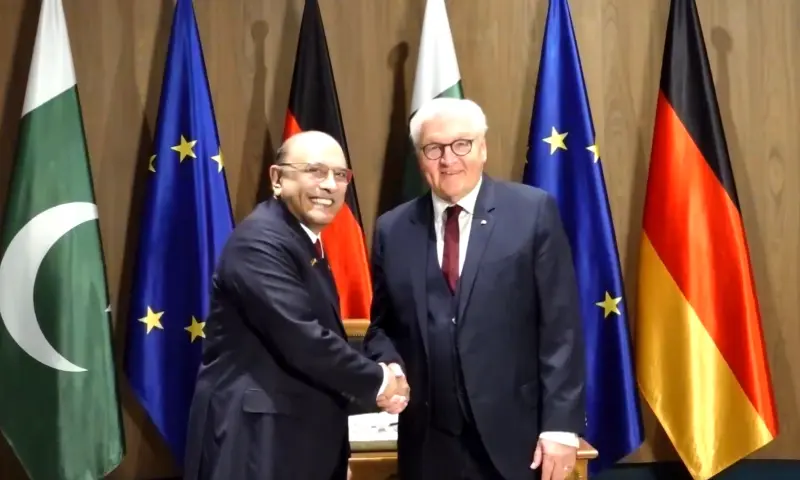
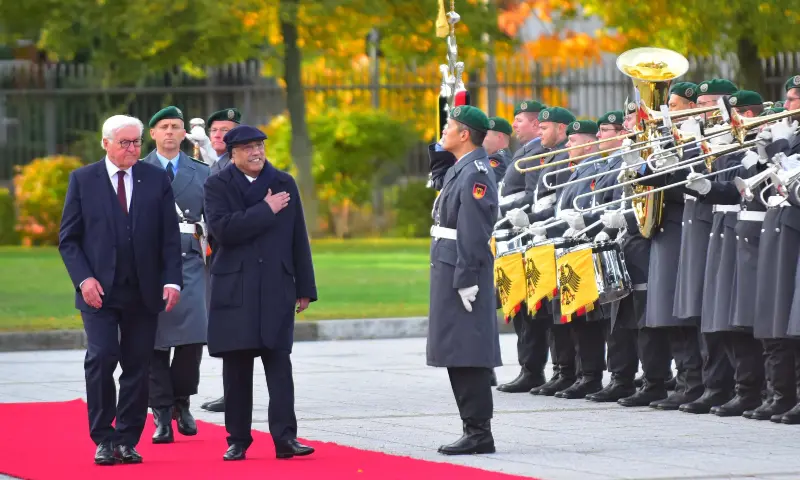
German President Frank-Walter Steinmeier praised Pakistan’s “rising diplomatic profile in the resolution of regional and global disputes”, in a meeting with President Asif Ali Zardari in Berlin on Friday.

President Zardari is currently on a three-day visit to Germany, having departed yesterday, as the two countries are set to mark the 75th anniversary of their diplomatic relations.

According to a statement posted by the president’s office, the two leaders also discussed challenges related to Afghanistan.

President Zardari said that while Pakistan “has no conflict with the Afghan people”, it would not allow terrorists to use Afghan soil to attack Pakistan’s citizens and violate its sovereignty.

Steinmeier appreciated Pakistan for facilitating the verification of 500 Afghans “destined to be repatriated to Germany”, it said, adding that he also commended Pakistan’s humanitarian assistance to “millions of Afghans” over more than four decades.

He also took a “significant interest” in the Makkah defence pact, which has been signed between Pakistan, Turkiye and Saudi Arabia. In response, President Zardari said the pact was aimed at “ensuring regional security and provided a security alternative to regional conflicts, and it is not directed against any specific country”.

The German president expressed hope that the two countries would continue to engage with reinforced efforts in the fields of business and trade to promote “bilateral business, education collaboration and technological cooperation”.

For his part, President Zardari thanked Steinmeier for his invitation and the hospitality extended to him and his delegation. President Zardari further expressed his gratitude for Steinmeier’s acknowledgement of Pakistan’s “sincere mediation role” in the conflict between the United States and Iran, the statement said.

He said Pakistan viewed the resolution of conflicts through the lens of sustained dialogue and constructive negotiations, “for the sake of regional as well as global peace and stability”.

During the meeting, President Zardari also stressed the need to “realise the available potential for expanding existing political, economic and defence cooperation” between Pakistan and Germany, with “greater focus on economy and trade, emerging technologies, climate resilience, skills development, people-to-people and cultural exchanges”, the statement said.

The president said that Pakistan “highly values” Germany as a major European partner, and expressed admiration for German support towards women’s empowerment, social protection and human development.

Pakistan was prepared for expanding bilateral cooperation beyond traditional areas into “innovative and mutually beneficial collaboration” with Germany, in the areas of scientific development, healthcare and education, vocational training and technological advancement, trade and investment, agriculture, commerce and industry, and climate resilience, through enhanced government-to-government, business-to-business and expert-level interactions, the statement further quoted President Zardari as saying.

He said the visit reflected Pakistan’s “commitment to deepening its longstanding cordial, friendly relations with Germany and readiness to translate existing relations into a stronger, robust and mutually beneficial partnership through sustained constructive engagement”.

President Zardari invited the German president to Pakistan, who responded that he would consider a visit “at an appropriate time”.

Both presidents participated in delegation-level talks after their one-on-one meeting, according to the statement. Sindh Chief Minister Murad Ali Shah and Sindh’s provincial ministers Sharjeel Memon and Jam Khan Shoro, Senator Saleem Mandviwalla and Pakistan’s Ambassador to Germany Salman Sharif were part of the Pakistani delegation.

Earlier, President Zardari was given a guard of honour upon his arrival at the German Ministry of Defence, with Steinmeier also present on the occasion, the statement added.

In a statement issued on Thursday, the Foreign Office (FO) said the president’s visit, scheduled for Oct 22-24, is “part of high-level exchanges between Pakistan and Germany”.

During his visit, he will also hold meetings with senior leadership and business leaders, with a “particular focus on economic and trade cooperation”, the FO said.

In September, Deputy Prime Minister and Foreign Minister Ishaq Dar met German Foreign Minister Johann Wadephul on the sidelines of the United Nations General Assembly.

During the meeting, Germany appreciated Pakistan’s mediation efforts in regional conflicts, especially in the Strait of Hormuz and Bab al-Mandab. The two sides also agreed to “get negotiations on peace for Ukraine going”, according to the German foreign office.

In June, a German delegation announced plans to bring about 30 German companies to Pakistan and link local businesses to European markets.

  •  

Flavio Bolsonaro Threatens Church Teachings and Democracy: Brazilian Bishops

They criticize the far-right candidate’s positions on labor rights, national sovereignty, poverty, violence, the environment, and human rights.

On Friday, Folha de Sao Paulo published the contents of a letter in which 54 Brazilian Catholic bishops warn that far-right presidential candidate Flavio Bolsonaro threatens the church’s social doctrine, democracy, national sovereignty and the practice of the common good.

RELATED:

Lula Urges Young and Elderly Brazilians to Defeat Bolsonaro

“We cannot remain neutral, lest our conscience or history condemn us in the future. Those who remained silent in the face of totalitarian threats that materialized in 20th-century Europe left a shameful legacy for future generations,” stated the “Letter from Catholic Bishops to the People of God Ahead of the Second Round of the 2026 Presidential Election.”

The signatories say they are in communion with the National Conference of Bishops of Brazil (CNBB) and aligned with the message issued by the organization’s Permanent Council, which defended the constitution and respect for the vote.

Besides urging voters to evaluate the records of the two candidates facing off in the Oct. 25 runoff, the bishops list the main positions through which Bolsonaro contradicts church teachings.

Labor Issues

The far-right candidate has consistently opposed eliminating the six-days-on, one-day-off work schedule and has proposed hourly pay, which “does not recognize the dignity of the worker and could bring this issue back to the forefront.”

National Sovereignty

Flavio Bolsonaro “promises Brazil’s submission to the United States, participated in a conspiracy to impose tariffs on Brazilian products, advocates foreign interference in elections, and promises to hand over our rare earth resources for U.S. exploitation.”

Poverty

The bishops cite the apostolic exhortation Dilexi Te and say the Liberal Party “has always publicly opposed social programs and the fight against poverty,” even though Flavio Bolsonaro now says he will maintain some of those programs.

🇧🇷⛪️ Creencias y política chocan en Brasil: crece la polémica por la promesa religiosa de Bolsonaro

✝️ Miles de fieles conmemoraron el aniversario de Nuestra Señora Aparecida, patrona del país sudamericano, en medio de la controversia por la promesa de campaña del candidato a la… pic.twitter.com/5AgyIQGEzv

— Sputnik Mundo (@SputnikMundo) October 14, 2026

The text reads, “Beliefs and politics collide in Brazil: controversy grows over a religious pledge made by Bolsonaro. Thousands of the faithful commemorated the anniversary of Our Lady of Aparecida—the patron saint of the South American nation—amidst controversy surrounding a campaign promise by presidential candidate Flavio Bolsonaro to declare that the nation belongs to Jesus Christ.

Catholics and representatives of Afro-Brazilian religions have warned of potential risks of exclusion and discrimination. Although the campaign asserted that this is merely a symbolic expression of faith, the debate has reignited questions regarding religious freedom and respect for the diversity of beliefs within Brazil.”

Violence

The bishops criticize Bolsonaro’s promise to expand access to firearms, “as his father did during his administration.” The issue had already been criticized in the homily delivered by the archbishop of Aparecida, who preached a message of “unarmed peace” during Mass on the Feast of Our Lady.

Environment

The bishops accuse Flavio Bolsonaro of denying the climate crisis and seeking to continue the “devastating policies” of his father, Jair Bolsonaro. They cite the environmental licensing law approved in 2025, known as the “Devastation Law.”

Human Rights and Democracy

The bishops recalled that the far-right candidate “publicly expresses support for torture” and that his family honored Col. Carlos Alberto Brilhante Ustra, a torturer during the military dictatorship.

Flavio Bolsonaro “made several statements that threaten the constitutional order” and, if elected, would govern with a majority in Congress and the Supreme Federal Court (STF), “creating the conditions for a usurpation of power,” the bishops warned.

The Brazilian Situation

Without mentioning Lula, the letter states that the Workers’ Party candidate, “although he has also been the subject of criticism, has always demonstrated responsibility toward the poor and our Common Home, and has acted within the limits of the democratic order, respecting the Constitution.”

“Whether one likes the current government or not cannot be a reason to hand the country over to someone who demonstrates such a contradiction with the teachings of our church,” the bishops say. They also urge Catholics not to abstain from voting.

Among the signatories are Bishop Jose Ionilton Lisboa de Oliveira, president of the Pastoral Land Commission, and the archbishops of Porto Velho, Roque Paloschi; Feira de Santana, Zanoni Demettino Castro; and Uberaba, Paulo Mendes Peixoto. The list includes bishops from Brazil’s Amazon, Northeast, Southeast, Central-West, and South regions.

The letter adds to the existing rivalry between Flavio Bolsonaro and the Catholic Church during the 2026 presidential campaign. In September, the Brazilian Commission for Justice and Peace delivered a report to the bishops detailing 58 attacks by the far right against Catholics and their church since 2018.

teleSUR/ JF

Sources: Folha de Sao Paulo – Brasil de Fato

  •  

Petrol Price stays at Rs377 ,Diesel Crosses Rs393 for weekend

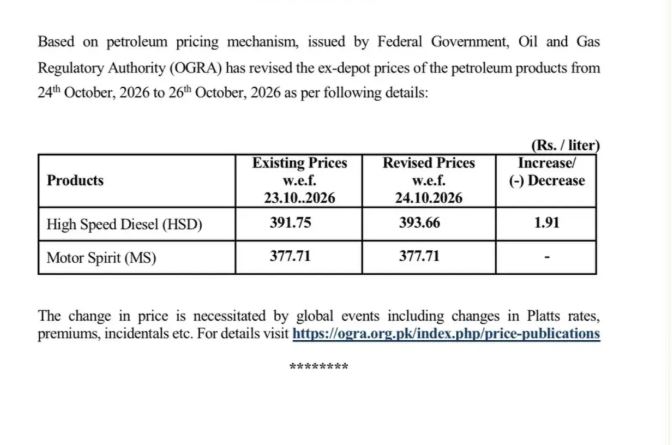
ISLAMABAD – Pakistani government increased the price of high-speed diesel by Rs1.91 per litre for October 24–26, 2026, while keeping petrol unchanged at Rs377.71 per litre.

The latest revision takes diesel from Rs391.75 to Rs393.66 per litre, marking its second consecutive increase. On Thursday, the government had raised diesel by Rs1.64 per litre and reduced petrol by Rs1.60 per litre.

Petrol Price Stays At Rs Diesel Crosses Rs393 For Weekend

In a press release issued on Friday, the Petroleum Division said the Oil and Gas Regulatory Authority had revised the ex-depot prices under the federal government’s petroleum pricing mechanism.

The announcement coincided with rising global crude prices as Houthi attacks in Saudi Arabia fuelled concerns about further disruption to energy supplies from the Middle East.

Brent crude futures gained $1.40, or 1.2%, to reach $114.57 a barrel by 1138 GMT on Friday. Earlier in the session, Brent touched $115, its highest level since May 4 and a peak of more than five months.

US West Texas Intermediate crude rose $1.48, or 1.5%, to $100.95 a barrel. Brent was on course for its third consecutive weekly increase, with a gain of 4.2%. WTI, despite advancing during Friday’s trading, was heading towards a weekly decline of approximately 0.5%.

The post Petrol Price stays at Rs377 ,Diesel Crosses Rs393 for weekend appeared first on Daily Pakistan English News.

  •  

I woke up to panicked text messages about the PHP attacks. As a cybersecurity expert, here are the 3 things I tell people to do right away.

Portrait of a person in a dark sweater with arms crossed against a plain teal background.
Yonaton Keller is a product manager at Zafran Security and has been working on the exposed PHP vulnerabilities.

Courtesy of Yonaton Keller

  • PHP, the open-source computer programming language, had two major vulnerabilities exposed.
  • Yonaton Keller woke on Wednesday to panicked messages about the two PHP vulnerabilities.
  • He shares three steps you can take to protect your website.

This as-told-to essay is based on a conversation with Yonaton Keller, a 46-year-old product manager at Zafran Security, based in Tel Aviv. His words have been edited for length and clarity.

When I woke up at 6:30 a.m. on Wednesday, I had multiple messages from around 4:45 a.m. alerting me that two vulnerabilities in the PHP programming language had been disclosed.

I immediately understood that this was a very serious situation.

Websites run different versions of PHP, and it's estimated that around 70% of websites worldwide use it. This isn't the first time PHP vulnerabilities have been found, but these ones require essentially no authentication on the attacker's part.

It's a very tricky situation. If it were a year and a half ago, nobody would have really responded to this so urgently. But this might be one of the first major incidents of its kind in this AI era, and the cycle of how attackers operate and how we typically respond is broken.

AI enhances detection and response times, but it also means that any limited-technical person could exploit these vulnerabilities within minutes.

My team was very concerned and had to act fast

I'm based in Israel, so when it was 6:30 a.m., my time, it was the middle of the night in the US. This time gap worked in our team's favor, as we had time to figure out what was going on before our customers woke up.

PHP is an open-source computer programming language used to create websites and web applications. It's such a widely used programming language that we immediately understood that every one of our customers, which includes major corporations and businesses, would likely be affected by this.

With bugs or critical flaws in the infrastructure, like the two that were found in PHP, exploitation is actually quite easy, especially if you use AI agents. That was the first thing we understood: even completely unskilled attackers can use these vulnerabilities to take down sites.

The PHP Foundation said it would disclose the details of the vulnerabilities and release a fix for newer versions of the language around 5 p.m. Israel time. But some details had already been informally disclosed on an online forum. The post was deleted minutes afterward, but screenshots spread around the internet quite quickly in unofficial forums.

So, my team and I dropped everything else and spent all day on Wednesday gathering informal information to see whether we could mitigate the risk of exploitation before an official fix was released.

How to tell if you're at risk

The first step people can take to figure out if they're impacted is to look at their websites and web applications, and try to understand where PHP is involved. You can also assume that most, if not all, of them will use PHP in some way, unless you have very basic HTML-based pages.

The second step would be to look at what vulnerability scanners online are telling you. Tenable, Qualys, and Rapid7 are usually the big three for releasing detection rules and actually detecting the vulnerability. In this case, these vulnerabilities have caused such widespread panic worldwide that they were quick to respond. This is also a way to understand the exact vulnerabilities in your internet-facing assets.

After taking these steps, immediately look online to upgrade your website to the current PHP version. It's quite easy to upgrade that, and it's free. There are some technical steps to do after the fix, so you might need a tech guy to implement them. If you don't update your PHP version, the impact on your business and website can be very, very serious.

Some people are also fully taking their sites offline, and I think that can be the right call if you have evidence that you are being targeted. However, 70% of the internet can't and shouldn't be taken offline just because those sites have some vulnerabilities. It's an emergency step to take if you have evidence of potential exploitation, but it can't be a step taken by everyone.

This was not just about attackers disrupting your website or web application; it was about them taking control of your server, stealing sensitive documents, moving inside your network, and then carrying out malicious operations, such as deploying ransomware or other actions they intended.

The situation has calmed down, but my cybersecurity team is still very concerned

Things have calmed down a bit since Wednesday, but we're still very, very concerned. Patching 70% of worldwide websites doesn't take a minute or two.

Hours after the fix was disclosed by the PHP Foundation, there were already tons of exploitation attempts popping up online. Attackers are getting quicker. I think that in this AI era, when in a matter of minutes, many attackers can attack, you don't have the time you used to.

The whole traditional process of scoping the attack surface, establishing a remediation plan, then calling a guy who's going to be responsible for this remediation plan, et cetera, is broken.

For a long period of time, organizations were investing a lot in what we call post-compromise scenarios. I think the AI era of cybersecurity will involve a lot more security investments in the pre-compromise realm, so defenses can be pre-built and ready for attacks in situations like this.

Read the original article on Business Insider
  •  
❌