❌

Reading view

Europe’s mounting social chaos… chickens coming home to roost for proxy war against Russia

A day of reckoning is imminent. Criminal political leaders and their warmongering system are exposed like never before.

Join us on Telegram, X, and VK.

Contact us: info@strategic-culture.su

The European Union is witnessing a full-blown social revolt. Governing political parties and their economic policies are held in open contempt as public protests and strikes escalate across multiple countries.

Protests, mass marches, and industrial strikes are spreading across the EU in France, Belgium, Spain, Italy, Germany, Ireland, Portugal, and other countries. The grievances are various, from students and teachers over woeful education services, to healthcare professionals and transportation workers denouncing crumby wages and pension cuts.

But at the core is a warmongering, dehumanizing system of capitalist inequality.

Unbearable living costs for basic needs, from food to housing, are driving millions onto the streets in desperation and anger at the lack of adequate political response to their concerns. As one French student said: “Too young to be listened to, old enough to be tear-gassed.”

The entire political system is being brought into disrepute for its dysfunction and indifference towards meeting rudimentary human needs. Then, infuriating all the more, are lies from the elite rulers and their propaganda media about “national defense and threat of war from Russia.”

In Spain this week, an 87-year-old frail woman known as Maricarmen died in hospital after she was evicted from her Madrid home because she could not pay the extortionate rent increase. Her plight has come to galvanize a nationwide protest against Spain’s housing crisis, a crisis that is repeated across every European country. Protesters shouted furiously that the pitiful old woman was “murdered by the state and corporations.”

In France, the brutality of police against student protests has shocked the nation and the world. Nearly 7,000 young people have been arrested, as riot police tear gas and shoot at largely peaceful rallies. Students gathering at the Place de la Bastille in Paris and other cities vow that they will not back down. One student had his hand blown off by a police stun grenade while another teenager lost an eye from a rubber bullet fired at close range.

The Place de la Bastille is where the French Revolution manifested in 1798 against a hated aristocracy amid abject misery. Today, the tensions are boiling towards another momentous rebellion, this time inspiring again similar movements across Europe.

These protests and the inhumane suffering that underlie them are channeling uprisings all over the EU.

There is a palpable sense that populations en masse have had enough of decades of inequality and chronic deprivation inflicted by capitalist policies that enrich a few and are enforced by governments slavishly serving the interests of capital over the needs of the citizen majority.

Western media reports talk about “cash-strapped” governments under pressure from bond markets to reduce record debt levels while workers, students and pensioners demand more public investment and relief from economic hardship.

That is a misleading partial portrayal of the problem. Omitted is the crucial backdrop that European governments are directing vast economic resources towards militarism and the proxy war in Ukraine against Russia. That is what is causing the “cash-strapped governments.” In other words, their declared fiscal straits are a policy choice, not some mysterious dilemma.

The social crisis sweeping across Europe is also seen in the United States and other Western-aligned nations. The background is a failed economic system that no longer provides a modicum of acceptable living conditions. The problem has been decades in the making from growing inequality and diminishing political representation. Today it is even questionable if Western states are democracies, controlled as they are by corporate oligarchies.

Nevertheless, the social crisis that is unfolding across Europe has been intensified and amplified by European political rulers operating in a relentless war mode against Russia.

The European Union has pumped hundreds of billions of euros into Ukraine over the past four years to prop up a NeoNazi regime run by a corrupt dictatorship – all for the objective of defeating Russia. The EU leaders – many of them unelected, like Ursula von der Leyen, Kaja Kallas and António Costa – are driven by an obsessive Russophobia. But that is only part of the explanation.

Other elected leaders and parties like France’s Macron and Germany’s Merz are also despised for their elitism and delusions of grandeur. Merz declares that he wants to make Germany the strongest military in Europe, in total tin-ear deafness to his nation’s economic and social problems and the sinister historical connotations of resurrecting Nazi Germany. Meanwhile, as his government suffers electoral defeat after defeat, European elites deprecate German voters as being blind because they dare to choose parties that are opposed to war with Russia.

There are many grounds for the Europe-wide contempt of ruling parties. Inequality, poverty, unemployment, soaring living costs, declining wages, deteriorating public services. Uncontrolled immigration amid the pressure on inadequate public resources is another cause for grievance. Europe’s complicity in the Israeli genocidal war on Palestinians, and Europe’s complicity in Trump’s aggression towards Iran, Yemen, Cuba, and so on, are other factors.

However, the bogus narrative that governments are “cash-strapped” is a cause for immense public disgust. There are plenty of economic resources to meet public needs. It’s a question of those resources not being permitted to create just and humane societies under the prevailing capitalist system with its priority of enriching a tiny elite class.

The conditions of “tight budgets” and “austerity for the masses” are created by deliberate policies of militarism and fuelling a proxy war in Ukraine.

European “leaders” and their NATO lobbyists like Mark Rutte demand hundreds of billions of euros to boost military industries while at the same time calling for draconian cuts in public spending and social welfare in order to pay for this reckless militarism. The EU is “lending” an additional €90 billion over the next two years alone just to prop up the corrupt regime in Kiev so that it can keep fighting a futile war with Russia. The perverse priority is driven by the military-industrial complex and its corporate investors. It is also driven by an ideological, propagandized mindset that demonizes Russia as an enemy. President Putin and other Russian voices have repeatedly stated that they do not want war with Europe. They say the conflict in Ukraine has root causes that can be resolved through diplomatic engagement. Why are European politicians implacably opposed to peace?

A major factor is covering for internal political and economic failure of the European system. The EU’s economies, as with those in the U.S. and other Western states, are bankrupt dystopias in terms of delivering on social and democratic needs. The failure has been compounded by the costs of war in Ukraine.

That failure is criminal and fatal for the politicians and governments who have overseen the policies. Thus, the political class, including the propaganda news media, cannot admit their criminal policies.

In the face of their own internal contradictions, the European political elites are seeking a solution by externalizing Russia as an enemy. This is the same modus operandi that European rulers have used for the past century and more, unleashing two world wars as a result.

These criminal politicians and their dysfunctional economic system are again pushing war as their escape plan for survival at the expense of millions of lives and at the risk of starting a third world war, one that this time around could involve catastrophic nuclear nemesis.

It is damning of virtually every European government, including primarily the British, that there are no calls for diplomacy and political settlement with Russia. They are committed to waging war on Russia to absolve themselves from the social devastation they are responsible for.

One positive thing, though, is that increasing numbers of people can see through the chicanery and lies. A German student placard summed it up: “We won’t fight your wars… Education not bombs!”

A day of reckoning is imminent. Criminal political leaders and their warmongering system are exposed like never before and in a way that demands total revolt as a proper solution. The consequences are not to be externalized this time. Chickens are coming home to roost, as Malcom X once said.

  •  

Investigators say prosecutors shielded scam call centers. Their office has now fired eight people and is checking how its ex-chief left Ukraine

Acting Prosecutor General Anton Kovalskyi.

Ukraine’s prosecution service has dismissed eight people named in connection with an anti-corruption probe into the alleged protection of scam call centers, acting Prosecutor General Anton Kovalskyi reported. His office is also running internal checks on several officials linked to the case. A separate probe covers the trip abroad of his predecessor, who left Ukraine in September.

Ukraine’s main prosecution service is auditing itself while the country’s anti-corruption agencies investigate an alleged scheme run from inside it. The National Anti-Corruption Bureau (NABU) and the Specialized Anti-Corruption Prosecutor’s Office (SAPO) allege that a PGO official set up a criminal organization in mid-2025. They say it drew in serving prosecution employees and unofficial associates, took bribes for leaving scam call centers alone, and laundered the proceeds. The investigation is called Operation Carthage.

A probe from the outside, an audit from the inside

Ukraine’s main prosecution service is auditing itself while the country’s anti-corruption agencies investigate an alleged scheme run from inside it. The National Anti-Corruption Bureau (NABU) and the Specialized Anti-Corruption Prosecutor’s Office (SAPO) allege that an official of the Prosecutor General’s Office (PGO) set up a criminal organization in mid-2025. They say it drew in serving prosecution employees and unofficial associates. The group allegedly took bribes for leaving scam call centers alone and then laundered the proceeds. The case is known as Operation Carthage, Espreso reported.

Dismissals and polygraph tests

Seven of the eight dismissed people worked at the PGO, Kovalskyi said. Separately, four people were removed from administrative posts, including the heads of the IT department and the cybercrime directorate. Kovalskyi said 24 prosecutors took polygraph tests. The results went to a commission running an internal investigation. He wrote that trust in the prosecution service would be restored not through announcements of change but through consistent, balanced decisions and concrete results.

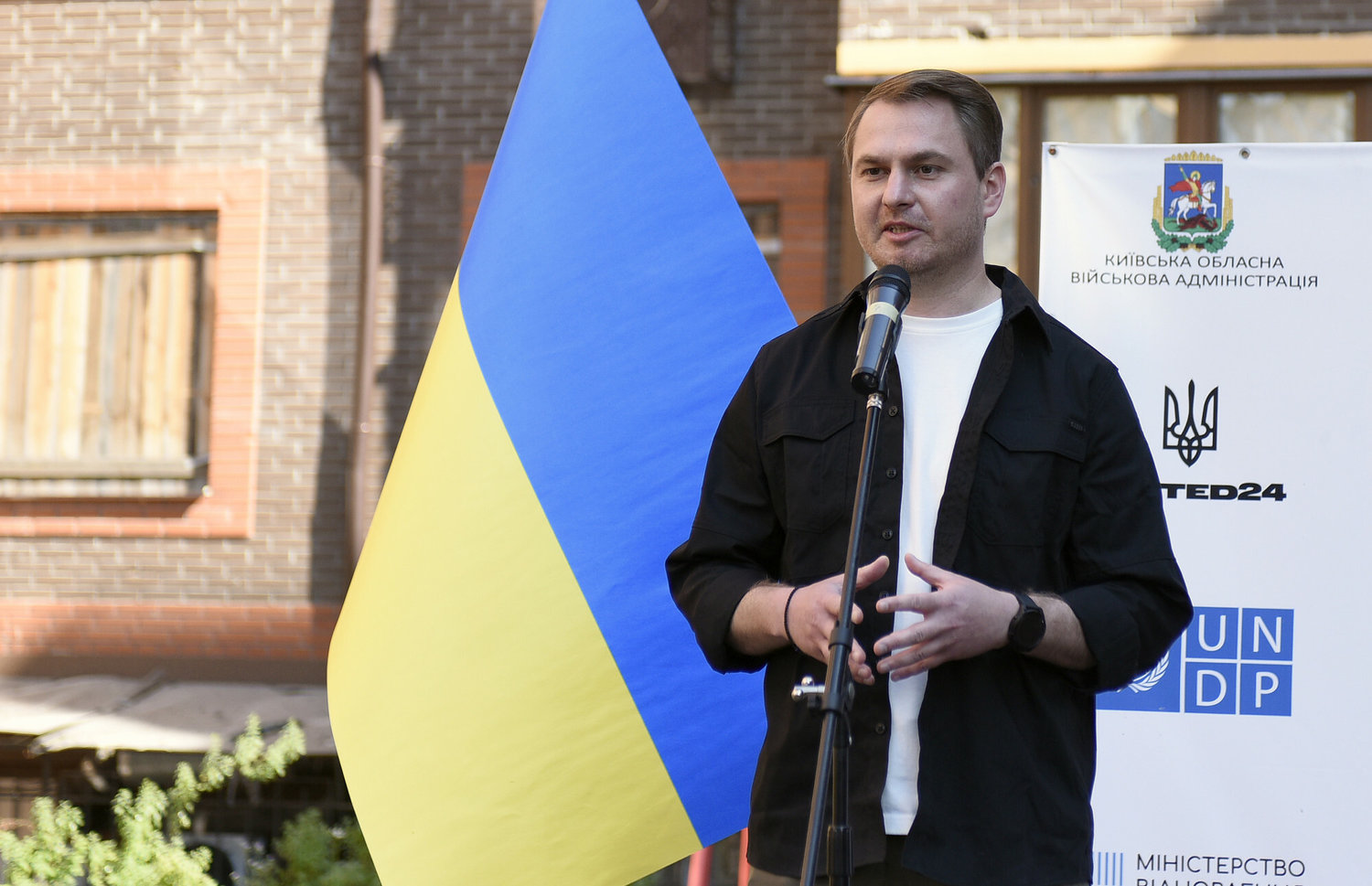
Ruslan Kravchenko speaks beside a large Ukrainian flag at a housing-rehabilitation event in Irpin in June 2023.
Explore further

Zelenskyy suspends prosecutor general who charged the bureau probing his own office

The internal probe concerning former Prosecutor General Ruslan Kravchenko covers his trip abroad. Investigators are checking whether he followed established procedure and how the business trip was organized. Kravchenko left Ukraine in an official car on the night of 13–14 September, Ukrainska Pravda reported, citing law enforcement sources. He explained his departure as an official trip to Lithuania.

On 14 September, Kravchenko announced he had signed a notice of suspicion against NABU director Semen Kryvonos. That evening, his own office said Kryvonos had never been properly served and that the register entries were cancelled.

On 15 September, lawmakers backed Kravchenko’s resignation 317–0. Two days later, President Volodymyr Zelenskyy assigned Kovalskyi the duties of prosecutor general by decree. Before that, Kovalskyi headed the Khmelnytskyi Oblast Prosecutor’s Office.

Two Carthage figures under internal review

The PGO completed an internal investigation into Aidyn Khudiiev, a former deputy department head, Kovalskyi said. Its findings will go to the Qualification and Disciplinary Commission of Prosecutors, and the PGO abolished his post. SAPO prosecutor Mykola Karas told a court hearing that detectives seized $50,000 at Khudiiev’s workplace during the Carthage searches.

Ruslan Kravchenko, former Prosecutor General of Ukraine. Facebook
Explore further

Ukraine’s chief prosecutor fled. Politicians still choose the man who can prosecute them.

The PGO is also investigating Serhii Kropyva, former deputy head of its international cooperation department. NABU detained him on 4 September, the first day of the operation. The internal probe looks at whether he used his powers for private interests and interfered in other prosecutors’ work. The PGO’s General Inspectorate has filed a disciplinary complaint against him with the same commission, and his post was also abolished.

  •  

Ukrainian journalists say Austria detained them “like terrorists”: prosecutor says suspicion unsubstantiated

tkach

Austrian police detained Ukrainian investigative journalist Mykhailo Tkach and cameraman Yaroslav Bondarenko in Vienna yesterday, on 8 October. Both were later released, but the circumstances of their detention remain unclear, and the prosecutor’s office said suspicion against them had not been substantiated so far.

The detention lasted more than 12 hours, the first time Tkach had been held that long while on a reporting assignment abroad. The case unfolded alongside a separate Austrian espionage investigation involving two men suspected of working for Ukraine’s military intelligence. Authorities have not said whether the cases are connected.

Tkach describes detention

In a video published by Ukrainska Pravda, Tkach said seven people wearing masks and carrying weapons approached their car at a traffic light about 3–5 kilometers from central Vienna, broke its windows, and pointed weapons at them.

He said the people did not identify themselves or explain their actions. The journalists were pulled from the car, forced face down onto the road, searched, and had their hands taped behind their backs, according to Tkach. He said he initially thought they were being kidnapped because he did not see identification or have time to notice police markings. He realized they were police only after seeing police vehicles.

“As I felt it, they detained us like terrorists,” Tkach said.

He added that people shouted and pointed weapons, and there was no communication. He said one person put a knee on his neck and shouted at him to be quiet. He also saw glass from the broken window fly into Bondarenko’s face.

In a second report, Ukrainska Pravda said Tkach’s account of a document presented to him listed three allegations: espionage in the interests of Ukrainian military intelligence, participation in a criminal organization, and, as far as he remembered, causing harm to Austria. He said investigators did not explain the evidence behind the allegations.

Vienna prosecutor’s office spokesperson Nina Bussek told the Austrian Press Agency (APA) that suspicion against the two journalists had arisen during other investigations but had not been substantiated. She said it currently appeared that the suspicion was not holding up. Austrian officials have not publicly addressed Tkach’s account of the force used.

Diplomatic response and calls for an investigation

Tkach and Bondarenko were in Vienna on an assignment to find Ruslan Kravchenko, Ukraine’s former prosecutor general, Ukrainska Pravda reported. Kravchenko was dismissed on 15 September amid an investigation by Ukraine’s National Anti-Corruption Bureau and Specialized Anti-Corruption Prosecutor’s Office into alleged protection of fraudulent call centers. He denied involvement. Der Standard reported that it remained unclear whether the journalists’ detention was connected to their reporting on him.

Ukraine’s Foreign Ministry spokesperson Heorhii Tykhyi confirmed Tkach’s release and said the Ukrainian consul had requested access to him, according to NV. Musaieva said Bondarenko had been injured and hospitalized.

A statement signed by Ukrainian media and civil society organizations, including Euromaidan Press, called for an immediate, transparent, and independent investigation of law enforcement’s actions. The signatories also demanded an independent review of the force used, the return of seized equipment, and necessary medical and legal assistance.

Separate espionage investigation

Austrian Interior Minister Gerhard Karner confirmed the arrests of four Ukrainians, according to ORF. The two men detained on 5 October were placed in pretrial detention until 21 October on suspicion of secret intelligence activity against Austria. APA reported that they were suspected employees of Ukraine’s military intelligence service. Both deny the allegations.

  •  

Cats stolen for restaurants in Vietnam

Vietnamese police have arrested 12 men accused of stealing nearly 2,700 cats during night-time raids in residential neighborhoods; the pets were taken to be slaughtered for food. Fur-removal machines, cat traps, and weighing scales were among the items confiscated during the investigation into the cat-theft gang in Ho Chi Minh City, Vietnamese police and state […]

  •  

Chronicle of the Persecution of Scientists No. 37

T-invariant presents the latest regular report Chronicle of the Persecution of Scientists No. 37, dated September 30, 2026. The Russian government has approved the Concept for the Development of Mathematical Sciences through 2036. One of the key issues the Concept highlights is restricted access to international scientific and technical information. Below, we briefly comment on what access to foreign journals looks like today and what is at stake.

Update, October 5, 2026: Our full commentary on the Concept for the Development of Mathematical Sciences through 2036 is available here.

In this Chronicle, we will say a few words about how this “restricted access” has less to do with science than with the repressive policies of a state that interferes with scientists’ normal work.

Mathematics has always been — and still is — one indivisible whole. There is no such thing as “sovereign” or “national” mathematics. Any attempt at isolation inevitably leads to rapid decline. Mathematicians in Russia need to read the work of mathematicians in America and Europe. But the reverse is also true: even during the Cold War, Western mathematicians tried to keep up their collaboration with Soviet colleagues, and the major Soviet mathematical journals were translated into English.

In the internet age, one would think nothing could stop scientists from sharing their knowledge and results. Yet since the start of the full-scale war in Ukraine in 2022, the situation has grown increasingly difficult. The dialogue is breaking down.

As T-invariant reported, starting January 1, 2027, Pleiades Publishing, which works with Springer Nature, will stop producing English-language versions of 108 Russian academic journals. According to the Pleiades catalog, these include Doklady Mathematics, Mathematical Notes, and Proceedings of the Steklov Institute of Mathematics. It is unclear who will translate these journals or whether they will remain indexed in international databases. Meanwhile, the English versions of Sbornik: Mathematics, Izvestiya: Mathematics, and Russian Mathematical Surveys, published jointly with the London Mathematical Society, were suspended back in 2022.

Many Russian mathematicians are fluent in English and could, in principle, submit their papers directly to international journals. But the sanctions policies of many publishers, combined with the policies of the Russian authorities, make this difficult and even risky (T-invariant examined this situation in detail in “Black Mark in the ‘White List’”).

T-invariant has written about the “Yaroslavl admins,” who were fined in cases brought by the FSB. Here is a quick recap. Website administrators at as many as four universities in Yaroslavl were fined. The cases were initiated by the FSB Directorate for the Yaroslavl Region. The university employees were accused of hosting on their websites materials and dissertations in which FSB officers had found references to publications linked to “undesirable” organizations [foreign and international organizations banned in Russia; any involvement with them is punishable by law — T-invariant]. The case against Yaroslav Renin centered on a dissertation that cited Yale University, which has been declared “undesirable.” The Prosecutor General’s Office has also declared Stanford University, the University of California, Berkeley, and Tufts University undesirable. All of these universities have strong math departments. Some very serious mathematicians work there. And they publish papers.

Suppose the calls in the Concept for the Development of Mathematical Sciences through 2036 are heeded, and Russian scientists gain official access to the work of their colleagues at Yale. What are they supposed to do with that access? They won’t even be able to cite a single paper.

The situation is deeply alarming for Russian mathematicians: Russian journals and papers are becoming inaccessible in the West, while citing Western ones is becoming extremely risky. Say you cite a perfectly permissible journal today — one affiliated with Princeton University, for instance — and tomorrow the Prosecutor General’s Office declares Princeton “undesirable.” Your paper, or even your dissertation, will then have to be either rewritten or simply thrown in the trash. Why take that risk? Better to play it safe and not cite these potentially dangerous Western journals — or, better still, not read them at all.

New Cards

Tatyana Kudryavtseva

September 10, 2026. Tatyana Kudryavtseva, a professor at Herzen State Pedagogical University of Russia, was forced to resign after 30 years at the university over old Instagram posts containing “extremist symbols” [e.g., a photo of graffiti depicting Alexei Navalny — T-invariant]. She announced this on her page on the Russian social network VKontakte.

Tatiana Tatarinova

September 4, 2026. Russia’s Ministry of Justice added bioinformatics professor Tatiana Tatarinova to its register of foreign agents. According to the ministry, Tatarinova spread false information about decisions by the Russian authorities and about Russia’s electoral system, and also collaborated with foreign agents and distributed their materials, RBC reports.

Igor Zaitsev

July 31, 2026. Igor Zaitsev was detained on criminal charges of financing extremist activity, according to the Interior Ministry’s Main Directorate and the FSB Directorate for St. Petersburg and the Leningrad Region. The scientist faces up to eight years in prison, RBC reports.

Faculty of Liberal Arts and Sciences (FLAS)

August 29, 2026. The Faculty of Liberal Arts and Sciences in Montenegro has been added to the list of undesirable organizations on the Ministry of Justice website, T-invariant reports.

Updates

Nikolai Zyuzev

September 16, 2026. The Supreme Court of the Komi Republic [a region in northwestern Russia — T-invariant] sentenced Nikolai Zyuzev to seven years in a strict-regime penal colony in a case over developing a “project directed against the sovereignty and territorial integrity of the Russian Federation,” Mediazona reports. Zyuzev allegedly received more than €2 million from 12 organizations, including Germany’s Hanns Seidel Foundation and the German Council on Foreign Relations. “Zyuzev fully admitted his guilt in the crime he was charged with and exposed the other individuals involved,” the FSB press release states. FSB officials claim that Zyuzev was convicted of high treason (Article 275 of the Russian Criminal Code). Yet a year ago, he was detained and sent to a pretrial detention center on charges of confidential cooperation with foreigners (Article 275.1 of the Criminal Code).

Pavel Syutkin

September 15, 2026. Moscow’s Zyuzinsky District Court sentenced Pavel Syutkin to six years in a general-regime penal colony for spreading military “fakes” [i.e., “knowingly false information” about the Russian army — T-invariant], a Mediazona correspondent in the courtroom reports. The trial was held behind closed doors. Prosecutors had sought an eight-year sentence.

Ekaterina Zhuravskaya

September 4, 2026. Moscow’s Gagarinsky District Court fined Ekaterina Zhuravskaya in an administrative case over ties to an “undesirable” organization, Mediazona reports. The case was brought over links she posted on X (formerly Twitter) to materials from Deutsche Welle, The Insider, Radio Liberty, TV Rain, and Meduza — seven posts in total, published between December 2024 and May 2026.

Misha Verbitsky

September 3, 2026. Misha Verbitsky was dismissed from IMPA, the Brazilian institute where he worked, over his LiveJournal posts, T-invariant reports. The editors have obtained the letter notifying him of the decision. It does not specify which posts led to his dismissal.

Vasilina Orlova

August 19, 2026. The Interior Ministry put Vasilina Orlova on its wanted list, Mediazona reports.

Her entry in the Interior Ministry’s database states that she is wanted under a criminal statute. It had not previously been reported that a criminal case had been opened against her. In 2024, Orlova was fined on an administrative charge of participating in the activities of an “undesirable” organization. The charge stemmed from the anthropologist’s online participation in the Free Nations of Post-Russia Forum, held in Tokyo in 2023.

The post Chronicle of the Persecution of Scientists No. 37 appeared first on Т-инвариант / T-invariant.

  •  

The Sceptic | Episode 99: Steven Edginton on Tan Ikram’s Campaign for Pakistani Judges | Plus: Solving the Prisons Crisis and Burnham’s Vibes-Based Energy Plan

In Episode 99 of the Sceptic: Steven Edginton on Tan Ikram's campaign for Pakistani judges and the BBC's migrant-rape blindspot. Plus: how to solve the prisons crisis and Burnham's vibes-based energy plan.

The post The Sceptic | Episode 99: Steven Edginton on Tan Ikram’s Campaign for Pakistani Judges | Plus: Solving the Prisons Crisis and Burnham’s Vibes-Based Energy Plan appeared first on The Daily Sceptic.

  •  

Gen Z vs. Macron: France’s student rebellion explodes

French students shut down 1,800 schools and brought more than 450,000 people to the streets Tuesday, as the nationwide youth revolt grows against Macron austerity. Danièle Obono, La France Insoumise MP in the French National Assembly, joins Zoe Alexandra and Rania Khalek to unpack how one protest in Saint-Denis over teacher shortages and overcrowded classrooms has transformed into a movement that’s shaking Paris to its core.

Obono lays out a decade of neoliberal attacks on public education under Macron’s austerity agenda, and explains why the viral video of Saint-Denis Mayor Bally Bagayoko shielding students from riot police has transformed him into a symbol of solidarity for young and working-class people across France. And she responds to Trump’s claims that immigrants and Islam are behind the rebellion; Obono argues that a growing movement of working-class youth from diverse neighborhoods singing “La Marseillaise” and demanding their rights is the only answer to the far right:

“We tell Donald Trump to mind his own business. We have absolutely no lessons to learn from him.”

Watch full episodes of BT Live, join breakthroughnews.org as a member today!

******

Rough transcript follows:
[Speaker 1:] Massive student protests have been taking place across France, where students are mobilizing for the right to education and against austerity measures undermining it. Roughly 1,800 high schools shut down on Tuesday, October 7, as students, supported by trade unions, families, and progressive politicians, took to the streets. According to trade unions, over 450,000 people participated in protests across the country. Students at 90% of French universities also organized actions that same day, adding even more weight to this historic mobilization.

The students’ main demands include urgent measures to address the critical situation in French schools: staffing, class sizes, and the condition of school buildings. They are basic demands to make education dignified and high-quality. These protests made international headlines, and even Donald Trump commented on them, which we’ll get to in this interview. The protests are expected to continue.

To talk about the significance of these protests and what they mean for the progressive camp in France, we’re very lucky to be joined by Danielle Obono, a deputy in the French National Assembly with La France Insoumise. Danielle, welcome to the show.

[Speaker 2:] Hi, thank you for having me.

[Speaker 1:] We’re so excited you’re with us. A lot of people in the United States have seen videos of the protests, but perhaps aren’t fully aware of why people have been taking to the streets. Can you tell us about the underlying causes and motivations for these protests? What is the situation of public education in France? And how did almost 2,000 high schools organize to shut down on Tuesday?

[Speaker 2:] The situation is very difficult for students. This historic nationwide movement actually started in a small high school near Paris. At first, teachers—and then teachers and students—decided to mobilize to protest the lack of staff, the condition of the buildings, the overcrowded classrooms, and, overall, the inequalities between schools and teachers. They went on strike, and then the students decided to join in and help their teachers. They blocked the whole school.

That’s how it started. Through social media, they shared videos, and students in other places recognized the same situation. This is also something that has been happening over the past two or three years. You could see videos on social media of teachers showing the appalling state of their classrooms, and students showing the very bad food they had at school, and things like that.

That’s really what sparked the movement. The root cause is ten years of Macron attacking public schools and public education in France, which used to be of a very high standard and accessible to every segment of society. In France, schools are really a symbol of the French Republic and of equality, and a way to access citizenship. It means a lot to people, and people really love public schools.

Over the past ten years, neoliberal policies have attacked this public school system. Macron, an overzealous neoliberal, has been hell-bent on privatizing it and turning it into a market. I think that’s why this movement sparked and happened: because of this decade-long rule by Macron and his attack on social services, especially public education.

[Speaker 1:] There’s a video circulating of the mayor of Saint-Denis, Bally Bagayoko, in the middle of Tuesday’s protest, protecting students from riot police. I’m sure you’ve seen it. Why did Bally’s actions—and the fact that he, along with other left-wing politicians and trade unionists, was on the streets with young people—have such a big impact?

[Speaker 2:] I think there are two reasons. The first is Bally Bagayoko himself, who is the new mayor of Saint-Denis. Saint-Denis is the second-largest city in the Paris region, next to Paris. It was a huge win for us that he won the election. He was immediately attacked because he is a Black Muslim mayor from La France Insoumise. That also created a lot of solidarity among young people, working-class people, and many others in France.

But beyond Bally himself, La France Insoumise members, especially elected officials, have supported the movement from the very start. Two of our MPs went to the first high school that sparked the whole movement. That’s also how it spread in videos: the students welcomed them and started asking us to come support the movement. Then, when the police started attacking the students, we went there to protect them.

Unfortunately, we’ve become used to police brutality and the police attacking social movements. That’s how Macron has dealt with social unrest in the country. We’ve always been part of the movement and supported it. As elected public officials, we go to demonstrations to protect protesters. When they’re arrested or detained, we go to the police stations and make sure everything is all right.

That’s why you could see many of us at the protests. We believe we have to be there to protect the protesters, especially because they’re very young high school students. There’s been a lot of police brutality targeting those young students.

That’s the context of this moment you see, and I think it’s very symbolic of what’s been happening in France: the brutality of the Macron regime, and who is standing beside the people and the students. We are side by side, and now we’re joined by elected officials who have been doing the same thing we’ve been doing.

[Speaker 1:] It’s a really powerful image. As you said, it encapsulates this feeling of the people versus this neoliberal regime. We know that, in addition to protracted social unrest, there have been numerous protests against Macron’s austerity measures. This is happening at a time when his government is facing pressure on the streets and a crisis of institutional legitimacy.

We know that in 2024, when the left-progressive alliance led by La France Insoumise, the New Popular Front, emerged as the largest group in Parliament, Macron blocked it from appointing a prime minister. That seems completely against democracy and the will of the people. Given this institutional crisis, how do you see the high school students’ protests connecting to the broader societal rejection of Macron’s government? And what do you see as an institutional path forward?

[Speaker 2:] The student protests have already spread. On October 6, the call to action was supported by trade unions. That’s one reason so many people came out: parents are taking to the streets with their kids, and grandparents, too. There are lots of videos of elderly people supporting the youth.

It’s already a mass movement, supported by a majority of people in France. It shows how young people are expressing all their anger and opposition to the Macron government. On the demonstrations, you can see posters saying “Macron out,” and another very important slogan is against the far right.

As you pointed out, back in 2024, when we won the election, Macron betrayed the results of the democratic process. The reason he did that was that they wanted the far right to win. Macron himself had decided to call a snap election after the European election, where the far right came first. He said, “Okay, let’s have a snap election and give them power,” but it didn’t happen because the people said, “No way.” We actually won.

This has been going on for years. Young people, especially, have been witnessing everything happening. They’ve also been witnessing what’s going on all over the world, especially the genocide in Gaza. You can see a lot of Palestinian flags and posters at the demonstrations, with people saying, “Give money to the schools, not to fund genocide.” There’s a mass politicization process among young people that is already shaking power.

We are at the end of ten years of Macron in power. Next year will be the presidential election, and a lot of young people—those who are on the streets now—will be voters. They’re calling for an end to Macron, opposing the far right, and many are supporting our movement. At the start of the movement, a lot of media said we were manipulating students, which was very condescending. They thought the students couldn’t have started the movement on their own.

There are two institutional fights we’re going to take on now as members of Parliament. The first is the budget. We’re starting to debate it, and the Macron government had planned to reduce the education budget even further. I think it will be very difficult for them to do that, since the movement is still going on and there will be a lot of pressure. The combination of people in the streets, young people striking, and us battling in the National Assembly will be very interesting to build on over the next month or so, as we head toward the presidential campaign.

The campaign is about the themes being discussed now. I also think it’s interesting that this began with the far right and a lot of xenophobic and racist media discourse. We’ve been countering that with issues like the cost of living, and we’ve been quite successful. This counter-narrative is becoming stronger because of the students’ demands. That’s what we’re talking about, and that’s what the media have to ask the government and everyone about.

I think it’s also very important ideologically that the discourse and narratives center working-class, anti-racist, and solidarity messages.

[Speaker 1:] U.S. President Donald Trump and other cabinet members have made very disparaging comments about the protests, saying that France is enveloped in chaos because there are so many, quote-unquote, illegal immigrants, and that Islam is taking over the country. What do you make of this narrative, and what is your response to Donald Trump?

[Speaker 2:] We would say to Donald Trump that he should mind his own business. We have absolutely no lessons to take from him.

But I think it’s interesting to see how racist, racialized narratives are something the right wing and the far right have been trying to promote here, too. That’s especially because the people who started this movement are from poor, working-class neighborhoods, where there are a lot of people from immigrant backgrounds.

I think it’s all the more powerful because those young people are saying, “We demand equality. We demand to be treated as citizens, not second-class citizens.” When we came to the protest, they started chanting “La Marseillaise,” which is very powerful because they were reclaiming this revolutionary history, but also this French identity, which is very revolutionary—the revolutionary side of laïcité. It was the best answer to people like Donald Trump and the far right and right-wing people: those leading the movement are very diverse, and there’s a lot of solidarity.

It was also interesting that more well-off students—young people studying in high schools in central Paris that are a little wealthier—started protesting in solidarity with students in poorer neighborhoods. You see this coalition of young people reclaiming their rights and demanding equality. I think that’s the best answer to the far right and to the racist and xenophobic discourse against them.

Among the demands of university students, they’re also opposing some of the xenophobic measures implemented against foreign students, especially those from Africa, the Middle East, and elsewhere. So, yes, I think that’s the best thing young people can do right now to answer Mr. Trump.

[Speaker 1:] An extremely powerful response. Of course, he doesn’t speak for the people of the United States. We’ve seen young people across the United States consistently taking to the streets for the past two years, since he took office. I know they’ve also taken great inspiration from French youth. It’s a beautiful outpouring from young people across the world. I love to see it and hear it. Donald Trump is clearly frightened by the example the French people are setting for young people in his own country.

[Speaker 2:] If I may, I think those young students have also been very impacted by the protests they watched on U.S. campuses against the genocide. You can see it in the posts. There’s also been a youth movement in Nepal over the past couple of years, and now, in Germany, students are opposing the war. They’re also leading mass movements.

I think it’s very inspiring because you see young people connecting the dots between their situation at home and a sense of internationalism and solidarity with people all around the world. It’s very inspiring, and it’s a powerful movement. It’s great to be part of it here, and also to feel this sense of an international anti-austerity, anti-imperialist movement led by young people.

[Speaker 1:] Amazing. Incredible. Danielle, thank you so much for joining us here on BT Live. We’re very excited to have you back on soon and see how Macron’s government weathers this youth-led storm.

[Speaker 2:] Thank you.

  •  
❌