❌

Reading view

Venezuela's Nicolas Maduro and wife Cilia Flores deny US torture charges as 'false accusations'

Ousted Venezuelan president Nicolas Maduro and his wife Cilia Flores pleaded not guilty on Thursday to new torture charges brought against them by US authorities, calling them “false allegations". The couple has been held in a New York jail since their capture in early January and is facing a new indictment accusing them of conspiring to torture political opponents and US citizens.

  •  

After 0-for-8 Tailhook Failures, F-35C Completes Landmark Arrested Landing Aboard USS John F. Kennedy

The US Navy F-35C Lightning II aircraft made its first-ever arrested landing and takeoff aboard its newest Ford-class aircraft carrier. This milestone marks a major step for the US jet that initially struggled with hook-related flaws that complicated landings during ground tests.

On 13 October, an F-35C from Air Test and Evaluation Squadron (VX) 23 (“Salty Dogs,” NAS Patuxent River) made the first arrested landing aboard the Pre-Commissioning Unit (PCU) John F. Kennedy (CVN-79).

The aircraft reportedly used the unique EMALS and AAG electromagnetic launch-and-recovery systems to perform arrested launches and recoveries from CVN-79 as part of Aircraft Compatibility Testing (ACT).

ACT lets engineers examine how the ship’s equipment interacts with specific aircraft types while gathering data to confirm those systems function as intended.

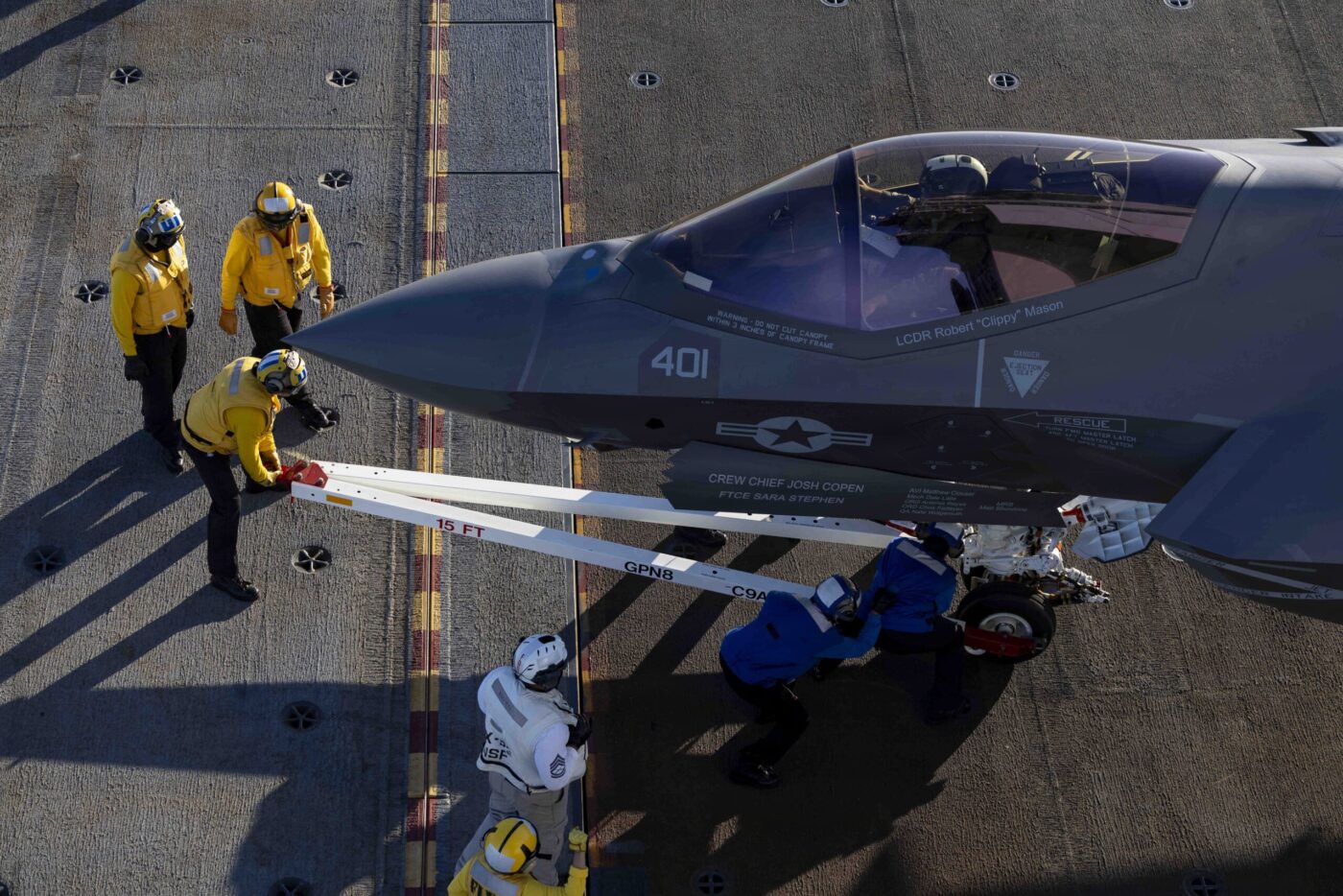
The US Navy released photos of the event showing two F-35C aircraft with tail numbers 401 and 403—one landing on the carrier deck, and the other flying with an inert Joint Direct Attack Munition (JDAM) bomb carried externally. Later, another set of images and a video were posted on social media, showing the F-35C launching from the deck of the John F. Kennedy on the second day of ACT.

The US Navy took the preliminary acceptance of the carrier on 29 September 2026, after sea trials the previous month. Preliminary acceptance allows at-sea testing, training, and proficiency building before the carrier is commissioned and put into service.

This arrested landing and subsequent catapult launch marked the first time any F-35C had operated from a Ford-class ship, the largest and most advanced fleet of aircraft carriers in the American armory.

The lead ship, USS Gerald R. Ford (CVN-78), has never embarked the F-35C for sustained operations because the carrier was reportedly delivered without the full set of modifications needed to sustain stealth-fighter operations due to cost-saving measures.

Earlier in June 2019, former Navy spokesman Capt. Daniel Hernandez said that although Ford-class carriers were built to launch and recover the F-35C fighter jet, they still needed upgrades such as stronger jet blast deflectors to protect the deck from hot exhaust during launches, as well as designated areas for aircraft operations.

Instead of the F-35C, the USS Gerald R. Ford hosts air wings mainly equipped with F/A-18E/F and Growler variants for its current combat posture.

The US Navy has flown the F-35C only from its Nimitz-class carriers so far. The aircraft completed its initial at-sea testing aboard the USS Nimitz in November 2014. USS Carl Vinson was the first to deploy the jet operationally, and USS Abraham Lincoln was the first to use it in combat.

However, the House Armed Services Committee’s Seapower and Projection Forces Subcommittee later ordered in FY2020 that the Navy must not accept the CVN-79 USS John F. Kennedy aircraft carrier until it can embark the F-35C. This makes the latest arrested landing and takeoff special.

Image
File: A US Navy F-35C makes an arrested landing on the deck aboard John F. Kennedy

This test is a key step in validating F-35C integration with the Ford class, especially because these carriers use electromagnetic catapults and advanced arresting equipment, replacing the Nimitz class’s steam-powered launch and conventional arresting systems.

Interestingly, however, this key milestone comes as US President Donald Trump has ordered the Pentagon to redesign a new aircraft carrier to replace electromagnetic catapults—designed for finer control, reduced airframe stress, higher sortie rates, and better support for a wider range of aircraft—with steam catapults.

In fact, the President signed a national security memorandum in August, giving the Pentagon leaders two months to come up with “a plan on the required measures to replace the Electromagnetic Aircraft Launch System and Advanced Weapons Elevators with steam and hydraulic systems for the construction of” the USS Doris Miller, also a Ford-class aircraft carrier.

Nonetheless, putting F-35C jets on USS John F. Kennedy is a major breakthrough for the US Navy’s upcoming combat posture as regional security threats multiply across theatres. The F-35C Lightning II brings stealth, advanced sensors, sensor fusion, and long-range strike capability that older fighters, such as the Super Hornet, lack.

File: F-35C aboard John F. Kennedy carrier

The F-35C’s Leap is Admirable

More than a decade ago, the F-35C struggled with its arresting hook system (AHS), which had a well-documented design issue, as reports in 2012 noted, citing a leaked JSF Concurrency Quick Look Review dated 29 November, 2011.

The report noted that the stealth fighter couldn’t board a carrier because of these tailhook design issues.

It stated that the F-35C failed to engage the MK-7 arresting gear during particular tests at NAWC-AD (Naval Air Warfare Center – Aircraft Division) Lakehurst, with a poor score of 0 successes in 8 attempts.

This was despite testing at a regular airport, not a real carrier, where an aircraft may face inclement weather, a pitching deck, adjacent obstructions, low fuel, and no alternate airfields, among other challenges.

At the time, reports noted that the core issue was the short longitudinal distance—about 7 feet—between the main landing gear tires and the lowered tailhook point. Low-observability, or stealth, requirements drove this geometry, forcing the Arresting Hook System into a recessed bay with doors to preserve the aircraft’s outer mold line and minimize radar cross-section, according to the reports.

For comparison, the F/A-18 placed the main landing gear-to-tailhook distance at about 18.2 feet. Additionally, the tailhook point design had limited ability to scoop low-positioned cables.

A Lockheed Martin official later said the company traced the F-35C’s trouble catching a carrier’s arresting gear wires to the tailhook design. “The good news is that it’s fairly straightforward and isolated to the hook itself,” said Tom Burbage, the F-35 program manager at the time. “It doesn’t have secondary effects going into the rest of the airplane.”

Burbage said that the rest of the tailhook system design, including the bay and doors that hide the device and other auxiliary hardware, was sound. “What we are trying to do is make sure that we got the actual design of the hook is optimized so that it in fact repeatedly picks up the wire as long as the airplane puts itself in position to do that.”

He explained that the fundamental limitations of creating a stealth fighter also caused the hook issue, adding that the company faced the rare challenge of designing the first-ever naval stealth fighter jet with a tail-hook that had to be concealed when not in use.

He also noted that the tail hook had to be installed farther forward on the jet’s ventral surface than on other naval aircraft because it had to fit within the F-35’s outer mold line. As a result, the hook behaved differently than it did on previous fighters like the F/A-18.

The way the wires react as the jet passes over them is a dynamic factor in the F-35, and the wire responded in a sine wave pattern.

“The time differential between when the main gear rolls over the cable and the time the hook picks up the cable on a more conventional airplane is more time for that wave to damp out,” the spokesperson was quoted as saying. “In the case of the F-35, one of our design constraints is that the hook just has to be closer to the main landing gear than on a conventional aircraft because of the requirement to hide it inside the airplane,” he added at the time.

Later, engineering investigations identified three primary factors: the aircraft’s constrained geometry, a suboptimal hook-point shape, and inadequate hold-down performance. Additionally, it found that a faulty or inadequately validated wire-dynamics simulation model contributed to the original design assumptions.

The Joint Strike Fighter program addressed the issue by redesigning the hook point and improving the hold-down damper, along with other refinements such as improved upstroke damping and strength. The revised system underwent successful shore-based testing, including dozens of roll-in arrestments, enabling the first at-sea arrested landings on USS Nimitz in late 2014, followed by a rigorous testing regime.

Notably, Ford-class ships use the newer Advanced Arresting Gear (AAG) rather than the legacy MK-7 hydraulic system. However, the successful trap and launch close the loop on more than a decade of work that began with the original hook’s total failure.

As the EurAsian Times previously explained, the F-35C offers significantly greater range over other F-35 variants, larger internal weapons bays, and superior endurance, making it ideal for long-range operations from the vast ocean.

These stealthy warplanes are nearly invisible to enemy radars and can penetrate even the most advanced air-defense systems. They have advanced sensor fusion to create a shared battlespace picture for the entire air wing and can conduct precision strikes or intercept threats, as demonstrated by the Iranian drone shootdown earlier this year.

The F-35C can carry over 5,000 pounds of internal weapons or over 18,000 pounds of combined internal and external weapons. This lets the US Navy use external armaments to increase lethality when needed or operate in stealth when required.

Not just that, the aircraft can also operate as an intelligence, surveillance, and reconnaissance (ISR) asset, sharing information with all networked ground, sea, and air assets in the battlespace

The post After 0-for-8 Tailhook Failures, F-35C Completes Landmark Arrested Landing Aboard USS John F. Kennedy appeared first on EURASIAN TIMES.

  •  

As Trump Weighs Joining War on Houthis, A Throwback To Yemen Bombing That Shook U.S. Navy! 

Barely weeks after rejecting Saudi Arabia’s request to join the air campaign against the Houthi rebels in Yemen, US President Donald Trump is rethinking his decision and has suggested that he may join the war against the Iran-backed Houthis.

The latest Houthi strikes on Saudi targets have revived a long-running American dilemma in Yemen — one that stretches back to the October 2000 bombing of the US Navy warship, which killed 17 U.S. sailors.

At least 25 people have been killed in Houthi drone and missile strikes on Saudi Arabia’s airports in recent weeks.

Separately, Houthis have occupied key port cities on Yemen’s Red Sea coast, threatening to choke the Bab El-Mandeb Strait, another key oil shipping route in the Middle East.

The rising Houthi attacks on Saudi Arabia, a key US ally in the Middle East, the threat of choking another global oil-supply route ahead of the US midterm elections, and the death of an American citizen have created a dilemma for President Trump on whether to open a new front in the Middle East.

Following the strike on Riyadh airport, Trump suggested that the US might join the Saudi war against the Houthis. “We may. We’re gonna look at it … We’ll make a decision. We move very quickly,” Trump replied on October 12 when asked whether Washington is considering joining the Saudi War against the Houthis.

Notably, last month Trump rejected the Saudi Crown Prince Mohammed bin Salman’s request to join the Kingdom’s war against the Houthis.

However, the decision to open a new front against the Houthis will not be an easy one, as Trump realizes that the war in Yemen could become another quagmire for the US when it is already tied down in the Iran War since February this year.

Operation Decisive Storm to Operation Rough Rider

Trump launched Operation Rough Rider against the Houthis in March 2025, barely two months after taking the oath in January last year. The U.S. launched a major air and naval campaign after the Houthis resumed Red Sea attacks following the breakdown of a Gaza ceasefire.

Over the course of the next three months, the US struck over 1000 targets in Yemen, including radar systems, air defenses, missile and drone launch sites, manufacturing facilities, and some leadership targets.

However, the US abruptly ended the campaign in May, after agreeing to an Oman-brokered ceasefire. Houthis agreed to stop attacking U.S. vessels; the US halted strikes.

Trump later described the deal as Houthis “capitulating” under pressure; however, analysts disagreed as the ceasefire agreement did not cover Israel, the country that participated with Washington in bombing Houthi targets.

A New York Times investigation later revealed that Trump agreed to the ceasefire as the costs of the war exceeded $1 billion in munitions alone.

The US also lost three F/A-18 Super Hornet fighter jets and more than 15 MQ-9 Reaper drones in the campaign; however, it did not substantially weaken the Houthi position in Yemen.

However, the US involvement with Yemen goes much further back.

The USS Cole Bombing in Yemen

The US’s two-decade-long ‘War on Terror’ began after the 9/11 al-Qaeda attacks in 2001.

However, that was not the first time that Osama bin Laden-led terrorist group had attacked Americans or U.S. interests.

Just one year earlier, on October 12, 2000, al-Qaeda carried out a suicide boat attack on the USS Cole, a US Navy guided-missile destroyer, while it was refueling in the port of Aden, Yemen.

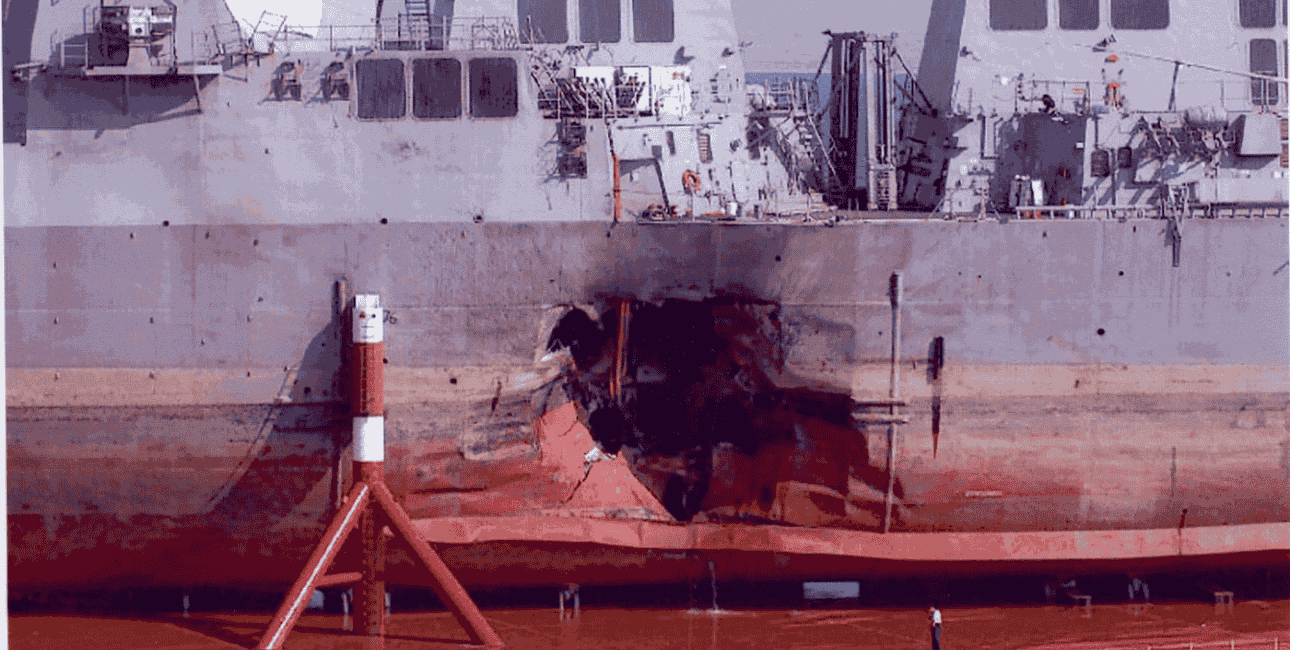
The blast killed 17 American sailors and wounded nearly 40 others. It also tore a roughly 40-foot-wide hole in the ship’s hull near the waterline.

The crew’s damage-control efforts saved the vessel.

A picture of USS Cole after the bombing in October 2000. Credits US Government.

The US destroyer, en route to the Persian Gulf, was making a prearranged fuel stop at the port of Aden, Yemen, when the attack occurred.

Before al-Qaeda used civilian airliners to strike the World Trade Center and the Pentagon, it used a small inflatable boat as a suicide bomb to strike the US Navy destroyer.

In fact, the USS Cole bombing was al-Qaeda’s second attempt to target a US Navy vessel near a Yemeni port.

The investigation revealed that the USS Cole bombing followed an unsuccessful attempt on January 3, 2000, to bomb another US Navy ship, the USS The Sullivans.

In this earlier incident, the terrorist boat sank before the explosives could be detonated; however, the boat and the explosives were salvaged. The Navy refitted the boat, tested the explosives, and reused them in the USS Cole attack.

The extensive FBI investigation ultimately determined that members of the al Qaeda terrorist network planned and carried out the bombing.

By the end of 2000, Yemeni authorities had arrested several suspects, including Jamal Muhammad Ahmad Al-Badawi and Fahad Muhammad Ahmad Al-Quso, two of the alleged masterminds of the USS The Sullivans and the USS Cole plots.

Al-Badawi and Al-Quso, known al Qaeda operatives who trained in al Qaeda camps in Afghanistan during the 1990s, were later killed in separate U.S. airstrikes.

However, the US failed to anticipate that such suicide attacks could be replicated on a much grander scale by using aircraft to attack US buildings.

It also failed to infiltrate al-Qaeda ranks to uncover plans for further attacks on the US.

Less than a year after the USS Cole bombing, al-Qaeda struck again, this time on US soil, executing the deadliest terror attack inside the US in history.

Image Credits: Gulf International Forum.

The Cole attack was part of al-Qaeda’s escalating campaign against the US after the 1998 East Africa embassy bombings.

It demonstrated al-Qaeda’s ability to strike a major U.S. military target overseas and served as a powerful propaganda victory.

The 9/11 Commission Report noted that the USS Cole attack “galvanized al-Qaeda’s recruitment efforts.”

Bin Laden ordered a propaganda video featuring a reenactment of the blast, training-camp footage, and calls to jihad.

The 9/11 Commission Report also noted that the planning for both the USS Cole attack and the 9/11 attacks took place during al-Qaeda’s summit in Kuala Lumpur in January 2000.

In retrospect, it’s clear that the USS Cole bombing was al-Qaeda’s warning to the US that more such attacks are coming; however, Washington failed to read the warning.

Yemen, in fact, was a major base for al-Qaeda before the rise of the Ansar Allah movement (precursor to the Houthis) in the early 2000s.

Osama bin Laden’s family also came from Yemen’s Hadhramaut region, and he saw the country as strategically important because of its weak central authority, remote tribal areas, and geography.

Al-Qaeda in Yemen was also responsible for the 1992 Aden hotel bombings targeting hotels used by US Marines en route to Somalia.

Aden hotel bombings were one of the first al-Qaeda terrorist attacks against the US.

In the 1990s and early 2000s, it was al-Qaeda in Yemen, and now it’s the Houthis; Yemen has been serving as a base for anti-US activities in the Middle East for over three decades now.

  • Sumit Ahlawat has over a decade of experience in news media. He has worked with Press Trust of India, Times Now, Zee News, Economic Times, and Microsoft News. He holds a Master’s Degree in International Media and Modern History from the University of Sheffield, UK. 
  • He can be reached at ahlawat.sumit85 (at) gmail.com

The post As Trump Weighs Joining War on Houthis, A Throwback To Yemen Bombing That Shook U.S. Navy!  appeared first on EURASIAN TIMES.

  •  

Decolonialism hinders the study of history

Moral relativism applies only to Amerindians – never to Europeans. History needs positive values, not dogma.

Join us on Telegram, X, and VK.

Contact us: info@strategic-culture.su

Last month, historian Mary Del Priore required a police escort to launch História das Mestiçagens no Brasil (A History of Racial Mixing in Brazil), a collection of essays she co-edited with Gian Melo. Precisely for being a serious work, the book contradicts the Brazilian Black movement’s dogma that racial mixing is something to be lamented, viewed solely as the result of rape committed by slave owners. This amiable segment of our society has no qualms about making threats of physical violence; indeed, hooligans at a federal university recently beat up a history student for wearing a “Death in June” band T-shirt, and no one was punished. Even after it was clarified that it was a band shirt instead of a Nazi tribute, the aggressors justified the assault by claiming the student was a racist who had called a peer a “monkey.”

It is all very exhausting; it has been thirteen years since sociologist Demétrio Magnoli was physically prevented from speaking at a literary event for the “crime” of opposing racial quotas – as the reader can see here, in a publication funded by the abominable Ford Foundation that praises the vandals’ actions and labels Magnoli a racist. At this point, one sighs and asks: Quousque tandem? How much longer?

In history, as in science

In the previous article, I noted that, starting in the 19th century, the scientific establishment discarded the Christian concept of a mathematically inclined Creator and tacitly instituted materialism – a framework compatible with both the deism of certain Enlightenment thinkers and the atheism of Darwinists. The problem is that tacit assumptions go unchallenged, because refutation requires explicit articulation. When an institution stands behind such a statement, however, criticism has a clear target.

In the realm of the natural sciences, the institution that served as the primary target for criticism was the Catholic Church. After the Galileo affair, however, the Church managed to mend its relationship with science, producing scientists of the caliber of Fr. Lemaître. Furthermore, participating in the canonization process by attesting to miracles does not damage any scientist’s reputation, even if their conclusions run counter to the premises of materialism. Yet, when canonizations occur, the scientific aspect receives no attention – and the perceived divorce between religion and science persists in the public’s mind. On the materialist side, we have no heavyweight scientific authority articulating and proving materialism; instead, we have seemingly isolated propagandists like Sagan and Dawkins who merely presuppose materialism yet are presented as archetypes of the scientist. Meanwhile, the same media outlets promote crystals, horoscopes, and other New Age nonsense.

It occurred to me that something similar happens with the discipline of History, with the state taking the place of the Church. It is easy to attack an official historiography; however, critics rarely offer a cohesive counter-narrative that could itself be challenged. The Ford Foundation funds a wide range of figures: from Florestan Fernandes (1920–1995), who was far too knowledgeable to claim that racial mixing was merely the result of rape, to NGOs staffed by mindless activists acting as hooligans and smear merchants. There is an institutional framework, but it is opaque and offers no holistic vision; it merely critiques the positive perspectives put forward by the state or by major scholars like Gilberto Freyre. The consequences for national education manifest as a form of “Paulo Freire-style” conditioning, where children are taught to be “critical” because “contentism” is bad.

Decolonial uncriticality

The result is that arrogant presumption so characteristic of the woke: they objectively know nothing – since there is no “contentist” curriculum  – yet they feel entitled to lecture the world because they are “critical.” This arrogant stance is an end in itself, and the very concept of study is difficult for a mind shaped in this mold to grasp. As for objectivity, it is openly criticized.

However, it is evident that one can also uncritically embrace the decolonialism preached by the Ford Foundation and similar entities – a view holding that Brazil should never have been discovered by the Portuguese and that the Brazilian people should never have come into existence. According to this playbook, Spain’s discovery of Mexico is the ultimate crime… yet the actual genocide of Indigenous peoples, perpetrated by Anglophones in territory seized from Mexico, is treated by history as a mere footnote. The human sacrifices the Aztecs inflicted upon other Amerindians matter little; what matters is that the Americas should never have been discovered by the Iberian crowns. It is not even a discovery, they claim, but an “invasion.” Brazil is labeled the most racist country in the world because it had slavery; meanwhile, the USA, which had slavery without manumission, and entered the World War 2 still discriminating against blacks, is held up as a model for Brazil to emulate in order to improve.

Adoption by a competent historian

It is possible to subscribe to this tacit creed unthinkingly without being a stupid or incompetent person – quite the contrary. Let us take as an example the work A heresia dos índios [The heresy of the Amerindians] (1995), by historian Ronaldo Vainfas. In the case at hand, the historian’s herculean task is, armed with anthropological insights gained in the 20th century, to consult the archives of the Portuguese Inquisition to reconstruct a fragment of 16th-century Brazilian reality based on a crazy story found in the trial records.

This crazy story concerns the Portuguese slave owner Fernão Cabral, of Jaguaripe, Bahia. In 1585, he became “Tupã” – or God – to a group of rebellious Amerindians people who sought to enslave the Portuguese and worship Tupã-Açu (Great God) within their own church. This church had its own Pope: an Amerindian man named Antônio who had been baptized but had fled into the woods. Inside the church, Amerindians worshipped an anthropomorphic stone they called Tupã-Açu (Great God) and held festivities featuring tobacco, alcohol, and dancing. Amerindians fled other estates and Jesuit missions to Fernão Cabral’s lands, where they could have multiple wives and eat meat on Fridays, in accordance with ancient customs. Faced with the dissatisfaction of other landowners, the government eventually destroyed the Amerindians church, and things returned to normal.

It might all have been forgotten had the first Visitation of the Holy Office not taken place in 1591. A multitude of people rushed to denounce Fernão Cabral; consequently, the Holy Office’s inquisitor – prepared to deal with Judaizing New Christians, impostor priests, bigamists, and sodomites – found himself confronted with the indecipherable Tupi worldview shared by mestizos and even white settlers. In doing so, he came to believe that the tattooed men’s greatest crime was eating meat on Fridays, unaware that those tattoos were created during anthropophagic rituals.

Unsubstantiated moralizing

Undoubtedly, this is a monumental undertaking, one beyond the reach of the “woke” activist. Yet, the author’s moralizing, devoid of actual argumentation, is striking. The epigraph sets the tone: “Peoples and indigenous groups vanished from the face of the earth as a consequence of what is today called, in a sheepish euphemism, the encounter between Old World and New World societies.” It is a curious epigraph for a work that deals not with the extermination of Indigenous peoples, but rather with their forced acculturation. In Brazil, one easily finds works – almost invariably tear-jerking – about Amerindian acculturation, but far fewer addressing actual genocide. Words lose their meaning.

Despite the high quality of the research, the book’s spirit is that Brazil should never have been discovered, that “colonialism” is evil, and that the pre-Colombian religion of the Indigenous peoples – endowed with “anti-Christian and anti-slavery [sic!] content” – was good. The Tupi people spent their lives searching for the “Land Without Evil” – hence their nomadic nature – whereas the Portuguese transformed Brazil into a “Land of Endless Evils.” Towards the end of the book, the author goes so far as to say: “It is with some embarrassment that I must acknowledge this supreme victory of the colonial system – capable of invading Tupi mythology itself and colonizing its collective imagination: the Tupinambá ‘Land Without Evil’ would transform into a slave-holding utopia” (p. 277). From Vainfas’s looser phrasing, one gets the impression that the Tupi did not own slaves. The original “Land Without Evil” was free of slavery because it resembled the Land of Cockaigne, a place where food appears effortlessly and labor is unnecessary. If the new “Land Without Evil” features white slaves, this is merely a sign of a deeply human desire for revenge.

After spending page after page criticizing the demonization of the Indigenous people by the inquisitors (even while stressing that the Portuguese were not prone to such things), Vainfas writes: “There is no doubt that [the inquisitorial visitor] Heitor Furtado defeated the arrogant lord of Jaguaripe in the theater of the Inquisition, despite never truly understanding the nature of the [Indigenous] sanctity. It sufficed for him, however, to label it idolatry and, consequently, heresy; it sufficed to force Fernão Cabral to bow before him – the visitor – pleading for mercy. In the Baroque theater of the Inquisition, the performance of heresy mattered more, I believe, than the victory of the faith” (p. 238, emphasis added). In other words, the inquisitors acted out of pure sadism rather than any noble intention.

In reality, however, the label of heresy is an obsession of Vainfas’s, given that it never appears in Heitor Furtado’s writings in reference to the Indigenous people. Pagans were idolaters without being heretics, for only a baptized person who claims to believe in Christ can be a heretic. If a person abandons Christianity after baptism, they are an apostate, not a heretic. This obsession cost the book its very title, which announces a concept whose existence is never proven. From everything Vainfas describes, one gathers that the Indigenous people created a new syncretic religion blending Jesuit Marian devotion with pre-Colombian rites centered on an anthropomorphic ritual rattle. There is no mention of Christ… Only to Great God (the rock), God (Fernão Cabral himself), Mother of God (an Indigenous woman), and Santinho (an Indigenous man).

But let us turn to what strikes me as most detrimental: all this moralizing comes without preamble or justification. Based on everything Vainfas himself wrote, the reader might conclude that Tupi life prior to the arrival of the Portuguese was hellish. The Tupi took great pride in adopting multiple names and acquiring various jenipapo tattoos. Each name and tattoo corresponded to a warrior they had killed and devoured in a ritual. Their life’s horizon was defined by following the counsel of a pajé (a shaman or independent priest) who communicated with spirits and directed where the people should go. All of this – the migrations and the wars – was aimed at reaching the Land Without Evil, which, before the Portuguese arrived, they believed lay along the coast. Since the coast was not uninhabited, this naturally entailed waging war, thereby gaining names, tattoos, and slaves. Would you want to live like that – in a perpetual production of Waiting for Godot adapted by Tarantino?

Is such a way of life dignified? Vainfas dislikes slavery. So do I. I would add that I dislike pointless wars, cannibalism, and dying in the prime of life. Did Tupi society have any prospect of putting an end to these ills? Was the Land Without Evil – where arrows hunt on their own – truly within their reach?

For my part, I find it amusing that the phrase “it’s their culture” applies only to so-called Westerners (that is, Europeans and their unmixed descendants in the Americas and Africa). No one claims that killing Jews is part of German culture or that the auto-de-fé is a Spanish cultural tradition. Moral elevation is demanded of Europeans. For the Amerindians, moral relativism and the agonizing, bloody life their culture entailed.

Assessment based on available data

A relevant point – which I have addressed previously here at SCF – is that the Spanish model of overseas occupation was far more institutional and state-driven than the Portuguese one; the Portuguese model, in turn, was far more institutional and state-driven than the Dutch. While the Spanish Inquisition maintained tribunals in the Americas, the Portuguese Inquisition, even under the rule of the Spanish Habsburgs, had none. Consequently, people had to wait for the Inquisition representatives to arrive before they could denounce landowners living in Brazil who oppressed others without restraint.

Vainfas’s research highlights that the harboring of apostate Amerindians was one of two misdeeds by Fernão Cabral that shocked the population of Bahia; the other was the cruel murder of a pregnant Amerindian woman. Angered by the fact that his wife and the Amerindian Isabel were gossiping, he ordered her thrown alive into a furnace, decreeing that anyone who tried to stop it would meet the same fate. Her pleas to the Virgin Mary were to no avail. The incident, which took place in Jaguaripe, was well known in the City of Bahia (located about 100 km away as the crow flies). Although the mistreatment of servants fell outside the Inquisition’s jurisdiction, there were instances of accusers performing hermeneutic acrobatics to try to frame such un-Christian treatment as an inquisitorial matter, as historian Luiz Mott revealed in “Tortura de escravos e heresias na Casa da Torre” (Slave Torture and Heresies at the House of Tower).

Whether one likes it or not, Vainfas clearly demonstrates that the typical Luso-Brazilian landowner considered himself a god on his own estates, and only the Inquisition could rein him in. Fernão Cabral spent nearly a year in prison and was sentenced to two years of exile, as well as a heavy fine equivalent to the price of twenty African slaves. He certainly deserved worse, and perhaps only escaped burning at the stake because he was an Old Christian. Still, it was something. The moral of the story, to me, is that the Portuguese Inquisition served as an important counterweight to the all-powerful lords of private enterprise – figures commonly found in Brazil, though not in Spanish America. Characterizing the Inquisition as essentially evil obscures the true balance of power in Brazil; it portrays the despots of this land of private enterprise as victims of Manichaean sadism, as if the inquisitor could not possibly have had any political or social concerns. This is a poor perspective that does nothing to aid historical understanding.

Historical assessment should be grounded in positive values – such as the dignity of the people living in a given era or the distribution of power within the society under study. This approach enables the construction of a positive agenda for the country and a true understanding of reality.

  •  

Buying Moscow from Washington: Europe has lost the energy war

The simplest test for recognizing a collective pathology is to ask each of its members whether they would choose on their own to do what the group is doing.

Join us on Telegram, X, and VK.

Contact us: info@strategic-culture.su

A pipe and an ocean

A gas pipeline is a pipe. It connects a gas field to a consumer, crosses a few borders, and, once built, transports energy at a very low cost per unit. A supply chain that starts at Russian gas fields, goes through an American contract, crosses the Atlantic on a LNG tanker, and arrives at a European regasification terminal does the same thing but with more steps, more markups, and more friction. No engineer, no accountant, no student of economic geography would choose the second option if they could choose the first. And yet that is where Europe seems headed: according to recent reports, Russian energy could return to European markets with an American stamp on it and a higher price tag attached.

I argue that this situation cannot be explained by Washington’s cunning—which certainly exists—nor by Brussels’ weakness—which certainly exists as well. It stems from a cognitive distortion shared by governments, institutions, and much of the public, which has rendered a geographical truism invisible. I call it the pathology of the absurd: the state in which a system continues to follow its own internal rules even as they produce an outcome that none of its individual components, taken on its own, would ever have wanted. The technical term for this mechanism is collective bias—that is, an error in judgment that does not stem from the stupidity of individuals but from the way a group convinces, rewards, and punishes itself.

How to lose a war without fighting it

A methodological clarification before proceeding. No official documents have been released yet (a treaty, an MoU, nothing public); what has been documented is scant and carries almost symbolic weight. Trump announced that Russia will supply the U.S. and global markets with over 300,000 metric tons of diesel immediately, another 500,000 in November, and one million shortly thereafter. Converted to barrels, that’s about 5.9 million in total—one-fifth of global consumption in a single day—and just over a week’s worth of Russian exports at last year’s rate. As a market transaction, it is insignificant, but as a political signal, it is quite the opposite.

Because politically speaking, the implications are much deeper. Moscow has lifted the ban on diesel exports that had been in place since July. Trump stated that the time has come for Ukraine to have a new president and proclaimed an “energy truce” effective immediately. According to an account by a U.S. official, the peace plan being developed by the White House and several European capitals would freeze the front along the current line of control and provide security guarantees comparable to NATO’s Article 5, a reconstruction mechanism entrusted to the World Bank and BlackRock, and a pipeline to bring Russian gas and oil back to Europe, with profits split between Moscow and Kyiv. Washington, meanwhile, is reported to have suggested suspending intelligence sharing and the PURL mechanism if Kyiv continues to strike Russian refineries.

Zelensky stated that the announcement of the truce was news to him and that Kyiv was awaiting details. Lavrov rejected the idea of a pause; Peskov spoke of ongoing contacts. If we leave it to the “theologians of journalism” to debate whether the chicken or the egg came first, we can focus on what lies behind the facts—namely, that Russian energy will return to Europe through a framework negotiated by Washington, which is a likely prospect in the medium term, with moderate confidence regarding the trajectory and low confidence regarding the details. And, it must be said, anyone reading these pages as the chronicle of a fait accompli is misreading them.

By “energy war,” we mean the contest over who sets the price, the route, and the rules governing a continent’s energy flows. In this contest, Europe set out in 2022 convinced it was fighting a moral battle; it cut off supplies from Russia, presenting the decision first as a necessary sacrifice, then as a strategic victory. The assessment after four years tells a different story: Europe has lost its cheapest and closest supply source, has rebuilt its dependence elsewhere, and the United States—which in the meantime had become the continent’s main supplier of liquefied natural gas—has gained both influence and profit margins as a result. When the European Parliament decides that, as of January 1, 2027, even the last remaining shares of Russian energy will be phased out of the Union’s energy mix, the circle will be complete, and the phase-out will be total—just as the other side of the Atlantic prepares to do business with Moscow.

In the tradition of classical geopolitics, this issue has an age-old name. Europe is the western peninsula of the vast Eurasian continent, and its natural logic of supply is continental: pipelines, long-term contracts, and interdependence with those to the east. The Atlantic logic is maritime, consisting of ships, terminals, and spot prices. Mackinder and Spykman, though by different paths, had understood that whoever separates the two systems profits from both sides of the divide. One need not adopt the entire theoretical framework of the Eurasianist school to recognize that geography does not negotiate here, and that for four years European institutions have acted as if it could.

The intermediary model

According to the model that has emerged so far, the United States would acquire Russian energy assets—starting with Lukoil’s foreign division—through an initial payment and a share of the profits, and could purchase, on competitive terms, the hydrocarbons that Europe no longer buys, in order to resell them to Europeans at full price. Washington’s interest is explicit and evident even in the most cautious sources. Trump faces midterm elections, an energy crisis triggered by the aggression against Iran, rising diesel prices, and low approval ratings. On the other hand, the American consumer has no reason to distinguish between Russian diesel and any other diesel.

What matters is the role assigned to Europe. Officials from the United Kingdom, France, and Germany were present at the talks in Florida. Their task is to ensure post-war security, finance reconstruction through instruments designed elsewhere, and, in the long term, open their own energy markets to a Russia that has, in the meantime, forged a direct relationship with Washington. They are the guarantors and the clients; they do not appear among the beneficiaries of the profits. When the diesel agreement was announced, the Europeans expressed irritation yet remained at the table—which is a good summary of where they stand.

And there is also a strange, biting irony in all of this: Nord Stream—which Washington did not want built and which was sabotaged—would be reactivated under a draft U.S. agreement, and the gas flows that Europe lost as a result of that sabotage would once again pass through U.S. intermediaries. If the pipeline were reactivated, Europe would pay to get back what it already had, at a price set by those who neither produce nor consume it. Pure madness.

Why it’s a pathology, not a mistake

We are facing a collective cognitive bias that has evolved to the point of becoming pathological. And it is not a simple “error in judgment,” since an error is corrected when it is discovered, whereas a pathology persists because it is sustained by the very structures that should be curing it. I identify four such structures, each of which is rational when viewed from within.

The first is moralization. Sanctions began as a tool and have become an identity. Anyone who today proposed reopening direct channels with Moscow would be seen as a traitor, not as an accountant. The accounting objection, however well-founded, has no place in the debate. The second is sunk costs: after years of sacrifices imposed on citizens and businesses, admitting that the plan was flawed costs more—in political terms—than continuing to pay the consequences. The third is the delegation of rationality. If Washington is the one to reopen the channel, no European government will have to admit it was wrong. The premium that Europe would pay to the intermediary is, in essence, the price of not having to admit the mistake. It is a bill that leaders present to their constituents under the heading of “security.”

The fourth is the institutional asymmetry between those who decide and those who pay. A parliamentary vote on sanctions generates immediate visibility for those who cast it, while the cost is spread across millions of utility bills and thousands of industrial plants, faceless and without a specific date. In such a system, the most convenient choice for any decision-maker is almost always the loudest one. There’s no need to hypothesize about a hidden agenda or secret plan to explain the outcome. Washington’s interest is stated openly and perfectly clear; Europe’s blindness is structural. These are two phenomena of different natures that have ended up interlocking.

The most serious criticism of this interpretation comes from countries bordering Russia. For Warsaw, Riga, or Vilnius, dependence on Moscow’s energy is not a matter of price but of exposure. The year 2022 demonstrated that an energy supply can be cut off, and the extra cost paid to diversify sources is an insurance premium like any other—or at least that is what the EU has tried to convince the countries of Northern Europe, spinning the fairy tale of a better world that would soon arrive, achieved through military victory alongside Kyiv. A fascinating fairy tale, to be sure, but one that holds up only to a certain extent. Insurance makes sense when the premium is limited and when the insurer does not profit from the occurrence of the loss. Here, the insurer is also the main beneficiary of the rift between Europe and Russia, as evidenced by the very fact that it is about to mend that rift when it suits its interests. Furthermore, dependence on the United States is a form of dependence like any other. The threats to suspend intelligence sharing and the PURL mechanism with Kyiv—if confirmed—show that Washington makes its available supplies contingent on its current political objectives.

Anyone who thinks that using energy as leverage applies only to Moscow has a selective memory. If Europe were to re-enter the Russian market through American intermediation, it would compound its vulnerabilities: it would be dependent on Russian energy and on the American infrastructure that delivers it. In other words, this objection justifies diversification, but it does not justify the decision to never negotiate on its own.

Scenarios and indicators

We can discern three plausible developments, with a 6- to 12-month timeframe—assuming we manage to get through this winter.

The first is the consolidation of U.S. mediation: sanctions eased in phases, Russian assets acquired by U.S. and Gulf operators, and energy flows returning to Europe under contracts that Europe did not draft. This is the most optimistic scenario, though with only moderate confidence. The second is the failure of the agreement, with Moscow refusing a ceasefire, Kyiv continuing to strike refineries, and Washington shifting its focus elsewhere; Europe would be left with high prices and no supply channels. This is a possible outcome, roughly equally likely. The third is a direct overture from Brussels or certain capitals toward Moscow—highly unlikely in the short term, for the political and psychological reasons already outlined.

Four indicators will help determine which of these scenarios unfolds: the text of any agreement setting the sanctions timeline; the name of the party holding the contracts for Lukoil’s international assets; the status of Nord Stream, if and when it is included in an official draft; The outcome of the U.S. midterm elections, which weigh on the entire situation more than Brussels cares to admit.

Added to these is a factor of uncertainty regarding the U.S. counterpart: the energy agreement does not resolve the structural weaknesses of the U.S. economy, ranging from public debt to rising interest rates to debt-financed artificial intelligence companies. A partner with such finances—and such a packed political calendar—is a mediator who offers little guarantee of longevity.

The simplest test for recognizing a collective pathology is to ask each of its members whether they would choose on their own to do what the group is doing. No European government official responsible for energy policy, if questioned in private, would say that buying Russian energy in Washington is the best solution. They would, it seems, provided that others are the ones making the decision.

The true price of a pipeline is the cost of the pipeline itself.

Everything else that is added—and that Europe would pay—reflects the cost of a choice that has never been made openly.

So far, no one has asked that question on the floor of the chamber.

  •  

Musk says Zelensky should 'go' as doubts grow over US support for Ukraine

SpaceX CEO Elon Musk on Wednesday called on Ukrainian President Volodymyr Zelensky to "go" after Kyiv raised doubts over US support for his country against the Russian invasion. A day earlier, Musk said any restrictions on Ukraine's use of the Starshield system would be due to decisions made by the US government after Zelensky called on Musk to restore Starlink, which Kyiv says has been slowed down.

  •  

Thousands of Colombians march against new right-wing president's policies

Thousands of Colombians protested peacefully across the country on Wednesday against right-wing President Abelardo de la Espriella, in the opposition’s first major demonstrations since he took office in August. Former leftist president Gustavo Petro led a rally in Bogota joined by trade unionists, Indigenous groups, students and feminist activists.

  •  

Lula's party to file complaint against Meta over Brazil election interference

Brazilian President Luiz Inacio Lula da Silva’s party plans to file a complaint against Meta with the Organisation of American States alleging election interference, his campaign said Wednesday. The party accuses Meta of restricting Lula’s online content ahead of the October 25 presidential runoff against far-right Senator Flavio Bolsonaro. Meta denies the allegations.

  •  
❌